A lesson for upper elementary students exploring the International Space Station as a symbol of global cooperation, featuring a video-based discussion and a creative engineering activity to design a new scientific module.
A quick 30-minute introduction to the skeletal system, focusing on its main functions and the names of key bones in the human body. Students will explore how their 'internal frame' helps them move and stay protected.
A 5th-grade science lesson exploring the biological impact of nature on the human brain, featuring a hands-on outdoor experiment to measure stress levels.
Students explore the ecosystem beneath the forest floor, focusing on animals that create tunnels and live among tree roots.
A lesson exploring the characteristics, classification, and social behavior of prehistoric Sabertooth cats.
A lesson focused on the formation of sedimentary rocks and how their layers serve as a timeline for life on Earth, specifically focusing on the sequence of formation and fossil aging.
A lesson exploring the unique life cycle of periodical cicadas and how their emergence patterns help them survive and reproduce.
A hands-on science lab using crackers, water, and plastic bags to simulate the digestive process, with differentiated materials for various learner needs.
A lesson introducing students to various ecosystems through vocabulary and visual identification. Students will learn the key characteristics of different biomes including forests, deserts, and oceans.
A lesson that uses a 'mystery drink' metaphor to teach students about computer viruses and the critical importance of asking for permission before downloading files from the internet.
A 5th-grade STEM lesson where students explore the concept of neurodiversity and engineering through the lens of Jack and Jill's creative solution to a water transport problem. Students will design and build their own aqueducts to move water without carrying it, reflecting on how 'thinking outside the box' leads to innovation.
A comprehensive lesson exploring how the five sense organs collect data and send signals to the brain for processing. Students will learn the pathway from stimulus to perception through reading, mapping, and assessment.
A comprehensive lesson exploring the five human sense organs, their functions, and essential care practices to maintain sensory health.
A comprehensive lesson investigating aquatic ecosystems through leaf pack analysis. Students identify macroinvertebrates, explore their specialized adaptations, and evaluate how human activities impact water quality and biodiversity.
A post-dissection lesson focused on analyzing owl pellet data to understand ecological relationships and energy flow, with materials specifically designed for both 9th grade (quantitative analysis) and 5th grade (qualitative observation and basic food chains).
Students investigate how different gene versions lead to different proteins and traits, moving from Darwin's Bark Spiders to human athletes. They will model inheritance and apply their findings to real-world runner scenarios.
A comprehensive set of materials designed for MCAS-Alt portfolios, focusing on the plant life cycle (birth, growth, reproduction, and death) through sequencing and model-building.
A comprehensive resource set for teaching and assessing the flow of matter in ecosystems, specifically designed for MCAS-Alt data collection. Students will identify roles (producer, consumer, decomposer) and build models of energy flow using food chains.
A lesson focused on observing and questioning inherited traits in animals (dogs, cats, and humans) designed for MCAS Alt evidence collection. Students use structured sentence stems to record observations and develop inquiry questions about how traits are passed from parents to offspring.
Explore the fascinating world of birds that have traded flight for other incredible skills in this engaging introductory lesson.
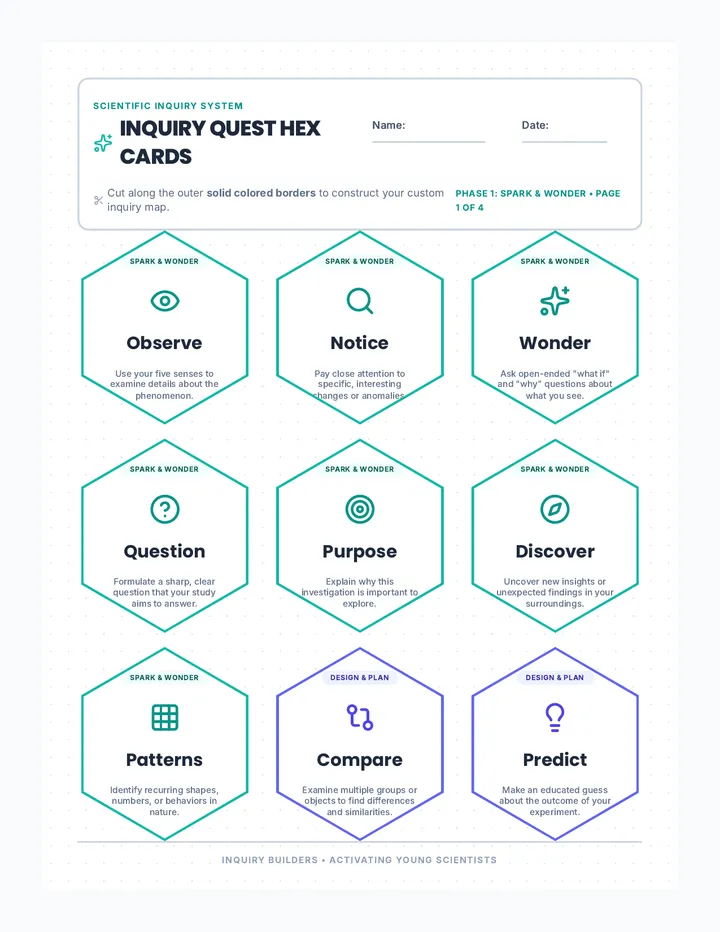
A hands-on project where students explore their own traits and talents. Students will document their unique 'code' and present their findings through a structured project guide.
Focuses on summarizing Kamal's story and digging deeper into character feelings. Students will compare literal text with implied meaning and practice identifying the main idea and key supporting details.
Students will define and distinguish between inherited traits (hair color, eye color) and talents (singing, sports) using Kamal's story as a guide. They will use a graphic organizer to categorize these features and complete a varied question worksheet.
A lesson focused on understanding the human digestive system, tracking the path of food and the role of helper organs.
Students will identify local pollinators, understand the pollination process, and begin designing a habitat conservation plan.
A visual, snowman-themed lesson designed for autistic elementary students to explore the three states of matter (solid, liquid, gas) through hands-on experimentation and clear visual aids.
Applying knowledge of electricity and magnetism to build and understand series and parallel circuits.
An investigation into magnetic fields, poles, and the invisible forces that attract and repel materials.
Students explore the concept of electrical energy, understanding where it comes from and how it moves from one form to another.
Students explore the visible light spectrum and how white light is composed of many colors.
Students classify materials as transparent, translucent, or opaque based on how much light passes through them.
Students investigate how light bends when it passes through different mediums like water or glass.
Students explore how light reflects off surfaces and how we use mirrors to change its direction.
Students discover that light energy travels in straight lines from a source until it hits an object.
A lesson designed to help students distinguish between effective and ineffective slide design for their invention presentations. It uses a side-by-side comparison of a 'good' and 'bad' presentation to teach visual design and organization principles.
A quick assessment on the fundamentals of block-based programming using Scratch, focusing on sprites, scripts, and control flow.
An investigation into soil layers and composition, exploring how organic matter and weathered rock combine to support life.
Students learn how rocks are constantly recycled and transformed through the rock cycle via heat, pressure, weathering, and erosion.
An exploration of the three main types of rocks—igneous, sedimentary, and metamorphic—and how their formation processes define their characteristics.
Students investigate the specific properties used to identify minerals, including hardness, streak, luster, and cleavage, using a hands-on lab approach.
A lesson introducing core marketing concepts through interactive listening activities and visual matching. Students will master terms like market research, demographics, advertising, and the sales funnel.
An exploration of the biology and behavior of the Great White Shark, focusing on vocabulary development and anatomical features through an underwater explorer lens.