An introductory lesson exploring the global economy through the lens of GDP, HDI, and diverse economic systems, emphasizing the interconnectedness of globalization.
A deep dive into the life of Nelson Mandela, focusing on his struggle against apartheid and his vision for a unified South Africa. Students will explore historical context and the power of reconciliation.
A comprehensive mini-project exploring the evolution of women's rights, pioneers in STEM, and leaders in social justice through creative research and presentation.
This lesson explores the complex ethical and strategic arguments surrounding the United States' decision to use atomic weapons against Japan in 1945. Students will analyze primary arguments and engage in a 'This or That' decision-making activity to understand the historical dilemma.
In this project-based lesson, students act as "Economy Architects" to design and create artistic representations of the four major economic systems. They will explore the characteristics of traditional, command, market, and mixed economies through visual storytelling and structural design.
This lesson traces the structural and functional evolution of the U.S. federal court system from its constitutional origins to the modern day, focusing on key legislative acts and judicial shifts.
A comprehensive lesson exploring the 1215 conflict between King John and his barons, the creation of the Magna Carta, and its lasting impact on modern democracy and individual rights.
A lesson exploring the legal and social definitions of refugees, asylum seekers, and internally displaced persons to help students understand the complexities of global displacement.
A deep dive into 20th-century US History through the lens of Forrest Gump, covering the Civil Rights Movement, the Vietnam War, and the Cold War era. Students will analyze the film's portrayal of historical events and distinguish between cinematic fiction and historical reality.
A high-intensity jigsaw activity designed for APUSH students to analyze 10 foundational primary sources of the American Revolution, exploring diverse perspectives from Patriots, Loyalists, women, and enslaved people.
A comprehensive jigsaw activity where students analyze 10 primary sources to understand the diverse and often conflicting perspectives surrounding the American Revolution, including Loyalist, Patriot, British, and marginalized voices.
Students learn to deconstruct and analyze historical images and political cartoons using the S.I.G.H.T. framework to uncover symbolism, bias, and visual narratives.
Students learn to interrogate written primary sources using the P.R.I.S.M. framework to uncover author perspective, historical context, and hidden biases.
Students learn to interpret and deconstruct historical data visuals like graphs, tables, and charts using the C.L.U.E.S. acronym to understand the historical narrative behind the numbers.
A comprehensive look at the Enlightenment, focusing on the major philosophes, their groundbreaking ideas on government and society, and the enduring impact of their work on modern democracy.
A 40-minute lesson focusing on Norse rituals and their connection to the Year 11 Assessment Task Checkpoint 2. Students will explore Blót, burial rites, and Seidr to understand how these practices shaped Norse society and the human search for meaning.
A comprehensive practice exam and answer key focusing on Australian consumer, financial, and legal rights and responsibilities, as well as labour market factors and decision-making.
A practice exam focusing on the rights and responsibilities of individuals in legal and employment contexts, as well as factors affecting economic decisions. Includes multiple choice, data interpretation, and an extended response section.
This lesson explores the life and influence of Anne Boleyn, examining her as a 'proto-feminist' figure who defied 16th-century gender norms and acted as a catalyst for the English Reformation. Students will analyze her power dynamics with Henry VIII and her lasting impact on the Tudor legacy and future feminist movements.
Discover the ancient origins, symbols, and nature-connected rituals of Beltane, alongside a creative floral craft.
A comprehensive lesson on the Civil Rights Movement featuring gallery stations and a guided investigation worksheet. Students analyze institutional obstacles, legal strategies, non-violent and militant tactics, and the expansion of the movement to other marginalized groups.
An exploration of Australia's entry into World War II, focusing on the constitutional and cultural ties to the British Empire that led to the declaration of war in 1939.
A lesson focused on researching and profiling influential women using digital encyclopedias. Students practice gathering key facts and summarizing information in an accessible format.
An in-depth exploration of Charles Sumner's role as a radical abolitionist and political catalyst in the years leading up to the American Civil War. This lesson examines his rhetoric, legislative strategies, and the national impact of his physical assault on the Senate floor.
Comprehensive answer keys and teacher facilitation guides for the Europe remediation packet.
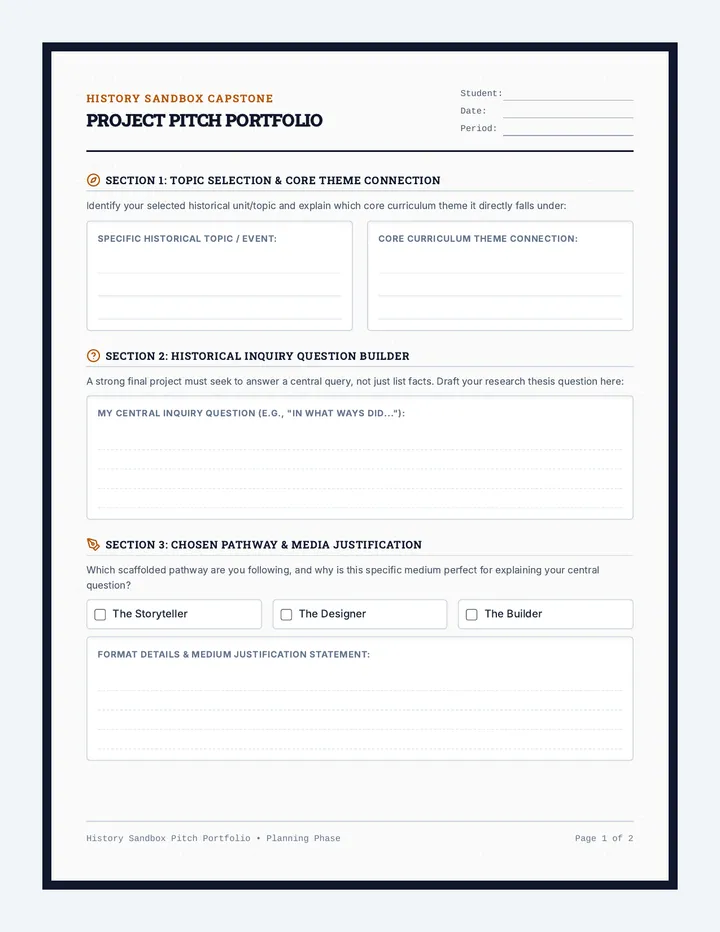
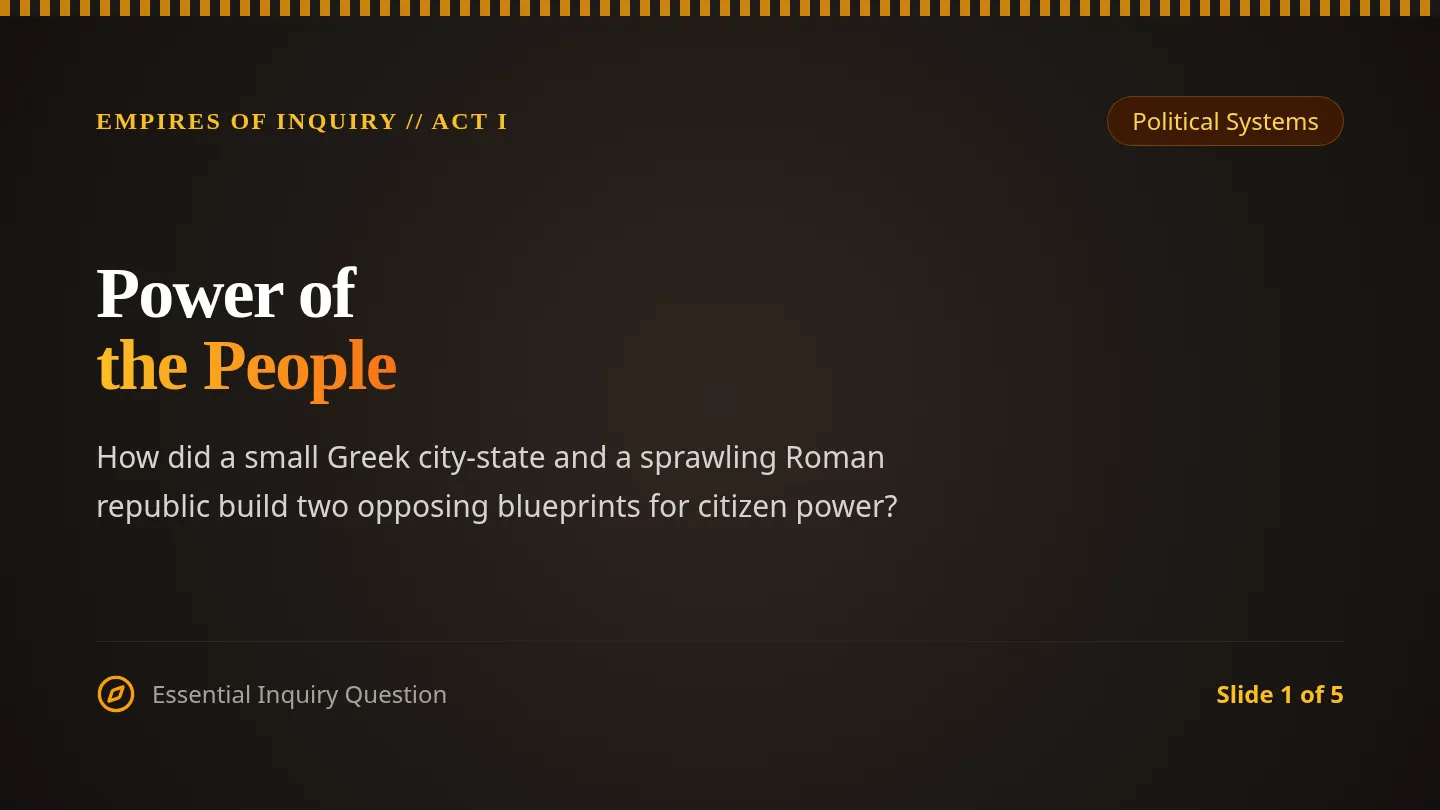
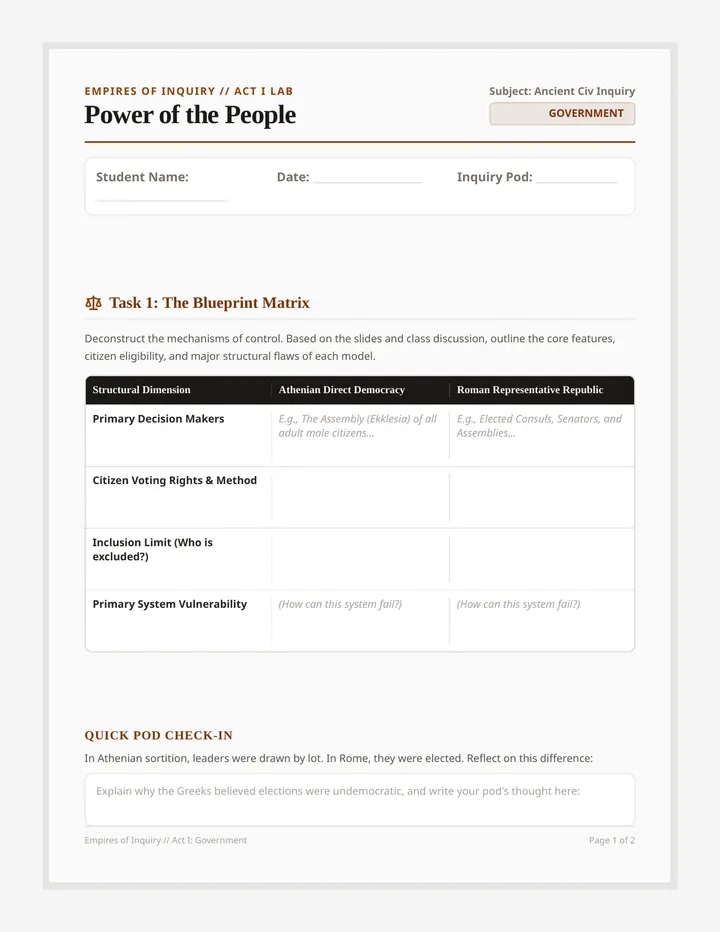
A deep dive into how the philosophies, government structures, and architecture of Ancient Greece and Rome laid the groundwork for modern European society.
A lesson exploring the complexities of Fourth Amendment protections in the digital age through 10 realistic search warrant scenarios involving electronics. Students will analyze legal dilemmas, identify exceptions, and argue the constitutionality of various search and seizure methods.
A high-intensity warm-up session focusing on the landmarks of the Civil Rights Movement, from legal victories to grassroots activism.
A fast-paced, 45-minute review session designed to prepare students for a test on the Articles of Confederation, the Three Branches of Government, and the First Amendment through independent 'investigation' and group 'case solving'.
A high-energy, gamified review session covering the Articles of Confederation, the Three Branches of Government, and the First Amendment to prepare students for their upcoming assessment.
An introduction to behavioral economics for 12th-grade students, focusing on psychological biases, irrationality in decision-making, and the ethics of nudge theory in market trends.