An introductory 6th-grade science lesson covering biotic and abiotic factors, levels of organization, competition, symbiosis, and adaptations, closely aligned with curriculum assessments.
An inquiry-based exploration of the four forces of flight—lift, weight, thrust, and drag—through the lens of aerospace engineering. Students design, test, and iterate on paper gliders to observe aerodynamic principles in action.
A final assessment to evaluate student understanding of thermal energy transfer, insulators, and conductors.
Applying thermal energy knowledge to complex real-world scenarios through a reading passage and interactive task cards.
A hands-on laboratory experiment where students test various materials to determine their effectiveness as insulators.
Reviewing the three types of heat transfer through interactive slides and a graphic organizer to connect concepts to everyday life.
A comprehensive lesson on the water cycle, covering evaporation, condensation, precipitation, runoff, and absorption through visual aids and tiered practice.
A comprehensive introduction to biomimicry where students explore how nature's best designs solve human challenges, culminating in a creative engineering project.
Students explore the Input-Process-Output (IPO) model by deconstructing everyday smart devices and designing their own tech solutions to classroom challenges. This lesson bridges the gap between physical hardware and programmatic logic through hands-on analysis and creative problem-solving.
A comprehensive lesson exploring why Australia receives high levels of UV radiation, focusing on ozone depletion and the interaction between light and matter. Students analyze data, practice constructing scientific explanations, and explore the biological impact of UV light.
A physics-focused lesson exploring the concept of centrifugal force through real-world applications like amusement park rides, car turns, and washing machines. Students will distinguish between centripetal and centrifugal force while analyzing how spinning motion affects objects.
A comprehensive 50-minute review session focused on energy transfer, ecological roles, and ecosystem stability, modeled after the Unit 5 Assessment. Includes a warm-up, main review worksheet, and exit ticket.
A journey into the intersection of Ancient Greek geometry and astronomy. Students explore how the Greeks used 'perfect' shapes to accurately calculate Earth's size and shape, while also examining how that same quest for perfection delayed our understanding of planetary orbits.
An exploration of gravity as the fundamental force that 'sculpts' the universe. Covers orbits as 'falling and missing', gravity as the engine of stellar fusion, and how it interacts with mass and distance to shape everything from tides to galaxies.
A comprehensive exploration of our solar system, covering Earth-Moon-Sun interactions, planetary characteristics, the reclassification of Pluto, and the mysteries of the outer reaches. Designed with a 'Space Explorer Field Manual' aesthetic for middle school learners.
Initial lesson on Ancient Greek astronomy and navigation foundations.
Exploration of current space science, including the mechanics of the moon, GPS technology, and future lunar missions.
An introductory exploration of the solar system's components, planetary order, and key celestial facts designed for middle school students.
An introduction to how Ancient Greek thinkers combined philosophy, geometry, and observation to understand the universe. Students will explore the transition from mythological explanations to mathematical models of the cosmos.
A comprehensive set of Science of Reading based activities focusing on geological vocabulary through phoneme-grapheme mapping, syllable division, and morphological analysis.
Focuses on the role of plants and animals in cycling water through ecosystems, specifically looking at transpiration and animal respiration/waste.
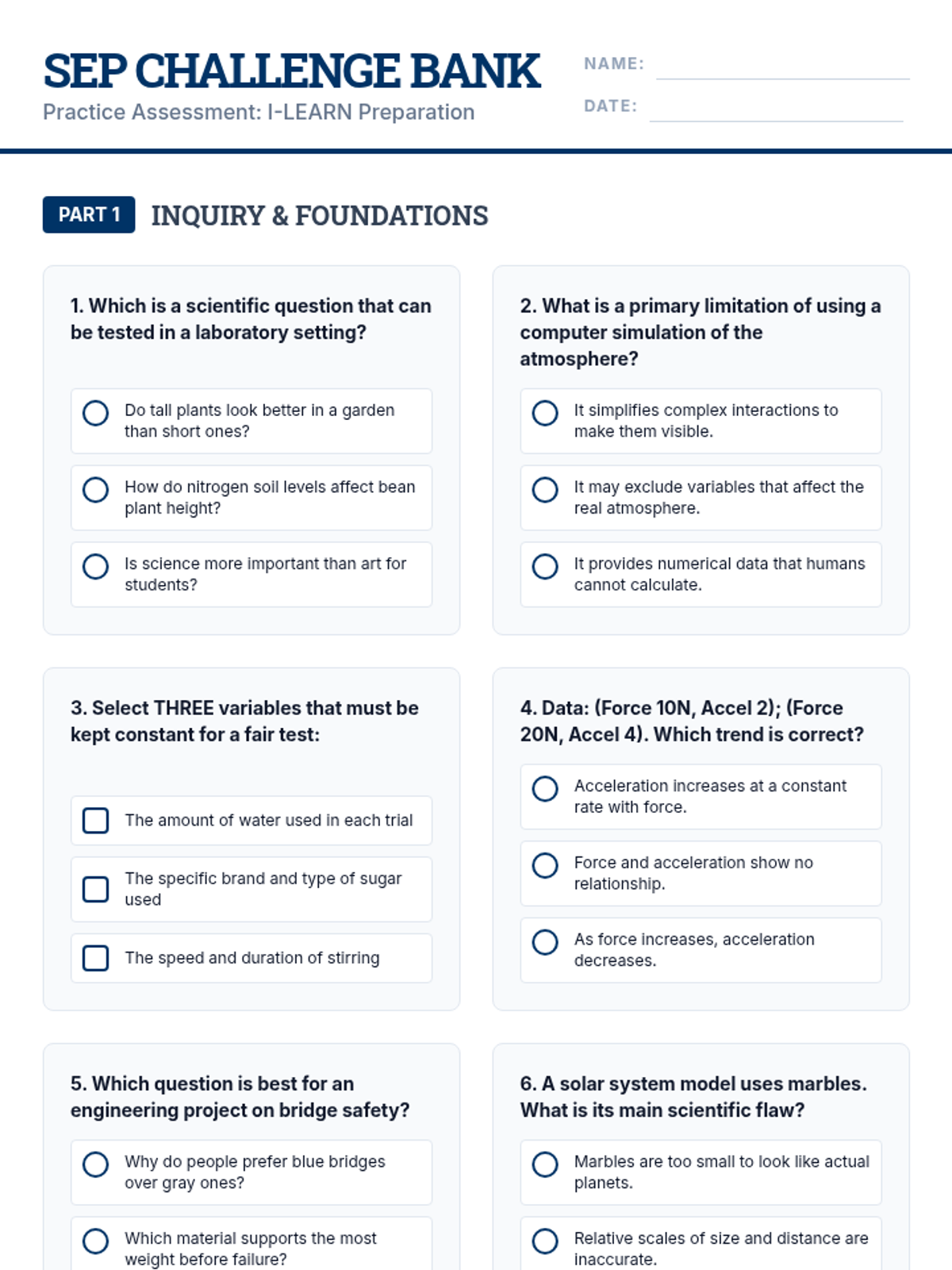
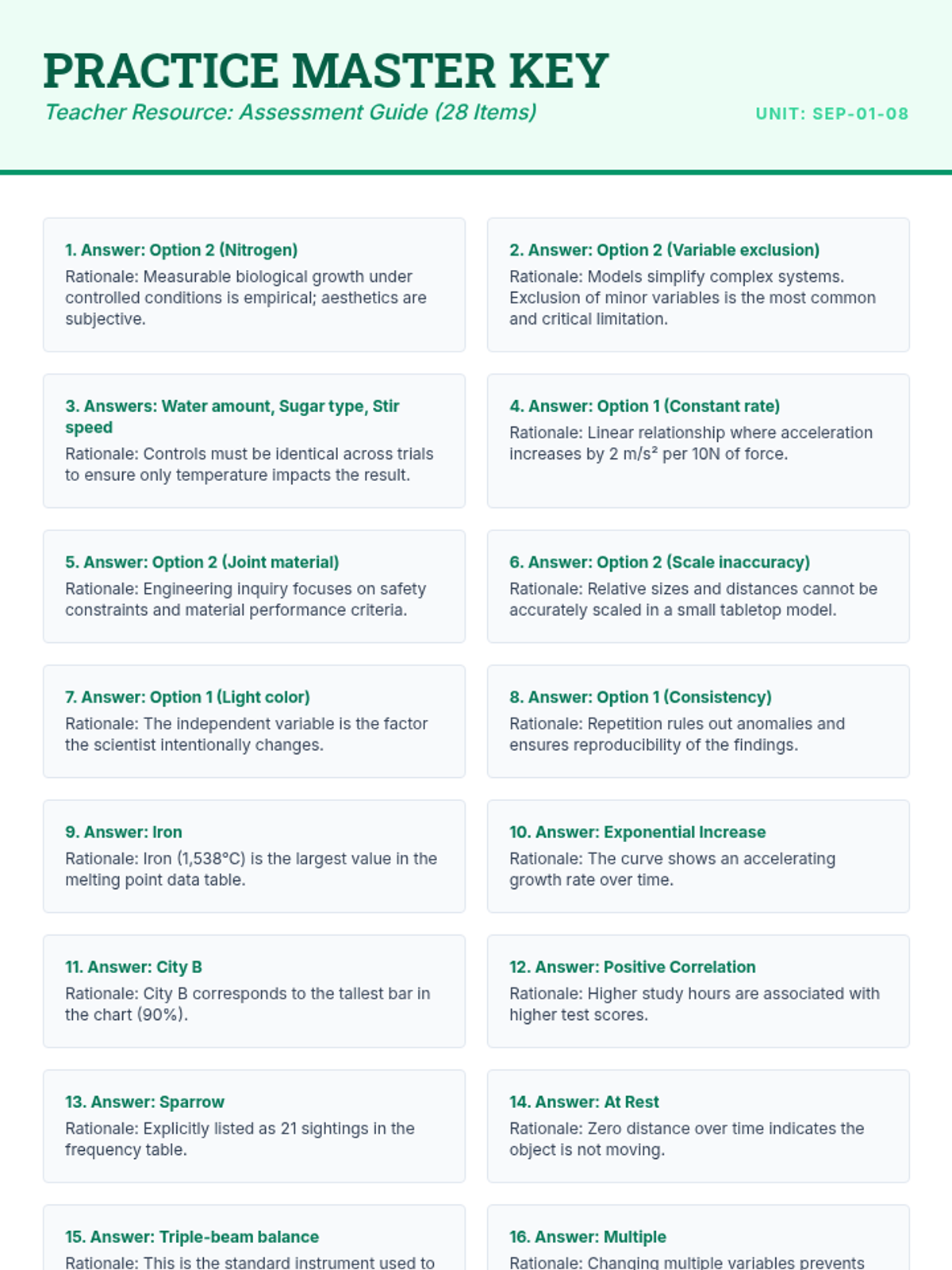
A high-stakes assessment focused on interpreting various scientific data representations, including tables, bar graphs, line graphs, and scatter plots. Students will analyze trends, identify variables, and draw conclusions from realistic scientific scenarios.
A fast-paced, 20-minute lesson introducing students to the essential physical buttons and ports found on modern computers, focusing on identification and function.
A foundational look at robot anatomy, exploring how sensors, actuators, and controllers work together to create a functional machine.
A student-led inquiry project exploring the intersection of music and neuroscience. Students choose their own research path to discover how musical training transforms cognitive development and present their unique findings.