Students will differentiate between the major biomes of Eastern Europe (Tundra, Taiga, and Grassland) by analyzing a video and creating a travel guide flyer that details climate, vegetation, and unique environmental challenges.
A look into the lives, systems, and vocabulary of the thirteen original American colonies.
An immersive gallery walk exploring the core beliefs and historical influences of Hinduism, Buddhism, Judaism, Christianity, Islam, and Taoism. Students rotate through visual stations to build a comparative understanding of global spiritual traditions.
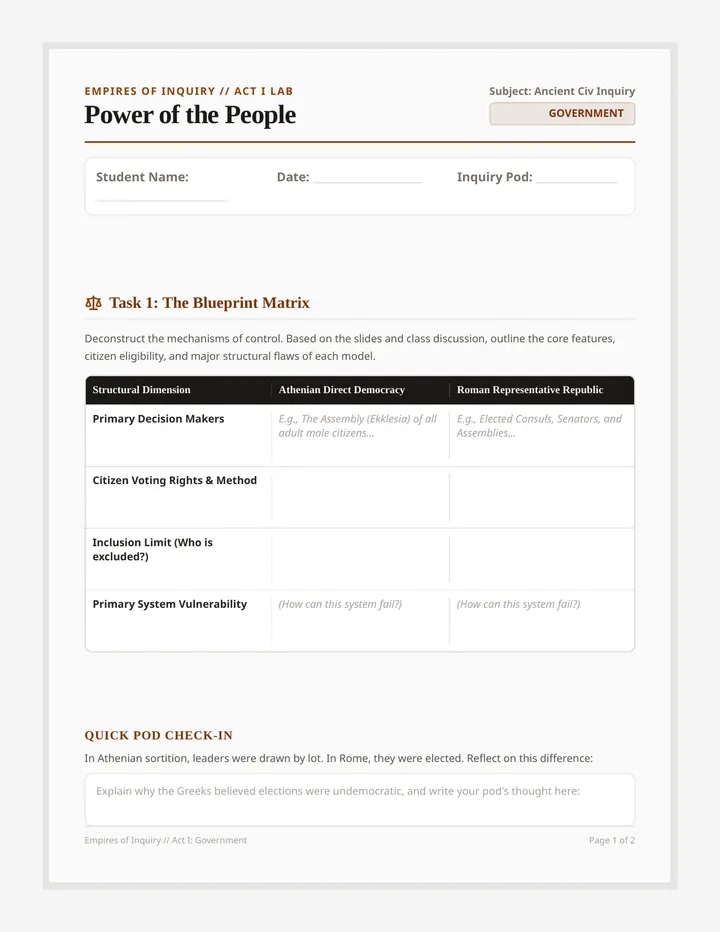
An exploration of the foundations of citizenship in ancient Athens, covering eligibility, rights, responsibilities, and the unique practice of ostracism.
An in-depth look at the landmark Supreme Court case of Dred Scott v. Sandford, exploring its legal complexities and its role as a catalyst for the American Civil War.
A lesson exploring the Olmec civilization through their iconic colossal heads, focusing on social hierarchy, political power, and their enduring legacy as Mesoamerica's 'Mother Culture'.
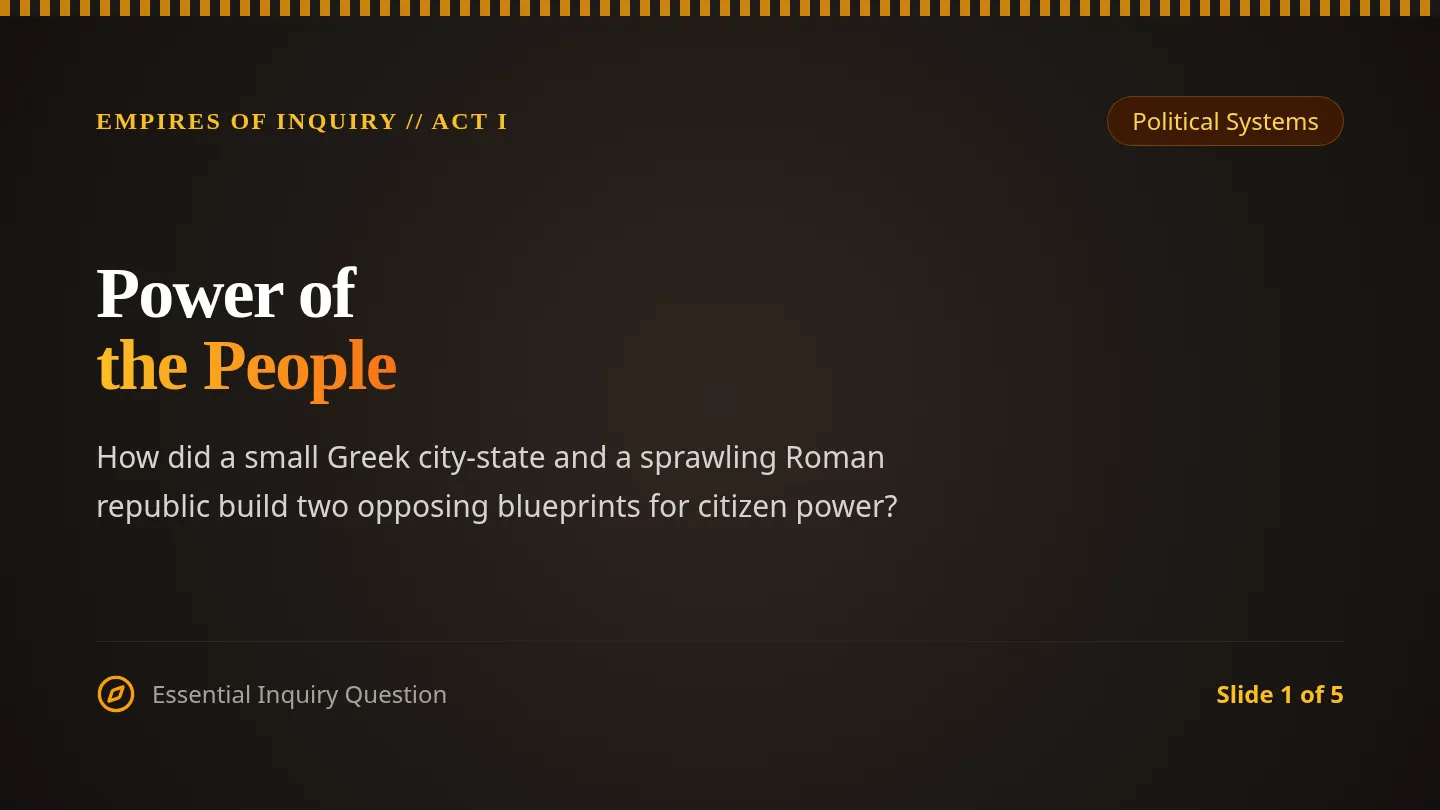
This lesson compares the exclusionary nature of citizenship in Ancient Athens with the 1857 Dred Scott decision, exploring how legal standing and individual rights were historically denied based on birth and status.
A final comparison of the four civilizations, focusing on shared characteristics like irrigation, social classes, and writing systems, culminating in a unit assessment.
Focusing on the Huang He (Yellow River), the early dynasties, the concept of the Mandate of Heaven, and the development of Confucianism and Taoism.
Investigating the advanced urban planning of Harappa and Mohenjo-Daro, the mystery of their undeciphered script, and their extensive trade networks.
An analysis of the Nile River's role in Egyptian life, the power of Pharaohs, the construction of pyramids, and the religious beliefs of the afterlife.
An exploration of the Tigris and Euphrates rivers, the development of city-states, the Code of Hammurabi, and the social hierarchy of Sumer.
Global Blueprints, Global Chessboard, Containment Briefing, Frozen Front Mission, Containment Evolution, Red Scare Files, Prosperity Paradox, Boomer Blueprint, Suburban Shifts, Living Room Revolution, Rhythm Revolution, and Atomic Shadow.
This lesson explores the methods used by Benito Mussolini and Adolf Hitler to establish totalitarian regimes in Italy and Germany. Students will analyze tactics such as propaganda, terror, economic manipulation, and cults of personality to understand how 'total' control was achieved.
A comprehensive 35-minute lesson exploring the Cold War nuclear era, focusing on Tennessee State Standard US.69. Students will analyze the impact of atomic testing, civil defense strategies, and the logic of Mutual Assured Destruction.
A comprehensive look at the classic novel 'The Watsons Go to Birmingham – 1963', including a complete plot summary and a comparative analysis between the book and its film adaptation.
A 40-minute high school history lesson exploring the rise of 1950s youth culture, the evolution of popular music, and Tennessee's pivotal role in the global music industry through Sun Studio and Stax Records.
A 25-minute exploration of how television transformed American life in the 1950s, focusing on consumer culture, the nuclear family ideal, and the shift in political campaigning.
A jigsaw activity where students become experts on specific facets of globalization—definitions, drivers/impacts, and economic consequences—before sharing their findings with peers to form a complete understanding of the topic.
Students explore the intersection of history, art, and civic values by analyzing controversial monuments and designing their own commemorative public art. This lesson specifically looks at New Mexico's complex history and global movements to rethink public memory.
A culminating primary source analysis assessment covering the global impacts and perspectives of imperialism.
Explores the decline of the Qing Dynasty, the Opium Wars, and the impact of the Treaty of Nanjing on Chinese sovereignty.
Investigates the rise of the British East India Company, the 1857 Rebellion, and the subsequent direct rule of the British Raj.
Examines the motives for European imperialism and the division of Africa following the Berlin Conference of 1884.
A Social Studies and Creative Writing lesson where students analyze modern cultural objects as future archaeological artifacts to evaluate societal values and legacy.
An exploration of Ancient Roman religion, from the polytheistic pantheon and state rituals to the historical transition toward Christianity.
A comprehensive lesson exploring the economic boom, social shifts, and systemic inequalities of 1950s America, covering consumerism, suburbia, the G.I. Bill, and energy dependence.
A comprehensive lesson on Eisenhower's Cold War policies, focusing on the evolution of containment through brinkmanship, peaceful coexistence, and the military-industrial complex. Designed for Tennessee US.62 standard and EOC preparation.
A comprehensive 30-minute lesson on the Second Red Scare, covering McCarthyism, HUAC, the Rosenbergs, and the cultural impact of anti-communist hysteria in 1950s America. Students will analyze primary sources and explore the ethical dilemmas of blacklisting.