A lesson focused on comparing quantities and numbers up to 15 using visual representations and numerical values. Students will practice identifying sets with more or fewer items and comparing numerals directly.
A week-long series of activities focused on identifying math operations in word problems, counting mixed coins, and determining if a purchase is affordable within a budget. Includes a teacher guide, graphic organizers, and practice worksheets themed around a neighborhood corner store.
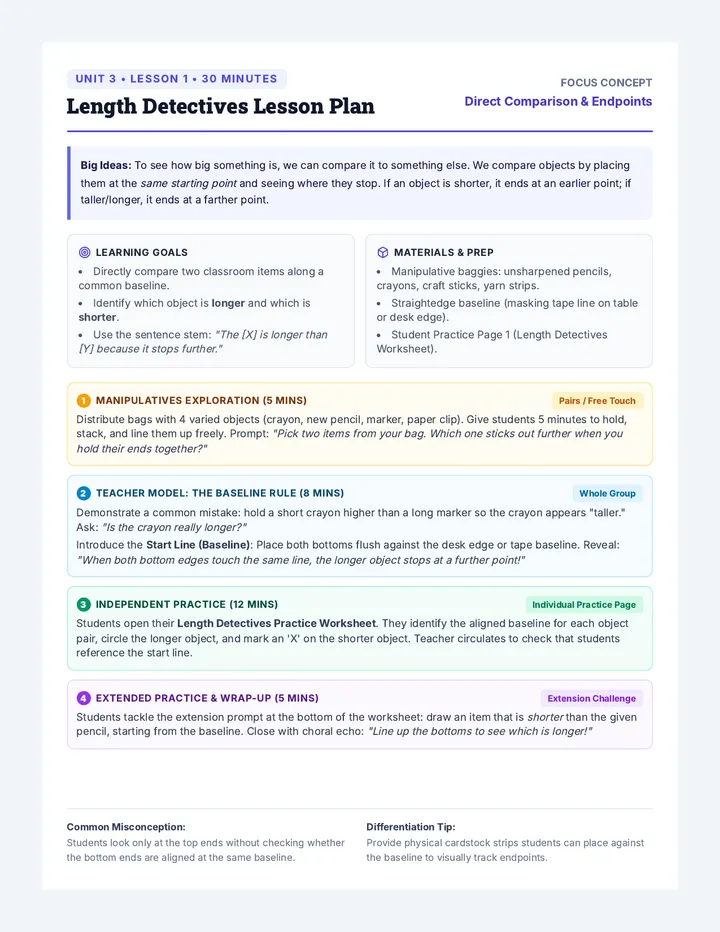
A Kindergarten lesson focused on comparing the length (height) of block towers and determining the difference in length by counting individual block units.
A kindergarten math lesson focused on counting and writing numbers from 1 to 20 using winter-themed objects and scenarios.
Final review and assessment of numeral ID and counting sequences.
Fluency focus on backward sequences across the full 0-120 range.
Advanced number line navigation and relative position (0-120).
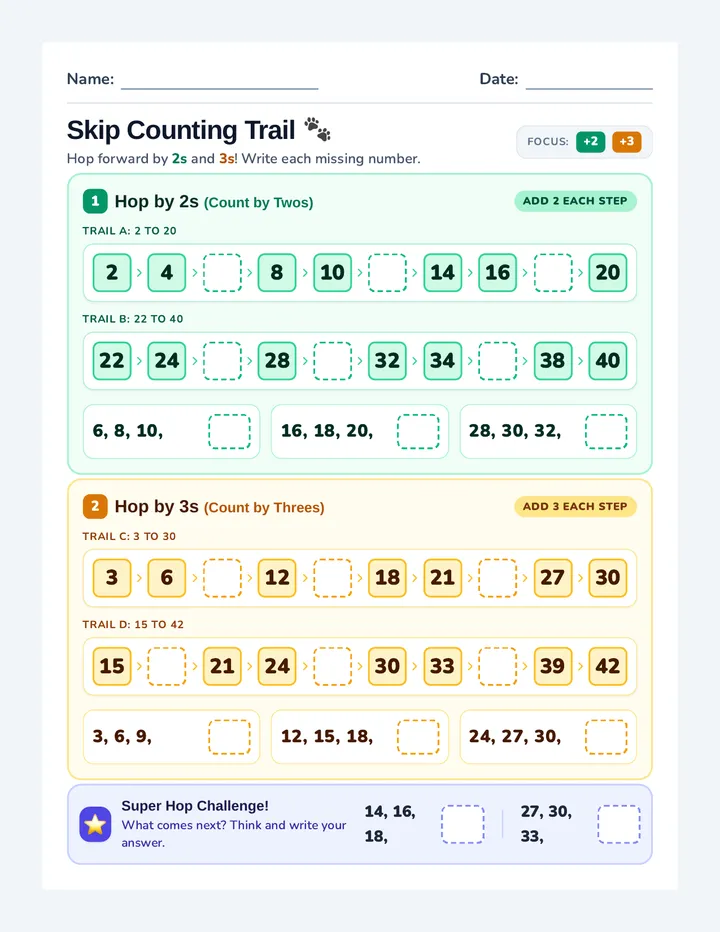
Finding missing numbers in various sequences (FNS/BNS).
Mastery of the 100-120 range (the "Peak").
Backward sequences from 100 down to 50.
Forward sequences and numeral identification for numbers 50-100.
Placing and identifying numbers on an open number line (0-50).
Backward sequences across decades (50 down to 20).
Mastering transitions between decades from 20 to 50.
Intensive focus on backward number sequences from 20 down to 10.
Focus on numeral identification and forward sequences for numbers 11-20.
Consolidation of skills where students compare varied pairs of two-digit numbers and record results using appropriate symbols and mathematical reasoning.
Focusing on numbers where the tens digits are different, emphasizing that the tens digit is the primary factor in determining which number is greater.
Focusing on numbers with the same tens digit to understand that when tens are equal, we look at the ones digit to determine the relationship.
Introduction of the symbols <, >, and = as tools to record the relationship between two numbers, connecting them to the language of 'greater than' and 'less than'.
Students compare two numbers visually using base-ten models to identify which is 'greater' and which is 'less' before introducing formal symbols.
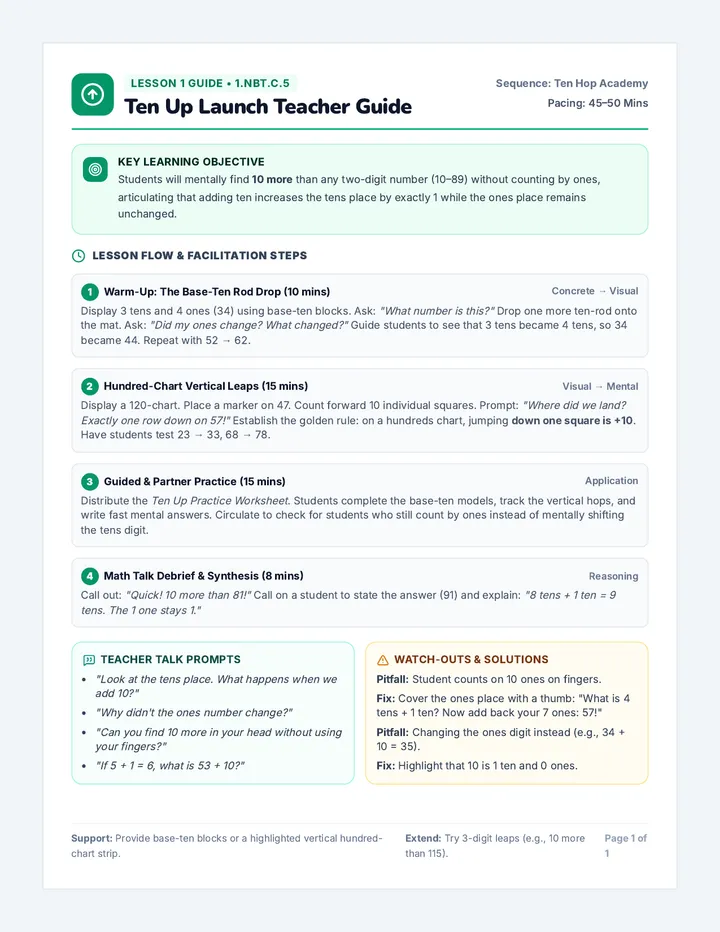
Students build two-digit numbers using base-ten models to understand that the tens digit represents the number of groups of ten and the ones digit represents the number of leftovers.