Action Detective Slides Action Detective Agency
Let's find the secret movements!
Lesson 1: Spotting Action
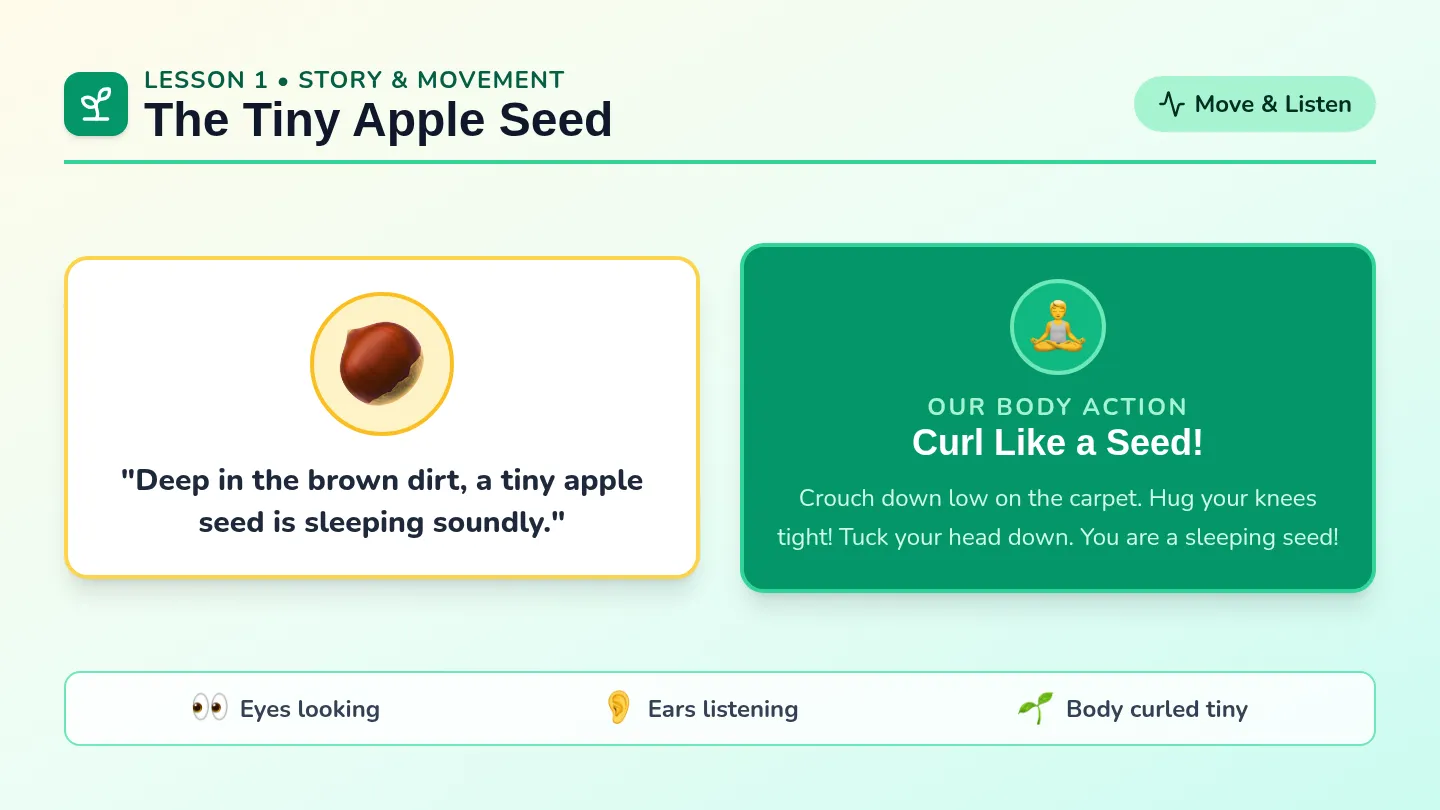
Put on your Magic Glasses!
Today, we are looking for MOVEMENTS.
What is an Action Word?
🏃
Run
🦘
Jump
😴
Sleep
"Actions are things we can DO with our bodies!"
Detective Challenge #1
🐕 🎾
Look at the dog!
What is the dog DOING?
A He is fuzzy.
B He is PLAYING.
C He is brown.
Let's Open Our Books!
Get your detective glasses ready.
GO, DETECTIVES!
Action Scavenger Hunt Worksheet Action Scavenger Hunt
Detective Agency Case #01
Name:
Date:
The Secret Mission
Look at the busy park below. Can you find the things that are MOVING? Circle the actions!
🏃♀️
🌳
🤸
🪑
🐕
🪨
🕊️
I found...
Which action was your favorite? Point to it and tell a friend!
Super Action!
Can you DO the movements you found? Jump like the boy!
Action Detective Teacher Guide Detective Case File
Lesson 1: Spotting the Action
Objective
Students will identify characters performing actions in a picture book illustration.
Key Vocabulary
• Action
• Movement
• Do/Doing
Materials Needed
• Picture book with distinct actions (e.g., "The Snowy Day")
• Action Detective Slides
• Scavenger Hunt Worksheets
1
The Hook (5 mins)
Gather students on the rug. Tell them they have been hired by the Action Detective Agency . Their mission: Find things that are moving .
"Detectives, put on your magic glasses! (Hands around eyes). We aren't looking for trees or houses today. We are looking for what people are DOING!"
2
Direct Instruction (10 mins)
Use the Action Detective Slides . Show the examples of "Run," "Jump," and "Sleep."
Check for Understanding: Ask students to stand up and show you the action. "Detectives, show me 'Run' in place! Show me 'Jump'!"
3
Guided Read-Aloud (15 mins)
Read a picture book. Every few pages, pause and say: "Detective Alert!"
Have students use their "glasses" to find an action in the picture.
Scaffold: If a student points to a dog, ask: "You found the dog! But what is the dog doing ? Is it sitting? Is it barking?"
4
Independent Hunt (10 mins)
Distribute the Action Scavenger Hunt Worksheet . Students circle the actions they find in the park scene. Encourage them to act out the actions as they find them.
Action Matchup Cards Matchup Card Set
Cut along the dotted lines! ✂️
Characters (The Who)
👦
Boy
🐱
Cat
🐸
Frog
🐦
Bird
Actions (The Do)
Jump
Sleep
Run
Sing
Action Detective Agency - Lesson 2 Resource
Action Pairing Board The Great Matchup
Help the characters find their actions!
Name:
"Place a character on the left and an action on the right. Then say it out loud!"
WHO?
ACTION
WHO?
ACTION
WHO?
ACTION
Read Your Sentence!
Example: "The Boy + Jumps"
Action Matchup Teacher Guide Detective Case File
Lesson 2: The Great Matchup
Objective
Students will pair characters (subjects) with actions (verbs) to form meaningful pairs.
Materials Needed
• Action Matchup Cards
• Action Pairing Board
• Scissors & Glue sticks
1
The Mystery Problem (5 mins)
Gather the "Detectives." Explain that some animals and people have lost their actions! They are just standing still and don't know what to do.
"Oh no! This Frog is just sitting here. Does he want to jump? Does he want to sleep? We have to find the best action for him!"
2
Modeling the Match (10 mins)
Show a Character card (e.g., Boy) and an Action card (e.g., Run).
Hold them up: "Boy... Run."
Put them together: "The boy runs!"
Ask: "Does it make sense? Yes!"
Try a silly one: "The boy... flies?" (Wait for laughs). "Maybe! But the bird is better at flying."
3
The Workshop (20 mins)
Students cut out their cards and use the Action Pairing Board to create three pairs.
Teacher's Role:
Circulate and ask students to "read" their matches. Encourage them to use a full sentence: "The cat sleeps."
4
Action Gallery (5 mins)
Students leave their boards on their desks and do a "Detective Walk" around the room to see what actions others picked for their characters.
Sentence Train Slides Sentence Train Builders
Lesson 3: Making Sentences GO!
How do we build a sentence?
👦
WHO
Engine
🏃
DO
Wheels
"The Boy Runs!"
Let's Build Together!
Pick an Engine:
🐱
👧
Pick your Wheels:
😴
🍎
Wait! Does an Apple move? No! That's not an action!
Can you read this train?
Frog
Jumps
"The Frog Jumps!"
FULL SENTENCE!
Sentence Train Worksheet My Sentence Train
Circle and read your sentence!
Name:
1 Pick your Engine (WHO)
👦
Boy
👧
Girl
🐱
Cat
🐶
Dog
2 Pick your Wheels (ACTION)
🏃
Runs
😴
Sleeps
🦘
Jumps
🍭
Wait!
Is a lollipop an action? No! Don't pick that one!
Choo Choo! Read It!
"The _______________ _______________."
Sentence Builder Teacher Guide Detective Case File
Lesson 3: Sentence Train Builders
Objective
Students will orally construct a two-word sentence (Noun + Verb) using visual prompts.
Metaphor
"The Engine (Who) makes the wheels (Action) go!"
1
The Hook (5 mins)
Show a picture of a train. Explain that a train needs two parts to move: the Engine and the Wheels.
"A sentence is just like a train! If we have a boy (engine) but he doesn't have an action (wheels), our sentence train is stuck! It can't go anywhere."
2
Direct Instruction (10 mins)
Use the Sentence Train Slides . Demonstrate building a sentence:
Pick "Cat" (Engine).
Pick "Sleeps" (Wheels).
Push them together and say: "Cat... Sleeps! Choo Choo!"
3
The "Wait!" Game (5 mins)
Show a Noun and a non-action (e.g., Cat + Cookie). Ask: "Can our train go?" Let the students shout "NO!" because a cookie isn't an action word. This reinforces that sentences need a verb.
4
Building Workshop (15 mins)
Students complete the Sentence Train Worksheet . Differentiation:
Puppet Theater Templates Puppet Theater Stars
Color, Cut, and Glue to a Craft Stick!
😊
I AM...
🐸
THE FROG...
🐝
THE BEE...
🐶
THE DOG...
Theater Magic!
"When your puppet moves, use your loudest voice to say what it is doing!"
Puppet Theater Guide Detective Case File
Lesson 4: Puppet Action Theater
Objective
Students will use a puppet to perform an action and narrate it using a two-word sentence.
Theater Skills
• Voice Projection
• Movement-Word Sync
• Narrating in the 3rd person
1
The Hook (5 mins)
Gather the Detectives. Tell them the Agency has a new secret tool: The Action Puppet! Puppets are great at showing movements, but they can't talk. They need us to tell their story.
2
Direct Instruction (5 mins)
Model using a puppet. Make the puppet jump.
"Watch Mr. Frog. (Make him jump). I am jumping! Or I can say: Frog... Jumps! Now he's tired. (Make him lay down). Frog... Sleeps!"
3
Action Script Challenges
Give students these prompts while they have their puppets:
Challenge A
"Your puppet is in a race! What is he doing?"
(Expected: "He runs!" or "I run!")
Challenge B
"Your puppet sees a tall wall! How does he get over?"
(Expected: "Frog jumps!" or "I jump!")
4
Small Group Shows (15 mins)
Students pair up. One person makes their puppet do an action, and the other person has to "read" the action. "Your dog... sits!" Then they swap roles.
Class Book Page Template The Busy Class Book
By: ___________________________
Draw yourself doing an action!
Author's Note
Teacher: "What are you doing in your picture?"
Author's Showcase Slides WE ARE AUTHORS!
Let's write "The Busy Class Book"
Your Page Mission:
1. DRAW
Show yourself doing your favorite action!
2. DICTATE
Tell your teacher what is happening in your picture!
What can you do?
🎨
"Sam PAINTS."
⚽
"Mia KICKS."
💃
"Leo DANCES."
"You are the engine! What are your wheels doing?"
Let's Get Busy!
Pick up your crayons and start your engine!
Class Book Guide Detective Case File
Lesson 5: The Busy Class Book
Objective
Students will synthesize their learning by creating an illustration of an action and dictating a two-word sentence.
Project Goal
A collaborative class book titled "Our Busy Classroom."
1
The Launch (5 mins)
Use the Author's Showcase Slides . Tell the Detectives they have completed their training. Now, they are "Expert Action Authors." They are going to write a book about everything the class can do.
2
Drawing Time (20 mins)
Distribute the Class Book Page Template . Students draw themselves performing their favorite action (dancing, painting, running, etc.).
Teacher Tip: Remind them to show movement in the drawing (e.g., speed lines, arms up).
3
Dictation & Assessment (10 mins)
As students finish their drawings, pull them aside for dictation. Use this as a final assessment check:
The Question: "Tell me about your picture. What are you doing?"The Goal: Student says a Noun + Verb (e.g., "I run" or "Sam jumps").Recording: Write their exact words on the lines at the bottom of their page.
4
The Grand Reading
Bind the pages together with a cover (e.g., "The Busy Class"). Gather the class and read the book aloud. Have each student stand up when their page is read to "perform" the action they drew.