Voice Vibe Slides Feel the Voice
Hearing Emotions in Stories
The Mystery Voice
"I have a surprise for you!"
Close your eyes and listen:
Is it Happy?
Is it Sad?
Is it Angry?
Happy Voice
How it sounds:
✨ Higher pitch
✨ Fast and bouncy
✨ Lots of energy
Let's Try!
"Yay! We're going to the park!"
Sad Voice
Let's Try!
"I can't find my favorite toy."
How it sounds:
💧 Lower pitch
💧 Slow and heavy
💧 Quiet volume
Mad Voice
How it sounds:
🔥 Loud volume
🔥 Sharp and hard
🔥 Fast and strong
Let's Try!
"Stop doing that right now!"
Ready to Listen?
Get your Feeling Faces worksheet ready!
STUDIO SESSION STARTING
Emotion Soundboard Guide Emotion Soundboard
Teacher facilitation guide
Lesson Objective
Students will identify primary emotions (happy, sad, angry) based on vocal cues such as pitch, volume, and pace, without visual aids.
Preparation
Project the Voice Vibe Slides
Print Feeling Faces Worksheet for each student
Gather a small bell or chime for transitions
Vocabulary
Pitch: High or low sound
Volume: Loud or quiet sound
Expression: Showing feelings in voice
The "Mystery Voice" Script
Read the same sentence using different vocal cues. Ask students to identify the feeling before showing the slides.
VOICE 1: HAPPY High pitch, fast, bouncy
"I have a surprise for you!"
Question: "Is this voice heavy or light? Do I sound like I'm smiling?"
VOICE 2: SAD Low pitch, slow, quiet
"I have a surprise for you..."
Question: "Does my voice sound fast or slow? Does it sound like I have a frown?"
VOICE 3: MAD Loud, sharp, strong
"I HAVE A SURPRISE FOR YOU!"
Question: "Is my voice loud or quiet? Does it sound like a soft pillow or a hard rock?"
Checking for Understanding
What did we hear?
"When I was sad, did I talk fast like a rabbit or slow like a turtle?"
Why does it matter?
"If we read a story with no feelings, how would the characters feel?"
Common Misconception
Students often confuse 'loud' with 'mad'. Remind them that we can be happy-loud (excited) or mad-loud. Focus on the 'sharpness' of the voice for anger.
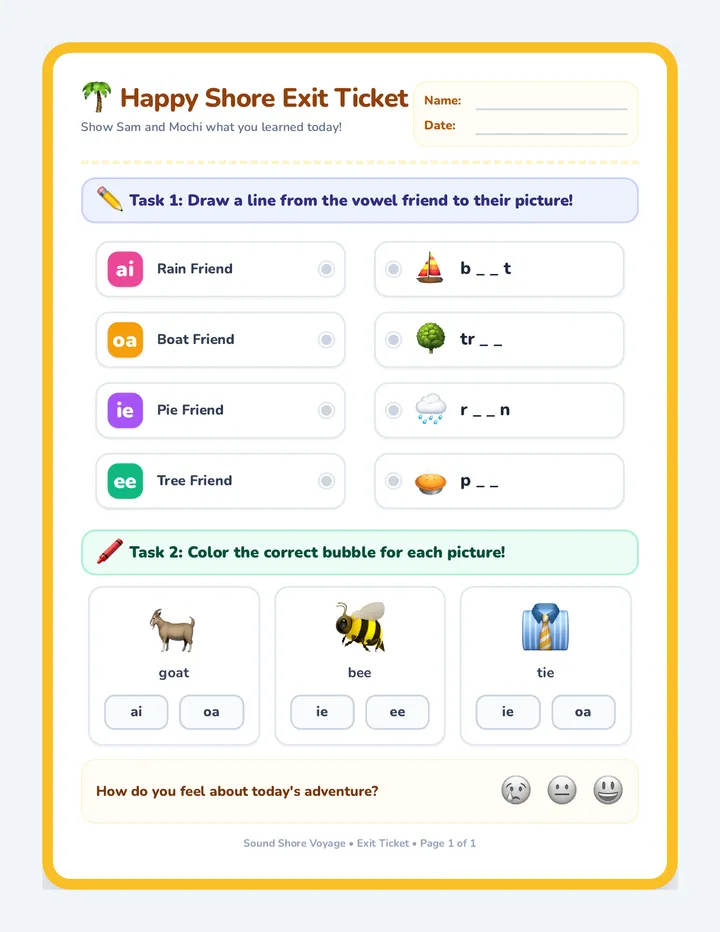
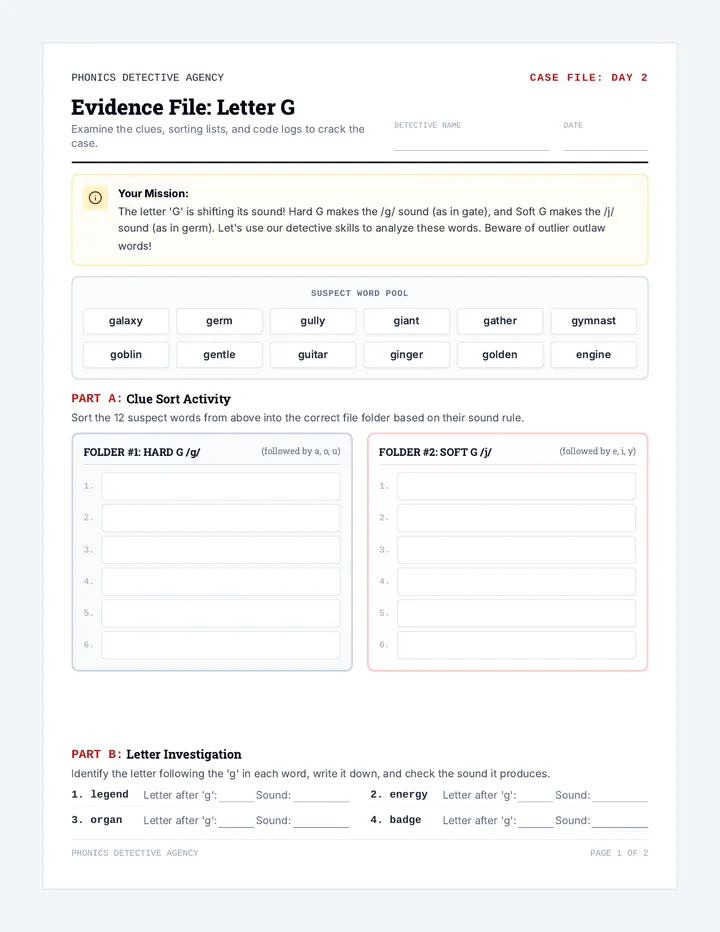
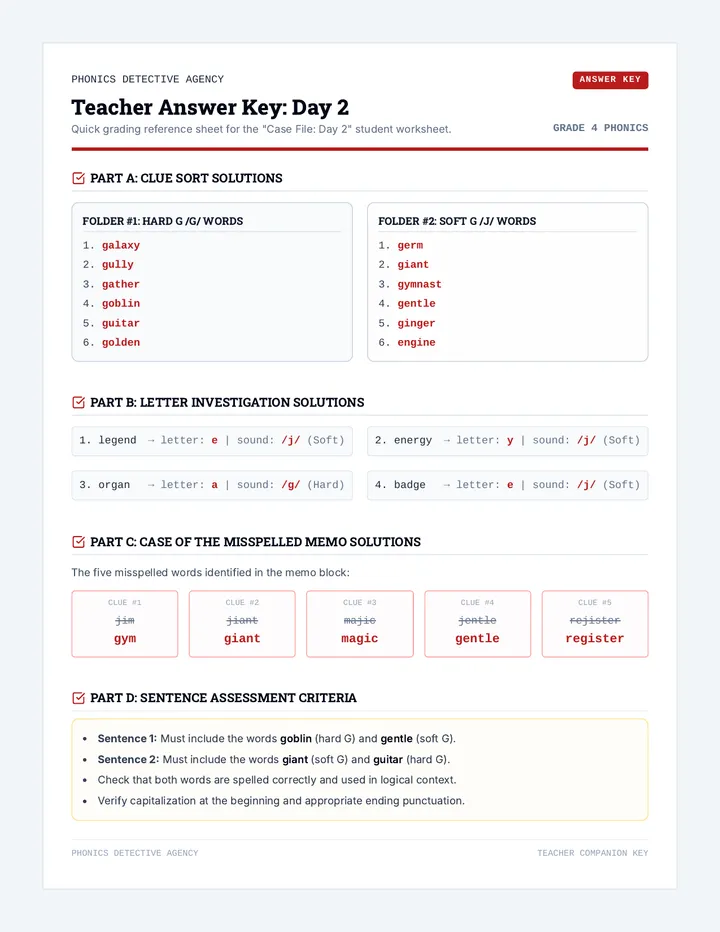
Feeling Faces Worksheet Name:
Date:
VOICE VIBES
Lesson 1: Activity Sheet
Feeling Faces
Listen to your teacher's voice. Which face do you hear?
1
"I found a bug!"
2
"Where is my coat?"
3
"That's not fair!"
4
Draw YOUR happy face here!
Studio Note: Pay attention to the sound, not just the words!
Punctuation Power Slides ? !
Punctuation Power
The Sound of the Symbols
The Question Mark
?
Voice Goes UP ⤴️
When we ask something, our voice gets a little higher at the end.
"Can you play?"
It's a voice cliff-hanger!
The Exclamation!
!
Big Energy!
Voice Gets STRONG 💥
When we are excited or surprised, our voice gets louder and stronger.
"Look at that!"
Symbol Showdown
Listen to the voice. Hold up your sign!
?
Question
!
Excitement
Punctuation Script Guide Punctuation Script
Intonation Training Guide
The Lesson Flow
In this lesson, students learn that punctuation marks are "voice signals." They tell the narrator how to sound. Use this script to play the "Symbol Showdown" game.
The Question Up-Swing
Exaggerate the pitch rise at the end. It should sound like you are waiting for an answer.
The Exclamation Burst
Use a sharp, energized volume. Imagine you are pointing at something amazing.
Symbol Showdown Script
Round 1
"Is it time to go?"
?
Rising pitch
Round 2
"I see a monster!"
!
High energy
Round 3
"Where did the cat go?"
?
Rising pitch
Round 4
"That cake looks delicious!"
!
Excited/Loud
The "Silent Symbol" Challenge
After several rounds, try reading a sentence with the WRONG intonation (e.g., say a question like a command). Ask the students: "Does my voice match the symbol?" This helps them build critical listening skills.
Punctuation Sign Cards Worksheet Punctuation Flash Cards
Cut along the dotted line. Hold up the right card when you hear the voice!
Question
Voice goes UP ⤴️
?
Excited
Voice is STRONG 💥
!
Name: _________________________________________________
Character Caller Slides Character Callers
Who is talking?
The Voice Dial
Squeaky High
"I am a tiny little mouse!"
Rumbly Low
"I am a big, fuzzy bear!"
Talking Together
BEAR
"Is it time for lunch?"
"Not yet, Big Bear!"
MOUSE
Your Turn to Act!
Robot
Queen
Ghost
Bird
What does your character sound like?
Dialogue Duo Script Teacher Guide Dialogue Duo
Character Acting Guide
The Lesson Focus
Students are moving from identifying emotions to creating character personas . The key is "vocal contrast"—making characters sound distinct from one another.
Director Tips:
Encourage "physicalizing" the voice (e.g., puff out chest for Bear, crouch for Mouse).
Focus on Pitch : Is the voice high or low?
Focus on Texture : Is the voice scratchy, smooth, or rumbly?
Character Contrast
L
Low & Large
Bear, Giant, Tree
H
High & Tiny
Mouse, Bee, Ant
Mini-Script: The Big Bridge
Teacher reads the prompt, students read the lines in character.
BEAR
Rumbly & Slow
"I want to cross this big bridge!"
MOUSE
Squeaky & Fast
"But Bear, you are too heavy for it!"
BEAR
"Oh no! Then I will wait here."
MOUSE
"Don't be sad! I will bring you a snack!"
The "Switcheroo" Game
After practicing once, ask students to switch! Can they make a Squeaky Bear and a Rumbly Mouse? This shows they understand the technique is a choice they make with their voice.
Character Mask Cutouts Worksheet Actor's Masks
Cut out the characters. Use them to help you find your voice!
Mouse: Squeaky & High
CUT
CUT
Tape stick here
Bear: Rumbly & Low
CUT
CUT
Tape stick here
Studio Stage Prop #3
Speed and Sound Slides Speed and Sound
The Pace of the Story
The Speedometer
Fast Pace
When things are exciting or scary!
"Run, run, as fast as you can!"
Slow Pace
When things are calm or sad.
"Once... upon... a... time..."
The Volume Knob
Quiet Whisper
For secrets and nighttime.
Loud Shout
For surprises and hero moments!
Follow the Leader
Repeat after me! Watch the speed and sound!
FAST
SLOW
LOUD
QUIET
Speed Limit Lesson Plan Teacher Guide Speed Limit
Pacing and Volume Lesson Plan
Objective
Students will demonstrate control over their vocal speed and volume to reflect the mood or action of a sentence.
The Hook
"If a story is about a turtle, should we read it like a racecar? Why not?"
Activity: Follow the Leader
Stand in a circle. Use your hands to show the speed and volume as you speak.
Exercise 1: THE TURTLE Slow & Quiet
"The moon is up in the dark sky."
Motion: Walk in place very slowly, whispering the words.
Exercise 2: THE CHEETAH Fast & Loud
"Look out! Here comes the train!"
Motion: Rapid foot-taps while shouting clearly.
Exercise 3: THE SECRET Slow & Very Quiet
"I know where the treasure is hidden..."
Motion: Finger to lips, tip-toeing in place.
Connecting Mood to Sound
When do we go FAST?
"When characters are running, excited, or scared."
When do we go SLOW?
"When characters are tired, thinking, or calm."
Vocal "Rhythm" Challenge
Clap the rhythm of a sentence first. Then speak it. Ask: "Is the clap fast or slow?" This bridges the gap between physical rhythm and oral fluency.
Mood Meter Worksheet Name:
Date:
Mood Meter
Lesson 4: Speed & Volume
How should we read it?
Circle the speed and volume that fits each picture!
A sleeping
KITTEN
Fast
Slow
Speed
Loud
Quiet
Volume
A zoomed
RACE CAR
Fast
Slow
Loud
Quiet
A heavy
GIANT
Fast
Slow
Loud
Quiet
Studio Calibration Tool #4
Star Storyteller Slides Star Storytellers
It's Showtime!
Performance Plan
1
Pick a Feeling
Will you be happy, sad, or mad?
2
Pick a Voice
Will you talk like a giant or a mouse?
3
Punctuation
Are you asking or exclaiming?
ON AIR
Take a deep breath...
Speak with your heart!
Bravo!
You are a Master Narrator!
Narrator Star Rubric Teacher Guide Narrator Star Rubric
Performance Assessment Guide
Observation Notes
Use this rubric while students perform their expressive reading. Focus on their effort to modulate their voice, rather than perfect accuracy.
Feeling Force
Monotone
Reads with one flat sound throughout.
Emerging
Shows emotion in some parts of the reading.
Expressive
Strongly reflects the intended mood/feeling.
Character Persona
Normal Voice
Uses natural speaking voice for the character.
Changing Pitch
Tries to go high or low to match character size.
Character Pro
Distinct character voice is clear and consistent.
Punctuation Power
Missed Cues
Ignores the rising pitch or energy requirements.
Partial Cues
Responds to some exclamation points or questions.
Symbol Master
Always matches intonation to punctuation marks.
Student Name: ________________________________
Final Performance Date: ___________________
Star Storyboard Worksheet Name:
Date:
Performance Plan
Lesson 5: Finale
My Star Storyboard
Get ready for your big performance!
My Character
Draw who is talking!
The Feeling
HAPPY
SAD
MAD
The Voice
Circle your settings!
My Big Line