Boundary Break Slides Boundary Break
Hitting the Ceiling of the Real Number System
Project: Complex Foundations
The Impossible Problem
Consider the simplest quadratic equation that causes a "Mathematical Crisis":
\(x^2 + 1 = 0\)
Solve for \(x\).
What happens when you try to take the square root?
Why is this a problem in the "Real" world?
"I have yet to see a number whose square is negative..."
Visualizing the Gap
Case A: \(y = x^2 - 1\)
The parabola dips below the x-axis. It has two real solutions (x-intercepts).
Case B: \(y = x^2 + 1\)
The parabola floats above the x-axis. It never touches the real number line.
Real Axis
y-value
No Intercepts?
If there are no real solutions, does the answer just not exist?
"These numbers are impossible... and we shall call them imaginary."
René Descartes (1637)
Descartes used "imaginary" as an insult. He thought they were useless fiction. History would prove him wrong.
Inquiry Mission
Identify
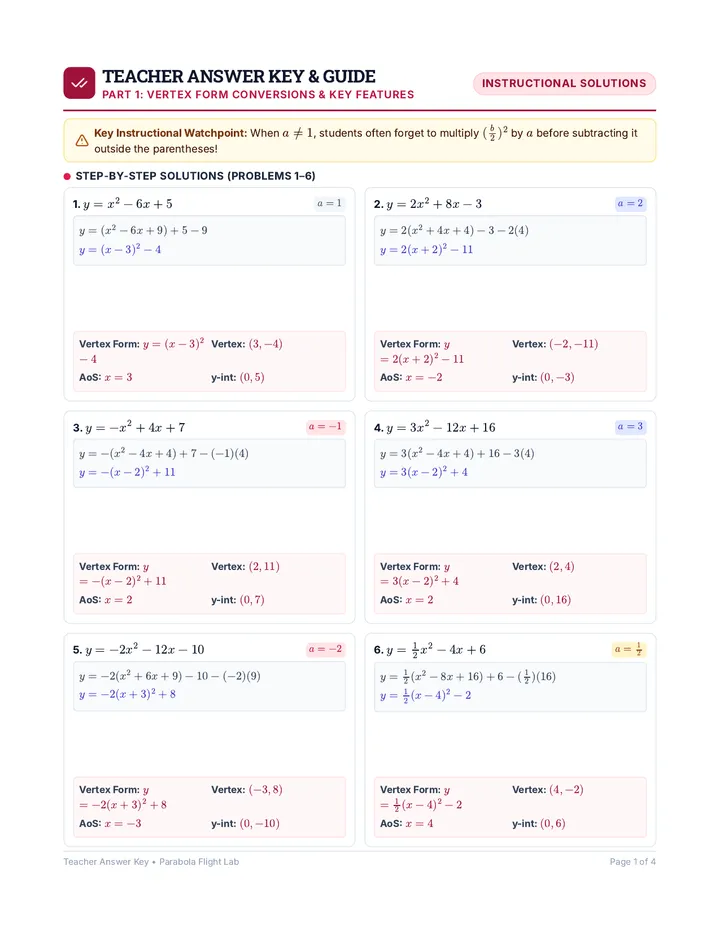
Find other quadratic equations that have no real solutions. Look for a pattern in their vertex form.
Evaluate
What must be true about the discriminant (\(b^2 - 4ac\)) for an equation to have no real roots?
Predict
If these numbers aren't on the "Real" line, where else could they be? Think outside the 1D line.
Prepare for Lesson 2: Defining the Impossible
Real World Limits Worksheet Real World Limits
Inquiry: Investigation 1.1
Cadet Name:
Date:
Objective
Determine why certain quadratic equations fail to intersect the x-axis and analyze the numerical implications of "impossible" square roots.
1
The Wall: Algebraic Solving
Attempt to solve the following equations using standard algebraic manipulation (isolate \(x\)). If you encounter a problem, circle it.
Problem A: \(x^2 - 9 = 0\)
Problem B: \(x^2 + 9 = 0\)
Analysis:
What mathematical operation caused the "failure" in Problem B? Why can't we proceed with "Real" numbers?
2
Visual Verification
Sketch the graphs of \(f(x) = x^2 - 4\) and \(g(x) = x^2 + 4\). Label the x-intercepts (if any).
\(f(x) = x^2 - 4\)
\(g(x) = x^2 + 4\)
Observation:
How does the vertical shift of a parabola affect the existence of real solutions?
3
The Discriminant Detective
Recall the discriminant formula: \(D = b^2 - 4ac\). Determine if the following quadratics have real roots by calculating \(D\).
Equation \(b^2 - 4ac\) calculation Real Roots? (Y/N) \(x^2 - 2x + 1 = 0\) \(x^2 - 2x + 5 = 0\) \(2x^2 + 3x + 10 = 0\)
Reflect:
If the discriminant is negative, we are forced to take the square root of a negative number. If you had to "invent" a symbol to represent \(\sqrt{-1}\), what would it look like and why?
Imaginary Identity Slides Imaginary Identity
Defining the Unit \(i\)
i
Specification: Radical Simplification
The Master Key
To solve the "Impossible Problem," mathematicians defined a new unit:
\(i = \sqrt{-1}\)
DEFINITION
Corollary:
\(i^2 = -1\)
Historical Context
For centuries, mathematicians like Cardano and Euler flirted with these numbers. Leonhard Euler was the first to use the symbol i in 1777 to stand for "imaginary."
"Imaginary" doesn't mean "fake." It just means it's not on the standard 1D horizontal number line.
Protocol: Simplifying \(\sqrt{-n}\)
The Method
Separate the negative sign from the number using the product property of radicals:
\(\sqrt{-n} = \sqrt{n} \cdot \sqrt{-1} = i\sqrt{n}\)
Example Gallery
\(\sqrt{-4}\) \(2i\)
\(\sqrt{-25}\) \(5i\)
\(\sqrt{-12}\) \(2i\sqrt{3}\)
Why do we care?
Electrical Engineering
Imaginary numbers are used to model Alternating Current (AC) circuits. Without \(i\), we couldn't easily describe voltage and current shifts.
Signal Processing
WiFi, radio waves, and music compression rely on complex numbers to process frequencies and waves efficiently.
Descartes was wrong. "Imaginary" numbers run the modern world.
Negative Radical Lab
PROTOCOL ID: 2.1-LAB
Mission 1
Convert basic negative square roots into pure imaginary numbers.
Level 1
Mission 2
Apply radical properties to simplify complex expressions like \(\sqrt{-48}\).
Level 2
Mission 3
The "Crisis Solve": Return to Lesson 1's equations and find the actual imaginary roots.
Master Level
Negative Radical Lab Worksheet Negative Radical Lab
Technical Specification: Identity of \(i\)
Scientist:
Date:
Fundamental Truths
\(i = \sqrt{-1}\)
Definition
\(i^2 = -1\)
Property
Simplification Protocol
\(\sqrt{-n} \rightarrow \sqrt{n} \cdot \sqrt{-1} \rightarrow i\sqrt{n}\)
Mission 1: The Clean Cuts
Rewrite the following perfect square roots of negative numbers as pure imaginary units.
1. \(\sqrt{-16} =\)
2. \(\sqrt{-49} =\)
3. \(\sqrt{-100} =\)
4. \(-\sqrt{-64} =\)
Mission 2: Radical Breakdown
Simplify each expression. Pull out \(i\) first, then simplify the remaining real radical. Show your work steps.
5. \(\sqrt{-12}\)
Show simplification steps...
6. \(\sqrt{-20}\)
Show simplification steps...
7. \(3\sqrt{-72}\)
Show simplification steps...
8. \(\frac{1}{2}\sqrt{-32}\)
Show simplification steps...
Mission 3: Resolving the Crisis
Return to the equation from Lesson 1: \(x^2 + 1 = 0\). We know it has no real solutions. Now that you have the "Imaginary Key," solve for \(x\) fully.
Work Area:
Observation 1
How many solutions does this equation have? Are they real or imaginary?
Observation 2
If you graph this, why do we still say it has "no x-intercepts" even though it has solutions?
End of Technical Report // Authorized Personnel Only // Complex Operations Unit
Standard Form Blueprint Slides Standard Form
Blueprint
Constructing Complex Numbers
Module 3: Hybrid Systems
The Hybrid Structure
Most complex numbers are a combination of a Real part and an Imaginary part.
"
\(a + bi\)
Real Part
Imaginary Part
Construction Rules:
a is a real number.b is a real number (the coefficient of \(i\)).Always put the real part first .
Example: \(3 - 4i\) is a complex number where \(a = 3\) and \(b = -4\).
Number Taxonomy
The values of \(a\) and \(b\) determine the classification of the number:
Pure Real
If \(b = 0\) , the number is just a real number.
\(5 + 0i = 5\).
Pure Imaginary
If \(a = 0\) , the number is pure imaginary.
\(0 - 8i = -8i\).
Non-Pure Complex
If both \(a \neq 0\) and \(b \neq 0\) .
\(2 + 6i\)
The Big Sort
Every number we have ever worked with is actually a Complex Number. Some just have an imaginary part equal to zero!
"The real numbers are simply a subset of the complex numbers. The number system has finally come full circle."
Component Check
Analyze this construction:
\( -7 + 13i \)
Identify \(a\) and \(b\).
Determine the number type.
What is the "Pure Real" version of this?
Next Phase: The Argand Plane Visualization
Number Navigator Sort Activity Number Navigator
Activity: Taxonomy Sorting
Cut & Classify Task
Instructions: Cut out the number cards at the bottom of the page. Sort them into the correct categories in the classification grid based on their construction (\(a + bi\)). If a number could fit into multiple categories, place it in the most specific one.
Pure Real Numbers
Construction: \(a + 0i\) (where \(b = 0\))
Pure Imaginary
Construction: \(0 + bi\) (where \(a = 0\))
Non-Pure Complex Numbers
Construction: \(a + bi\) (where \(a \neq 0\) and \(b \neq 0\))
\(12\)
\(4i\)
\(2 + 3i\)
\(-5 - 8i\)
\(\pi\)
\(\sqrt{-25}\)
\(i\sqrt{7}\)
\(0.75\)
\(6 + 0i\)
\(1 - i\)
\(-14i\)
\(\frac{2}{3} + \frac{1}{3}i\)
Navigator Class: Complex Taxonomy Form ID: SN-3.2
Argand Atlas Slides Argand Atlas
Charting the Complex Plane
Navigation: Coordinate Phase
Beyond the Line
Real numbers live on a 1-dimensional line. But complex numbers have two parts (\(a\) and \(b\)).
"If a number has two independent components, it needs a two-dimensional space to exist."
— Jean-Robert Argand (1806)
Real Axis
Is there a vertical dimension?
Anatomy of the Complex Plane
Real Axis (a)
Imaginary Axis (bi)
\(3 + 2i\)
(3 units Right, 2 units Up)
Mapping Rule
The complex number \(a + bi\) maps to the coordinate point:
\((a, b)\)
+a = Right
-a = Left
+b = Up
-b = Down
Location Protocol
\(4i\)
Where does it go?
Imaginary Axis
\(-3\)
Where does it go?
Real Axis
\(1 - i\)
Where does it go?
Quadrant IV
\(-2 + 5i\)
Where does it go?
Quadrant II
Mission: Plotting
Step 1: Parse
Break your complex number into its \(a\) and \(b\) coordinates.
Step 2: Navigate
Move horizontally for "a" and vertically for "b". Mark your position.
Argand Atlas Lab
Open your map and begin charting. Accuracy is paramount for navigation.
Final Objective: Lesson 5 - Measuring the Distance (Magnitude)
Plane Plotter Worksheet Plane Plotter
Field Manual: Argand Navigation
Navigator:
Sector:
X-Axis
Real Part (a)
Y-Axis
Imaginary Part (b)
Mapping
\(a + bi \rightarrow (a, b)\)
Objective 1: Signal Conversion
Convert the following complex signals into coordinate pairs.
\(3 + 4i\) →
\(-2 - 5i\) →
\(6i\) →
\(-7 + 0i\) →
\(1 - i\) →
\(-4i + 3\) →
Objective 2: Fleet Deployment
Plot and label the following points on the Argand plane below.
REAL IMAGINARY
A: \(2 + 3i\)
B: \(-4 - i\)
C: \(5i\)
D: \(-3 + 0i\)
E: \(1 - 4i\)
F: \(-2 + 2i\)
Objective 3: Zone Intel
Analysis A
If a complex number has a negative real part and a positive imaginary part, which quadrant will it be in?
Analysis B
Where are all the "Pure Imaginary" numbers located on the plane? Be specific about the axis name.
Mapping complete // Data synced to Argand Database // End Transmission
Magnitude Mission Slides Magnitude Mission
Measuring the Distance to Zero
Sector: Modulus Extraction
Defining Modulus
The magnitude (or modulus) of a complex number is its absolute distance from the origin \((0, 0)\).
Notation:
\(|a + bi|\)
Pythagorean Logic:
If a complex number is a point on a 2D plane, the distance to the origin is just the hypotenuse of a right triangle!
\(|a + bi| = \sqrt{a^2 + b^2}\)
Protocol: Magnitude Calculation
Example: \(3 + 4i\)
1. Identify \(a = 3\) and \(b = 4\).
2. Square them: \(3^2 = 9\) and \(4^2 = 16\).
3. Add them: \(9 + 16 = 25\).
4. Square root: \(\sqrt{25} = 5\).
\(|3 + 4i| = 5\)
The "i" Warning
NEVER include \(i\) in the formula!
We are measuring the lengths of the sides. We only use the real coefficient \(b\) , not the imaginary unit itself.
Wrong: \(\sqrt{a^2 + (bi)^2}\)
Distance Duel
Competitor A
\( -10 \)
\(|a + bi| = ?\)
VS
Competitor B
\( 6 + 8i \)
\(|a + bi| = ?\)
Which number is "further" from zero?
Magnitude Mission
Calculation
Master the modulus formula for all four quadrants.
Level: Operator
Comparison
Determine relative size in the complex plane using magnitude.
Level: Strategist
Final Exam
Complete the Complex Foundations Checkpoint.
Level: Master
Distance Duel Worksheet Distance Duel
Extraction Protocol: Modulus
Technician:
Date:
Standard Formula
\(|a + bi| = \sqrt{a^2 + b^2}\)
Warning Log
Do not include \(i\) in the square. Only use the real coefficient \(b\).
Phase 1: Magnitude Extraction
Calculate the magnitude (modulus) of each complex number. Show your simplification steps.
1. \(|3 + 4i|\)
Ans:
2. \(|-5 + 12i|\)
Ans:
3. \(|1 - 1i|\)
Ans:
4. \(|-8i|\)
Ans:
Phase 2: Magnitude Comparison
Compare the sizes of the following pairs using \(<\), \(>\), or \(=\). Show calculations for both.
\(|2 - 2i|\)
?
\(|-3|\)
\(|4 + 3i|\)
?
\(|0 - 5i|\)
Mission Analysis
In your own words, explain why the modulus of a complex number is always positive, even if the real and imaginary parts are both negative.
End of Mission // Return to Origin Base // Data Secured
Complex Foundations Checkpoint Quiz Complex Foundations
Terminal Assessment: Sequence Checkpoint
Cadet:
Score:
Part I: Roots of the Imaginary
1 Which of the following defines the unit \(i\)?
\(i = \sqrt{1}\)
\(i^2 = 1\)
\(i = \sqrt{-1}\)
\(i^2 = i\)
2 Simplify the following radical expression: \(\sqrt{-72}\)
Part II: Hybrid Construction
3 Identify the real part (\(a\)) and imaginary part (\(b\)) of the complex number: \(4 - 9i\)
a =
b =
4 Which classification best describes the number \(0 + 6i\)?
Pure Real
Pure Imaginary
Non-Pure Complex
Part III: Atlas & Magnitude
5 Plot the complex number \(Z = -3 + 2i\) on the grid below.
6 Calculate the magnitude of \(Z\) from question 5: \(|-3 + 2i|\)
7 Which is greater: \(|5 + 0i|\) or \(|3 + 4i|\)? Explain.
Analysis Brief
Why is the complex number system necessary? Reference the limitations of quadratic equations in your response.
Verification successful // Complex Foundations Mastery Check // Level 11 Algebra