Voice Mystery Slides VOICE ACTORS ACADEMY
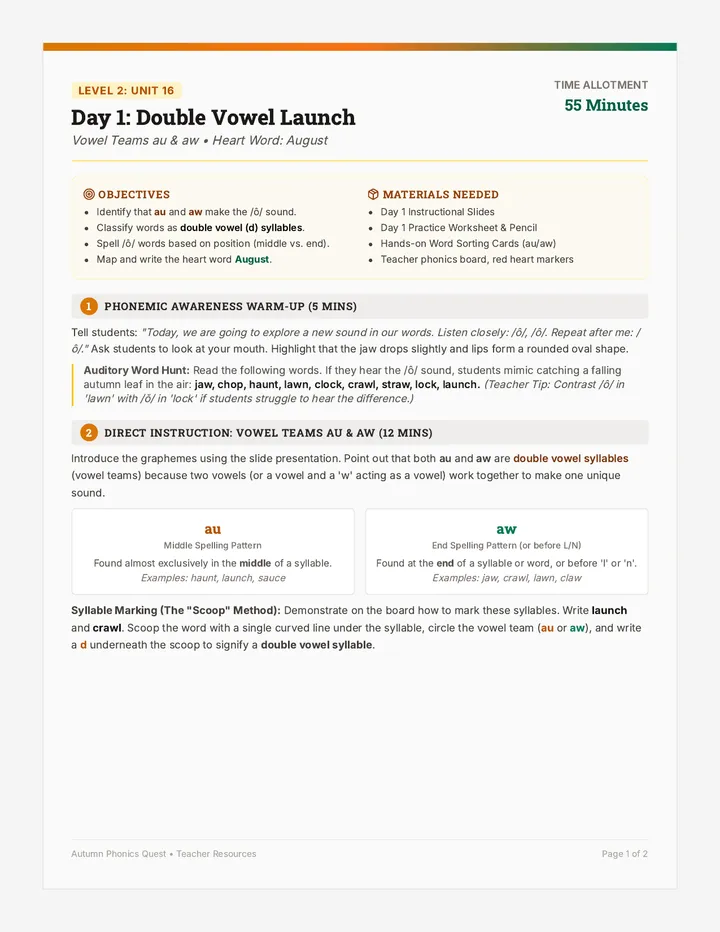
Lesson 1: Feelings in the Air
Mystery Voices
Which one makes you want to keep listening?
The Robot
Flat, fast, and no feelings.
The Storyteller
Full of emotion and energy!
Our Secret Weapon: Prosody
Expression
Using your voice to show how a character feels.
Emphasis
Making important words stand out.
Tone
The "mood" of your voice (happy, scared, excited).
Audio Case Study
Let's listen to The Brave Little Toaster.
Close your eyes. What do you hear?
Voice getting higher?
Louder or softer?
Fast or slow?
Mapping the Magic
Now, look at the text as you listen. When the narrator's voice changes, we can mark it!
Text Sample
"The cabin was dark and quiet. Suddenly, a loud bang shook the door!"
Scary! Surprised!
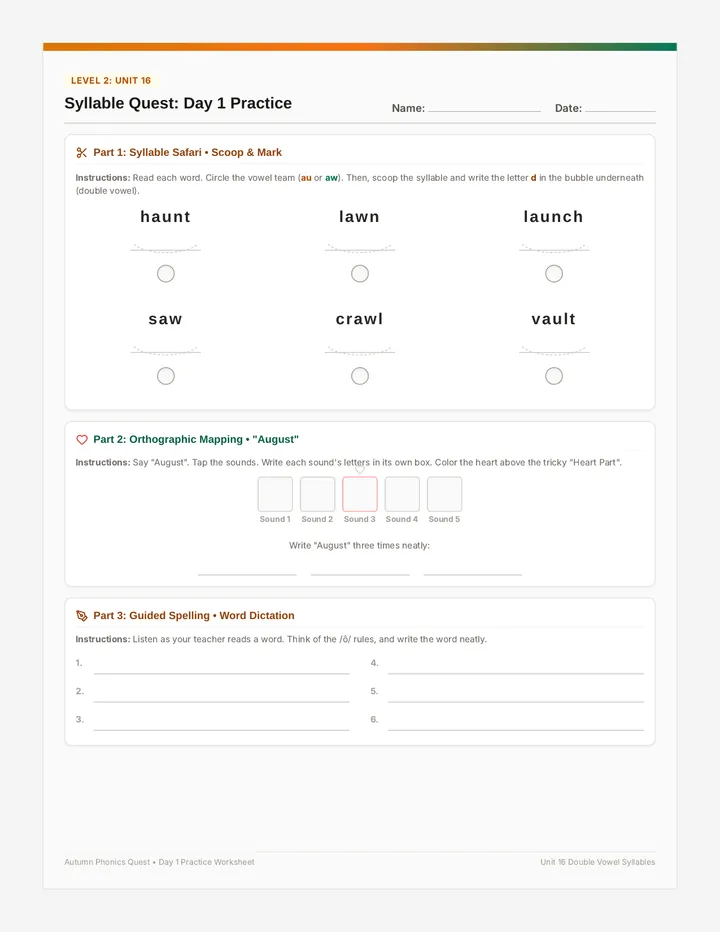
Emotion Map Worksheet Emotion Map
Voice Actors Academy: Lesson 1
Name:
Date:
Director's Notes:
Listen carefully to the audio story. When you hear the narrator's voice change, mark it on your map! Use the symbols below to show how their voice sounds.
^
High Pitch
!
Loud/Strong
...
Slow Pause
v
Soft Voice
The Script Map
Line 1
Once upon a time, there was a tiny mouse who lived in a giant, dusty castle. It was so quiet that you could hear a pin drop.
How did it feel?
Voice Clues:
Line 2
Suddenly, the heavy wooden doors burst open! CRASH! "Who is in my castle?" a booming voice roared.
How did it feel?
Voice Clues:
Studio Reflection
Why do you think the narrator made their voice loud and scary in Line 2? How does it help you understand the story?
Verified Recording Session
Expression Essentials Teacher Guide TEACHER GUIDE
Feelings in the Air
Lesson 1: Identifying Prosody and Emotion
Objective
Students will identify how oral narrators use pitch, volume, and pacing to convey emotion, connecting these vocal changes to specific text cues.
Preparation
Load "Voice Mystery Slides"
Select a short audio-narrated literary text (e.g., 2-3 mins)
Print "Emotion Map" worksheets
Discussion Starters
"How did the narrator's voice change when the giant spoke?"
"Why did the storyteller slow down when it was quiet in the castle?"
"If the narrator read the whole story in a robot voice, how would that change the story?"
Instructional Flow
1
The Mystery Voice Hook (5 mins)
Use Slide 2. Model the difference between a "flat/monotone" voice and an "expressive" voice. Ask: "Which one helped you picture the story better?" Introduce the term Prosody—the music of reading.
2
Close Listening (10 mins)
Play the first half of your selected audio story. Tell students to close their eyes. No text yet! Their goal is to "see" the feelings with their ears. Pause after emotional moments to check for understanding.
3
Text-to-Voice Mapping (15 mins)
Distribute the Emotion Map Worksheet. Re-play the audio, but this time have students follow along with the text. Model the first example (Line 1) together. Show them how to circle words where the voice shifts.
4
Debrief & Reflect (10 mins)
Review the "Studio Reflection" on the worksheet. Emphasize that narrators change their voice because of what is happening in the text.
Worksheet Key Guide
Text Line 1
"tiny mouse... giant, dusty castle... quiet..."
Narrator uses a Soft Voice (v) and Slow Pacing (...) to build mystery and emphasize the "quiet" castle.
Text Line 2
"Suddenly... CRASH! ...booming voice..."
Narrator uses High Energy and Loud Volume (!) to show a jump-scare or surprise.
Punctuation Road Sign Slides Punctuation Road Signs
Lesson 2: Tracking Punctuation and Pacing
Red Light, Green Light
Listening is like driving!
When the narrator hits a mark, you have to react.
.
Full Stop
The Period says:
"Stop and breathe!"
,
Pause
The Comma says:
"Take a tiny break!"
!
Excited
The Exclamation says:
"Speed up with feeling!"
Follow the Light
Watch the highlighted text on the screen.
Your eyes follow the highlight.
Your ears listen for the pause.
Your hand moves across the desk.
The boat floated softly,
down the long river.
The sun was setting.
Tracking in progress...
Activity: Punctuation Police
The Mission:
Find every "Stop Sign" (period) and "Slow Down" (comma) in the poem.
The Action:
When you hear a period, touch your head. When you hear a comma, tap your shoulder!
Punctuation Police Worksheet Punctuation Police
Voice Actors Academy: Lesson 2
Patrol:
Shift:
Police Dispatch:
The narrator is "driving" through this poem! Your job is to catch every road sign. Circle the Periods in RED and the Commas in YELLOW. Draw a above every place the narrator takes a breath.
The Windy Day
The wind began to blow, whistling through the trees.
It shook the golden leaves. It rattled every door.
"Oh no!" cried the little bird, as she tried to fly.
Then, the sky turned grey, and the rain began to fall.
Finally, the world grew still and quiet.
Police Report
How many full stops (periods) did you find?
How many pauses (commas) did you find?
The Pacing Secret
Which line was the slowest? Why do you think the narrator slowed down there?
Pacing Checked
Stops Verified
Stop and Go Teacher Guide PUNCTUATION PATROL
Stop and Go Guide
Lesson 2: Tracking Punctuation and Pacing
Objective
Students will use punctuation marks (periods, commas) as visual cues to regulate their reading rate and incorporate appropriate pauses.
Red Light / Green Light
The Punctuation Edition:
. Red Light: Students freeze completely. Silence for 2 seconds.
, Yellow Light: Students tap their desk once (a quick breath pause).
! Green Light: Students wave hands in the air (high energy).
Watch For...
Students who "run through" periods without stopping. Common 2nd-grade habit! Remind them that periods are for the narrator AND the listener to take a breath.
Instructional Flow
1
Physical Punctuation (10 mins)
Start with Slide 2. Play "Red Light, Green Light" using only punctuation commands. Once they have the physical movements down, play a short audio clip and have them react in real-time to the narrator's pauses.
2
The Highlighter Trick (10 mins)
Use Slide 3 to demonstrate Visual Tracking. Explain that the highlighter is the "car" and the punctuation is the "sign." Show how the highlighter STOPS on a period and SLOWS on a comma.
3
Punctuation Police Practice (20 mins)
Distribute the Punctuation Police Worksheet. Round 1: Silent reading to circle punctuation. Round 2: Listen to audio and draw breath marks (hands). Round 3: Check answers against the key below.
The Windy Day: Pacing Key
Line 1: 1 Comma (Slow), 1 Period (Stop)
Line 2: 2 Periods (Total 2 Stops)
Line 3: 1 Exclamation (Fast/Excited), 1 Comma, 1 Period
Line 4: 2 Commas, 1 Period
Line 5: 1 Period (The Longest Stop)
*Line 5 is the slowest because it ends the story and the mood is "quiet." Encourage students to take a deep 3-second breath at the end.
Dialogue Detectives Slides Character Voice Lab
Lesson 3: Distinguishing Dialogue
The Identity Test
If you close your eyes, how do you know who is talking?
Character A
"I'm so tiny and fast!"
High Pitch Quick
Character B
"I AM HUGE AND LOUD!"
Deep Pitch Booming
Dialogue Detectives
Quotation marks are like Talking Bubbles.
"We have to get out of here!" whisper-yelled the rabbit.
The narrator sees these and switches their voice automatically!
""
When you see these,
the voice MUST change!
Lab Mission
The Experiment:
1 Listen for a voice change.
2 Highlight the quotation marks.
3 Label who is talking!
Great narrators don't just read words...
They become the characters!
Who's Talking Worksheet Character Voice Tracker
Lab Report: Lesson 3
Scientist:
Lab Date:
Experimental Procedure:
Analyze the audio clip. For each character, identify their "vocal signature." Highlight the quotation marks in the script below to show when they speak!
Character A
Name:
Vocal DNA:
High Pitch
Low Pitch
Loud / Bold
Soft / Shy
Character B
Name:
Vocal DNA:
High Pitch
Low Pitch
Loud / Bold
Soft / Shy
Script Observation Room
"Wait for me!" squeaked the little mouse, scurrying across the floor.
The wise owl looked down and asked, "Where are you going in such a hurry?"
"I found a giant piece of cheese in the kitchen!" the mouse replied excitedly.
The owl blinked slowly. "Be careful," he warned. "The cat is sleeping there."
Final Observation:
How did the narrator help you know exactly when the OWL was speaking without seeing a picture of him?
Character Voice Teacher Guide Lab Supervisor
Character Voice Guide
Lesson 3: Distinguishing Dialogue
Objective
Students will analyze how narrators use pitch and volume to differentiate speakers and identify dialogue boundaries using quotation marks.
Audio Hook
Mouse vs. Giant Clip:
Play a 30-second clip of a high-pitched "Mouse" voice and a deep "Giant" voice. Have students point to the ceiling for high voices and the floor for low voices.
Teacher Tip
Watch for students who struggle to find where a character stops speaking. Remind them that the second set of quotation marks is the "end bubble."
Instructional Flow
1
The Identity Hook (Slide 2)
Play the audio clips without the labels. Have students guess who is talking. Discuss Vocal DNA: Pitch (high/low), Speed (fast/slow), and Volume (loud/soft).
2
Mapping Talking Bubbles (Slide 3)
Introduce quotation marks as "Talking Bubbles." Show a text example and have students clap when the narrator opens the bubble and snap when they close it.
3
Voice Lab Practice (20 mins)
Distribute Who's Talking Worksheet. Use a multi-speaker audio story (like Aesop's Fables). Students listen and "dissect" the character voices on their report.
Voice Lab Practice Cards
Cut these out for a matching or role-play game:
The Nervous Squirrel
High pitch, very fast, shaky
The Sleepy Bear
Low pitch, slow, deep breathy
The Proud Queen
Clear, loud, slow and steady
The Broken Robot
Flat, choppy, medium volume
Echo Ensemble Slides The Echo Ensemble
Lesson 4: Echo Reading & Choral Practice
Lip Sync Challenge
Can you match the narrator exactly?
Round 1: Mouth the words only!
Round 2: Whisper-read together.
Round 3: Full ensemble voice!
"Step into the spotlight and find your rhythm."
Reading Styles
Echo Reading
The narrator leads...
and YOU repeat!
Follow the Leader
Choral Reading
The narrator and the class...
read AT THE SAME TIME!
Total Harmony
Ensemble Pro-Tips
Eyes Ahead
Scan 2-3 words ahead of where you are reading.
Ear Check
Listen to the narrator's speed to stay in time.
Breathe Together
Use those "road signs" (periods) to take a team breath.
Echo Reading Challenge Worksheet Echo Challenge
Voice Actors Academy: Lesson 4
Performer:
Ensemble:
Director's Notes:
Follow the conductor! Match the narrator's speed. Look for the guide marks to know when to breathe and when to put extra feeling into the words.
// 2-Second Stop
/ Quick Pause
__ Extra Feeling
The brave little toaster sat on the counter / waiting for the sun to rise //
Every morning / he looked out the window and smiled //
"I am ready for a brand new day!" / he chirped loudly //
The kitchen was warm and cozy / but outside / the world was waiting //
Performance Review
What was easy to match?
The speed (pacing)
The feeling (expression)
The stops (punctuation)
Director's Feedback:
Ensemble Director's Guide Ensemble Director
Echo Ensemble Guide
Lesson 4: Echo & Choral Practice
Objective
Students will synchronize their oral reading with a model narrator to develop automaticity, proper pacing, and authentic expression.
Lip Sync Battle
Model the "mouthing" technique first. It helps students focus 100% on the rhythm without the pressure of decoding out loud. Great for building confidence!
Troubleshooting
If the class is falling behind the audio, slow down the playback speed (if possible) or do more "Echo" rounds before moving to "Choral."
Instructional Flow
1
The Lip Sync Hook (Slide 2)
Play a high-energy clip. Students mouth the words. Then whisper. Then speak. This "scaffolding" of the voice allows students to find the beat before they find their volume.
2
Echo Reading Rounds (15 mins)
Use the Echo Reading Challenge Worksheet. Play a sentence, then pause the audio. Students repeat it, focusing on the exact tone used by the narrator.
3
Choral Harmony (15 mins)
Play the same passage without pausing. The whole class reads along with the narrator. Use hand signals (like a conductor) to keep them together.
4
Small Ensemble Breakouts (10 mins)
Divide students into groups of 3-4. Assign each group one "line" of the script to master. They perform for each other at the end.
Conducting Hand Signals
Raise Palms: Increase volume or pitch.
Lower Palms: Decrease volume or move to a whisper.
Flat Hand (Stop): Immediate 2-second pause for periods.
Circle Motion: Keep going! (Continuous flow for long sentences).
Studio Stars Slides Recording Studio Stars
Lesson 5: Recording & Evaluation
On Air Today!
Today, you are the Professional Narrator.
Your voice will bring the story to life!
Step 1: Record
Read your favorite passage into the microphone.
Step 2: Review
Listen back and grade your performance!
The Star Checklist
What makes a 5-star recording?
Pacing
Did I stop at the periods?
Expression
Did I show the character's feelings?
Volume
Was I clear and easy to hear?
"Your voice is your instrument. Play it with pride!"
The Producer's Review
Listen back to your recording.
Find ONE thing you loved and ONE thing you want to try again.
The Highlight
The Remix
My Narrator Journal Worksheet Narrator Journal
Recording Session Log
The Star:
Passage:
Self-Evaluation Checklist
Pacing (Road Signs)
Expression (Feelings)
Clarity (Volume)
The Big Win
What is one part of your recording that sounded just like a professional narrator?
The Remix
What is one word or sentence you would like to record again to make it even better?
My Next Voice Goal:
In the next story I read, I want to focus more on...
Character Voices
Commas & Periods
Excited Feeling
Official Recording Wrap
Studio Producer Guide Studio Producer
Recording Stars Guide
Lesson 5: Recording & Self-Evaluation
Objective
Students will apply all fluency skills (prosody, punctuation, dialogue) to a final recording and use comparative listening to self-reflect on their growth.
The Booth Setup
Quiet corner with a laptop/tablet and microphone.
Visual "On Air" sign for the booth.
Headphones for comparative listening.
Recording software open and ready (e.g., Seesaw, Flip, or Voice Memos).
Encouragement
Fluency can be nerve-wracking! Remind students that even professional voice actors do "multiple takes." Mistakes are just part of the process.
Instructional Flow
1
Pre-Recording Warm-up (Slide 3)
Review the "Star Checklist." Have students do a collective "Vocal Warm-up": stretch their faces, practice a deep breath, and do a quick tongue twister.
2
Studio Sessions (30 mins)
Rotate students through the recording booth. While one student records, others can be practicing their passage or completing the first half of the Narrator Journal.
3
Comparative Review (15 mins)
Students listen to their recording AND the original audio narrator. Ask them to find one specific word where they matched the narrator's feeling perfectly.
4
The Star Celebration (10 mins)
Volunteers can share a 10-second snippet of their "best take" with the class. Award "Studio Star" stickers to everyone!
Fluency Rubric
Skill Level 1 (Emerging) Level 2 (Fluent) Level 3 (Star) Pacing Stumbles on words; few pauses at punctuation. Occasional stumbles; mostly stops at periods. Consistent pacing; uses all punctuation marks correctly. Expression Reads in a flat or robotic voice. Changes voice slightly for major feelings. Authentic emotion; matches the mood of the text. Dialogue Doesn't change voice for characters. Voice shifts slightly between speakers. Distinct, recognizable voices for each character.