A 6th-grade student worksheet featuring multiple-choice and fill-in-the-blank questions to practice synonym and antonym analogies with age-appropriate vocabulary.
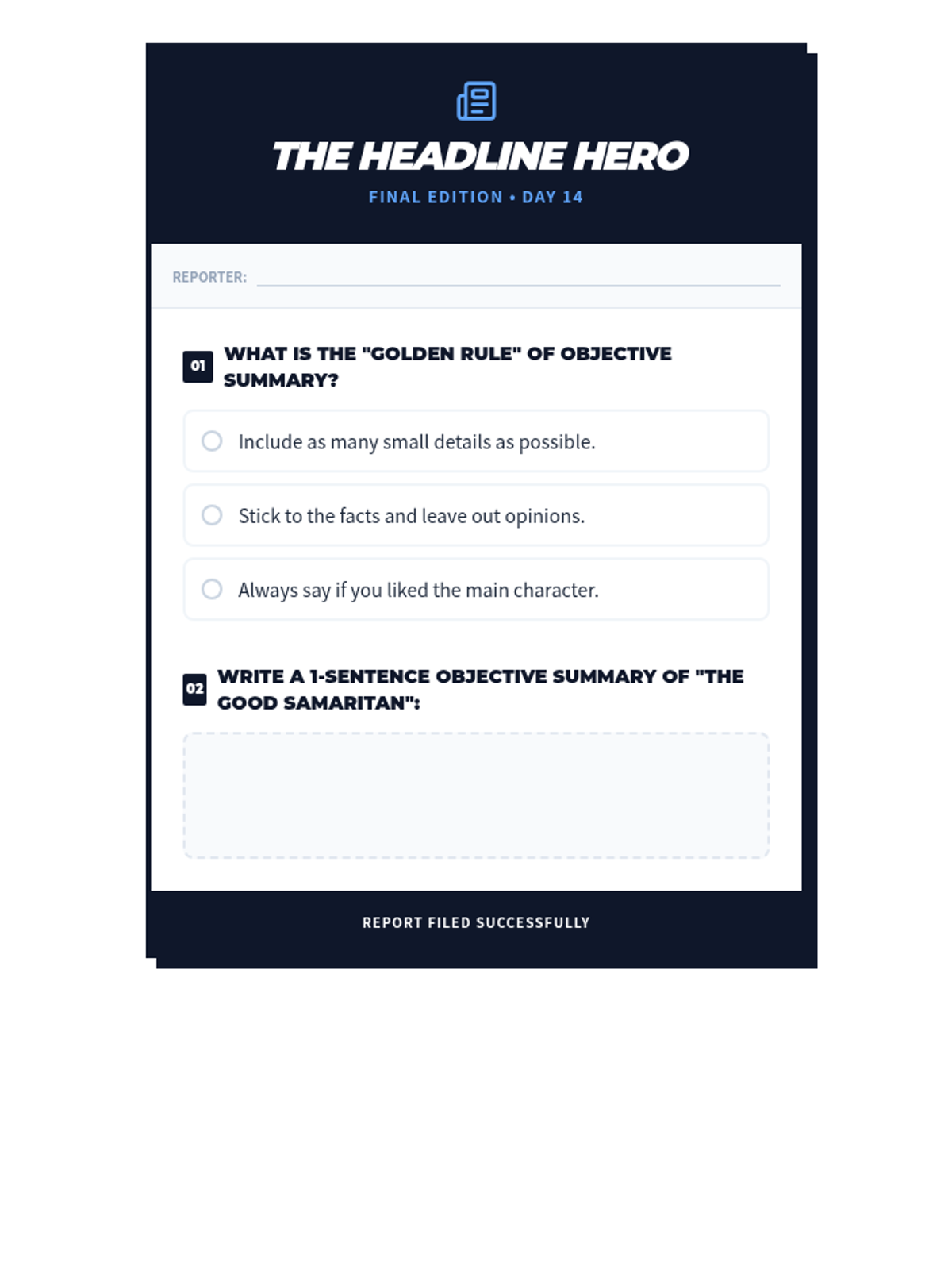
A quick assessment to check student understanding of objective summarization and their ability to summarize 'The Good Samaritan' in a single sentence.
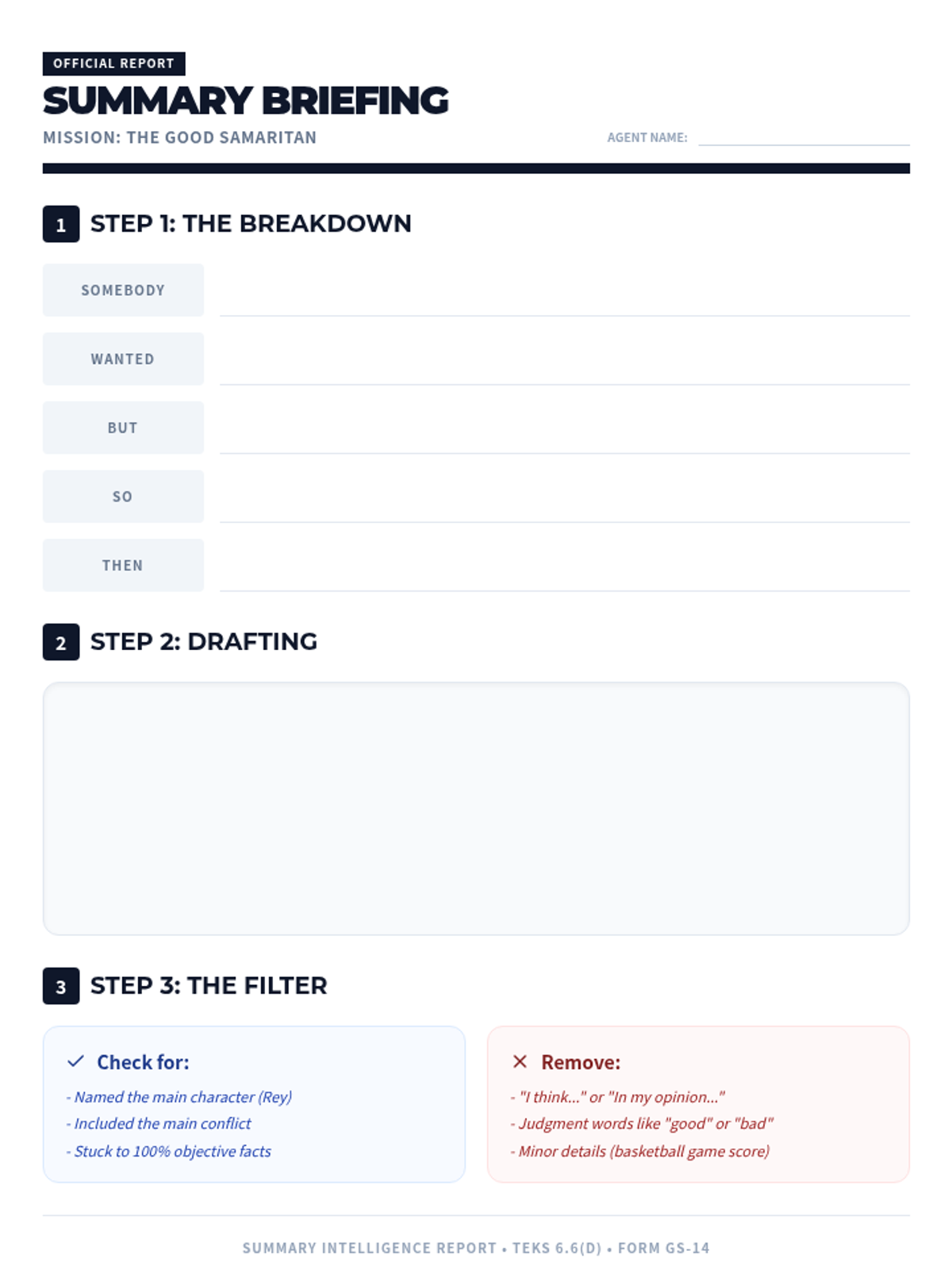
A structured worksheet using the SWBST method to guide students in drafting an objective summary of 'The Good Samaritan'.
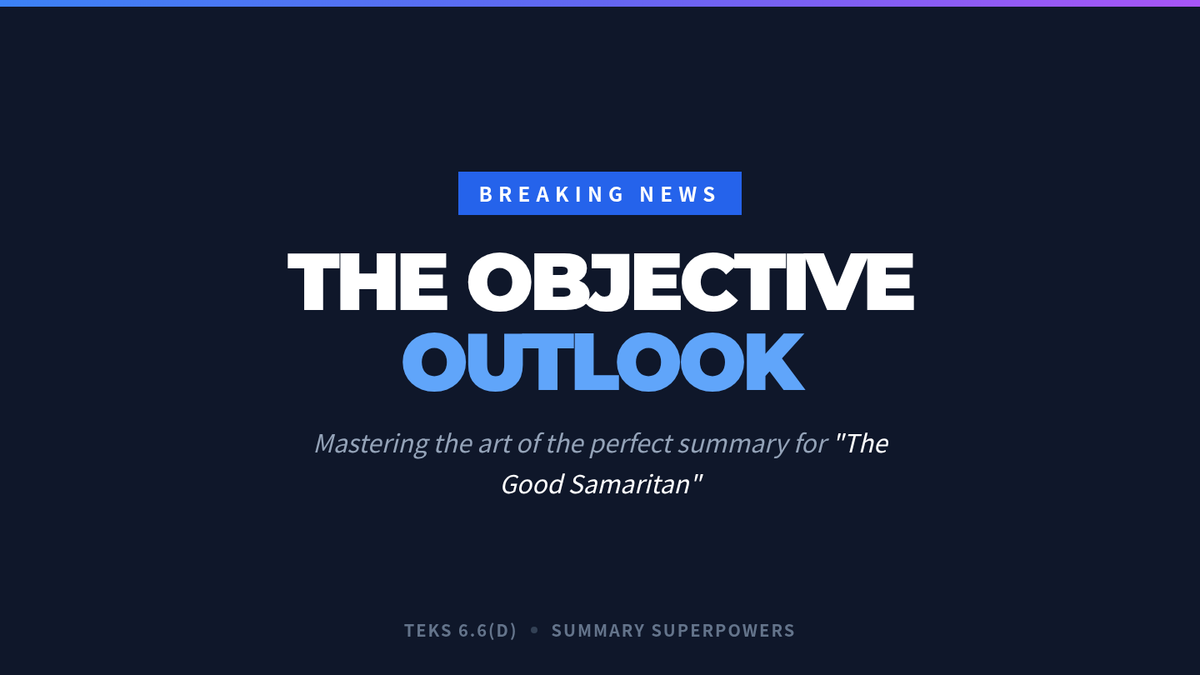
A slide deck teaching TEKS 6.6(D) summarization skills, focusing on the difference between objective and subjective details using a news-broadcast 'Daily Briefing' aesthetic.
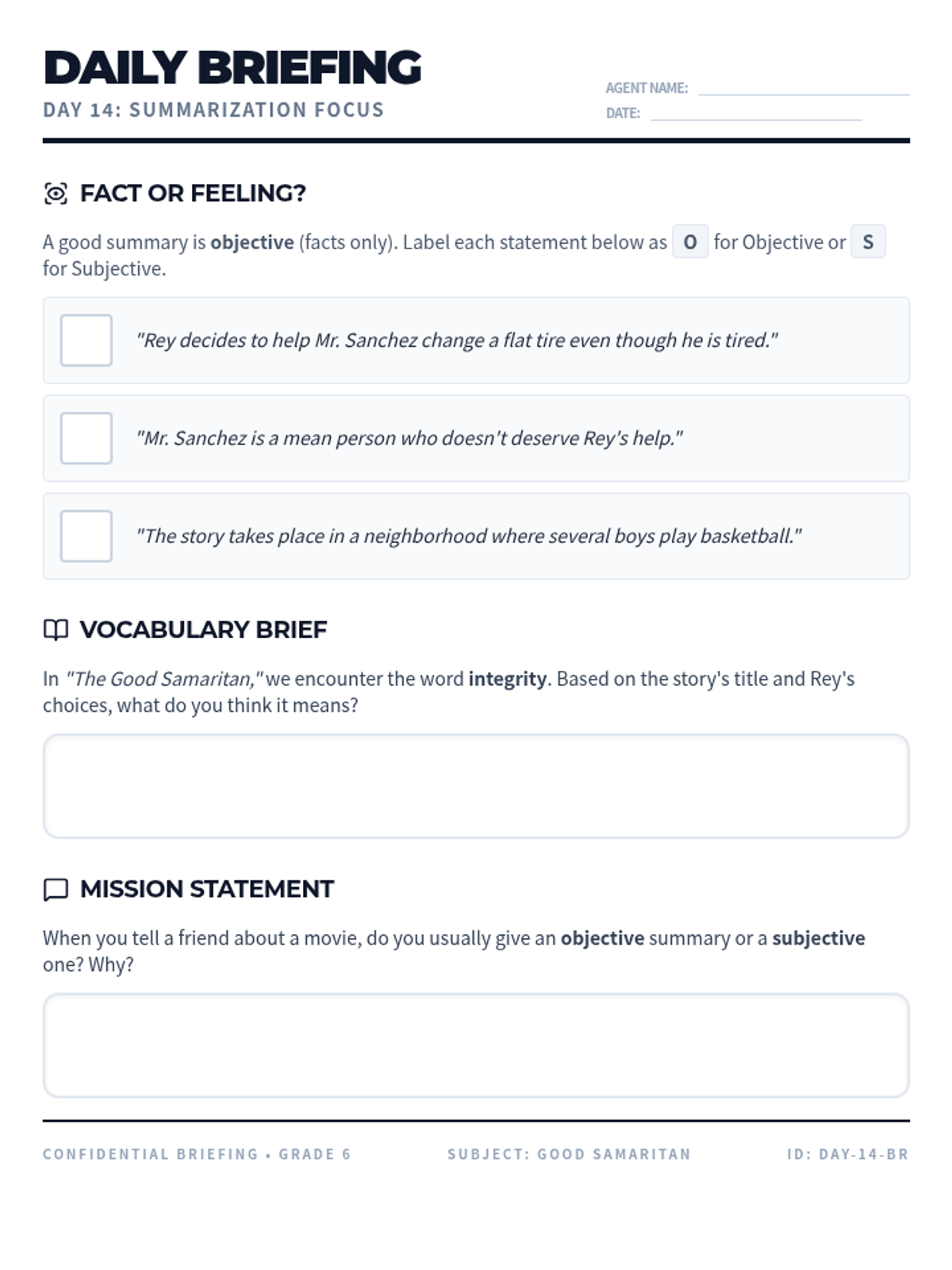
A 'Daily Briefing' themed bell-ringer for Day 14 focusing on distinguishing between objective and subjective statements and defining 'integrity' in context of 'The Good Samaritan'.
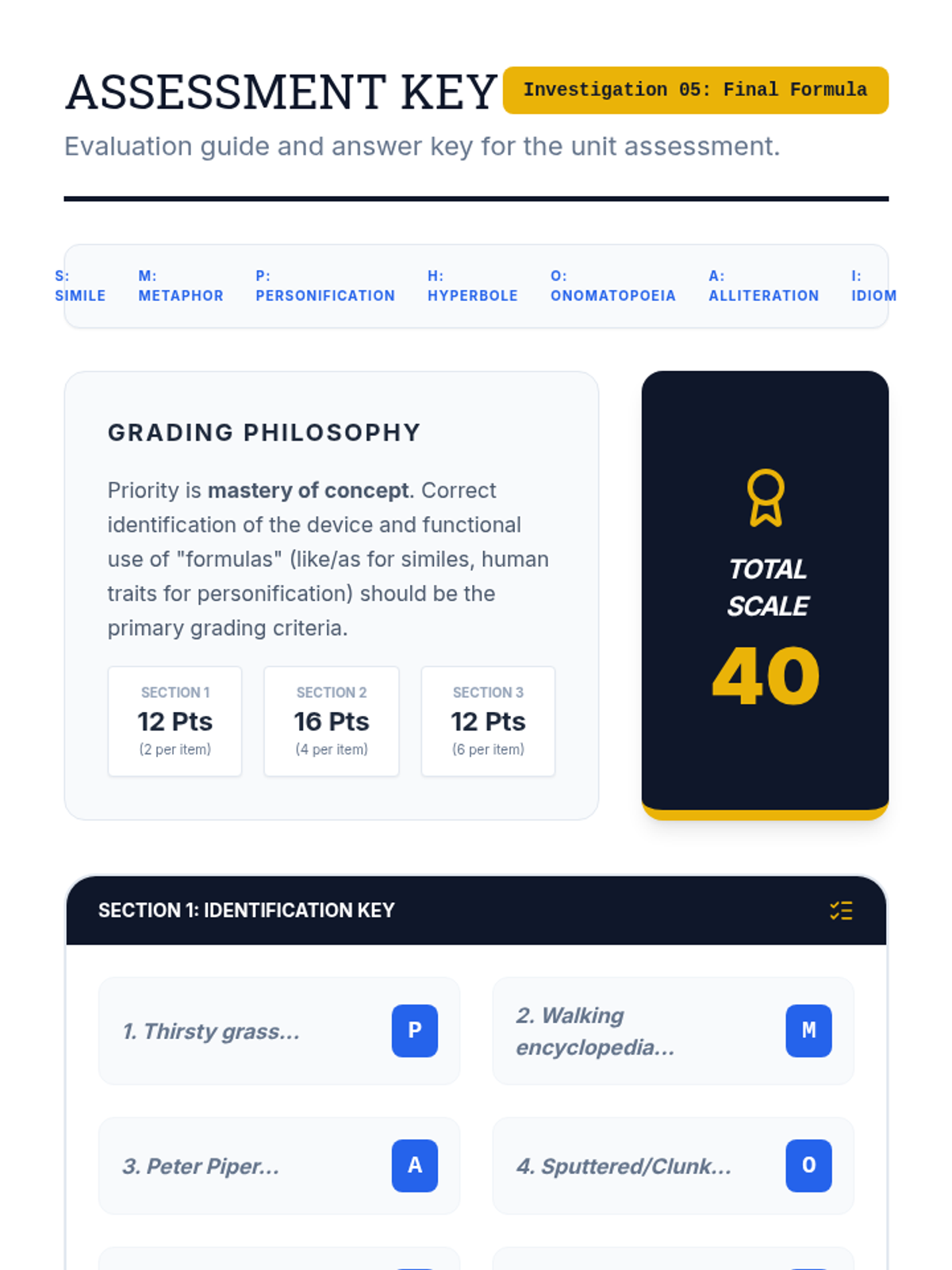
An answer key for the unit assessment. Includes specific point values, grading criteria for creative synthesis, and model responses for the analysis section.
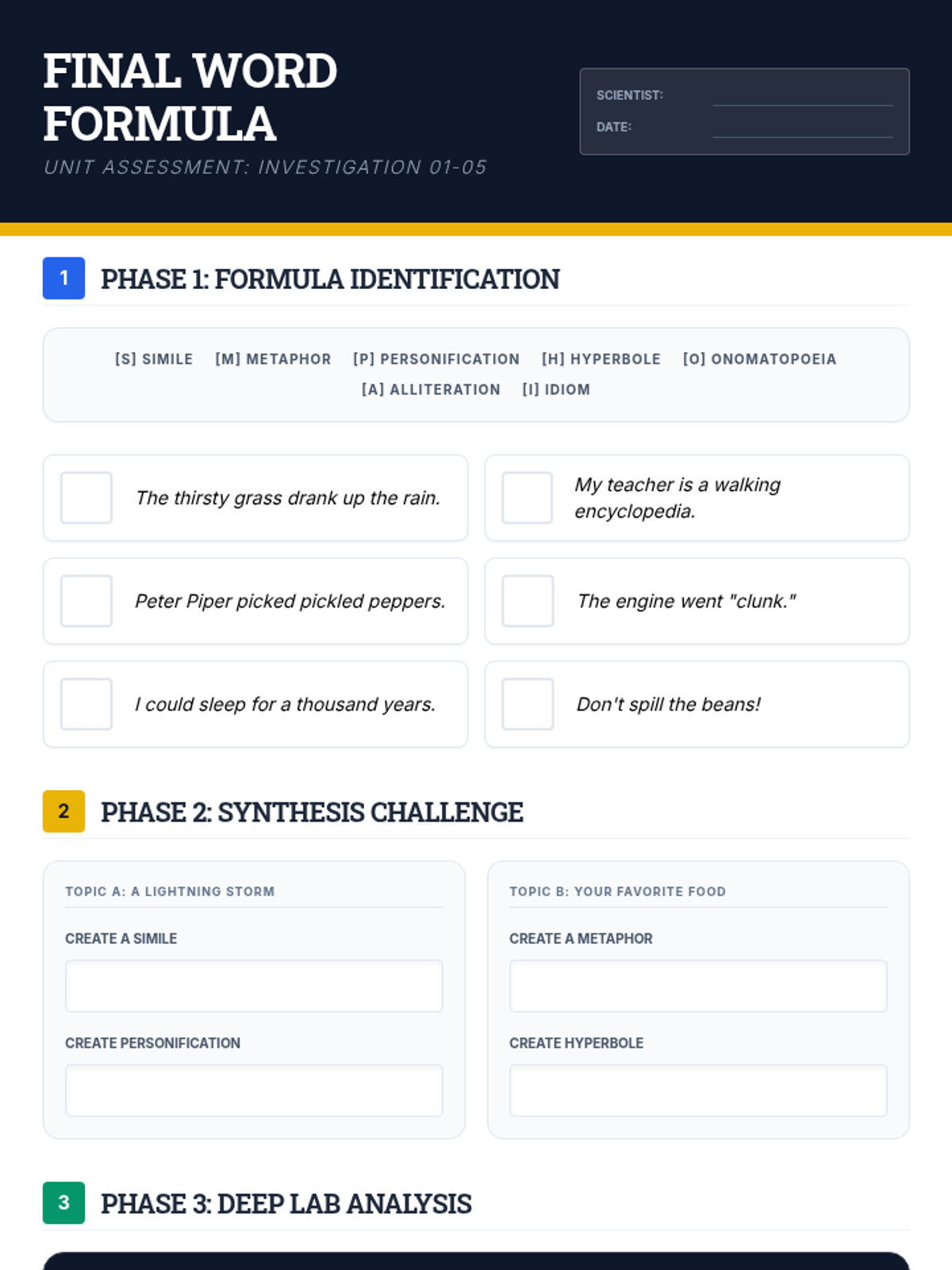
A cumulative unit assessment covering all types of figurative language introduced in the sequence. Designed as a final 'Research Log' to verify student mastery through identification, synthesis, and analysis.
A visual presentation for Lesson 5, providing a cumulative review of all figurative language types covered during the week. Uses a graduation/certification theme to motivate students.
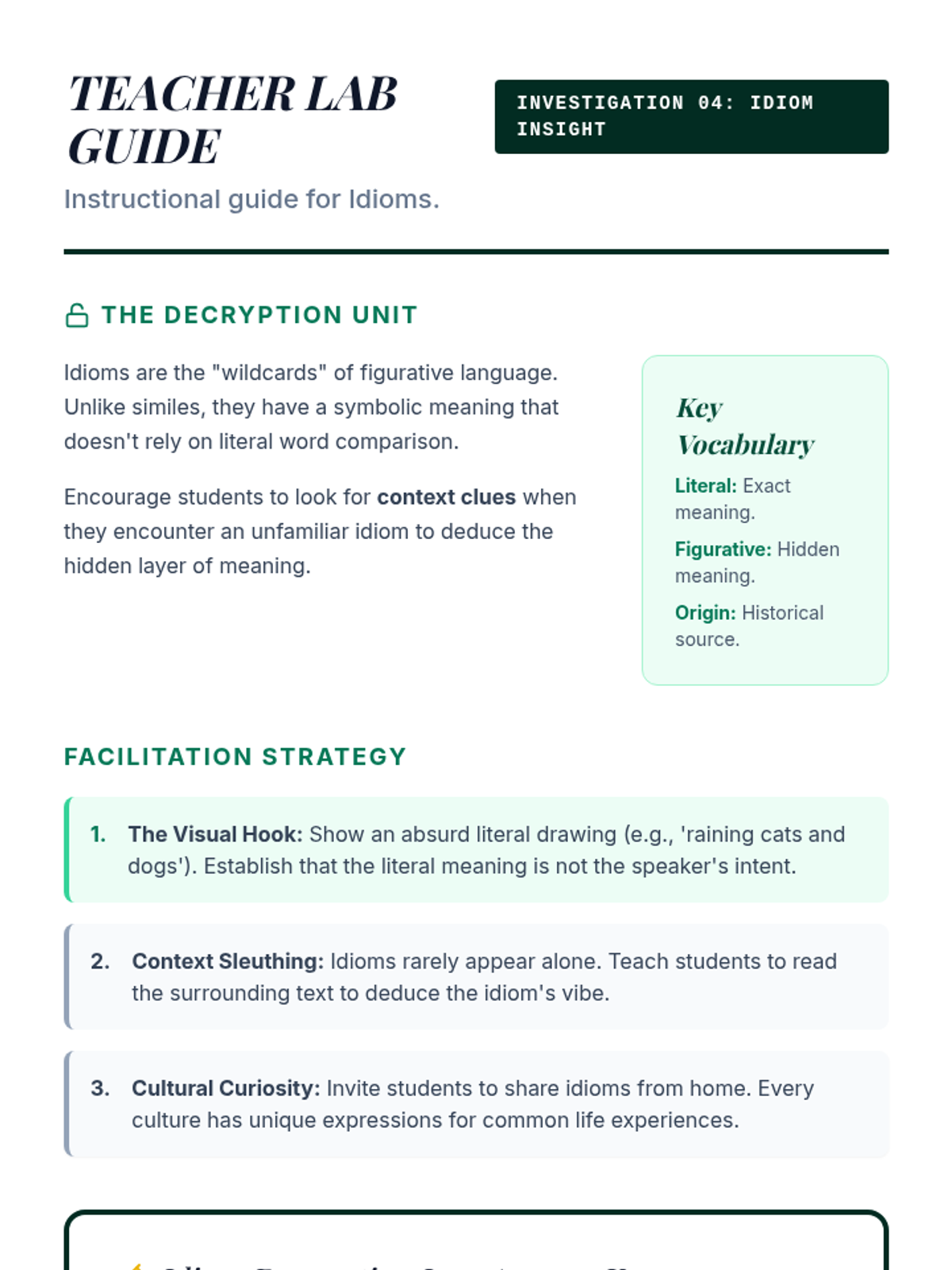
A teacher resource for Lesson 4, providing instructional strategies and an answer key for the 'Idiom Insight' activities. Focuses on literal vs. figurative distinctions and context-clue strategies.
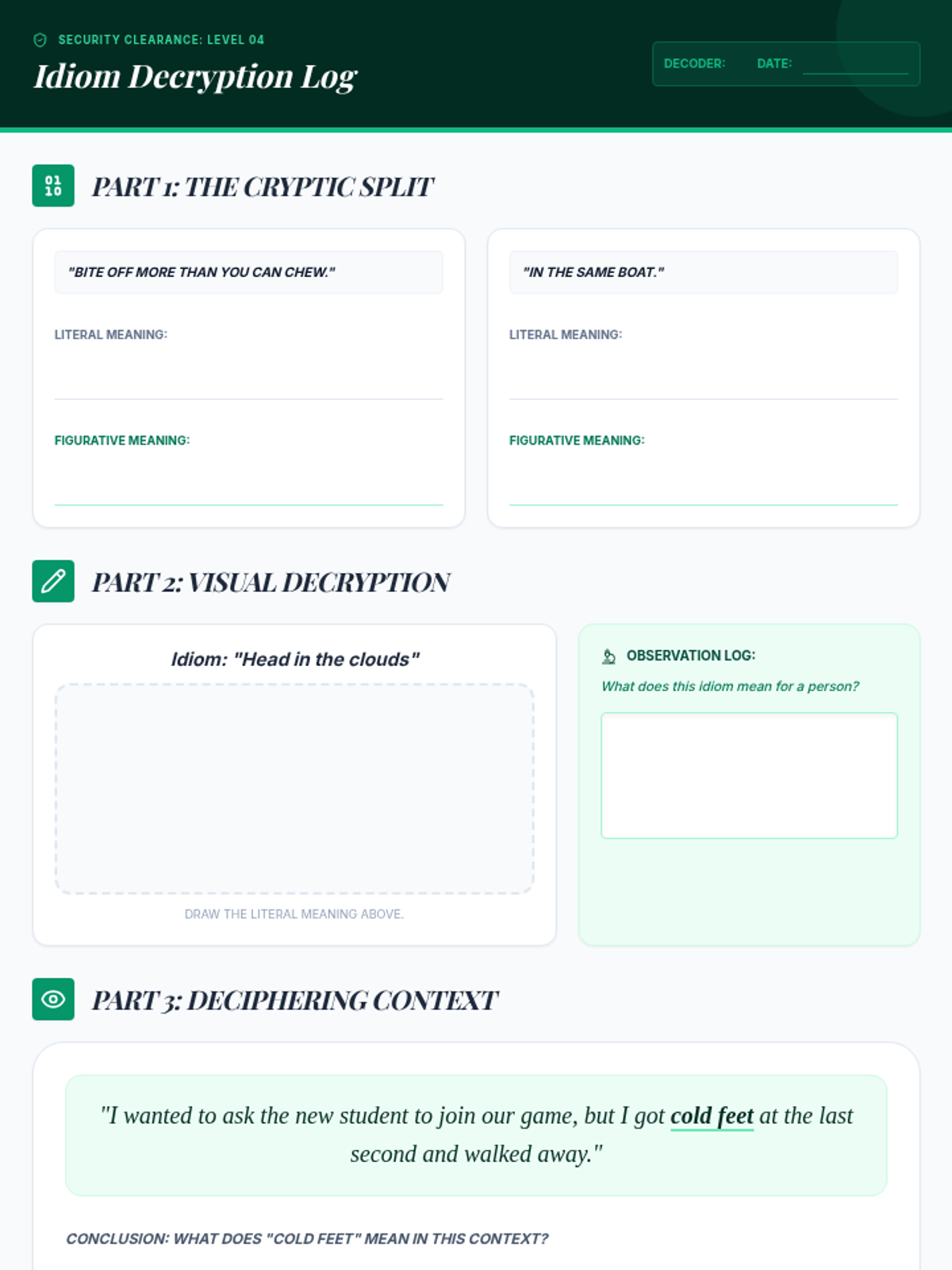
A student activity sheet for Lesson 4, designed as a 'Decryption Log.' Includes literal vs. figurative analysis, a visual interpretation task, and a context-clue decoding exercise for idioms.
A visual presentation for Lesson 4, introducing idioms through a 'cryptology lab' theme. Focuses on the difference between literal and figurative meanings and explores common idioms and their origins.
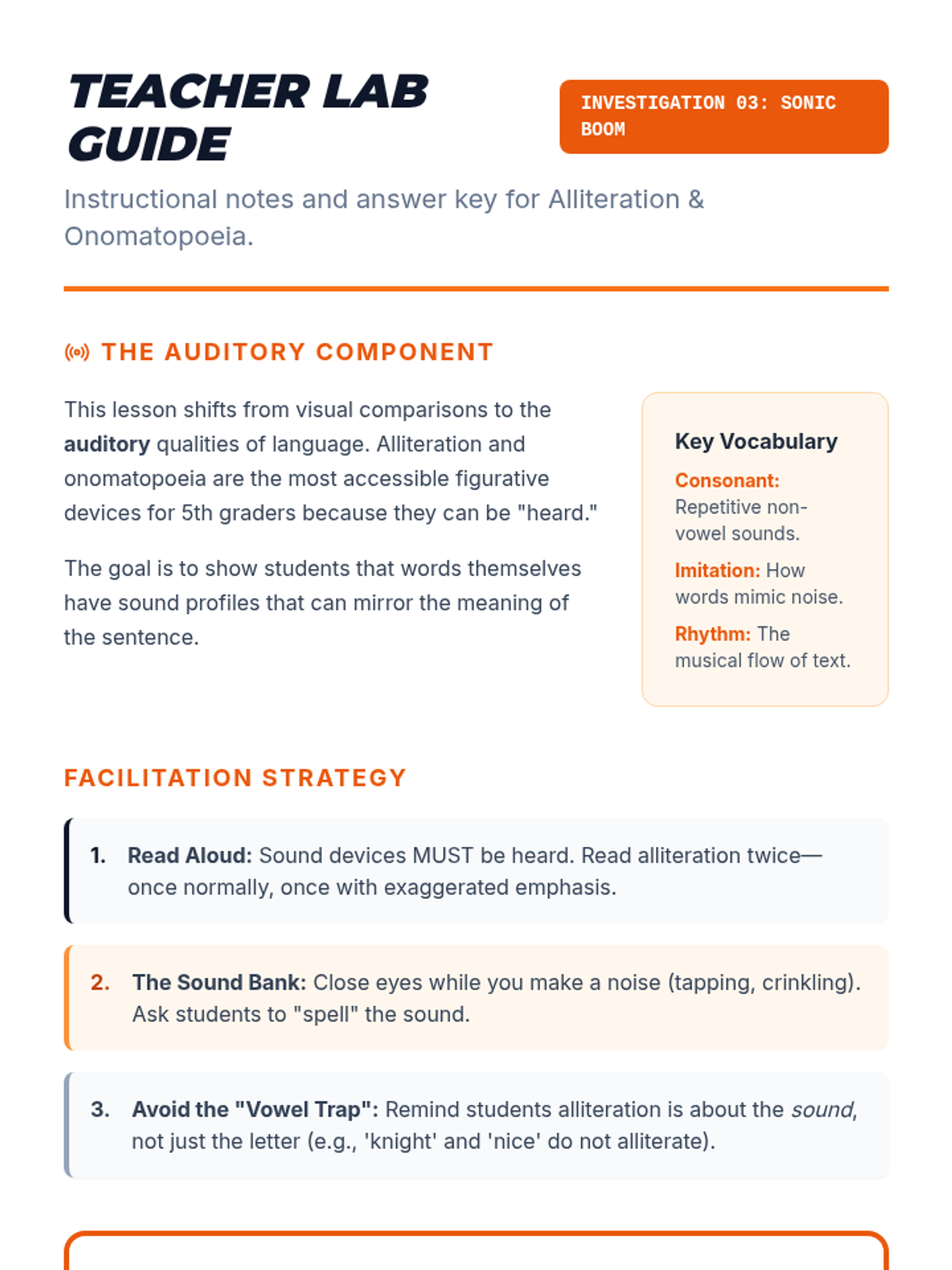
A teacher resource for Lesson 3, providing instructional strategies and an answer key for the 'Sonic Boom' activities. Focuses on the auditory impact of language.
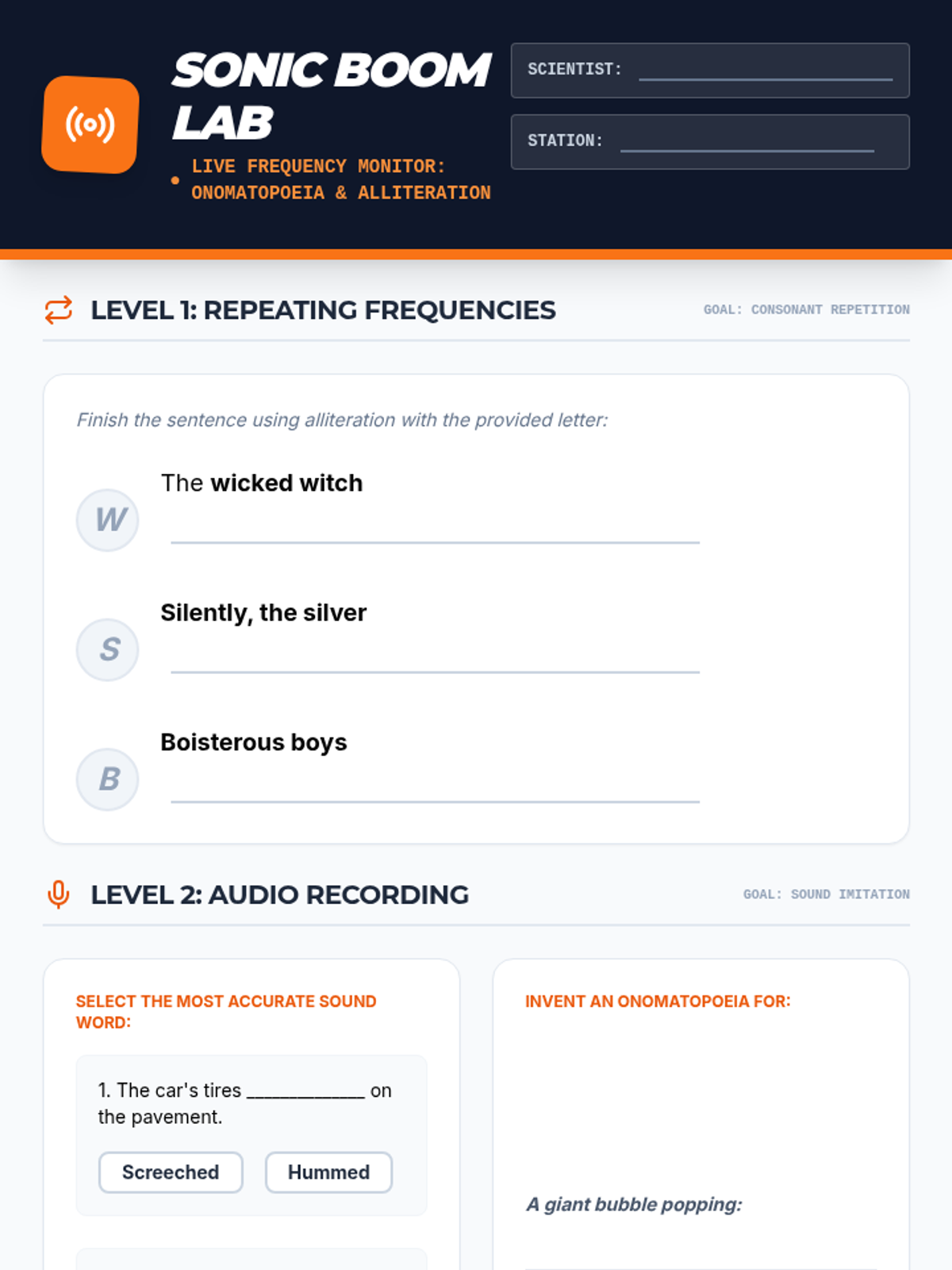
A student activity sheet for Lesson 3, focused on alliteration and onomatopoeia. Includes sentence completion, sound word matching, and a creative synthesis challenge.
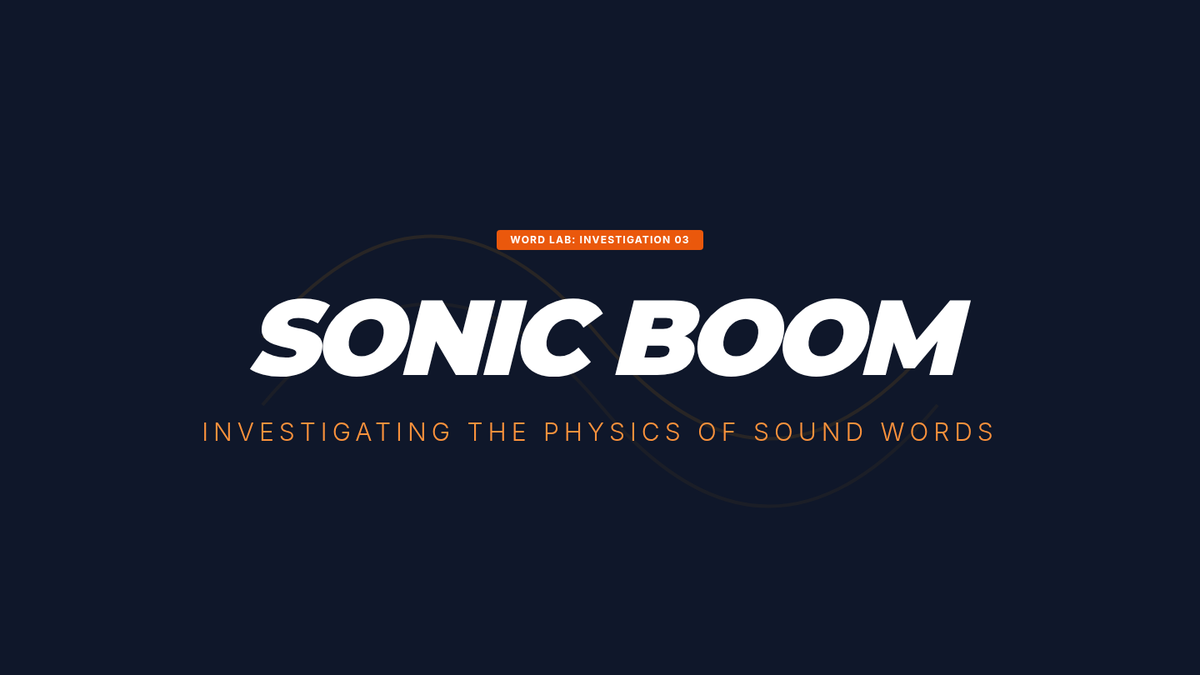
A visual presentation for Lesson 3, focusing on onomatopoeia and alliteration. Investigates the auditory impact of these devices using a high-energy 'sonic lab' theme.
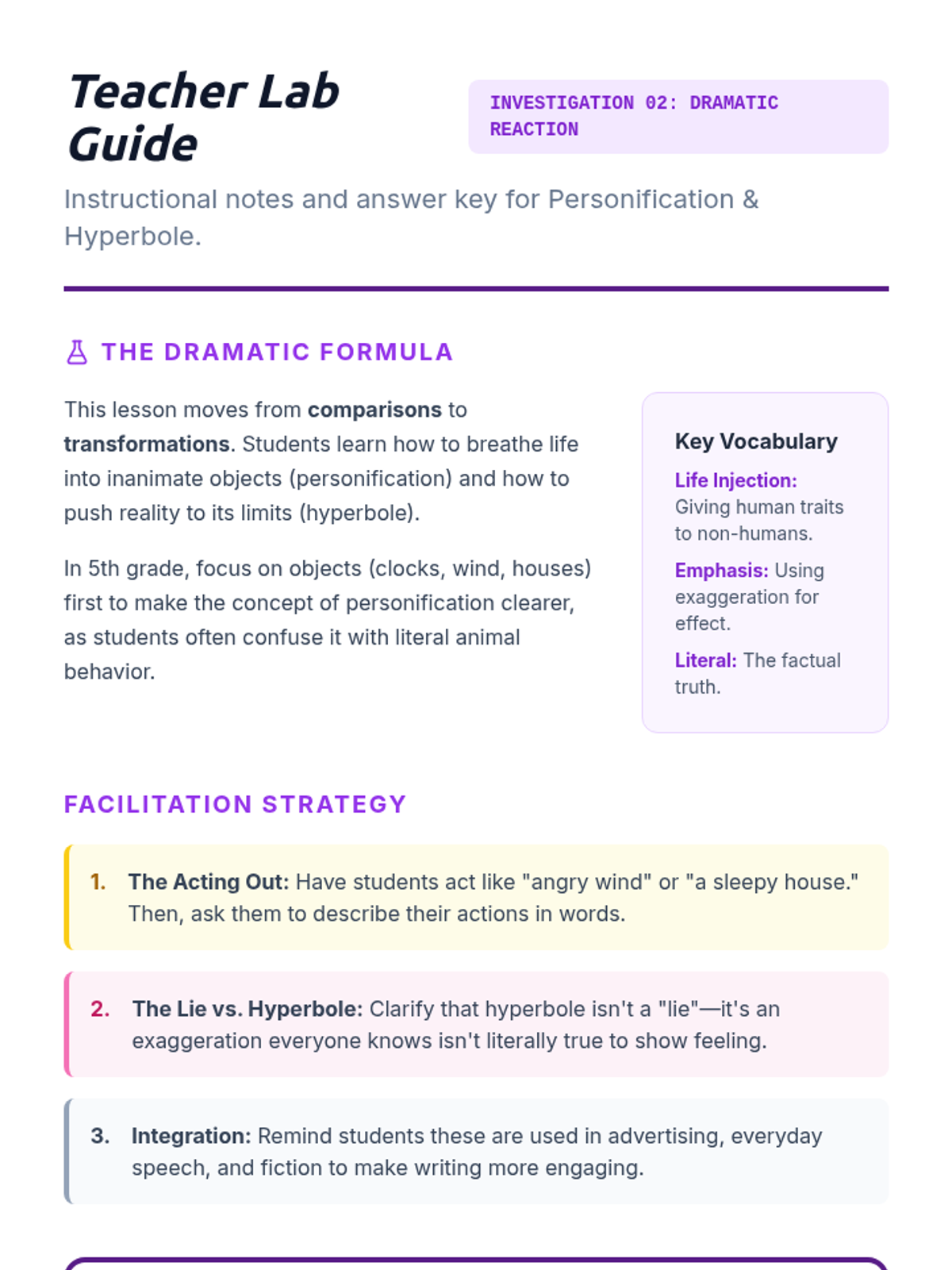
A teacher resource for Lesson 2, providing instructional strategies and an answer key for the 'Dramatic Reaction' activities. Includes tips for distinguishing between literal descriptions and figurative language.
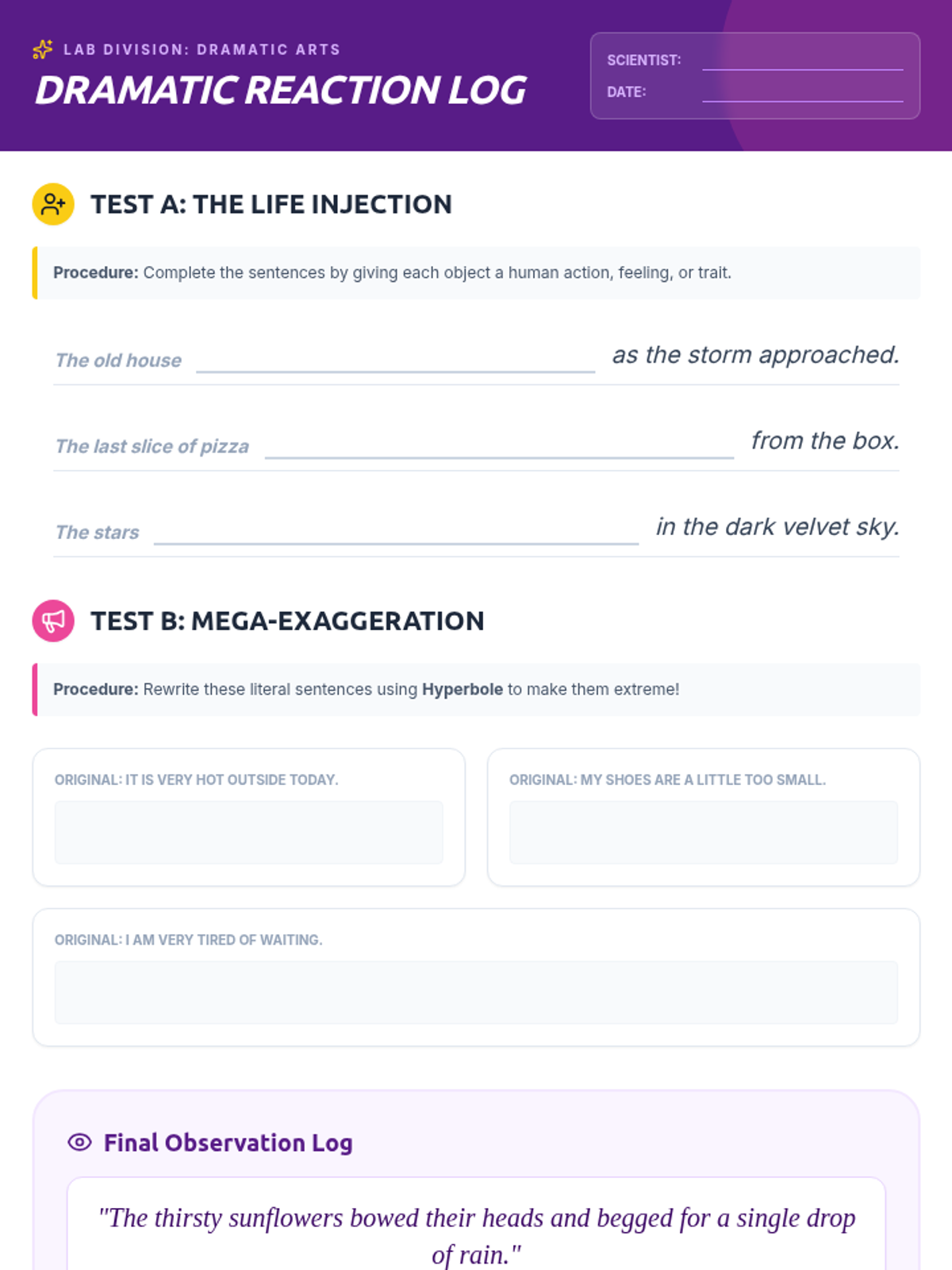
A student activity sheet for Lesson 2, focused on personification and hyperbole. Includes creative completion tasks, 'extreme rewriting' challenges, and a visual dissection exercise.
A visual presentation for Lesson 2, focusing on personification and hyperbole. Uses a dramatic 'theatrical lab' theme to illustrate how these devices add personality and emphasis to writing.
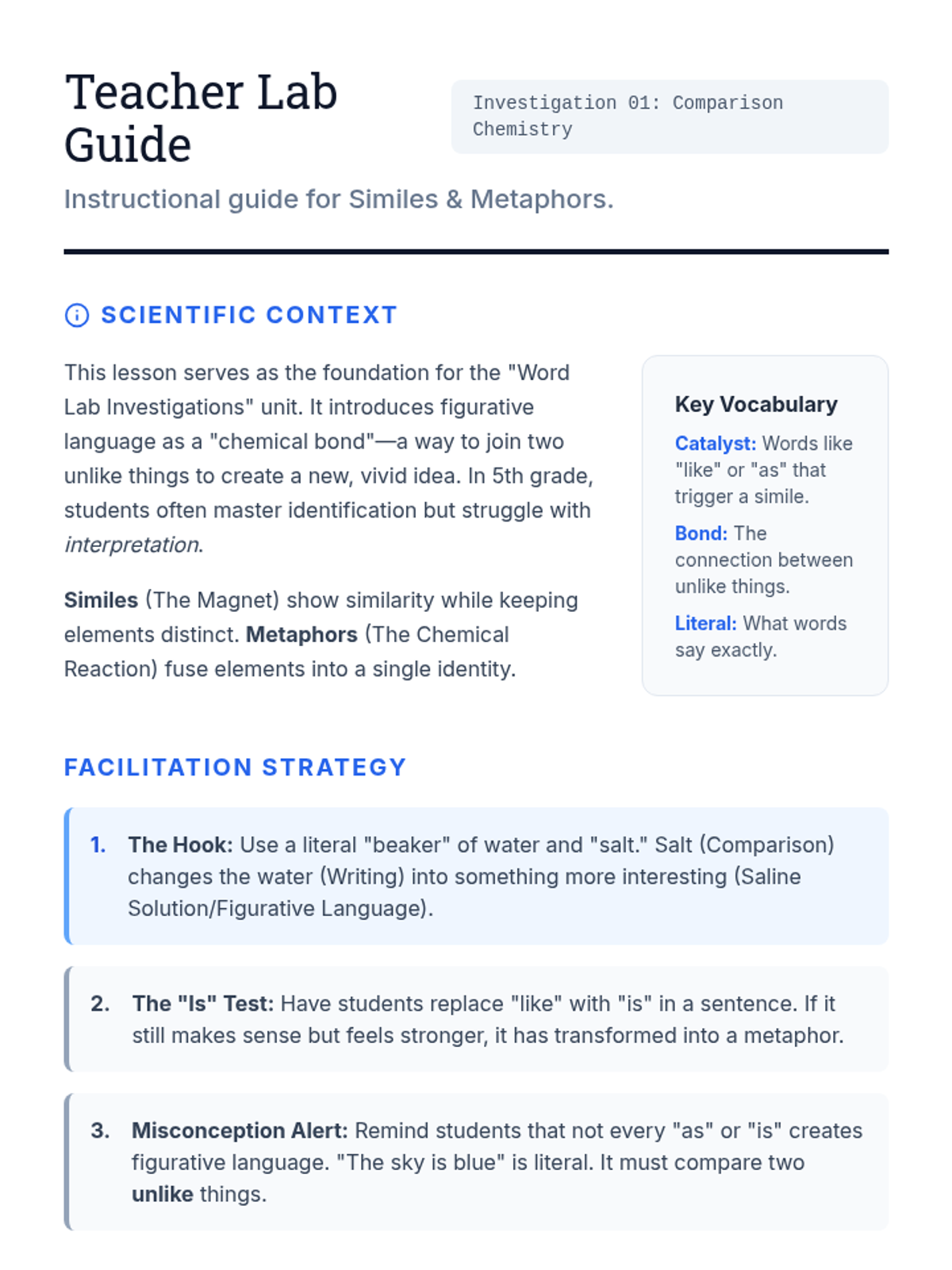
A teacher resource for Lesson 1, providing instructional strategies, background knowledge on common student misconceptions, and a full answer key for the 'Comparison Chemistry' worksheet.
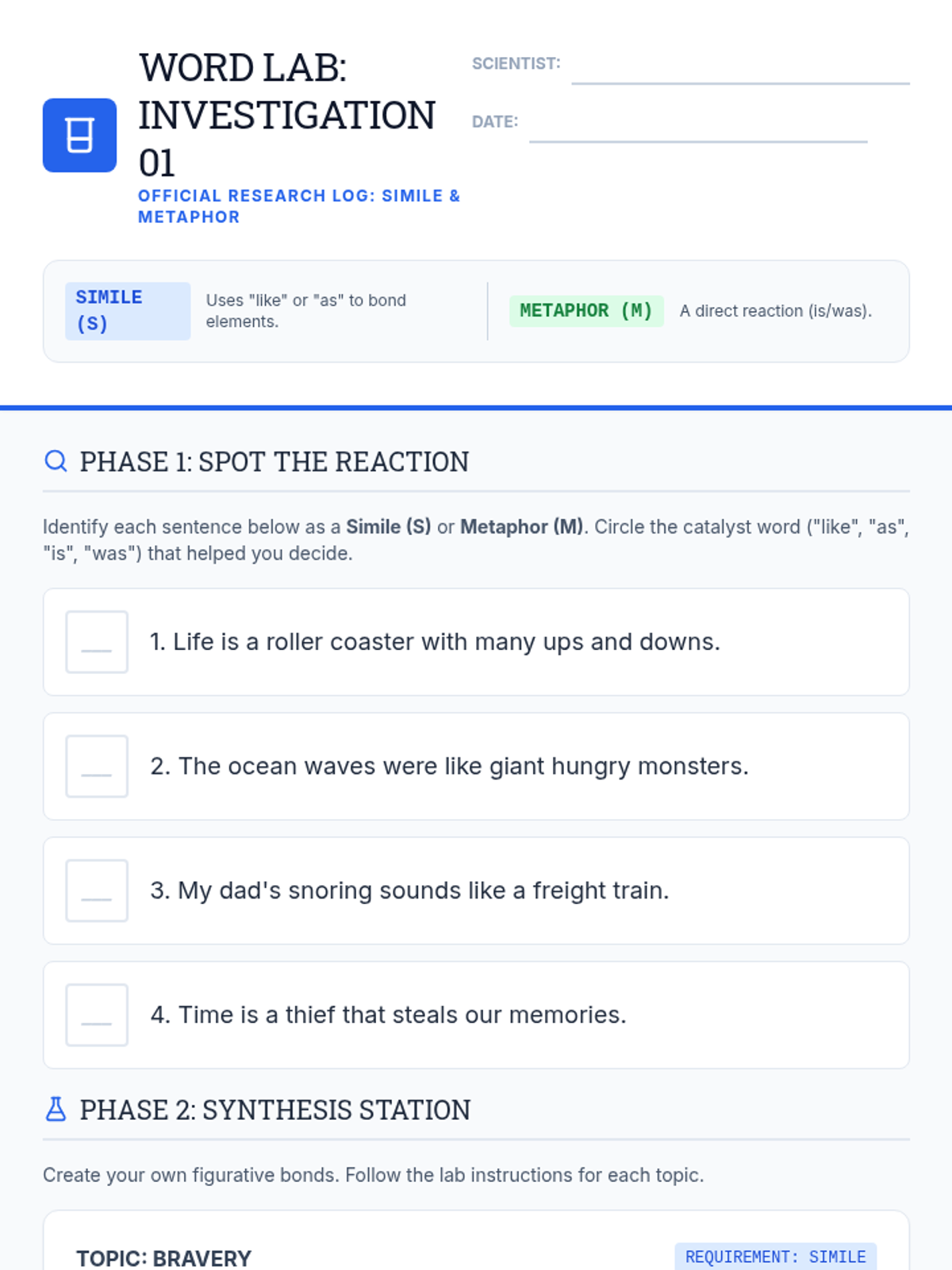
A student activity sheet for Lesson 1, designed as a 'Research Log.' It includes identification practice (Simile vs. Metaphor), creative synthesis prompts, and a short-answer analysis section for deeper comprehension.
A visual presentation for Lesson 1, introducing similes and metaphors through a laboratory-themed investigation. Includes clear definitions, 'formulas' for identification, and guided practice challenges.