Builds word mastery through parts of speech, Greek and Latin roots, and morphological analysis of prefixes and suffixes. Develops nuanced comprehension using context clues, shades of meaning, and idiomatic expressions.
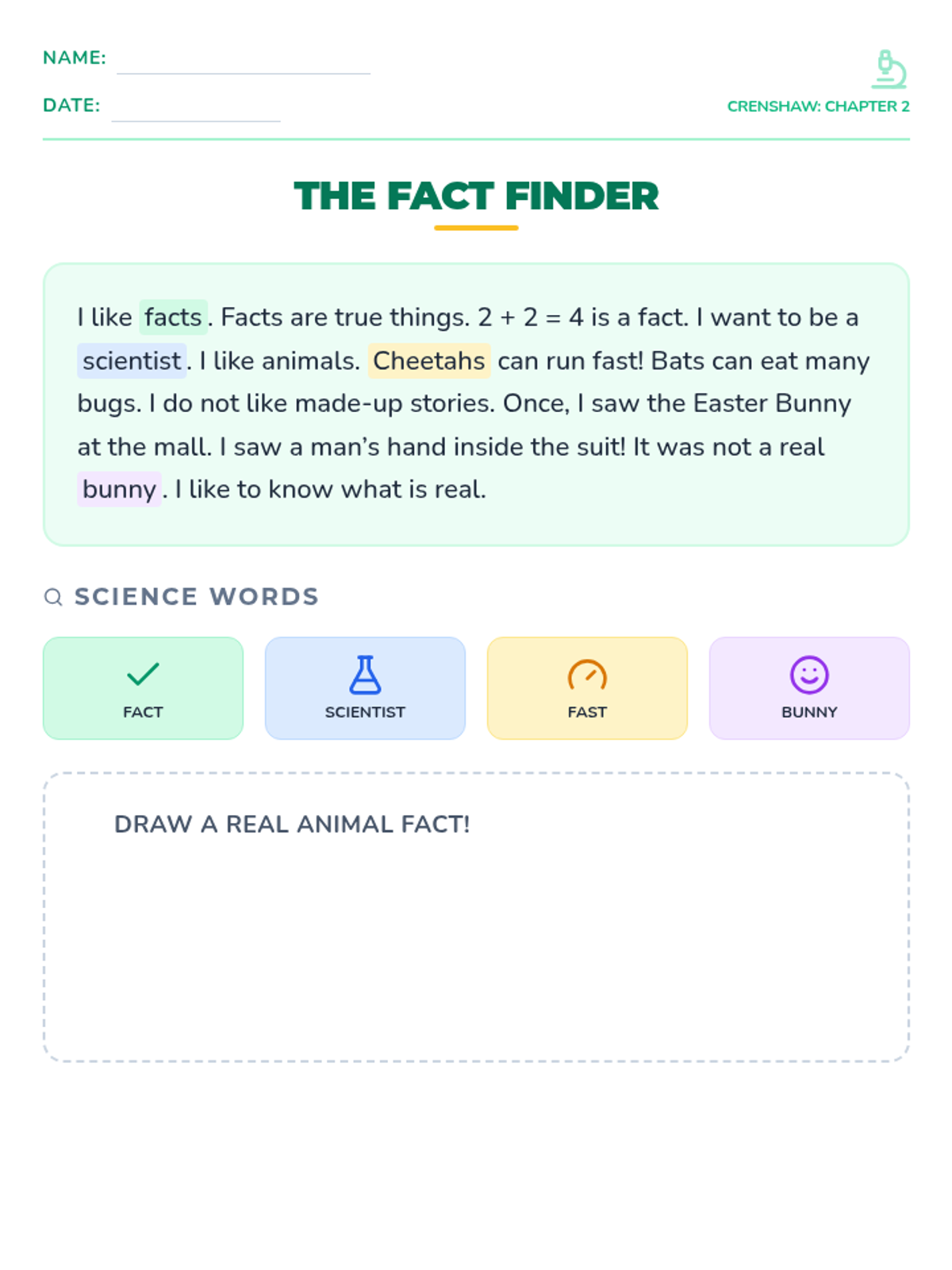
A 1st-grade reading adaptation of the second chapter of Crenshaw, focusing on Jackson's love for facts and science. Includes simplified text, a picture glossary, and a drawing activity.
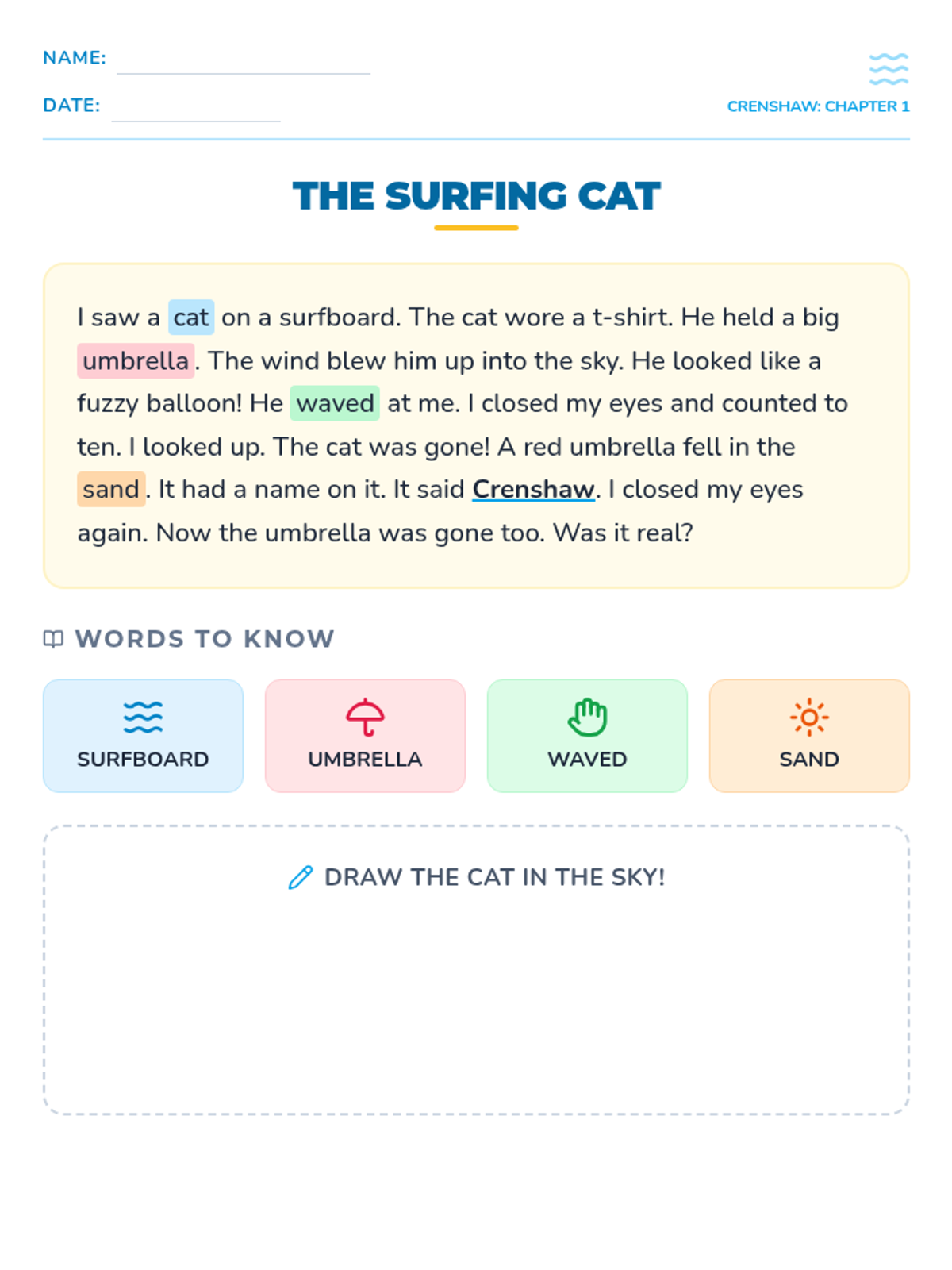
A 1st-grade reading adaptation of the first chapter of Crenshaw, featuring simplified text, large font for easy reading, a picture glossary for key vocabulary, and a drawing space for student engagement. This version is optimized for single-page printing.
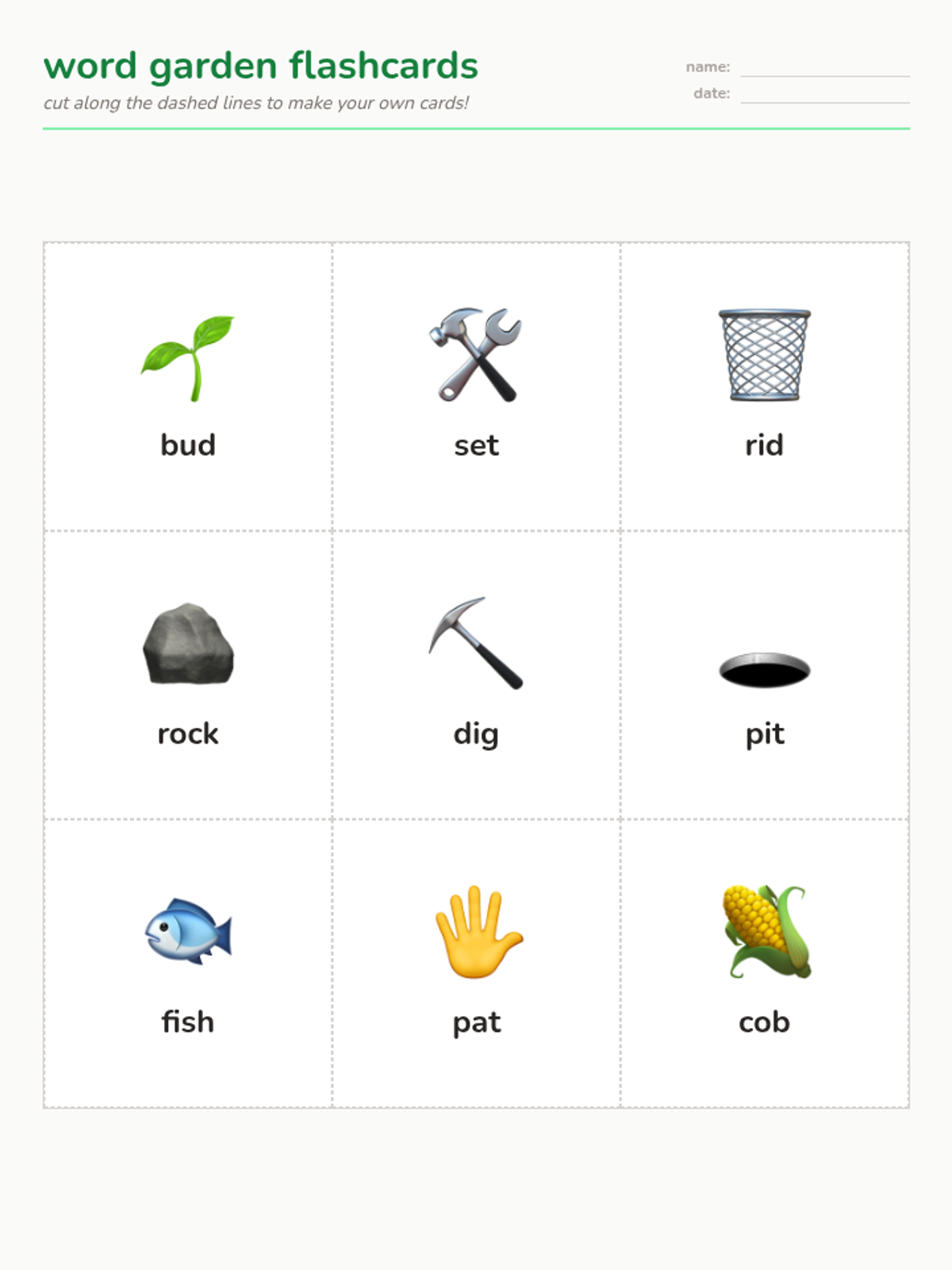
A set of printable flashcards featuring all 13 garden words and their corresponding images. Updated icons for 'set' and 'squash'. Designed with dashed lines for easy cutting and a clean, lowercase aesthetic. Layout updated for cleaner borders and vertical centering.
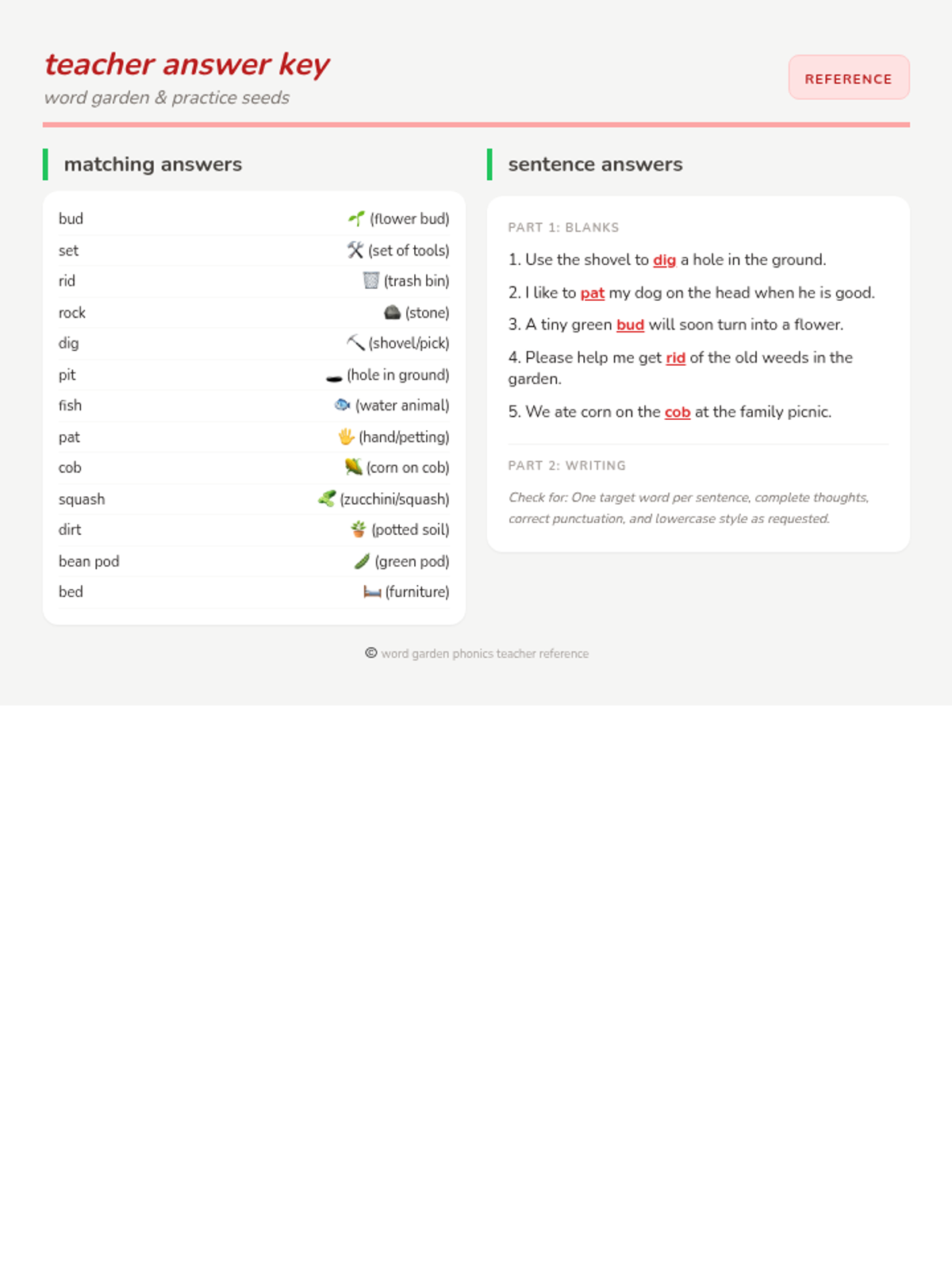
A concise, single-page teacher answer key providing correct pairings and complete sentence completions for the Word Garden activities. Updated with new icons for 'set' and 'squash'.
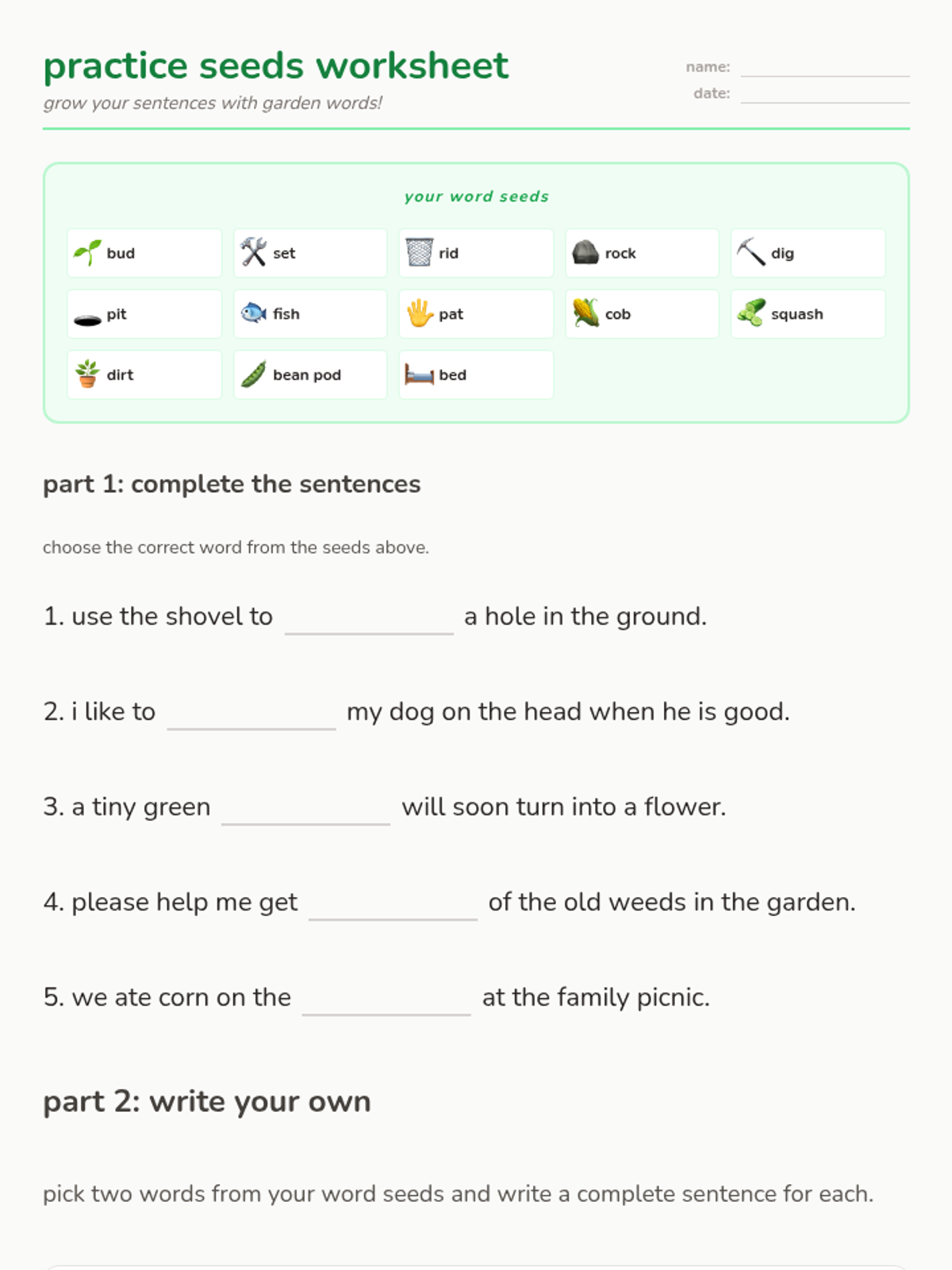
A sentence-level practice worksheet featuring a visual word bank, fill-in-the-blank exercises, and creative writing prompts. Icons for 'set' and 'squash' updated for better clarity. All labels are lowercase as requested.
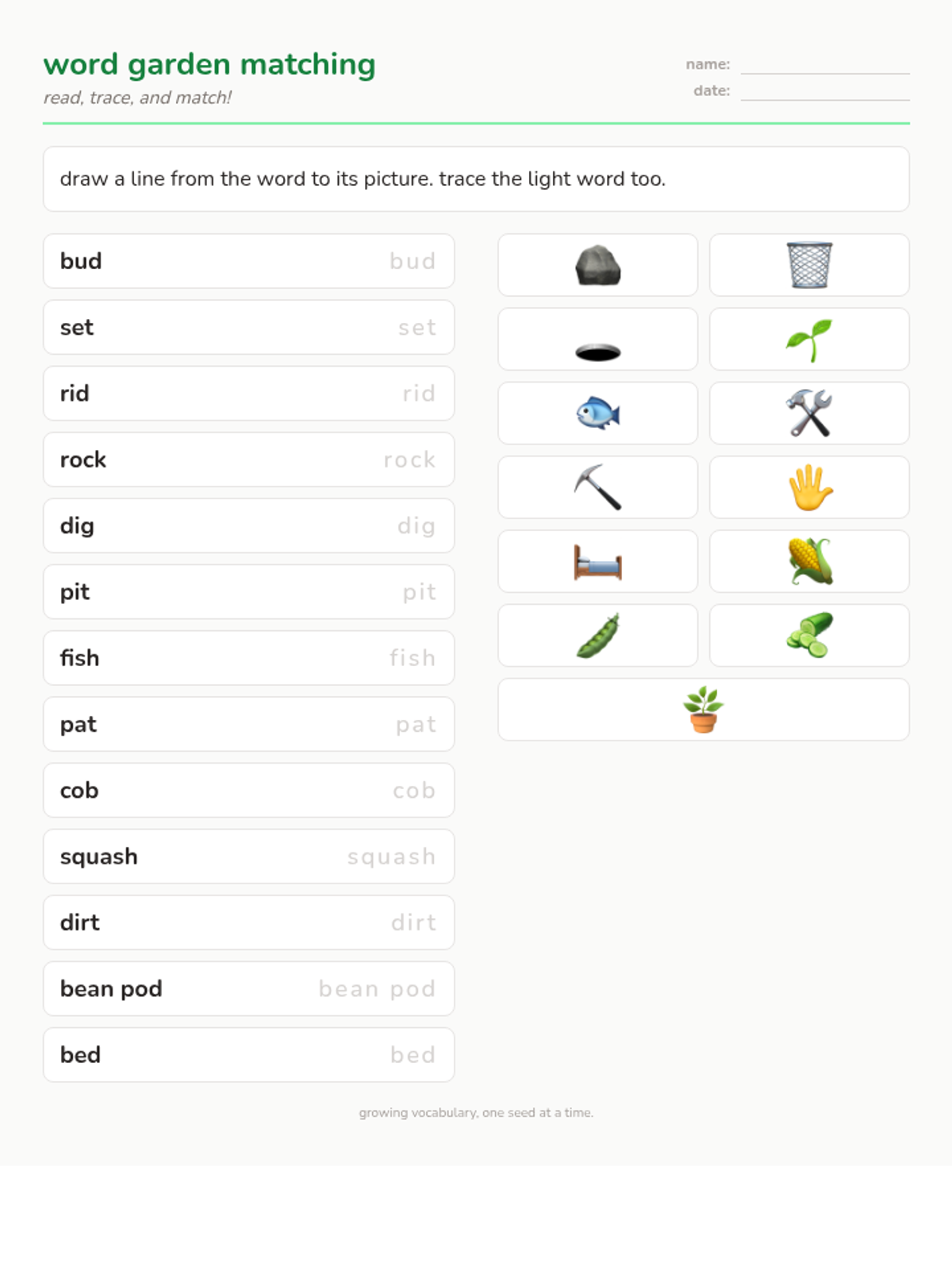
A compact matching worksheet where students connect all 13 words to their corresponding images and trace the words in a guided box, all on a single page. Layout revised for clarity and contrast. Updated icons for 'set' (tools) and 'squash' (zucchini).
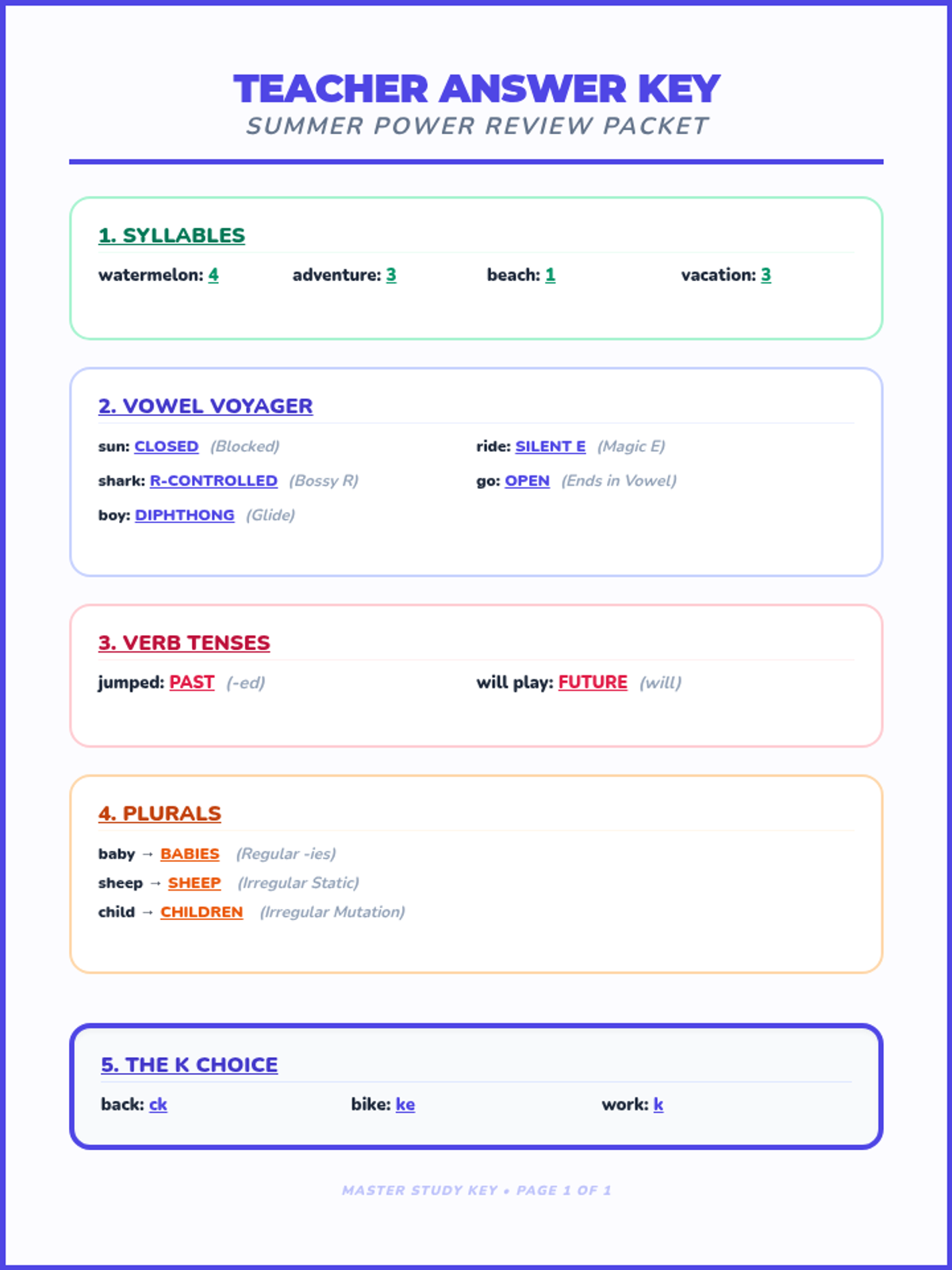
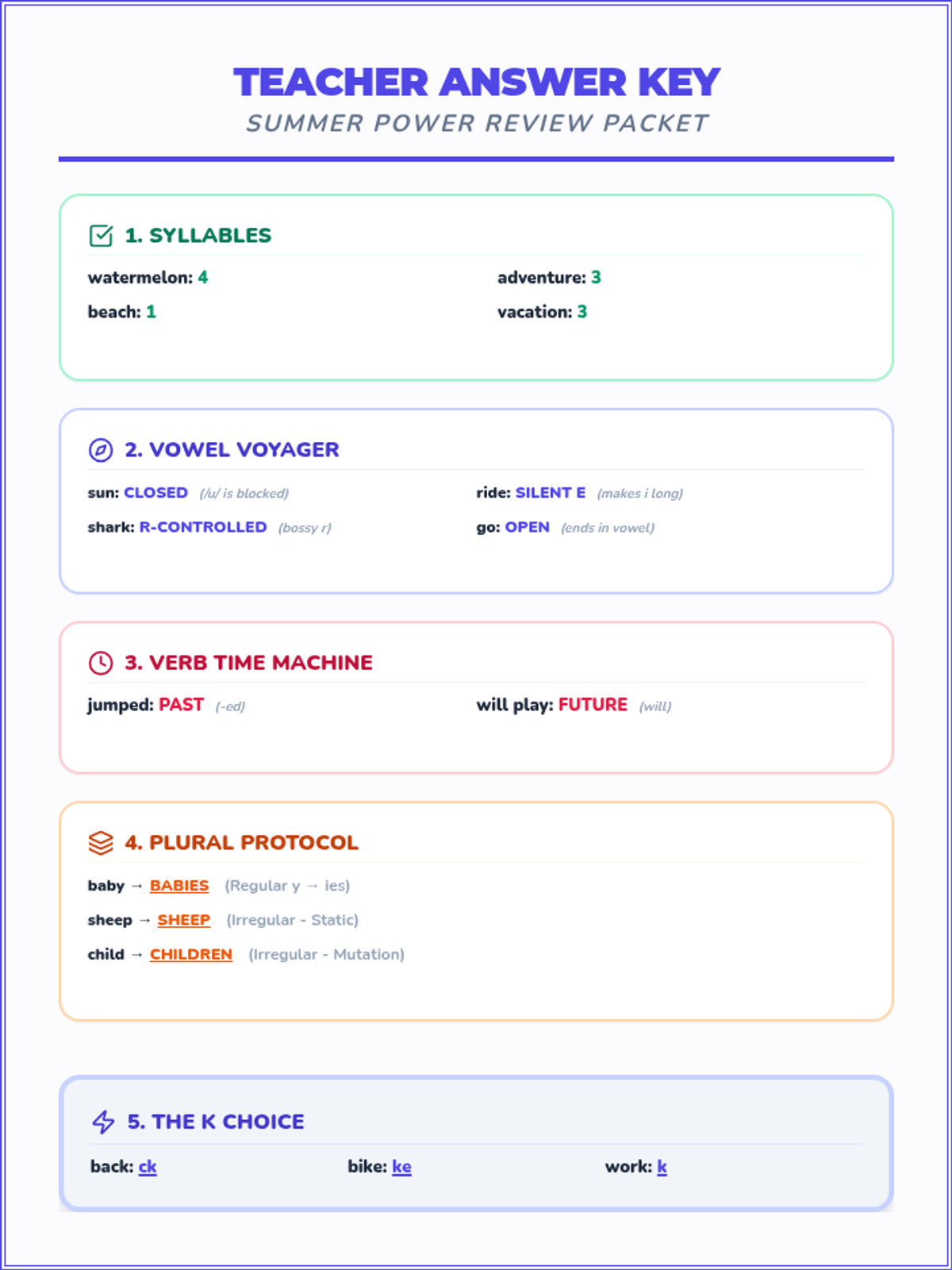
A high-contrast teacher answer key for the Summer Power Review Packet. Provides clear answers for Grade 2 literacy worksheet tasks with rule reminders. Optimized for successful PDF export.
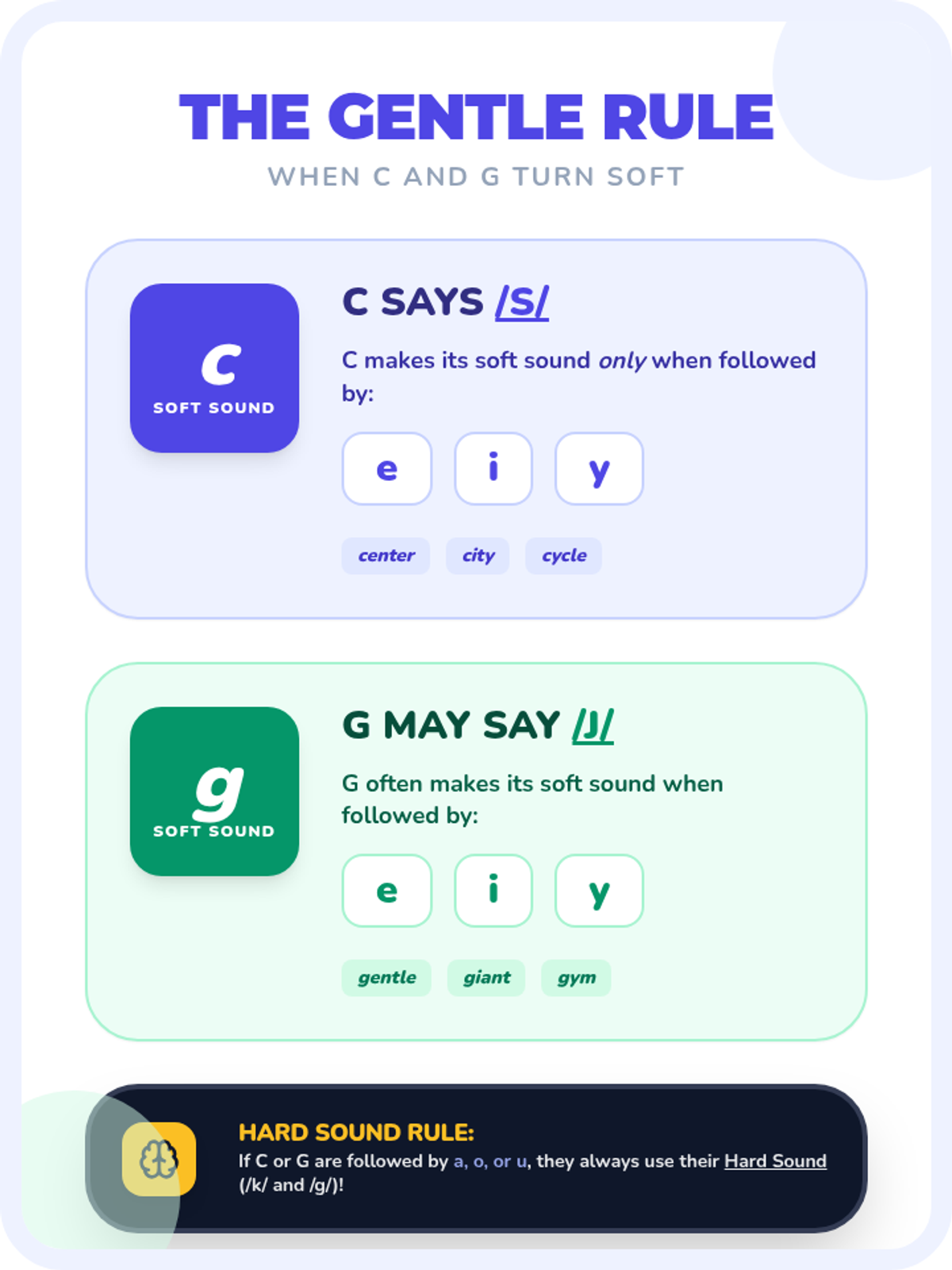
An anchor chart explaining the rules for Soft C and Soft G sounds, including examples and the corresponding Hard C/G rules for comparison.
A simplified, high-contrast teacher answer key for the Grade 2 Summer Power Review Packet. Provides clear answers and logic summaries for each task. Optimized for high-quality PDF export and classroom printing.
A comprehensive 6-page Summer Review Packet for Grade 2 literacy. Features explicit rule anchor charts for phonics, morphology, vowel types, verb tenses, and spelling, followed by a detailed worksheet. Designed with high-contrast elements and zero complex CSS for reliable PDF export.
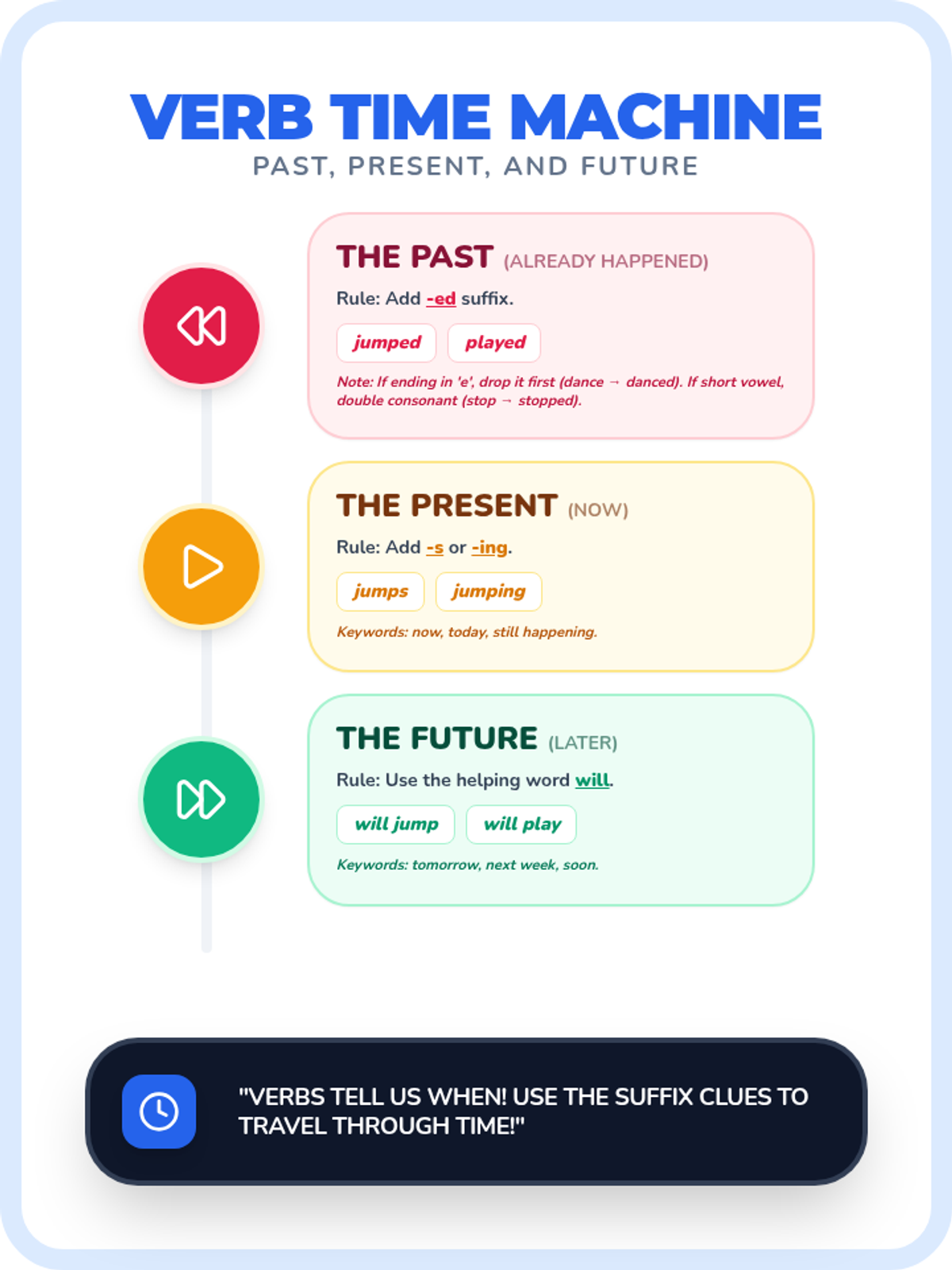
An anchor chart explaining past, present, and future verb tenses with visual cues, rules for spelling changes, and examples. Fits on a single page. Corrected suffix layout.
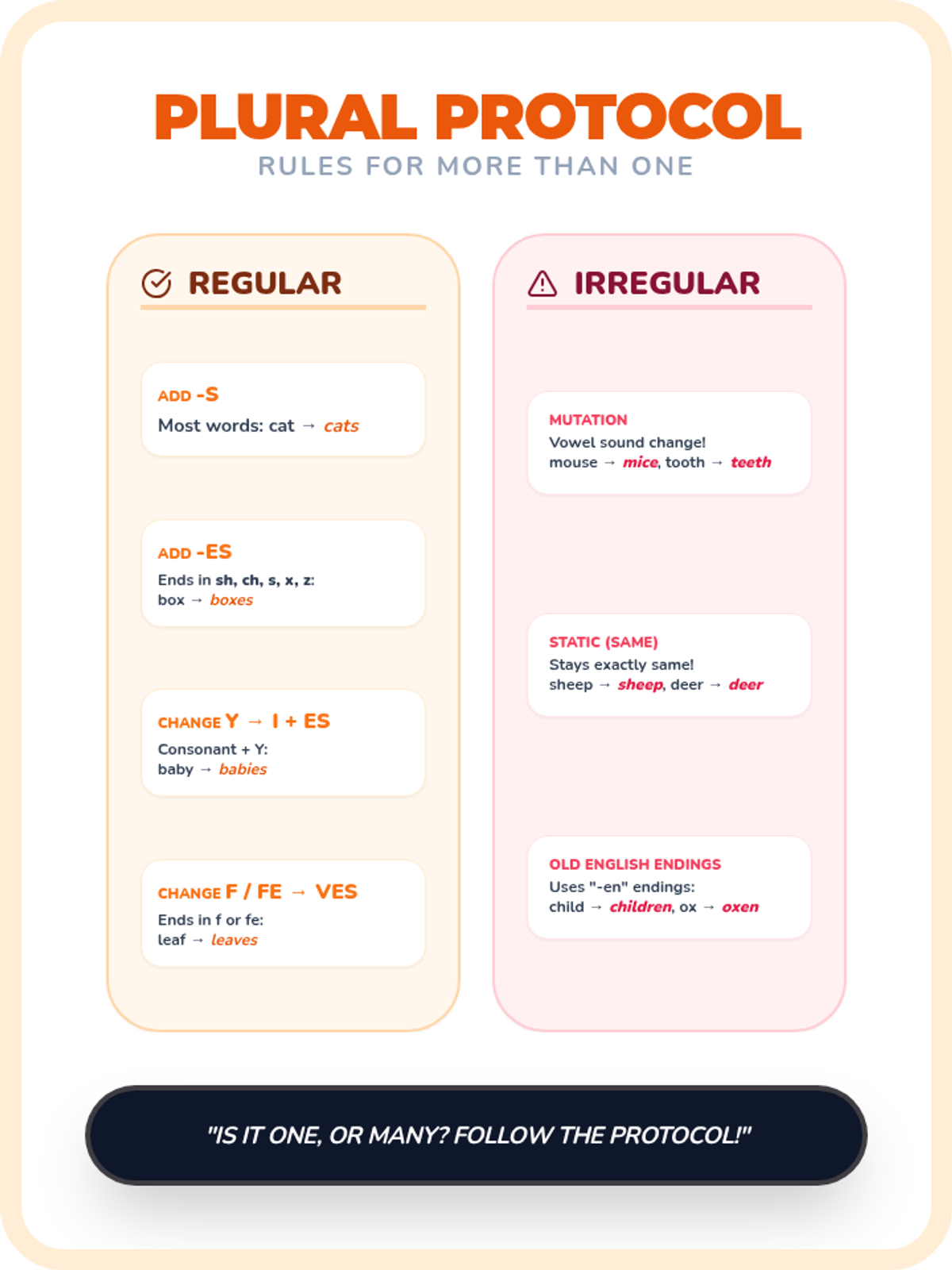
A visual anchor chart comparing regular plural spelling rules with common irregular plural forms, including mutations and static words. Includes the F/FE rule. Fits on a single page.
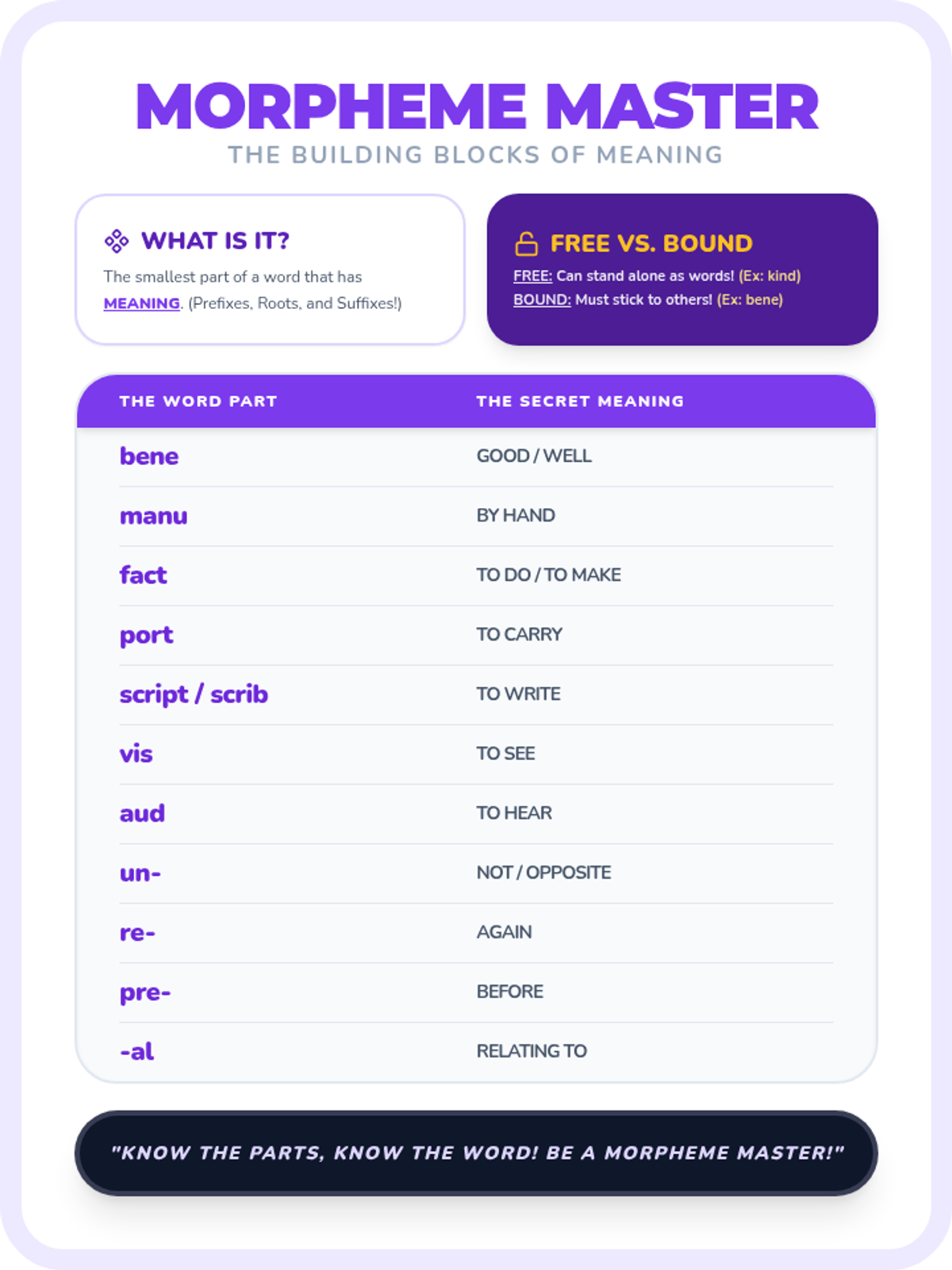
A comprehensive student-friendly list of common Latin roots, prefixes, and suffixes (morphemes) with their meanings, following Logic of English principles. Fits on a single page. Expanded list for mastery.
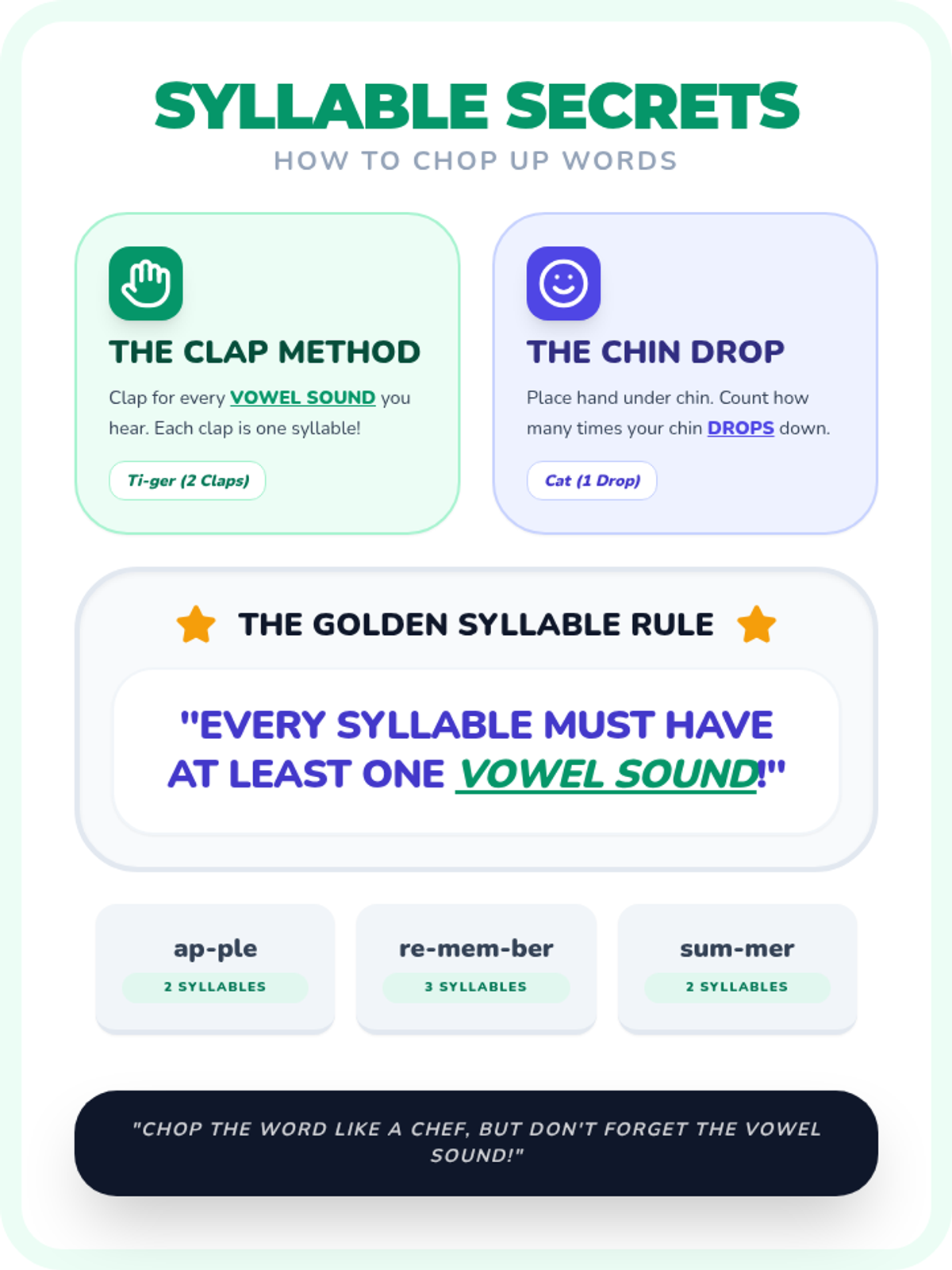
An anchor chart teaching students how to identify and count syllables using the clap method and chin drop method. Fits on a single page. Corrected page break cutting through the main rule.
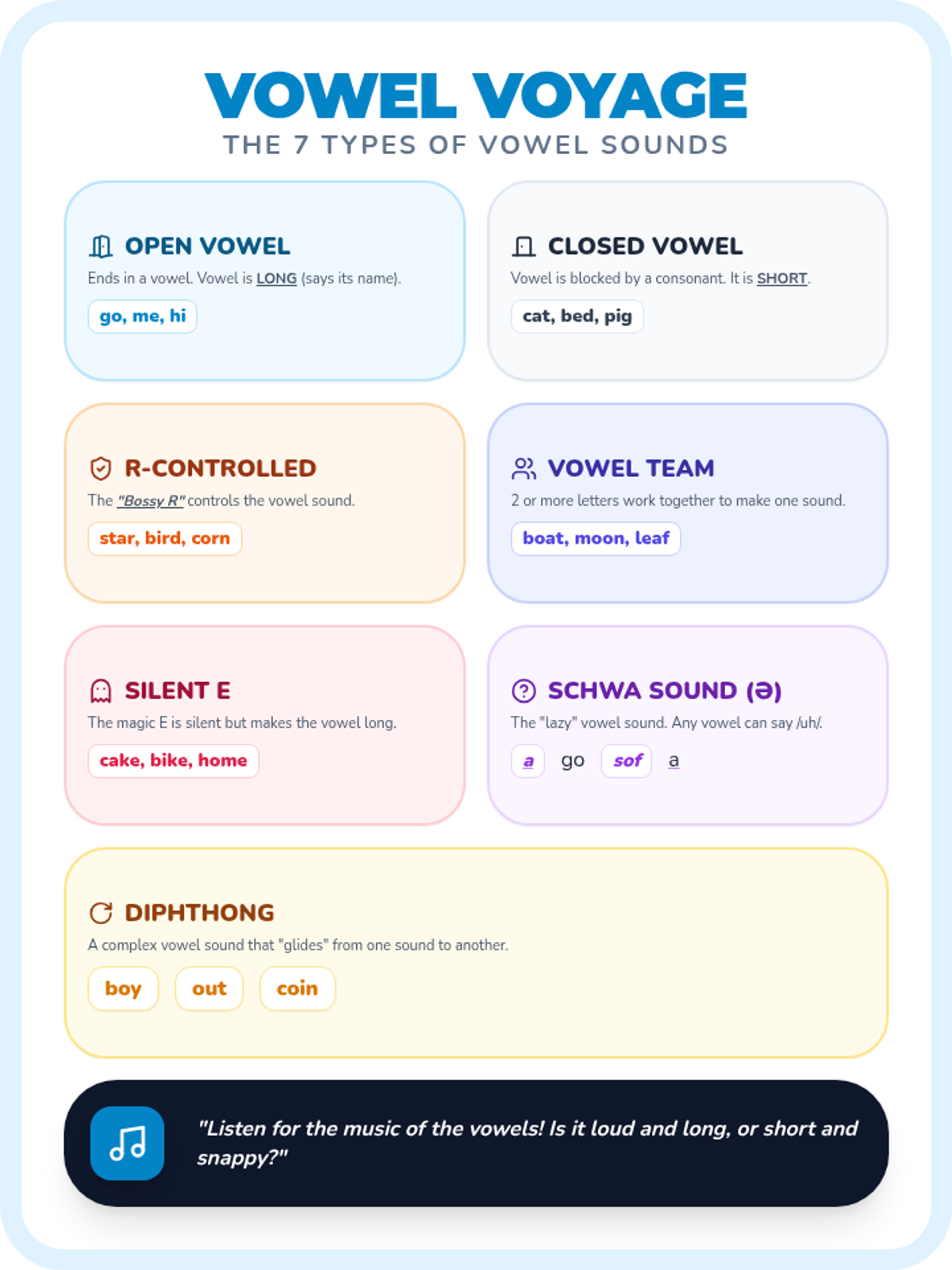
A comprehensive anchor chart defining the 7 types of vowel sounds including open, closed, r-controlled, multi-letter, silent E, diphthongs, and schwa. Fits on a single page. Corrected Schwa symbol and added Diphthongs.
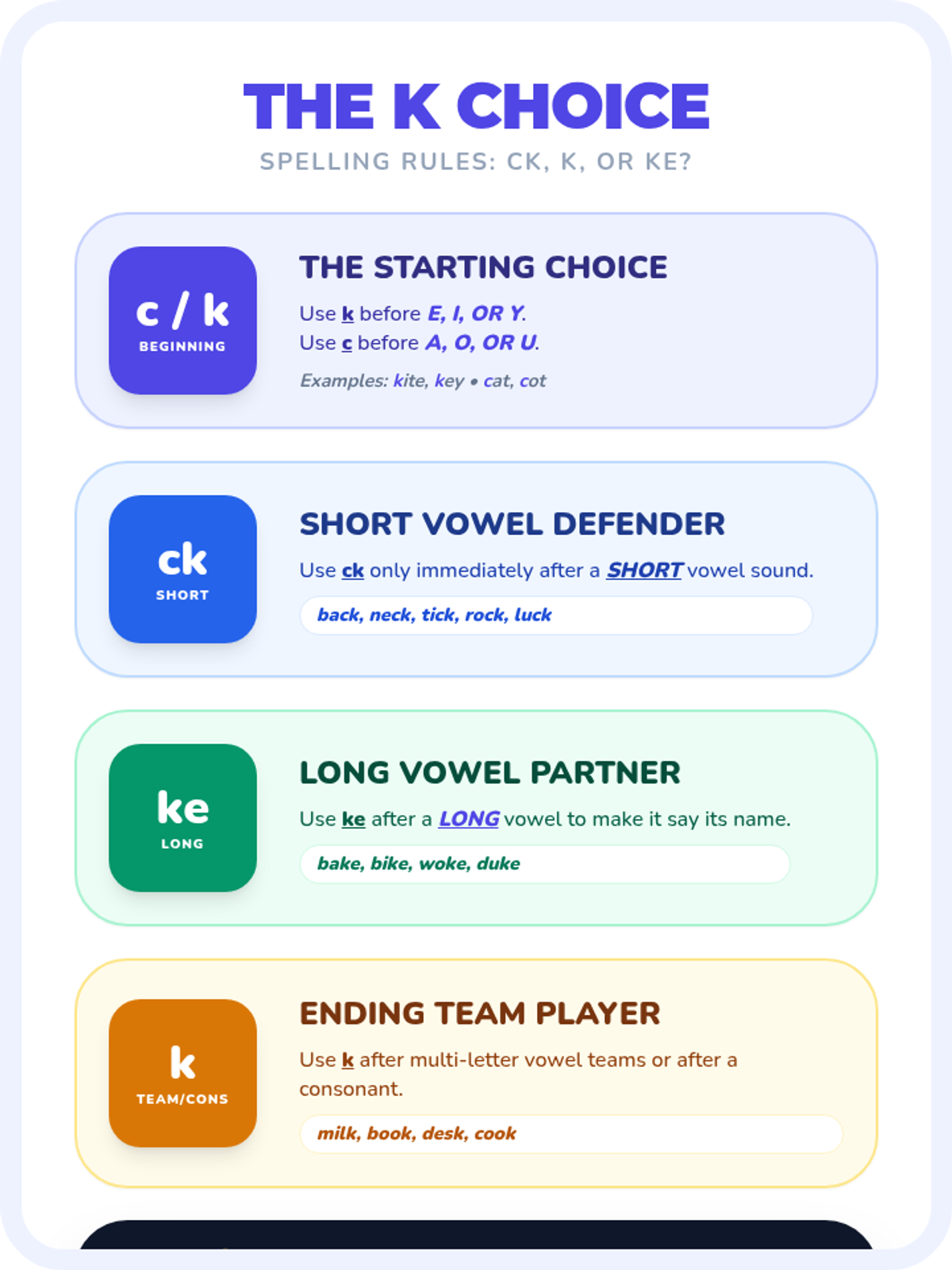
An anchor chart explaining the spelling rules for ck, k, and ke, designed for primary grade literacy review. Includes the beginning K/C rule and fits on a single page. Corrected page break issue.
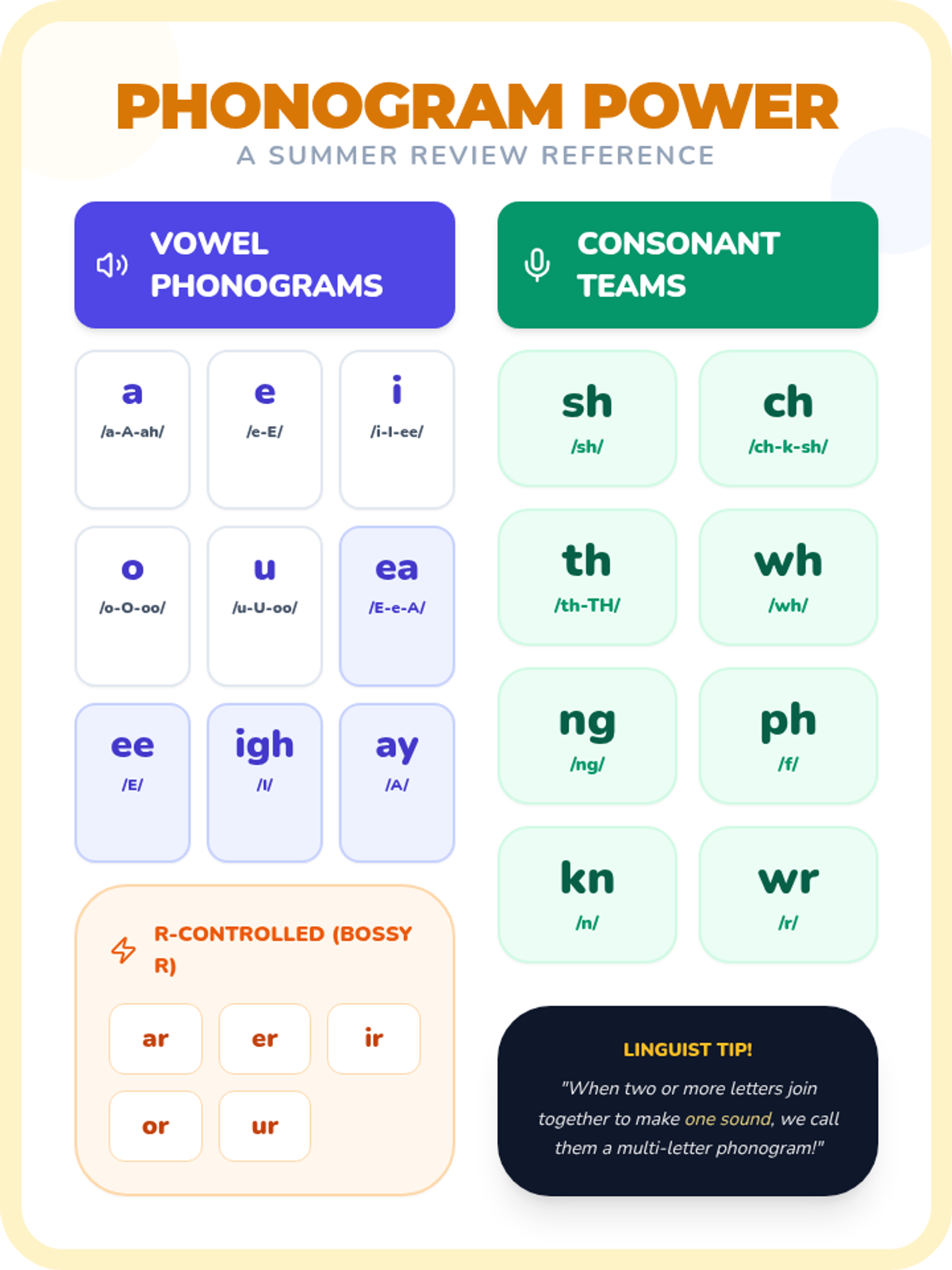
An anchor chart designed for Grade 2 students to review primary phonograms, including single-letter vowels, multi-letter teams, and consonant combinations. Logic of English style. Increased contrast and legibility. Full-page utilization.
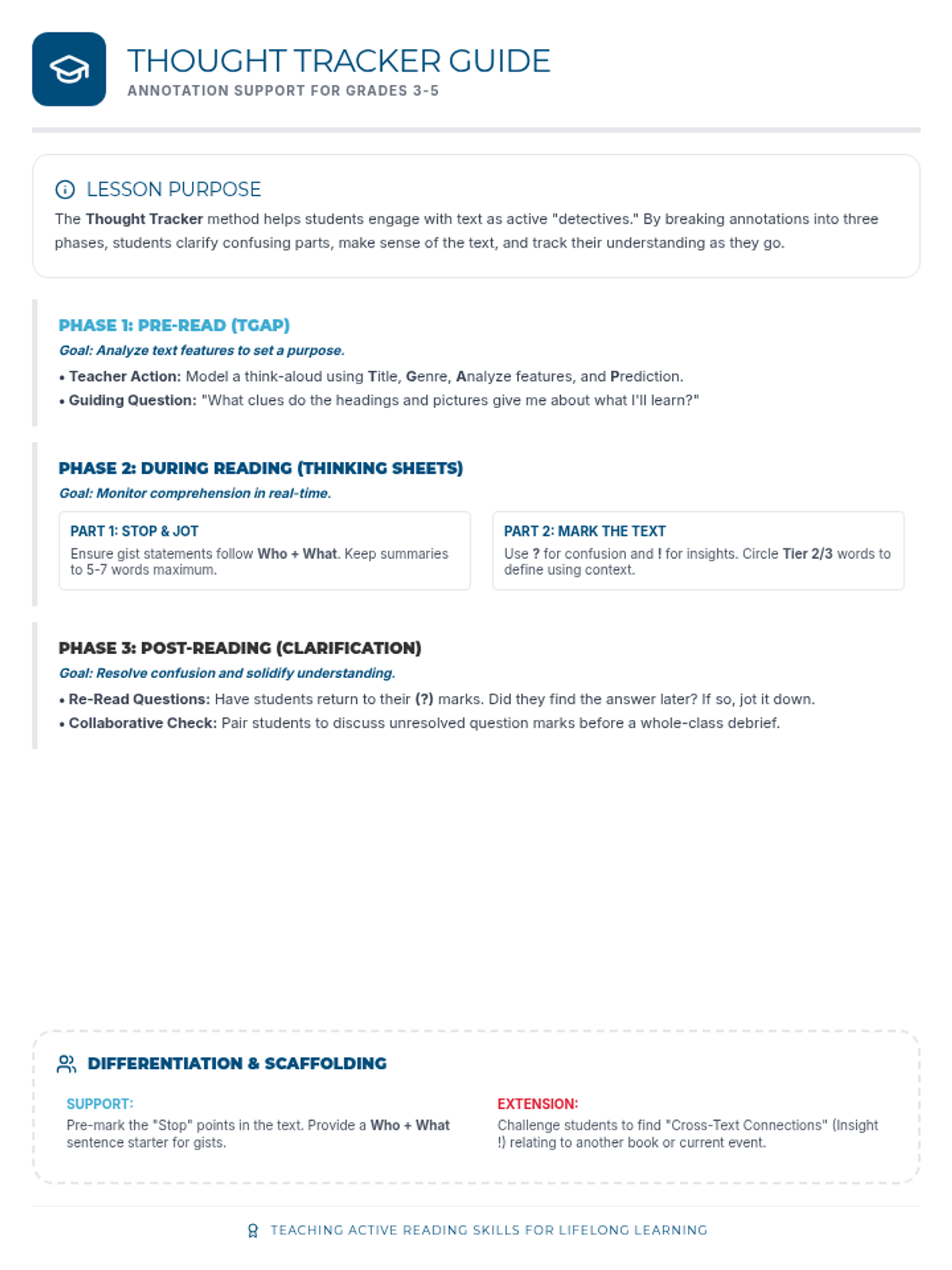
A teacher facilitation guide for the 'Thought Tracker' method, providing instructional steps, guiding questions, and differentiation strategies for each phase of the annotation process.
An instructional slide deck to introduce the 'Thought Tracker' annotation method, guiding students through pre-reading (TGAP), during-reading (Stop & Jot, Mark the Text), and post-reading clarification.
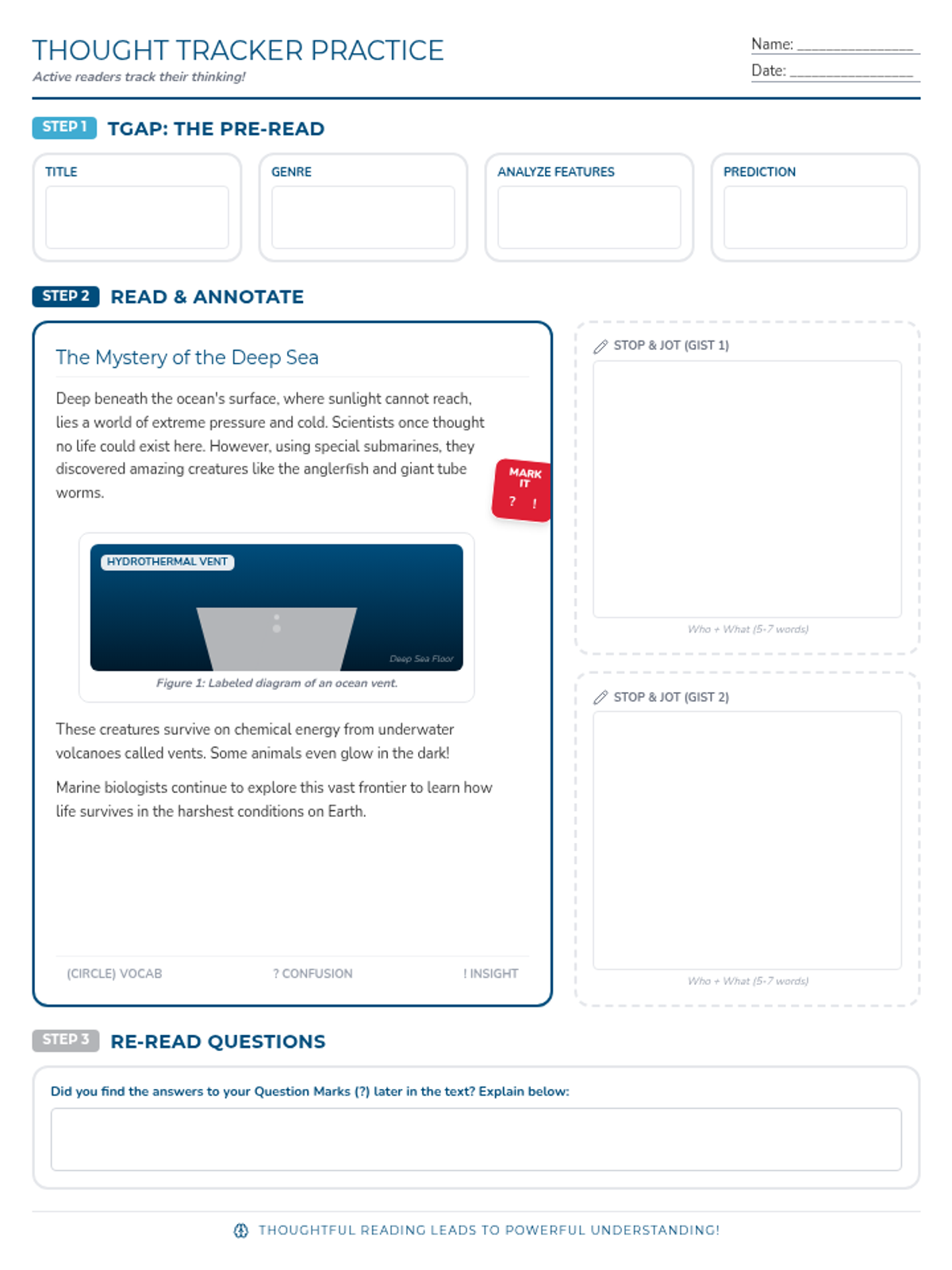
A student practice sheet for the 'Thought Tracker' method, now featuring a labeled deep-sea vent diagram as a text feature for students to analyze during the TGAP phase. Student work areas in Step 1 have been enlarged for better usability.
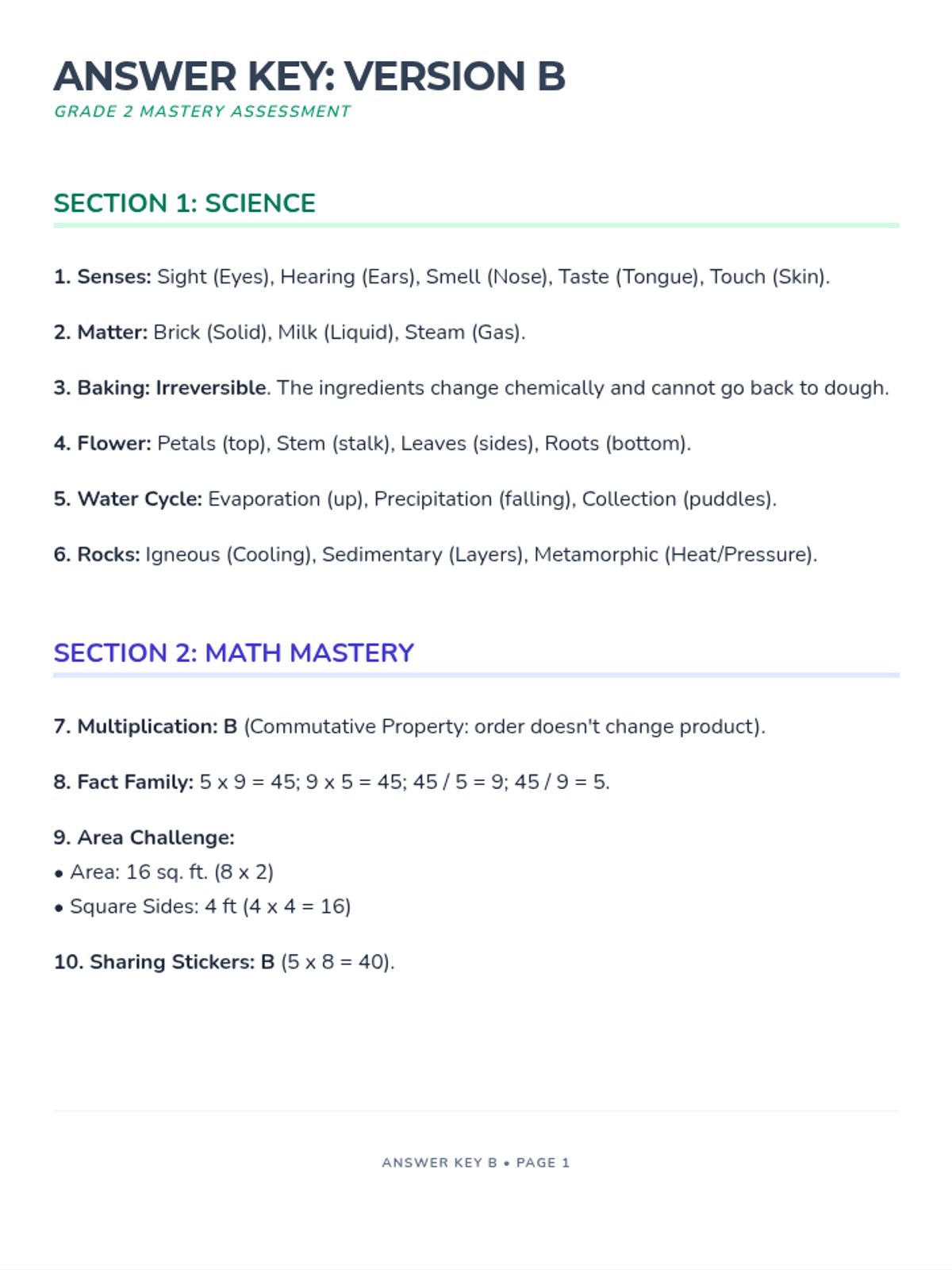
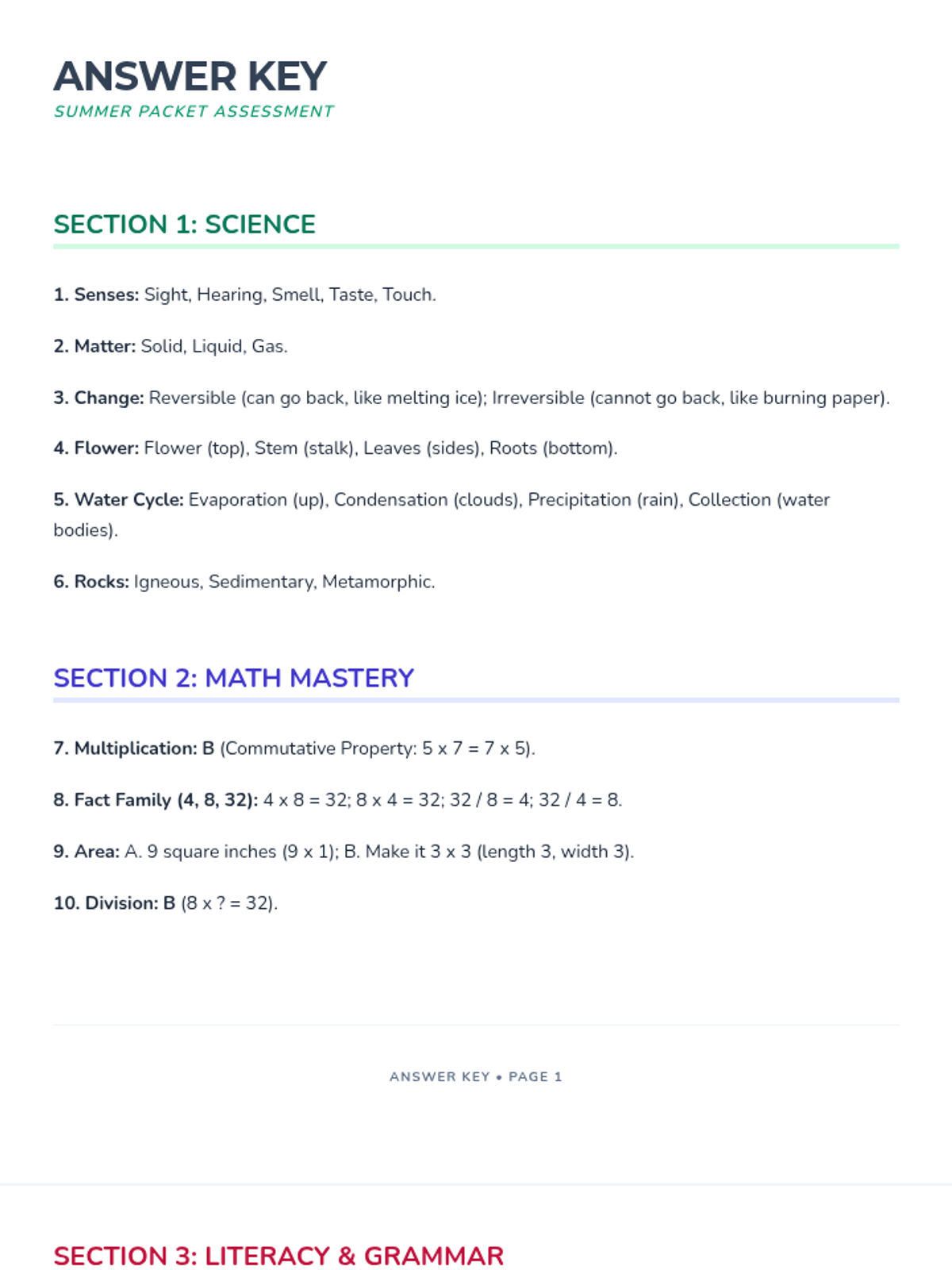
A comprehensive answer key for Version B of the Grade 2 Mastery Assessment. Provides solutions for all new questions in science, math, literacy, and social studies. Includes unit labels in math calculations.
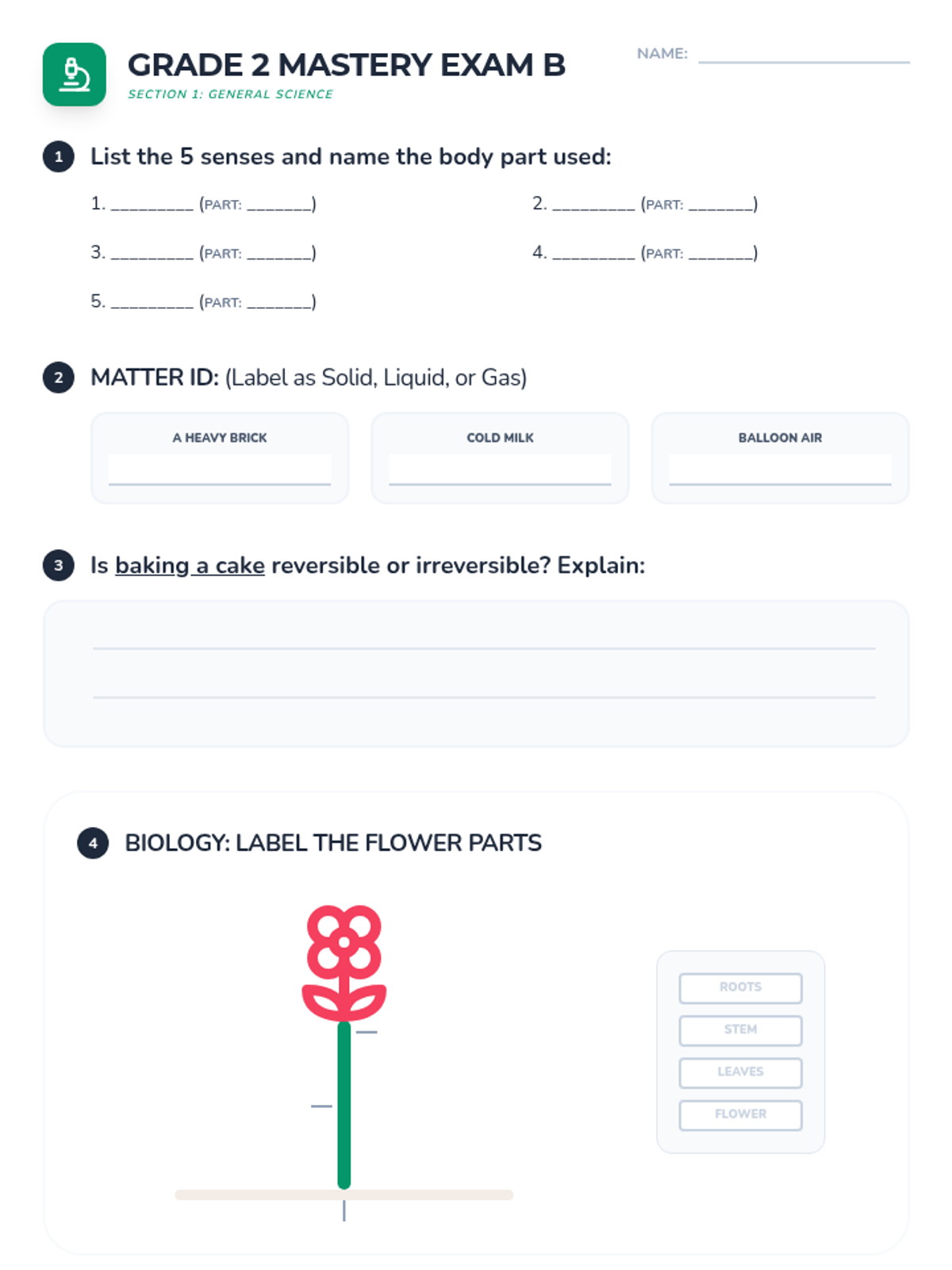
An alternate version (Version B) of the Grade 2 Mastery Assessment. Covers identical topics (Science, Math, Literacy, Social Studies) but features entirely different questions, word lists, and problem scenarios to provide a fresh evaluation. Includes corrected diagram pointers and improved layout.
A comprehensive 2-page answer key for the Grade 2 Mastery Assessment, including solutions for science, math, grammar, and social studies questions.
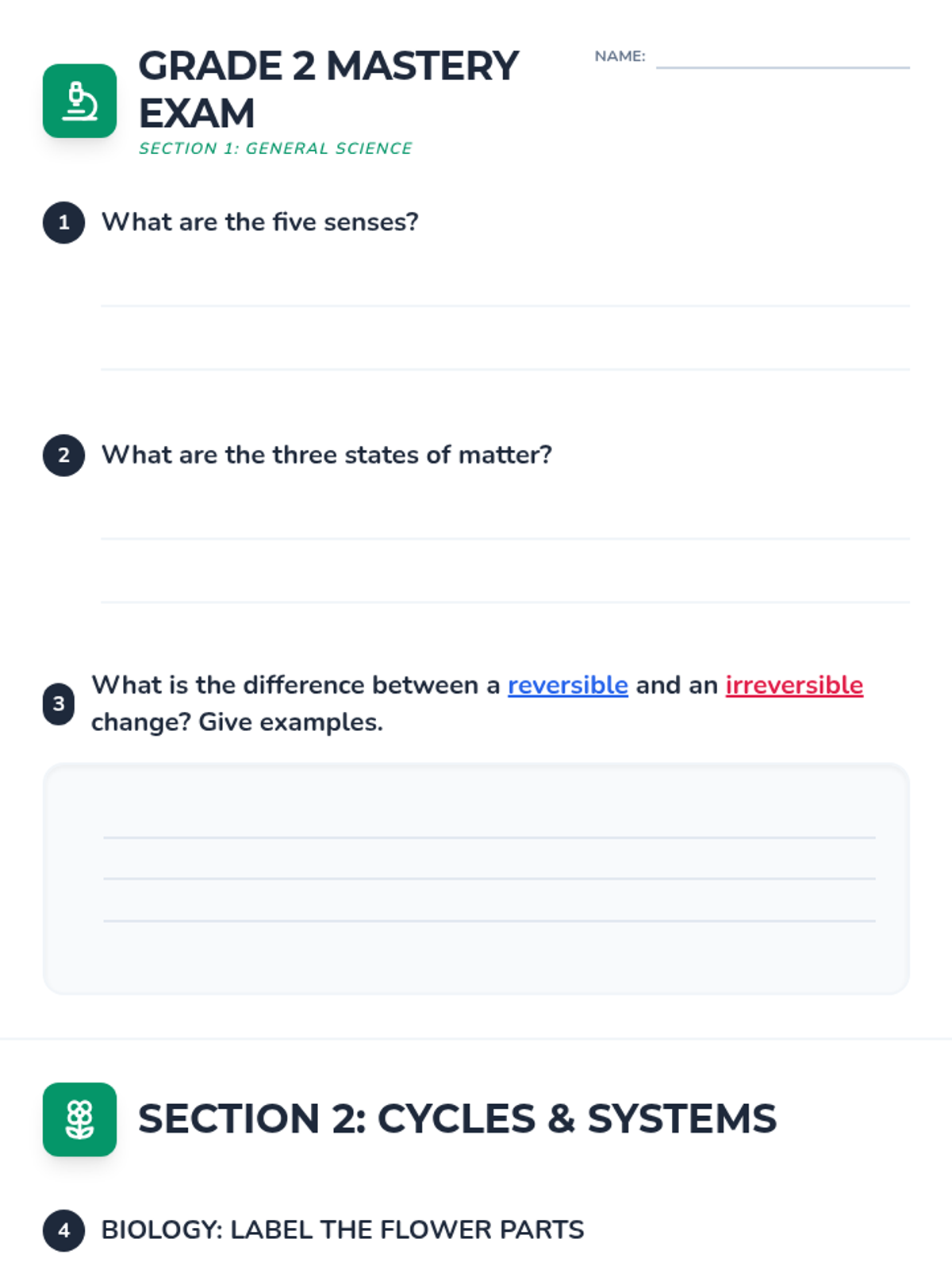
A comprehensive Grade 2 assessment packet covering Science, Math, Literacy, and Social Studies. Features improved diagram pointers, expanded handwriting areas, and a structured flow to ensure pedagogical effectiveness and print quality.
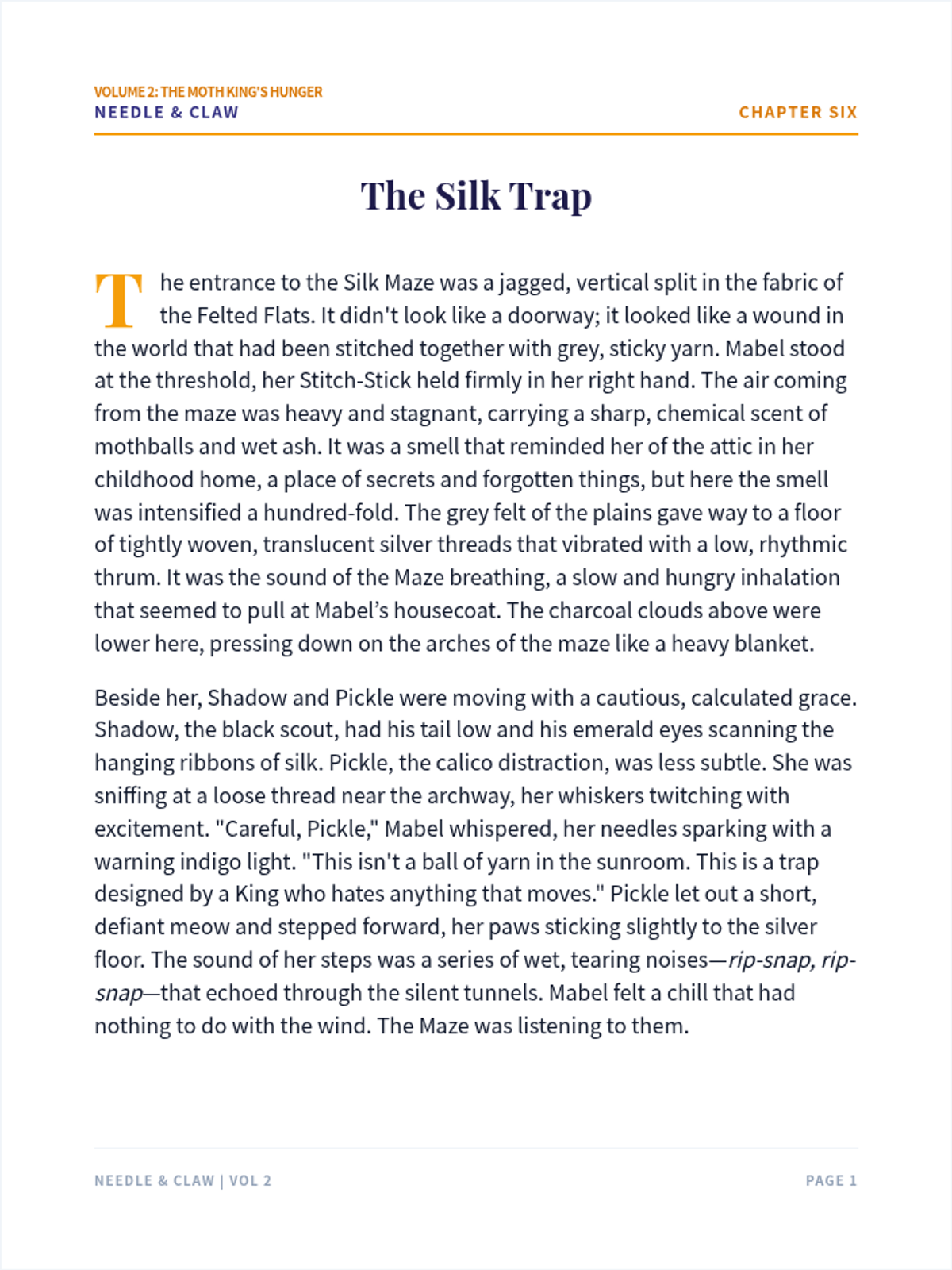
Expanded Chapter 6 of 'Needle & Claw' Volume 2: The Moth King's Hunger. Mabel and Arthur navigate the Silk Maze to rescue Shadow and Pickle from the Silk-Guardian. This version features 15 full pages of narrative text and a student workspace, maintaining Hi-Lo style for high school students with strict single-spaced formatting and consistent characterization. Revised for maximum text density.
Expanded Chapter 5 of 'Needle & Claw' Volume 2: The Moth King's Hunger. Mabel and Arthur return to the village to find the people 'harvested' of their memories. Shadow finds a secret map, leading them to the heart of the Silk Maze. This version features 15 full pages of narrative text and a student workspace, maintaining Hi-Lo style for high school students with strict single-spaced formatting and consistent characterization. Revised for maximum text density and consistency.
Chapter 4 of 'Needle & Claw' Volume 2: The Moth King's Hunger. Mabel and Arthur climb the Giant's Needle to mend the Sky-Breach. This version features 15 full pages of narrative text and a student workspace, maintaining Hi-Lo style for high school students with strict single-spaced formatting and consistent characterization. Revised for maximum text density and consistency.
Expanded Chapter 3 of 'Needle & Claw' Volume 2: The Moth King's Hunger. Mabel and Arthur join the Lace Resistance to mend the 'First Fold'. This version features 15 full pages of narrative text and a student workspace, maintaining Hi-Lo style for high school students with strict single-spaced formatting and consistent characterization. Revised for maximum text density and consistency.
Expanded Chapter 2 of 'Needle & Claw' Volume 2: The Moth King's Hunger. Mabel and Arthur enter the Felted Flats to rescue Shadow and discover the 'Heart-String' magic. This version features 15 full pages of narrative text, maintaining Hi-Lo style for high school students with strict single-spaced formatting and consistent characterization. Revised for maximum text density and consistency.
Expanded Chapter 1 of 'Needle & Claw' Volume 2: The Moth King's Hunger. Mabel and Arthur encounter a reality-eating silver moth in the Sunrise Senior Living Center and are pulled into a portal within Mr. Henderson's trunk. This version features 15 full pages of narrative text, maintaining Hi-Lo style for high school students with strict single-spaced formatting and consistent characterization. Revised for maximum text density and consistency.
Expanded 16-page Chapter 1 of 'Needle & Claw' Volume 2: The Moth King's Hunger. This version features 15 full pages of dense narrative text plus a comprehensive student workspace. It maintains strict alignment with Volume 1 characterization and locations, using single-spaced 12pt font in a chapter book format.
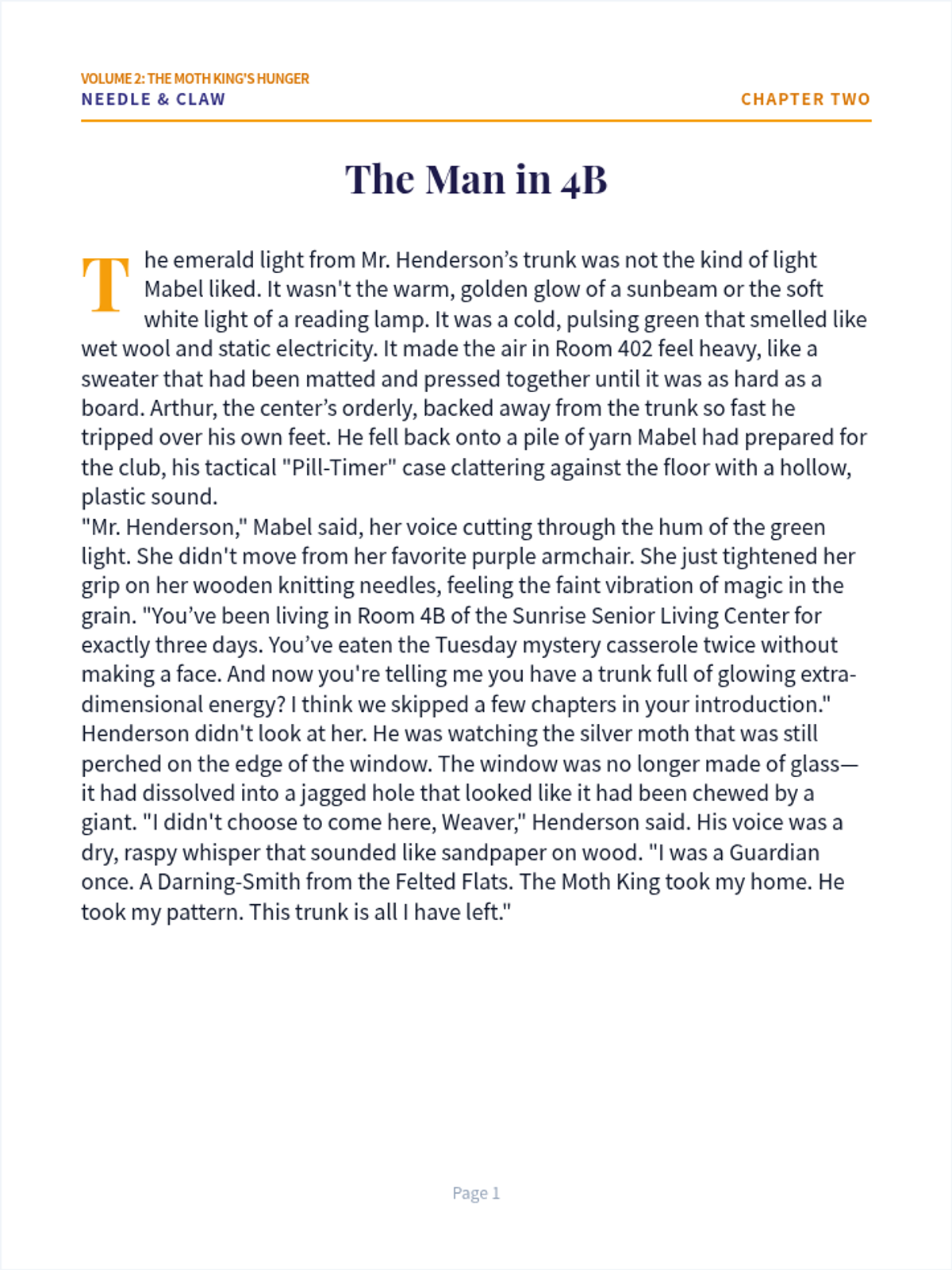
Expanded Chapter 2 of 'Needle & Claw' Volume 2: The Moth King's Hunger. Mr. Henderson reveals his trunk is a doorway to the Moth King's lair. Arthur accidentally falls into the portal, forcing the group to follow him into the Felted Flats. This version features 15 full pages of narrative text and a student workspace.
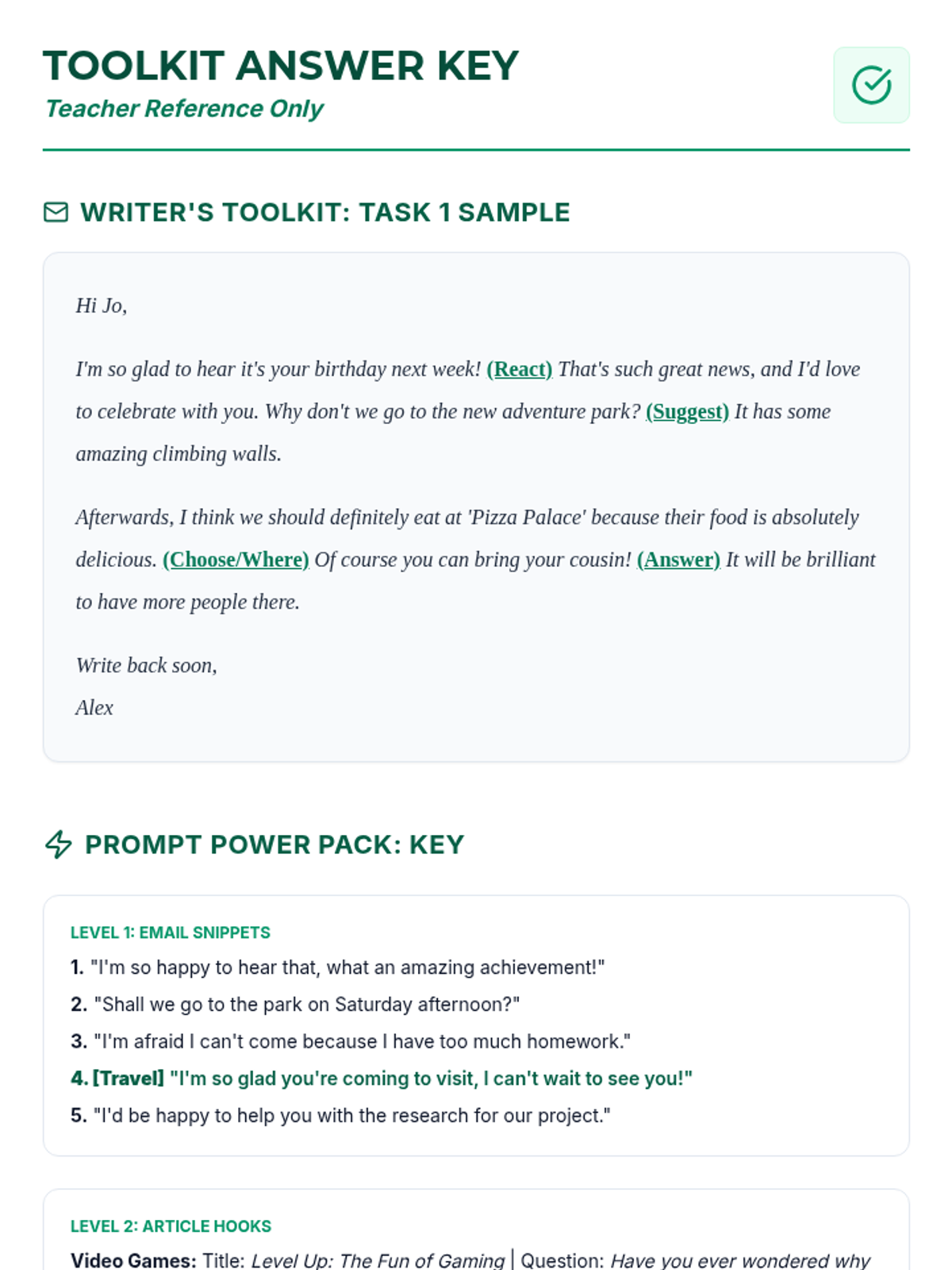
Answer key for the Writer's Toolkit and Prompt Power Pack, providing sample replies and model answers for all prompts including travel-themed exercises.
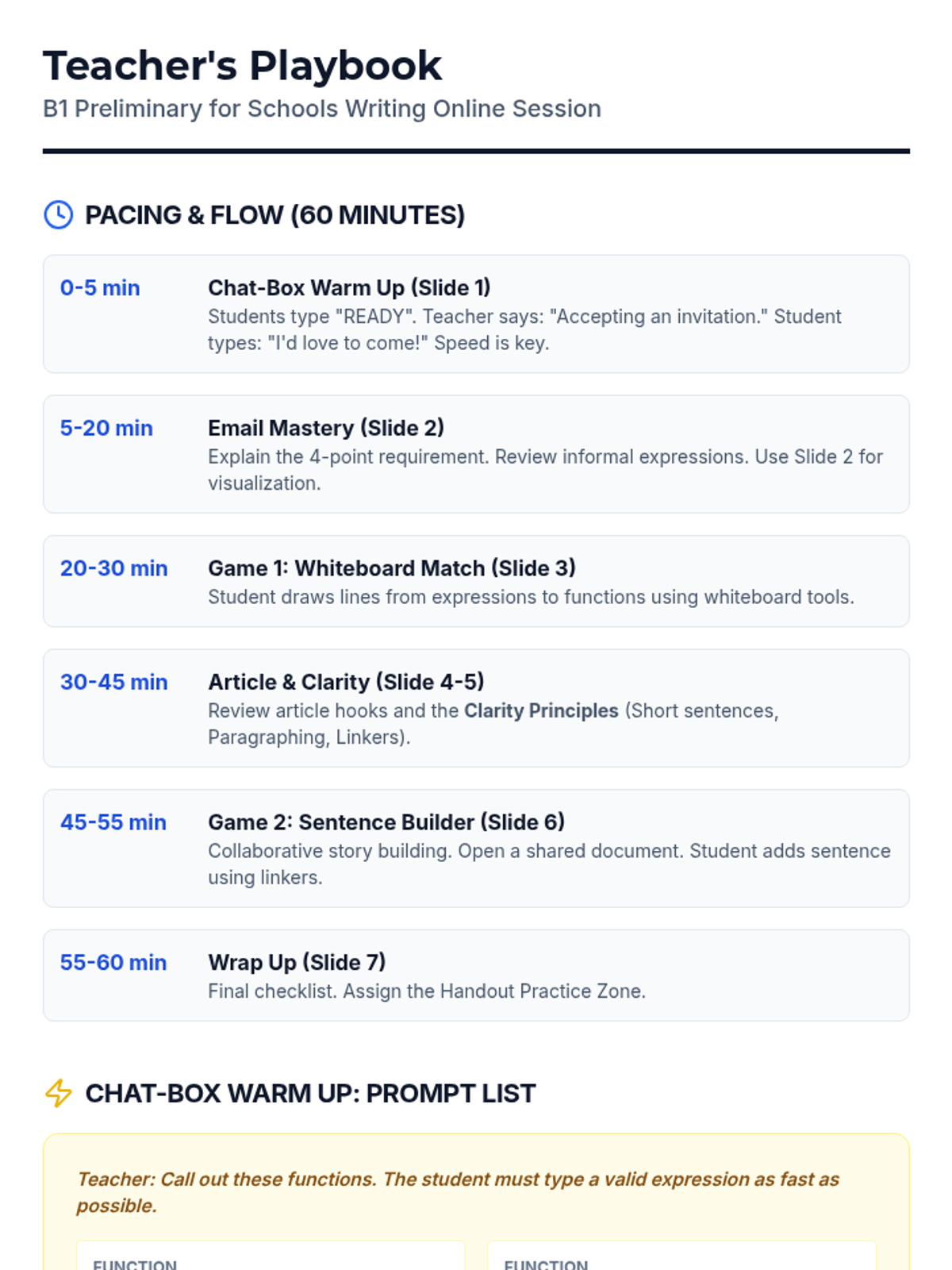
A teacher-facing guide with detailed pacing, digital game instructions, clarity training tips, a warm-up prompt list, and a reference list of B1 expressions.
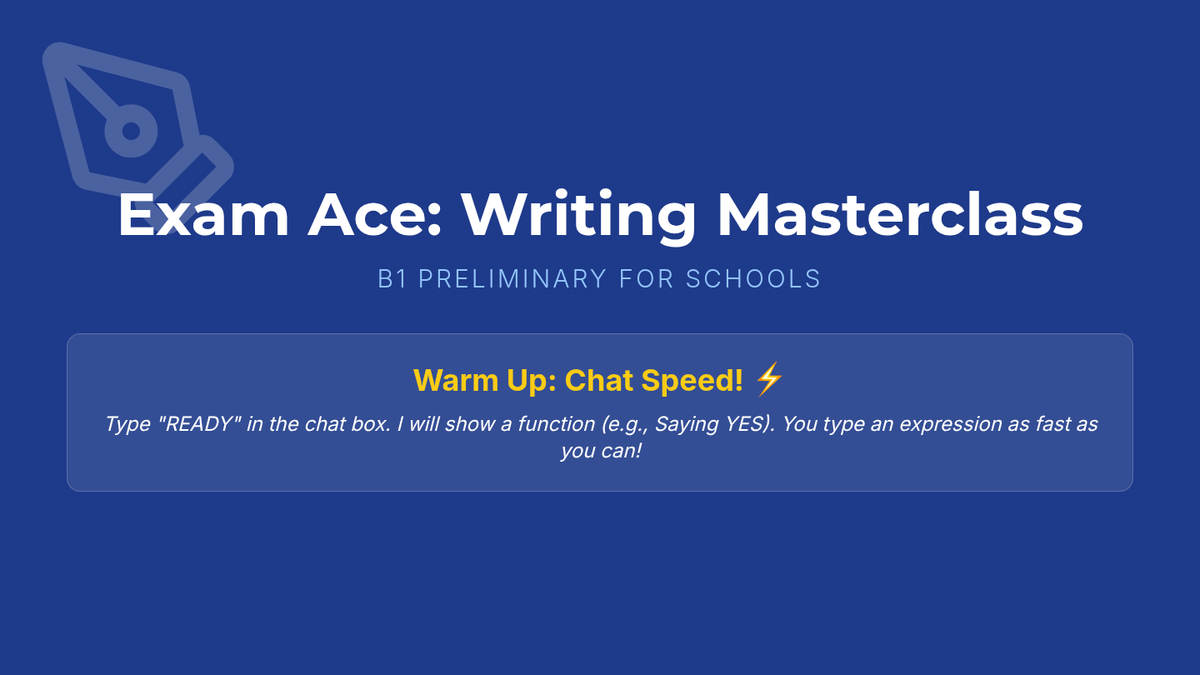
Interactive slides for an online B1 Preliminary writing lesson, featuring warm-up challenges, task breakdowns, clarity tips, and digital games for emails and articles.
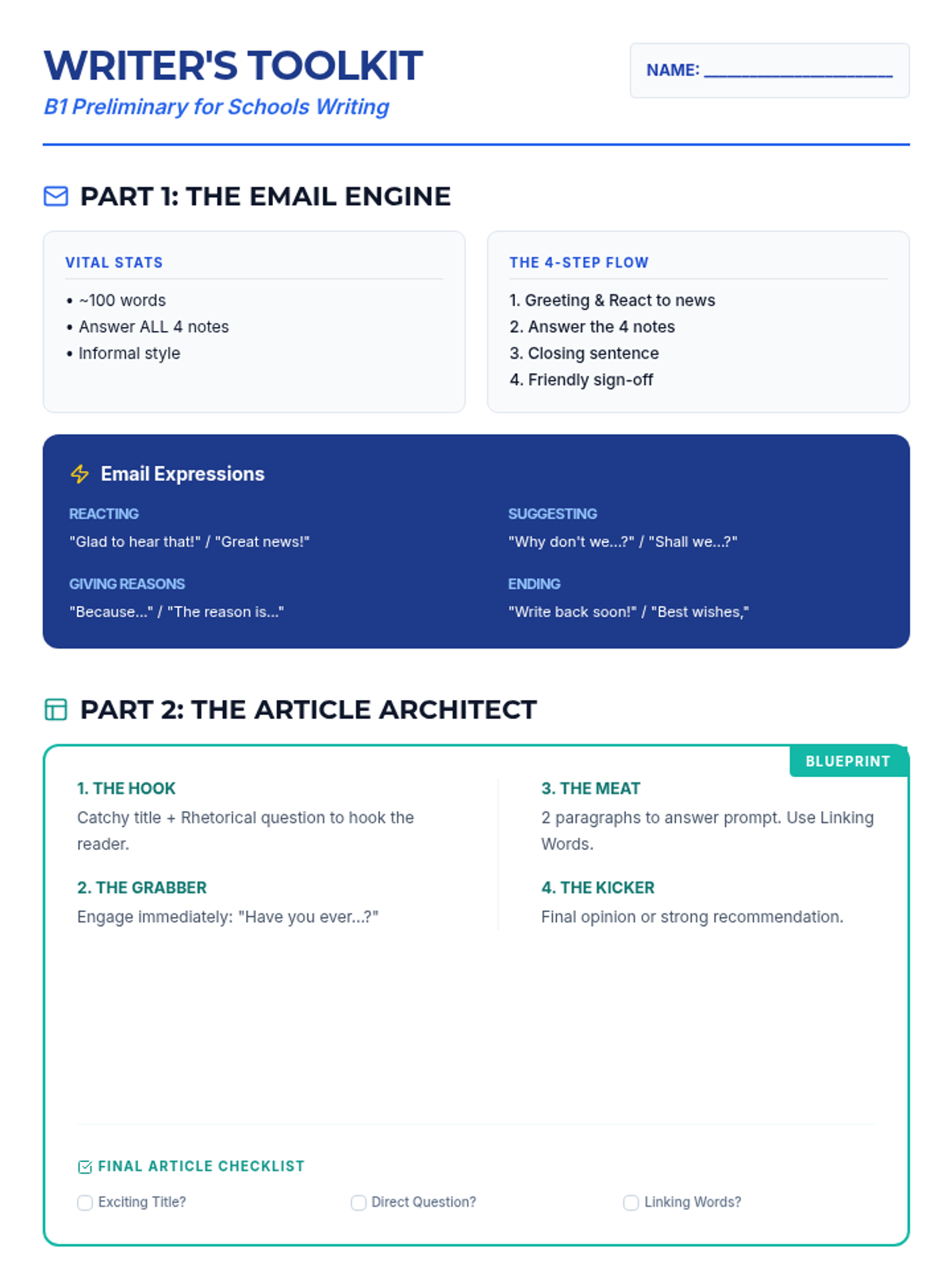
A student-facing toolkit for B1 Preliminary writing, featuring essential expressions, structural blueprints for emails and articles, and practice areas.
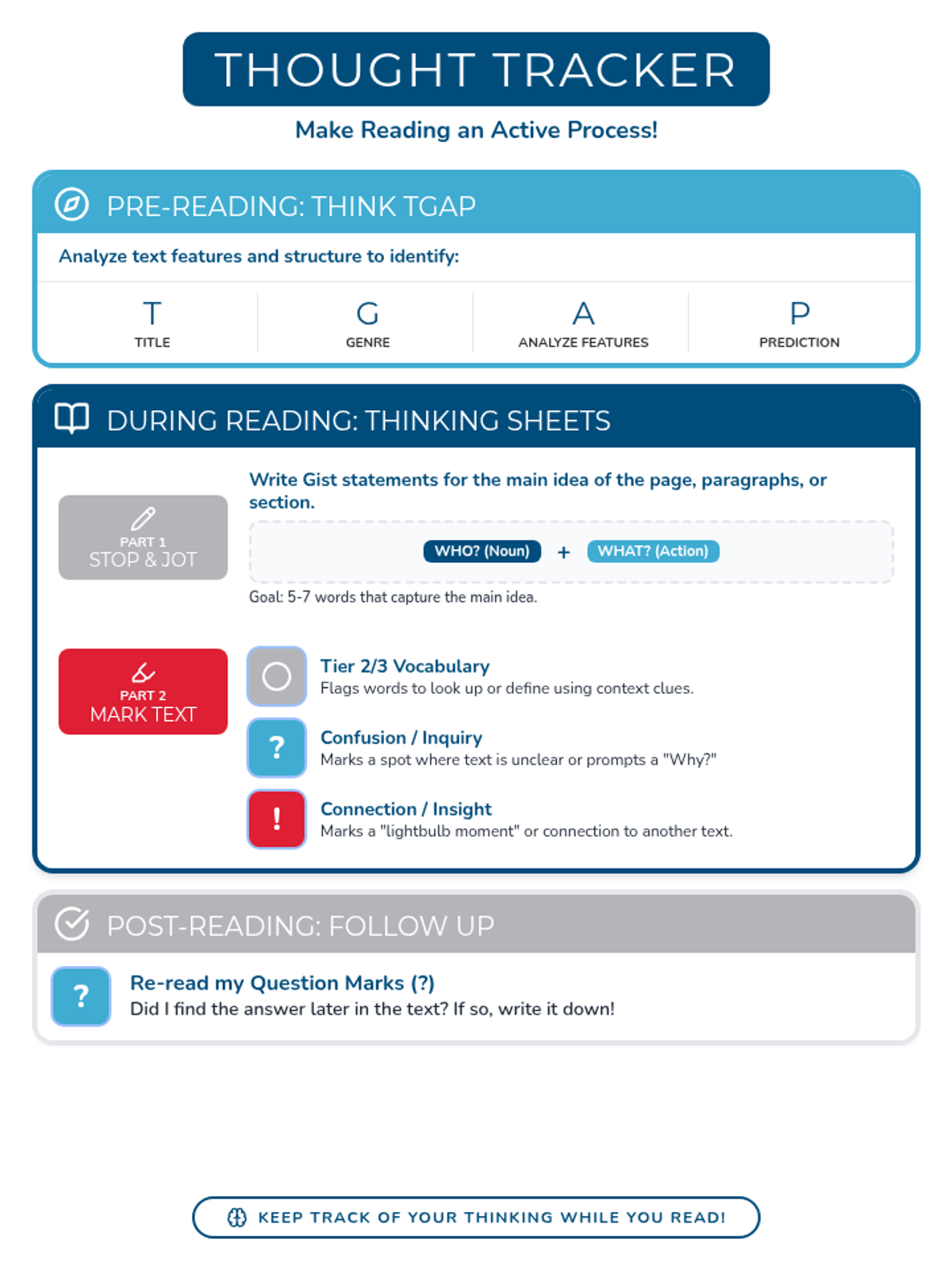
An updated classroom anchor chart for the 'Thought Tracker' annotation process, now including more detailed text from the guidance PDF and increased spacing between key sections for better visual clarity.
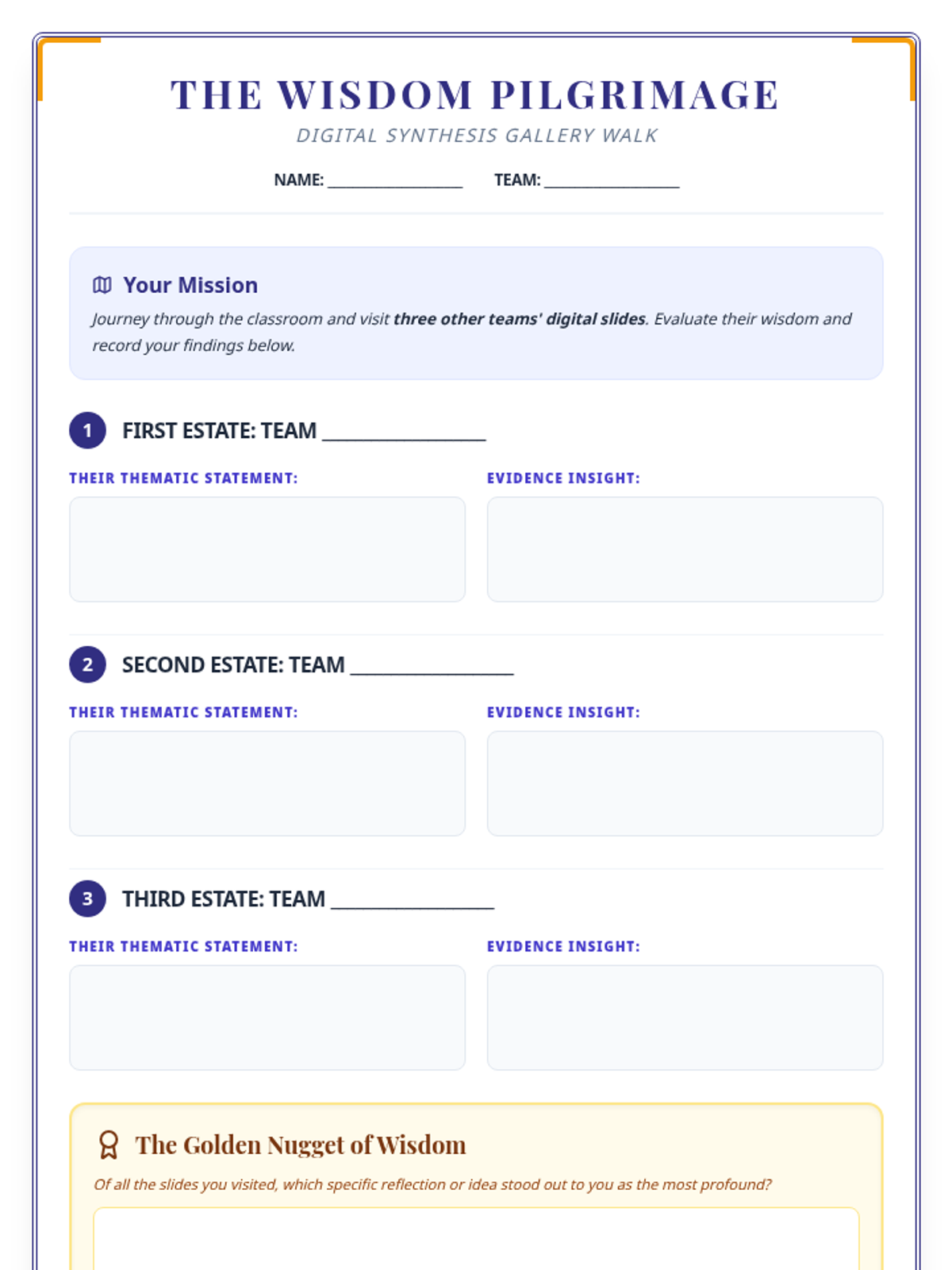
A structured handout for a Gallery Walk activity (titled 'The Wisdom Pilgrimage') where students visit three peer digital projects and record thematic insights and evidence evaluations. Optimized for single-page use.
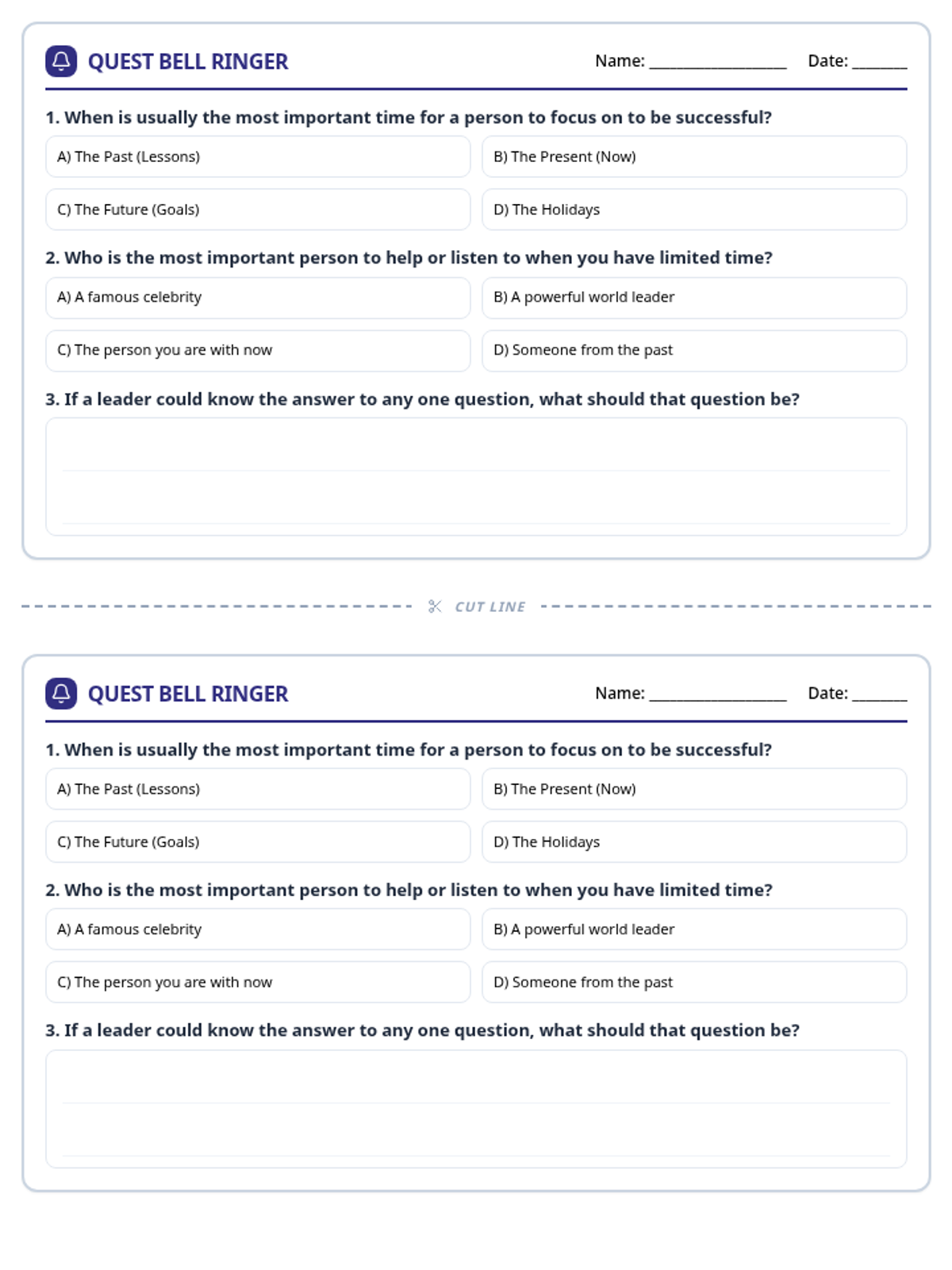
A printable bell ringer cut-out sheet with general 'warm up' questions about timing, priority, and success to prepare students for the themes of 'The Three Questions'. Optimized to fit two copies on a single 8.5x11 sheet.
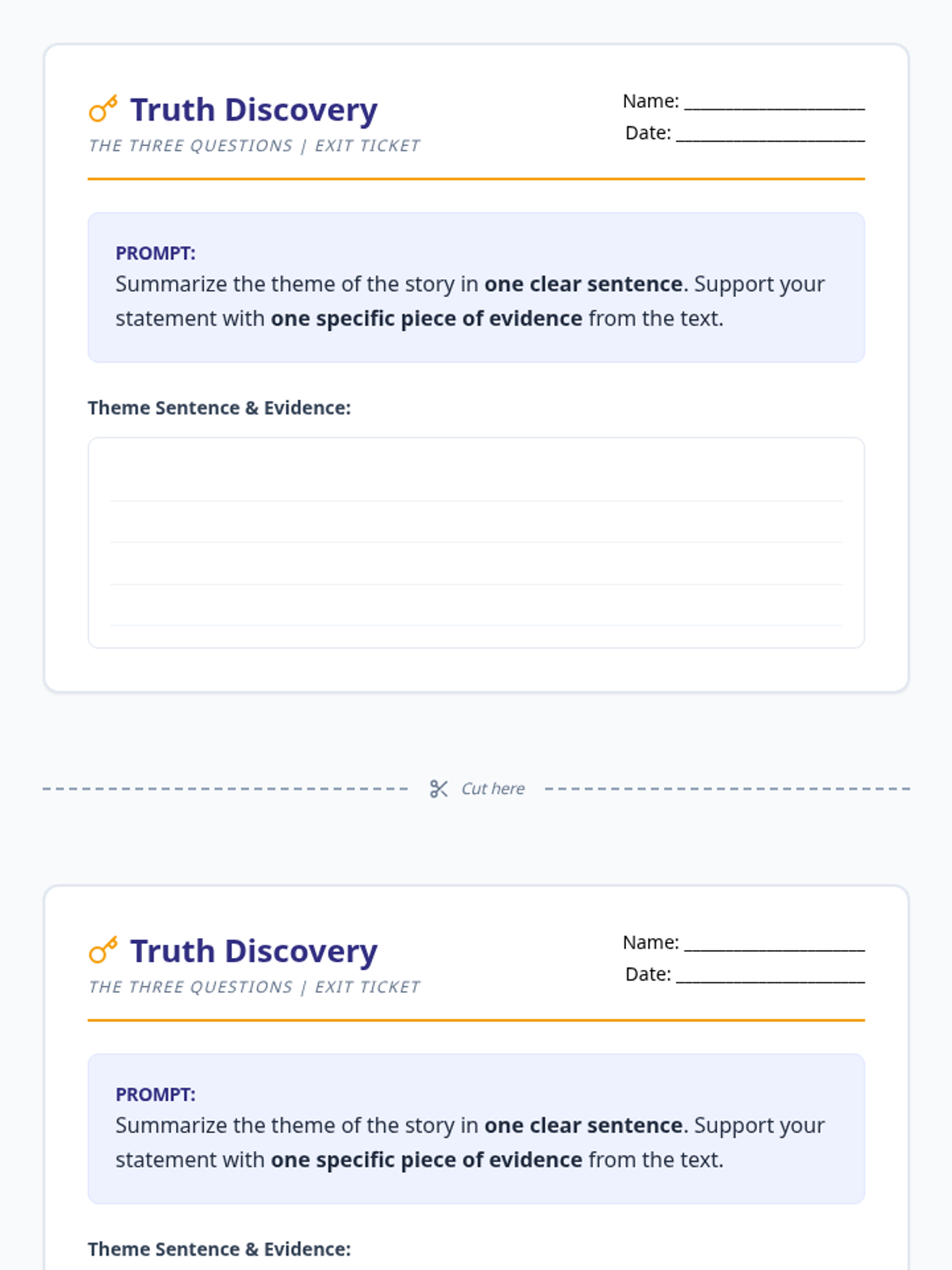
A printable exit ticket cut-out sheet for summarizing the theme of 'The Three Questions' with supporting textual evidence. Designed for handwriting clarity.
A comprehensive instructional slide deck for the 'Quest for Wisdom' lesson, featuring vocabulary quizzes, plot analysis, and a starfish legend video introduction. The video and related discussion questions are strategically placed after the context slide to build thematic understanding before reading. Includes a sample student slide as an exemplar for the collaborative activity. Vocabulary quiz and bell ringer styles have been standardized. Instructions for the 'Wisdom Pilgrimage' gallery walk included.
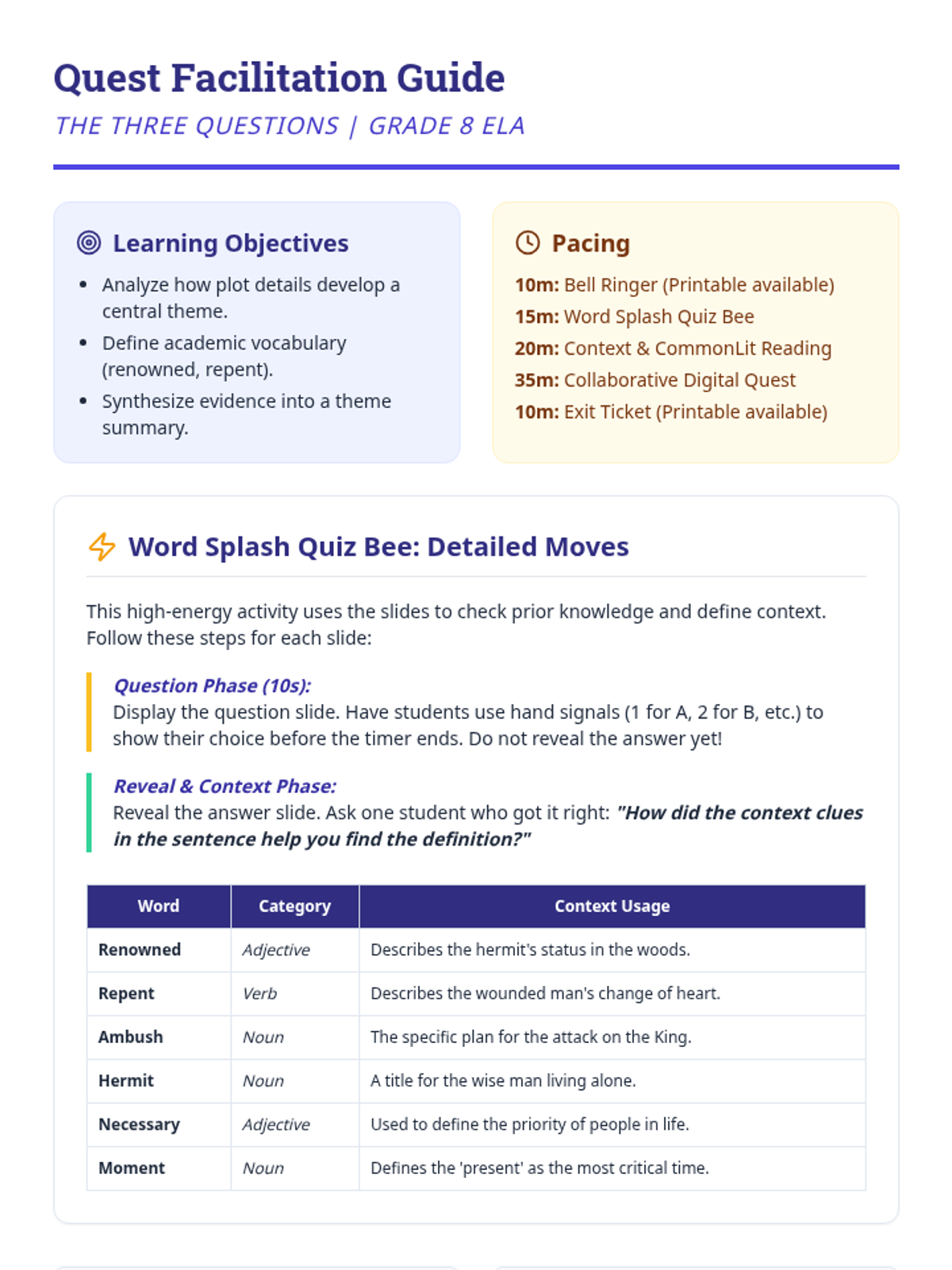
A teacher's guide for the lesson on 'The Three Questions', including pacing, instructional moves for the Word Splash quiz, and guidance for the collaborative project.
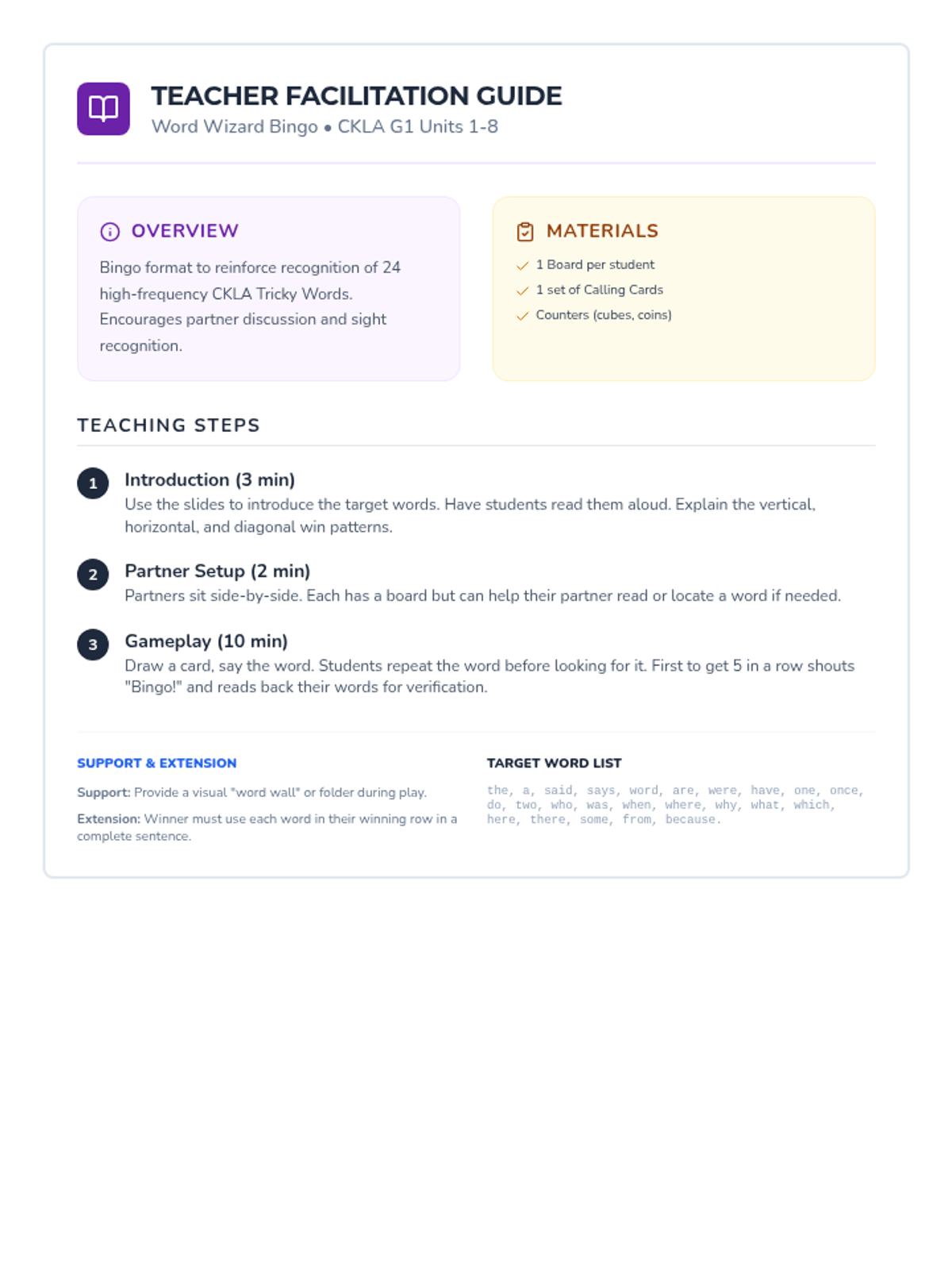
A refined, single-page teacher guide for Word Wizard Bingo with consolidated instructions, preparation checklists, and a target word master list.
A vibrant presentation to introduce the Word Wizard Bingo game, featuring updated win pattern icons, rules, and a visual tricky word list.
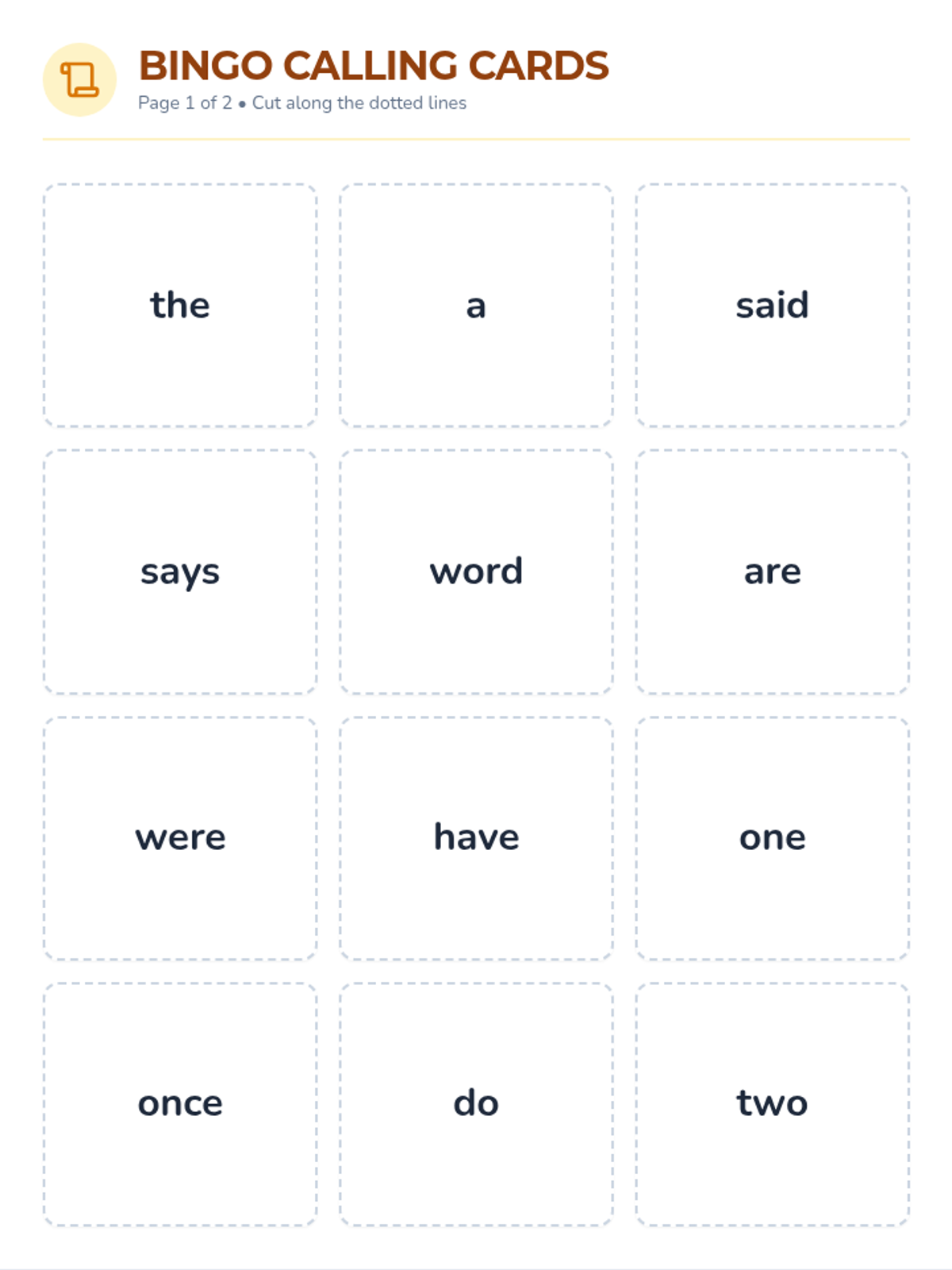
Two pages of printable calling cards for the Word Wizard Bingo game, featuring the 24 key CKLA Tricky Words with clear dashed cut lines and white backgrounds for clean printing.
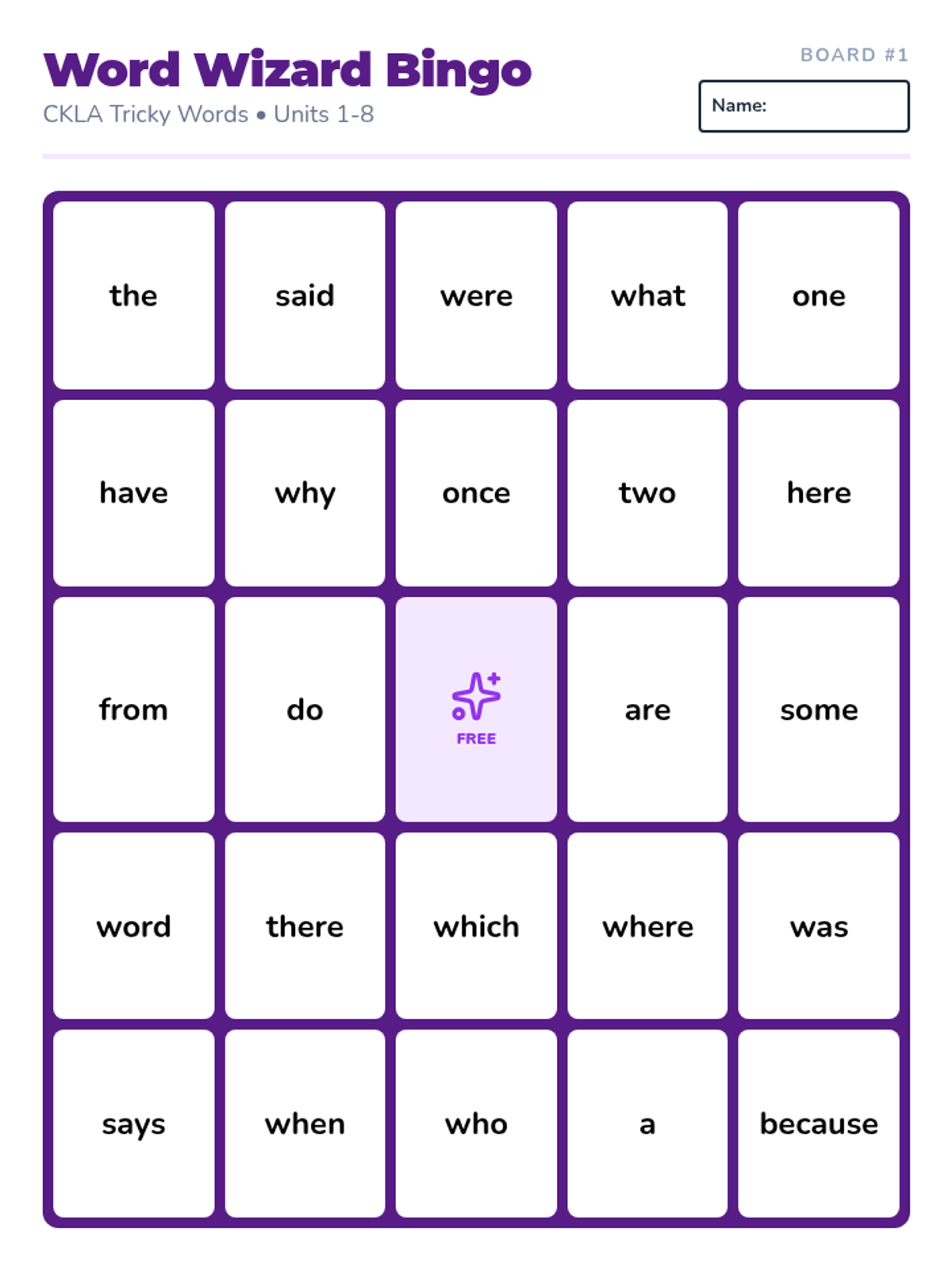
Four unique Bingo boards featuring CKLA Tricky Words from Units 1-8, designed for first-grade partner play with clear text and a magical theme. Each board is on its own page for perfect printing.
Revised introductory slides for the donut history lesson. Features updated thematic icons and clear visual frameworks for teaching main idea and supporting details.
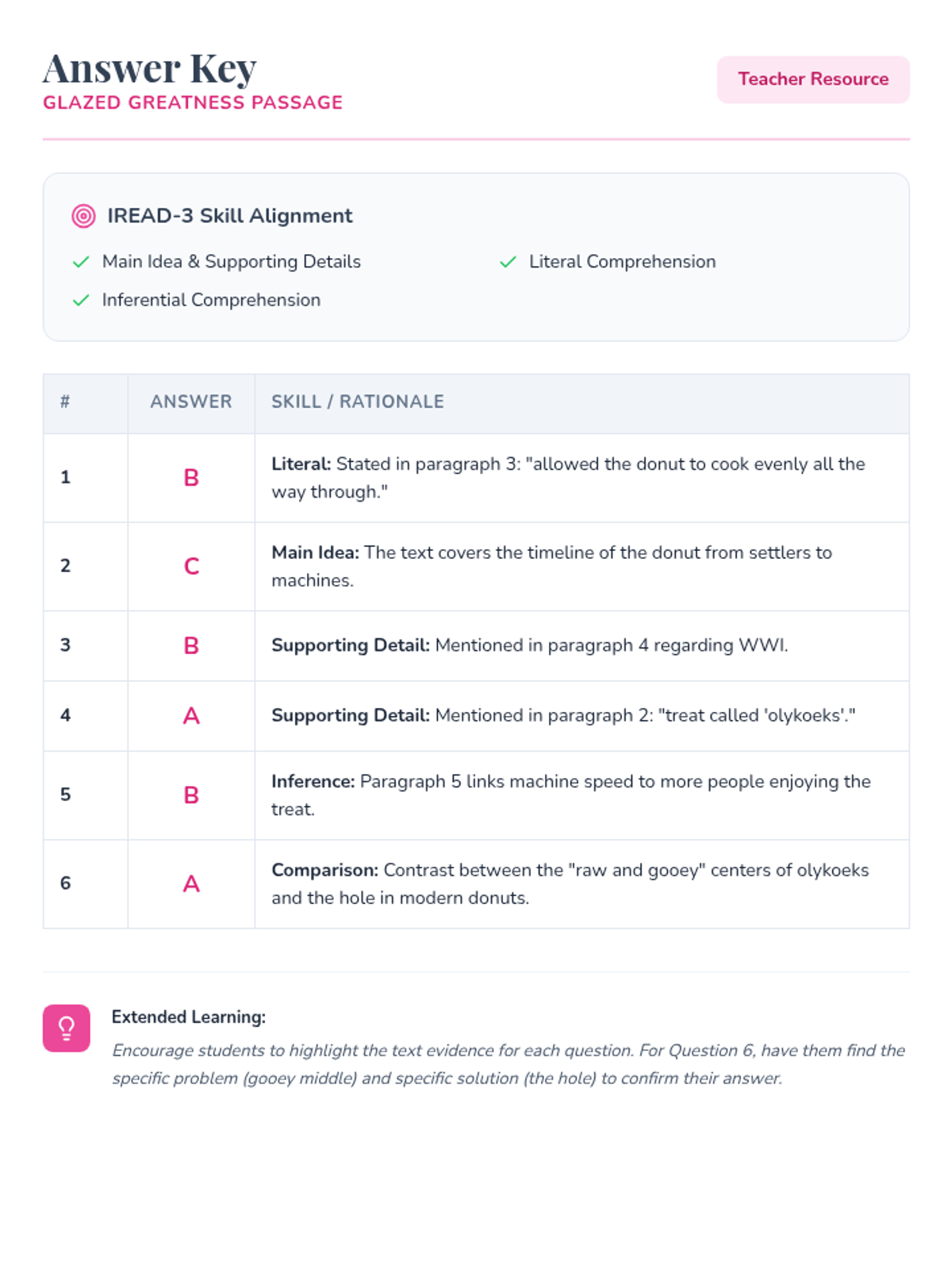
Answer key for the Glazed Greatness passage assessment, renumbered to match the six-question version. Optimized to fit on a single page for teacher convenience.
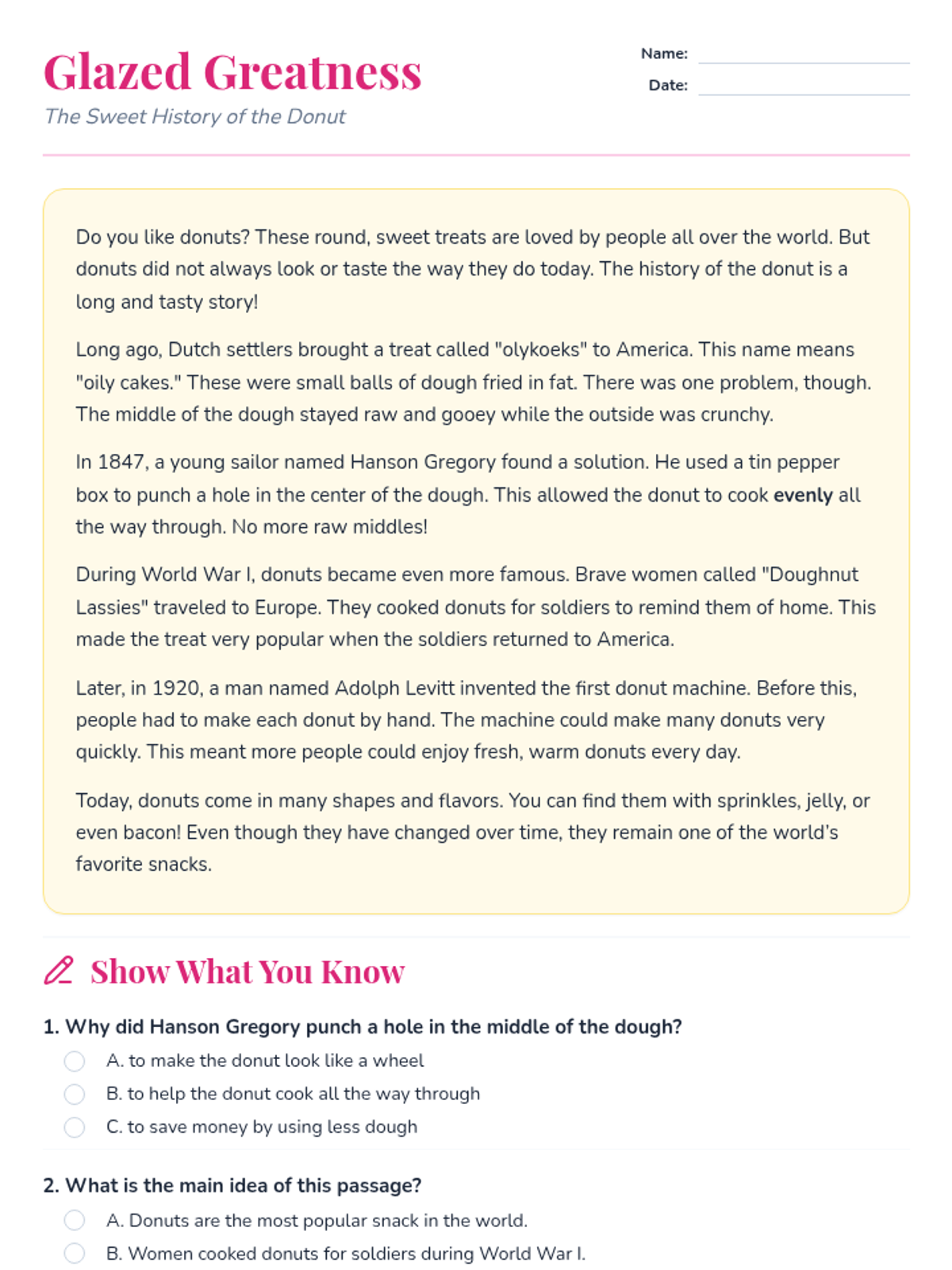
A refined two-page version of the Glazed Greatness passage and assessment. Includes the full reading passage on page 1 and six renumbered questions on page 2 focusing on literal/inferential comprehension and main idea.
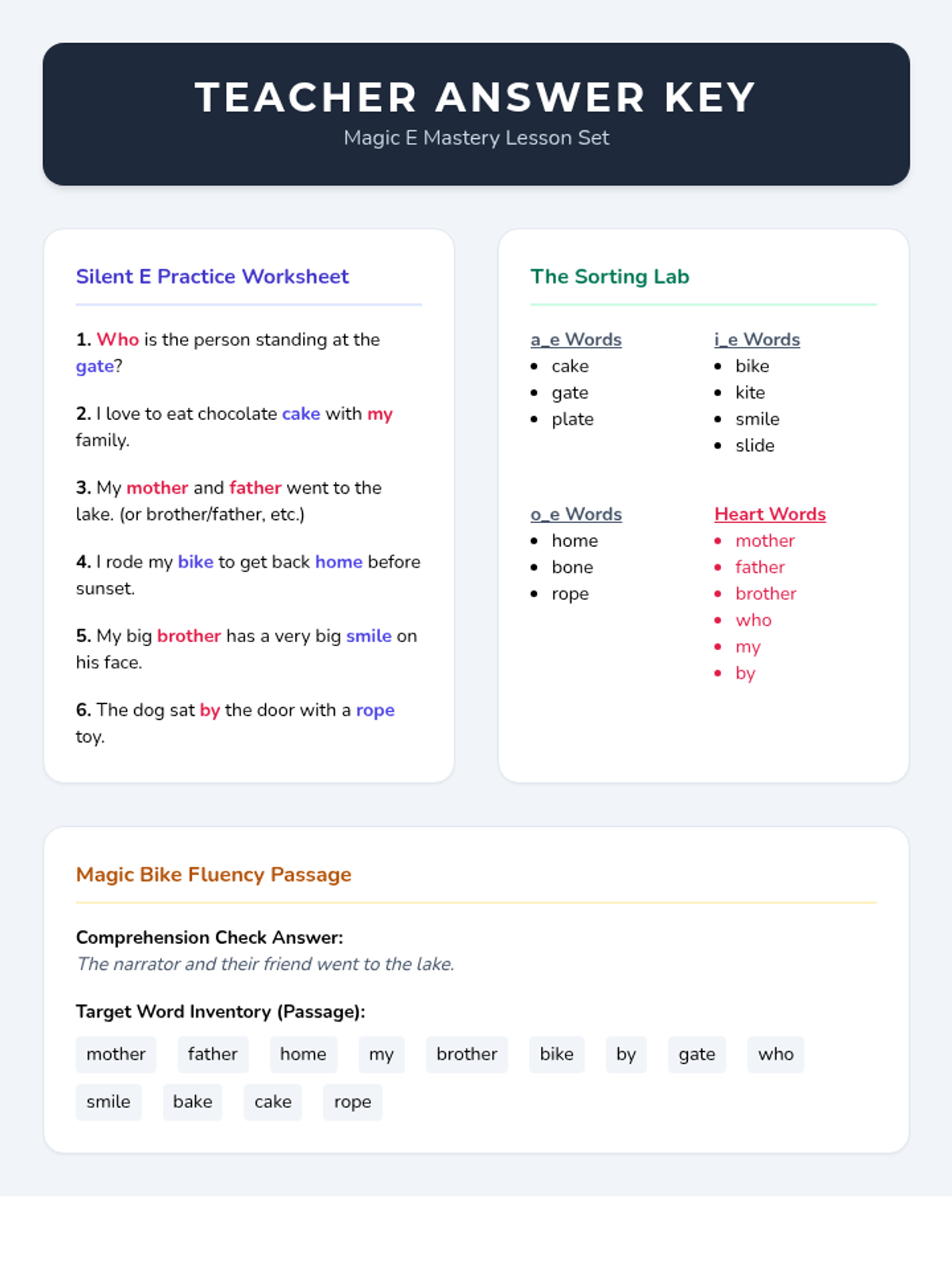
Comprehensive answer key for the 'Magic E Mastery' lesson materials, including sentence completion answers, correct word sort categories, and fluency passage reading checks.
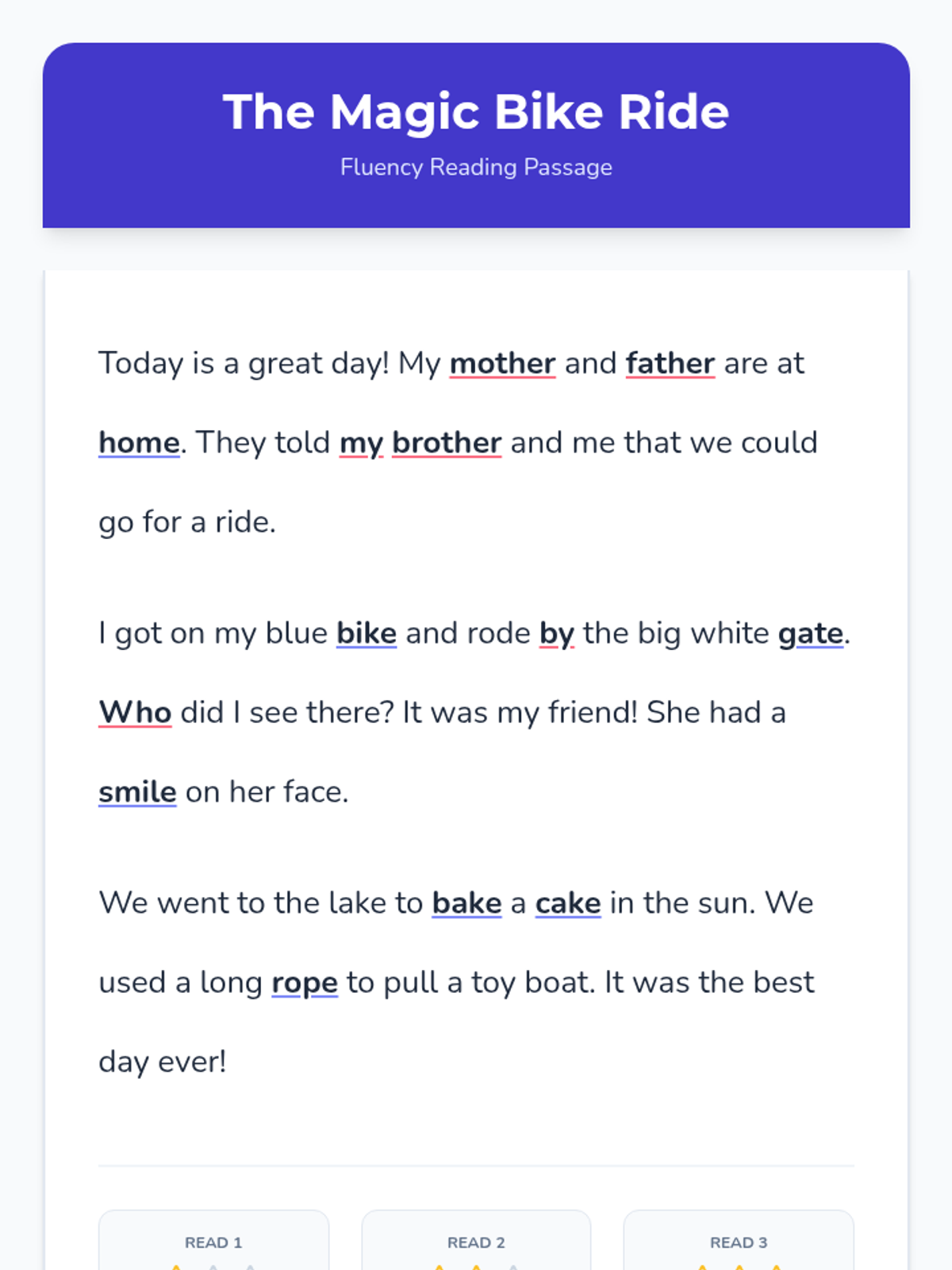
A reading fluency passage titled 'The Magic Bike Ride'. It incorporates target heart words and silent e patterns to provide contextual reading practice. Includes a fluency tracker and a comprehension question.
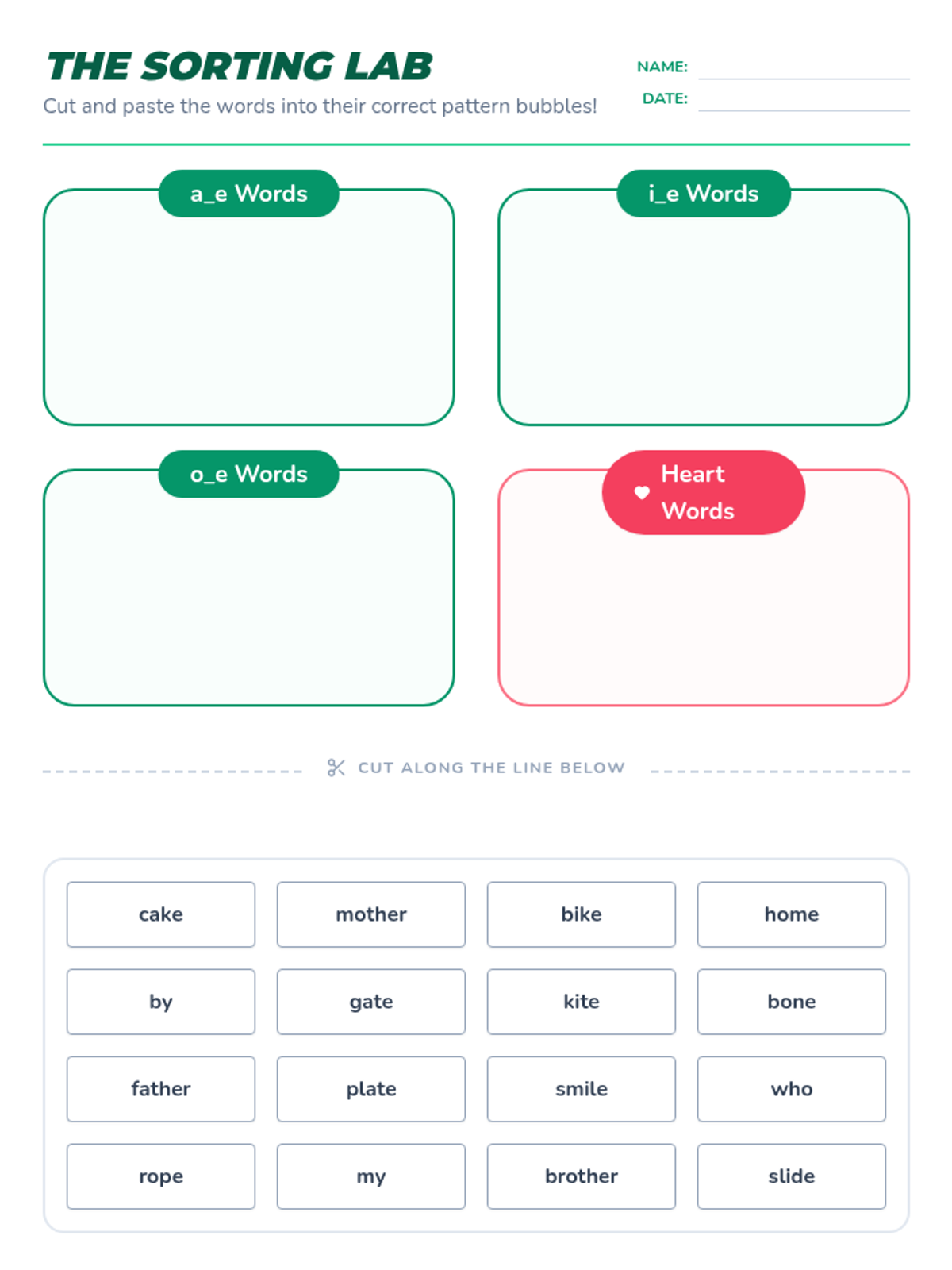
A cut-and-paste word sort activity. Students categorize words into a_e, i_e, o_e, and Heart Word groups to practice pattern recognition.
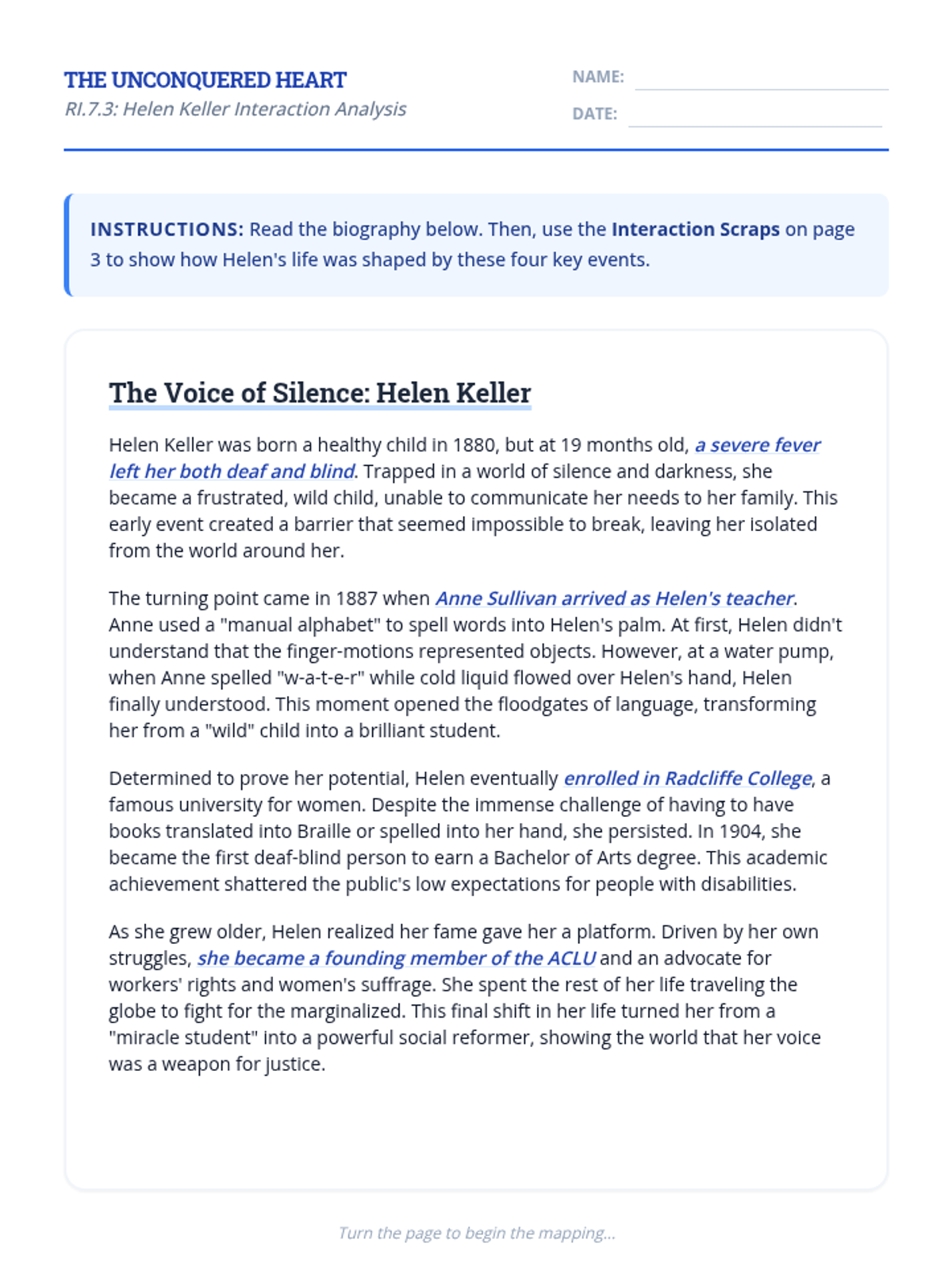
A slide deck introducing RI.7.3 through the lens of Helen Keller's life. Includes thinking stems, modeling of interactions, and clear instructional guidance for analyzing pivots in a person's life.
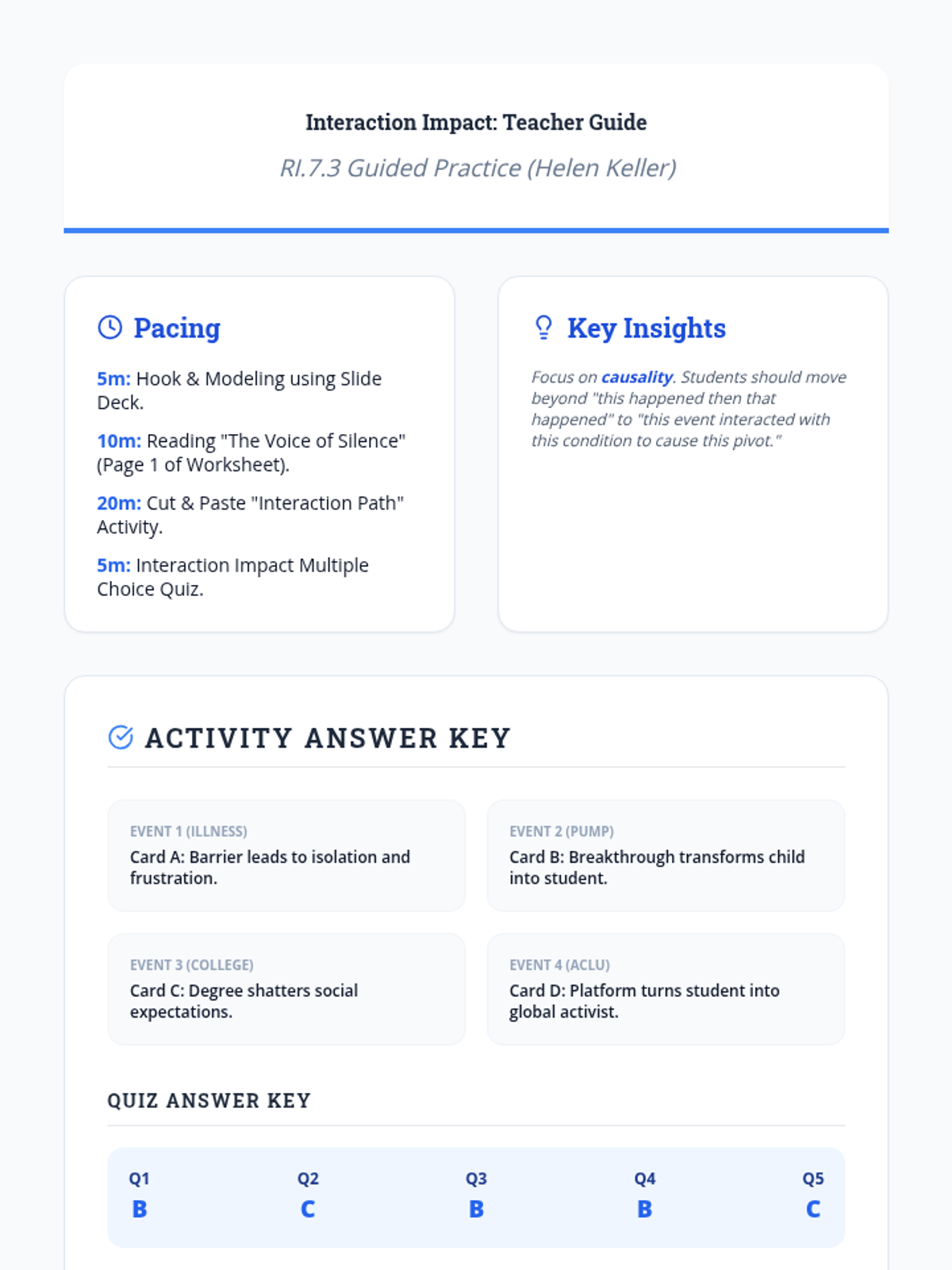
A teacher-facing resource providing pacing, discussion prompts, and a comprehensive answer key for the Interaction Impact lesson. It aligns specifically to RI.7.3 by highlighting the expected depth of student analysis regarding Helen Keller.
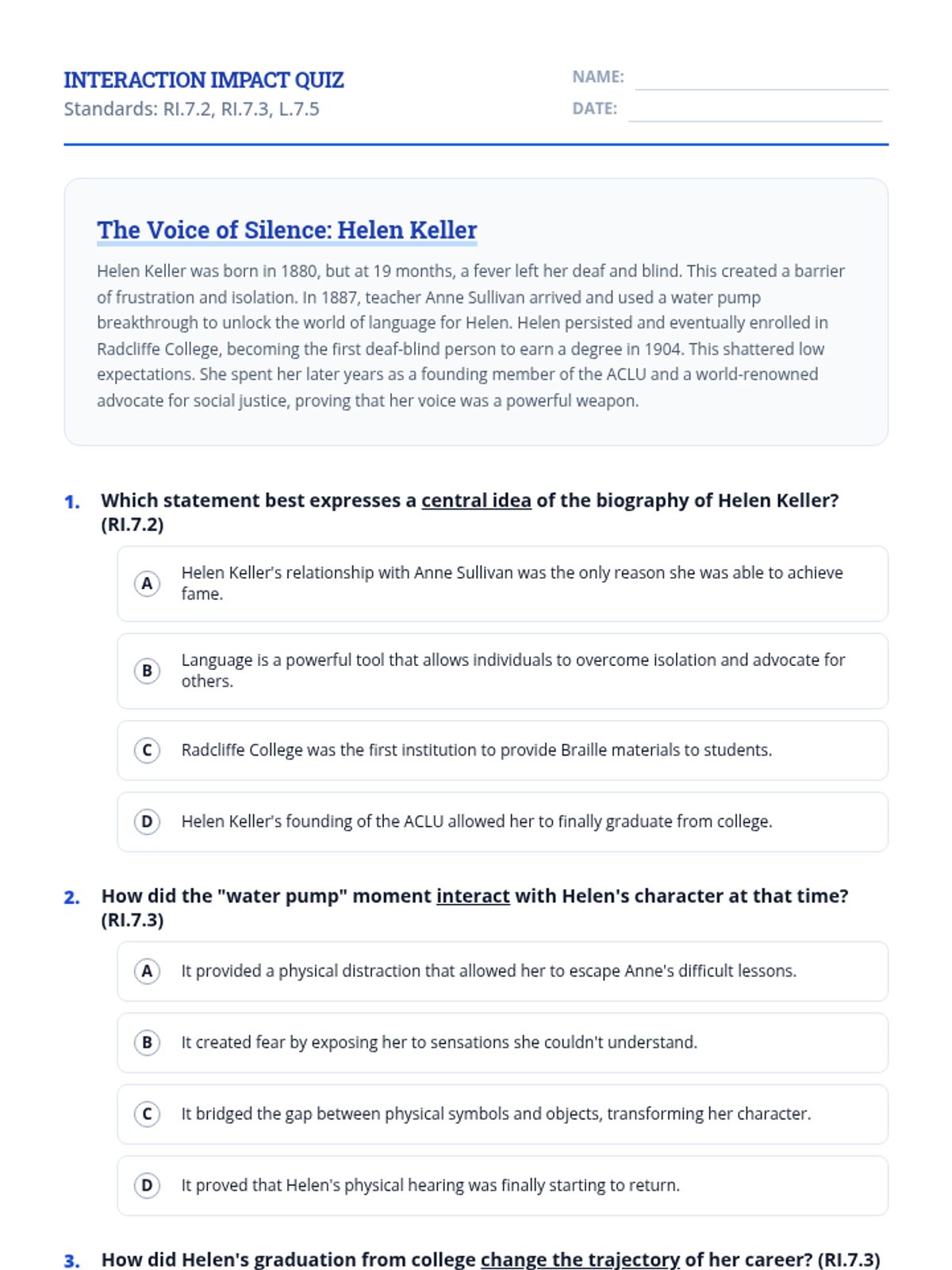
A 5-question multiple choice quiz assessing RI.7.2 (Central Idea), RI.7.3 (Interactions), and L.7.5 (Word Relationships and Nuance) using the life of Helen Keller. Condenses questions to maximize paper usage.
A cut-and-paste activity focusing on the life of Helen Keller with randomized interaction cards (C, A, B, D order) to challenge student analysis. Students match key events in her life to their corresponding interactions. Includes reflection section with handwriting lines.
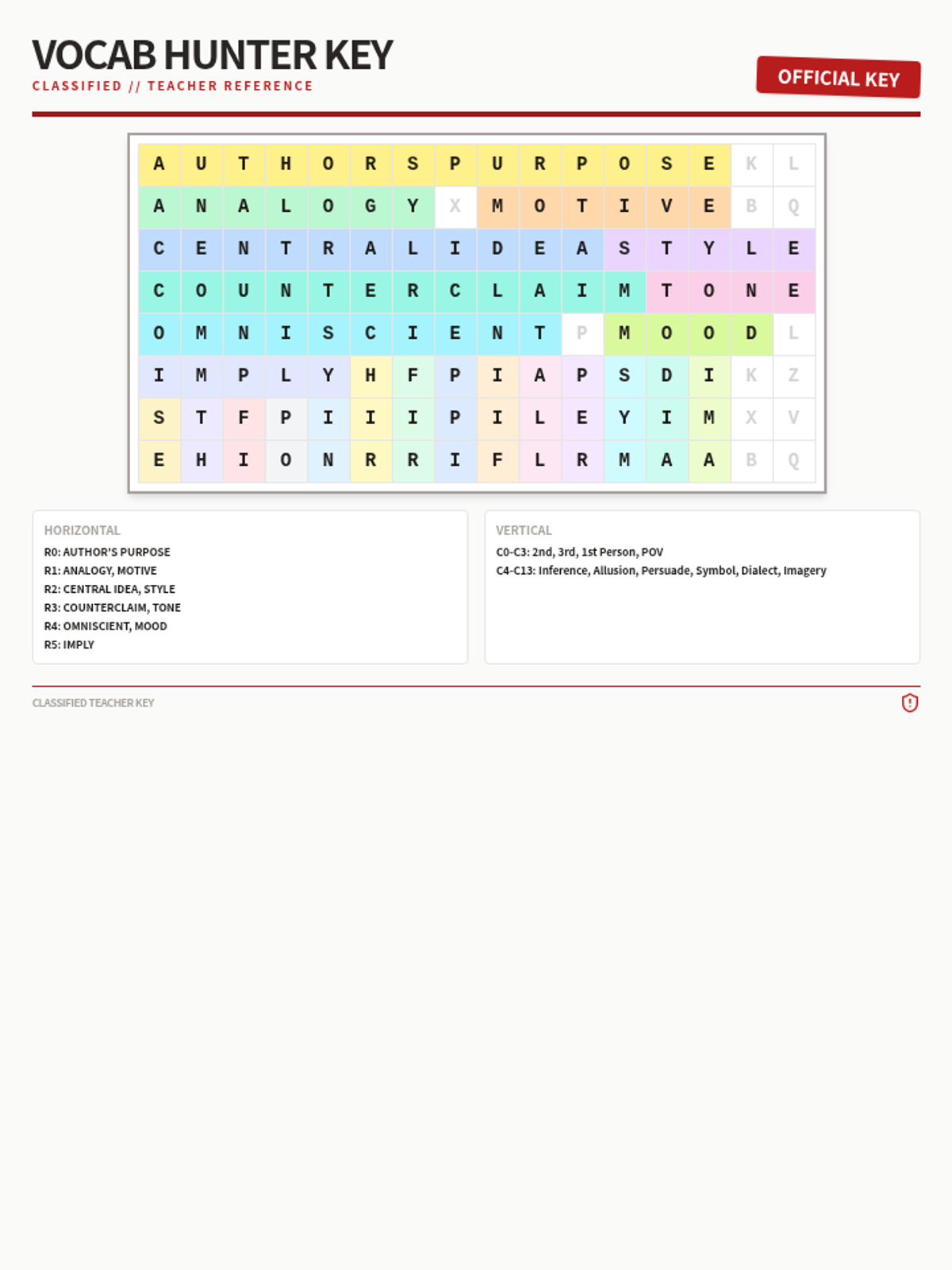
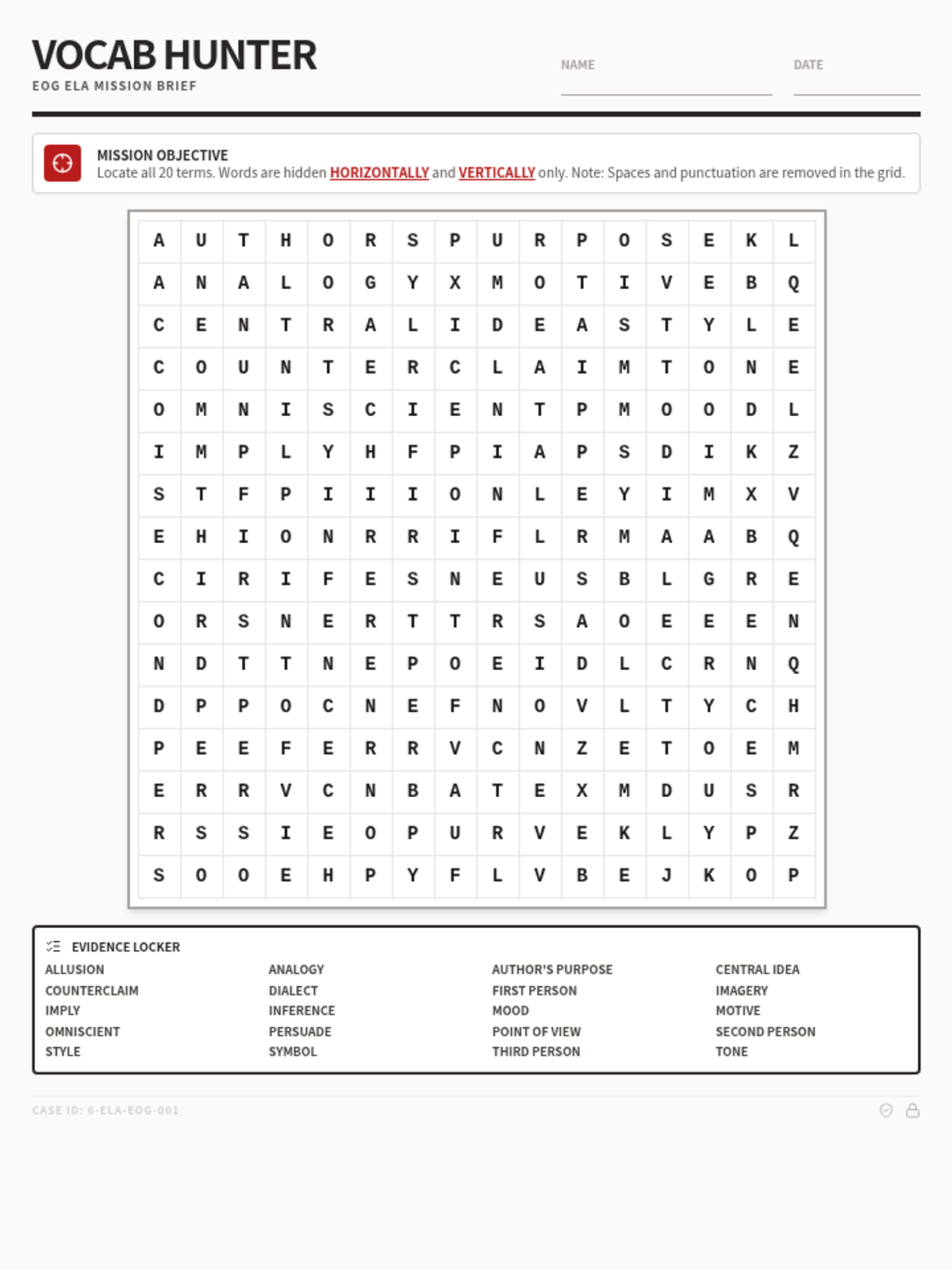
An answer key for the Vocab Hunter Worksheet, showing the locations of all 20 vocabulary terms within the word search grid. Includes a manifest for quick reference.
A detective-themed word search worksheet featuring 20 core 6th-grade ELA vocabulary terms. The puzzle is designed for easy difficulty, with words hidden only horizontally and vertically.
A visual presentation for teaching RL.8.4 standards, focusing on figurative language, connotation, and tone. It includes guided analysis of the 'Whispering Gallery' and 'Iron Pulse' texts, with clear definitions and visual breakdowns of complex literary devices.
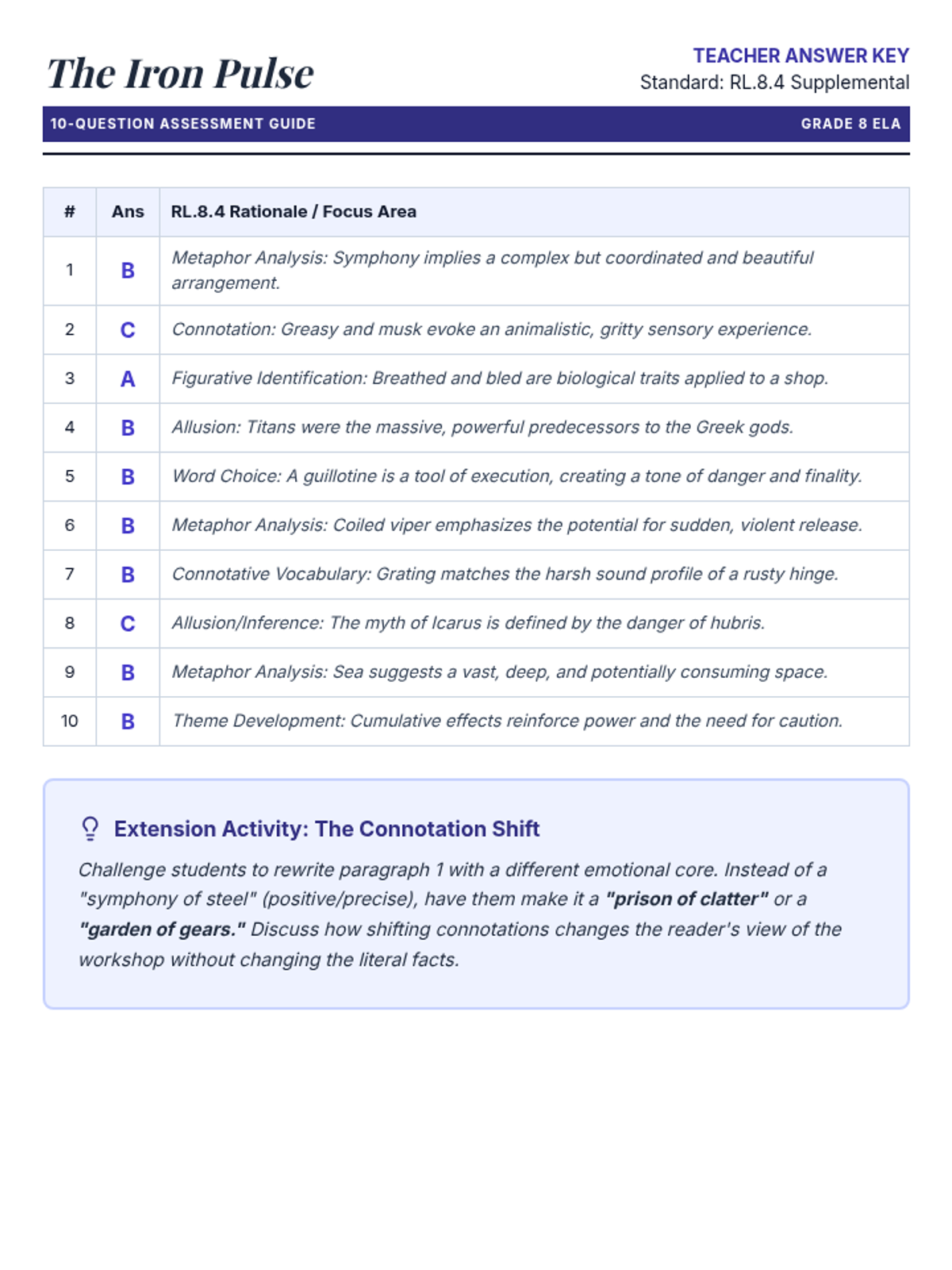
Teacher answer key for the 'Iron Pulse' supplemental worksheet, featuring correct answers, rationales for RL.8.4 alignment, and an extension activity for connotation. This version includes layout optimizations for page-break avoidance.
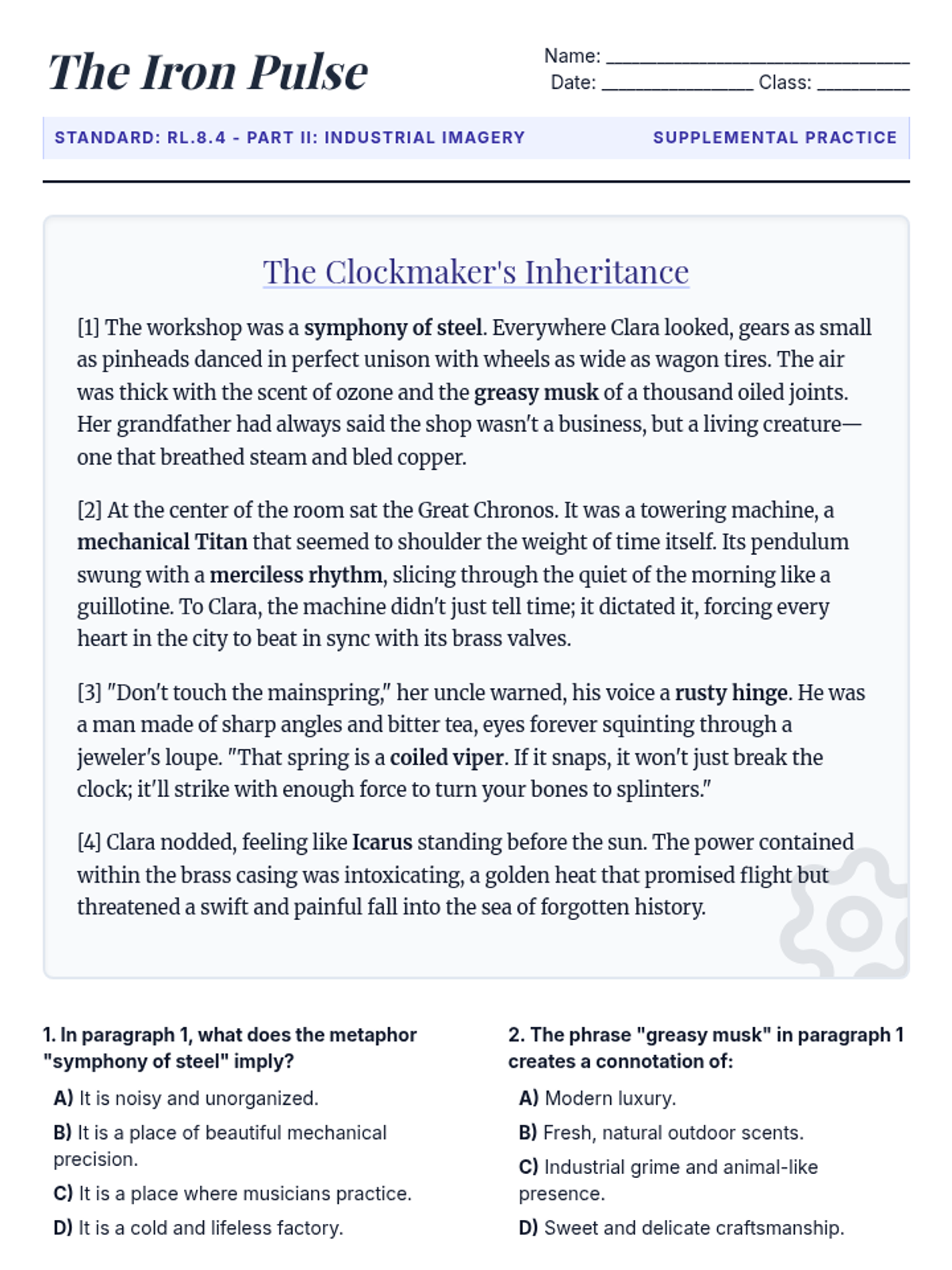
A supplemental 10-question worksheet for RL.8.4, featuring an original passage, 'The Clockmaker's Inheritance'. Students analyze industrial metaphors, mythological allusions, and the connotative impact of mechanical imagery. This version includes lined student response areas.
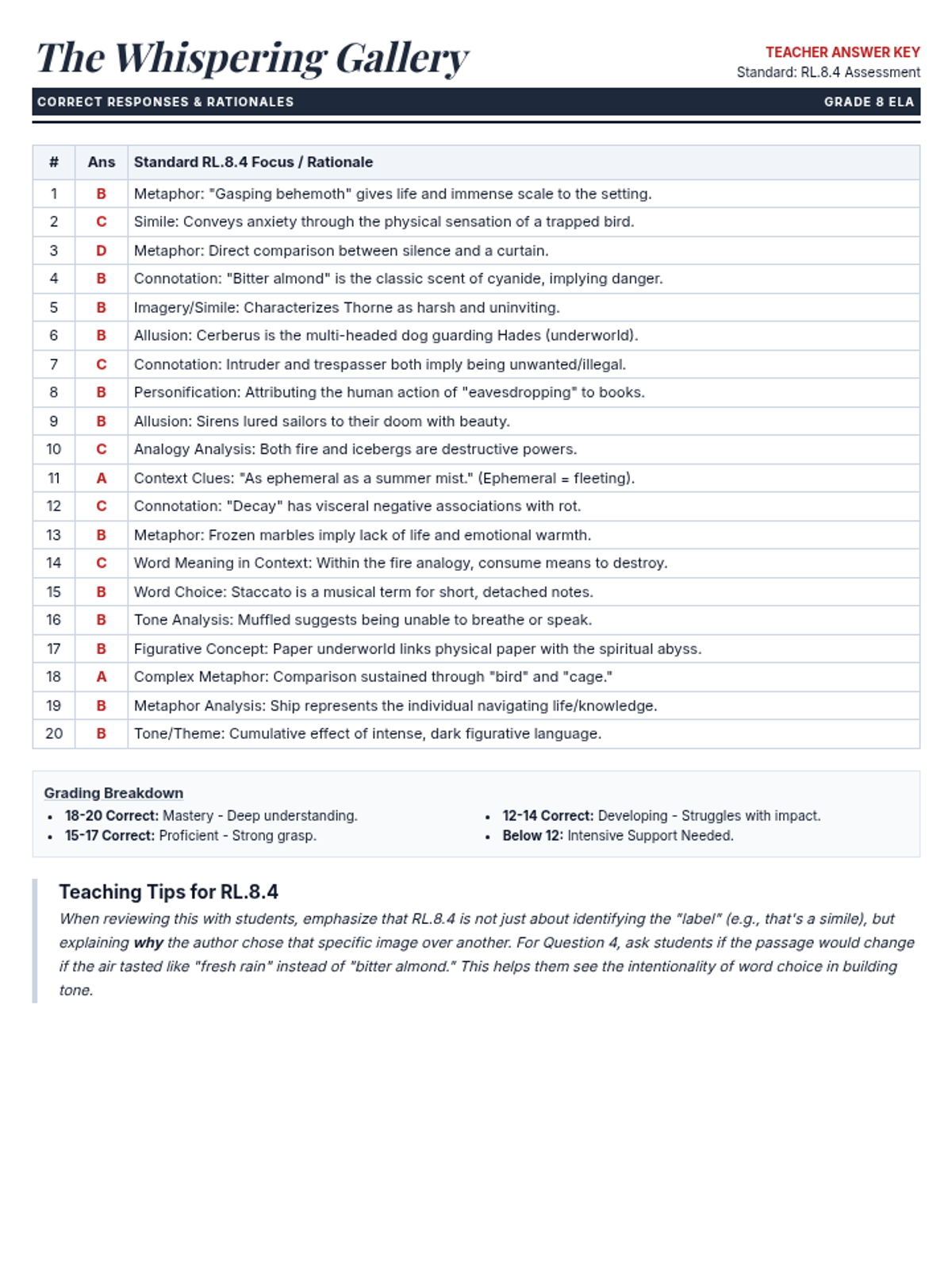
Teacher answer key for 'The Whispering Gallery' worksheet, including correct answers, standard-aligned rationales, and a grading guide for RL.8.4.
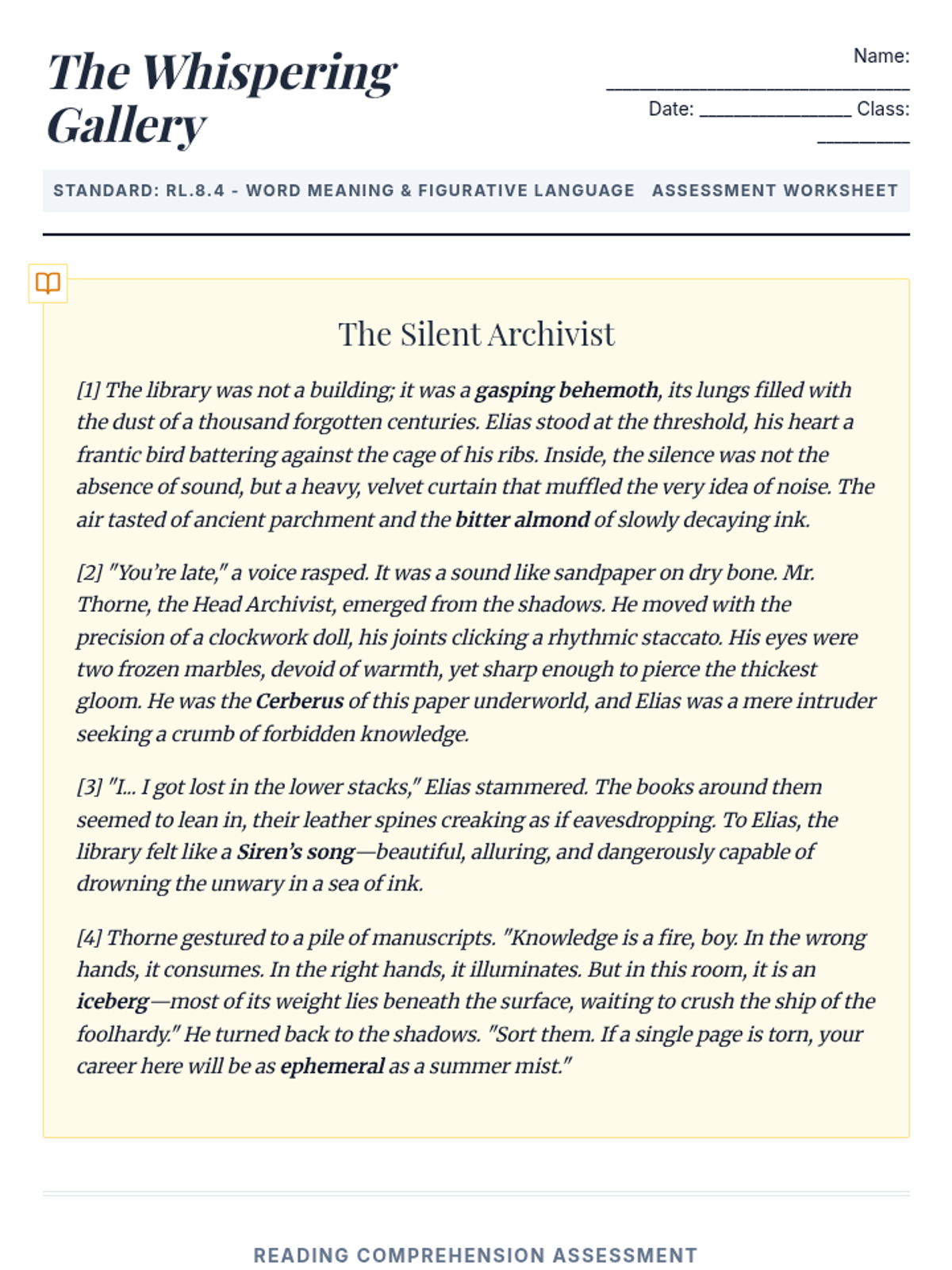
A rigorous 20-question EOG-style worksheet focusing on RL.8.4 standards. It features an original literary passage, 'The Silent Archivist', and tasks students with analyzing figurative language, allusions, analogies, and connotative meanings.
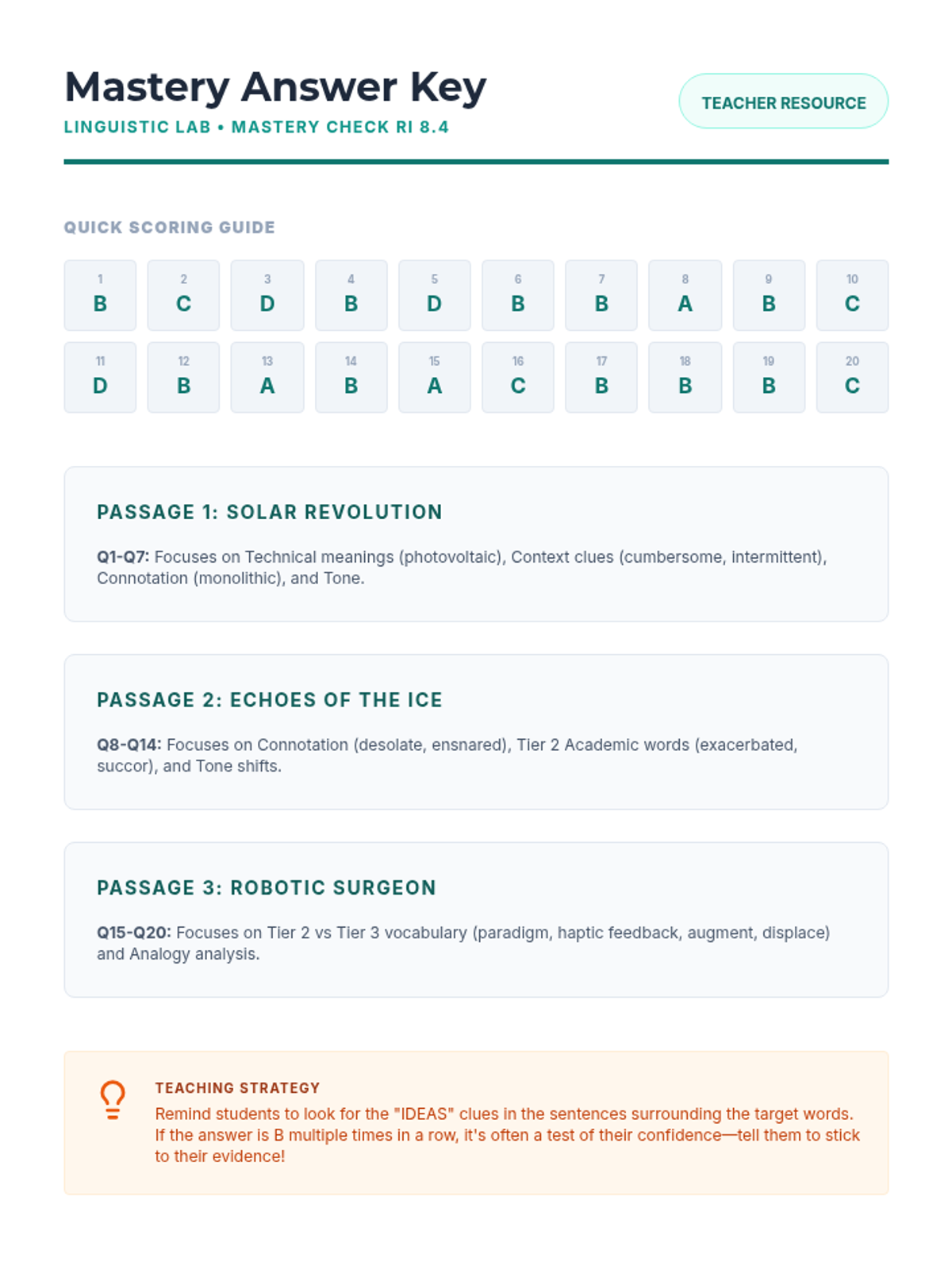
Teacher answer key and standards breakdown for the 20-question Linguistic Lab Mastery Check.
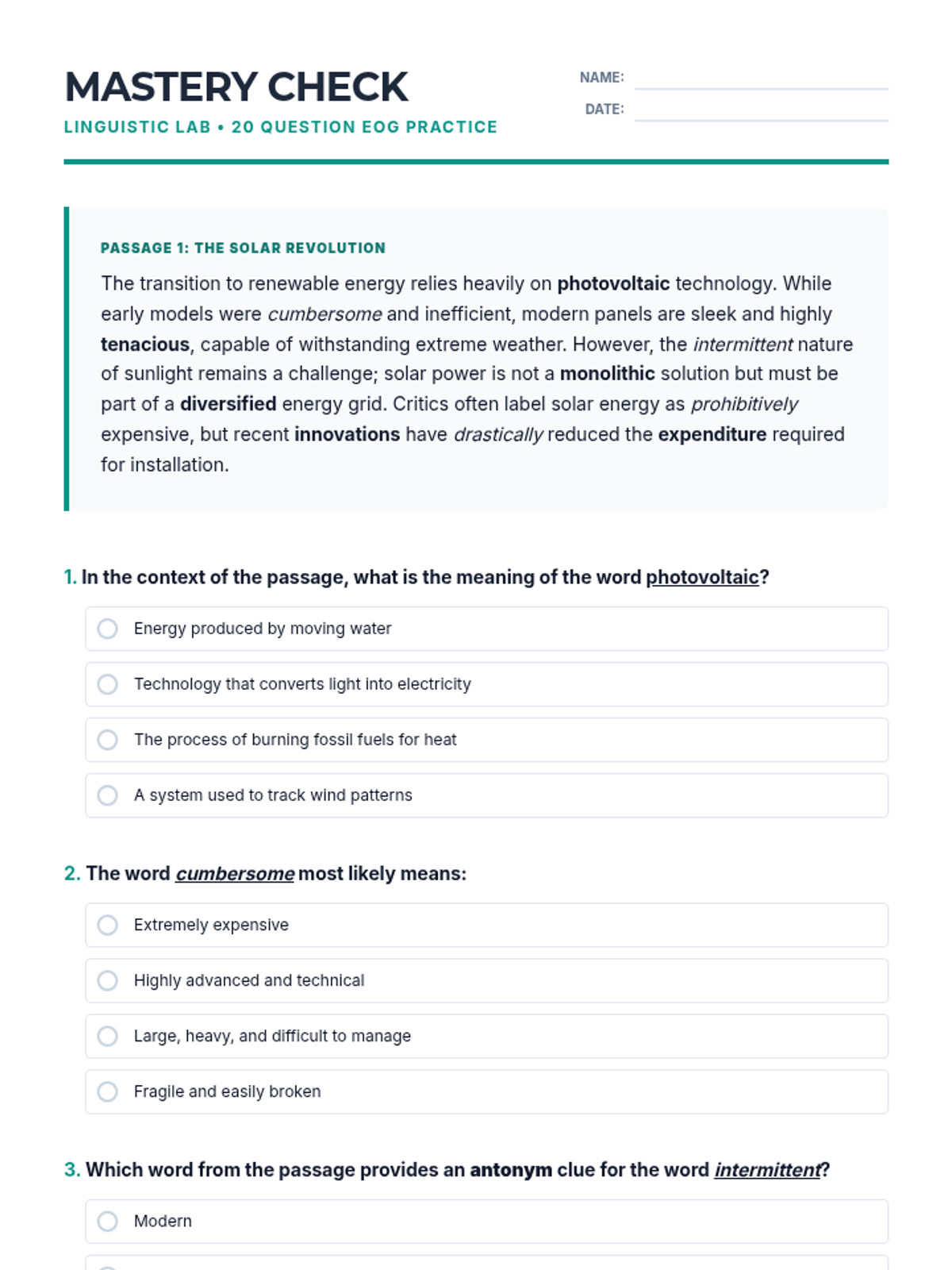
A 20-question mastery assessment for RI 8.4 featuring three informational passages and EOG-style questions on context clues, connotation, tone, and vocabulary tiers.
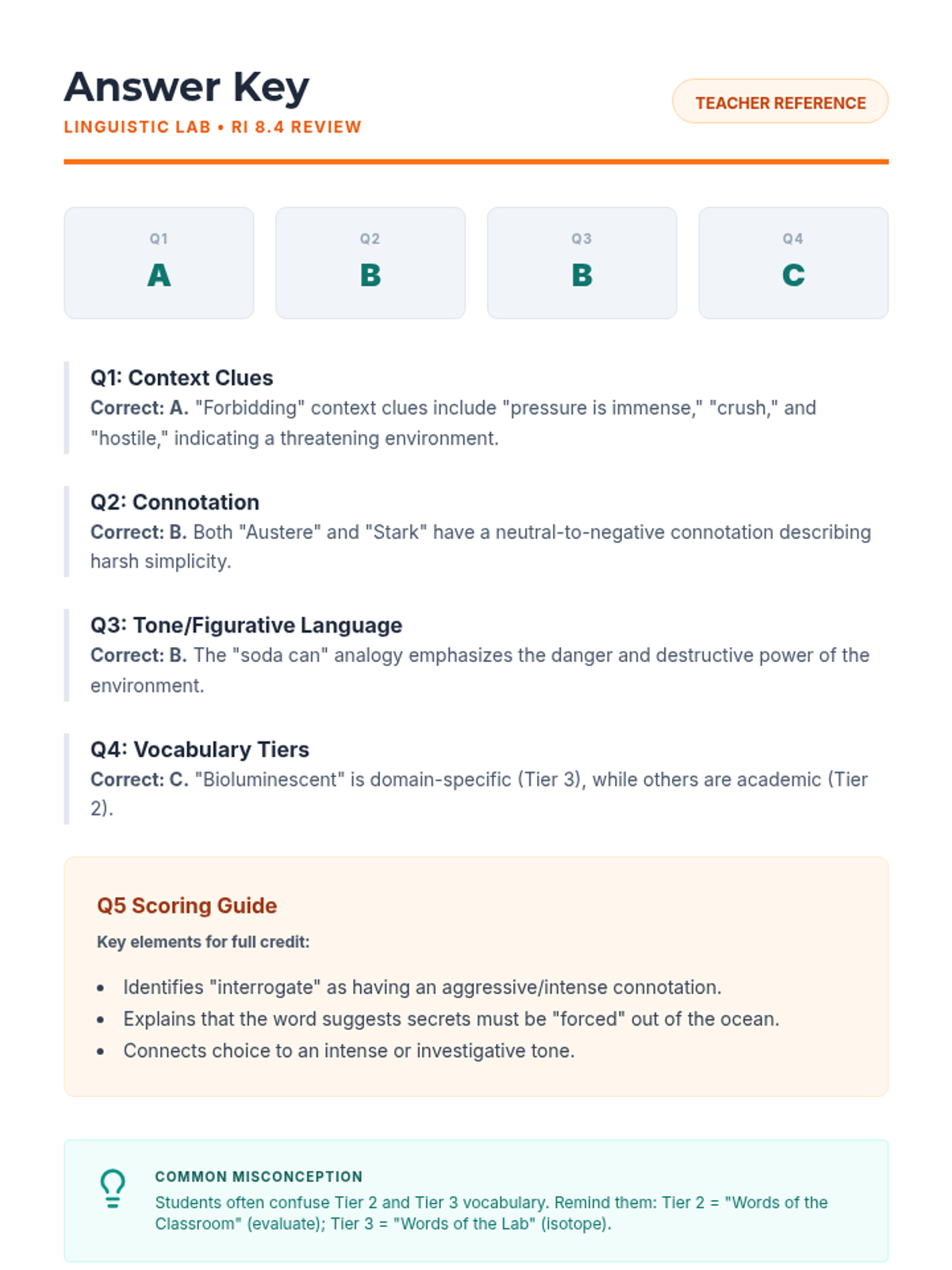
A detailed teacher answer key and scoring guide for the Linguistic Lab Practice Quiz, featuring rationales for each answer and common misconceptions.
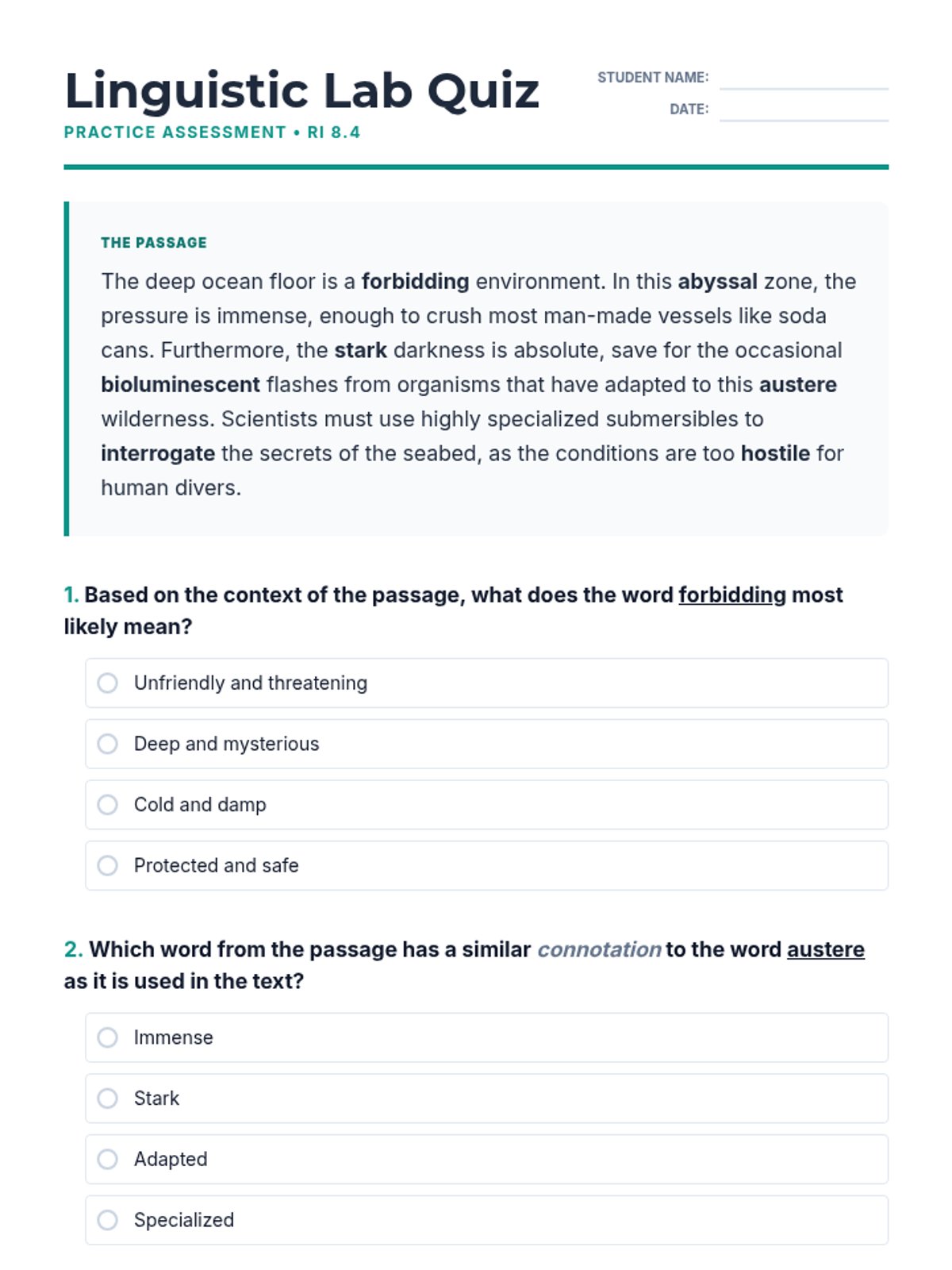
A practice quiz for RI 8.4 featuring a short informational passage and multiple-choice/short-answer questions focusing on context clues, connotation, tone, and technical vocabulary.
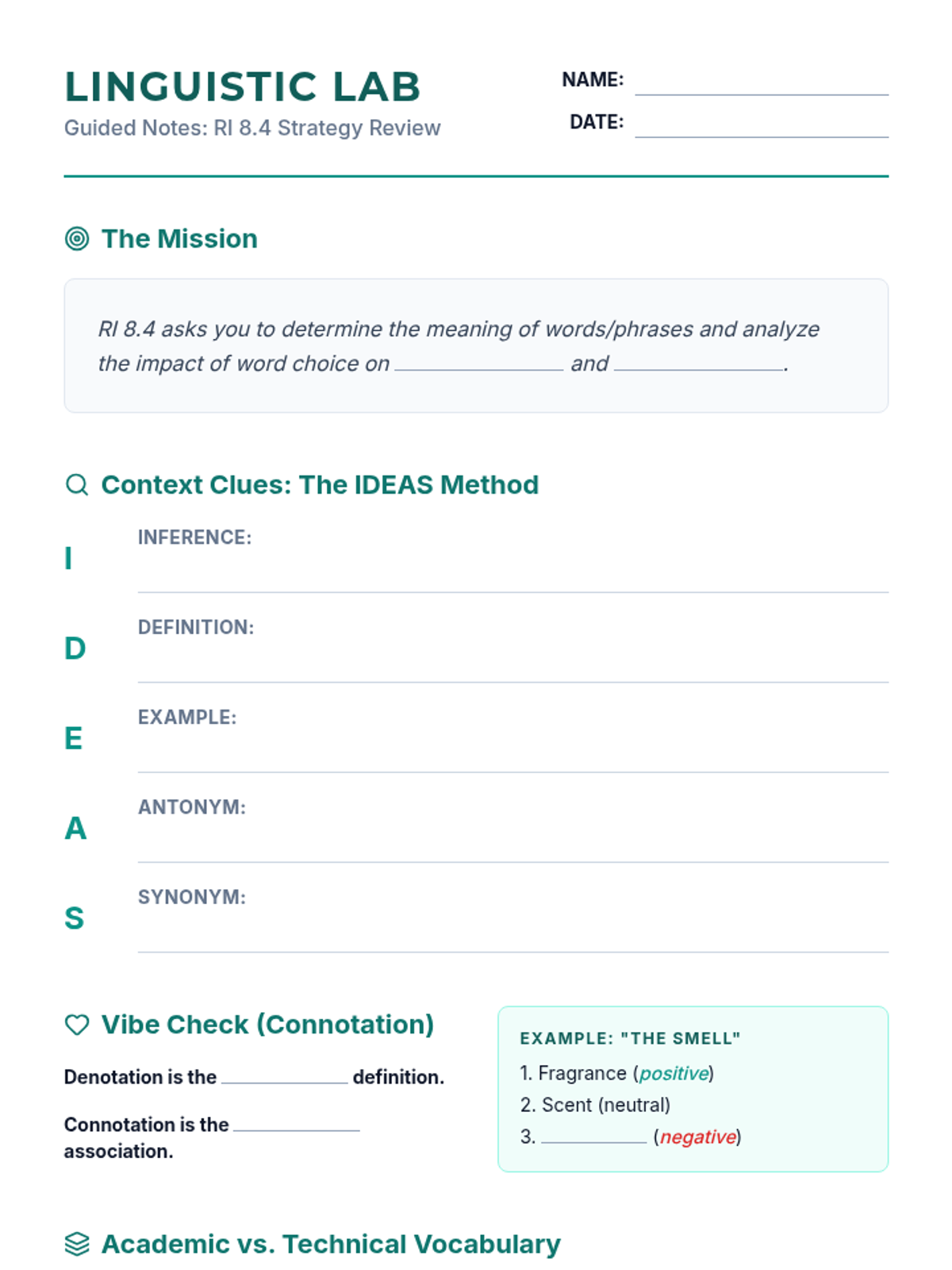
Guided notes for students to use during the Linguistic Lab slide presentation, featuring sections for context clues, connotation, and EOG strategies.
A visually engaging slide deck covering RI 8.4 EOG strategies, including context clues (IDEAS), connotation, tone, and vocabulary tiers.
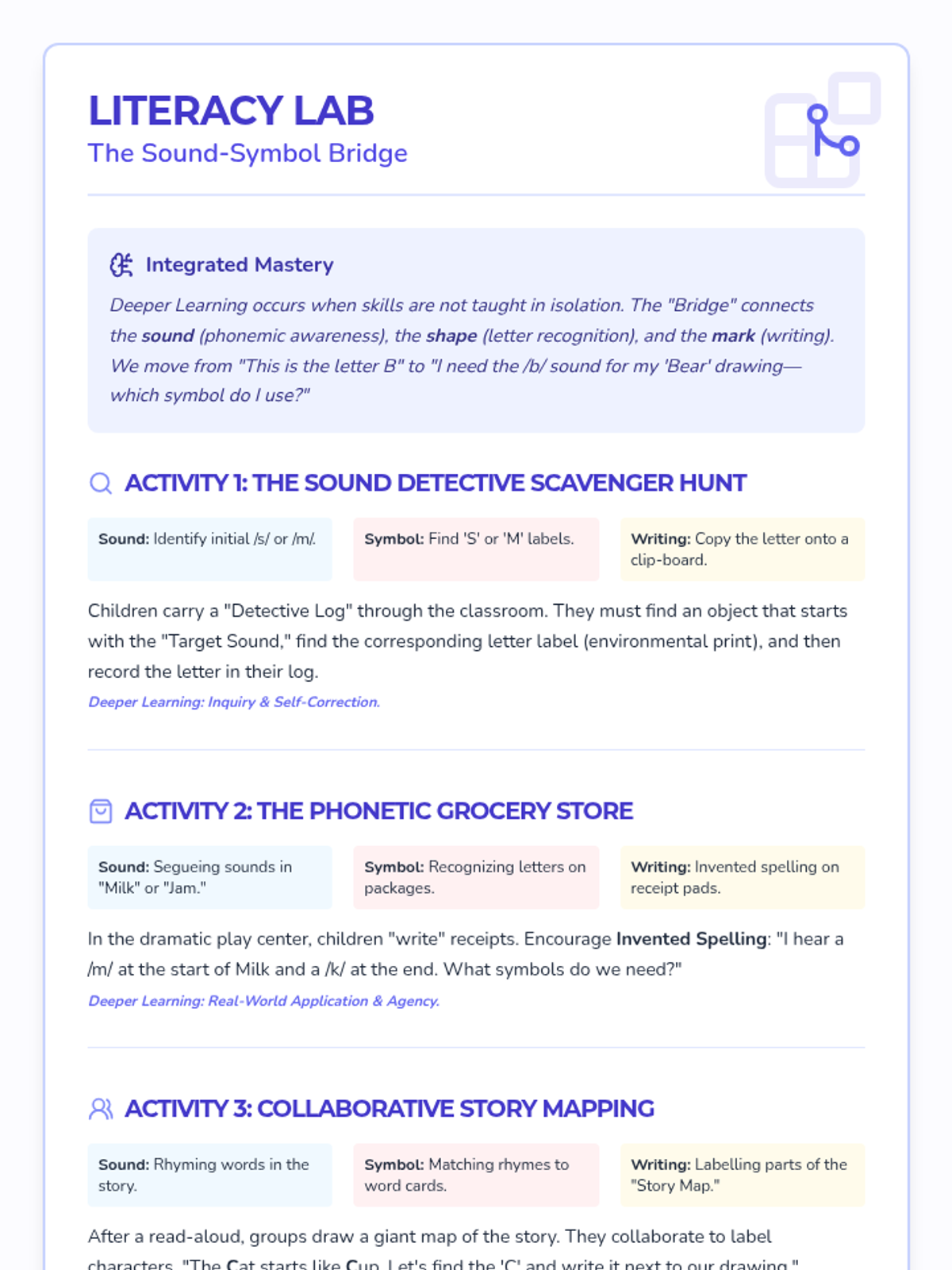
Teacher activity guide and student discovery log that integrate sound-symbol relationships, letter recognition, and emergent writing through play-based inquiry.
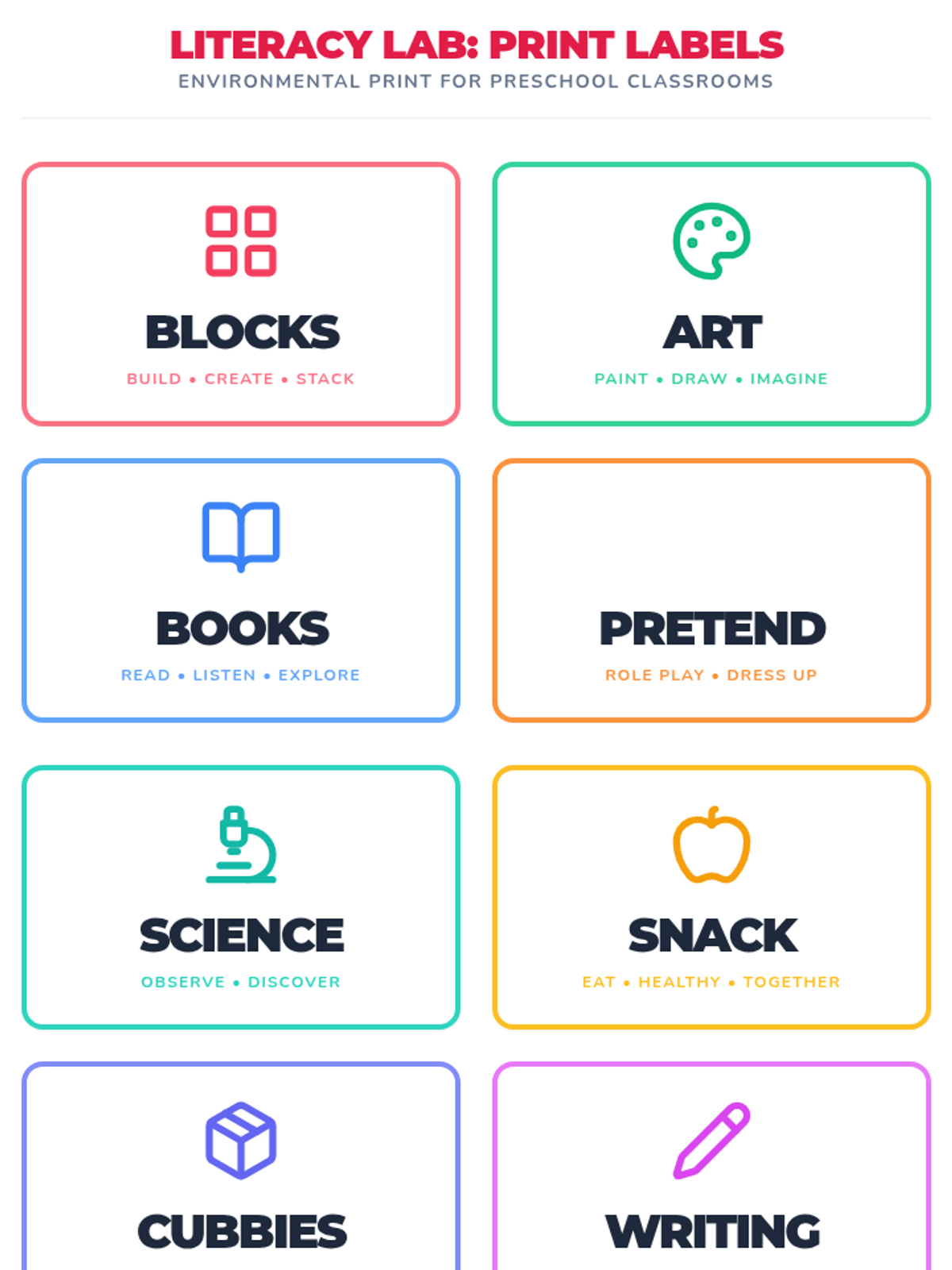
A set of visually engaging, printable classroom labels for preschool environments, including major learning centers and functional utility items.
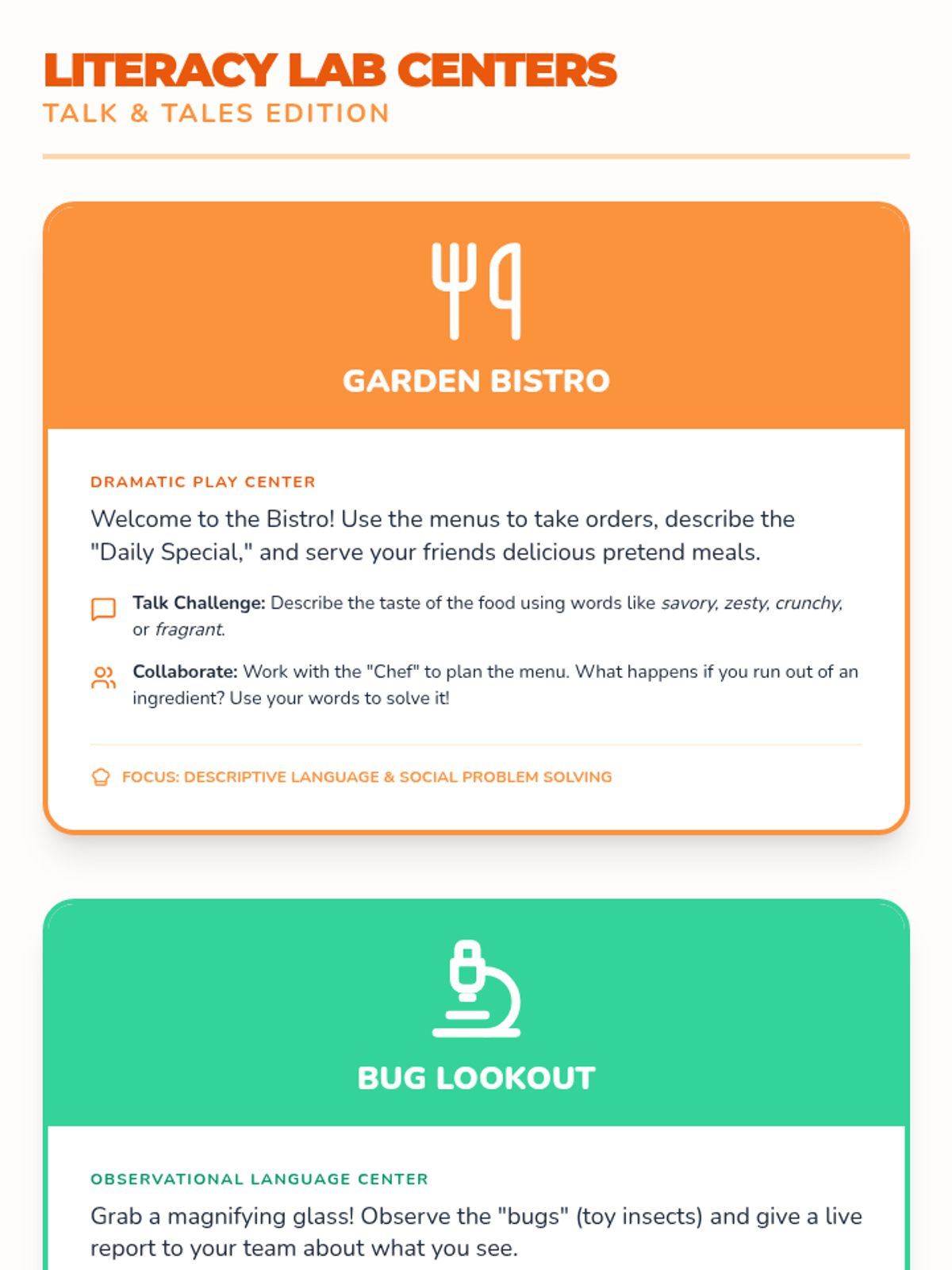
Updated child-friendly center activity cards for dramatic play, storytelling, and vocabulary development, featuring the Garden Bistro and Bug Lookout.
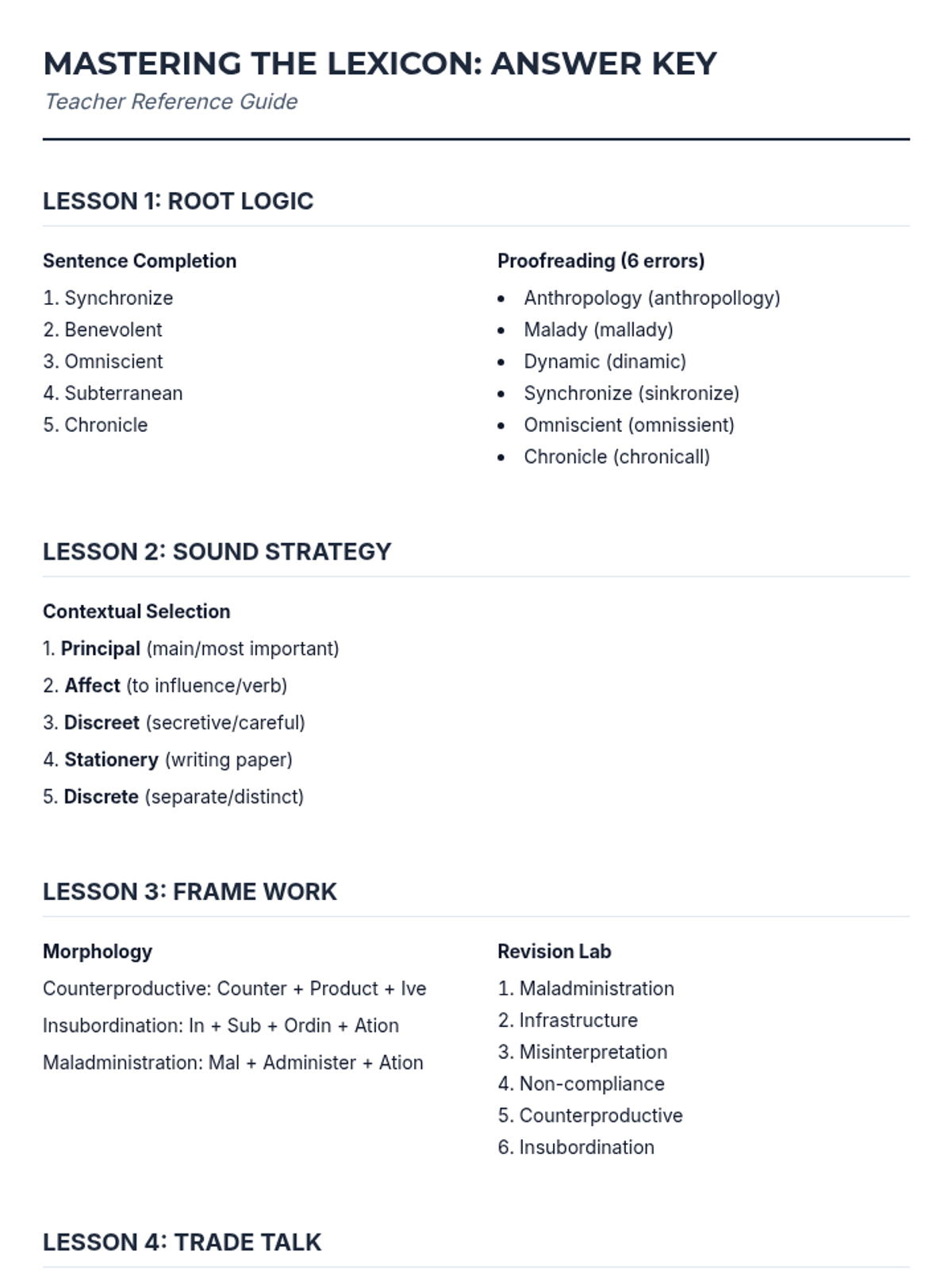
A comprehensive answer key for the "Mastering the Lexicon" sequence, providing solutions for all exercises across the five spelling lessons. Includes correct spellings for proofreading tasks and sentence completion.
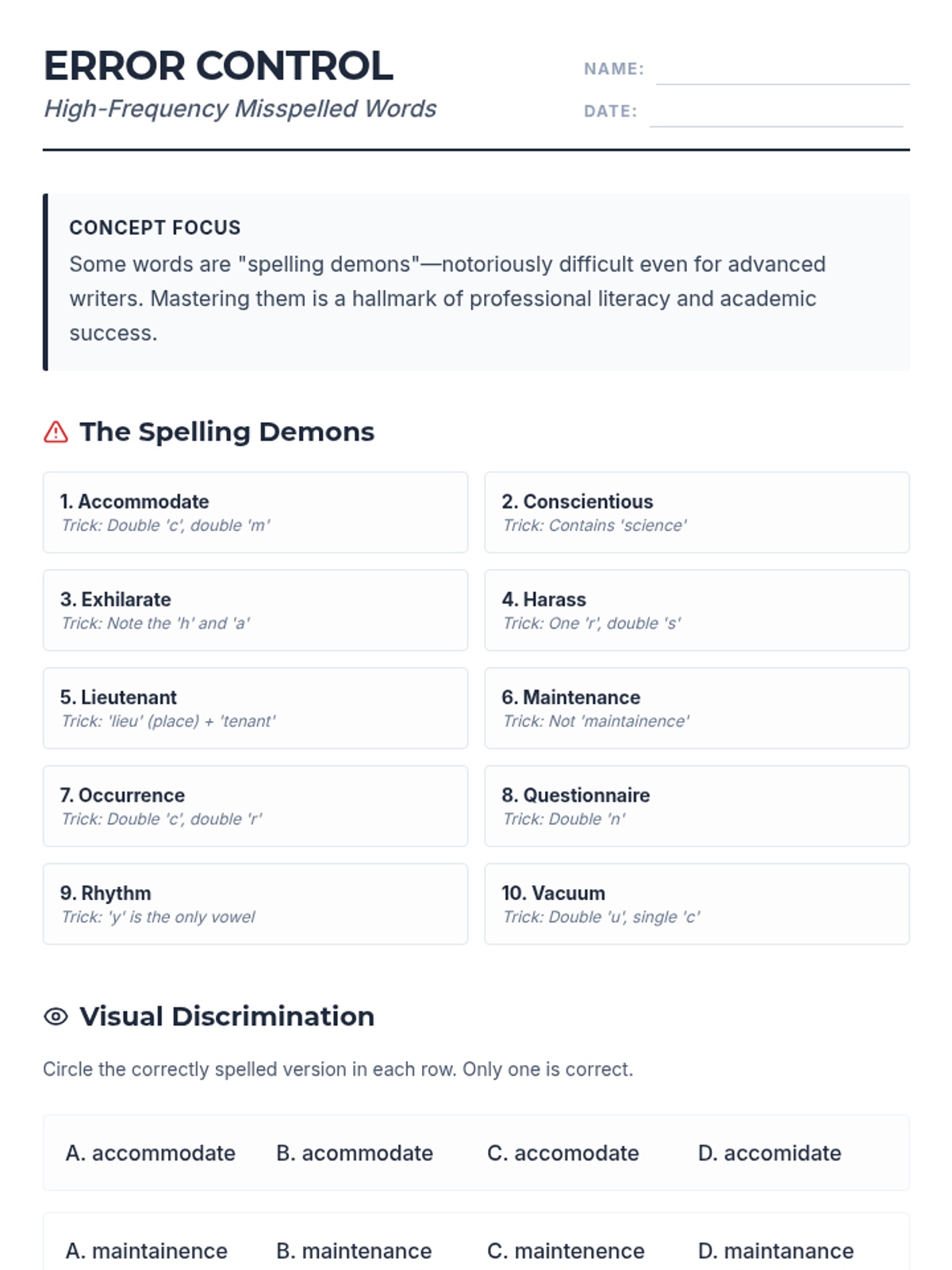
A high-level spelling worksheet targeting 10 high-frequency "demon" words (accommodate, maintenance, questionnaire, etc.) for adult students. Features mnemonic tips, a visual discrimination task, and an email-based editing exercise.
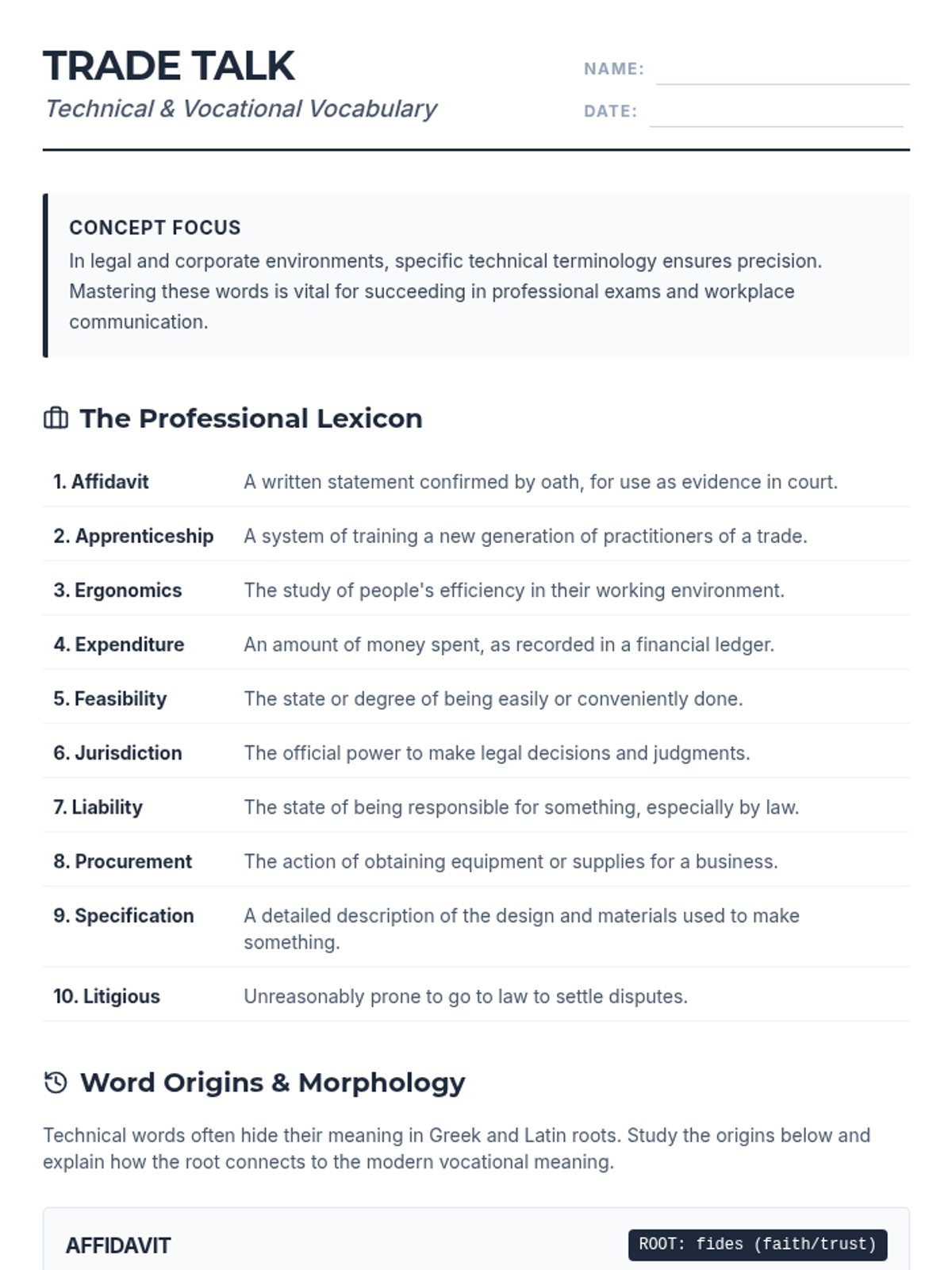
A vocational spelling and vocabulary worksheet for adult students focusing on technical and legal terminology (affidavit, ergonomics, feasibility, etc.). Includes professional definitions, word origin/morphology studies, and a legal memo proofreading task.
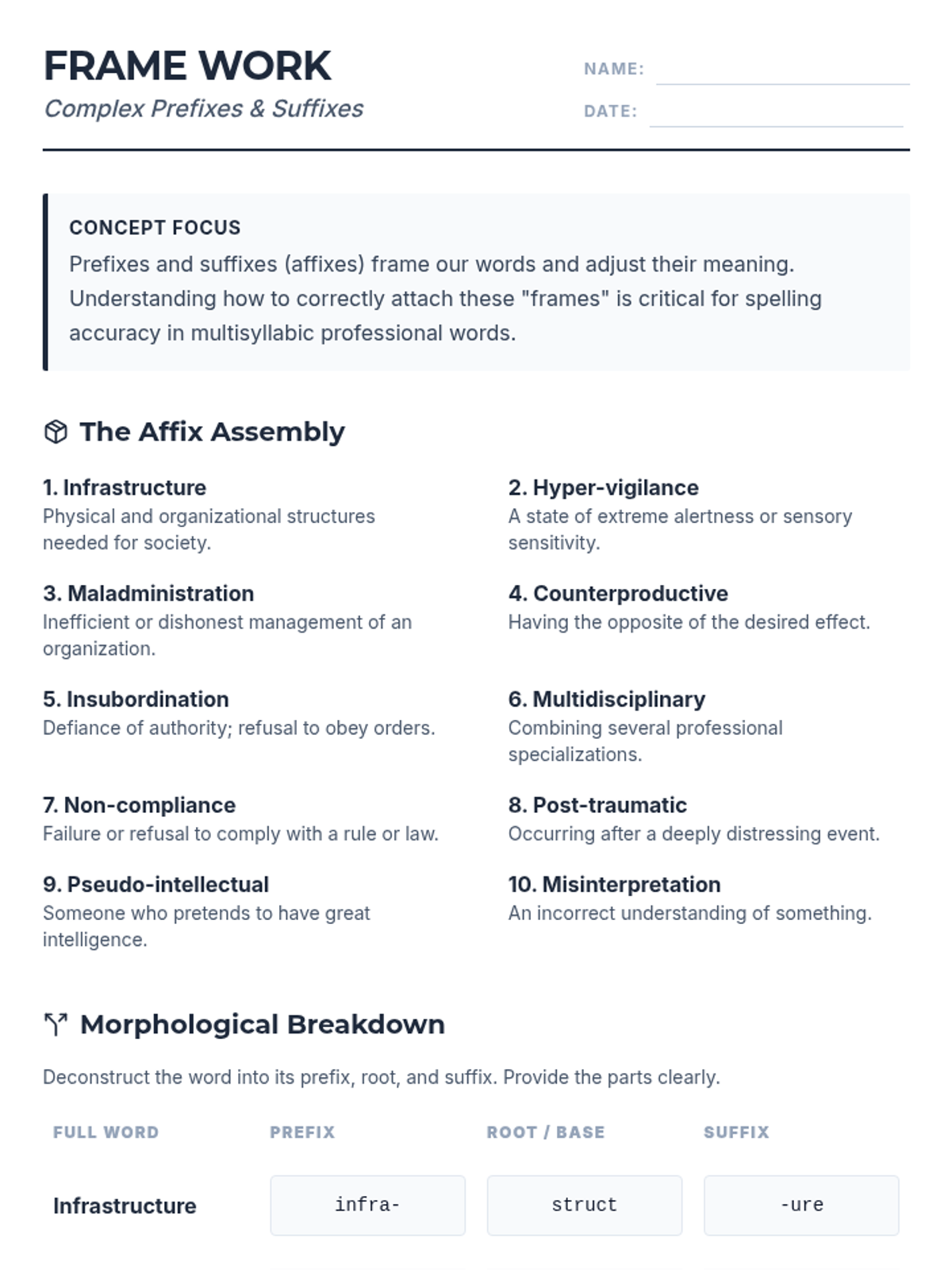
An advanced morphology worksheet for adult students focusing on complex prefixes and suffixes. Includes a spelling list with definitions, a morphological breakdown exercise, and a proofreading task set within a professional administrative context.
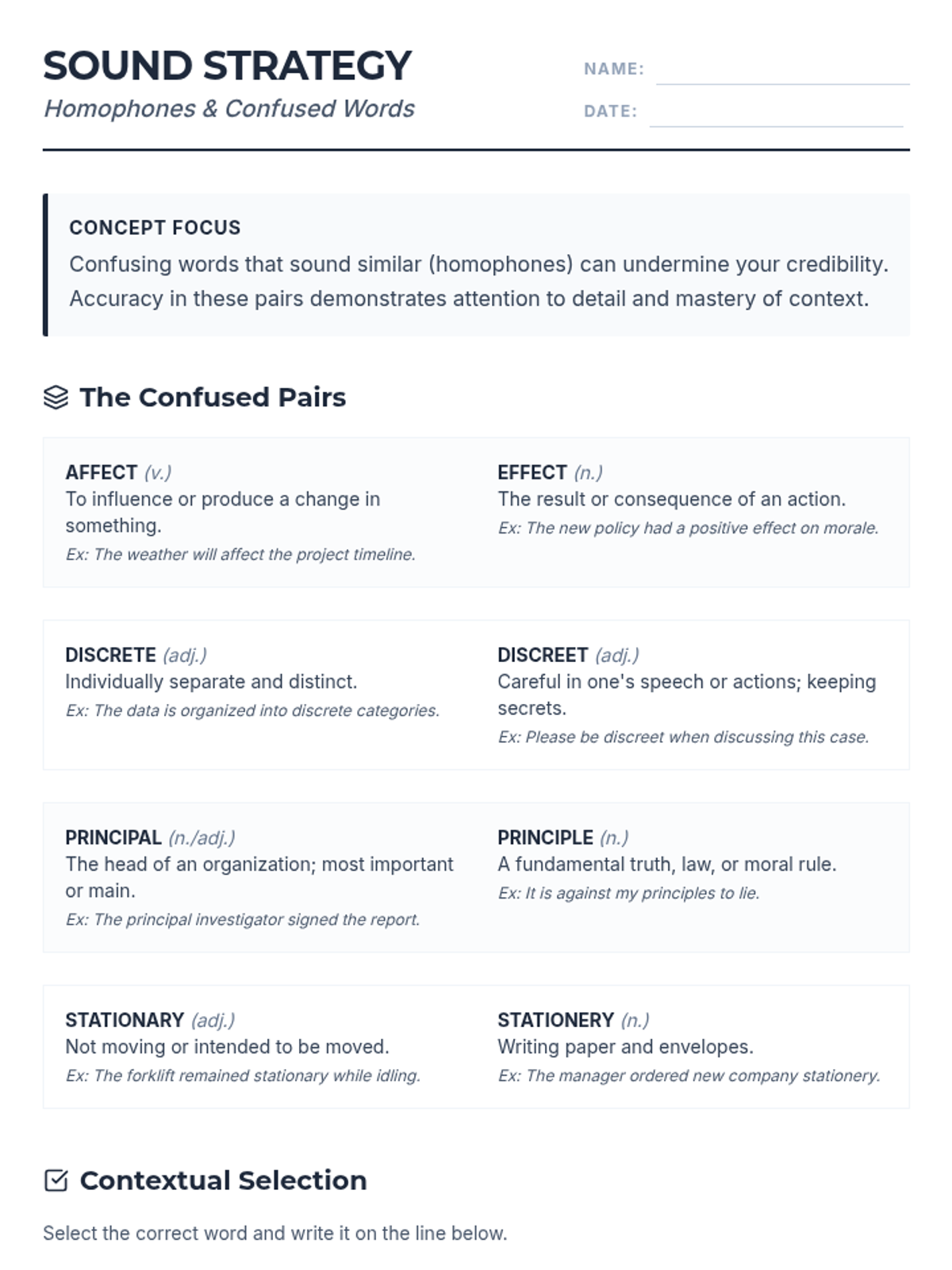
A focused spelling worksheet for adult students on homophones and commonly confused word pairs (affect/effect, discrete/discreet, principal/principle, stationary/stationery). Features detailed definitions with examples, a contextual selection exercise, and a sentence construction task.
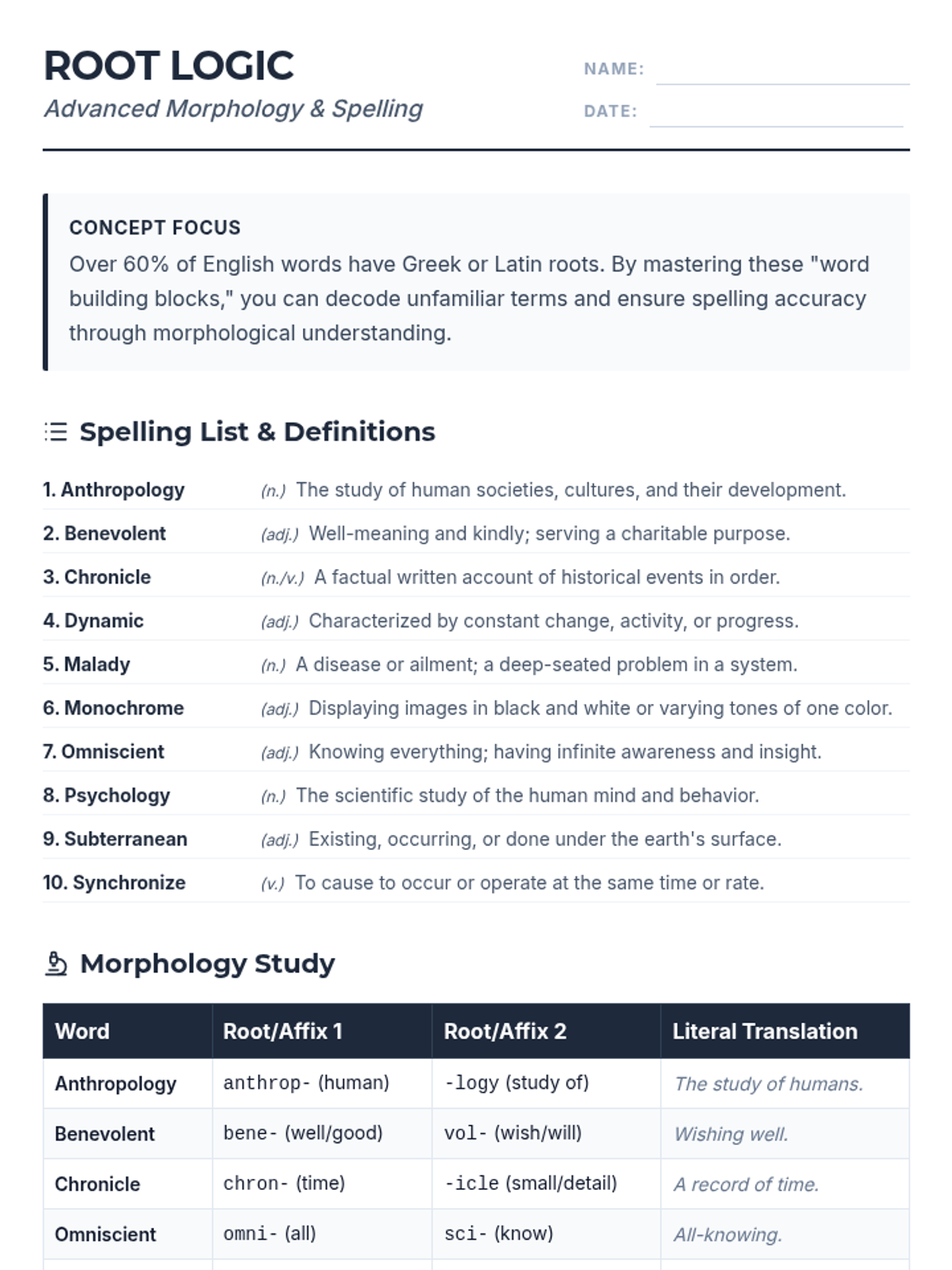
A comprehensive spelling and morphology worksheet for adult students focusing on Greek and Latin roots. Includes a list of 10 advanced words with definitions, a morphology breakdown table, sentence completion exercises, and a paragraph-based proofreading task.
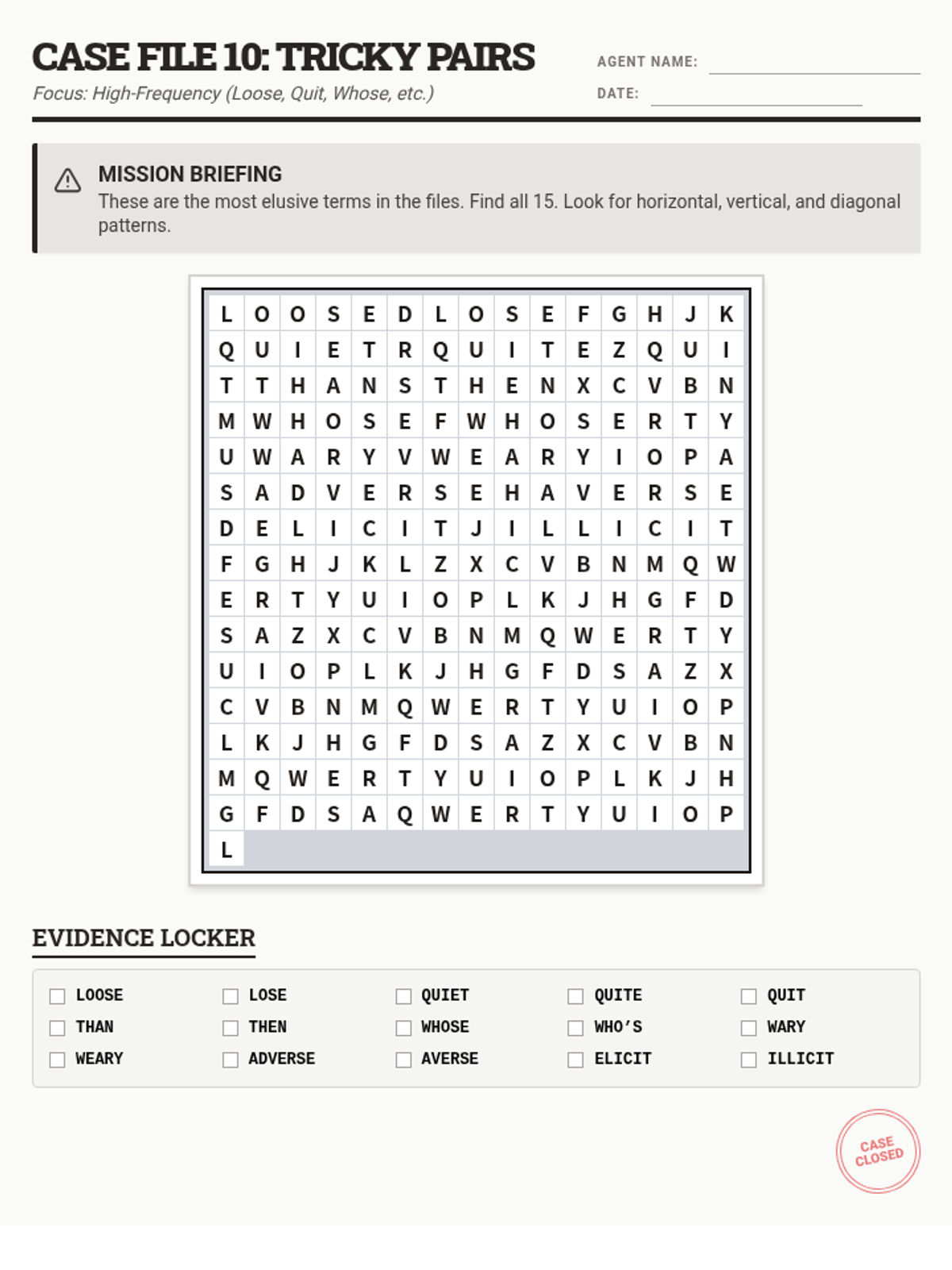
The final word search worksheet focusing on the most difficult commonly confused word pairs like loose/lose and than/then. Closes the detective case theme.
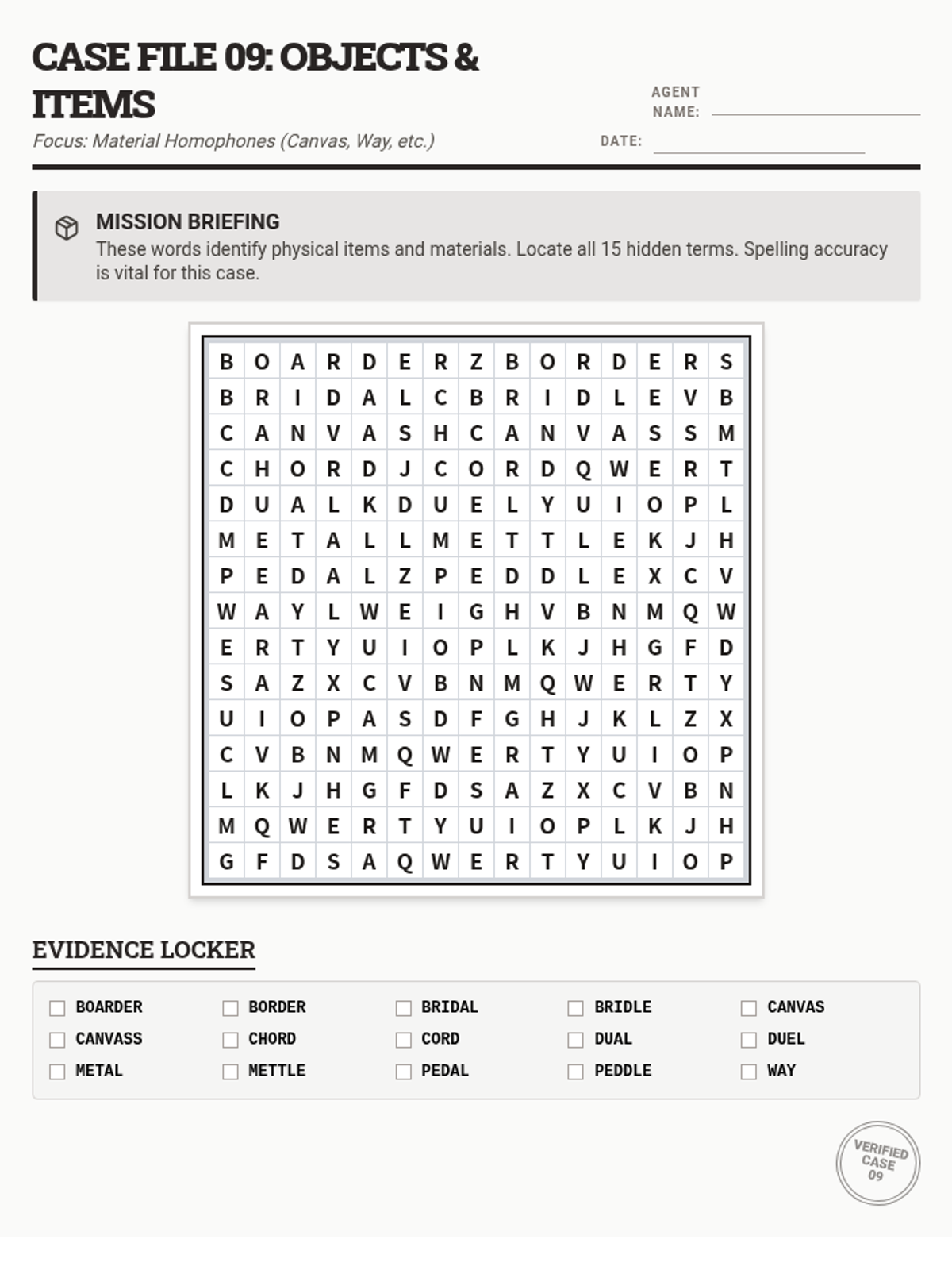
A word search focused on object-based homophones like metal/mettle and canvas/canvass. Features an industrial materials case theme.
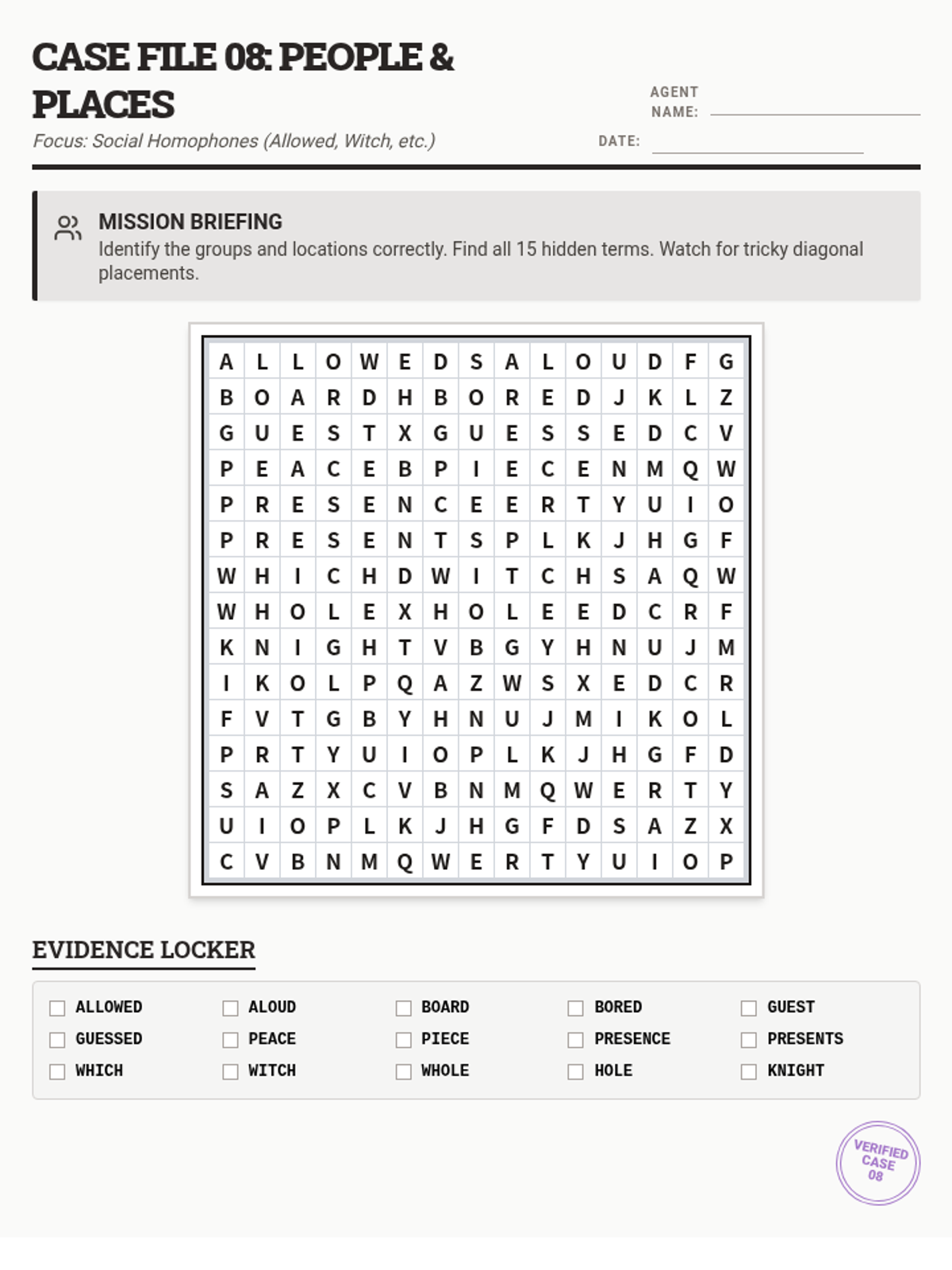
A word search worksheet covering social and location-based homophones like allowed/aloud and which/witch. Community case file theme.
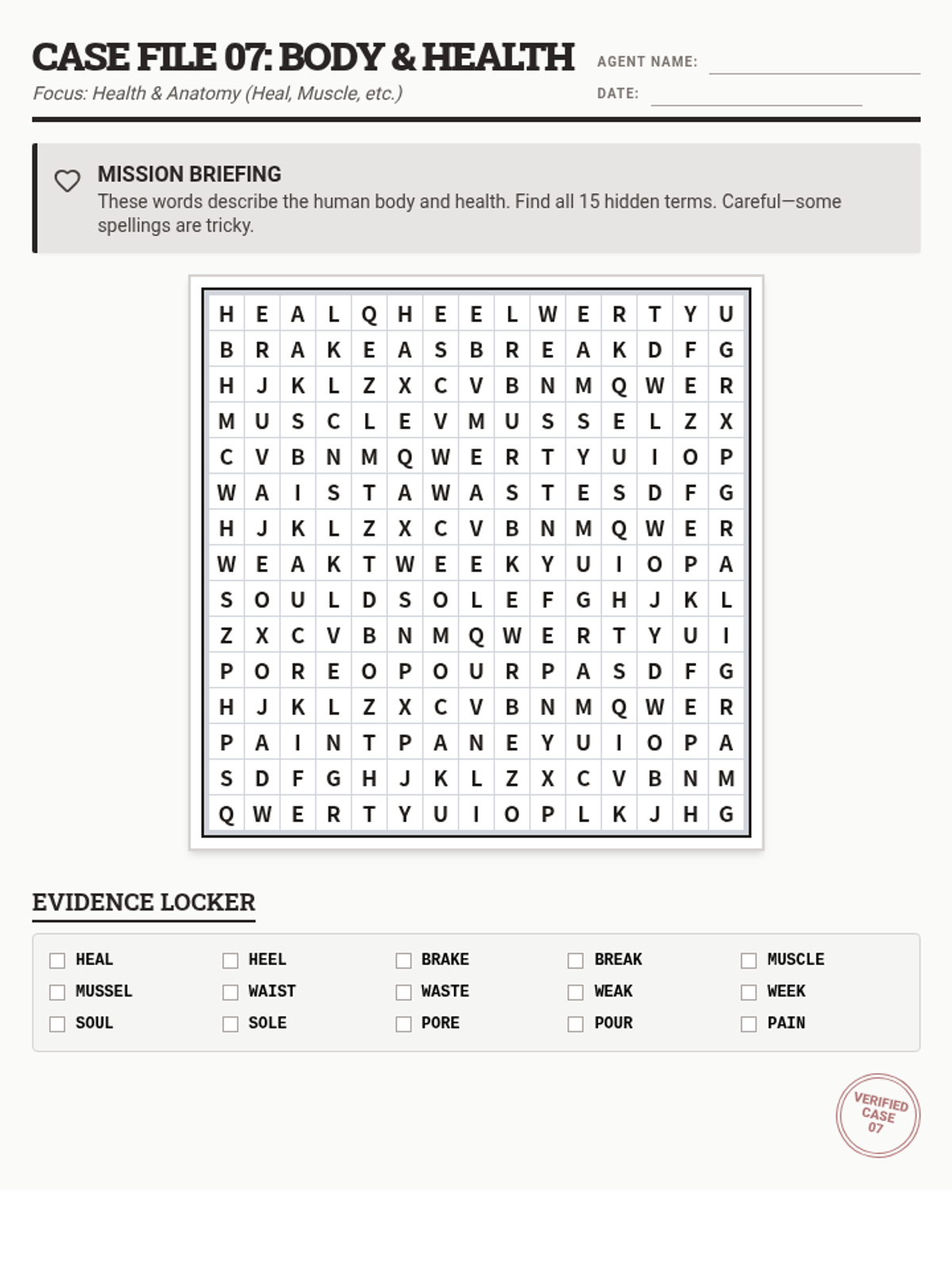
A word search worksheet exploring homophones related to health and anatomy, like heal/heel and muscle/mussel. Professional medical case theme.
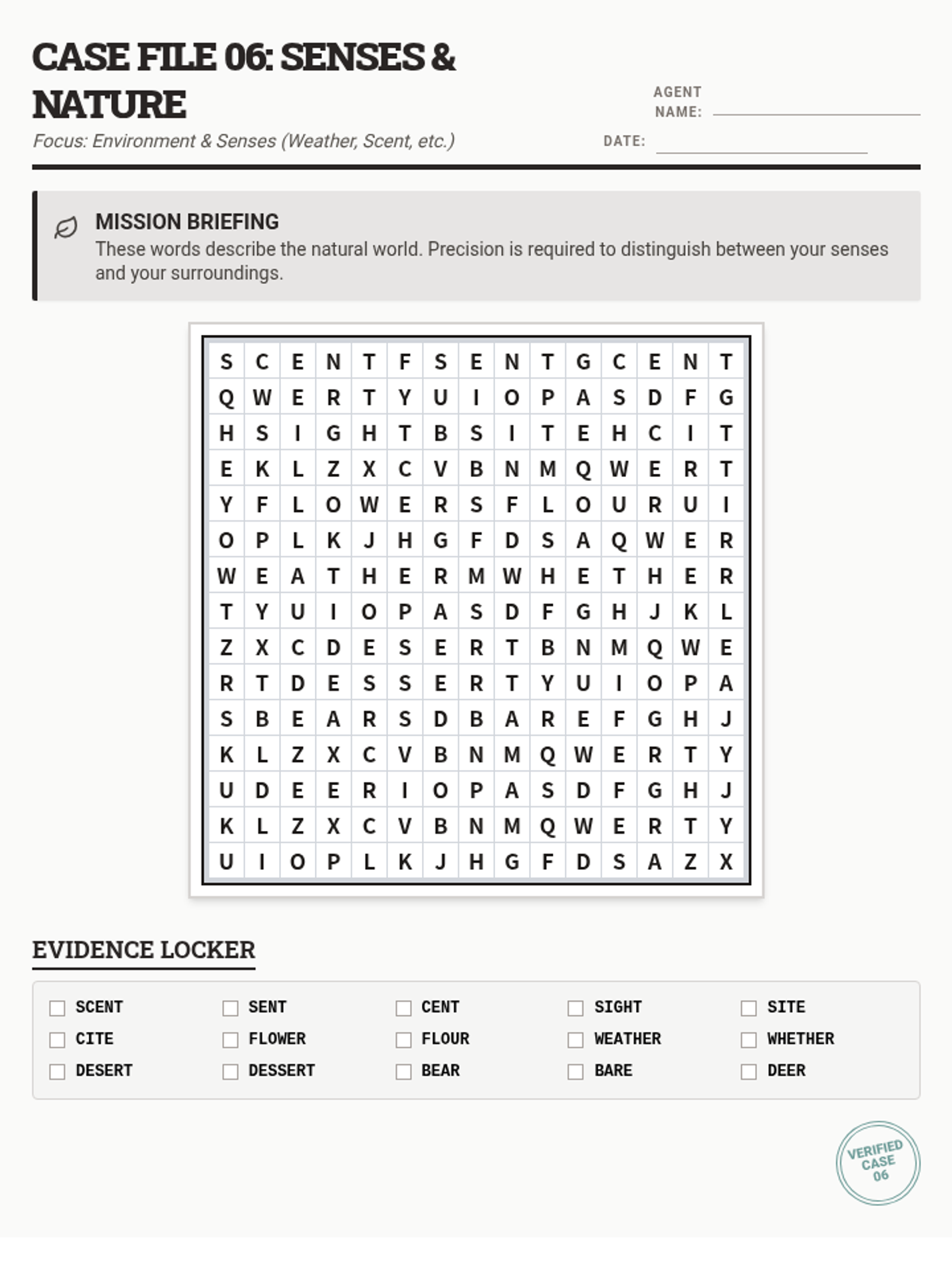
A word search targeting nature and sensory homophones like scent/sent/cent and desert/dessert. Designed with a natural science case theme.
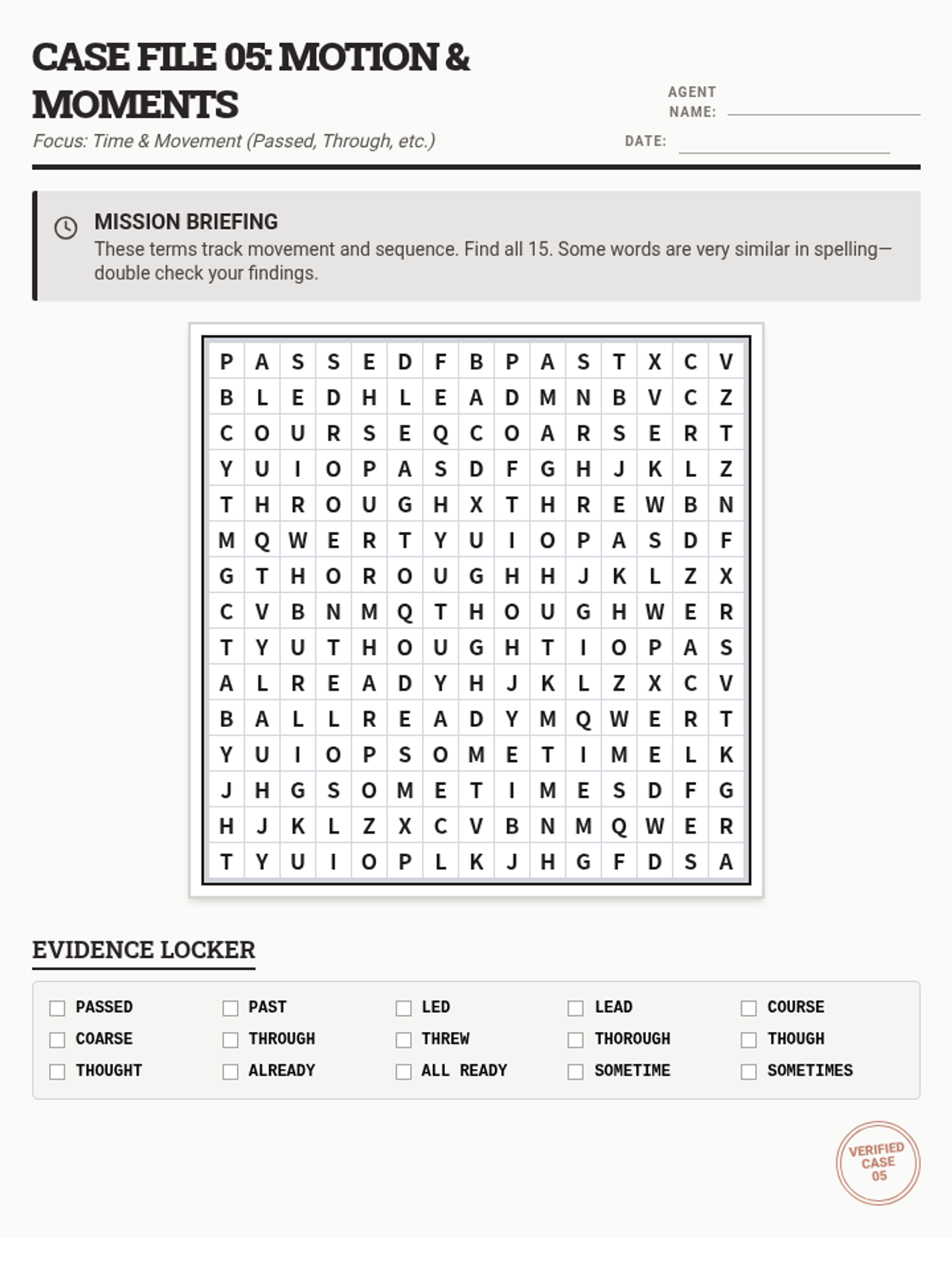
A word search focused on movement and time-related confusions such as passed/past and through/threw/thorough. Features a "case file" investigative design.
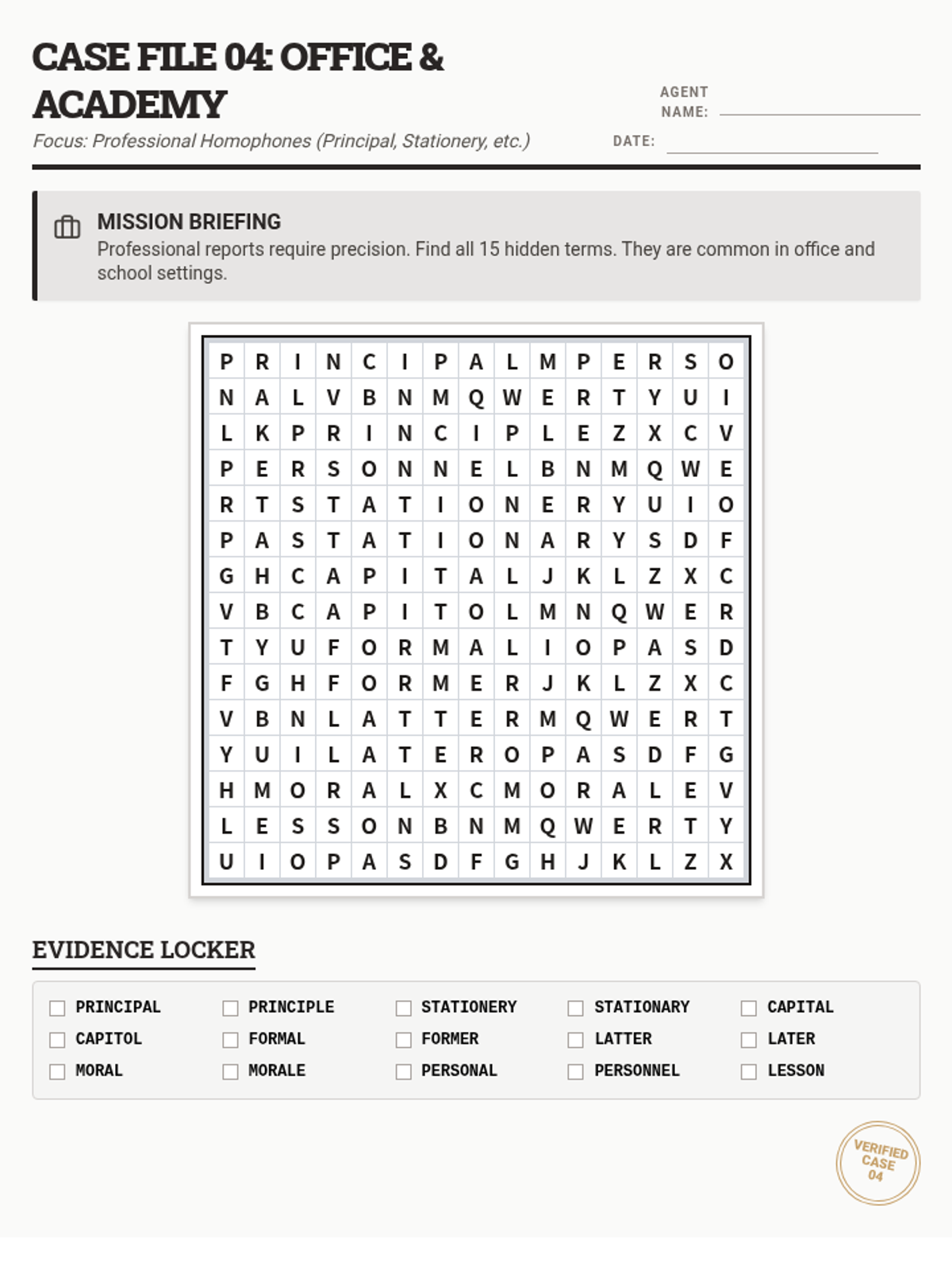
A word search worksheet covering professional and academic homophones like principal/principle and personnel/personal. Features a business case theme.
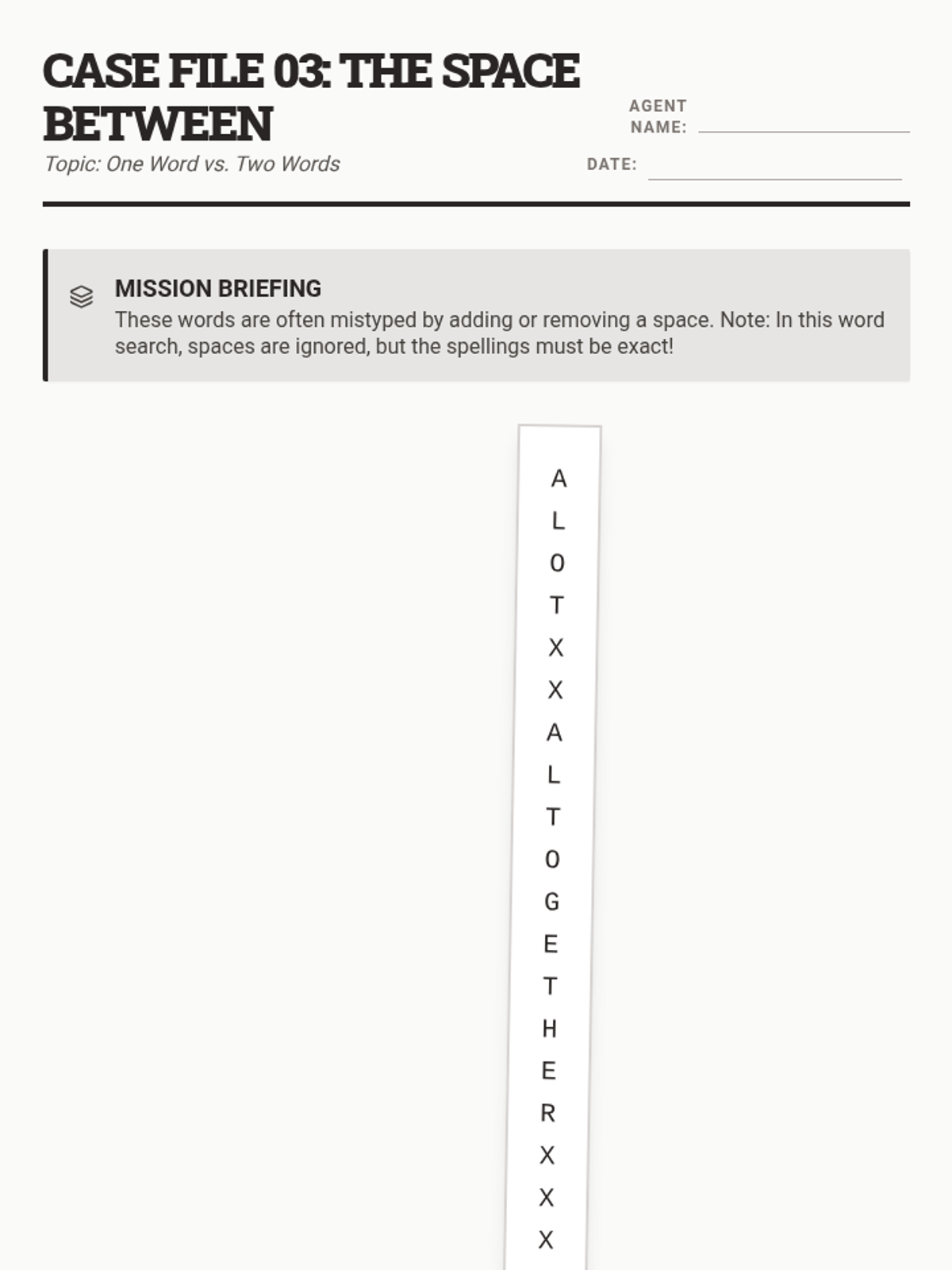
A word search focusing on one-word vs. two-word confusions like everyday/every day and into/in to. Encourages attention to spelling and usage.
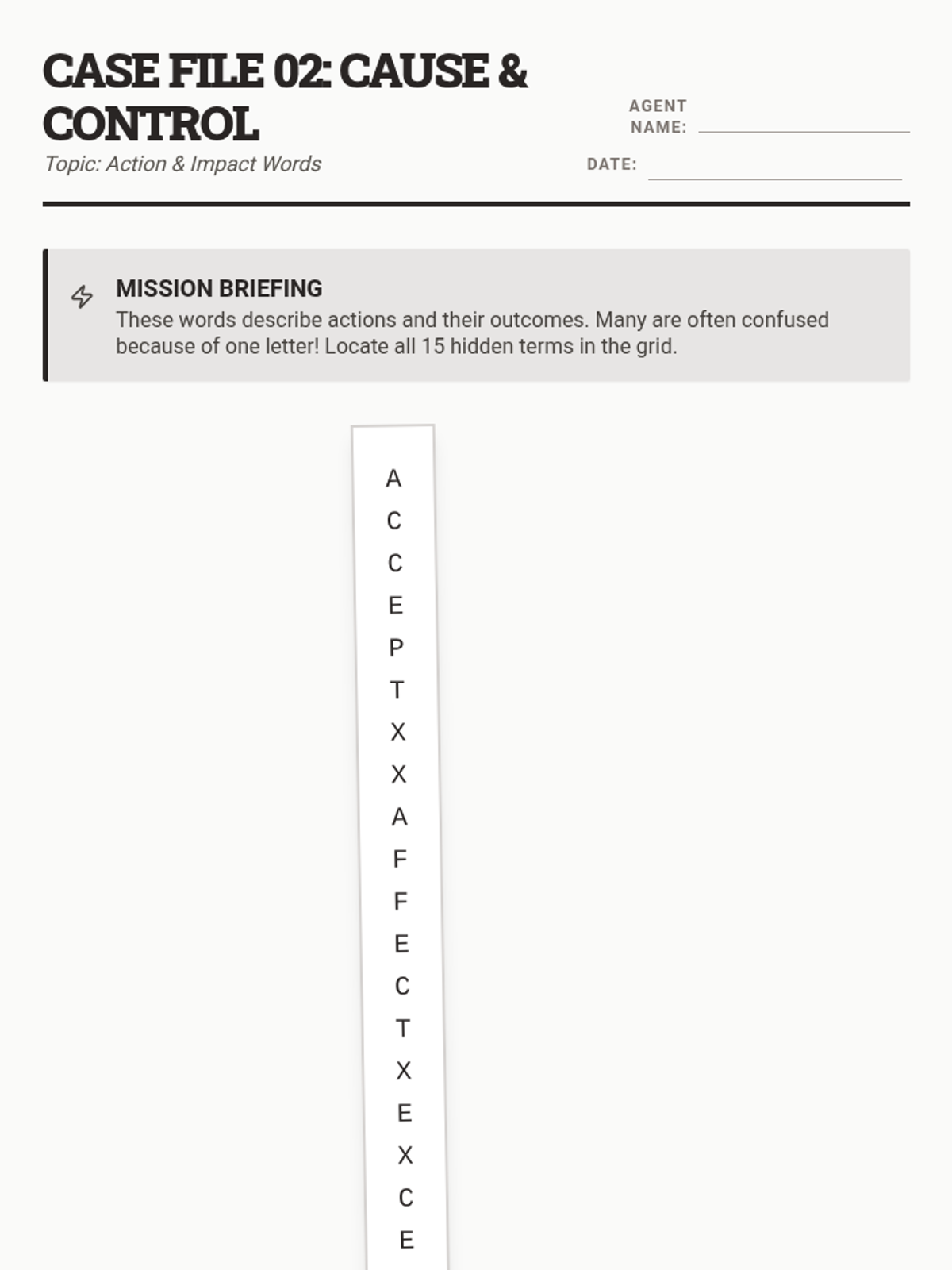
A second word search worksheet targeting verbs and nouns that are frequently confused, such as affect/effect and advice/advise. Uses a detective notebook style.
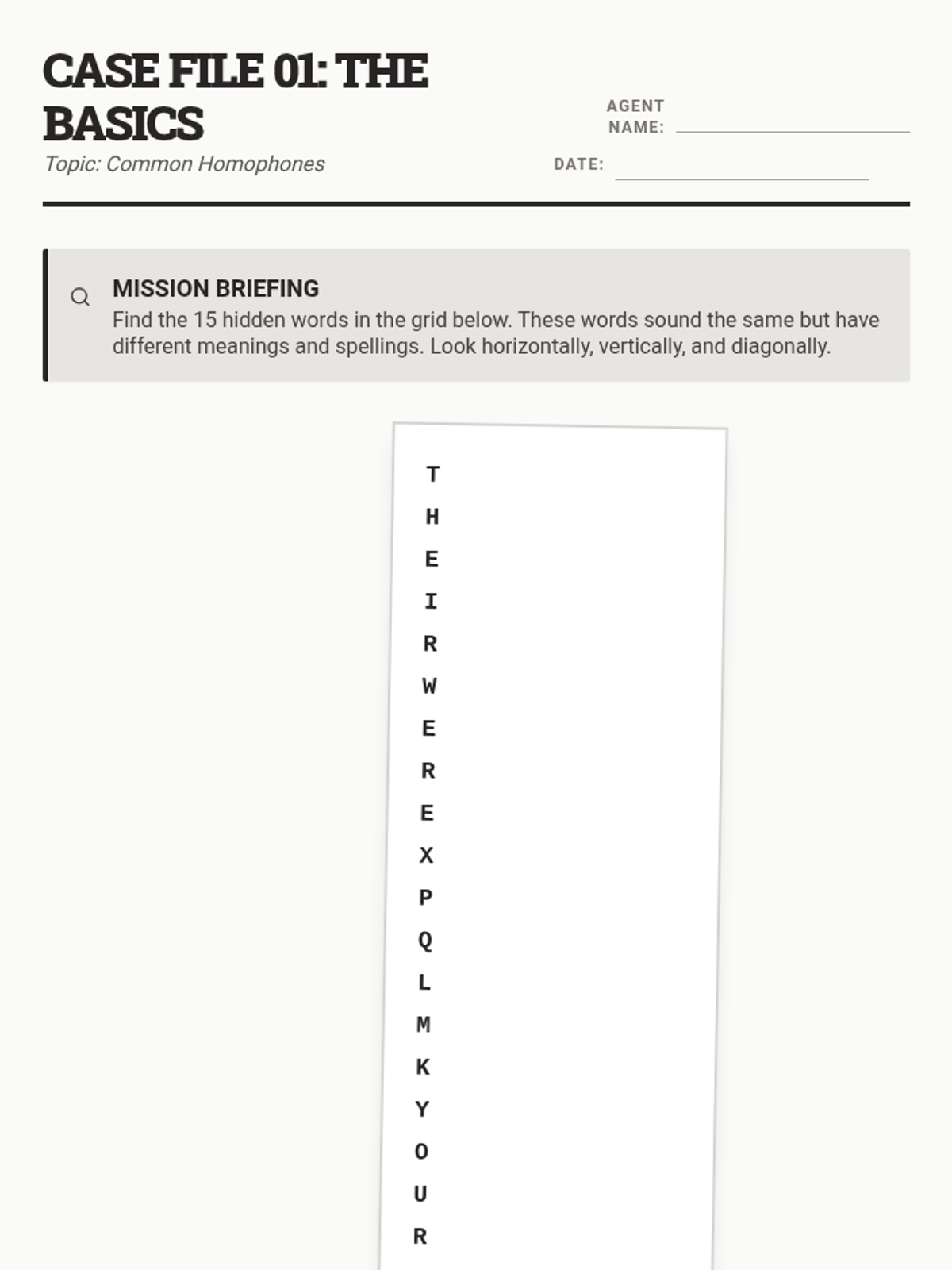
A word search worksheet focusing on basic homophones like to/too/two and their/there/they're. Features a detective case file theme with a 15x15 grid and word bank.
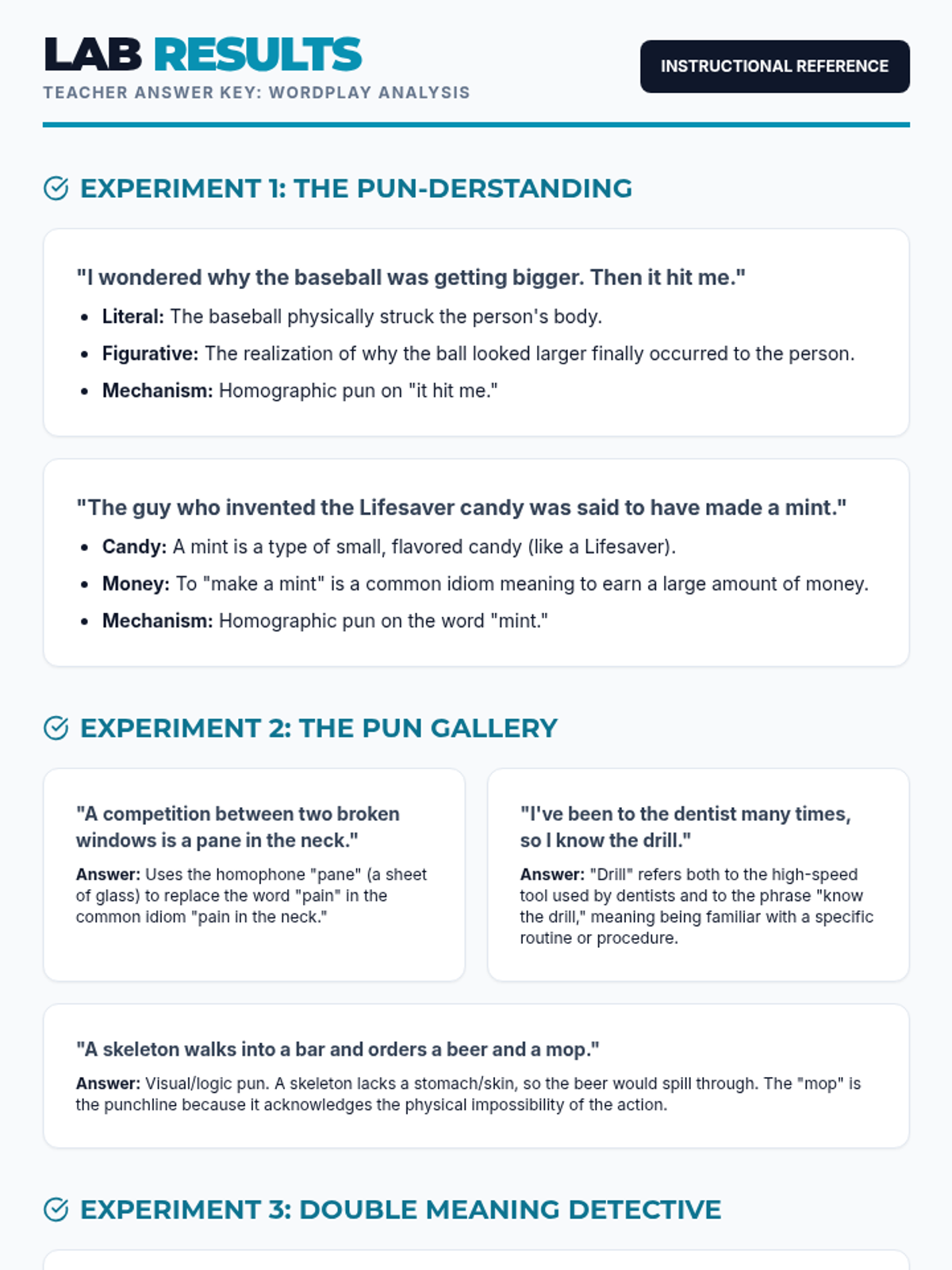
An updated answer key reflecting the additions to the wordplay worksheet, including explanations for the 'Pun Gallery' section and refined linguistic definitions.
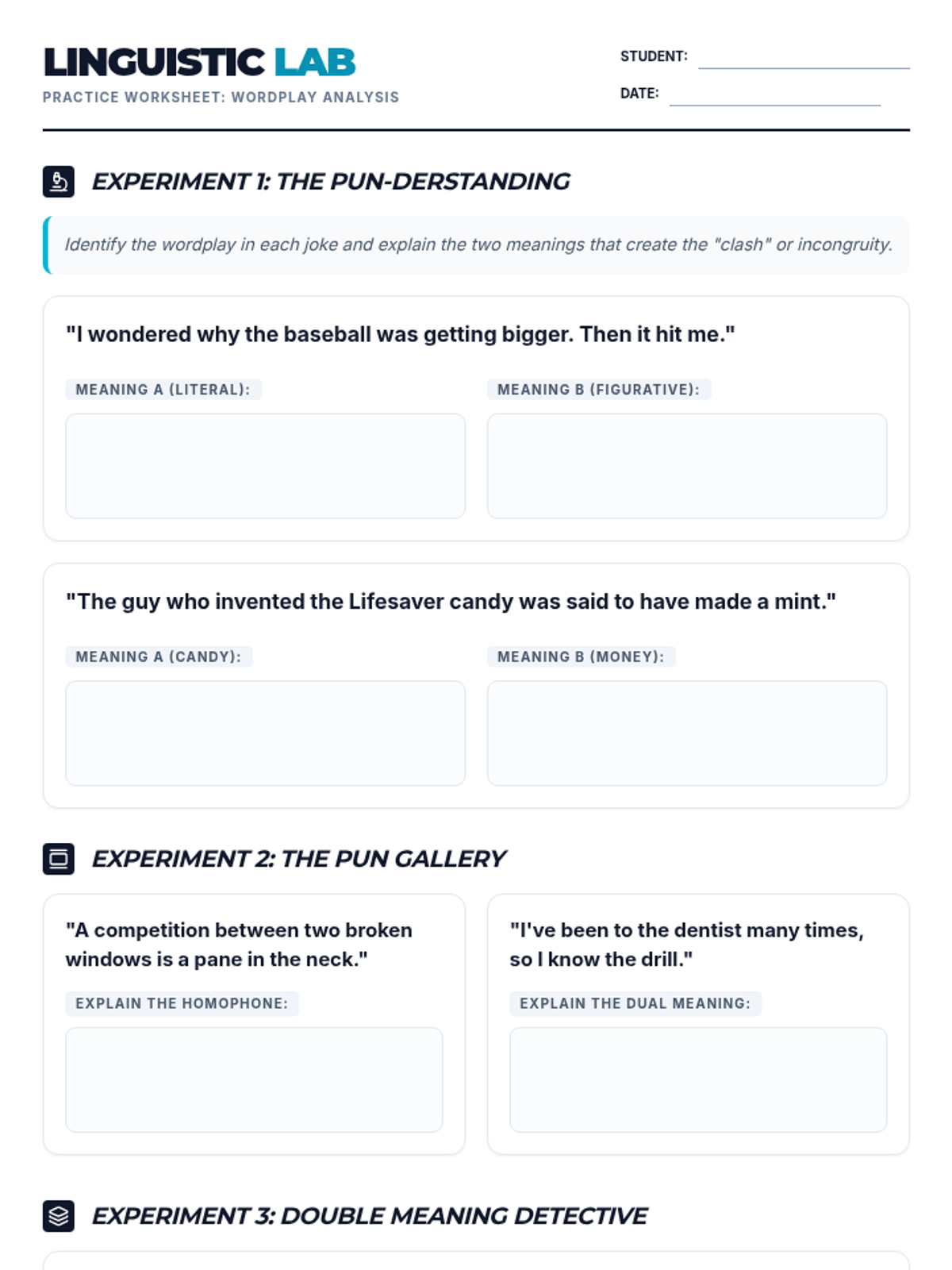
A polished 2-page practice worksheet for analyzing puns, idioms, and double meanings. Improved layout efficiency, clearer work areas for multi-meaning questions, and higher-contrast labels based on reviewer feedback.
A set of high-school instructional slides exploring the mechanics of puns, double-meanings, and idioms. It uses the 'Incongruity Theory' of humor to help students deconstruct and analyze wordplay.
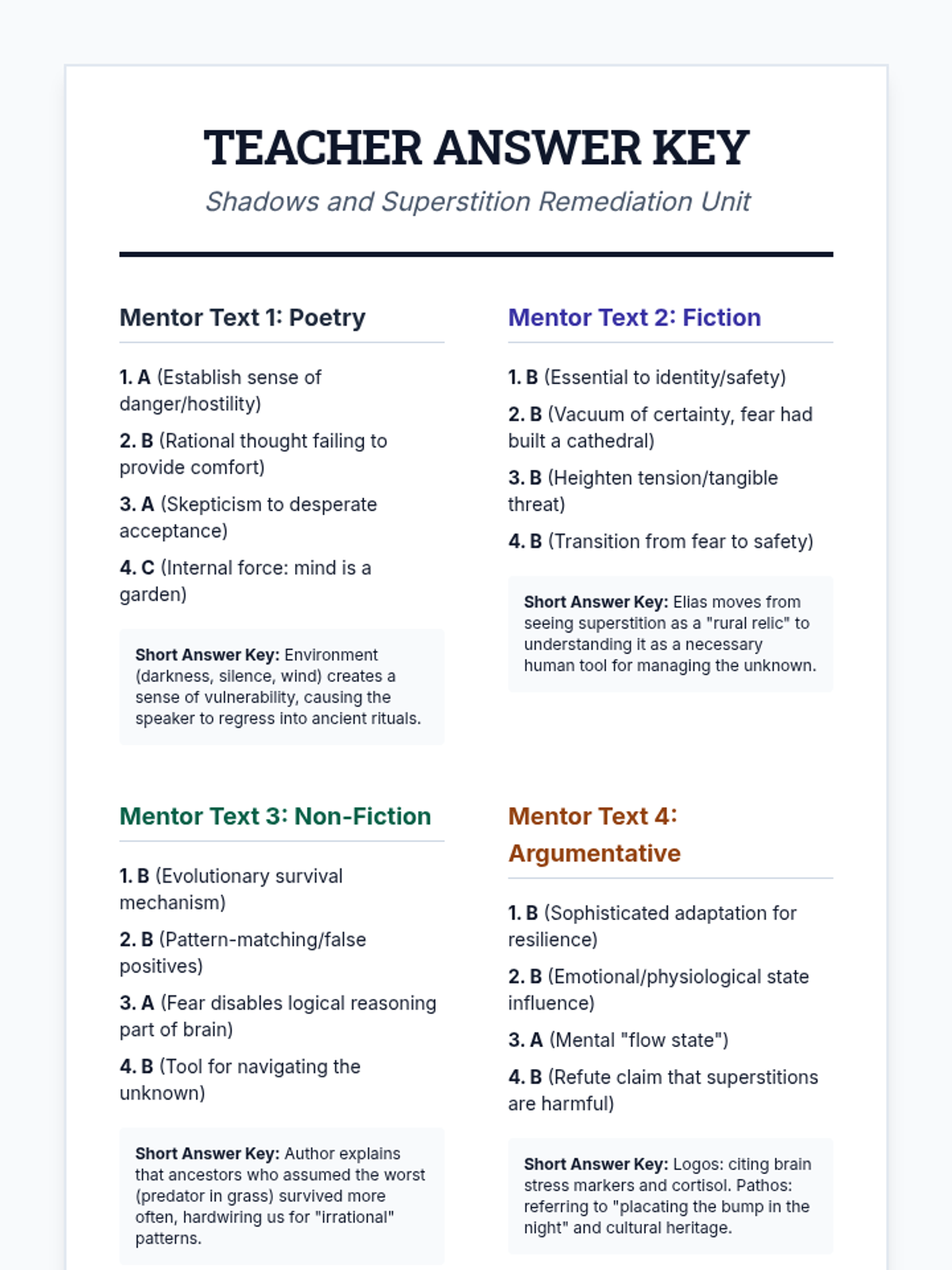
A comprehensive answer key for all mentor texts, revision/editing exercises, and the cumulative test in the Shadows and Superstition remediation packet. Revised to fit on a single page. Adjusted spacing and naming for consistency.
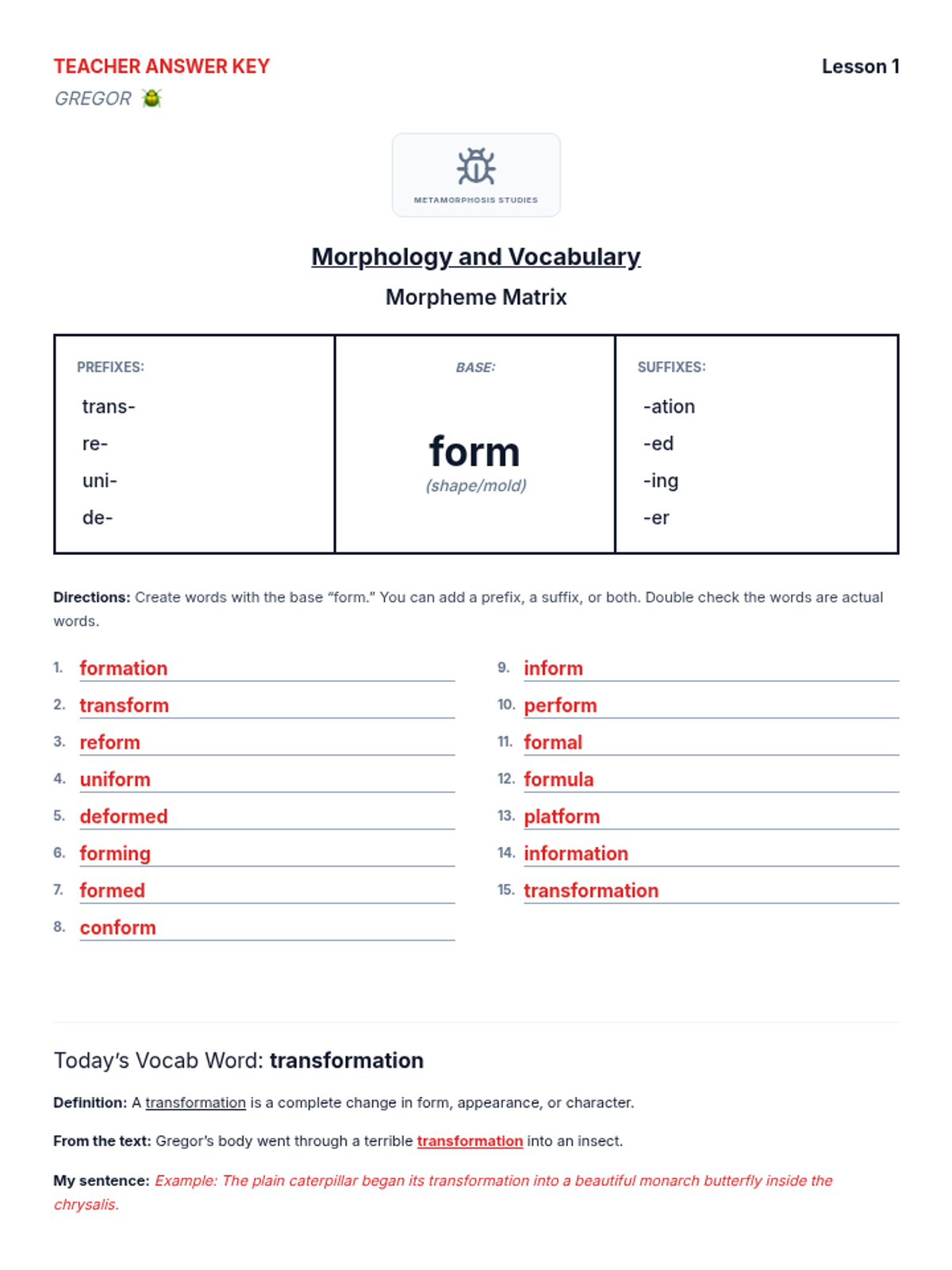
A comprehensive teacher answer key for the Metamorphosis Form Skills Worksheet, featuring suggested words for the morpheme matrix, syllable divisions for decoding, and the correct answer for the comprehension question.
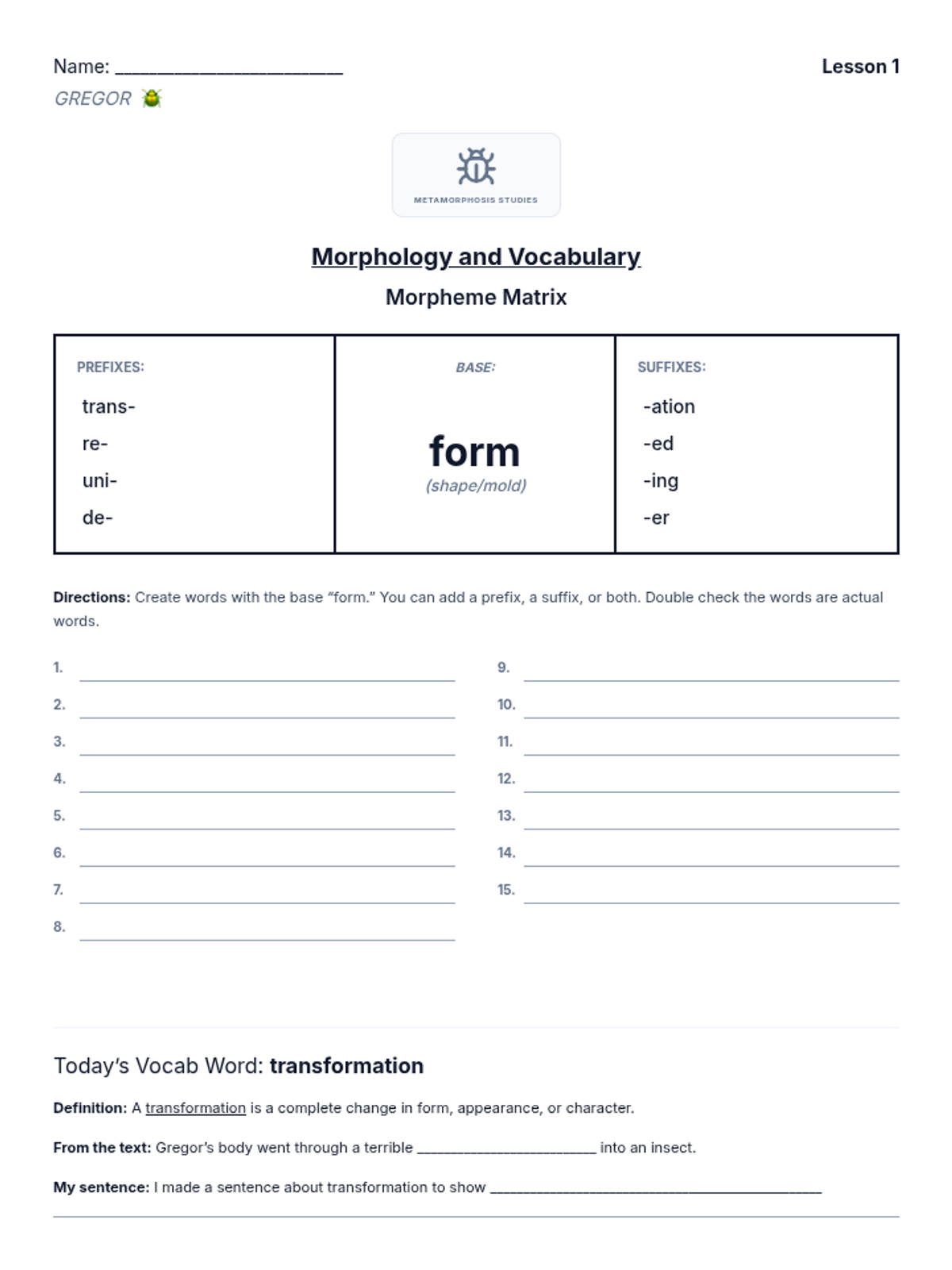
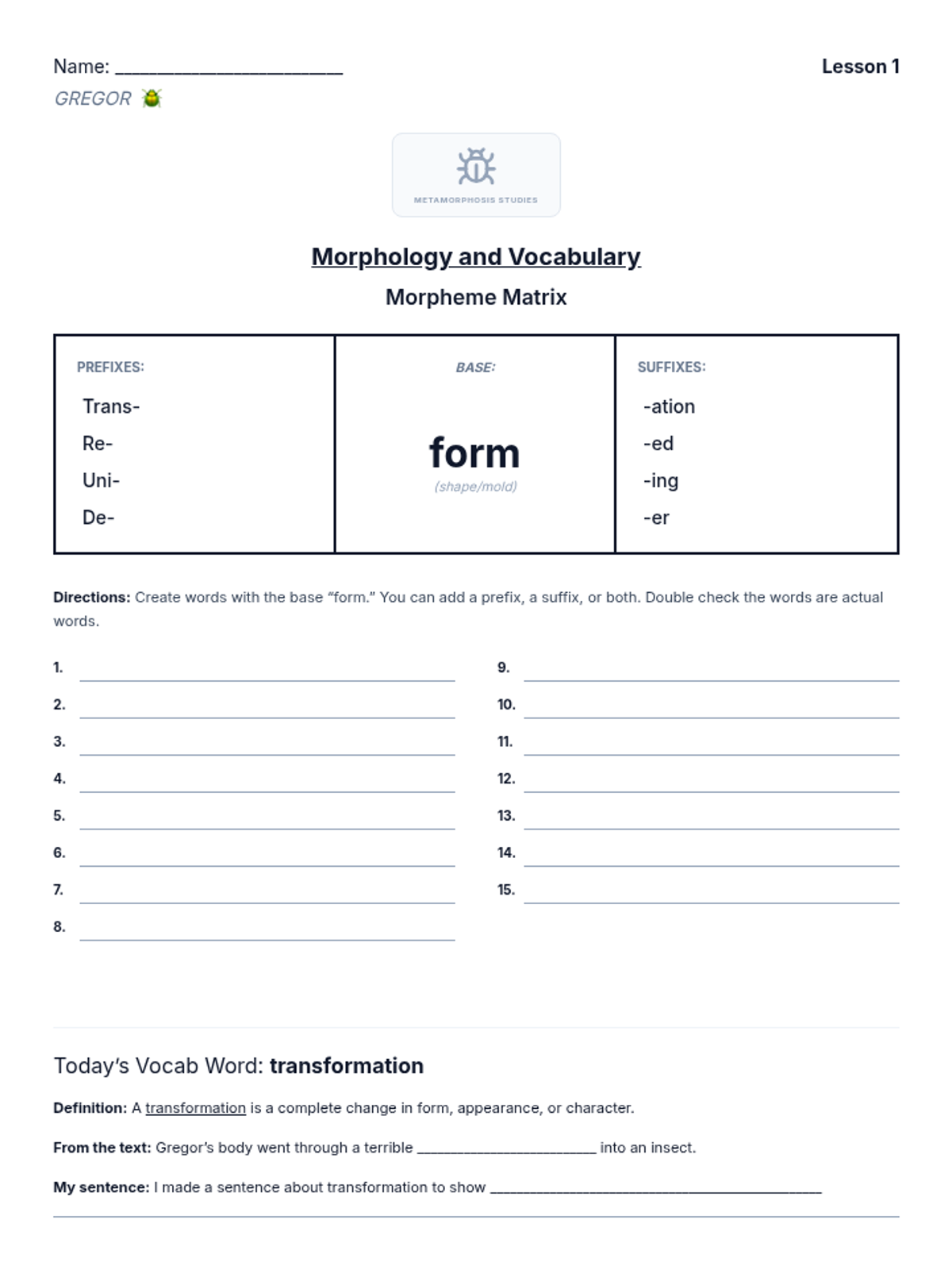
A comprehensive morphology and reading worksheet updated to use the root word 'form'. Features a morpheme matrix, decoding exercises for words like 'transformation', and a fluency-tracked reading passage from Kafka's Metamorphosis.
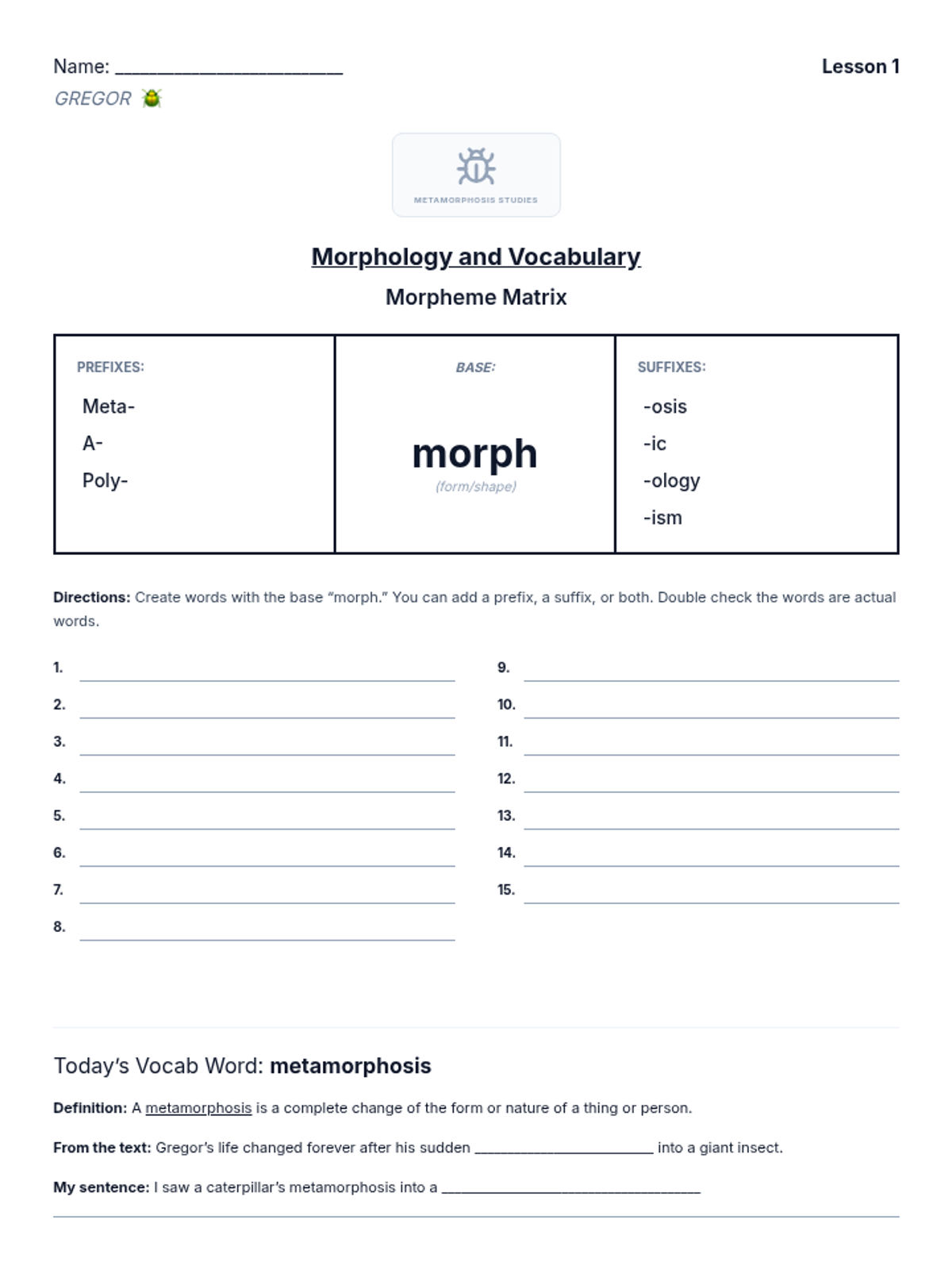
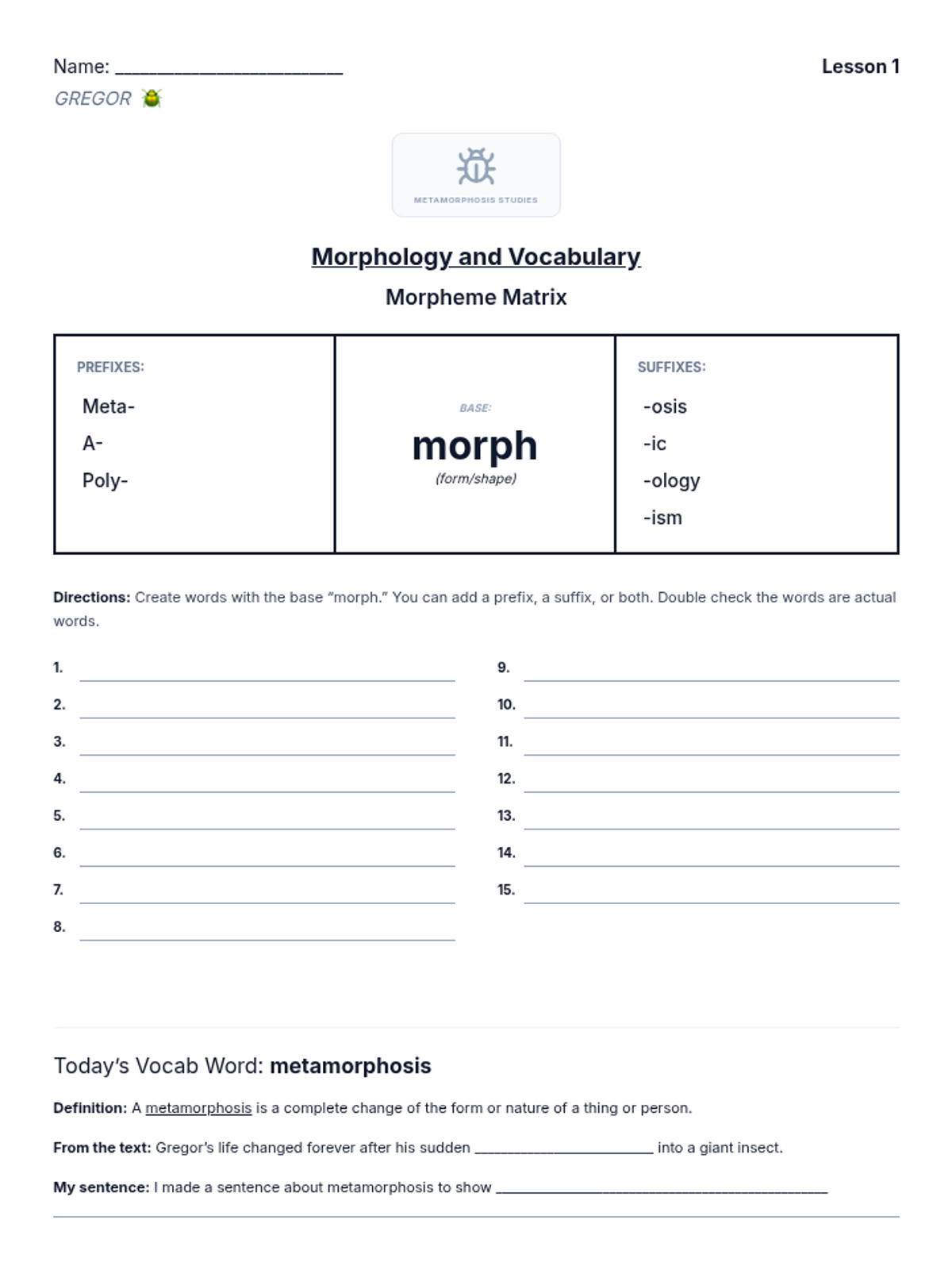
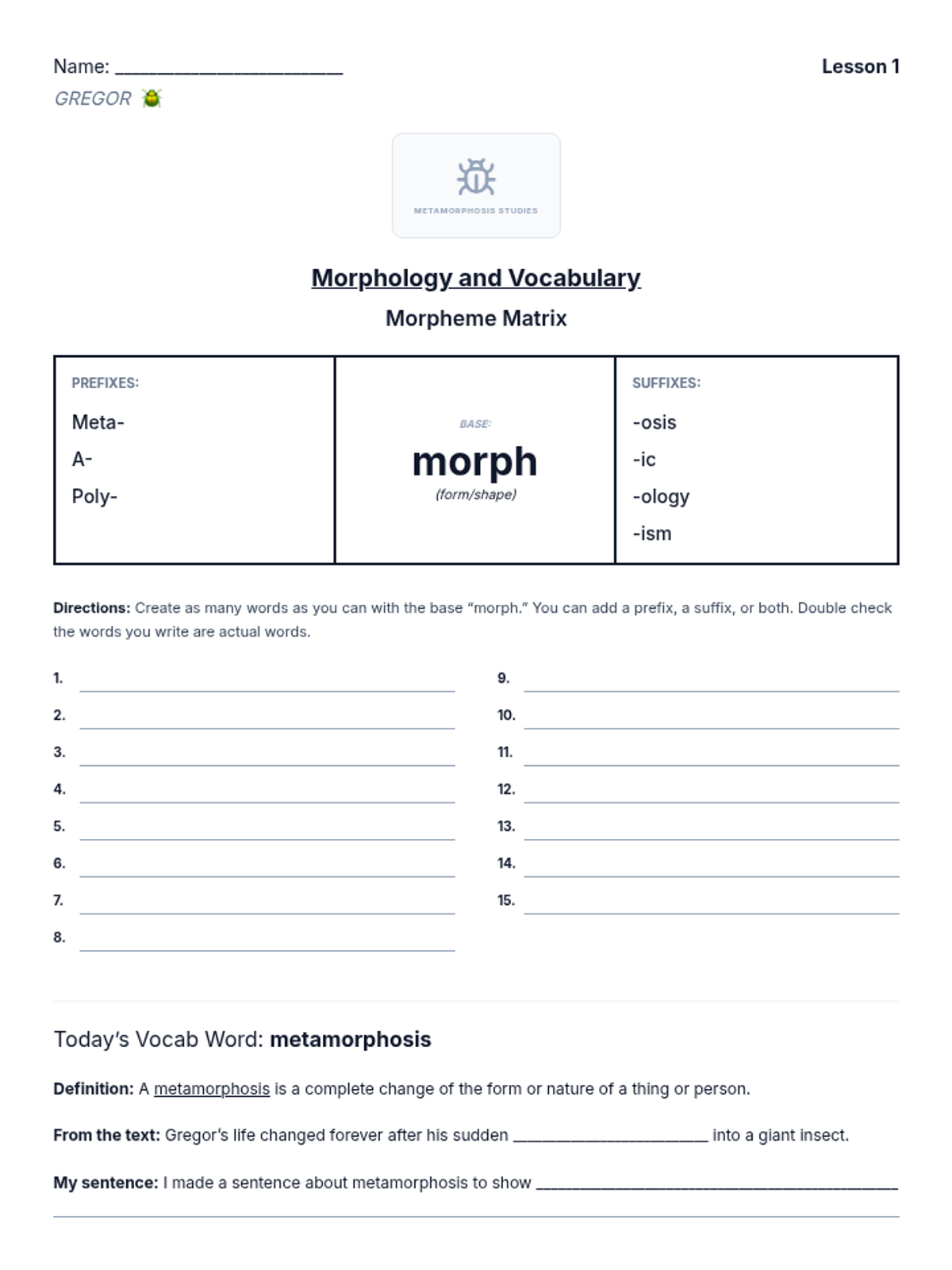
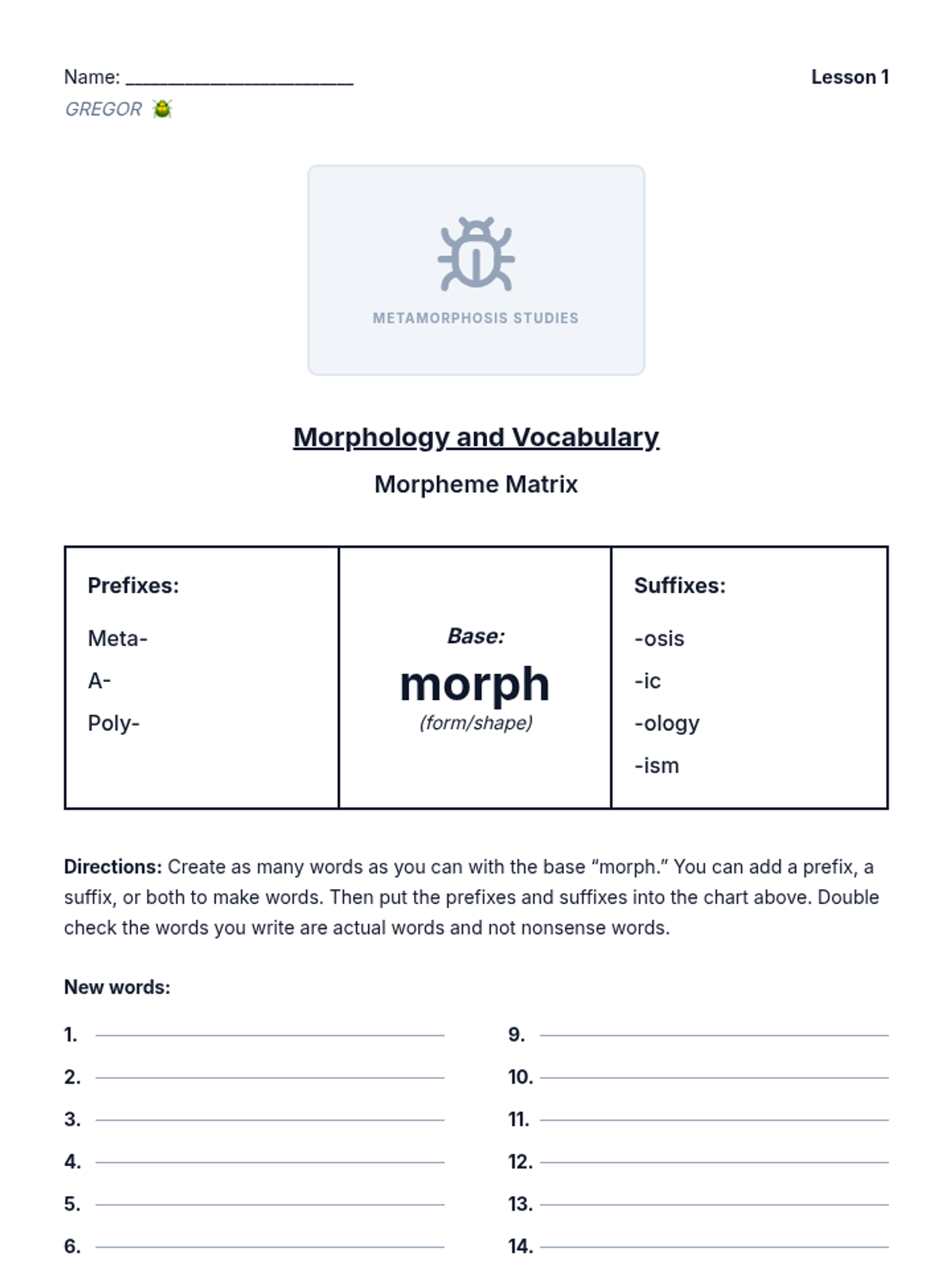
A comprehensive morphology and reading worksheet following a specific structural template, featuring a morpheme matrix for the base 'morph', decoding steps, and a fluency-tracked reading passage of Kafka's Metamorphosis.
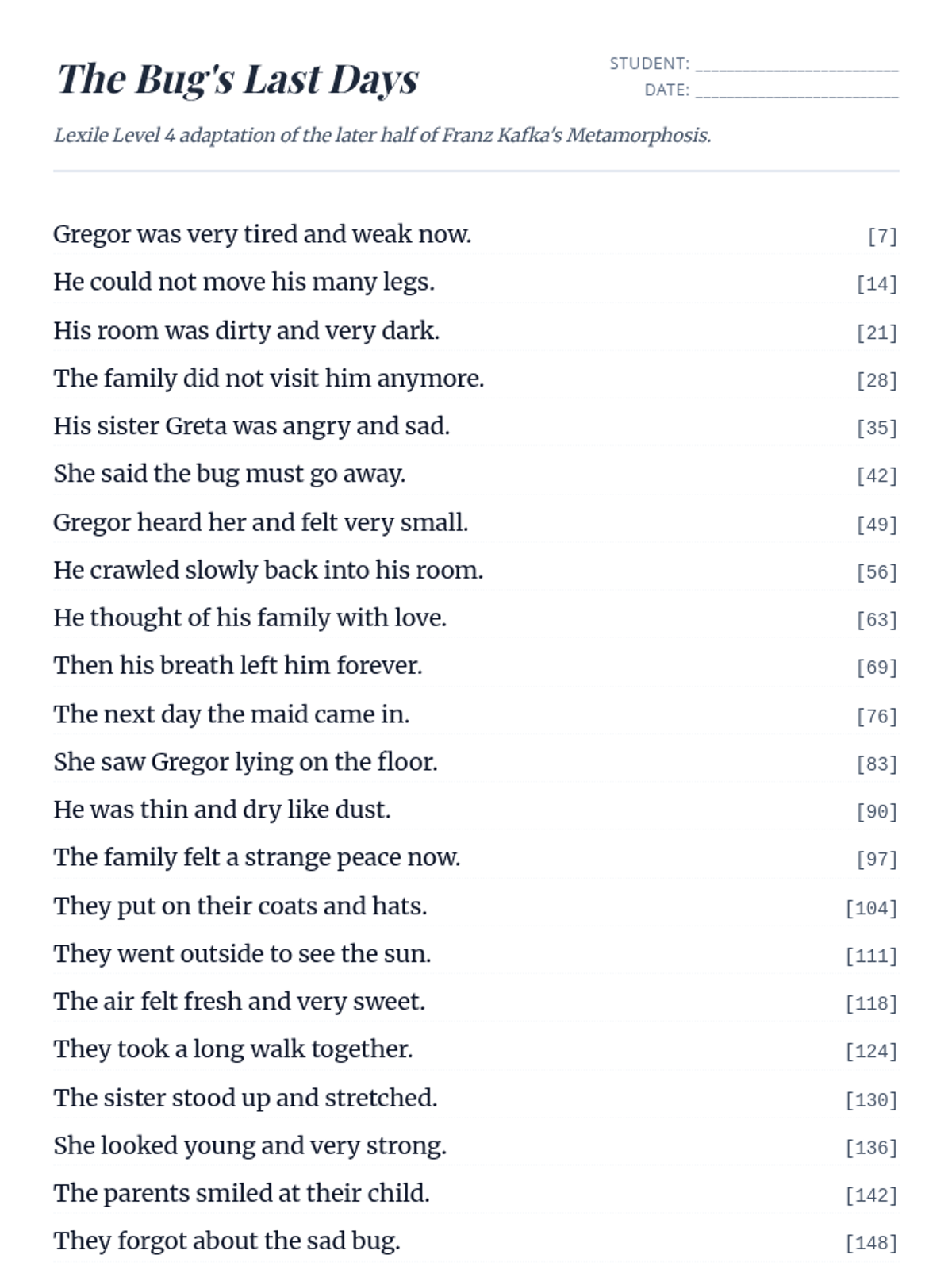
A clean reading document featuring a simplified 200-word adaptation of the latter half of Kafka's Metamorphosis, including running word counts in the right margin for fluency tracking.
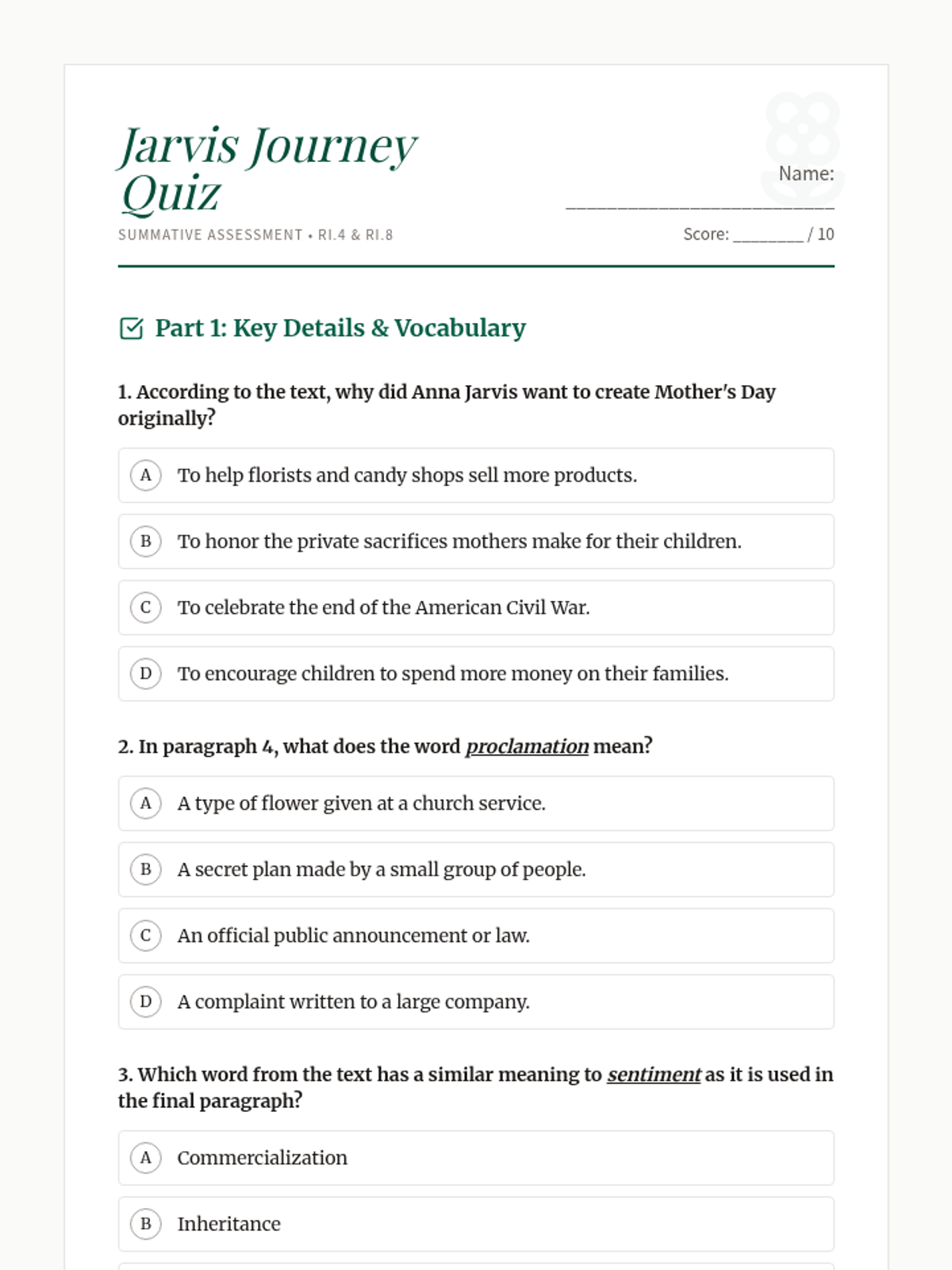
A summative assessment for the Mother's Day lesson, featuring multiple-choice and short-answer questions focused on RI.4 (vocabulary) and RI.8 (reasons and evidence). Updated for better layout and page breaks.
A visually engaging slide deck for the Mother's Day lesson, covering historical context, key vocabulary definitions, and guided practice for analyzing claims and evidence (RI.4/RI.8).
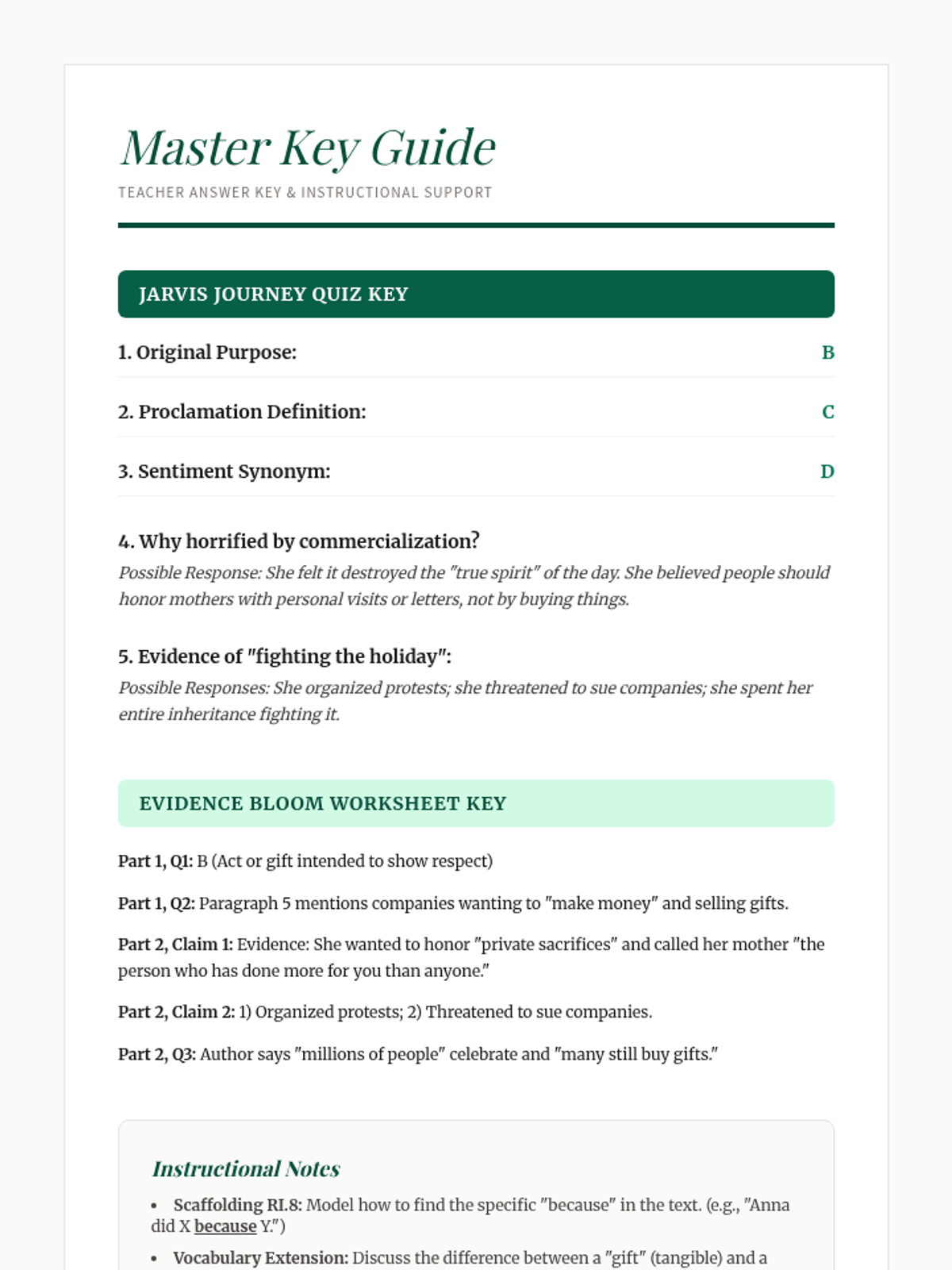
An answer key and teacher guide for the Mother's Day reading pack, providing suggested responses and instructional strategies for RI.4 and RI.8. Updated to include quiz answers and improved layout.
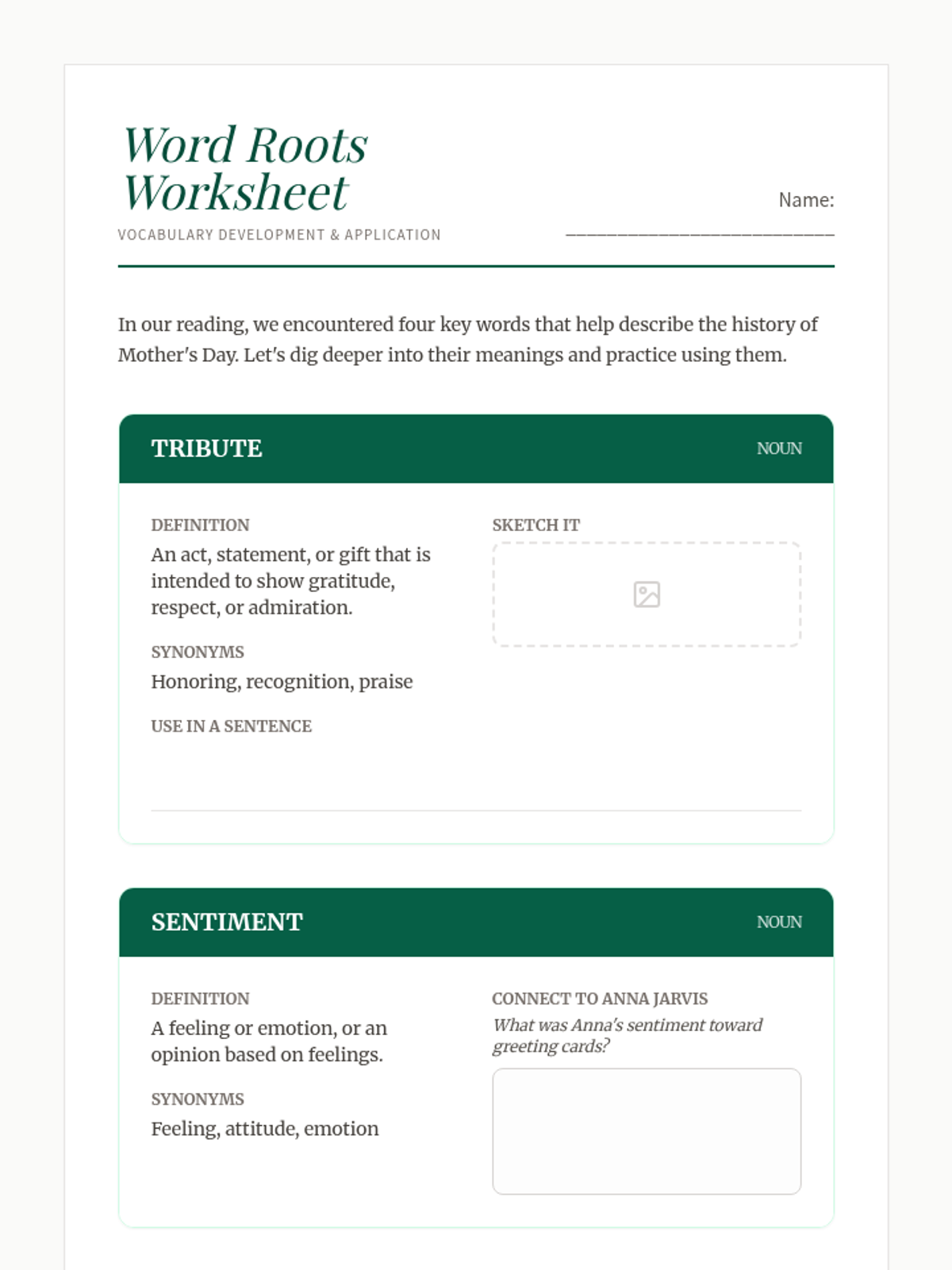
A vocabulary-focused worksheet that breaks down key terms from the passage. Updated with consistent definition blocks, fixed page breaks, and improved writing space.
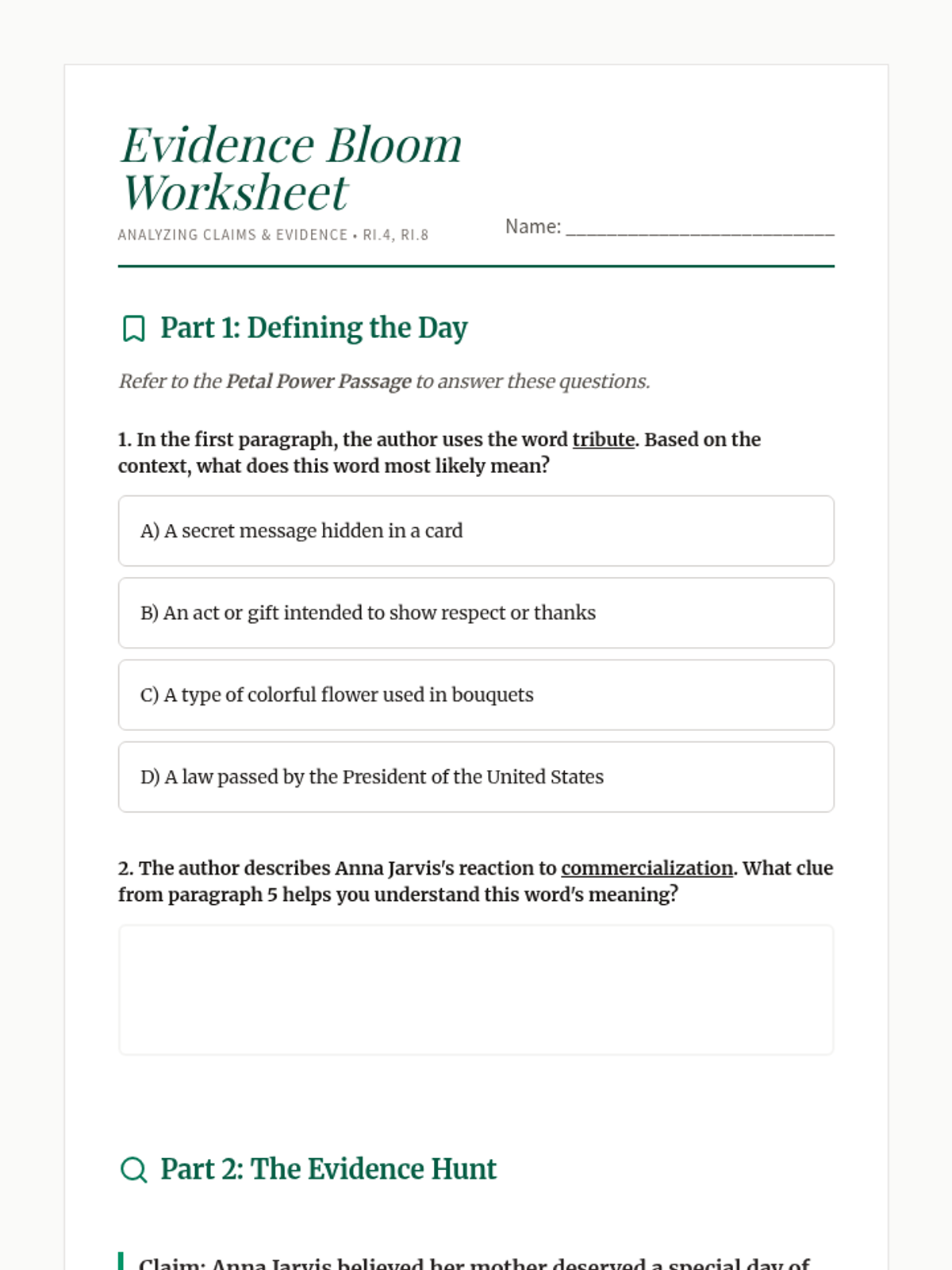
A comprehension worksheet focusing on CCSS RI.4 and RI.8. Updated with improved page break handling, better handwriting spacing, and corrected header alignment.
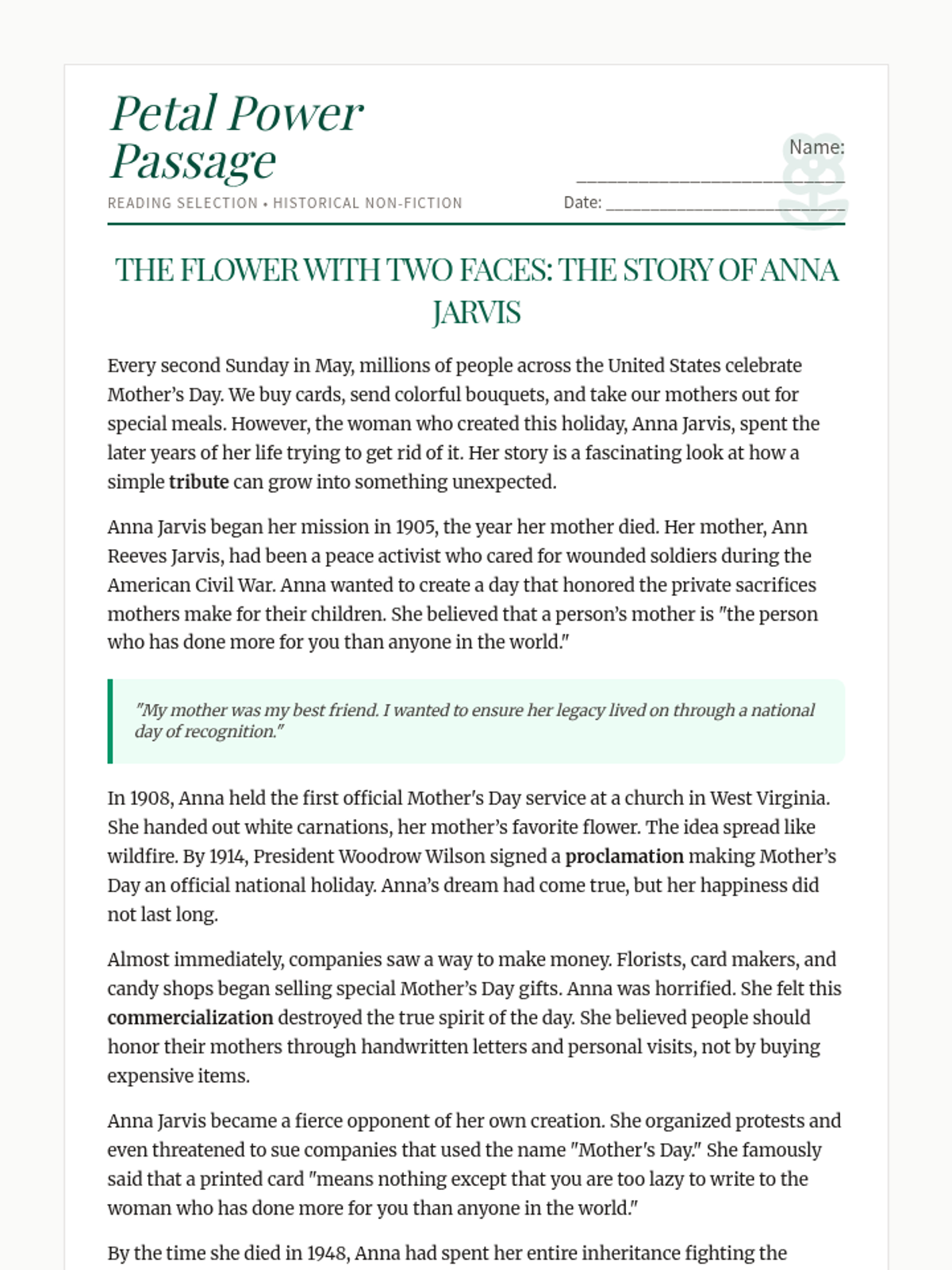
A reading passage about Anna Jarvis and the history of Mother's Day, featuring domain-specific vocabulary and a narrative arc suitable for 4th-grade analysis. Layout tightened for single-page printing.
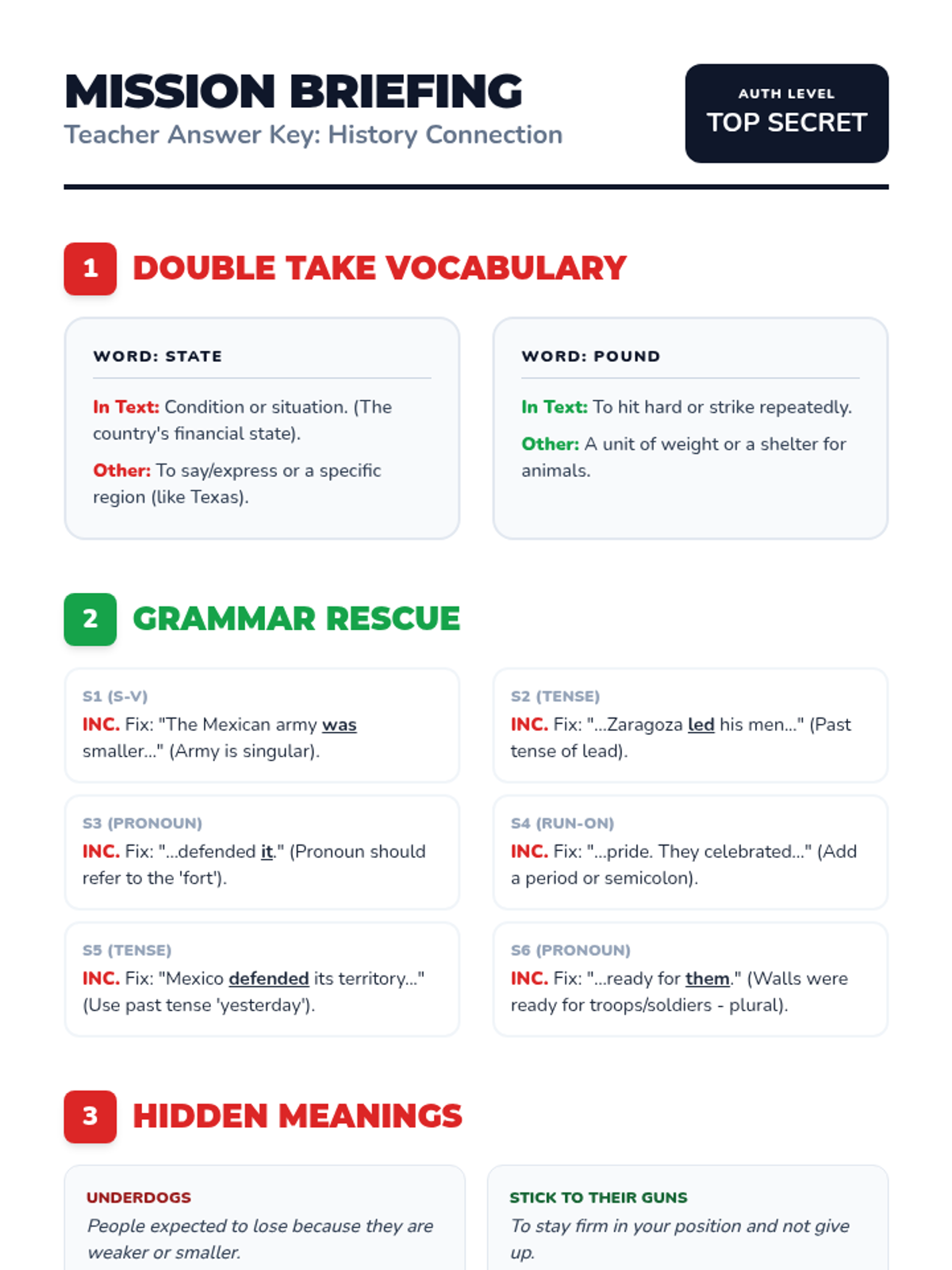
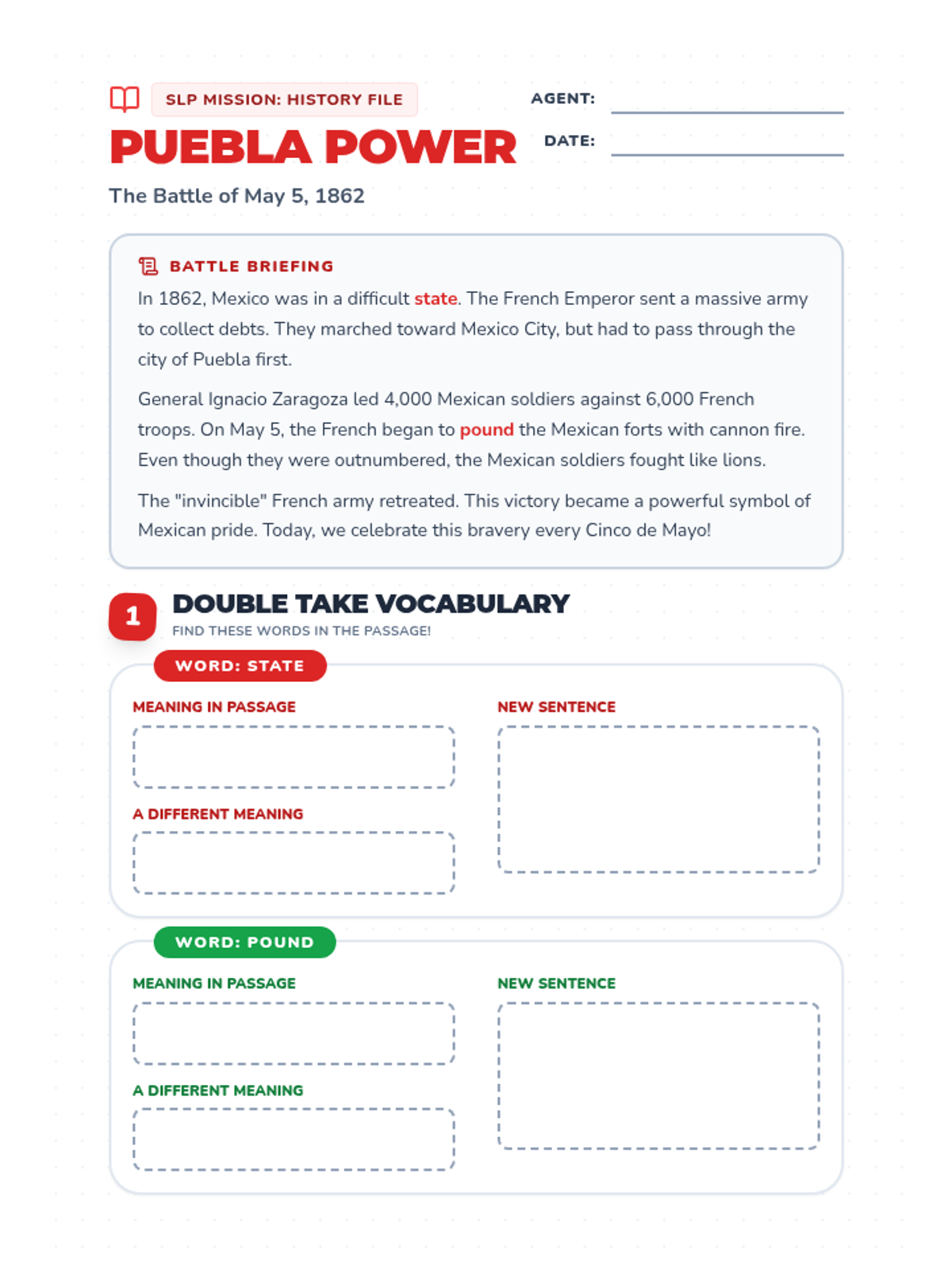
Revised teacher answer key for the Puebla Power Pack, updated to align with the new historical passage content. Provides clear definitions, grammatical corrections, and figurative language explanations.
A 4-page student worksheet packet for Cinco de Mayo, featuring a historical passage about the Battle of Puebla. Both vocabulary words (state and pound) are now located on the first page alongside the text. Layout and font sizes have been increased to better fill the space and provide ample writing room.
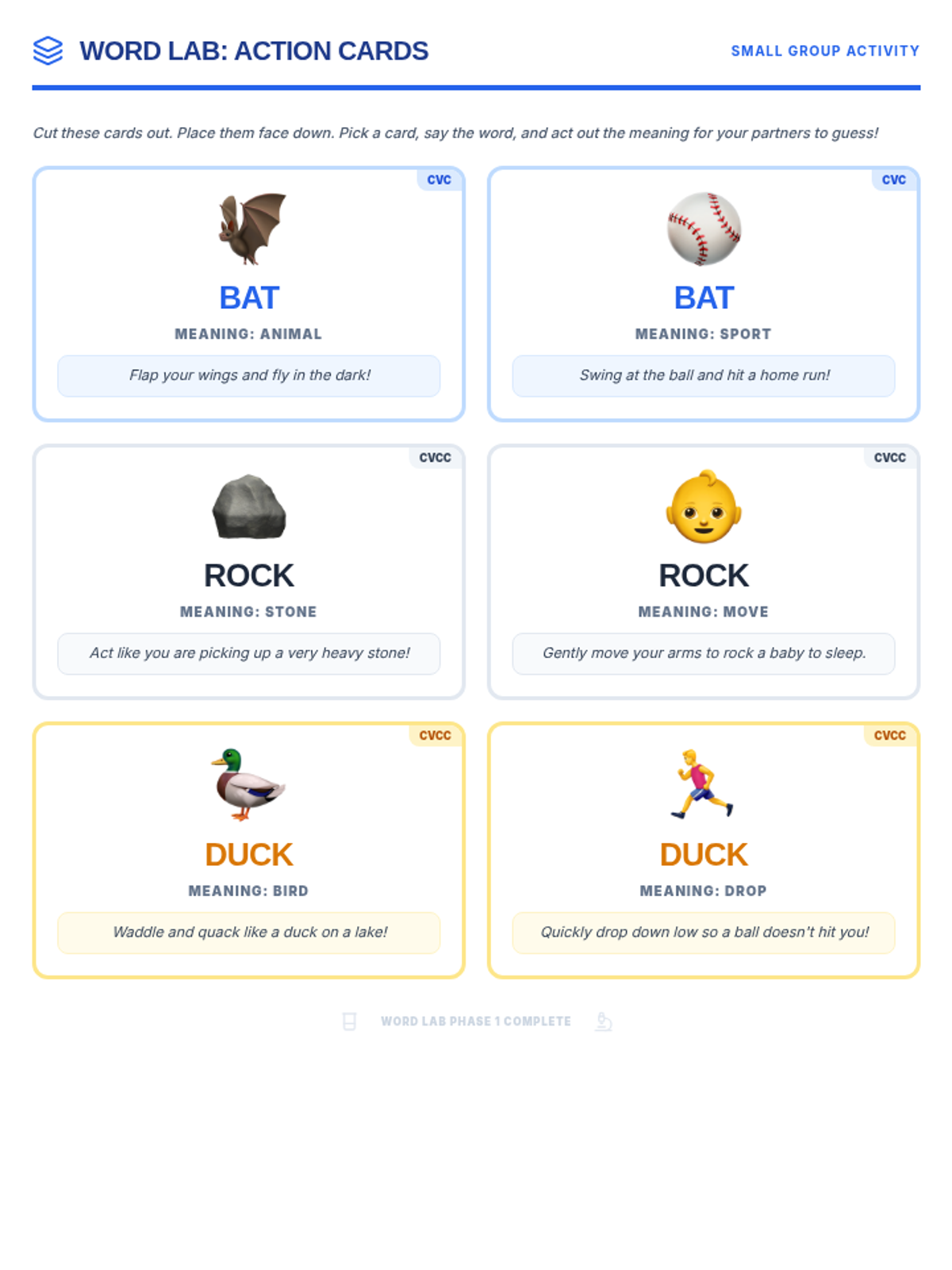
A set of interactive small-group cards for a 'charades' style game. Students act out different meanings of CVC/CVCC words (bat, rock, duck) for their partners to guess. Cards replaced 'bark' (r-controlled) with 'rock' (CVCC) for better phonics alignment.
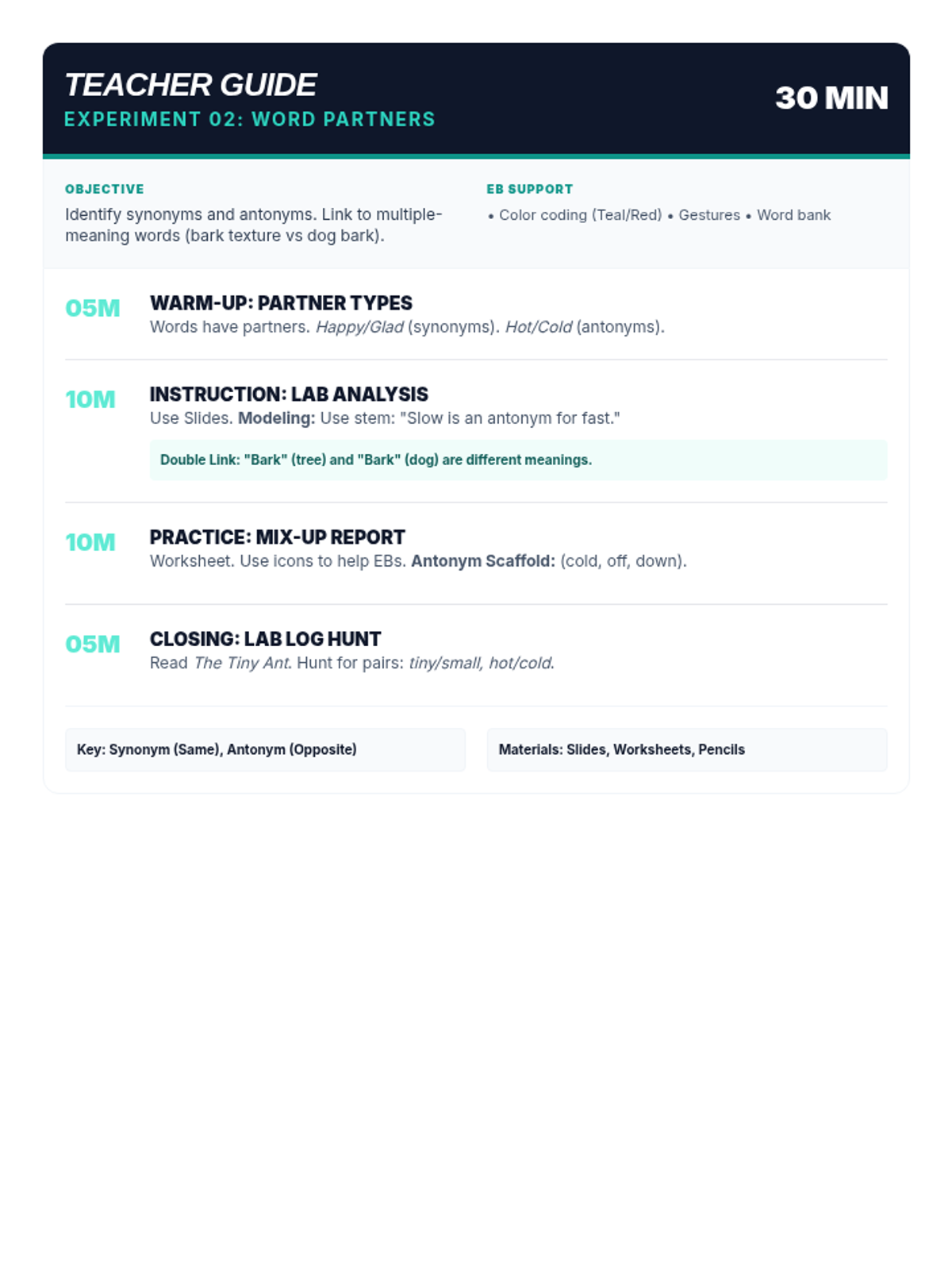
A facilitation guide for the 30-minute 'Word Partners' lesson focusing on synonyms and antonyms. Includes specific EB supports, modeling prompts, and a pacing breakdown.
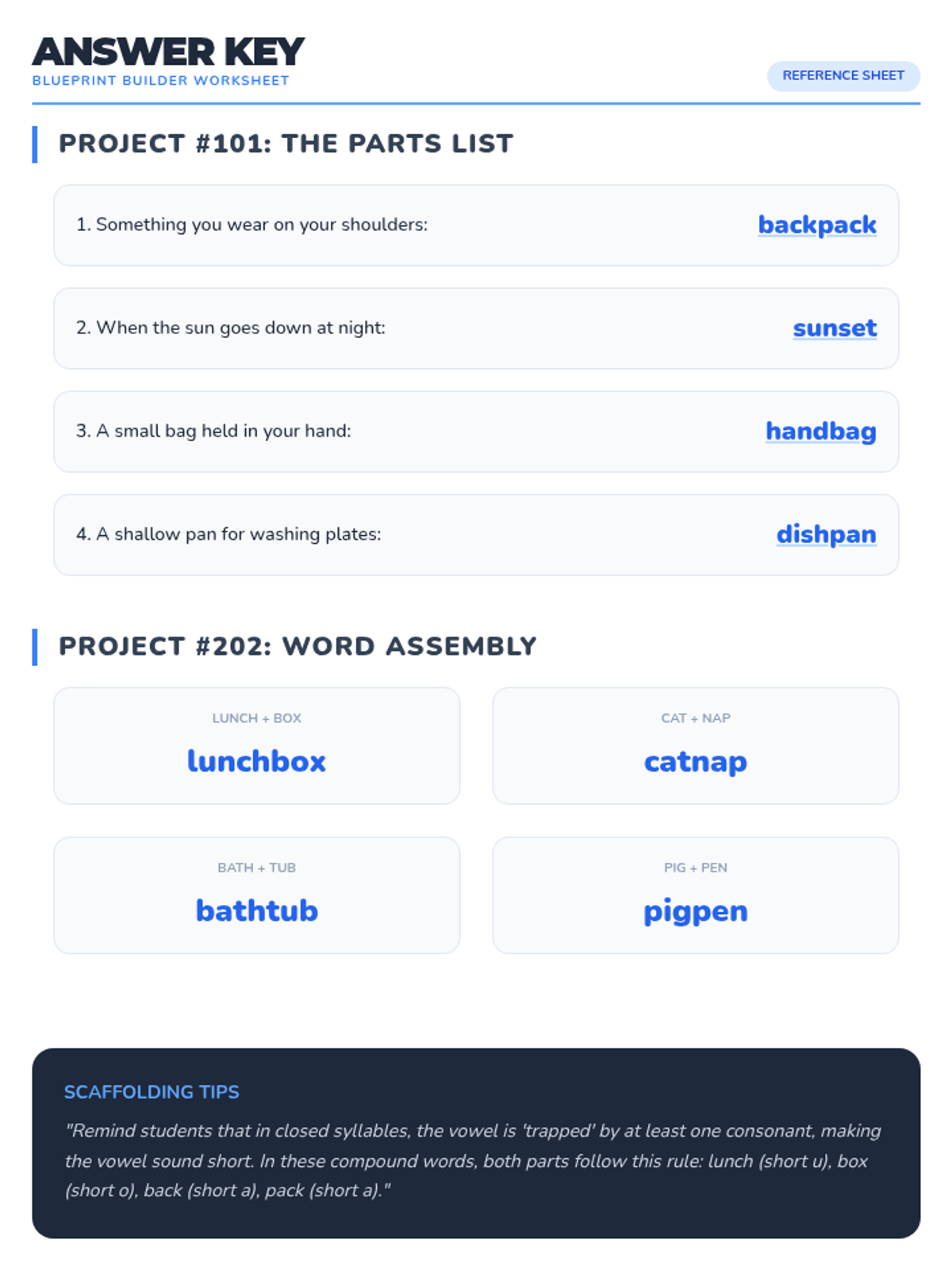
Teacher answer key for the Blueprint Builder Worksheet, providing assembled words and phonics-based teaching tips.
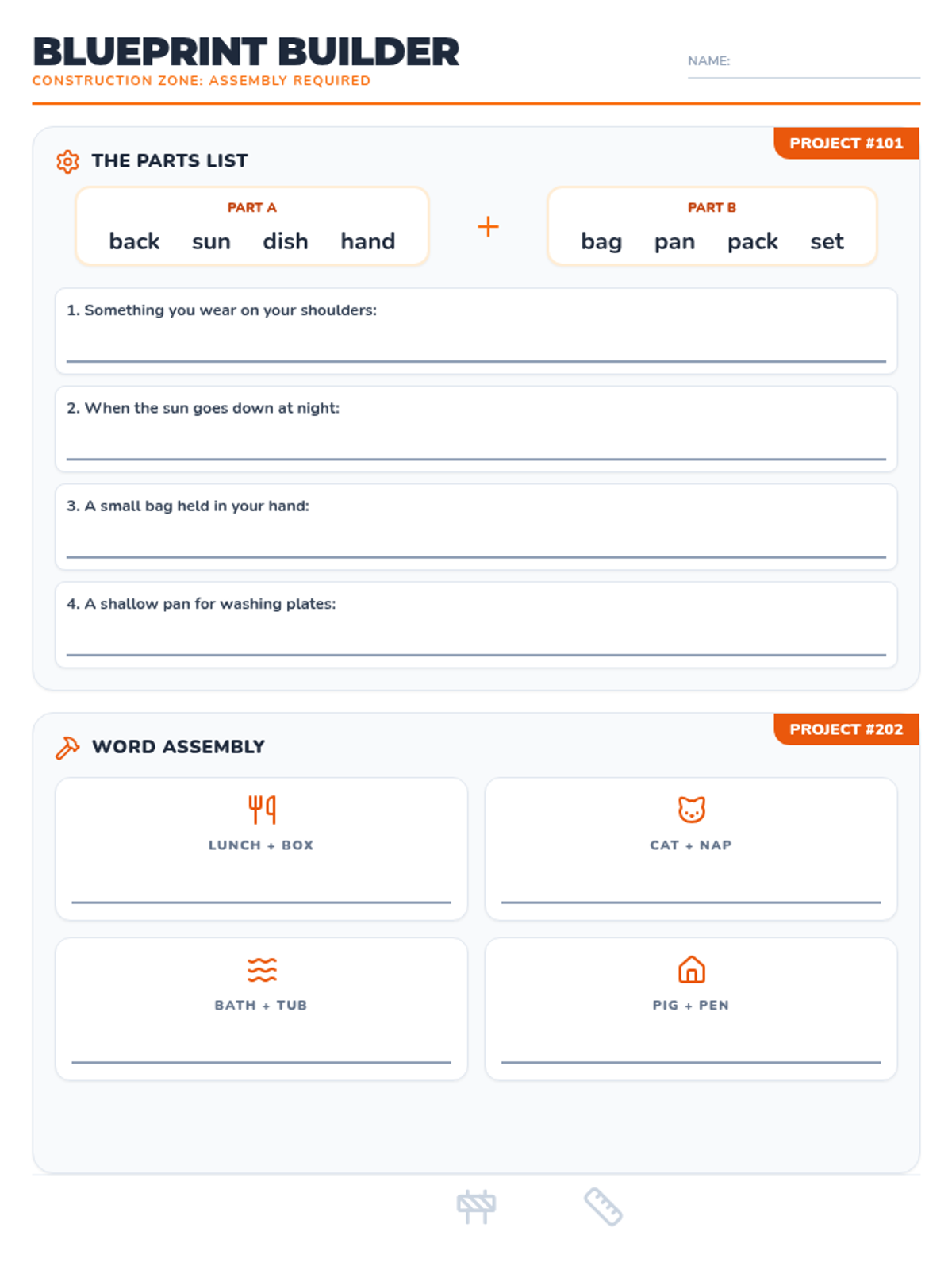
A construction-themed worksheet where students assemble compound words from provided word parts to match clues and icons. Revised to fix layout and improve contrast.
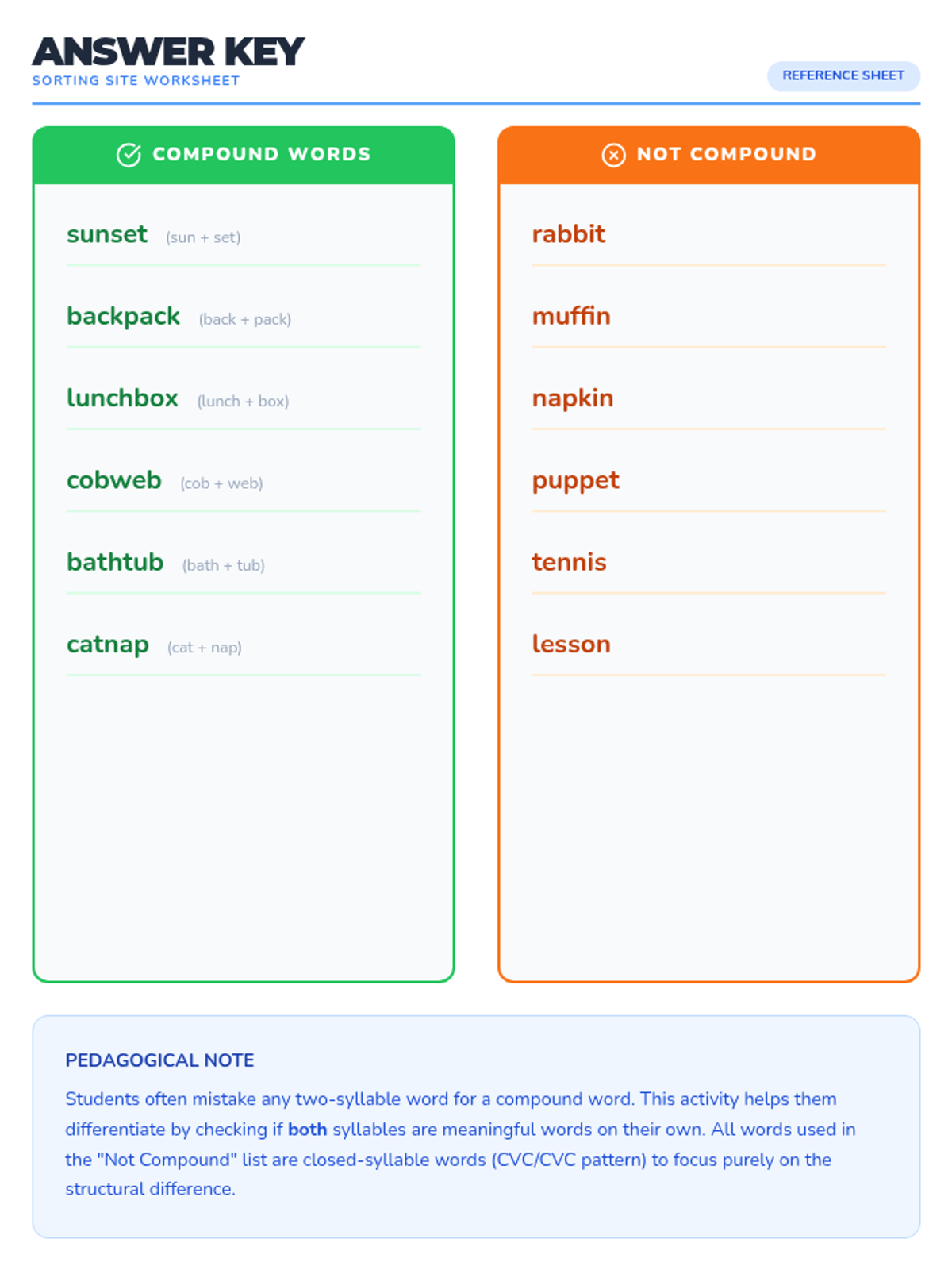
Teacher answer key for the Sorting Site Worksheet, clarifying the difference between compound words and two-syllable words.
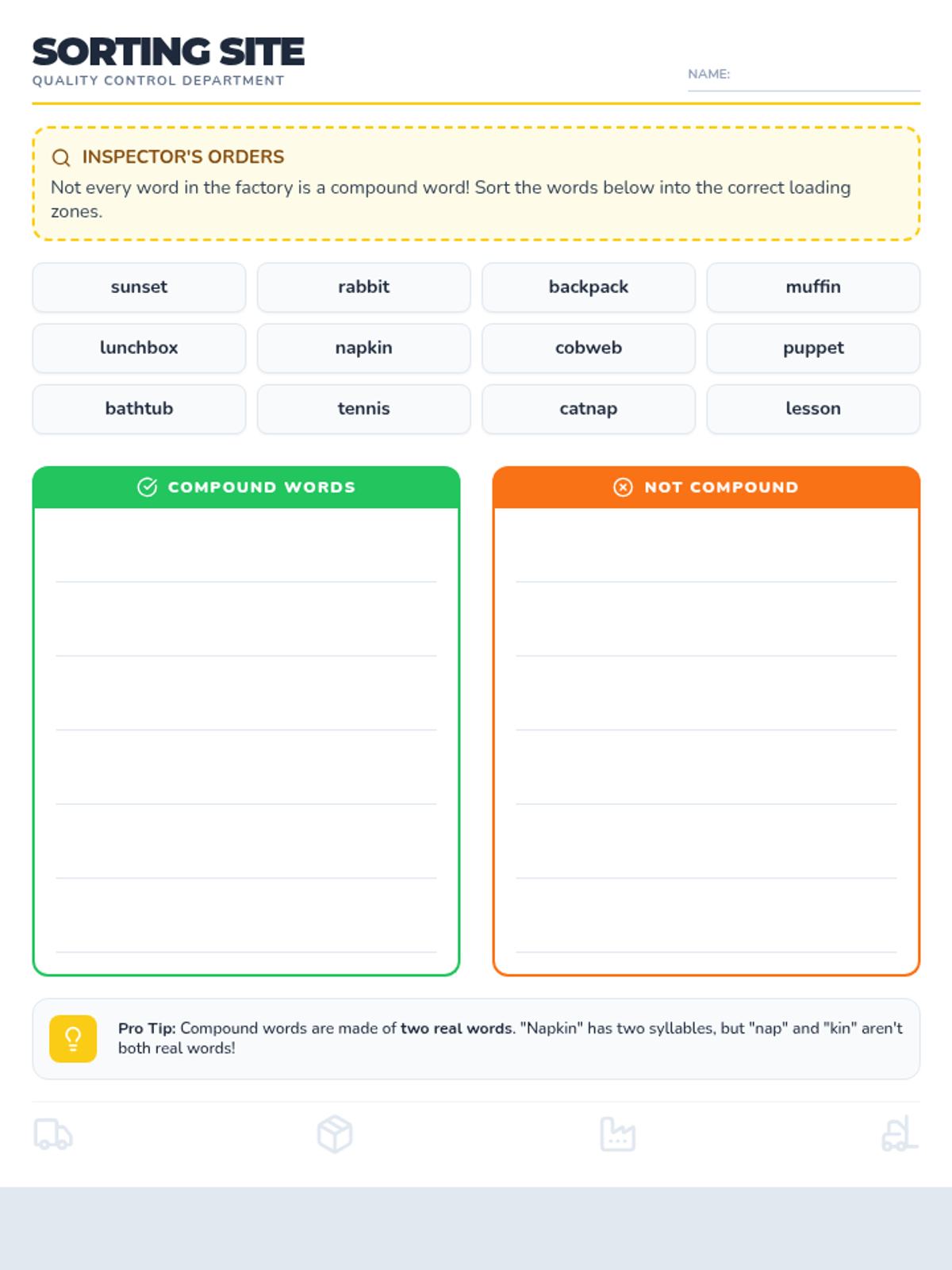
A sorting worksheet where students differentiate between compound words with two closed syllables and simple two-syllable words. Revised to fix layout and improve student work area.
A colorful presentation for introducing compound words with two closed syllables, using a construction theme to engage 2nd-grade students.
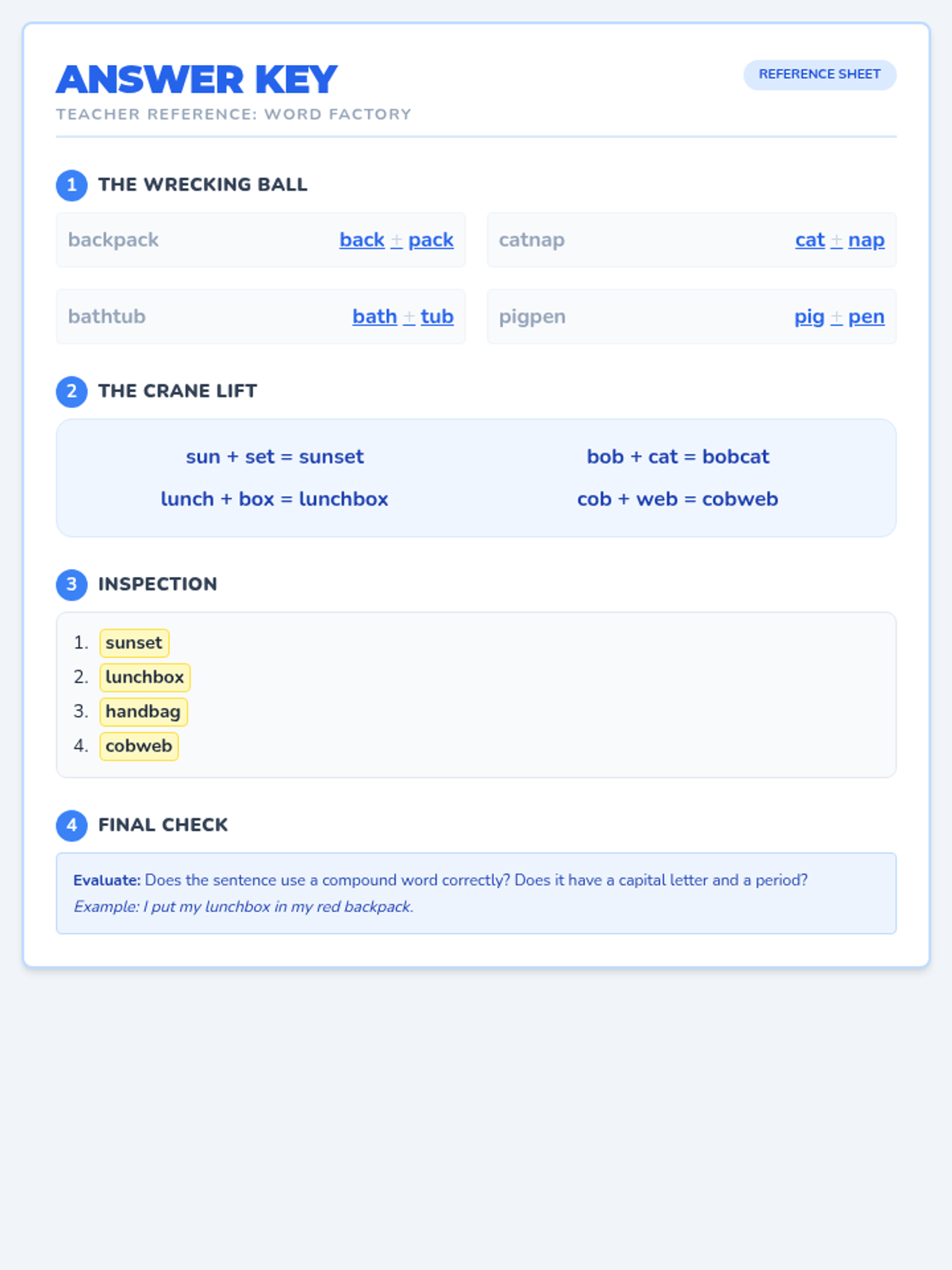
Teacher answer key for the Word Factory Worksheet, providing clear solutions and grading guidance for each activity. Updated to remove references to "bedbug".
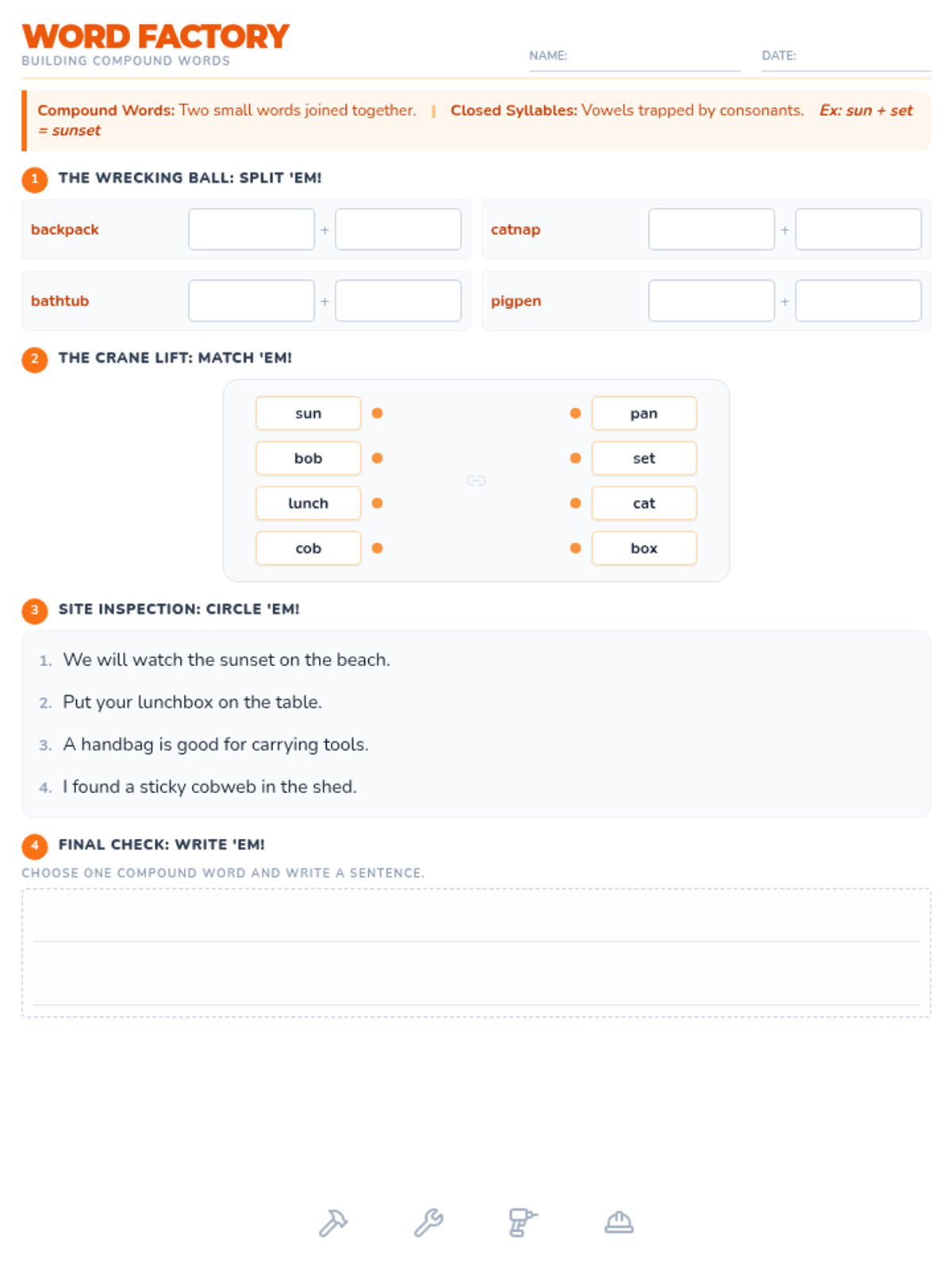
A student worksheet featuring multiple activities for practicing compound words with two closed syllables, including splitting, matching, and identifying words in context. Updated to remove references to "bedbug" and improve layout.
A vibrant and friendly cover page for the Sound Explorers 1st grade phonics practice book. Features blank student information fields and adventure-themed icons.
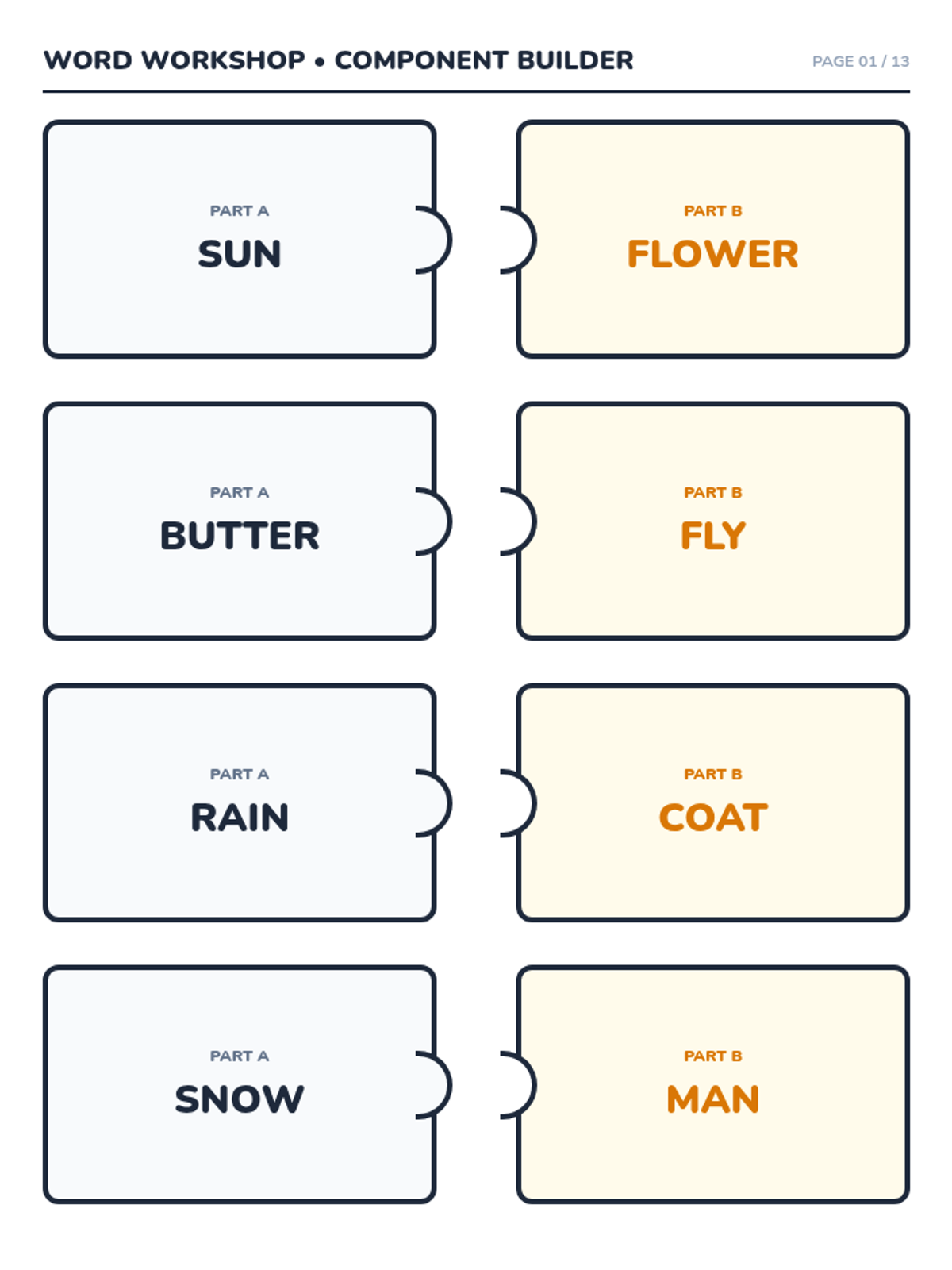
A set of 104 cards (52 pairs) featuring single words that can be joined to form unique compound words. Designed with a puzzle-piece visual metaphor and consistent border styling for clean interlocking. Revised for completeness and improved visual accuracy.
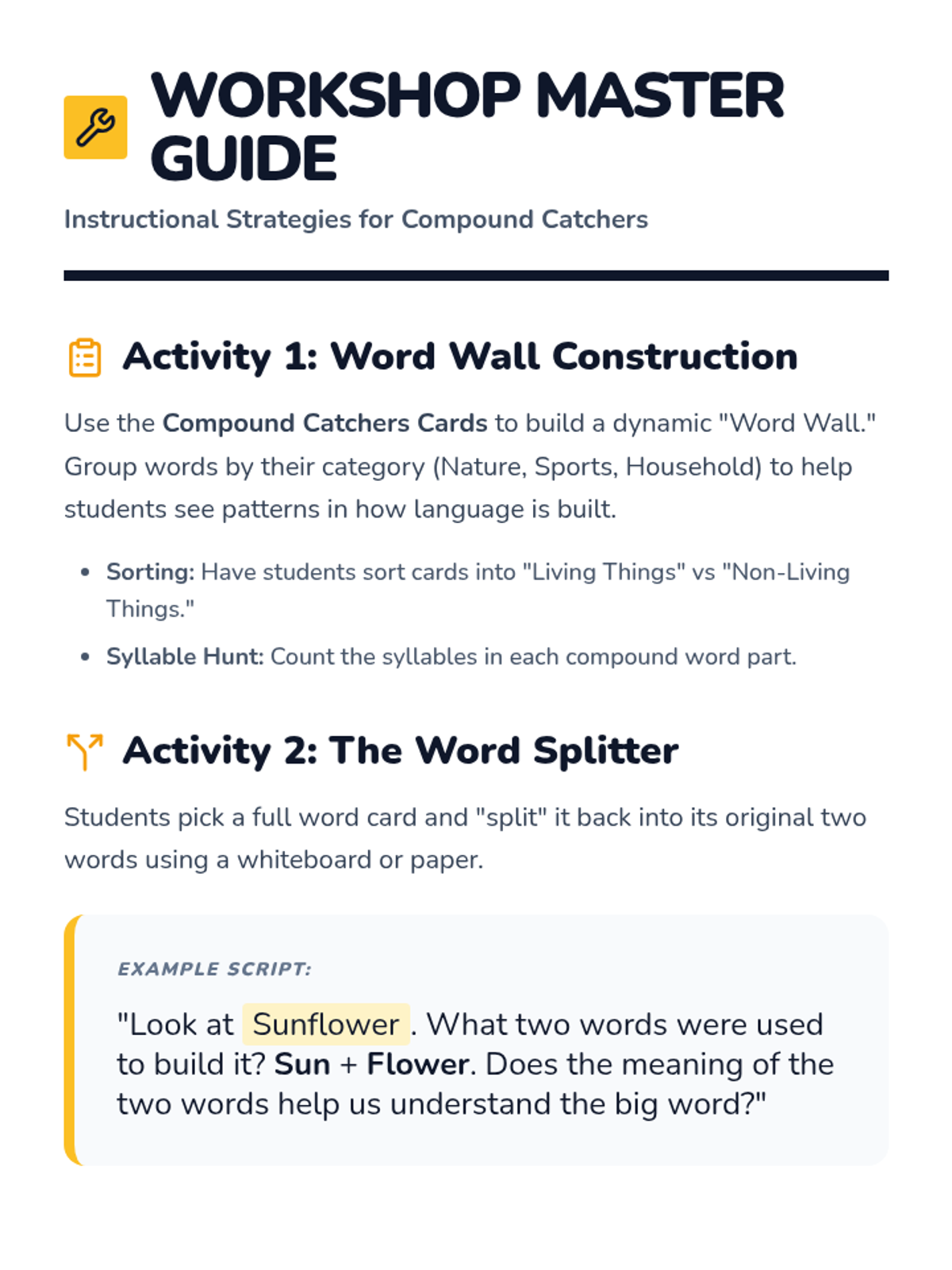
A teacher-facing instructional guide providing strategies, activity ideas, and games for using both the full word cards and the component builder set. Revised to include new activities for the Builder Cards.
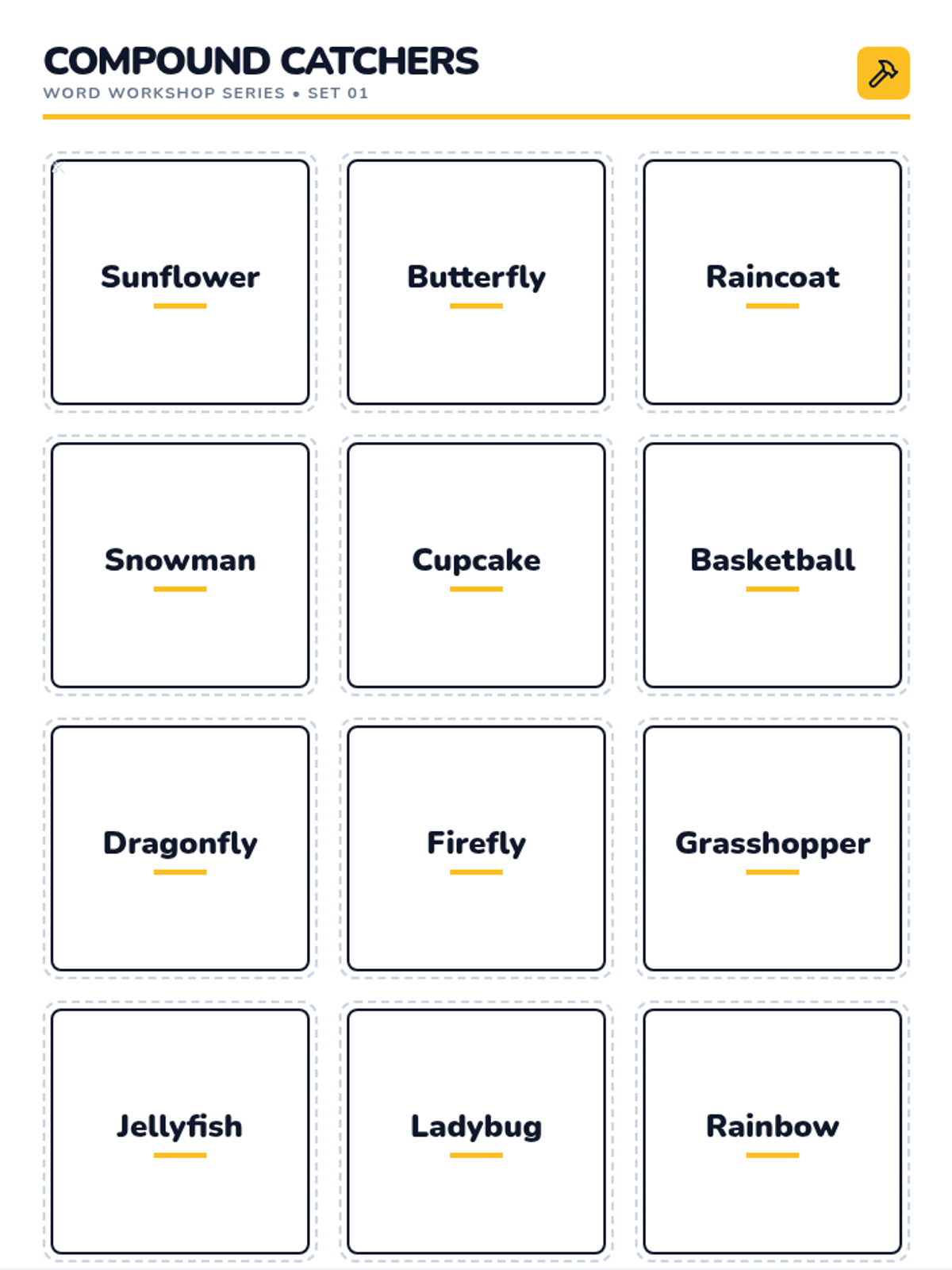
A comprehensive set of 100 compound word cards designed for printing and cutting. Each card features a bold, clear compound word with a consistent 'Word Workshop' theme for classroom use. Revised for better page breaks and ink efficiency.
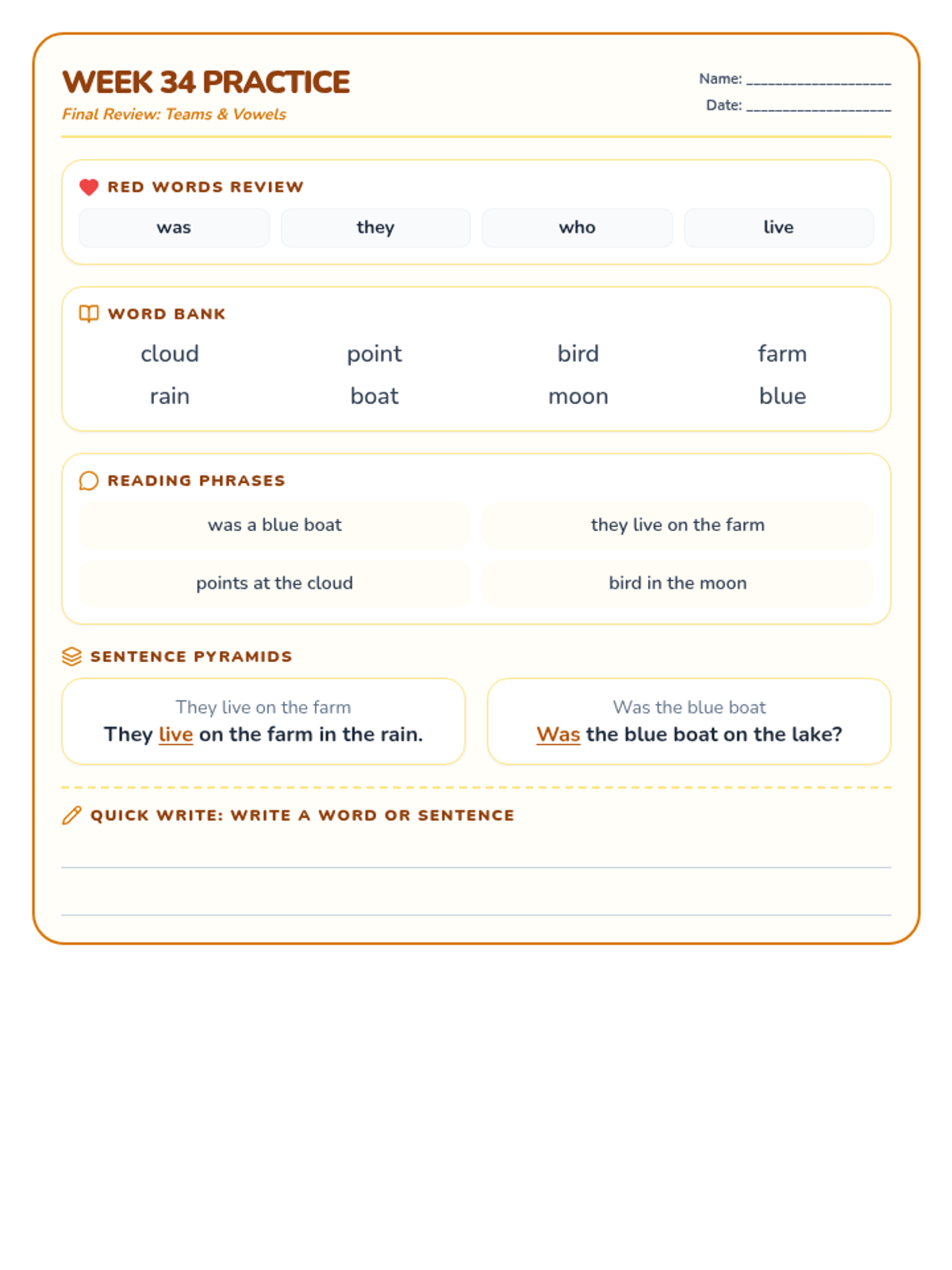
Compact phonics practice sheet for Week 34 with side-by-side sentence pyramids and handwriting space.
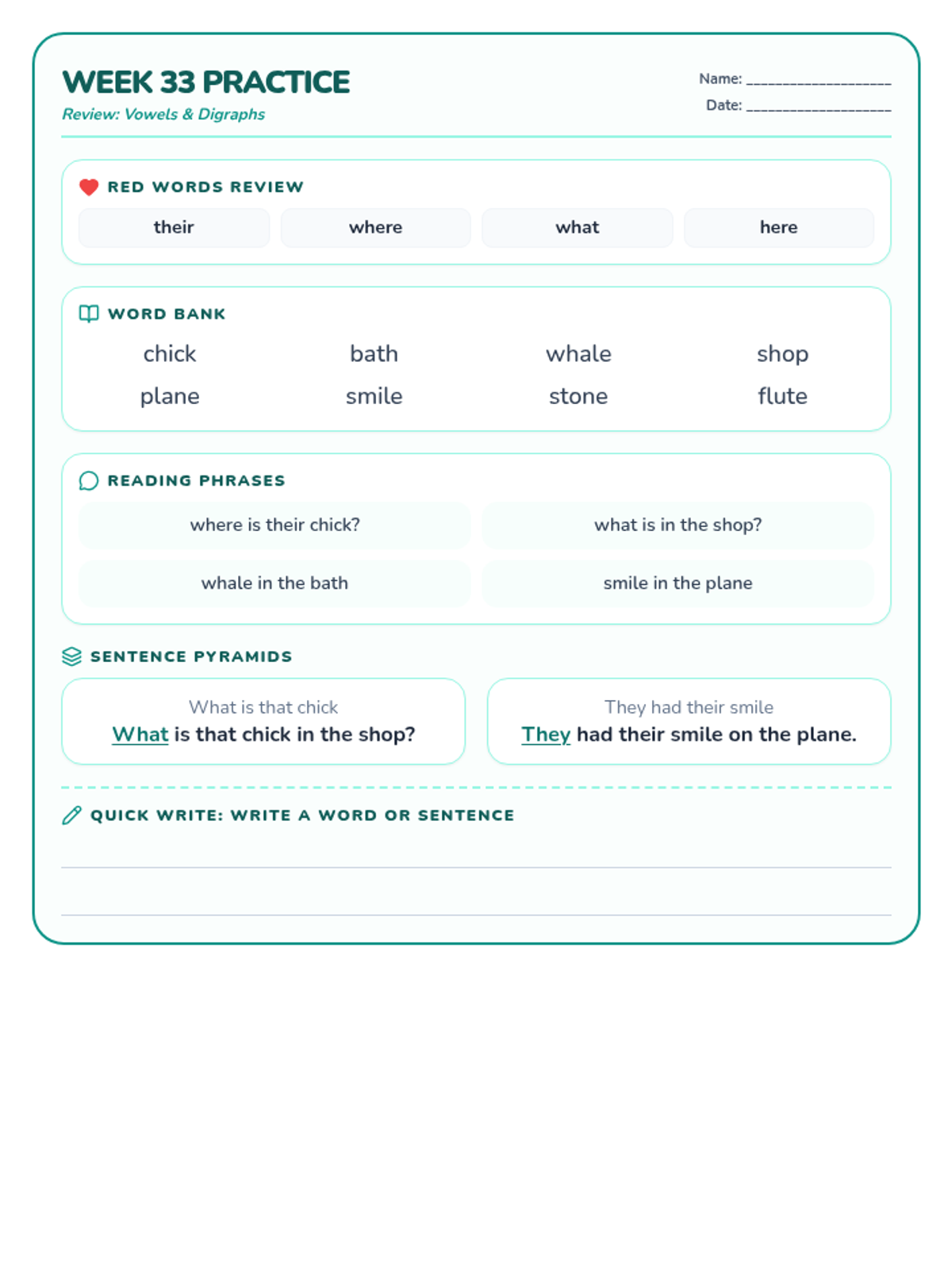
Compact phonics practice sheet for Week 33 with side-by-side sentence pyramids and handwriting space.
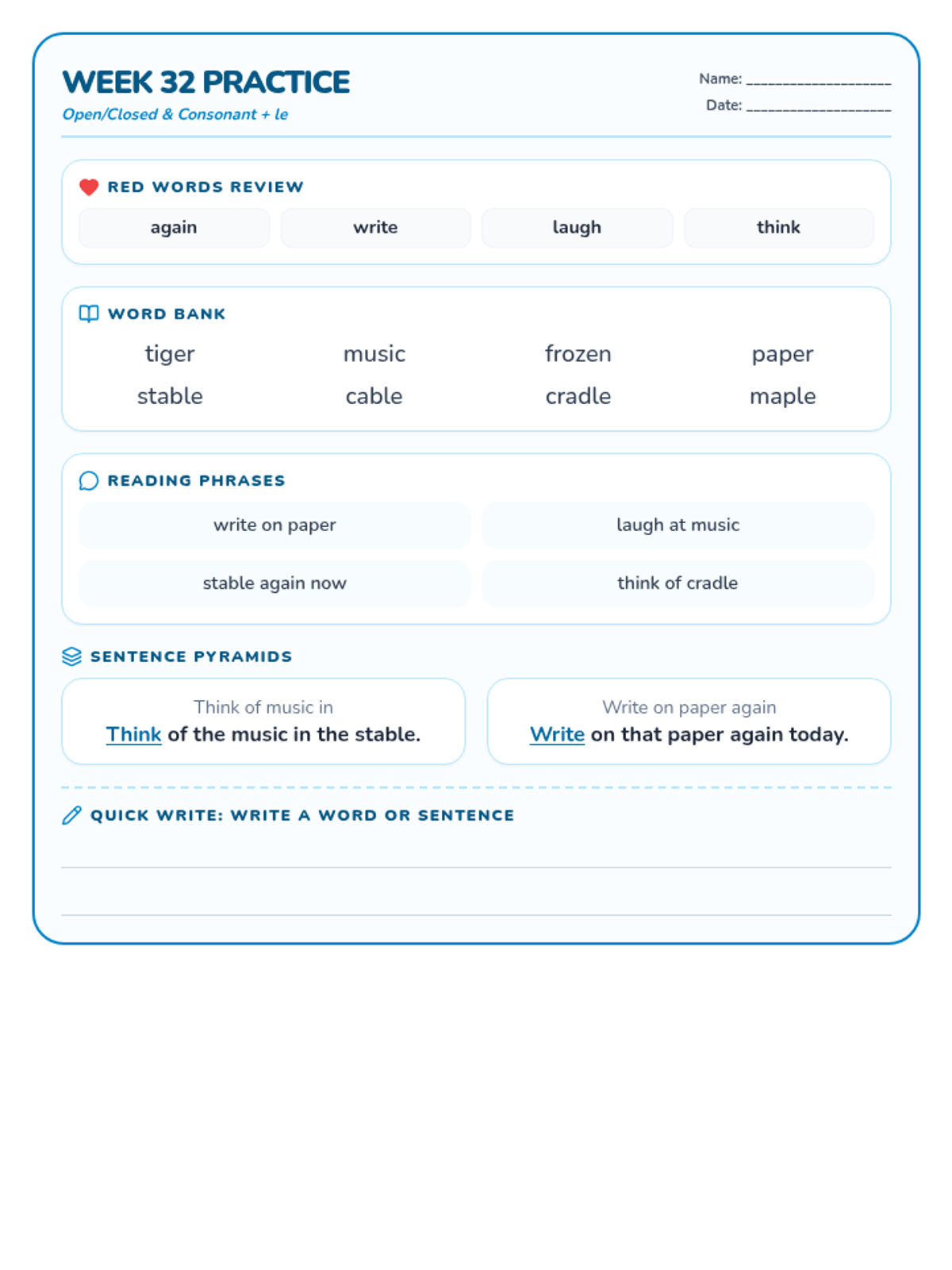
Compact phonics practice sheet for Week 32 with side-by-side sentence pyramids and handwriting space.
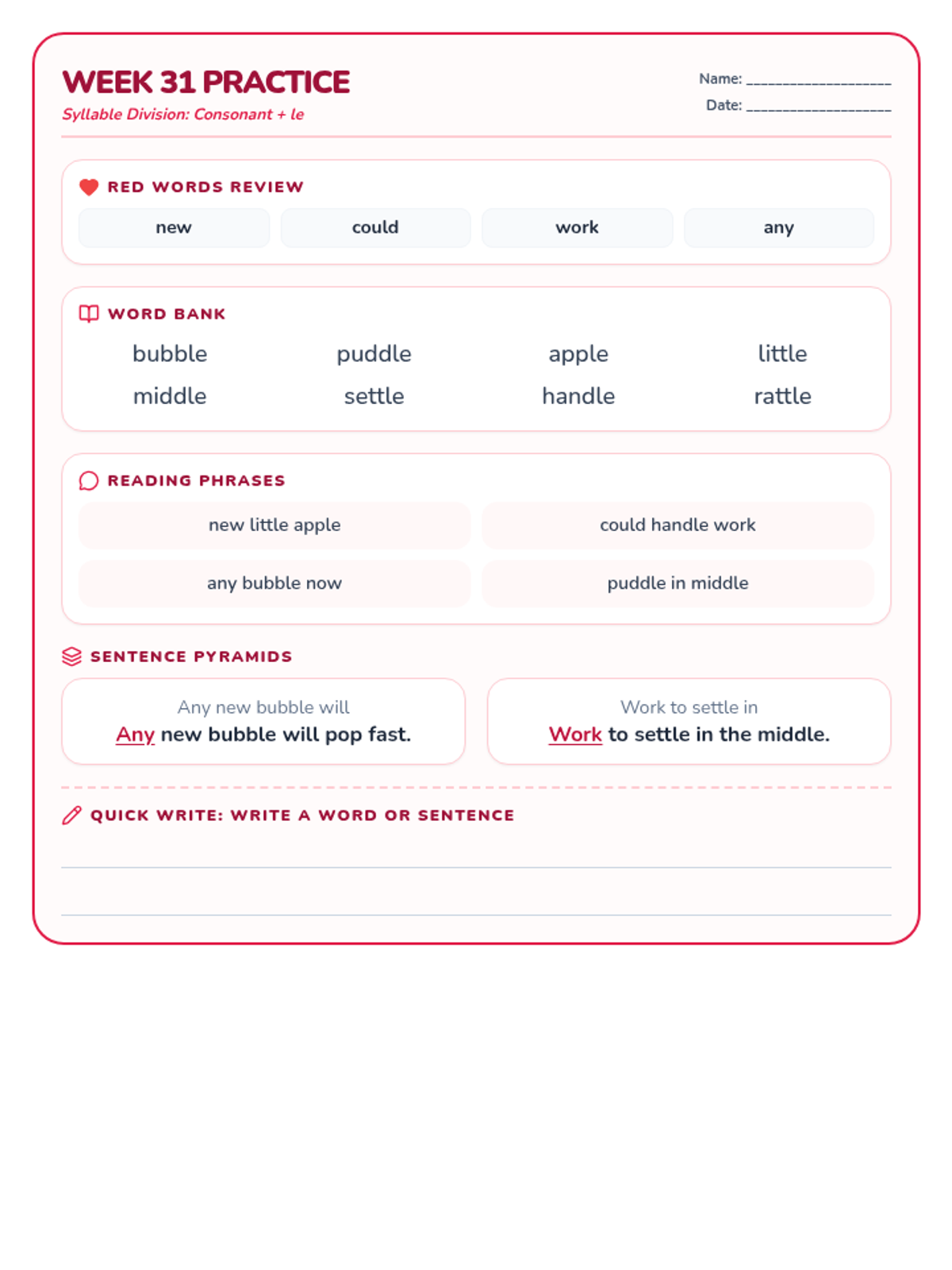
Compact phonics practice sheet for Week 31 with side-by-side sentence pyramids and handwriting space.
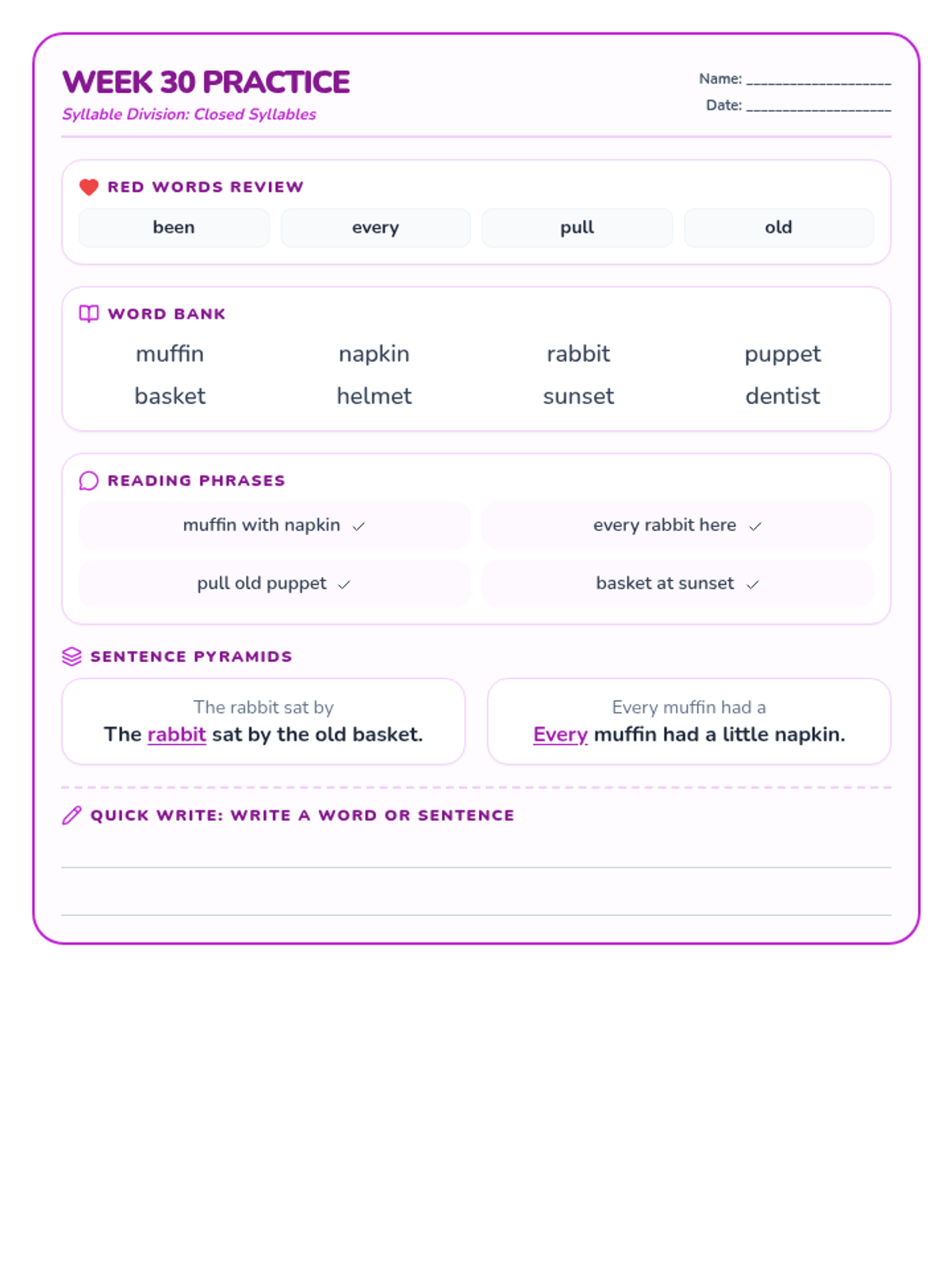
Compact phonics practice sheet for Week 30 with side-by-side sentence pyramids and handwriting space.
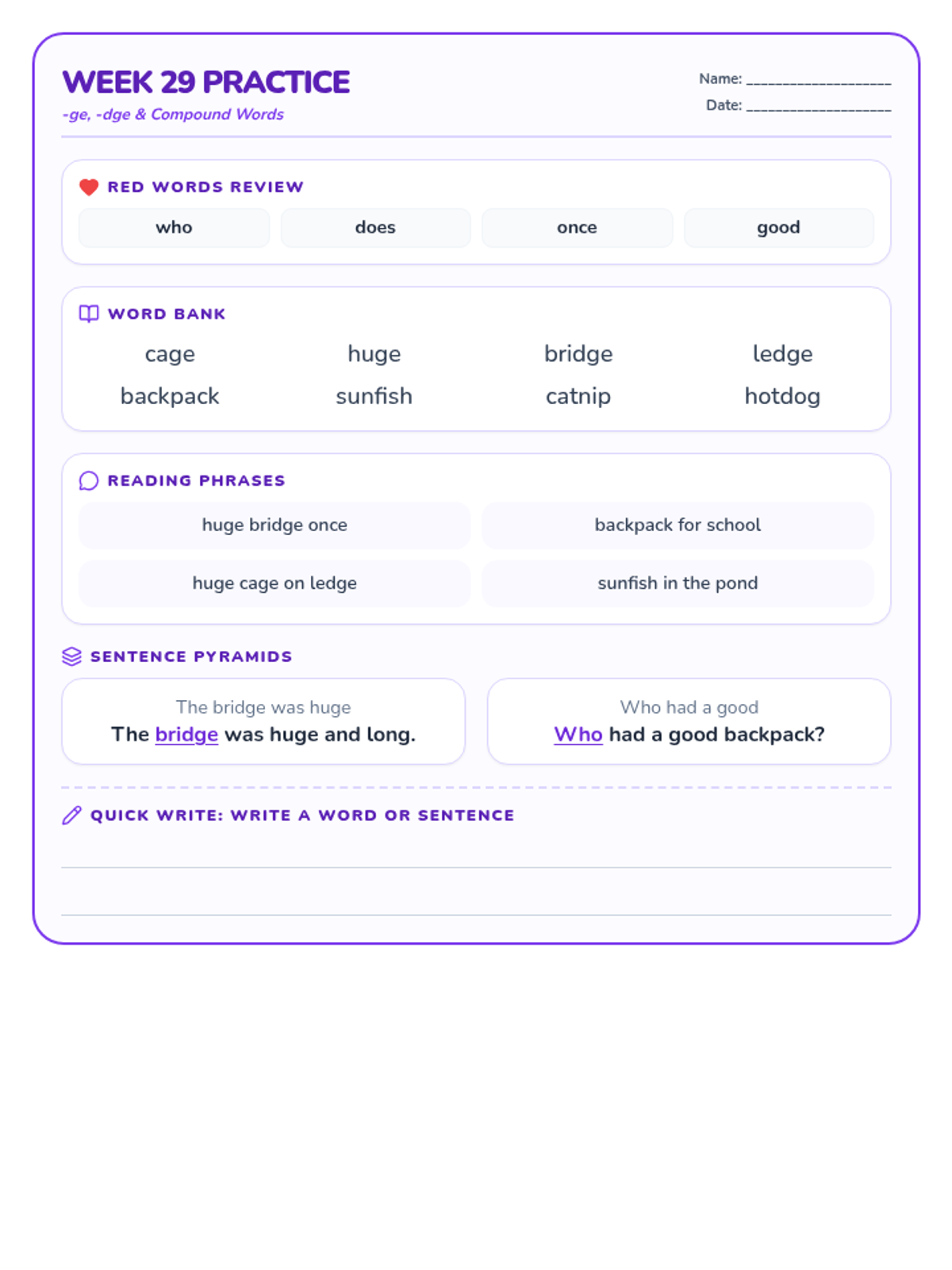
Compact phonics practice sheet for Week 29 with side-by-side sentence pyramids and handwriting space.
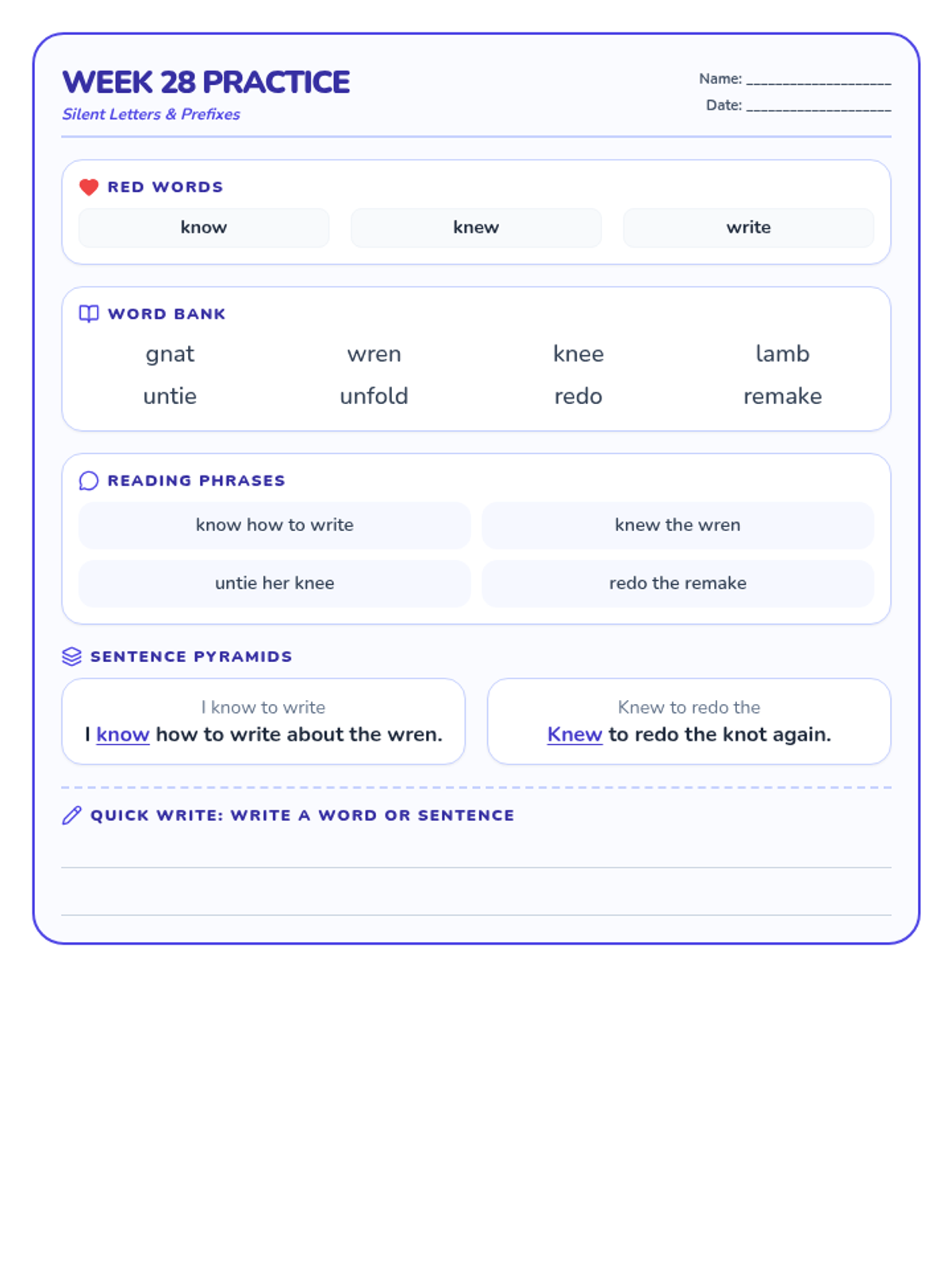
Compact phonics practice sheet for Week 28 with side-by-side sentence pyramids and handwriting space.
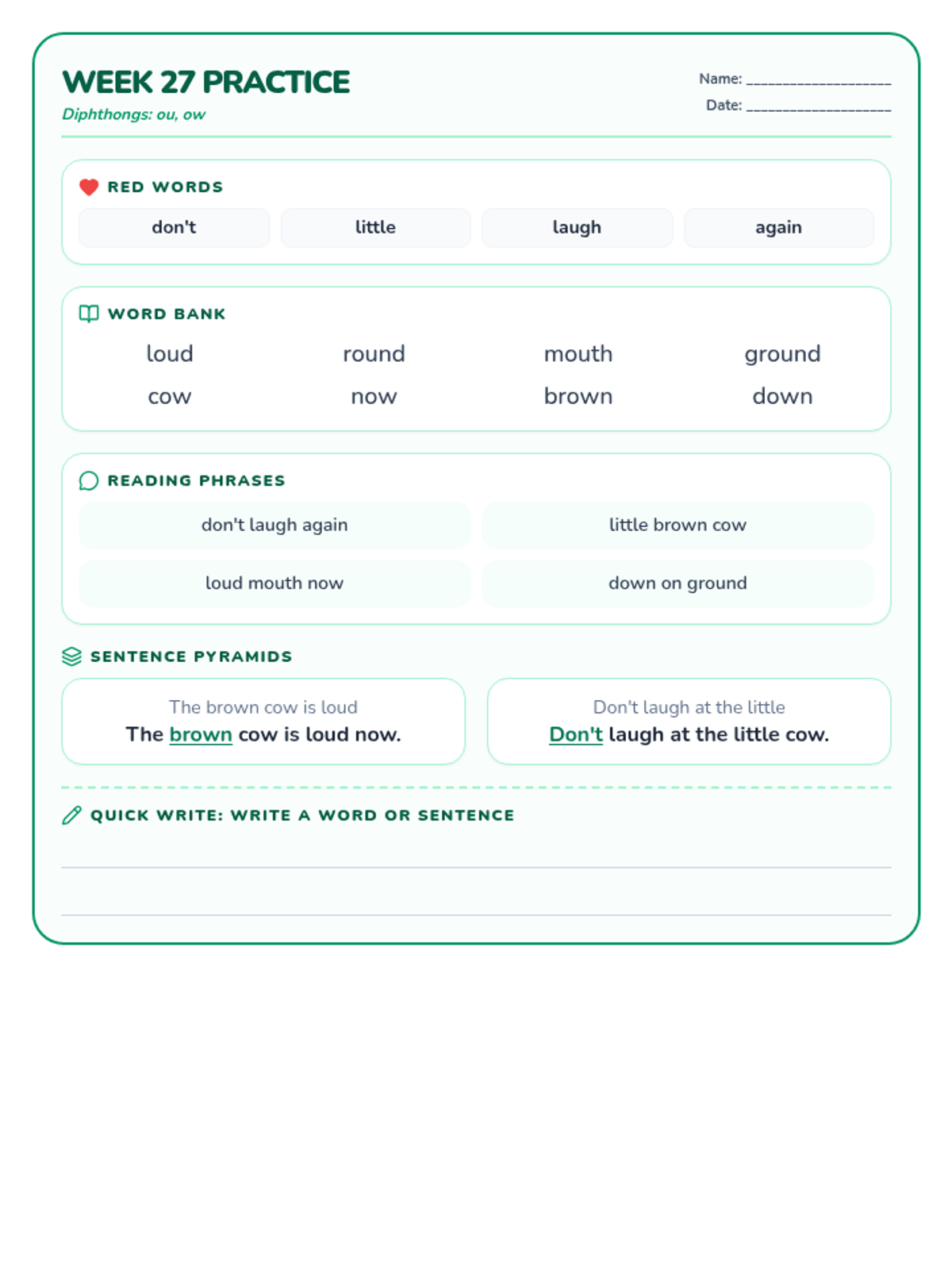
Compact phonics practice sheet for Week 27 with side-by-side sentence pyramids and handwriting space.
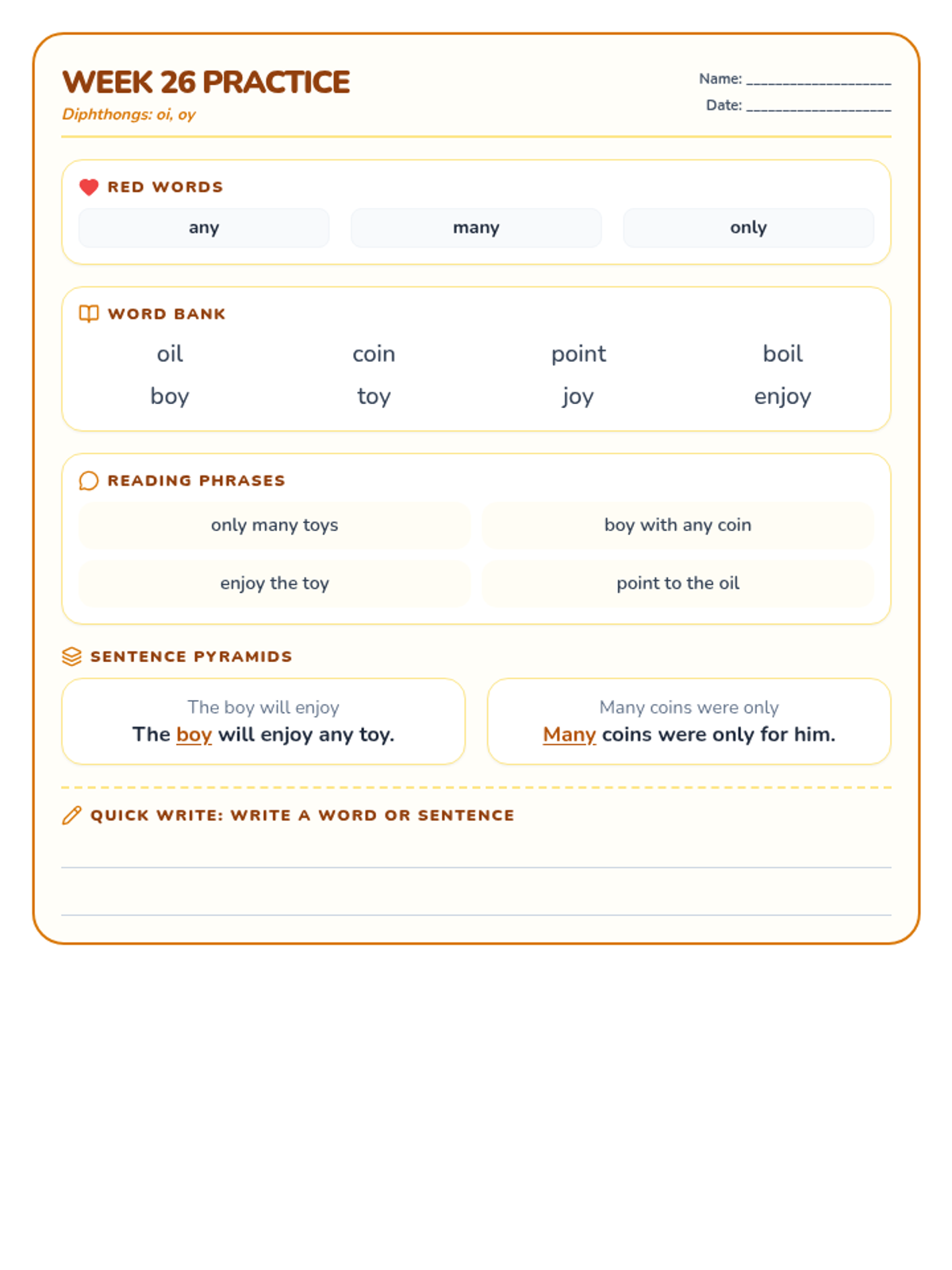
Compact phonics practice sheet for Week 26 with side-by-side sentence pyramids and handwriting space.
Spanish version of the interactive glossary practice slides for 3rd-grade students, containing 10 questions and answer keys.
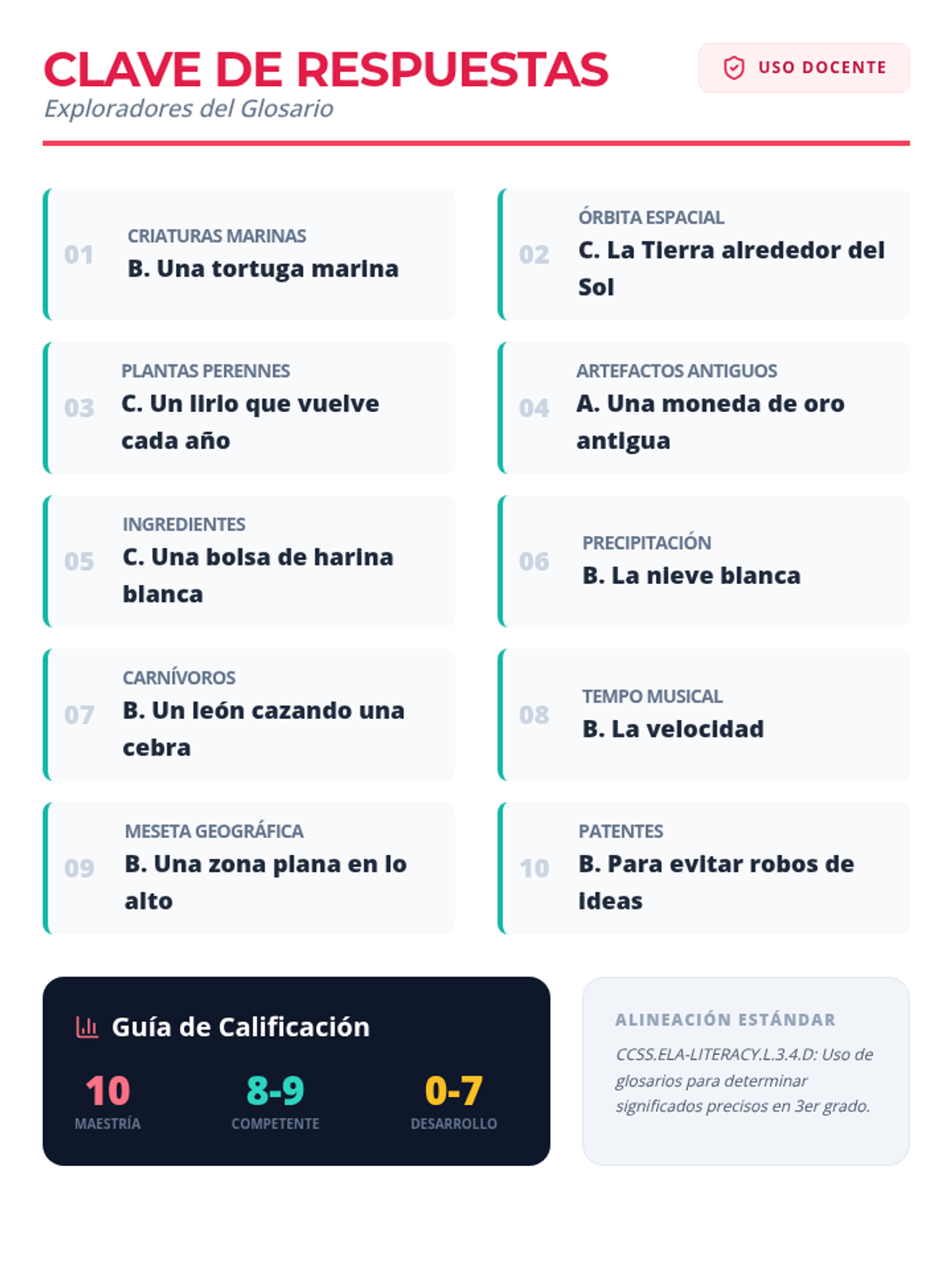
Answer key for the Spanish vocabulary packet 'Exploradores del Glosario', including a scoring guide and standard alignment.
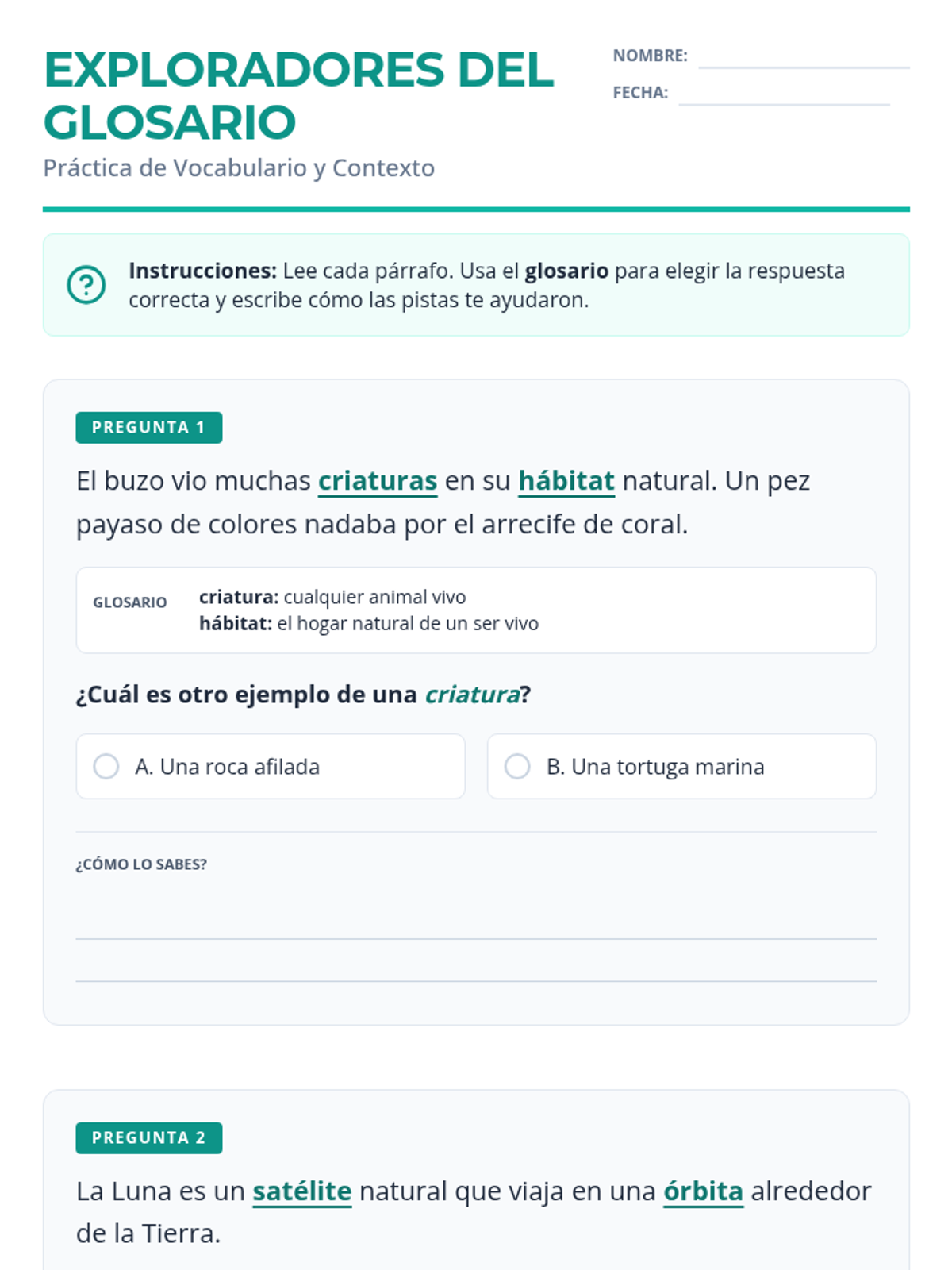
A 4-page Spanish vocabulary packet for 3rd graders focusing on using context clues and glossaries to understand academic terms across various subjects.
A set of 10 interactive question and answer slides for 3rd-grade students, focusing on using glossaries and context clues to master new vocabulary across various subjects.
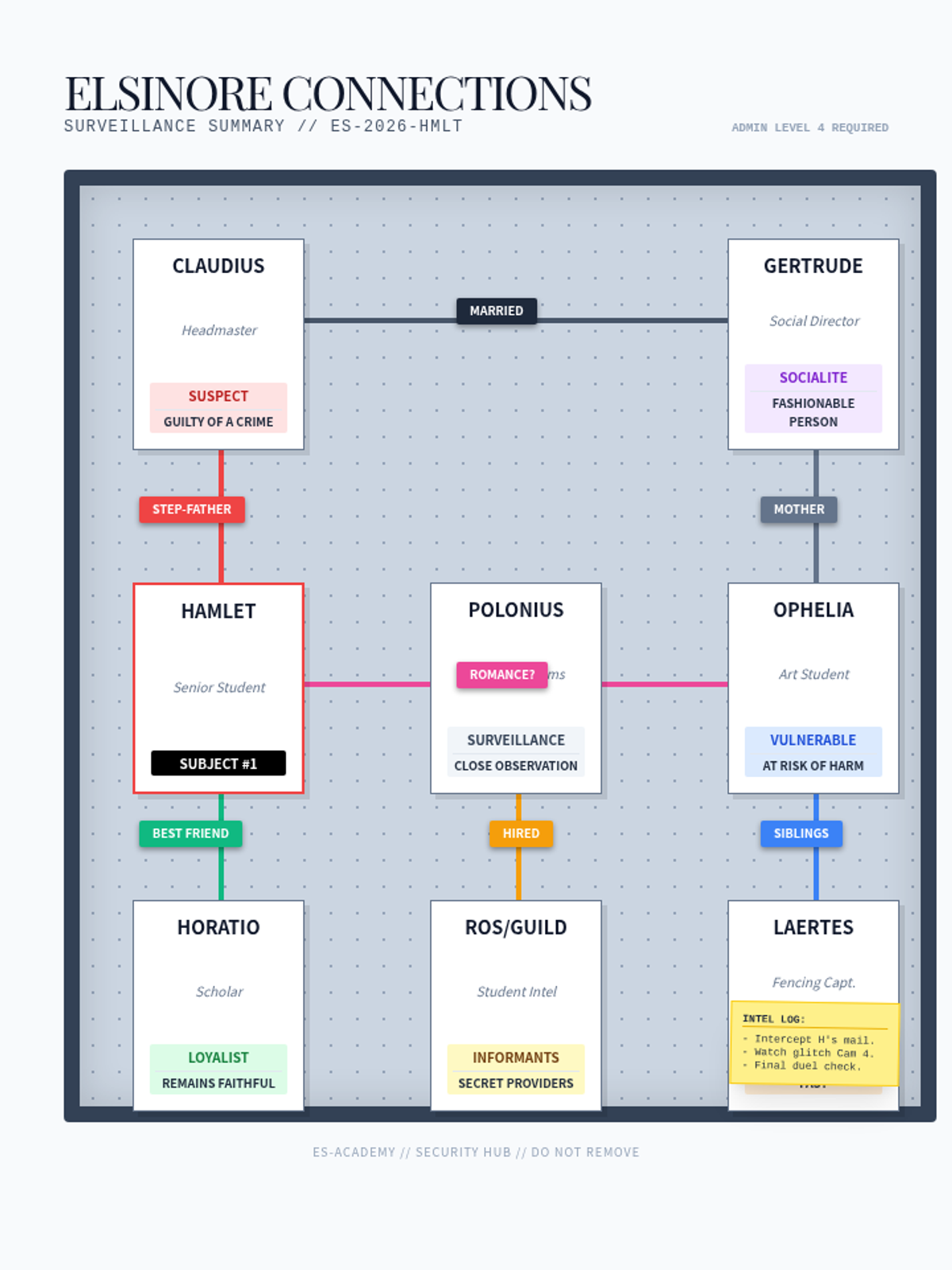
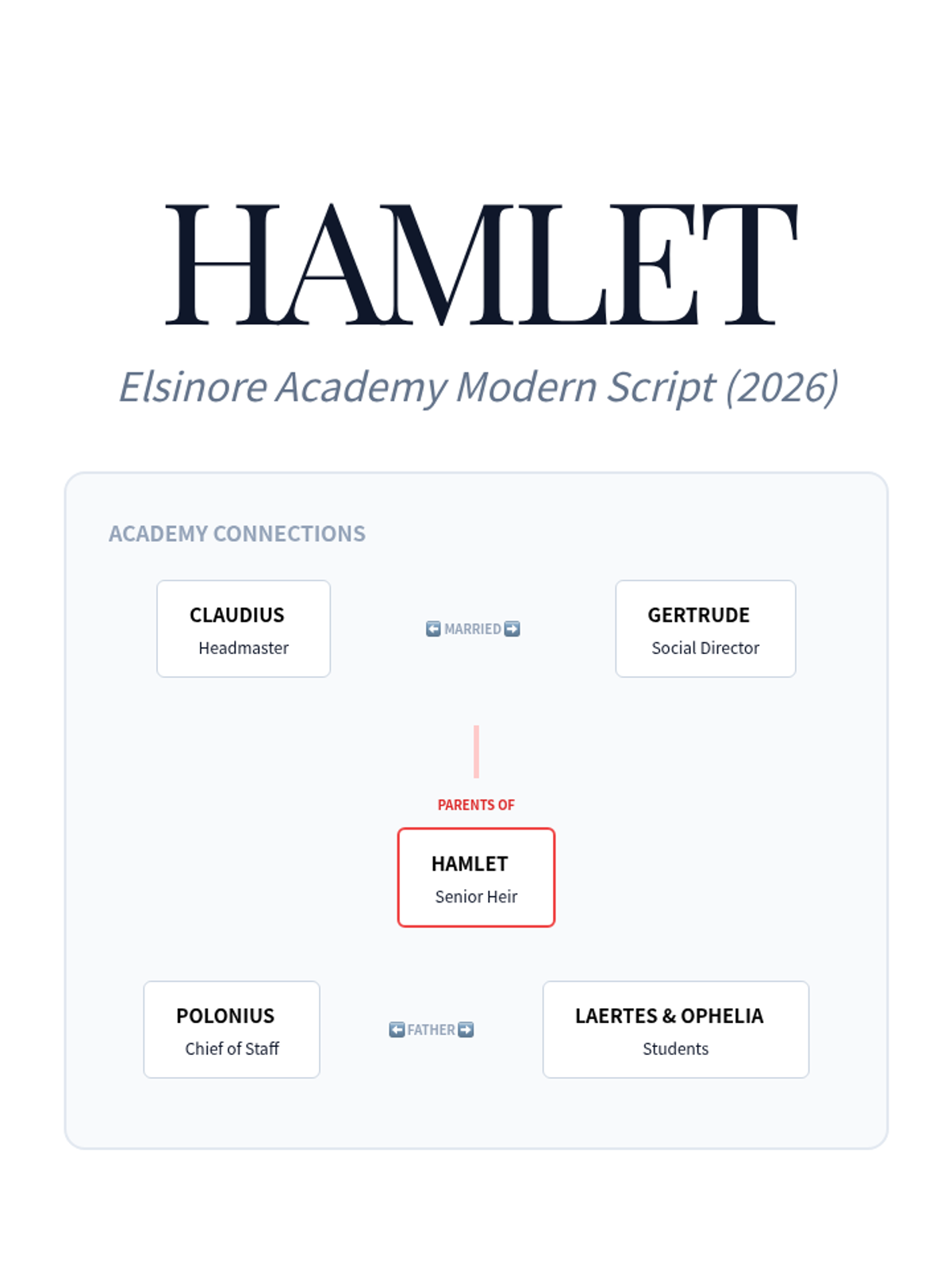
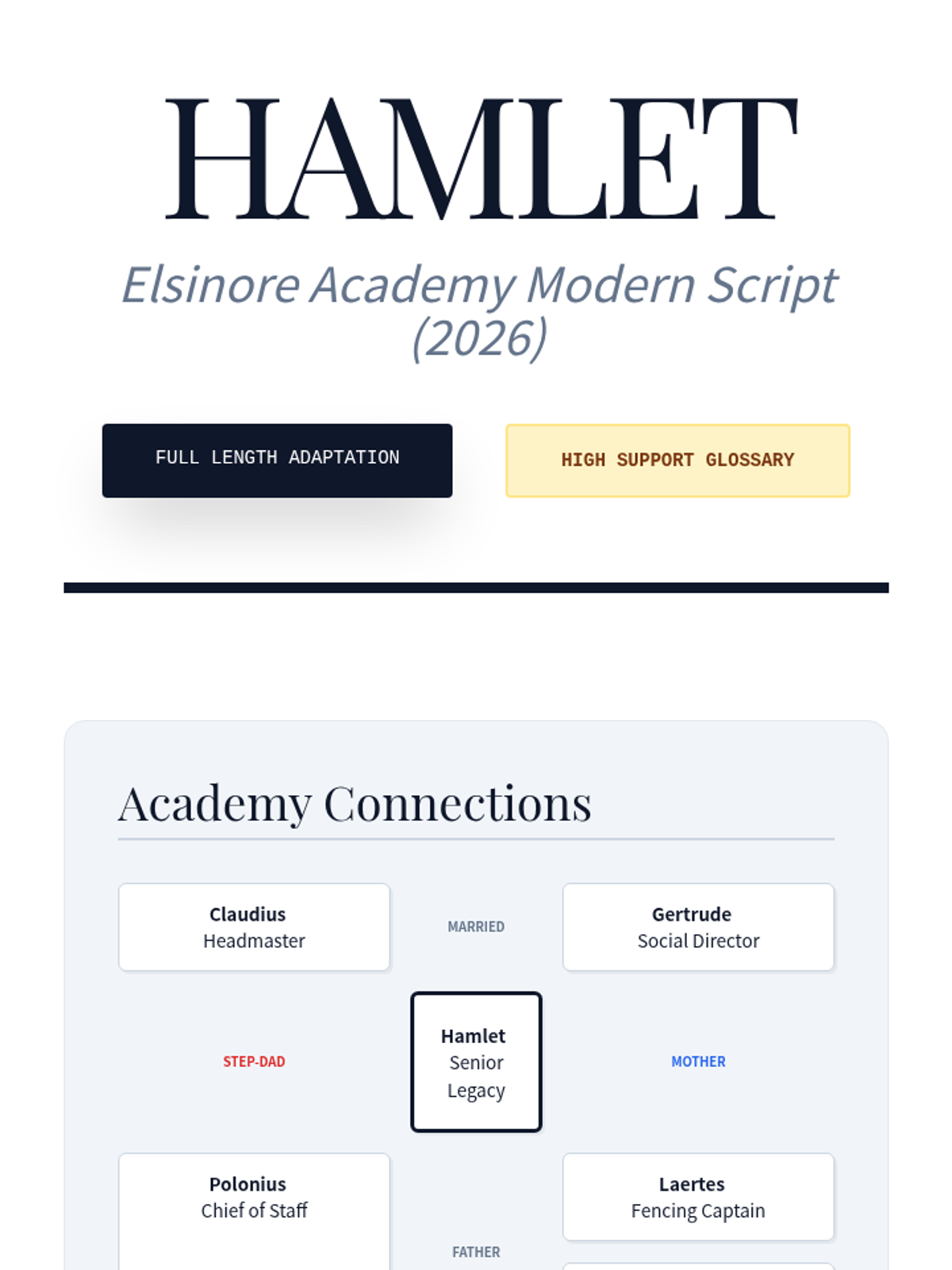
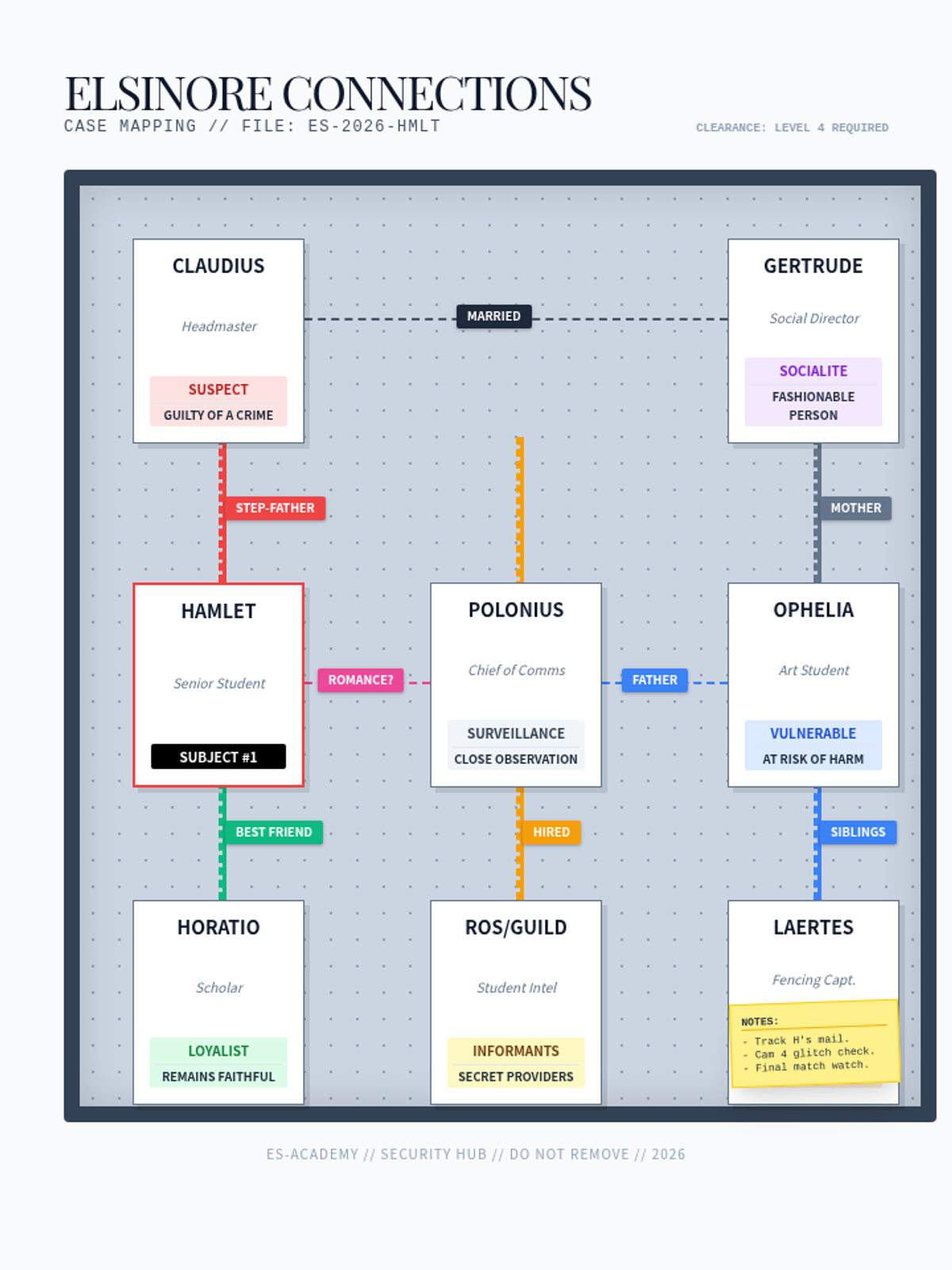
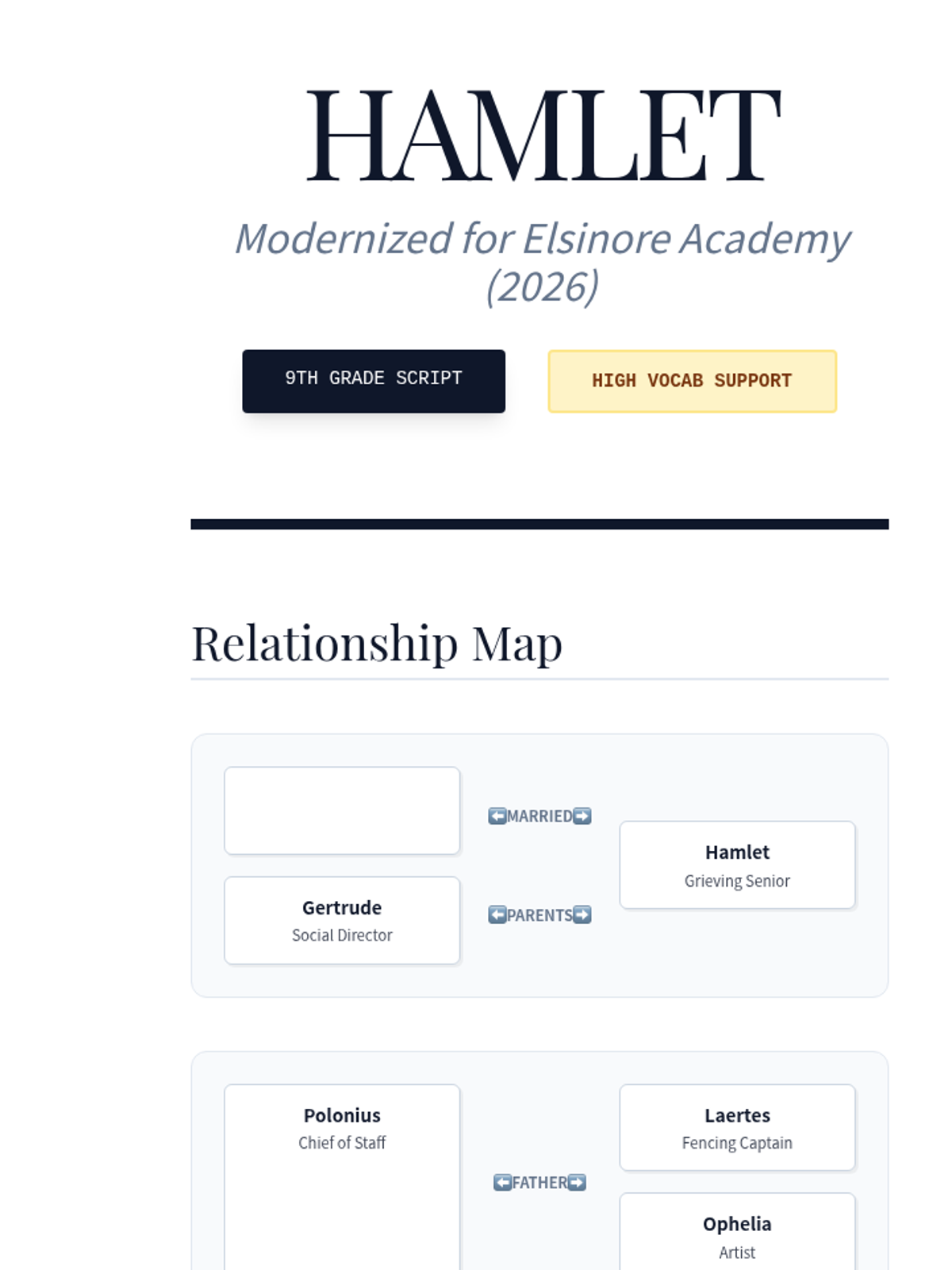
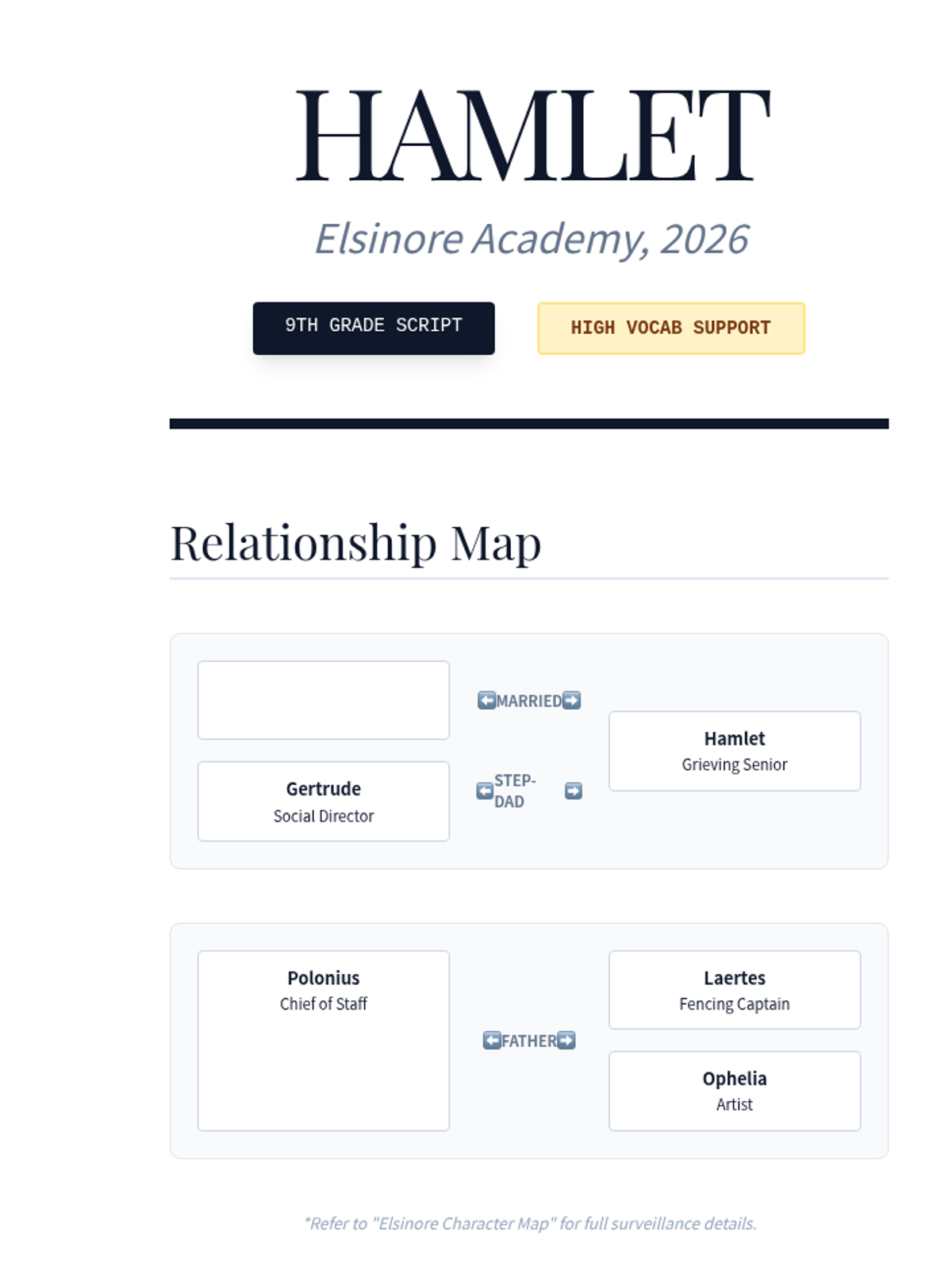
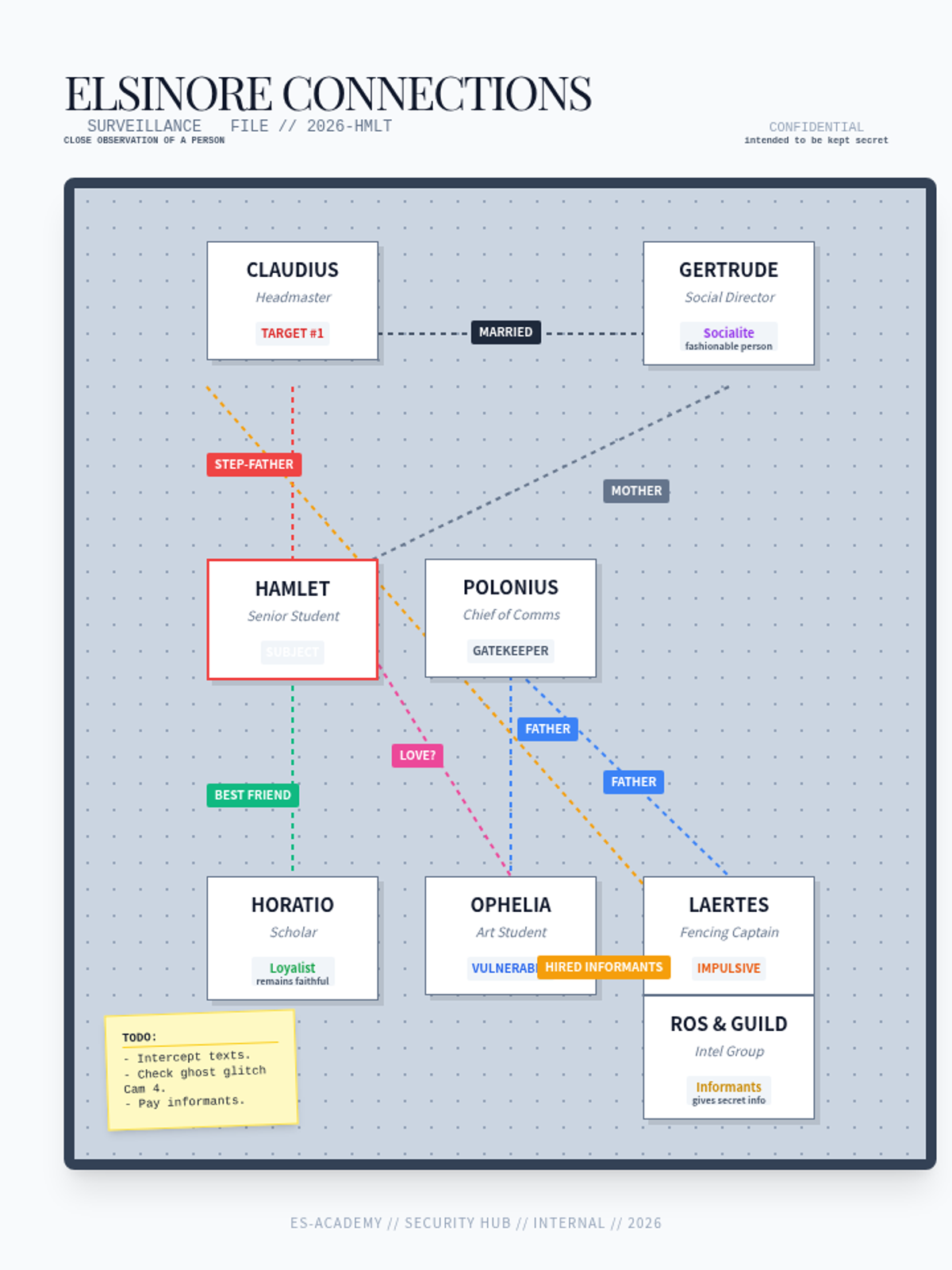
A character map styled as a surveillance board, showing relationships and roles of the modernized Hamlet characters at Elsinore Academy. Uses a stable 3-column layout to ensure correct connection alignment and includes tier 2/3 vocabulary subscripts. Corrected sticky note overlap and increased font contrast. Corrected connection lines for parents. Fixed label swapping.
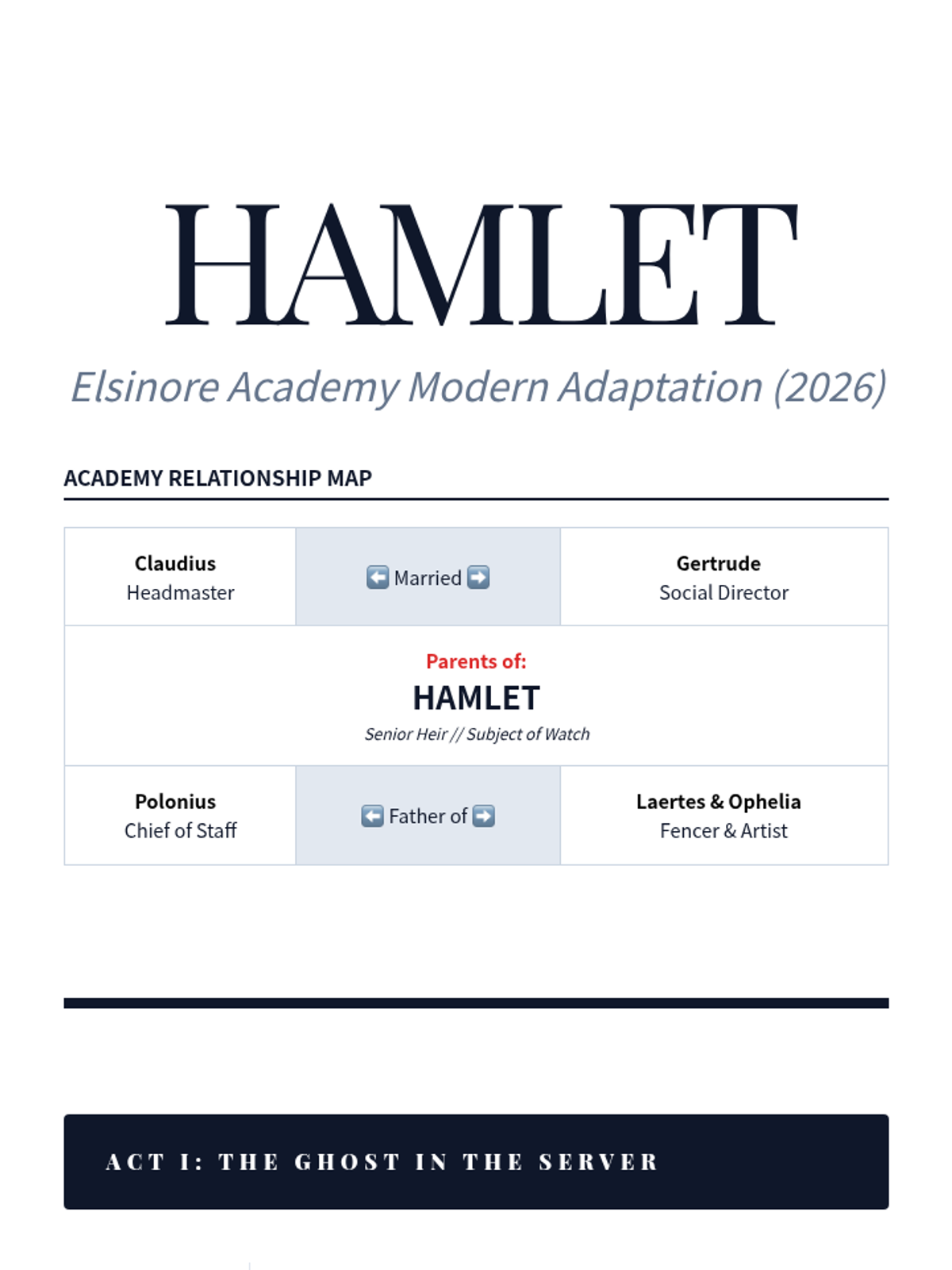
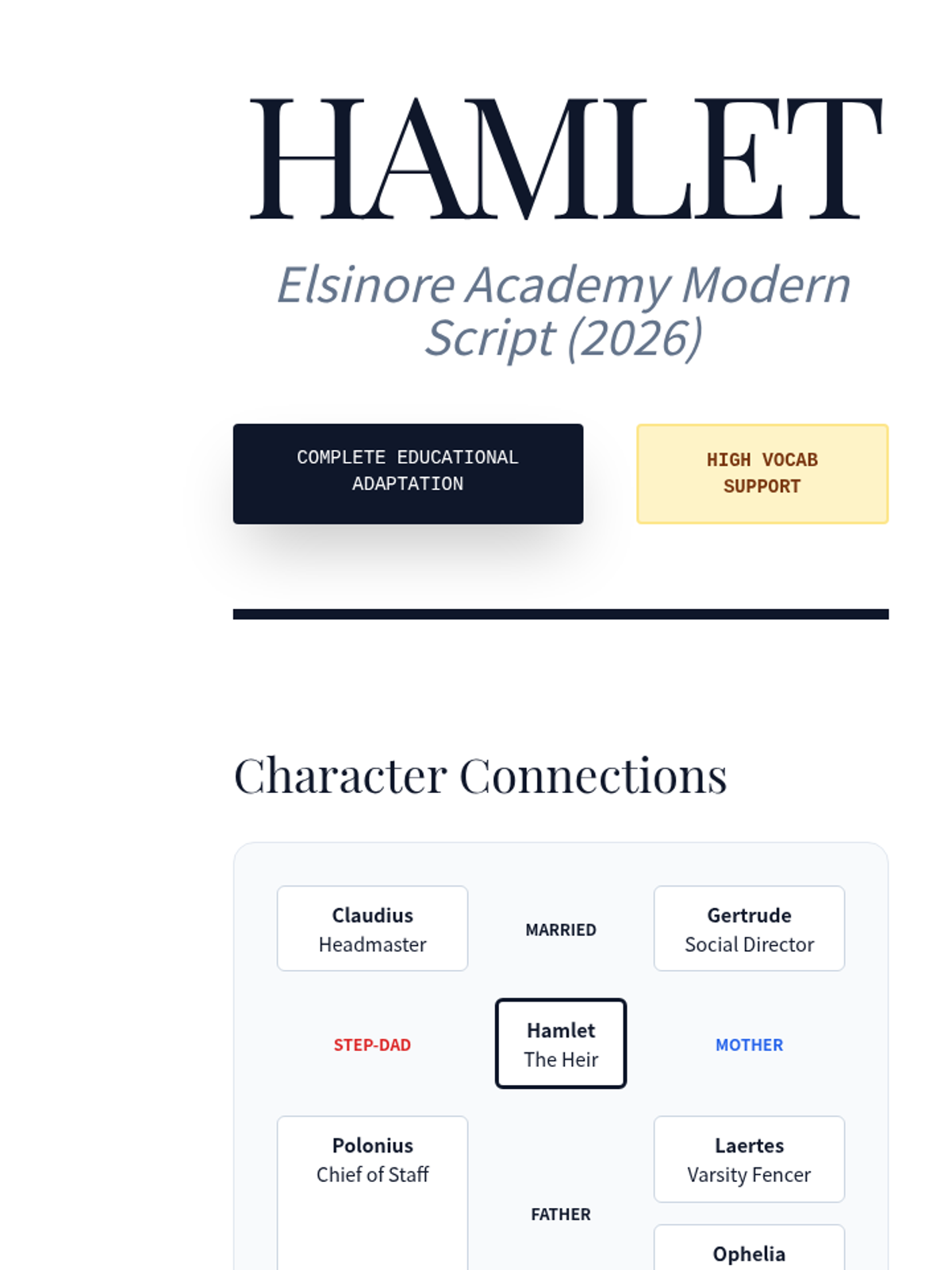
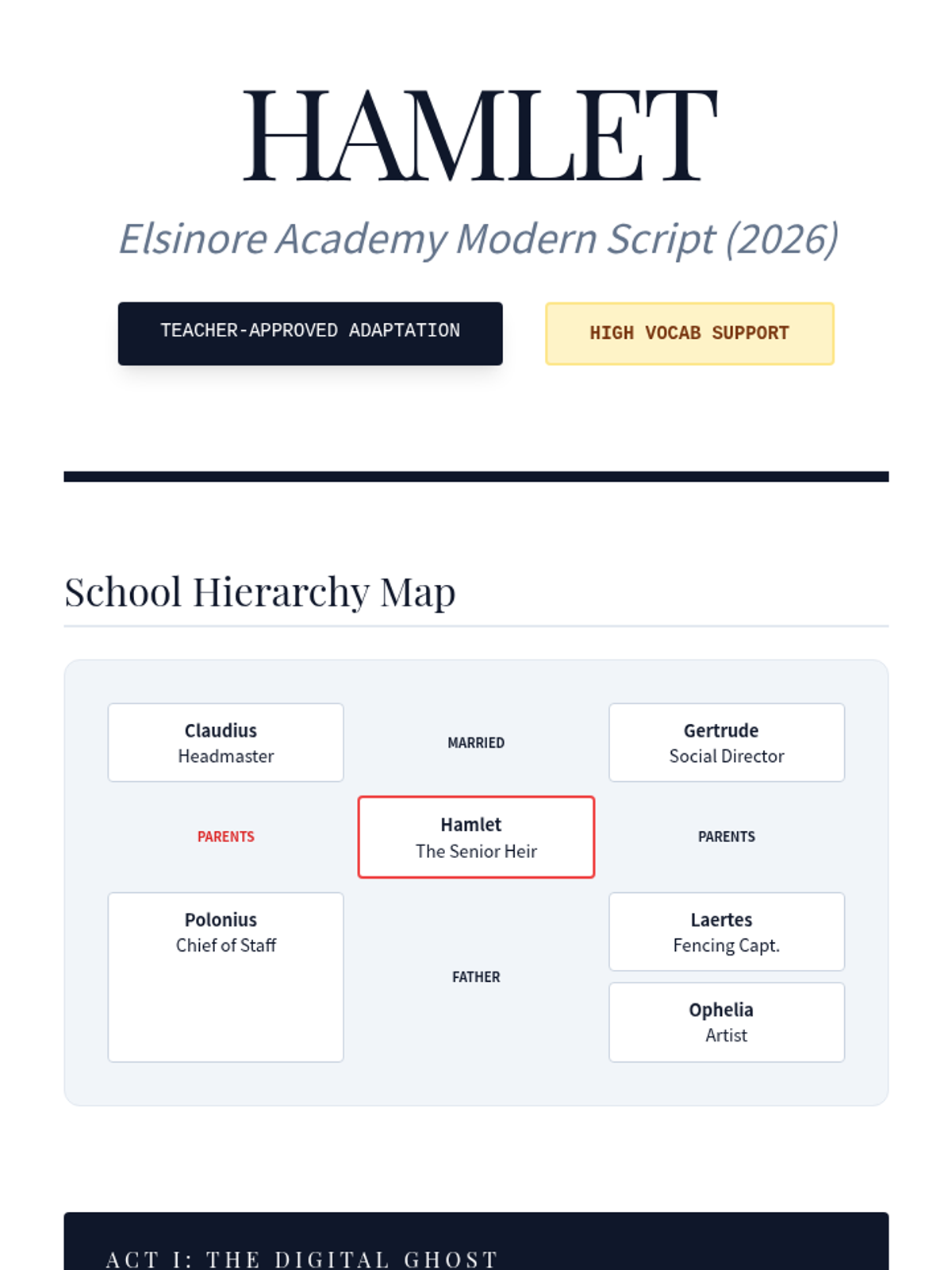
The complete five-act storyline of Hamlet modernized into a boarding school setting with high-frequency vocabulary support through subscripts. Expansion focuses on the play's weight. Includes a cast list and simplified relationship map on page 1. Fixed ruby positioning and alignment issues. Corrected Claudius/Hamlet names. Expansion focuses on deeper dialogue beats.
The complete five-act storyline of Hamlet modernized into a boarding school setting with high-frequency vocabulary support through subscripts. Expansion includes significantly more dialogue and key scenes to match the original play's weight. Includes a cast list and simplified relationship map on page 1. Fixed ruby positioning and alignment issues. Corrected Claudius/Hamlet names. Expansion focuses on deeper dialogue beats.
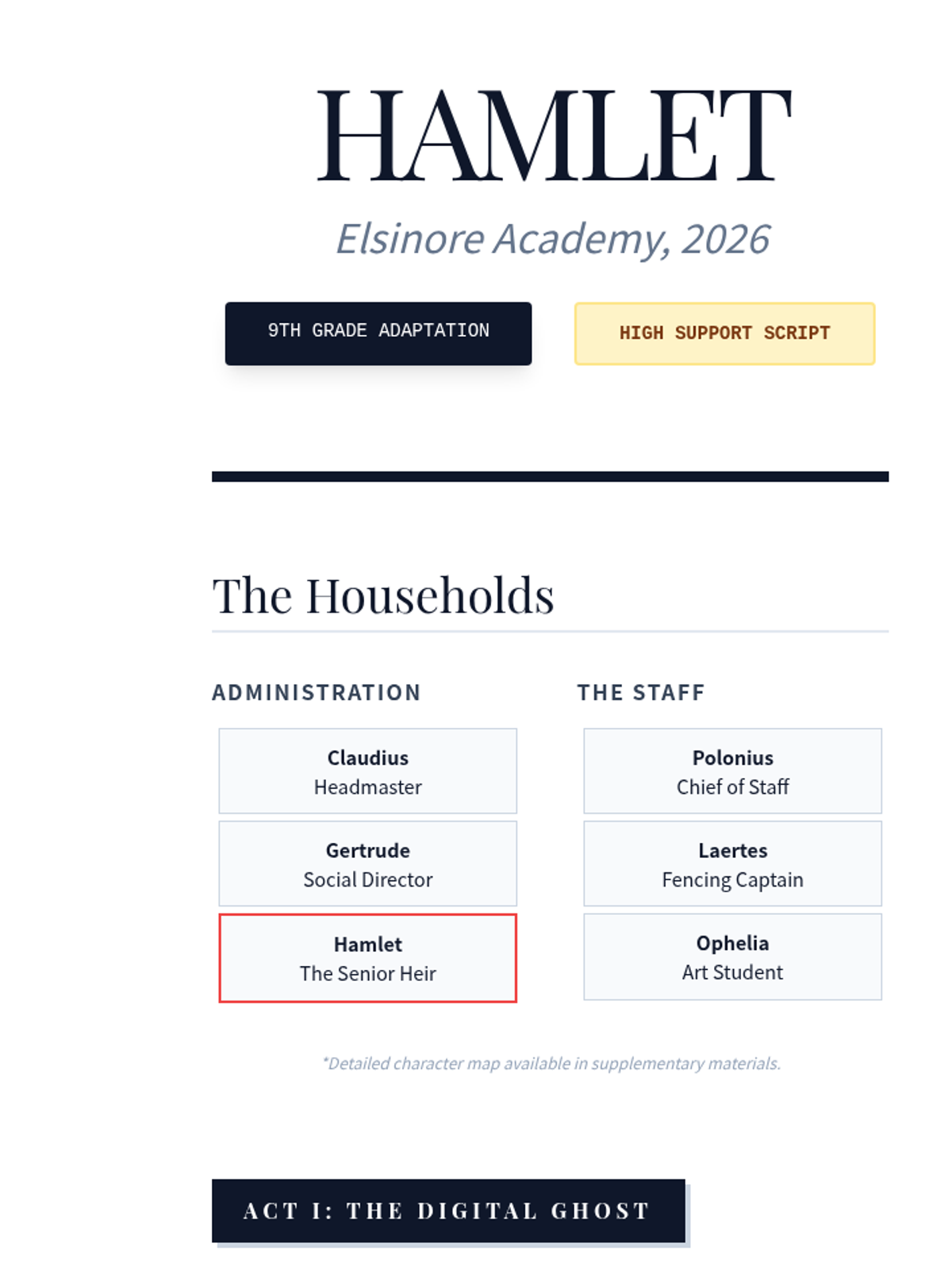
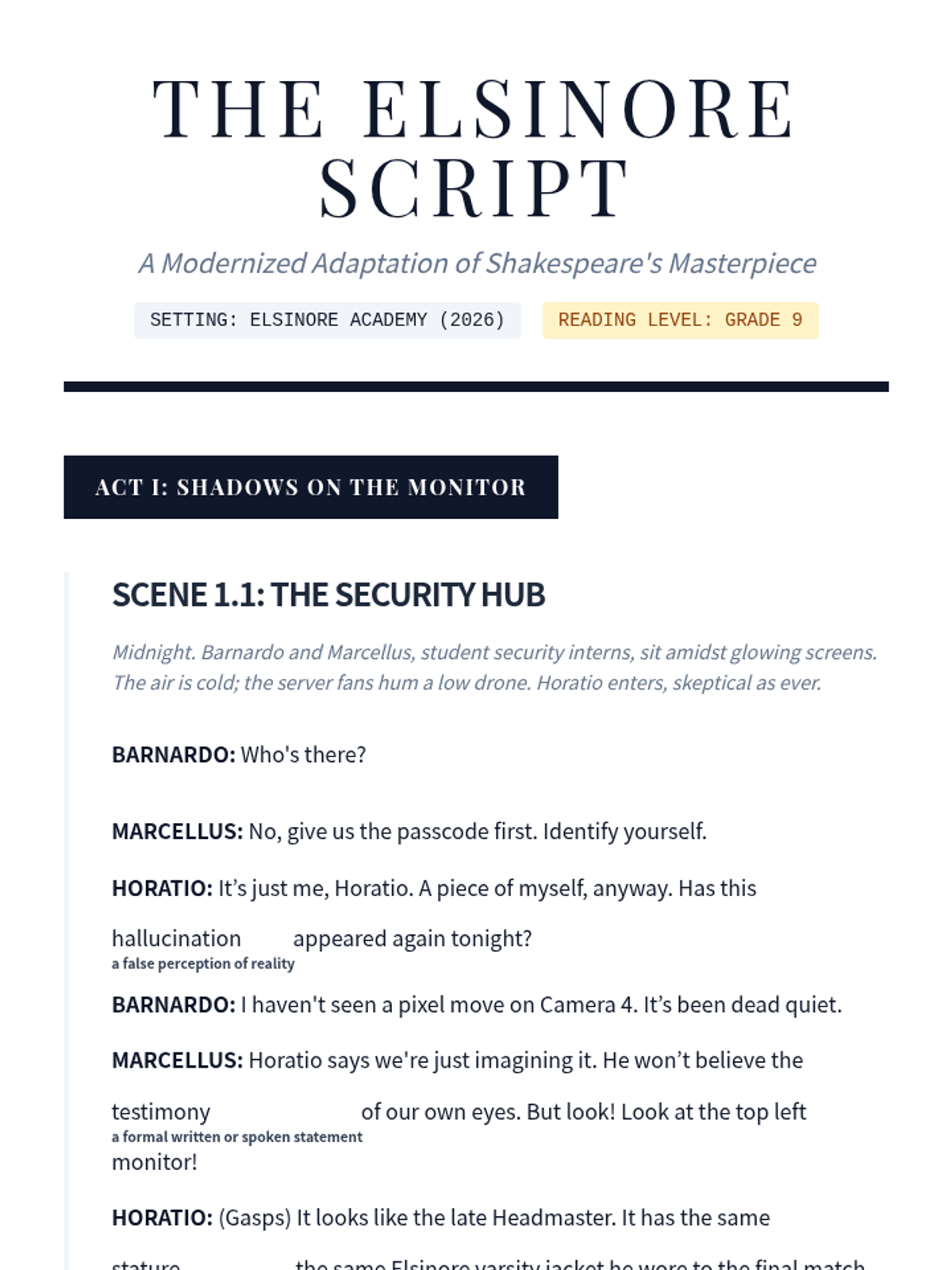
The complete five-act storyline of Hamlet modernized into a boarding school setting with high-frequency vocabulary support through a stable sidebar glossary. Expansion includes significantly more dialogue and key scenes to match the original play's weight. Uses a professional educational script layout with annotation space and integrated character map.
A character map styled as a surveillance board, showing relationships and roles of the modernized Hamlet characters at Elsinore Academy. Uses a stable 3-column layout to ensure correct connection alignment and includes tier 2/3 vocabulary subscripts. Corrected sticky note overlap and increased font contrast. Corrected connection lines for parents.
The complete five-act storyline of Hamlet modernized into a boarding school setting with high-frequency vocabulary support through a stable sidebar glossary. Expansion includes significantly more dialogue and key scenes to match the original play's weight. Uses a professional educational script layout with annotation space.
The complete five-act storyline of Hamlet modernized into a boarding school setting with high-frequency vocabulary support through subscripts. Expansion includes significantly more dialogue and key scenes to match the original play's weight. Includes a cast list and simplified relationship map on page 1. Fixed ruby positioning and alignment issues. Corrected Claudius/Hamlet names.
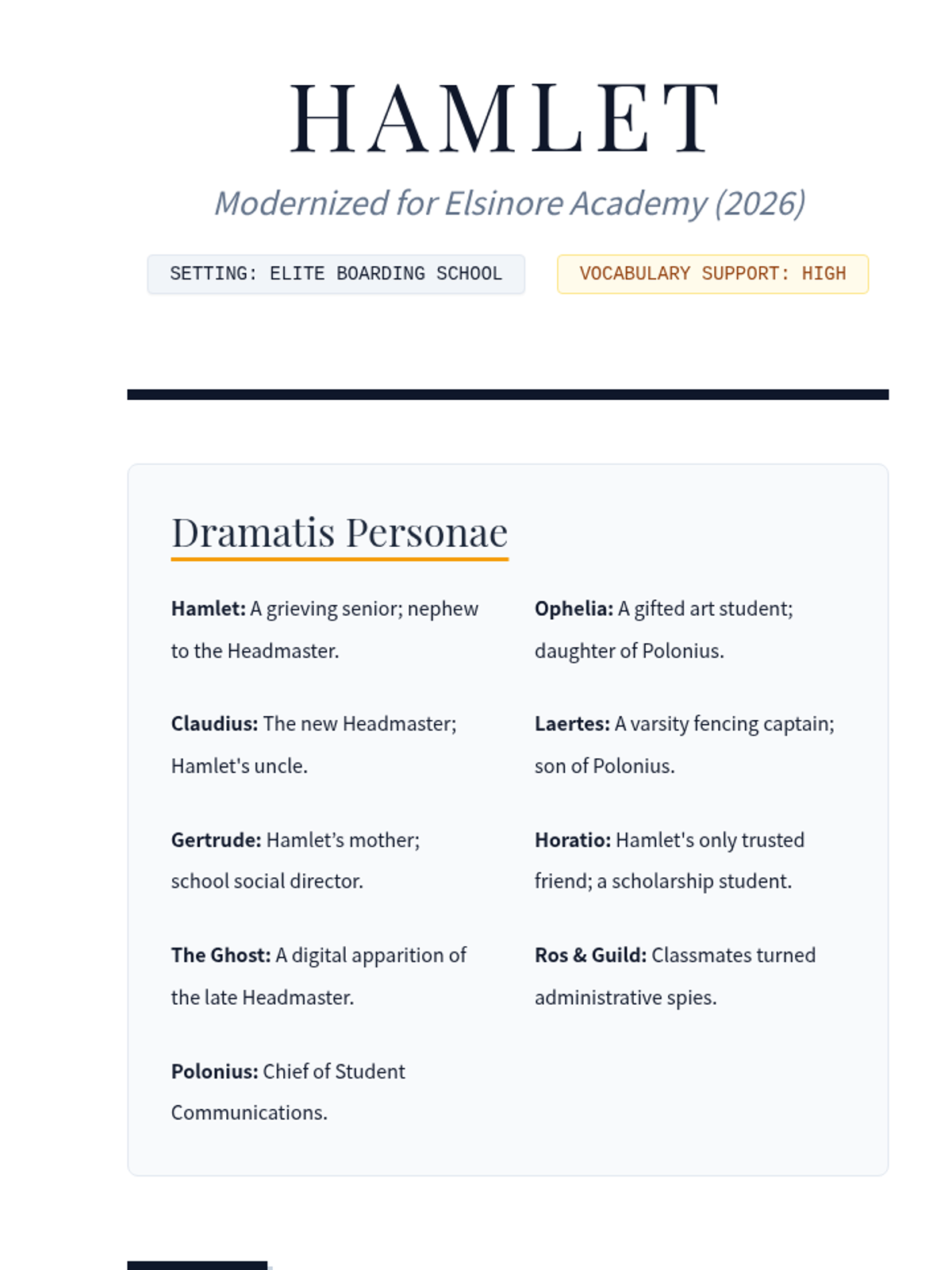
The complete five-act storyline of Hamlet modernized into a boarding school setting with high-frequency vocabulary support through subscripts. Expansion includes significantly more dialogue and key scenes to match the original play's weight. Includes a cast list and simplified relationship map on page 1. Fixed ruby positioning and alignment issues.
The complete five-act storyline of Hamlet modernized into a boarding school setting with high-frequency vocabulary support through subscripts. Expansion includes significantly more dialogue and key scenes to match the original play's weight. Includes a cast list and simplified relationship map on page 1.
The complete five-act storyline of Hamlet modernized into a boarding school setting with high-frequency vocabulary support through subscripts. Expansion includes significantly more dialogue and key scenes to match the original play's weight.
A character map styled as a surveillance board, showing relationships and roles of the modernized Hamlet characters at Elsinore Academy. Corrected relationship lines for Polonius and his children. Now includes tier 2/3 vocabulary subscripts. Corrected Claudius/Hamlet names and SVG lines for layout stability.
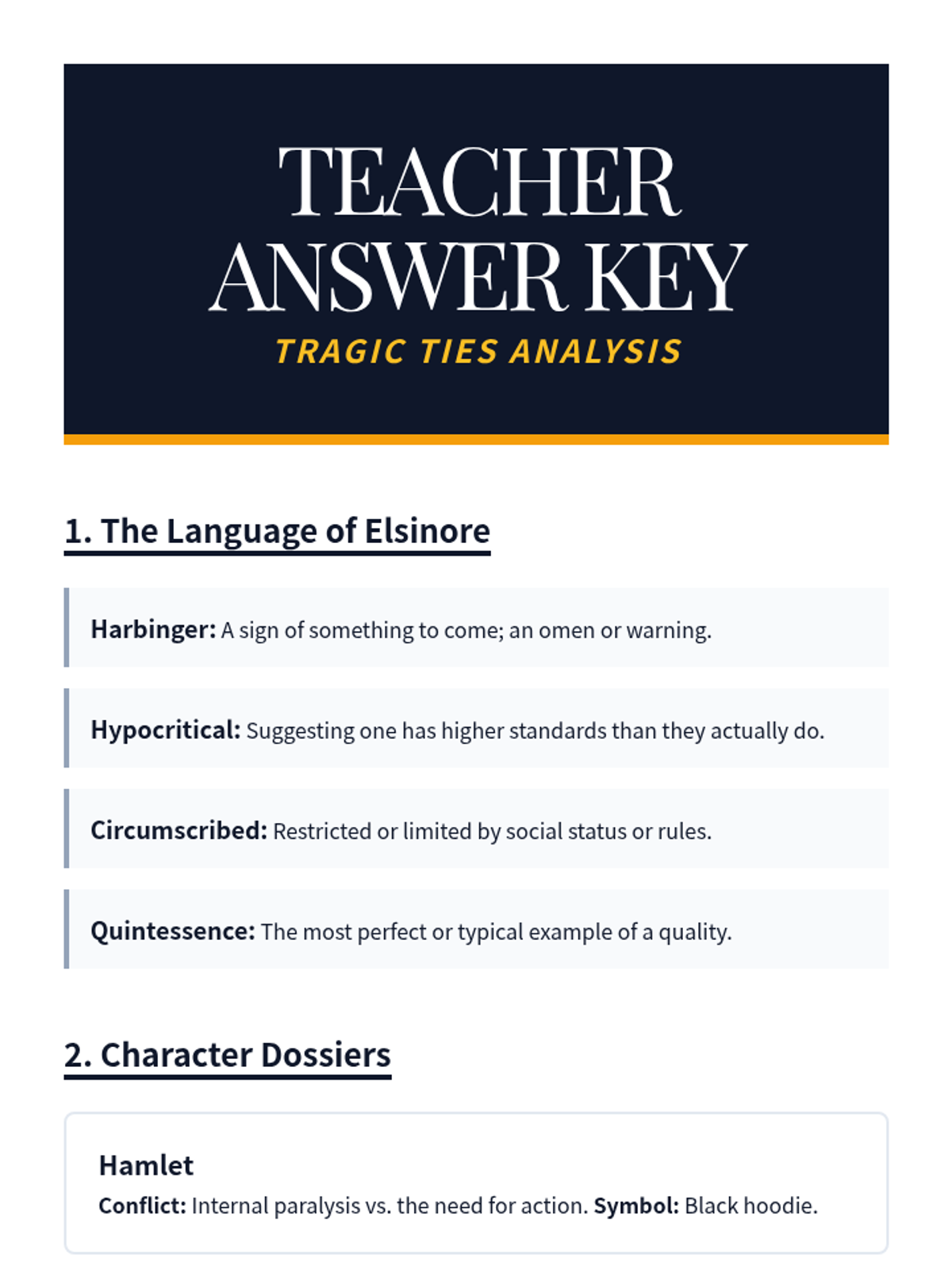
The answer key for the Tragic Ties Worksheet, providing definitions and analysis for the teacher.
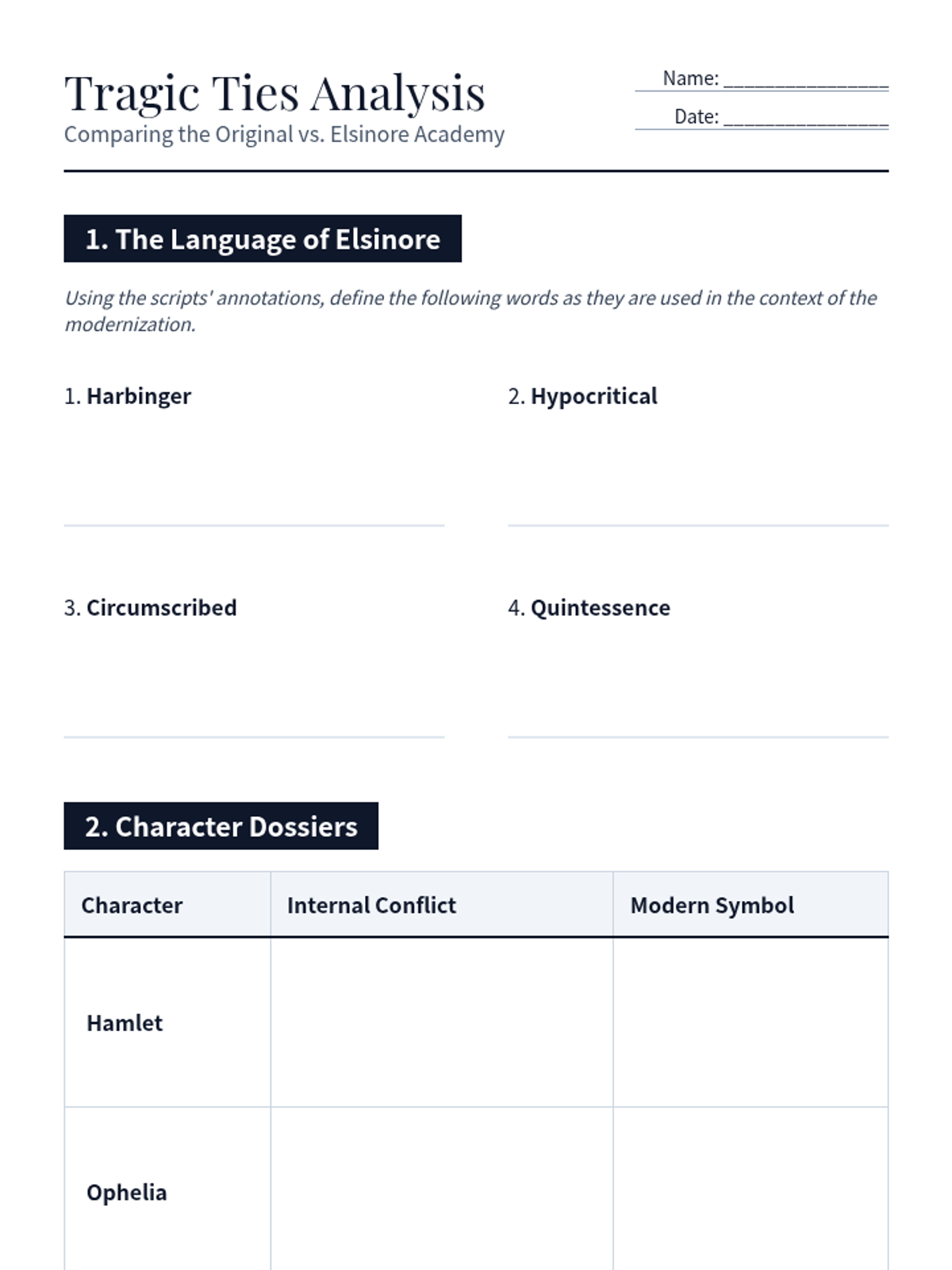
A student worksheet focused on vocabulary mastery and character analysis within the modernized Elsinore Academy setting.
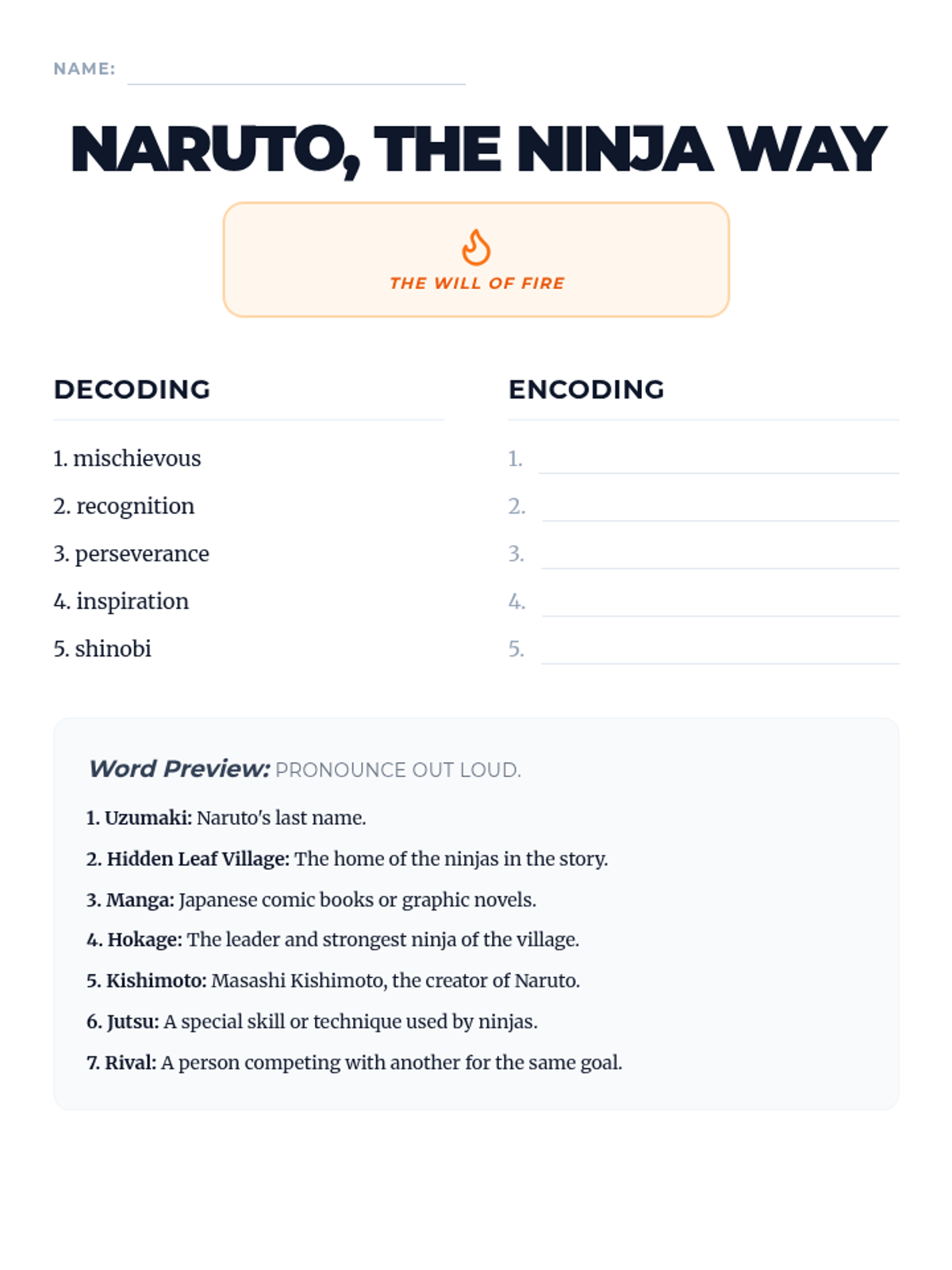
A complete 6-page reading packet about Naruto and creator Masashi Kishimoto. Includes decoding/encoding skills, a fluency passage with word counts, a themed focus question, 10 multiple-choice comprehension questions, and a bonus drawing mission.
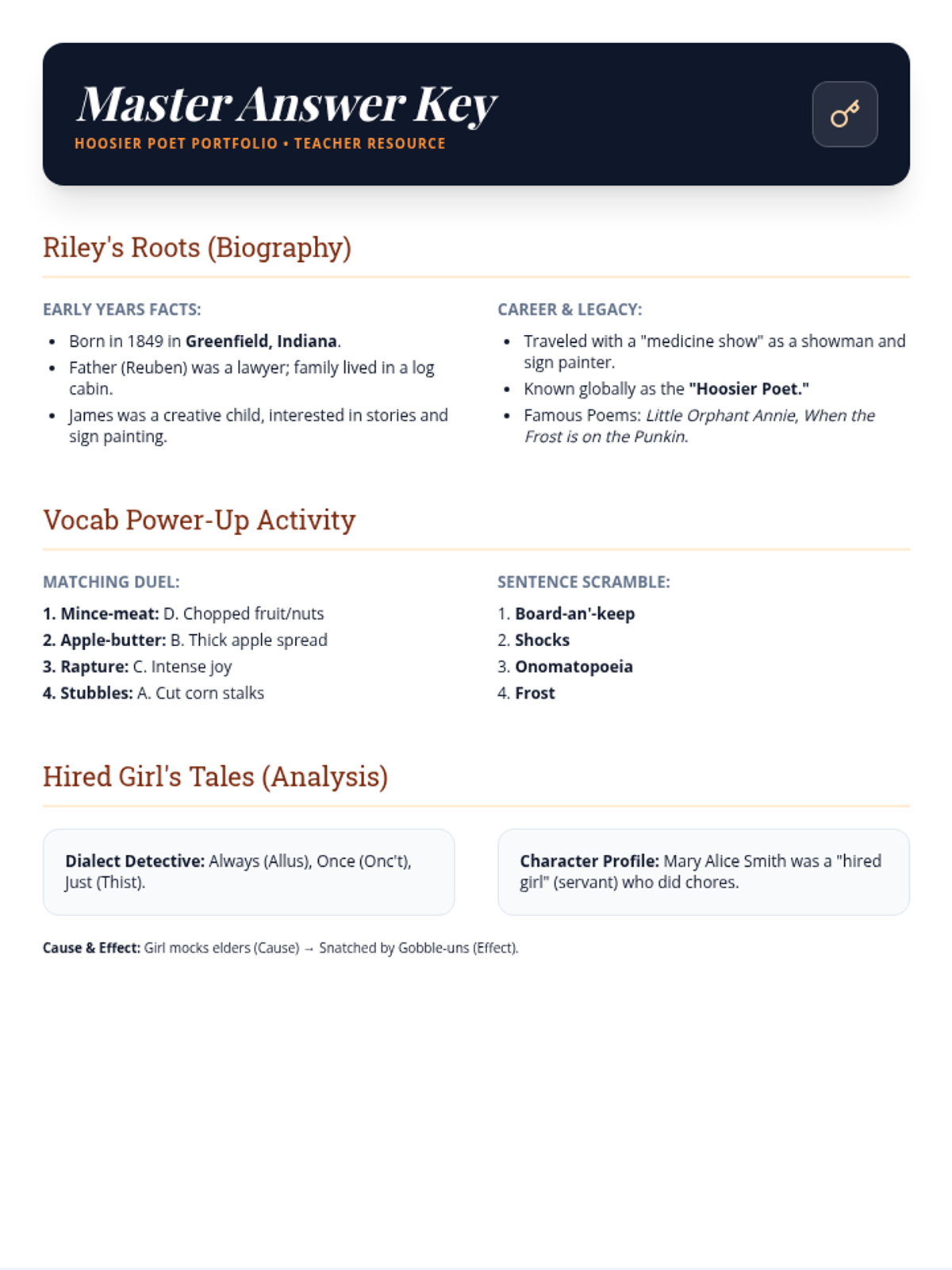
A comprehensive answer key for all student-facing worksheets in the James Whitcomb Riley unit. It provides translations for dialect terms, character descriptions, analysis findings, and sensory imagery examples.
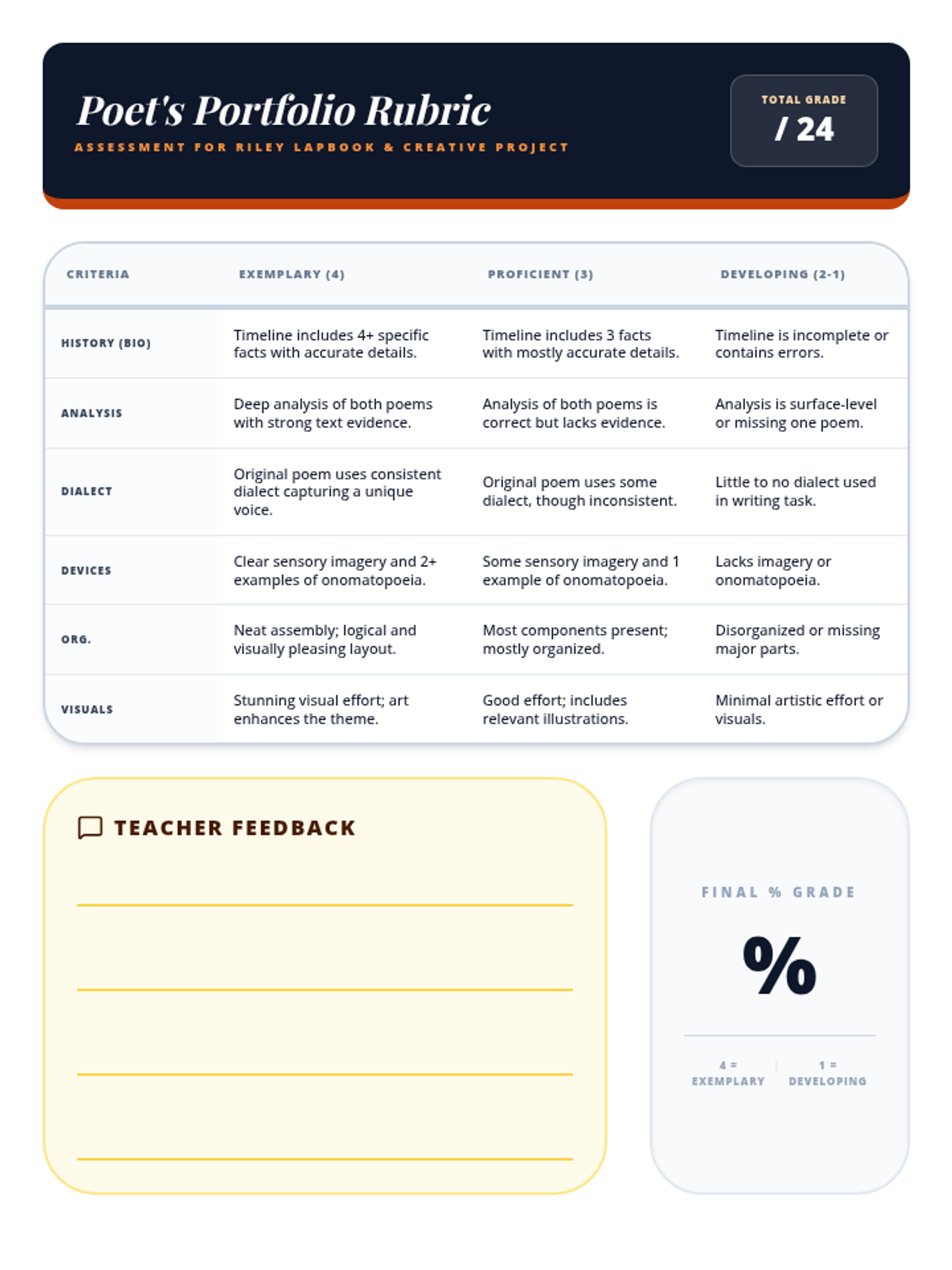
A project-based rubric for the Hoosier Poet Portfolio. It evaluates students on historical accuracy, poetry analysis, creative use of dialect, application of literary devices (imagery, onomatopoeia), lapbook organization, and overall creativity.
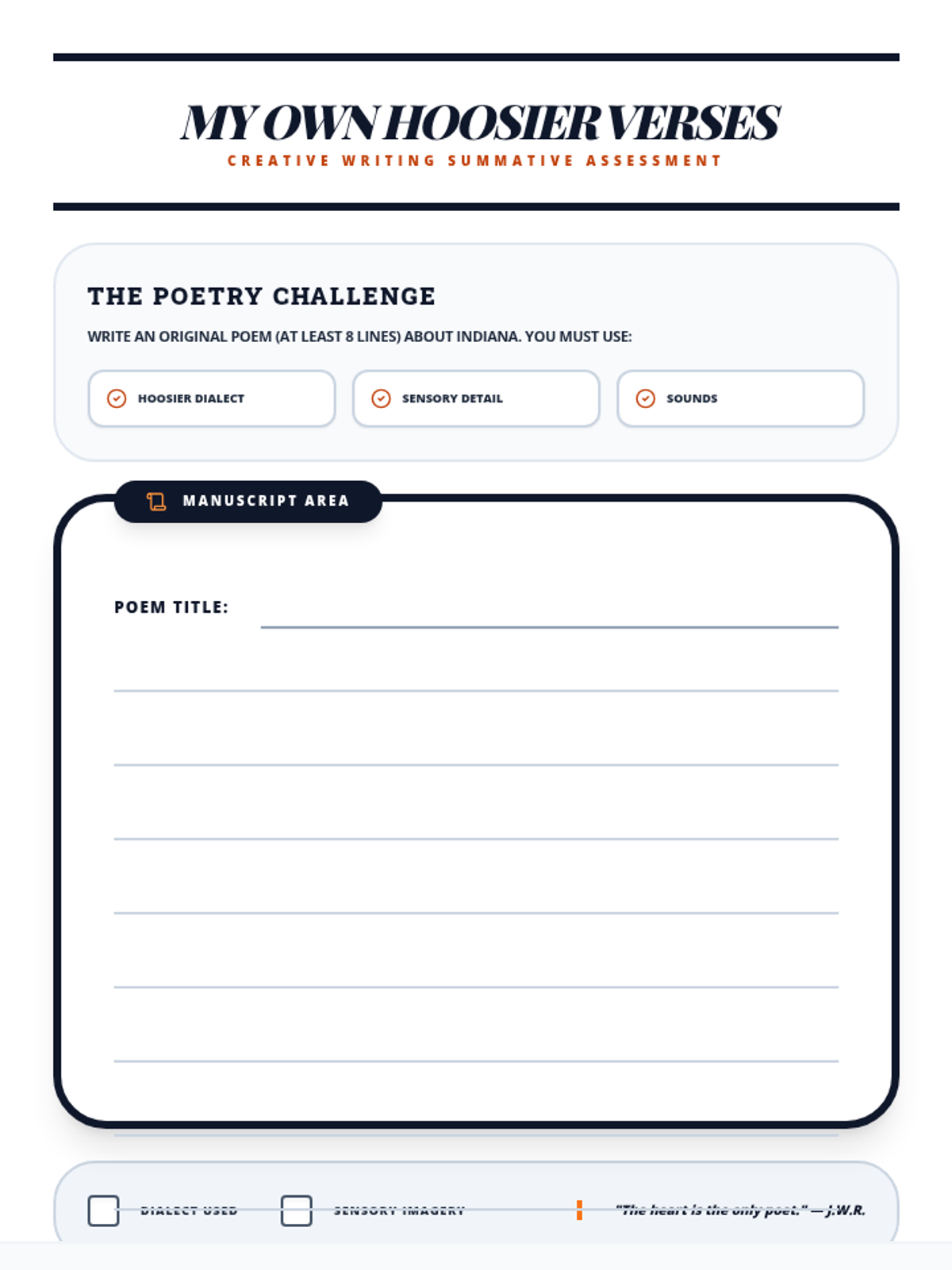
A creative writing prompt and template for students to write their own original poem in the style of James Whitcomb Riley. The task requires the use of Hoosier dialect, sensory imagery, and onomatopoeia to describe a modern Indiana scene. Includes a scoring guide.
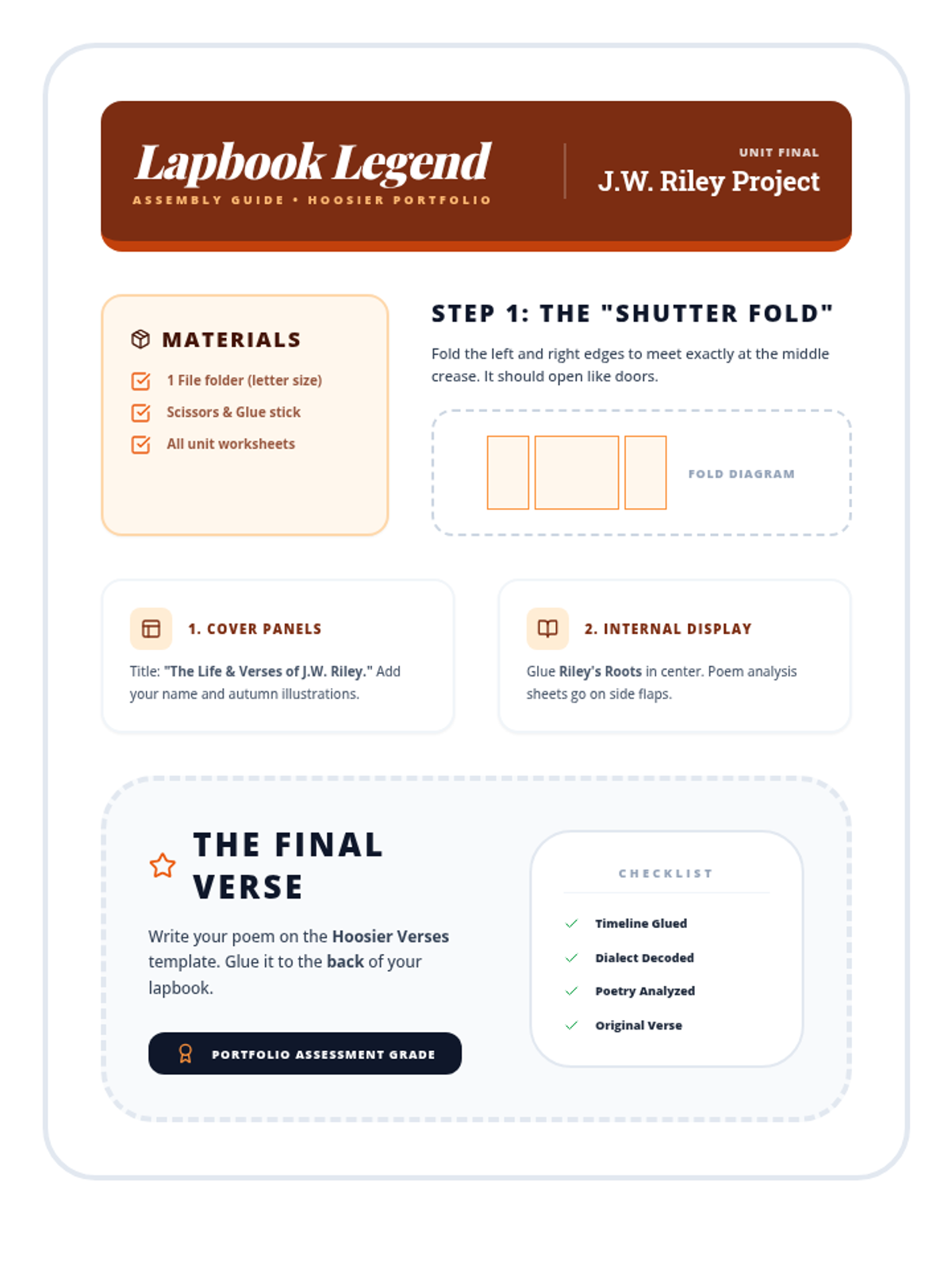
A guide for students on how to assemble their final interactive lapbook project. It includes visual diagrams for folding the folder, instructions on where to place the various components (biography, poem analysis), and a checklist for completion.
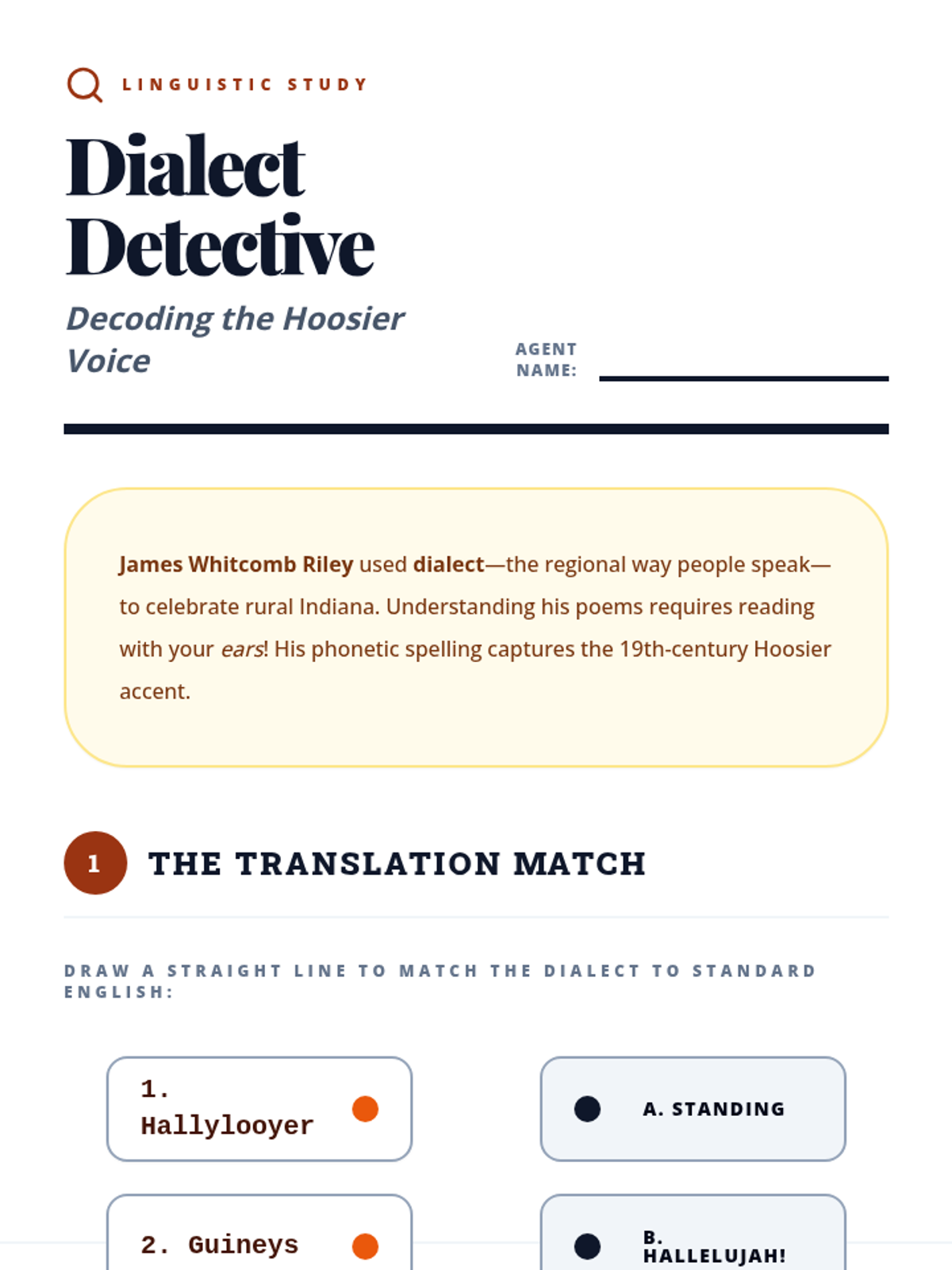
A vocabulary and language activity focused on James Whitcomb Riley's Hoosier dialect. Students match historical dialect words to modern meanings, use context clues to define agricultural terms, and experiment with modern Indiana slang. Includes a teacher answer key.
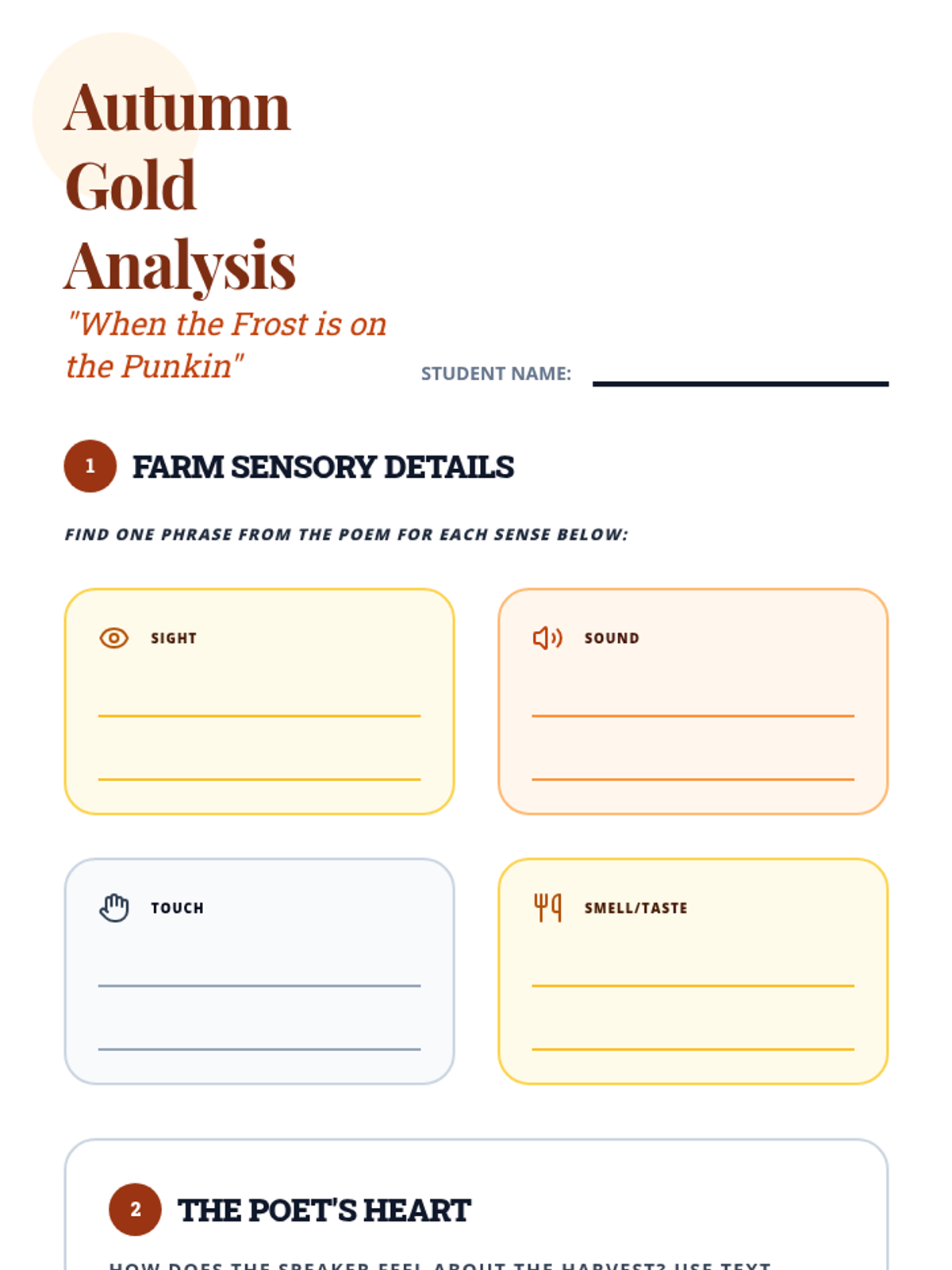
A worksheet for "When the Frost is on the Punkin" that guides students through identifying sensory details (sight, sound, touch, taste/smell), analyzing onomatopoeia, and interpreting the author's tone and mood regarding the harvest season. Includes a teacher answer key.
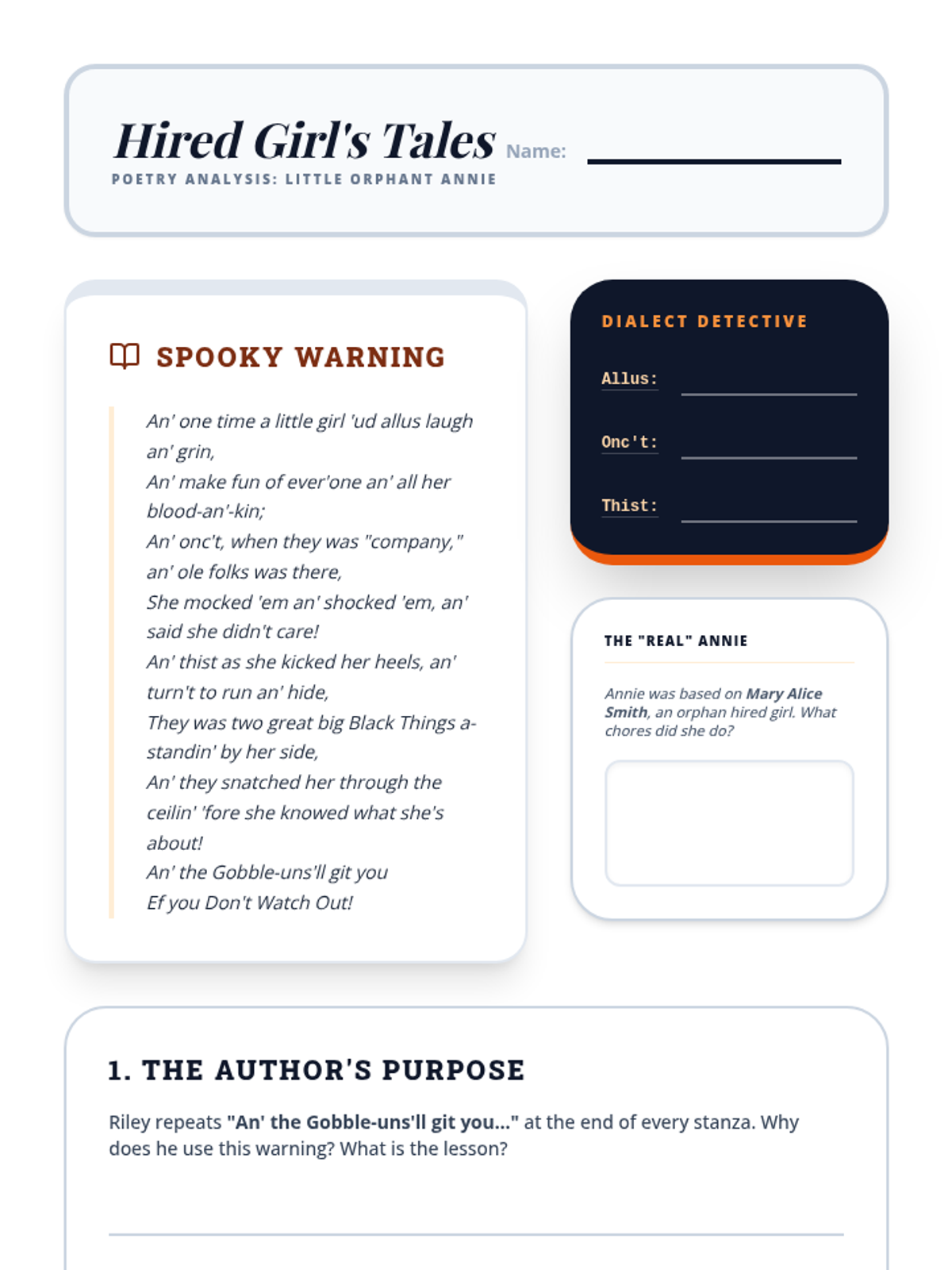
An analysis worksheet for Riley's "Little Orphant Annie." It focuses on dialect translation, cause-and-effect relationship between behavior and the supernatural warnings in the poem, and visual interpretation of the poem's imagery. Includes a teacher answer key.
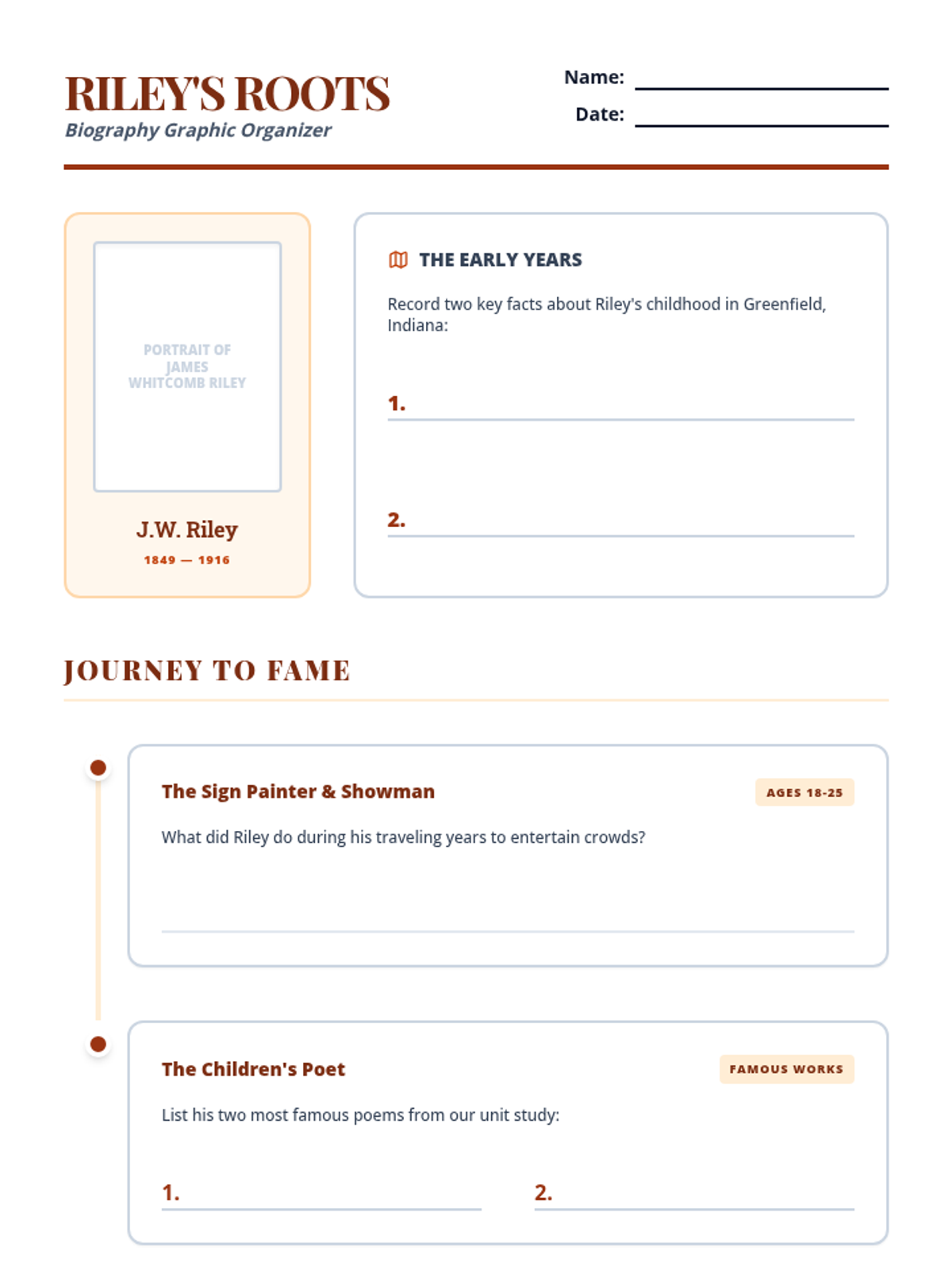
A biography graphic organizer for student note-taking. It features a timeline of Riley's life, a portrait sketch area, and guided prompts about his early life in Greenfield, his "medicine show" days, and his literary legacy in Indiana. Includes a teacher answer key.
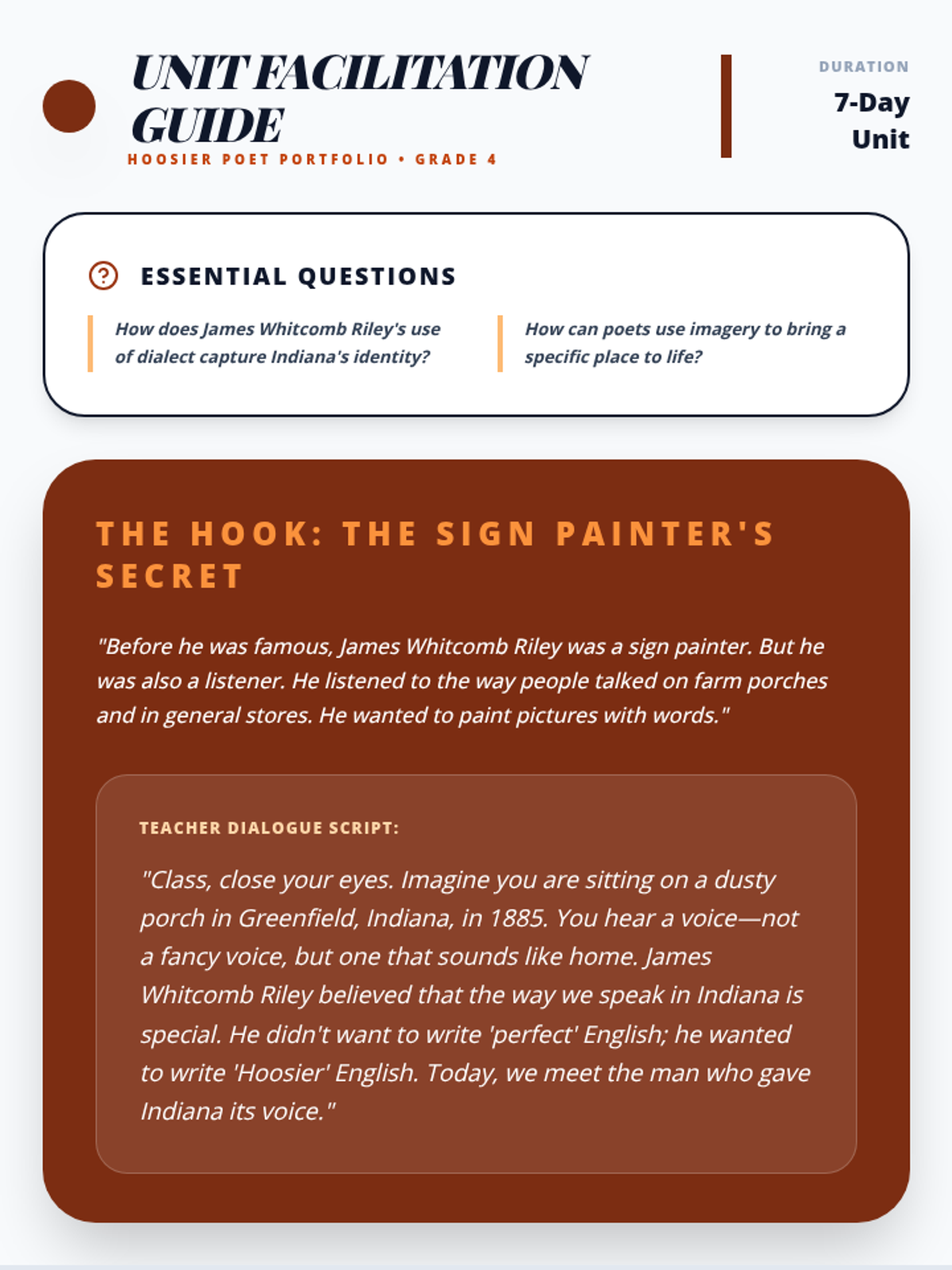
A highly detailed, multi-page teacher facilitation guide. Includes an engaging "hook," scripted teacher dialogue, higher-order thinking questions for each stage of the unit, and a day-by-day procedural breakdown for implementing the James Whitcomb Riley portfolio project.
A visually rich slide deck for teaching James Whitcomb Riley's biography, Hoosier dialect, and analysis of his two most famous poems: "Little Orphant Annie" and "When the Frost is on the Punkin." Includes clear explanations of imagery and onomatopoeia.
An introductory presentation for teachers to use in class, explaining the common grammatical patterns of Shakespearean English with bilingual support.
A trilingual dictionary (Shakespearean, Modern English, Spanish) containing nearly 200 archaic terms essential for understanding Macbeth, organized alphabetically for student reference.
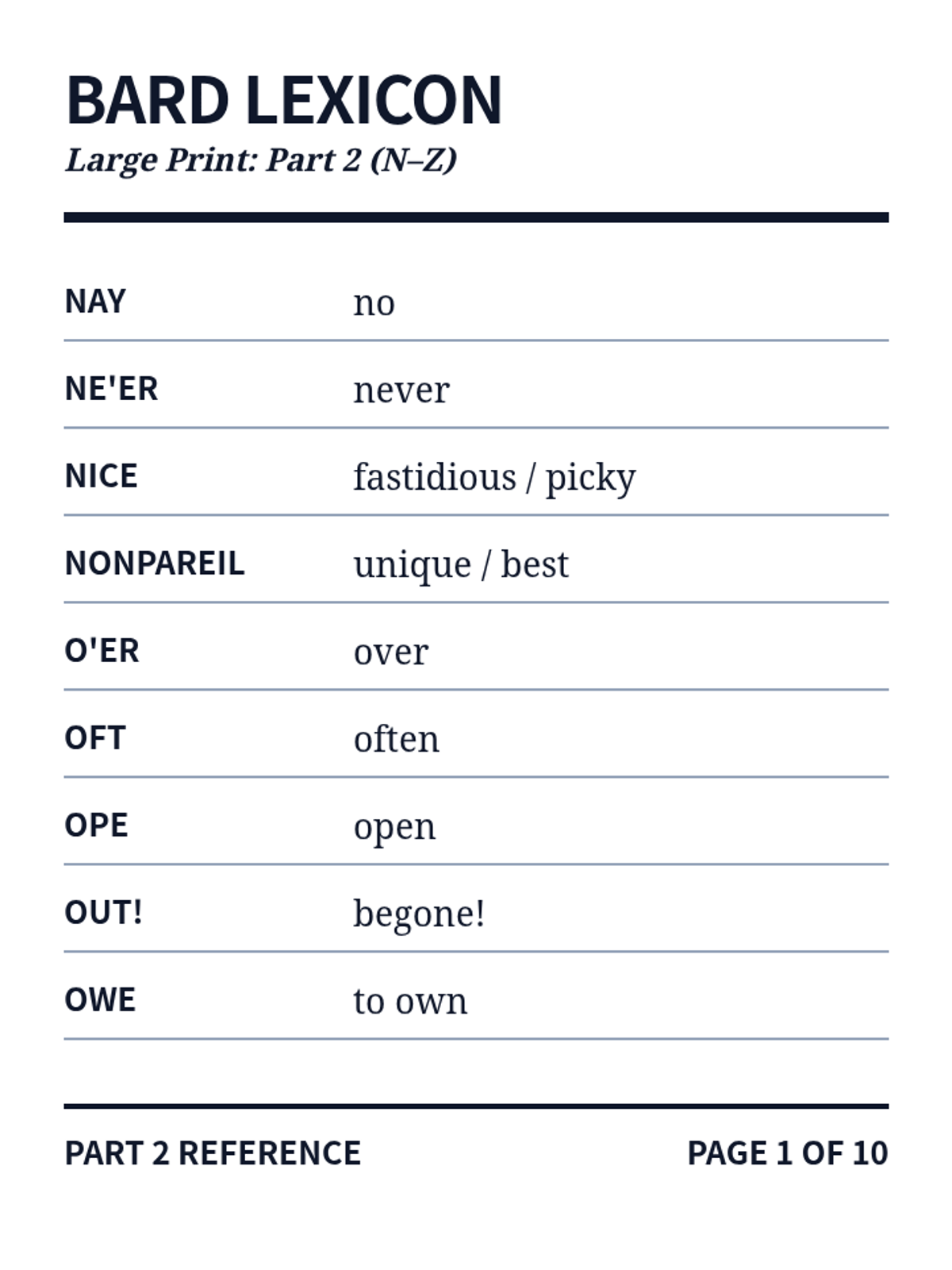
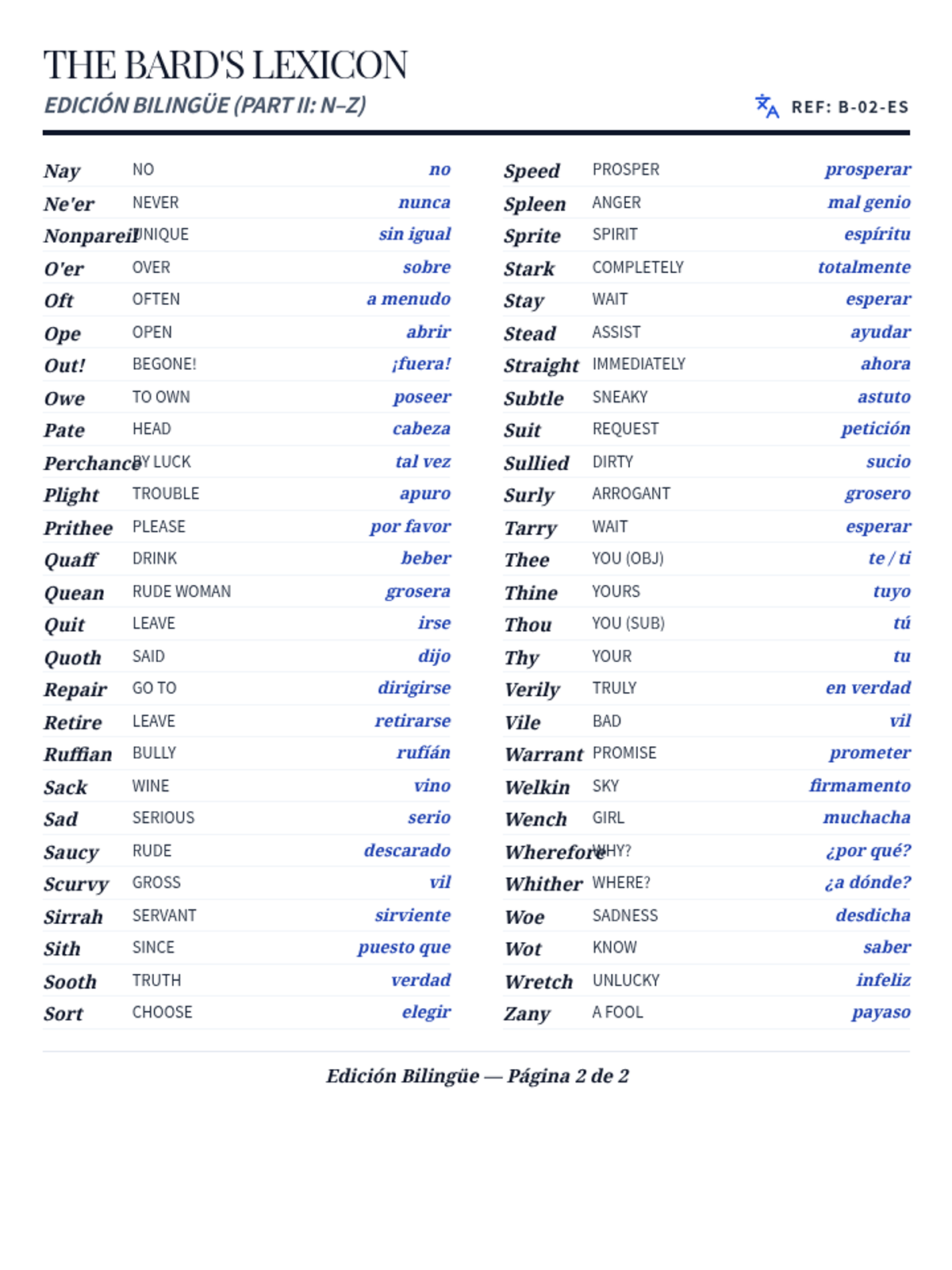
Part 2 (N-Z) of the Bard Lexicon in large print (20pt font) for visually impaired students. Features high-contrast text and a single-column layout for maximum readability.
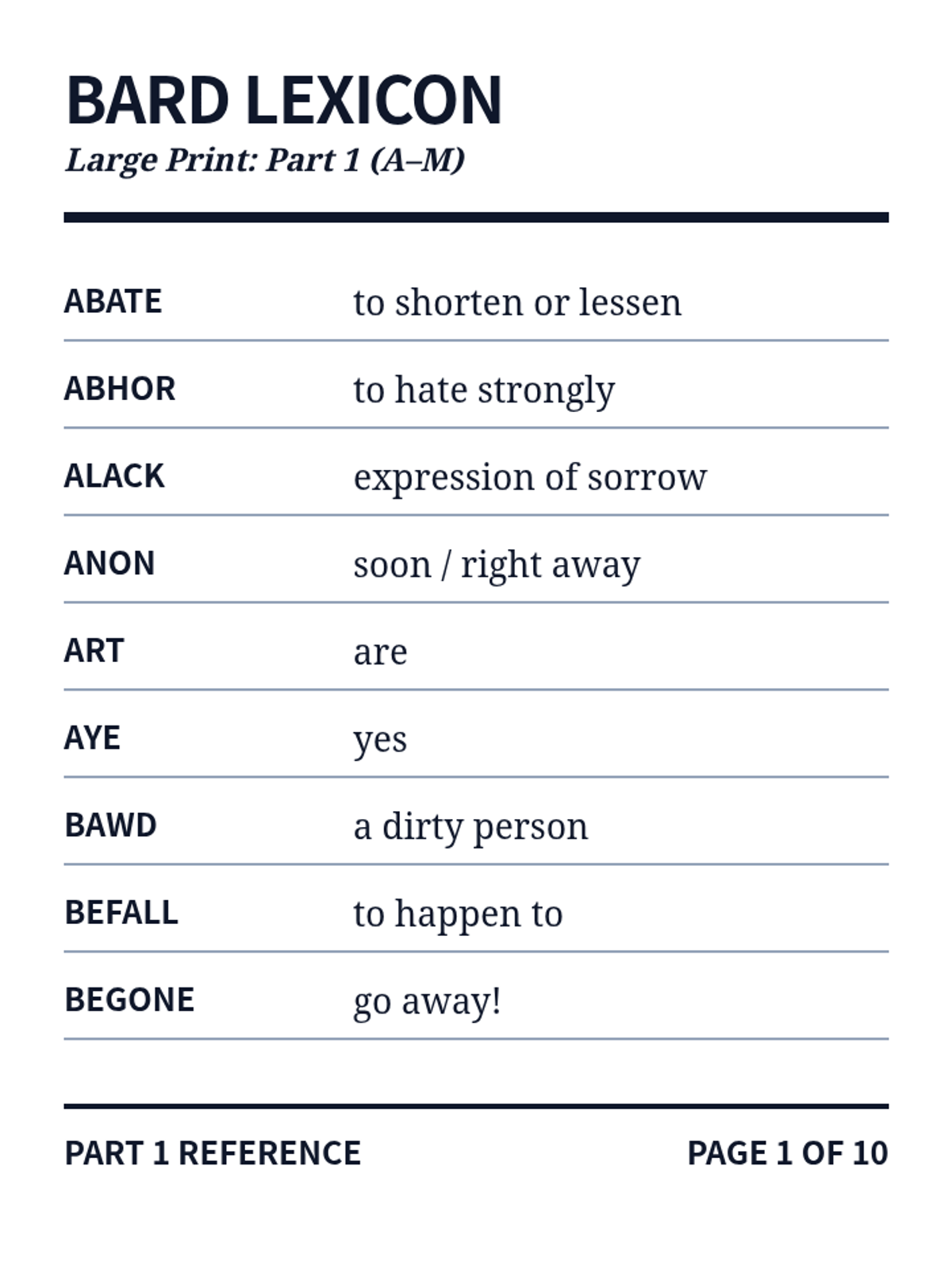
Part 1 (A-M) of the Bard Lexicon in large print (20pt font) for visually impaired students. Features high-contrast text and a single-column layout for maximum readability.
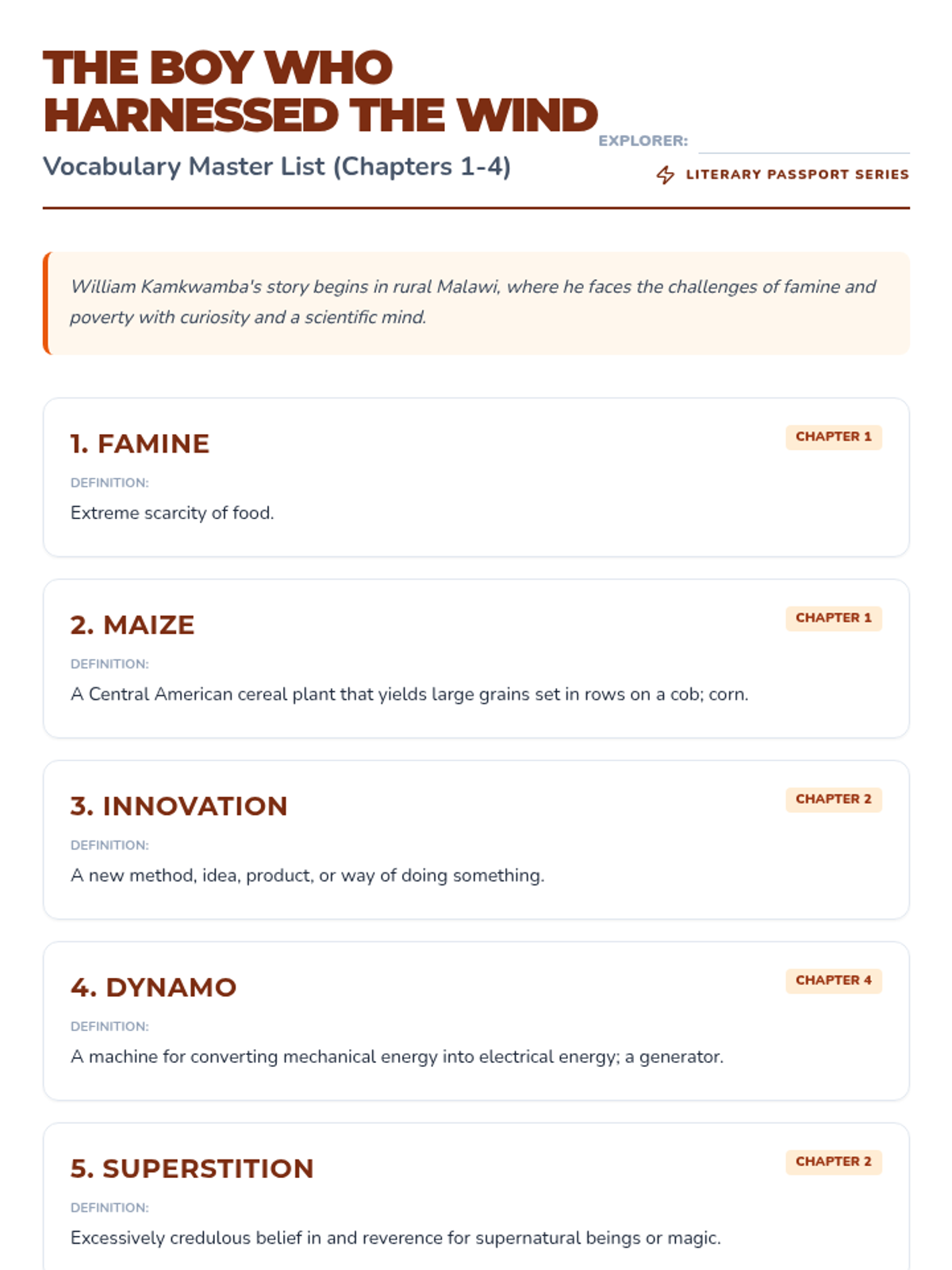
A vocabulary list for the first four chapters of The Boy Who Harnessed the Wind. Key terms include famine, dynamo, and innovation, reflecting the environmental and technical aspects of the memoir.
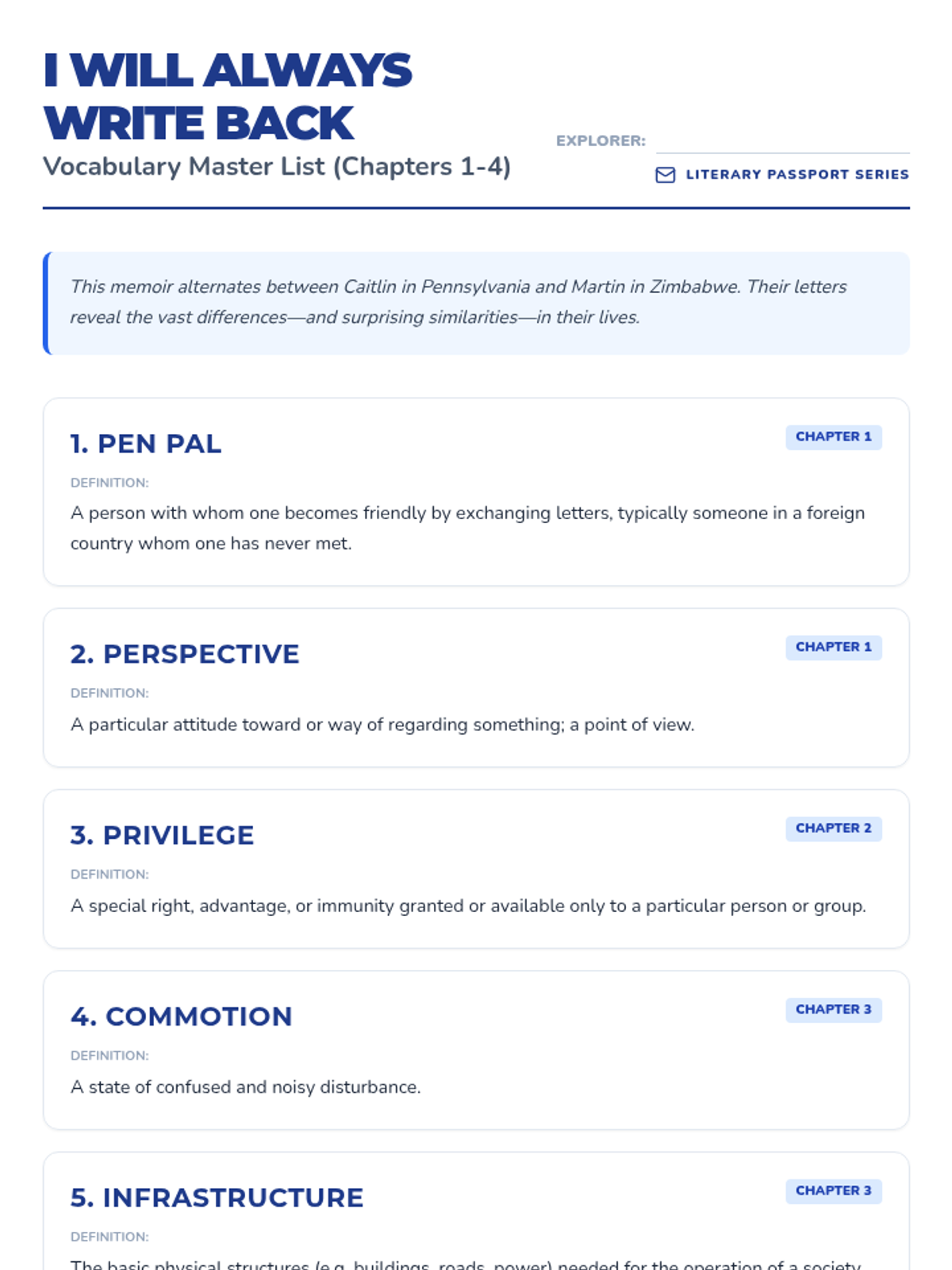
A vocabulary list for the first four chapters of I Will Always Write Back. Focuses on terms like perspective, privilege, and infrastructure to highlight the contrast between the two main characters' environments.
Part 2 of the bilingual (English/Spanish) visual word bank for the Shakespearean encoding activity, completing the alphabet with common Elizabethan words and their modern translations in pt. 10.5 font. Updated for layout and contrast issues.
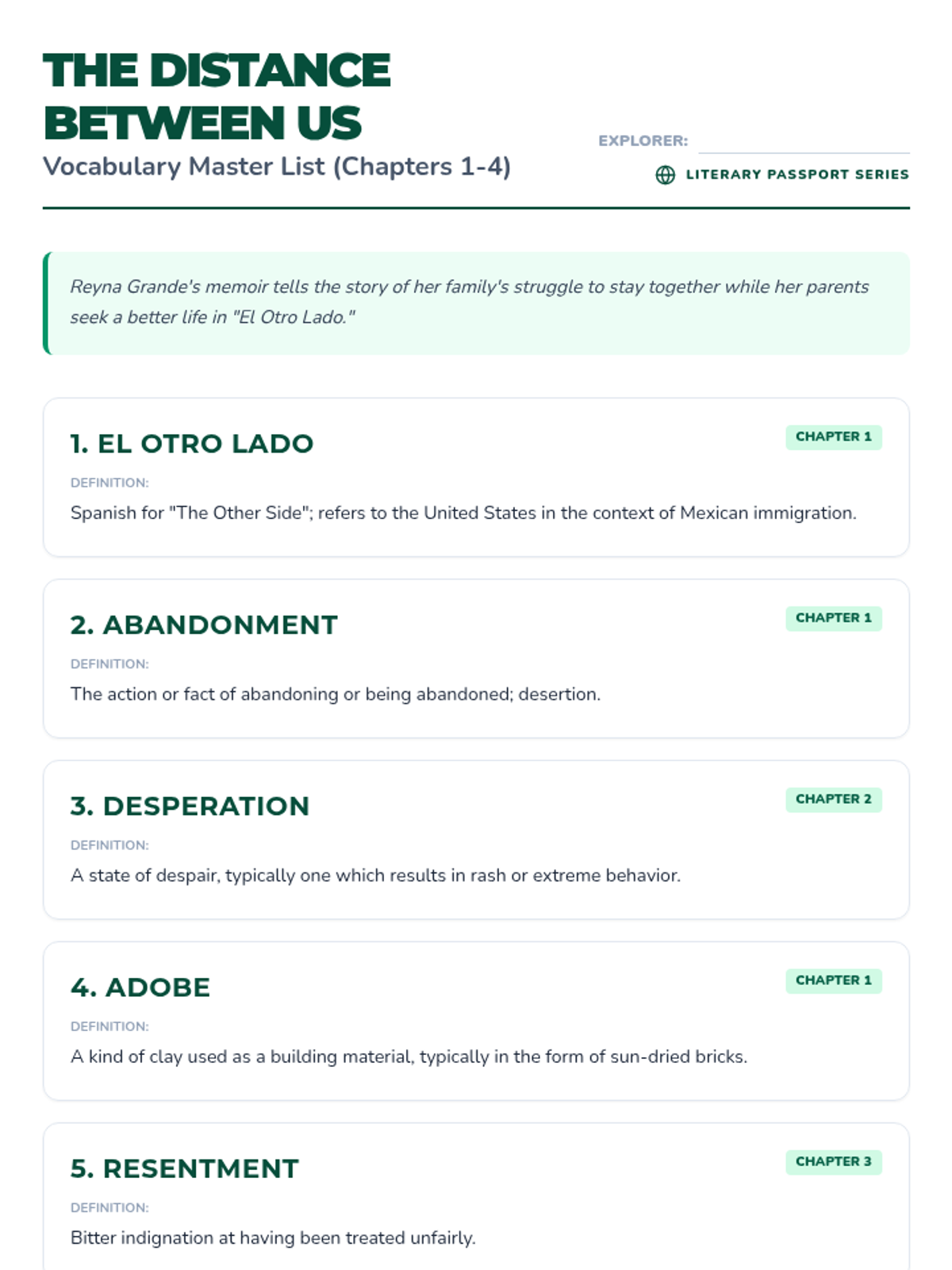
A vocabulary list for the first four chapters of The Distance Between Us. Includes cultural terms like El Otro Lado and adobe, as well as thematic words like resilience and abandonment.
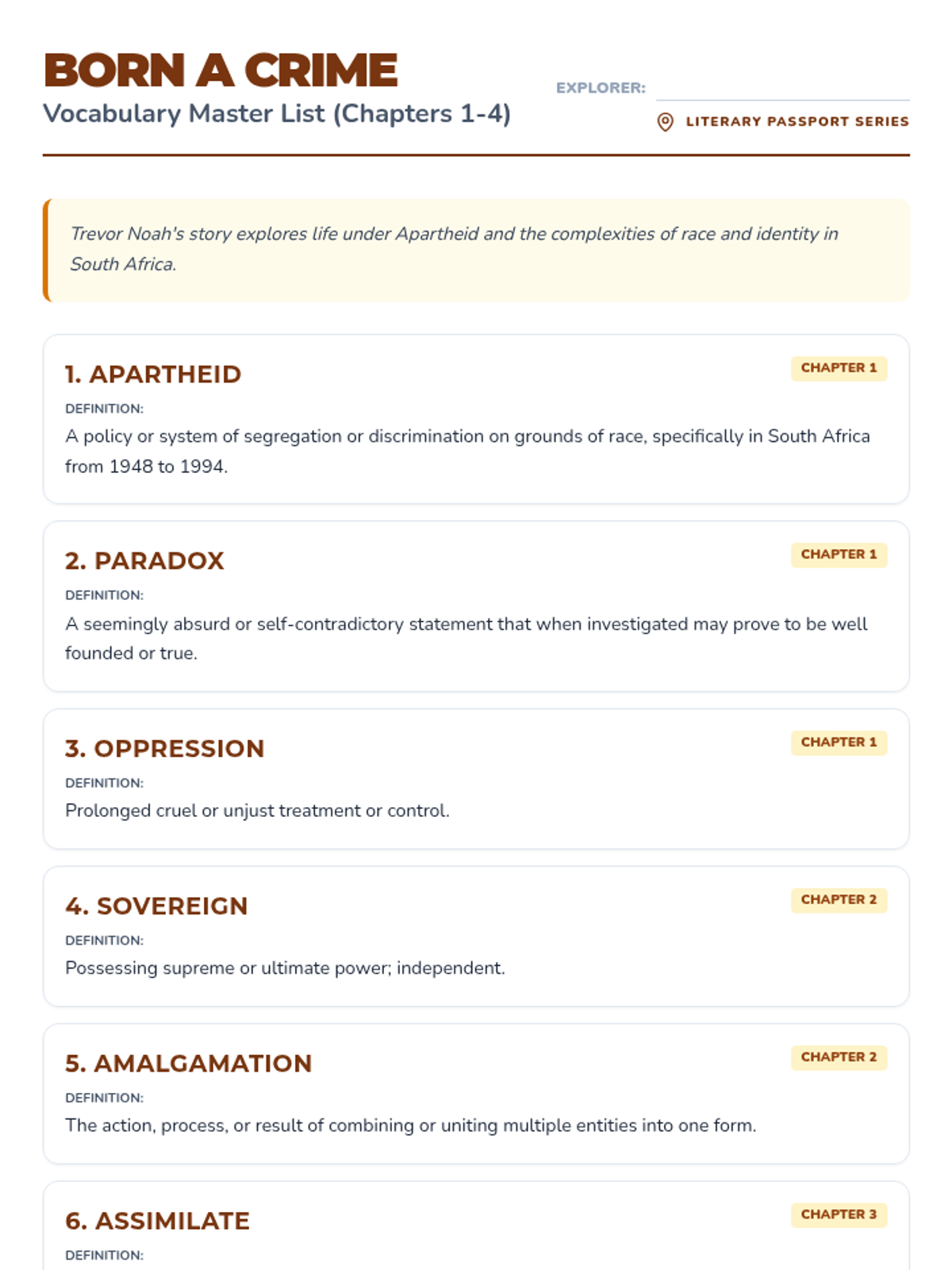
A vocabulary list for the first four chapters of Born a Crime by Trevor Noah. Key terms include apartheid, paradox, and sovereign, with a focus on South African history and identity.
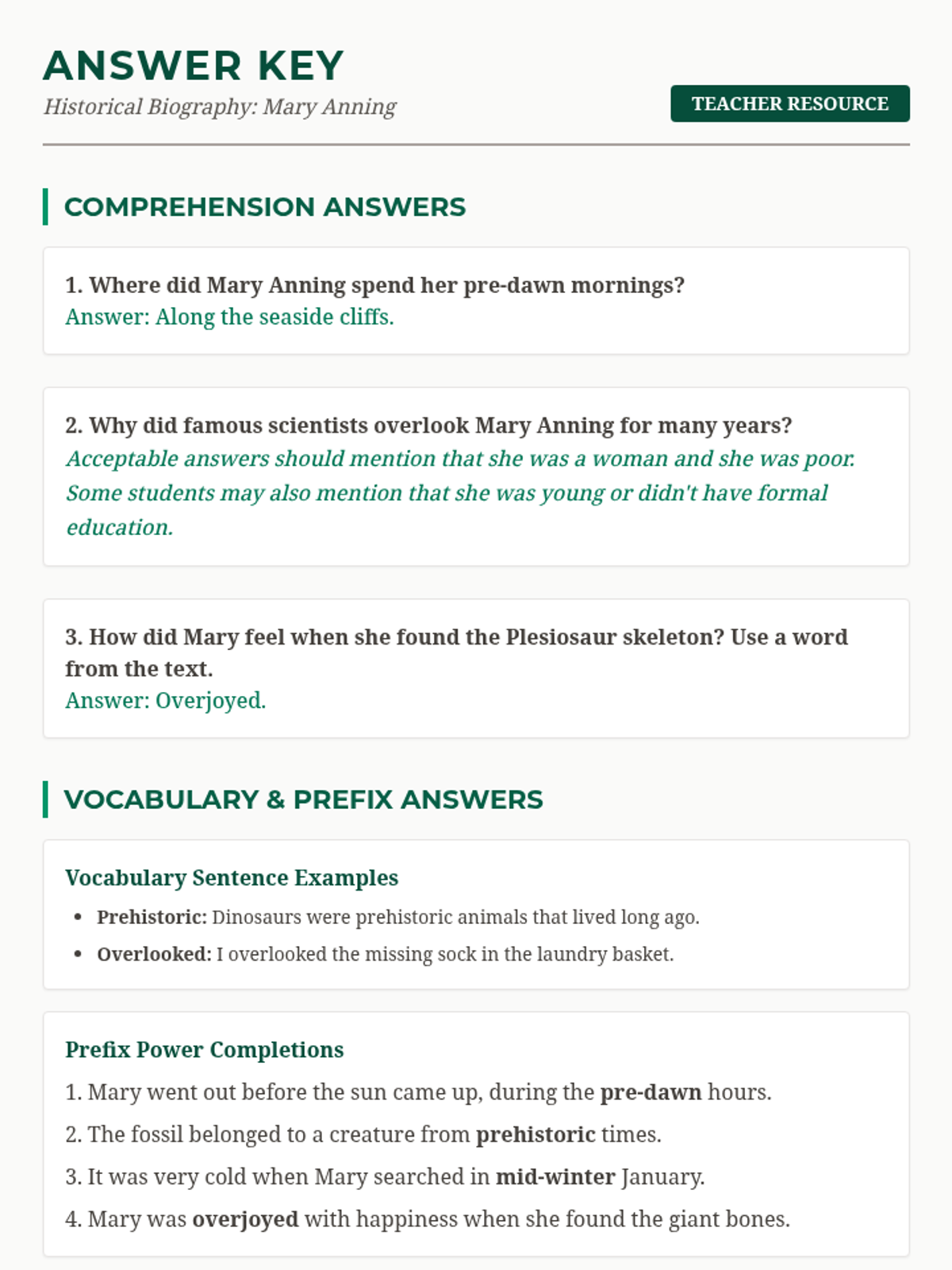
Updated teacher's answer key for the final version of the Fossil Hunter Reading Worksheet, reflecting the longer passage and updated question set. Revised for better layout and clarity.
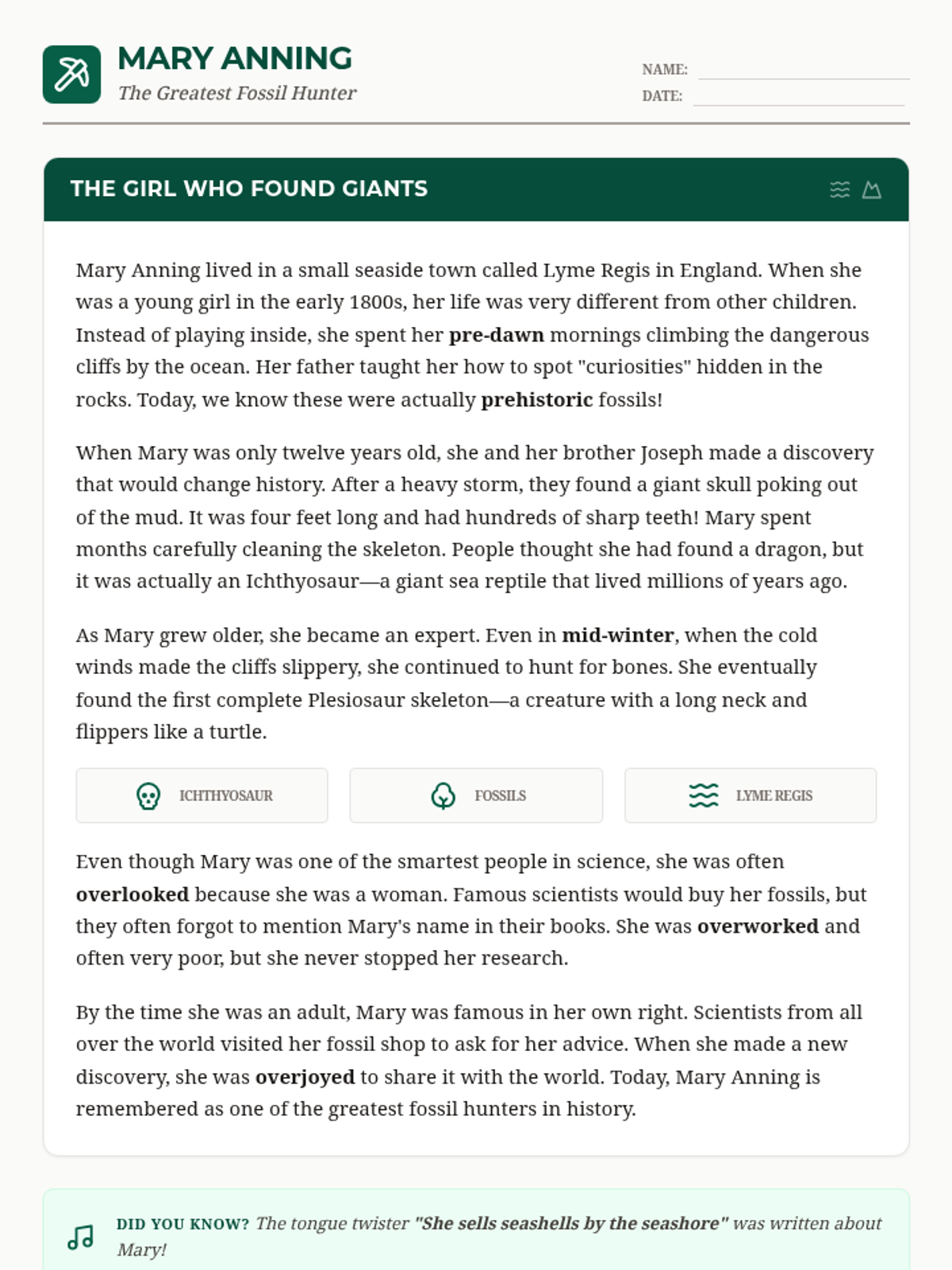
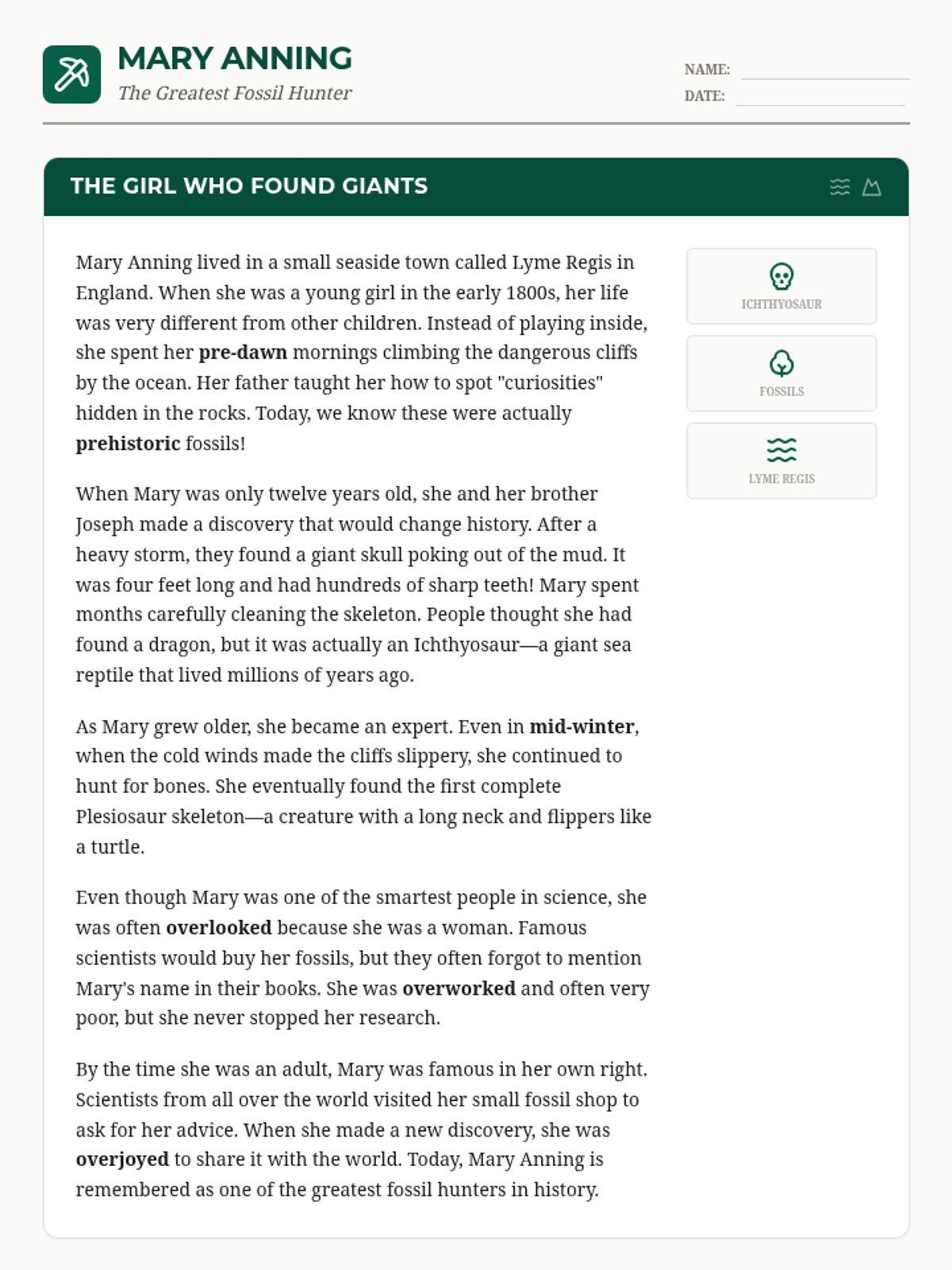
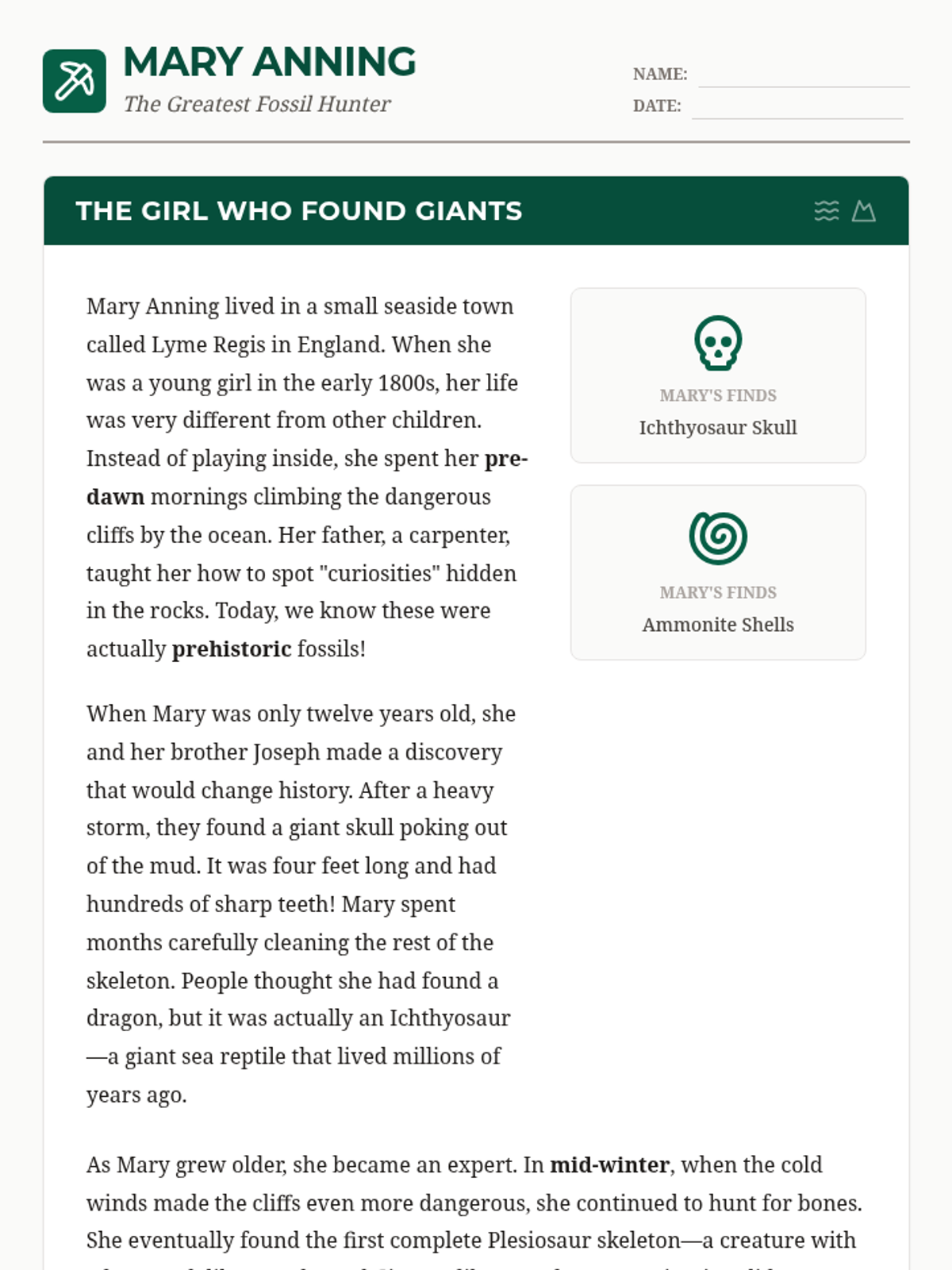
A Grade 3 reading comprehension worksheet about fossil hunter Mary Anning, featuring a significantly longer biography passage across three pages, visual icons for fossil finds, vocabulary exercises, and a word study section on the prefixes pre-, mid-, and over-. Revised for optimal page flow and clarity.
Updated teacher's answer key for the Fossil Hunter Reading Worksheet, reflecting the longer passage and new comprehension questions.
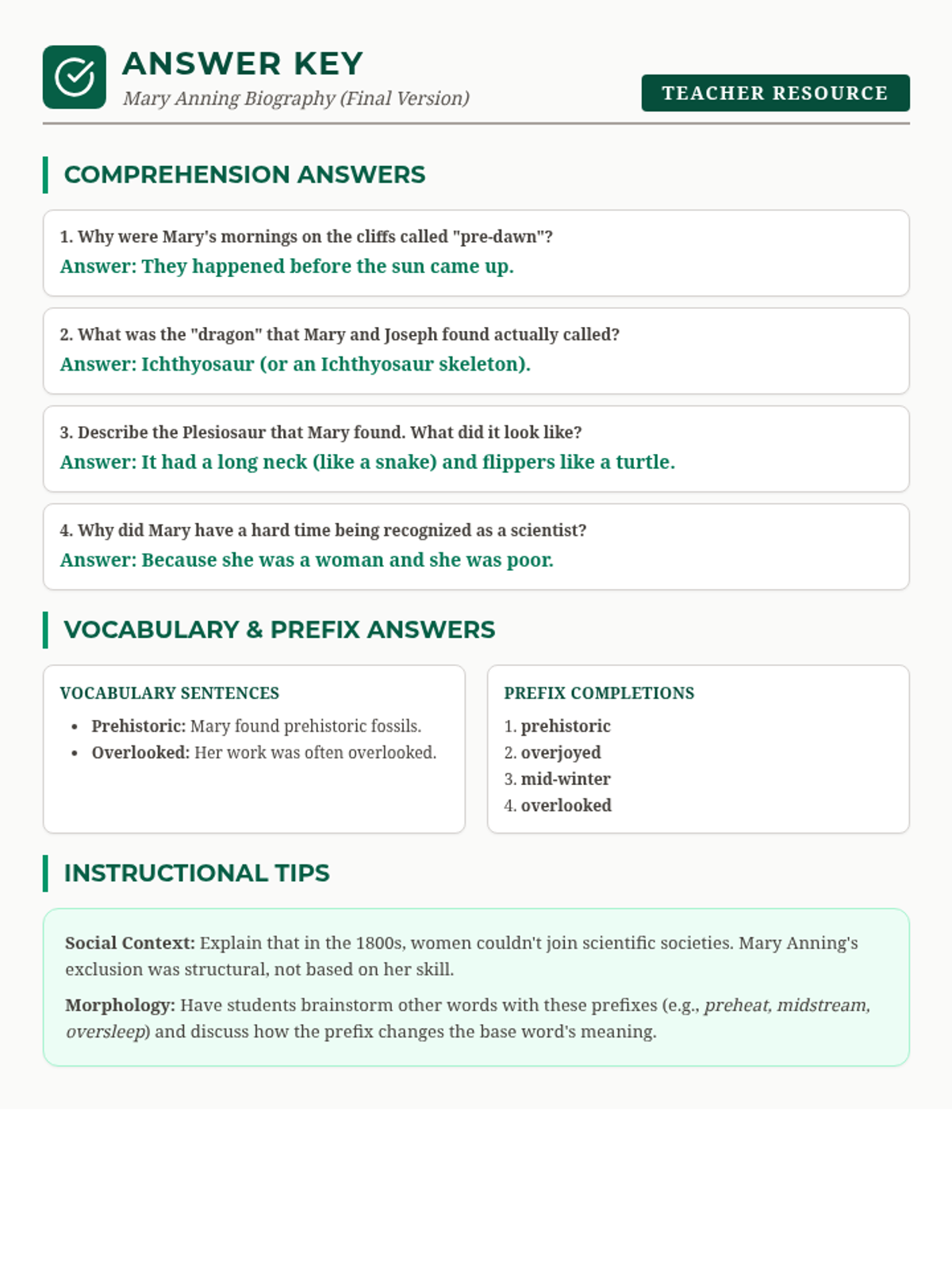
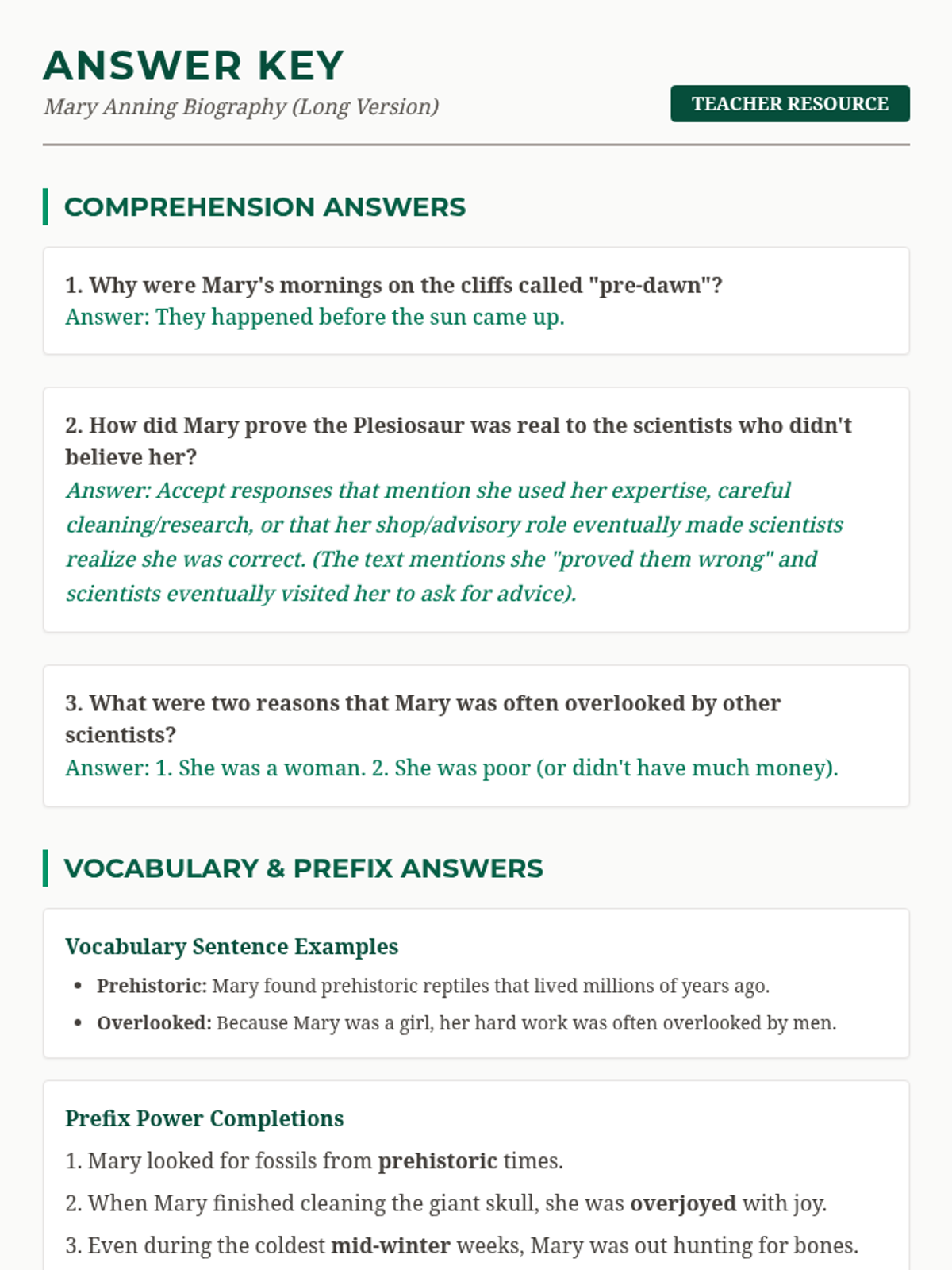
A teacher's answer key for the Fossil Hunter Reading Worksheet, providing correct answers for comprehension questions, vocabulary examples, and prefix activities, along with instructional tips.
A Grade 3 reading comprehension worksheet about fossil hunter Mary Anning, featuring an expanded biography passage, visual sidebars with icons, vocabulary exercises, and a word study section on the prefixes pre-, mid-, and over-. Revised with a longer text and more illustrations.
A visual introduction to the Word Detective scavenger hunt, setting the theme and explaining the rules and target vocabulary.
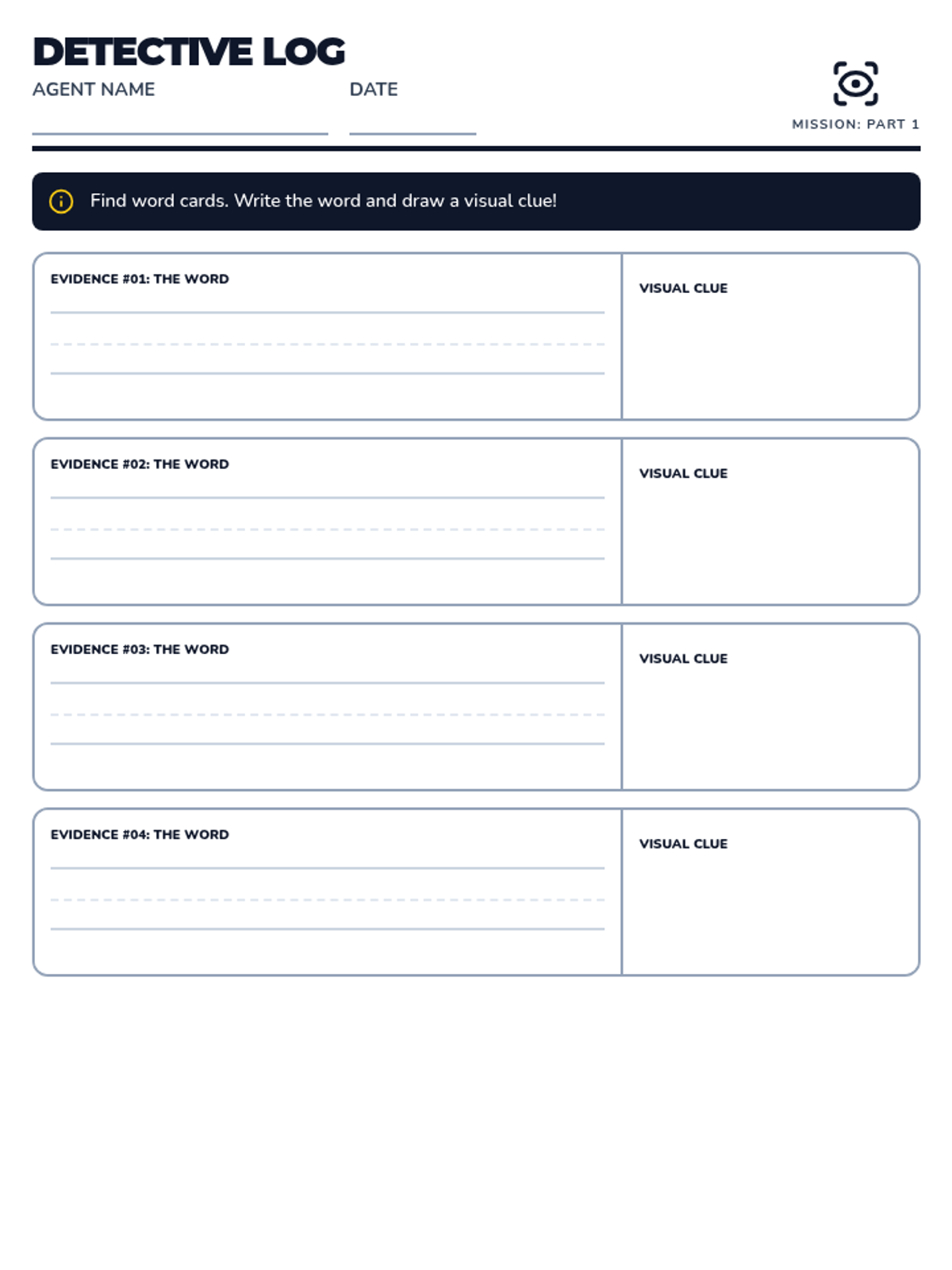
A recording sheet for students to document the challenging vocabulary words they find during their scavenger hunt mission.
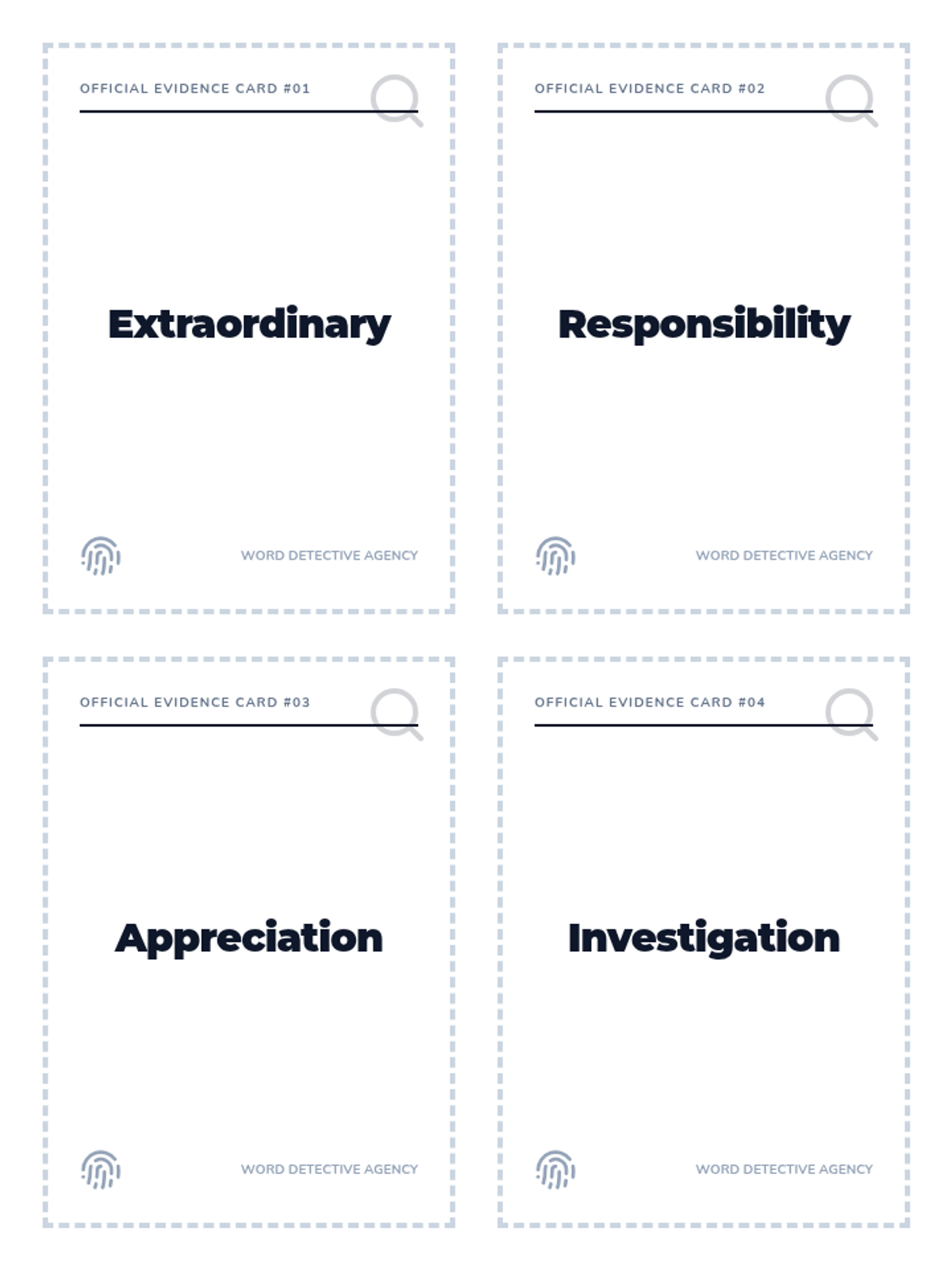
A set of 8 printable word cards featuring challenging high-level vocabulary for advanced kindergarteners to find during their scavenger hunt.
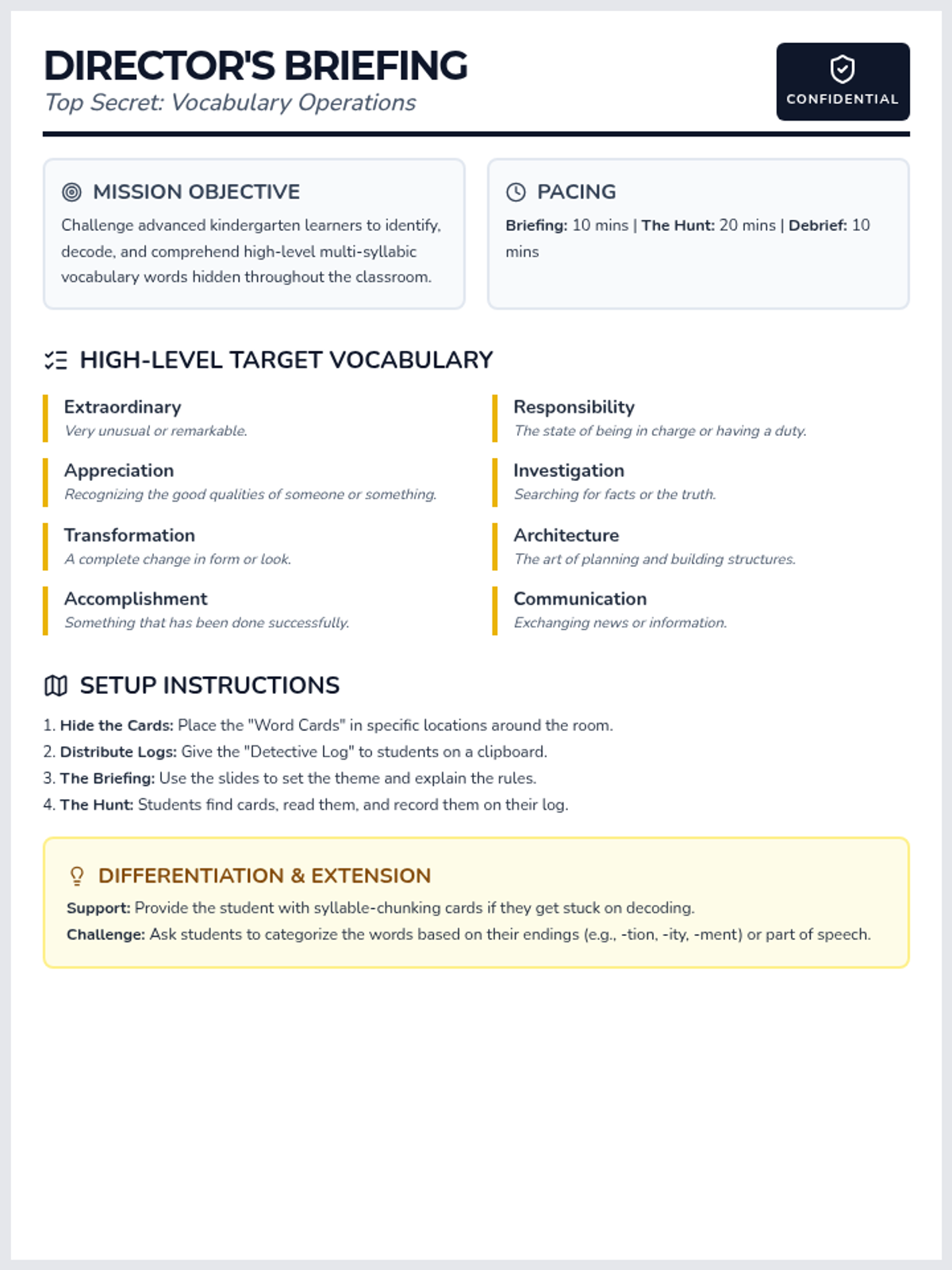
A comprehensive teacher guide for the Word Detective Mission, including target vocabulary definitions, setup instructions, and extension ideas for advanced learners.
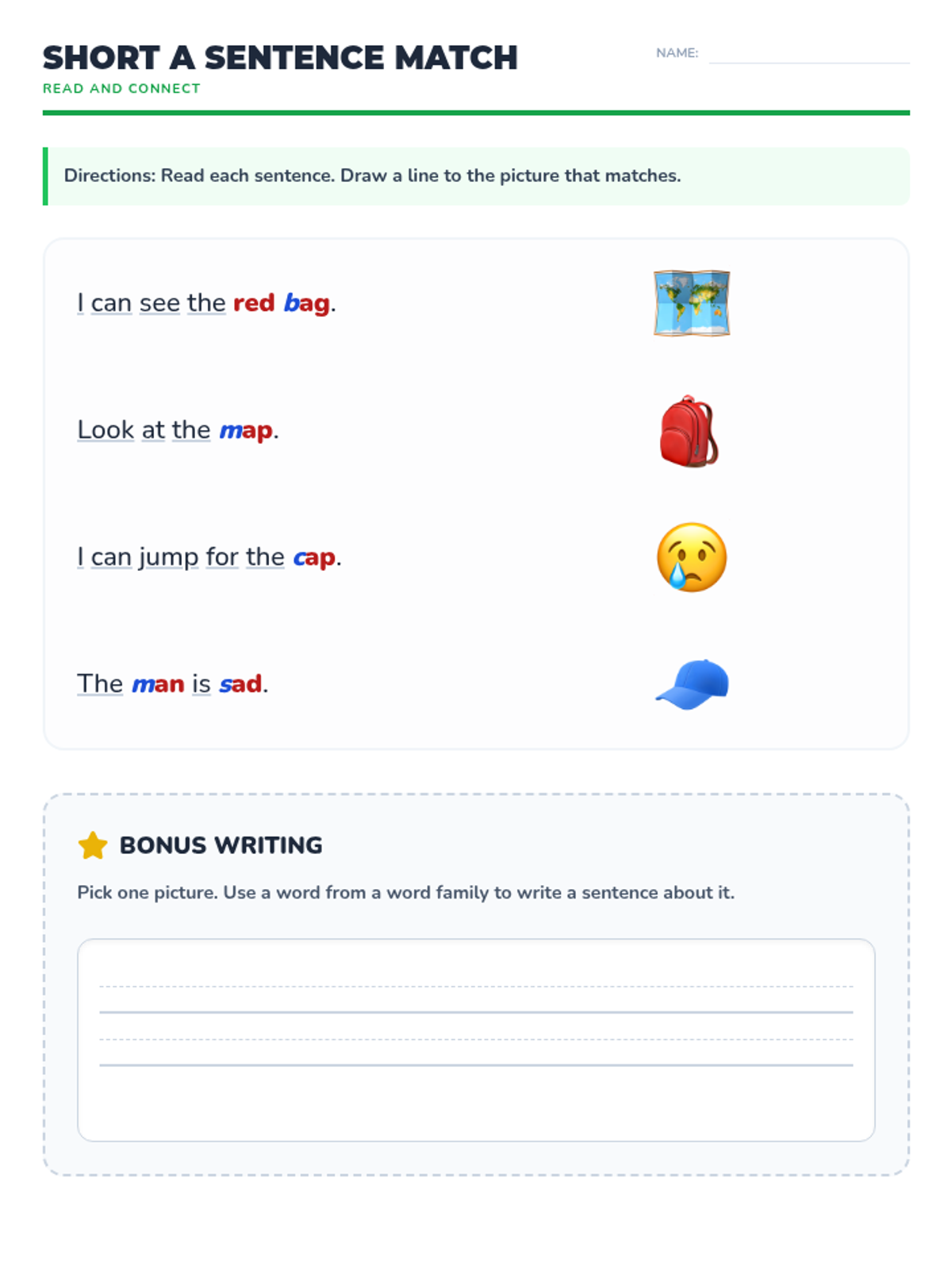
A matching activity where students read decodable sentences containing short 'a' CVC words and Pre-primer Dolch sight words, then connect them to the corresponding visual emojis. Includes a primary-ruled bonus writing section. Layout optimized for single-page printing.
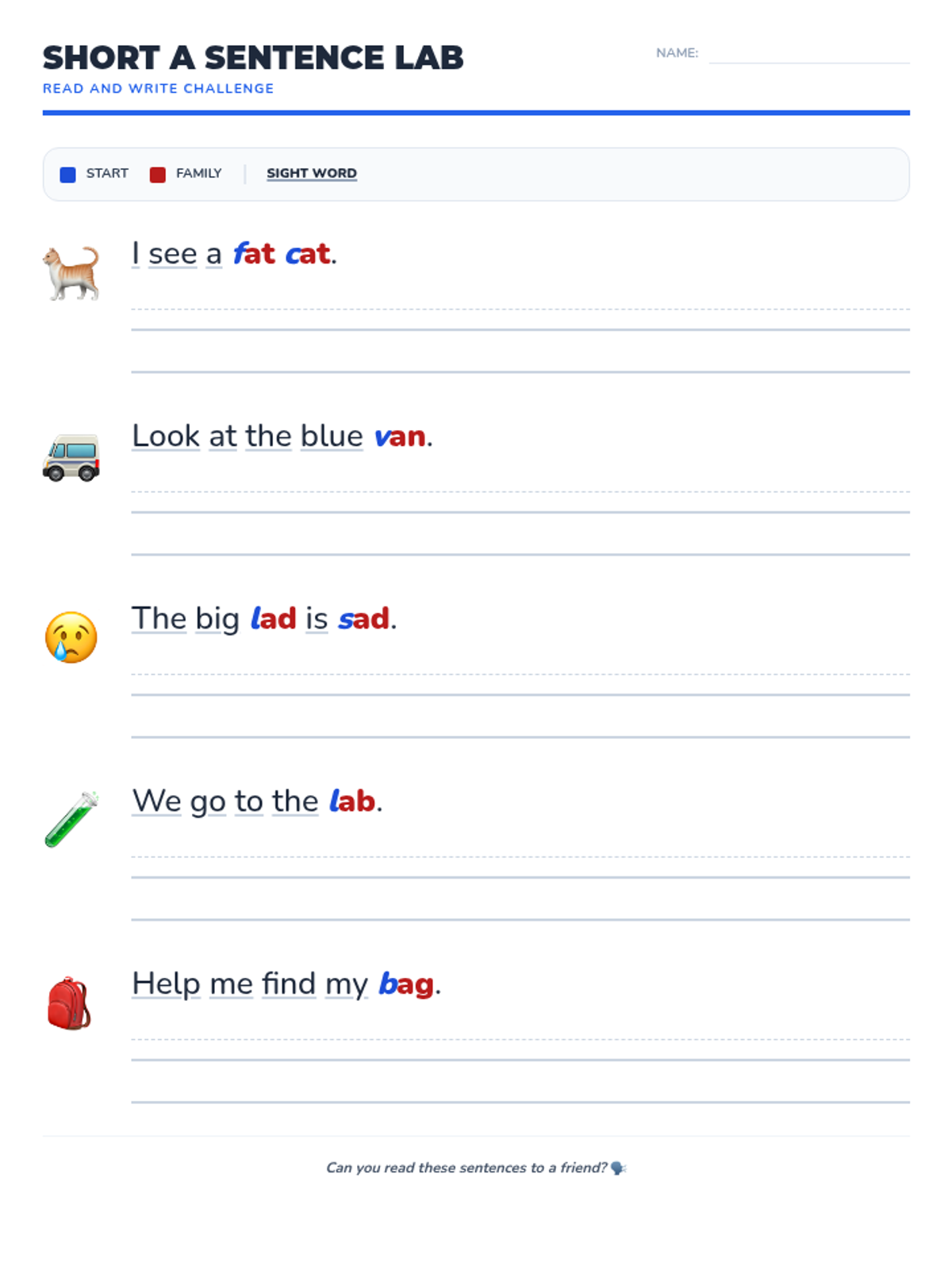
A sentence-level decodable worksheet combining short 'a' CVC word families with pre-primer Dolch sight words. Includes visual support and primary-ruled writing lines for 10-year-olds with limited English proficiency and memory gaps. Layout optimized for single-page printing.
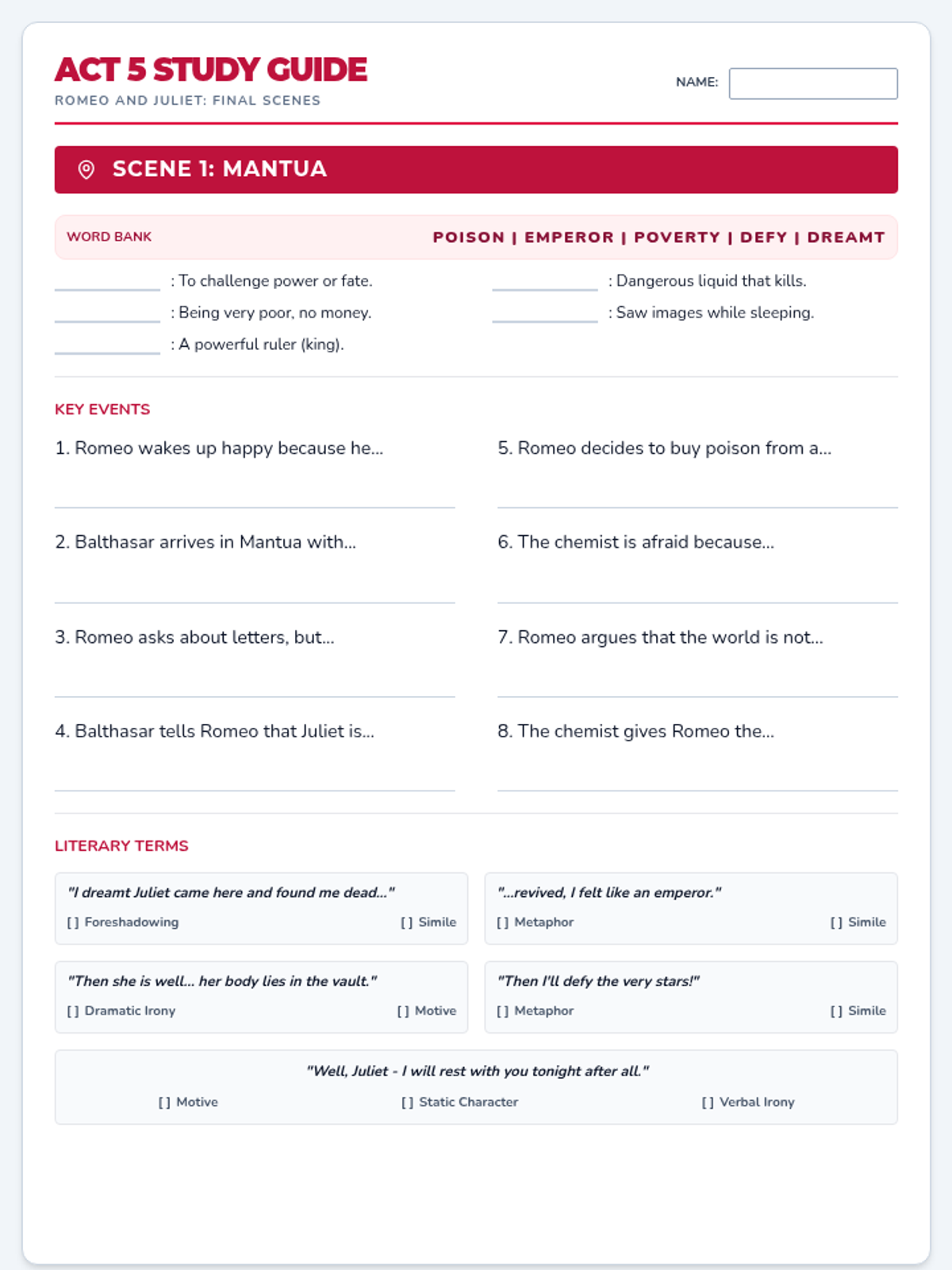
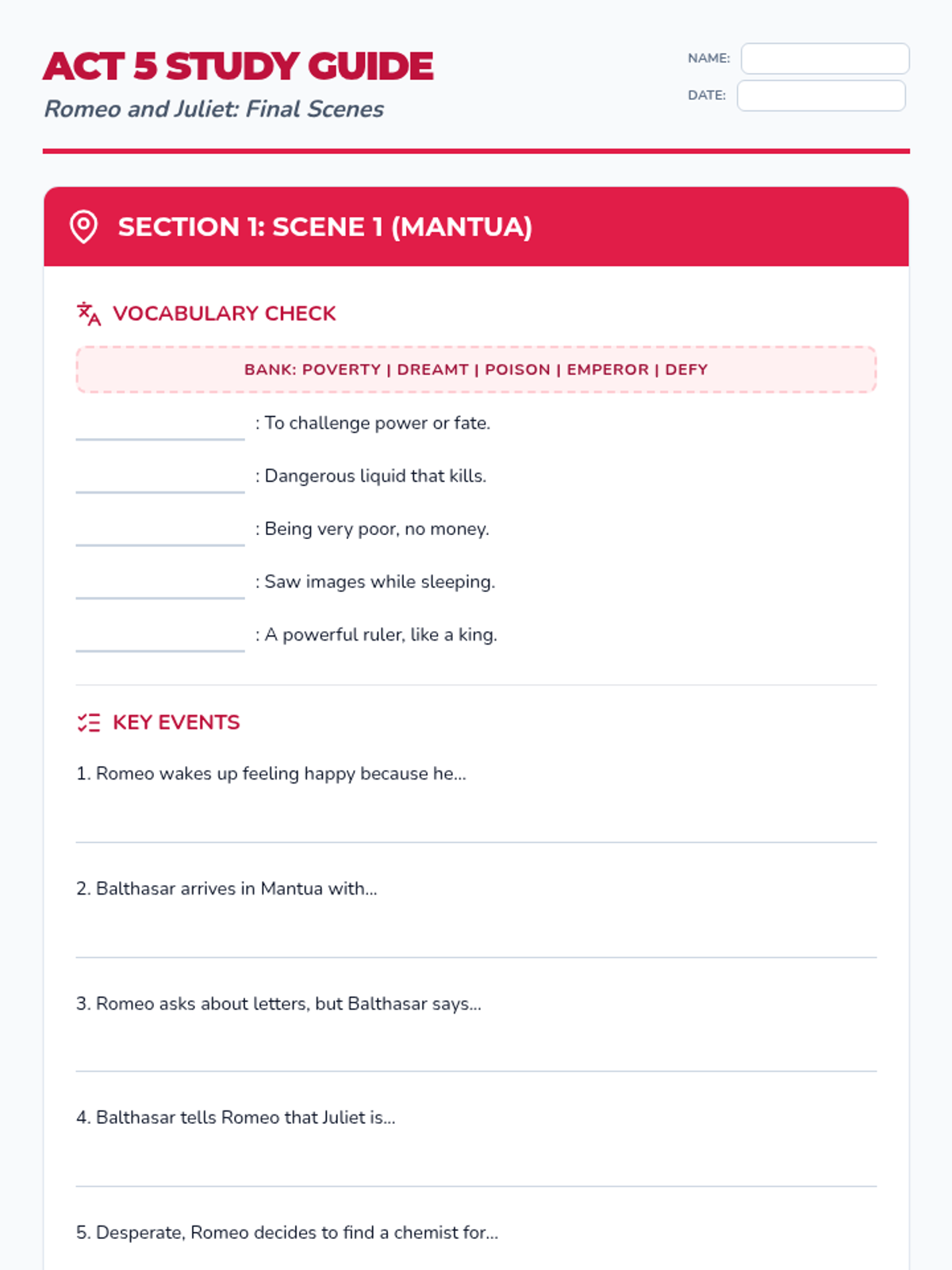
A final, complete Act 5 Study Guide with 14px font for key sentences and bold quotes throughout. It includes 5 scrambled vocabulary words, 8 plot event sentence starters in a space-saving 2-column layout, and 5 literary term MCQs per scene, all carefully laid out to fit exactly one scene per page (3 pages total).
A final, complete Act 5 Study Guide with 14px font for key sentences. It includes 5 scrambled vocabulary words, 8 plot event sentence starters, and 5 literary term MCQs per scene, all carefully laid out for printing.
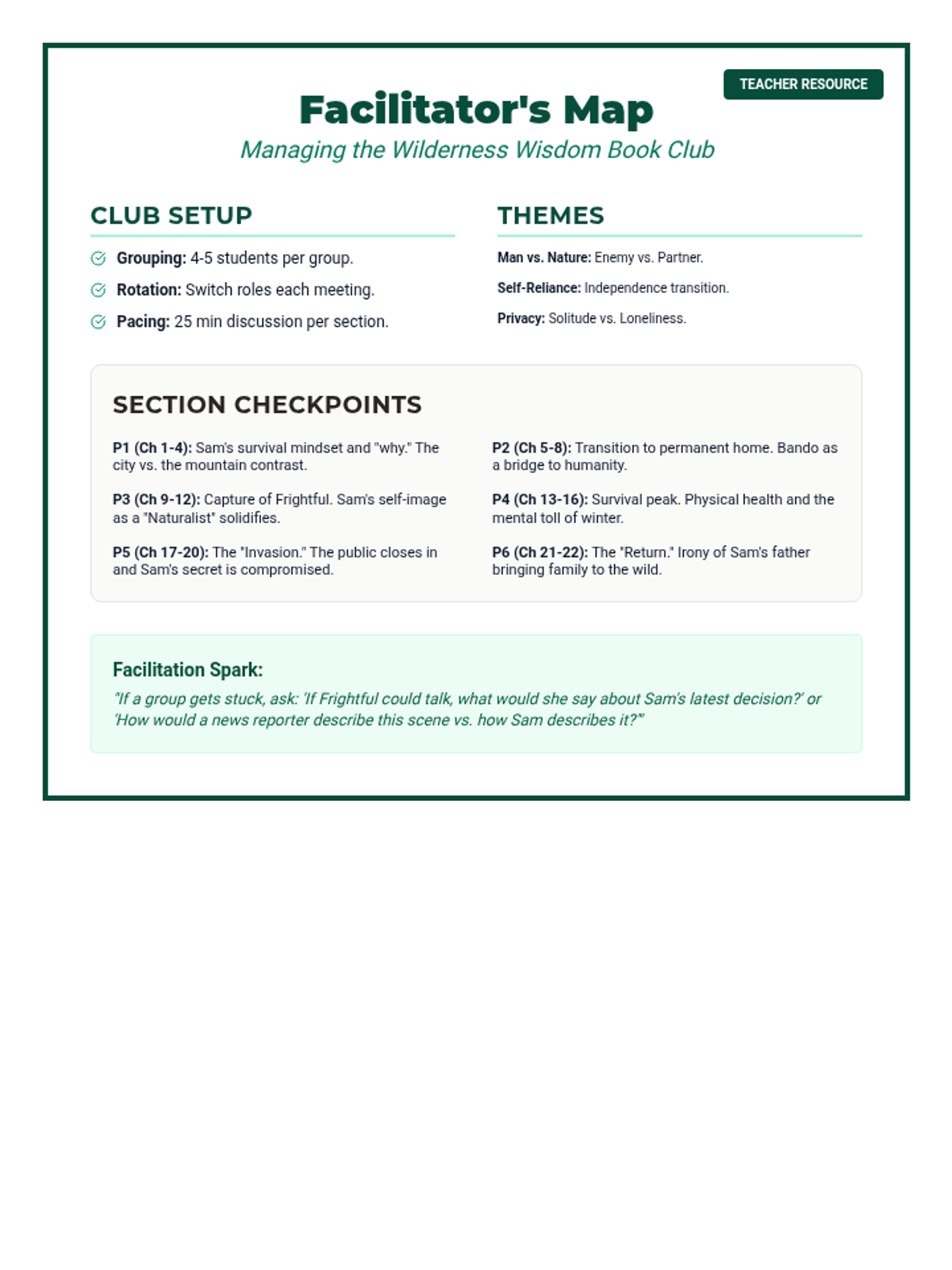
A condensed one-page facilitator's guide. Features tighter layout and more efficient use of space while retaining all key thematic tracking points and section checkpoints for the 6-part book club journey.
Revised presentation slides including a new reading schedule for the 6-part journey. Icons have been scaled up for better visual impact and typographical spacing has been refined for clarity.
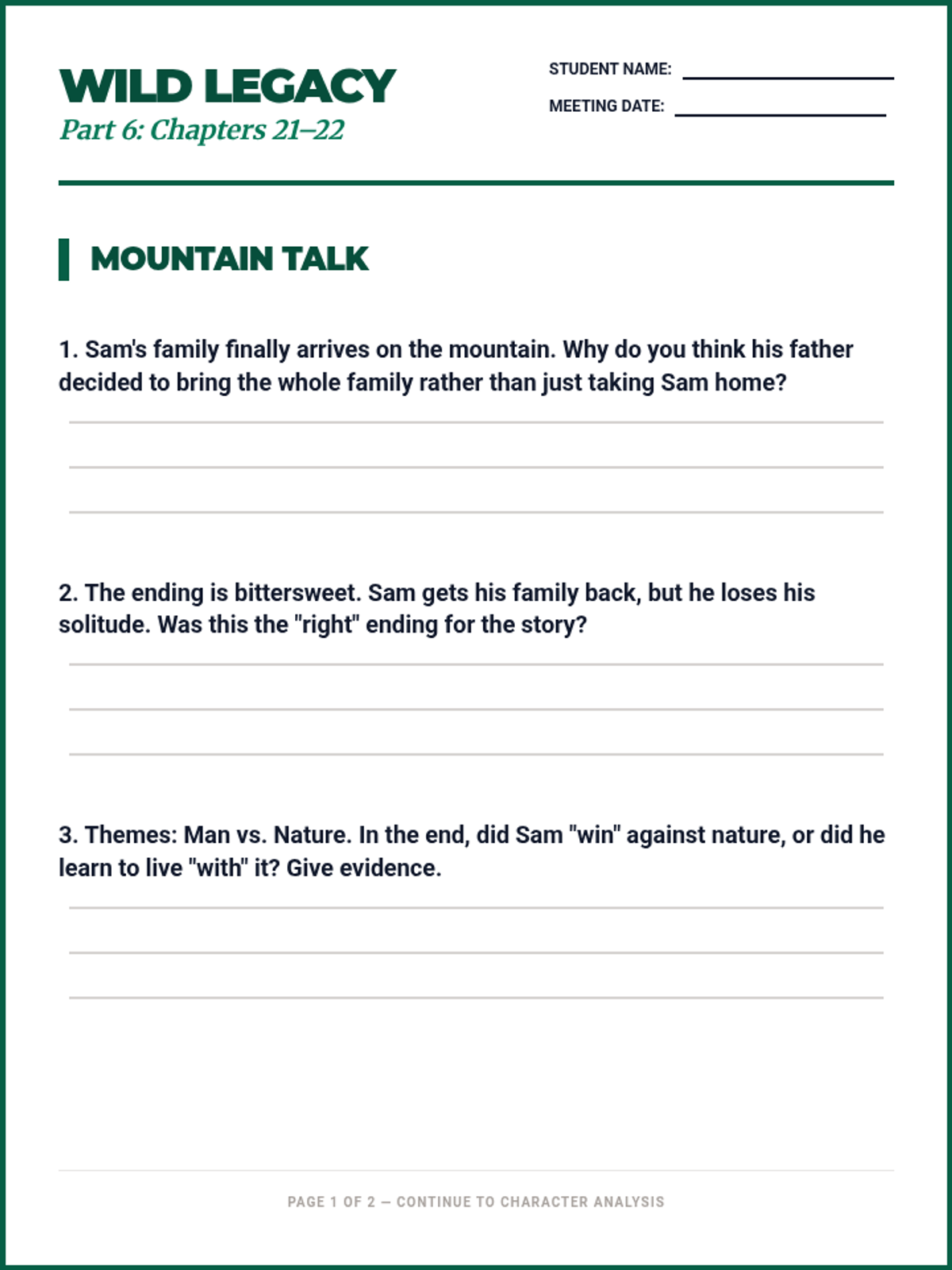
Revised student discussion guide for the final chapters. Features darkened lines and text for better legibility, expanded writing areas for prompts, and a consolidated layout that keeps the character analysis graphic organizer on a single page.
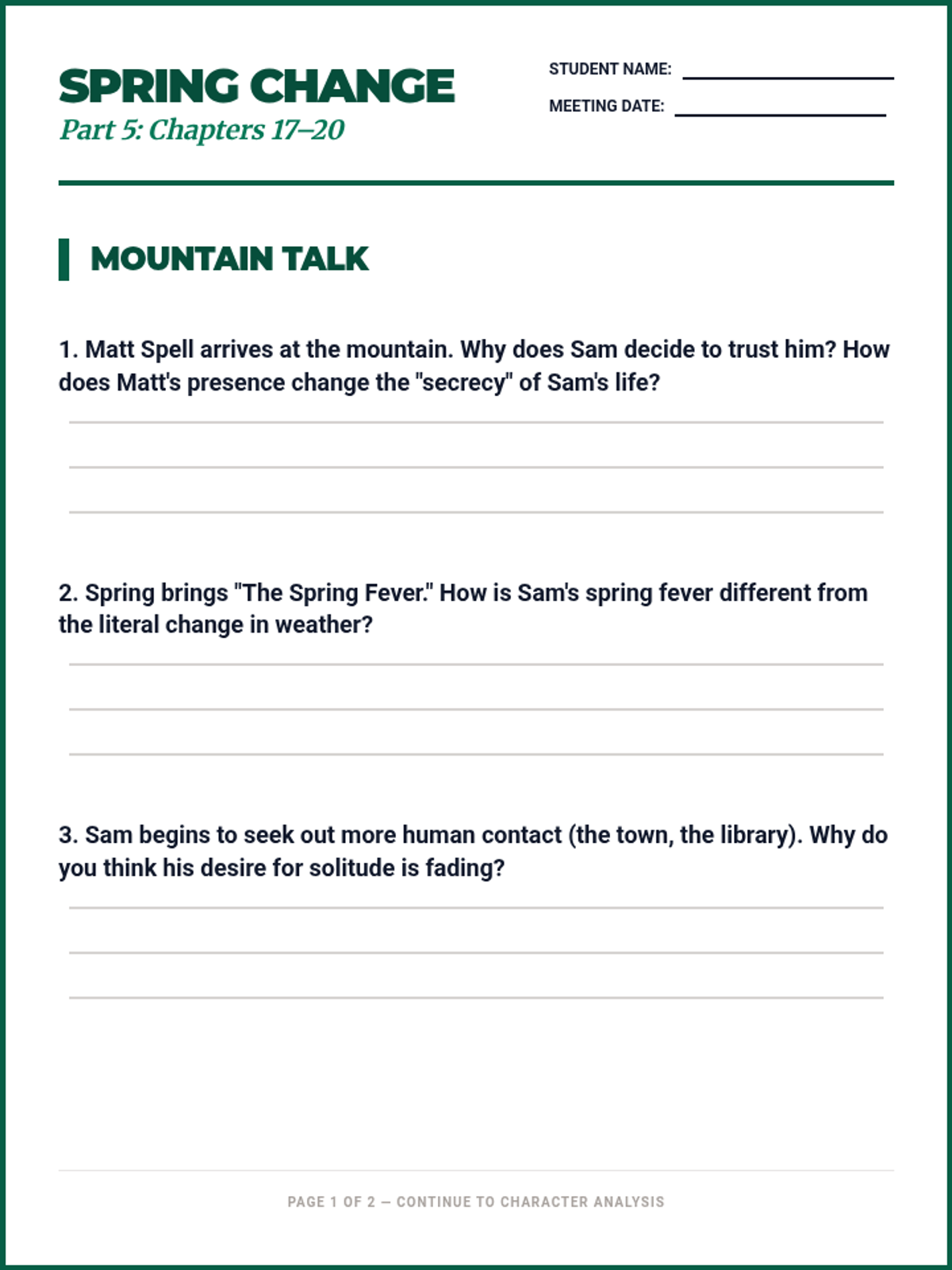
Revised student discussion guide for Chapters 17-20. Features darkened lines and text for better legibility, expanded writing areas for prompts, and a consolidated layout that keeps the character analysis graphic organizer on a single page.
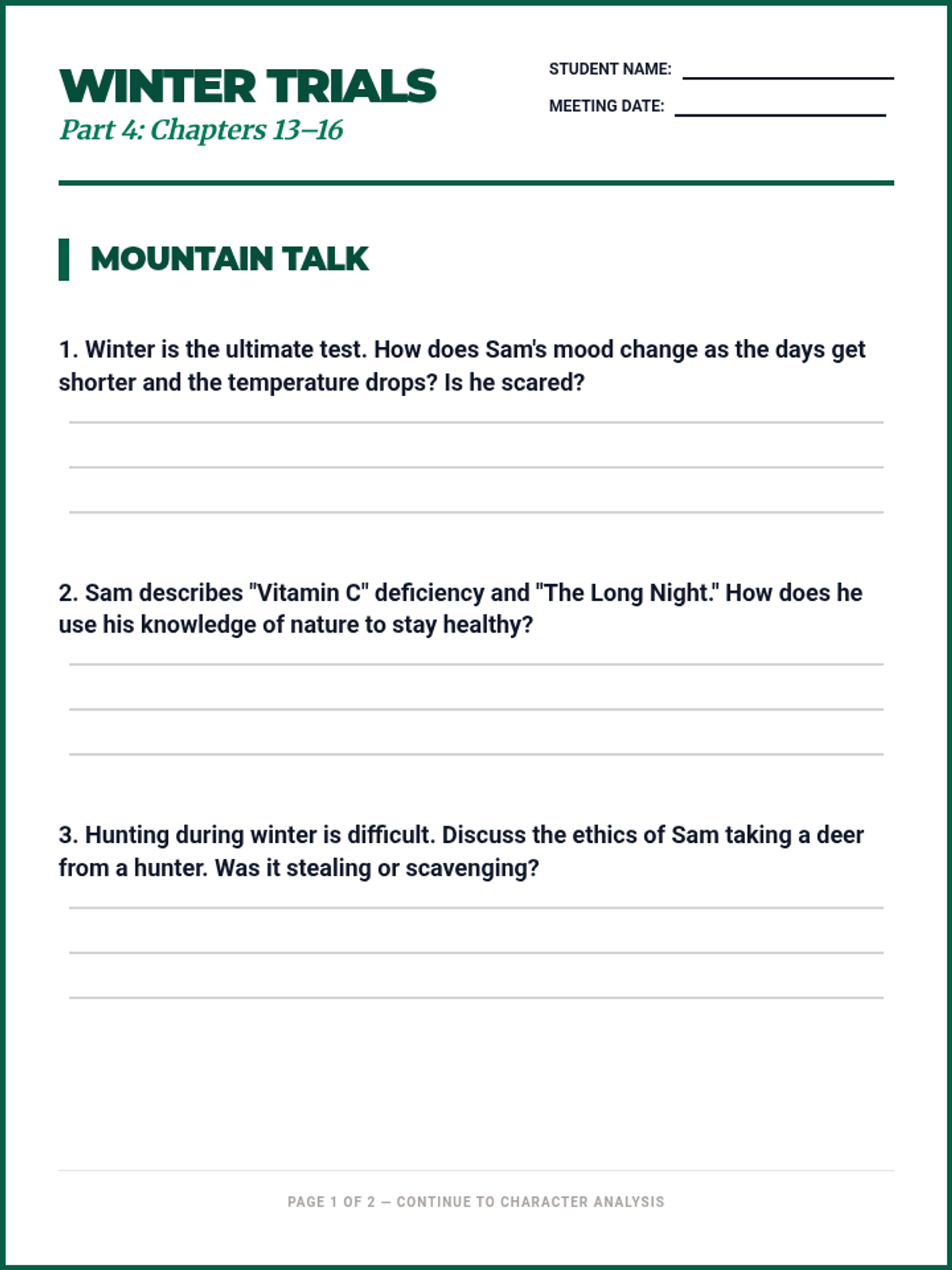
Revised student discussion guide for Chapters 13-16. Features darkened lines and text for better legibility, expanded writing areas for prompts, and a consolidated layout that keeps the character analysis graphic organizer on a single page.
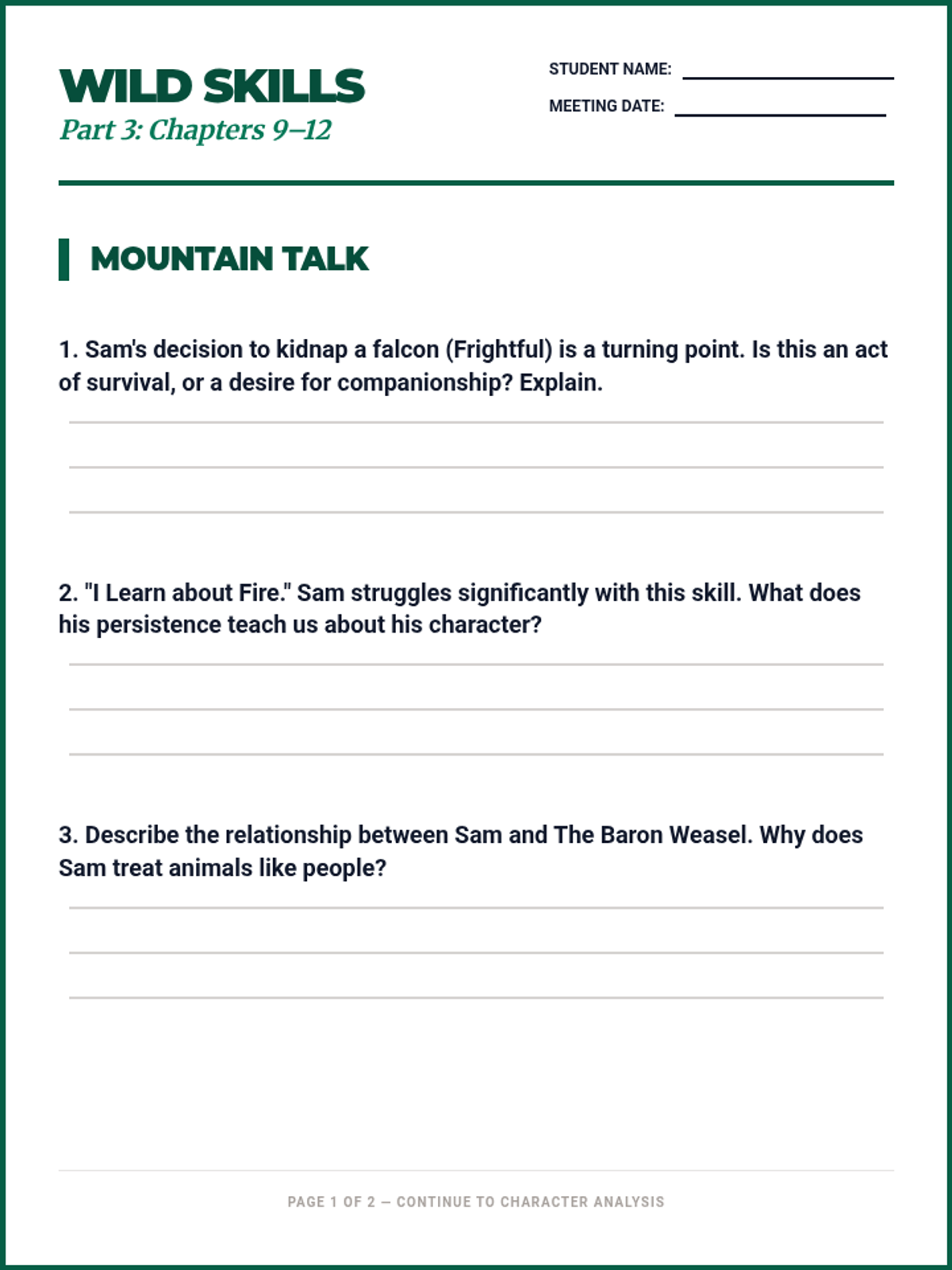
Revised student discussion guide for Chapters 9-12. Features darkened lines and text for better legibility, expanded writing areas for prompts, and a consolidated layout that keeps the character analysis graphic organizer on a single page.
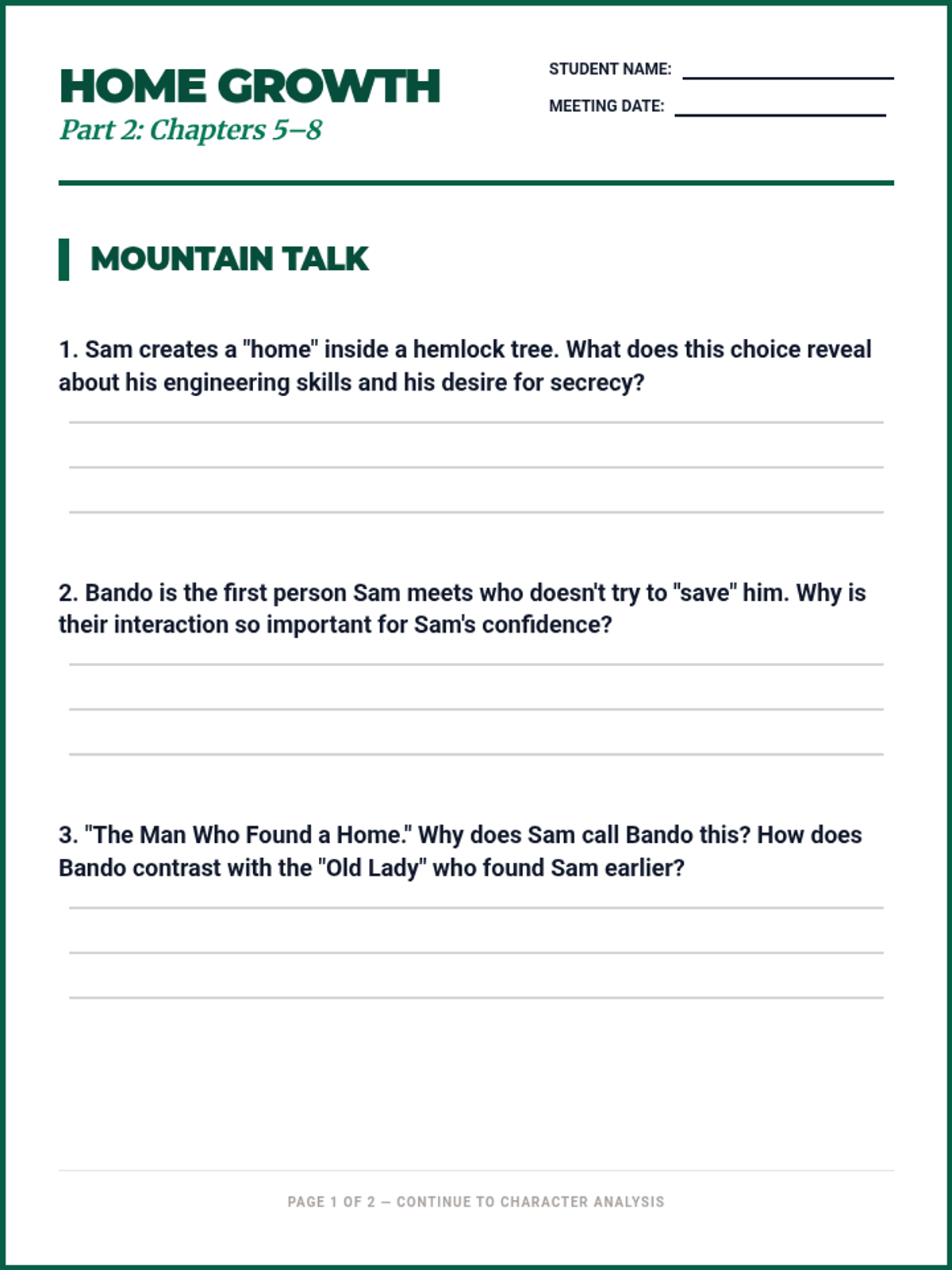
Revised student discussion guide for Chapters 5-8. Features darkened lines and text for better legibility, expanded writing areas for prompts, and a consolidated layout that keeps the character analysis graphic organizer on a single page.
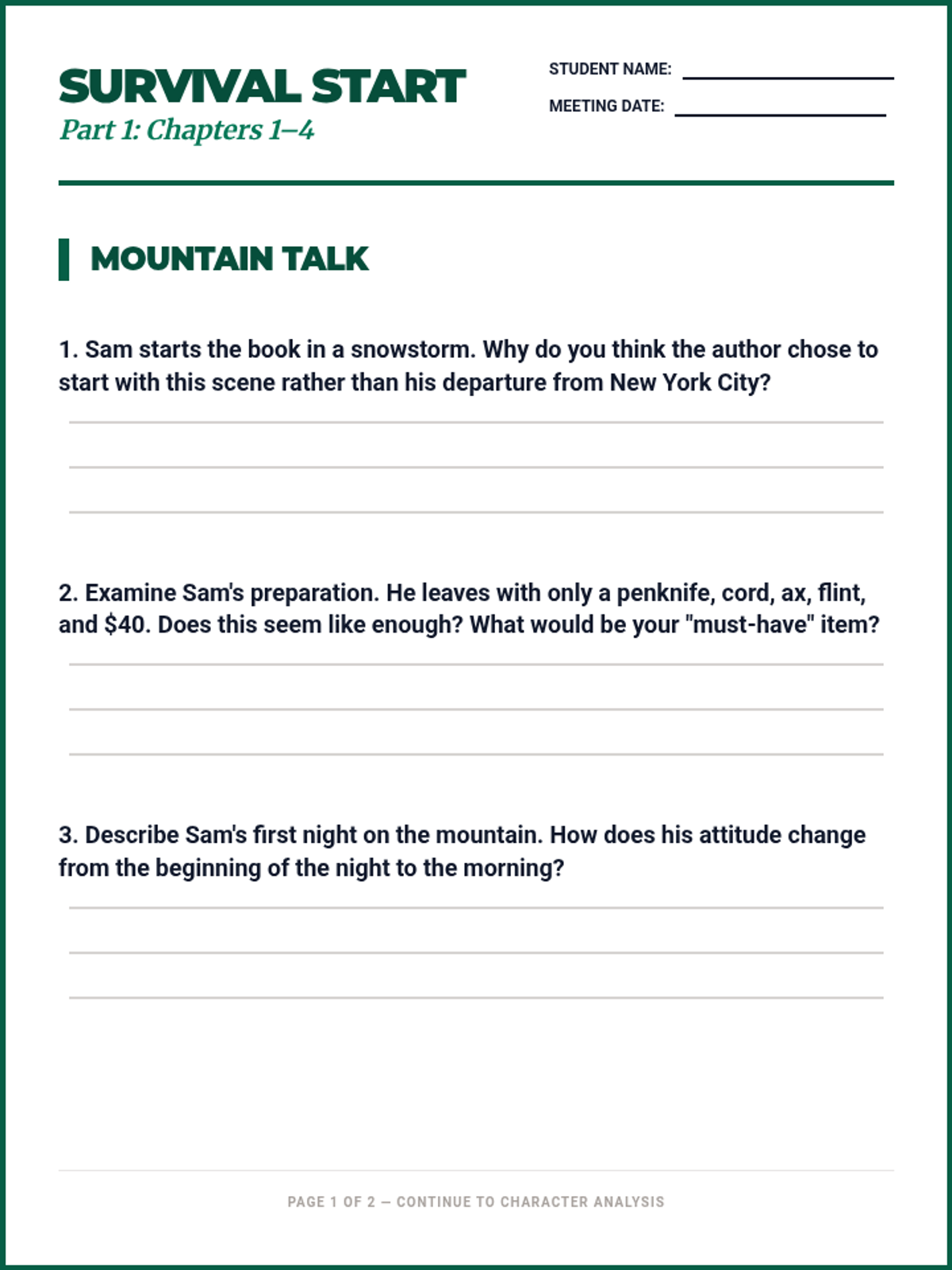
Revised student discussion guide for Chapters 1-4. Features darkened lines and text for better legibility, expanded writing areas for prompts, and a consolidated layout that keeps the character analysis graphic organizer on a single page.
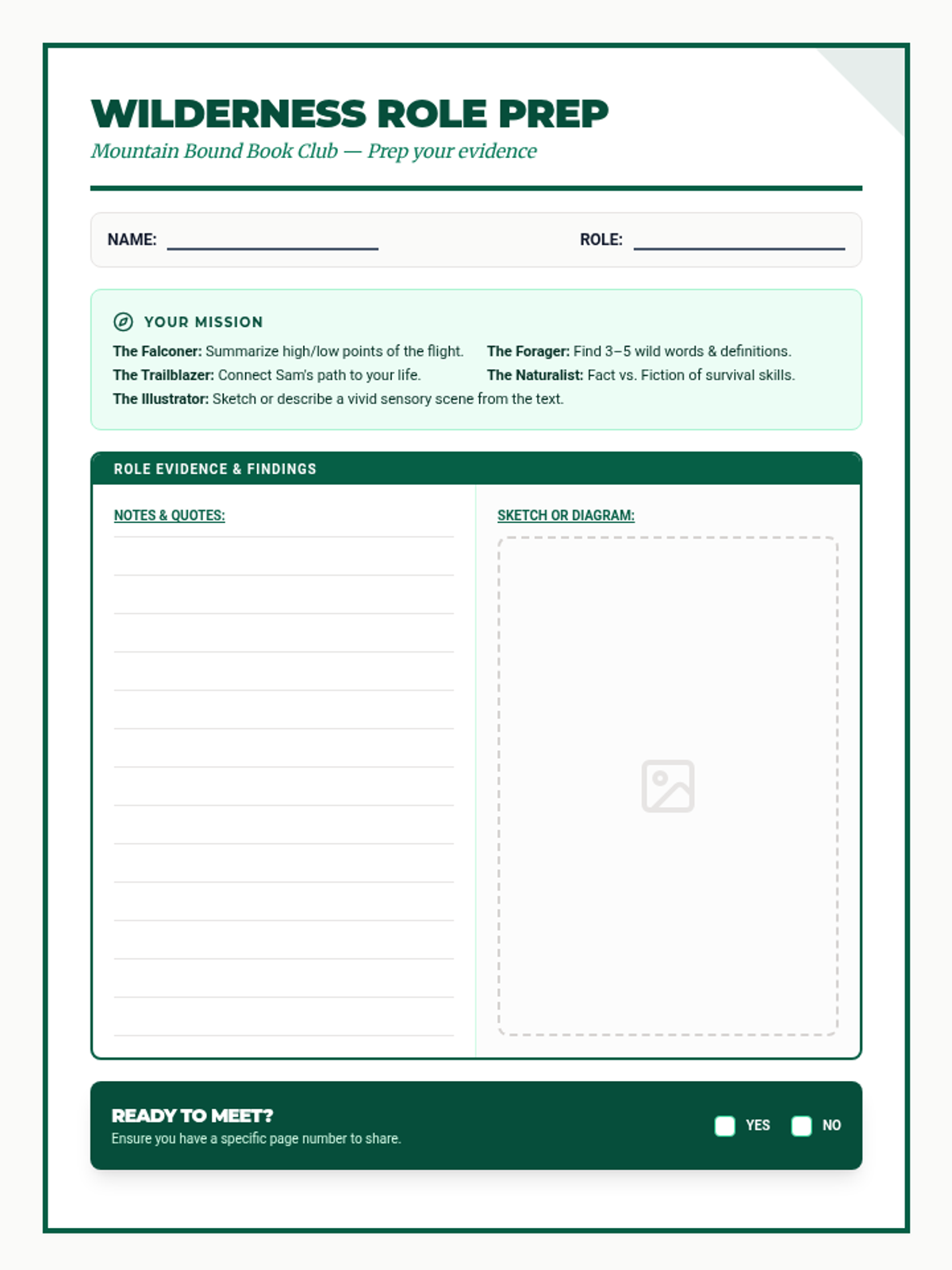
Revised student role preparation sheet. Now features a split work area for both writing and sketching (essential for the Illustrator role) and fits perfectly on a single page with a reinforced emerald border.
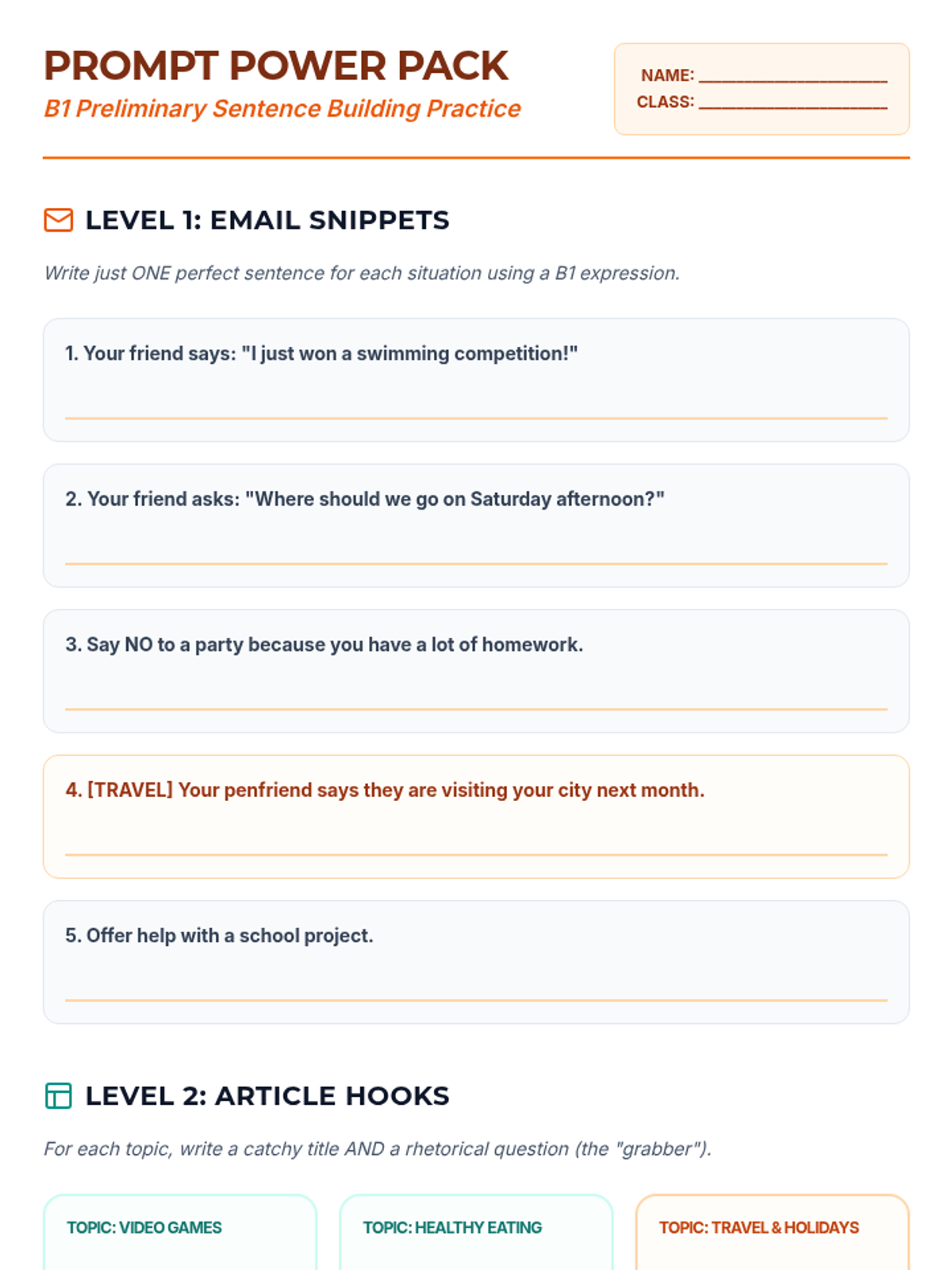
A worksheet containing specific sentence-level writing prompts for B1 Preliminary, featuring new travel-themed exercises for emails, articles, and clarity training.
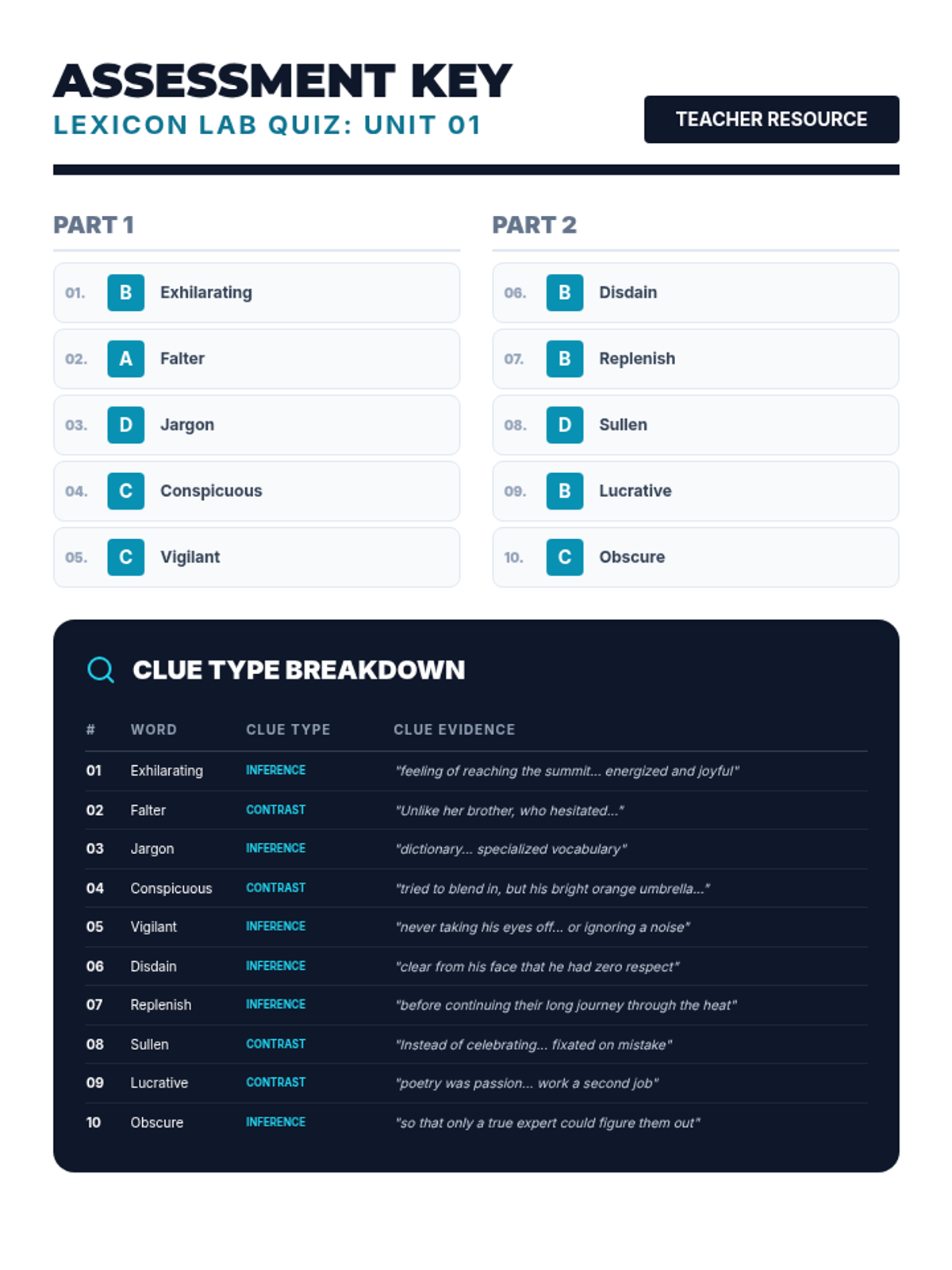
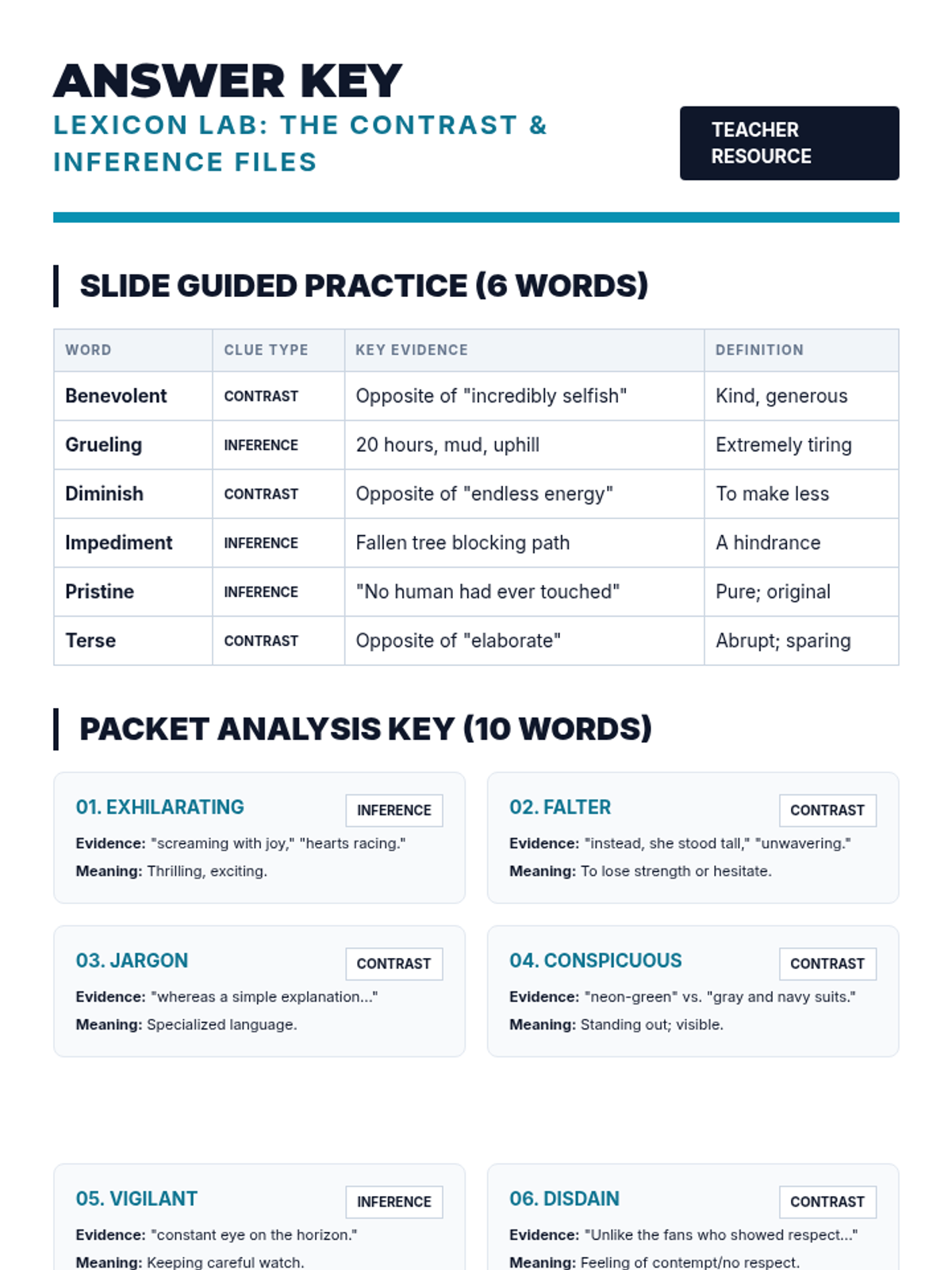
A comprehensive answer key for the Lexicon Lab Assessment, including correct answers, word associations, and context clue analysis for each question.
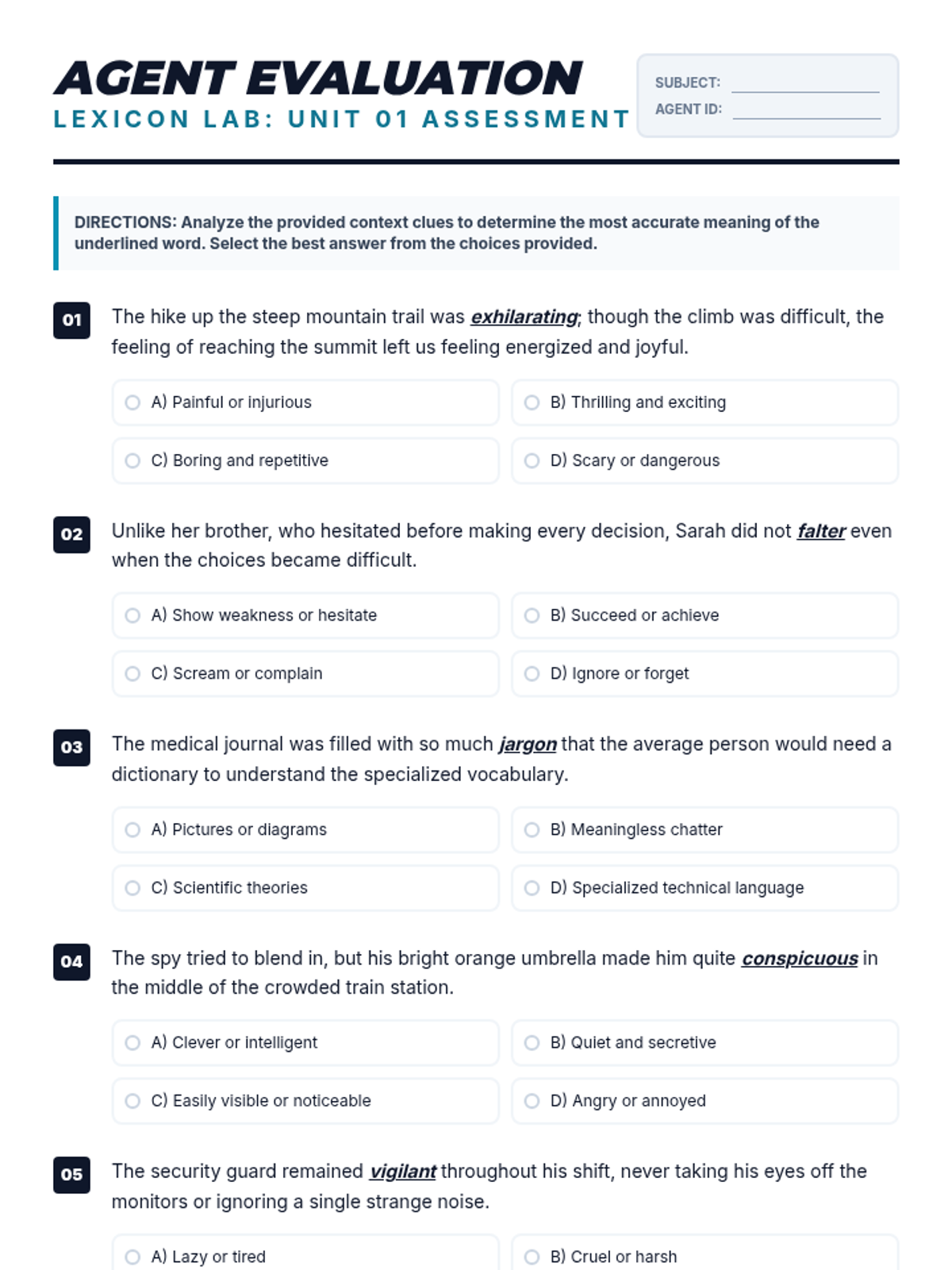
A 10-question multiple-choice assessment for the Lexicon Lab lesson. Tests student mastery of Tier 2 vocabulary words through context clue analysis and definition selection.
An expanded teacher's answer key for the Lexicon Lab lesson. Now includes comprehensive keys for sixteen vocabulary words, including additions like 'pristine', 'terse', 'vigilant', 'disdain', 'replenish', 'sullen', 'lucrative', and 'obscure', with evidence and pedagogical notes.
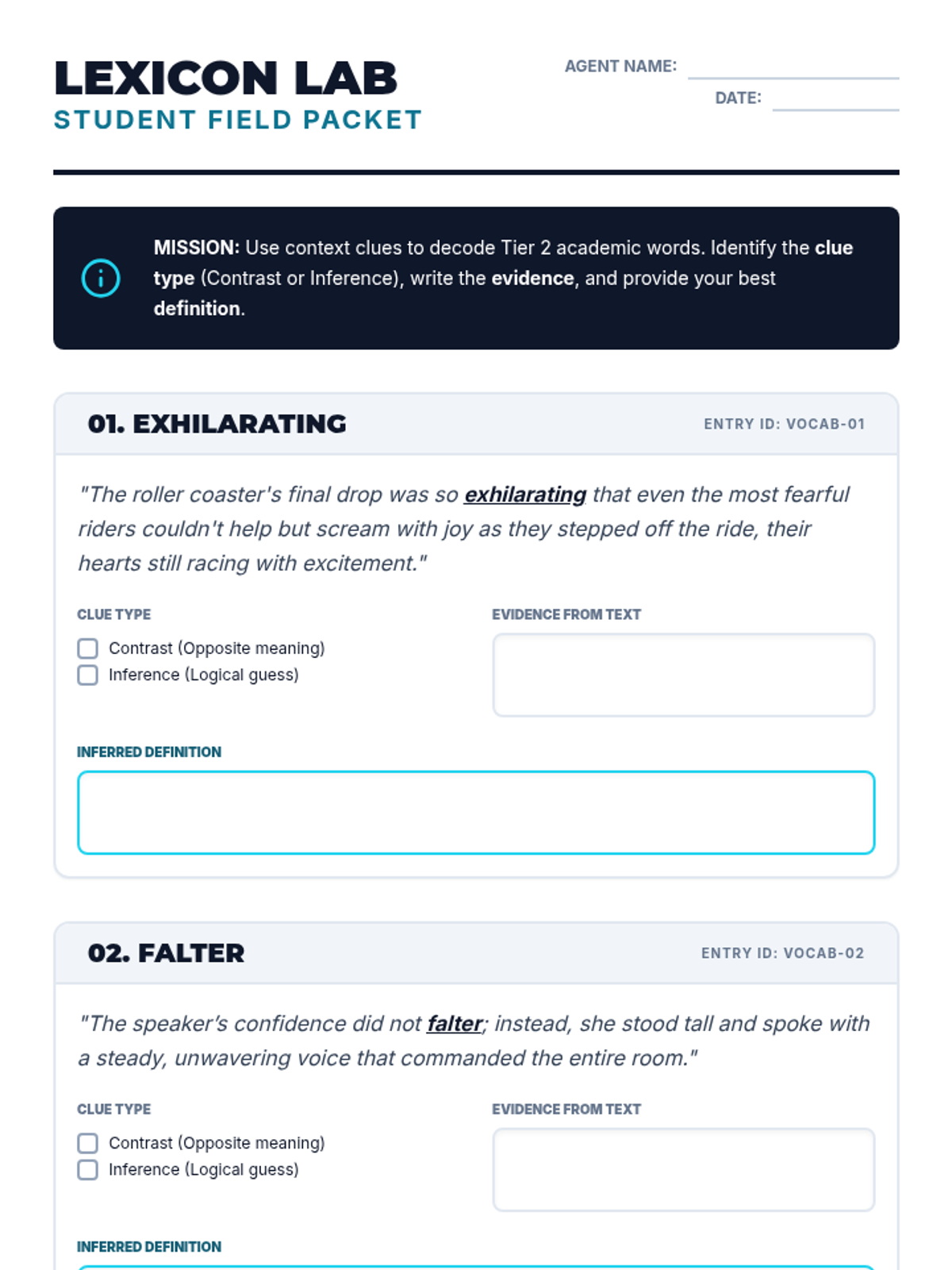
An expanded 4-page student work packet for the Lexicon Lab lesson. Now includes ten in-depth vocabulary entries featuring Tier 2 words like 'vigilant', 'disdain', 'replenish', 'sullen', 'lucrative', and 'obscure', with structured space for evidence collection and synthesis across multiple levels of difficulty.
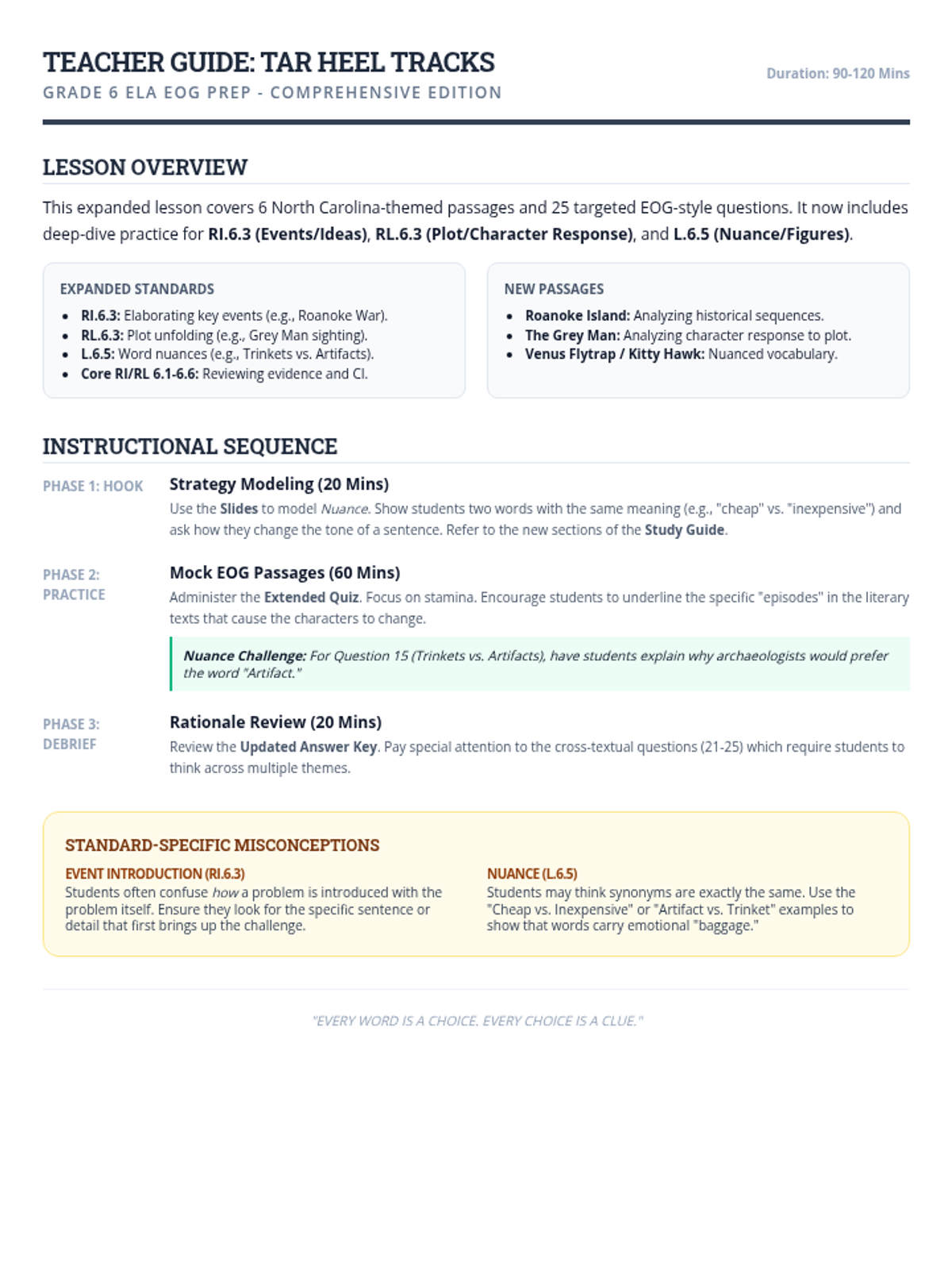
Teacher facilitation guide for the expanded Tar Heel Tracks EOG prep lesson. It includes updated instructional sequences for RI.6.3, RL.6.3, and L.6.5, differentiation tips for new passages, and a stamina-focused pacing guide.
Visual presentation for Grade 6 ELA EOG review, focusing on evidence, central idea, word meaning, and perspective with interactive North Carolina-themed examples.
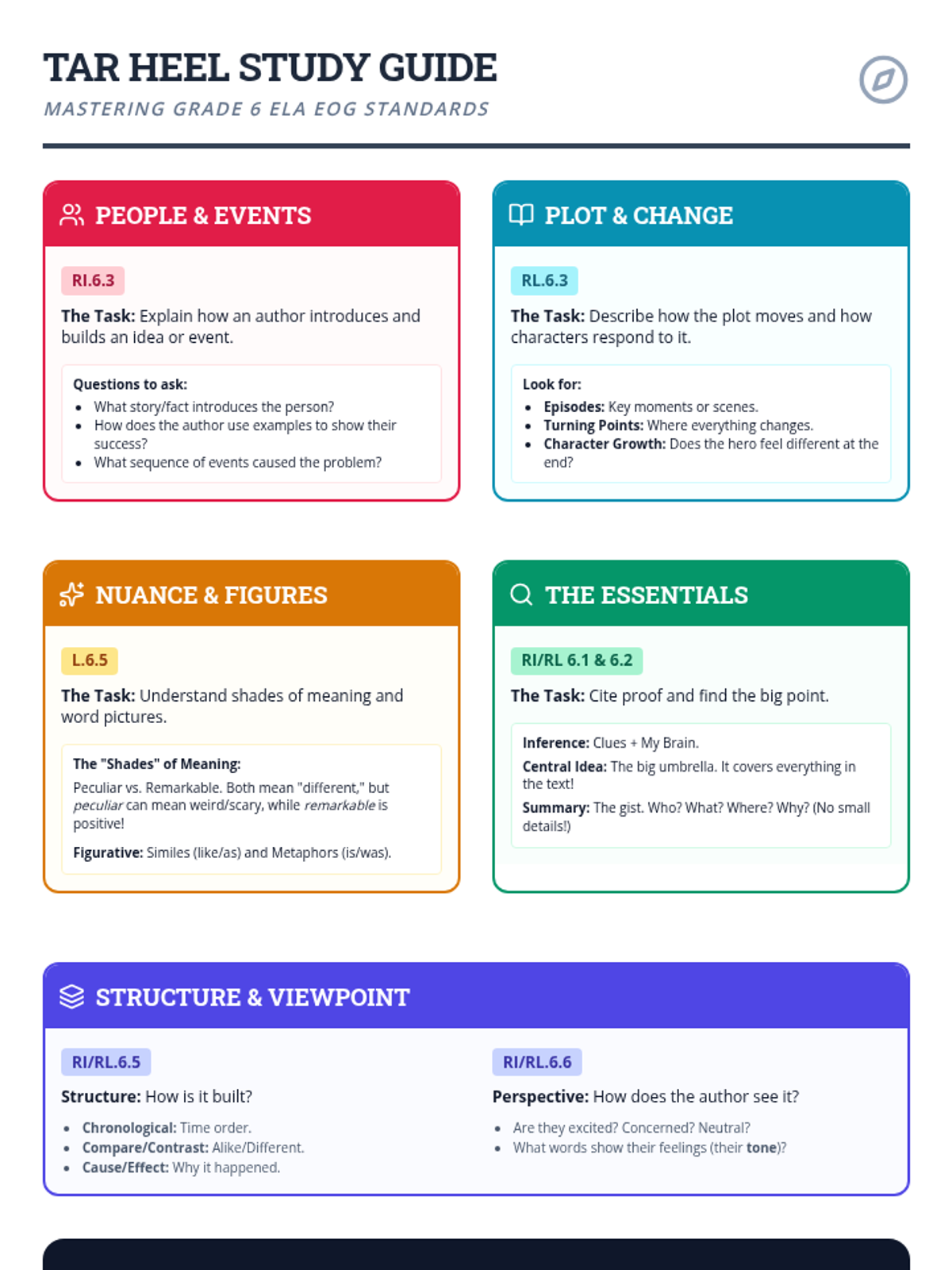
An expanded Grade 6 ELA EOG study guide. It includes new sections on analyzing key individuals/events (RI.6.3), plot unfolding (RL.6.3), and word nuances (L.6.5), alongside core reading strategies. Features North Carolina-themed examples.
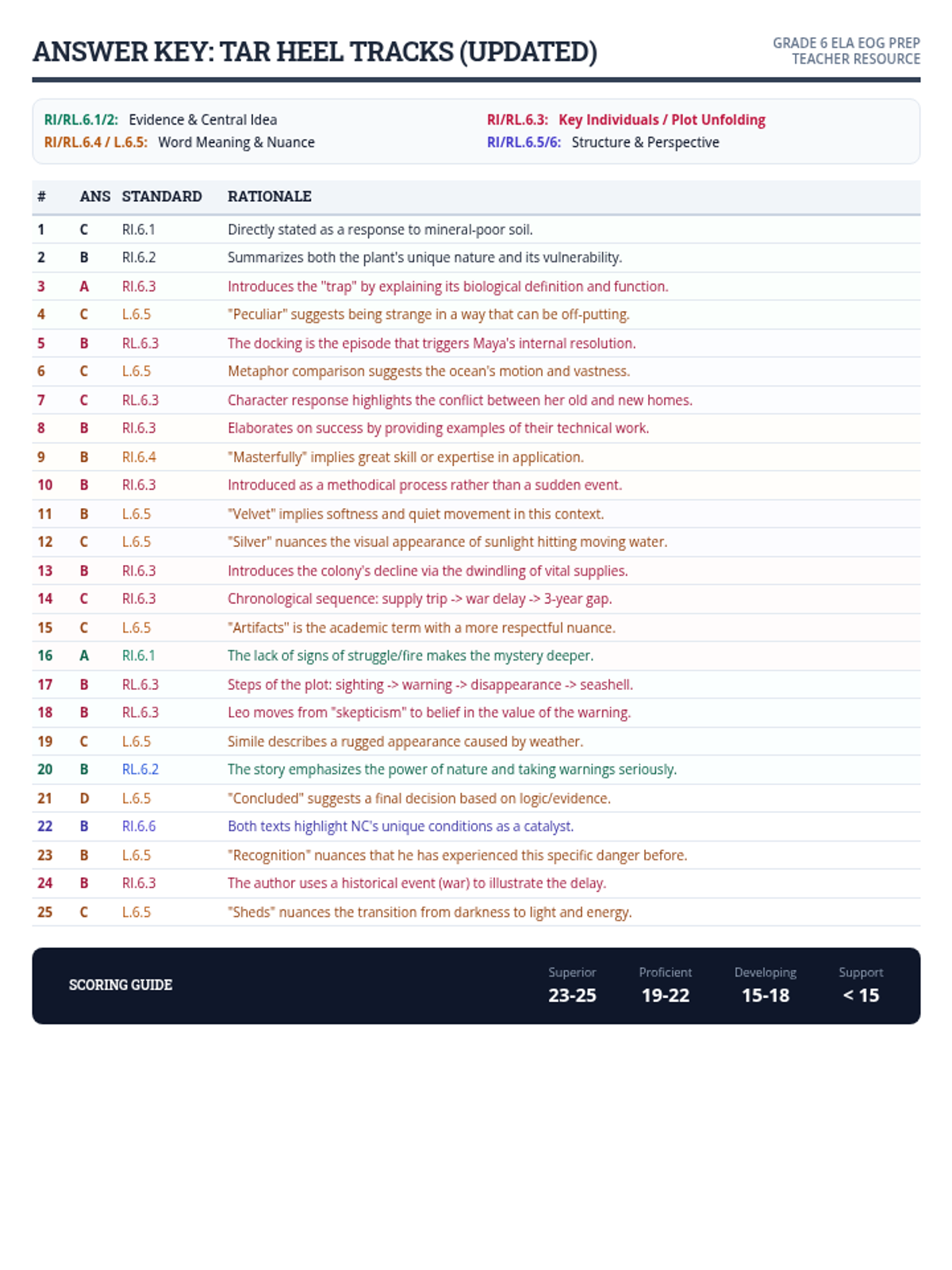
Updated answer key for the Tar Heel Tracks Quiz, now including 25 questions across 6 passages with new standards alignment for RI.6.3, RL.6.3, and L.6.5. Includes rationales for every question and corrected standard color-coding.
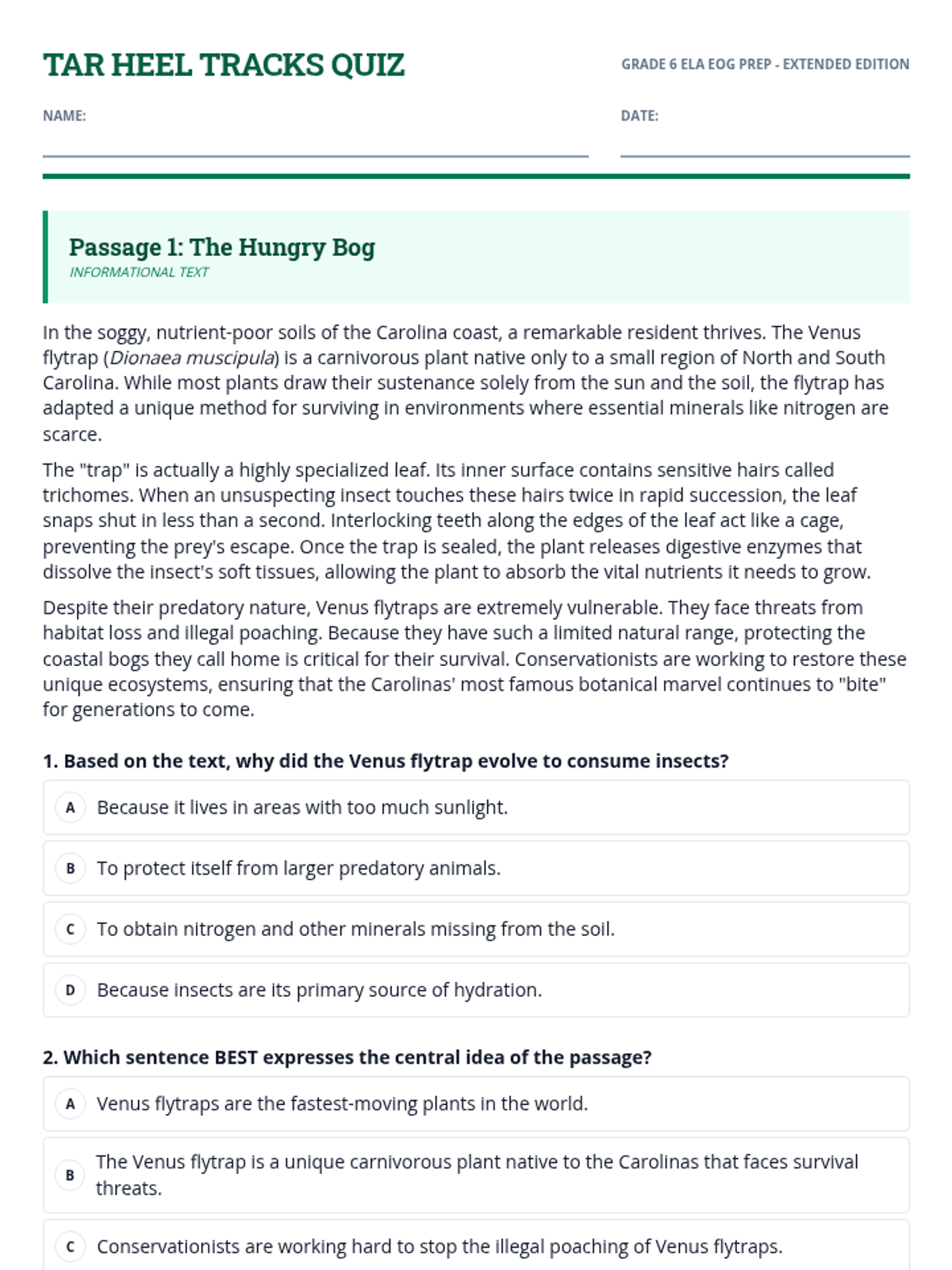
An updated 25-question EOG-style ELA quiz for Grade 6, now featuring 6 passages (3 informational, 3 literary). It includes new questions targeting RI.6.3, RL.6.3, and L.6.5, alongside evidence, central idea, and perspective. Revised for layout and standard coverage.
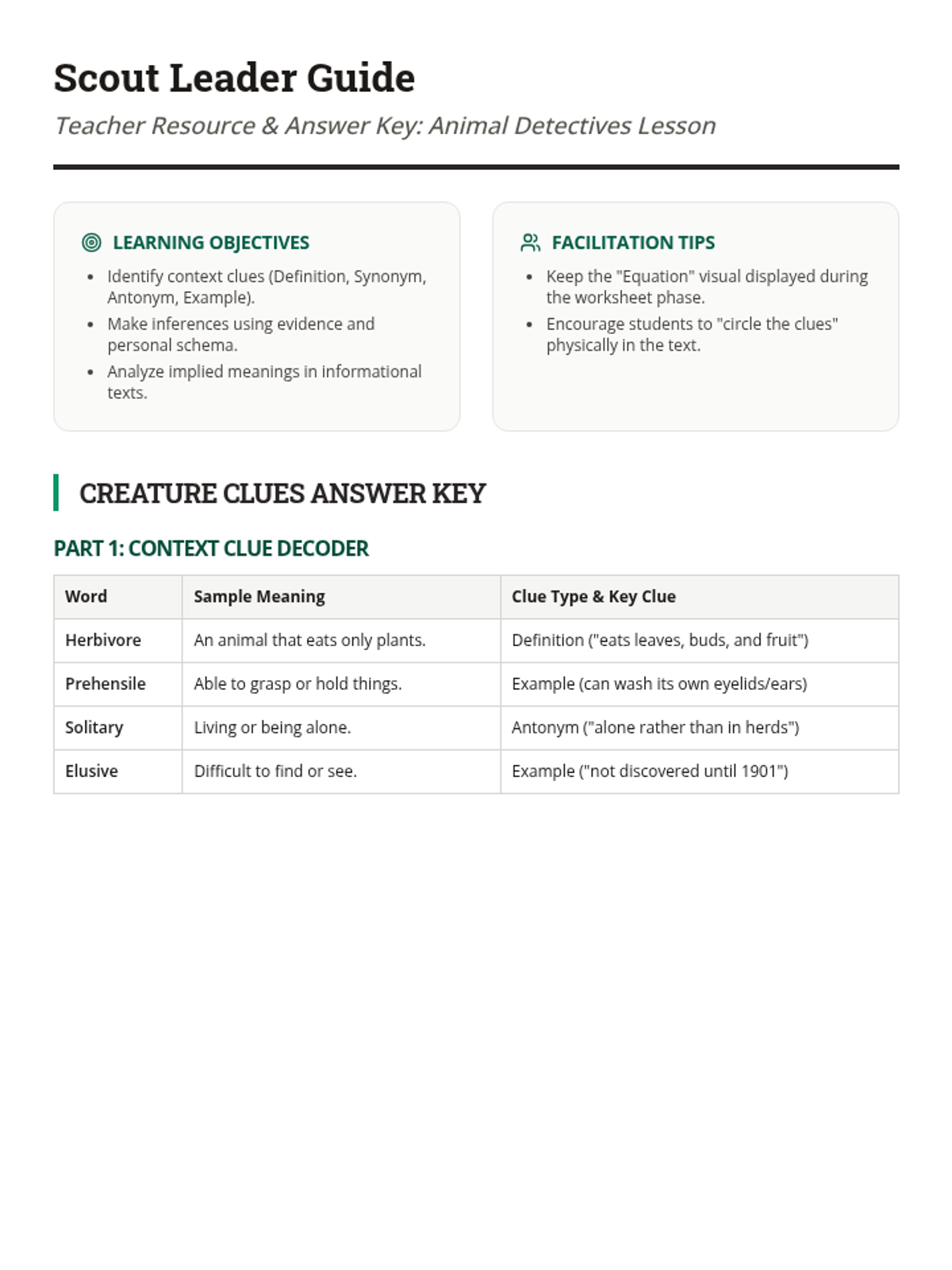
A comprehensive teacher guide including learning objectives, facilitation tips, and a full answer key for the worksheet and task cards. Designed to help educators guide middle school students through inference and context clue mastery.
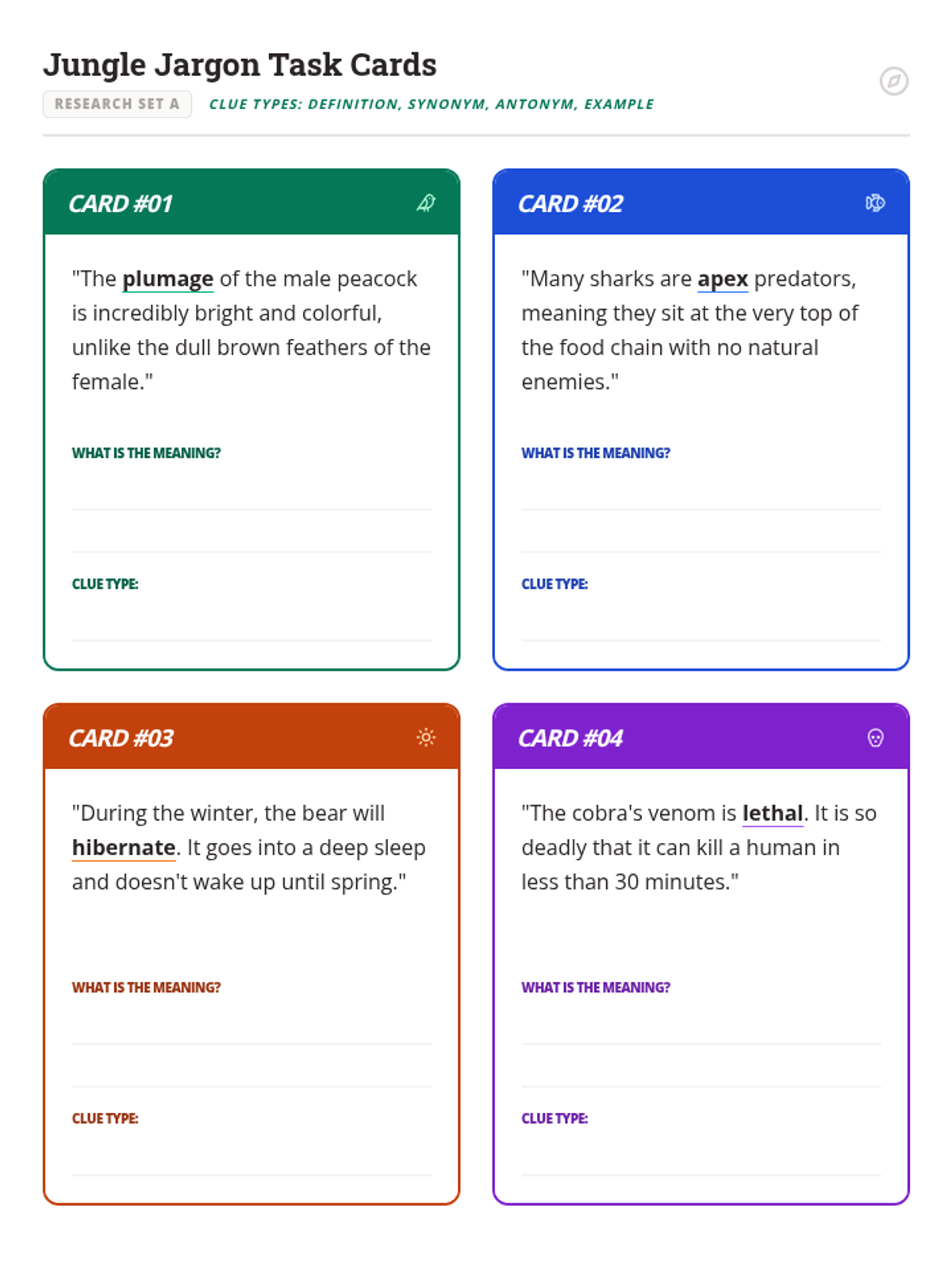
A set of 8 task cards featuring animal facts with challenging Tier 2 vocabulary. Each card requires students to identify the word's meaning and the type of context clue (Definition, Synonym, Antonym, Example) used.
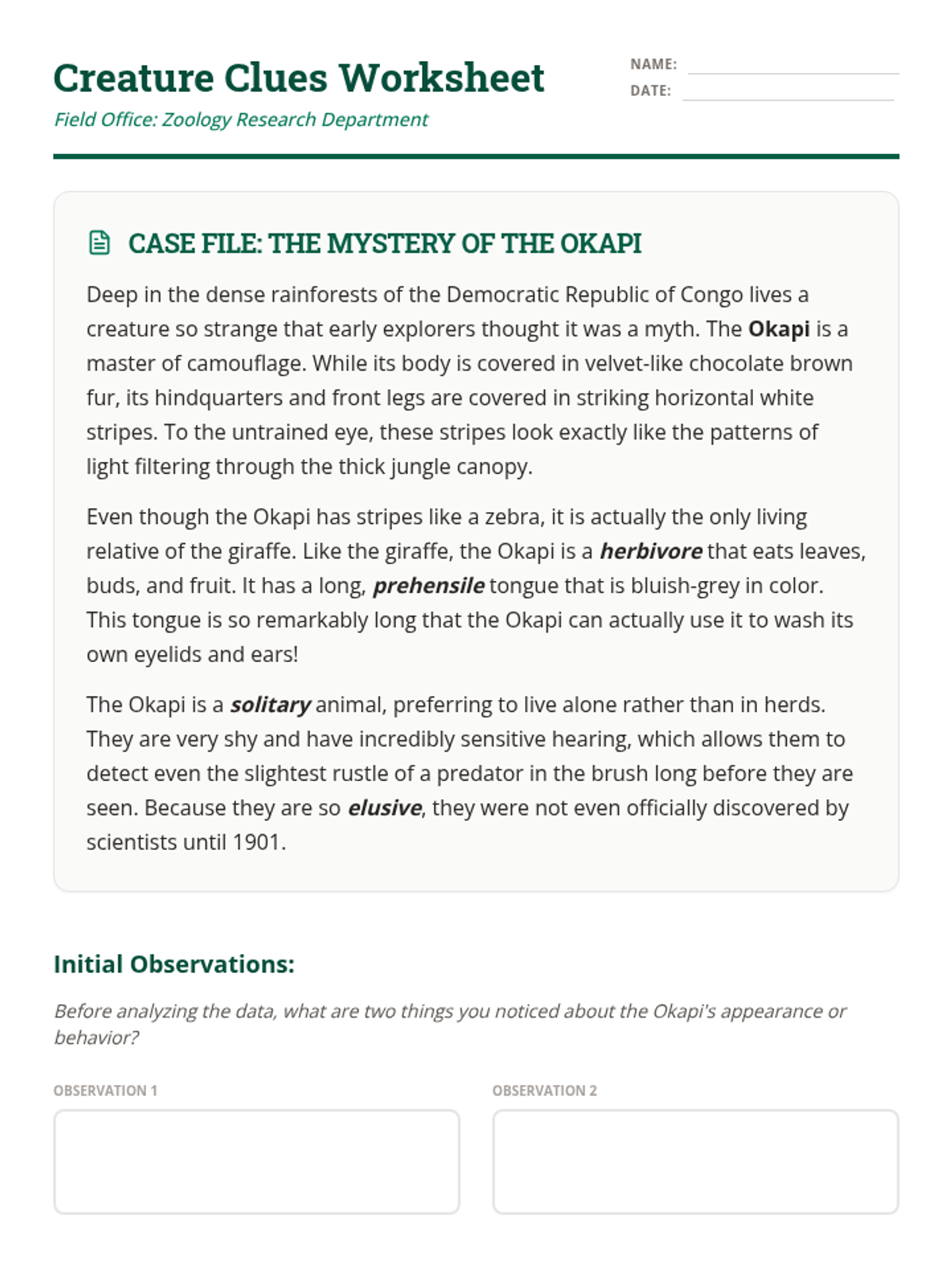
A two-page student worksheet featuring a reading passage about the Okapi and two graphic organizers. One organizer focuses on decoding Tier 2 vocabulary using context clues, while the other uses an "Equation" model for making text-based inferences.
A visual presentation introducing inference and context clues using zoology-themed examples and a guided case study on the snow leopard. Includes clear definitions and an observation activity.
A detailed teacher's answer key with full idiom phrases and story sequence solutions. Includes instructional tips for classroom delivery.
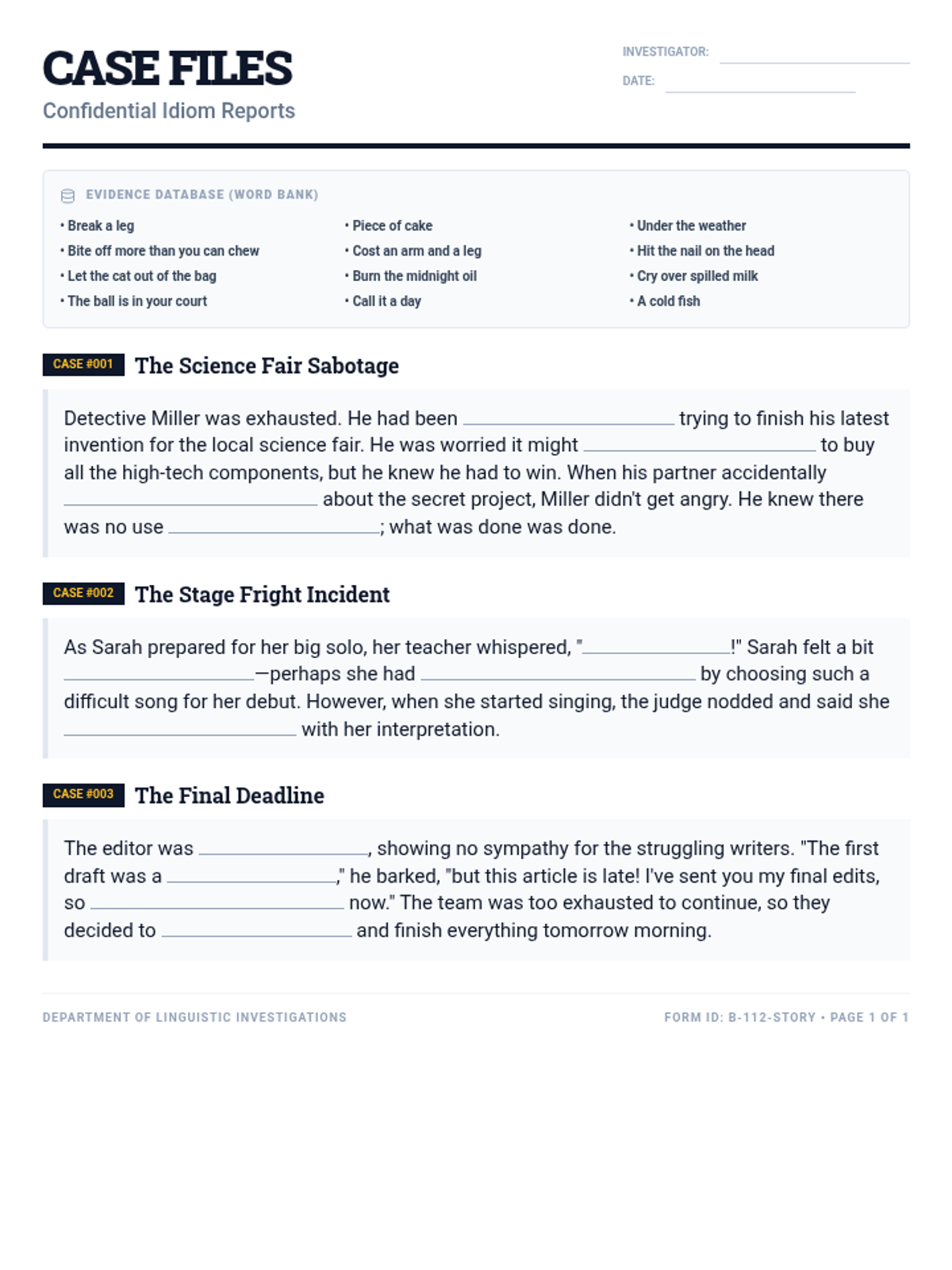
A single-page, detective-themed worksheet featuring three short fill-in-the-blank stories. Students use context clues and a provided word bank of 12 idioms to complete the narratives.
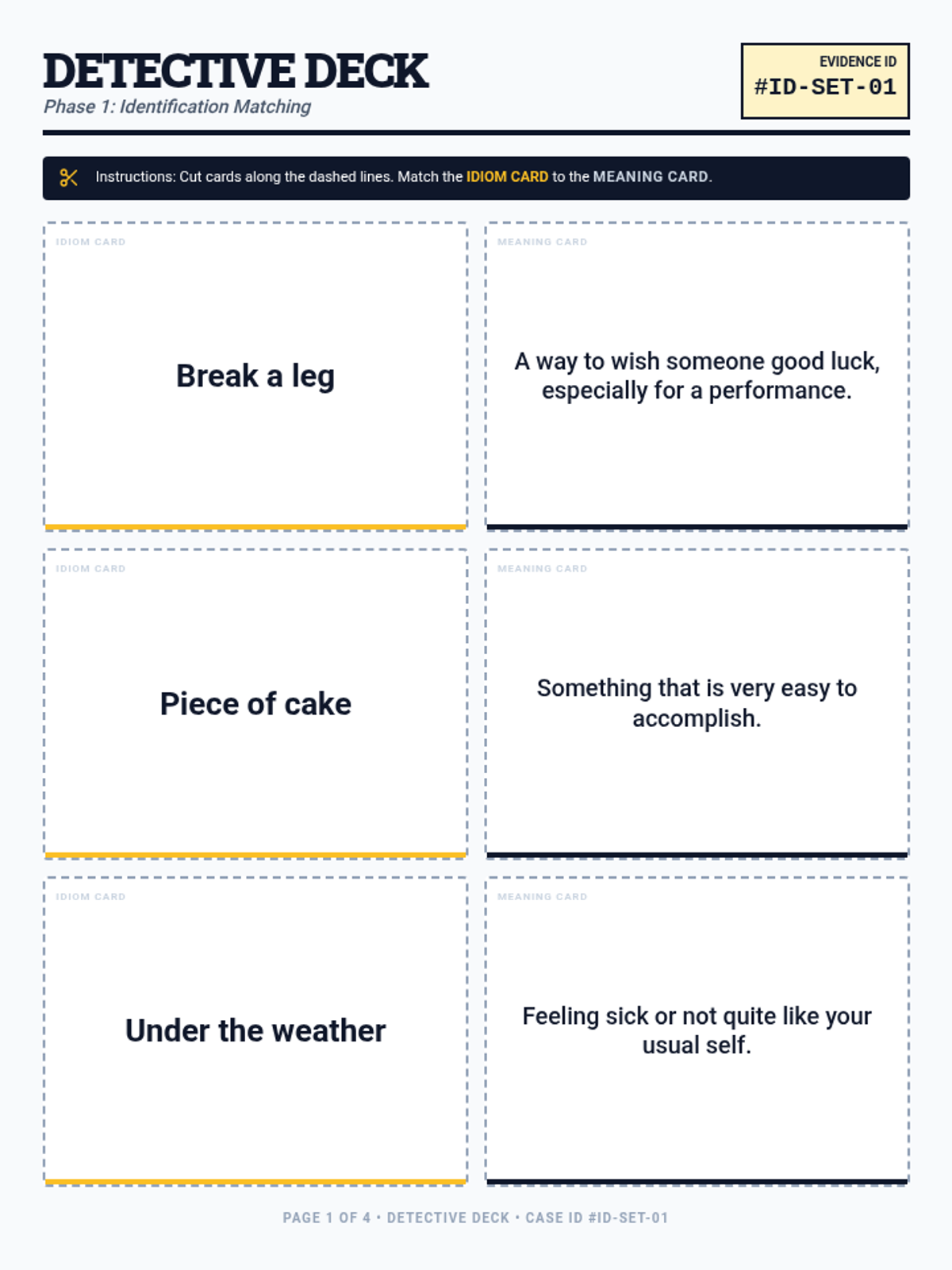
A set of 24 detective-themed matching task cards (12 pairs) featuring common English idioms and their literal meanings. Cards are formatted to prevent page-break slicing and include clear visual indicators for idioms versus meanings.
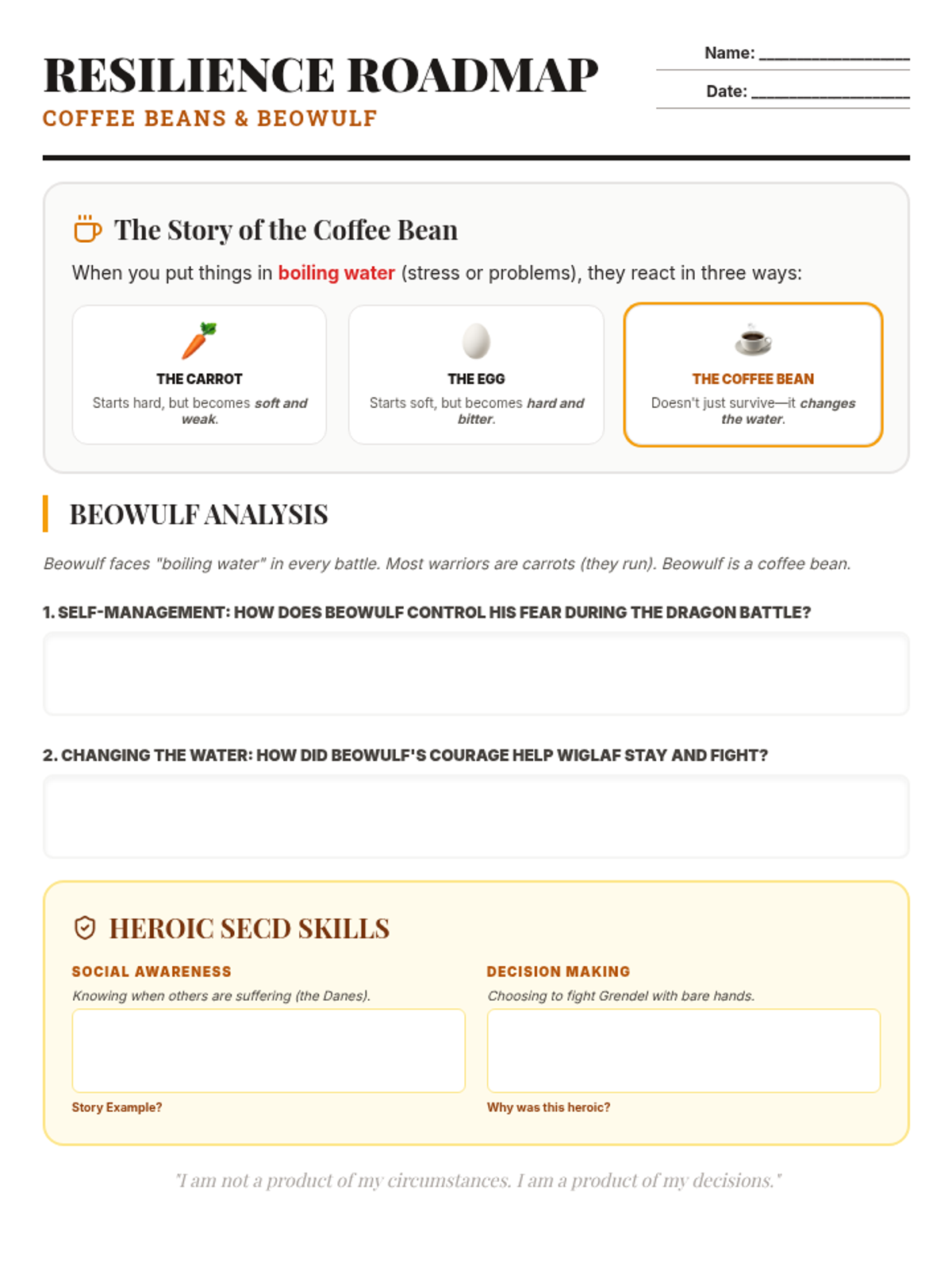
A resilience-focused handout connecting the Coffee Bean metaphor (Carrot, Egg, Coffee Bean) to Beowulf's character and SECD skills like self-management and social awareness. Labeled for Group 1. Includes Name, Date, and Period fields. Optimized for 8.5x11 printing.
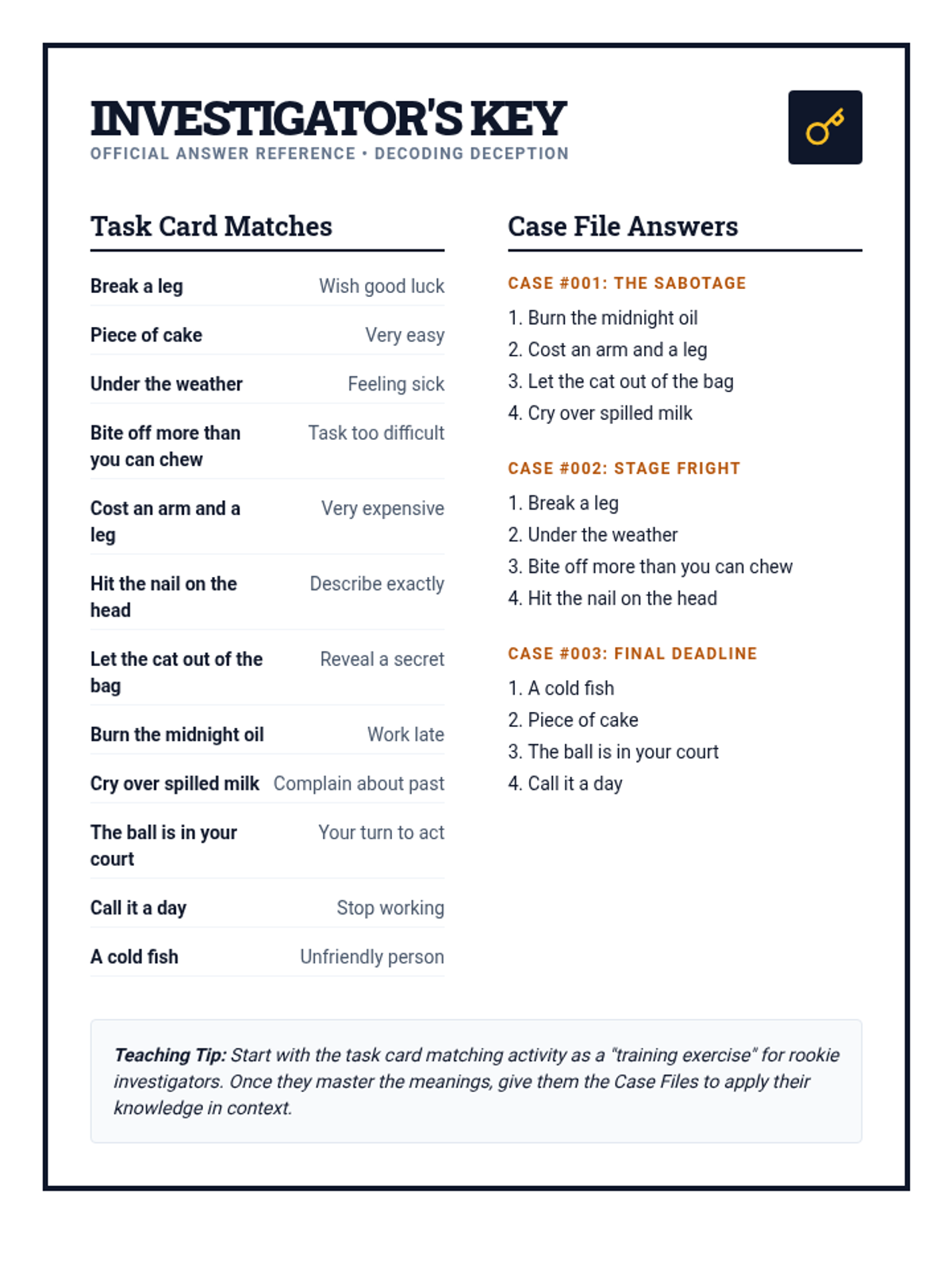
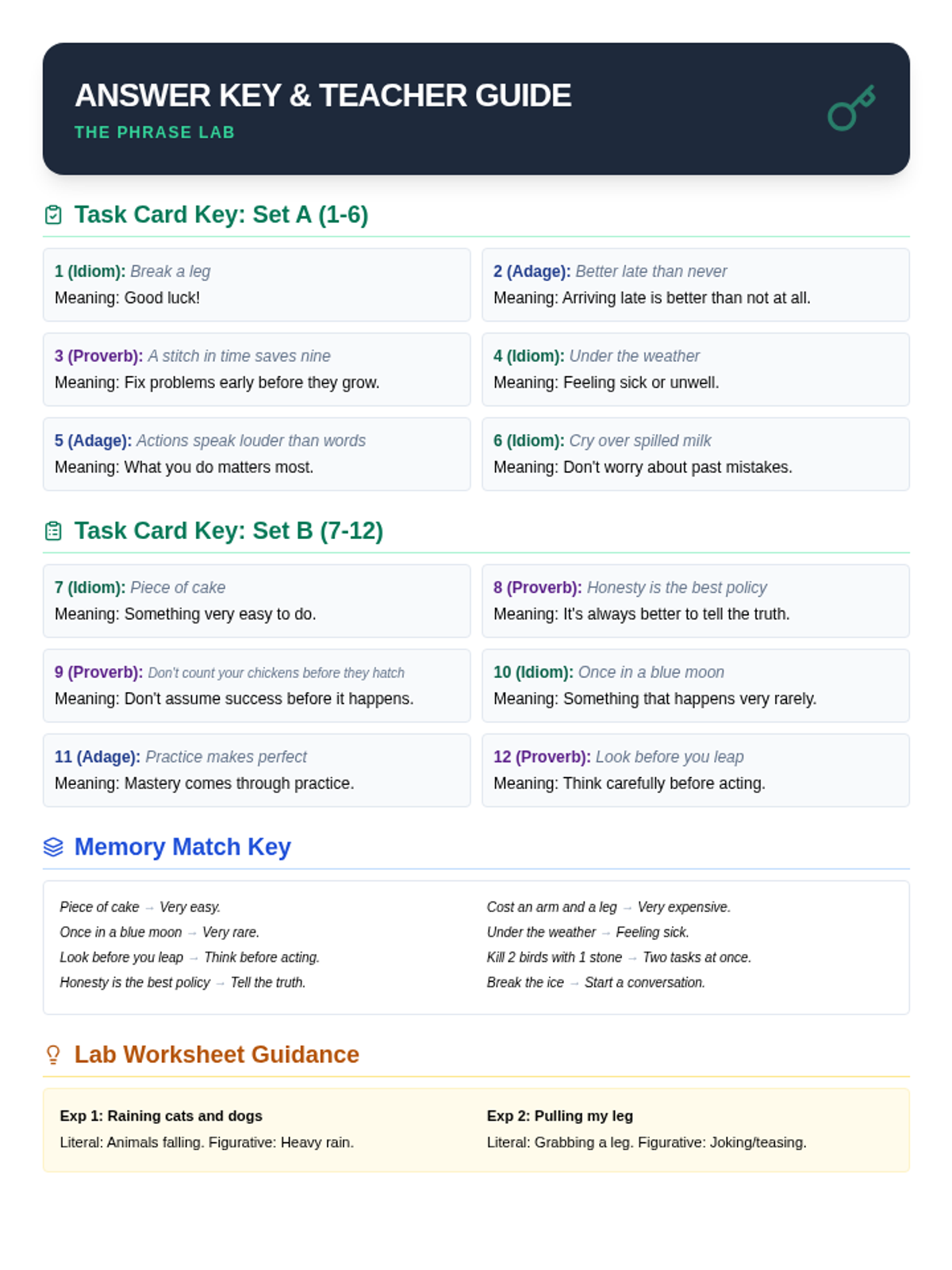
A comprehensive answer key and facilitation guide for teachers. Revised to include 12 task card answers categorized by type. Compact single-page layout.
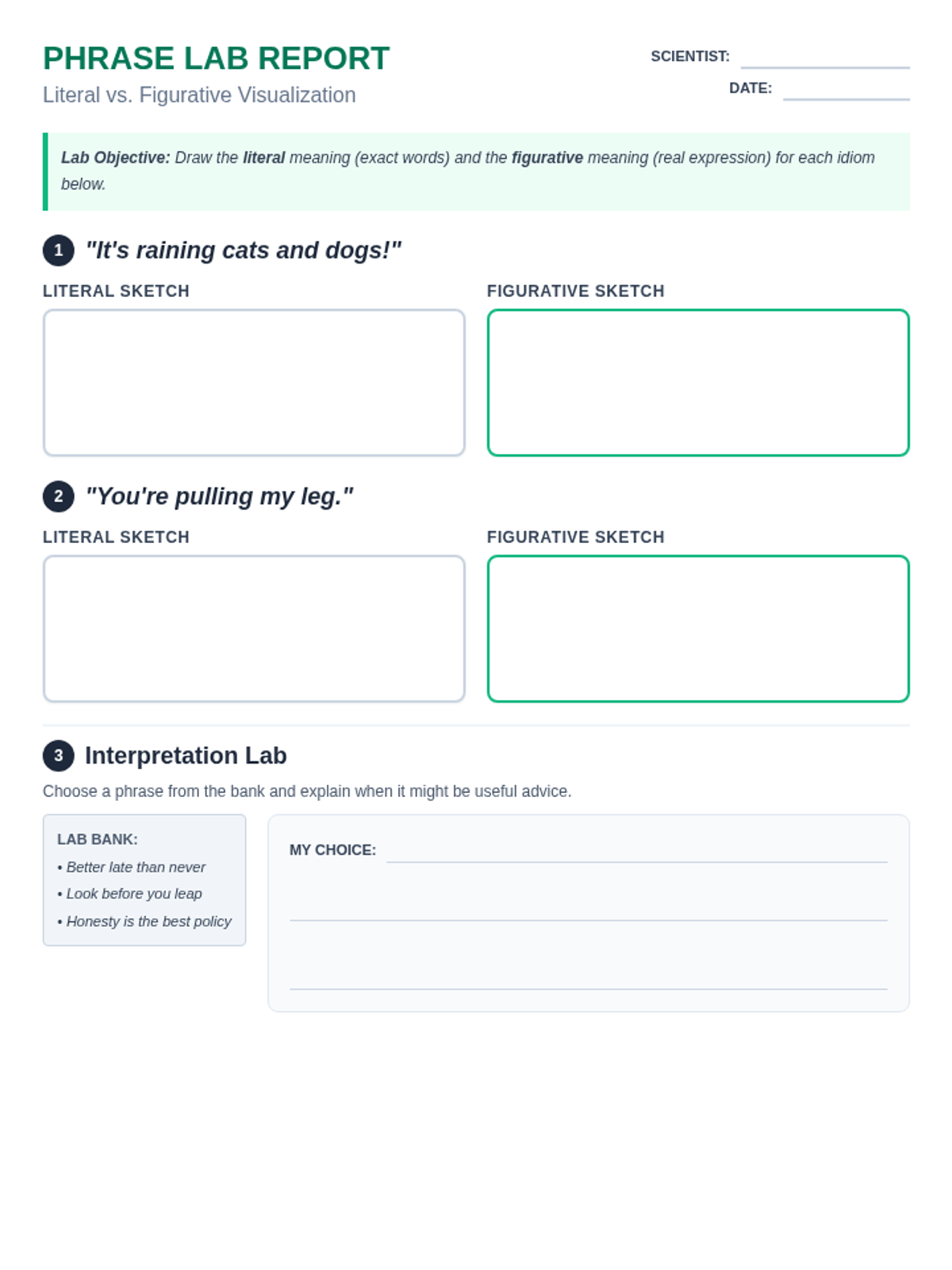
A worksheet for 4th graders to illustrate the difference between literal and figurative meanings of common idioms. Revised with darker labels, larger text, and a single-page layout.
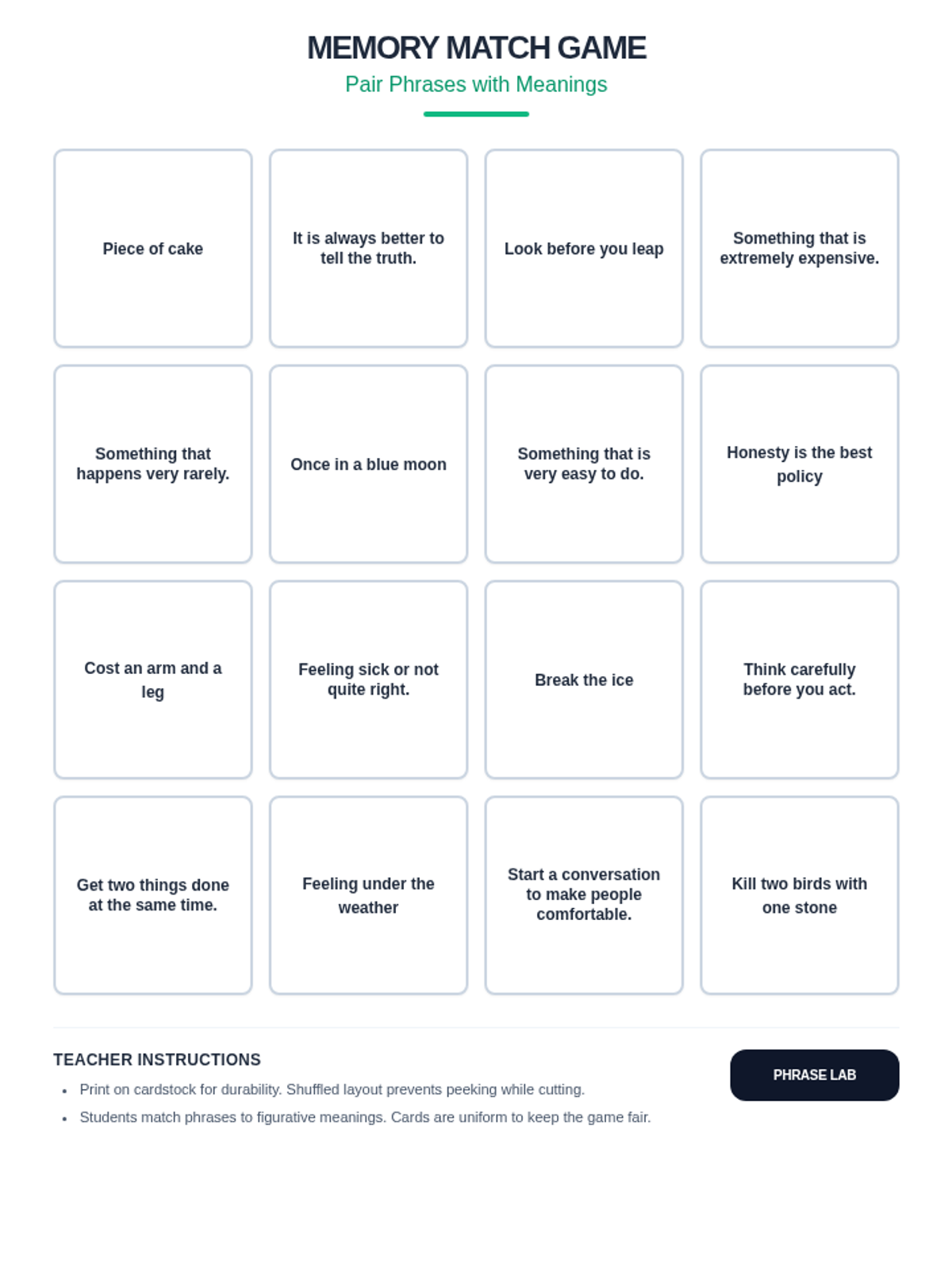
A matching memory game featuring 8 pairs of idioms, adages, and proverbs. Revised for absolute uniformity in text styling (color/weight/size) and thicker borders for easier cutting.
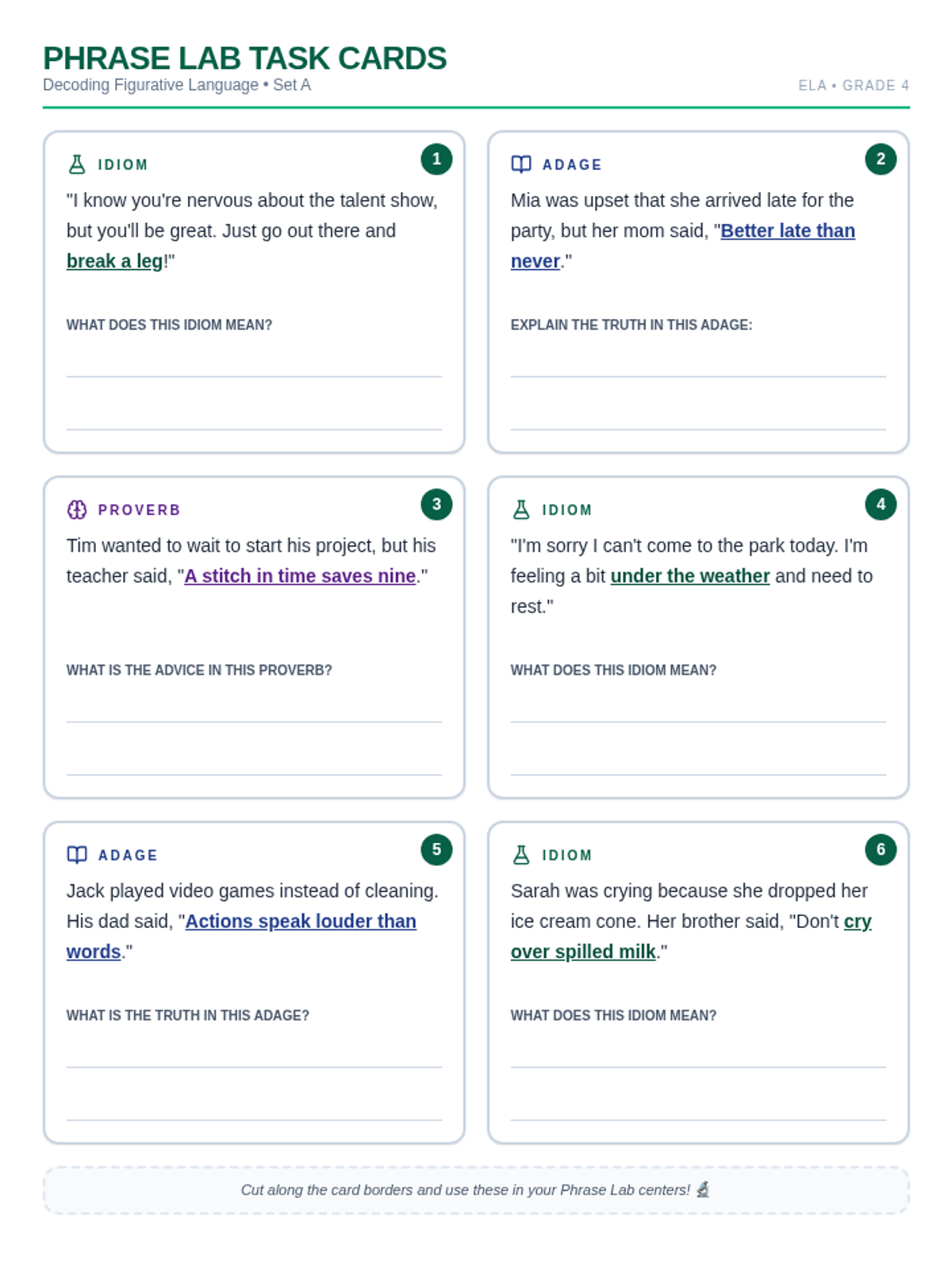
A set of 12 printable task cards featuring idioms, adages, and proverbs in context across two pages. Each card is labeled by type and includes a written interpretation area for student practice. Revised for high contrast and single-page sectioning.
A visual slide deck introducing idioms, adages, and proverbs with a fun 'Phrase Lab' theme, featuring clear definitions and examples. Revised with clearer distinctions and improved contrast.
A comprehensive unit slide presentation for Beowulf, covering all seven parts with visual support, vocabulary, and key discussion prompts. Updated to include SECD skills and the Coffee Bean metaphor for resilience. Includes Name/Date/Period tracking fields and prominent Group 1 branding.
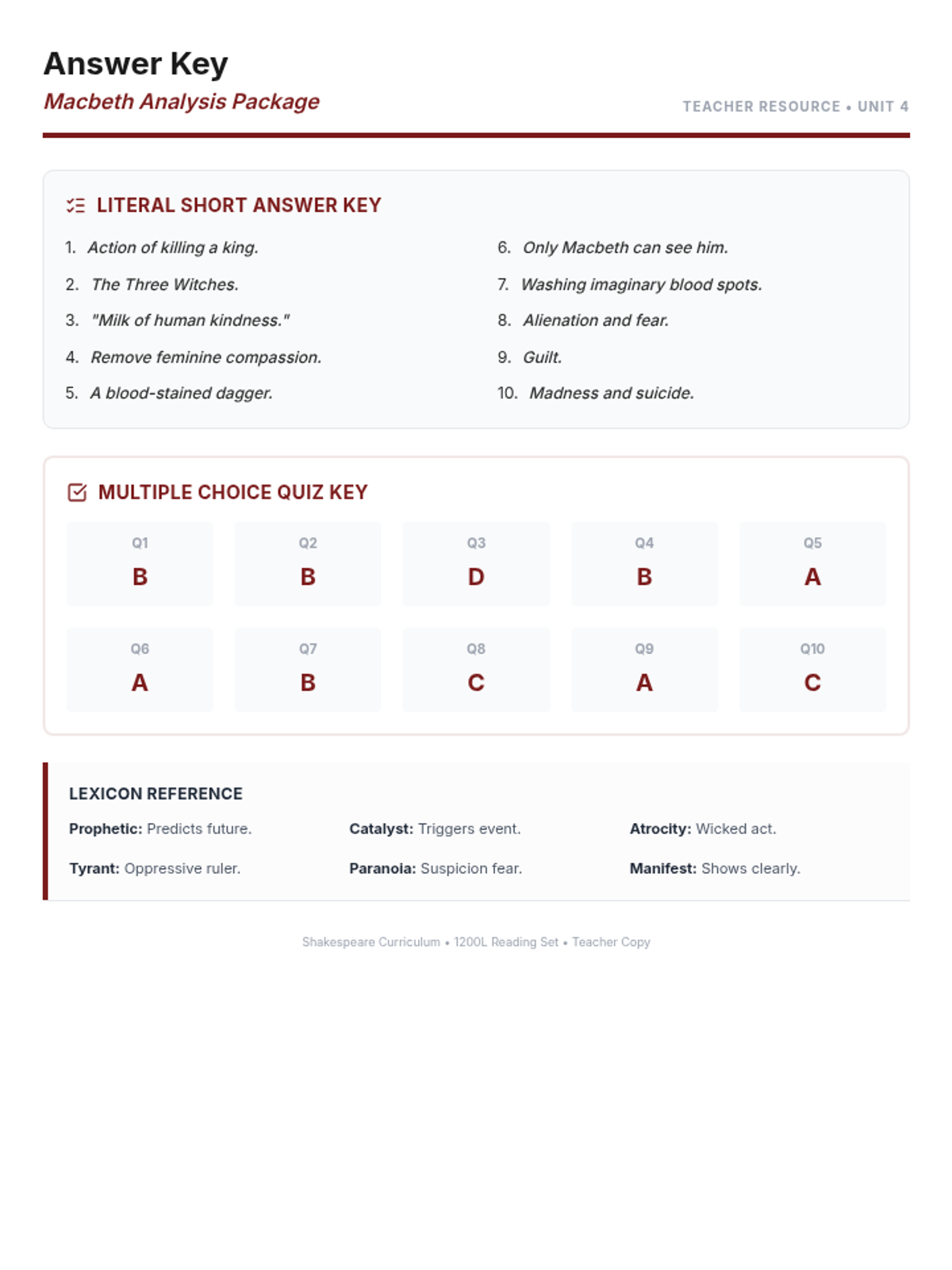
A master answer key covering both the literal short-answer questions from the article and the 10-question multiple-choice quiz. Optimized for single-page layout.
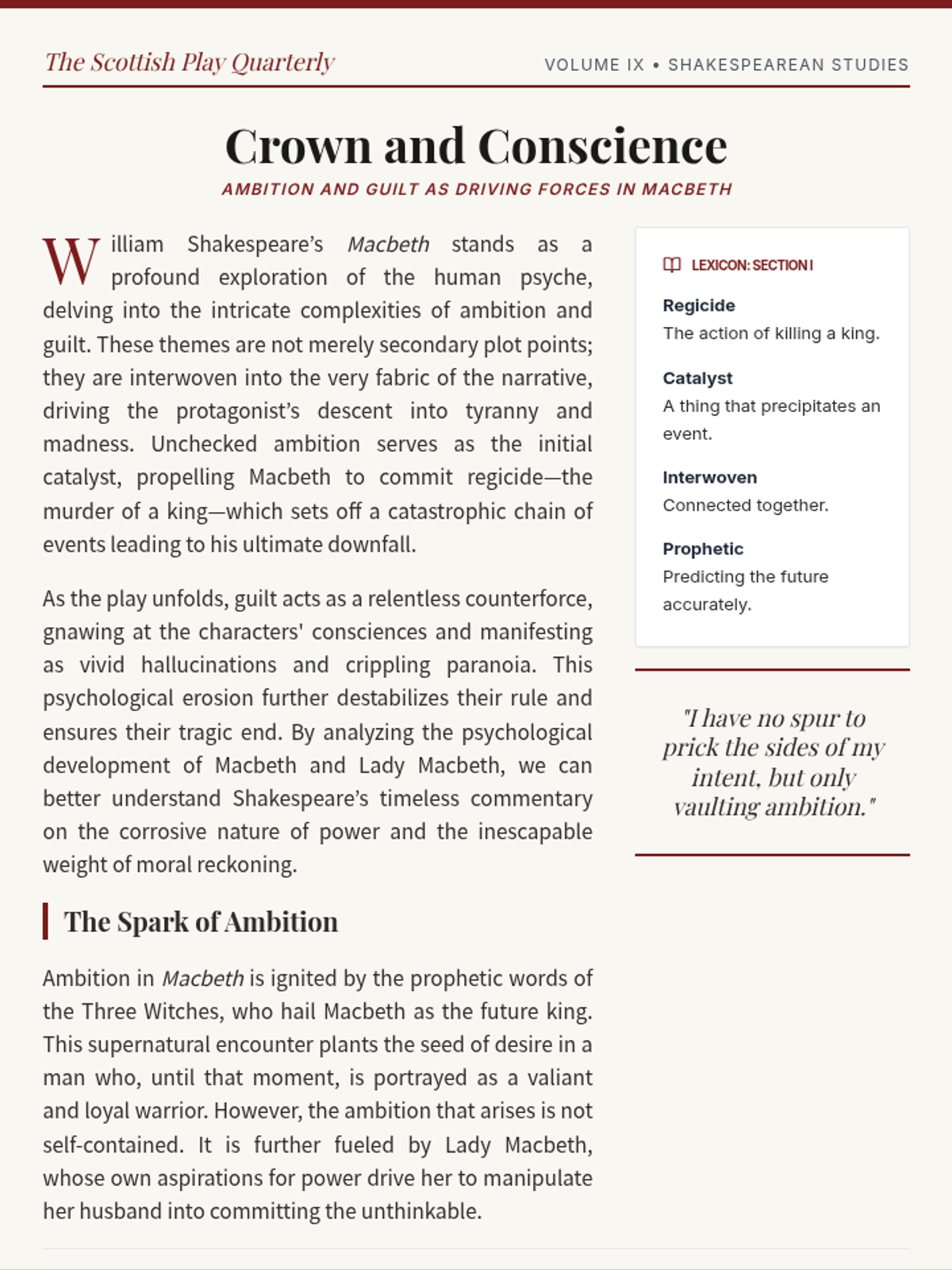
A comprehensive 4-page article adapted for 9th-grade readers (1200L), exploring the themes of ambition and guilt in Shakespeare's Macbeth, including integrated vocabulary banks and comprehension questions.
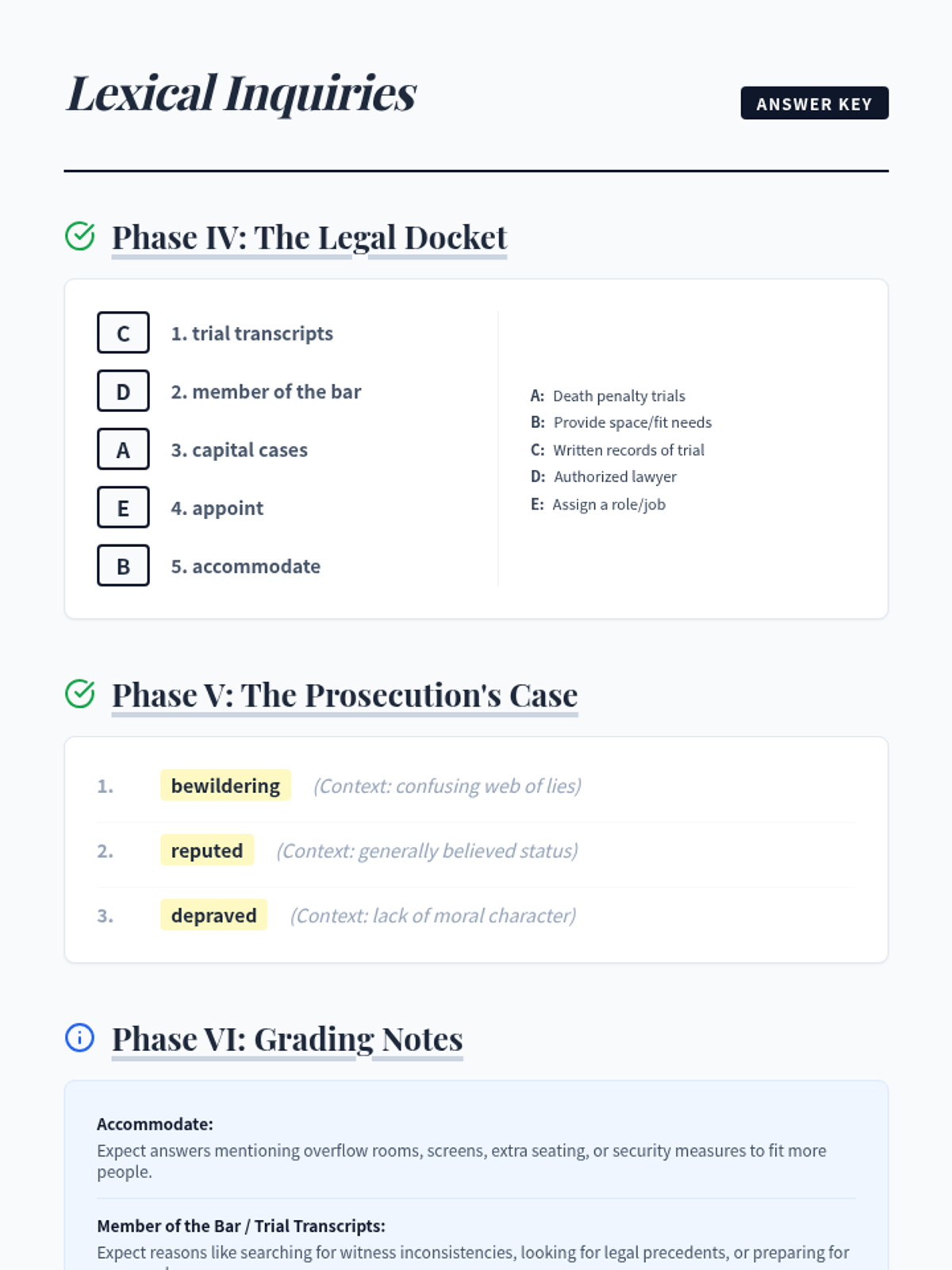
A teacher's answer key for the Case Brief Worksheet, providing matching solutions, context clue answers, and conceptual guidance for evaluating student application of legal terminology.
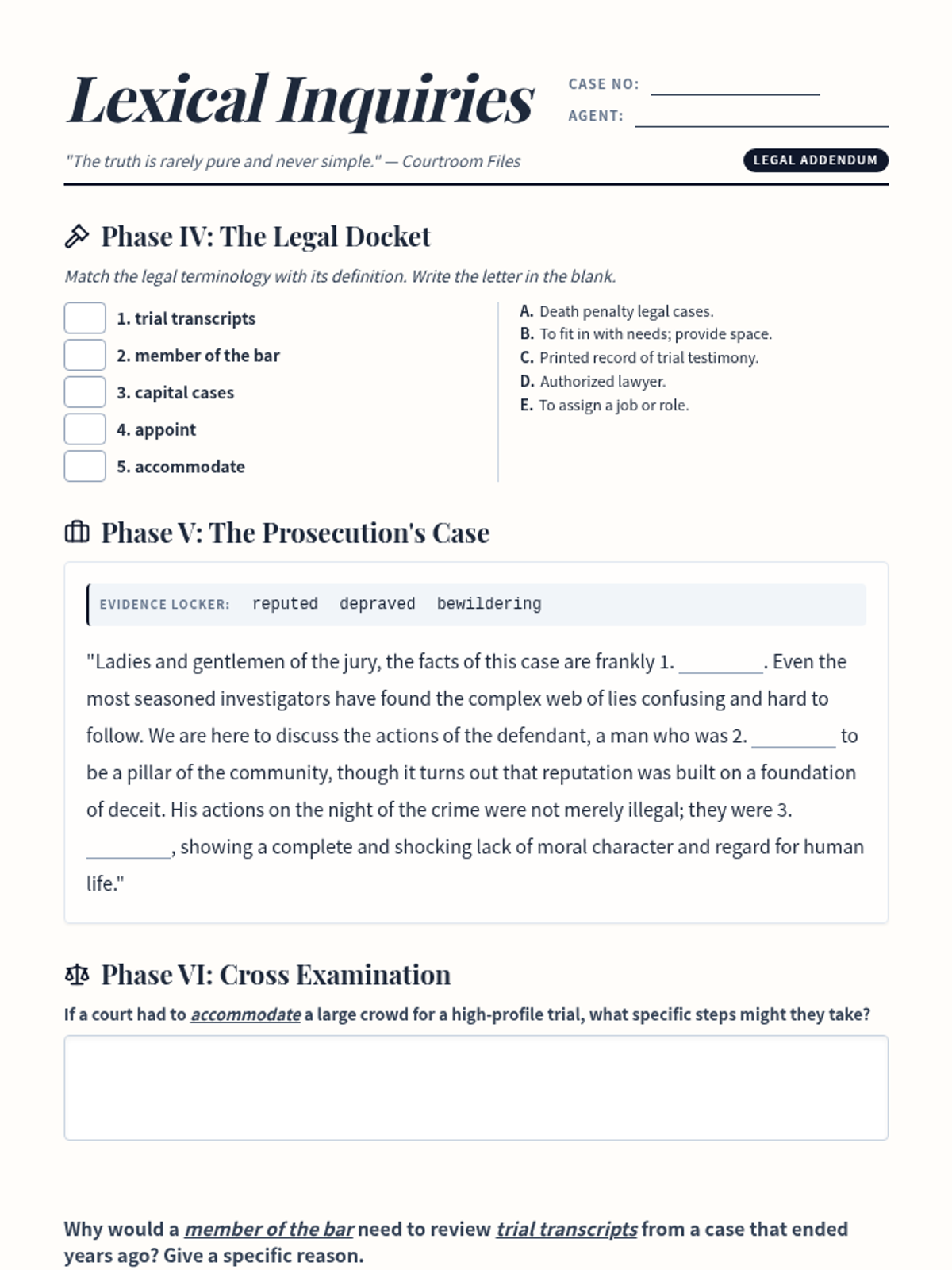
A second vocabulary worksheet in the Lexical Inquiries series, focusing on legal and courtroom terminology. Students engage with words like 'reputed', 'depraved', and 'trial transcripts' through matching, narrative context, and reflective application. All terms are lowercase.
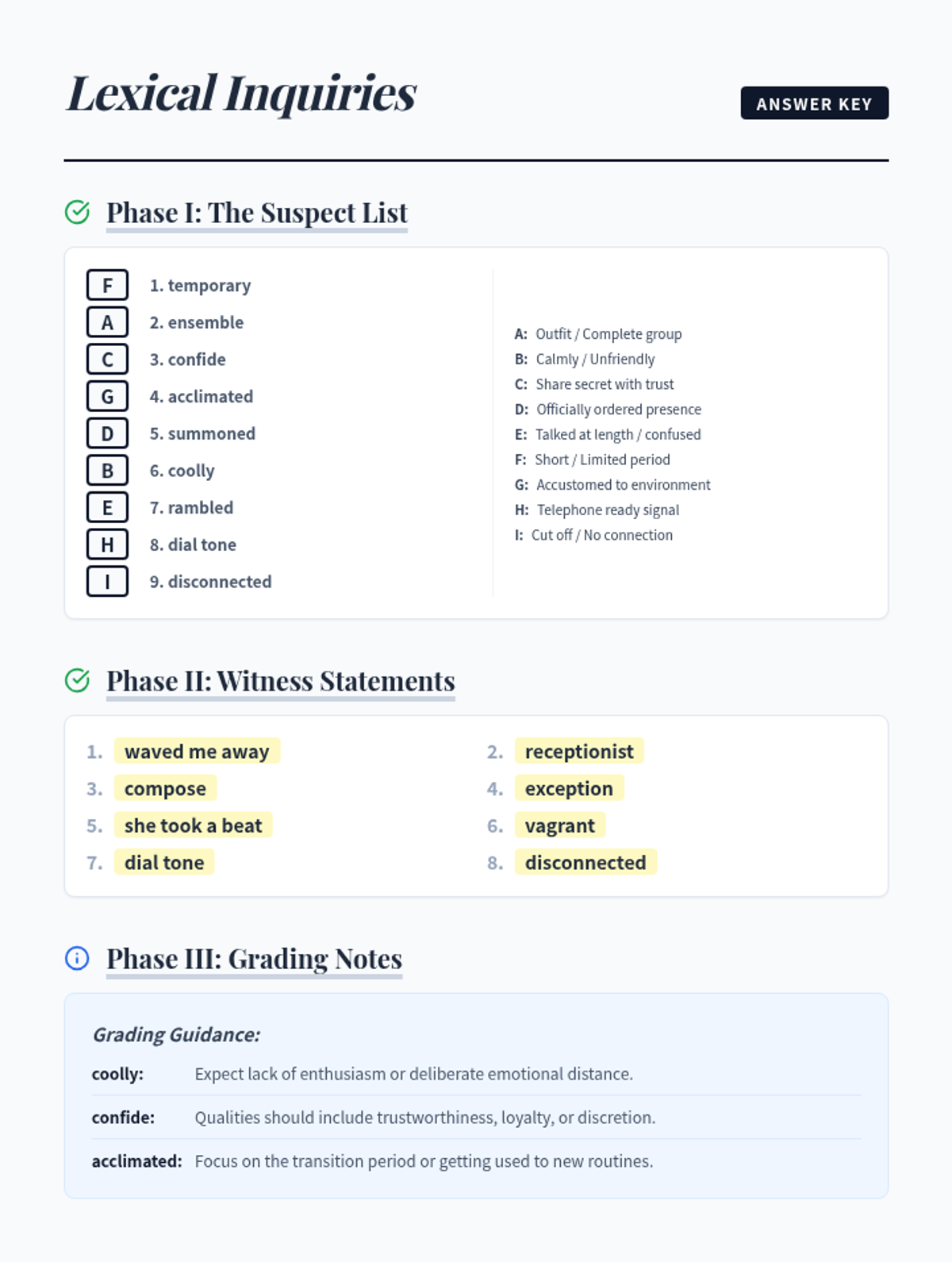
A teacher's answer key for the Word Inquiries Worksheet, providing matching solutions, context clue answers, and conceptual guidance for evaluating student application of legal terminology. Updated to include 'dial tone' and 'disconnected'.
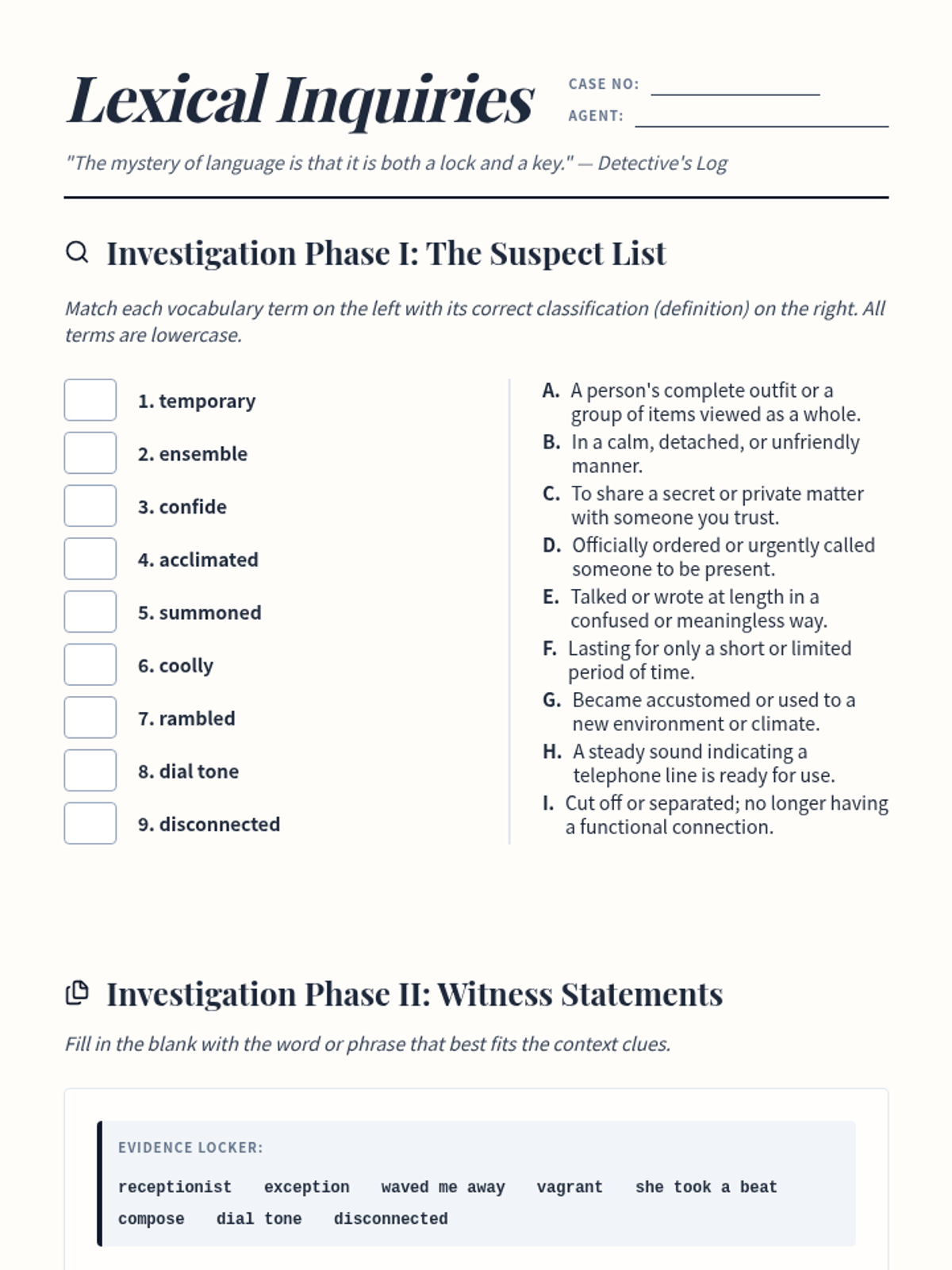
A mystery-themed vocabulary worksheet focusing on matching definitions, using context clues in a narrative setting, and applying words to personal reflections. Features a sophisticated 'Private Investigator' aesthetic with clear sections for word analysis. All vocabulary terms are lowercase. Includes the new terms 'dial tone' and 'disconnected'.
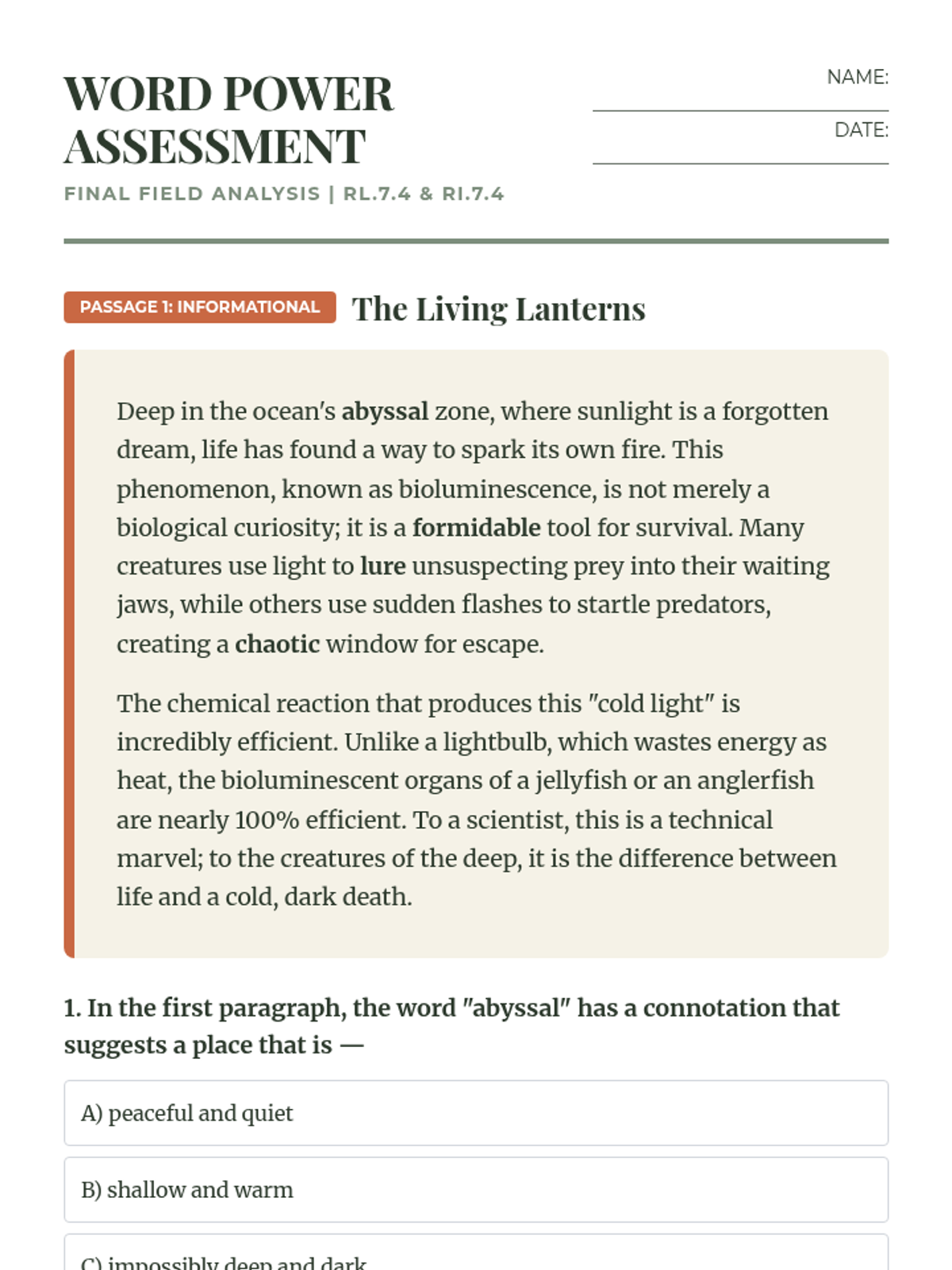
A comprehensive formal assessment featuring an informational passage on bioluminescence and a poem about a locomotive. Includes 10 multiple-choice questions targeting RL.7.4 and RI.7.4, covering connotation, figurative language, technical meaning, and tone. Standardized layout for printing with optimal page breaks.
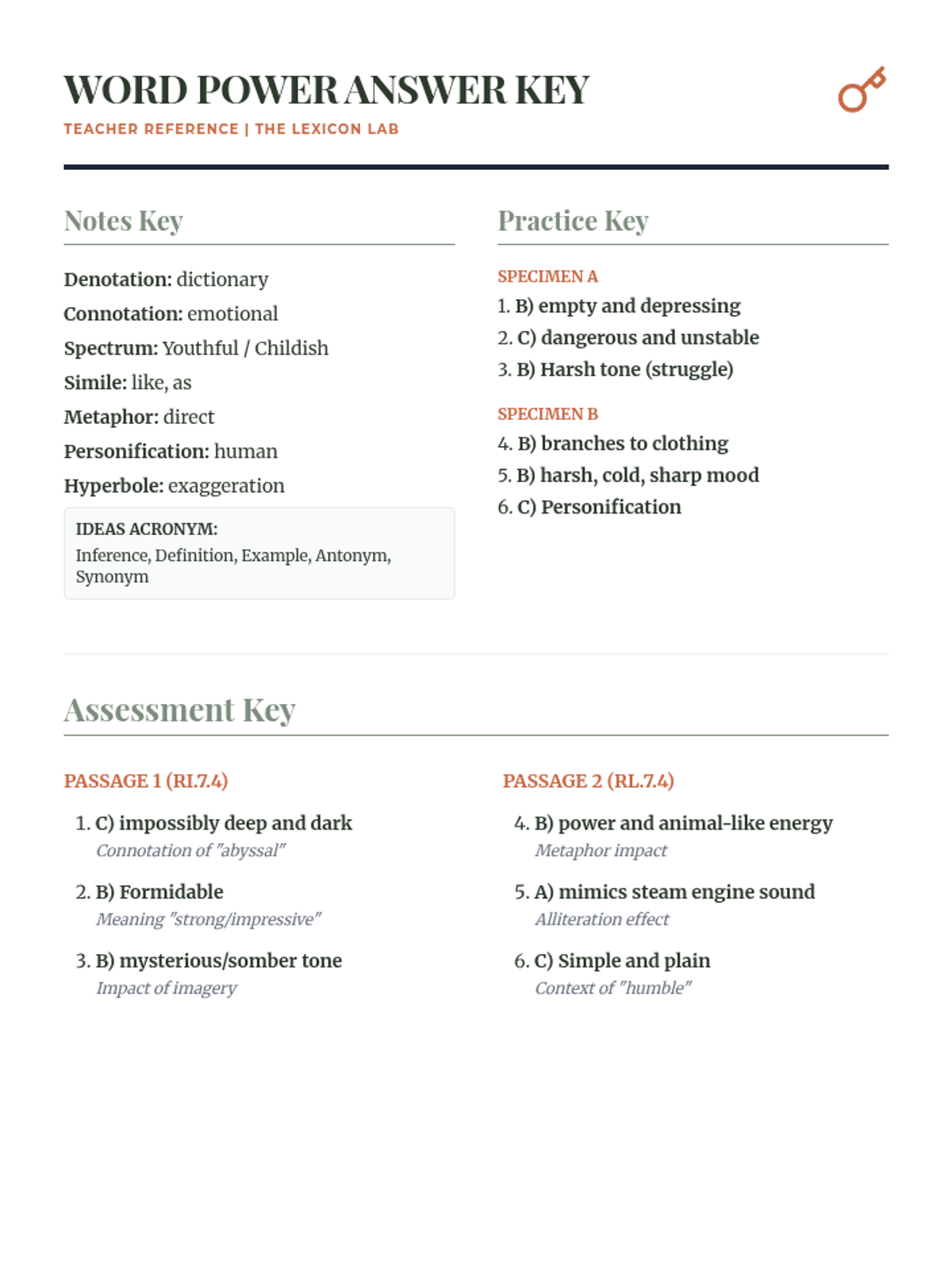
A teacher answer key for the Vocabulary Voyage Notes and Context Quest Practice. Updated to a cleaner layout with assessment references moved to a standalone key.
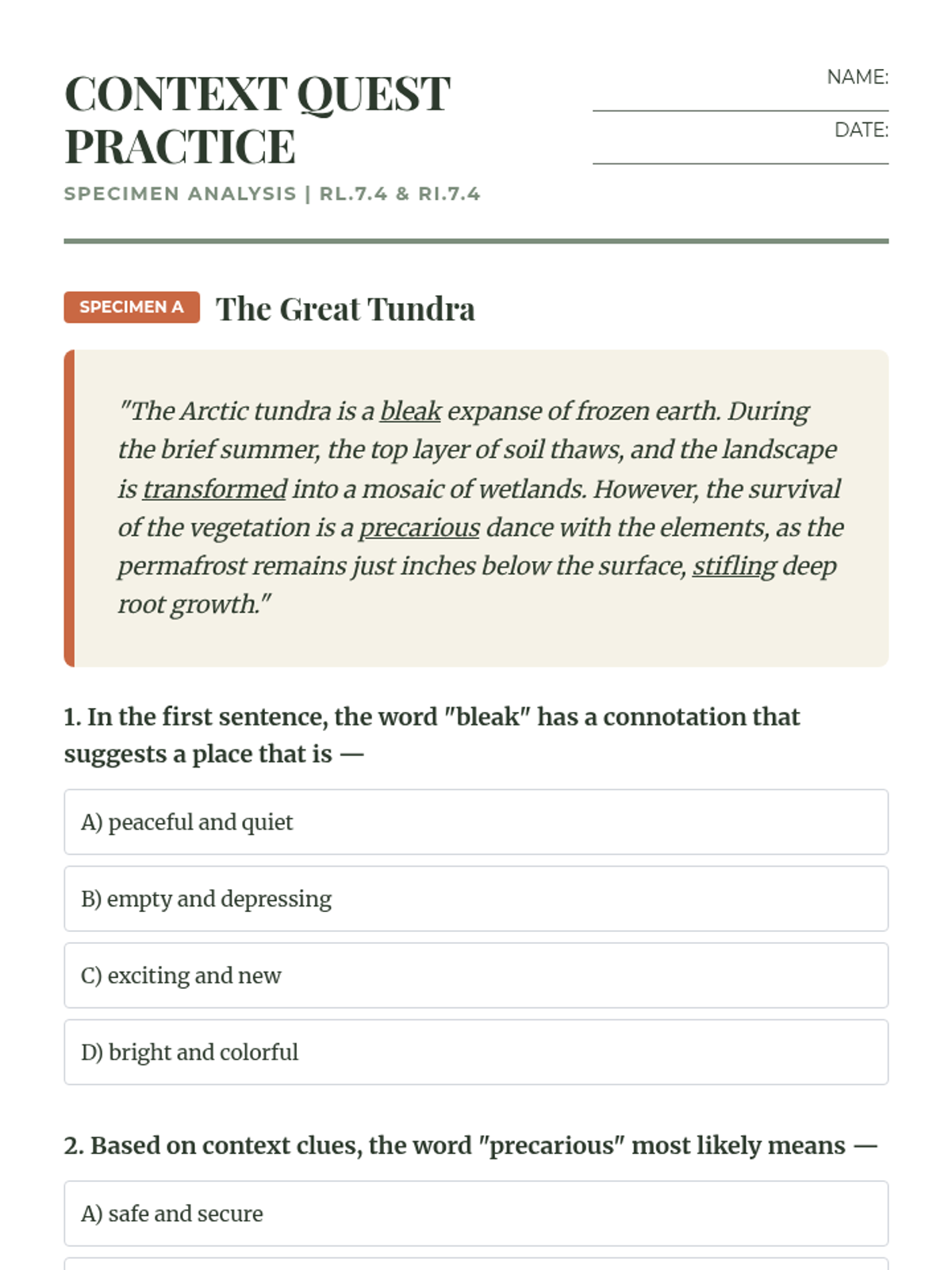
A practice worksheet featuring informational and literary passages with multiple-choice questions targeting RL.7.4 and RI.7.4. Standardized for printing with improved page breaks and annotation space.
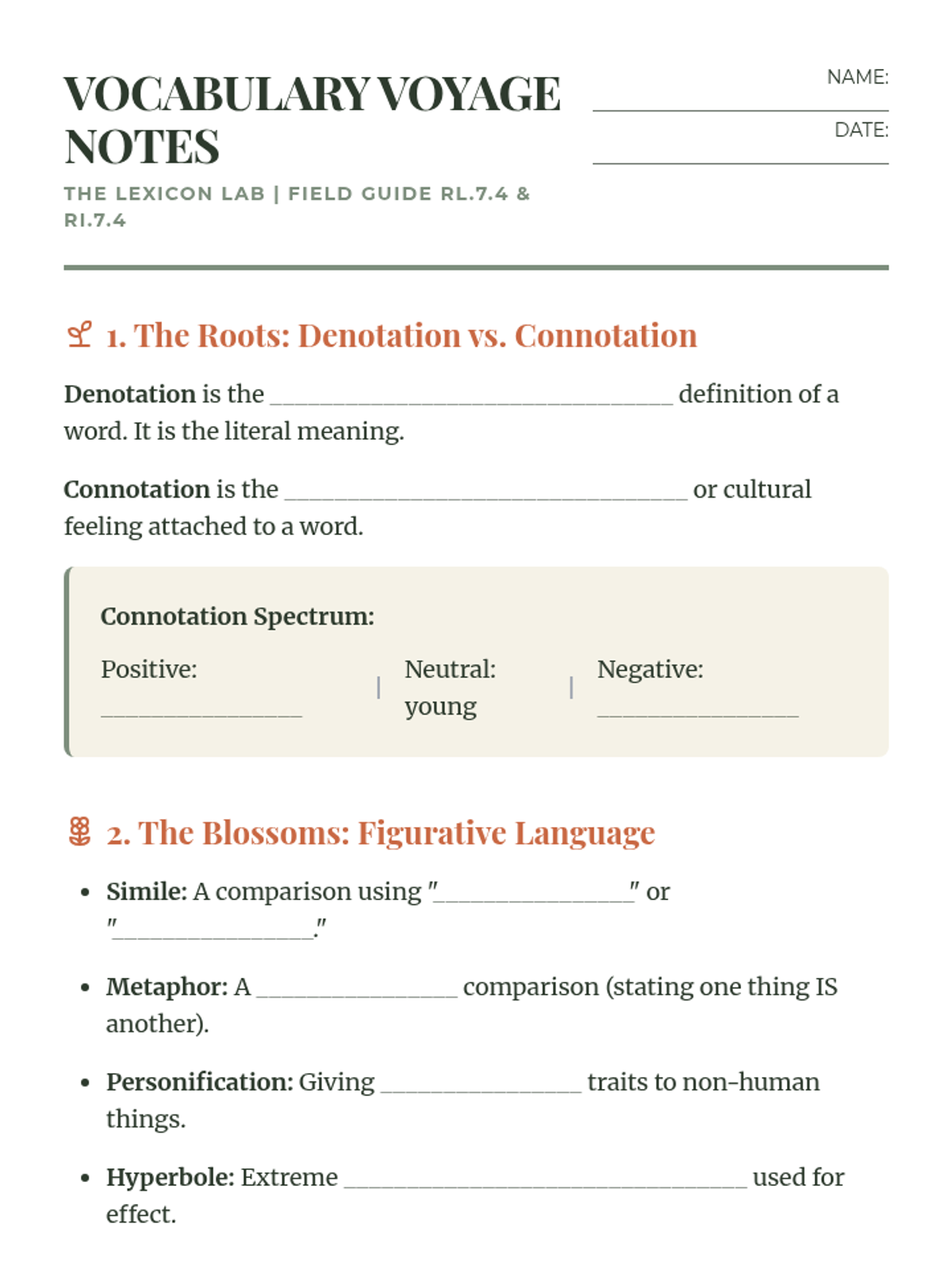
Fill-in-the-blank guided notes for students to use during the Word Power Slides presentation, following the Botanical Explorer theme with improved grid layouts and spacing.
A presentation slide deck for 'Marks on Paper' from Bad Boys, exploring themes of speech, identity, and the power of written communication through visual storytelling and guided discussion.
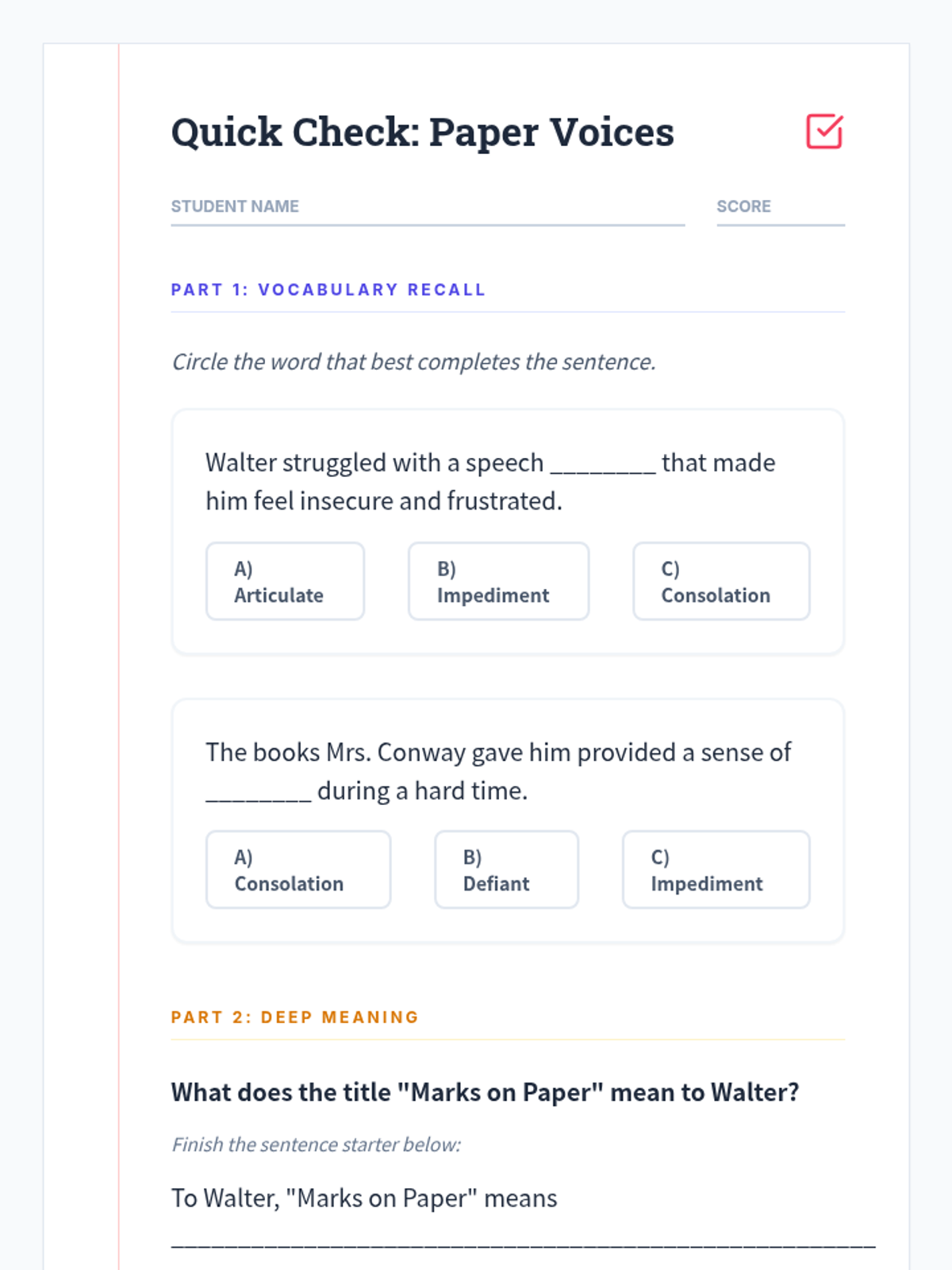
A short exit ticket for 'Marks on Paper' to assess vocabulary retention, understanding of the central metaphor, and character motivation.
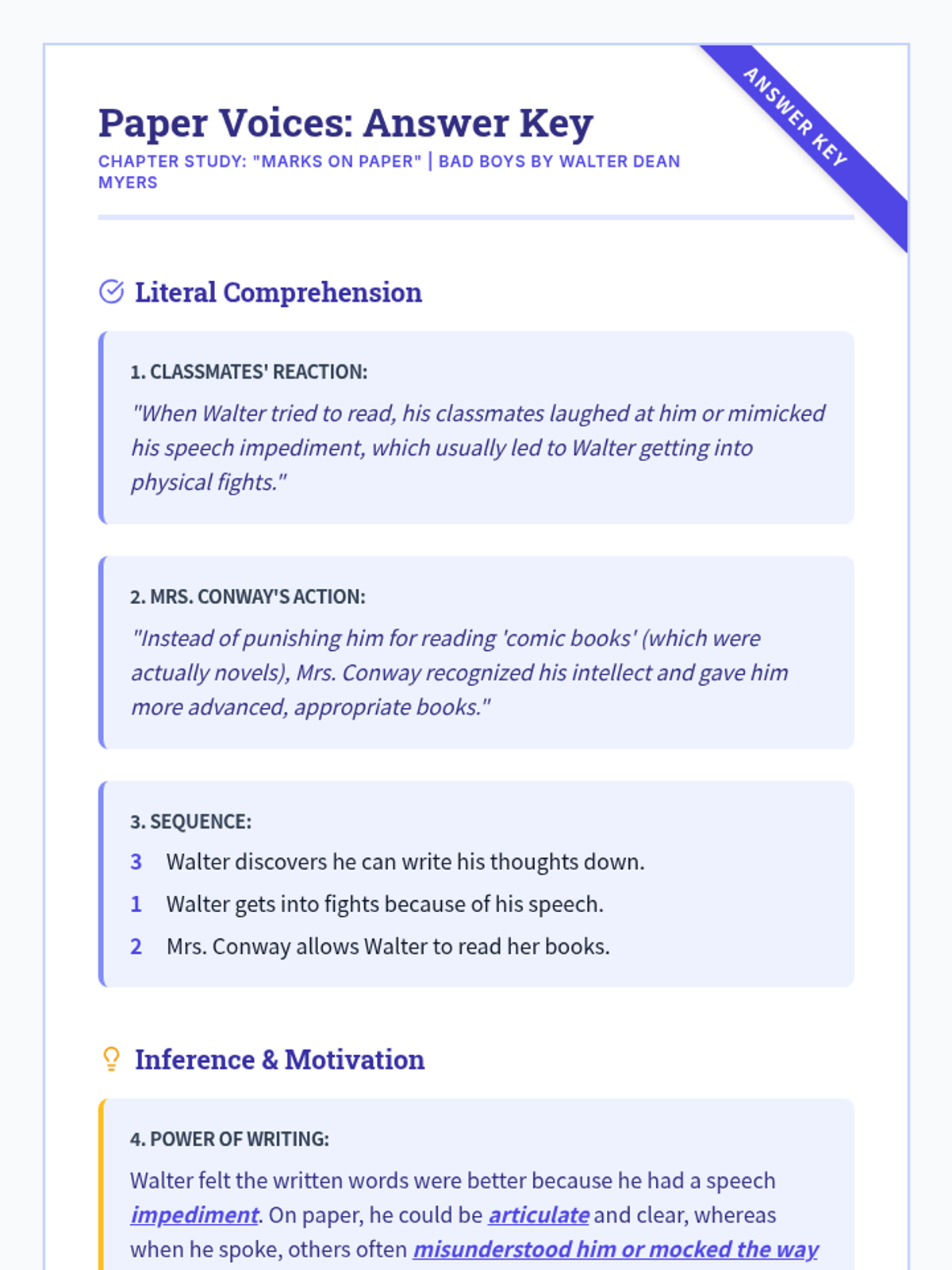
Teacher answer key and facilitation guide for the 'Marks on Paper' study guide, including expected student responses and instructional tips.
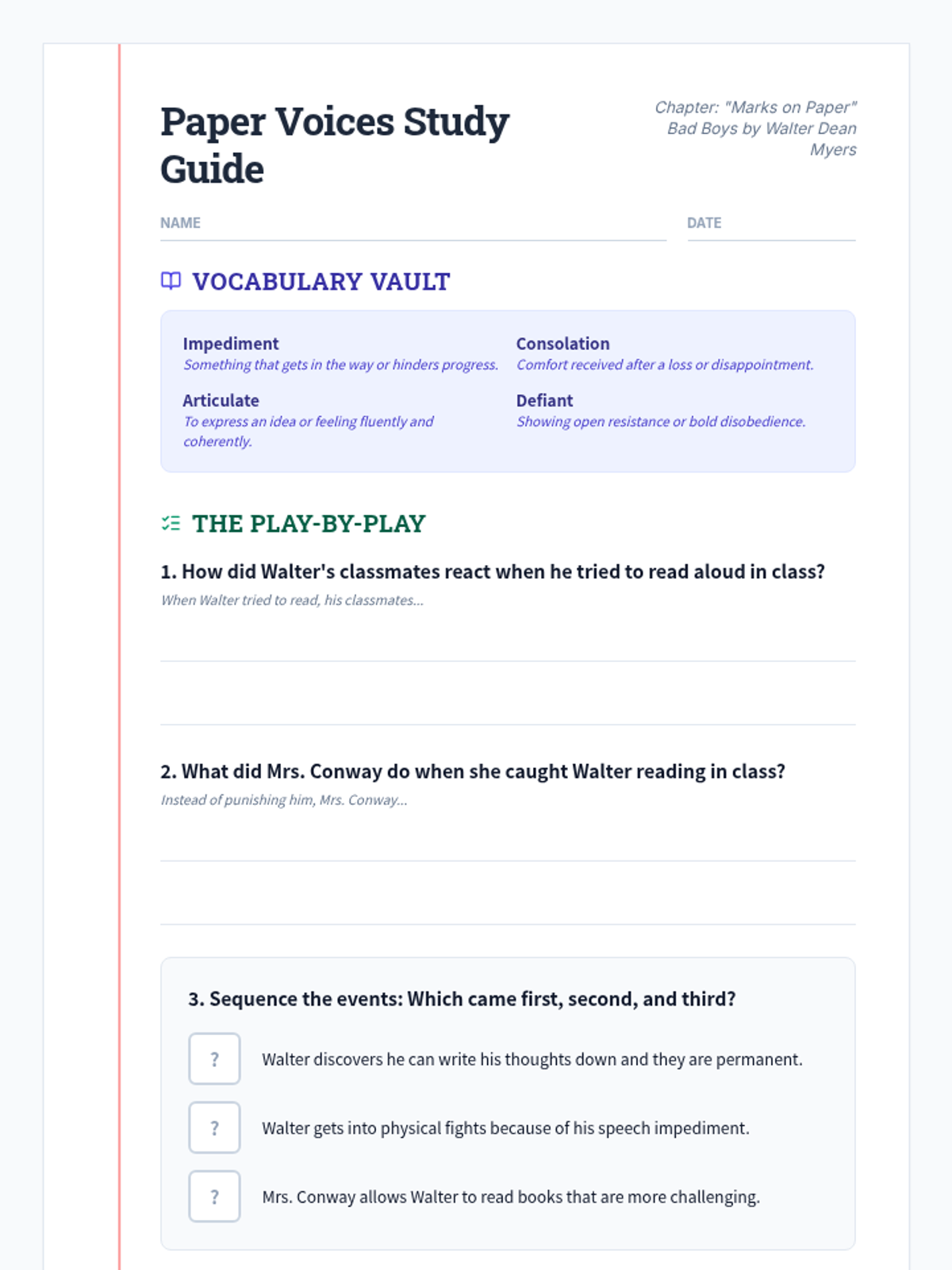
A study guide for the chapter 'Marks on Paper' from Bad Boys by Walter Dean Myers, featuring vocabulary definitions, literal comprehension questions, sequence tasks, and inference-based sentence frames.
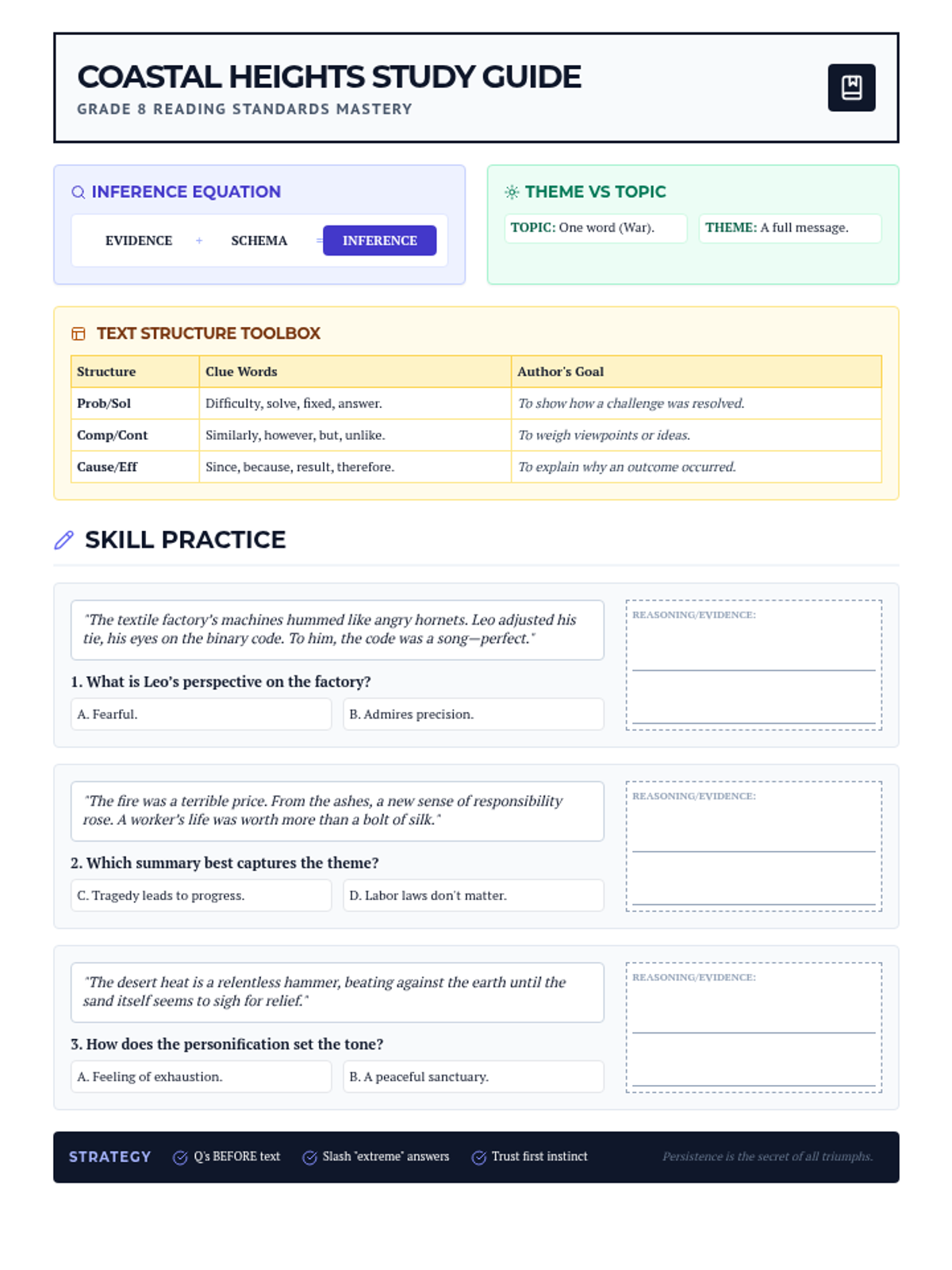
Revised 1-page study guide consolidated for print efficiency, featuring toolkits for inference and theme, a text structure table, and targeted practice items with reasoning space.
A 10-slide instructional presentation for whole-class review, breaking down the most challenging skills and questions from the Coastal Heights assessment with strategy tips.
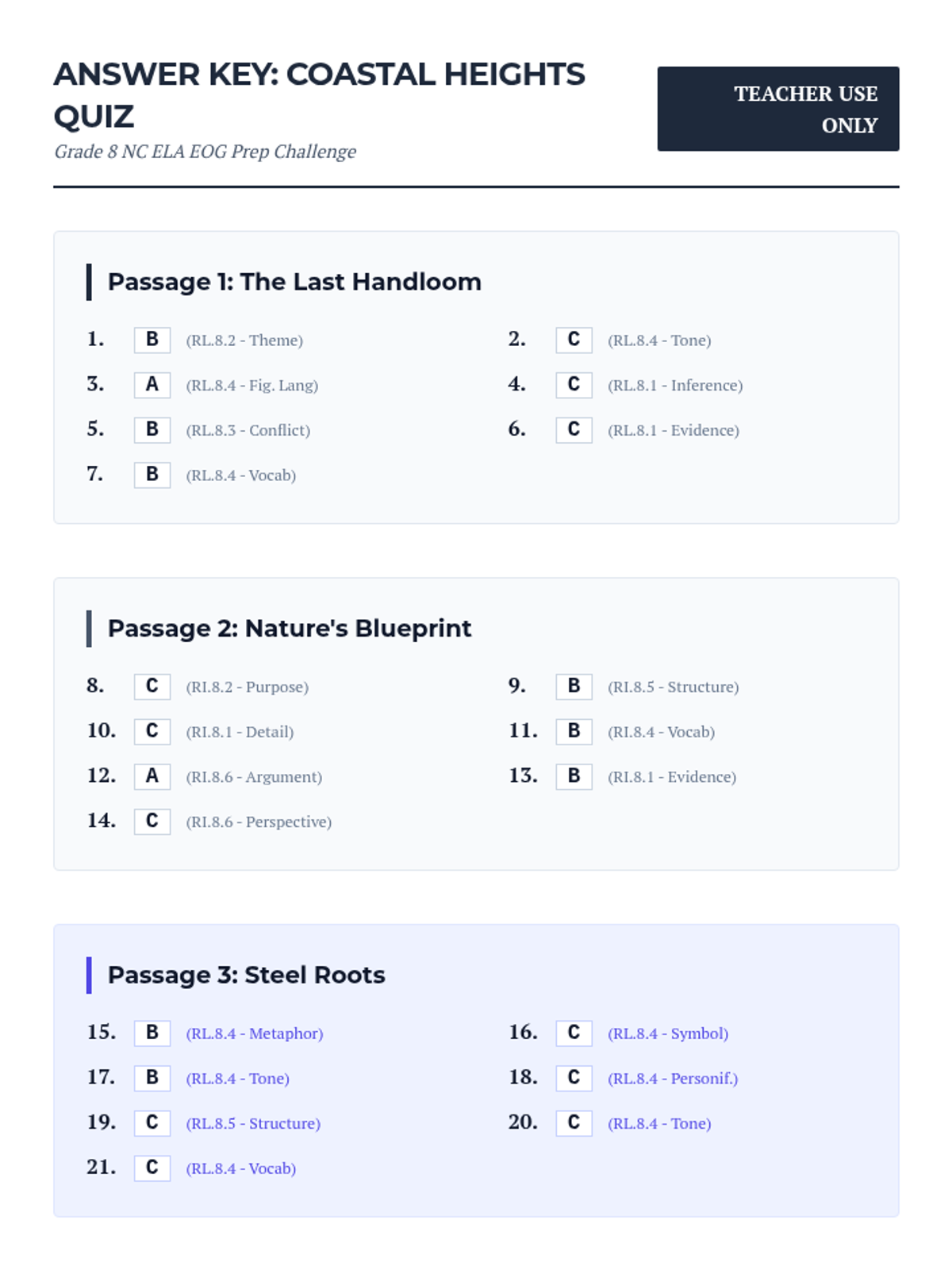
Revised Answer Key with improved linear flow, page-break prevention (break-inside-avoid), and clearly defined passage sections for easier grading.
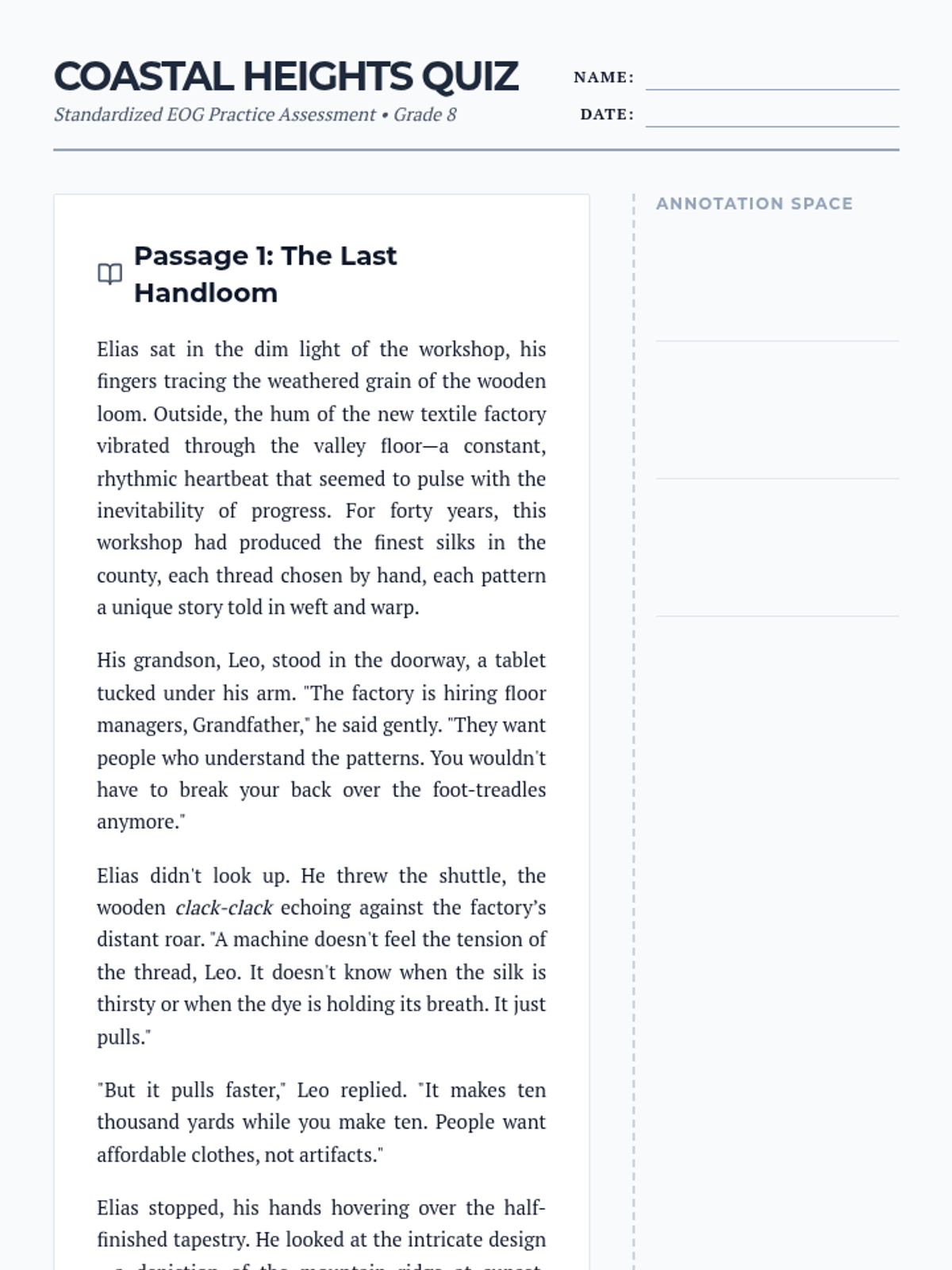
Revised 35-question Grade 8 EOG quiz with improved page break management (break-inside-avoid) and added annotation space for student scratch work.
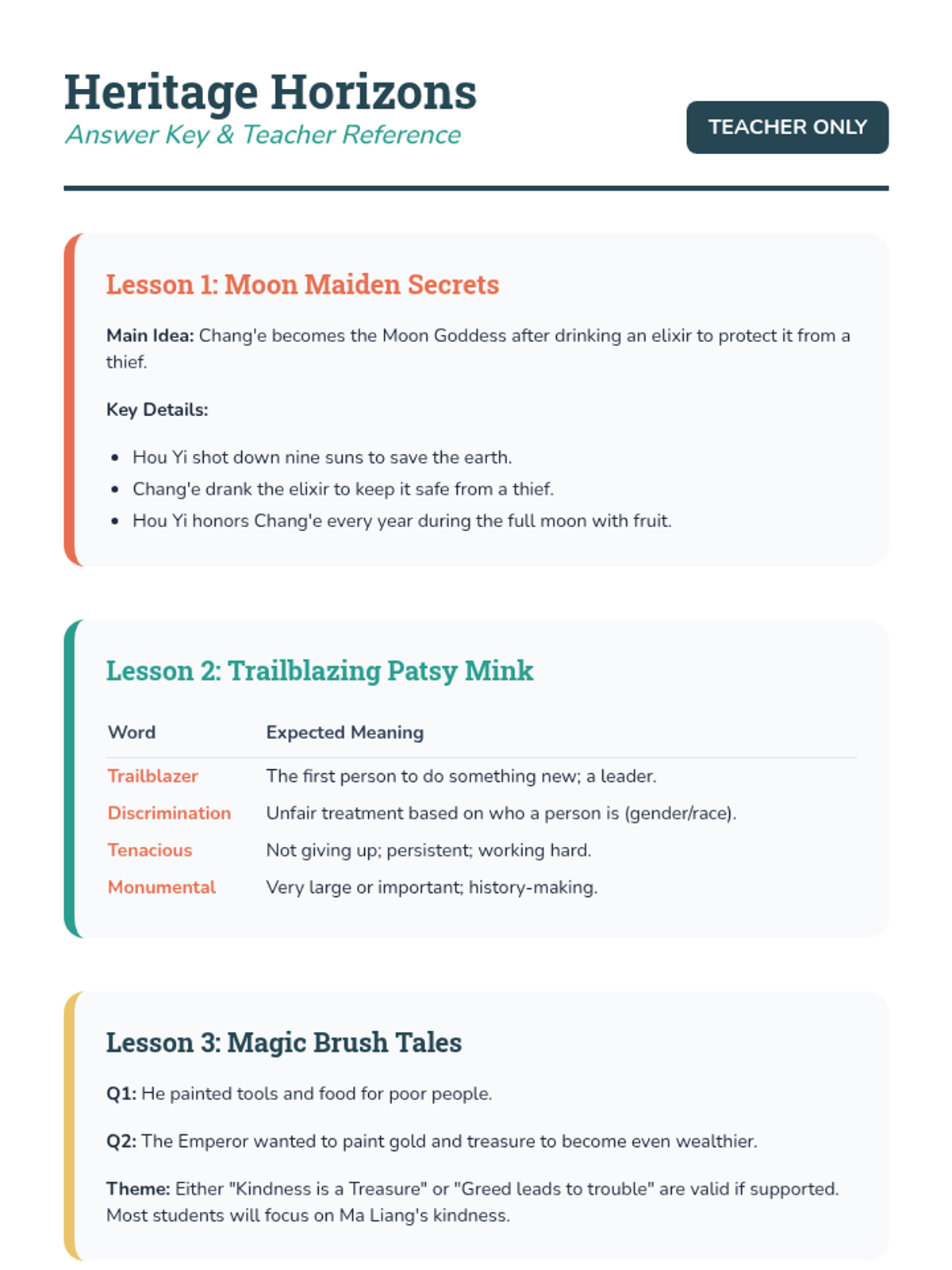
A comprehensive teacher's answer key for the Heritage Horizons unit. It provides expected student responses for main ideas, vocabulary meanings, reading comprehension questions, and fact-checking across all four instructional lessons.
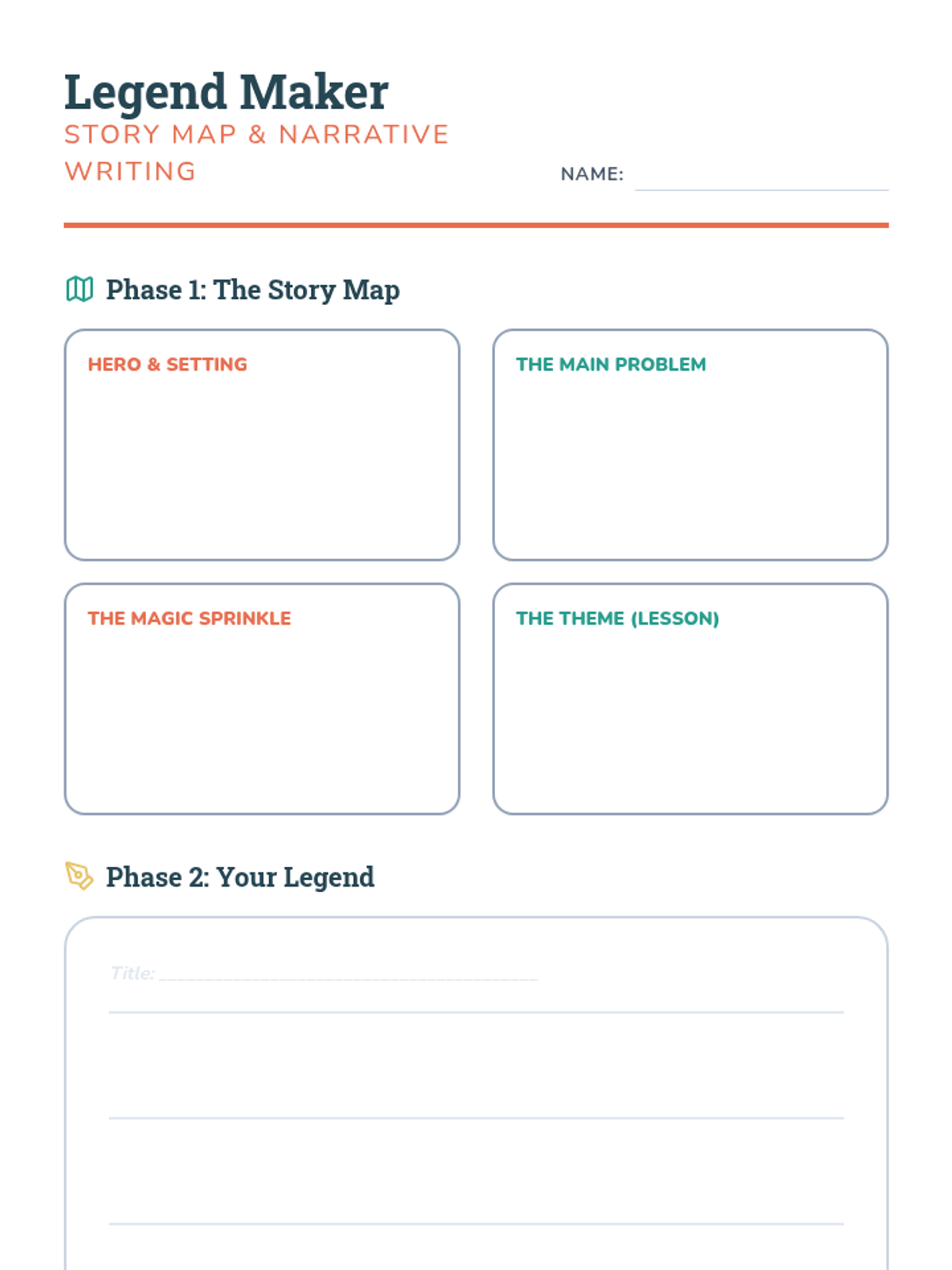
A creative writing organizer and narrative paper for students to draft their own heritage-inspired legends. It includes a structured story map section for planning and a dedicated writing area with a self-check checklist.
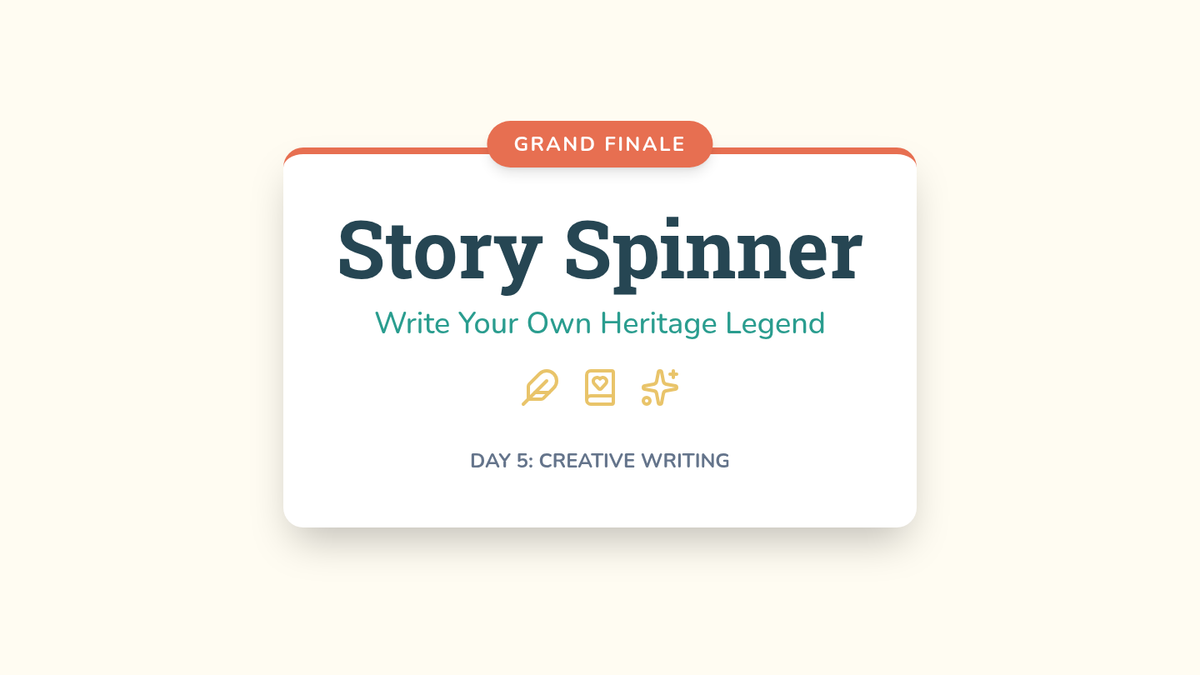
A slide deck for Day 5 of the Heritage Horizons unit. It guides students through the creative writing process to create their own legend or biographical narrative, focusing on story structure and narrative elements.
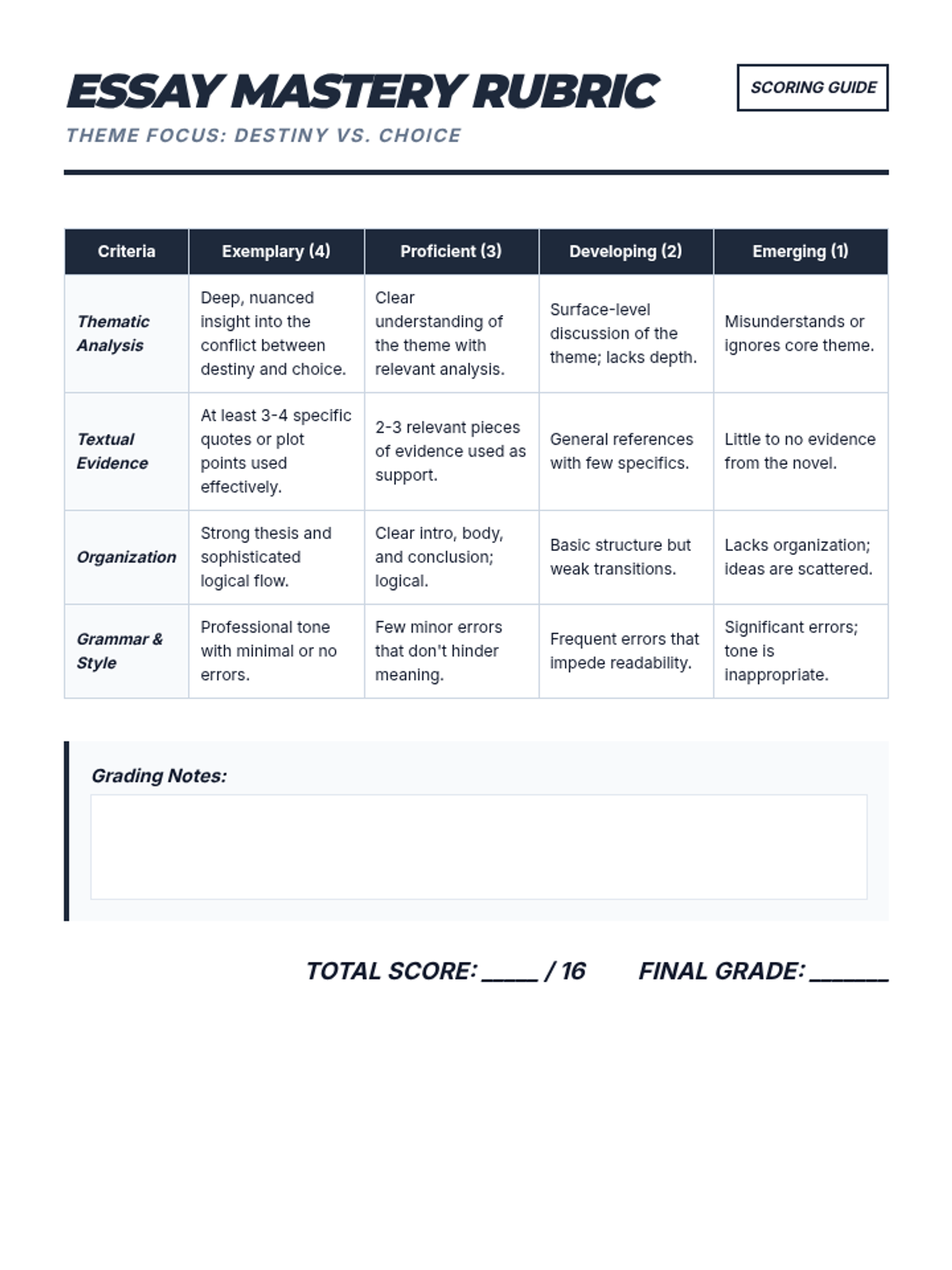
A detailed grading rubric for the thematic essay component of the 'I Am Number Four' final exam. It evaluates students on thematic analysis, textual evidence, organization, and grammar/style.
A presentation deck to prepare students for the 'I Am Number Four' final exam. It covers the exam structure, key vocabulary, critical character reviews, and the core essay theme of destiny versus choice.
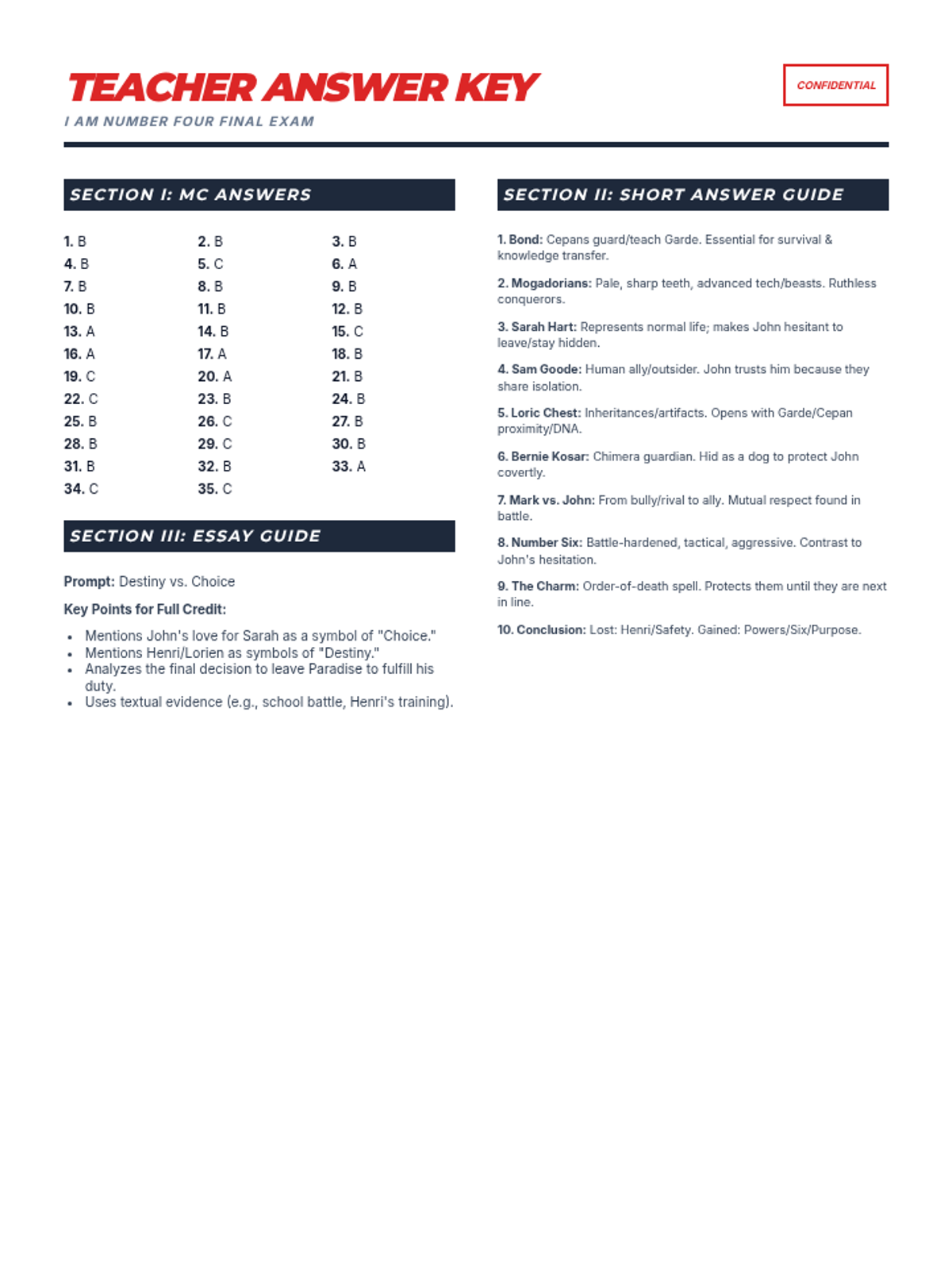
An answer key for the 'I Am Number Four' final exam, providing correct responses for the 35 multiple-choice questions and detailed grading guidelines for the 10 short-answer questions.
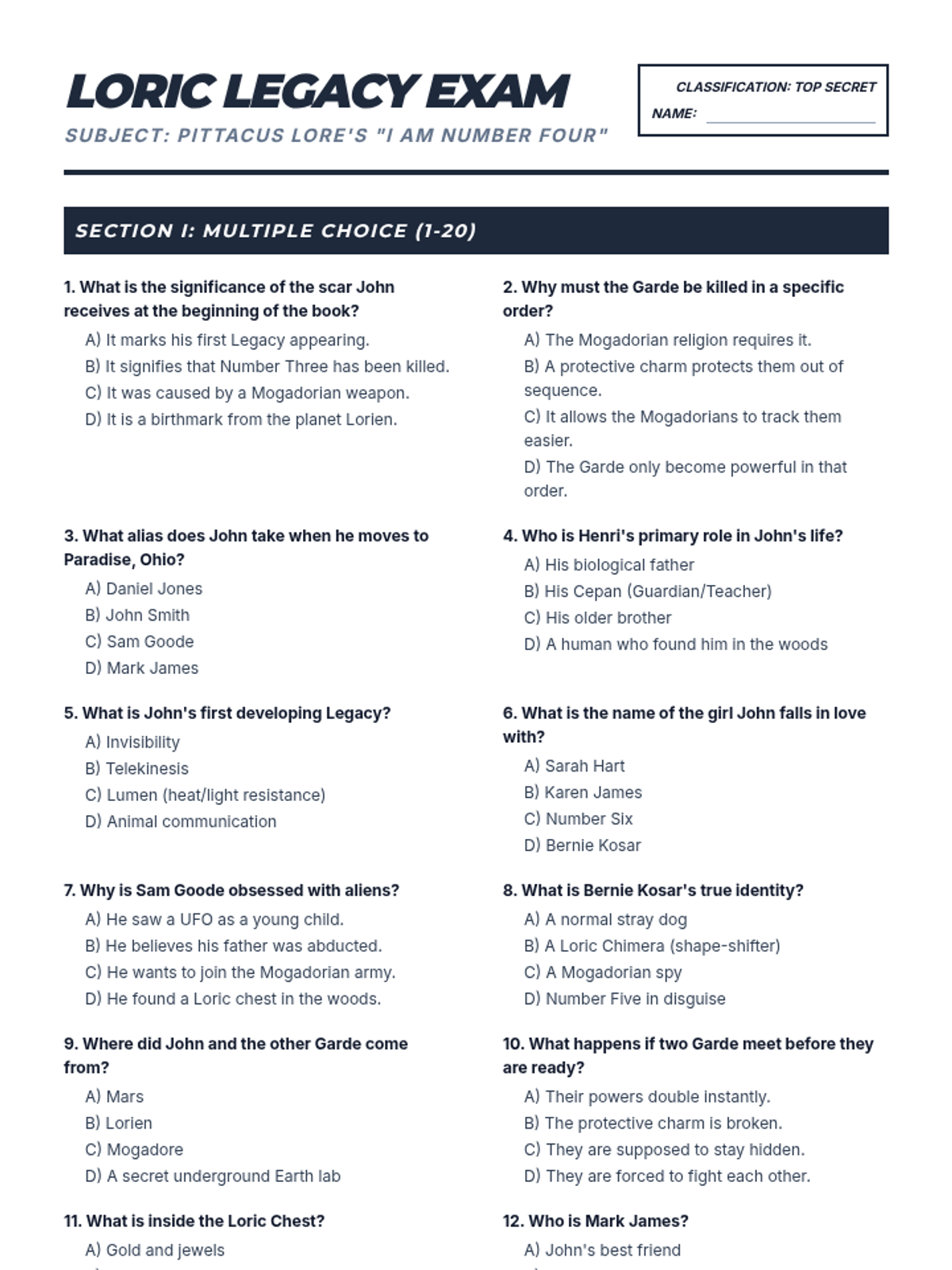
A comprehensive 5-page final exam for the novel 'I Am Number Four', featuring 35 multiple-choice questions, 10 short-answer questions, and a thematic essay on destiny versus choice. The design uses a 'classified dossier' aesthetic to match the novel's sci-fi thriller tone.
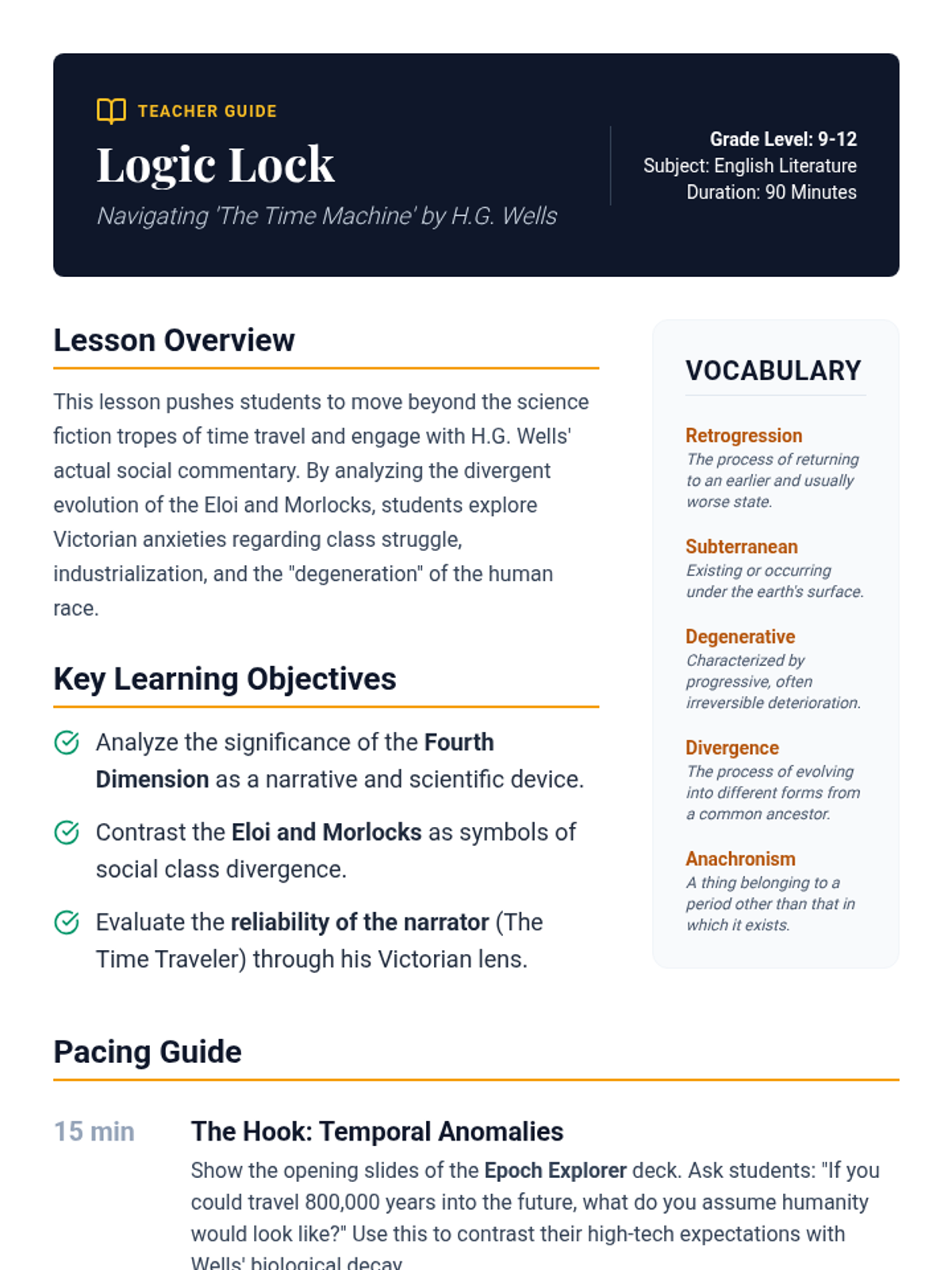
A comprehensive facilitation guide for teachers, providing pacing, discussion prompts, vocabulary, and instructional strategies for teaching H.G. Wells' 'The Time Machine'. Revised for better page breaks and content balance.
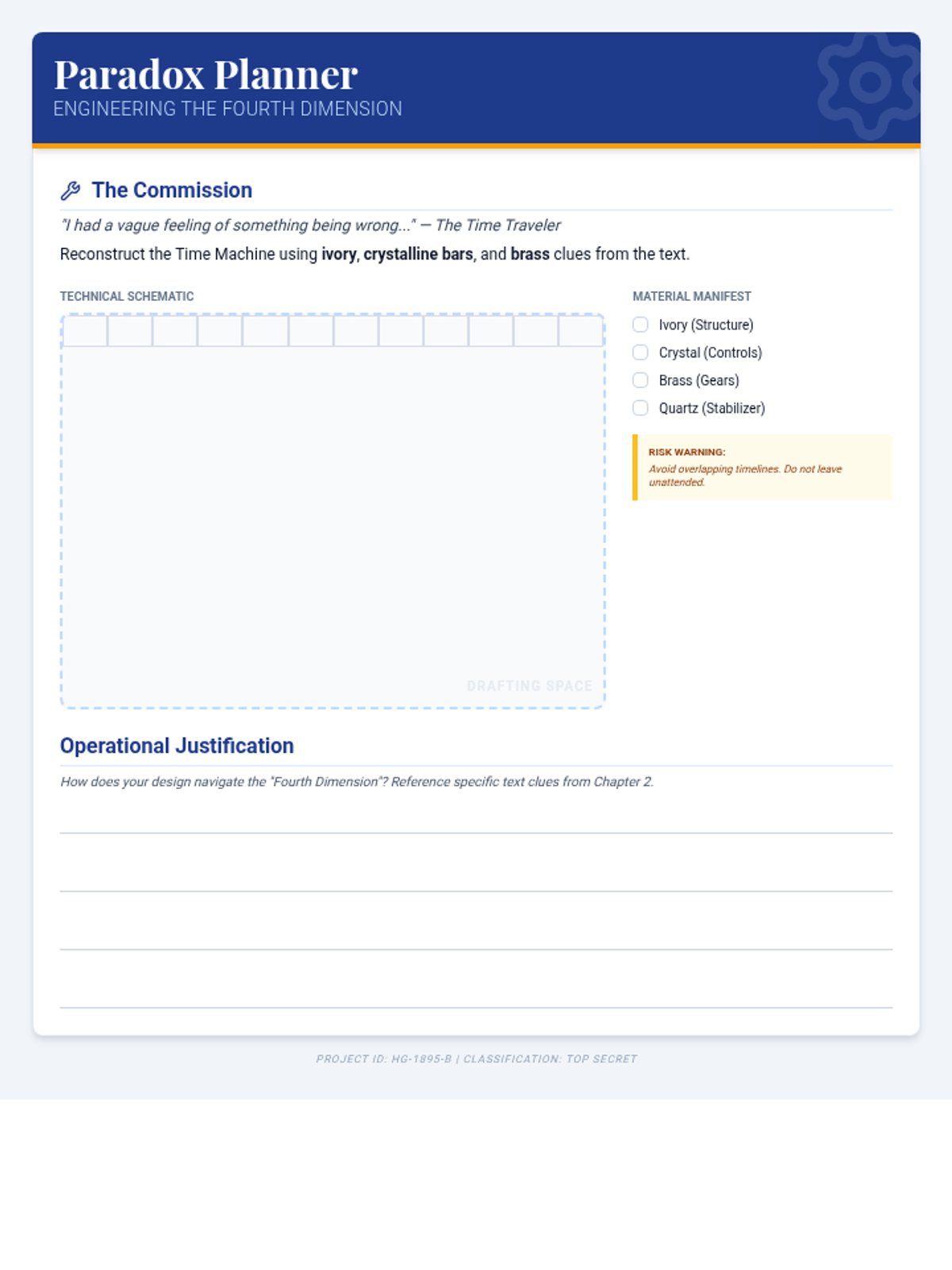
A creative design activity where students use textual evidence to sketch and explain their own version of the Time Machine. Final revision to fit on one page.
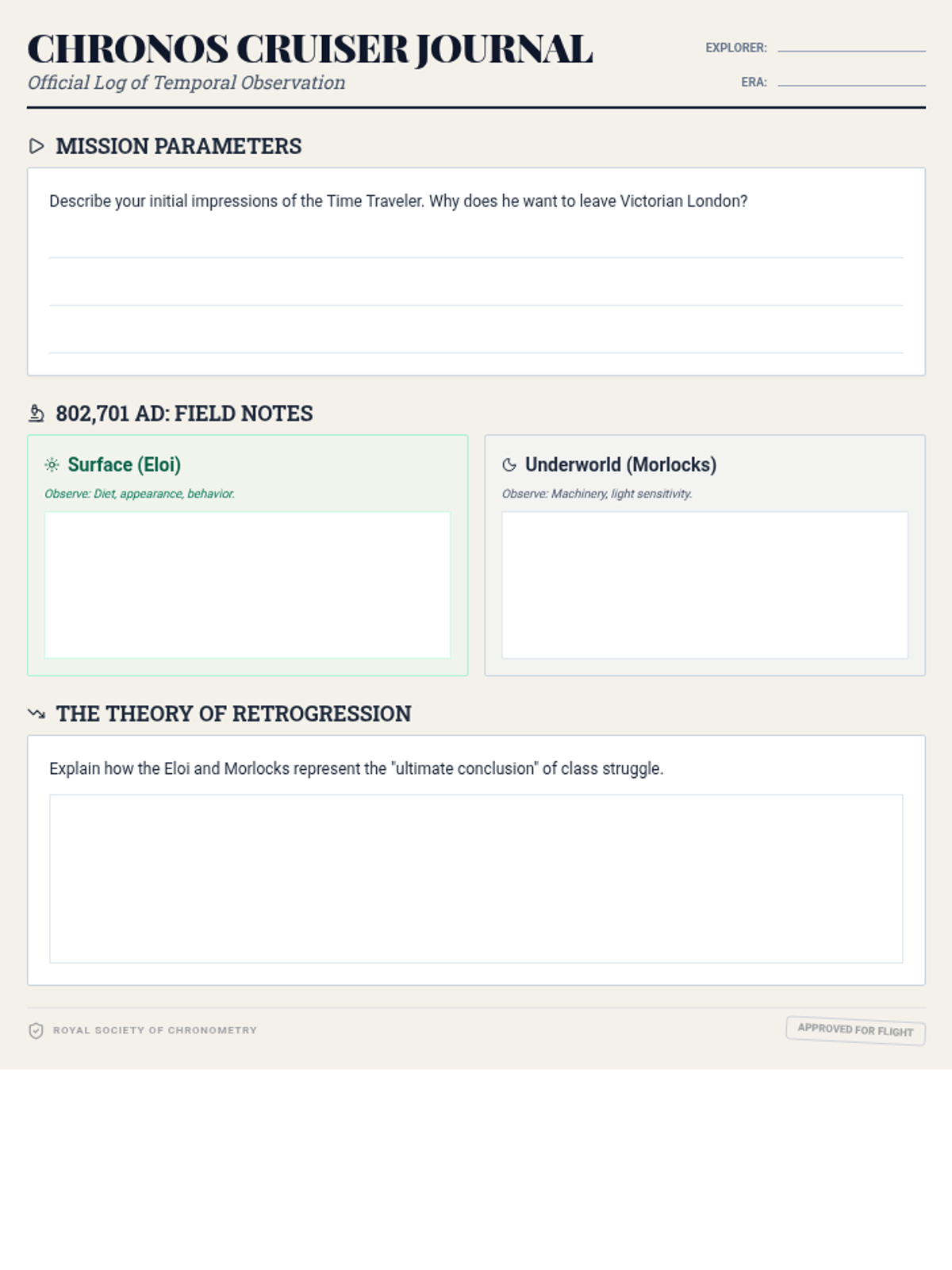
A student worksheet designed as an observation log. Students track the characteristics of the Eloi and Morlocks, analyze the Time Traveler's motivations, and reflect on the novel's social themes. Final revision to fit on one page.
A visual presentation introducing H.G. Wells' 'The Time Machine', covering the fourth dimension, the contrast between the Eloi and Morlocks, and Wells' social commentary. Includes discussion prompts and key quotes.