Systematic research, evidence evaluation, and logical reasoning skills for formal discourse. Equips speakers to organize persuasive arguments, identify fallacies, and execute strategic impact calculus during competitive engagement.
A visual and detailed slide deck tracking the career of LeBron James through all 17 stages of Joseph Campbell's Hero's Journey (Monomyth). It connects specific career milestones—like 'The Decision' and the 2016 Championship—to archetypal phases like Apotheosis and the Ultimate Boon.
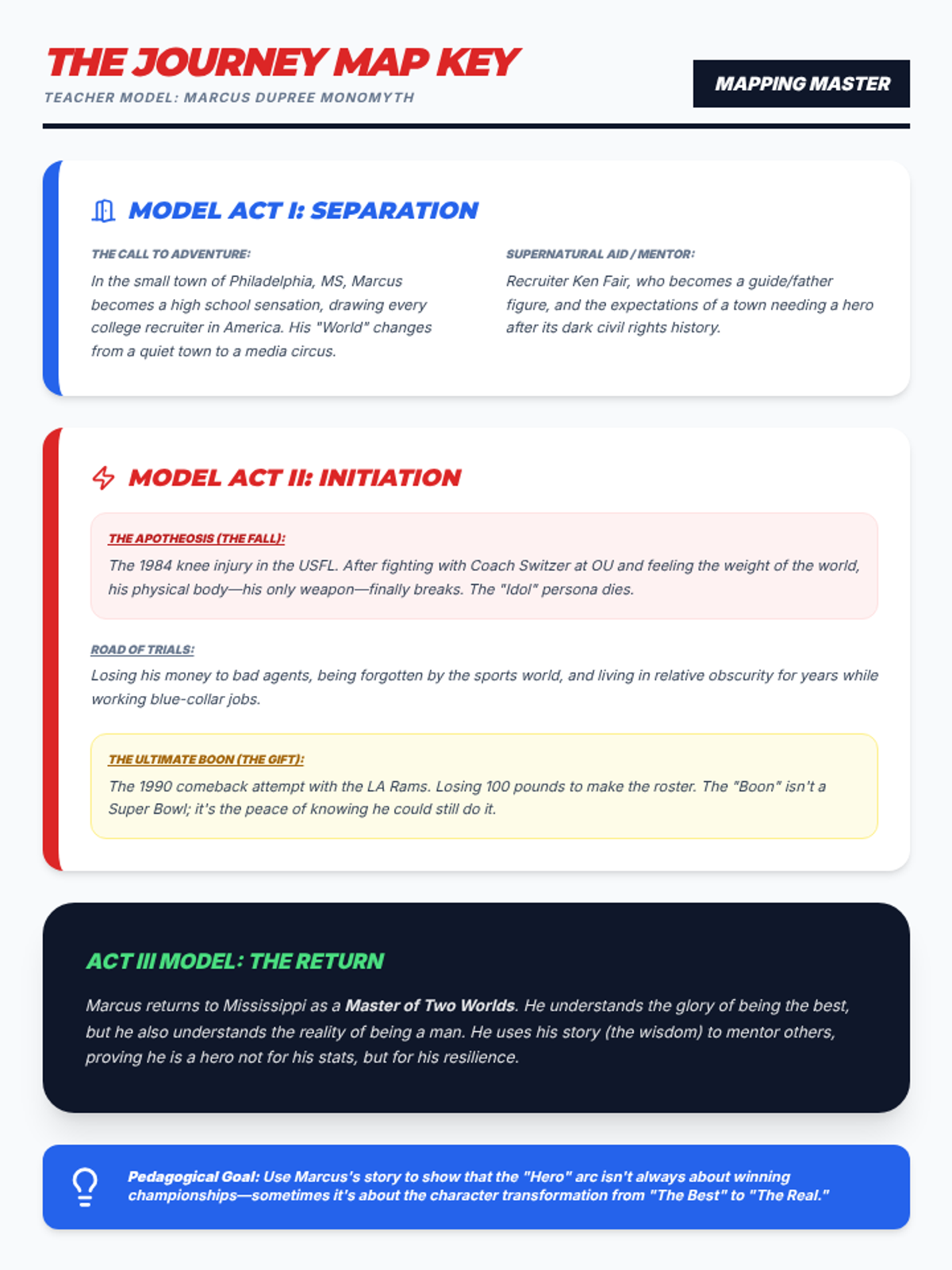
A teacher answer key for the Monomyth viewing handout, using the 30 for 30 'The Best That Never Was' as a model for Marcus Dupree's Hero's Journey.
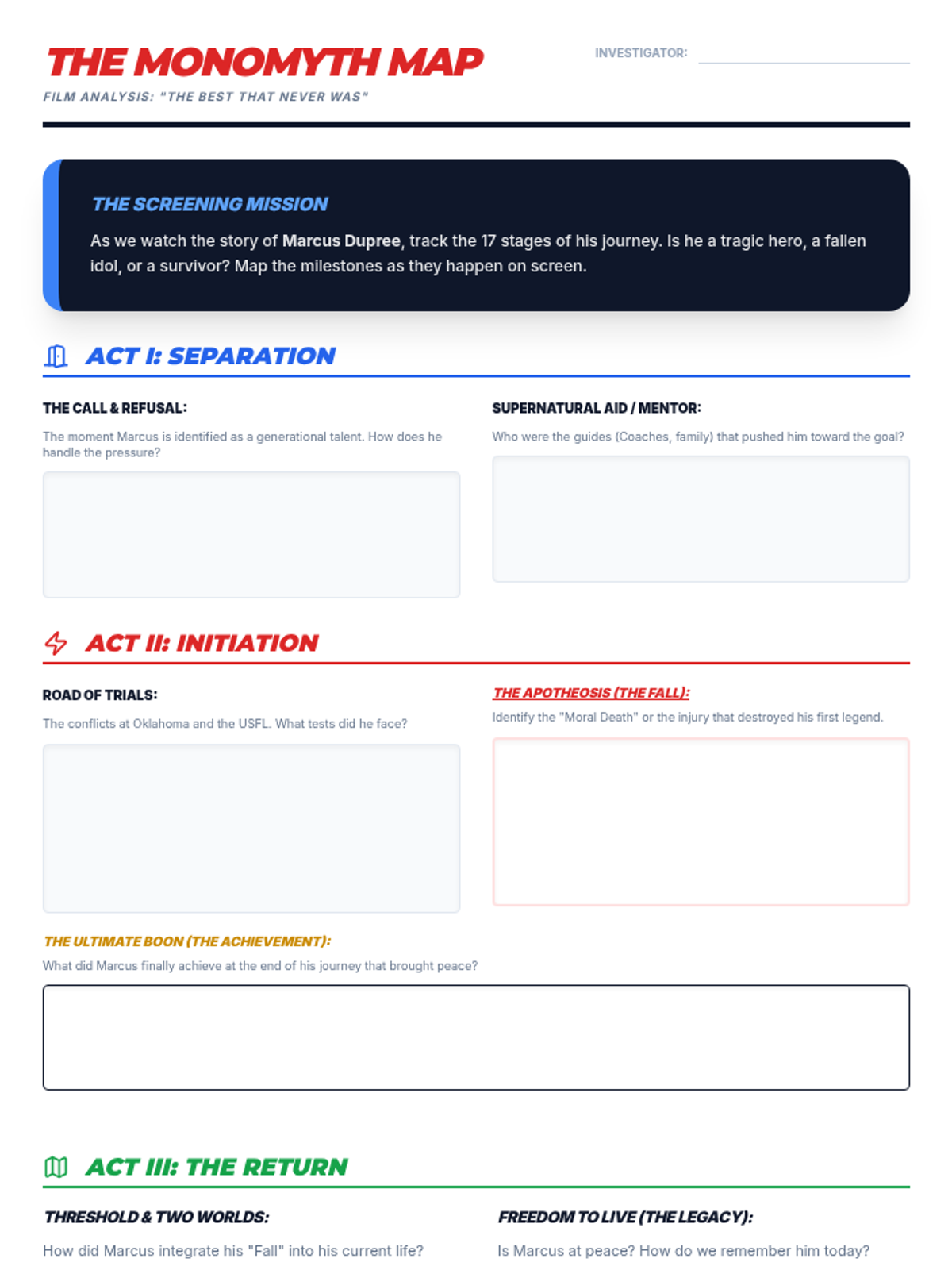
A viewing guide worksheet for the 30 for 30 documentary 'The Best That Never Was', designed for students to track Marcus Dupree's career using the stages of the Hero's Journey (Monomyth).
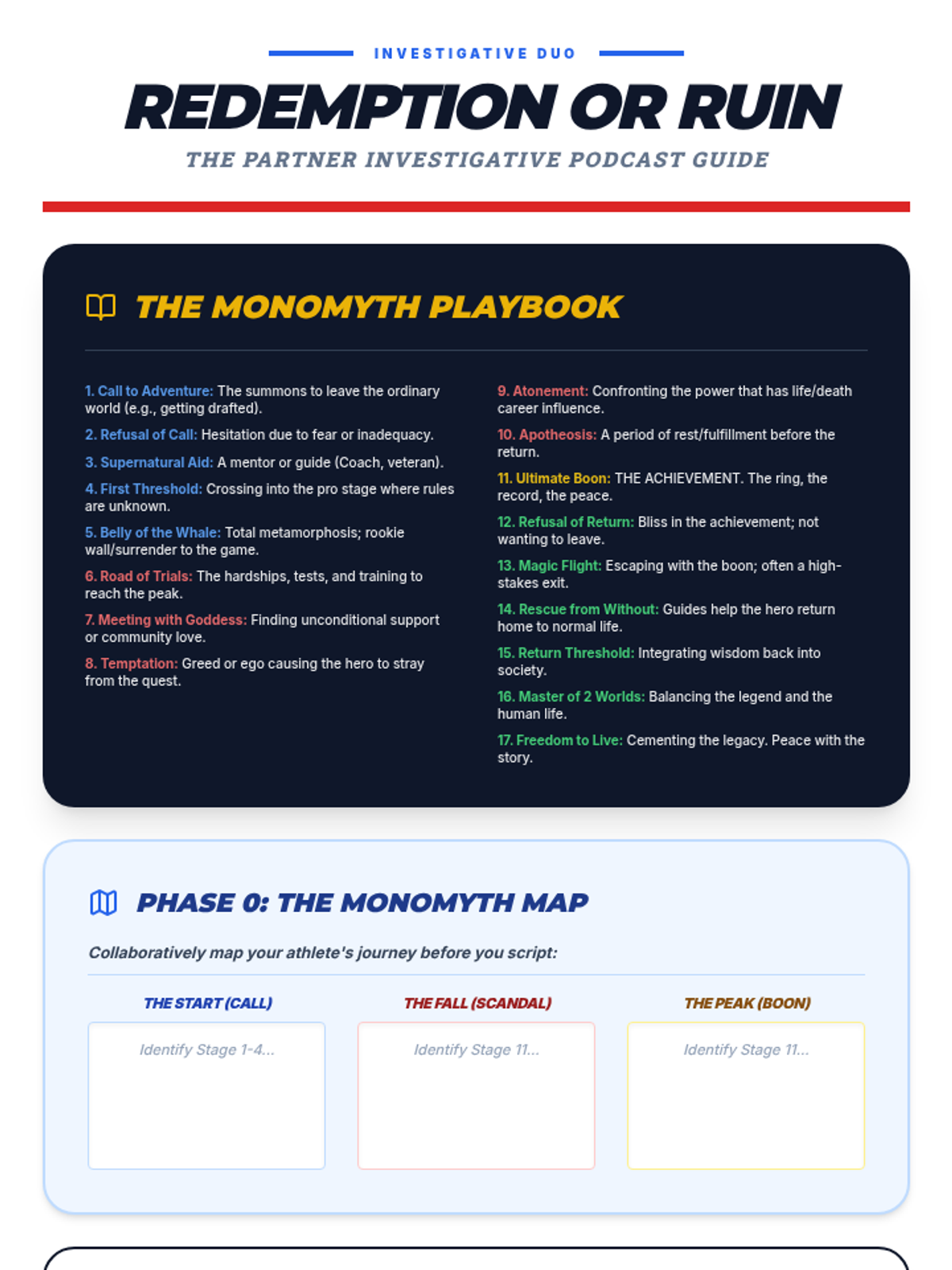
A robust, multi-phase project guide for the 'Redemption File' podcast. It includes a mandatory Research Dossier requirement and a Phase 0 launching activity for 'The U' case study. Provides expanded work areas for research transcription. Now incorporates Hero's Journey analysis and archetype definitions for partner pairs.
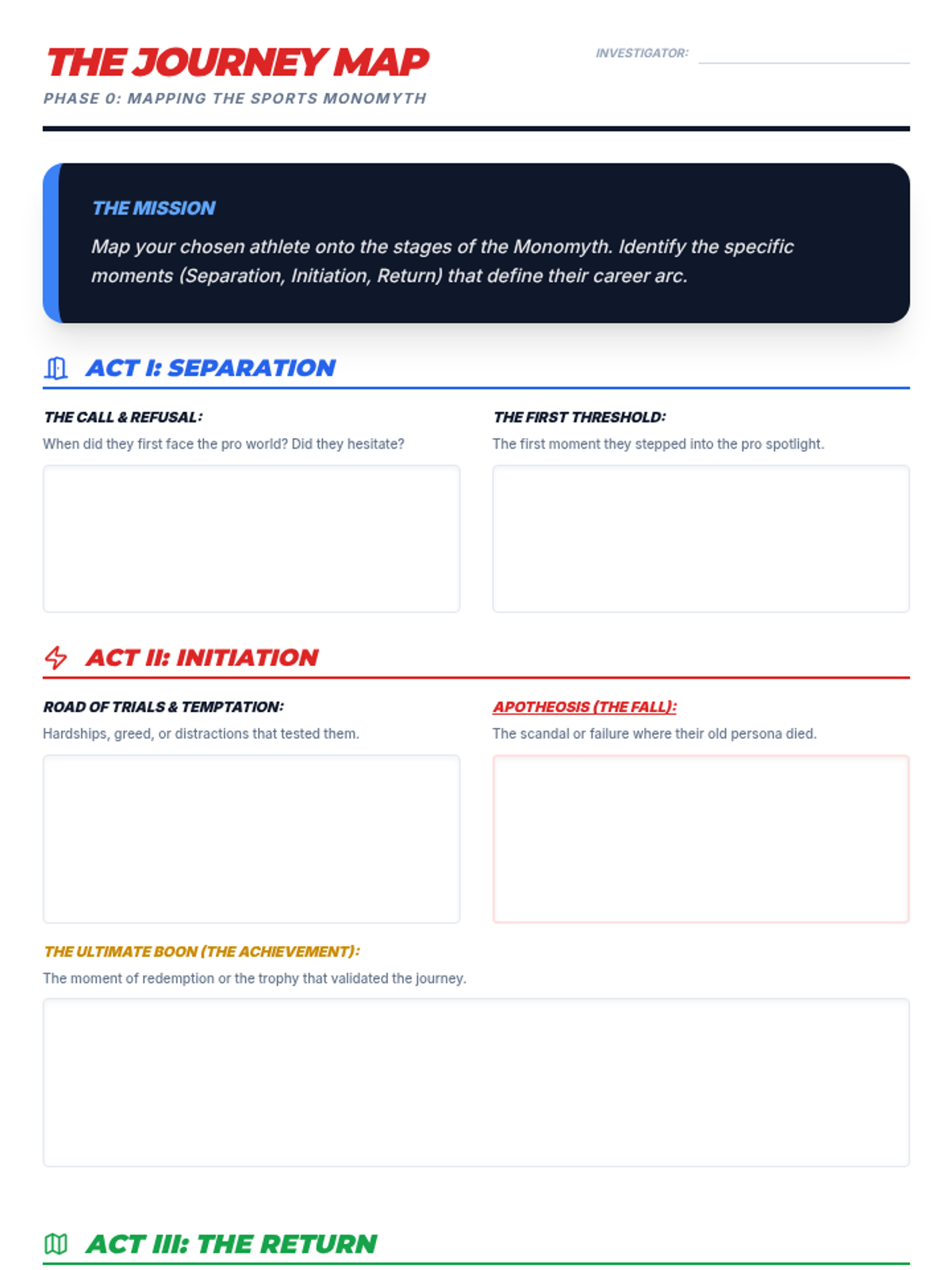
A student worksheet for mapping a sports figure's career onto the stages of the Hero's Journey. It uses phases like Separation, Initiation (including the Scandal as Apotheosis), and Return to analyze their narrative arc. Expanded work areas and primary evidence sections included. Now includes Act III: The Return.
Detailed instructional slides that explain all 17 stages of Joseph Campbell's Monomyth, specifically adapted for sports narratives. Includes Act-by-Act breakdowns, evidence collection instructions, and an introduction to the partnered investigative podcast project.
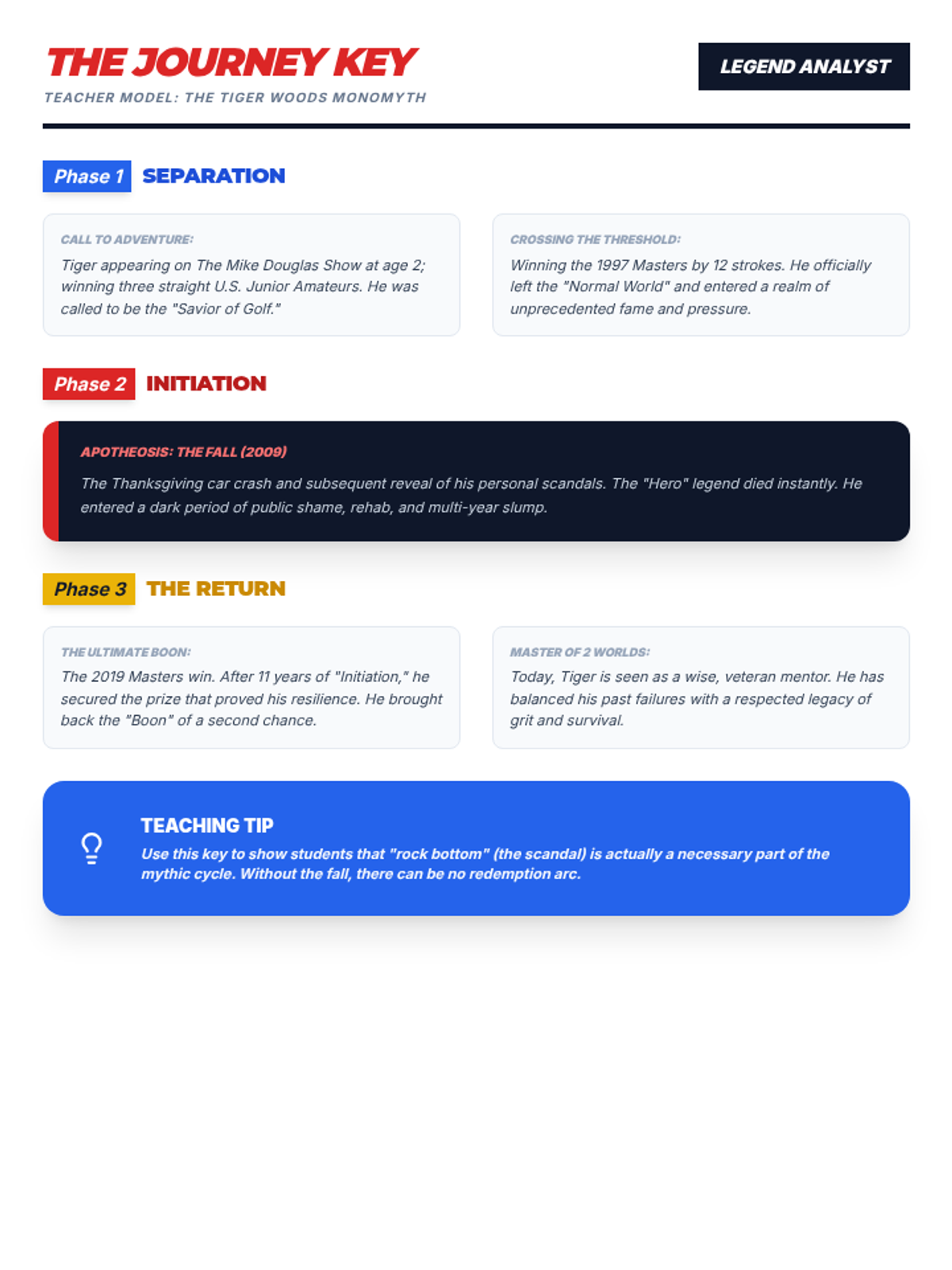
A teacher key for the Journey Map handout, using Tiger Woods as a model to demonstrate how an athlete's career follows the stages of the monomyth, including the fall (apotheosis) and redemption (return).
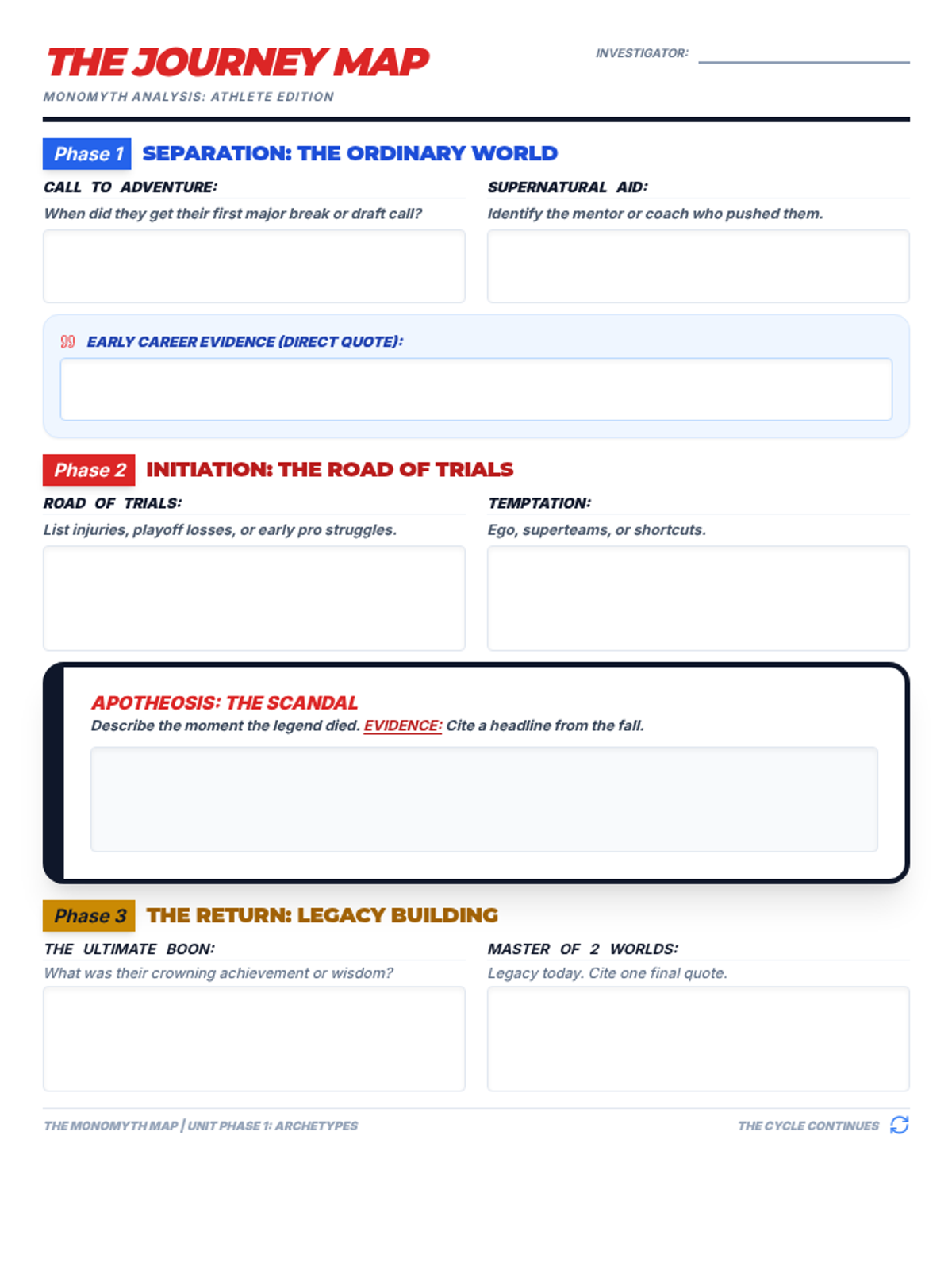
A student worksheet for mapping a sports figure's career onto the stages of the Hero's Journey. It uses phases like Separation, Initiation (including the Scandal as Apotheosis), and Return to analyze their narrative arc. Now includes specific space for primary evidence and quotes.
Instructional slides that adapt Joseph Campbell's 17 stages of the Monomyth specifically for sports narratives. It connects phases like Separation, Initiation, and Return to athlete career arcs, scandals, and legacy building.
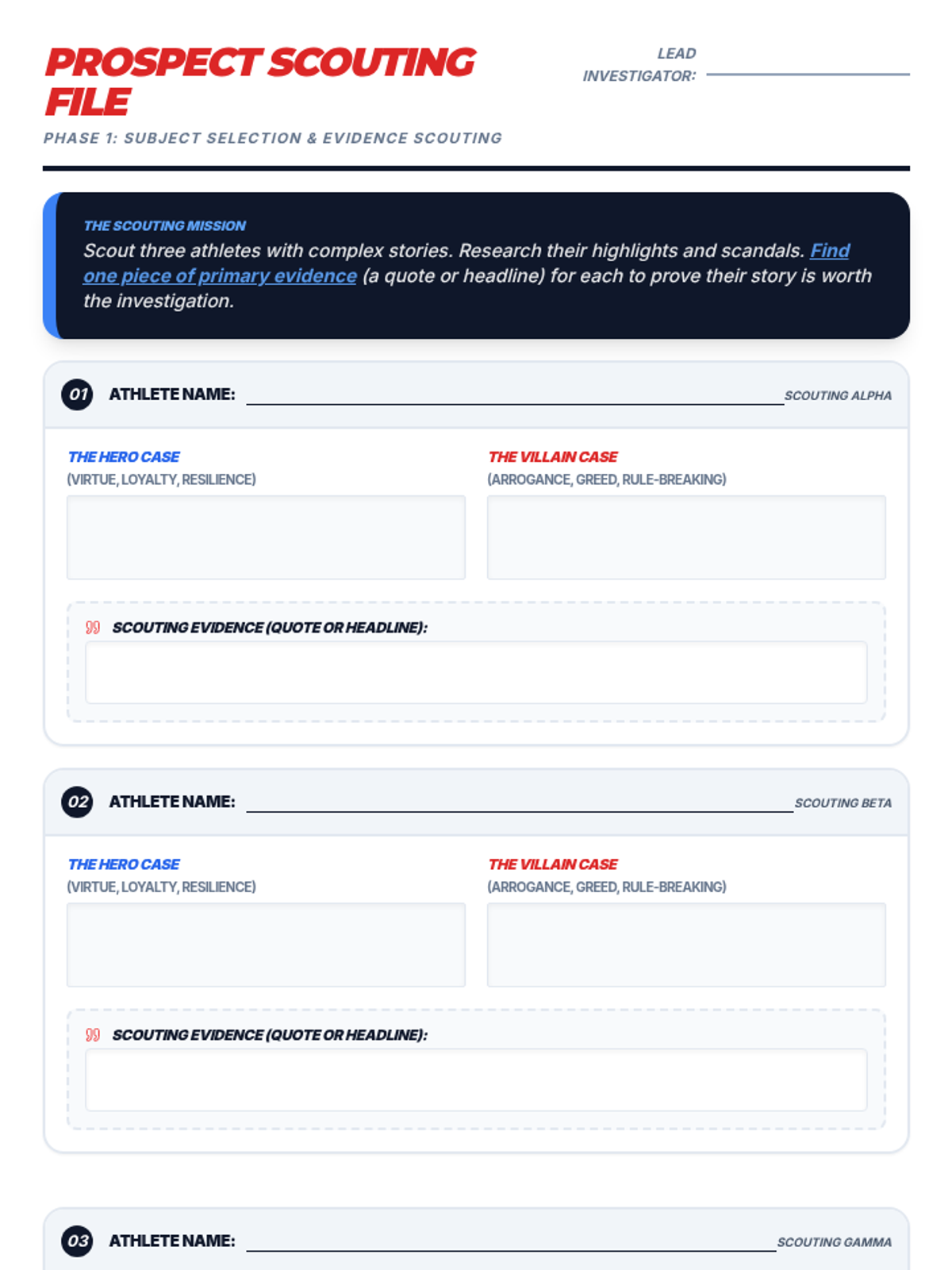
A subject scouting worksheet for students to investigate and evaluate three potential sports figures for their podcast project. It includes sections for identifying hero and villain traits for each prospect, finding primary quotes or evidence, and a final selection area.
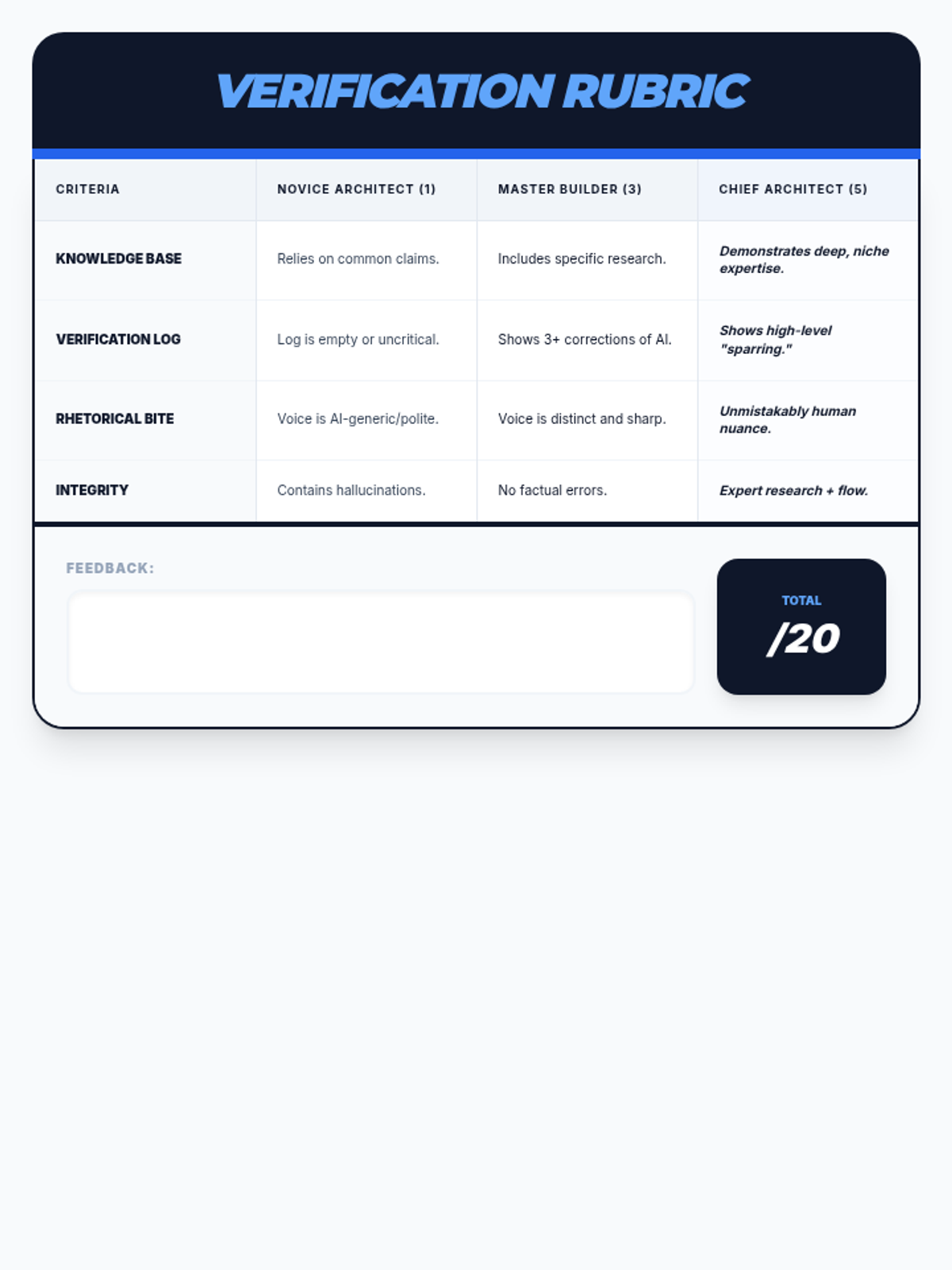
The grading rubric for the Echo Logic project. Evaluates students on their research-backed knowledge base, their active verification/rejection of AI suggestions, and their ability to produce a sharp 'human' voice.
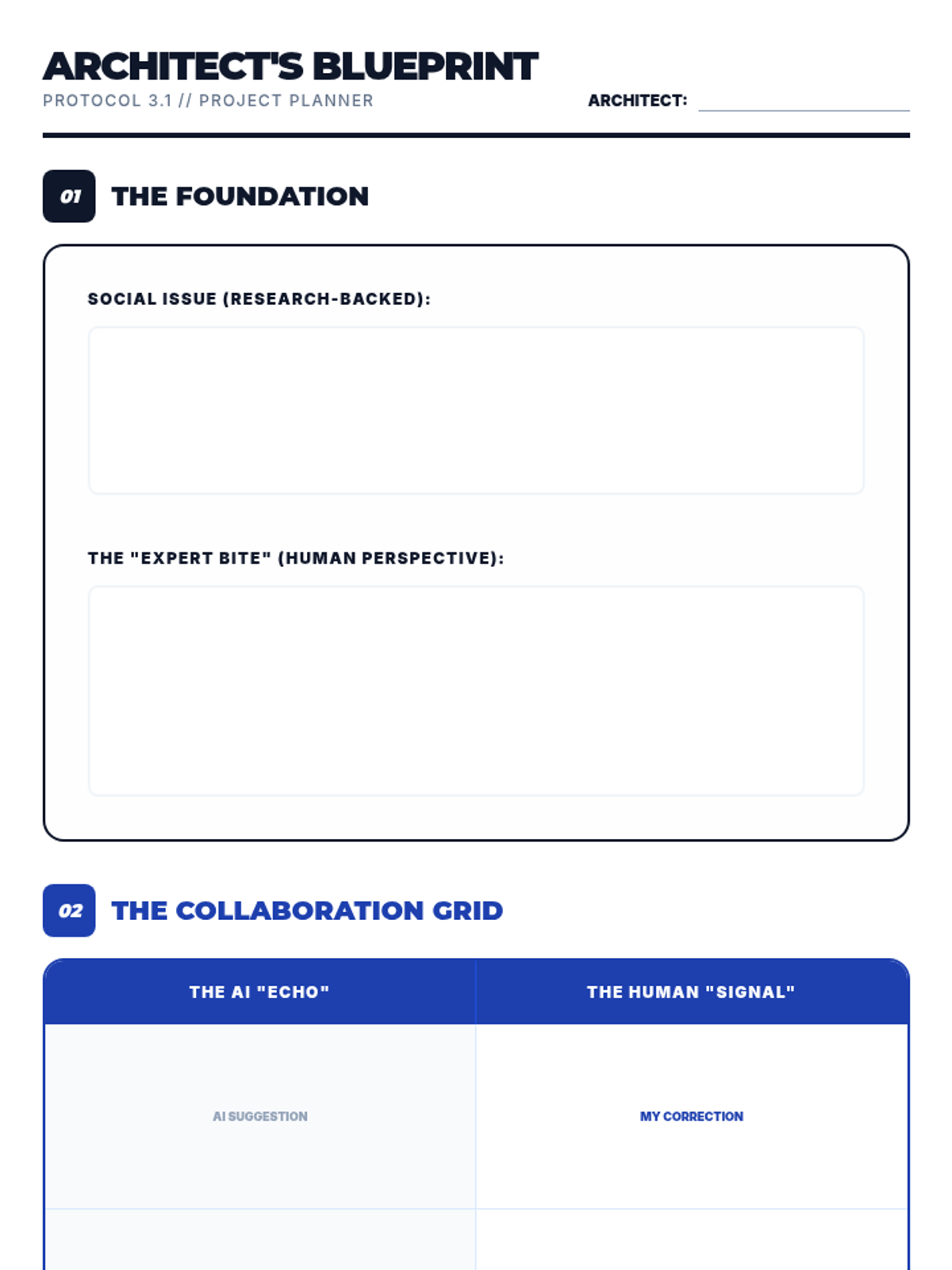
The project planner for the final social commentary piece. Includes a 'Collaboration Grid' where students must record and justify their rejection of generic AI suggestions, reinforcing the priority of human expertise.
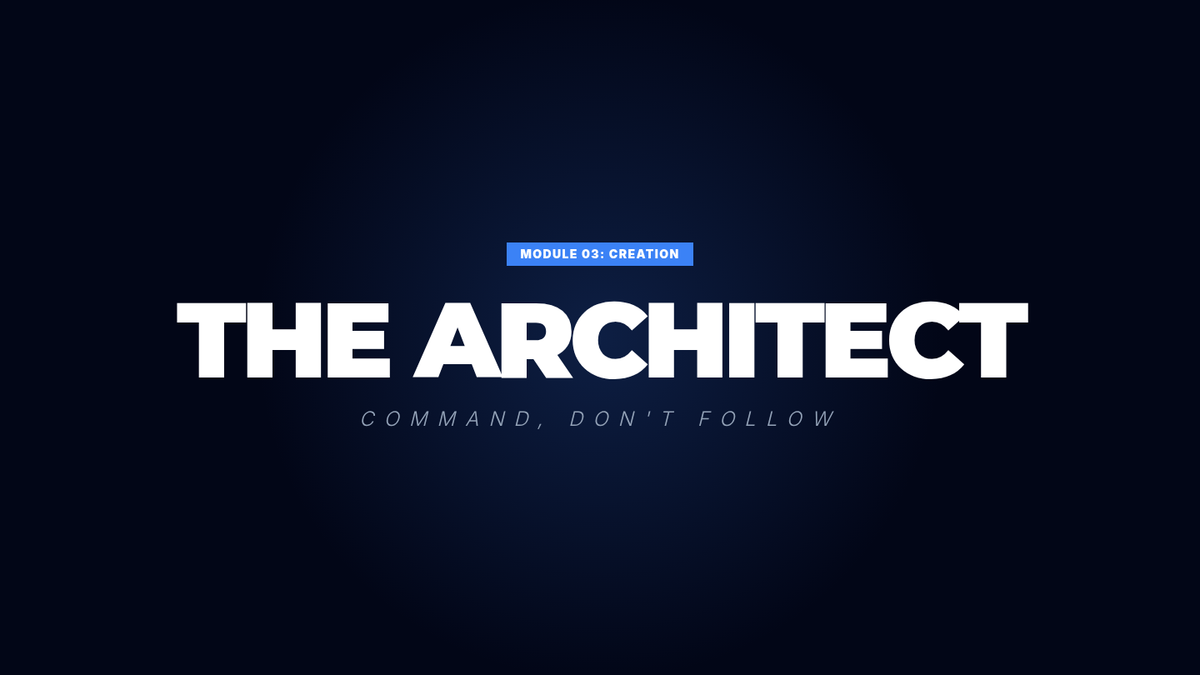
Final project introduction slides. Outlines the 'Architect' methodology, emphasizing the shift from AI-as-answer-generator to AI-as-structural-tool, and introduces the 'Verification Log' requirement.
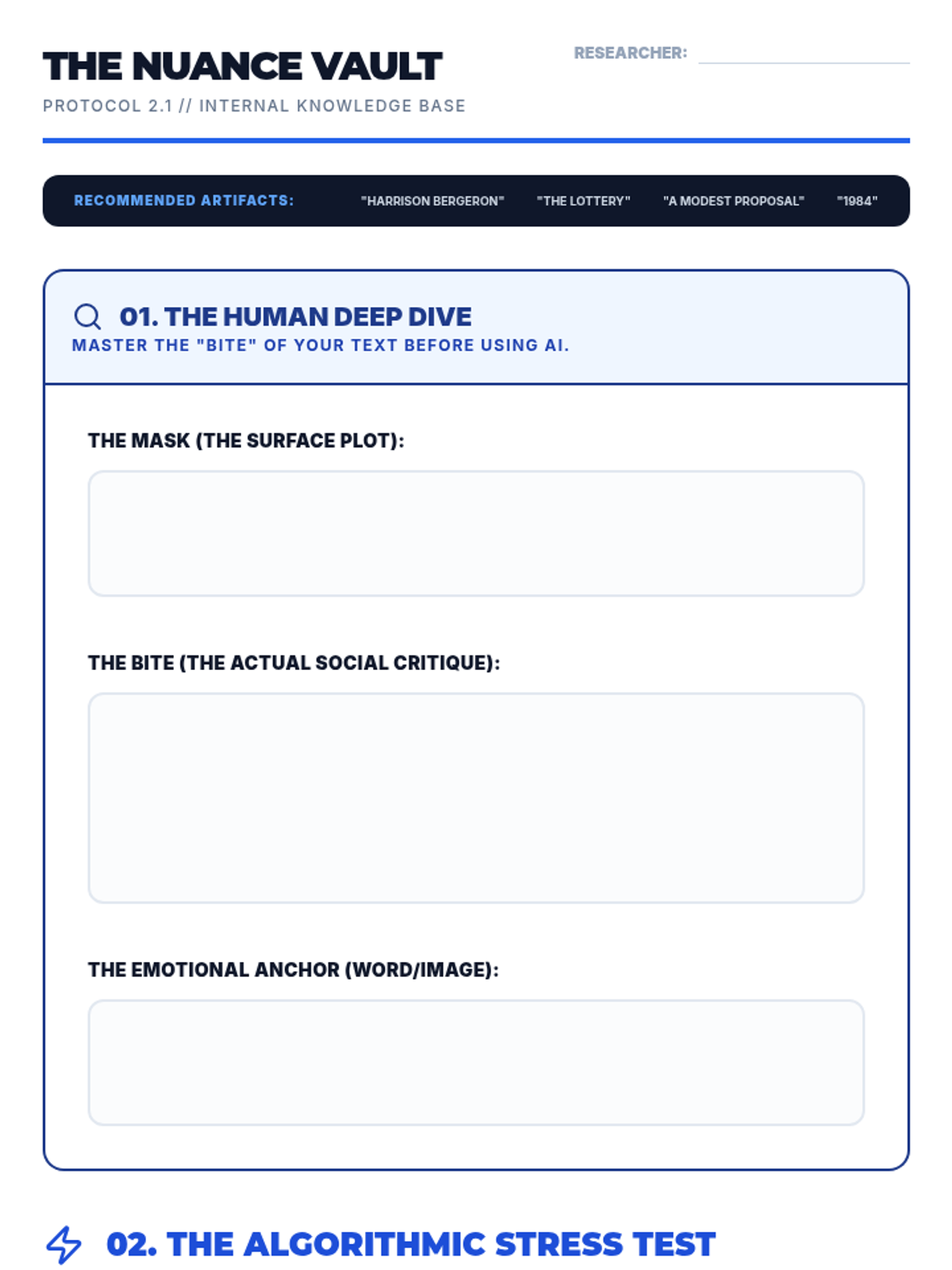
A graphic organizer for building an 'Internal Library' of social commentary knowledge. Students analyze a primary text and use their findings to 'stress test' and correct an AI summary.
Slide deck for Lesson 2. Explores the 'Flatness' problem in AI analysis and teaches students how to find the 'moral weight' and 'bite' in social commentary that algorithms often miss.
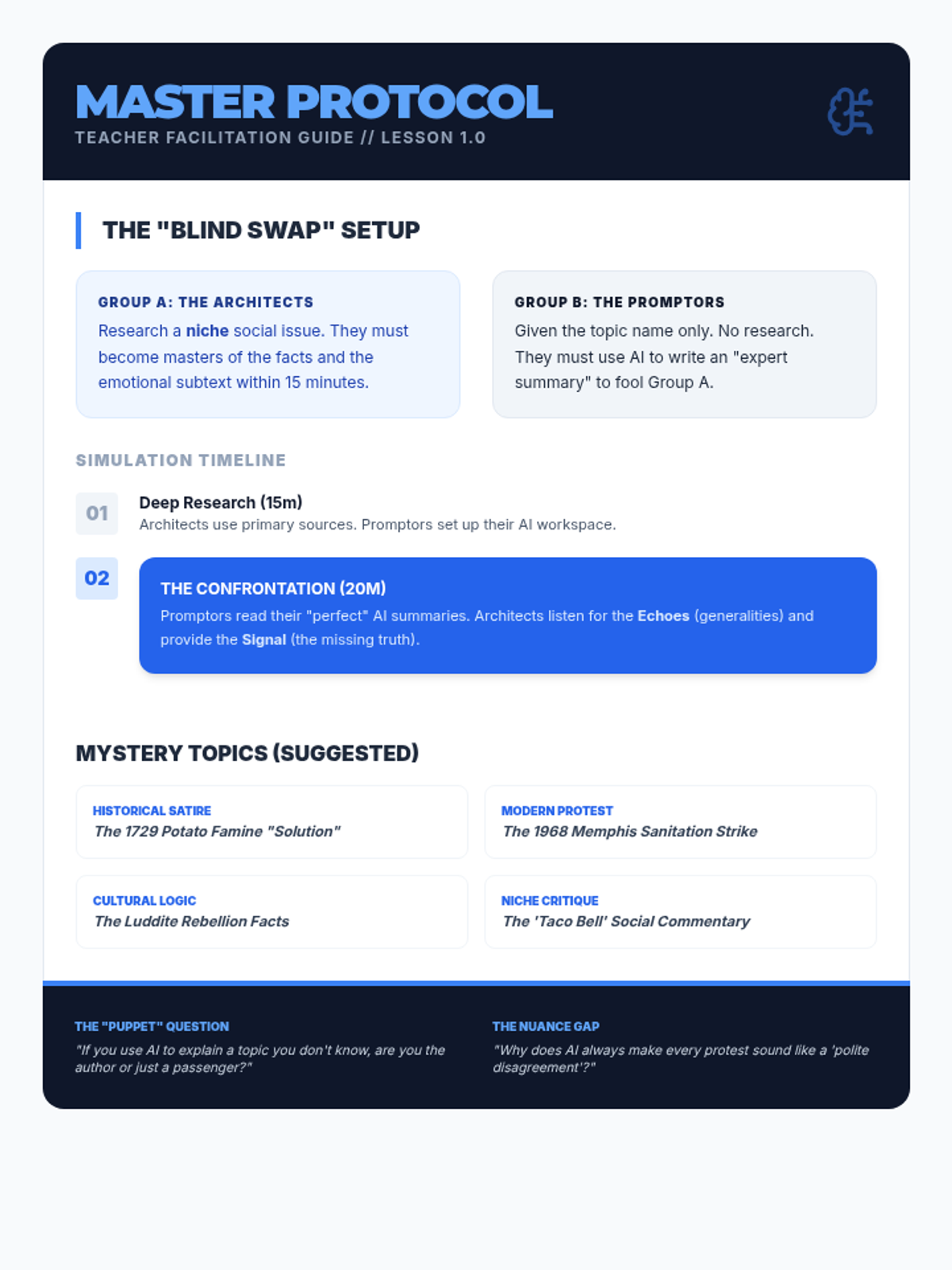
Facilitation guide for teachers to run the 'Echo Swap' simulation. Explains the 'Asymmetry of Knowledge' setup and the pedagogical importance of the 'Aha!' moment.
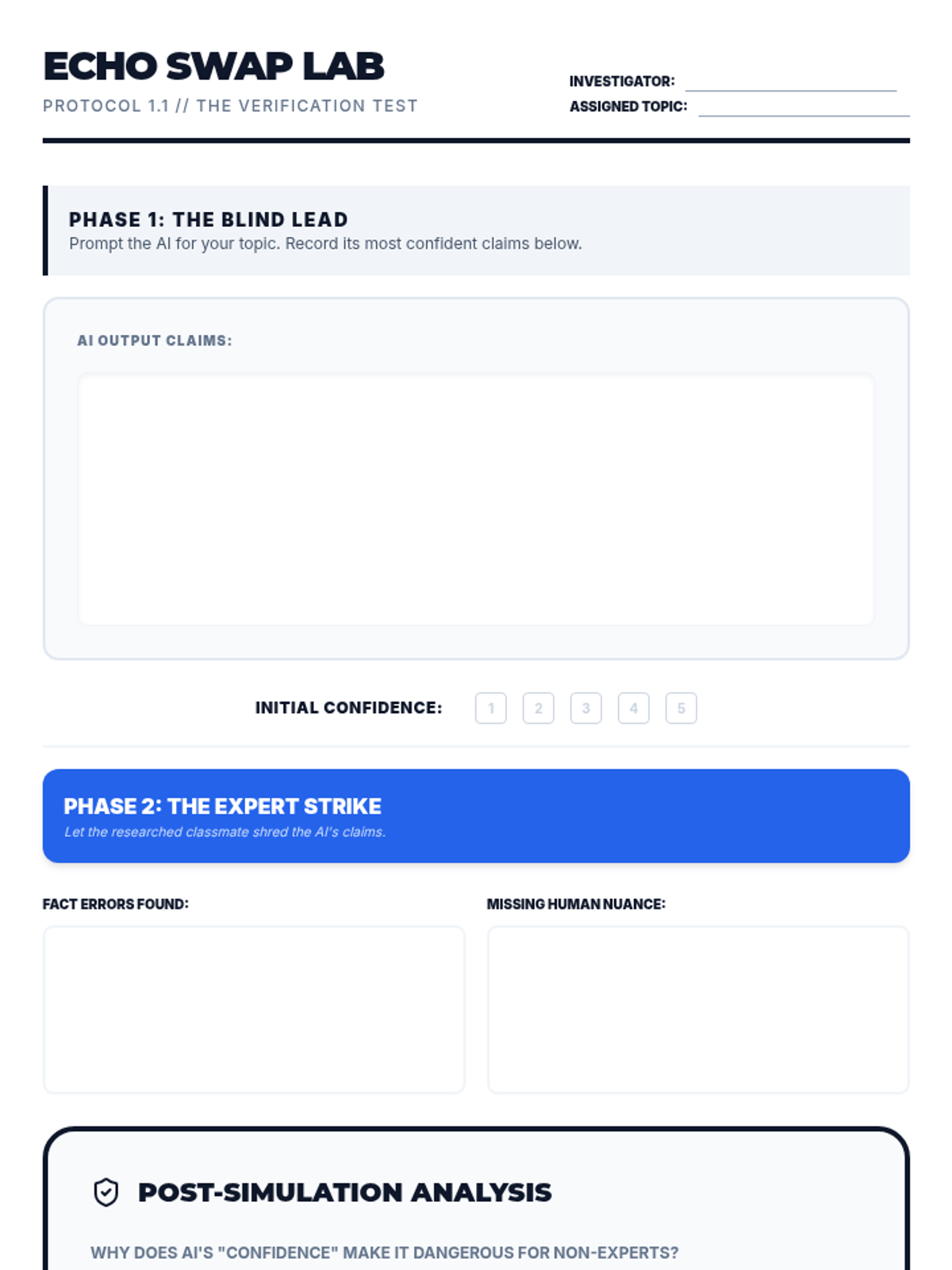
A laboratory worksheet for the 'Echo Swap' experiment. Students record AI claims on a mystery topic, then work with an expert classmate to identify hallucinations and errors.
Introductory slide deck for the Echo Logic unit. Introduces the concept of 'Confidence vs. Truth' and prepares students for the Swap Experiment simulation.
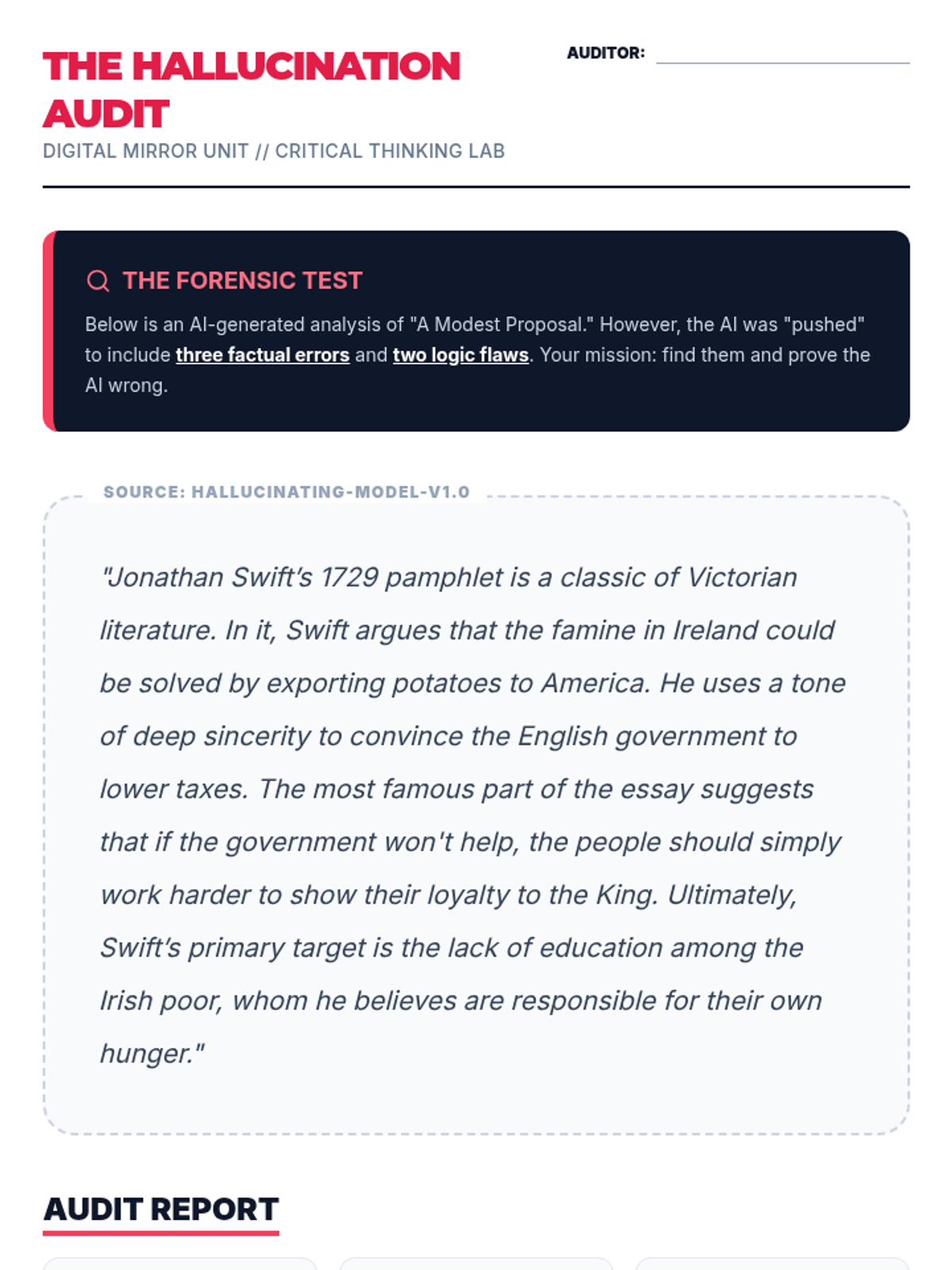
A worksheet where students must identify factual errors and logic flaws in a 'glitched' AI-generated analysis. Teaches the necessity of prior knowledge for effective AI collaboration.
A slide deck for a 'Toaster Riot' experiment designed to show students why AI requires human knowledge to be effective. Demonstrates AI hallucinations and the importance of verification.
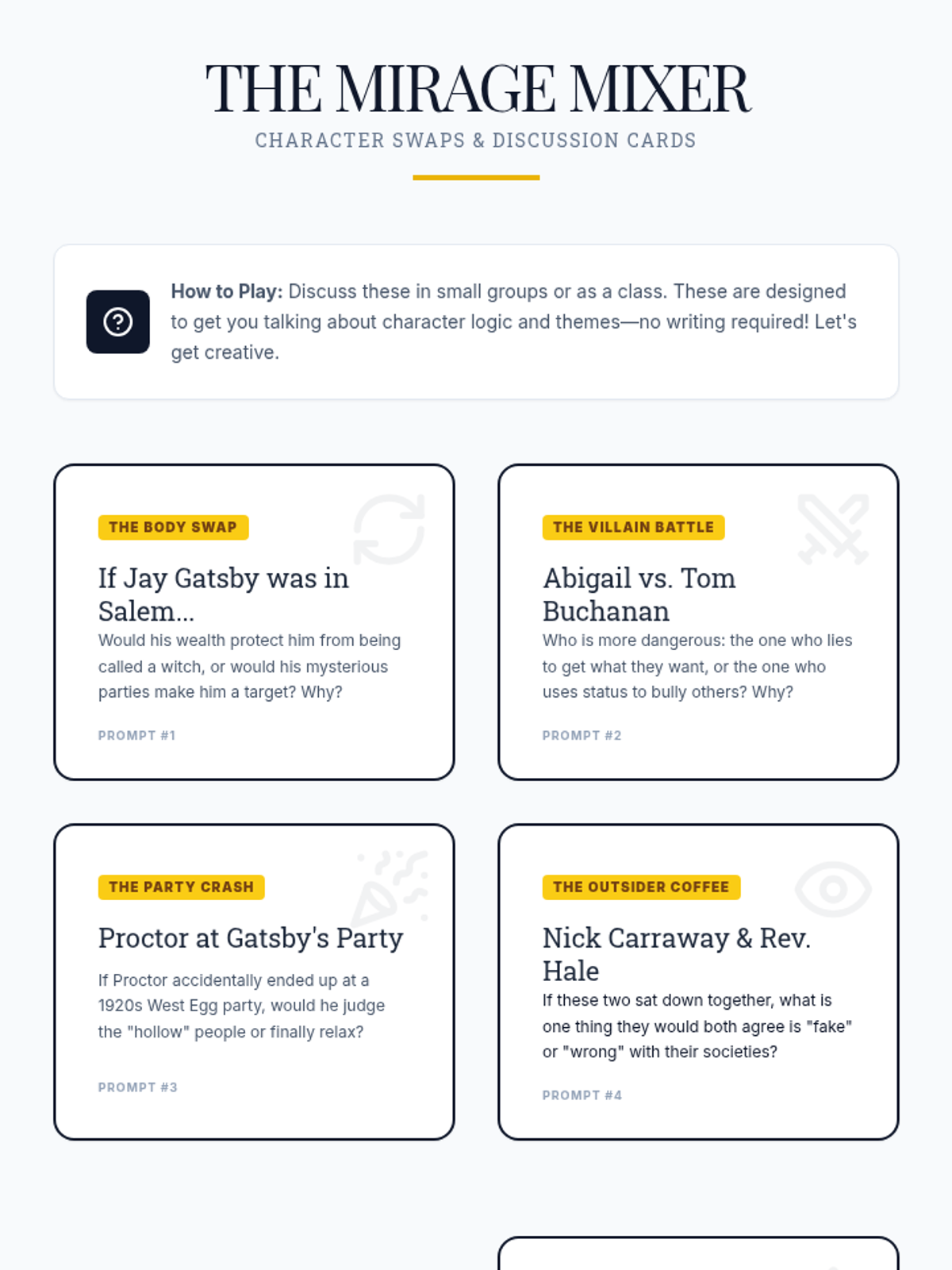
A fun, interactive discussion activity featuring "Character Swap" cards designed to spark debate, laughter, and thematic connections between The Great Gatsby and The Crucible.
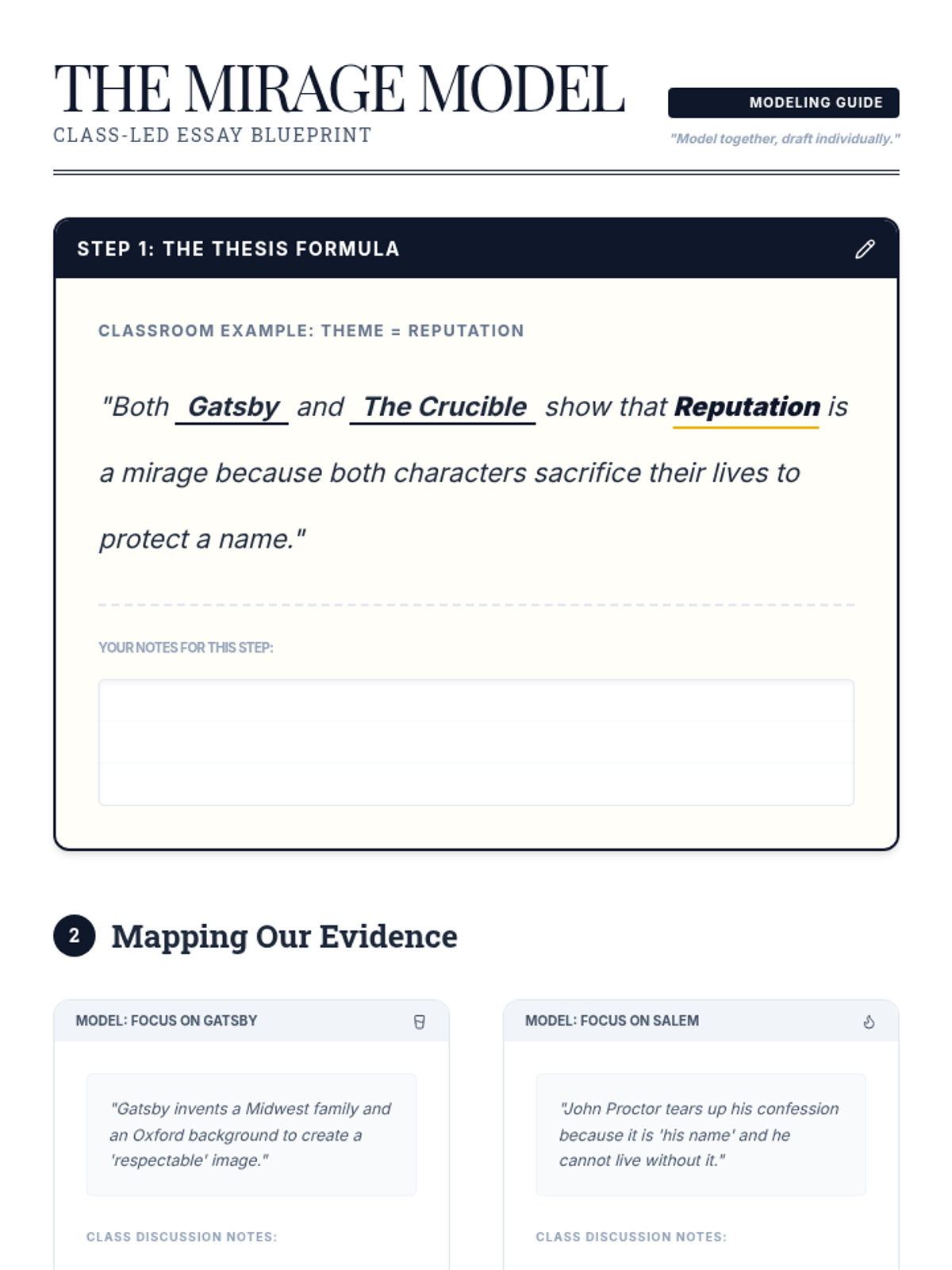
A collaborative modeling guide designed for class-wide instruction, showing students how to plan a comparative essay using a pre-selected theme before they work independently.
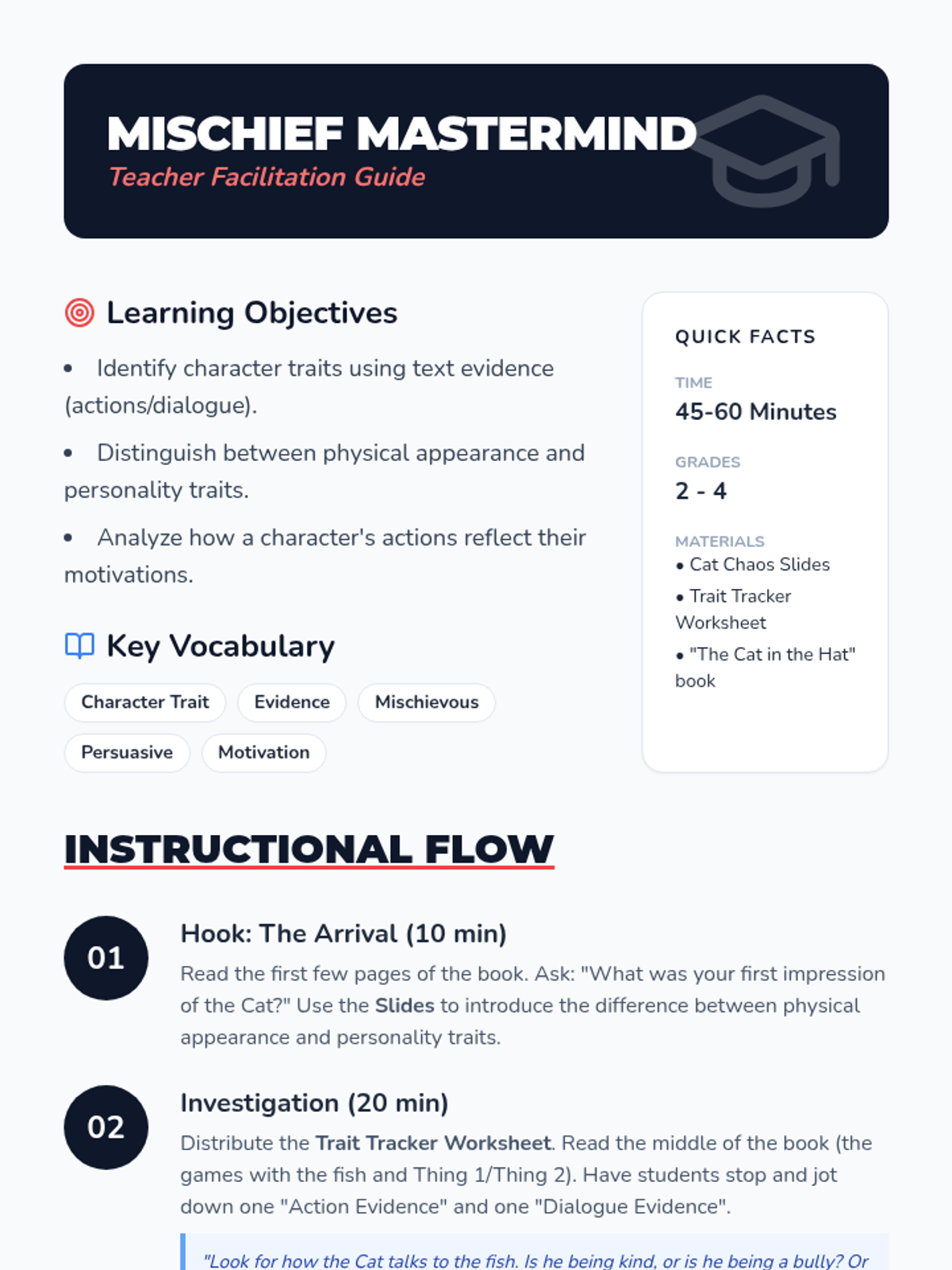
A comprehensive guide for teachers to lead the 'Cat Chaos' lesson, including learning objectives, a timed lesson flow, discussion prompts, and an answer key with trait examples.
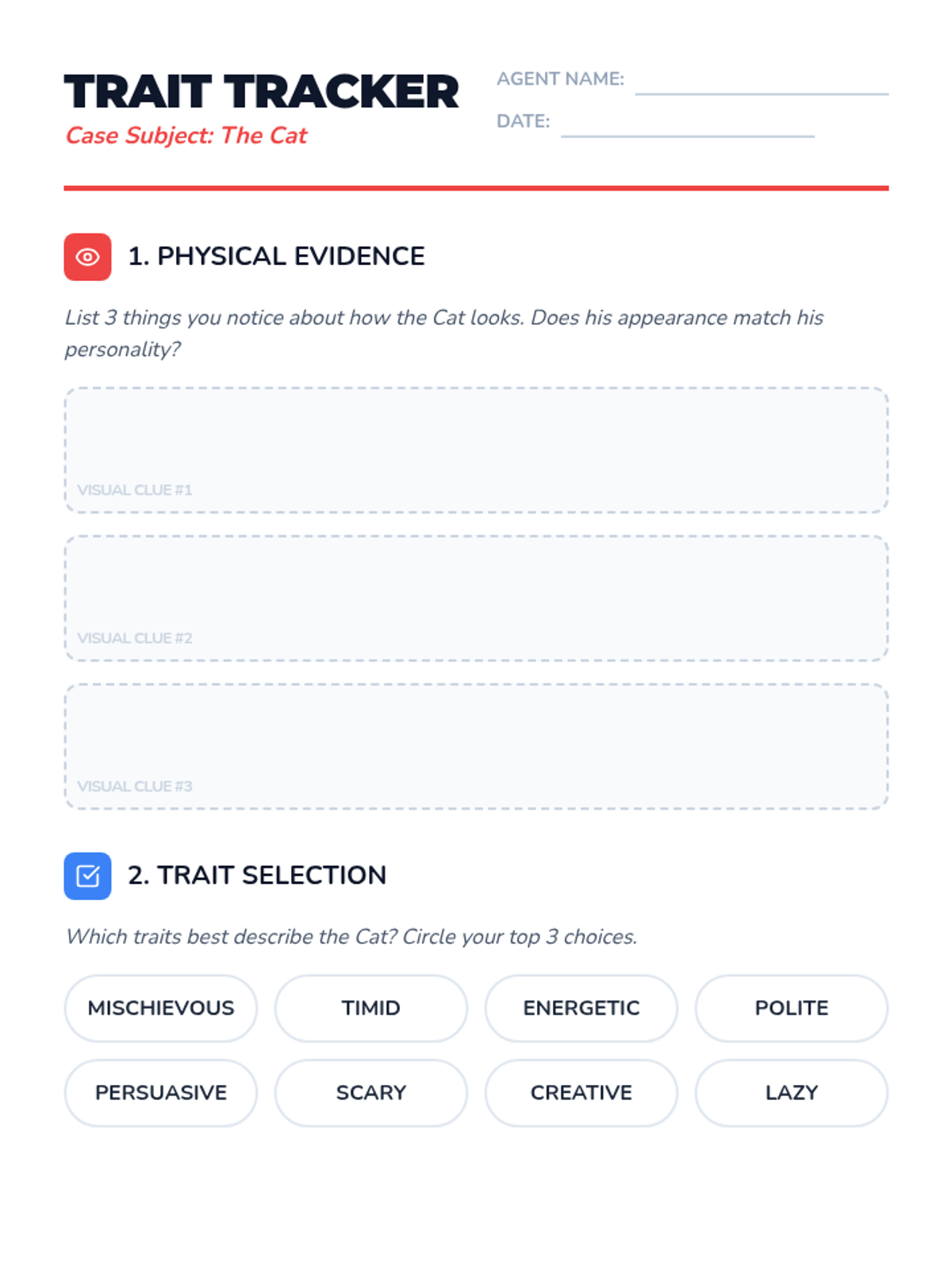
A structured investigation worksheet for students to track the Cat's physical attributes, select character traits, provide textual evidence, and reflect on his development. Optimized for handwriting space and proper page flow.
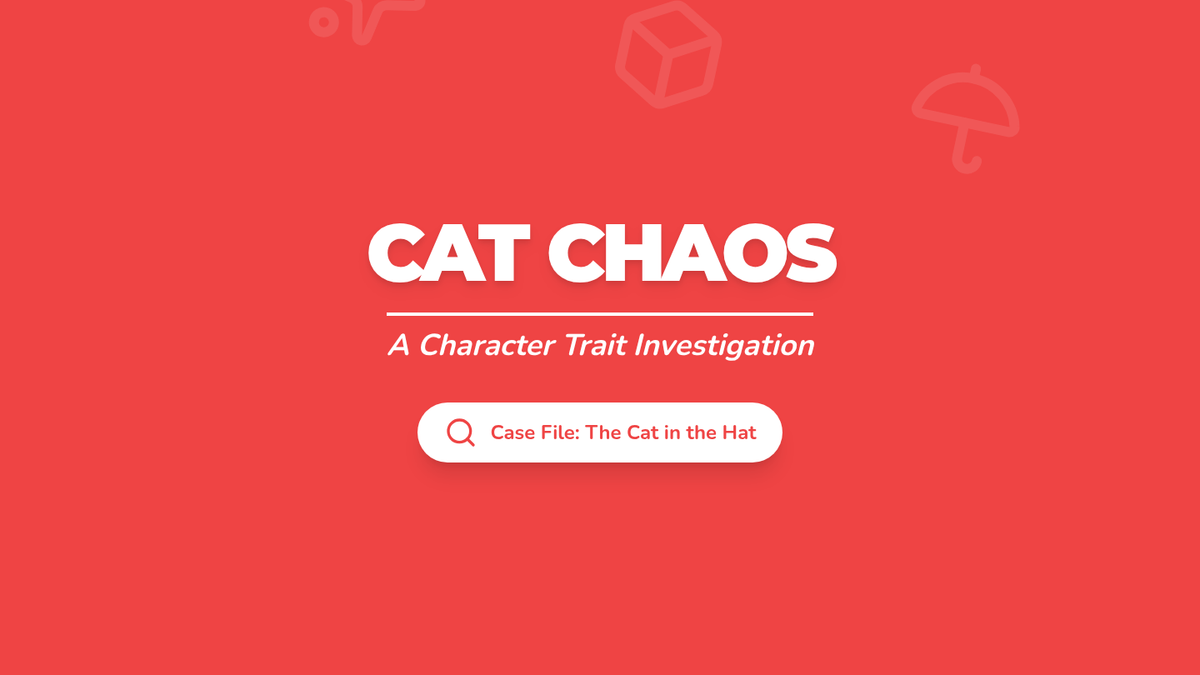
Vibrant, instructional slides that introduce character traits and evidence through the lens of 'The Cat in the Hat'. Includes definitions, evidence examples, and a classroom debate prompt.
A teacher-facing resource featuring complete answer keys for the Gallery Walk stations and Debate Cards, plus a detailed 10-minute classroom protocol for conducting a rapid 'Sprint Debate'. Layout updated for clean page breaks.
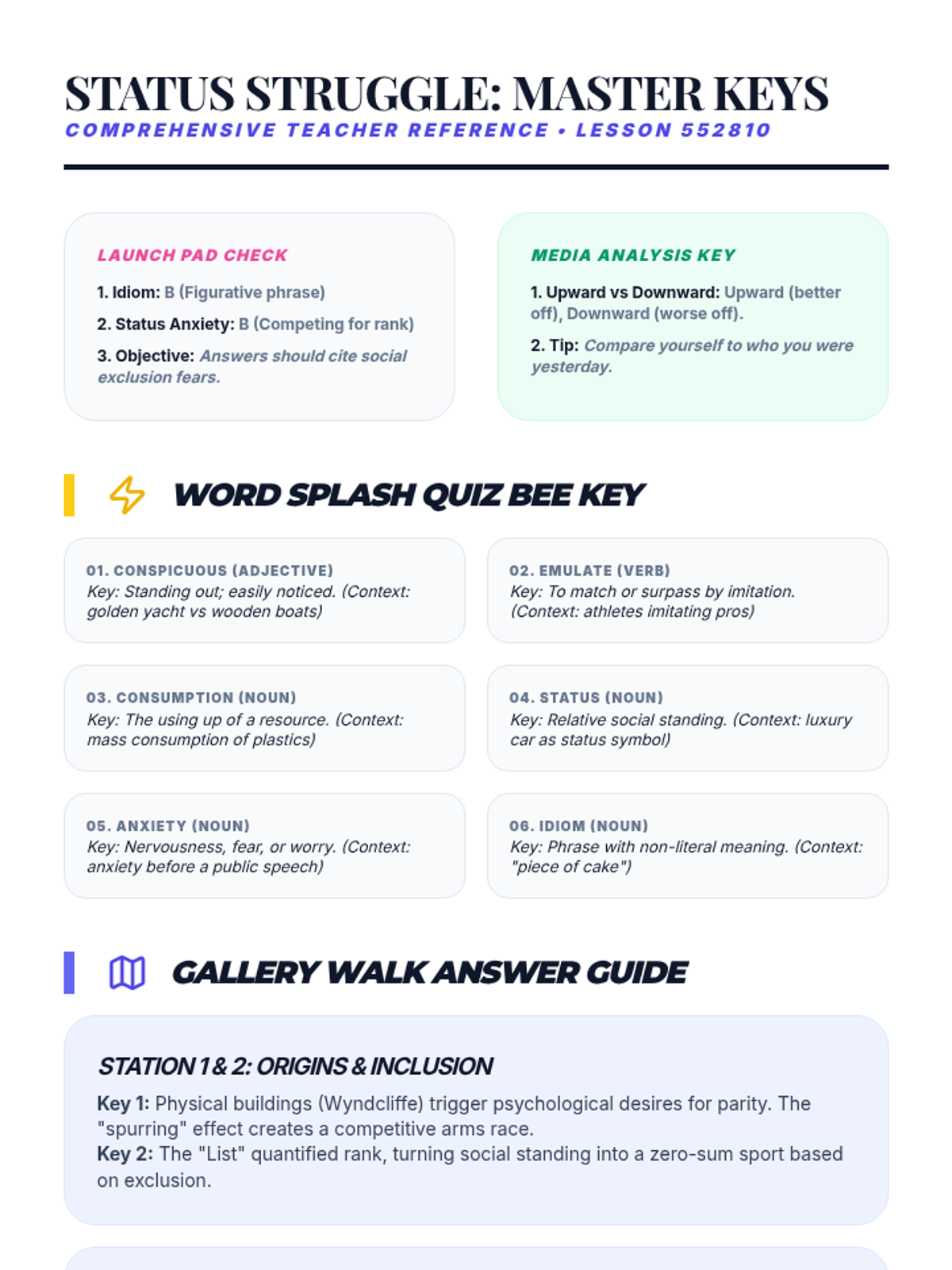
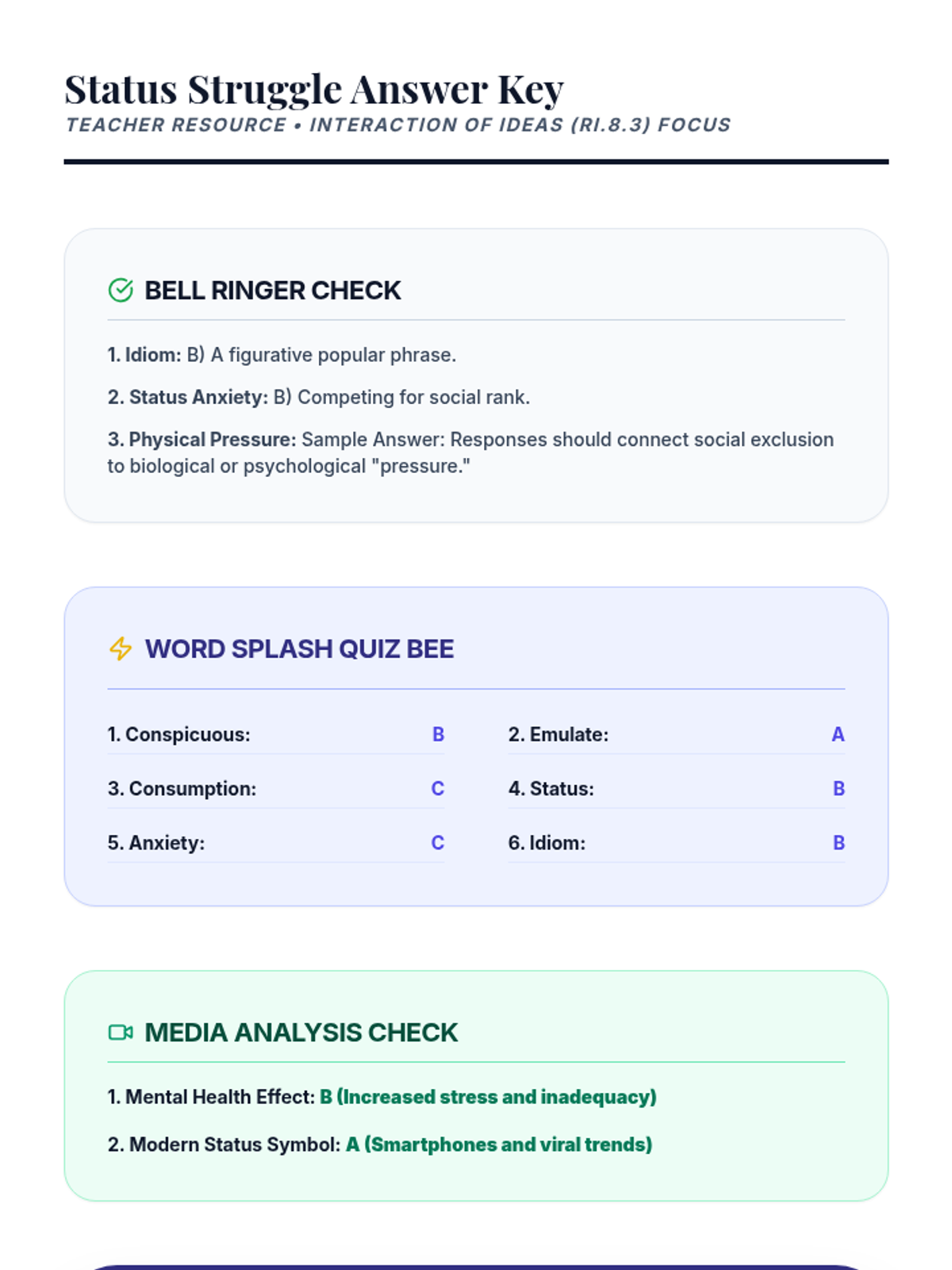
A comprehensive answer key covering the bell ringer, vocabulary quiz bee, gallery walk stations, and exit ticket, with specific explanations of Idea Interactions (RI.8.3). UPDATED for the "Science of Comparison" video.
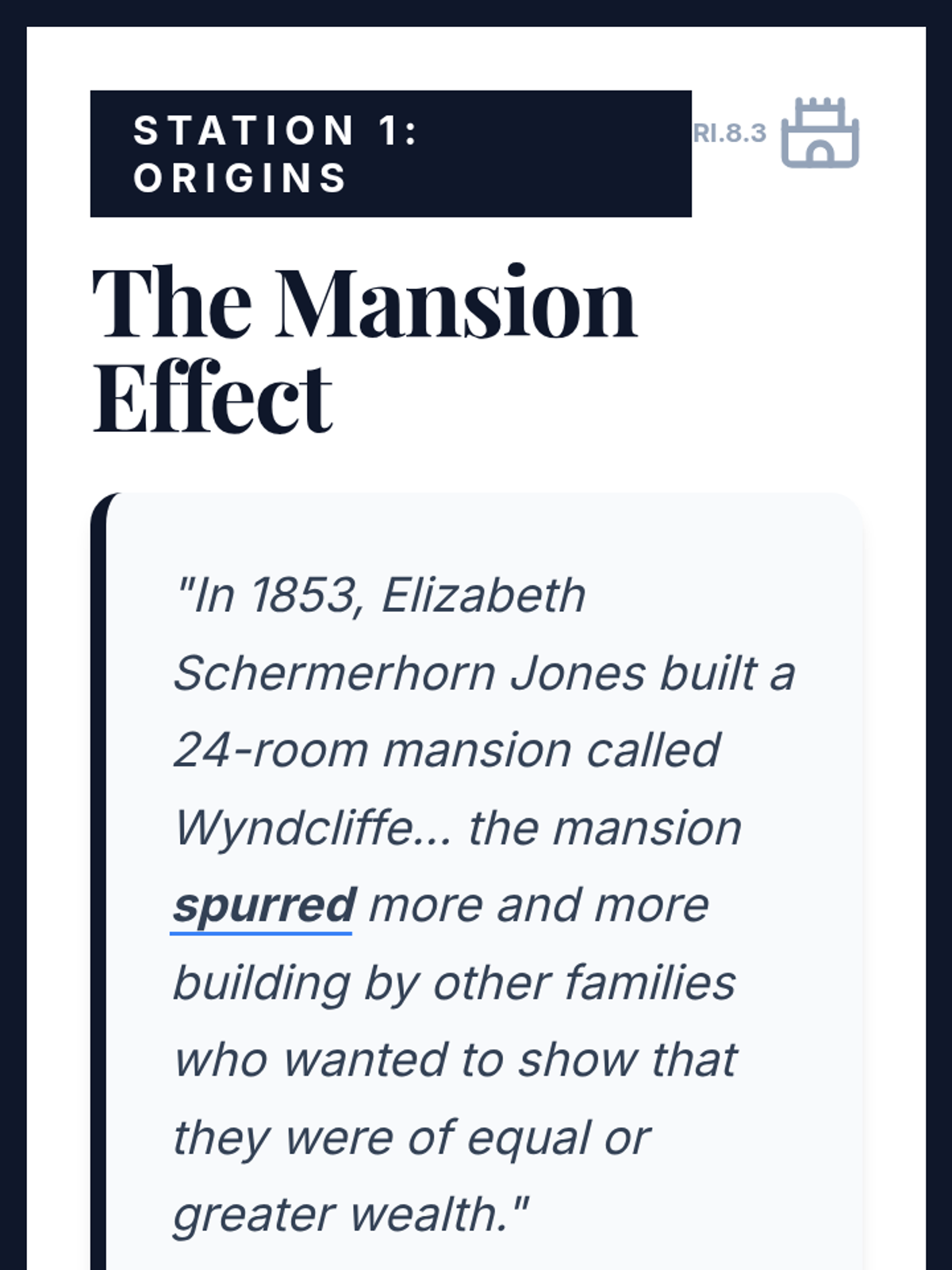
A set of 4 large-format gallery walk stations specifically designed to target the 'Interaction of Ideas' (RI.8.3). Each station features a clear textual excerpt, synthesis prompts, and dedicated student work areas. Layout updated for single-page fits.
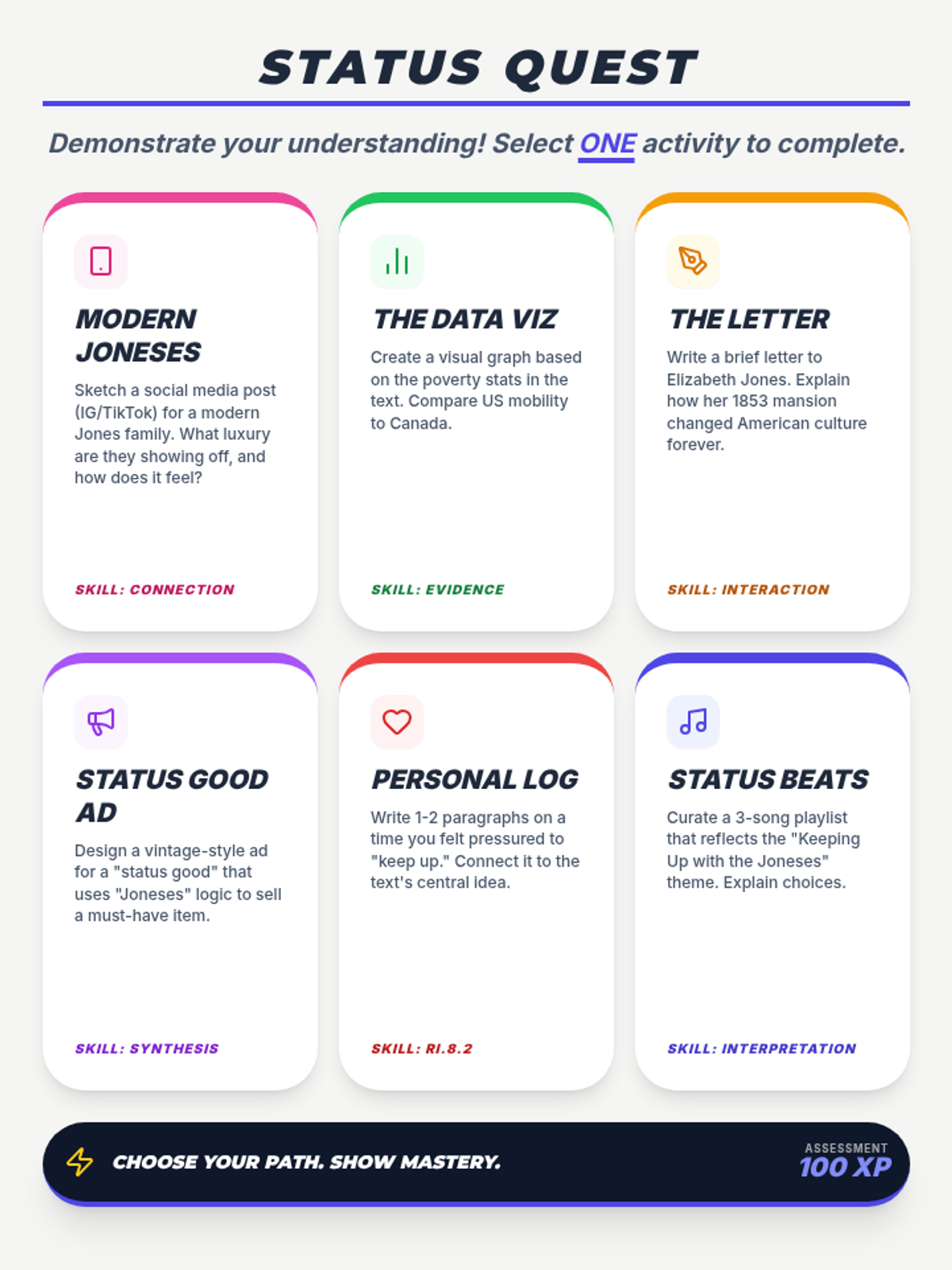
A vibrant Choice Board activity for 'Keeping Up with the Joneses' featuring 6 creative tasks. Students choose ONE activity to complete on the provided 'Quest Log' response sheet. Layout corrected for full-page use. Work area includes light lines for writing-heavy tasks. Standard alignment standardized to RI.8.3.
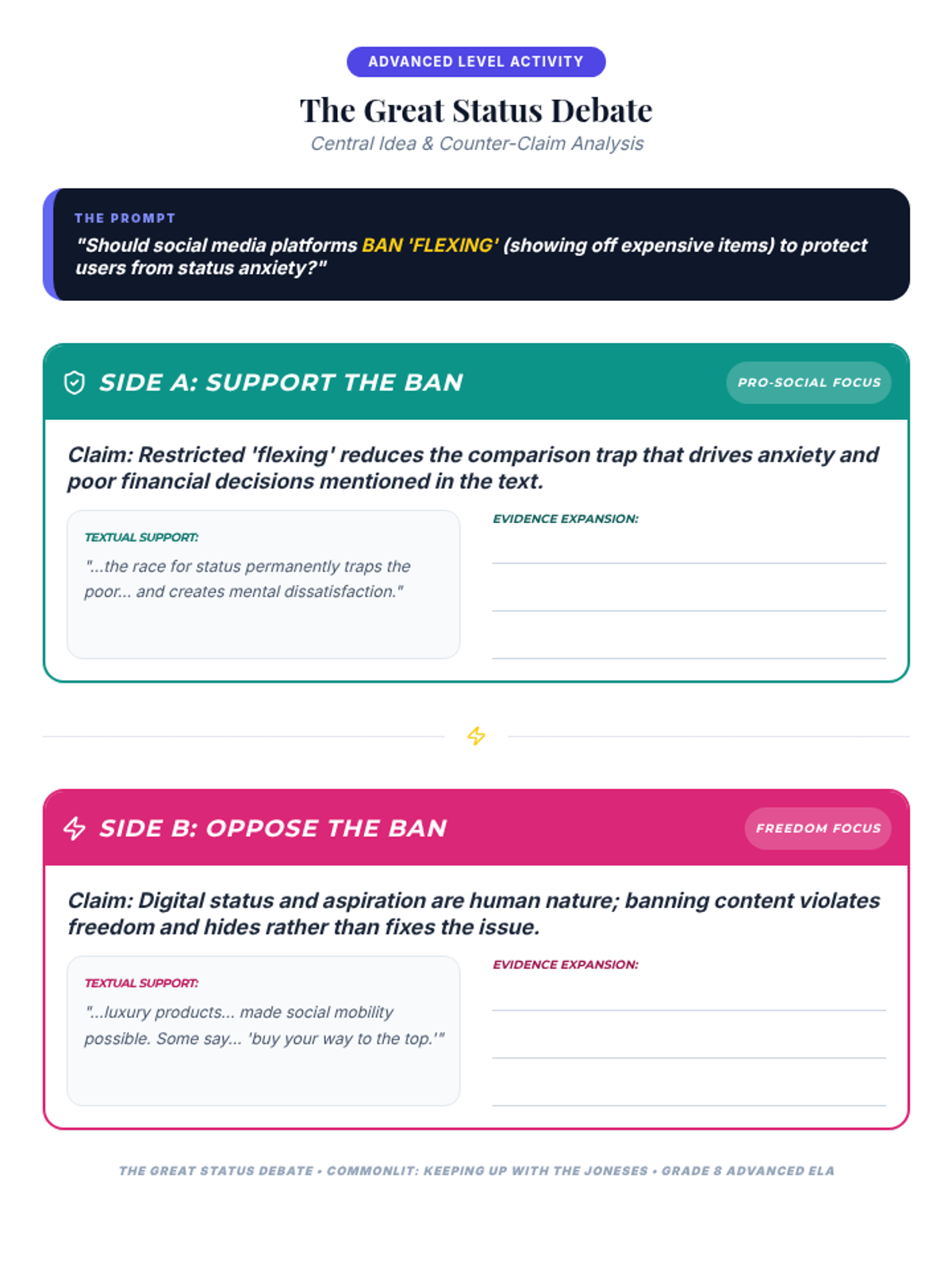
A debate facilitation sheet for advanced students featuring pro and con claim cards with designated spaces for recording textual evidence and counter-arguments.
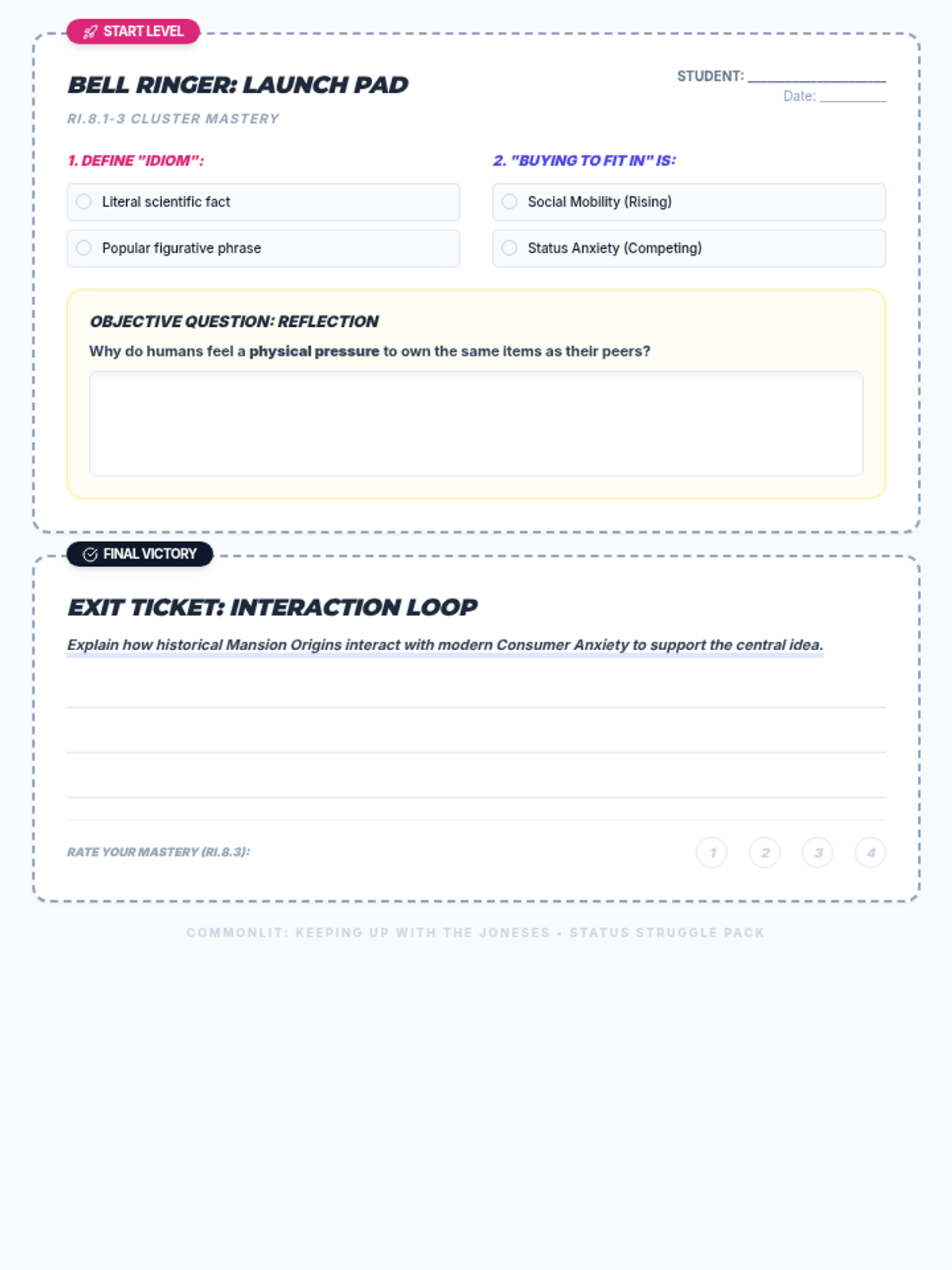
A printable worksheet featuring a 2 MC + 1 Open-Ended Bell Ringer and an Exit Ticket summary slip. The structure mirrors the slide deck's high-energy 'Launch Pad' and 'Victory Lap' themes. Layout corrected to ensure single-page fit. Context and categories added to vocabulary questions.
A updated 37-slide deck for 'Keeping Up with the Joneses'. Slide 21 now features a single guide question focused on personal progress to reduce student anxiety. Maintains all other slides including the advanced debate track and media analysis. Spacing and layout optimized for readability.
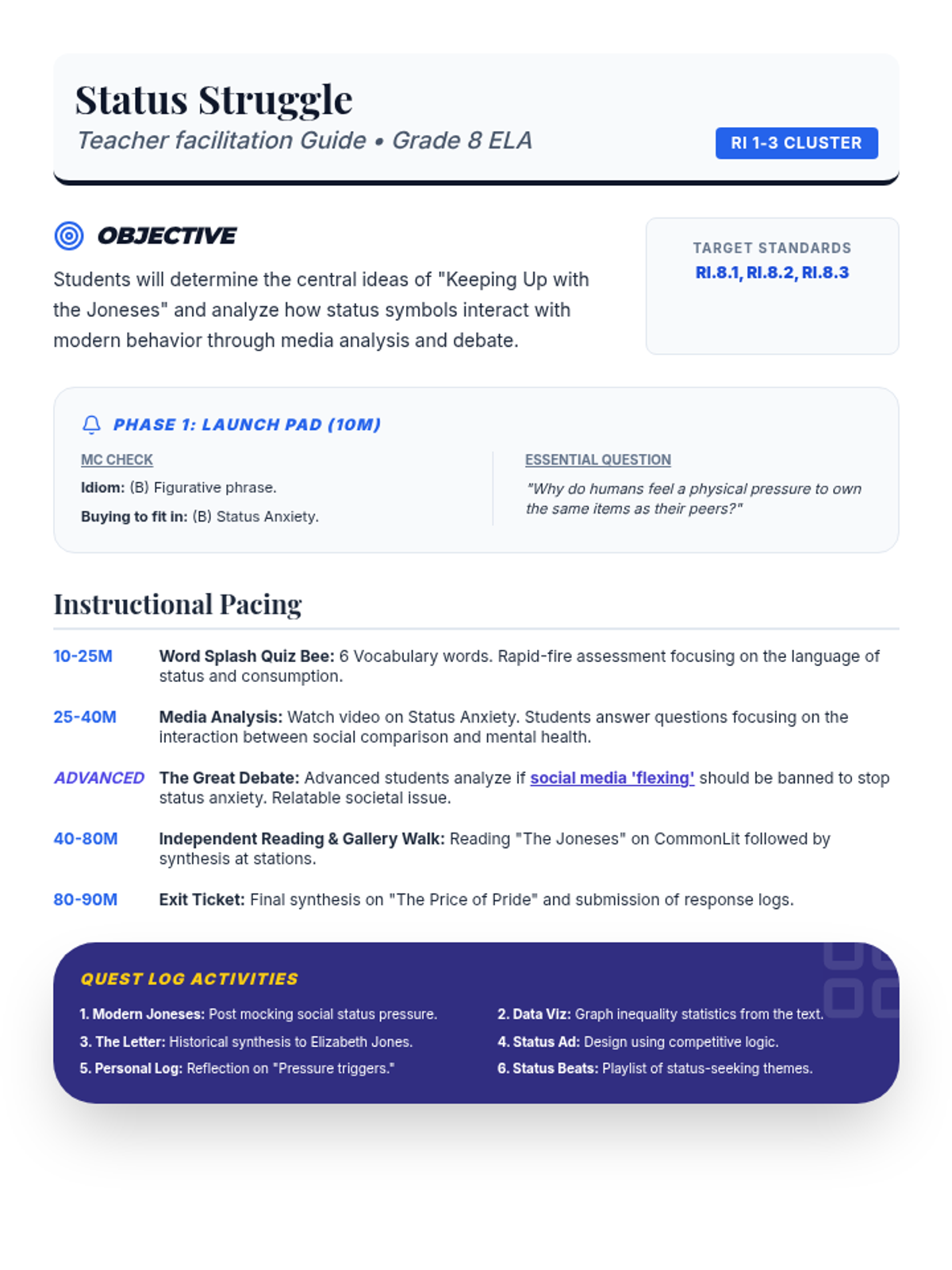
A robust 2-page teacher facilitation guide updated for better layout and a single-page fit. Includes the specific Bell Ringer questions and Choice Board task descriptions.
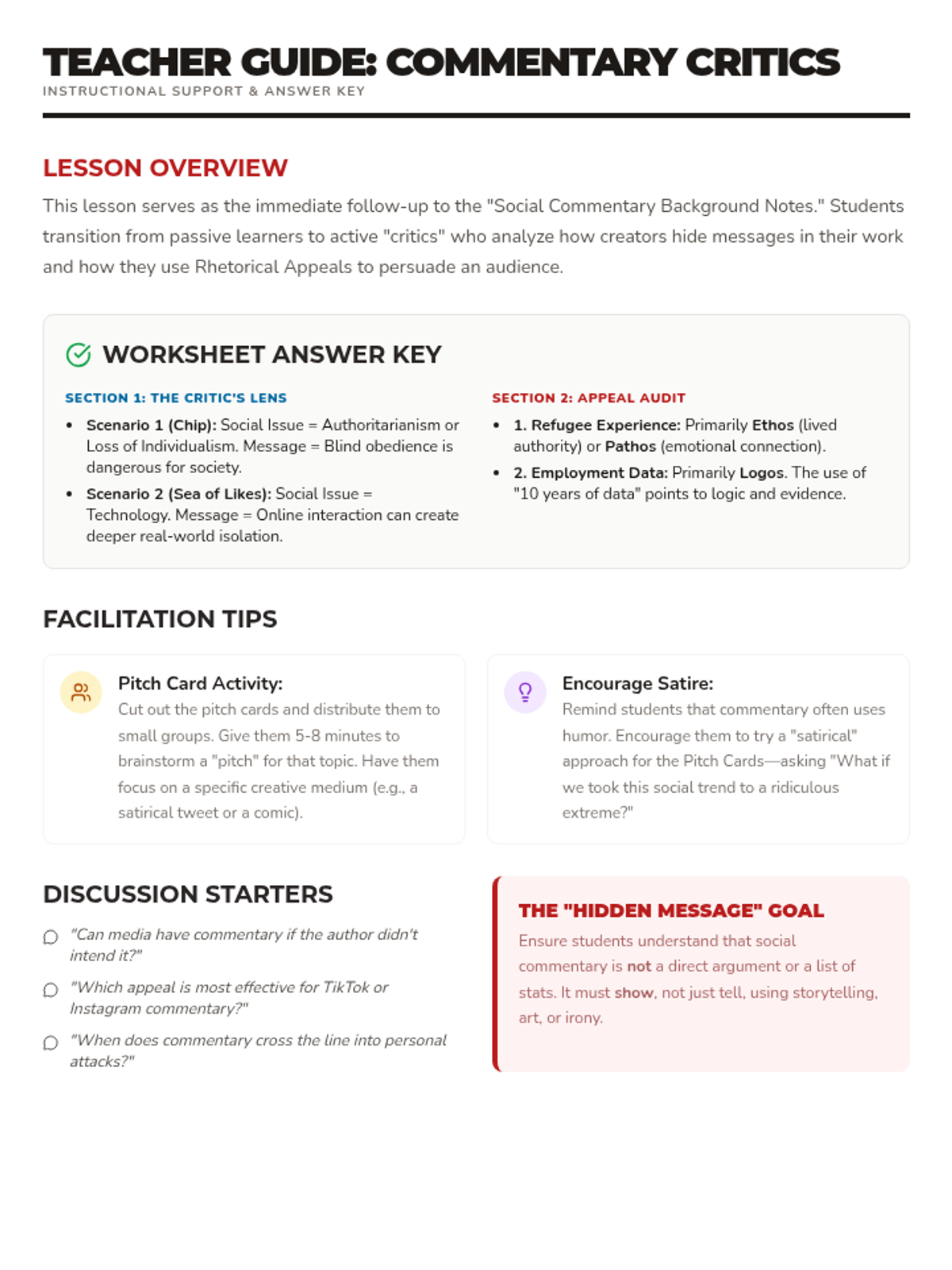
A teacher-facing guide providing an answer key for the worksheet, facilitation strategies for the pitch cards, and discussion prompts to deepen student understanding of social commentary.
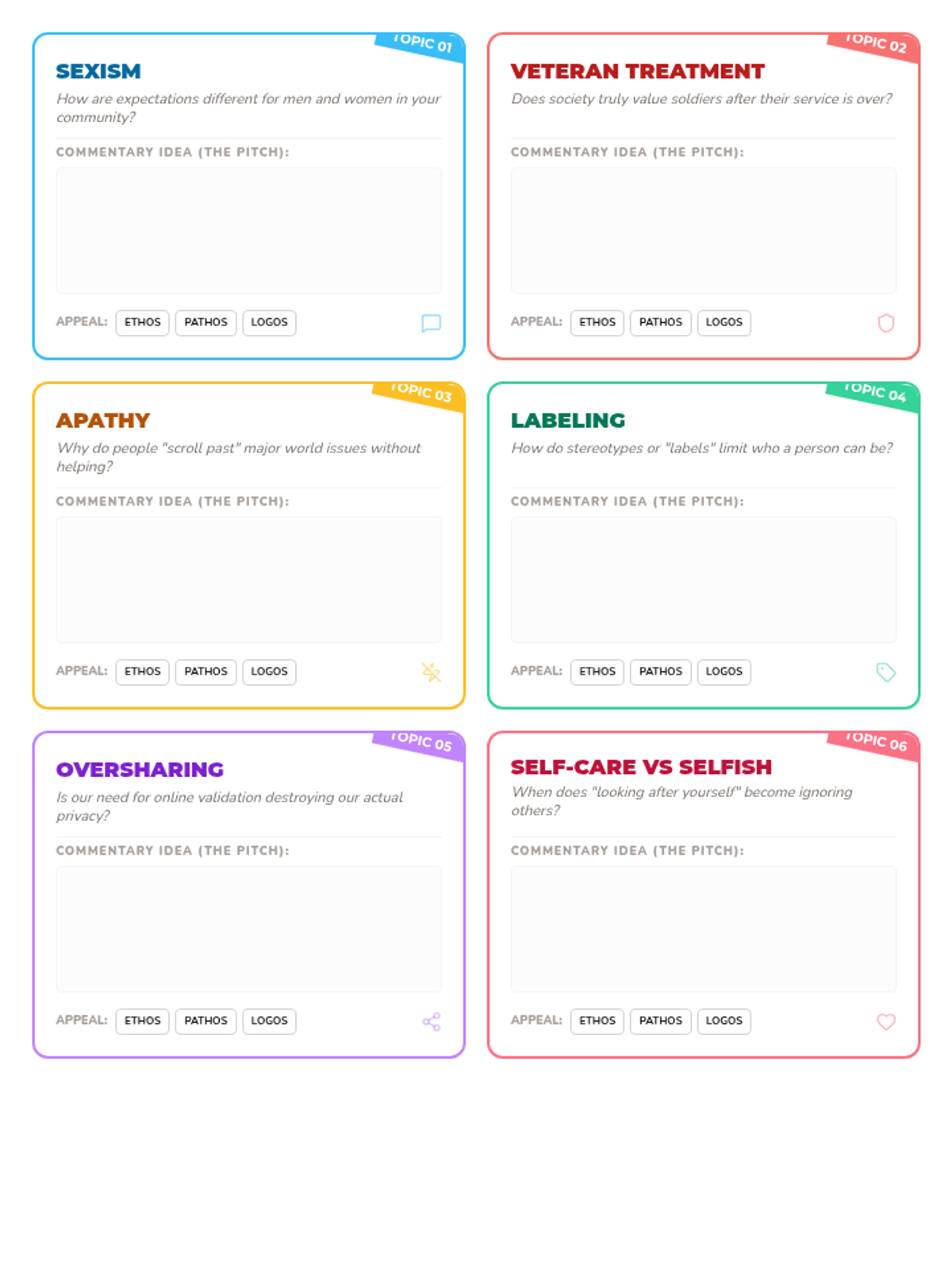
A set of six creative prompt cards based on the specific social issues mentioned in the background notes. Students can use these to brainstorm commentary ideas and identify rhetorical appeals.
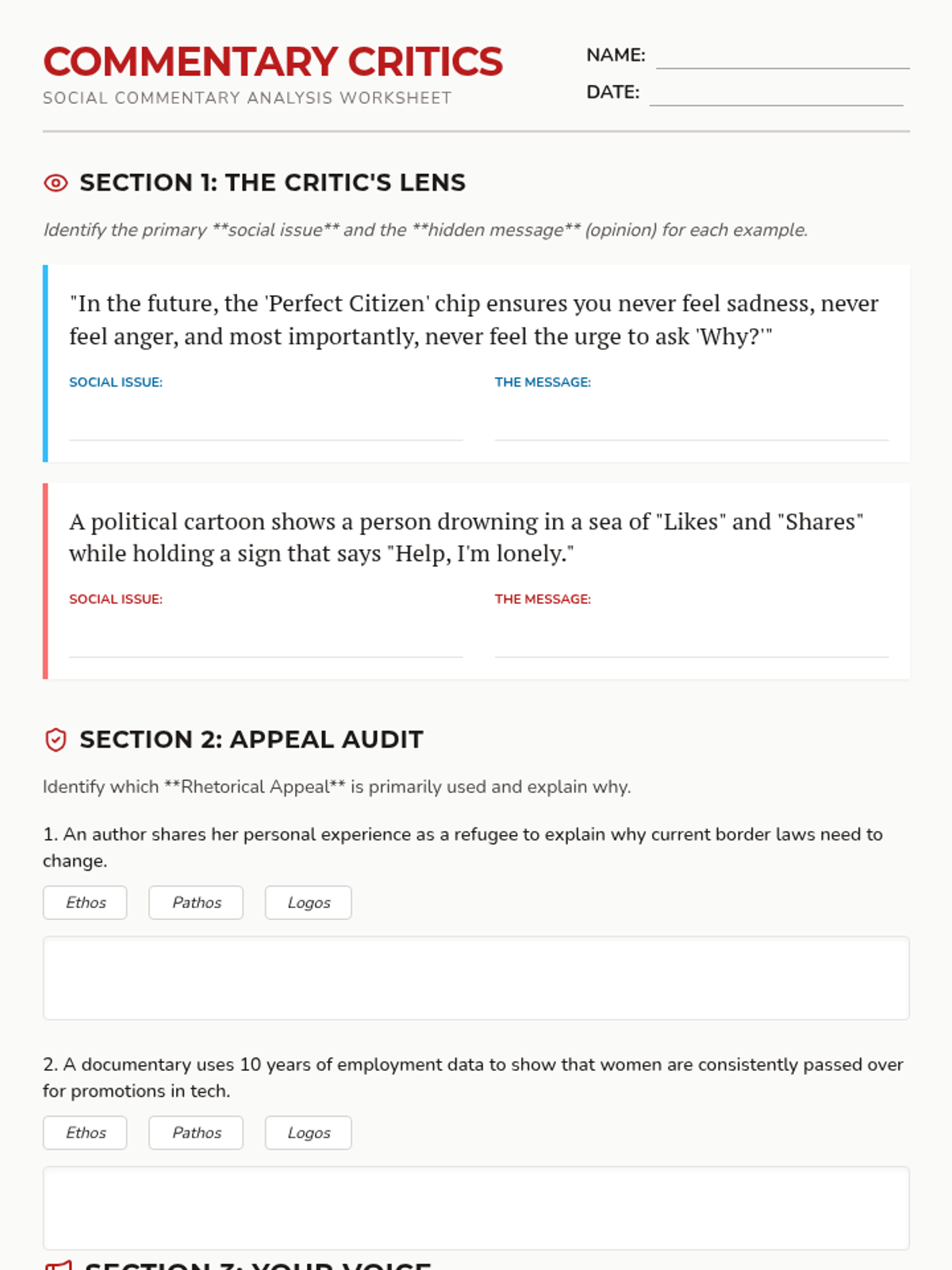
A comprehensive worksheet for students to analyze social commentary snippets, identify rhetorical appeals, and brainstorm their own social commentary projects based on the lesson notes.
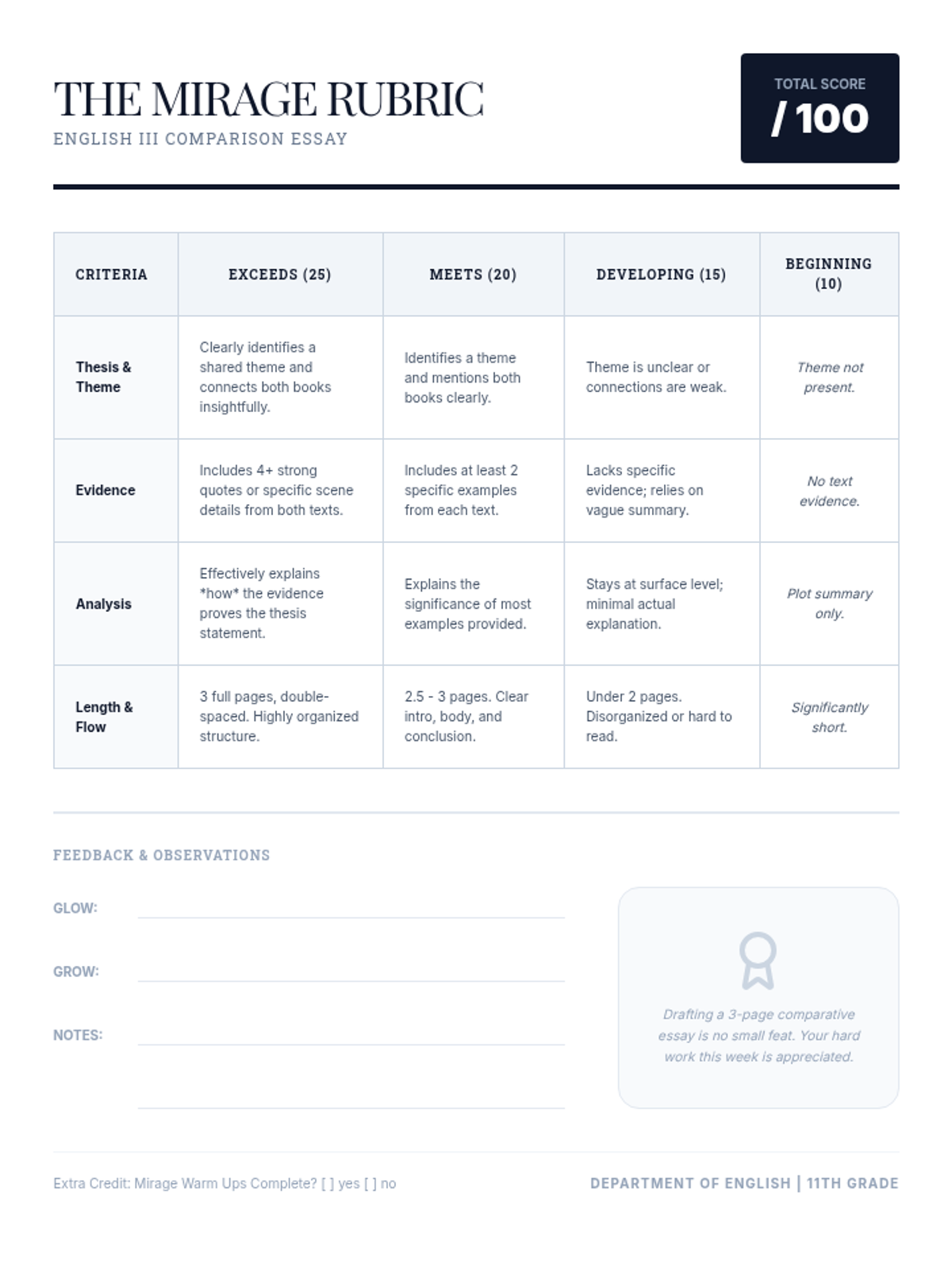
A clear and concise grading rubric for the "Mirage" comparative essay, focusing on thesis clarity, evidence, and structural requirements.
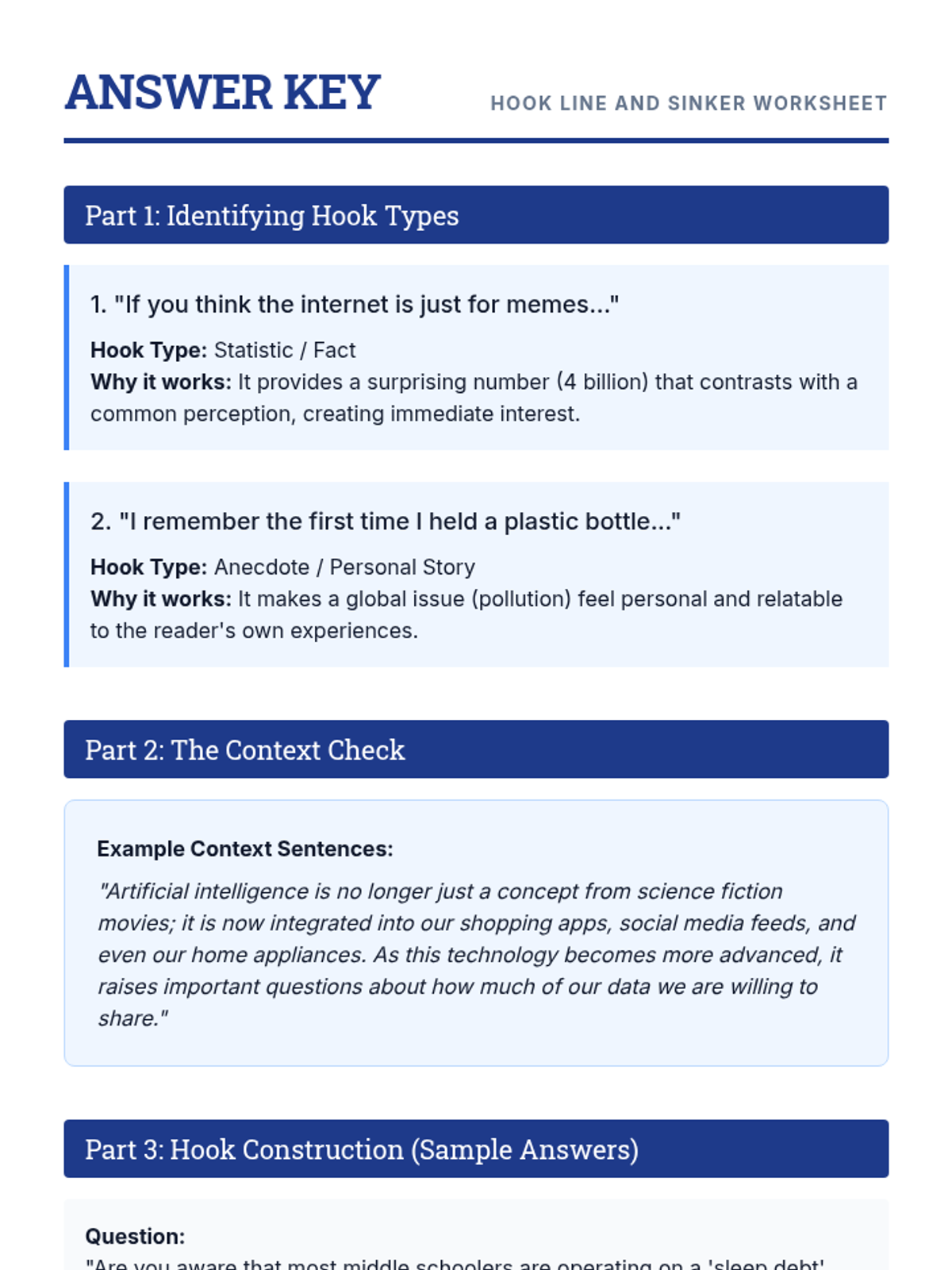
An answer key for the 'Hook Line and Sinker' worksheet, providing sample answers and explanations for teachers.
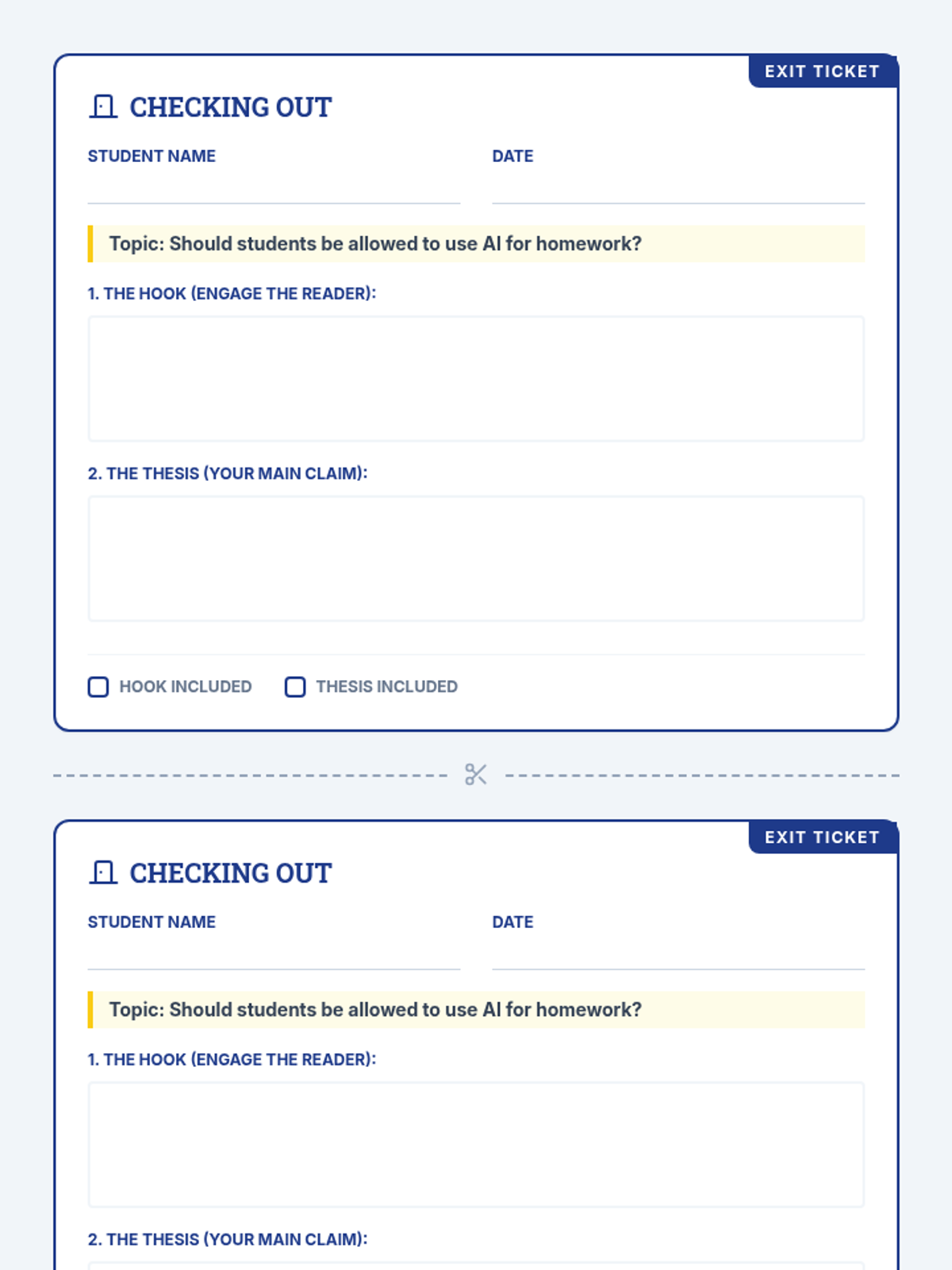
A quick assessment exit ticket for the end of the lesson. Updated with two tickets per page and significantly increased writing space for student responses.
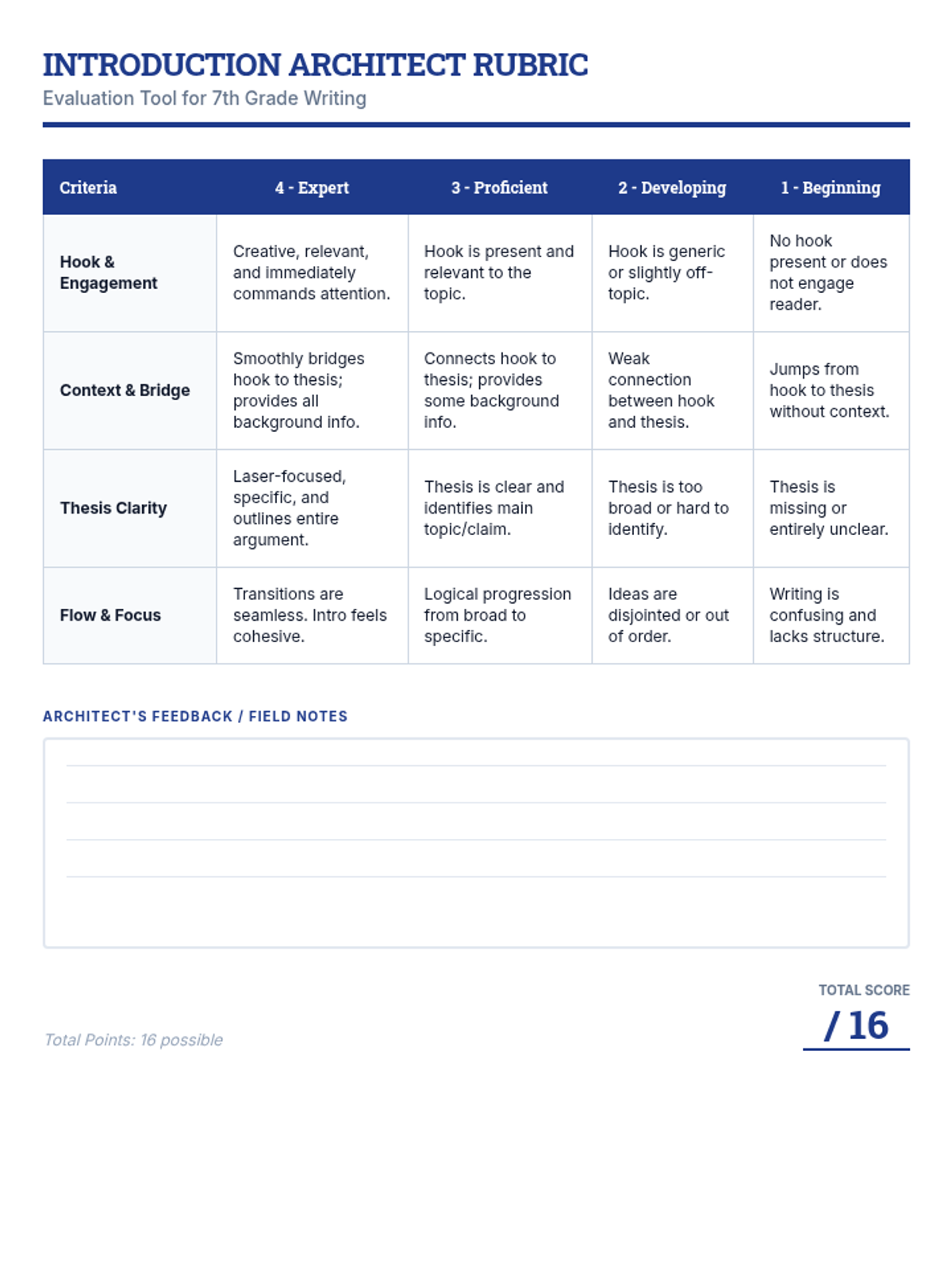
An evaluation rubric for 7th-grade introductions. Updated to fit on one page with a clean feedback area.
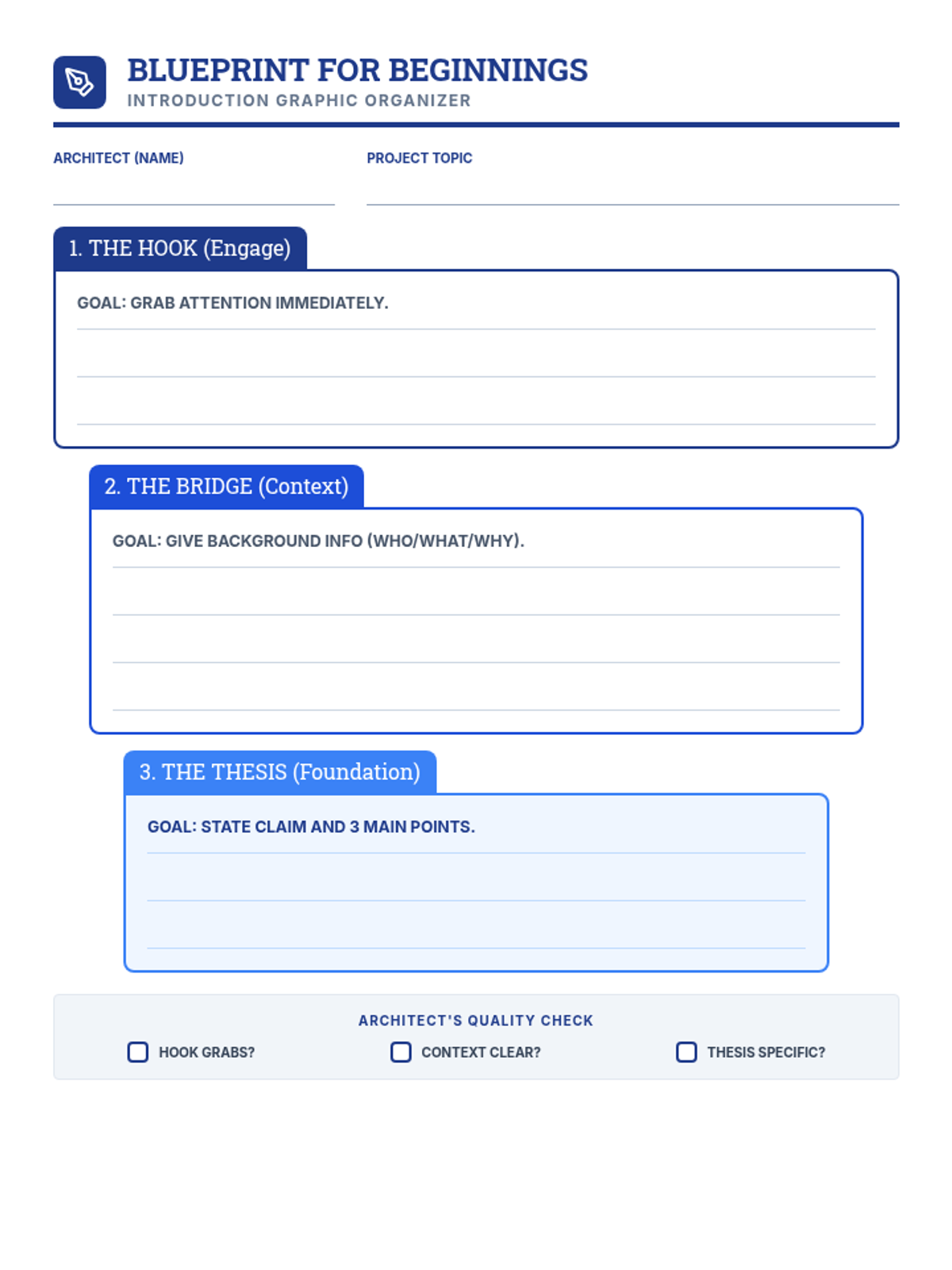
A visual graphic organizer designed as a 'funnel' to help students draft their own introductions. Updated to fit on one page with high-contrast text.
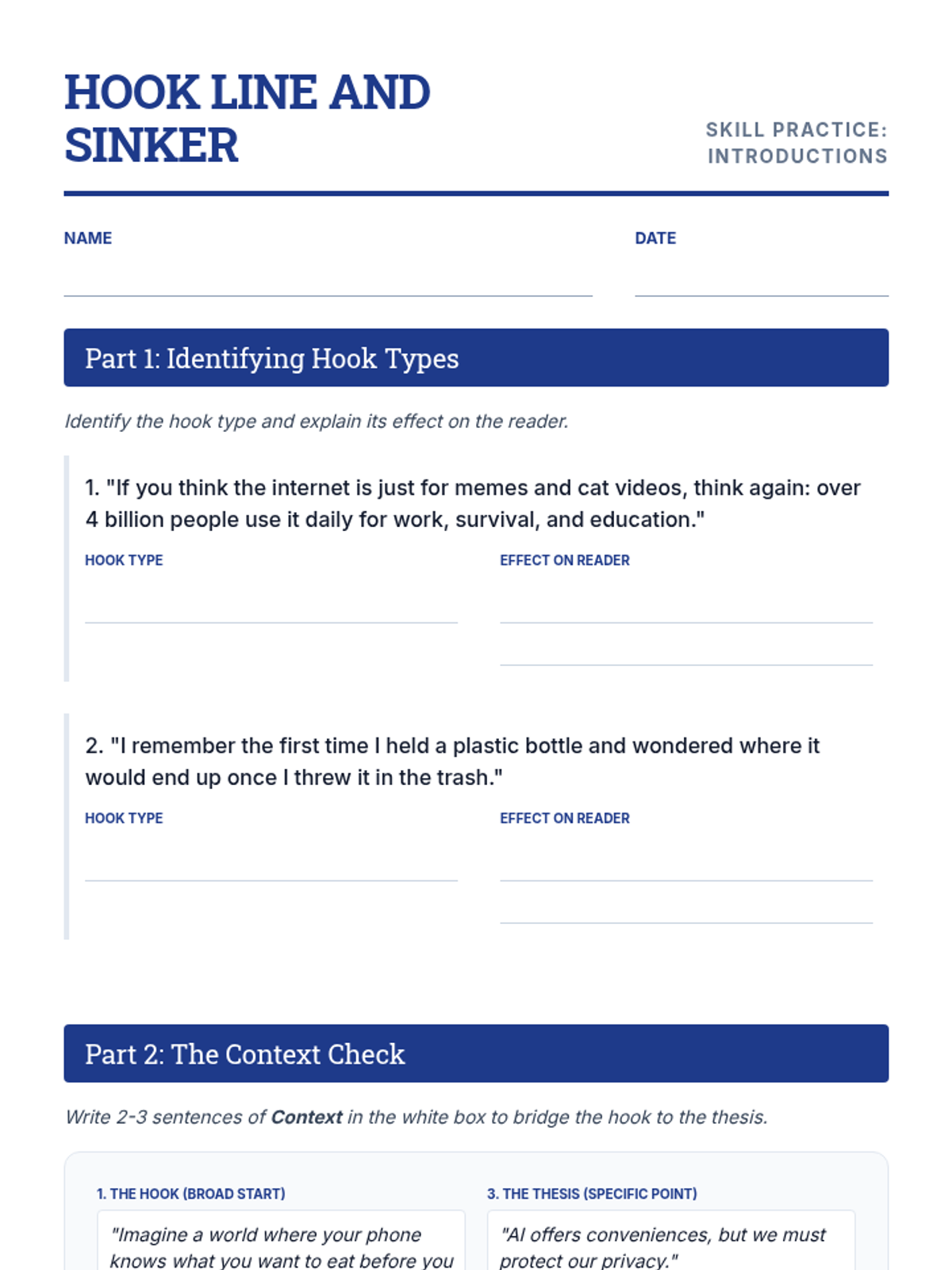
A practice worksheet where students identify hook types, write context sentences to bridge an intro, and practice drafting different types of hooks for a specific topic. Updated with improved spacing and layout.
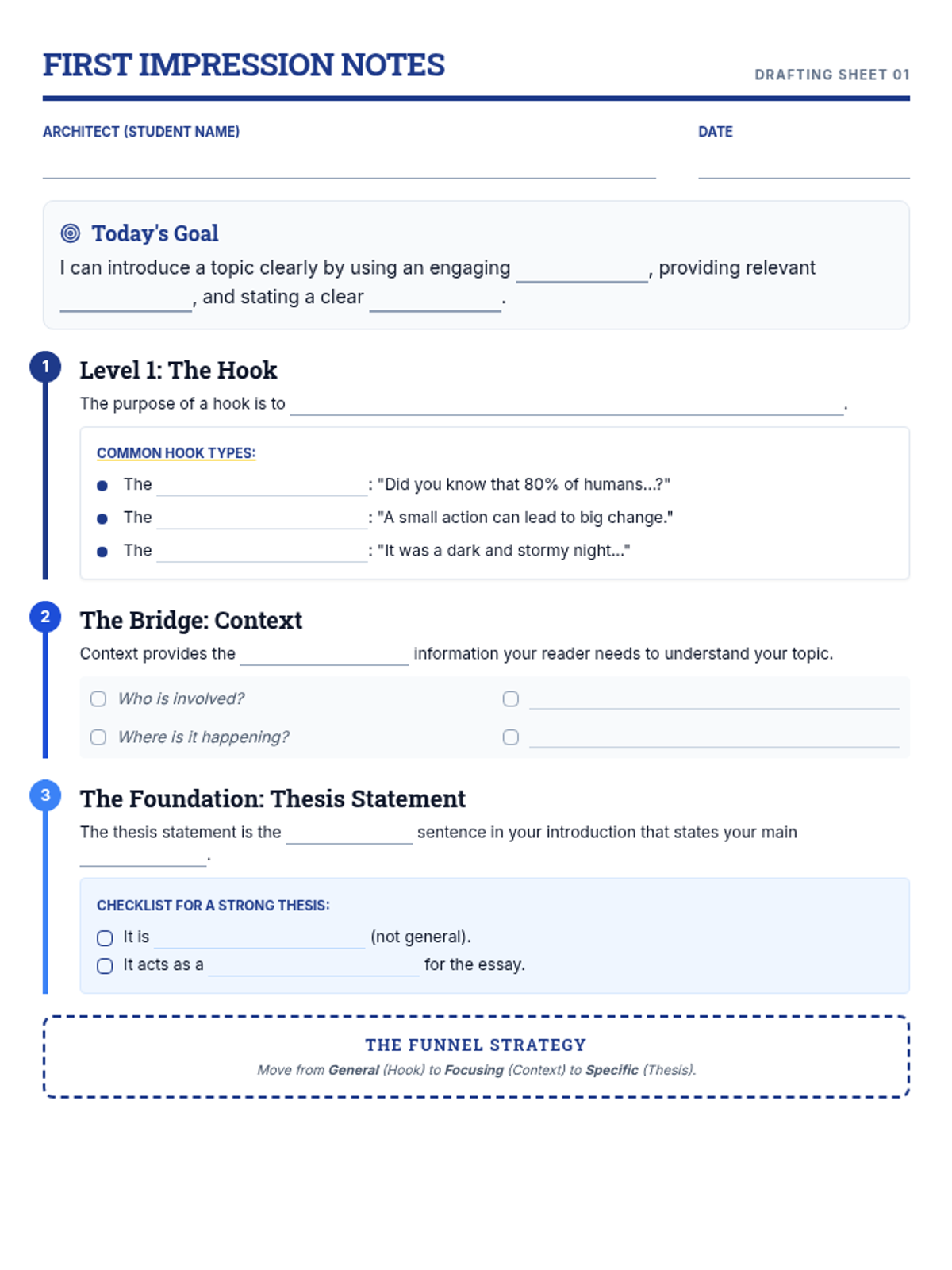
Guided notes for students to use during the 'Opening Act' presentation. Features fill-in-the-blank sections for definitions, hook types, and the funnel method. Updated to fit on one page.
Instructional slides for a 7th-grade lesson on writing introductions. The slides use a blueprint/architectural theme to teach the 'Funnel Method' (Hook, Context, Thesis).
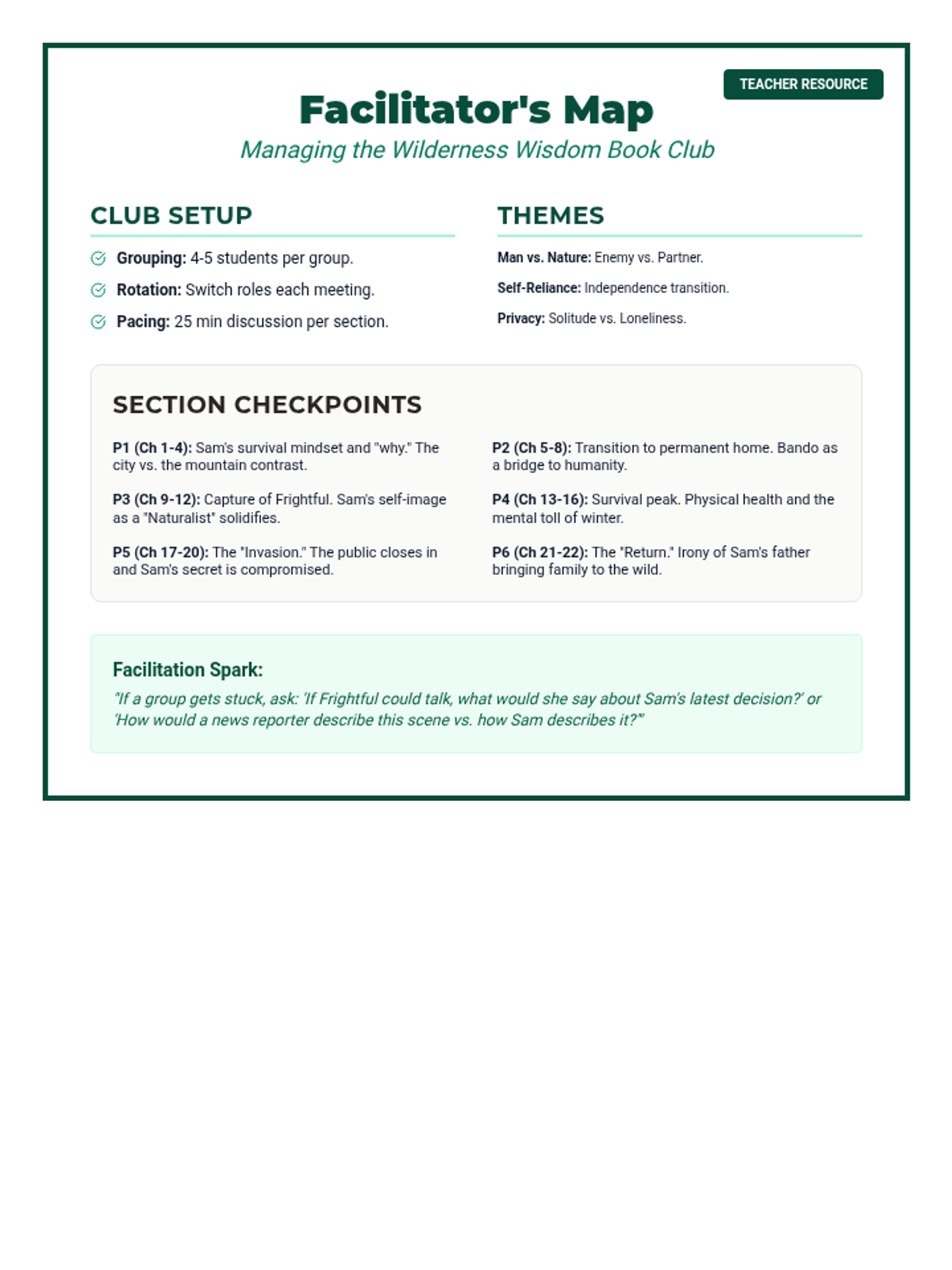
A condensed one-page facilitator's guide. Features tighter layout and more efficient use of space while retaining all key thematic tracking points and section checkpoints for the 6-part book club journey.
Revised presentation slides including a new reading schedule for the 6-part journey. Icons have been scaled up for better visual impact and typographical spacing has been refined for clarity.
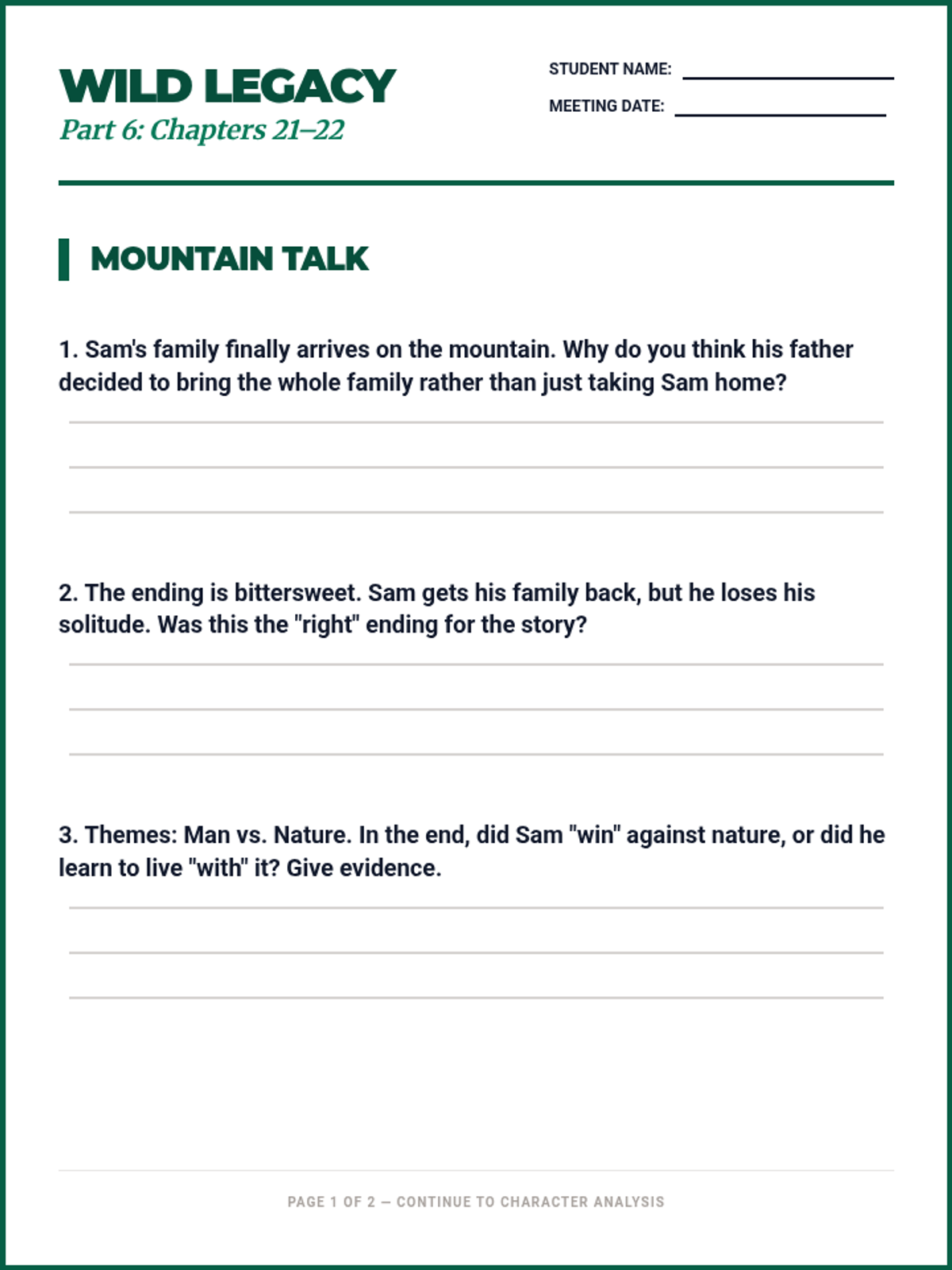
Revised student discussion guide for the final chapters. Features darkened lines and text for better legibility, expanded writing areas for prompts, and a consolidated layout that keeps the character analysis graphic organizer on a single page.
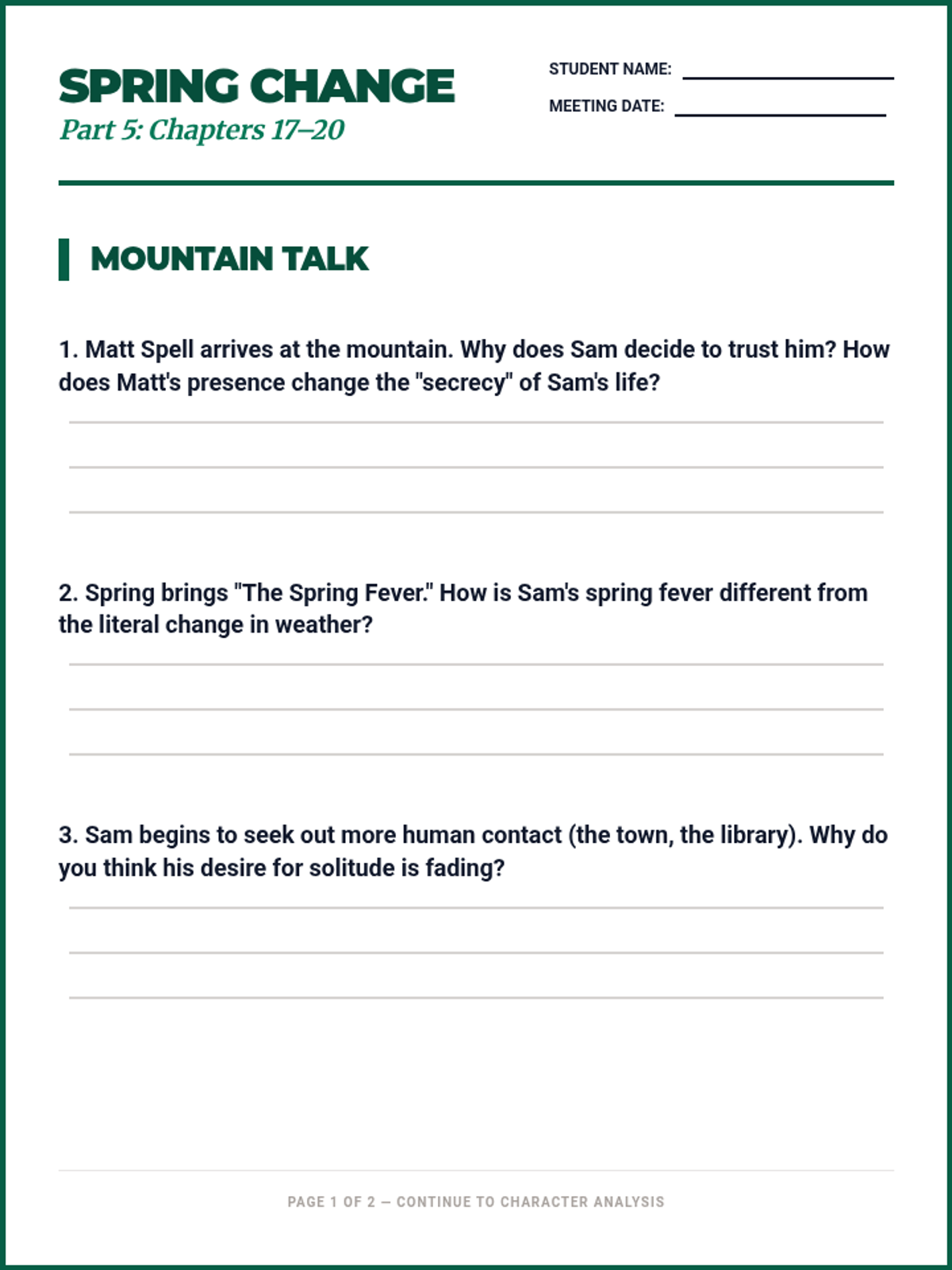
Revised student discussion guide for Chapters 17-20. Features darkened lines and text for better legibility, expanded writing areas for prompts, and a consolidated layout that keeps the character analysis graphic organizer on a single page.
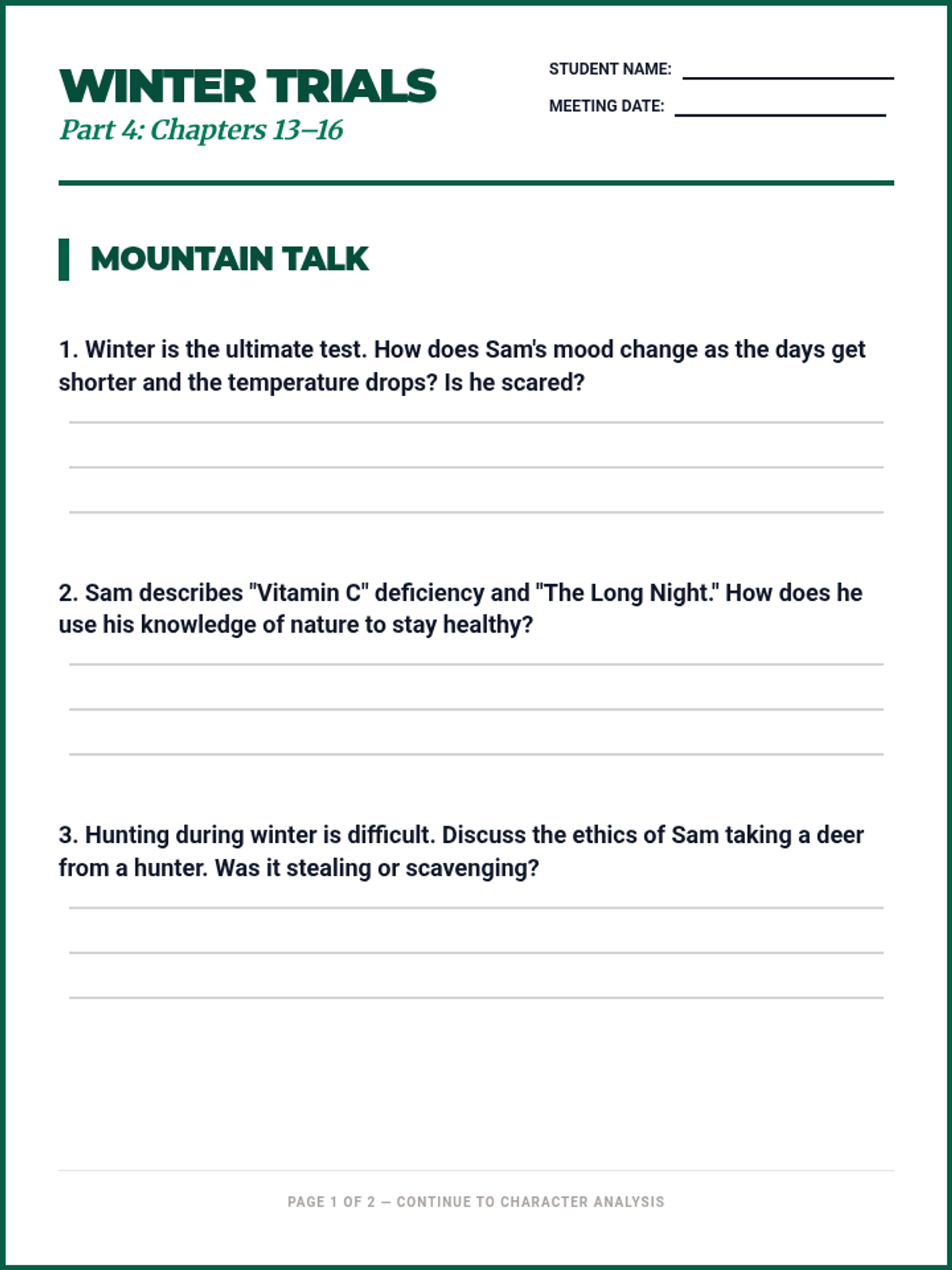
Revised student discussion guide for Chapters 13-16. Features darkened lines and text for better legibility, expanded writing areas for prompts, and a consolidated layout that keeps the character analysis graphic organizer on a single page.
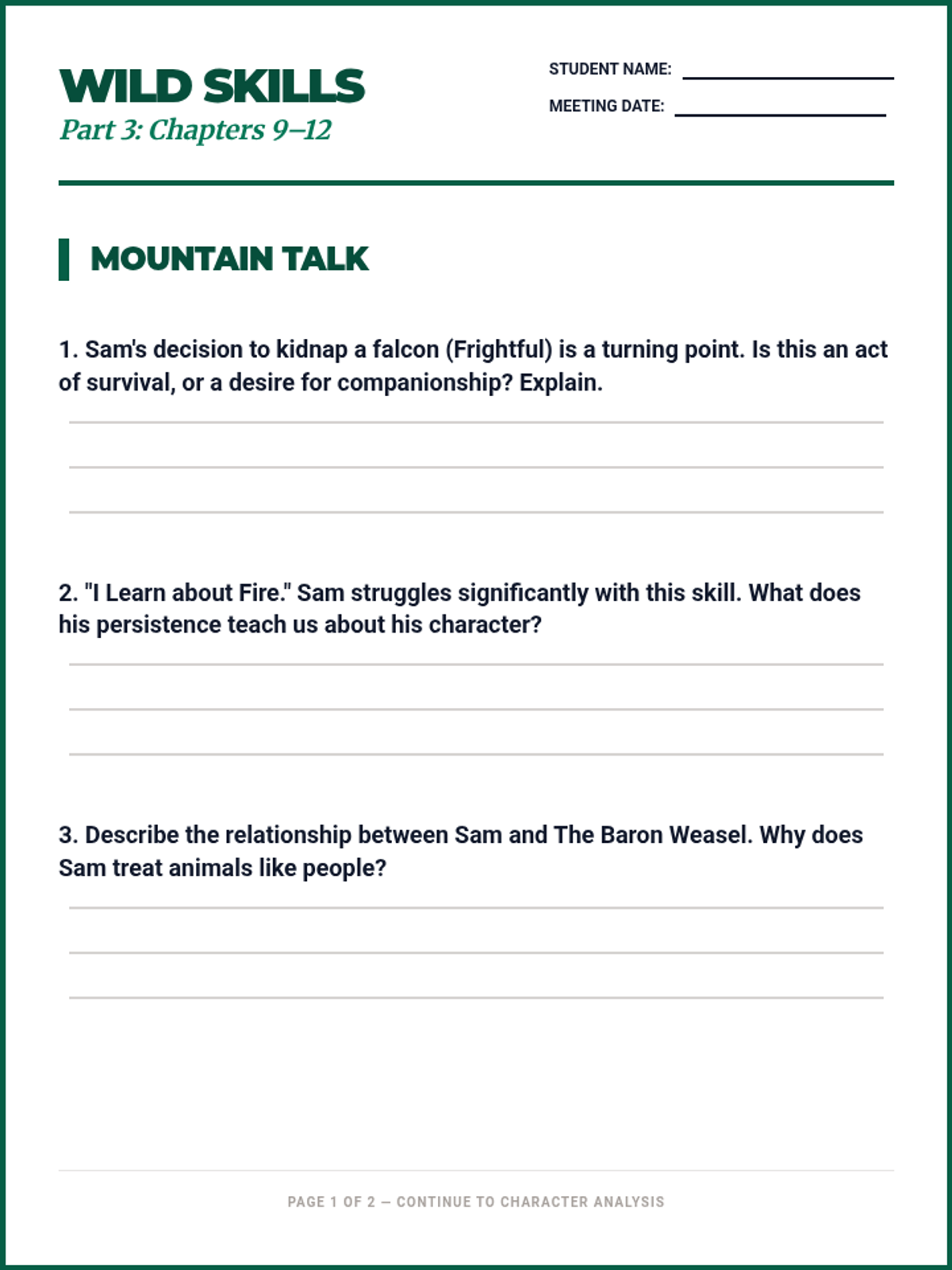
Revised student discussion guide for Chapters 9-12. Features darkened lines and text for better legibility, expanded writing areas for prompts, and a consolidated layout that keeps the character analysis graphic organizer on a single page.
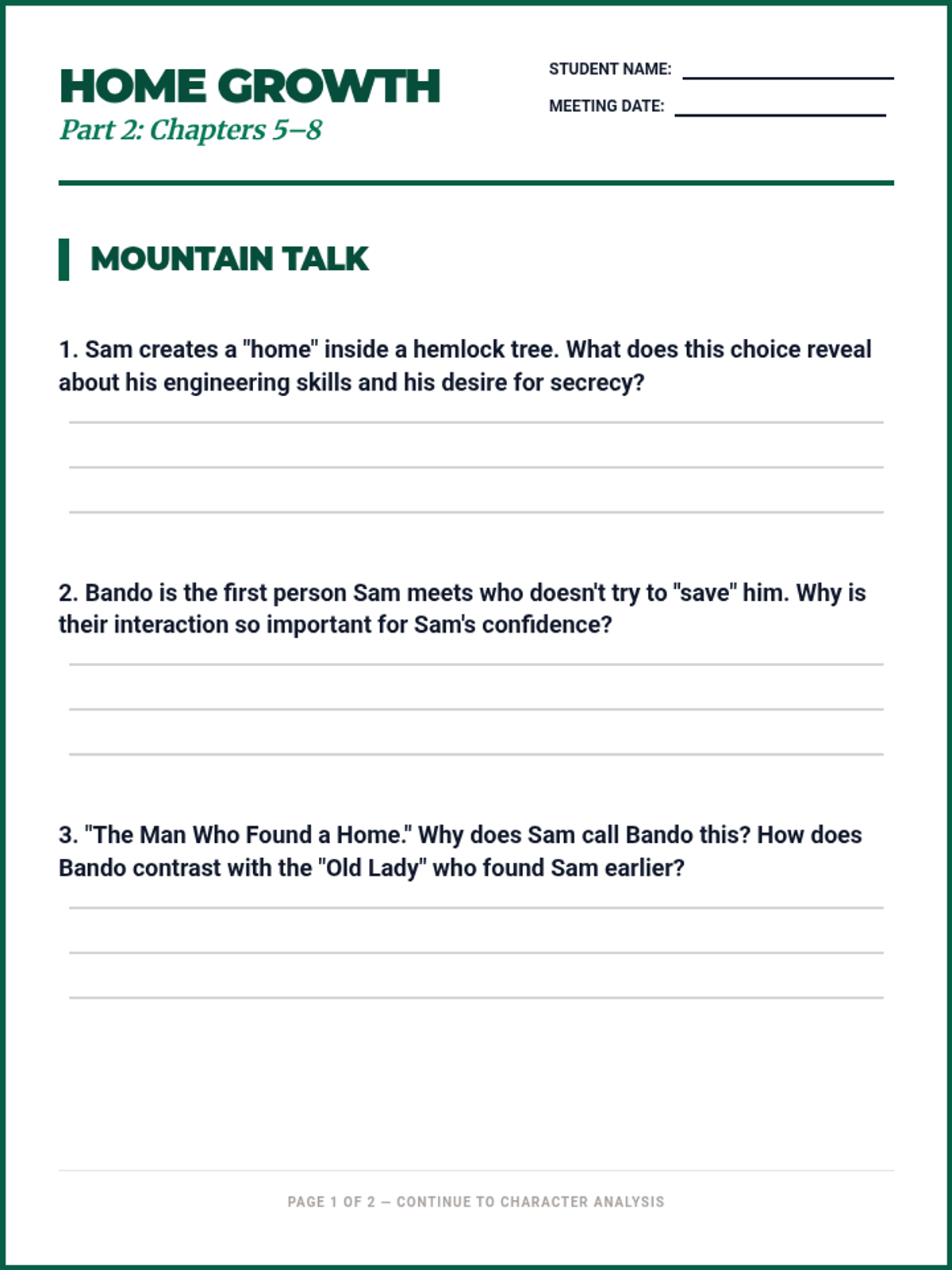
Revised student discussion guide for Chapters 5-8. Features darkened lines and text for better legibility, expanded writing areas for prompts, and a consolidated layout that keeps the character analysis graphic organizer on a single page.
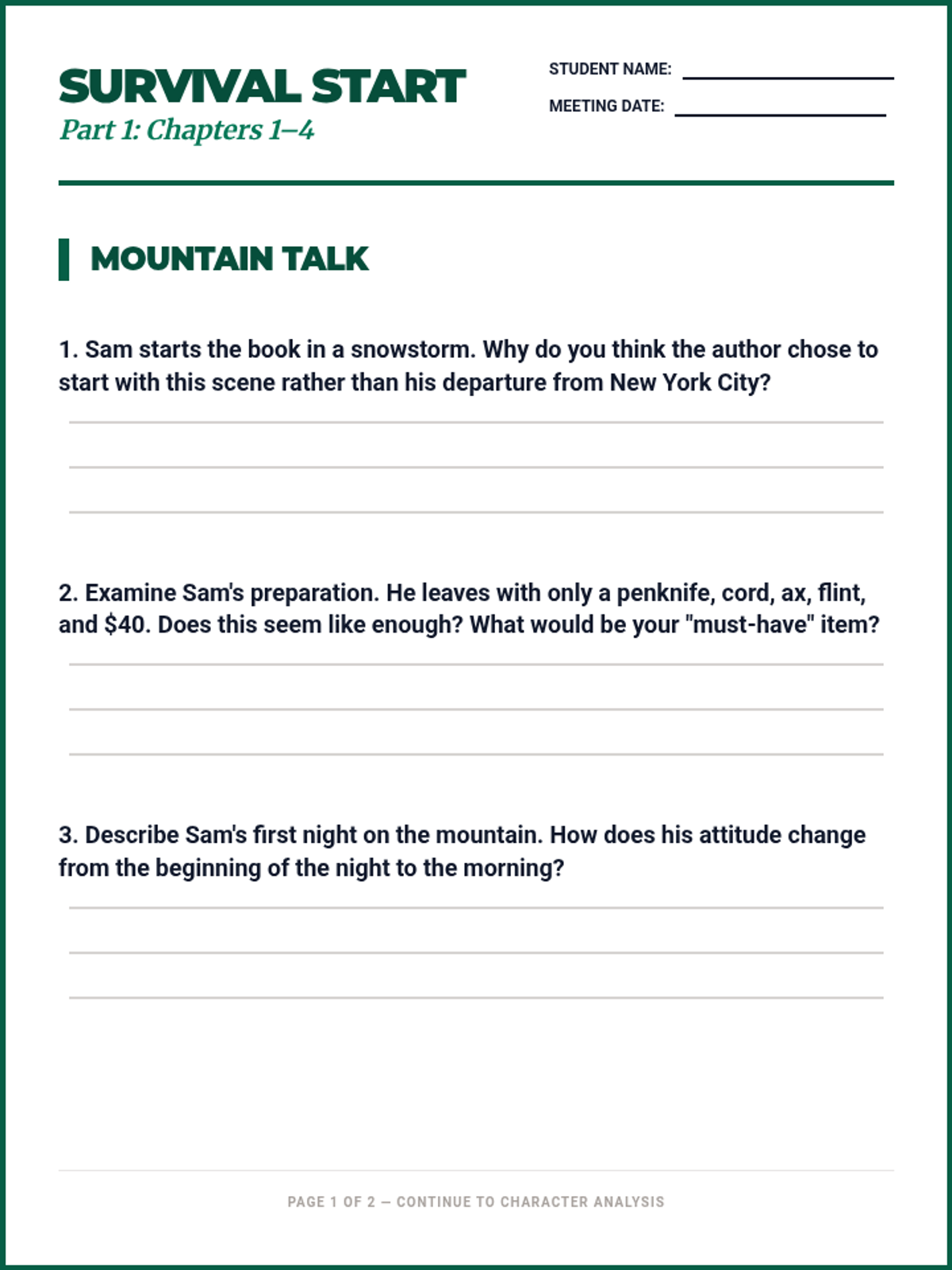
Revised student discussion guide for Chapters 1-4. Features darkened lines and text for better legibility, expanded writing areas for prompts, and a consolidated layout that keeps the character analysis graphic organizer on a single page.
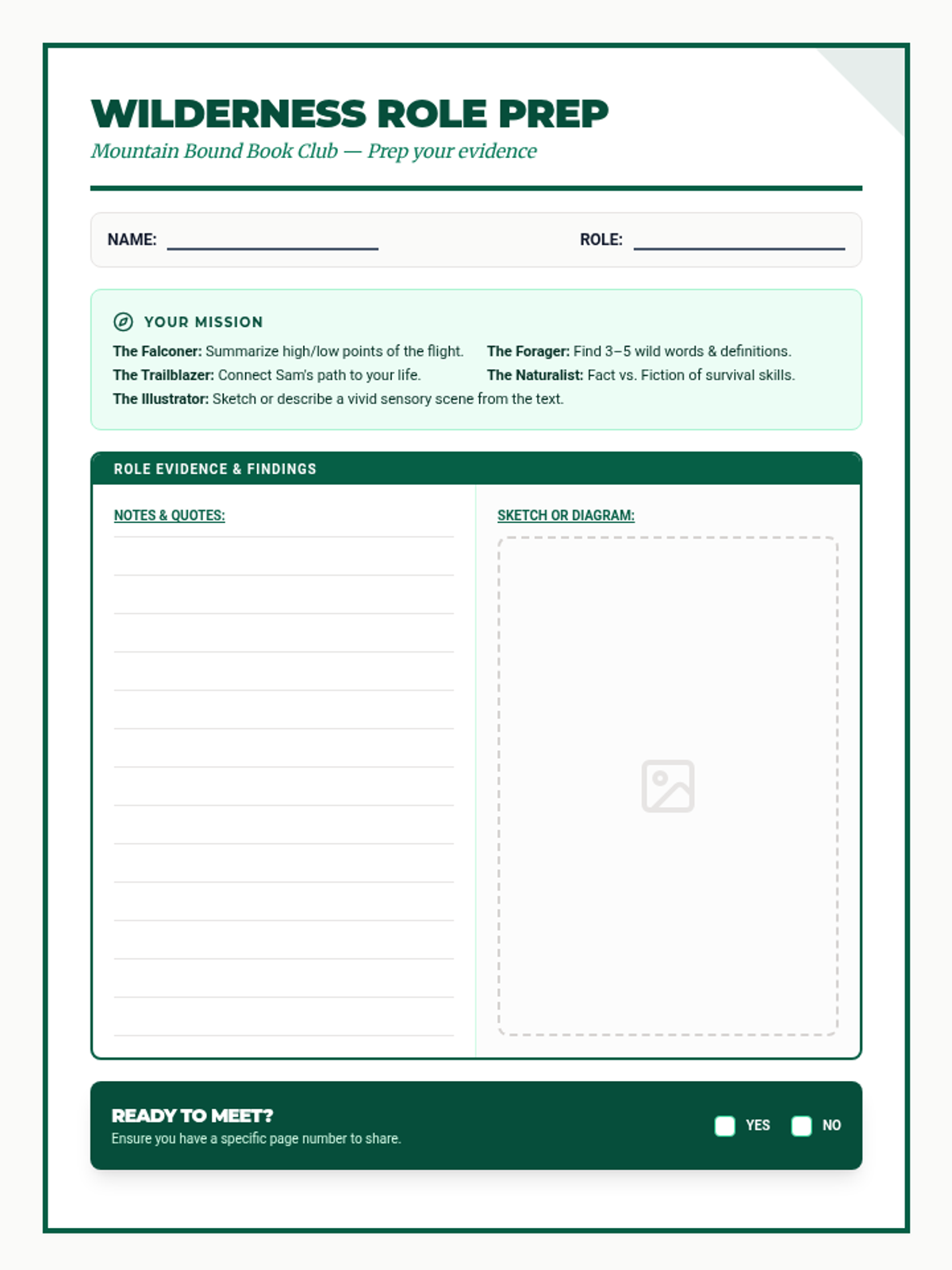
Revised student role preparation sheet. Now features a split work area for both writing and sketching (essential for the Illustrator role) and fits perfectly on a single page with a reinforced emerald border.
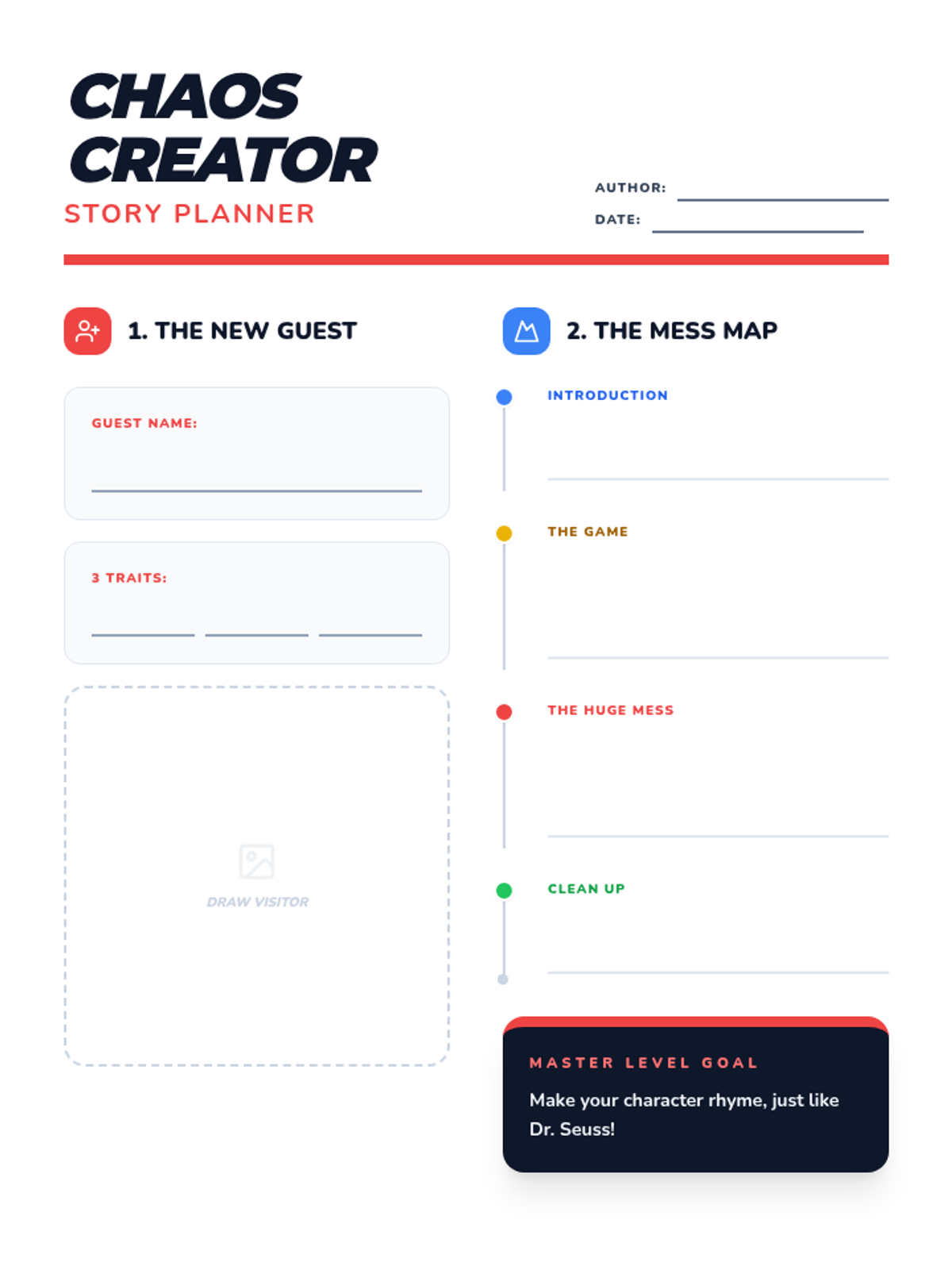
A high-contrast narrative planning document for students to design their own visitor and map out a Seussian story arc. Optimized for printable use with white backgrounds and generous writing space.
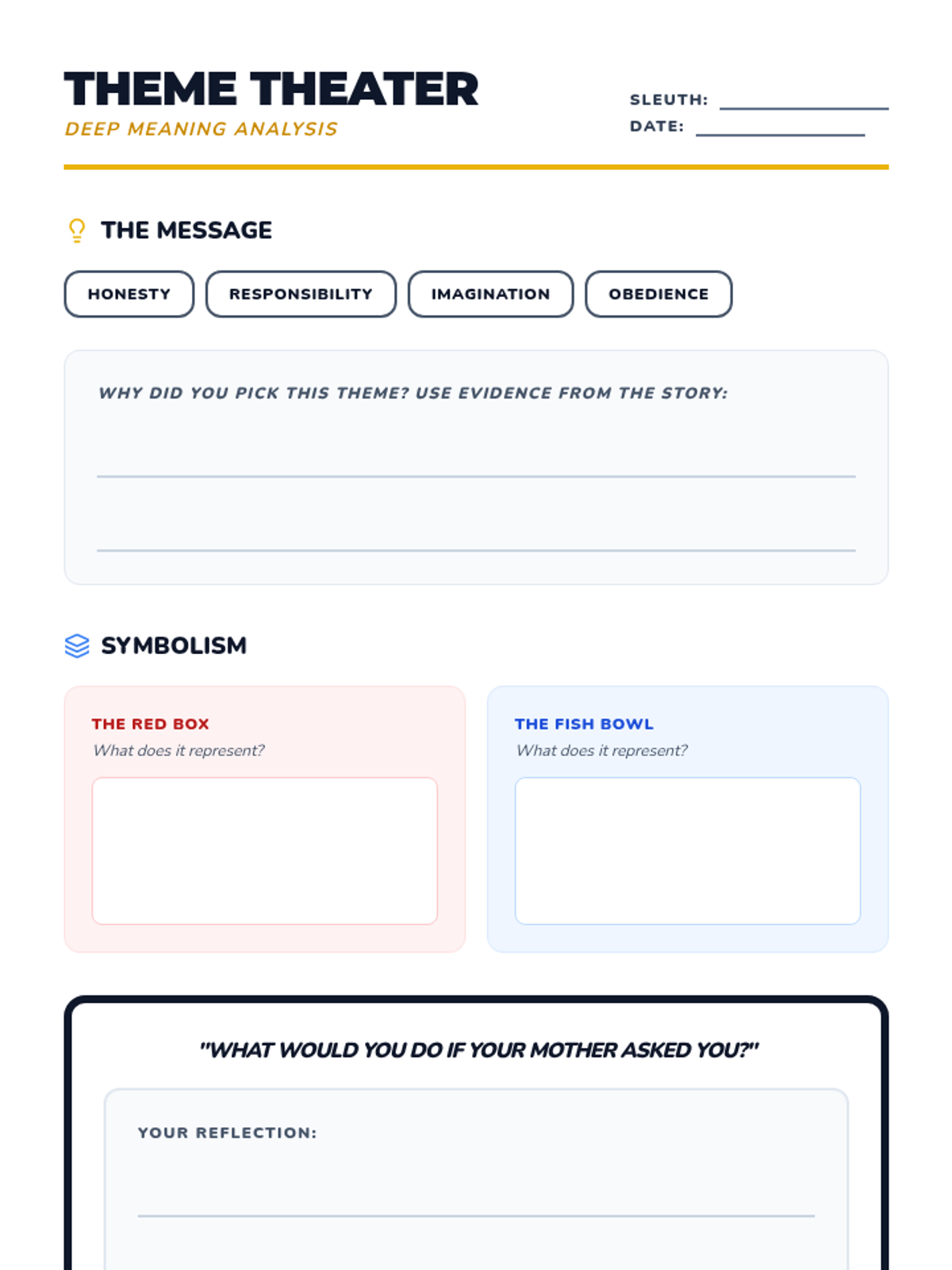
A deep-dive analysis worksheet focusing on theme selection, symbolism (the red box and fish bowl), and personal reflection on the story's concluding question. Optimized for one-page layout and legible work areas.
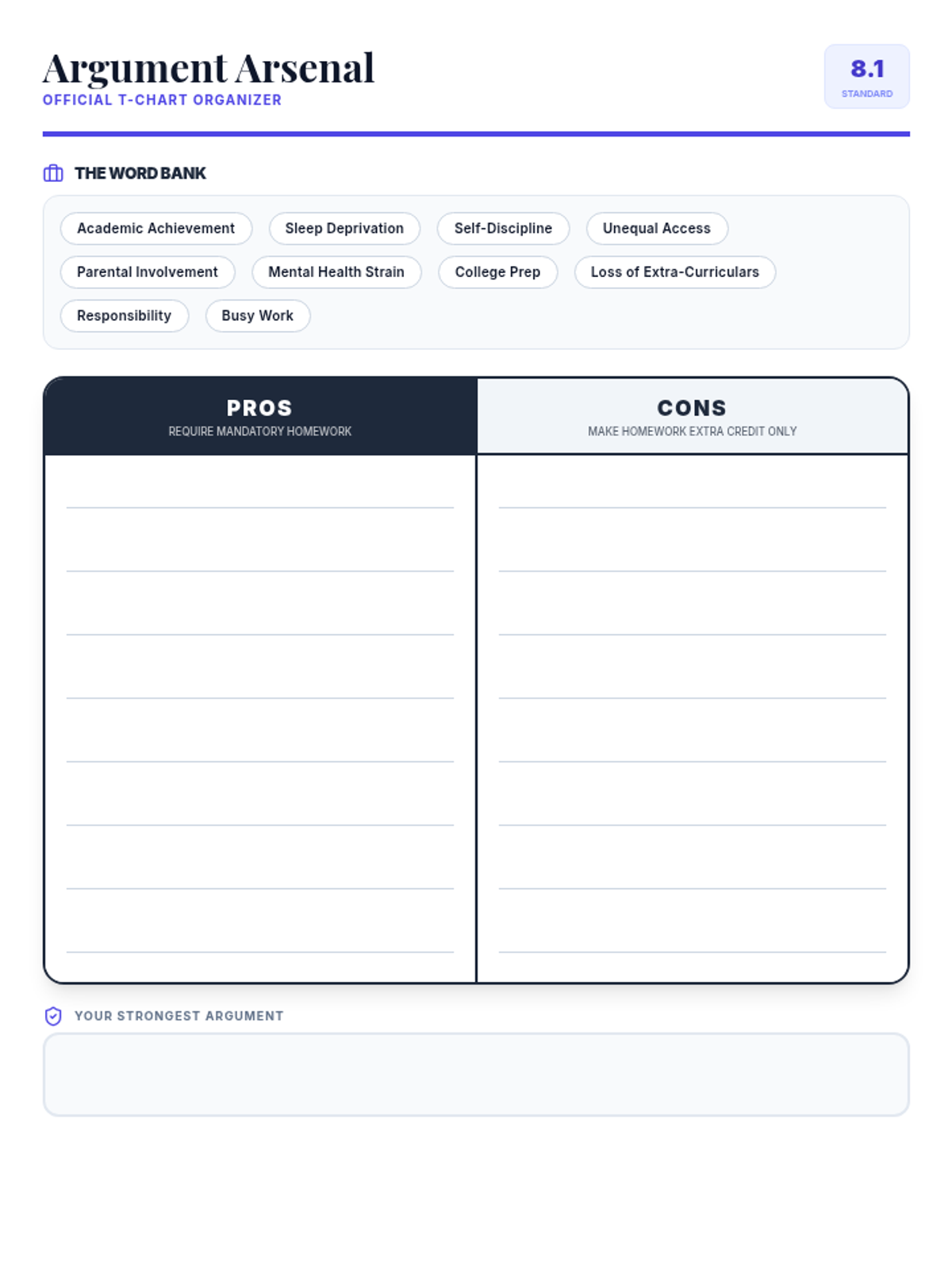
A neutral T-chart graphic organizer for analyzing the pros and cons of homework requirements, featuring a word bank and space for a position statement, with the CCSS standard code removed.
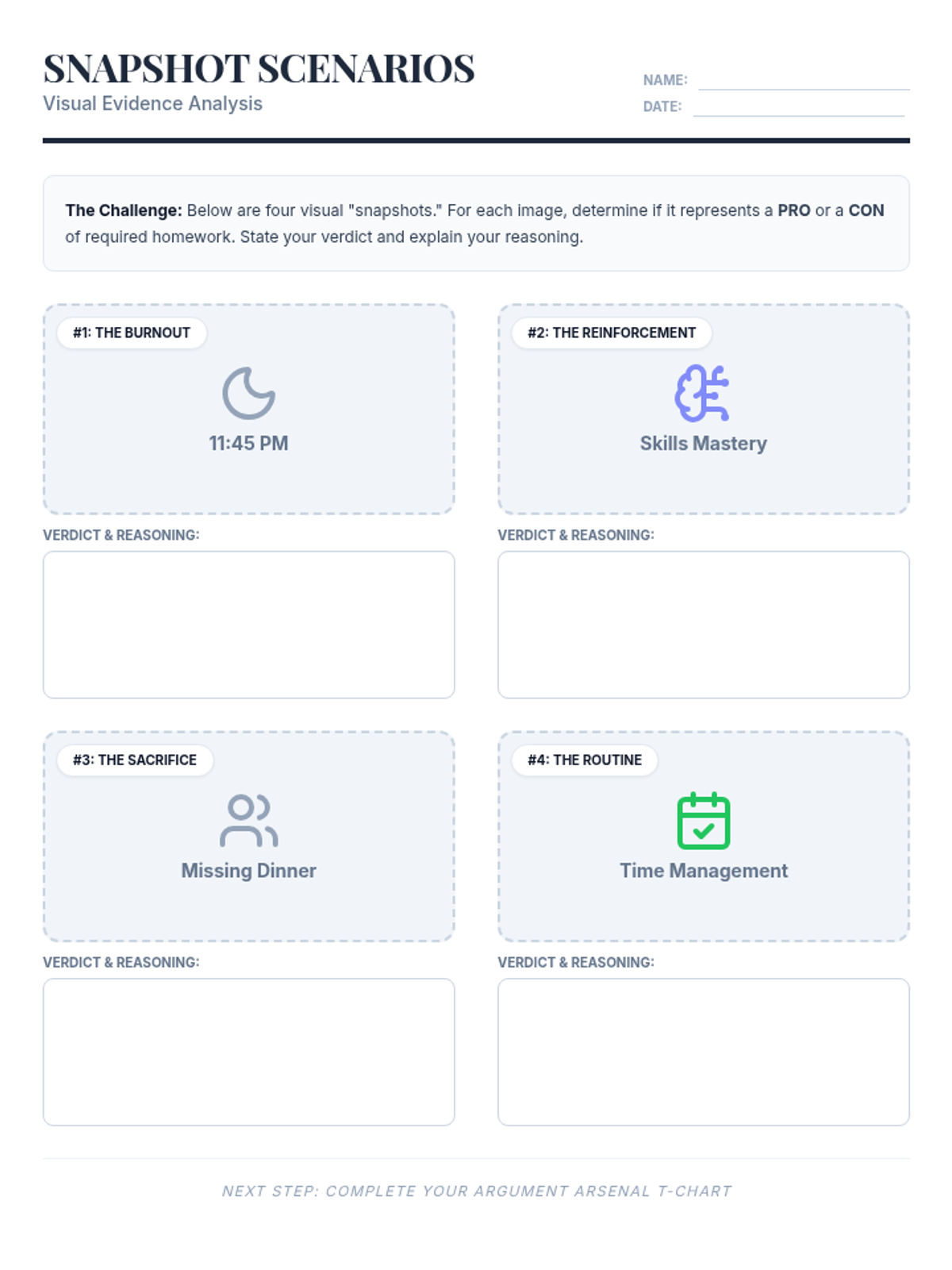
A neutral visual analysis worksheet featuring four homework scenarios to help students identify pros and cons based on evidence without thematic branding.
A neutral 4-slide presentation for introducing the homework requirement analysis lesson, focusing on definitions, pros/cons, and student tasks.
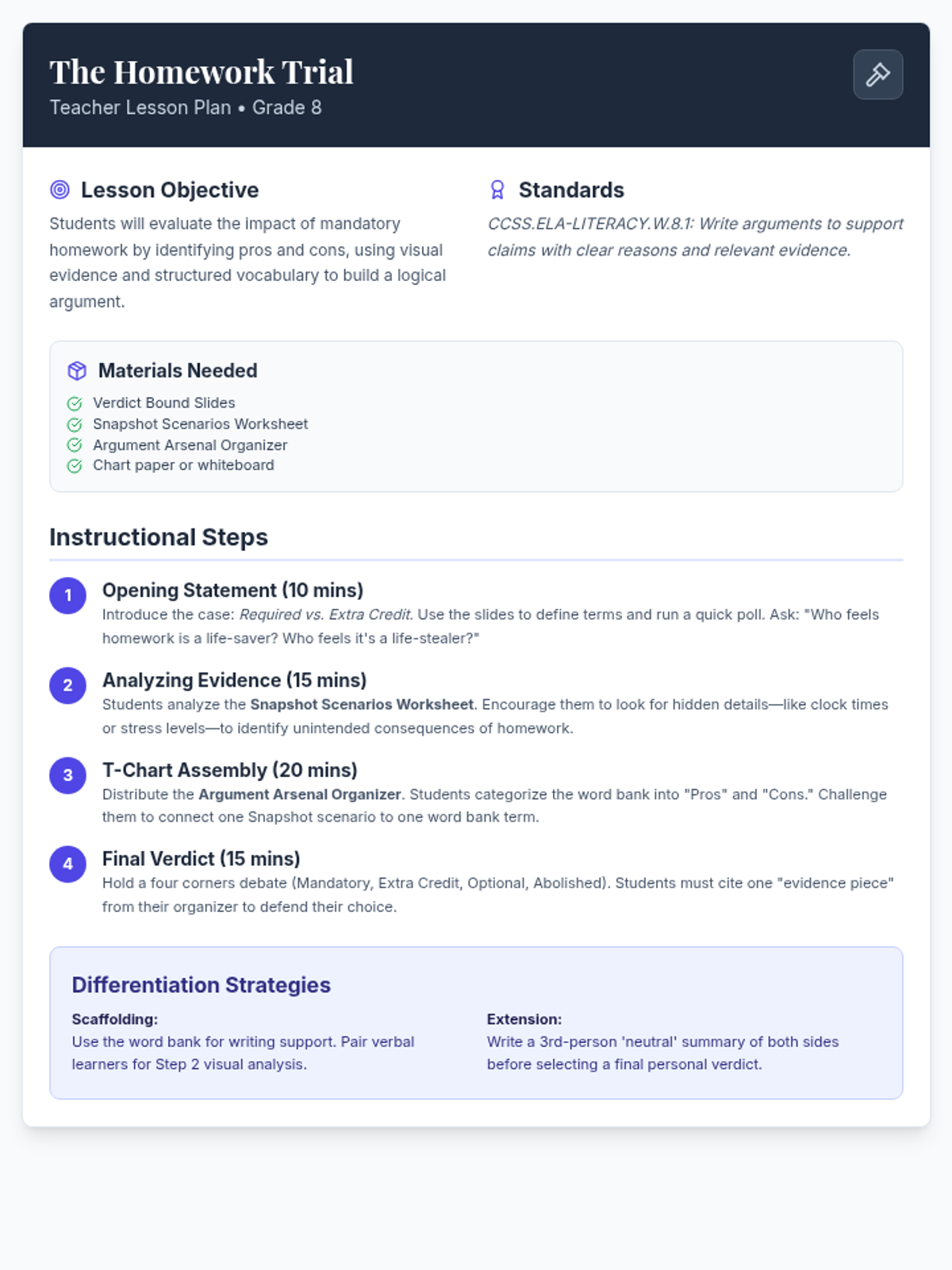
A neutral teacher's guide for the homework requirement analysis lesson, detailing instructional steps, objectives, and support strategies without thematic metaphors.
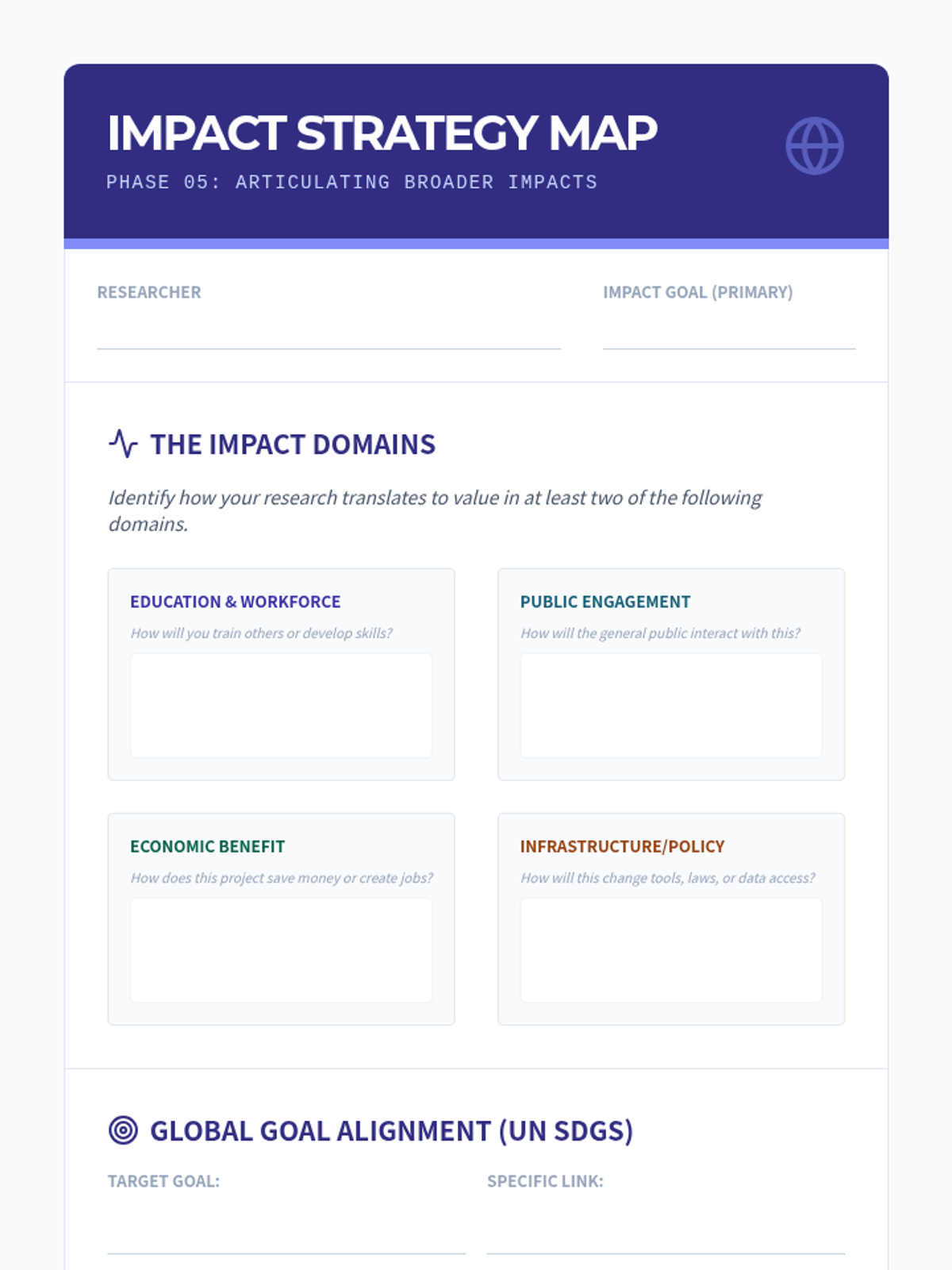
A structured worksheet for graduate students to map research impacts, align with UN SDGs, and draft a broader impacts narrative.
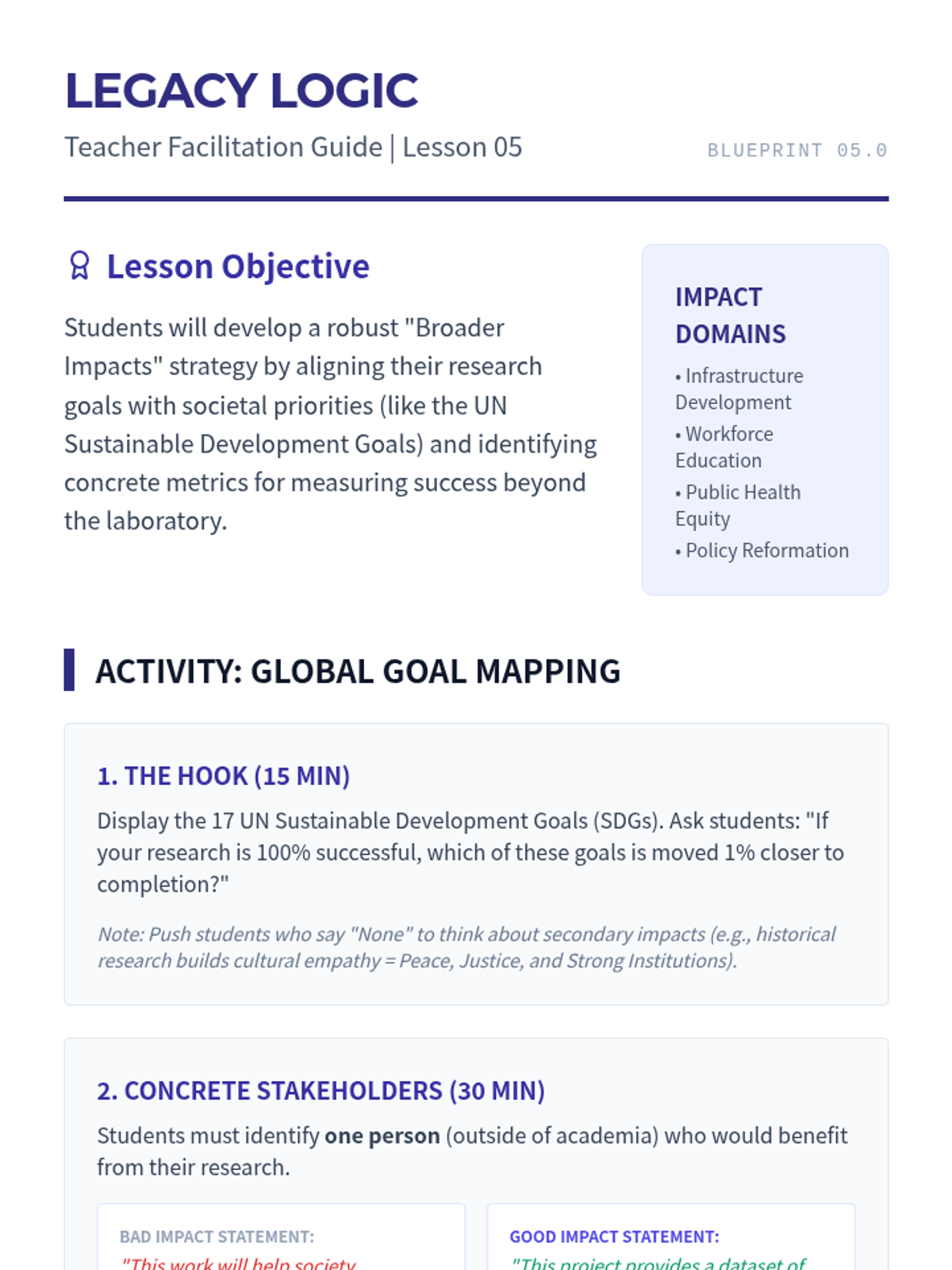
A comprehensive teacher guide for facilitating Lesson 5, focusing on impact assessment, UN SDG alignment, and persuasive broader impact writing.
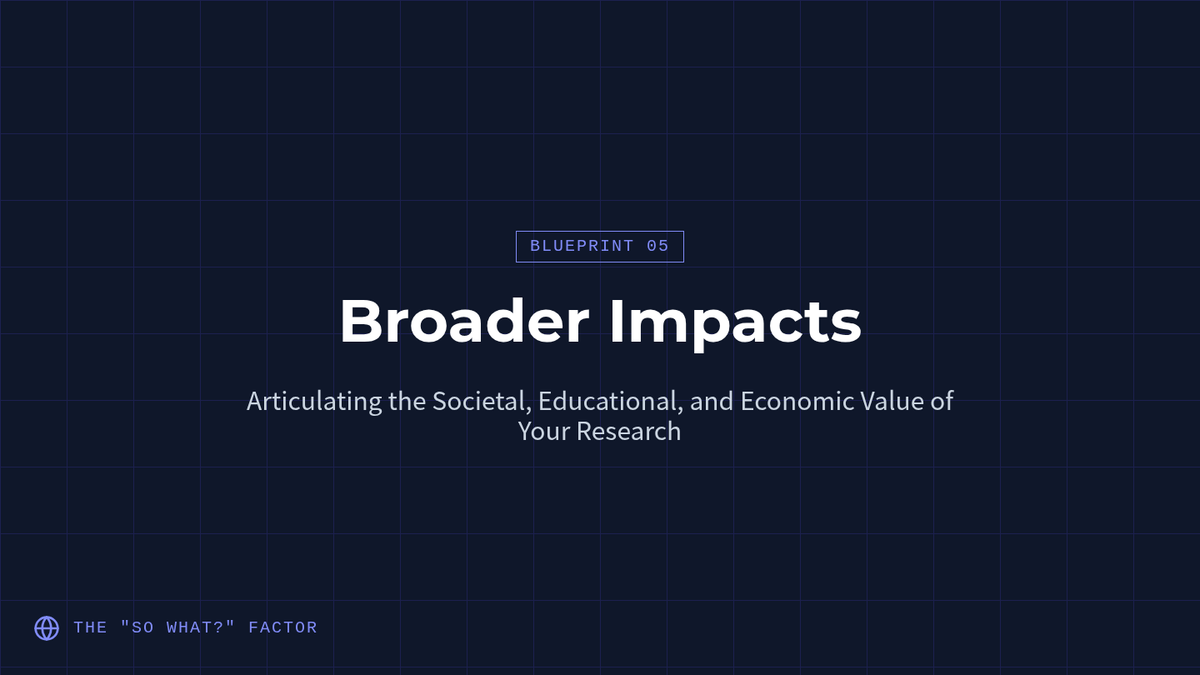
A slide deck for graduate students explaining how to articulate the societal, educational, and economic impacts of their research for grant proposals.
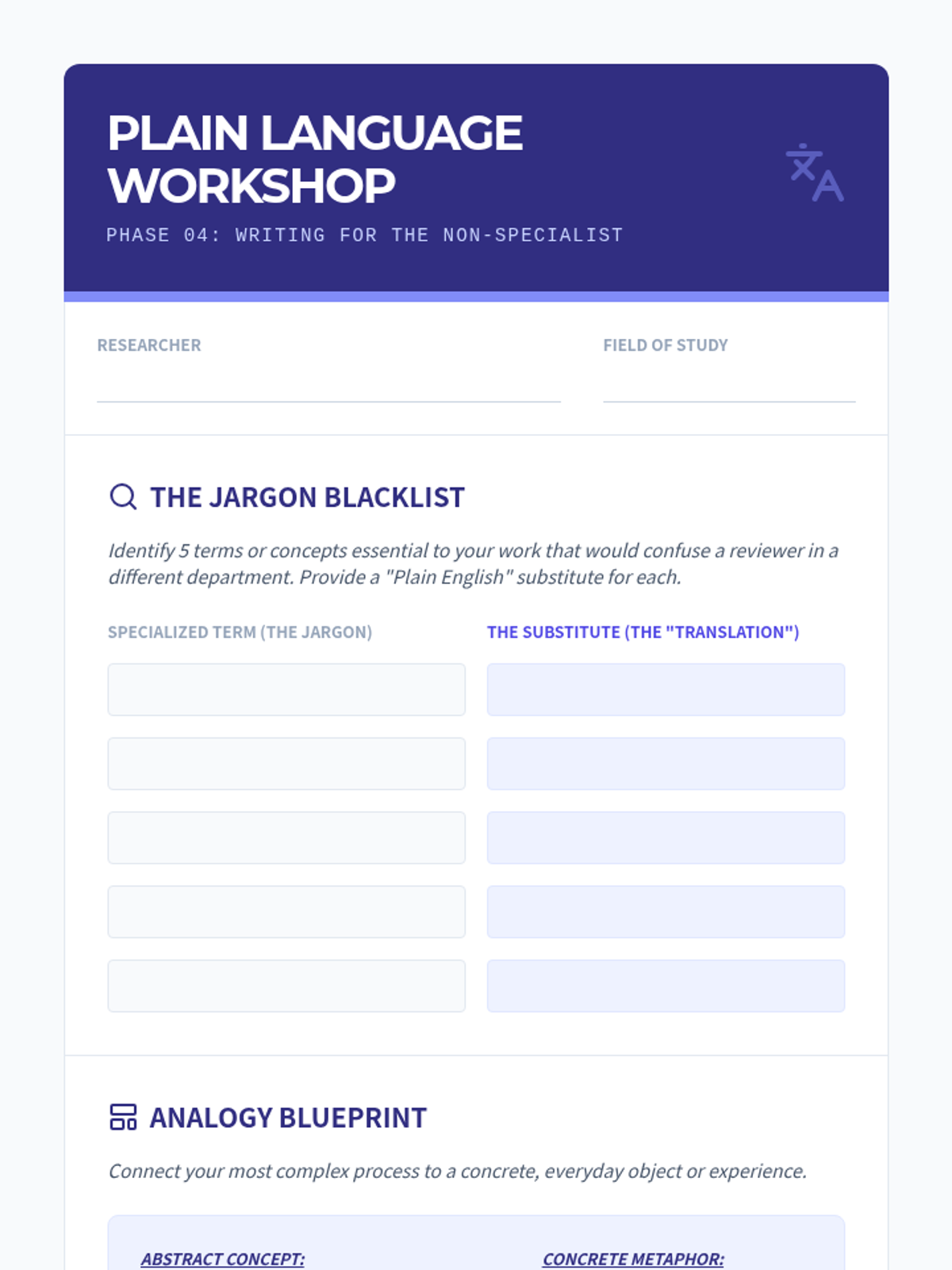
A structured worksheet for graduate students to practice removing jargon and building analogies for their research proposals.
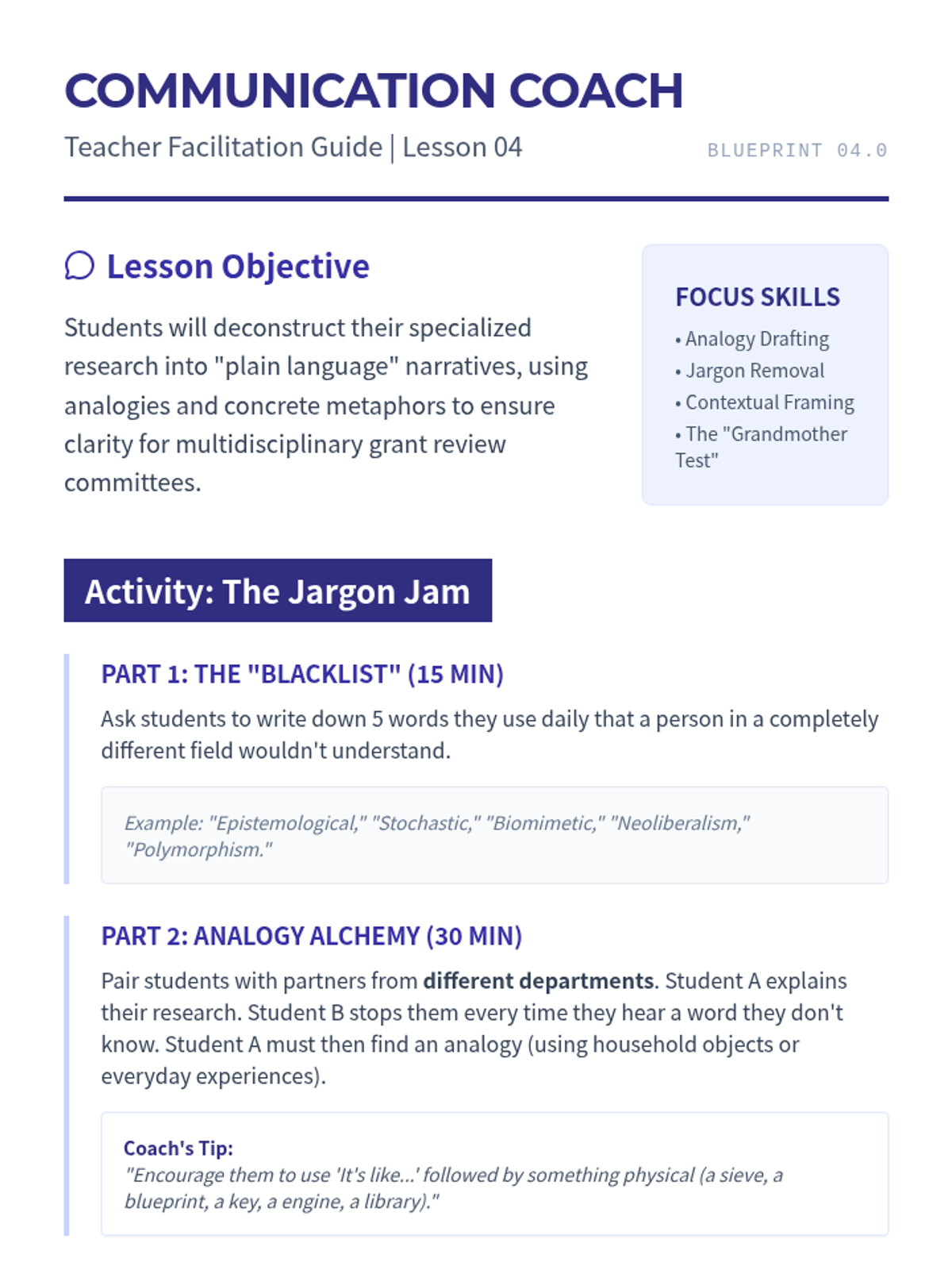
A comprehensive teacher guide for facilitating Lesson 4, focusing on jargon removal, analogy building, and effective research communication strategies.
A slide deck focusing on techniques for translating complex research into accessible language for multi-disciplinary grant review panels.
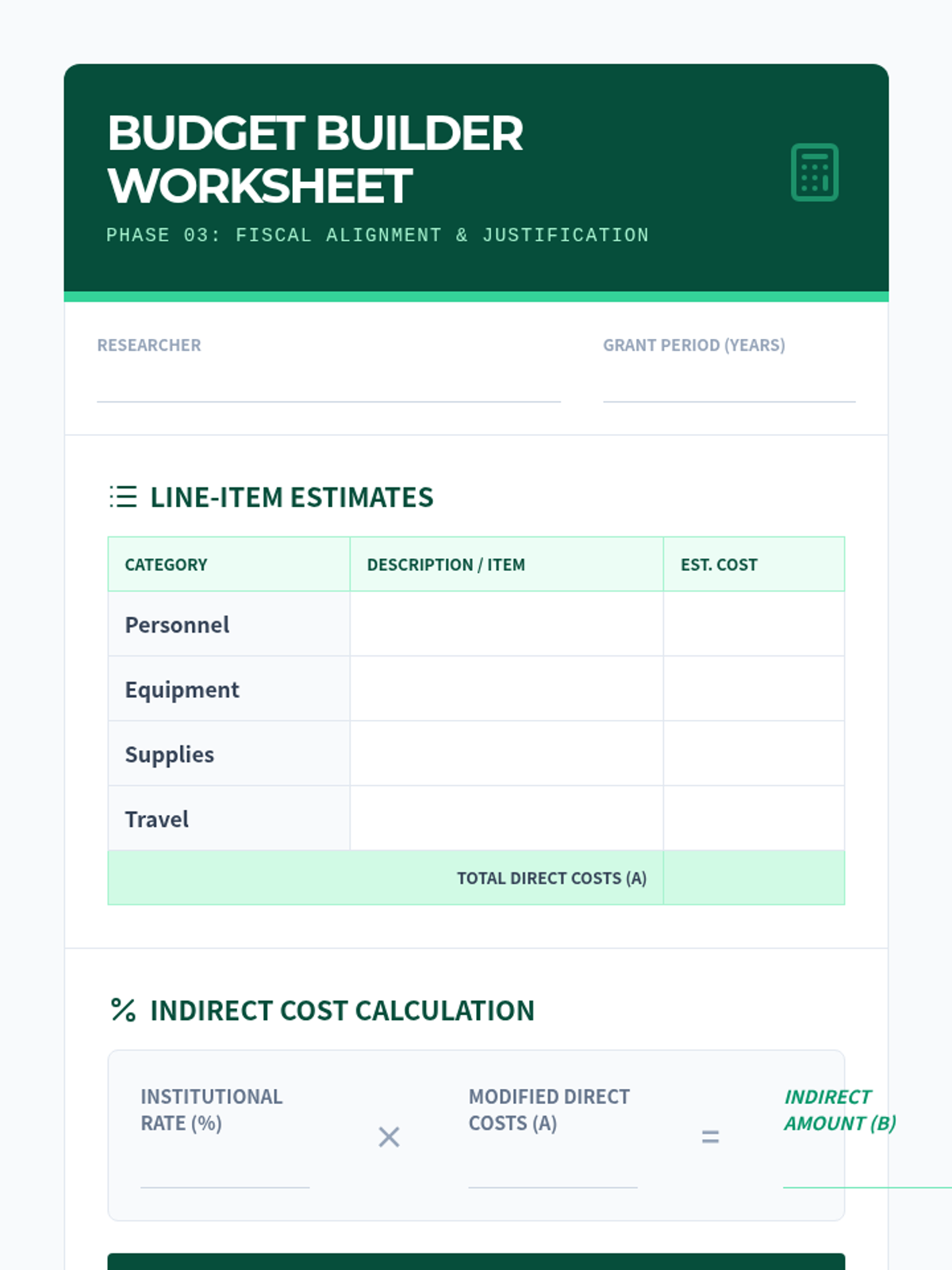
A structured worksheet for graduate students to estimate research costs, calculate indirect expenses, and draft a persuasive budget justification narrative.
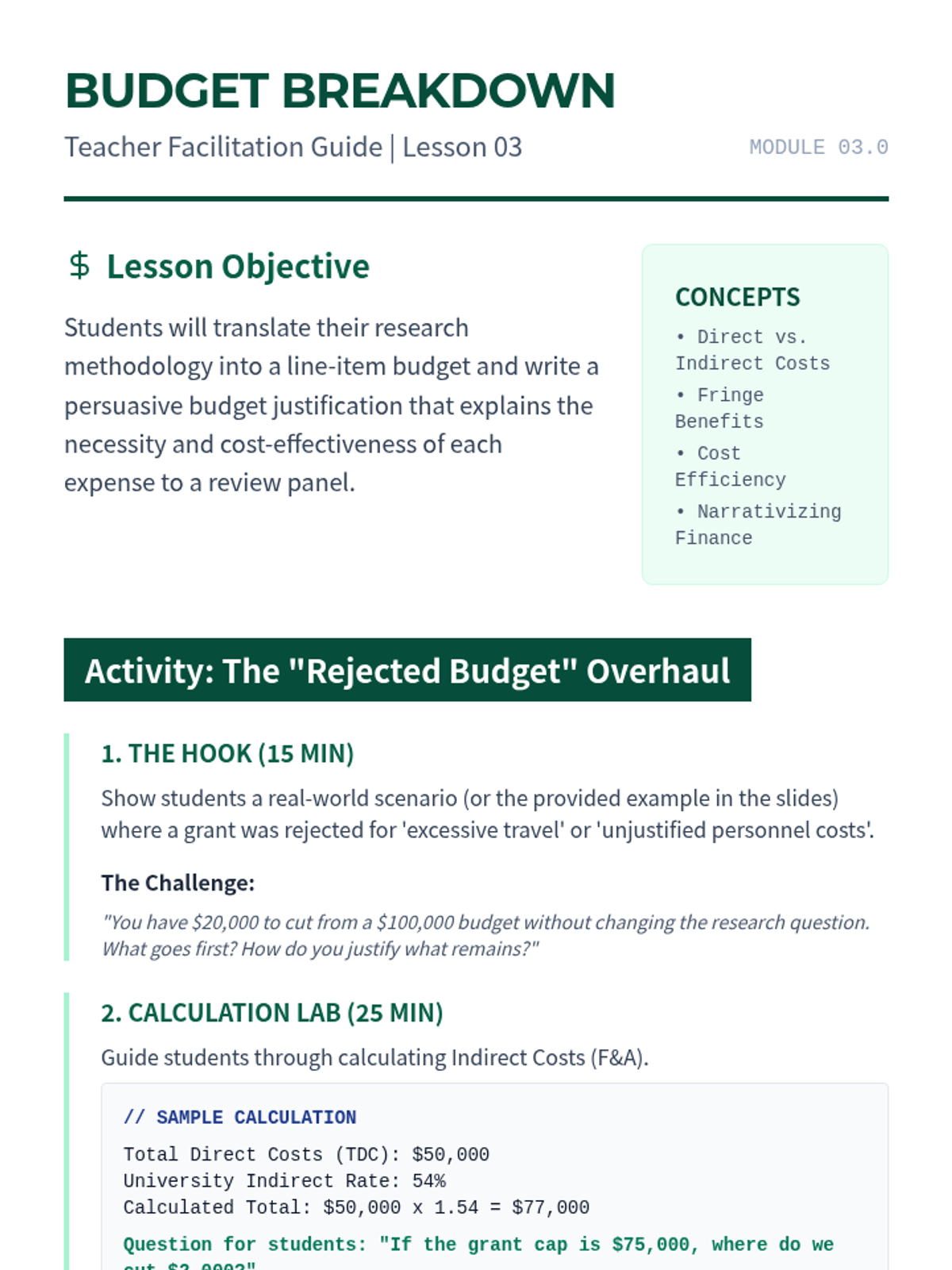
A comprehensive teacher guide for facilitating Lesson 3, focusing on grant budgeting, indirect costs, and persuasive budget justification techniques.
A slide deck covering the fundamentals of grant budgeting, including direct/indirect costs and writing persuasive budget justifications.
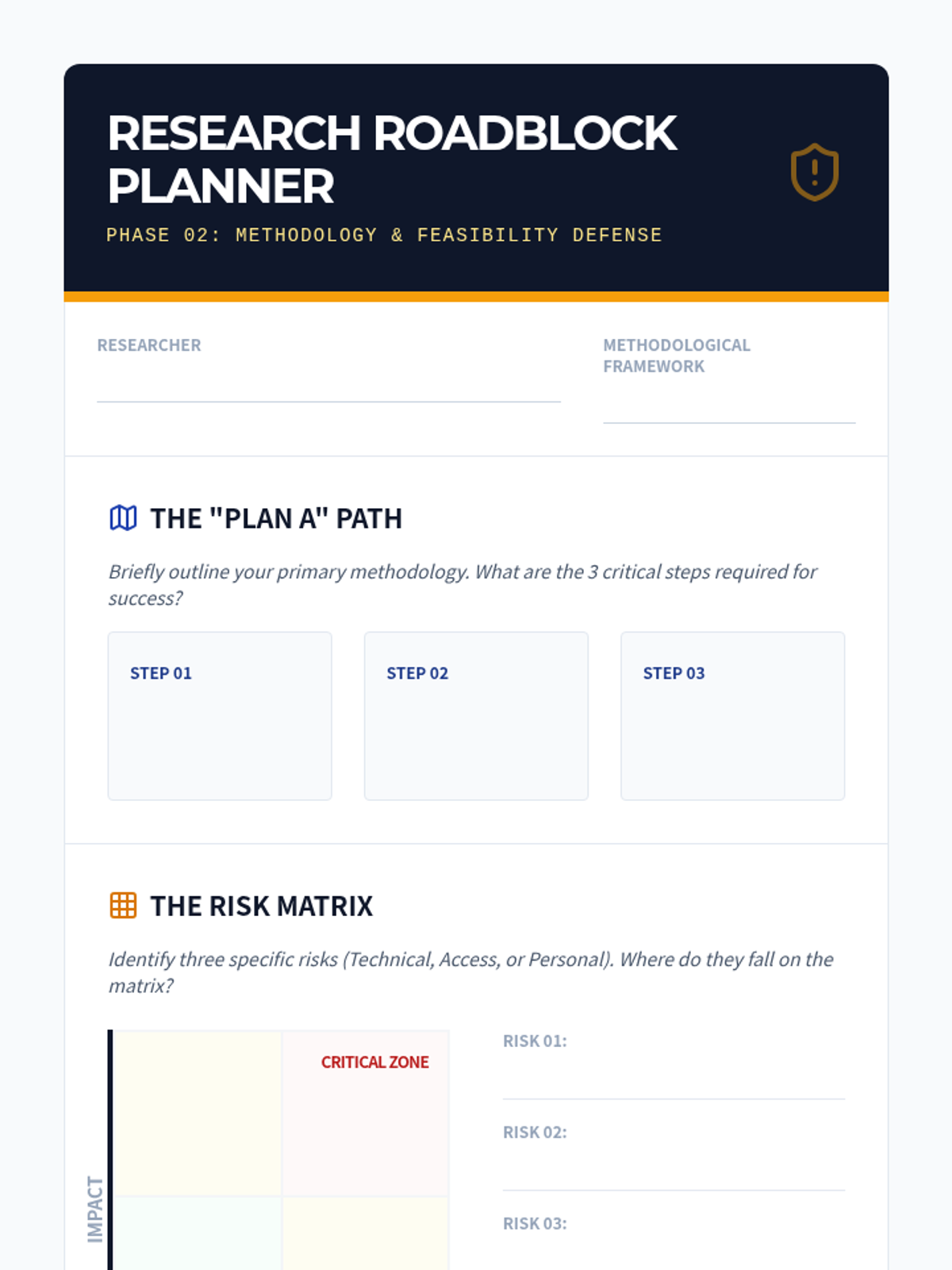
A structured worksheet for graduate students to map research methodology risks and draft contingency plans for their proposals.
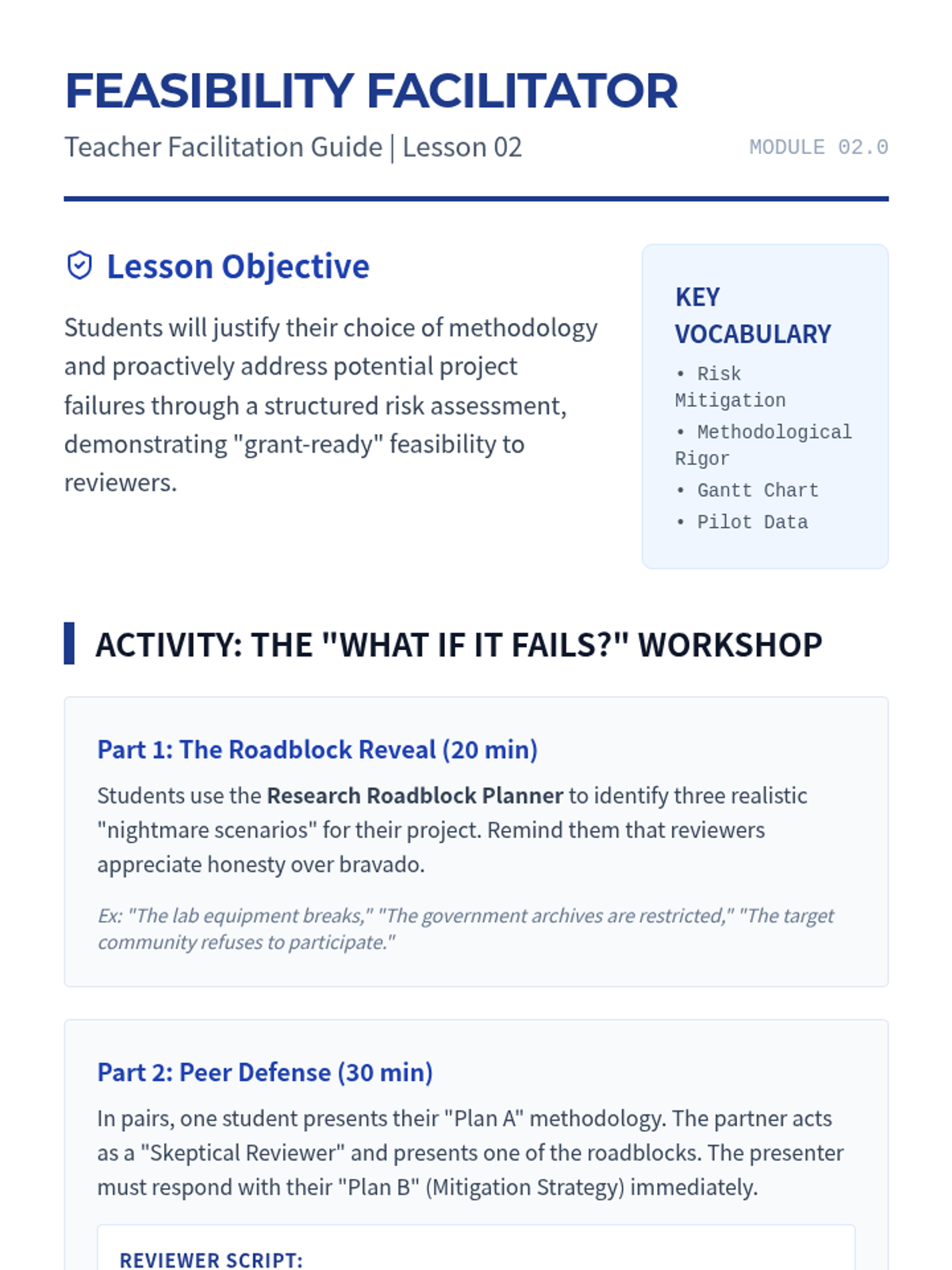
A comprehensive teacher guide for facilitating Lesson 2, focusing on research methodology defense and risk assessment workshops.
A slide deck for graduate students focusing on research methodology, timeline planning, and risk mitigation strategies in grant proposals.
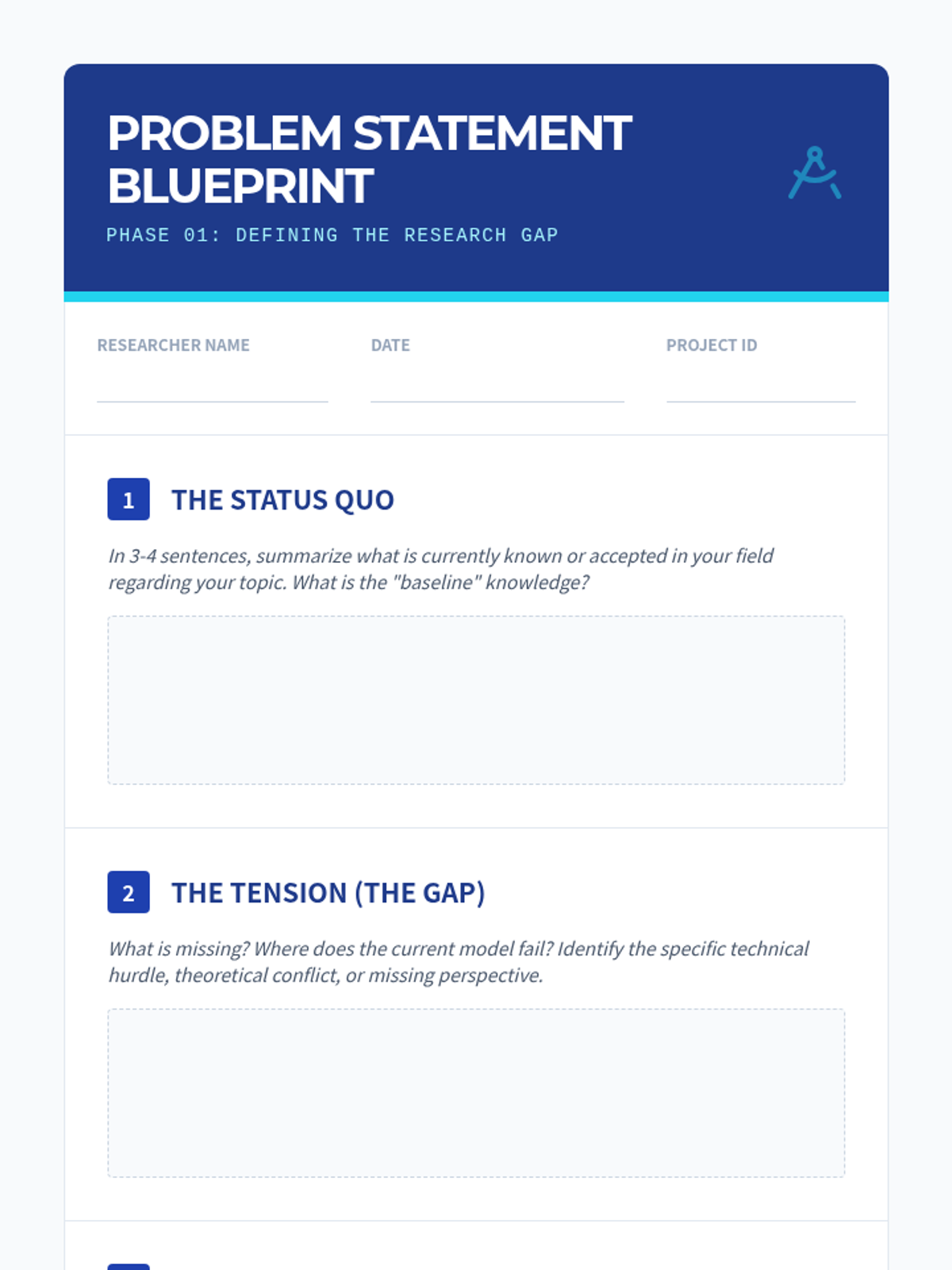
A structured worksheet for graduate students to draft their research problem statement by identifying the status quo, the gap, and the significance.
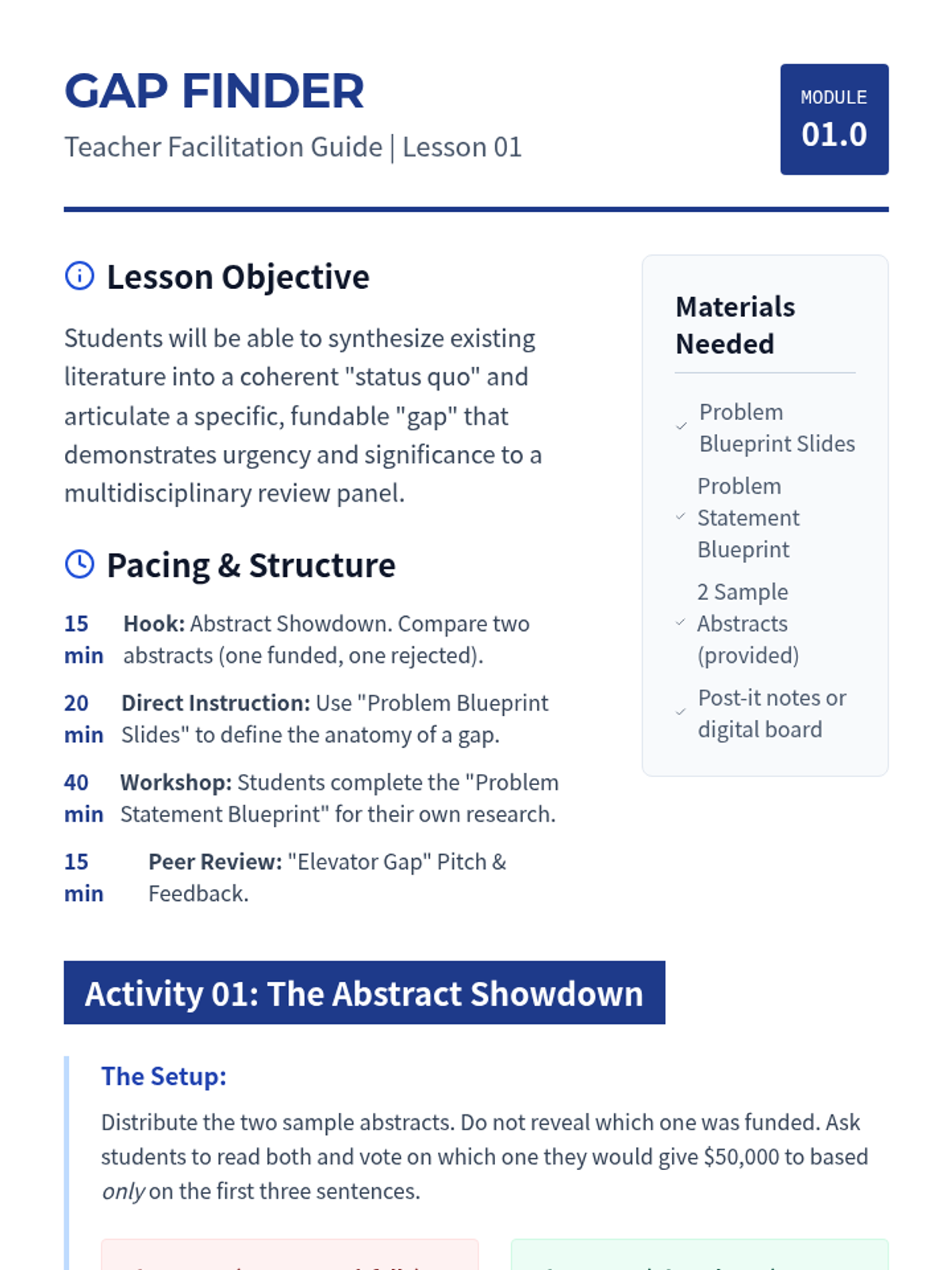
A comprehensive teacher guide for facilitating the first lesson on defining research gaps, including sample abstract analysis and discussion prompts.
A visual presentation for graduate students on defining research gaps and crafting problem statements for grant proposals.
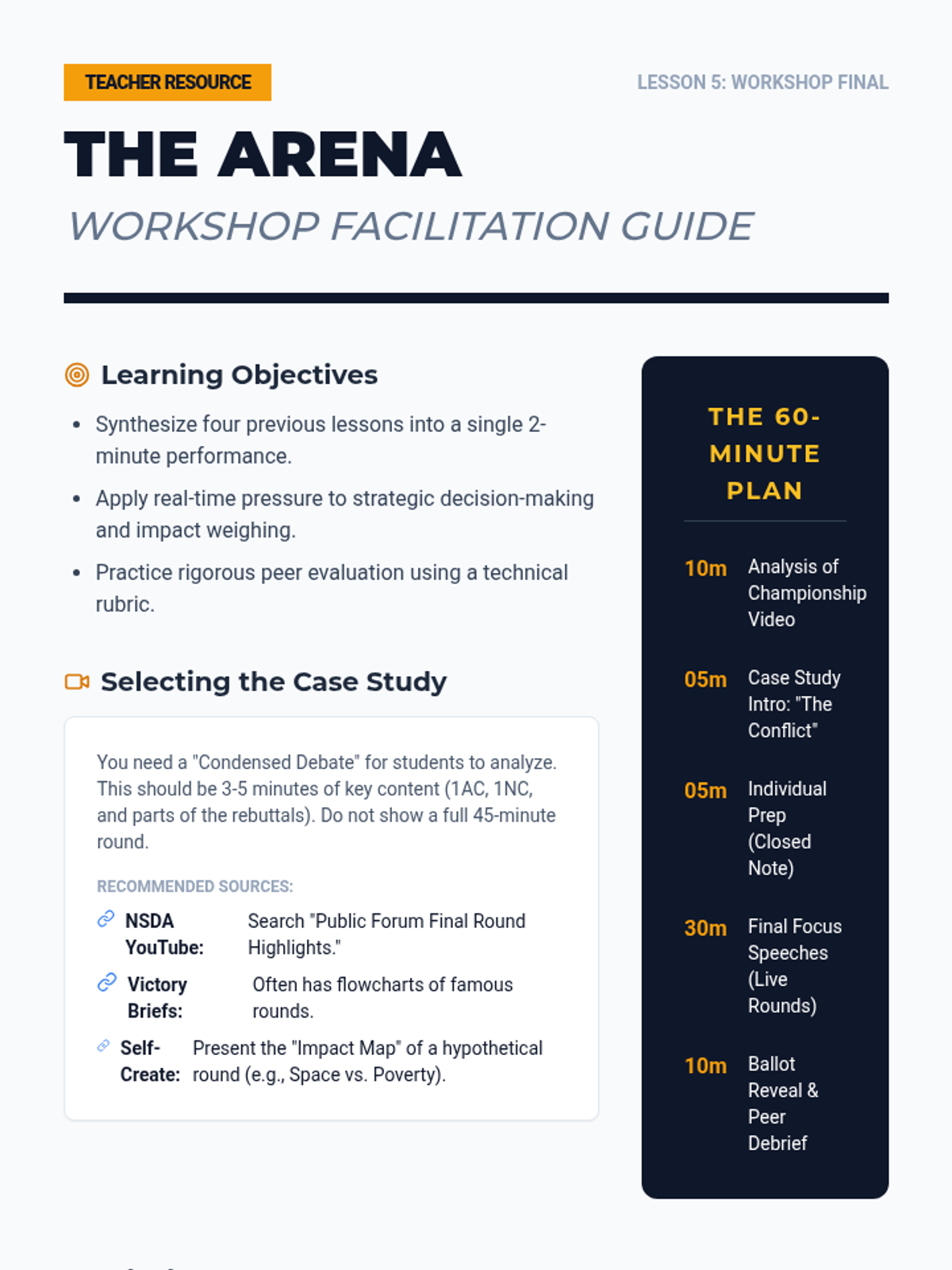
A facilitation guide for the final workshop lesson, including pod-based grouping strategies and pacing for the live speaking simulation.
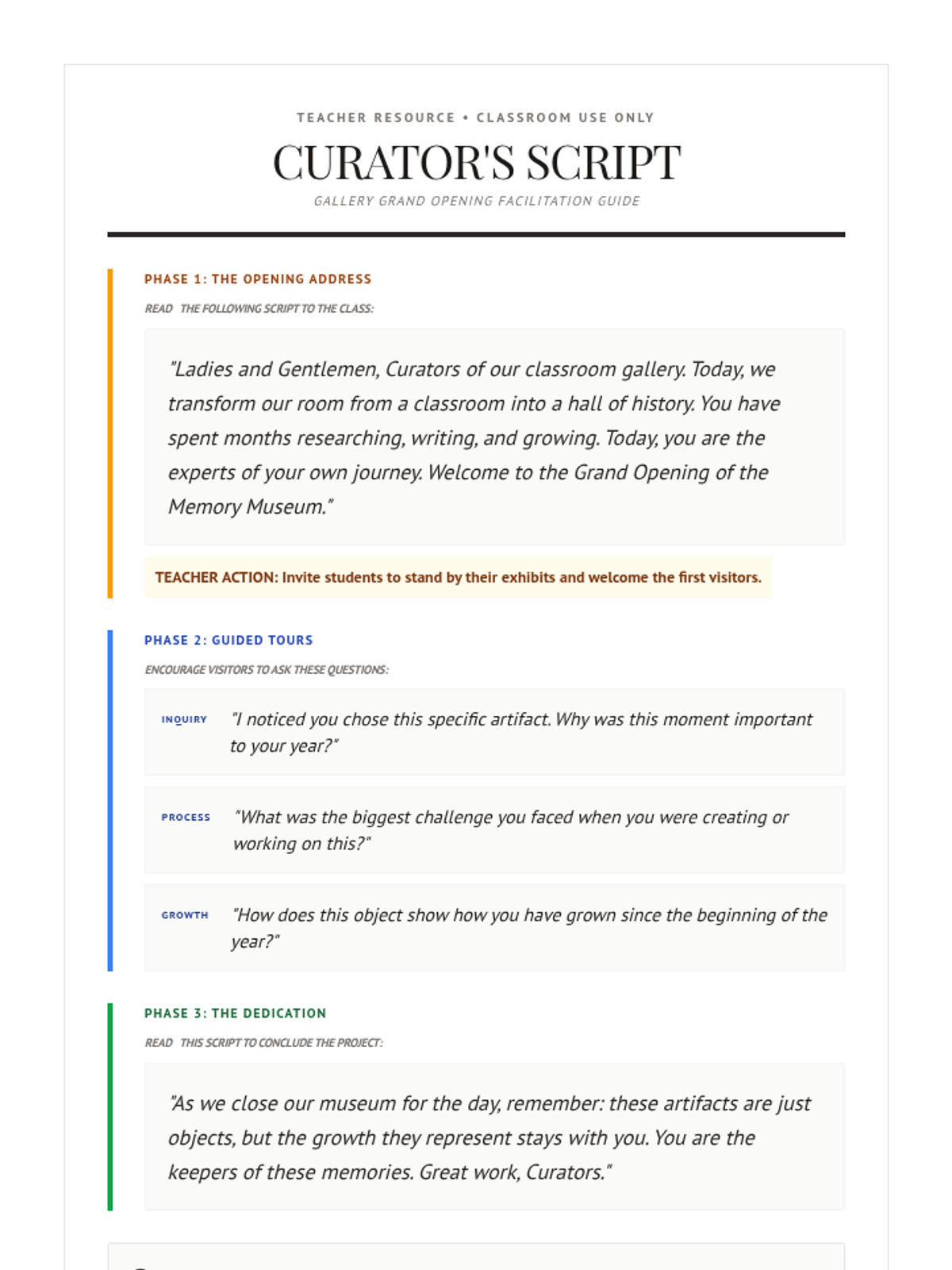
A facilitation guide for teachers featuring scripted opening and closing remarks, inquiry prompts for peer interaction, and specific tips for supporting diverse learners during the museum tour.
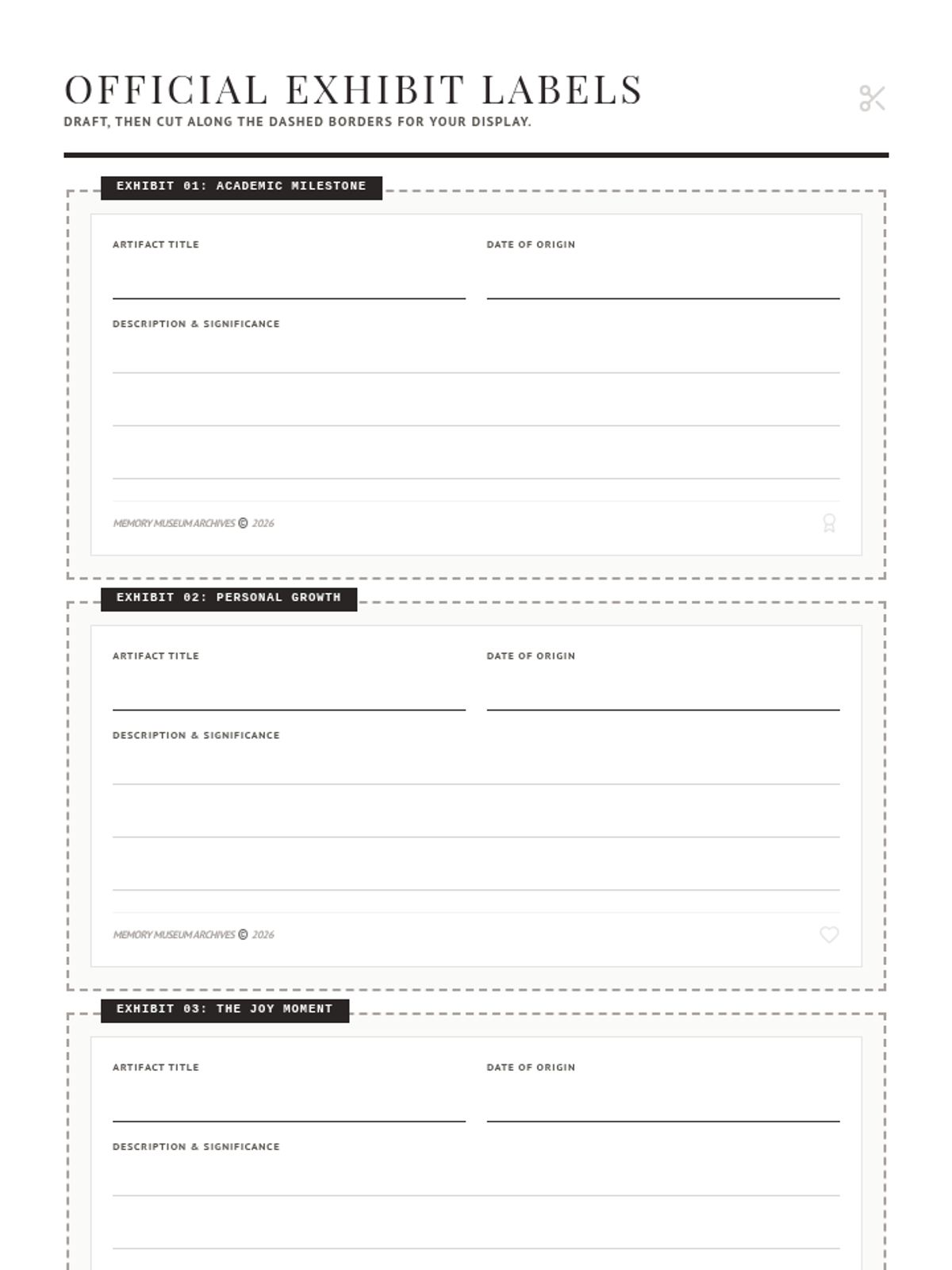
A set of printable exhibit labels designed with a museum aesthetic for students to draft and display alongside their selected artifacts.
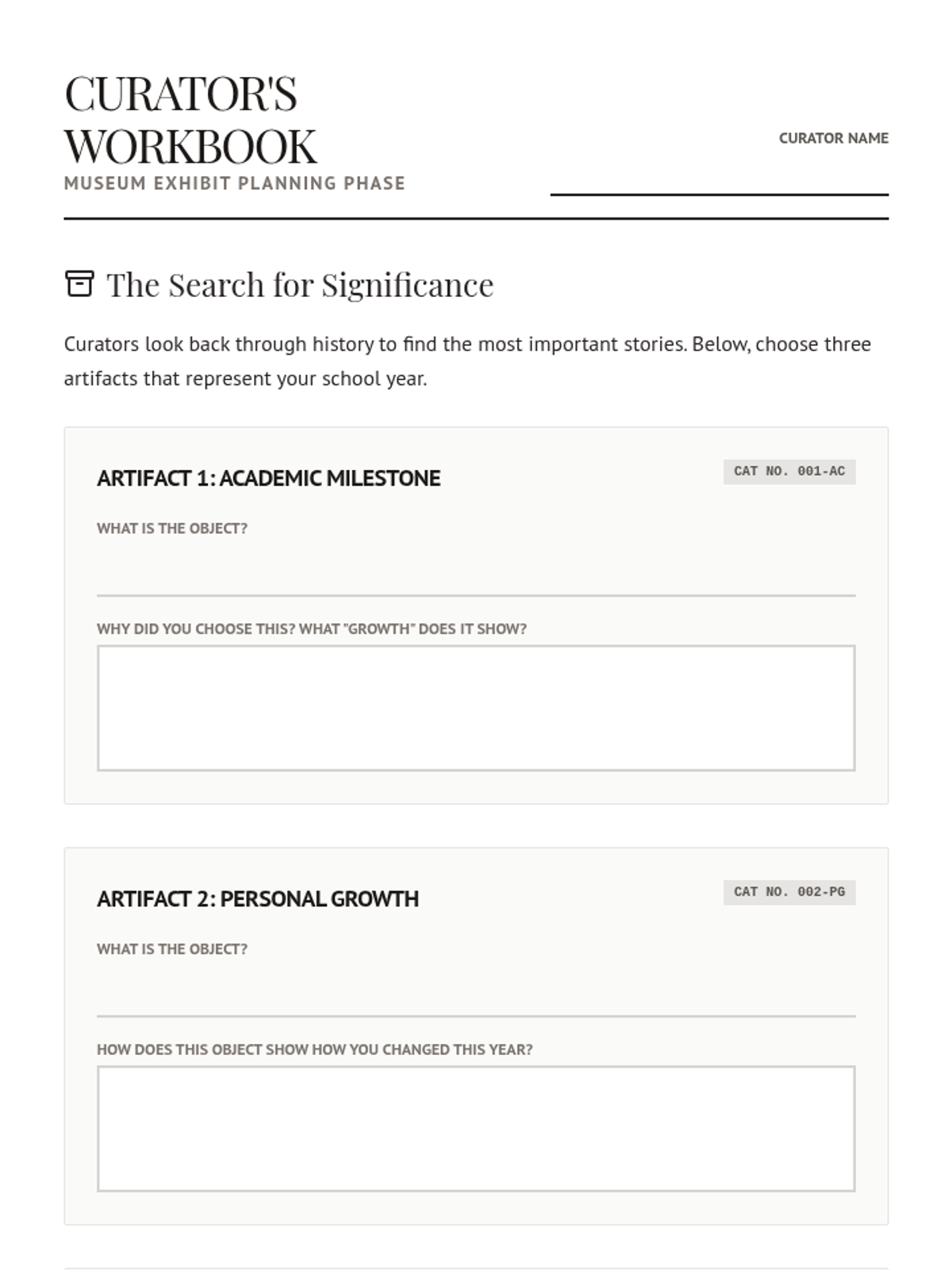
A student-facing planning workbook used to brainstorm artifact selections, reflect on growth milestones, and sketch out their museum exhibit layout.
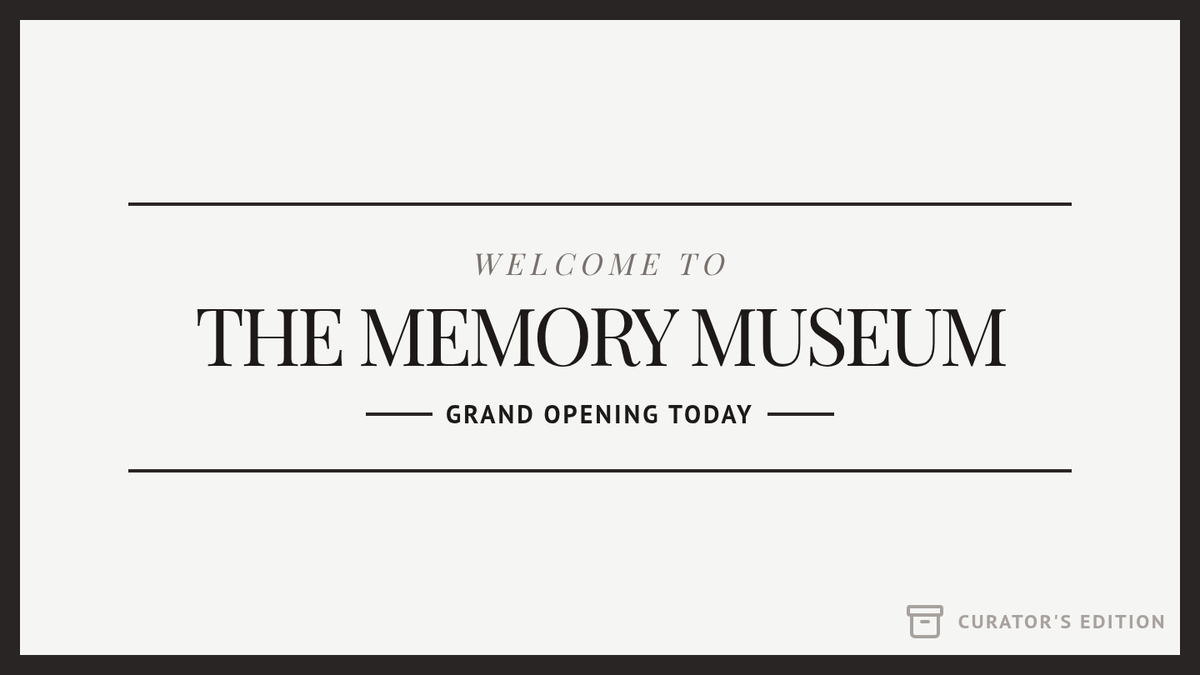
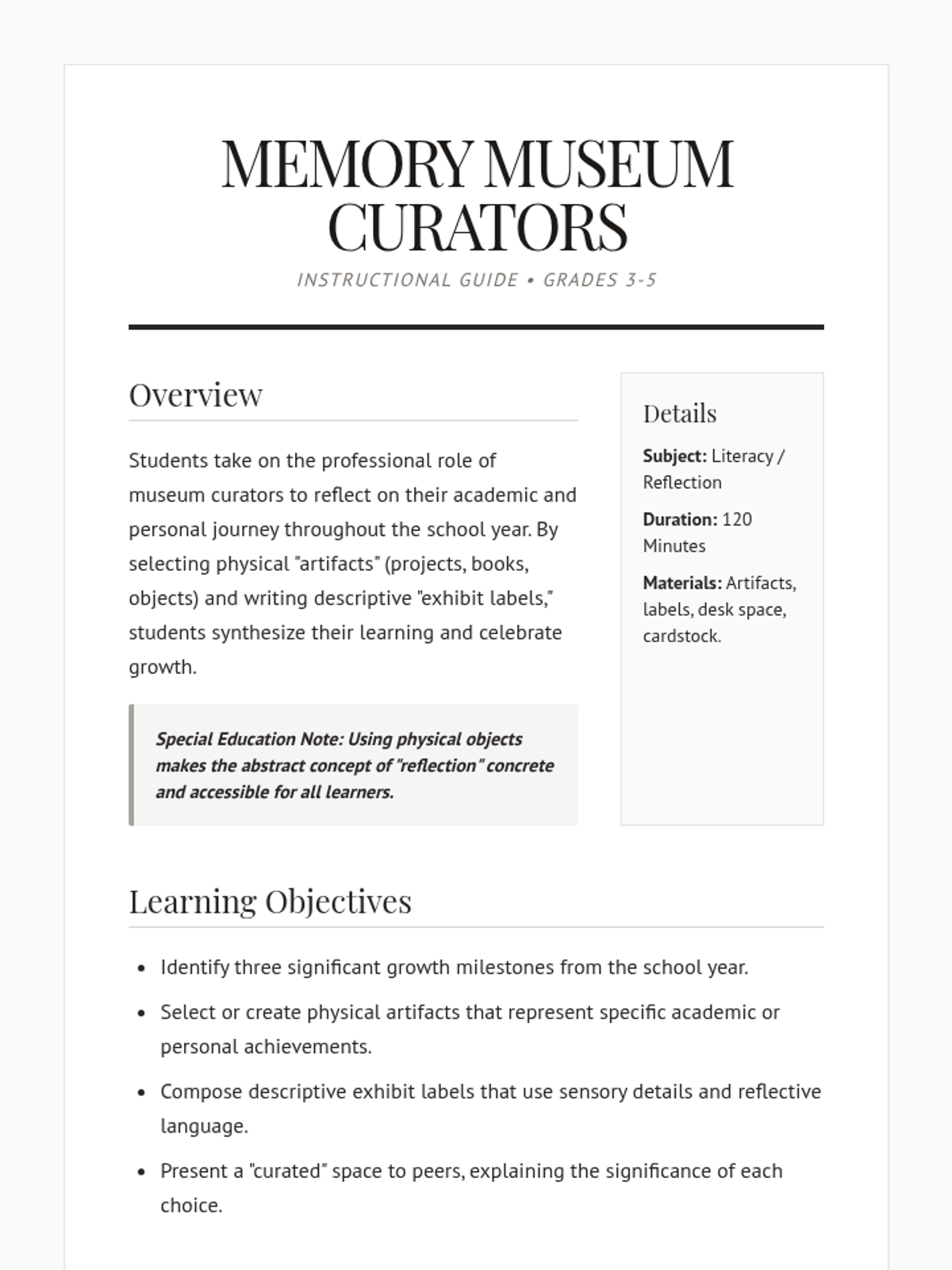
A visually engaging slide deck designed to introduce students to the "Memory Museum" project, explaining the role of a curator and setting expectations for their end-of-year reflection.
A comprehensive teacher's guide for the Memory Museum Curators project, detailing learning objectives, a step-by-step instructional process, and differentiation strategies for 3rd-5th grade students.
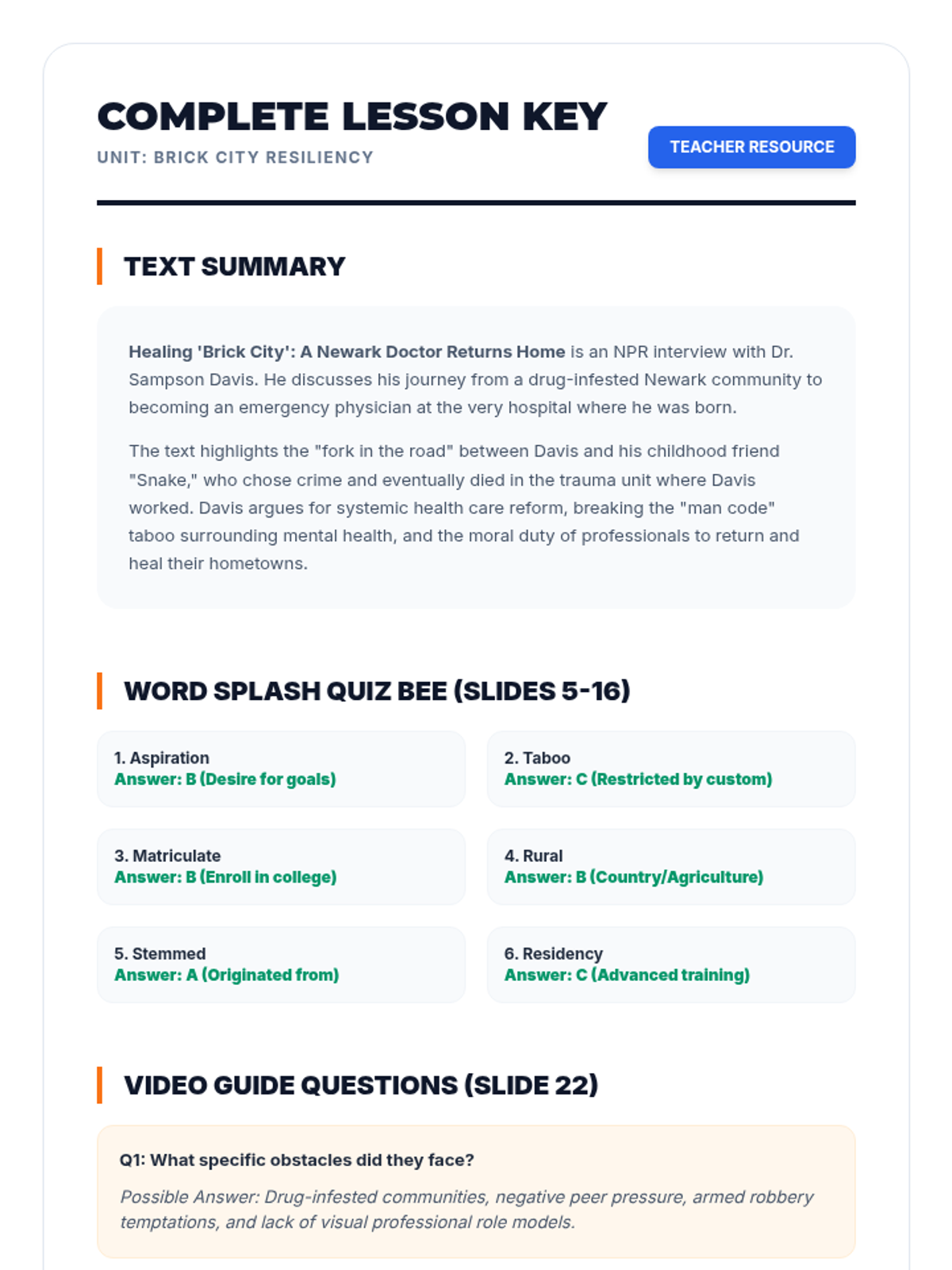
A comprehensive teacher's answer key covering all lesson components: the text summary, Word Splash Quiz Bee answers, video guide questions, and detailed look-fors for the 9 Choice Board activities.
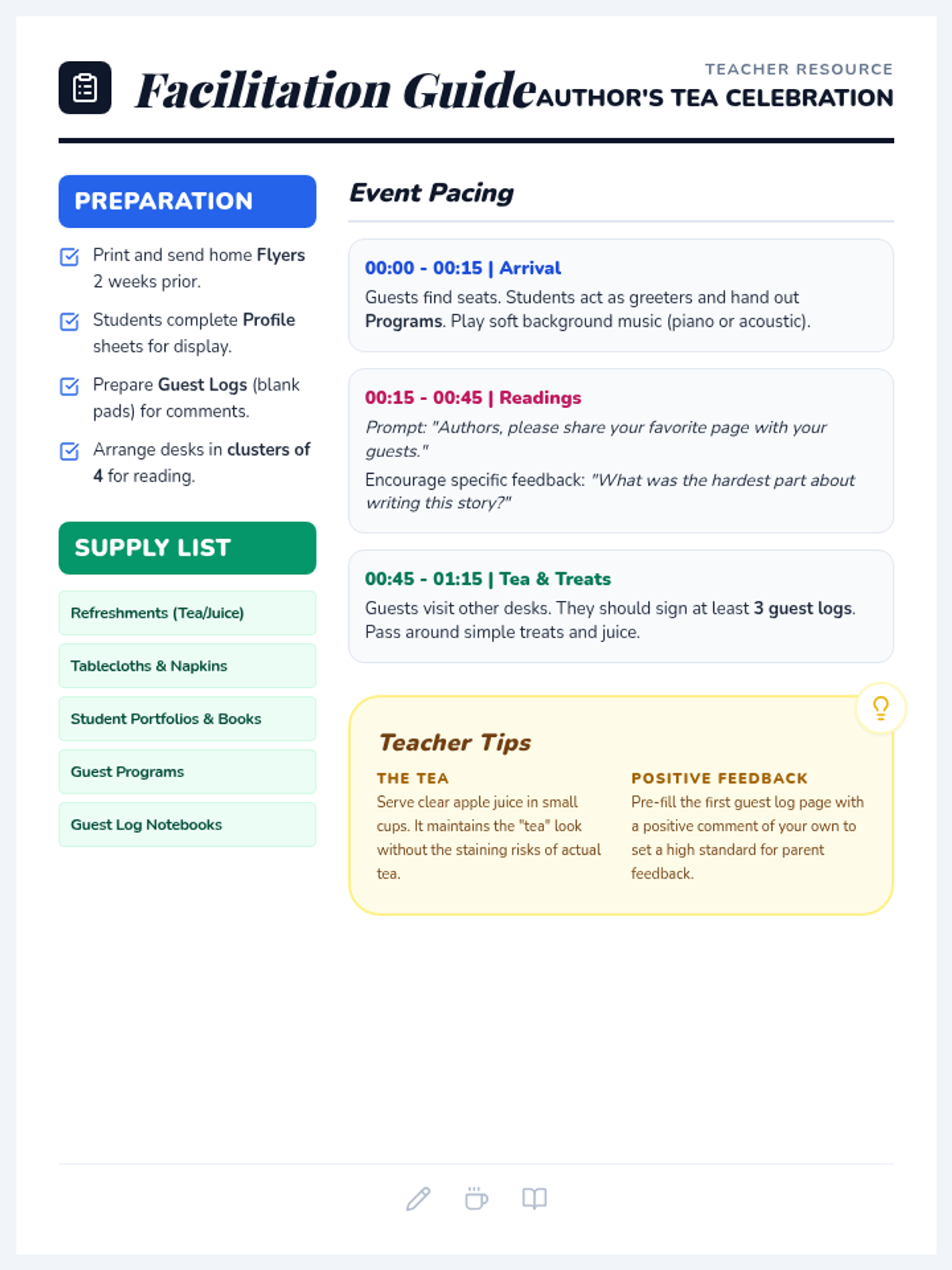
A teacher-facing facilitation guide for hosting a first-grade Author's Tea, including preparation checklists, a detailed schedule, and instructional tips.
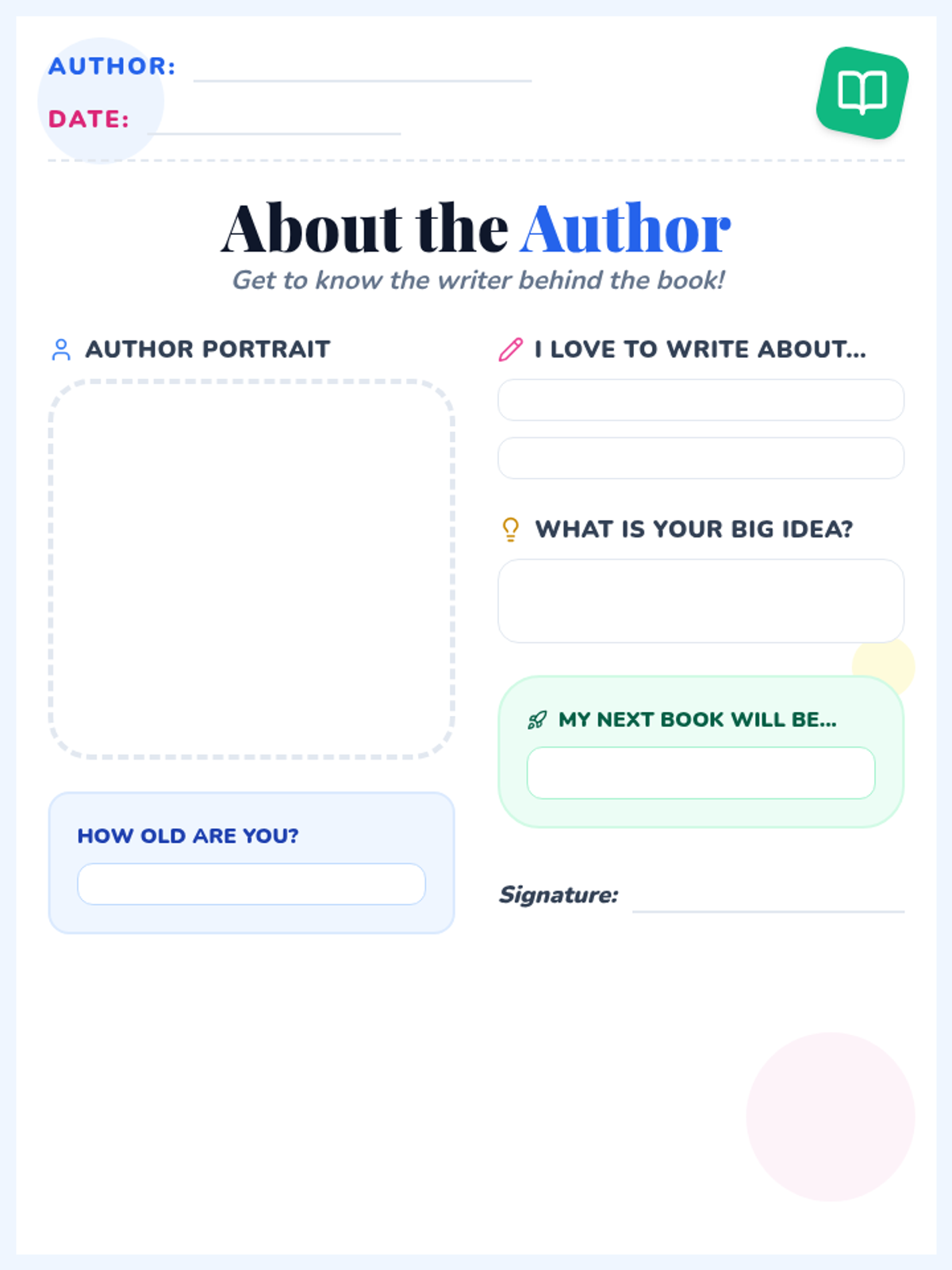
A creative student-facing "About the Author" profile sheet where students can draw their portrait and share details about their writing journey for the Author's Tea. Now features the requested book icon and fits properly on a single page.
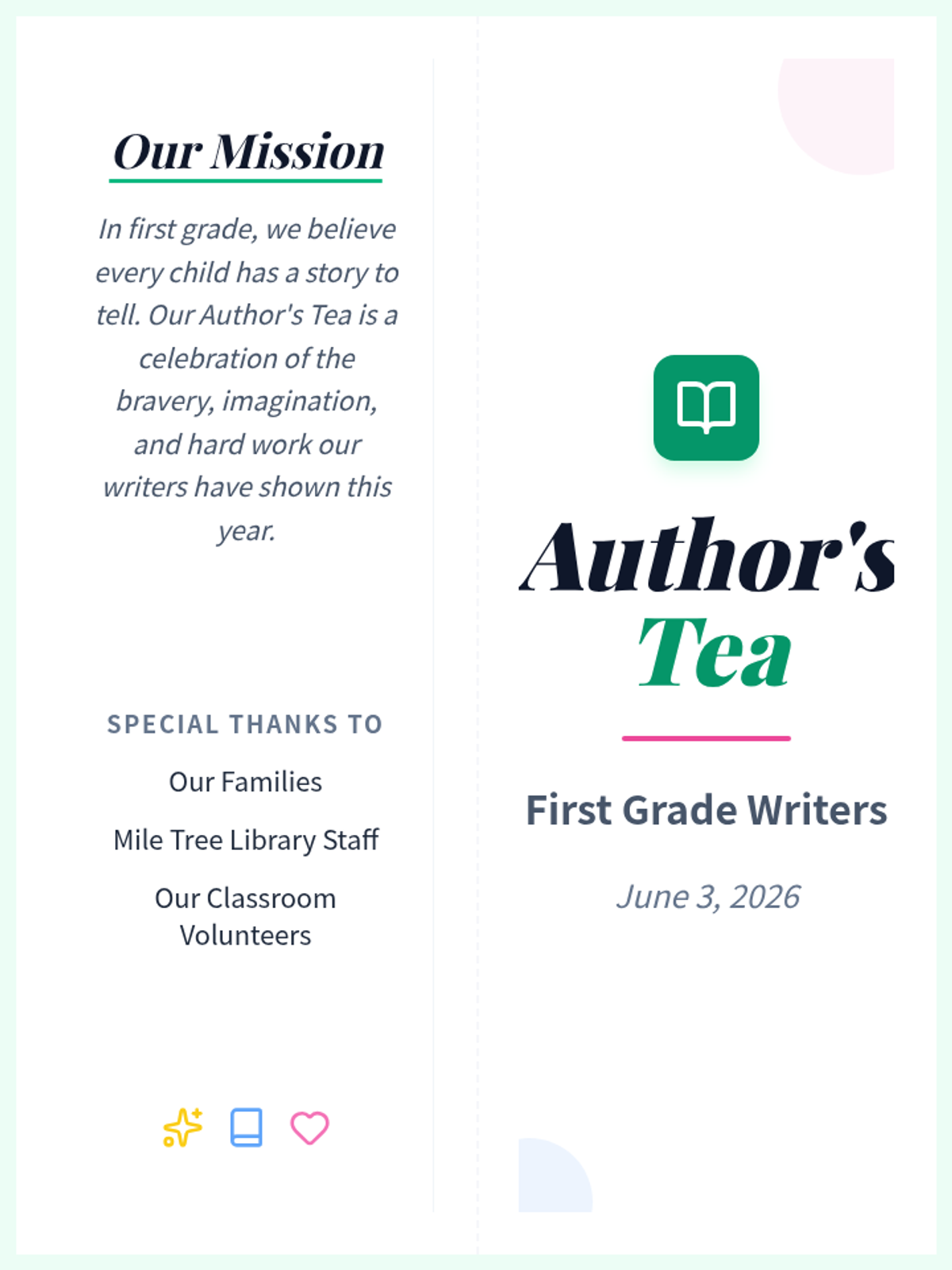
A double-sided, foldable program for parents and guests attending the First Grade Author's Tea, outlining the schedule, mission, and menu.
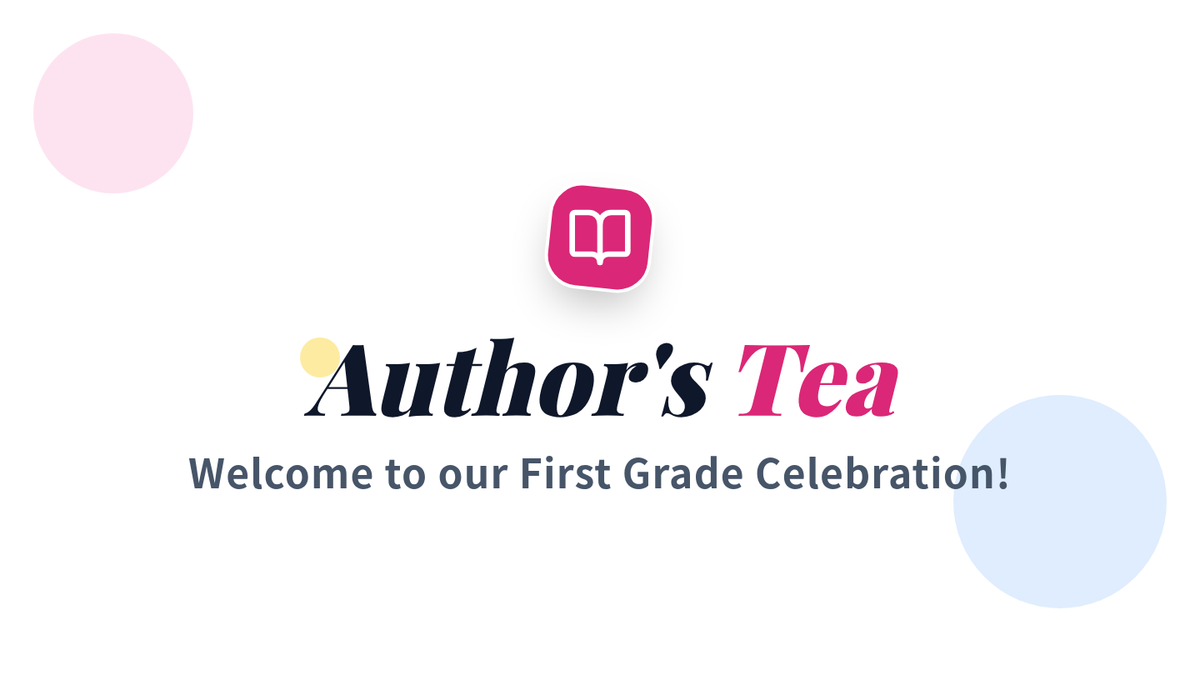
A vibrant presentation for a first-grade Author's Tea, featuring welcoming slides, a schedule of events, and celebratory transitions to guide the celebration.
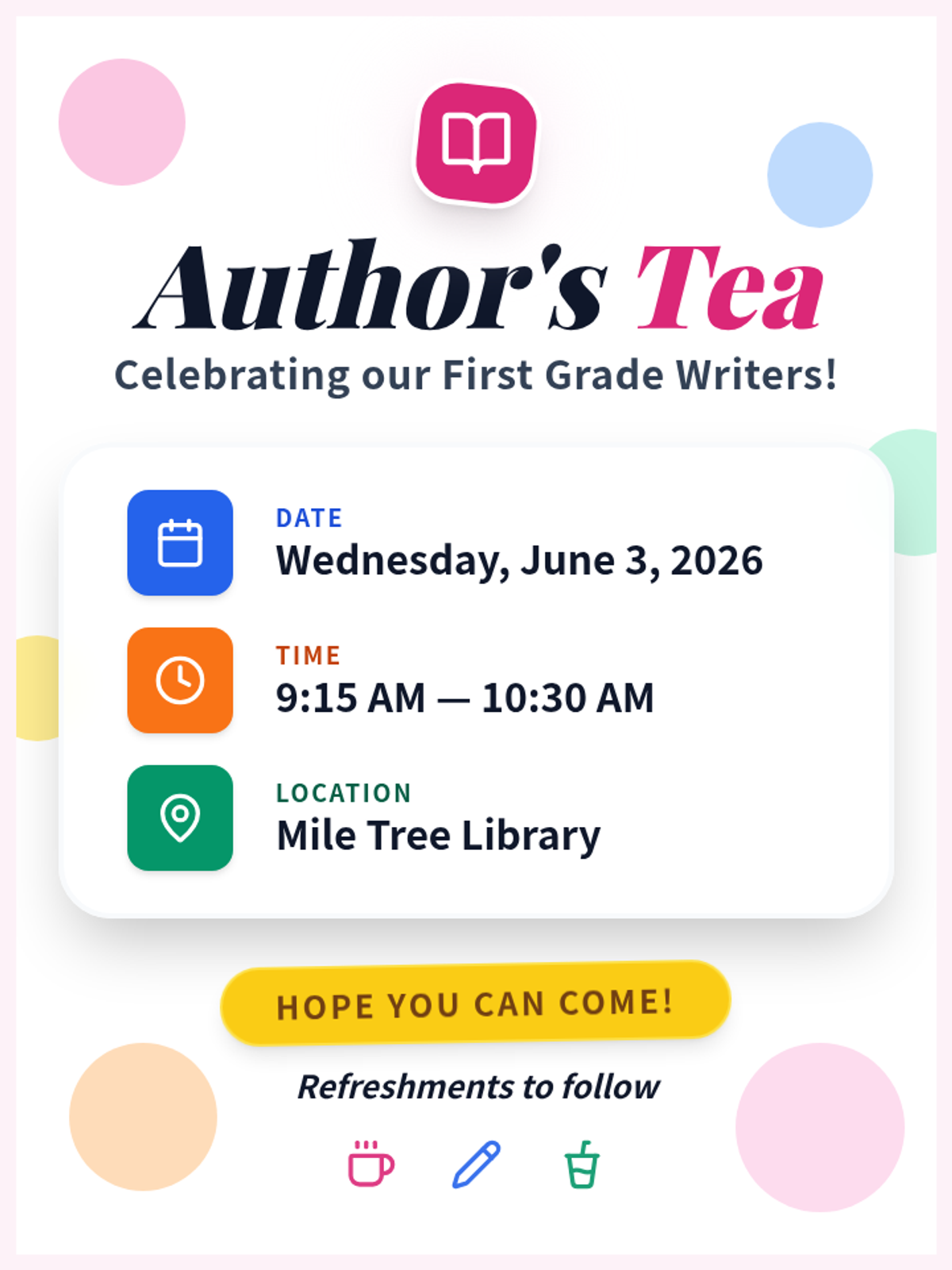
A bright and vibrant full-page flyer for a first-grade Author's Tea, now featuring a prominent "picture" of an open book icon as a central visual element, alongside its colorful polka dot theme.
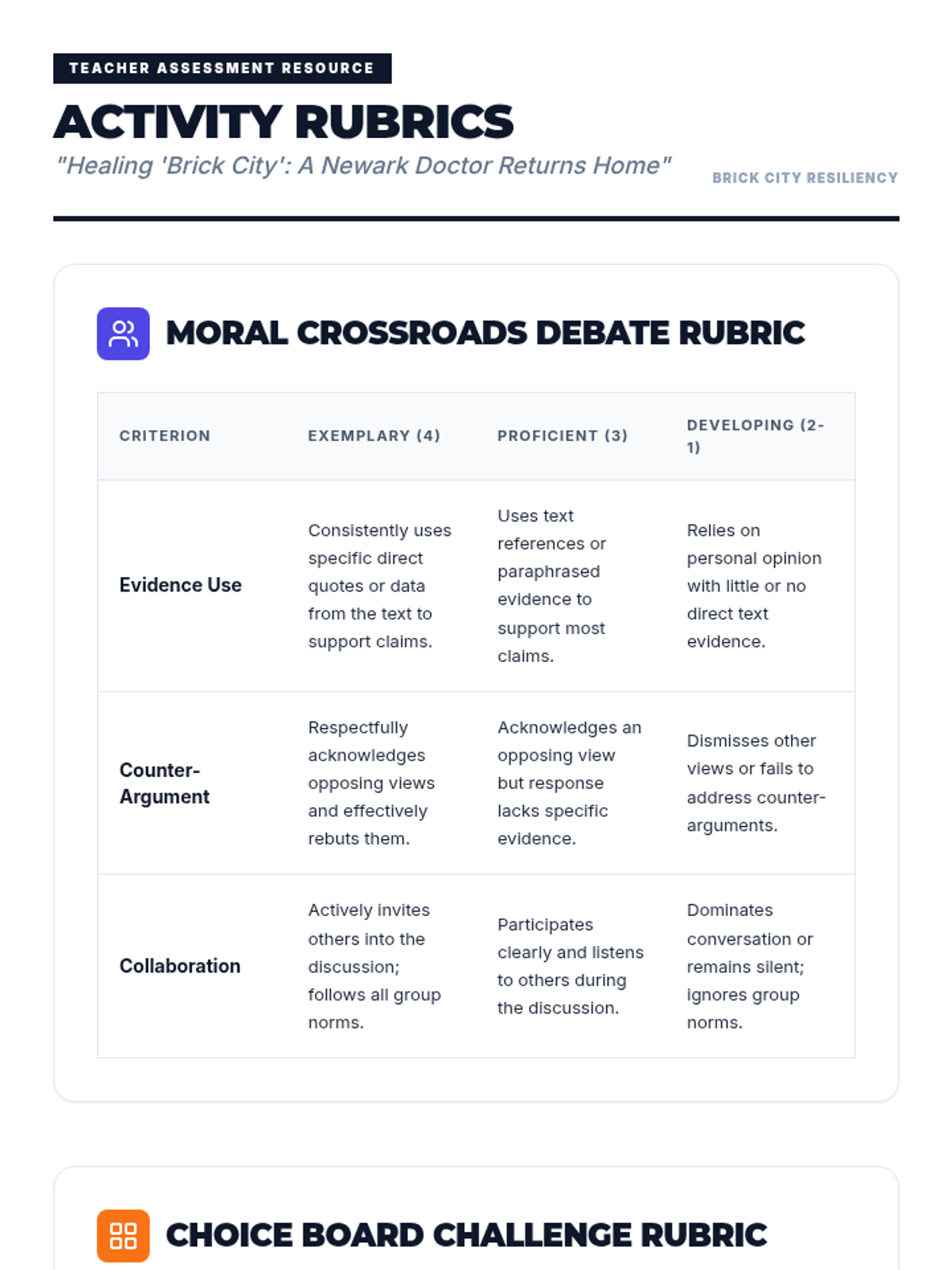
A teacher assessment resource containing evaluation rubrics for both the Moral Crossroads Debate activity and the Choice Board Challenge, focusing on evidence use, depth of analysis, and collaboration.
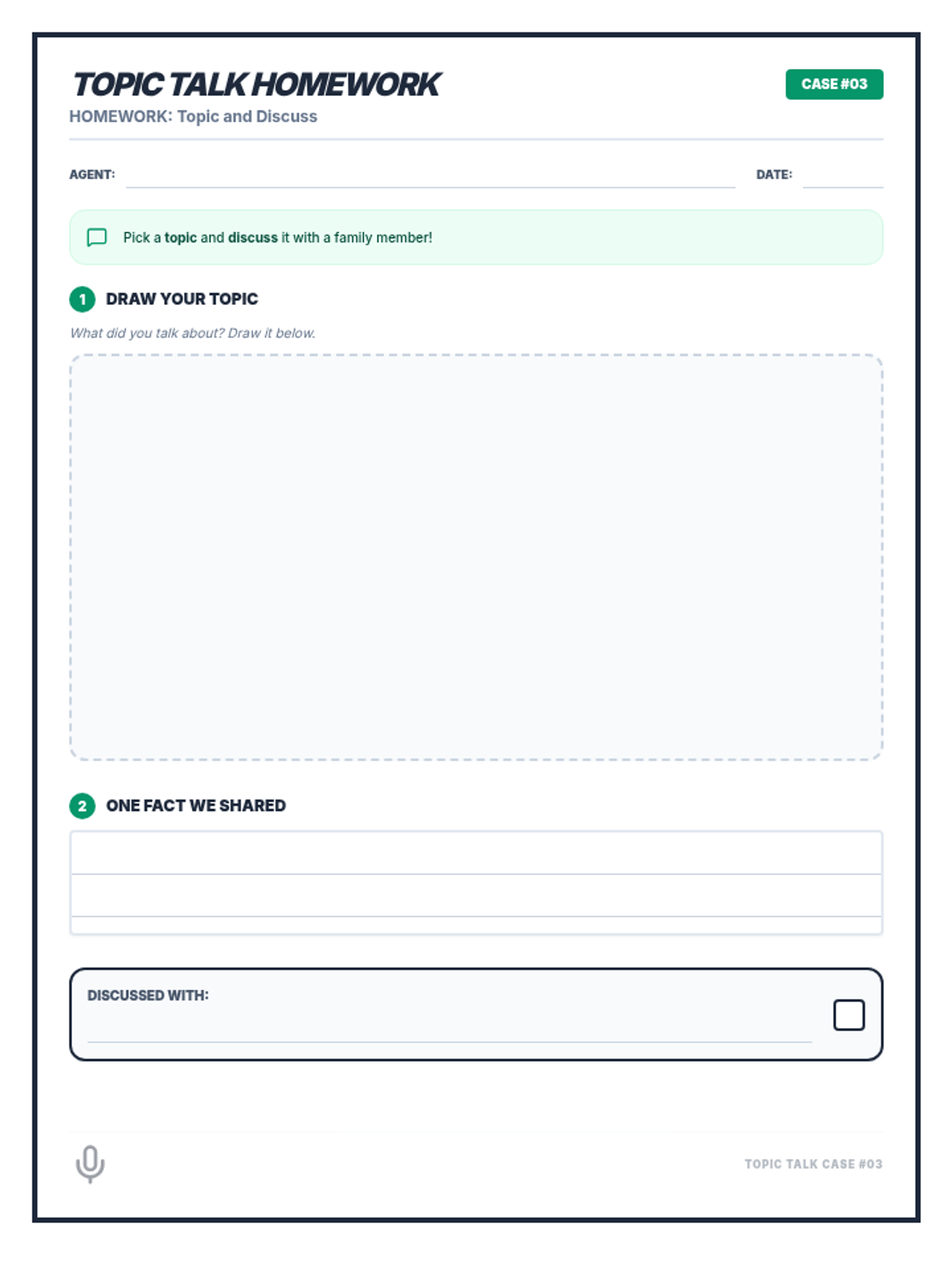
A home discussion log where students pick a topic, discuss it with a family member, and record a fact they shared. Focuses on reinforcing the definitions of 'topic' and 'discuss' in a real-world setting. Revised for 1-page layout and improved contrast.
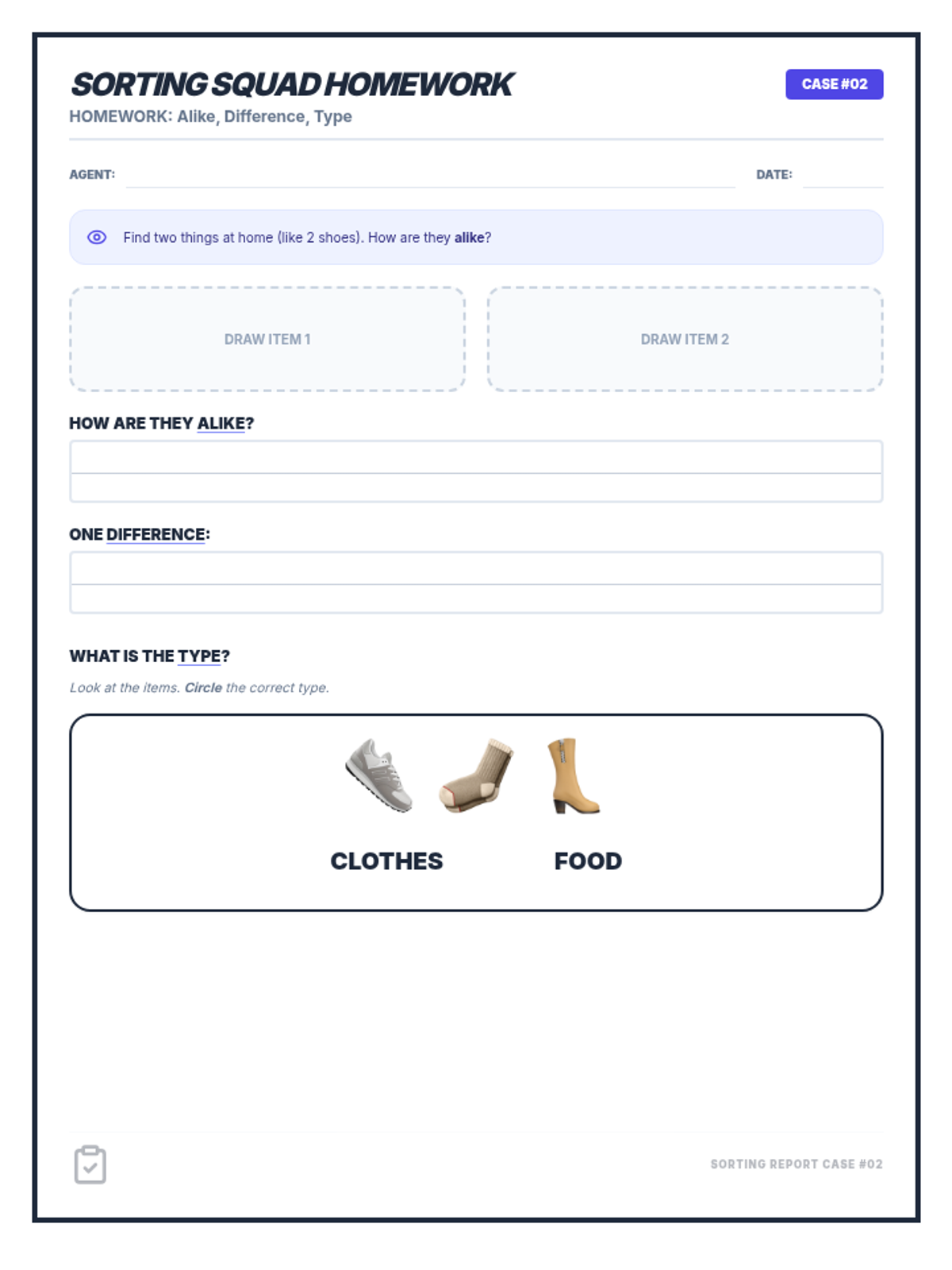
A comparison-focused homework sheet where students find and compare two household items, identifying how they are alike and different, and practicing the concept of 'type' with visual groups. Revised for 1-page layout and improved contrast for handwriting lines.
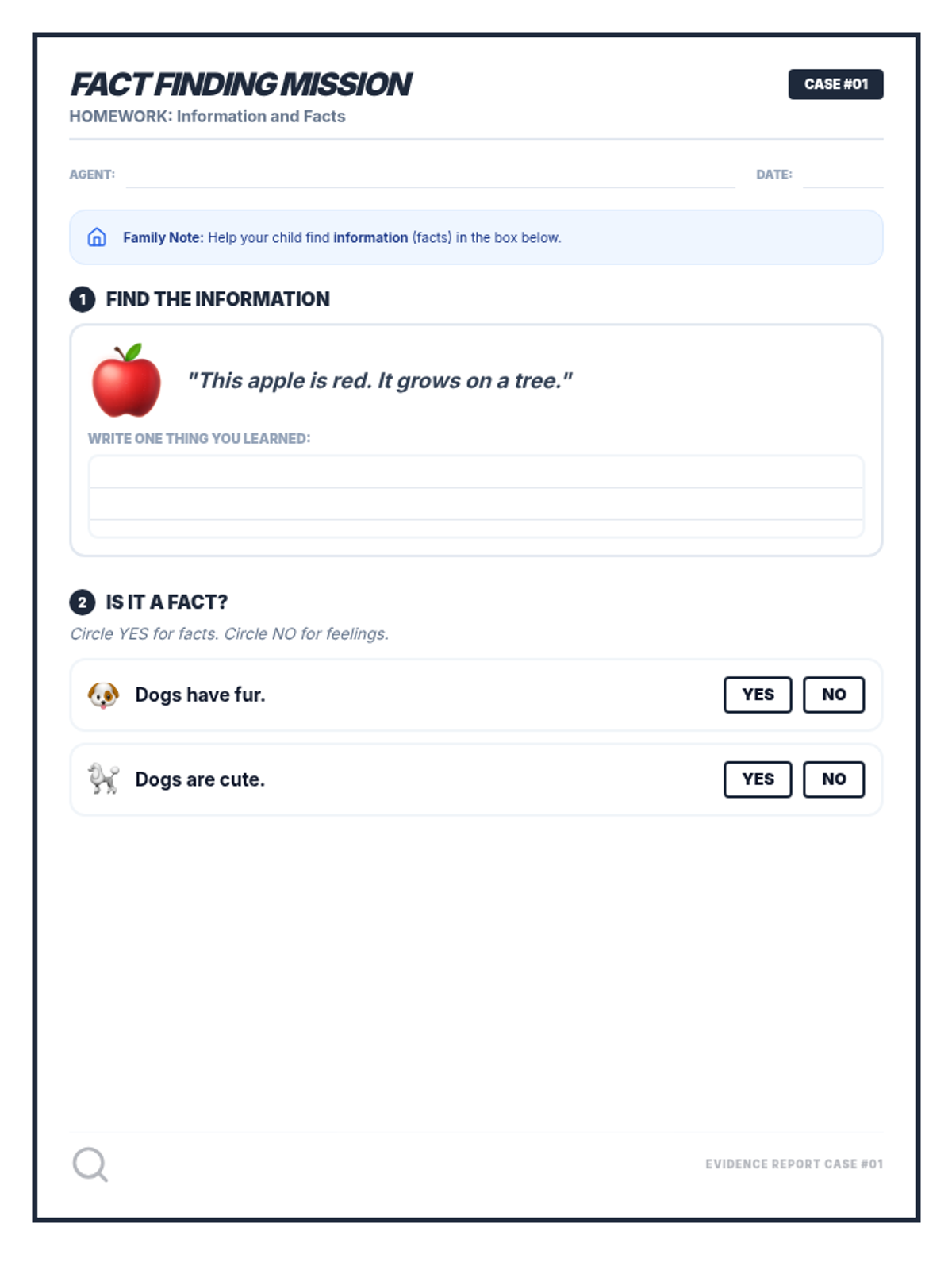
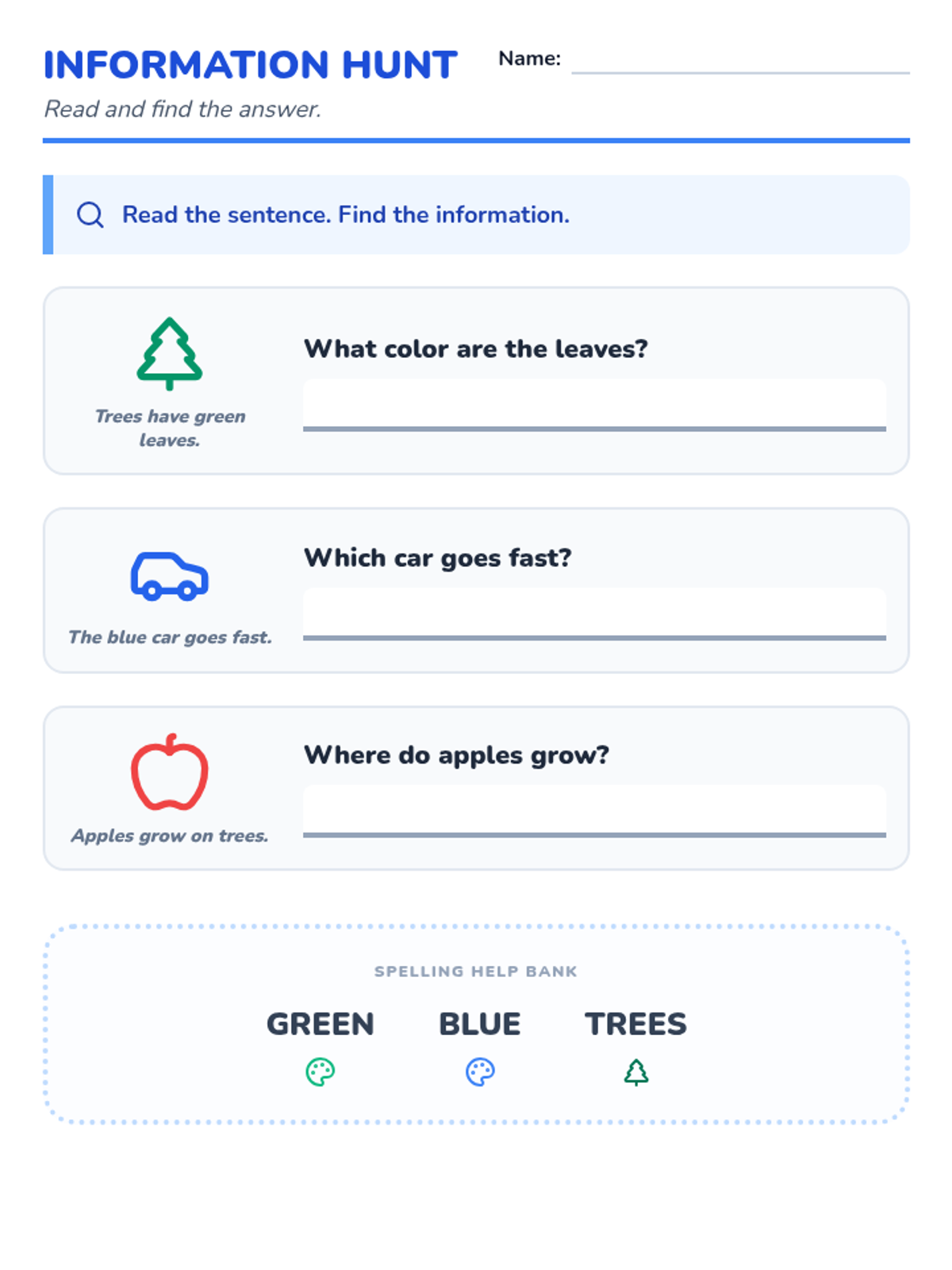
A homework sheet focused on 'information' and 'fact'. Students practice finding information in a simple context and distinguishing between facts and opinions with a family-friendly instruction note. Revised for 1-page layout and improved contrast.
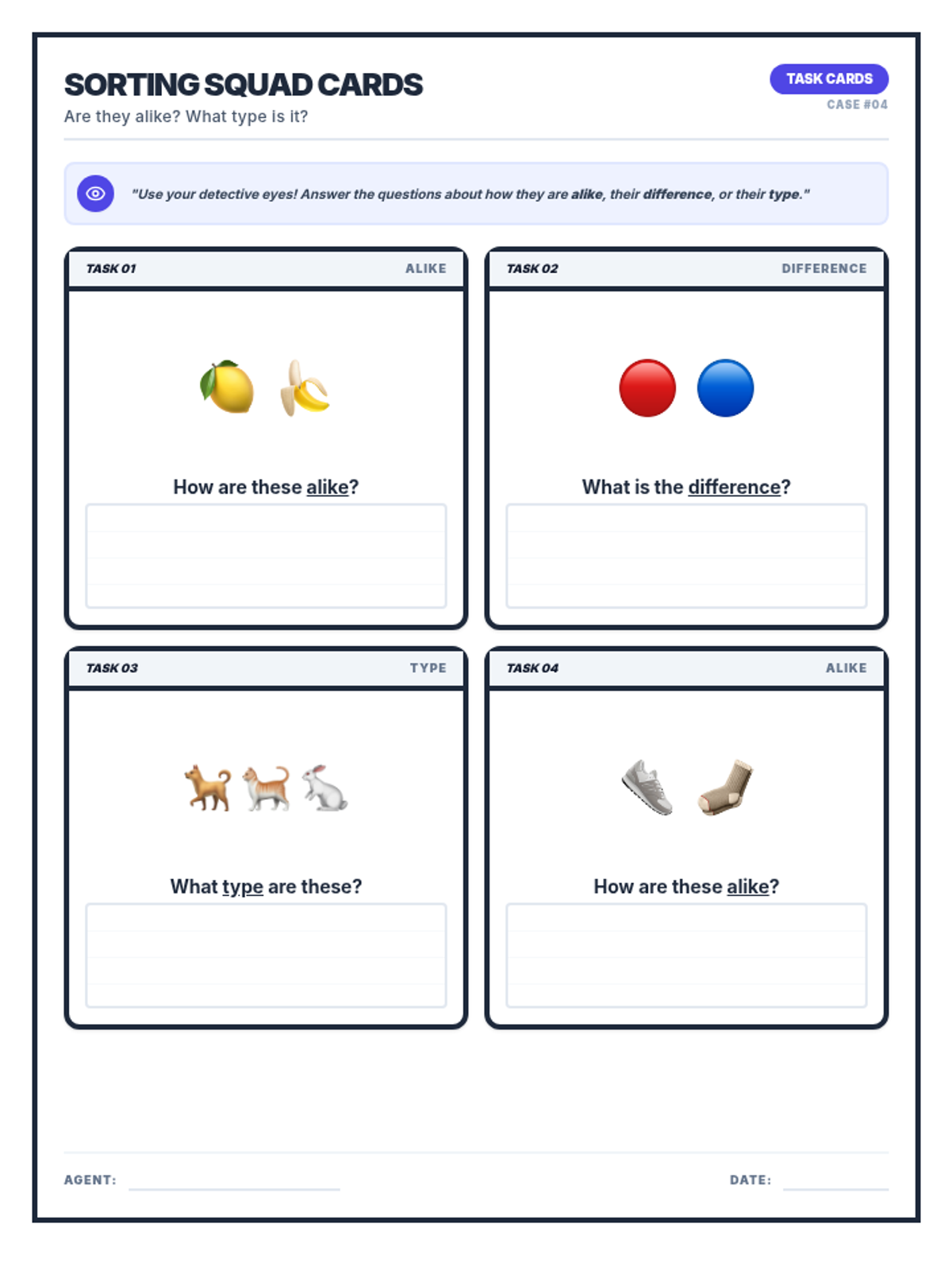
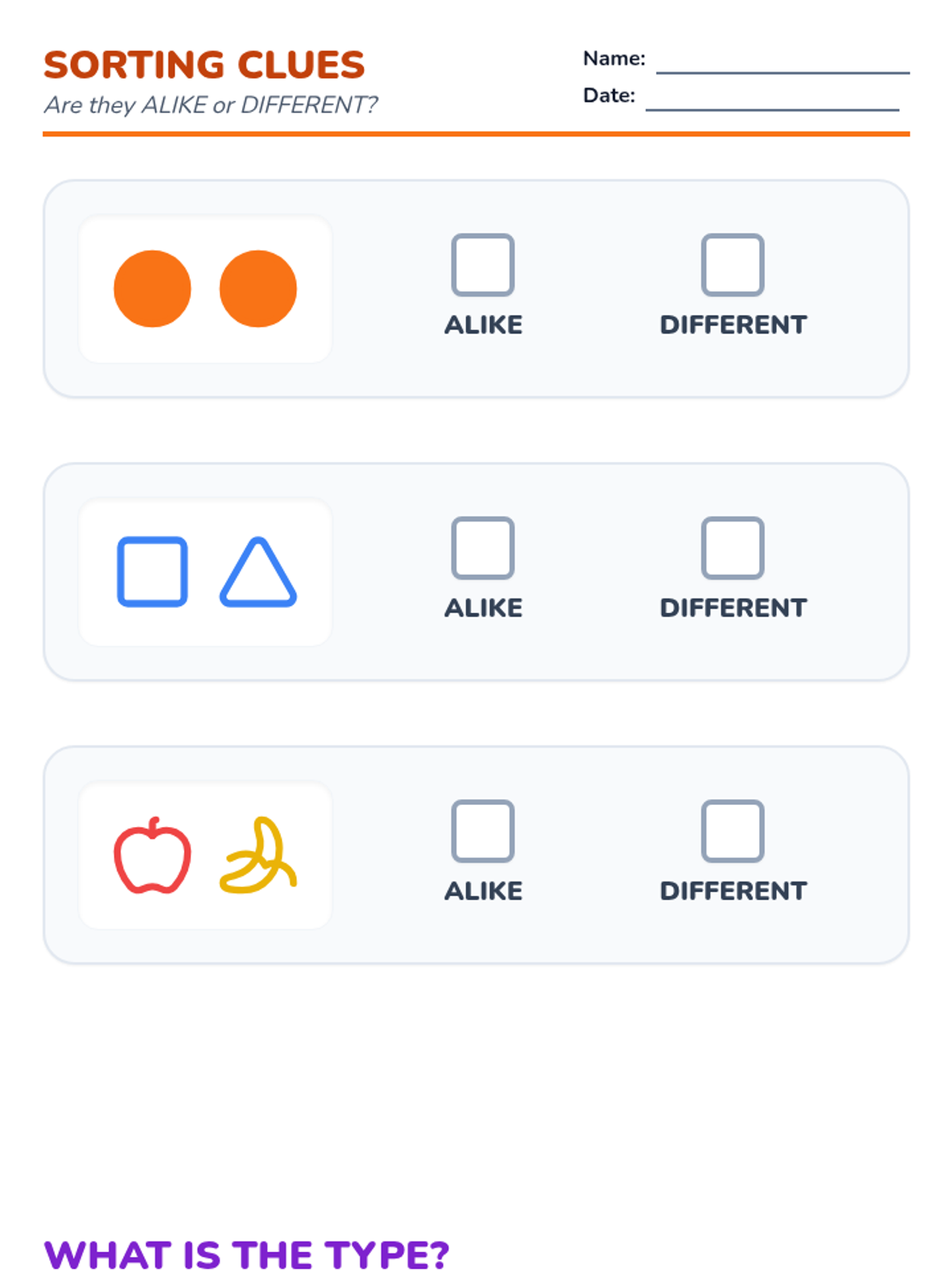
A set of task cards for comparing and categorizing items. Students analyze visual pairs and sets to identify how they are alike, their differences, or their shared 'type'. Revised for single-page layout with larger response areas and white backgrounds for legibility.
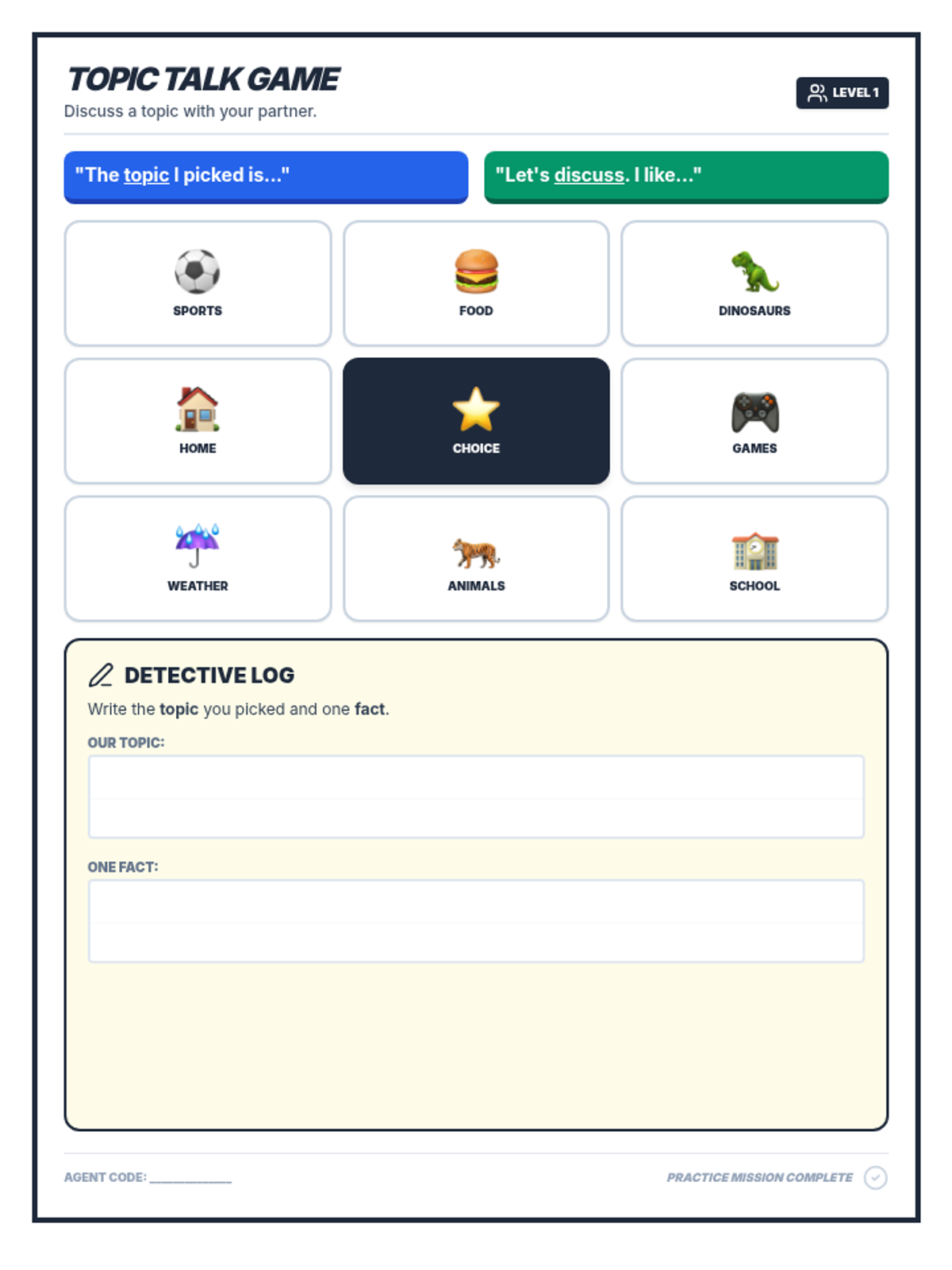
A partner-based discussion game featuring a choice board of visual topics. Students use sentence starters to practice identifying a topic and engaging in discussion with their peers. Revised to fit on a single page with a new 'Detective Log' for written practice. Grid heights and padding optimized for 1-page layout.
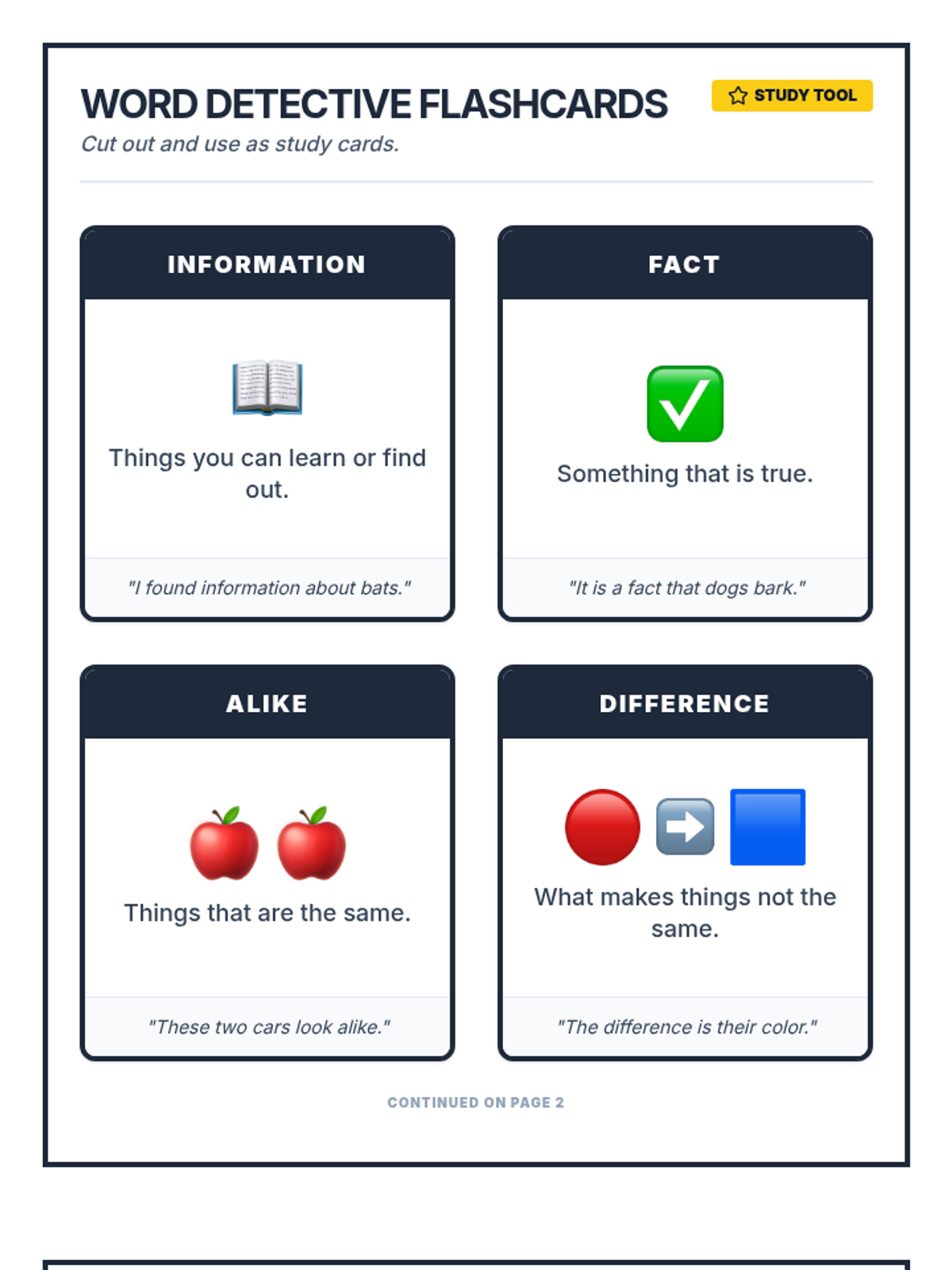
Visual vocabulary flashcards for the seven target academic words, featuring simple definitions, clear icons, and example sentences to support student mastery. Revised for consistent 2-page layout with borders and improved writing space for notes. Example sentences increased for better readability. Corrected arrow rendering and removed placeholder text.
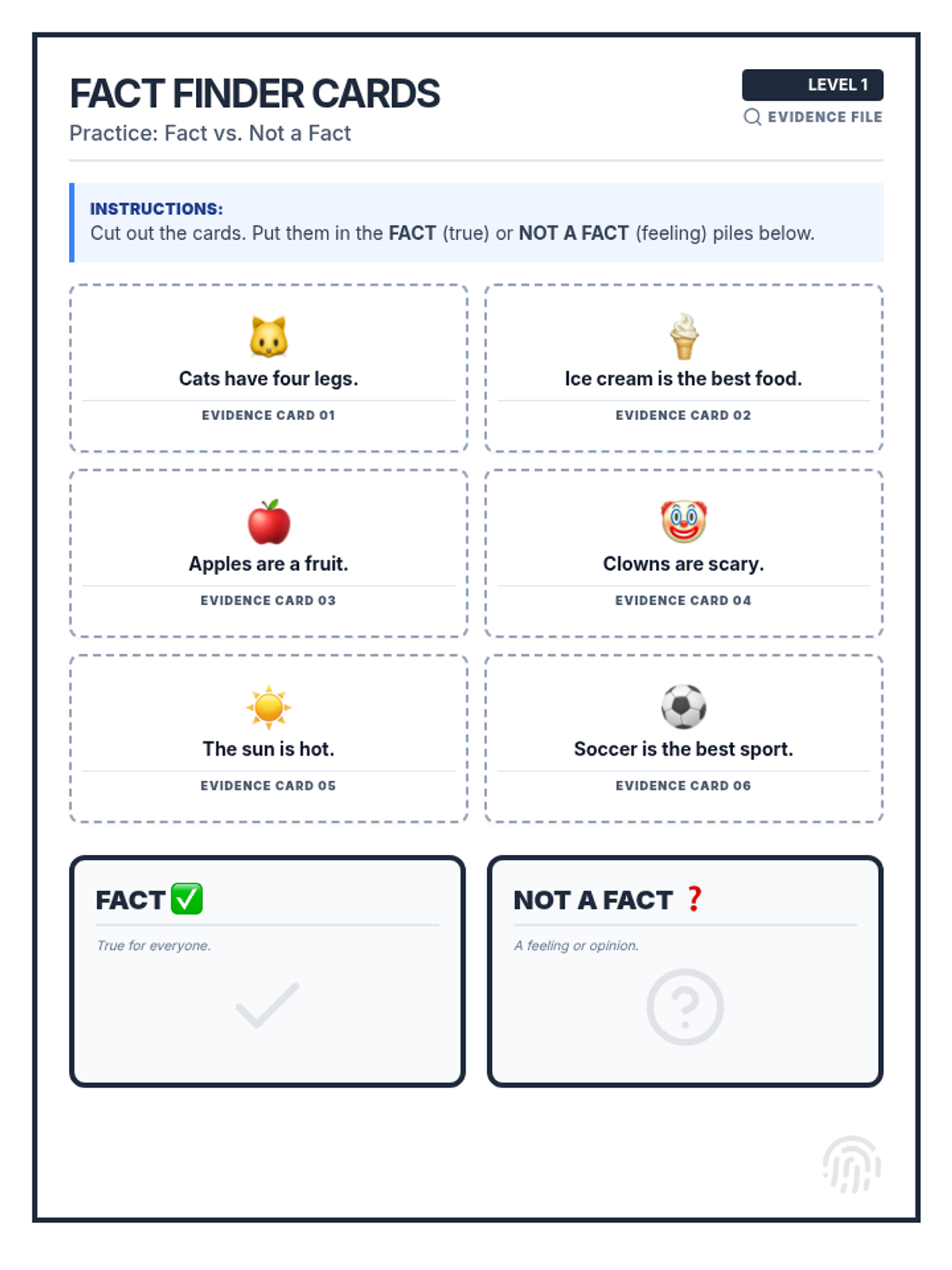
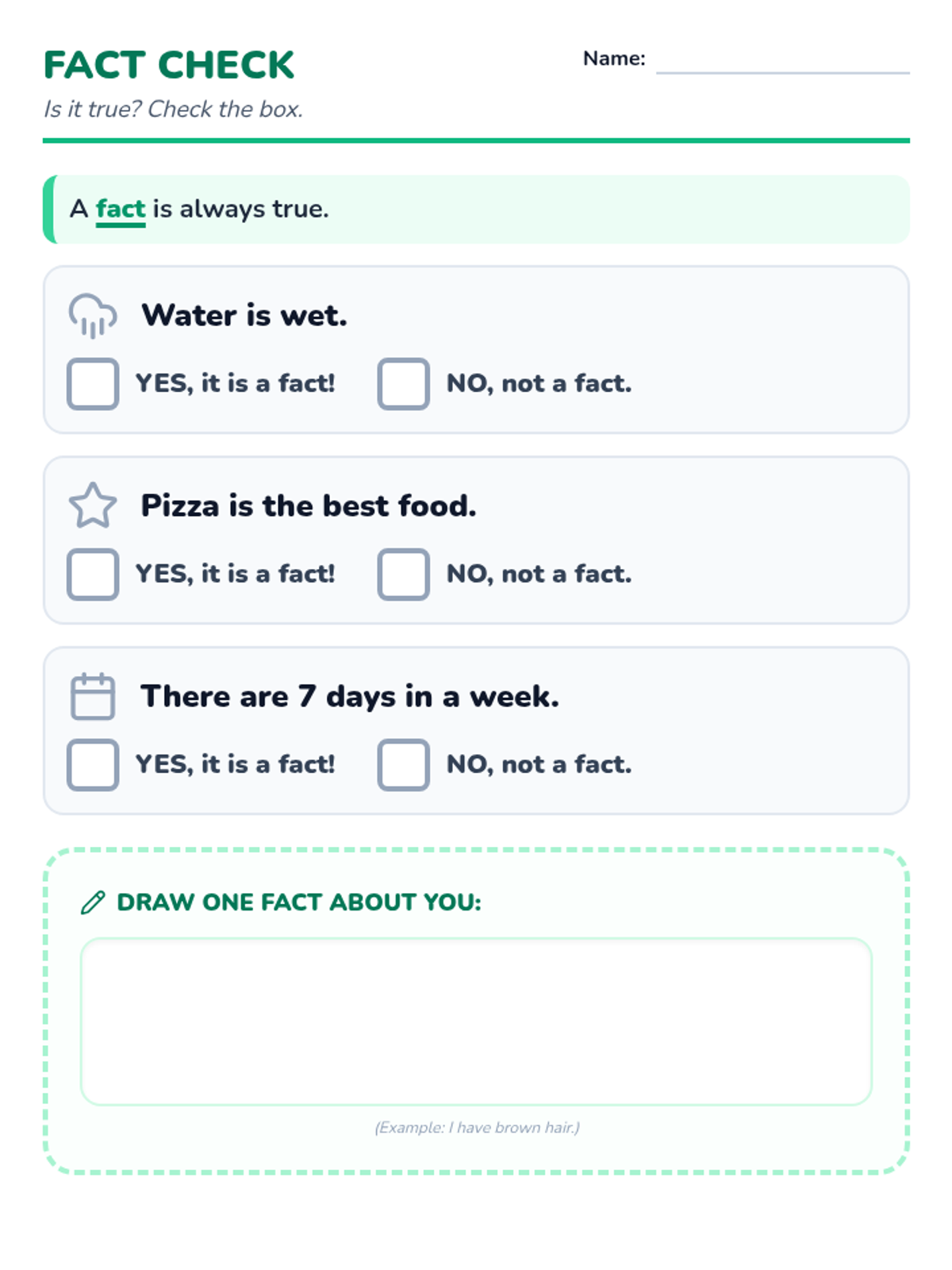
A hands-on sorting activity where students cut out cards and categorize statements as either 'Fact' or 'Not a Fact' to practice the concept of information versus opinion. Revised to fit on a single page with high-contrast text and larger sorting zones.
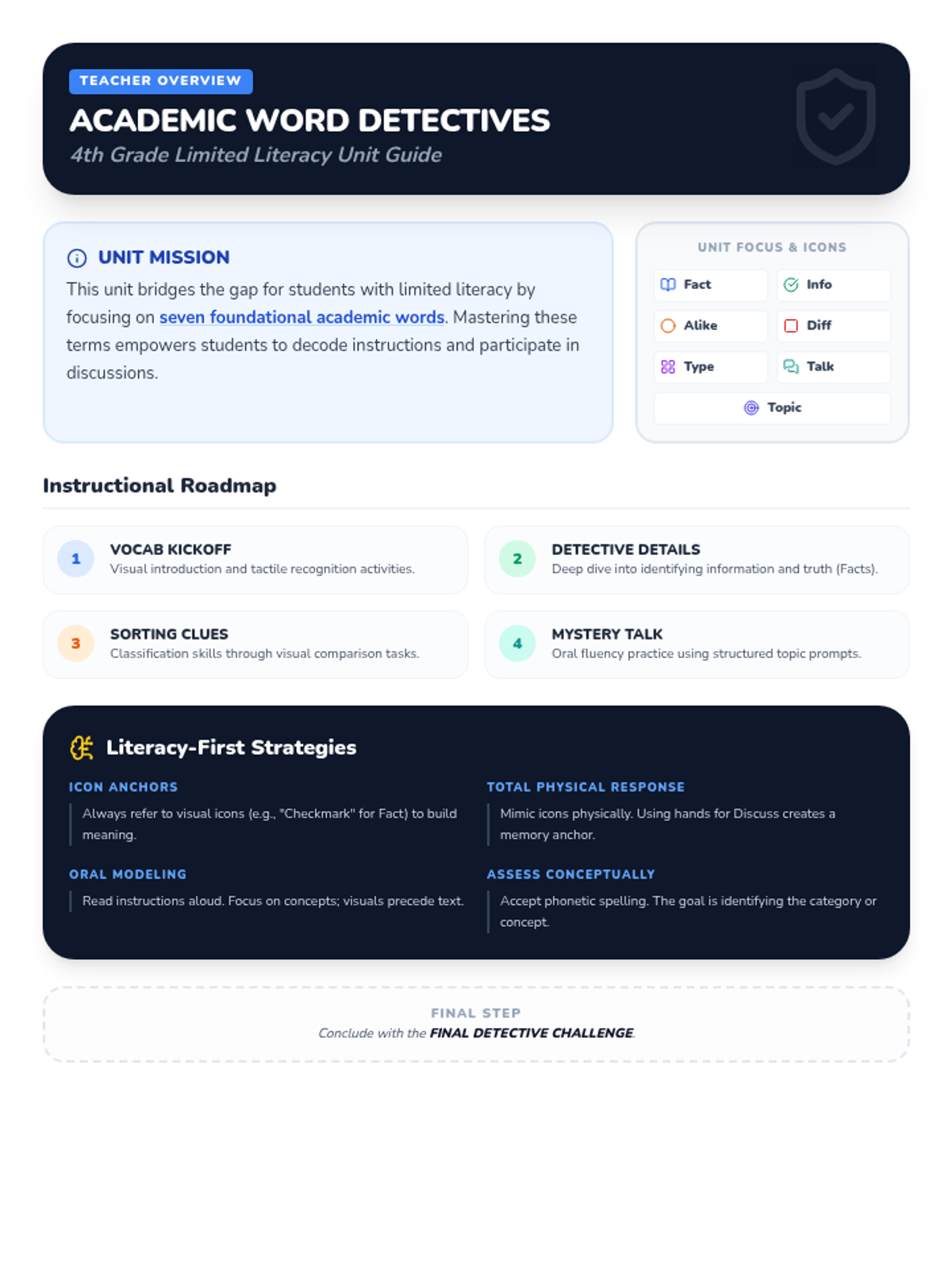
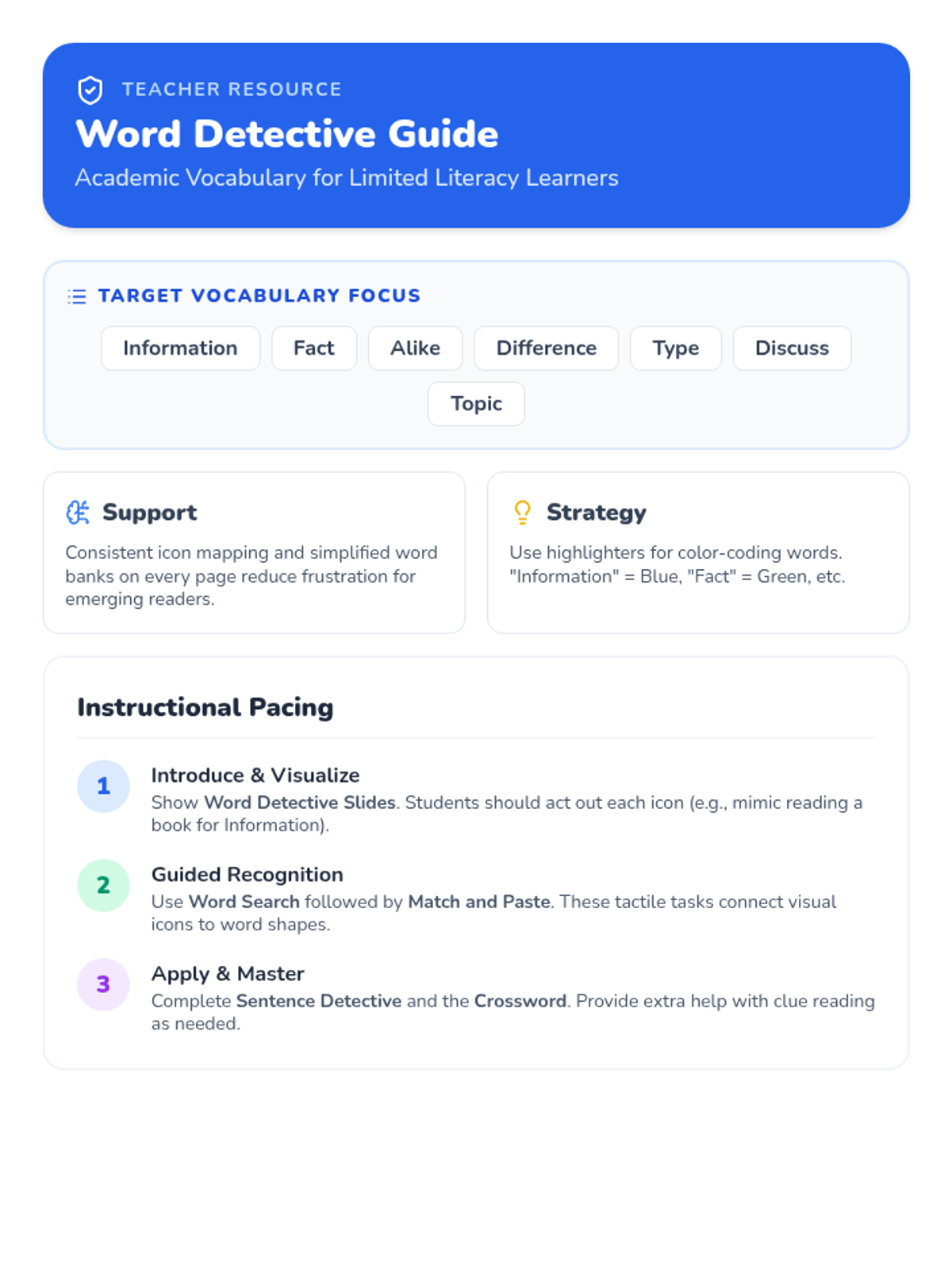
A high-level unit guide for the Academic Word Detectives sequence. Provides a roadmap for all 4 lessons, target vocabulary summaries, and specific pedagogical strategies for limited literacy learners. Revised for 1-page layout and fixed syntax.
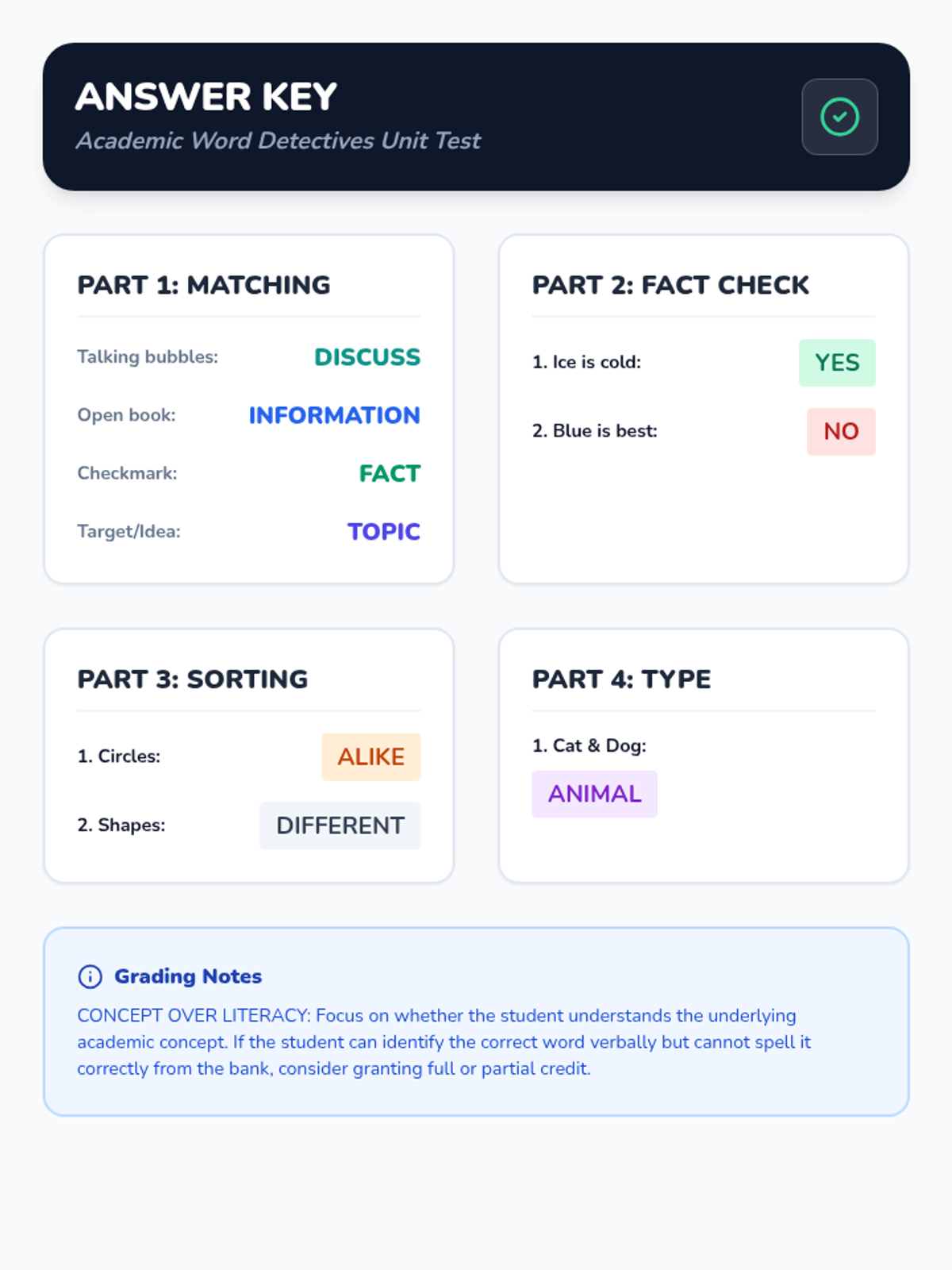
Teacher answer key for the Word Detective Final Challenge. Includes scoring notes and clear identification for all visual items. Revised for better text alignment.
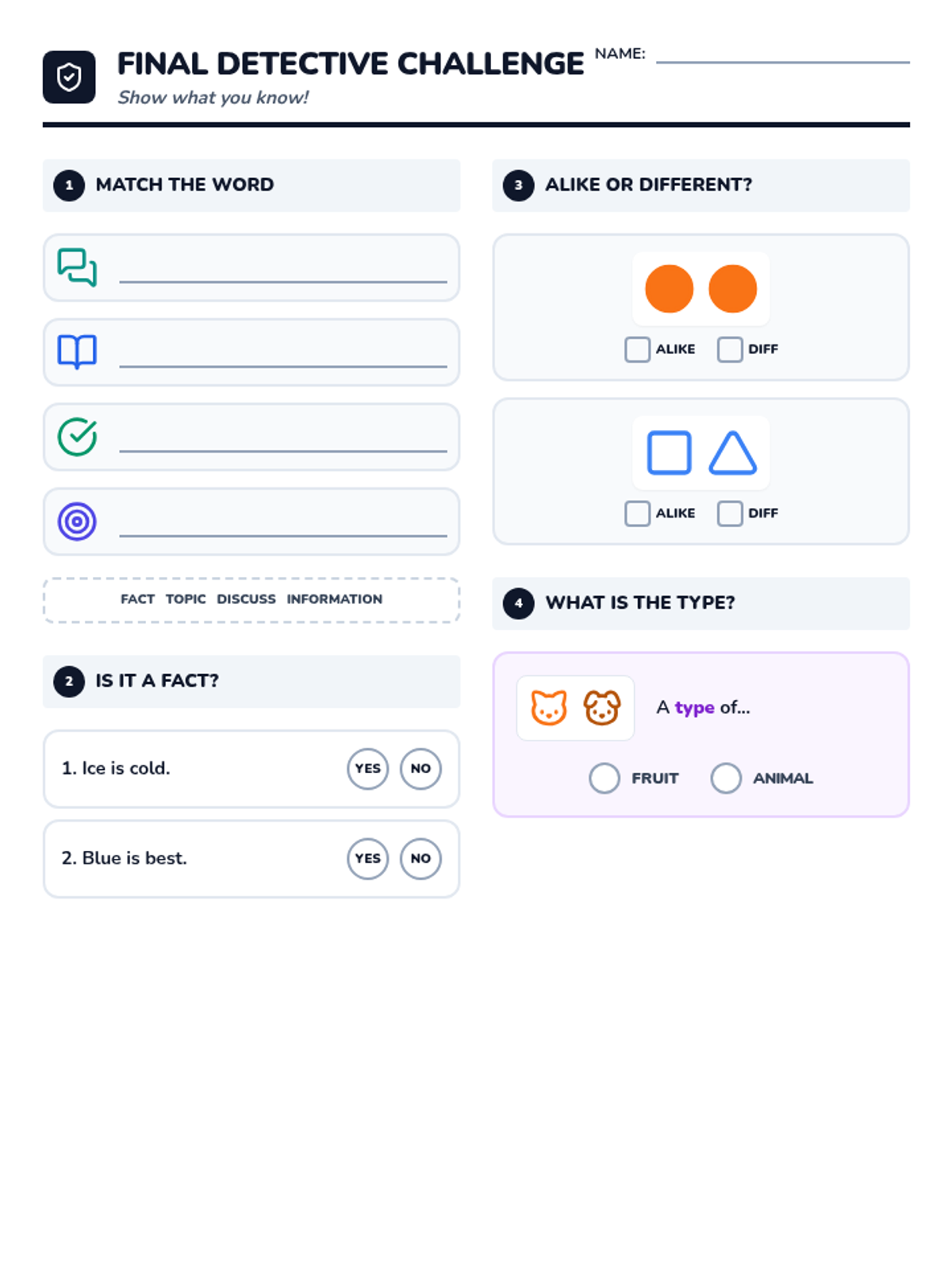
A cumulative unit test for the Academic Word Detectives unit. Features visual matching, true/false fact checks, comparison tasks, and categorization problems designed for students with limited literacy. Revised for 1-page layout.
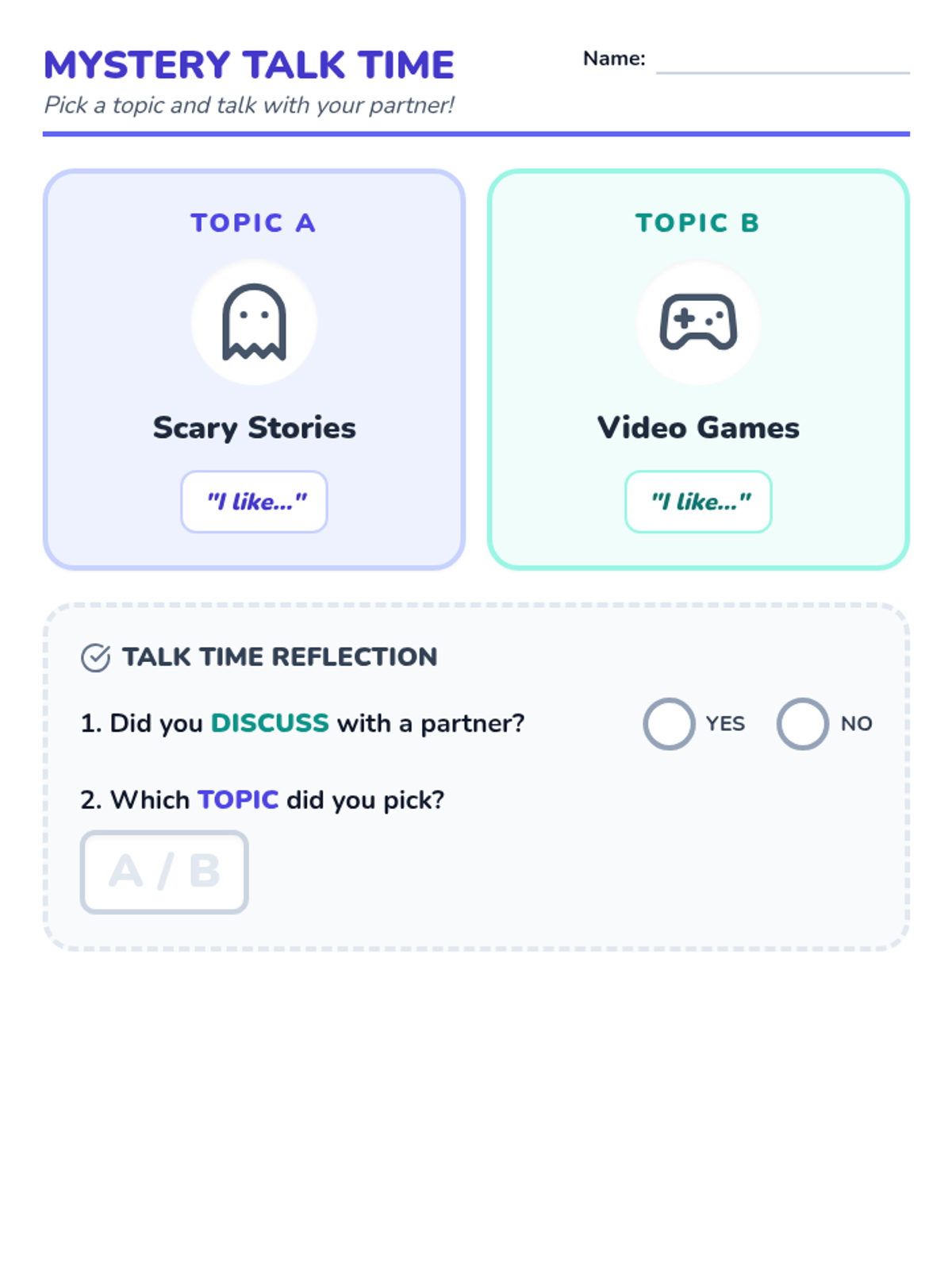
A structured discussion activity providing visual topic choices and sentence starters, followed by a simple reflection checklist. Revised for title consistency, improved contrast, and uniform answer styling. Designed for 4th-grade students with limited literacy.
A visual slide deck for identifying the 'topic' from clues and modeling how to 'discuss' with a partner. Revised with added practice examples and improved text contrast. Designed for 4th-grade students with limited literacy.
A comparison and categorization worksheet where students identify alike/different pairs and select the correct 'type' for sets of objects. Revised for uniform answer styling, consistent terminology, and corrected page breaks. Designed for 4th-grade students with limited literacy.
A visual slide deck teaching comparison (alike vs. difference) and categorization (types). Revised with split challenge/reveal slides and improved visual contrast. Designed for 4th-grade students with limited literacy.
A true/false worksheet helping students distinguish between objective facts and subjective opinions. Revised for uniform answer styling and fixed page breaks.
A reading comprehension worksheet focused on finding specific information in simple sentences. Revised to fix page breaks and improve contrast for answer areas.
A visual slide deck for teaching students how to identify facts and find information in simple contexts. Designed for 4th-grade students with limited literacy. Revised for improved contrast and added summary slide.
A teacher guide providing instructional strategies and literacy support tips. Revised to fit on a single page and list the 7 target words clearly.
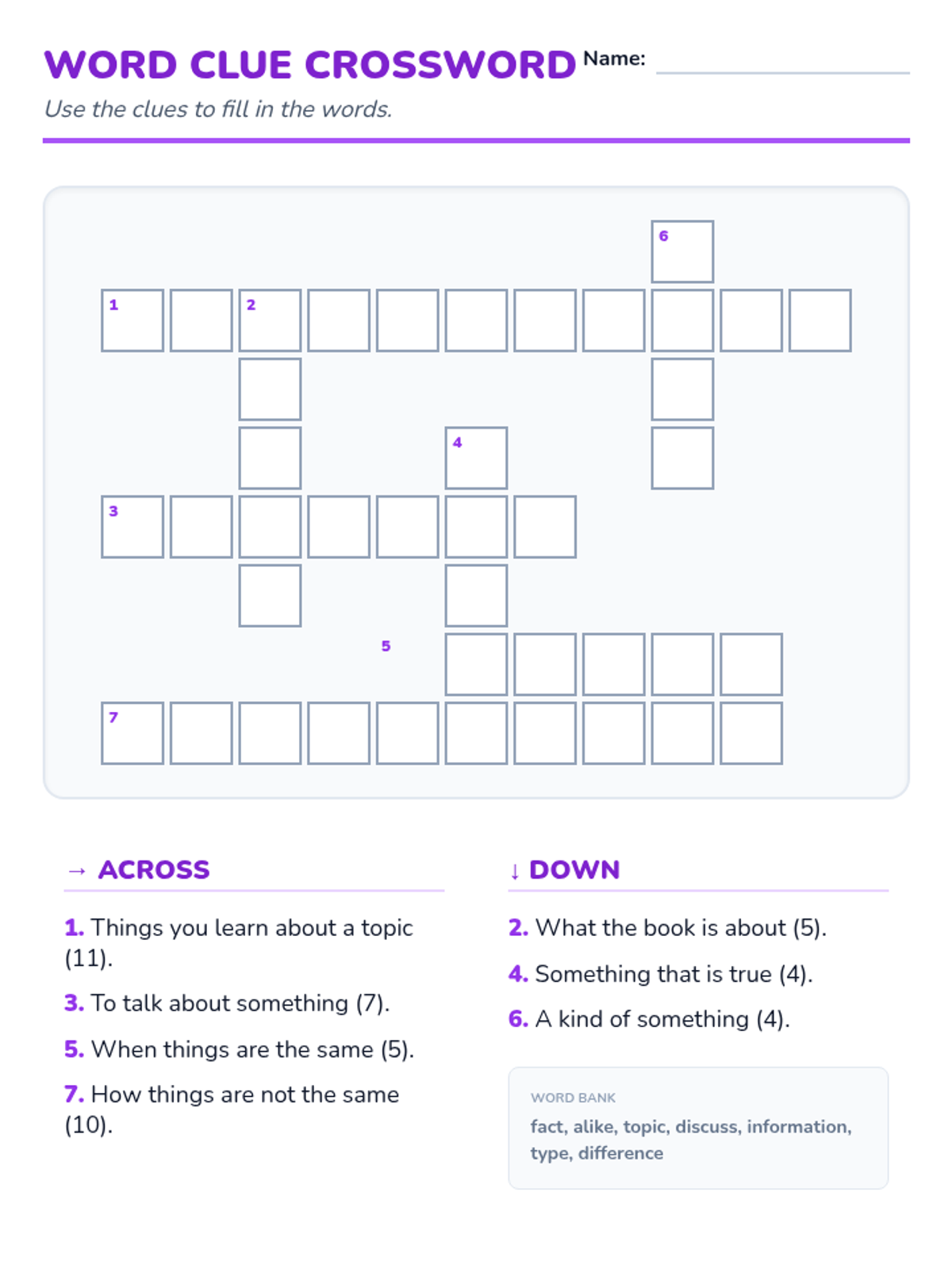
A simple academic vocabulary crossword puzzle for 4th-grade students with limited literacy. Revised with larger boxes, correct intersections, and clear clue numbers. Corrected grid logic and ensured 1-page layout. Removed placeholder text and improved contrast. Final revision using stable HTML table grid.
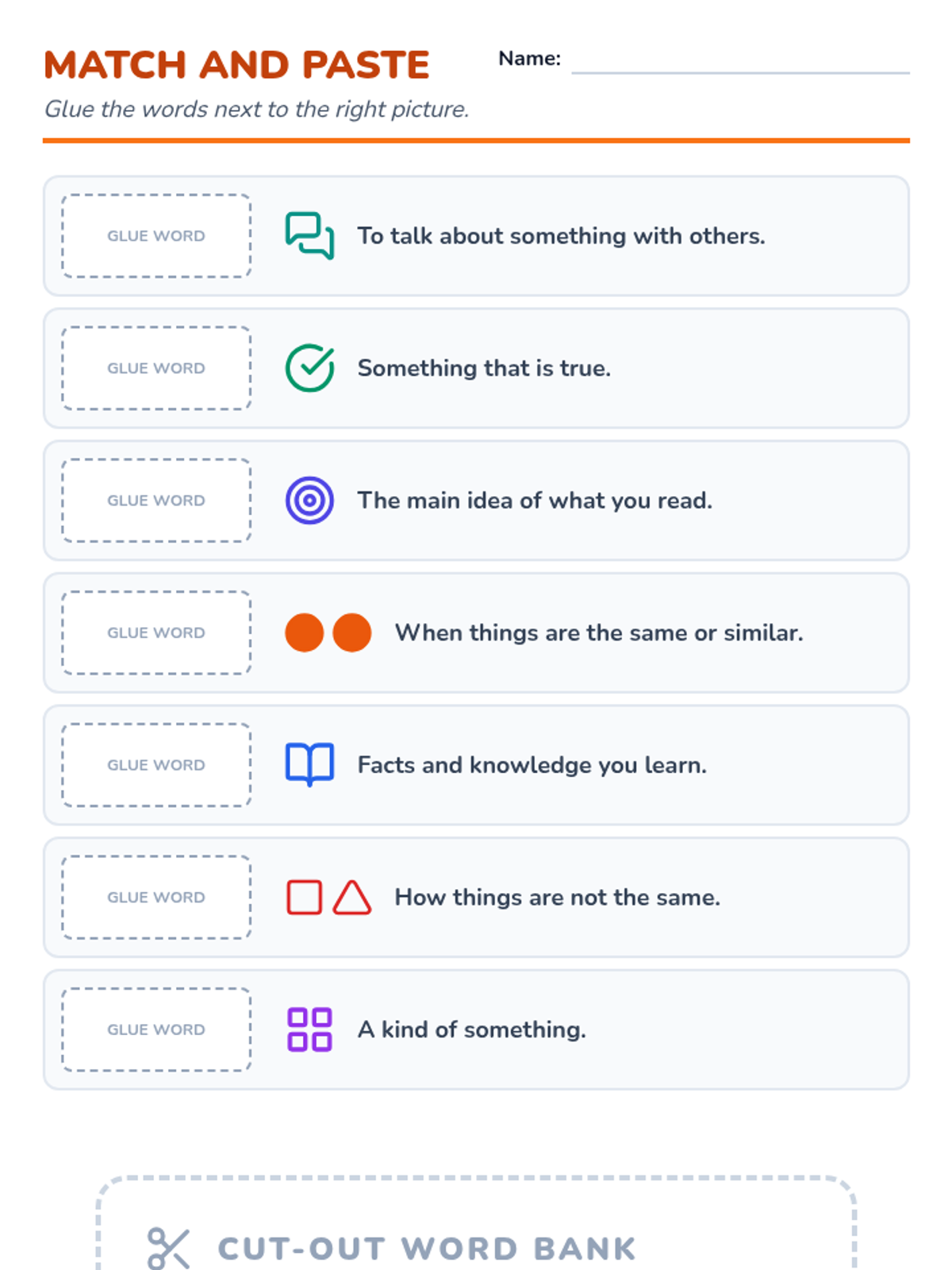
A cut-and-paste matching activity for academic vocabulary. Revised to fit all matching items on one page and use uniform text colors for cutouts to encourage reading comprehension. Corrected page breaks for cut-out bank.
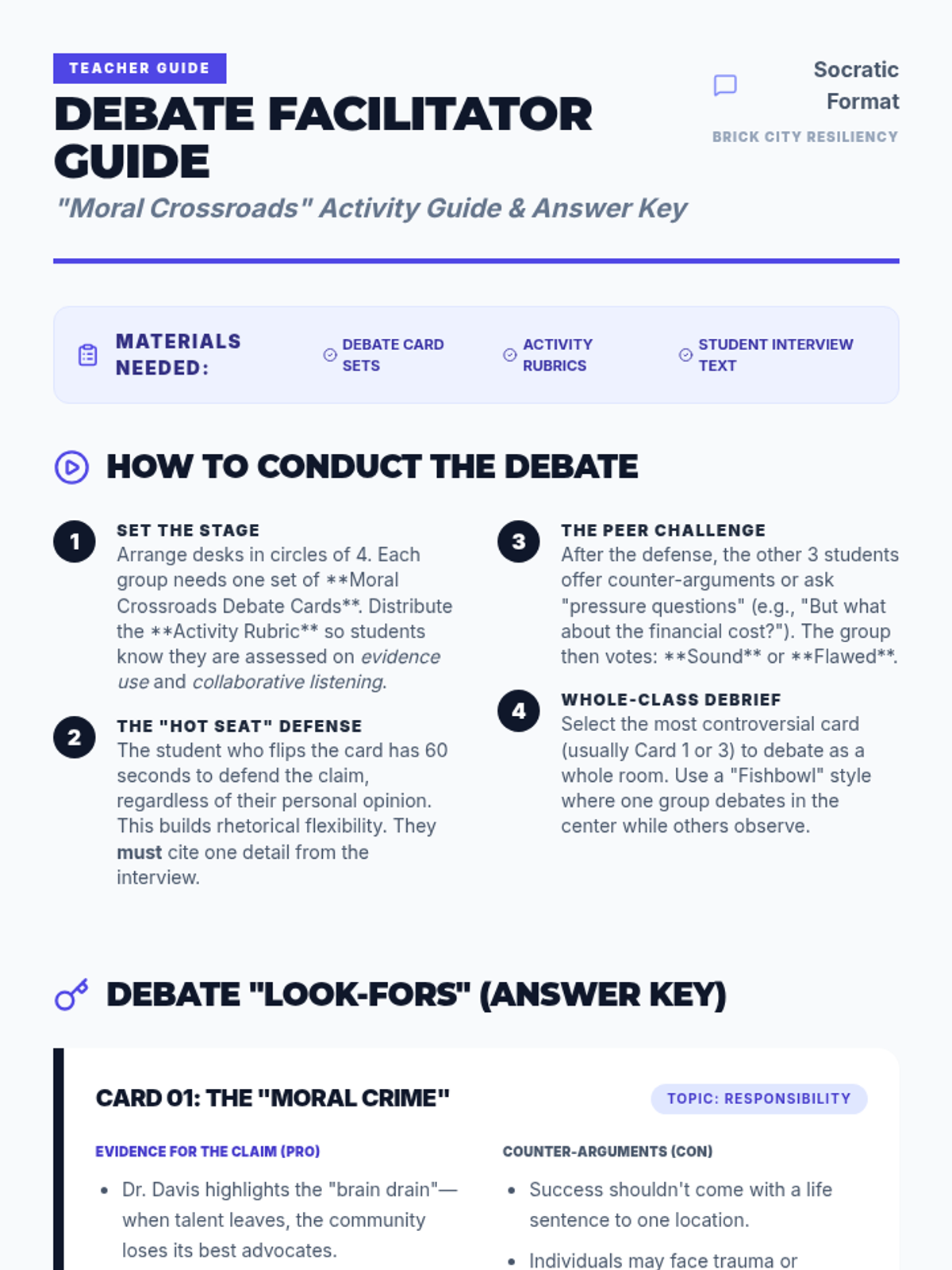
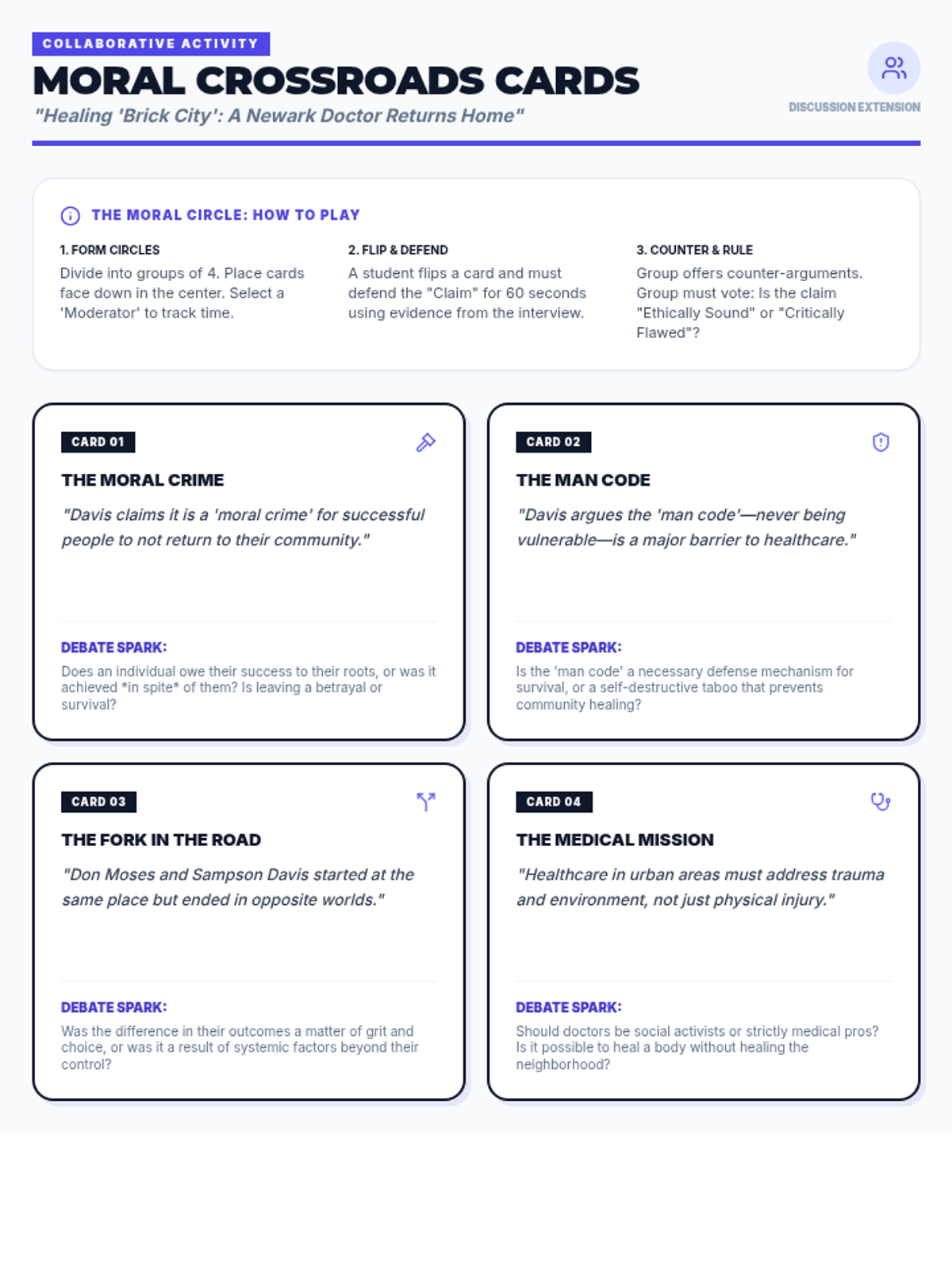
A comprehensive teacher facilitation guide and answer key for the Moral Crossroads debate activity. It provides step-by-step classroom implementation strategies, detailed pro/con arguments and evidence for each of the four debate cards, and 'facilitator nudges' to deepen student discussion.
A set of four high-stakes discussion cards featuring controversial claims from Dr. Sampson Davis's interview. Designed for collaborative group debate or a Socratic Seminar format.
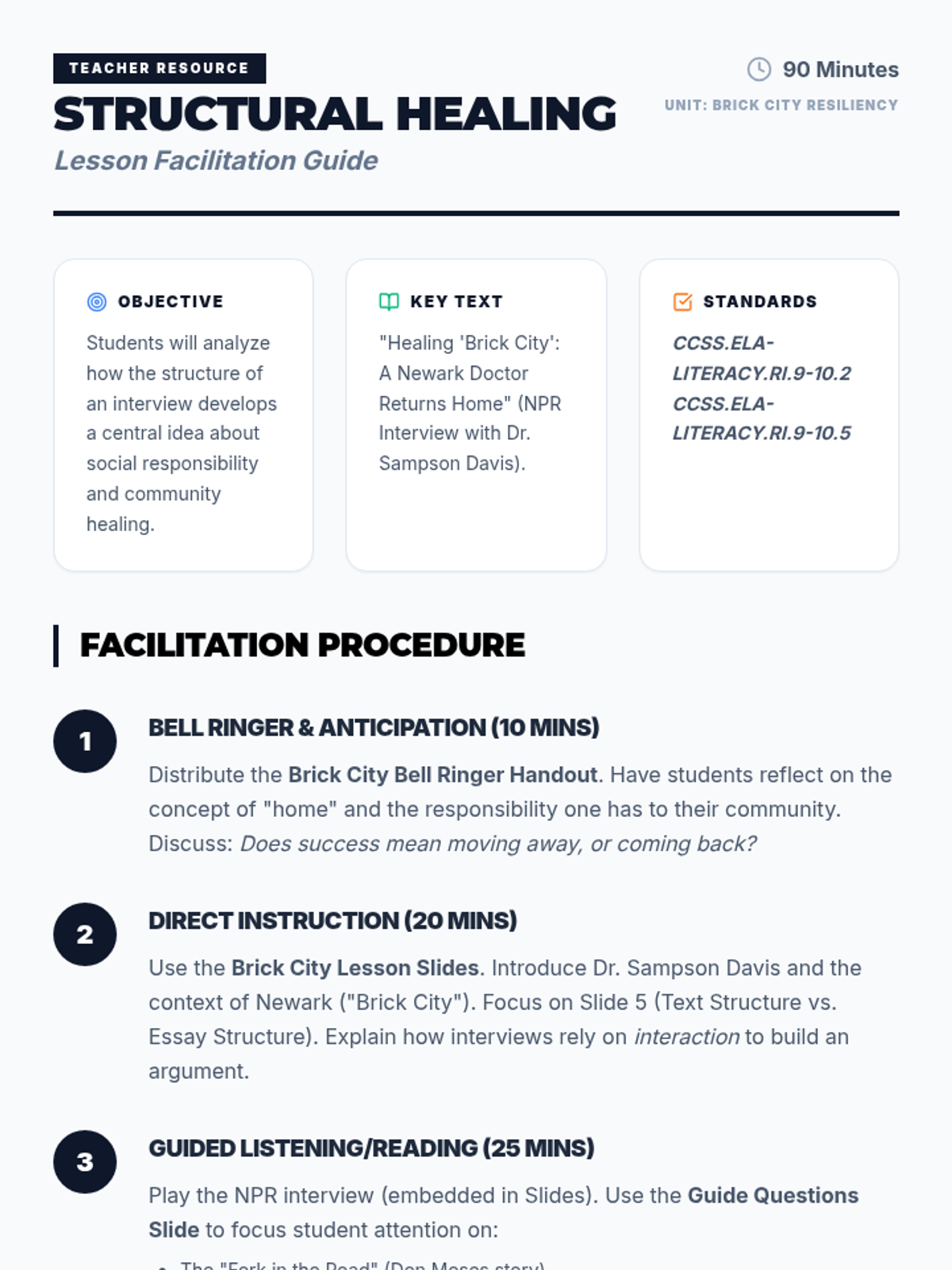
A comprehensive teacher's lesson guide for the 'Structural Healing' lesson, including learning objectives, standards, a step-by-step 90-minute procedure, and key discussion prompts. This version integrates the Moral Crossroads Debate activity.
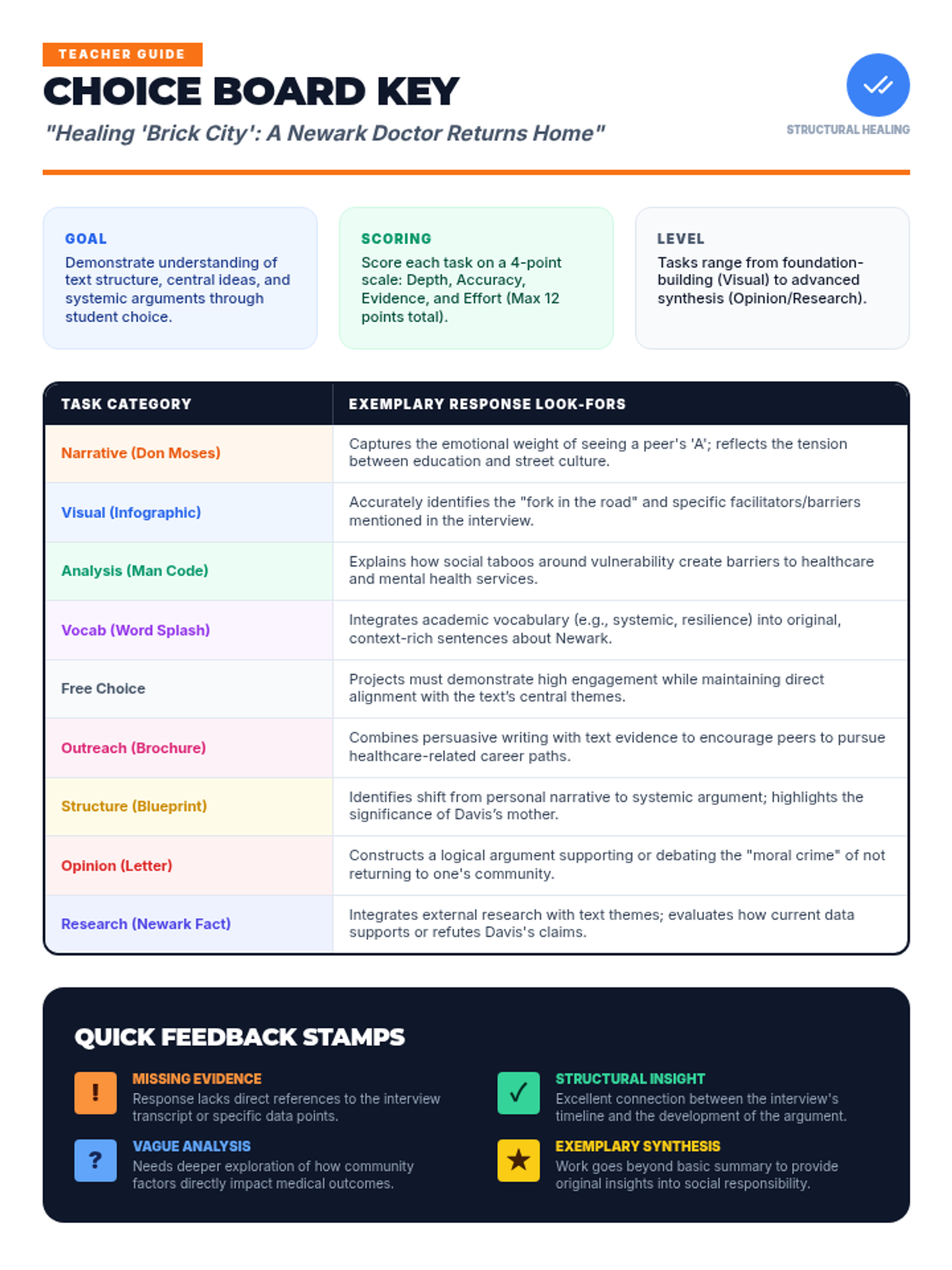
A teacher guide and assessment key for the Brick City Choice Board, providing specific response look-fors for all nine activities, grading criteria, and a quick feedback reference.
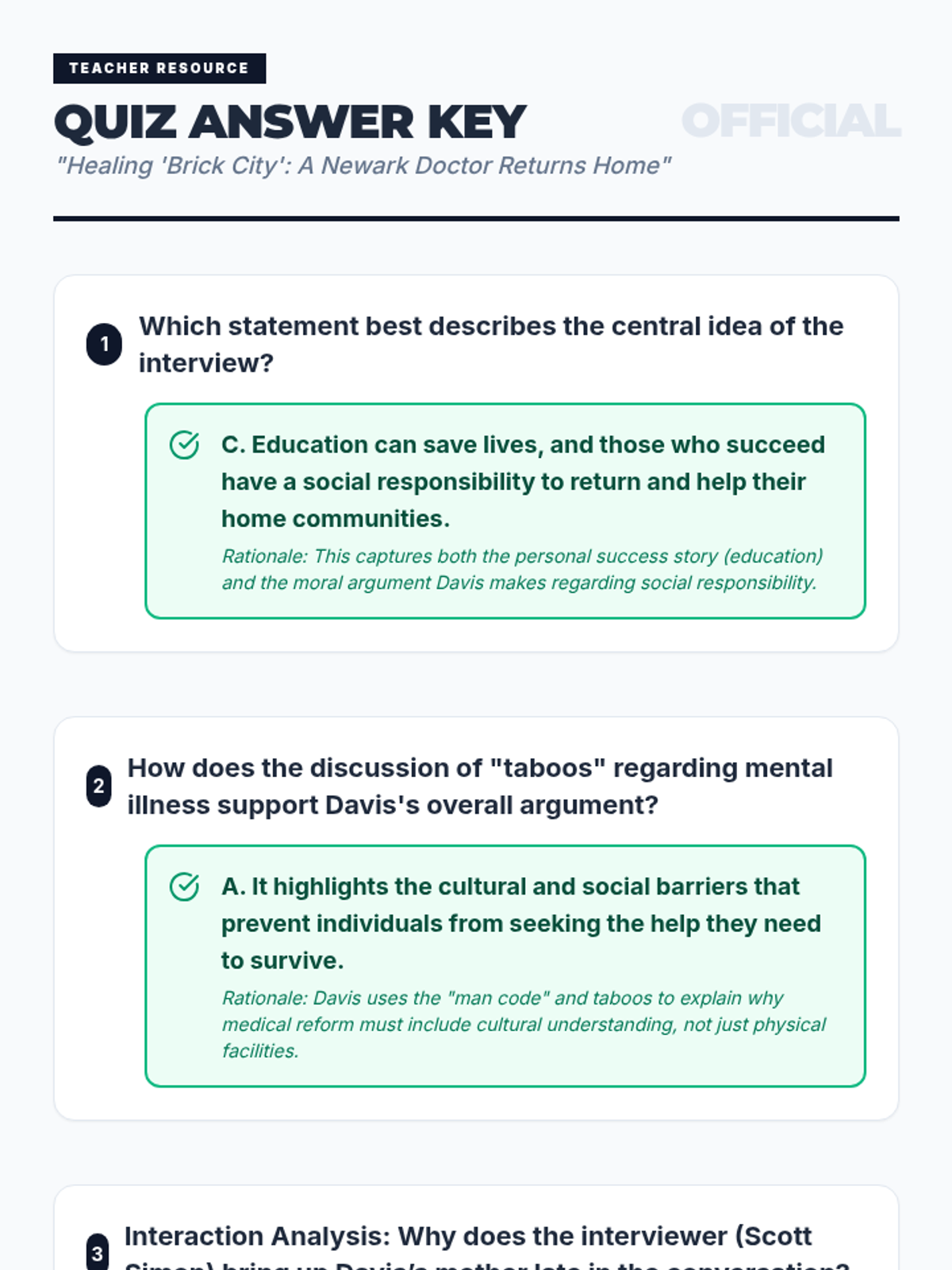
A comprehensive answer key for the Brick City Formative Quiz, featuring correct answers for multiple-choice questions, rationales for each choice, and a sample high-quality short answer response with grading criteria.
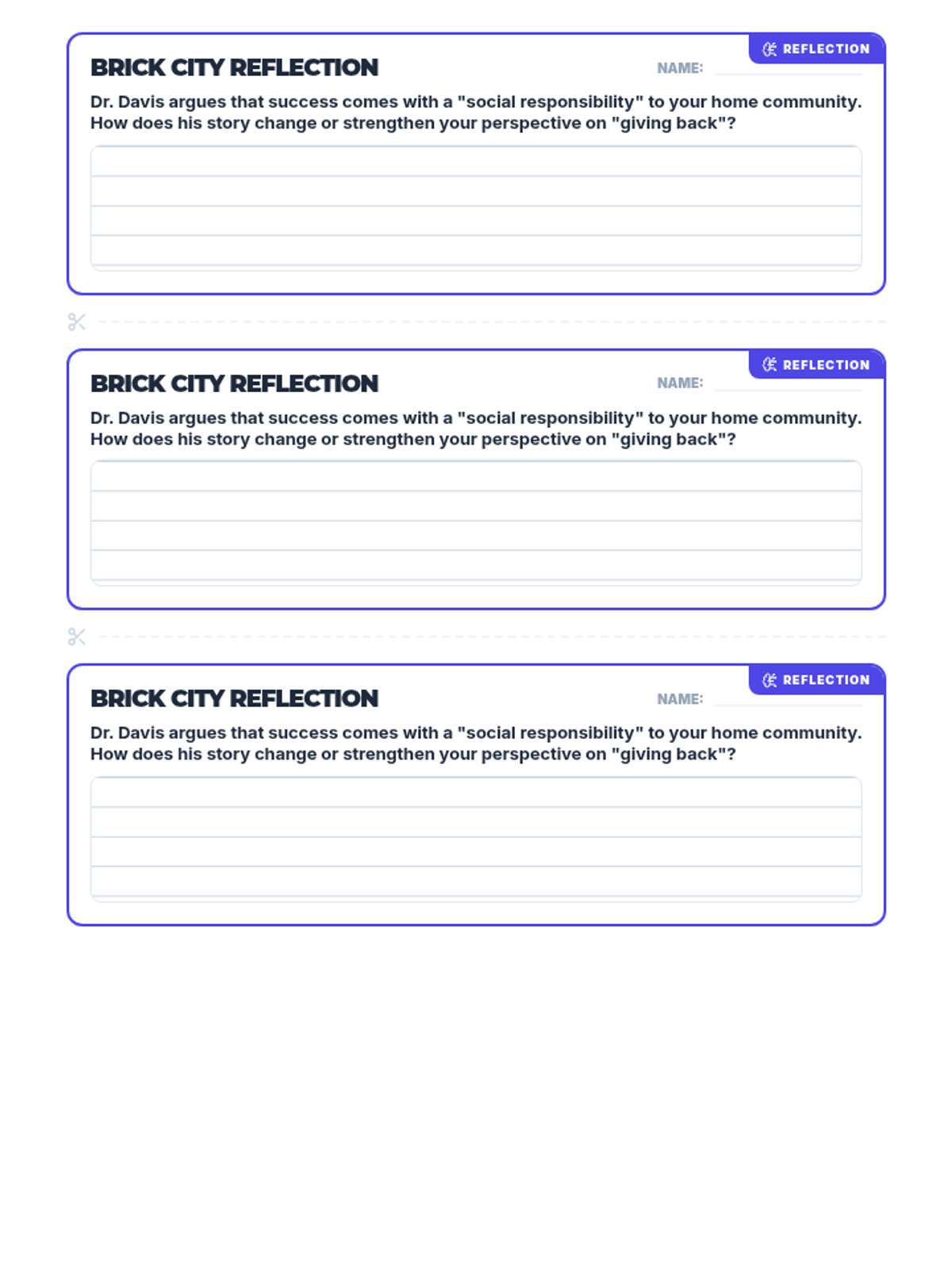
A revised exit ticket handout featuring three reflection-style slips on a single 8.5x11 page. The prompt focuses on the personal application of Dr. Davis's argument about social responsibility.
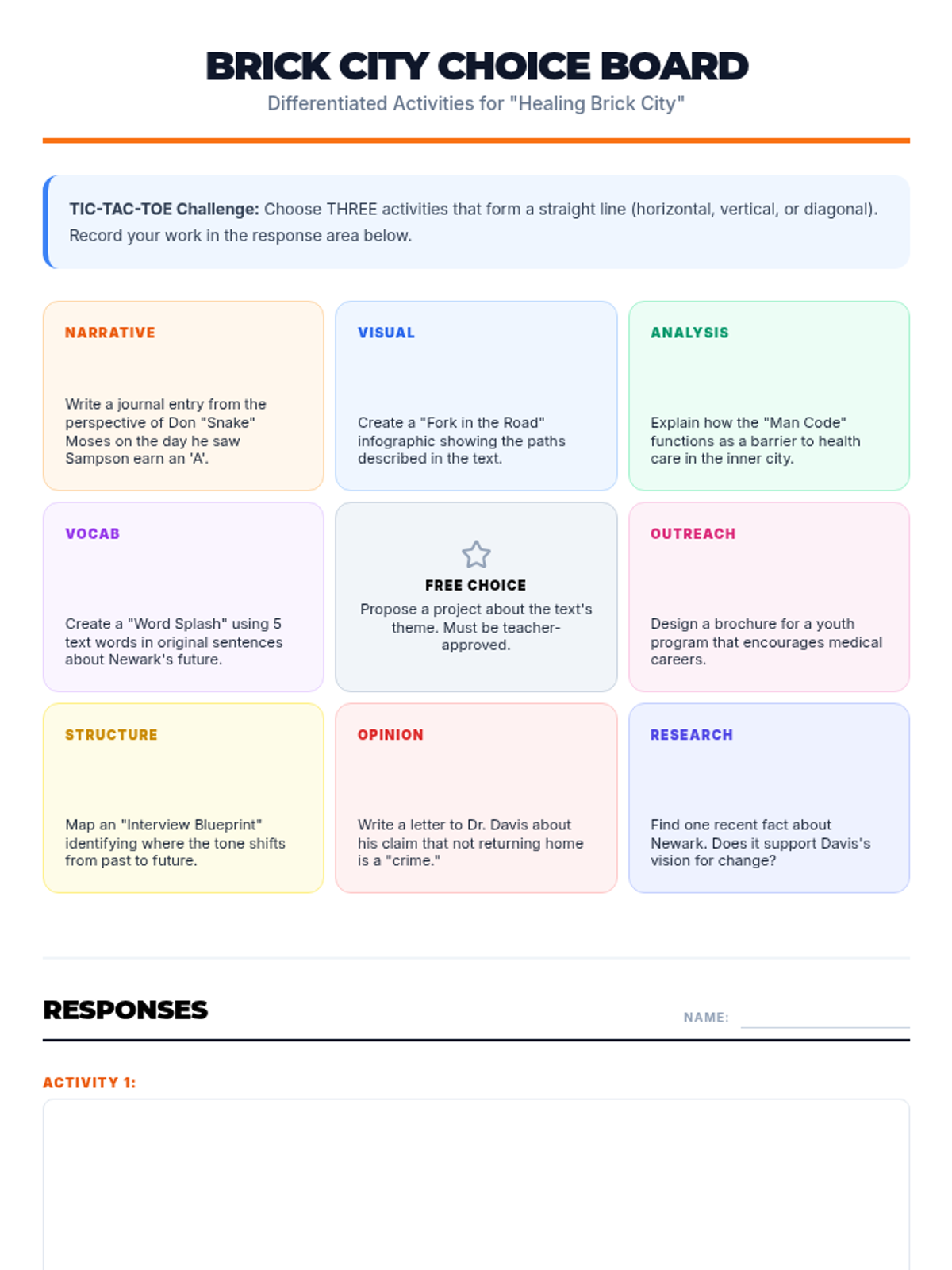
A revised Choice Board with 3 response slots, fixed page breaks for the response area, increased writing space, and a cleaner print-friendly white background. Content includes 9 differentiated tasks based on the text.
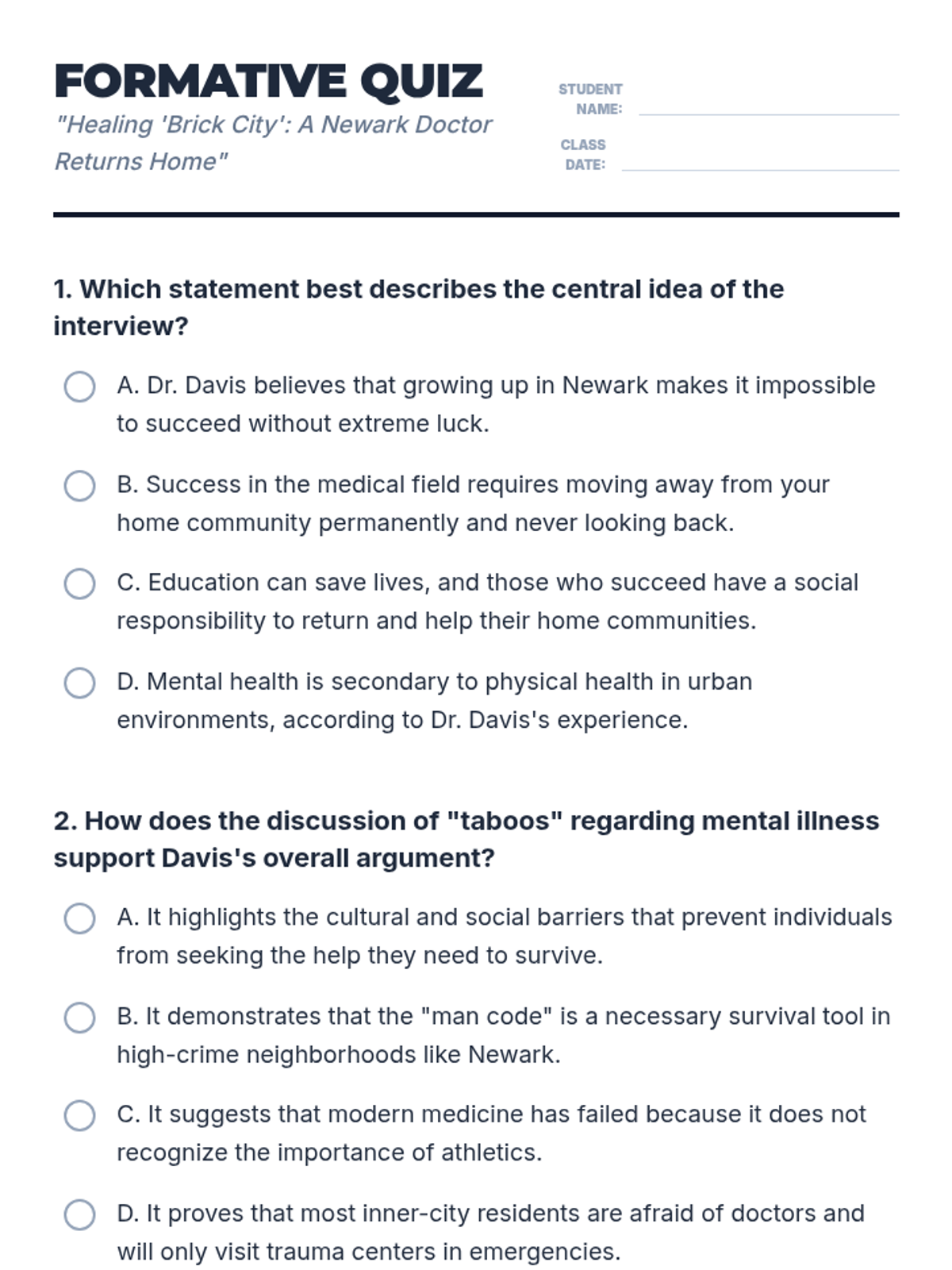
A revised formative quiz with improved page breaks (using break-inside: avoid), larger name/date fields, and a white response area for student handwriting. Questions focus on central ideas and structural analysis.
A complete overhaul of the 'Healing Brick City' lesson slides, transformed with a vibrant and colorful aesthetic. The video on Slide 23 has been removed for better performance and replaced with a high-impact graphic and key quote summarizing 'The Pact' to maintain instructional flow. Multiple-choice options in the Quiz Bee are now more compact and legible.
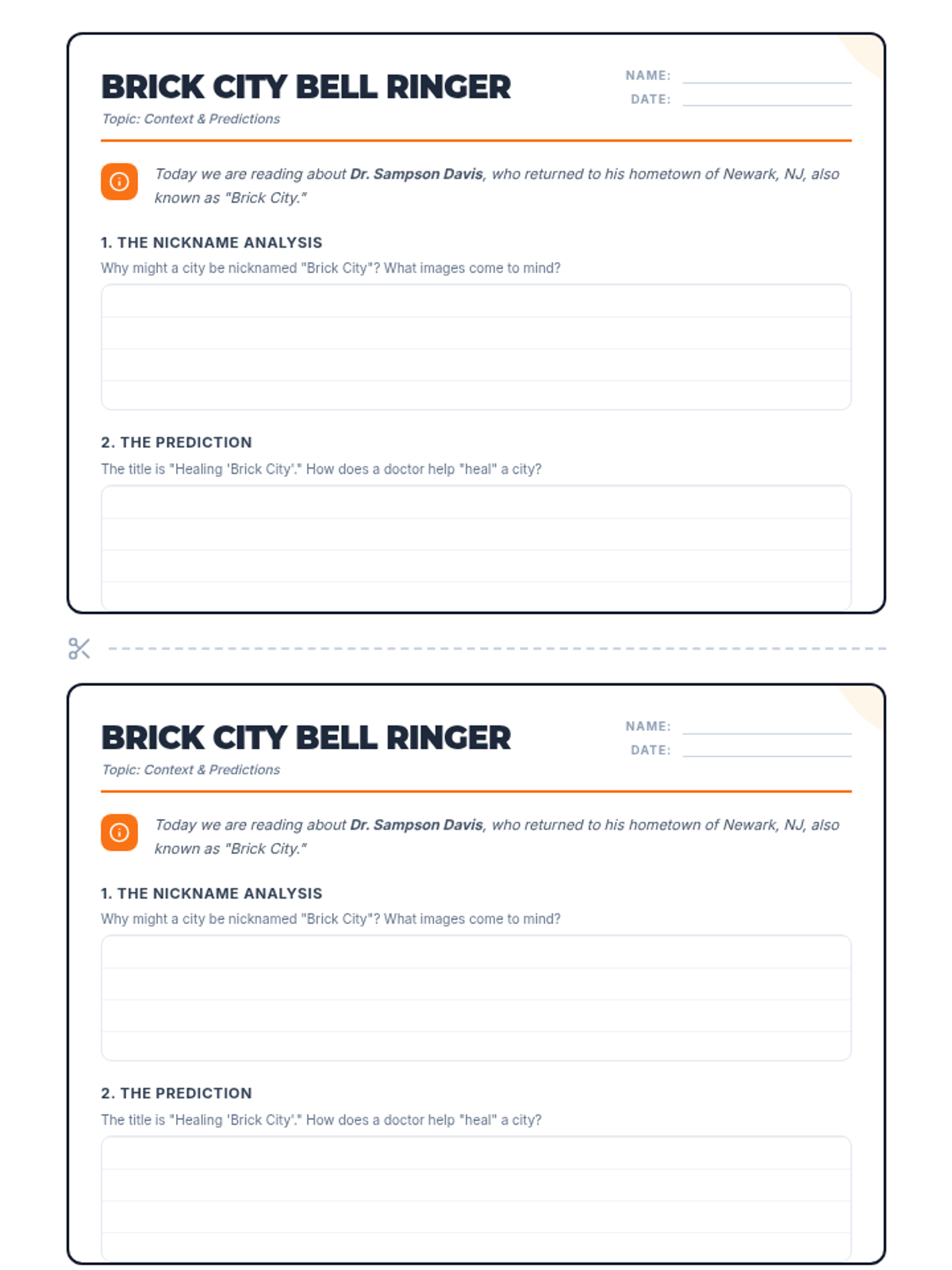
A final revised bell ringer handout with two copies per page, featuring a fixed height layout for perfect 8.5x11 printing, lined writing areas, and improved cut line contrast.
Instructional slides defining theme and exploring the symbolism of the "Mess" in 'The Cat in the Hat', concluding with a discussion on the final moral question. Visuals optimized for balance and readability.
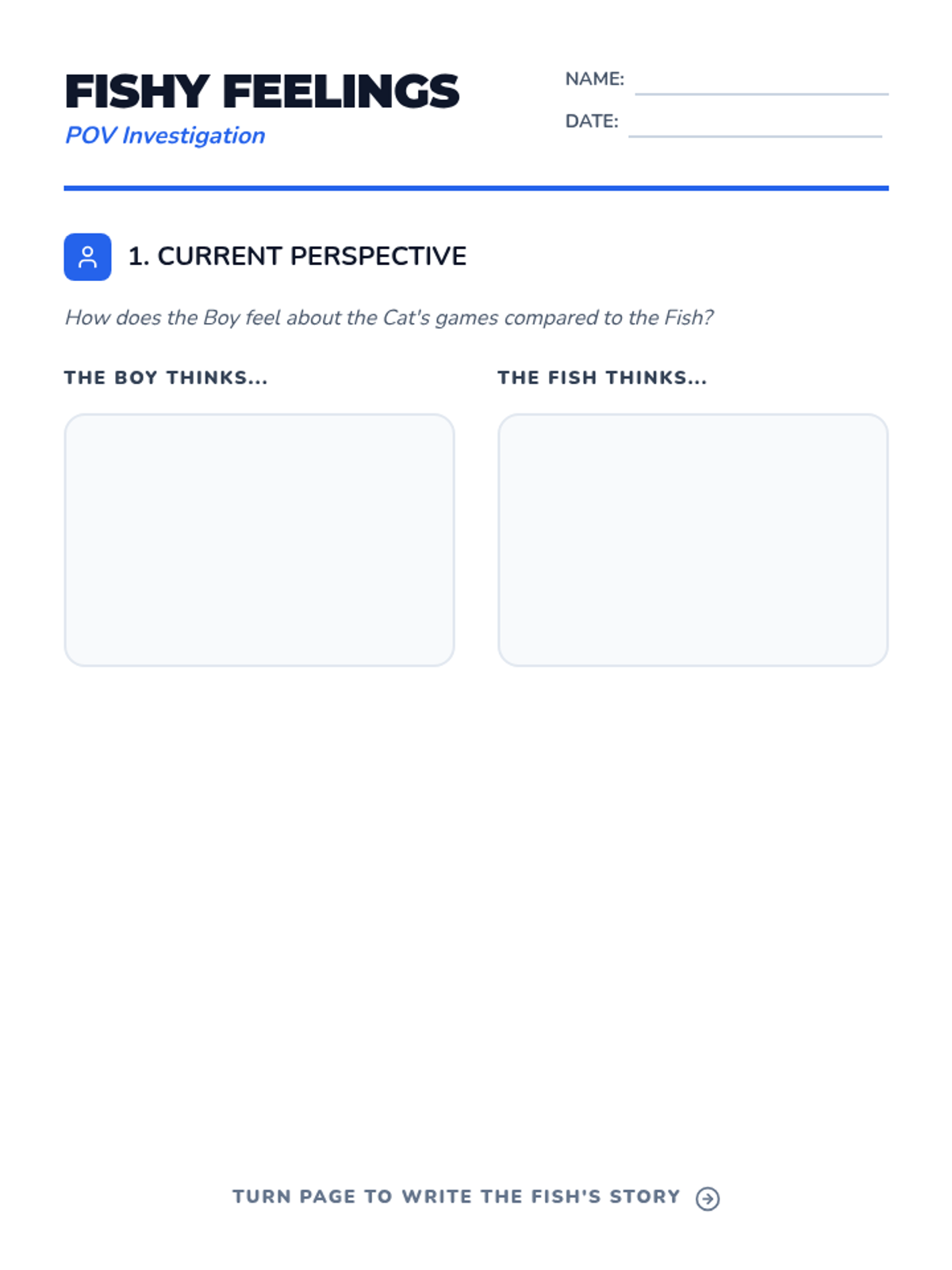
A creative writing and analysis worksheet where students compare character perspectives and rewrite a key scene from the Fish's first-person point of view. Optimized for proper page flow and student work space.
Instructional slides comparing first and third person point of view, specifically focusing on how the Fish and the Cat perceive the events of the story differently.
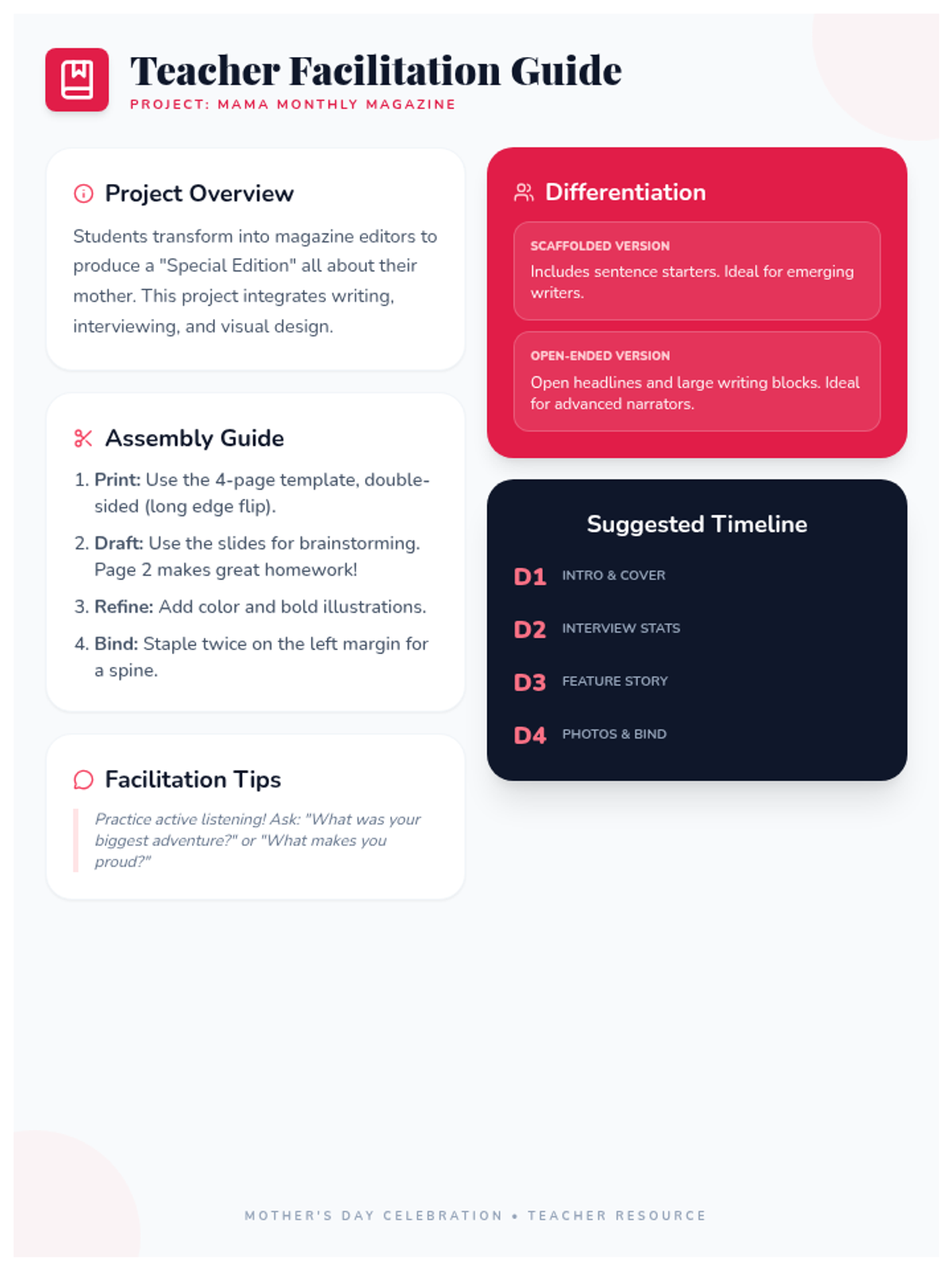
A teacher's guide providing project overview, assembly instructions, differentiation tips, and a suggested timeline for the Mama Monthly magazine project. Revised for better layout and clarity.
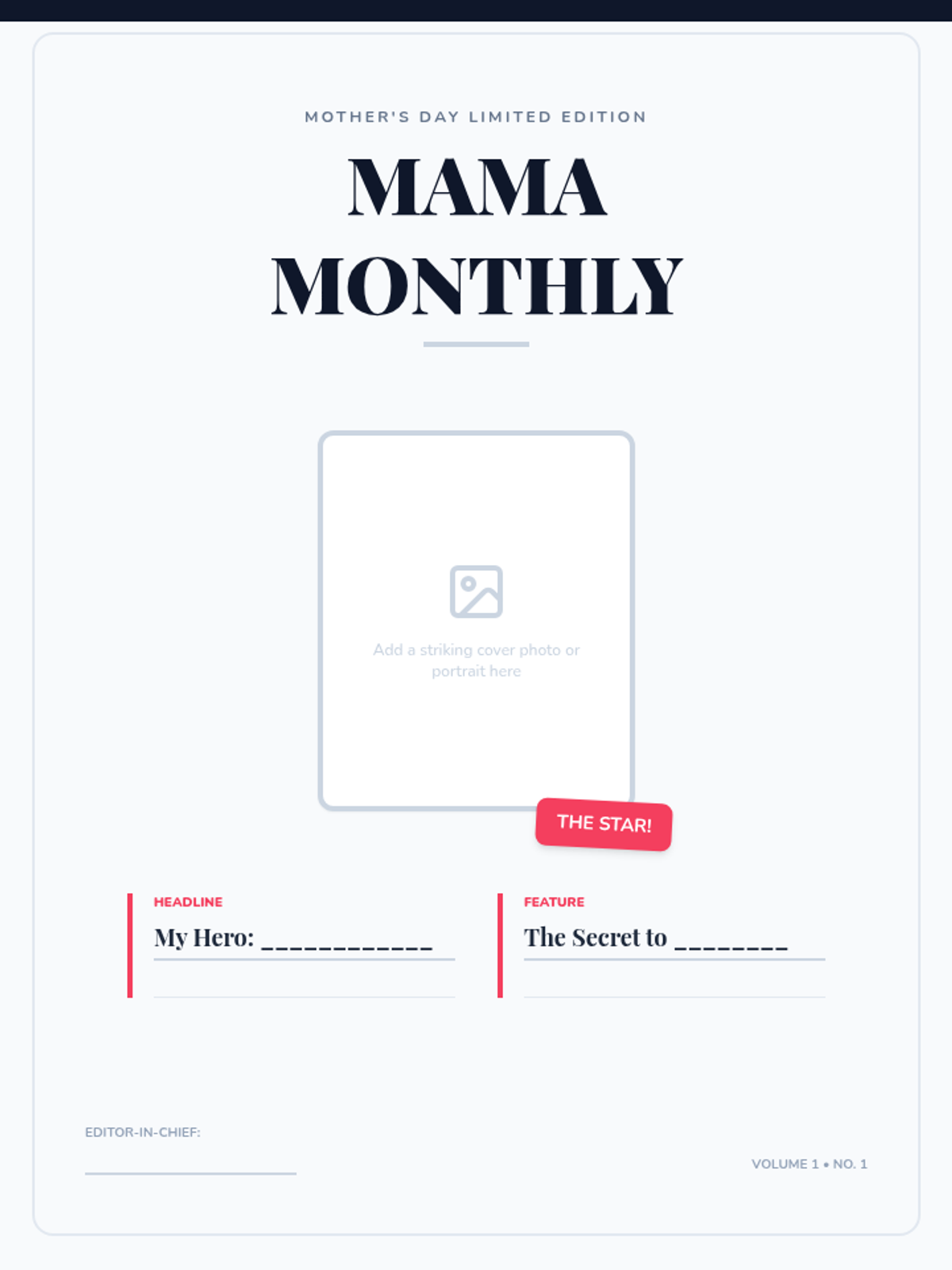
A 4-page printable magazine template with open-ended writing prompts and headline spaces for advanced writers to celebrate Mother's Day. Revised for better layout and writing space.
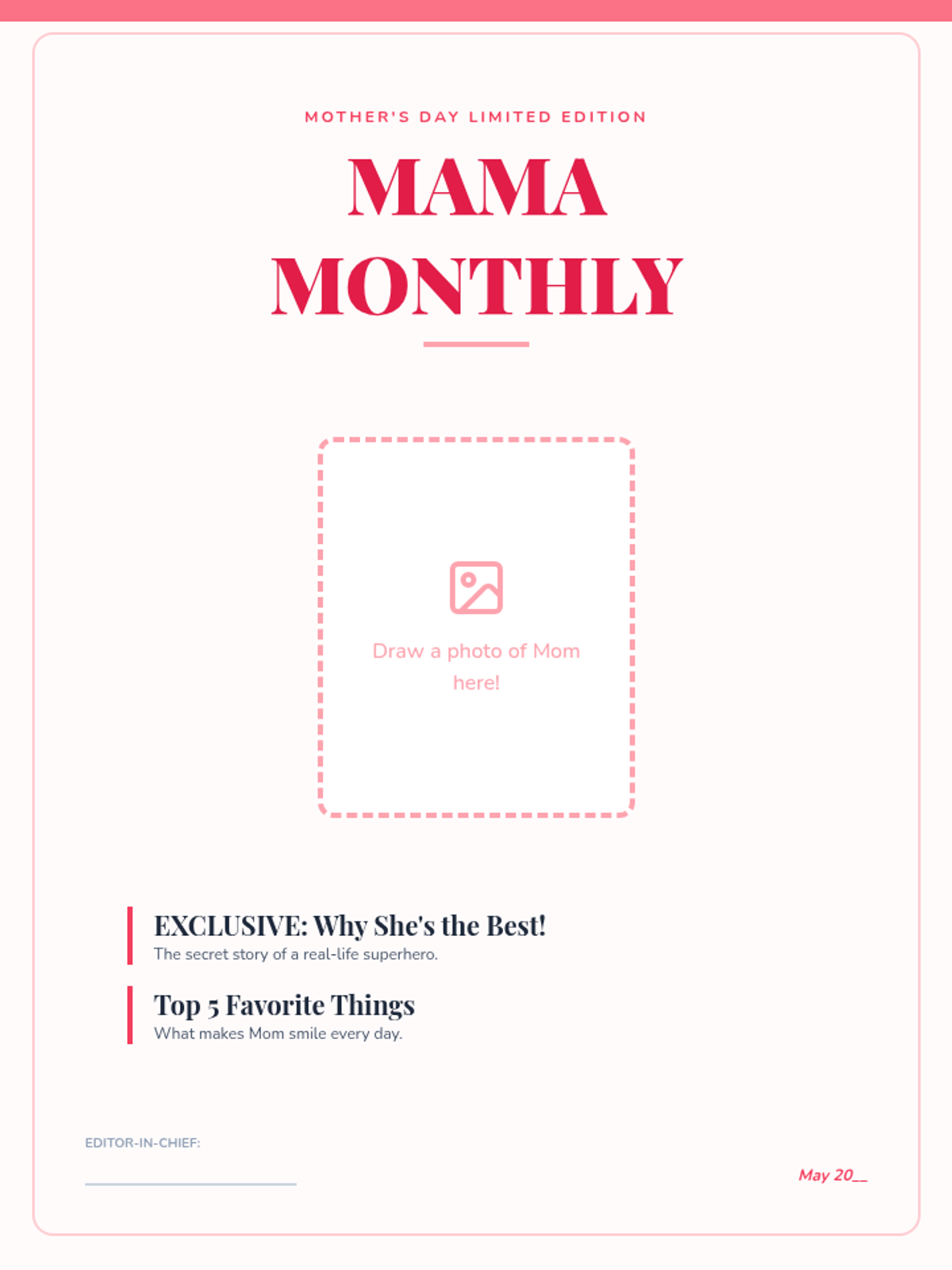
A 4-page printable magazine template with sentence starters for Mother's Day, including a cover, profile page, feature story, and photo gallery. Revised for better page breaks and writing space.
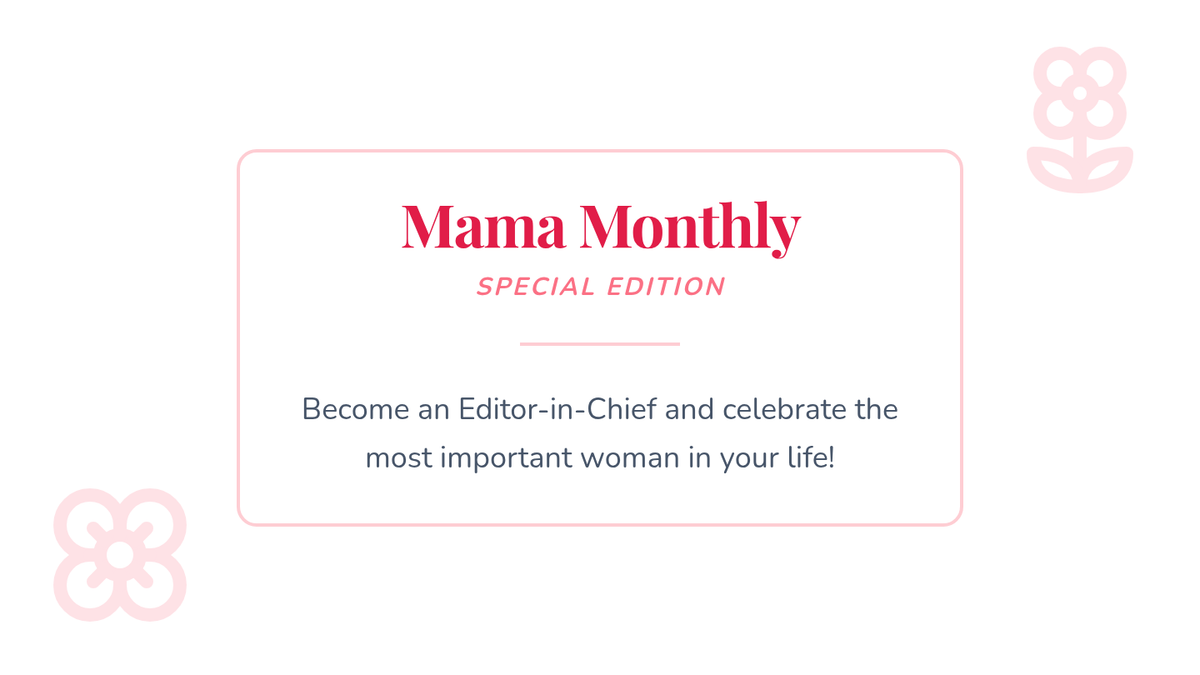
A visually engaging slide deck that introduces students to the concept of a magazine, brainstorms content about their mothers, and teaches basic interviewing skills for their project.
Visual aids for the 'Silent Echoes' Socratic Seminar, including the core prompt, opening question, and discussion norms.
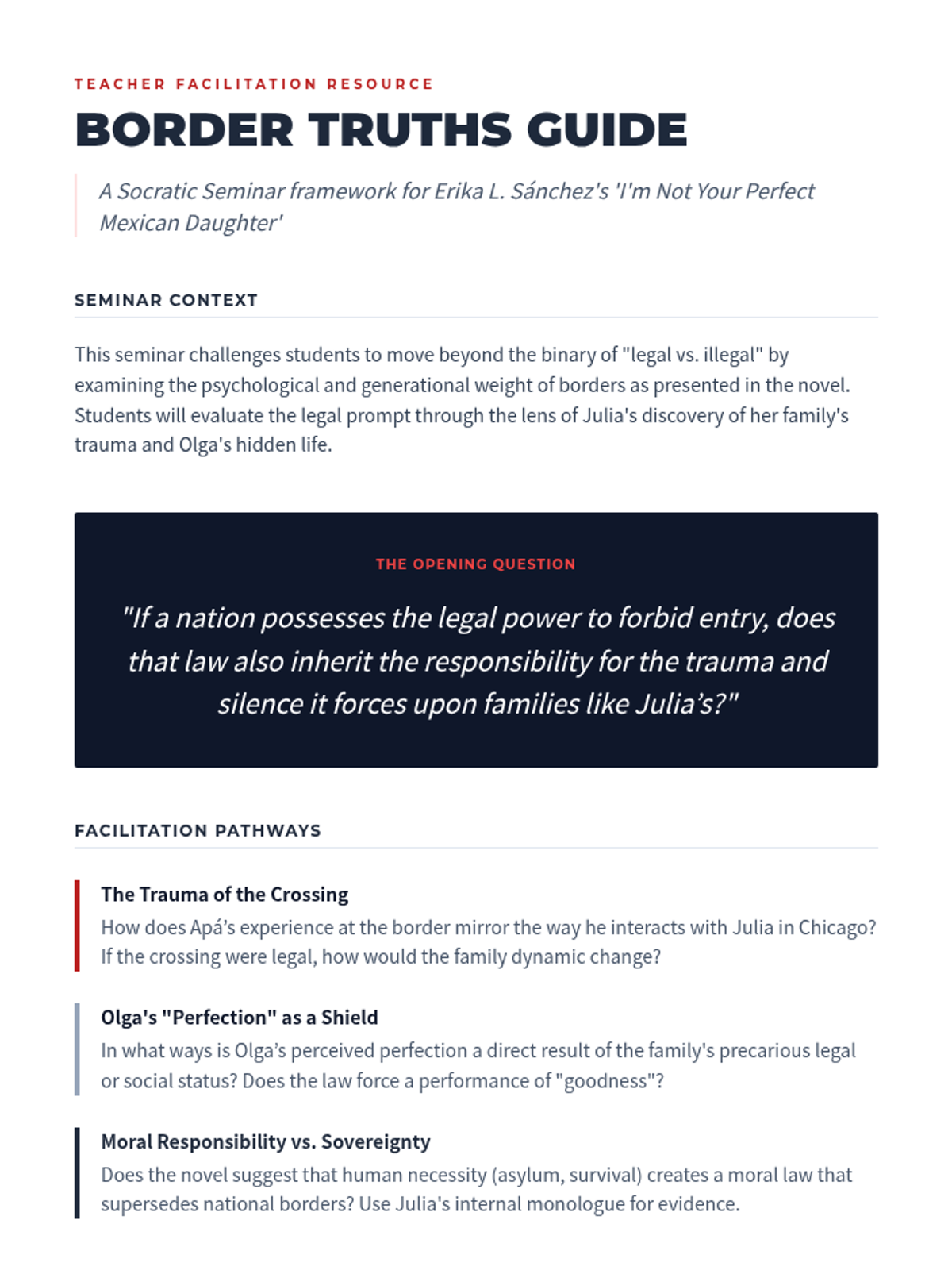
A comprehensive teacher's guide for facilitating a Socratic Seminar on 'I\'m Not Your Perfect Mexican Daughter', including the opening question, follow-up prompts, and evidence reference points.
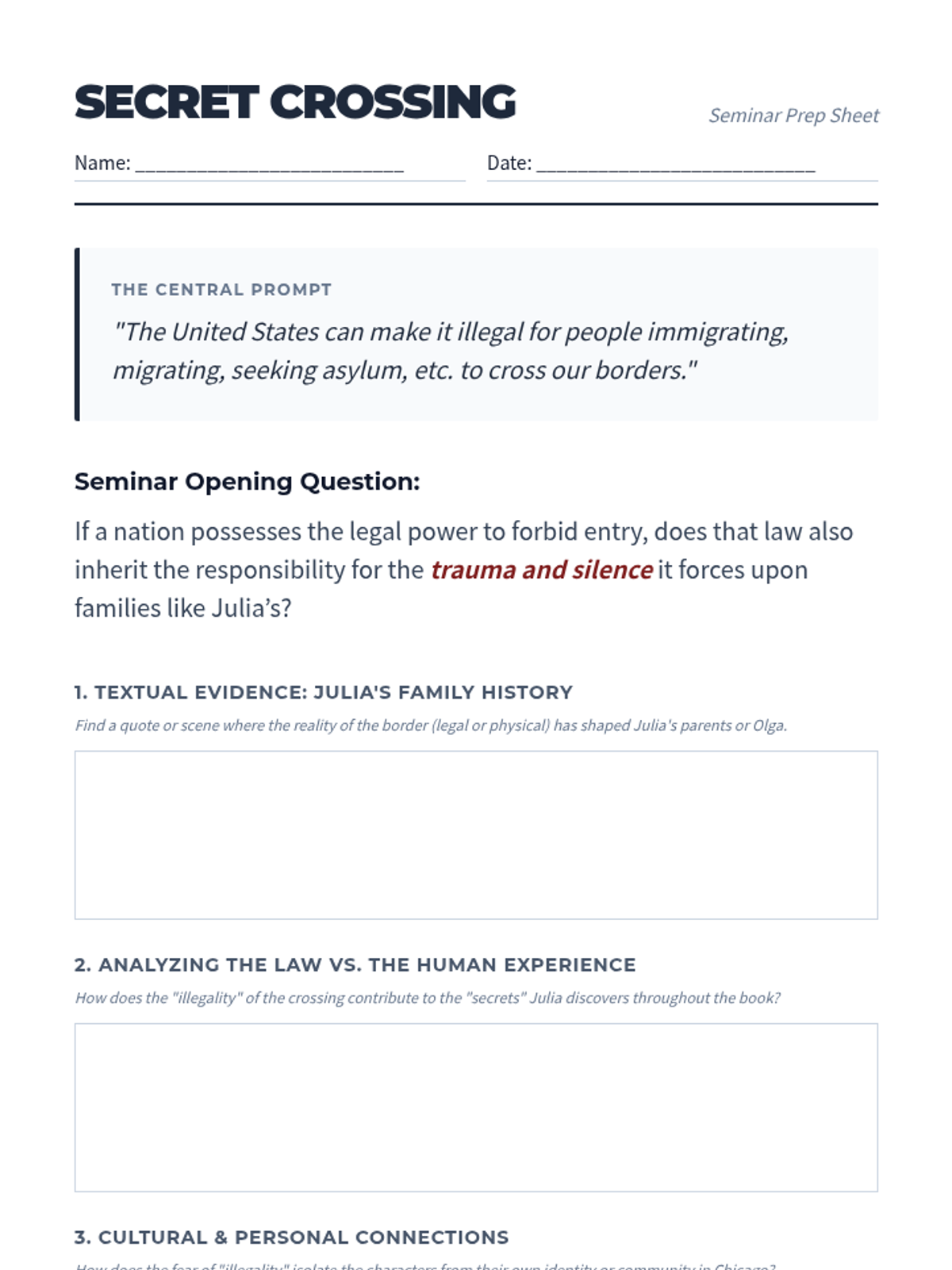
A student preparation sheet for a Socratic Seminar on 'I\'m Not Your Perfect Mexican Daughter', featuring the central prompt about border legality and spaces for gathering textual evidence.