A comprehensive teacher guide for facilitating Lesson 3, focusing on grant budgeting, indirect costs, and persuasive budget justification techniques.
An introductory presentation for teachers to explain the purpose of nonsense words and model the decoding process (Look, Tap, Blend) with the class. Includes practice slides for CVC and initial blends.
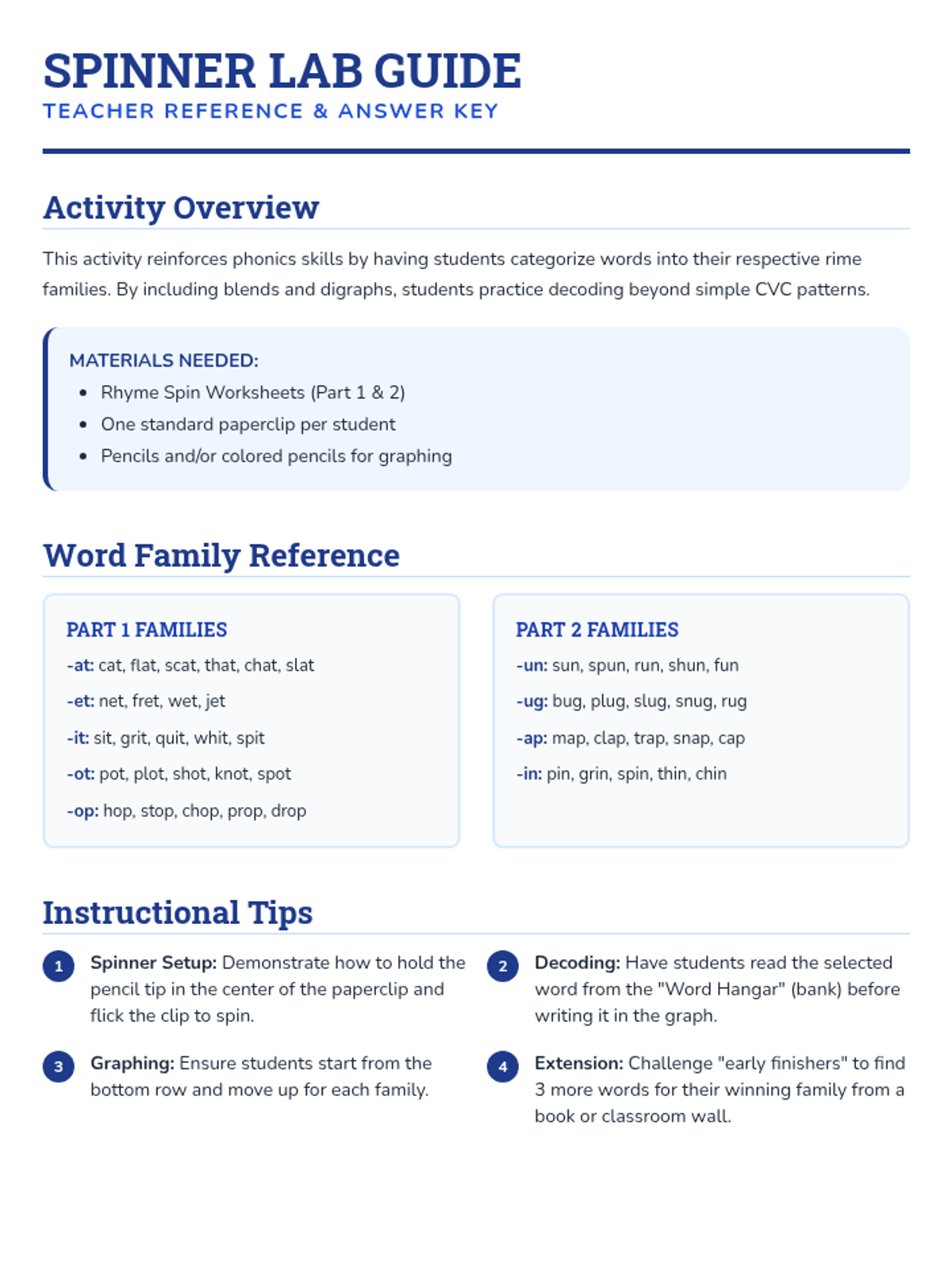
A teacher resource providing the answer key for the sorting activity, instructional objectives, and tips for administering the nonsense word assessments and drills.
An independent work activity where students sort nonsense words into different planetary categories based on their short vowel sounds. Includes 15 words across all five short vowels.
A set of four timed nonsense word reading drills (12 words each) for students to practice decoding fluency and speed. Includes a simple progress tracking log at the bottom.
A student-facing nonsense word reading assessment with a space theme, featuring 25 words ranging from CVC to blends and digraphs. Includes a teacher scoring section.
An answer key for the Sentence Lab Worksheet, providing correct classifications and example repairs for grammar exercises.
A visual graphic organizer designed to help students build complete sentences by connecting subjects and predicates in a color-coded "construction" layout.
A structured worksheet for identifying and fixing sentence fragments and run-ons using visual scaffolds and color-coding for subjects and predicates.
Instructional slides with a construction theme that define fragments, complete sentences, and run-ons using color-coded visual scaffolds.
A professional teacher guide for the Sentence Builders lesson, featuring color-coded keys, instructional strategies for autistic students, and a step-by-step delivery plan.
A 5-question multiple-choice assessment designed for English I students, explicitly set to English locale to prevent browser translation issues during printing.
A comprehensive double-sided student handout in English, combining logical fallacy definitions with history/science case study paragraphs and analysis areas. Explicitly set to English locale to prevent browser translation issues.
A comprehensive double-sided student handout combining the logical fallacy definitions with the four history/science case study paragraphs and significantly expanded work areas for student analysis.
A 5-question multiple-choice assessment designed for English I students, redesigned into a concise single-page format for efficient classroom use.
Teacher answer key and grading rubric for the Lunar Leap Assessment, featuring standards alignment and rationales for each answer. This version is optimized for perfect 8.5x11 printing with fixed page heights.