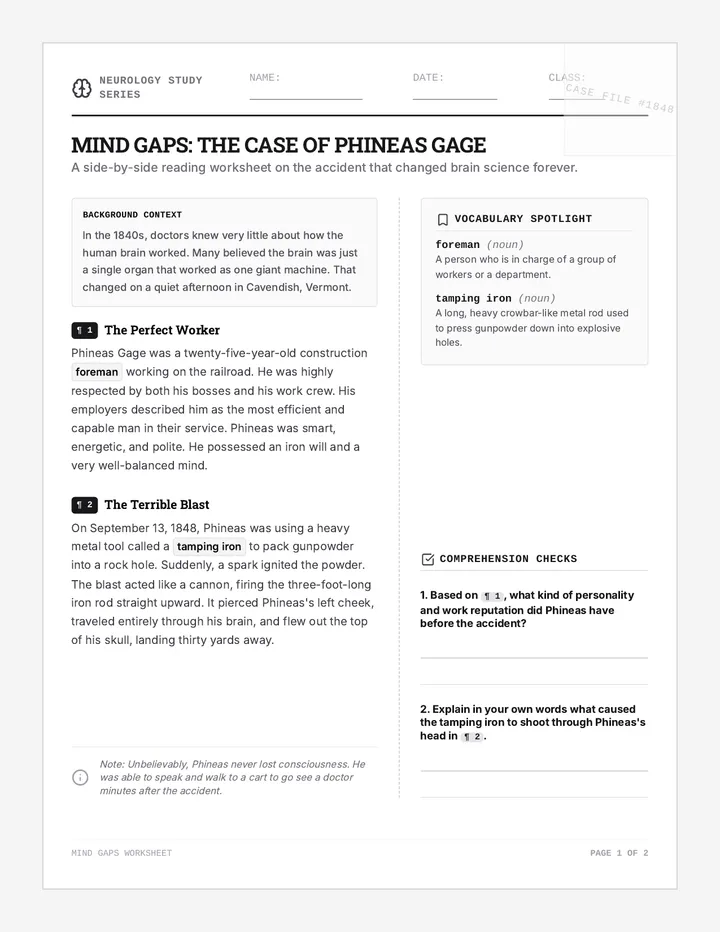
A comprehensive student worksheet accompanying the reading passage, featuring reading comprehension, vocabulary matching, a technological comparison activity, and an ethical scenario analysis on biodiversity and land management.
Le corrigé détaillé de l'évaluation sur les interactions, incluant le barème par question et les solutions graphiques attendues pour les DOI et les vecteurs. Version corrigée avec tracés SVG et mise en page optimisée.
Une évaluation de physique-chimie de 50 minutes pour le niveau 4ème, centrée sur les interactions et les forces. Elle demande aux élèves de construire des DOI et de représenter des vecteurs forces avec précision. Version corrigée pour le layout et les rendus LaTeX.
Une évaluation de physique-chimie de 50 minutes pour le niveau 4ème, centrée sur les interactions et les forces. Elle demande aux élèves de construire des DOI et de représenter des vecteurs forces avec précision. Version corrigée pour le layout.
Le corrigé détaillé de l'évaluation sur les interactions, incluant le barème par question et les solutions graphiques attendues pour les DOI et les vecteurs.
Une évaluation de physique-chimie de 50 minutes pour le niveau 4ème, centrée sur les interactions et les forces. Elle demande aux élèves de construire des DOI et de représenter des vecteurs forces avec précision.
A high-stakes exit ticket for the Human Genetics lesson, evaluating student understanding of genetic hierarchy and their ability to solve Punnett square problems.
A teacher-facing resource for aggressive monitoring during the Human Genetics lesson, featuring specific 'look-fors' and a tracking grid for student mastery.
A set of three station activities for the Human Genetics lesson, including hands-on modeling instructions, a vocabulary matching game, and genetic cross task cards.
A high-impact slide presentation for the 90-minute Human Genetics lesson, covering DNA hierarchy and Punnett squares with built-in Think-Pair-Share and station instructions.
A student handout for the Human Genetics lesson featuring a bell ringer, guided notes with sentence stems, and practice Punnett square problems for aggressive monitoring.
Advanced investigator worksheet for high-achieving students. Features DOK 3 level strategic thinking questions, including probability justification, evolutionary persistence of alleles, and a complex CER on meiosis errors. Fixes page breaks and increases response space with a more compact layout. Added a mini-pedigree for Task 1.
Scaffolded investigator worksheet for students needing support. Fixes missing pedigree diagram, alignment in the matching section, and keeps stations on single pages.
Standard student investigator worksheet for the Human Genome lesson. Fixes page-break issues and increases writing space for students.
Four detailed station cards for the Human Genome investigation. Fixes pedigree diagrams, page overflow, and improves contrast for accessibility.
A high-impact 8-slide presentation deck for the Human Genome lesson. Fixes visual clarity on diagrams and text contrast issues. Added a Bell Ringer, simplified language, and improved chunking for better student engagement. Now includes X and Y chromosome labels on the karyotype example.
A detailed 2-day teacher facilitation guide for the Human Genome lesson, including pacing, teacher scripts, and aggressive monitoring checklists. Fixes formatting and content gaps.
A comprehensive teacher facilitation guide for Operation Earth. Includes a mission timeline for document deployment, specific support strategies for bilingual/ELL students, inquiry prompts, and presentation ideas. Simplified language is used for easy educator reference.
A simplified tactical worksheet to help students narrow their research focus. Uses simple language like 'Where?', 'Who?', and 'Why?' to guide bilingual students through picking a specific research target. Light backgrounds are used in all work areas for handwriting legibility.
A mission-themed brainstorming worksheet for Operation Earth with simplified language for bilingual students. Scaffolds inquiry from basic facts to 'hard' questions using a question ladder and a central mind map.
A teacher guide containing the answer keys for the worksheet and task cards, along with instructional tips and scaffolding strategies for teaching symbiotic relationships.
A graphic organizer featuring a relationship matrix for definitions and symbols, and a visualization tool for mapping specific symbiotic interactions. Includes writing lines and word bank support.