A 20-question practice test for geometric transformations, including translations, reflections, rotations, dilations, and compositions, styled as a technical blueprint.
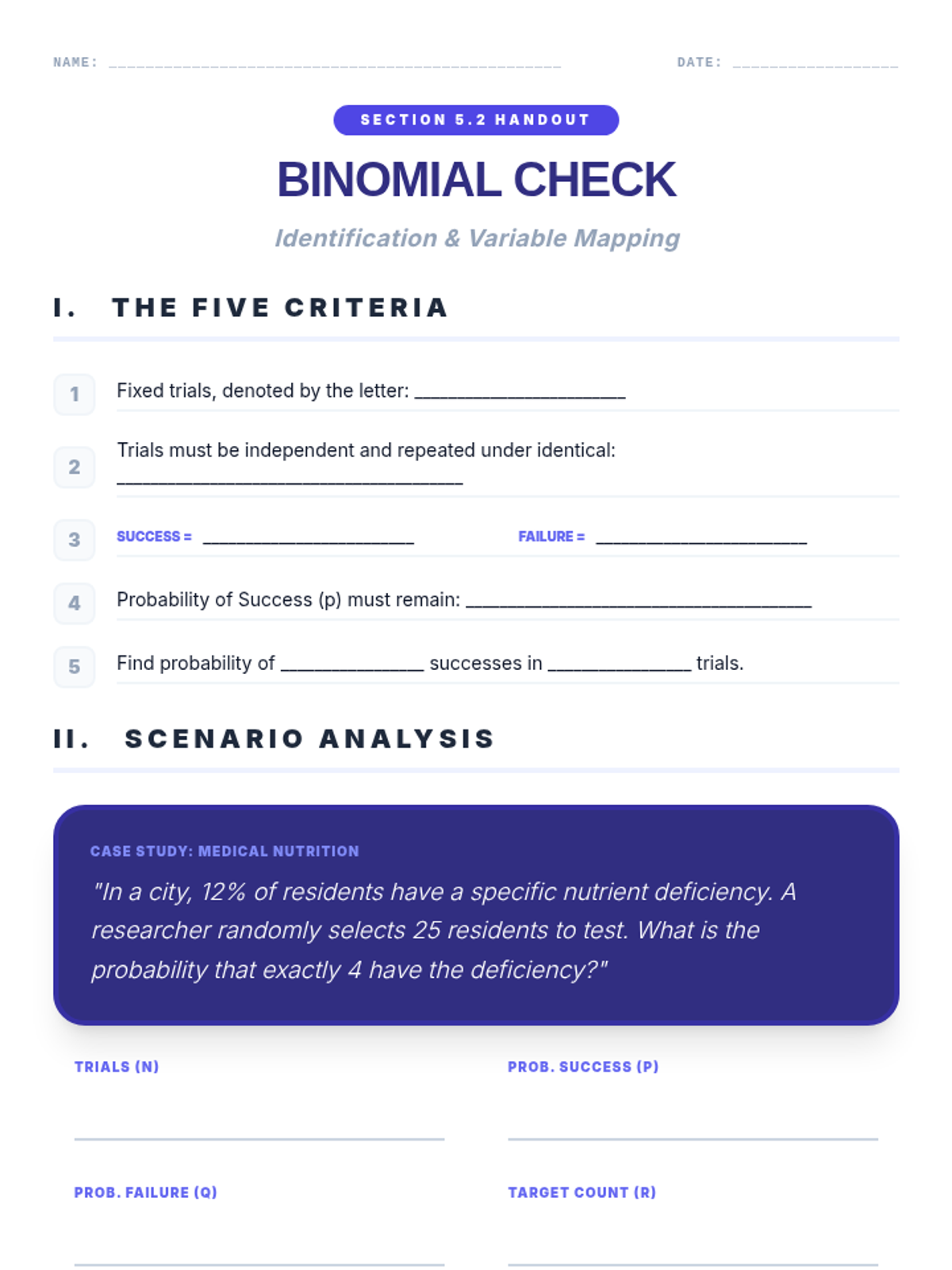
A student worksheet for identifying and applying the five features of binomial experiments, featuring scenario analysis and concept checks. Now with improved page-break handling and labeled answer areas.
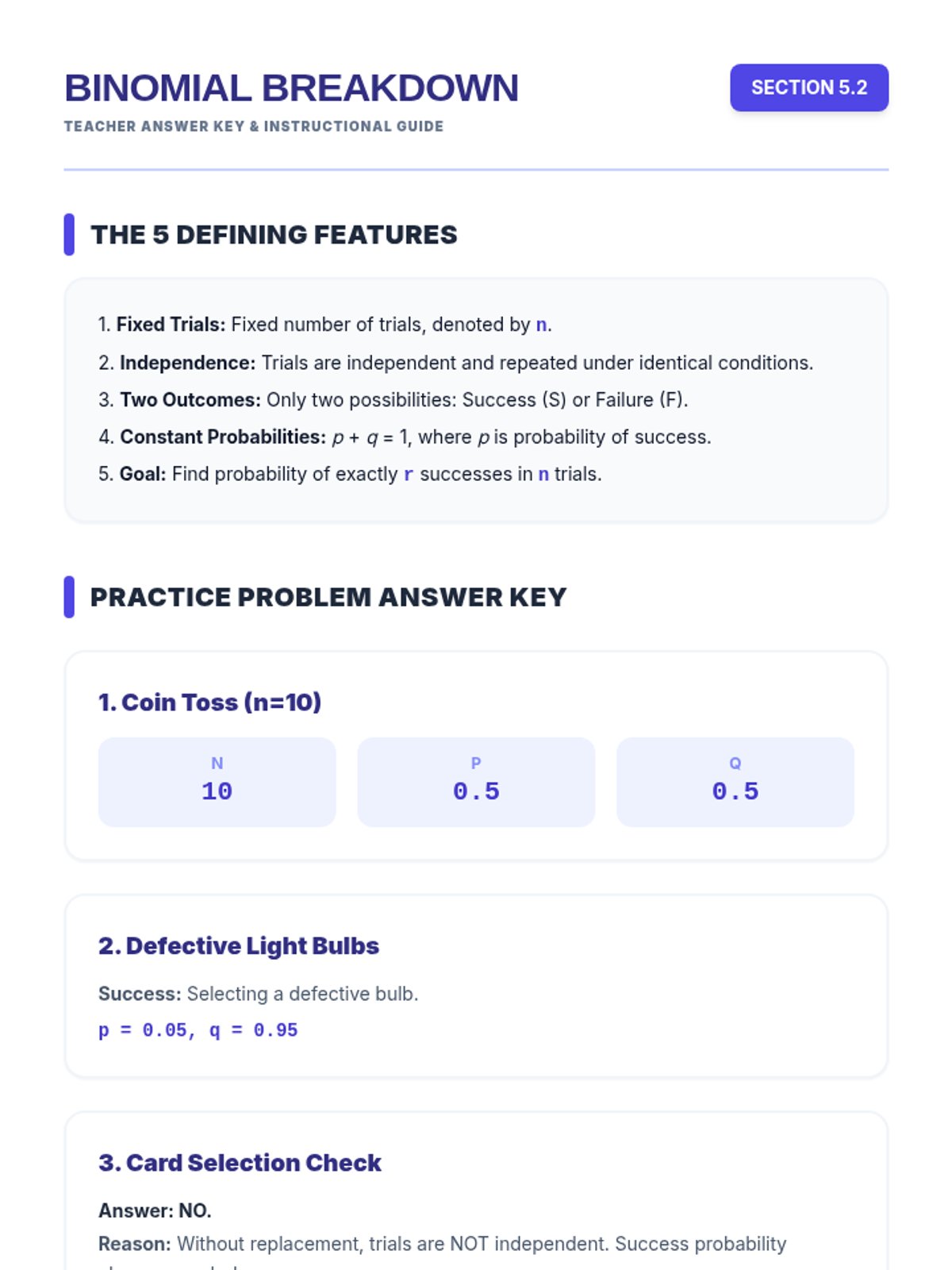
Teacher answer key and instructional guide for the Binomial Breakdown lesson, providing detailed solutions and pedagogical tips. Features improved page-break handling and math rendering.
A set of instructional slides introducing binomial experiments, their five defining features, and real-world calculation examples. Now with improved layouts and math rendering.
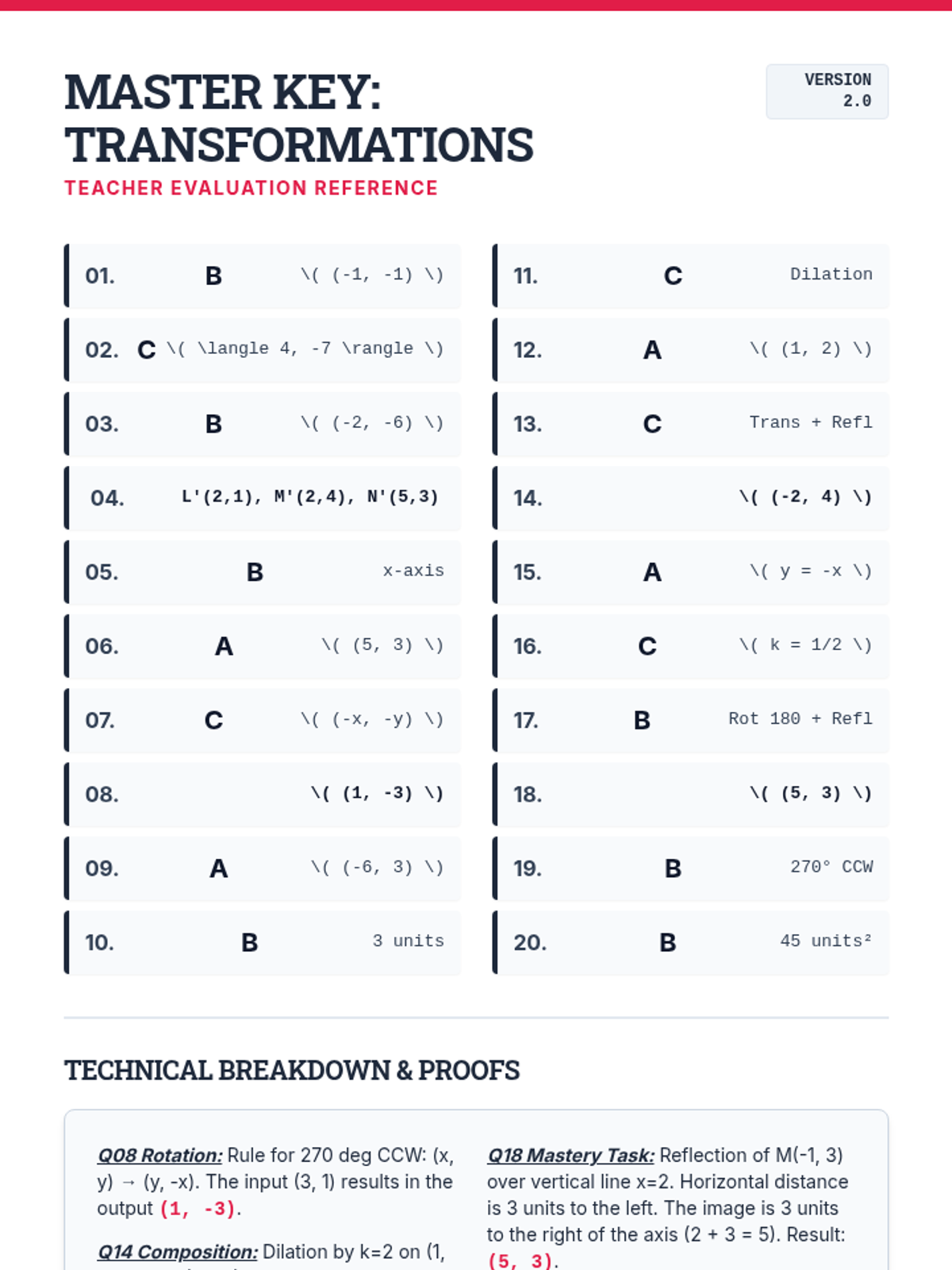
Answer key for the Transformation Blueprint Reviewer, providing correct answers and brief explanations for complex problems.
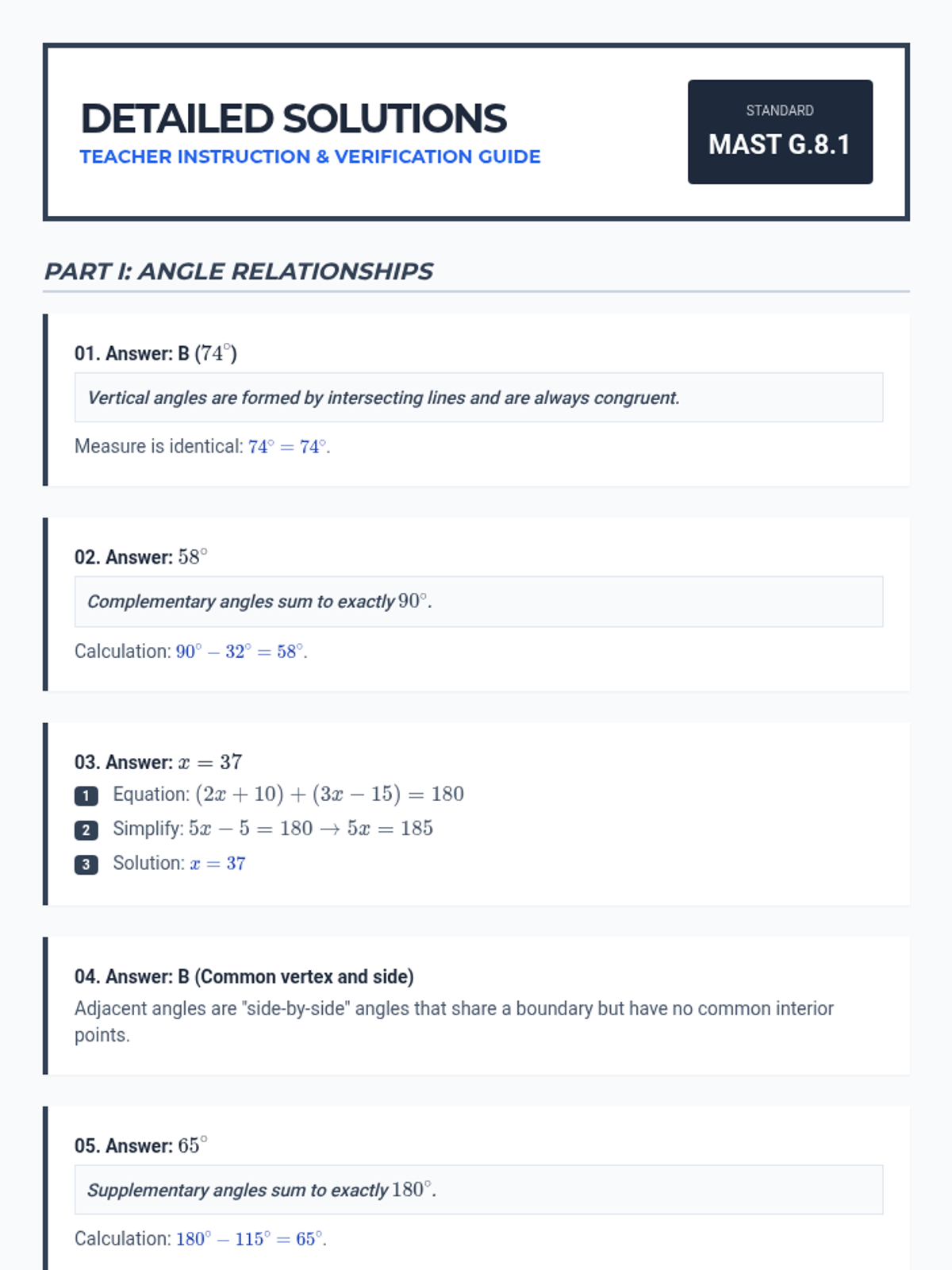
A detailed answer key and teacher facilitation guide for the Angle Navigator test. Features rule summaries, step-by-step algebraic solutions, and classification reasoning. Updated for improved vertical space and contrast.
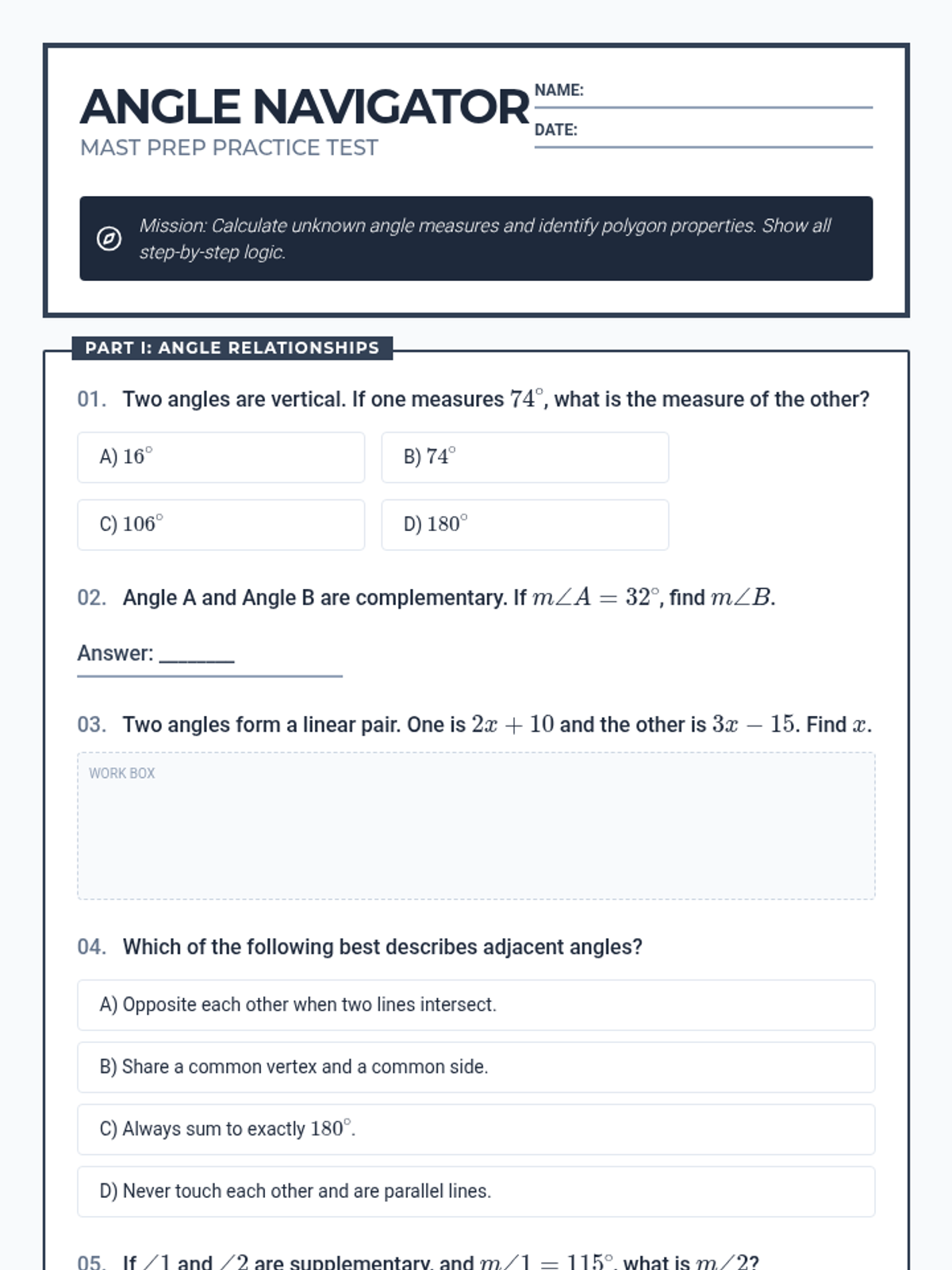
A 15-question practice test covering angle pairs, triangle sums, and quadrilateral sums, designed with an architectural blueprint theme. Includes expanded work areas, consistent multiple-choice styling, and a condensed answer key summary.
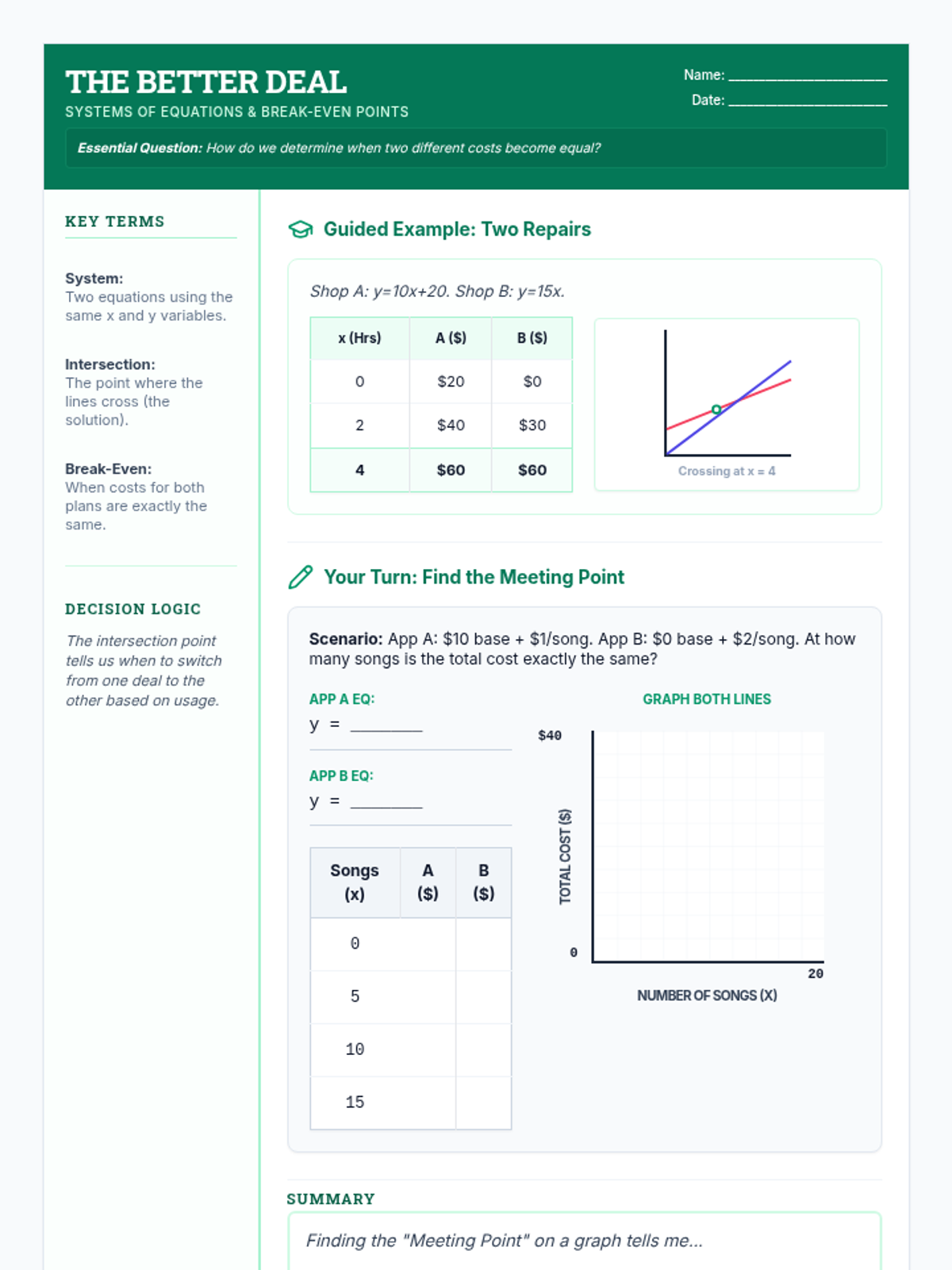
A Cornell-style notebook page that teaches students how to compare two different consumer options using systems of equations. It guides them through writing two equations, completing a comparison table, and graphing both lines on one coordinate plane to find the break-even point.
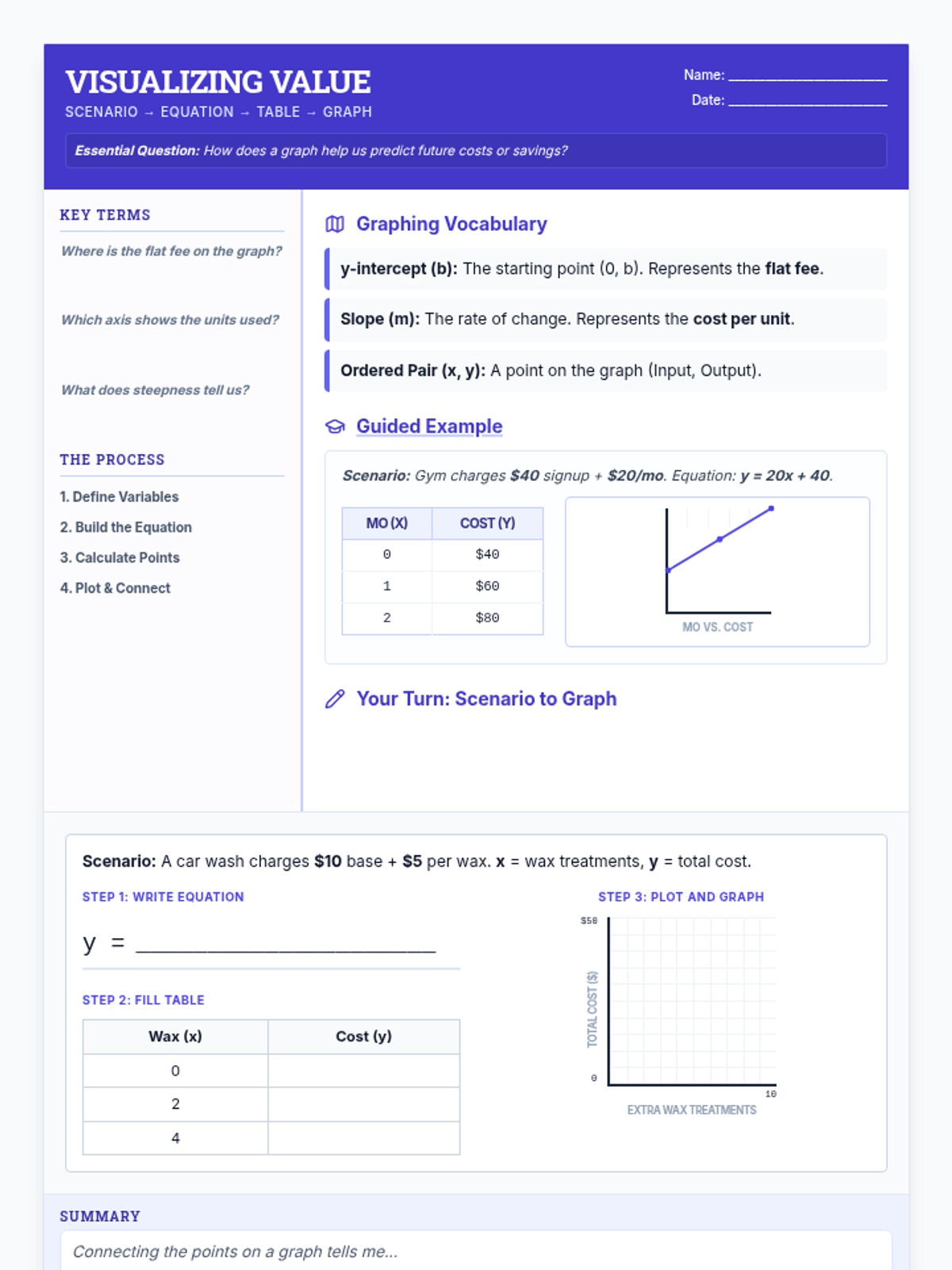
A Cornell-style notebook page that guides students through the complete process of algebraic modeling in consumer contexts: translating a scenario into an equation, completing a table of values, and plotting the data on a coordinate plane. It features a gym membership guided example and a car wash practice problem.
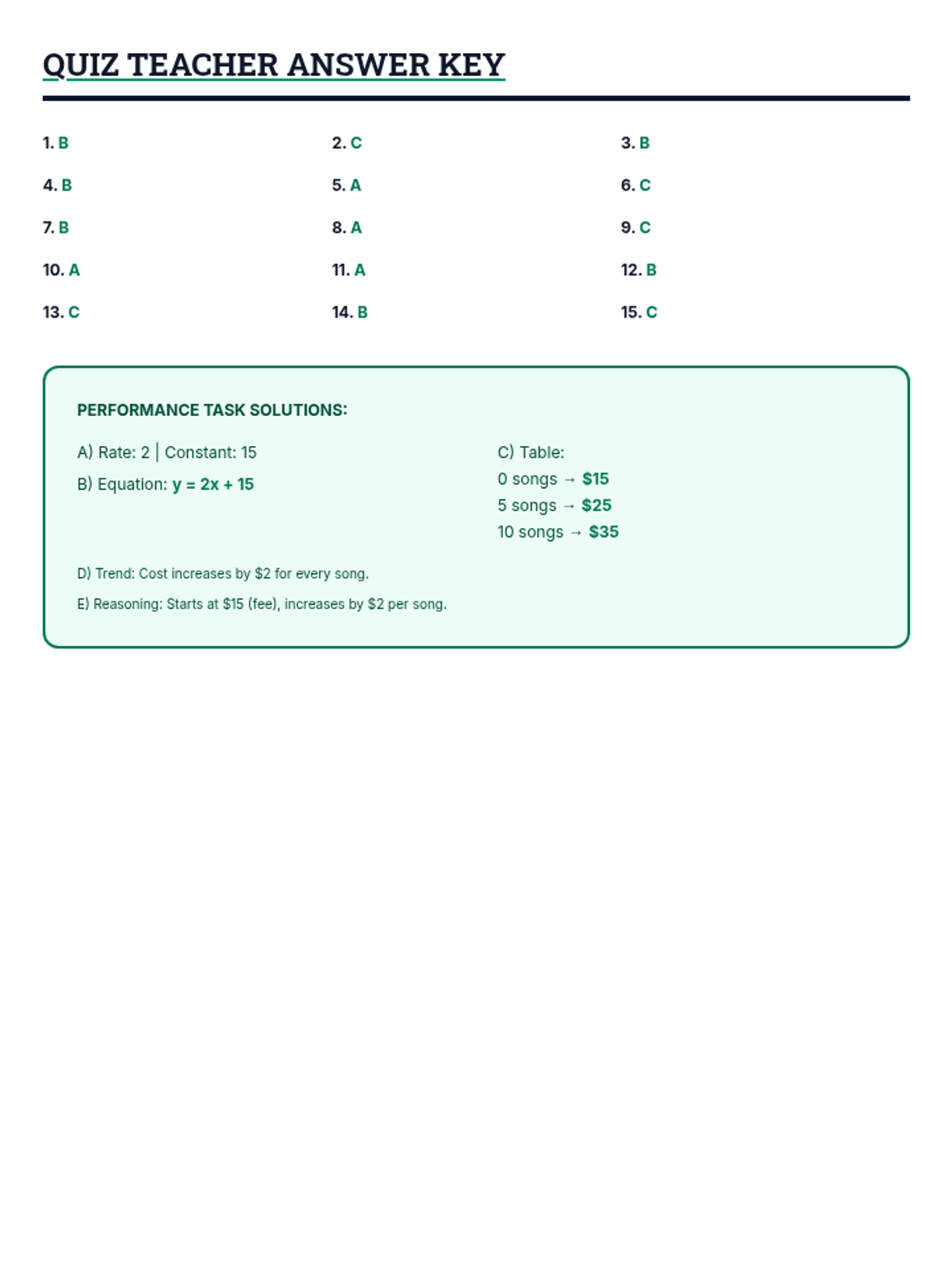
Teacher-facing answer key for the Consumer Math Unit Quiz. Optimized for single-page printing with a compact grading rubric and clear solution breakdown.
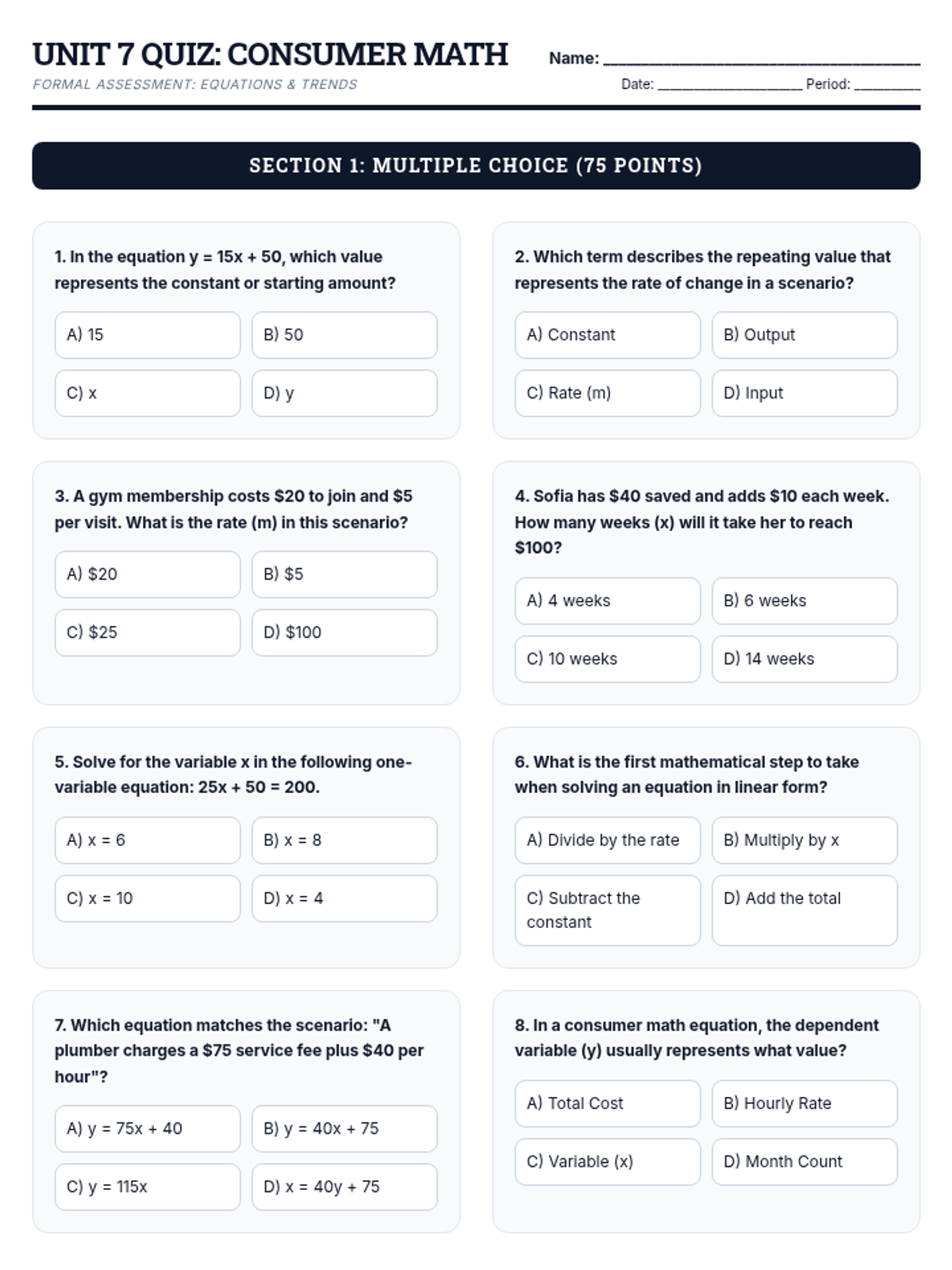
A 15-question multiple-choice quiz covering all Unit 7 Consumer Math concepts. It features an open-ended performance task centered on a subscription service scenario. Layout issues and work area prompts have been corrected for professional student use.
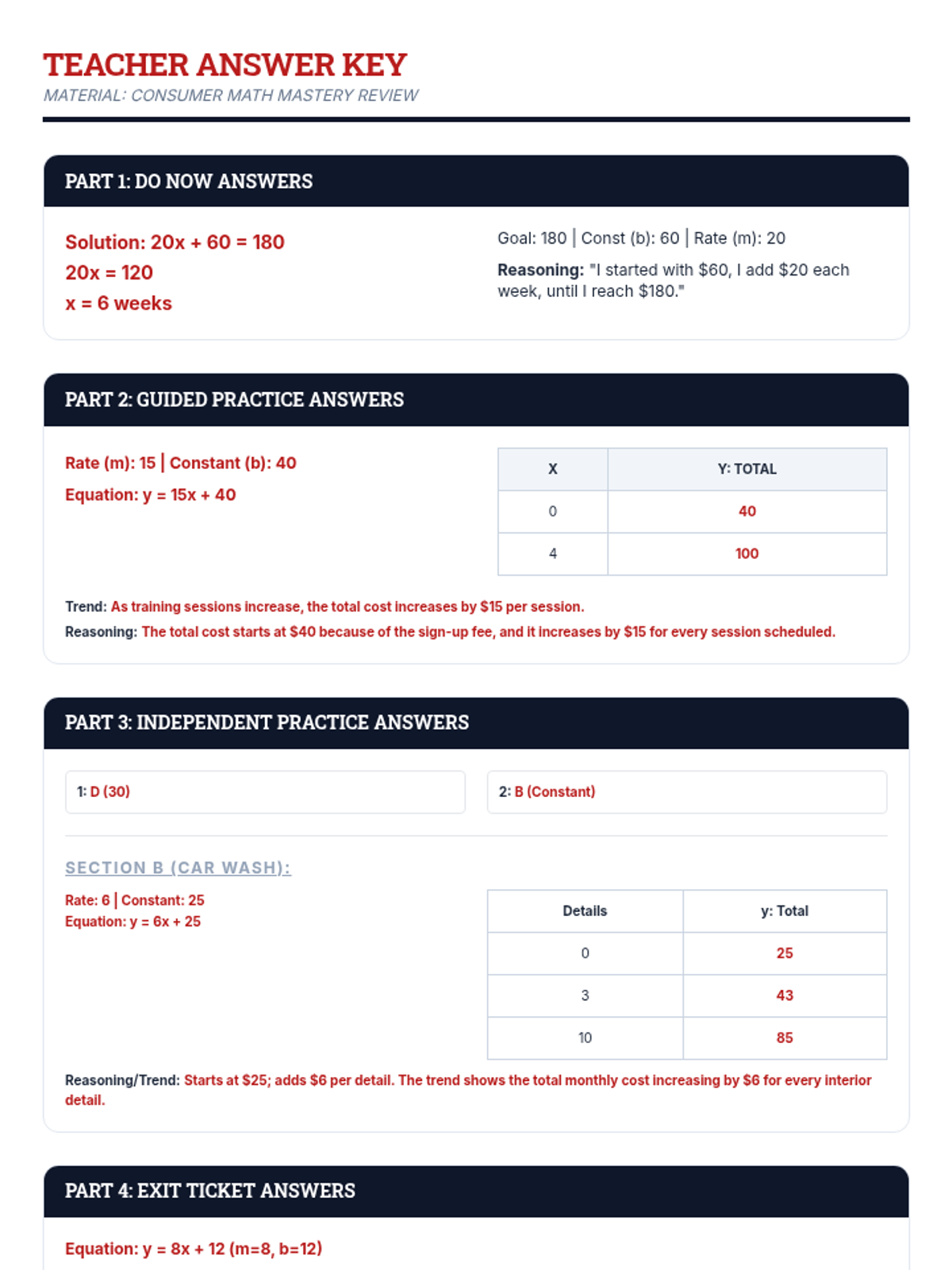
Teacher-facing answer key for the revised Consumer Math Mastery Review. Provides all solutions, equations, table data, and model written reasoning in a clear, high-contrast format.
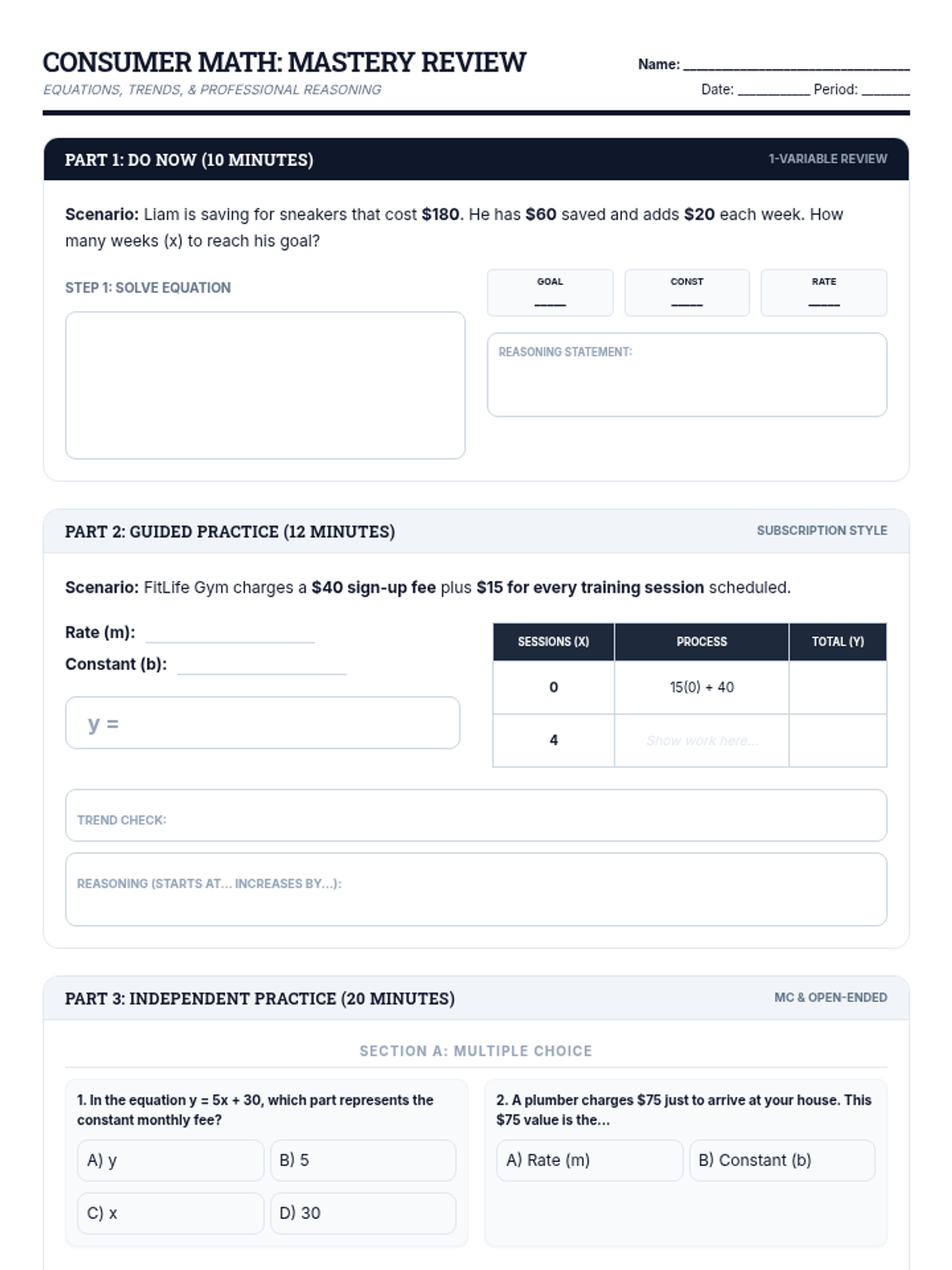
A comprehensive review sheet for students covering one and two-variable consumer math problems. It includes sections for a Do Now, Guided Practice, Independent Practice (with tables and MC), an Exit Ticket, and an expanded Homework section. Layout and student work areas have been optimized for clarity and handwriting space.
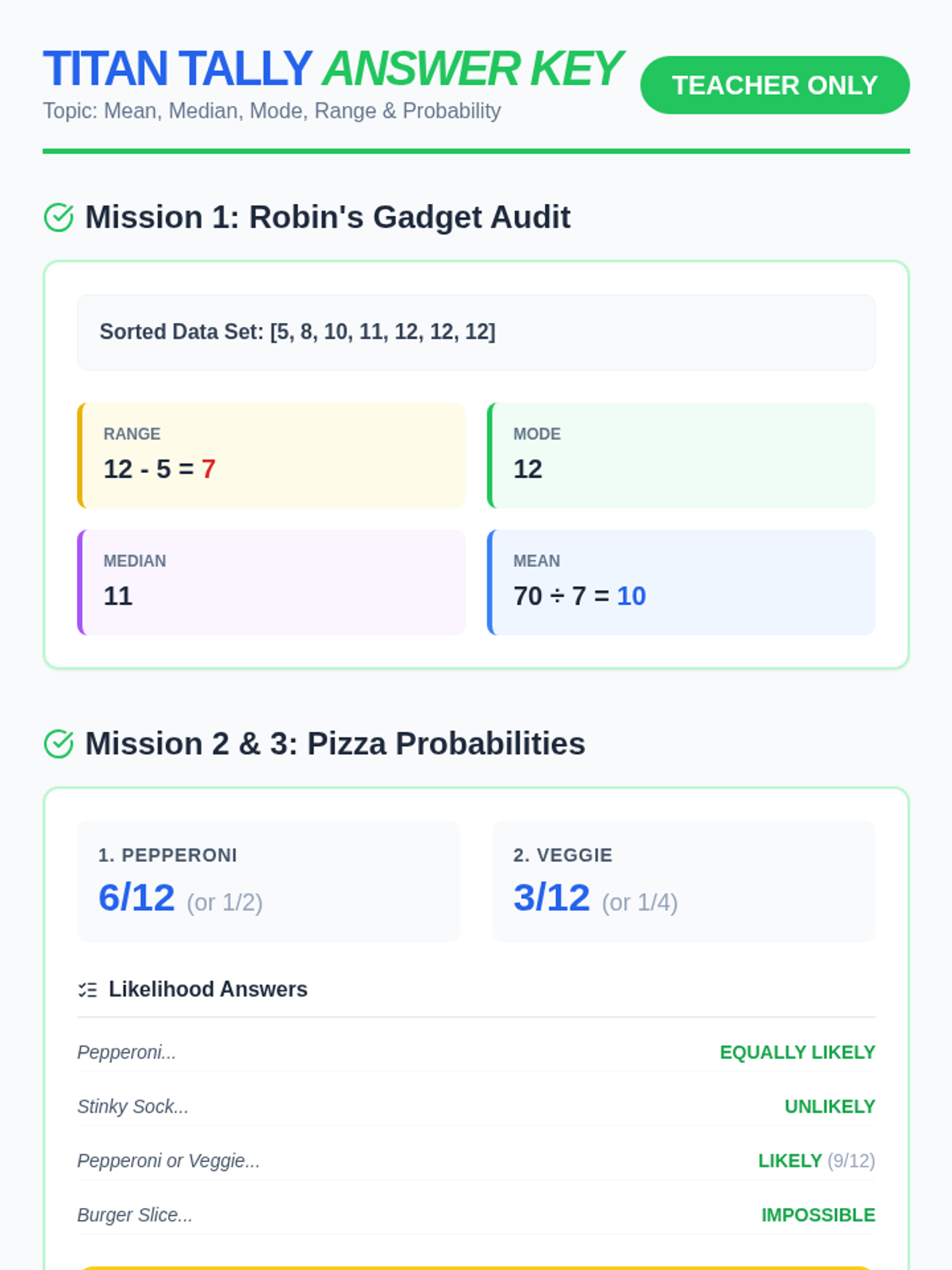
A teacher-facing answer key for the Titan Tally Worksheet, providing clear solutions and explanations for all statistics problems with improved formatting.
A vibrant and interactive slide deck for teaching statistics concepts with deep Teen Titans integration and guided practice examples. Standardized for fixed height to prevent cutoff.
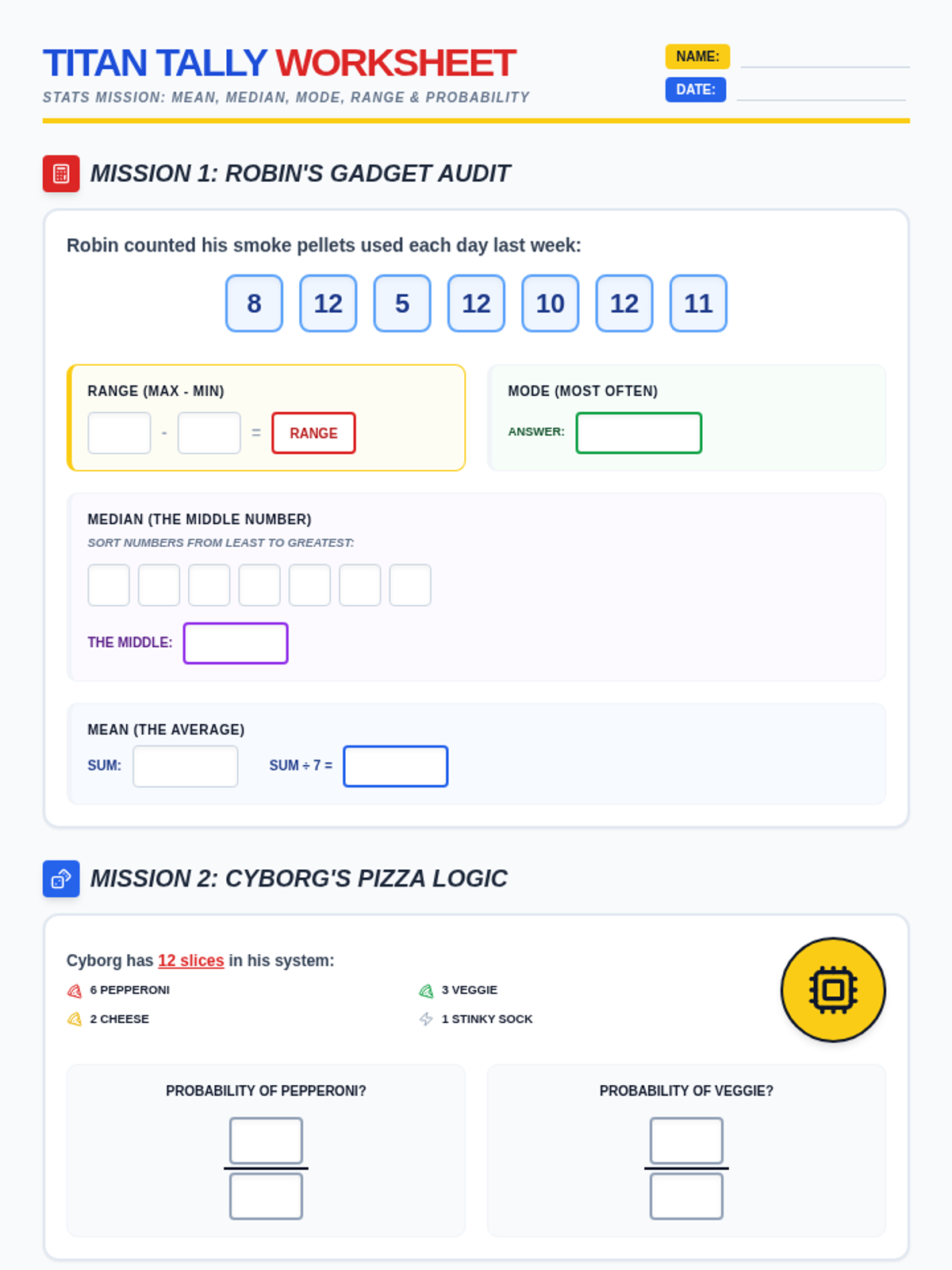
A step-by-step guided practice worksheet for statistics including mean, median, mode, range, and probability calculations themed around the Teen Titans. Adjusted for better page breaks and work space.
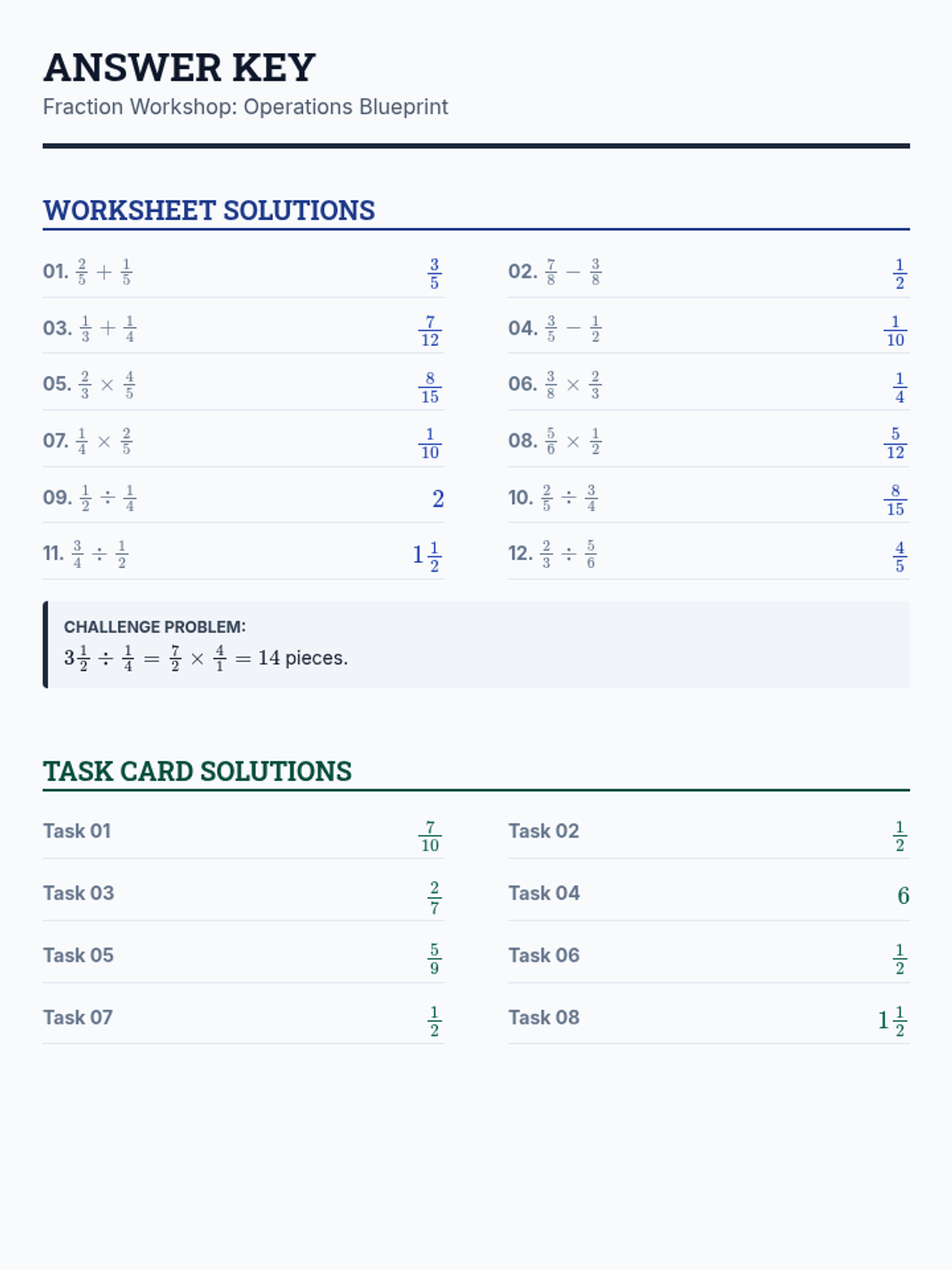
Complete answer key for the Fraction Workshop worksheet and task cards, including step-by-step simplification notes.
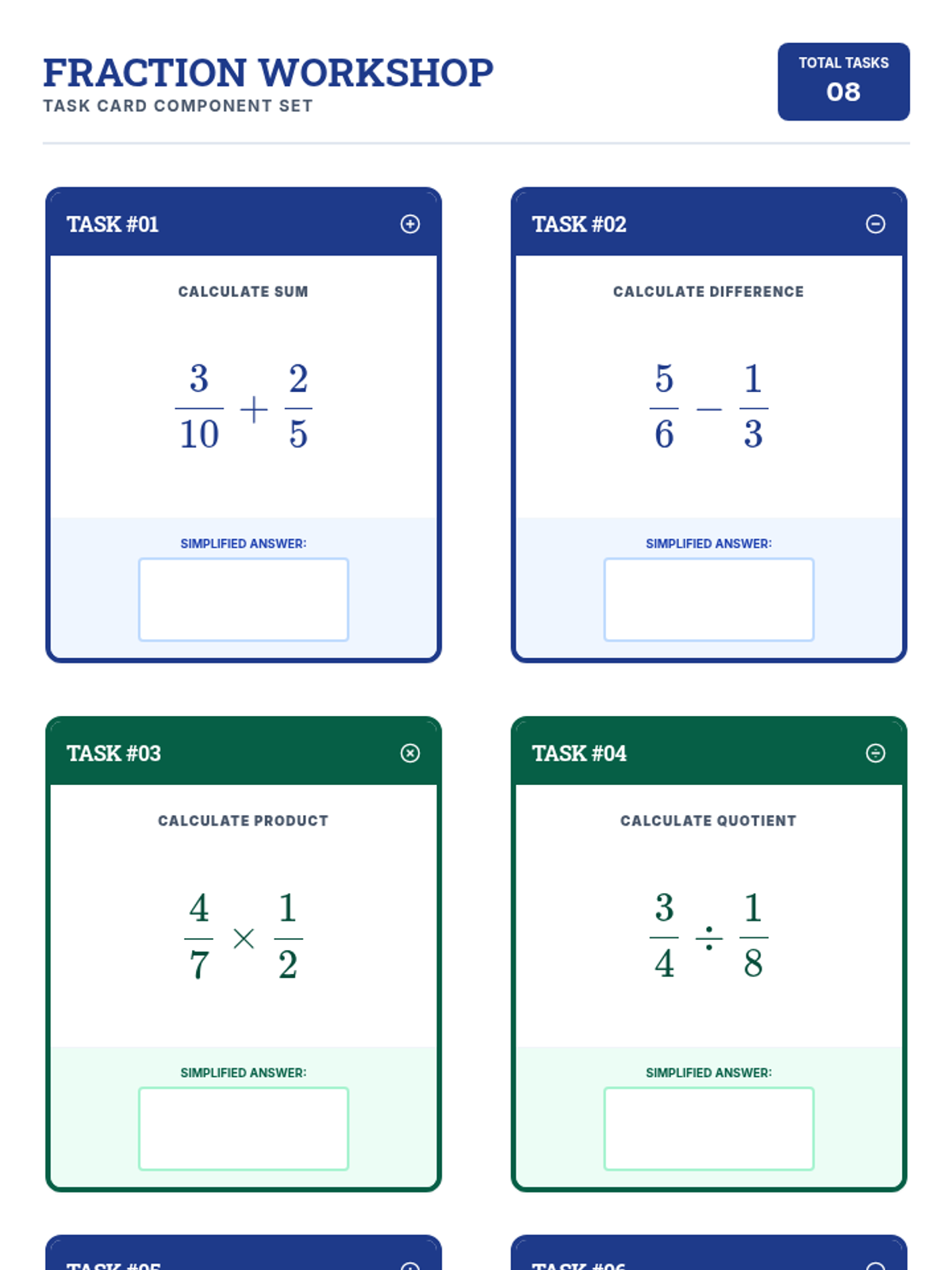
A set of 8 printable task cards featuring addition, subtraction, multiplication, and division problems with fractions. Fixes page breaks, background ink usage, and answer area sizes.
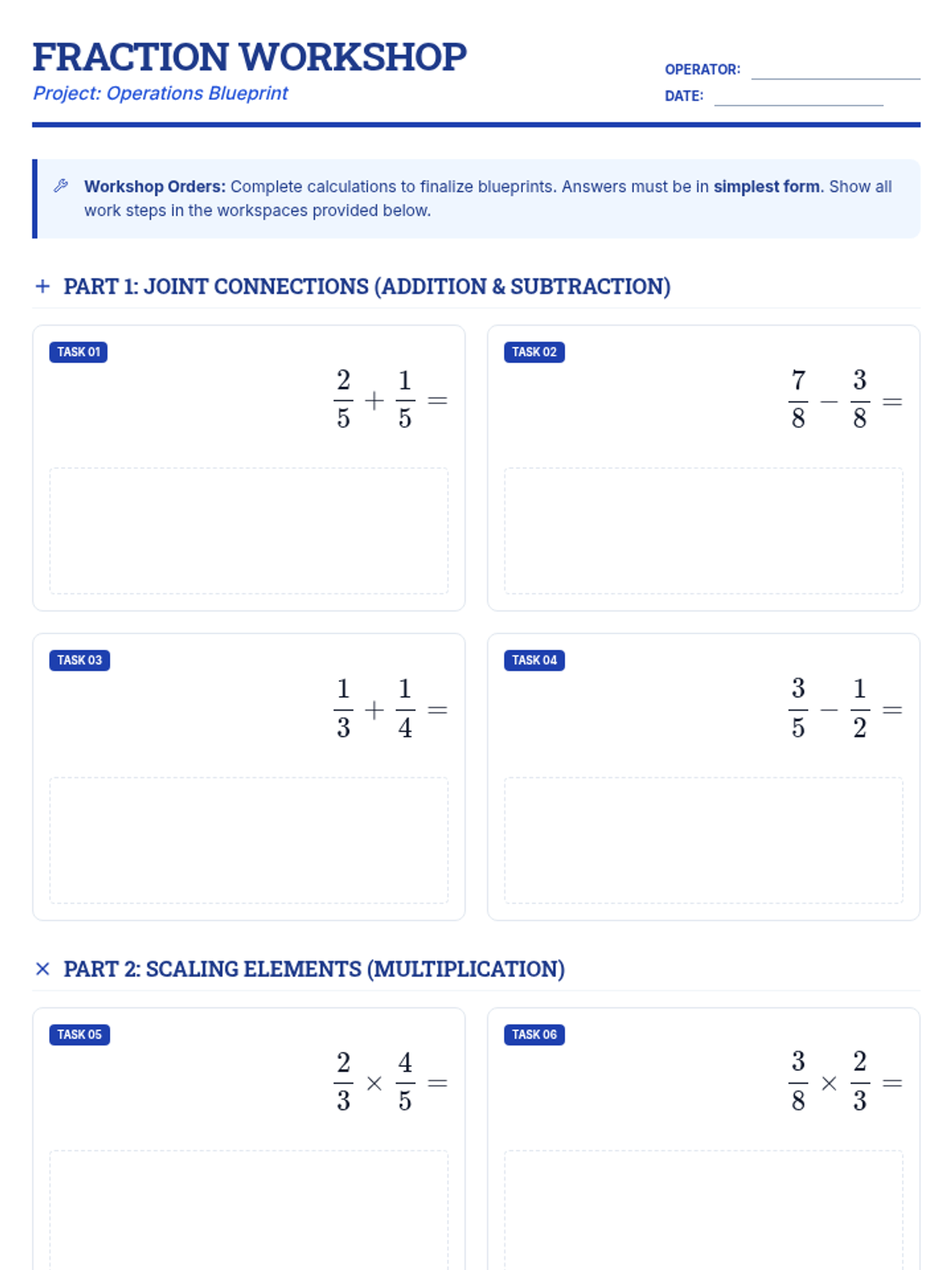
A blueprint-themed worksheet for practicing all four operations with fractions, including simple and unlike denominators. Fixes LaTeX rendering, layout issues, and student work areas.
Instructional slides for a lesson on radicals, focusing on simplification, complex numbers, rational exponents, and solving radical equations. Revised with improved layout, increased font sizes, and missing topic coverage.
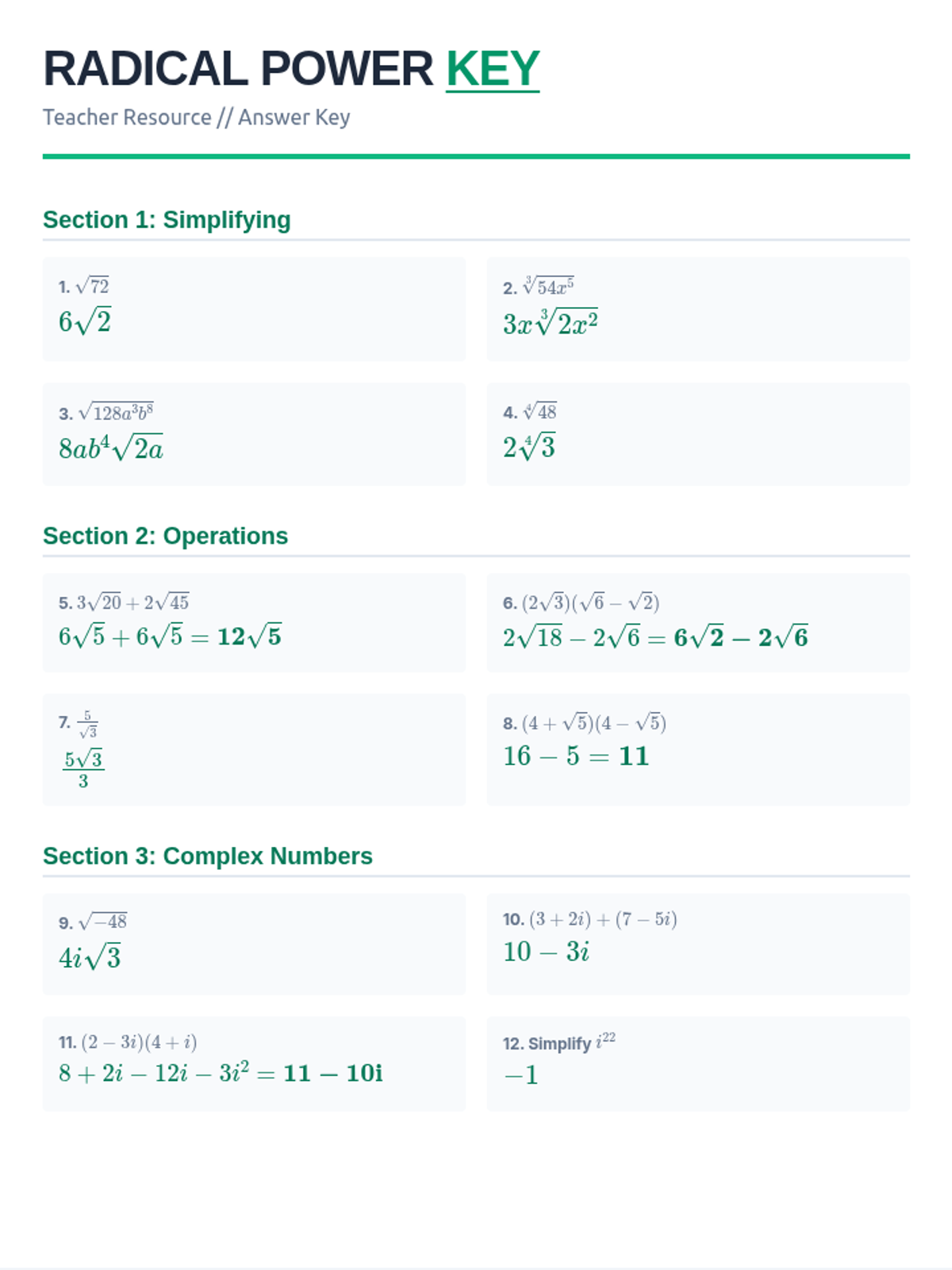
Complete answer key for the Radical Power Quiz, revised for better legibility and to prevent solution overflow. Includes detailed step-by-step bonus solution.
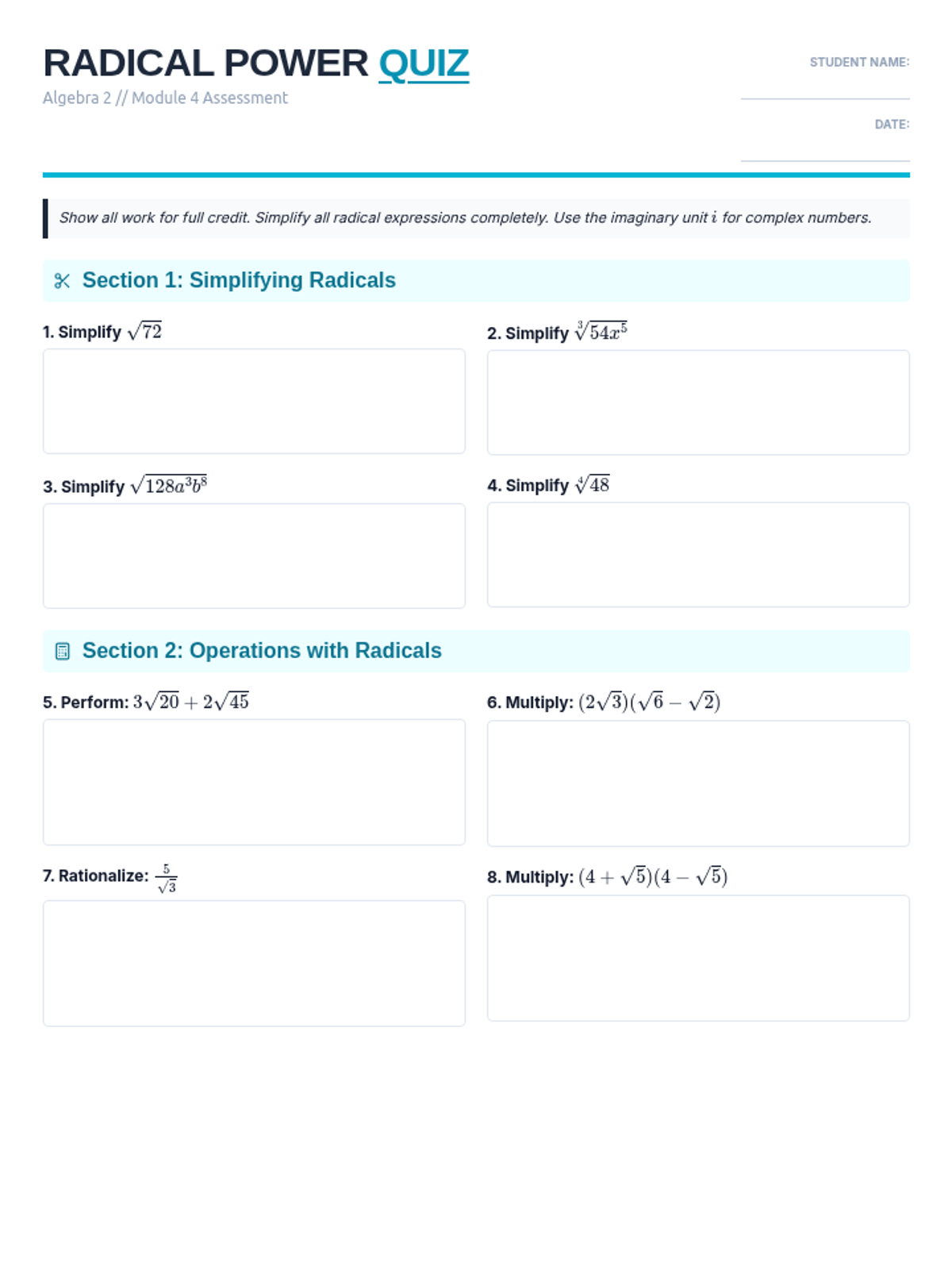
A 20-question quiz on radicals for Algebra 2, covering simplifying, operations, complex numbers, equations, and conversions, with dedicated space for student work. Revised for better layout and font sizing.
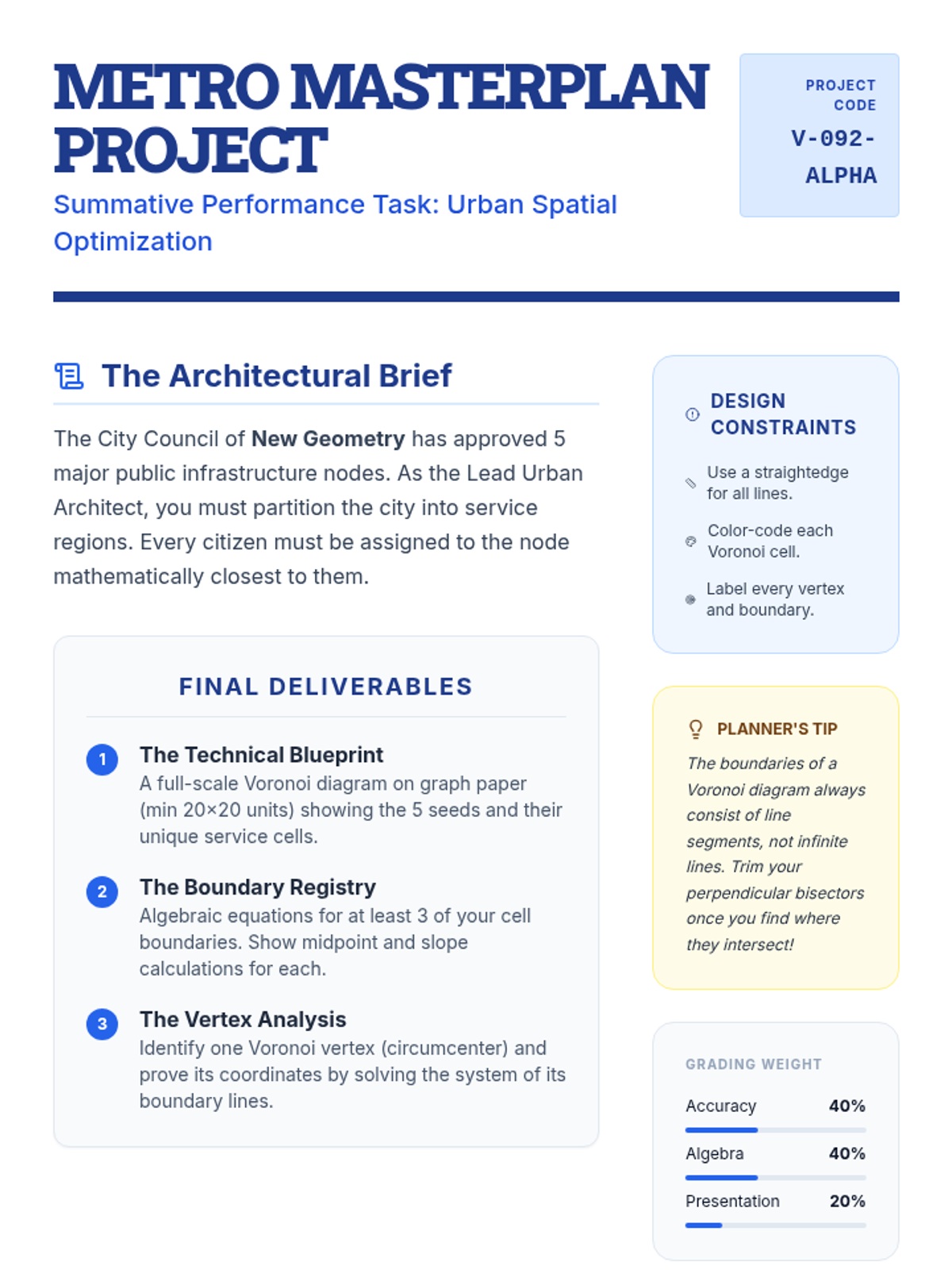
A summative project guide where students design a city's infrastructure layout, constructing a 5-seed Voronoi diagram and providing mathematical proof of its efficiency.
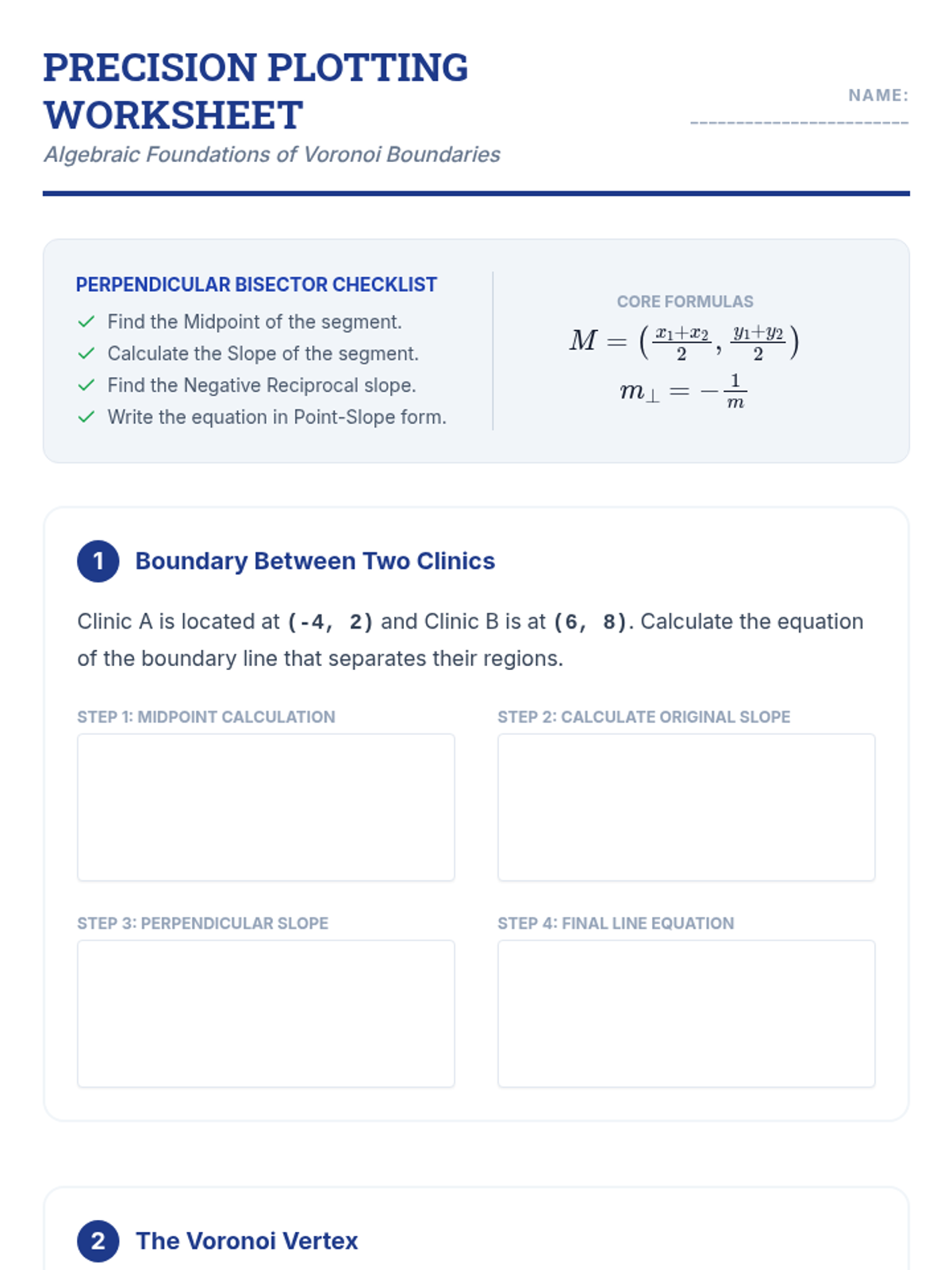
A math worksheet that combines geometry and algebra, requiring students to calculate the equations of perpendicular bisectors and find Voronoi vertices through systems of linear equations.
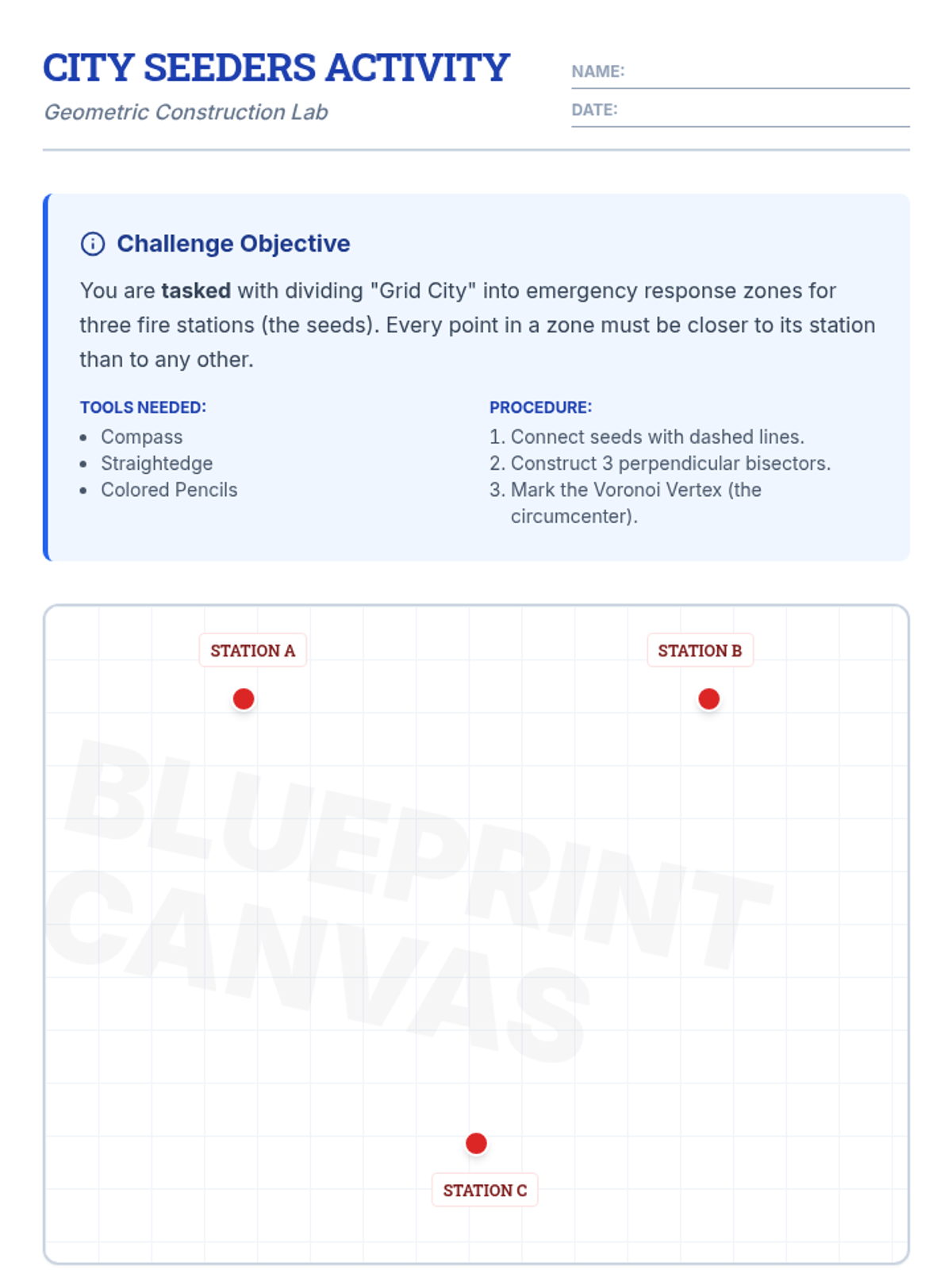
A hands-on activity sheet where students use a compass and straightedge to construct a Voronoi diagram for three "fire stations" on a grid, reinforcing the concept of the perpendicular bisector.
A visual slide deck that defines Voronoi diagrams, explains the construction algorithm using perpendicular bisectors, and shows real-world applications in urban planning and beyond.
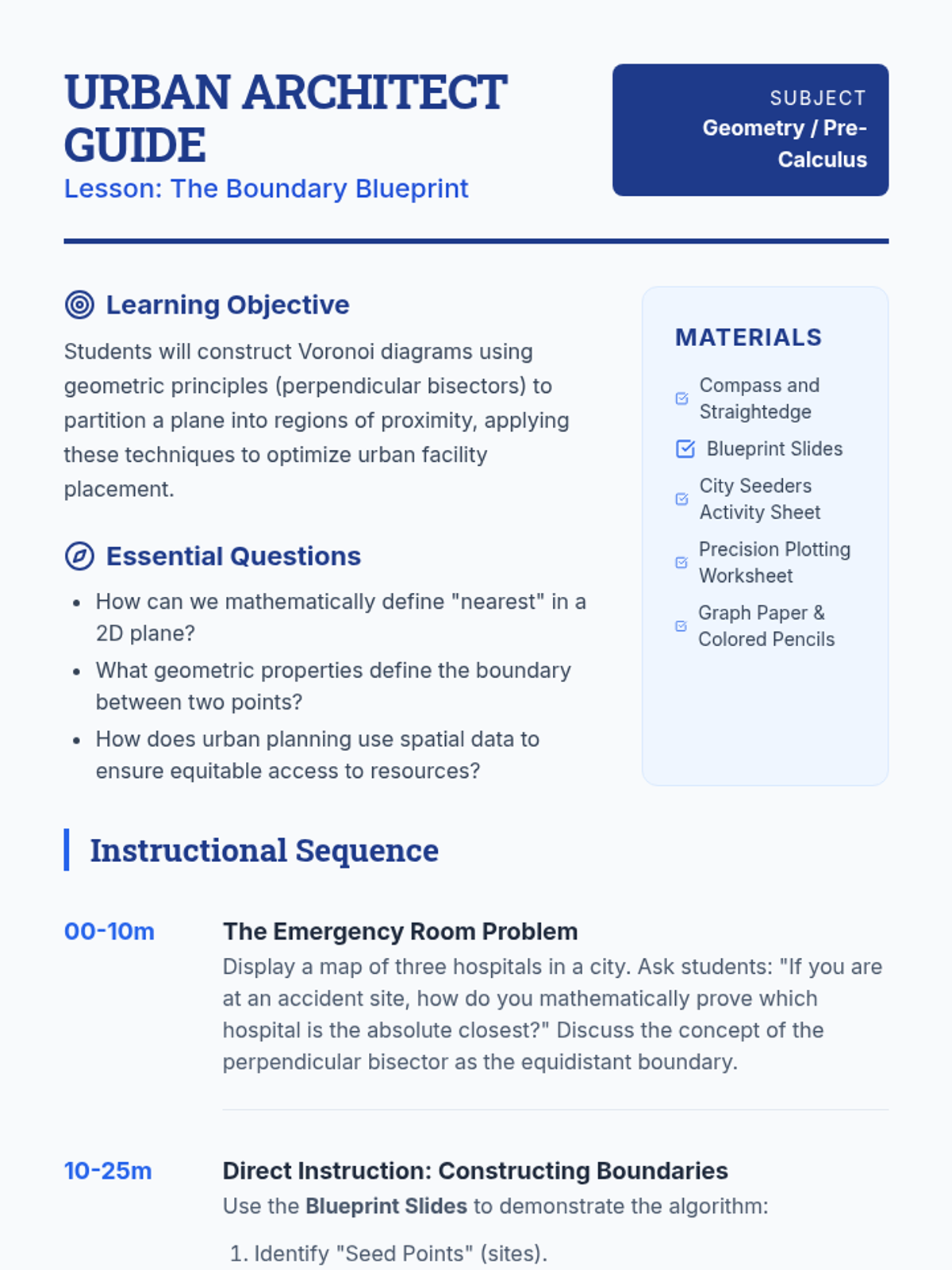
A comprehensive lesson plan for teachers, outlining the instructional sequence, learning objectives, and materials needed to teach Voronoi diagrams through an urban planning lens.
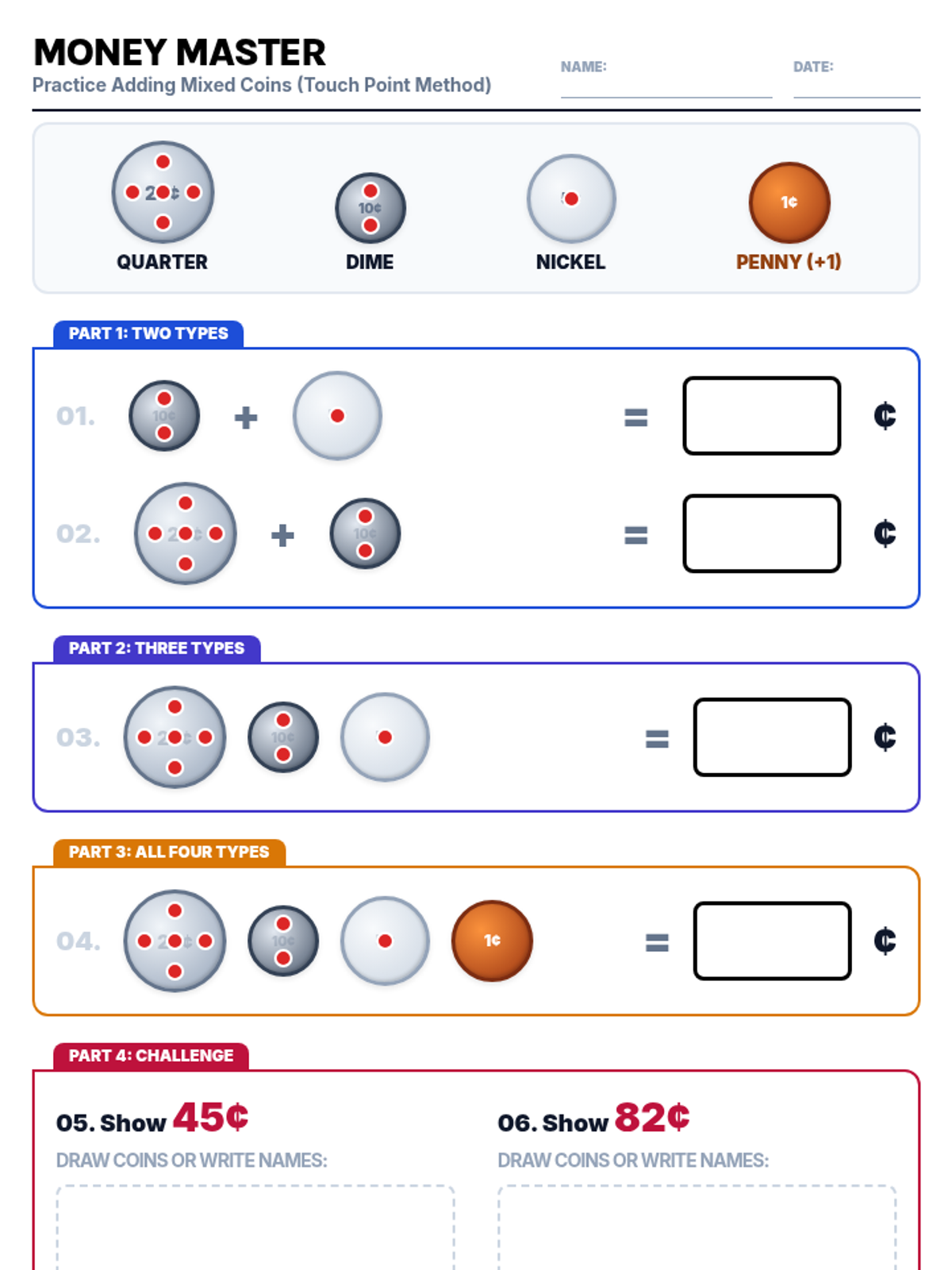
A practice worksheet for adding mixed coins using the Touch Point counting method, featuring progressively difficult problems from two coin types to all four, including pennies. Includes a visual reference key and two open-ended questions for creating specific totals.
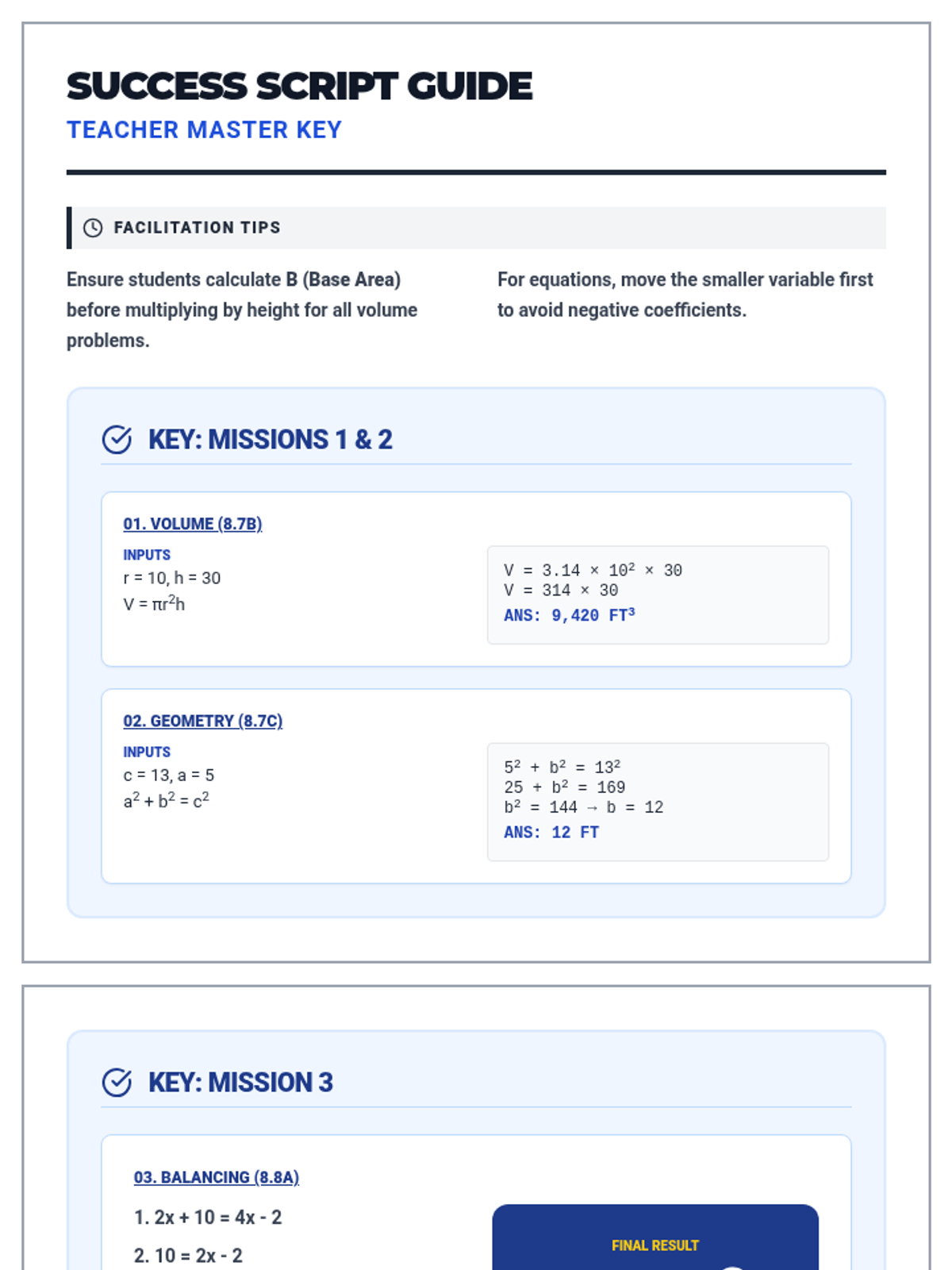
A 2-page teacher guide with step-by-step solutions. Improvements include better page-break handling using `break-inside-avoid`, a new "Classroom Extension" section to maximize page usage, and a modular layout for clearer instructional pacing.
A polished 5-slide presentation for STAAR review. Revised layout for Slide 3 eliminates overlapping content, improved text weights for better visibility, and refined visual guides for consistent instructional quality.
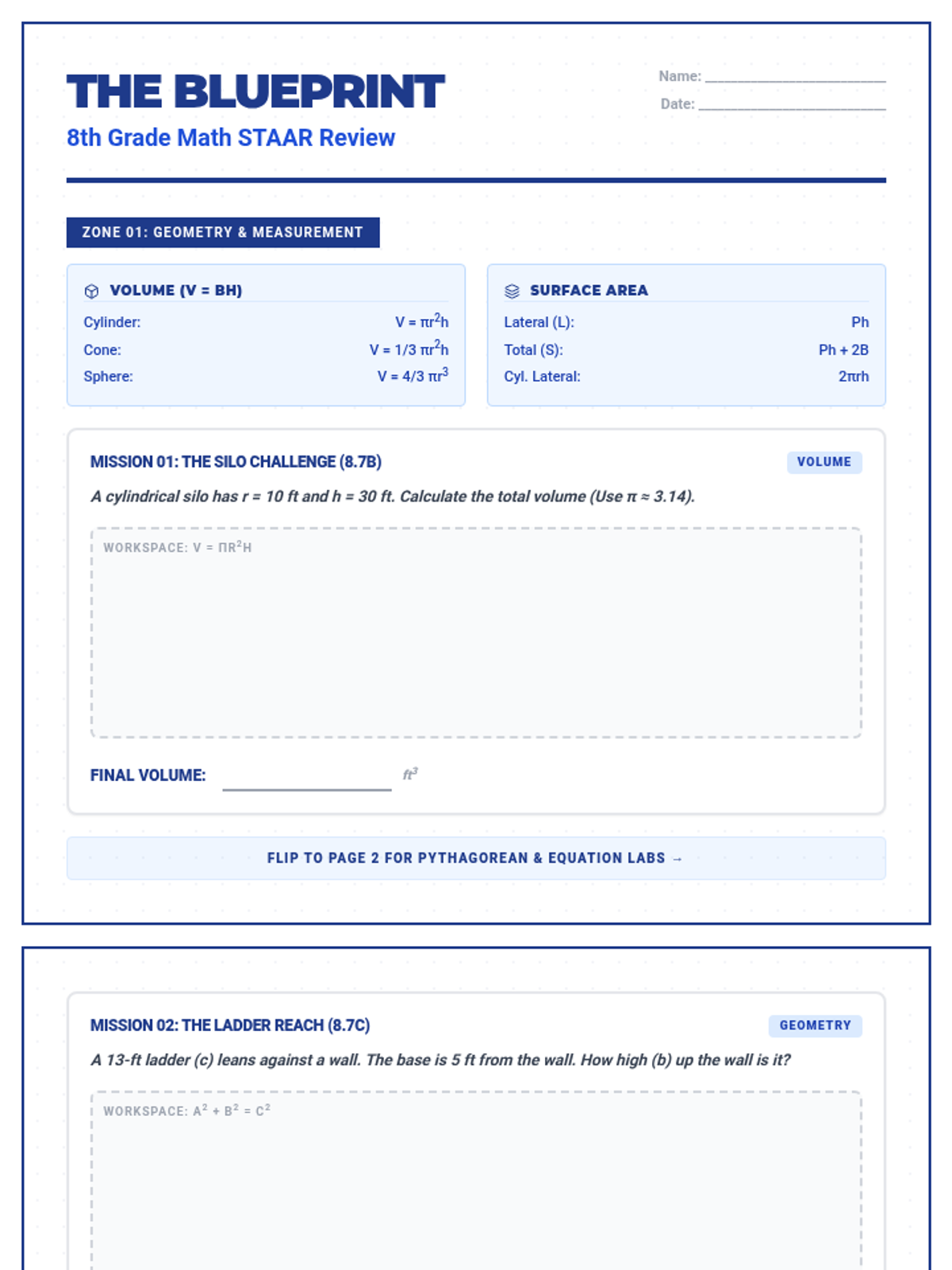
A revised 2-page student study packet. Improvements include optimized page breaks for multi-step problems, a refined "Blueprint" aesthetic with clearer technical workspaces, and high-legibility student work areas.