Teacher lesson plan for Day 2 of the Renewable Energy Quest, focusing on solar energy systems and vocabulary for a 45-minute middle school class.
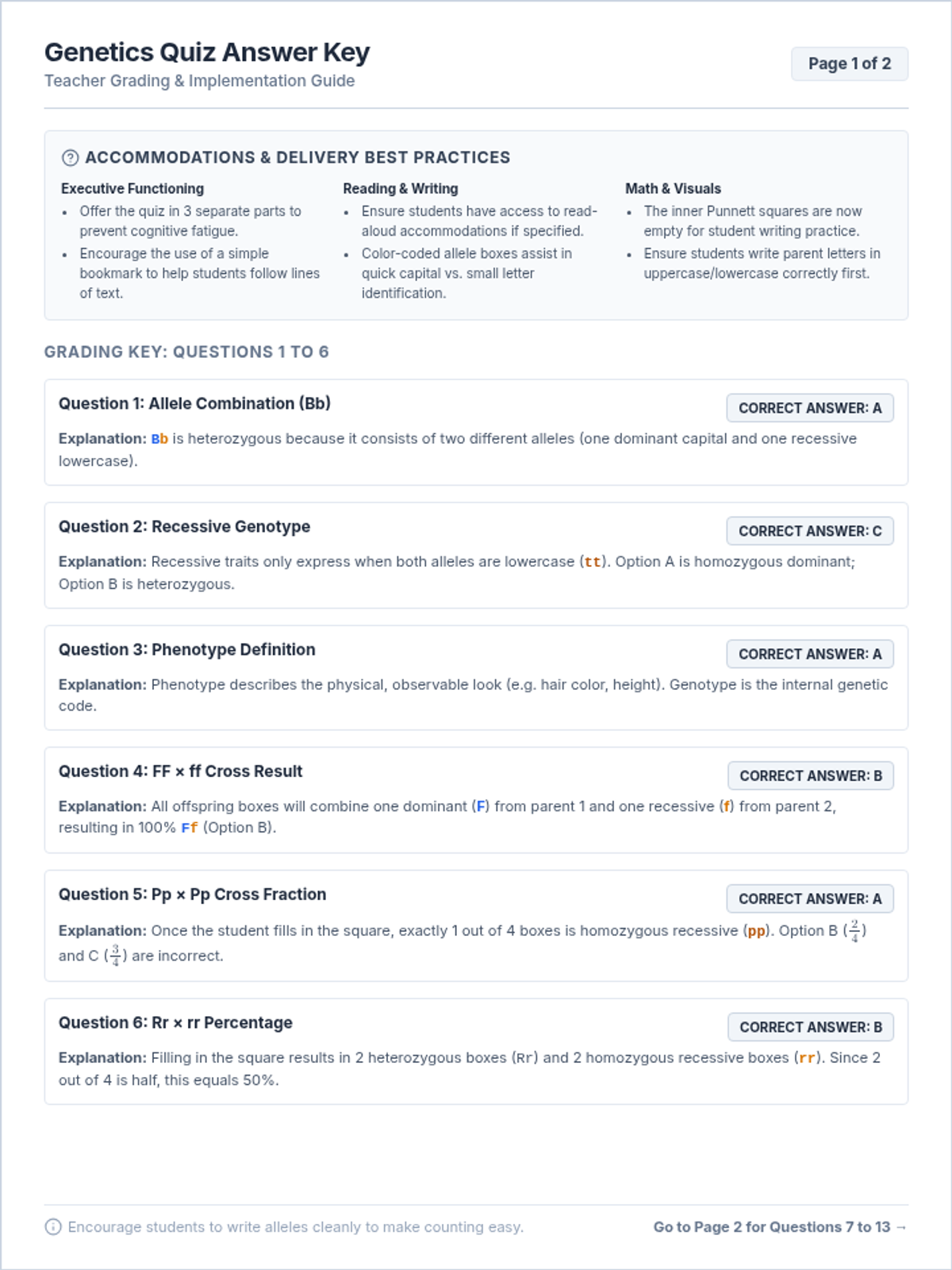
A comprehensive master answer key covering all three tiered challenge levels (Robust, Scaffolded, and Simple).
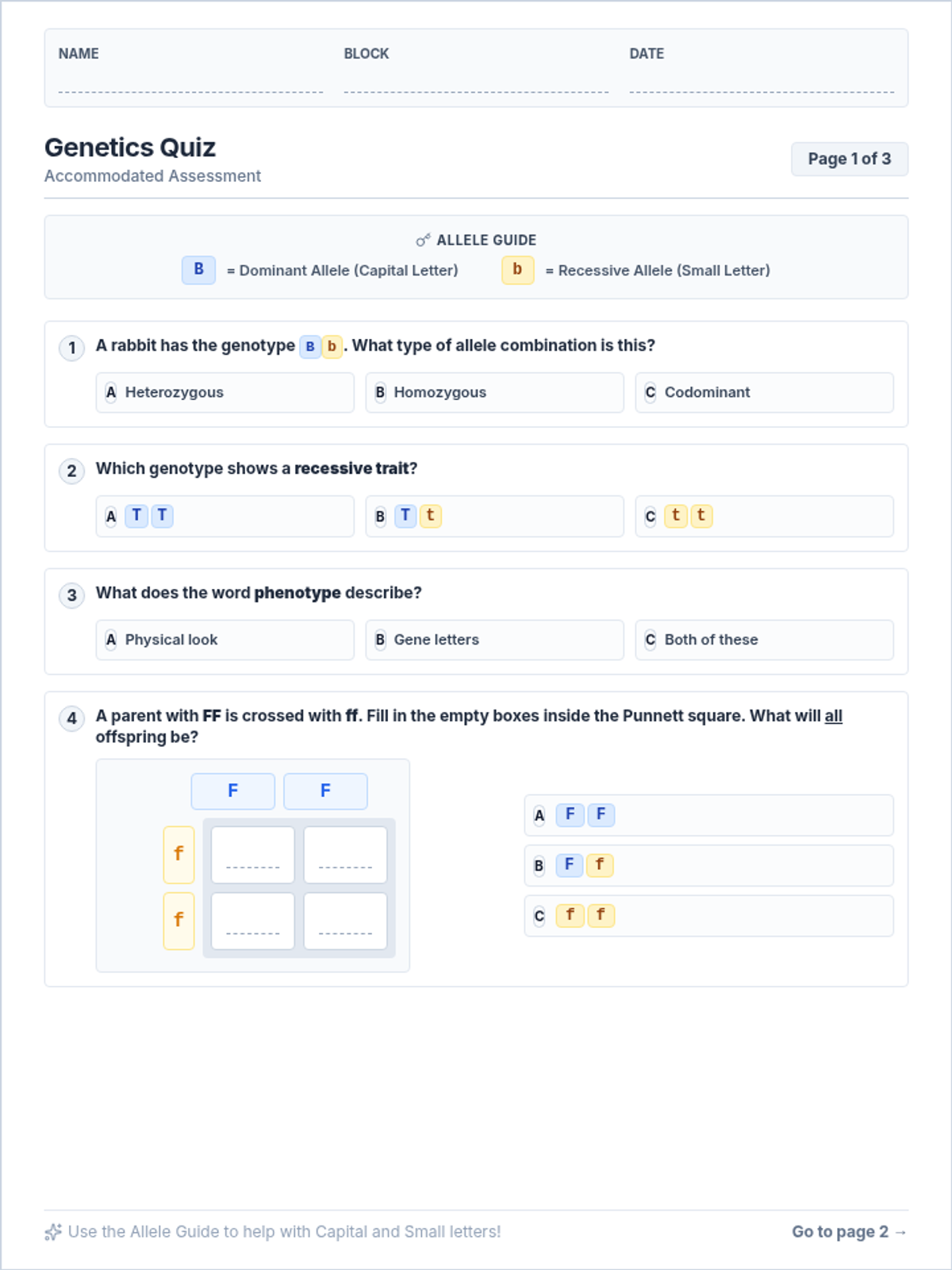
Level 3: Simple. A foundational genetic modeling worksheet focusing on basic monohybrid crosses (F1 and F2 generations) using pea plant traits.
Level 2: Scaffolded. A genetic modeling worksheet focusing on reverse-engineering parent genotypes from offspring data, featuring a guided hypothesis-testing structure.
Level 1: Most Robust. An advanced genetic modeling worksheet focusing on meiosis, random assortment mechanics, and multi-event probability calculations.
Tiered slide presentation updated to match the hierarchy: Level 1 (Robust), Level 2 (Scaffolded), and Level 3 (Simple). Features color-coded previews and modeling protocols.
A comprehensive teacher professional development guide including essential AI concepts, facilitation strategies, and quick-reference prompt cheat sheets.
A high school activity sheet requiring students to apply the CO-STAR prompt engineering framework, map industry impacts, and draft ethical AI policies.
Advanced slide deck for high school students exploring generative AI paradigms, professional prompt engineering frameworks (CO-STAR), and the future of work.
A middle school activity sheet involving ethical analysis of recommendation engines, labeling neural network structures, and debating facial recognition bias.
A middle school slide deck focused on the technical basics of neural networks and the ethical challenges of recommendation engines and deepfakes.
A grade 3-5 worksheet focusing on analyzing AI bias scenarios and practicing prompt engineering using a structured 'Role + Task + Detail' framework.
Instructional slides for grades 3-5, focusing on 'Pattern Detectives' - understanding data, spotting bias, and learning the basics of effective prompting.
An activity sheet for grades 1-2 focusing on distinguishing between traditional machines and AI, and designing an AI solution for a simple problem.
Instructional slides for grades 1-2 focused on 'Smart Helpers' - identifying AI in the world and understanding simple machine learning patterns.
A comprehensive teacher guide for the 'Robot Brains' lesson, including a script, instructional sequence, and differentiation tips for Kindergarten.
A simple, visual worksheet for Kindergarten students to practice identifying AI and 'training' a robot.
Introductory slide deck for Kindergarten students exploring the difference between human brains and computer 'brains'.
The comprehensive K-12 AI literacy curriculum scope and implementation guidelines for district-wide alignment.
An answer key and teacher facilitation supplement for the Earth Dynamics Texas Coast lesson, providing solutions for the STAAR prep questions and instructional guidance for the lab activities.
A set of 8 STAAR-format multiple-choice questions covering TEKS 8.5A-E, focusing on atomic structure, periodic table trends, chemical formulas, and the law of conservation of mass.
A collection of 8 STAAR-formatted multiple-choice questions covering Grade 8 Science Reporting Category 3 (Earth and Space), designed for test preparation and assessment.
A lab investigation sheet focusing on the Law of Conservation of Mass, comparing open and closed systems through macroscopic observations, sub-microscopic modeling, and symbolic chemical equations.
A master answer key and grading rubric for the Lab Log, Field Manual, and Assessment, including specific expected results and a CER scoring table.
A weather systems analysis worksheet where students interpret weather maps and satellite imagery to understand atmospheric movement, pressure systems, and the Sun's role in driving Gulf Coast weather patterns.