A project guide for students to design and present conservation strategies for protecting Colorado alpine wildlife, featuring a brainstorm area and scoring rubric.
A comprehensive teacher professional development guide including essential AI concepts, facilitation strategies, and quick-reference prompt cheat sheets.
A high school activity sheet requiring students to apply the CO-STAR prompt engineering framework, map industry impacts, and draft ethical AI policies.
Advanced slide deck for high school students exploring generative AI paradigms, professional prompt engineering frameworks (CO-STAR), and the future of work.
A middle school activity sheet involving ethical analysis of recommendation engines, labeling neural network structures, and debating facial recognition bias.
A middle school slide deck focused on the technical basics of neural networks and the ethical challenges of recommendation engines and deepfakes.
A grade 3-5 worksheet focusing on analyzing AI bias scenarios and practicing prompt engineering using a structured 'Role + Task + Detail' framework.
Instructional slides for grades 3-5, focusing on 'Pattern Detectives' - understanding data, spotting bias, and learning the basics of effective prompting.
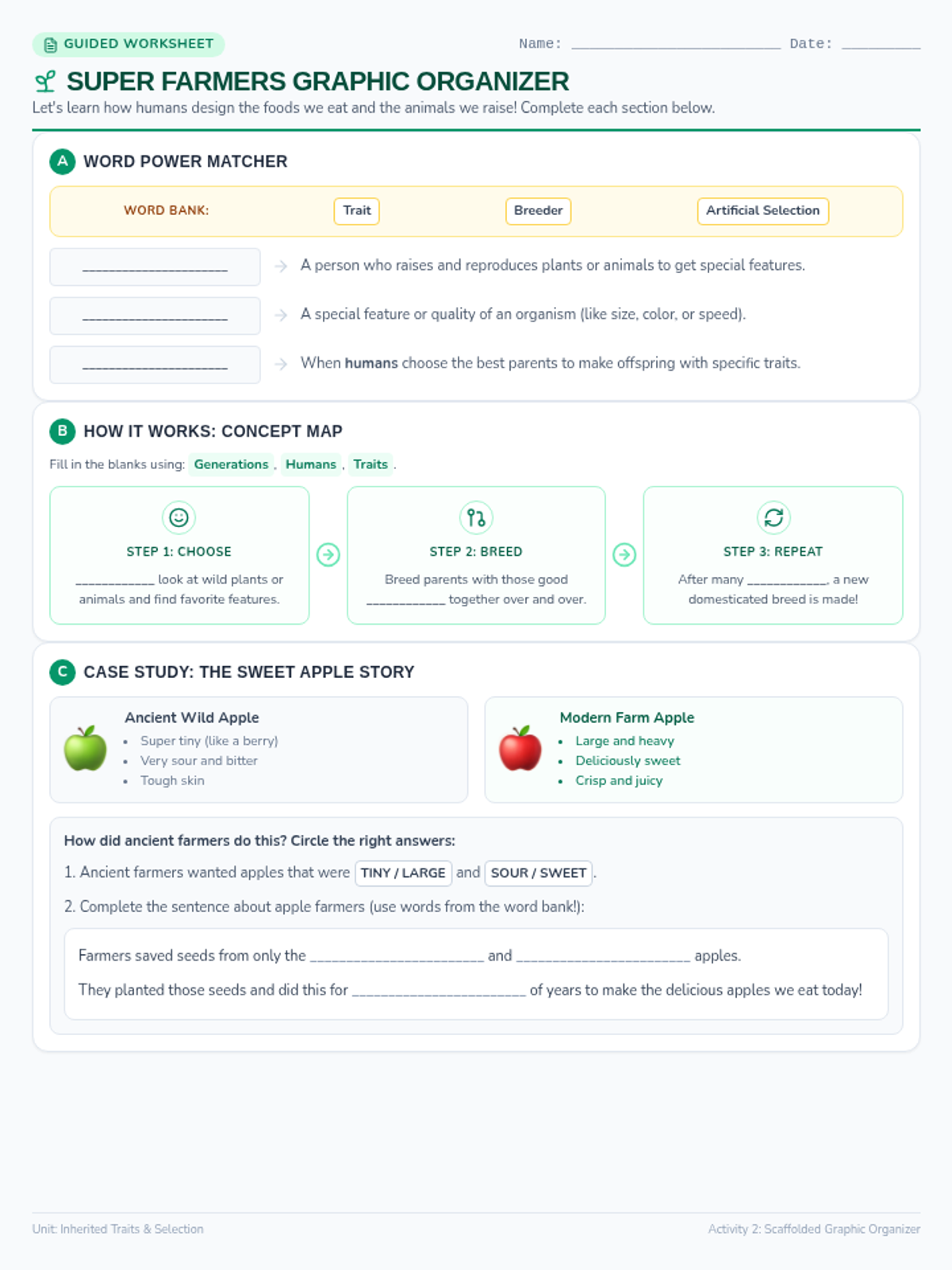
An activity sheet for grades 1-2 focusing on distinguishing between traditional machines and AI, and designing an AI solution for a simple problem.
Instructional slides for grades 1-2 focused on 'Smart Helpers' - identifying AI in the world and understanding simple machine learning patterns.
A comprehensive teacher guide for the 'Robot Brains' lesson, including a script, instructional sequence, and differentiation tips for Kindergarten.
A simple, visual worksheet for Kindergarten students to practice identifying AI and 'training' a robot.
Introductory slide deck for Kindergarten students exploring the difference between human brains and computer 'brains'.
The comprehensive K-12 AI literacy curriculum scope and implementation guidelines for district-wide alignment.
A teacher reference material providing answer keys for the Matter Master STAAR Quiz and sample data/exemplar responses for the laboratory stations. Includes CER writing exemplars.
A teacher answer key and scoring rubric for the System Scrimmage Quiz, including rationales for multiple-choice questions and a point-based scoring guide for the constructed response item.
A visual presentation to introduce the Matter Master Labs lesson. Includes briefings for the CER framework, station objectives, and rotation procedures.
An 8-question STAAR-aligned assessment for Grade 5 Science, focusing on Reporting Category 3 (Earth and Space). Includes 7 multiple-choice questions and 1 multi-part constructed response question covering weather vs climate, the water cycle, and Sun/Earth/Moon systems.
A comprehensive answer key for the Eco Detectives mission, including solutions for the STAAR-format assessment and the student field journal activities.
Teacher answer key for the STAAR Power Practice Force and Motion assessment. Includes correct answers, TEKS alignment, detailed rationales for each question, and classroom remediation strategies.
A STAAR-formatted assessment for Grade 5 science covering organisms and environments, with questions aligned to TEKS 5.9A-D and 5.10A-C.
A set of 8 STAAR-formatted science practice questions for Grade 5, focusing on force, motion, and energy. Includes selected response and simulated drag-and-drop questions aligned with TEKS 5.6A-C.
A 2-page student field journal featuring a water cycle model investigation, Texas weather data analysis, a shadow-tracking exercise for Earth's rotation, and a comparison activity for celestial bodies. designed for Grade 5 Science students.
A student field journal for Grade 5 science, featuring vocabulary development using Marzano's process, a Texas Gulf Coast ecosystem case study, and activities on food webs and adaptations.
A STAAR-format practice quiz for 5th grade students covering physical properties, mixtures, solutions, and state changes. Includes rigorous multiple-choice questions with standard Texas-style distractors.
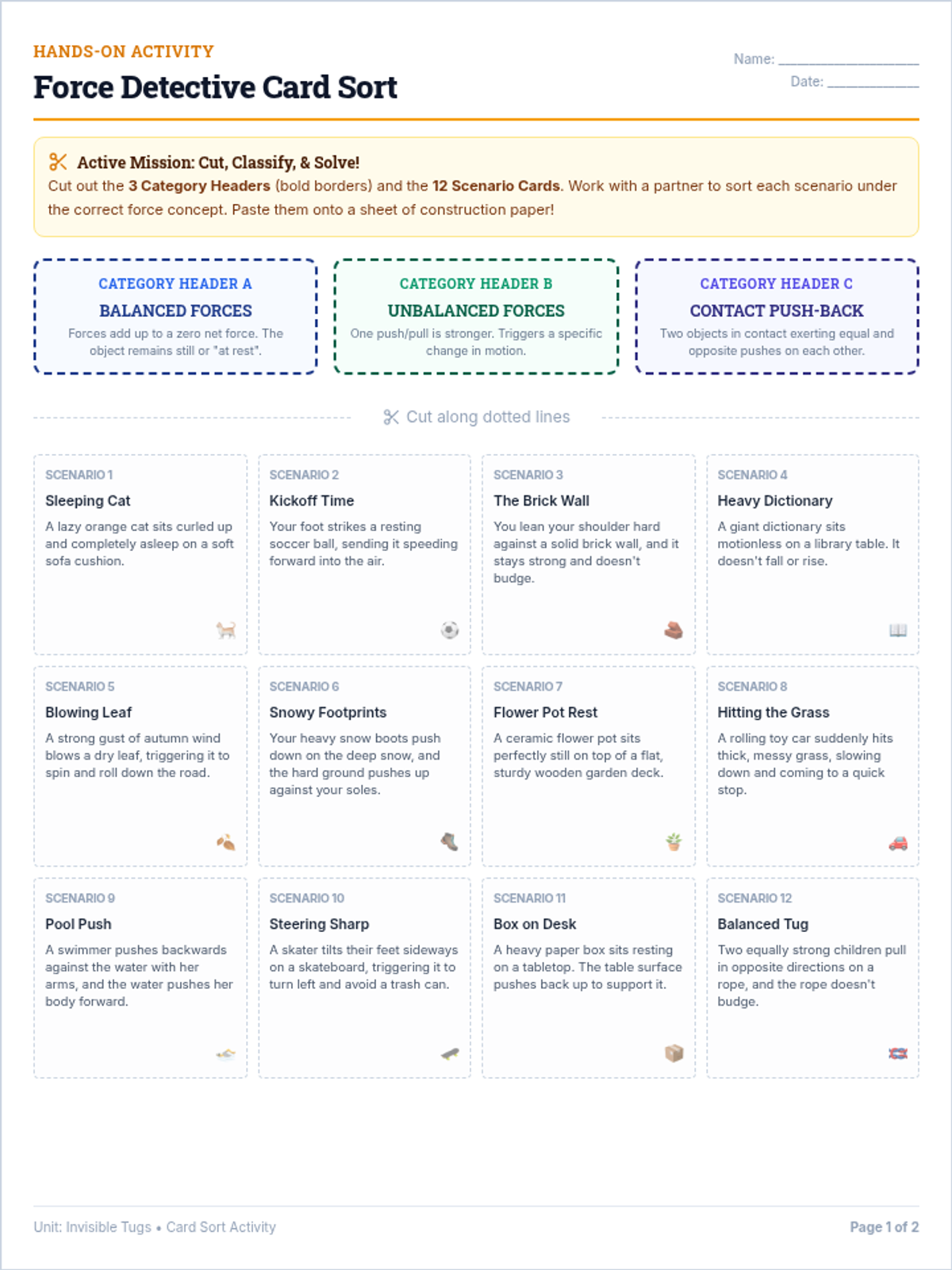
Student lab journal for force and motion investigations. Includes prediction tasks for balanced/unbalanced forces, a structured data table for a friction experiment, and an annotation activity for a roller coaster model.
A visual slide deck for the System Scape lesson, covering the anchoring phenomenon of Texas biomes, the Sun-Ocean interaction in the water cycle, Earth's rotation (day/night), physical characteristics of the Sun, Earth, and Moon, and the key differences between weather and climate.