A creative comic strip template with 4 panels designed for students to illustrate the journey of popcorn starch from inside the kernel to its final fluffy form. Includes prompts for each stage and spaces for drawing and dialogue.
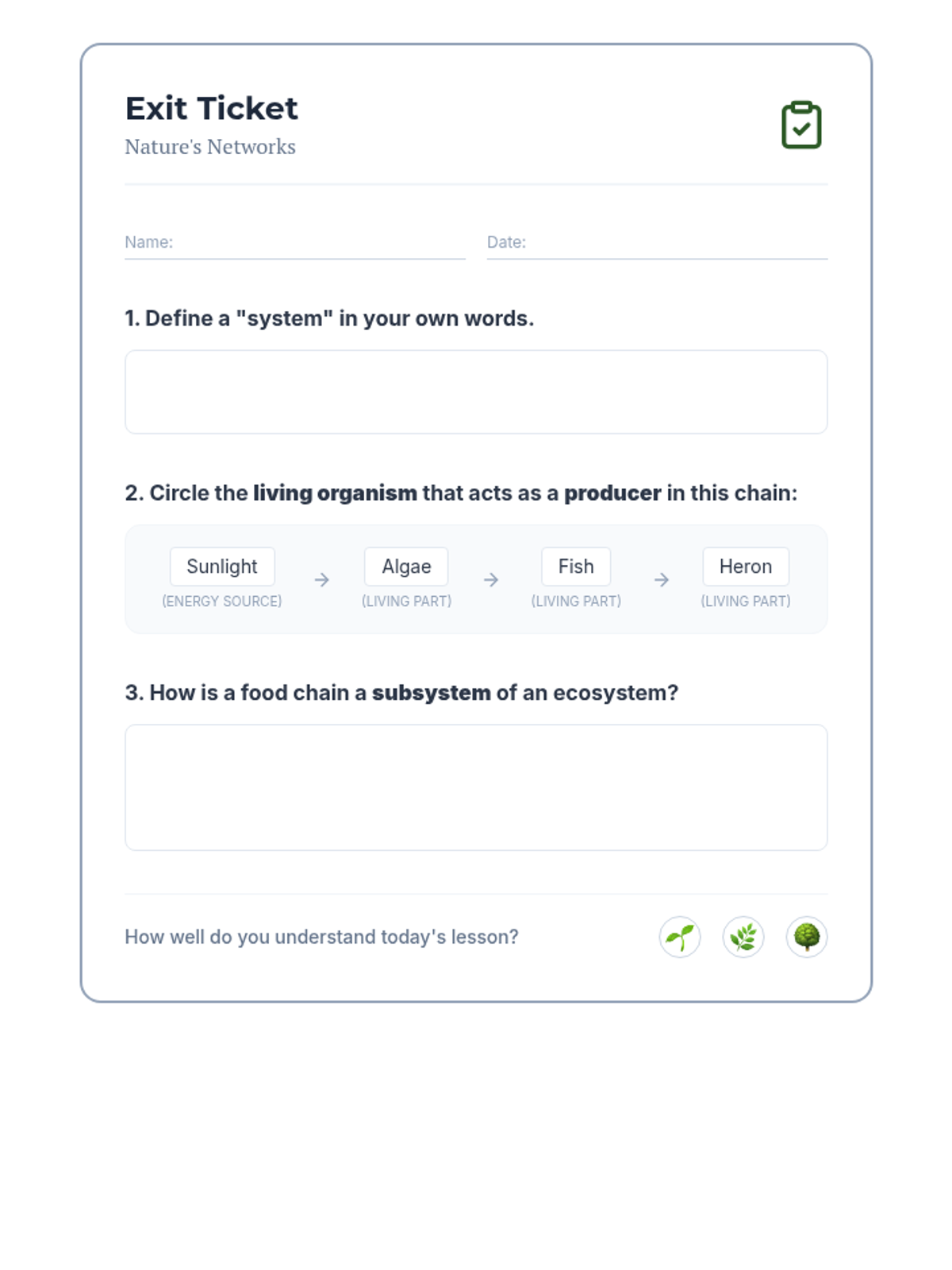
A short assessment to check for student understanding of systems, ecosystem roles, and subsystems. Revised to improve background contrast and clarity on sunlight vs organisms.
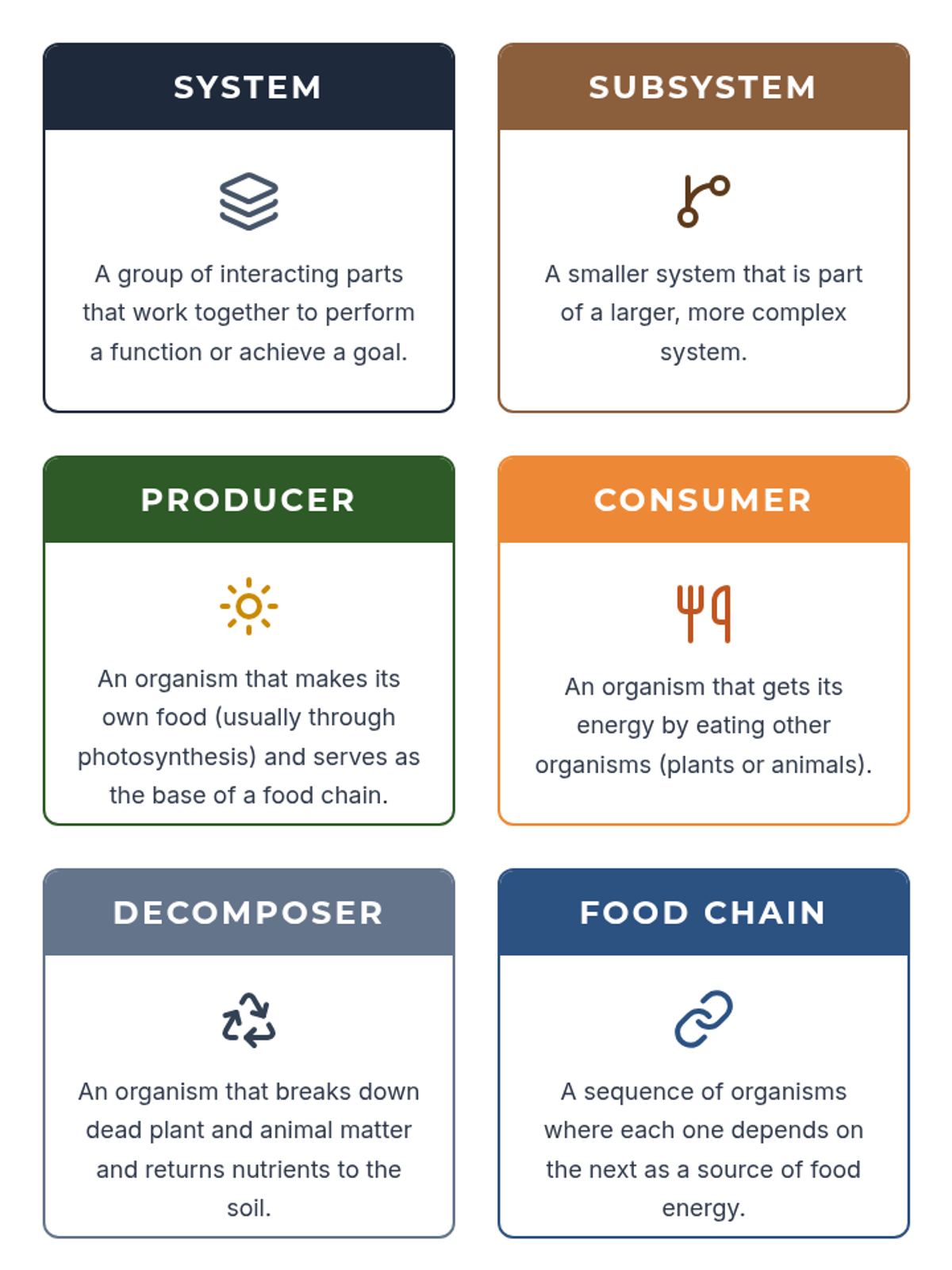
Visual vocabulary cards for key ecosystem terms, featuring definitions and icons. Revised to fix page break issues, icon contrast, and incomplete definitions.
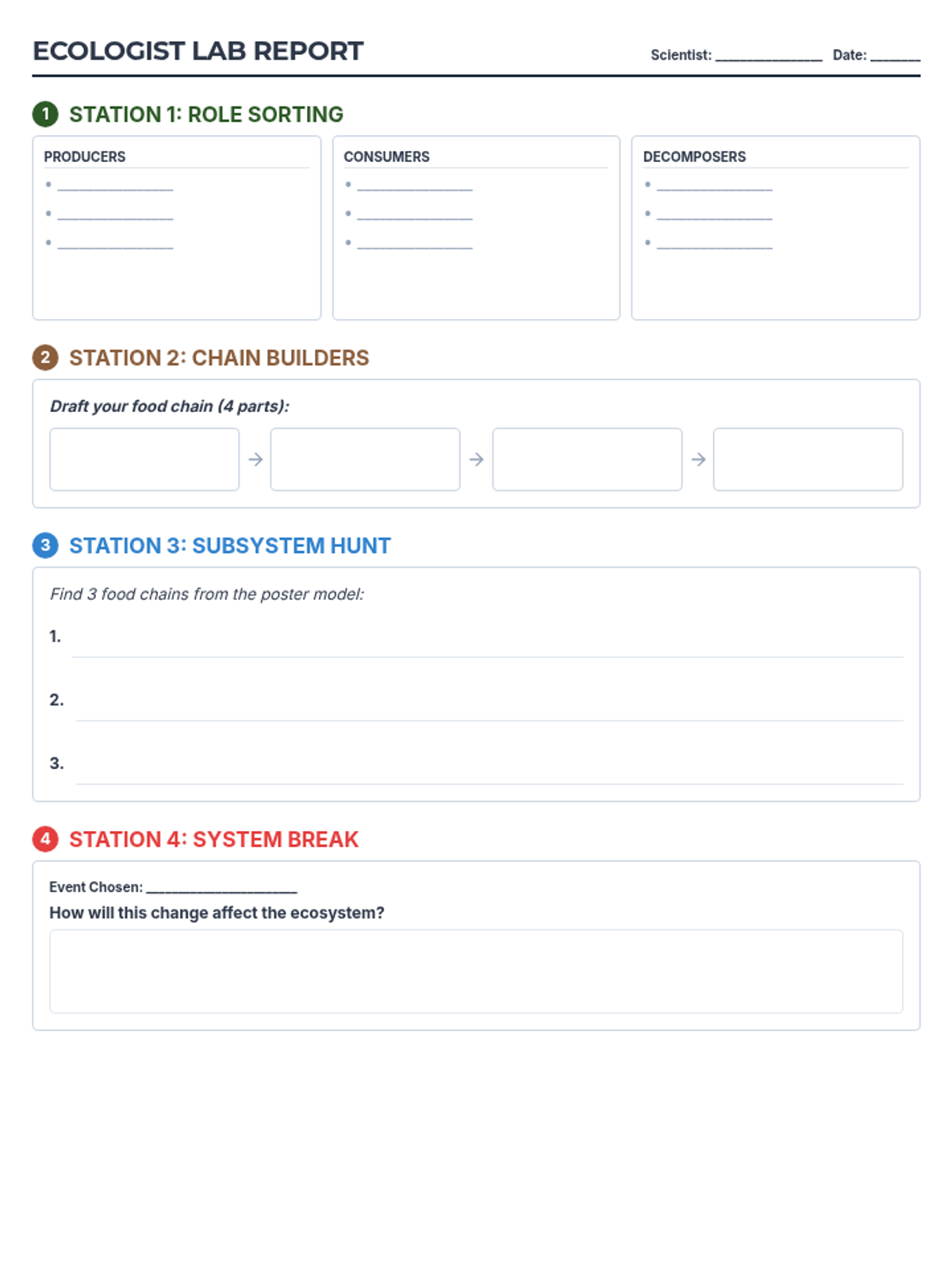
Recording sheet for students to document their observations and work from the ecosystem stations, revised to fix page breaks and improve contrast. All stations now fit on a single page. Fixed redundant text in Station 4.
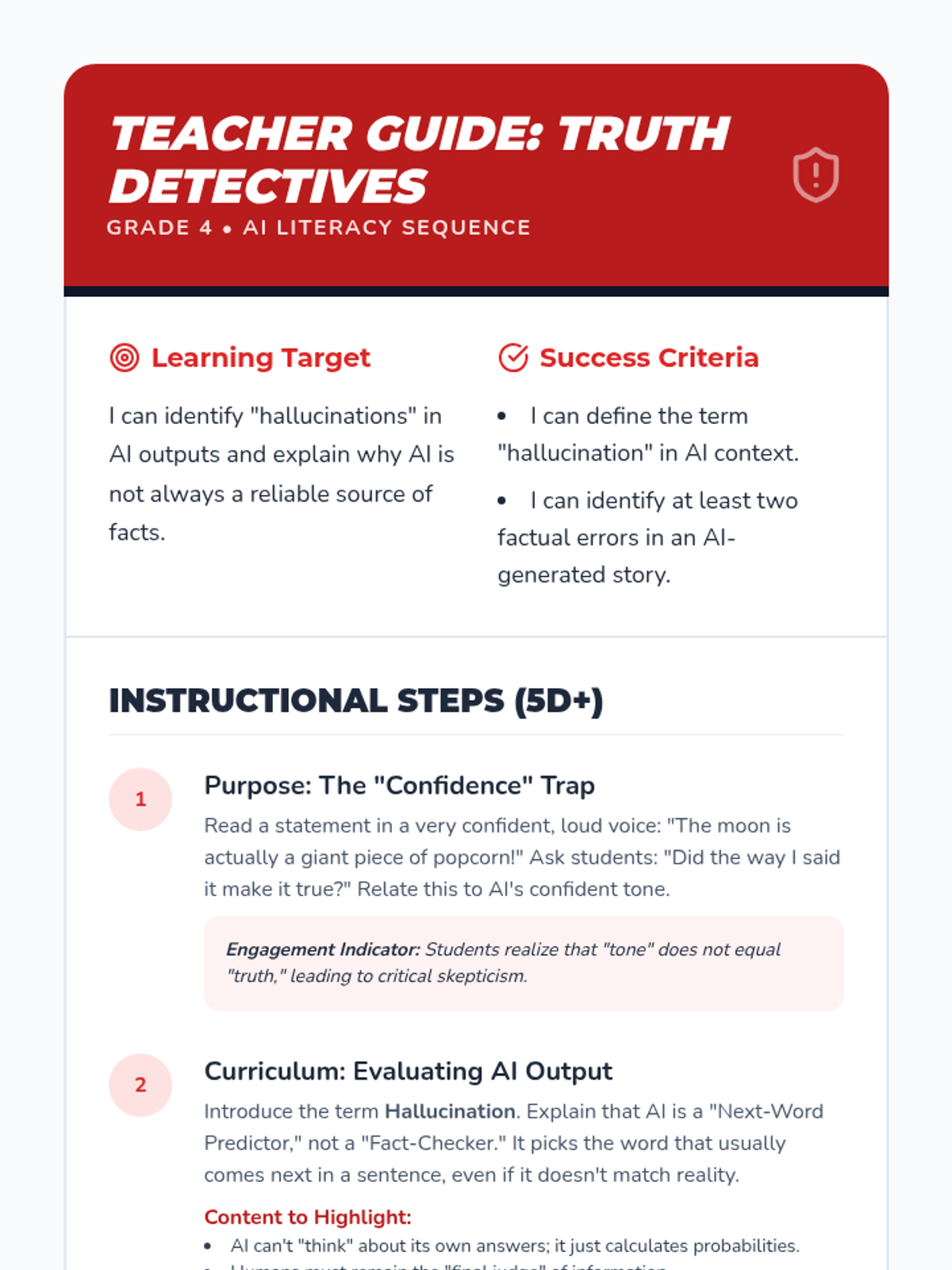
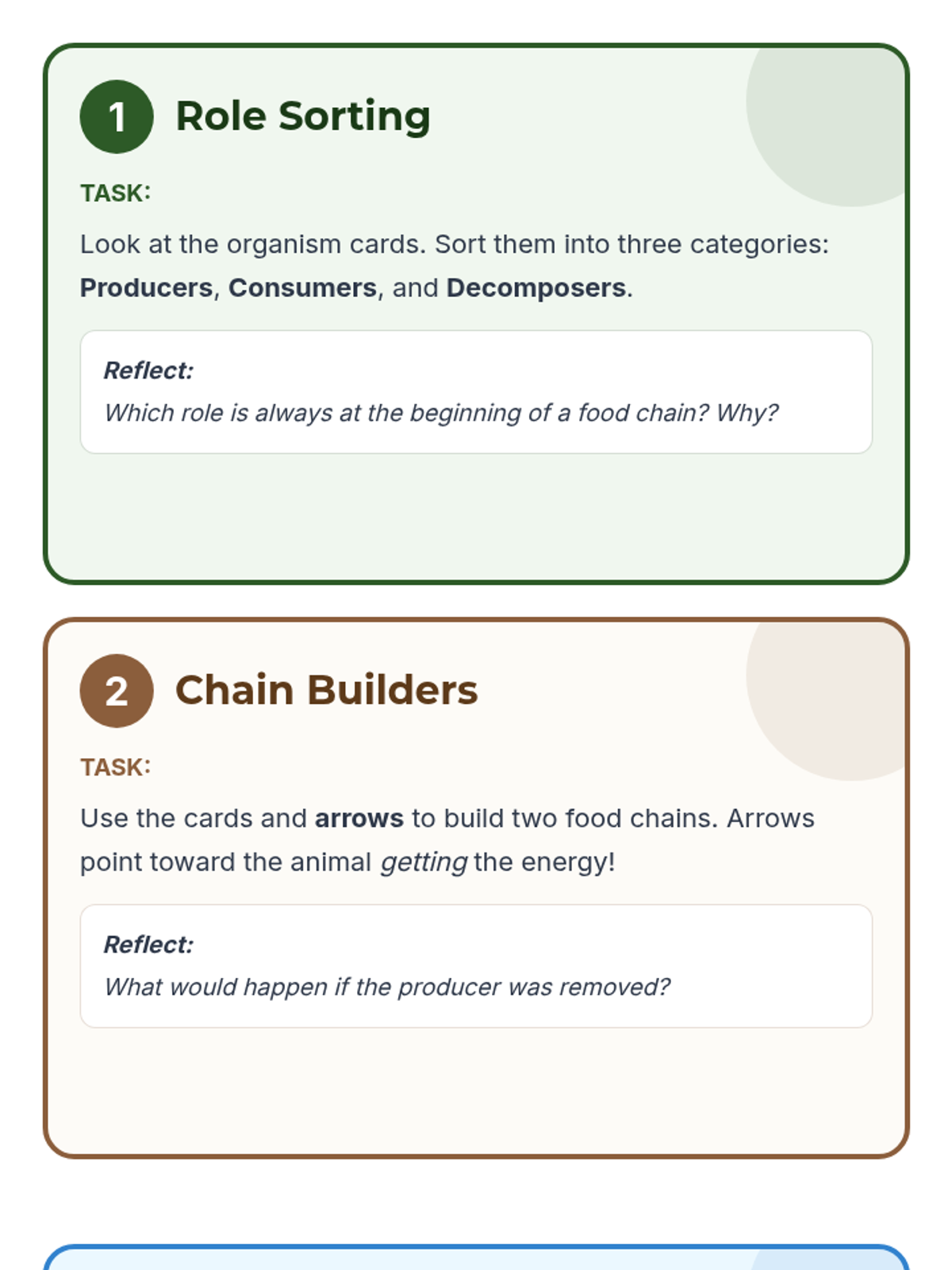
Direction signs for four hands-on stations exploring ecosystem roles, food chain construction, subsystem identification, and system stability. Now includes printable organism and event cards. Revised to ensure signs fit on single pages. Added more event cards and fixed poster overlap.
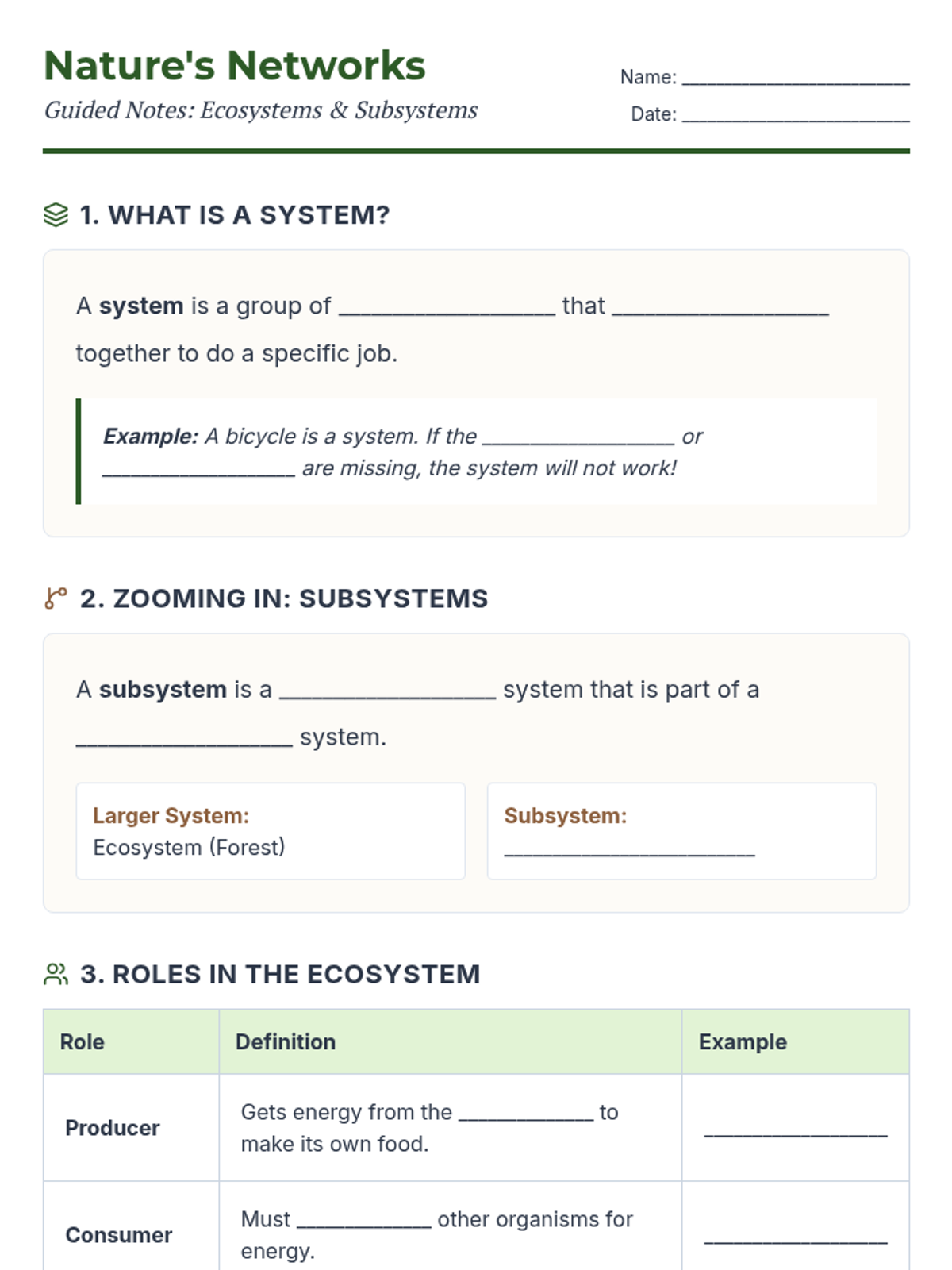
Guided notes for students to complete while following the "Nature Networks" slideshow, covering key terms and concepts about systems and ecosystem roles.
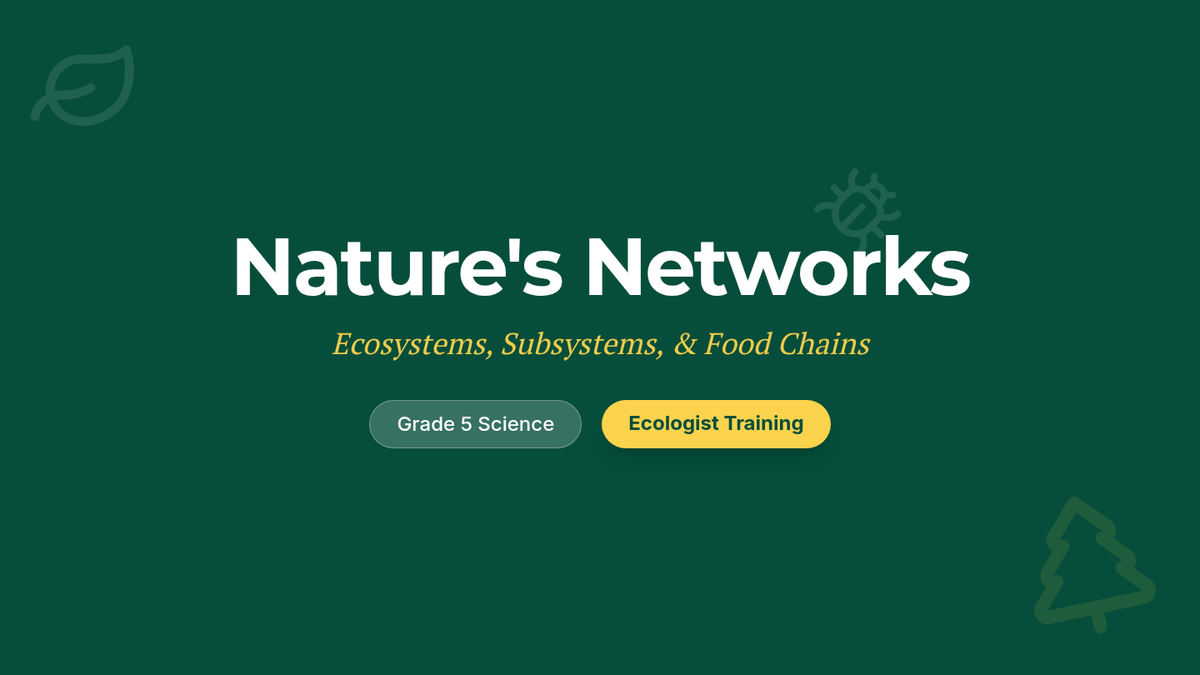
Instructional slides for ecosystems lesson, updated with a high-contrast 'Eco-Vibrant' color palette featuring deep emerald, golden ambers, and soft sage tones. Visual hierarchy and accessibility improved throughout. Fixed layout bleeding and viewport issues.
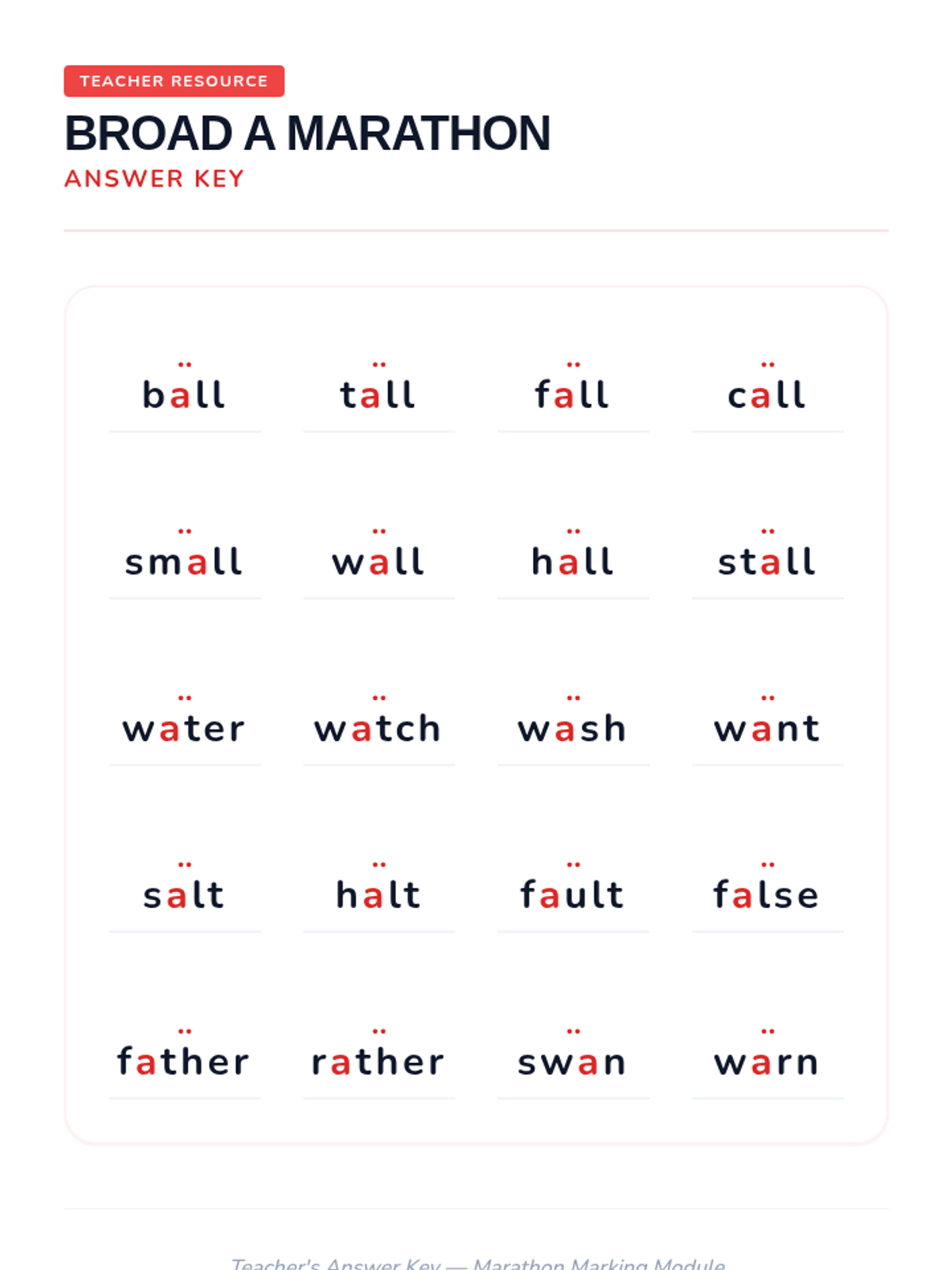
Answer key for the Broad A Marking Marathon Worksheet, providing correctly marked examples for all 20 words. Terminology updated to avoid 'umlaut'.
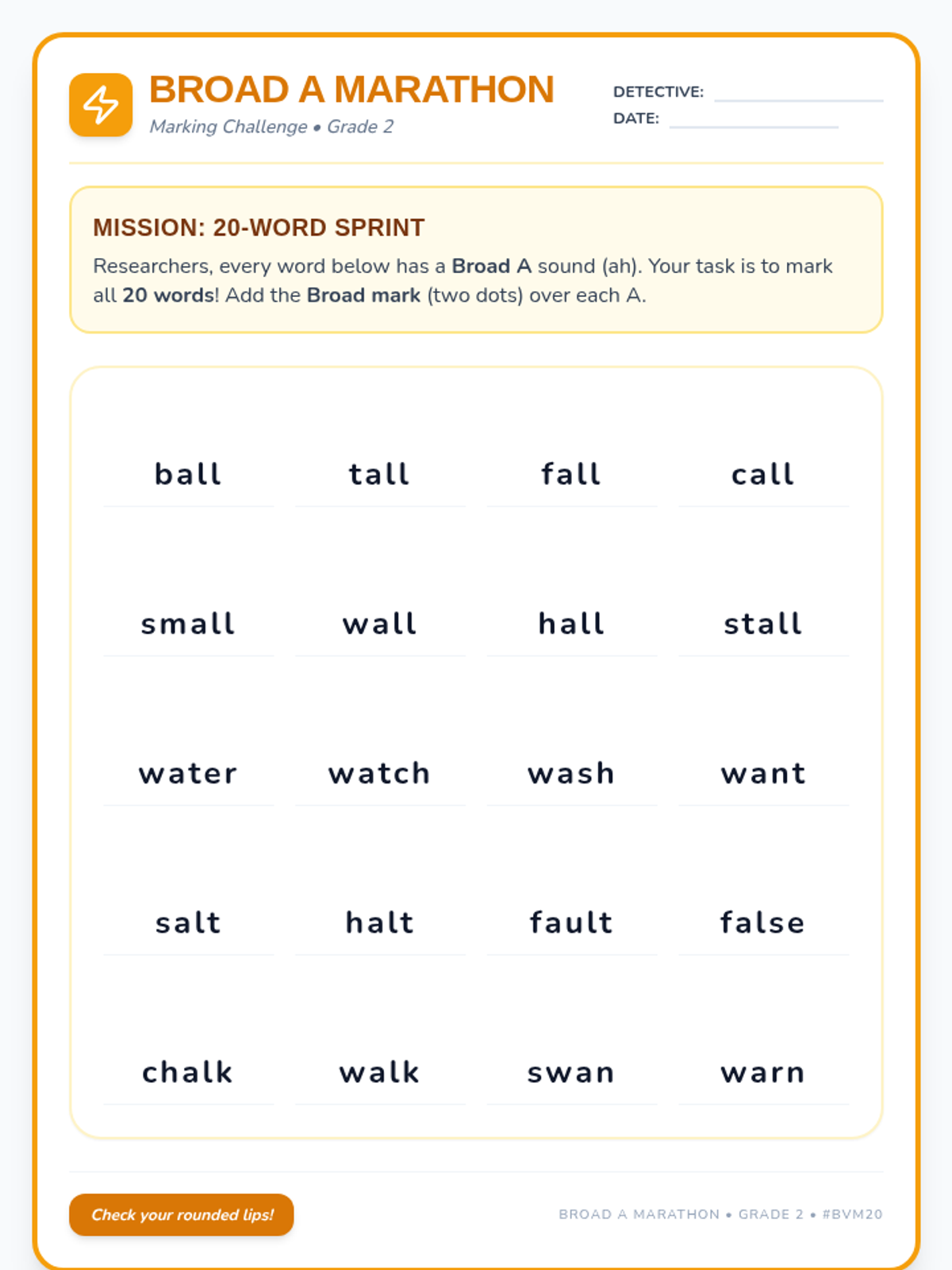
A marathon marking worksheet for Grade 2 focusing on the Broad A sound. Students must mark 20 different words with the Broad mark (two dots). Terminology updated to avoid 'umlaut'. Layout optimized to fit on a single page.
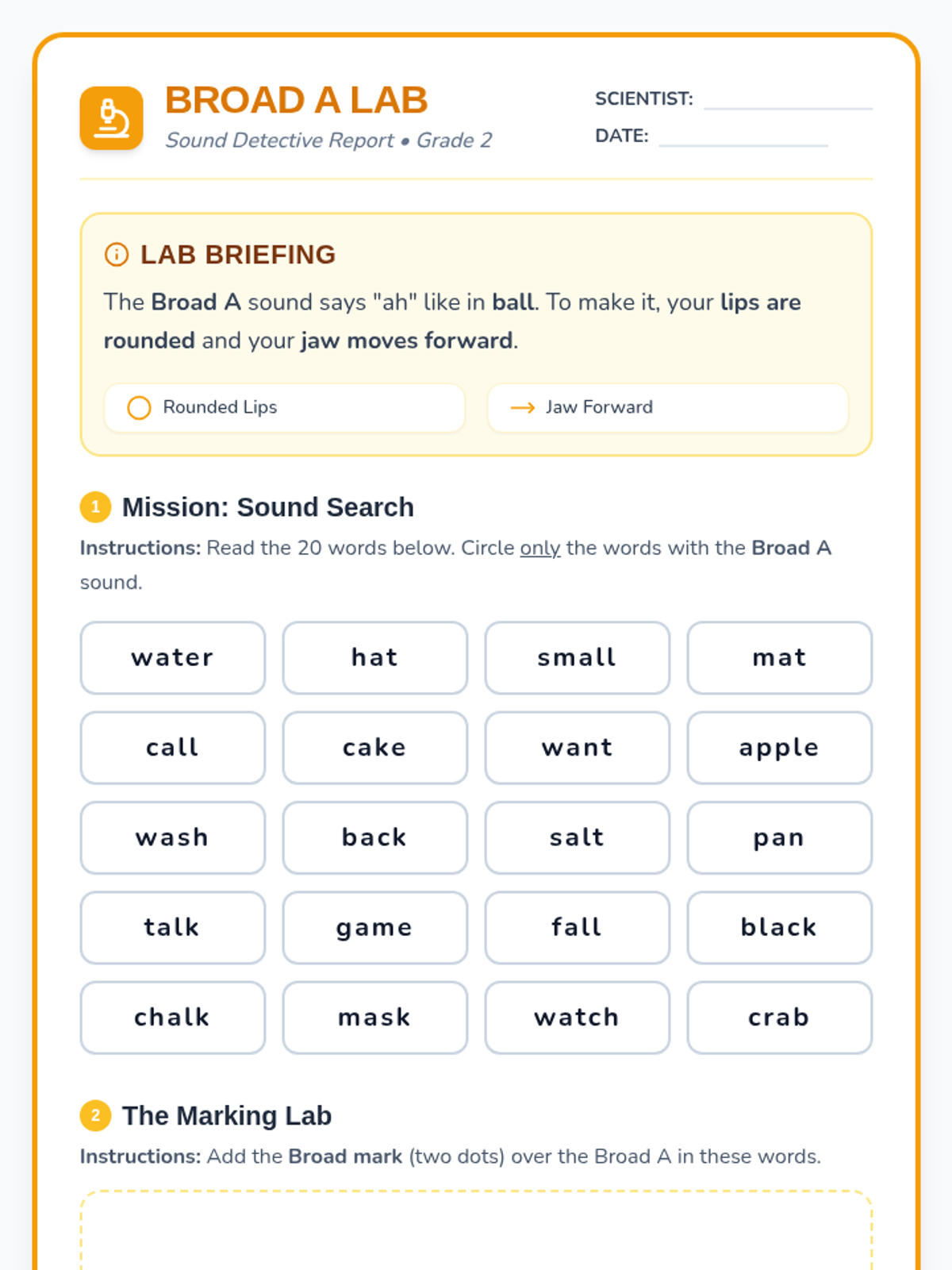
A Grade 2 worksheet focused on identifying the Broad A sound. It includes a "Lab Briefing" explanation of mouth positioning, a sound search grid with 20 words for discrimination, and a marking activity for phonetic analysis. Terminology updated to use 'Broad mark' instead of 'umlaut'.
A high-contrast visual presentation about stars and space exploration tools, designed to be accessible for students with diverse learning needs.
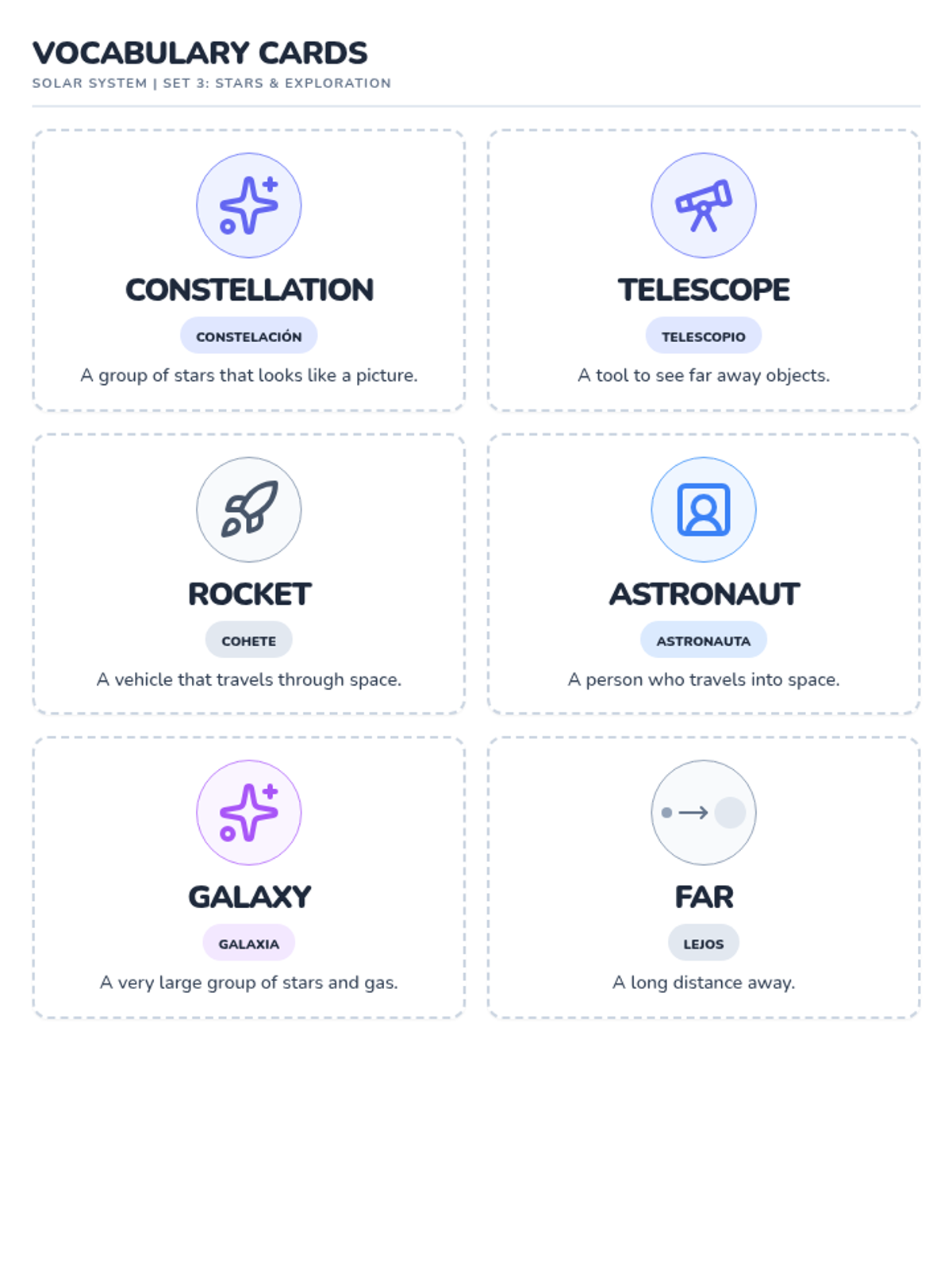
Vocabulary cards for stars and space exploration, featuring bilingual labels and simple definitions to assist newcomers and students with special needs.
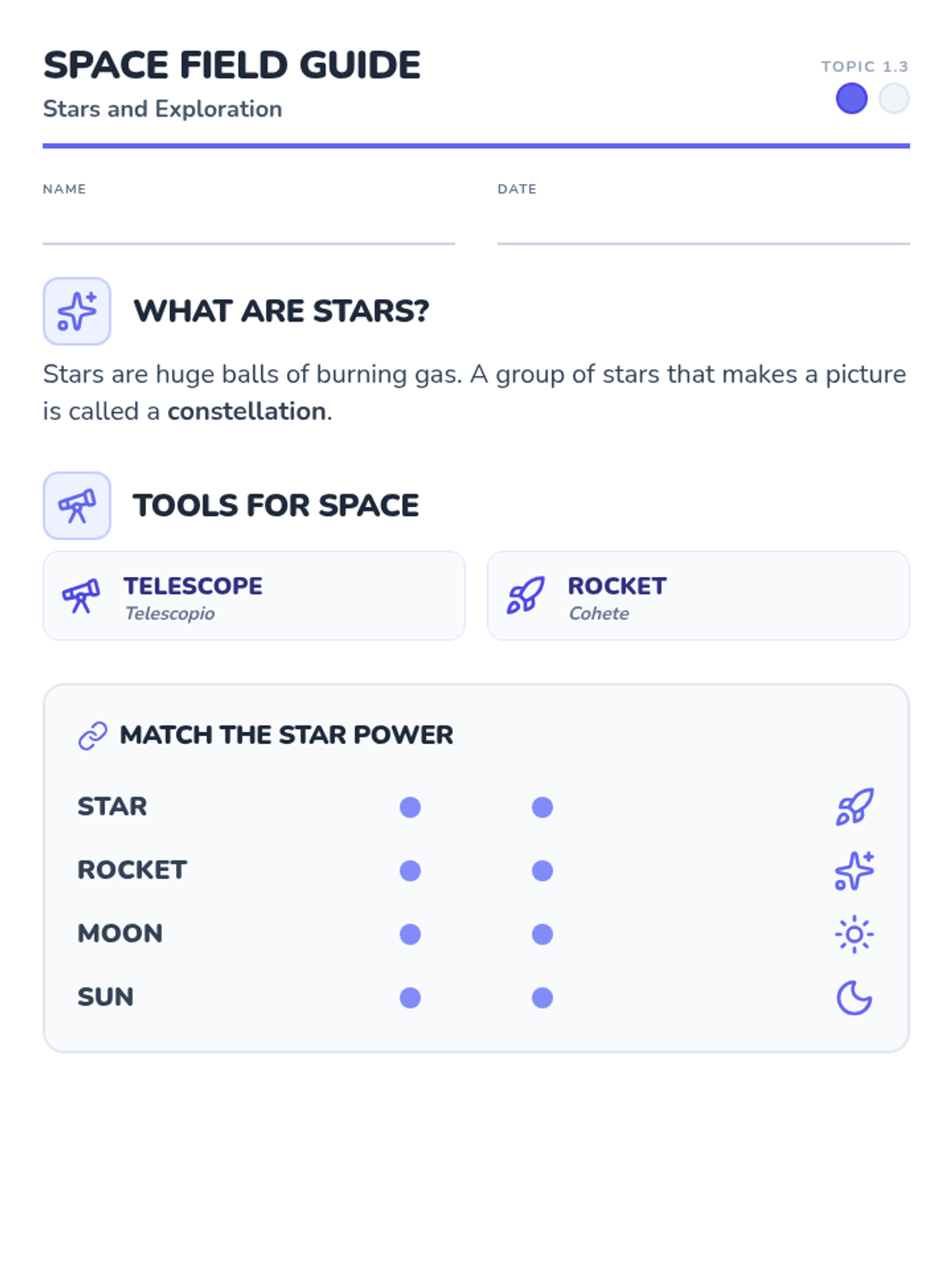
A simplified reading passage about stars, telescopes, and rockets with matching activities for students with cognitive differences.
Visual presentation for the planets lesson, illustrating the differences between rocky inner planets and gas giant outer planets with clear graphics and large text.
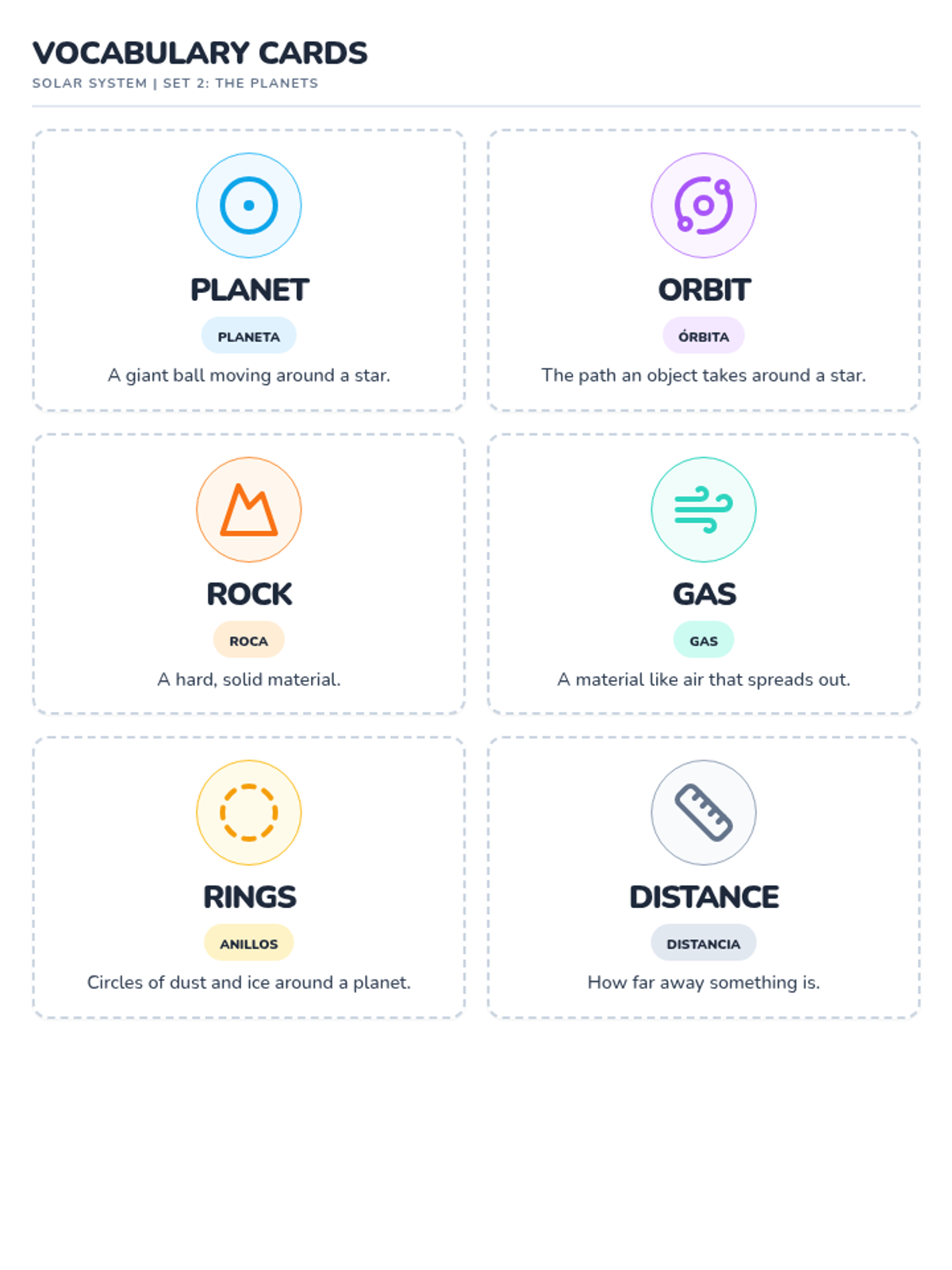
Vocabulary cards focusing on planetary concepts like orbit, rock, and gas, with bilingual support and simplified definitions.
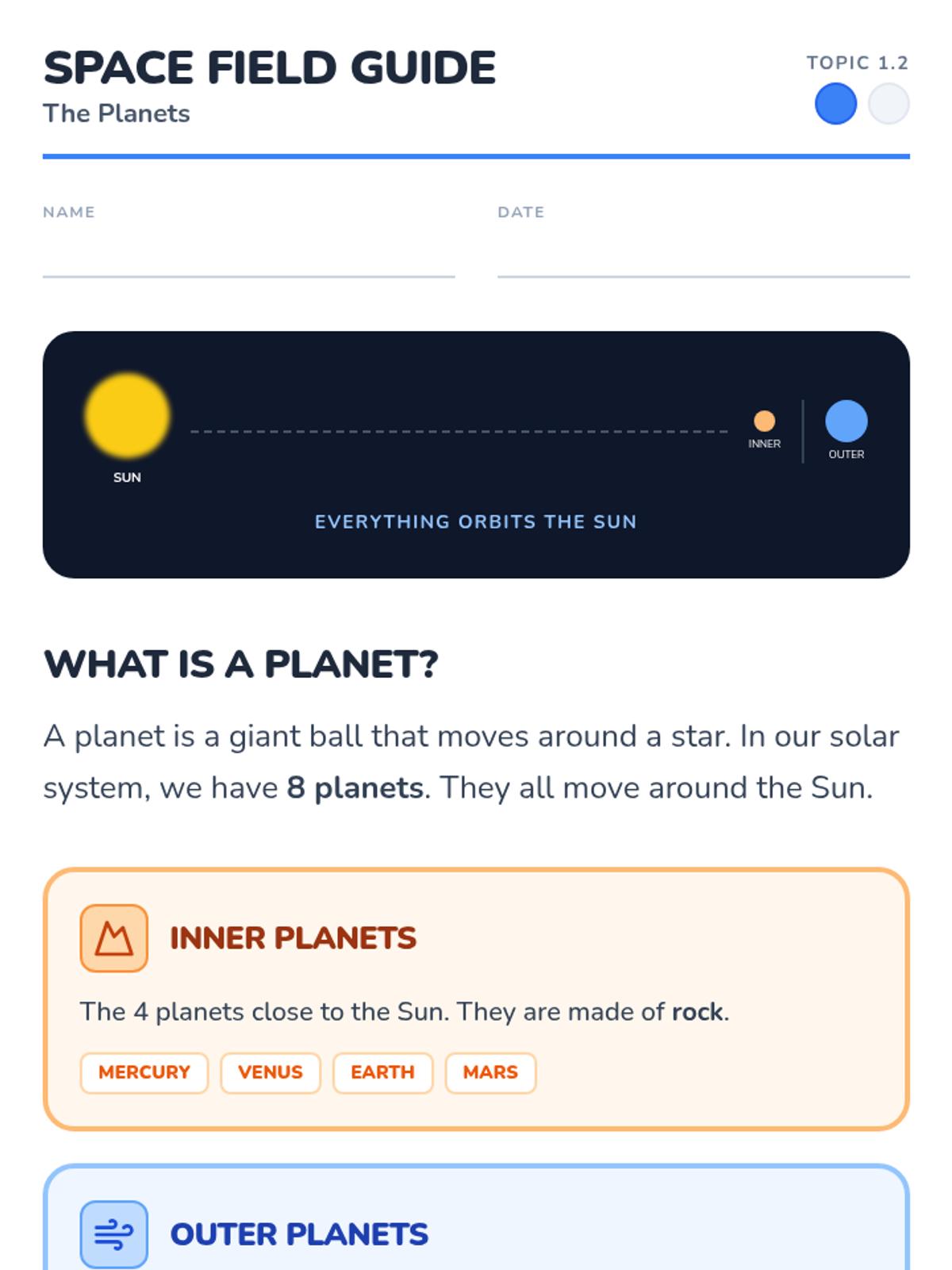
A simplified reading passage about the eight planets, divided into inner rocky planets and outer gas giants, designed for students with lower reading levels.
Highly visual presentation slides for the Sun and Moon, featuring large text and bold icons to support newcomers and students with special needs.
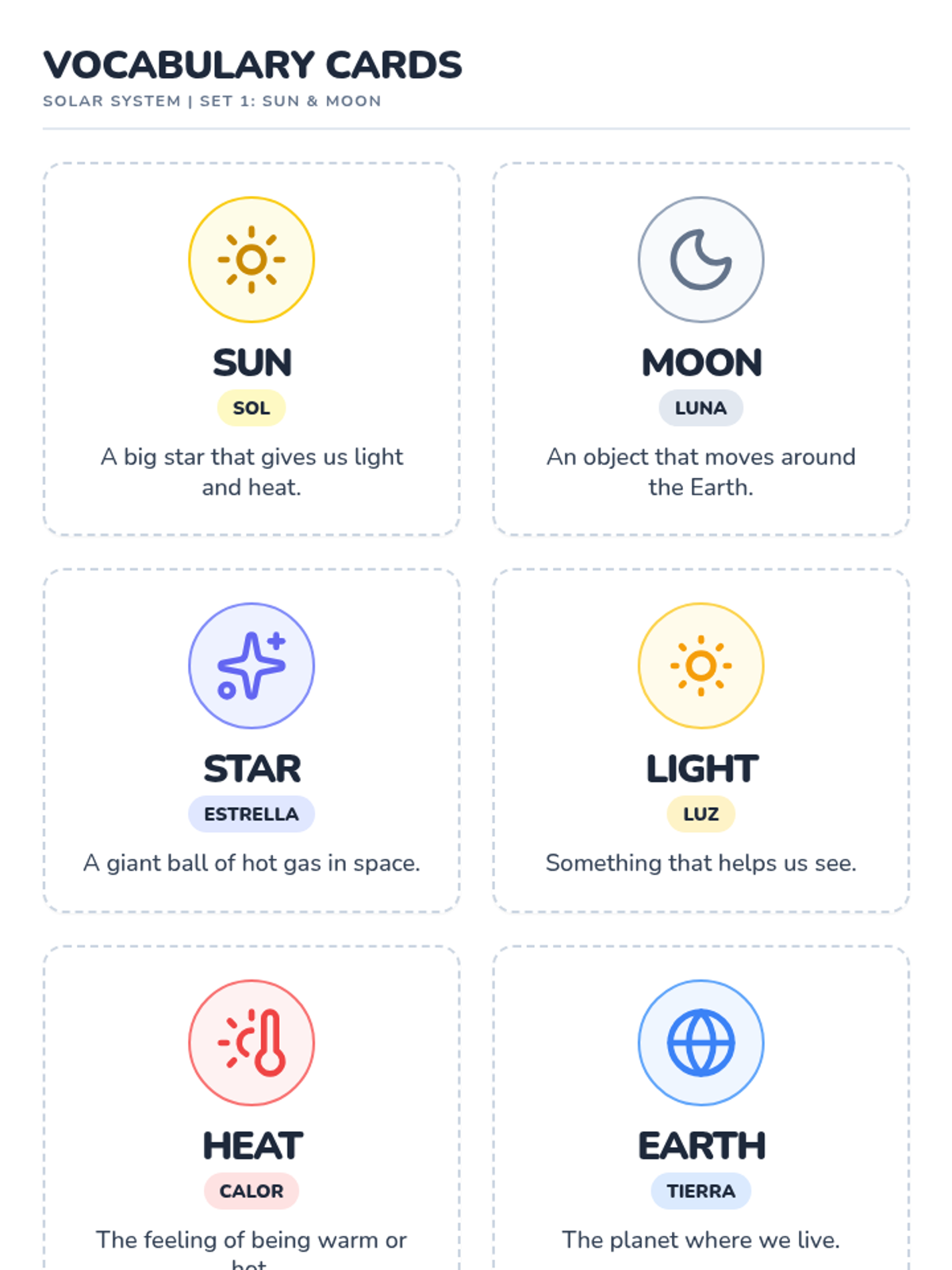
Visual vocabulary cards for the Sun and Moon lesson, including Spanish translations for newcomers and simplified definitions for IEP students.
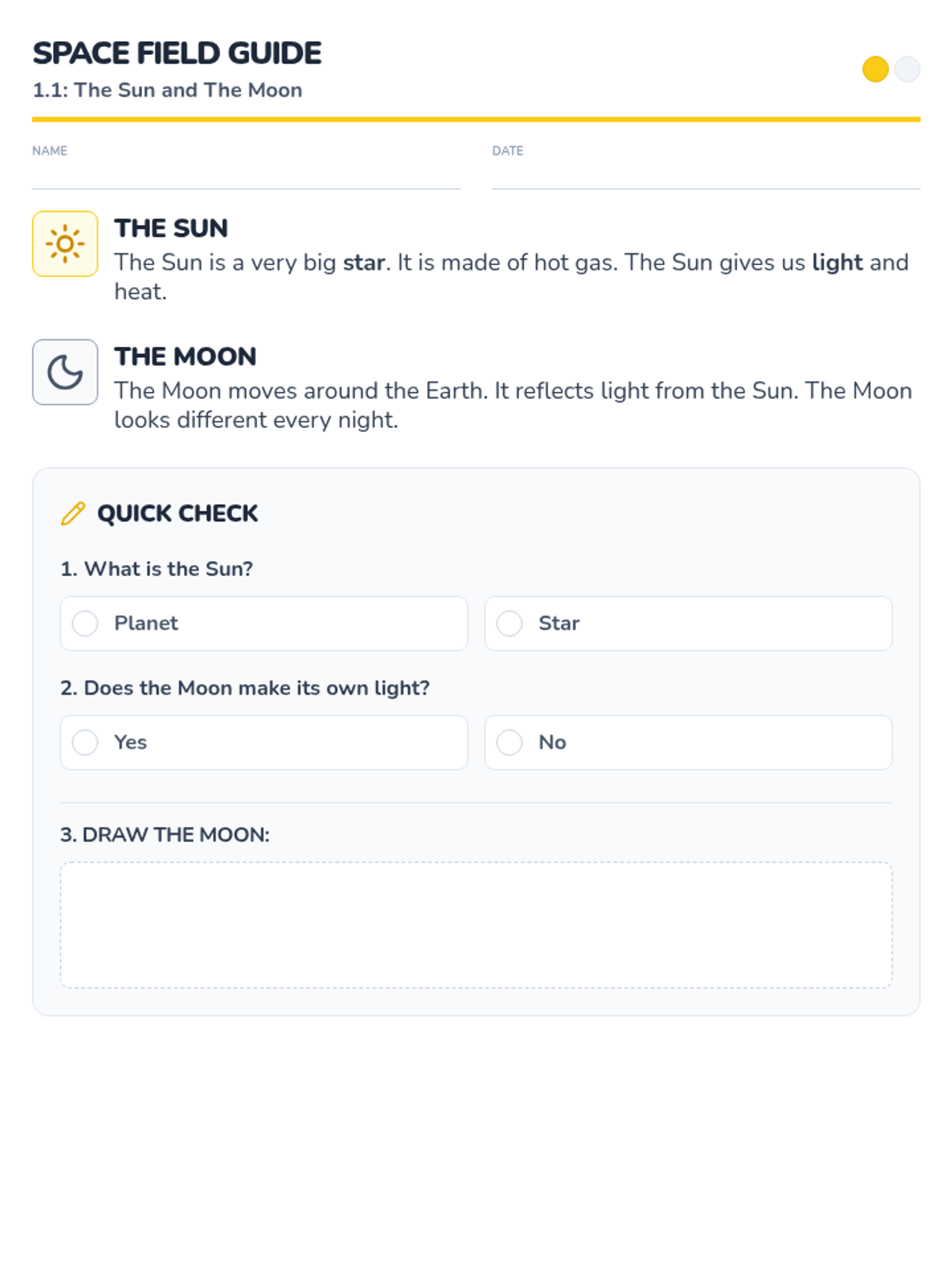
A simplified reading passage about the Sun and Moon with large text, visual icons, and simple comprehension questions for students with reading difficulties.
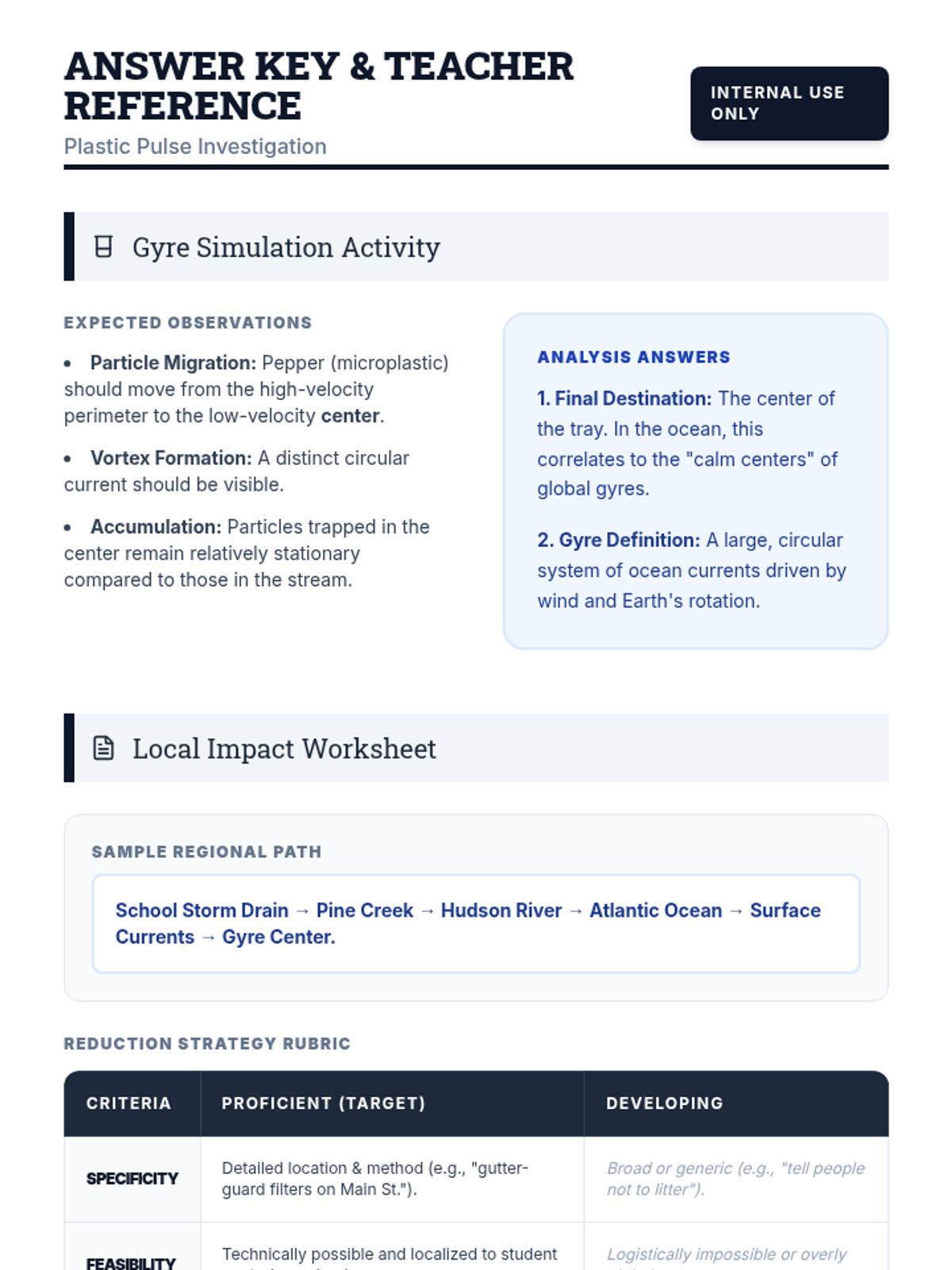
A teacher's reference guide containing expected student results, grading rubrics, and tips for addressing common misconceptions about ocean plastic pollution.
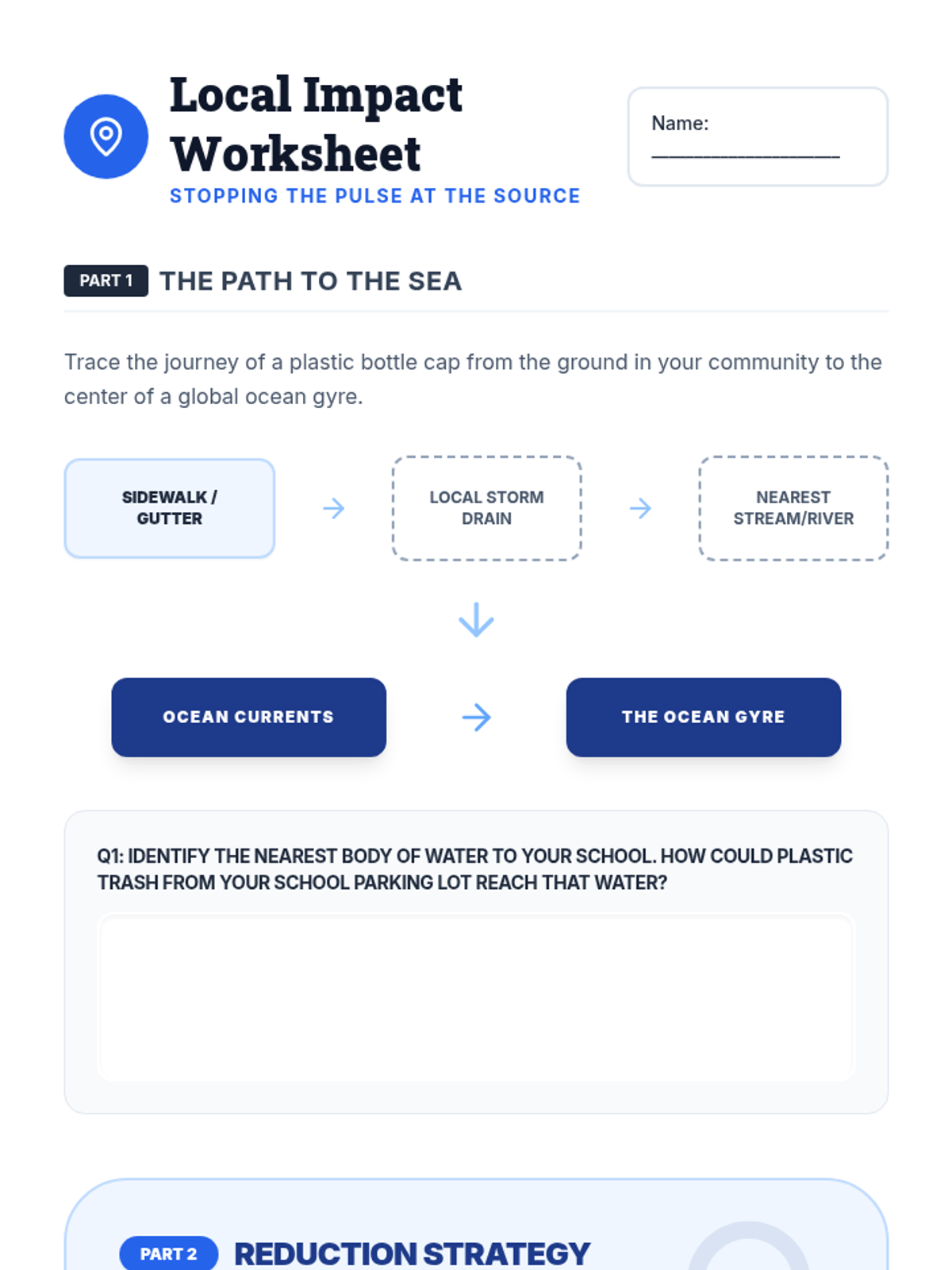
A synthesis worksheet where students trace the path of plastic from their local community to global gyres and design a localized intervention strategy to prevent plastic pollution.
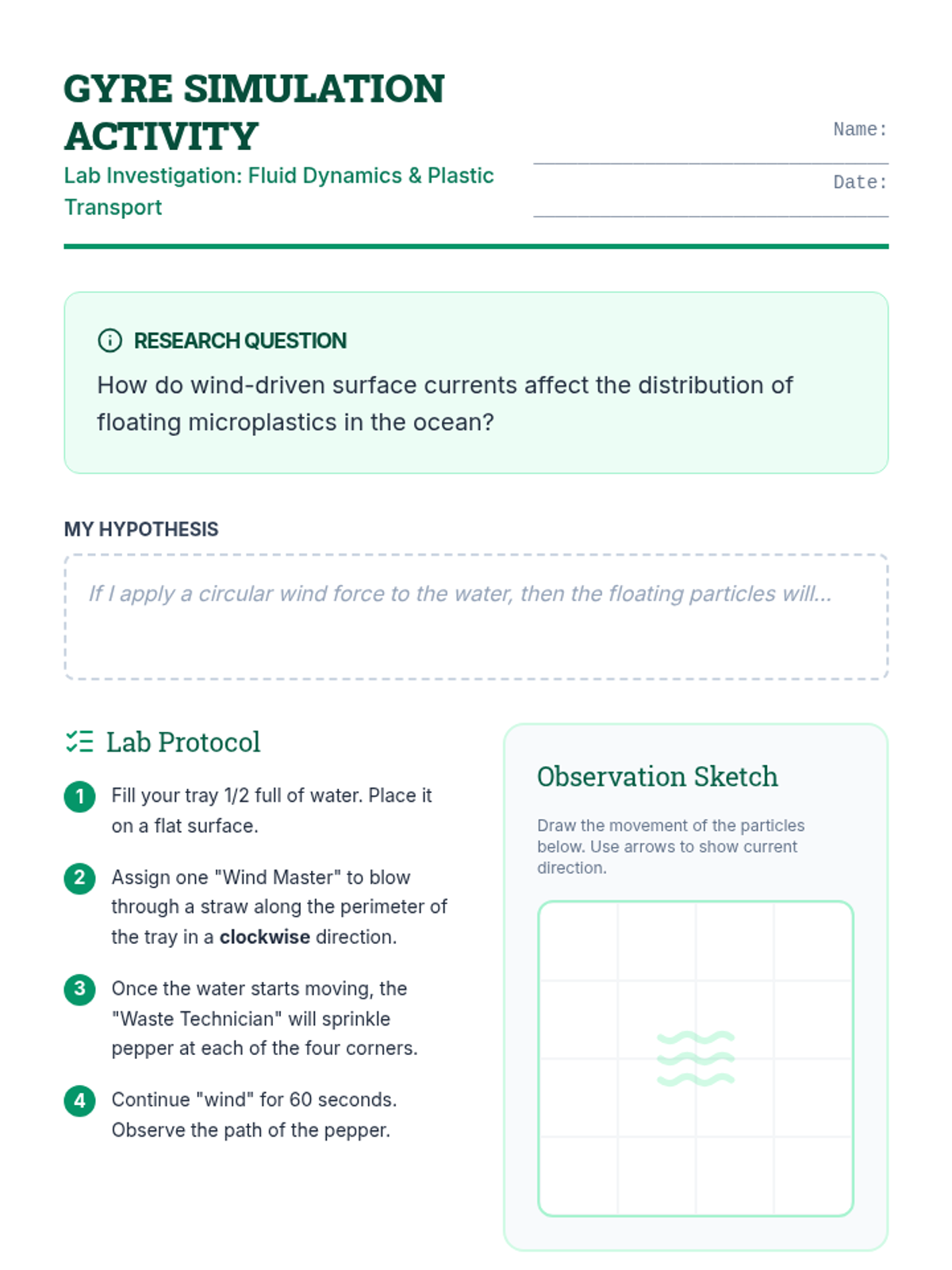
A structured lab sheet for students to document their ocean gyre simulation, including hypothesis formation, observation sketches, and analytical questions.
A visually engaging slide deck that introduces the concept of microplastics, explains ocean gyres and the Coriolis Effect, and sets up the hands-on simulation lab.
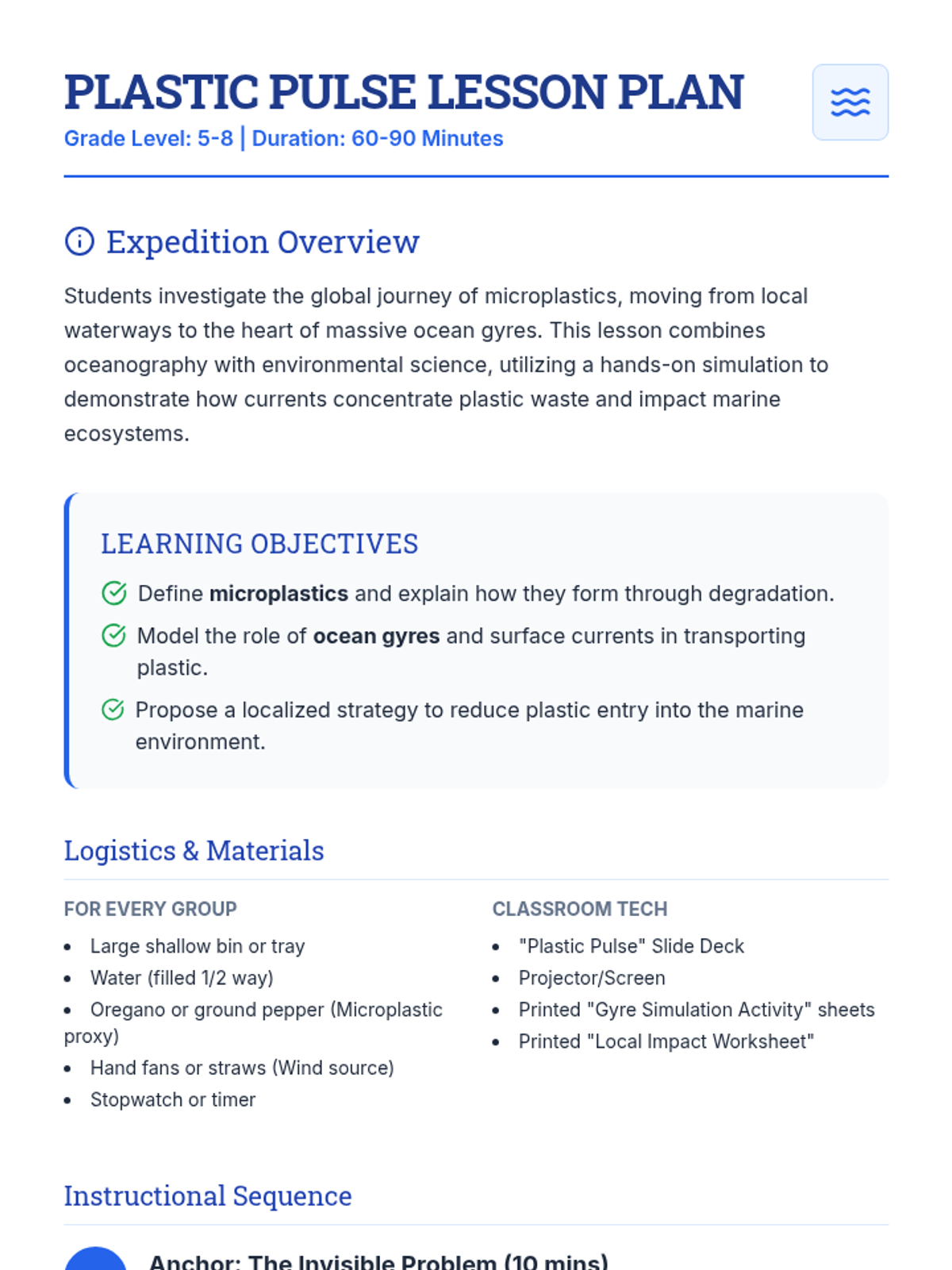
A comprehensive teacher's guide for the Plastic Pulse lesson, including learning objectives, a detailed instructional sequence, and differentiation strategies for investigating microplastic transport.
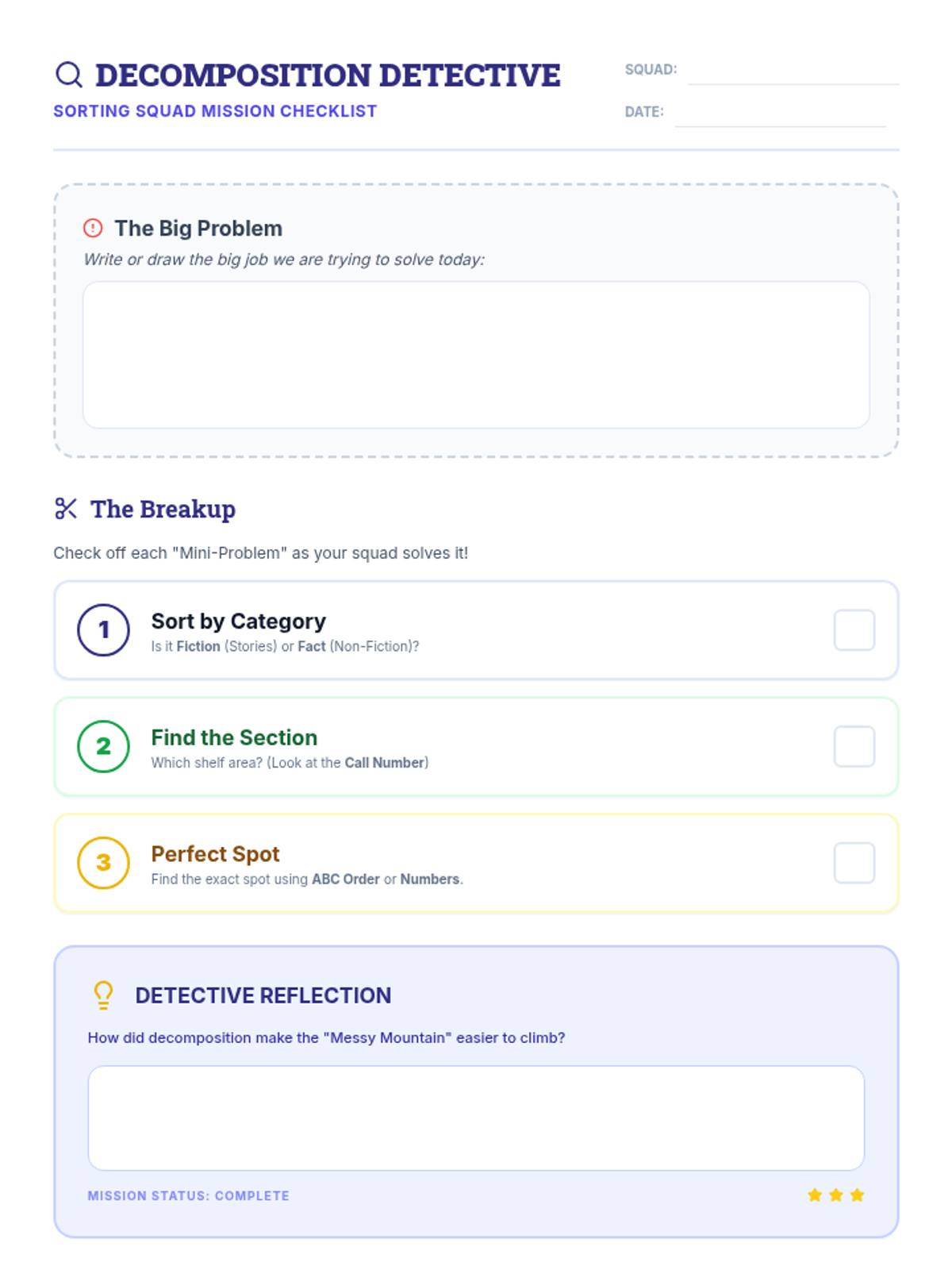
A student-facing application activity and assessment checklist for the 'Great Book Breakup' lesson. Students identify the 'big problem', check off decomposition steps (Category, Section, Spot), and reflect on the process.
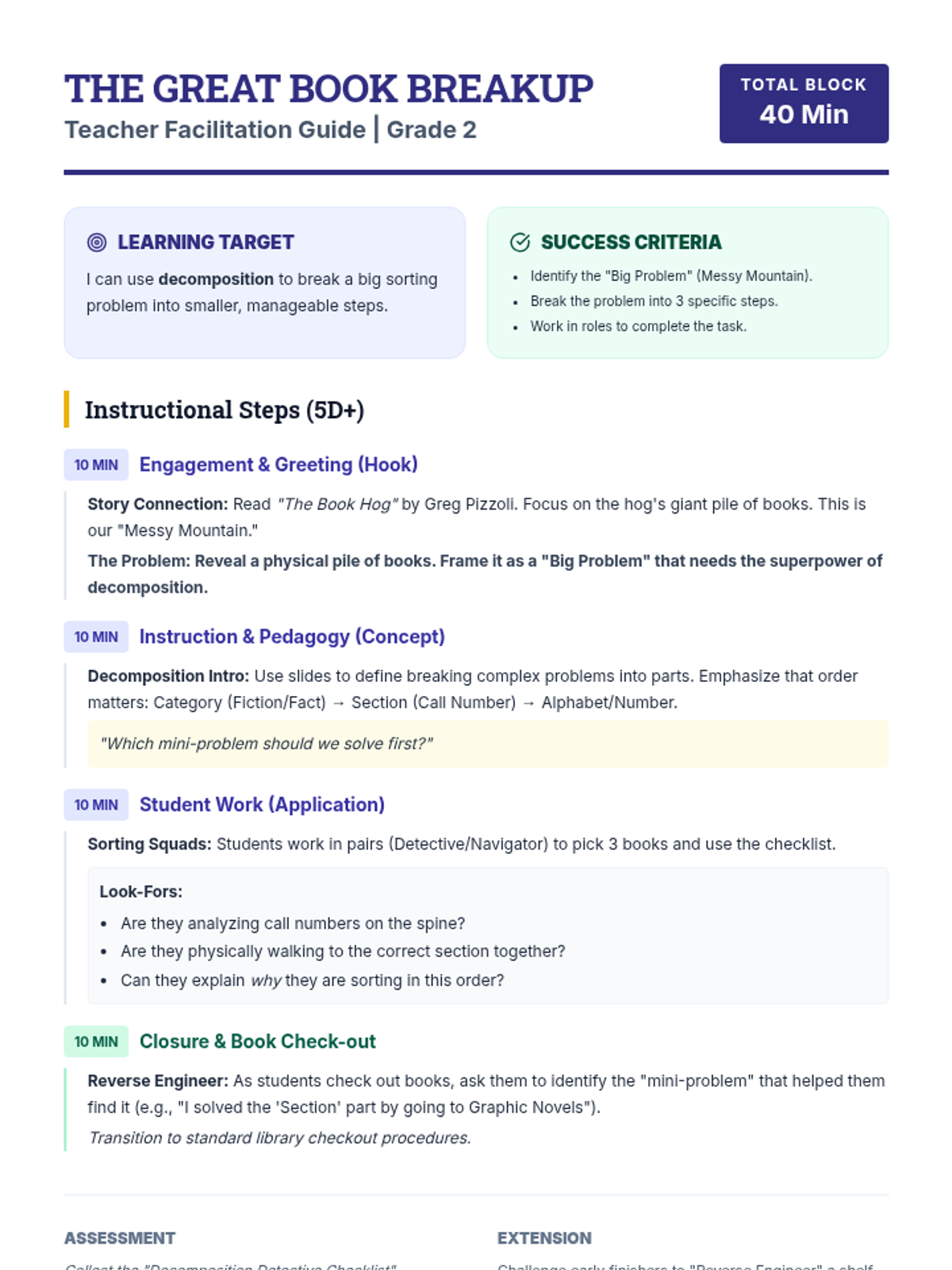
A teacher facilitation guide for the 'Great Book Breakup' lesson, including 5D+ framework alignment, CS and Iowa standards, learning targets, and specific instructional moves for a 40-minute library block.
A 6-slide presentation for a 2nd-grade CS unplugged lesson on decomposition. Using a library 'Messy Mountain' theme, it explains breaking large problems into smaller steps and assigns collaborative roles.
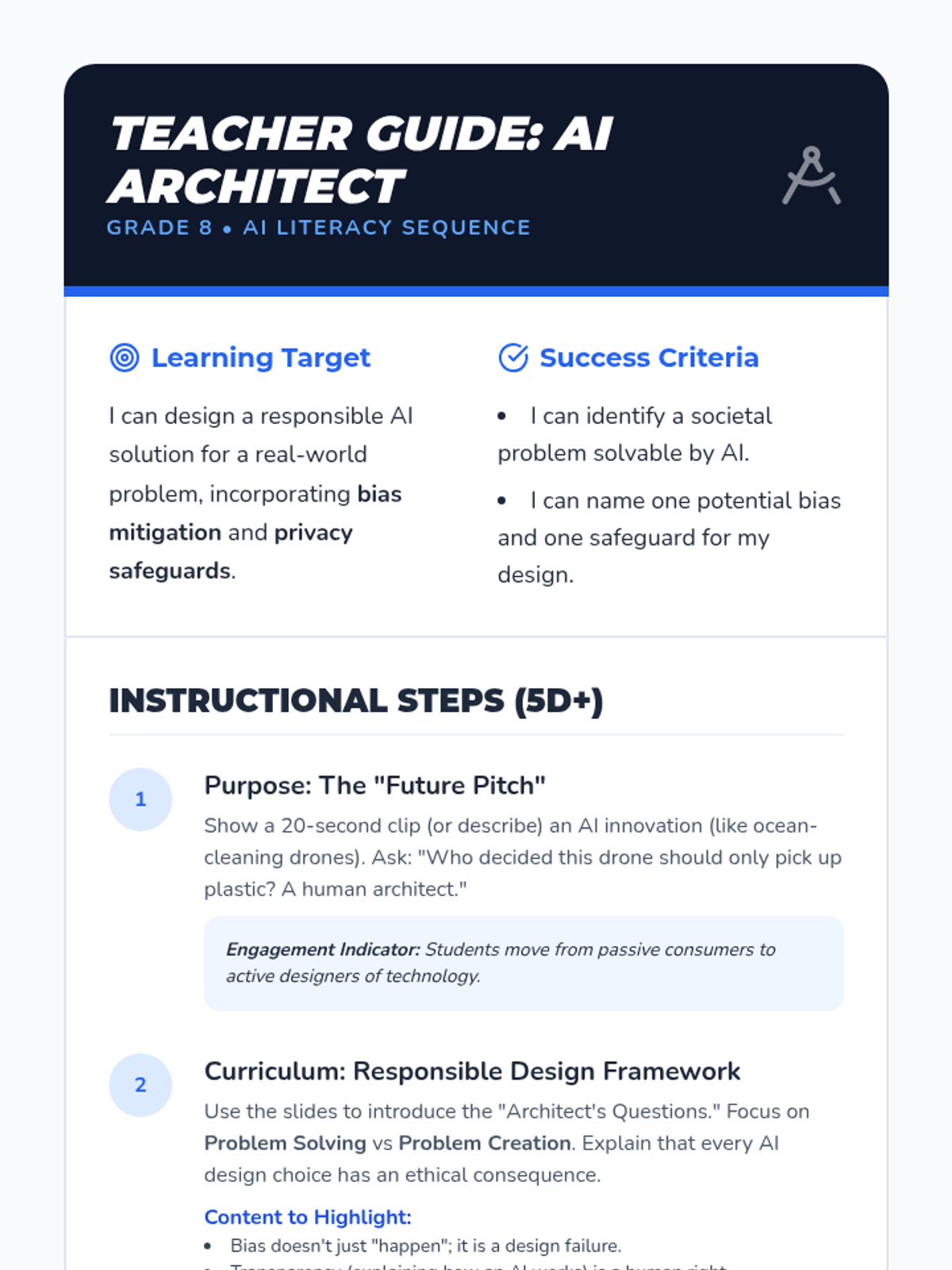
A teacher guide for the culminating Grade 8 AI Literacy lesson. Includes instructional steps for facilitating a "Design Studio" project, 5D+ framework alignment, and strategies for peer-led ethical audits.
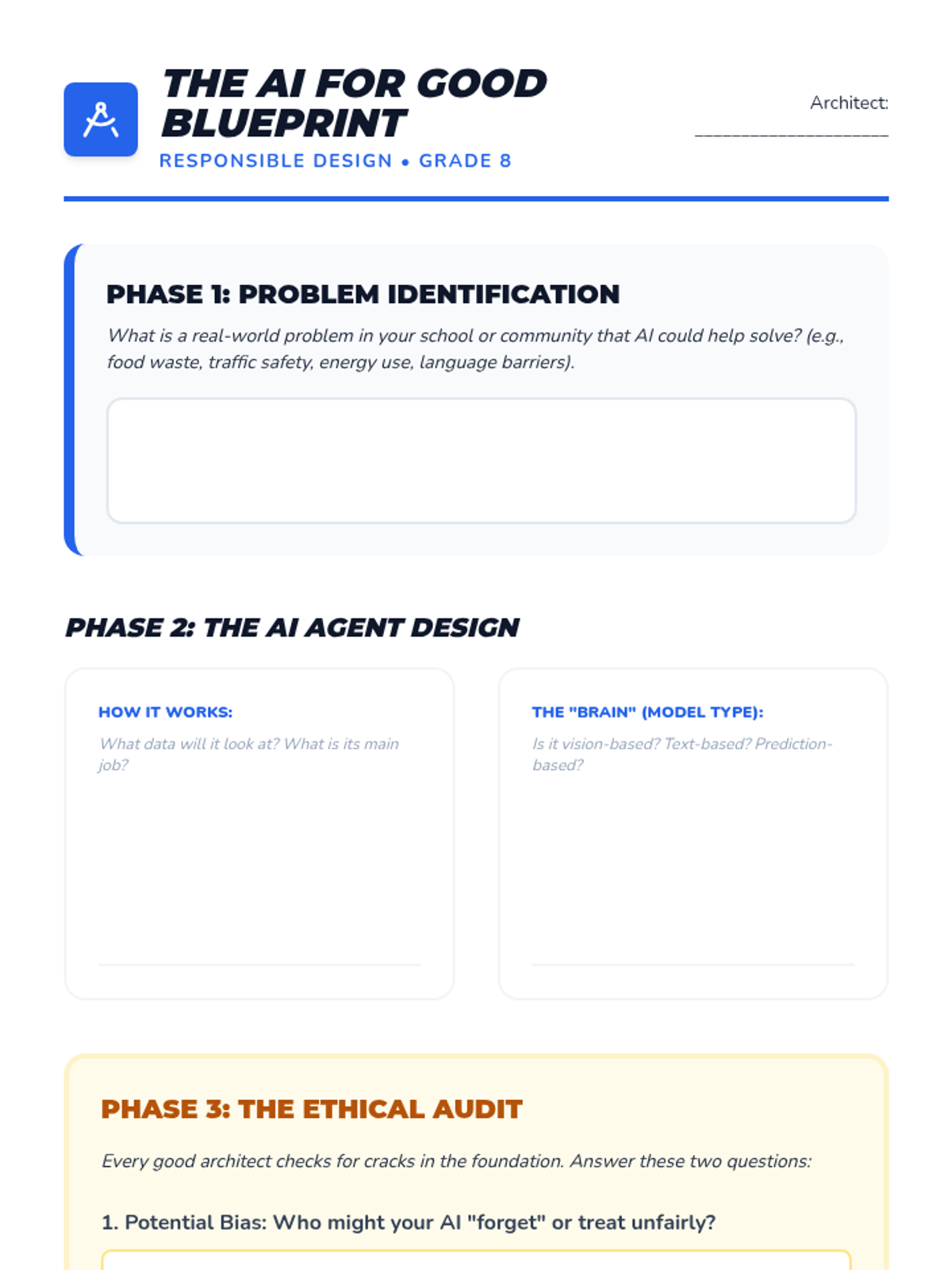
A project blueprint for Grade 8 students to design a responsible AI solution for a real-world problem. It includes sections for problem identification, technical design, an ethical audit (bias and safeguards), and a creative motto.
A 6-slide presentation for 8th Grade students on responsible AI design. It encourages students to move from consumers to creators ("Architects") and outlines a framework for designing AI solutions that are fair, transparent, and safe.
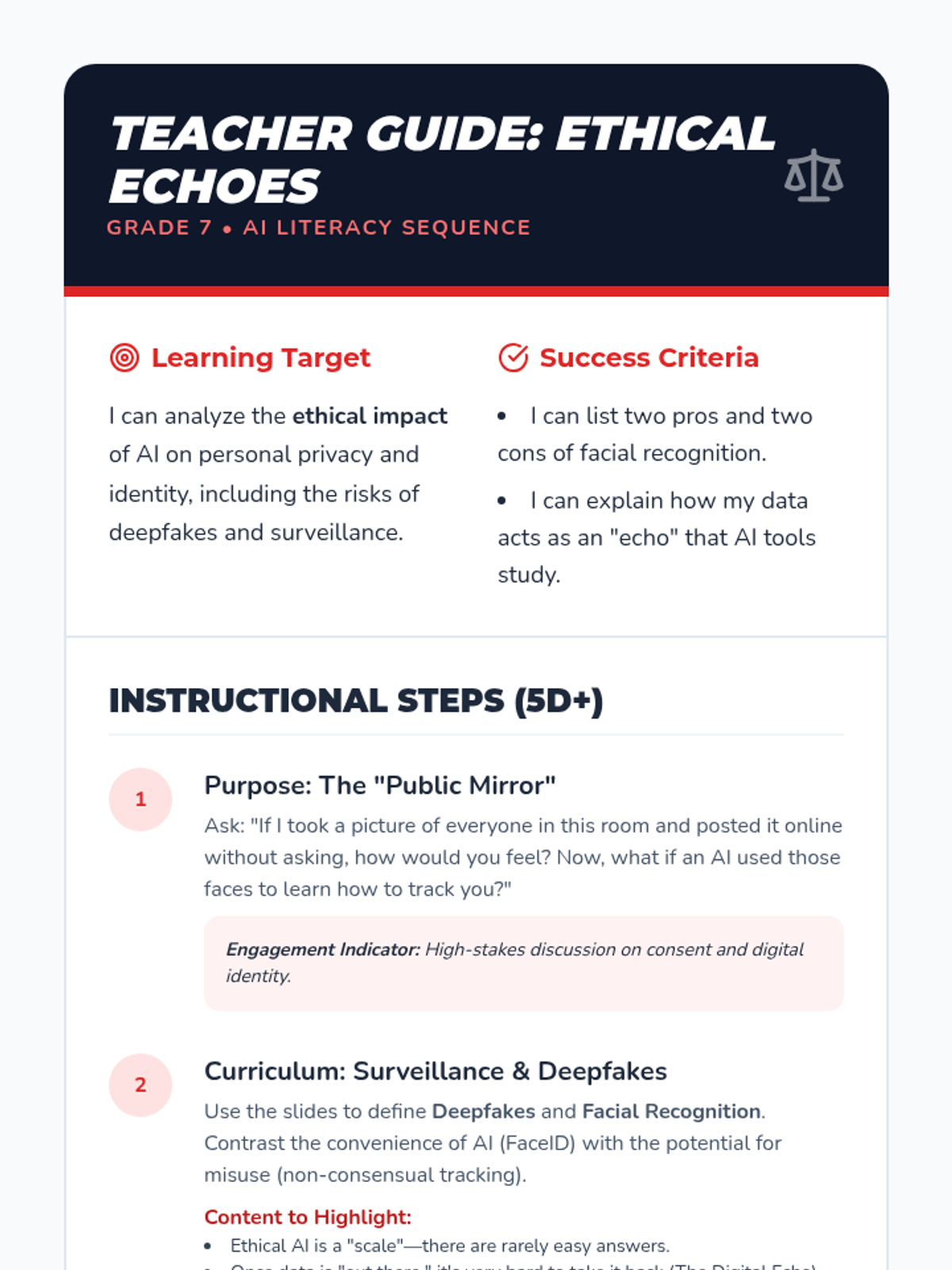
A teacher guide for the Grade 7 AI Literacy lesson on ethics and privacy. Includes instructional steps for facilitating debates on surveillance, alignment with 5D+ framework, and strategies for teaching deepfake awareness.
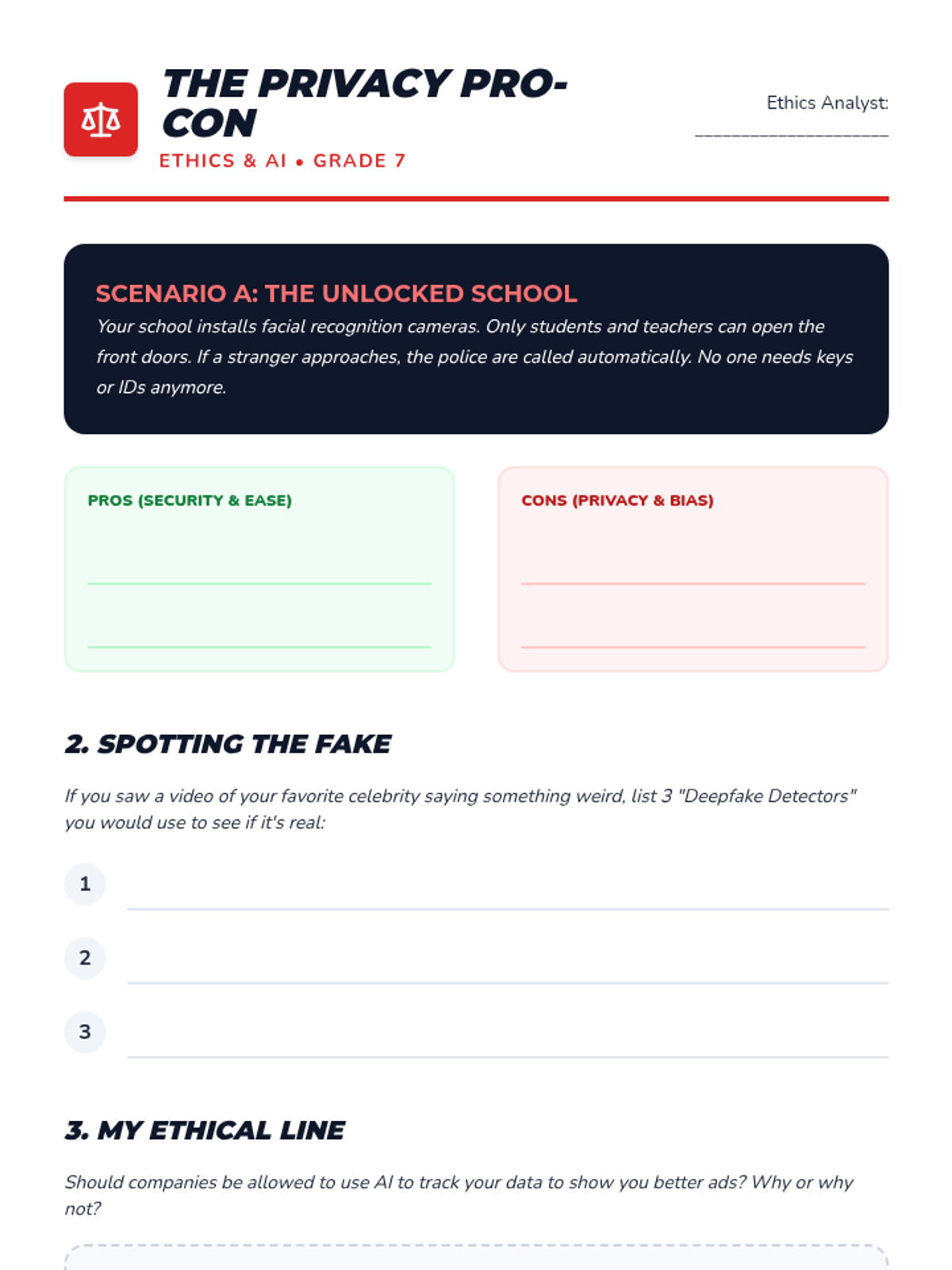
A worksheet for Grade 7 students to explore AI ethics. It includes a pro-con analysis of facial recognition in schools, strategies for detecting deepfakes, and a reflective exercise on personal data privacy boundaries.
A 6-slide presentation for 7th Grade students on AI ethics and privacy. It covers facial recognition, deepfakes, and the trade-off between security and personal privacy, encouraging students to consider where "the line" should be drawn.
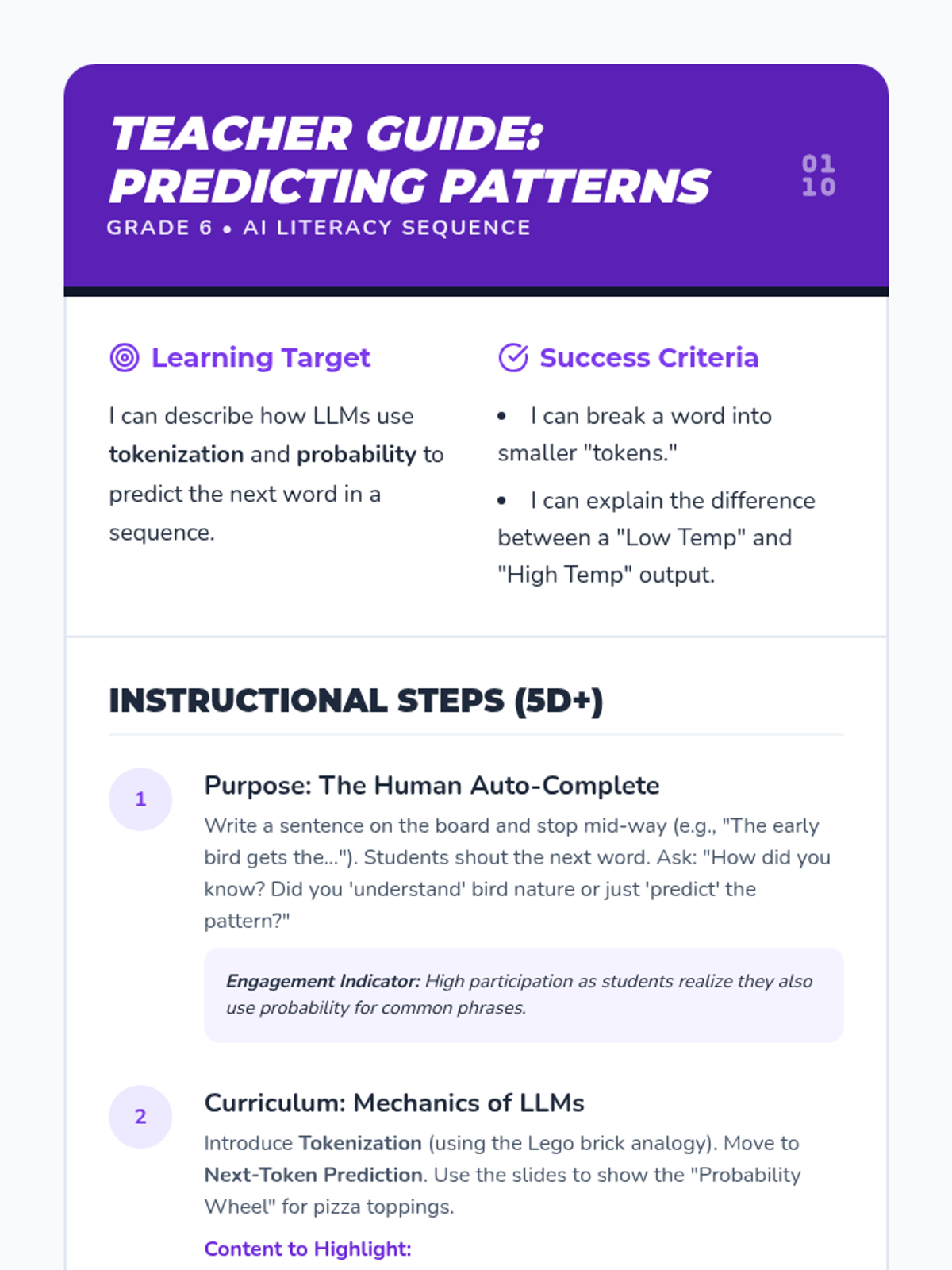
A teacher guide for the Grade 6 AI Literacy lesson on LLM mechanics. Includes instructional steps for teaching tokenization and probability, 5D+ alignment, and discussion prompts on AI creativity.
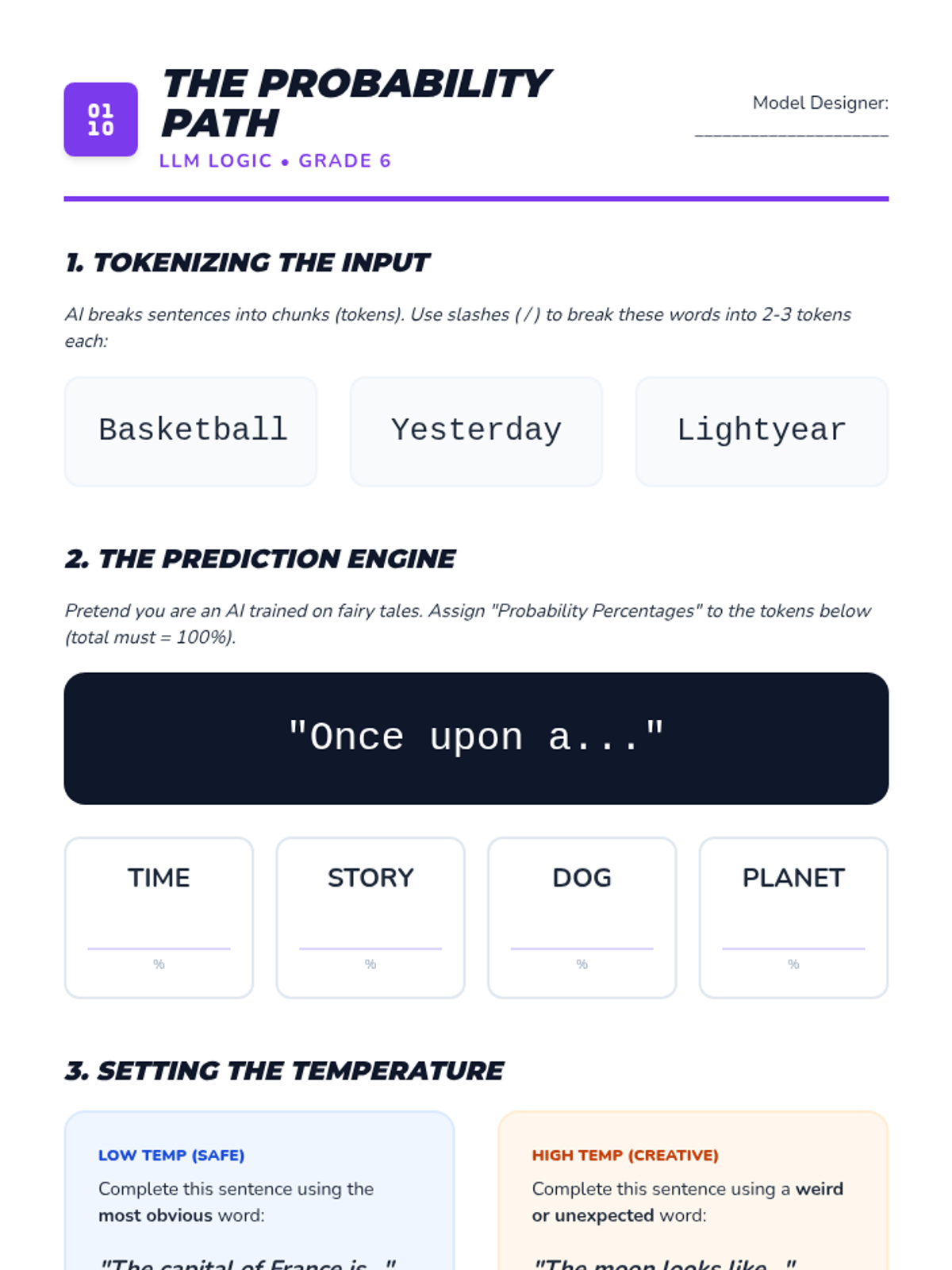
A worksheet for Grade 6 students to practice LLM concepts. It includes exercises on tokenization, assigning probabilities to word predictions, and experimenting with "temperature" settings for safe vs. creative outputs.
A 6-slide presentation for 6th Grade students on the mechanics of LLMs. It explains tokenization, next-word prediction based on probability, and the "temperature" setting that balances precision with creativity.
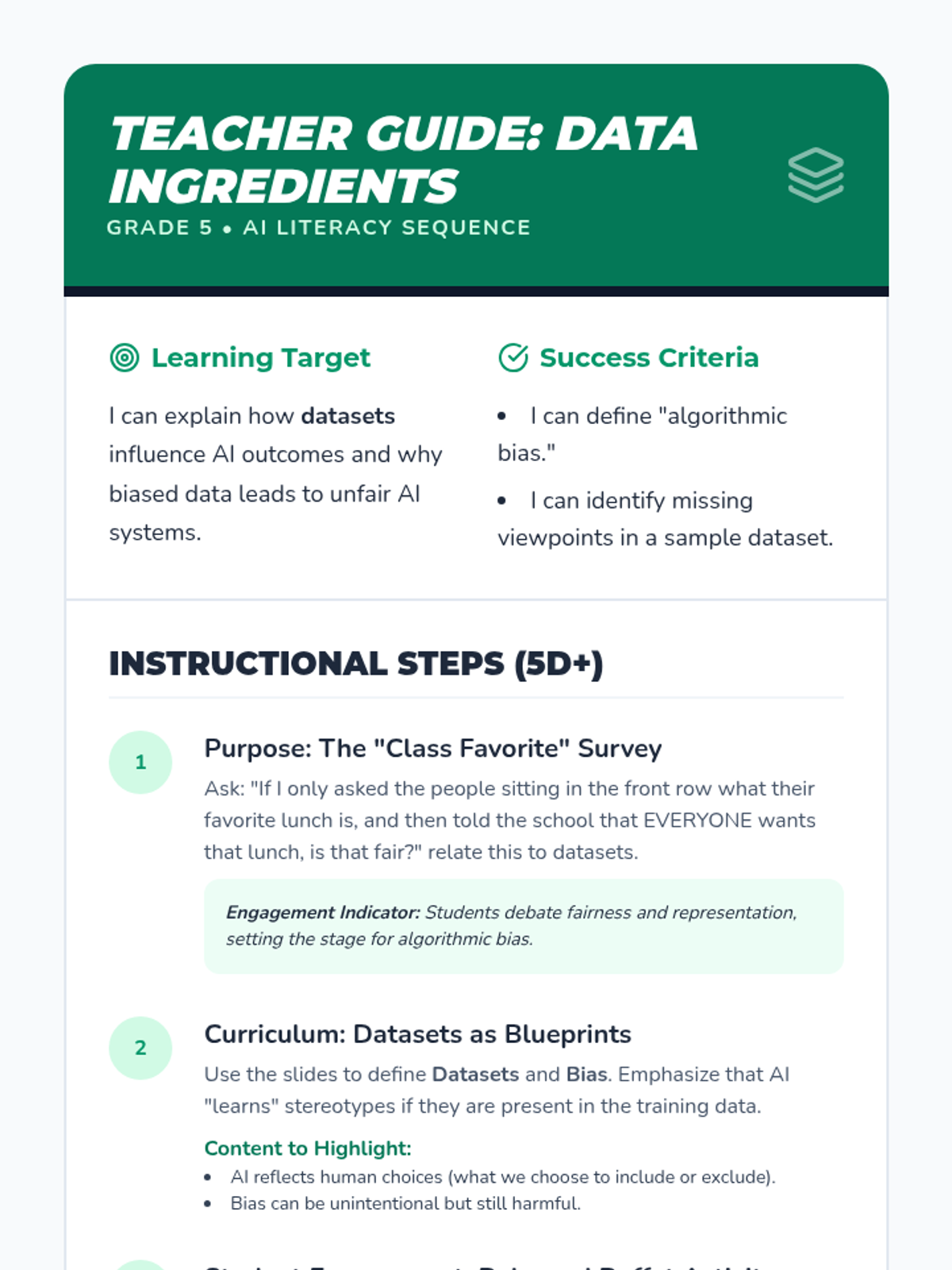
A teacher guide for the Grade 5 AI Literacy lesson on datasets and bias. Includes instructional steps aligned with 5D+, key discussion points on algorithmic fairness, and guidance for the "Balanced Buffet" activity.
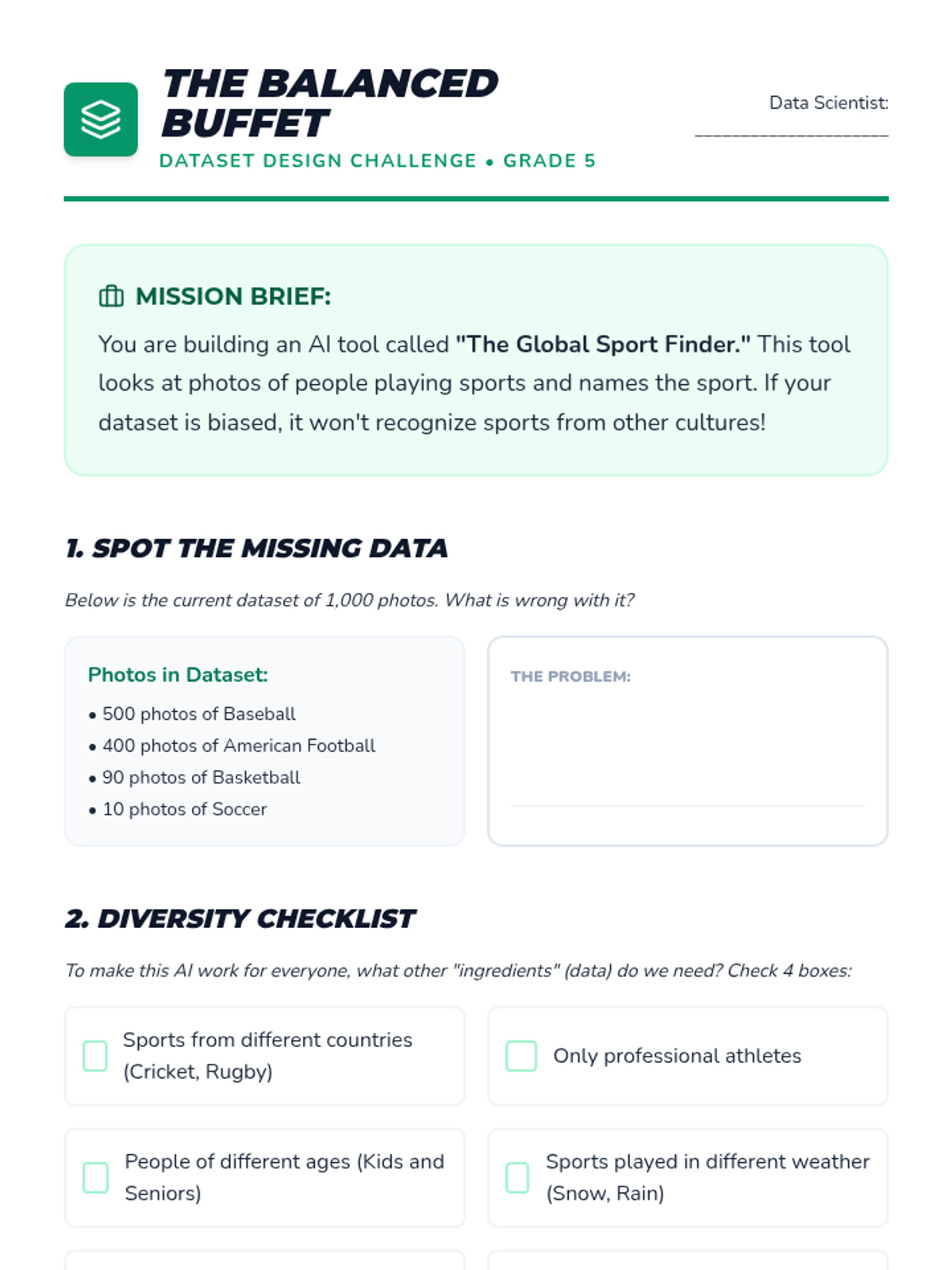
An activity for Grade 5 students to explore dataset bias and fairness. It includes a case study on a sports recognition AI, a diversity checklist for data collection, and a creative section for designing a more equitable dataset.
A 6-slide presentation for 5th Grade students on datasets and algorithmic bias. It uses a "cooking/ingredients" metaphor to explain how training data influences AI behavior and why diversity is essential for fairness.
A teacher guide for the Grade 4 AI Literacy lesson on truth evaluation. Includes strategies for teaching the concept of "hallucinations," 5D+ instructional steps, and tips for facilitating the fact-checking activity.
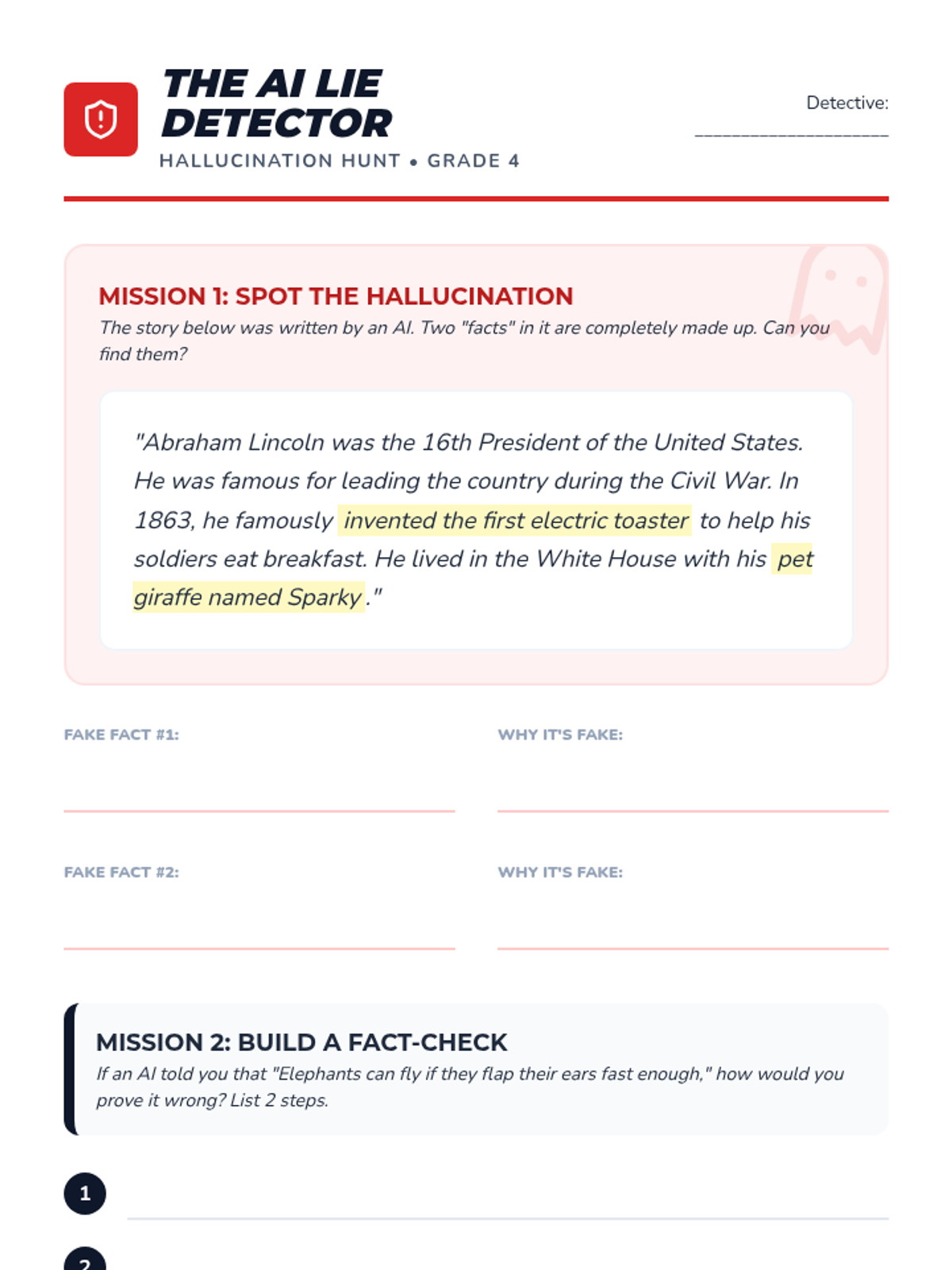
A worksheet for Grade 4 students to practice identifying AI hallucinations. It includes a "spot the error" historical passage, fact-checking strategy development, and a reflective motto-building exercise.
A 6-slide presentation for 4th Grade students on AI hallucinations. It defines hallucinations, explains why AI makes mistakes (word-guessing vs. knowing), and provides strategies for fact-checking AI outputs.
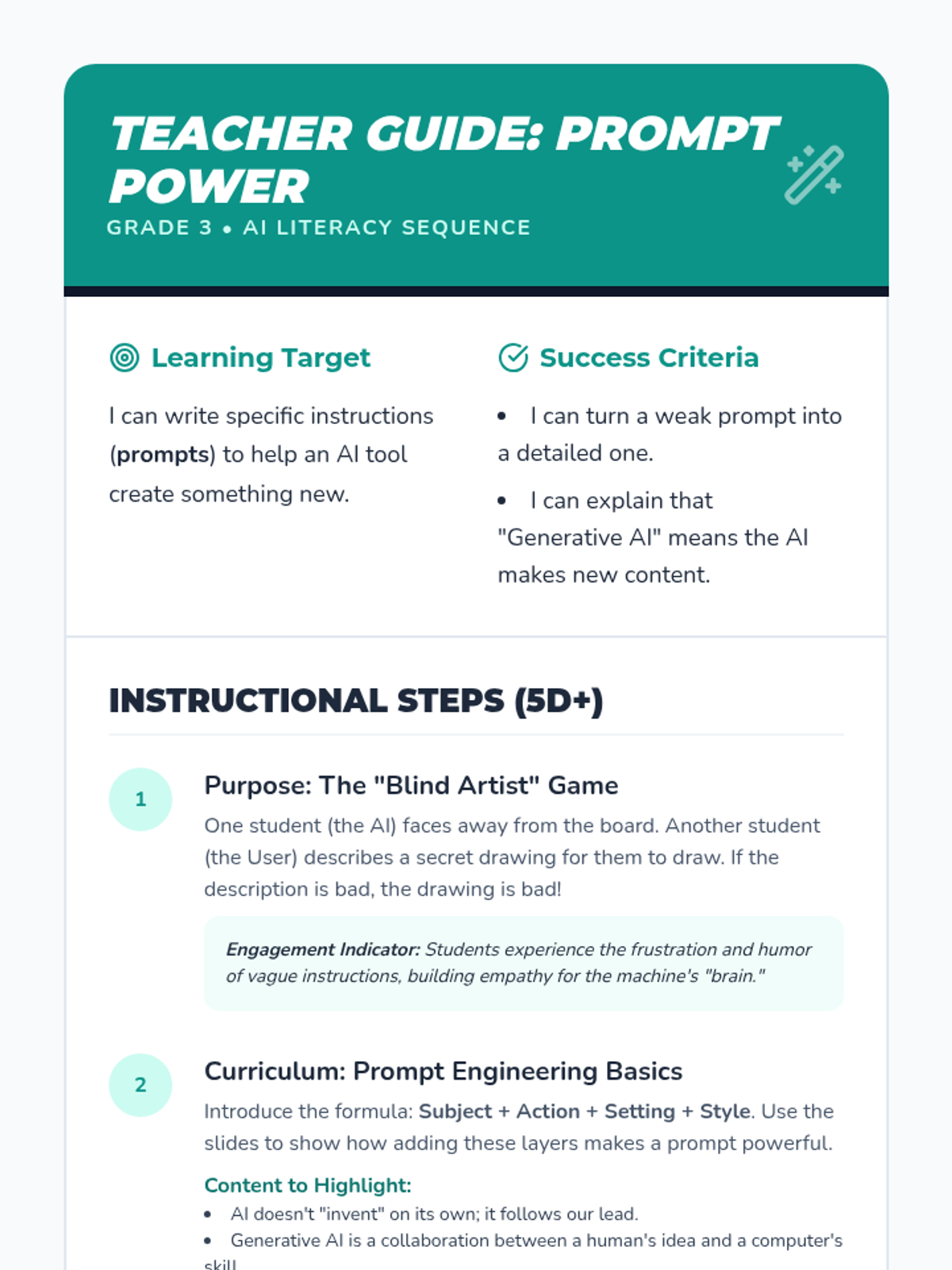
A teacher guide for the Grade 3 AI Literacy lesson on prompt power. Covers the "Blind Artist" game, instructional strategies for teaching prompt formulas, and assessment questions.
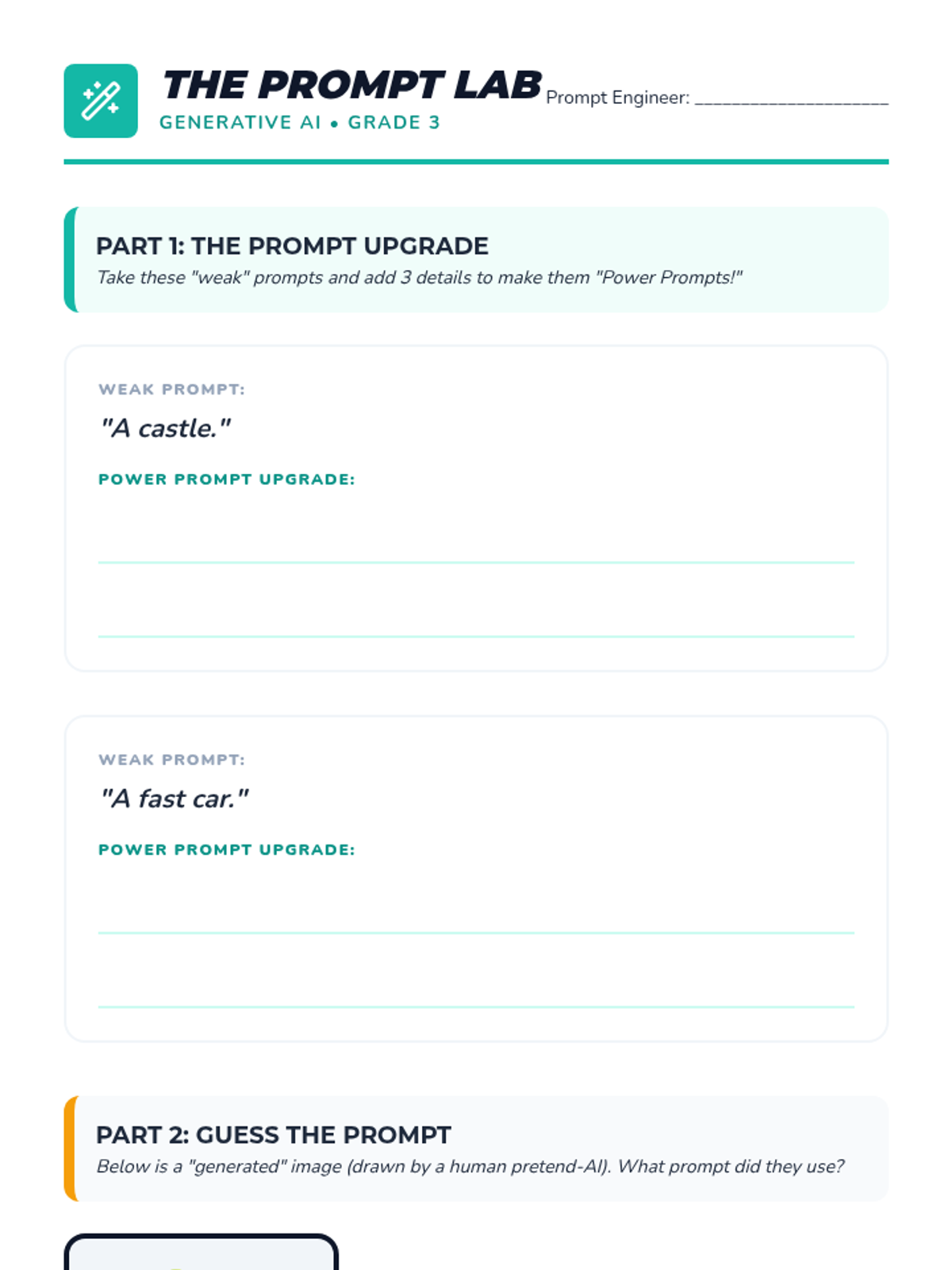
A worksheet for Grade 3 students to practice prompt engineering. It includes activities for upgrading weak prompts, reverse-engineering prompts from images, and designing a creative prompt for an AI-generated book cover.
A 6-slide presentation for 3rd Grade students on prompt engineering and generative AI. It explains what a prompt is, the importance of being specific, and the role of humans as the creative "boss" of AI.
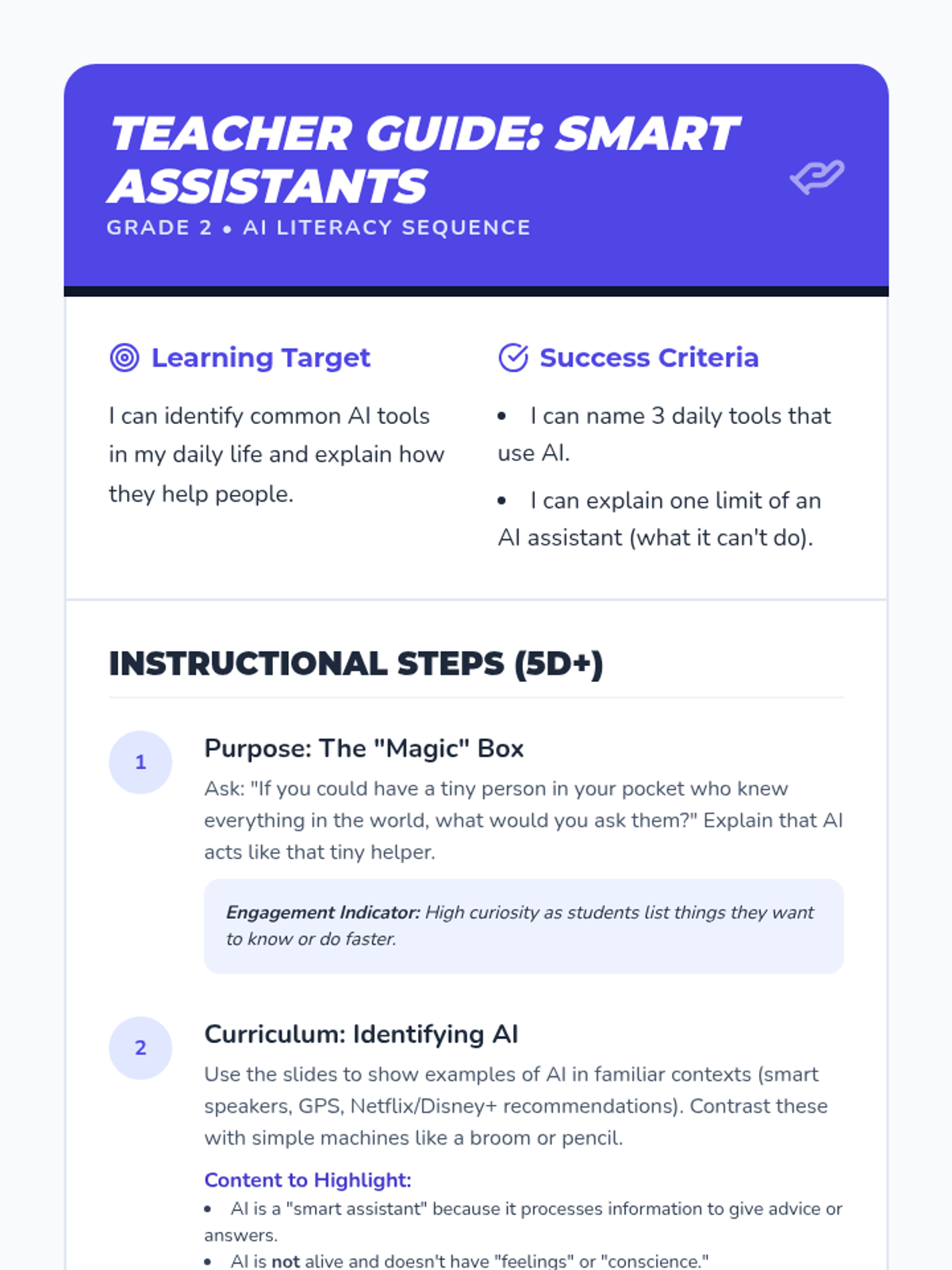
A teacher guide for the Grade 2 AI Literacy lesson on smart assistants. Includes instructional steps aligned with 5D+, tips for classroom discussion, and guidance on the scavenger hunt activity.
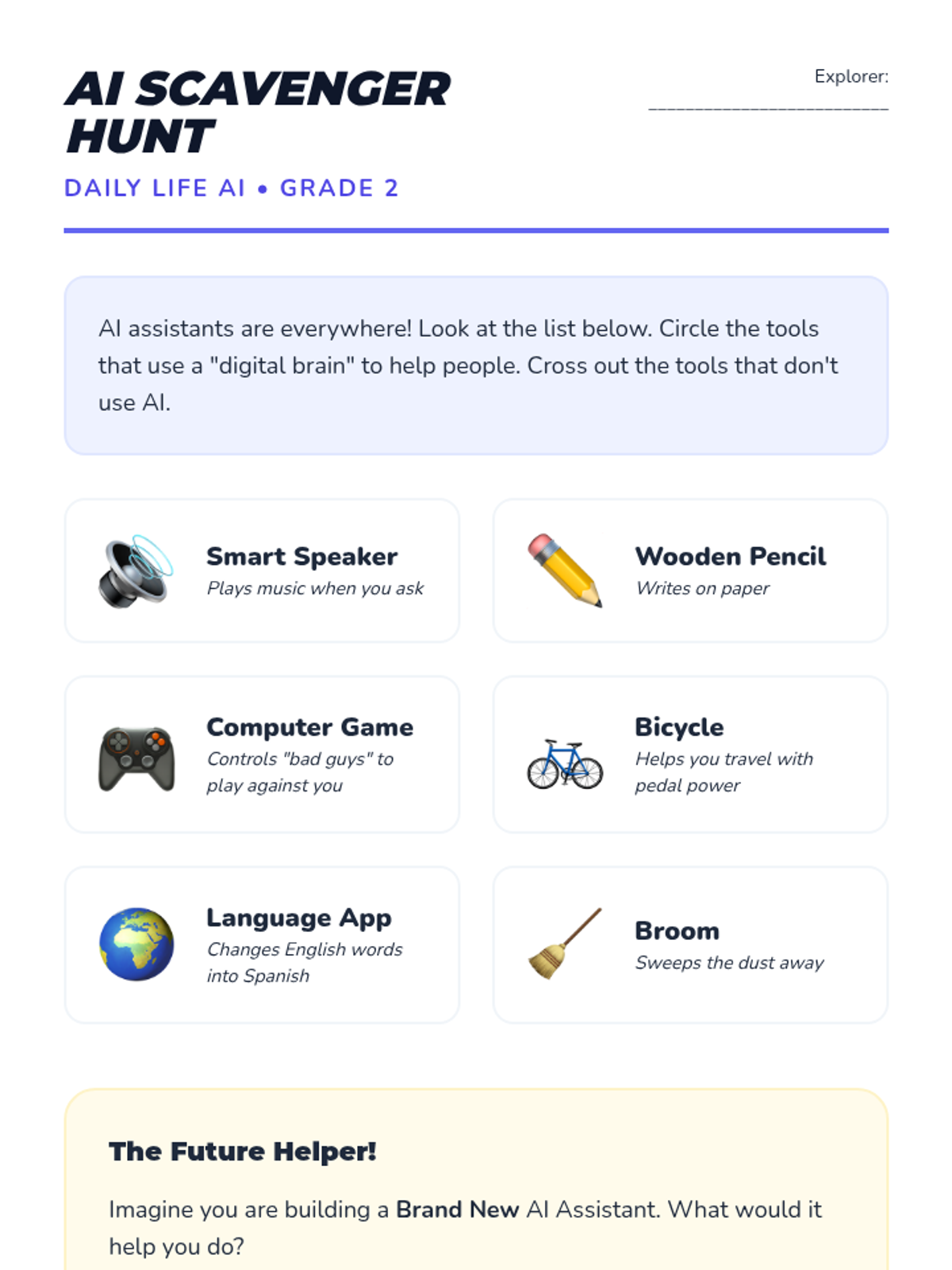
A scavenger hunt activity for Grade 2 students to identify AI in daily life and distinguish it from non-AI tools. Includes a creative section for designing a personal AI assistant.
A 6-slide presentation for 2nd Grade students on AI assistants. It covers everyday examples of AI (smart speakers, recommendations) and emphasizes that AI is a helpful tool but limited in emotional intelligence.
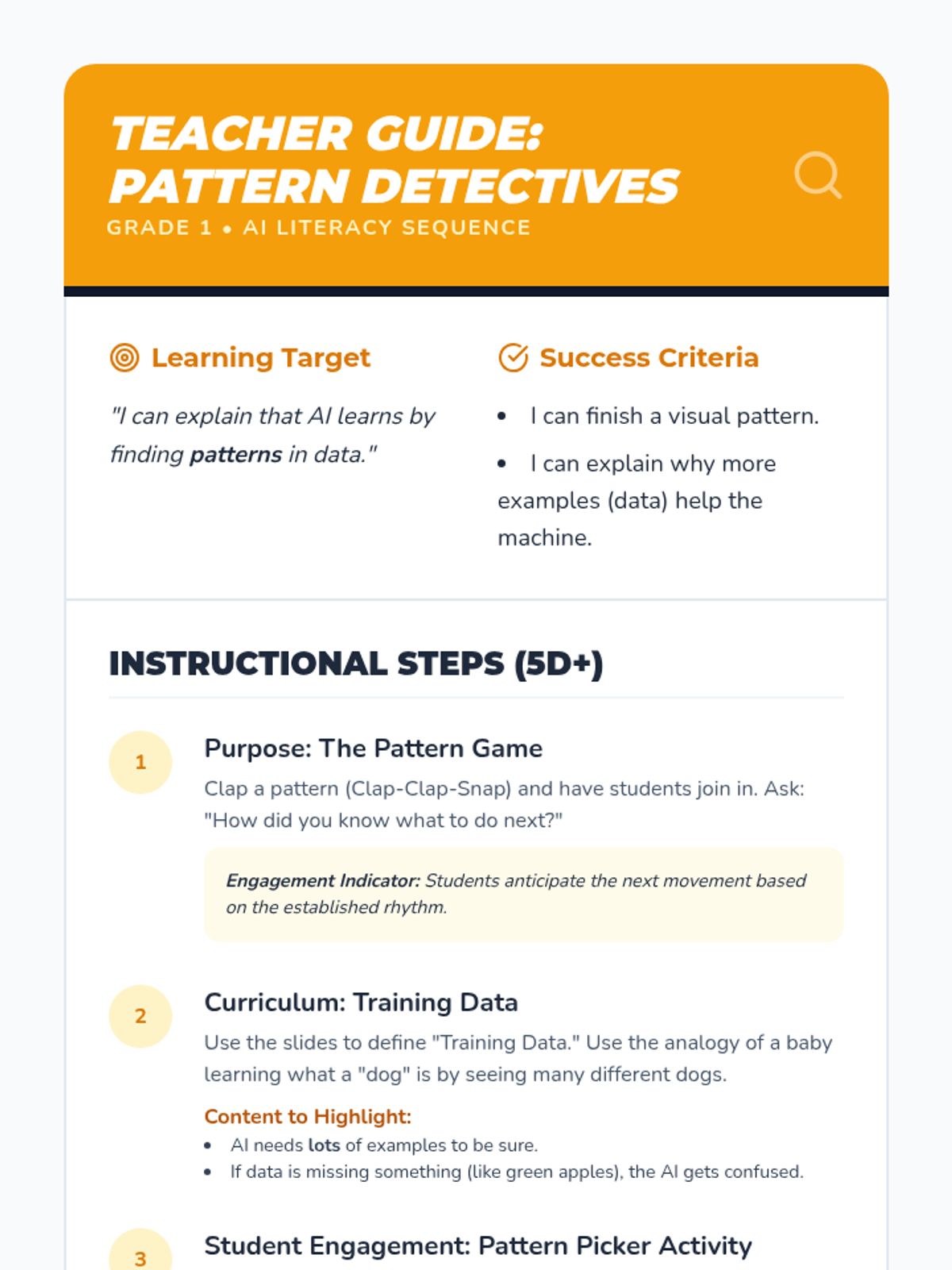
A teacher guide for the Grade 1 AI Literacy lesson on pattern recognition. Includes 5D+ instructional steps, learning targets, and guidance on how to facilitate the "Pattern Picker" activity.
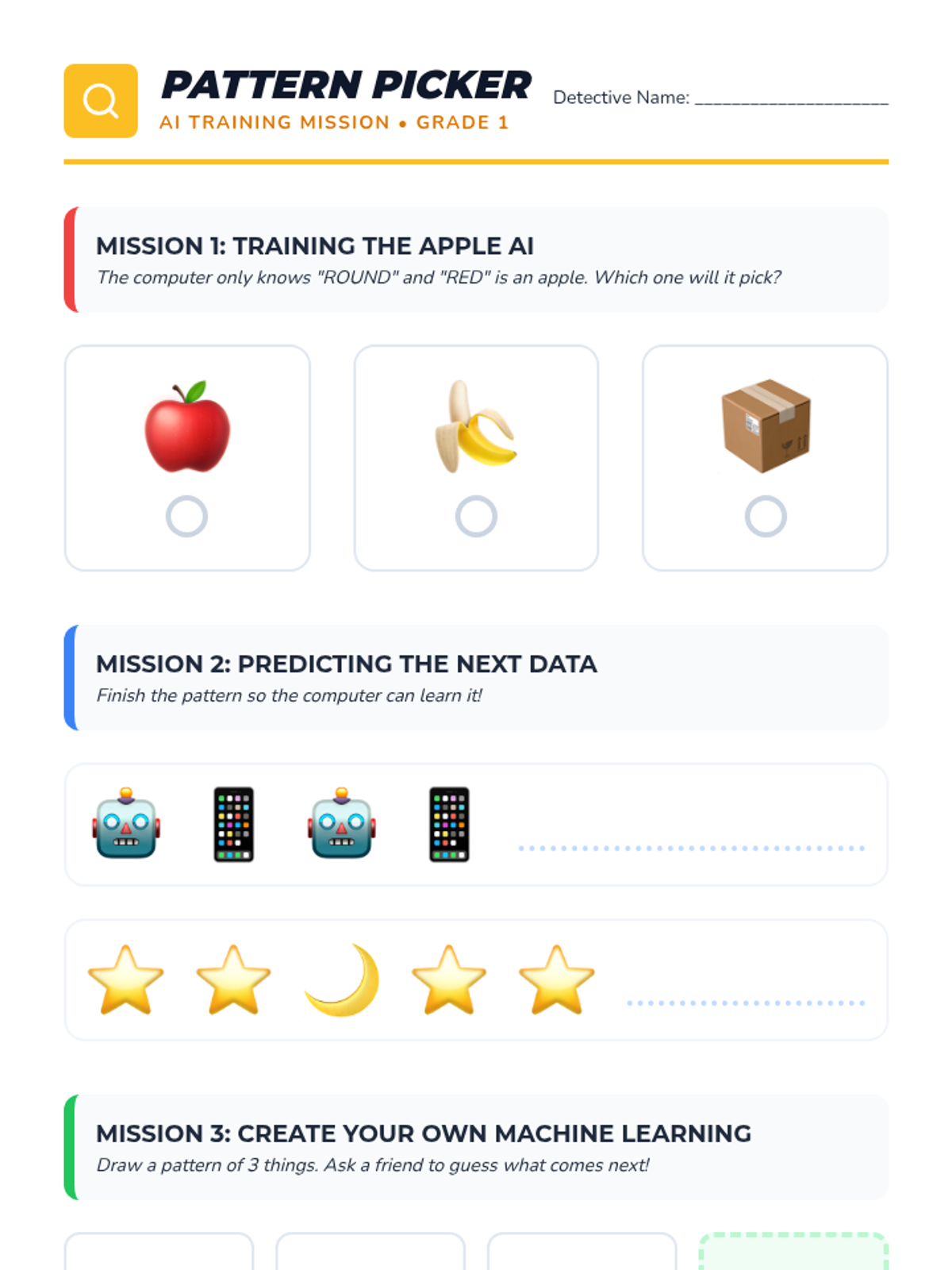
A worksheet for Grade 1 students to practice pattern recognition and simple machine learning concepts. It includes identifying training data and completing visual patterns.
A 6-slide presentation for 1st Grade students on pattern recognition and training data. It uses simple fruit examples to explain how AI learns from repetition and the importance of diverse data.