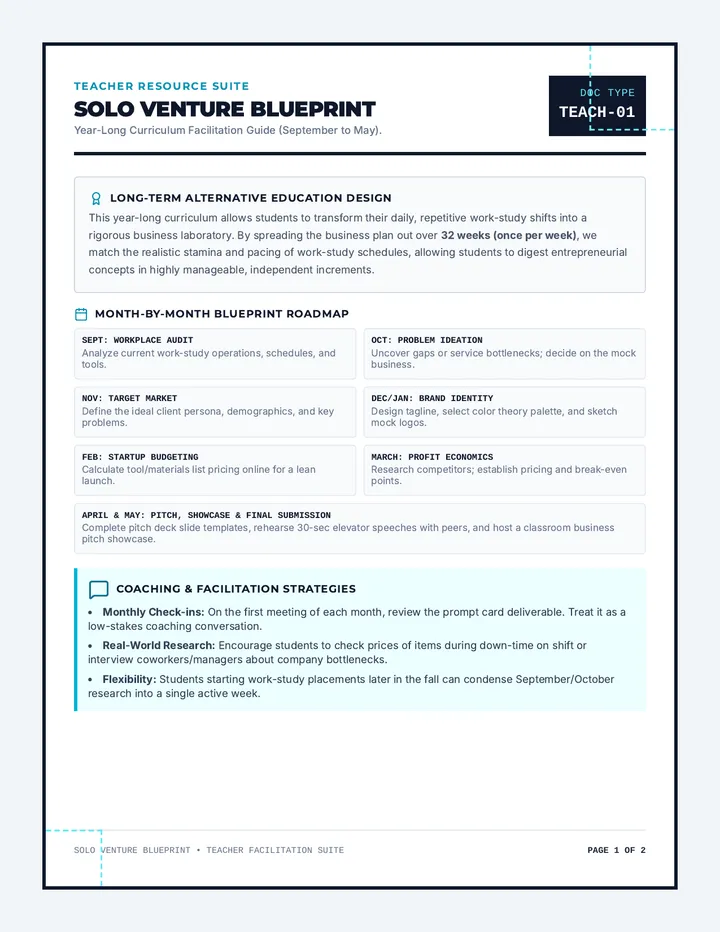
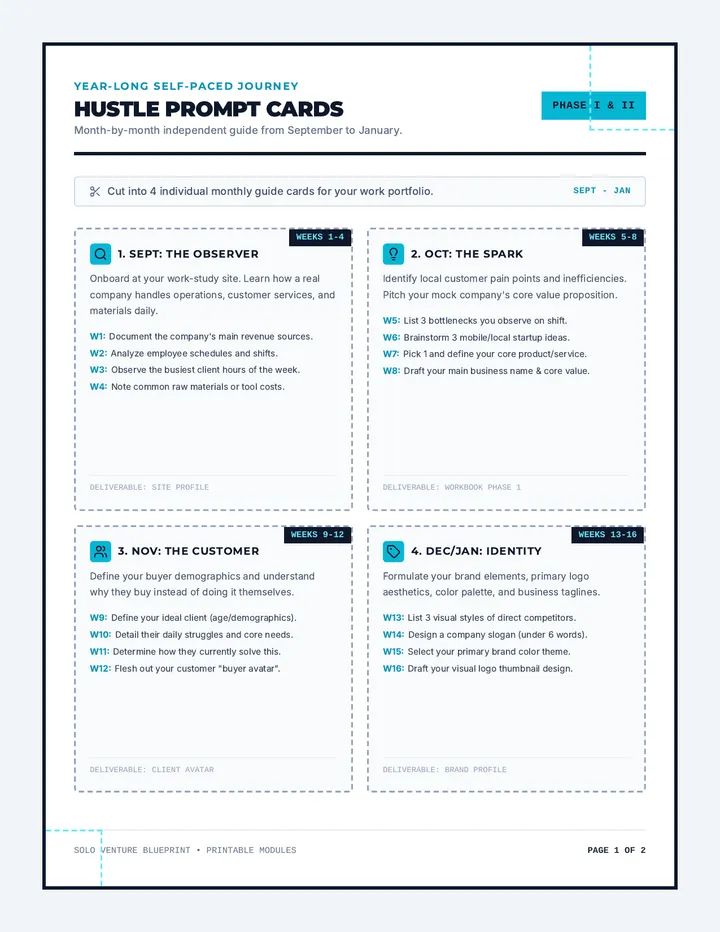
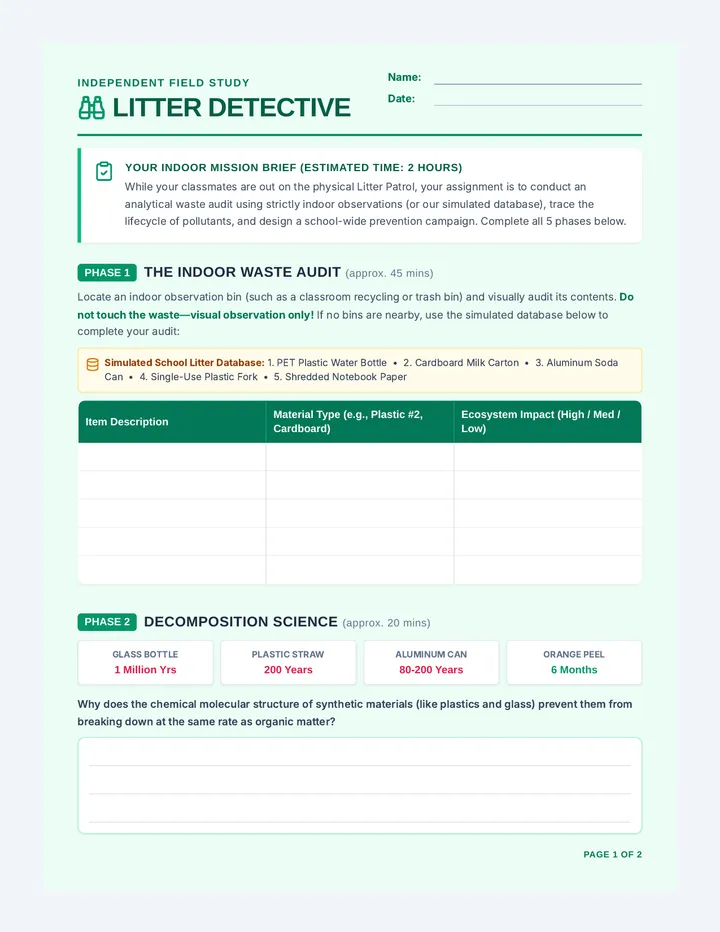
A student activity worksheet where they map out a 'Skeleton Plan' for a hypothetical non-profit organization across 8 core business plan sections, followed by a reflective question.
Presentation deck for Investigation 7, covering the anchoring phenomenon, karyotypes, and gel electrophoresis.
Comprehensive Teacher Guide for Investigation 7 (5 Blocks). Covers pedigrees, genetic disorders, and molecular biotechnology with pacing and monitoring guides.
Expanded Teacher Guide for Investigation 7, covering all 3 Experiences over 5 blocks. Includes preparation checklists, common misconceptions, and detailed monitoring feedback loops. Fixes page breaks.
Master Answer Key for Investigation 7, covering the anchoring phenomenon probability and all three station activities (Pedigrees, Mutations, Biotech).
A high-impact presentation deck for Investigation 7, covering the anchoring phenomenon, human karyotypes, pedigree mapping, sex-linked inheritance, genetic disorders, and gel electrophoresis.
Detailed Teacher Guide for Investigation 7, covering the 5-block structure and anchoring phenomenon. Includes pacing for all three instructional Experiences.
Student Investigator Logbook for Investigation 7, containing tracking for pedigrees, genetic mutations, and biotechnology tools.
Investigator Logbook for Investigation 7, covering all 3 Experiences (Genetics, Disorders, Biotech) across 5 blocks. Includes sections for the anchoring phenomenon (Polydactyly), pedigree analysis, nondisjunction modeling, and gel electrophoresis.
Four detailed station cards for the Human Genome investigation. Fixes pedigree diagrams, page overflow, and improves contrast for accessibility. Added Hemophilia to the Disorder Database to cover sex-linked traits.
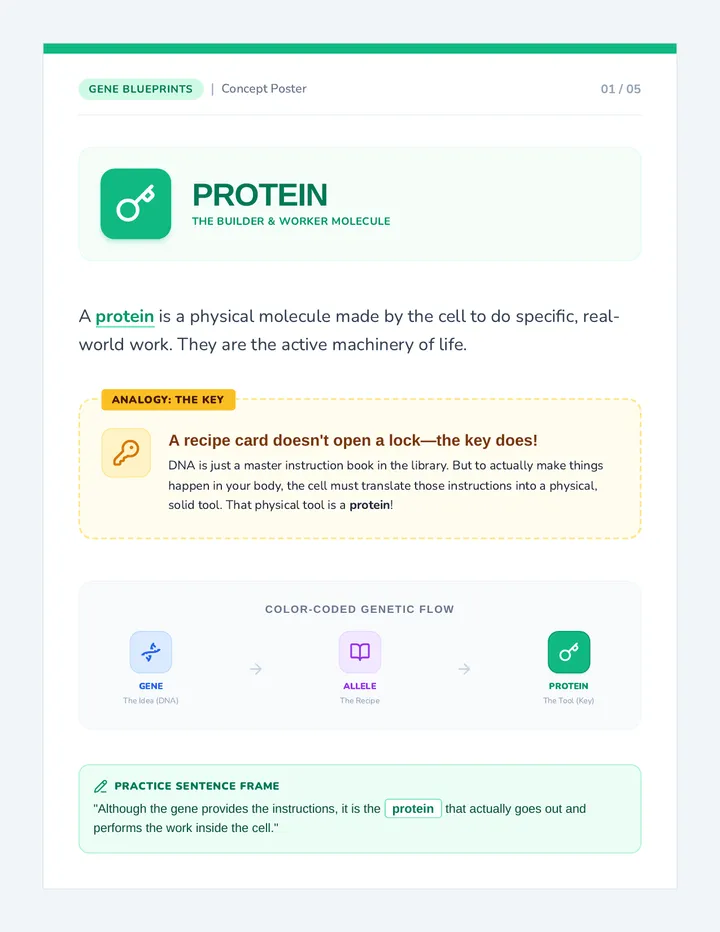
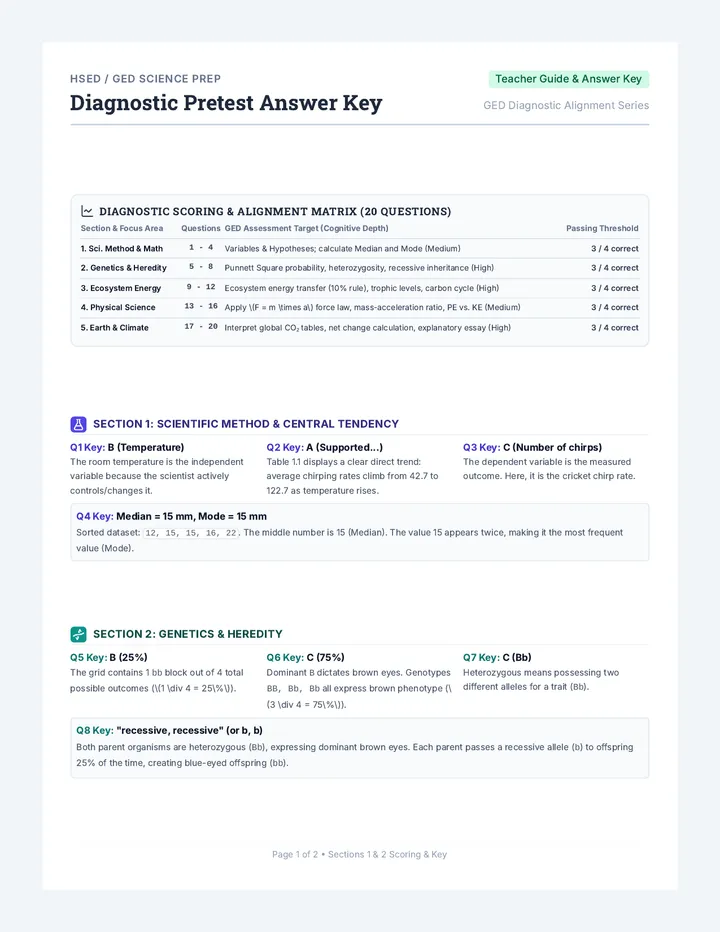
Comprehensive answer key for the Human Genome Blueprint lesson, covering all station activities and differentiated worksheet tiers.
A teacher-facing monitoring tracker for the Genetic Disorders lesson, designed to record student progress in identifying mutation types and analyzing chromosomal abnormalities.
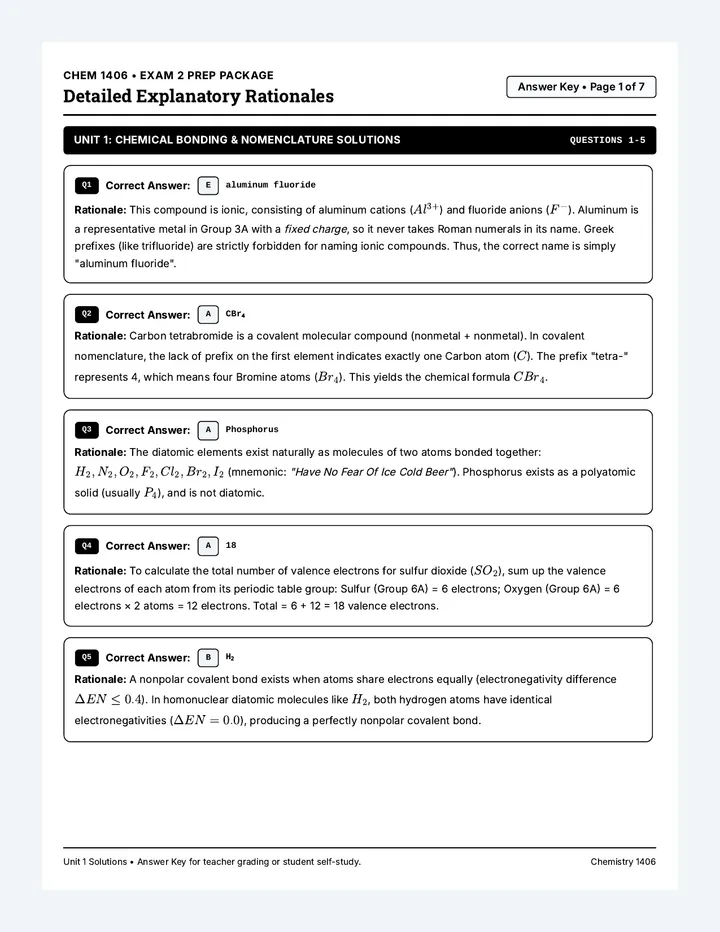
Answer key for the Final Review Quiz. Rationales were improved for clarity and consistency. Removed instructor notes and resource headers for a cleaner layout. Added layout improvements for page-break consistency.
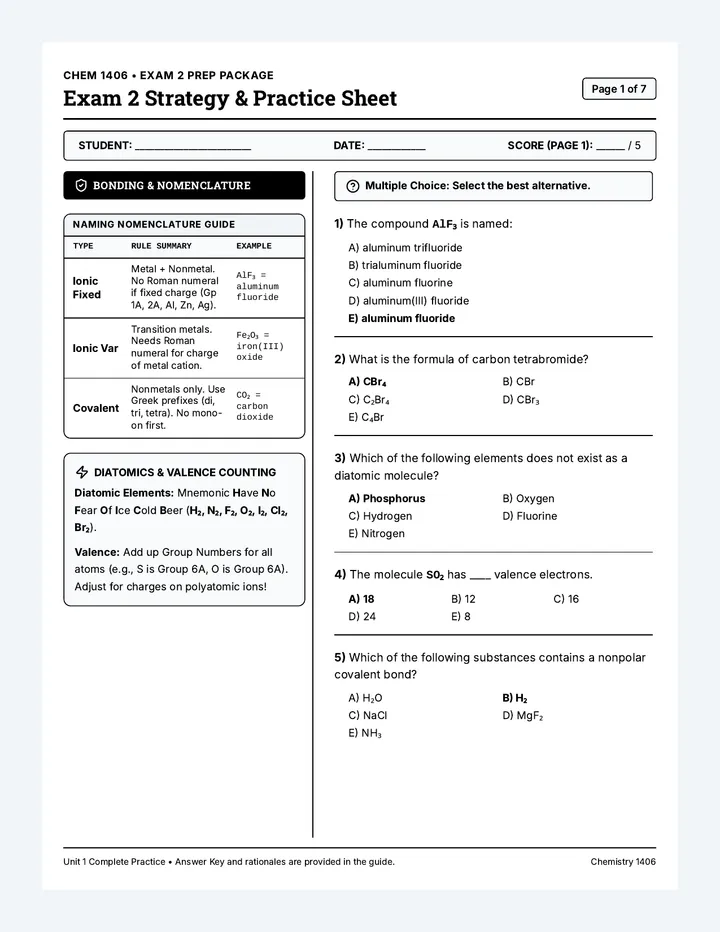
A 30-question multiple-choice review for introductory chemistry laboratory students. Improved diagram rendering and ensured question integrity across page breaks. Removed unstable LaTeX in favor of clean HTML entities for broader compatibility.
A comprehensive study guide covering pH calculations, laboratory indicator tests, organic chemistry functional groups, and quantitative solution calculations for chemistry laboratory students. Added a Quick Practice Arena for calculation practice and fixed layout issues.
An exit ticket assessment for the Genetic Disorders lesson, evaluating student mastery of mutation types, meiotic nondisjunction, and hierarchical impact of genetic errors.
A station pack for the Genetic Disorders lesson, including clinical karyotype analysis, pedigree forensics, and molecular triage scenarios for evaluating mutation impact.
A professional high-impact slide presentation for the Genetic Disorders lesson, focusing on mutation mechanics, nondisjunction, and karyotype analysis with built-in discussion prompts.
A clinical student handout for the Genetic Disorders lesson, designed as a medical case file with space for bell ringer responses, guided notes on mutations, and station observation logs.
A high-stakes exit ticket for the Human Genetics lesson, evaluating student understanding of genetic hierarchy and their ability to solve Punnett square problems.
A teacher-facing resource for aggressive monitoring during the Human Genetics lesson, featuring specific 'look-fors' and a tracking grid for student mastery.
A set of three station activities for the Human Genetics lesson, including hands-on modeling instructions, a vocabulary matching game, and genetic cross task cards.
A high-impact slide presentation for the 90-minute Human Genetics lesson, covering DNA hierarchy and Punnett squares with built-in Think-Pair-Share and station instructions.
A student handout for the Human Genetics lesson featuring a bell ringer, guided notes with sentence stems, and practice Punnett square problems for aggressive monitoring.
Advanced investigator worksheet for high-achieving students. Features DOK 3 level strategic thinking questions, including probability justification, evolutionary persistence of alleles, and a complex CER on meiosis errors. Fixes page breaks and increases response space with a more compact layout. Added a mini-pedigree for Task 1.
Scaffolded investigator worksheet for students needing support. Fixes missing pedigree diagram, alignment in the matching section, and keeps stations on single pages. Added sex-linked support content.
Standard student investigator worksheet for the Human Genome lesson. Fixes page-break issues and increases writing space for students.
Revamped Human Genome stations with clear visual diagrams for Karyotypes and Chromosomal Mutations (Deletion, Inversion, etc.). Includes a specific polydactyly pedigree and a high-contrast gel electrophoresis lab analysis. Fixes pedigree consistency and layout overflow. Added more reliable connector logic for the pedigree.
A comprehensive 9-slide presentation deck covering Investigation 7. Includes the anchoring phenomenon (Polydactyly), Experience 1 (Genetics/Pedigrees/Sex-linked), Experience 2 (Disorders/Nondisjunction/Sickle Cell), and Experience 3 (Molecular Biotechnology/Gel Electrophoresis).
A participant handout for Lesson 2 (Decomposition) with a Rally Coach section for low-lift tasks, a Professional Blueprint for classroom application, and a reflective Coach's Corner connecting early exposure to long-term CS success.
A 5-slide presentation for Lesson 2 (Decomposition) featuring the Allison Cuttler quote, the video intro, Rally Coach instructions, and professional application examples across storytelling, standards, and math.
Updated facilitation guide for Lesson 2 (Decomposition), featuring quotes from Krauss & Prottsman and Allison Cuttler, a Rally Coach instructional strategy, and cross-curricular connections from literacy to industrial tech.
A teacher guide with standards, pacing, and pedagogical tips. Optimized for single-page use with improved contrast and layout.
A structured planning document for advocacy projects. Optimized for 2-page printing with an expanded sketch area and clear checklist.
A research and analysis worksheet where students investigate environmental inequality. Optimized for 2-page printing with generous work areas and built-in visual aids.
A 6-slide presentation covering environmental justice concepts, the Flint water crisis, urban air pollution data, and potential community solutions.
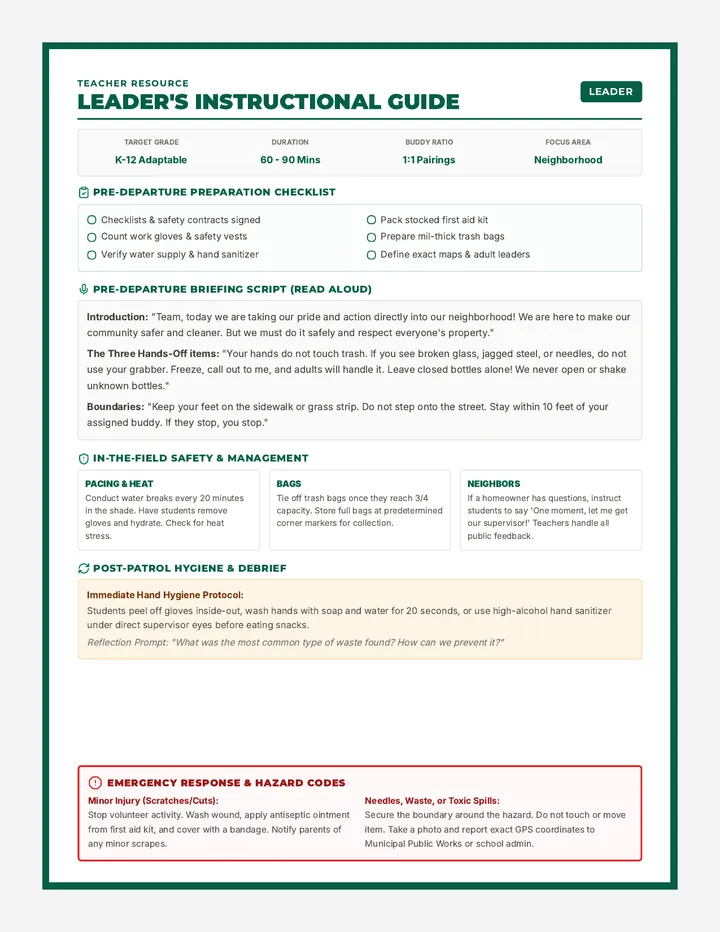
A teacher-facing facilitation guide for the Waste Wise project, including learning objectives, pacing, safety notes, and discussion prompts.
A detailed grading rubric for the Trash to Treasure video project, focusing on scientific accuracy, creative execution, and technical quality.
A comprehensive project guide and rubric for high school students to create a video documentary or performance art piece focused on waste management and upcycling, inspired by Shoji Yamasaki.
A research primer for students explaining the mechanics of bioaccumulation and biomagnification, providing inquiry questions and scientific vocabulary to support their lab report research.
A formal grading rubric for teachers to assess the Plastic-Free Project lab report, focusing on research depth, challenge integrity, and scientific writing standards.
A two-week tracking log for students to document their single-use plastic encounters, attempted alternatives, and difficulty levels as part of their Zero Waste Quest project.
A comprehensive project guide for the Zero Waste Quest, detailing the challenge rules, research requirements on bioaccumulation, and the specific structure for the final formal lab report.