A teacher answer key for the 'Resistance Simulation' lab, featuring baseline calculations, expected outlier impacts, and detailed explanations for the resistance of various dispersion measures.
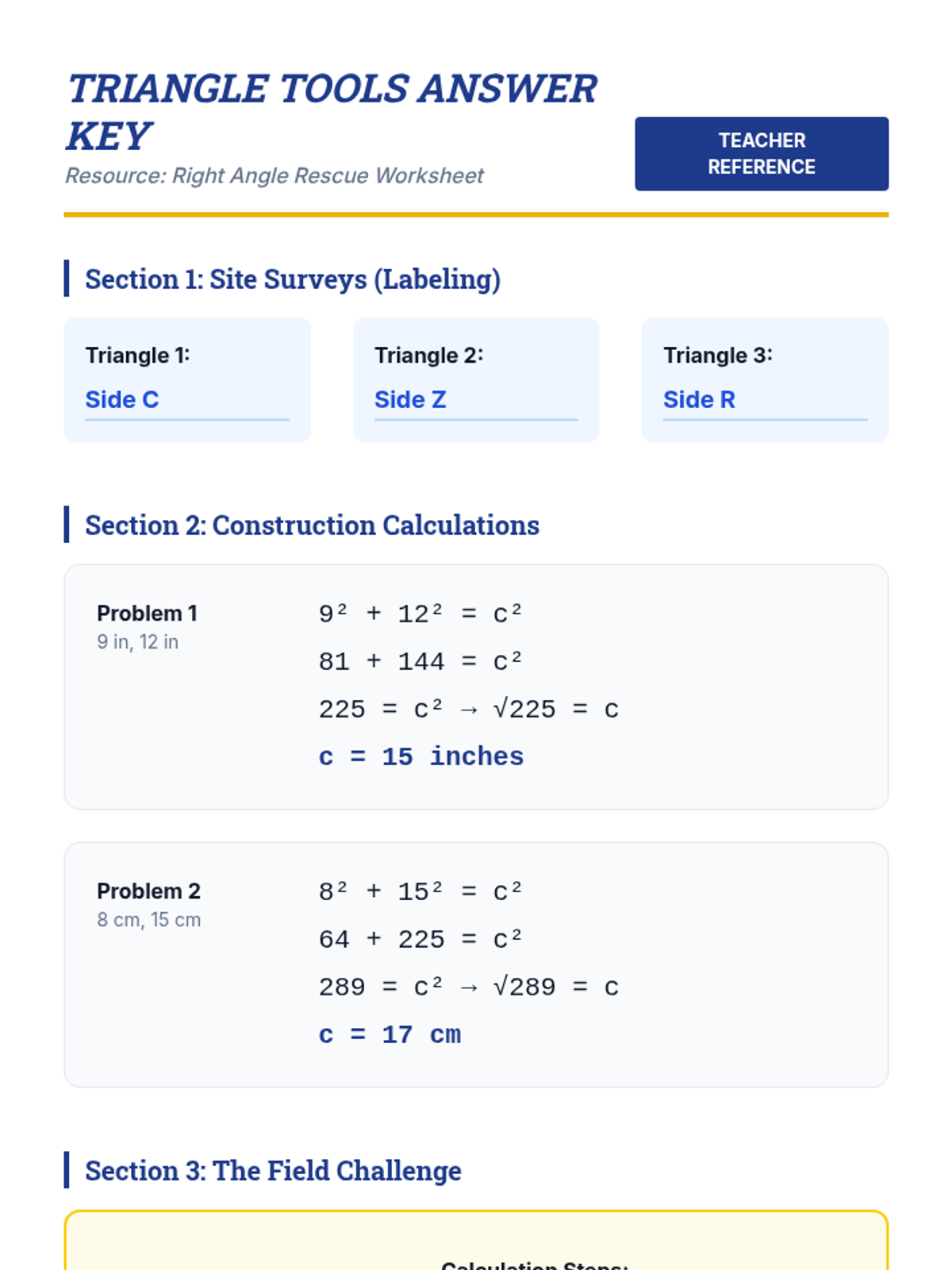
A teacher's answer key and facilitation guide for the Tarsia puzzle, including a master pairing list and assembly tips.
A student activity sheet containing 12 triangular puzzle pieces with mathematical symbols and their names. Students must cut out and match the edges to complete the challenge.
An instructional slide deck introducing common and advanced mathematical symbols used in operations and number relationships, featuring clear visual definitions and examples.
A visual presentation deck with an architectural theme to introduce the concepts of supplementary and complementary angles, memory aids, and step-by-step solving strategies.
An answer key for the Angle Architect guided notes and practice worksheet, providing solutions and step-by-step algebraic breakdowns for teachers.
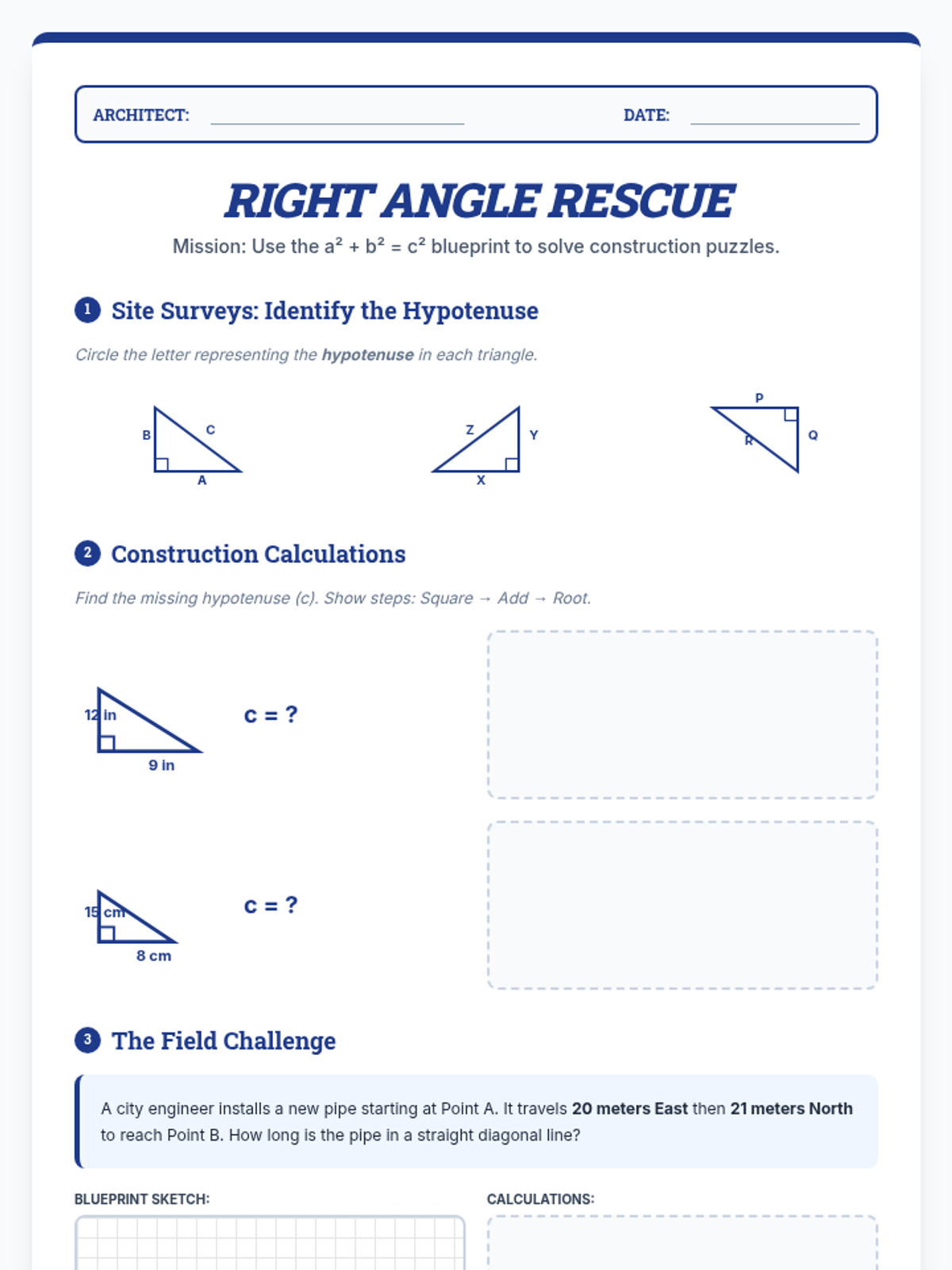
A practice worksheet using the blueprint theme, featuring classification tasks, missing angle calculations, algebraic problem-solving, and a multi-step word problem challenge.
A visual presentation for introducing division through equal groups. Uses the bakery theme to guide students through the "One-by-One" sharing strategy.
An answer key for the Cookie Divider Worksheet, providing clear solutions and calculations for the drawing and word problems.
A guided notes document using an architectural blueprint theme to teach the concepts of complementary and supplementary angles, including definitions, diagrams, and step-by-step example problems.
A student worksheet for practicing division through equal groups. Features drawing activities, fill-in-the-blank identification, and a bakery-themed word problem.
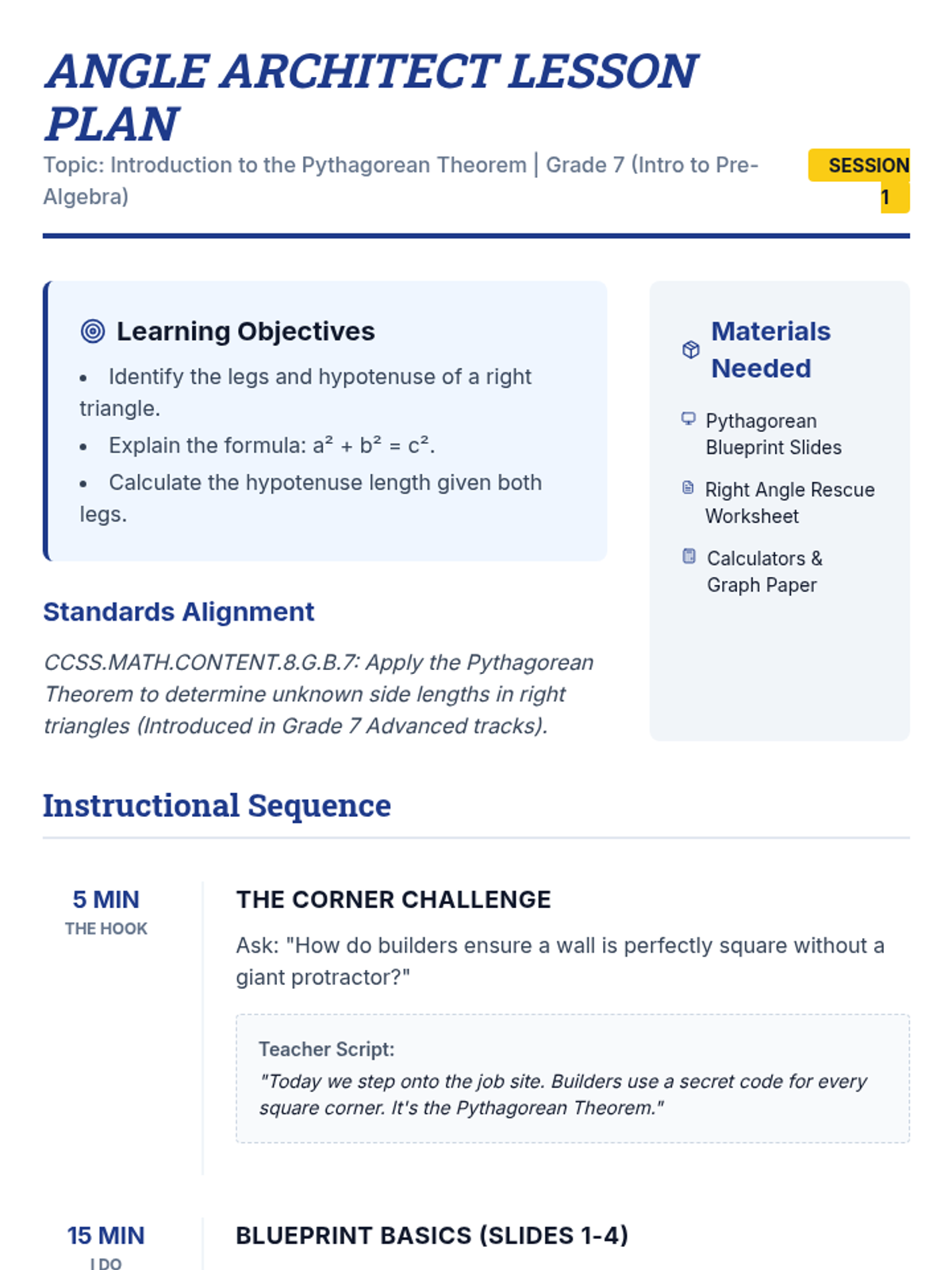
A comprehensive lesson plan for teachers, outlining a bakery-themed introduction to division using equal groups. Includes a hook, modeling steps, and guided practice activities.
A student worksheet for sketching a distance-time graph based on a detailed narrative, including analysis questions about slope and key graphical features. Optimized for 8.5x11 printing with strict 1-inch margins and tightened vertical spacing to ensure single-page fit.
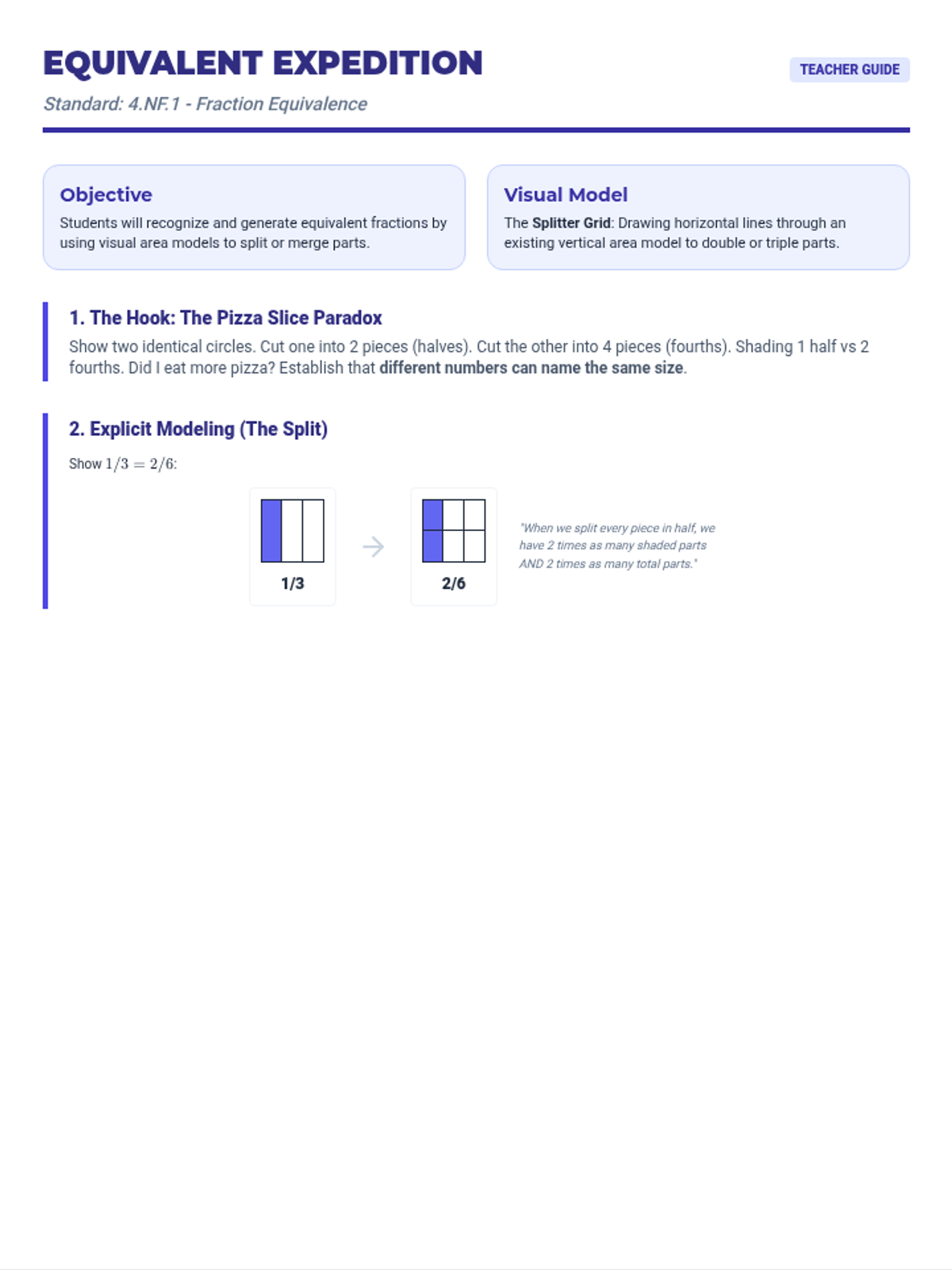
A 9th-grade worksheet for matching real-world narratives to their corresponding distance-time graphs, optimized for 8.5x11 printing with strict 1-inch margins and clear, legible typography.
A student worksheet for sketching a distance-time graph based on a detailed narrative, including analysis questions about slope and key graphical features. Optimized for 8.5x11 printing with strict 1-inch margins and tightened vertical spacing.
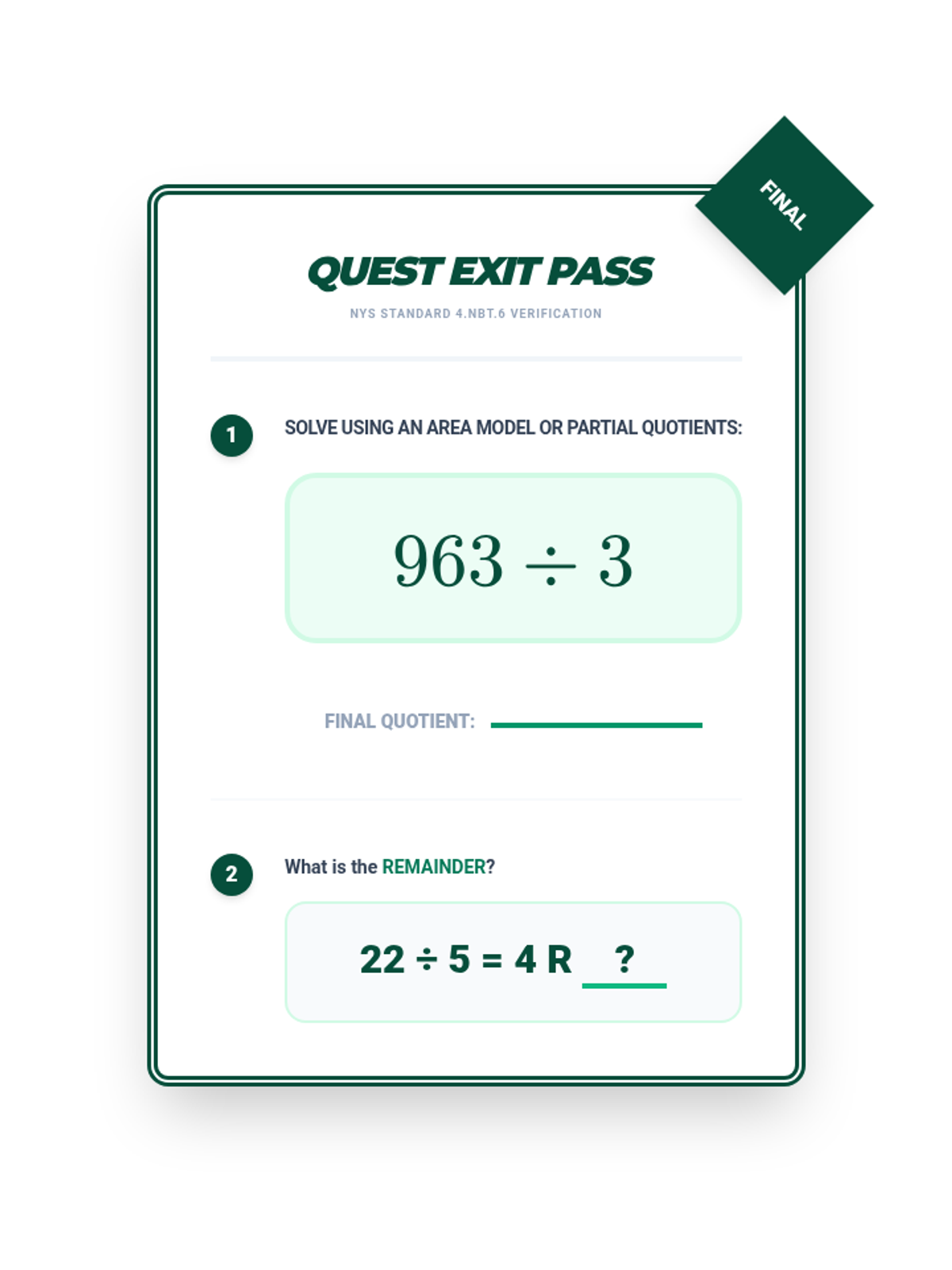
A visual anchor chart for one-step algebra equations designed for Special Education. It features a 'Math Mechanic' theme with four quadrants representing each operation, color-coded inverse pairs, and simplified 3-step graphic organizers for each equation type.
A comprehensive teacher's answer key for the VLT Sort Activity, including classification results, justifications, and instructional tips for common misconceptions.
An answer key for the Graph Analysis Worksheet with correctly identified functions, visual VLT indicators, and detailed reasoning for each item.
A visual presentation for teaching the five methods of proving a quadrilateral is a parallelogram, featuring architectural diagrams, coordinate geometry formulas, and critical thinking checks.
An architectural-themed worksheet for 10th-grade geometry focused on proving quadrilaterals are parallelograms through coordinate geometry, formal two-column proofs, and critical thinking.
An architectural-themed graphic organizer summarizing the five methods to prove a quadrilateral is a parallelogram, featuring visual diagrams and coordinate geometry logic.
A comprehensive teacher's guide for a 10th-grade geometry lesson on proving parallelograms. Includes learning objectives, step-by-step instructional procedures, common pitfalls, and differentiation strategies with an architectural theme.
A short, single-page assessment to evaluate student understanding of slope, optimized for 8.5x11 printing with 1-inch margins and concise formatting to ensure all questions fit.
A visual 8-slide presentation teaching the definition and 7 core properties of parallelograms, featuring memory tricks, clear geometric diagrams, and summarized takeaways.
The complete answer key for the Parallelogram Pro Quiz, including property references and helpful teacher tips for common student misconceptions.
A 10-question multiple-choice quiz based on Mr. Dallas's lesson on parallelogram properties, covering definitions, congruent sides and angles, supplementary consecutive angles, and diagonal behavior.
A short assessment to evaluate student understanding of calculating slope from points and interpreting its real-world meaning, optimized with reduced font size and spacing to ensure all content fits on one page.
A comprehensive answer key for the Slope Superstars Activity, Rate of Change Worksheet, and Exit Ticket, designed for easy teacher reference with high contrast and clear sectioning.
A short assessment to evaluate student understanding of calculating slope from points and interpreting its real-world meaning, optimized for 8.5x11 printing with clear work areas and 1-inch margins.
A condensed exit ticket for 9th-grade math focused on interpreting distance-time graphs, featuring a matching activity and a graph-to-story translation problem, all optimized to fit a single 8.5x11 page.
Independent practice worksheet for calculating and interpreting slope from graphs, points, and real-world scenarios, optimized with corrected graph points and a reduced font size for improved layout.
Group activity worksheet for calculating slope and rate of change from real-world scenarios, optimized for 8.5x11 printing with 1-inch margins and clear work areas.
A professionally formatted 2-page lesson plan for 9th-grade math, optimized for 8.5x11 printing with 1-inch margins and clear instructional phases.
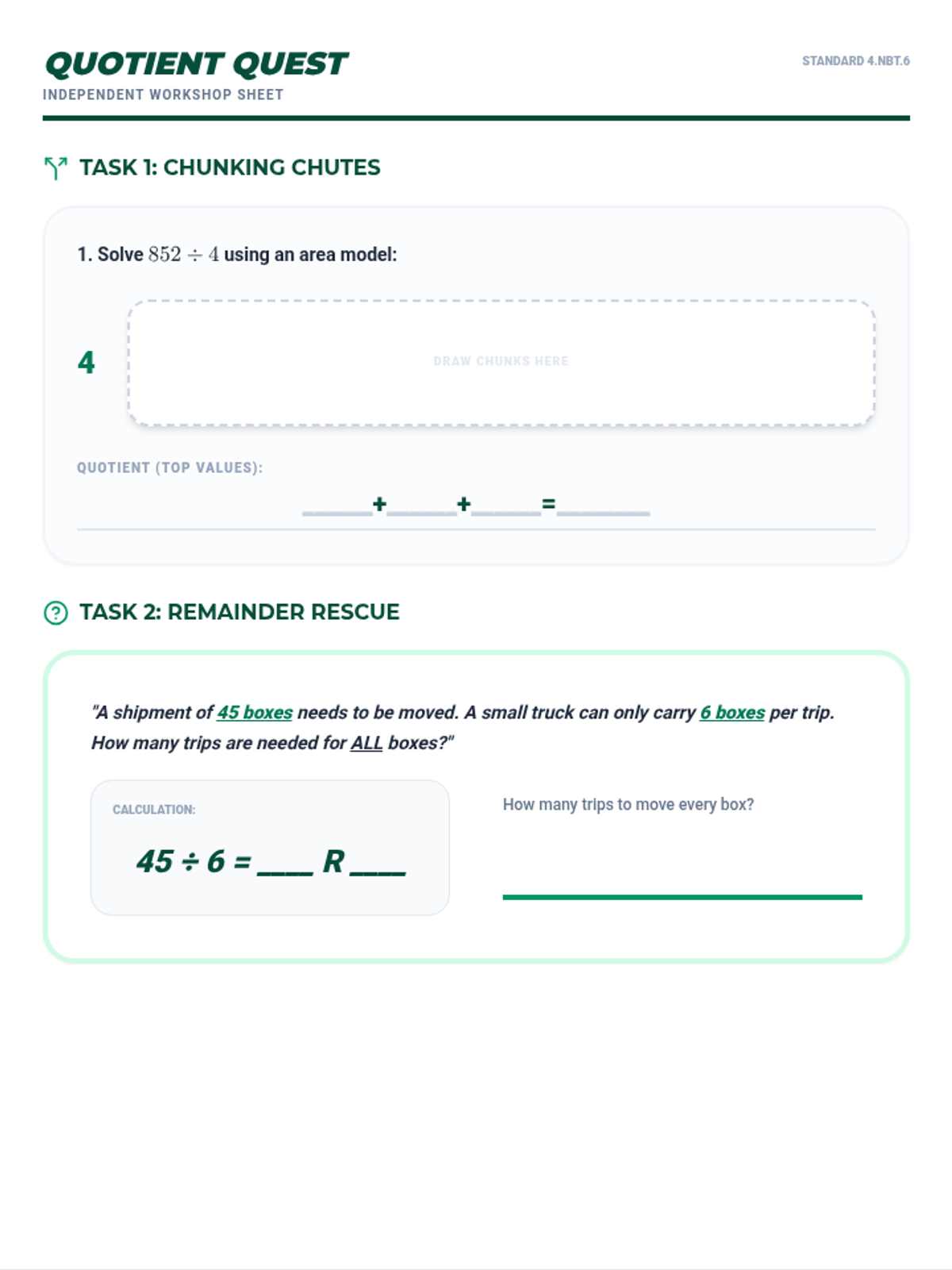
A comprehensive answer key for the Blueprint Practice Worksheet, providing step-by-step solutions for all problems.
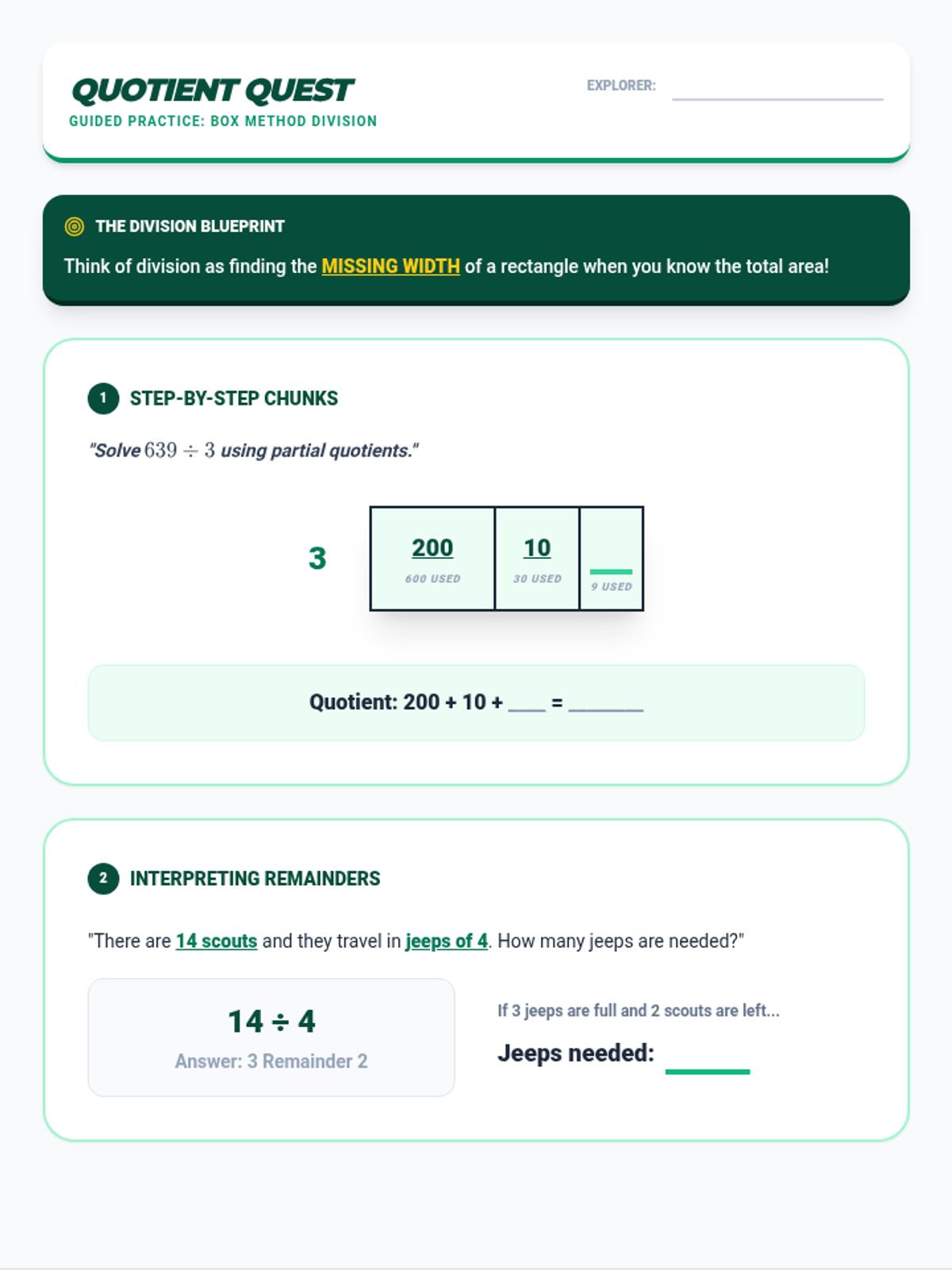
A two-page practice worksheet with 'blueprint' solving boxes that guide students through the steps of identifying operations, applying inverses, and checking their work.
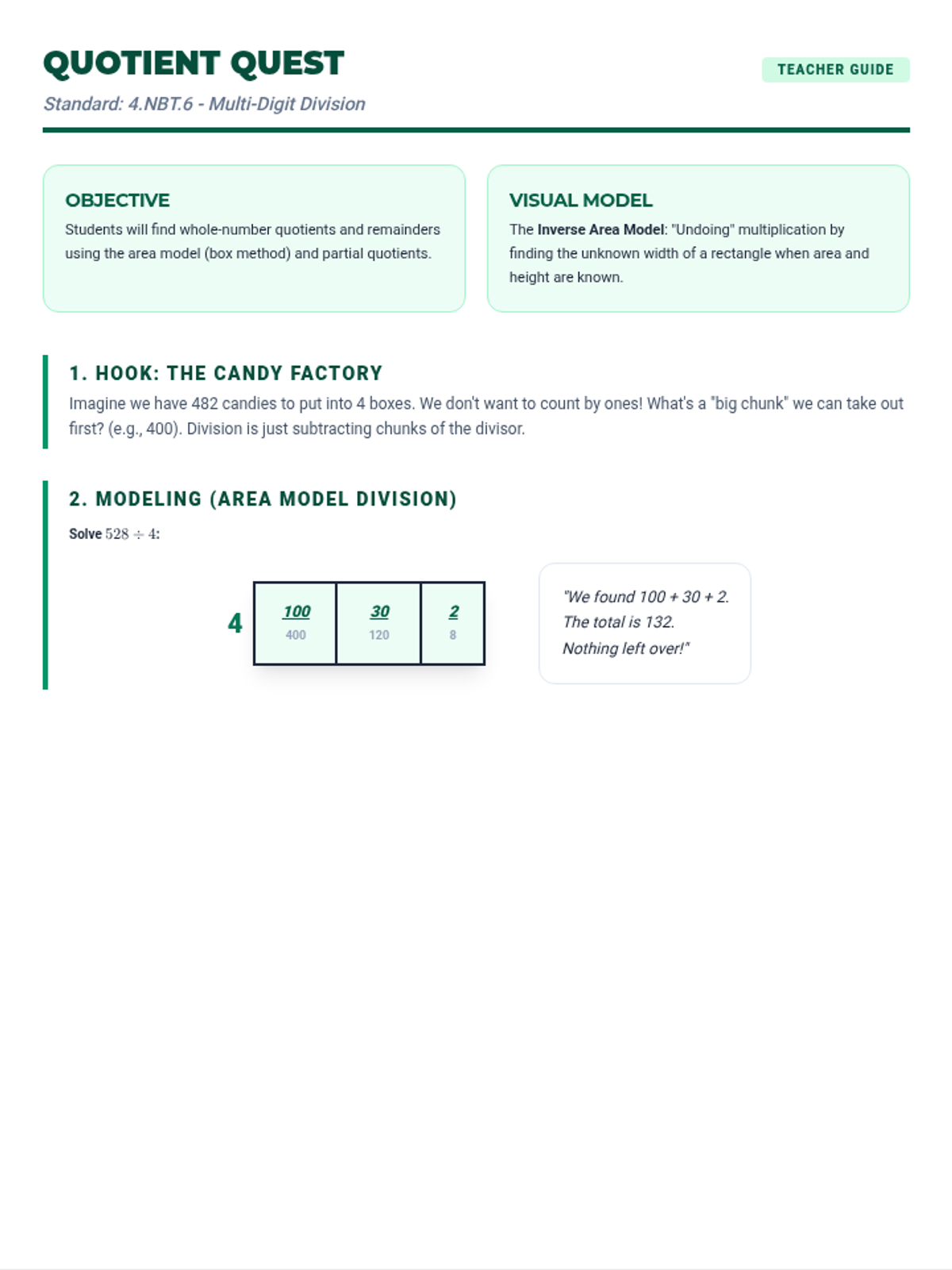
A comprehensive one-page reference sheet for solving one-step equations, featuring visual examples of addition, subtraction, multiplication, and division along with a 4-step graphic organizer.
A comprehensive teacher guide for the Slope Intercept Mastery lesson, including pacing, objectives, common student misconceptions, and discussion prompts.
The updated answer key for the Graphing Gauntlet worksheet, now providing solutions for all 8 drafting problems, extraction answers, and the final word problem solution.
A slide deck for teaching slope-intercept form through a blueprint/architectural design lens. Includes formula breakdown, step-by-step graphing guide, and a real-world application example.
An updated blueprint-themed worksheet for 9th-grade students to practice graphing linear equations in slope-intercept form. It now includes 8 drafting problems, identifying slope and y-intercept, and a real-world application problem.
A set of four hands-on field missions for students to experiment with daylight estimation, historical nautical timekeeping, fractal scaling, and sun-based coordinate mapping. All missions now feature consistent, professional layouts with scientific sidebars.
A comprehensive quiz covering fixed-point navigation, coordinate axes, microcosms vs macrocosms, and different types of symmetry. Refactored for standard portrait format.
A reference page explaining Longitude as the X-axis of navigation, along with advanced symmetry concepts like Rotational and Logarithmic Spirals. Updated for scientific accuracy regarding the difficulty of longitude and spiral patterns. Standard portrait format.
A conceptual worksheet for students to identify patterns of symmetry and scale in nature. Updated with 'Mission Break' callouts after Section 1 and Section 2 to guide students to specific field activities.
A two-page reference sheet covering the North Star (Polaris) as a navigation tool on page one, and the concepts of symmetry and scale (Microcosm/Macrocosm) in nature on page two. Updated for scientific accuracy and refactored for standard portrait format with small, professional font sizes.
A teacher guide providing a 15-minute pacing plan, discussion script, and answer key for the Cosmic Symmetry lesson. Updated for scientific accuracy regarding precession and terminology. Standard portrait format.
A student worksheet focused on identifying microcosm/macrocosm patterns and using coordinate symmetry (reflection) to complete a geometric compass rose design. Refactored for standard portrait format with an added 'Mission Break' callout.
A visual slide deck distinguishing between the North Star (fixed points) and Nature's Symmetry (repeating patterns) as tools for ancient navigation, now updated with integrated 'Mission Break' slides to signal field work timing.
A teacher-facing lesson guide with pacing, hands-on activity instructions, discussion prompts, and key concepts for the 15-30 minute Cosmic Compass lesson. Redesigned with a modern star chart aesthetic.
A three-page student resource featuring 'The Navigator's Codex' (informational text) and a two-part 'Blueprint Analysis' (interactive worksheet). Covers the historical breakthrough of Polaris, rotational symmetry in nature and navigation, Greek root decoding, and mathematical coordinate prediction. Redesigned with a modern star chart aesthetic and updated with the specific 'Why it matters' takeaway requested by the user. Vertical spacing tightened and font sizes adjusted to prevent content overlap.
Instructional slides for the 'Cosmic Compass' lesson, redesigned with a modern star chart aesthetic. Features neon accents, geometric layouts, and high-contrast digital motifs to teach the Greek roots micro/macro/cosmos and rotational symmetry. Updated with the specific 'Why it matters' takeaway requested by the user.