A comprehensive teacher's guide for the Popcorn Expansion Lab, featuring learning objectives, a detailed material list, step-by-step procedures, and key discussion prompts synchronized with the lesson's video.
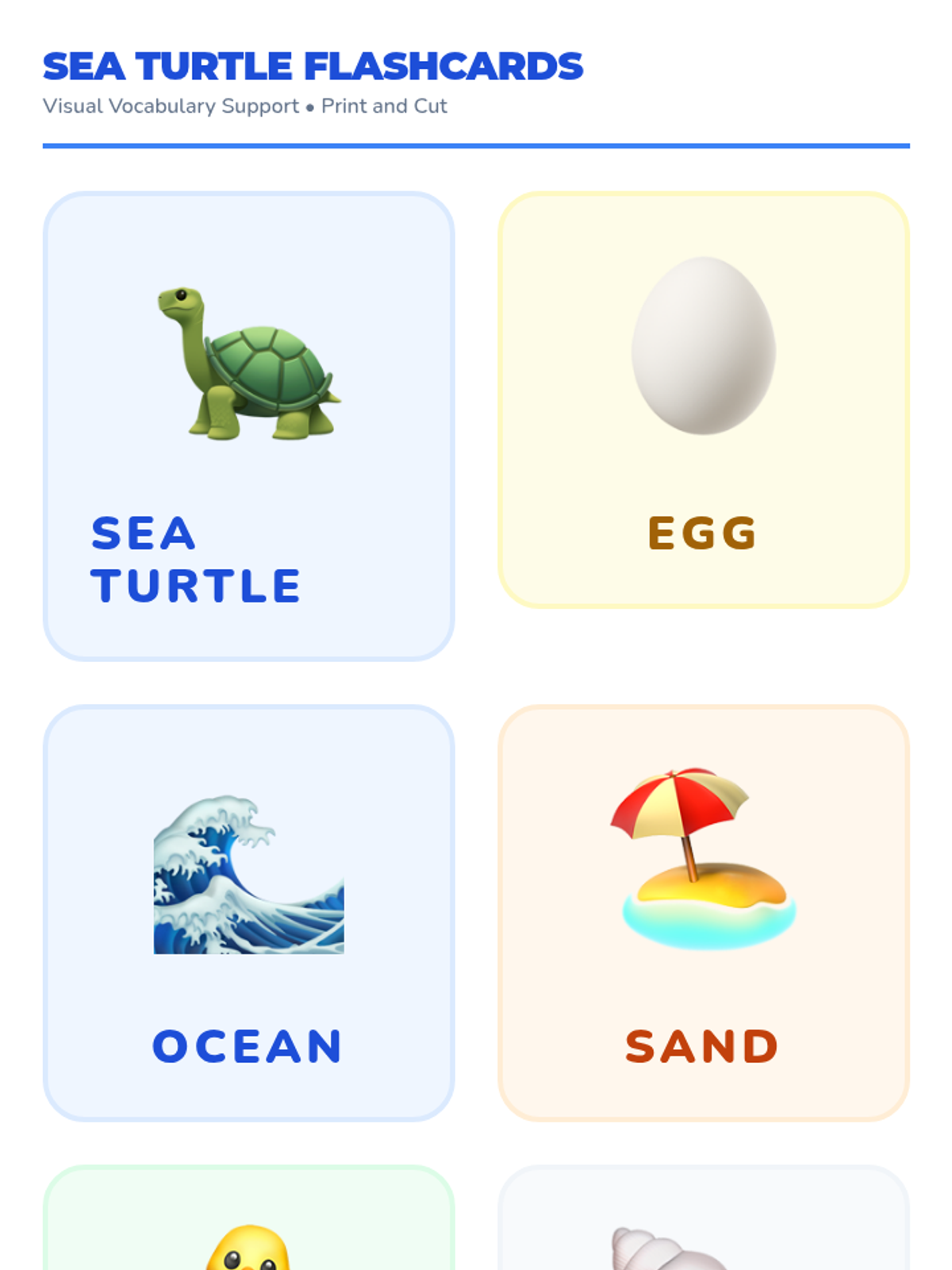
A set of advanced visual vocabulary cards for sea turtle conservation, featuring terms like adaptation, endangered, conservation, and habitat.
A highly rigorous reading comprehension worksheet for sea turtles, featuring an extended passage, main idea organizer, evidence-based matching, and conservation analysis.
An advanced slide deck for sea turtles, introducing high-level concepts like adaptation, environmental threats (pollution, nets), and conservation efforts.
An advanced teacher guide for 4th-grade EL students, elevating concepts to include conservation, adaptation, and main idea identification.
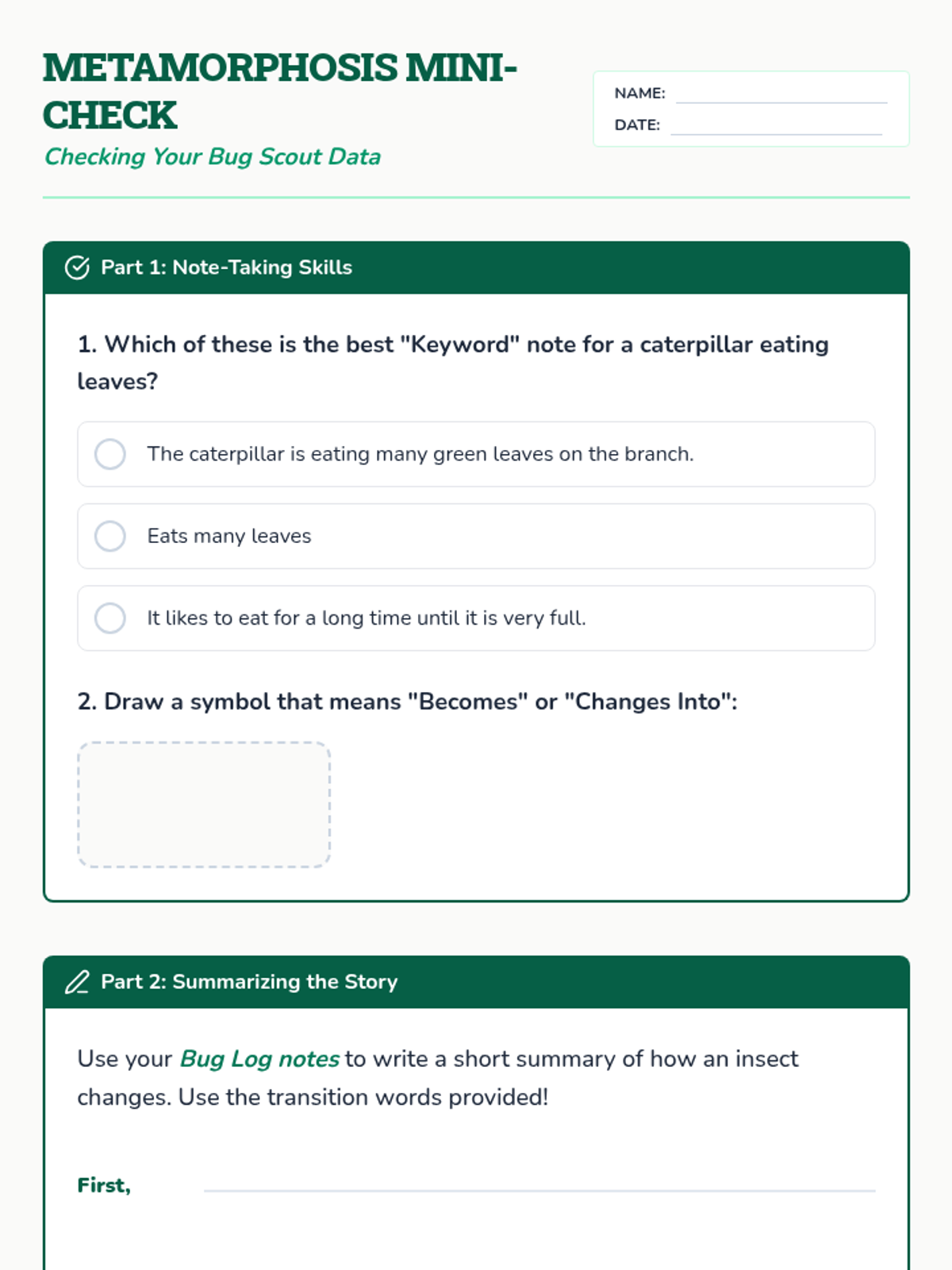
An exit ticket assessment for Grade 5 ESL students to verify their note-taking skills (keyword selection and symbol usage) and their ability to summarize the metamorphosis process using their notes.
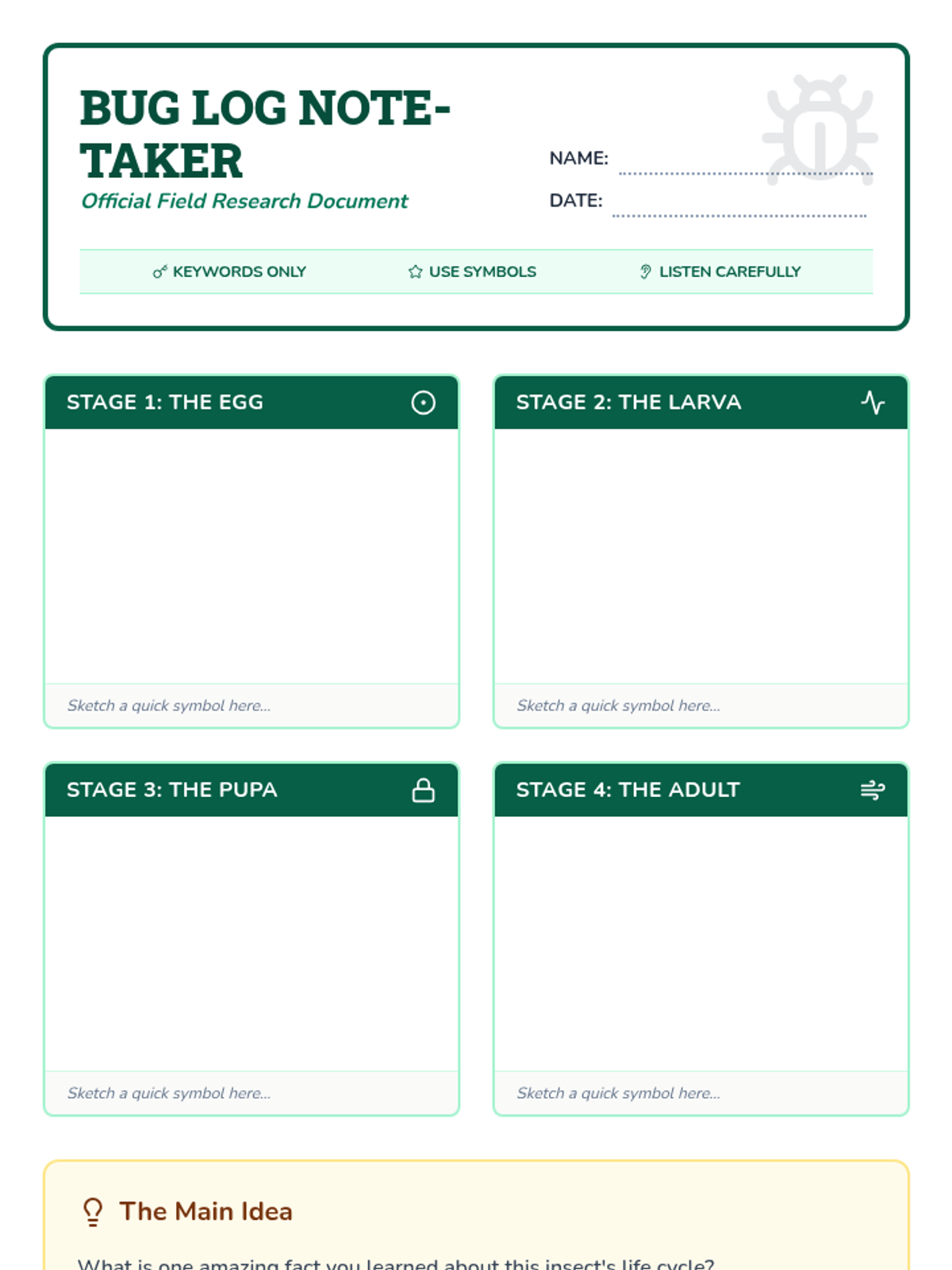
A student graphic organizer for taking notes during a video, featuring four distinct sections for the stages of metamorphosis, space for keywords and symbols, and a summary area with a vocabulary bank.
An engaging slide deck designed for Grade 5 ESL students, teaching metamorphosis and expert note-taking strategies (keywords and symbols) with a nature explorer theme.
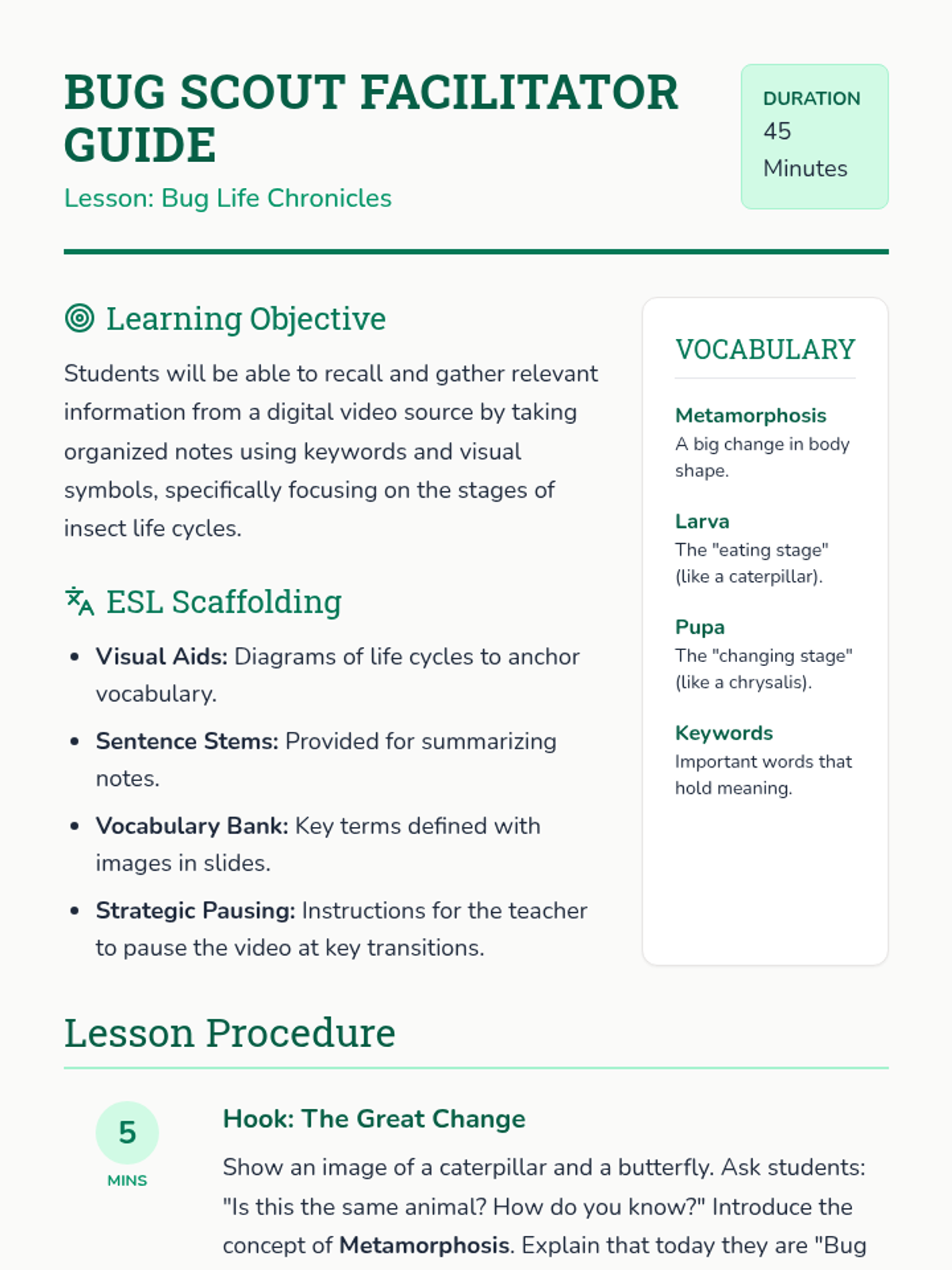
A comprehensive facilitation guide for a 45-minute ESL lesson on taking notes from a video, including learning objectives, ESL scaffolding strategies, and a detailed lesson procedure.
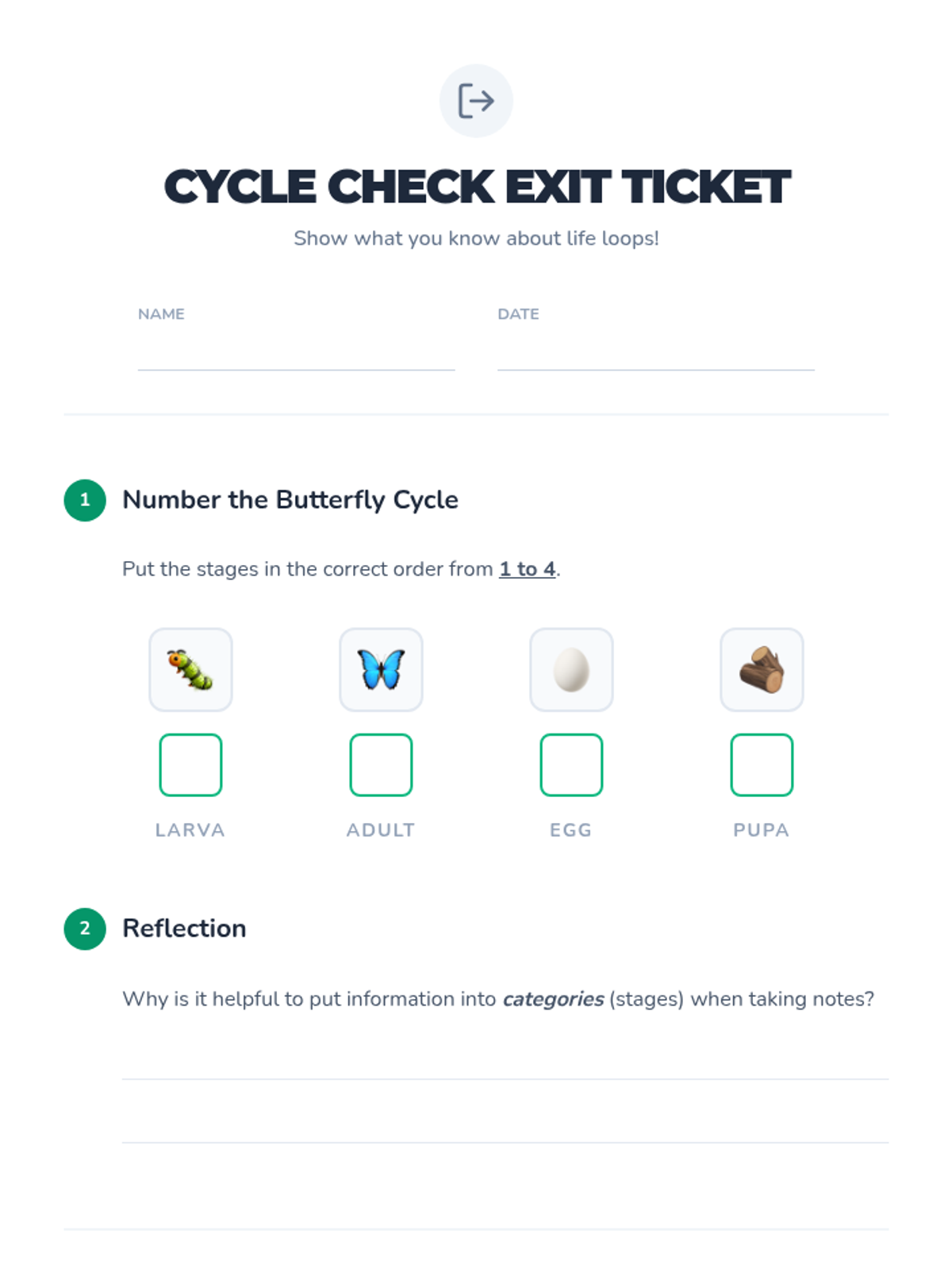
A quick assessment tool for students to sequence the butterfly life cycle and reflect on the value of categorizing information.
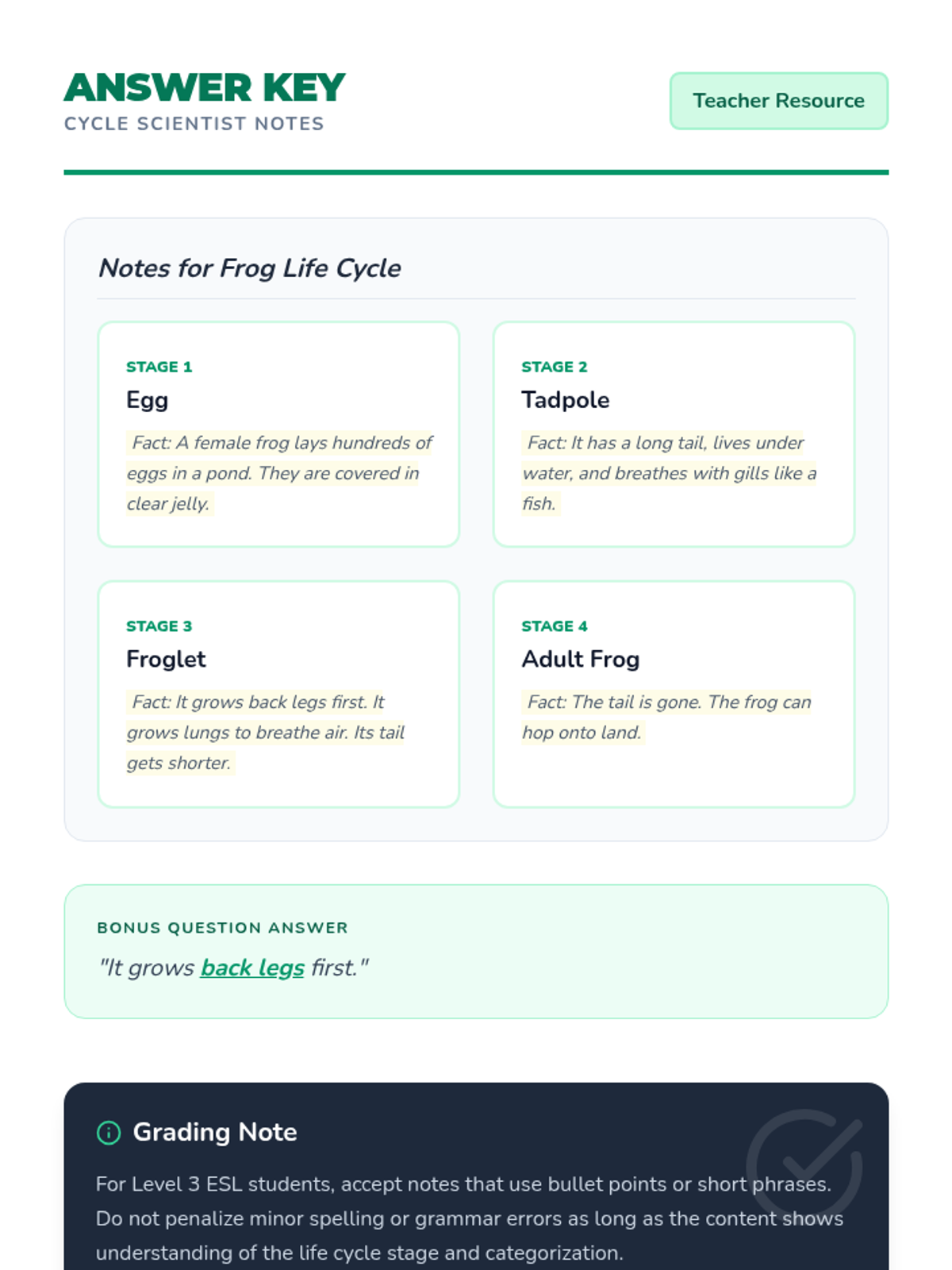
A teacher-facing answer key for the Cycle Scientist Notes Worksheet, providing expected responses for the Frog Life Cycle stages.
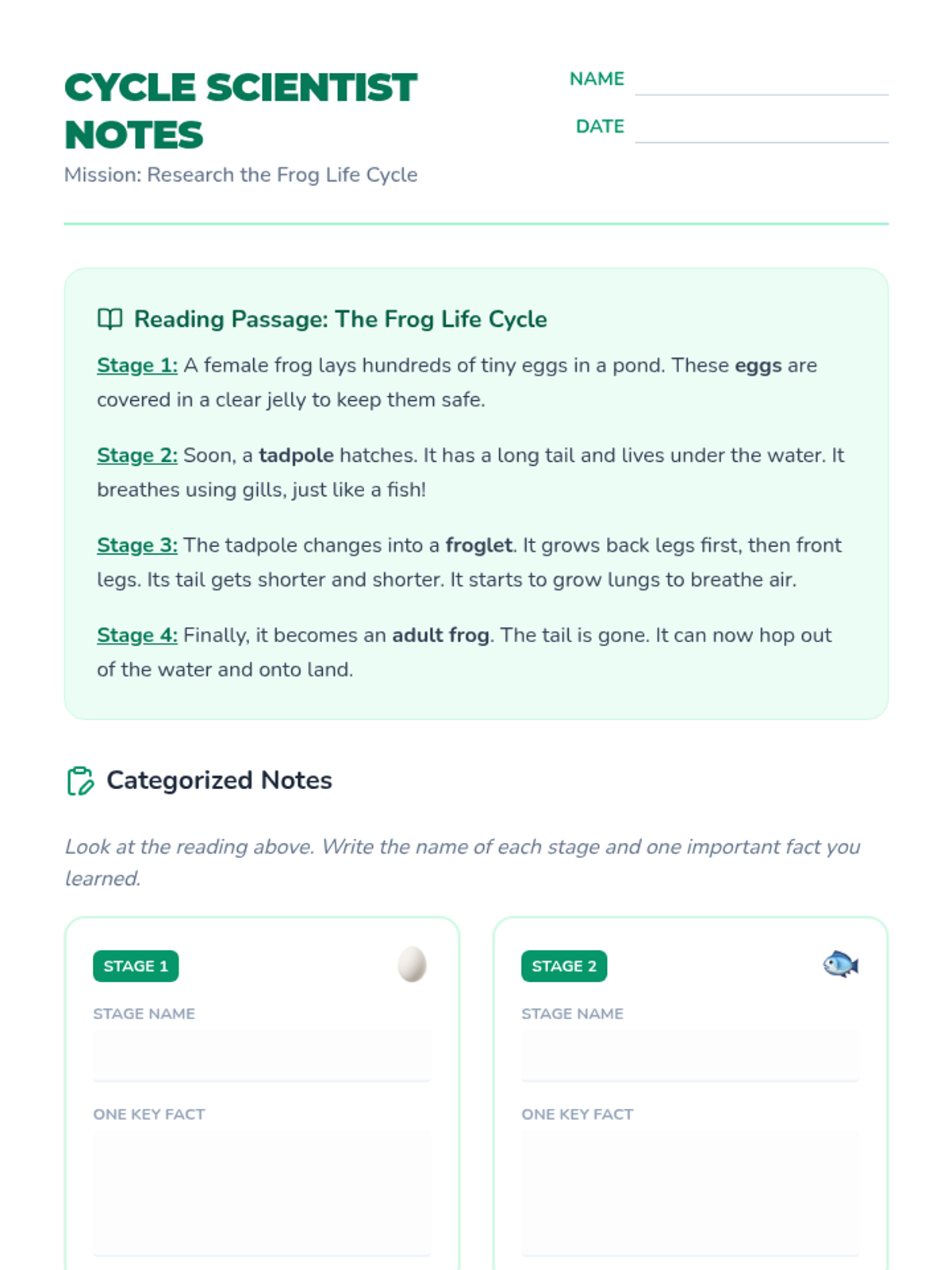
A worksheet where students read a passage about the Frog Life Cycle and practice note-taking by categorizing information into four stages.
A dynamic slide deck for instruction on life cycles, focusing on vocabulary, transition words, and guided practice for note-taking.
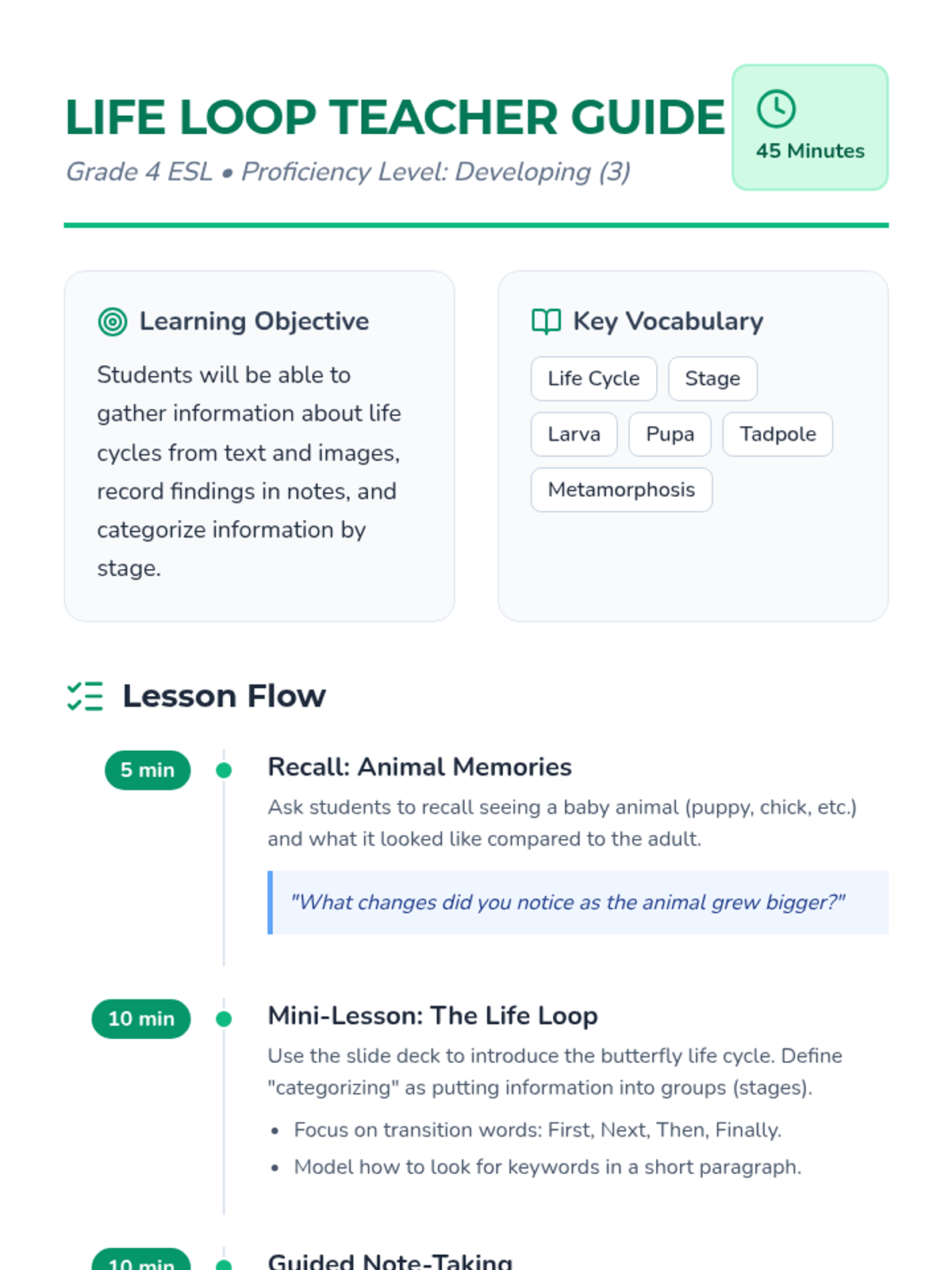
A comprehensive lesson plan for teachers, detailing the 45-minute flow of activities, vocabulary, and differentiation strategies for teaching life cycles and note-taking to Grade 4 ESL students.
A visual presentation for instruction, featuring high-impact slides on the solar system, planet categorization, and key vocabulary with definitions and checkpoints.
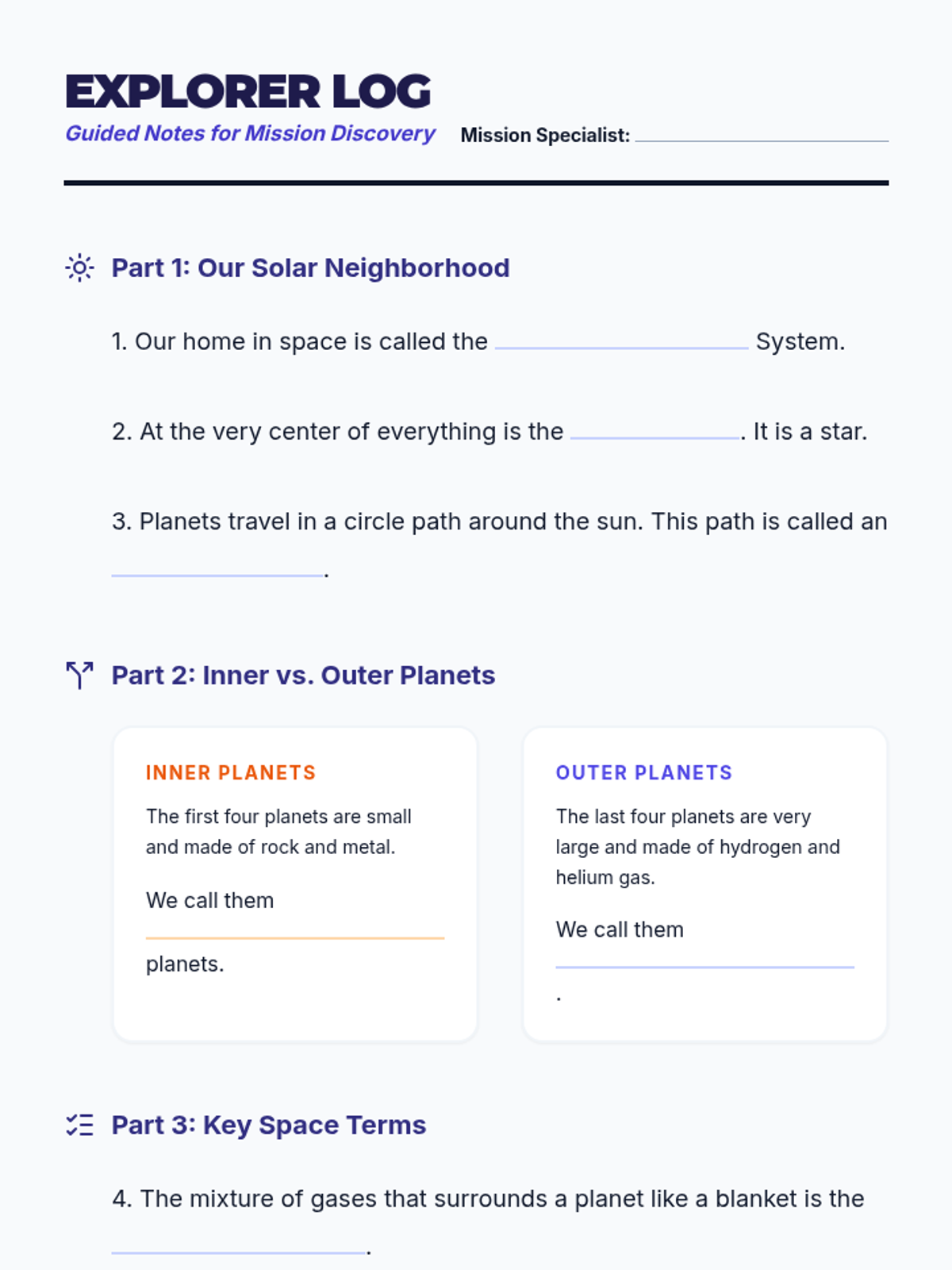
A cloze-style guided notes sheet for students to use during the visual slide presentation, focusing on key domain-specific solar system vocabulary.
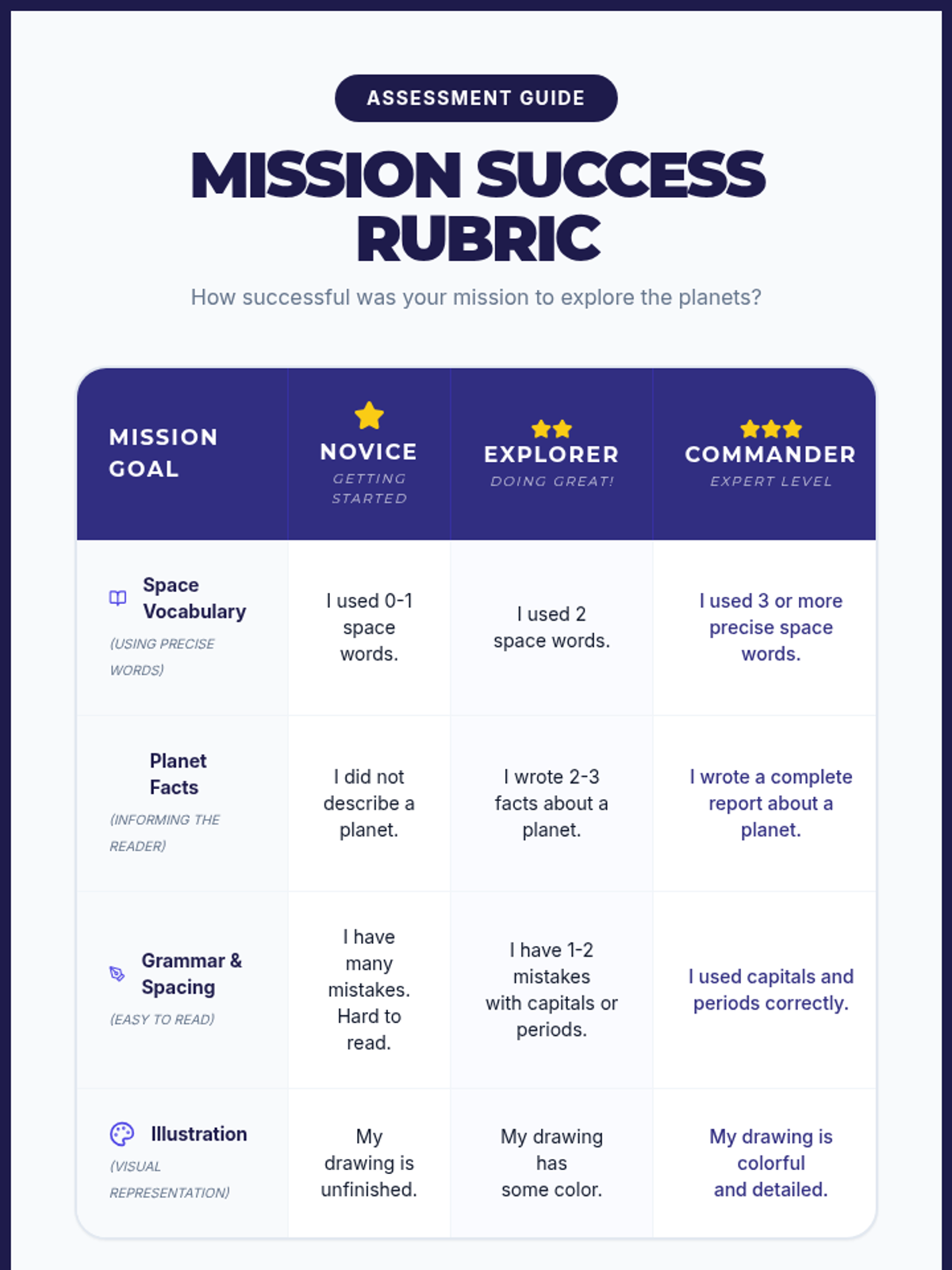
A student-friendly mission-themed rubric for evaluating the planet report, focusing on vocabulary use, content, grammar, and illustrations.
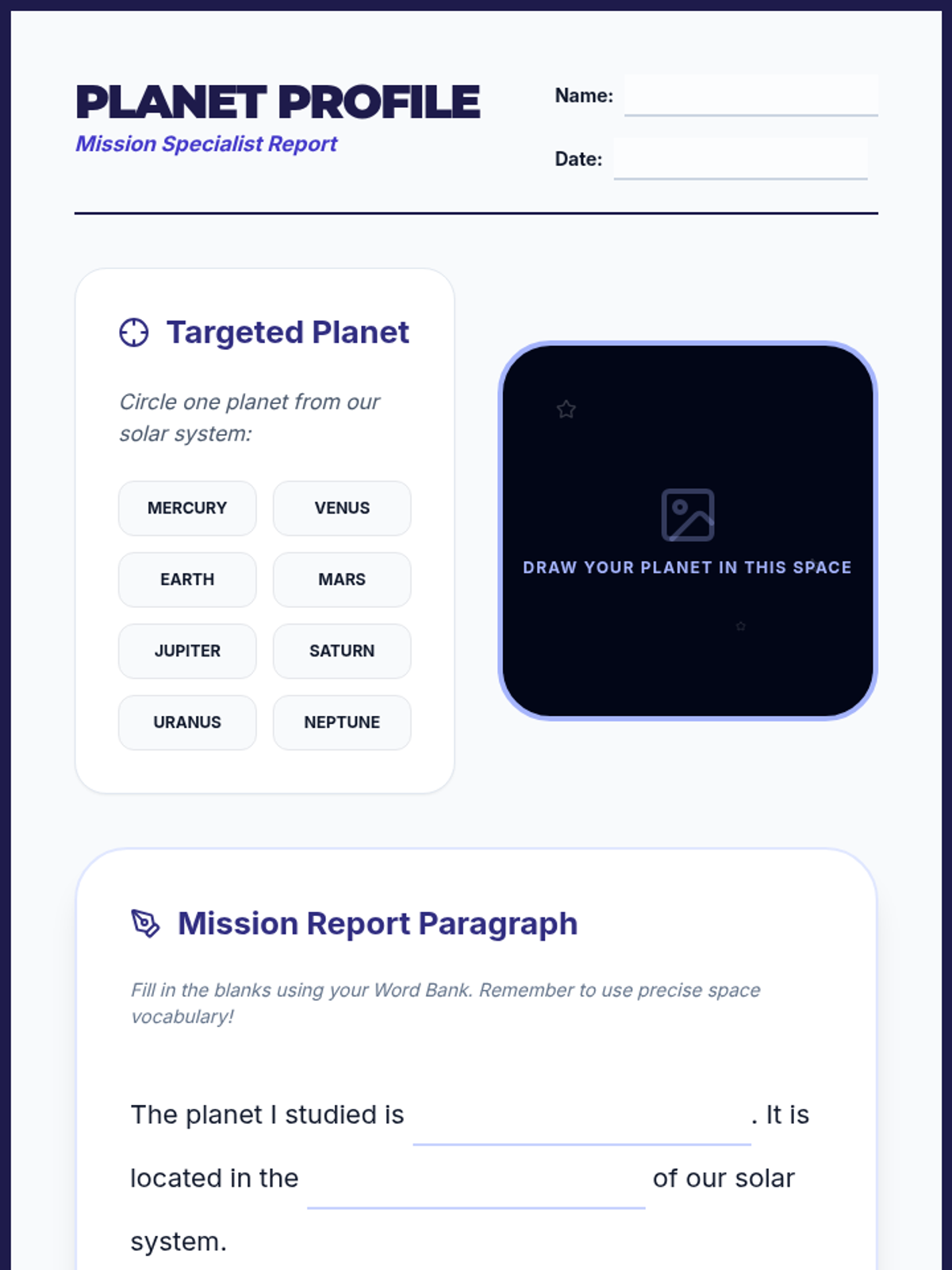
A scaffolded writing template for a Grade 4 ESL planet report, featuring sentence starters, a drawing area, and a vocabulary checklist to encourage precise language use.
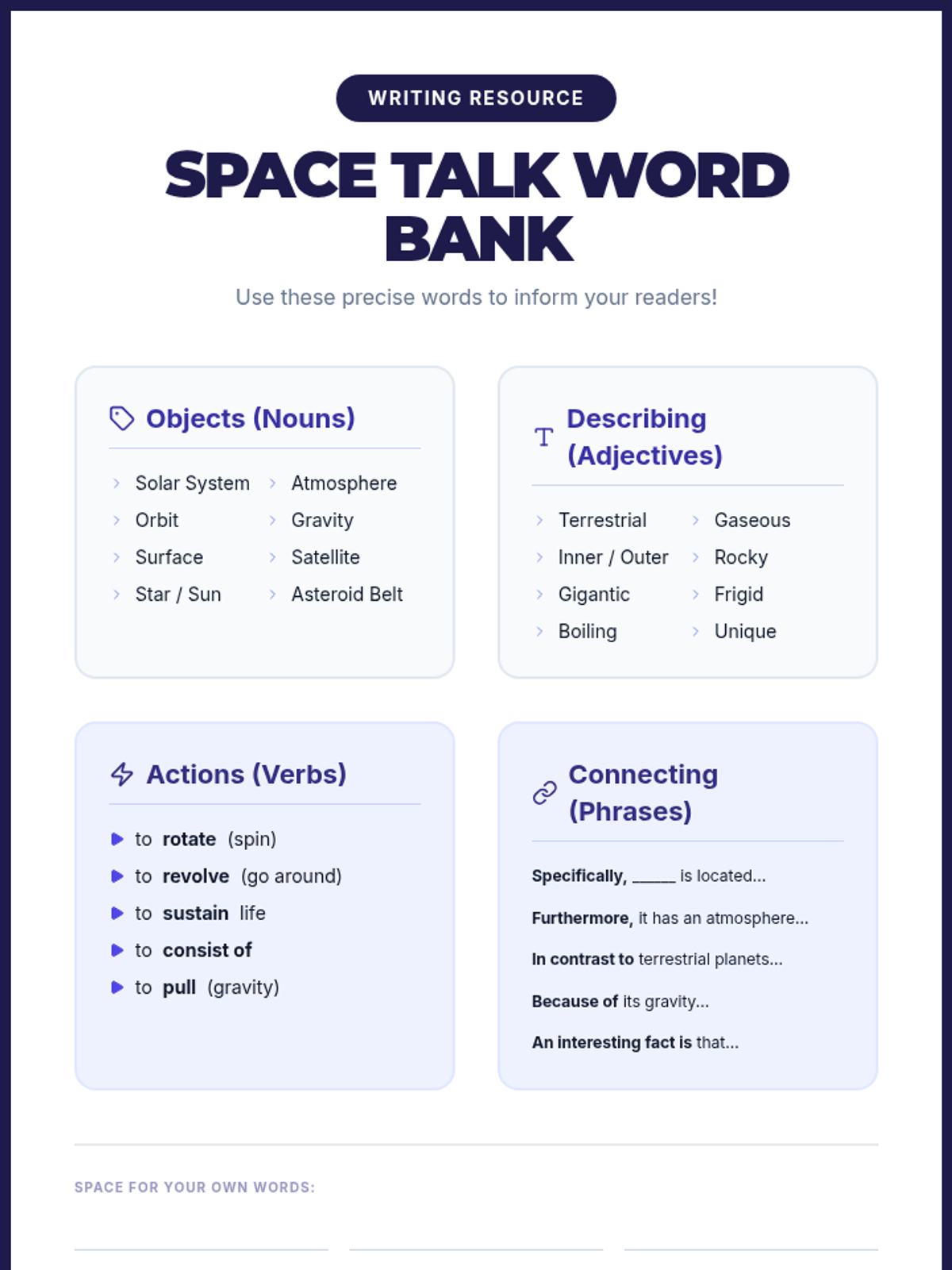
A categorized word bank for Grade 4 ESL students to support precise language use in their planet reports, including nouns, adjectives, verbs, and sentence starters.
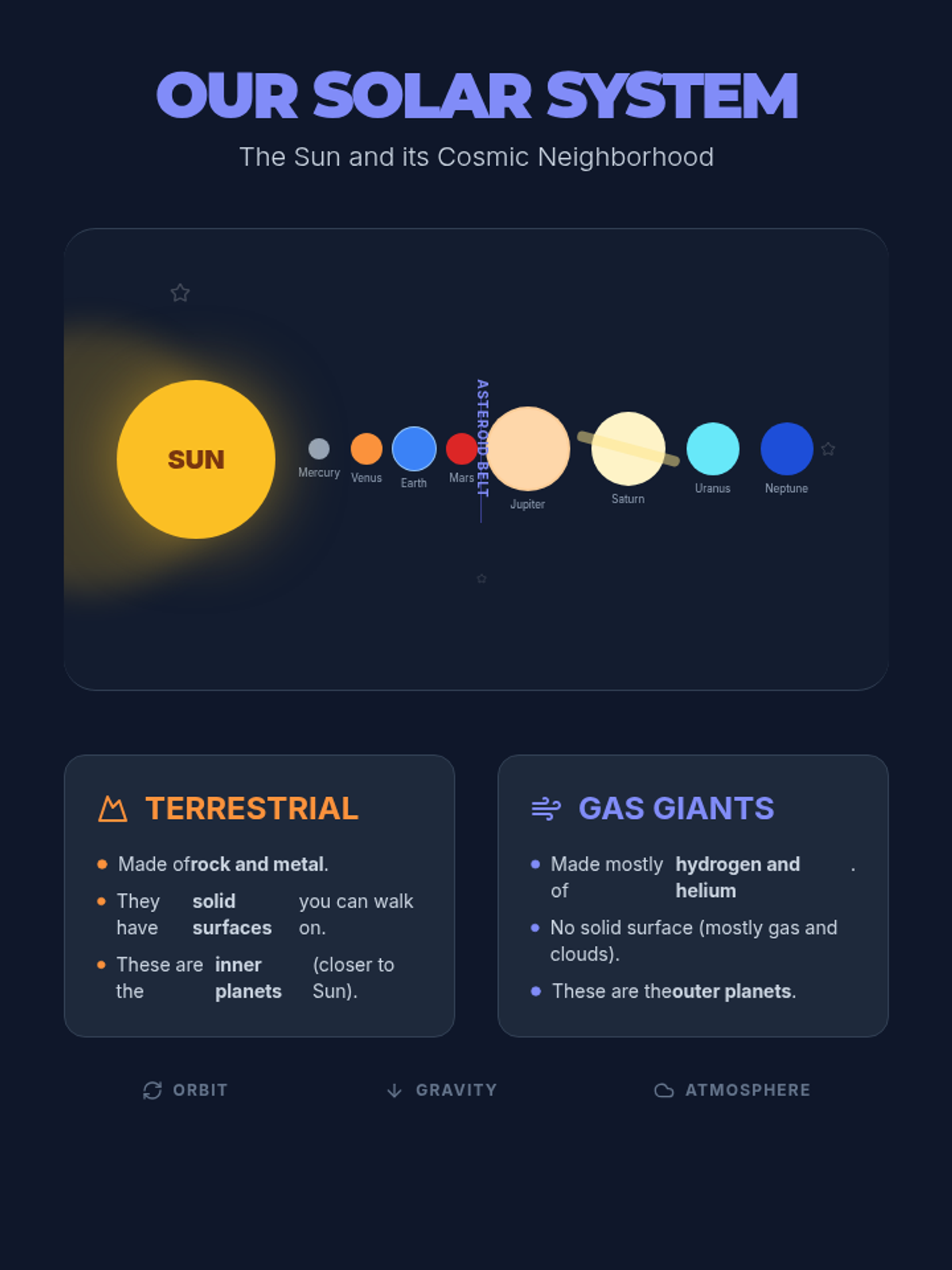
A visual anchor chart illustrating the solar system, categorized by Terrestrial (rocky) and Gas Giant planets, including key characteristics and domain-specific vocabulary.
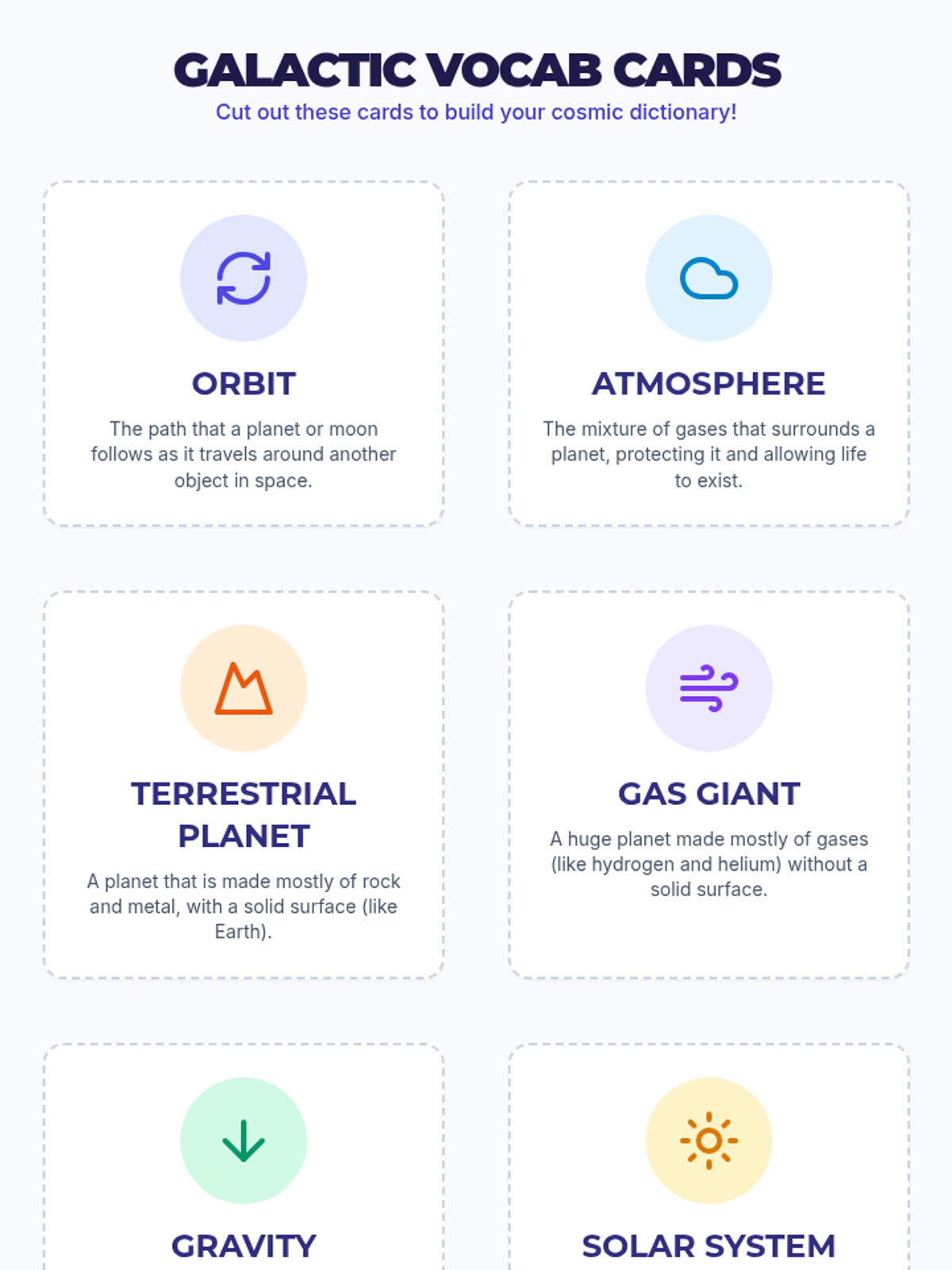
A set of visual vocabulary cards featuring key domain-specific terms for the solar system unit, including Orbit, Atmosphere, Terrestrial Planet, Gas Giant, Gravity, and Solar System.
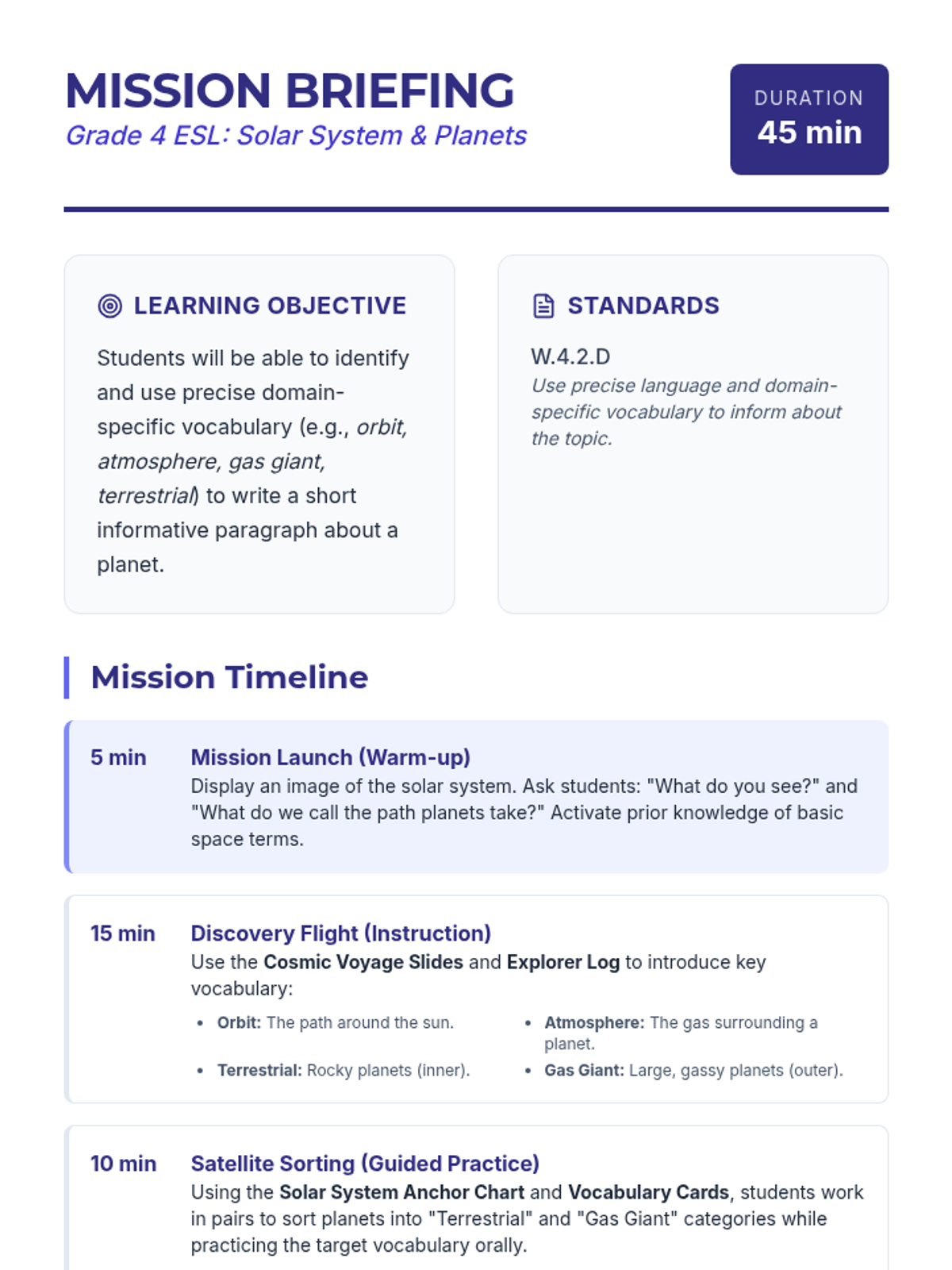
A detailed lesson plan for a 45-minute grade 4 ESL lesson on the solar system, featuring a mission-themed timeline, learning objectives, standards, and specific ESL support strategies.
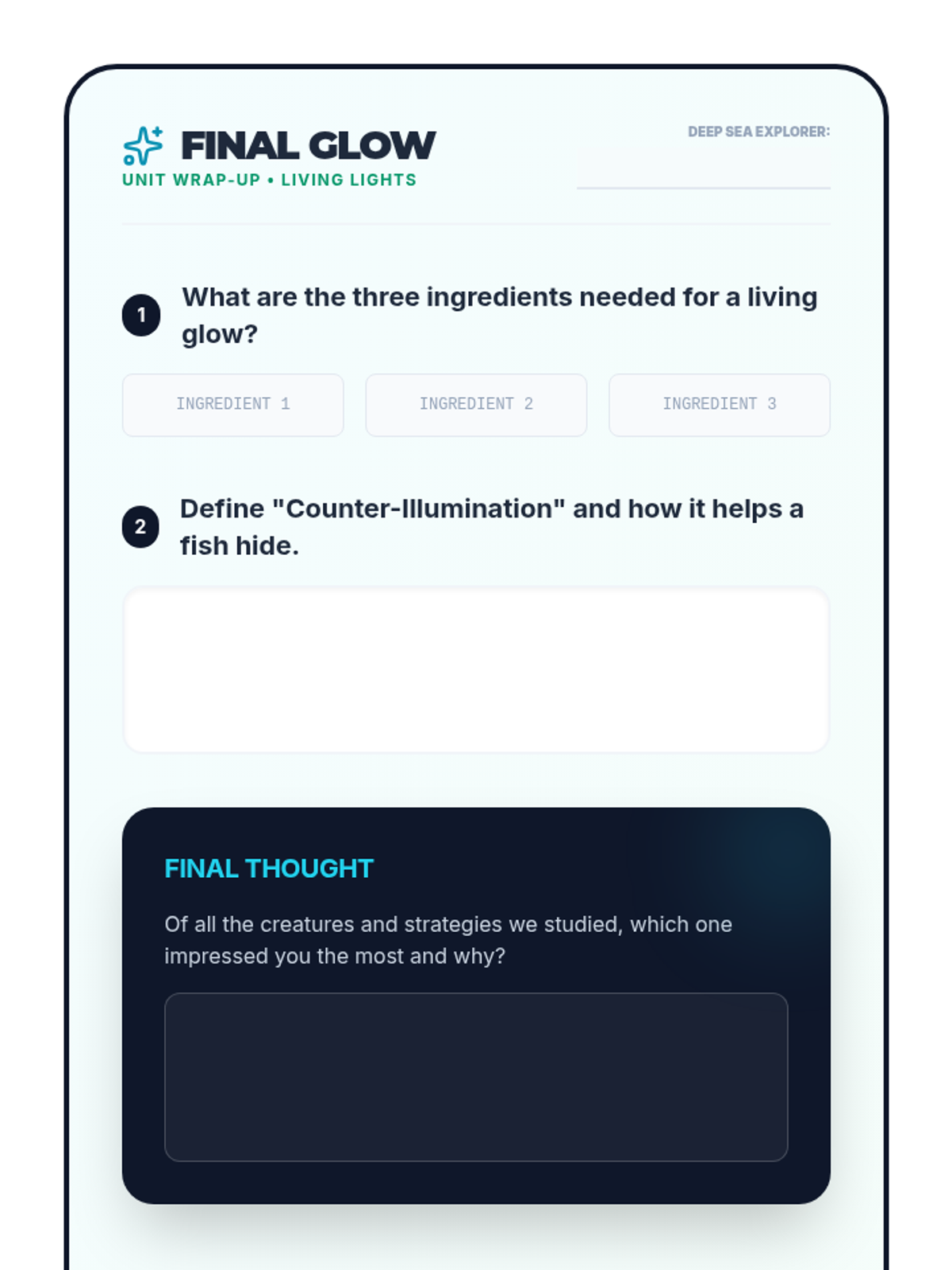
A final unit exit ticket for assessing cumulative student understanding of bioluminescence concepts.
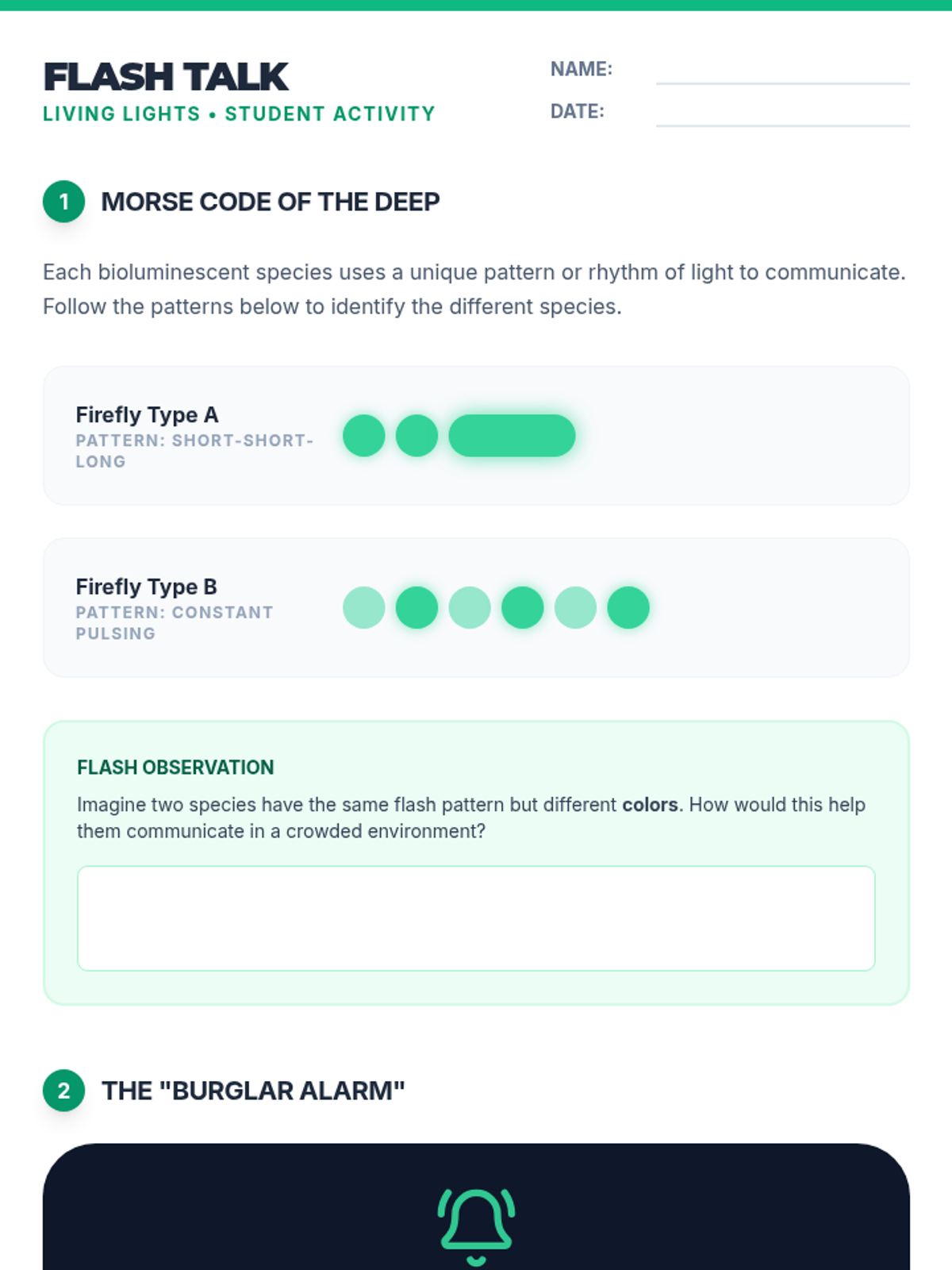
A student worksheet for exploring strategies like counter-illumination (camouflage), burglar alarms (defense), and mating signals.
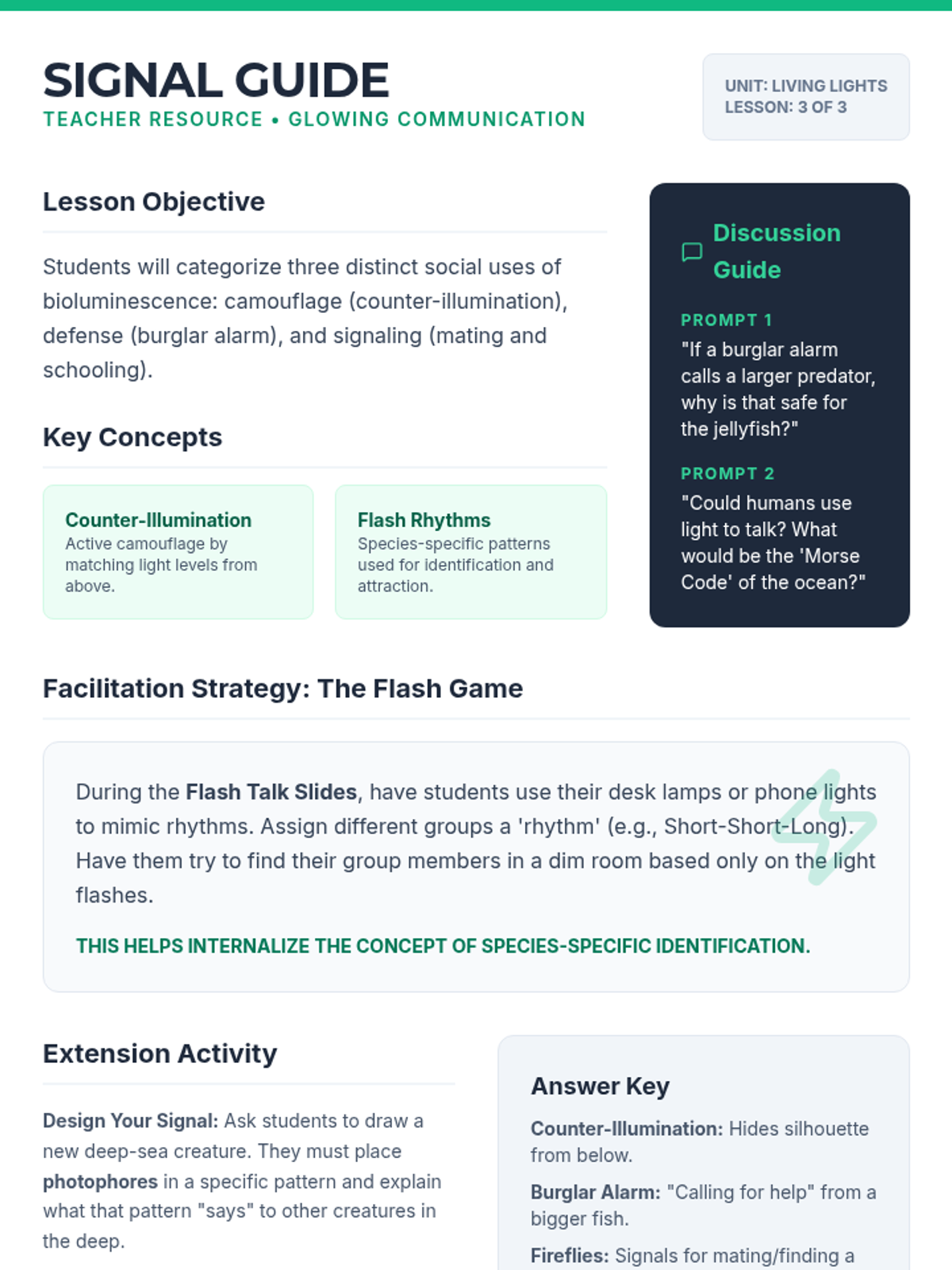
A teacher facilitation guide for Lesson 3, focusing on the social and defensive uses of light in nature, including discussion prompts and a classroom activity guide.
Exploring strategies like counter-illumination (camouflage), burglar alarms (defense), and mating signals.
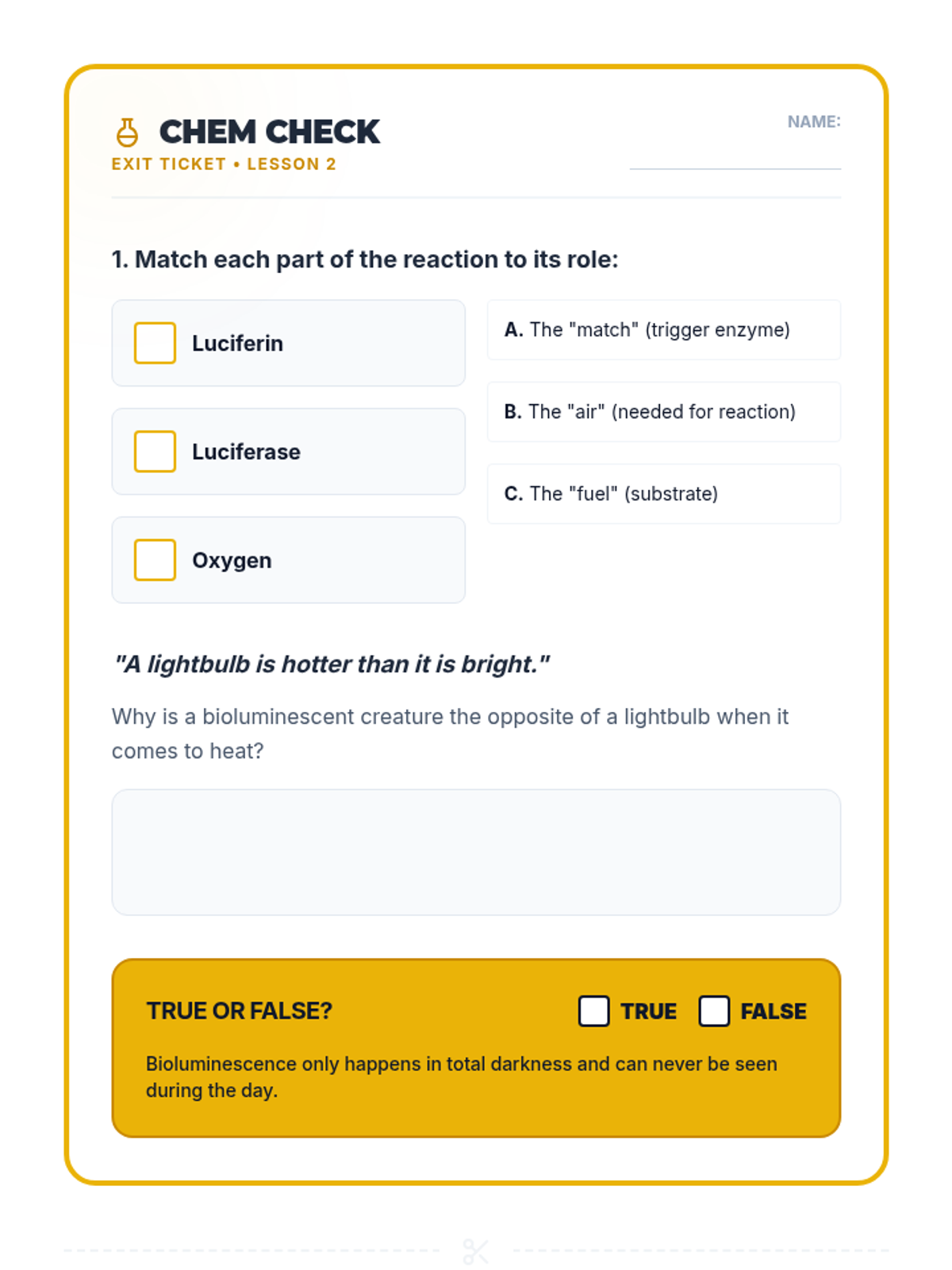
A quick check for Lesson 2 to assess student understanding of the chemical components of bioluminescence.
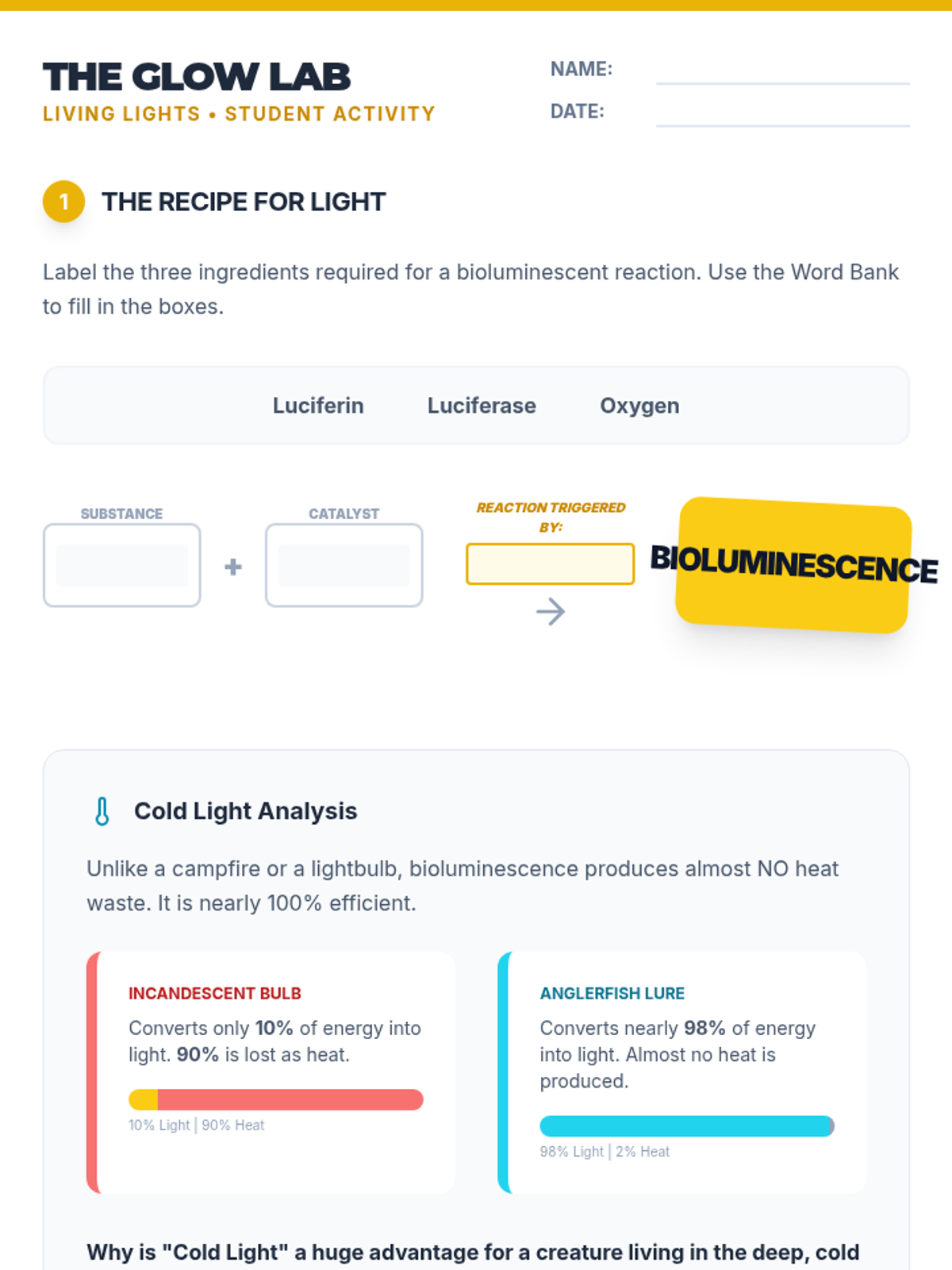
A student activity sheet for labeling the chemical equation and predicting reactions.
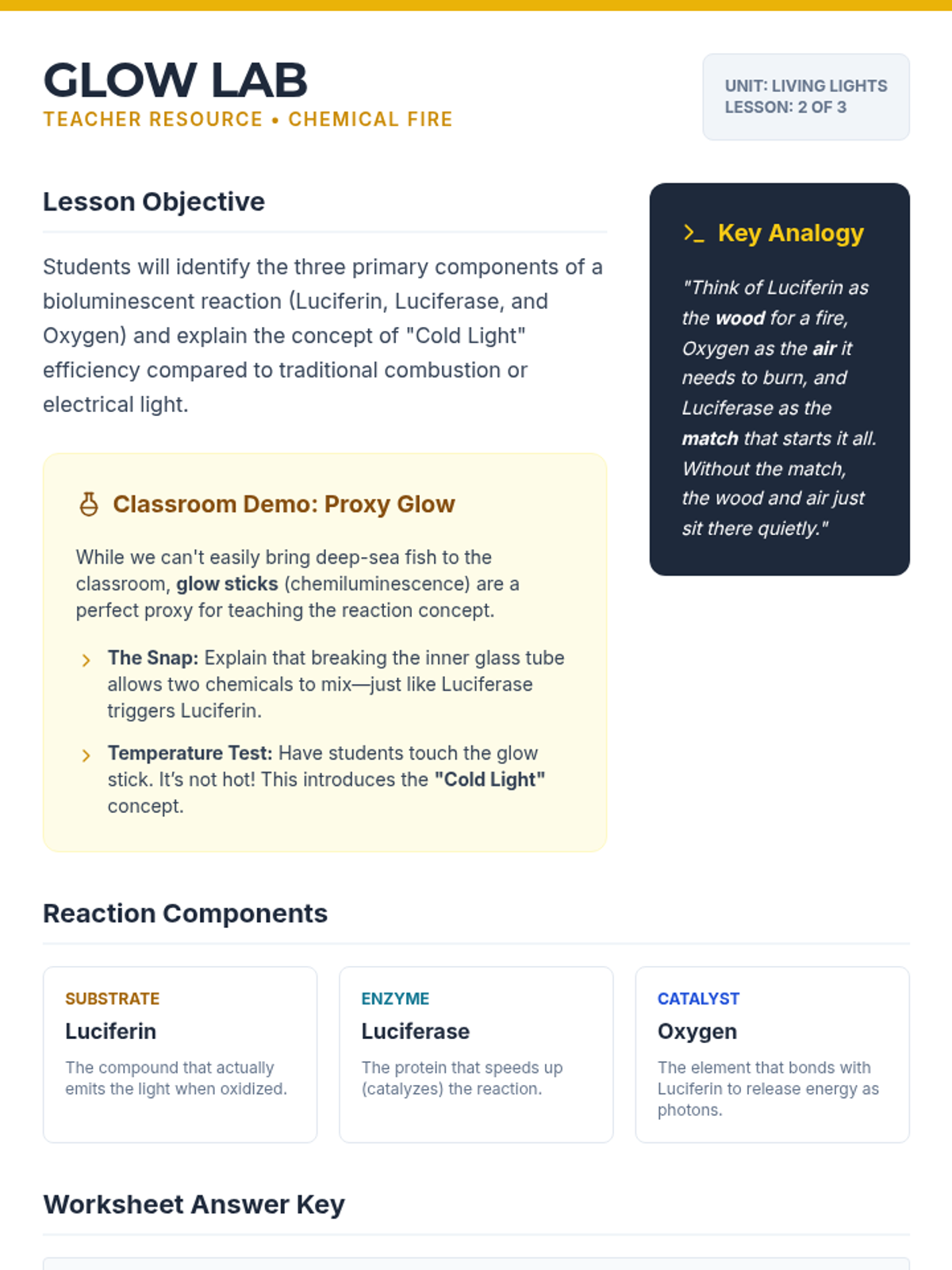
A teacher facilitation guide for Lesson 2, including background chemistry on the bioluminescent reaction and a classroom demonstration guide using glow sticks.
Detailed breakdown of the chemical reaction behind bioluminescence, exploring the roles of luciferin, luciferase, and oxygen in creating "cold light."