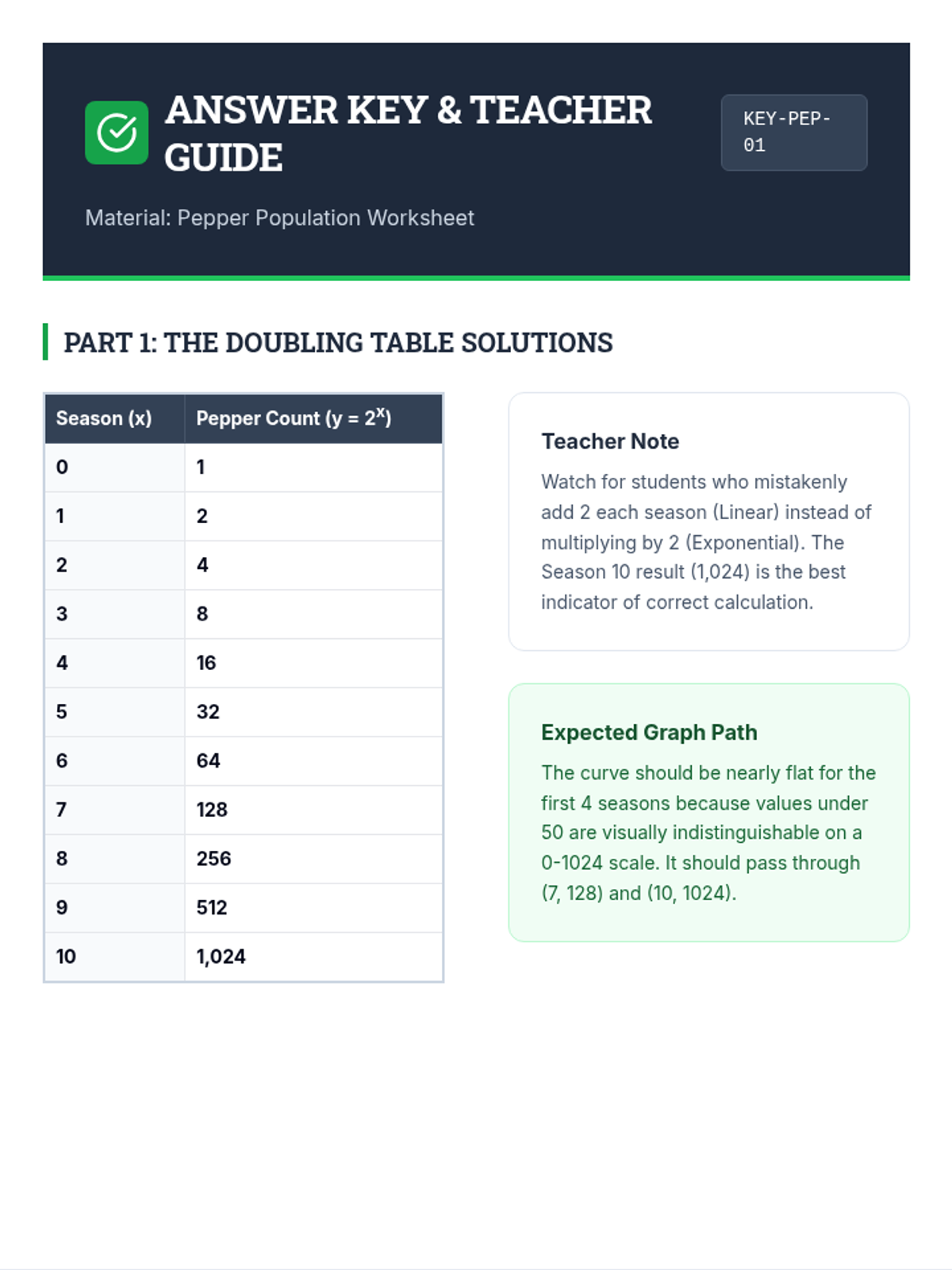
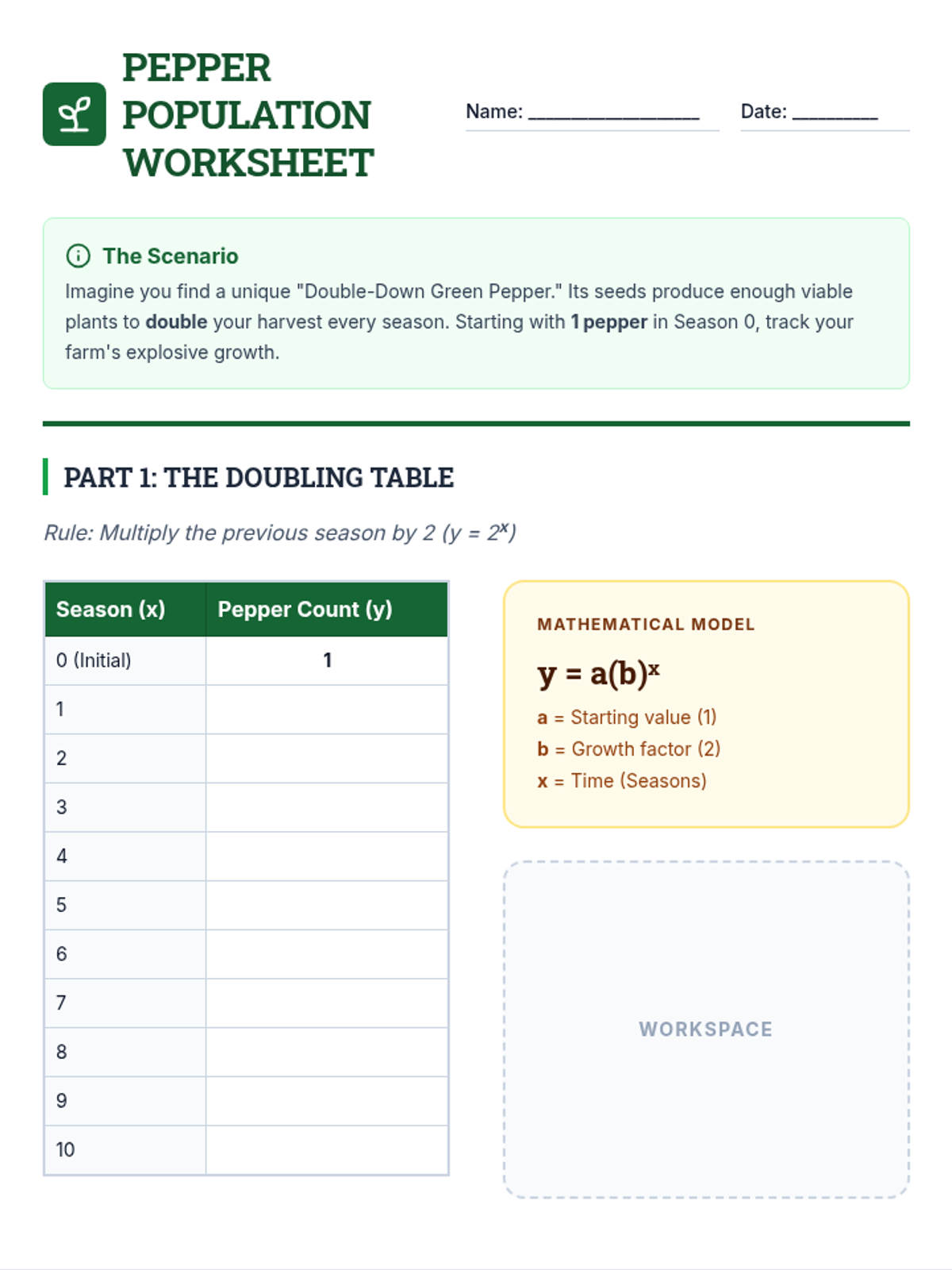
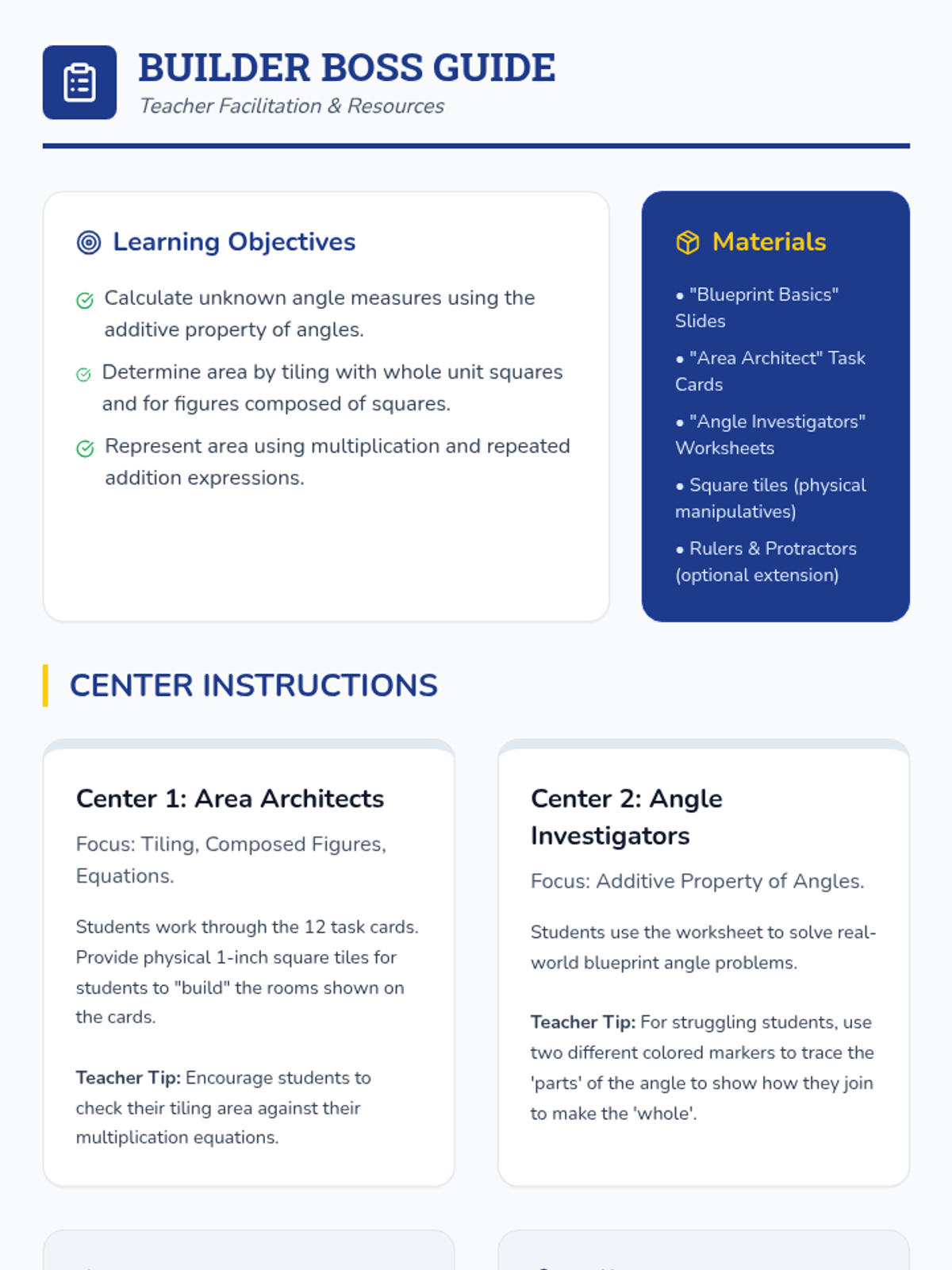
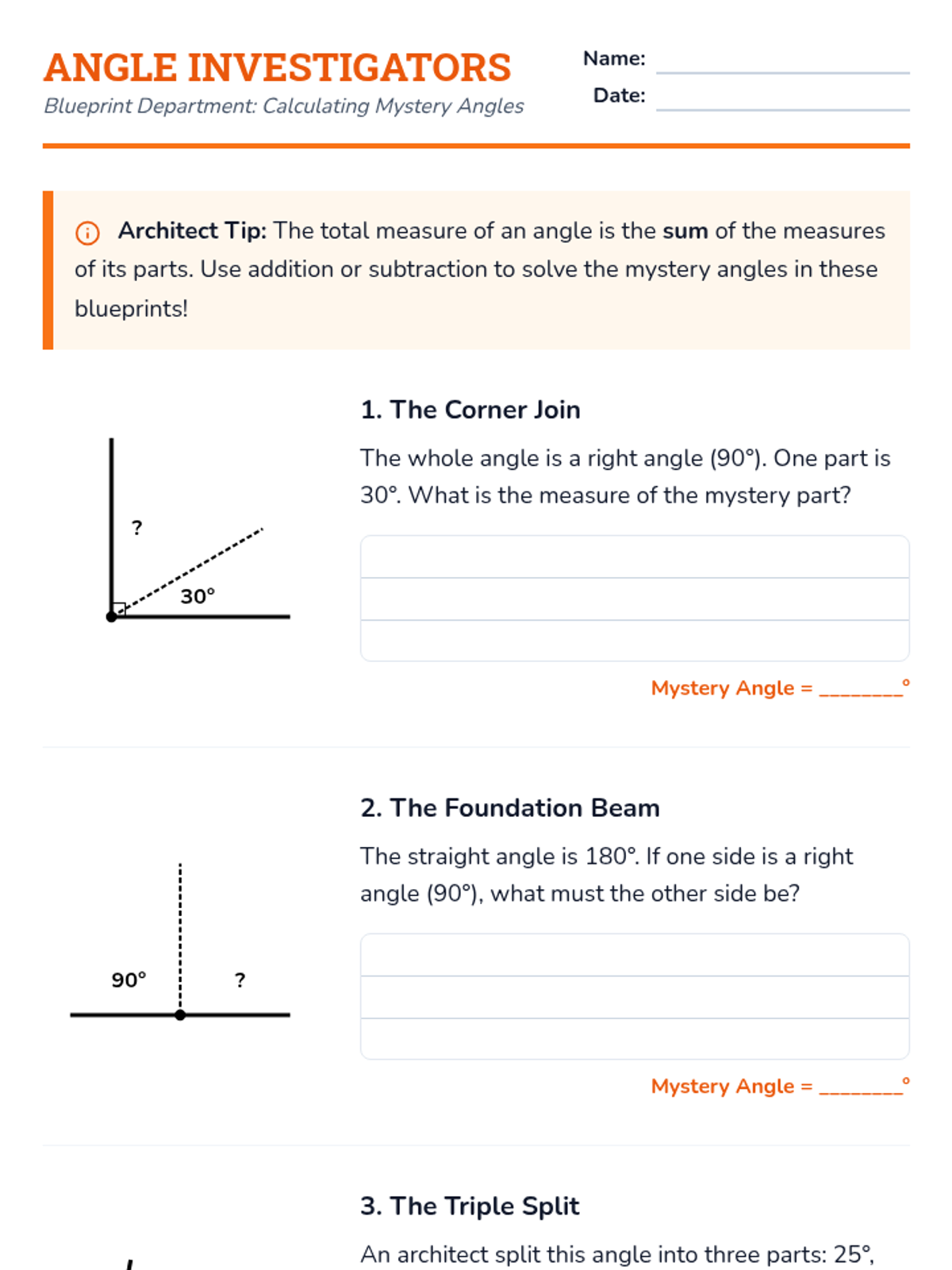
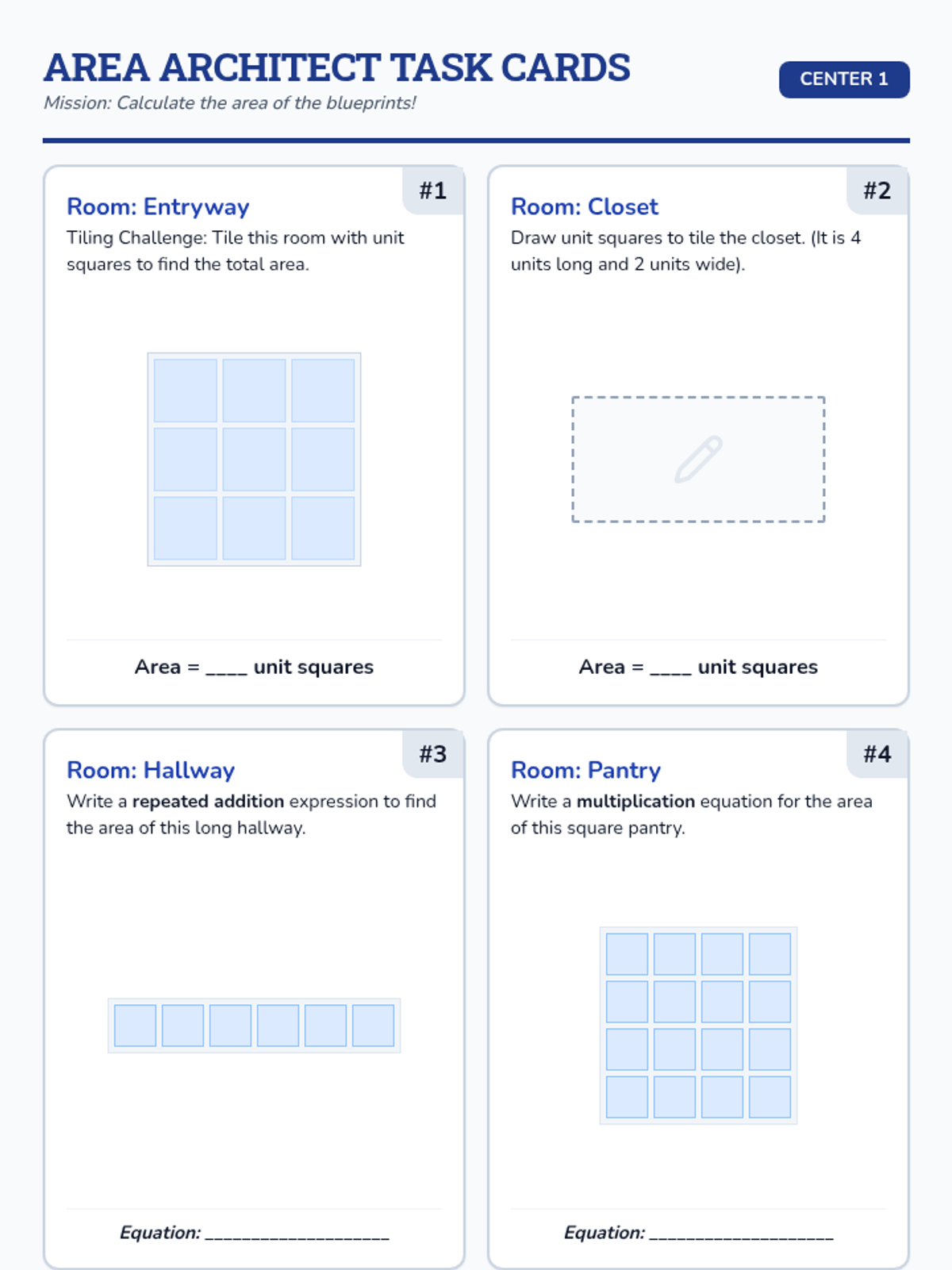
A comprehensive teacher facilitation guide for the 'Exponential Expeditions' lesson, featuring learning objectives, a timed lesson timeline, and a detailed answer key for multiple solution paths.
A student worksheet for sketching a distance-time graph based on a detailed narrative, including analysis questions about slope and key graphical features. Optimized for 8.5x11 printing with 1-inch margins.
A quick assessment for students to demonstrate their ability to interpret a line graph as a narrative and identify key graphical features like slope and intercepts. Optimized for 8.5x11 printing with 1-inch margins.
A quick assessment for students to demonstrate their ability to interpret a line graph as a narrative and identify key graphical features like slope and intercepts. Optimized for 8.5x11 printing.
A comprehensive answer key for the Blueprint Practice Worksheet, providing step-by-step solutions for all problems.
A two-page practice worksheet with 'blueprint' solving boxes that guide students through the steps of identifying operations, applying inverses, and checking their work.
A comprehensive one-page reference sheet for solving one-step equations, featuring visual examples of addition, subtraction, multiplication, and division along with a 4-step graphic organizer.
A comprehensive teacher guide for the Slope Intercept Mastery lesson, including pacing, objectives, common student misconceptions, and discussion prompts.
The updated answer key for the Graphing Gauntlet worksheet, now providing solutions for all 8 drafting problems, extraction answers, and the final word problem solution.
A slide deck for teaching slope-intercept form through a blueprint/architectural design lens. Includes formula breakdown, step-by-step graphing guide, and a real-world application example.
An updated blueprint-themed worksheet for 9th-grade students to practice graphing linear equations in slope-intercept form. It now includes 8 drafting problems, identifying slope and y-intercept, and a real-world application problem.
A short assessment to evaluate student understanding of calculating slope from points and interpreting its real-world meaning, optimized for 8.5x11 printing with clear work areas and 1-inch margins.
A set of four hands-on field missions for students to experiment with daylight estimation, historical nautical timekeeping, fractal scaling, and sun-based coordinate mapping. All missions now feature consistent, professional layouts with scientific sidebars.
A comprehensive quiz covering fixed-point navigation, coordinate axes, microcosms vs macrocosms, and different types of symmetry. Refactored for standard portrait format.
A reference page explaining Longitude as the X-axis of navigation, along with advanced symmetry concepts like Rotational and Logarithmic Spirals. Updated for scientific accuracy regarding the difficulty of longitude and spiral patterns. Standard portrait format.
A conceptual worksheet for students to identify patterns of symmetry and scale in nature. Updated with 'Mission Break' callouts after Section 1 and Section 2 to guide students to specific field activities.
A two-page reference sheet covering the North Star (Polaris) as a navigation tool on page one, and the concepts of symmetry and scale (Microcosm/Macrocosm) in nature on page two. Updated for scientific accuracy and refactored for standard portrait format with small, professional font sizes.
A teacher guide providing a 15-minute pacing plan, discussion script, and answer key for the Cosmic Symmetry lesson. Updated for scientific accuracy regarding precession and terminology. Standard portrait format.
A student worksheet focused on identifying microcosm/macrocosm patterns and using coordinate symmetry (reflection) to complete a geometric compass rose design. Refactored for standard portrait format with an added 'Mission Break' callout.
A visual slide deck distinguishing between the North Star (fixed points) and Nature's Symmetry (repeating patterns) as tools for ancient navigation, now updated with integrated 'Mission Break' slides to signal field work timing.
A teacher-facing lesson guide with pacing, hands-on activity instructions, discussion prompts, and key concepts for the 15-30 minute Cosmic Compass lesson. Redesigned with a modern star chart aesthetic.
A three-page student resource featuring 'The Navigator's Codex' (informational text) and a two-part 'Blueprint Analysis' (interactive worksheet). Covers the historical breakthrough of Polaris, rotational symmetry in nature and navigation, Greek root decoding, and mathematical coordinate prediction. Redesigned with a modern star chart aesthetic and updated with the specific 'Why it matters' takeaway requested by the user. Vertical spacing tightened and font sizes adjusted to prevent content overlap.
Instructional slides for the 'Cosmic Compass' lesson, redesigned with a modern star chart aesthetic. Features neon accents, geometric layouts, and high-contrast digital motifs to teach the Greek roots micro/macro/cosmos and rotational symmetry. Updated with the specific 'Why it matters' takeaway requested by the user.
A comprehensive facilitator's guide for teachers. Includes a 50-minute pacing guide, specific scaffolding tips for accessibility, a detailed answer key with multiple solution pathways, and strategies for addressing common misconceptions like additive thinking.