A structured graphic organizer for 3rd grade personal narratives, featuring guided sections for the beginning, middle, and end of a story with helpful sentence starters and transition words.
An answer key for the Inference Investigators lesson, providing suggested responses for the graphic organizers and correct options with rationales for the STAAR-style assessment.
A STAAR-formatted assessment featuring 8 selected-response questions, including two-part evidence-based items. The questions require students to make inferences and identify supporting text evidence from both literary and informational passages.
A comprehensive 2-page STAAR Reading Language Arts (RLA) cheat sheet for Grades 3-4, featuring visually organized sections for genres, plot elements, author's craft, text features, and test-taking strategies like RACE and two-part questions.
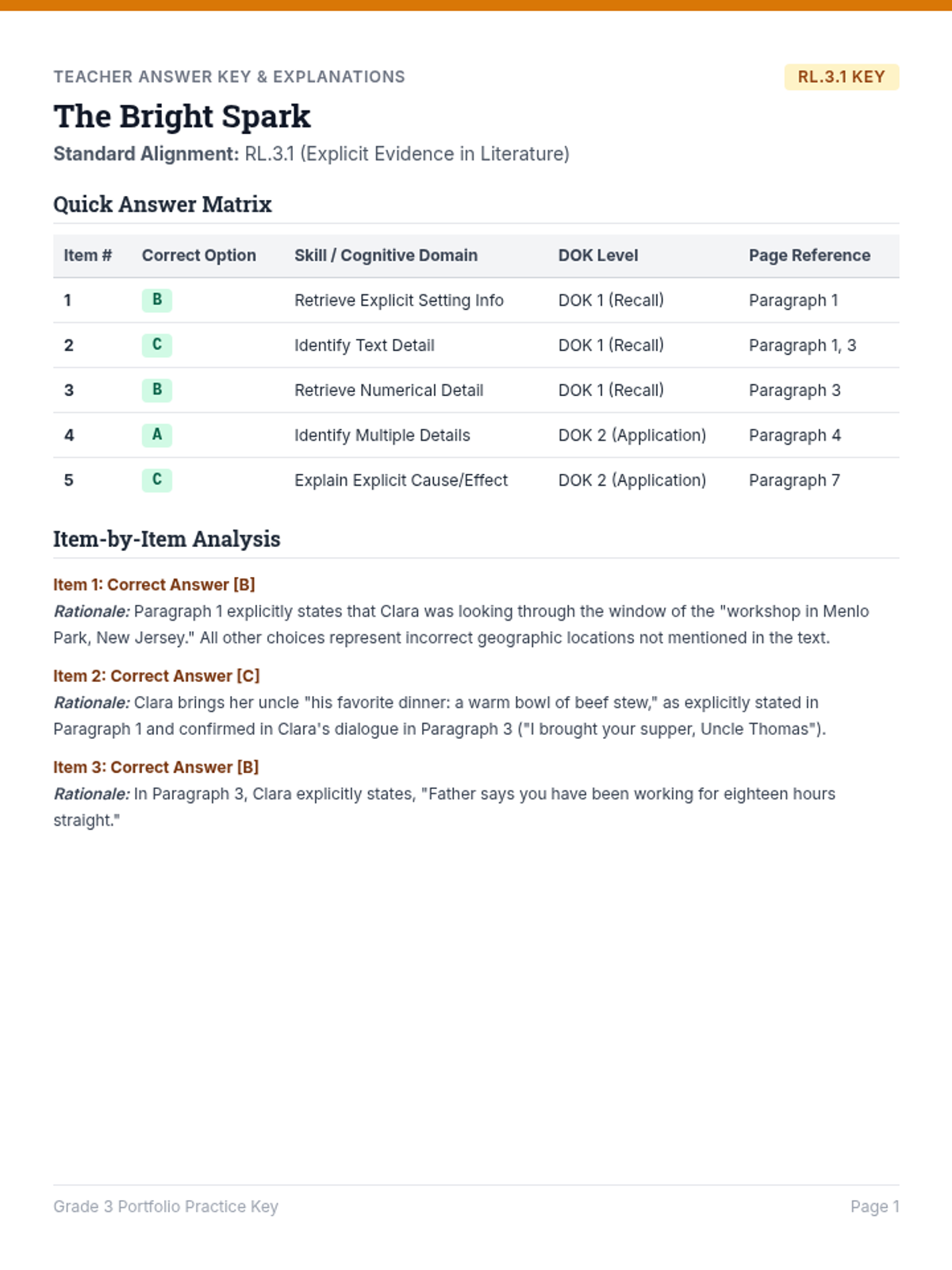
A comprehensive answer key for the Wilderness Whispers lesson, including STAAR practice answers with TEKS alignment, rationales for evidence-based items, and exemplar responses for analysis activities.
A STAAR-format practice test for Grade 5 RLA with 10 questions covering multiple genres, including two-part evidence-based items, focusing on literary elements and author's craft.
An Evidence Log student worksheet featuring two reading passages (literary fiction and informational) and "It Says, I Know, And So" graphic organizers for each to guide students through making text-based inferences.
A refined 2-page STAAR Math cheat sheet for Grades 3-4, featuring color-coded sections for place value, algebraic relationships, operations, fractions, geometry, measurement, and data analysis, with improved diagrams and higher-contrast text.
A comparative analysis worksheet for Grade 5 RLA where students investigate sensory details, genre mechanics, and thematic synthesis across fiction, drama, and poetry. Includes designated work areas for student responses.
A teacher-facing facilitator guide for the Inference Investigators lesson. Includes a thinking script for modeling the 'It Says, I Know, And So' strategy, a pacing guide, and tips for addressing common student misconceptions during STAAR prep.
An instructional slide deck for Grade 5 RLA focusing on literary elements and author's craft across fiction, drama, and poetry. Features explicit instruction on theme, plot, sensory details, and genre-specific tools.
A high-energy, detective-themed slide deck for Grade 3 RLA. It introduces the 'It Says, I Know, And So' strategy for making inferences and provides guided practice with both literary and informational Texas-themed content.
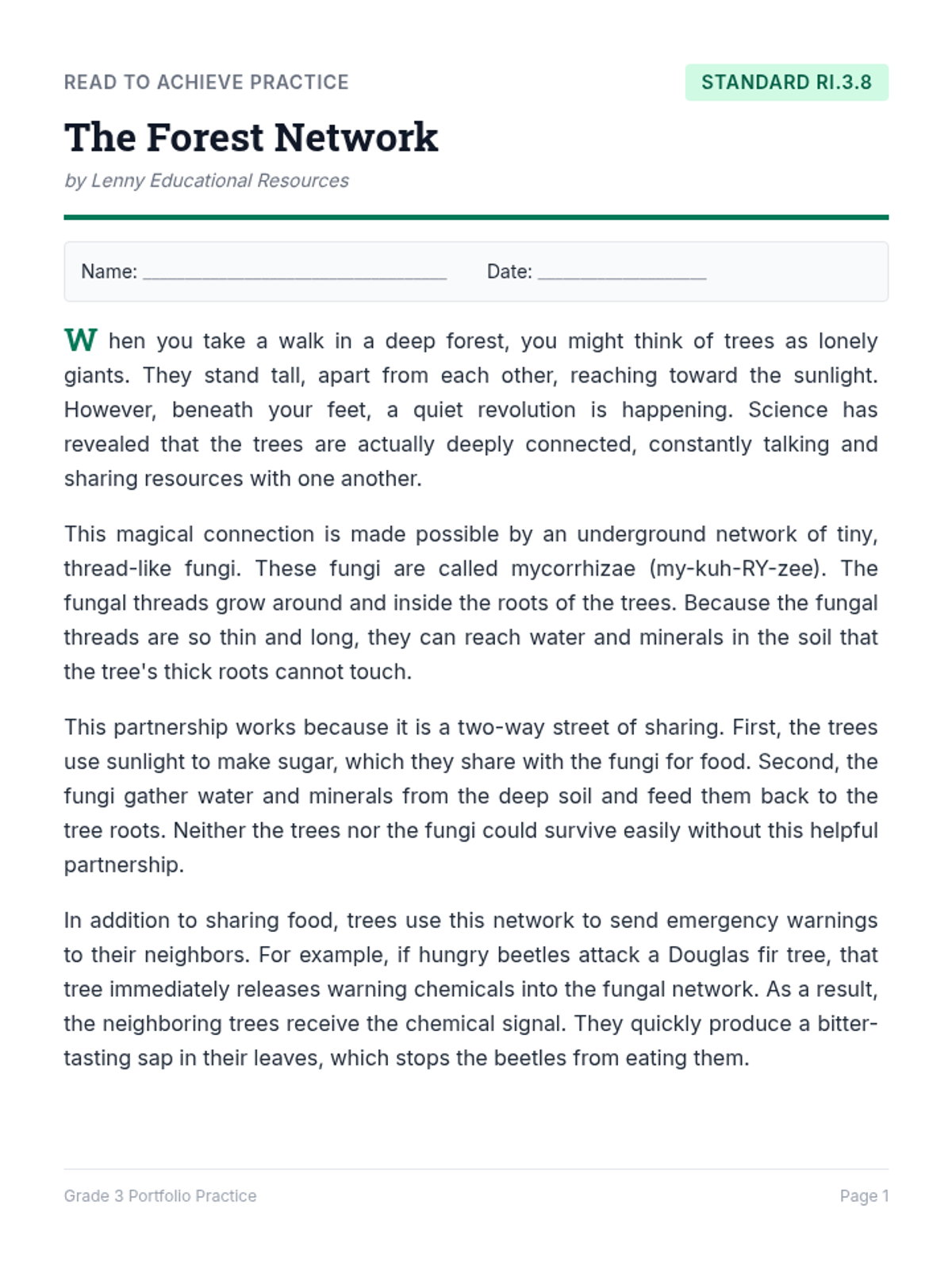
A reading packet for Grade 5 RLA containing three thematically connected texts—a fiction excerpt, a dramatic scene, and a poem—about a character's encounter with a storm in the wilderness. Includes space for student name and date.
A facilitator guide for Grade 5 RLA STAAR preparation, featuring a close reading protocol, annotation strategies, and TEKS alignment for analyzing literary elements across multiple genres.
A student-facing, printable 5-point STAAR Argumentative ECR rubric. It provides clear descriptors for each score point in Organization & Development (0-3) and Conventions (0-2), along with a helpful student checklist.
Updated answer key for the Grove Secrets Quiz, now including exemplars for two RL.7.3 analysis options (The Big Freeze and Awards Night).
A 12-question multiple-choice worksheet plus two RL.7.3 short response analysis options, covering key plot events and character growth in Tangerine.
A presentation designed for a 3-day literacy lesson. It covers what makes a poem unique (stanzas, rhythm, imagery), guided analysis for 'The Meadow's Secret' and 'The Forest's Song', and a final day comparison activity.
A comparison worksheet for the third day of the poetry unit. It includes an observation table for brainstorming and five multiple-choice questions comparing 'The Meadow's Secret' and 'The Forest's Song'.
A student worksheet featuring the poem 'The Forest's Song' with five multiple-choice questions focusing on personification, setting, and speaker's perspective.
A student worksheet featuring the poem 'The Meadow's Secret' along with five multiple-choice comprehension questions focused on imagery, mood, and poetic structure.
A comprehensive teacher guide for a 3-day poetry unit, including daily lesson objectives, instructional flows, and answer keys for all student worksheets.
A new folder reference sheet for RSP students, focused on "Ending Secrets" such as Silent e Drop, Plural Rules (s vs es), the 1-1-1 Doubling Rule, and Changing Y to I. Includes supportive checklists and a vowel suffix gallery.
A teacher's answer key for the Word Wizard practice worksheet. Provides clear, bolded answers for matching, sentence completion, and an exemplar response for the short-answer challenge.
A teacher resource containing the updated answer key for multiple-choice questions, a scoring rubric for the open-response question, and a high-quality exemplar response.
A graphic organizer for students to compare the strategies and outcomes from both passages. It features an evidence grid and sections for identifying similarities and differences.
A comprehension assessment featuring 5 multiple-choice questions and one open-response question. It targets MCAS ELA standards including key ideas, craft and structure, and integration of information.
Expanded and more complex 5th-grade level non-fiction passages. Passage 1 details the mechanics of open-ocean cleanup in the Great Pacific Garbage Patch, while Passage 2 explains the strategy of intercepting urban runoff at river mouths.
A comprehensive 4-page Teacher Key and Lesson Plan designed to support the implementation of Lessons 16-25. It includes a structured 60-minute daily routine, explicit teacher scripts for vowel instruction, scaffolding strategies for TESOL students, and a complete answer key for every blank, comprehension question, and mechanics exercise in the student handouts.
A comprehensive 4-page expansion for Lesson 25 of a reading intervention program. It focuses on the prefix 'de-', the Latin base 'duc' (to lead), and the vocabulary word 'deduce'. It includes a final synthesis reading passage that reviews multiple vowel sounds and decoding strategies, comprehension questions with discussion frames, and a final reflective writing task. Designed for high school TESOL students.