A slide deck introducing the tripartite definition of knowledge (Justified True Belief). It breaks down each condition (Truth, Belief, Justification) and uses the 'Lucky Guess' hook to demonstrate why justification is necessary.
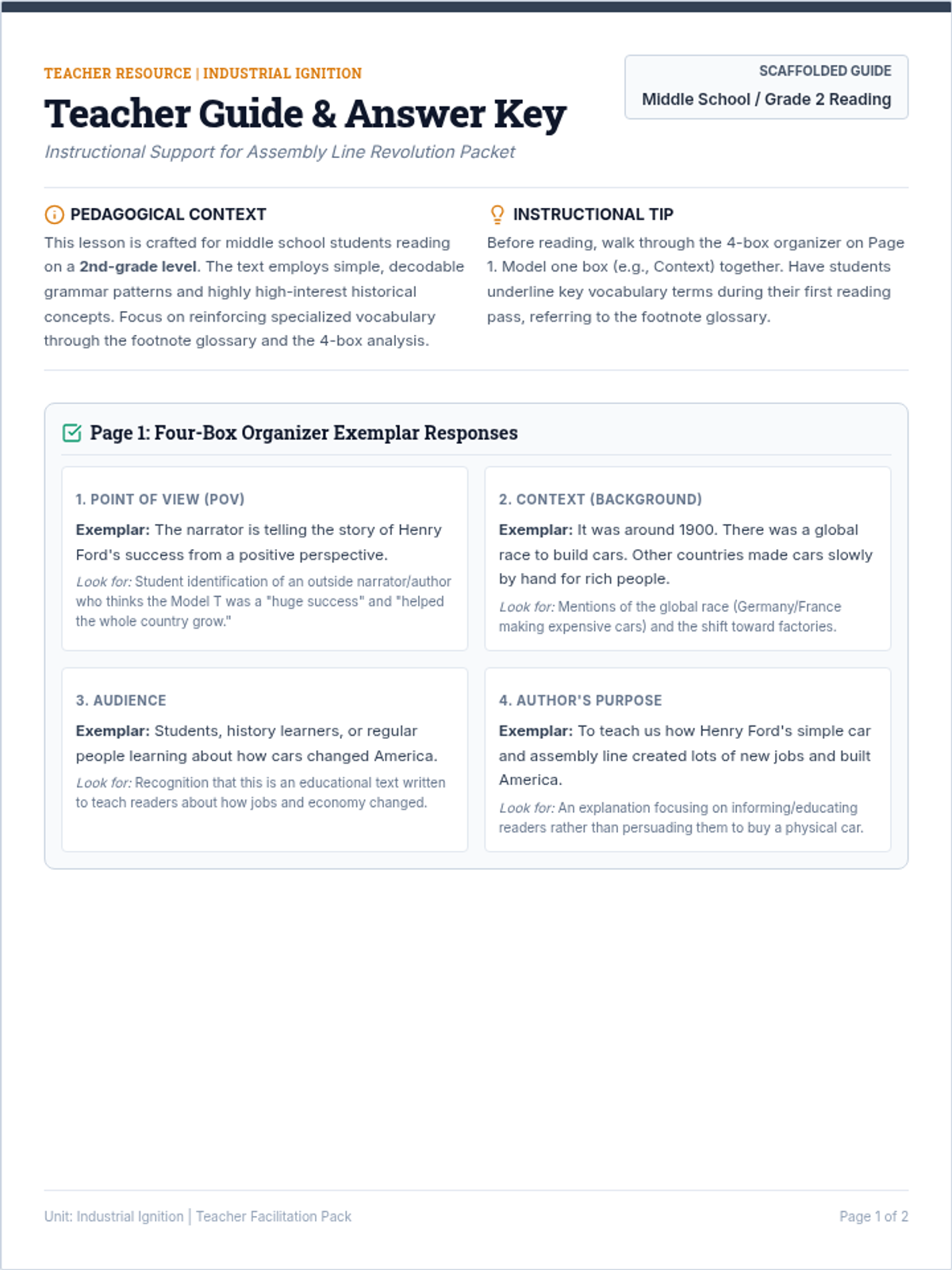
Teacher Guide and Answer Key companion for the Assembly Line Revolution Student Packet. Includes teaching tips for middle schoolers reading at a second-grade level, exemplar responses for the four-box organizer, multiple-choice answer explanations, and a short-answer grading rubric.
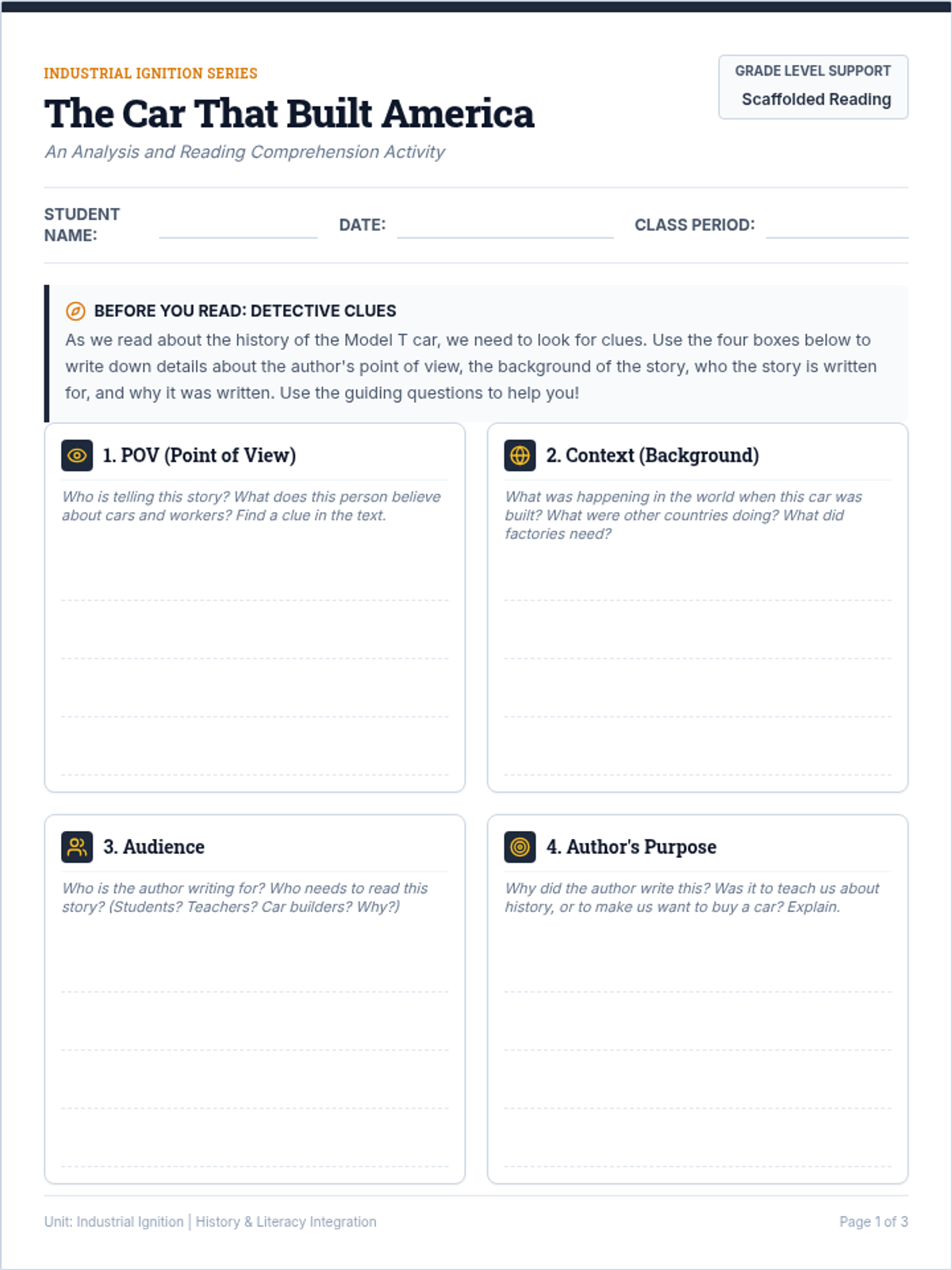
Printable Student Packet about the Model T, industrial economy, and labor changes, designed for middle schoolers reading at a second-grade level. Includes a 4-box analysis organizer (POV, Context, Audience, Purpose), a 6-paragraph reading passage, a student-friendly footnote glossary, and a multi-dimensional comprehension assessment.
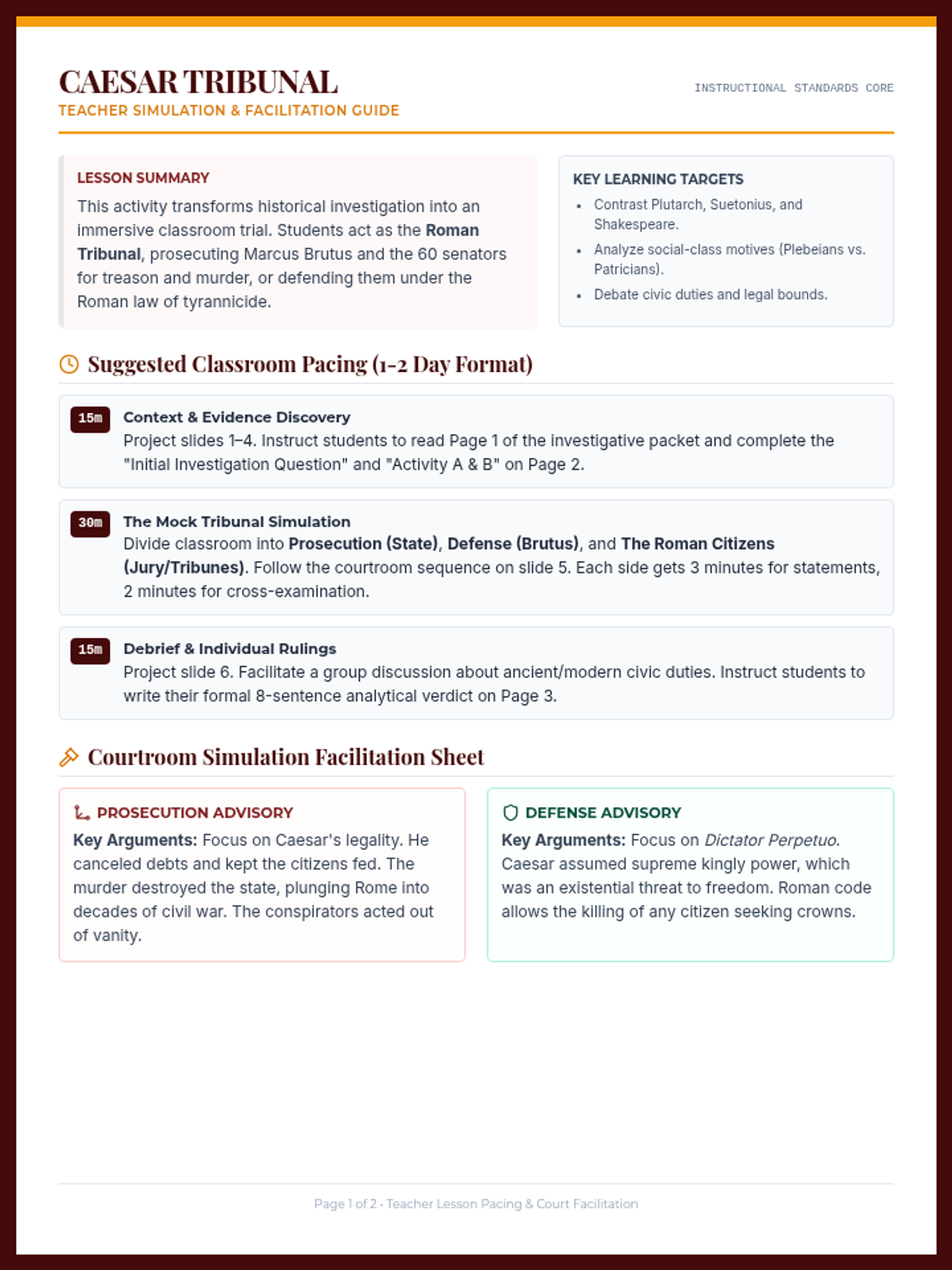
A two-page printable teacher guide and lesson key. Contains complete instructional scaffolding, pacing, step-by-step mock trial simulation guidelines, and a comprehensive answer key for the Caesar Conspiracy student workbook.
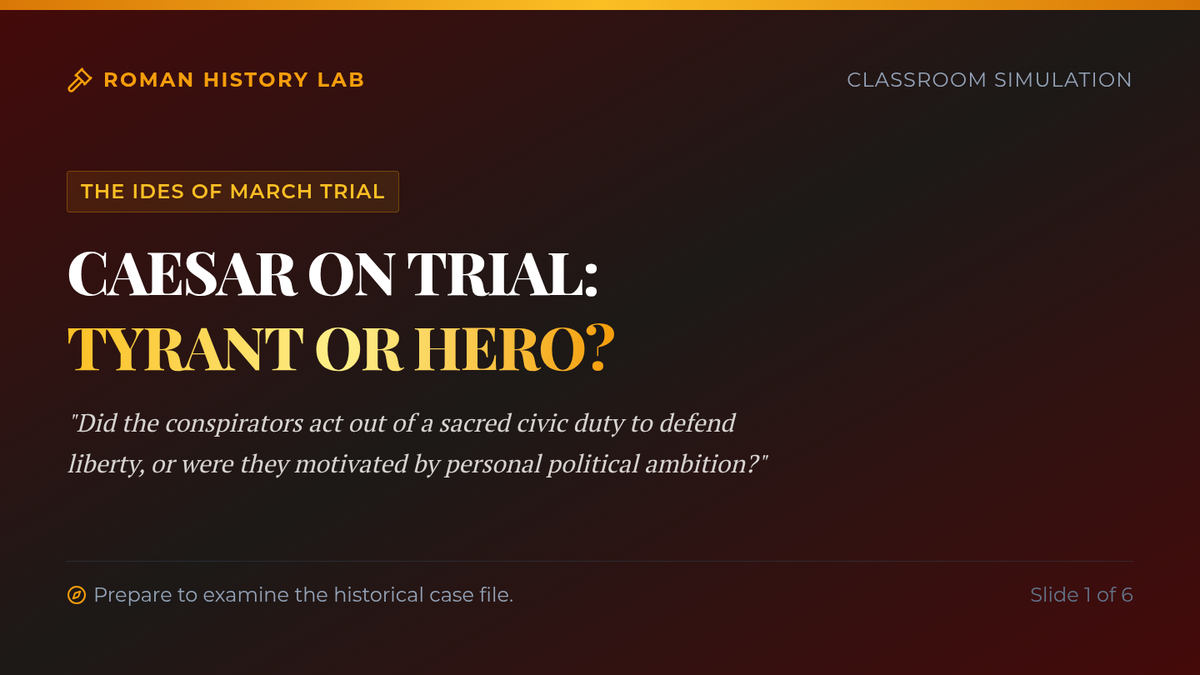
A six-slide instructional presentation for the Caesar Tribunal lesson. Featuring high-impact visuals, a deep Roman crimson theme, analysis of the historical sources (Plutarch, Suetonius, Shakespeare), and guidelines for the classroom mock trial.
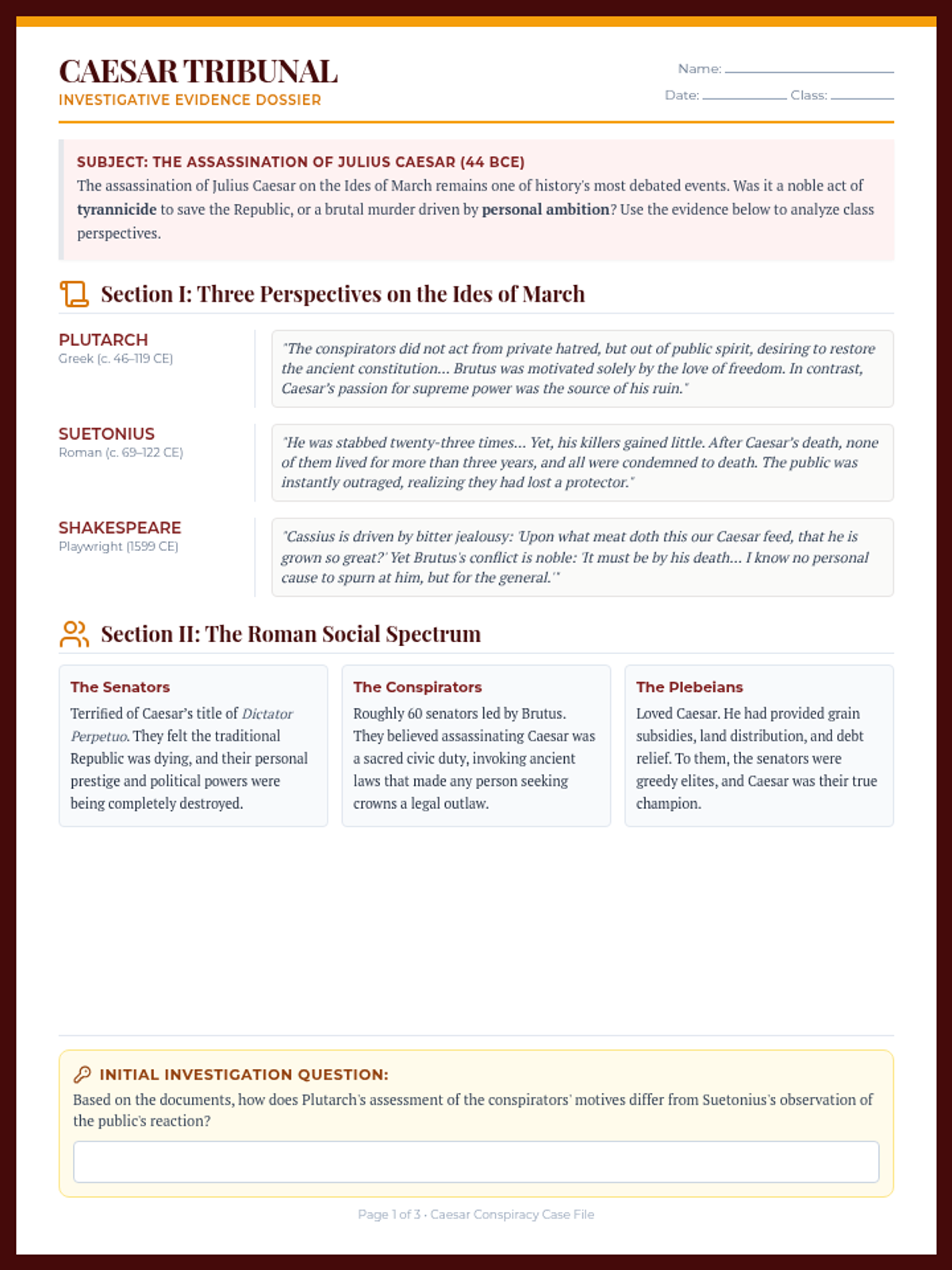
A three-page student investigative packet for the Caesar Tribunal lesson. It includes a primary source-based reading passage, a vocabulary matching activity, a custom Roman word search, short-answer questions, and a scaffolded 8-sentence analytical essay.
A 3-slide presentation deck focused on freeze-dried potato chuño technology of the Inca, exploring dehydration, preservation, and food storage. All text is 24px (text-2xl) or larger.
A 3-slide presentation deck focused on the grass suspension bridges of the Inca, exploring tension and cooperative community maintenance. All text is 24px (text-2xl) or larger.
A 3-slide presentation deck focused on the decimal knot-record quipu system of the Inca, exploring communication and census keeping. All text is 24px (text-2xl) or larger.
A 3-slide presentation deck focused on the monumental Aztec Sun Stone calendar, exploring cosmic myths and temporal tracking. All text is 24px (text-2xl) or larger.
A 3-slide presentation deck focused on the Aztec education systems, exploring the Calmecac (noble school) and Telpochcalli (commoner school). All text is 24px (text-2xl) or larger.
A 3-slide presentation deck focused on the double-aqueduct system of Tenochtitlan, exploring fresh water delivery and hydraulic engineering. All text is 24px (text-2xl) or larger.
A 3-slide presentation deck focused on Maya hydraulic engineering in Palenque, exploring water pressure and underground stone aqueducts. All text is 24px (text-2xl) or larger.
A 3-slide presentation deck focused on the Maya Maize God myth and the Popol Vuh creation story. All text is 24px (text-2xl) or larger.
A 3-slide presentation deck focused on the Maya writing system, exploring hieroglyphs, codices, and stelae. All text is 24px (text-2xl) or larger.
A 3-slide presentation deck focused on Olmec stone carvers, analyzing how colossal basalt heads were sculpted without metal tools. All text is 24px (text-2xl) or larger.
A 3-slide presentation deck focused on the Olmec rubber ballgame, exploring rubber chemistry and ballcourt physics. All text is 24px (text-2xl) or larger.
A 3-slide presentation deck focused on Olmec jade trade networks, exploring the Motagua River Valley and the symbolic meaning of green stones. All text is 24px (text-2xl) or larger.
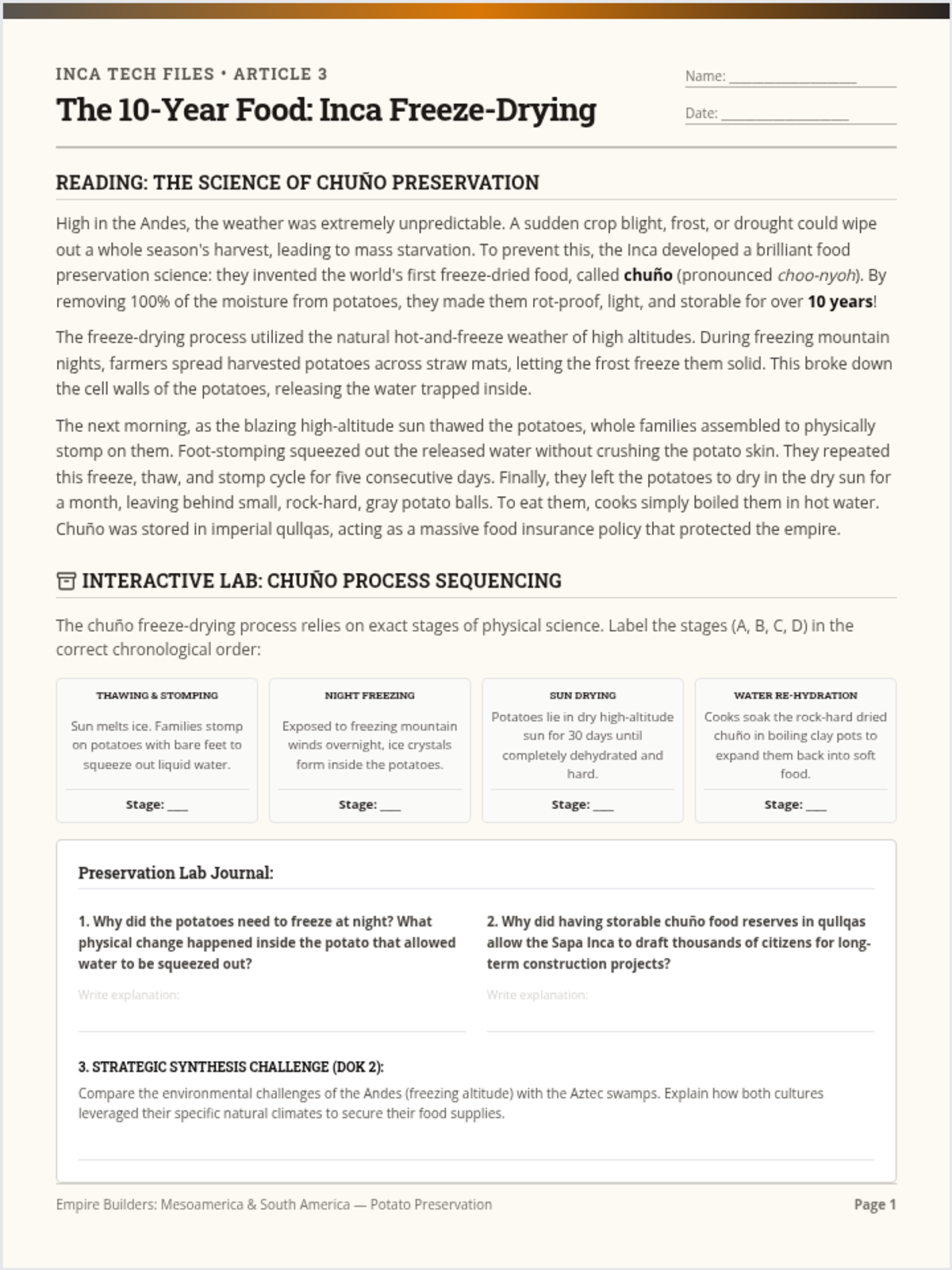
A 1-page student reading and activity sheet on the freeze-dried potato chuño technology of the Inca, exploring dehydration, preservation, and food storage. Includes a science process-sequencing activity.
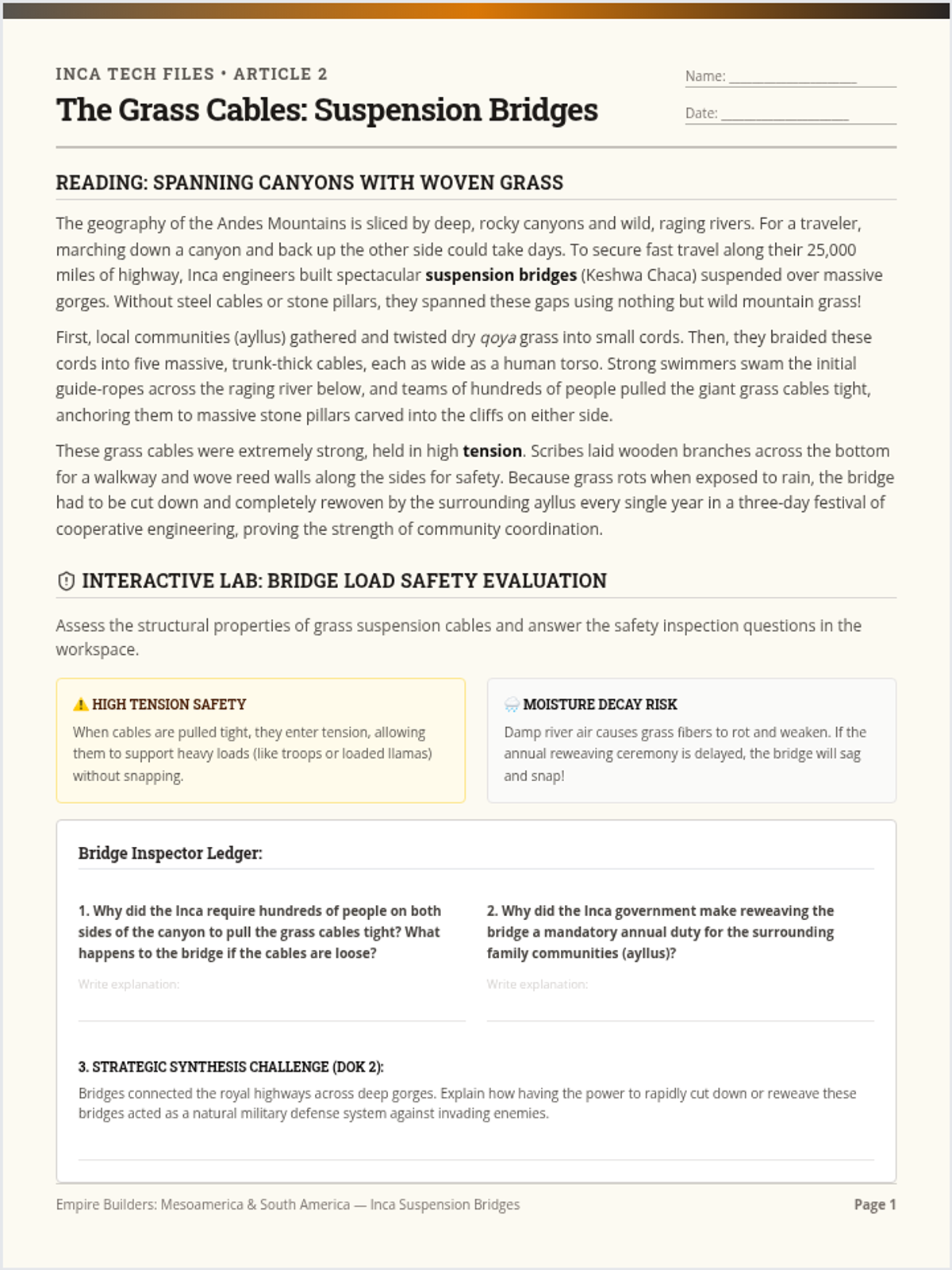
A 1-page student reading and activity sheet on the grass suspension bridges of the Inca, exploring tension and cooperative community maintenance. Includes a bridge safety evaluation worksheet.
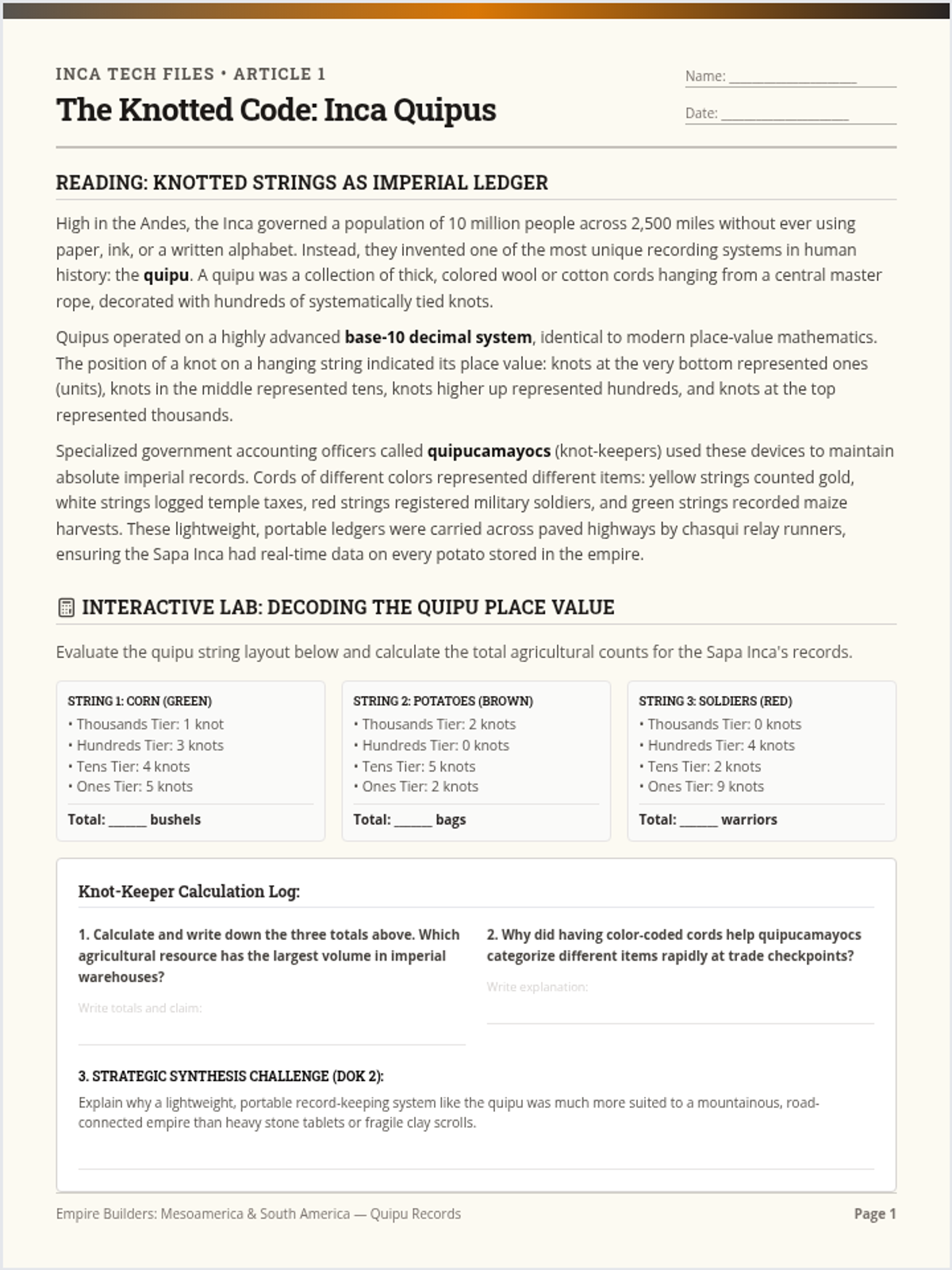
A 1-page student reading and activity sheet on the decimal knot-record quipu system of the Inca, exploring communication and census keeping. Includes a knot decoding and calculation exercise.
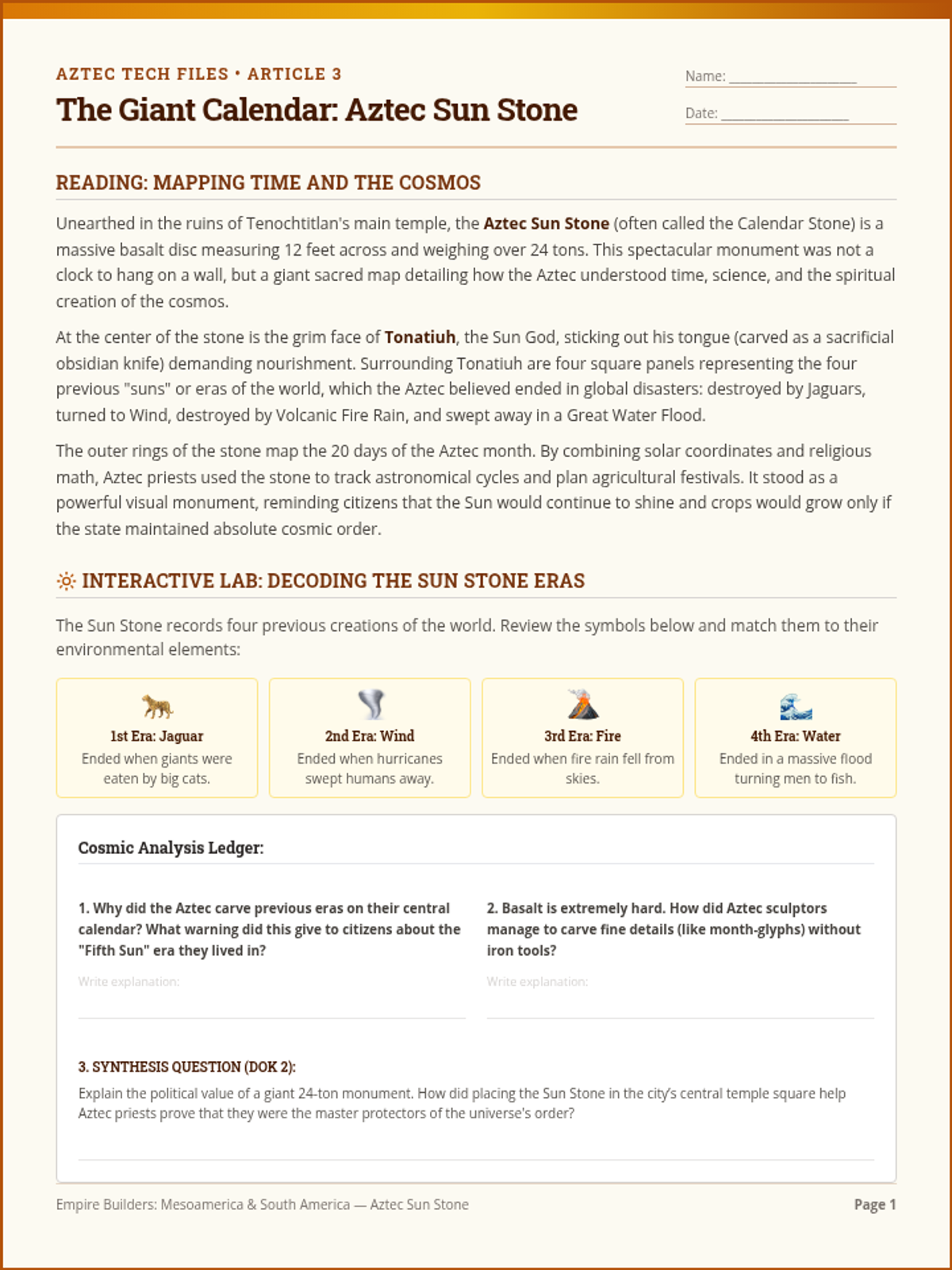
A 1-page student reading and activity sheet on the monumental Aztec Sun Stone calendar, exploring cosmic myths and temporal tracking. Includes a visual decoding and analysis activity.
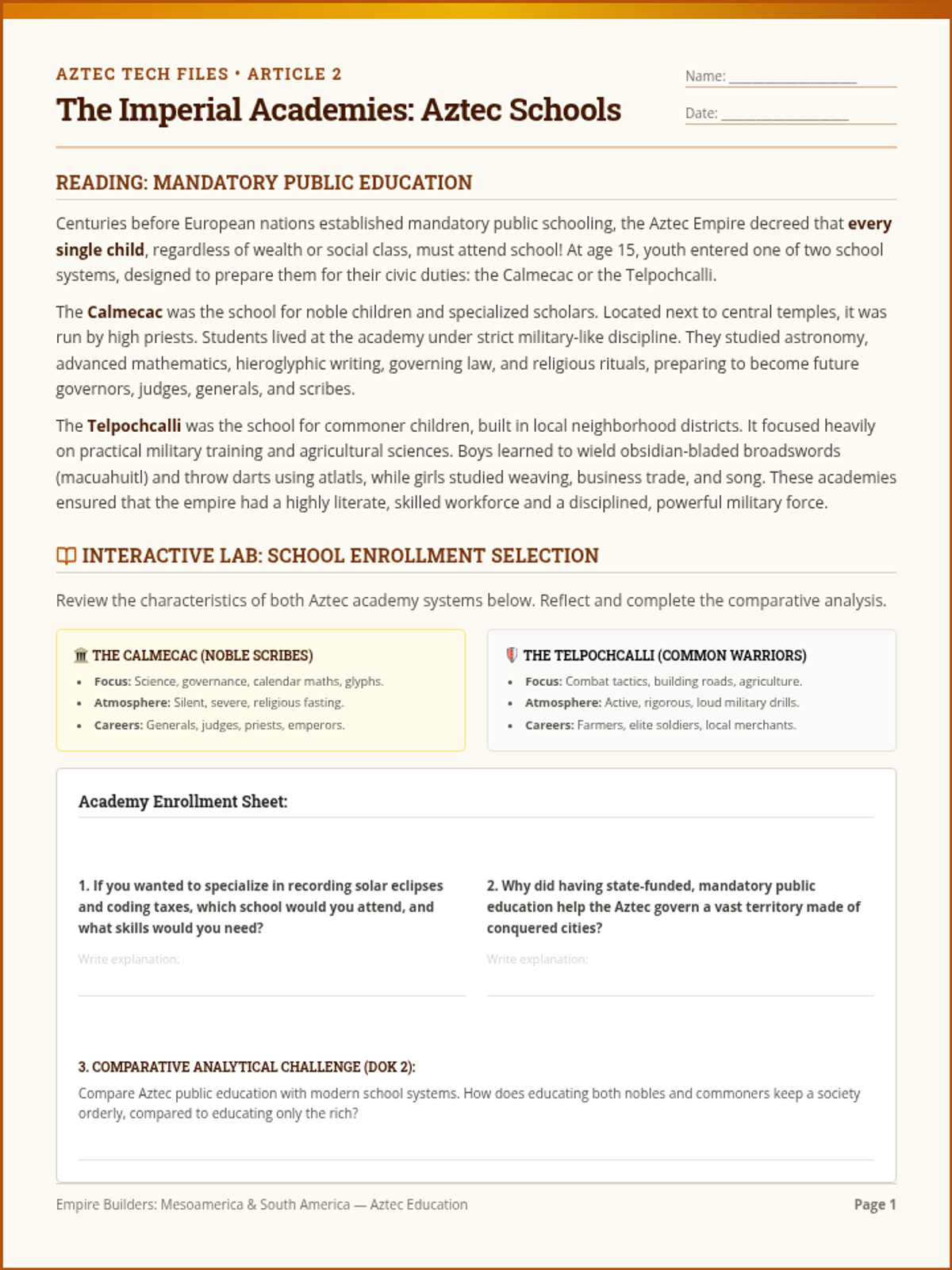
A 1-page student reading and activity sheet on the Aztec education systems, exploring the Calmecac (noble school) and Telpochcalli (commoner school). Includes a comparative selection and reflective analysis activity.
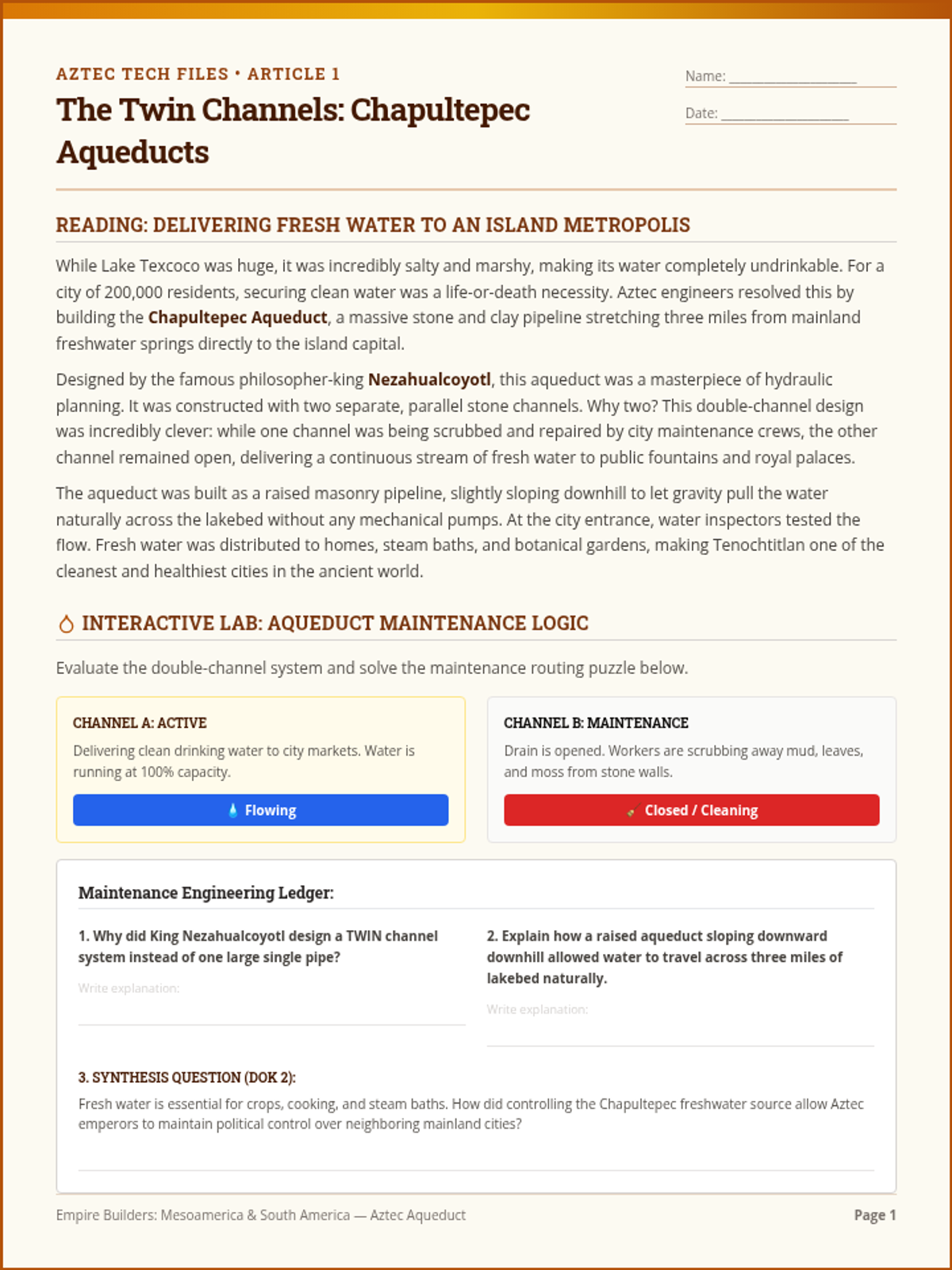
A 1-page student reading and activity sheet on the double-aqueduct system of Tenochtitlan, exploring fresh water delivery and hydraulic engineering. Includes a clean routing diagram workspace.
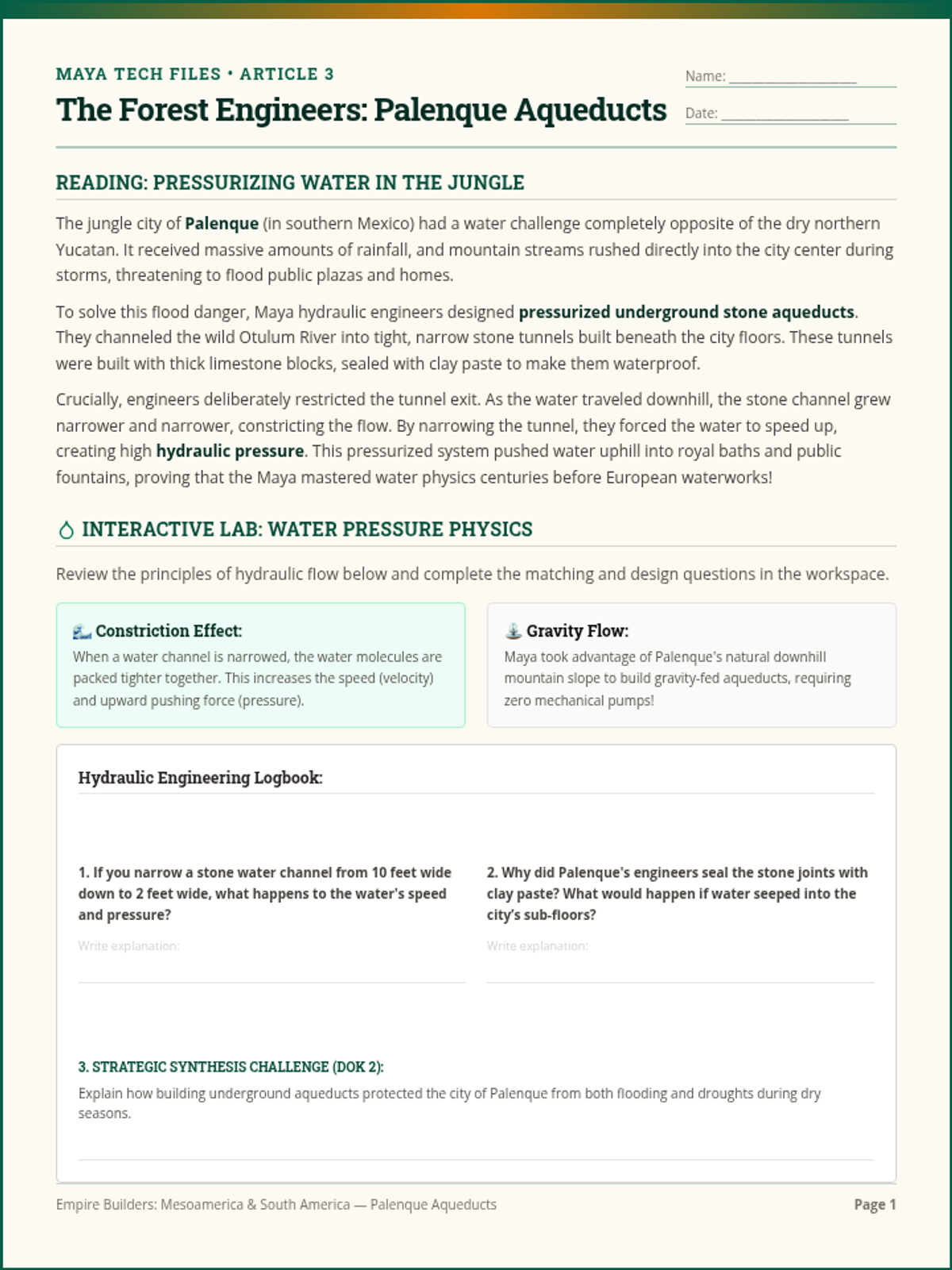
A 1-page student reading and activity sheet on Maya hydraulic engineering in Palenque, focusing on pressurized underground stone aqueducts. Includes a water pressure matching activity.
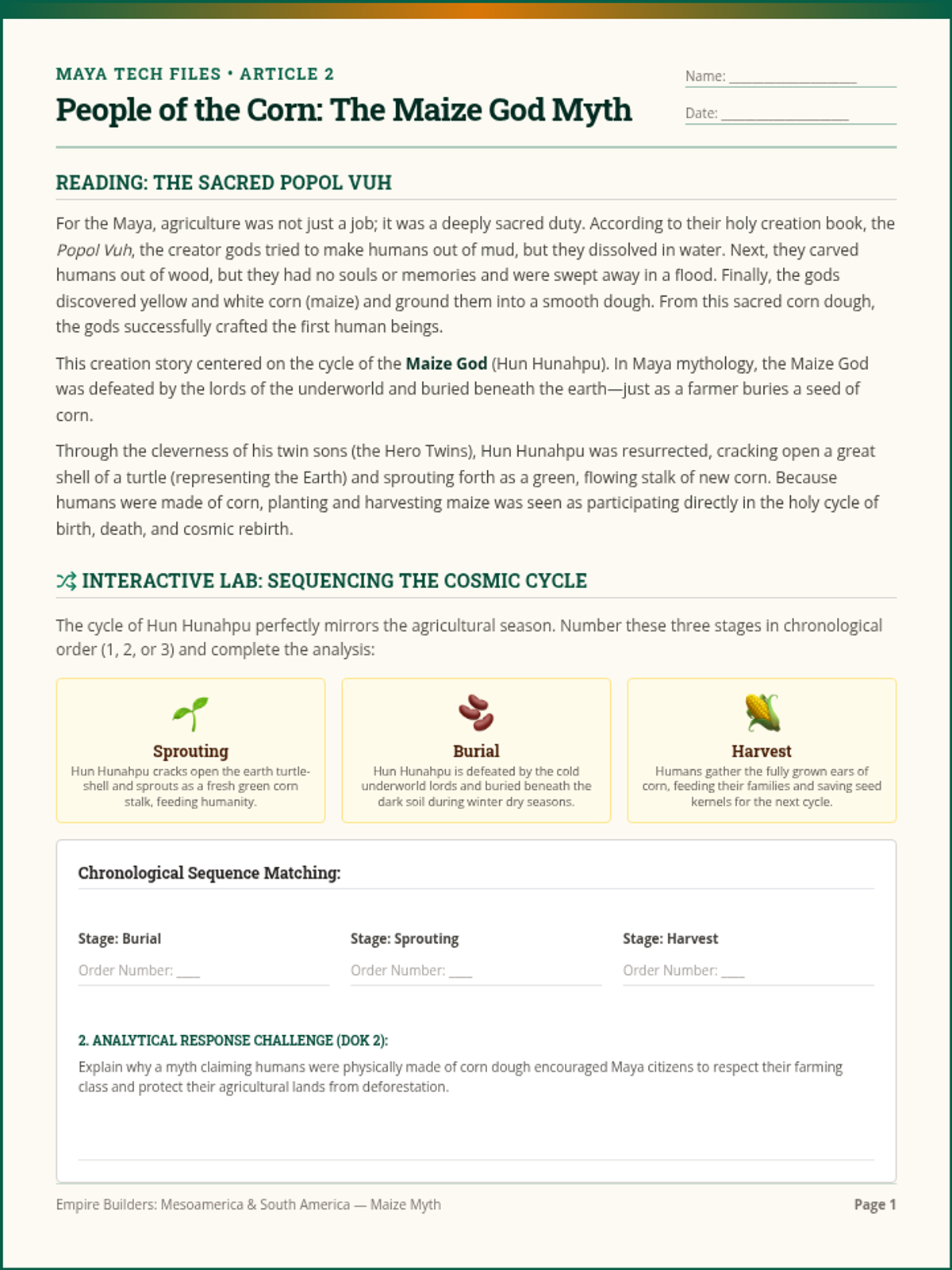
A 1-page student reading and activity sheet on the Maya Maize God myth and the Popol Vuh creation story. Includes a sequencing and comparative analysis activity.
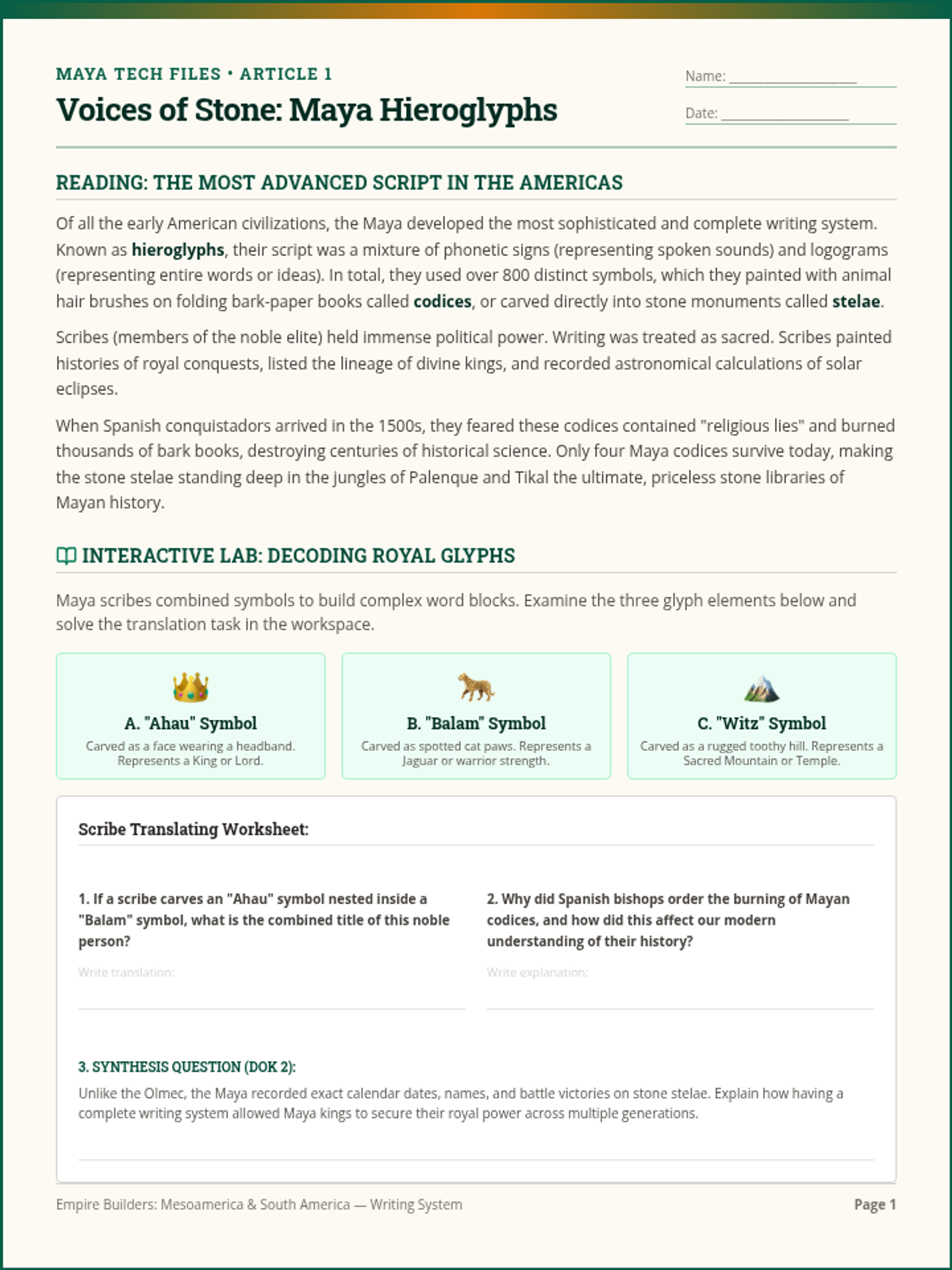
A 1-page student reading and activity sheet on the Maya writing system, exploring hieroglyphs, codices, and stelae. Includes a glyph-decoding matching activity.
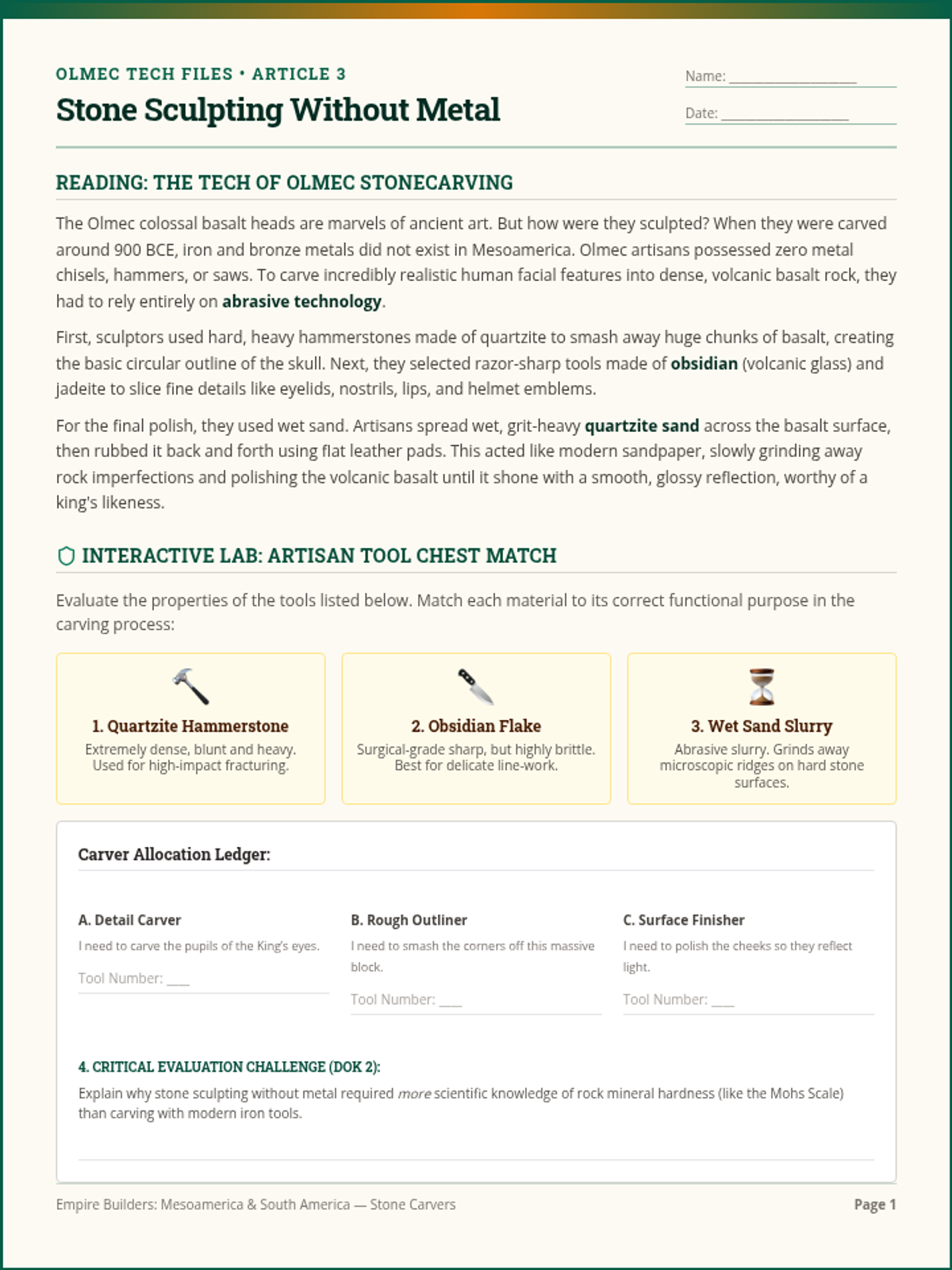
A 1-page student reading and activity sheet on Olmec stone carvers, analyzing how colossal basalt heads were sculpted without metal tools. Includes a resource allocation matching exercise.
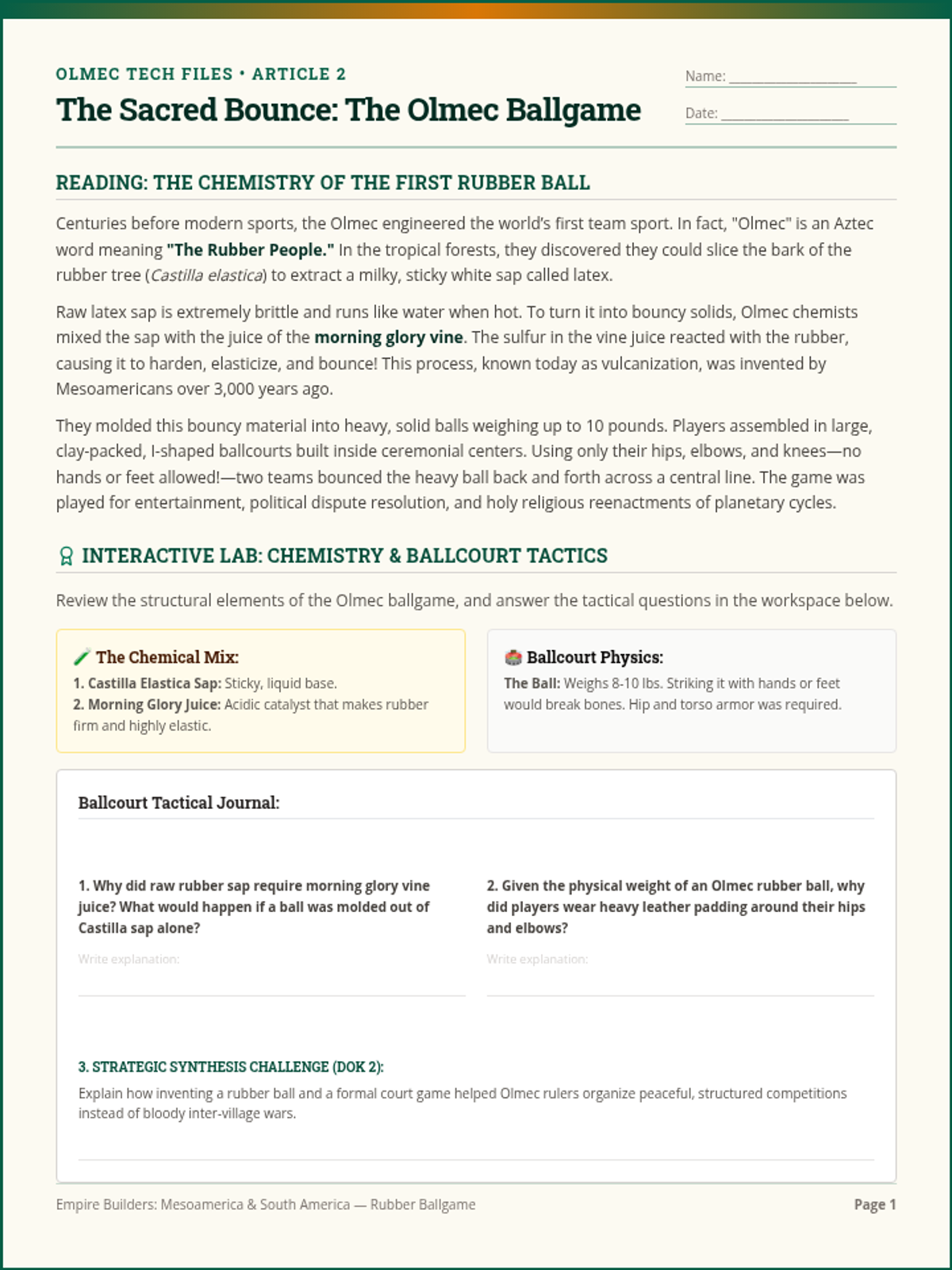
A 1-page student reading and activity sheet on the Olmec rubber ballgame, exploring rubber engineering and ballcourt logistics. Includes tactical comprehension questions.
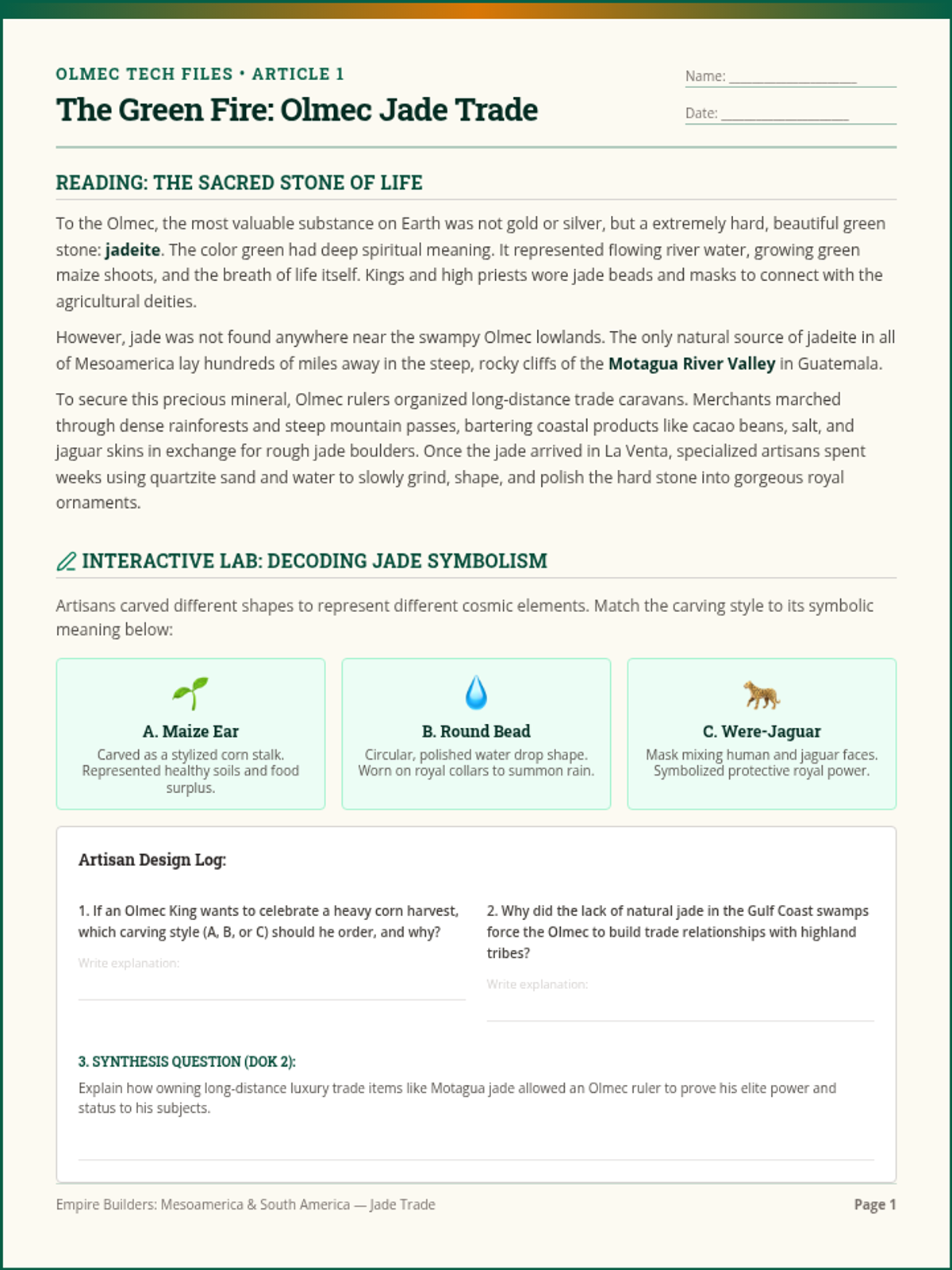
A 1-page student reading and activity sheet on Olmec jade trade networks, exploring the Motagua River Valley and the symbolic meaning of green stones. Includes a jade-carving analysis workspace.
A 5-slide presentation deck used to teach the Inca civilization, focusing on steep mountain terracing, Qhapaq Ñan roads, and featuring an interactive "Chasqui Relay" classroom messenger roleplay game. All text is 24px (text-2xl) or larger.
A 5-slide presentation deck used to teach the Aztec civilization, focusing on Lake Texcoco, Tenochtitlan, chinampa farming, and featuring an interactive "Design a Chinampa" classroom modeling activity. All text is 24px (text-2xl) or larger.
A 5-slide presentation deck used to teach the Maya civilization, focusing on independent city-states, trade networks, cenotes, and featuring an interactive "Barter Market" classroom trading activity. All text is 24px (text-2xl) or larger.
A highly illustrated 5-slide presentation deck used to teach the Olmec civilization, featuring styled graphic diagrams, Lucide icons, and an interactive "Boulder Mover" roleplay classroom activity. All text is 24px (text-2xl) or larger.
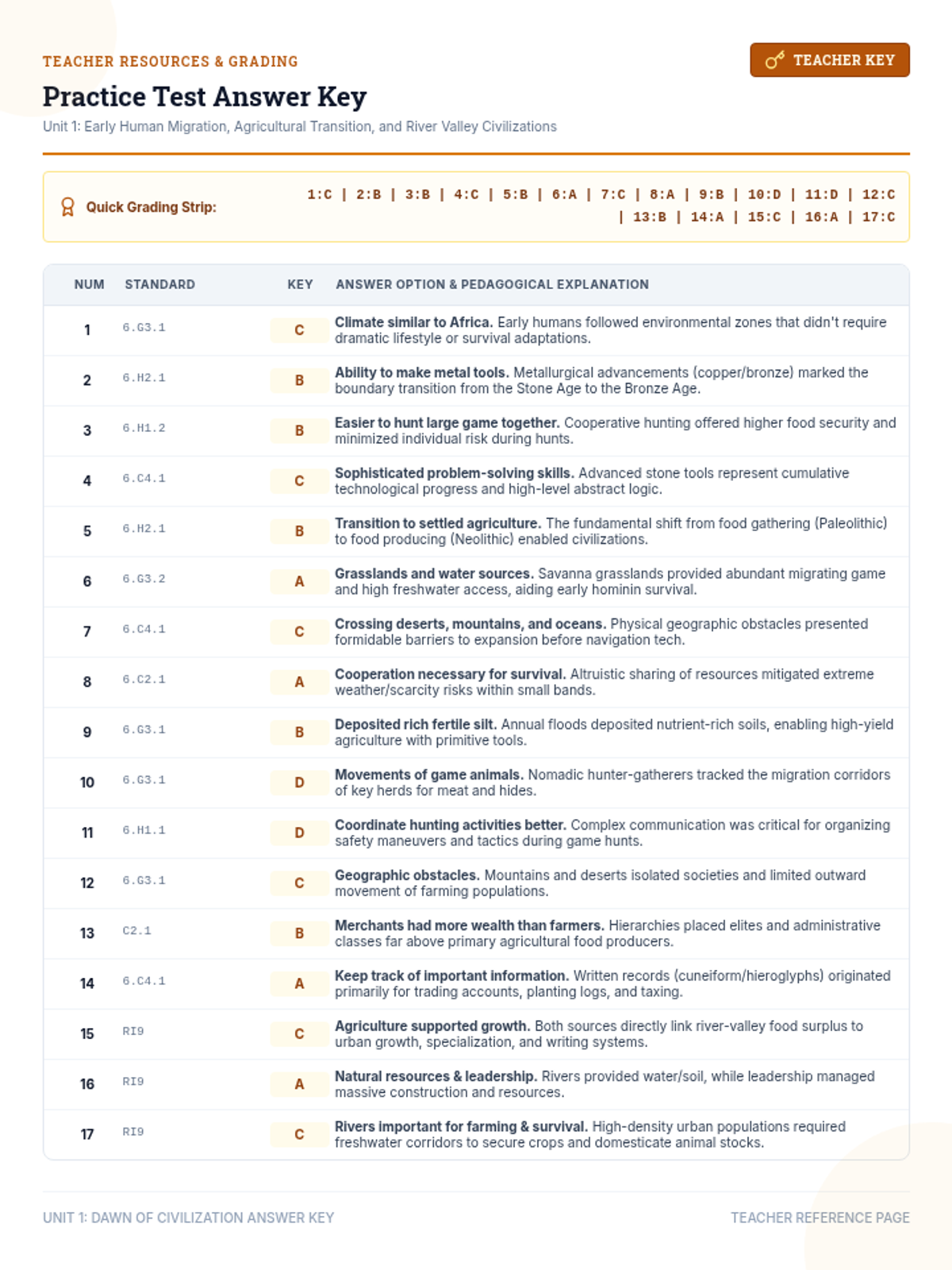
A professional 1-page teacher answer key matching the Dawn of Civilization Practice Test. Includes standard alignments, correct options, and brief pedagogical explanations for each of the 17 questions to aid teachers in assessment and grading.
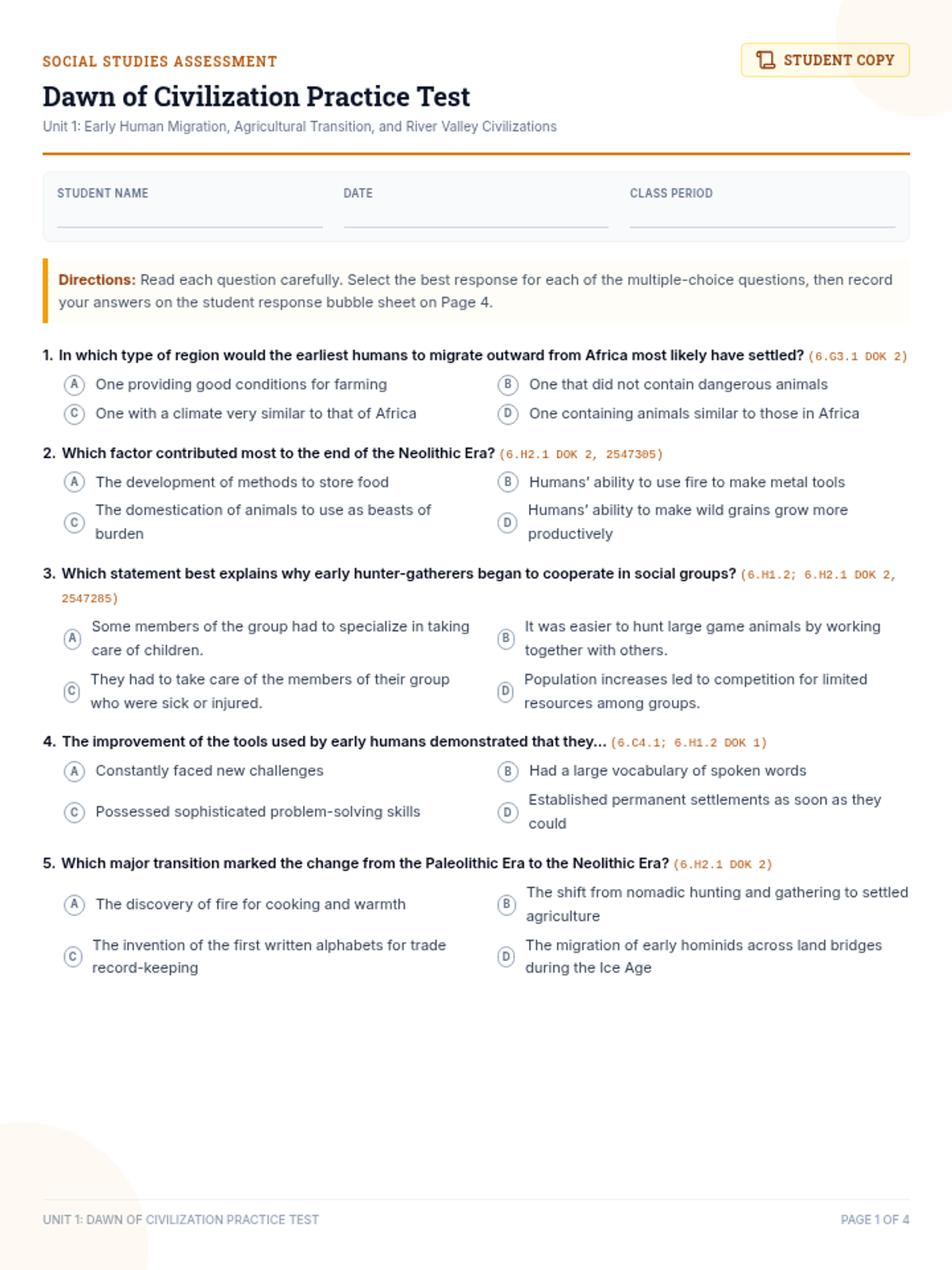
A beautifully designed 4-page student practice test covering early human migration, the Paleolithic and Neolithic Eras, and the rise of river valley civilizations. Features cleaned-up question numbering, two new high-quality questions for numbers 5 and 9, elegant typography, and a professional student bubble answer sheet on the final page.
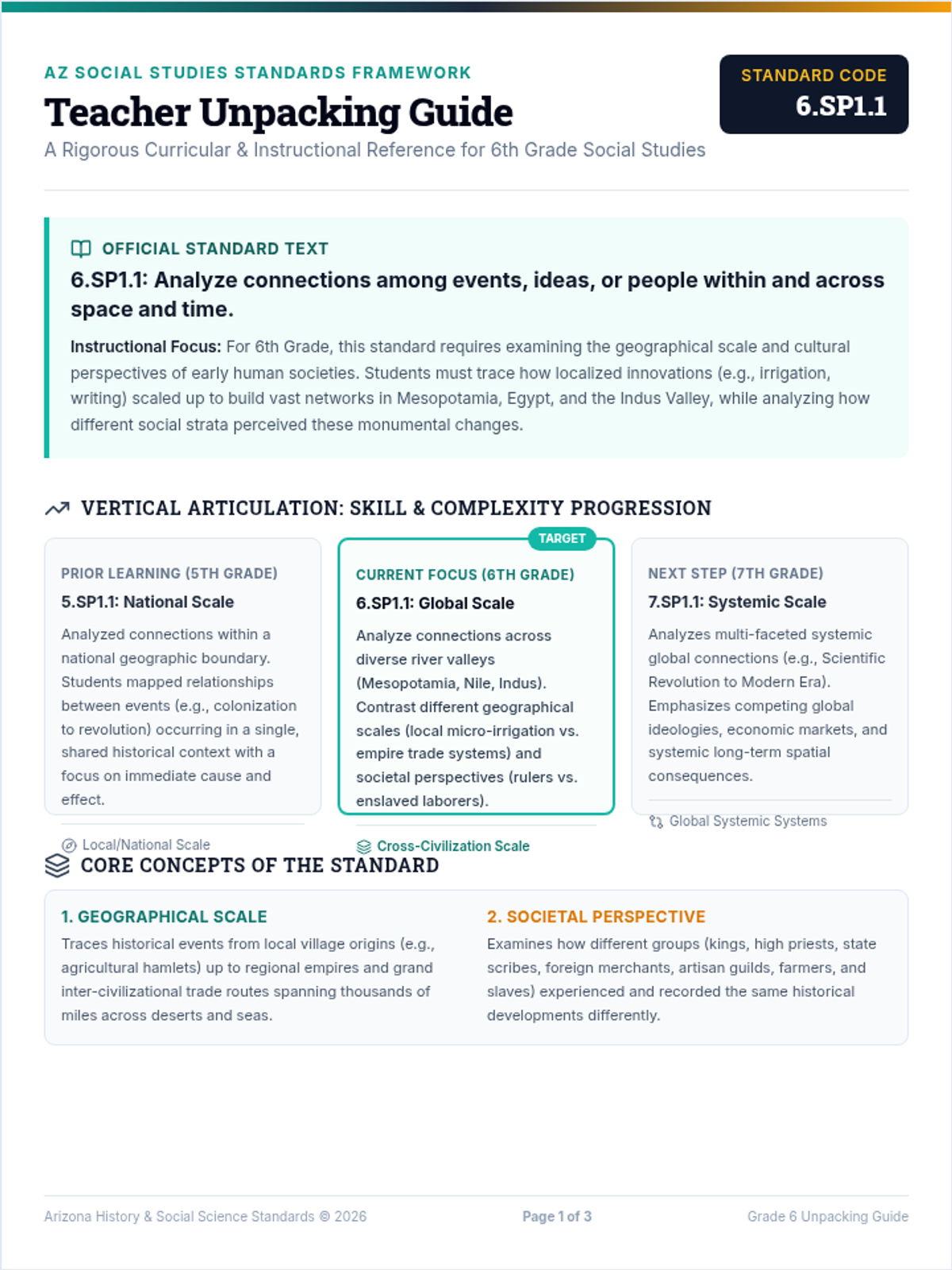
A comprehensive 3-page Teacher Unpacking Guide for Arizona Social Studies Practice Standard 6.SP1.1, focused on scale and perspective within Mesopotamia, ancient Egypt, and the Indus Valley. It includes standard deconstruction, 3-tier vertical articulation, detailed learning targets, evidence of learning, classroom anchor case studies, and a rigorous, topic-specific mastery rubric for educators.
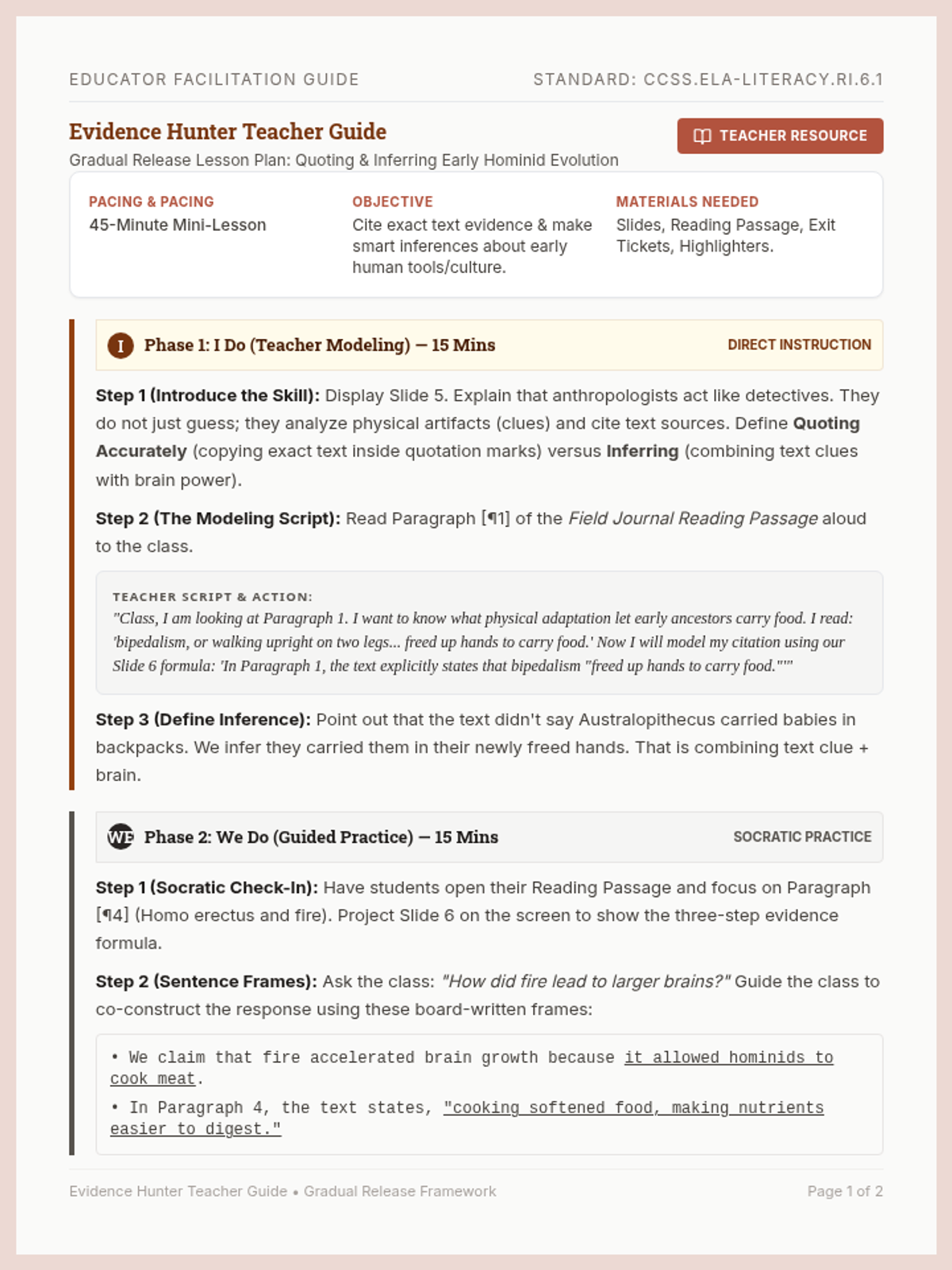
A 2-page print-ready teacher instructional guide detailing an "I Do, We Do, You Do" gradual release model for teaching ELA RI.6.1 textual evidence within the hominid evolution social studies unit.
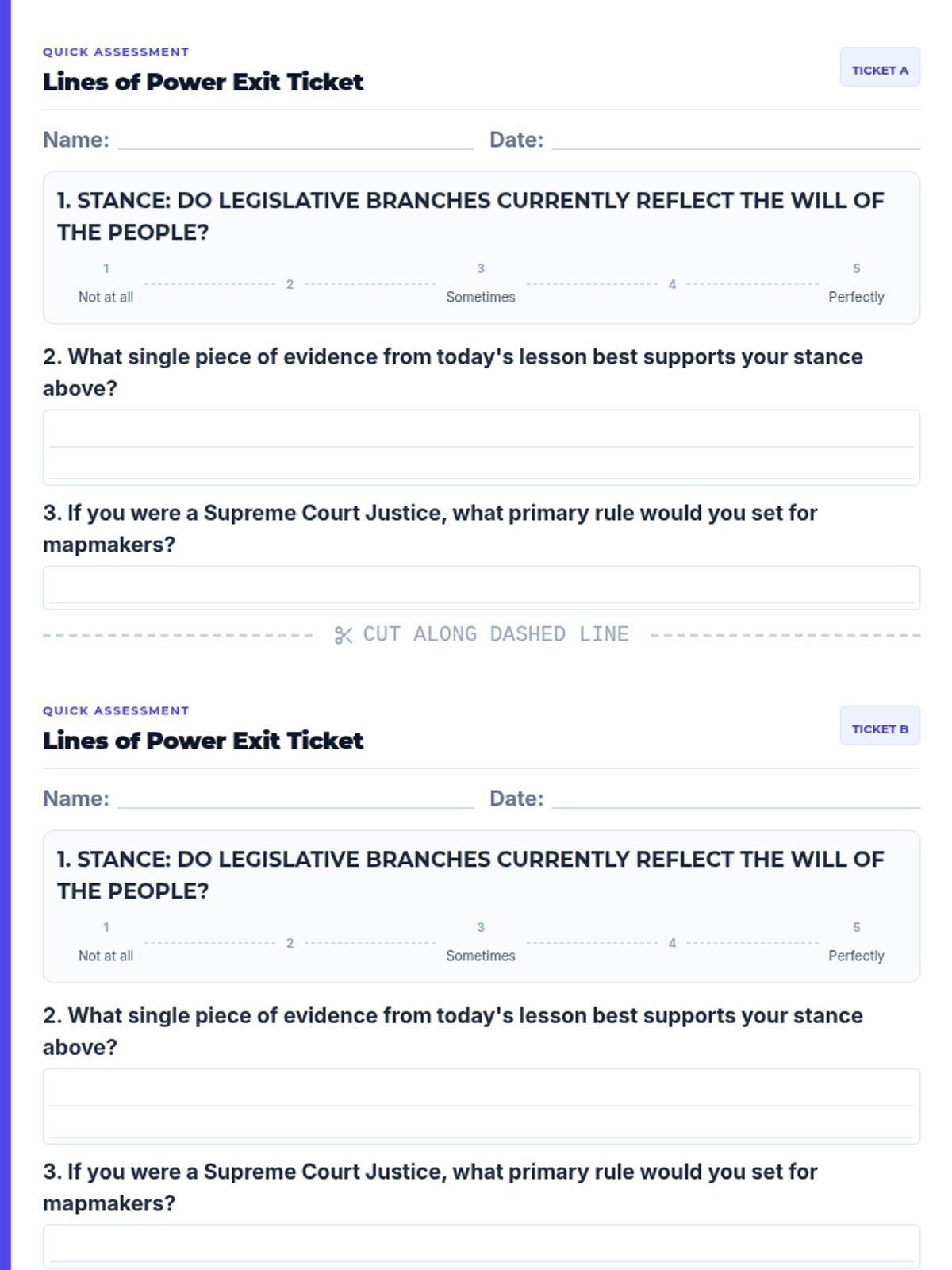
An elegant, print-ready, double-sided styled exit ticket containing name and date fields, a visual representation scale, and text-based reasoning prompts for student closure.
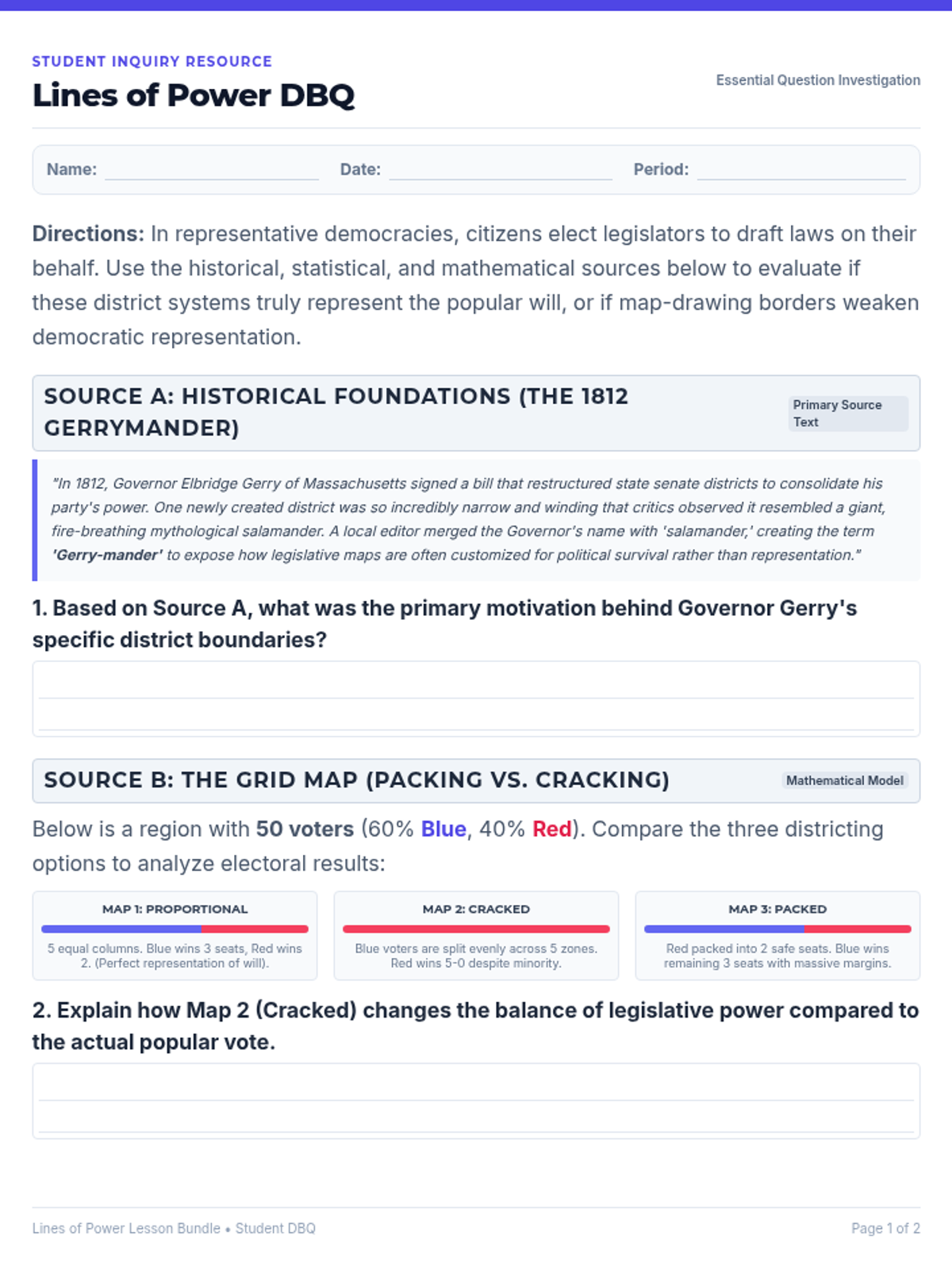
A structured, two-page DBQ worksheet for students containing a historical gerrymandering source, a mathematical grid map scenario, public opinion data, and a lined synthesis writing section.
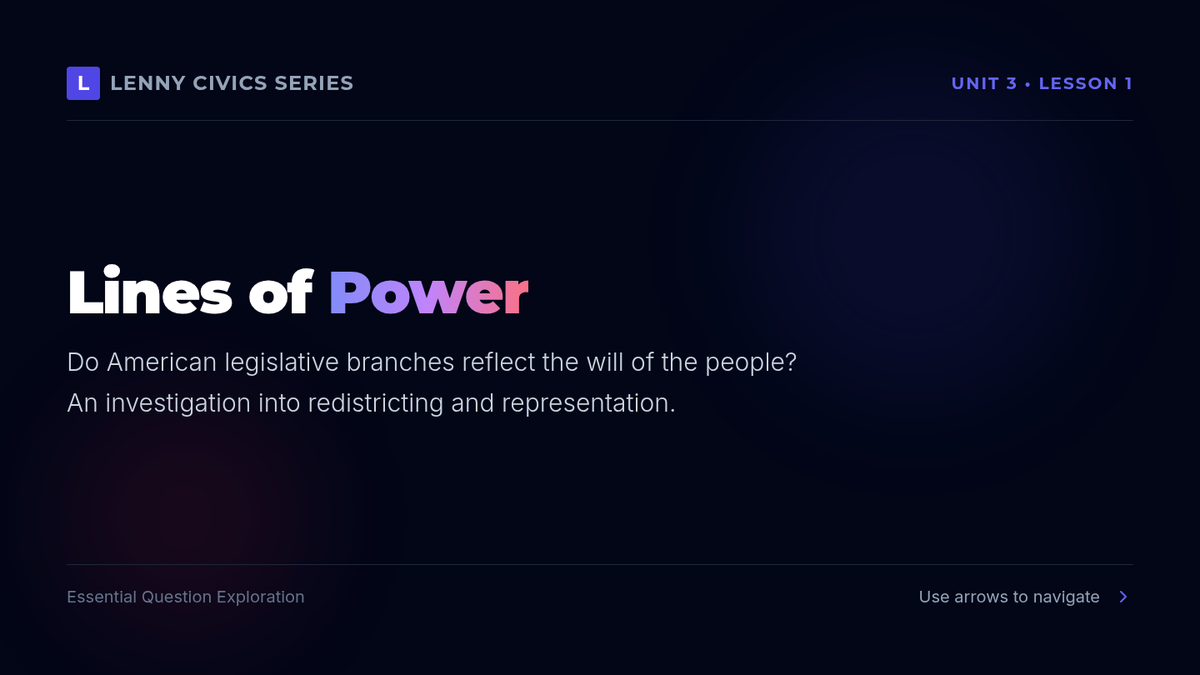
A highly visual, six-slide presentation introducing the mechanics of redistricting, visual diagrams of packing and cracking, and discussion prompts exploring the core essential question.
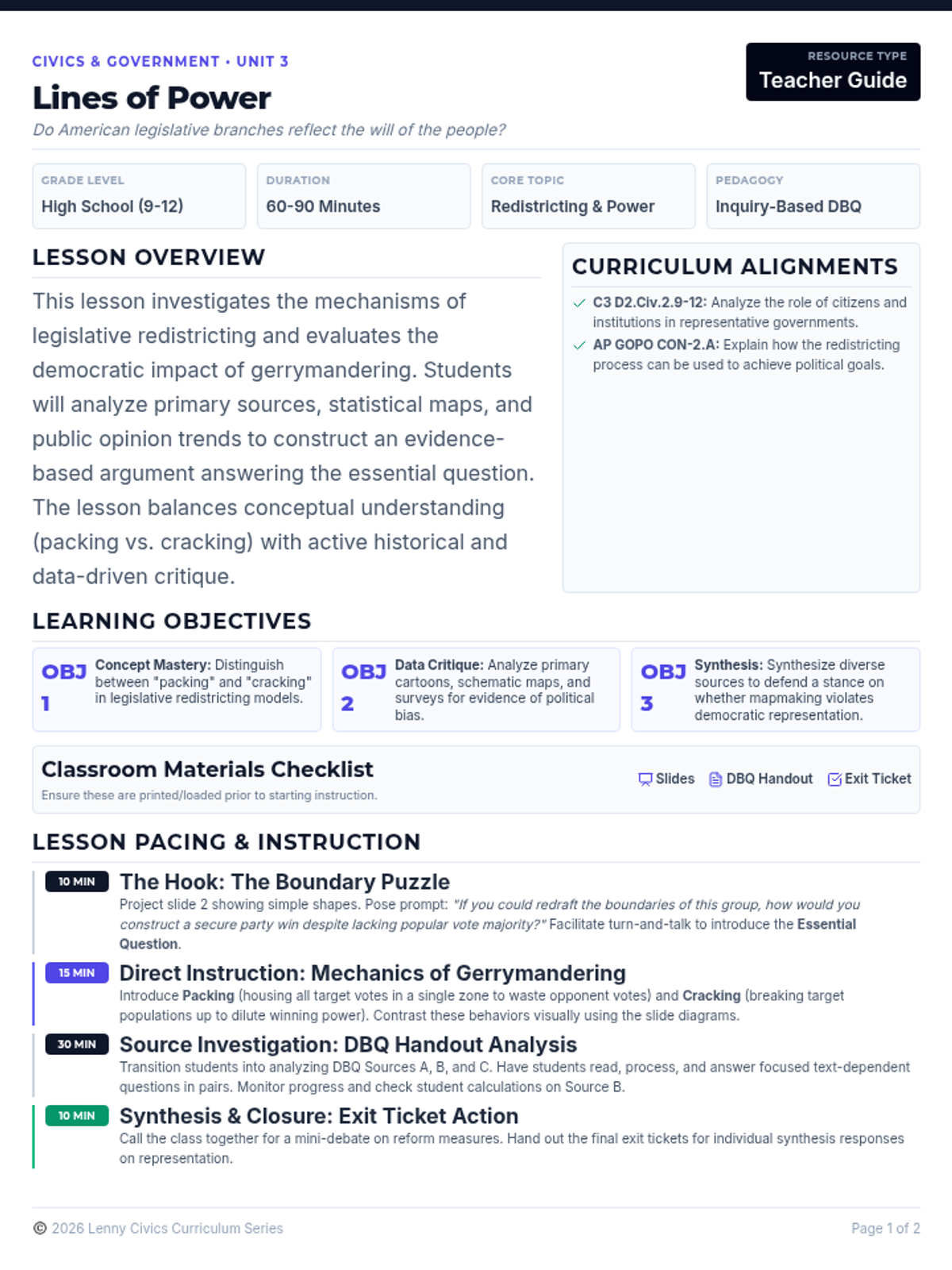
A professional, two-page editorial teacher guide providing instructional pacing, discussion scaffolding, standard alignments, and detailed answer keys/rubrics for the Lines of Power lesson.
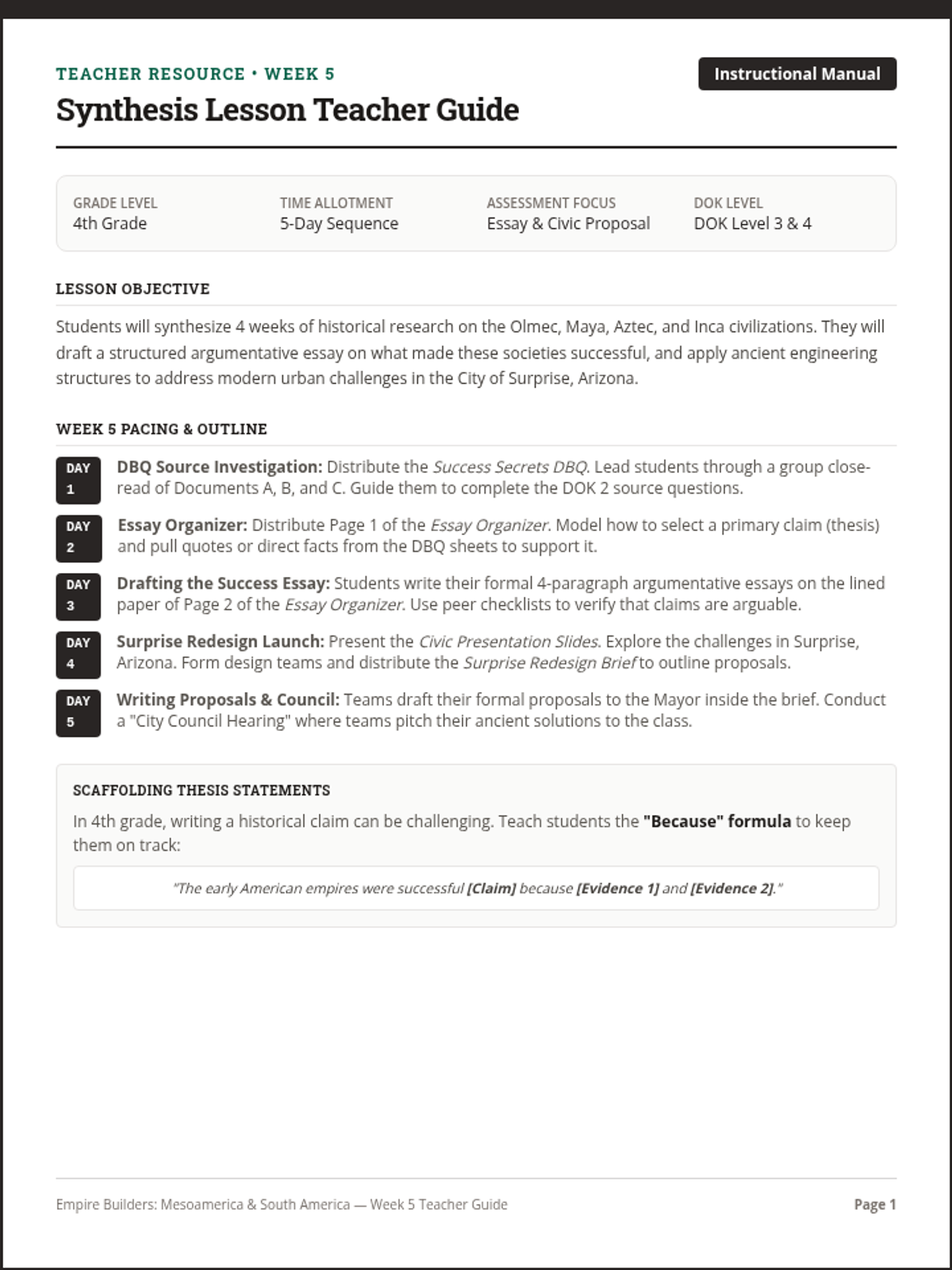
A 2-page teacher's guide for Week 5 (Synthesis) containing DBQ guidelines, essay grading rubrics, civic project pacing, and exemplar proposals.
A 5-slide presentation deck used to launch the Civic Design Project, introducing the City of Surprise desert challenges and matching them to ancient technologies. All text is verified to be 24px (text-2xl) or larger.
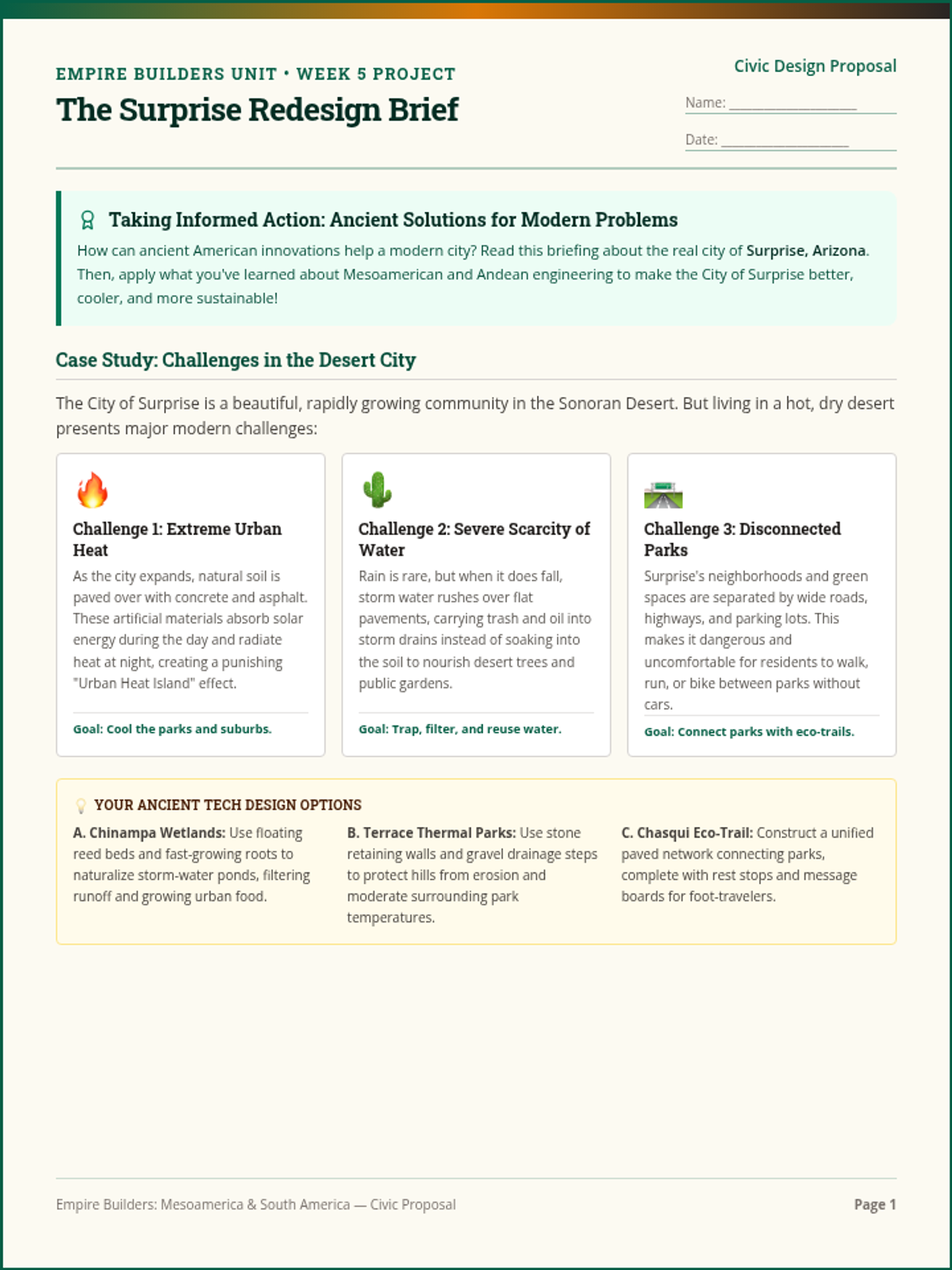
A 2-page civic engagement student workbook containing the Surprise, AZ case study of urban environmental challenges and a formal ancient-to-modern civic proposal workspace.
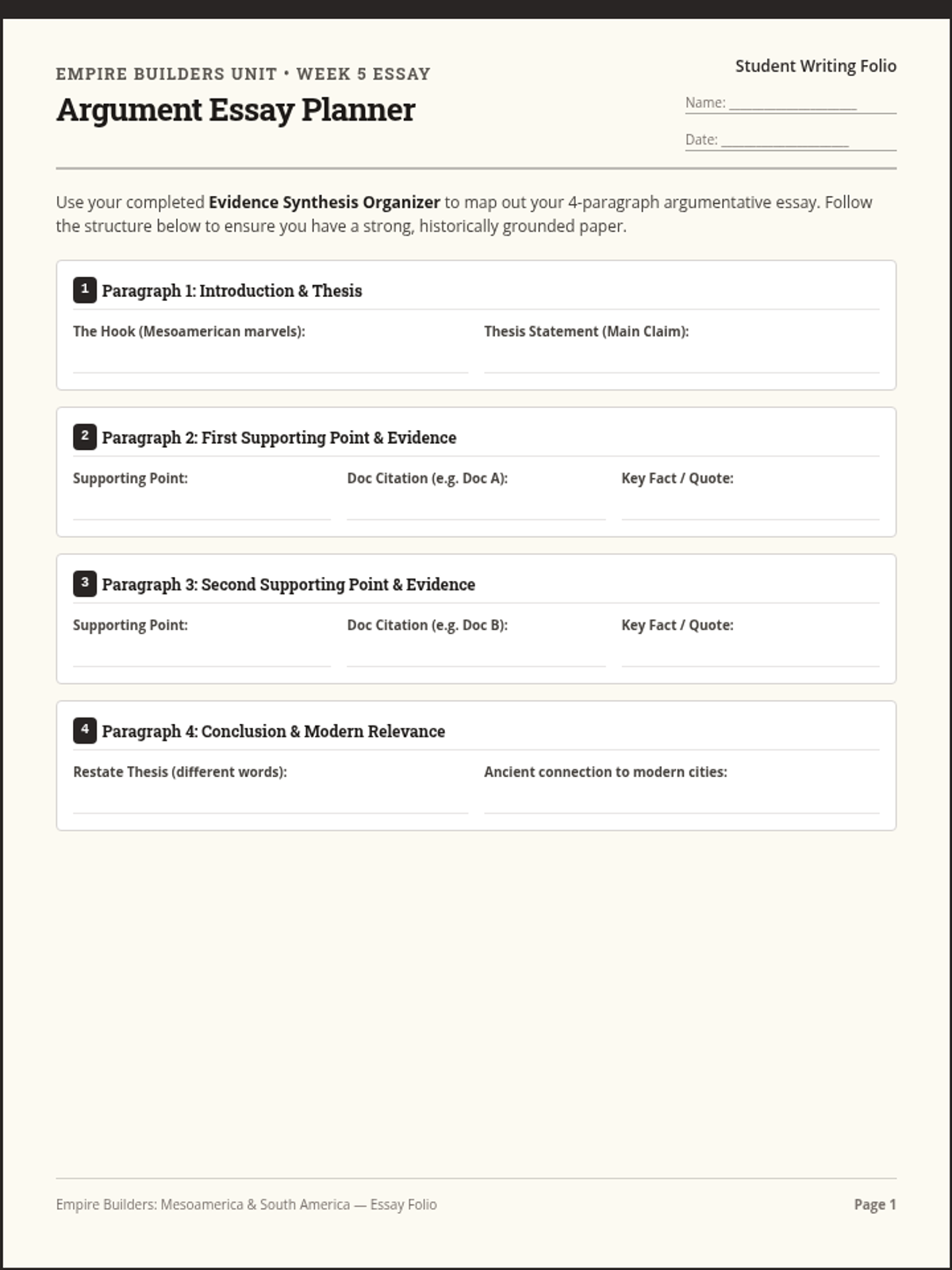
A 2-page essay organizer and formal lined writing template where students plan and write their argumentative essay on Mesoamerican success.
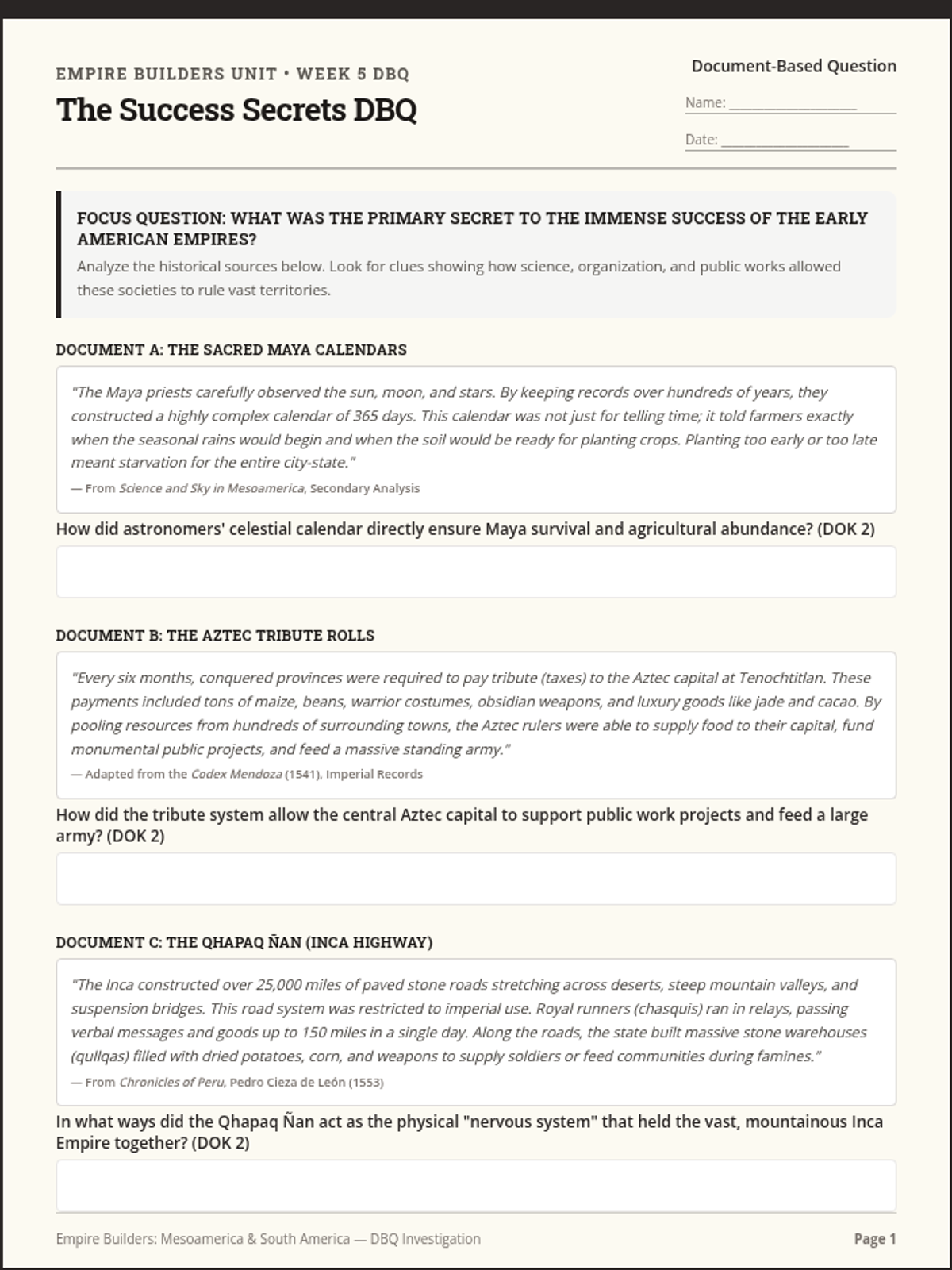
A 2-page DBQ document set featuring primary/secondary source documents on Mesoamerican success secrets (calendars, tribute, and roads) along with a structured argumentative evidence organizer.
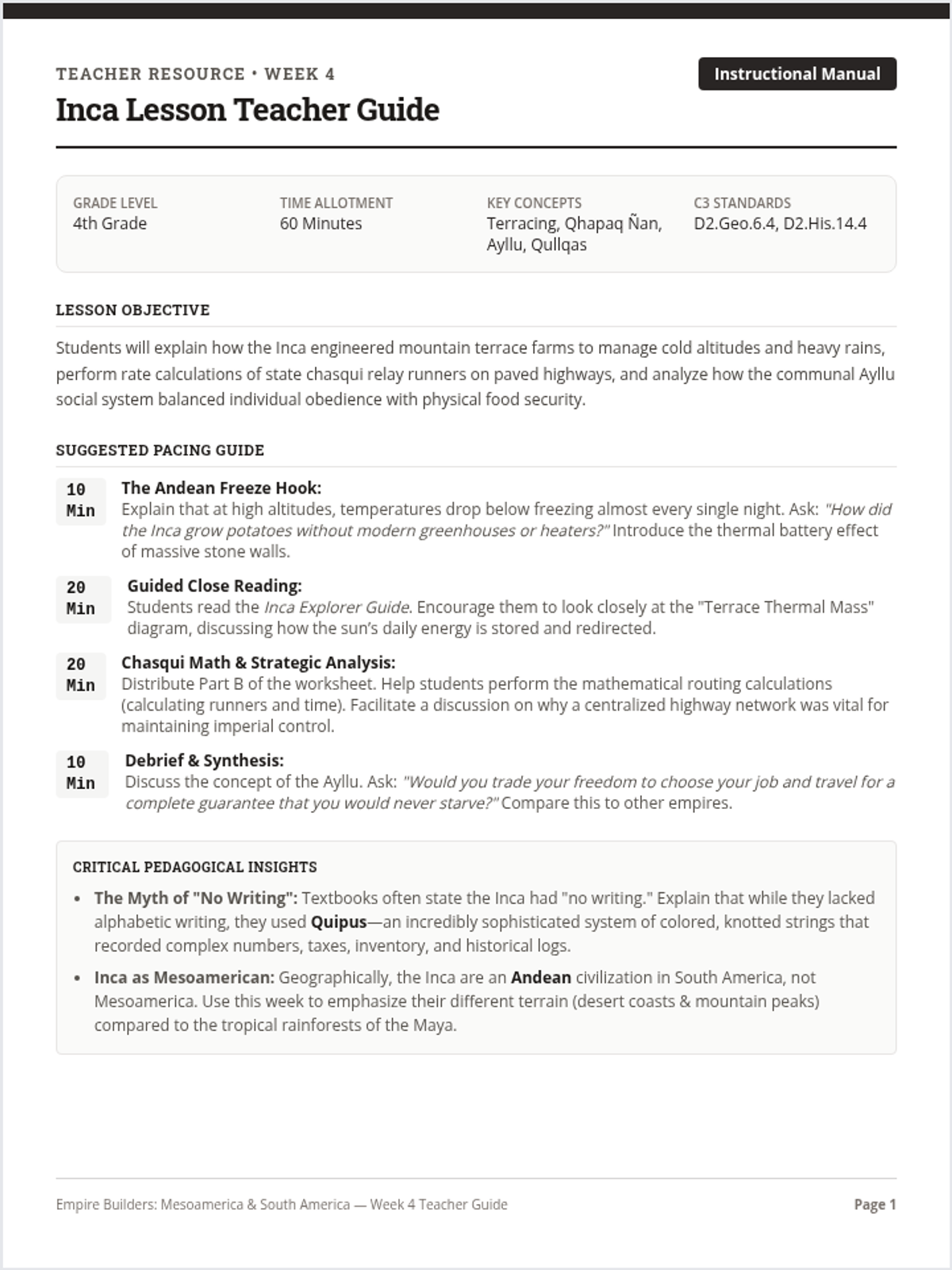
A 2-page teacher's guide for Week 4 (Inca) with standards, pacing, common misconceptions, and comprehensive answer keys.
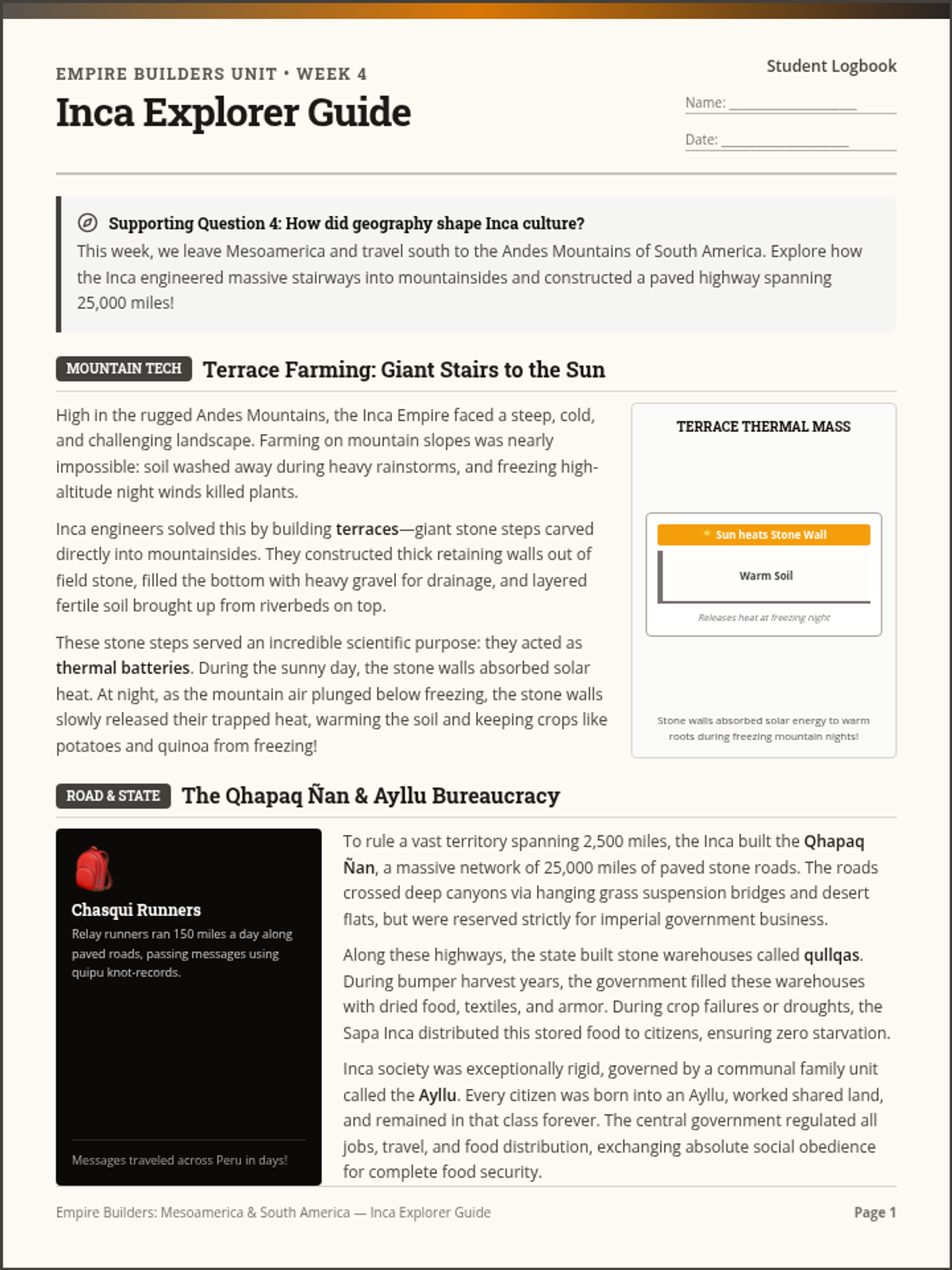
A 2-page student reading and worksheet on the Inca civilization, investigating their steep mountain terracing, Qhapaq Ñan road network, and the communal Ayllu social system. Includes DOK 2 comprehension questions.
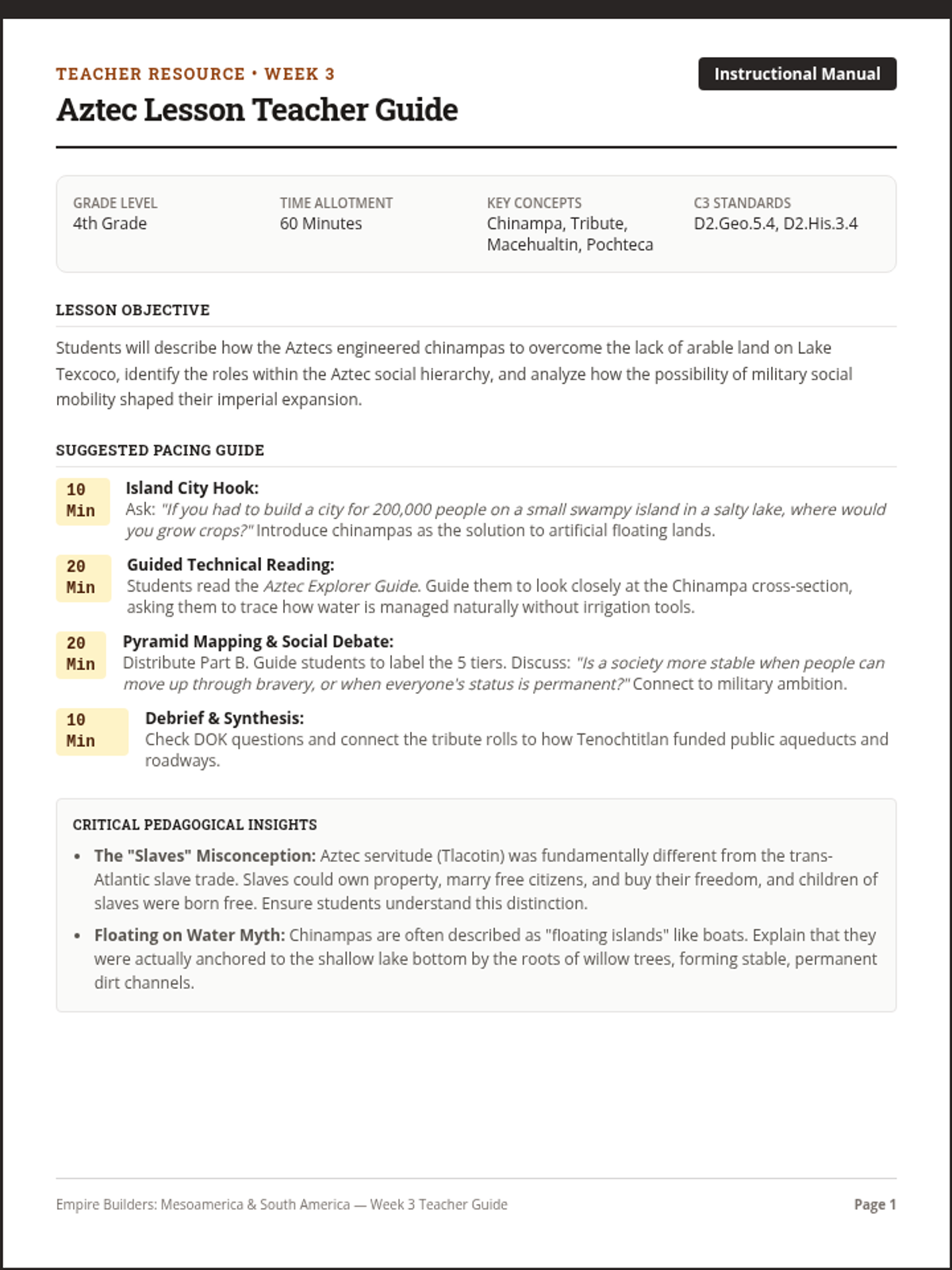
A 2-page teacher's guide for Week 3 (Aztec) with standards, pacing, common misconceptions, and comprehensive answer keys.
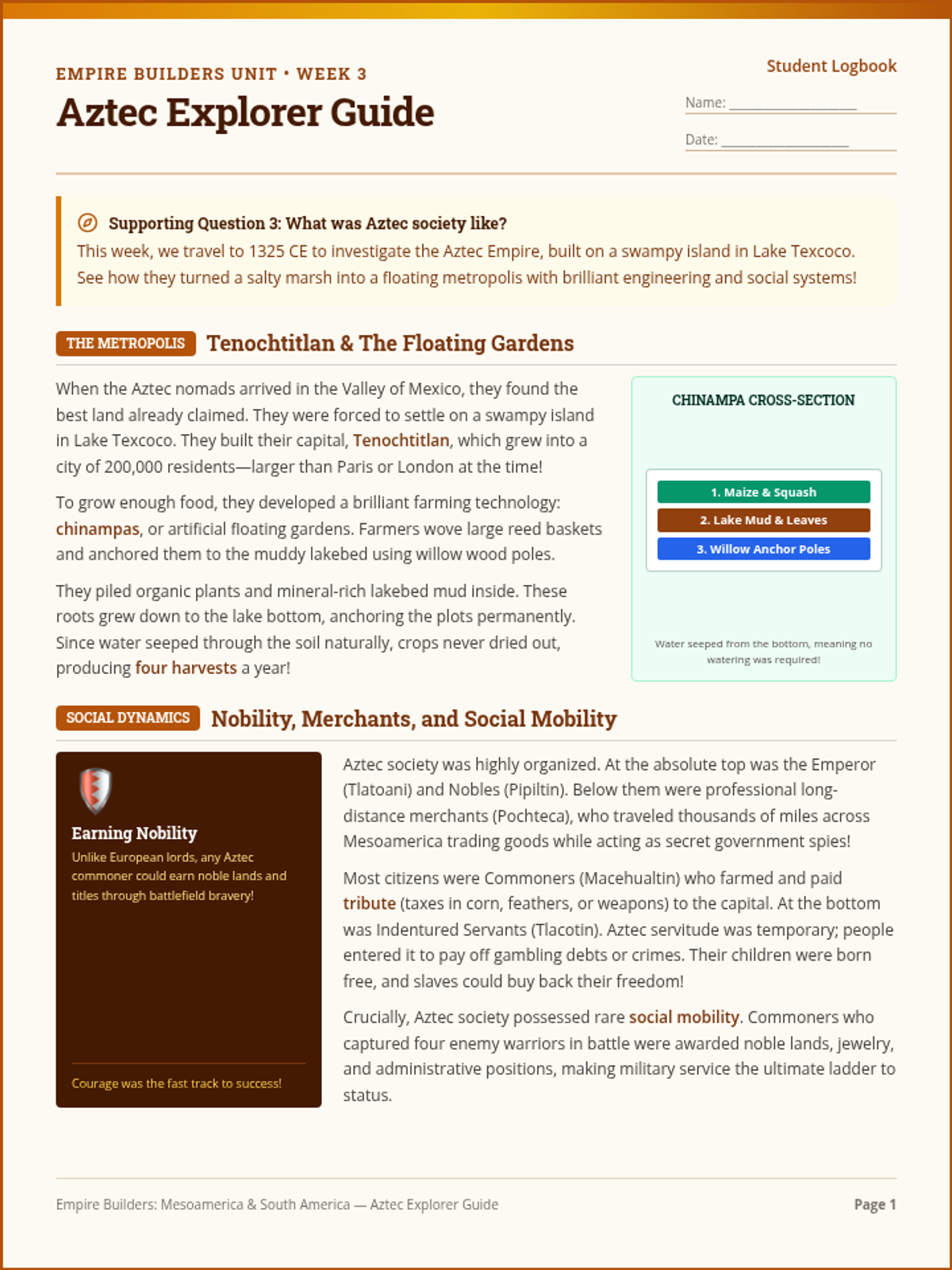
A 2-page student reading and worksheet on the Aztec civilization, exploring Lake Texcoco, chinampa agricultural technology, and military social mobility. Includes DOK 2 comprehension questions.