Examining foundational arguments from major thinkers alongside contemporary debates on morality, governance, and the nature of existence. Addresses core concepts like political structures, consciousness, and the conflict between agency and fate.
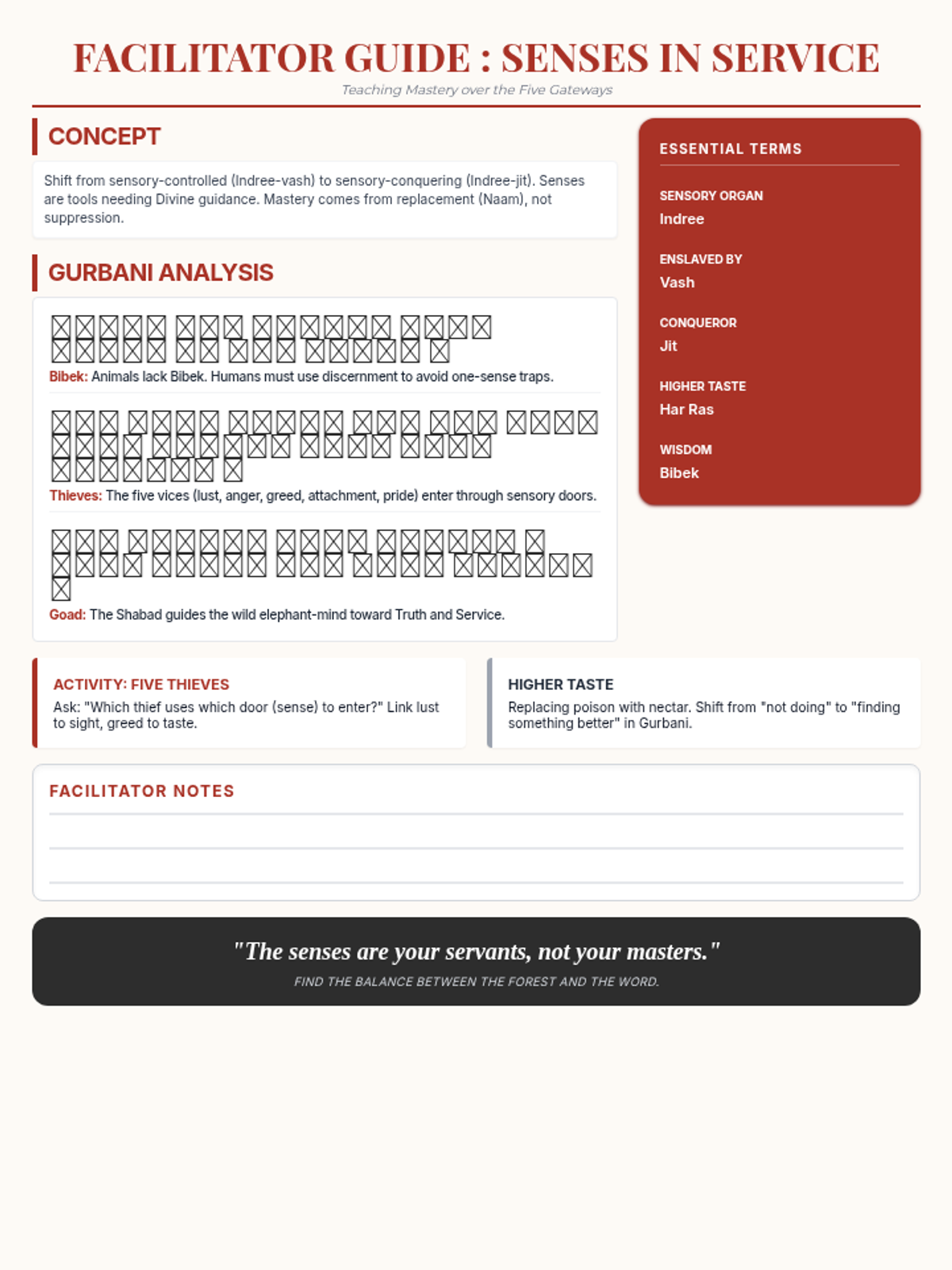
A facilitator guide for teachers or workshop leaders, significantly expanded with Gurbani Analysis of verses related to the 'Five Thieves' and the 'Elephant of the Mind' metaphors. Updated layout, improved font handling for Gurmukhi, and included a dedicated facilitator notes area. Consolidated to a single page. Font sizes increased for better legibility. Full Gurbani verses provided.
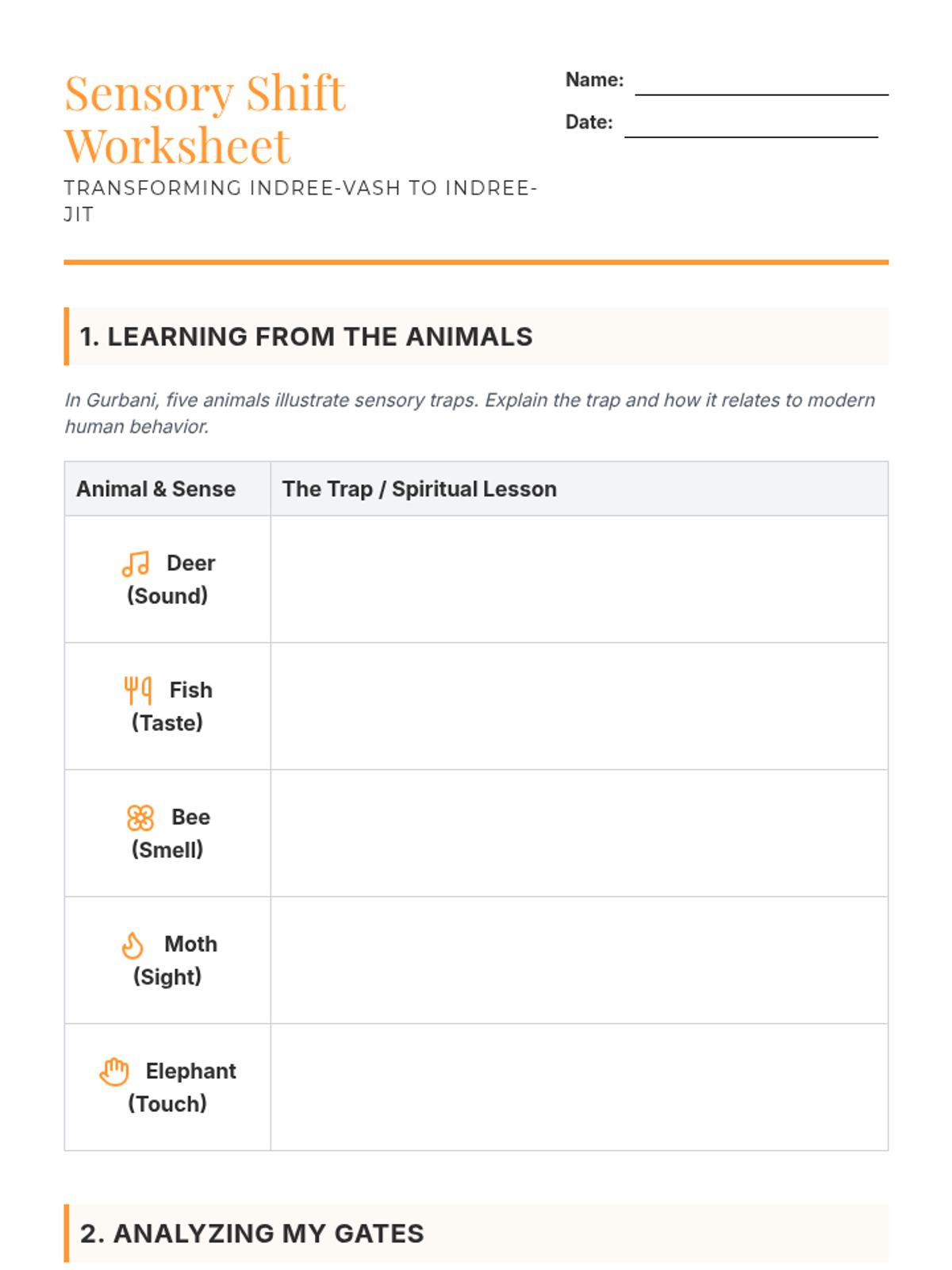
A student worksheet designed for reflection on sensory habits, identifying personal sensory traps based on the animal metaphors in Gurbani, and planning practical ways to redirect senses toward spiritual service.
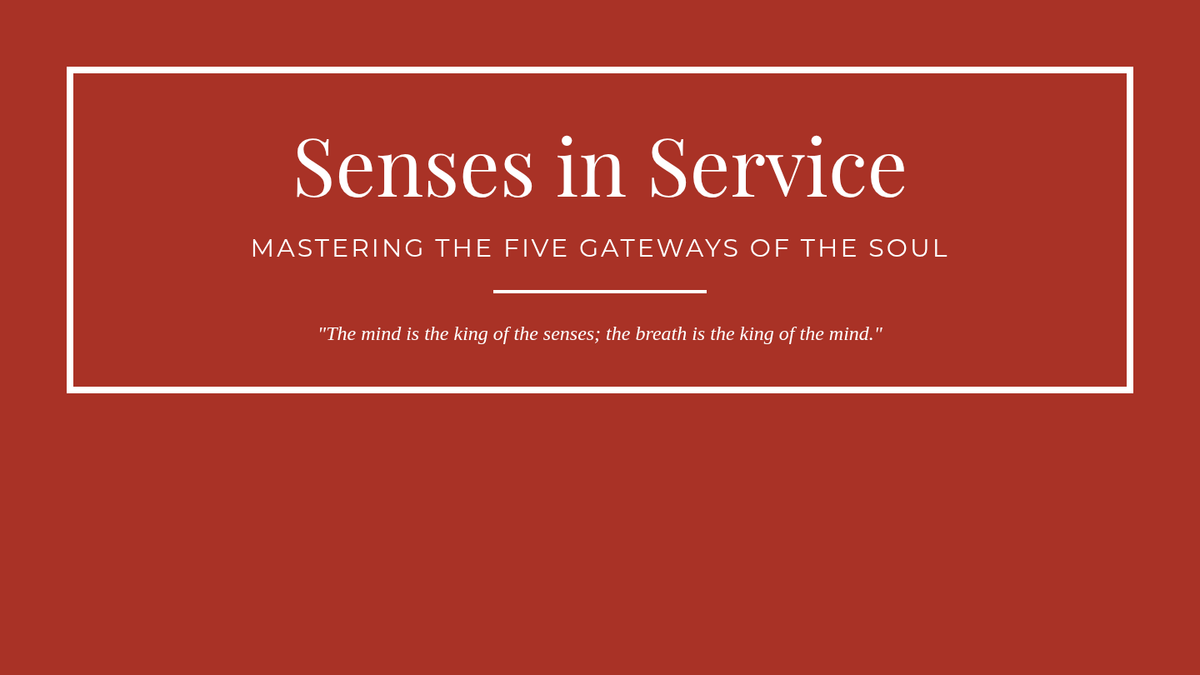
A 10-slide presentation exploring the Gurmat perspective on the five senses, significantly expanded with Gurbani verses (Gurmukhi) from the Guru Granth Sahib to emphasize the concept of the 'Five Thieves' and the 'Guru's Goad' for sensory mastery. Updated font handling for Gurbani rendering. Citations and contrast improved. Background stability and layout bleed issues resolved. Centering and typography polished. Removed tracking on long strings to improve legibility.
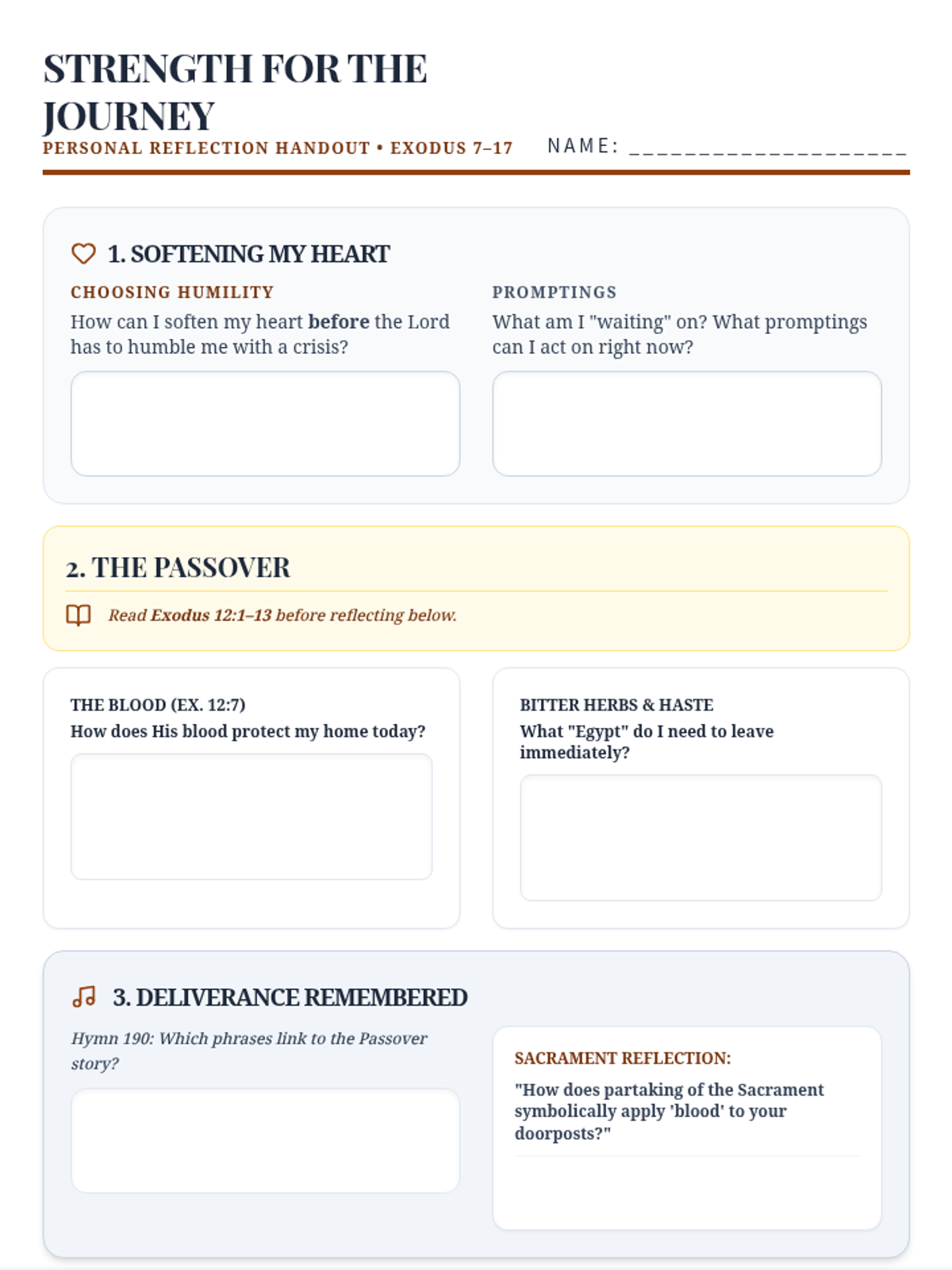
Updated student handout with specific reflection prompts in Part 5 regarding daily consistency and physical tasks, aligning with the updated lesson flow. Part 3 now includes the requested discussion question. Spacing optimized for two-page printing.
Updated lesson slides with a new slide (Slide 7) for Part 4: The Refining Wait. It explains how the Lord could have saved Israel on day one but waited to work on the hearts of others. All subsequent slides shifted accordingly. Layout and typography improved for clarity.
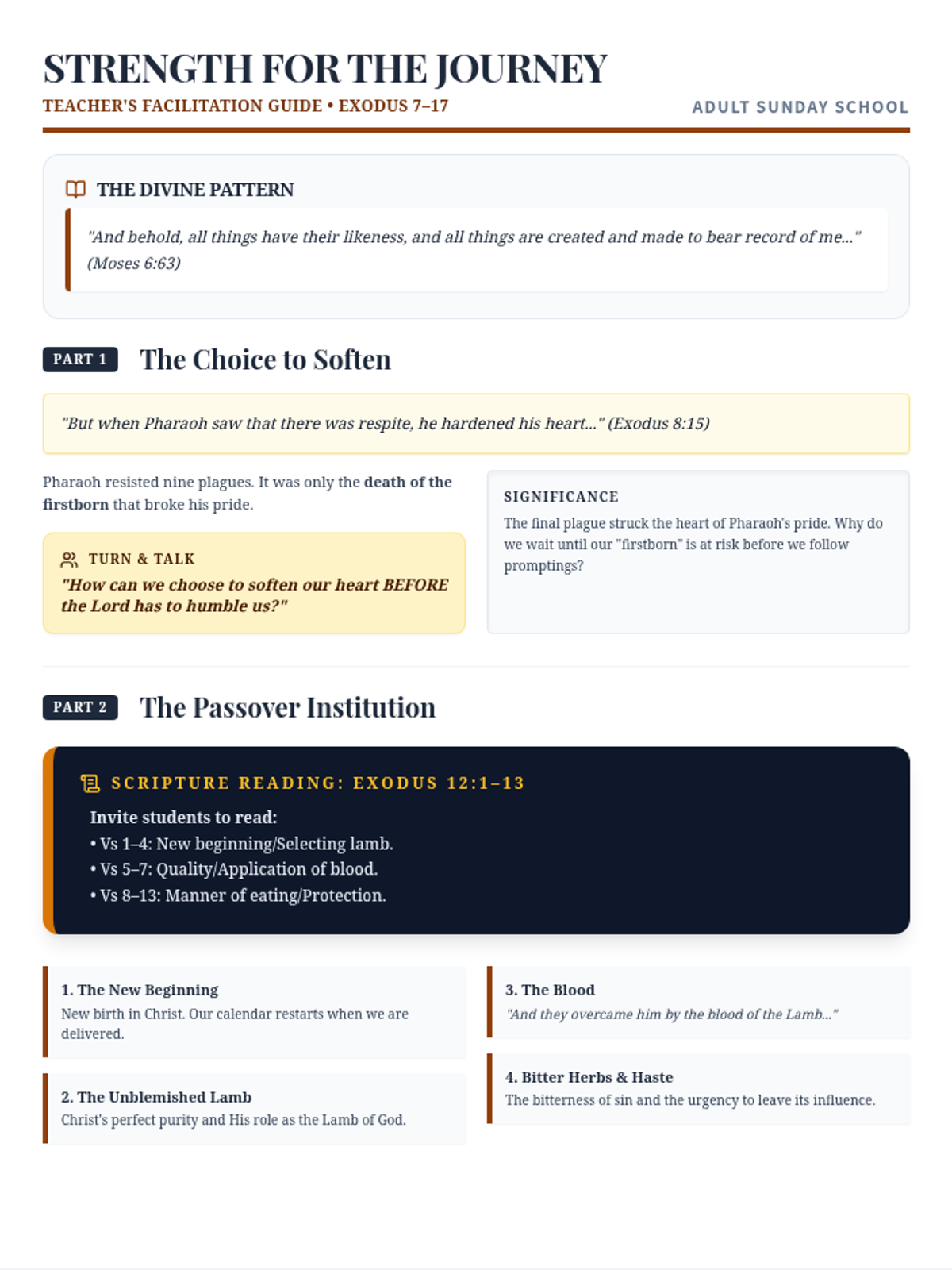
Updated Teacher Guide for the 'Strength for the Journey' lesson. Added explanation to Part 4 about how the Lord could have saved Israel on day one but waited to work on the hearts of others during the plagues. Consolidated reflection lines and improved page flow to 4 pages.
A 6-slide presentation designed to guide classroom discussion on the characterization of Calypso in Book 5 of the Odyssey, exploring her motivations, divine rebellion, and complexity.
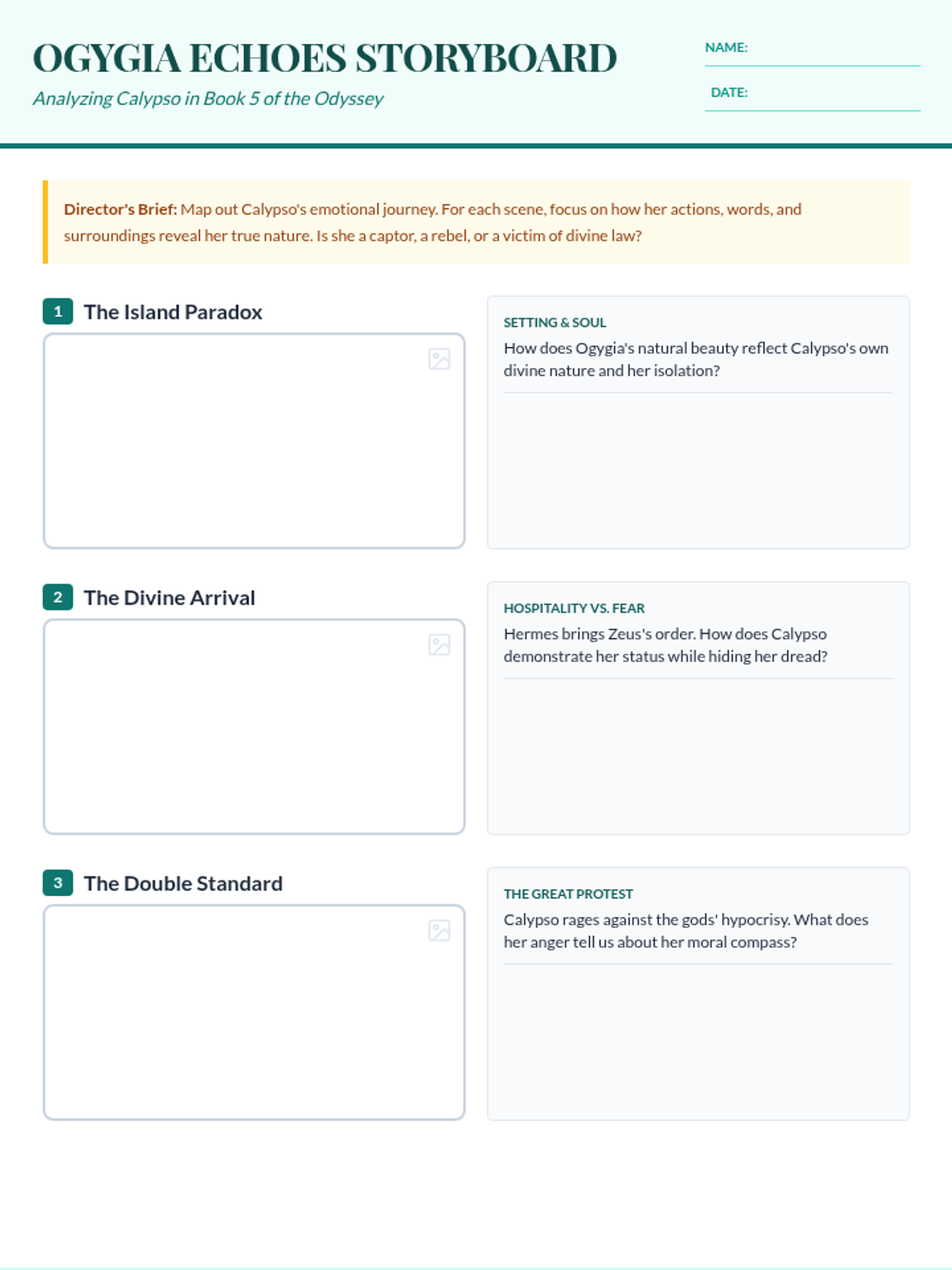
A 2-page graphic storyboard worksheet for students to analyze the characterization of Calypso in Book 5 of the Odyssey through sketching and written reflection.
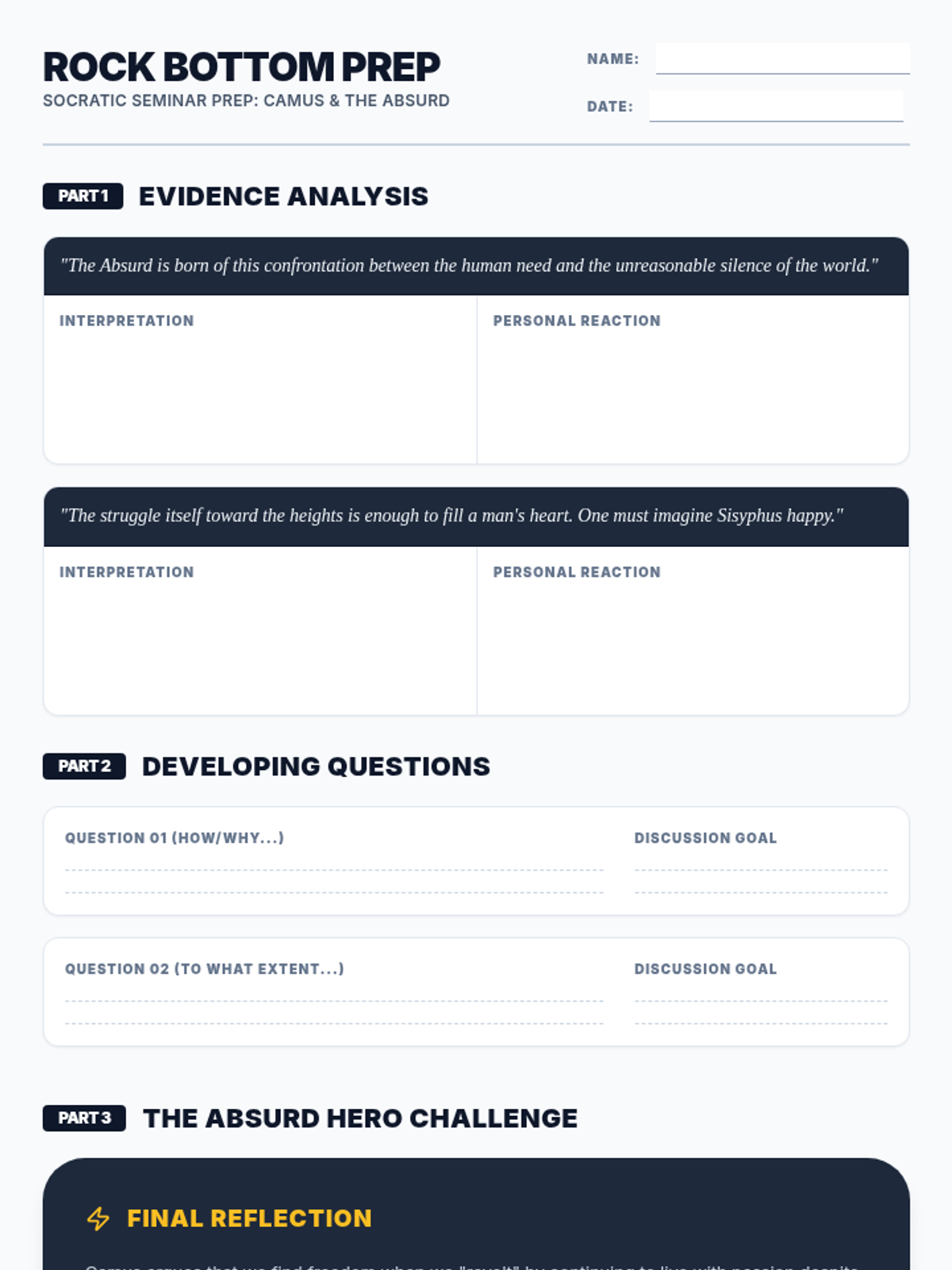
A preparation worksheet for students to analyze key quotes and develop their own discussion questions for the Socratic Seminar on 'The Myth of Sisyphus'.
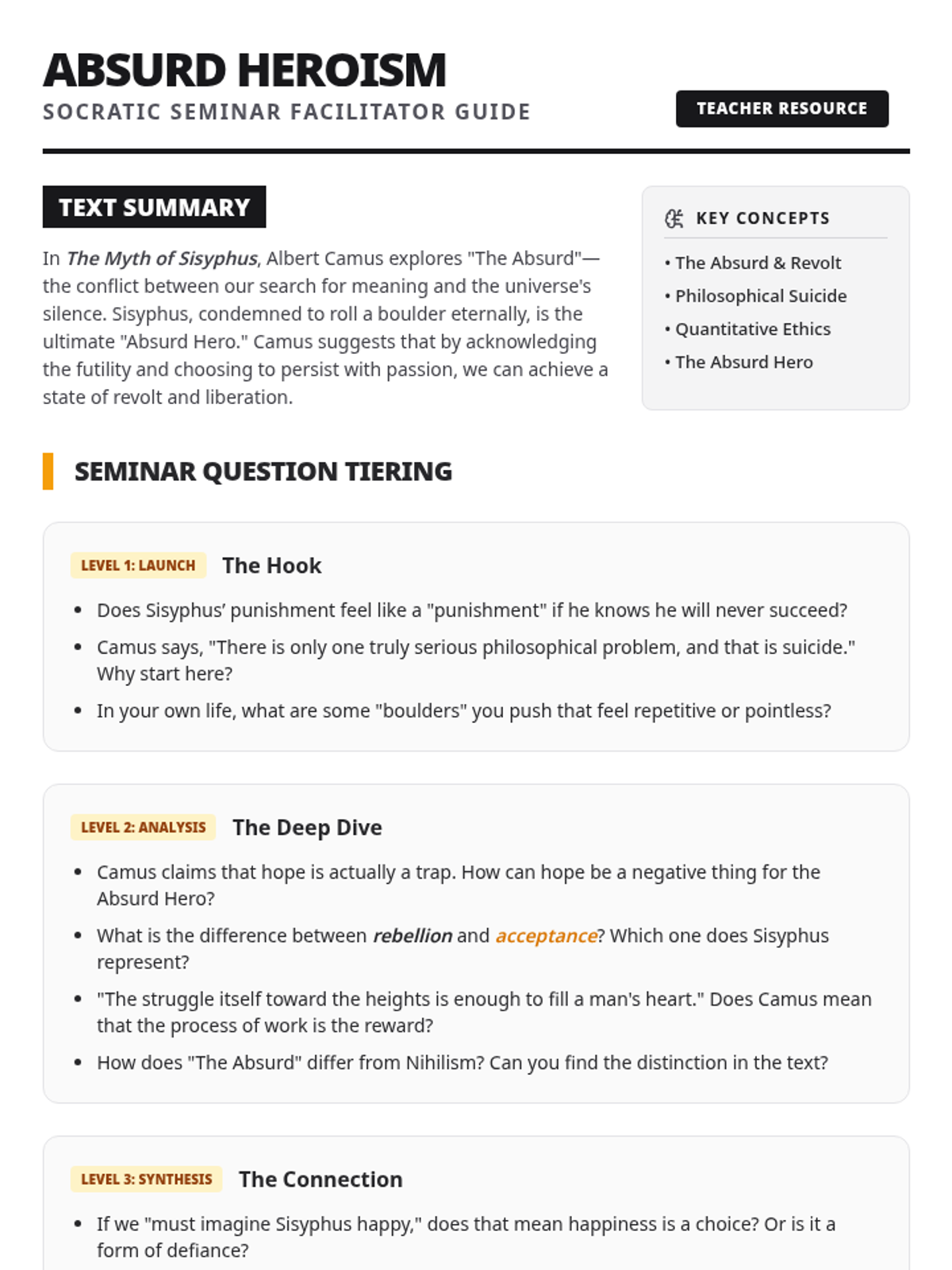
Instructional guide for teachers conducting a Socratic Seminar on Camus' 'The Myth of Sisyphus', including tiered discussion questions and facilitator tips.
Visual presentation slides for a Socratic Seminar on Albert Camus' 'The Myth of Sisyphus', introducing the rules of discussion and core philosophical concepts.
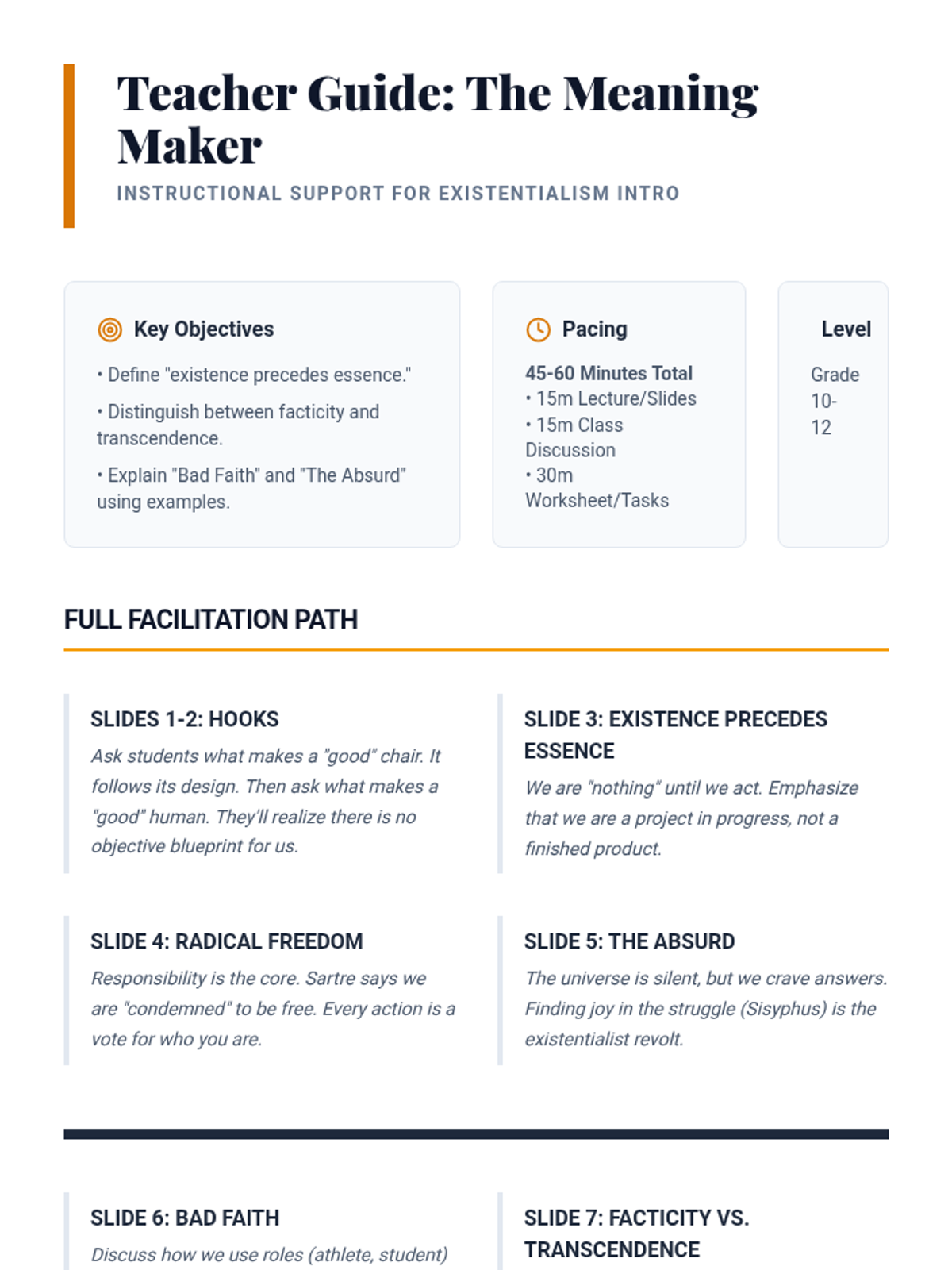
A comprehensive teacher facilitation guide for the "Meaning Maker" lesson on existentialism. Includes slide-by-slide prompts, pacing guides, strategy notes for every slide, and student misconception management. Updated for better page flow and complete slide coverage.
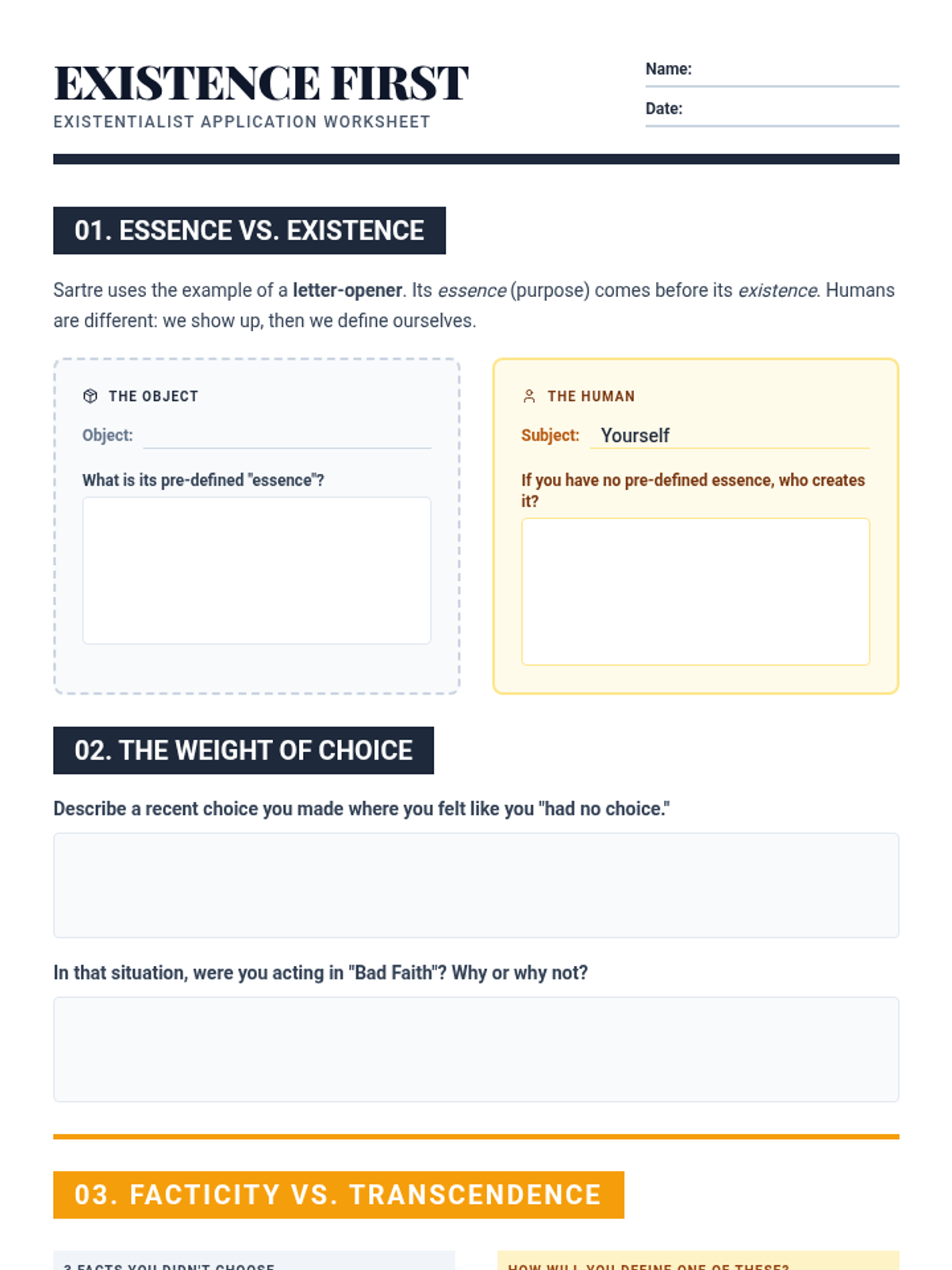
A two-page student worksheet that applies existentialist concepts (Essence vs. Existence, Facticity, The Absurd) to personal life. Includes reflection prompts and analysis of Jean-Paul Sartre and Albert Camus' ideas. Updated for better page breaks and writing area visibility.
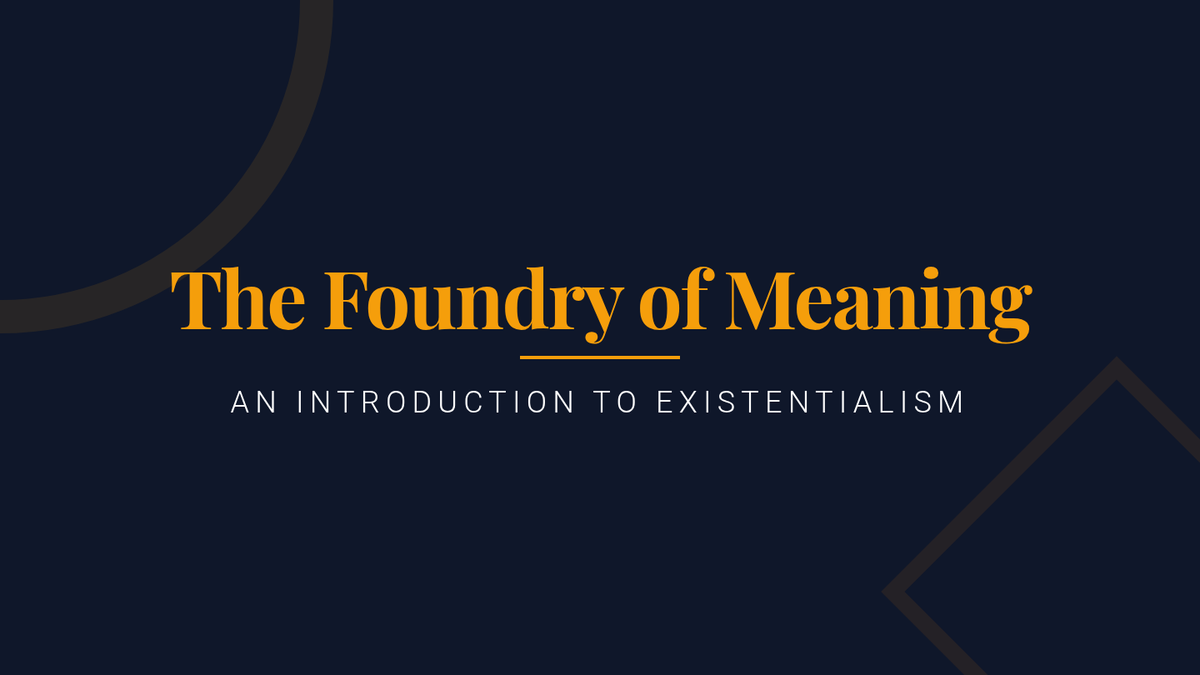
A visually striking introductory slide deck on existentialism, covering core concepts like radical freedom, existence preceding essence, the absurd, and bad faith. Uses an industrial "Foundry of Meaning" theme.
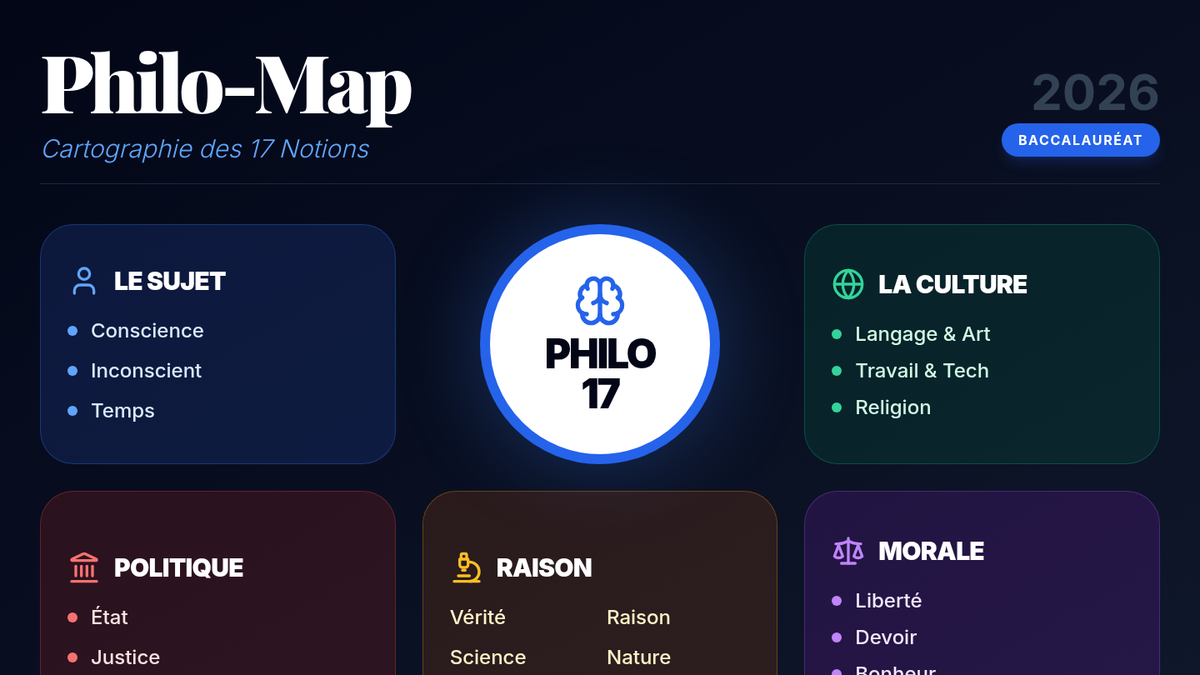
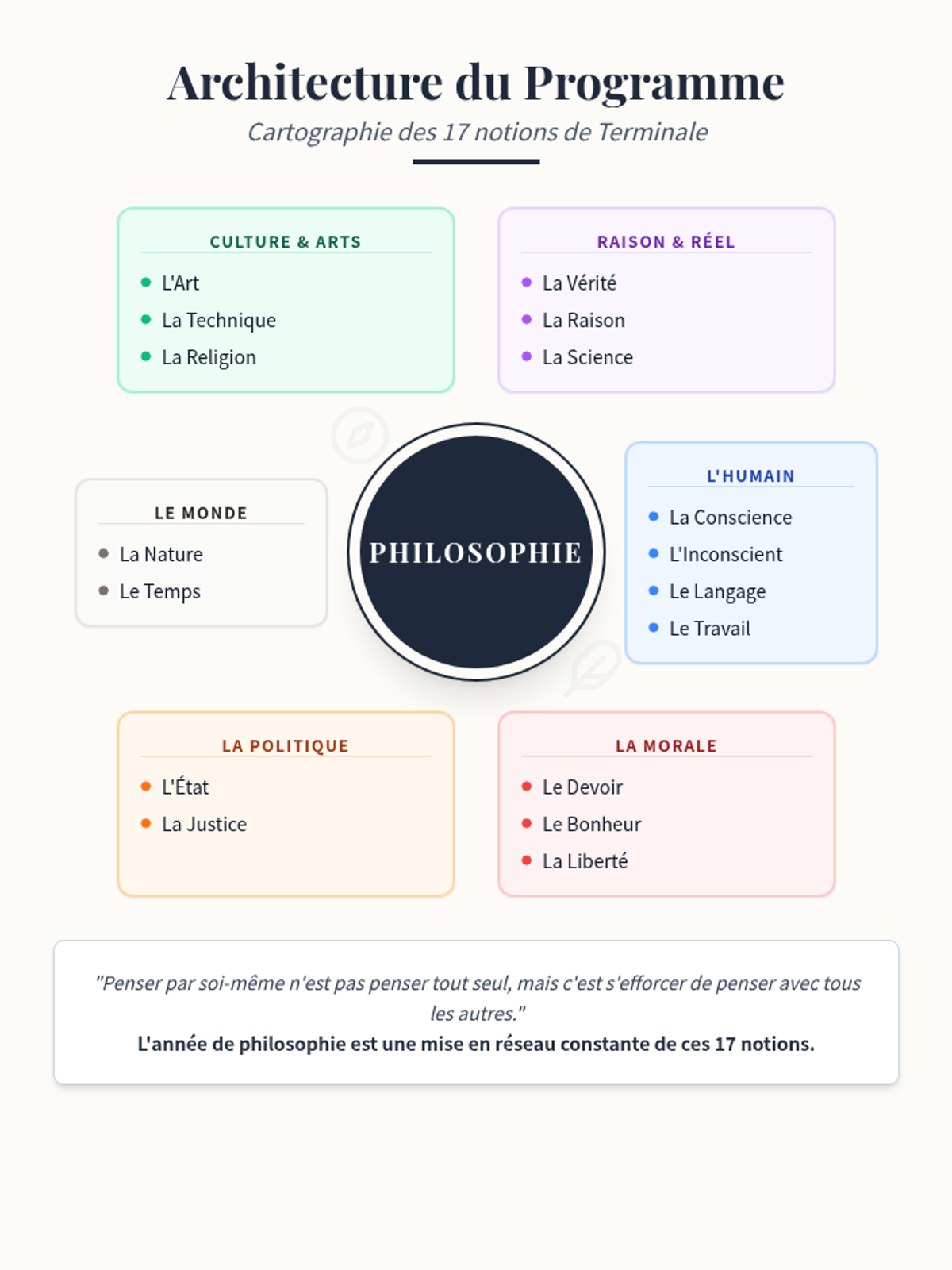
Une carte mentale visuelle présentant l'organisation des 17 notions du programme de philosophie du baccalauréat en 5 grands domaines conceptuels. Layout optimisé pour une clarté maximale.
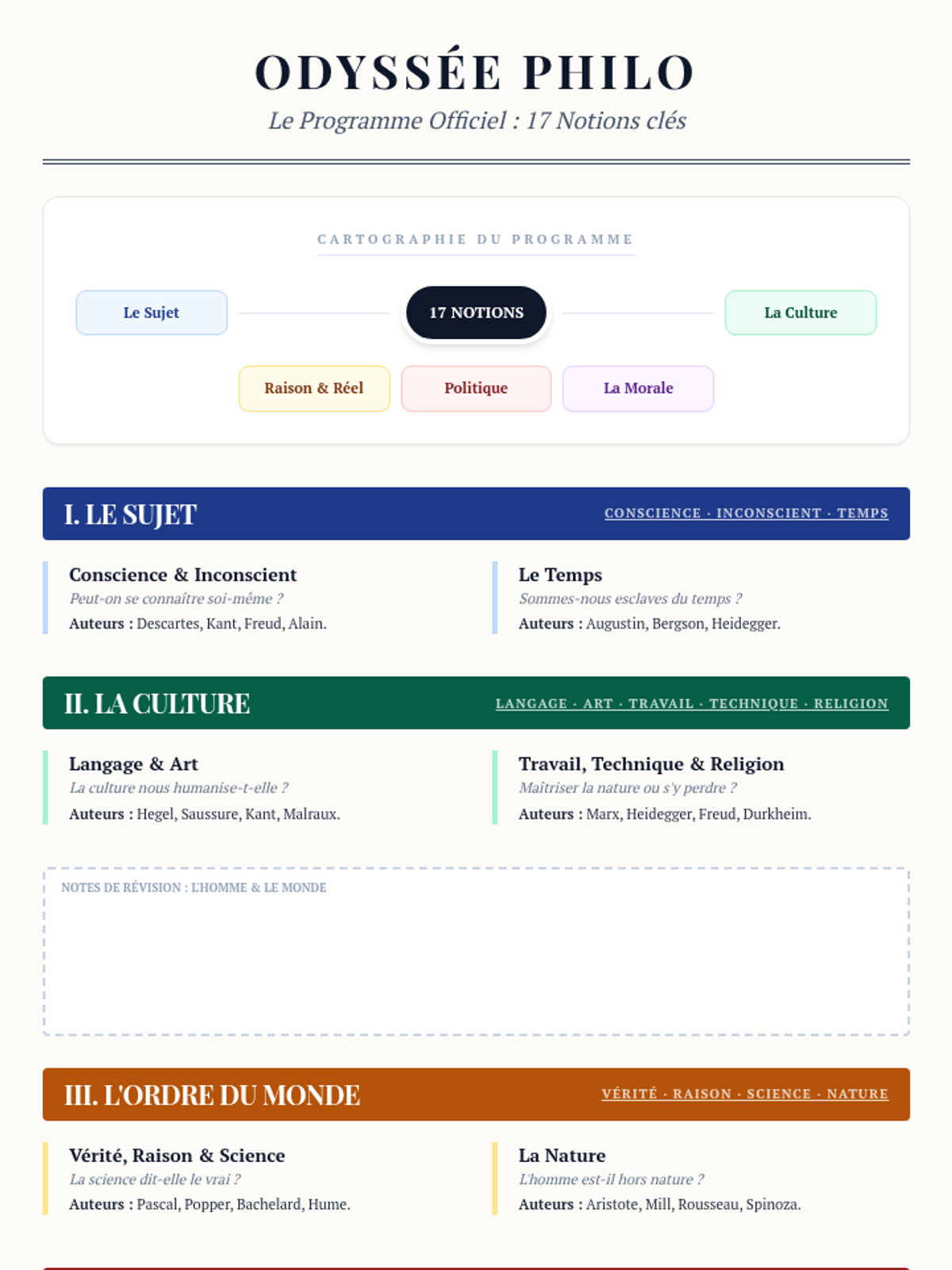
Un guide d'étude complet présentant les 17 notions du programme de philosophie, organisées par thèmes avec définitions, auteurs clés et problématiques pour les révisions du baccalauréat. Inclut une cartographie visuelle et des zones de notes pour l'étudiant.
Une carte mentale visuelle présentant les 17 notions du programme de Terminale Générale, regroupées par domaines thématiques. Mise à jour pour une meilleure lisibilité et une structure robuste évitant les chevauchements en version imprimée.
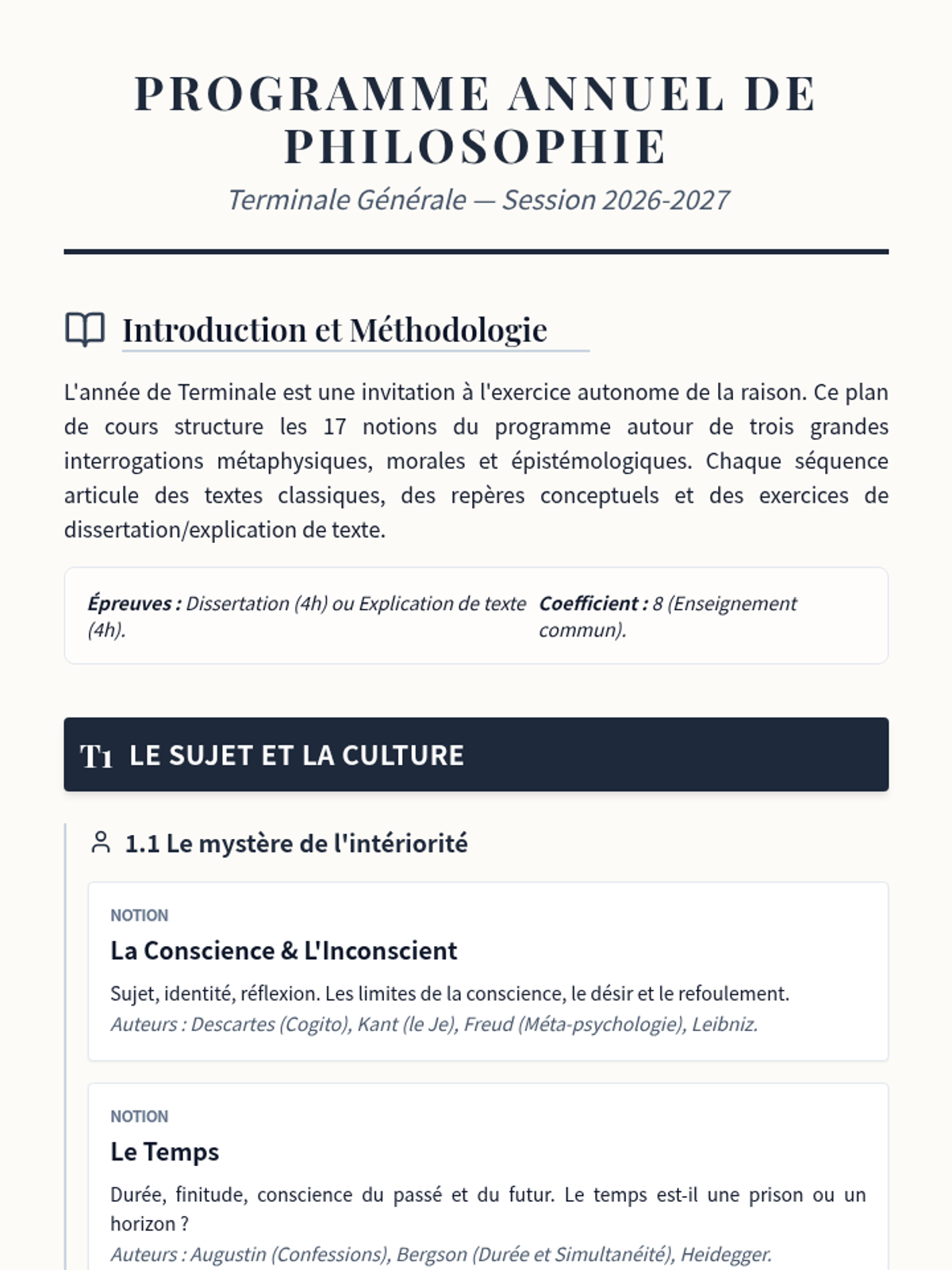
Un plan de cours annuel détaillé pour la classe de Terminale Générale, organisant les 17 notions du programme en trois trimestres thématiques. Il inclut les auteurs clés, les problématiques centrales et les repères conceptuels essentiels. Mis à jour avec une mise en page optimisée pour l'impression et une typographie soignée.
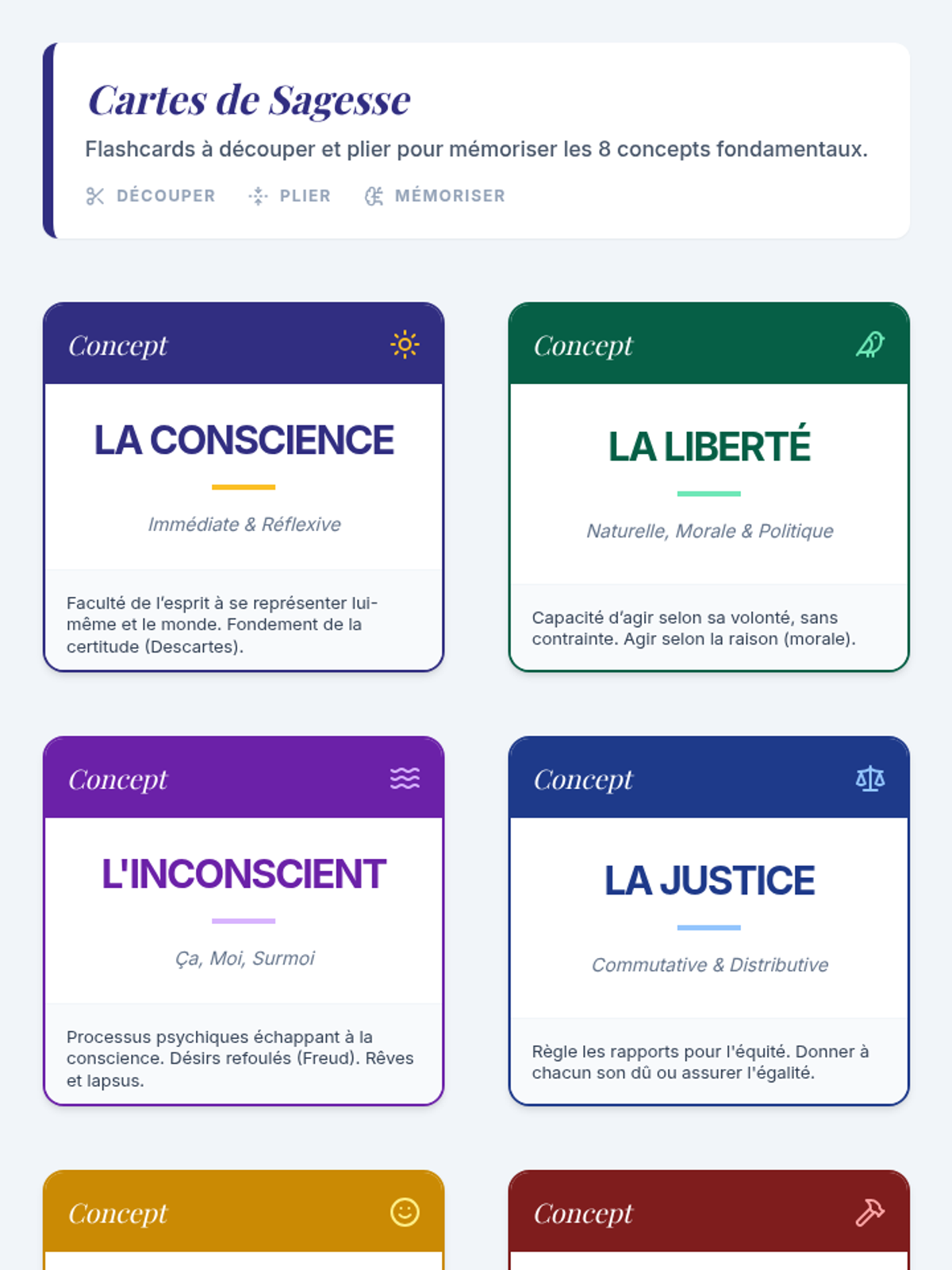
Un ensemble de huit flashcards à découper, présentant au recto le concept philosophique et au verso sa définition synthétique pour une mémorisation rapide.
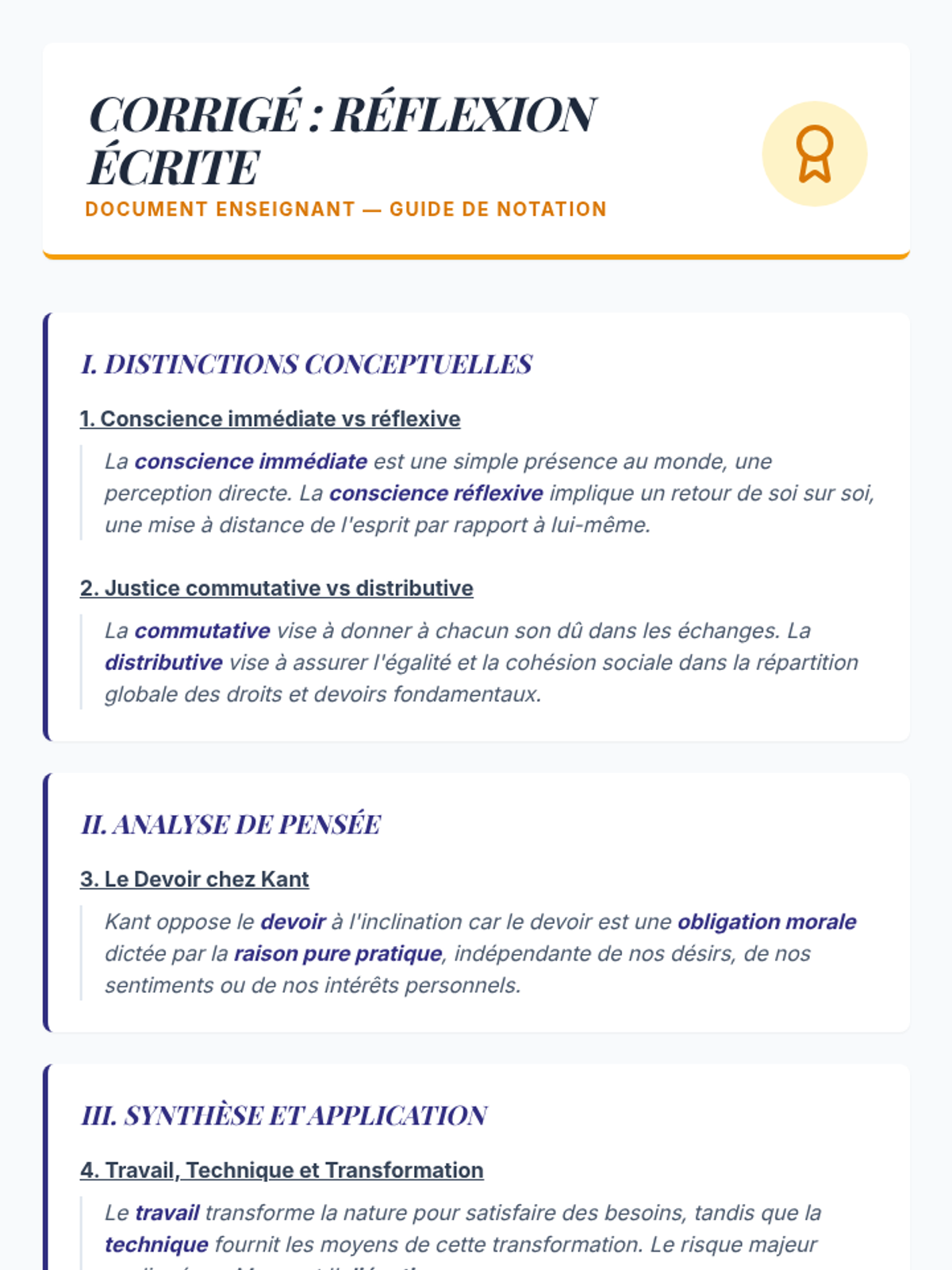
Corrigé détaillé de la fiche de réflexion écrite Sagesse Flash pour l'enseignant, incluant des pistes de notation et les points clés.
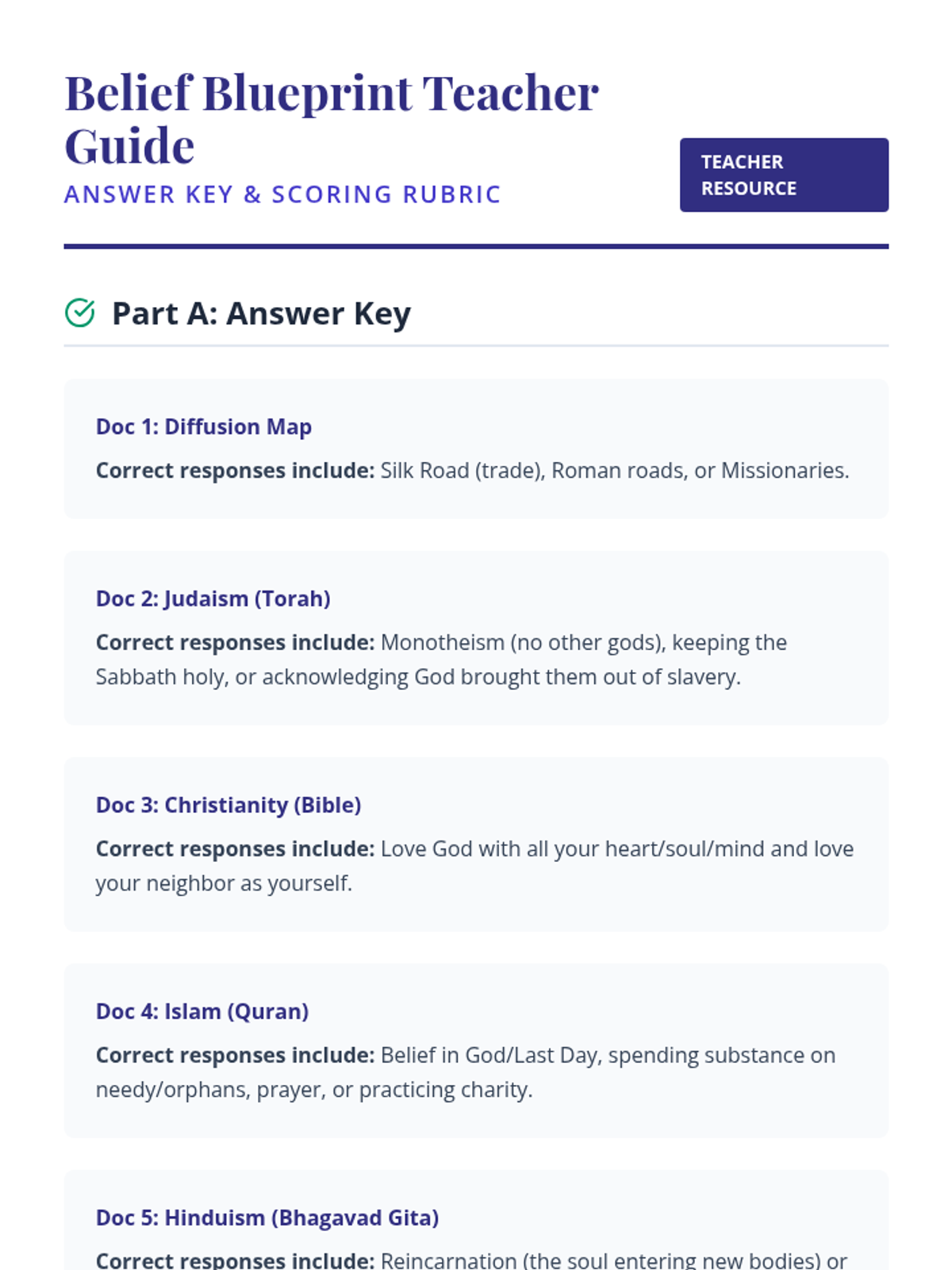
A comprehensive teacher's guide for the World Religions DBQ, including a detailed answer key for document analysis, an NYS-aligned 1-5 scoring rubric, and instructional strategies for guiding student writing.
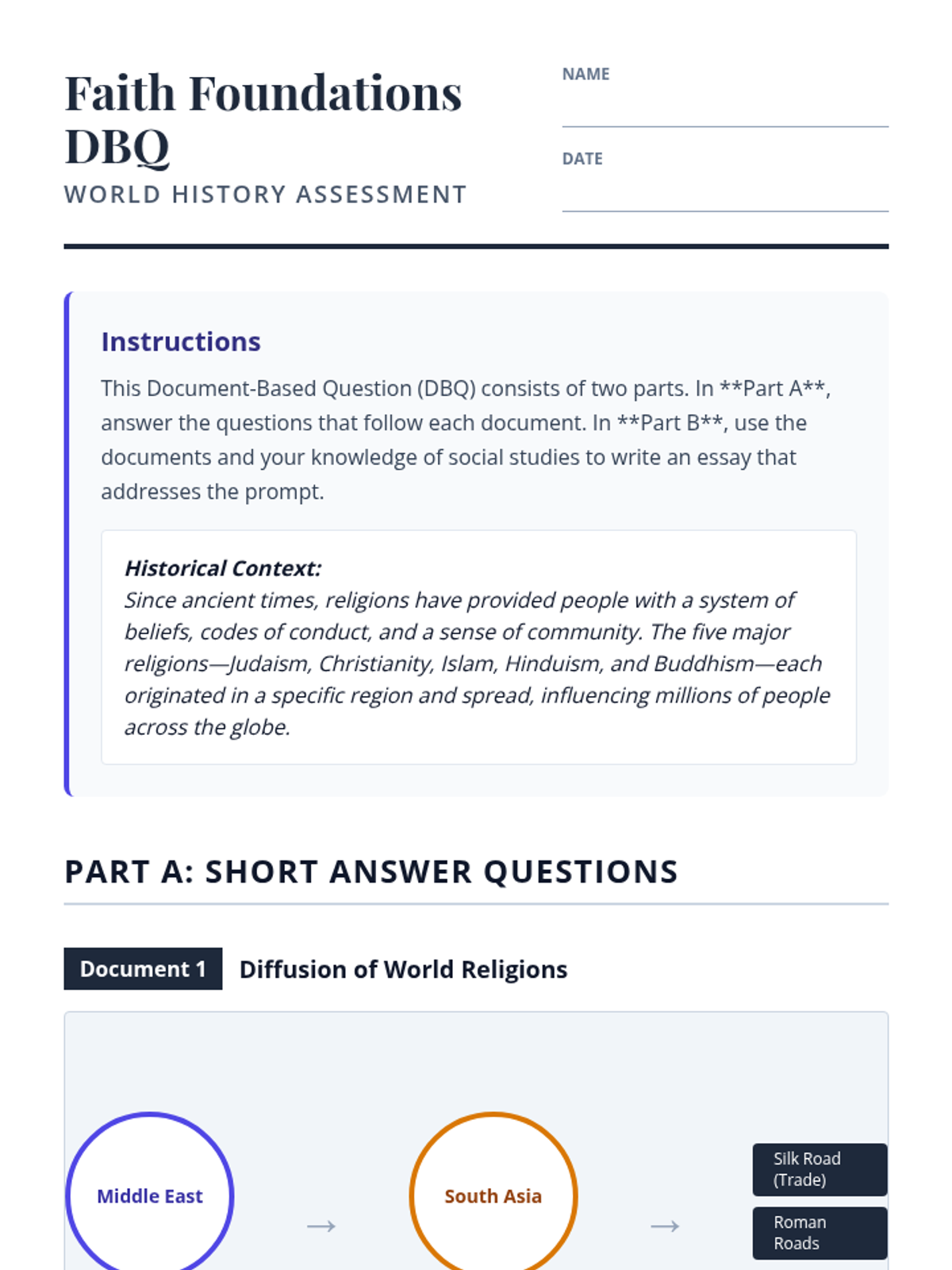
A formal 6th-grade NYS-style DBQ assessment on World Religions, featuring maps and sacred text excerpts for Hinduism, Buddhism, Judaism, Christianity, and Islam, followed by a document-based essay prompt.
A visually engaging presentation that introduces the 6th-grade World Religions DBQ assessment, outlining the mission, providing visual context for maps and sacred texts, and setting clear writing expectations for students.
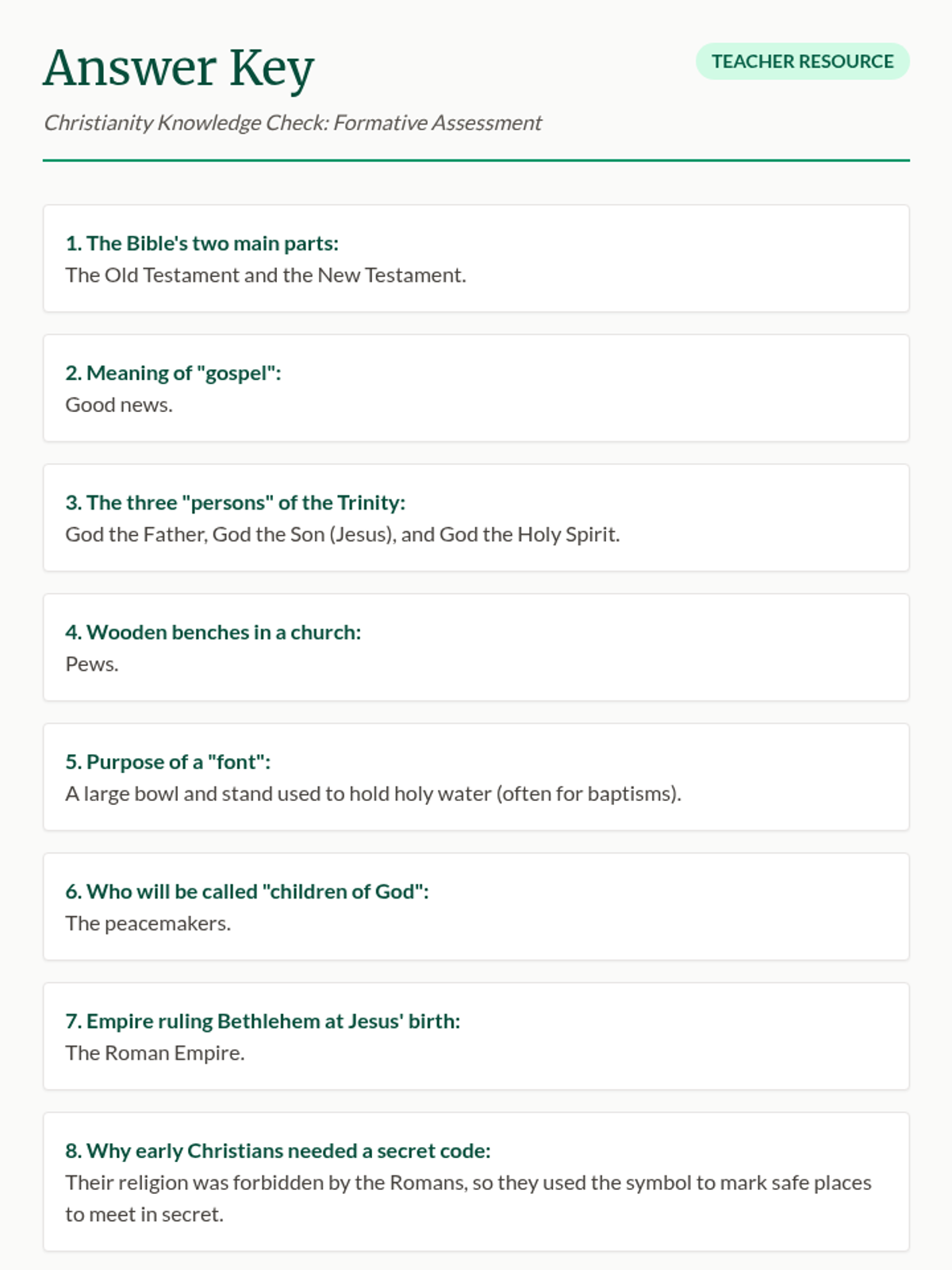
A revised teacher's answer key for the Christianity Knowledge Check, with question 2 updated to provide the meaning of 'gospel' as 'good news'.
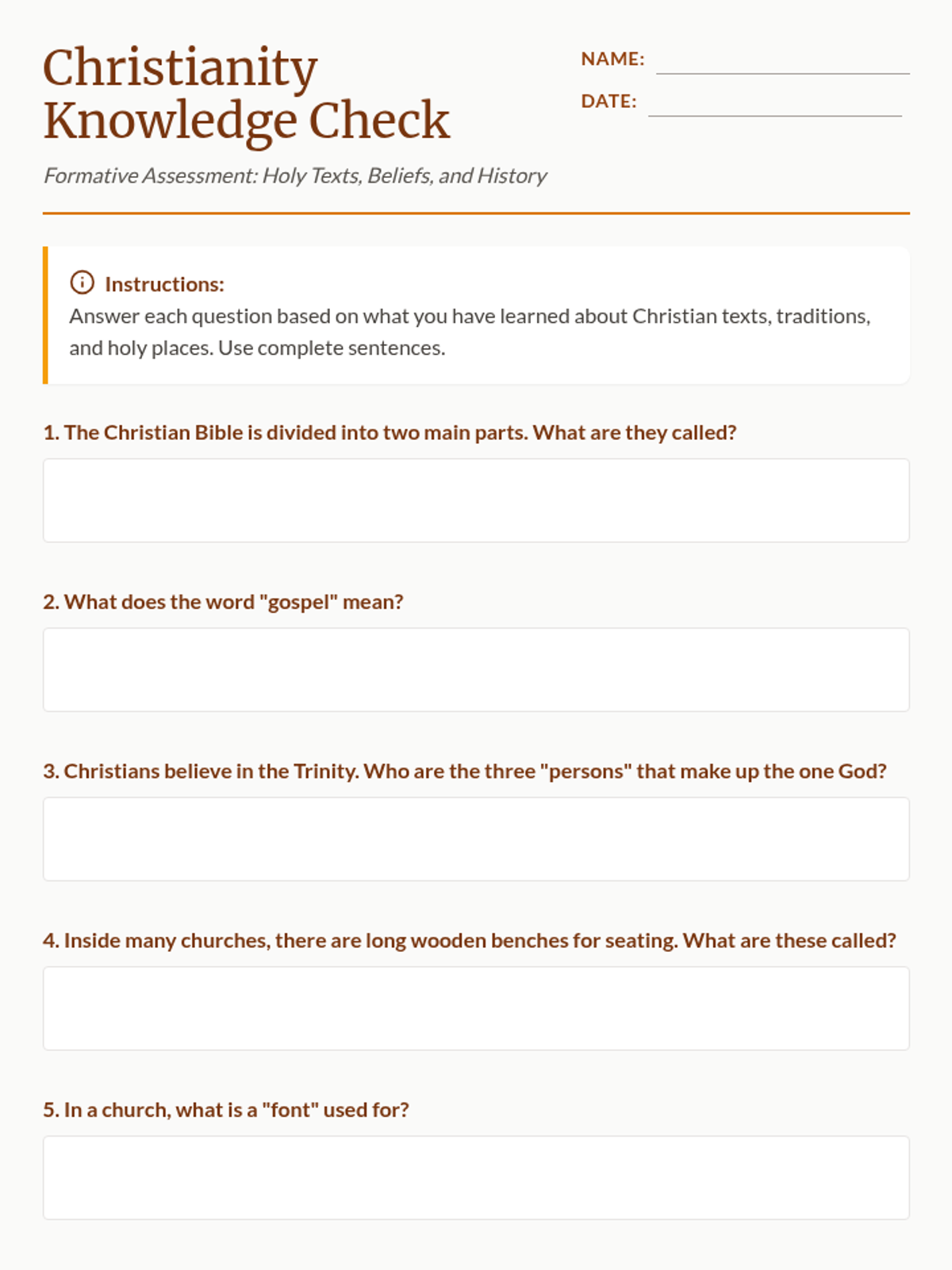
A revised 15-question formative assessment worksheet on Christianity, with question 2 updated to ask for the meaning of the word 'gospel'.
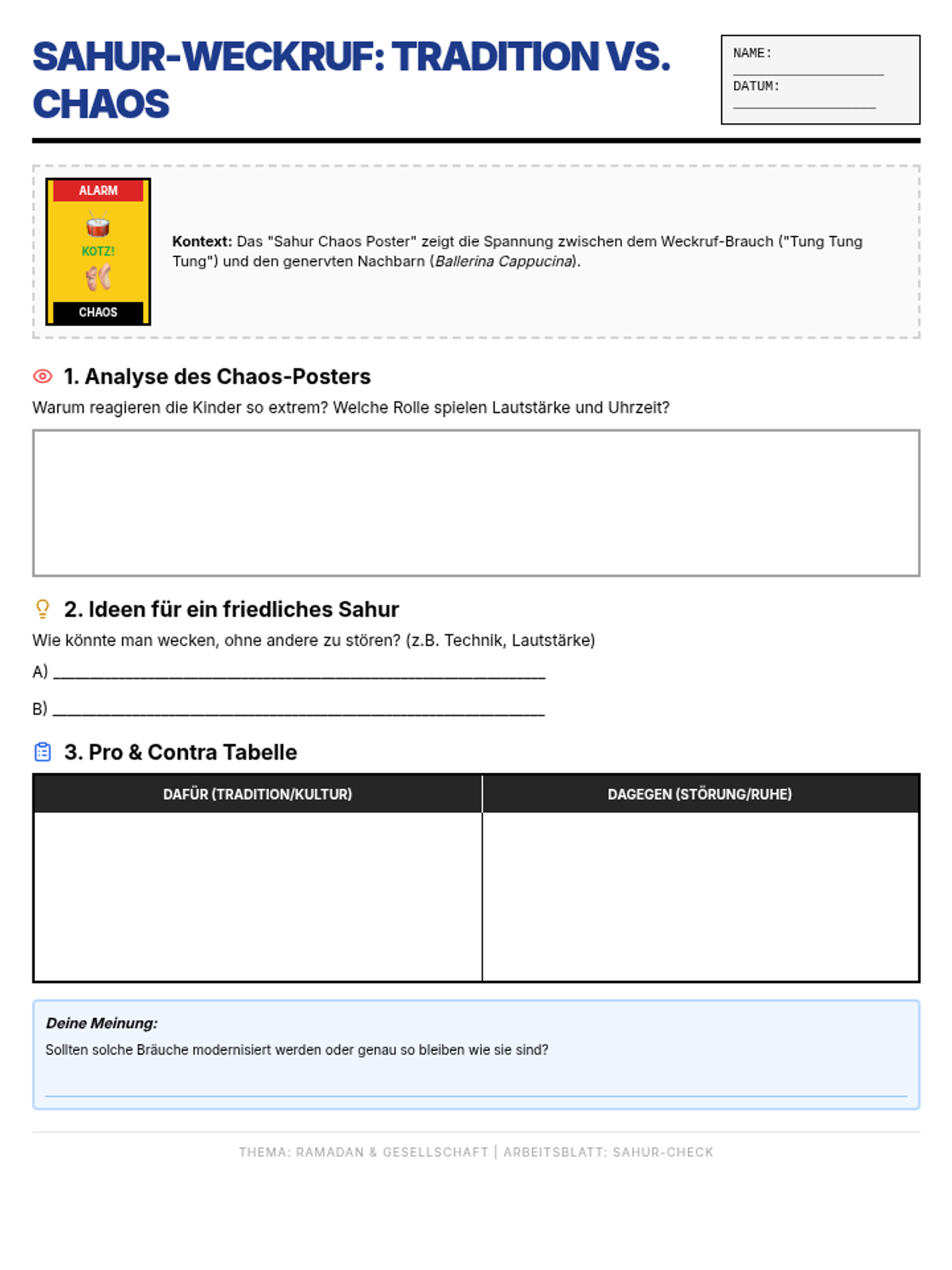
Ein Arbeitsblatt, das die kulturelle Praxis des Sahur-Weckrufs erklärt und die Schüler dazu anregt, über die Auswirkungen von Lautstärke und Tradition auf die Mitmenschen nachzudenken.
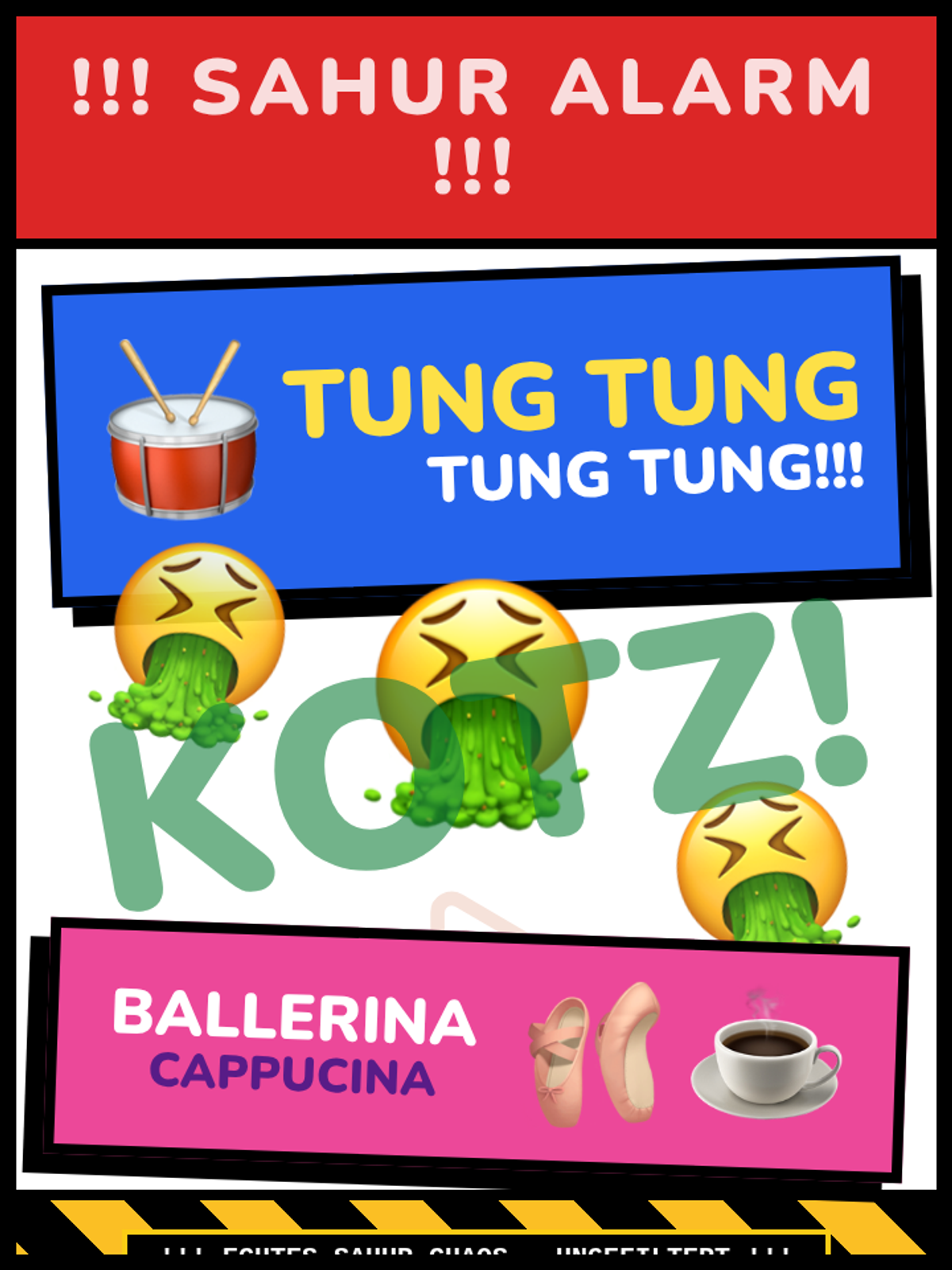
Ein absichtlich chaotisch gestaltetes Poster im "hässlichen" Stil, das eine humorvolle (und etwas eklige) Szene zwischen einem Sahur-Trommler und Ballerina-Kindern darstellt. Es dient als provokanter Einstieg in das Thema Ramadan-Traditionen.
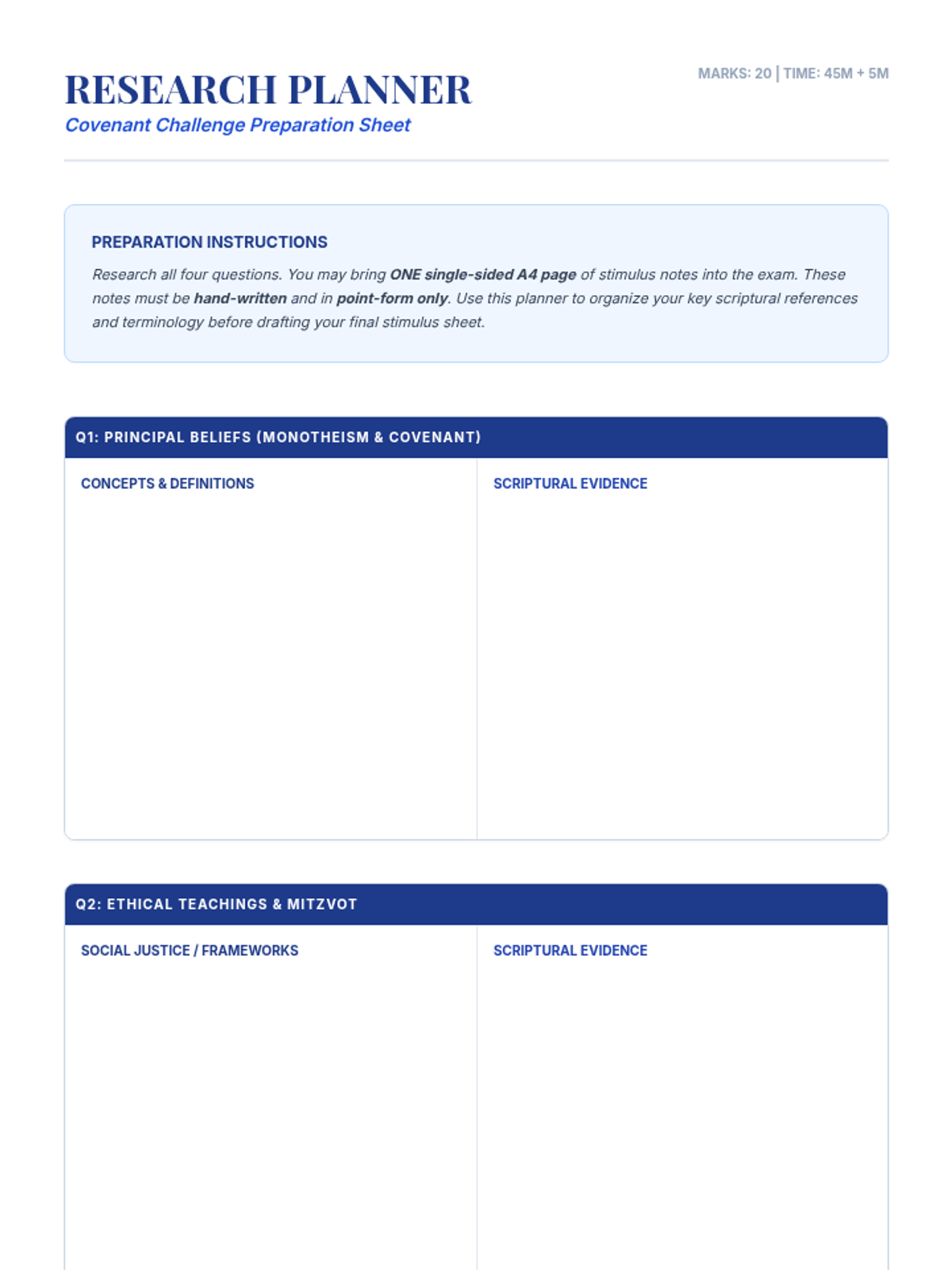
A research planner helping students organize findings for all four potential essay questions. Updated to include all questions and larger work areas.
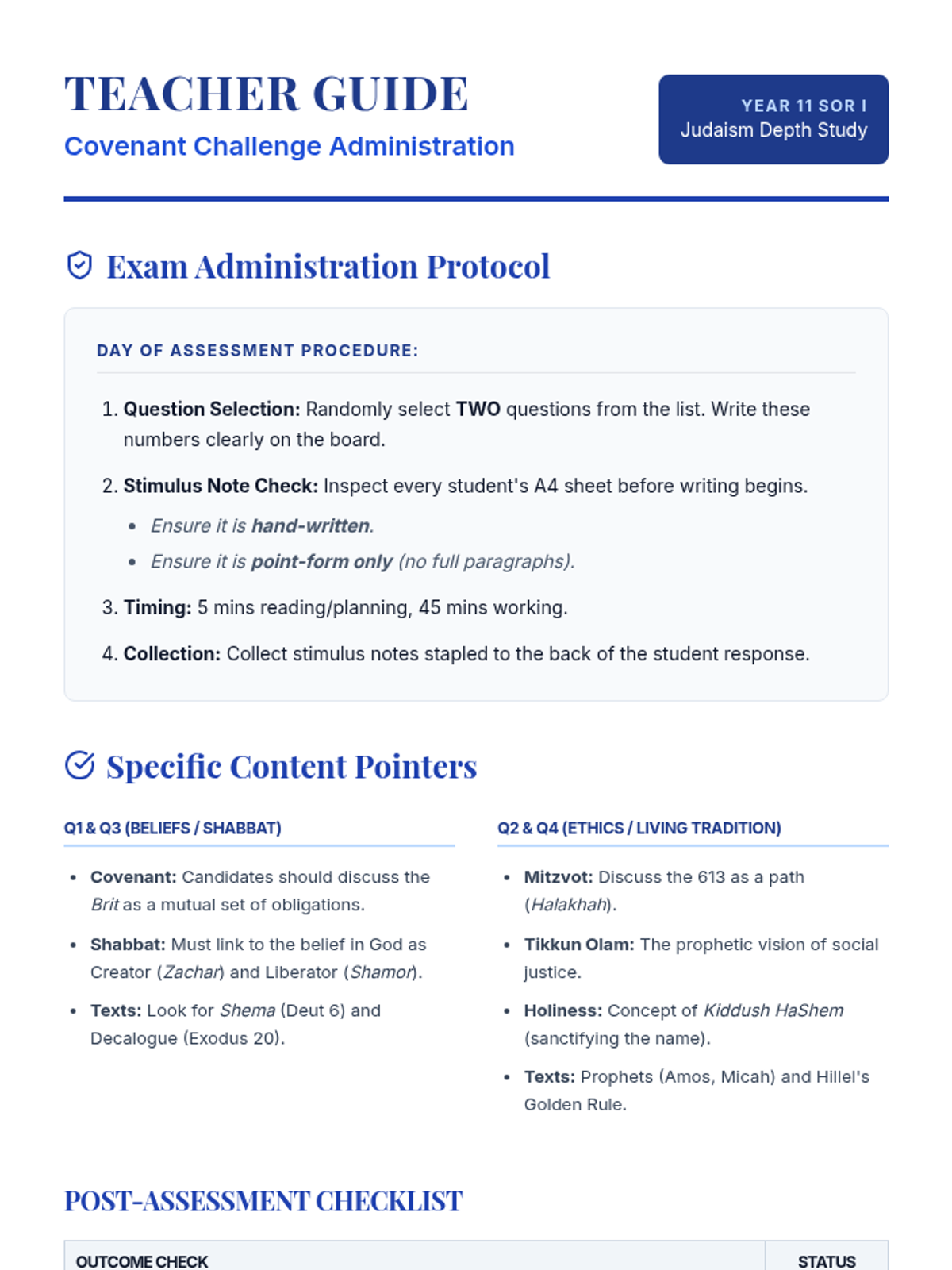
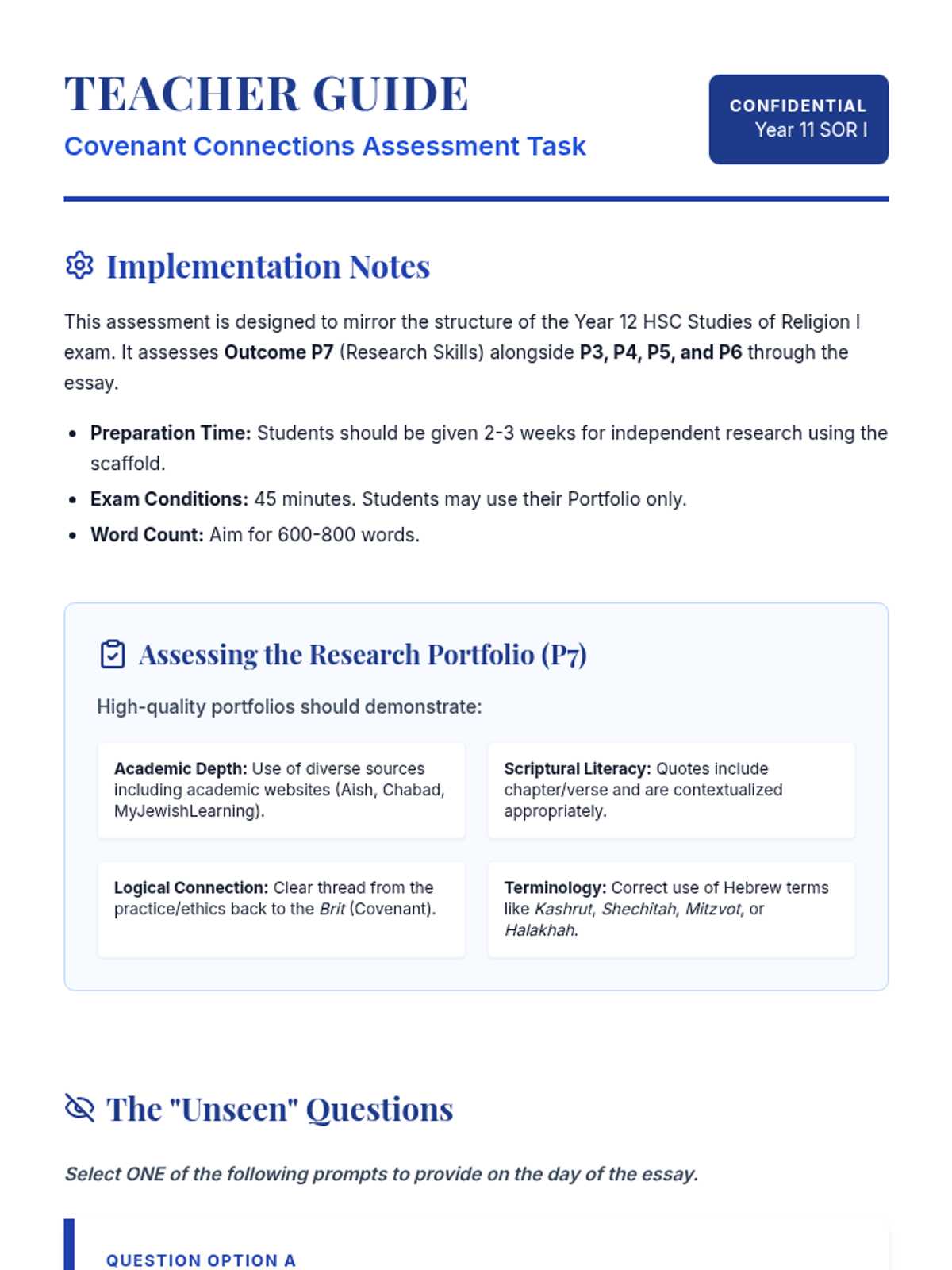
Administrative guide for teachers, detailing the question selection process, the protocol for checking stimulus notes, and marking pointers. Fixed page breaks and checkboxes.
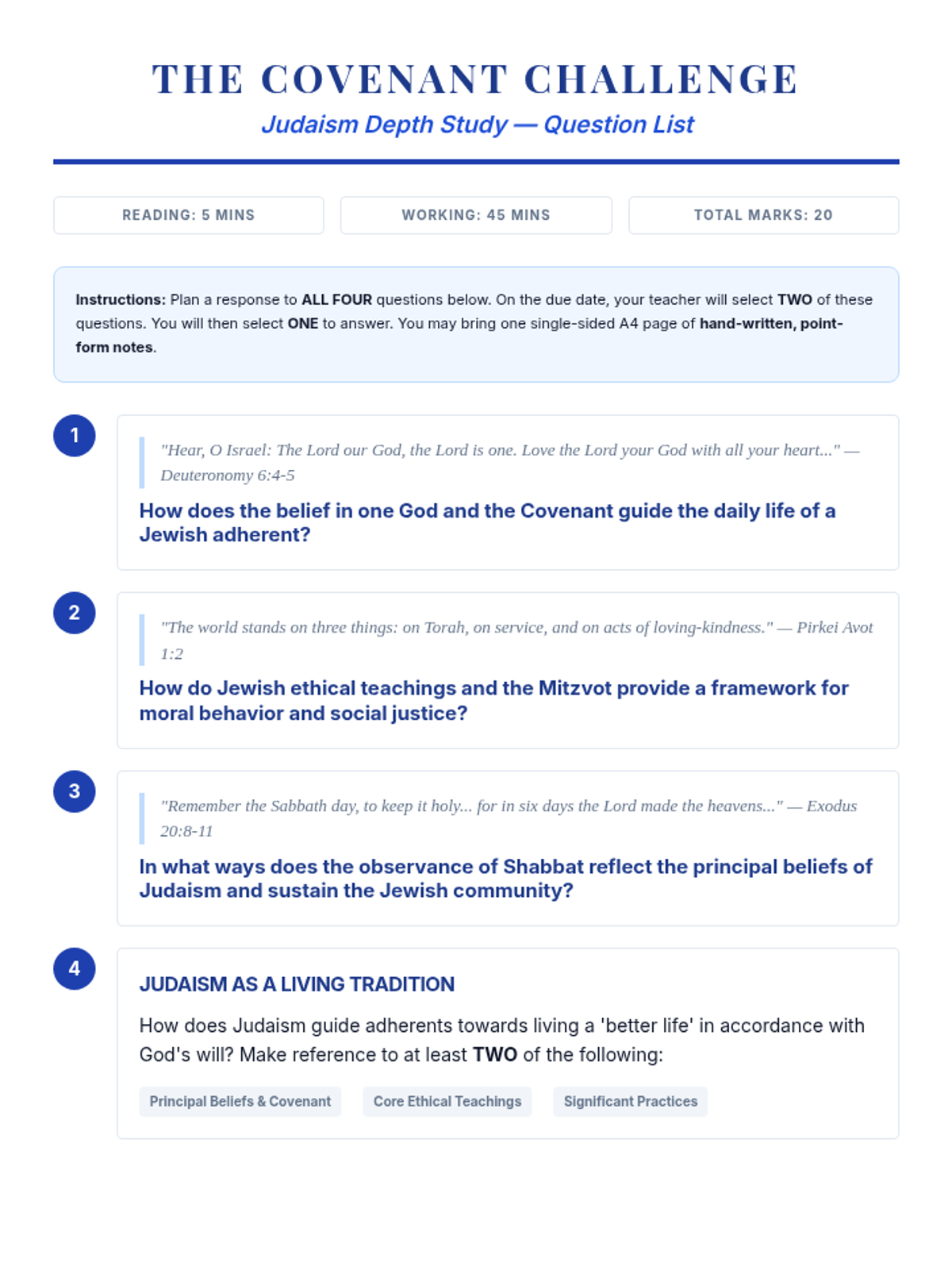
The list of four prepared essay questions for the Judaism Depth Study, compressed to fit a single page with all administrative details.
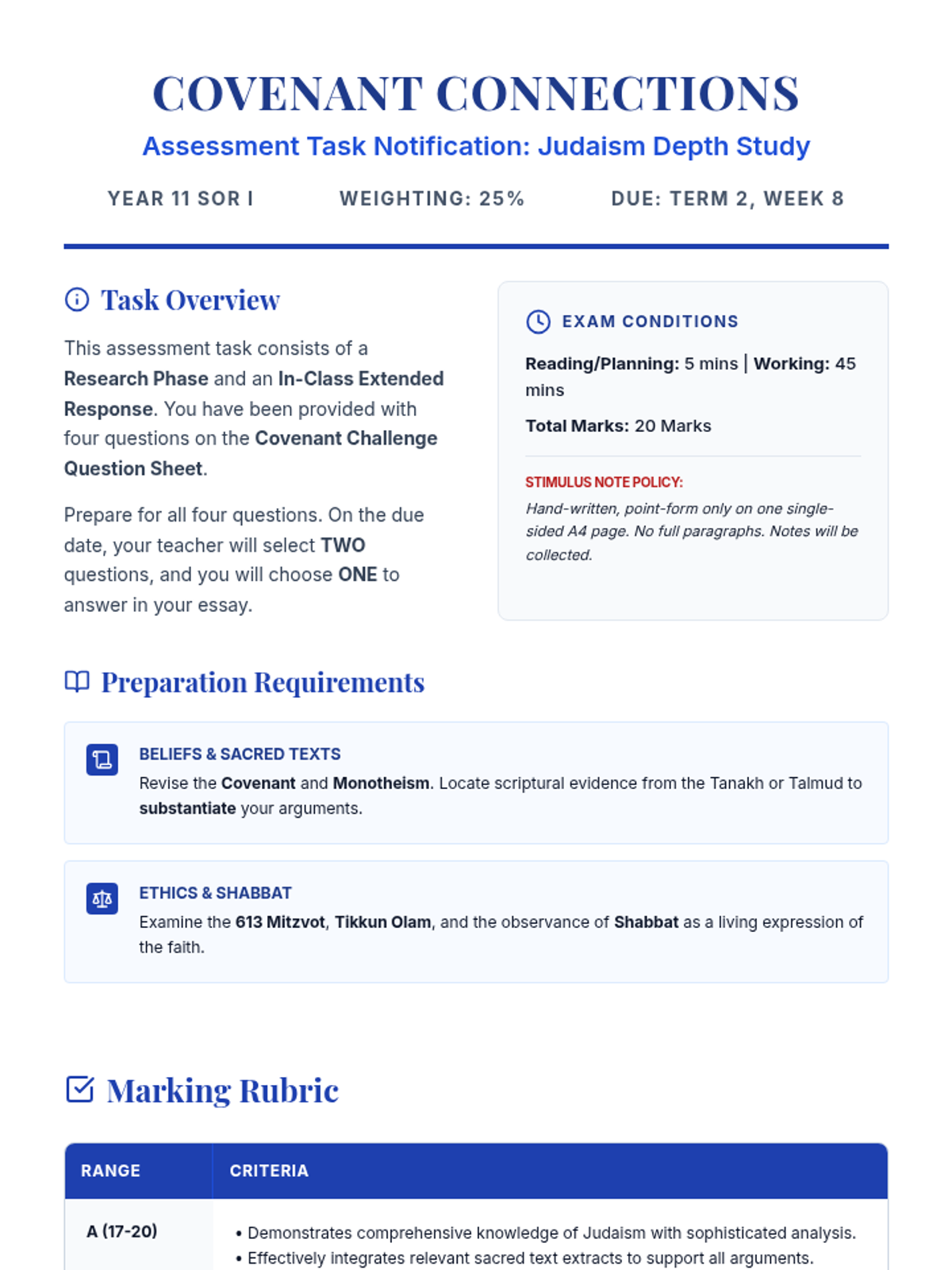
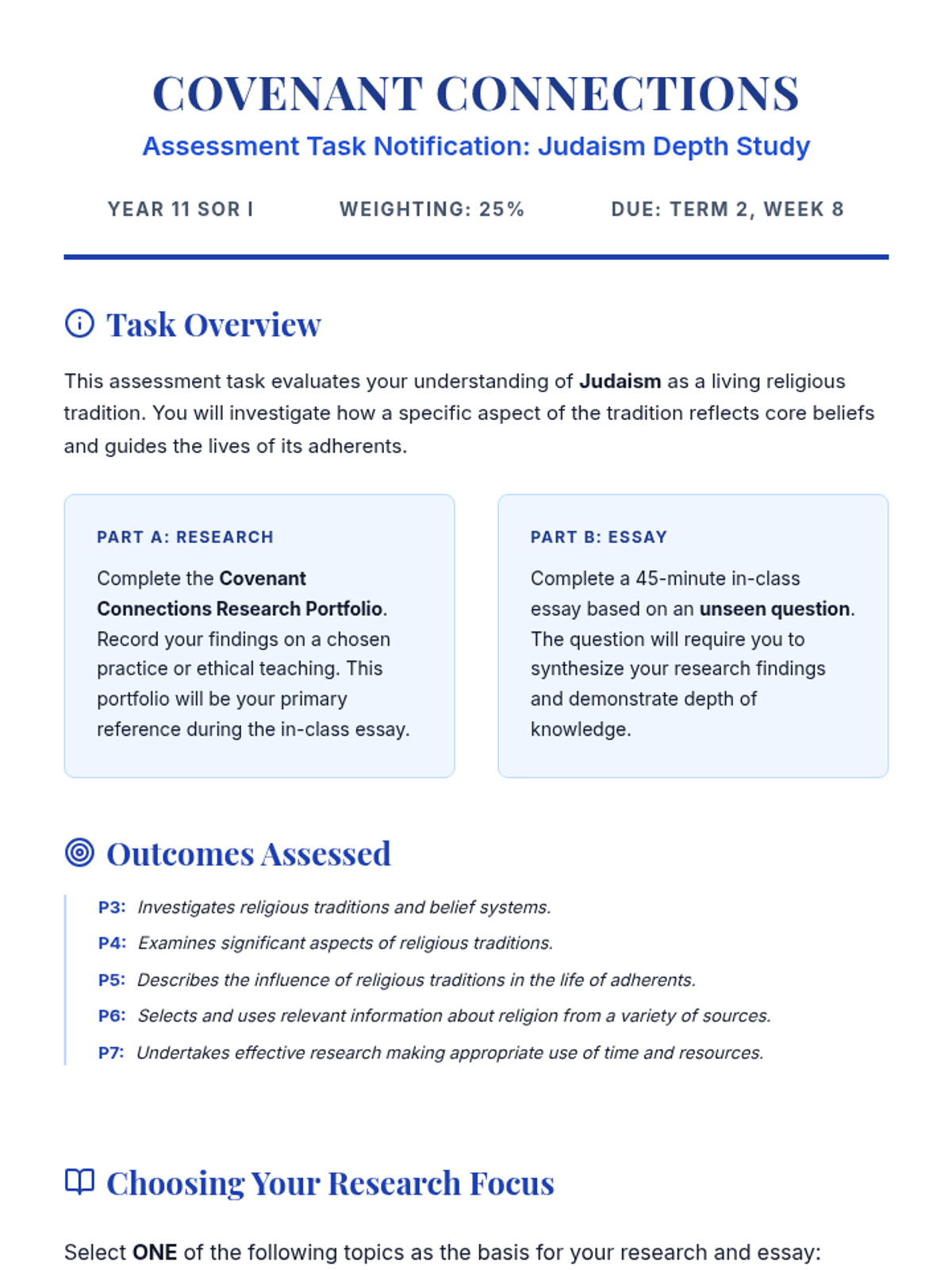
Official assessment notification for the Year 11 Judaism Depth Study, mirroring the Christianity research and in-class essay structure. Includes stimulus note policy and syllabus outcomes. Updated with better layout and text clarity.
A comprehensive teacher's guide updated with Dietary Laws (Kashrut) and Commandments of the Torah (Mitzvot) sample response pointers. Improved layout to prevent orphaned questions.
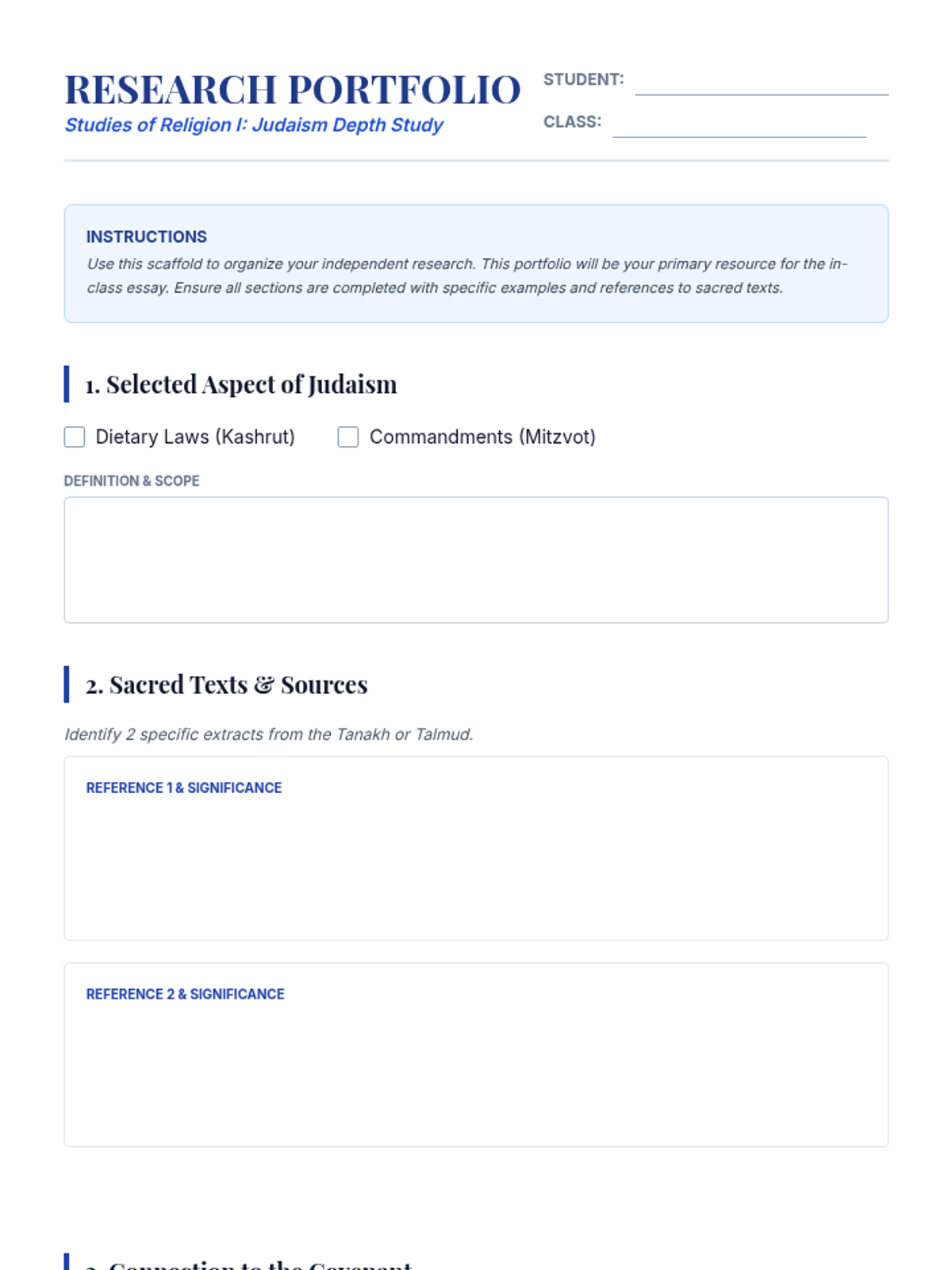
A structured research scaffold for students to organize their findings on Dietary Laws or Mitzvot in preparation for the in-class essay. Improved layout and larger work areas.
Official assessment notification for the Year 11 Judaism Depth Study, detailing task requirements, outcomes, and a marking rubric. Updated with Dietary Laws and Commandments topics and improved layout to ensure rubric clarity.
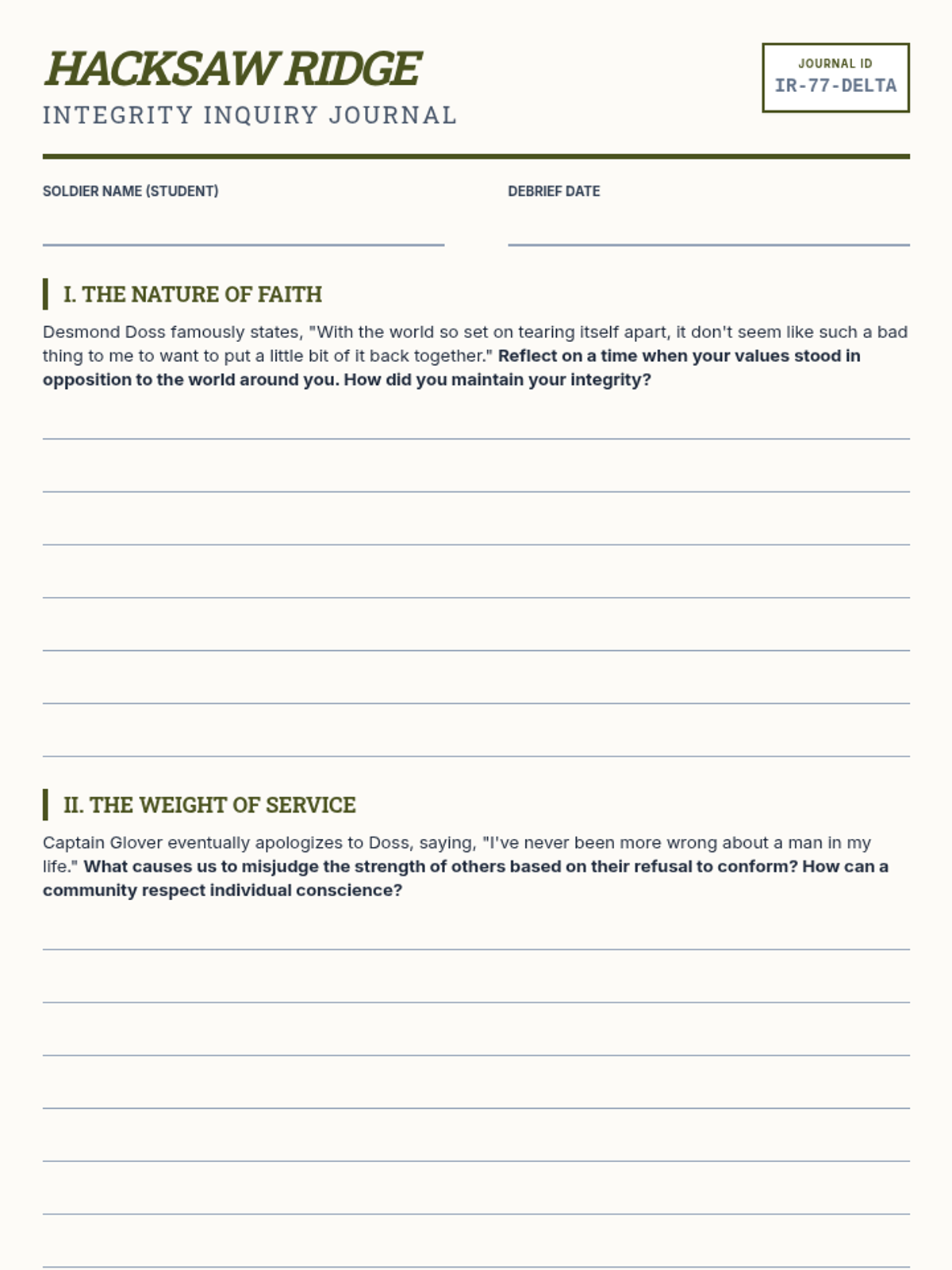
An open-ended reflection journal with four deep, philosophical prompts centered on integrity, faith, and the nature of heroism as depicted in Hacksaw Ridge.
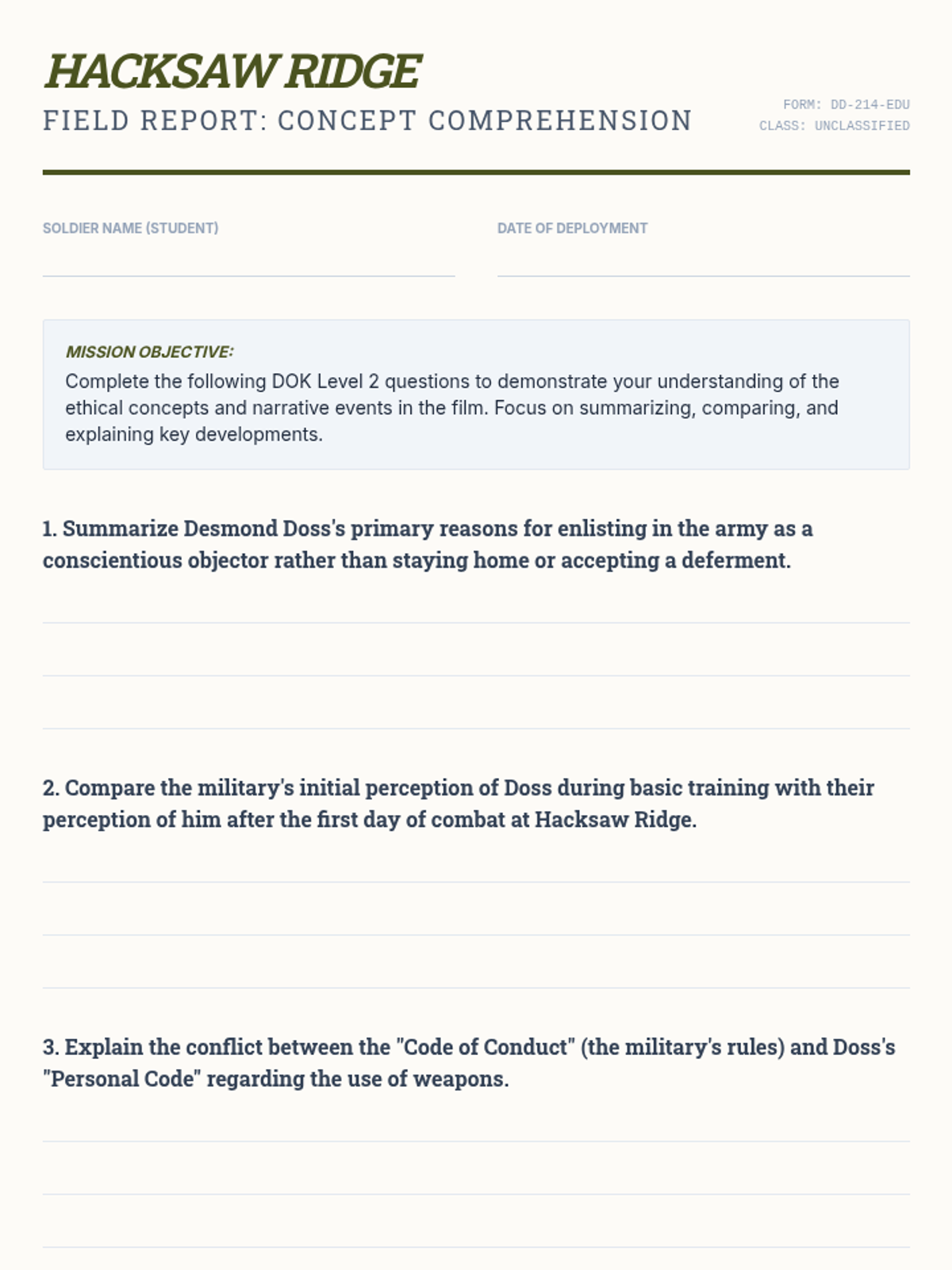
A student-facing worksheet featuring five DOK Level 2 comprehension questions about Hacksaw Ridge, focusing on summarization, comparison, and explanation of key themes and plot points.
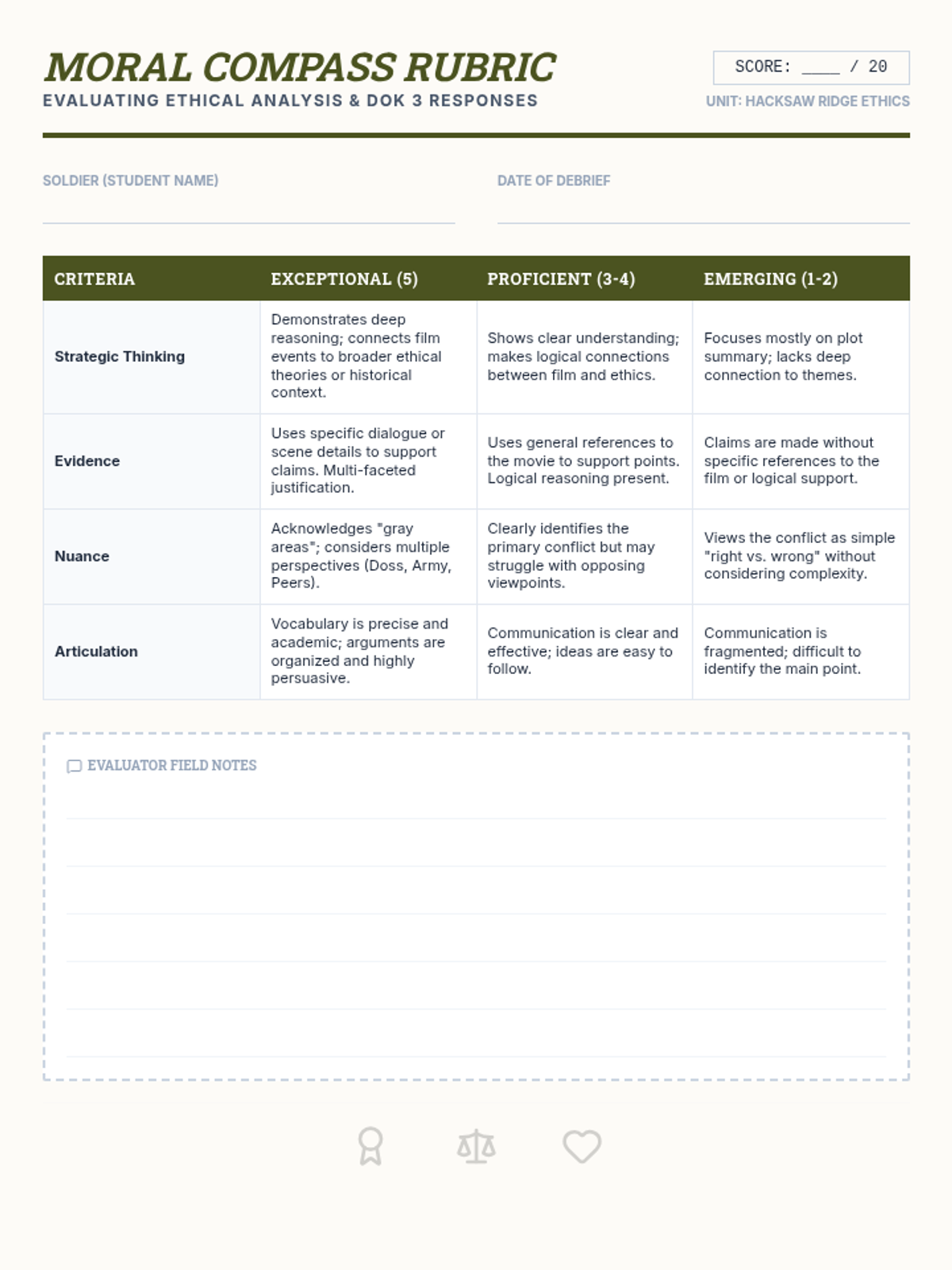
A clear and professional rubric for evaluating student responses or participation in discussions about the ethics of Hacksaw Ridge, designed with a military dossier aesthetic.
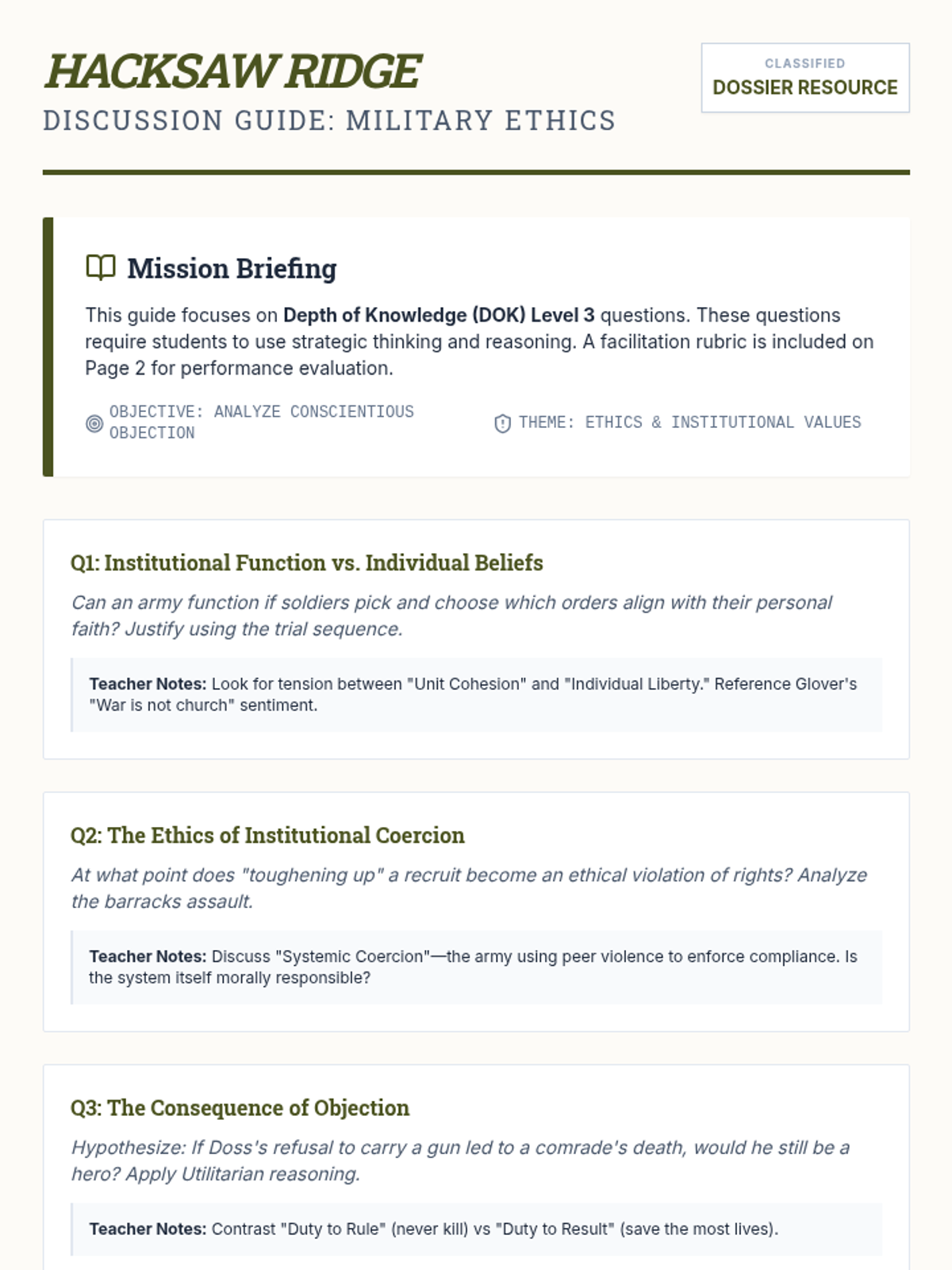
A teacher facilitation guide containing five high-level DOK 3 discussion questions regarding the ethics and conscientious objection themes in Hacksaw Ridge, complete with teacher notes and talking points.
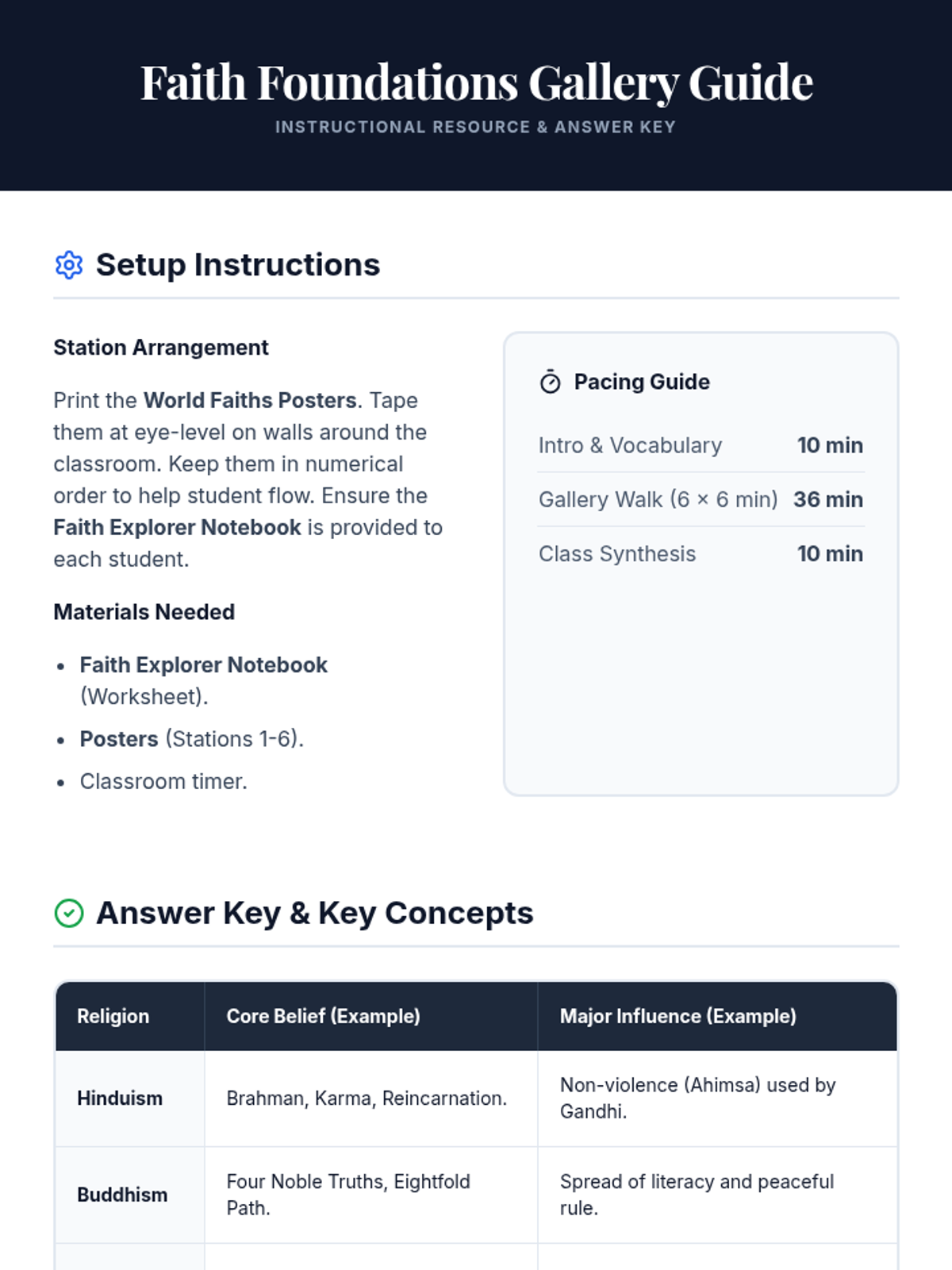
A teacher resource guide with setup instructions, rotation pacing, an answer key, and discussion prompts for the Faith Foundations gallery walk. Formatted for clarity and easy reading.
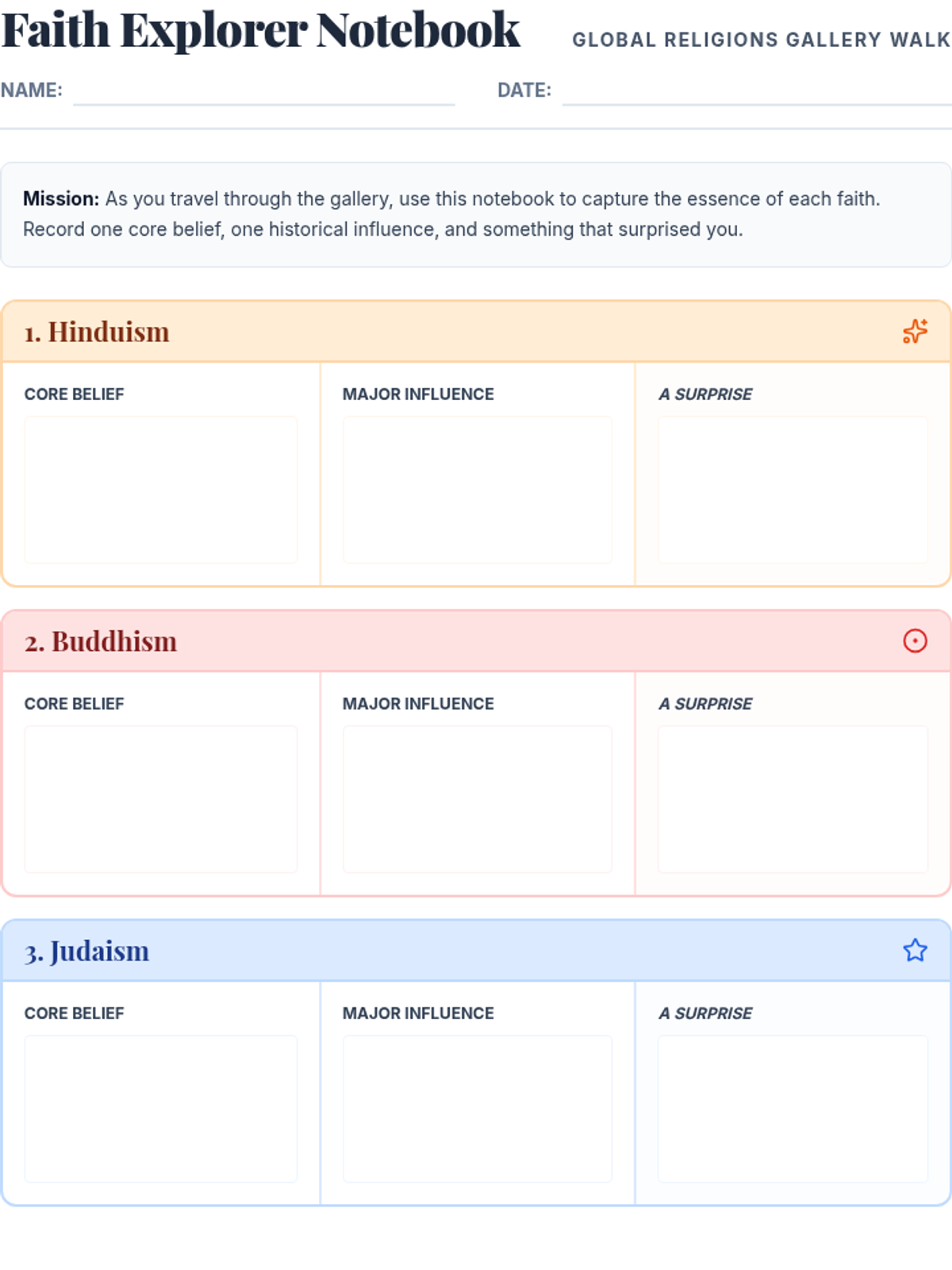
A guided reflection worksheet for students to use during the gallery walk, with dedicated sections for beliefs, influences, and surprises for each religion. Space has been increased to allow for comfortable handwriting.
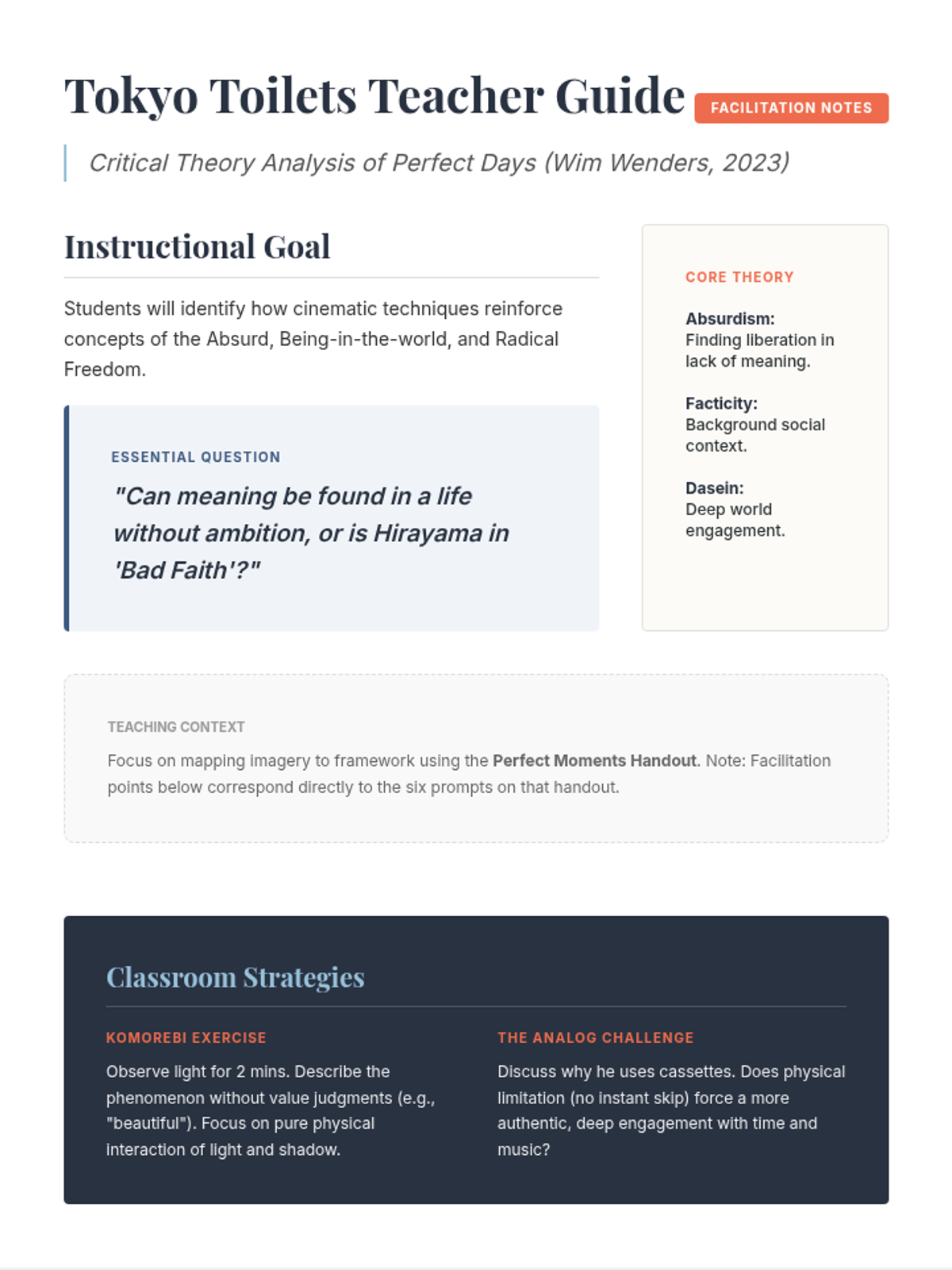
A comprehensive teacher facilitation guide for 'Perfect Days' featuring theoretical background, expected student responses, and instructional strategies for teaching existentialism through cinema.
A visually sophisticated presentation deck for analyzing 'Perfect Days' through existentialist lenses. Features key concepts from Camus, Sartre, and Heidegger with integrated film stills (placeholders) and discussion prompts.
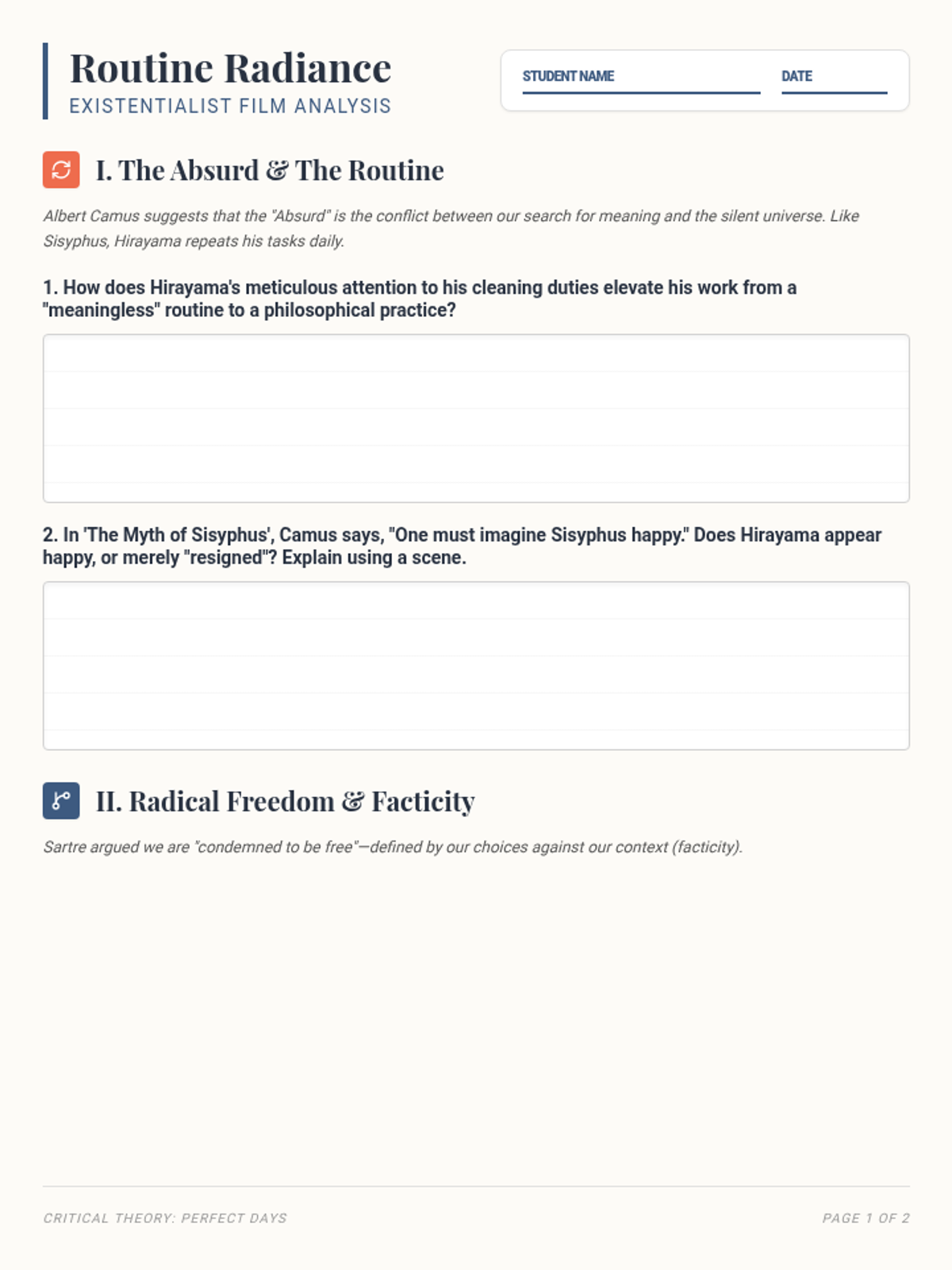
A structured student handout featuring discussion questions that analyze the film 'Perfect Days' through Camus's Absurdism, Sartre's Radical Freedom, and Heidegger's Being-in-the-World. Includes spacious response areas for critical writing.
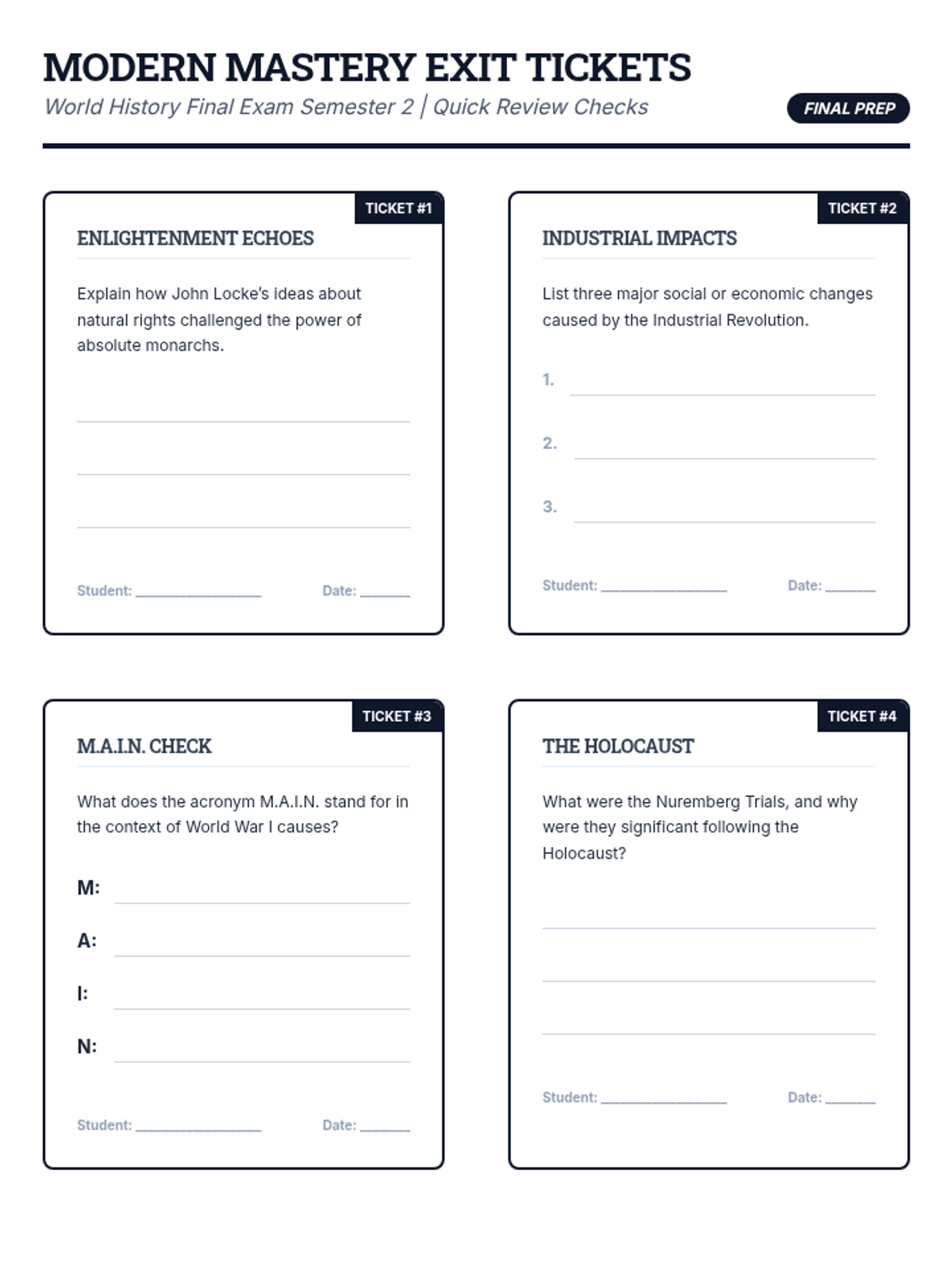
A collection of five different exit tickets designed for quick checks for understanding on core topics like the Enlightenment, Industry, World Wars, and the Cold War.
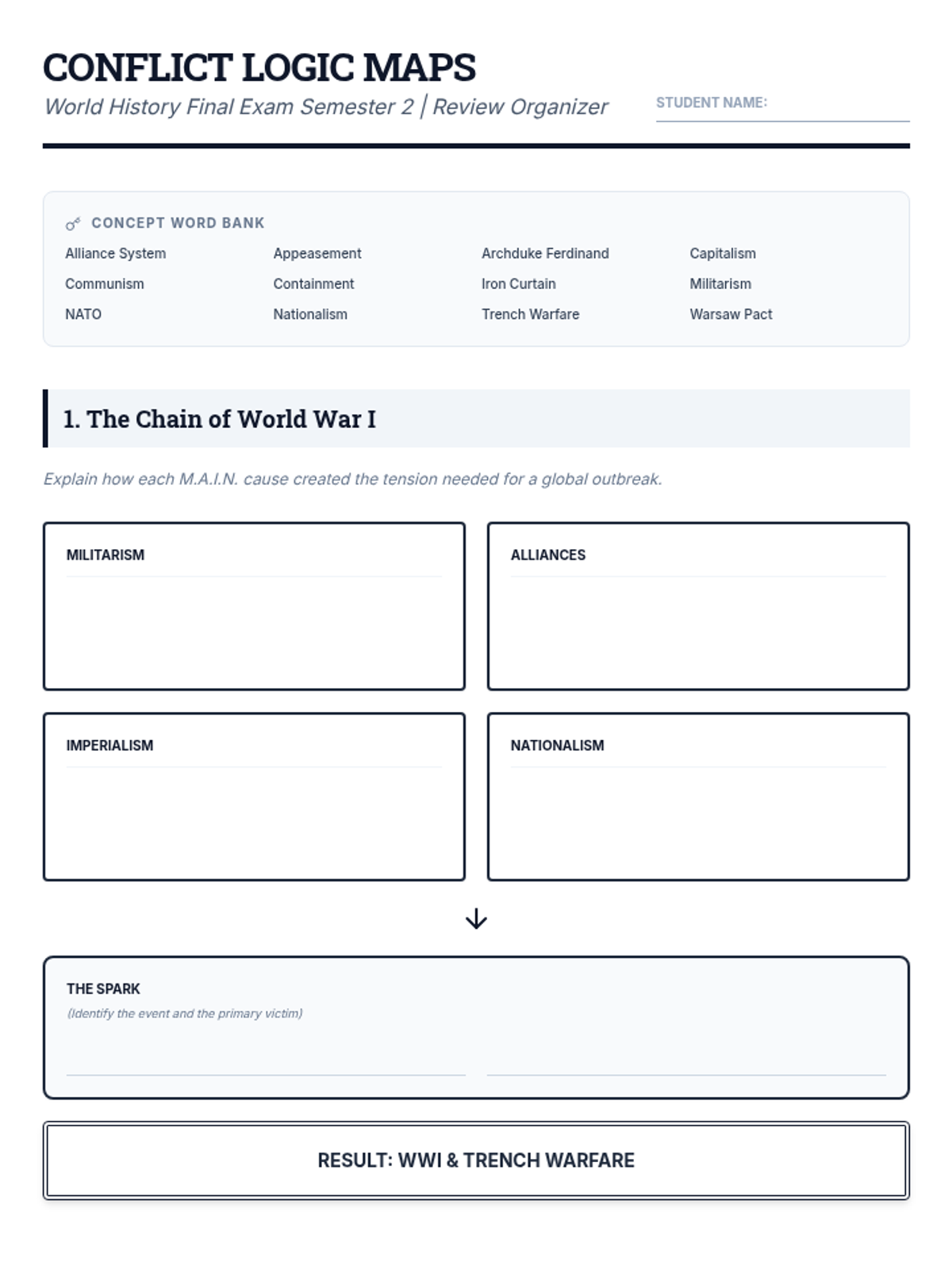
A set of visual logic maps and flowcharts for students to review the causes of World War I and the ideological divisions of the Cold War.
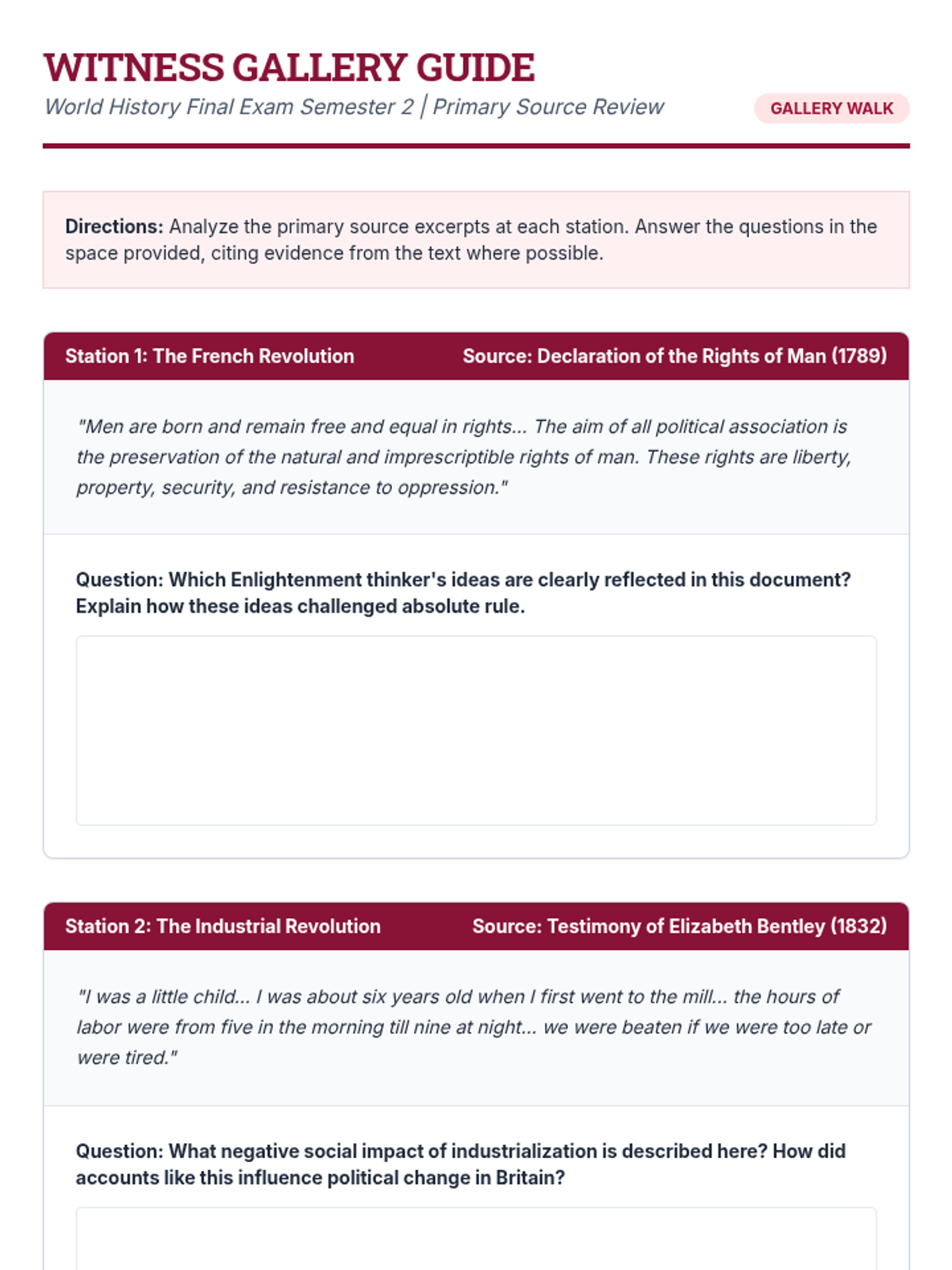
A gallery walk guide with primary source excerpts and analysis questions covering the French Revolution, Industrialization, Imperialism, and the Cold War.
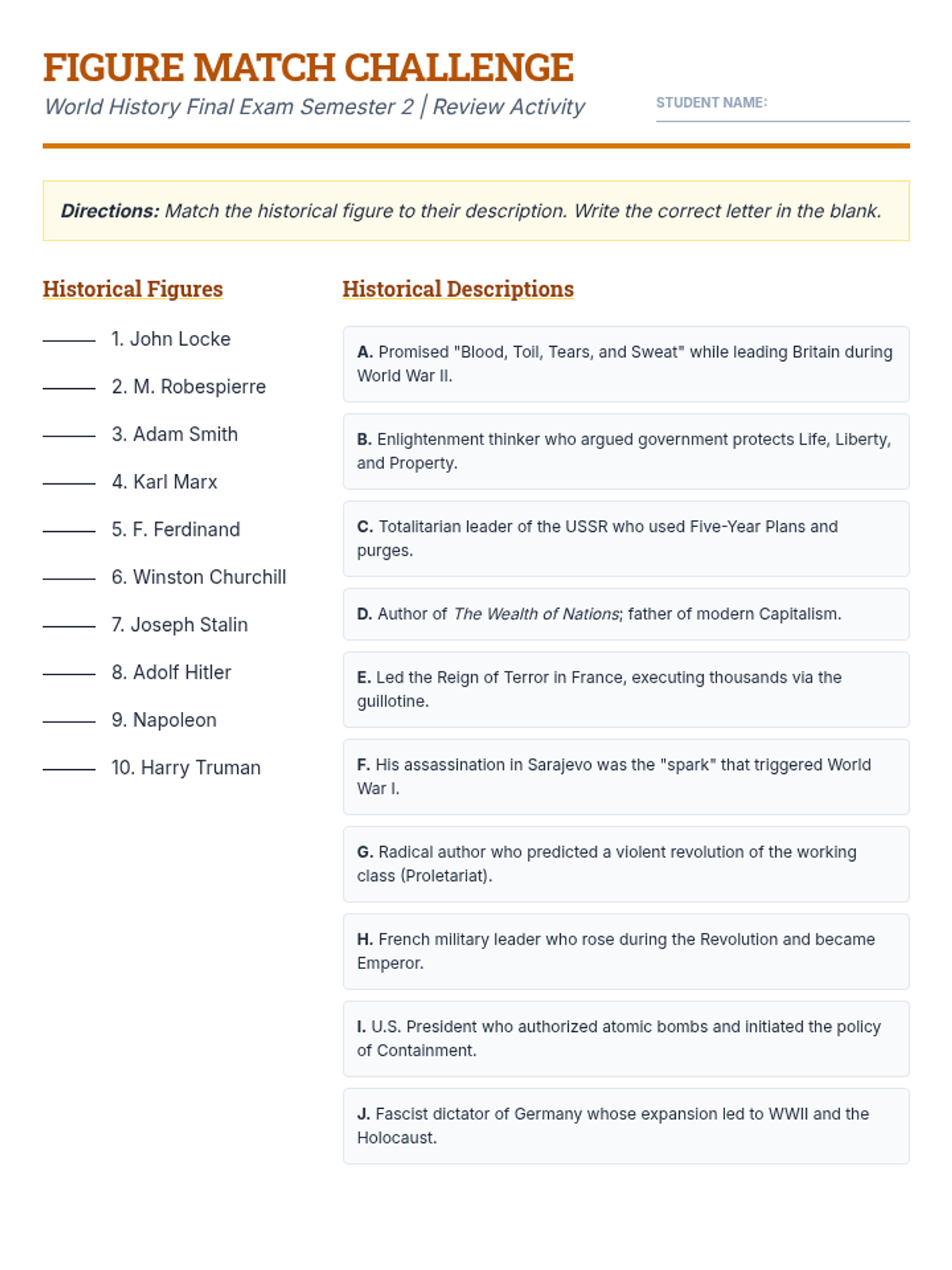
A matching activity focused on the key historical figures from the Enlightenment through the Cold War, testing student knowledge of significant leaders and thinkers.
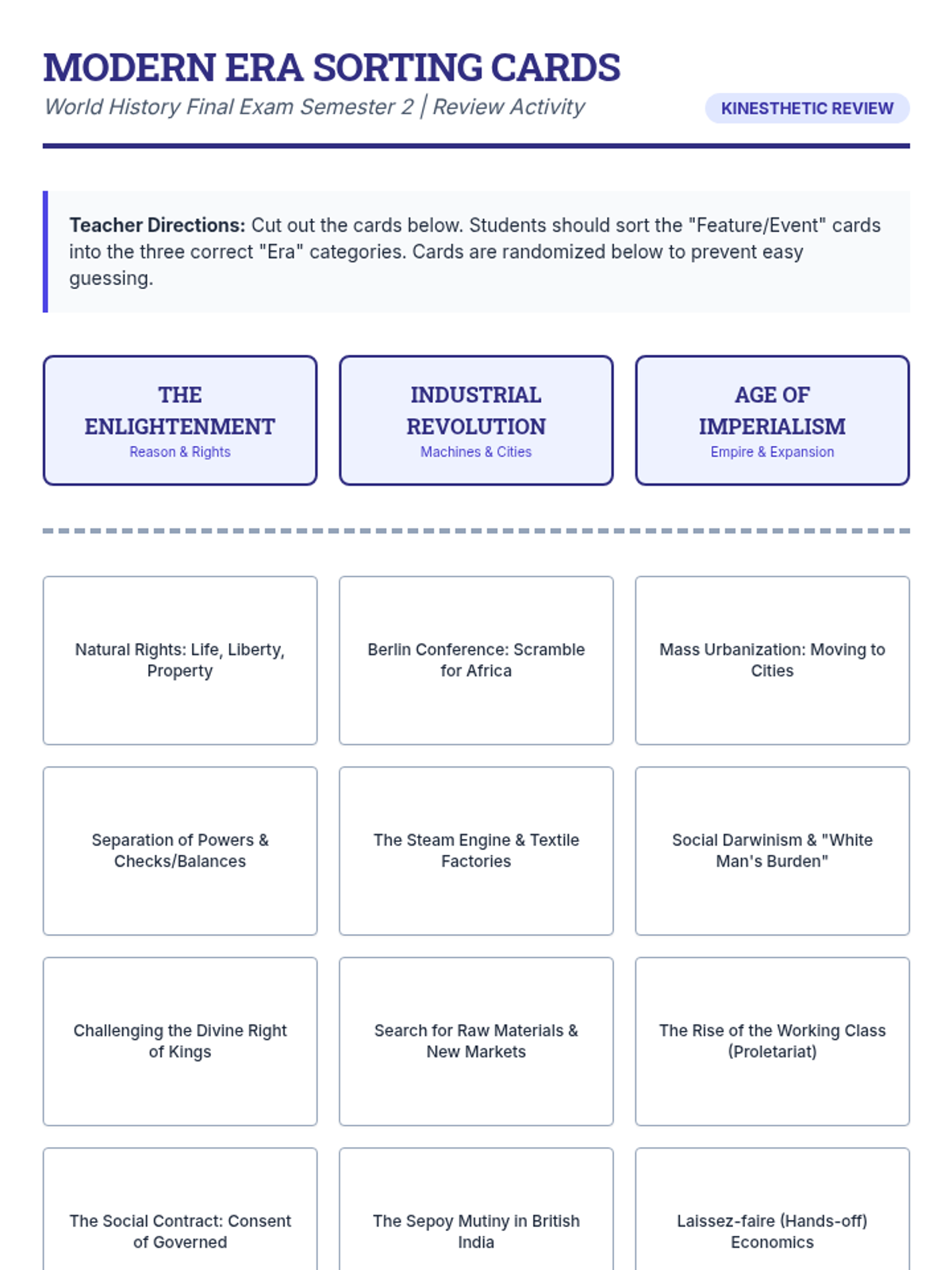
A set of printable sorting cards for reviewing the core concepts of the Enlightenment, Industrial Revolution, and Age of Imperialism with 18 randomized challenge cards.
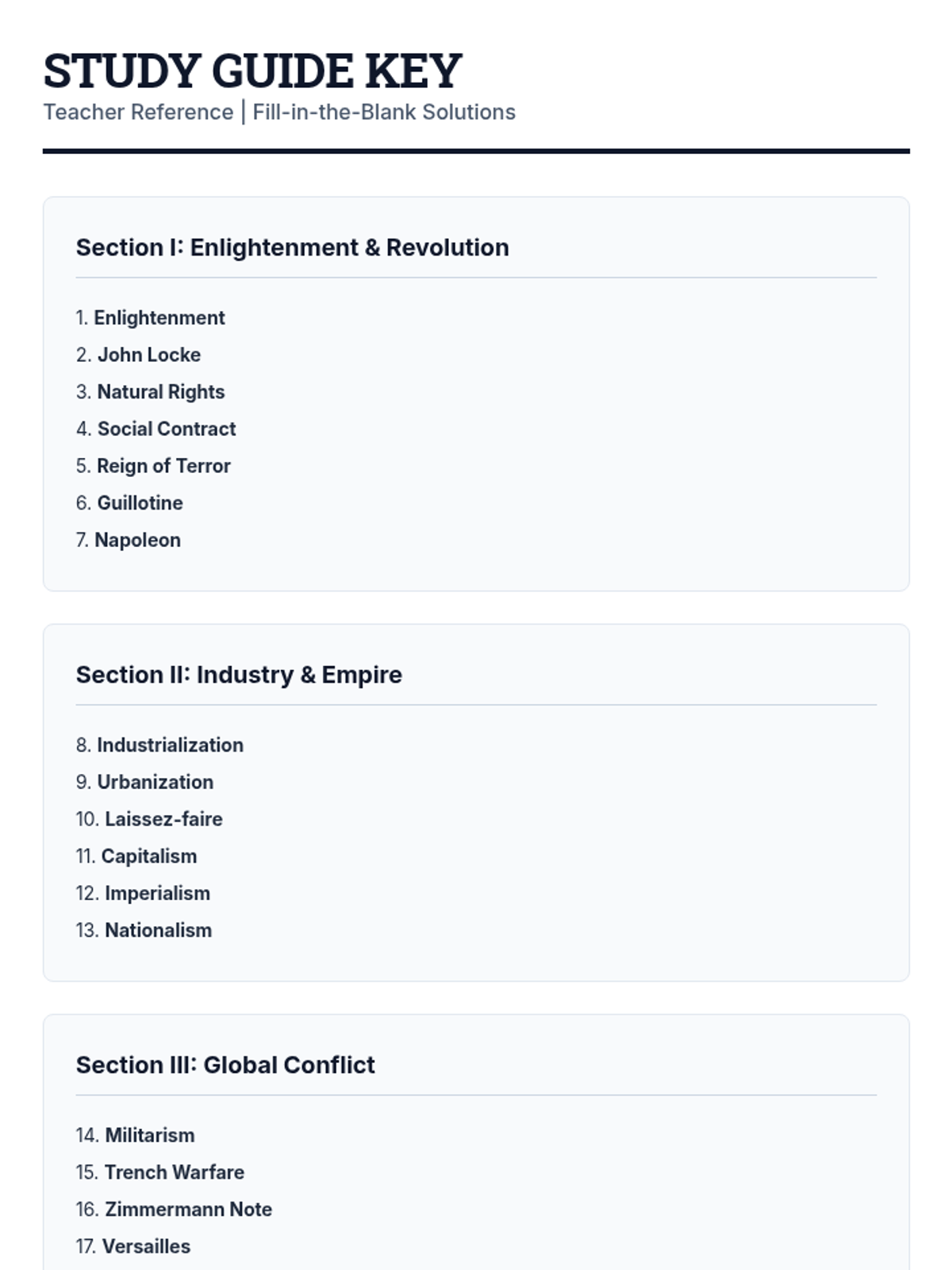
Answer key for the Modern Era Study Guide student fill-in-the-blank activity.
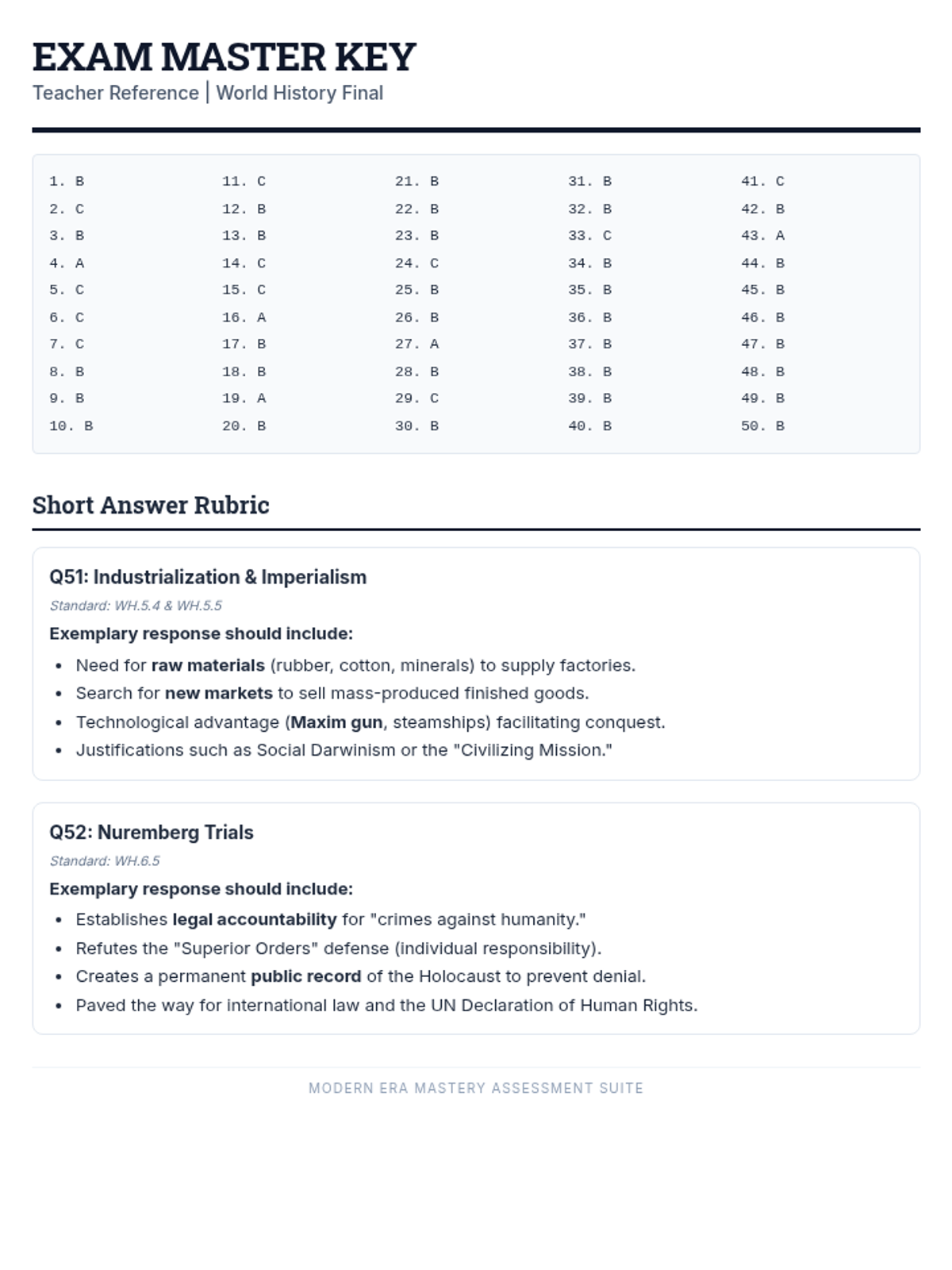
A condensed, single-page teacher answer key and grading rubric for the World History final exam, featuring corrected terminology and a streamlined layout.
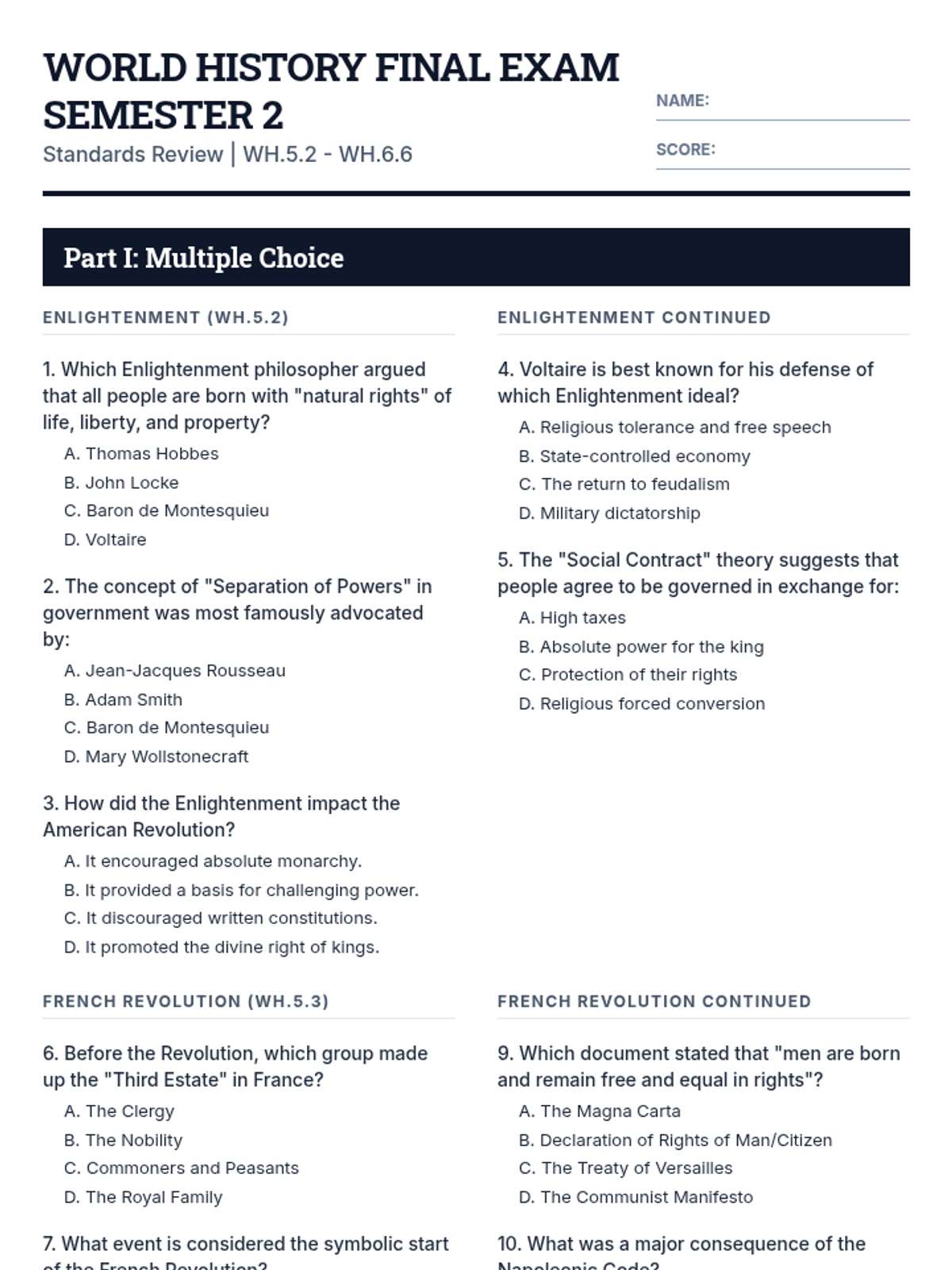
A 50-question multiple-choice final exam for World History Semester 2, including two short-answer questions and improved layout for print efficiency.
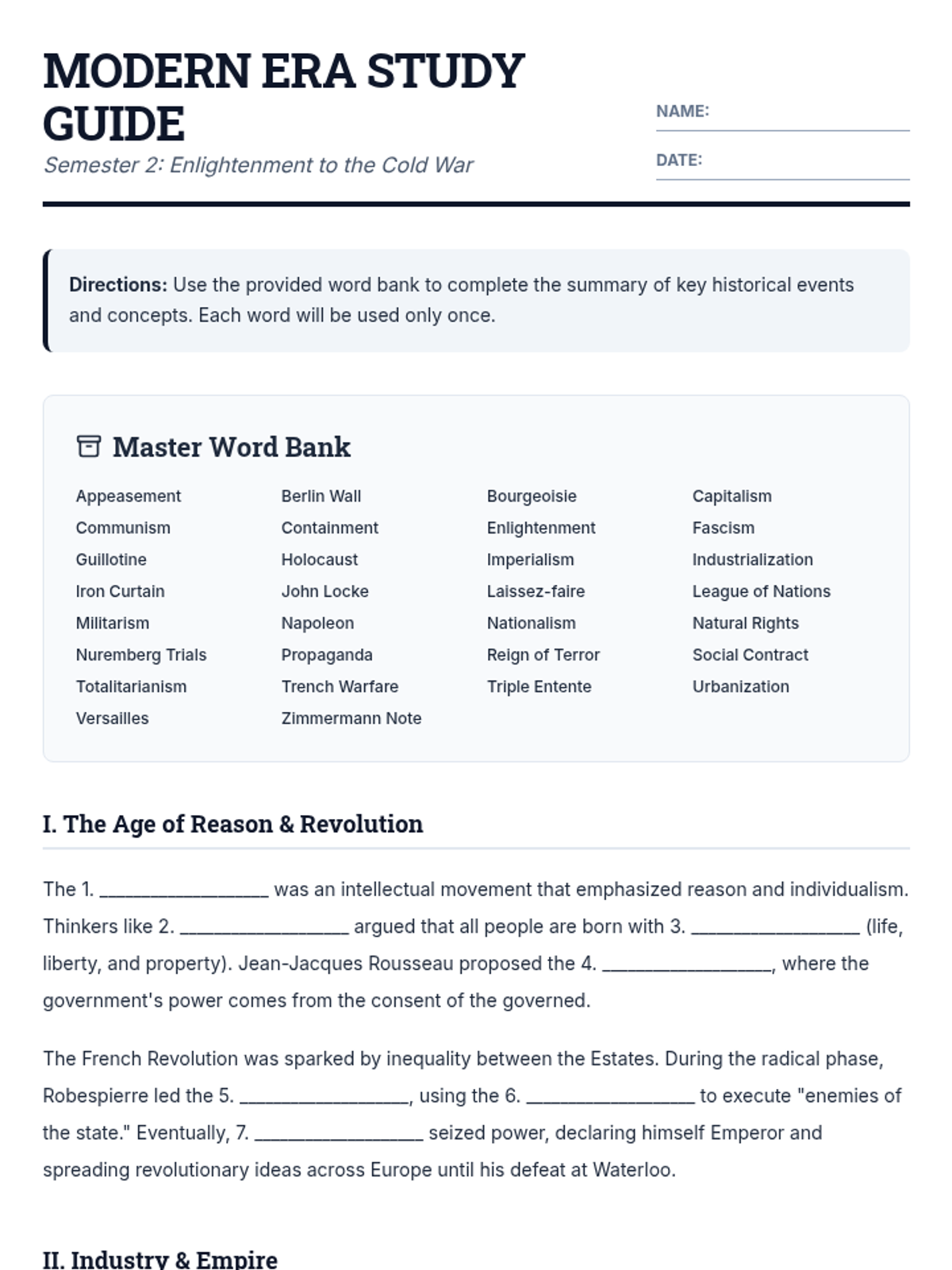
A comprehensive fill-in-the-blank study guide covering Enlightenment, Industrial Revolution, World Wars, and the Cold War with a full word bank for student review.
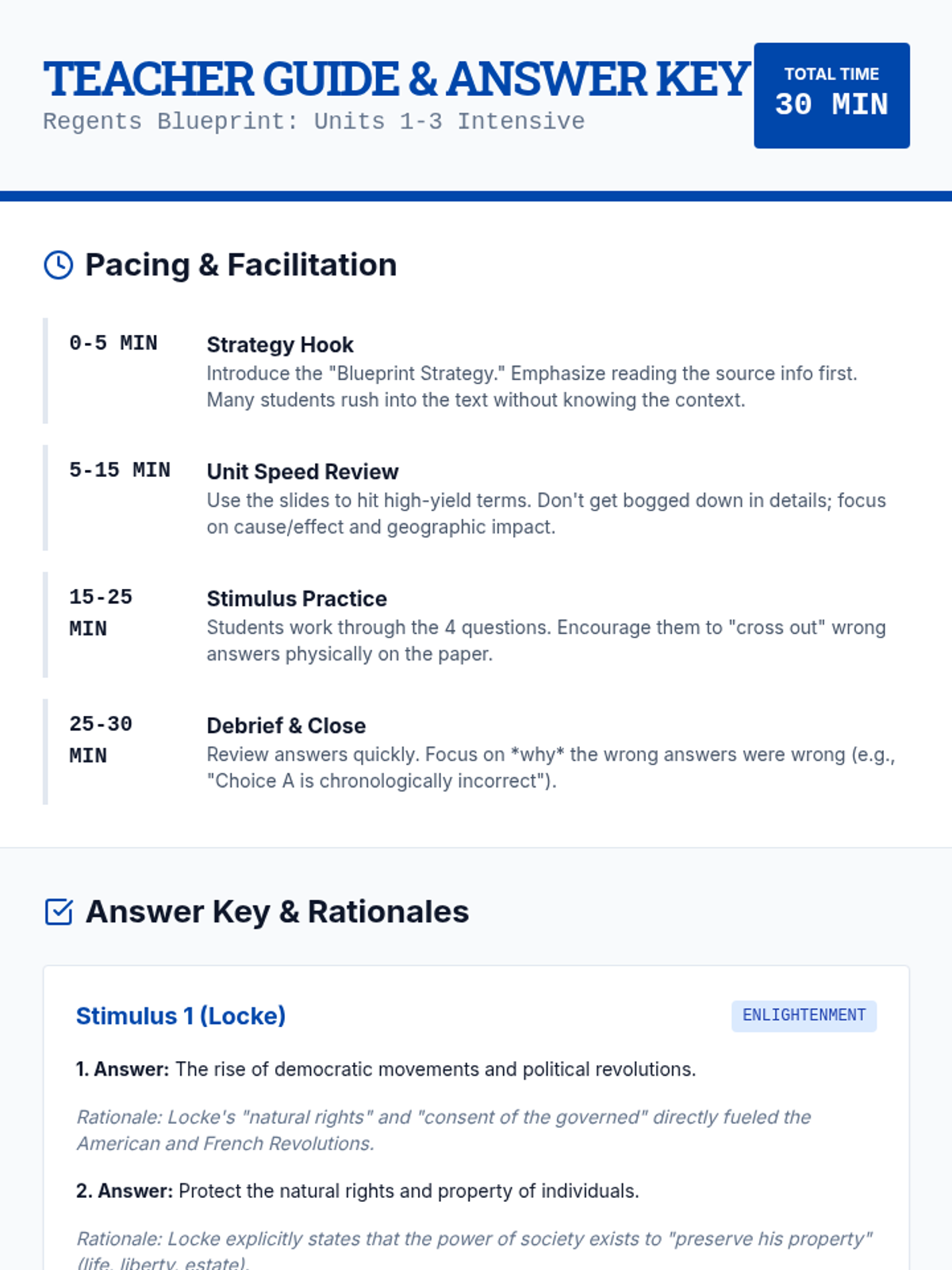
A comprehensive teacher guide for the 30-minute Regents prep session, including a pacing guide, answer key with rationales, and common student misconceptions.
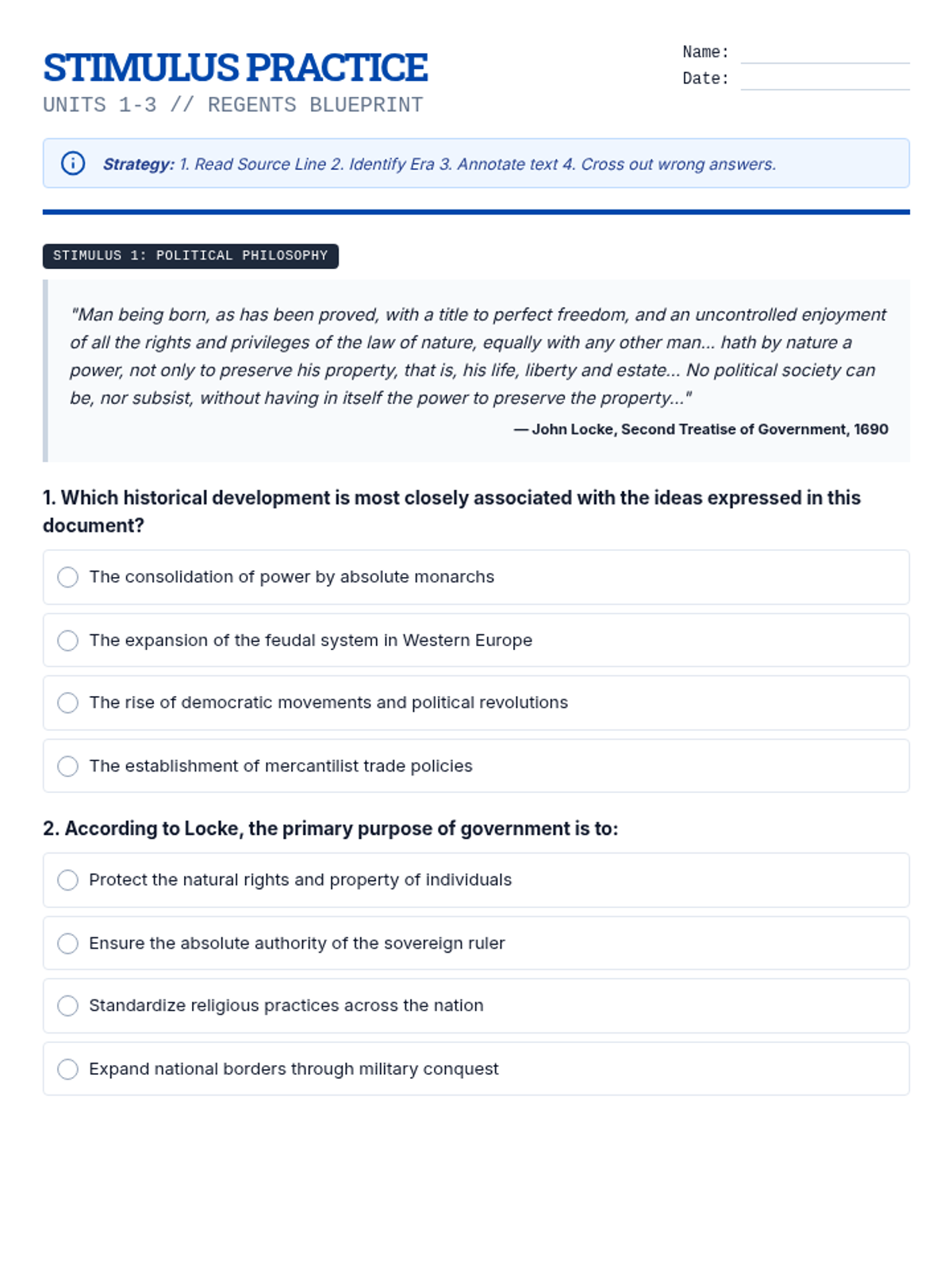
A printable student practice sheet featuring stimulus-based multiple choice questions for Units 1-3. Designed with a clean technical aesthetic and clear student work areas.
A high-energy 30-minute slide deck for Regents review, focusing on test-taking strategies and key concepts for Units 1-3. Features a technical 'blueprint' aesthetic.
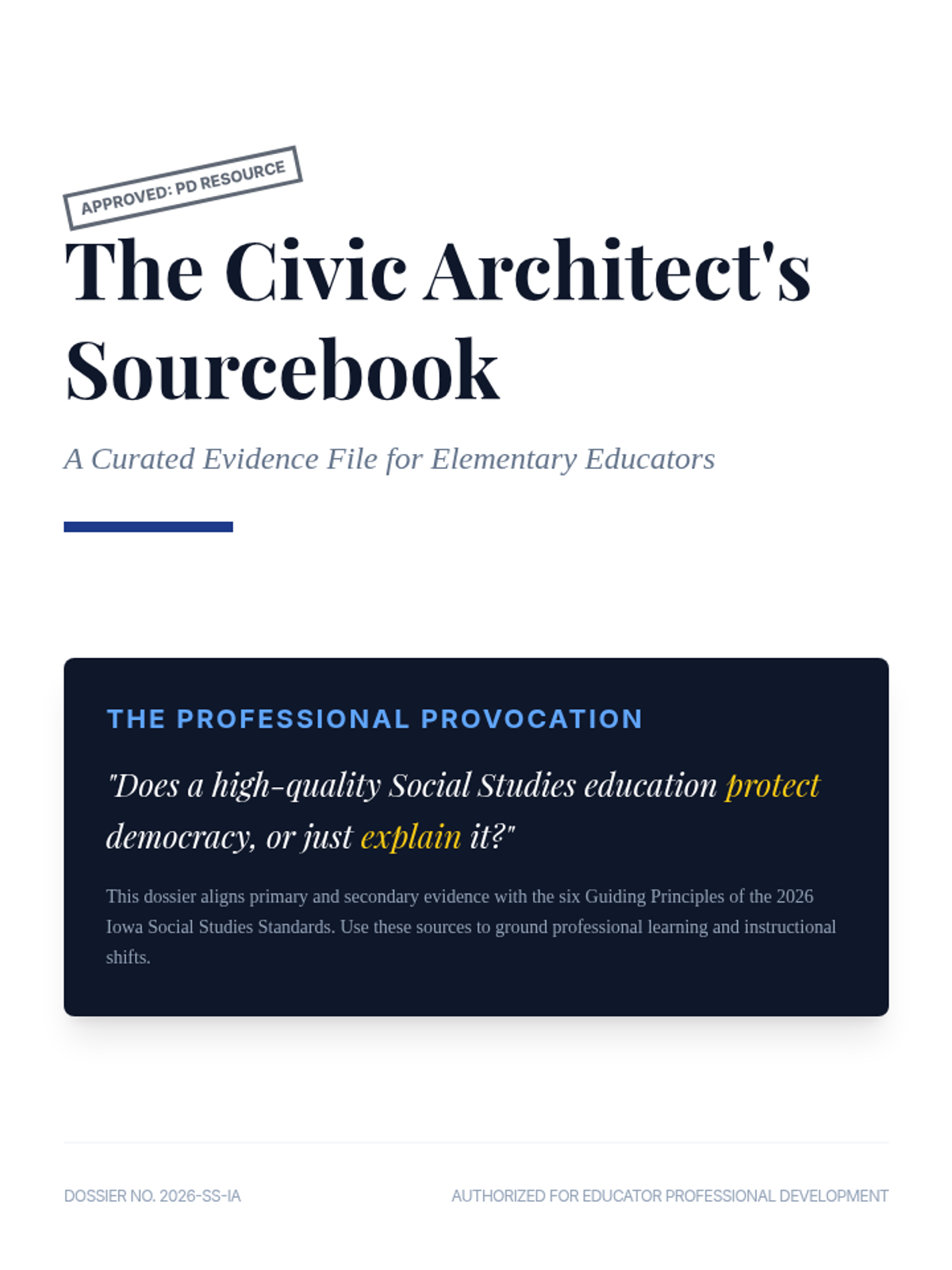
An expanded professional development sourcebook for elementary teachers, providing multiple primary and secondary sources (including Eleanor Roosevelt, Frederick Douglass, and Alexander Hamilton) for every one of the six Guiding Principles in the Iowa Social Studies Standards. This resource is designed to help educators argue for and implement instructional practices that protect democracy through active, high-quality social studies.
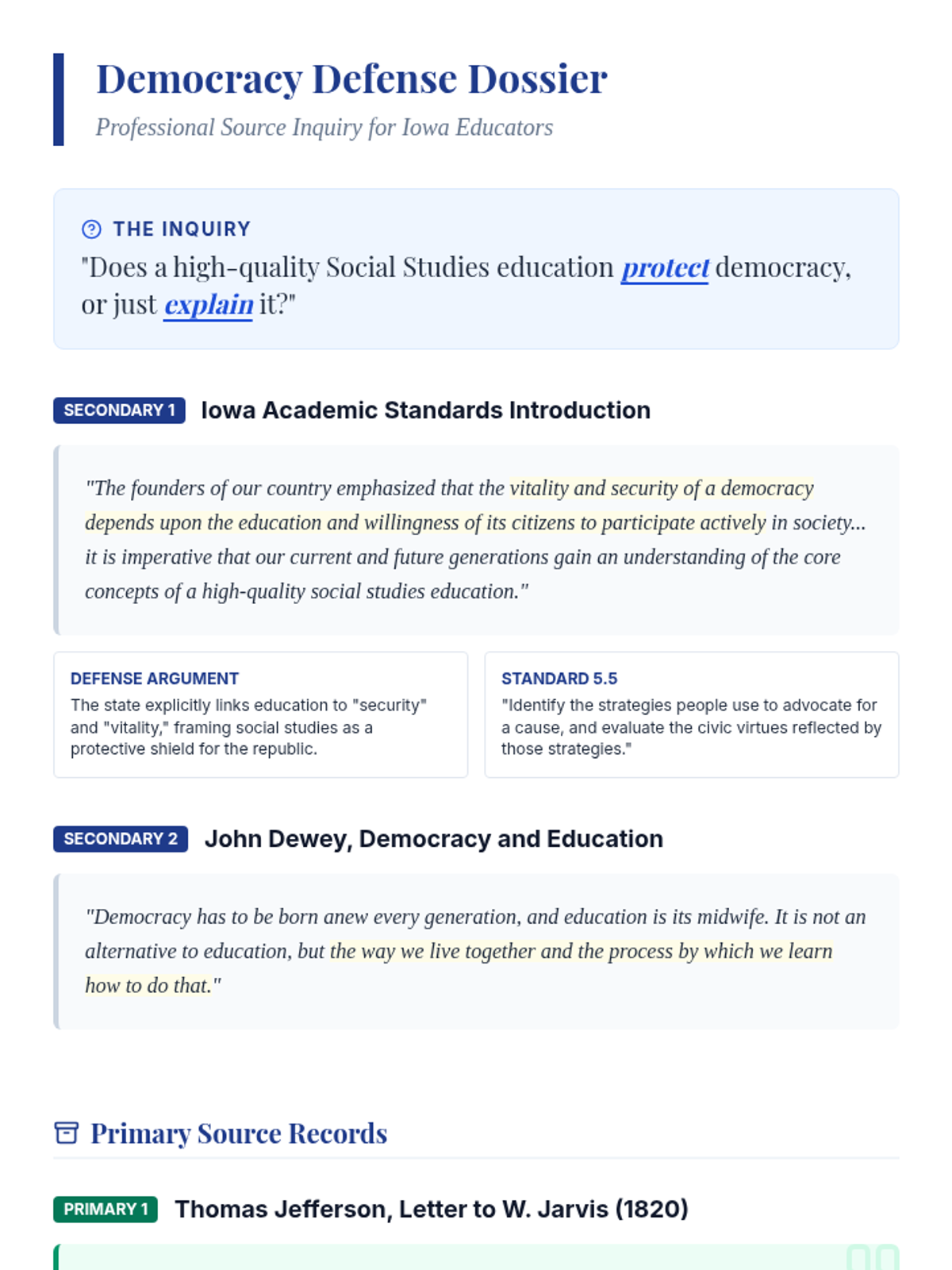
A professional dossier for elementary teachers providing primary and secondary sources (including Thomas Jefferson, John Dewey, and Iowa-specific Supreme Court cases) to explore the role of social studies in protecting versus explaining democracy. It integrates specific language from the 2026 Iowa Social Studies Standards to support professional development and inquiry.
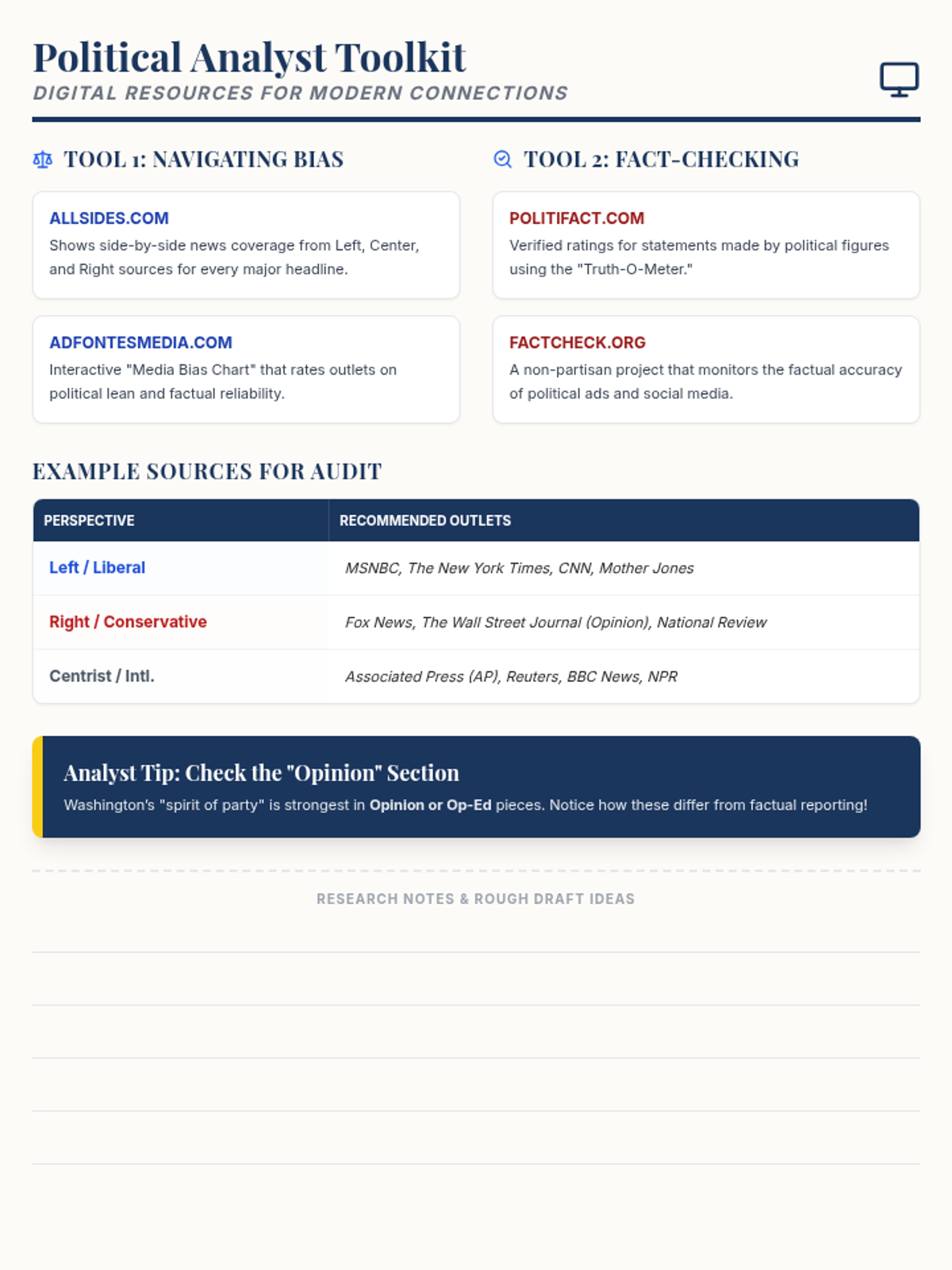
A digital resource guide for students to use while completing the 'Prophecy or Paranoia?' project. It includes media bias tools, fact-checking sites, and categorized news outlets to support their media audit. This version is optimized for a clean 1-page layout with improved work space.
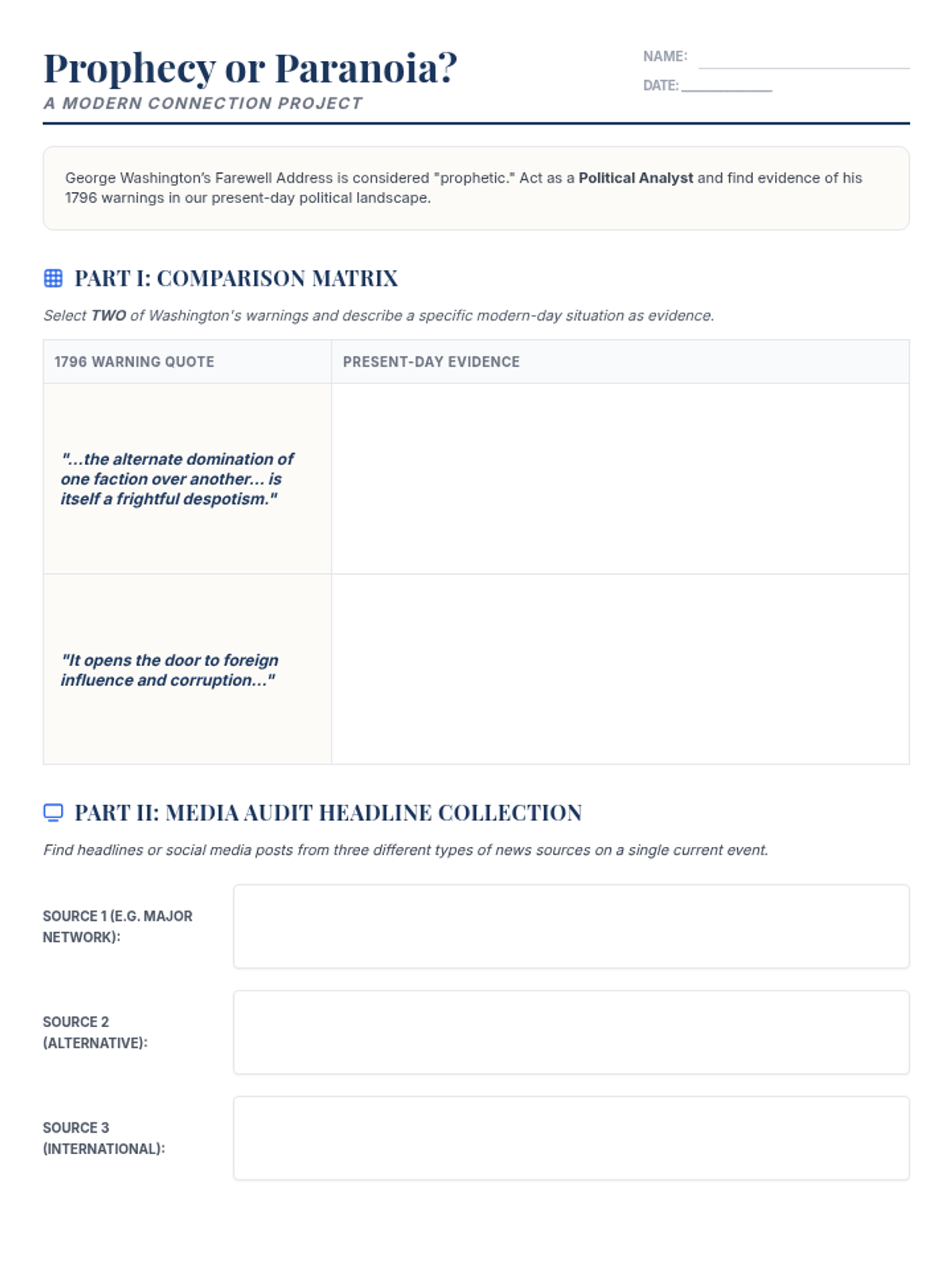
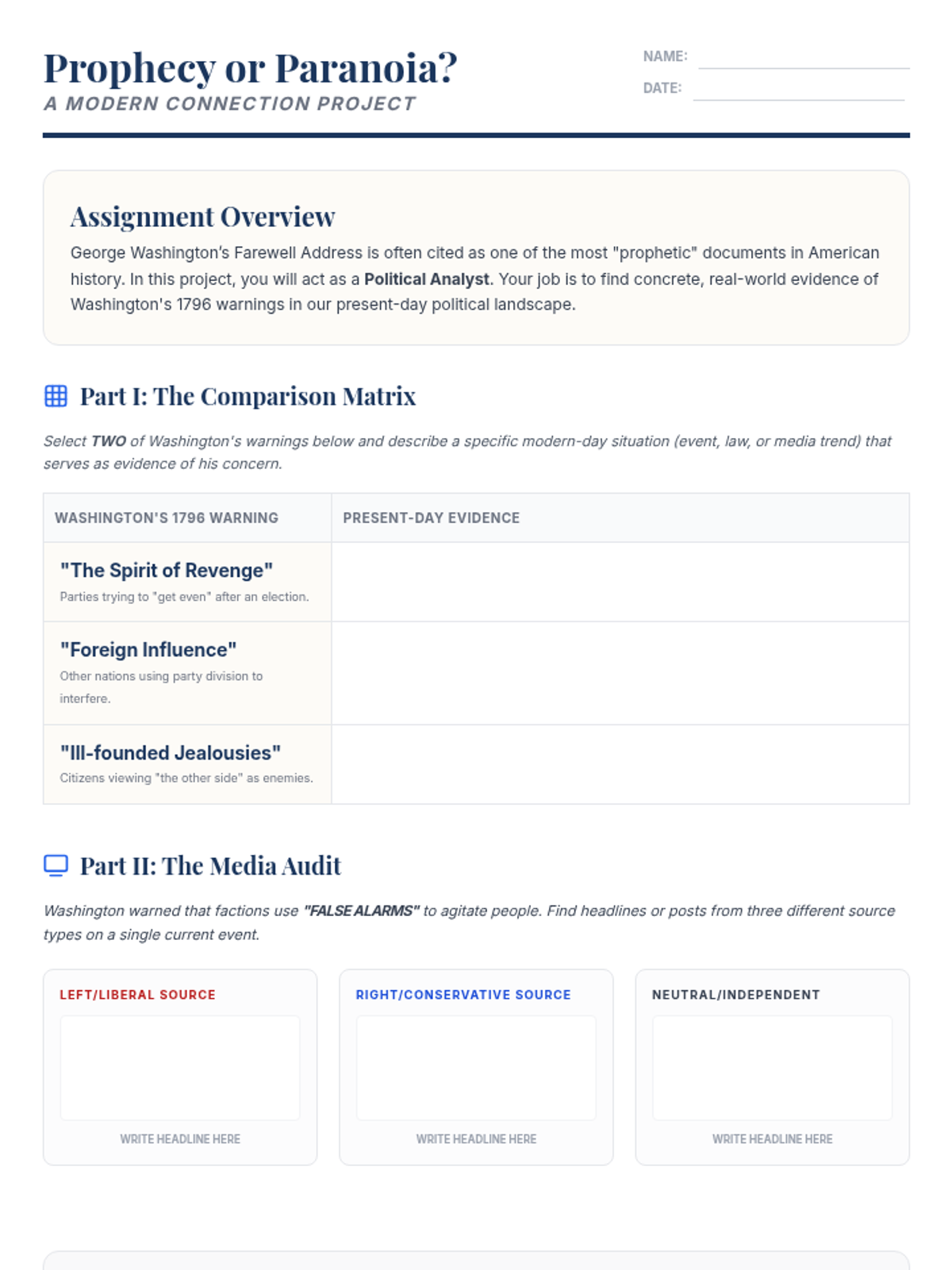
A follow-up assignment for high school government students that connects Washington's 1796 warnings to modern political parties, media bias, and current events through a comparison matrix and a media audit. This version ensures a strict 2-page layout with ample student work space and improved font legibility.
A follow-up assignment for high school government students that connects Washington's 1796 warnings to modern political parties, media bias, and current events through a comparison matrix and a media audit. This version fixes layout issues and optimizes the document for 2-page printing.
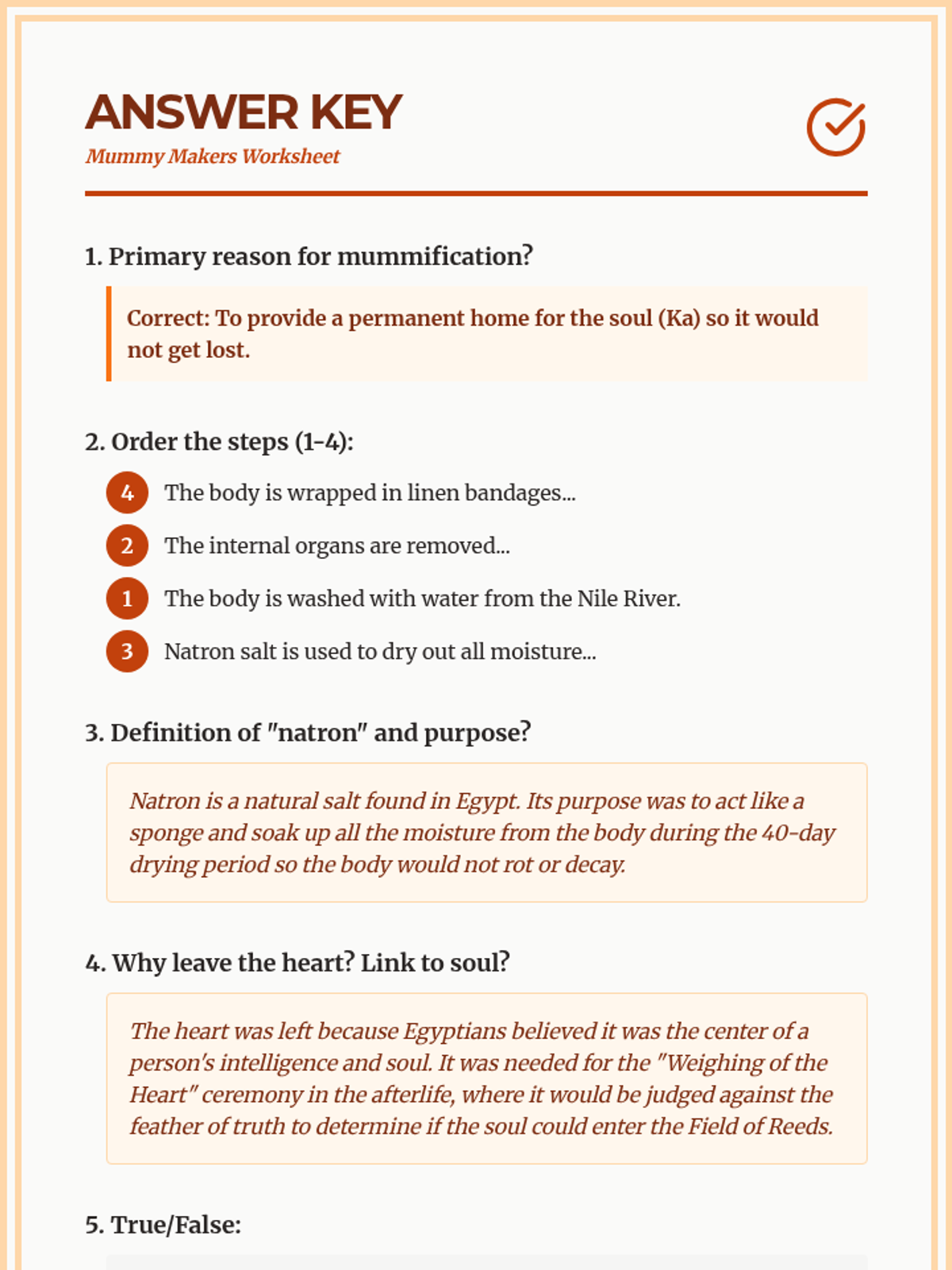
A teacher-facing answer key for the Mummy Makers Worksheet, providing correct answers and scoring guidance for all questions.
A two-page reading comprehension worksheet for 5th graders about Ancient Egyptian mummification. It includes a detailed reading passage followed by multiple choice, sequencing, vocabulary, and short answer questions.
A student worksheet designed to accompany the Testing Trap Comic. It includes analysis questions about the comic's story, comprehension questions on the history of testing (Terman, bias, 1970s shifts), and a reflection section on interpersonal intelligence.
A comprehensive guide for teachers to facilitate a lesson using the Testing Trap Comic. It includes background on Lewis Terman, discussion prompts regarding neurodiversity and systemic bias, and differentiation strategies for students.
A multi-page retro-style comic book following Leo, a high-school student with dyslexia, as he navigates the high-pressure world of standardized testing. The comic integrates the history of testing (from Terman to the 1970s) and celebrates non-traditional intelligences.
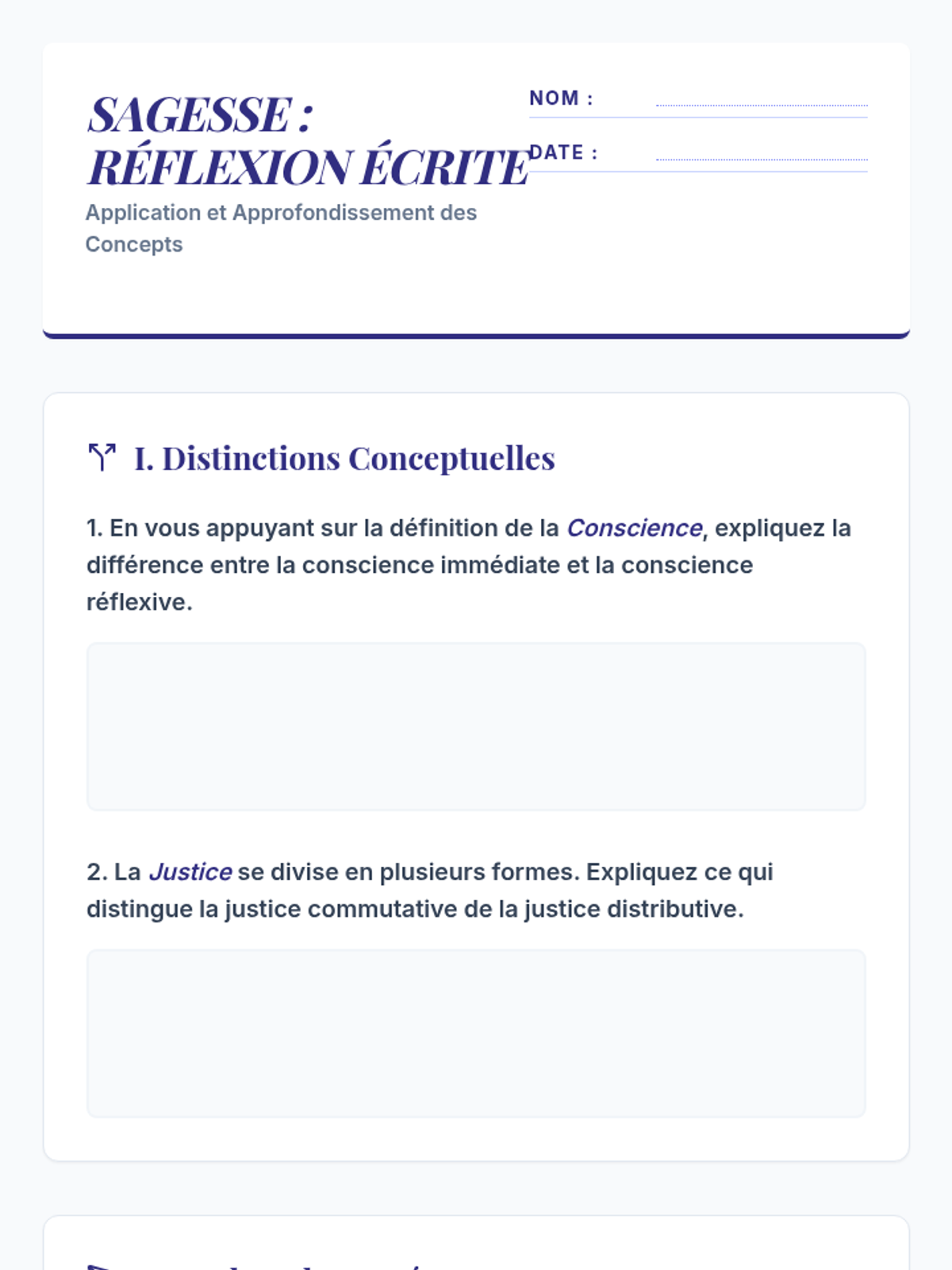
Une fiche d'exercices écrits demandant aux élèves d'expliquer les distinctions et les nuances des huit concepts philosophiques étudiés.
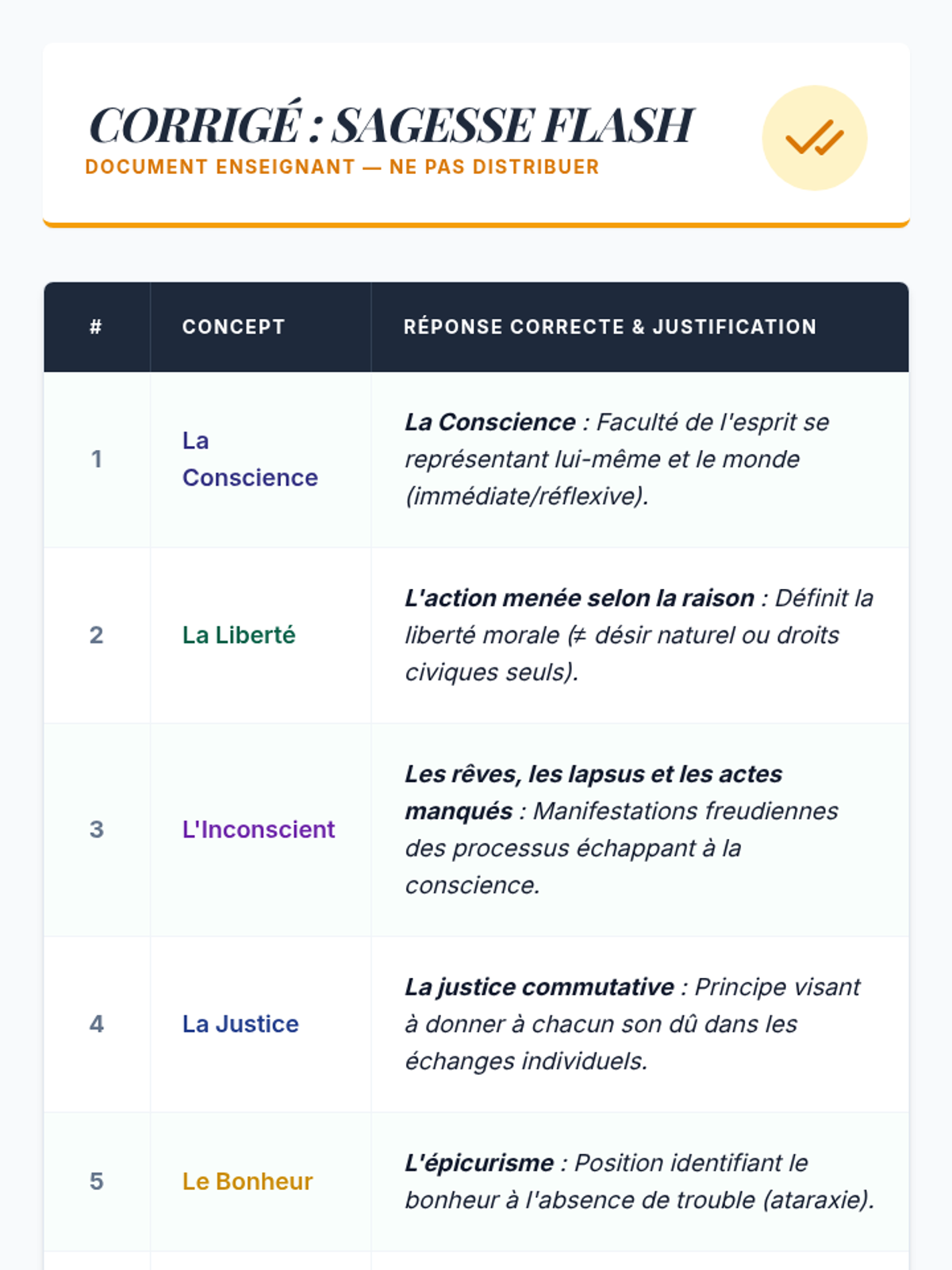
Corrigé détaillé du quiz QCM Sagesse Flash avec justifications basées sur les textes sources pour l'enseignant.
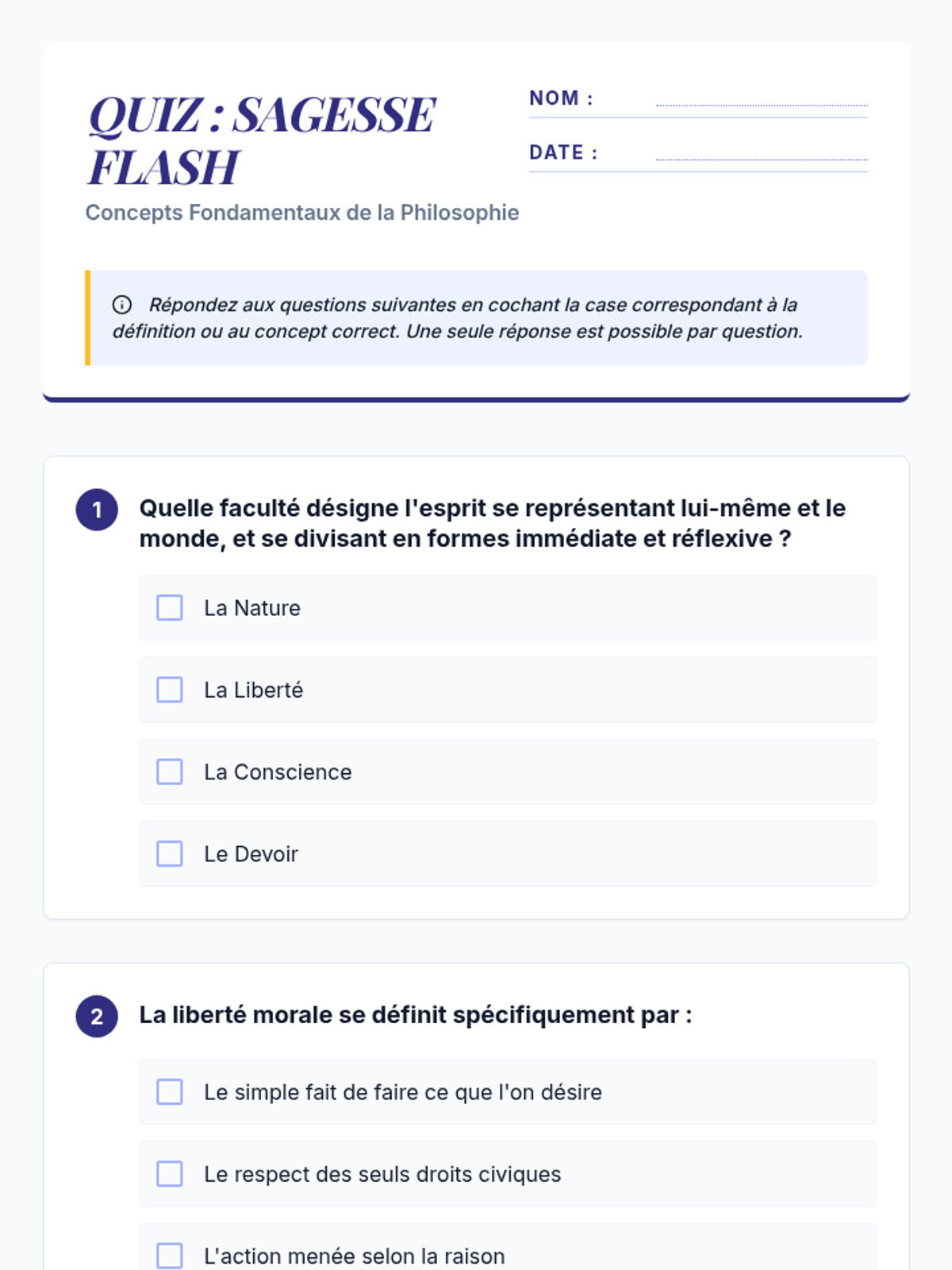
Un questionnaire à choix multiples (QCM) de huit questions testant la compréhension des définitions philosophiques fournies.
Une présentation visuelle reprenant les huit définitions philosophiques demandées pour une révision rapide en classe.
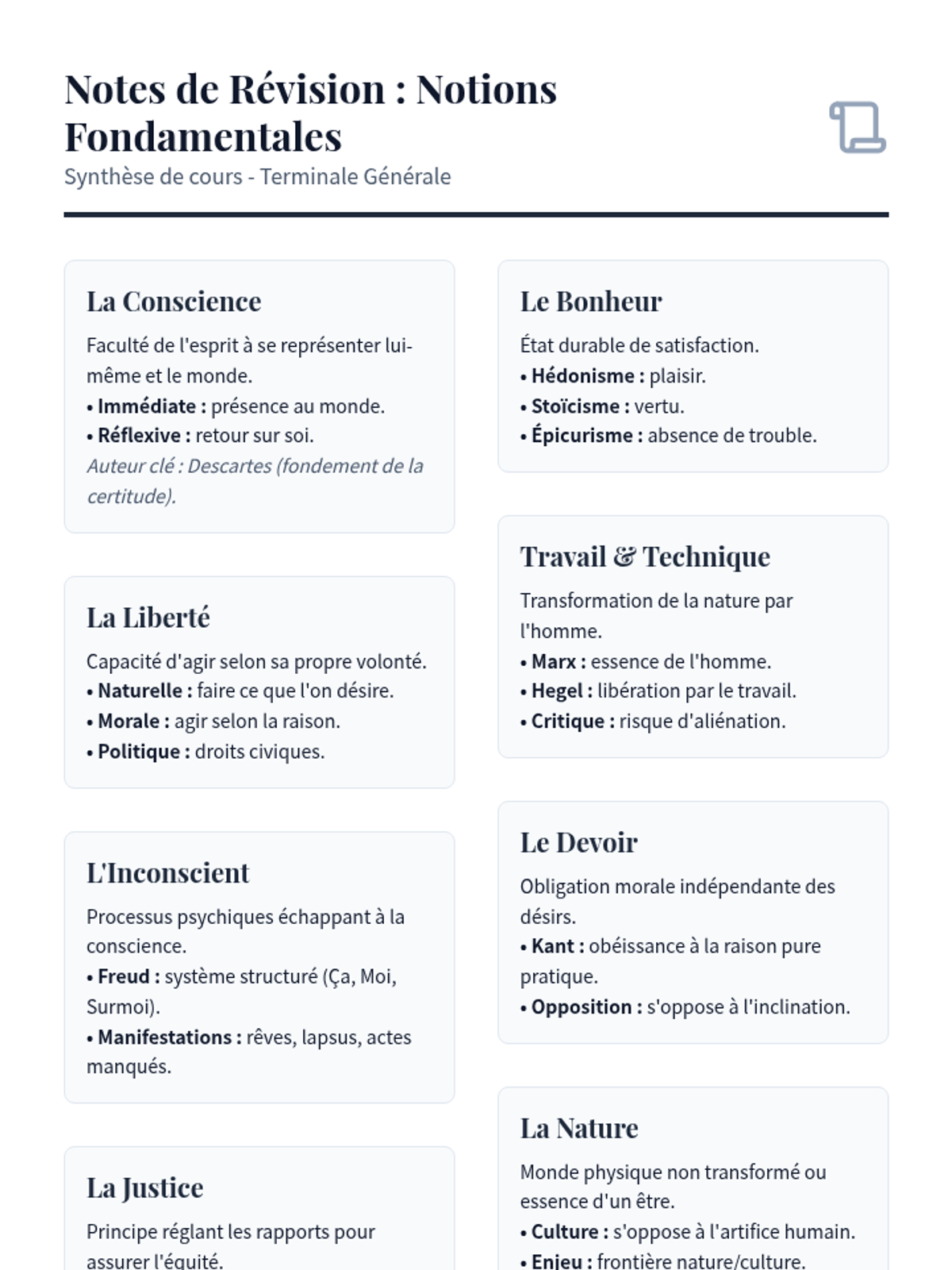
Une fiche de synthèse claire et structurée regroupant toutes les définitions fournies, idéale pour la révision finale avant le test ou l'examen.
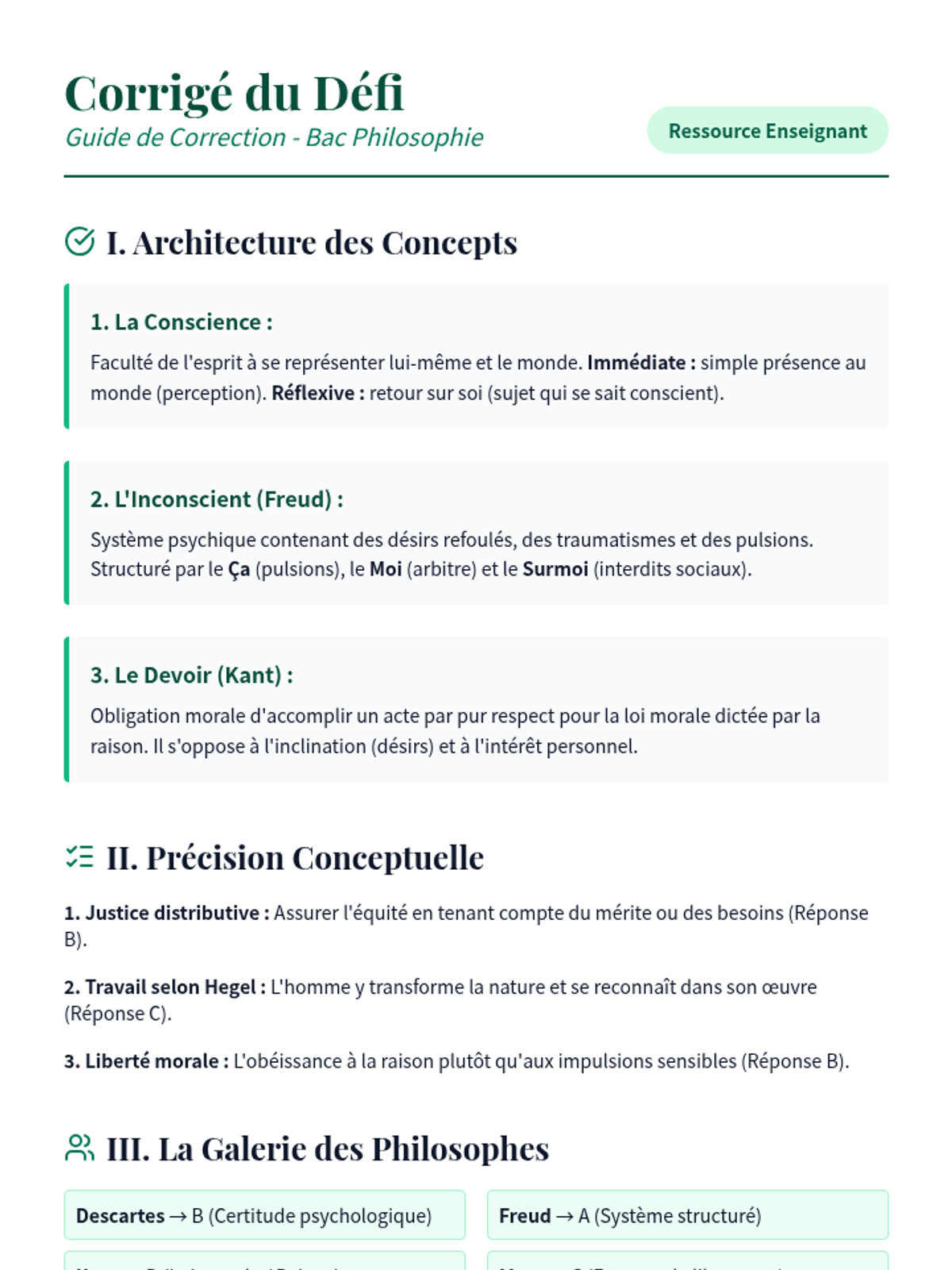
Le corrigé complet et détaillé du test "Défi des Notions", incluant les définitions attendues, les réponses au QCM et une suggestion de barème.
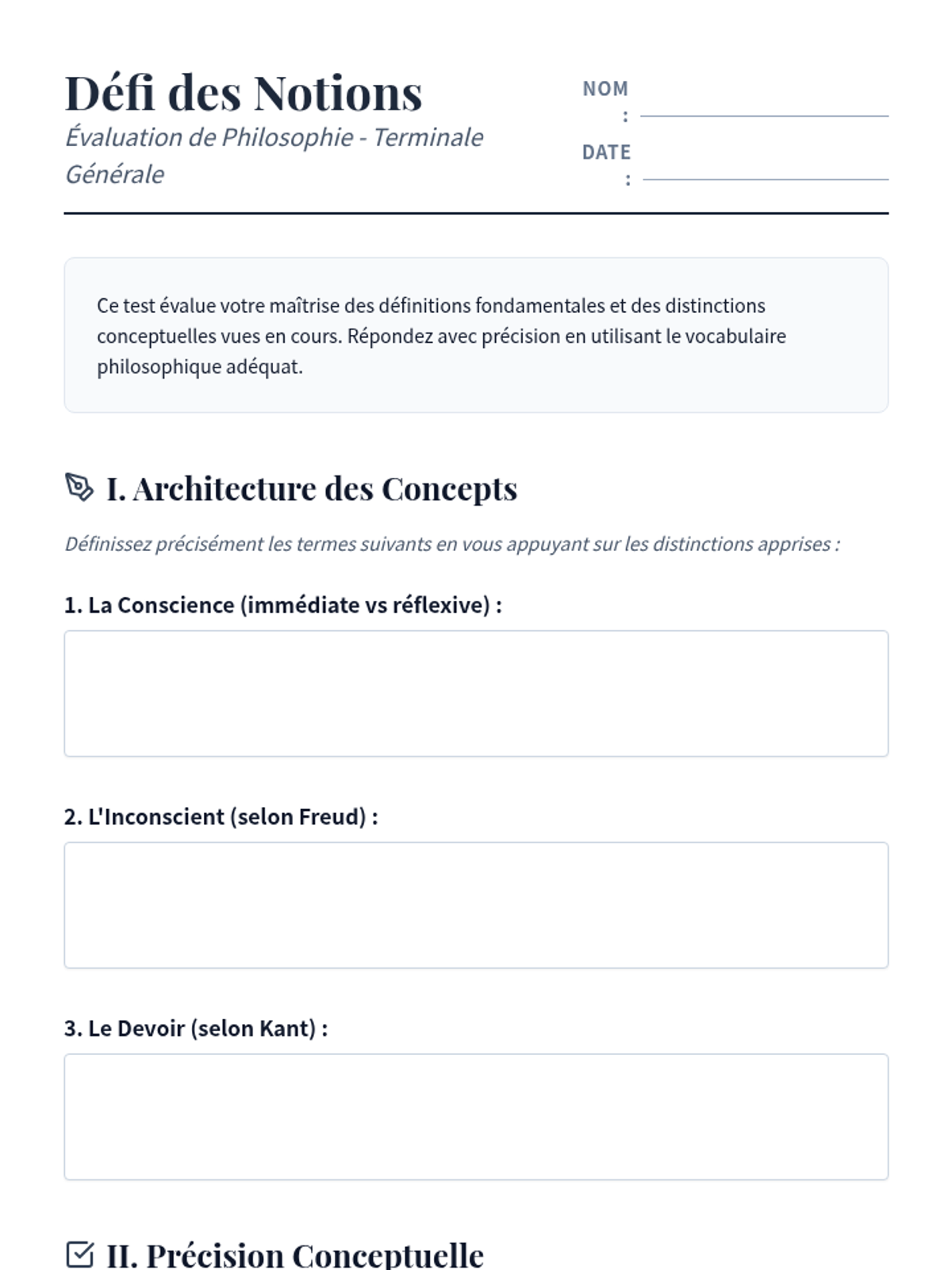
Un test de connaissances complet pour les élèves de Terminale, comprenant des définitions, des QCM conceptuels et une mise en relation d'auteurs basée sur les notions du programme.
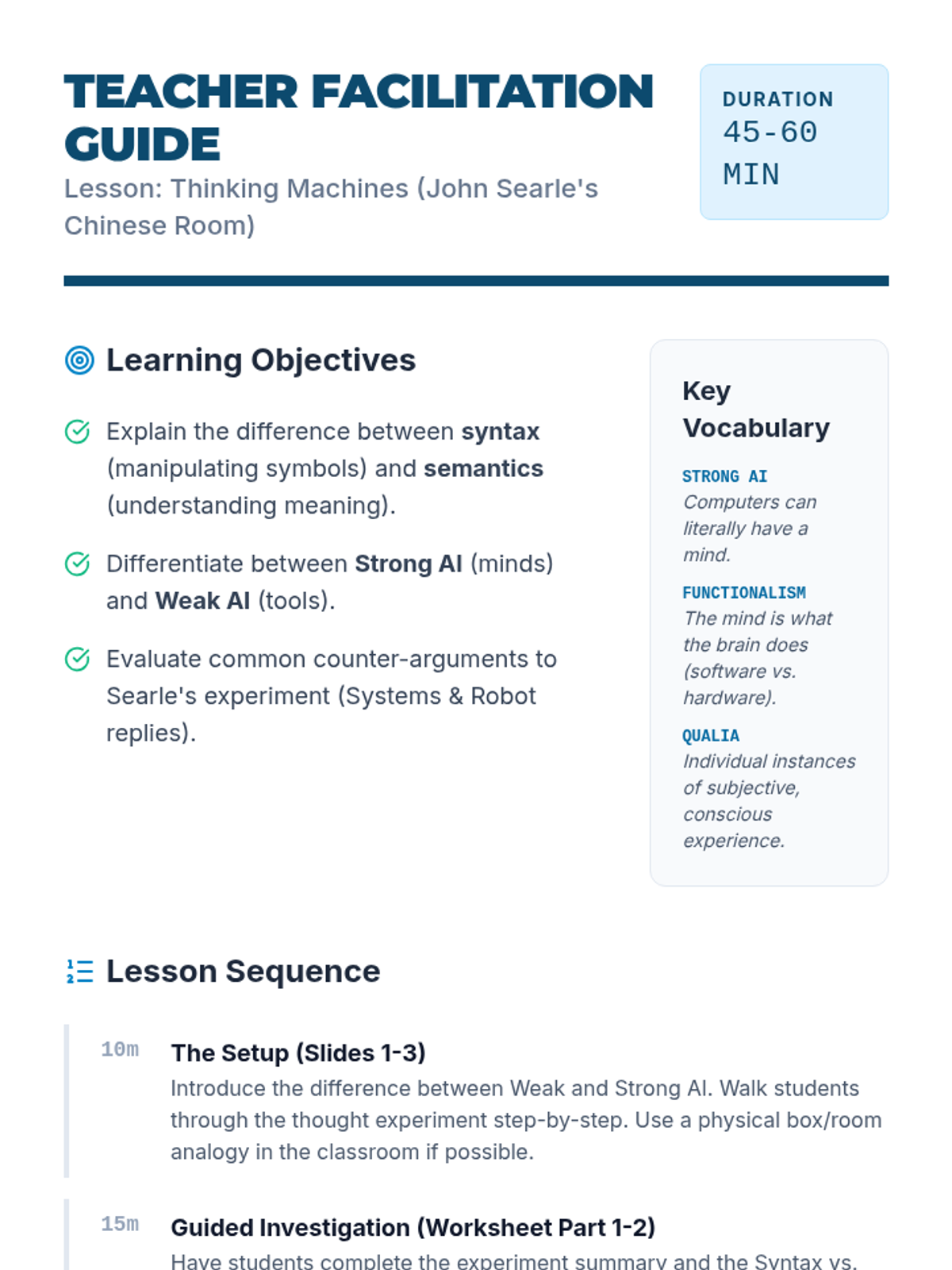
A comprehensive facilitator guide for the Thinking Machines lesson, including instructional sequences, discussion prompts, and an answer key.
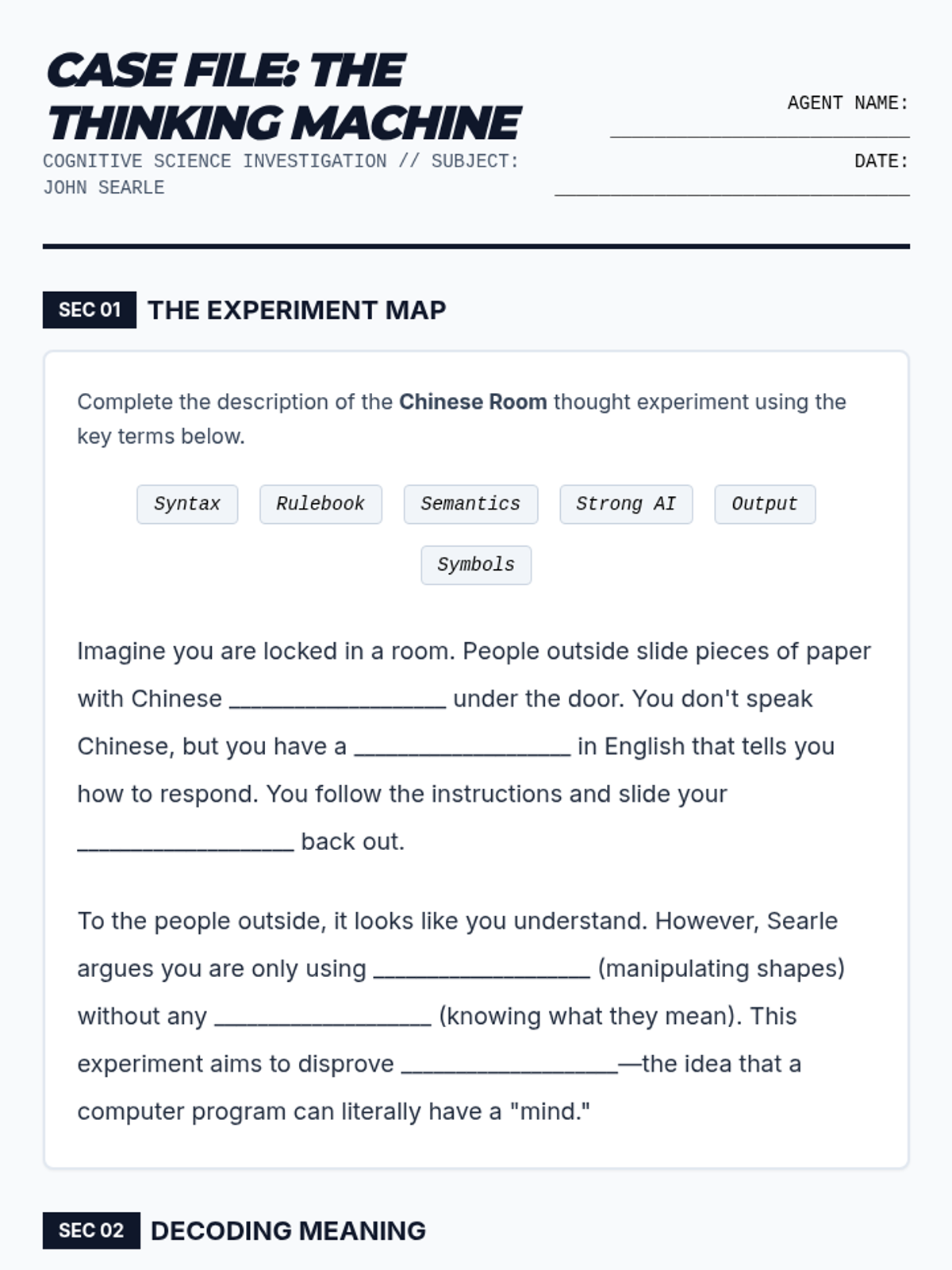
A student investigation worksheet structured as a "case file" to help students process the Chinese Room thought experiment and its counter-arguments.
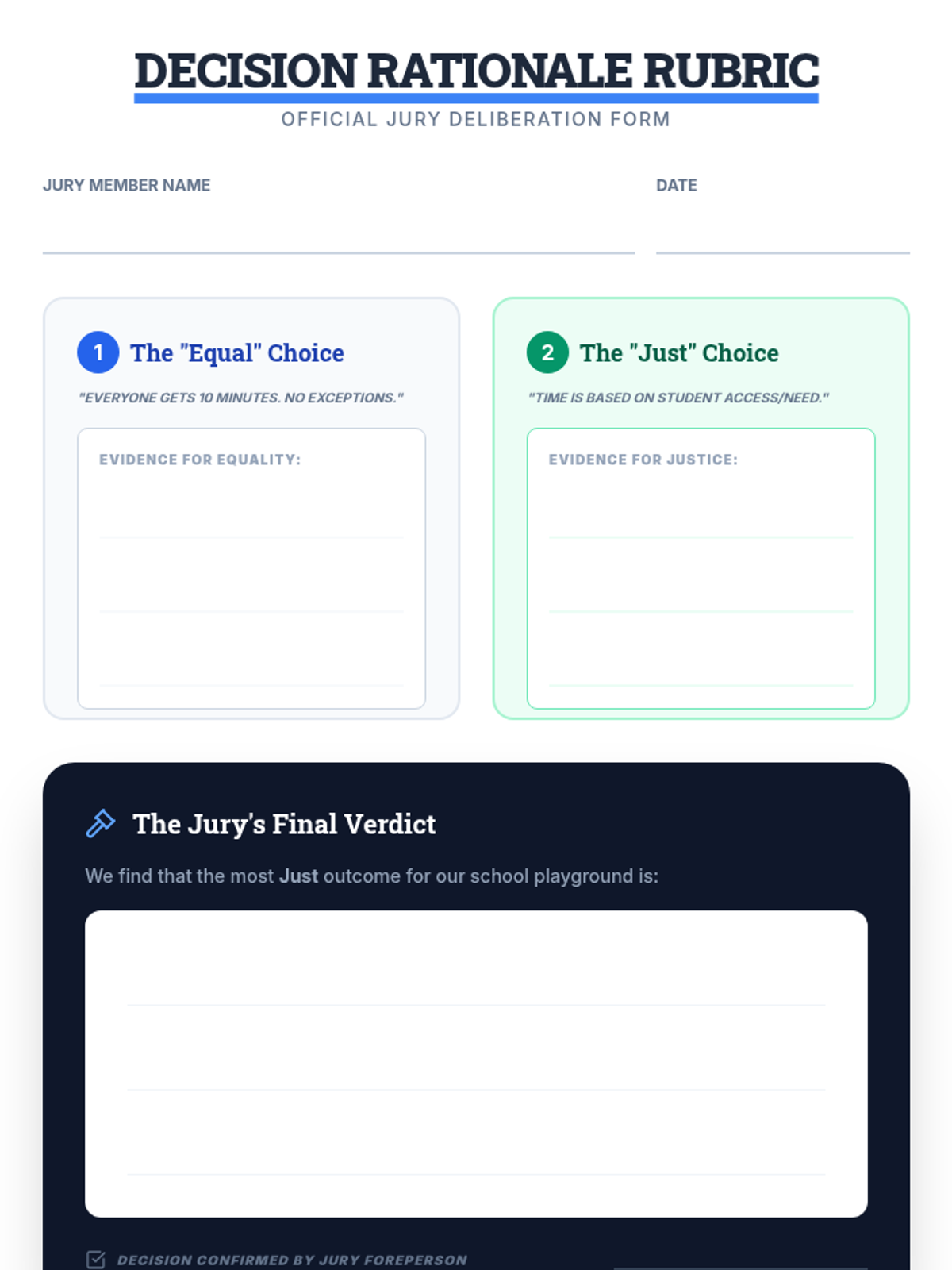
A final assessment and deliberation worksheet for students to record their verdict, justifying their choice based on the principles of equality (fairness) versus equity (justice).
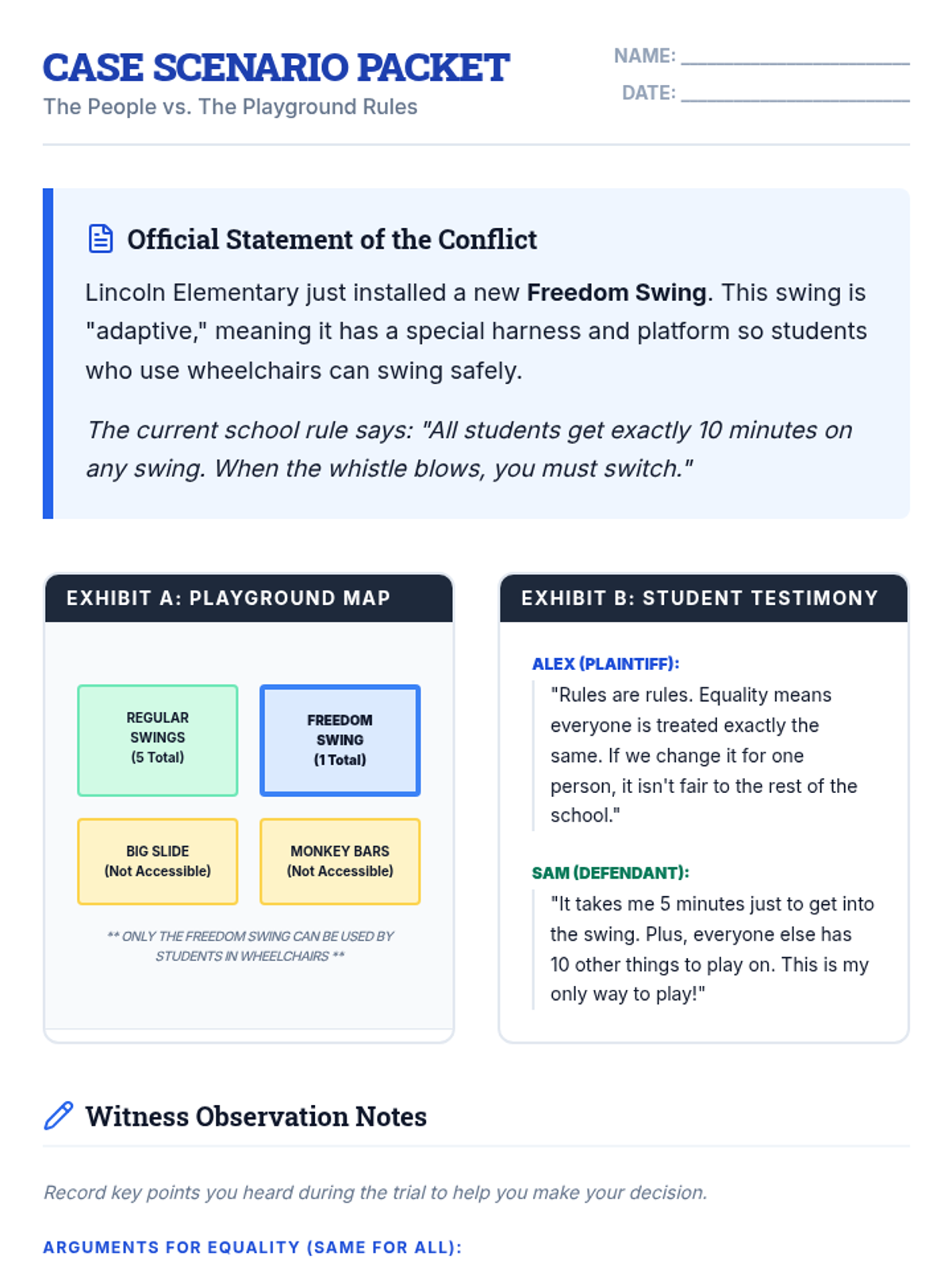
A student-facing handout containing the case details, a visual map of the playground evidence, and witness testimony summaries for 'The Playground Project' mock trial.
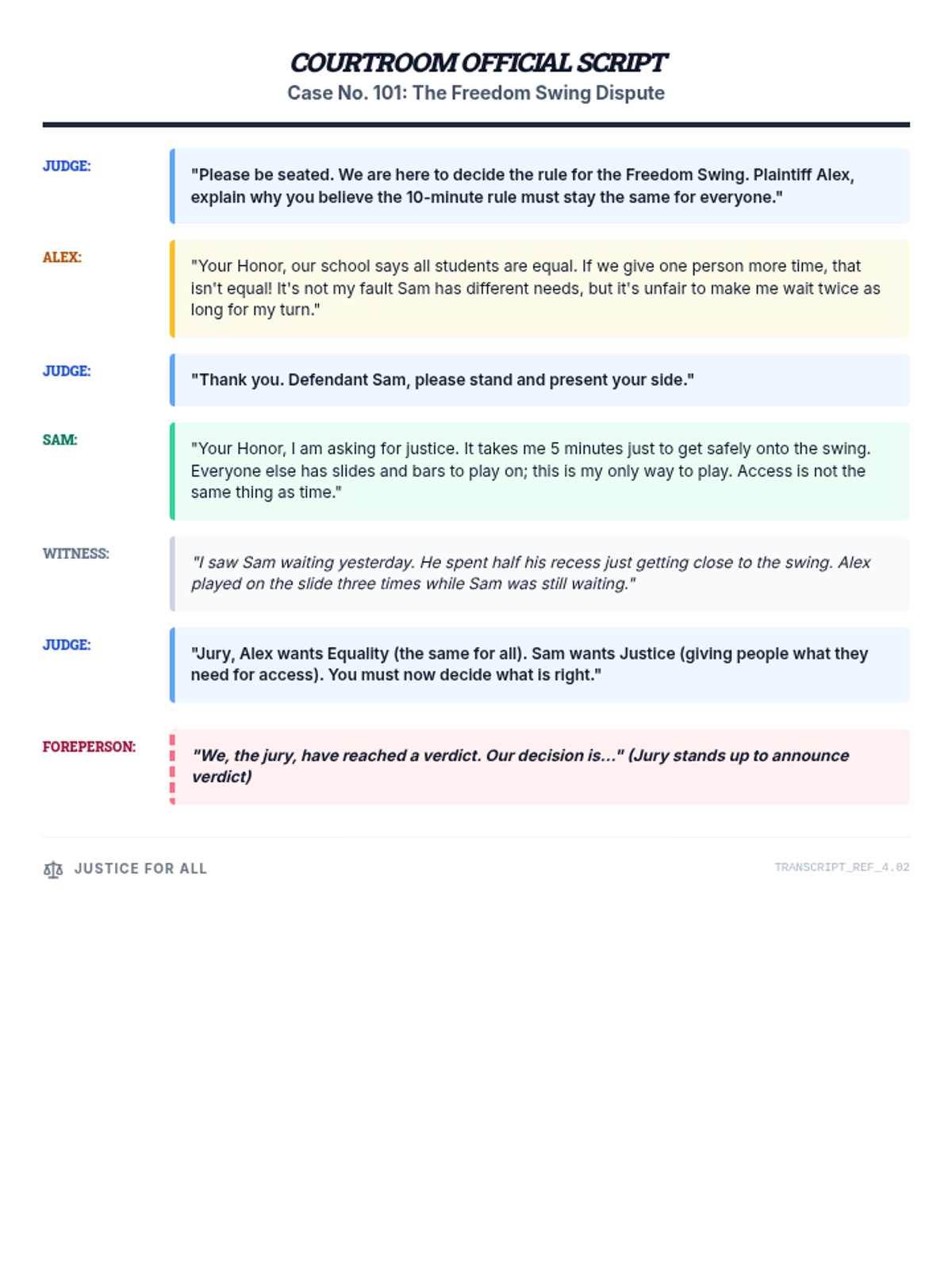
A structured script for the mock trial, providing the Judge with opening and closing statements and guiding the Plaintiff and Defendant on their key arguments regarding equality vs equity.
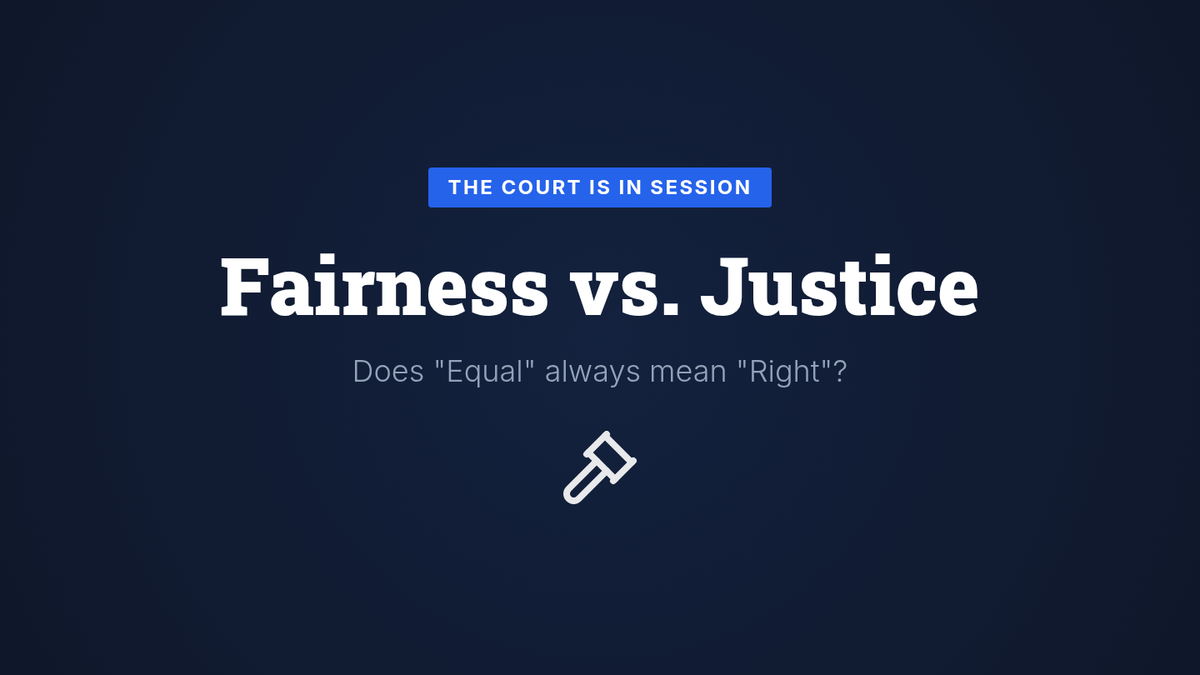
A 5-slide presentation introducing the concepts of fairness vs justice using the 'Apple Test' and setting up the playground swing case study for the class mock trial.
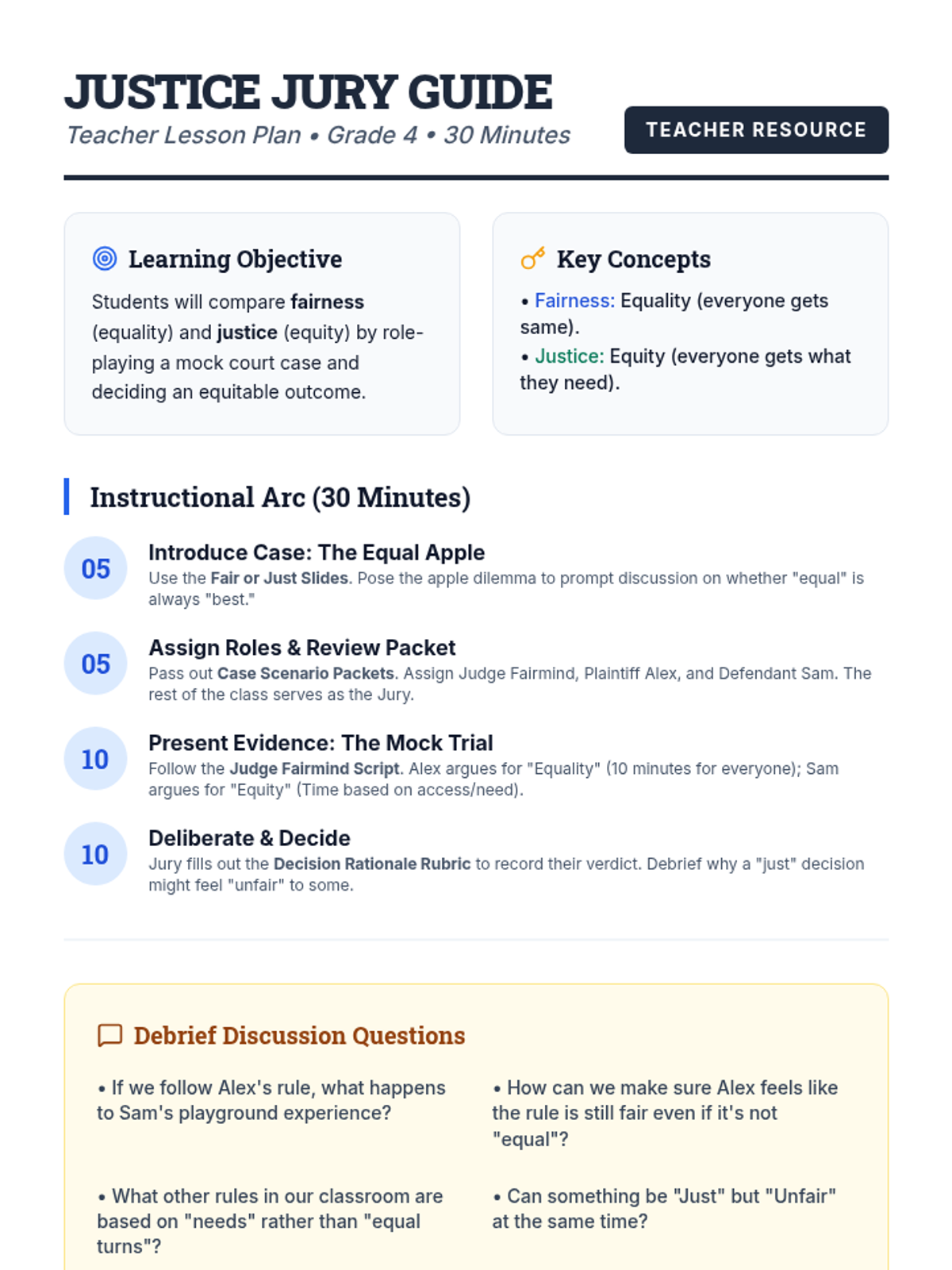
A comprehensive teacher guide for the 30-minute 'Fairness vs Justice' lesson, including learning objectives, a timed instructional arc, and facilitation tips for the mock trial.
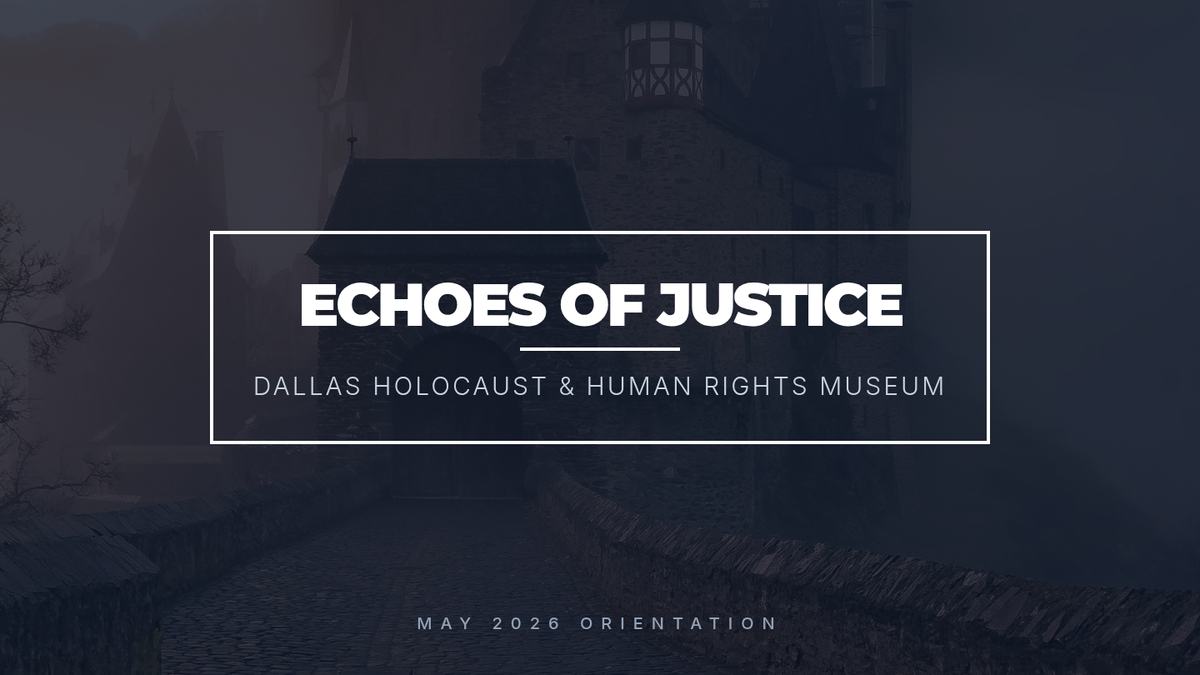
An orientation slide deck for students before their visit to the Dallas Holocaust and Human Rights Museum, covering mission, behavior expectations, and the daily schedule.
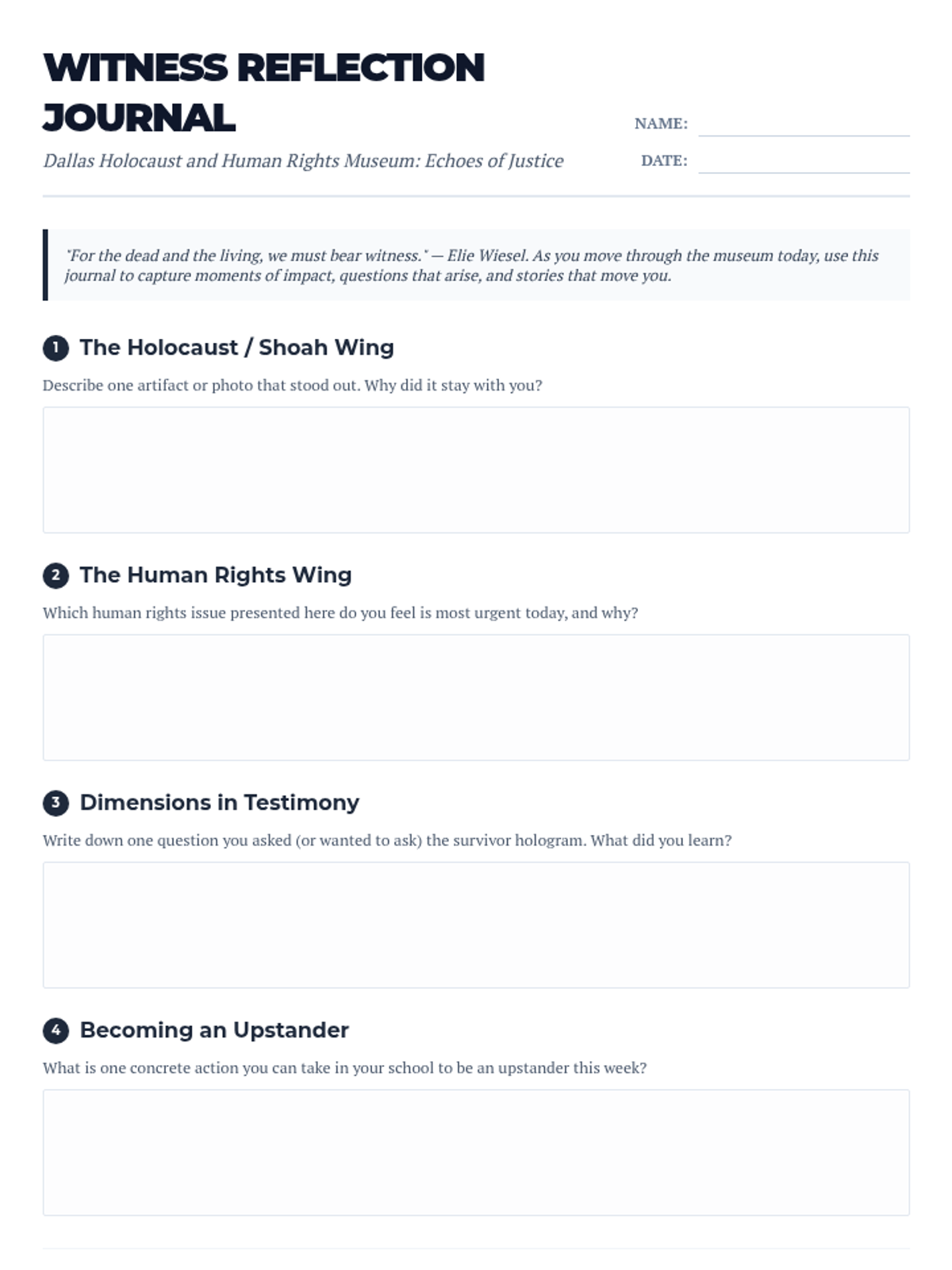
A student reflection journal to be used during the museum tour, providing structured prompts for the Holocaust Wing, Human Rights Wing, and interactive testimony session.
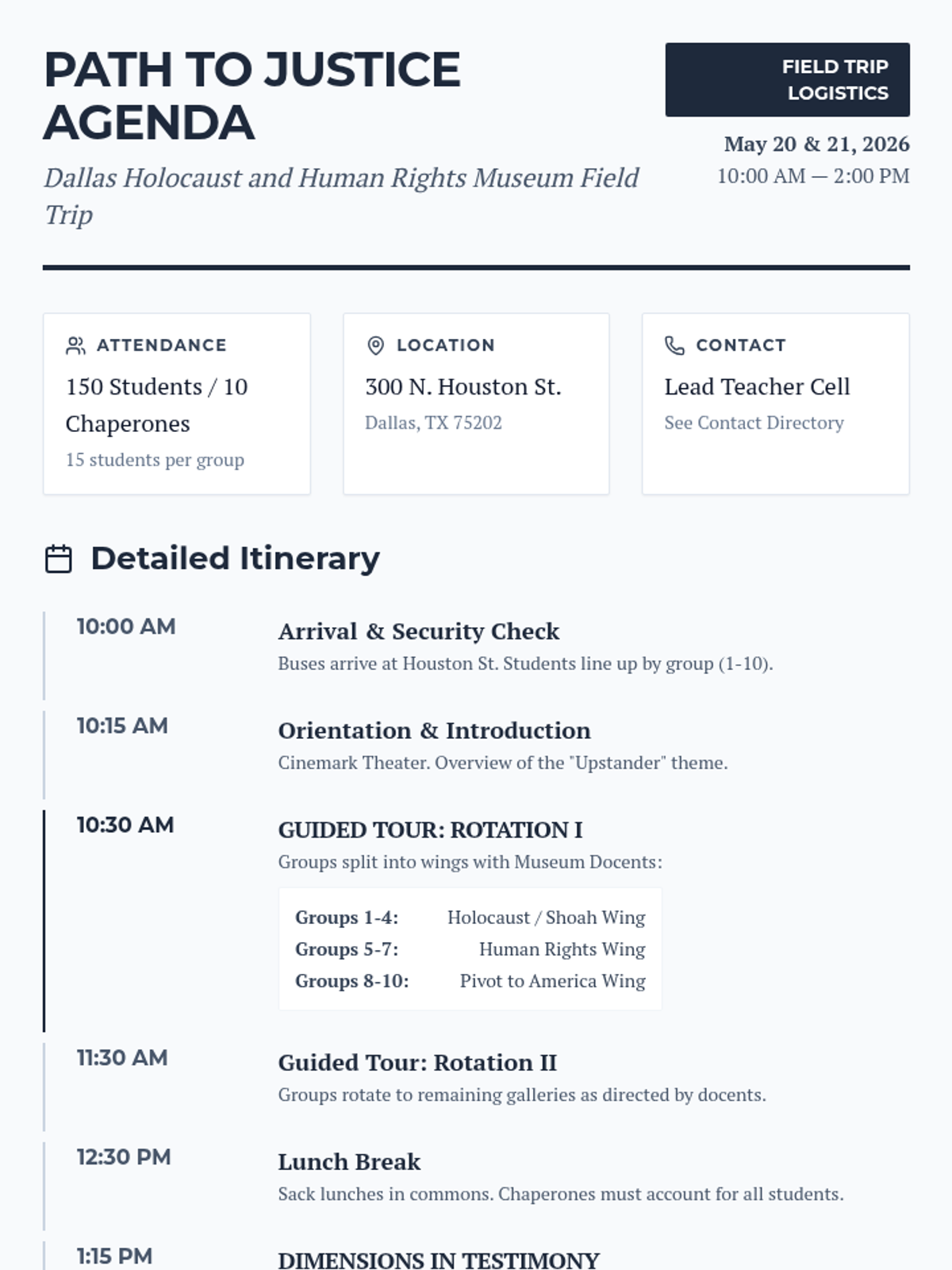
A detailed 4-hour field trip itinerary for teachers and chaperones visiting the Dallas Holocaust and Human Rights Museum, including rotation schedules and logistical reminders.
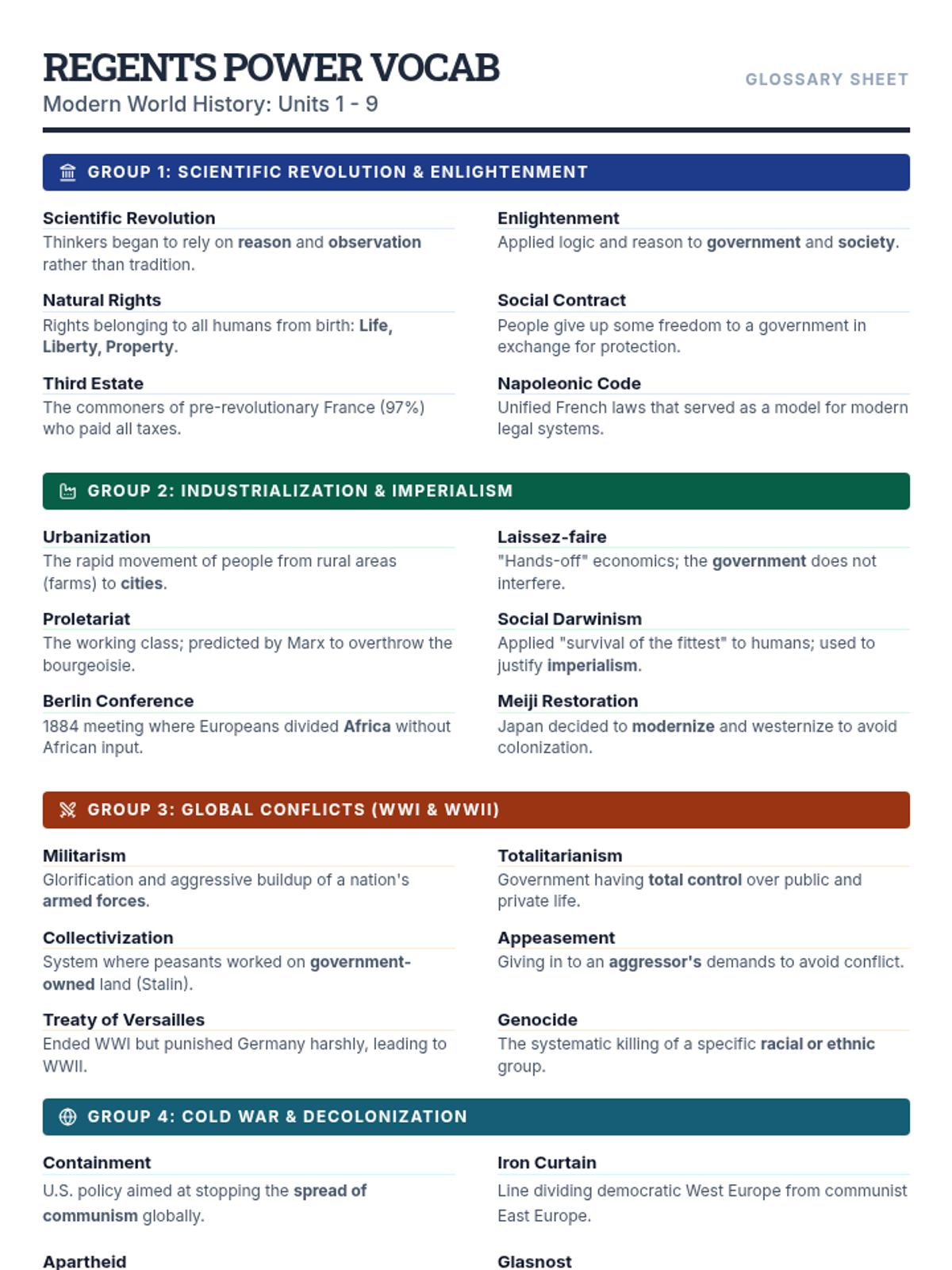
A comprehensive 2-page vocabulary glossary for Units 1-9 of the NYS Modern World History Regents, featuring high-impact terms and exam hacks organized by unit grouping for study consistency. Fixed page breaks and spacing.
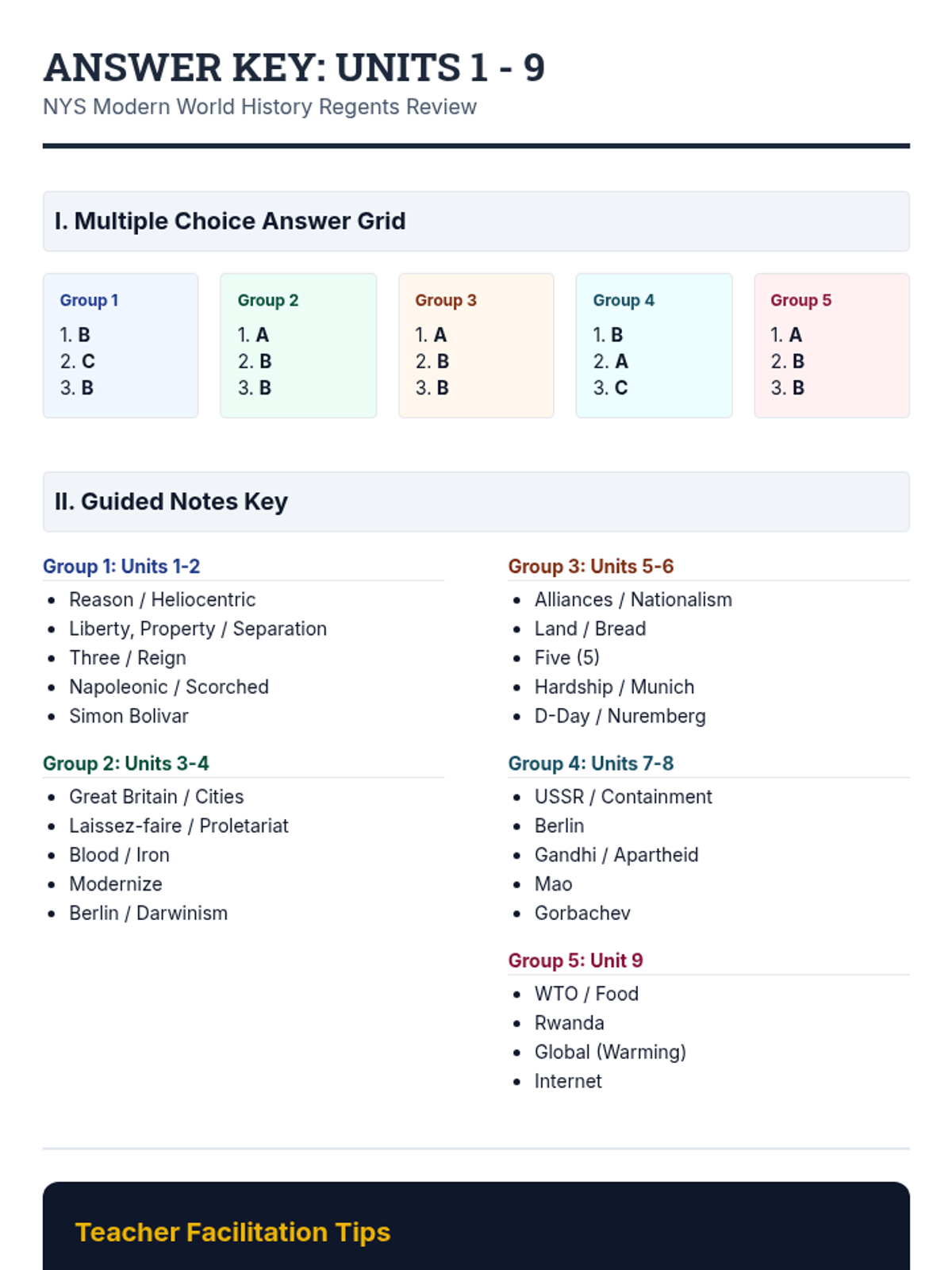
An expanded teacher answer key for the Modern Era Regents Review lesson (Units 1-9), featuring a clear answer grid for all 15 multiple-choice questions, organized key terms for guided notes, and high-impact teaching tips. Optimized for printing.
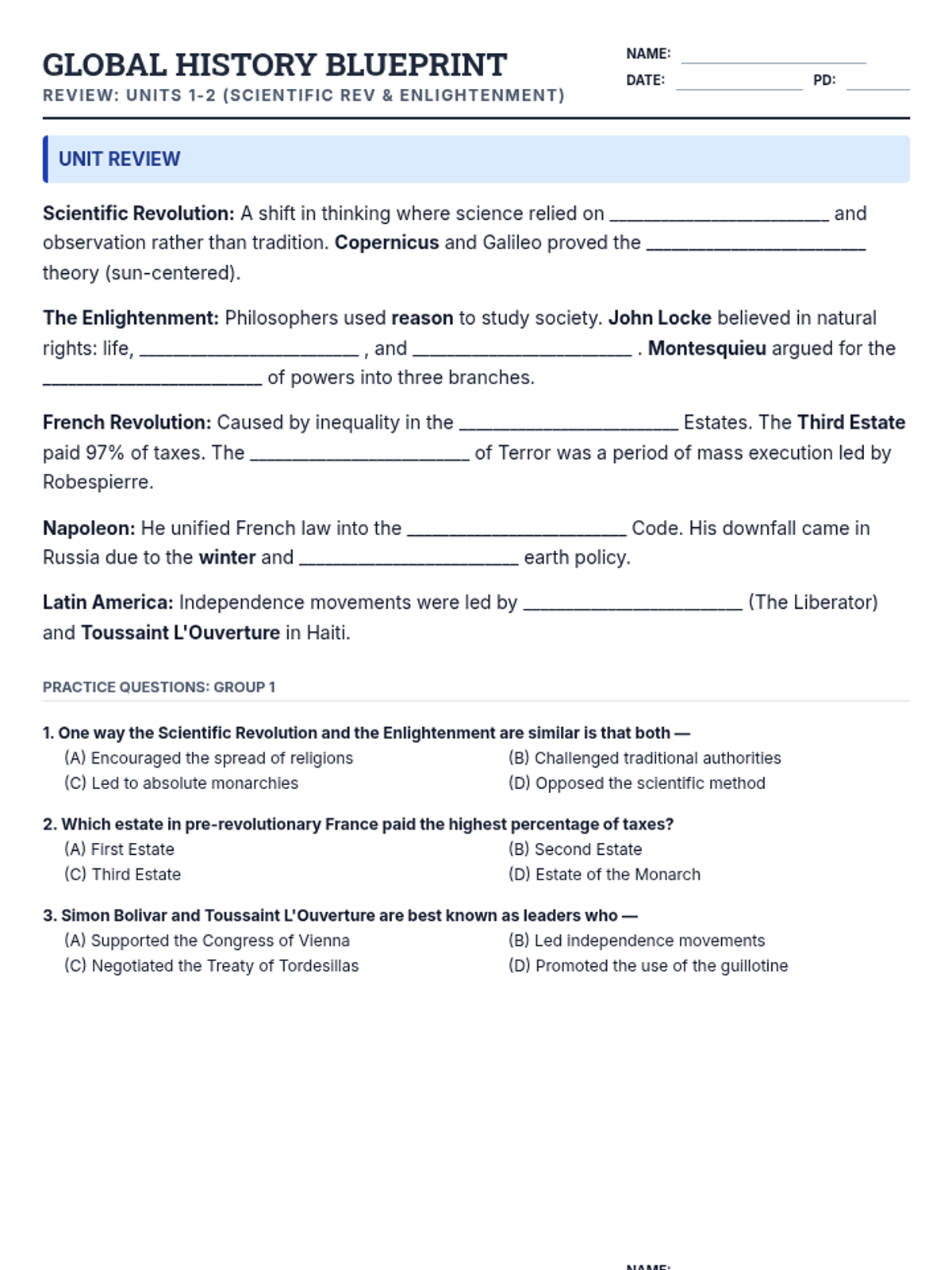
A 5-page guided notes packet covering Units 1-9, organized into dedicated pages for each unit grouping. Each page includes fill-in-the-blank review sections and 3 integrated Regents-style multiple-choice questions. Fixed page breaks and spacing issues.