Lenny LearningLenny
Create
Explore
Workspace
LoginSign up
MathEnglish Language ArtsScience & EngineeringSocial StudiesGlobal LanguagesHealth & Physical EducationSpecial EducationCounseling & Life SkillsArts & CreativityESL
Lenny LearningLenny
Lenny Learning
About
Training
Pricing
Support
Contact
© 2026 Lenny Learning Inc.

Philosophy & Ethics

SequencesLessonsMaterialsVideos
  1. Social Studies

Philosophy & Ethics

SequencesLessonsMaterialsVideos

Examining foundational arguments from major thinkers alongside contemporary debates on morality, governance, and the nature of existence. Addresses core concepts like political structures, consciousness, and the conflict between agency and fate.

Social StudiesSocial Studies PracticesLocation WordsMapsOrder EventsChronology and CausationEvaluating SourcesHistorical ThinkingGeography, Humans, & the EnvironmentAmerican Symbols and LandmarksCitiesStatesState CapitalsRegions of the United StatesGeographic SkillsPhysical GeographyHuman GeographyRegional GeographyGeography of AfricaGeography of AsiaGeography of EuropeGeography of OceaniaGeography of the AmericasSociety and Environment of EuropeSociety and Environment of AsiaSociety and Environment of The AmericasSociety and Environment of the Middle EastSociety and Environment of AfricaHistoryPrehistoryComparing Ancient River CivilizationsAncient MesopotamiaAncient Egypt and KushAncient South AsiaEarly ChinaGreeceRome and the Byzantine EmpireAncient World HistoryNative Peoples of North AmericaNative Peoples of Mesoamerica and South AmericaAfrican EmpiresMedieval AsiaMedieval EuropeThe Silk RoadMedieval HistoryIslamic EmpiresWorld ReligionsRenaissance PeriodAge of ExplorationThe Thirteen ColoniesThe American RevolutionUS History Early RepublicFounding of the United StatesUS History AntebellumUS Civil WarReconstruction PeriodThe Gilded AgeUS ImperialismWorld ImperialismWorld War IUS History 1920sGreat DepressionWorld War IIThe Cold WarUS History 1950-60sUS History 1960s-70sWorld History 20th CenturyContemporary US HistoryContemporary World HistoryHolidaysCivics and GovernmentCitizenshipGovernment FoundationsThe ConstitutionUS ConstitutionExecutive BranchLegislative BranchJudicial BranchState and LocalPolitical ParticipationPublic PolicyPolitical SystemsPower and AuthoritySocial MovementsDefining DevianceTheories of DevianceCrime and Criminal JusticeEconomicsBasic Economic PrinciplesSupply and DemandWhat is MoneyEconomic FundamentalsMicroeconomicsMacroeconomicsBanking and FinanceEconomic SystemsGlobal EconomicsCorporations and PowerThe Changing WorkplaceUnemployment and LaborClass and InequalitySocial MobilityGlobal InequalityPsychologyHistory of PsychologyPsychology as a ScienceBrain and Nervous SystemNeuroscience and BehaviorGenetics and BehaviorSleep and ConsciousnessSensory ProcessesPerceptual OrganizationClassical ConditioningOperant ConditioningObservational LearningCognitive LearningMemory ProcessesThinking and Problem SolvingLanguage and CognitionTheories of MotivationStress and CopingPrenatal and Infant DevelopmentChildhood DevelopmentAdolescent DevelopmentAdulthood and AgingSelf and IdentitySocial CognitionSocial InfluenceAttraction and RelationshipsGroup BehaviorPrejudice and DiscriminationAnxiety and Mood DisordersClinical PsychologyForensic PsychologyPhilosophy & EthicsIntroduction to PhilosophyMajor Philosophers & IdeasMind and Body ProblemFree Will vs DeterminismEthics & MoralityReligion & PhilosophyPolitical Philosophy
Introduction to PhilosophyFundamental questions regarding existence, knowledge, and ethics through the analysis of major philosophical traditions. Builds critical thinking skills by evaluating logical arguments from classical to modern theorists.
Major Philosophers & IdeasCore tenets of Western and Eastern philosophical traditions, focusing on ethics, logic, and existentialism. Examines the contributions of major thinkers from Socrates to modern theorists to develop critical reasoning and moral frameworks.
Mind and Body ProblemExamines the relationship between mental states and physical brain processes. Analyzes classical dualism, physicalism, and modern theories of consciousness.
Free Will vs DeterminismCore arguments surrounding human agency, causality, and moral responsibility. Examines the tension between biological or environmental programming and the capacity for independent choice.
Ethics & MoralityAnalyzes foundational frameworks of right and wrong, including utilitarianism, deontology, and virtue ethics. Applies these theories to contemporary moral dilemmas and the development of societal value systems.
Religion & PhilosophyFundamental tenets of major world religions and classic ethical frameworks. Analyzes the intersection of spiritual beliefs, moral reasoning, and societal norms across cultures.
Political PhilosophyFundamental theories of governance, justice, and the social contract. Examines the relationship between individuals and the state while evaluating concepts of liberty, equality, and authority.
Video
Post-War Europe: The Welfare State and the Rise of the European Union

Post-War Europe: The Welfare State and the Rise of the European Union

This video provides a comprehensive overview of European history in the immediate aftermath of World War II, specifically focusing on the period from 1945 to the 1970s. It contrasts the divergent paths taken by Western Europe and the Eastern Bloc regarding economic recovery, industrialization, and social organization. Host John Green explores how Western nations developed the "Welfare State" and moved toward economic integration through the European Economic Community (the precursor to the EU), while Eastern nations under Soviet influence pursued rapid industrialization and "Goulash Communism." The video delves into key themes such as the rise of consumer culture, the invention of the "teenager" as a demographic, and the philosophical shift toward Existentialism in response to the horrors of the war. It examines how ordinary life changed through the availability of household appliances and goods like Coca-Cola, symbolizing a new "democratized luxury." Additionally, it addresses the complex social issues of the time, including the changing roles of women, the lingering effects of anti-Semitism, and the incomplete reckoning with Nazi crimes. For educators, this resource serves as an excellent tool for teaching the Cold War not just as a geopolitical conflict, but as a clash of economic systems and lifestyles. It provides concrete examples of how macro-political decisions affected daily life, from the food people ate to the furniture they bought. The video effectively links economic history with cultural and philosophical history, making it valuable for interdisciplinary lessons connecting social studies, economics, and sociology.

CrashCourseCrashCourse

15mins 57s

Video
Why Humans Fight: The Evolutionary and Historical Roots of War

Why Humans Fight: The Evolutionary and Historical Roots of War

This video investigates the complex historical and philosophical question of why humans engage in war. Host John Green navigates the debate between two primary schools of thought: Thomas Hobbes's view of early human life as "nasty, brutish, and short," and Jean-Jacques Rousseau's concept of the peaceful "noble savage." The video examines anthropological evidence, archaeological findings, and evolutionary theories to determine if violence is an innate part of human nature or a cultural development. The content explores several key themes, including the distinction between biological imperatives (genes seeking to reproduce) and cultural behaviors. It delves into the role of resource scarcity—specifically food and mates—in driving early human conflict, which typically manifested as raiding rather than organized warfare. The video also touches on the psychology of soldiers, using powerful quotes from Vietnam veteran Karl Marlantes to discuss the "savage joy" and transcendence some find in combat, while balancing this with the concept of free will and the evolution of human institutions. For educators, this resource is a powerful tool to bridge history, biology, and philosophy. It challenges students to think critically about "inevitability" in history and encourages them to analyze how modern institutions have evolved to mitigate biological aggressive tendencies. It provides a nuanced look at the difference between interpersonal violence and state-sponsored war, making it an excellent launchpad for discussions on ethics, psychology, and the future of global conflict.

CrashCourseCrashCourse

10mins 37s

Video
The Scientific Revolution: How Science Changed the World

The Scientific Revolution: How Science Changed the World

This educational video from the Crash Course European History series provides a fast-paced and comprehensive overview of the Scientific Revolution. Host John Green explains the fundamental paradigm shift that occurred in Europe during the 16th and 17th centuries, moving from an ancient, geocentric understanding of the universe to a heliocentric model grounded in observation and mathematics. The video details how this era introduced the radical new concept of human progress—the idea that life could improve over time through knowledge—which was a departure from previous cyclical views of history. The content explores key themes including the conflict between established religious dogma and emerging scientific evidence, specifically highlighting the tension between the Catholic Church and astronomers like Copernicus and Galileo. It delves into the development of the scientific method, contrasting Francis Bacon's inductive reasoning with Rene Descartes' deductive reasoning, and culminates with Isaac Newton's synthesis of these ideas into universal laws of physics. The video also connects scientific advancement to European exploration and colonization, noting how interactions with the wider world contributed to medical and botanical knowledge. For educators, this video serves as an excellent anchor for units on European History, the History of Science, or Epistemology. It creates opportunities to discuss the nature of truth, the importance of skepticism, and the historical roots of modern scientific inquiry. The video addresses complex topics like the trial of Galileo and the philosophical underpinnings of "I think, therefore I am" in a way that is accessible to high school students, making it a valuable tool for sparking classroom debates about authority, evidence, and the evolution of human thought.

CrashCourseCrashCourse

15mins 8s

Video
How Modernism Transformed Art, Science, and Philosophy

How Modernism Transformed Art, Science, and Philosophy

This educational video from Crash Course European History explores the profound cultural and intellectual shifts that occurred in Europe around the turn of the 20th century. Host John Green examines the rise of Modernism, a movement characterized by the rejection of traditional forms and the embrace of uncertainty, subjectivity, and innovation. The video covers the transition from Realism to Impressionism and Cubism in art, the departure from classical ballet in dance, and the move from Newtonian physics to Quantum Theory and Relativity in science. The content delves into key themes such as the breakdown of absolute truths, the exploration of the human subconscious, and the impact of non-European influences on Western culture. Significant figures like Sigmund Freud, Friedrich Nietzsche, Albert Einstein, and Pablo Picasso are discussed in depth, highlighting how their revolutionary ideas challenged the Enlightenment's focus on rationality and objective reality. The video illustrates how these disruptions in art, science, and philosophy mirrored the political and social upheavals of the era. For educators, this resource serves as an excellent synthesis of the intellectual history of the early 1900s. It provides a multidisciplinary approach, connecting visual arts, music, physics, and psychology to explain the "paradigm shift" that defined the modern era. The video is particularly useful for helping students understand abstract concepts like relativity, psychoanalysis, and existential philosophy by grounding them in their historical context and demonstrating how they shaped the 20th-century worldview.
CrashCourseCrashCourse

15mins 9s

Video
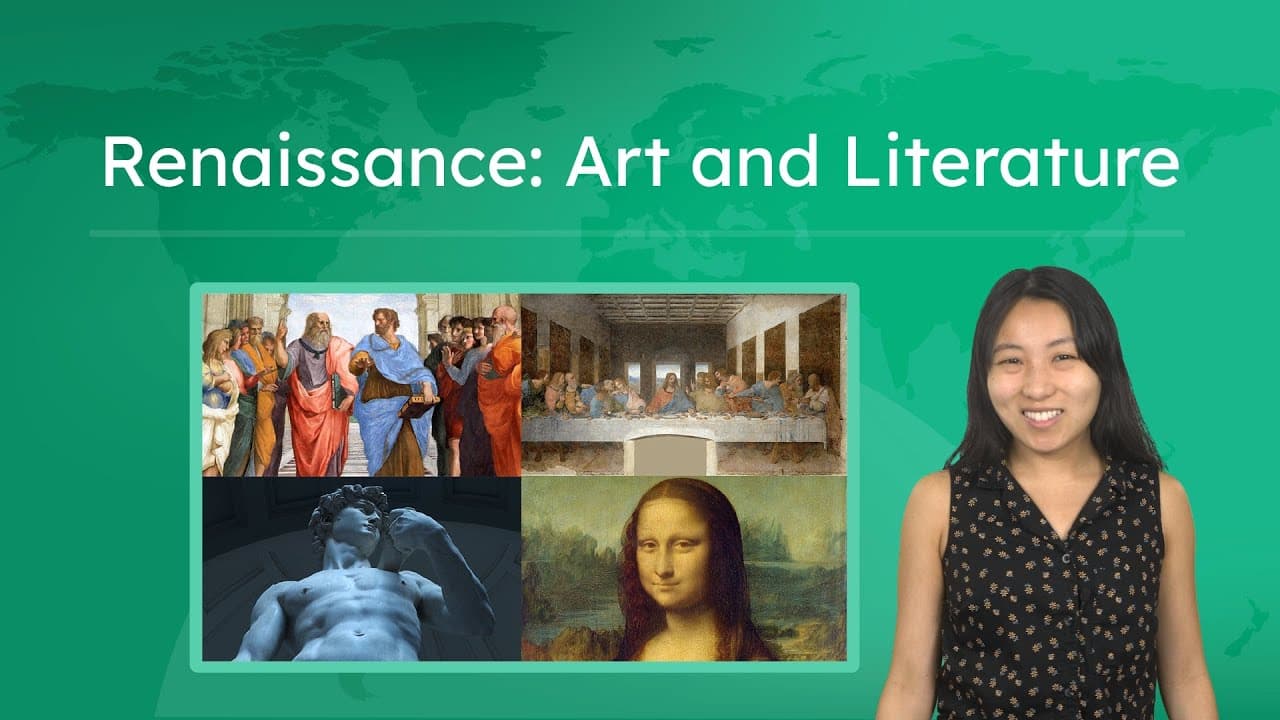
How Renaissance Art and Literature Changed the World

How Renaissance Art and Literature Changed the World

This educational video takes students on a journey through a virtual museum to explore the profound cultural shifts of the Renaissance. It contrasts the art and literature of the Middle Ages—characterized by religious themes and flat, stylized figures—with the explosion of Realism, Humanism, and Individualism during the Renaissance. Through detailed analyses of masterpieces by Leonardo da Vinci, Michelangelo, and Raphael, the video demonstrates how artists used techniques like linear perspective and shading to celebrate the human form and experience. The video also examines the literary revolution led by figures like Dante Alighieri and William Shakespeare. It highlights the shift from Latin to vernacular languages, making literature accessible to the common person, and the move toward exploring complex human emotions and everyday experiences rather than just religious doctrine. Key concepts such as Secularism—the separation of institutions from religious beliefs—are defined and applied to show how society began questioning authority and valuing individual potential. Ideal for World History and Art History classes, this video serves as an engaging multimedia text. It helps students visualize abstract historical concepts through famous works of art. Teachers can use this video to anchor discussions on how cultural values are reflected in art, the importance of the printing press and vernacular language in spreading ideas, and the lasting impact of Renaissance thinking on modern views of human potential and individuality.

Miacademy & MiaPrep Learning ChannelMiacademy & MiaPrep Learning Channel

12mins

Video
Restoring Order After Napoleon: The Congress of Vienna

Restoring Order After Napoleon: The Congress of Vienna

This educational video from Crash Course European History explores the aftermath of the French Revolution and the Napoleonic Wars, focusing on the Congress of Vienna in 1815. Host John Green explains how major European powers—Britain, Prussia, Russia, Austria, and a defeated France—convened to redraw the map of Europe and restore the "old order" of monarchy and aristocracy. The video details the political maneuvering of key figures like Klemens von Metternich and Charles Maurice de Talleyrand, illustrating how they established a "Balance of Power" intended to prevent future massive conflicts and check the expansion of nations like Russia. The video also delves deeply into the ideological and cultural shifts of the time. It contrasts the conservative political backlash, championed by thinkers like Edmund Burke who valued tradition and stability, against the lingering revolutionary spirit. Significant attention is given to the rise of Romanticism as a cultural reaction against Enlightenment rationality. Through examples in literature (Mary Shelley, Alexander Pushkin) and art, the video highlights how the era began to prioritize emotion, nature, and the past over reason and industrialization. For educators, this video serves as an excellent bridge between the age of revolutions and the modern era. It provides crucial context for understanding 19th-century geopolitics, the concept of the "Concert of Europe," and the tension between conservative institutions and rising liberal/nationalist movements. The juxtaposition of political history with art and literature offers interdisciplinary opportunities to discuss how cultural movements reflect and react to political realities, making it highly valuable for World History, European History, and Humanities curriculums.

CrashCourseCrashCourse

14mins 1s

Video
The Northern Renaissance: Books, Politics, and Radical Ideas

The Northern Renaissance: Books, Politics, and Radical Ideas

This educational video explores the spread of Renaissance ideas from Italy to Northern Europe, examining how the movement transformed as it crossed the Alps. It begins by identifying the printing press as the technological catalyst that democratized knowledge, allowing ideas to travel faster and reach wider audiences than ever before. The narrative then delves into how Northern Humanists adapted Italian concepts to fit their own cultural and religious contexts, often focusing more on religious reform and social ethics than the aesthetic glorification of the individual seen in Italy. The content profiles four pivotal thinkers who shaped Western political and social thought: Desiderius Erasmus, the "Prince of the Humanists" who advocated for a middle path of religious reform; Niccolò Machiavelli, whose treatise "The Prince" established modern political realism; Thomas More, whose "Utopia" imagined an idealistic communal society; and Christine de Pizan, an early feminist who challenged the misogyny of her time. Through these figures, the video illustrates the tension between idealism and realism that defined the era. For the classroom, this video serves as an excellent bridge between the artistic Renaissance and the political/religious upheavals of the Reformation. It provides rich opportunities to discuss the impact of media technology on society, debate the ethics of political power (is it better to be loved or feared?), and analyze how historical context shapes philosophical outlooks. The video effectively demonstrates how the Renaissance was not a monolith but a diverse movement with conflicting values and visions for the future.

CrashCourseCrashCourse

14mins 2s

Video
How Authoritarian Socialism Controls Truth and Economies

How Authoritarian Socialism Controls Truth and Economies

This educational video provides a deep dive into the mechanisms of authoritarian socialism, exploring how these regimes control both information and economies. The narrator, Justin, begins by examining the psychological tools used by authoritarian systems, specifically propaganda and cognitive dissonance, to manipulate citizens' perception of reality. The video explains how truth is often subverted to maintain the status quo and the authority of the state, using the famous "2+2=5" analogy to illustrate how political pressure can force individuals to accept falsehoods.

Miacademy & MiaPrep Learning ChannelMiacademy & MiaPrep Learning Channel

12mins 18s

Video
What Anarchism Actually Means: Beyond Chaos and Disorder

What Anarchism Actually Means: Beyond Chaos and Disorder

This episode of Crash Course Political Theory provides a comprehensive introduction to anarchism, moving beyond the common stereotype of chaos and disorder to explore it as a serious political philosophy. The video examines the core belief that society can organize itself without a centralized state, arguing that human nature is inherently cooperative rather than competitive. It contrasts anarchist views with those of thinkers like Thomas Hobbes, who believed life without government would be "nasty, brutish, and short." The video traces the historical development of anarchist thought through key figures such as Emma Goldman, Pierre-Joseph Proudhon, Mikhail Bakunin, and Peter Kropotkin. It distinguishes between different strands of the ideology, including mutualism, collectivist anarchism, and anarchist communism. The narrative connects these historical theories to modern movements, analyzing the Occupy Wall Street protests, the concept of "everyday anarchism" in daily life, and even the divergence of right-wing anti-state movements like crypto-anarchism. For educators, this resource is an excellent tool for high school Civics, Government, and Philosophy classes. It helps students understand the spectrum of political ideologies beyond the standard liberal-conservative binary. By presenting anarchism as a theory of mutual aid and voluntary association, it prompts deep discussions about the necessity of the state, the nature of hierarchy, and how communities handle crisis. The video also addresses the complex relationship between anarchism and violence, offering a nuanced look at political radicalism.

CrashCourseCrashCourse

11mins 42s

Video
Understanding Liberalism: Liberty, Rights, and the Social Contract

Understanding Liberalism: Liberty, Rights, and the Social Contract

This educational video from the Crash Course Political Theory series explores the complex philosophy of Liberalism, moving beyond the common political usage of the term to its roots as a philosophy centered on liberty and individual rights. Hosted by Ellie Anderson, the video traces the evolution of liberal thought from the 1600s social contract theories of Thomas Hobbes and John Locke to modern interpretations by John Rawls and Isaiah Berlin. It tackles difficult questions about what happens when individual rights conflict and how a democratic society balances freedom with equality. The content dives deep into key political concepts including the State of Nature, the Social Contract, the Veil of Ignorance, and the crucial distinction between Negative Liberty (freedom from interference) and Positive Liberty (the capacity for self-determination). It also addresses historical contradictions within classical liberalism, such as its coexistence with slavery and colonialism, and introduces contemporary debates regarding multiculturalism and group rights versus individual rights. For educators, this video serves as an excellent anchor for units on political philosophy, civics, or government. It provides a structured framework for students to understand abstract concepts like justice and fairness. The video offers concrete metaphors—like the ride-sharing app for the social contract or the job applicant for positive/negative liberty—that make complex theories accessible. It naturally prompts critical thinking and classroom debate regarding current events, social justice, and the role of government.

CrashCourseCrashCourse

12mins 24s

Video
How the Scientific Revolution Changed the World

How the Scientific Revolution Changed the World

This educational video provides a comprehensive overview of the Scientific Revolution during the Renaissance, tracing its roots from the Islamic Golden Age to its profound impact on European society and the modern world. The narrative explains how the shift from relying on tradition and religious authority to using observation, experimentation, and reason transformed humanity's understanding of the universe. It highlights the interconnectedness of global history by acknowledging the crucial role Islamic scholars played in preserving and advancing Greek and Roman knowledge, which later fueled European scientific breakthroughs. The video profiles key historical figures including Ibn al-Haytham and Al-Khwarizmi from the Islamic world, and Copernicus, Galileo, and Isaac Newton from Europe. It details their specific contributions—from the development of algebra and optics to the heliocentric theory and the laws of gravity. Beyond the science, the video explores the ripple effects of these discoveries, explaining how the scientific method influenced navigation, global trade, economic power, and even political philosophies leading to democracy and human rights. This resource is highly valuable for World History, Science, and Social Studies classrooms. It encourages interdisciplinary learning by connecting scientific progress with political and social change. Teachers can use this video to teach the importance of critical thinking, the value of cross-cultural knowledge exchange, and the historical struggle between established authority and new evidence-based ideas.

Miacademy & MiaPrep Learning ChannelMiacademy & MiaPrep Learning Channel

12mins 40s

Video
How the Printing Press Revolutionized Education

How the Printing Press Revolutionized Education

This educational video explores the transformative impact of the printing press on education and society during the Renaissance. It begins by contrasting modern diverse classrooms with the exclusive, limited educational systems of the Middle Ages, where books were hand-copied rarities and schooling was a privilege reserved primarily for wealthy males and the clergy. The narrative explains how Gutenberg's invention democratized knowledge, leading to higher literacy rates, the spread of humanism, and the Protestant Reformation. The video also introduces viewers to key historical figures and philosophers who shaped educational theory, including Erasmus, Thomas Hobbes, Jean-Jacques Rousseau, and Confucius. It contrasts their varying views on the purpose of education—from fostering independent thought to maintaining social order. Furthermore, it traces the evolution of educational institutions, highlighting the slow inclusion of the middle class and the significant delay in public education for girls. For educators, this video serves as an excellent tool to connect technological innovation with social change. It encourages critical thinking about how access to information shapes society, making it highly relevant for discussions on current digital information ages. The content naturally leads to lessons on historical inequality, the history of communication, and the philosophy of learning, making it versatile for World History and Civics classrooms.

Miacademy & MiaPrep Learning ChannelMiacademy & MiaPrep Learning Channel

12mins 17s

Video
From Absolute Kings to Constitutional Rights: The English Civil War

From Absolute Kings to Constitutional Rights: The English Civil War

This episode of Crash Course European History explores the tumultuous 17th-century struggle in Britain between the concept of the "Divine Right of Kings" and the rising power of Parliament. It details the reigns of the Stuart monarchs—James I, Charles I, Charles II, and James II—tracing how their attempts to enforce absolute rule and religious uniformity led to the English Civil War, the execution of a king, and a temporary military dictatorship under Oliver Cromwell. The video delves into the complex intersection of religion and politics, highlighting how conflicts between Catholics, Anglicans, and Puritans fueled social unrest, civil war, and eventually the "Glorious Revolution." It examines the pivotal transition from absolutism to constitutionalism, culminating in the English Bill of Rights of 1689, which established parliamentary sovereignty and limited monarchical power. For educators, this resource serves as an essential primer on the foundations of modern Western democracy. It connects historical events to the influential political philosophies of Thomas Hobbes and John Locke, demonstrating how the chaos of the 17th century birthed the concepts of natural rights—life, liberty, and property—that directly influenced the founding documents of the United States and other modern democracies.

CrashCourseCrashCourse

14mins 36s

Video
How the Romantic Movement Transformed Art and History

How the Romantic Movement Transformed Art and History

This educational video provides a comprehensive overview of the Romantic Movement in 19th-century Europe, exploring it as a direct reaction against the rationalism of the Enlightenment and the industrialization of society. The narrator explains how the political turbulence of the French Revolution and the technological shifts of the Industrial Revolution left people feeling alienated, leading artists and thinkers to seek meaning through emotion, nature, and individualism rather than cold logic.

Miacademy & MiaPrep Learning ChannelMiacademy & MiaPrep Learning Channel

10mins 13s

Video
From Pizza to Politics: Understanding the Articles of Confederation

From Pizza to Politics: Understanding the Articles of Confederation

This educational video provides a comprehensive overview of the Articles of Confederation, the first governing document of the United States. Through an accessible analogy involving friends trying to order pizza with limited funds, the narrator explains the core tension between "public good" and "individual will" that shaped the early American government. The video breaks down the philosophical roots of the Articles, including Classical Liberalism and the influence of Enlightenment thinkers like Adam Smith and Baruch Spinoza. The content offers a detailed examination of the structural components of the Articles of Confederation, describing the unicameral legislature and the high thresholds required for passing laws (9/13 votes) or amendments (13/13 votes). It clearly delineates the specific powers granted to the national government, such as declaring war and managing foreign relations, while highlighting the critical weaknesses that ultimately led to its failure—specifically the inability to tax, enforce laws, or regulate a unified currency. For educators, this resource serves as an excellent bridge between abstract political theory and historical reality. The use of the "pizza problem" metaphor makes the concept of competing interests tangible for students. The video is particularly useful for units on the foundations of American government, the Critical Period following the Revolutionary War, and the events leading up to the Constitutional Convention. It provides clear definitions of complex vocabulary like "specie," "unicameral," and "social contract."

Miacademy & MiaPrep Learning ChannelMiacademy & MiaPrep Learning Channel

8mins 28s

Video
Why Democracy Feels Broken: Models, Critiques, and Theory

Why Democracy Feels Broken: Models, Critiques, and Theory

This educational video from Crash Course Political Theory explores the complex nature of democracy, addressing the common modern sentiment that democratic systems are "broken." Hosted by Dr. Ellie Anderson, the video investigates whether dissatisfaction with democracy is a new phenomenon or an inherent feature of the system. It traces critiques of democracy back to ancient philosophers like Plato, who worried about the chaos of "unmixed freedom," and contrasts historical Athenian practices with the egalitarian decision-making of indigenous hunter-gatherer societies.

CrashCourseCrashCourse

12mins 5s

Video
The Ethics of War: Understanding Just War Theory

The Ethics of War: Understanding Just War Theory

This educational video provides a comprehensive introduction to Just War Theory, using the 2003 United States invasion of Iraq as a primary case study. Hosted by Ellie Anderson for Crash Course Political Theory, the video breaks down the ethical framework originally established by philosophers like Thomas Aquinas. It distinguishes between the two main categories of the theory: *jus ad bellum* (the conditions under which a nation may justly go to war) and *jus in bello* (the ethical conduct required during war). The video systematically explores the six criteria for *jus ad bellum*—just cause, right intention, legitimate authority (nationhood), likelihood of success, proportionality, and last resort. It then examines the three criteria for *jus in bello*—legitimate targets, proportionate damage, and necessity. Throughout the explanation, the narrator applies these concepts to the Iraq War, analyzing arguments made by the Bush administration regarding weapons of mass destruction and humanitarian intervention, while contrasting them with the eventual outcomes and lack of international support. For educators, this resource is an excellent tool for High School Civics, History, and Philosophy classrooms. It moves beyond simple dates and battles to engage students in critical ethical reasoning. The video encourages learners to evaluate historical events through a moral lens, discussing complex topics like pre-emptive vs. preventive war, the impact of modern technology (drones and AI) on warfare, and the difficult reality of civilian casualties. It provides a structured vocabulary for discussing international conflict and political responsibility.

CrashCourseCrashCourse

12mins 6s

Video
The Theories Behind Prison, Punishment, and Abolition

The Theories Behind Prison, Punishment, and Abolition

This episode of Crash Course Political Theory explores the history, philosophy, and future of the prison system. Host Ellie Anderson examines why societies punish, moving from historical corporal punishment to the development of the modern prison system in the late 1700s. The video breaks down complex concepts like Jeremy Bentham's Panopticon and Michel Foucault's theories on surveillance, helping students understand how physical structures and social observation influence human behavior.

CrashCourseCrashCourse

11mins 3s

Video
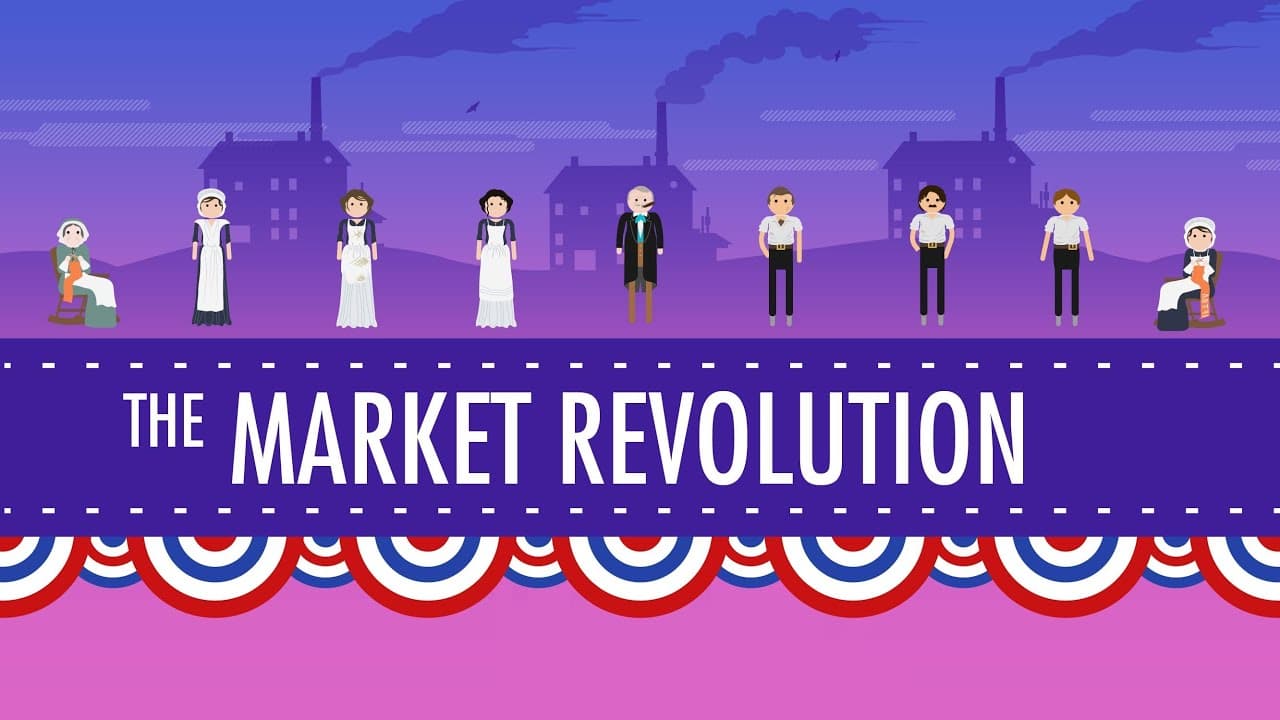
How the Market Revolution Transformed Early America

How the Market Revolution Transformed Early America

This educational video provides a fast-paced and comprehensive overview of the Market Revolution in the United States during the first half of the 19th century. Hosted by John Green, the video explores how America shifted from a Jeffersonian agrarian society of subsistence farmers to a Hamiltonian commercial and industrial power. It details the explosion of new technologies—including canals, steamboats, railroads, and the telegraph—that dramatically lowered transportation costs and connected local markets into a national economy. The content dives deep into the structural changes that accompanied this economic shift, such as the development of the factory system, the legal creation of corporations with limited liability, and the crucial role the government played in financing infrastructure and protecting business interests through Supreme Court rulings. It also examines the social consequences of these changes, including the migration of people westward (Manifest Destiny), the influx of immigrants to fill factory jobs, and the changing nature of labor from task-oriented work to time-disciplined wage labor. For educators, this video serves as an excellent anchor for units on 19th-century US History, industrialization, or economics. It connects historical events to literary movements like Transcendentalism and works like Herman Melville's "Bartleby the Scrivener," offering interdisciplinary opportunities. The video challenges students to think critically about the definition of freedom, the relationship between government and business, and the human cost of economic progress, making it a valuable tool for high school history and social studies classrooms.

CrashCourseCrashCourse

14mins 11s

Video
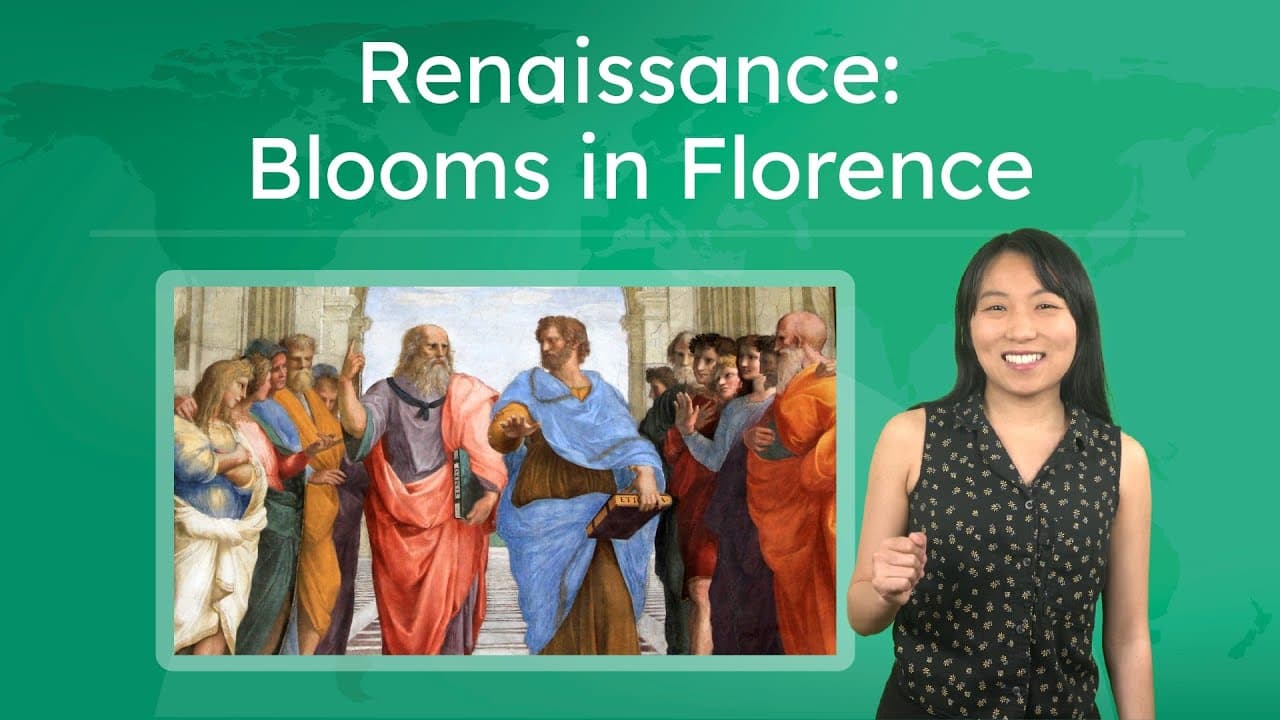
How Florence Sparked the Renaissance

How Florence Sparked the Renaissance

This engaging educational video explores the origins and impact of the Renaissance, focusing on Florence, Italy, as the birthplace of this cultural revolution. The narrator guides viewers through the transition from the Middle Ages to the modern era, explaining how a rediscovery of ancient Greek and Roman ideas sparked new ways of thinking about human potential. The video utilizes famous artworks, historical examples, and clear definitions to make complex historical concepts accessible. Key themes include the philosophy of Humanism, the influence of wealthy patrons like the Medici family, the decline of feudalism, and the impact of the Black Death on social structures. It also covers significant technological and cultural shifts, such as the invention of the printing press, the rise of secularism, the use of perspective in art, and the transition to writing in the vernacular. This resource is highly valuable for World History and Art History classrooms. It breaks down the abstract causes of the Renaissance into concrete factors—economic prosperity, trade, and crisis recovery. Teachers can use the built-in discussion questions to prompt critical thinking about how historical events shape culture and how modern technology compares to the printing press in spreading ideas.

Miacademy & MiaPrep Learning ChannelMiacademy & MiaPrep Learning Channel

12mins 40s

Video
How Enlightenment Ideas Sparked the American Revolution

How Enlightenment Ideas Sparked the American Revolution

This educational video provides a comprehensive overview of the origins and key events of the American Revolution, connecting concrete historical milestones with the abstract philosophical shifts that drove them. Starting from the early struggles of the Jamestown settlement in 1607, the narrative traces the explosive population growth in the colonies and the economic engines of mercantilism and the transatlantic slave trade. It methodically explains how the relationship between Great Britain and its colonies deteriorated through a series of policy decisions—specifically taxation without representation following the Seven Years' War—leading to pivotal moments like the Boston Massacre and the Boston Tea Party. A significant portion of the video is dedicated to the intellectual underpinnings of the Revolution, specifically the influence of European Enlightenment thinkers like John Locke. It explores how concepts such as natural rights, the social contract, and the separation of powers were woven into the fabric of American revolutionary rhetoric by figures like Thomas Jefferson and Thomas Paine. Crucially, the video does not shy away from the historical contradictions of the era, encouraging critical thinking about how the ideals of "liberty and justice" coexisted with the brutal reality of chattel slavery and the exclusion of women and Native Americans from the narrative of equality. For educators, this resource offers a nuanced entry point into US History units. It goes beyond simple memorization of dates by framing the Revolution as a battle of ideas as much as a military conflict. The built-in review questions and "pause for reflection" moments make it an interactive tool for checking comprehension. It effectively sets the stage for discussions on civics, the purpose of government, and the complex legacy of the Founding Fathers, making it particularly useful for middle and high school social studies classrooms.

Miacademy & MiaPrep Learning ChannelMiacademy & MiaPrep Learning Channel

10mins 46s

Video
What We Owe Each Other: The Ethics of Global Citizenship

What We Owe Each Other: The Ethics of Global Citizenship

This educational video from Crash Course Political Theory explores the complex concept of cosmopolitanism—the idea of being a "citizen of the world." Using the 2015 refugee crisis in Sweden as a hook, the video traces the history of this philosophy from Ancient Greece (Diogenes) and China (Tianxia) to the Enlightenment ideas of Immanuel Kant. It examines the tension between our local obligations to neighbors versus our moral duties to humans across the globe. Key themes include the balance between national sovereignty and international human rights, the effectiveness and limitations of global organizations like the UN, and the philosophical concept of "unsocial sociability." The video also delves into modern applications, such as the debate over open borders, the ethics of globalization, and critiques regarding whether universal human rights are culturally biased. It highlights perspectives from diverse thinkers like Kwame Anthony Appiah and Peter Singer. This resource is highly valuable for High School Civics, Government, and Philosophy classrooms. It provides a structured framework for students to discuss current events like migration crises and international conflict. By connecting abstract theories to real-world examples (e.g., the UN Security Council's veto power, global supply chains), it helps students understand the practical challenges of achieving global justice and peace.

CrashCourseCrashCourse

13mins 3s

Video
How the Constitution Functions as a Social Contract

How the Constitution Functions as a Social Contract

This educational video introduces students to the concept of constitutional government by drawing a relatable analogy to the "Terms and Conditions" agreements found in modern apps and software. It breaks down complex political philosophy into digestible parts, starting with the idea of a social contract as proposed by Jean-Jacques Rousseau. The narrator explains that just as users agree to terms to use an app, citizens and governments enter a social contract where citizens give up certain absolute freedoms in exchange for the protection of rights and an organized society. The video identifies and defines three core principles of constitutional government: Rule of Law (society is governed by laws, not individuals), Limited Government (government authority is restricted), and Popular Sovereignty (the ultimate power rests with the people). It emphasizes that a constitution serves as a written instrument that clearly outlines the powers of the government and, crucially, guarantees specific rights to the citizens that the government cannot infringe upon. Designed for civics and government classrooms, this resource is highly valuable for bridging the gap between abstract political theory and students' daily lives. It includes built-in pause points with reflection questions, making it an interactive tool for introducing the U.S. Constitution. The video concludes with a powerful call to civic engagement, reminding students that an informed citizenry is essential for democracy to function and that they must "vote, debate, and participate."

Miacademy & MiaPrep Learning ChannelMiacademy & MiaPrep Learning Channel

10mins 49s

Video
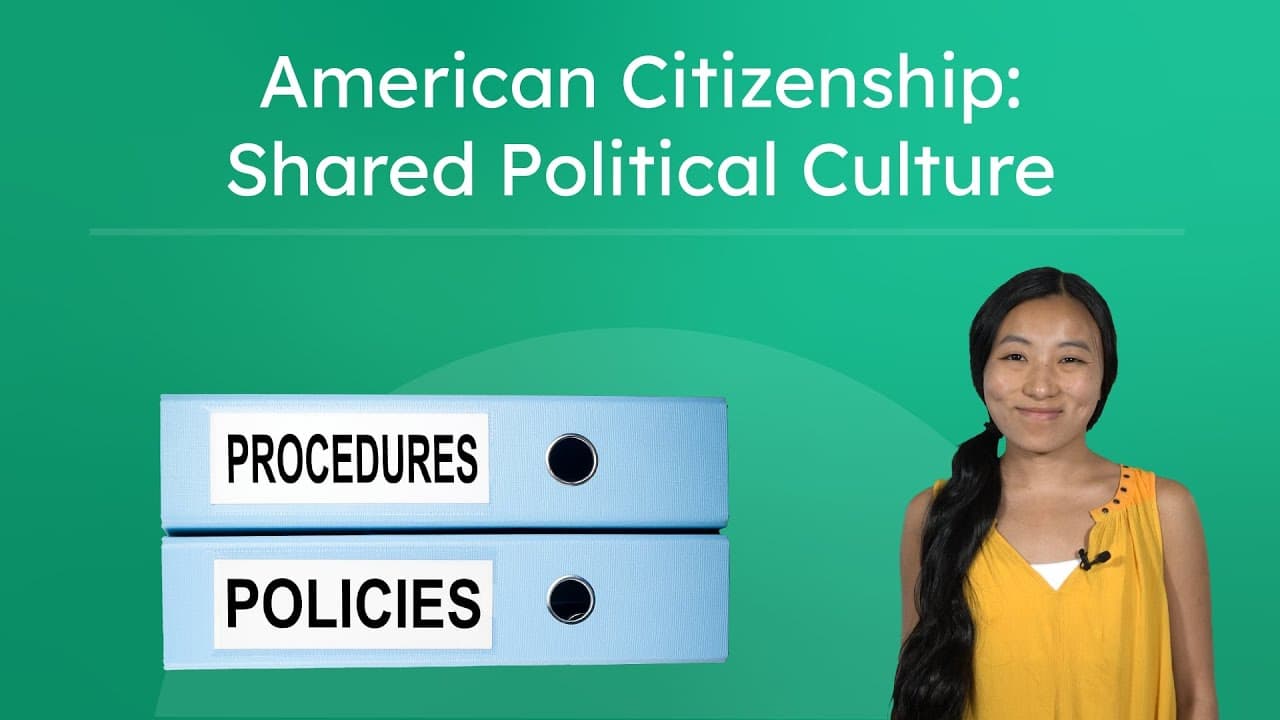
How Concepts, Principles, and Practices Shape American Democracy

How Concepts, Principles, and Practices Shape American Democracy

This educational video explores the foundational structure of American democracy by breaking it down into three interconnected layers: concepts, principles, and practices. The host explains how abstract ideas like justice, equality, and liberty evolve into fundamental truths (principles) and ultimately result in concrete governmental procedures (practices) such as jury trials, separation of powers, and elections. The lesson emphasizes that American identity is defined by these shared political traditions rather than by ethnicity or race. The content delves into specific examples of this hierarchy, showing how the concept of 'liberty' leads to the principle of 'limited government,' which in turn necessitates the practice of 'checks and balances' and 'judicial review.' It also touches upon the historical context of the social contract, suggesting that human beings formed these systems as solutions to historical struggles like war, famine, and subjugation. The video positions the U.S. Constitution and Bill of Rights as the documents that codify these principles into law. Ideally suited for high school civics and government classes, this video provides a framework for students to understand how abstract political philosophy translates into real-world governance. Teachers can use this resource to help students move beyond memorizing vocabulary to understanding the logical flow of democratic institutions. It serves as an excellent primer for units on the Constitution, the judicial system, or political theory, encouraging critical thinking about why our government functions the way it does.

Miacademy & MiaPrep Learning ChannelMiacademy & MiaPrep Learning Channel

9mins 9s

Video
Why the 1848 Revolutions Swept Europe and Failed

Why the 1848 Revolutions Swept Europe and Failed

This educational video from Crash Course European History explores the tumultuous year of 1848, a time when a wave of revolutions swept across Europe. Narrated by John Green, the video dissects the complex web of causes behind these uprisings, ranging from the devastation of the Irish Potato Famine and the "Hungry Forties" to the social and economic dislocations caused by the Industrial Revolution. It explains how traditional agrarian systems were failing and how new political ideologies like liberalism, nationalism, and socialism began to challenge the established monarchical order. The video provides a detailed tour of the specific revolutionary movements in France, the German states, the Austrian Empire, Italy, and Poland. It introduces key historical figures such as Louis Napoleon, Klemens von Metternich, and Karl Marx, while explaining pivotal concepts like the "springtime of Nations" and the friction between different revolutionary classes. The narrative highlights how the initial successes of these revolutions were often undone by internal disunity between middle-class liberals and working-class radicals, allowing conservative forces to reassert control. For educators, this resource serves as an excellent synthesis of 19th-century European political history. It helps students understand the connection between economic hardship and political action, the difficulty of coalition-building in politics, and the origins of modern political spectrums. The video concludes by asking critical historical questions about the value of revolution, noting that while many political goals failed, the revolutions successfully ended serfdom in Austria, changing the lives of millions.

CrashCourseCrashCourse

16mins 25s

Video
Exploring Native Worldviews Through Humor and Reciprocity

Exploring Native Worldviews Through Humor and Reciprocity

This episode of Crash Course Native American History, hosted by Che Jim, explores the foundational elements of Indigenous worldviews, challenging the pervasive stereotype of the "stoic Indian." The video argues that humor, play, and laughter are not just entertainment but are "Good Medicine"—sacred tools for healing, resilience, and community building. It examines how Native American cultures have historically used humor to cope with trauma, subvert colonial power structures, and maintain social harmony, citing examples from the sacred clowns of the Pueblo people to modern indigenous comedy troupes like the 1491s.

CrashCourseCrashCourse

11mins 11s

Video
Defining Heroes and Traitors in American History

Defining Heroes and Traitors in American History

This educational video explores the complex and often subjective definitions of "hero" and "traitor" through three distinct case studies from American history. The narrator challenges students to look beyond simple definitions and consider how historical context, personal values, and perspective shape these labels. The video examines John Adams' controversial defense of British soldiers after the Boston Massacre, Colonel John Chivington's role in the horrific Sand Creek Massacre, and Carry Nation's radical "hatchetations" during the temperance movement. The video delves into deep ethical questions about justice, duty, and morality. It asks students to evaluate whether John Adams was a traitor to the colonial cause or a hero of justice for defending the enemy. It contrasts Chivington's self-proclaimed heroism in protecting settlers with the brutal reality of massacring peaceful Cheyenne and Arapaho people. Finally, it analyzes Carry Nation's crusade against alcohol, asking if her violent methods undermined her virtuous goals. Each segment includes pauses for reflection and specific guiding questions. Teachers can use this video to foster critical thinking and historical analysis skills. It serves as an excellent anchor for lessons on the American Revolution, Native American history, or the Prohibition era. By presenting historical figures who defy easy categorization, the video encourages students to engage with nuance and ambiguity. It is particularly useful for sparking debates about the rule of law, the ethics of war, and the validity of different protest methods.

Miacademy & MiaPrep Learning ChannelMiacademy & MiaPrep Learning Channel

11mins 30s

Video
How the American Revolution Actually Happened

How the American Revolution Actually Happened

In this fast-paced and nuanced overview of the American Revolution, John Green moves beyond a simple timeline of battles to explore the complex causes and contradictory outcomes of the war. The video connects the end of the Seven Years' War and British debt to the imposition of taxes like the Stamp Act and Townshend Acts, explaining how these economic pressures catalyzed a desire for self-governance. It distinguishes between the "War for Independence" and the actual "Revolution," challenging viewers to consider how revolutionary the event truly was for different groups of people. Key themes include the intellectual roots of the revolution in the Enlightenment, specifically the ideas of John Locke and Immanuel Kant regarding liberty and property rights. The video critically examines the hypocrisy inherent in the founding era, contrasting the soaring rhetoric of "all men are created equal" with the reality of slavery and the exclusion of women and non-property owners from political power. It highlights that for many—especially slaves, women, and the poor—the power structure remained largely unchanged despite the overthrow of the monarchy. For educators, this video serves as an excellent tool for teaching critical historical analysis rather than just rote memorization. It prompts students to evaluate historical narratives, understand the difference between political independence and social revolution, and discuss the complexities of the Founding Fathers. The content supports lessons on the Declaration of Independence, the influence of philosophical movements on political action, and the evolution of American democratic ideals.

CrashCourseCrashCourse

11mins 27s

Video
How Renaissance Art and Literature Changed the World

How Renaissance Art and Literature Changed the World

This educational video takes students on a journey through a virtual museum to explore the profound cultural shifts of the Renaissance. It contrasts the art and literature of the Middle Ages—characterized by religious themes and flat, stylized figures—with the explosion of Realism, Humanism, and Individualism during the Renaissance. Through detailed analyses of masterpieces by Leonardo da Vinci, Michelangelo, and Raphael, the video demonstrates how artists used techniques like linear perspective and shading to celebrate the human form and experience. The video also examines the literary revolution led by figures like Dante Alighieri and William Shakespeare. It highlights the shift from Latin to vernacular languages, making literature accessible to the common person, and the move toward exploring complex human emotions and everyday experiences rather than just religious doctrine. Key concepts such as Secularism—the separation of institutions from religious beliefs—are defined and applied to show how society began questioning authority and valuing individual potential. Ideal for World History and Art History classes, this video serves as an engaging multimedia text. It helps students visualize abstract historical concepts through famous works of art. Teachers can use this video to anchor discussions on how cultural values are reflected in art, the importance of the printing press and vernacular language in spreading ideas, and the lasting impact of Renaissance thinking on modern views of human potential and individuality.

Miacademy & MiaPrep Learning ChannelMiacademy & MiaPrep Learning Channel

12mins

Video
Early Imperial China: The Silk Road, Legalism, and the Qin Dynasty

Early Imperial China: The Silk Road, Legalism, and the Qin Dynasty

This educational video provides an engaging overview of Early Imperial China, focusing on the Qin and Han Dynasties. Hosted by an energetic presenter with a robot sidekick named Mia, the video breaks down complex historical concepts into accessible segments. It explores major technological advancements like paper-making and iron tools, explains the massive cultural and economic impact of the Silk Road, and introduces the strict political philosophy of Legalism that shaped the government structure. The narrative connects these historical events to modern concepts, using analogies like comparing the Silk Road to the internet to help students grasp the importance of cultural exchange. It covers key figures like Emperor Qin Shi Huang and his Terracotta Army, while also discussing the social mobility available through education in ancient China compared to other ancient civilizations. The video concludes by touching on the fall of the Han Dynasty and the subsequent Three Kingdoms period. Teachers can use this video as a core component of a World History unit on Ancient Civilizations. It offers excellent opportunities for classroom discussions on trade, government systems, and the difference between rule by strict law versus moral leadership. The clear pauses for questions make it interactive, allowing educators to check for understanding and encourage critical thinking about how ancient innovations and philosophies still influence the world today.

Miacademy & MiaPrep Learning ChannelMiacademy & MiaPrep Learning Channel

9mins 44s

Video
Restoring Order After Napoleon: The Congress of Vienna

Restoring Order After Napoleon: The Congress of Vienna

This educational video from Crash Course European History explores the aftermath of the French Revolution and the Napoleonic Wars, focusing on the Congress of Vienna in 1815. Host John Green explains how major European powers—Britain, Prussia, Russia, Austria, and a defeated France—convened to redraw the map of Europe and restore the "old order" of monarchy and aristocracy. The video details the political maneuvering of key figures like Klemens von Metternich and Charles Maurice de Talleyrand, illustrating how they established a "Balance of Power" intended to prevent future massive conflicts and check the expansion of nations like Russia. The video also delves deeply into the ideological and cultural shifts of the time. It contrasts the conservative political backlash, championed by thinkers like Edmund Burke who valued tradition and stability, against the lingering revolutionary spirit. Significant attention is given to the rise of Romanticism as a cultural reaction against Enlightenment rationality. Through examples in literature (Mary Shelley, Alexander Pushkin) and art, the video highlights how the era began to prioritize emotion, nature, and the past over reason and industrialization. For educators, this video serves as an excellent bridge between the age of revolutions and the modern era. It provides crucial context for understanding 19th-century geopolitics, the concept of the "Concert of Europe," and the tension between conservative institutions and rising liberal/nationalist movements. The juxtaposition of political history with art and literature offers interdisciplinary opportunities to discuss how cultural movements reflect and react to political realities, making it highly valuable for World History, European History, and Humanities curriculums.

CrashCourseCrashCourse

14mins 1s

Video
From Absolute Kings to Constitutional Rights: The English Civil War

From Absolute Kings to Constitutional Rights: The English Civil War

This episode of Crash Course European History explores the tumultuous 17th-century struggle in Britain between the concept of the "Divine Right of Kings" and the rising power of Parliament. It details the reigns of the Stuart monarchs—James I, Charles I, Charles II, and James II—tracing how their attempts to enforce absolute rule and religious uniformity led to the English Civil War, the execution of a king, and a temporary military dictatorship under Oliver Cromwell. The video delves into the complex intersection of religion and politics, highlighting how conflicts between Catholics, Anglicans, and Puritans fueled social unrest, civil war, and eventually the "Glorious Revolution." It examines the pivotal transition from absolutism to constitutionalism, culminating in the English Bill of Rights of 1689, which established parliamentary sovereignty and limited monarchical power. For educators, this resource serves as an essential primer on the foundations of modern Western democracy. It connects historical events to the influential political philosophies of Thomas Hobbes and John Locke, demonstrating how the chaos of the 17th century birthed the concepts of natural rights—life, liberty, and property—that directly influenced the founding documents of the United States and other modern democracies.

CrashCourseCrashCourse

14mins 36s

Video
Understanding Liberalism: Liberty, Rights, and the Social Contract

Understanding Liberalism: Liberty, Rights, and the Social Contract

This educational video from the Crash Course Political Theory series explores the complex philosophy of Liberalism, moving beyond the common political usage of the term to its roots as a philosophy centered on liberty and individual rights. Hosted by Ellie Anderson, the video traces the evolution of liberal thought from the 1600s social contract theories of Thomas Hobbes and John Locke to modern interpretations by John Rawls and Isaiah Berlin. It tackles difficult questions about what happens when individual rights conflict and how a democratic society balances freedom with equality. The content dives deep into key political concepts including the State of Nature, the Social Contract, the Veil of Ignorance, and the crucial distinction between Negative Liberty (freedom from interference) and Positive Liberty (the capacity for self-determination). It also addresses historical contradictions within classical liberalism, such as its coexistence with slavery and colonialism, and introduces contemporary debates regarding multiculturalism and group rights versus individual rights. For educators, this video serves as an excellent anchor for units on political philosophy, civics, or government. It provides a structured framework for students to understand abstract concepts like justice and fairness. The video offers concrete metaphors—like the ride-sharing app for the social contract or the job applicant for positive/negative liberty—that make complex theories accessible. It naturally prompts critical thinking and classroom debate regarding current events, social justice, and the role of government.

CrashCourseCrashCourse

12mins 24s

Video
How the Romantic Movement Transformed Art and History

How the Romantic Movement Transformed Art and History

This educational video provides a comprehensive overview of the Romantic Movement in 19th-century Europe, exploring it as a direct reaction against the rationalism of the Enlightenment and the industrialization of society. The narrator explains how the political turbulence of the French Revolution and the technological shifts of the Industrial Revolution left people feeling alienated, leading artists and thinkers to seek meaning through emotion, nature, and individualism rather than cold logic.

Miacademy & MiaPrep Learning ChannelMiacademy & MiaPrep Learning Channel

10mins 13s

Video
The Northern Renaissance: Books, Politics, and Radical Ideas

The Northern Renaissance: Books, Politics, and Radical Ideas

This educational video explores the spread of Renaissance ideas from Italy to Northern Europe, examining how the movement transformed as it crossed the Alps. It begins by identifying the printing press as the technological catalyst that democratized knowledge, allowing ideas to travel faster and reach wider audiences than ever before. The narrative then delves into how Northern Humanists adapted Italian concepts to fit their own cultural and religious contexts, often focusing more on religious reform and social ethics than the aesthetic glorification of the individual seen in Italy. The content profiles four pivotal thinkers who shaped Western political and social thought: Desiderius Erasmus, the "Prince of the Humanists" who advocated for a middle path of religious reform; Niccolò Machiavelli, whose treatise "The Prince" established modern political realism; Thomas More, whose "Utopia" imagined an idealistic communal society; and Christine de Pizan, an early feminist who challenged the misogyny of her time. Through these figures, the video illustrates the tension between idealism and realism that defined the era. For the classroom, this video serves as an excellent bridge between the artistic Renaissance and the political/religious upheavals of the Reformation. It provides rich opportunities to discuss the impact of media technology on society, debate the ethics of political power (is it better to be loved or feared?), and analyze how historical context shapes philosophical outlooks. The video effectively demonstrates how the Renaissance was not a monolith but a diverse movement with conflicting values and visions for the future.

CrashCourseCrashCourse

14mins 2s

Video
Machiavelli and the Ethics of Political Power

Machiavelli and the Ethics of Political Power

This educational video from Crash Course Political Theory explores the controversial philosophy of Niccolò Machiavelli and his seminal work, 'The Prince.' Rather than dismissing Machiavelli simply as a teacher of evil, the host analyzes his concept of political realism—the idea that effective leadership often requires making morally difficult or 'not good' choices to maintain the state's stability. The video bridges the gap between the 16th century and the modern era by examining how these ideas manifest in the concept of 'Realpolitik.' The content draws powerful connections between Machiavelli's theories and the actions of modern political figures, specifically focusing on Henry Kissinger's controversial career during the Cold War. It delves into the ethical dilemma of 'dirty hands' in politics: is it acceptable for a leader to compromise their morals to achieve a greater good? The video also introduces perspectives from other major political thinkers like Max Weber, Carl Schmitt, Hannah Arendt, and Catherine Zuckert to provide a balanced and nuanced debate. For educators, this resource serves as an excellent prompt for deep classroom discussions about civics, history, and ethics. It challenges students to move beyond black-and-white moralizing and consider the complex trade-offs inherent in governance. By comparing historical theory with 20th-century events like the Vietnam War and diplomatic relations with China, the video helps students understand the practical applications—and devastating consequences—of political realism.

CrashCourseCrashCourse

13mins 1s

Video
The Atlantic Slave Trade: History and Legacy

The Atlantic Slave Trade: History and Legacy

This educational video provides a comprehensive overview of the Atlantic Slave Trade, examining the staggering statistics, economic motivations, and brutal realities of the "peculiar institution." Host John Green details the movement of 10-12 million Africans to the Americas, debunking common misconceptions about where enslaved people were taken—highlighting that the vast majority went to the Caribbean and Brazil for sugar production, rather than the United States. The video explores the horrifying conditions on slave ships and the dangerous labor of sugar processing, framing slavery not just as a historical event but as an economic engine driven by consumer demand. Beyond the physical aspects, the video delves into the intellectual and legal history of slavery, defining "chattel slavery" and the concept of "social death." It traces the roots of these dehumanizing ideologies through history, referencing Greek philosophy (Aristotle), Roman plantation models (latifundia), Judeo-Christian justifications (the Curse of Ham), and the Arab slave trade. The analysis challenges viewers to understand how slavery was justified intellectually and legally for centuries. This resource is highly valuable for high school history classrooms as it connects historical events to broader themes of economics, human rights, and moral responsibility. It encourages critical thinking about how language is used (critiquing the casual use of the word "slave") and concludes with a powerful reflection on the shared human responsibility for this tragedy, warning against using history to blame specific groups while exonerating others.

CrashCourseCrashCourse

11mins 8s

Video
How Hinduism and Buddhism Shaped Ancient India

How Hinduism and Buddhism Shaped Ancient India

In this installment of Crash Course World History, John Green tackles the complex and vibrant history of India, focusing on the development of two major world religions: Hinduism and Buddhism. The video navigates the challenges of studying Indian history, such as the vast diversity of the subcontinent and the biases of British historians, before diving into the structural foundations of Indian society. Green explains the origins of the caste system through the Vedic myth of Purusha and connects it to the concepts of Dharma (duty), Karma (action/consequence), and Samsara (the cycle of rebirth), illustrating how these spiritual beliefs enforced social cohesion for millennia. The narrative then shifts to the story of Siddhartha Gautama and the birth of Buddhism as a reaction to the rigid social hierarchy of Hinduism. Green details the Four Noble Truths and the Eightfold Path, explaining Buddhism's appeal to lower-caste individuals. The video also covers the Mauryan Empire under Emperor Ashoka, a warrior-turned-pacifist who attempted to rule through Buddhist principles (Dhamma) after witnessing the devastation of war. Special attention is given to Ashoka's pillars and stupas as historical artifacts. For educators, this video is an invaluable tool for simplifying abstract religious and philosophical concepts. It provides a clear framework for comparing Hinduism and Buddhism, exploring how religious beliefs shape political structures, and discussing the concept of historical bias. The engaging animations and humor make difficult topics like the caste system and metaphysical ethics accessible to high school students, serving as a perfect launchpad for discussions on social stratification, religious syncretism, and ancient governance.

CrashCourseCrashCourse

12mins 17s

Video
Knighthood, Chivalry, and the Medieval Code of Honor

Knighthood, Chivalry, and the Medieval Code of Honor

This engaging educational video explores the world of medieval knighthood by drawing parallels between knights and modern superheroes. The narrator guides students through the rigorous training process required to become a knight—from serving as a young page to training as a squire—and explains the Code of Chivalry that governed their behavior. The video emphasizes that being a knight was not just about combat skills, but also about character virtues like bravery, respect, and kindness. The content delves into the specific historical context of the Middle Ages, introducing three key historical figures who embodied different aspects of the era: Thomas Aquinas (representing intellect, faith, and reason), Richard the Lionheart (representing bravery and military leadership), and William Marshal (representing loyalty and tournament skill). It also touches upon the significance of the Magna Carta in limiting royal power and establishing rights. For educators, this video serves as an excellent introduction to the social structures of the Middle Ages. It connects historical concepts to social-emotional learning by asking students to reflect on how the values of chivalry—such as standing up for others and keeping promises—apply to their lives today. The "superhero" analogy makes the distant history of the Middle Ages relatable and accessible for upper elementary and middle school students.

Miacademy & MiaPrep Learning ChannelMiacademy & MiaPrep Learning Channel

10mins 57s

Video
How Concepts, Principles, and Practices Shape American Democracy

How Concepts, Principles, and Practices Shape American Democracy

This educational video explores the foundational structure of American democracy by breaking it down into three interconnected layers: concepts, principles, and practices. The host explains how abstract ideas like justice, equality, and liberty evolve into fundamental truths (principles) and ultimately result in concrete governmental procedures (practices) such as jury trials, separation of powers, and elections. The lesson emphasizes that American identity is defined by these shared political traditions rather than by ethnicity or race. The content delves into specific examples of this hierarchy, showing how the concept of 'liberty' leads to the principle of 'limited government,' which in turn necessitates the practice of 'checks and balances' and 'judicial review.' It also touches upon the historical context of the social contract, suggesting that human beings formed these systems as solutions to historical struggles like war, famine, and subjugation. The video positions the U.S. Constitution and Bill of Rights as the documents that codify these principles into law. Ideally suited for high school civics and government classes, this video provides a framework for students to understand how abstract political philosophy translates into real-world governance. Teachers can use this resource to help students move beyond memorizing vocabulary to understanding the logical flow of democratic institutions. It serves as an excellent primer for units on the Constitution, the judicial system, or political theory, encouraging critical thinking about why our government functions the way it does.

Miacademy & MiaPrep Learning ChannelMiacademy & MiaPrep Learning Channel

9mins 9s

Video
Was the Renaissance Real? Art, Money, and Humanism in Italy

Was the Renaissance Real? Art, Money, and Humanism in Italy

This video explores the European Renaissance, examining whether it was truly a distinct historical period or merely a continuation of the Middle Ages. Host John Green investigates the intellectual shift known as Humanism, which prioritized human potential and worldly concerns over the divine focus of the medieval era. The video details how the rediscovery of classical Greek and Roman texts influenced philosophy, education, and the arts, while also highlighting the economic boom in Italian city-states like Florence that fueled this cultural explosion through patronage.

CrashCourseCrashCourse

14mins 34s

Video
How Modernism Transformed Art, Science, and Philosophy

How Modernism Transformed Art, Science, and Philosophy

This educational video from Crash Course European History explores the profound cultural and intellectual shifts that occurred in Europe around the turn of the 20th century. Host John Green examines the rise of Modernism, a movement characterized by the rejection of traditional forms and the embrace of uncertainty, subjectivity, and innovation. The video covers the transition from Realism to Impressionism and Cubism in art, the departure from classical ballet in dance, and the move from Newtonian physics to Quantum Theory and Relativity in science. The content delves into key themes such as the breakdown of absolute truths, the exploration of the human subconscious, and the impact of non-European influences on Western culture. Significant figures like Sigmund Freud, Friedrich Nietzsche, Albert Einstein, and Pablo Picasso are discussed in depth, highlighting how their revolutionary ideas challenged the Enlightenment's focus on rationality and objective reality. The video illustrates how these disruptions in art, science, and philosophy mirrored the political and social upheavals of the era. For educators, this resource serves as an excellent synthesis of the intellectual history of the early 1900s. It provides a multidisciplinary approach, connecting visual arts, music, physics, and psychology to explain the "paradigm shift" that defined the modern era. The video is particularly useful for helping students understand abstract concepts like relativity, psychoanalysis, and existential philosophy by grounding them in their historical context and demonstrating how they shaped the 20th-century worldview.
CrashCourseCrashCourse

15mins 9s

Video
From Pizza to Politics: Understanding the Articles of Confederation

From Pizza to Politics: Understanding the Articles of Confederation

This educational video provides a comprehensive overview of the Articles of Confederation, the first governing document of the United States. Through an accessible analogy involving friends trying to order pizza with limited funds, the narrator explains the core tension between "public good" and "individual will" that shaped the early American government. The video breaks down the philosophical roots of the Articles, including Classical Liberalism and the influence of Enlightenment thinkers like Adam Smith and Baruch Spinoza. The content offers a detailed examination of the structural components of the Articles of Confederation, describing the unicameral legislature and the high thresholds required for passing laws (9/13 votes) or amendments (13/13 votes). It clearly delineates the specific powers granted to the national government, such as declaring war and managing foreign relations, while highlighting the critical weaknesses that ultimately led to its failure—specifically the inability to tax, enforce laws, or regulate a unified currency. For educators, this resource serves as an excellent bridge between abstract political theory and historical reality. The use of the "pizza problem" metaphor makes the concept of competing interests tangible for students. The video is particularly useful for units on the foundations of American government, the Critical Period following the Revolutionary War, and the events leading up to the Constitutional Convention. It provides clear definitions of complex vocabulary like "specie," "unicameral," and "social contract."

Miacademy & MiaPrep Learning ChannelMiacademy & MiaPrep Learning Channel

8mins 28s

Video
How Florence Sparked the Renaissance

How Florence Sparked the Renaissance

This engaging educational video explores the origins and impact of the Renaissance, focusing on Florence, Italy, as the birthplace of this cultural revolution. The narrator guides viewers through the transition from the Middle Ages to the modern era, explaining how a rediscovery of ancient Greek and Roman ideas sparked new ways of thinking about human potential. The video utilizes famous artworks, historical examples, and clear definitions to make complex historical concepts accessible. Key themes include the philosophy of Humanism, the influence of wealthy patrons like the Medici family, the decline of feudalism, and the impact of the Black Death on social structures. It also covers significant technological and cultural shifts, such as the invention of the printing press, the rise of secularism, the use of perspective in art, and the transition to writing in the vernacular. This resource is highly valuable for World History and Art History classrooms. It breaks down the abstract causes of the Renaissance into concrete factors—economic prosperity, trade, and crisis recovery. Teachers can use the built-in discussion questions to prompt critical thinking about how historical events shape culture and how modern technology compares to the printing press in spreading ideas.

Miacademy & MiaPrep Learning ChannelMiacademy & MiaPrep Learning Channel

12mins 40s

Video
The Dutch Golden Age: Trade, Tolerance, and the Rise of Merchant Power

The Dutch Golden Age: Trade, Tolerance, and the Rise of Merchant Power

This educational video explores the remarkable rise of the Dutch Republic during the 17th century, often called the Dutch Golden Age. It examines how a small confederation of provinces transformed into a global economic superpower through innovative financial systems, aggressive trade policies, and a unique political structure. The video contrasts the Dutch model of merchant-led constitutionalism with the absolutist monarchies prevalent elsewhere in Europe, highlighting how the distribution of power influenced national success. The content covers a wide range of topics including the Eighty Years' War for independence from Spain, the establishment of the Dutch East India Company (VOC), and the cultural flourishing of the era as seen through the works of masters like Vermeer. It delves into the economic theory of mercantilism, the technological innovations in civil engineering and city planning (like Amsterdam's canals), and the eventual geopolitical rivalry with England that led to the Anglo-Dutch Wars. For educators, this video serves as an excellent case study for AP European History or World History curriculums. It provides concrete examples of how geography, economics, and religious tolerance can drive state building. The video connects abstract economic theories like mercantilism to real-world events and uses visual art as a historical document to reveal the everyday lives and values of the 17th-century middle class.

CrashCourseCrashCourse

13mins 44s

Video
Why the Roman Empire Survived Until the 15th Century

Why the Roman Empire Survived Until the 15th Century

In this installment of Crash Course World History, John Green challenges the traditional narrative that the Roman Empire fell in 476 CE. Instead, he argues that the empire merely shifted its center of gravity eastward to Constantinople, where it survived and thrived as the Byzantine Empire for another thousand years. The video explores the strategic advantages of the East, the continuity of Roman law and culture, and the evolution of Christianity into the Eastern Orthodox tradition. Key themes include the fluidity of historical periodization, the intersection of religion and politics (specifically the concept of Caesaropapism), and the preservation of legal systems. The video highlights the reign of Emperor Justinian and Empress Theodora, detailing their contributions to Roman law through the Digest and Institutes, their massive building projects like the Hagia Sophia, and their handling of political unrest like the Nika Riots. For educators, this video serves as an excellent tool for AP World History or general high school history classes to discuss how historians define "empires" and "falls." It provides a clear contrast between the chaotic fragmentation of Western Europe and the centralized, wealthy stability of the Byzantine East. It also offers opportunities to discuss gender roles in history through the figure of Theodora and the long-term impact of Roman civil law on modern European legal systems.

CrashCourseCrashCourse

12mins 44s

Video
The Global History of Non-Violent Resistance

The Global History of Non-Violent Resistance

This installment of Crash Course World History reframes the narrative of the 20th century, moving beyond the traditional focus on World Wars and genocide to explore the parallel rise of global non-violent resistance movements. John Green argues that while the century was undeniably violent, it also birthed a sophisticated, interconnected web of peace movements that spanned continents. The video traces the intellectual lineage of non-violence, connecting Leo Tolstoy's Christian anarchism to Mahatma Gandhi's Satyagraha, and demonstrating how these ideas flowed back to the West to influence the American Civil Rights Movement and anti-war activists. The video provides a comparative historical analysis of various non-violent struggles, including the Indian independence movement, anti-colonial efforts in Vietnam and Egypt, the Rosenstrasse protest in Nazi Germany, and the Prague Spring in Czechoslovakia. It highlights key concepts like 'ahimsa' (non-injury) and 'satyagraha' (truth-force) and examines the strategic logic behind civil disobedience. Significant attention is given to the cross-pollination of ideas, showing how activists like Bayard Rustin and Martin Luther King Jr. adapted Gandhian tactics for the American context. For educators, this resource serves as an excellent tool for teaching the global interconnectedness of historical events and political philosophies. It challenges students to analyze the efficacy of non-violence as a political tool against varying degrees of oppression. The video is particularly useful for units on the 20th century, human rights, decolonization, and civics, offering concrete case studies that allow for rich comparative analysis and discussion about the nature of power and resistance.

CrashCourseCrashCourse

12mins 49s

Video
Knighthood, Chivalry, and the Medieval Code of Honor

Knighthood, Chivalry, and the Medieval Code of Honor

This engaging educational video explores the world of medieval knighthood by drawing parallels between knights and modern superheroes. The narrator guides students through the rigorous training process required to become a knight—from serving as a young page to training as a squire—and explains the Code of Chivalry that governed their behavior. The video emphasizes that being a knight was not just about combat skills, but also about character virtues like bravery, respect, and kindness. The content delves into the specific historical context of the Middle Ages, introducing three key historical figures who embodied different aspects of the era: Thomas Aquinas (representing intellect, faith, and reason), Richard the Lionheart (representing bravery and military leadership), and William Marshal (representing loyalty and tournament skill). It also touches upon the significance of the Magna Carta in limiting royal power and establishing rights. For educators, this video serves as an excellent introduction to the social structures of the Middle Ages. It connects historical concepts to social-emotional learning by asking students to reflect on how the values of chivalry—such as standing up for others and keeping promises—apply to their lives today. The "superhero" analogy makes the distant history of the Middle Ages relatable and accessible for upper elementary and middle school students.

Miacademy & MiaPrep Learning ChannelMiacademy & MiaPrep Learning Channel

10mins 57s

Video
How Religion Shaped the American Colonies

How Religion Shaped the American Colonies

This educational video provides an engaging overview of the complex relationship between religion and government in Colonial America. It explores how diverse religious views influenced the formation of colonial governments, laws, and social norms. The narrative contrasts restrictive colonies, such as the Puritan-controlled New England colonies and Anglican-dominated Southern colonies, with more tolerant examples like William Penn's Quaker-founded Pennsylvania. It breaks down difficult concepts like theocracy and the separation of church and state using historical examples and clear definitions. The video covers several key historical themes, including the motivations for European migration, the persecution of religious minorities, and the early roots of religious freedom in the United States. It specifically examines three case studies: the Puritans/Pilgrims (restrictive), the Anglicans (hierarchical and restrictive), and the Quakers (tolerant and egalitarian). Additionally, the video addresses the experiences of minority groups often left out of the main narrative, including Jewish communities, Native Americans, and enslaved Africans, highlighting their resilience in preserving their beliefs. For educators, this resource is an excellent tool for middle and high school Social Studies classrooms. It serves as a foundational lesson for understanding the First Amendment and the historical context of the separation of church and state. The video is structured with built-in guiding questions and review segments, making it perfect for interactive viewing. It encourages students to analyze cause-and-effect relationships between belief systems and political structures, fostering critical thinking about how history shapes modern society.

Miacademy & MiaPrep Learning ChannelMiacademy & MiaPrep Learning Channel

11mins 50s

Video
How Reason Challenged Tradition in the Enlightenment

How Reason Challenged Tradition in the Enlightenment

This video provides a fast-paced and comprehensive overview of the Enlightenment, a pivotal period in European history where reason and rational investigation began to challenge traditional authority and superstition. Hosted by John Green, the video explores how the scientific revolution's emphasis on observation shifted to social and political spheres, influencing everything from religion and government to fashion and daily life. It highlights the tension between the high-minded ideals of philosophers and the gritty realities of 18th-century Europe, including the persistence of slavery and religious intolerance. The content covers a wide array of key themes, including the shift from supernatural to natural explanations for events like earthquakes, the rise of the public sphere through salons and coffeehouses, and the emergence of new economic theories like free trade. It introduces major figures such as Voltaire, Rousseau, Montesquieu, Diderot, Adam Smith, and Immanuel Kant, explaining their contributions to concepts like individual liberty, the social contract, and the separation of church and state. The video also critically examines the contradictions of the era, noting how Enlightenment reason was sometimes used to justify new forms of inequality. For educators, this resource is an excellent tool for High School European History or World History curriculums. It helps students connect abstract philosophical ideas to tangible historical changes, such as the French Revolution and the abolition of slavery. The video's discussion of satire and the "General Will" offers rich opportunities for analyzing primary sources and debating the balance between individual rights and collective security.

CrashCourseCrashCourse

16mins 23s

Video
How the Seven Years War Led to the American Revolution

How the Seven Years War Led to the American Revolution

In this fast-paced and engaging episode of Crash Course US History, John Green explores the global conflict known as the Seven Years War (or the French and Indian War) and its pivotal role in setting the stage for the American Revolution. The video moves beyond simple dates and battles to examine the complex economic and social forces at play, specifically focusing on the economic theory of mercantilism and how the colonial drive for land and resources sparked a global conflagration.

CrashCourseCrashCourse

10mins 40s

Video
How Hinduism and Buddhism Shaped Ancient India

How Hinduism and Buddhism Shaped Ancient India

In this installment of Crash Course World History, John Green tackles the complex and vibrant history of India, focusing on the development of two major world religions: Hinduism and Buddhism. The video navigates the challenges of studying Indian history, such as the vast diversity of the subcontinent and the biases of British historians, before diving into the structural foundations of Indian society. Green explains the origins of the caste system through the Vedic myth of Purusha and connects it to the concepts of Dharma (duty), Karma (action/consequence), and Samsara (the cycle of rebirth), illustrating how these spiritual beliefs enforced social cohesion for millennia. The narrative then shifts to the story of Siddhartha Gautama and the birth of Buddhism as a reaction to the rigid social hierarchy of Hinduism. Green details the Four Noble Truths and the Eightfold Path, explaining Buddhism's appeal to lower-caste individuals. The video also covers the Mauryan Empire under Emperor Ashoka, a warrior-turned-pacifist who attempted to rule through Buddhist principles (Dhamma) after witnessing the devastation of war. Special attention is given to Ashoka's pillars and stupas as historical artifacts. For educators, this video is an invaluable tool for simplifying abstract religious and philosophical concepts. It provides a clear framework for comparing Hinduism and Buddhism, exploring how religious beliefs shape political structures, and discussing the concept of historical bias. The engaging animations and humor make difficult topics like the caste system and metaphysical ethics accessible to high school students, serving as a perfect launchpad for discussions on social stratification, religious syncretism, and ancient governance.

CrashCourseCrashCourse

12mins 17s

Video
Unpacking Native American Identity and Perseverance

Unpacking Native American Identity and Perseverance

This educational video from Crash Course explores the complex and often misunderstood topic of Native American identity. Host Che Jim dismantles common stereotypes, explaining that Native people are modern individuals who may or may not fit visual expectations. The video delves into the diversity of the hundreds of tribes that existed before colonization and how European contact disrupted indigenous ways of life, particularly regarding spirituality and language. It highlights the resilience of Native communities in reclaiming their heritage, using the specific example of the Wampanoag language revitalization. The central themes include the legal and cultural definitions of identity, the impact of colonization, and the concept of perseverance. The video explains difficult concepts like "blood quantum"—a controversial system measuring the amount of "tribal blood" a person has—and contrasts it with lineal descent. It also touches on federal recognition, the role of government rolls like the Dawes Rolls, and the modern sovereignty of tribes to determine their own membership criteria. For the classroom, this video is an invaluable resource for United States History, Civics, and Social Studies. It provides a nuanced look at how identity is constructed through law, culture, and ancestry. Teachers can use it to spark discussions about the long-term effects of government policies on indigenous populations, the relationship between language and culture, and the difference between race and political status. The video transforms a monolithic view of "Native Americans" into a rich tapestry of diverse, sovereign nations.

CrashCourseCrashCourse

12mins 13s

Video
How the Mandate of Heaven Shaped China

How the Mandate of Heaven Shaped China

This fast-paced educational video explores over 2,000 years of Chinese history, focusing on the continuity of the Chinese state through the dynastic system. Host John Green explains how China was the first modern state with a centralized government and bureaucratic corps, maintaining a similar structure from 150 BCE until 1911 CE. The video breaks down the concept of a dynasty, touches upon the exception of Empress Wu, and provides a rapid-fire timeline of the major Chinese dynasties from the Shang to the Qing.

CrashCourseCrashCourse

12mins 12s

Video
19th Century Reforms: Utopias, Temperance, and Abolition

19th Century Reforms: Utopias, Temperance, and Abolition

This fast-paced and engaging educational video explores the sweeping religious and social reform movements of 19th-century America. Host John Green connects the rapid economic shifts of the Market Revolution to the rise of the Second Great Awakening, explaining how religious fervor translated into attempts to perfect society. The video covers a wide array of topics including the emergence of Utopian communities like the Shakers and Mormons, the push for public education, the temperance movement against alcohol, and the building of asylums.

CrashCourseCrashCourse

14mins 47s

Video
Discovering the Golden Age of Ancient China

Discovering the Golden Age of Ancient China

This educational video explores the reunification and subsequent "Golden Age" of Ancient China under the Sui and Tang dynasties. Narrated by Mia, it takes students on a journey through a timeline of chaos following the Han Dynasty to the stability established by the Sui. The video details significant technological advancements, including the Four Great Inventions (gunpowder, paper, printing, and the compass) and the construction of the massive Grand Canal, highlighting how these innovations connected the world and fueled economic growth. The content dives deep into the cultural explosion of the Tang Dynasty, showcasing its poetry, landscape paintings, ceramics, music, and cuisine. It emphasizes the aesthetic and social values of the time, illustrating how art and daily life were intertwined. Furthermore, the video addresses the philosophical and religious landscape of the era, specifically examining how Buddhism and Confucianism coexisted and complemented one another to guide social behavior and spiritual life. This resource is highly valuable for World History curriculums, offering a clear, engaging overview of a complex historical period. It provides opportunities to discuss the impact of technology on society, the role of infrastructure in economic development, and the syncretism of religious beliefs. Teachers can use the embedded questions to check for understanding and the rich visuals of artifacts and maps to anchor lessons on geography and art history.

Miacademy & MiaPrep Learning ChannelMiacademy & MiaPrep Learning Channel

10mins 10s

Video
The Impossible Empire of Charles V

The Impossible Empire of Charles V

This fast-paced educational video explores the complex history of the Holy Roman Empire through the lens of its most powerful ruler, Charles V. Host John Green breaks down the paradox of an empire that was, as Voltaire famously noted, neither holy, nor Roman, nor an empire. The video examines how Charles V attempted to rule a vast, disconnected collection of territories spanning Europe and the Americas, facing challenges ranging from the Protestant Reformation and rebellious German princes to the logistical nightmare of governing colonies across an ocean. The narrative delves into the specific mechanisms of Habsburg power, including strategic marriages that led to significant genetic consequences (the famous "Habsburg Jaw") and the immense debt accumulated to buy the imperial throne. It contrasts the decentralized structure of the Holy Roman Empire with the rising nation-states of France and England, offering a comparative analysis of political power in the 16th century. The video also critically examines the Spanish colonization of the Americas, the encomienda system, and Charles's failed attempts to protect indigenous populations from the conquistadors. For educators, this resource provides a rich case study in the limits of political power and the transition from feudalism to early modern statehood. It serves as an excellent launchpad for discussions on the intersection of religion and politics during the Reformation, the ethical implications of colonization, and the role of genetics in royal dynasties. The video concludes with a philosophical reflection on the nature of "failure" in history, encouraging students to look beyond binary judgments of historical figures.

CrashCourseCrashCourse

13mins 16s

Video
How the Reformation Reshaped Europe: Henry VIII and the Catholic Response

How the Reformation Reshaped Europe: Henry VIII and the Catholic Response

This video explores the widespread political and social reactions to the Protestant Reformation, beginning with the dramatic story of King Henry VIII and the English Reformation. It details how personal desires and political power led to the creation of the Church of England, separating the country from papal authority. The narrative transitions to the Catholic Church's response—the Counter-Reformation—highlighting the Council of Trent and the formation of the Jesuits as efforts to address corruption and reaffirm Catholic doctrines. The video further examines the violent conflicts that arose from these religious divisions, including the French Wars of Religion and the Princes' War in Germany, culminating in the Peace of Augsburg. It connects these historical events to broader themes, discussing how the challenge to religious authority empowered ordinary people to eventually question political rulers, setting the stage for future revolutions. Designed for history students, this resource is excellent for explaining the complex interplay between religion and politics in 16th-century Europe. It provides clear definitions of key terms like "annulment," "heresy," and "treason," and uses historical paintings and maps to visualize the era's turmoil. Teachers can use this video to launch discussions on the separation of church and state, the impact of the printing press on independent thought, and the causes of religious conflict.

Miacademy & MiaPrep Learning ChannelMiacademy & MiaPrep Learning Channel

13mins 11s

Video
How Disease, War, and Schism Transformed Medieval Europe

How Disease, War, and Schism Transformed Medieval Europe

This educational video from Crash Course, hosted by John Green, explores the tumultuous 14th and 15th centuries in Medieval Europe. It moves beyond the common myths of the "Dark Ages" to examine the complex realities of the time, specifically focusing on how massive disruptions—disease, war, and religious schism—reshaped the continent. The video details the devastating impact of the Black Death, the political upheaval of the Hundred Years' War between England and France, and the crisis of authority within the Catholic Church known as the Great Schism. Key themes include the interconnectedness of historical events, such as how the Bubonic Plague led to labor shortages that ultimately undermined the feudal system. It explores the tension between religious and secular power, illustrated by the conflict between Pope Boniface VIII and King Philip IV, and discusses the evolution of warfare with the introduction of the longbow and gunpowder. The narrative also highlights the rise of common people's power through peasant revolts and the contributions of figures like Joan of Arc and Catherine of Siena. For educators, this video serves as an excellent synthesis of late medieval history, connecting cause and effect across social, political, and biological domains. It provides a platform for discussing how crises can accelerate social change, the role of technology in shifting power structures, and the decline of medieval institutions that paved the way for the Renaissance. The fast-paced, humorous delivery makes complex topics like papal politics and feudal economics accessible and engaging for students.

CrashCourseCrashCourse

14mins 9s

Video
The History of the Caliphate and Rise of Islamism

The History of the Caliphate and Rise of Islamism

In this episode of Crash Course World History, John Green explores the complex history and modern political implications of the 'Caliphate' and the 'Islamic State.' The video deconstructs the rise of groups like ISIS within the context of Islamic history, distinguishing between the religious faith of Islam and the political ideology of Islamism. It traces the origins of the Caliphate from the death of Prophet Muhammad through the Rashidun, Umayyad, and Abbasid eras, examining how the concept of leadership evolved from a religious community to a vast empire.

CrashCourseCrashCourse

13mins 28s

Video
How Religious Freedom Shaped America's Founding

How Religious Freedom Shaped America's Founding

This educational video explores the significant role that religion and the concept of religious freedom played in the American Revolution and the founding of the United States. It begins by examining the Great Awakening, a series of religious revivals that swept through the colonies, fostering a spirit of individualism and skepticism toward traditional authority which eventually translated into political skepticism against British rule. The narrative connects these shifting social attitudes to the growing desire for self-governance and independence.

Miacademy & MiaPrep Learning ChannelMiacademy & MiaPrep Learning Channel

11mins 42s

Video
The Origins of the Scientific Revolution

The Origins of the Scientific Revolution

This educational video provides a comprehensive overview of the origins of the Scientific Revolution, tracing the dramatic shift from the geocentric worldviews of the Middle Ages to the heliocentric discoveries of the early modern era. It explores how the Catholic Church maintained authority over knowledge during the medieval period and how the Renaissance, the Age of Discovery, and the invention of the printing press created the perfect conditions for new ideas to flourish. The narrative introduces key historical figures who challenged the status quo, including Nicolaus Copernicus, Tycho Brahe, Johannes Kepler, and Galileo Galilei. It details their specific contributions—from Copernicus's initial heliocentric theory to Kepler's elliptical orbits and Galileo's telescopic observations—while highlighting the personal risks they faced by challenging established Church doctrine. The video explains the scientific concepts of geocentrism versus heliocentrism clearly, using animations to demonstrate planetary motion. This resource is highly valuable for history and science classrooms as it connects scientific discovery with social and political history. It helps students understand that science does not happen in a vacuum but is influenced by culture, authority, and technology. The video includes built-in discussion pauses and questions, making it an interactive tool for exploring the Scientific Method, the nature of authority, and the courage required to pursue truth.

Miacademy & MiaPrep Learning ChannelMiacademy & MiaPrep Learning Channel

13mins 15s

Video
Analyzing Moral Arguments Regarding Slavery

Analyzing Moral Arguments Regarding Slavery

This educational video provides a structured analysis of the moral arguments used both to oppose and to defend the institution of slavery in the United States. The lesson begins by introducing general concepts of morality through philosophers like Kant, Mill, and Confucius, before transitioning to the specific historical context of the 19th-century abolitionist movement. The host utilizes a comparative chart to organize arguments based on Christian principles, Enlightenment ideals, and concepts of natural rights.

Miacademy & MiaPrep Learning ChannelMiacademy & MiaPrep Learning Channel

12mins 37s

Video
The Story of the Maurya Empire and India's Flag

The Story of the Maurya Empire and India's Flag

This educational video explores the history of Ancient India through the lens of the Maurya Empire, using the symbolism of the modern Indian flag as an engaging entry point. The host connects the blue wheel (Ashoka Chakra) in the center of India's flag to Emperor Ashoka, a ruler who unified much of the subcontinent. The narrative details the rise of the empire under Chandragupta Maurya, the administrative contributions of Chanakya, and the transformative reign of Ashoka, who shifted from conquest to governance based on peace and religious tolerance.

Miacademy & MiaPrep Learning ChannelMiacademy & MiaPrep Learning Channel

12mins 12s

Video
How Leadership Styles Shaped the Mughal Empire

How Leadership Styles Shaped the Mughal Empire

This educational video presents a comparative case study of two major emperors of the Mughal Empire in India: Akbar and Aurangzeb. It begins by contextualizing the Mughal Empire within the "First Global Age," mentioning contemporaries like the Ottomans, Ashanti, Tokugawa Shogunate, and Qing Dynasty. The narrative then focuses on how these two specific leaders managed the immense challenge of governing a vast, religiously and culturally diverse population. The video contrasts Akbar's policies of religious tolerance, cultural integration, and decentralized administration with Aurangzeb's later approach of strict centralization, religious orthodoxy, and relentless military expansion. Key themes explored include the impact of leadership styles on political stability, the role of religious tolerance in unifying diverse populations, and the economic consequences of continuous warfare. The video delves into specific historical examples, such as Akbar's "Divine Faith" discussions and tax reforms versus Aurangzeb's imposition of Islamic law and the reinstatement of taxes on non-Muslims. It highlights the direct correlation between these administrative choices and the empire's rise and eventual decline. For educators, this video serves as an excellent tool for teaching cause-and-effect in history and comparative governance. It transforms abstract political concepts into concrete examples by pitting two distinct ruling philosophies against one another. The content encourages critical thinking by asking students to evaluate which leadership style was more effective and why, making it highly applicable for units on World History, Asian Studies, or Civics. The clear visual aids, including maps and historical miniature paintings, help students visualize the geography and culture of the period.

Miacademy & MiaPrep Learning ChannelMiacademy & MiaPrep Learning Channel

9mins 50s

Video
How the Printing Press Revolutionized Education

How the Printing Press Revolutionized Education

This educational video explores the transformative impact of the printing press on education and society during the Renaissance. It begins by contrasting modern diverse classrooms with the exclusive, limited educational systems of the Middle Ages, where books were hand-copied rarities and schooling was a privilege reserved primarily for wealthy males and the clergy. The narrative explains how Gutenberg's invention democratized knowledge, leading to higher literacy rates, the spread of humanism, and the Protestant Reformation. The video also introduces viewers to key historical figures and philosophers who shaped educational theory, including Erasmus, Thomas Hobbes, Jean-Jacques Rousseau, and Confucius. It contrasts their varying views on the purpose of education—from fostering independent thought to maintaining social order. Furthermore, it traces the evolution of educational institutions, highlighting the slow inclusion of the middle class and the significant delay in public education for girls. For educators, this video serves as an excellent tool to connect technological innovation with social change. It encourages critical thinking about how access to information shapes society, making it highly relevant for discussions on current digital information ages. The content naturally leads to lessons on historical inequality, the history of communication, and the philosophy of learning, making it versatile for World History and Civics classrooms.

Miacademy & MiaPrep Learning ChannelMiacademy & MiaPrep Learning Channel

12mins 17s

Video
The Rise of Napoleon's Empire and the Haitian Revolution

The Rise of Napoleon's Empire and the Haitian Revolution

This educational video provides a comprehensive overview of Napoleon Bonaparte's imperial ambitions, contrasting his expansion in Europe with his failures in the Caribbean. It explores the complexities of empire-building, highlighting the tension between Enlightenment ideals and the realities of colonial slavery. The narrative focuses significantly on the Haitian Revolution, detailing how Toussaint L'Ouverture led a successful slave revolt in Saint-Domingue, forcing Napoleon to abandon his North American ambitions and sell the Louisiana Territory.

Miacademy & MiaPrep Learning ChannelMiacademy & MiaPrep Learning Channel

10mins 29s

Video
How the Seven Years War Led to the American Revolution

How the Seven Years War Led to the American Revolution

In this fast-paced and engaging episode of Crash Course US History, John Green explores the global conflict known as the Seven Years War (or the French and Indian War) and its pivotal role in setting the stage for the American Revolution. The video moves beyond simple dates and battles to examine the complex economic and social forces at play, specifically focusing on the economic theory of mercantilism and how the colonial drive for land and resources sparked a global conflagration.

CrashCourseCrashCourse

10mins 40s

Video
How Lobbying Influences Government and Laws

How Lobbying Influences Government and Laws

This educational video explores the complex world of lobbying in the United States government, breaking down how individuals and groups legally attempt to influence laws and public policy. It begins with the historical anecdote of Ulysses S. Grant in the Willard Hotel lobby to explain the term's origin before diving into the mechanics of modern influence. The narrator defines key concepts such as bribery, conflicts of interest, and the various organizational structures used to sway legislators, including Political Action Committees (PACs), advocacy groups, and special interest groups. A significant portion of the video is dedicated to the ethical gray areas surrounding money in politics. It introduces critical terms like "astroturfing"—the practice of masking the sponsors of a message to make it appear as a grassroots movement—and distinguishes between legitimate advocacy and potential corruption. The content contrasts the legal rights of groups to petition the government with the potential for financial resources to overshadow the will of ordinary constituents. For educators, this video serves as a vital tool for Civics and Government curricula. It encourages critical thinking by repeatedly pausing to ask students to evaluate the ethics of specific practices, such as whether elected officials should accept gifts or if PACs should be legal. It connects abstract political concepts to concrete examples like the ADL, AARP, and the Sierra Club, helping students understand the diverse ecosystem of political influence beyond just the ballot box.

Miacademy & MiaPrep Learning ChannelMiacademy & MiaPrep Learning Channel

12mins 21s

Video
Why the 1848 Revolutions Swept Europe and Failed

Why the 1848 Revolutions Swept Europe and Failed

This educational video from Crash Course European History explores the tumultuous year of 1848, a time when a wave of revolutions swept across Europe. Narrated by John Green, the video dissects the complex web of causes behind these uprisings, ranging from the devastation of the Irish Potato Famine and the "Hungry Forties" to the social and economic dislocations caused by the Industrial Revolution. It explains how traditional agrarian systems were failing and how new political ideologies like liberalism, nationalism, and socialism began to challenge the established monarchical order. The video provides a detailed tour of the specific revolutionary movements in France, the German states, the Austrian Empire, Italy, and Poland. It introduces key historical figures such as Louis Napoleon, Klemens von Metternich, and Karl Marx, while explaining pivotal concepts like the "springtime of Nations" and the friction between different revolutionary classes. The narrative highlights how the initial successes of these revolutions were often undone by internal disunity between middle-class liberals and working-class radicals, allowing conservative forces to reassert control. For educators, this resource serves as an excellent synthesis of 19th-century European political history. It helps students understand the connection between economic hardship and political action, the difficulty of coalition-building in politics, and the origins of modern political spectrums. The video concludes by asking critical historical questions about the value of revolution, noting that while many political goals failed, the revolutions successfully ended serfdom in Austria, changing the lives of millions.

CrashCourseCrashCourse

16mins 25s

Video
The Northern Renaissance: Books, Politics, and Radical Ideas

The Northern Renaissance: Books, Politics, and Radical Ideas

This educational video explores the spread of Renaissance ideas from Italy to Northern Europe, examining how the movement transformed as it crossed the Alps. It begins by identifying the printing press as the technological catalyst that democratized knowledge, allowing ideas to travel faster and reach wider audiences than ever before. The narrative then delves into how Northern Humanists adapted Italian concepts to fit their own cultural and religious contexts, often focusing more on religious reform and social ethics than the aesthetic glorification of the individual seen in Italy. The content profiles four pivotal thinkers who shaped Western political and social thought: Desiderius Erasmus, the "Prince of the Humanists" who advocated for a middle path of religious reform; Niccolò Machiavelli, whose treatise "The Prince" established modern political realism; Thomas More, whose "Utopia" imagined an idealistic communal society; and Christine de Pizan, an early feminist who challenged the misogyny of her time. Through these figures, the video illustrates the tension between idealism and realism that defined the era. For the classroom, this video serves as an excellent bridge between the artistic Renaissance and the political/religious upheavals of the Reformation. It provides rich opportunities to discuss the impact of media technology on society, debate the ethics of political power (is it better to be loved or feared?), and analyze how historical context shapes philosophical outlooks. The video effectively demonstrates how the Renaissance was not a monolith but a diverse movement with conflicting values and visions for the future.

CrashCourseCrashCourse

14mins 2s

Video
Understanding the Declaration: Grievances, Rights, and Vision

Understanding the Declaration: Grievances, Rights, and Vision

This engaging video lesson breaks down the historical context, content, and lasting impact of the Declaration of Independence. Using an accessible analogy about persuading people to support a cause, the host transitions into the challenges the Founding Fathers faced in uniting the colonies against the British Crown. The video systematically categorizes the colonists' grievances—such as taxation without representation and lack of self-governance—and contrasts them with their specific demands for a new nation.

Miacademy & MiaPrep Learning ChannelMiacademy & MiaPrep Learning Channel

9mins 29s

Video
The Global History of Non-Violent Resistance

The Global History of Non-Violent Resistance

This installment of Crash Course World History reframes the narrative of the 20th century, moving beyond the traditional focus on World Wars and genocide to explore the parallel rise of global non-violent resistance movements. John Green argues that while the century was undeniably violent, it also birthed a sophisticated, interconnected web of peace movements that spanned continents. The video traces the intellectual lineage of non-violence, connecting Leo Tolstoy's Christian anarchism to Mahatma Gandhi's Satyagraha, and demonstrating how these ideas flowed back to the West to influence the American Civil Rights Movement and anti-war activists. The video provides a comparative historical analysis of various non-violent struggles, including the Indian independence movement, anti-colonial efforts in Vietnam and Egypt, the Rosenstrasse protest in Nazi Germany, and the Prague Spring in Czechoslovakia. It highlights key concepts like 'ahimsa' (non-injury) and 'satyagraha' (truth-force) and examines the strategic logic behind civil disobedience. Significant attention is given to the cross-pollination of ideas, showing how activists like Bayard Rustin and Martin Luther King Jr. adapted Gandhian tactics for the American context. For educators, this resource serves as an excellent tool for teaching the global interconnectedness of historical events and political philosophies. It challenges students to analyze the efficacy of non-violence as a political tool against varying degrees of oppression. The video is particularly useful for units on the 20th century, human rights, decolonization, and civics, offering concrete case studies that allow for rich comparative analysis and discussion about the nature of power and resistance.

CrashCourseCrashCourse

12mins 49s

Video
How the American Revolution Actually Happened

How the American Revolution Actually Happened

In this fast-paced and nuanced overview of the American Revolution, John Green moves beyond a simple timeline of battles to explore the complex causes and contradictory outcomes of the war. The video connects the end of the Seven Years' War and British debt to the imposition of taxes like the Stamp Act and Townshend Acts, explaining how these economic pressures catalyzed a desire for self-governance. It distinguishes between the "War for Independence" and the actual "Revolution," challenging viewers to consider how revolutionary the event truly was for different groups of people. Key themes include the intellectual roots of the revolution in the Enlightenment, specifically the ideas of John Locke and Immanuel Kant regarding liberty and property rights. The video critically examines the hypocrisy inherent in the founding era, contrasting the soaring rhetoric of "all men are created equal" with the reality of slavery and the exclusion of women and non-property owners from political power. It highlights that for many—especially slaves, women, and the poor—the power structure remained largely unchanged despite the overthrow of the monarchy. For educators, this video serves as an excellent tool for teaching critical historical analysis rather than just rote memorization. It prompts students to evaluate historical narratives, understand the difference between political independence and social revolution, and discuss the complexities of the Founding Fathers. The content supports lessons on the Declaration of Independence, the influence of philosophical movements on political action, and the evolution of American democratic ideals.

CrashCourseCrashCourse

11mins 27s

Video
How Mexico Won Independence From Spain

How Mexico Won Independence From Spain

This engaging educational video provides a comprehensive overview of the Mexican War of Independence, tracing its roots from the Spanish conquest of the Aztec Empire to the final establishment of an independent Mexican nation. It explores the complex social and political factors that fueled the revolution, specifically focusing on the rigid caste system of New Spain that created deep resentment among Criollos, Mestizos, and Indigenous populations. The narrative follows key figures like Miguel Hidalgo, José María Morelos, and Agustín de Iturbide, explaining their unique roles in the struggle for freedom. The video delves into key themes such as colonialism, social stratification, and the influence of Enlightenment ideas on revolutionary movements. It breaks down the specific grievances of different social classes—from the land-dispossessed Indigenous peoples to the politically sidelined Criollos—helping students understand that revolutions are often driven by a convergence of different motivations. The video also clarifies common historical misconceptions, such as the difference between Mexico's Independence Day and Cinco de Mayo. For educators, this resource serves as an excellent anchor for units on Latin American history, world revolutions, or social justice. It connects historical events to broader questions about identity and justice, asking students to consider how personal experiences shape political ideology. The visual aids, including maps and social hierarchy pyramids, make complex sociopolitical structures accessible, while the narrative pacing keeps students engaged with the dramatic arc of the war.

Miacademy & MiaPrep Learning ChannelMiacademy & MiaPrep Learning Channel

11mins 12s

Video
Regulating Online Speech in a Digital World

Regulating Online Speech in a Digital World

This educational video explores the complex relationship between free speech, democratic values, and content moderation in the digital age. It begins by distinguishing between government-protected civil liberties and the rights of private social media platforms to moderate content, introducing key legal frameworks like Section 230 of the Communications Decency Act. The narrator explains how social media companies have essentially created their own "platform law" to police content, acting as arbitrators of truth without the checks and balances of traditional government institutions. The video details the mechanisms of content moderation, including user flagging and artificial intelligence, while highlighting the limitations of AI in detecting nuance like sarcasm. It then categorizes potential solutions to the disinformation crisis into four approaches: Public-to-Private (like Germany's NetzDG law), Government interventions (such as internal referral units or content filters), Market-based solutions (adjusting algorithms for social value), and Consumer-focused strategies (teaching digital literacy and signaling authority). This resource is highly valuable for Civics, Government, and Media Literacy classrooms. It moves beyond simple definitions to analyze the structural challenges of regulating online speech. Teachers can use this video to spark high-level debates about censorship, corporate responsibility, and the trade-offs between safety and freedom. It provides concrete examples of global policies, making it an excellent tool for comparative government studies and discussions on digital citizenship.

Miacademy & MiaPrep Learning ChannelMiacademy & MiaPrep Learning Channel

13mins 18s

Video
How Maria Stewart Pioneered Black Feminism and Abolition

How Maria Stewart Pioneered Black Feminism and Abolition

This educational video from Crash Course Black American History explores the life and legacy of Maria Stewart, a pioneering abolitionist and women's rights activist in the early 19th century. Hosted by Clint Smith, the video details Stewart's journey from being an orphaned indentured servant in Connecticut to becoming the first American woman to speak to a mixed audience of men and women, Black and white people, about political issues. It examines how personal tragedies, including the death of her husband and mentor David Walker, fueled her radicalization and religious commitment to fighting oppression. The video delves into key themes such as the intersection of race and gender, the role of religion in the abolitionist movement, and the concept of 'uplift.' It highlights Stewart's fearless rhetoric, including her critiques of white Christian hypocrisy and her calls for Black women to recognize their own power and influence. The narrative connects Stewart's 19th-century activism to the modern concept of intersectionality, coined by Kimberlé Crenshaw, illustrating how Stewart navigated the dual burdens of racism and sexism. For educators, this resource offers rich opportunities to discuss pre-Civil War activism, the role of Black women in history, and the analysis of primary source rhetoric. It serves as an excellent case study for understanding how marginalized voices found platforms through alliance with established figures like William Lloyd Garrison, while challenging students to consider who gets 'a seat at the table' in historical narratives. The video is particularly useful for units on the abolitionist movement, women's suffrage antecedents, and African American history.

CrashCourseCrashCourse

11mins 53s

Video
Understanding Liberalism: Liberty, Rights, and the Social Contract

Understanding Liberalism: Liberty, Rights, and the Social Contract

This educational video from the Crash Course Political Theory series explores the complex philosophy of Liberalism, moving beyond the common political usage of the term to its roots as a philosophy centered on liberty and individual rights. Hosted by Ellie Anderson, the video traces the evolution of liberal thought from the 1600s social contract theories of Thomas Hobbes and John Locke to modern interpretations by John Rawls and Isaiah Berlin. It tackles difficult questions about what happens when individual rights conflict and how a democratic society balances freedom with equality. The content dives deep into key political concepts including the State of Nature, the Social Contract, the Veil of Ignorance, and the crucial distinction between Negative Liberty (freedom from interference) and Positive Liberty (the capacity for self-determination). It also addresses historical contradictions within classical liberalism, such as its coexistence with slavery and colonialism, and introduces contemporary debates regarding multiculturalism and group rights versus individual rights. For educators, this video serves as an excellent anchor for units on political philosophy, civics, or government. It provides a structured framework for students to understand abstract concepts like justice and fairness. The video offers concrete metaphors—like the ride-sharing app for the social contract or the job applicant for positive/negative liberty—that make complex theories accessible. It naturally prompts critical thinking and classroom debate regarding current events, social justice, and the role of government.

CrashCourseCrashCourse

12mins 24s

Video
America in World War II: From Isolation to the Atomic Bomb

America in World War II: From Isolation to the Atomic Bomb

In this episode of Crash Course US History, John Green explores the complex role of the United States in World War II, challenging the common narrative of American isolationism prior to Pearl Harbor. The video details how the U.S. was deeply involved in global affairs through policy and trade long before officially entering the conflict. It provides a comprehensive overview of the two major theaters of the war—the Pacific and Europe—explaining strategic decisions like 'island hopping' and the eventual invasion of Normandy.

CrashCourseCrashCourse

13mins 27s

Video
How the Scientific Revolution Changed the World

How the Scientific Revolution Changed the World

This educational video provides a comprehensive overview of the Scientific Revolution during the Renaissance, tracing its roots from the Islamic Golden Age to its profound impact on European society and the modern world. The narrative explains how the shift from relying on tradition and religious authority to using observation, experimentation, and reason transformed humanity's understanding of the universe. It highlights the interconnectedness of global history by acknowledging the crucial role Islamic scholars played in preserving and advancing Greek and Roman knowledge, which later fueled European scientific breakthroughs. The video profiles key historical figures including Ibn al-Haytham and Al-Khwarizmi from the Islamic world, and Copernicus, Galileo, and Isaac Newton from Europe. It details their specific contributions—from the development of algebra and optics to the heliocentric theory and the laws of gravity. Beyond the science, the video explores the ripple effects of these discoveries, explaining how the scientific method influenced navigation, global trade, economic power, and even political philosophies leading to democracy and human rights. This resource is highly valuable for World History, Science, and Social Studies classrooms. It encourages interdisciplinary learning by connecting scientific progress with political and social change. Teachers can use this video to teach the importance of critical thinking, the value of cross-cultural knowledge exchange, and the historical struggle between established authority and new evidence-based ideas.

Miacademy & MiaPrep Learning ChannelMiacademy & MiaPrep Learning Channel

12mins 40s

Video
Why the Roman Empire Survived Until the 15th Century

Why the Roman Empire Survived Until the 15th Century

In this installment of Crash Course World History, John Green challenges the traditional narrative that the Roman Empire fell in 476 CE. Instead, he argues that the empire merely shifted its center of gravity eastward to Constantinople, where it survived and thrived as the Byzantine Empire for another thousand years. The video explores the strategic advantages of the East, the continuity of Roman law and culture, and the evolution of Christianity into the Eastern Orthodox tradition. Key themes include the fluidity of historical periodization, the intersection of religion and politics (specifically the concept of Caesaropapism), and the preservation of legal systems. The video highlights the reign of Emperor Justinian and Empress Theodora, detailing their contributions to Roman law through the Digest and Institutes, their massive building projects like the Hagia Sophia, and their handling of political unrest like the Nika Riots. For educators, this video serves as an excellent tool for AP World History or general high school history classes to discuss how historians define "empires" and "falls." It provides a clear contrast between the chaotic fragmentation of Western Europe and the centralized, wealthy stability of the Byzantine East. It also offers opportunities to discuss gender roles in history through the figure of Theodora and the long-term impact of Roman civil law on modern European legal systems.

CrashCourseCrashCourse

12mins 44s

Video
The Atlantic Slave Trade: History and Legacy

The Atlantic Slave Trade: History and Legacy

This educational video provides a comprehensive overview of the Atlantic Slave Trade, examining the staggering statistics, economic motivations, and brutal realities of the "peculiar institution." Host John Green details the movement of 10-12 million Africans to the Americas, debunking common misconceptions about where enslaved people were taken—highlighting that the vast majority went to the Caribbean and Brazil for sugar production, rather than the United States. The video explores the horrifying conditions on slave ships and the dangerous labor of sugar processing, framing slavery not just as a historical event but as an economic engine driven by consumer demand. Beyond the physical aspects, the video delves into the intellectual and legal history of slavery, defining "chattel slavery" and the concept of "social death." It traces the roots of these dehumanizing ideologies through history, referencing Greek philosophy (Aristotle), Roman plantation models (latifundia), Judeo-Christian justifications (the Curse of Ham), and the Arab slave trade. The analysis challenges viewers to understand how slavery was justified intellectually and legally for centuries. This resource is highly valuable for high school history classrooms as it connects historical events to broader themes of economics, human rights, and moral responsibility. It encourages critical thinking about how language is used (critiquing the casual use of the word "slave") and concludes with a powerful reflection on the shared human responsibility for this tragedy, warning against using history to blame specific groups while exonerating others.

CrashCourseCrashCourse

11mins 8s

Video
How the Reformation Reshaped Europe: Henry VIII and the Catholic Response

How the Reformation Reshaped Europe: Henry VIII and the Catholic Response

This video explores the widespread political and social reactions to the Protestant Reformation, beginning with the dramatic story of King Henry VIII and the English Reformation. It details how personal desires and political power led to the creation of the Church of England, separating the country from papal authority. The narrative transitions to the Catholic Church's response—the Counter-Reformation—highlighting the Council of Trent and the formation of the Jesuits as efforts to address corruption and reaffirm Catholic doctrines. The video further examines the violent conflicts that arose from these religious divisions, including the French Wars of Religion and the Princes' War in Germany, culminating in the Peace of Augsburg. It connects these historical events to broader themes, discussing how the challenge to religious authority empowered ordinary people to eventually question political rulers, setting the stage for future revolutions. Designed for history students, this resource is excellent for explaining the complex interplay between religion and politics in 16th-century Europe. It provides clear definitions of key terms like "annulment," "heresy," and "treason," and uses historical paintings and maps to visualize the era's turmoil. Teachers can use this video to launch discussions on the separation of church and state, the impact of the printing press on independent thought, and the causes of religious conflict.

Miacademy & MiaPrep Learning ChannelMiacademy & MiaPrep Learning Channel

13mins 11s

Video
How the Market Revolution Transformed Early America

How the Market Revolution Transformed Early America

This educational video provides a fast-paced and comprehensive overview of the Market Revolution in the United States during the first half of the 19th century. Hosted by John Green, the video explores how America shifted from a Jeffersonian agrarian society of subsistence farmers to a Hamiltonian commercial and industrial power. It details the explosion of new technologies—including canals, steamboats, railroads, and the telegraph—that dramatically lowered transportation costs and connected local markets into a national economy. The content dives deep into the structural changes that accompanied this economic shift, such as the development of the factory system, the legal creation of corporations with limited liability, and the crucial role the government played in financing infrastructure and protecting business interests through Supreme Court rulings. It also examines the social consequences of these changes, including the migration of people westward (Manifest Destiny), the influx of immigrants to fill factory jobs, and the changing nature of labor from task-oriented work to time-disciplined wage labor. For educators, this video serves as an excellent anchor for units on 19th-century US History, industrialization, or economics. It connects historical events to literary movements like Transcendentalism and works like Herman Melville's "Bartleby the Scrivener," offering interdisciplinary opportunities. The video challenges students to think critically about the definition of freedom, the relationship between government and business, and the human cost of economic progress, making it a valuable tool for high school history and social studies classrooms.

CrashCourseCrashCourse

14mins 11s

Video
The French Revolution: From Liberty to Terror

The French Revolution: From Liberty to Terror

This fast-paced educational video provides a comprehensive overview of the French Revolution, tracing its origins from the financial and agricultural crises of the late 18th century to the rise of Napoleon Bonaparte. Hosted by John Green, the video explores how a nation ruled by an absolute monarchy transformed into a republic based on the principles of liberty, equality, and fraternity, before descending into the violence of the Terror. It examines the complex interplay between Enlightenment ideals, class struggle, and political radicalism. Key themes include the shift from subjects to citizens, the tension between liberty and order, the role of women in the revolution, and the birth of modern political ideologies (left vs. right). The video highlights pivotal moments like the Storming of the Bastille, the Women's March on Versailles, and the execution of Louis XVI, while also discussing the intellectual reactions from figures like Edmund Burke and Mary Wollstonecraft. For educators, this resource serves as an excellent anchor for units on European history, revolutions, or civics. It helps students understand the chaotic nature of political change and challenges them to evaluate the cost of progress. The video connects historical events to modern concepts of human rights and nationalism, providing numerous entry points for class debates on whether violent revolution is justified to achieve democratic ends.

CrashCourseCrashCourse

15mins 29s

Video
How the Constitution Functions as a Social Contract

How the Constitution Functions as a Social Contract

This educational video introduces students to the concept of constitutional government by drawing a relatable analogy to the "Terms and Conditions" agreements found in modern apps and software. It breaks down complex political philosophy into digestible parts, starting with the idea of a social contract as proposed by Jean-Jacques Rousseau. The narrator explains that just as users agree to terms to use an app, citizens and governments enter a social contract where citizens give up certain absolute freedoms in exchange for the protection of rights and an organized society. The video identifies and defines three core principles of constitutional government: Rule of Law (society is governed by laws, not individuals), Limited Government (government authority is restricted), and Popular Sovereignty (the ultimate power rests with the people). It emphasizes that a constitution serves as a written instrument that clearly outlines the powers of the government and, crucially, guarantees specific rights to the citizens that the government cannot infringe upon. Designed for civics and government classrooms, this resource is highly valuable for bridging the gap between abstract political theory and students' daily lives. It includes built-in pause points with reflection questions, making it an interactive tool for introducing the U.S. Constitution. The video concludes with a powerful call to civic engagement, reminding students that an informed citizenry is essential for democracy to function and that they must "vote, debate, and participate."

Miacademy & MiaPrep Learning ChannelMiacademy & MiaPrep Learning Channel

10mins 49s

Video
Discovering the Golden Age of Ancient China

Discovering the Golden Age of Ancient China

This educational video explores the reunification and subsequent "Golden Age" of Ancient China under the Sui and Tang dynasties. Narrated by Mia, it takes students on a journey through a timeline of chaos following the Han Dynasty to the stability established by the Sui. The video details significant technological advancements, including the Four Great Inventions (gunpowder, paper, printing, and the compass) and the construction of the massive Grand Canal, highlighting how these innovations connected the world and fueled economic growth. The content dives deep into the cultural explosion of the Tang Dynasty, showcasing its poetry, landscape paintings, ceramics, music, and cuisine. It emphasizes the aesthetic and social values of the time, illustrating how art and daily life were intertwined. Furthermore, the video addresses the philosophical and religious landscape of the era, specifically examining how Buddhism and Confucianism coexisted and complemented one another to guide social behavior and spiritual life. This resource is highly valuable for World History curriculums, offering a clear, engaging overview of a complex historical period. It provides opportunities to discuss the impact of technology on society, the role of infrastructure in economic development, and the syncretism of religious beliefs. Teachers can use the embedded questions to check for understanding and the rich visuals of artifacts and maps to anchor lessons on geography and art history.

Miacademy & MiaPrep Learning ChannelMiacademy & MiaPrep Learning Channel

10mins 10s

Video
Understanding Liberalism: Liberty, Rights, and the Social Contract

Understanding Liberalism: Liberty, Rights, and the Social Contract

This educational video from the Crash Course Political Theory series explores the complex philosophy of Liberalism, moving beyond the common political usage of the term to its roots as a philosophy centered on liberty and individual rights. Hosted by Ellie Anderson, the video traces the evolution of liberal thought from the 1600s social contract theories of Thomas Hobbes and John Locke to modern interpretations by John Rawls and Isaiah Berlin. It tackles difficult questions about what happens when individual rights conflict and how a democratic society balances freedom with equality. The content dives deep into key political concepts including the State of Nature, the Social Contract, the Veil of Ignorance, and the crucial distinction between Negative Liberty (freedom from interference) and Positive Liberty (the capacity for self-determination). It also addresses historical contradictions within classical liberalism, such as its coexistence with slavery and colonialism, and introduces contemporary debates regarding multiculturalism and group rights versus individual rights. For educators, this video serves as an excellent anchor for units on political philosophy, civics, or government. It provides a structured framework for students to understand abstract concepts like justice and fairness. The video offers concrete metaphors—like the ride-sharing app for the social contract or the job applicant for positive/negative liberty—that make complex theories accessible. It naturally prompts critical thinking and classroom debate regarding current events, social justice, and the role of government.

CrashCourseCrashCourse

12mins 24s

Video
From Absolute Kings to Constitutional Rights: The English Civil War

From Absolute Kings to Constitutional Rights: The English Civil War

This episode of Crash Course European History explores the tumultuous 17th-century struggle in Britain between the concept of the "Divine Right of Kings" and the rising power of Parliament. It details the reigns of the Stuart monarchs—James I, Charles I, Charles II, and James II—tracing how their attempts to enforce absolute rule and religious uniformity led to the English Civil War, the execution of a king, and a temporary military dictatorship under Oliver Cromwell. The video delves into the complex intersection of religion and politics, highlighting how conflicts between Catholics, Anglicans, and Puritans fueled social unrest, civil war, and eventually the "Glorious Revolution." It examines the pivotal transition from absolutism to constitutionalism, culminating in the English Bill of Rights of 1689, which established parliamentary sovereignty and limited monarchical power. For educators, this resource serves as an essential primer on the foundations of modern Western democracy. It connects historical events to the influential political philosophies of Thomas Hobbes and John Locke, demonstrating how the chaos of the 17th century birthed the concepts of natural rights—life, liberty, and property—that directly influenced the founding documents of the United States and other modern democracies.

CrashCourseCrashCourse

14mins 36s

Video
Defining Heroes and Traitors in American History

Defining Heroes and Traitors in American History

This educational video explores the complex and often subjective definitions of "hero" and "traitor" through three distinct case studies from American history. The narrator challenges students to look beyond simple definitions and consider how historical context, personal values, and perspective shape these labels. The video examines John Adams' controversial defense of British soldiers after the Boston Massacre, Colonel John Chivington's role in the horrific Sand Creek Massacre, and Carry Nation's radical "hatchetations" during the temperance movement. The video delves into deep ethical questions about justice, duty, and morality. It asks students to evaluate whether John Adams was a traitor to the colonial cause or a hero of justice for defending the enemy. It contrasts Chivington's self-proclaimed heroism in protecting settlers with the brutal reality of massacring peaceful Cheyenne and Arapaho people. Finally, it analyzes Carry Nation's crusade against alcohol, asking if her violent methods undermined her virtuous goals. Each segment includes pauses for reflection and specific guiding questions. Teachers can use this video to foster critical thinking and historical analysis skills. It serves as an excellent anchor for lessons on the American Revolution, Native American history, or the Prohibition era. By presenting historical figures who defy easy categorization, the video encourages students to engage with nuance and ambiguity. It is particularly useful for sparking debates about the rule of law, the ethics of war, and the validity of different protest methods.

Miacademy & MiaPrep Learning ChannelMiacademy & MiaPrep Learning Channel

11mins 30s

Video
How Leadership Styles Shaped the Mughal Empire

How Leadership Styles Shaped the Mughal Empire

This educational video presents a comparative case study of two major emperors of the Mughal Empire in India: Akbar and Aurangzeb. It begins by contextualizing the Mughal Empire within the "First Global Age," mentioning contemporaries like the Ottomans, Ashanti, Tokugawa Shogunate, and Qing Dynasty. The narrative then focuses on how these two specific leaders managed the immense challenge of governing a vast, religiously and culturally diverse population. The video contrasts Akbar's policies of religious tolerance, cultural integration, and decentralized administration with Aurangzeb's later approach of strict centralization, religious orthodoxy, and relentless military expansion. Key themes explored include the impact of leadership styles on political stability, the role of religious tolerance in unifying diverse populations, and the economic consequences of continuous warfare. The video delves into specific historical examples, such as Akbar's "Divine Faith" discussions and tax reforms versus Aurangzeb's imposition of Islamic law and the reinstatement of taxes on non-Muslims. It highlights the direct correlation between these administrative choices and the empire's rise and eventual decline. For educators, this video serves as an excellent tool for teaching cause-and-effect in history and comparative governance. It transforms abstract political concepts into concrete examples by pitting two distinct ruling philosophies against one another. The content encourages critical thinking by asking students to evaluate which leadership style was more effective and why, making it highly applicable for units on World History, Asian Studies, or Civics. The clear visual aids, including maps and historical miniature paintings, help students visualize the geography and culture of the period.

Miacademy & MiaPrep Learning ChannelMiacademy & MiaPrep Learning Channel

9mins 50s

Video
Early Imperial China: The Silk Road, Legalism, and the Qin Dynasty

Early Imperial China: The Silk Road, Legalism, and the Qin Dynasty

This educational video provides an engaging overview of Early Imperial China, focusing on the Qin and Han Dynasties. Hosted by an energetic presenter with a robot sidekick named Mia, the video breaks down complex historical concepts into accessible segments. It explores major technological advancements like paper-making and iron tools, explains the massive cultural and economic impact of the Silk Road, and introduces the strict political philosophy of Legalism that shaped the government structure. The narrative connects these historical events to modern concepts, using analogies like comparing the Silk Road to the internet to help students grasp the importance of cultural exchange. It covers key figures like Emperor Qin Shi Huang and his Terracotta Army, while also discussing the social mobility available through education in ancient China compared to other ancient civilizations. The video concludes by touching on the fall of the Han Dynasty and the subsequent Three Kingdoms period. Teachers can use this video as a core component of a World History unit on Ancient Civilizations. It offers excellent opportunities for classroom discussions on trade, government systems, and the difference between rule by strict law versus moral leadership. The clear pauses for questions make it interactive, allowing educators to check for understanding and encourage critical thinking about how ancient innovations and philosophies still influence the world today.

Miacademy & MiaPrep Learning ChannelMiacademy & MiaPrep Learning Channel

9mins 44s

Video
Machiavelli and the Ethics of Political Power

Machiavelli and the Ethics of Political Power

This educational video from Crash Course Political Theory explores the controversial philosophy of Niccolò Machiavelli and his seminal work, 'The Prince.' Rather than dismissing Machiavelli simply as a teacher of evil, the host analyzes his concept of political realism—the idea that effective leadership often requires making morally difficult or 'not good' choices to maintain the state's stability. The video bridges the gap between the 16th century and the modern era by examining how these ideas manifest in the concept of 'Realpolitik.' The content draws powerful connections between Machiavelli's theories and the actions of modern political figures, specifically focusing on Henry Kissinger's controversial career during the Cold War. It delves into the ethical dilemma of 'dirty hands' in politics: is it acceptable for a leader to compromise their morals to achieve a greater good? The video also introduces perspectives from other major political thinkers like Max Weber, Carl Schmitt, Hannah Arendt, and Catherine Zuckert to provide a balanced and nuanced debate. For educators, this resource serves as an excellent prompt for deep classroom discussions about civics, history, and ethics. It challenges students to move beyond black-and-white moralizing and consider the complex trade-offs inherent in governance. By comparing historical theory with 20th-century events like the Vietnam War and diplomatic relations with China, the video helps students understand the practical applications—and devastating consequences—of political realism.

CrashCourseCrashCourse

13mins 1s

Video
The Global History of Non-Violent Resistance

The Global History of Non-Violent Resistance

This installment of Crash Course World History reframes the narrative of the 20th century, moving beyond the traditional focus on World Wars and genocide to explore the parallel rise of global non-violent resistance movements. John Green argues that while the century was undeniably violent, it also birthed a sophisticated, interconnected web of peace movements that spanned continents. The video traces the intellectual lineage of non-violence, connecting Leo Tolstoy's Christian anarchism to Mahatma Gandhi's Satyagraha, and demonstrating how these ideas flowed back to the West to influence the American Civil Rights Movement and anti-war activists. The video provides a comparative historical analysis of various non-violent struggles, including the Indian independence movement, anti-colonial efforts in Vietnam and Egypt, the Rosenstrasse protest in Nazi Germany, and the Prague Spring in Czechoslovakia. It highlights key concepts like 'ahimsa' (non-injury) and 'satyagraha' (truth-force) and examines the strategic logic behind civil disobedience. Significant attention is given to the cross-pollination of ideas, showing how activists like Bayard Rustin and Martin Luther King Jr. adapted Gandhian tactics for the American context. For educators, this resource serves as an excellent tool for teaching the global interconnectedness of historical events and political philosophies. It challenges students to analyze the efficacy of non-violence as a political tool against varying degrees of oppression. The video is particularly useful for units on the 20th century, human rights, decolonization, and civics, offering concrete case studies that allow for rich comparative analysis and discussion about the nature of power and resistance.

CrashCourseCrashCourse

12mins 49s

Video
Knighthood, Chivalry, and the Medieval Code of Honor

Knighthood, Chivalry, and the Medieval Code of Honor

This engaging educational video explores the world of medieval knighthood by drawing parallels between knights and modern superheroes. The narrator guides students through the rigorous training process required to become a knight—from serving as a young page to training as a squire—and explains the Code of Chivalry that governed their behavior. The video emphasizes that being a knight was not just about combat skills, but also about character virtues like bravery, respect, and kindness. The content delves into the specific historical context of the Middle Ages, introducing three key historical figures who embodied different aspects of the era: Thomas Aquinas (representing intellect, faith, and reason), Richard the Lionheart (representing bravery and military leadership), and William Marshal (representing loyalty and tournament skill). It also touches upon the significance of the Magna Carta in limiting royal power and establishing rights. For educators, this video serves as an excellent introduction to the social structures of the Middle Ages. It connects historical concepts to social-emotional learning by asking students to reflect on how the values of chivalry—such as standing up for others and keeping promises—apply to their lives today. The "superhero" analogy makes the distant history of the Middle Ages relatable and accessible for upper elementary and middle school students.

Miacademy & MiaPrep Learning ChannelMiacademy & MiaPrep Learning Channel

10mins 57s

Video
The Persians and Greeks: Comparing Empires and Democracies

The Persians and Greeks: Comparing Empires and Democracies

In this episode of Crash Course World History, John Green challenges the traditional Western narrative that depicts the Persian Wars as a simple struggle between the 'good, democratic' Greeks and the 'bad, totalitarian' Persians. He explores the vast, efficient, and relatively tolerant Persian Empire under Cyrus and Darius, contrasting it with the fragmented, slave-dependent Greek city-states. The video dissects the concept of historical bias, particularly through the lens of the Greek historian Herodotus, often called the 'Father of History' (and the 'Father of Lies'). Key themes include the complexities of ancient governance, the definition of freedom versus security, and the origins of political realism. The video delves into the Persian administrative structure, Zoroastrianism, and their ban on slavery, while juxtaposing this with the Athenian 'Golden Age,' which produced incredible art and philosophy but was underpinned by slavery, the exclusion of women, and imperialist aggression towards other Greek states. The darker side of Athenian democracy is highlighted through the Melian Dialogue during the Peloponnesian War. For educators, this video is an excellent tool for teaching students how to critically analyze historical sources and question received wisdom. It provides a nuanced view of the ancient world that moves beyond binary moral judgments. Classroom applications include debates on the merits of different political systems, discussions on the role of bias in history, and ethical evaluations of the phrase 'the strong do what they can and the weak suffer what they must' in the context of international relations.

CrashCourseCrashCourse

11mins 39s

Video
The Theories Behind Prison, Punishment, and Abolition

The Theories Behind Prison, Punishment, and Abolition

This episode of Crash Course Political Theory explores the history, philosophy, and future of the prison system. Host Ellie Anderson examines why societies punish, moving from historical corporal punishment to the development of the modern prison system in the late 1700s. The video breaks down complex concepts like Jeremy Bentham's Panopticon and Michel Foucault's theories on surveillance, helping students understand how physical structures and social observation influence human behavior.

CrashCourseCrashCourse

11mins 3s

Video
Evaluating the Justification of Violence and Rebellion in U.S. History

Evaluating the Justification of Violence and Rebellion in U.S. History

This educational video explores the complex ethical question of whether violence and property destruction can ever be justified during protests, rebellions, or revolutions. Through the philosophical lens of "moral relativism," it examines how historical context, cultural values, and personal perspectives shape the judgment of violent acts. The lesson uses an introductory animated scenario of a modern protest to hook viewers before pivoting to a structured analysis of three pivotal case studies from United States history. The content covers three significant events in detail: Bacon's Rebellion (1676), the raid on Harpers Ferry (1859), and the Tulsa Race Massacre (1921). For each event, the narrator details the motivations of the perpetrators, the violent methods employed, and the drastically different public reactions at the time and in hindsight. Special attention is paid to the historical consequences of these events, such as Bacon's Rebellion leading to a hardening of racial slavery laws to divide the working class, and John Brown's raid accelerating the onset of the Civil War. For educators, this resource serves as an excellent tool for fostering critical thinking and historical analysis in high school social studies classrooms. It moves beyond rote memorization to ask students to evaluate the morality of historical figures and the long-term legacy of their actions. By connecting abstract ethical concepts to concrete historical examples, the video helps students understand why different groups may view the same event as either a heroic struggle for justice or a criminal act of terrorism.

Miacademy & MiaPrep Learning ChannelMiacademy & MiaPrep Learning Channel

12mins 27s

Video
Introduction to Intellectual Property: How Ideas Become Property

Introduction to Intellectual Property: How Ideas Become Property

This video serves as an engaging introduction to the complex world of Intellectual Property (IP), launching a series that explores how laws protect creative and intellectual work. Host Stan Muller demystifies the tension between the desire for information to be free and the economic need to protect creators' rights. He explores the historical context of technology disrupting information control—dating back to Socrates complaining about writing—and applies these concepts to the digital age, illustrating how IP law attempts to balance public access with incentives for innovation. The content breaks down the pervasive nature of IP in daily life using a "Russian nesting doll" analysis of the very YouTube page the viewer is watching. It distinguishes between the main branches of IP: Copyrights (creative works), Patents (inventions), and Trademarks (brand identifiers). The video also delves into the philosophical definition of IP, clarifying that protection applies to the concrete, fixed expression of ideas rather than the abstract ideas themselves, and touches on the limitations of these protections through concepts like Fair Use. For educators, this resource is an excellent tool for teaching digital citizenship, civics, and law. It transforms abstract legal concepts into tangible examples relevant to students' digital lives (like downloading music or watching videos). It encourages critical thinking about the ethical and economic implications of file sharing, the history of media, and the legal frameworks that underpin the internet economy, making it highly applicable for high school Social Studies, Business, and Media Literacy courses.
CrashCourseCrashCourse

10mins 10s

Video
What Anarchism Actually Means: Beyond Chaos and Disorder

What Anarchism Actually Means: Beyond Chaos and Disorder

This episode of Crash Course Political Theory provides a comprehensive introduction to anarchism, moving beyond the common stereotype of chaos and disorder to explore it as a serious political philosophy. The video examines the core belief that society can organize itself without a centralized state, arguing that human nature is inherently cooperative rather than competitive. It contrasts anarchist views with those of thinkers like Thomas Hobbes, who believed life without government would be "nasty, brutish, and short." The video traces the historical development of anarchist thought through key figures such as Emma Goldman, Pierre-Joseph Proudhon, Mikhail Bakunin, and Peter Kropotkin. It distinguishes between different strands of the ideology, including mutualism, collectivist anarchism, and anarchist communism. The narrative connects these historical theories to modern movements, analyzing the Occupy Wall Street protests, the concept of "everyday anarchism" in daily life, and even the divergence of right-wing anti-state movements like crypto-anarchism. For educators, this resource is an excellent tool for high school Civics, Government, and Philosophy classes. It helps students understand the spectrum of political ideologies beyond the standard liberal-conservative binary. By presenting anarchism as a theory of mutual aid and voluntary association, it prompts deep discussions about the necessity of the state, the nature of hierarchy, and how communities handle crisis. The video also addresses the complex relationship between anarchism and violence, offering a nuanced look at political radicalism.

CrashCourseCrashCourse

11mins 42s

Video
Was the Renaissance Real? Art, Money, and Humanism in Italy

Was the Renaissance Real? Art, Money, and Humanism in Italy

This video explores the European Renaissance, examining whether it was truly a distinct historical period or merely a continuation of the Middle Ages. Host John Green investigates the intellectual shift known as Humanism, which prioritized human potential and worldly concerns over the divine focus of the medieval era. The video details how the rediscovery of classical Greek and Roman texts influenced philosophy, education, and the arts, while also highlighting the economic boom in Italian city-states like Florence that fueled this cultural explosion through patronage.

CrashCourseCrashCourse

14mins 34s

Video
The Story of the Maurya Empire and India's Flag

The Story of the Maurya Empire and India's Flag

This educational video explores the history of Ancient India through the lens of the Maurya Empire, using the symbolism of the modern Indian flag as an engaging entry point. The host connects the blue wheel (Ashoka Chakra) in the center of India's flag to Emperor Ashoka, a ruler who unified much of the subcontinent. The narrative details the rise of the empire under Chandragupta Maurya, the administrative contributions of Chanakya, and the transformative reign of Ashoka, who shifted from conquest to governance based on peace and religious tolerance.

Miacademy & MiaPrep Learning ChannelMiacademy & MiaPrep Learning Channel

12mins 12s

Video
The History and Ethics of the Tuskegee Syphilis Study

The History and Ethics of the Tuskegee Syphilis Study

This educational video from Crash Course Black American History, hosted by Clint Smith, provides a comprehensive examination of the Tuskegee Syphilis Study (1932-1972). It details how the United States Public Health Service recruited 600 Black men in Macon County, Alabama, under the guise of receiving free health care, only to withhold life-saving treatment for syphilis to observe the disease's progression. The video explores the historical context of scientific racism that fueled the study, the specific unethical methodologies employed, and the devastating impact on the men, their families, and the broader Black community's trust in the medical system. The narrative delves into the complex layers of the study, including the role of the Great Depression and poverty in coercing participation, the lack of informed consent, and the involvement of Black medical professionals like Nurse Eunice Rivers. It highlights the eventual exposure of the study by whistleblower Peter Buxtun in 1972, the subsequent class-action lawsuit led by Fred Gray, and the resulting changes in medical ethics laws, including the National Research Act of 1974 and the establishment of Institutional Review Boards. For educators, this video is a powerful tool for teaching about bioethics, civil rights history, and systemic racism in healthcare. It connects historical events to contemporary issues, such as medical mistrust and health disparities, encouraging students to think critically about the responsibilities of scientific institutions. The video serves as a case study for understanding the importance of informed consent and the long-term sociological effects of unethical government actions.

CrashCourseCrashCourse

13mins 48s

Video
How Identity Politics Challenges Classical Liberalism

How Identity Politics Challenges Classical Liberalism

This video from Crash Course Political Theory explores the complex tension between classical liberalism and identity politics, using the debate over affirmative action as a primary case study. It examines the foundational concepts of American democracy, such as the social contract and individual liberty, and questions whether these "colorblind" ideals are sufficient to address historical and systemic inequalities. Host Ellie Anderson introduces key political philosophers like John Locke, John Stuart Mill, Carol Pateman, Charles Mills, and Iris Marion Young to provide a theoretical framework for understanding modern political discourse. The video delves into two contrasting approaches to justice: "identity blindness," which argues that laws should be neutral regarding race and gender to ensure fairness, and "identity politics," which asserts that acknowledging social identities is necessary to correct past wrongs and achieve true equality. It traces the history of affirmative action in college admissions, referencing the 2023 Supreme Court decision, and analyzes arguments from both sides regarding fairness, diversity, and the risks of tribalism or essentialism. For educators, this resource is an excellent tool for high school Civics, Government, and Philosophy classrooms. It models how to analyze current events through the lens of political theory, helping students move beyond surface-level opinions to understand the deep philosophical disagreements that drive American politics. It encourages critical thinking about concepts like fairness, equal opportunity, and the common good, making it a powerful springboard for classroom debates and analytical writing assignments.

CrashCourseCrashCourse

11mins 40s