Fundamental principles of supply, demand, and monetary systems alongside micro- and macroeconomic structures. Examines the impact of corporate power, labor market dynamics, and global systems on social mobility and class inequality.
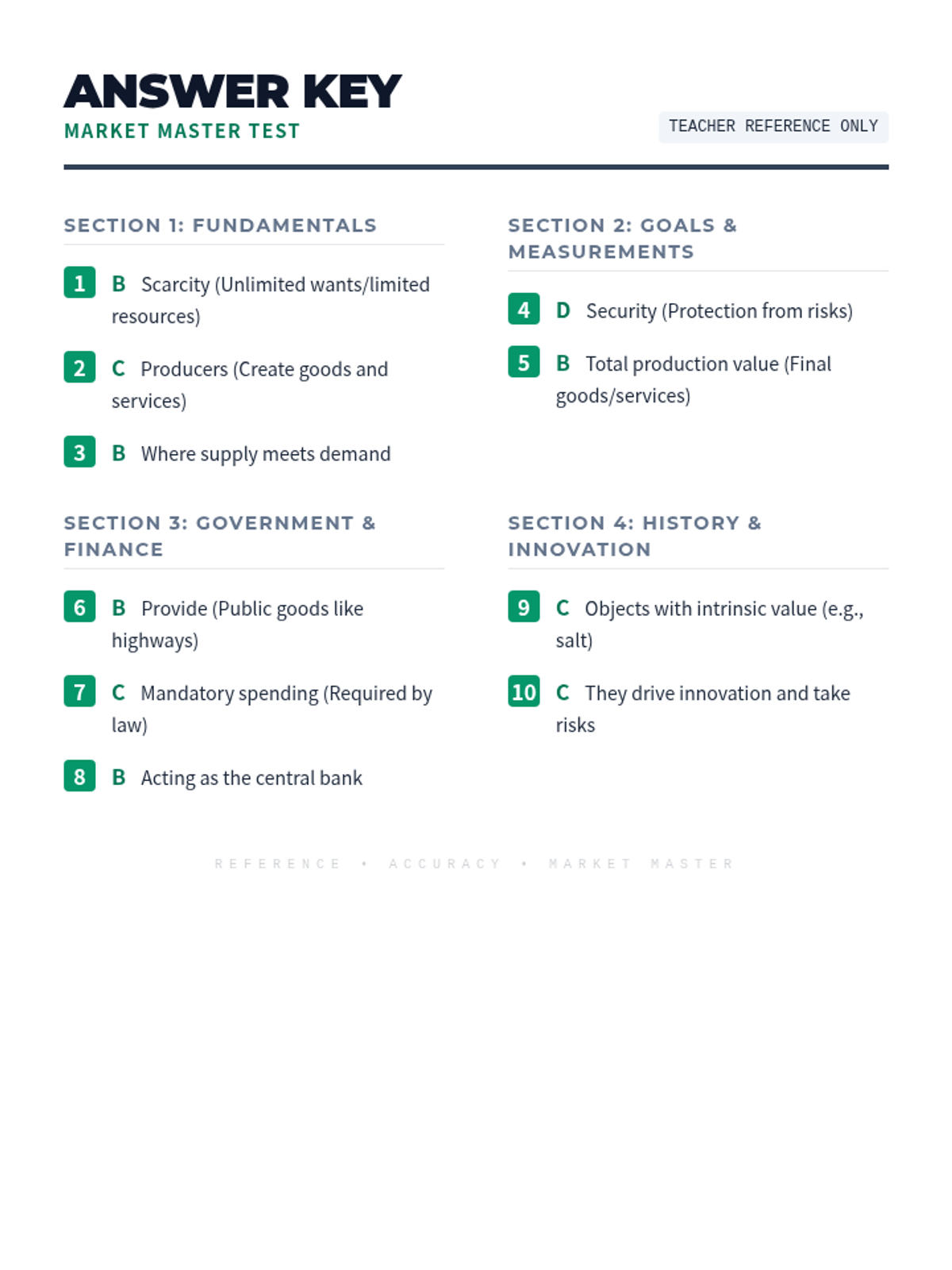
The teacher's answer key for the Market Master Test, providing the correct letter responses and brief rationale for each question.
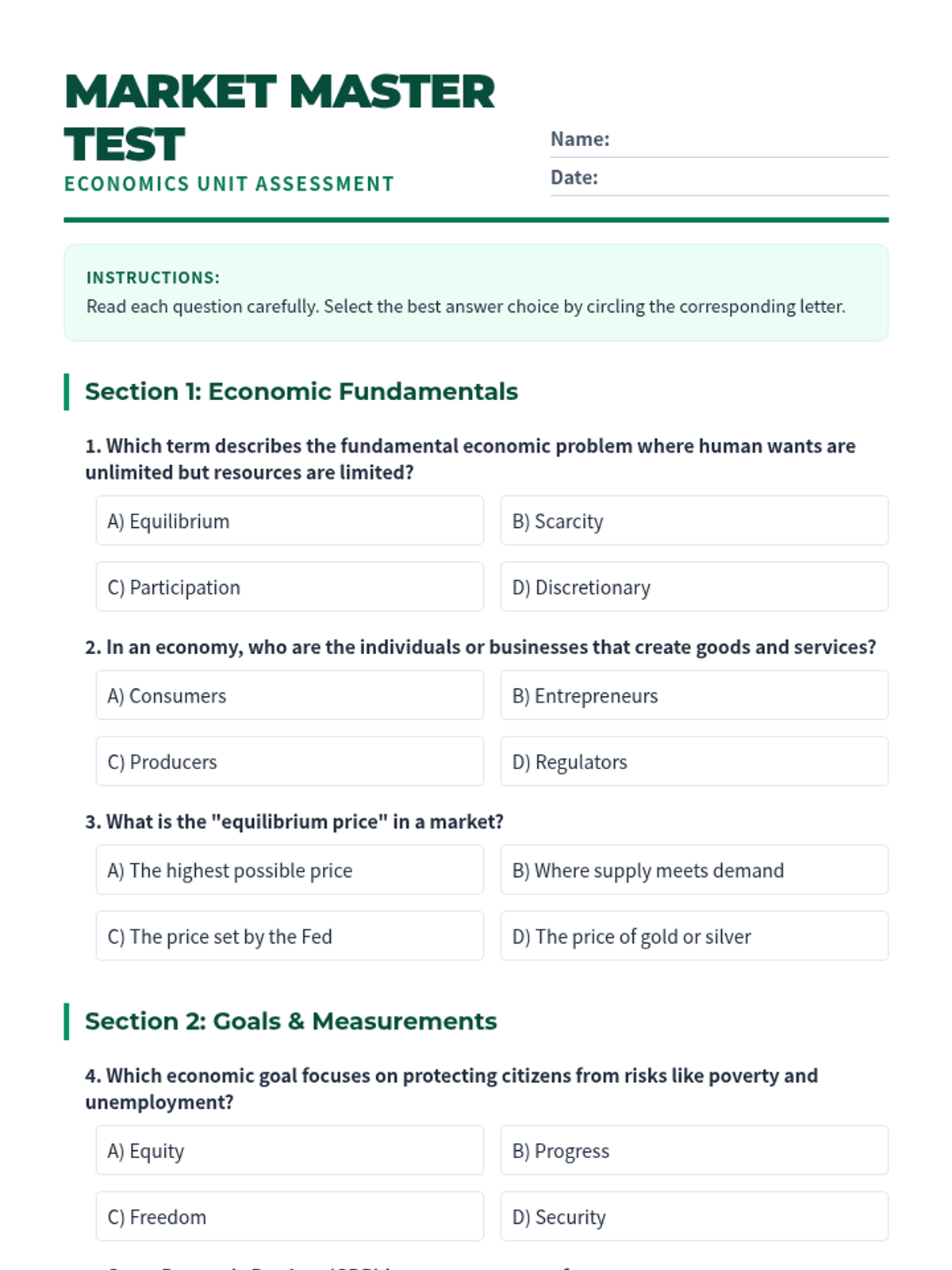
A 10-question multiple-choice test covering economic fundamentals, government roles, the Federal Reserve, and money history. All answer choices feature uniform styling for fair assessment. Layout updated for better page flow.
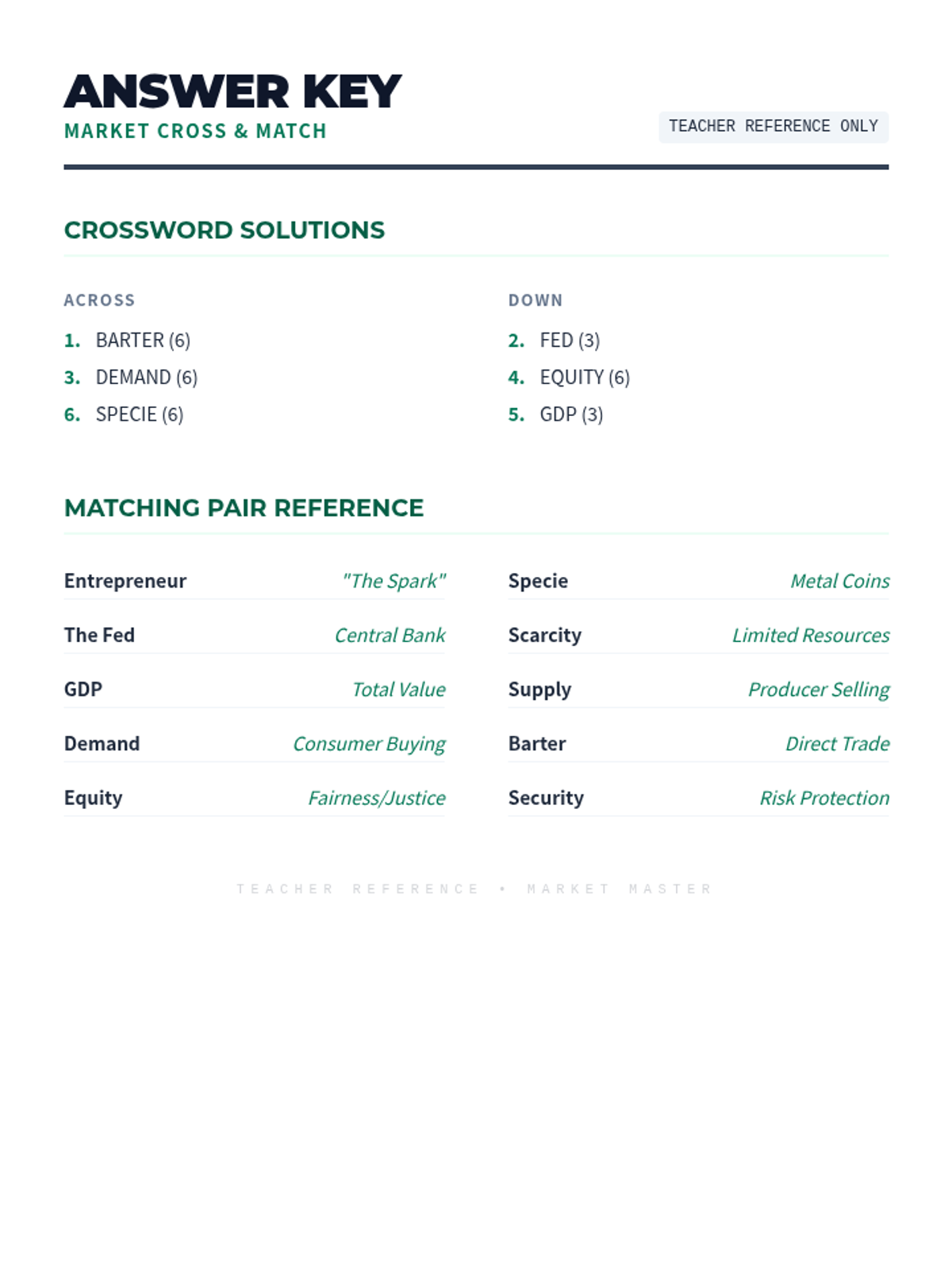
The combined answer key for the Market Cross crossword and the Market Match game, updated with the correct crossword solutions.
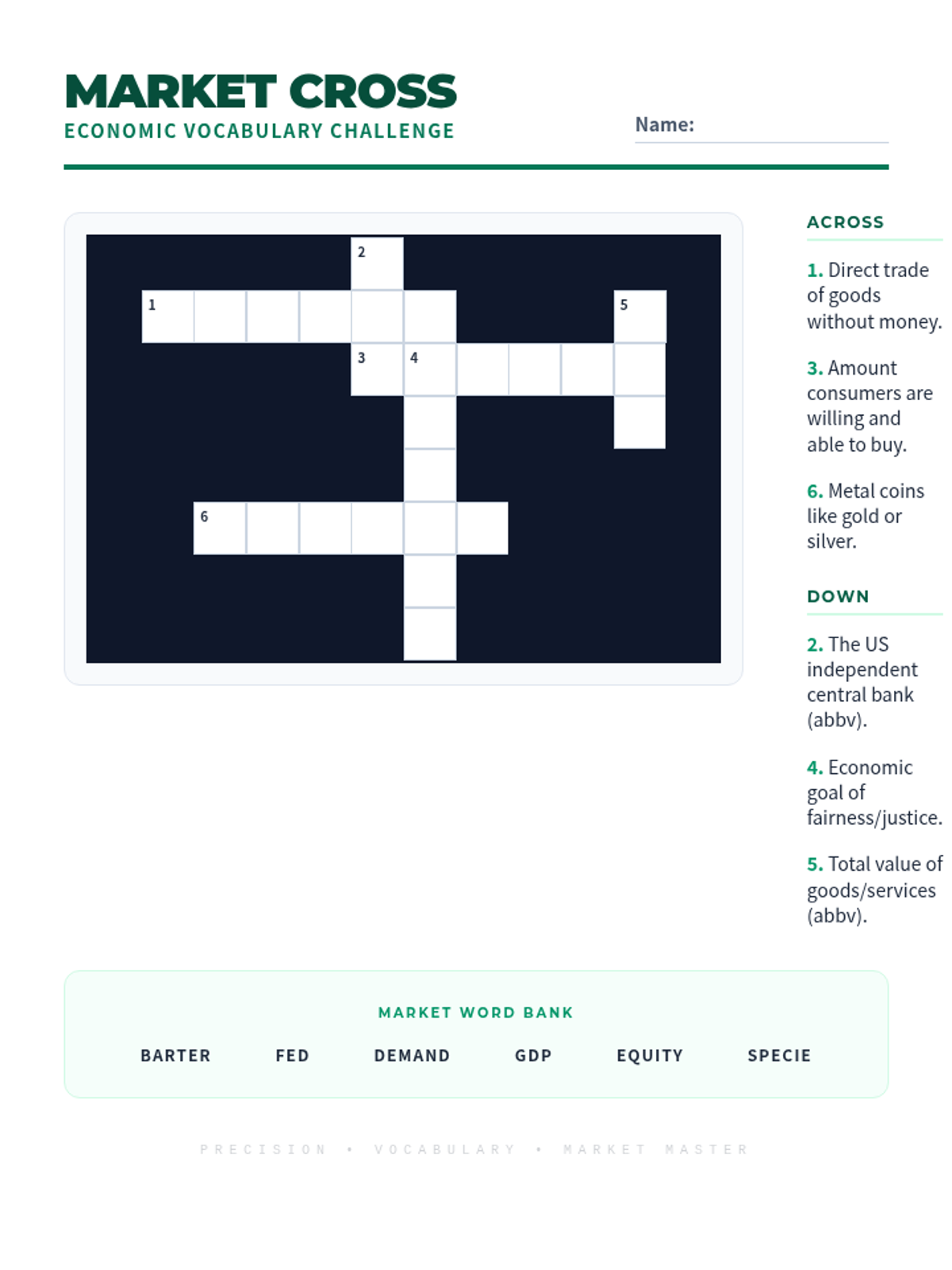
A vocabulary-building crossword puzzle featuring key economic terms like GDP, Barter, and Specie. The grid has been structurally redesigned for accurate letter intersections.
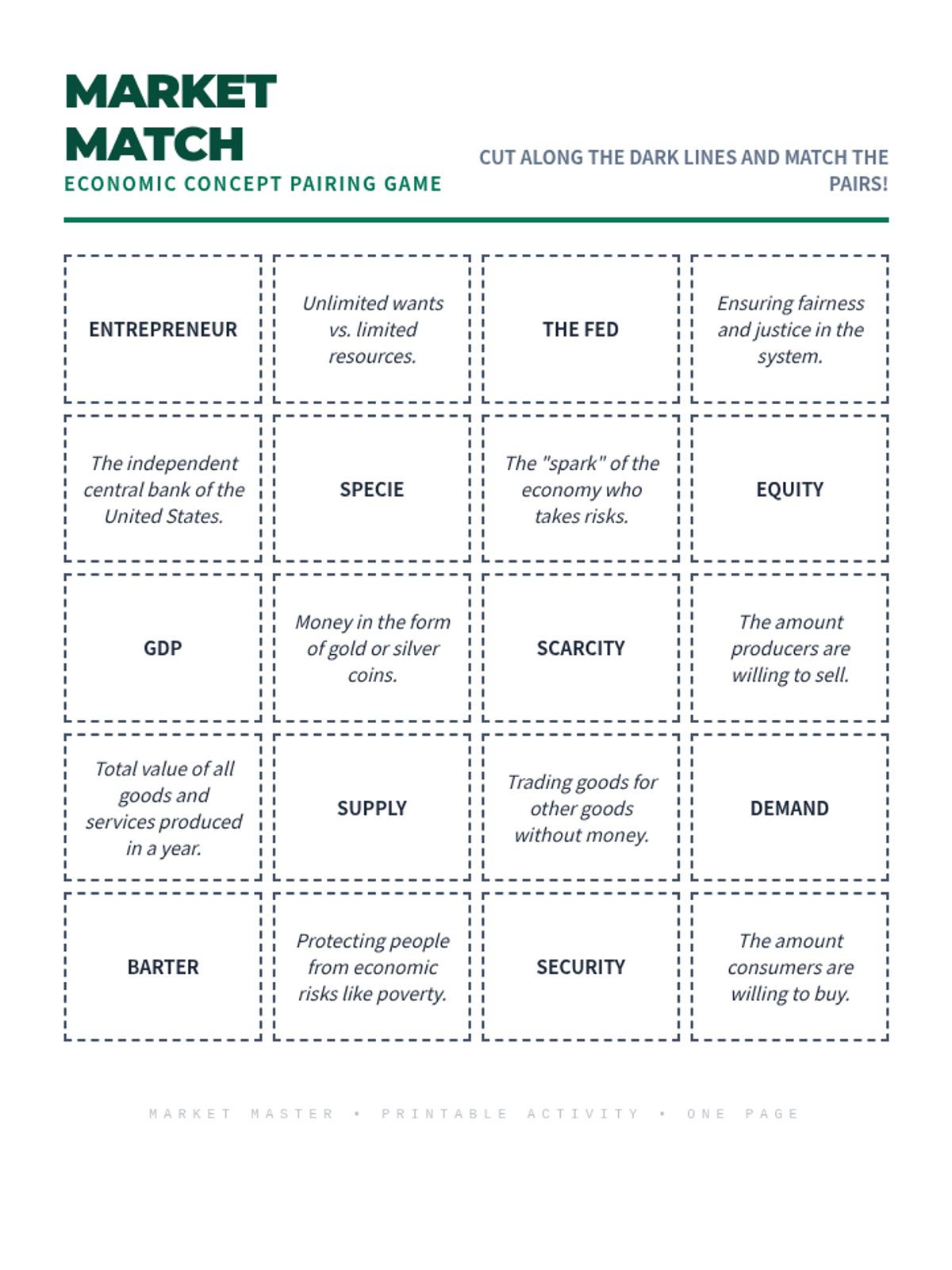
A set of printable matching cards for students to pair economic terms with their definitions, reinforcing vocabulary through hands-on play. All pairs now fit on one page with darkened cut-lines.
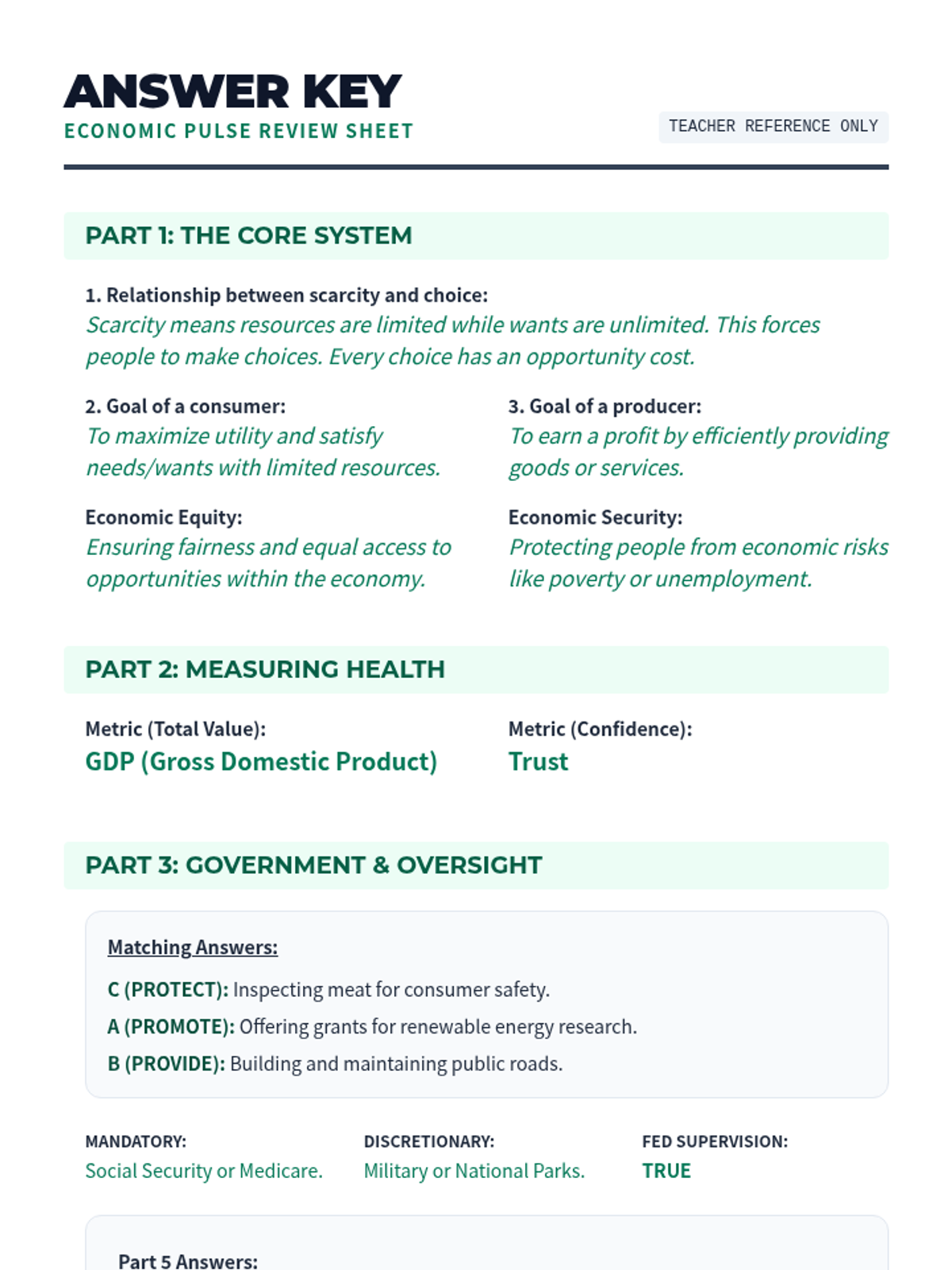
The answer key for the Economic Pulse review sheet, providing sample responses and factual corrections for the teacher.
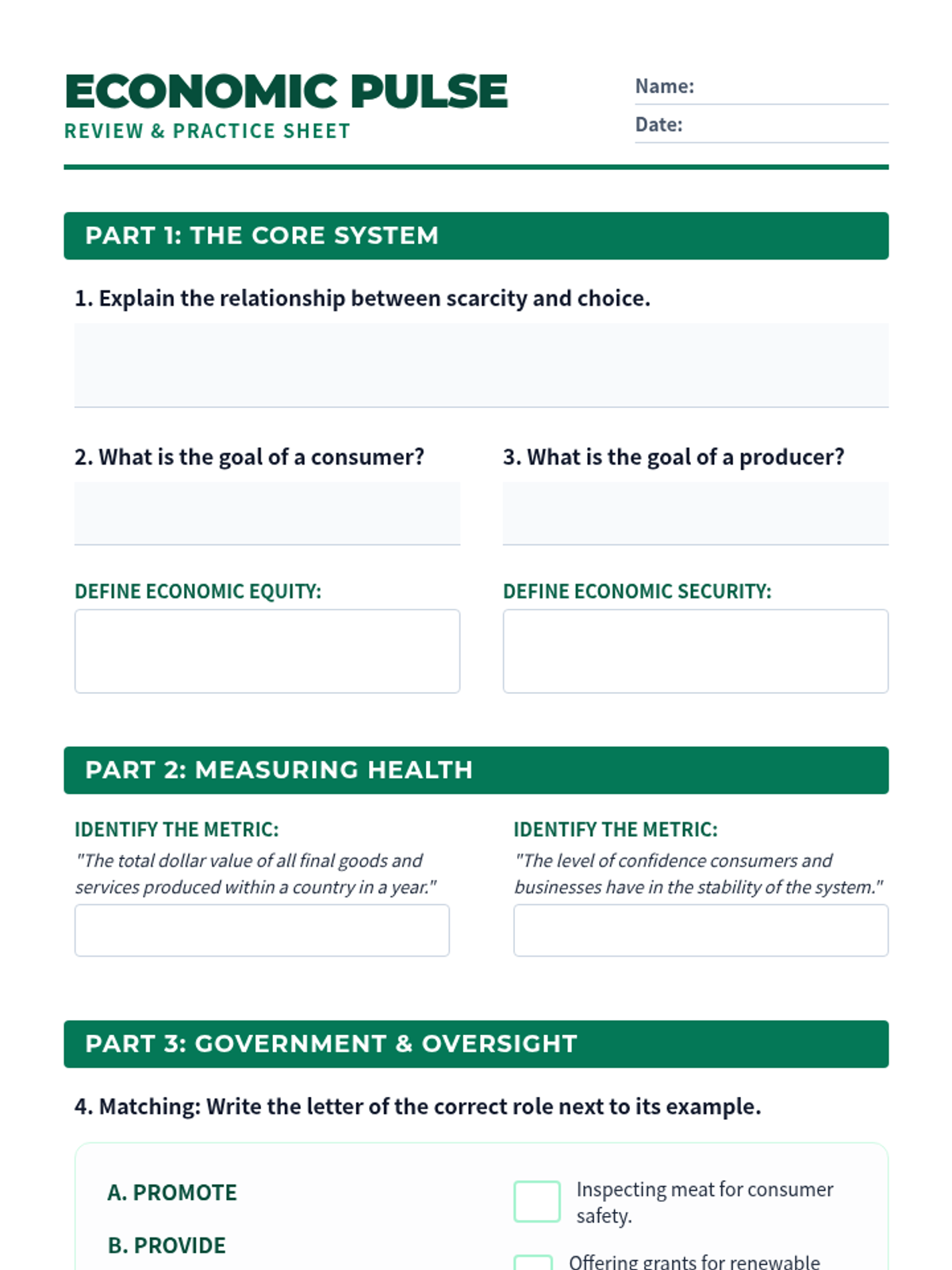
A comprehensive review sheet with matching, true/false, and open-ended questions covering the core topics of the economics unit.
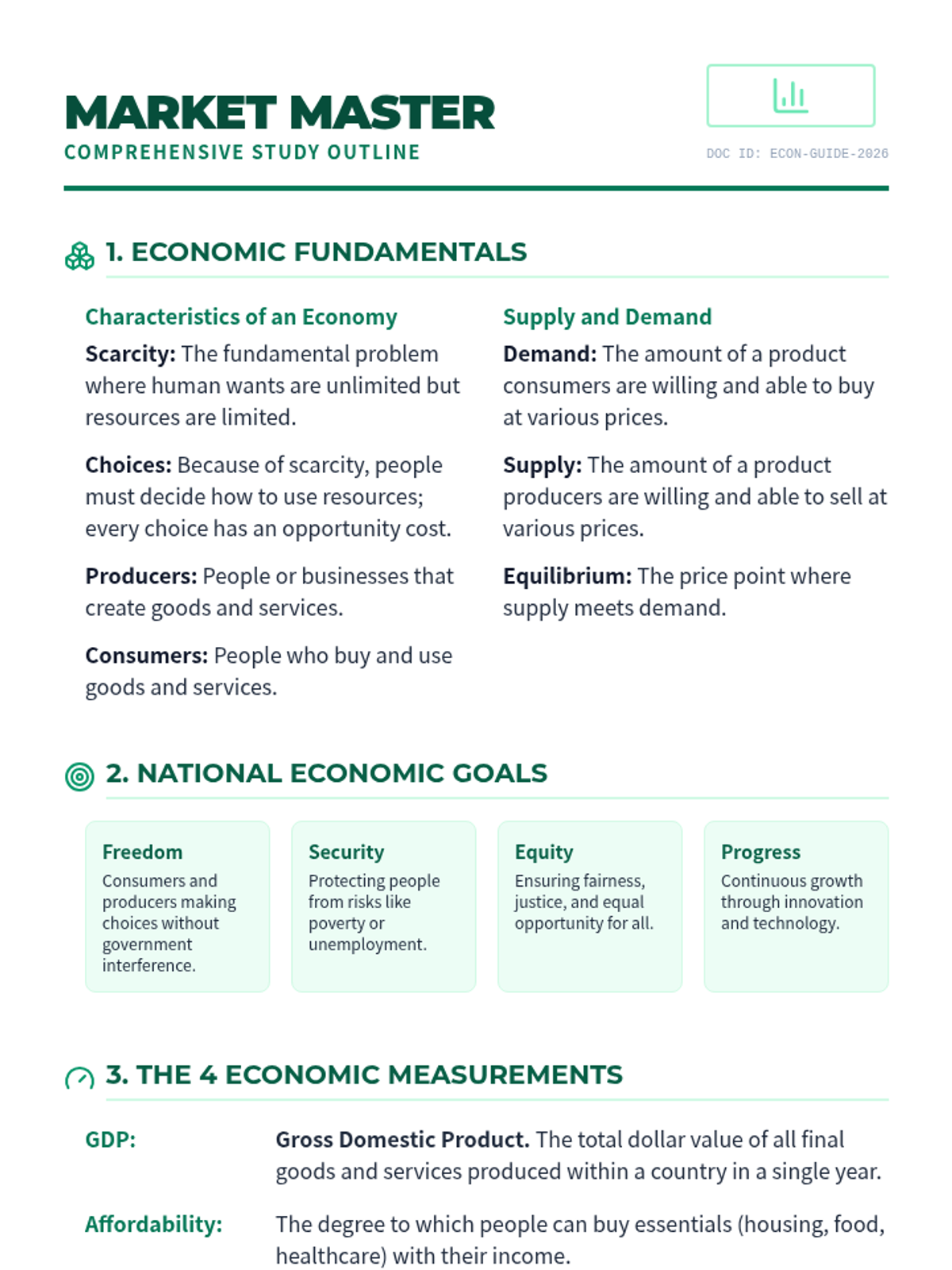
A detailed, structured outline of core economic concepts including definitions, government roles, and the history of currency.
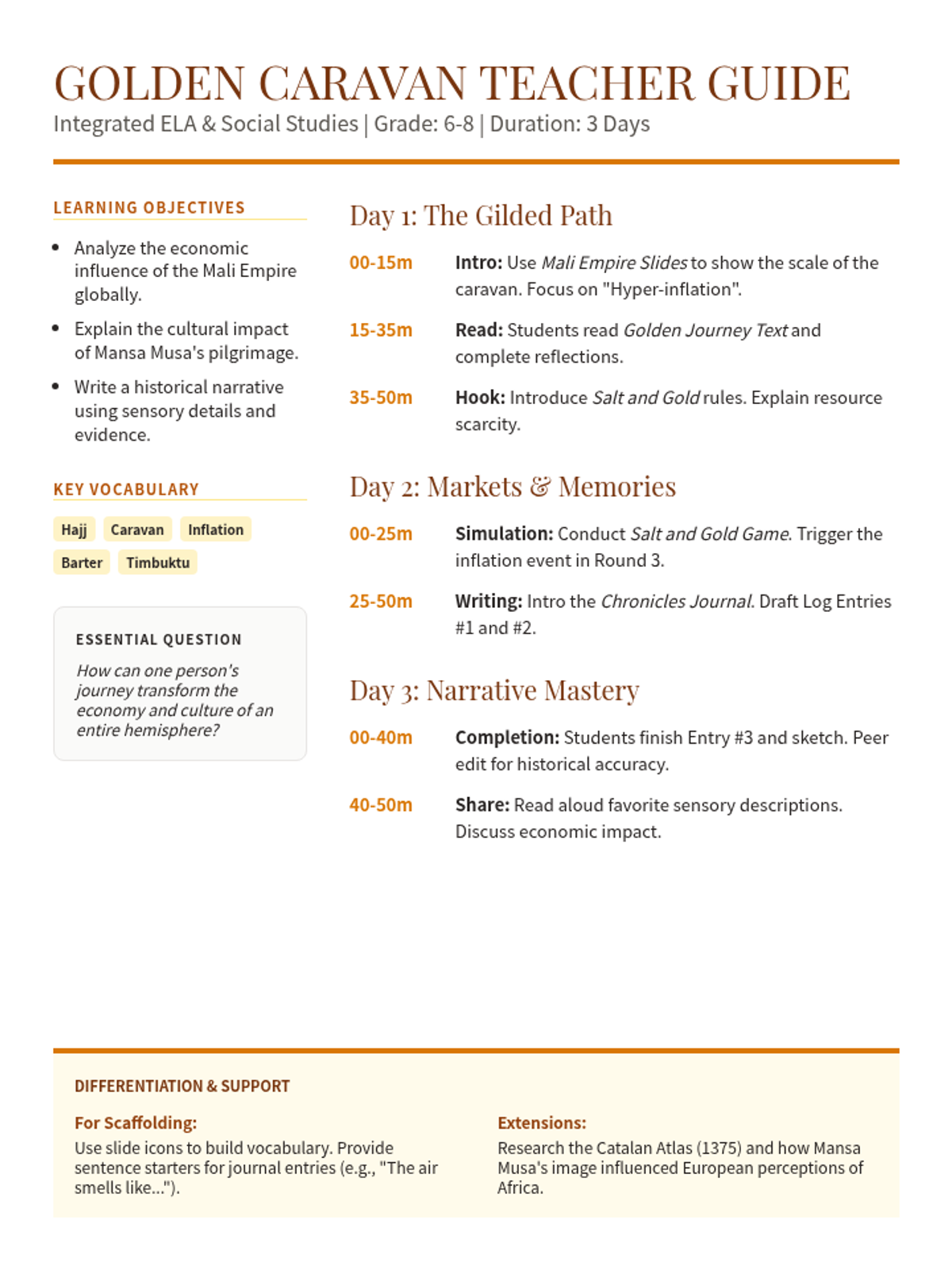
A comprehensive guide for teachers, including lesson objectives, daily pacing, key vocabulary, and differentiation strategies for the Golden Caravan lesson.
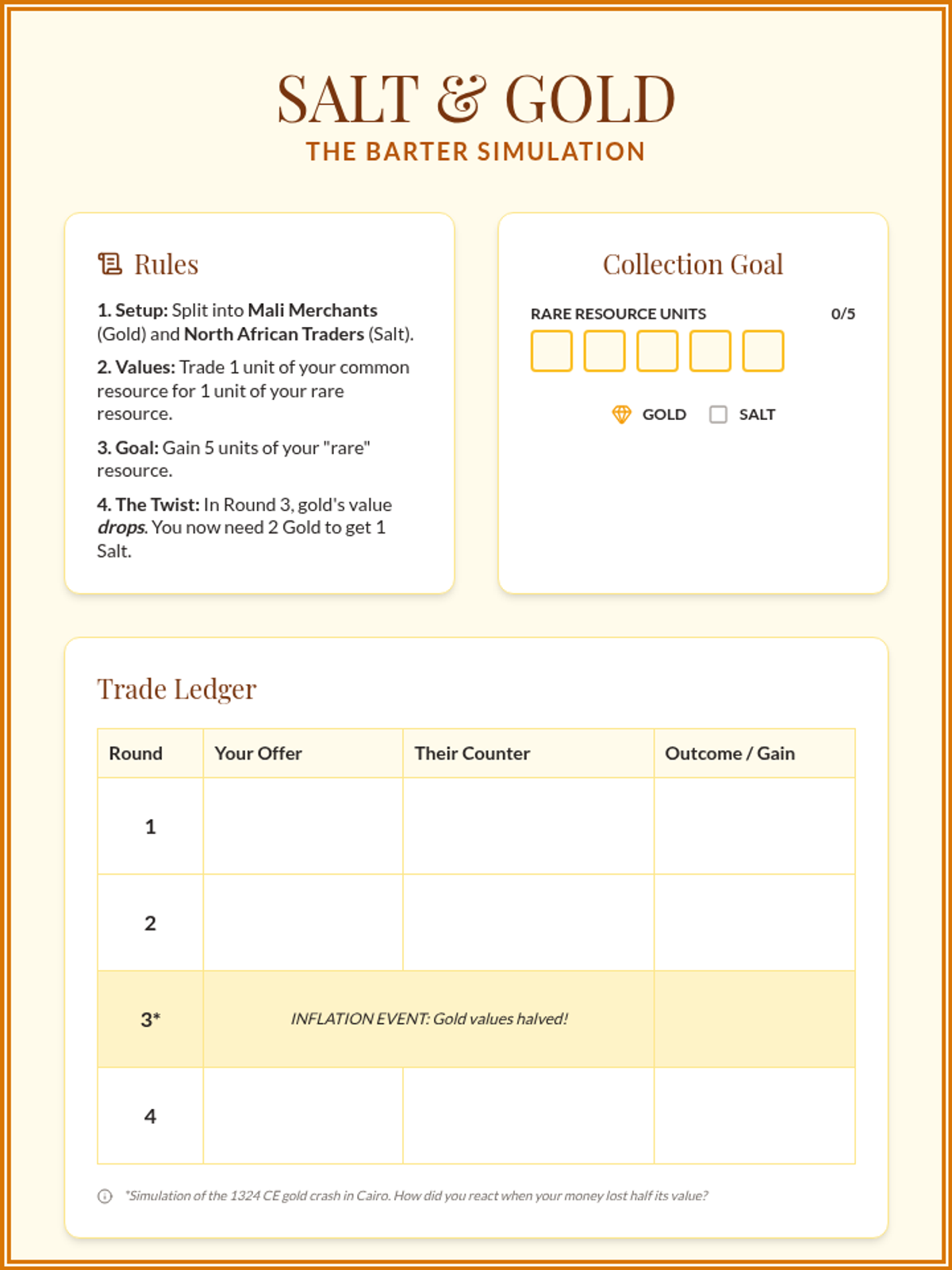
A trade simulation game where students act as merchants to understand the trans-Saharan trade and the economic effects of Mansa Musa's gold distribution.
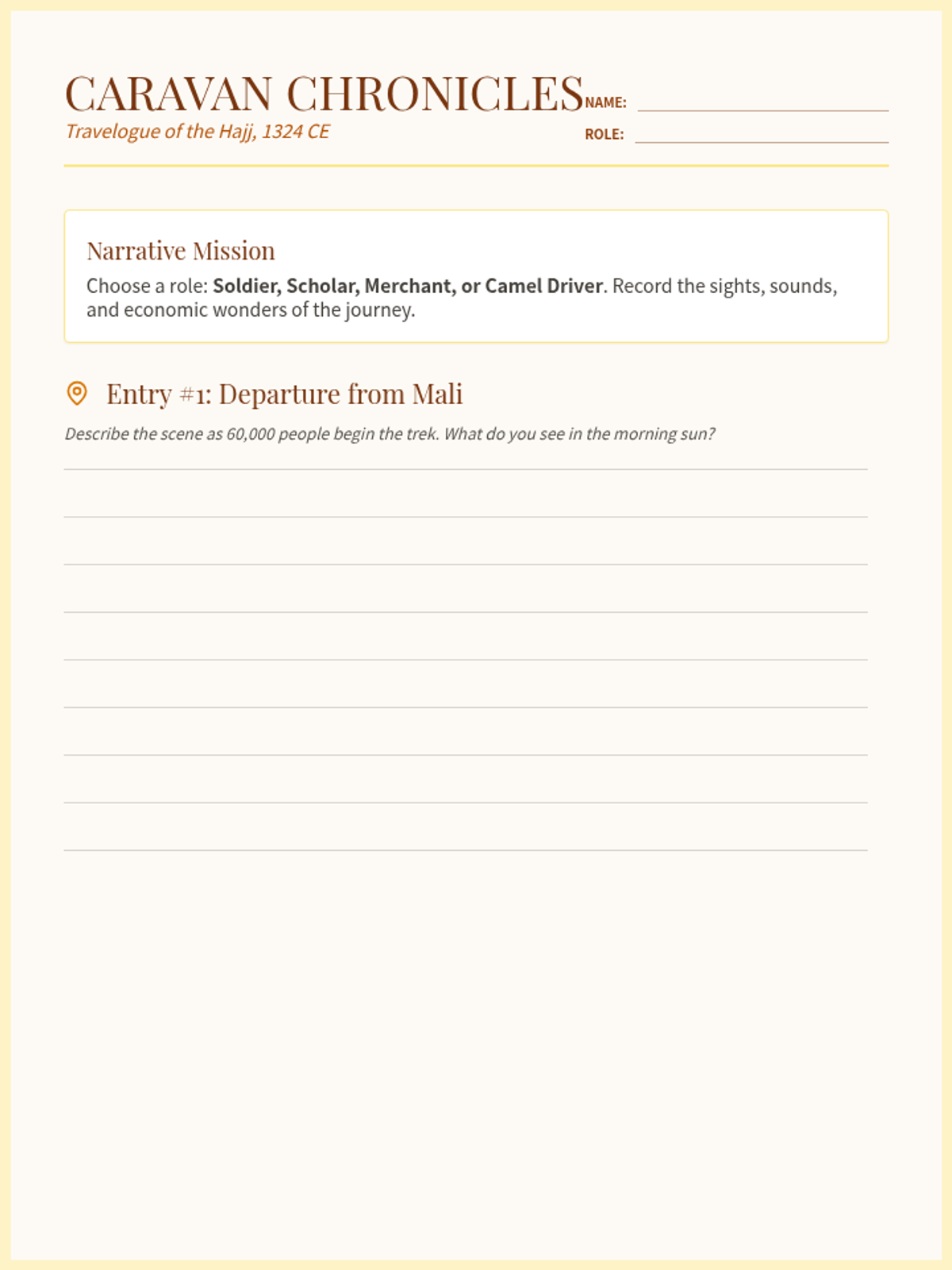
A student travelogue template for narrative writing, structured as a series of journal entries reflecting Mansa Musa's journey.
Instructional slides covering the history of the Mali Empire, the logistics of Mansa Musa's pilgrimage, and his global economic impact.
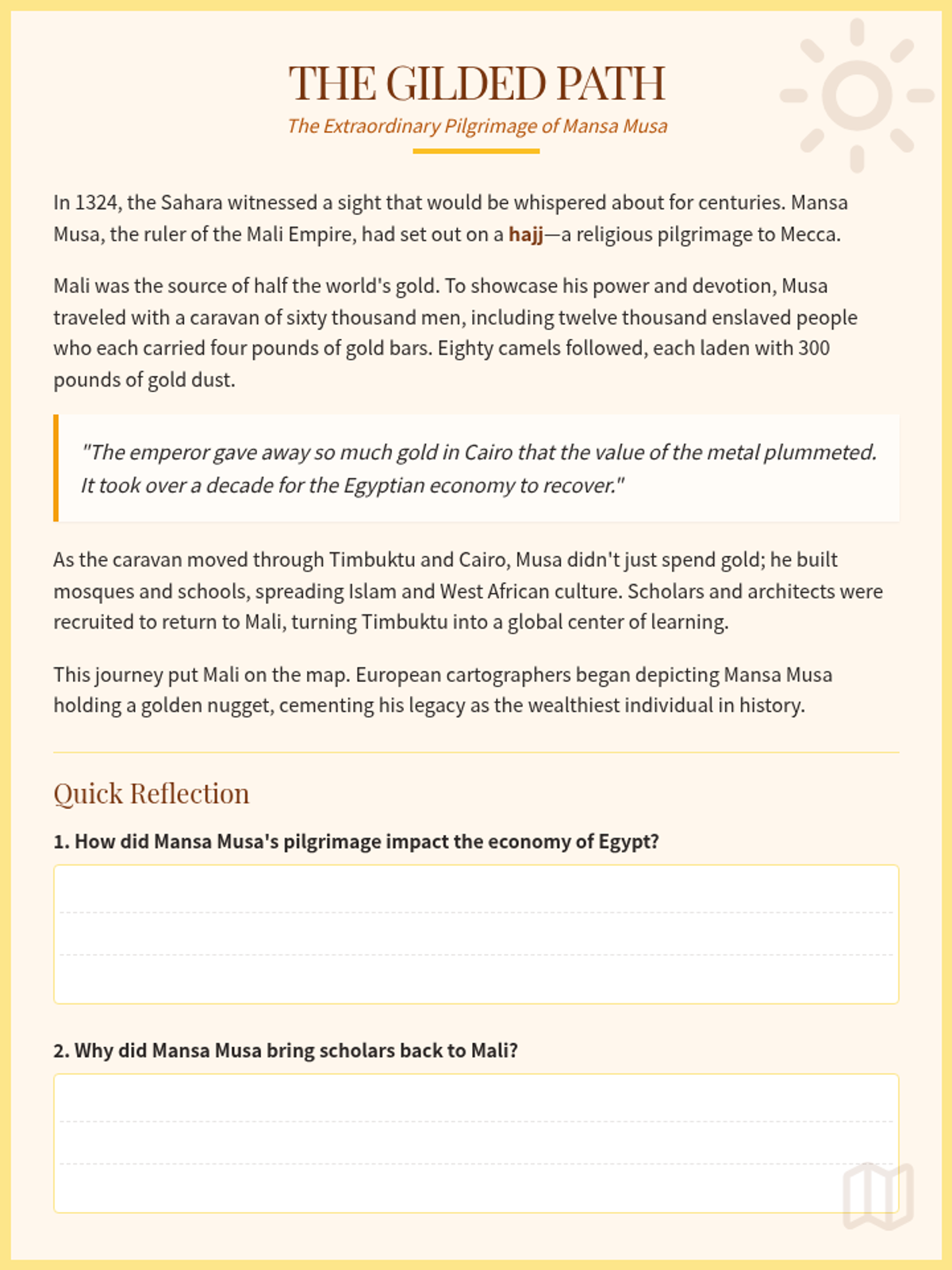
A historical reading passage about Mansa Musa's pilgrimage, highlighting the scale of his caravan, the impact on regional economies, and the cultural exchange that followed.
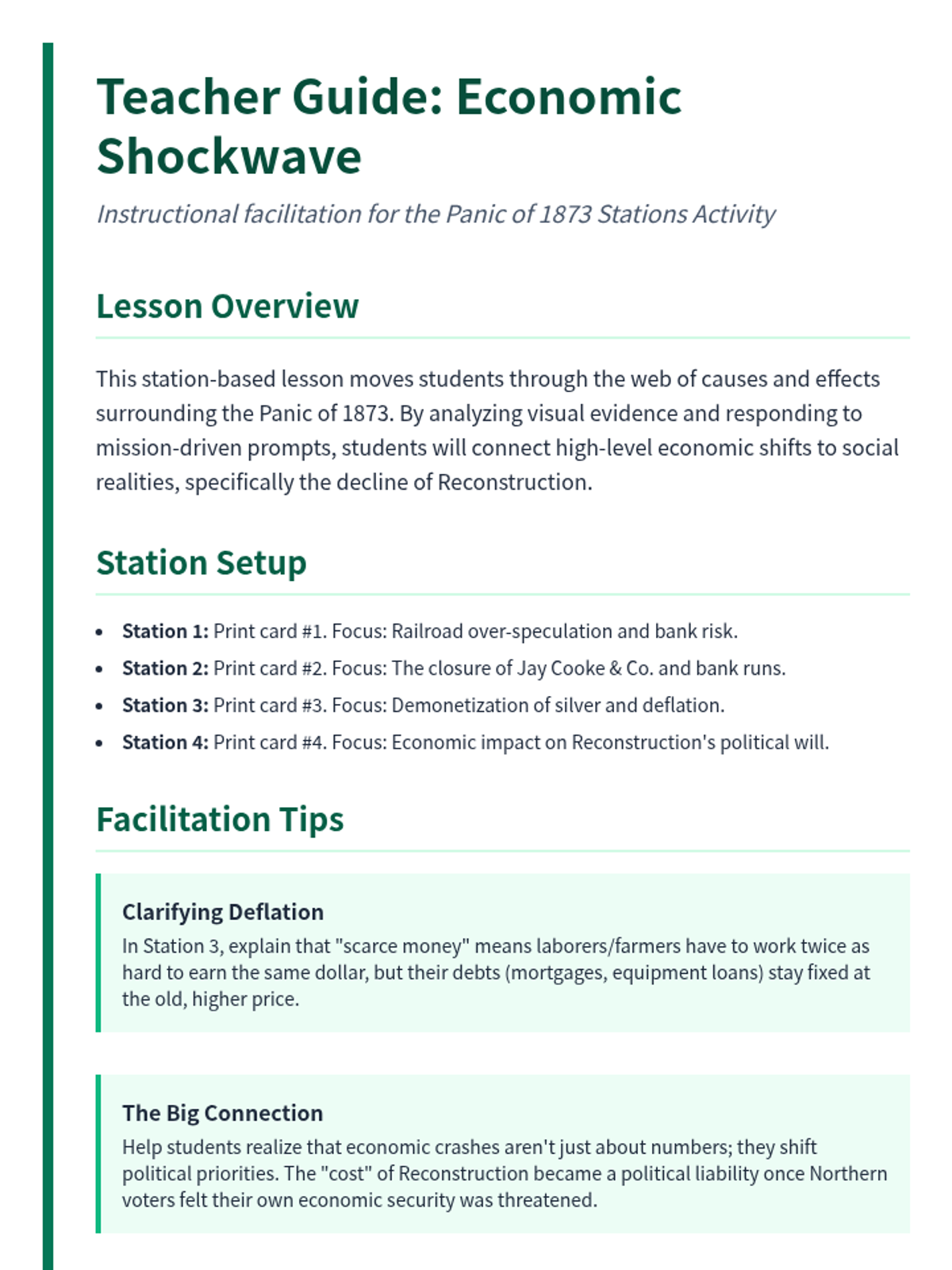
A guide for teachers to effectively set up and facilitate the station-based lesson. Revised for better page layout and content grouping.
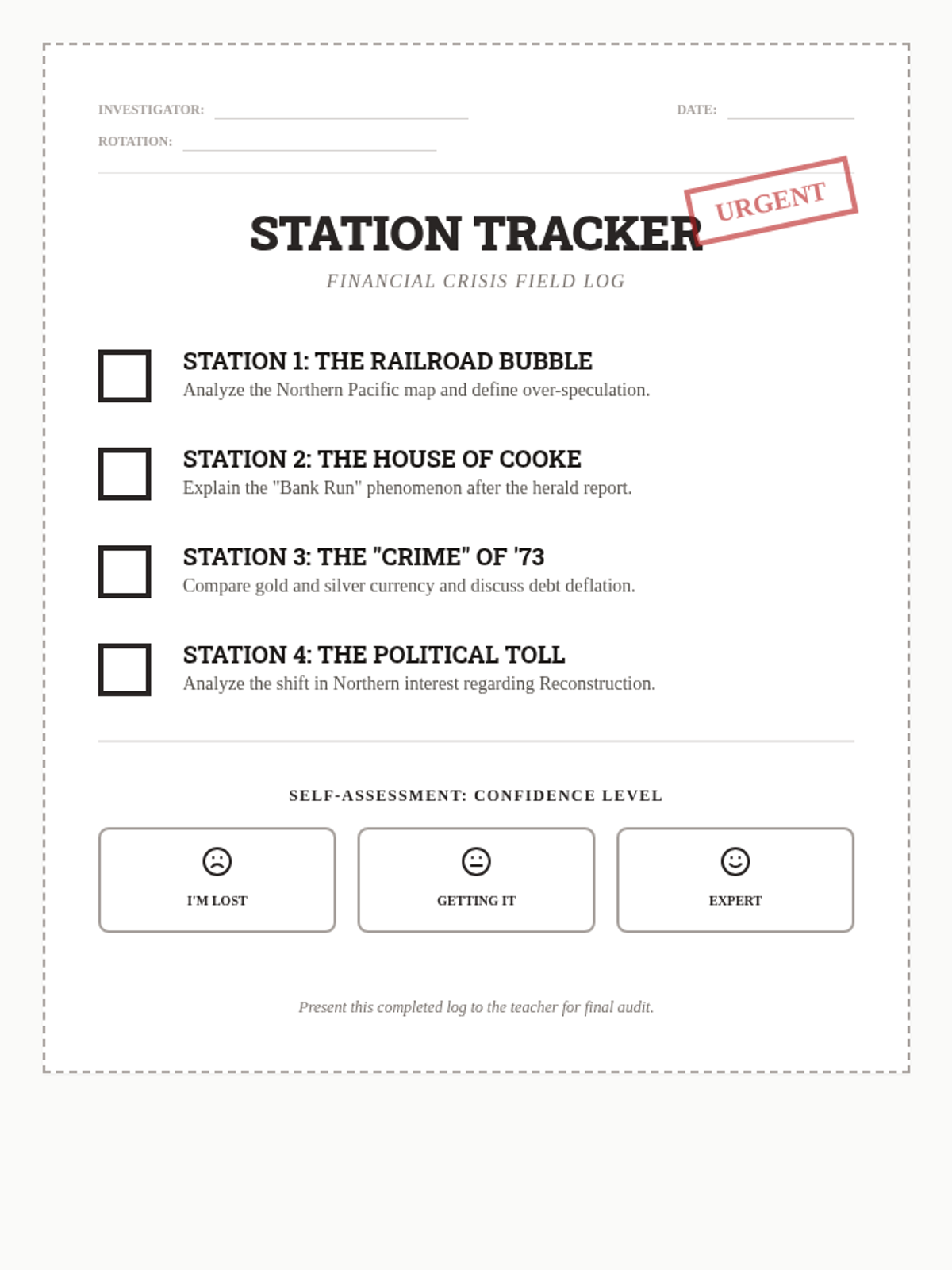
A student-facing rotation checklist to track progress through the stations and self-assess understanding. Revised for styling uniformity and visibility.
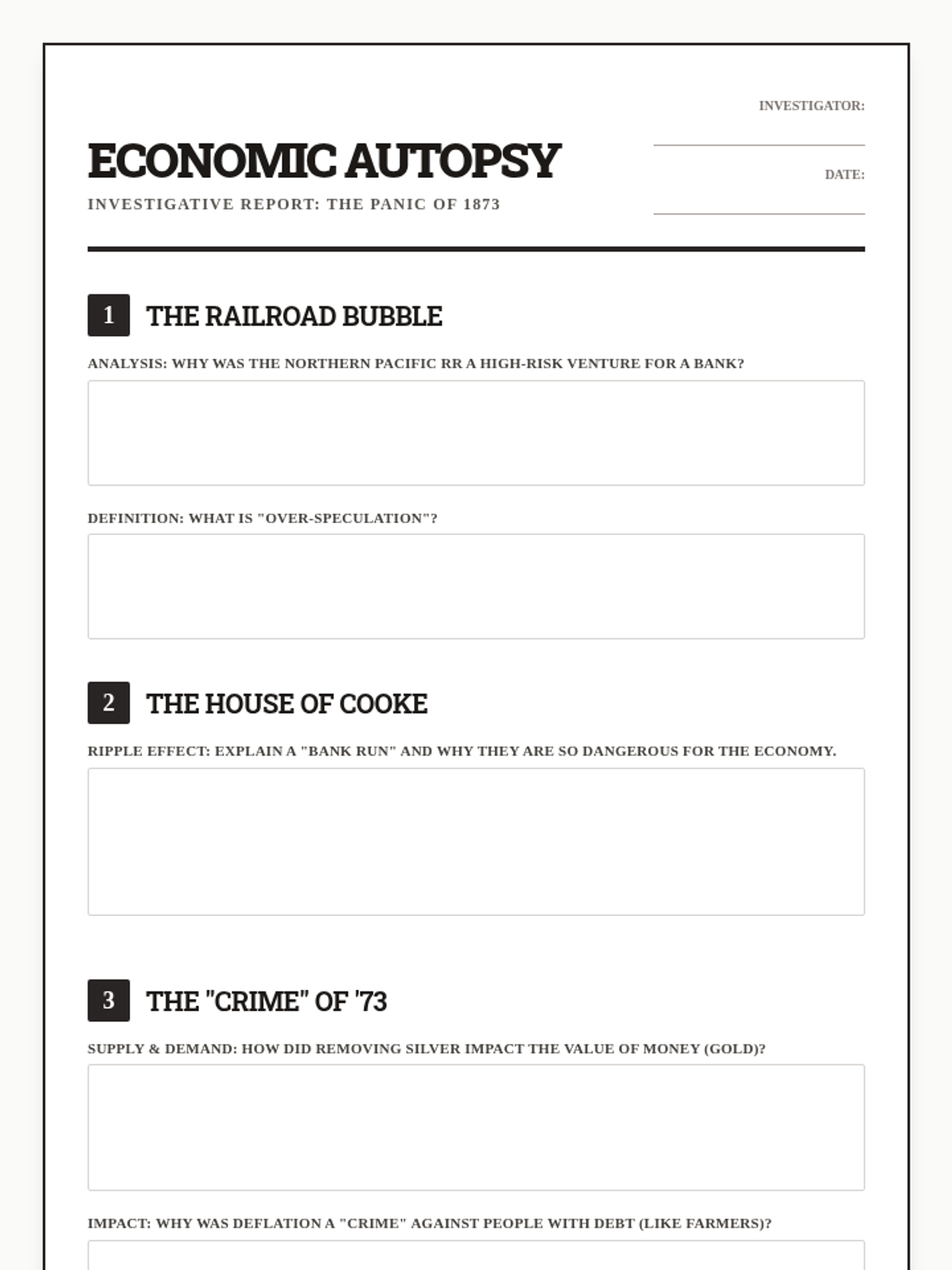
A comprehensive graphic organizer for students to record their findings and analysis as they move through the stations. Revised with standardized box sizes and improved page breaks.
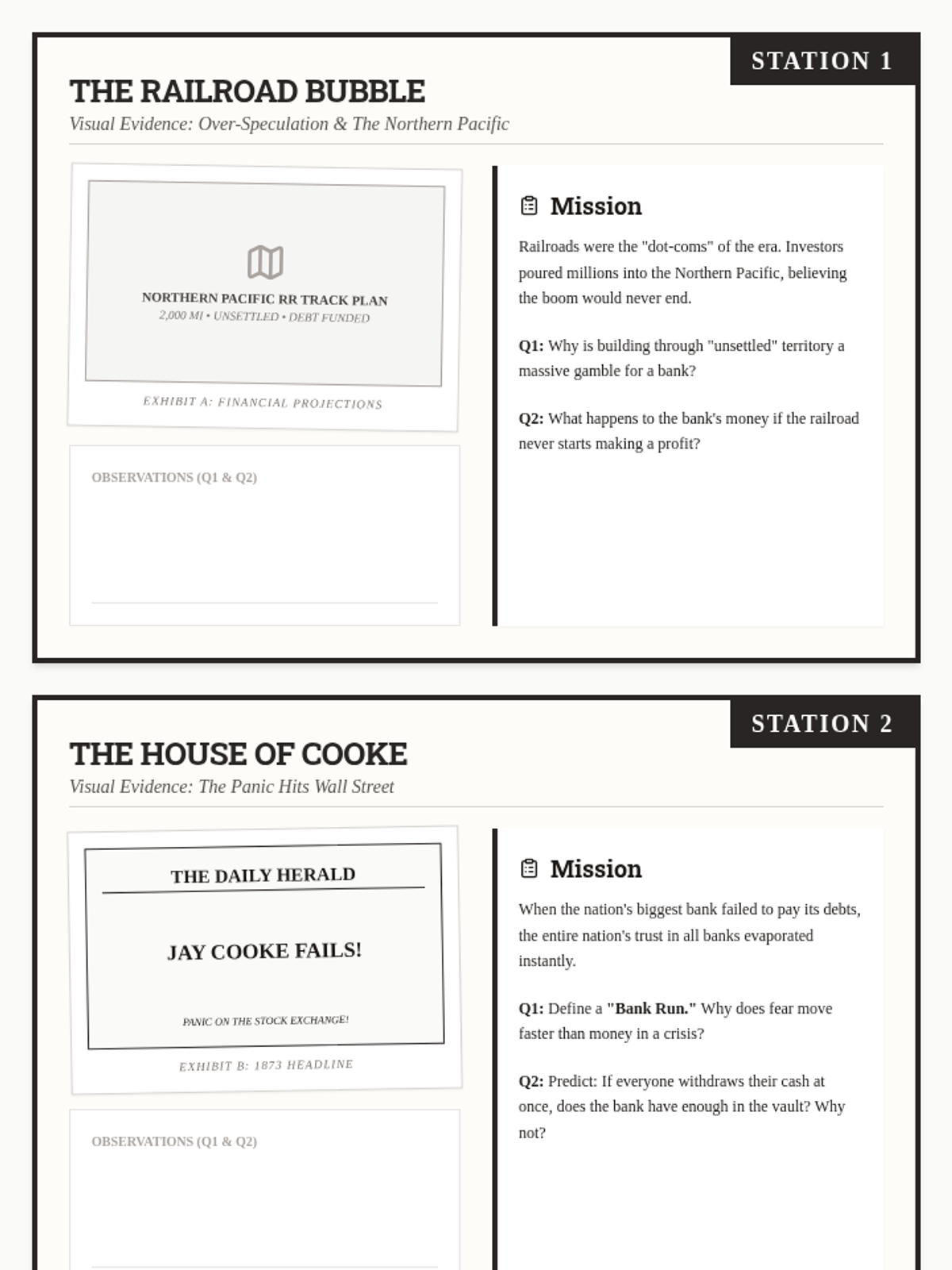
A set of four station cards for the Panic of 1873, featuring visual evidence and mission-based questions for students to complete. Revised with improved visuals and layout to prevent page breaks.
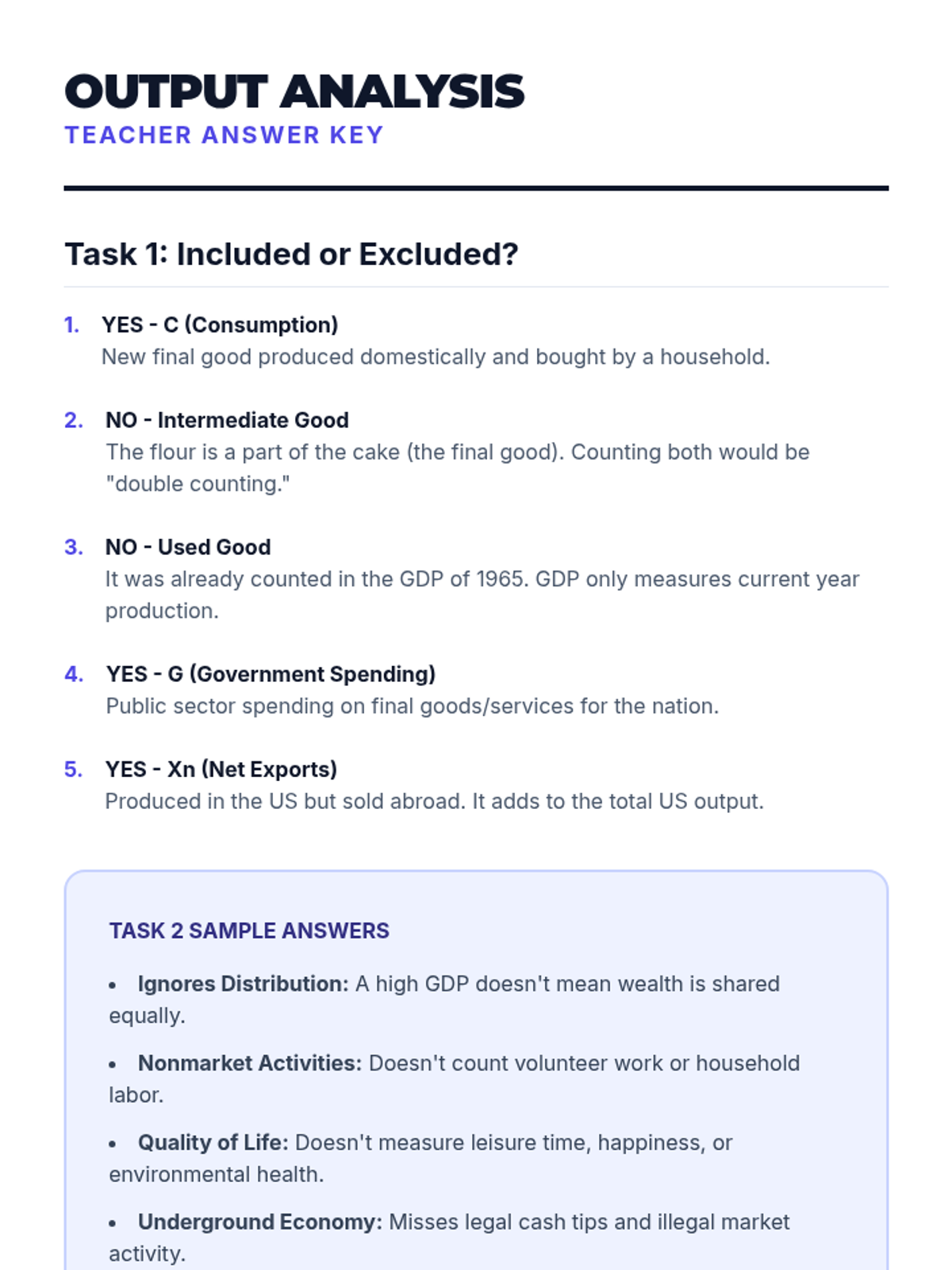
Answer key for the updated Output Analysis worksheet, providing correct component classifications (C, I, G, Xn) for 12 scenarios and guidance for the "Leisure Paradox" reflection. Fits on a single page. Standardized badge padding. Improved layout for single-page fit. Corrected corner styling.
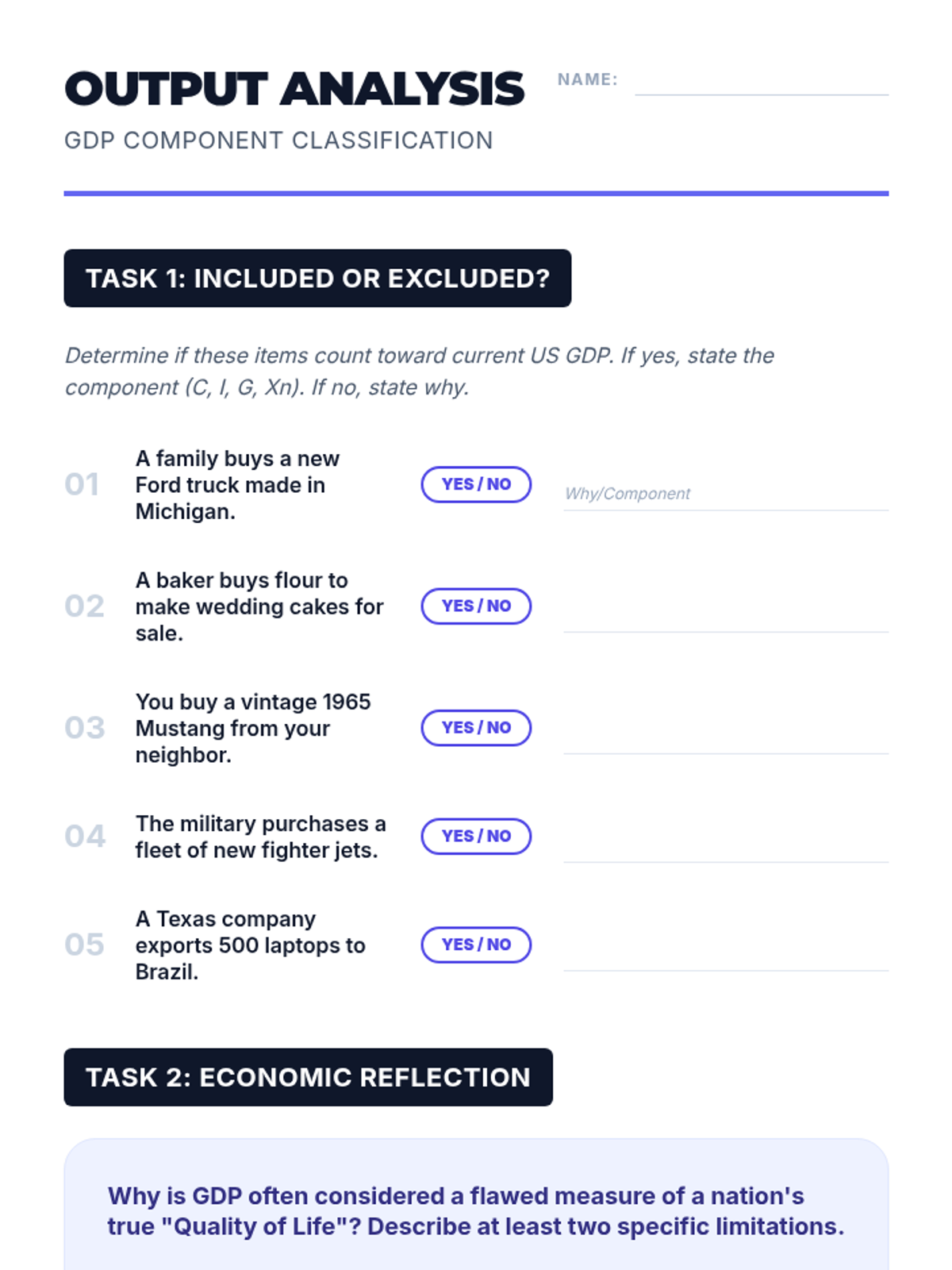
An expanded GDP practice worksheet with 12 classification scenarios (3 for each component) and a structured reflection on the "Leisure Paradox". Features a clean multi-page layout with larger fonts, high-contrast work areas, and improved logical flow. Corrected answer formatting for student use. Simplified audit section. Corrected page breaks. High-contrast prompt text. Mix of In/Out scenarios. Standardized boxes. improved writing area contrast. Standardized boxes and corrected typos.
A concise slide deck for a 45-minute lesson covering the definition of GDP, the C+I+G+Xn formula, and common exclusions. Updated examples for underground economy and transfer payments. Fixed subscript and contrast. Balanced content flow. Grammatically correct scenarios. Corrected formula subscript. Removed practice slides as per user request to keep only first three instructional slides.
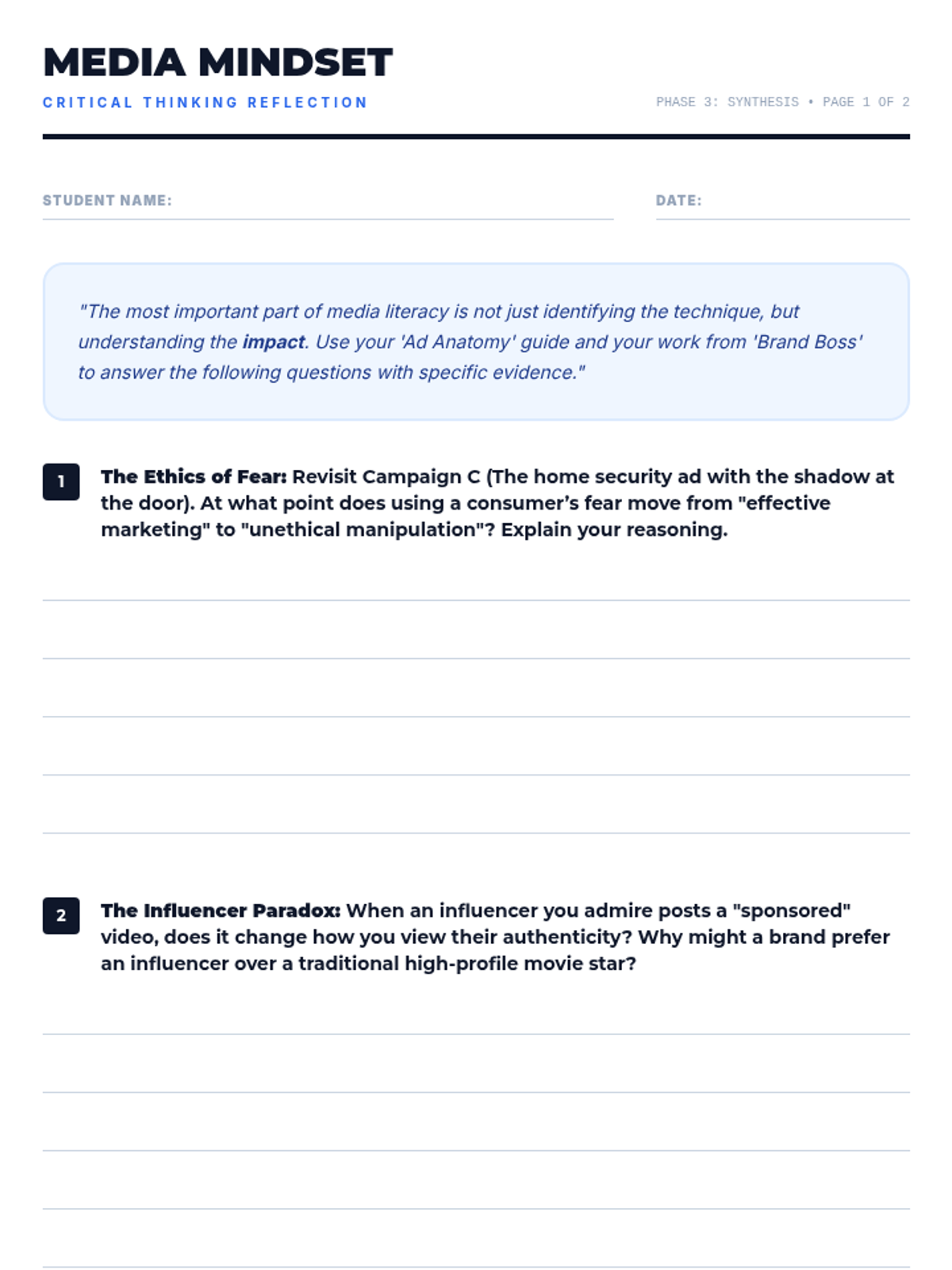
A two-page critical thinking worksheet featuring four complex short-answer questions that challenge students to analyze the ethics, psychology, and societal impact of modern advertising.
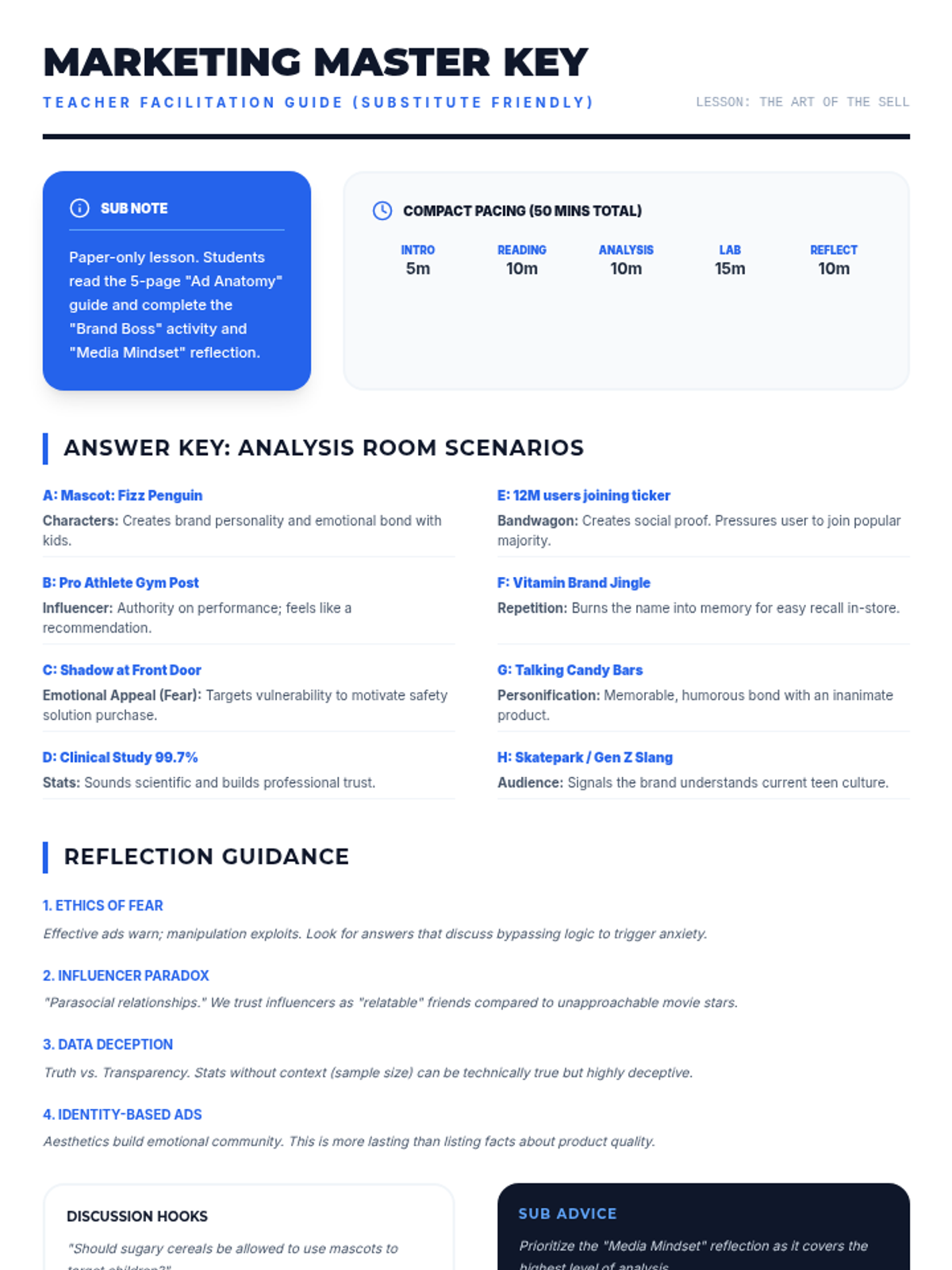
A sub-friendly teacher facilitation guide including a lesson pacing guide, detailed answer keys, reflection guidance, and classroom management tips.
A visual presentation introducing ten advertising techniques with bold graphics, key definitions, and real-world examples for a classroom setting.
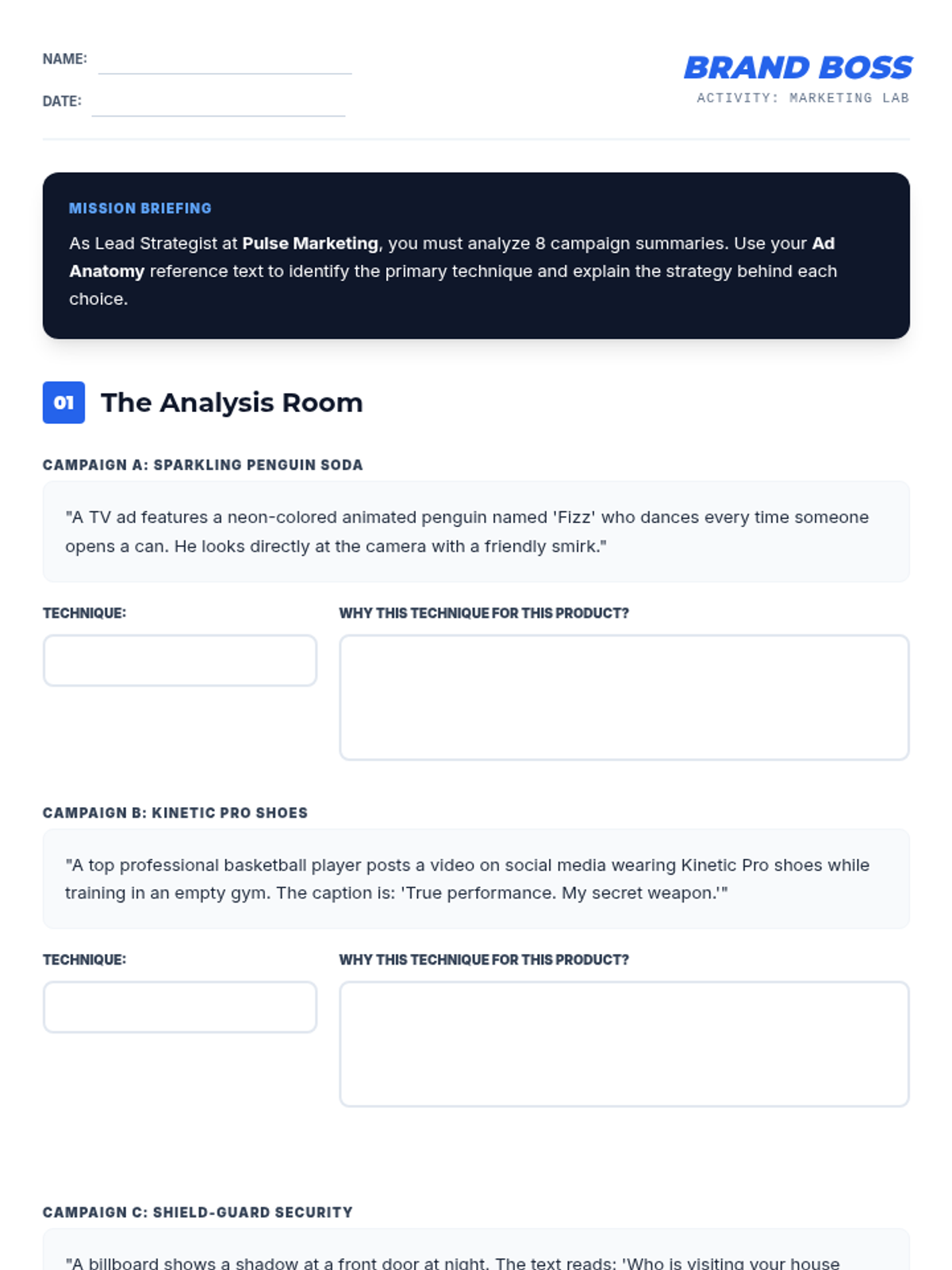
A four-part student activity involving a detailed eight-scenario analysis of advertising techniques and a creative project where students design an original ad campaign for a fictional product.
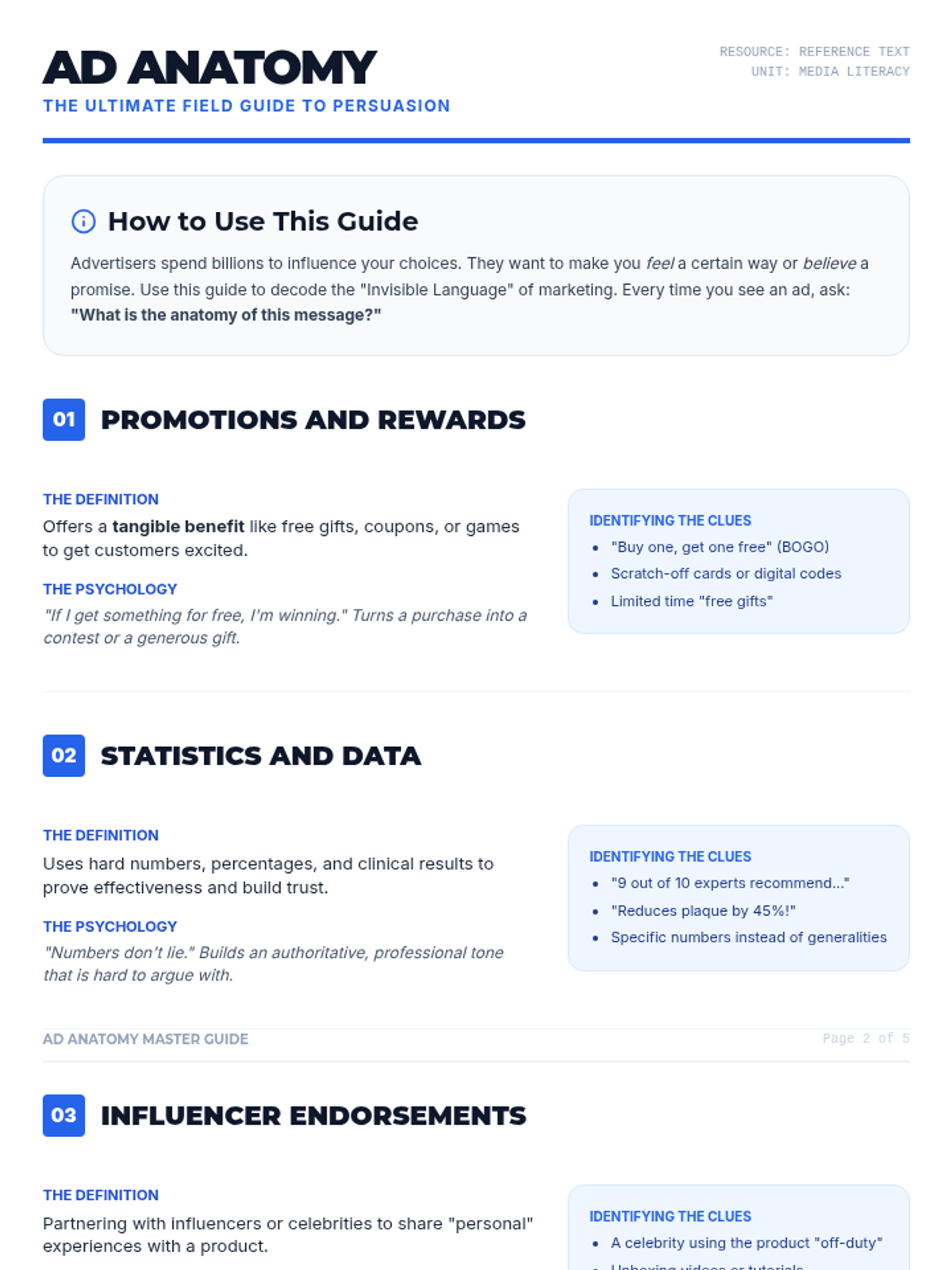
A detailed five-page master guide for 8th-grade students covering ten advertising techniques with definitions, psychological explanations, and identifying clues. Perfect for independent or sub-led instruction.
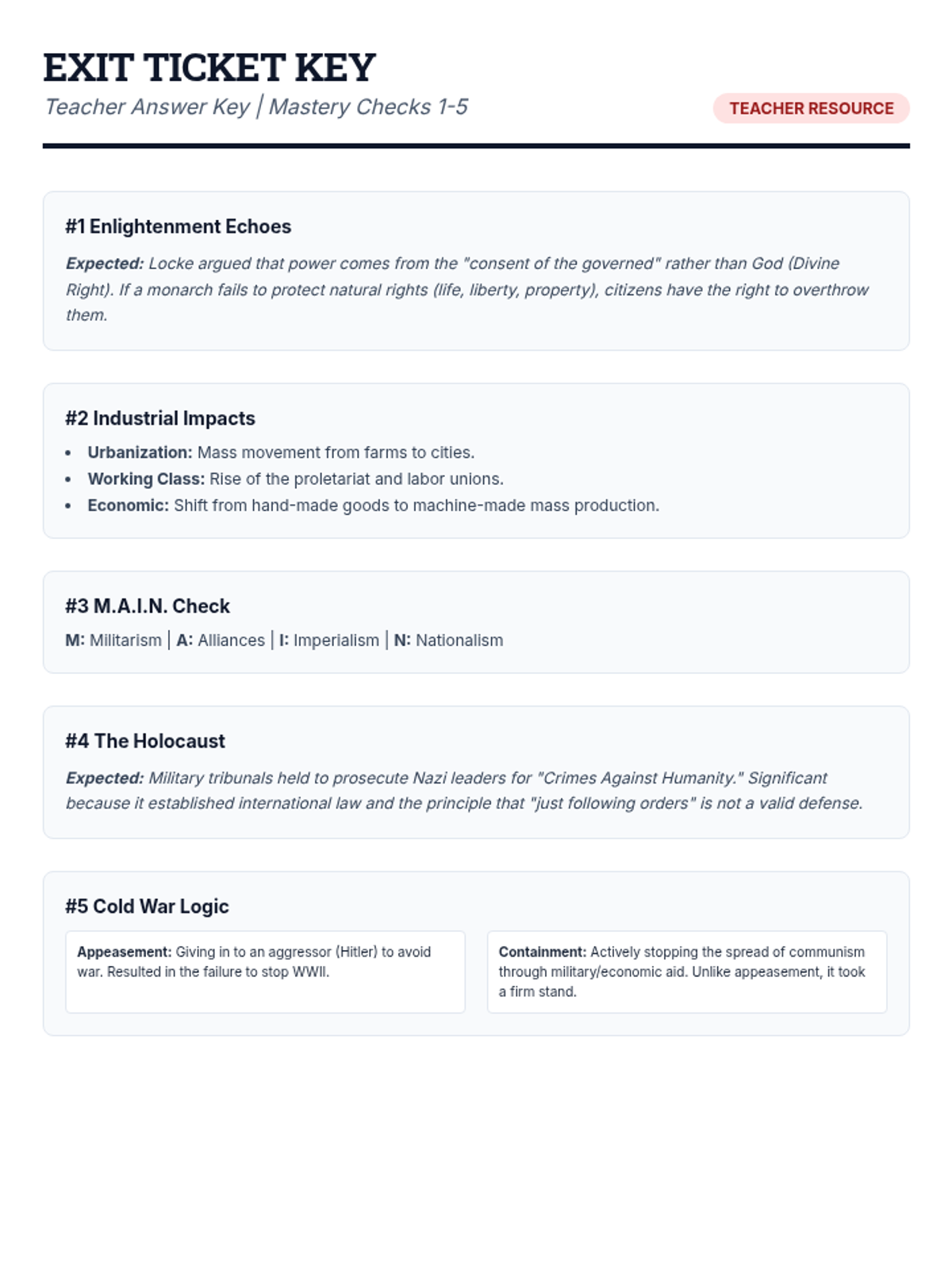
Comprehensive teacher answer key for the Modern Mastery Exit Tickets, providing suggested answers and key concepts for all five formative assessments.
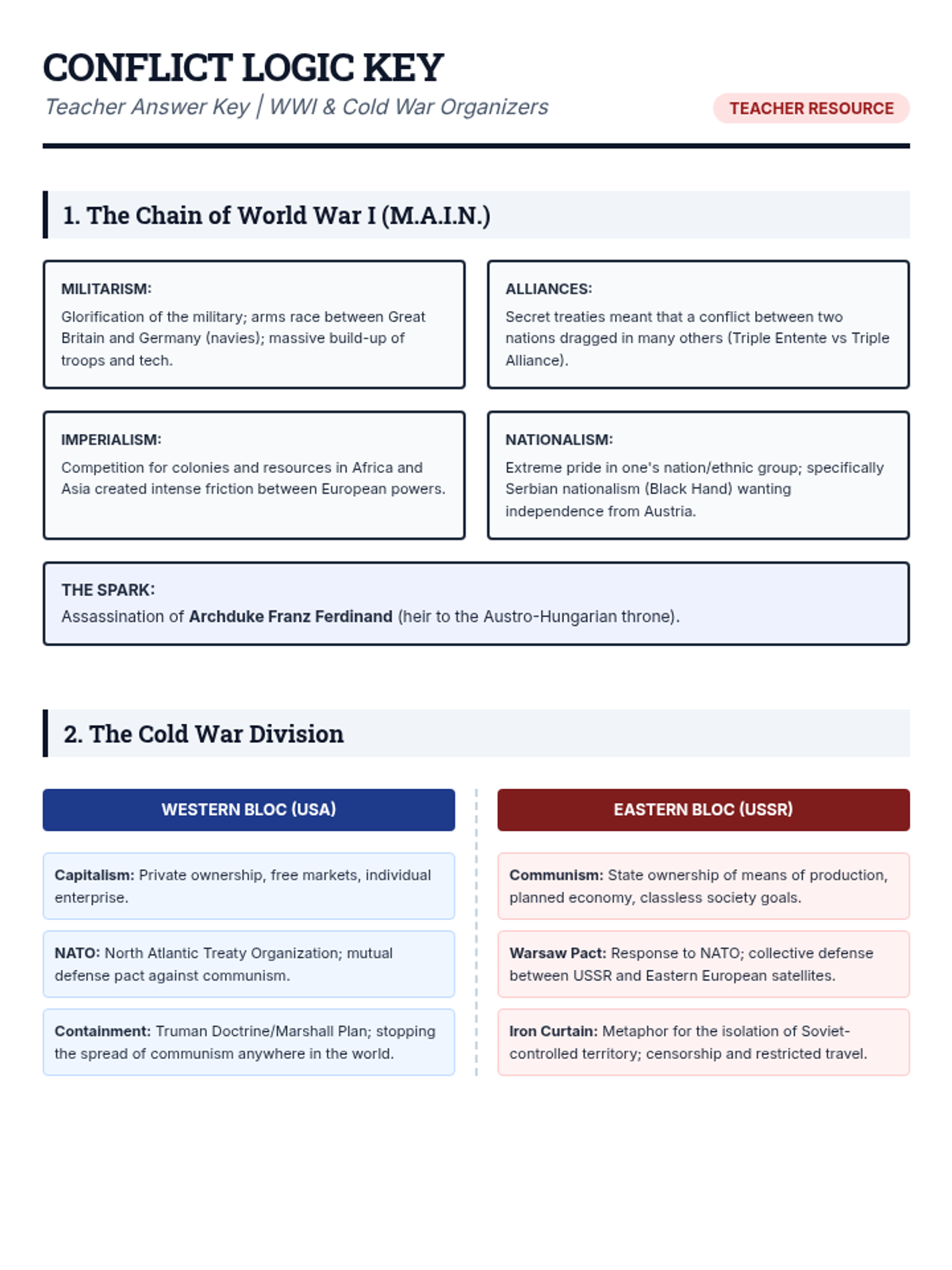
Teacher answer key for the Conflict Logic Maps, detailing the M.A.I.N. causes of WWI and the ideological differences of the Cold War.
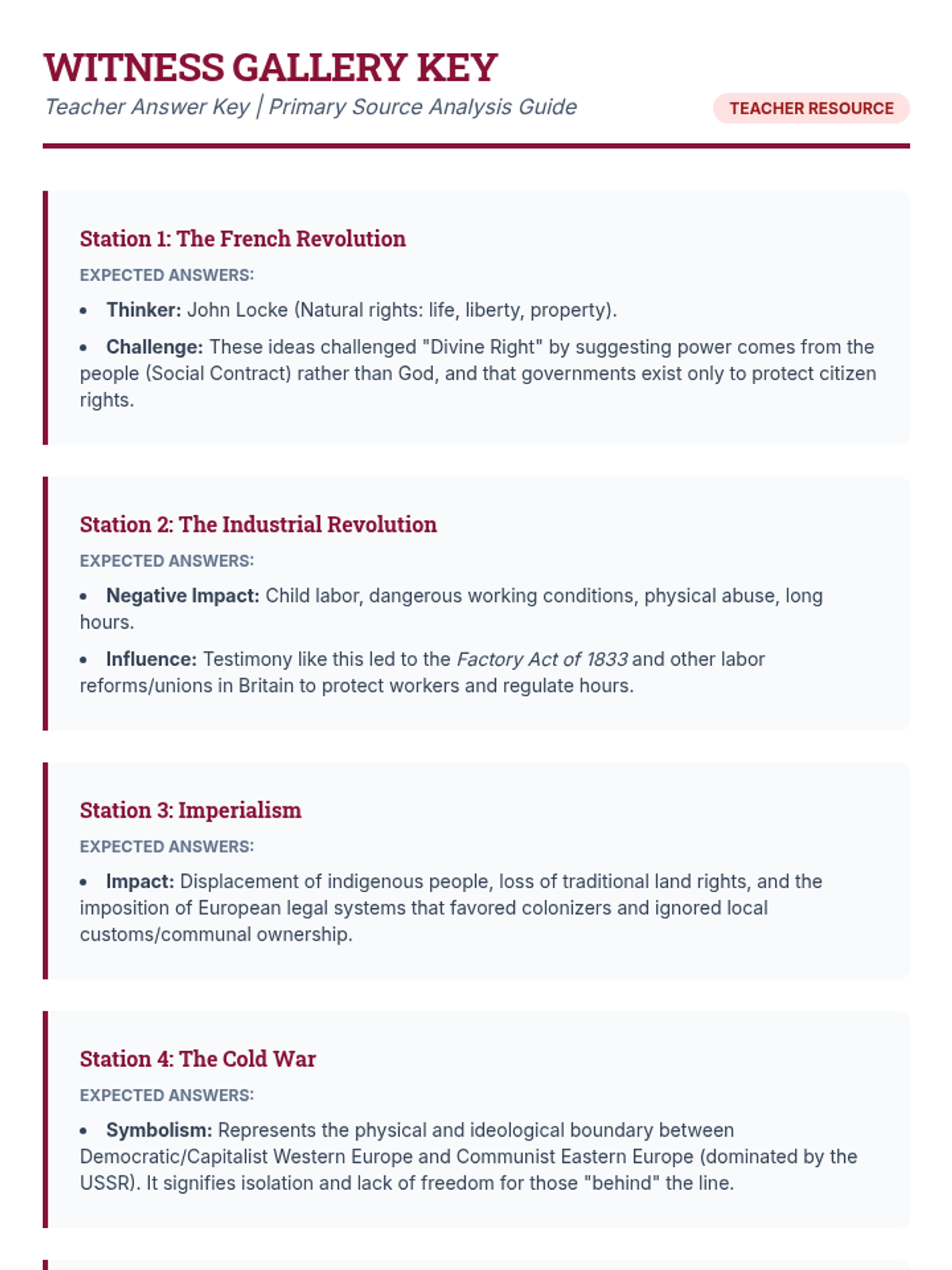
Teacher answer key for the Witness Gallery Guide, providing sample responses and grading criteria for the primary source analysis questions.
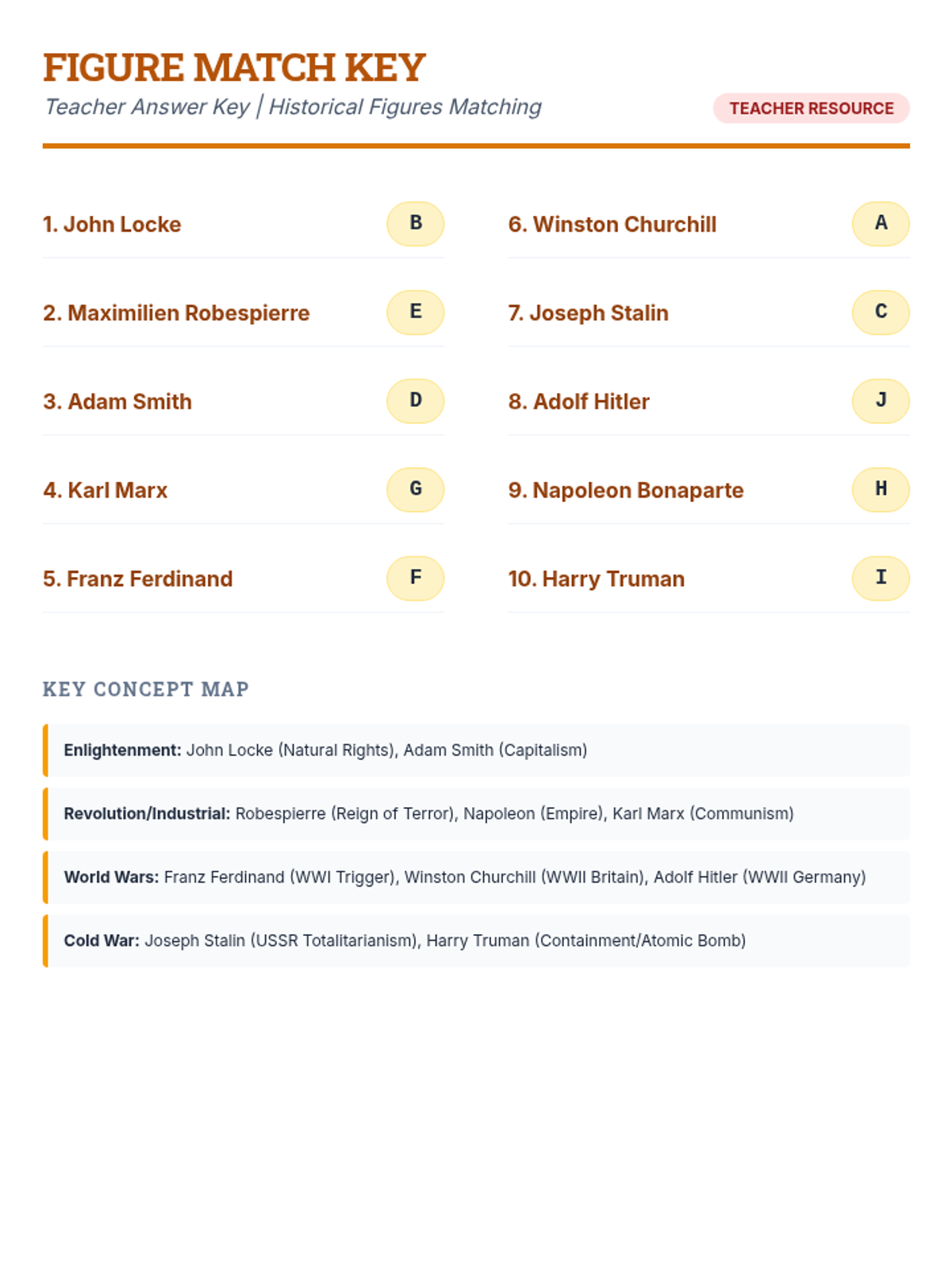
Teacher answer key for the Figure Match Challenge, providing the correct matching pairs for key historical figures and their descriptions.
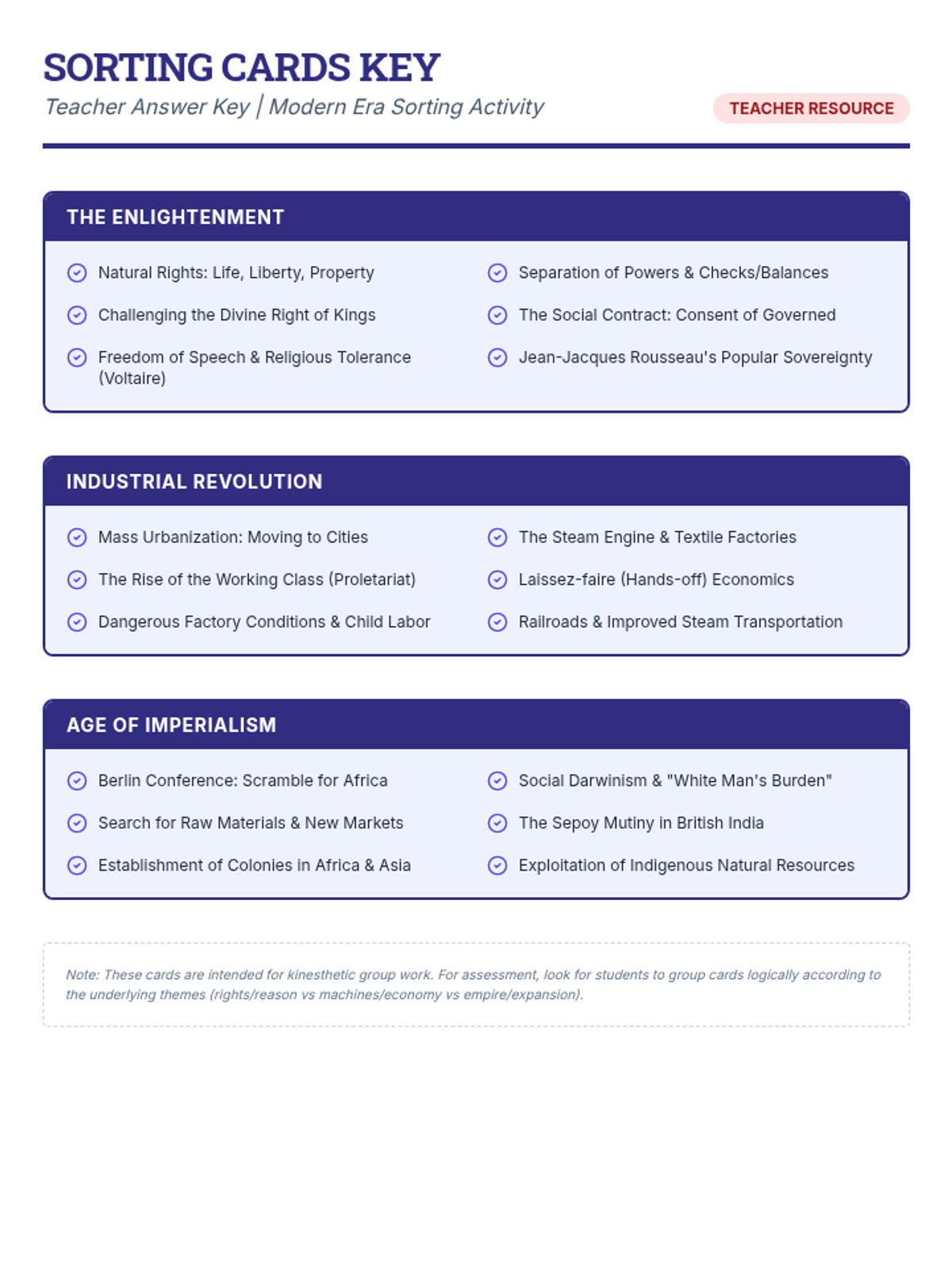
Teacher answer key for the Modern Era Sorting Cards activity, categorizing 18 key concepts into the Enlightenment, Industrial Revolution, and Age of Imperialism.
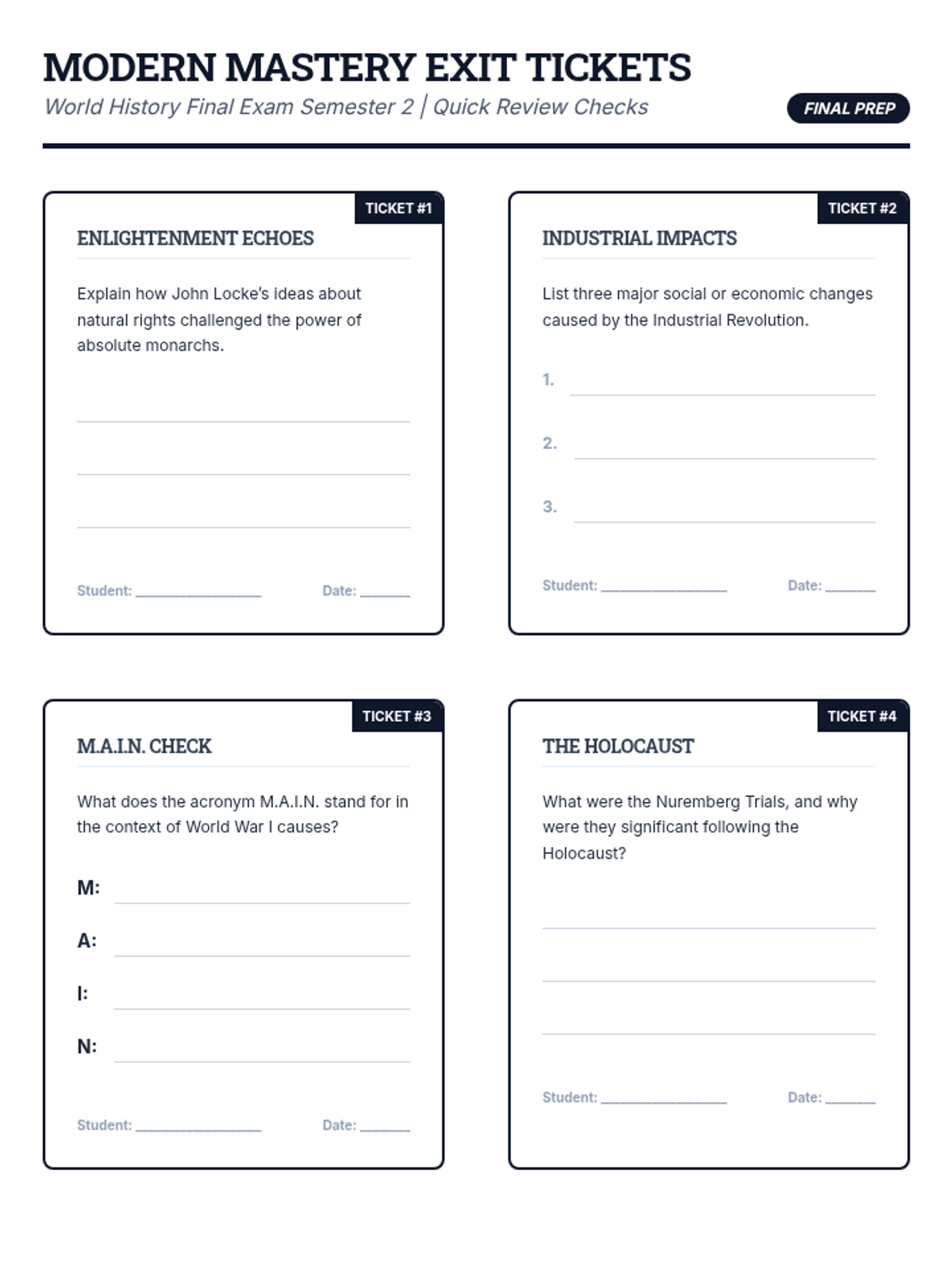
A collection of five different exit tickets designed for quick checks for understanding on core topics like the Enlightenment, Industry, World Wars, and the Cold War.
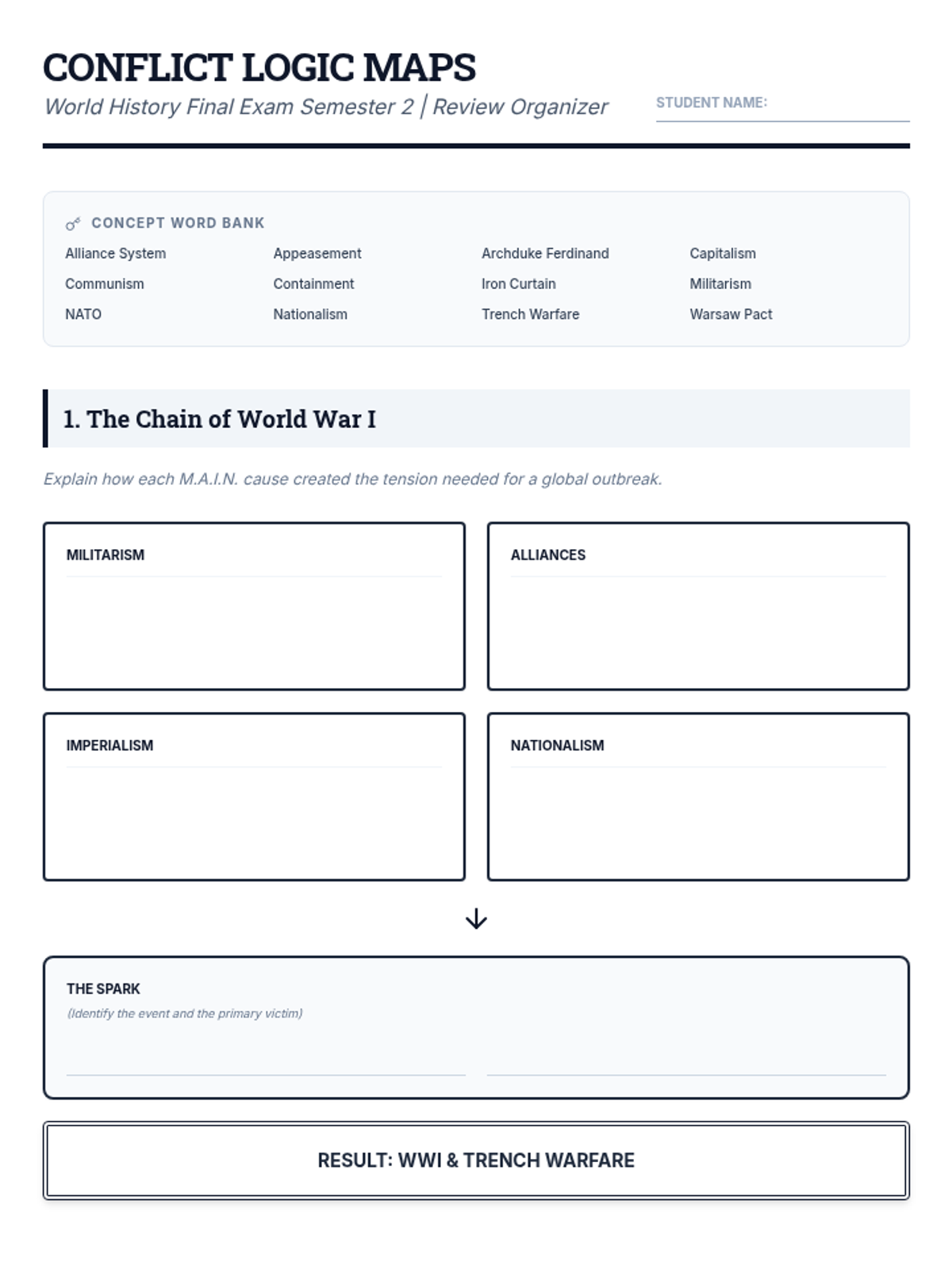
A set of visual logic maps and flowcharts for students to review the causes of World War I and the ideological divisions of the Cold War.
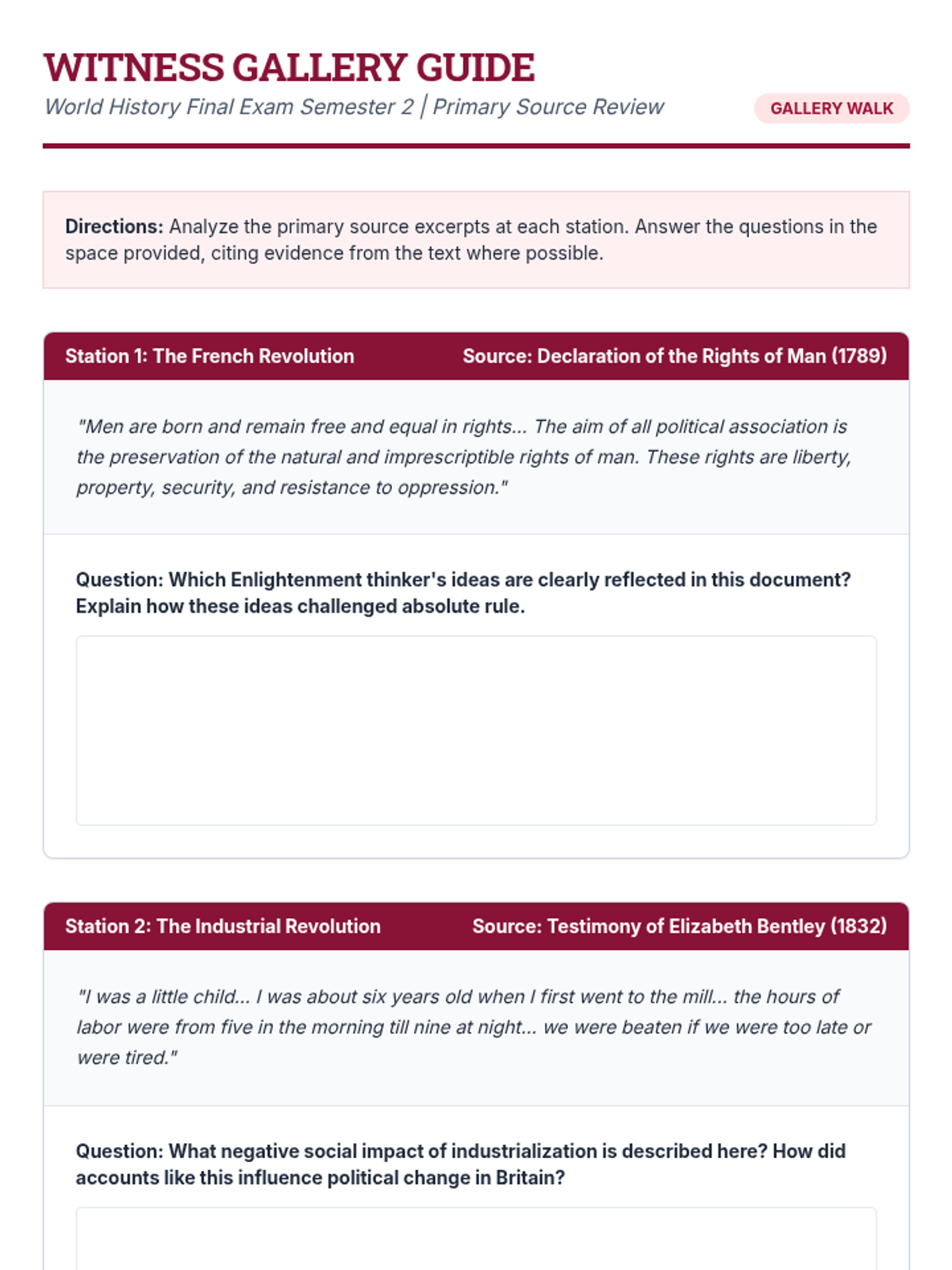
A gallery walk guide with primary source excerpts and analysis questions covering the French Revolution, Industrialization, Imperialism, and the Cold War.
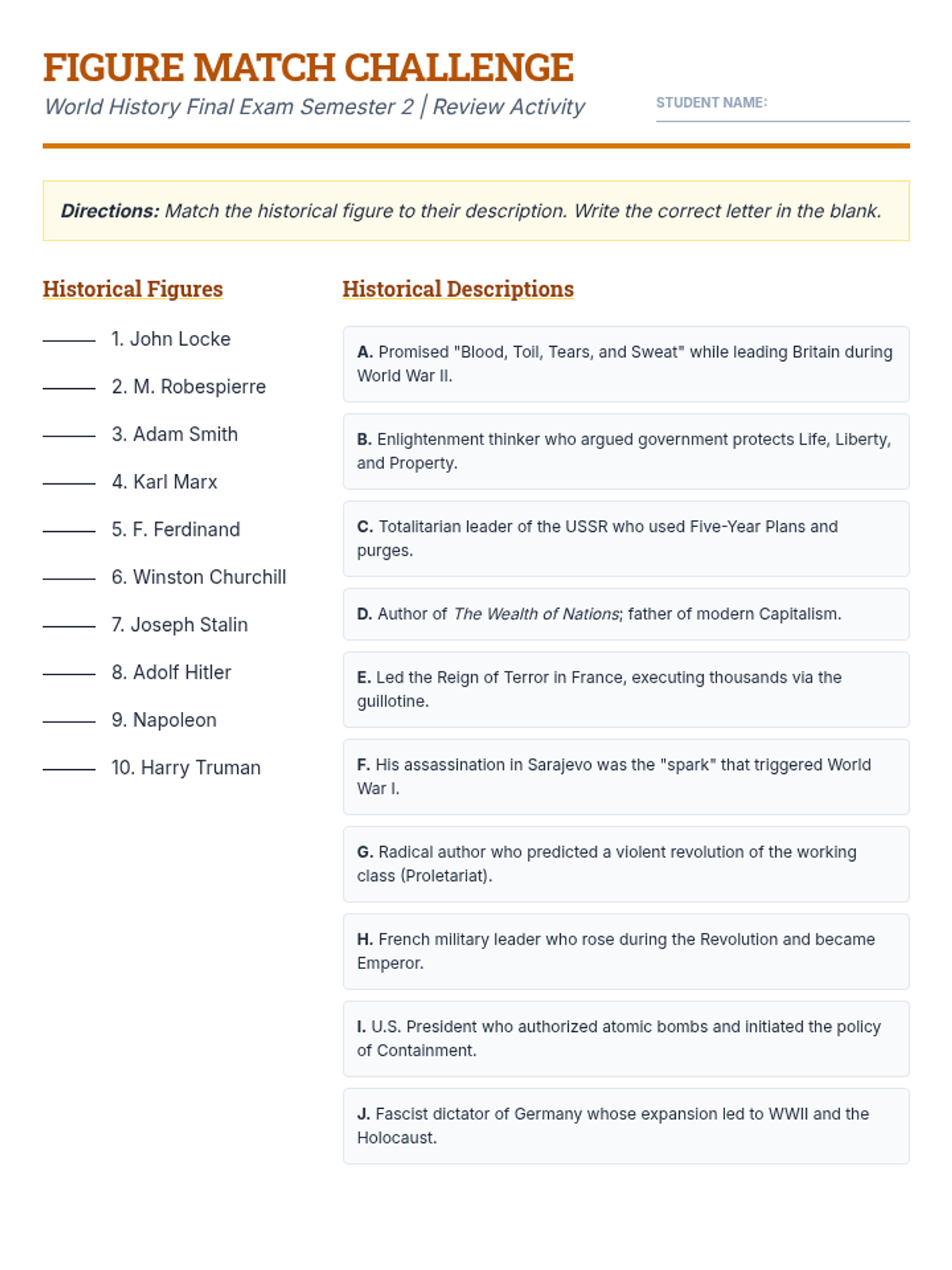
A matching activity focused on the key historical figures from the Enlightenment through the Cold War, testing student knowledge of significant leaders and thinkers.
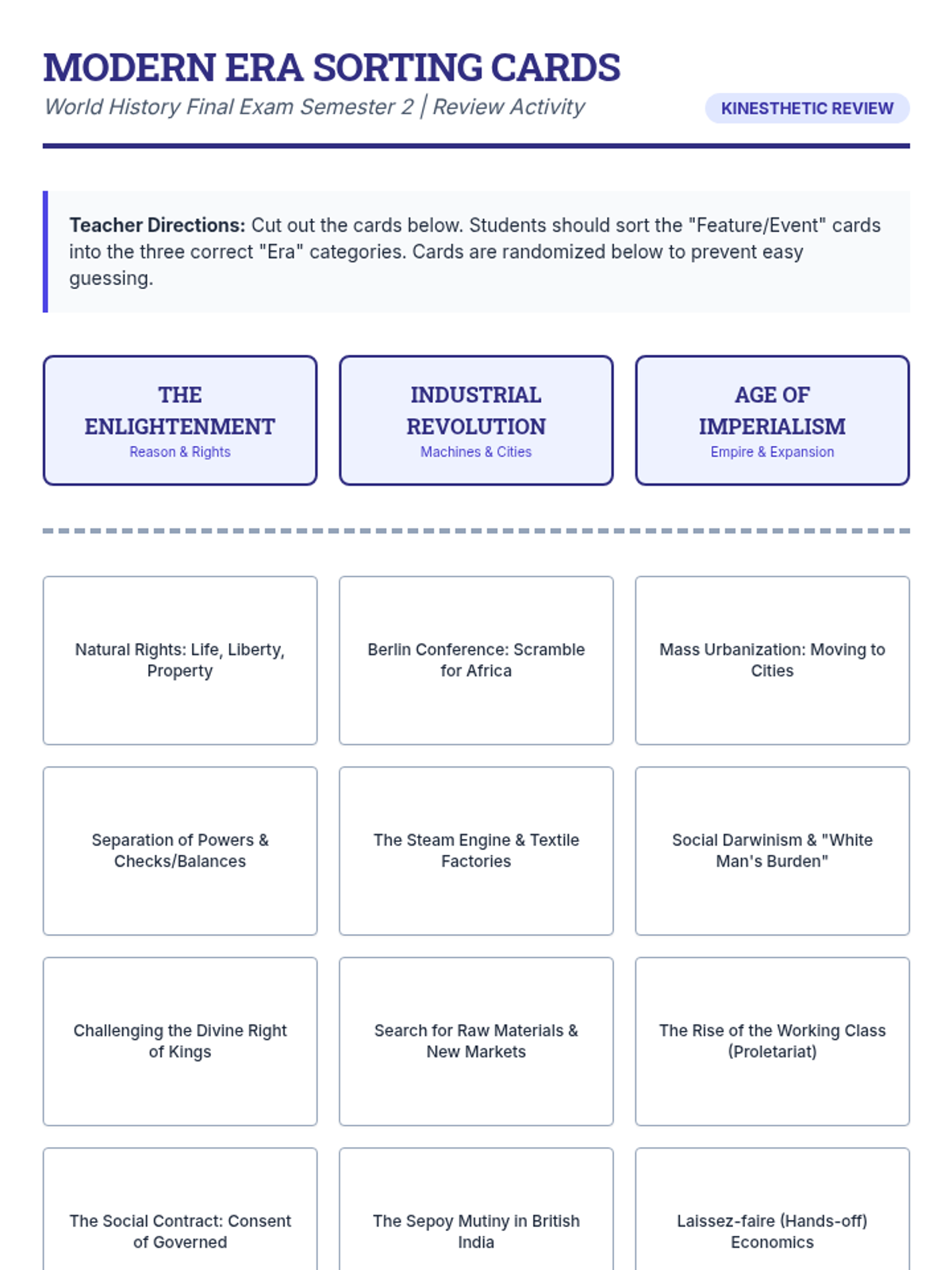
A set of printable sorting cards for reviewing the core concepts of the Enlightenment, Industrial Revolution, and Age of Imperialism with 18 randomized challenge cards.
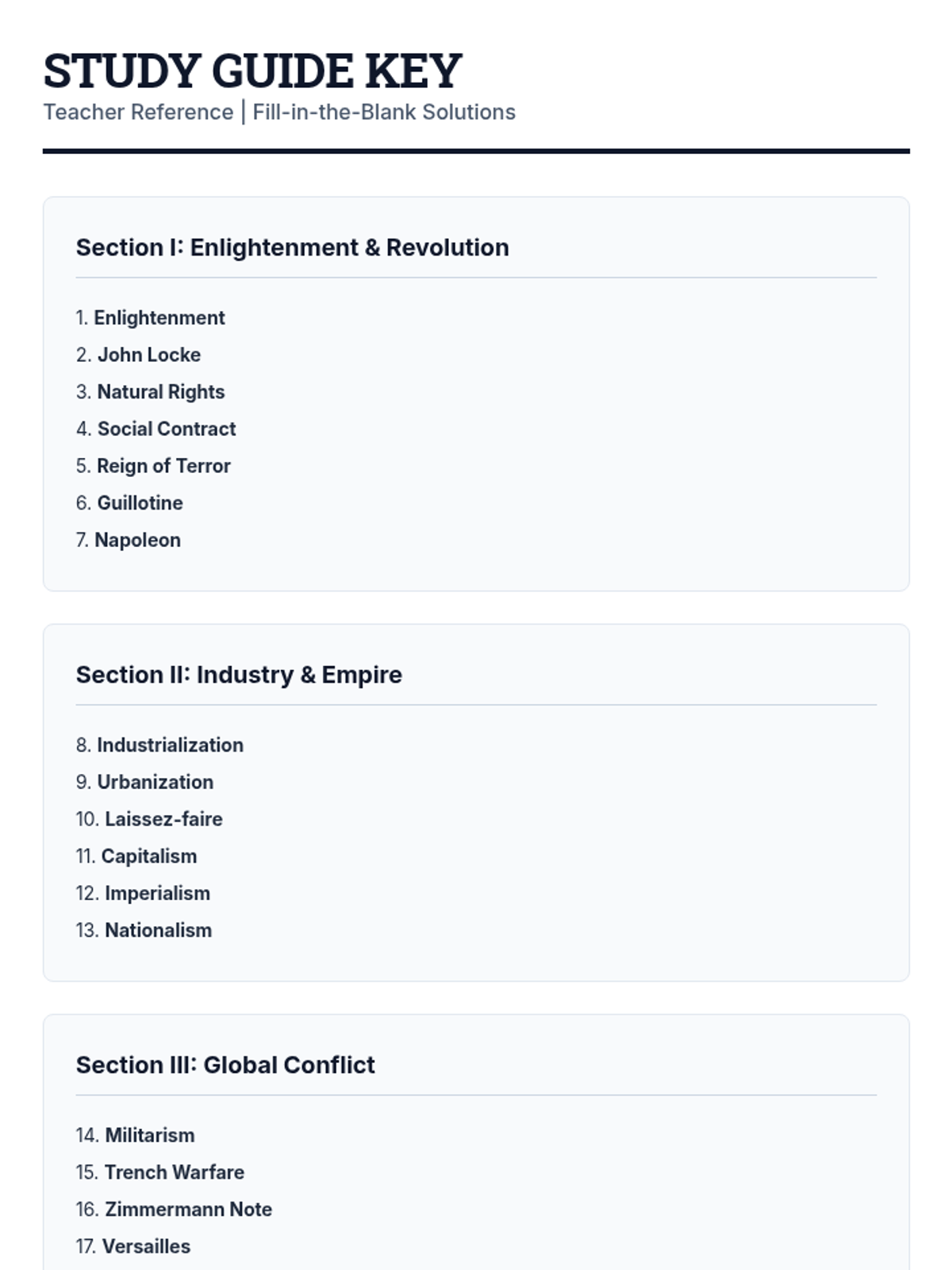
Answer key for the Modern Era Study Guide student fill-in-the-blank activity.
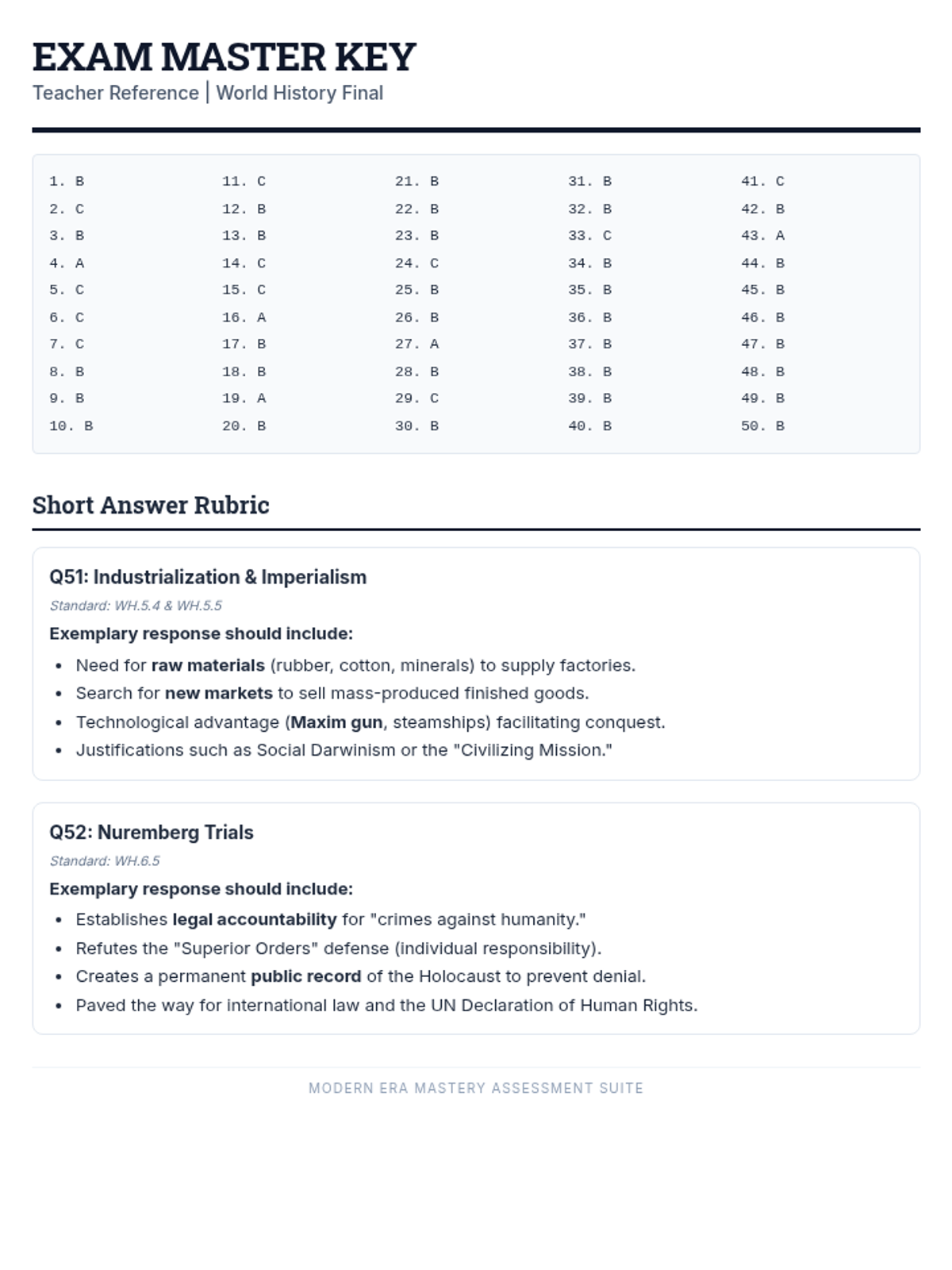
A condensed, single-page teacher answer key and grading rubric for the World History final exam, featuring corrected terminology and a streamlined layout.
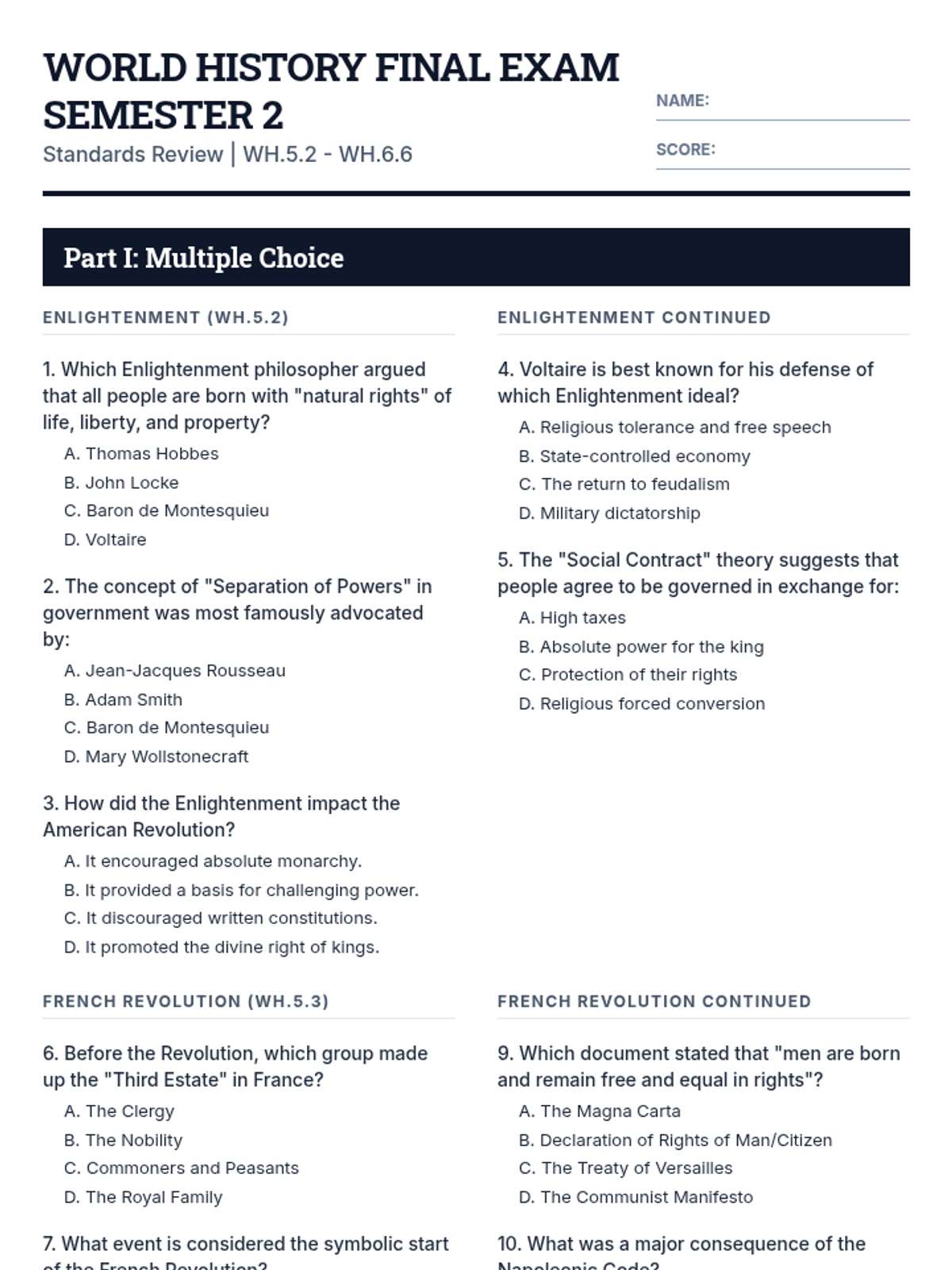
A 50-question multiple-choice final exam for World History Semester 2, including two short-answer questions and improved layout for print efficiency.
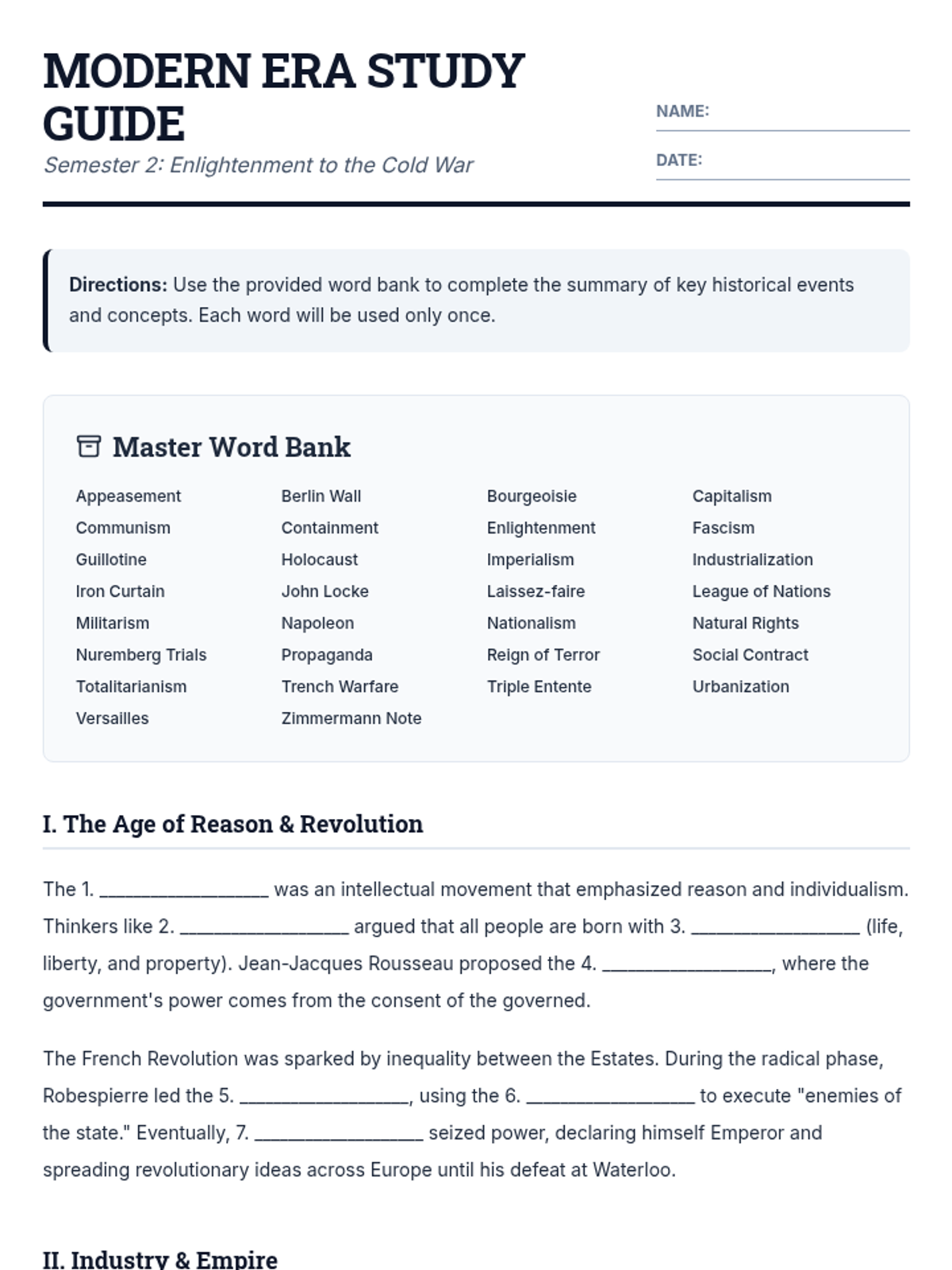
A comprehensive fill-in-the-blank study guide covering Enlightenment, Industrial Revolution, World Wars, and the Cold War with a full word bank for student review.
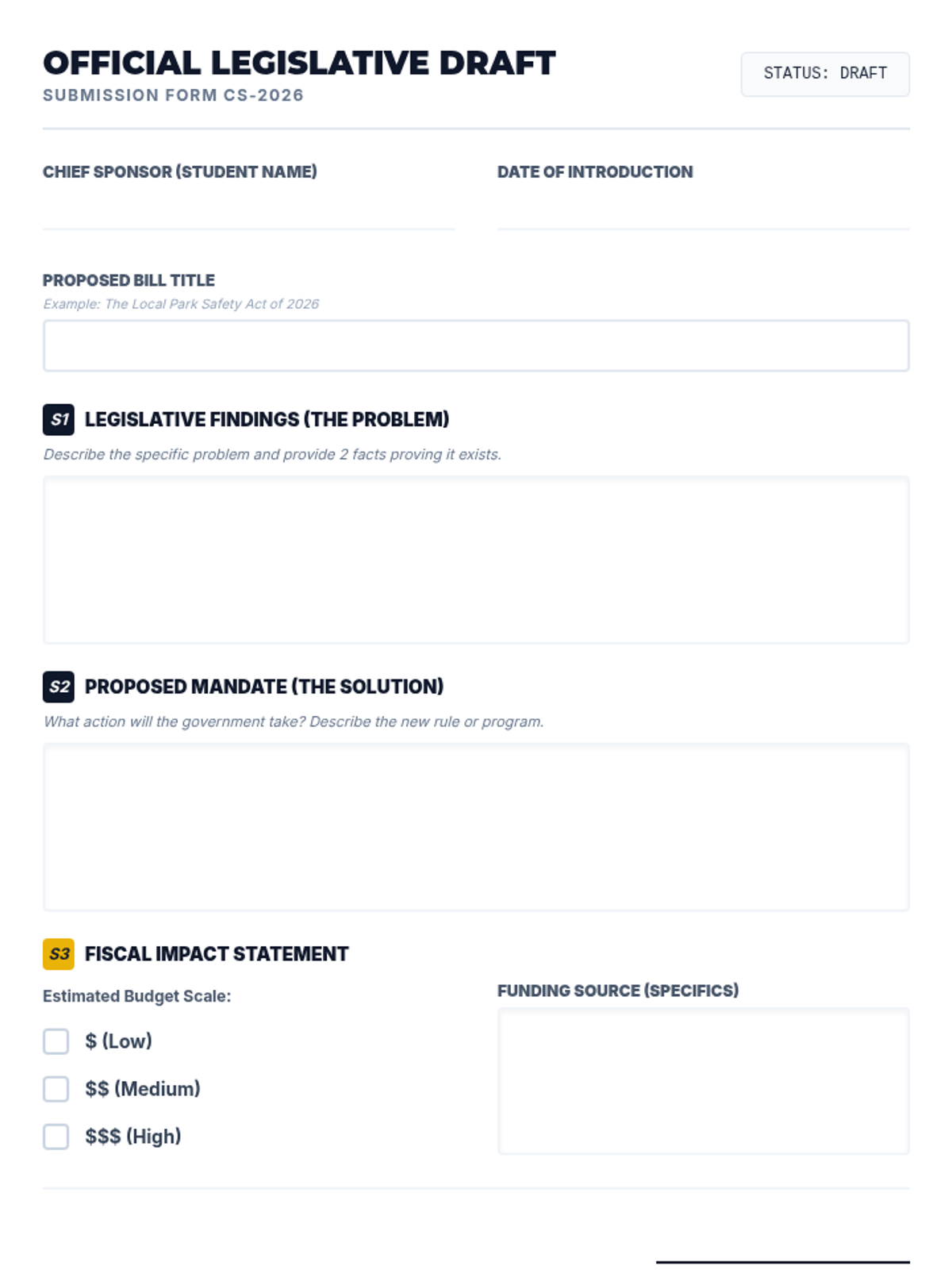
The official template for the "Citizen Solution" project, providing structured sections for students to draft their legislative findings, mandates, and fiscal impact statements.
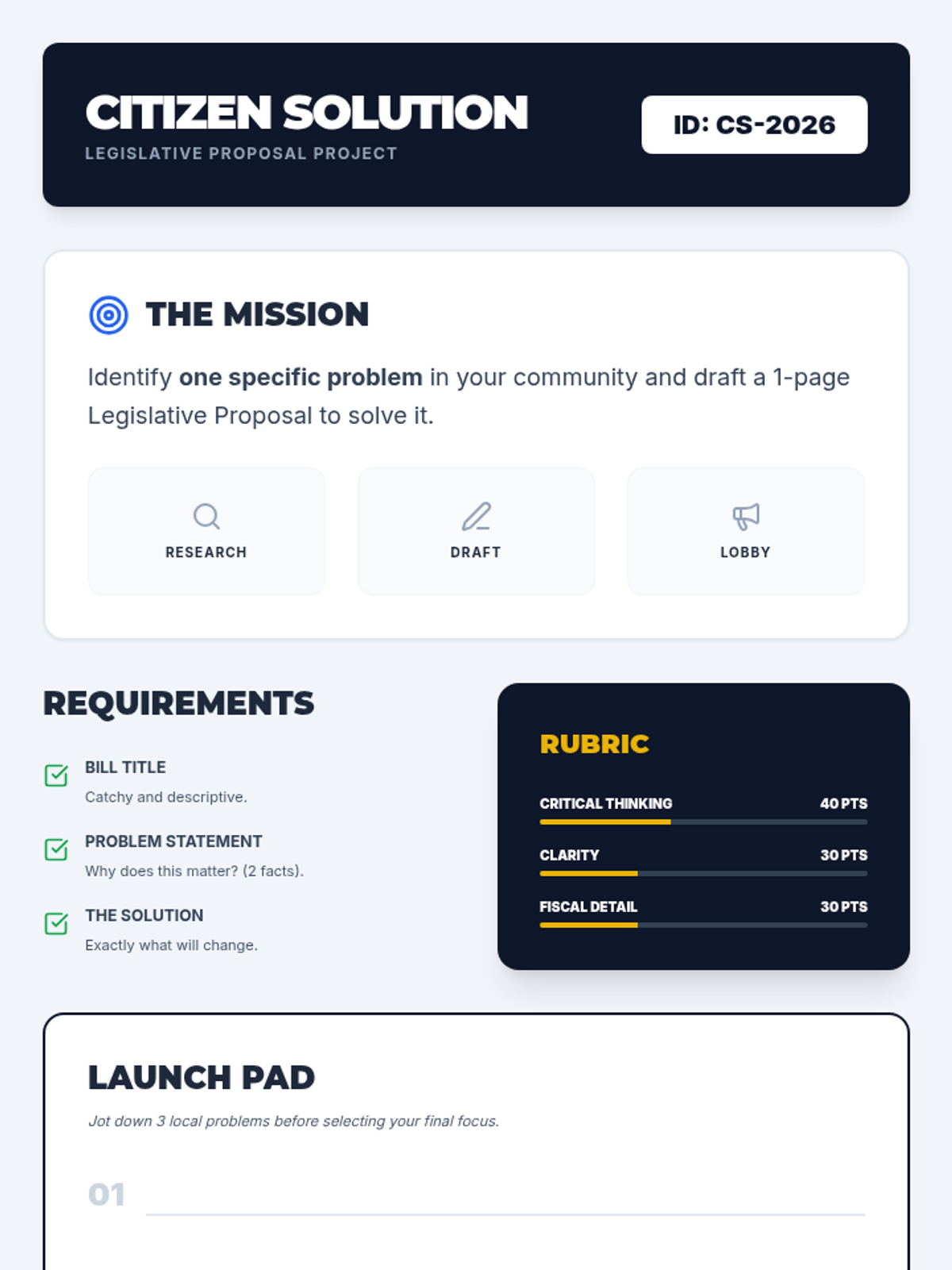
A project guide and instruction sheet for the "Citizen Solution" final project, outlining requirements for research, drafting, and fiscal planning.
An exploration of external influences on the legislative branch, including the role of lobbyists, interest groups, and political action committees (PACs).
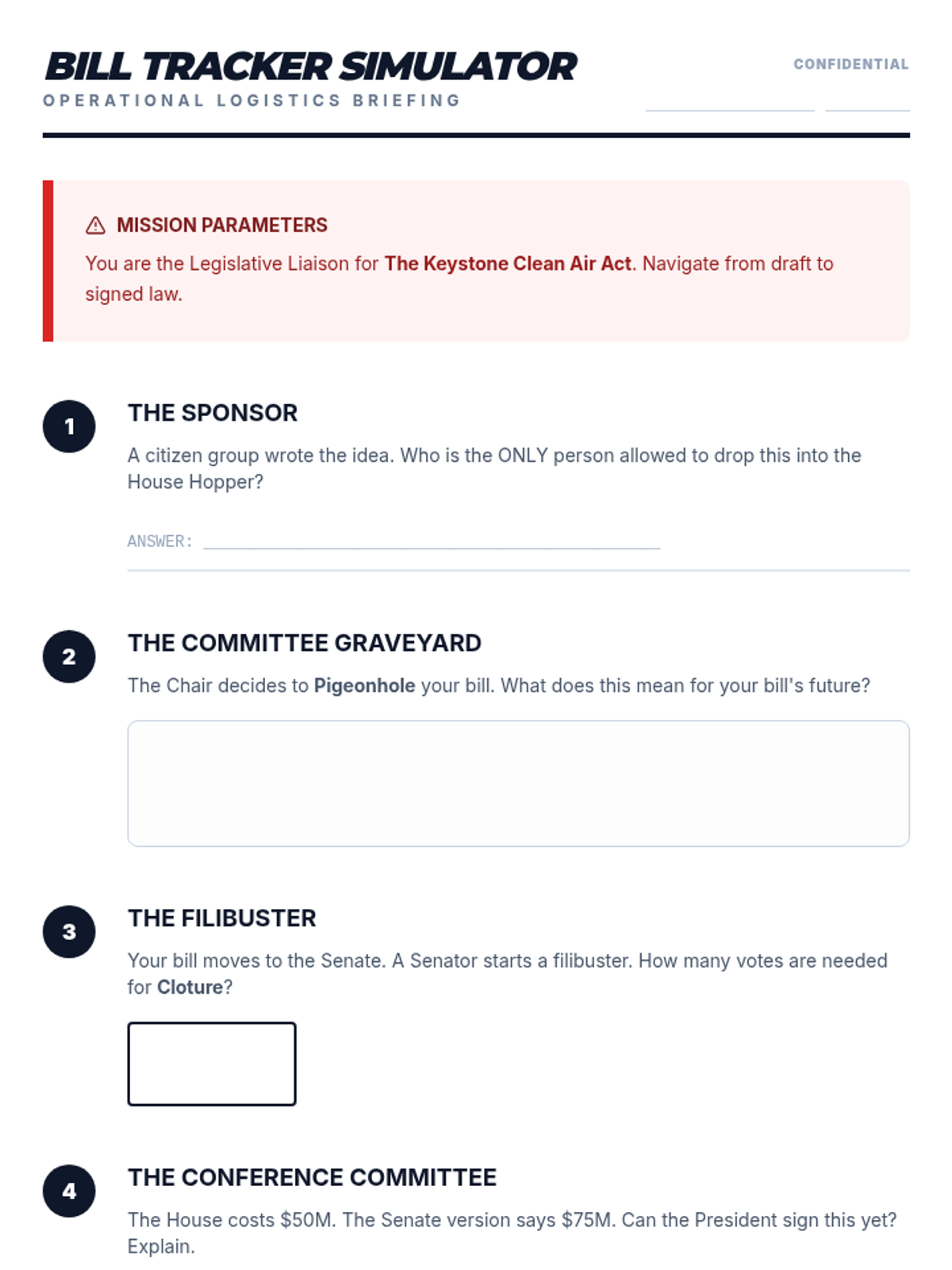
A scenario-based worksheet where students "follow" a bill through the legislative process, making decisions and answering procedural questions as obstacles arise.
An intense, visually-driven slide deck detailing the step-by-step process of how a bill becomes a law, highlighting the role of committees, the filibuster, and the executive veto.
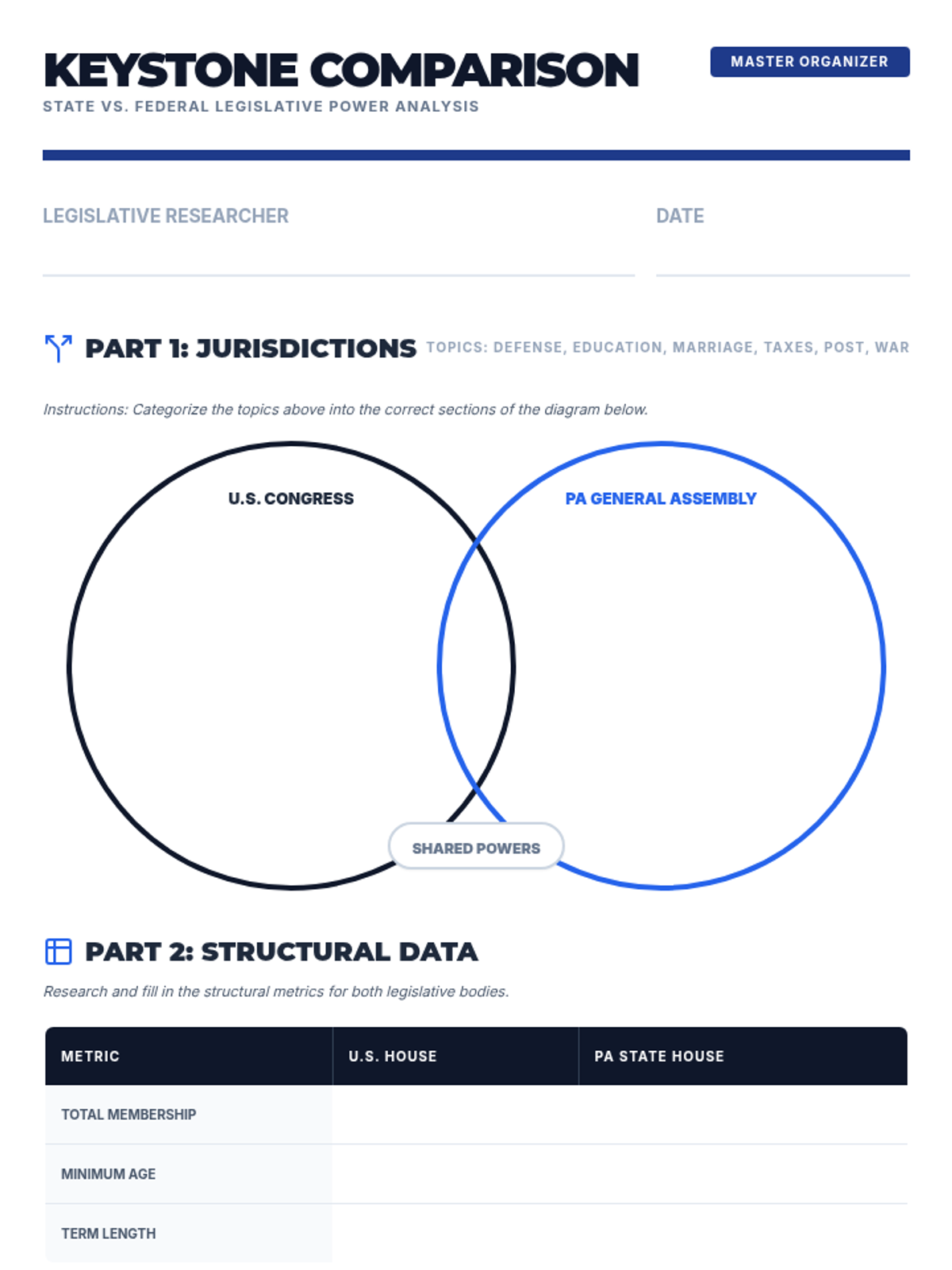
A graphic organizer and comparison worksheet for students to analyze the structural and jurisdictional differences between the PA General Assembly and the US Congress.
A state-specific slide deck comparing the PA General Assembly to the US Congress, detailing the size, scope, and specific daily impacts of state-level legislation.
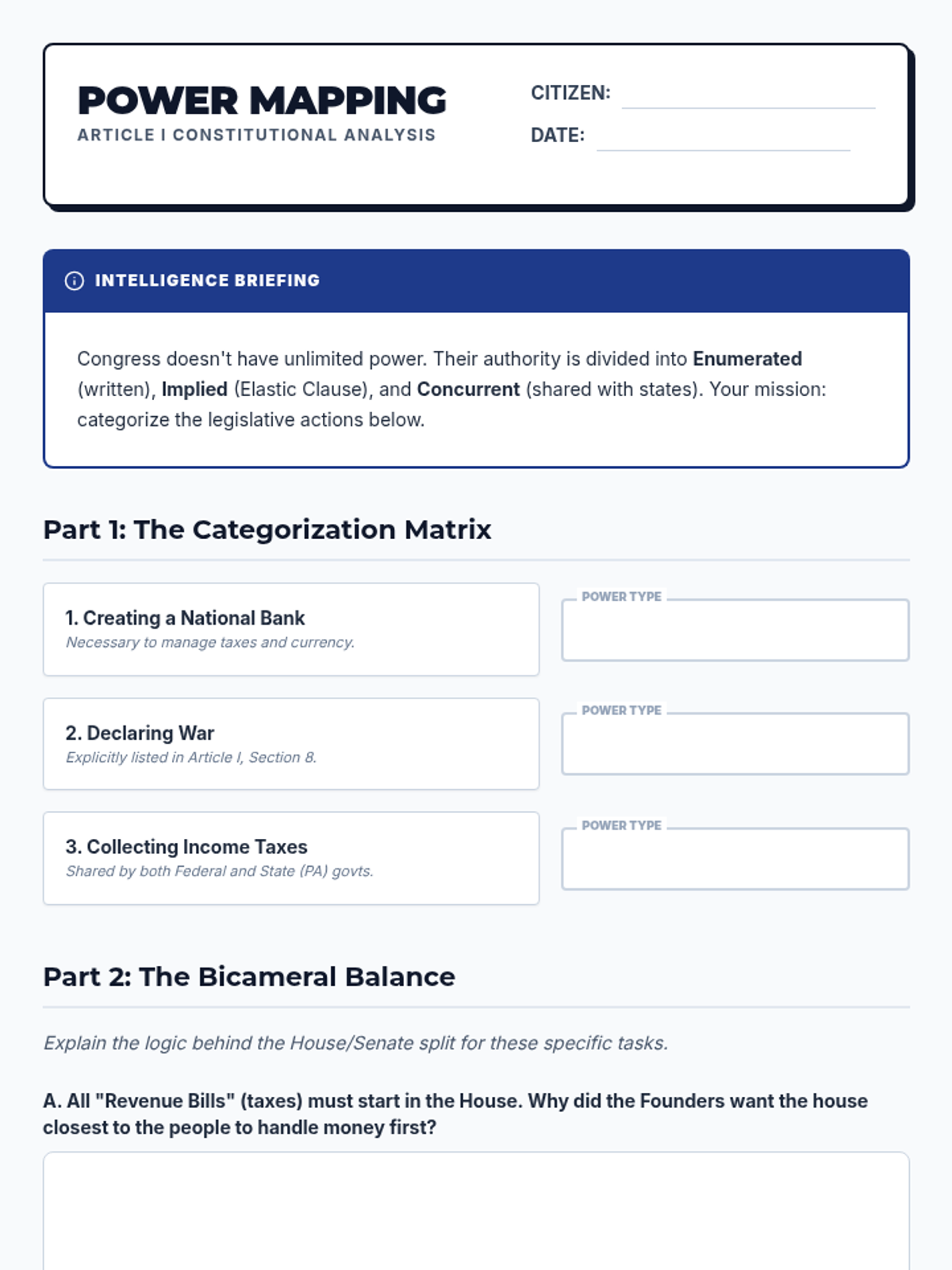
A student worksheet focusing on the categorization of legislative powers (enumerated, implied, concurrent) and the structural logic of the bicameral system.
An engaging slide deck covering the structure of the US Congress, the logic of bicameralism, and the enumerated and implied powers found in Article I of the Constitution.
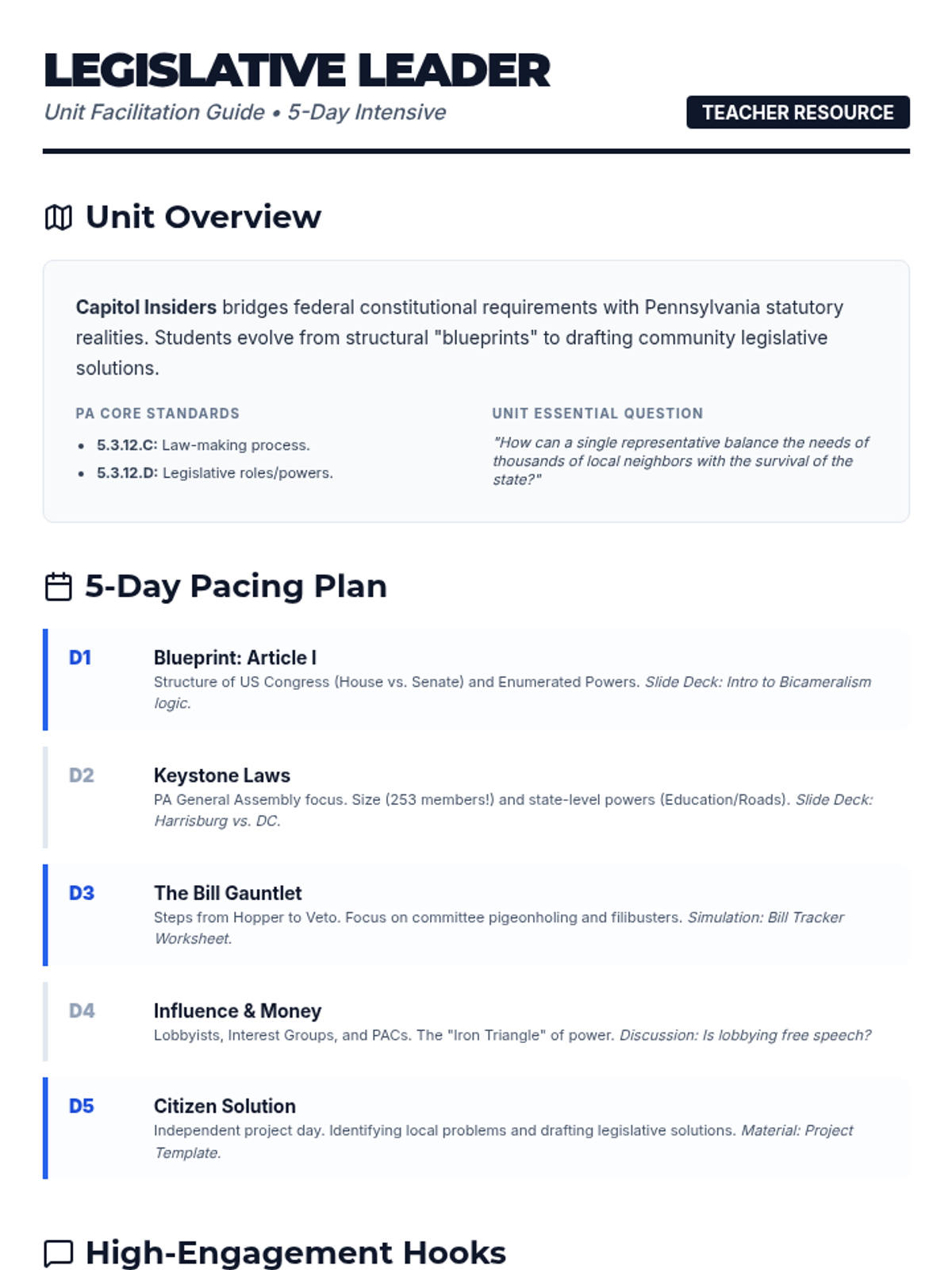
A comprehensive unit facilitation guide for teachers, providing a 5-day pacing plan, PA state standards alignment, and high-engagement discussion prompts for a legislative branch unit.
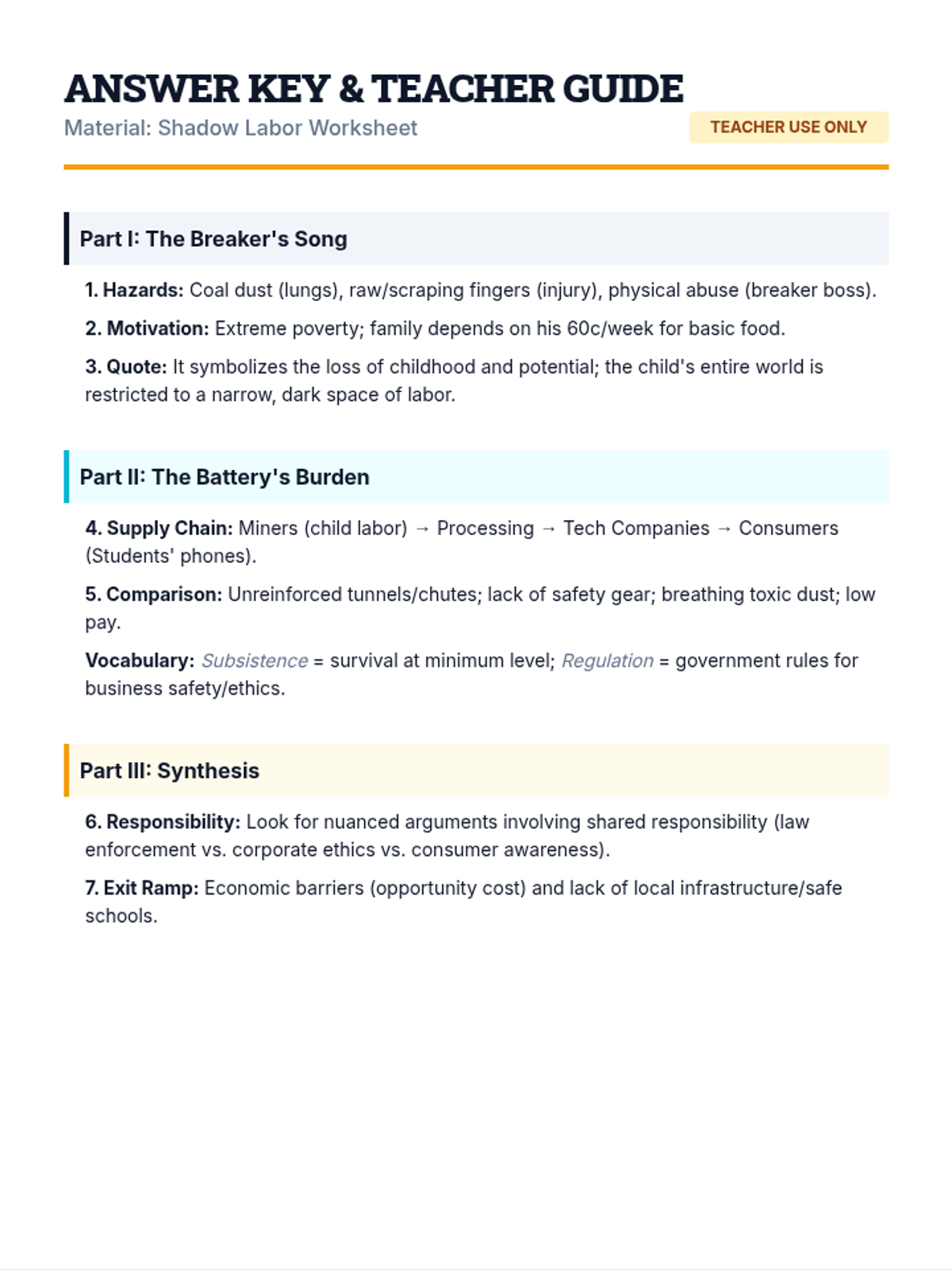
A teacher-facing answer key and facilitation guide for the 'Shadow Labor' worksheet, providing suggested responses and instructional tips.
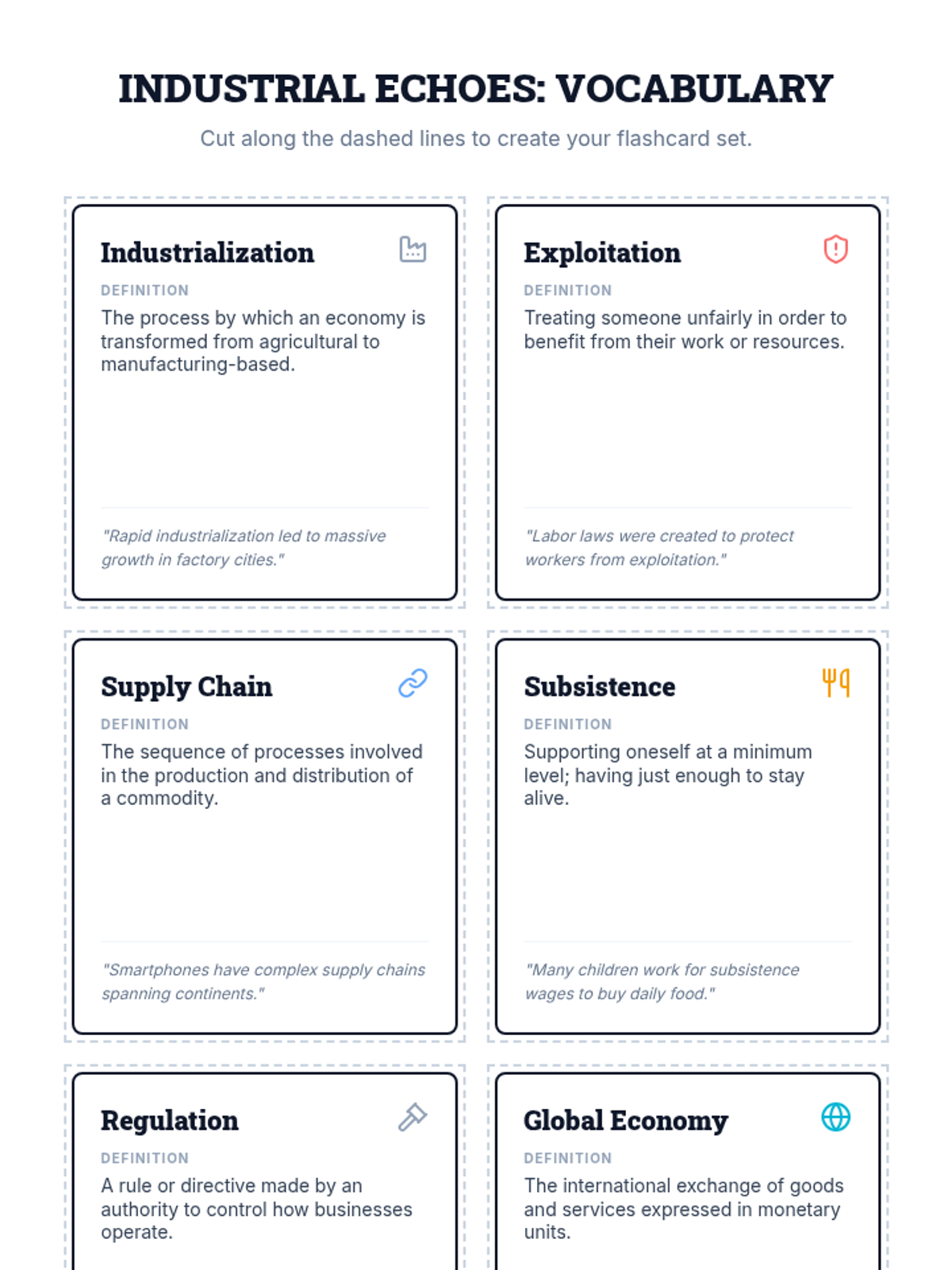
A set of 6 printable vocabulary cards with key terms, definitions, and usage examples for the child labor unit.
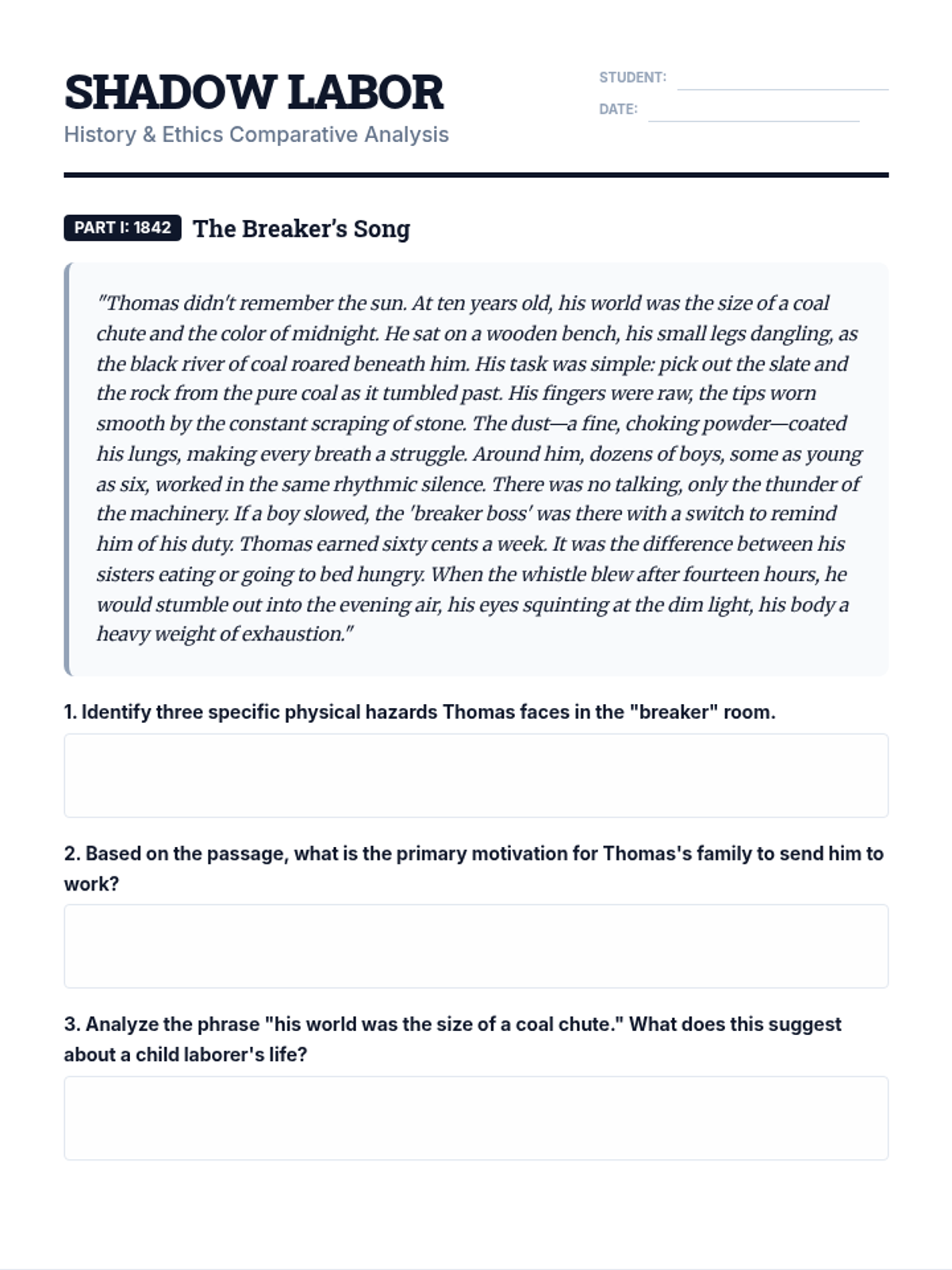
A comprehensive 3-page worksheet featuring two comparative reading passages (historical fiction and modern non-fiction) with comprehension, analysis, and critical thinking questions.
A visually striking slide presentation comparing historical and modern child labor, featuring data, key drivers, and comparison tables for 9th-grade students.
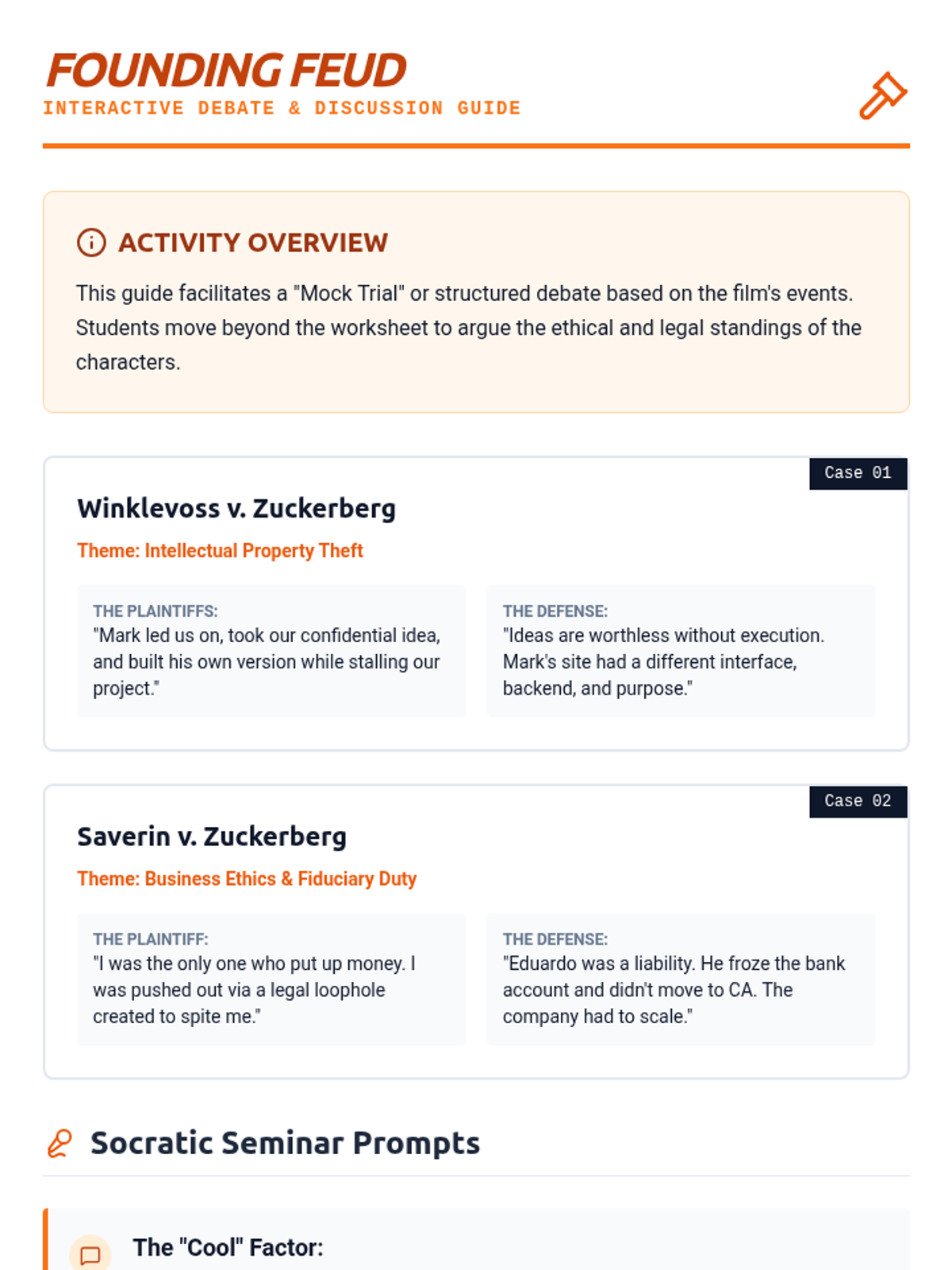
A teacher facilitation guide for post-viewing discussions and debates, featuring structured 'Mock Trial' cases for the legal disputes in 'The Social Network' and Socratic seminar prompts.
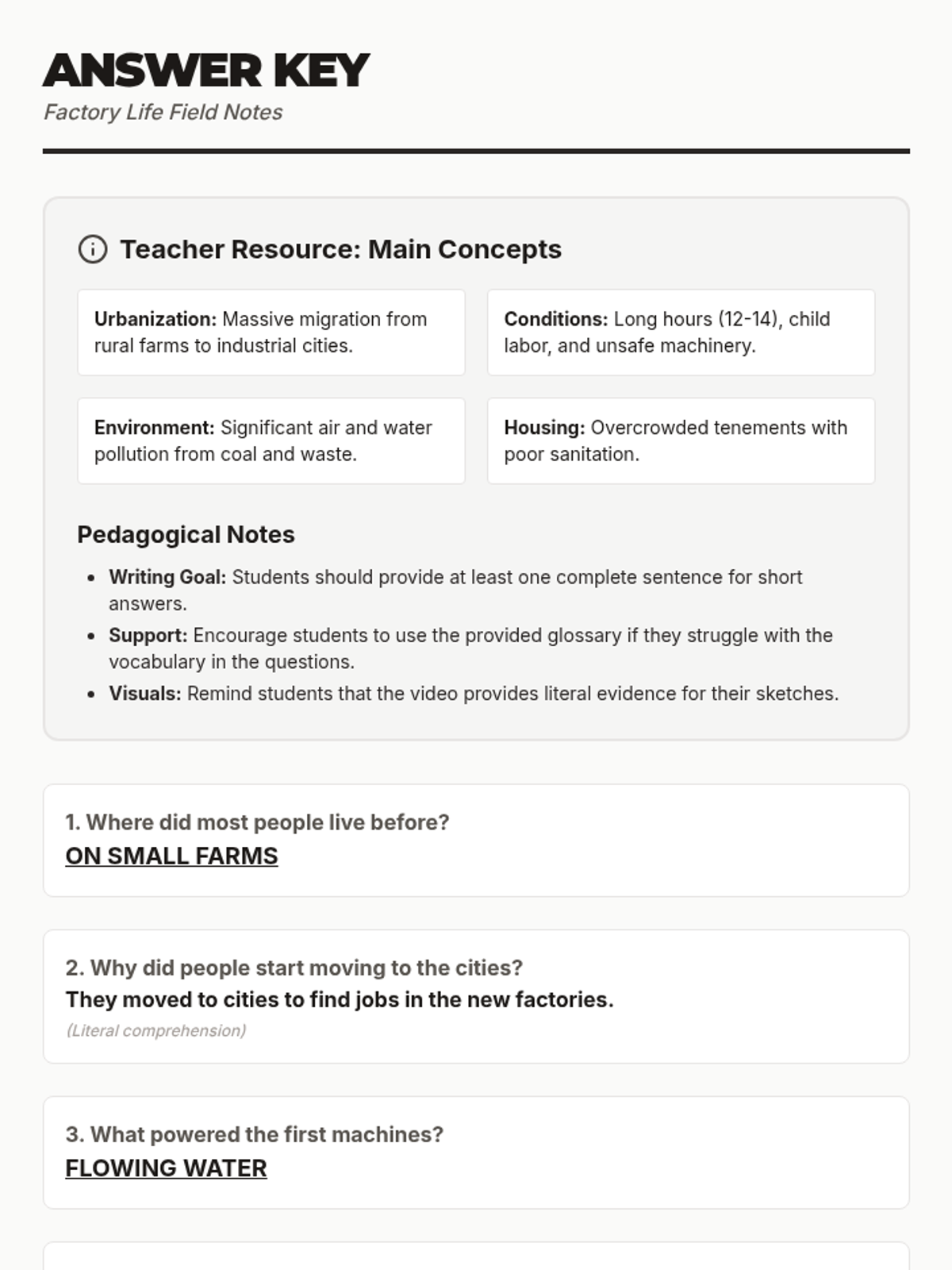
Teacher answer key for the Factory Life Field Notes, providing sample one-sentence answers and clear pedagogical guidance for teaching urbanization and industrialization.
An instructional slide deck focusing on urbanization and the working conditions of the Industrial Revolution. Features simplified vocabulary, large text, and integrated pause points for student response. Revised for better visual alignment and visibility.
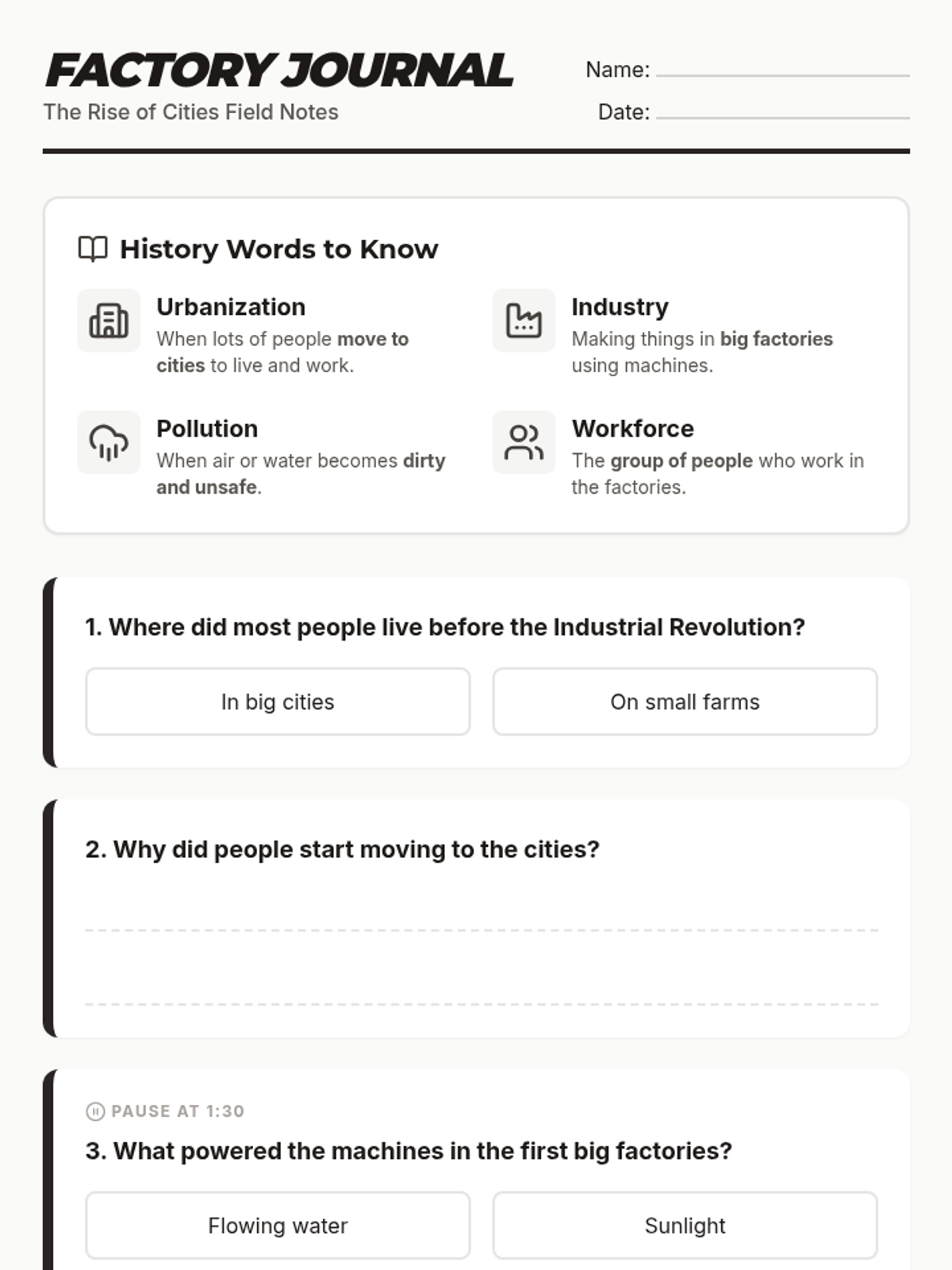
A guided video worksheet focused on urbanization and the Industrial Revolution. Designed for middle school students with low reading levels, it includes a visual glossary and 10 literal and inferential questions.
A comprehensive large-print resource containing the "Impact of Digital Technologies" report and a student analysis page. Features 26px (~20pt) text, bolded key terms, and high-contrast writing lines for accessibility. Layout is optimized for readability and ample response space.
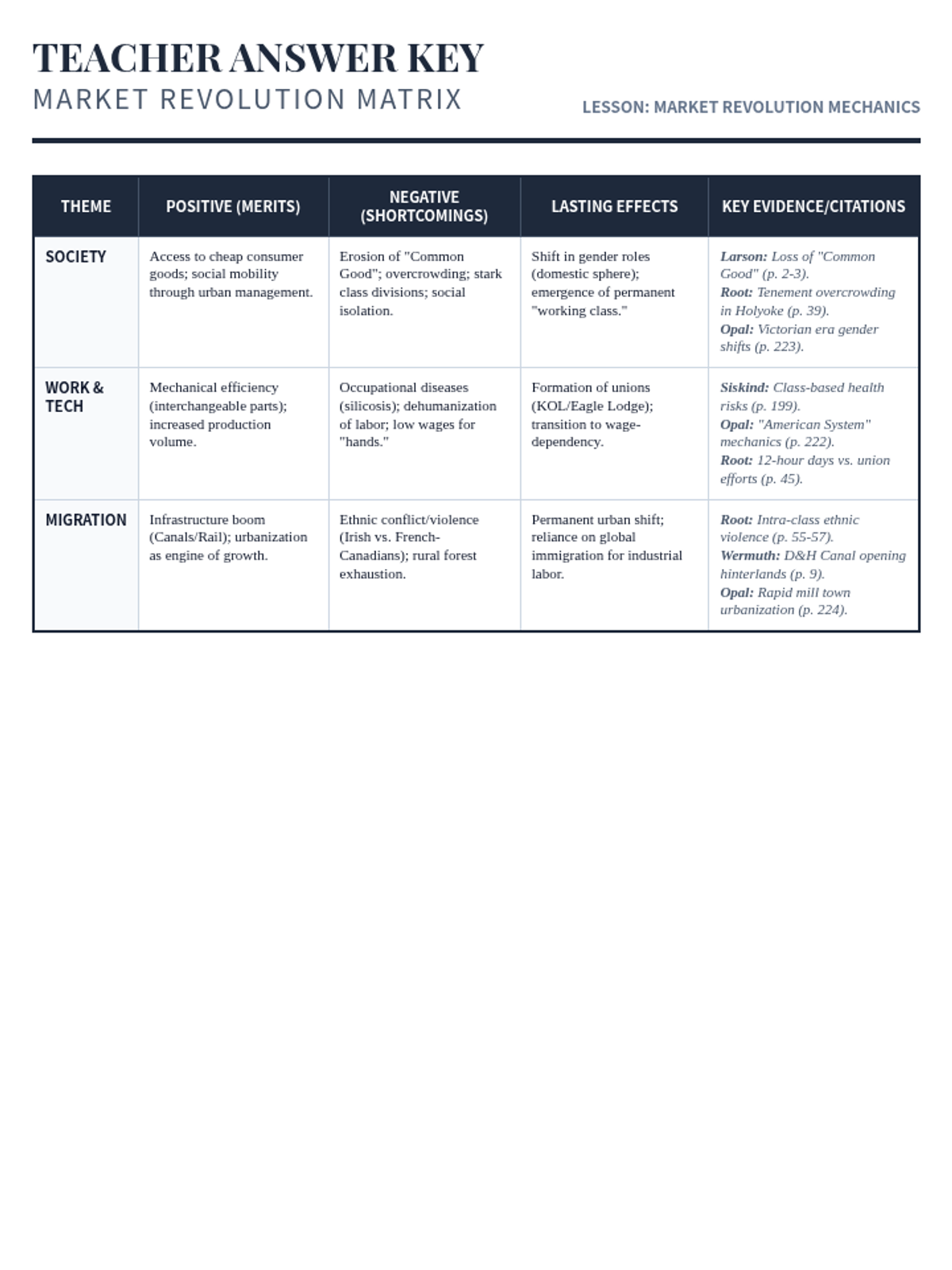
A comprehensive teacher's answer key for the Market Revolution Matrix, featuring evidence-backed synthesis points and exemplar seminar questions to guide high-level discussion.
An instructional slide deck to guide students through the analysis of the market revolution and prepare them for a evidence-based Socratic seminar.
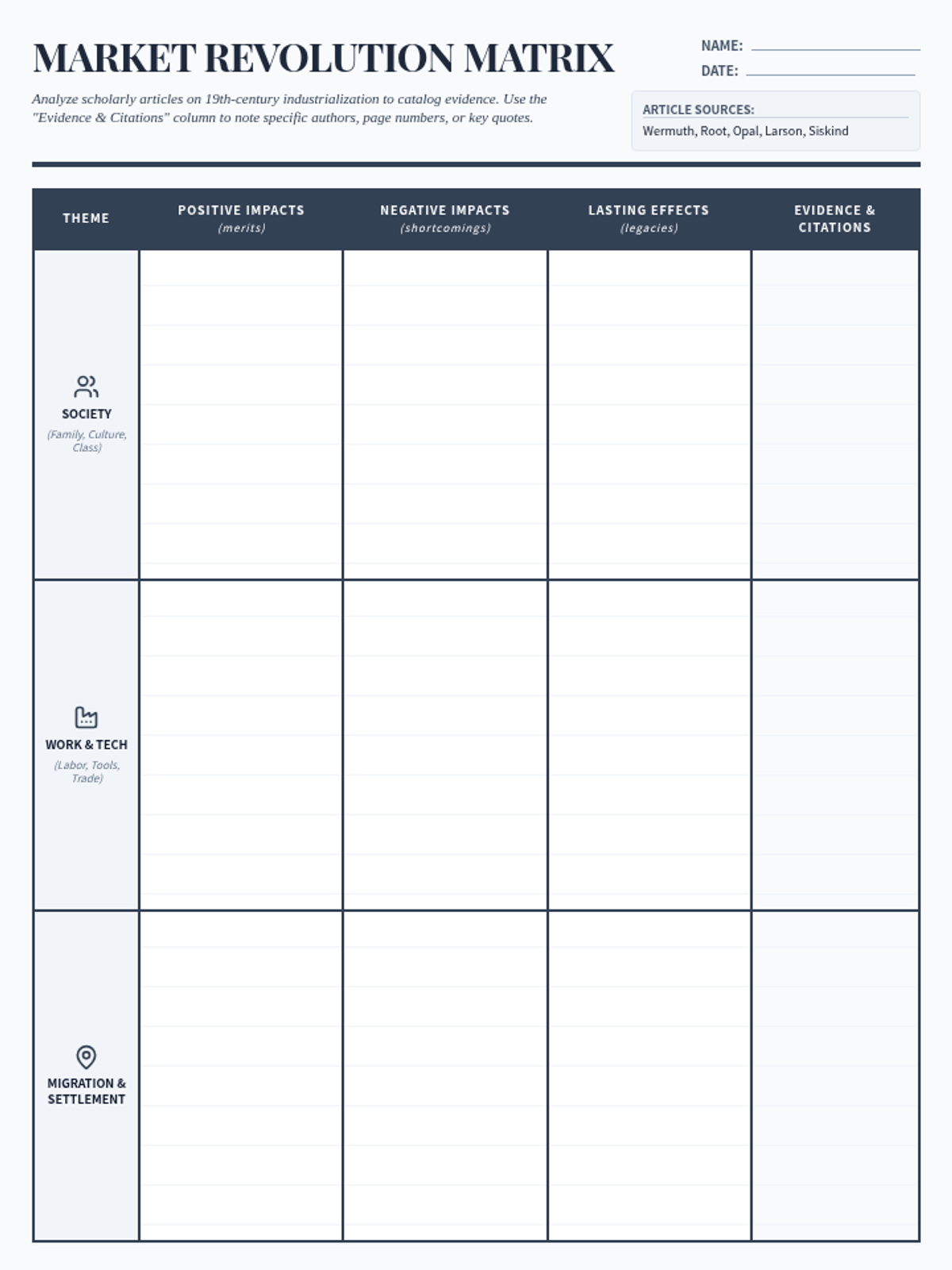
An expanded 2-page graphic organizer and preparation guide for a Socratic Seminar. It features a thematic matrix with a new evidence/citation column, a synthesis reflection on the definition of the mid-19th century American citizen, and placeholders for student-led discussion questions.
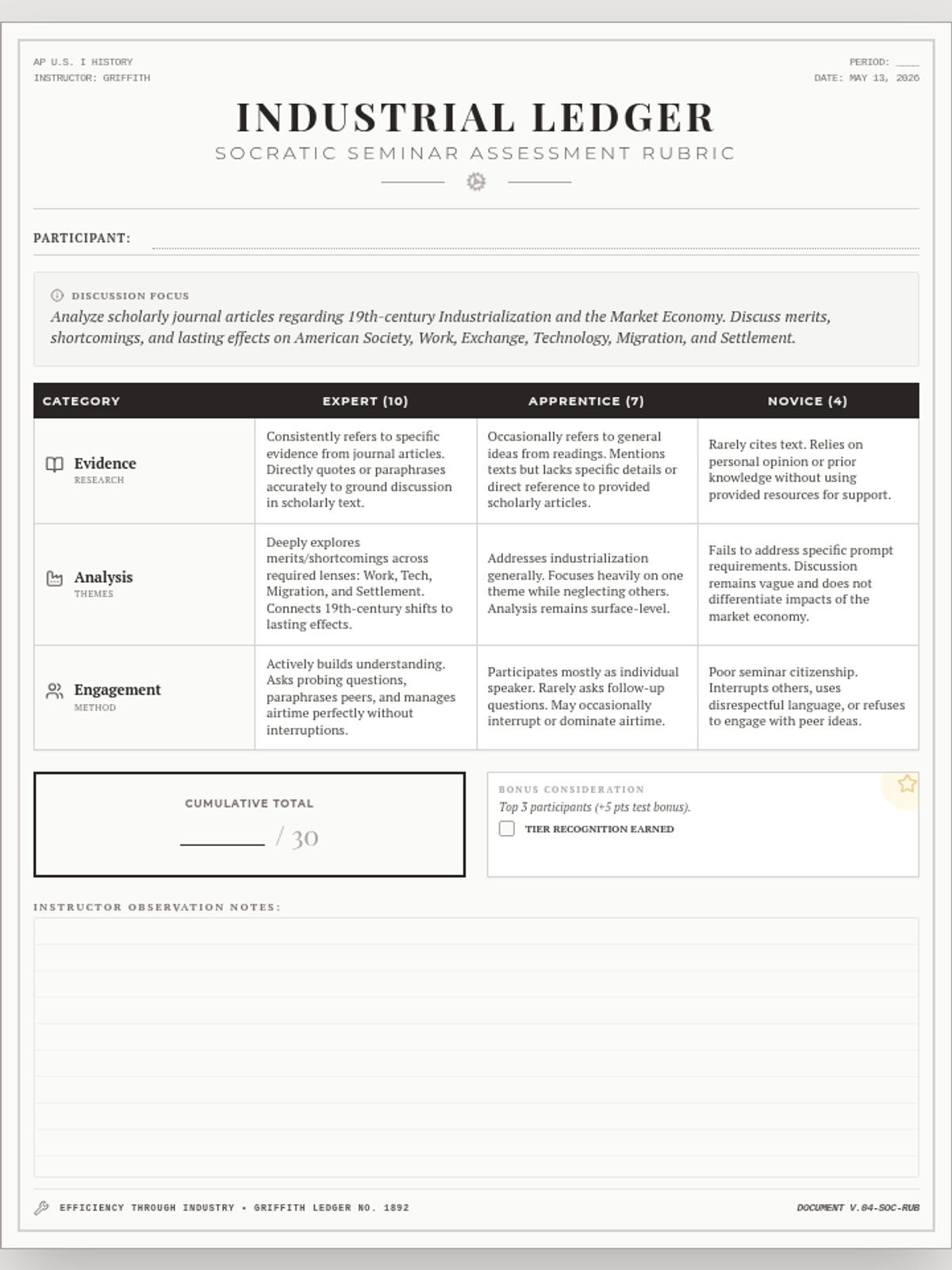
A professional 30-point Socratic Seminar rubric for AP US History, themed as a 19th-century industrial ledger. It evaluates textual evidence, thematic analysis of industrialization, and seminar facilitation across three performance levels.
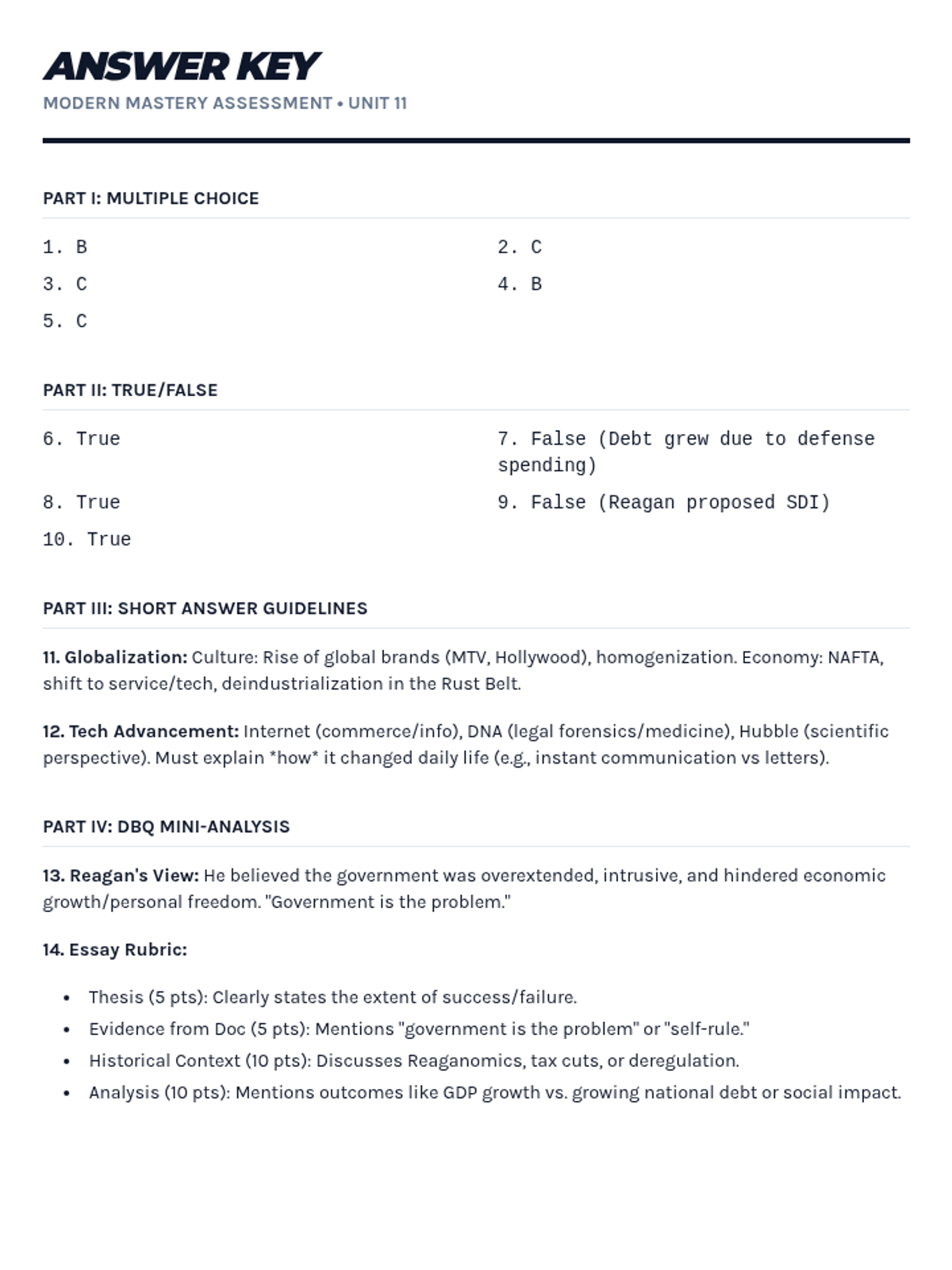
An answer key and grading rubric for the Unit 11 Modern Mastery Assessment.
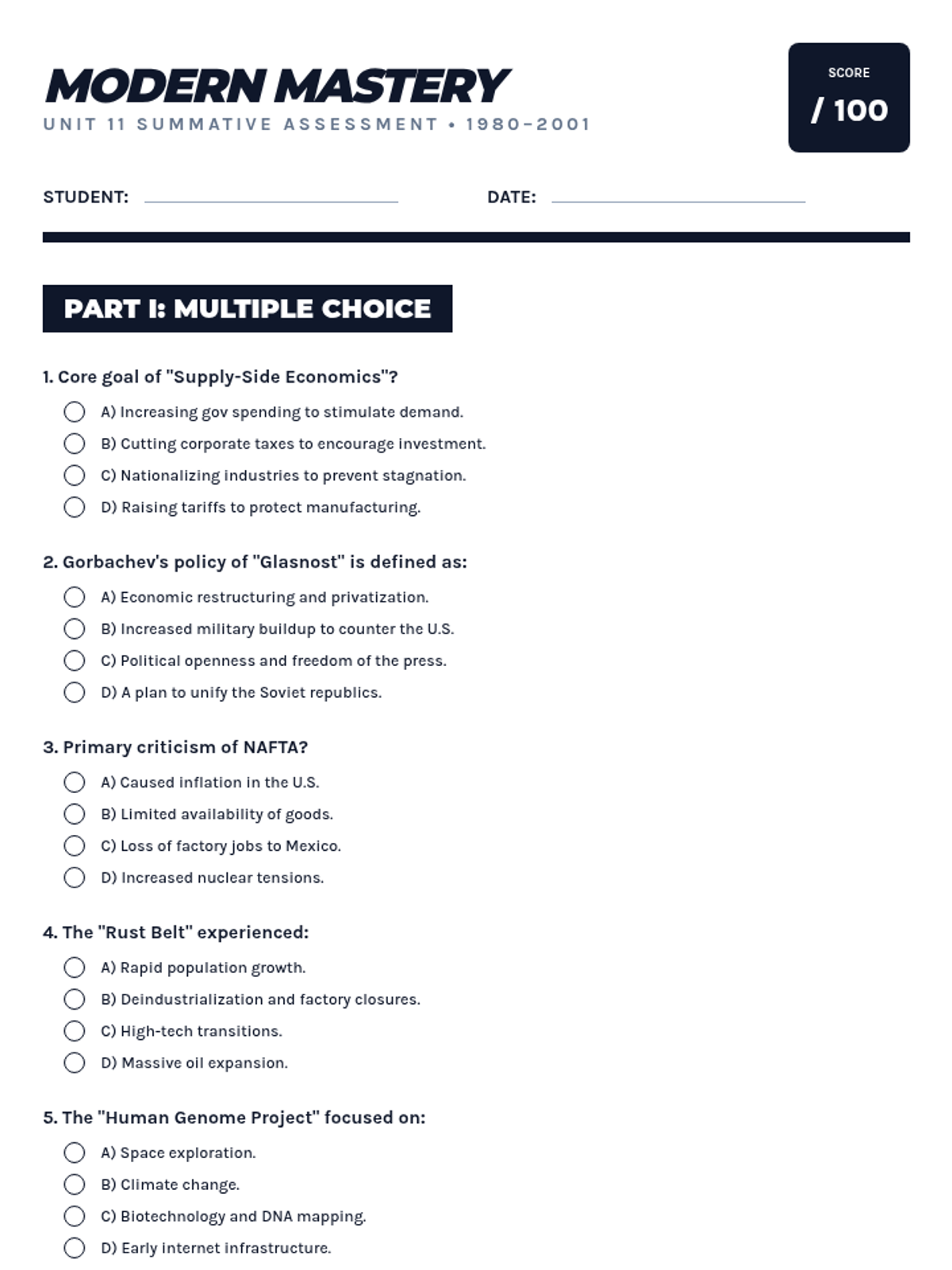
A summative assessment for Unit 11, including multiple-choice, true/false, short answer, and a mini-DBQ focused on the Reagan Revolution and the shifts of the 1980s and 90s.
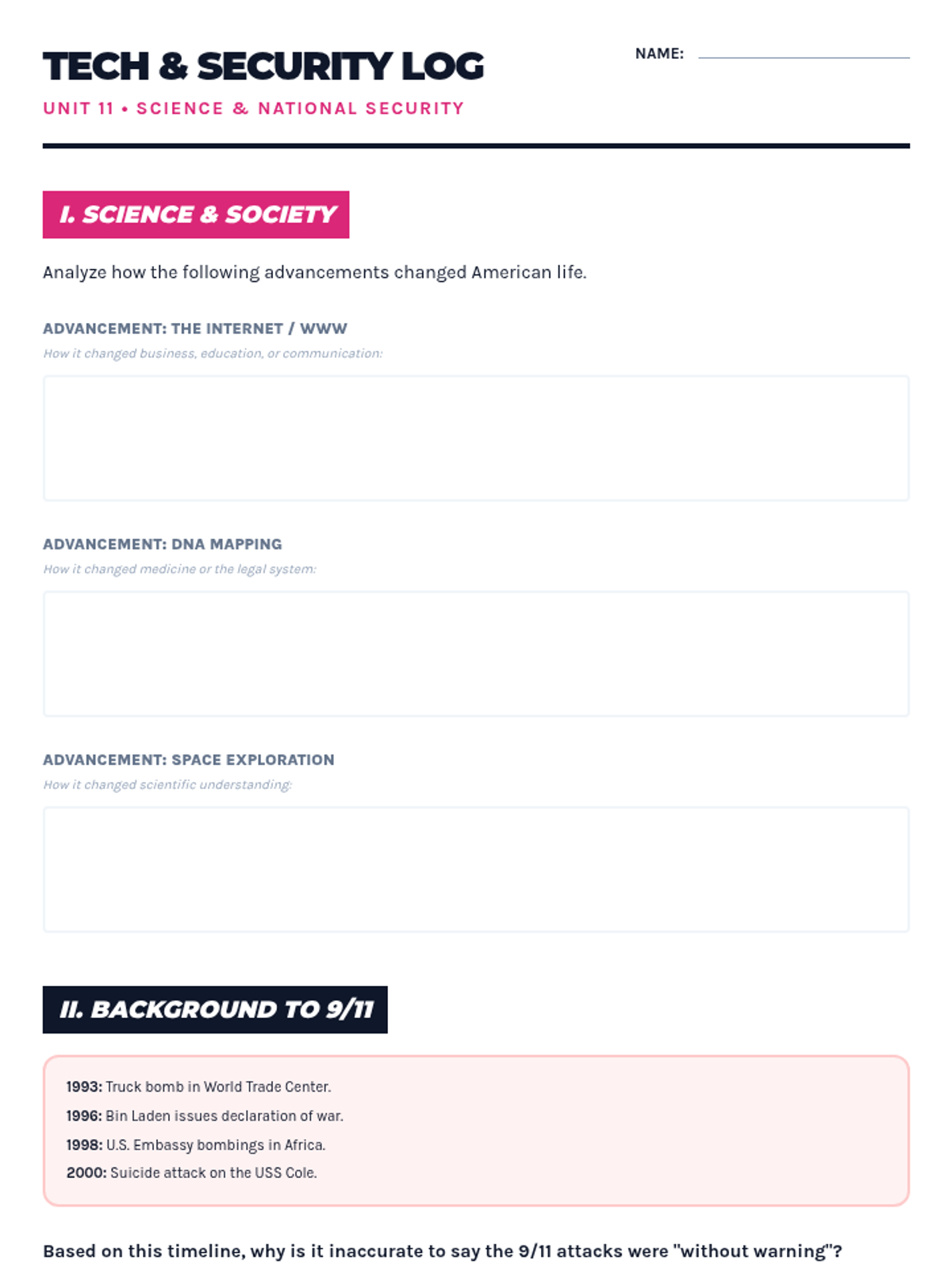
A student research and analysis log for tracking technological advancements and the emerging security challenges of the late 20th century.
Expanded presentation slides covering the Internet revolution, the Human Genome Project, NASA's 90s milestones, energy policy/climate change, and the emerging threat of Al-Qaeda leading to 9/11.
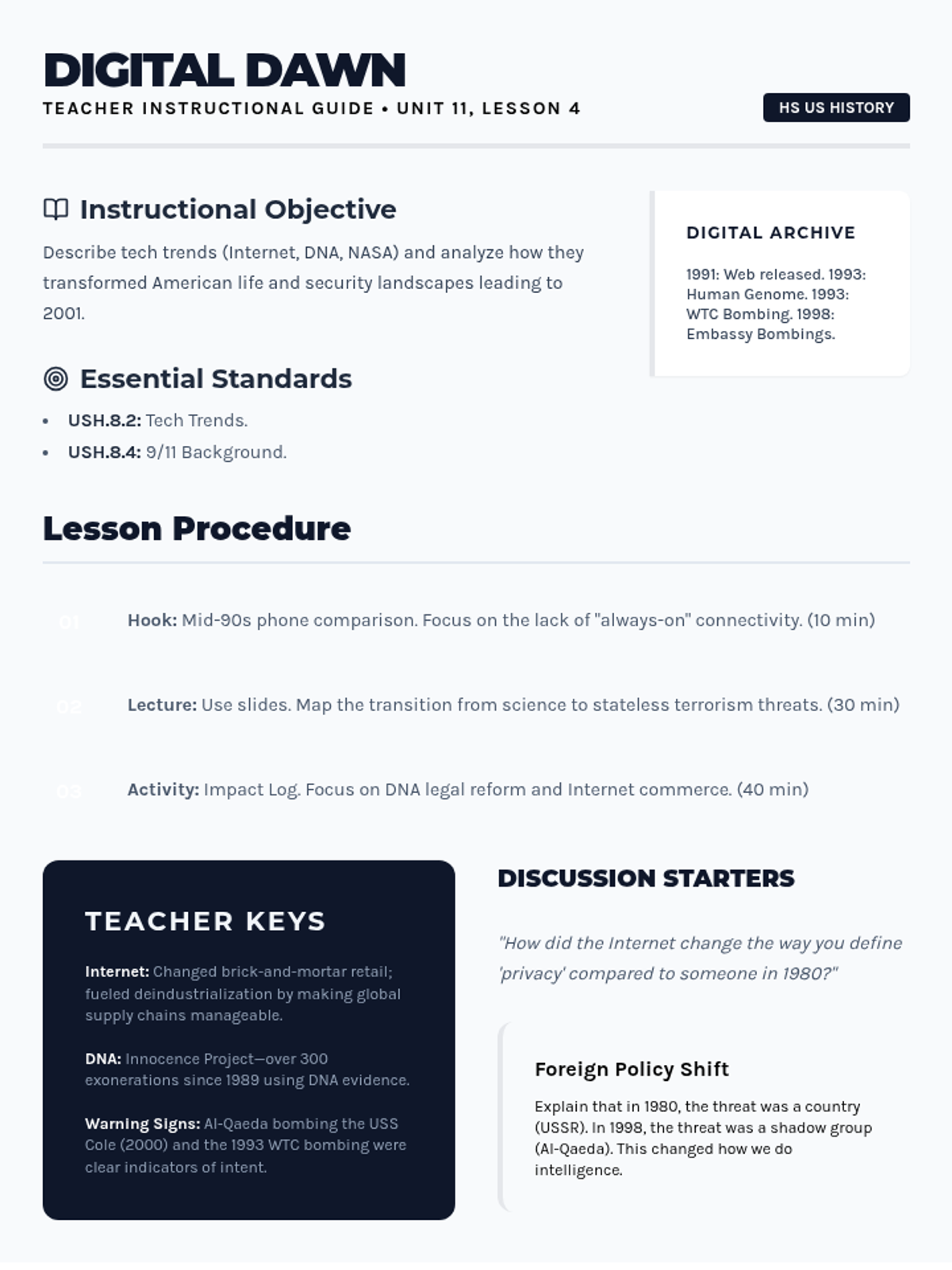
Teacher guide for Lesson 4, detailing instructional strategies for teaching about the 90s technological revolution and the emerging security threats leading to 9/11.
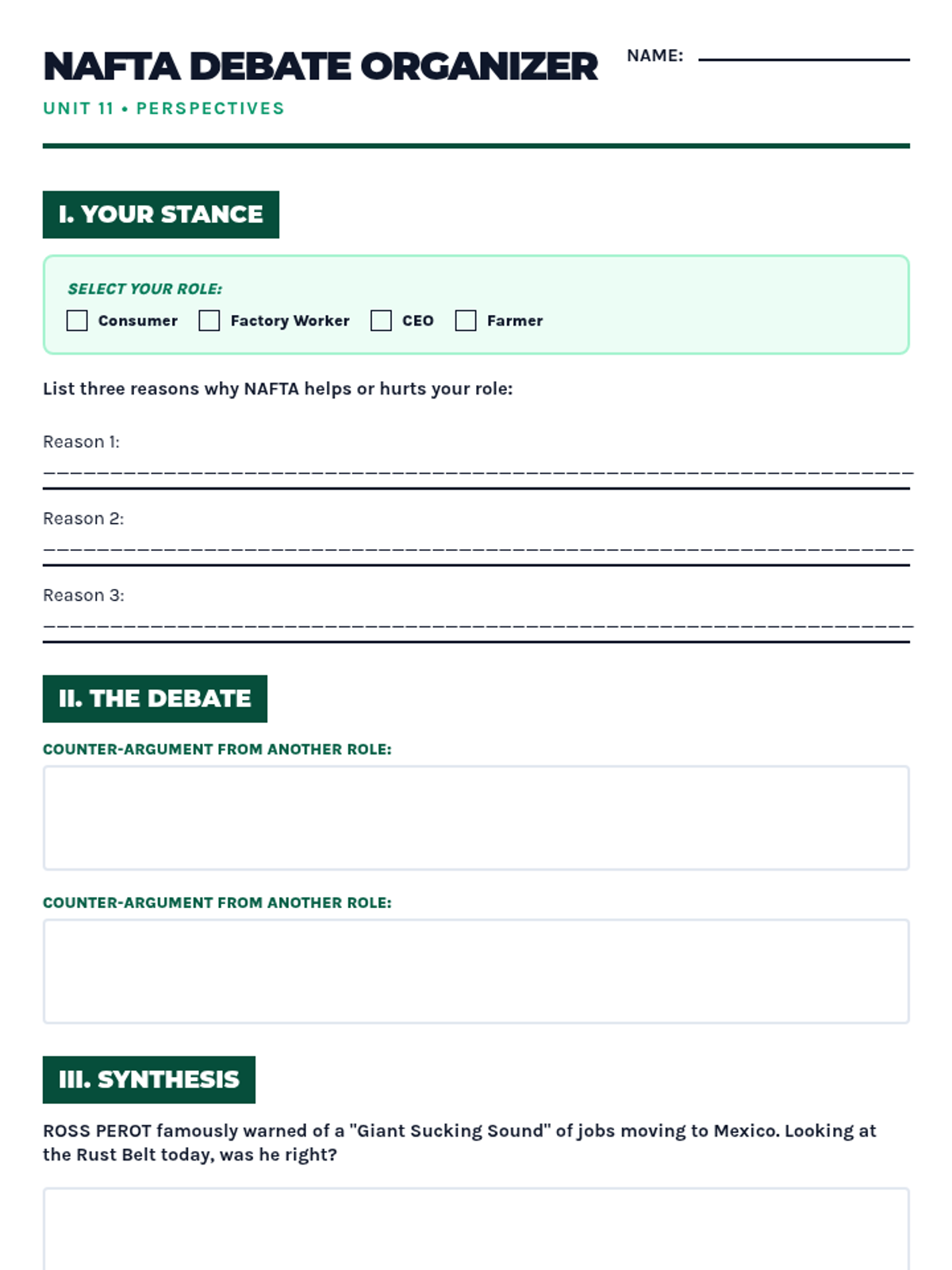
A student role-playing and debate organizer for analyzing the multiple perspectives on the North American Free Trade Agreement (NAFTA).
Expanded presentation slides covering globalization's cultural and economic impacts, NAFTA's pros and cons, and the specific causes of deindustrialization in the Rust Belt.
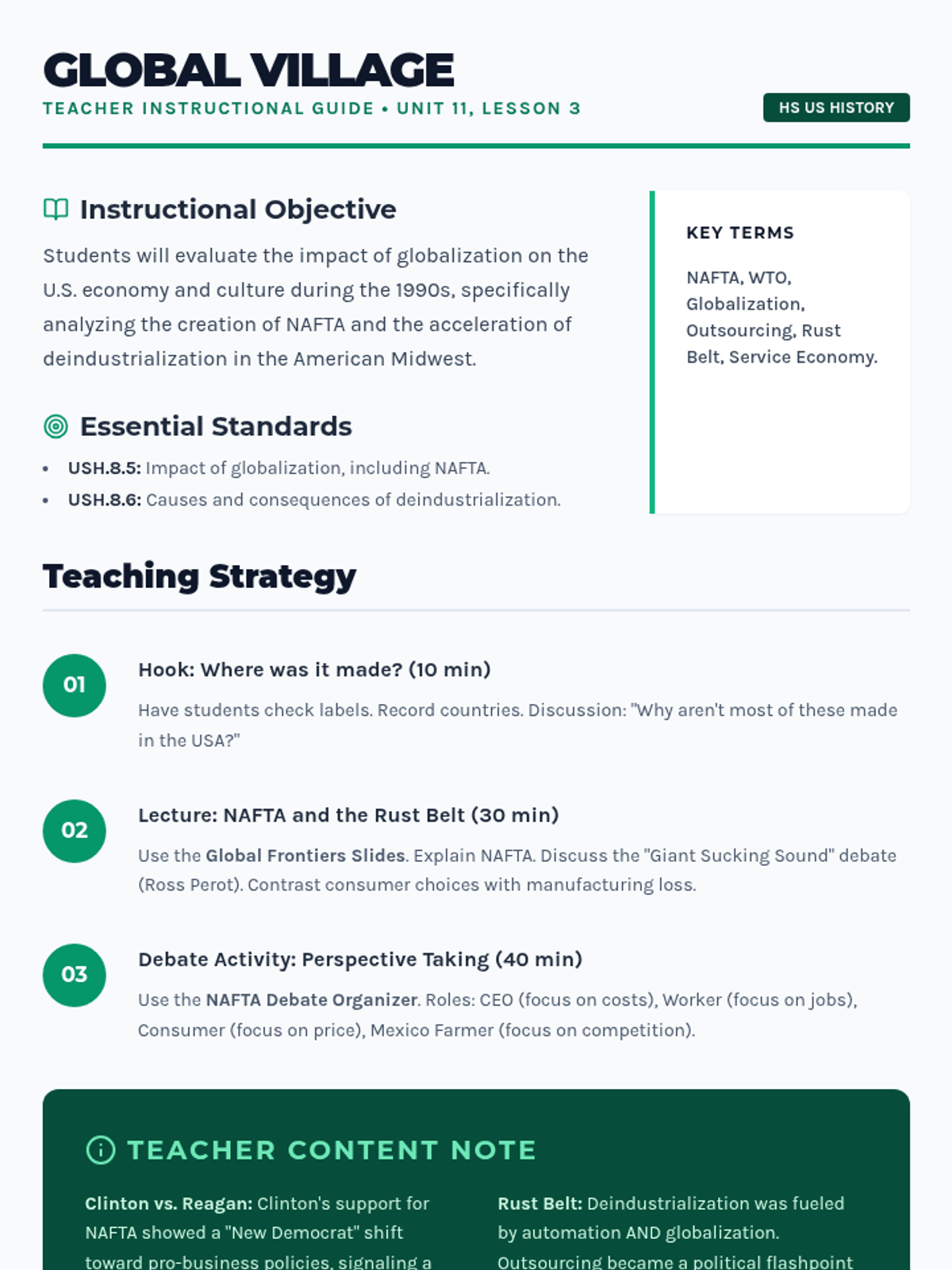
Teacher guide for Lesson 3, focusing on globalization, NAFTA, and the shift from manufacturing to a service-based economy in the 1990s.
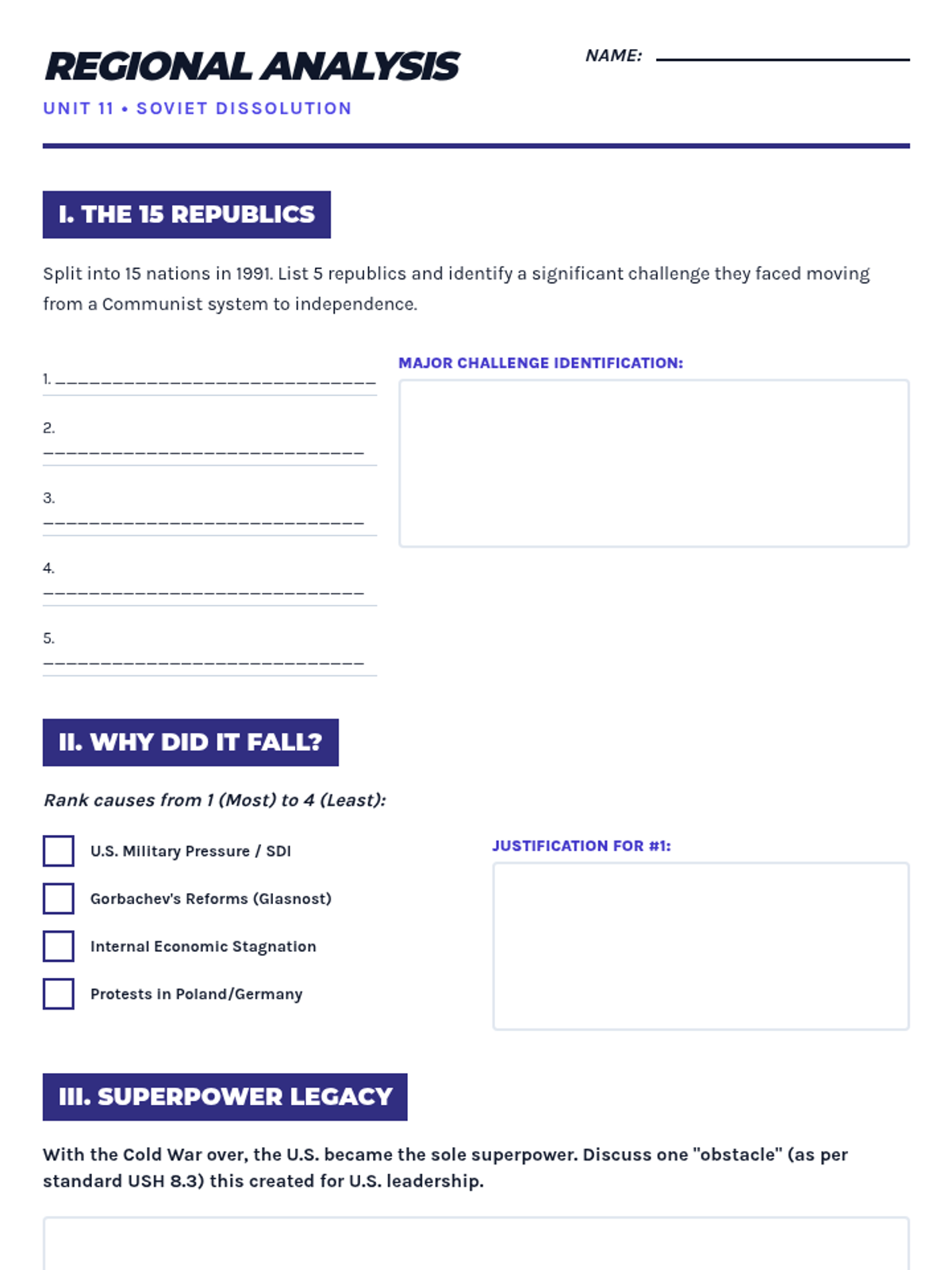
A student regional analysis and cause-analysis activity regarding the dissolution of the Soviet Union and the aftermath of the Cold War.
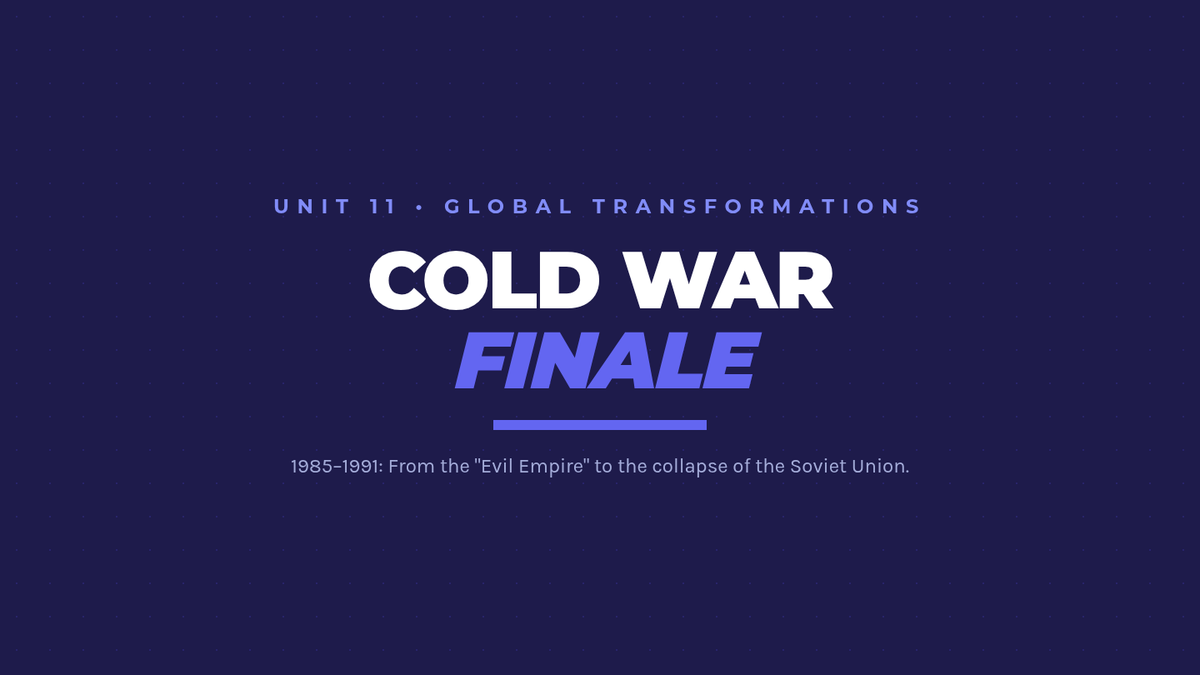
Expanded presentation slides detailing the end of the Cold War, including Reagan's strategy, Gorbachev's reforms, the Polish Solidarity movement, the fall of the Wall, and the "New Obstacles" to U.S. leadership.
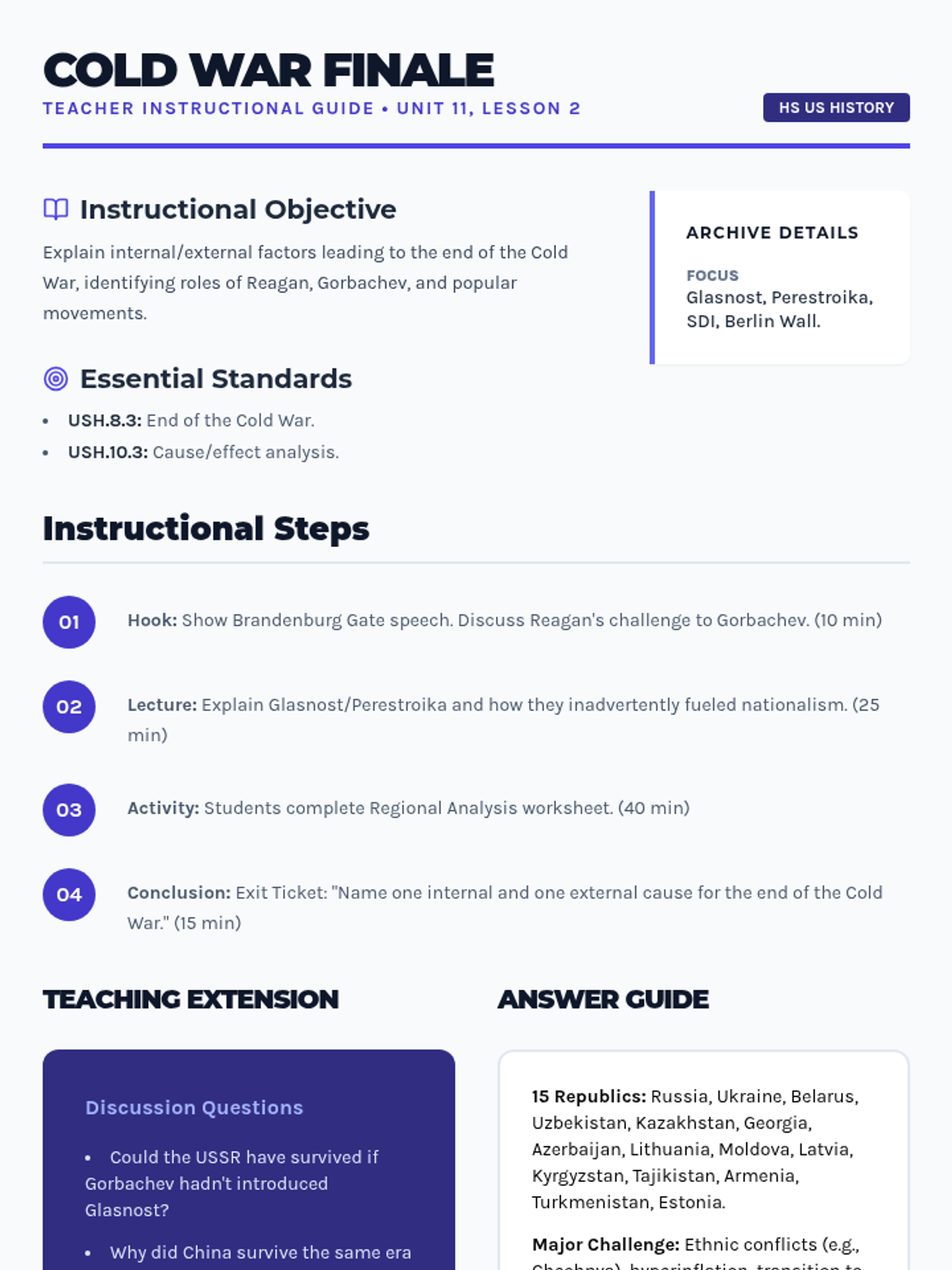
Teacher instructional guide for Lesson 2, covering the end of the Cold War, Gorbachev's reforms, and the fall of the Soviet Union.
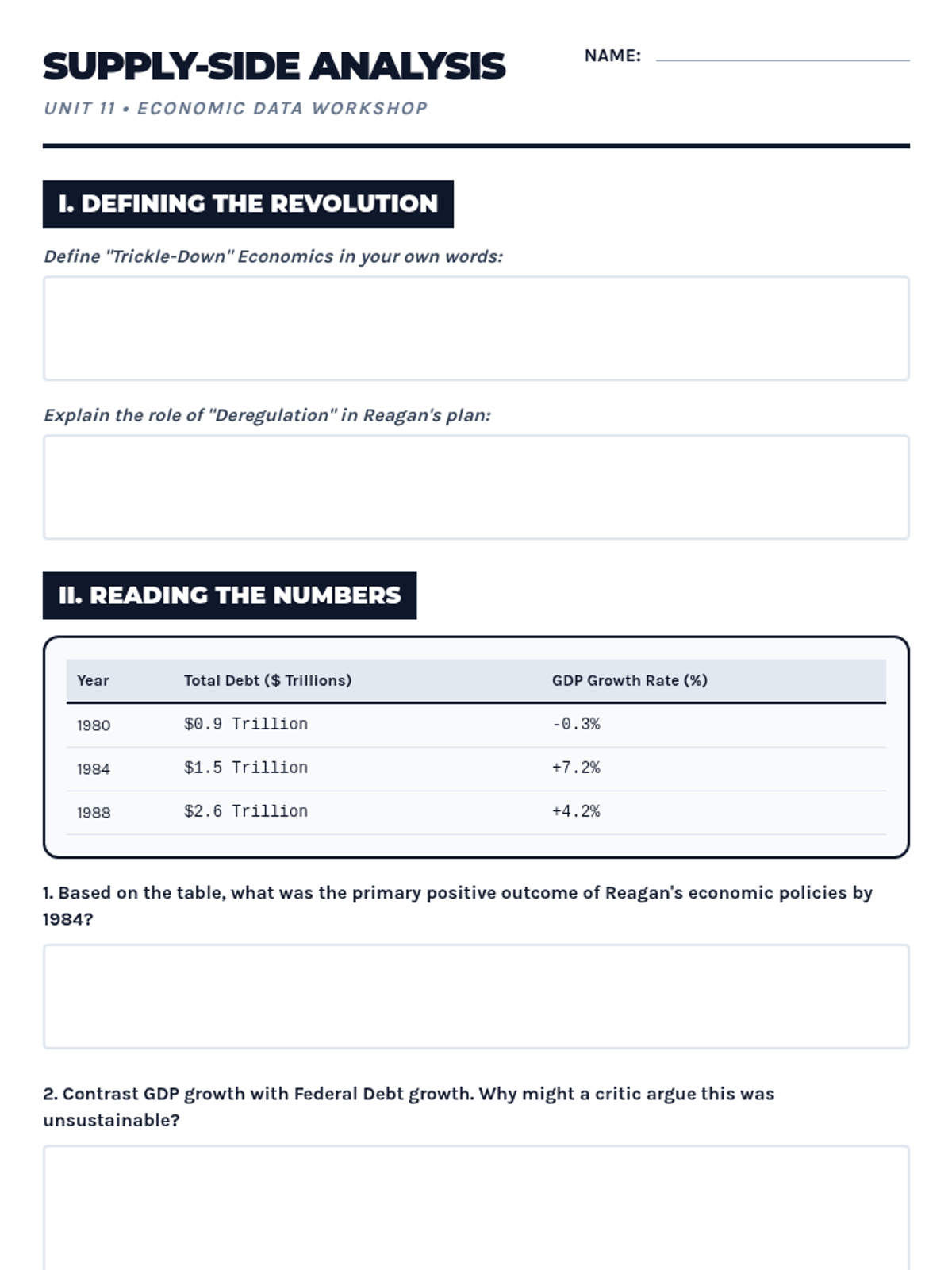
A student analysis worksheet for evaluating Reagan's economic policies (Reaganomics) through data analysis and reflecting on the social impact of the War on Drugs.
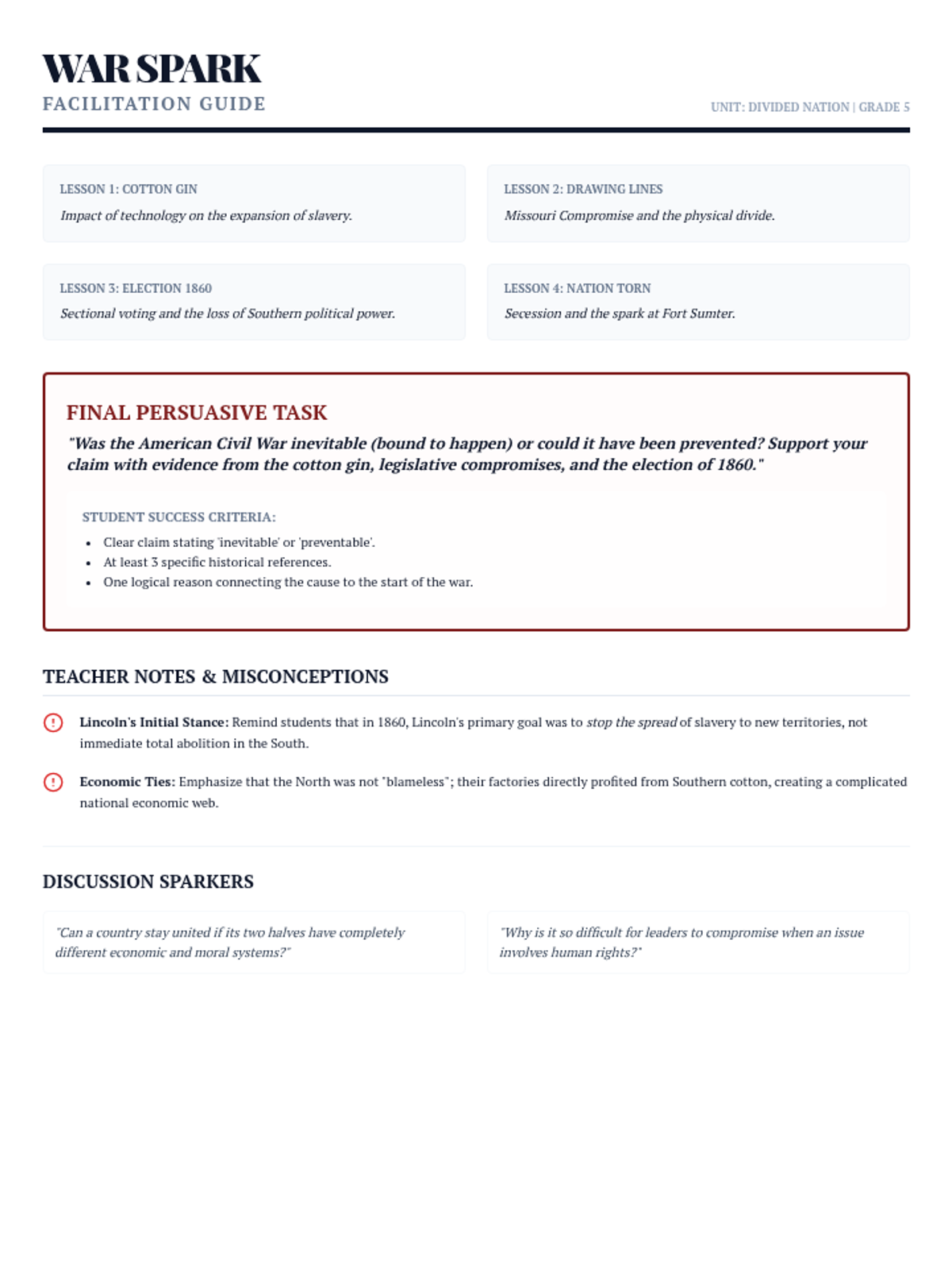
A teacher's facilitation guide for the Divided Nation unit. Revised with correct lesson assignment and optimized layout.
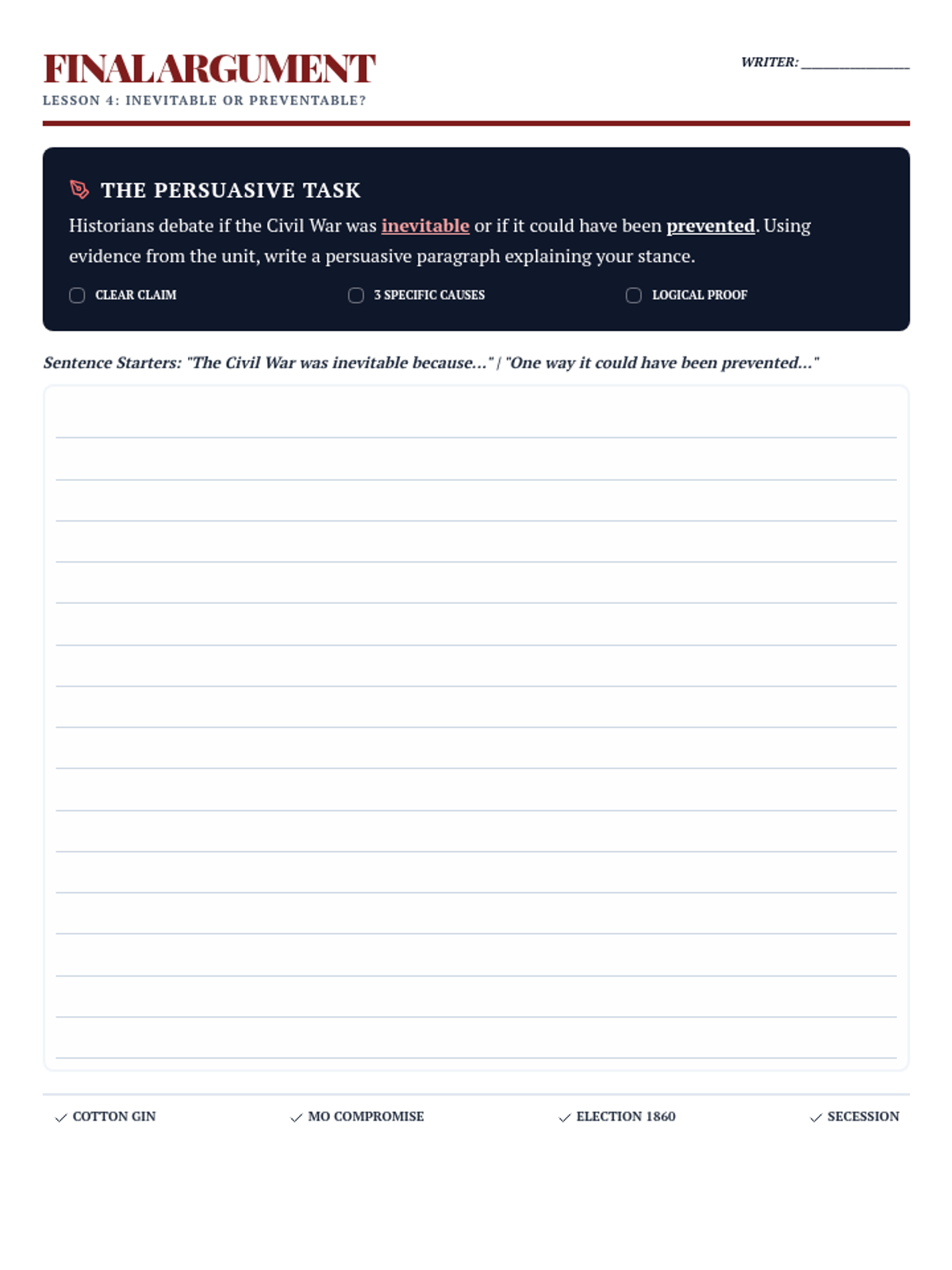
A persuasive writing prompt for the final lesson. Revised to fit on a single page with improved handwriting space and contrast.
Slides for Lesson 4 covering the secession and start of war. Revised for text alignment, contrast, and spacing.
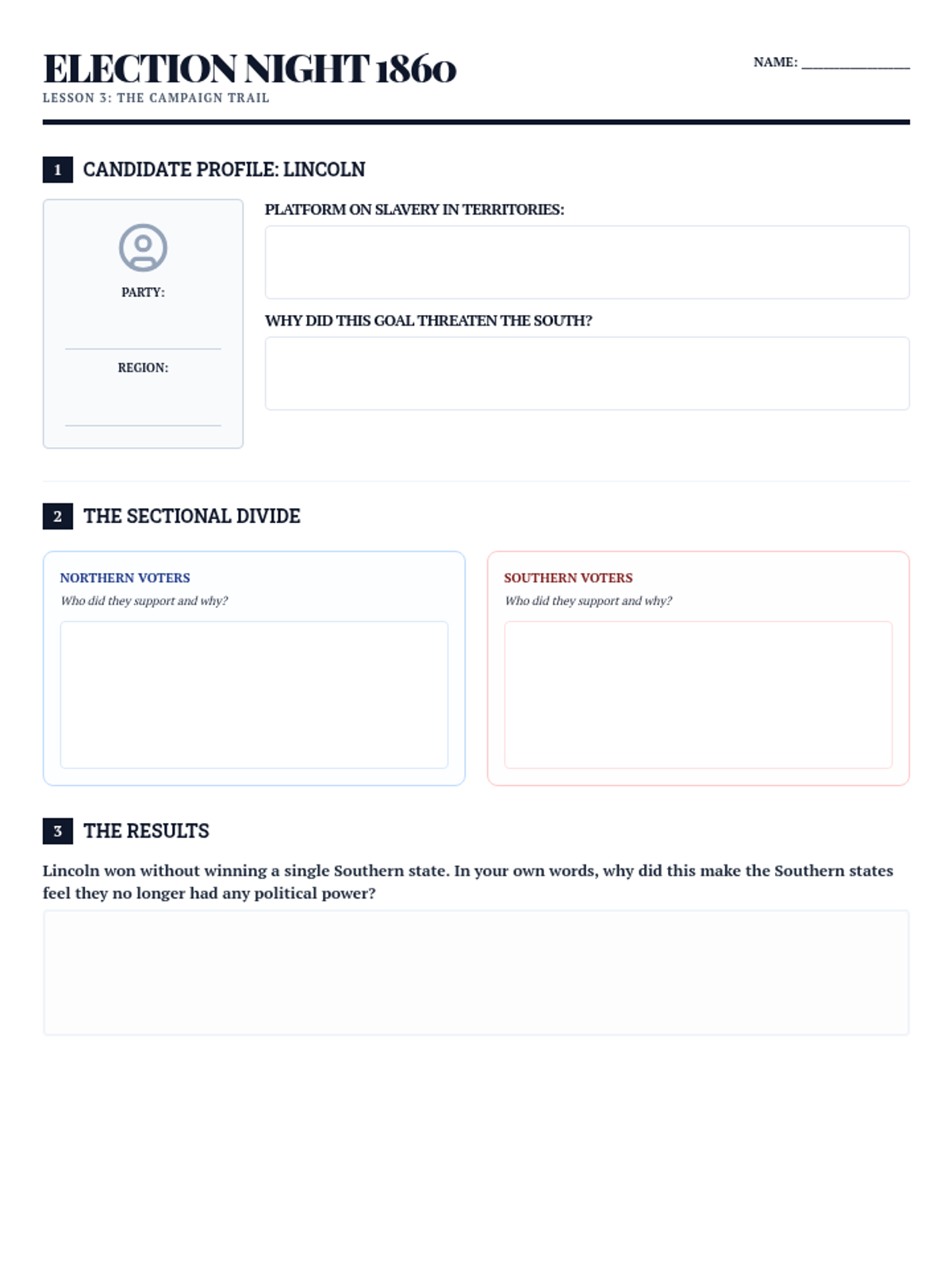
A worksheet for Lesson 3 analyzing the Election of 1860. Revised for layout consistency and improved student work areas.
Slides for Lesson 3 focusing on the Election of 1860, the four candidates, the sectional divide in voting, and Lincoln's victory.
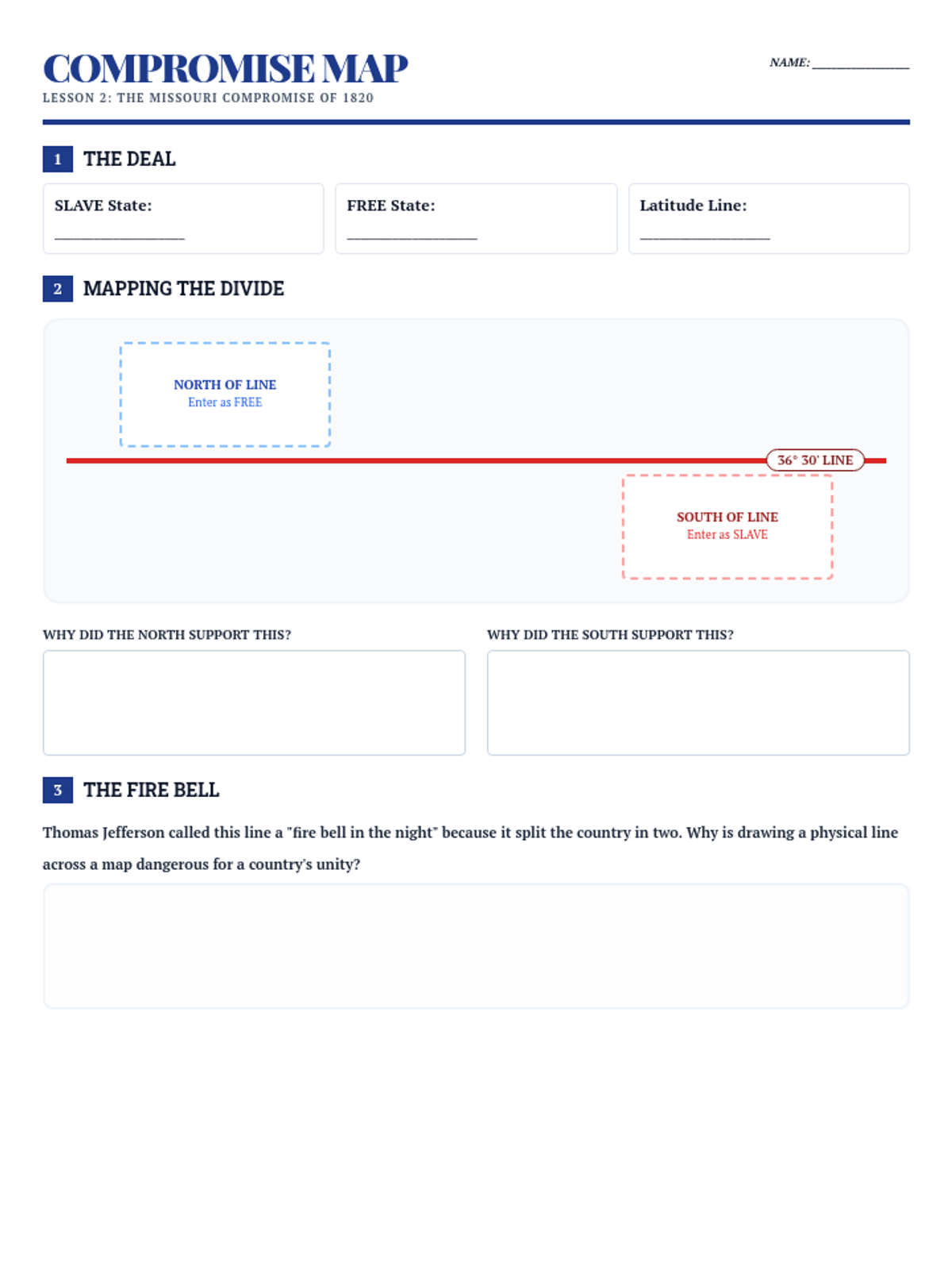
A mapping and analysis worksheet for Lesson 2 focusing on the Missouri Compromise. Revised for single-page layout and improved visual hierarchy.
Slides for Lesson 2 detailing the Missouri Compromise of 1820. Revised for visual clarity and contrast.
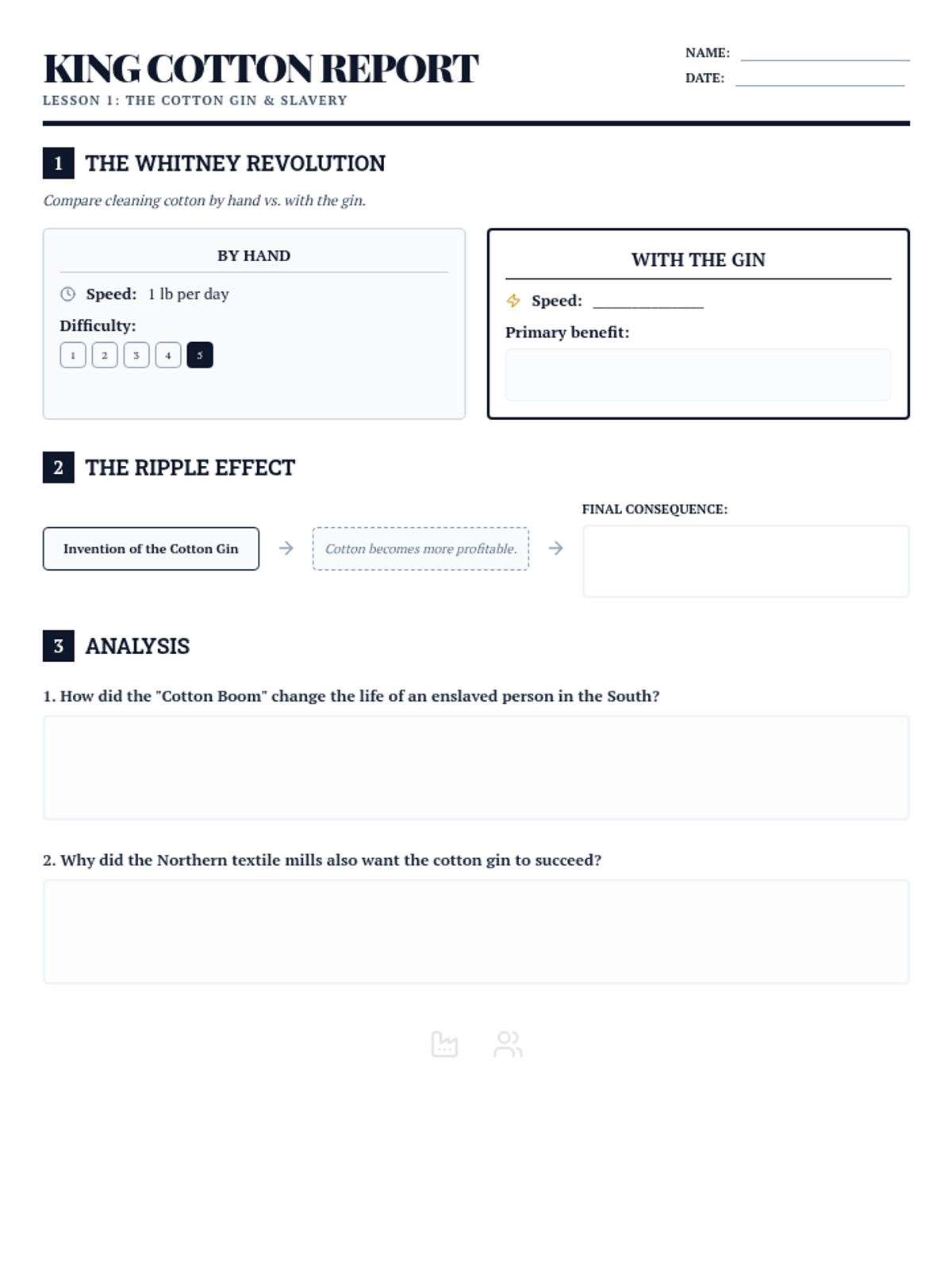
A worksheet for Lesson 1 analyzing the impact of the cotton gin. Revised for layout efficiency and improved student work areas.
Introductory slides for Lesson 1, covering Eli Whitney's invention of the cotton gin, its economic impact, and the resulting expansion of enslaved labor. Revised for title spacing.
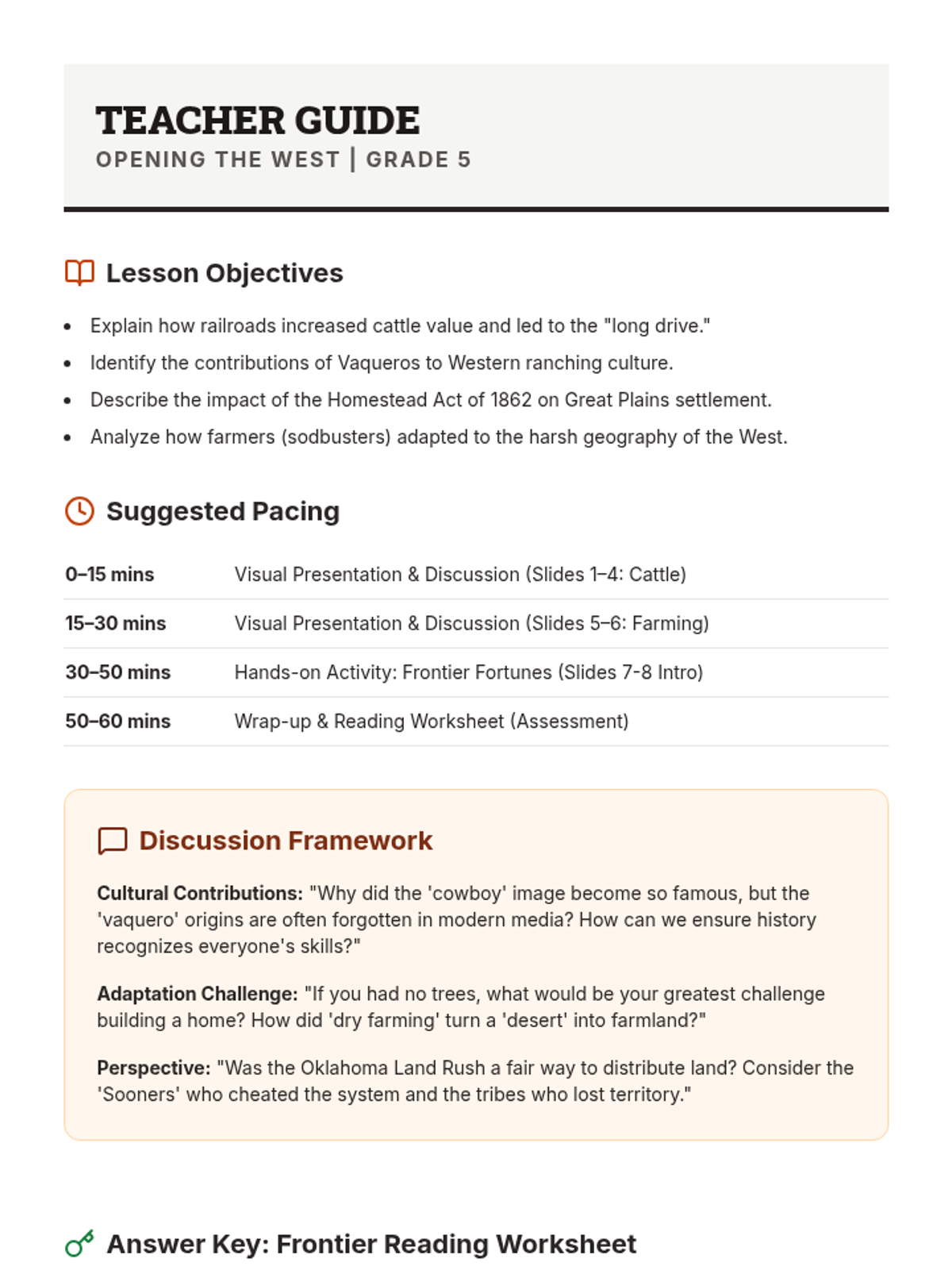
Teacher guide for 'Opening the West' lesson. Includes instructional objectives, a pacing guide, discussion prompts to encourage critical thinking, and a complete answer key for student materials.
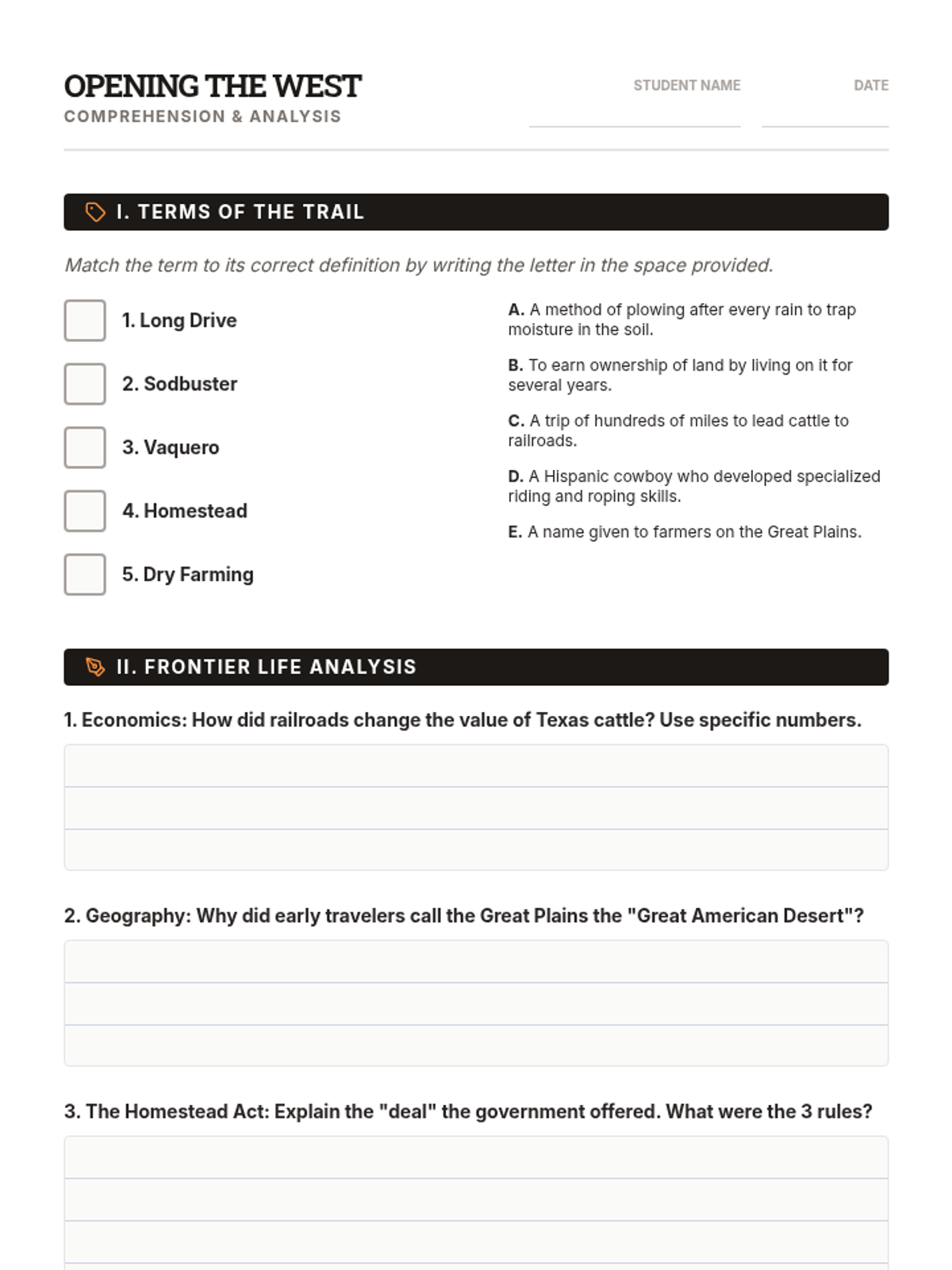
A comprehension worksheet for 'Opening the West' lesson, including vocabulary matching, short-answer analysis on economics and geography, and a creative reflection prompt on the Oklahoma Land Rush.
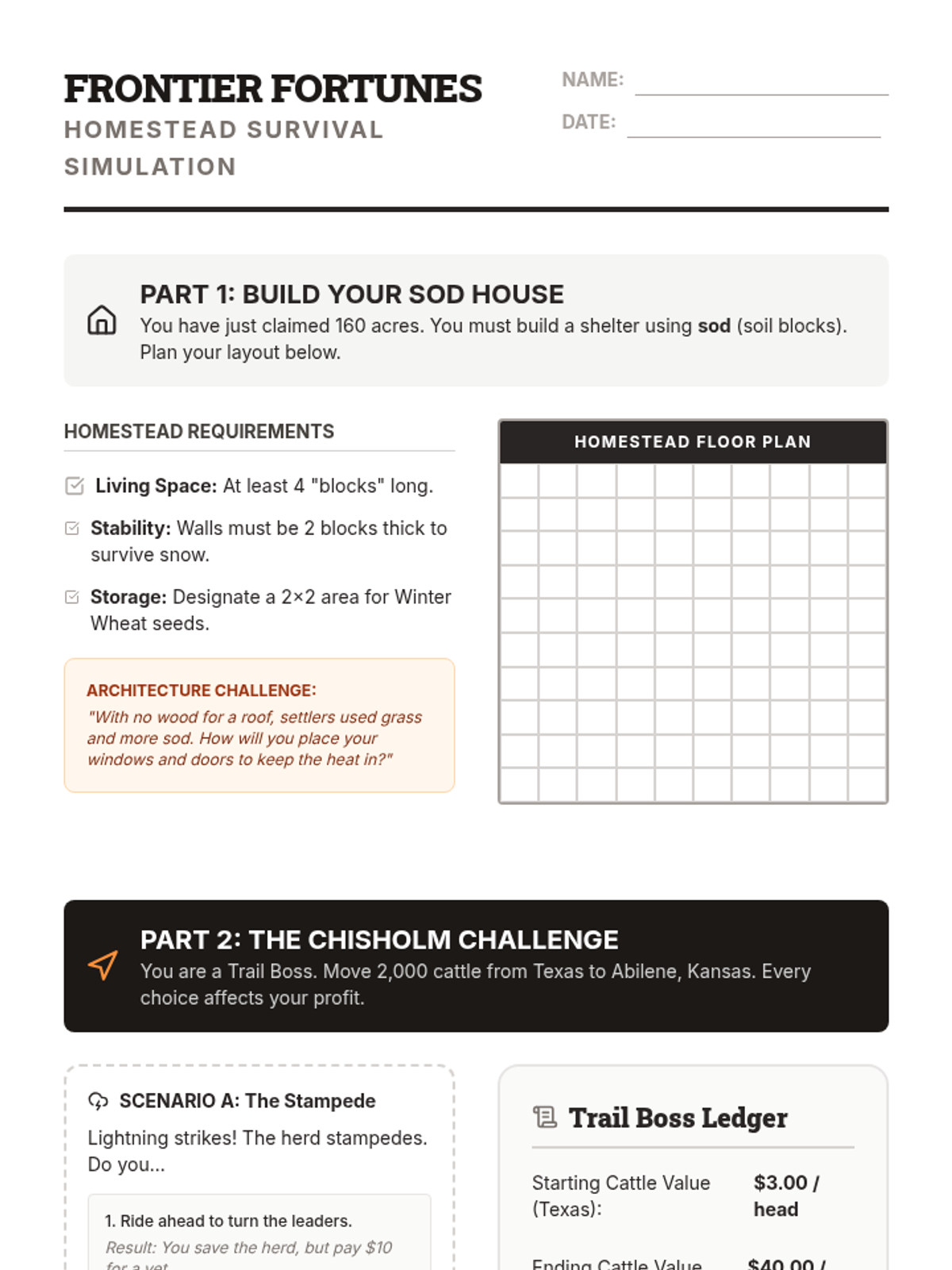
A hands-on activity sheet for 5th graders featuring a 'Sod House Blueprint' challenge and a 'Chisholm Challenge' decision-making simulation. Connects historical concepts to engineering and economic math.
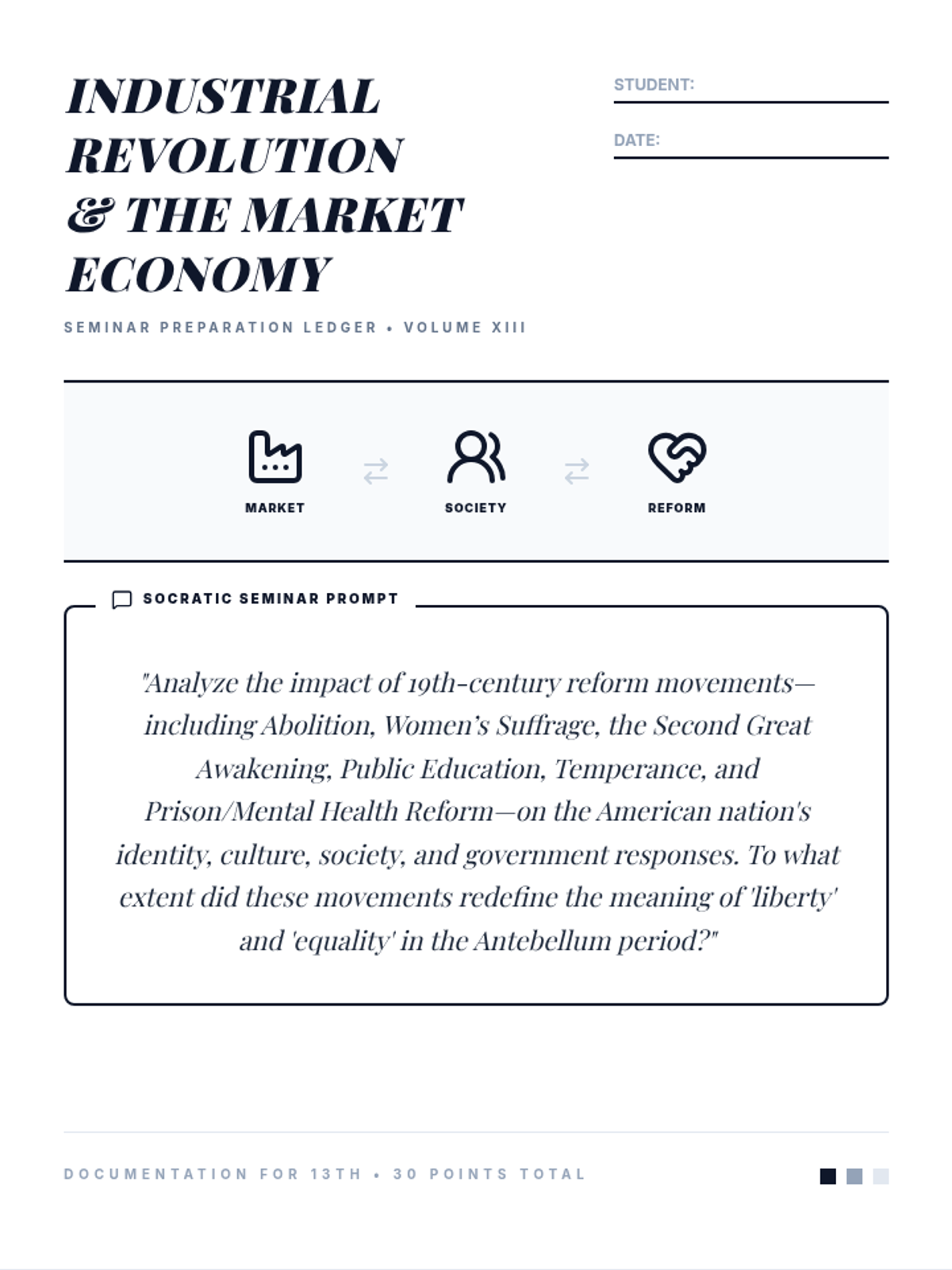
A detailed 5-page seminar preparation ledger for the Industrial Revolution and Market Economy lesson. Features a dedicated cover page with relevant historical icons and a prominent Socratic prompt, three separate article analysis pages, and a final synthesis evaluation. Writing lines are darkened for optimal print quality.
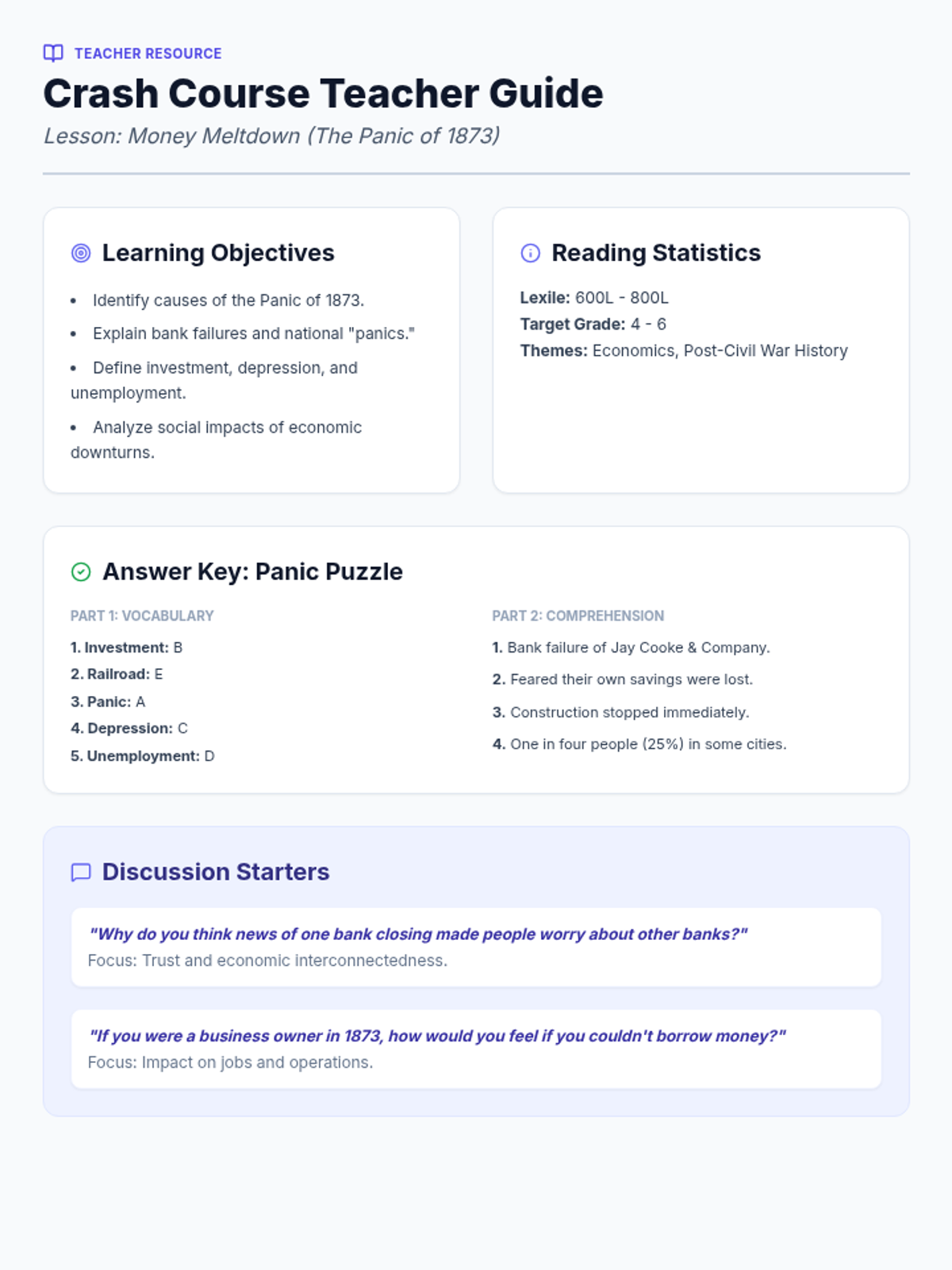
A comprehensive teacher guide for the Money Meltdown lesson. It includes learning objectives, reading statistics (Lexile 600-800L), a full answer key for the student worksheet, and discussion prompts.
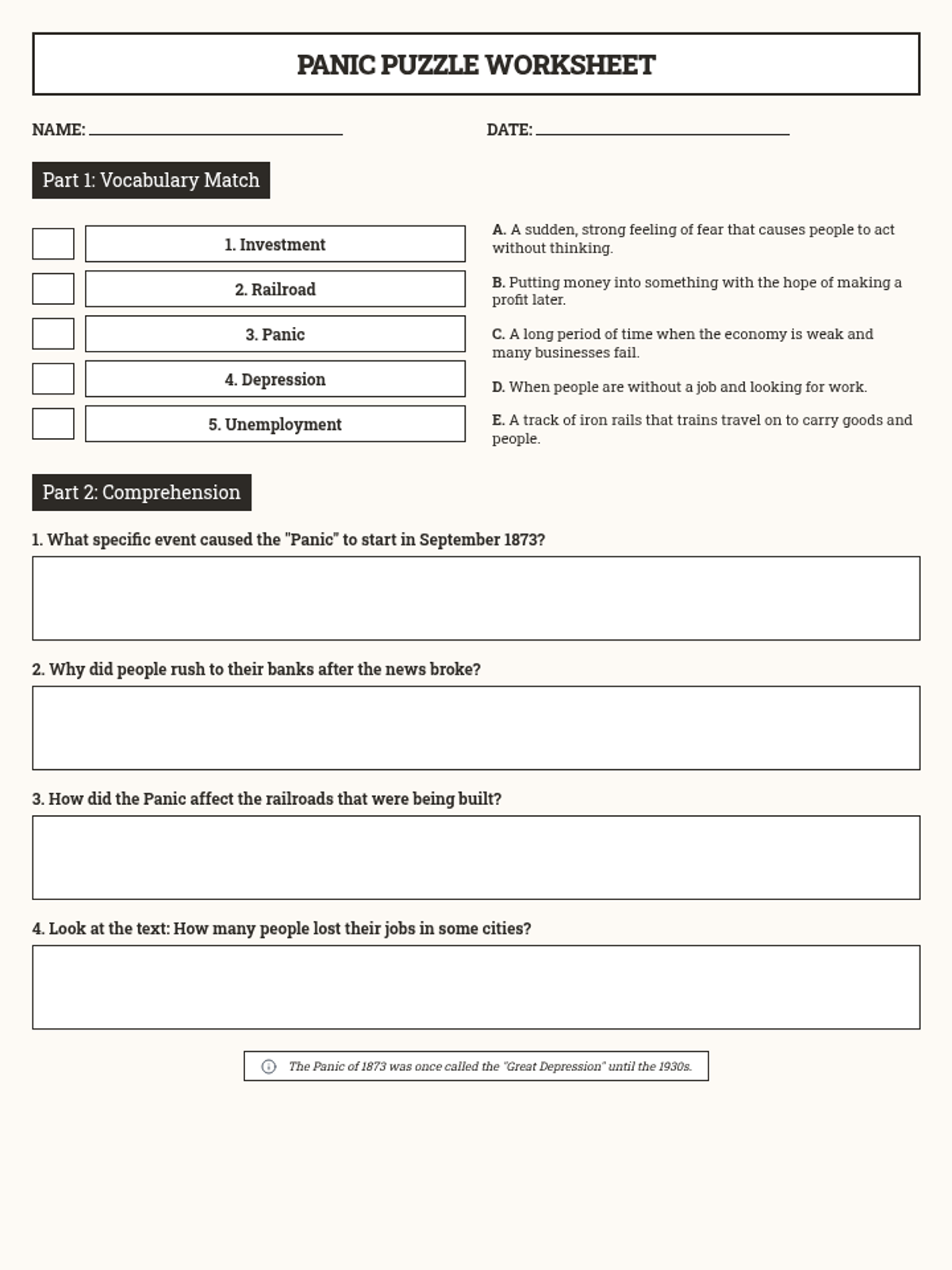
A follow-up worksheet for the Panic of 1873 reading passage. It includes a vocabulary matching section for the bolded terms and four short-answer comprehension questions.
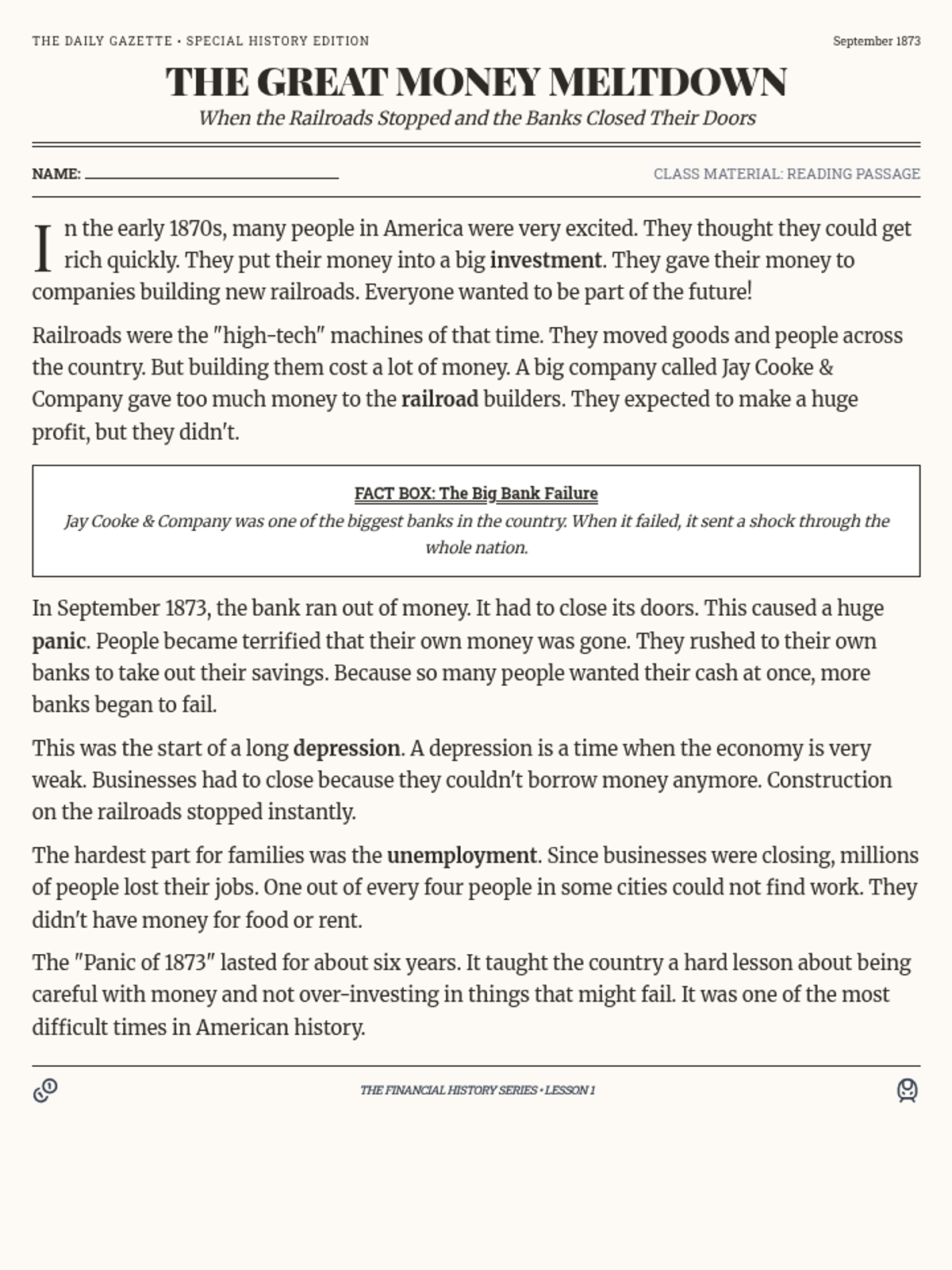
A simplified reading passage about the Panic of 1873, styled like a 19th-century newspaper. It features bolded vocabulary words and a clean layout suitable for lower reading levels.
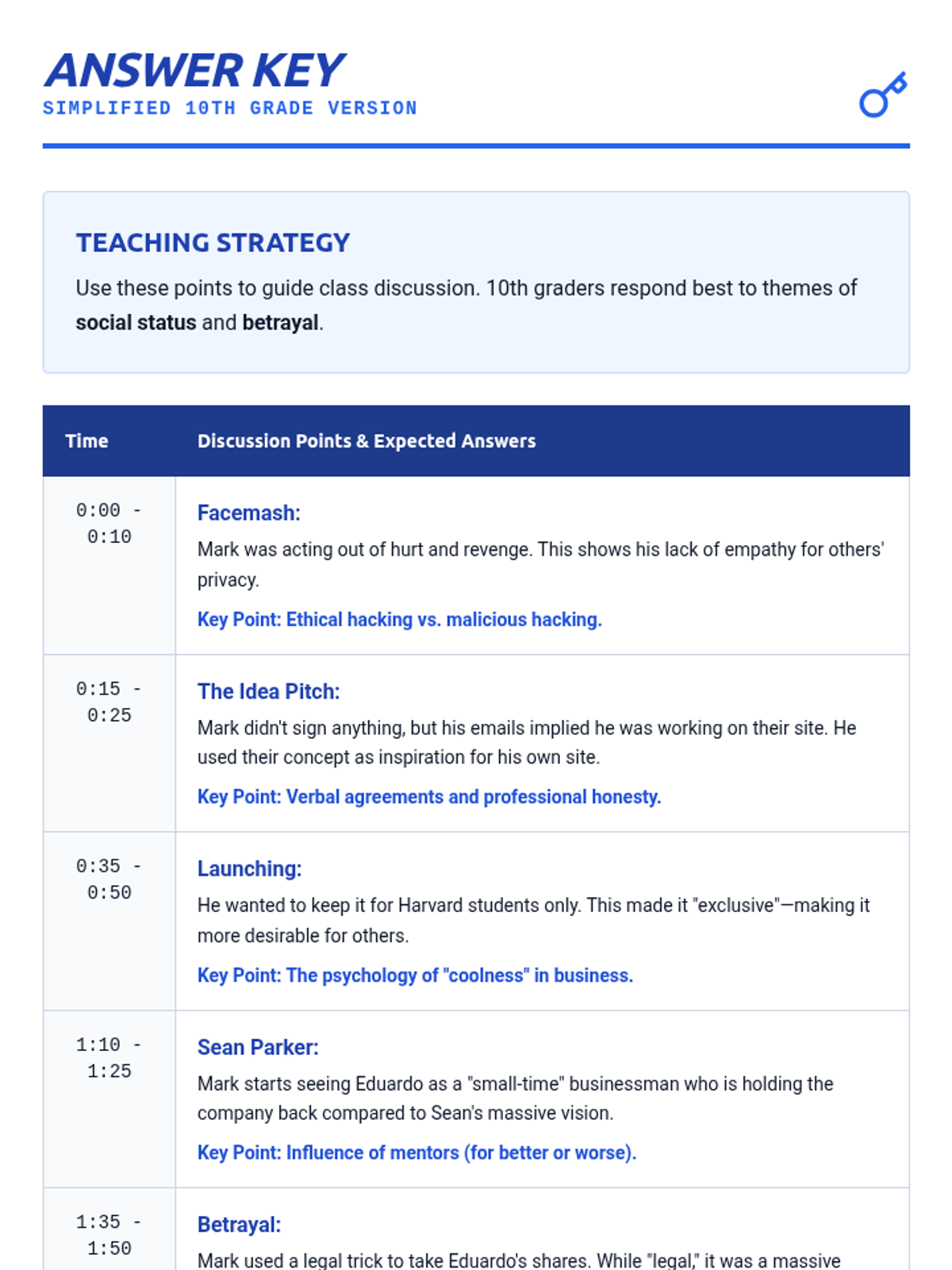
An updated teacher's answer key for the simplified 10th-grade movie guide, focusing on friendship, social status, and basic ownership concepts.
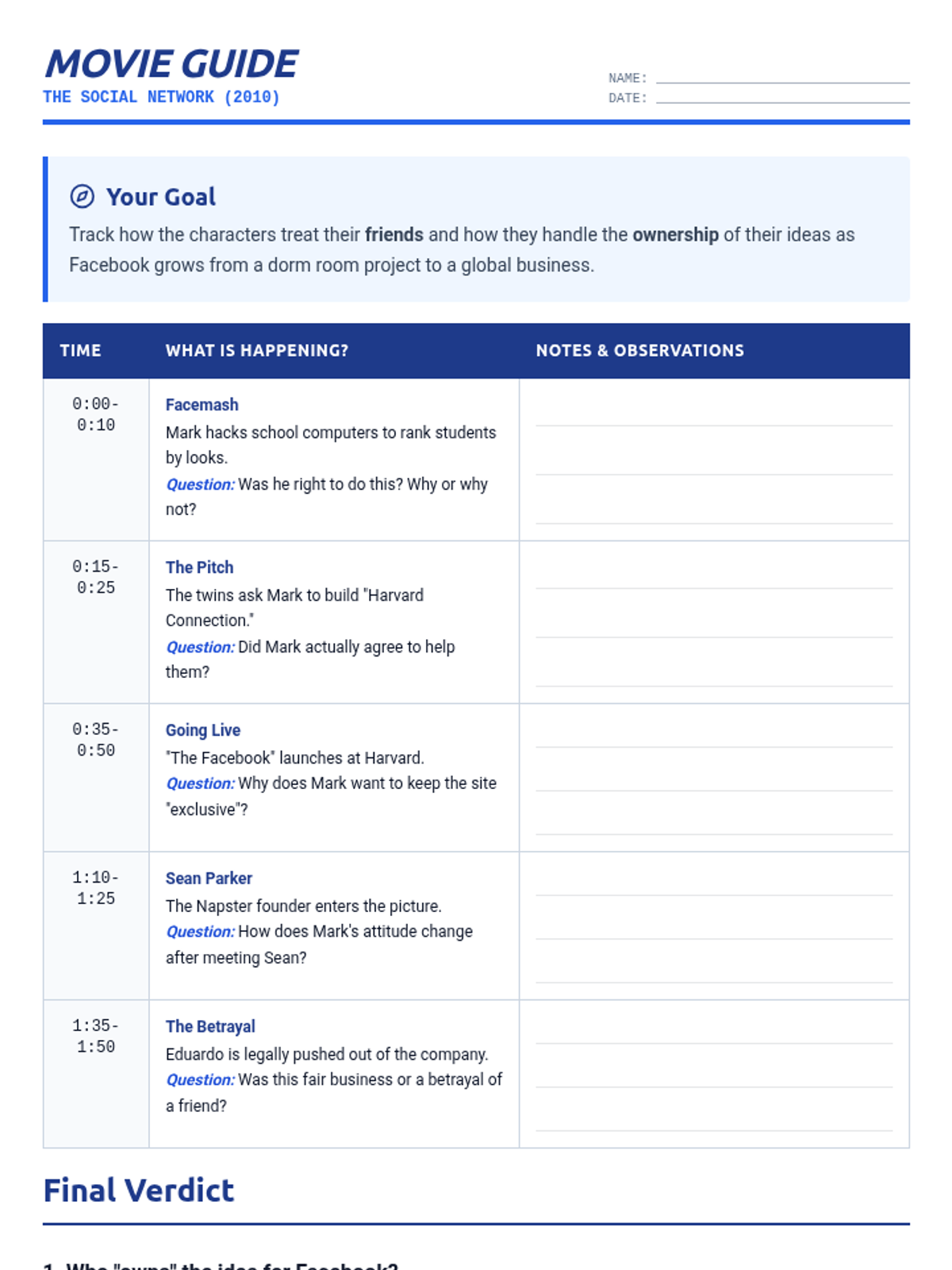
A simplified, 10th-grade appropriate movie guide for 'The Social Network' with accessible language, timestamped prompts, and scaffolded final response questions.
An introductory slide deck for the film 'The Social Network' focusing on key characters, intellectual property law concepts (copyright, trade secrets), and the ethical dilemmas presented in the movie.
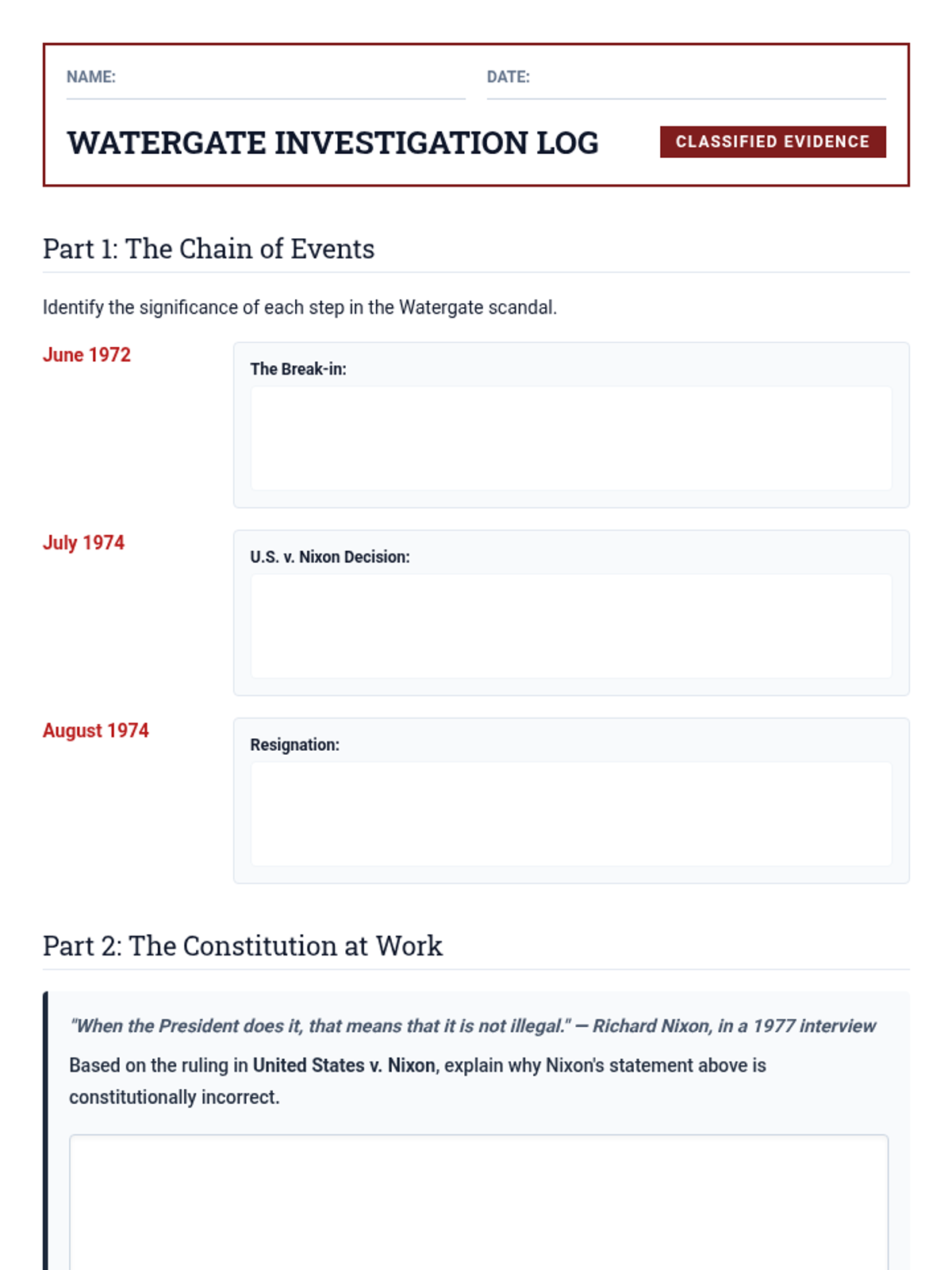
Student worksheet for Lesson 5, featuring a Watergate timeline, analysis of US v. Nixon, and a final unit reflection on the legacy of the 1960-1980 era.
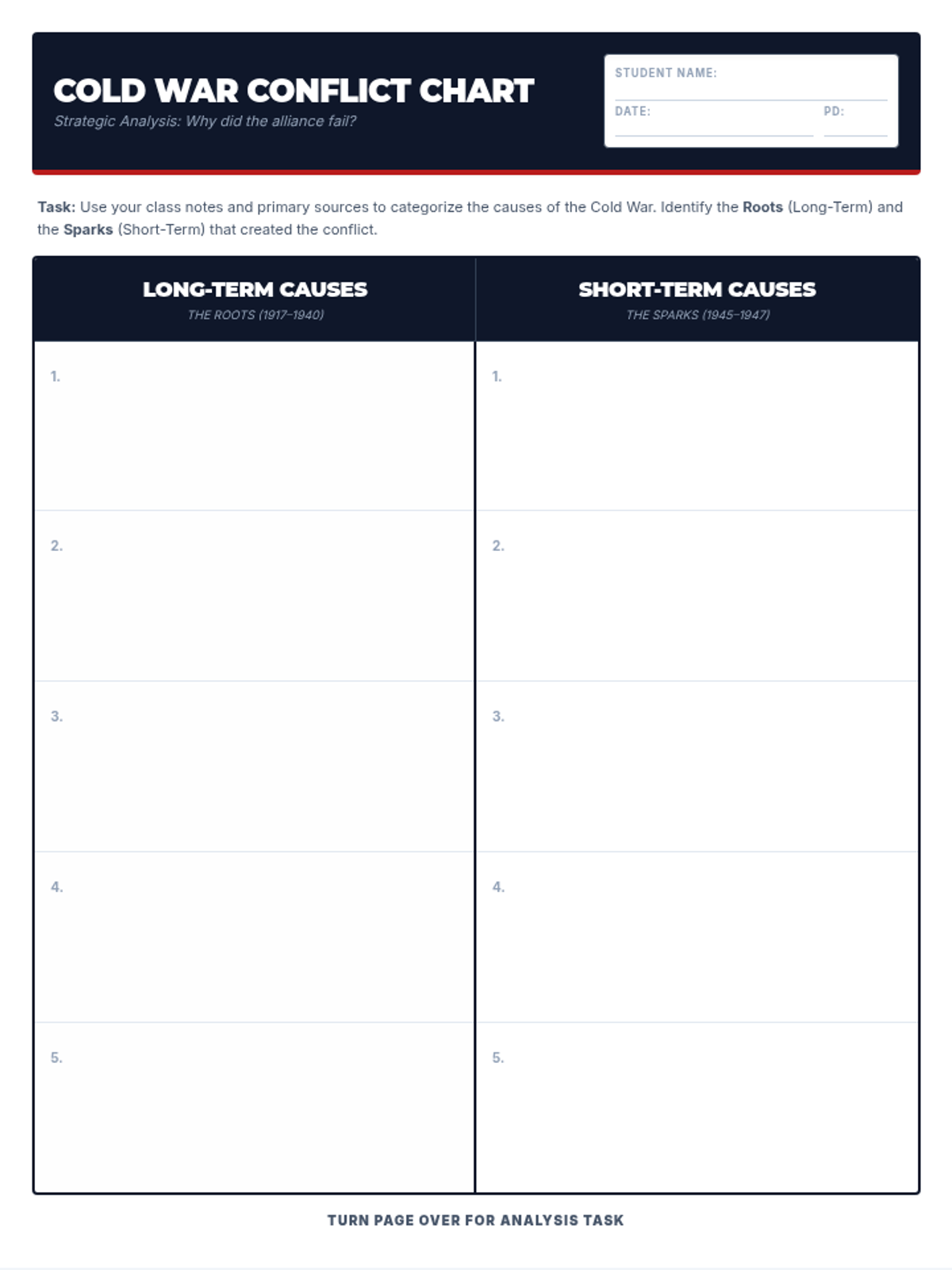
A front-and-back T-chart and writing activity comparing the long-term and short-term causes of the Cold War, featuring a critical thinking prompt for 8th-grade students. This version is blank for student completion.
A visual presentation deck for 8th-grade students covering the shift from WWII alliance to Cold War tension, ideological differences, containment policies, and the nuclear arms race.
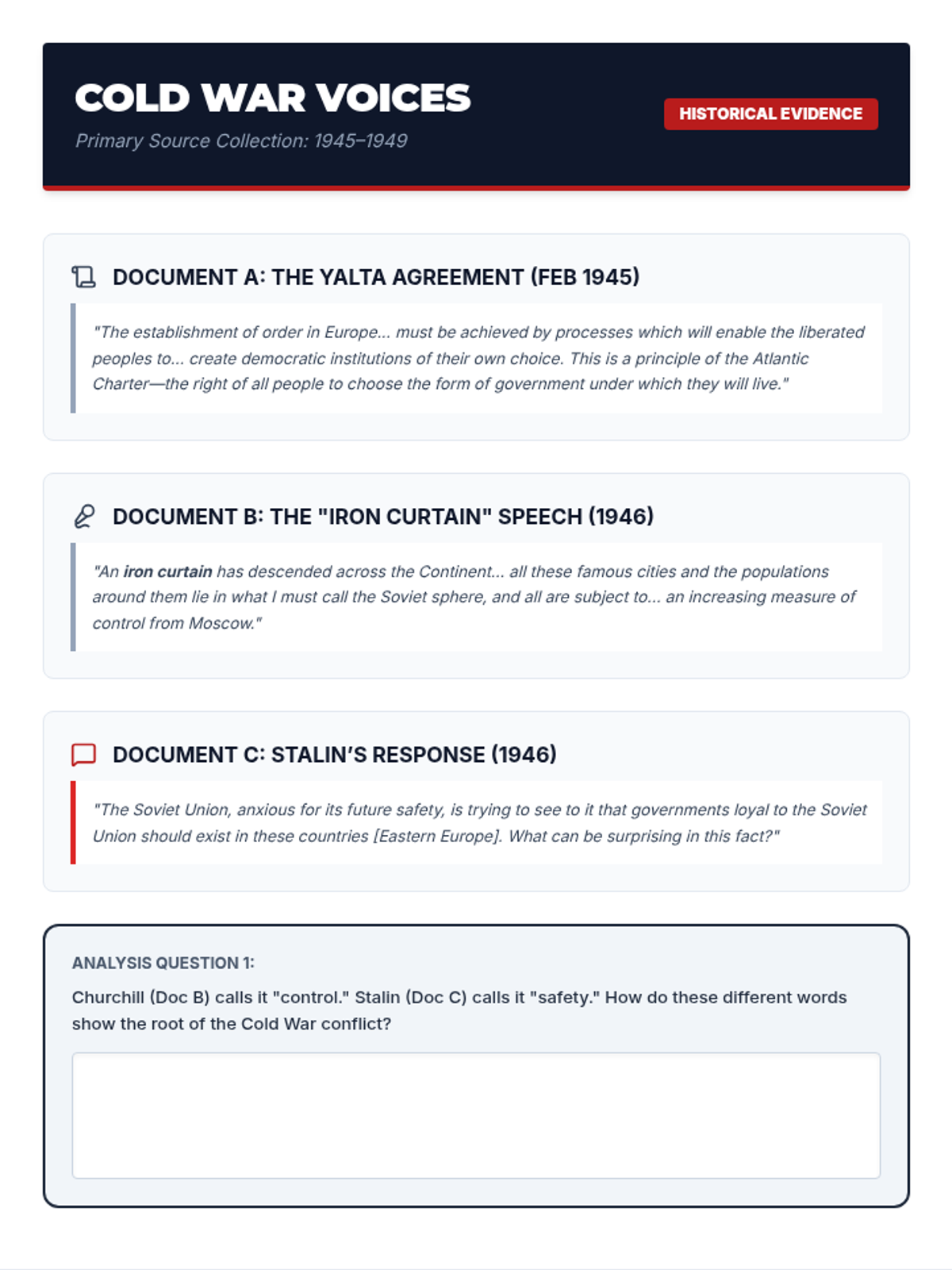
A curated collection of primary source excerpts from Churchill, Stalin, Truman, and Marshall, simplified for 8th-grade readability with vocabulary support and critical thinking prompts.
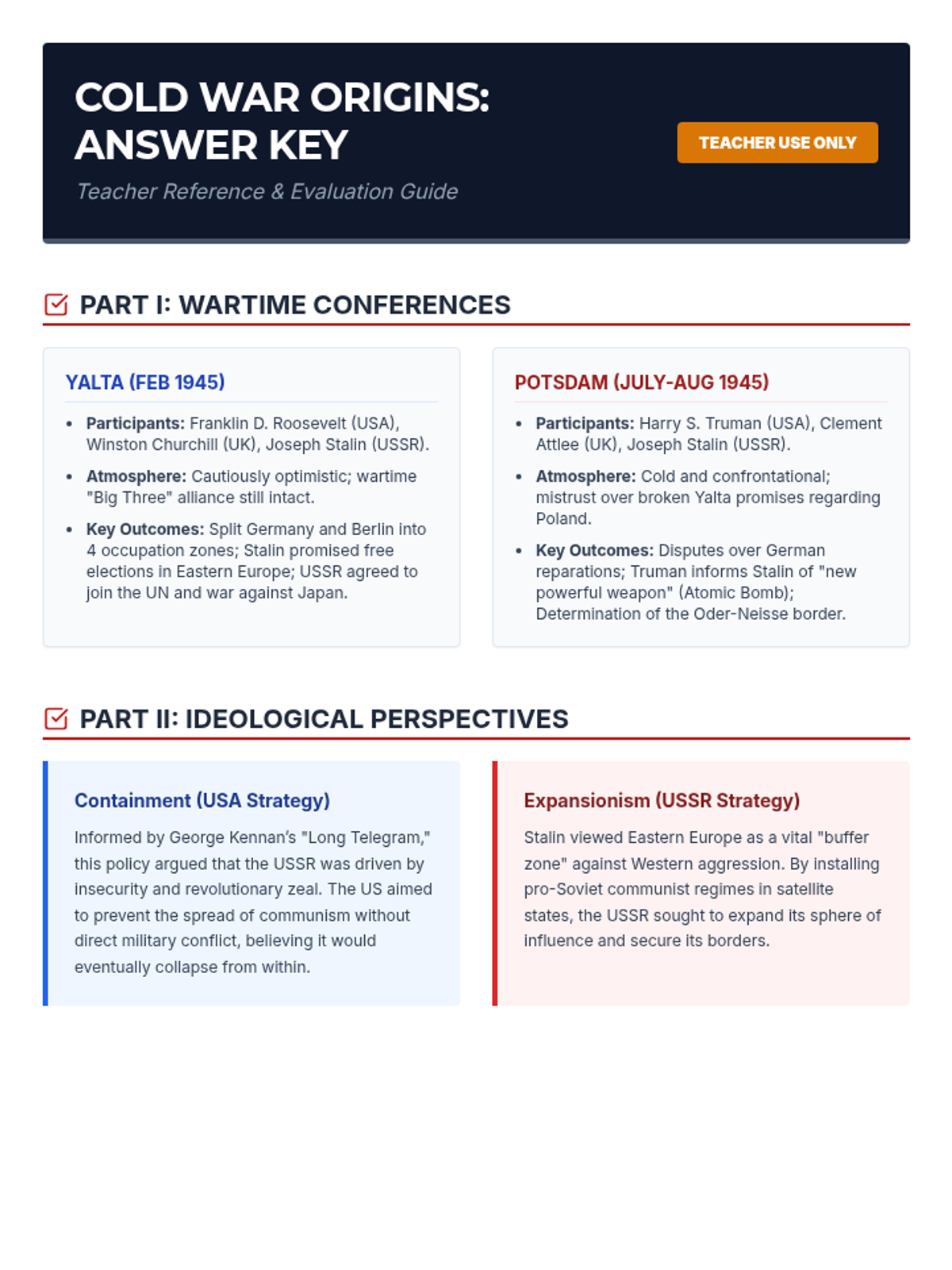
A teacher's answer key for the Cold War Origins Organizer, providing detailed summaries of the Yalta and Potsdam conferences, the policies of containment and expansionism, and the significance of early nuclear developments.
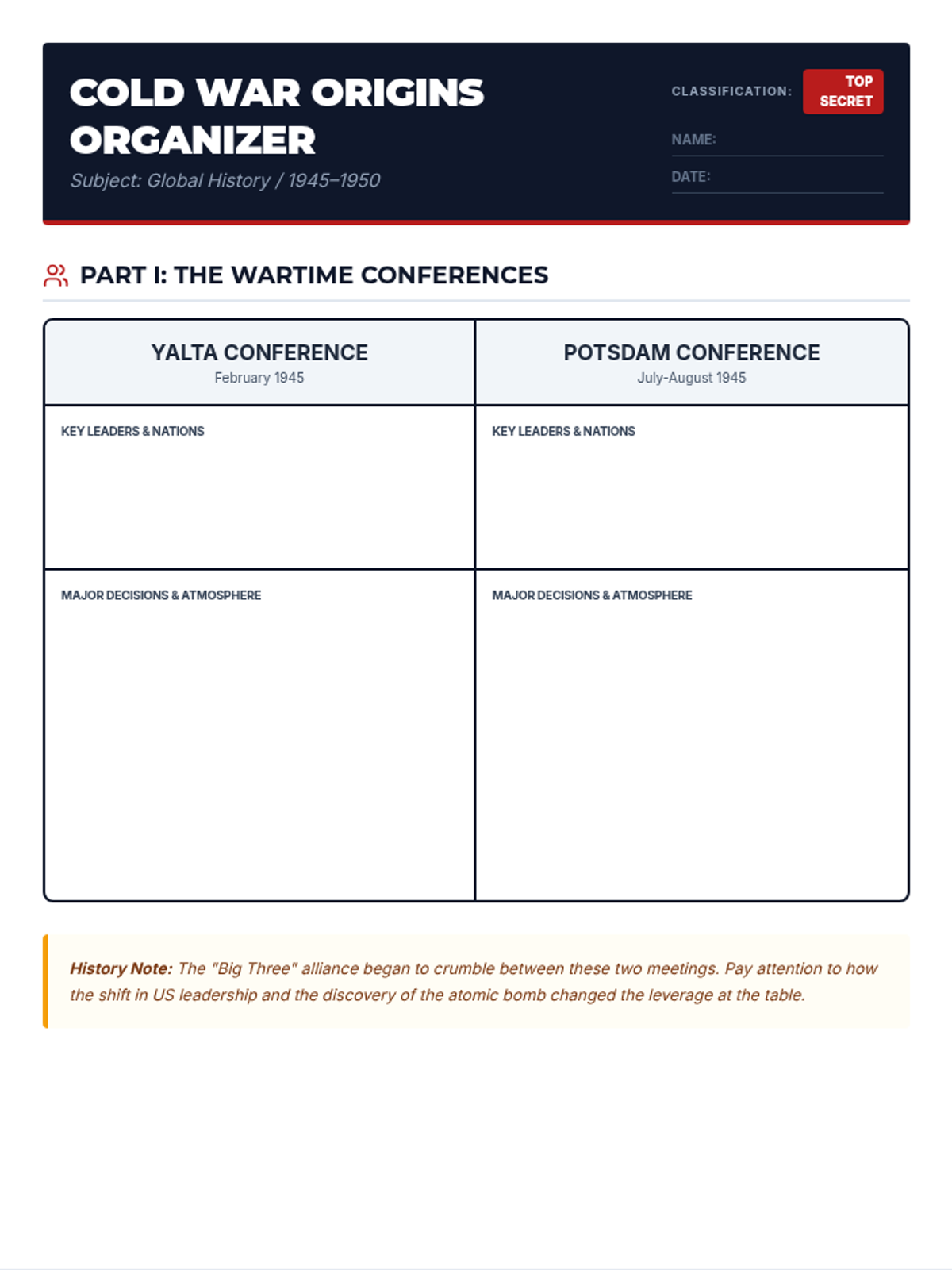
A comprehensive student graphic organizer for analyzing the causes of the Cold War, including wartime conferences, containment vs. expansionism, the Truman Doctrine, the Marshall Plan, and the nuclear arms race.
A 'Case Study' worksheet that uses detailed textual snapshots of real London locations (Brixton, Brick Lane, Battersea) to illustrate the before-and-after effects of gentrification. Designed to be used alongside real photographs displayed in class. Revised to fix layout, page breaks, and student work areas.
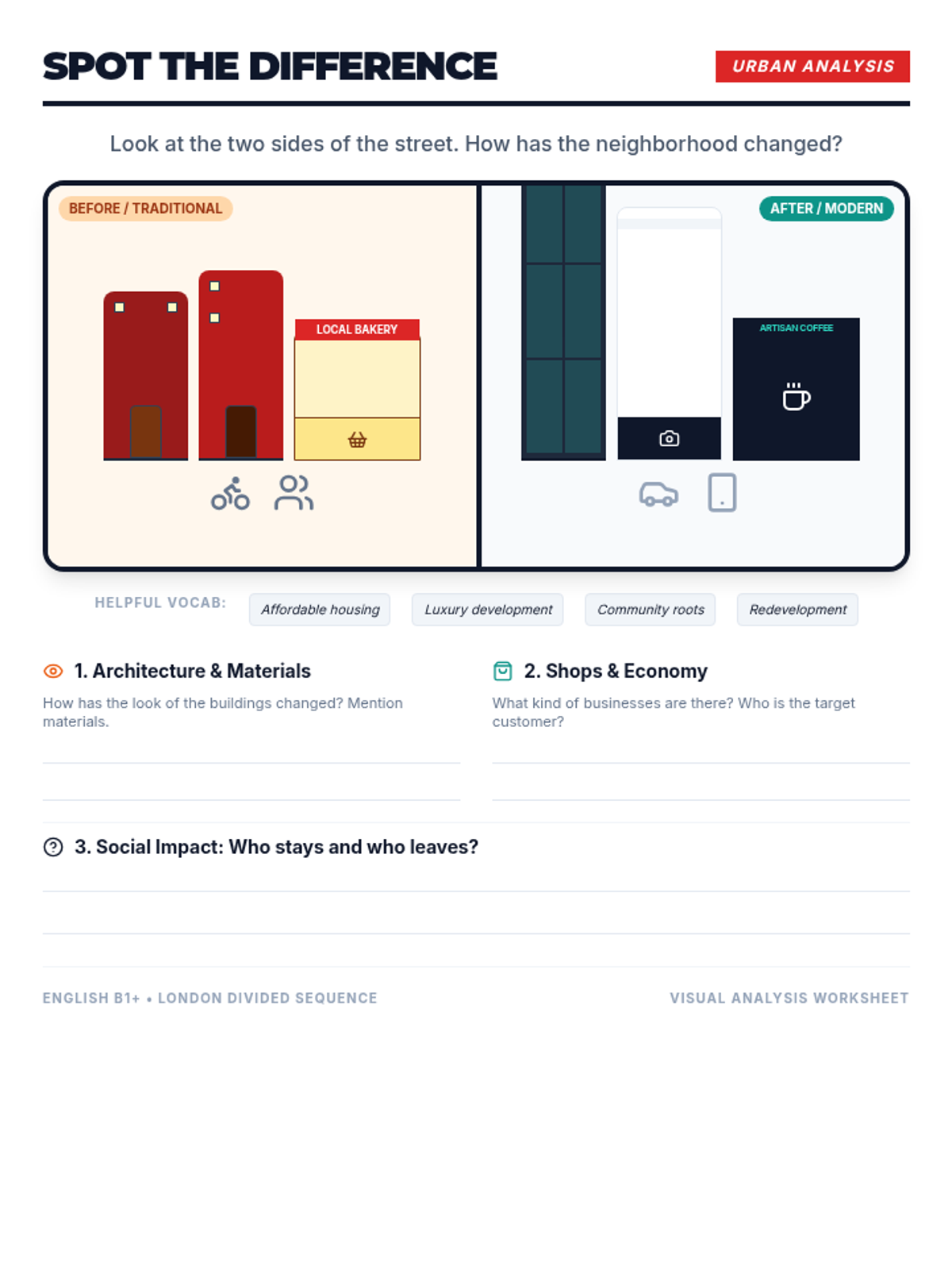
A visual comparison poster/worksheet featuring a stylized "Before and After" urban scene to elicit vocabulary related to architecture, social class, and neighborhood transformation. Revised to ensure one-page fit and include student work areas.
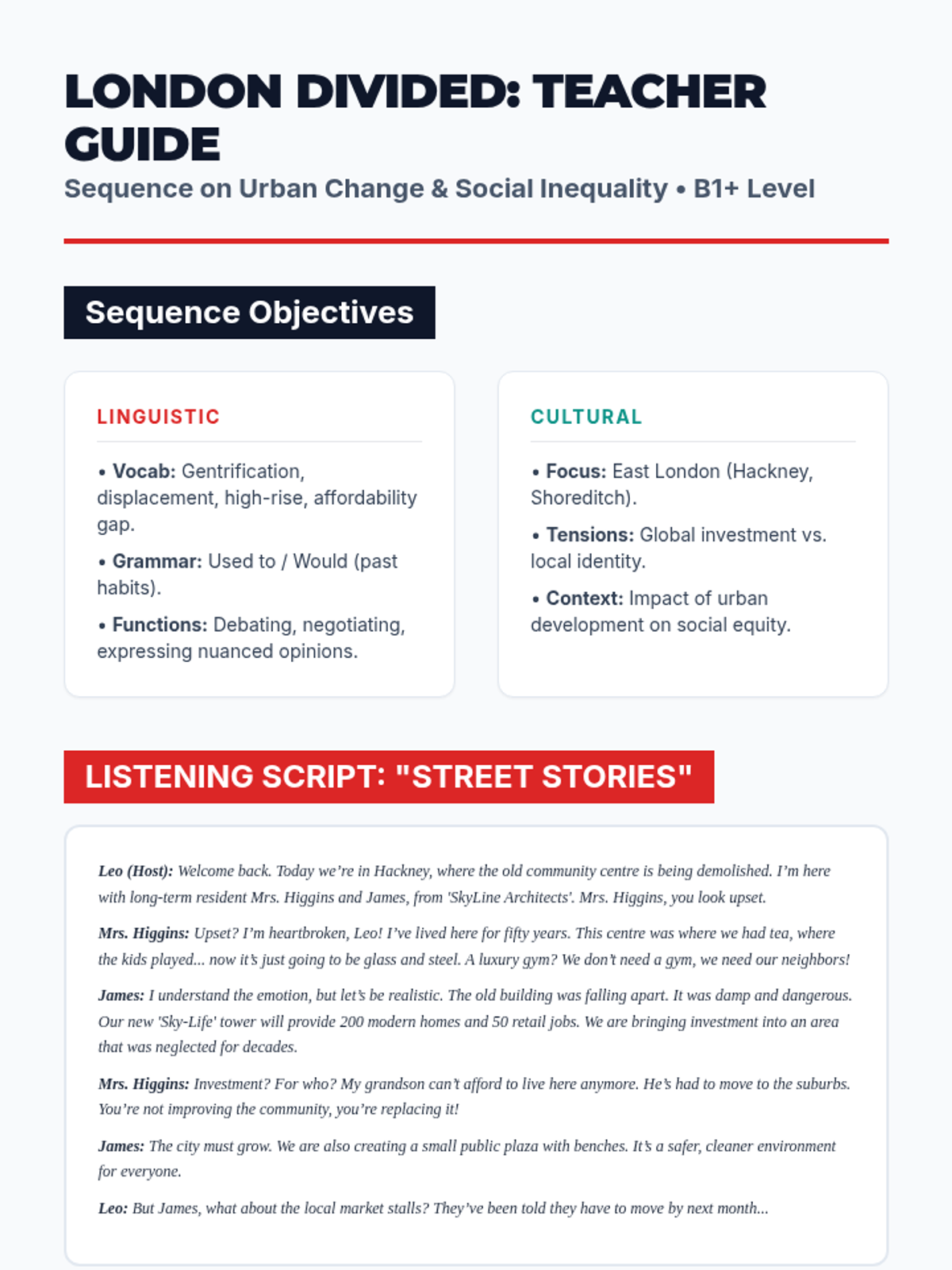
A comprehensive teacher guide for the London Divided sequence. Revised to balance white space on page 1, ensure answer key stays together, and fix teaching tips layout.
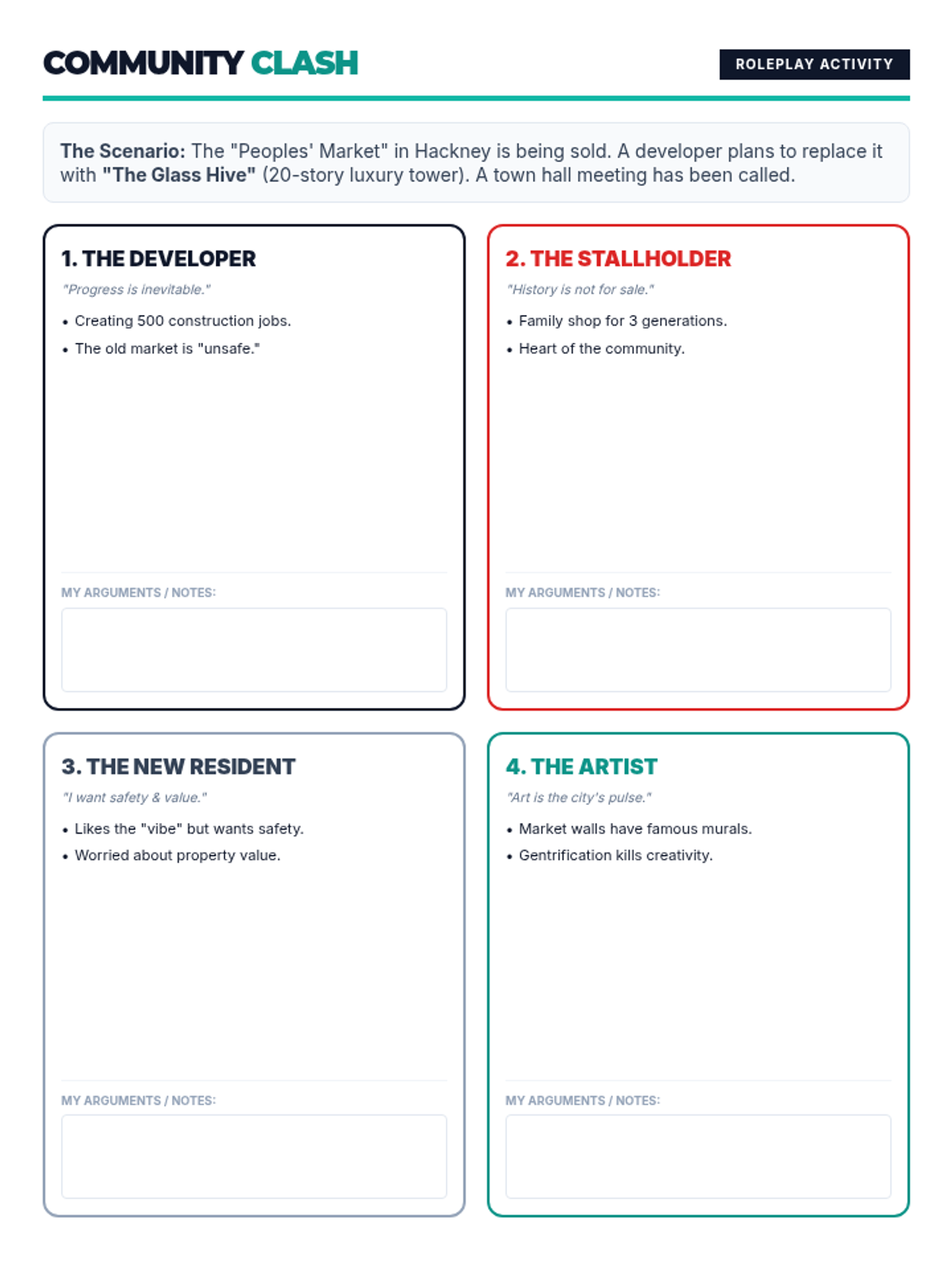
A set of role-play cards and a debate toolkit for a speaking activity. Revised for a two-page layout, improved note-taking areas with white backgrounds, and fixed overflow issues.
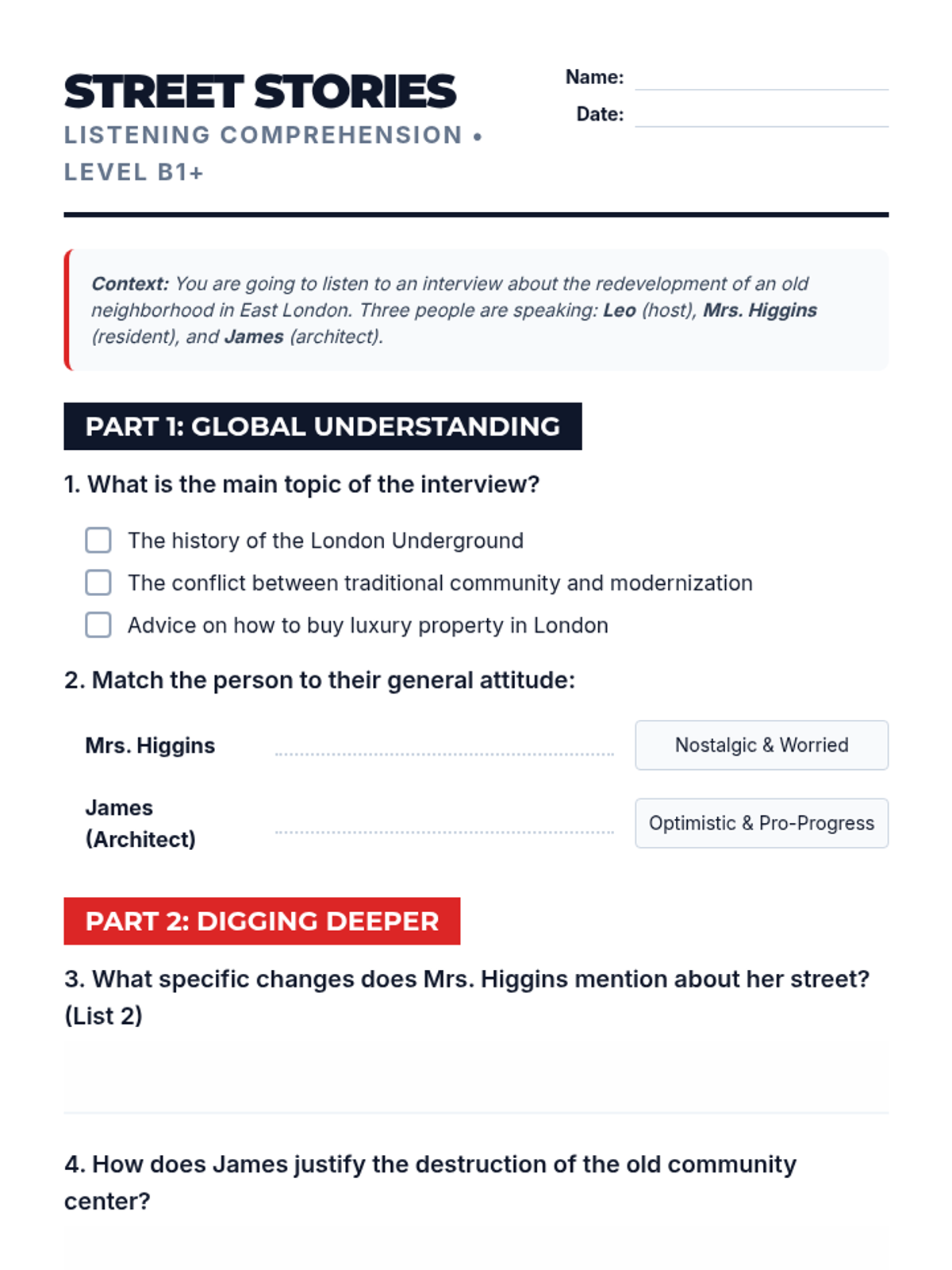
A listening comprehension worksheet for students to use with an interview about gentrification. Revised to fix logical errors in matching, improve table column balance, and ensure questions don't split across pages. Adjusted height to prevent stray 3rd page.
Introductory slides for the London Divided sequence, featuring visual contrasts, key vocabulary for B1+ students, and discussion prompts about urban change and gentrification. Revised for improved alignment, contrast, and clarity.
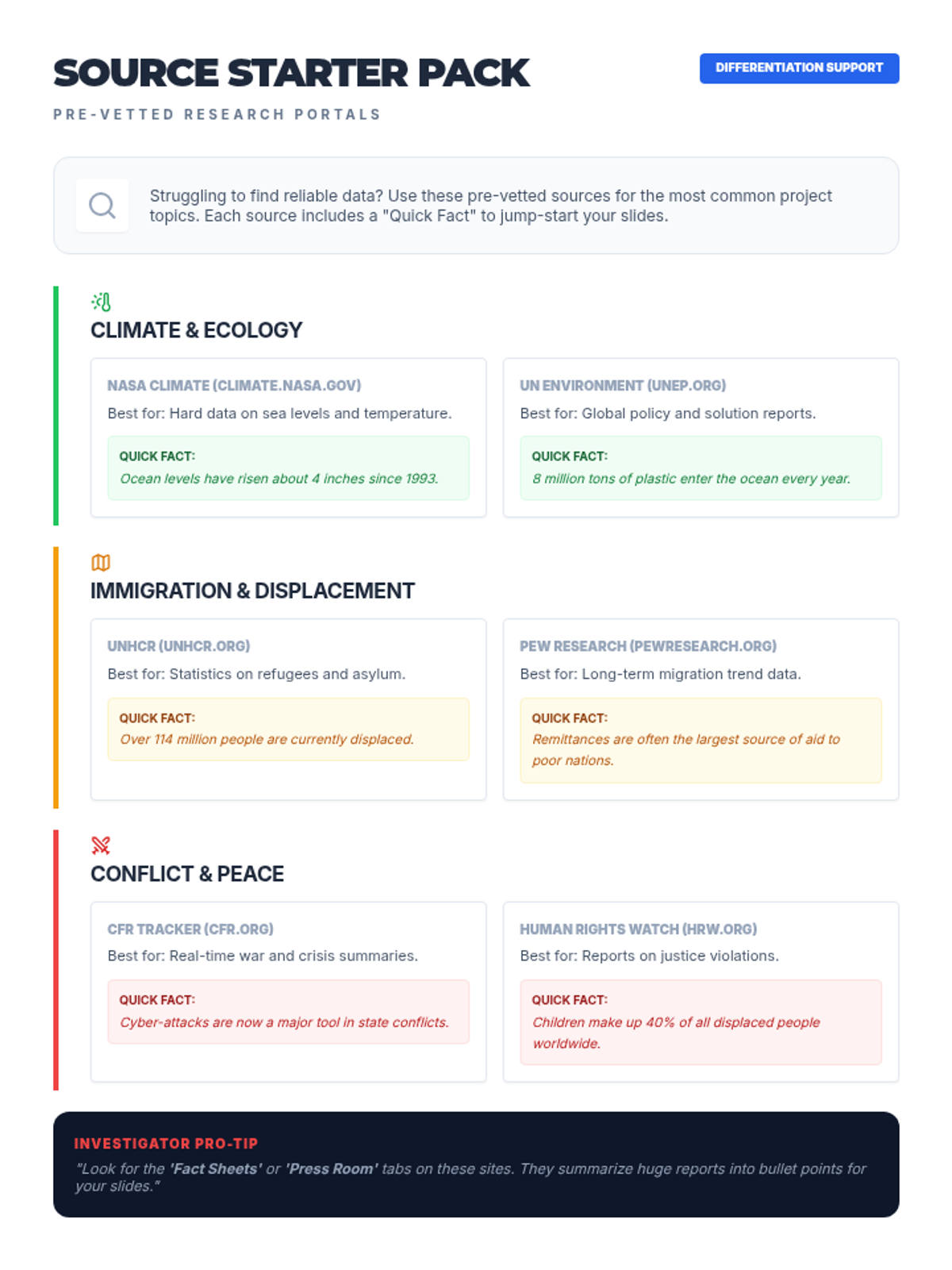
A curated reference sheet with pre-vetted, high-quality sources for common project topics, designed to help students who struggle with the initial research phase.
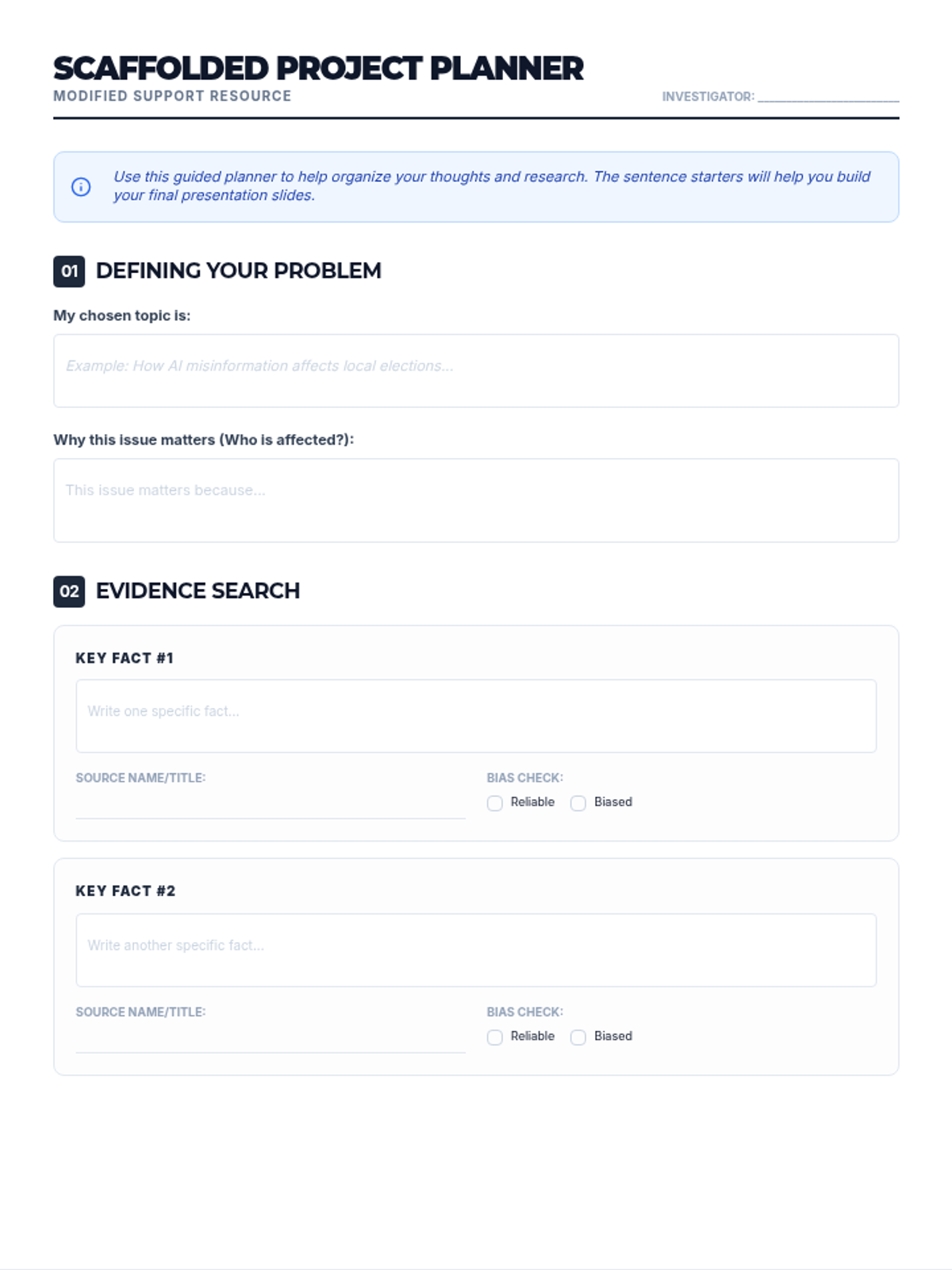
A highly structured version of the project researcher log for students needing additional scaffolding, featuring sentence starters, simplified source evaluation, and a slide-by-slide guide.
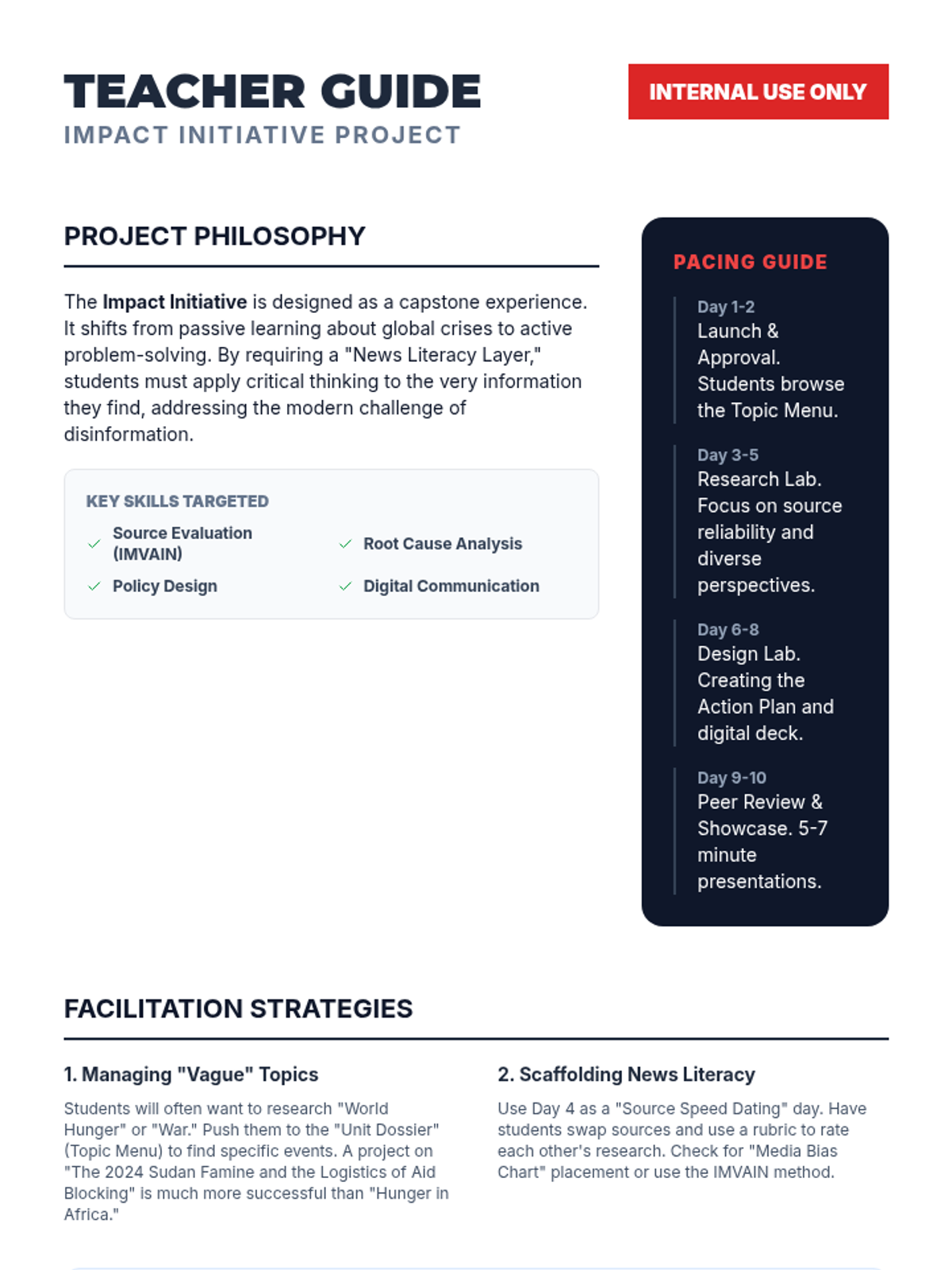
A teacher-facing facilitation guide for the Impact Initiative, including project philosophy, a 10-day pacing guide, and strategies for scaffolding news literacy and differentiation.
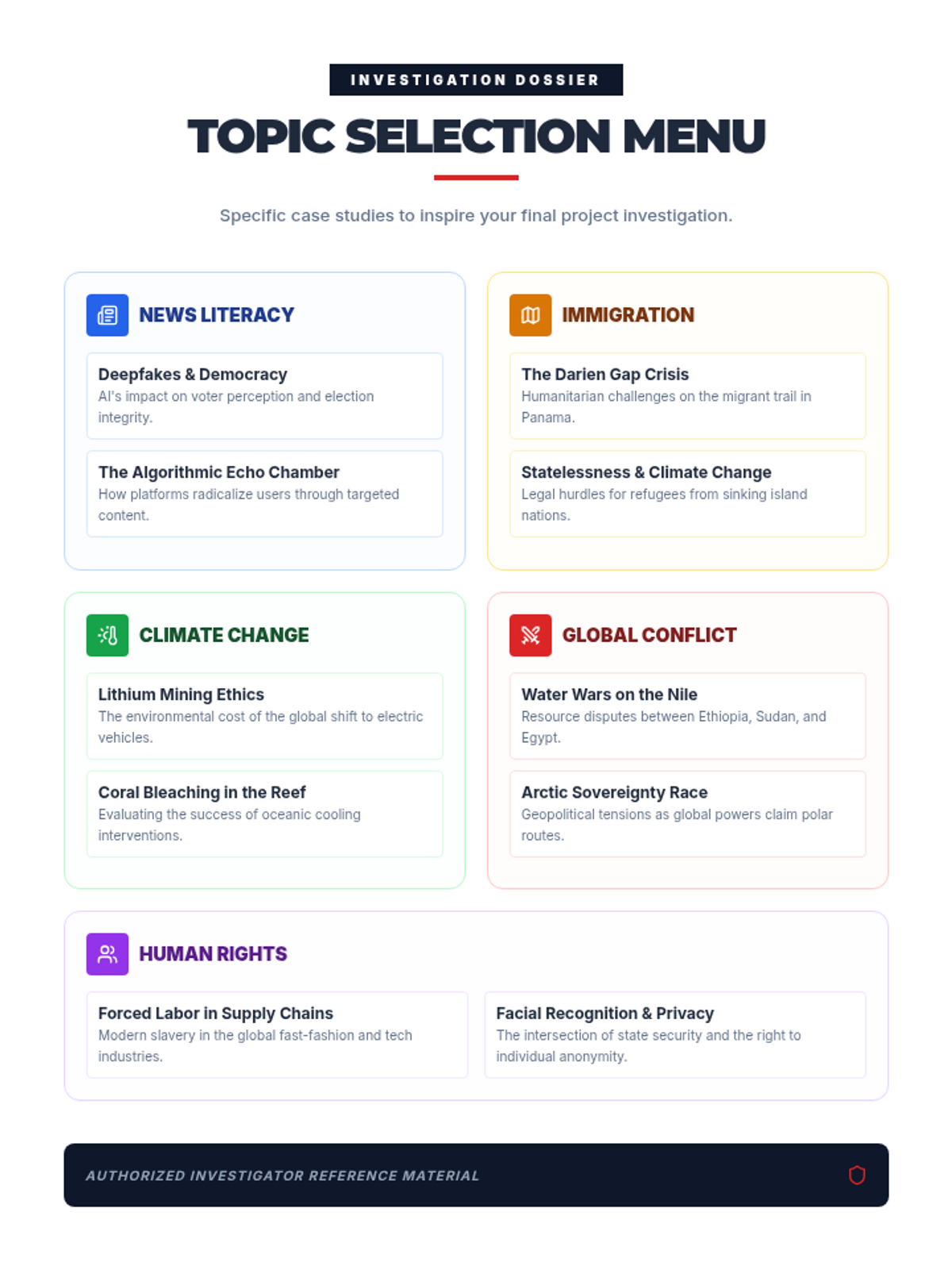
A curated list of specific case studies for each unit (News Literacy, Immigration, Climate Change, Global Conflict, Human Rights) to help students select high-impact project topics.
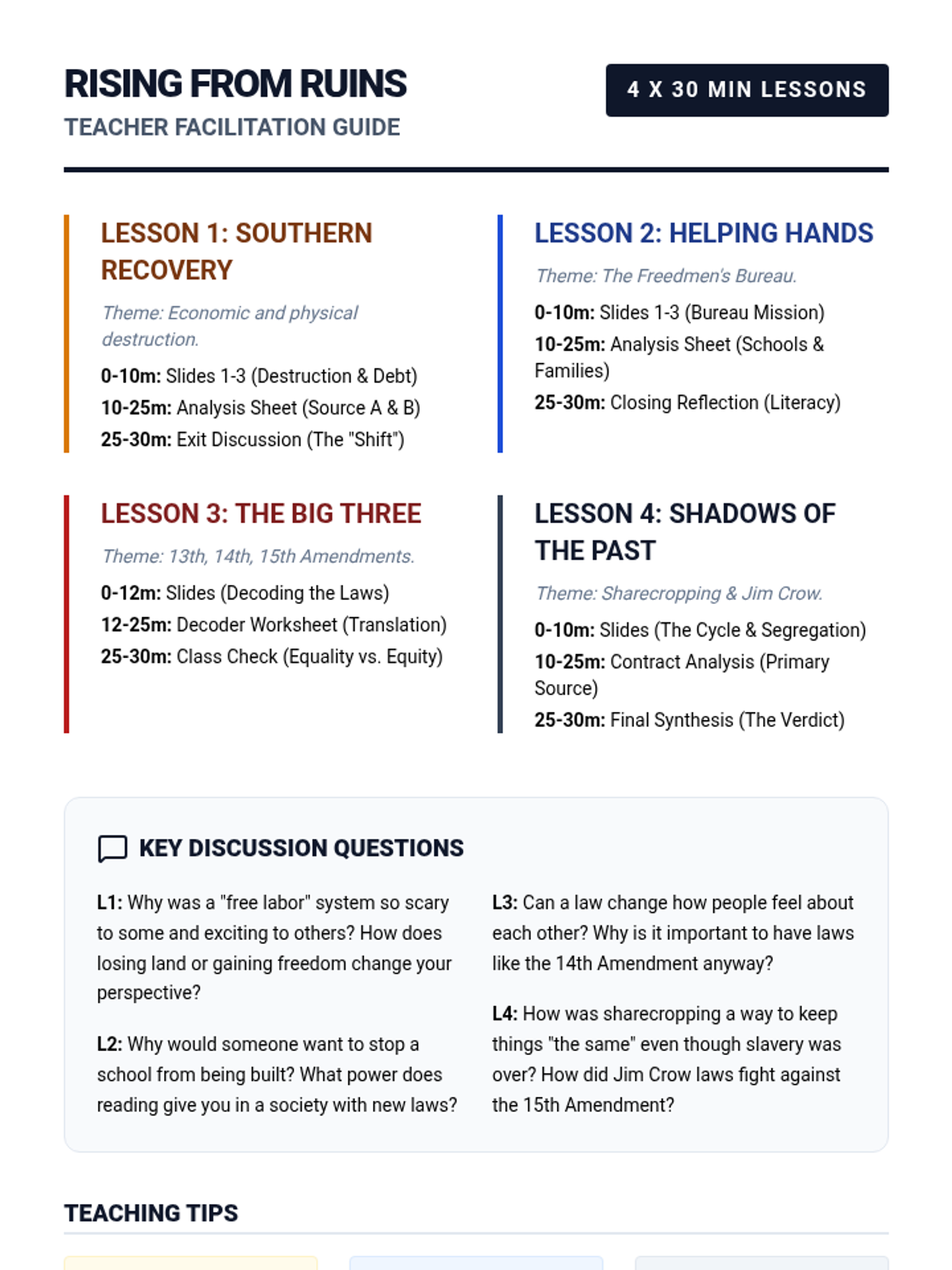
A comprehensive guide for teachers to manage the four 30-minute lessons, including pacing, discussion prompts, and differentiation strategies.
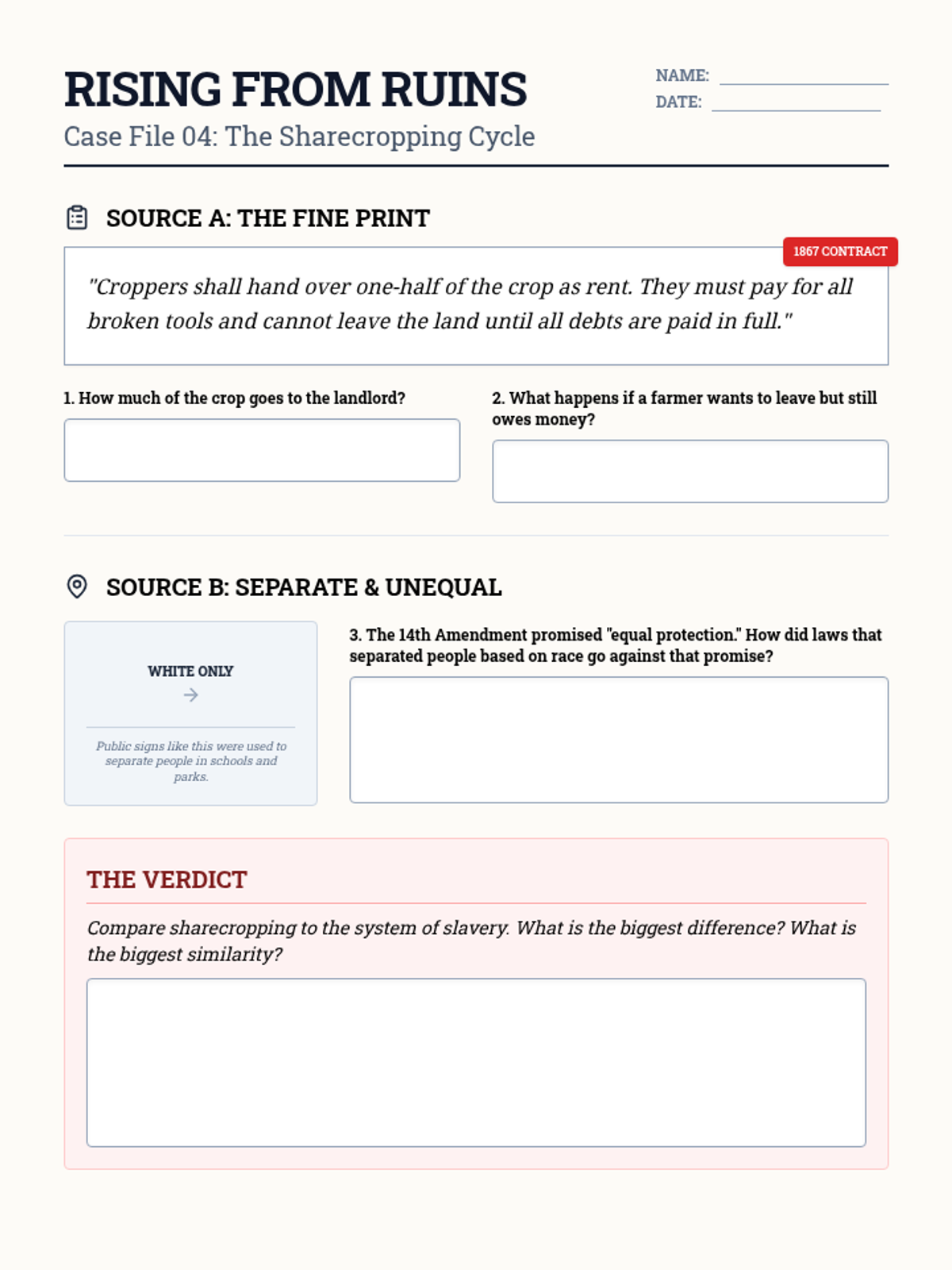
A student worksheet analyzing a sharecropping contract and the impact of Jim Crow laws on Southern life.
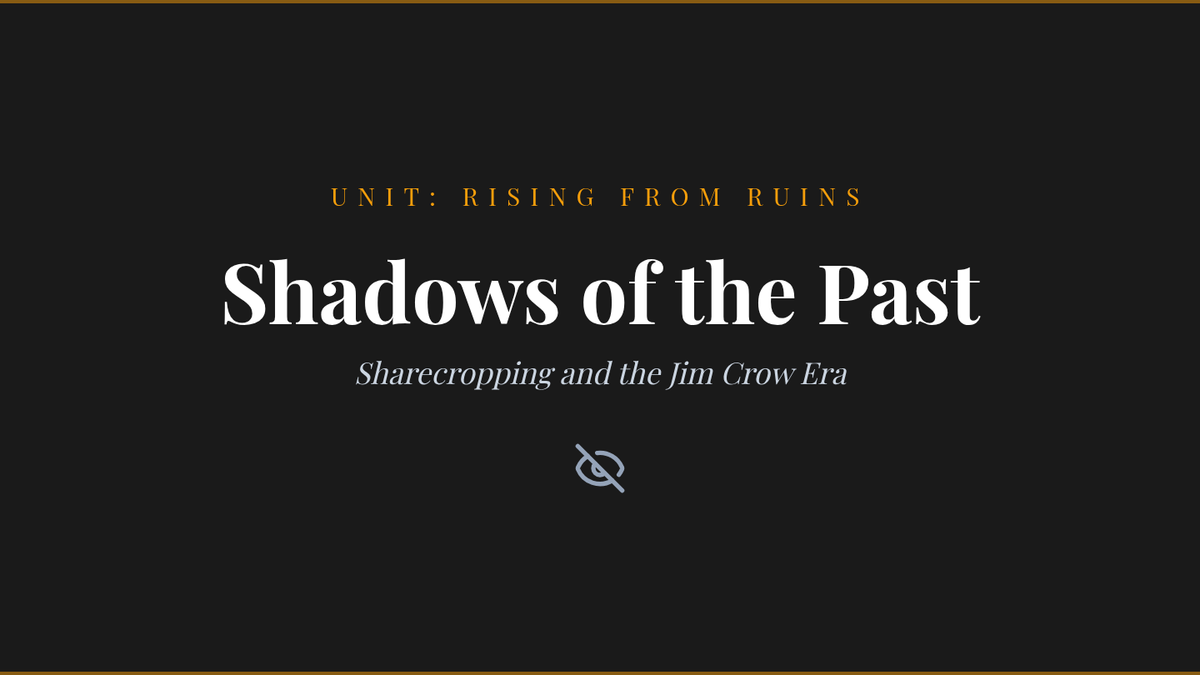
A slide presentation for Lesson 4 covering the economic trap of sharecropping and the legal and social restrictions of the Jim Crow era.
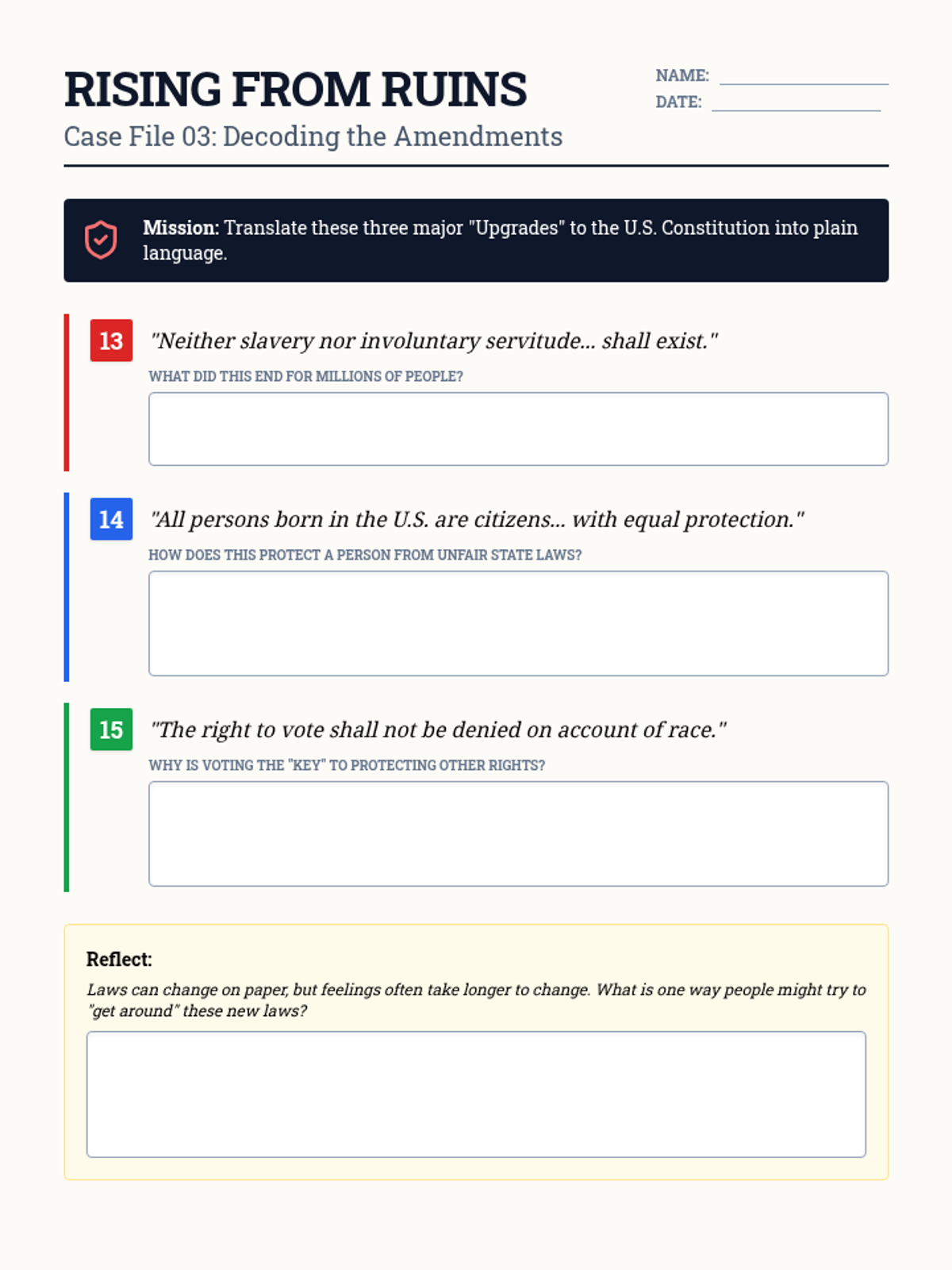
A student worksheet requiring students to interpret the 13th, 14th, and 15th Amendments in plain language and reflect on their impact.
A slide presentation for Lesson 3 explaining the 13th, 14th, and 15th Amendments and their significance in establishing civil rights.
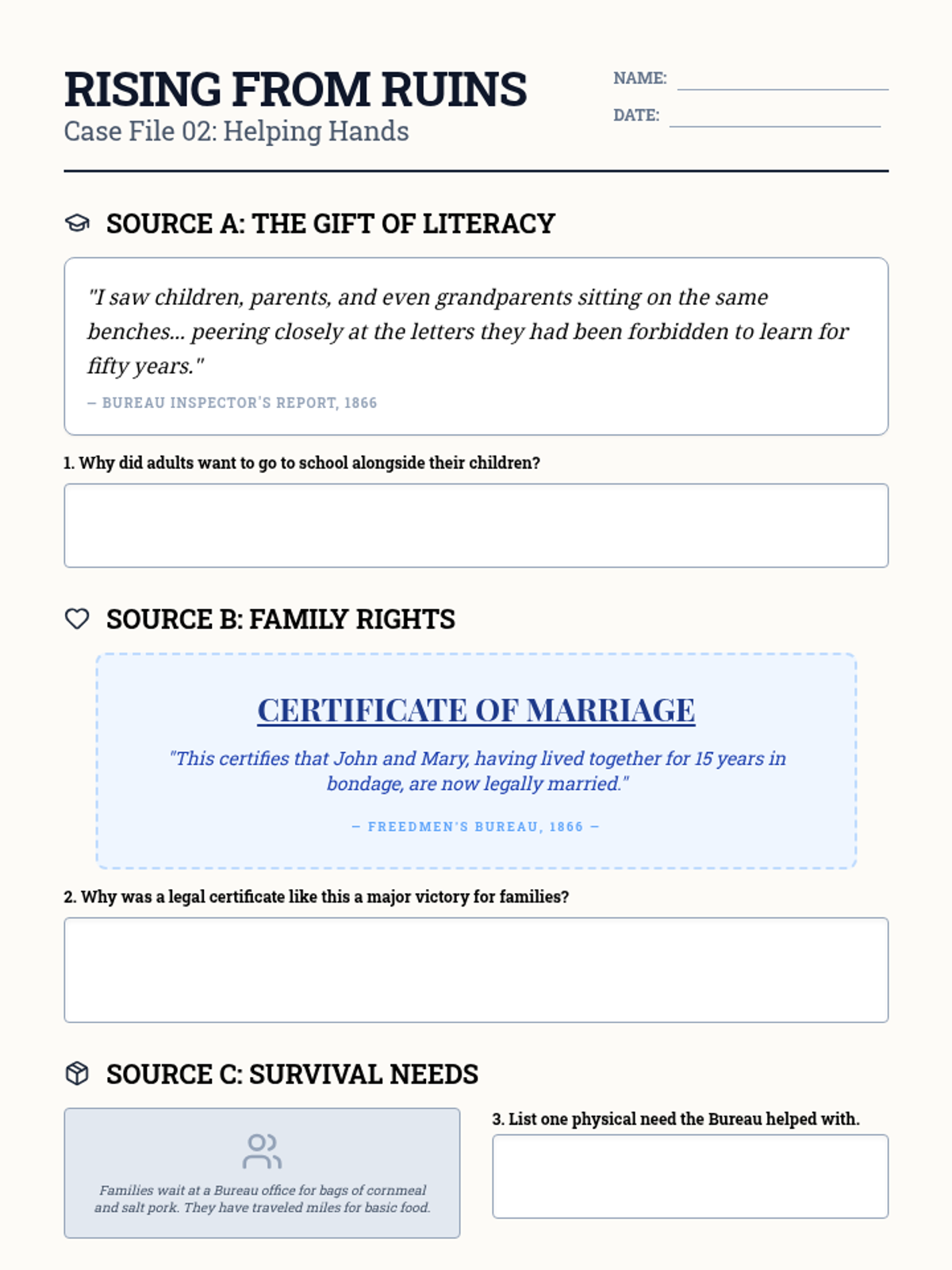
A student analysis sheet featuring primary source excerpts related to the Freedmen's Bureau's work in education and family reunification.
A slide presentation for Lesson 2 detailing the purpose, successes, and challenges of the Freedmen's Bureau during Reconstruction.
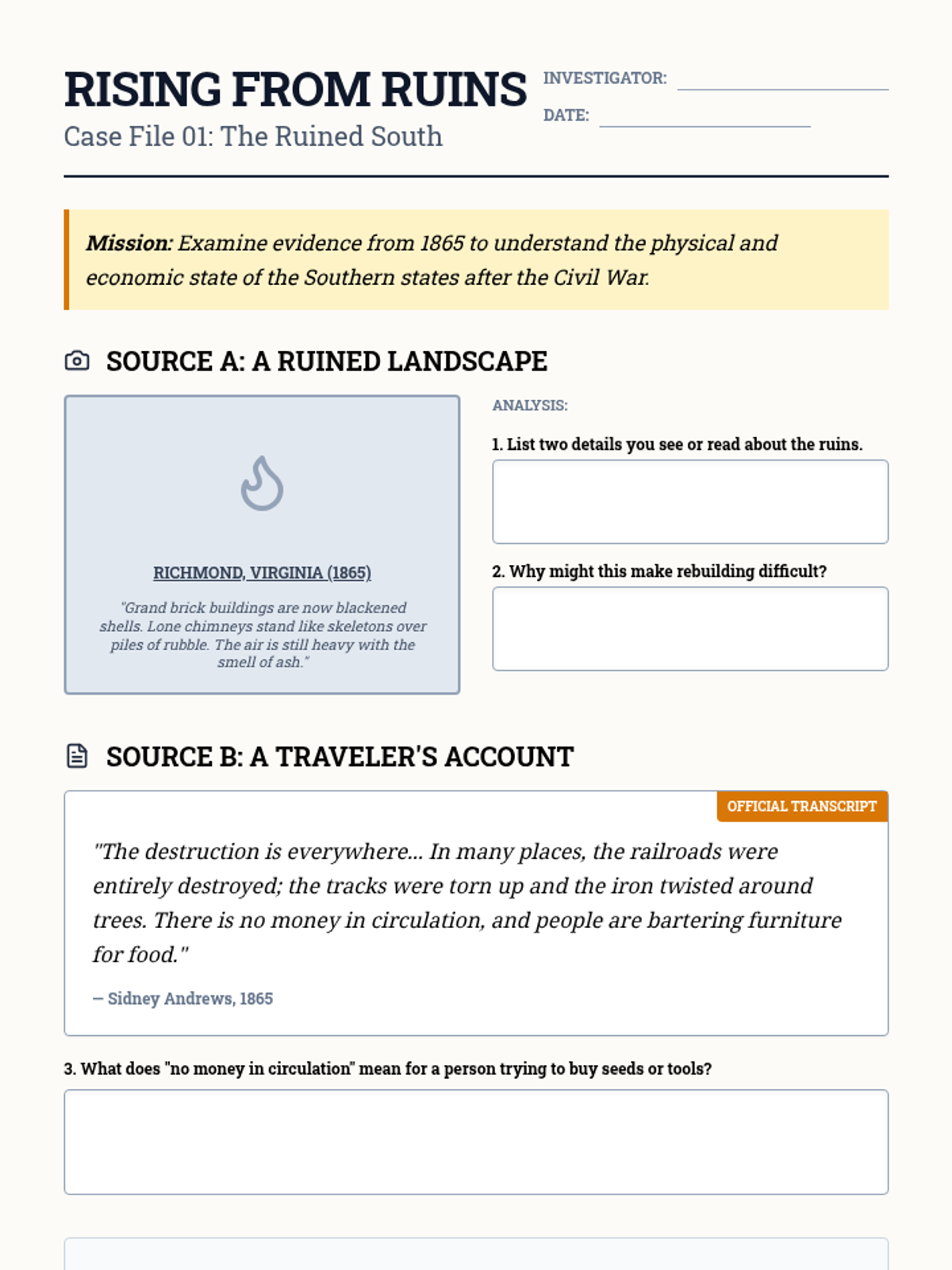
A student worksheet featuring primary source excerpts and prompts to analyze the physical and economic destruction of the South following the Civil War.
A slide deck for Lesson 1 introducing students to the physical and economic state of the South after the Civil War and the transition to a free labor system.
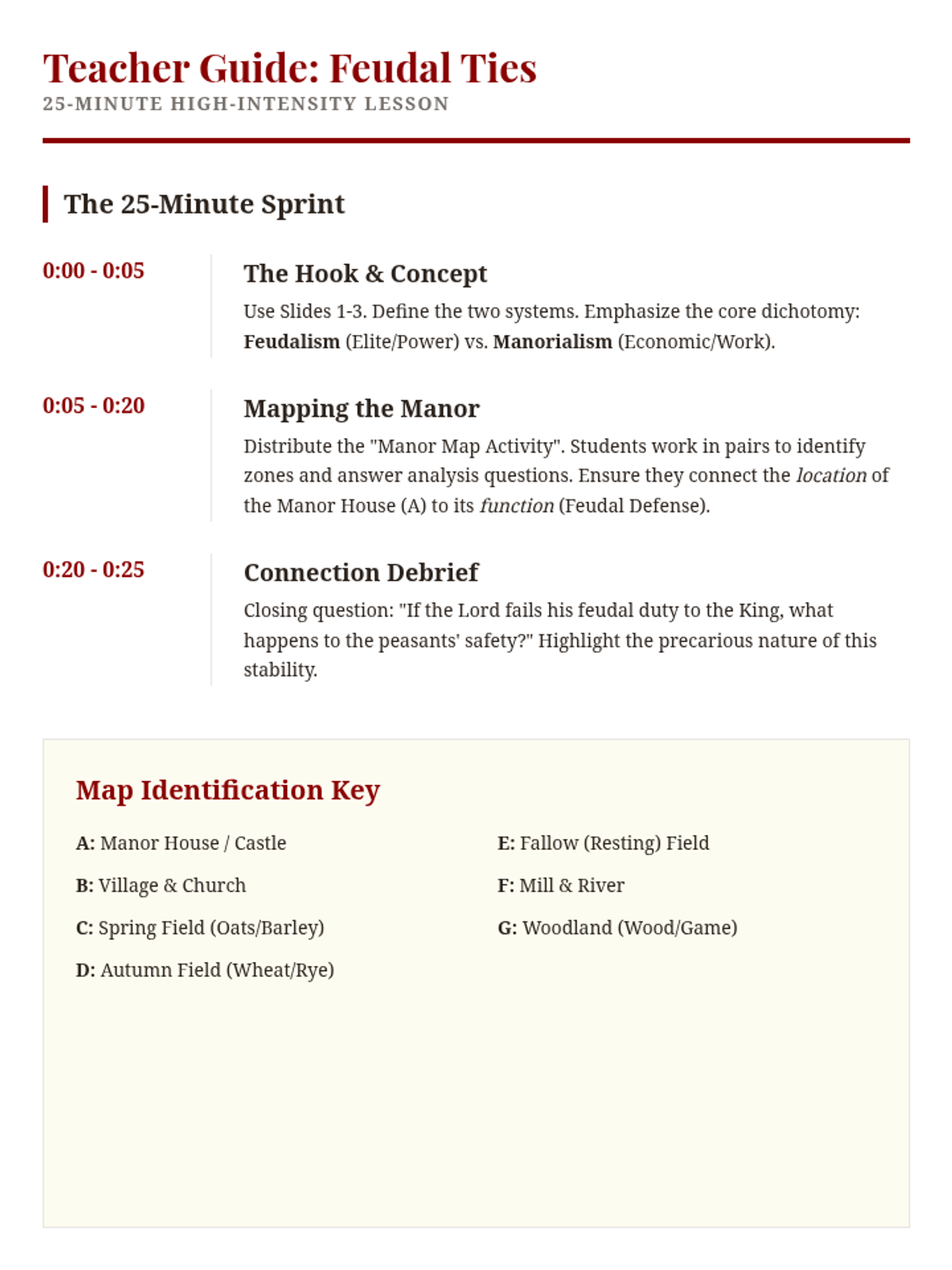
A teacher facilitation guide for the 25-minute Feudal Ties lesson, including a timeline, answer key, and discussion prompts.
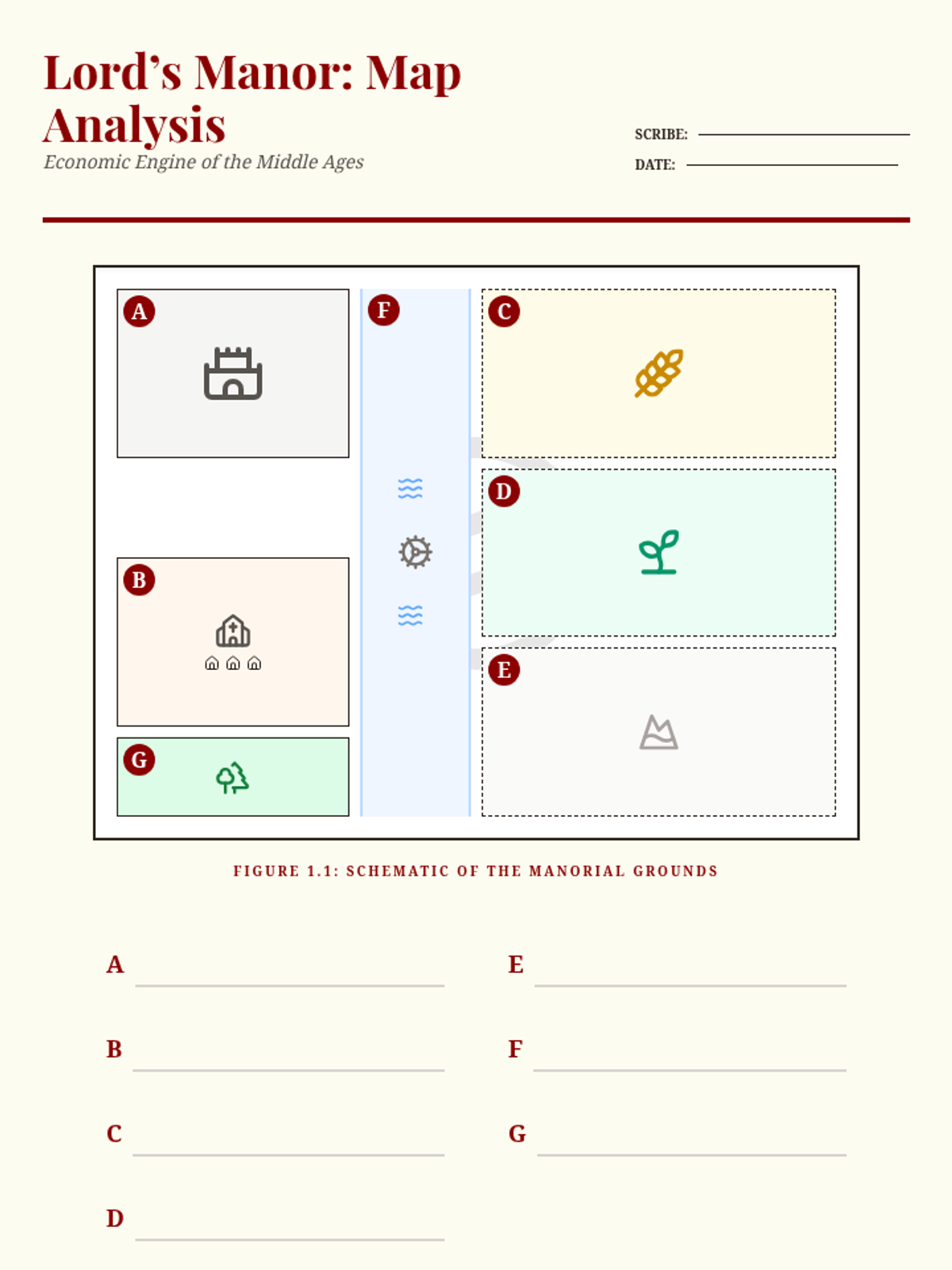
A mapping and analysis worksheet where students identify the parts of a medieval manor and explain the roles of Feudalism and Manorialism in its daily operation.
A 5-slide visual presentation contrasting the political system of Feudalism with the economic system of Manorialism. Includes diagrams of the feudal and manorial exchanges.
A 6-slide presentation summarizing the Homestead Act of 1862 and its profound economic impact on the Great Plains and the growth of the American Midwest. The slides cover the act's requirements, economic motivations for settlers, the role of railroads, and technological innovations for survival.
A visual slide presentation designed to accompany the video about New Jersey's rental assistance crisis, featuring vocabulary terms, economic comparisons, and 5 assessment questions for class review.
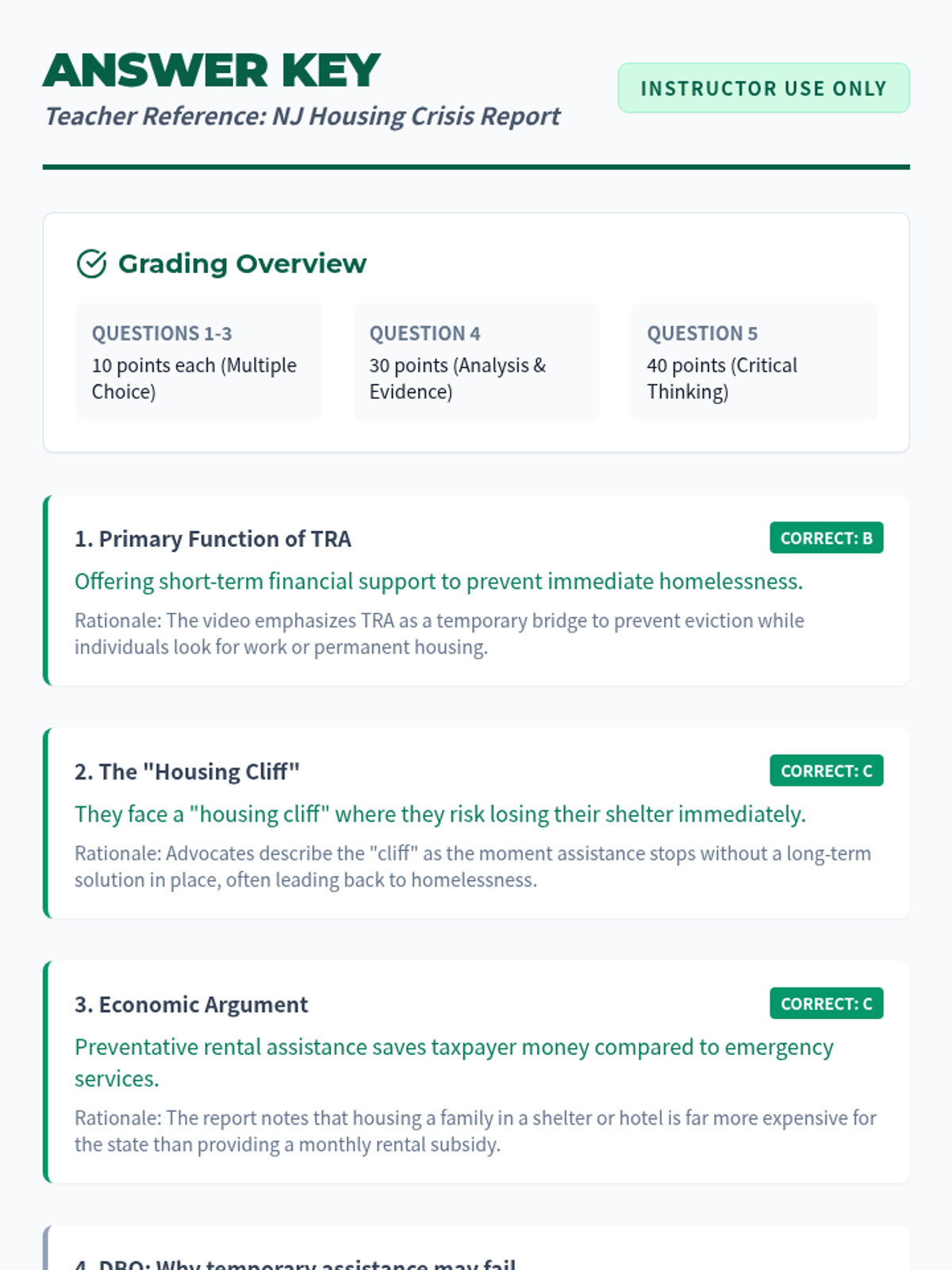
An answer key and grading guide for the Housing Safety Worksheet, providing correct answers, rationales, sample student responses for DBQs, and extension discussion prompts.
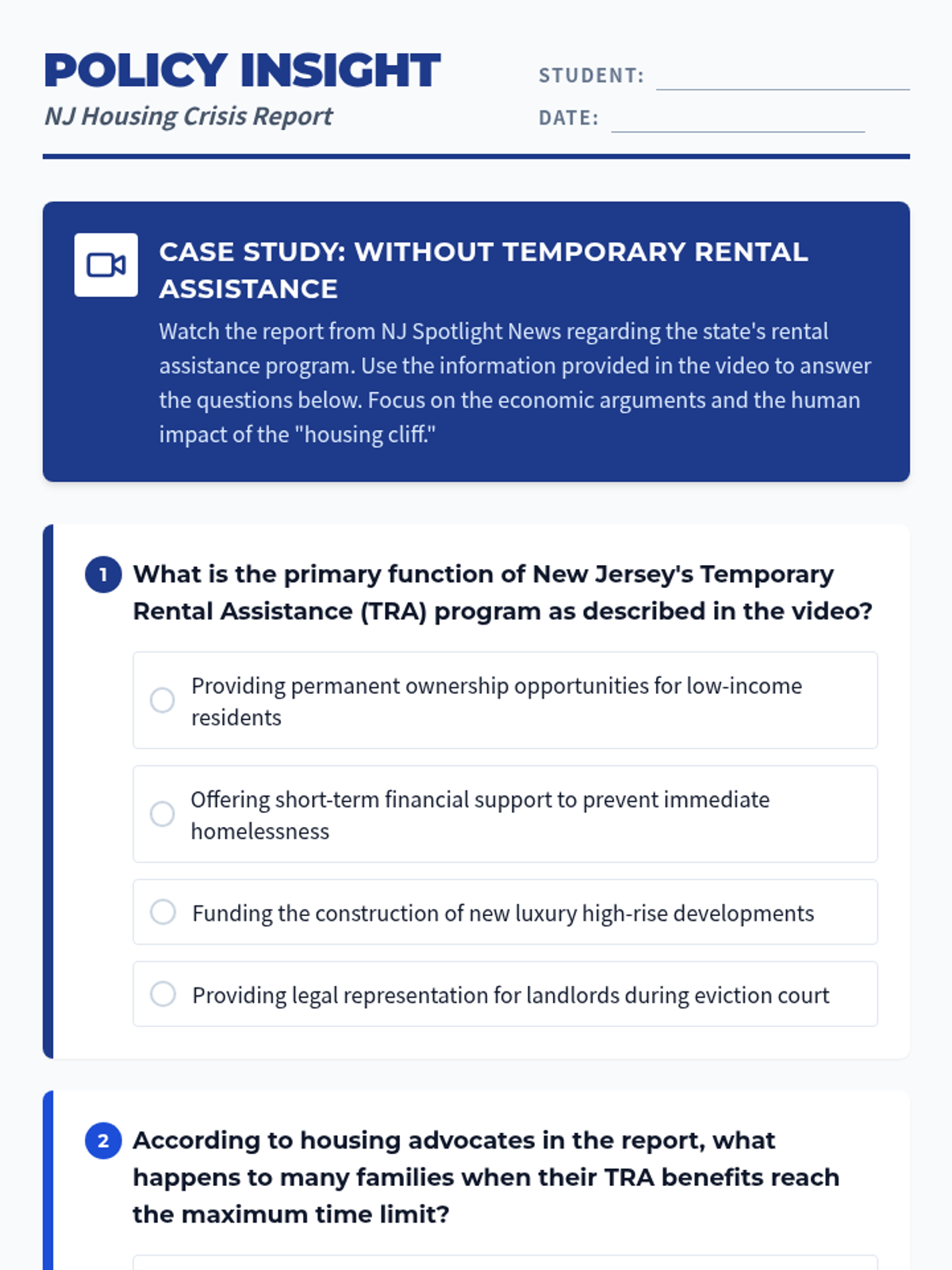
A student worksheet featuring 5 questions (3 multiple-choice and 2 document-based questions) based on a news report about New Jersey's Temporary Rental Assistance program.
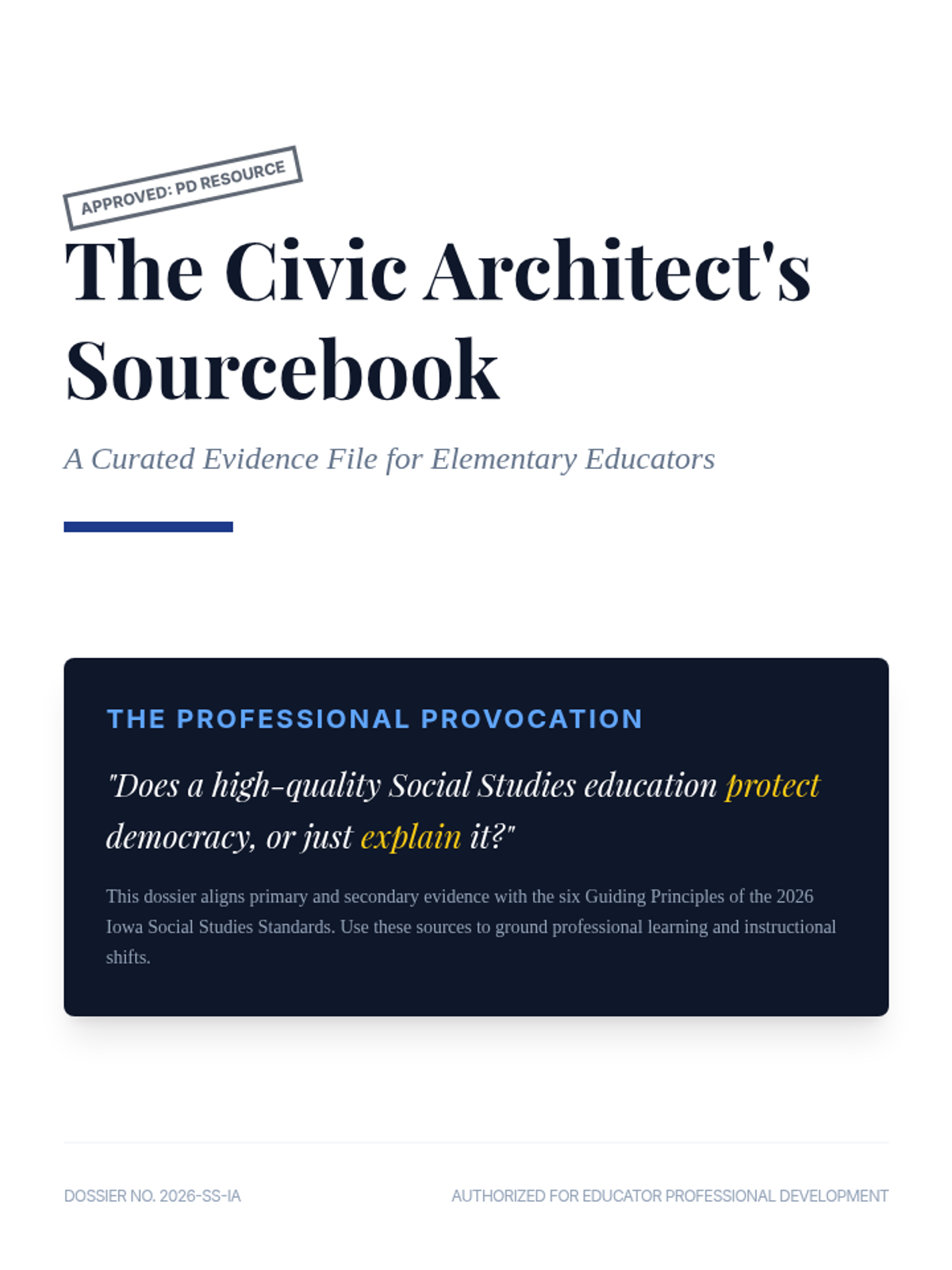
An expanded professional development sourcebook for elementary teachers, providing multiple primary and secondary sources (including Eleanor Roosevelt, Frederick Douglass, and Alexander Hamilton) for every one of the six Guiding Principles in the Iowa Social Studies Standards. This resource is designed to help educators argue for and implement instructional practices that protect democracy through active, high-quality social studies.
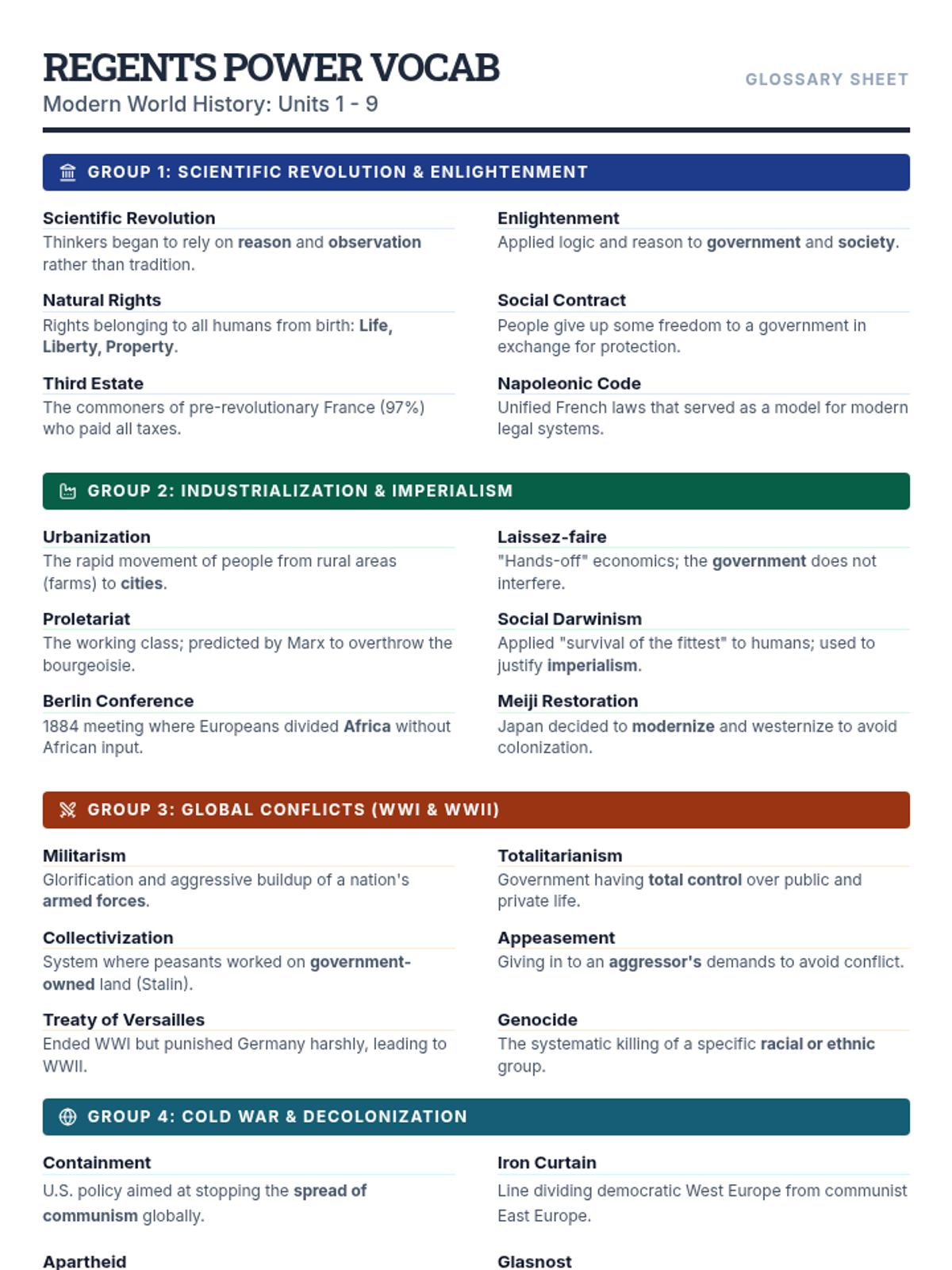
A comprehensive 2-page vocabulary glossary for Units 1-9 of the NYS Modern World History Regents, featuring high-impact terms and exam hacks organized by unit grouping for study consistency. Fixed page breaks and spacing.
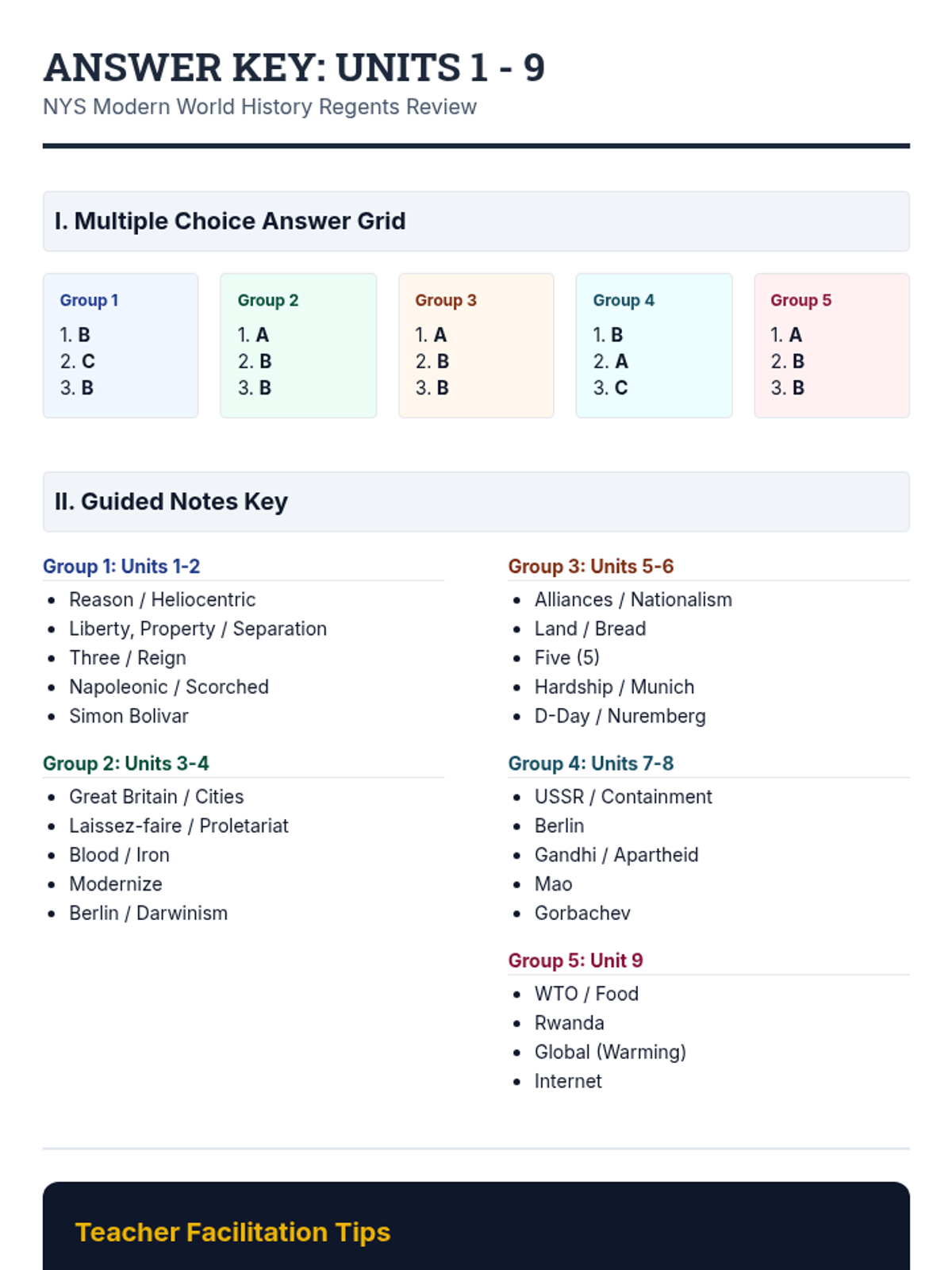
An expanded teacher answer key for the Modern Era Regents Review lesson (Units 1-9), featuring a clear answer grid for all 15 multiple-choice questions, organized key terms for guided notes, and high-impact teaching tips. Optimized for printing.
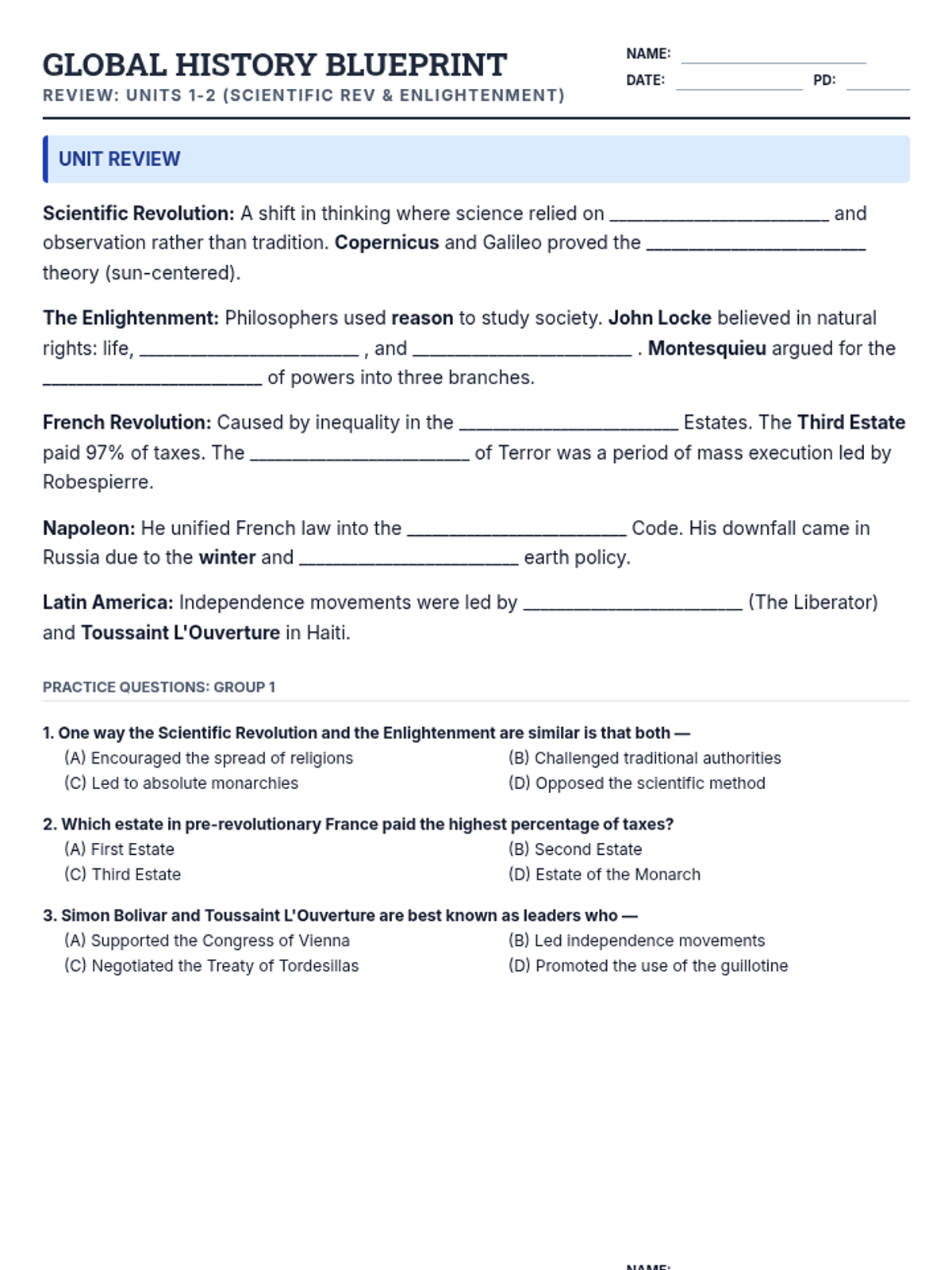
A 5-page guided notes packet covering Units 1-9, organized into dedicated pages for each unit grouping. Each page includes fill-in-the-blank review sections and 3 integrated Regents-style multiple-choice questions. Fixed page breaks and spacing issues.
A comprehensive 40+ slide deck for NYS Modern World History Regents review, covering Units 1-9 with 5 review slides and 3 quiz questions per unit grouping. Each complete unit has its own dedicated section with uniform quiz styling. Optimized for classroom visibility and PDF export. Corrected SPARK text spacing.
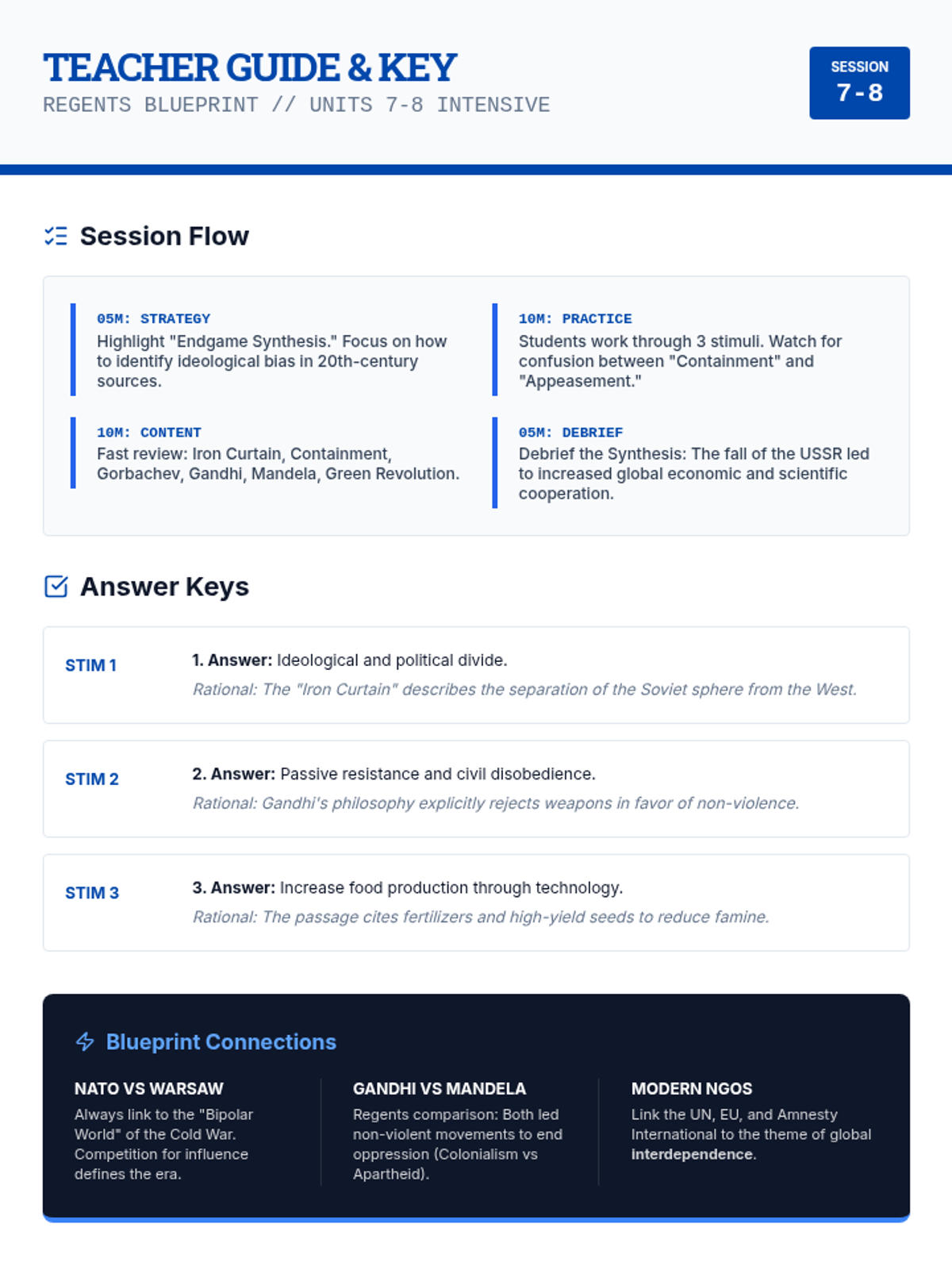
A comprehensive teacher guide for the 30-minute Regents prep session for Units 7-8, including a pacing guide and answer key with rationales.
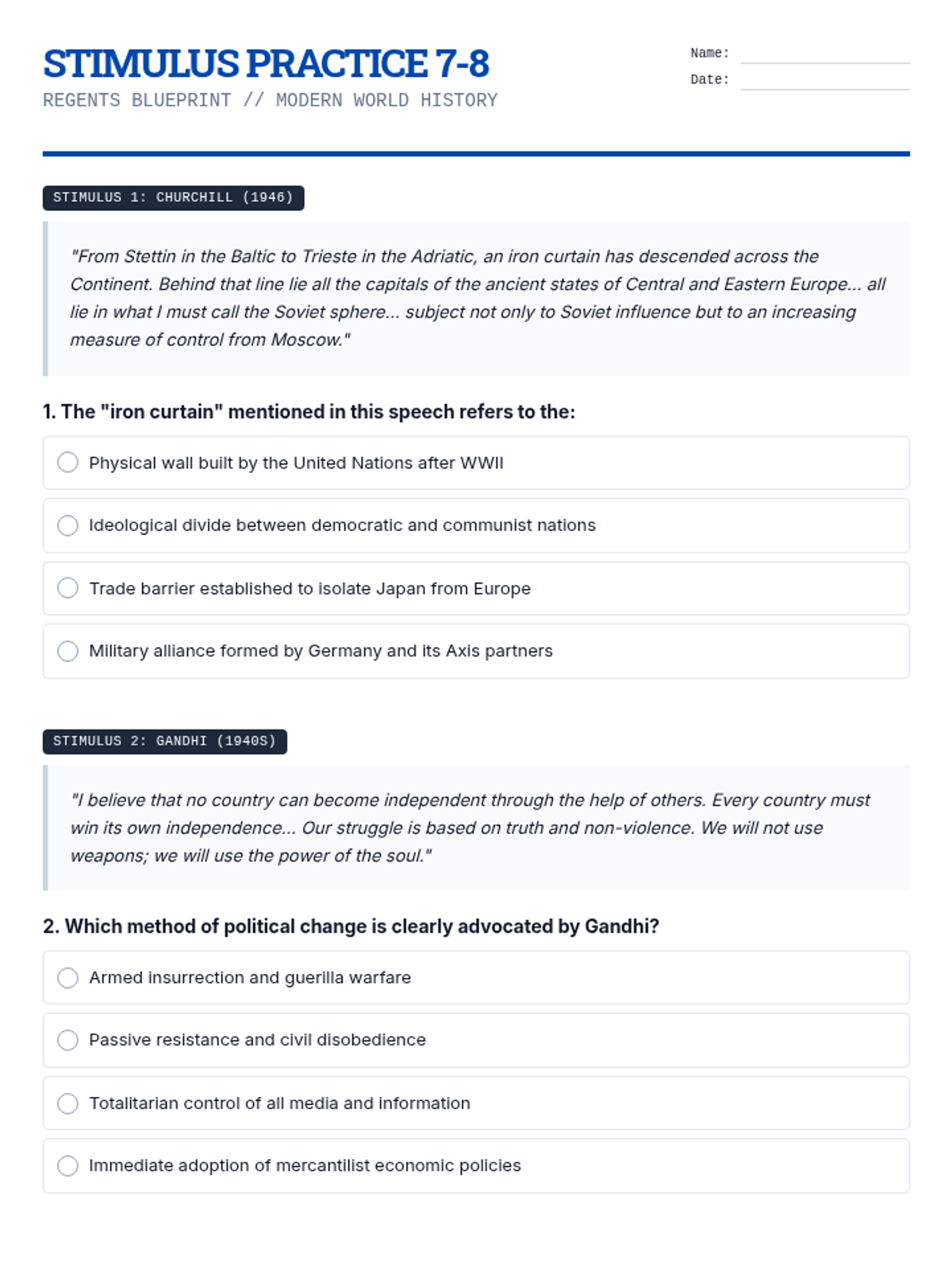
A printable student practice sheet featuring stimulus-based multiple choice questions for Units 7-8. Designed with a clean technical aesthetic and clear student work areas.
A high-energy 30-minute slide deck for Regents review, focusing on test-taking strategies and key concepts for Units 7-8. Features a technical 'blueprint' aesthetic.
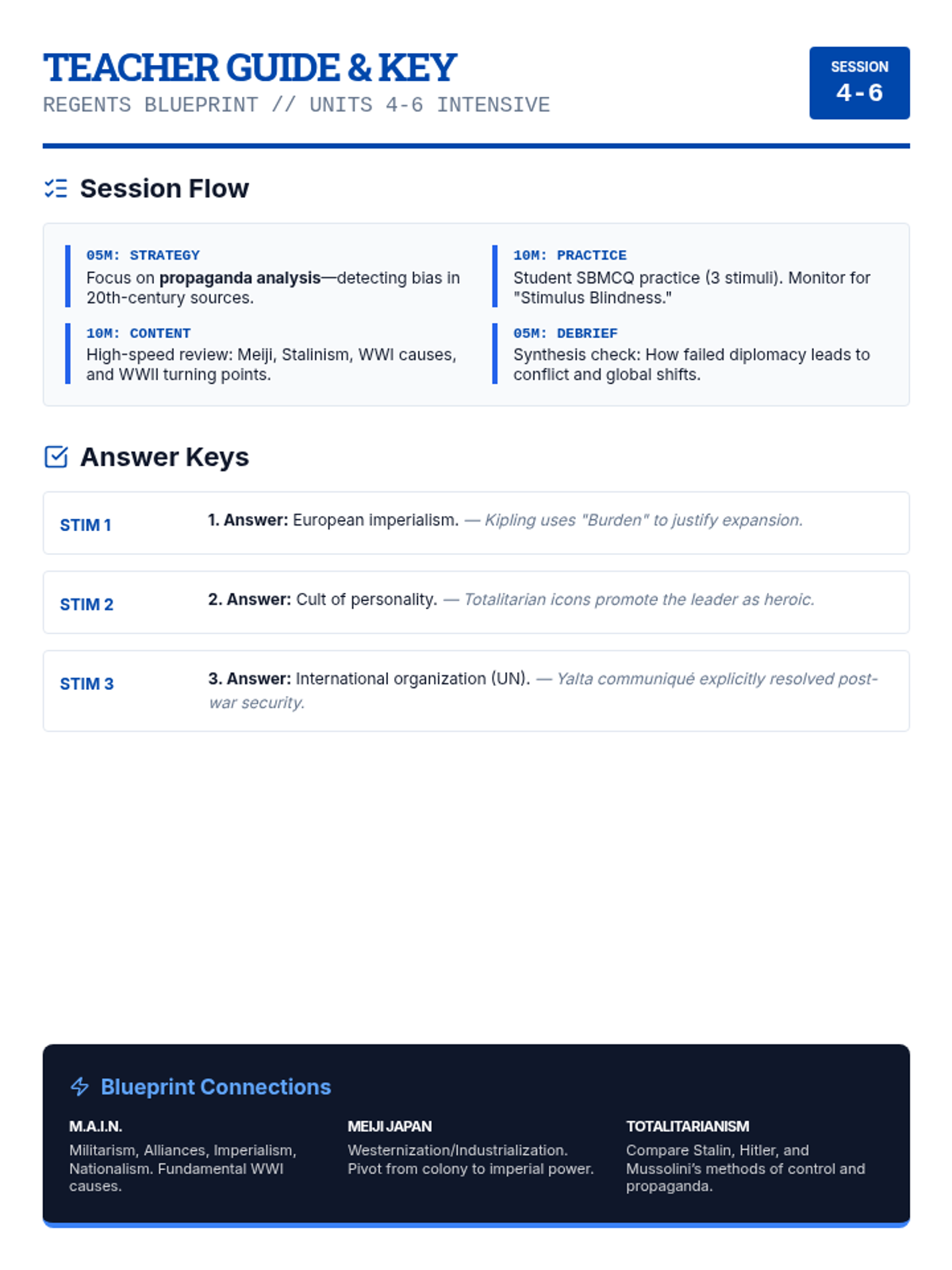
A comprehensive teacher guide for the 30-minute Regents prep session for Units 4-6, including a pacing guide and answer key with rationales.
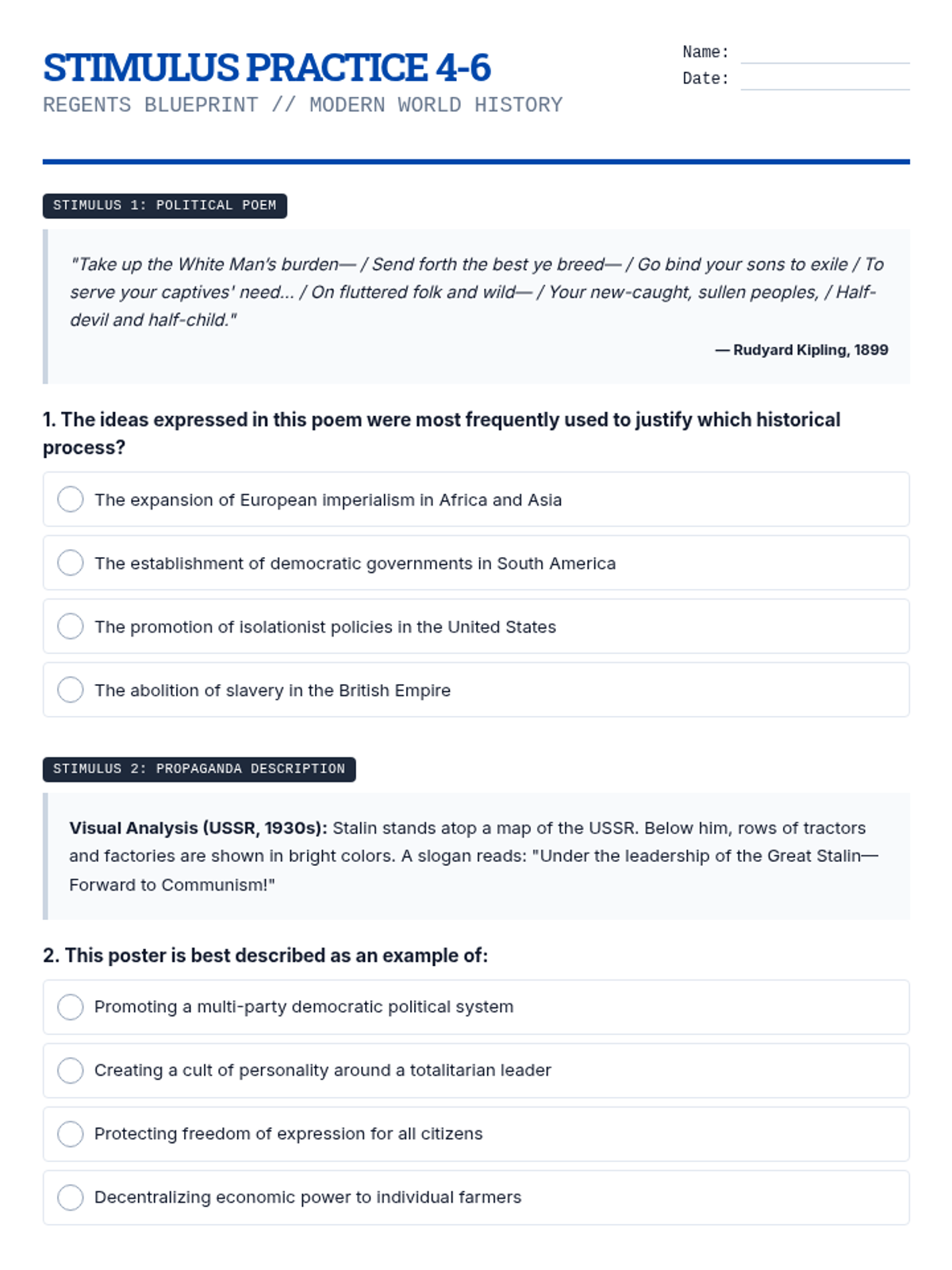
A printable student practice sheet featuring stimulus-based multiple choice questions for Units 4-6. Designed with a clean technical aesthetic and clear student work areas.
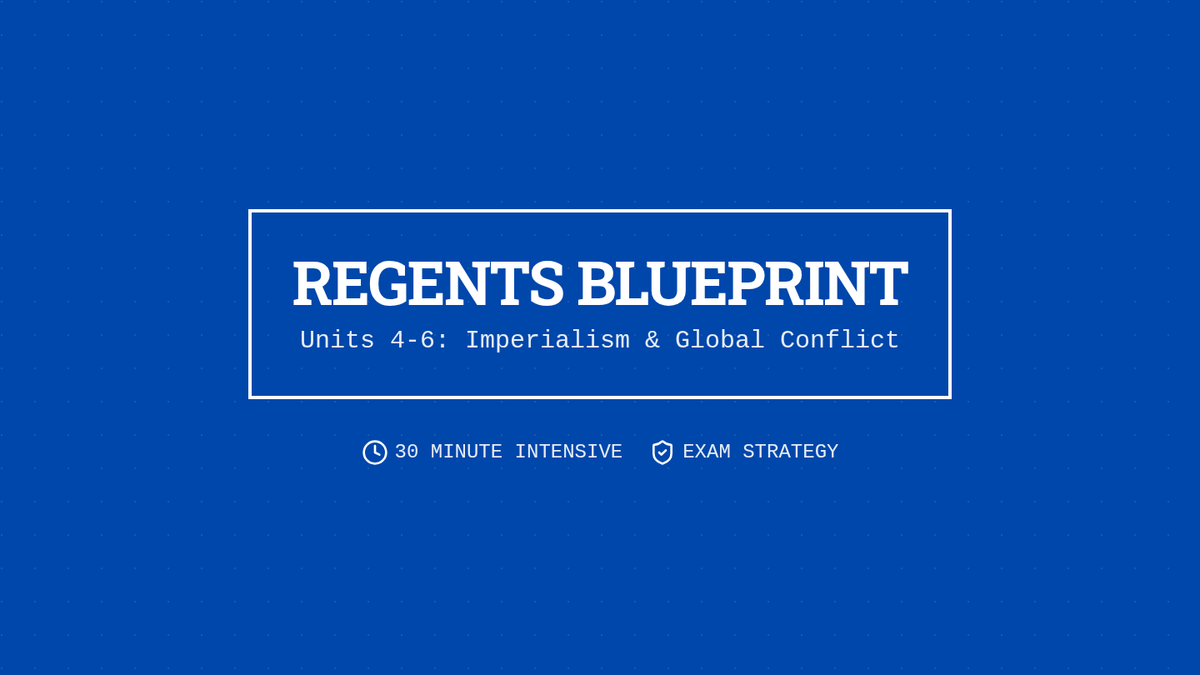
A high-energy 30-minute slide deck for Regents review, focusing on test-taking strategies and key concepts for Units 4-6. Features a technical 'blueprint' aesthetic.
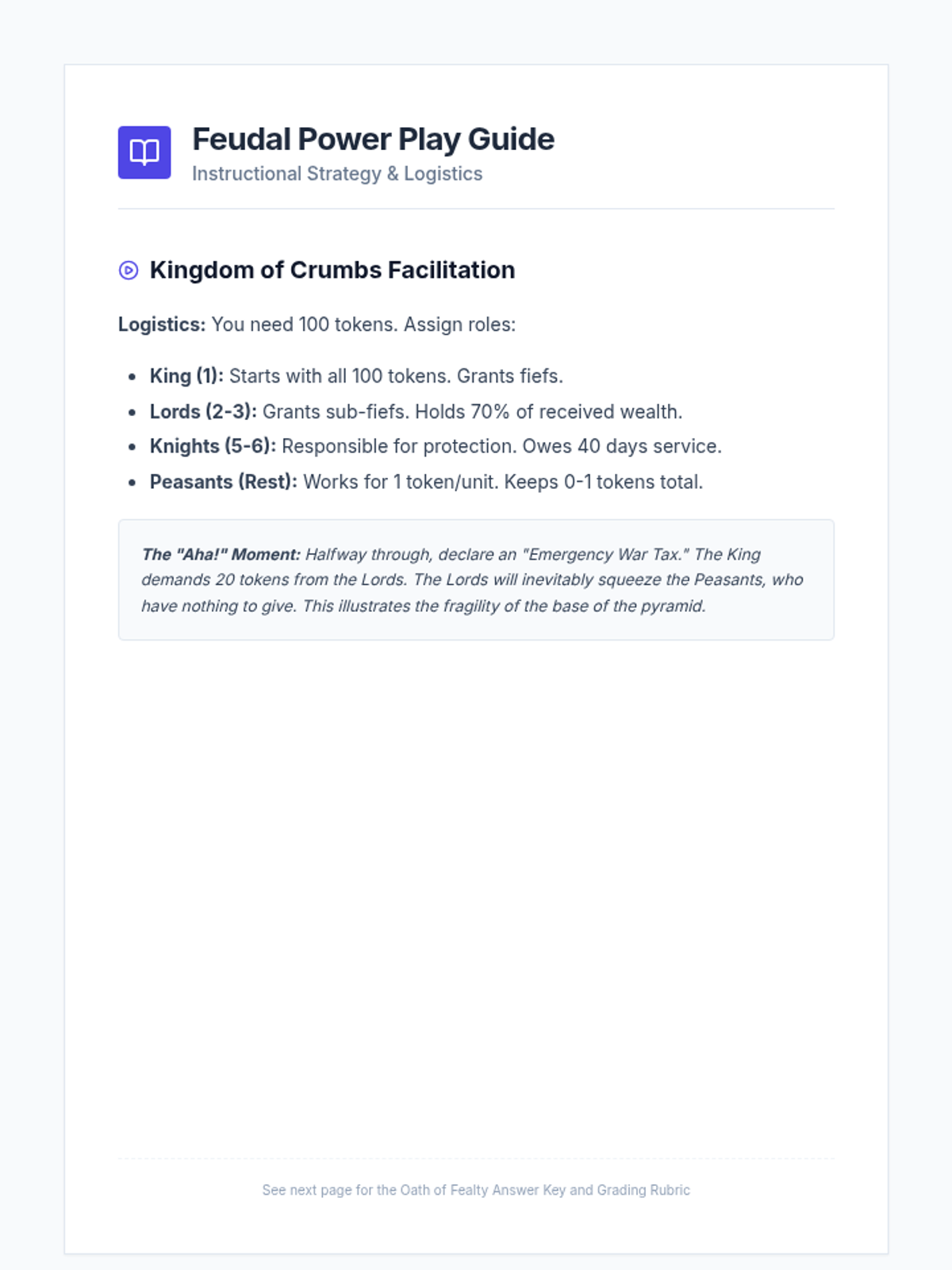
A comprehensive teacher guide for the Feudal Power Play lesson, including simulation facilitation instructions, answer keys for primary source analysis, and a grading rubric for the student contracts.
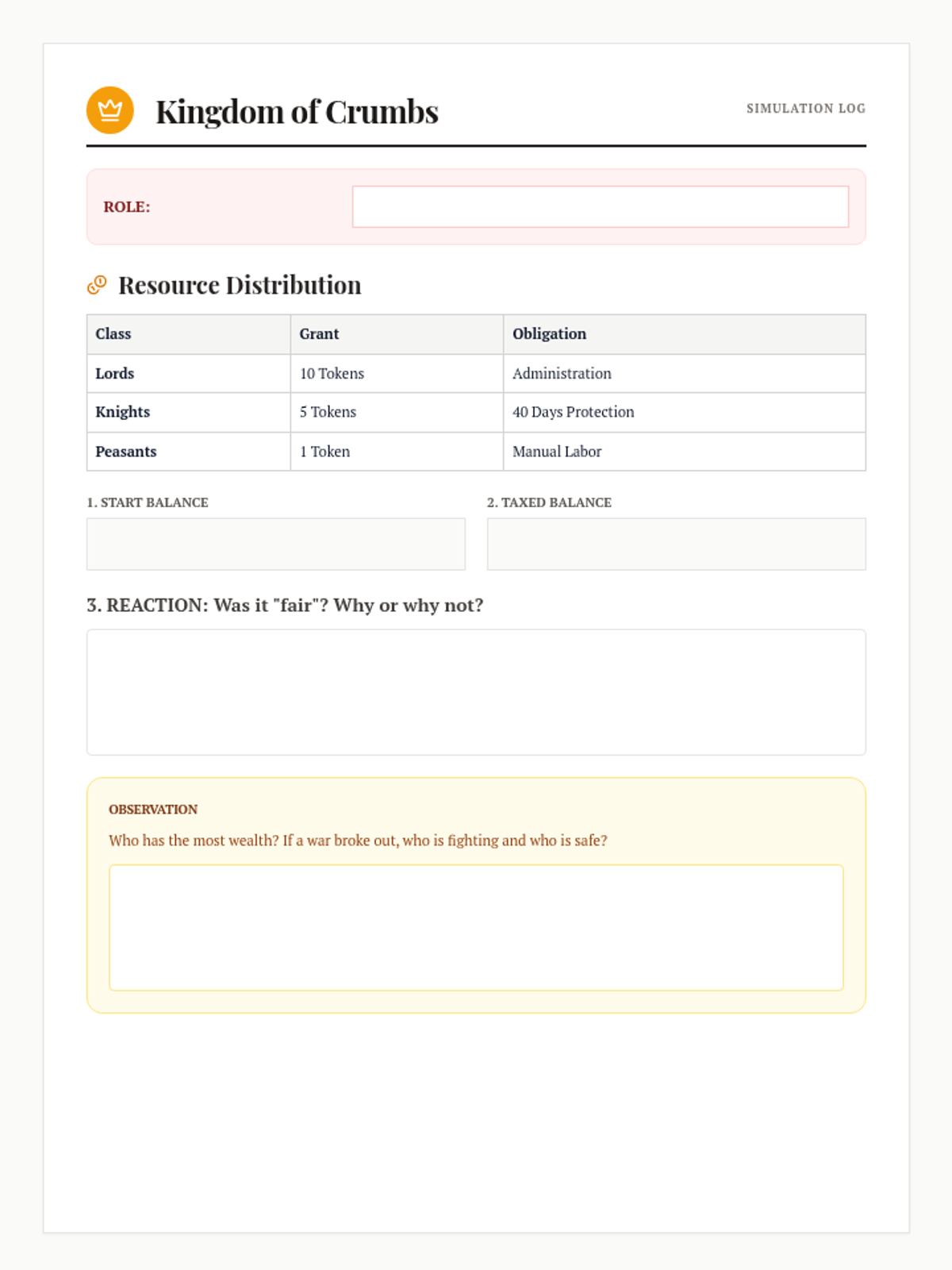
A student log and reflection guide for a classroom simulation where students assume roles in the feudal hierarchy and experience the flow of resources and obligations.
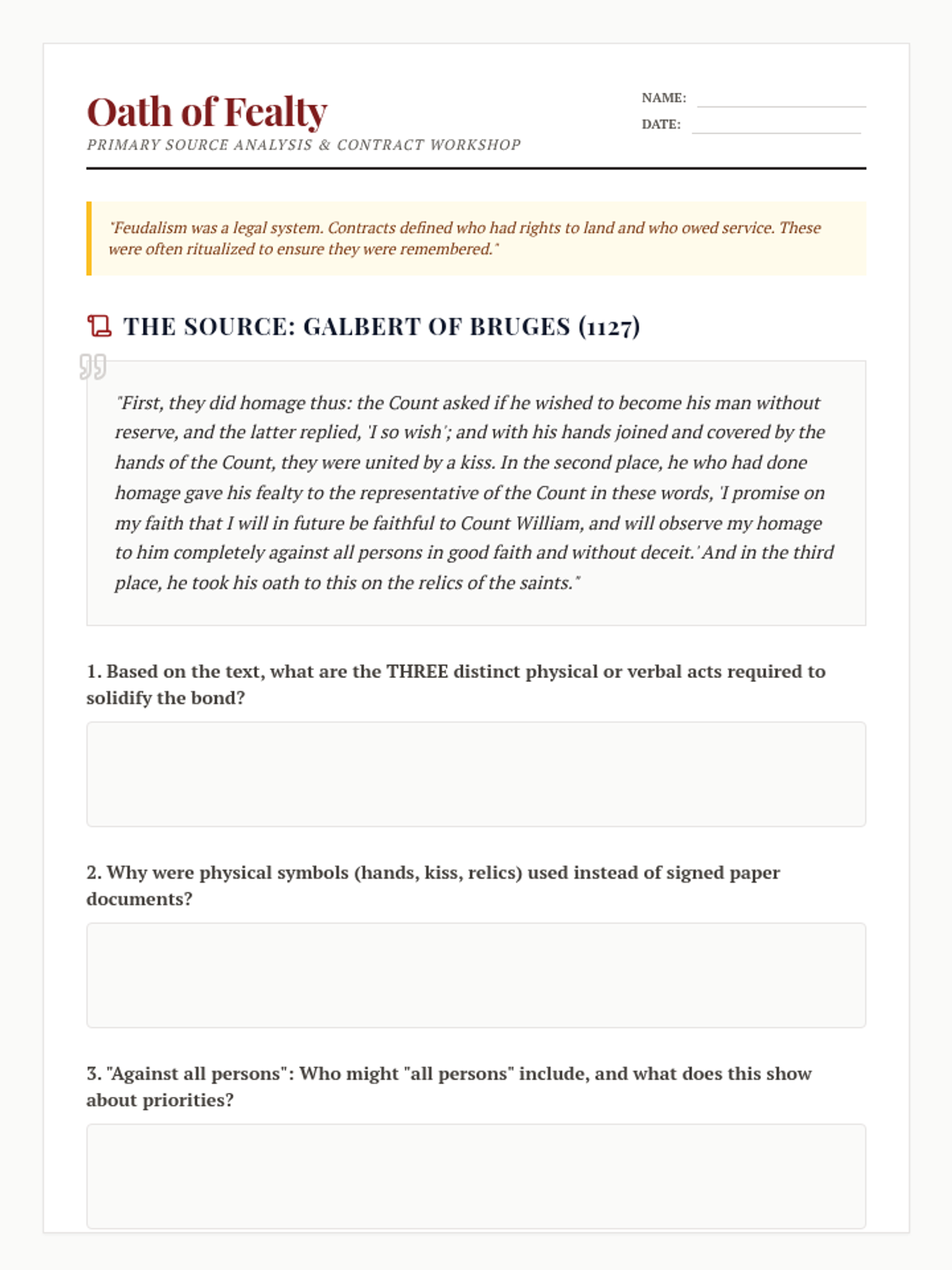
A two-page worksheet featuring a primary source analysis of an 1127 feudal oath and a creative 'Charter of Obligation' activity where students draft their own feudal contracts.
A visually rich slide deck for 10th-grade students exploring the social, economic, and political structures of Feudalism and the Manorial System. Focuses on reciprocal obligations and the 'Three Orders' of medieval society.
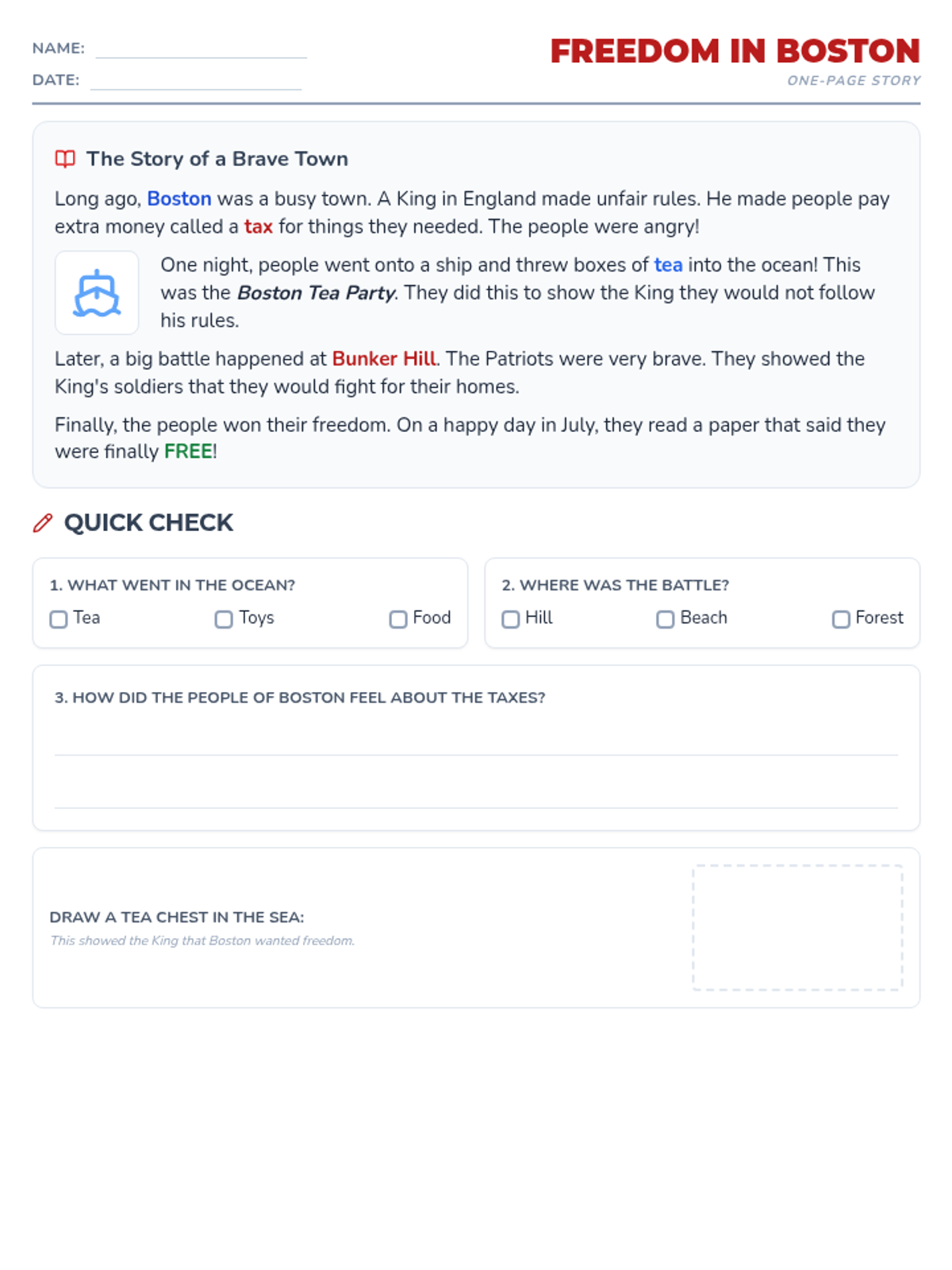
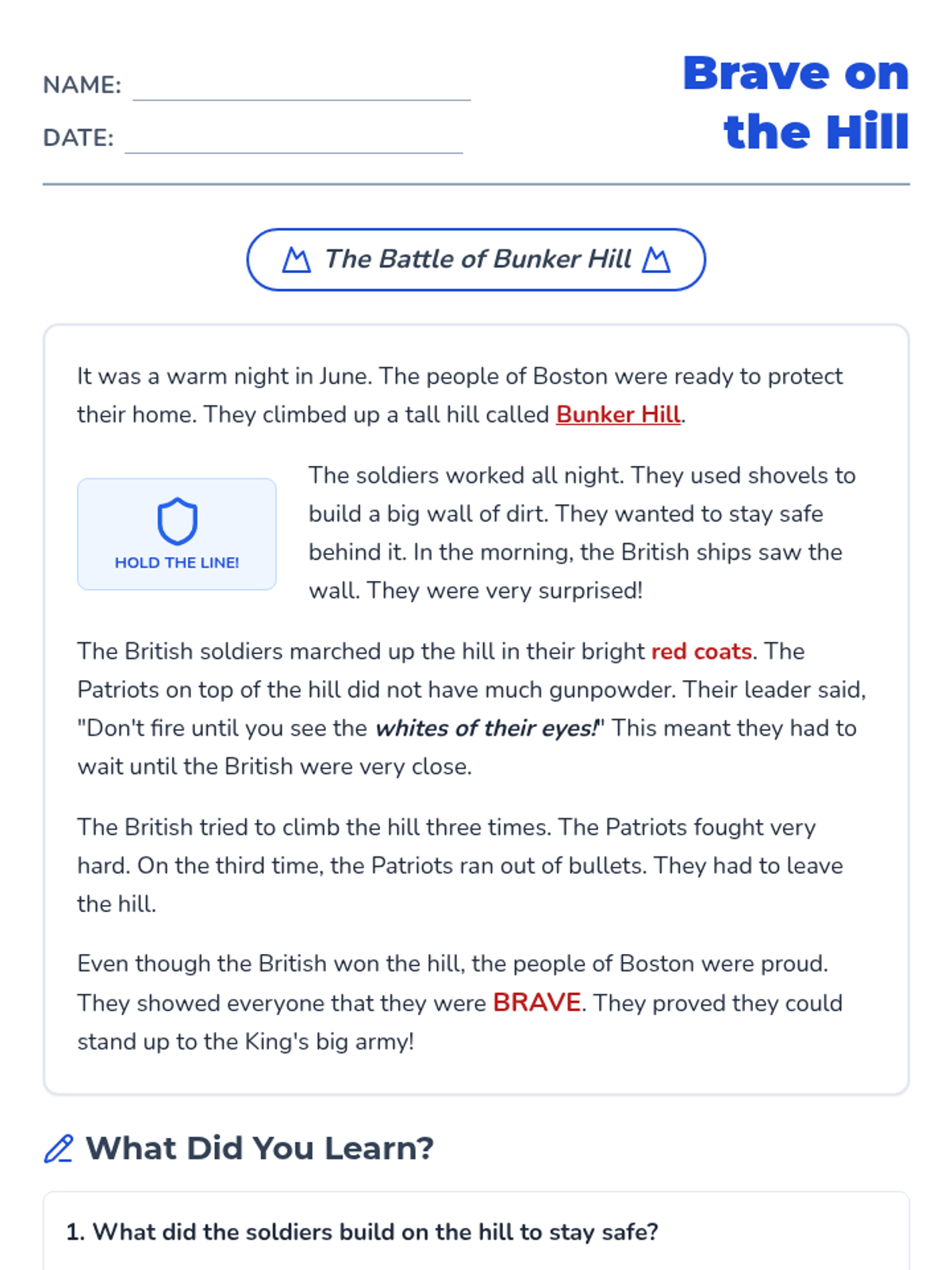
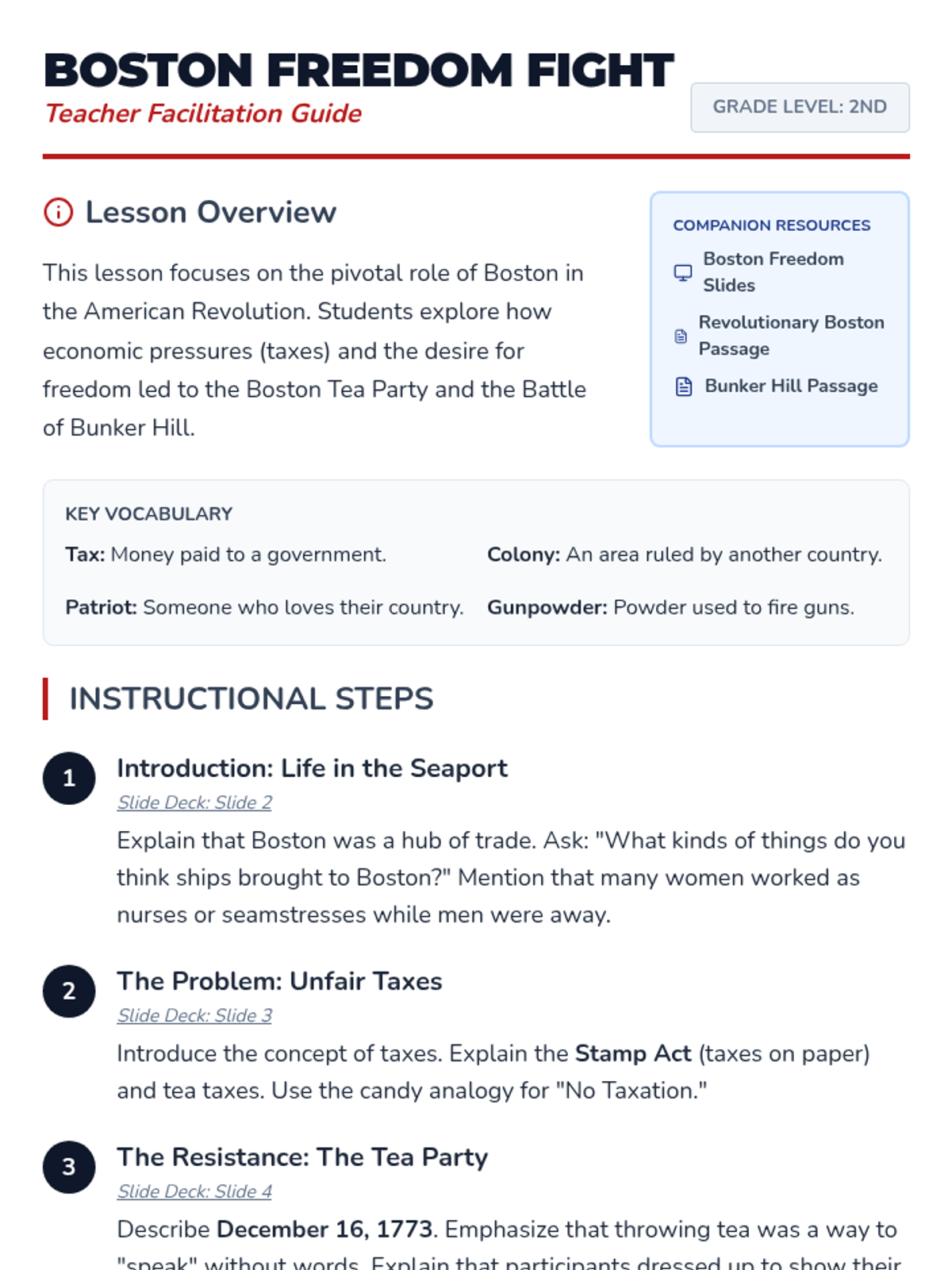
A single-page simplified reading passage about the American Revolution in Boston, covering the Tea Party and Bunker Hill with quick questions.
A simplified reading passage about the Battle of Bunker Hill, written at a 2nd-grade level with reading comprehension questions and a drawing area.
Instructional guide for teachers with background context, lesson steps, vocabulary, and an answer key for the student reading passages.
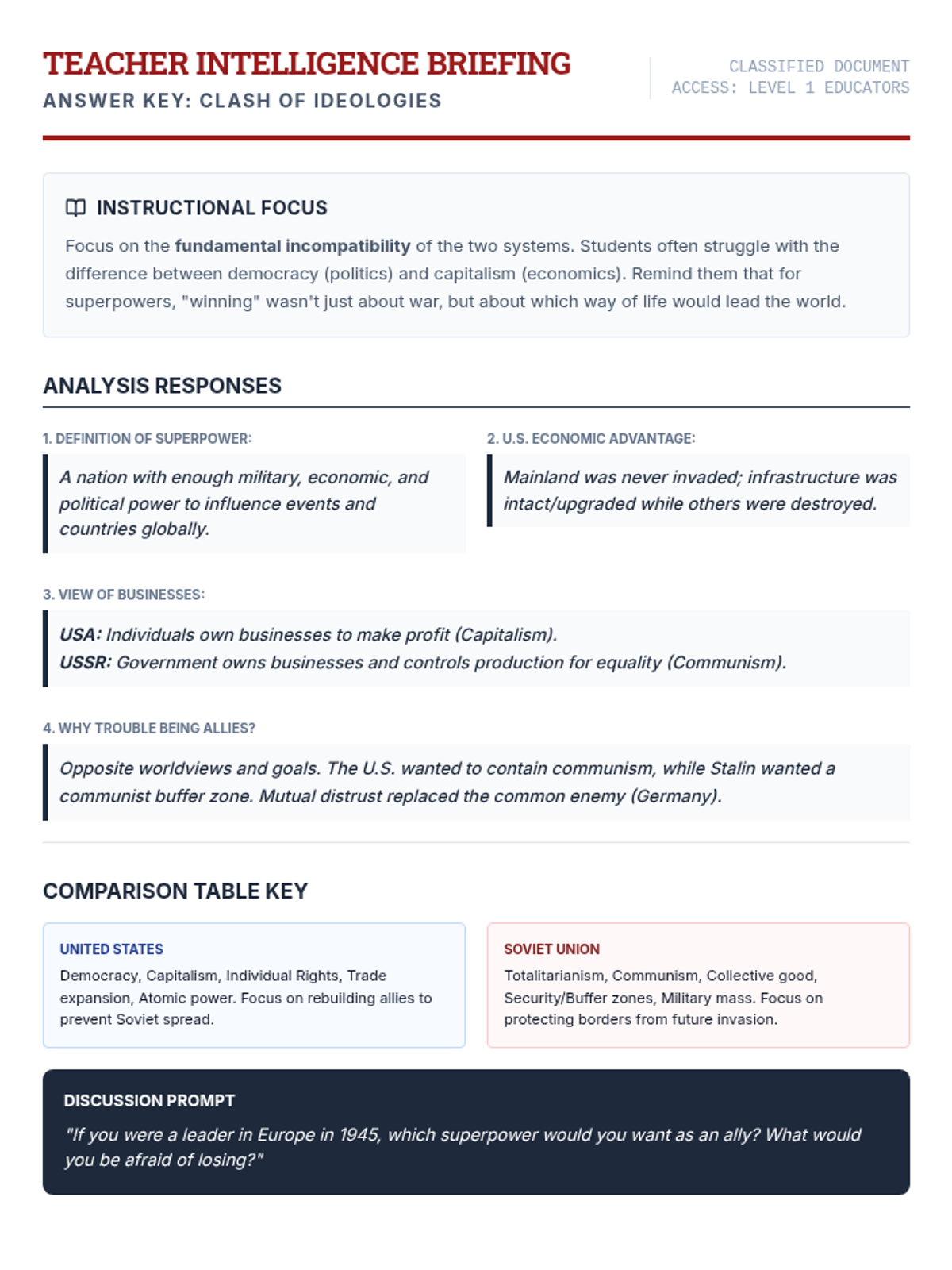
A teacher-facing answer key and instructional guide for the 'Clash of Ideologies' worksheet. It provides suggested answers, grading benchmarks, and pedagogical tips for explaining the complex geopolitical shift at the start of the Cold War.
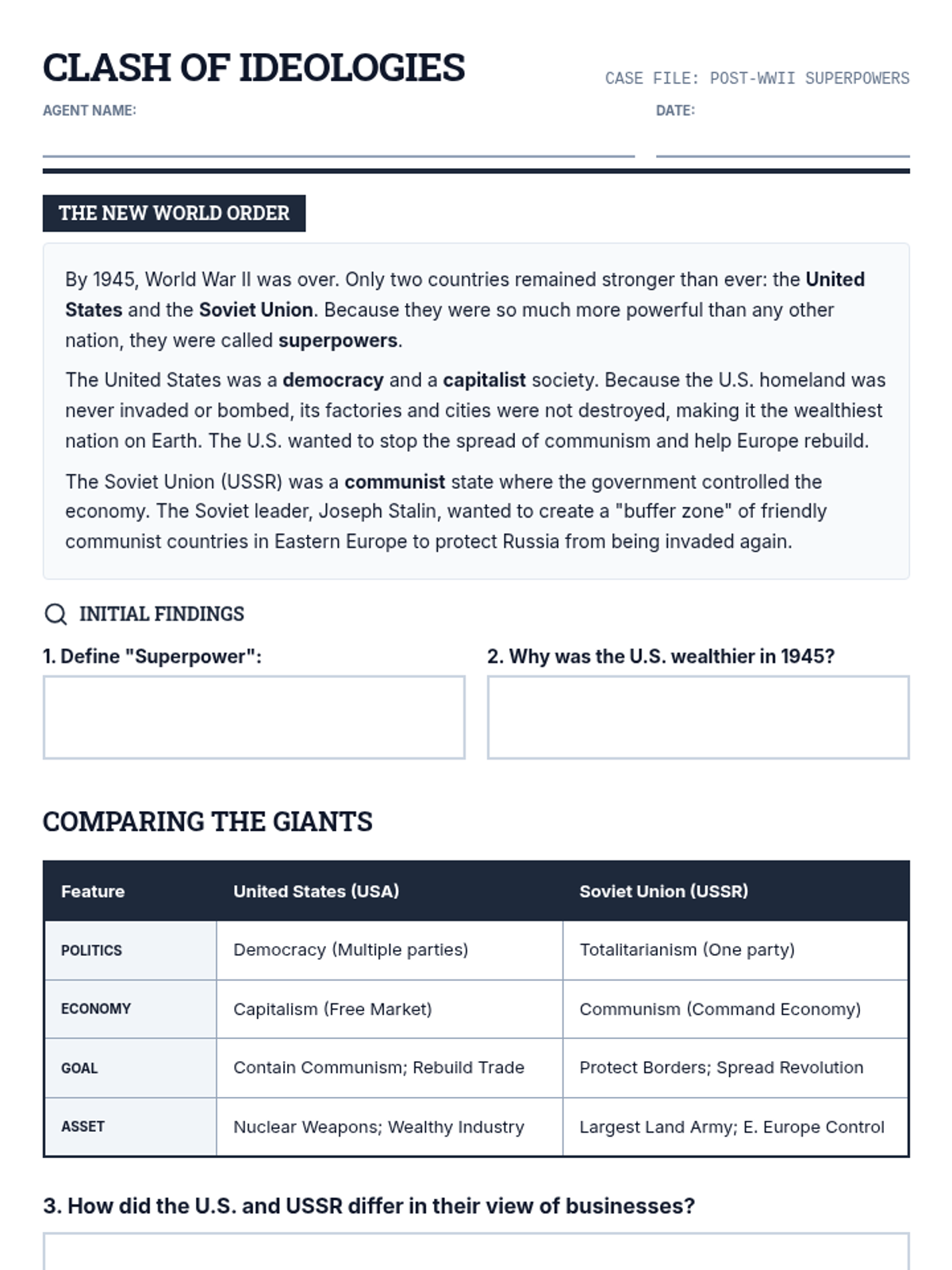
A comprehensive student worksheet for 7.5 grade level covering the emergence of the US and USSR as superpowers. It includes a reading passage, a detailed comparison table, analysis questions, and a creative drawing task to reinforce the concept of the 'Iron Curtain'. Designed with accessibility and high legibility in mind.
A visual slide presentation designed for middle school history classes, illustrating the fundamental ideological and political differences between the US and USSR after World War II. It uses clear, high-contrast layouts to introduce the concept of 'superpowers' and the 'Iron Curtain'.