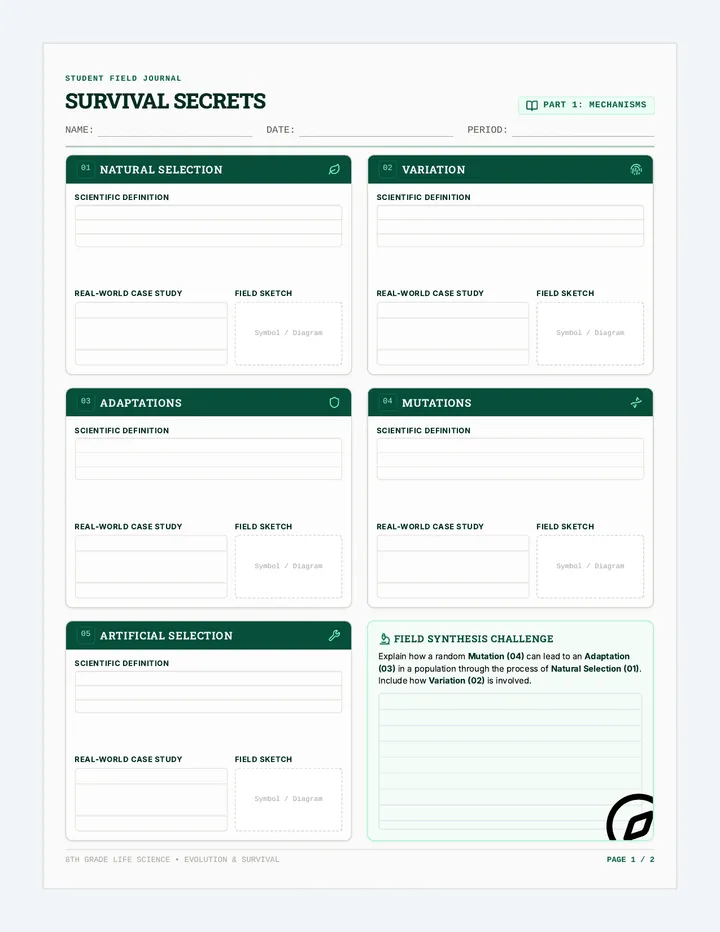
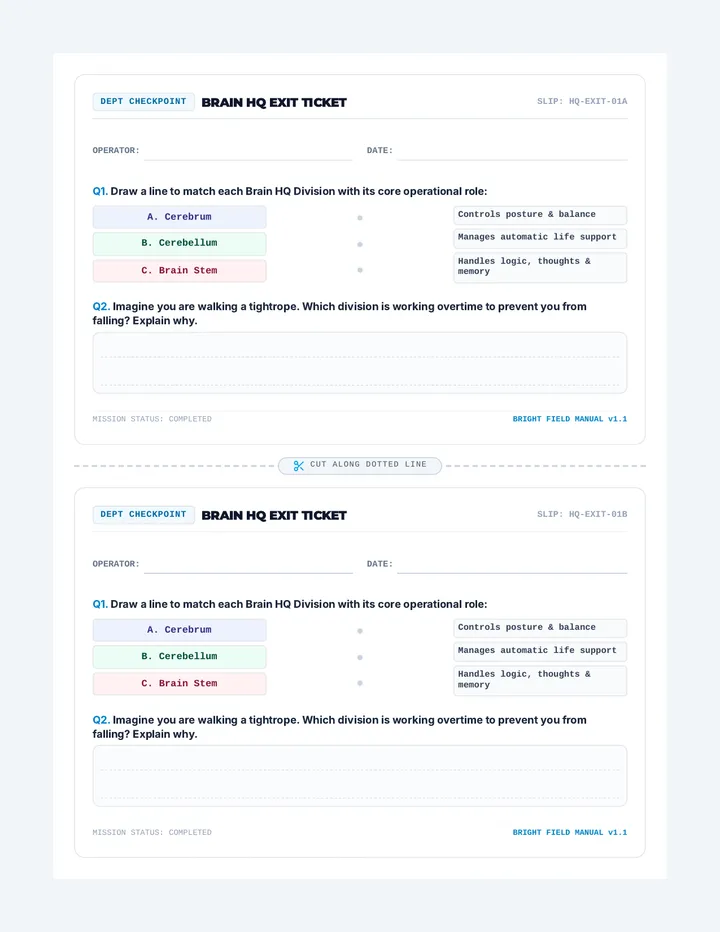
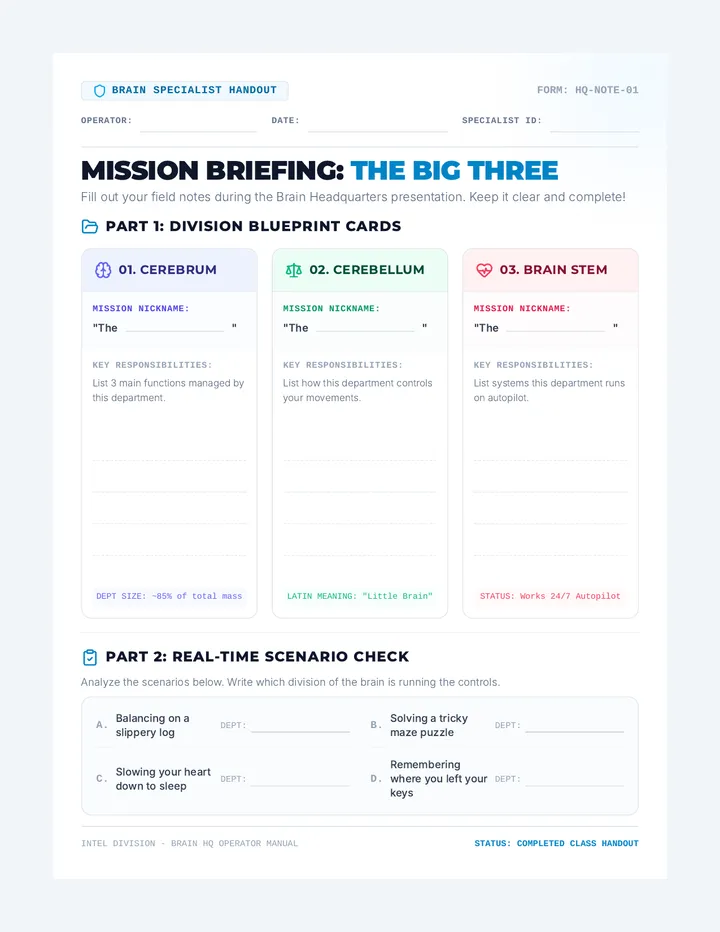
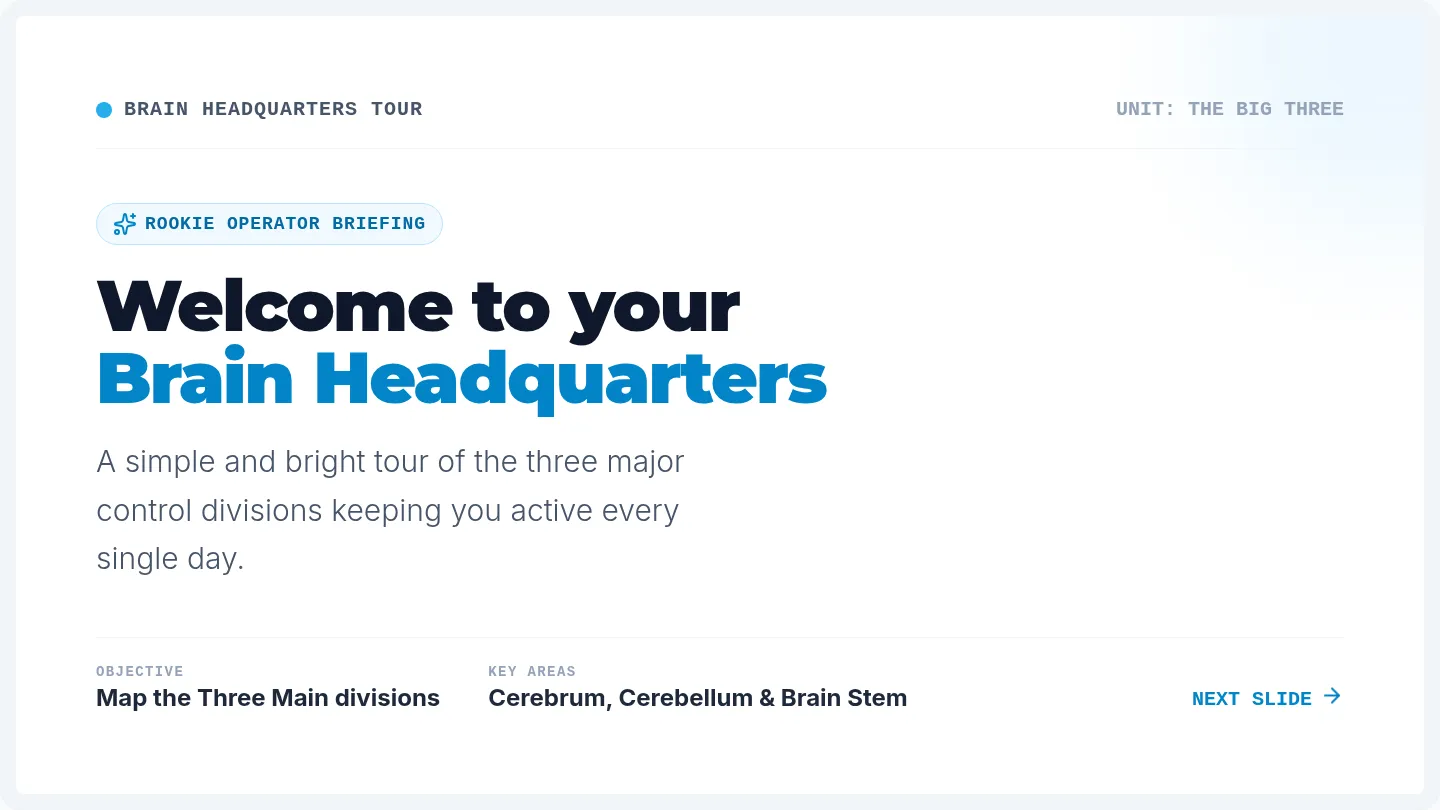
A mathematical practice sheet for heat calculations using the Q=mcΔT equation, featuring problems on warming water, specific heat of metals, and identifying mystery materials.
A comprehensive teacher facilitation guide for Operation Earth. Includes a mission timeline for document deployment, specific support strategies for bilingual/ELL students, inquiry prompts, and presentation ideas. Simplified language is used for easy educator reference.
A simplified tactical worksheet to help students narrow their research focus. Uses simple language like 'Where?', 'Who?', and 'Why?' to guide bilingual students through picking a specific research target. Light backgrounds are used in all work areas for handwriting legibility.
A mission-themed brainstorming worksheet for Operation Earth with simplified language for bilingual students. Scaffolds inquiry from basic facts to 'hard' questions using a question ladder and a central mind map.
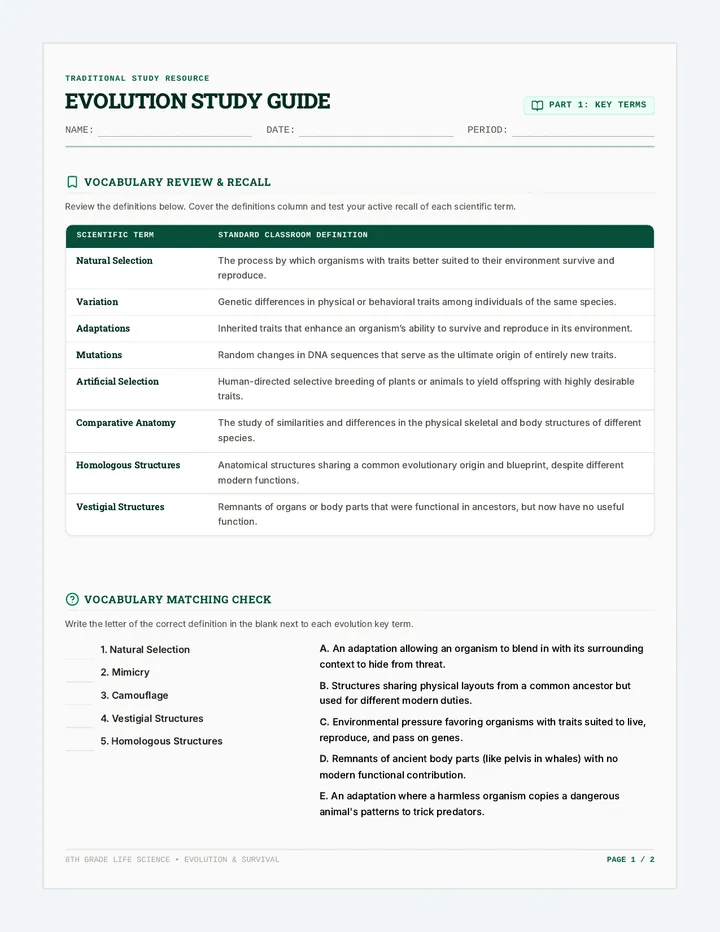
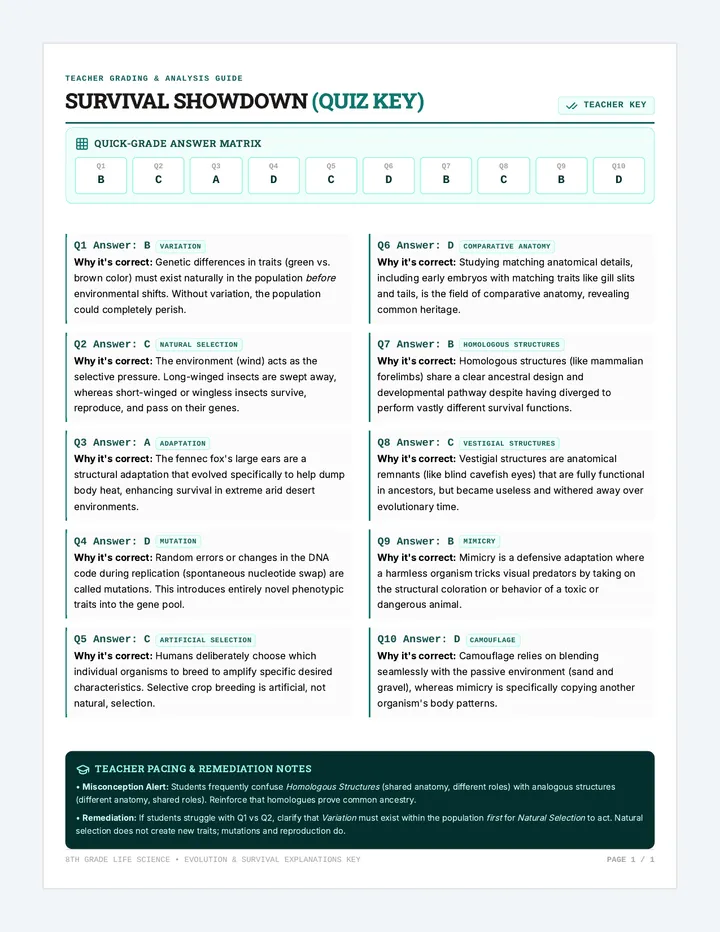
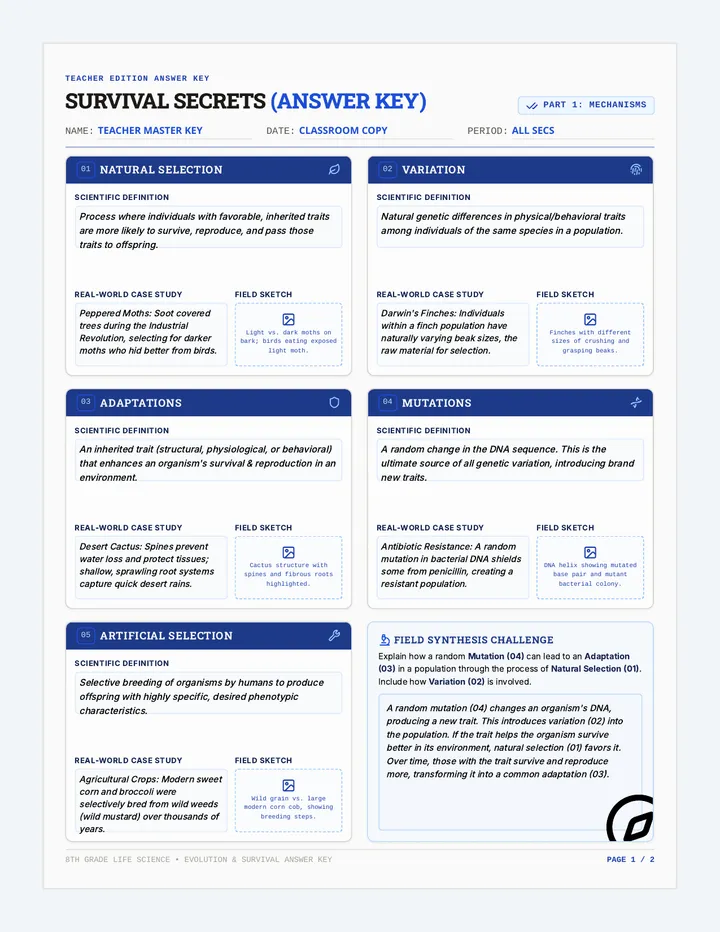
A teacher guide containing the answer keys for the worksheet and task cards, along with instructional tips and scaffolding strategies for teaching symbiotic relationships.
A graphic organizer featuring a relationship matrix for definitions and symbols, and a visualization tool for mapping specific symbiotic interactions. Includes writing lines and word bank support.
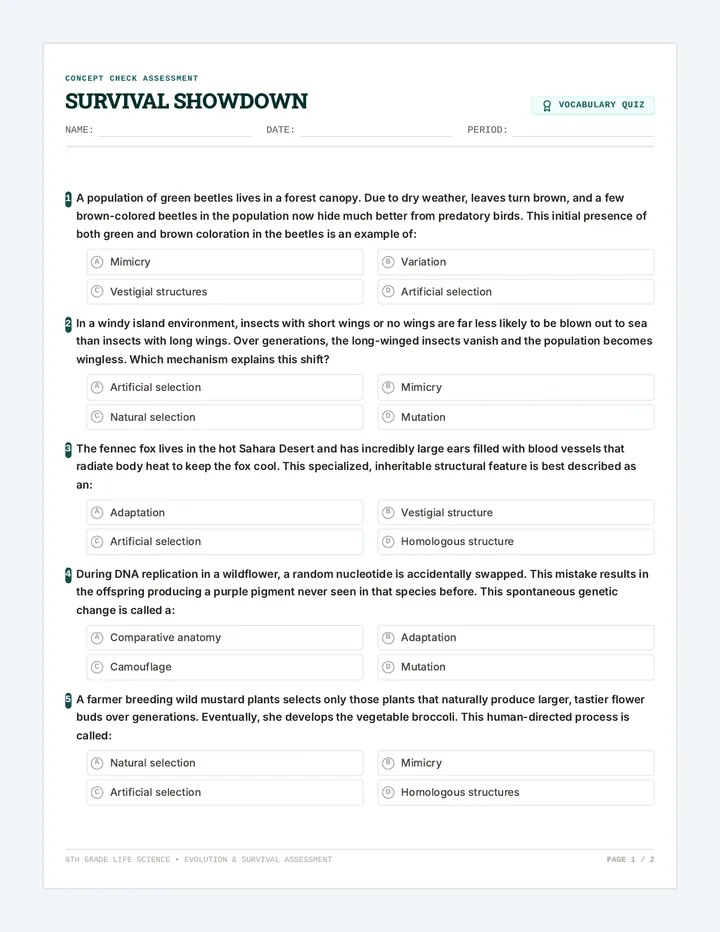
Eight task cards featuring unique animal and plant interaction scenarios. Students must classify each as mutualism, commensalism, or parasitism. Perfect for scavenger hunts or small group work. Polished for high-quality printing.
A two-page 'Field Report' worksheet where students identify and reason about symbiotic relationships using provided case studies. Includes a scaffolded word bank with definitions and clear horizontal writing lines within reasoning boxes for improved student response areas. consolidated to fit exactly two pages.
An introductory slide deck for the 'Wild Bonds' lesson, defining symbiosis and explaining mutualism, commensalism, and parasitism with clear visual cues and examples.
A participant handout for Lesson 2 (Decomposition) with a Rally Coach section for low-lift tasks, a Professional Blueprint for classroom application, and a reflective Coach's Corner connecting early exposure to long-term CS success.
A 5-slide presentation for Lesson 2 (Decomposition) featuring the Allison Cuttler quote, the video intro, Rally Coach instructions, and professional application examples across storytelling, standards, and math.
Updated facilitation guide for Lesson 2 (Decomposition), featuring quotes from Krauss & Prottsman and Allison Cuttler, a Rally Coach instructional strategy, and cross-curricular connections from literacy to industrial tech.
A research primer for students explaining the mechanics of bioaccumulation and biomagnification, providing inquiry questions and scientific vocabulary to support their lab report research.
A formal grading rubric for teachers to assess the Plastic-Free Project lab report, focusing on research depth, challenge integrity, and scientific writing standards.
A two-week tracking log for students to document their single-use plastic encounters, attempted alternatives, and difficulty levels as part of their Zero Waste Quest project.
A comprehensive project guide for the Zero Waste Quest, detailing the challenge rules, research requirements on bioaccumulation, and the specific structure for the final formal lab report.
A comprehensive teacher facilitation guide for Lesson 32, detailing the product vs. value hook, coaching strategies for the Value Proposition formula, and technical hierarchy audit points. Revised for high-contrast single-page layout.
A student drafting worksheet for Lesson 32 that guides students through writing multiple versions of a Value Proposition using the 'Action-Audience-Outcome' formula and testing it against the 'Grandma Test'. Revised for guaranteed single-page flow and improved writing space.
A high-impact slide presentation for Lesson 32 teaching the concept of Value Propositions, the 'Verb+Target+Outcome' formula, and text hierarchy for digital design. Revised for better heading spacing and improved text contrast.
A combined teacher facilitation guide for the Unit 3 Assessment phase. Includes technical audit checkpoints for spreadsheets, scaffolding for executive summaries, and a quick-look grading rubric. Revised for perfect page flow and clear heading spacing.
A student assembly checklist and reflection sheet for finalizing the Unit 3 Portfolio. Includes specific checks for spreadsheet cleanliness, branded chart accuracy, and professional PDF export. Revised for guaranteed single-page layout.
A combined teacher facilitation guide for the Unit 3 Assessment phase. Includes technical audit checkpoints for spreadsheets, scaffolding for executive summaries, and a quick-look grading rubric. Revised for single-page layout and fixed heading spacing.
A student assembly checklist and reflection sheet for finalizing the Unit 3 Portfolio. Includes specific checks for spreadsheet cleanliness, branded chart accuracy, and professional PDF export.
A formal Market Analysis Report template for students to synthesize their Unit 3 research. Includes sections for target audience profiling, data visualization placement, and a final executive summary.
A professional slide presentation for Lessons 30 and 31, covering the transition from raw data to a structured Market Analysis Report, document integration techniques, and final portfolio submission. Revised for better heading spacing and improved text contrast.
A student activity worksheet for Lesson 29 that guides students through creating a 6-month growth projection table, applying multiplication formulas, and analyzing revenue vs. profit. Revised for single-page layout and syntax accuracy.
A high-impact slide presentation for Lesson 29 teaching financial forecasting, multiplication formulas, and absolute referencing to 7th-grade marketing students. Revised with syntax corrections and improved contrast.
A comprehensive teacher guide for Lesson 29, detailing how to facilitate the 'Fortune Teller' hook, teaching absolute referencing logic with correct syntax, and assessing student financial growth projections.
A comprehensive teacher guide for Lesson 29, detailing how to facilitate the 'Fortune Teller' hook, teaching absolute referencing logic, and assessing student financial growth projections.
A student activity worksheet for Lesson 28 that guides students through creating Pie and Bar charts in Google Sheets, including branding customization and the 'Chart Logic' exit ticket. Revised for single-page layout and improved legibility.
A high-impact slide presentation for Lesson 28 teaching data visualization, featuring the '2-Second Rule' hook, an explanation of chart types (Pie vs. Bar), and branding customization for 7th-grade marketing students. Revised with hook visuals and improved typography.
A comprehensive teacher facilitation guide for Lesson 28, covering the '2-Second Rule' hook, chart selection instruction, and a technical assessment checklist for student charts.
A student activity worksheet for Lesson 28 that guides students through creating Pie and Bar charts in Google Sheets, including branding customization and the 'Chart Logic' exit ticket.
A high-impact slide presentation for Lesson 28 teaching data visualization, featuring the '2-Second Rule' hook, an explanation of chart types (Pie vs. Bar), and branding customization for 7th-grade marketing students.
A dynamic slide presentation for Lesson 27 focusing on data analysis skills in Google Sheets, including sorting, filtering, and conditional formatting to find market trends. Revised for better alignment and explicit marketing context for 7th graders.
A comprehensive teacher guide for Lessons 26 and 27, detailing the 'Human Calculator' demo, technical checkpoints for Google Sheets, and strategies for teaching market trend analysis. Re-structured for better page breaks and improved alignment.
A high-impact slide presentation for Lesson 26 teaching Google Sheets formulas, featuring the 'Human Calculator' hook, core functions (=SUM, =AVERAGE, =COUNT), and the efficiency of the fill handle. Final polish for alignment and visual clarity.
A student lab log for Lesson 27 that guides students through sorting, filtering, and conditional formatting tasks to identify market trends. Revised for better pencil legibility and single-page layout.
A student worksheet for Lesson 26 providing a formula cheat sheet, lab task instructions for survey analysis, and a budget table exercise. Revised for single-page layout and improved student work areas.
A comprehensive teacher guide for Lessons 26 and 27, detailing the 'Human Calculator' demo, technical checkpoints for Google Sheets, and strategies for teaching market trend analysis. Re-structured for better page breaks and clarity.
A high-impact slide presentation for Lesson 26 teaching Google Sheets formulas, featuring the 'Human Calculator' hook, core functions (=SUM, =AVERAGE, =COUNT), and the efficiency of the fill handle.
A student lab log for Lesson 27 that guides students through sorting, filtering, and conditional formatting tasks to identify market trends in their survey data.
A student worksheet for Lesson 26 providing a formula cheat sheet, lab task instructions for survey analysis, and a budget table exercise.
A comprehensive teacher guide for Lessons 26 and 27, detailing the 'Human Calculator' demo, technical checkpoints for Google Sheets, and strategies for teaching market trend analysis.
A dynamic slide presentation for Lesson 27 focusing on data analysis skills in Google Sheets, including sorting, filtering, and conditional formatting to find market trends.
Dynamic slides for Lesson 27, teaching students how to sort, filter, and apply conditional formatting to identify market segments. Includes the 'Needle Test' hook and visual logic demonstrations. Fixed tracking and contrast issues.
A professional student reference sheet for sorting, filtering, and identifying market trends. Includes visual examples of conditional formatting and a step-by-step segment search guide. Fixed exit ticket placeholder.
Detailed teacher guide for Lesson 27, teaching students how to sort, filter, and apply conditional formatting to survey data to identify market trends.