A visually engaging anchor chart defining harmonic motion and the restoring force, featuring examples and non-examples with a lab-blueprint aesthetic.
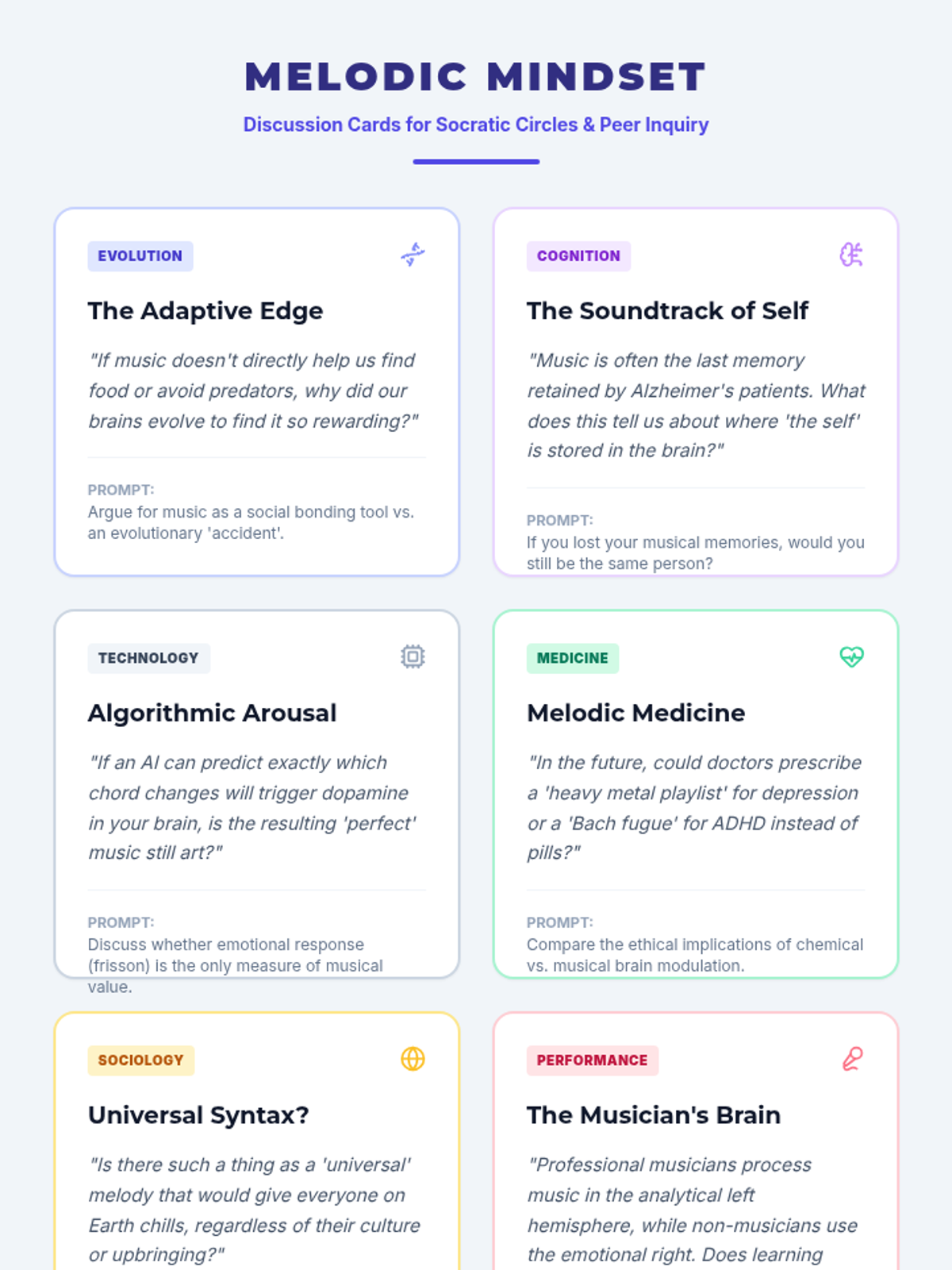
A set of six creative discussion cards for 'The Musical Brain' lesson, featuring thought-provoking prompts on evolution, technology, medicine, and culture, designed for high school Socratic seminars.
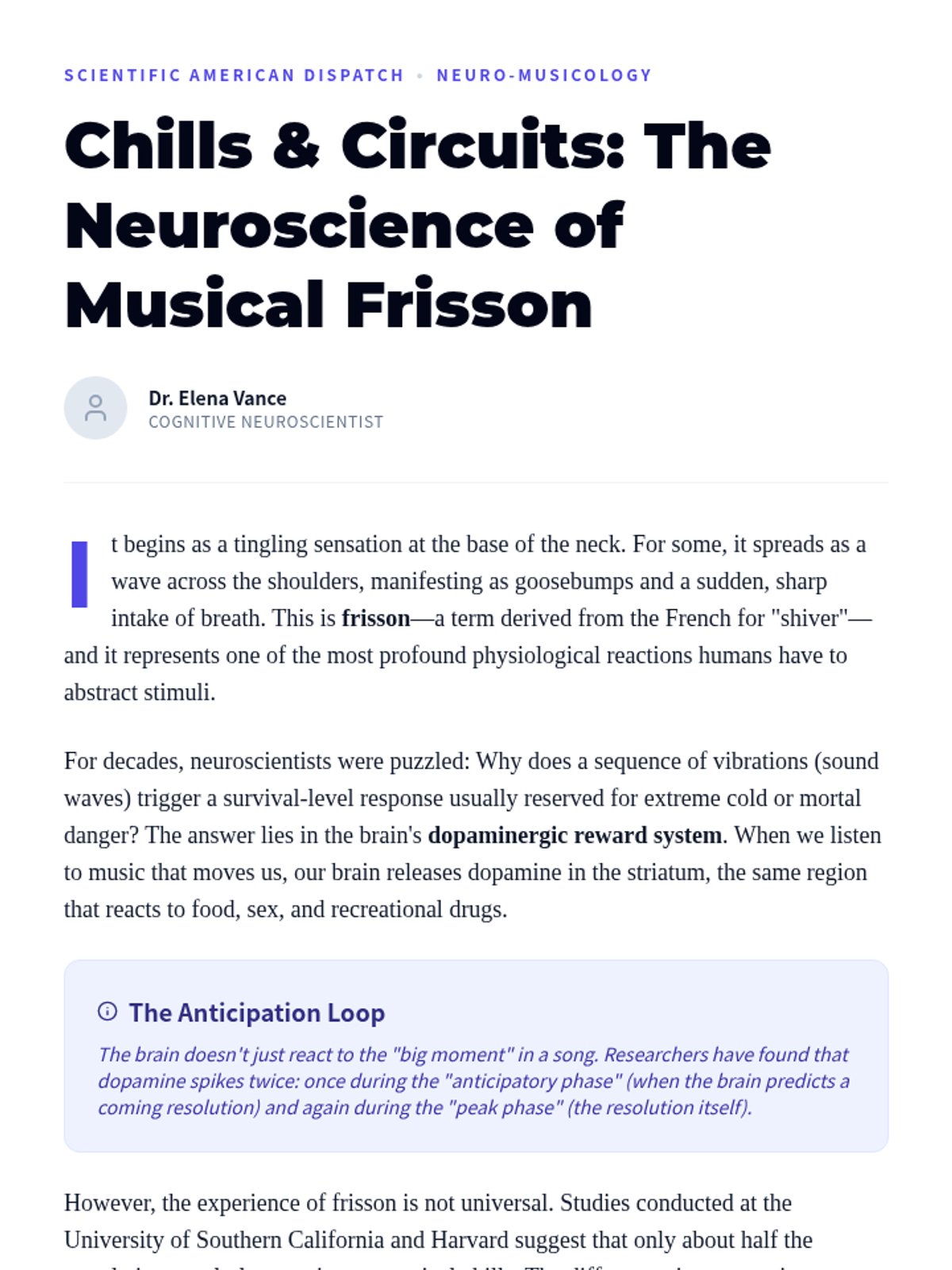
A sophisticated reading passage for high school students exploring the 'frisson' effect, the dopaminergic reward system, and the white matter pathways connecting the auditory cortex to the emotional brain.
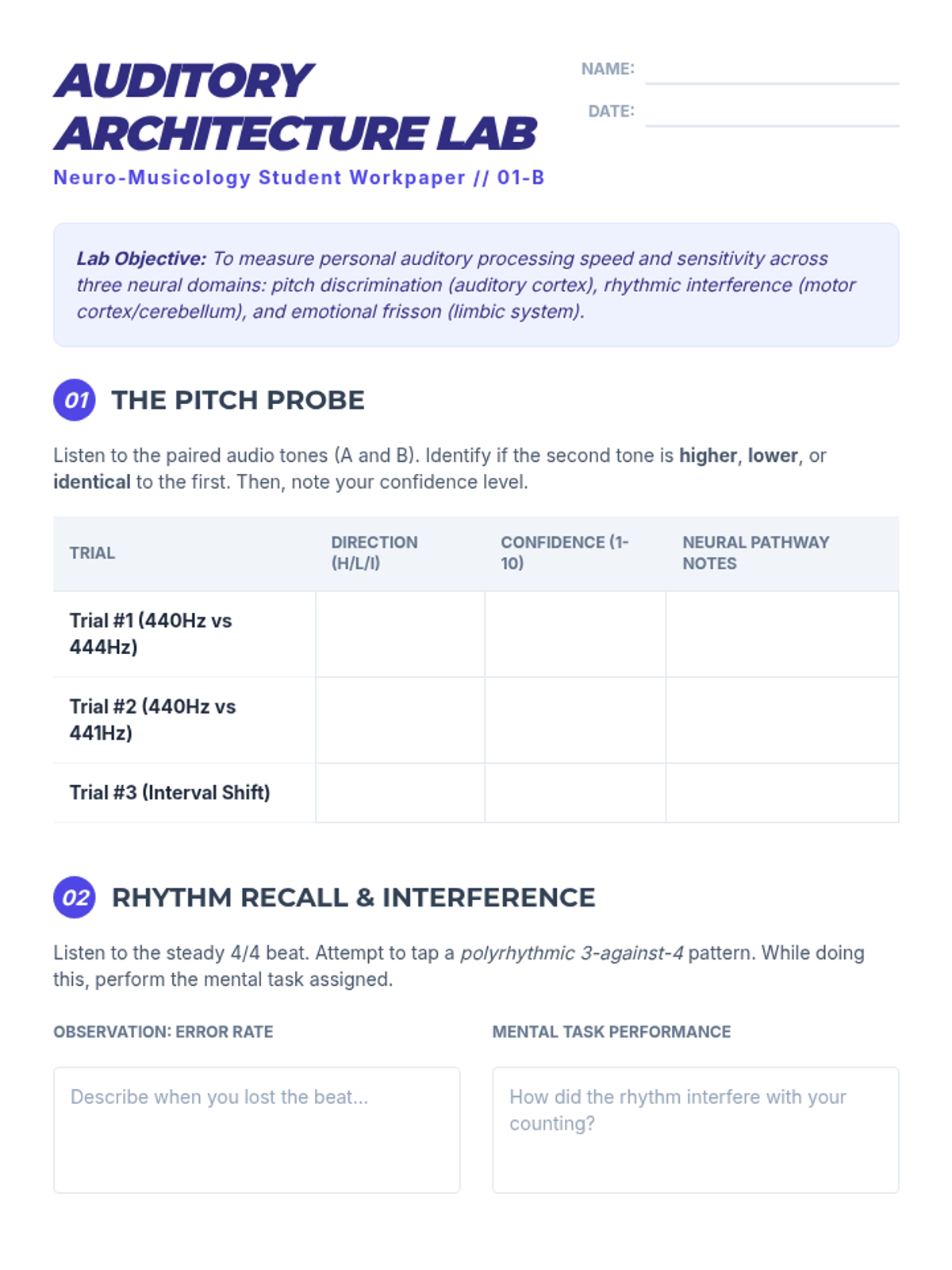
A student-facing lab worksheet designed for grades 9-12. It includes structured sections for pitch discrimination tests, rhythmic interference experiments, and an emotional frisson log, followed by scientific analysis questions.
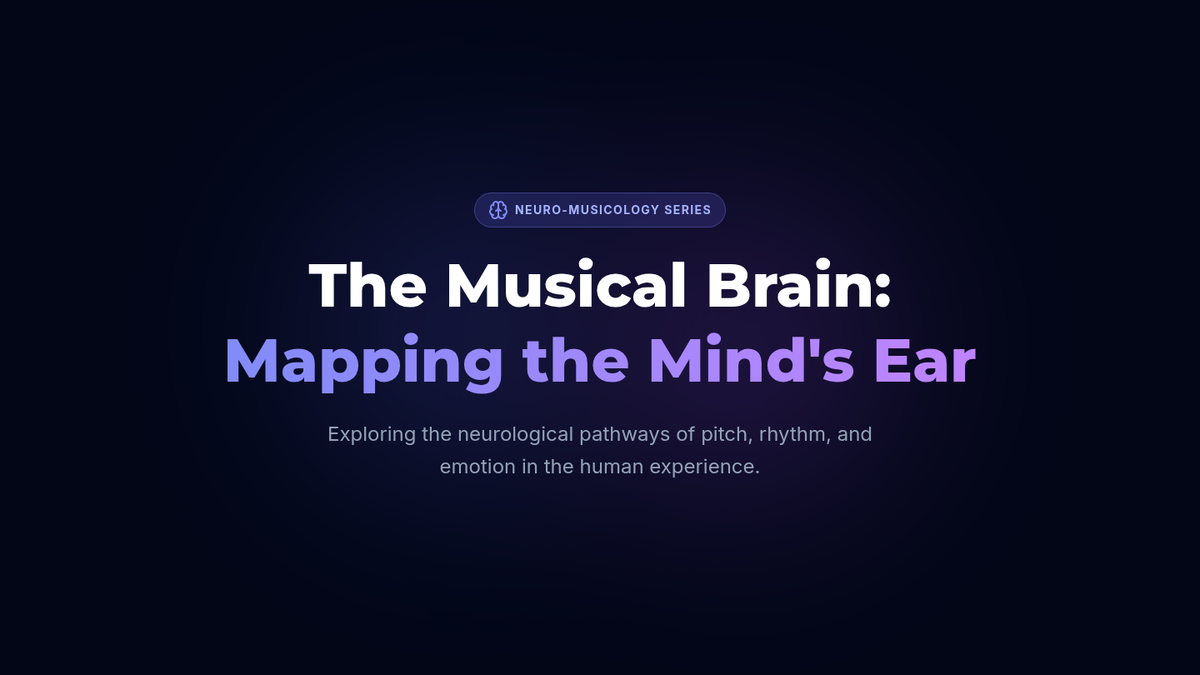
A visually striking slide deck for 'The Musical Brain' lesson. It covers neuroanatomy, the 'frisson' effect, the difference between pitch and rhythm processing, and the link between music and memory, designed with a sophisticated dark neural theme.
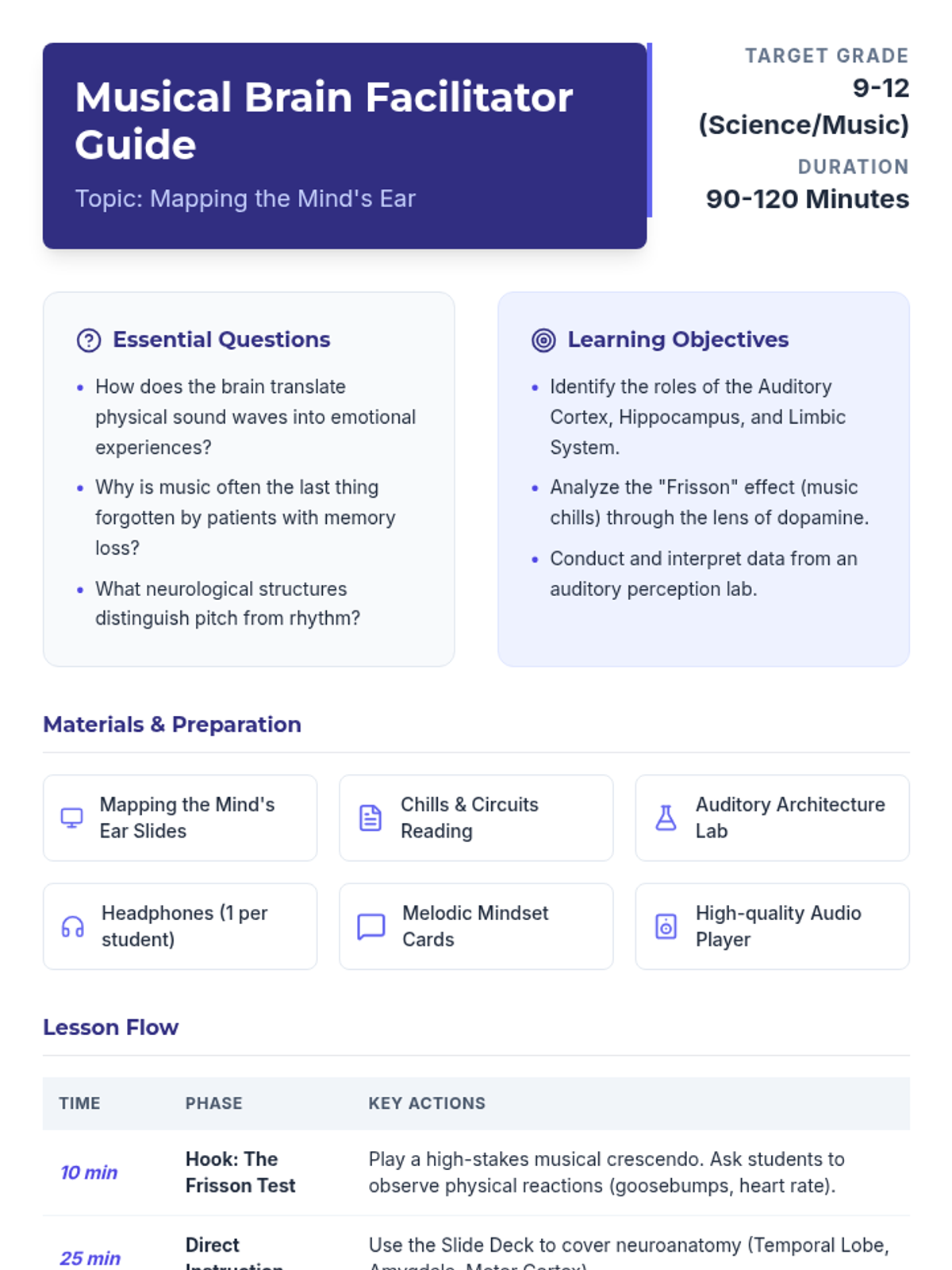
A comprehensive facilitator guide for high school teachers, providing a detailed roadmap for 'The Musical Brain' lesson. It includes essential questions, learning objectives, a timed lesson flow, and specific instructional tips for neuro-musicology instruction.
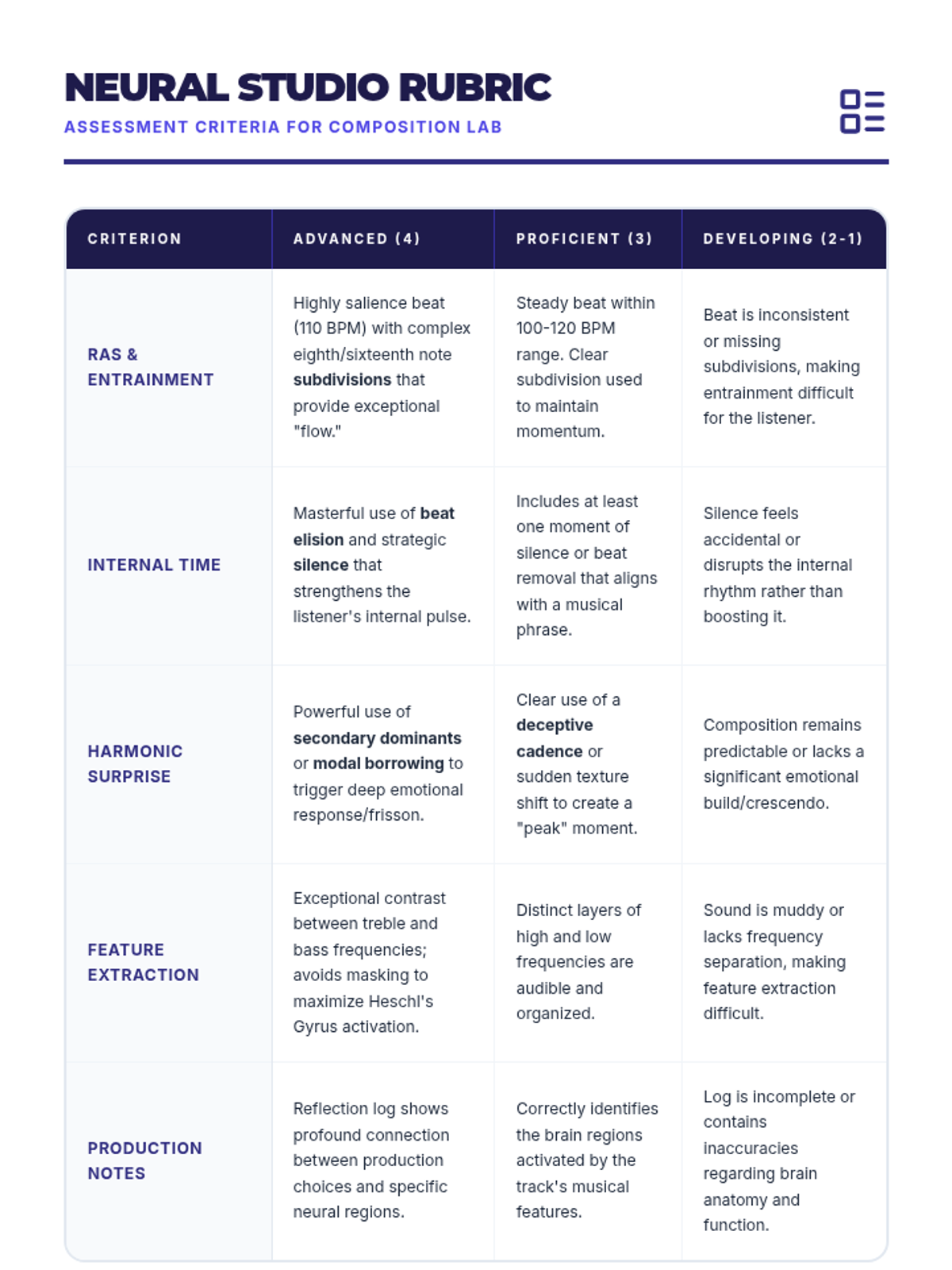
A teacher-facing rubric for assessing the Neural Studio Soundtrap project, covering criteria such as rhythmic entrainment, harmonic surprise, and scientific reflection.
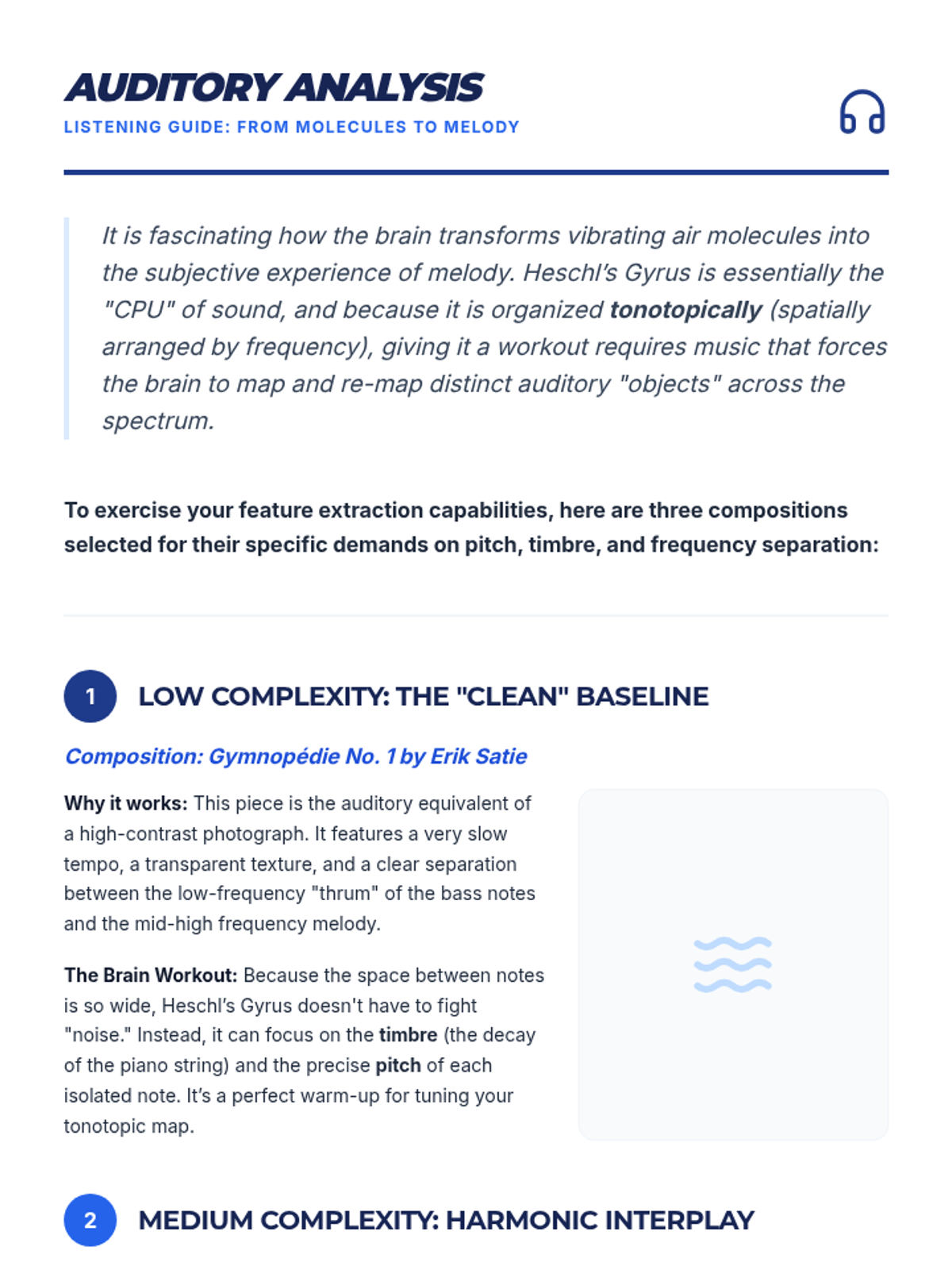
A detailed listening guide for students that analyzes three specific musical compositions (Satie, Bach, and Stravinsky) through the lens of auditory neuroscience and feature extraction.
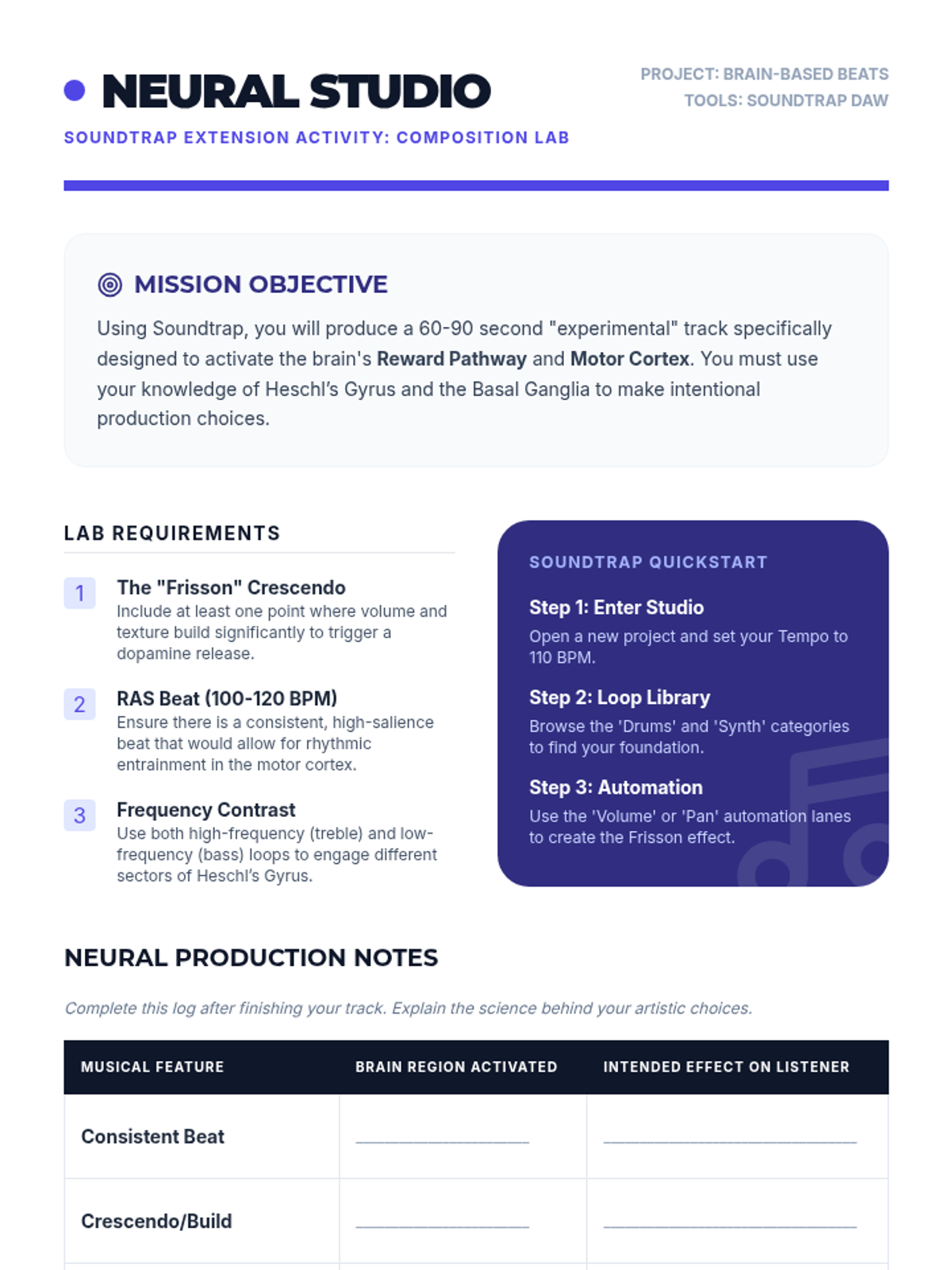
A student-facing extension activity for composing an experimental song in Soundtrap, requiring students to apply neuroscience concepts like entrainment and frisson to their musical production.
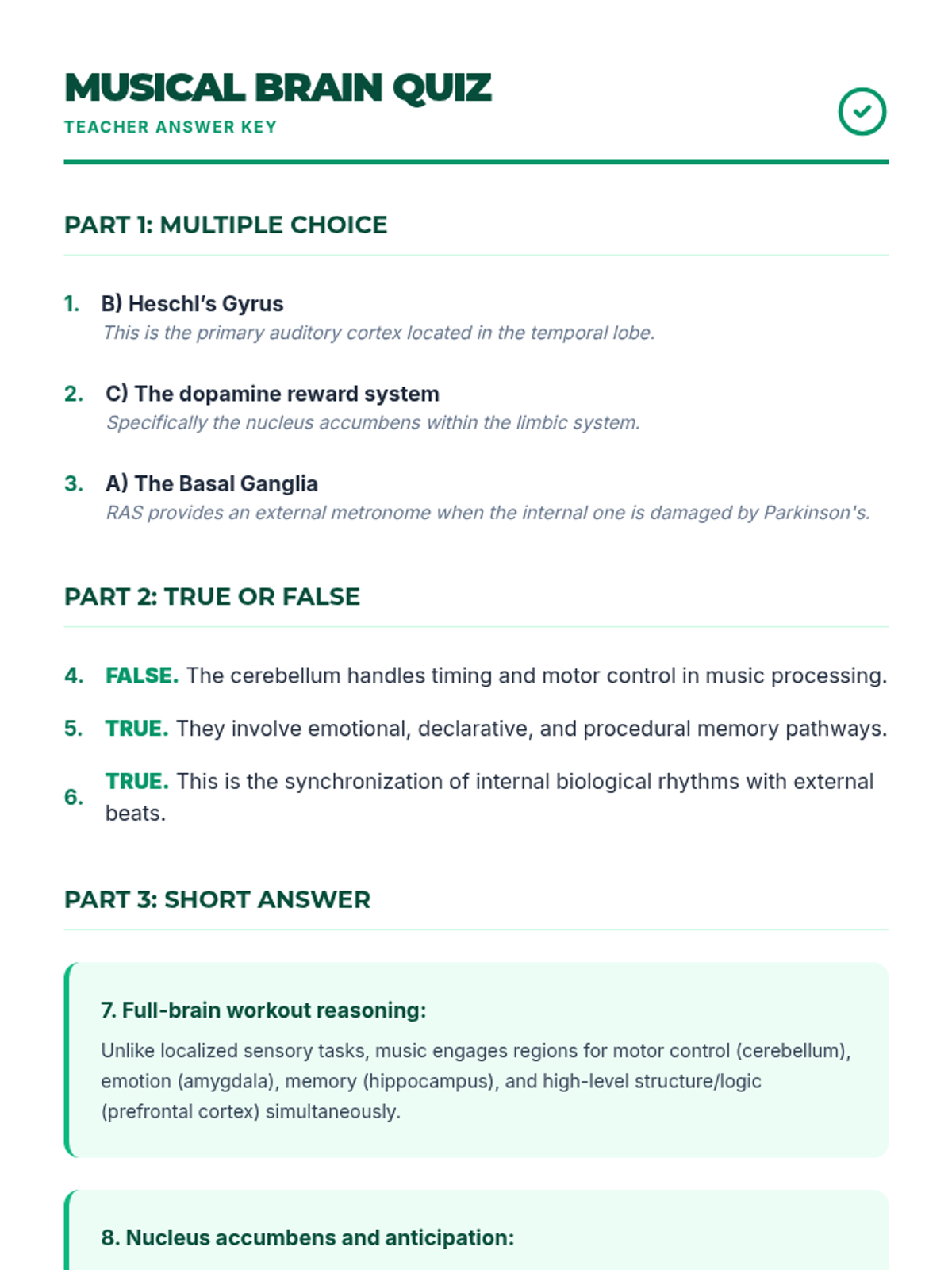
The teacher answer key for the Musical Brain Quiz, including explanations for neural mechanisms and sample short-answer responses.
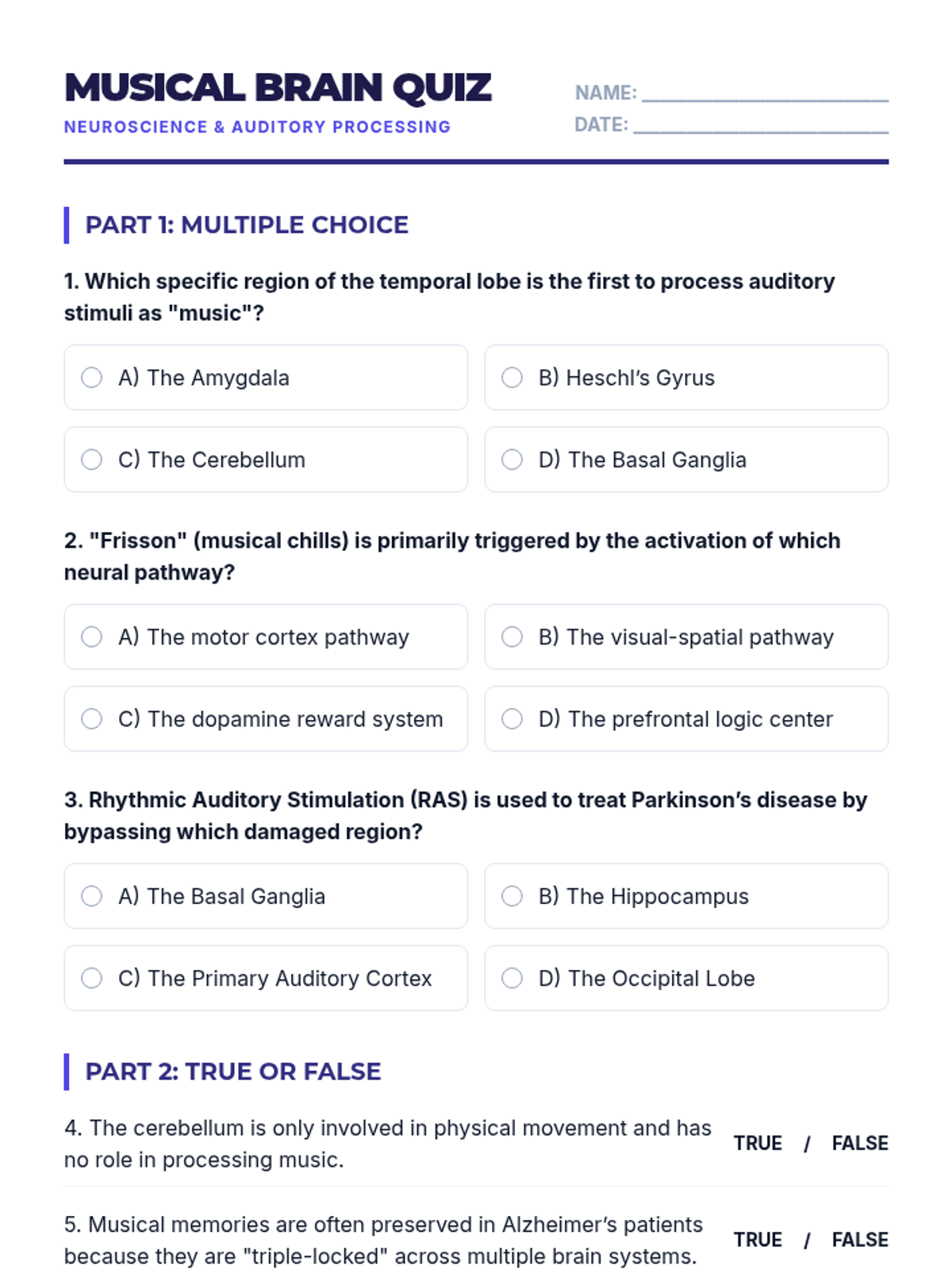
A student quiz covering the key neural regions and concepts from the "Musical Brain" lesson, including auditory processing, frisson, and clinical applications.
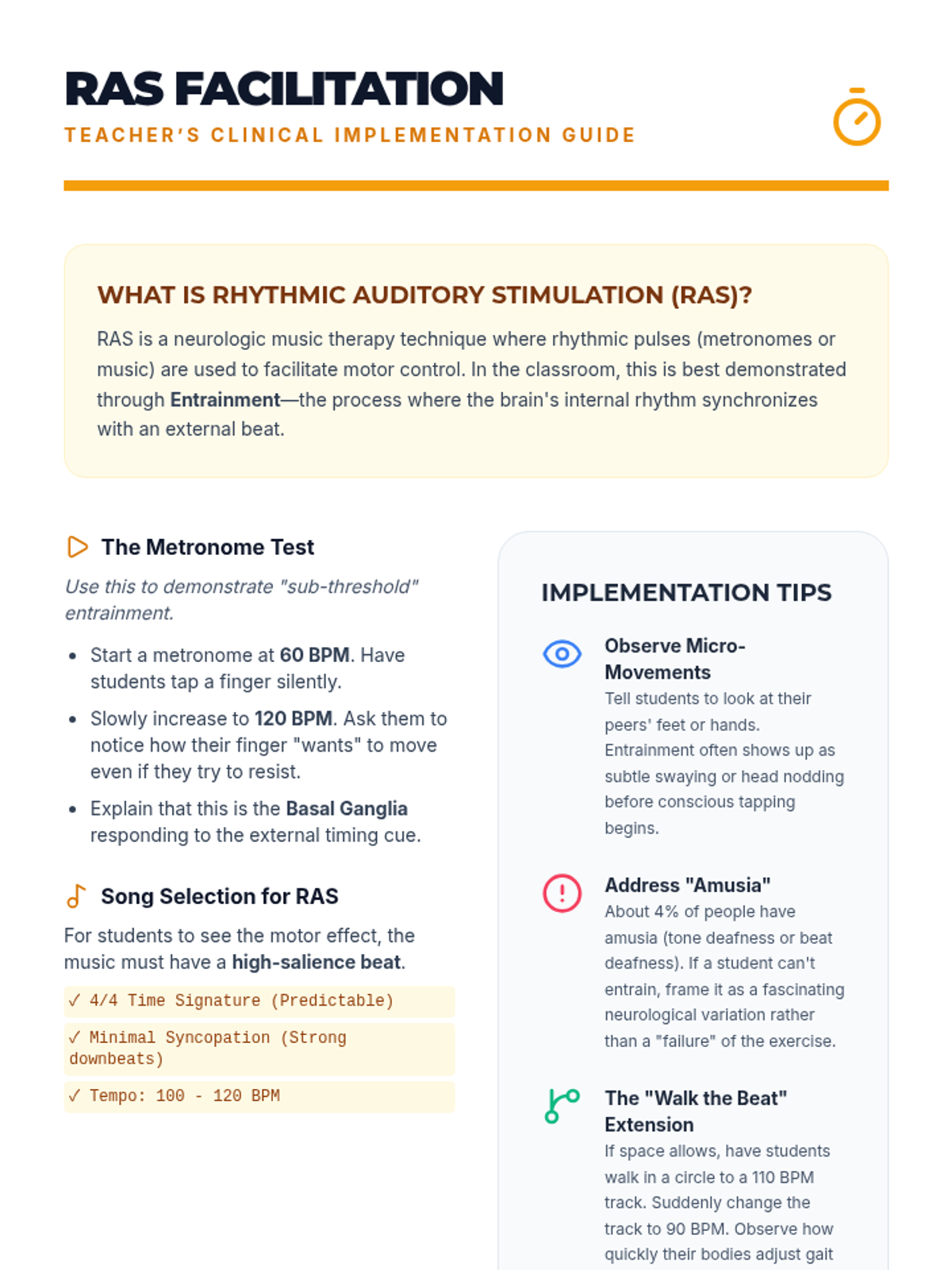
A teacher-facing implementation guide providing practical tips and activities for demonstrating Rhythmic Auditory Stimulation (RAS) and entrainment in the classroom.
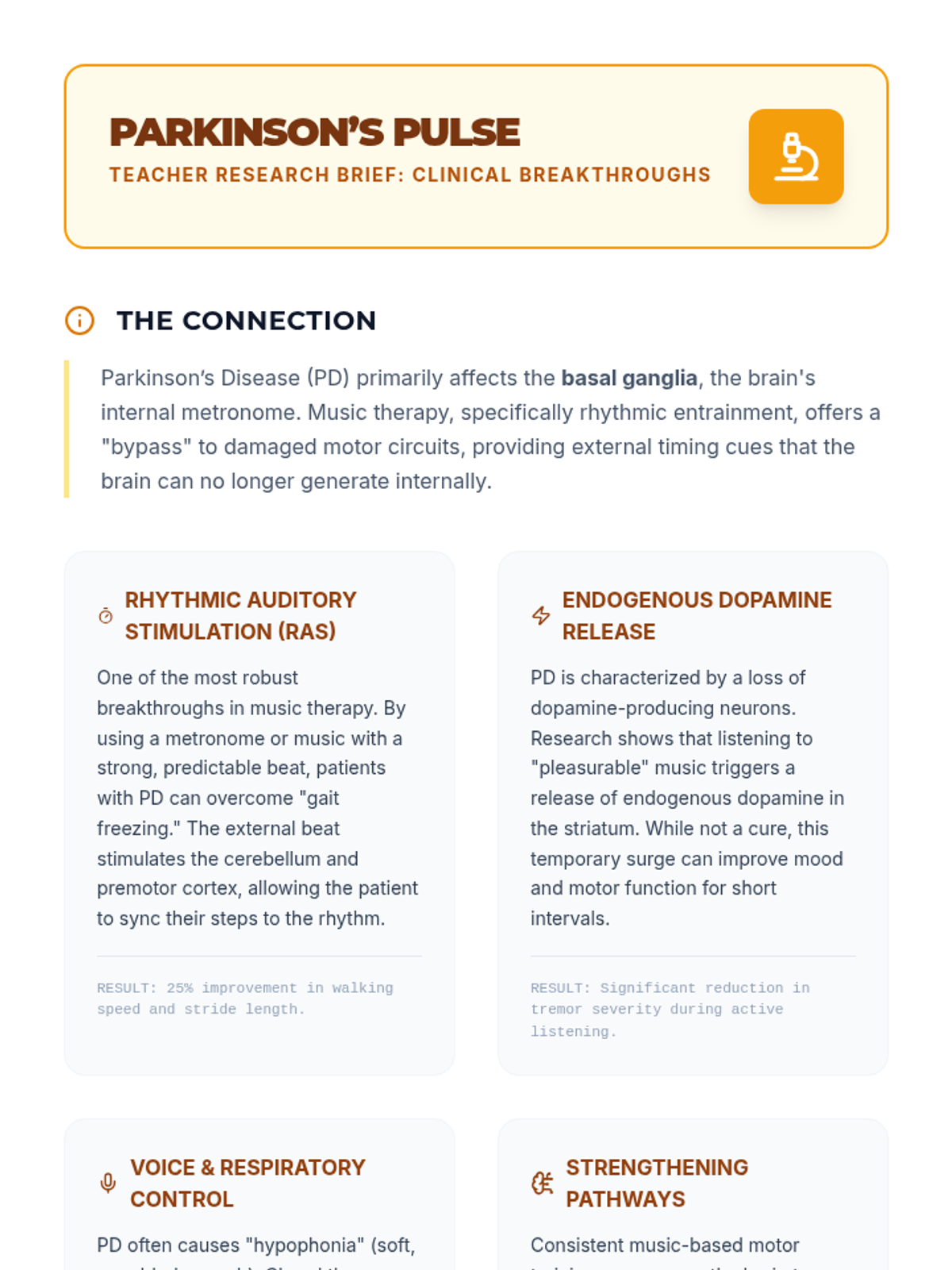
A teacher-facing research brief detailing breakthroughs in music therapy for Parkinson's disease, focusing on Rhythmic Auditory Stimulation (RAS) and neuroplasticity.
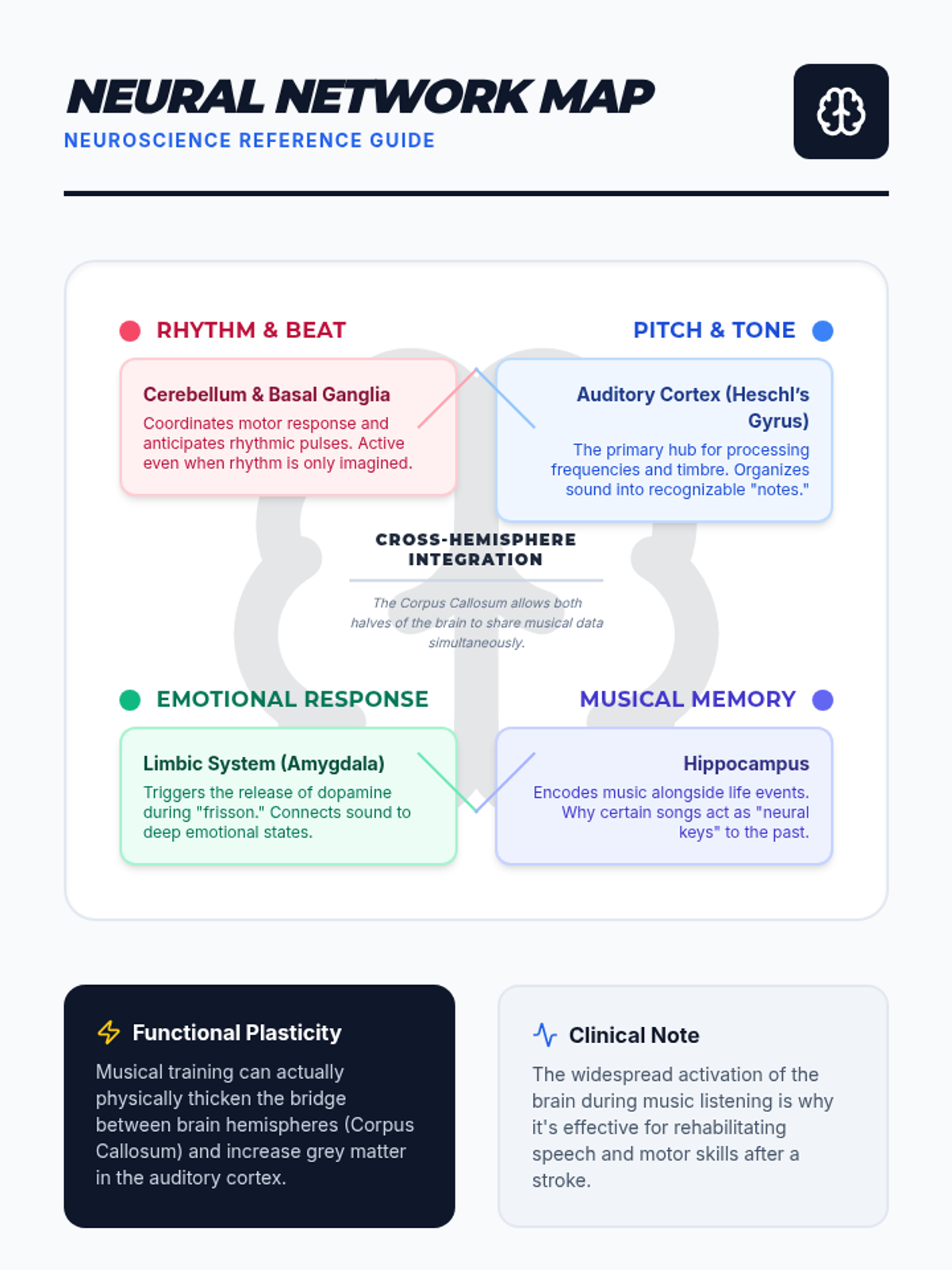
A color-coded reference diagram for students to identify the brain regions involved in processing rhythm, pitch, and emotion.
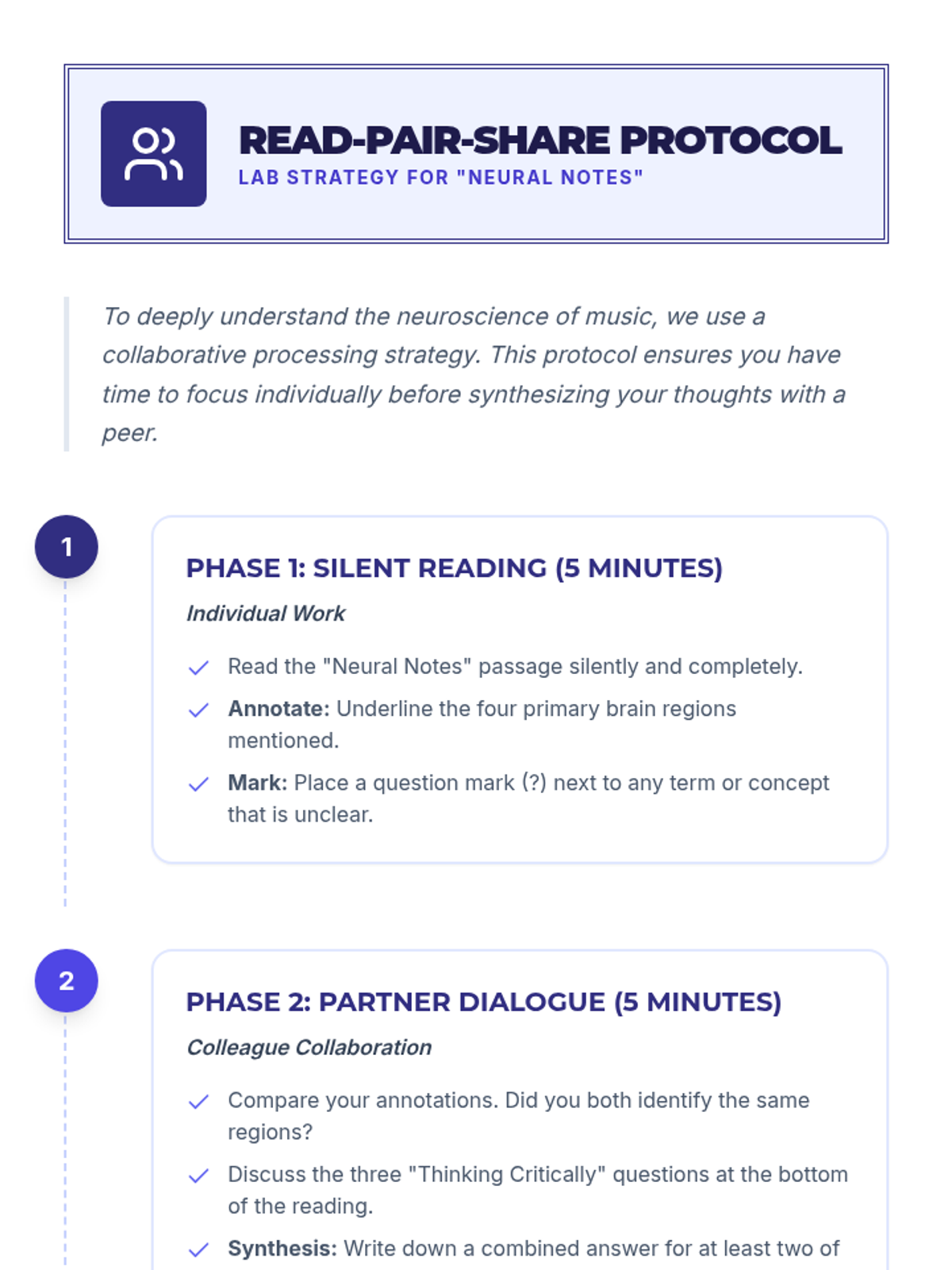
A step-by-step guide for students to use during the reading portion of the lesson, detailing the Read-Pair-Share collaborative learning strategy.
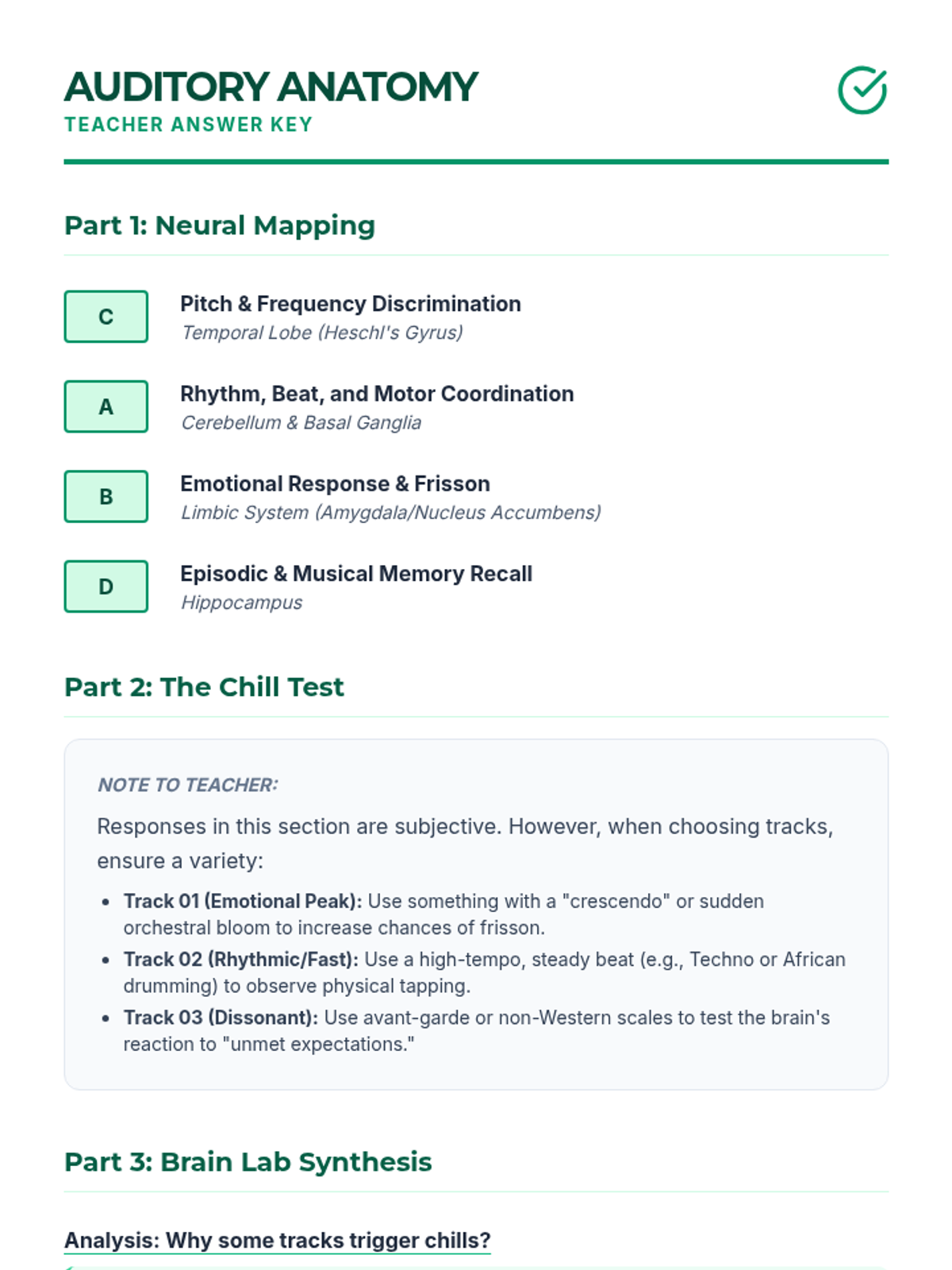
An answer key for the Auditory Anatomy activity sheet, providing correct neural mappings and guided sample responses for teacher reference.
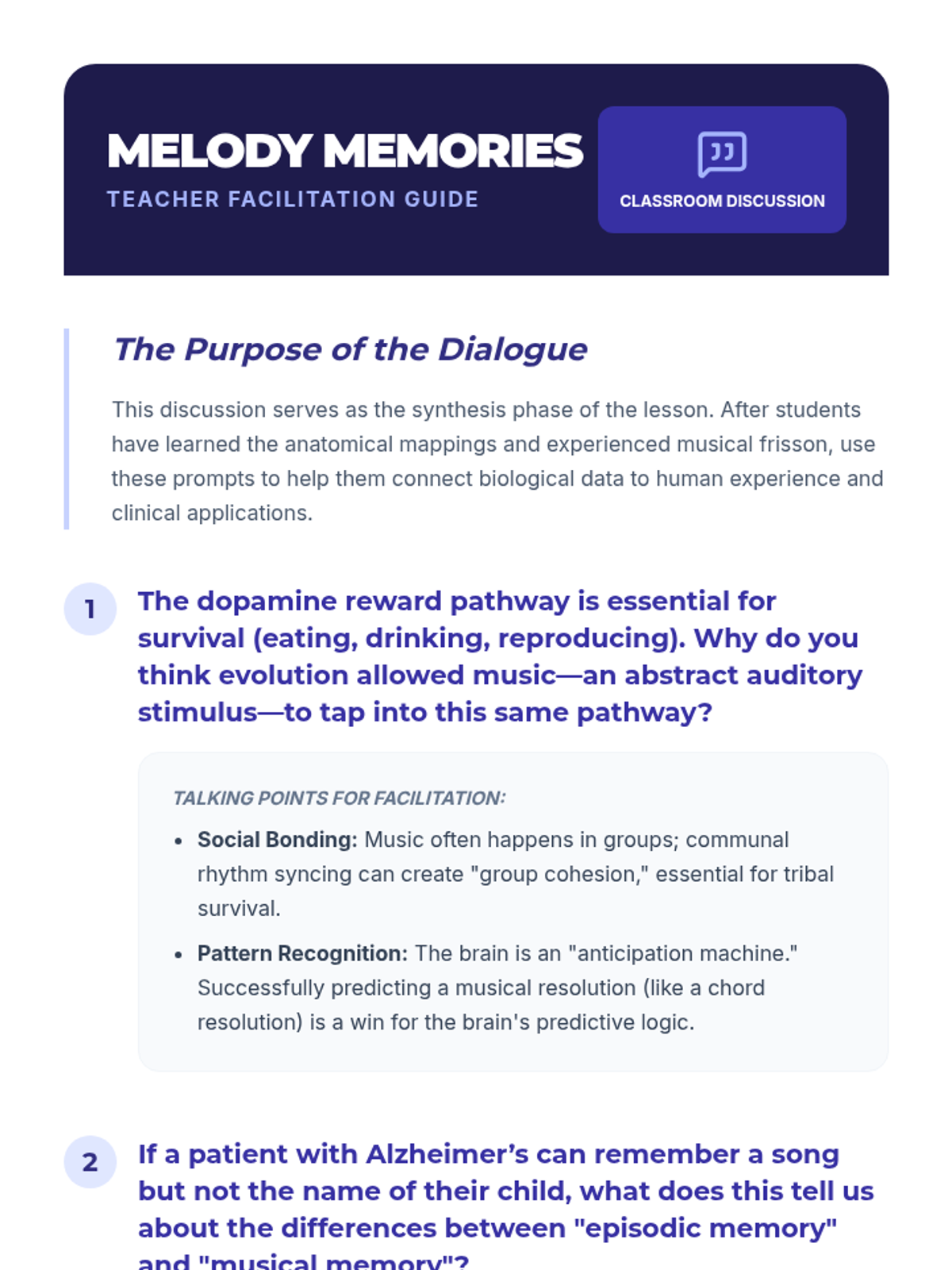
A teacher-facing resource for facilitating deep classroom discussion on the evolution of musical response and its clinical applications in memory care.
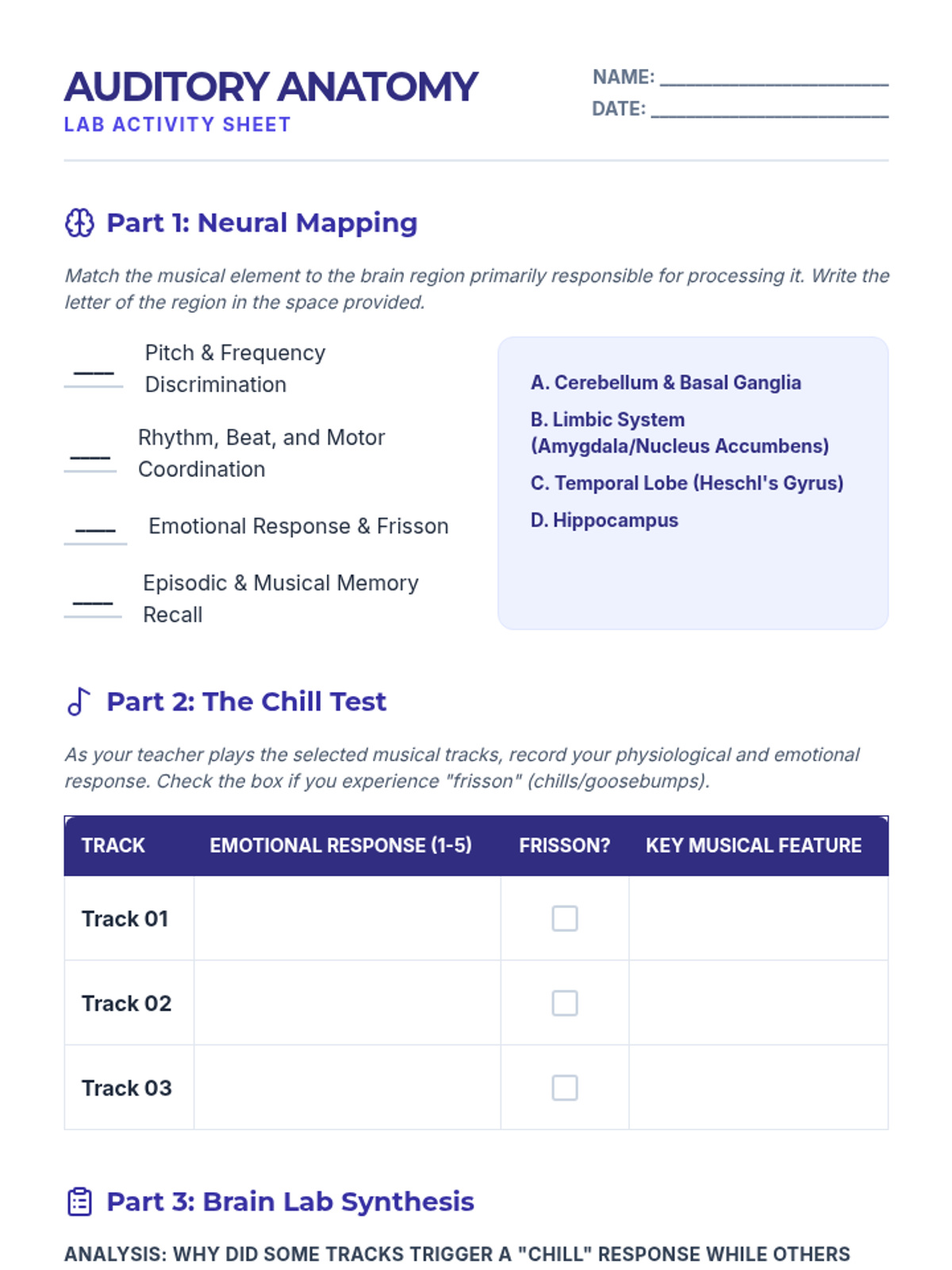
A hands-on student activity sheet for mapping brain regions to musical elements and recording physiological responses to auditory stimuli.
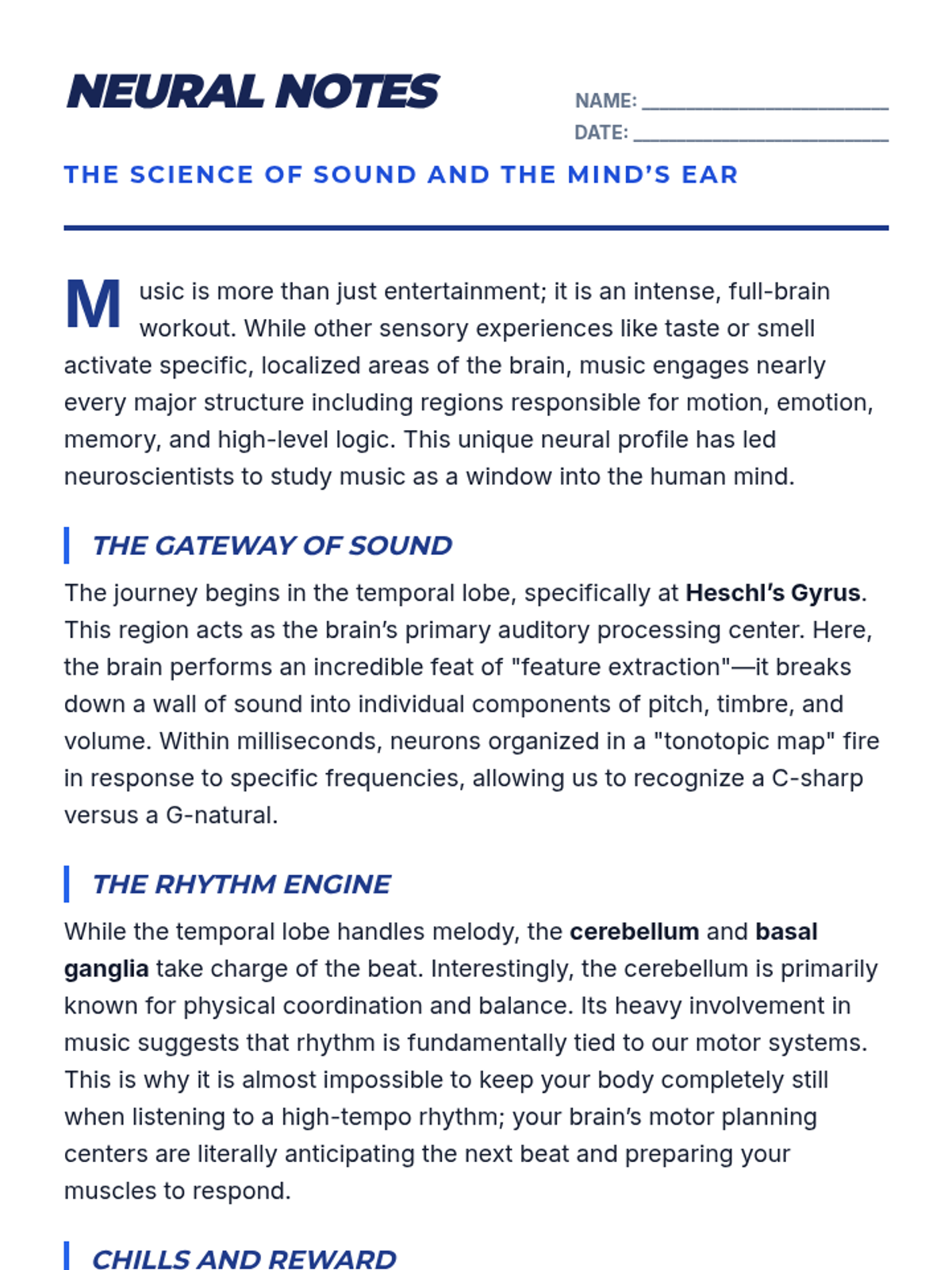
A scientific reading passage for high school students explaining the neural pathways involved in auditory processing, rhythm, emotion, and memory.
A visually striking slide deck for presenting the core concepts of musical neuroscience, featuring slides on auditory pathways, rhythm processing, and the emotional power of "frisson."
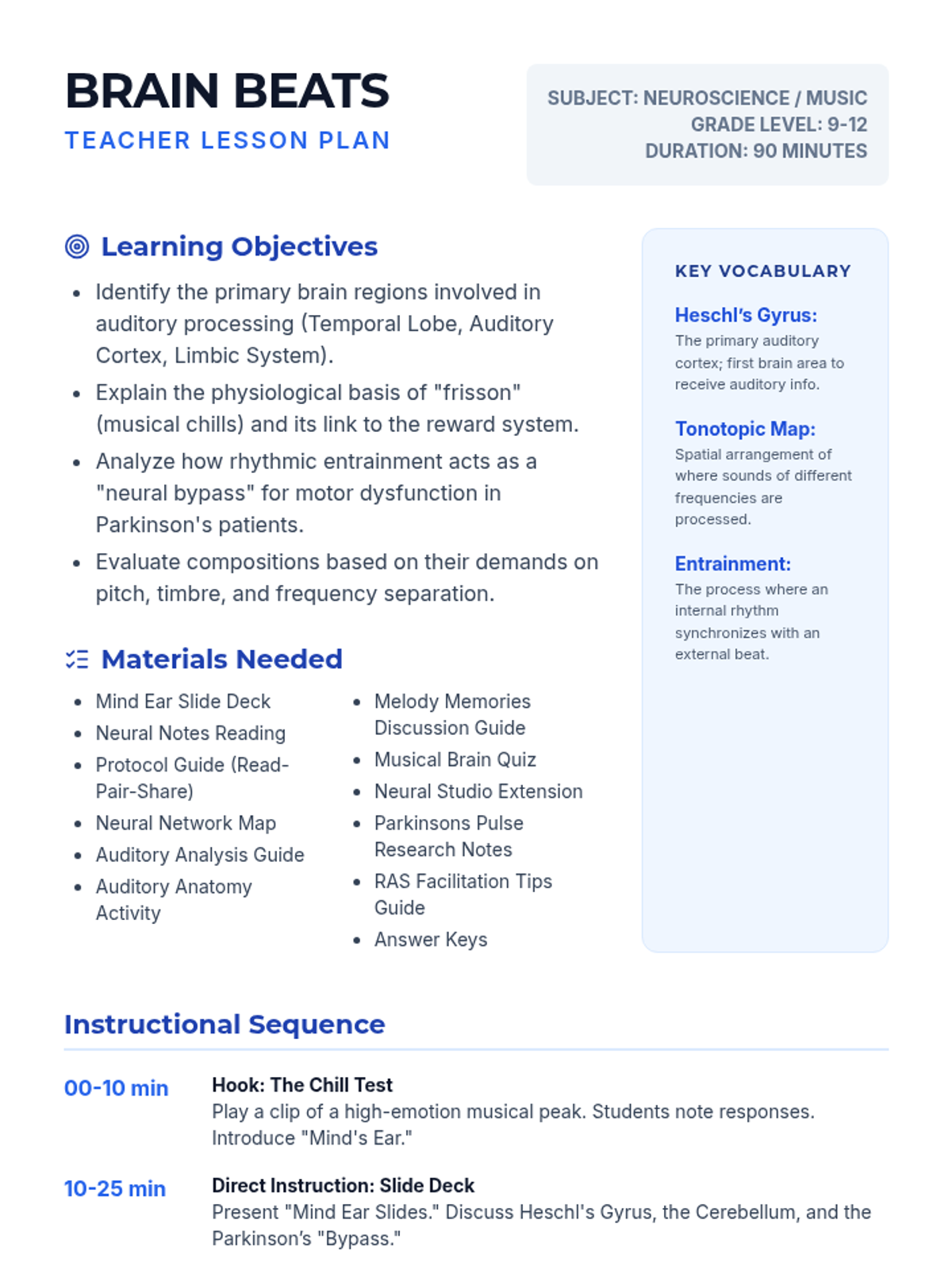
A comprehensive teacher lesson plan for a 90-minute session on the neuroscience of music, including learning objectives, a detailed pacing guide, and differentiation strategies.
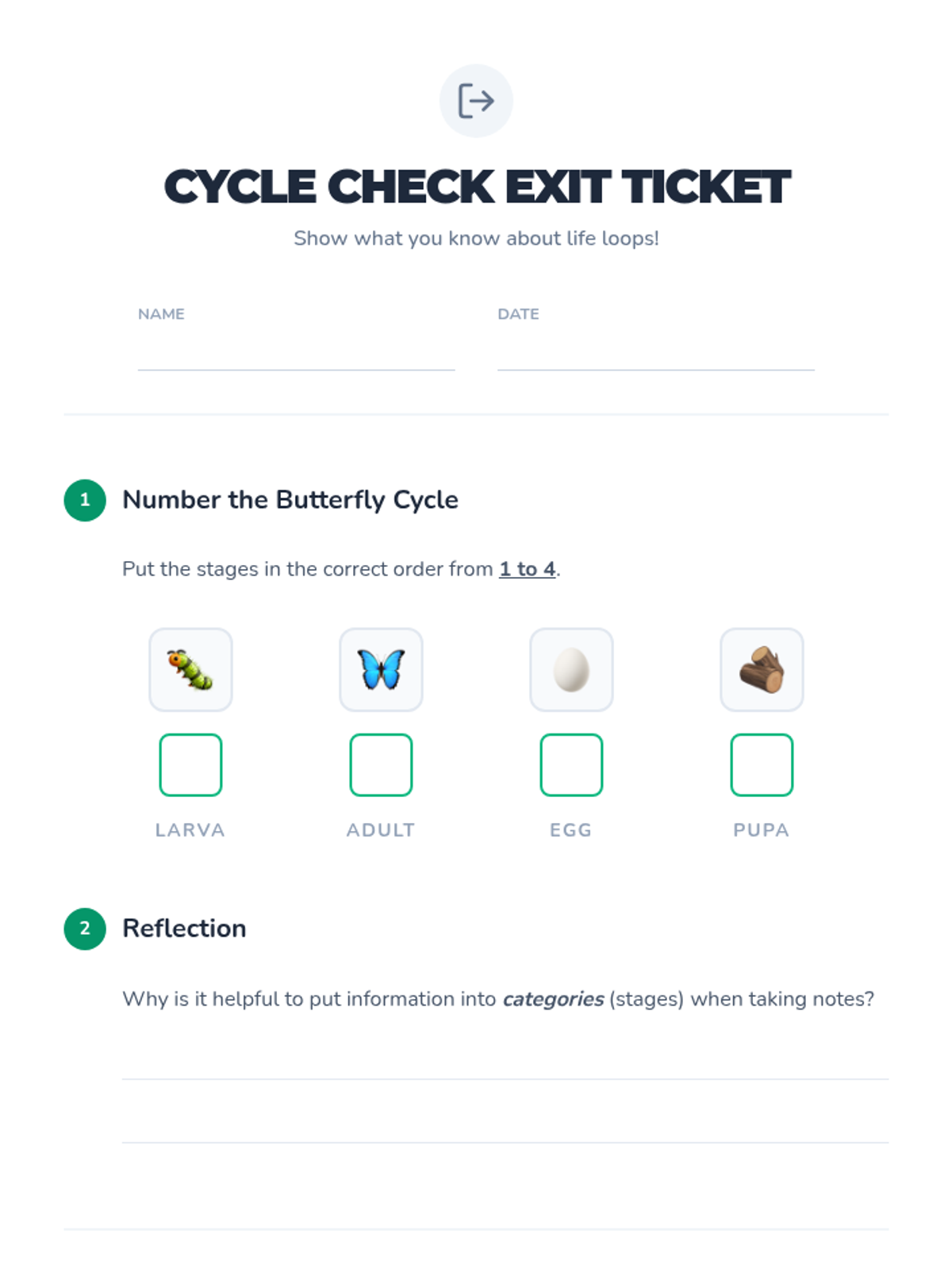
A quick assessment tool for students to sequence the butterfly life cycle and reflect on the value of categorizing information.
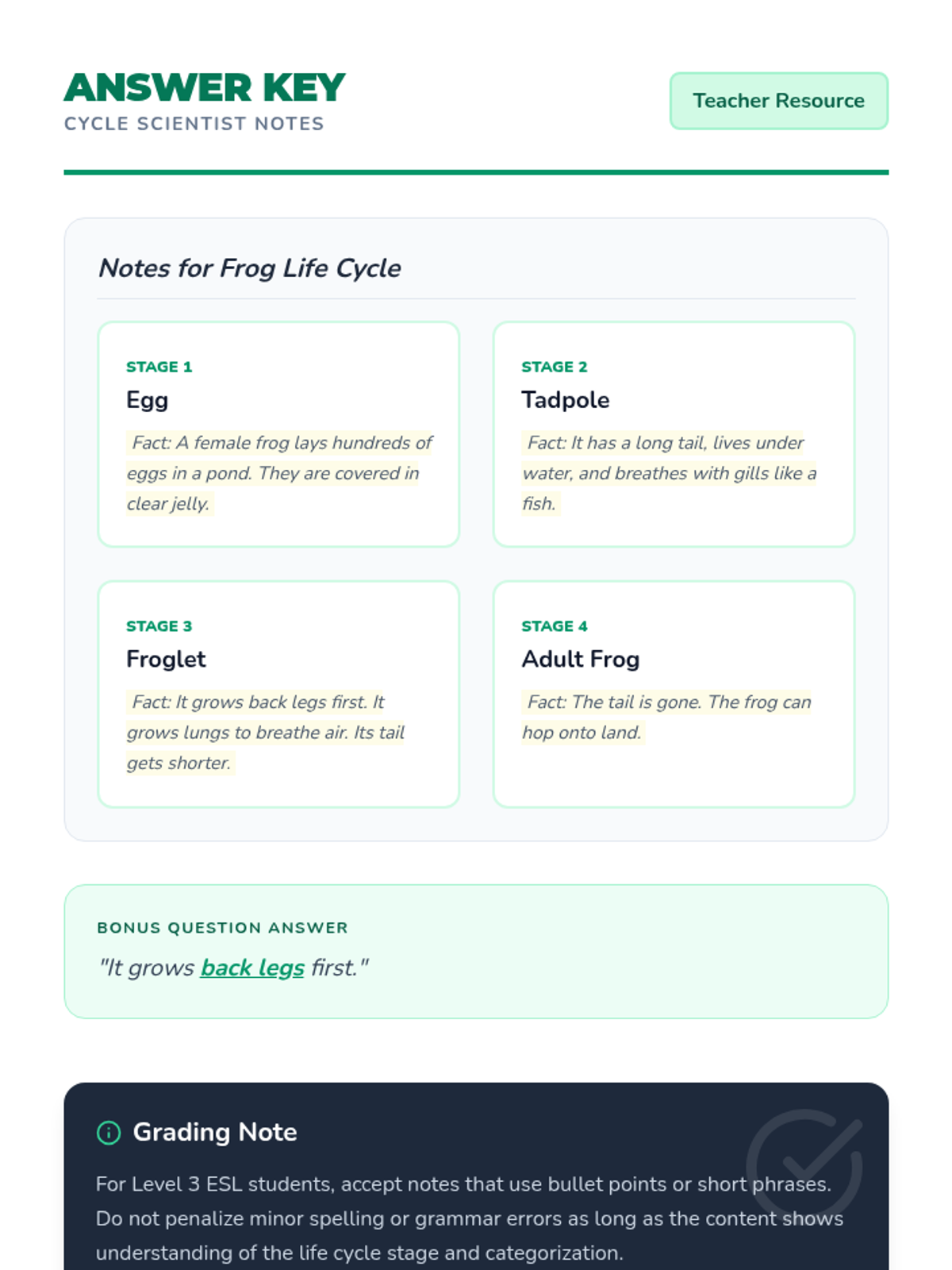
A teacher-facing answer key for the Cycle Scientist Notes Worksheet, providing expected responses for the Frog Life Cycle stages.
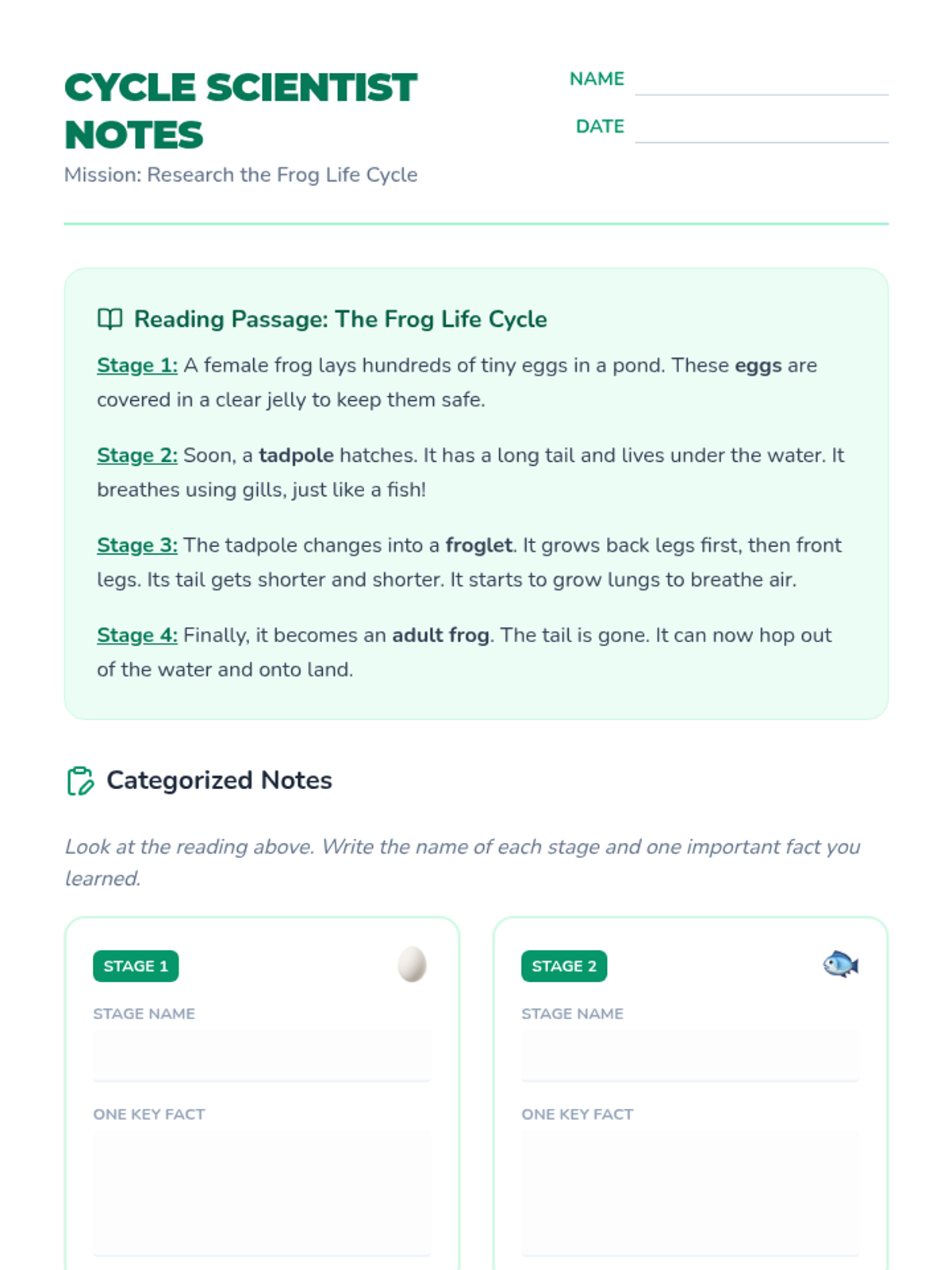
A worksheet where students read a passage about the Frog Life Cycle and practice note-taking by categorizing information into four stages.
A dynamic slide deck for instruction on life cycles, focusing on vocabulary, transition words, and guided practice for note-taking.
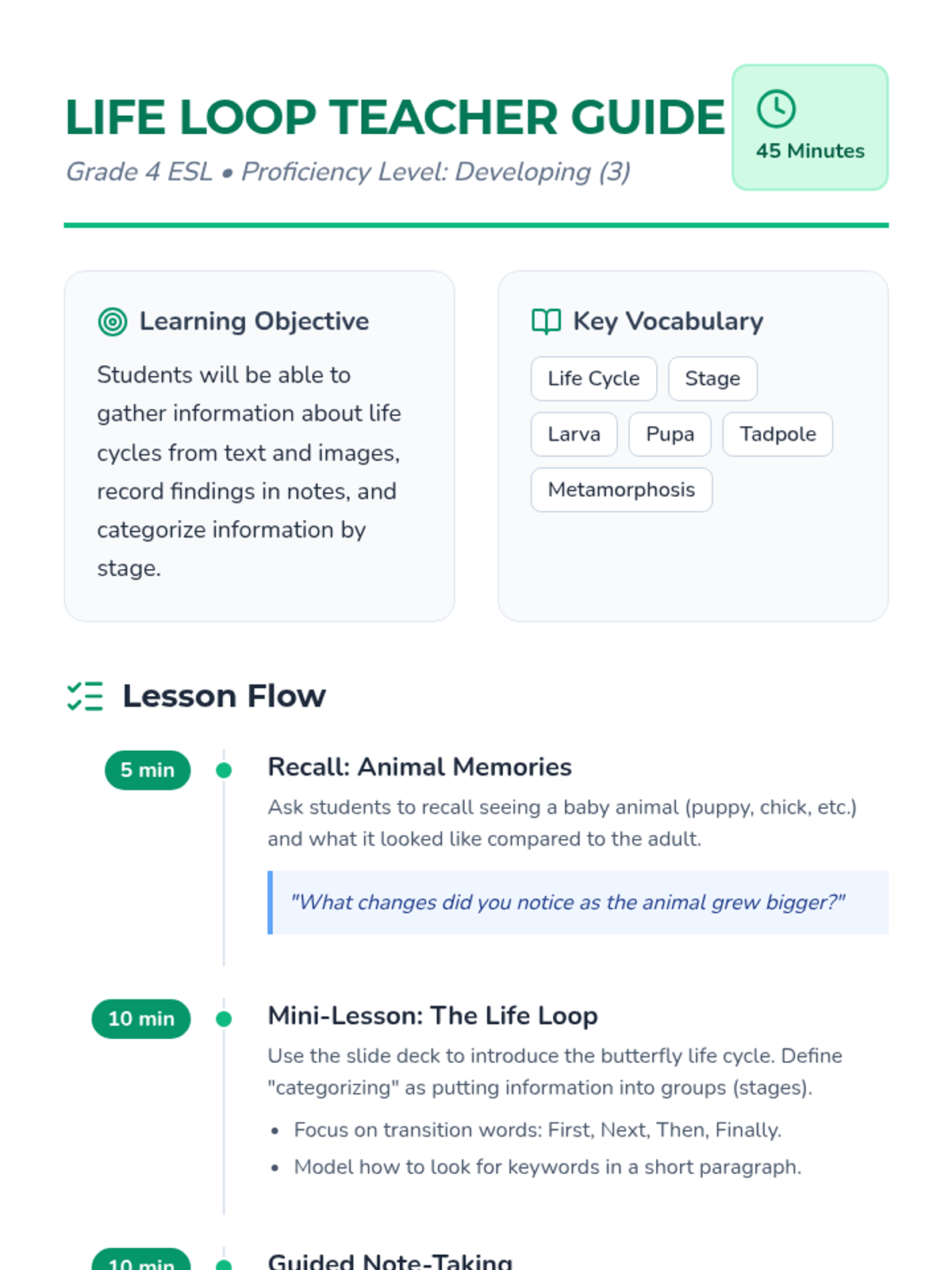
A comprehensive lesson plan for teachers, detailing the 45-minute flow of activities, vocabulary, and differentiation strategies for teaching life cycles and note-taking to Grade 4 ESL students.
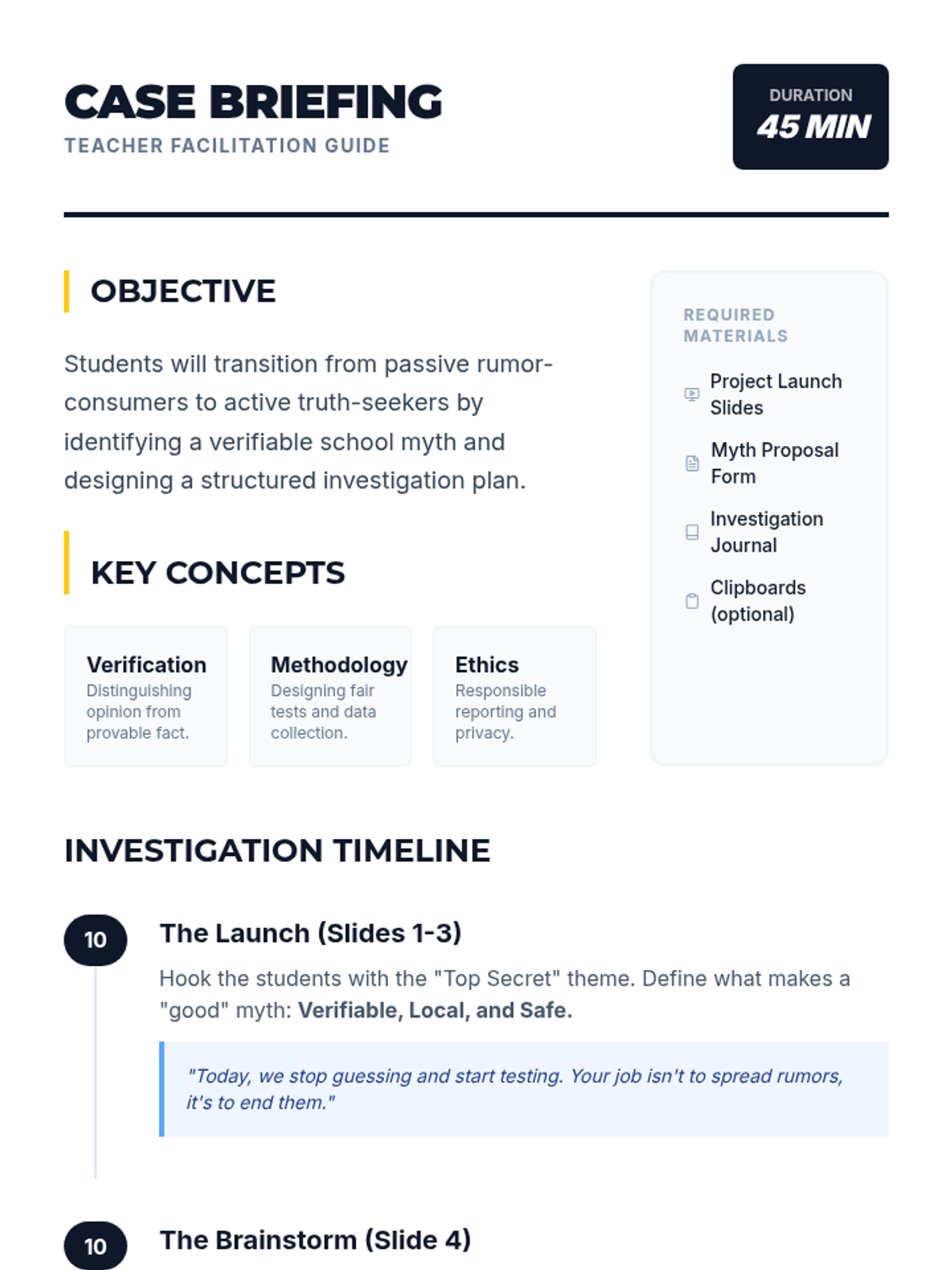
A pacing and facilitation guide for teachers to lead the 45-minute MythBusters launch lesson, including hooks, discussion prompts, and differentiation strategies.
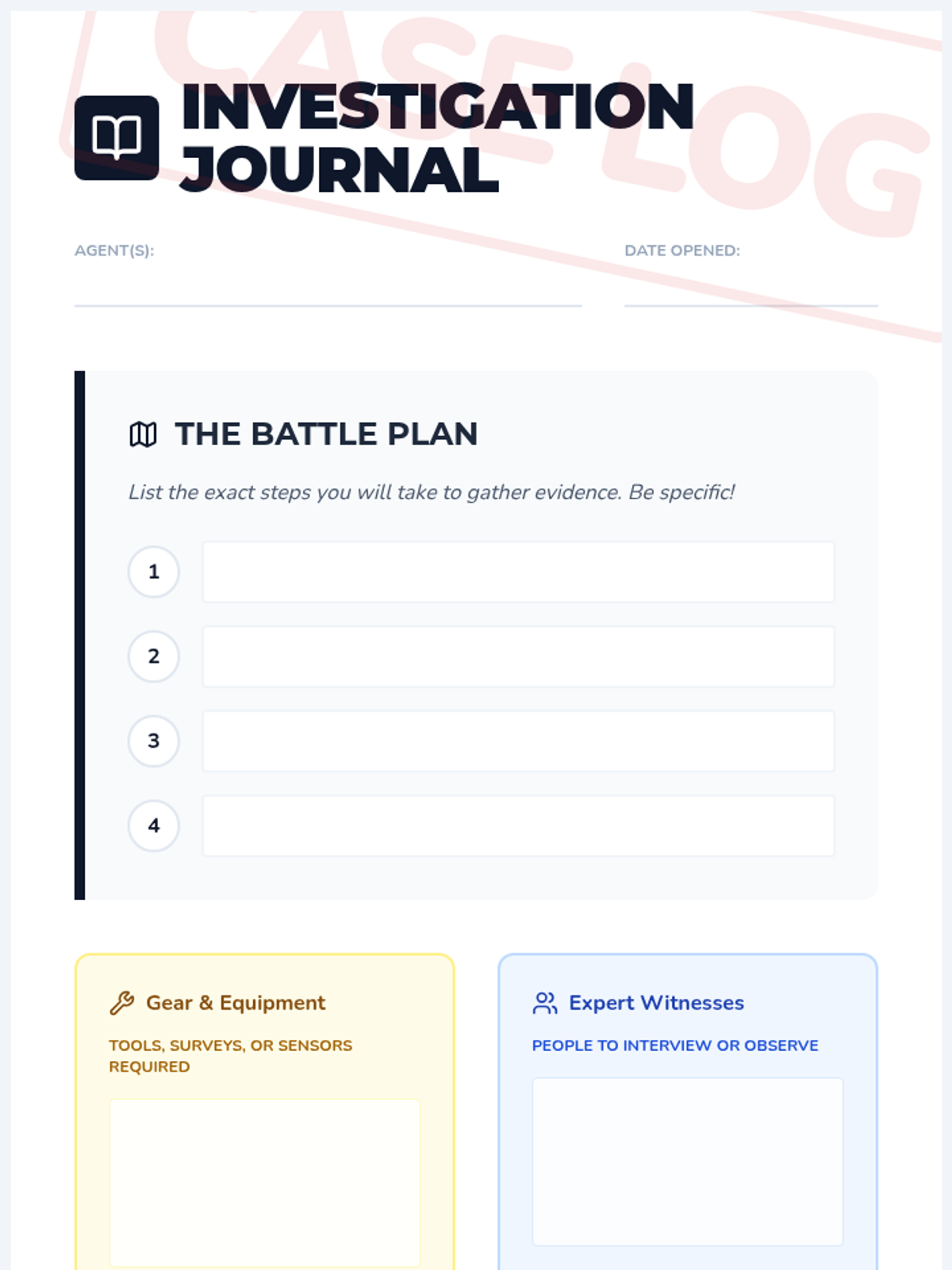
A comprehensive 3-page investigative packet for students to document their planning steps, record field data/observations, and present their final verdict based on evidence.
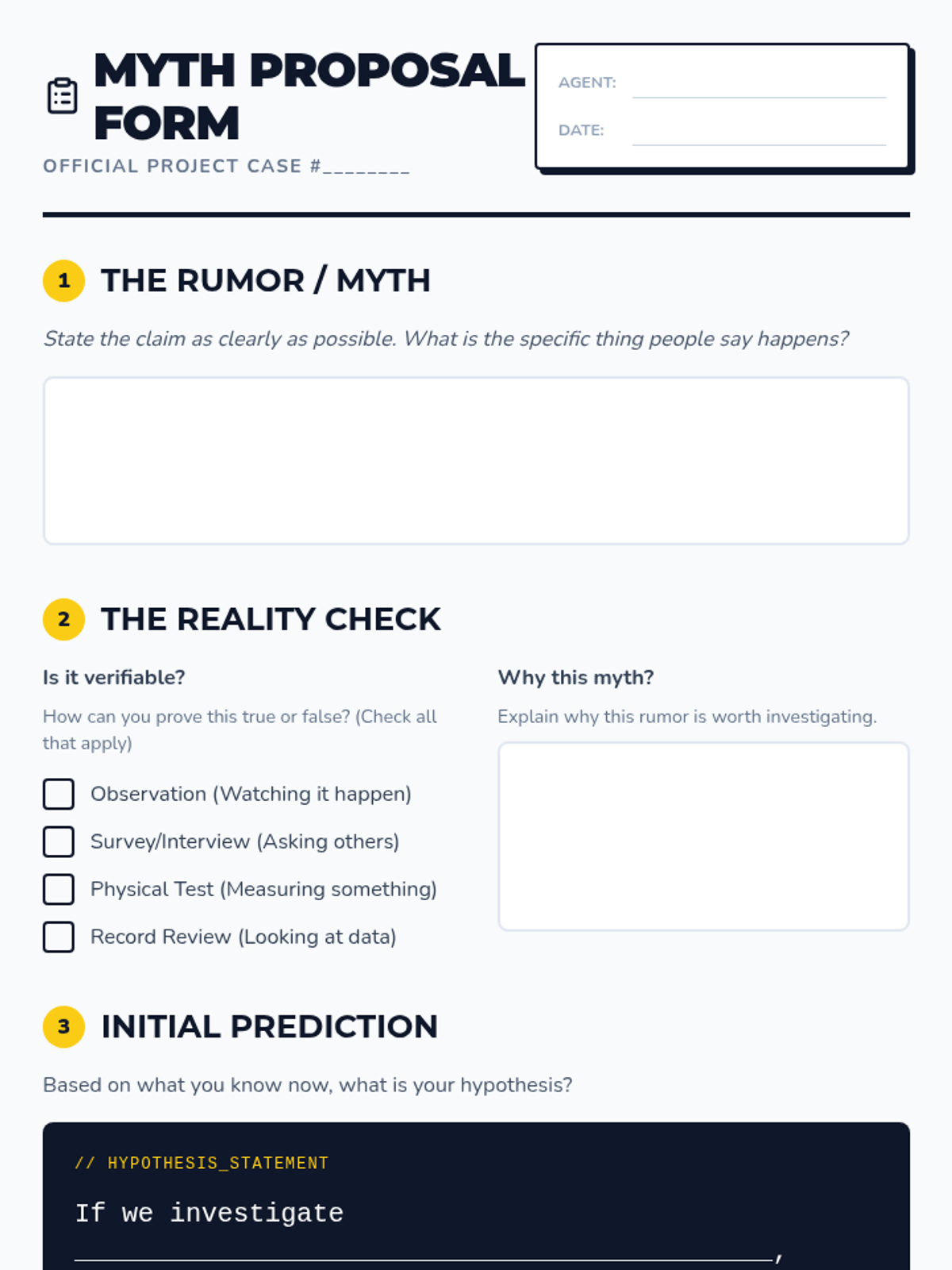
A formal project proposal worksheet for students to document their selected myth, justify why it is verifiable, and state their initial hypothesis.
A 5-slide introductory presentation to launch the MythBusters project, outlining criteria for selecting myths and the steps of the investigation process.
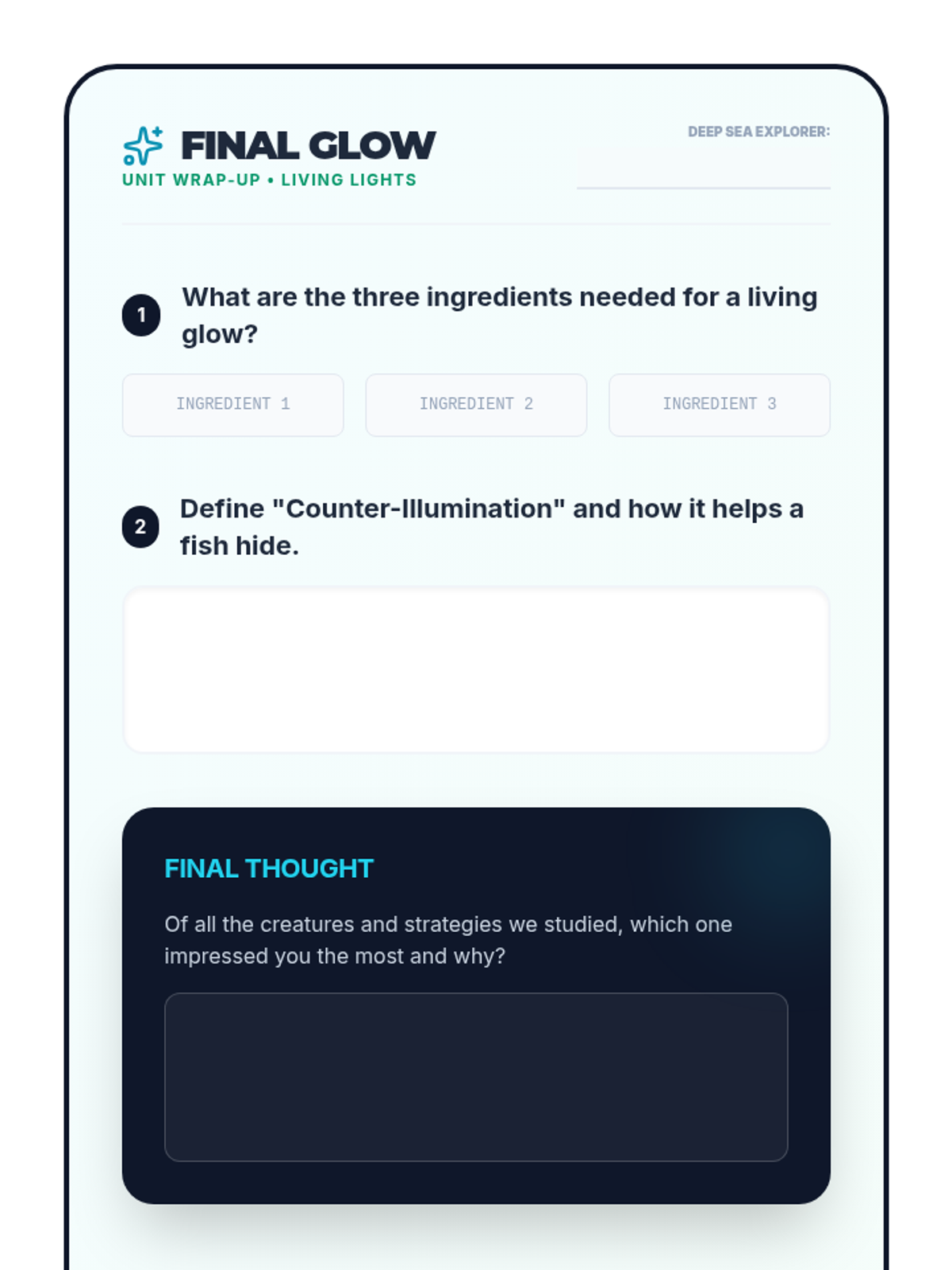
A final unit exit ticket for assessing cumulative student understanding of bioluminescence concepts.
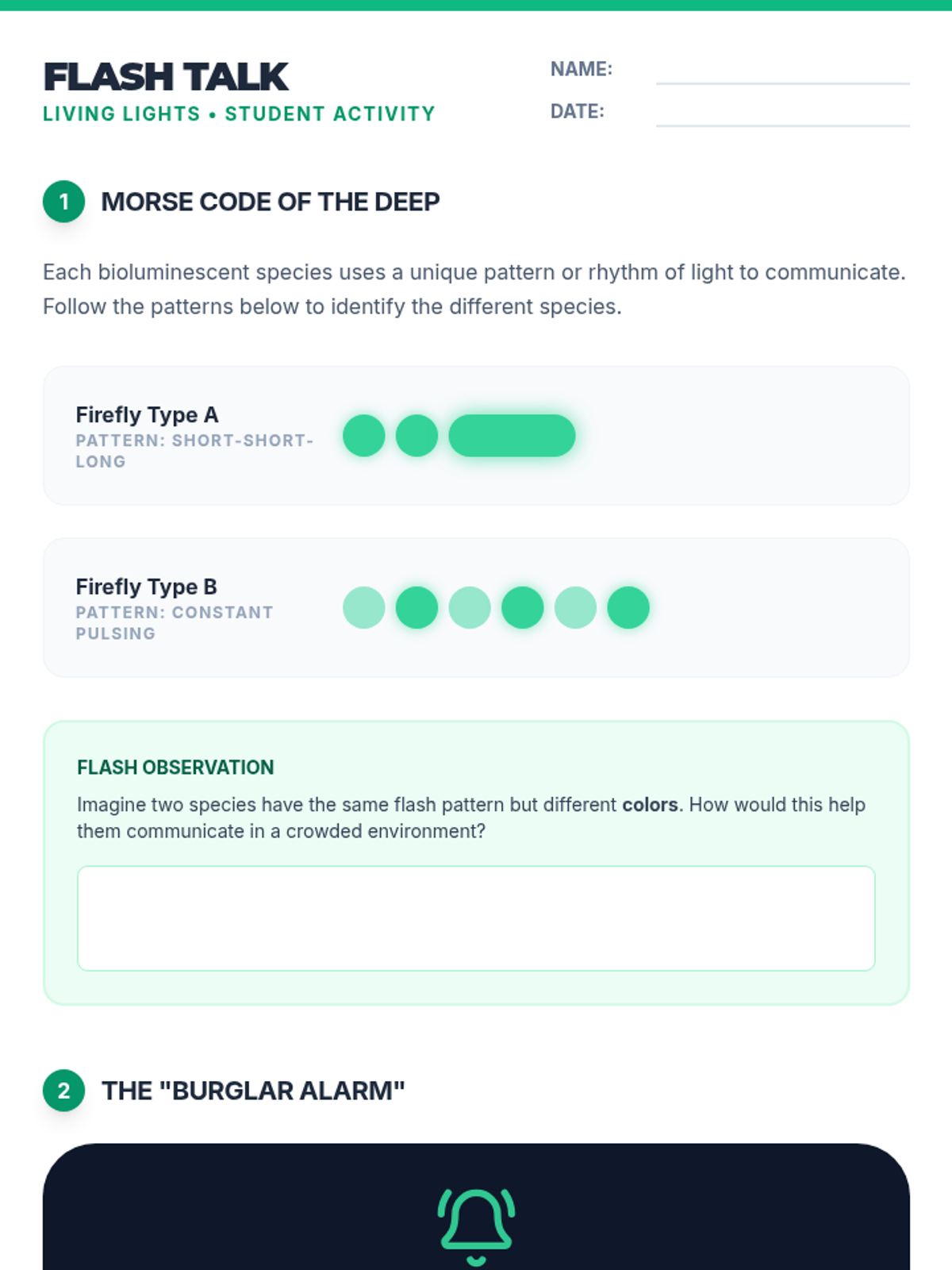
A student worksheet for exploring strategies like counter-illumination (camouflage), burglar alarms (defense), and mating signals.
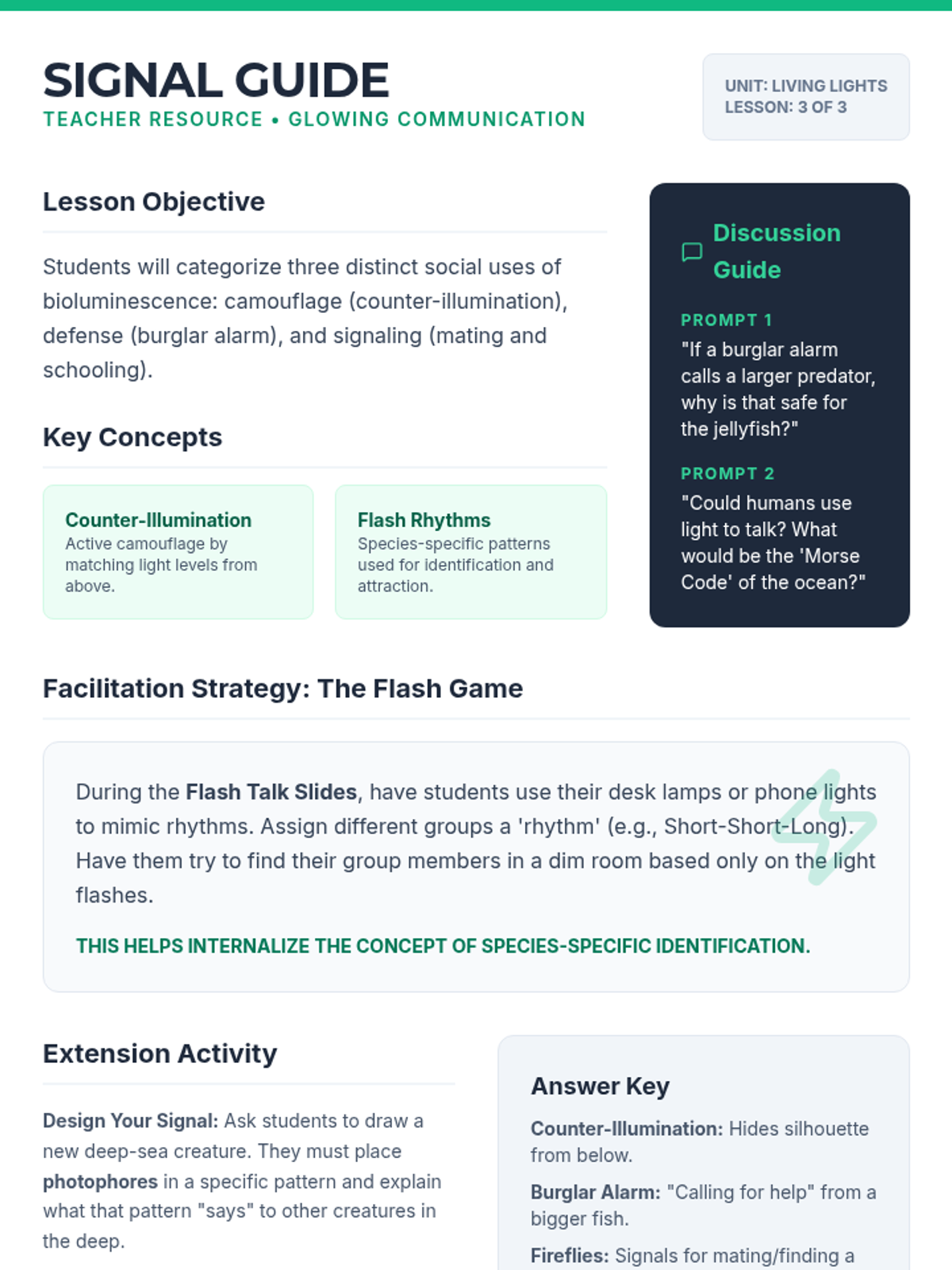
A teacher facilitation guide for Lesson 3, focusing on the social and defensive uses of light in nature, including discussion prompts and a classroom activity guide.
Exploring strategies like counter-illumination (camouflage), burglar alarms (defense), and mating signals.
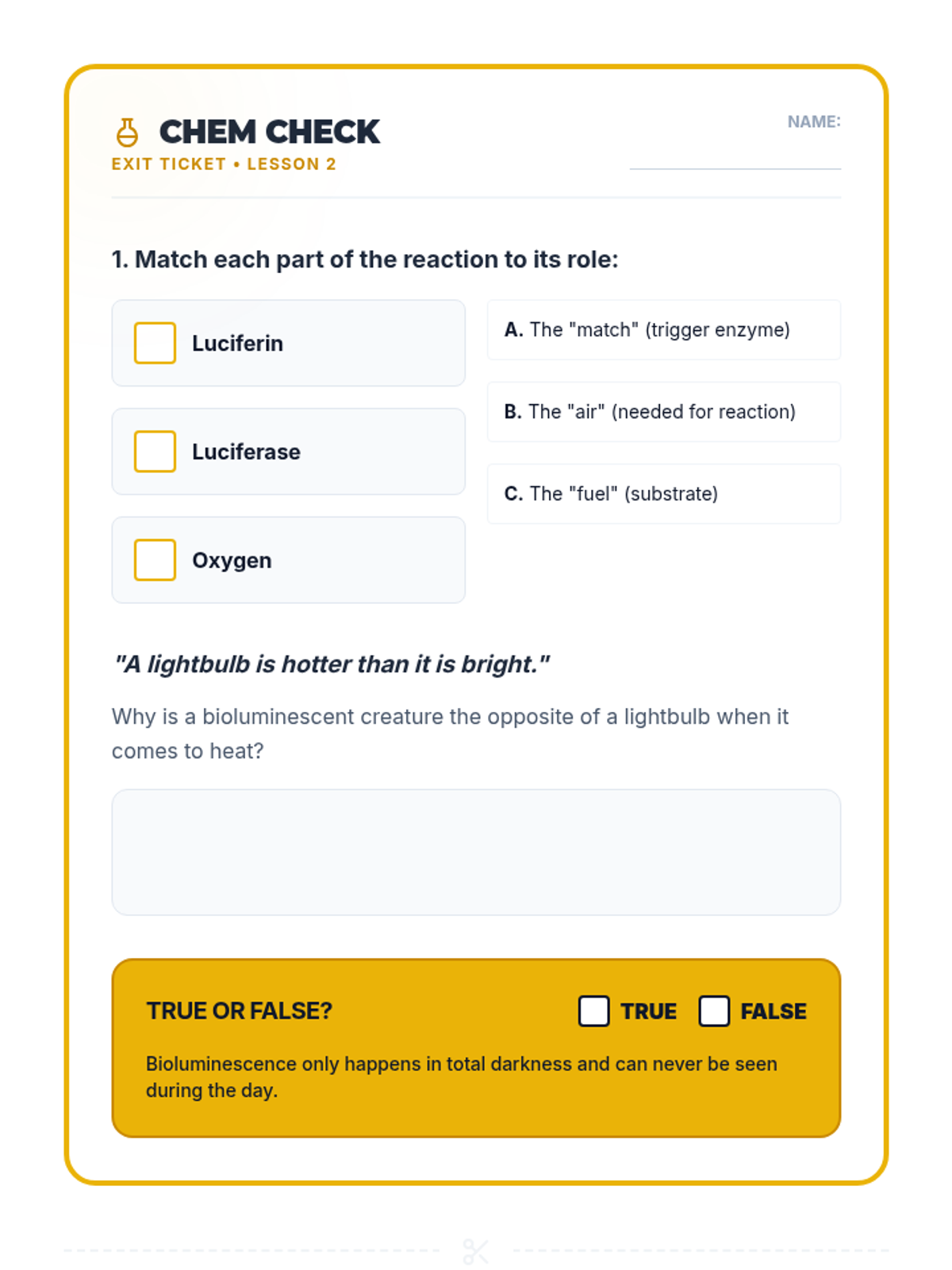
A quick check for Lesson 2 to assess student understanding of the chemical components of bioluminescence.
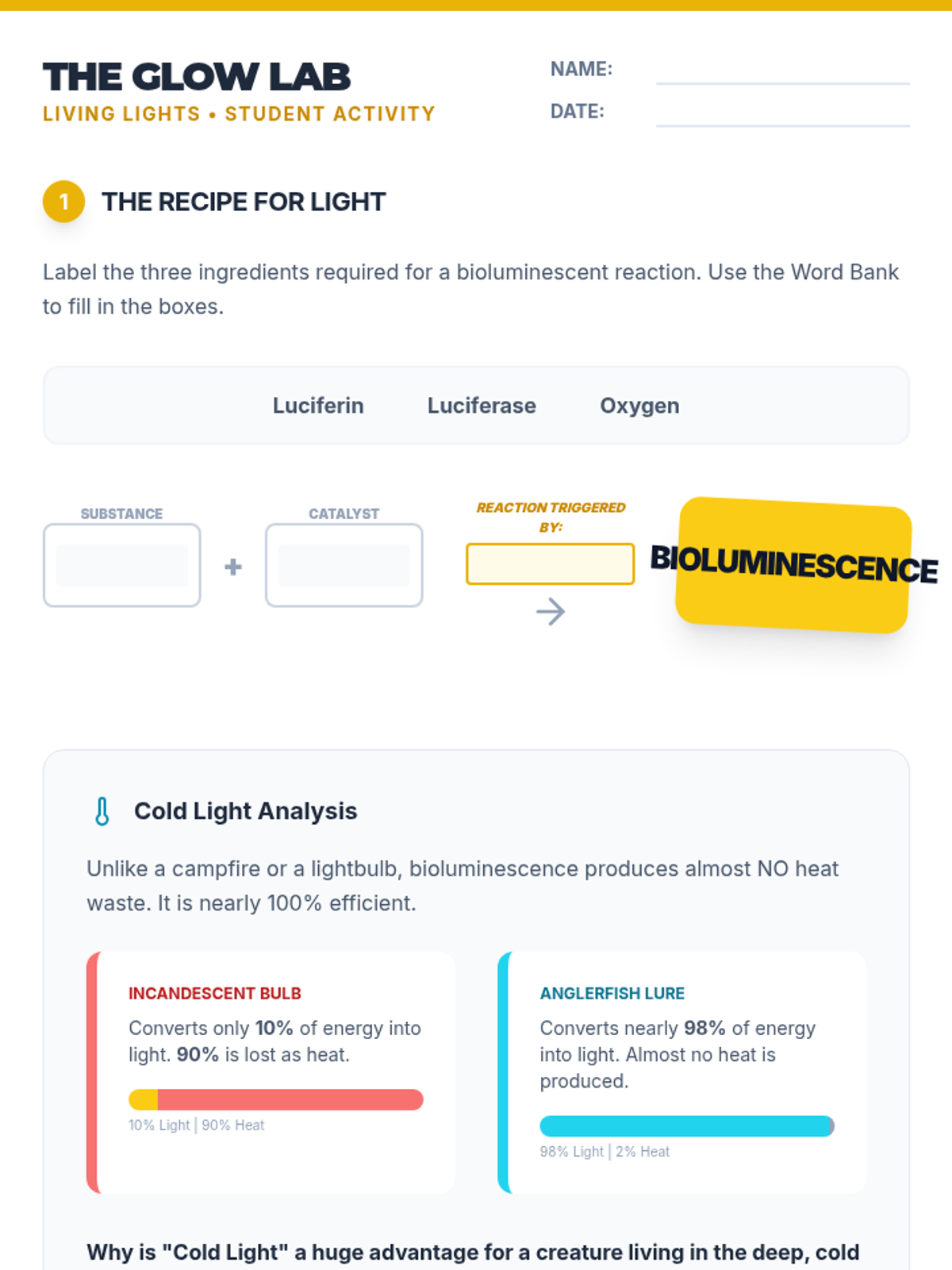
A student activity sheet for labeling the chemical equation and predicting reactions.
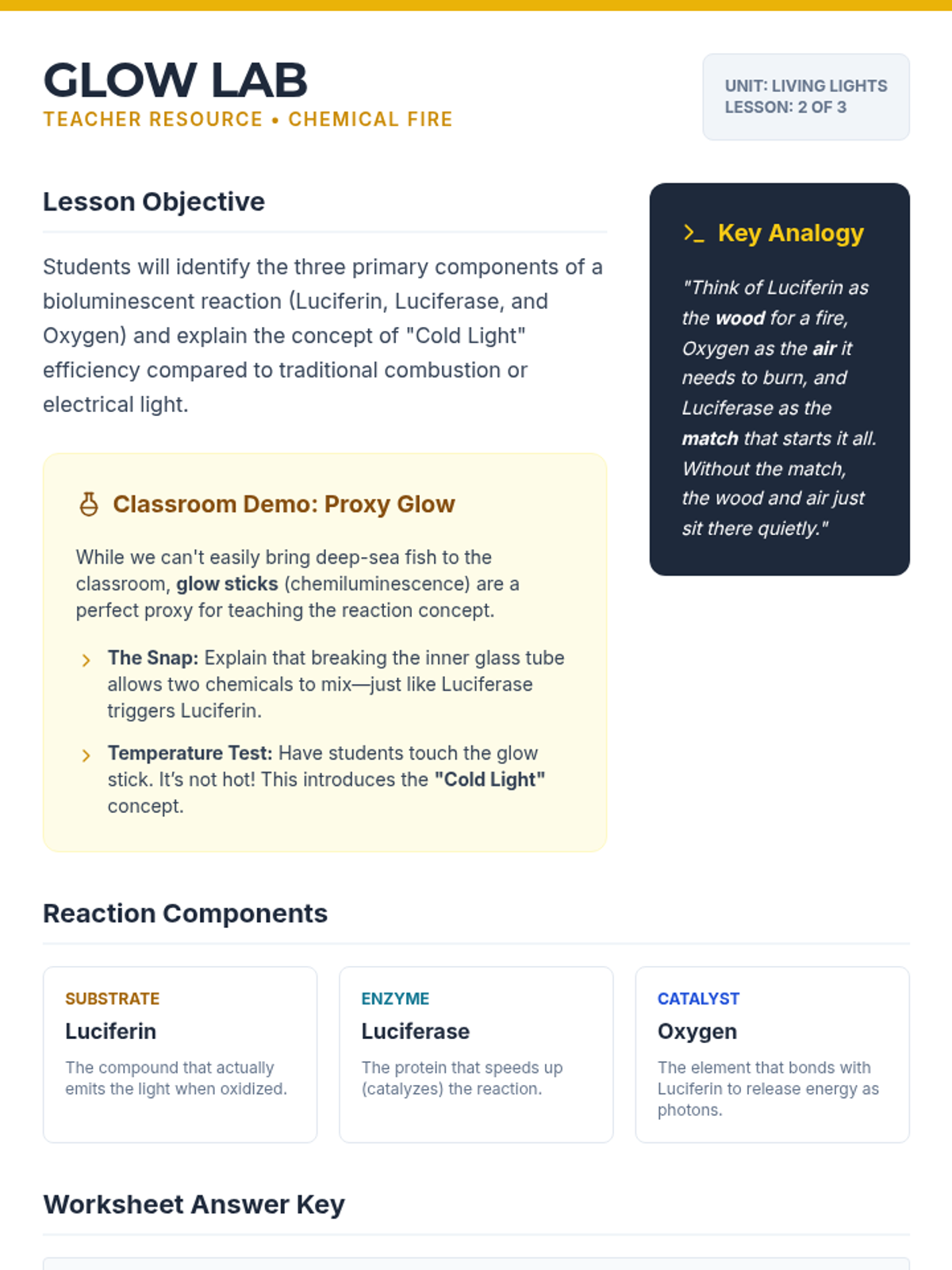
A teacher facilitation guide for Lesson 2, including background chemistry on the bioluminescent reaction and a classroom demonstration guide using glow sticks.
Detailed breakdown of the chemical reaction behind bioluminescence, exploring the roles of luciferin, luciferase, and oxygen in creating "cold light."
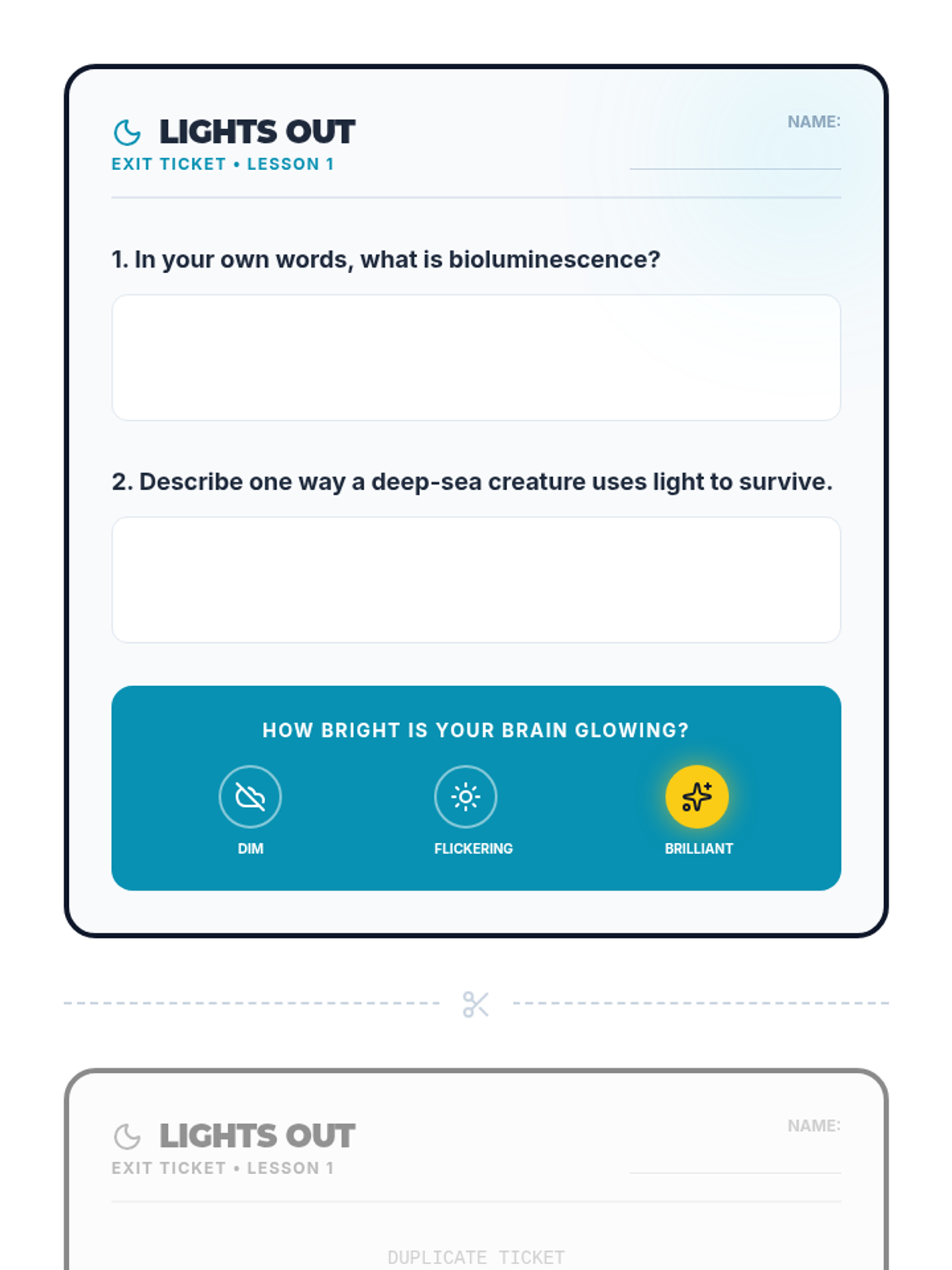
A quick exit ticket for assessing student understanding of bioluminescence and deep-sea survival adaptations.
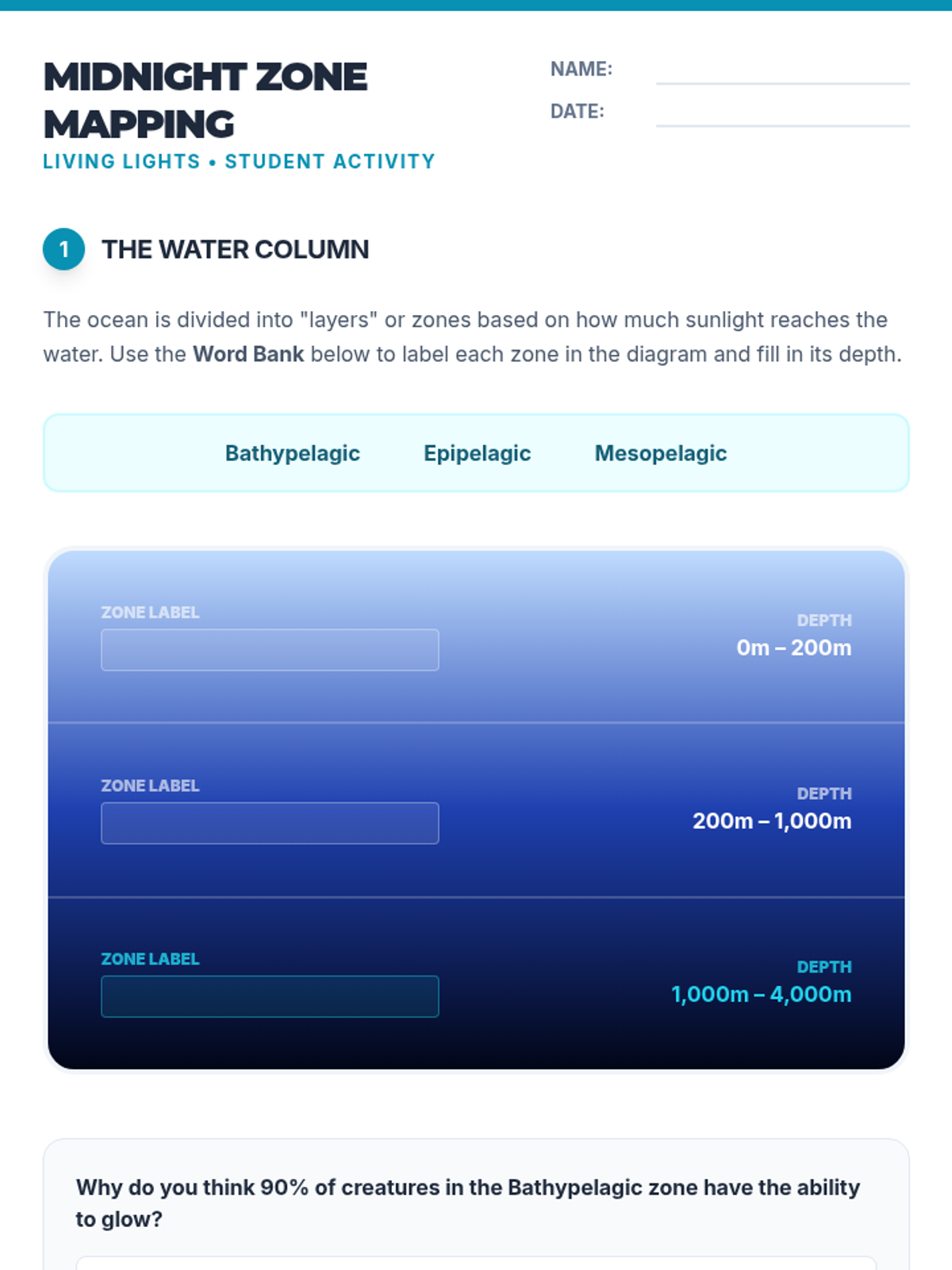
A student worksheet for exploring ocean zones and identifying the unique bioluminescent adaptations of deep-sea creatures.
An engaging visual presentation exploring the midnight zone of the ocean and the fascinating ways deep-sea organisms use bioluminescence for survival.
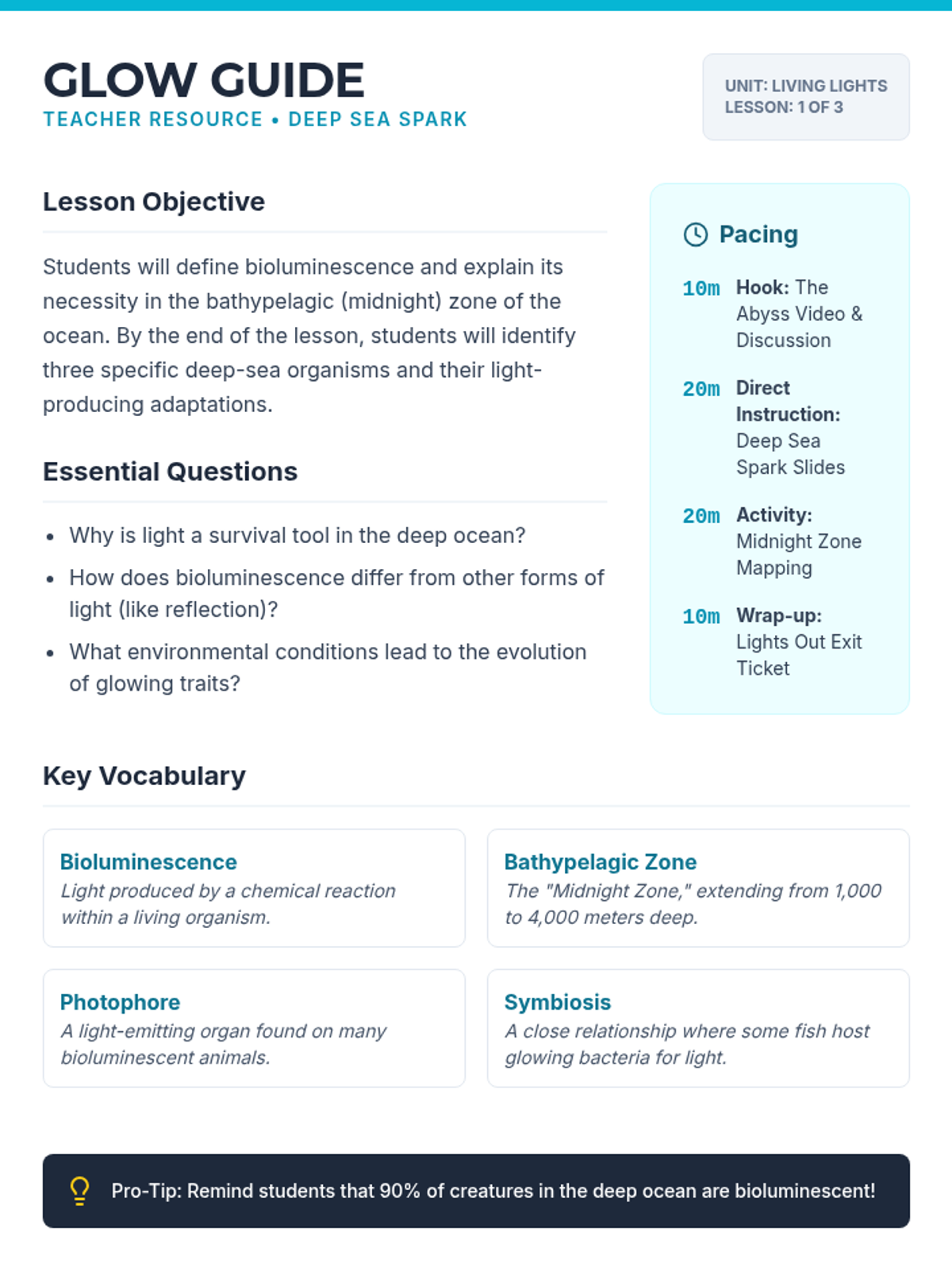
A comprehensive teacher facilitation guide for the "Deep Sea Spark" lesson, including pacing, discussion prompts, key vocabulary, and an answer key for student materials.
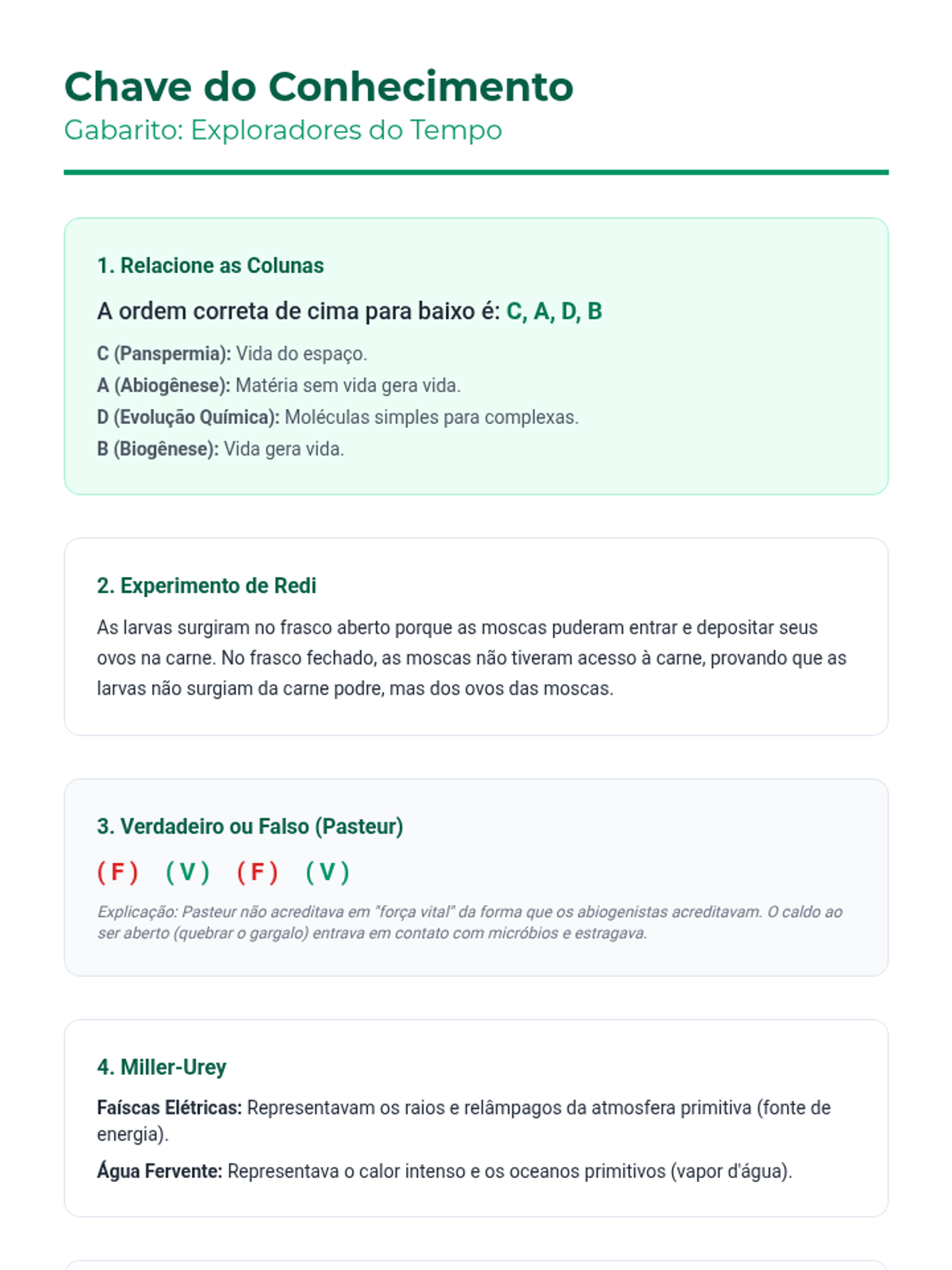
Gabarito detalhado para a folha de atividades "Exploradores do Tempo", fornecendo respostas corretas e explicações adicionais para o professor.
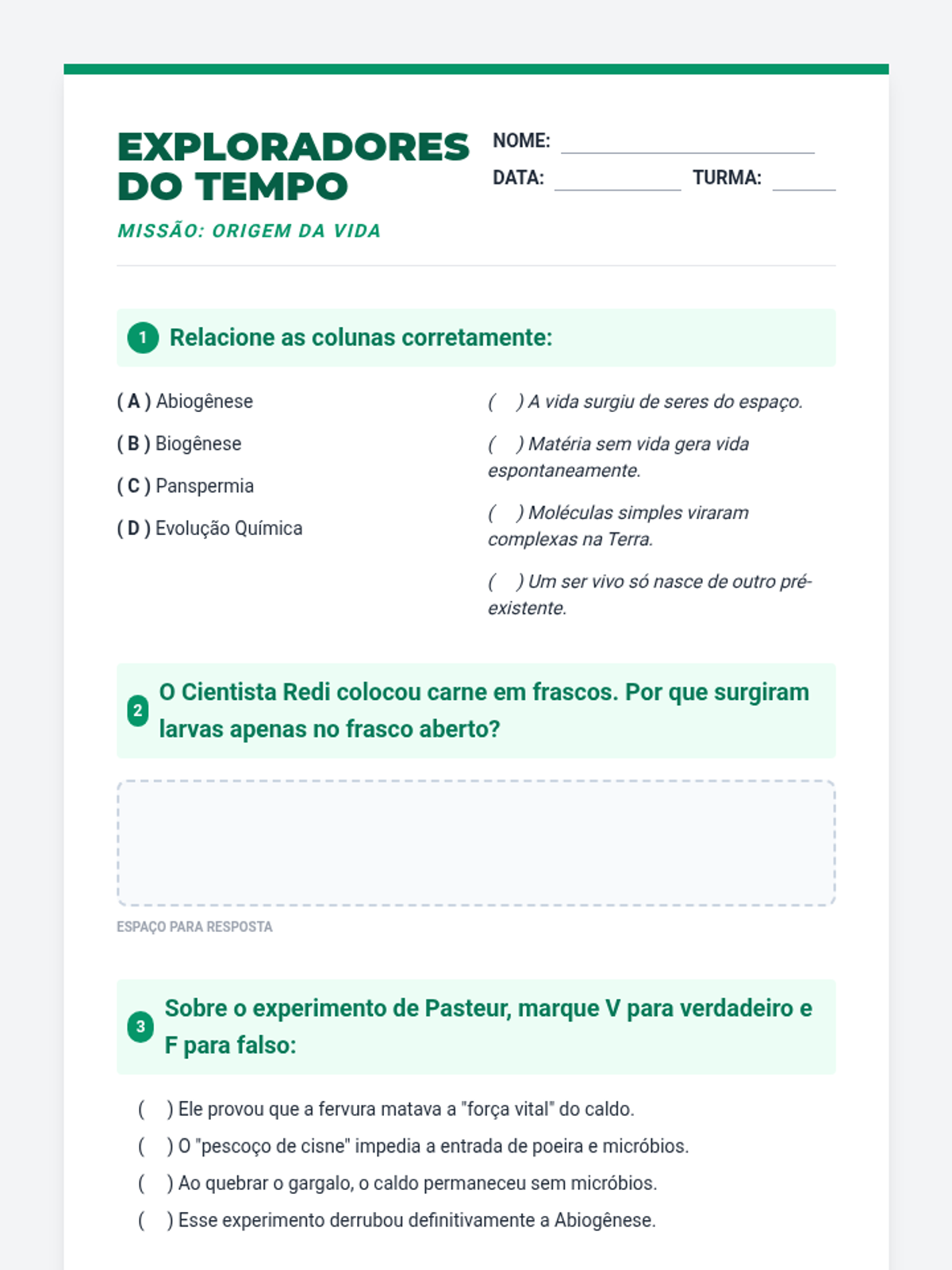
Folha de atividades para estudantes sobre a origem da vida, incluindo questões de múltipla escolha, verdadeiro ou falso, análise de experimentos e espaço para escrita.
Uma apresentação de slides visualmente impactante sobre a origem da vida, cobrindo abiogênese, biogênese, Terra primitiva e o experimento de Miller-Urey.
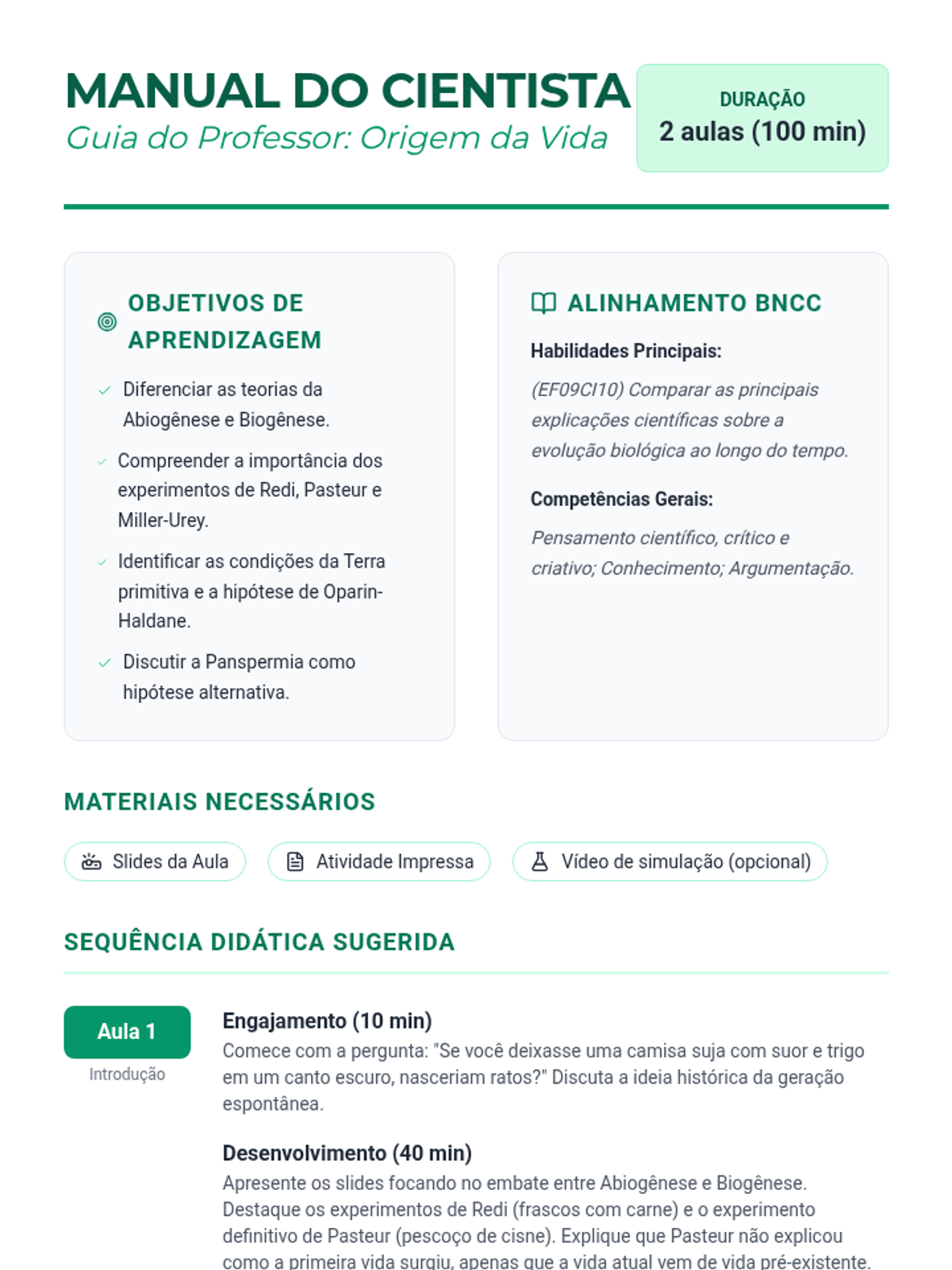
Um plano de aula detalhado para o professor, incluindo objetivos de aprendizagem, alinhamento com a BNCC, materiais necessários e uma sequência didática para duas aulas sobre a origem da vida.
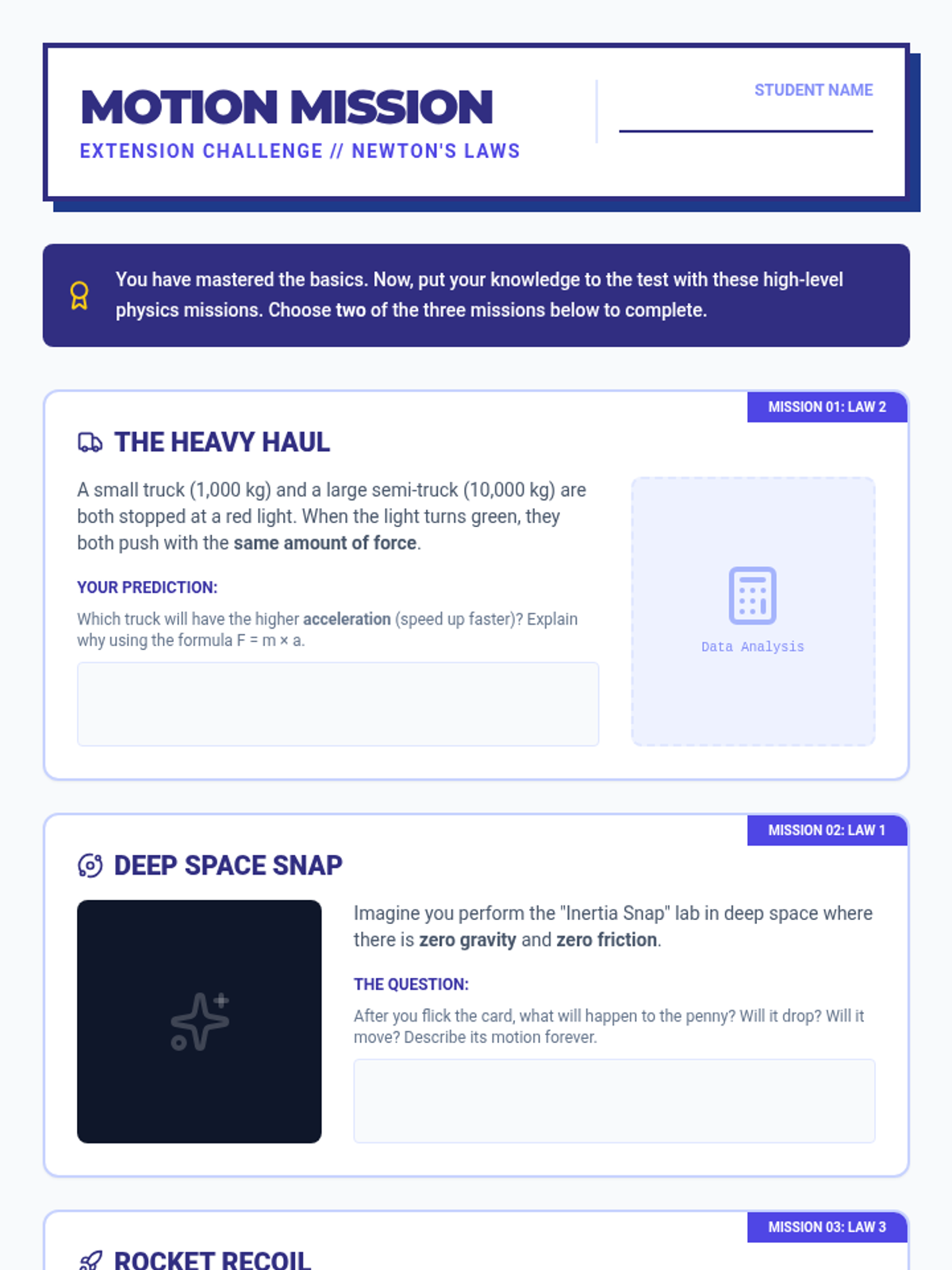
An extension worksheet for early finishers featuring three 'Missions' that apply Newton's Laws to complex scenarios like semi-truck acceleration, deep space motion, and rocket propulsion.
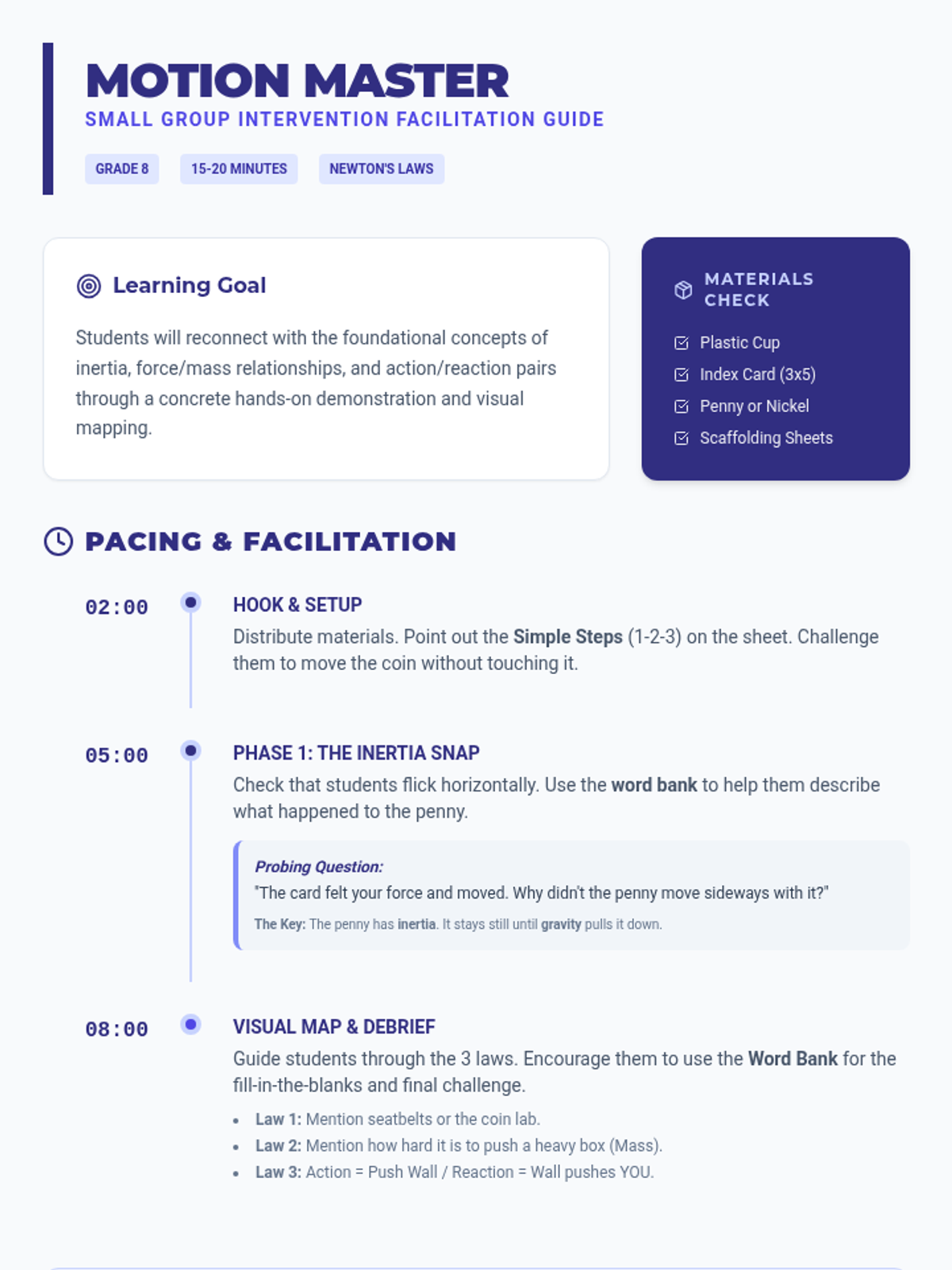
A teacher facilitation guide for the 15-minute Newton intervention. It includes a pacing timeline, specific probing questions for each phase, and a list of common 8th-grade misconceptions regarding force and motion.