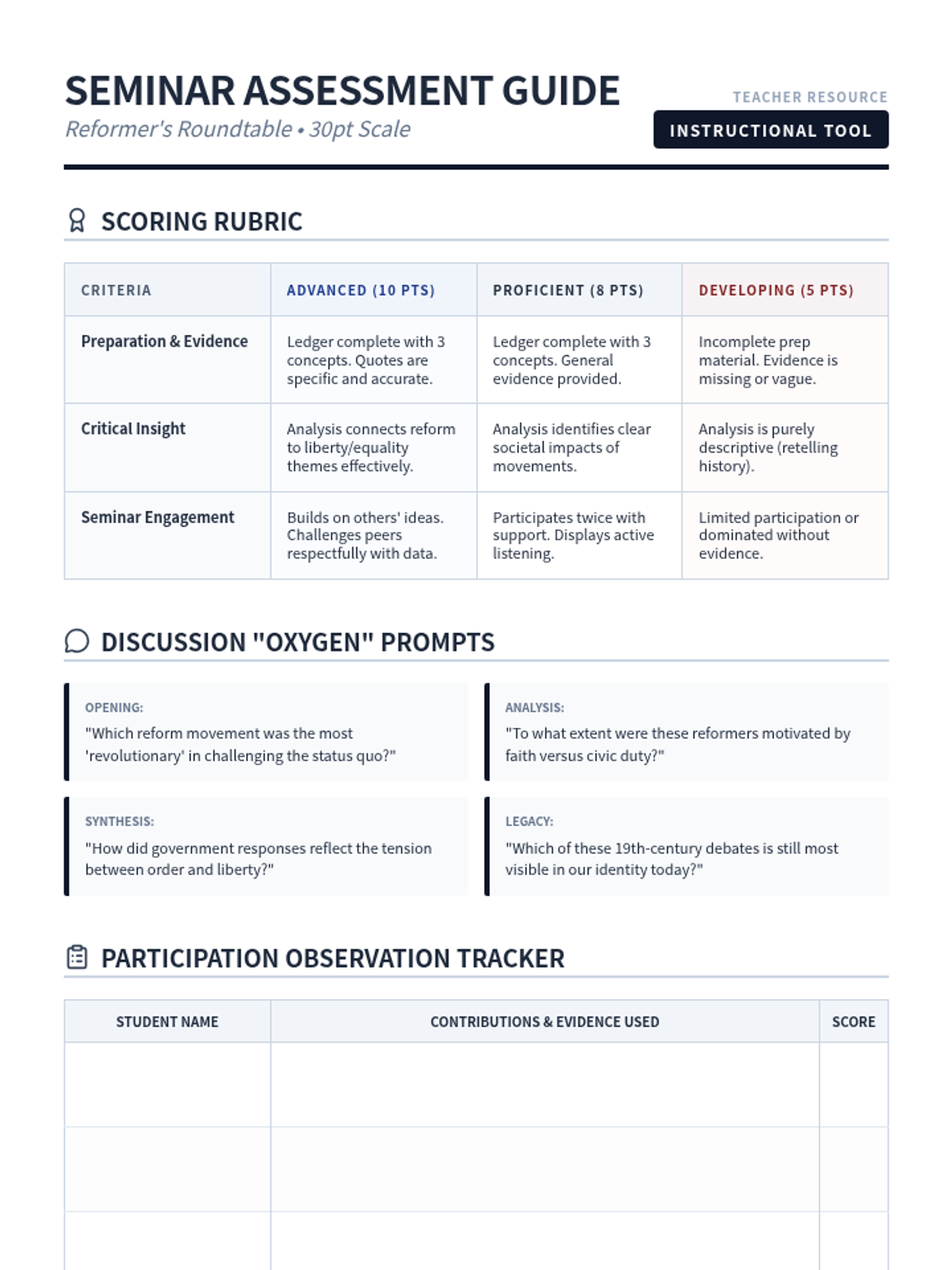
A comprehensive slide deck for an undergraduate psychology lesson focusing on evolutionary psychology, negativity bias, and behavioral interventions for happiness. Includes embedded video, discussion prompts, and clear lab instructions.
Plan de formation complet fusionnant micro-timing, logistique, liens de veille et références aux supports pédagogiques pour les 2 jours. Mis à jour pour refléter le recentrage sur la posture de professeur-documentaliste.
Document de fond fusionnant les notes théoriques du formateur, le corpus de référence et le glossaire des tropes pour une expertise complète. Focus recentré sur la posture du professeur-documentaliste et la psychologie du lecteur adolescent.
A teacher facilitation guide for the 20-minute Horace Mann lesson, including a pacing guide, answer key, and discussion prompts.
A primary source analysis worksheet featuring an excerpt from Horace Mann's 12th Annual Report, focused on the "Great Equalizer" concept.
A slide deck providing historical context on Horace Mann and the 1830s-1840s Common School Movement in America.
A concise assessment tool for evaluating student understanding of sovereignty, the difference between states and governments, and political legitimacy at the end of a lesson.
A teacher guide for the first lesson of the AP Government Mastery series, including learning objectives, discussion prompts, and an answer key for foundational political science concepts.
A student worksheet for AP US and Comparative Government focusing on the categorization of political systems, sources of legitimacy, and foundational US political philosophy.
A visual slide deck introducing fundamental political science concepts for AP US and Comparative Government, covering sovereignty, legitimacy, and the state-regime-government hierarchy.
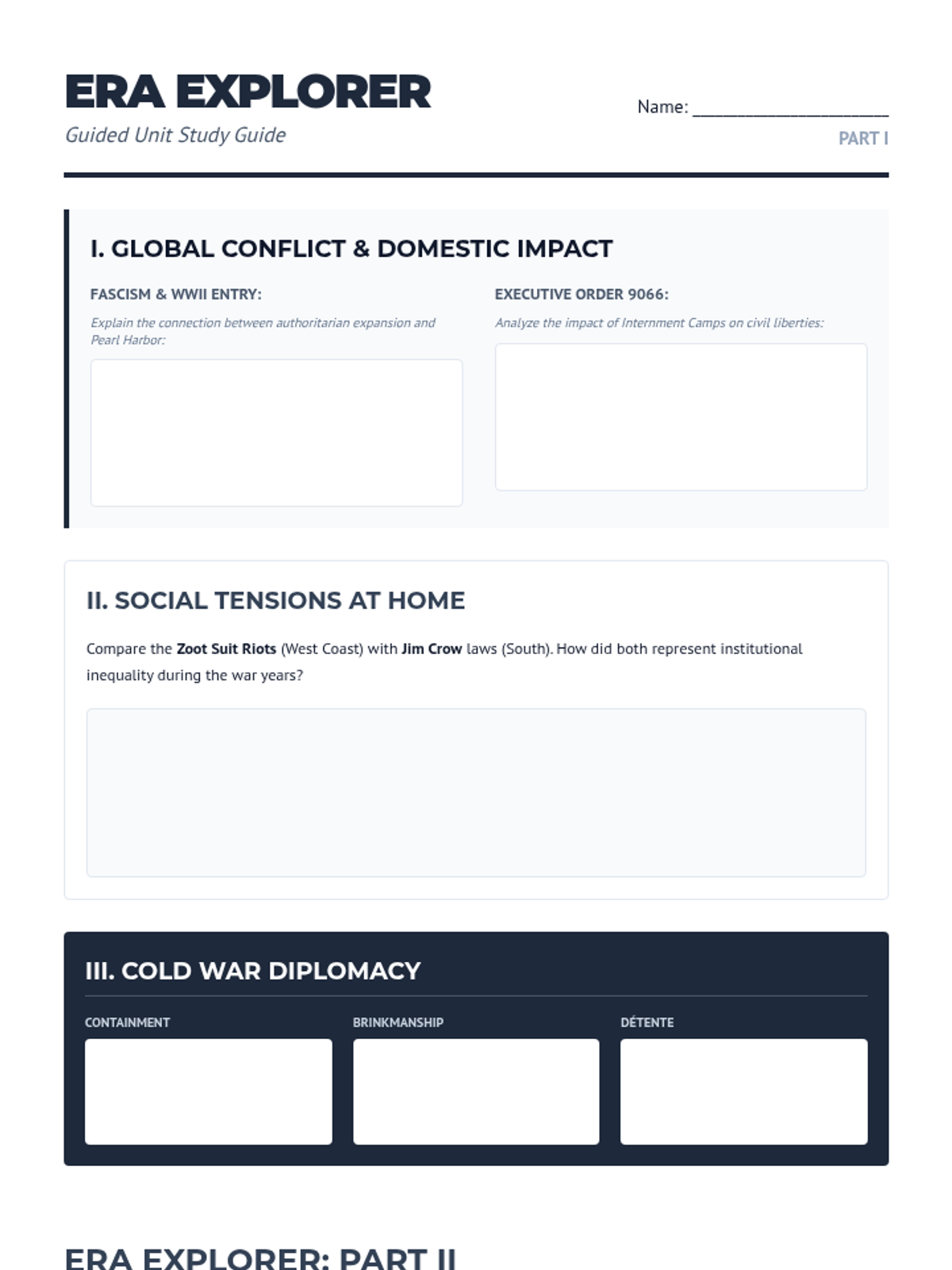
A structured analysis worksheet for students to 'interrogate' primary sources using the HIPP framework, with dedicated space for outside evidence and a final synthesis prompt.
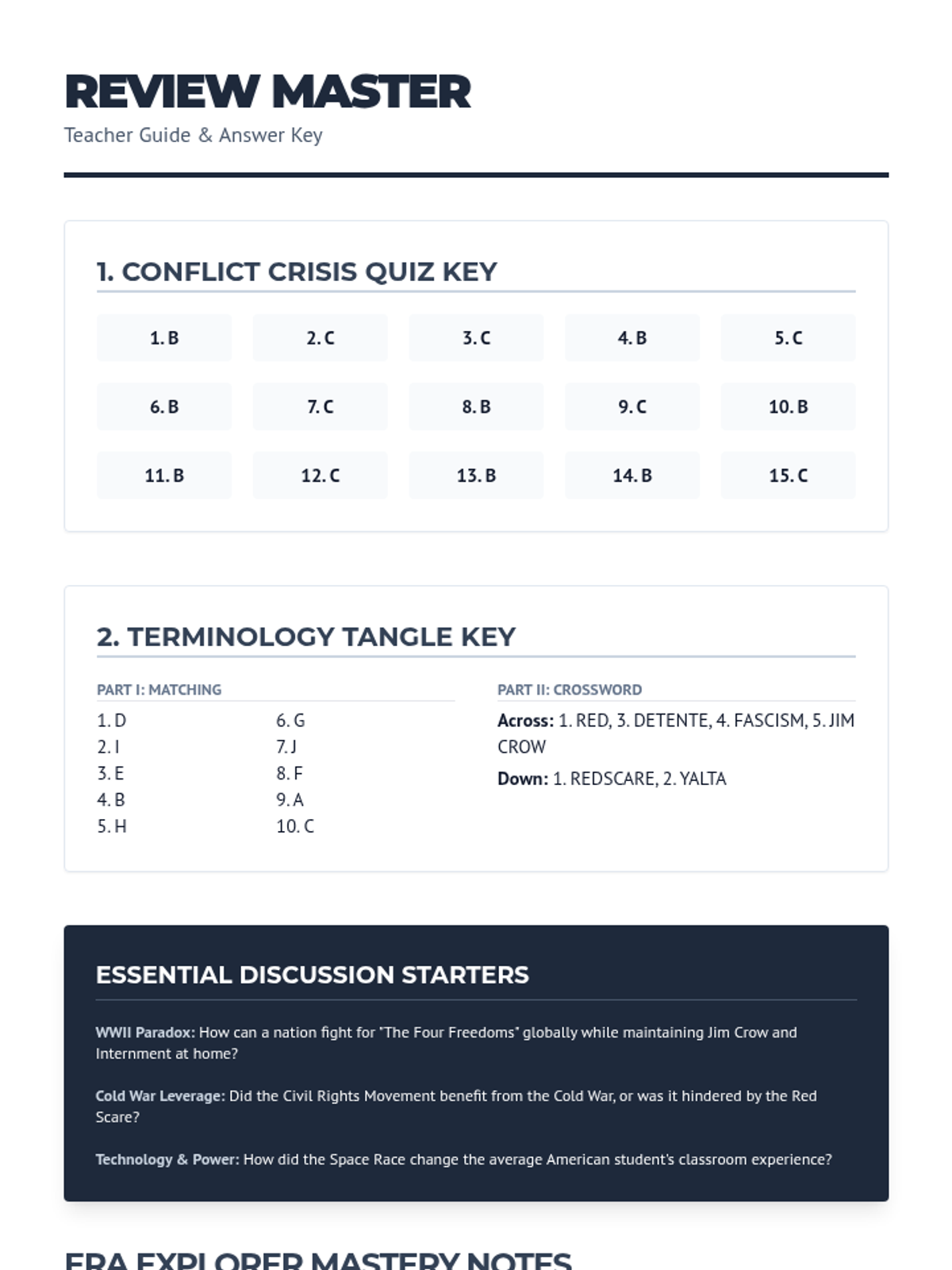
A curated collection of WWII primary sources designed as a classified dossier, including FDR's Infamy speech, Nazi propaganda, Executive Order 9066, and Truman's atomic bomb statement.
A high-impact visual presentation for introducing WWII primary source analysis, featuring the HIPP framework, modeling of FDR's 'Infamy' speech, and student instructions.
A comprehensive teacher facilitation guide for the WWII primary source lesson, featuring a detailed lesson plan, AP alignment, and an interrogation answer key for the sources.
Slide deck for the Constitutional Clash lesson, featuring the entire text from the student reader chunked across slides with specific annotation, stop and jot, and think-pair-share instructions, followed by reveal slides with model answers.
Exit ticket assessment for the Constitutional Clash lesson, focusing on the debates between Federalists and Antifederalists, matching key individuals to their roles, and reflecting on the importance of a written constitution.
Teacher annotated version and answer key for the Constitutional Clash lesson, providing model answers for all student activities, annotation checks, and the section review questions.
Student reader for the Constitutional Clash lesson, featuring the exact text from the provided source, a ratification table, integrated active monitoring moments, stop and jots, think-pair-share prompts, margin note areas, and the section review questions with sentence frames.
Teacher instructional guide for the Constitutional Clash lesson, including a detailed script, pacing timeline, identification of common misconceptions, and scaffolding strategies for LEP and IEP students.
A comprehensive teacher guide for facilitating the Anxiety Spectrum lesson, including timeframes, instructional phases, discussion prompts, and a case study answer key.
A reflective journal prompt document designed for students to explore the impact of casual language on mental health stigma and the importance of clinical accuracy.
A comprehensive teacher guide for the anxiety etiology lesson. It includes a pacing guide, detailed answer keys for the student worksheet, and pedagogical tips for addressing common AP Psychology misconceptions like the difference between negative reinforcement and punishment.
A student worksheet containing four clinical vignettes for analysis using the Deviance, Distress, Dysfunction, and Danger criteria to distinguish between normal behavior and clinical disorders.
A comprehensive teacher facilitation guide including a pacing plan, interactive video pause points, and a detailed answer key for the clinical simulation activity.
A student worksheet for mapping the behavioral cycle of anxiety. It includes a Little Albert review section, a structured flowchart template for a specific phobia, and analysis questions regarding negative reinforcement and exposure therapy.
A comprehensive slide deck for teaching the behavioral causes of anxiety disorders, featuring a Little Albert warm-up, embedded Crash Course video, and detailed explanations of the Cycle of Anxiety.
A comprehensive slide deck for High School Psychology covering the 4 Ds of diagnosis, defining anxiety disorders, and busting myths about OCD with an embedded Crash Course video.
A teacher facilitation guide for the Identity Lab lesson, providing pacing, discussion anchors, answer keys for the clinical case study, and AP Psychology exam connections.

A clinical-themed workbook for students to analyze hypothetical patient profiles, conduct research on EMDR, and design a multi-step treatment plan based on video evidence. Now updated with expanded research space and a Peer Clinical Audit section.