Habitat profile cards for students to use as inspiration for their 'Creature Creator' activity. Each card outlines specific climate conditions and survival challenges for the Rainforest, Arctic, Sahara Desert, and Midnight Zone.
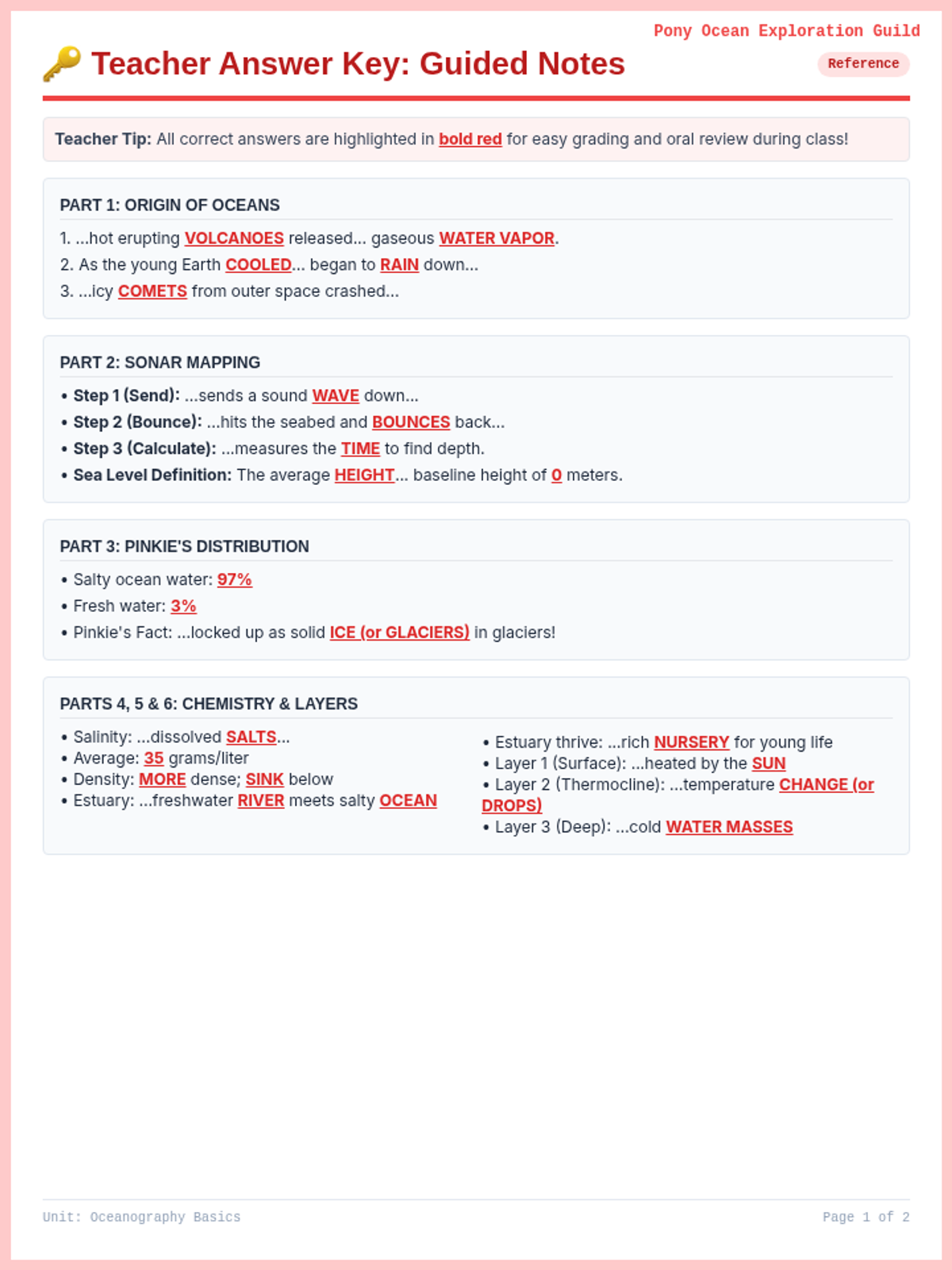
A comprehensive 2-page teacher answer key providing clear, bolded answers and mathematical solutions for the guided notes, worksheet, and student quiz.
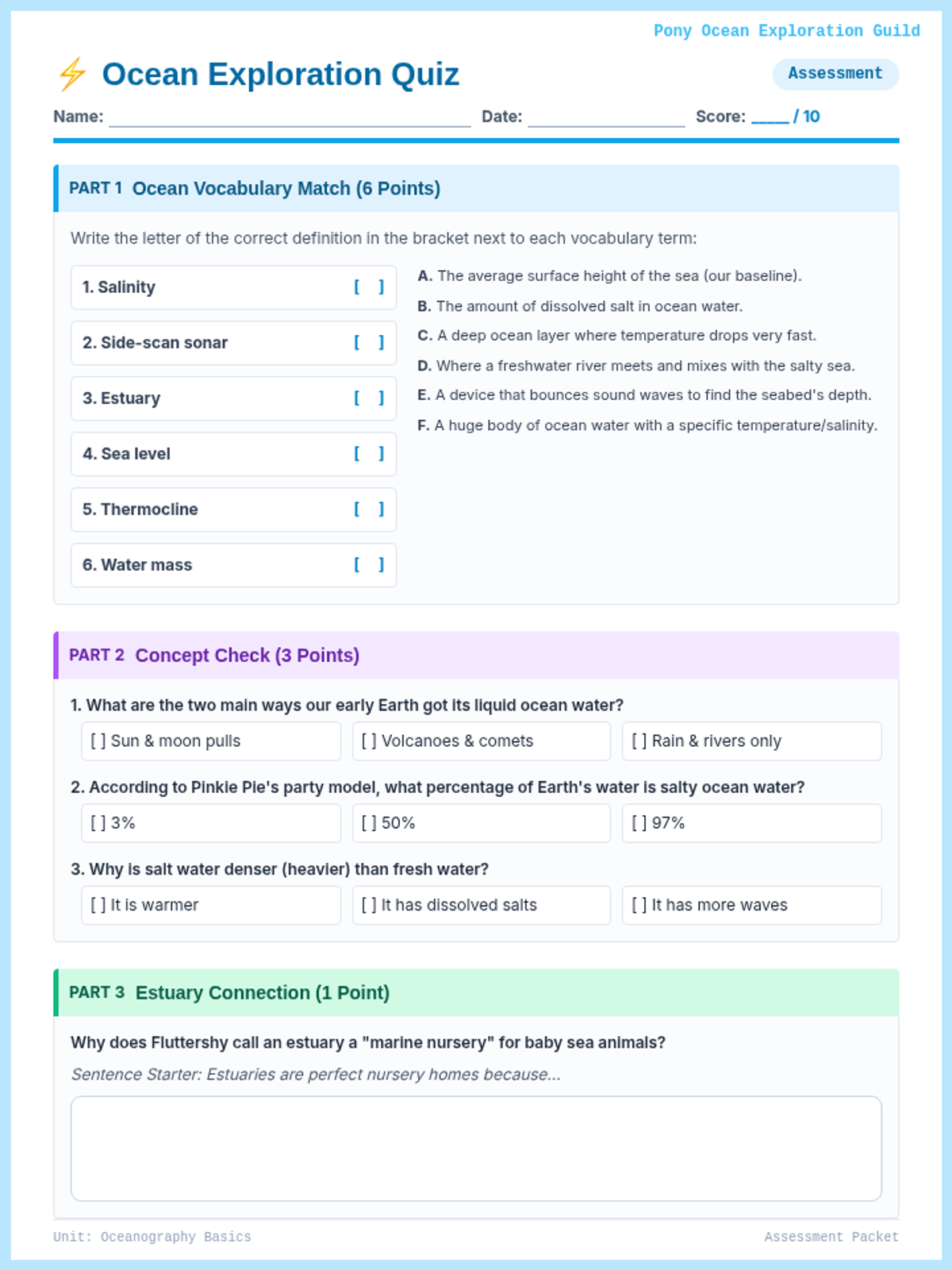
A supportive 1-page assessment utilizing word banks, sentence starters, and simple multiple-choice questions with balanced, clean styling for all options.
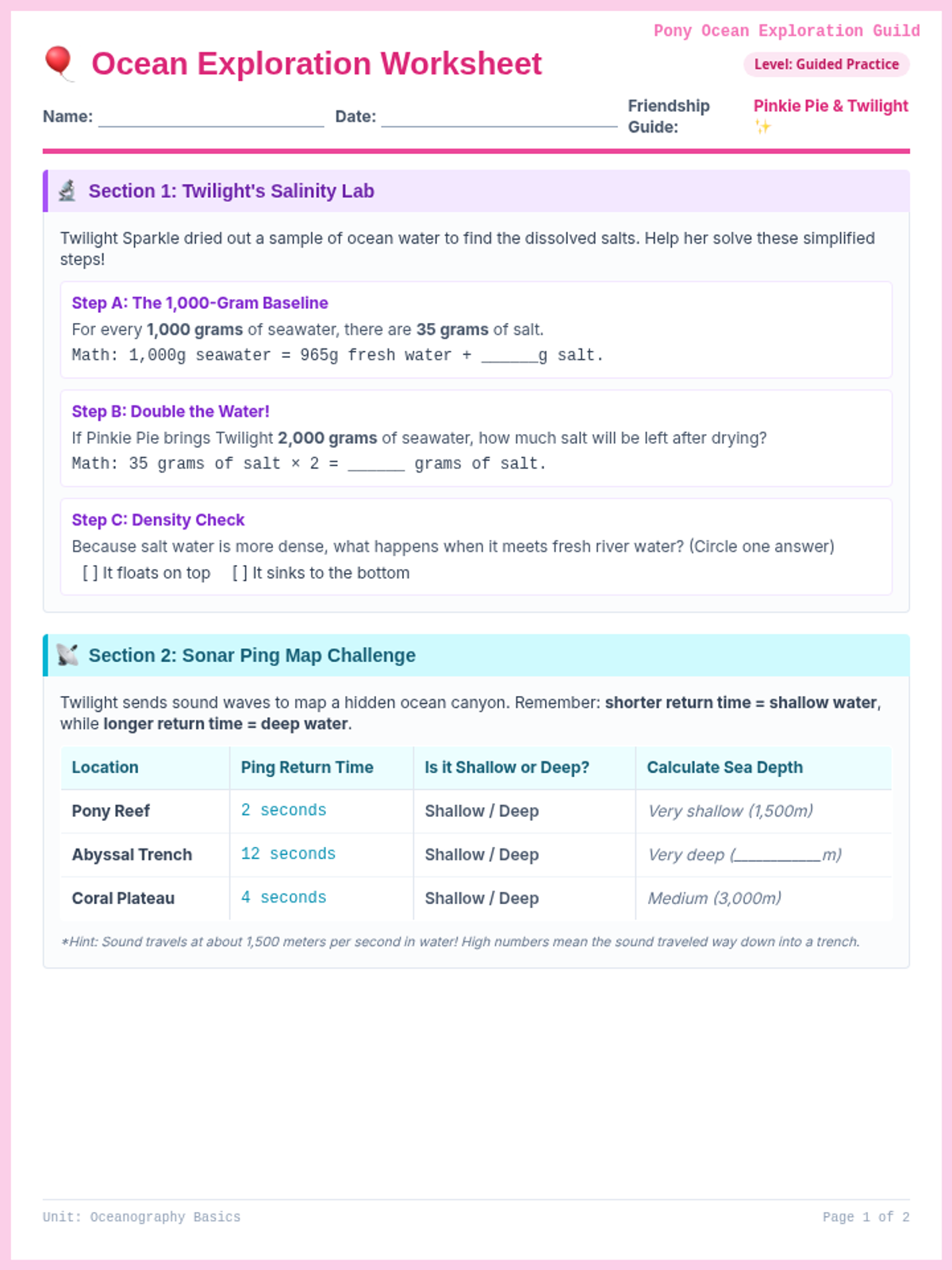
A 2-page student worksheet containing simplified step-by-step math for salinity and sonar, water sorting diagrams, and graphic organizers on estuaries and temperature profiles.
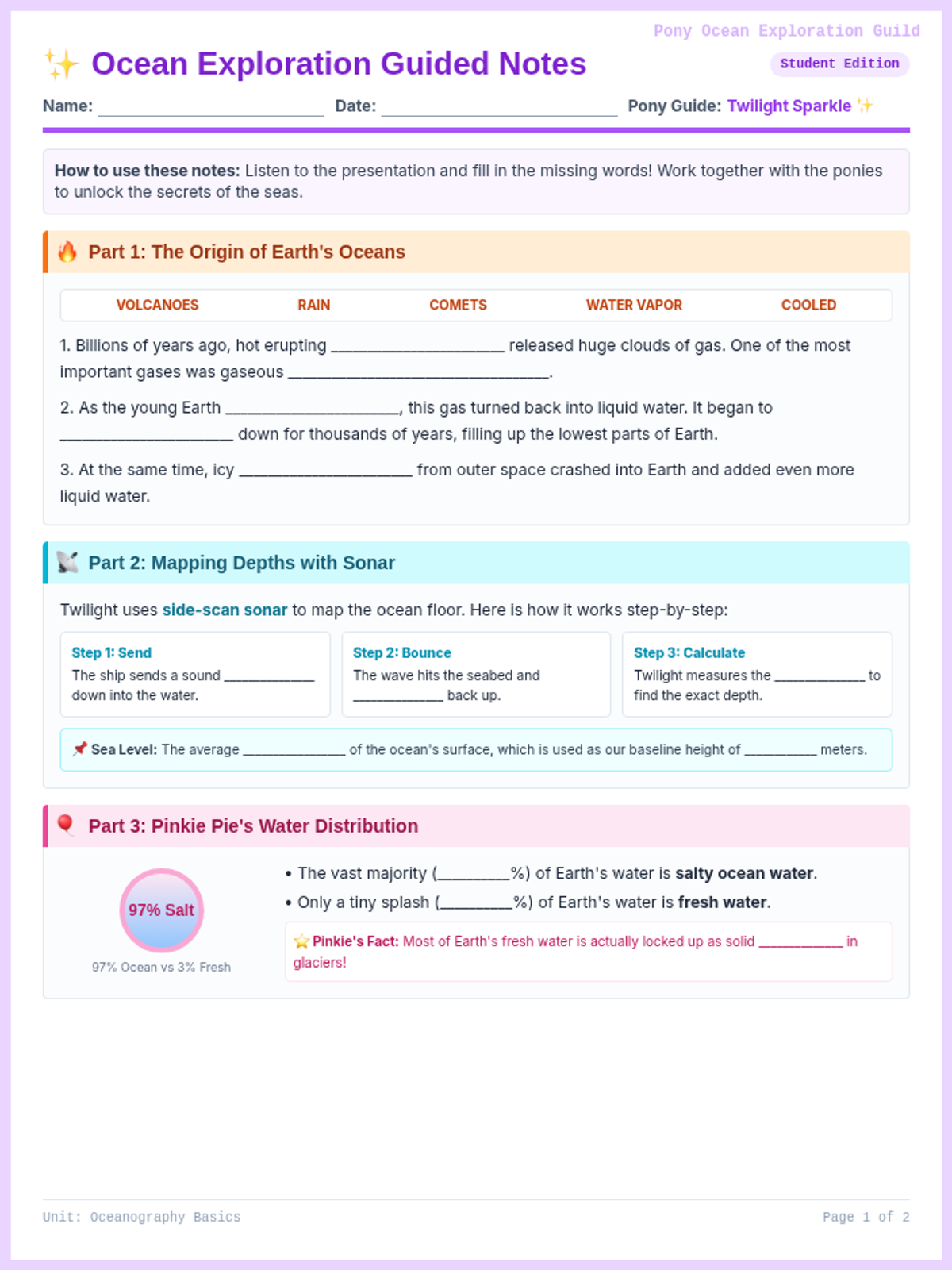
A 2-page highly supportive guided notes packet with custom character checkpoints, simple diagrams, fill-in-the-blanks, and a clear word bank for students to complete while following along with the presentation.
A 7-slide interactive presentation featuring the My Little Pony characters to explain ocean origins, water distribution, side-scan sonar, salinity, estuaries, and ocean layers. Designed with large text, vivid color codings, and simple layouts for visual learners.
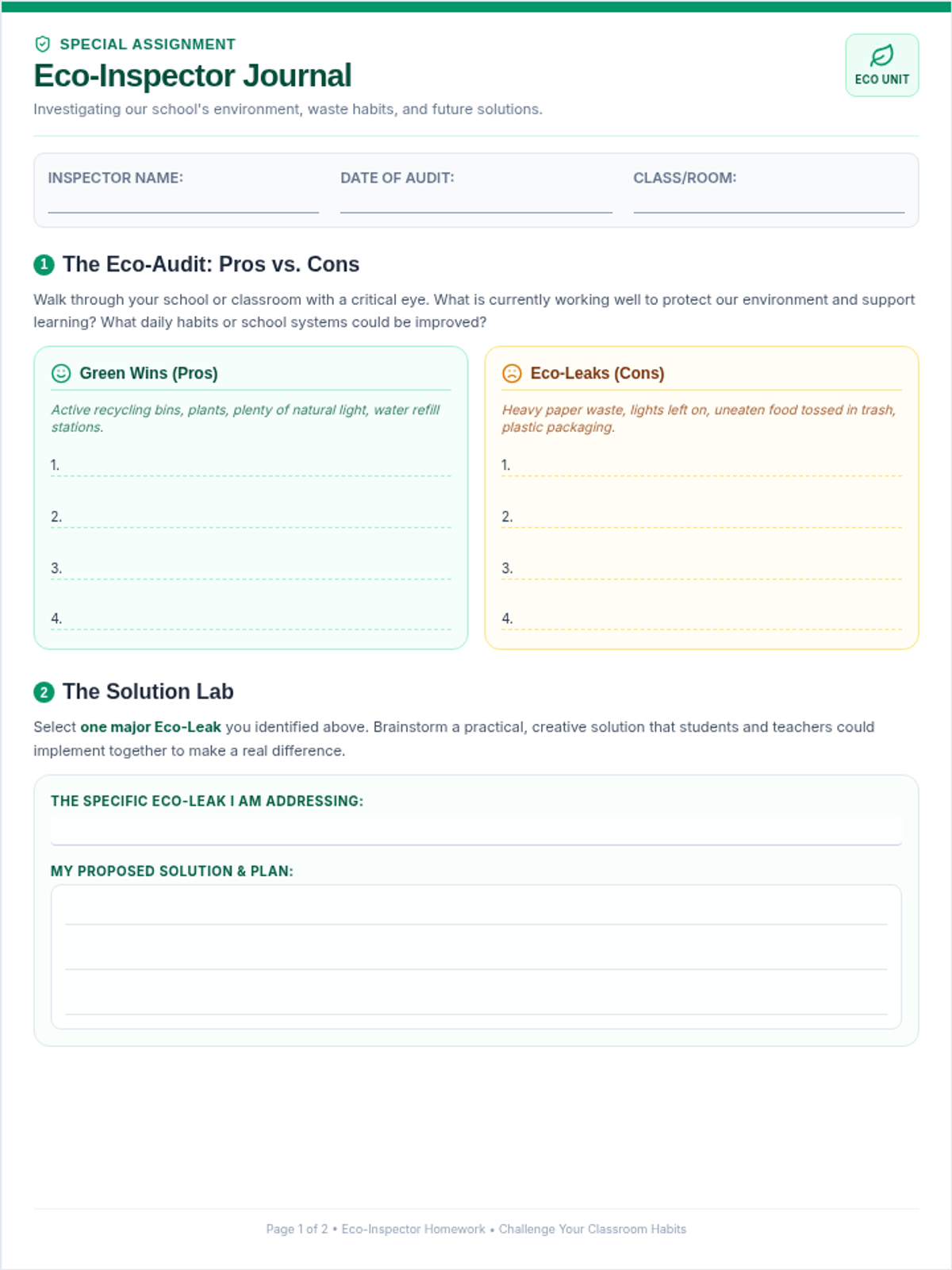
A highly engaging and beautifully formatted 2-page homework worksheet for students to audit their school/classroom environment, identify pros/cons, propose solutions, and design statistical data collection strategies for environmental habits.
A 1-page exit ticket and corresponding assessment rubric to measure student mastery of dog trait patterns and scientific explanation skills.
A 2-page printable student handout containing a breed data-tracking table on page 1 and a scaffolded Claim-Evidence-Reasoning (CER) writing template on page 2.
A 2-page printable card resource containing 8 distinct dog breed profiles with descriptions of their physical traits, ancestral environments, and original jobs to enable partner sorting.
An engaging 7-slide interactive slideshow designed for classroom projection to guide students through comparing dog traits, identifying patterns, and structuring their CER explanations.
A comprehensive 2-page teacher facilitation guide containing pacing, lesson objectives, a questioning framework, common misconceptions, and step-by-step instructions for the partner card-sorting and CER writing activities.
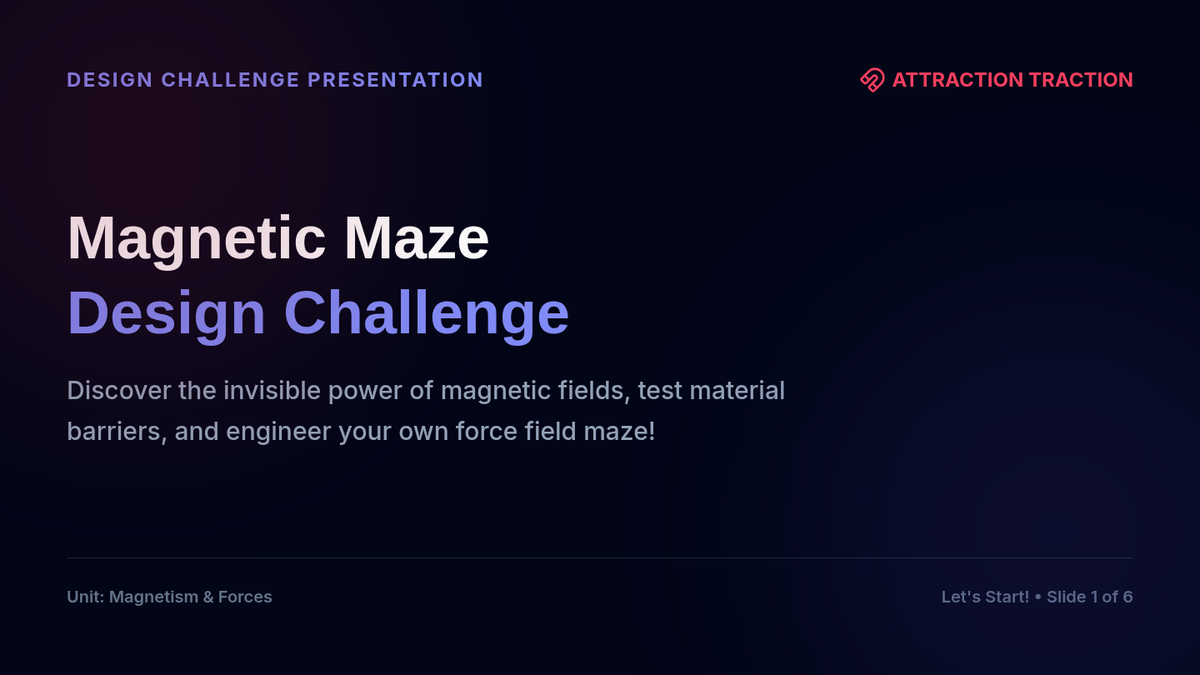
A 6-slide design challenge deck designed to guide students visually through the concepts of magnetism, non-contact forces, material testing, and iterative maze engineering.
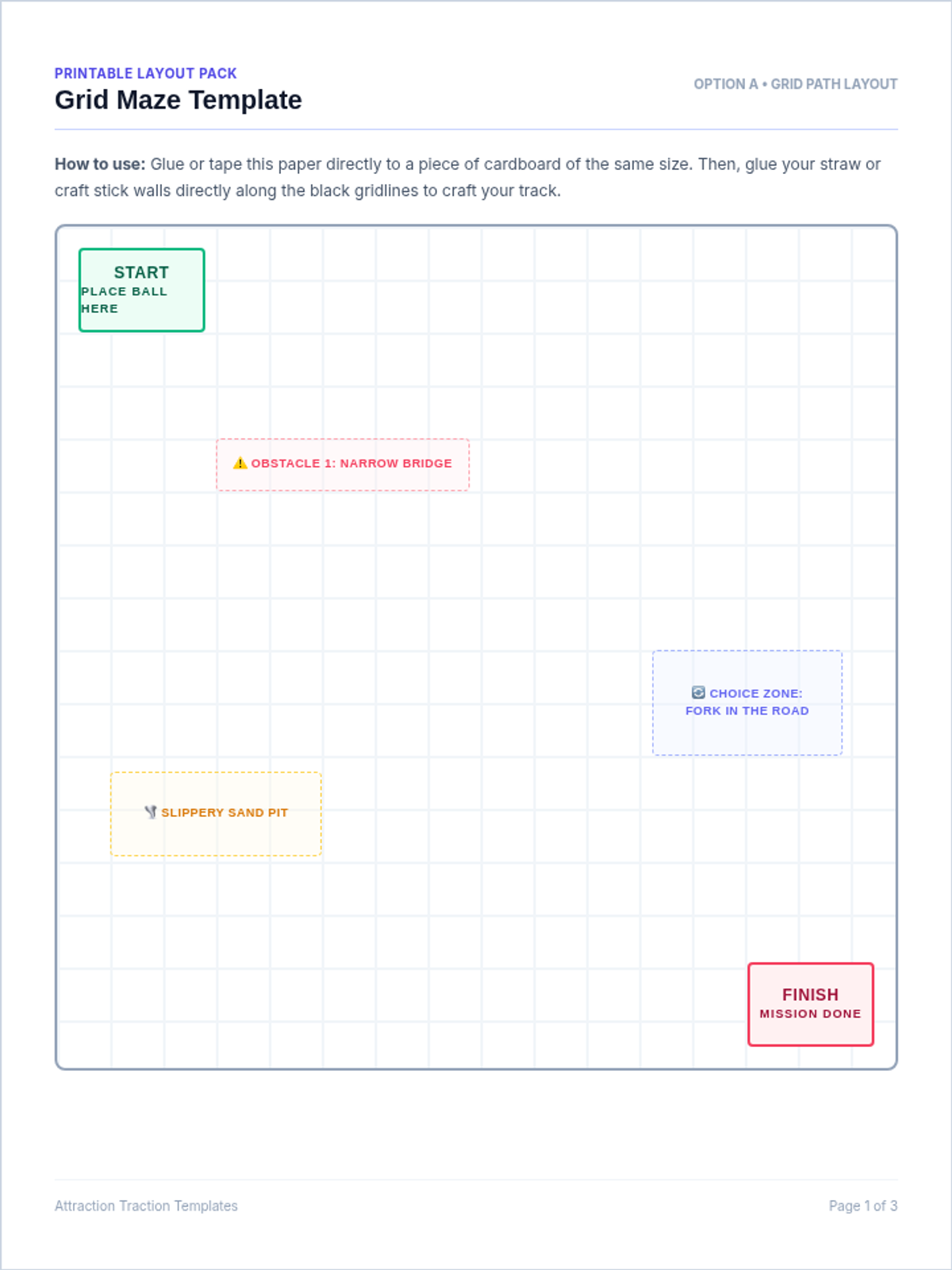
A 3-page printable pack featuring two complete pathing templates (orthogonal grid and concentric radial maze designs) and a hands-on material testing log sheet.
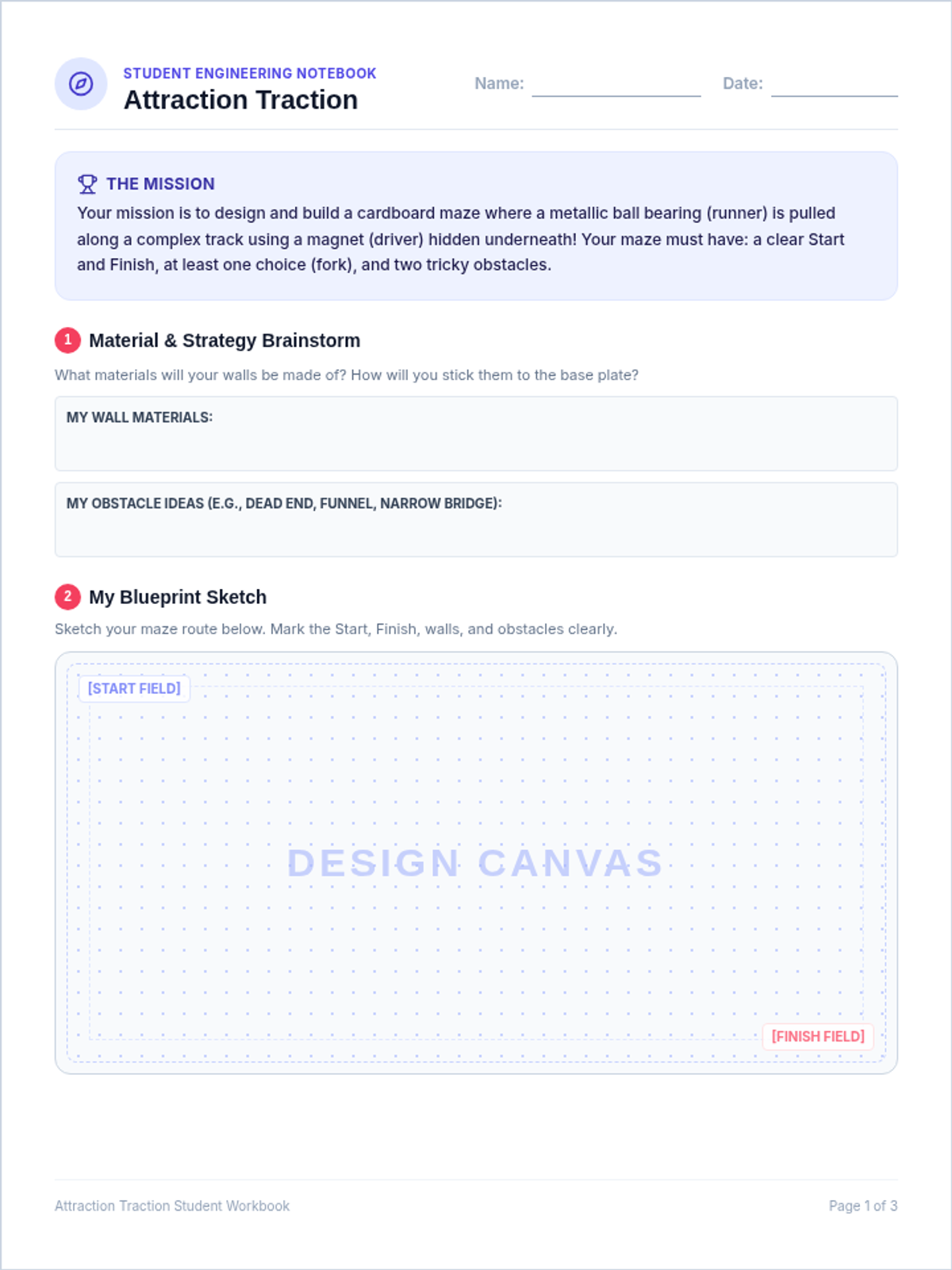
A 3-page student-facing STEM workbook containing a blueprint planning sheet, testing/iteration log, and a high-retention exit ticket with reflective writing prompts about magnetism and force vectors.
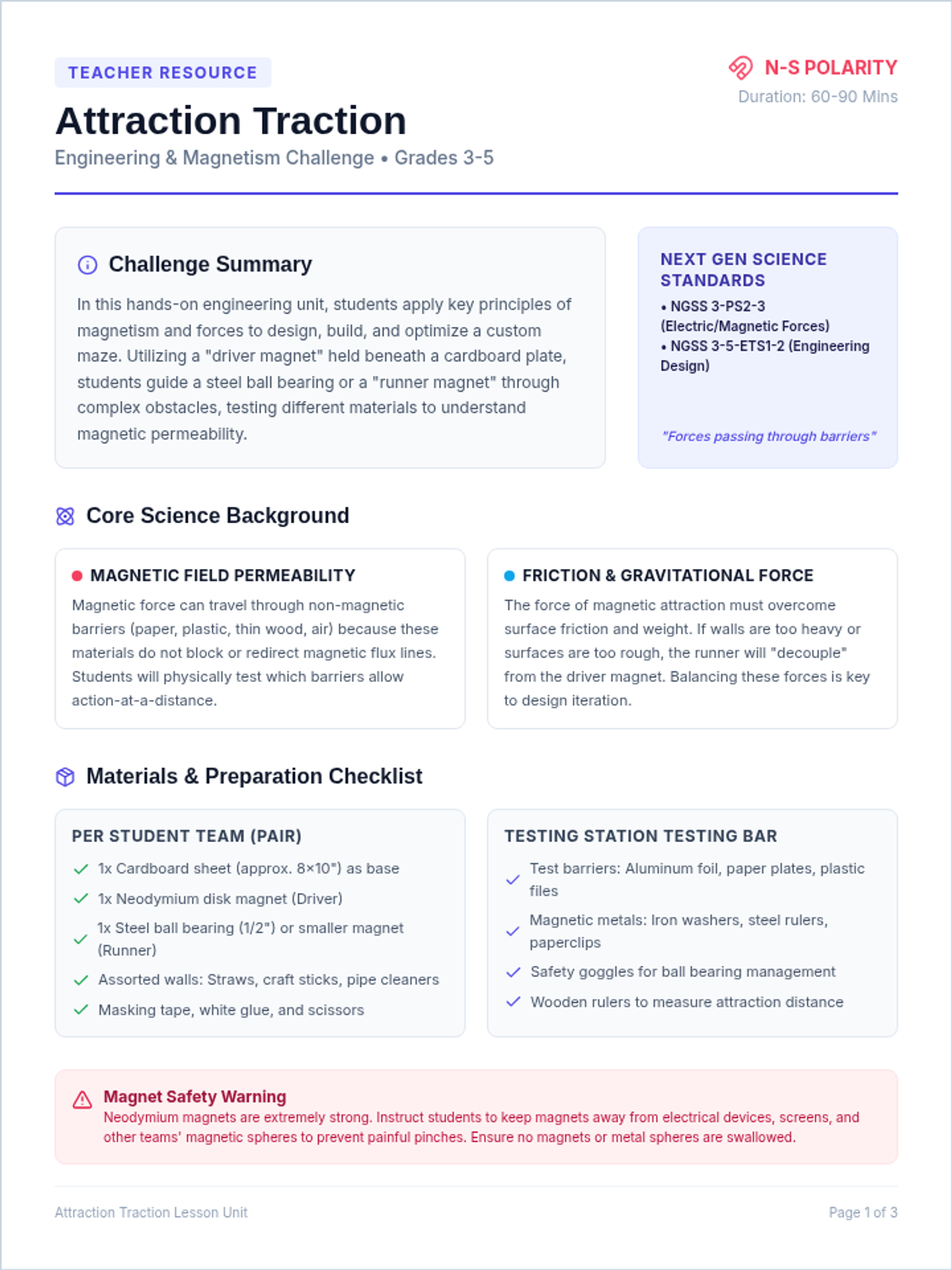
A 3-page printable guide for teachers featuring background science, step-by-step facilitation prompts, material checklists, lesson timeline, and a rubric for the Attraction Traction magnetic maze design challenge.
A 2-page print-ready teacher instructional plan and facilitation guide for running the Force Field Engineers magnet maze lab. Includes NGSS standards, a materials checklist, lesson pacing, inquiry prompts, a 3-tier grading rubric, and classroom troubleshooting tips.
A 2-page collection of printable layout templates, assembly components, and cutouts for building custom student magnet mazes. Includes a 1-inch printable grid board and a materials folding lab sheet.
A 2-page print-ready student lab handbook for the Magnet Maze engineering challenge. It includes a material testing matrix, maze blueprinting grid, testing logs, and reflective engineering prompts.
A 2-page teacher facilitation guide containing next-generation science standards (NGSS) alignments, a detailed 60-minute pacing guide, visual setup directions, a structured engineering design rubric, and a guide to solving common student misconceptions.
A 5-slide visual presentation for teachers to introduce non-contact forces, magnetic fields, attraction/repulsion, and the step-by-step engineering constraints of the Magnet Maze challenge.
A 3-page student activity guide and engineering worksheet for the magnet maze challenge. Includes design constraints, a layout sketching grid, material testing logs, and conceptual reflection questions on non-contact forces and poles.
A single-page formative assessment exit ticket where students analyze vague steps for logical loopholes, practice writing highly precise instructions, and explain why exact detail is crucial for programming.
A highly-structured 2-page student worksheet that helps kids brainstorm, sketch, and systematically draft chronological, step-by-step algorithms for building a marshmallow fluff and jelly sandwich.
A comprehensive, step-by-step facilitation guide for teachers on how to execute the literal-interpretation marshmallow fluff and jelly demo, complete with loophole guides, common student instruction errors, and reflection prompts.
A vibrant, projection-ready slide presentation that guides students through the 'Exact Instructions Challenge'. It establishes the rules of the robot-teacher demo, showcases ingredients, sets up the writing activity, and leads the class debrief on the importance of clarity.
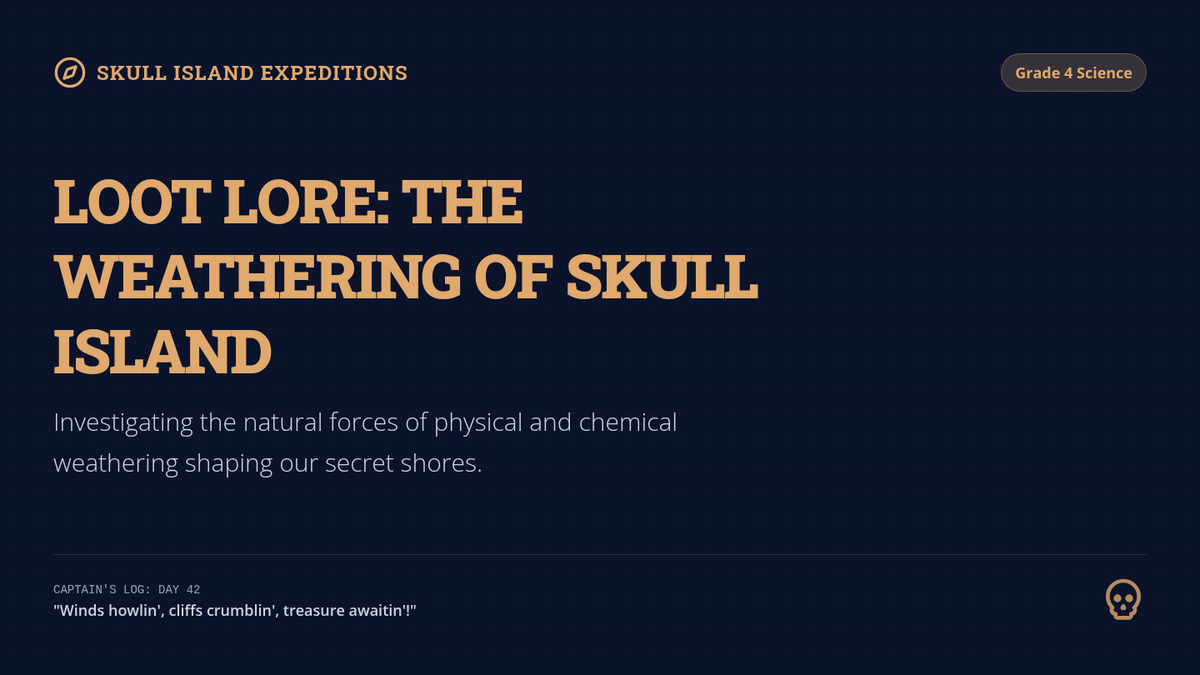
A high-impact, beautifully animated instruction slide deck utilizing a mysterious deep ocean theme. Includes core slide designs illustrating Physical and Chemical weathering concepts with rich visuals and pirate expedition tie-ins.
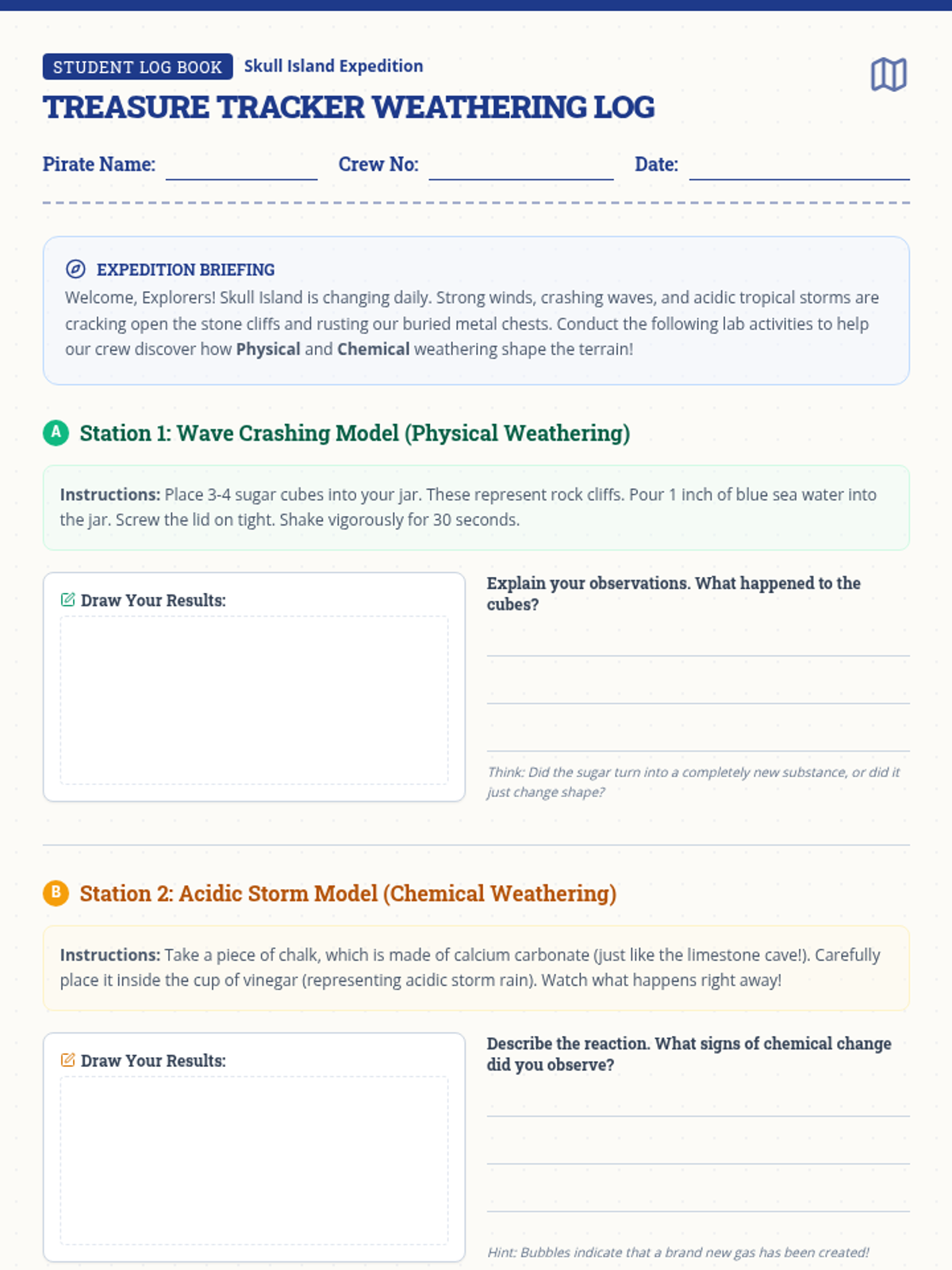
A student-facing laboratory recording sheet and assessment. Features beautifully framed blank visual recording areas, handwriting-spaced prompt lines, and scenarios to test students' mastery of chemical versus physical weathering in a high-seas context.
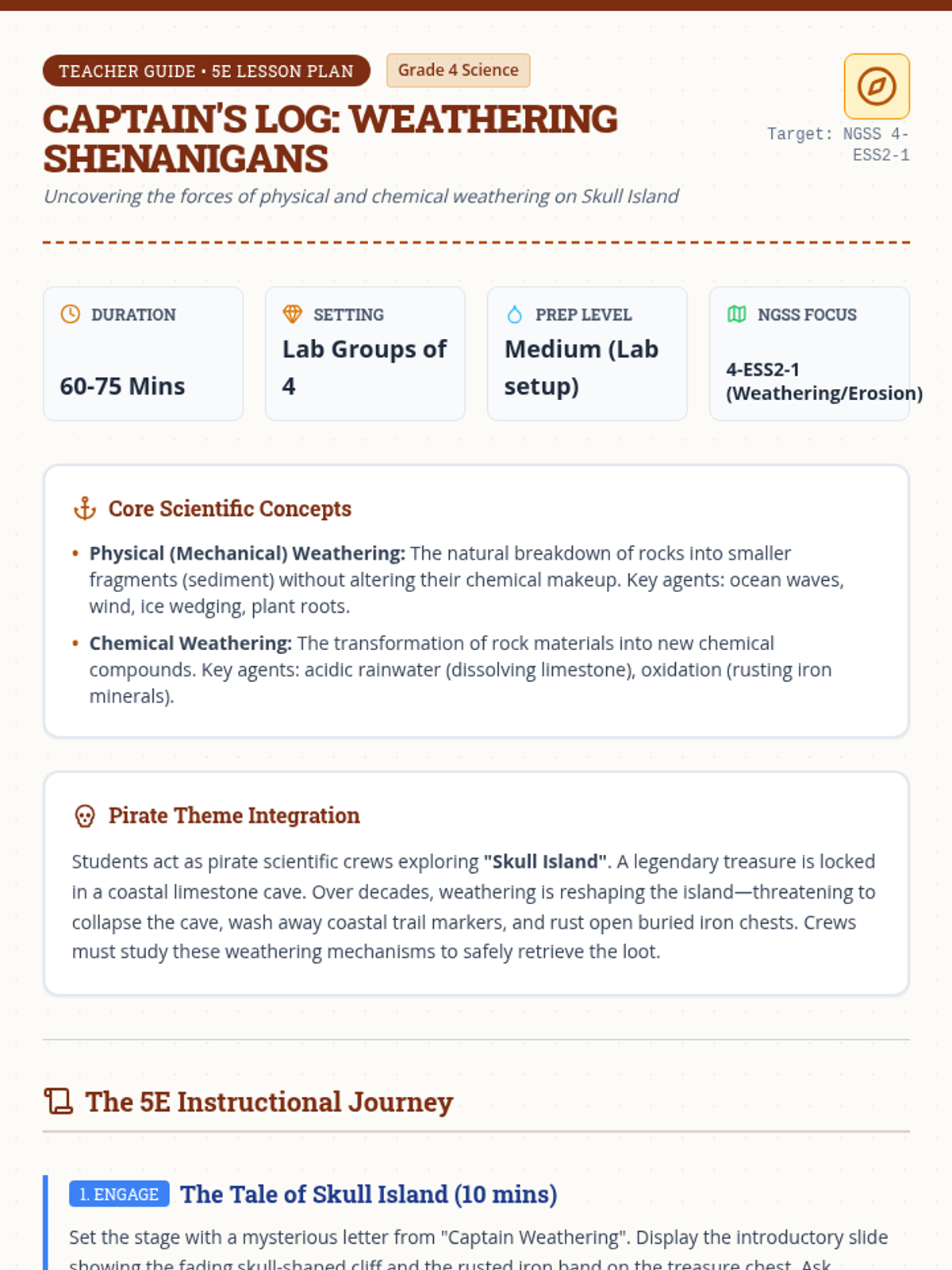
A comprehensive 5E Teacher Guide structured around the NGSS 4-ESS2-1 standard. Uses a pirate theme of Skull Island to guide teachers through facilitating lessons on physical and chemical weathering, complete with laboratory station instructions and master answer keys.
A 2-page complete teacher facilitation guide and answer key for the Microbot Mission viewing unit. It provides lesson timelines, pre- and during-viewing classroom discussion prompts, and fully explained numerical solutions for all math and geometry challenges.
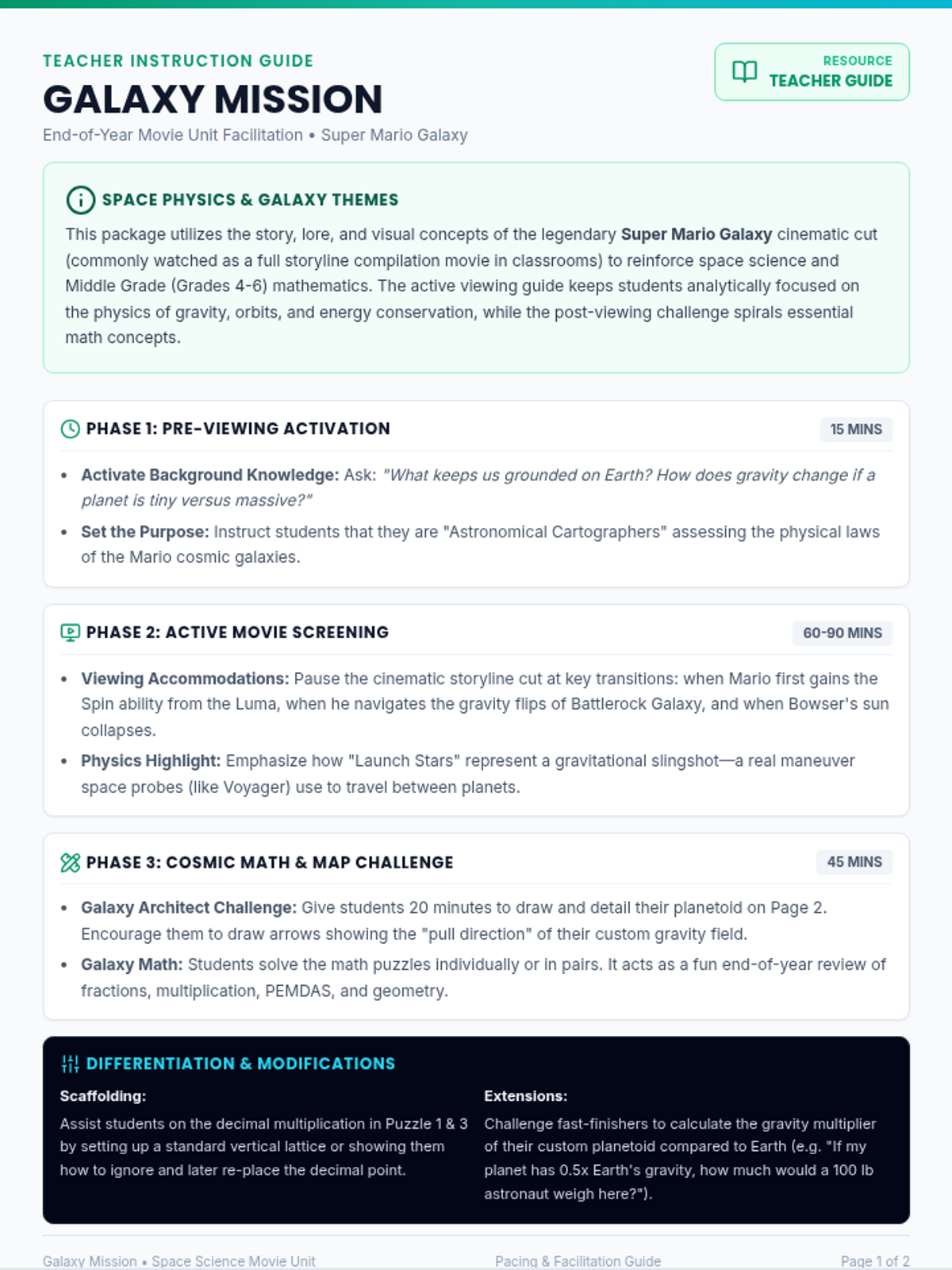
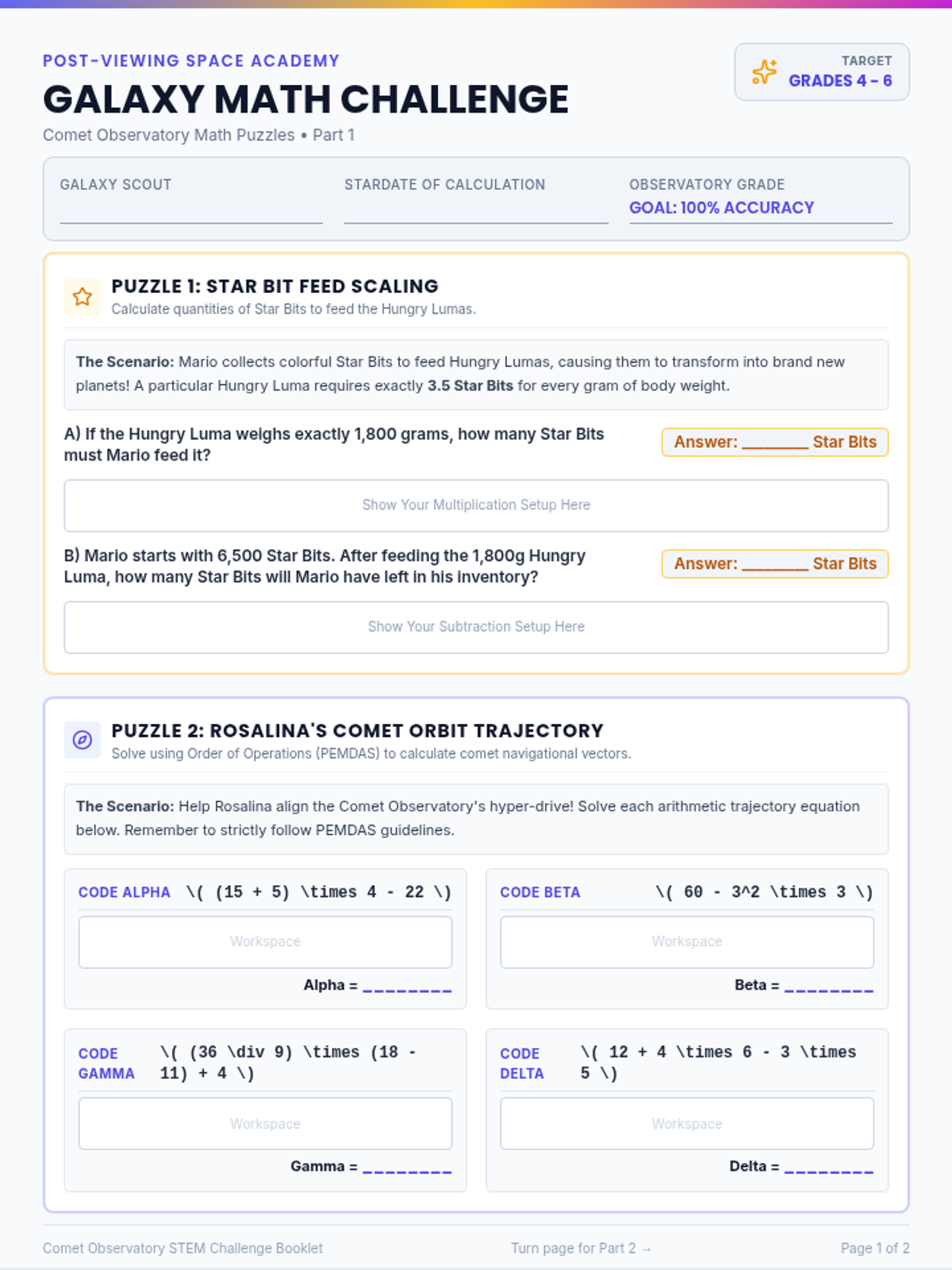
A high-energy 2-page math challenge booklet based on the physics, orbits, and story of Super Mario Galaxy. It presents Grade 4-6 aligned puzzles covering Star Bit scaling, PEMDAS navigational vectors, distance word problems, and orbital geometry.