A scaffolded practice worksheet for students, providing a step-by-step framework for converting ratios to fractions and calculating partition points using grids and clear computational boxes.
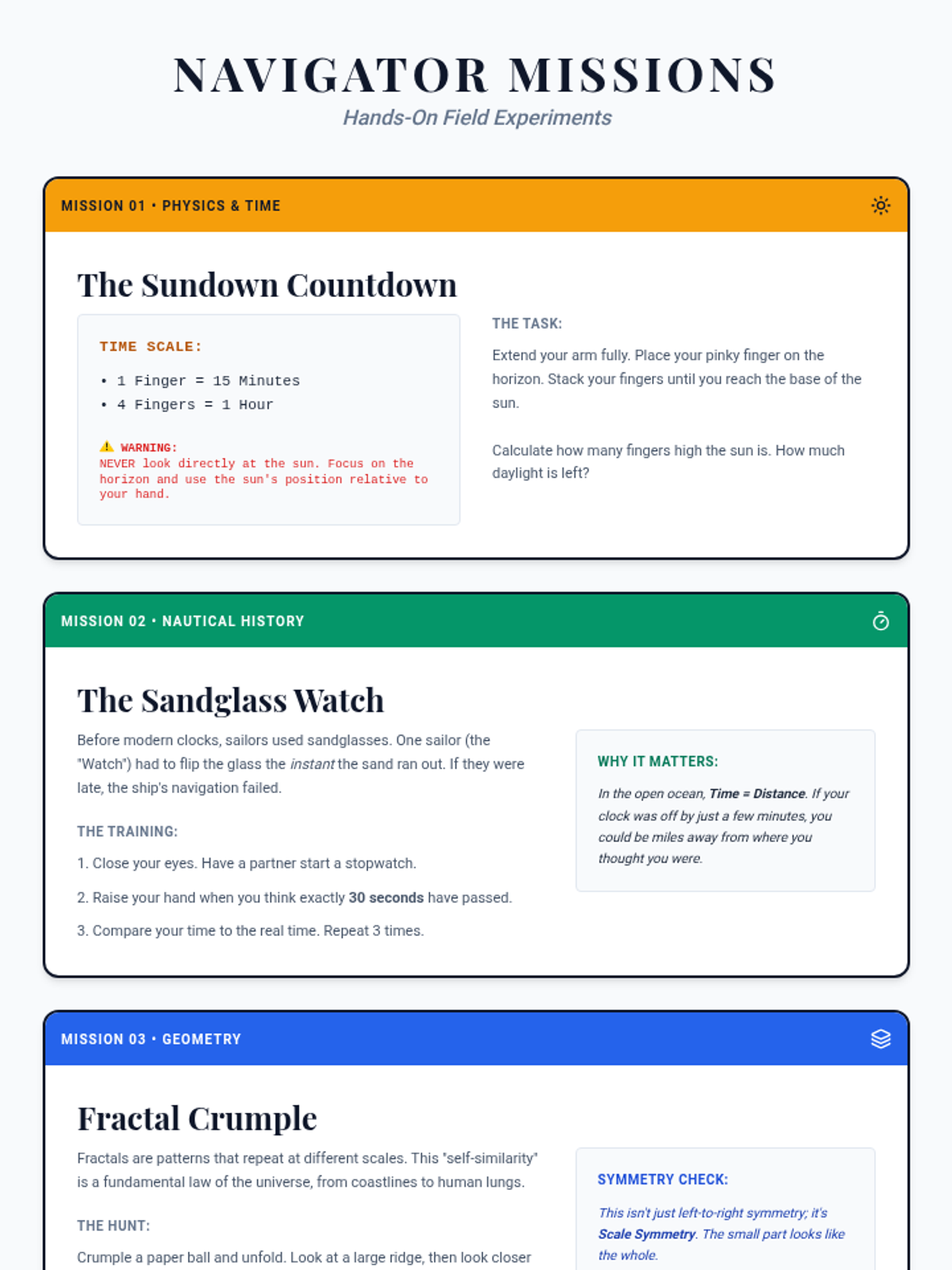
A set of four hands-on field missions for students to experiment with daylight estimation, historical nautical timekeeping, fractal scaling, and sun-based coordinate mapping. All missions now feature consistent, professional layouts with scientific sidebars.
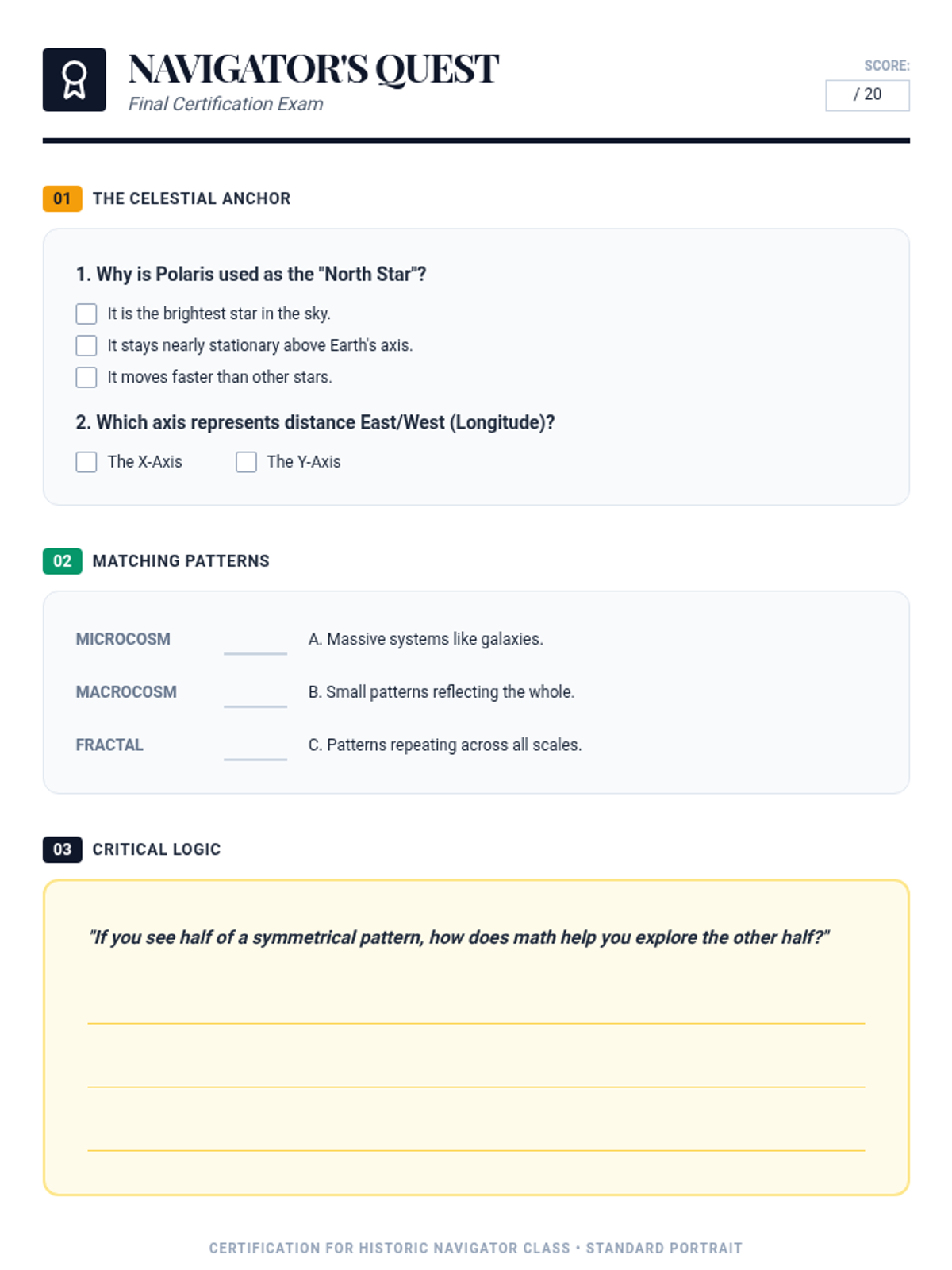
A comprehensive quiz covering fixed-point navigation, coordinate axes, microcosms vs macrocosms, and different types of symmetry. Refactored for standard portrait format.
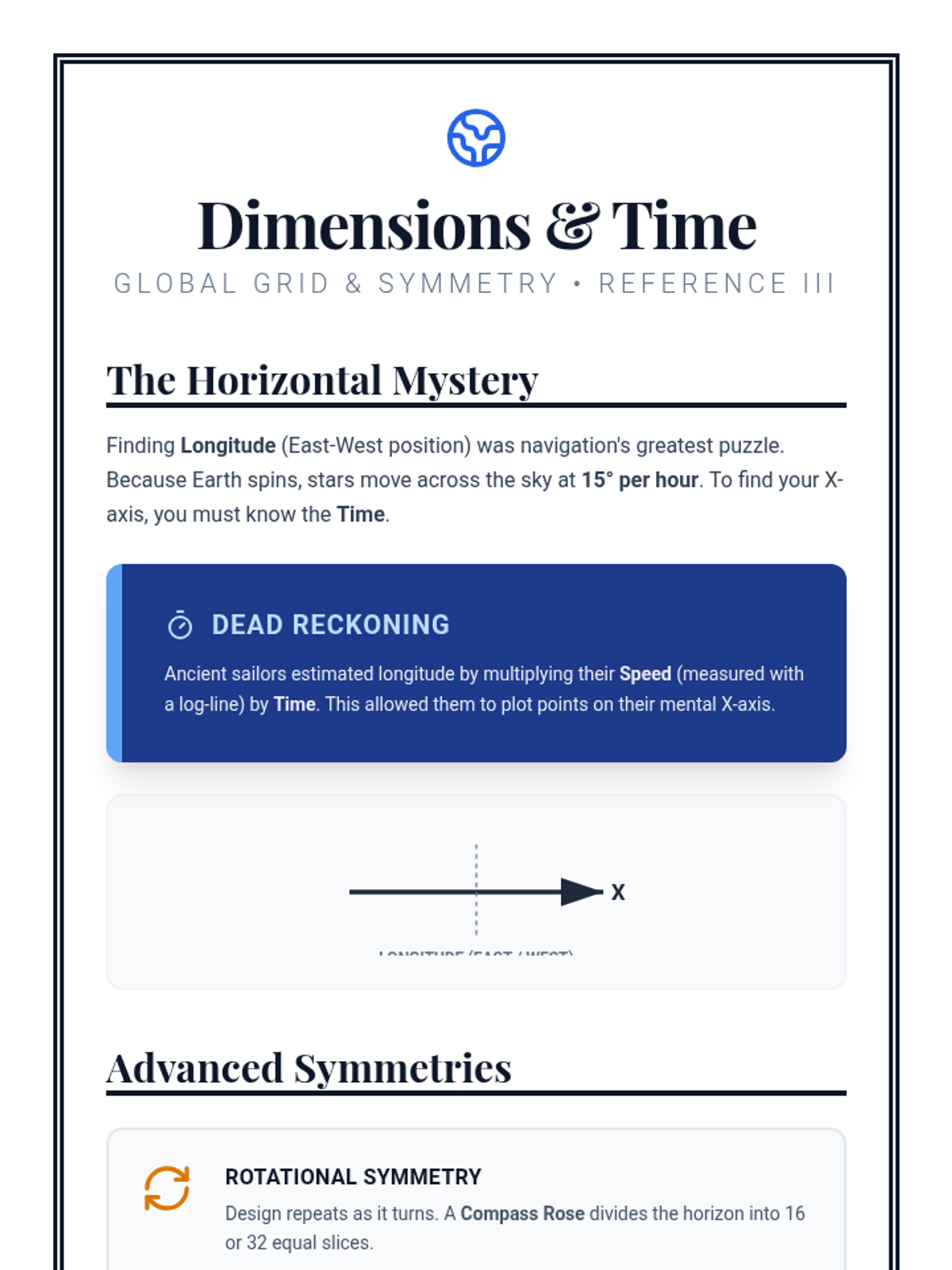
A reference page explaining Longitude as the X-axis of navigation, along with advanced symmetry concepts like Rotational and Logarithmic Spirals. Updated for scientific accuracy regarding the difficulty of longitude and spiral patterns. Standard portrait format.
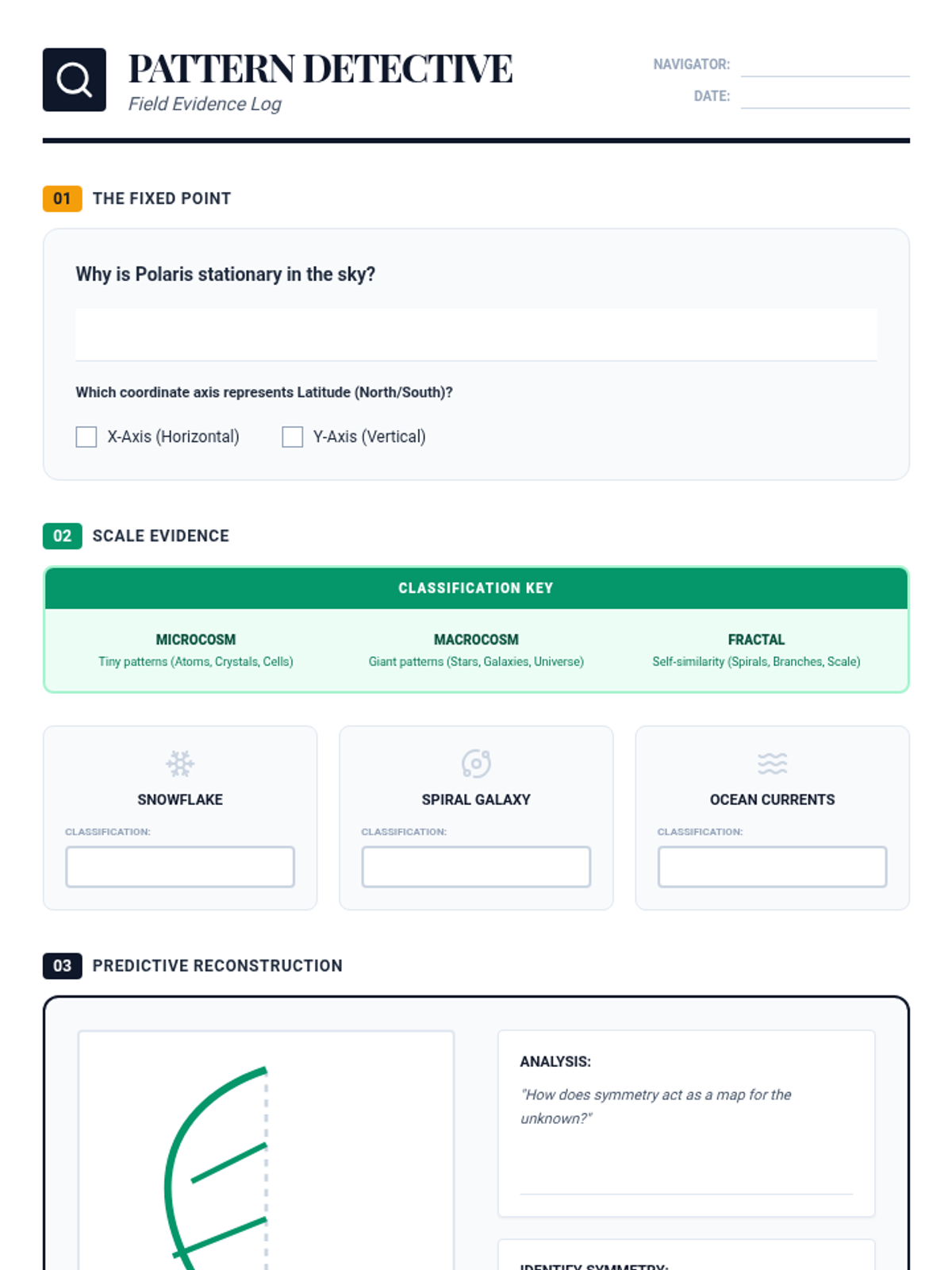
A conceptual worksheet for students to identify patterns of symmetry and scale in nature. Updated with 'Mission Break' callouts after Section 1 and Section 2 to guide students to specific field activities.
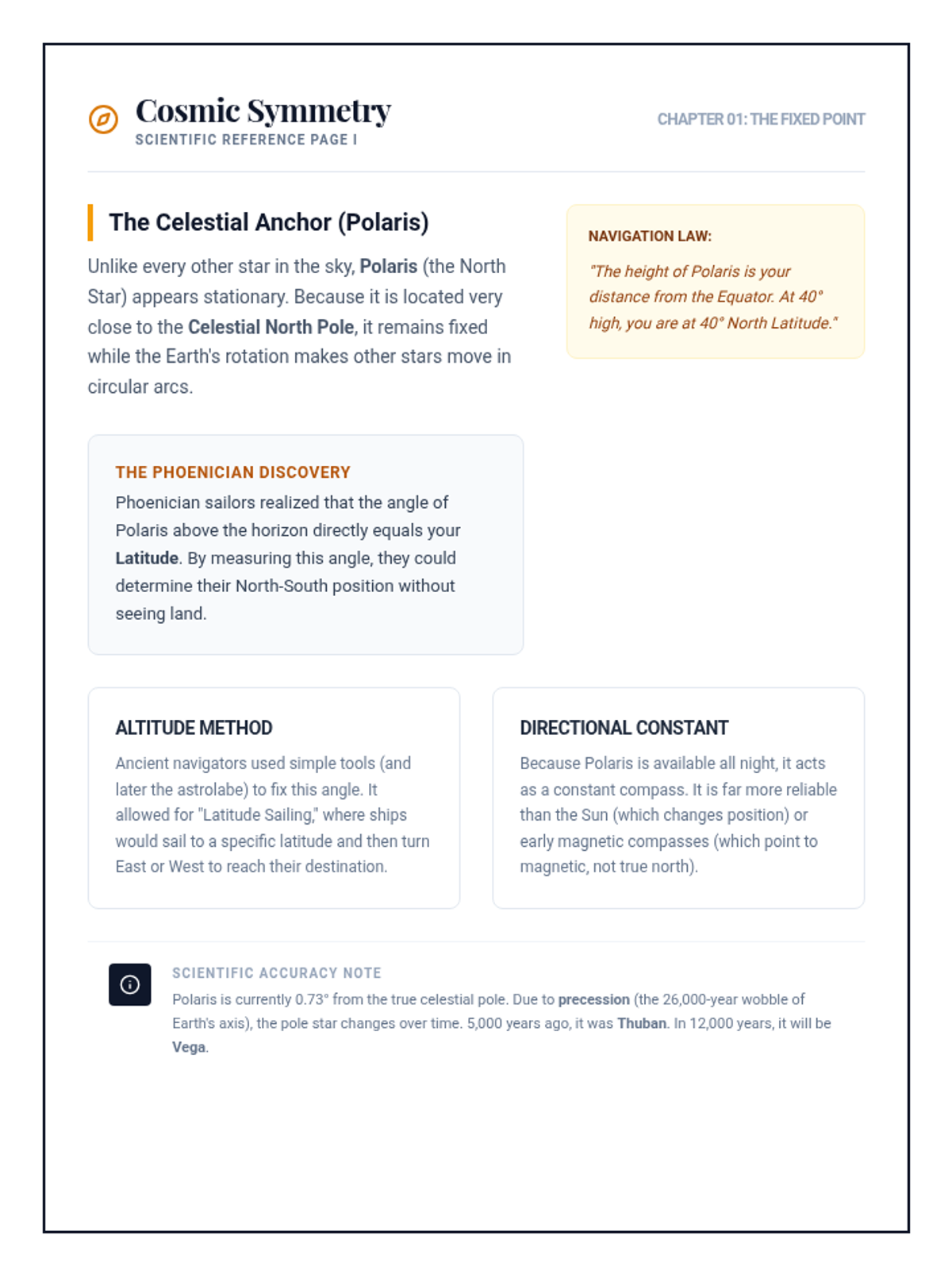
A two-page reference sheet covering the North Star (Polaris) as a navigation tool on page one, and the concepts of symmetry and scale (Microcosm/Macrocosm) in nature on page two. Updated for scientific accuracy and refactored for standard portrait format with small, professional font sizes.
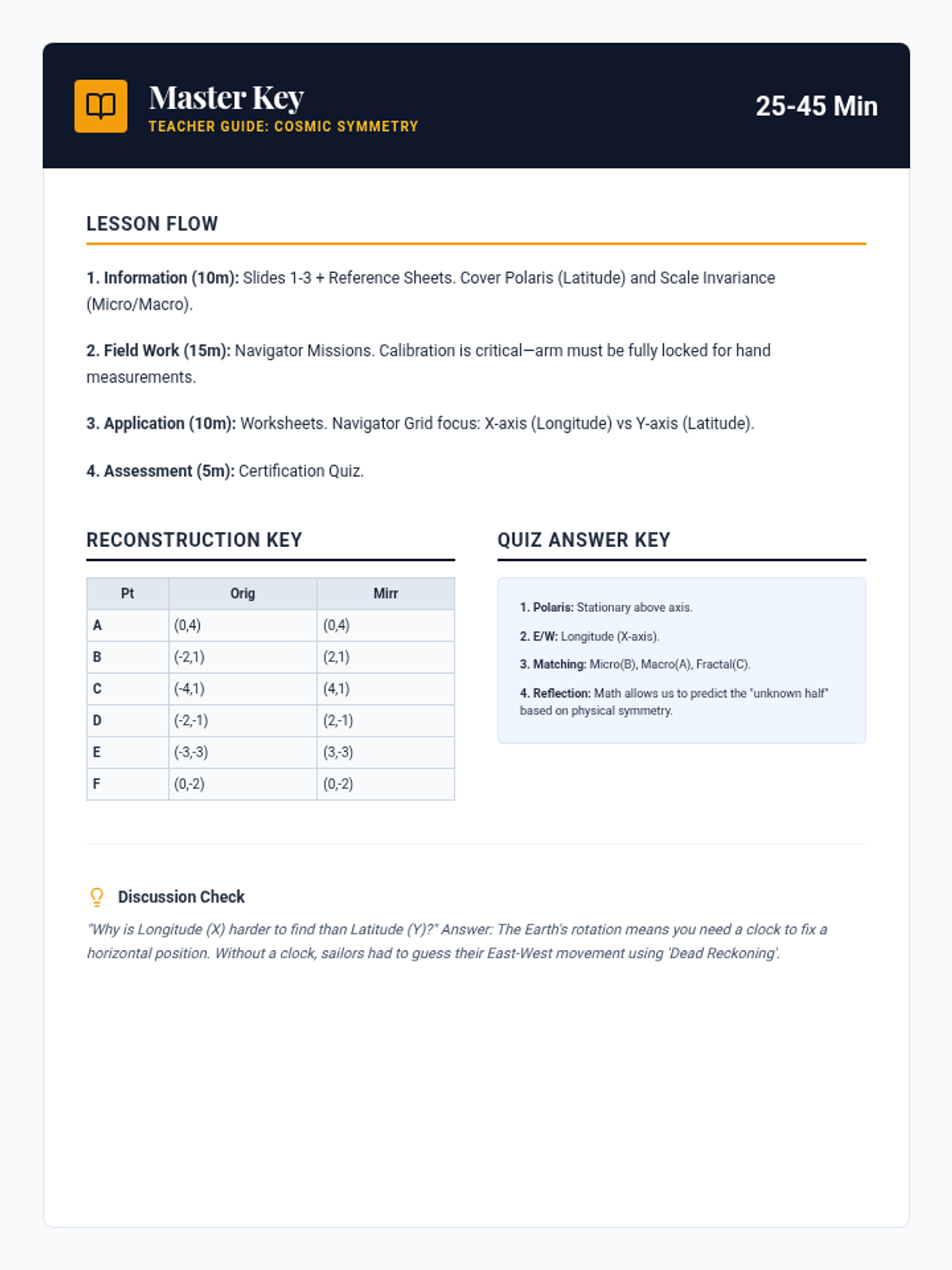
A teacher guide providing a 15-minute pacing plan, discussion script, and answer key for the Cosmic Symmetry lesson. Updated for scientific accuracy regarding precession and terminology. Standard portrait format.
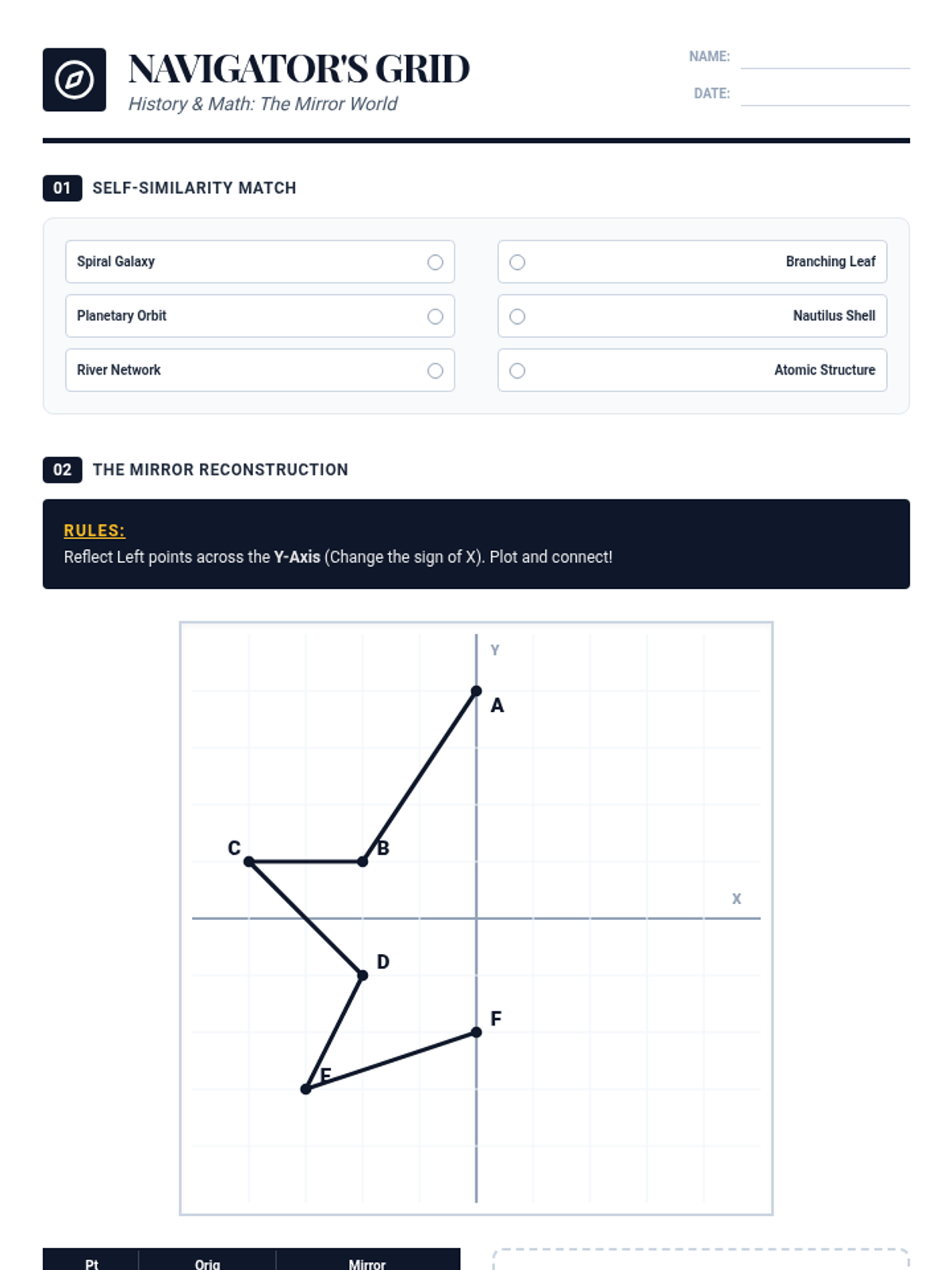
A student worksheet focused on identifying microcosm/macrocosm patterns and using coordinate symmetry (reflection) to complete a geometric compass rose design. Refactored for standard portrait format with an added 'Mission Break' callout.
A visual slide deck distinguishing between the North Star (fixed points) and Nature's Symmetry (repeating patterns) as tools for ancient navigation, now updated with integrated 'Mission Break' slides to signal field work timing.
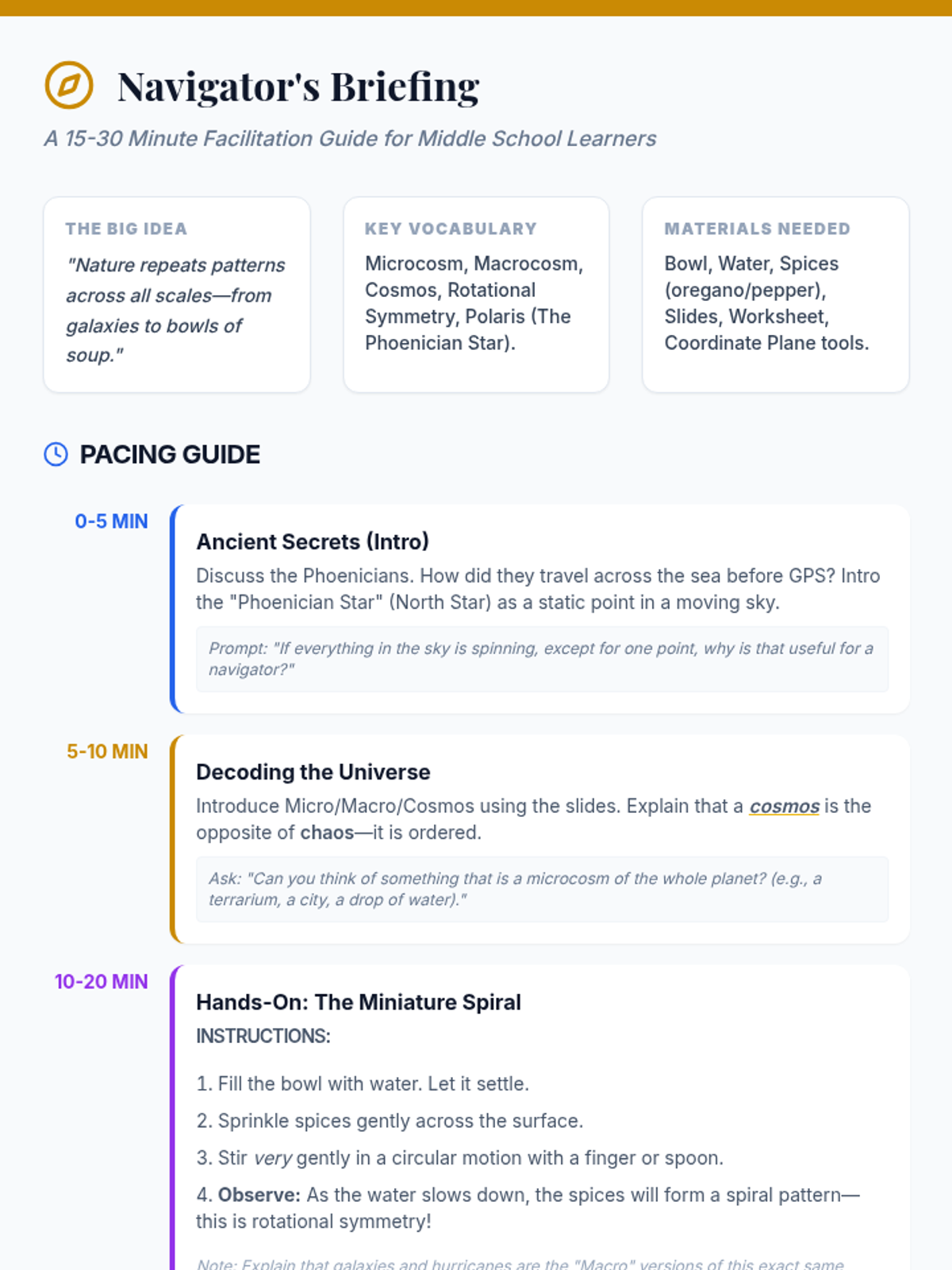
A teacher-facing lesson guide with pacing, hands-on activity instructions, discussion prompts, and key concepts for the 15-30 minute Cosmic Compass lesson. Redesigned with a modern star chart aesthetic.