Student practice worksheet featuring Arkansas-themed data scenarios for bar graphs, line graphs, and scatter plots, designed to build multi-step interpretation skills.
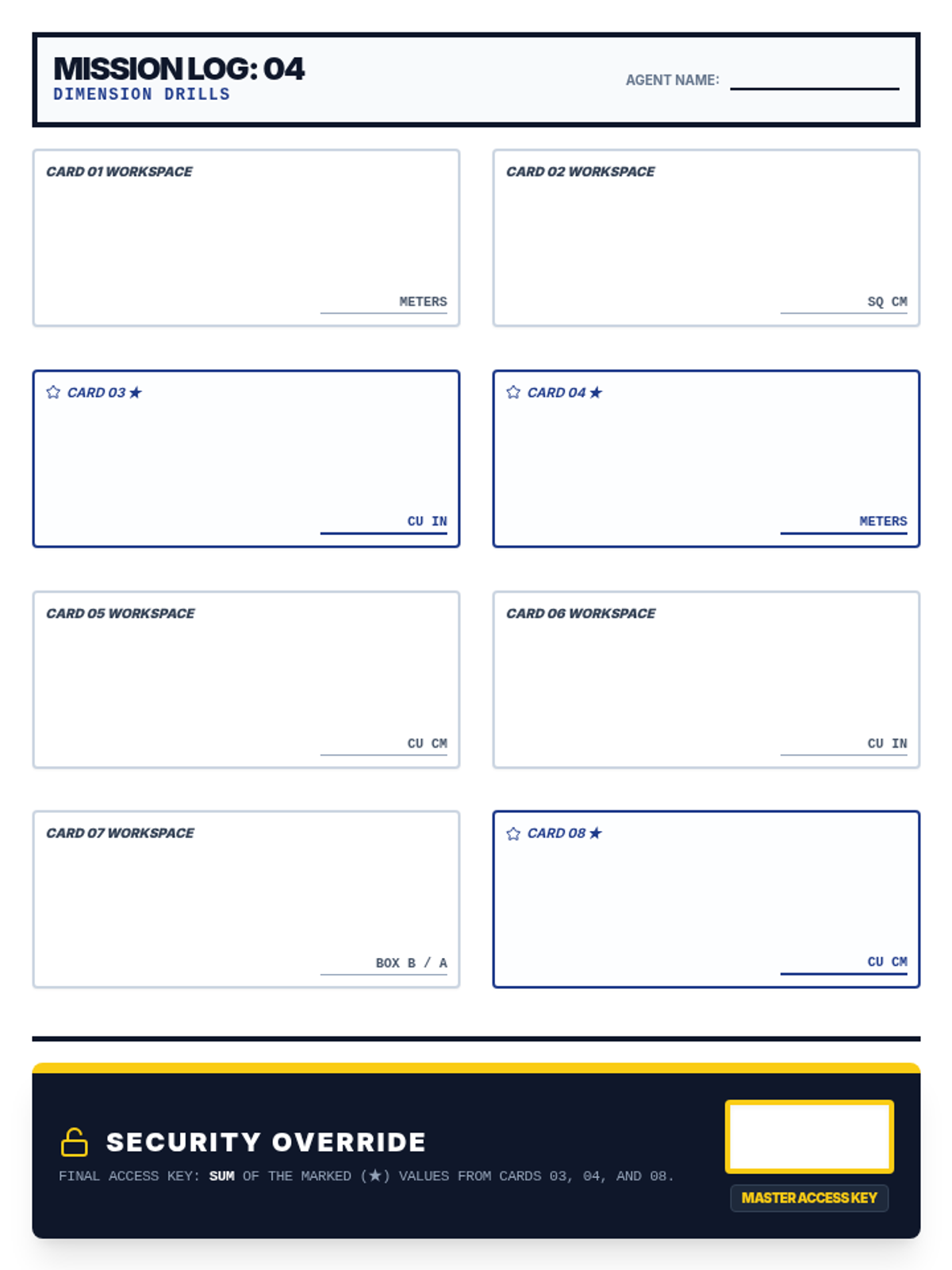
Day 4 mission log for students. Revised to fit on a single page, increase workspace height for calculations, and improve label contrast for better print legibility.
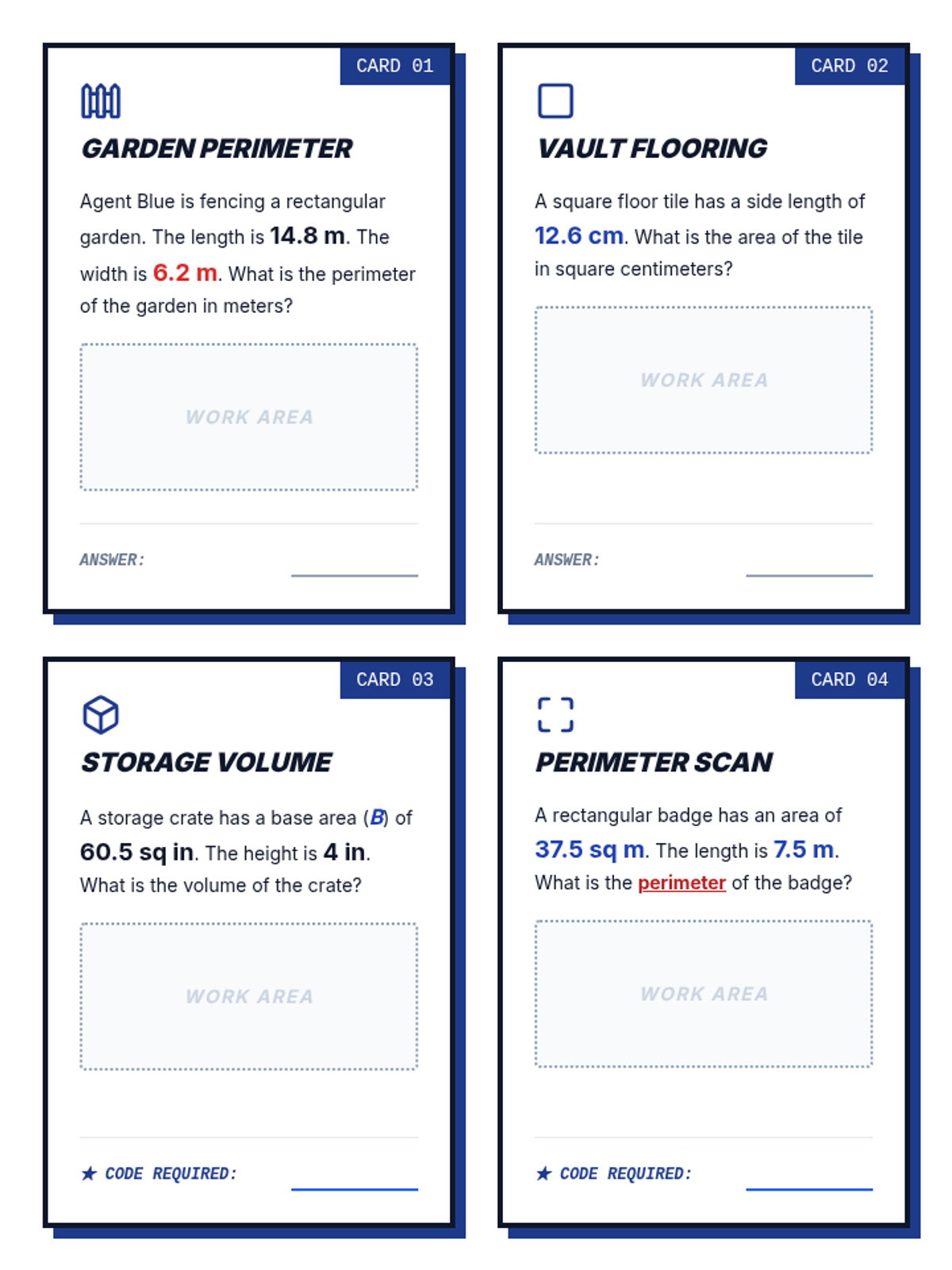
Day 4 task cards. Revised to standardize square visual representations, fix label overlap on Card 01, and clarify which cards contribute to the escape code. Added answer lines to cards.
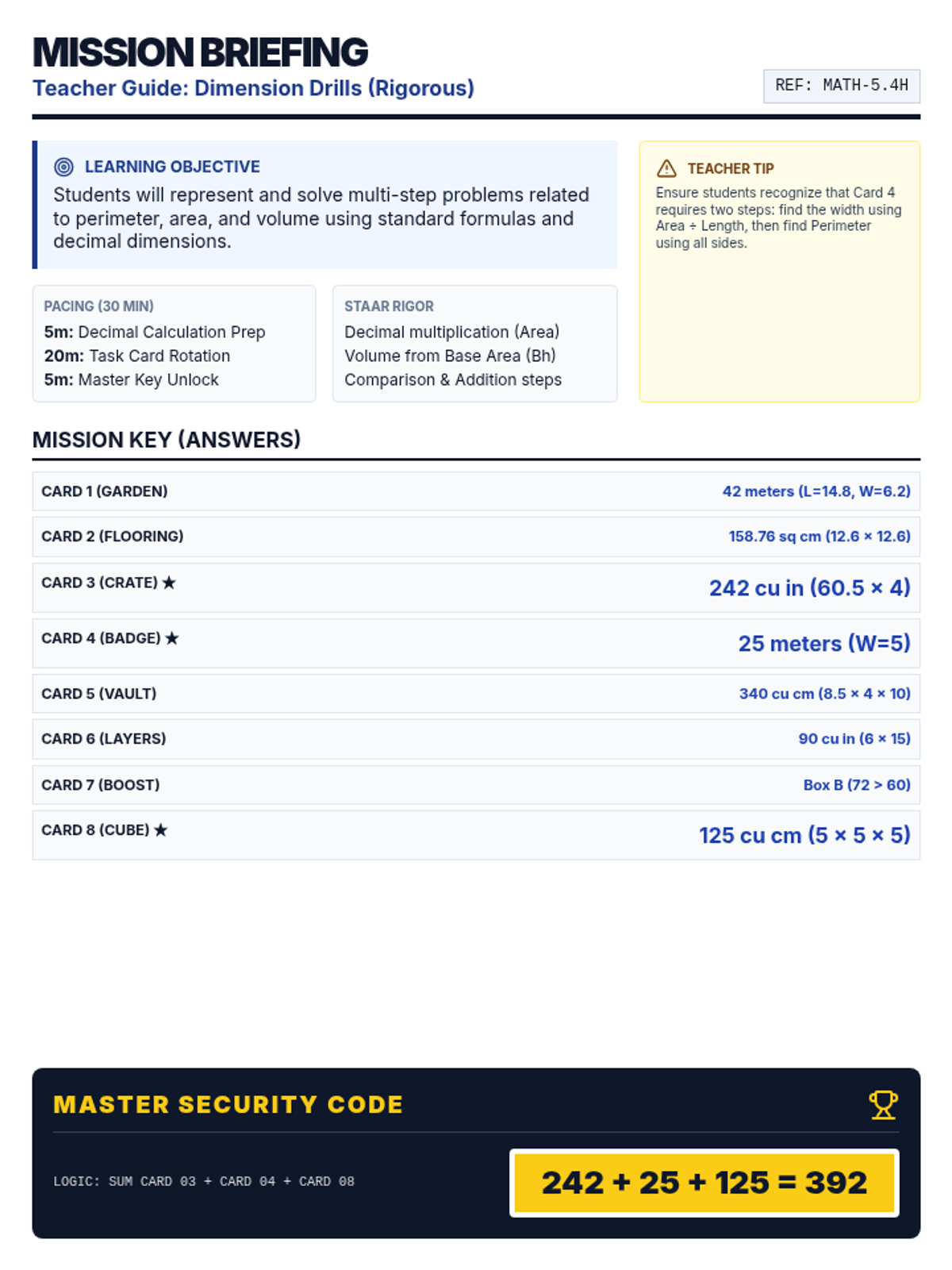
Teacher guide for Day 4. Revised to fit on a single page, fix math rendering, and standardize unit notation in the answer key.
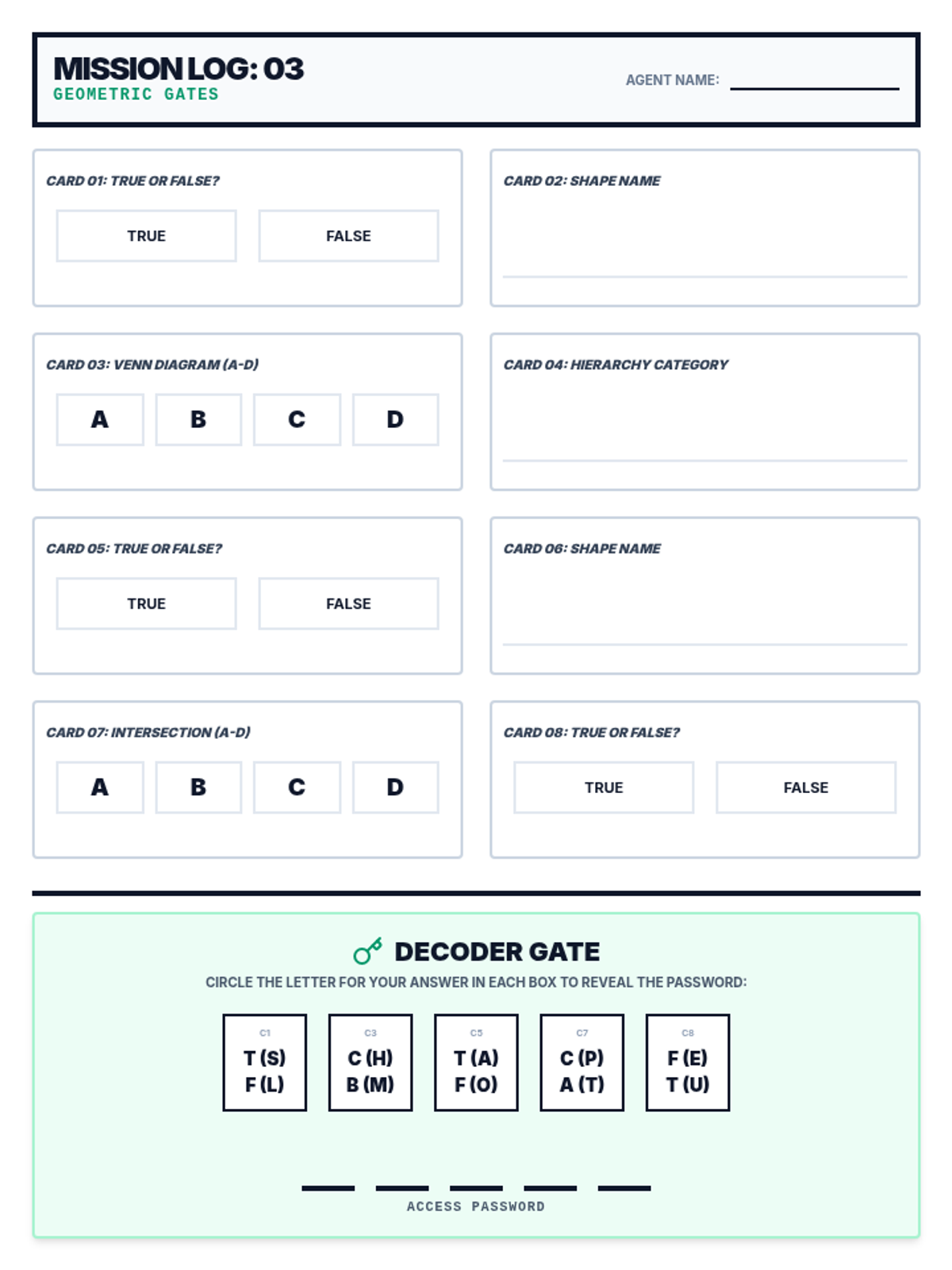
Day 3 mission log for students, focusing on classifying 2D figures. Features a unique 'Decoder Gate' where students use their true/false answers to reveal a secret password related to geometry. Revised for better layout and contrast.
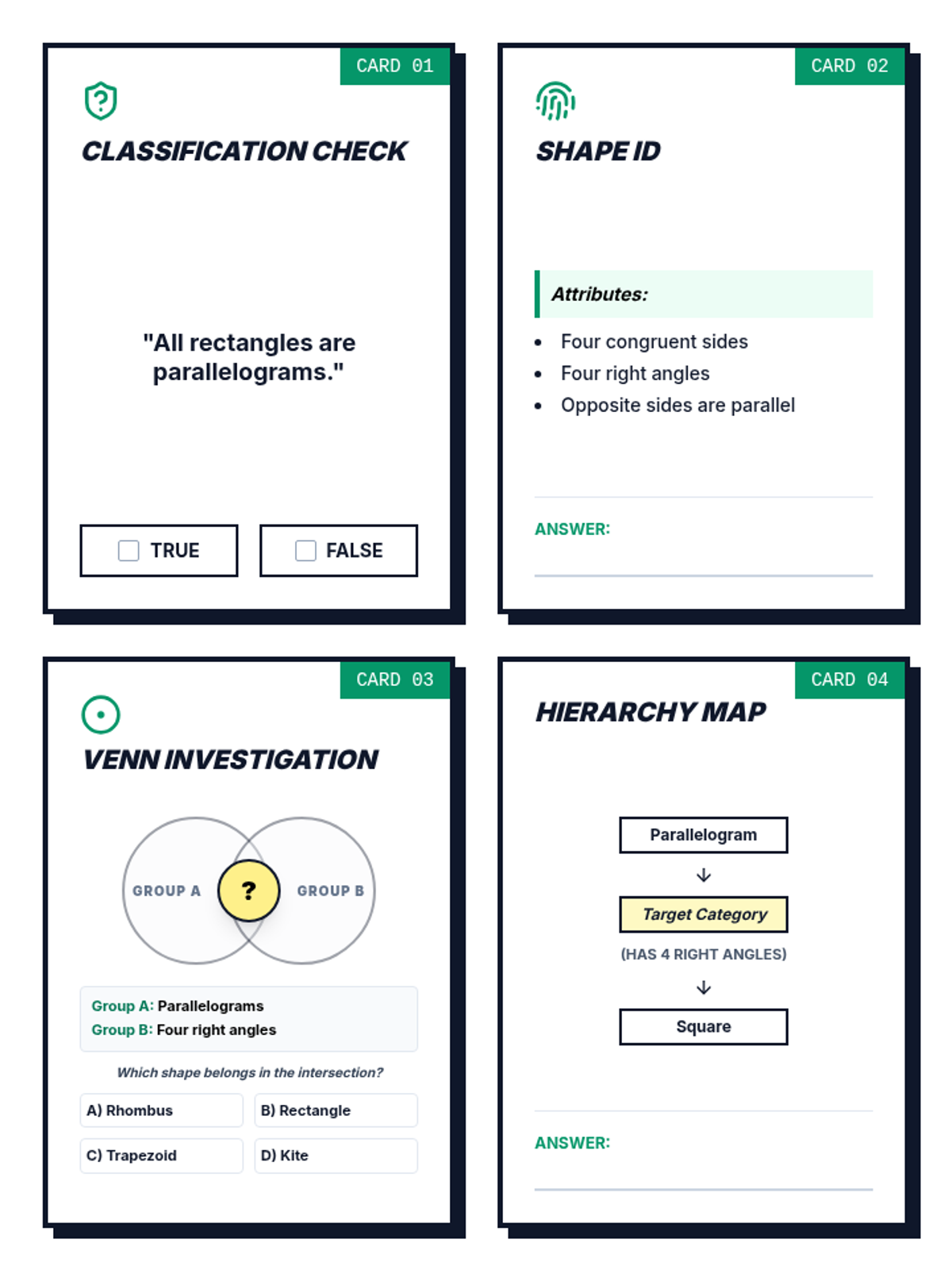
Day 3 task cards. Revised to ensure answer choice uniformity (styled identically), fix hierarchy logic on Card 4, and improve text contrast and header spacing. Added answer lines to cards.
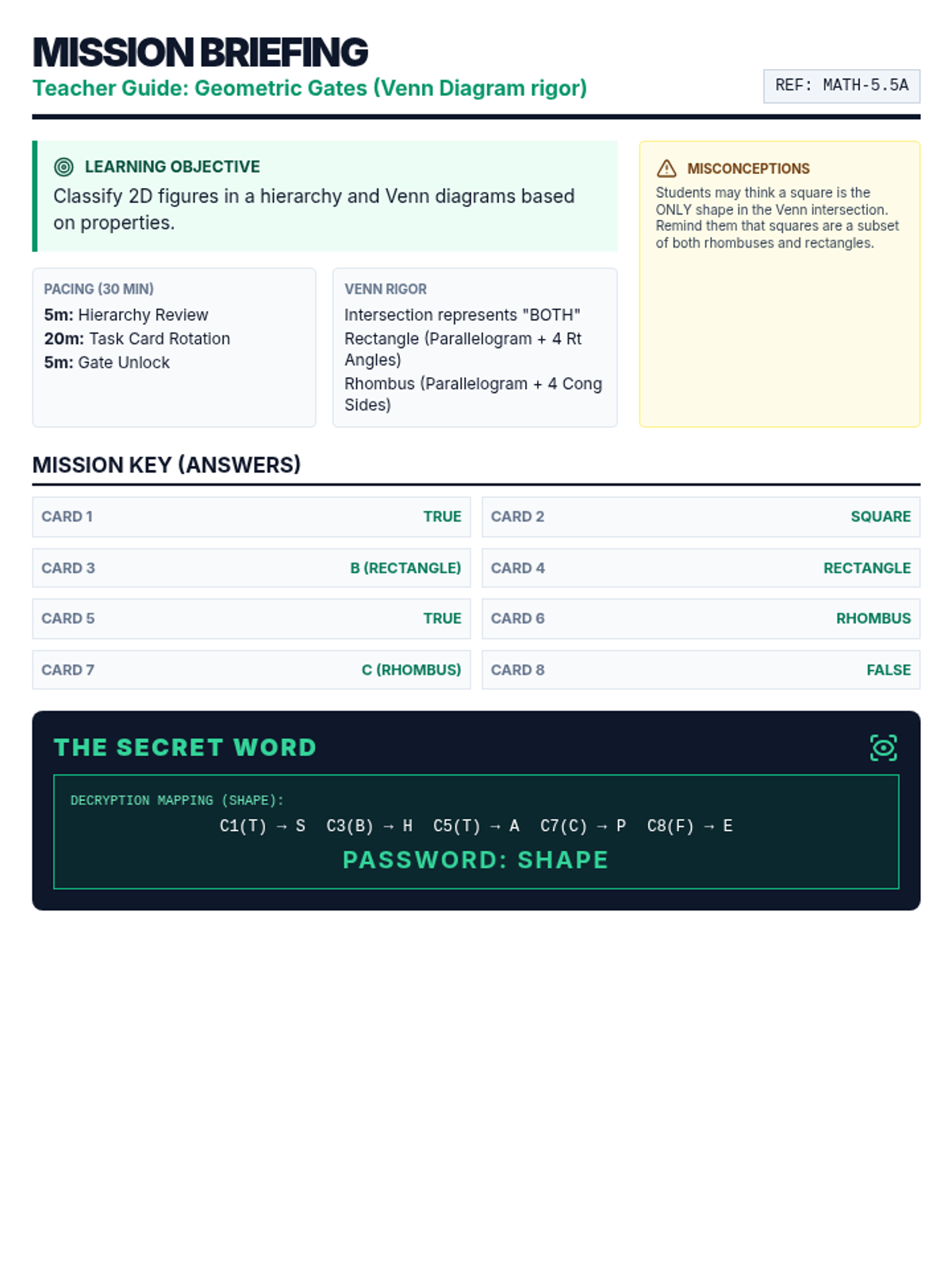
Teacher guide for Day 3. Revised to fit on one page, fix Card 4 answer consistency, and clarify the letter decryption mapping.
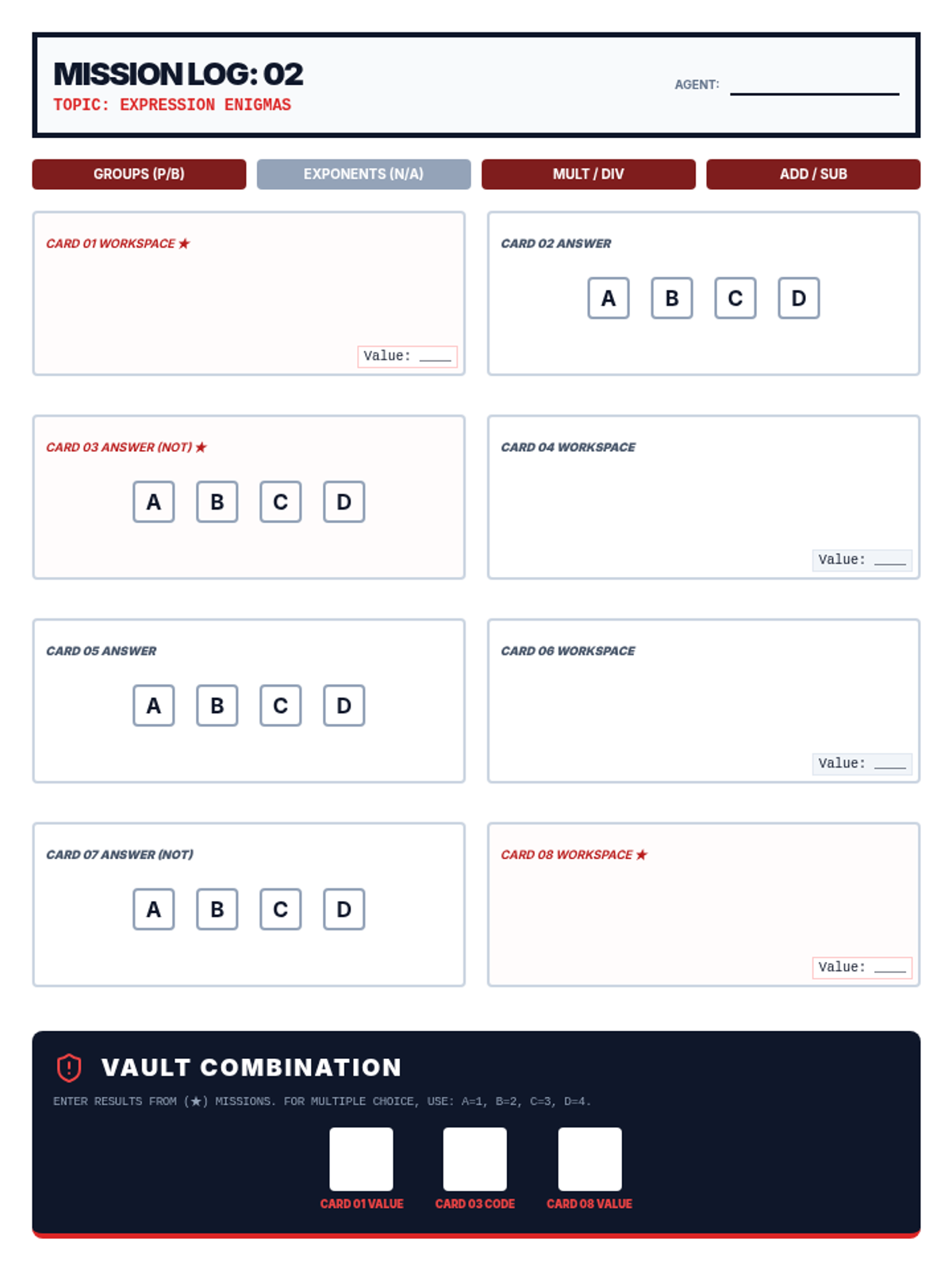
Day 2 mission log for students. Revised to support new rigorous question types, including multiple choice selections for equivalence and blank work areas for multi-step simplification. Includes a specific vault combination challenge.
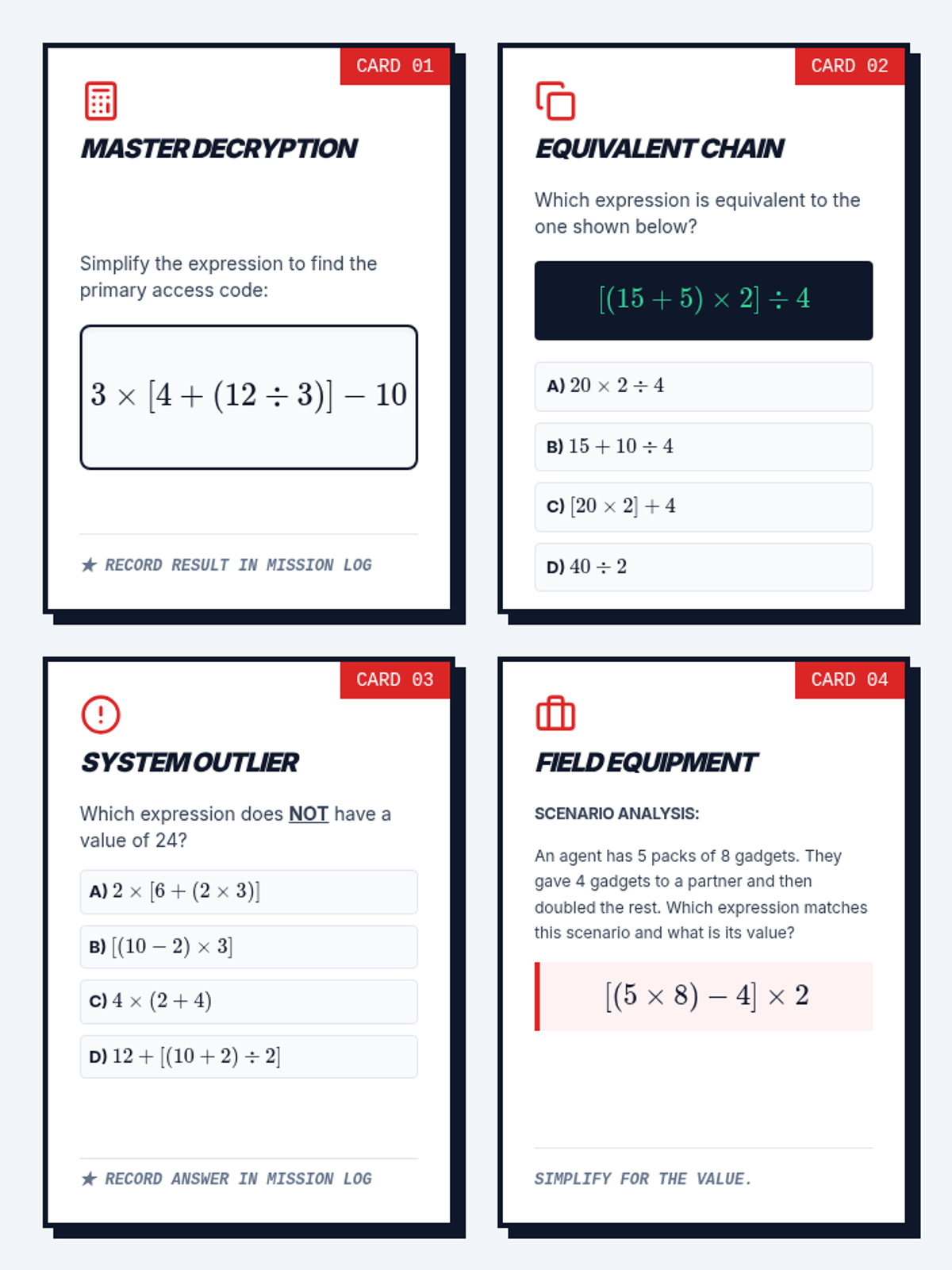
Day 2 task cards focusing on simplifying numerical expressions with increased rigor. Features STAAR-aligned question types, including matching equivalent expressions, identifying non-equivalent expressions, and multi-step word problem expressions with two levels of grouping.
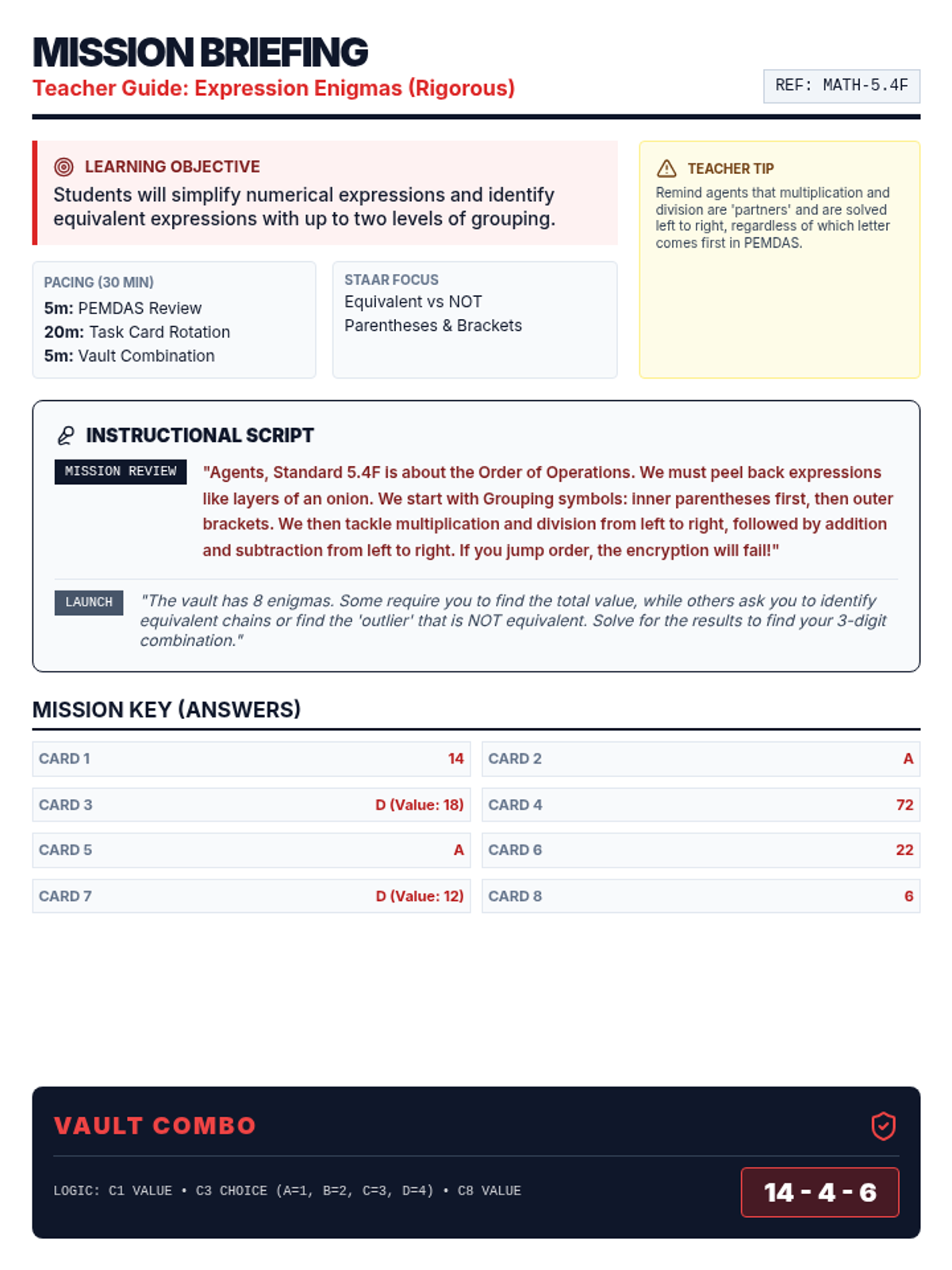
Teacher guide for Day 2 reteach on simplifying numerical expressions. Revised to fit on a single page and improve math notation rendering.
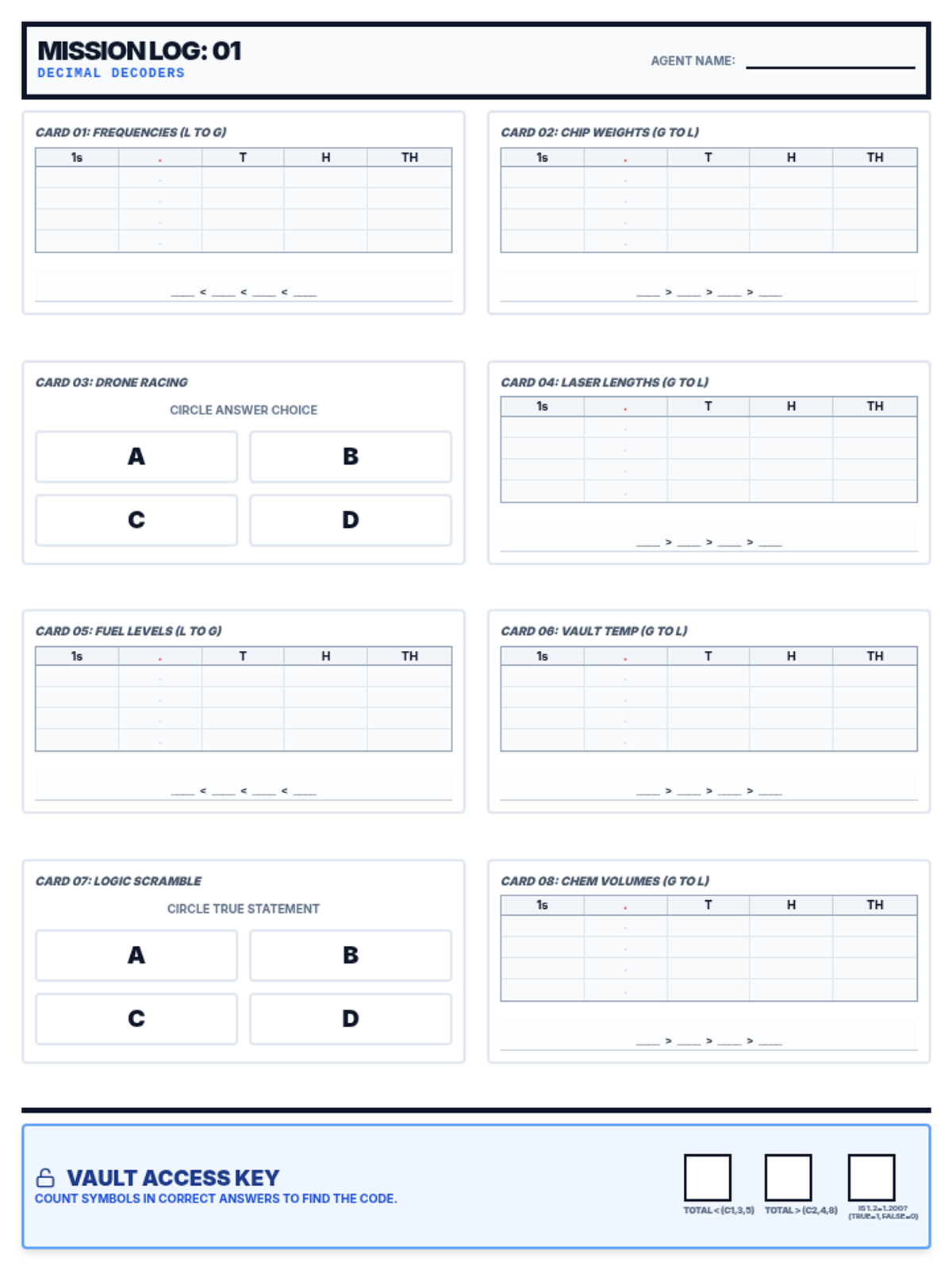
The student mission log for Day 1. Revised to include larger place value grids with a decimal point column, standard handwriting lines for ordering, and condensed layout to fit on a single page. Revised for better response line width and grid alignment.
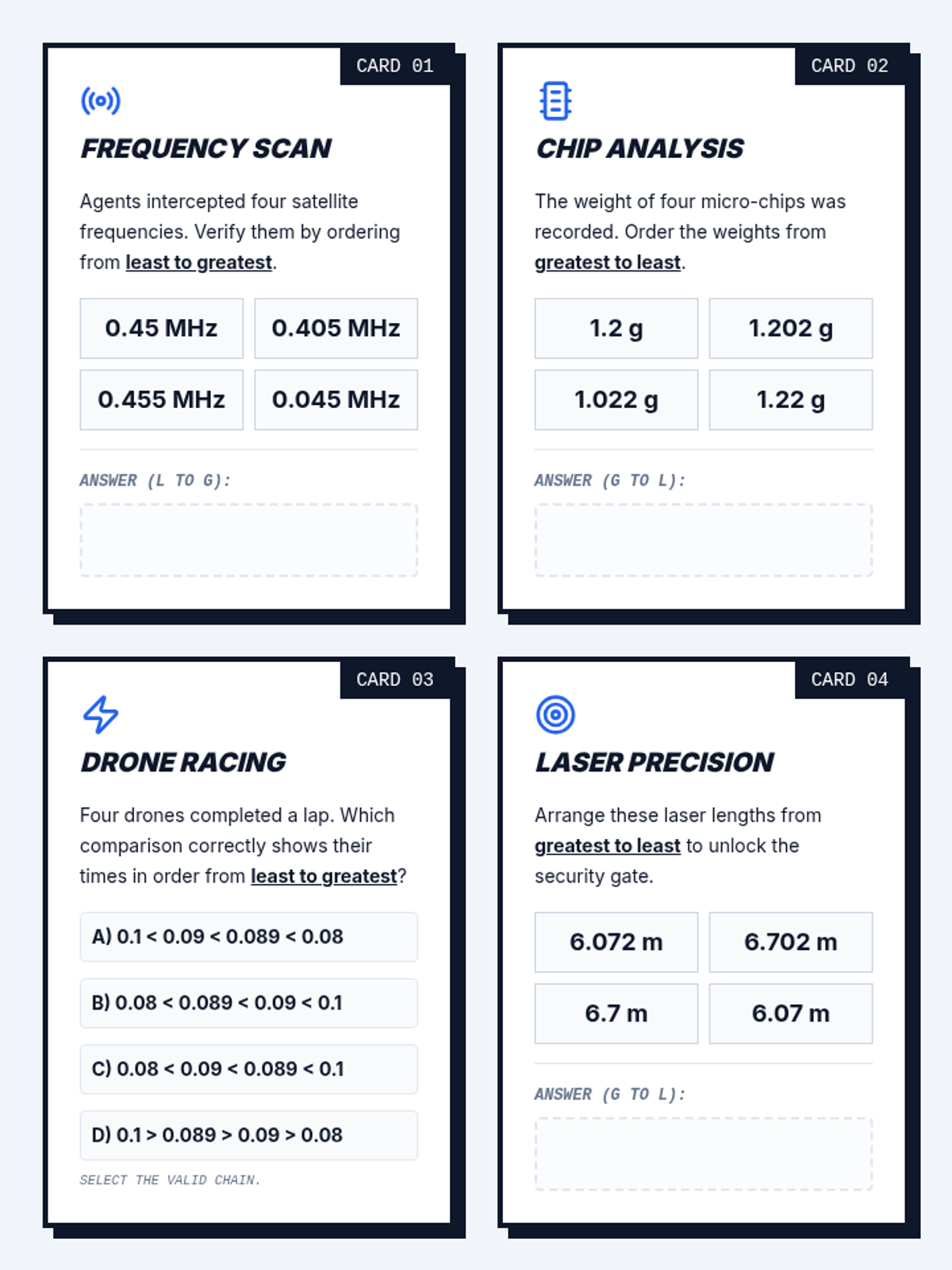
Day 1 task cards focusing on decimal comparison and ordering with increased rigor. Features word problems aligning with STAAR expectations, requiring students to order sets of 4 decimals to the thousandths using mathematical symbols. Revised for improved answer spacing and choice visibility.
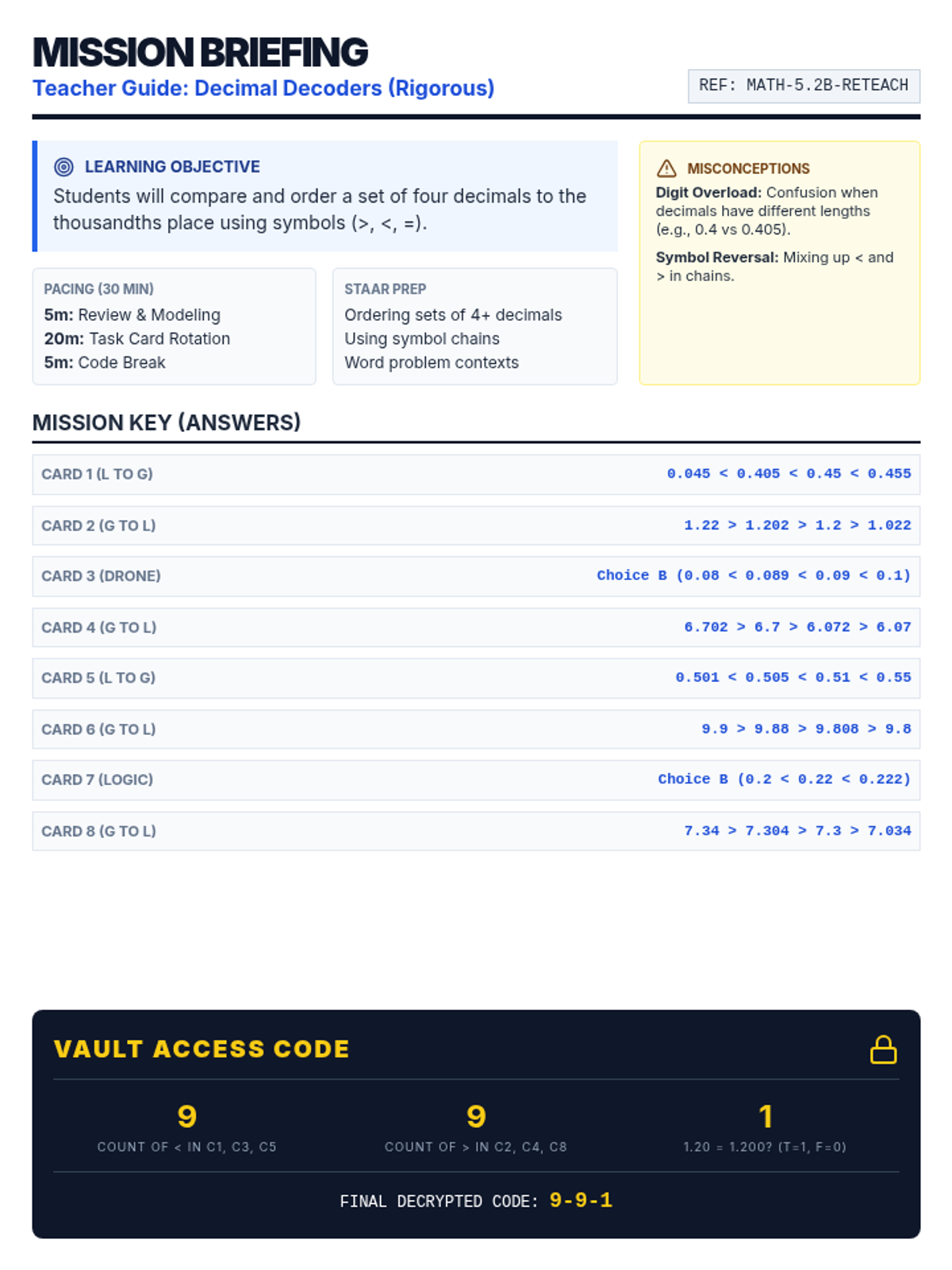
A teacher facilitation guide for the Day 1 math mission, including learning objectives, pacing, common misconceptions, an instructional script, and the answer key for the Decimal Decoders escape challenge. Revised to fit on a single page.
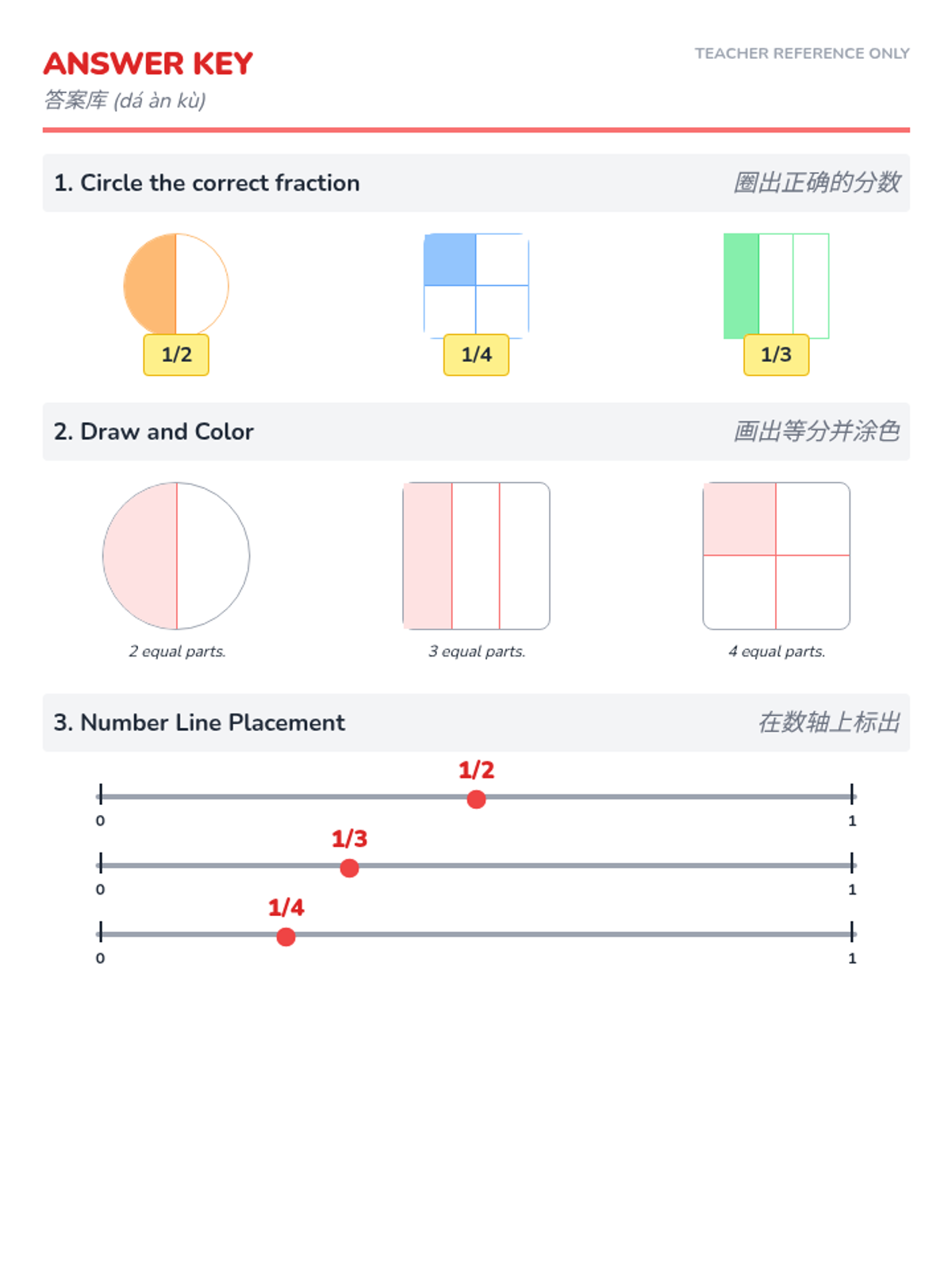
Answer key for the Kitchen Partition Worksheet with visual guides for teacher reference. Includes bilingual headers and improved number line spacing. Now fits on a single page.
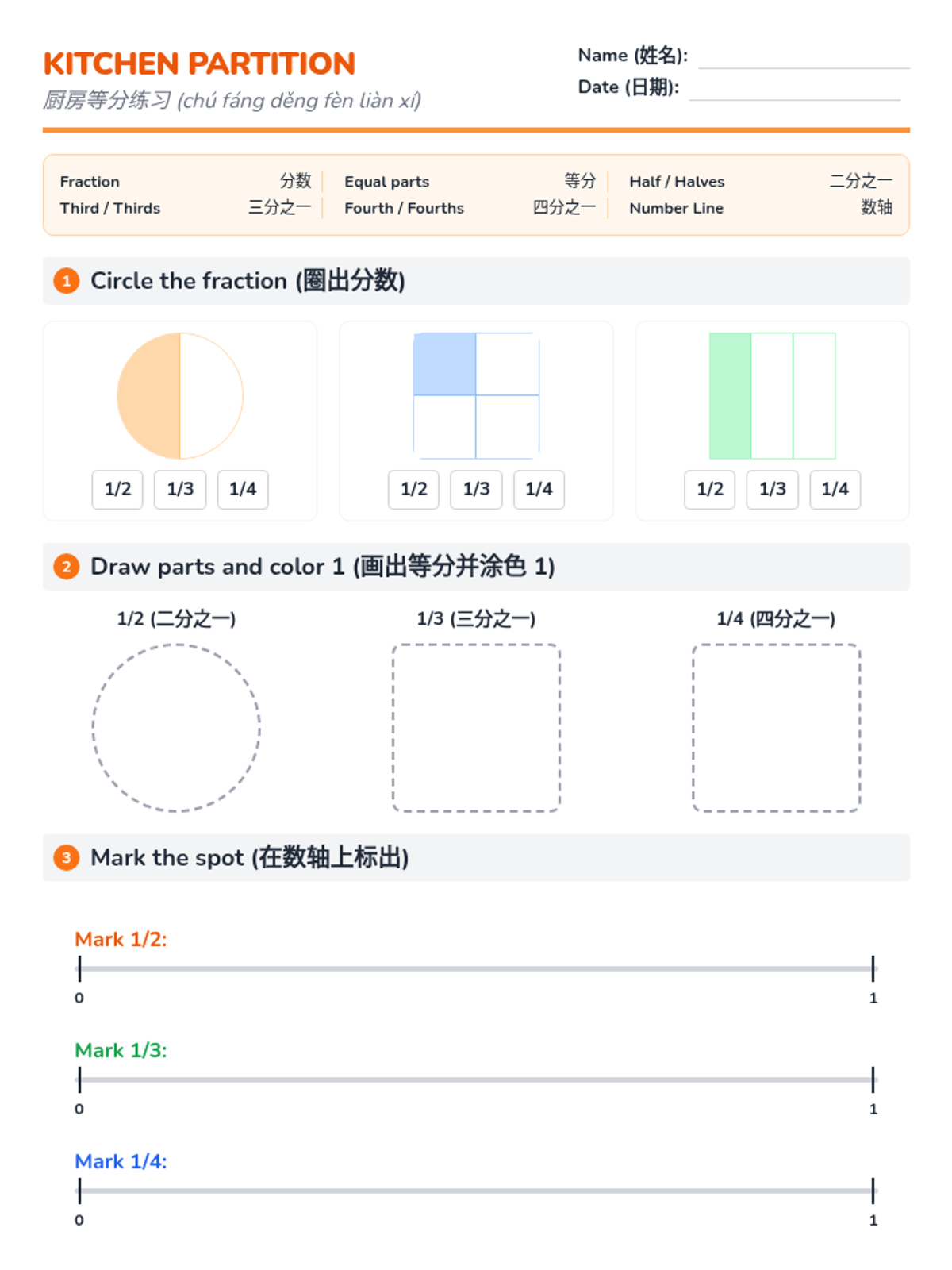
A bilingual English-Chinese worksheet for 3rd grade Level 1 ELL students. Covers identifying halves, thirds, and fourths and marking them on number lines. Now consolidated to a single page.
Visual slides for teaching fractions (halves, thirds, fourths) to Level 1 ELL students with Chinese support. Includes vocabulary and number line visualizations.
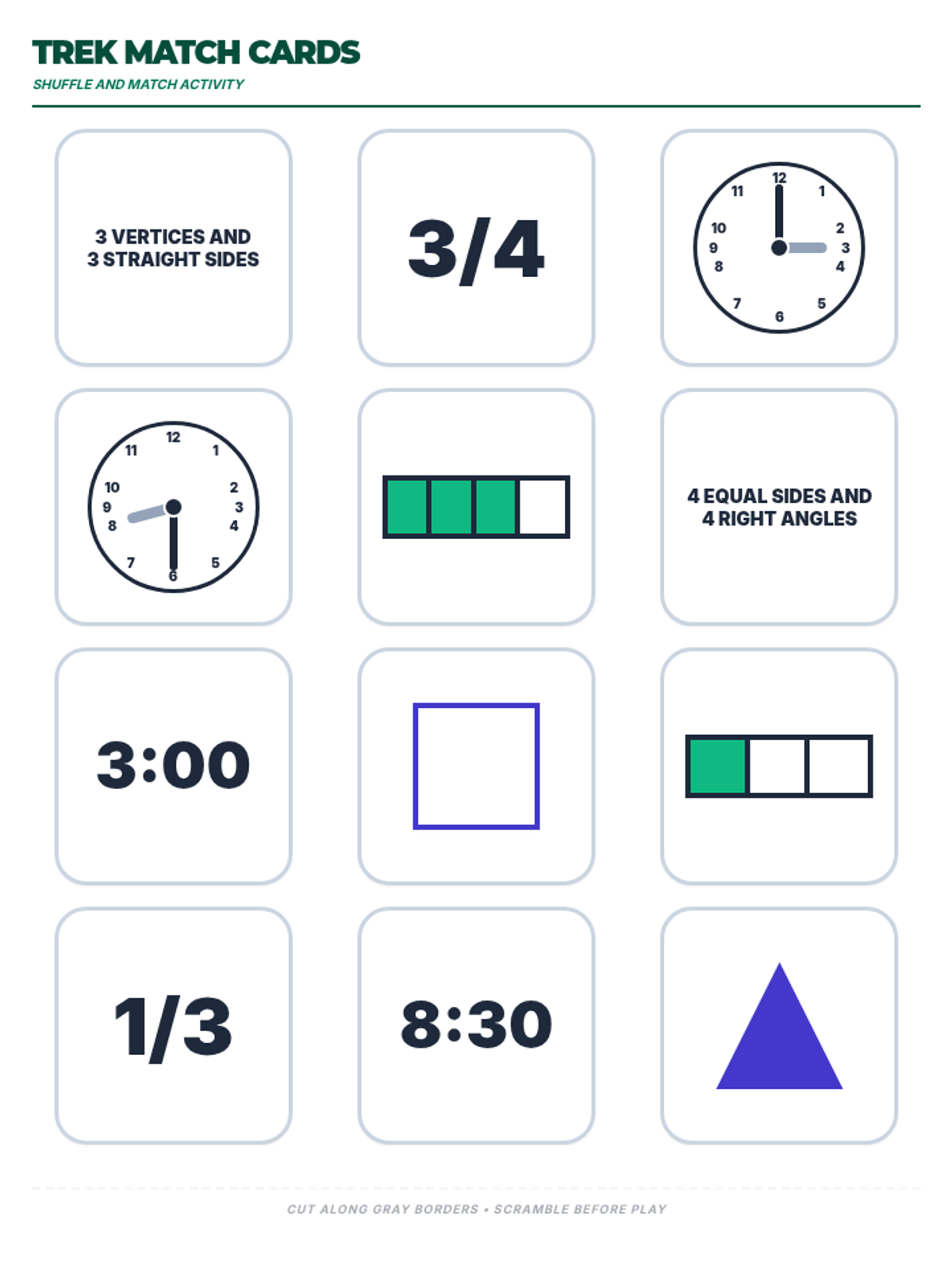
A series of 12 matching cards covering time, fractions, and geometry. Students match visual models to digital or numeric values and properties. Designed for conceptual reinforcement ahead of the Grade 3 MCAS. All cards and instructions fit on a single page.
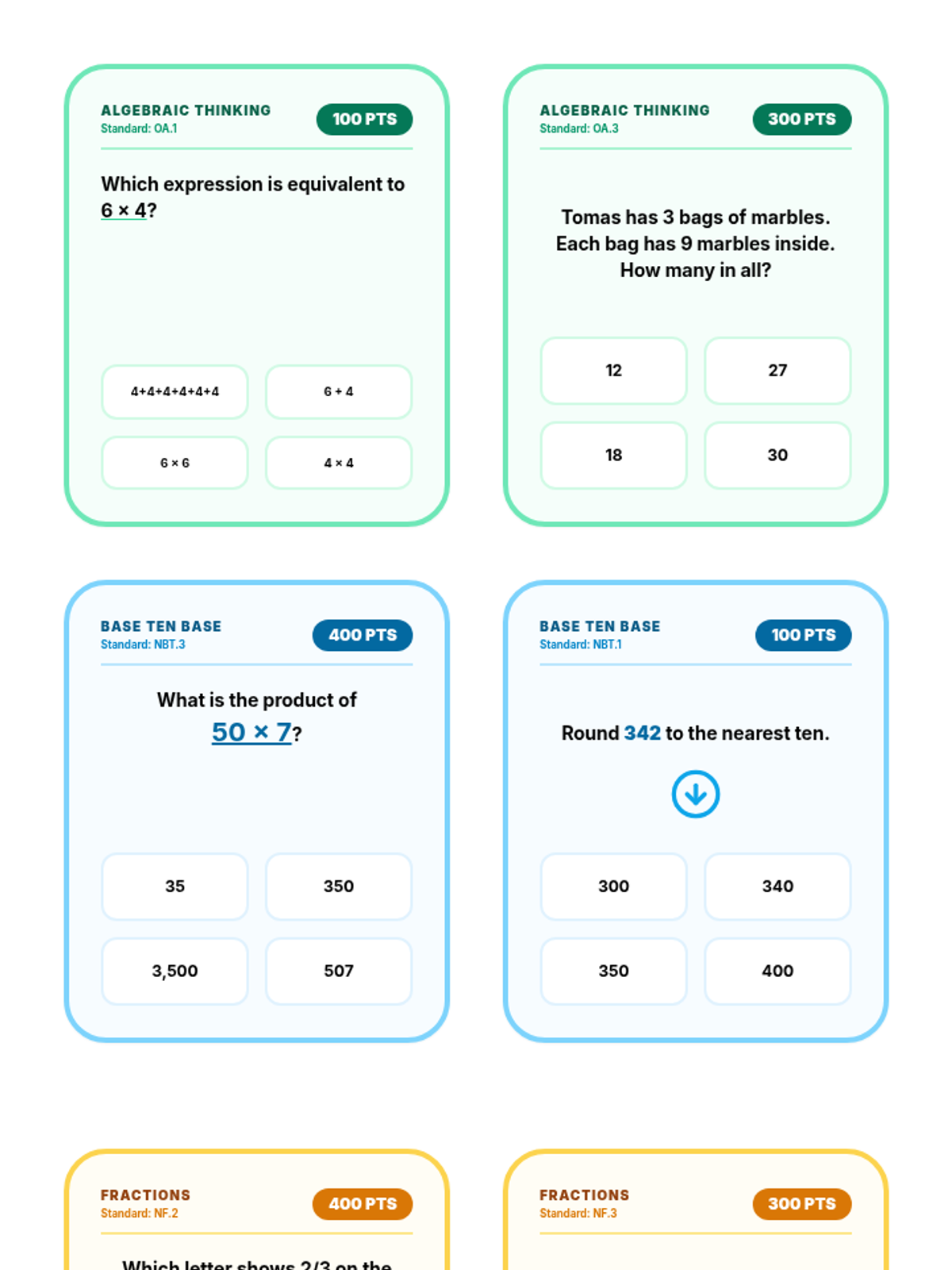
A set of 10 color-coded Grade 3 math task cards for the Summit Sprint game. Includes multiple-choice questions for OA, NBT, NF, MD, and G domains with point values (100-400) and high-contrast visuals. Cards use a consistent 2x2 layout with specific MCAS-aligned content and uniform answer styling.
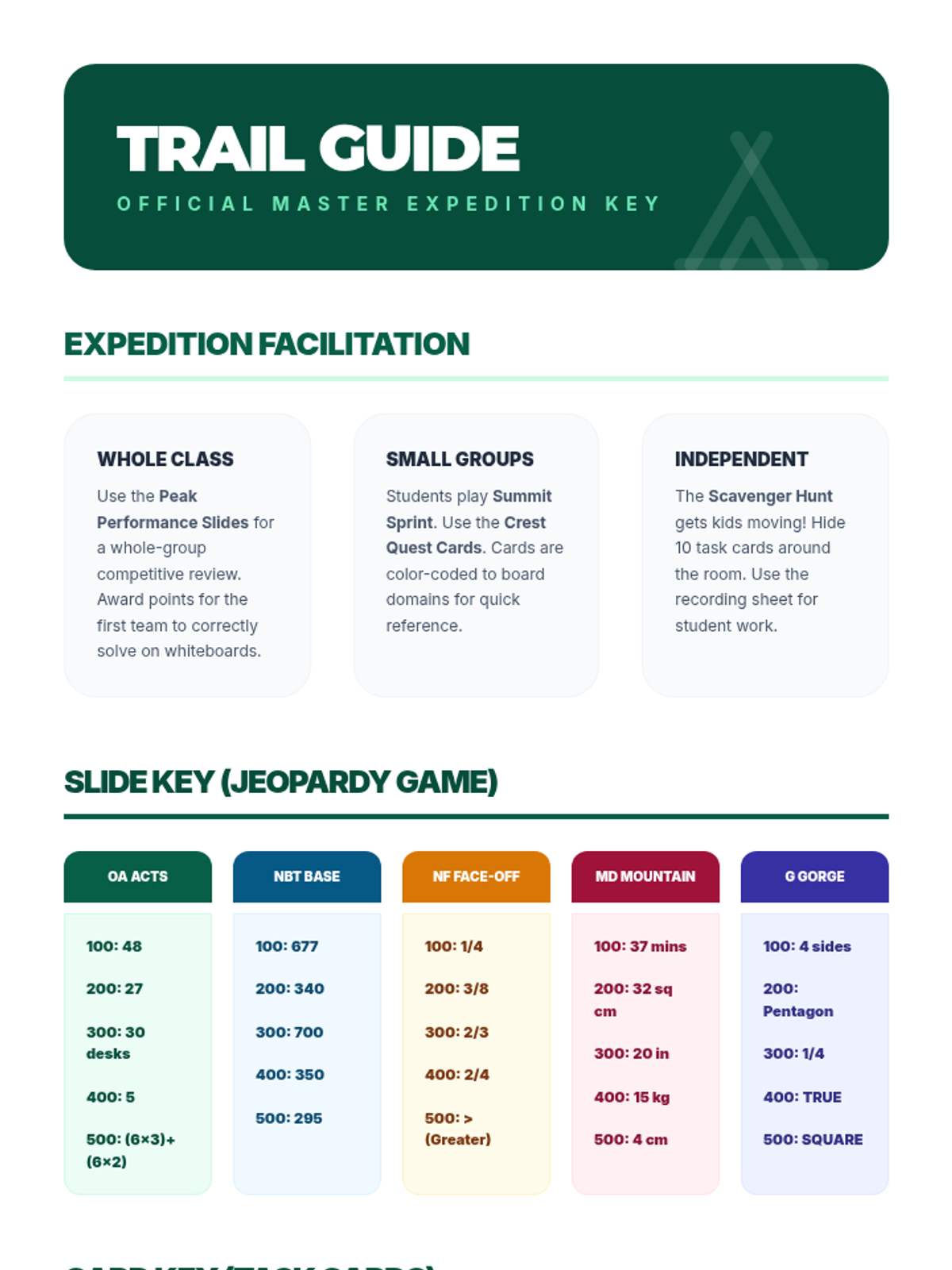
A comprehensive teacher resource including master answer keys for the 25-question Jeopardy slide deck, the expanded task card set, and the classroom scavenger hunt. Includes facilitation tips for different instructional models.
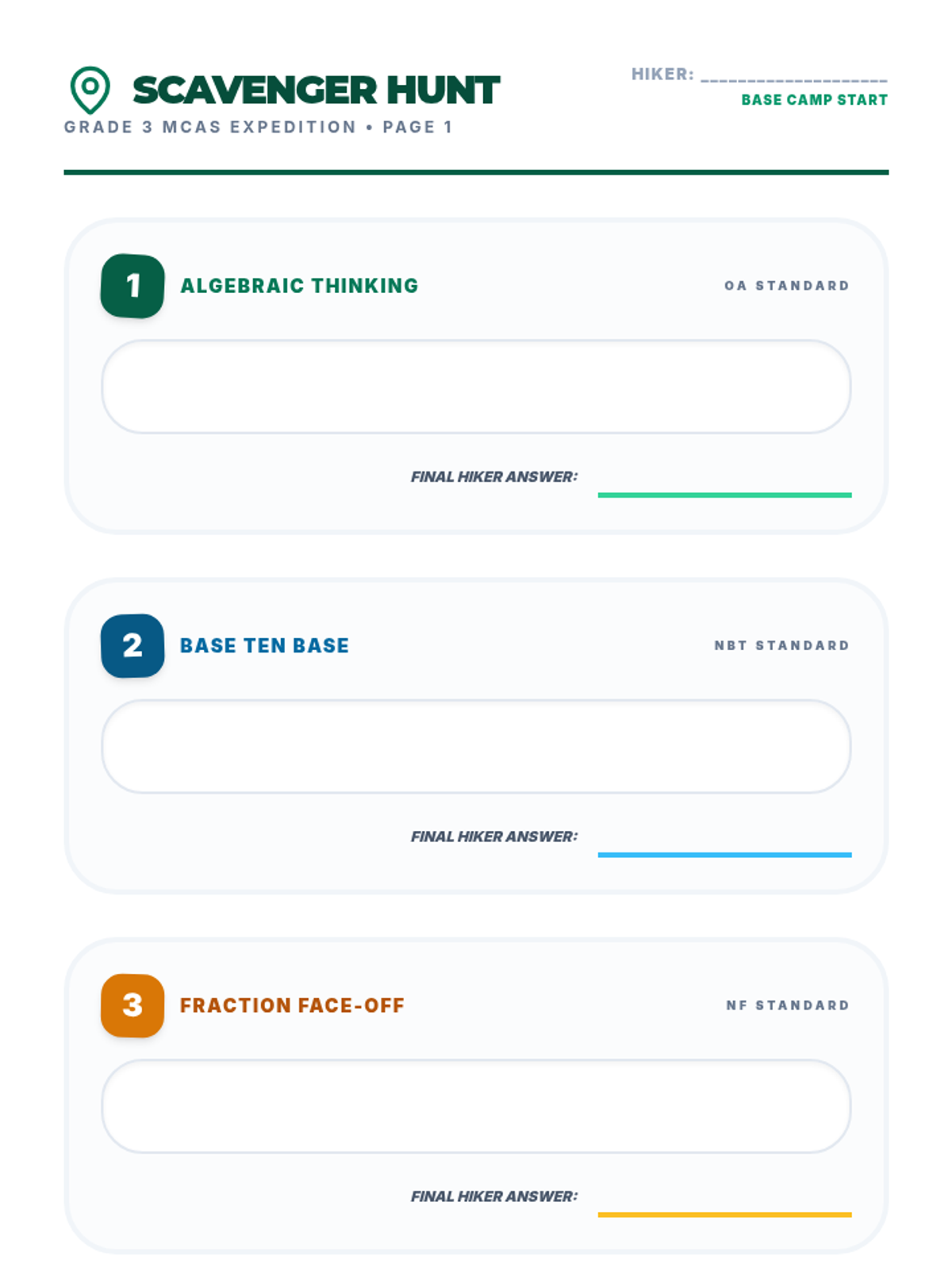
A recording sheet for a classroom math scavenger hunt. Students search for hidden MCAS-style math problems around the room and record their solutions in large, categorized work areas. Designed for high readability and plenty of scratchpad space.
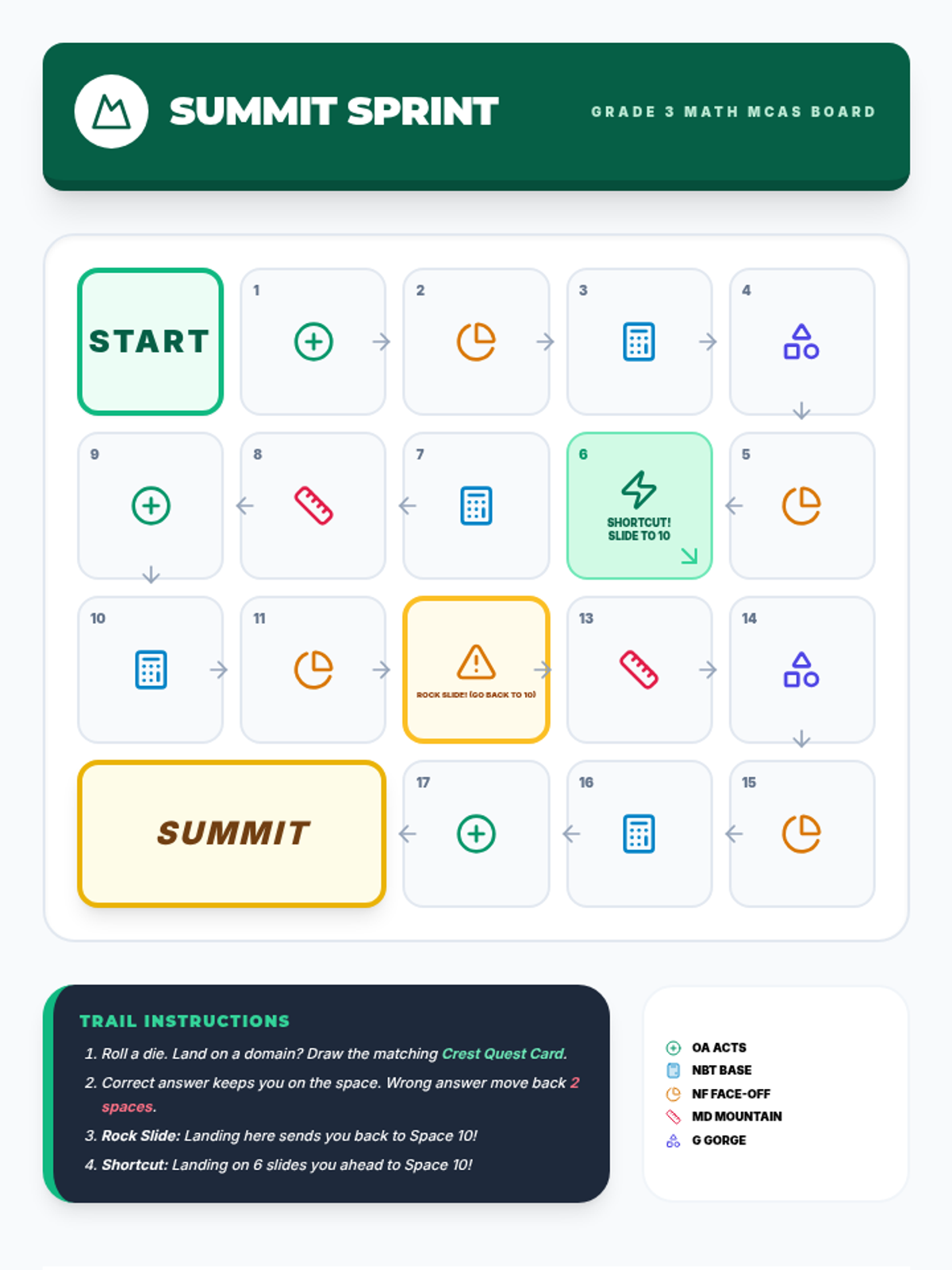
A printable board game designed for small groups (2-4 players). Students navigate 'Math Mountain' by rolling dice and solving math problems from task cards that correspond to different math domains found on the MCAS. Includes a 'Hiker's Log' workspace page.
A comprehensive 53-slide Jeopardy-style presentation for Grade 3 MCAS review. Features 25 questions across all domains with dedicated reveal slides. Includes improved SVG fraction models, workspace scratchpads for complex problems, and high-impact visual design.
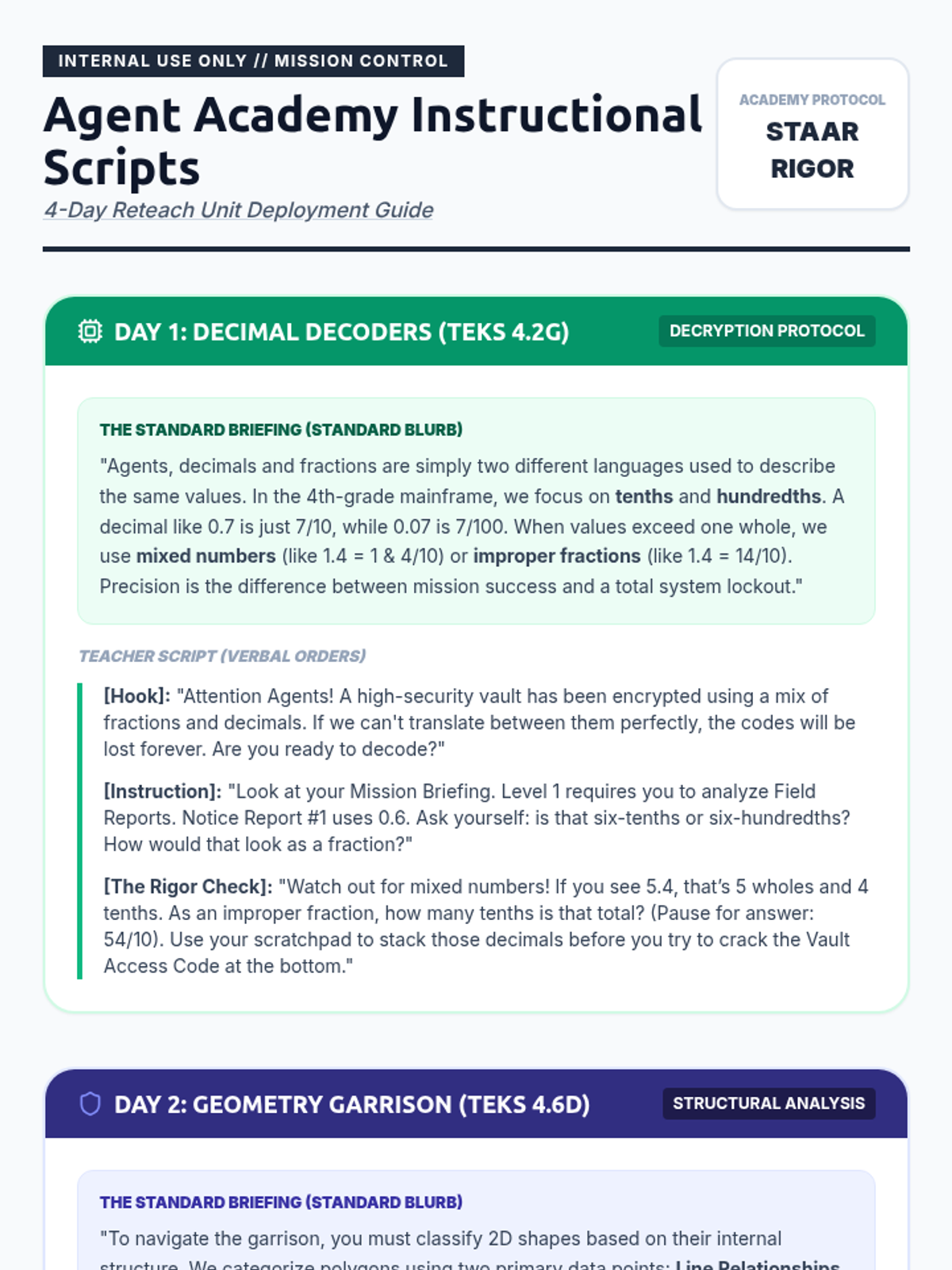
A comprehensive instructional script for the 4-day Agent Academy unit, featuring standard-aligned "briefings" (blurbs), verbal hook and instruction scripts for teachers, and specific rigor checks for each lesson.
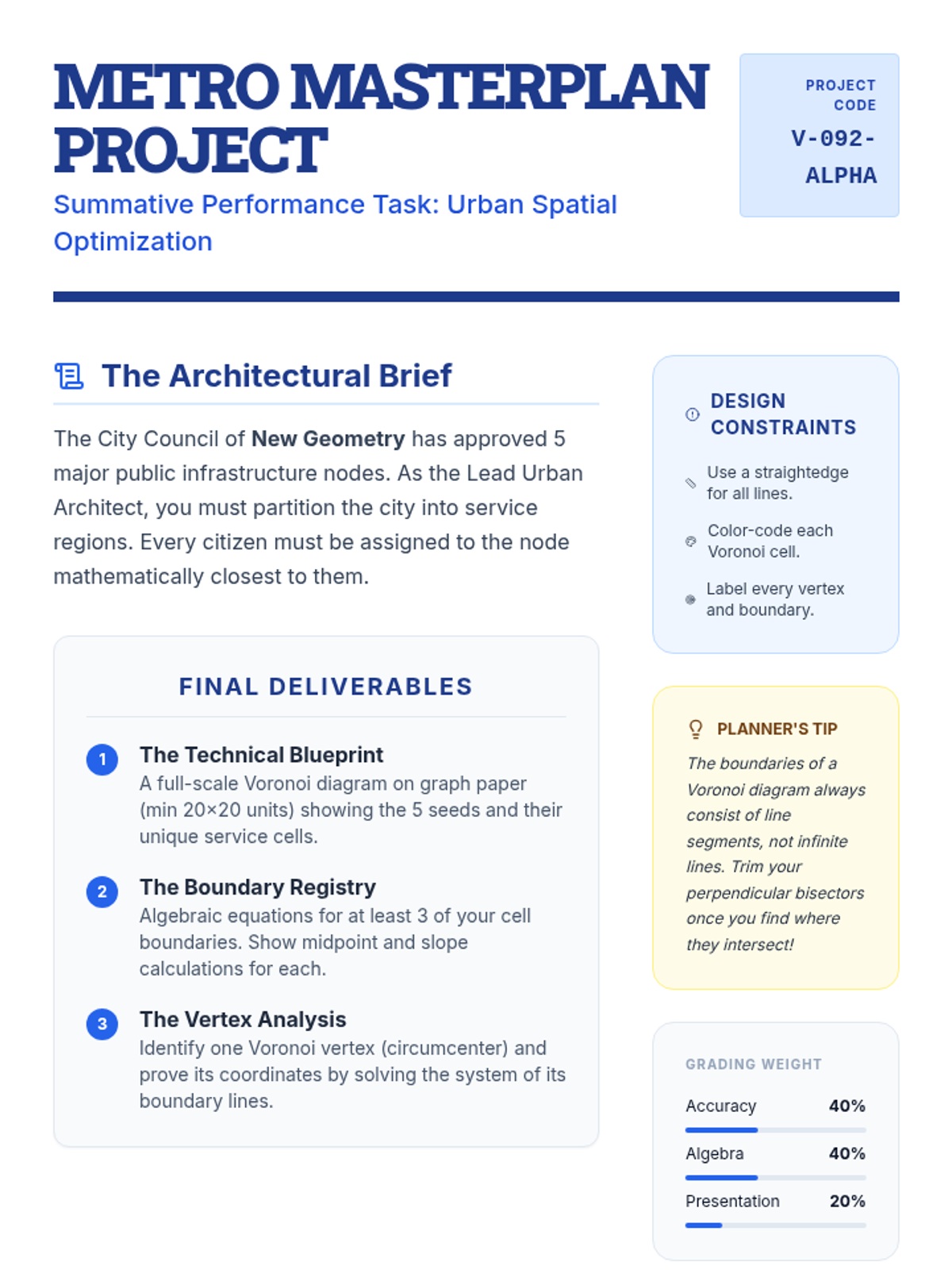
A summative project guide where students design a city's infrastructure layout, constructing a 5-seed Voronoi diagram and providing mathematical proof of its efficiency.
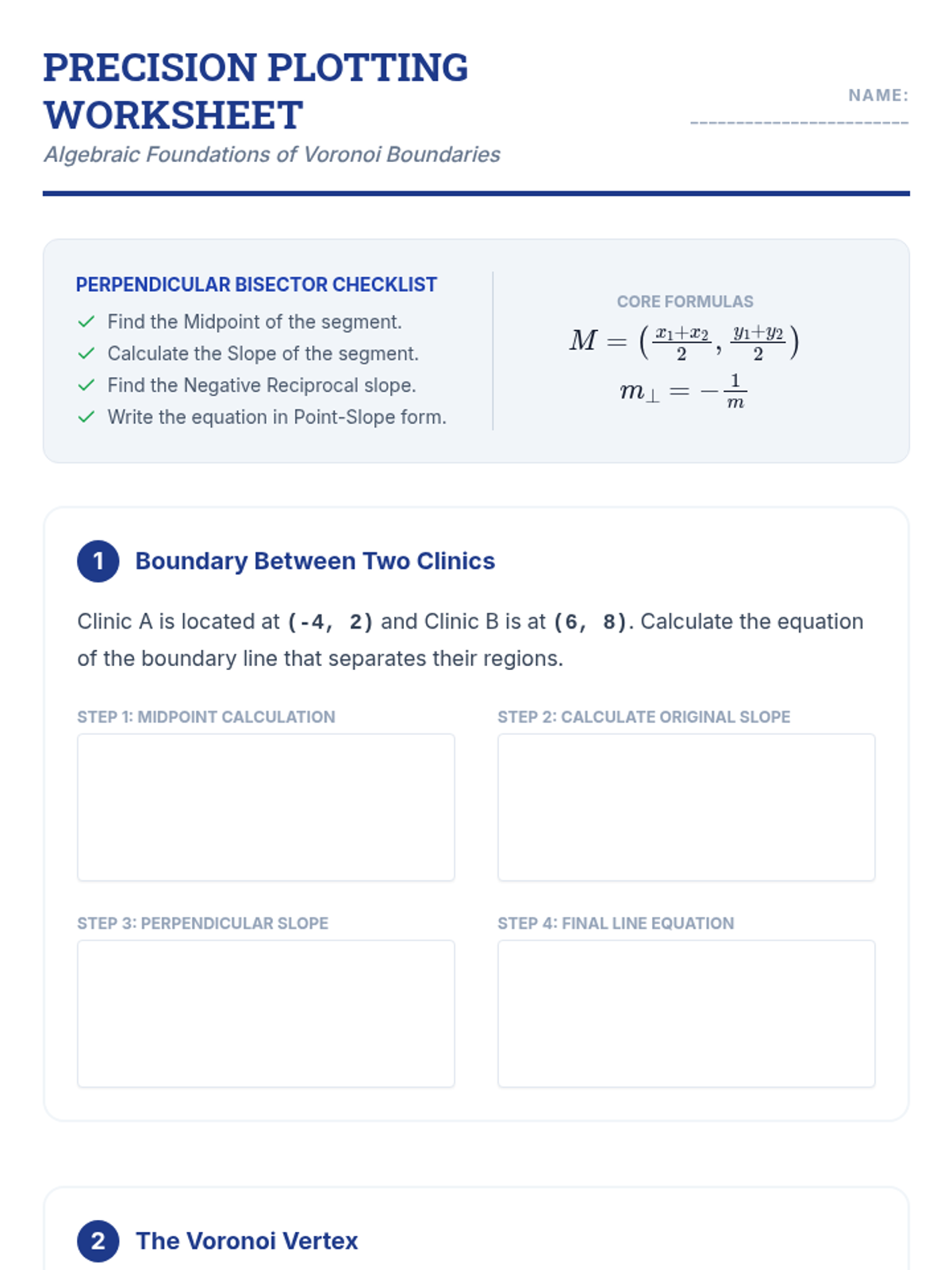
A math worksheet that combines geometry and algebra, requiring students to calculate the equations of perpendicular bisectors and find Voronoi vertices through systems of linear equations.
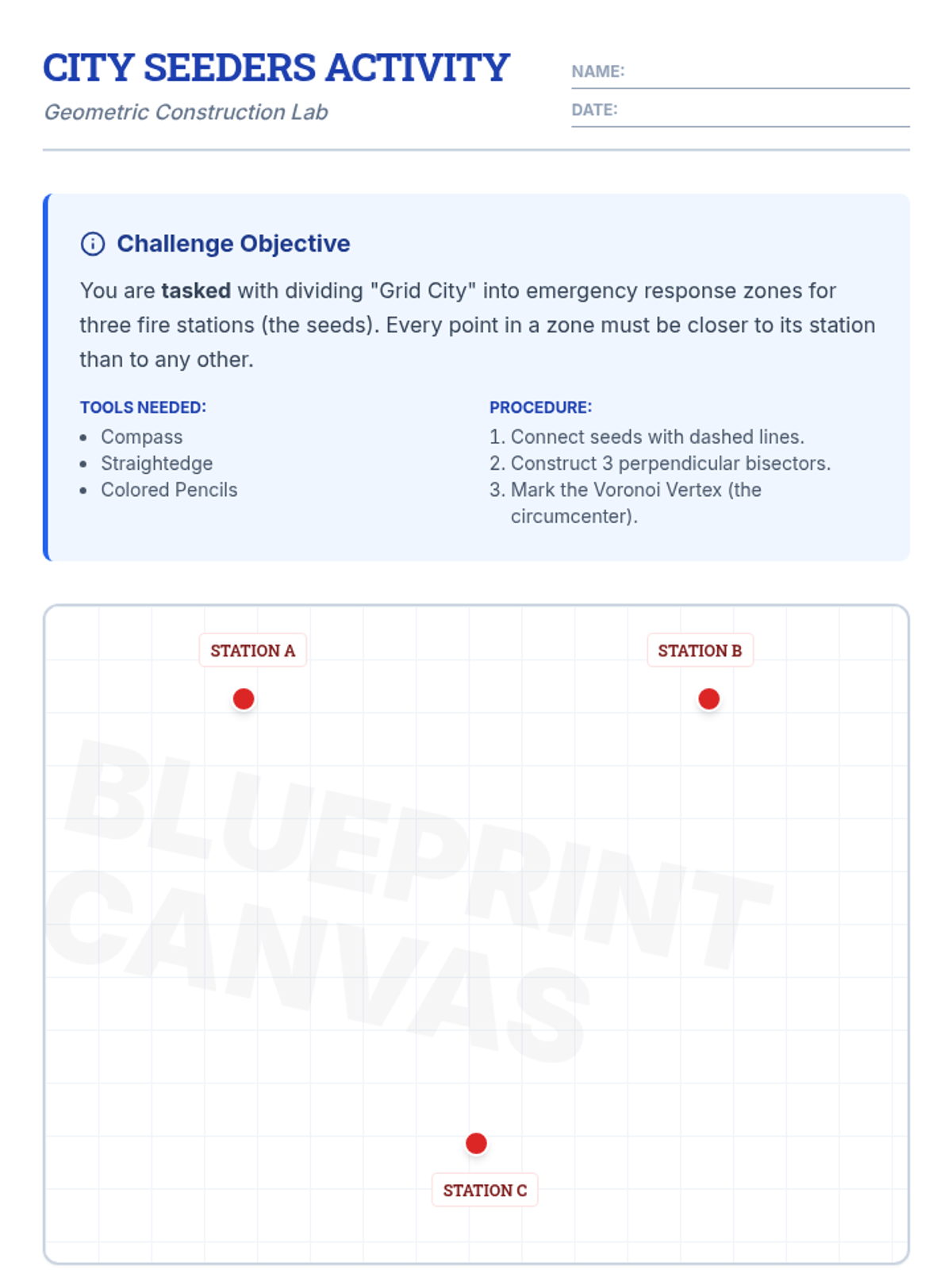
A hands-on activity sheet where students use a compass and straightedge to construct a Voronoi diagram for three "fire stations" on a grid, reinforcing the concept of the perpendicular bisector.
A visual slide deck that defines Voronoi diagrams, explains the construction algorithm using perpendicular bisectors, and shows real-world applications in urban planning and beyond.
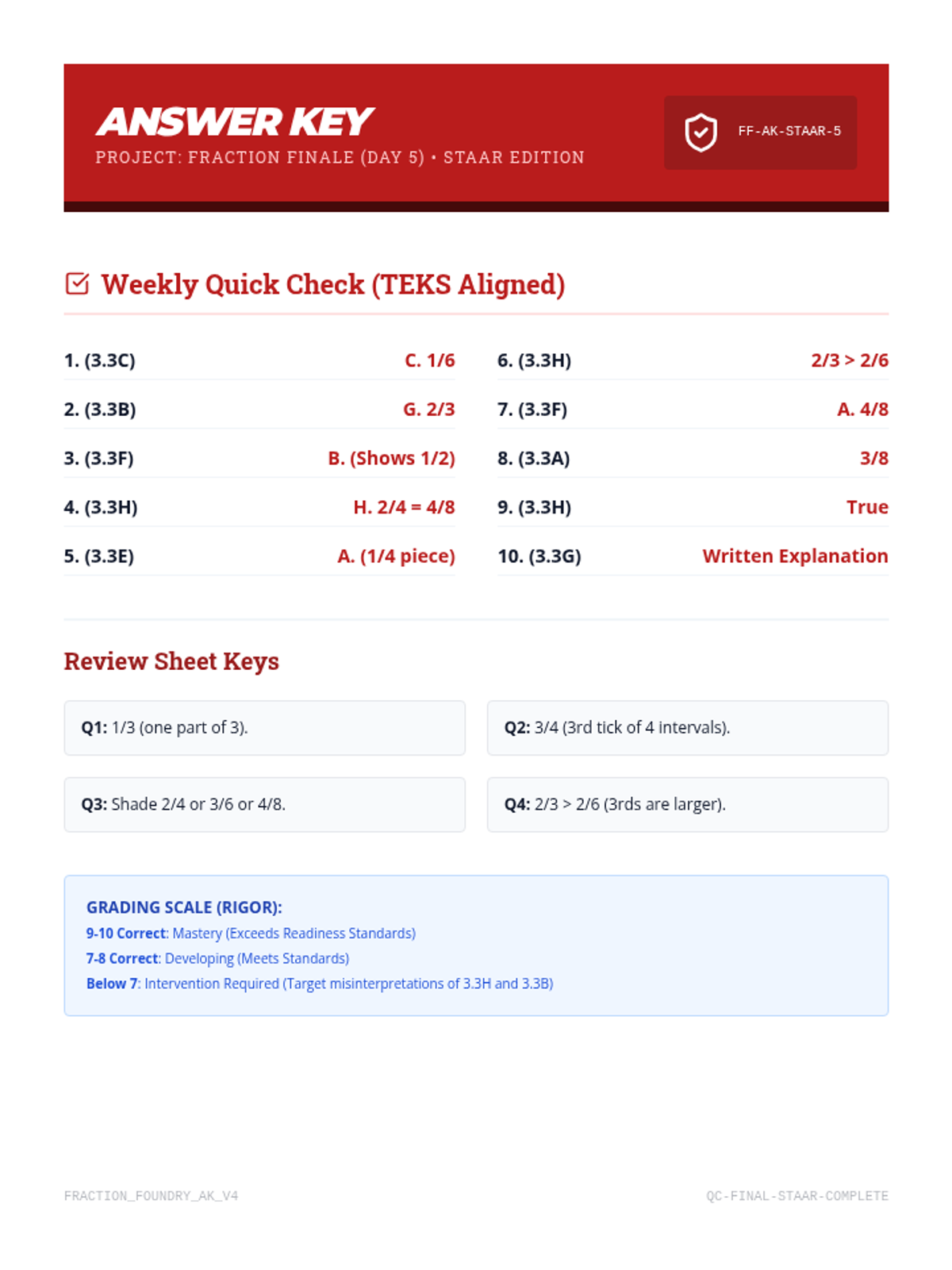
Answer key for Lesson 5 Fraction Finale review sheet and quick check assessment. Includes grading guide and point breakdown. Includes TEKS cross-references.
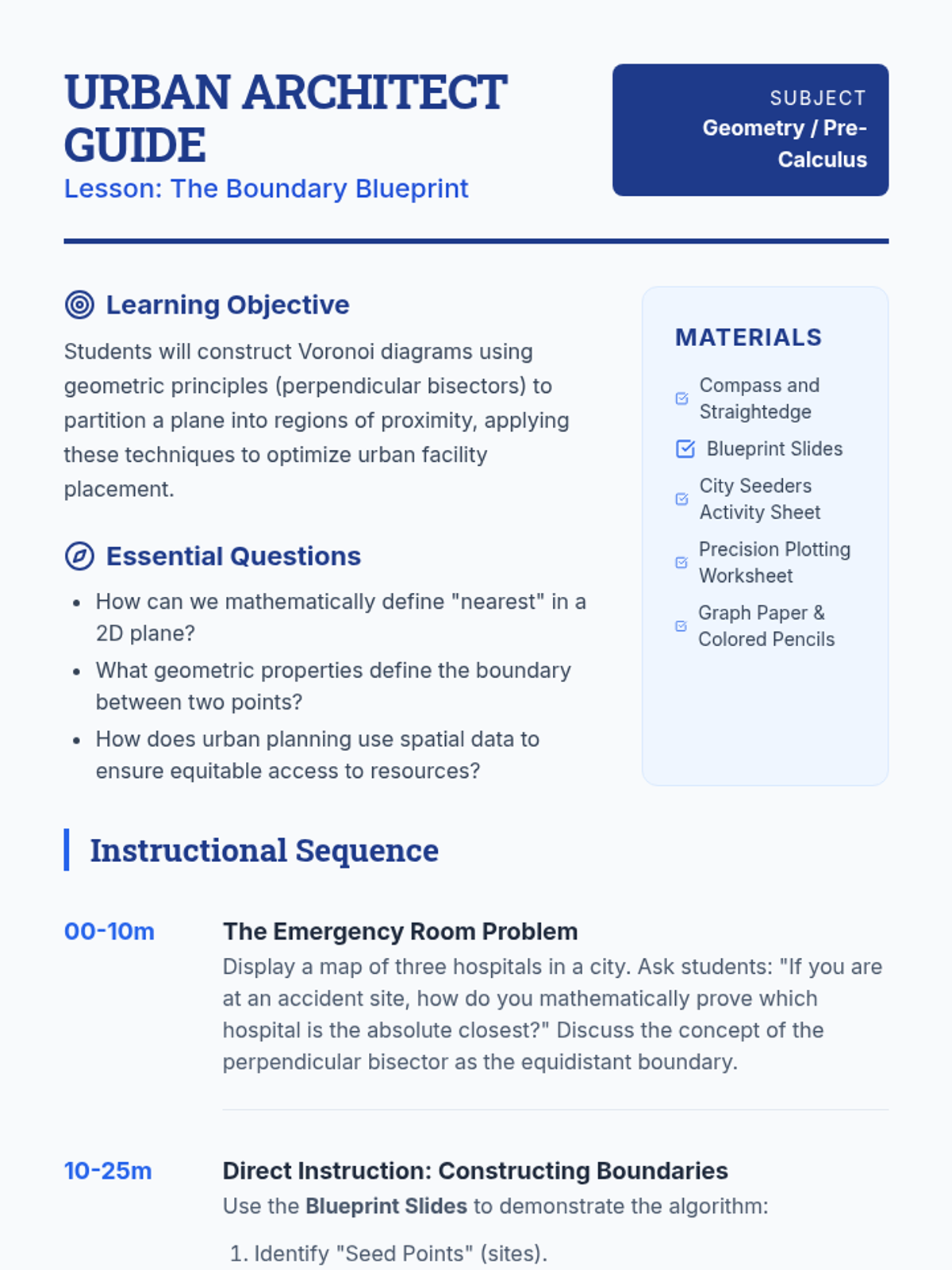
A comprehensive lesson plan for teachers, outlining the instructional sequence, learning objectives, and materials needed to teach Voronoi diagrams through an urban planning lens.
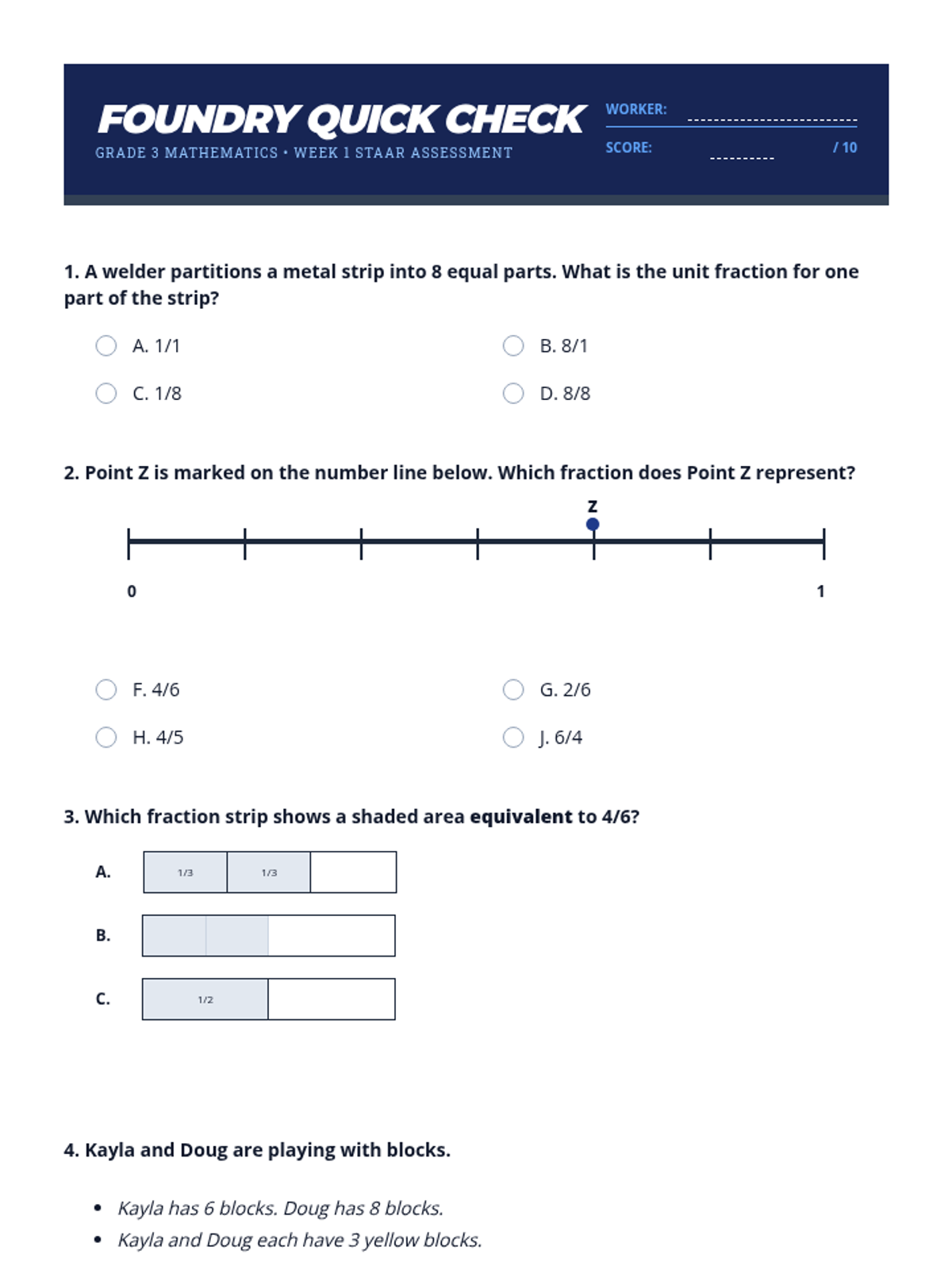
Cumulative 10-question assessment covering unit fractions, number lines, equivalence, and comparison of fractions with denominators 2, 3, 4, 6, and 8. Optimized for printing with high-contrast work areas and clear mathematical notation. Fully STAAR aligned with rigor. Fixed numbering and visual errors.
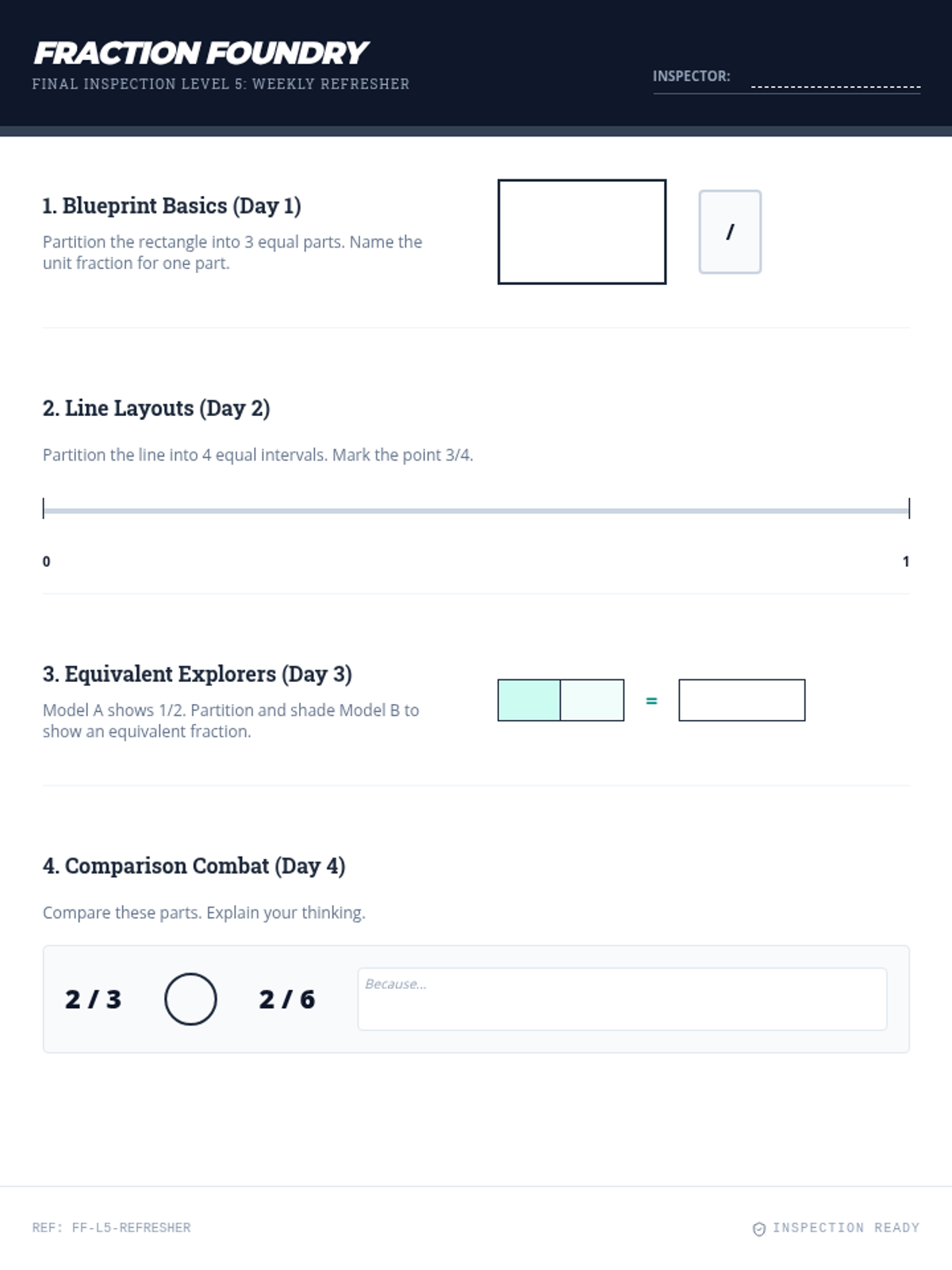
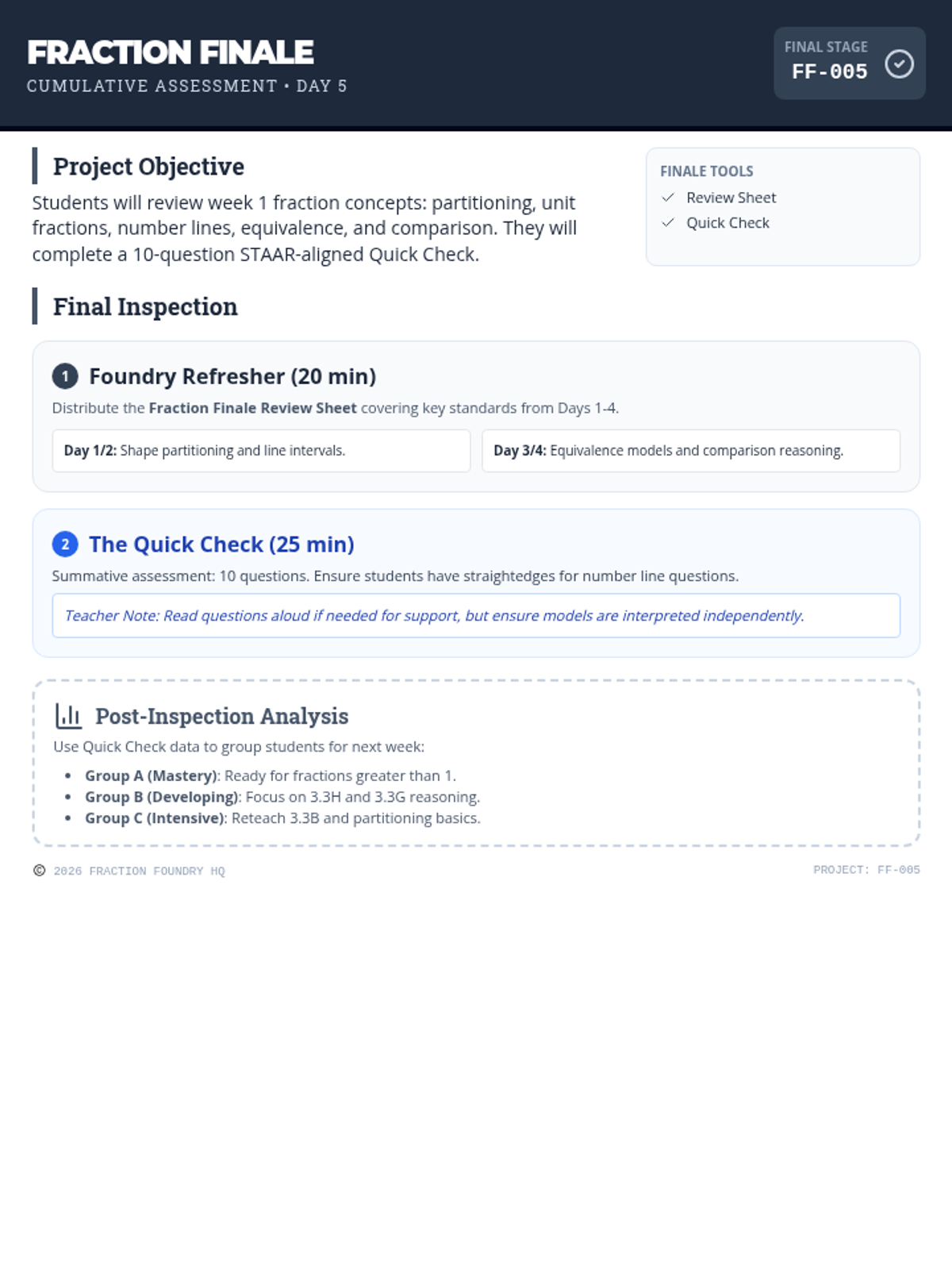
Review sheet for Day 5 of the Fraction Foundry sequence. Covers one key concept from each of the previous four days (partitioning, number lines, equivalence, comparison).
Teacher guide for Lesson 5, providing a structure for the cumulative review and quick check assessment. Includes grouping suggestions based on data.
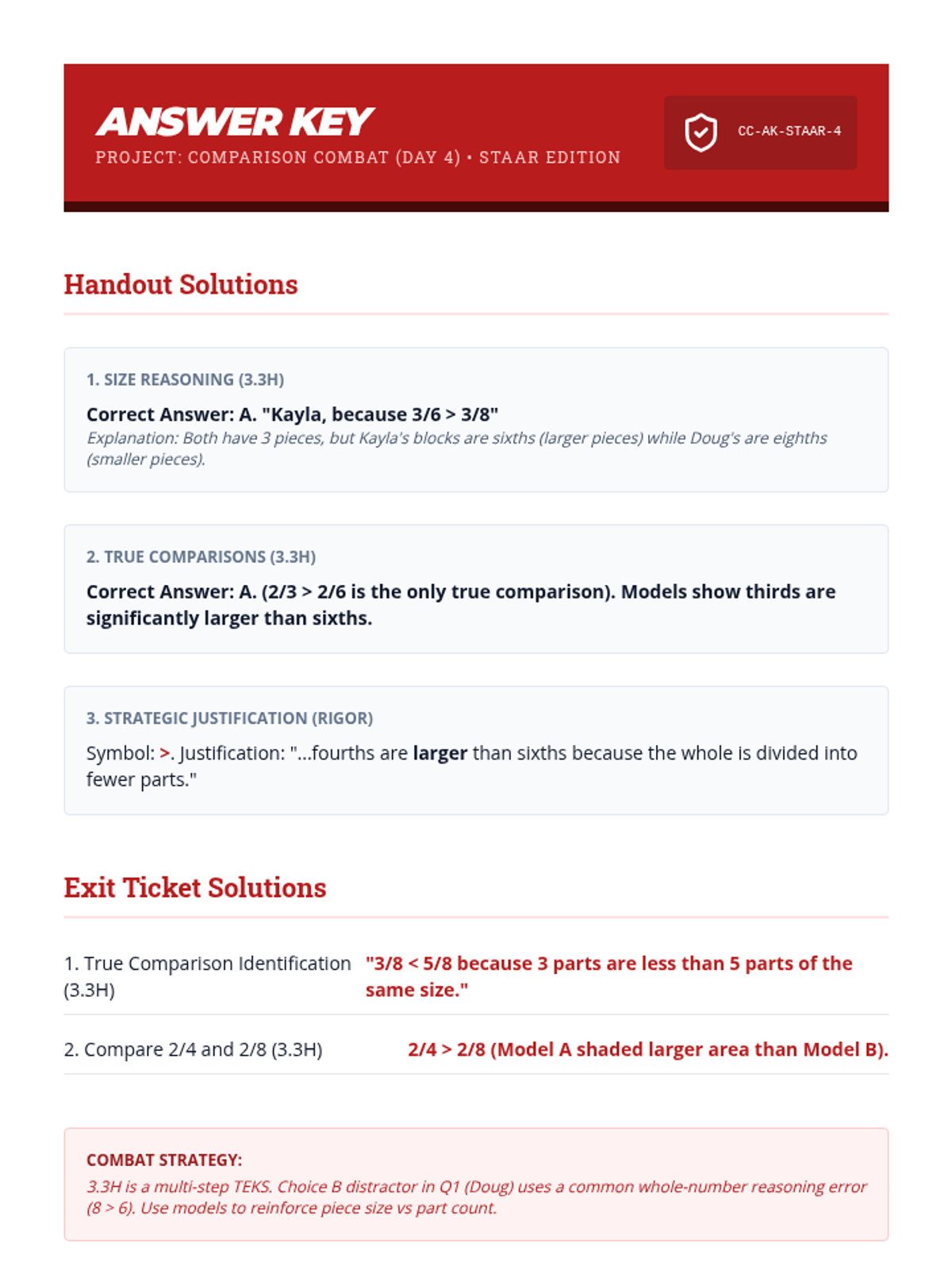
Answer key for Lesson 4 Comparison Combat handout and exit ticket. Includes reasoning guides for teacher use.
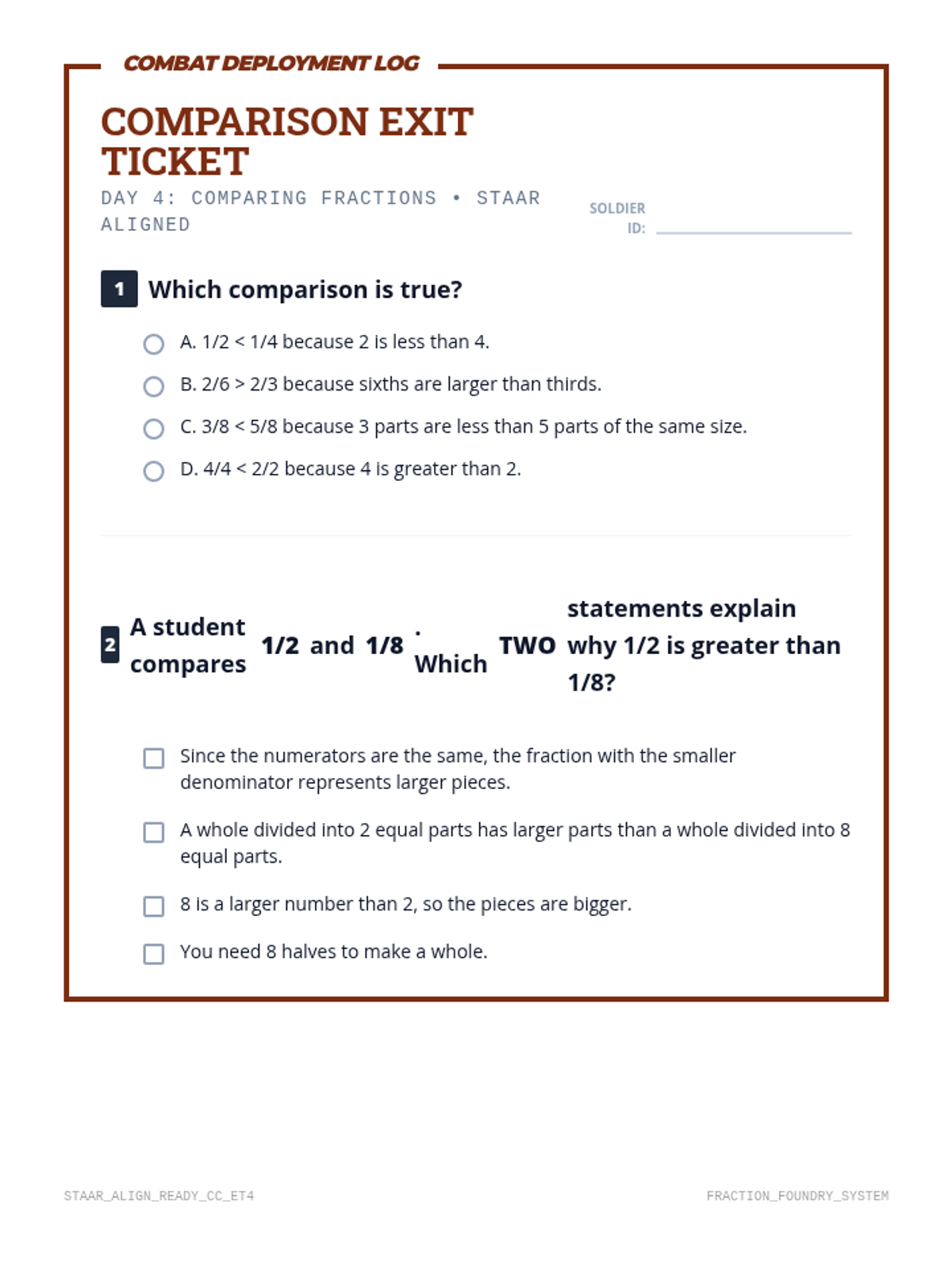
Exit ticket for Lesson 4, requiring students to compare fractions with like numerators or denominators and explain their reasoning using models. Optimized for STAAR rigor.
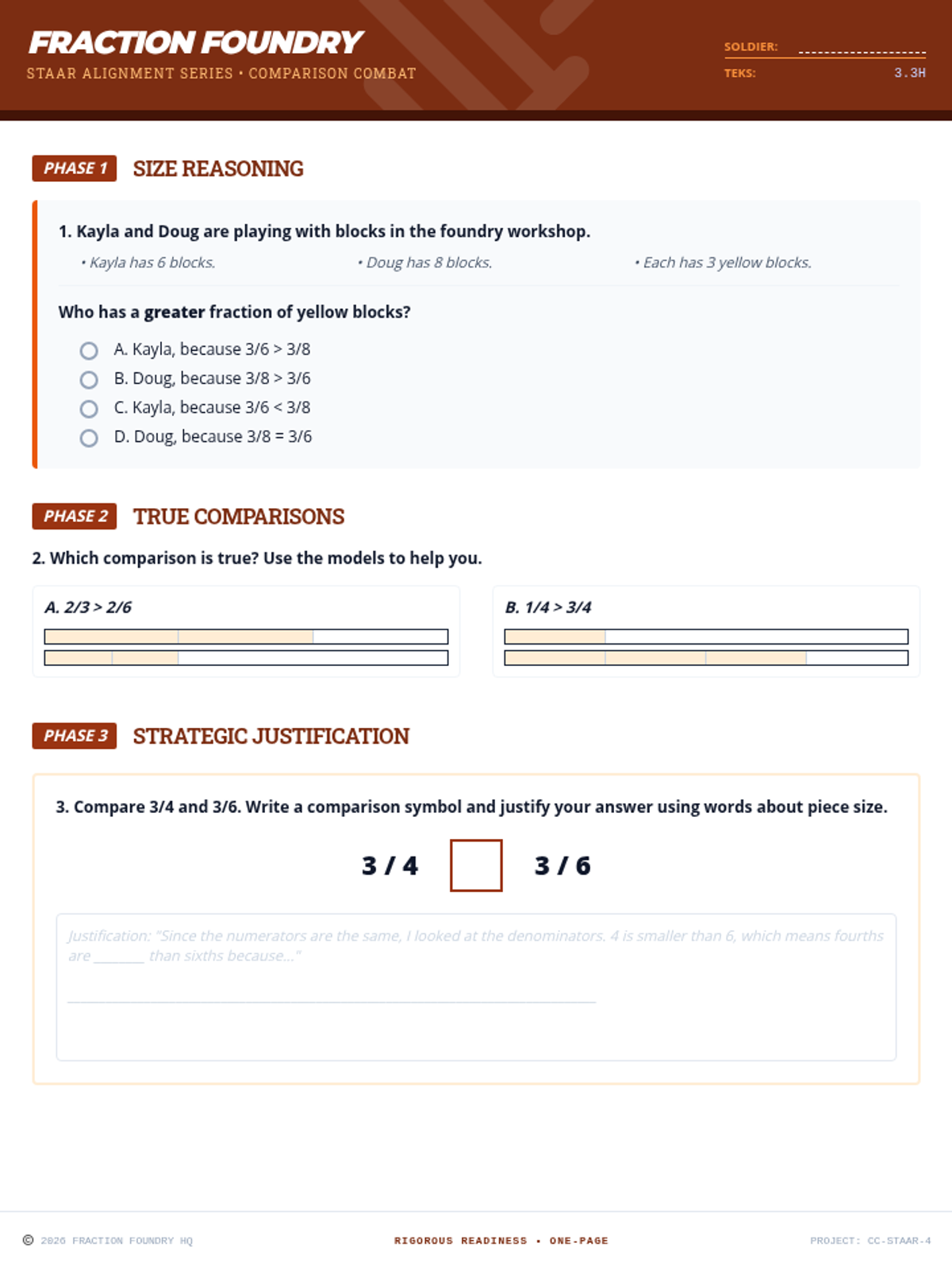
STAAR-aligned student handout for Lesson 4, focusing on comparing fractions using visual models and justification (TEKS 3.3H). Includes conceptual multiple choice and written justification. Industrial theme.
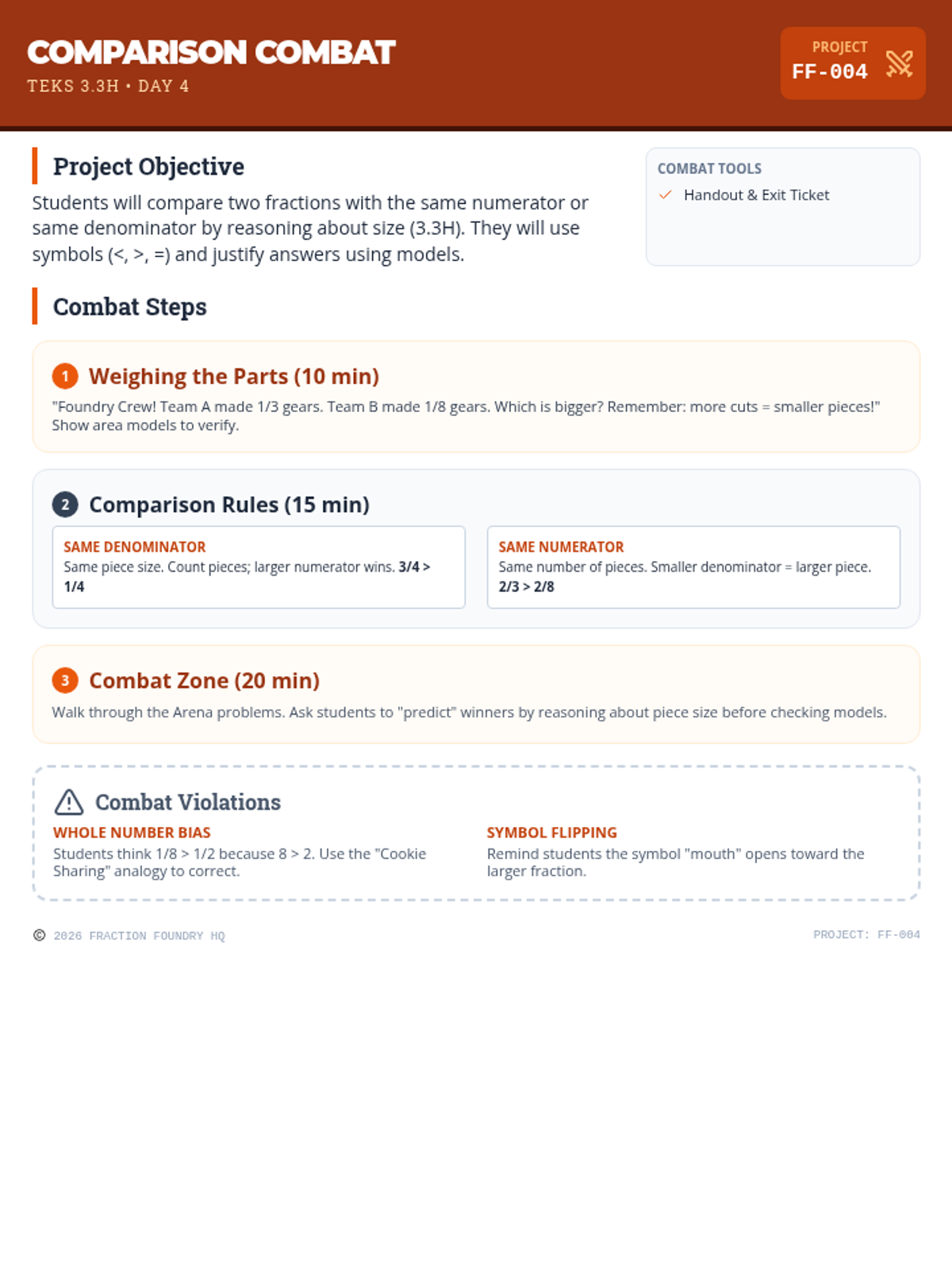
Teacher guide for Lesson 4, focusing on comparing fractions with the same numerator or the same denominator using visual models and reasoning.
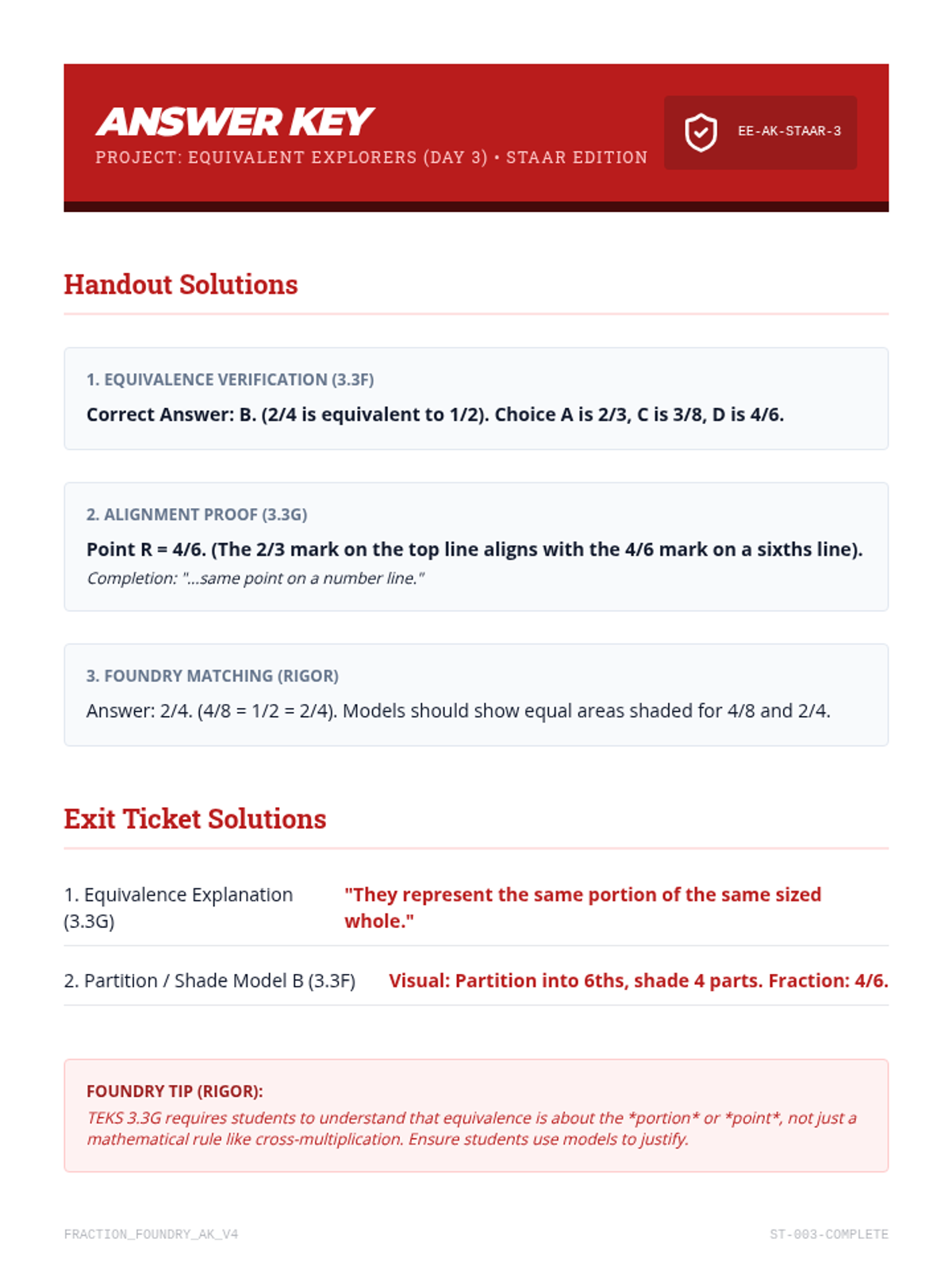
Answer key for Lesson 3 Equivalent Explorers handout and exit ticket. Includes visual answer guides and common misconception notes.
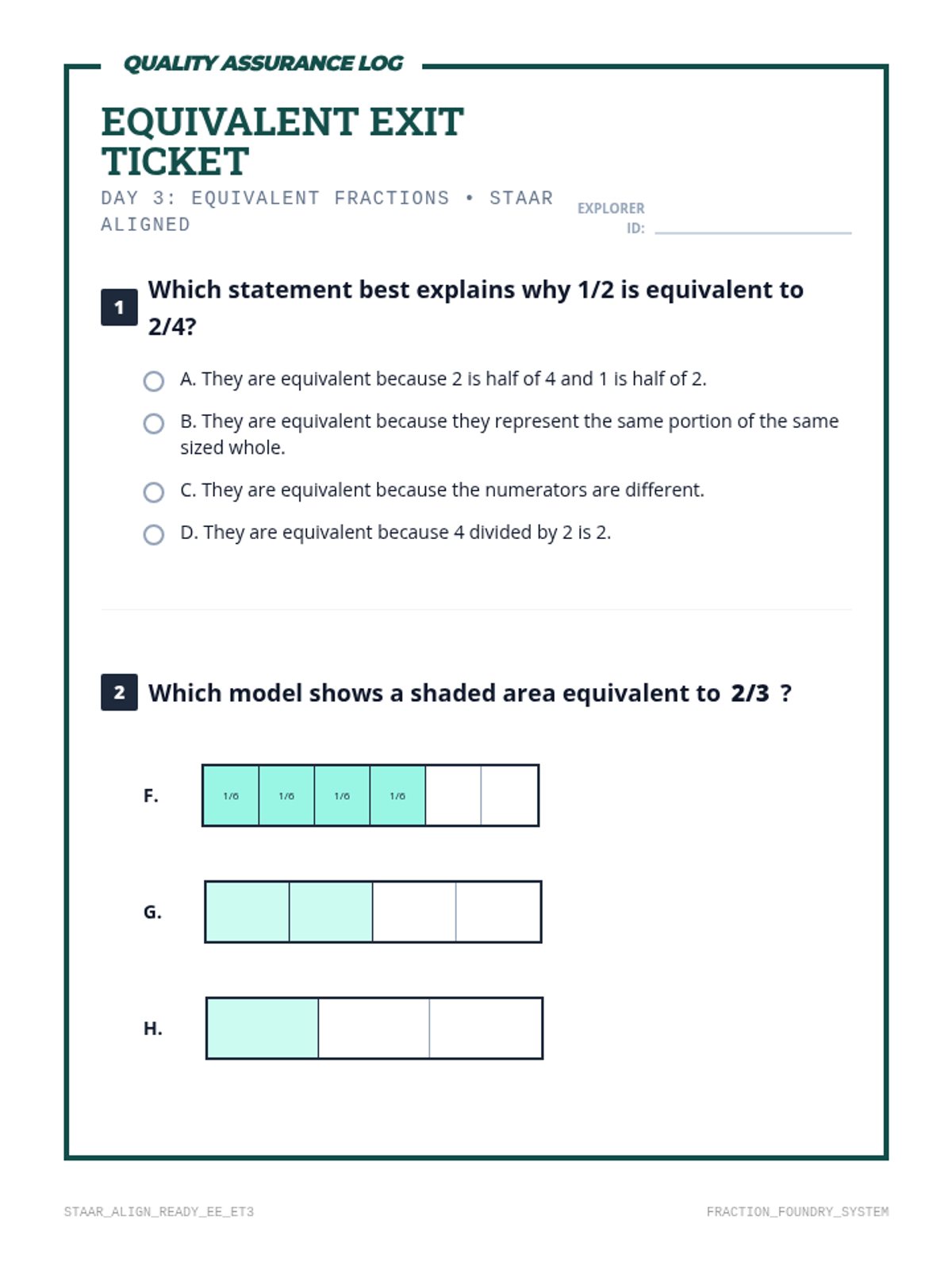
Exit ticket for Lesson 3, requiring students to show equivalence between 2/3 and 4/6 using area models and explanation. Optimized for STAAR rigor.
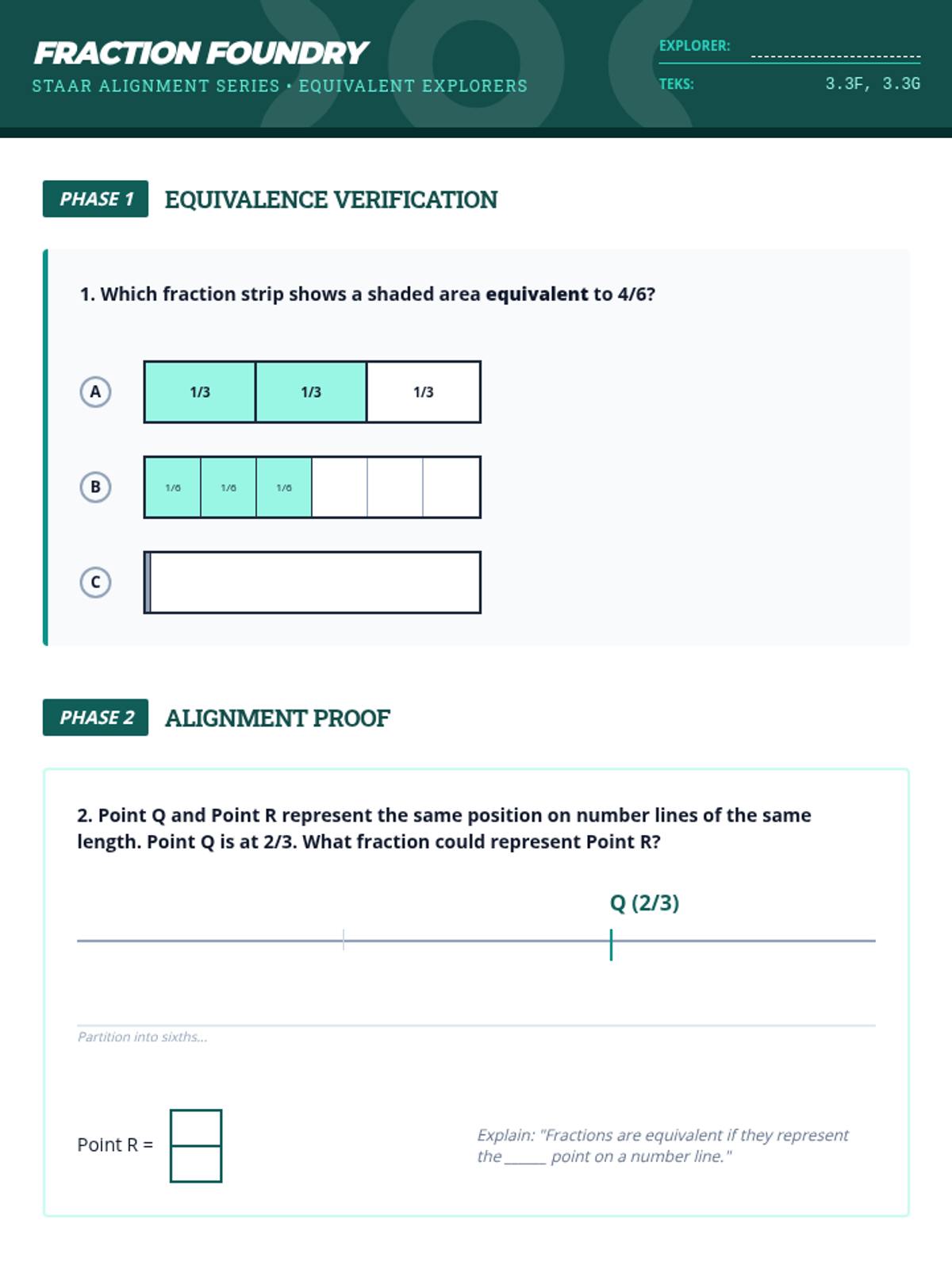
STAAR-aligned student handout for Lesson 3, focusing on identifying equivalent fractions using area models and number lines (TEKS 3.3F, 3.3G). Now includes exact STAAR-style fraction strip questions. Industrial theme.
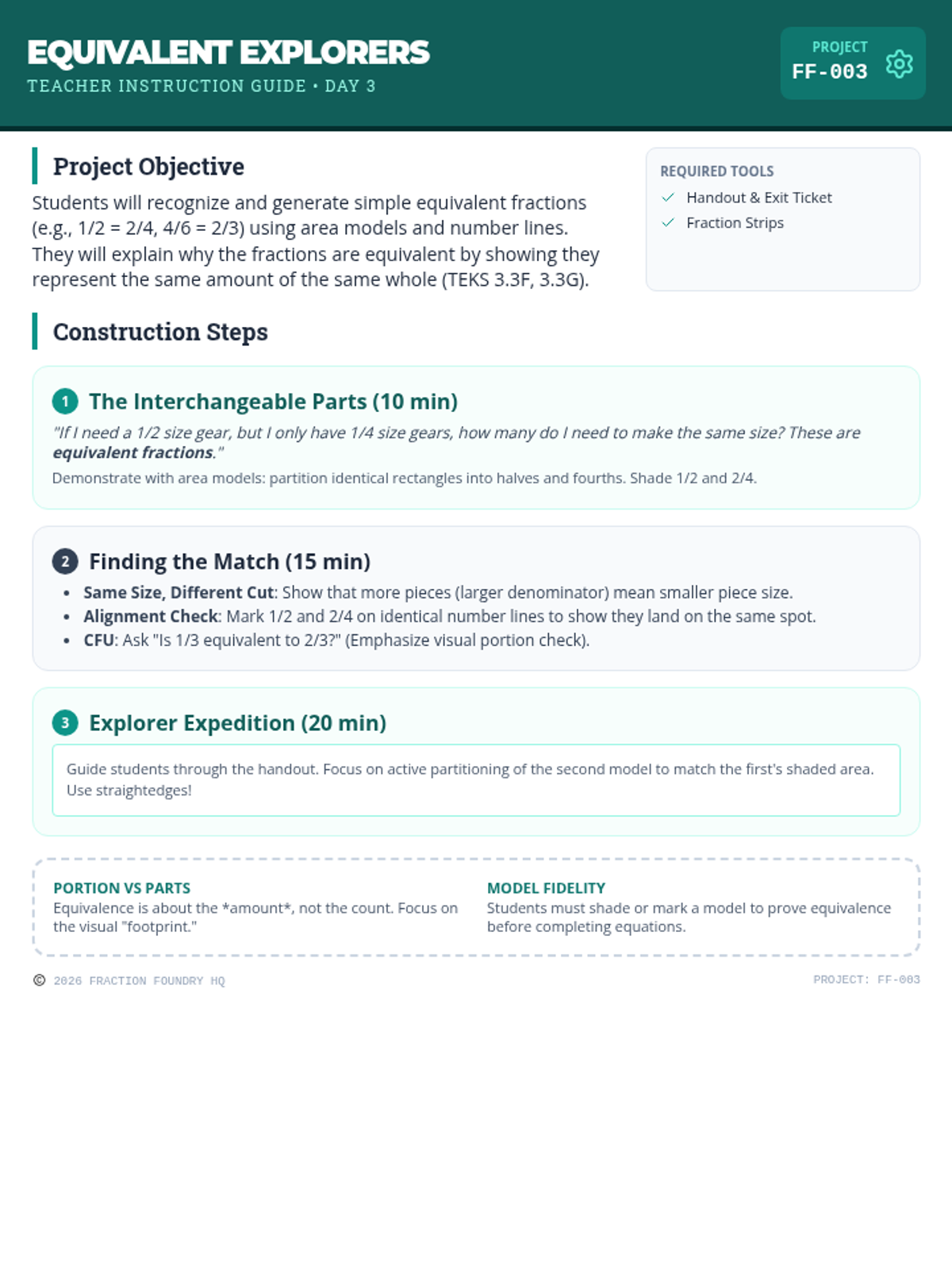
Teacher guide for Lesson 3, focusing on identifying equivalent fractions through area models and number lines with "interchangeable parts" terminology.
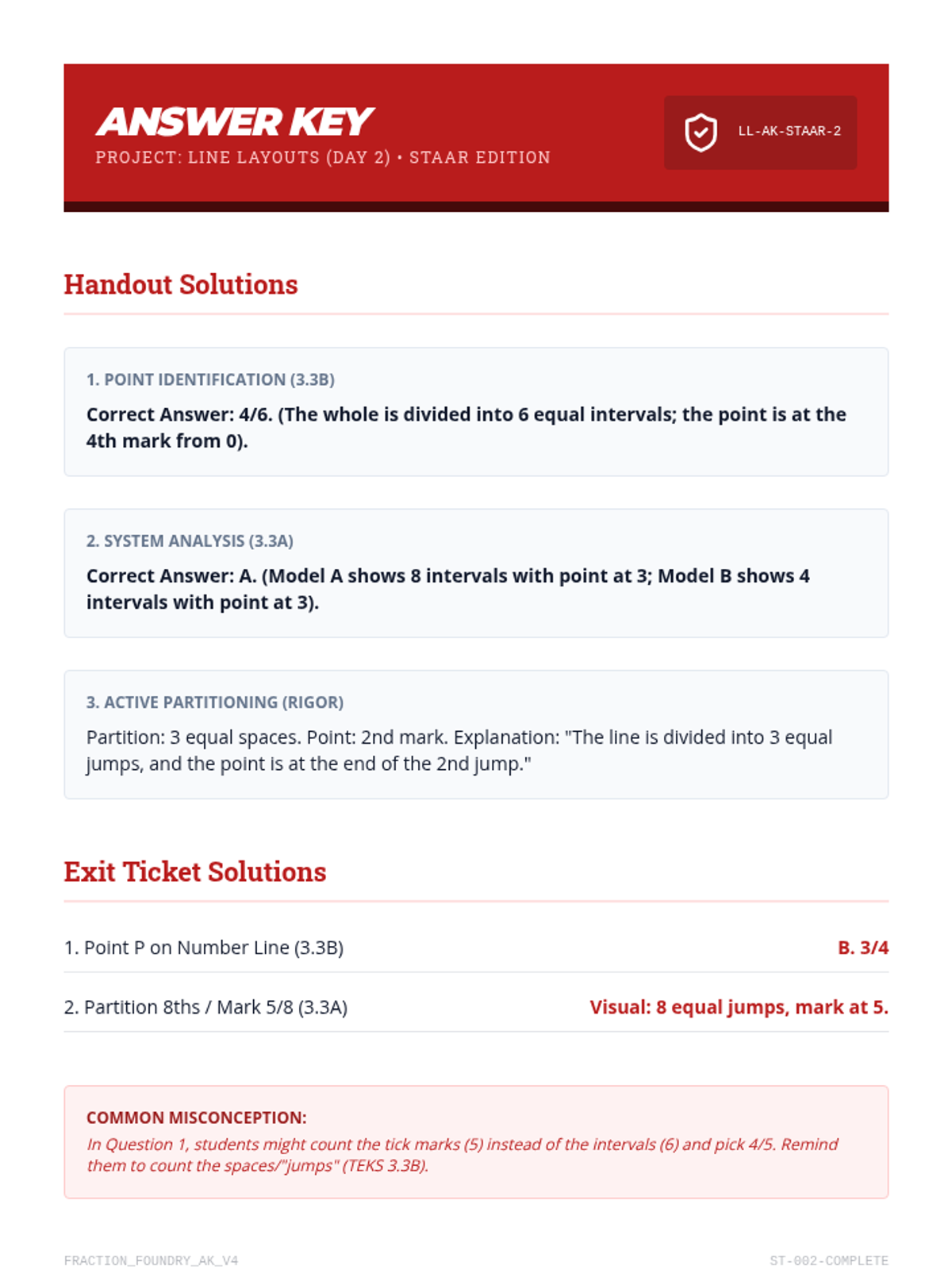
Answer key for Lesson 2 Line Layouts handout and exit ticket. Includes visual number line answer keys.
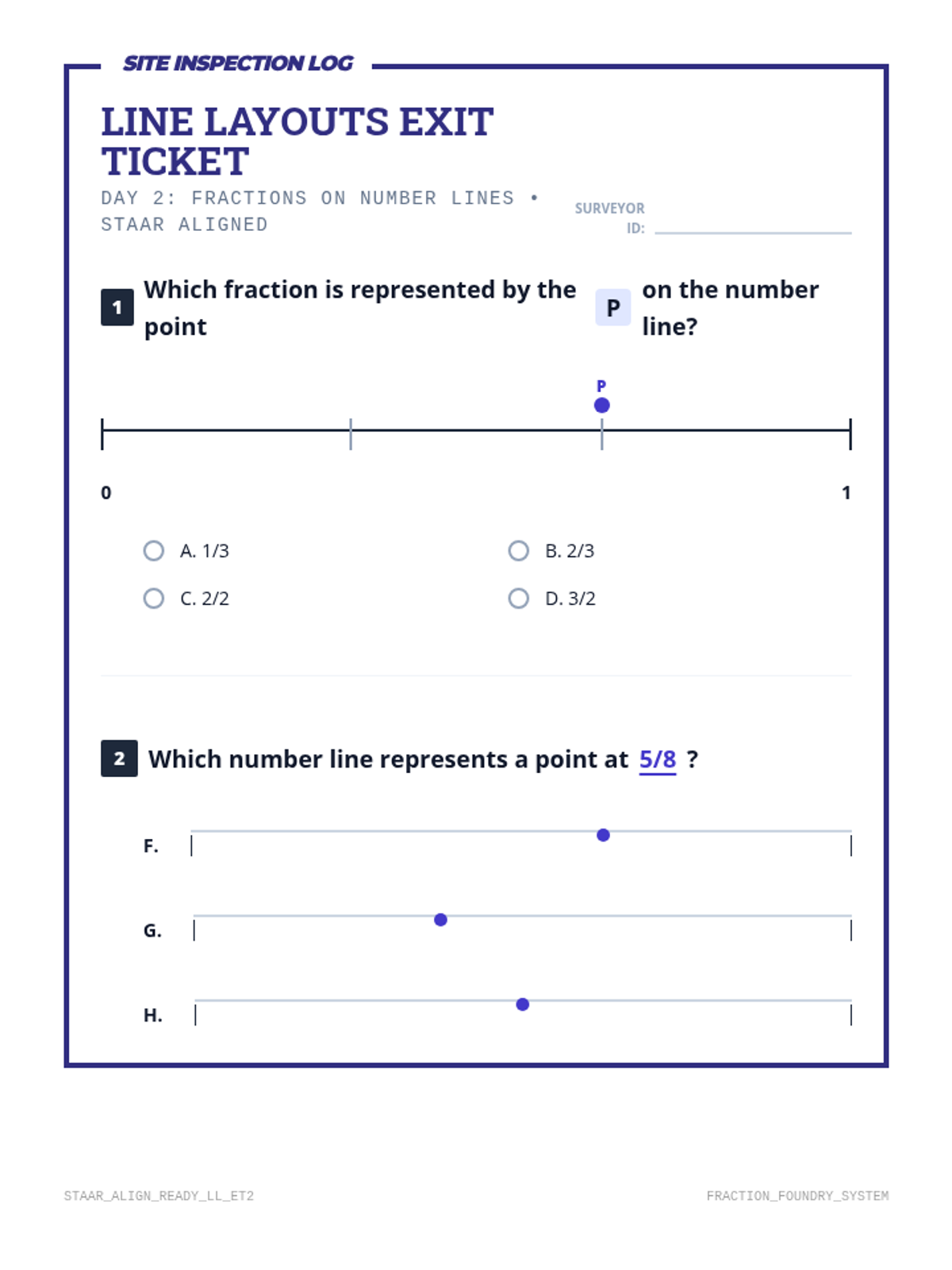
Exit ticket for Lesson 2, requiring students to identify a point on a number line (2/3) and partition a line into eighths to mark 5/8. Optimized for printing with clear page breaks and high-contrast work areas.
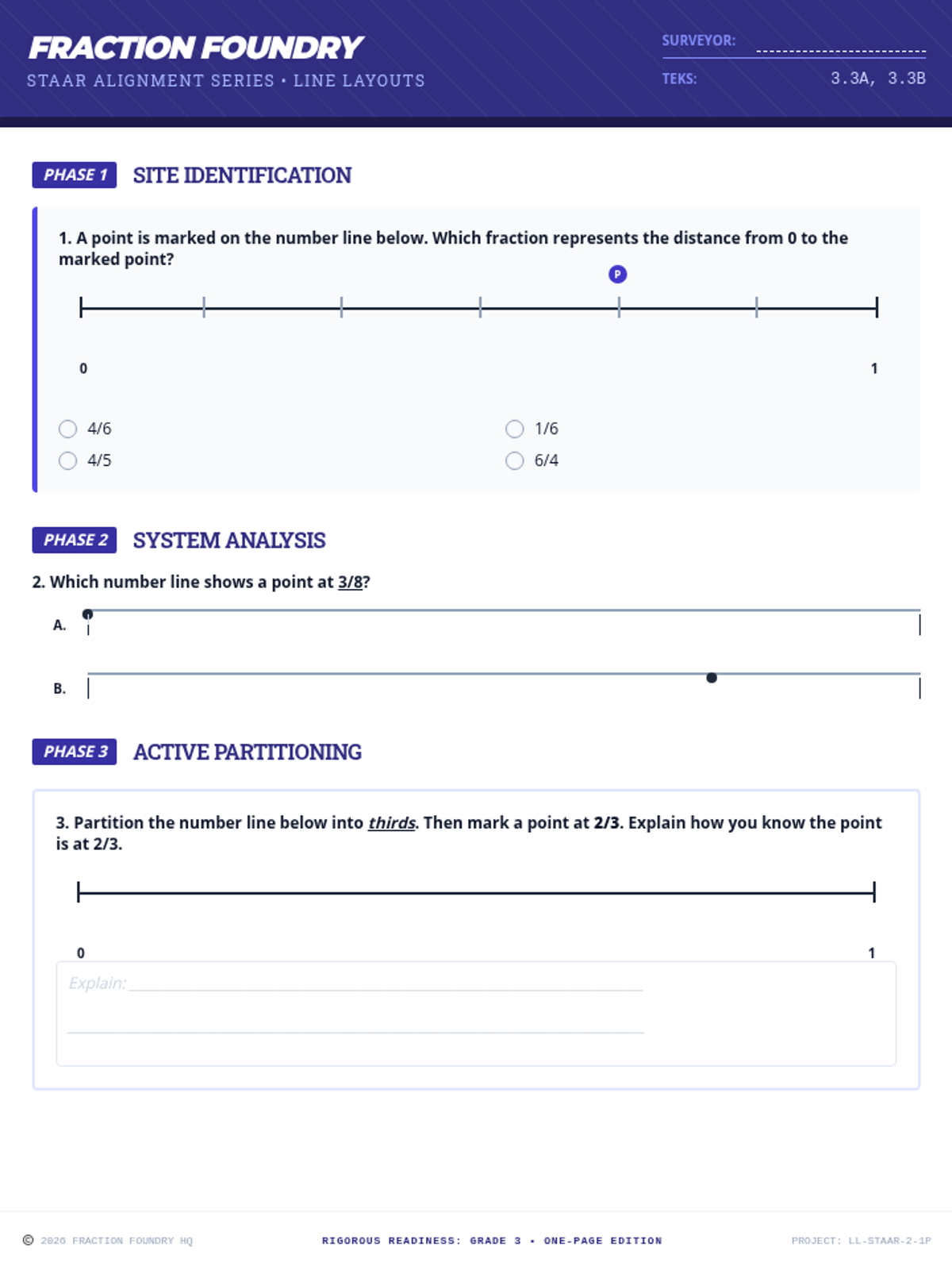
STAAR-aligned student handout for Lesson 2, focusing on number line representation (TEKS 3.3B, 3.3A). Includes identification of points and active partitioning with justification. Industrial theme.
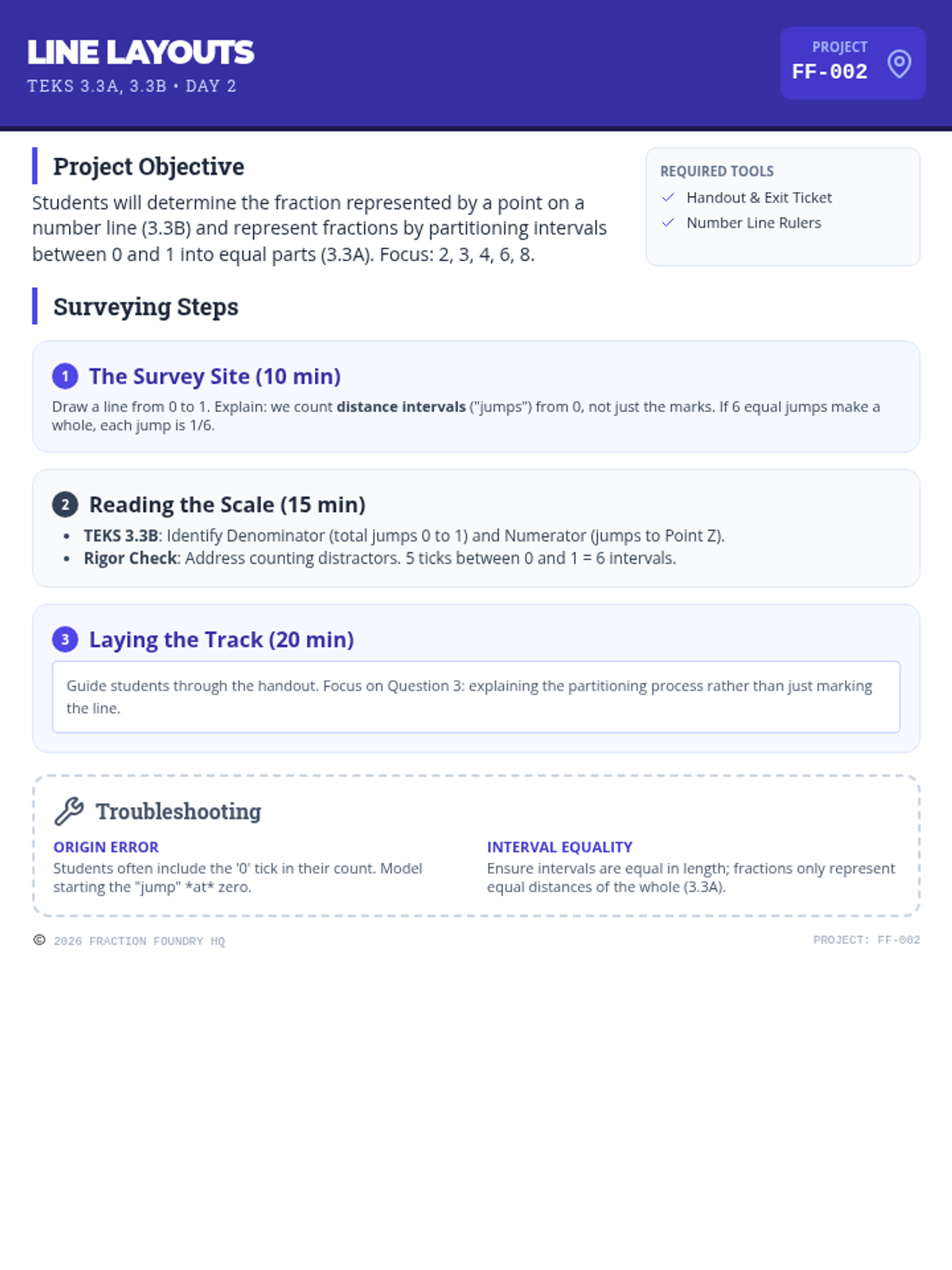
Teacher guide for Lesson 2, focusing on representing fractions on a number line using "surveying" terminology and "jumps" to define intervals. Now fully TEKS 3.3B aligned for STAAR rigor.
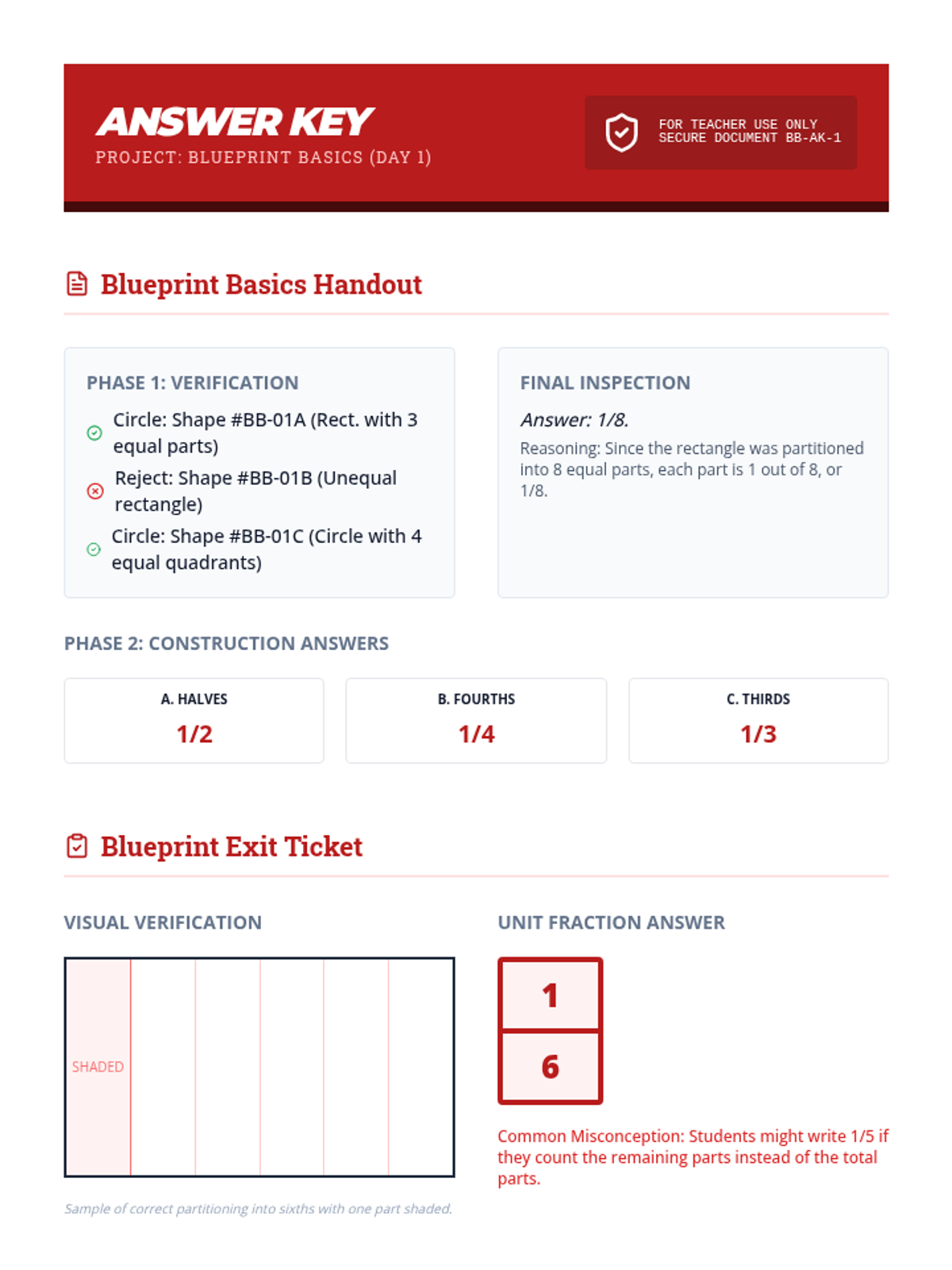
Answer key for Lesson 1 Blueprint Basics handout and exit ticket. Includes visual answer guides and common misconception notes.
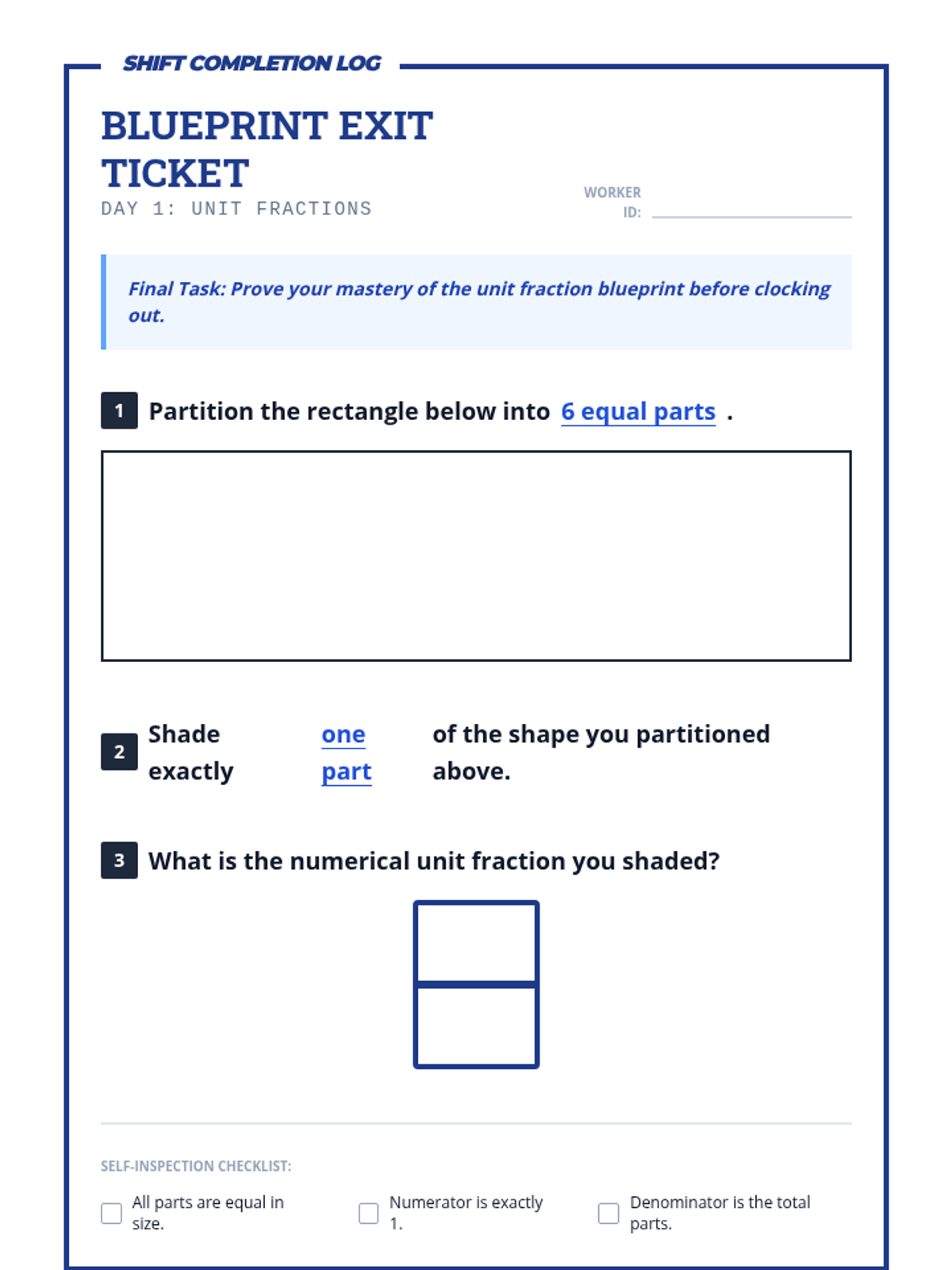
Exit ticket for Lesson 1, requiring students to identify unit fraction definitions and partition a rectangle into eighths. Optimized for STAAR rigor.
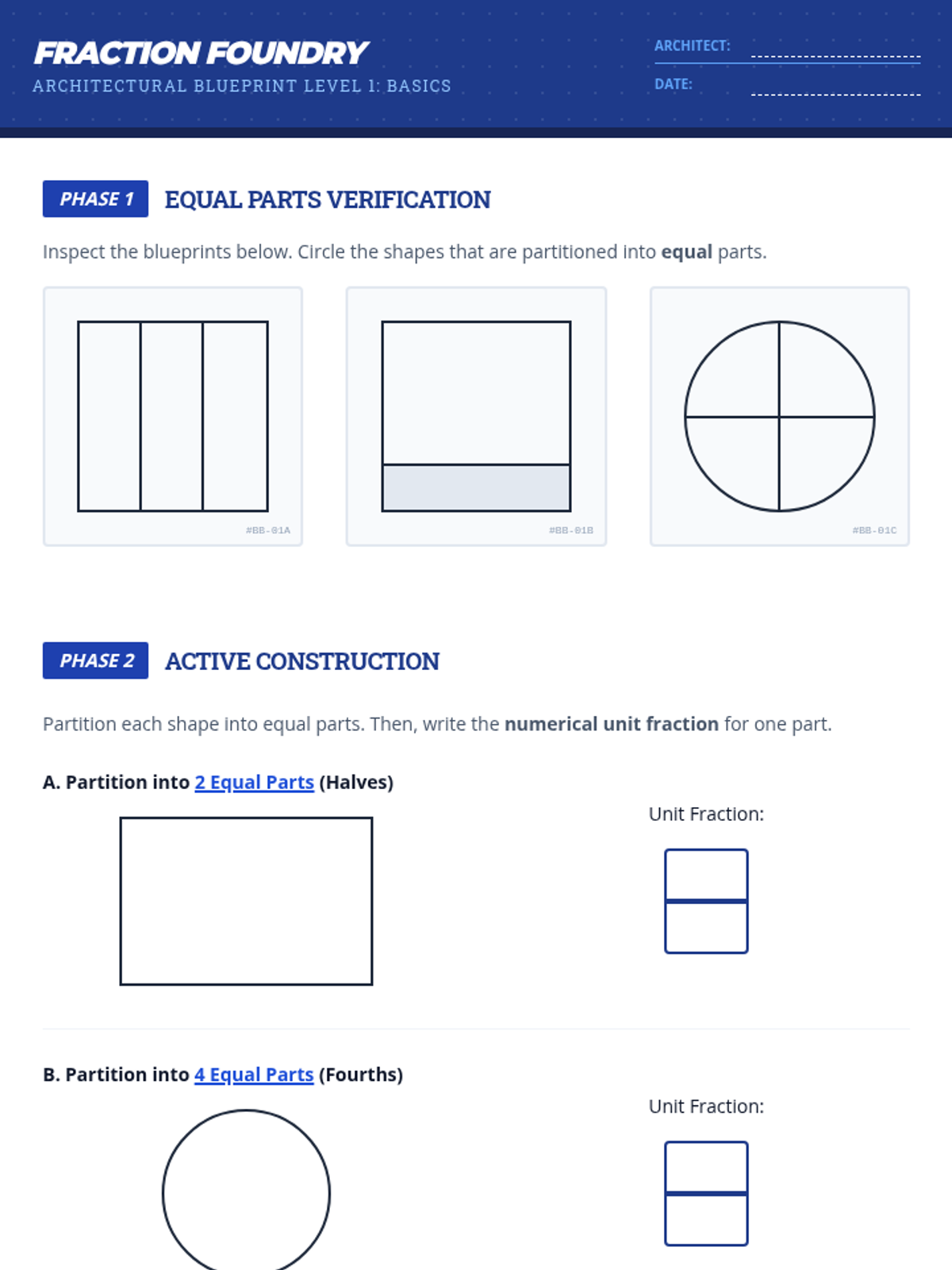
Fully STAAR-aligned student handout for Day 1. Includes conceptual multiple choice, model identification, and word problem partitioning (TEKS 3.3A, 3.3C, 3.3E). High-rigor industrial theme.