A visual presentation for 2nd grade subtraction. Includes a mental math warm-up, an embedded video section, procedural mantras, and a guide to the 'Ghost Blocks' visualization strategy.
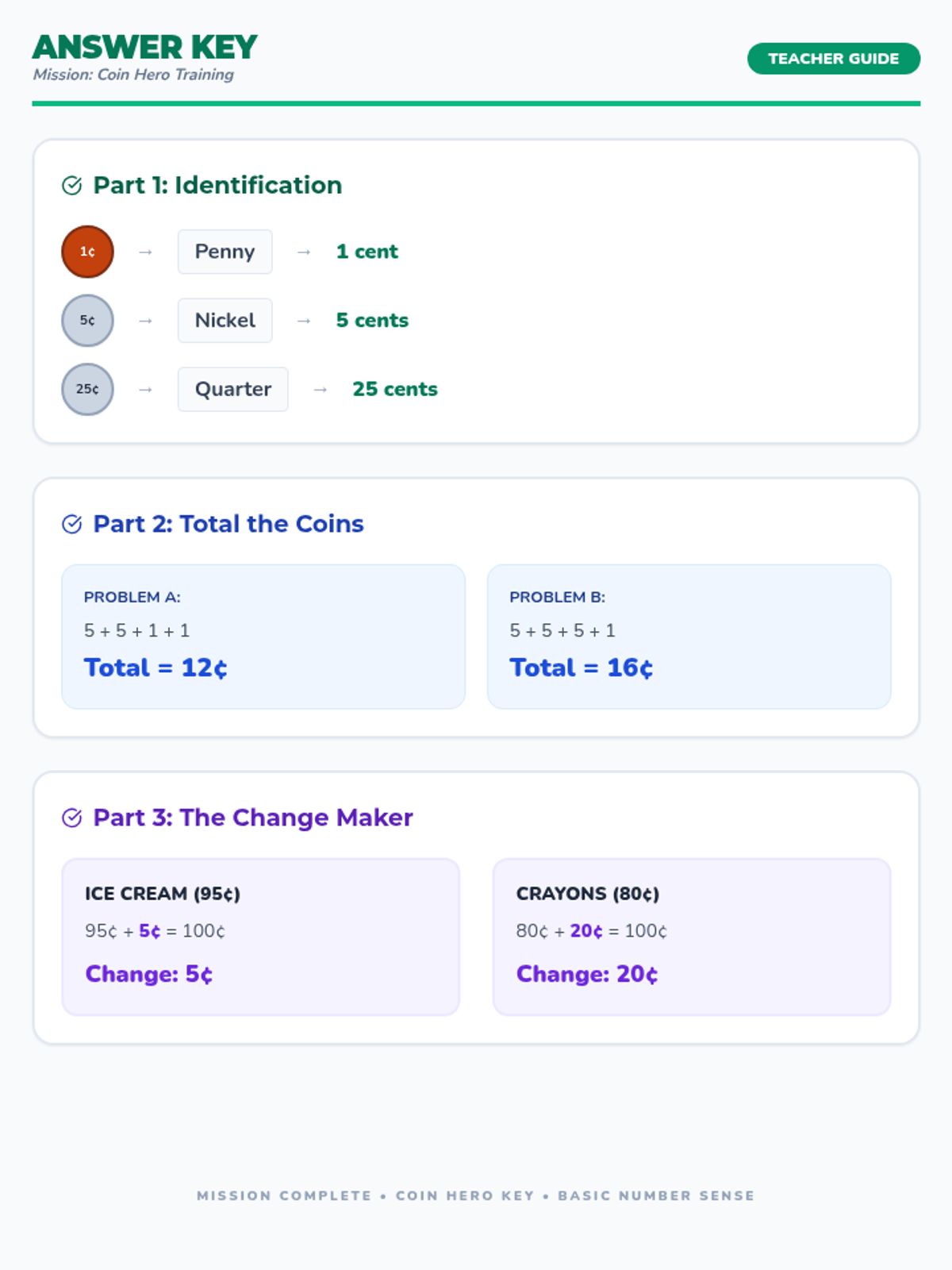
A clear answer key for the Coin Hero Mission practice worksheet. Provides step-by-step counting breakdowns and final answers for identification, total counting, and making change sections.
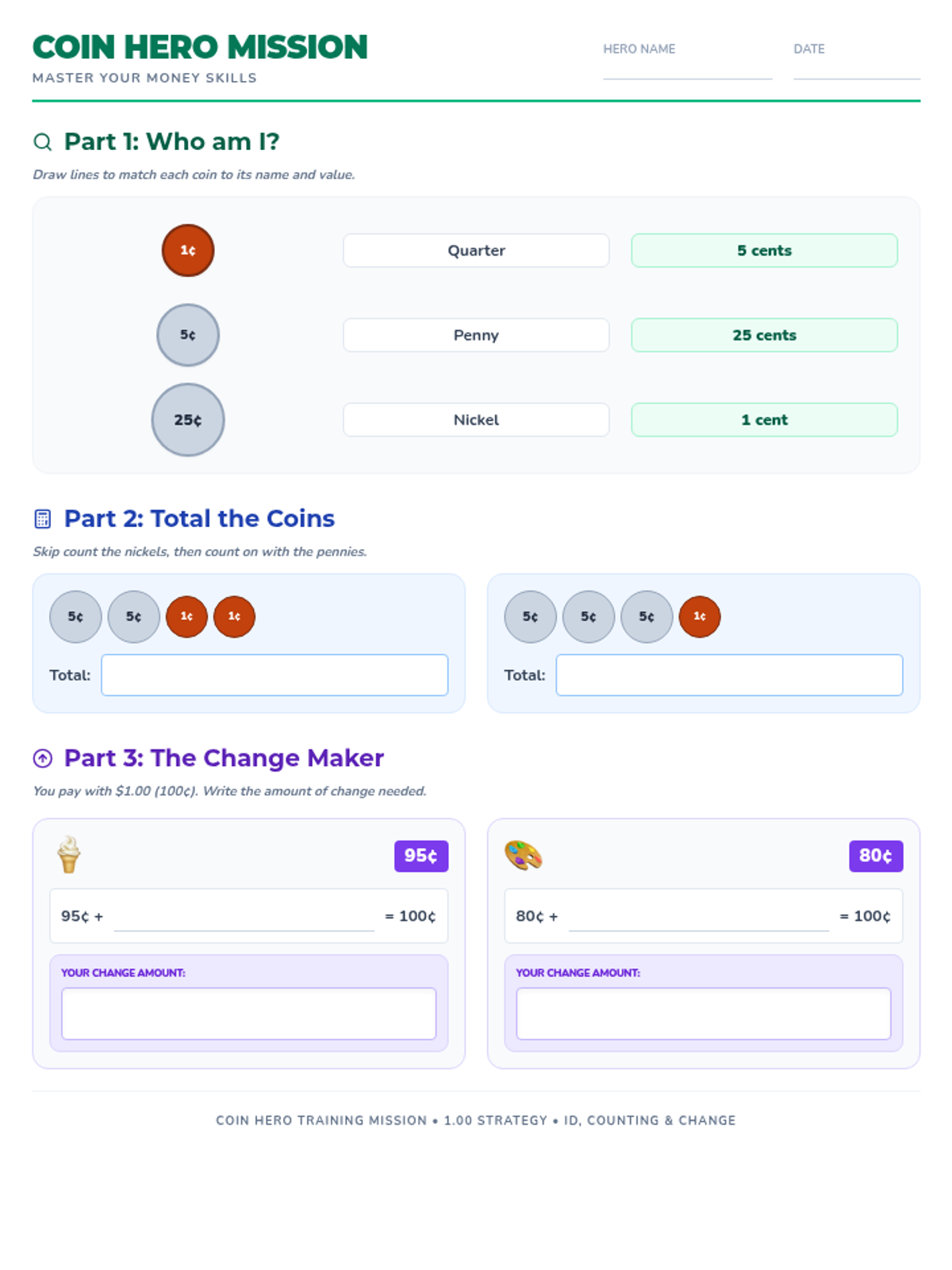
A skill-building worksheet for students to practice coin identification, skip counting with nickels and pennies, and calculating change from a dollar using the 'Counting Up' strategy. Includes visual coin representations and clear work areas.
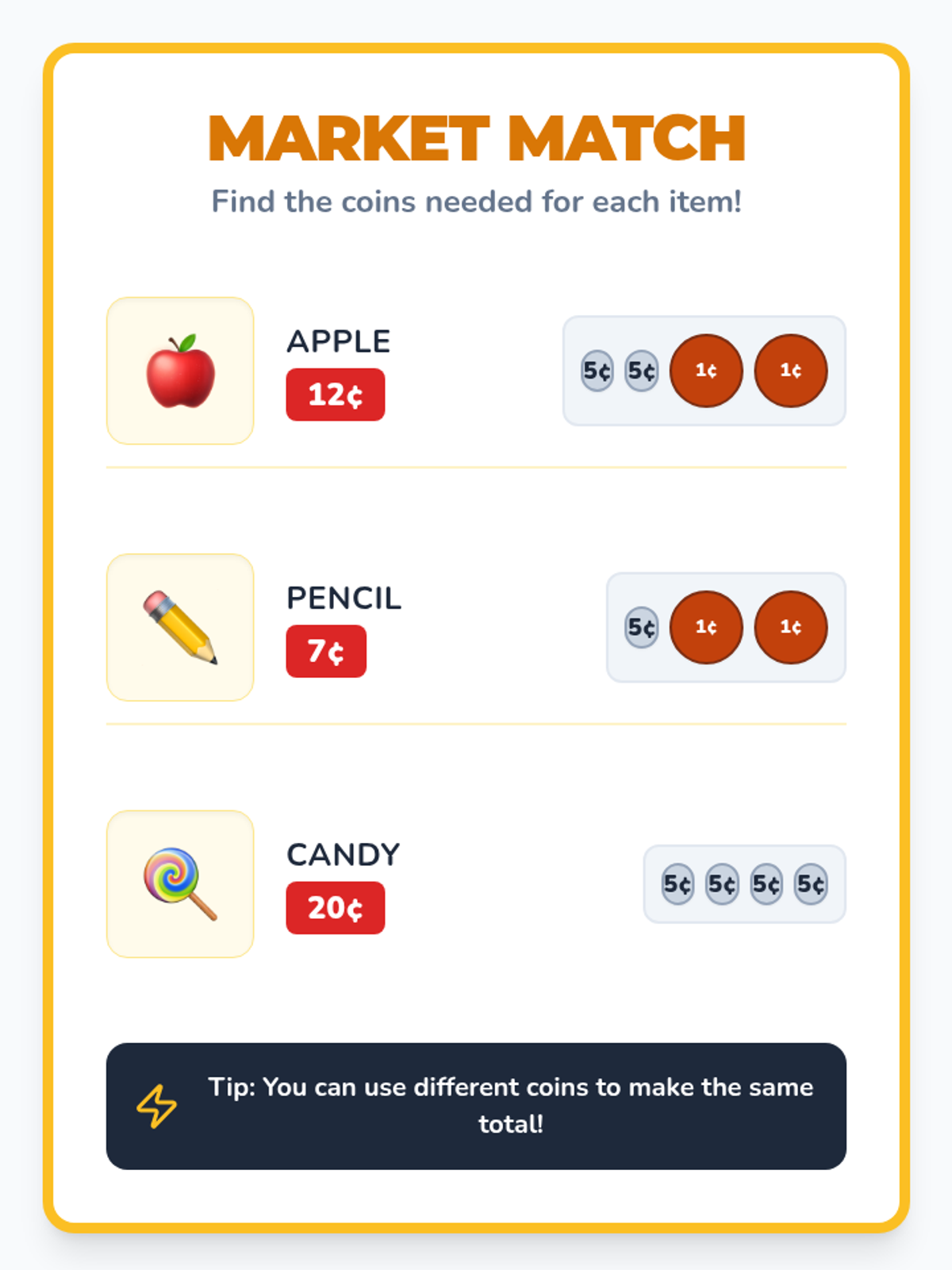
Two large visual anchor charts for classroom display. The first chart, 'Market Match', shows real-world items with price tags and the exact coin combinations needed. The second chart, 'The Change Maker', illustrates the 'Counting Up' strategy for finding change from one dollar using a visual number line and clear steps.
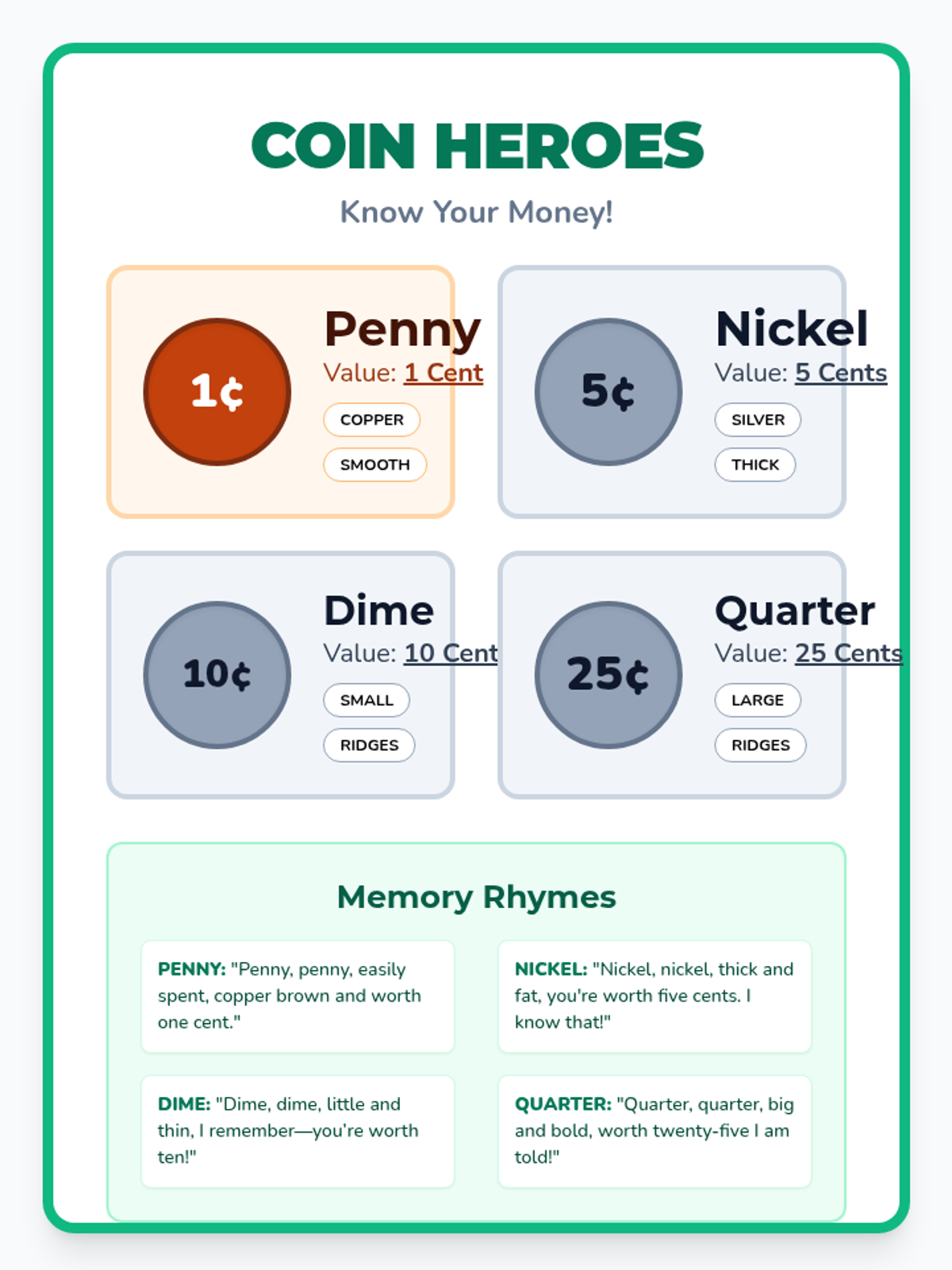
A set of two large visual anchor charts for classroom display. The first chart focuses on identifying coins (Penny, Nickel, Dime, Quarter) with names, values, and memory rhymes. The second chart provides a visual step-by-step guide for skip counting nickels and pennies to find a total value.
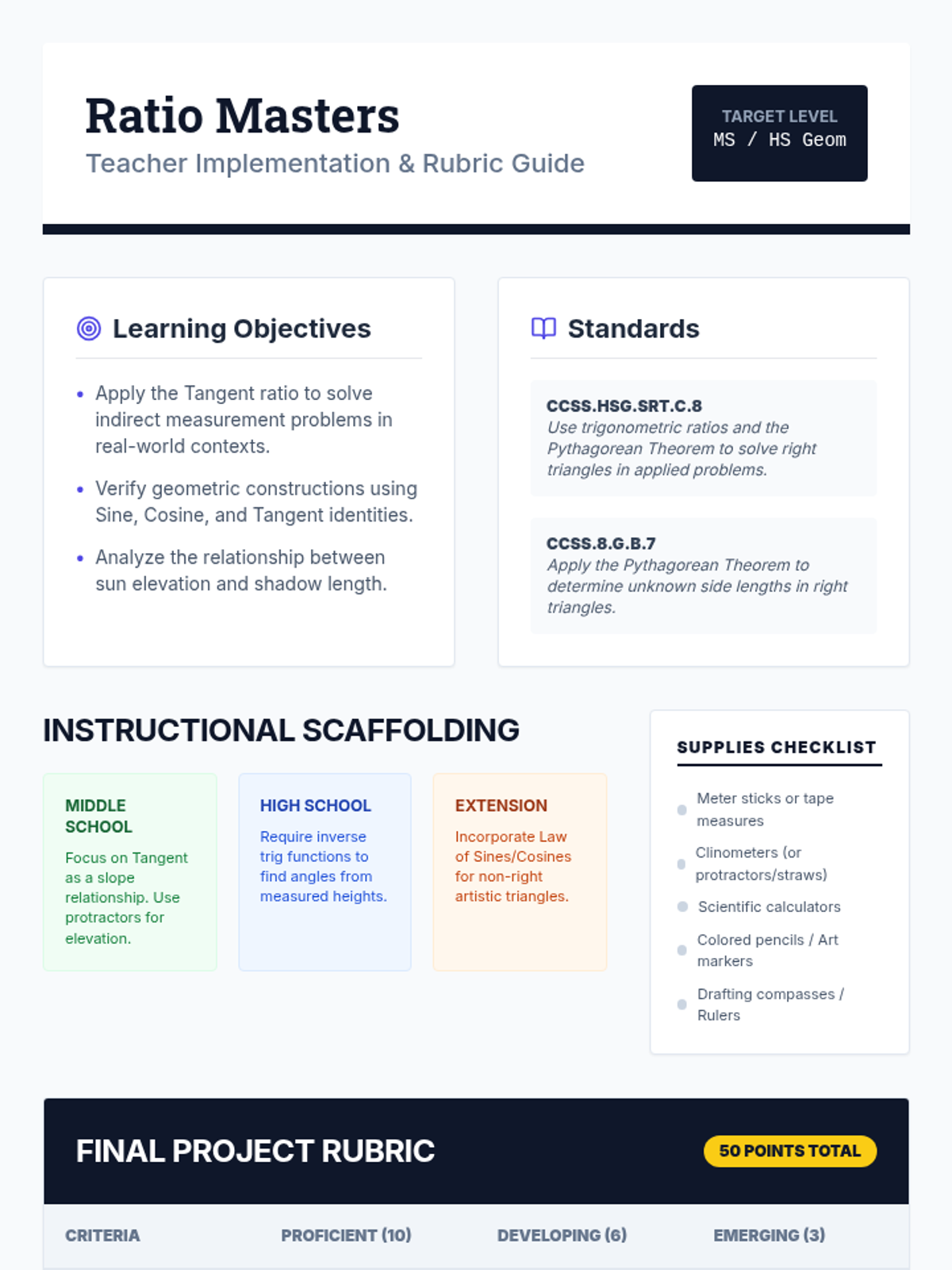
A teacher guide containing learning objectives, standards alignment, differentiation strategies for middle and high school, and a comprehensive grading rubric.
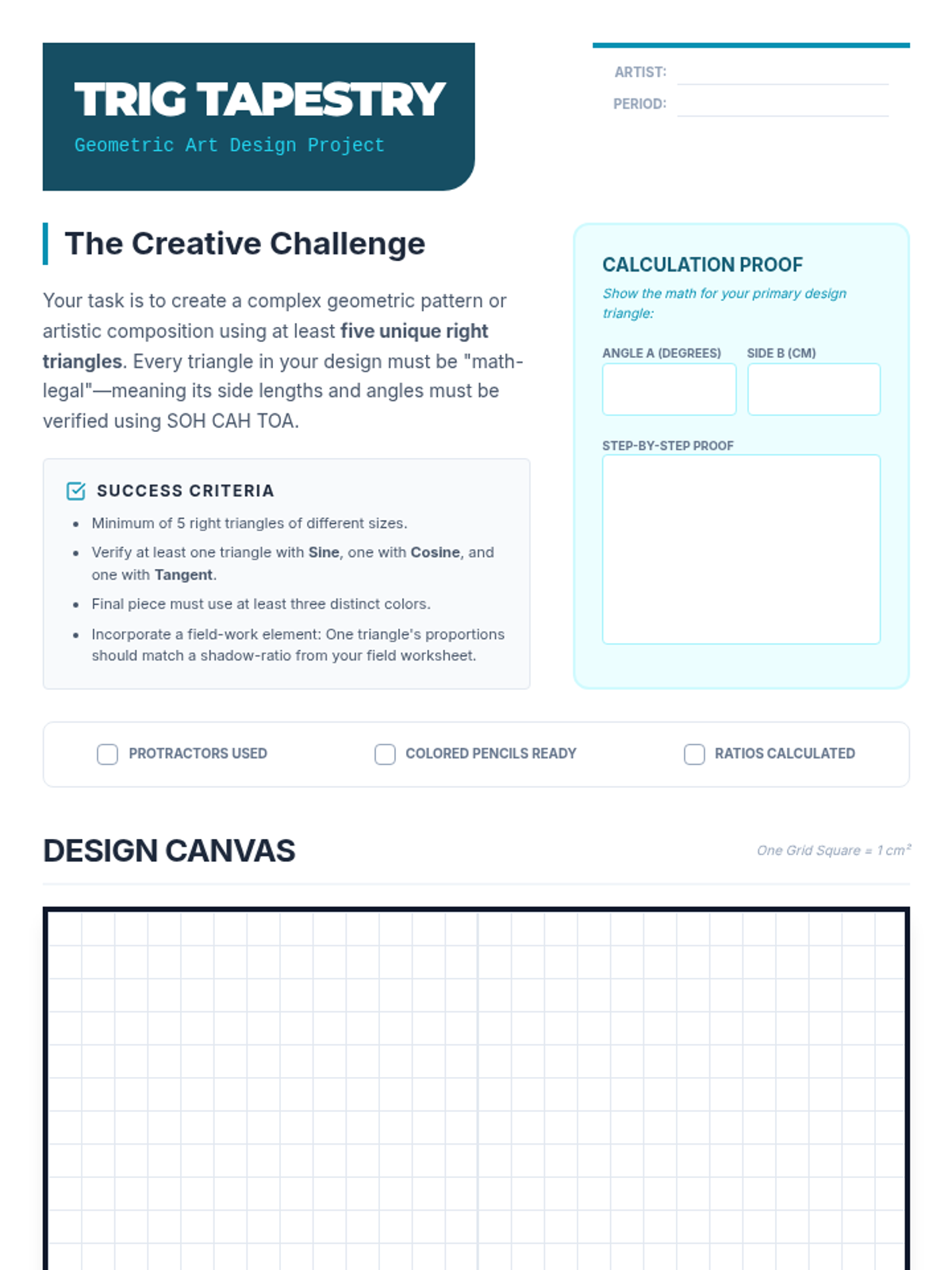
A project guide for the geometric art portion of the lesson. Students design a pattern using right triangles and prove their proportions using trigonometric ratios.
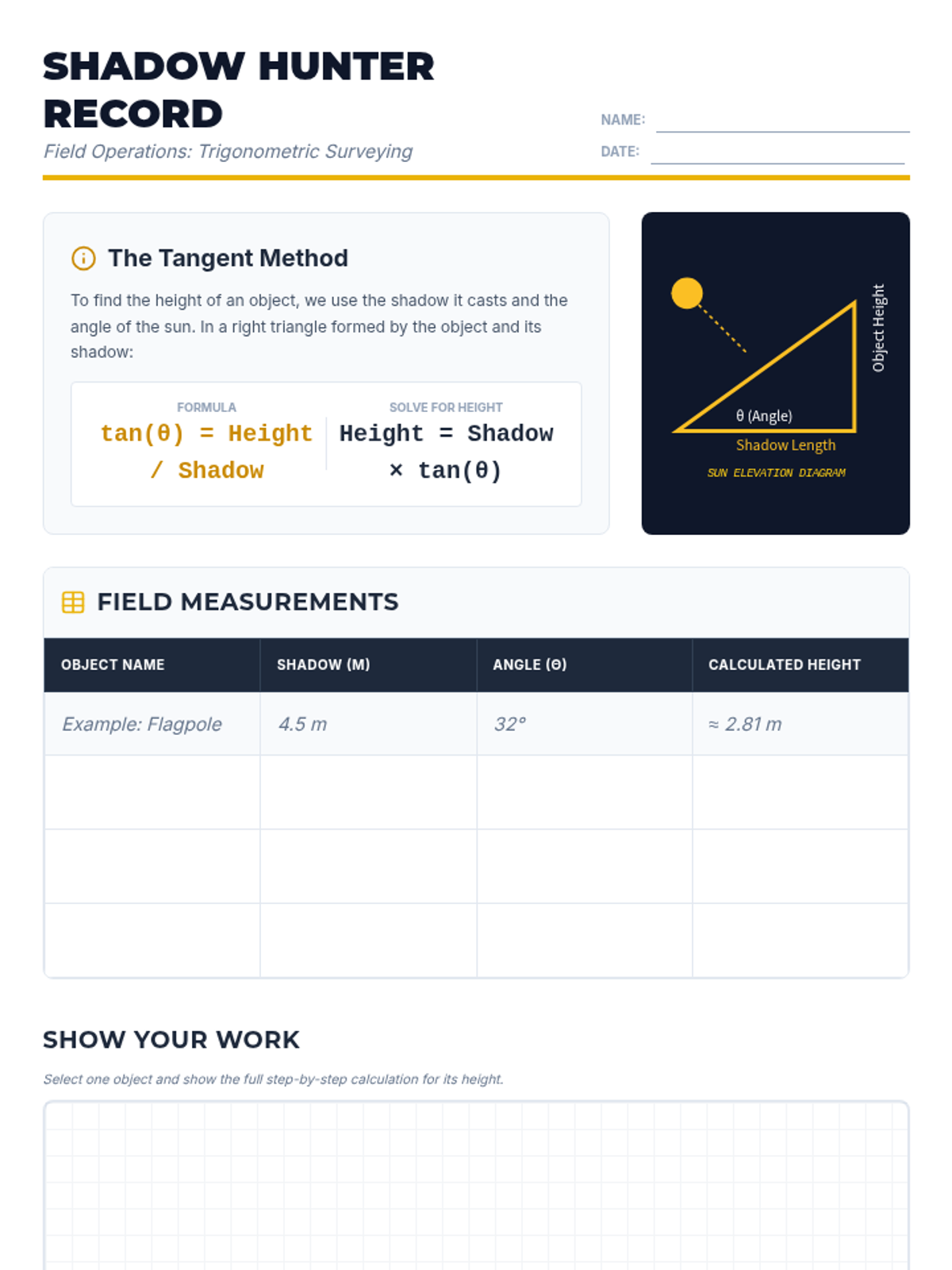
A field data collection sheet for students to record shadow lengths and calculate object heights using the tangent ratio. Includes space for work and reflection questions.
An introductory slide deck for the Shadows and Shapes project, covering trigonometric ratios, the two main project components (Shadow Hunters and Trig Tapestry), and the project timeline.
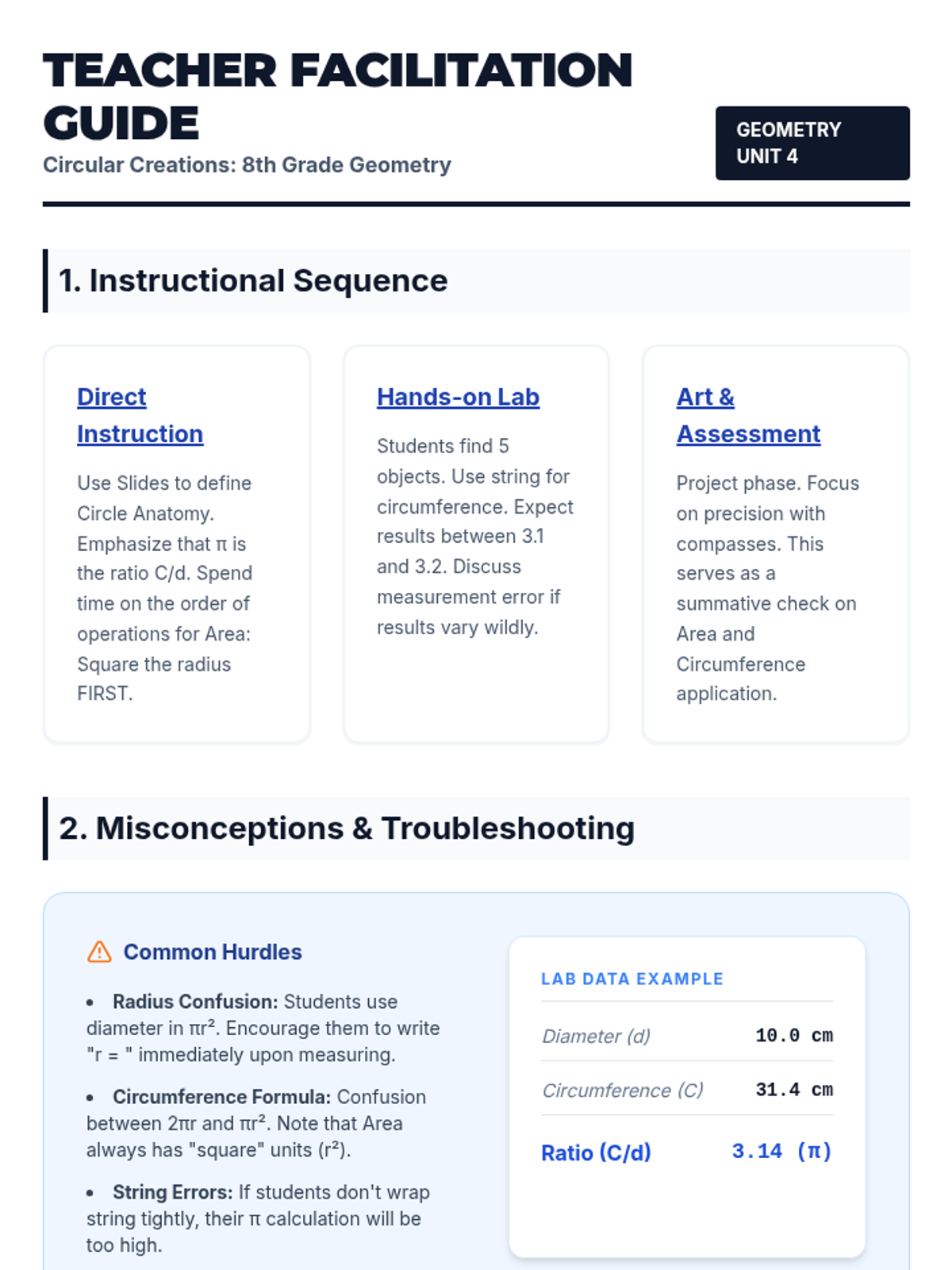
A facilitator guide for teachers including lesson pacing, common student misconceptions regarding circle formulas, a sample lab calculation, and a grading rubric for the art project.
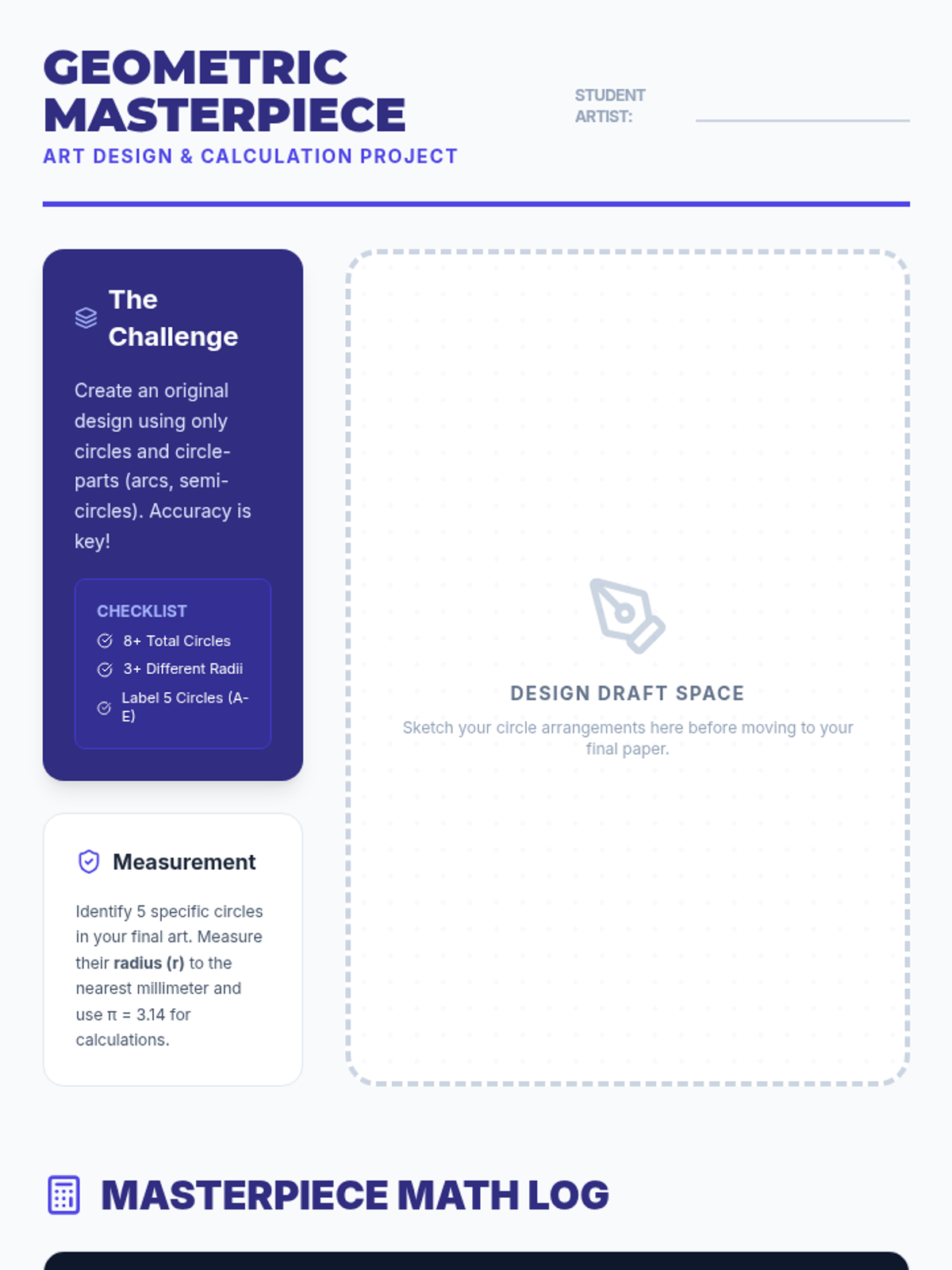
A creative project guide that tasks students with designing geometric art using circles, requiring them to measure radii and calculate circumference/area for various elements of their design.
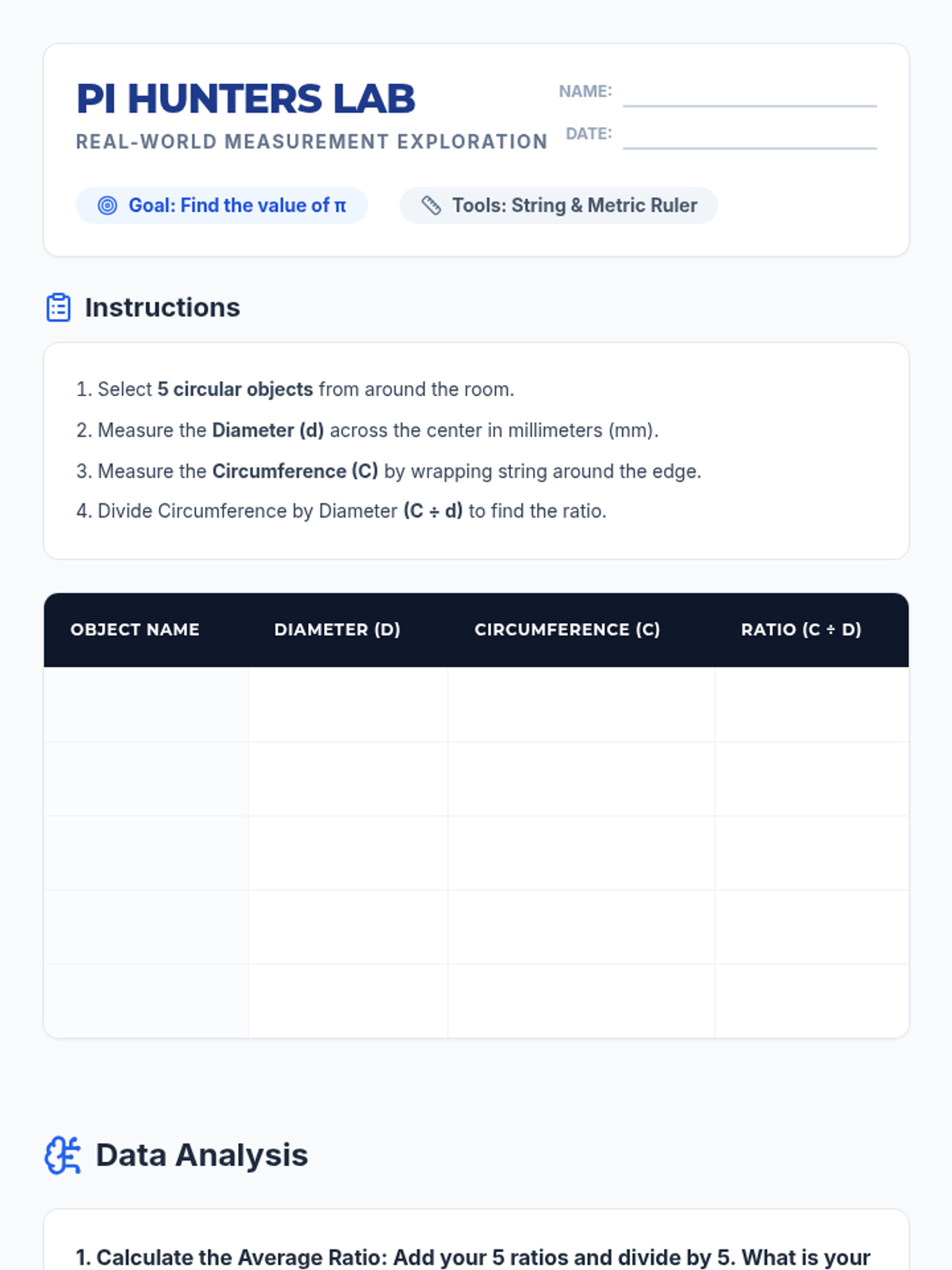
A measurement lab worksheet for students to record data from real-world circular objects, calculating the ratio of circumference to diameter to discover pi and practicing area/circumference predictions.
Visual slide deck for Grade 8 Geometry covering circle vocabulary, the relationship between circumference and diameter (pi), area formulas, and instructions for the Pi Hunters Lab and Geometric Masterpiece project.
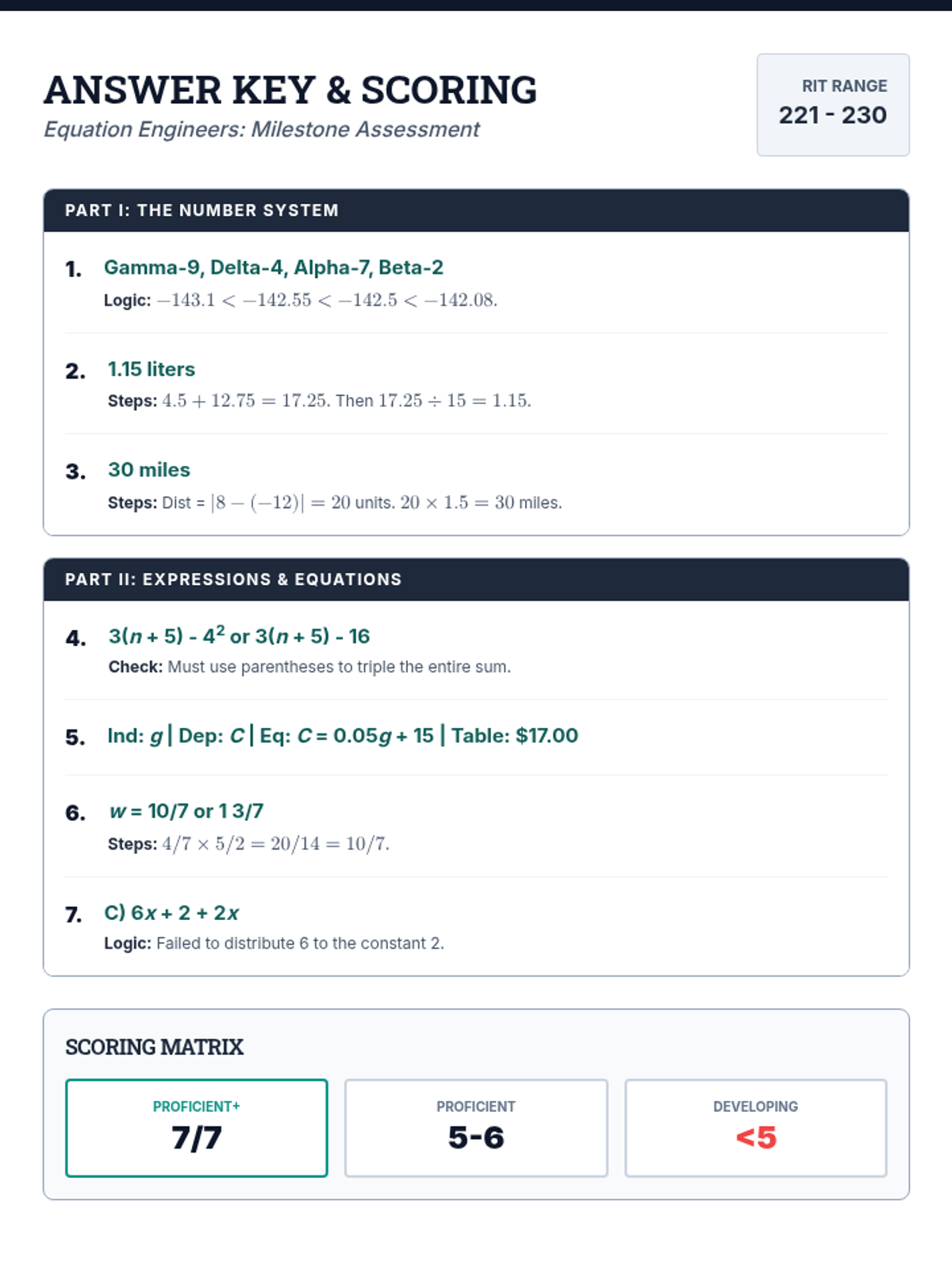
A teacher-facing answer key and scoring rubric for the Milestone Proficiency Assessment, including step-by-step solutions and performance level descriptors for the 221-230 RIT range.
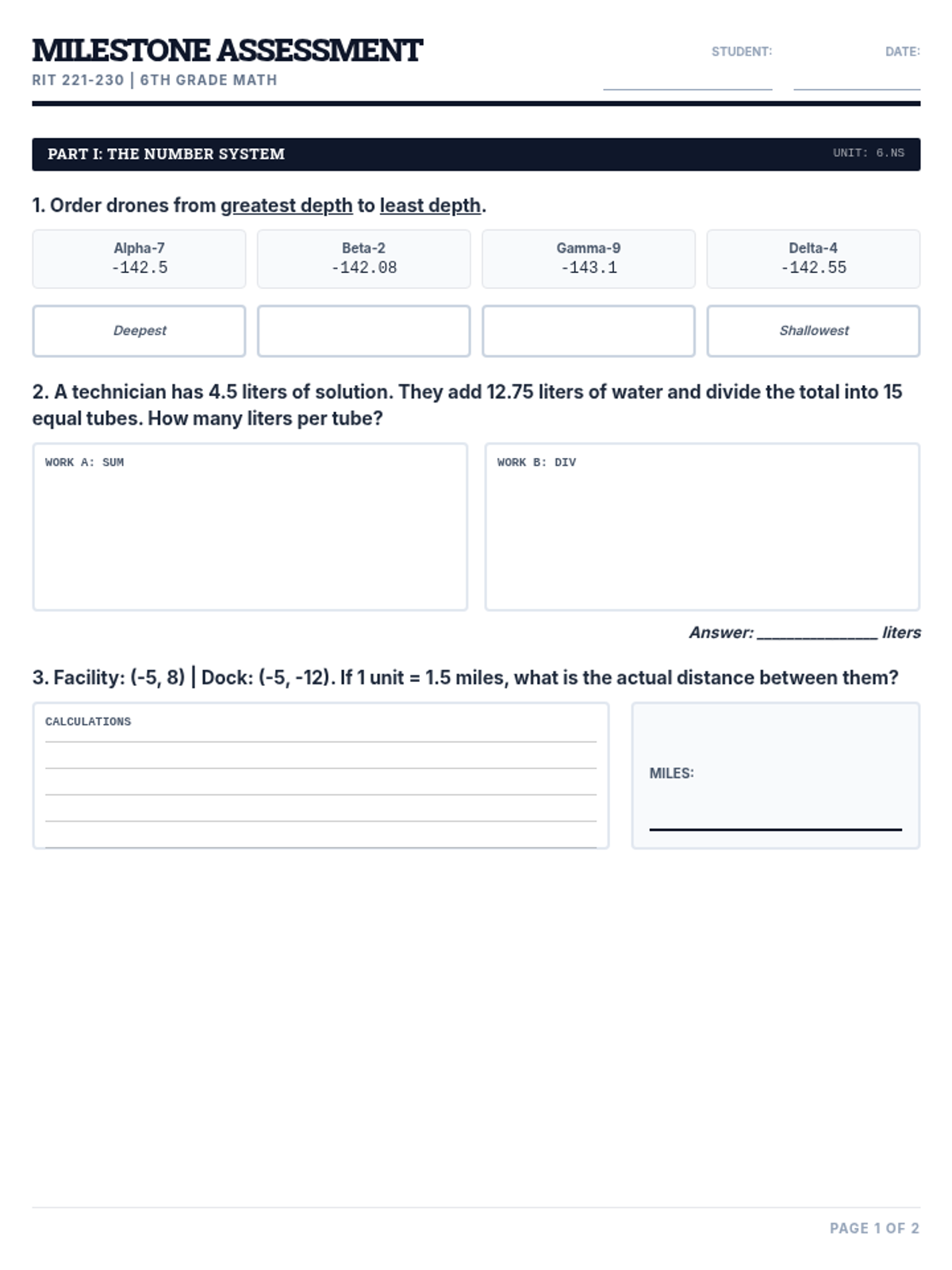
A 2-page summative assessment covering The Number System and Expressions & Equations for 6th grade, targeting the RIT 221-230 range with multi-step problems and high-rigor applications.
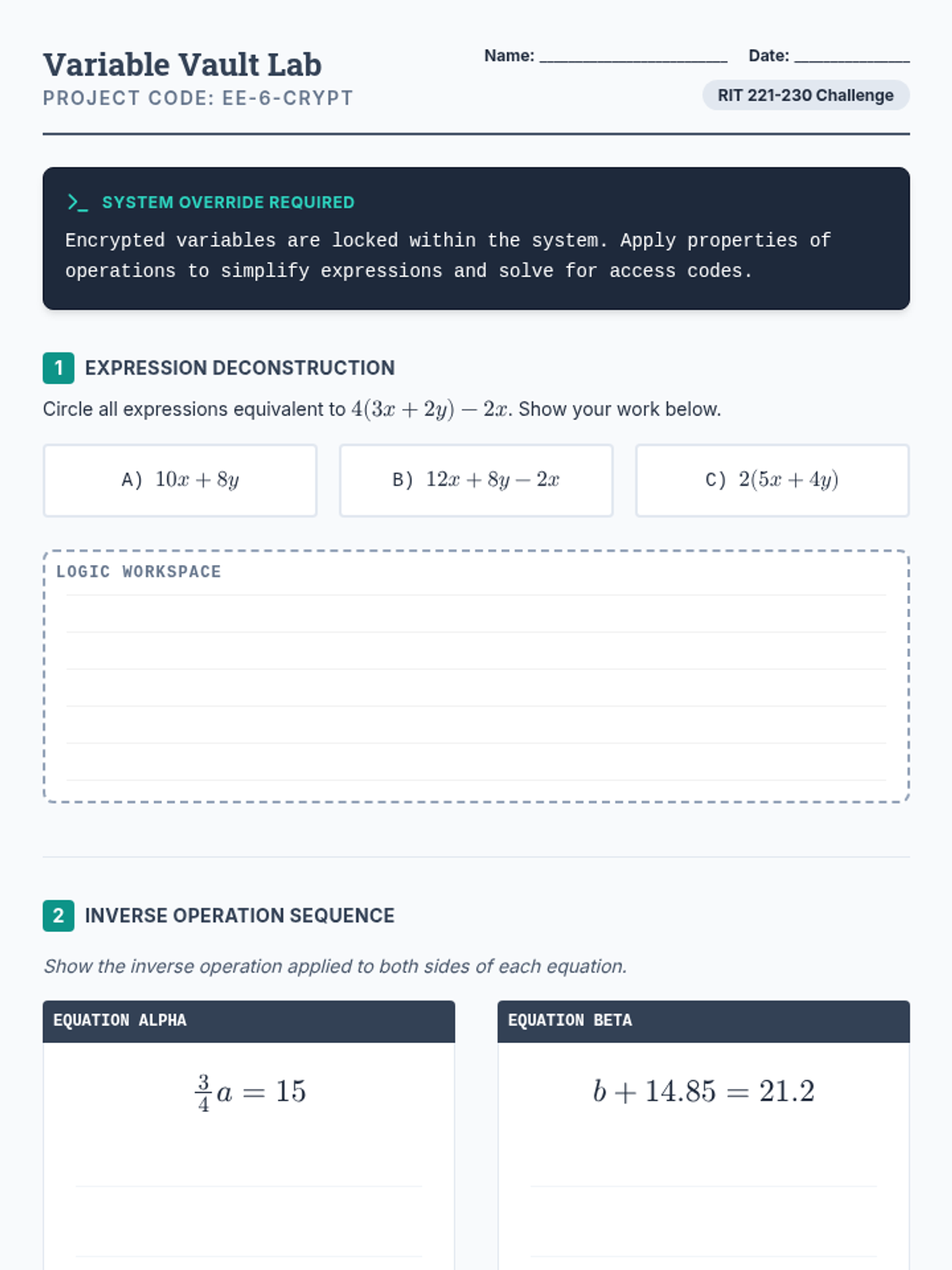
A student-facing activity focusing on expressions and equations, including equivalent expressions, solving one-step equations with fractions/decimals, and evaluating exponents, designed for RIT 221-230.
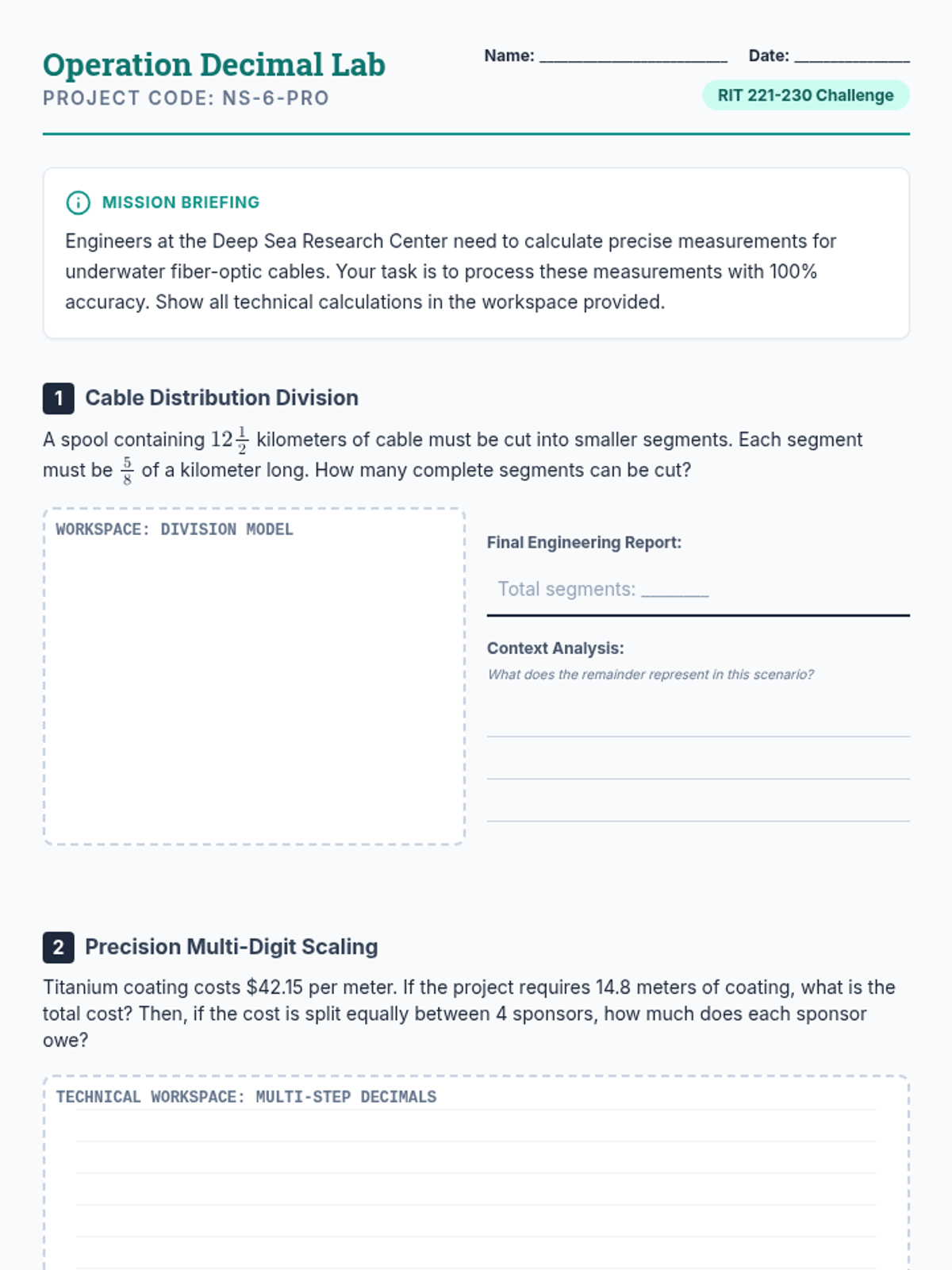
A student-facing lab activity focused on multi-digit decimal operations and fraction division within a real-world engineering context, designed for students in the RIT 221-230 range.
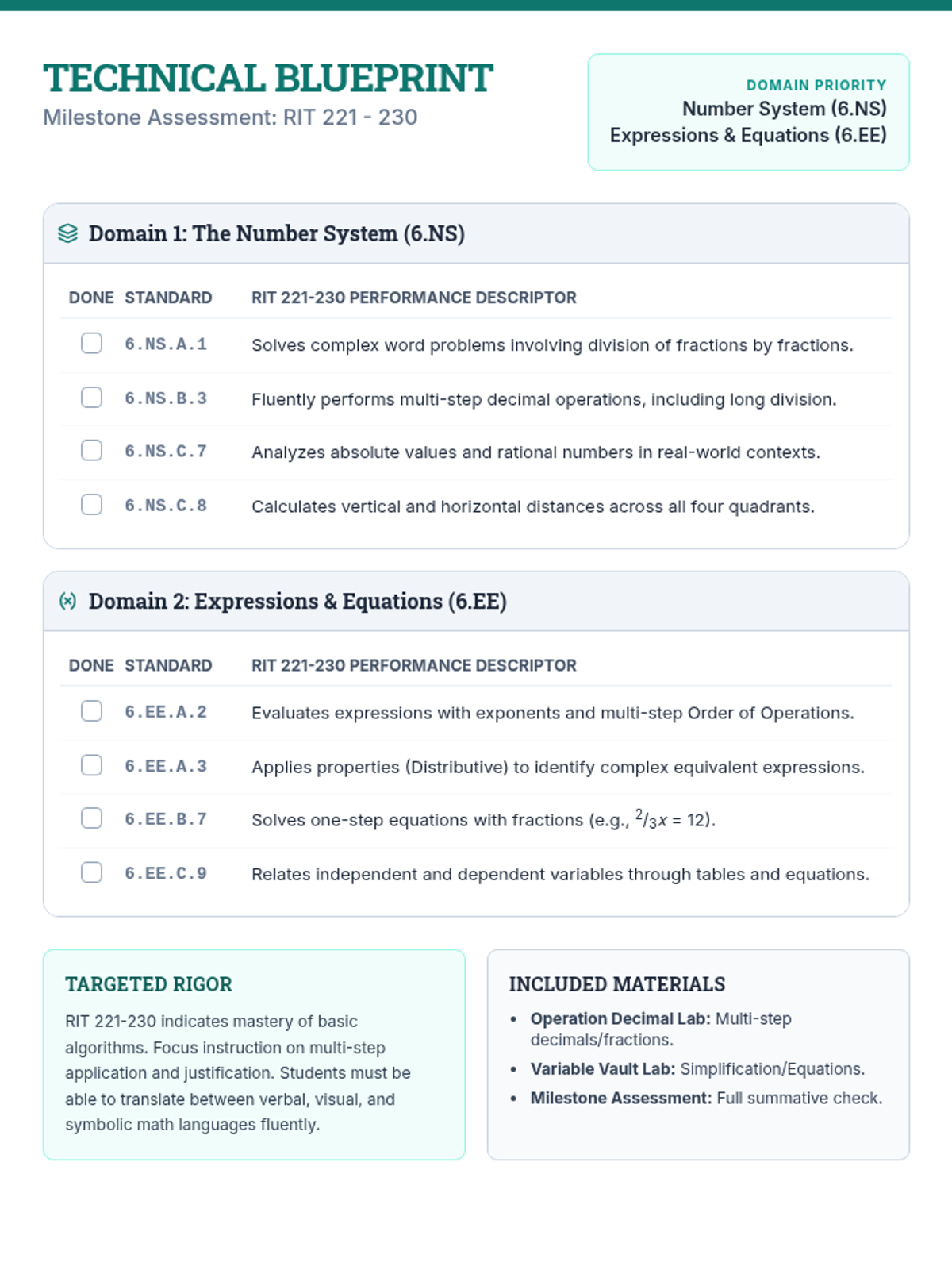
A teacher-facing blueprint checklist mapping 6th-grade math standards to RIT 221-230 performance descriptors for The Number System and Expressions & Equations.
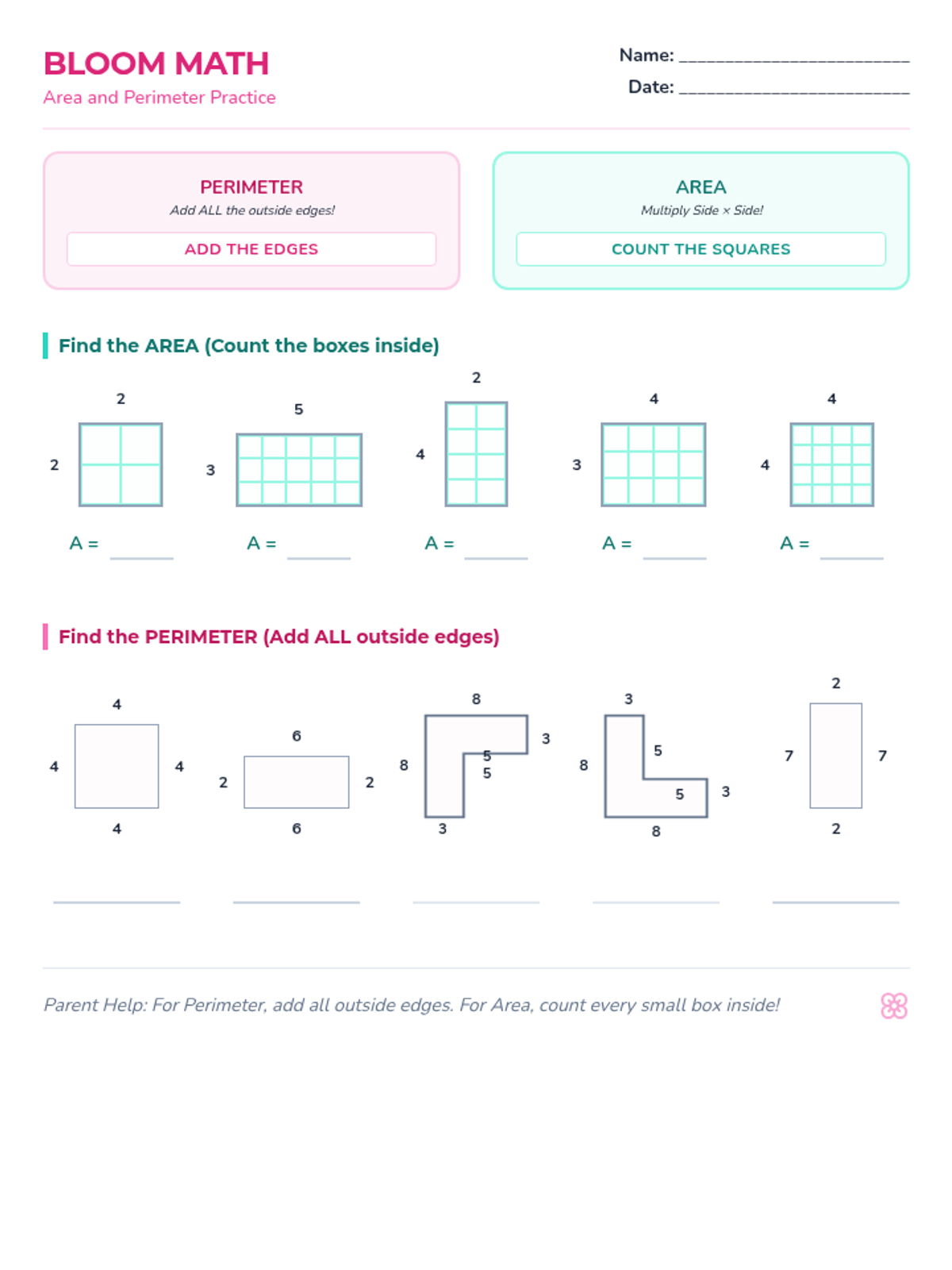
A math worksheet focusing on calculating area and perimeter. Improved for 1st-grade readability with clearer shapes, larger labels, and better spacing. Includes grid visuals for all area problems. L-shape labels are carefully positioned to avoid overlap. Answer lines are widened for handwriting. Grid lines in area shapes are darkened for contrast. Space for equations is increased. L-shape math is verified and labels are repositioned for clarity. stroke width reduced for clarity. Parent help text made more readable. Area labels now include "A=" prompt. Labels are consistent in color.
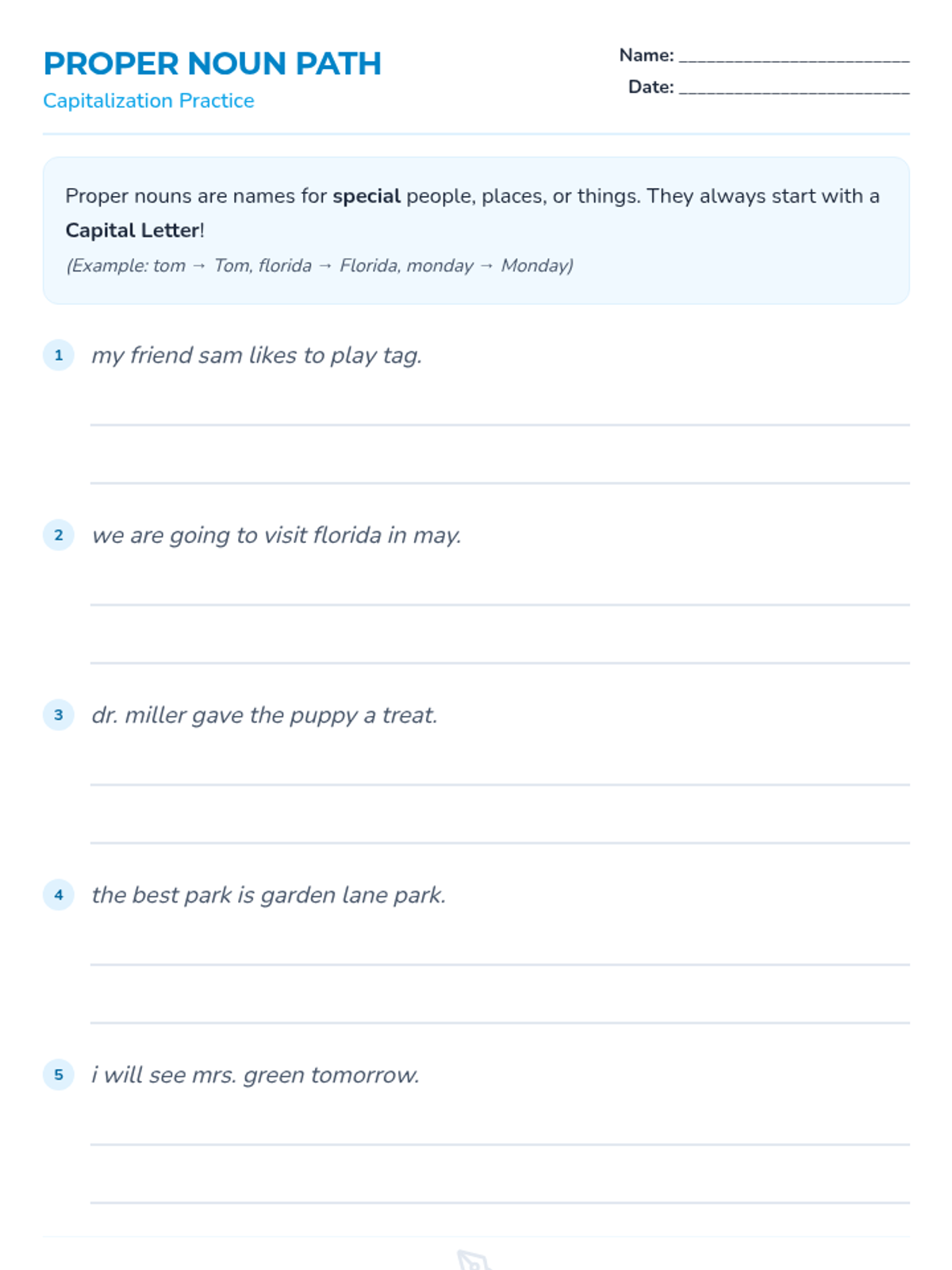
An editing worksheet where students identify and capitalize proper nouns in five sentences. Features larger handwriting space and single-page layout. Definition expanded to include titles. Optimized for single-page printing.
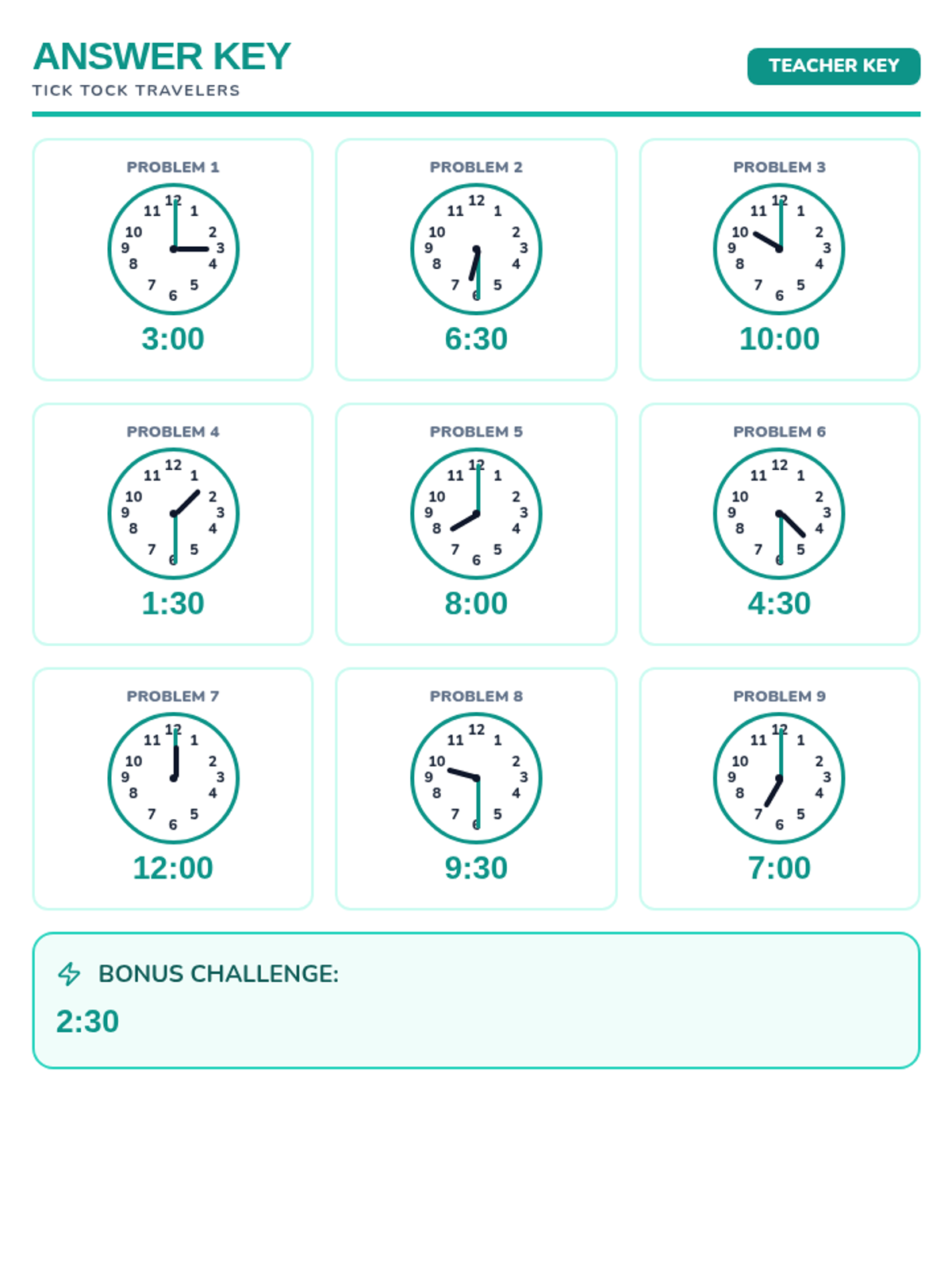
The answer key for the Time Traveler Worksheet, showing the correct digital times for each analog clock provided to students.
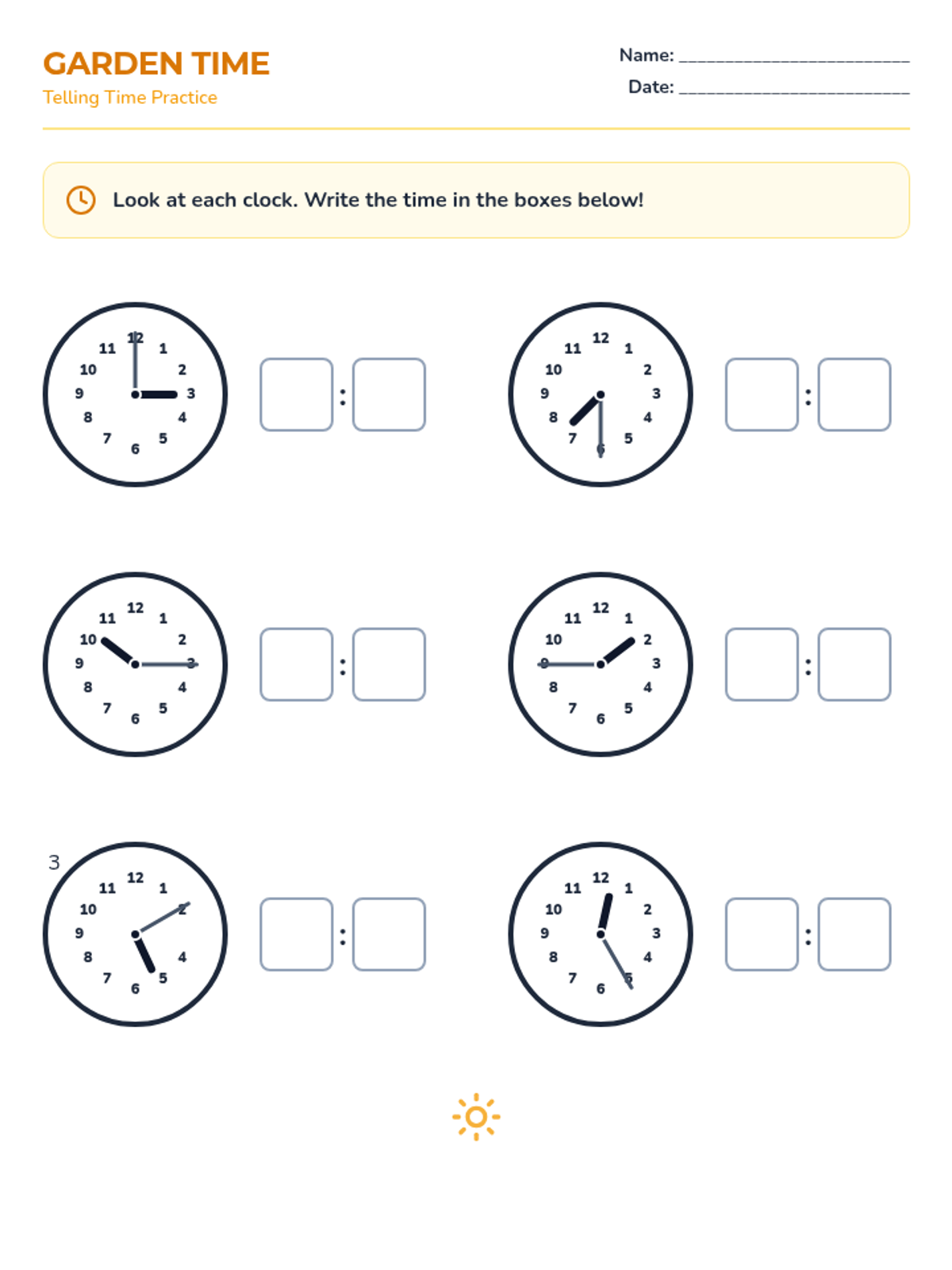
A math worksheet for practice in telling time. Adjusted for 1st-grade readability with clearer clock hands and simplified 5-minute increments while respecting the "to the minute" instruction through clear visuals. Clocks now include all hour numbers and guided answer fields. Hand rotations are mathematically corrected. Clock numbers are pulled away from the border for legibility. Sun icon is darkened for contrast. Time boxes are now symmetrical. Hand lengths reduced to prevent overlap. Clocks and boxes aligned. Corrected clock number rendering.
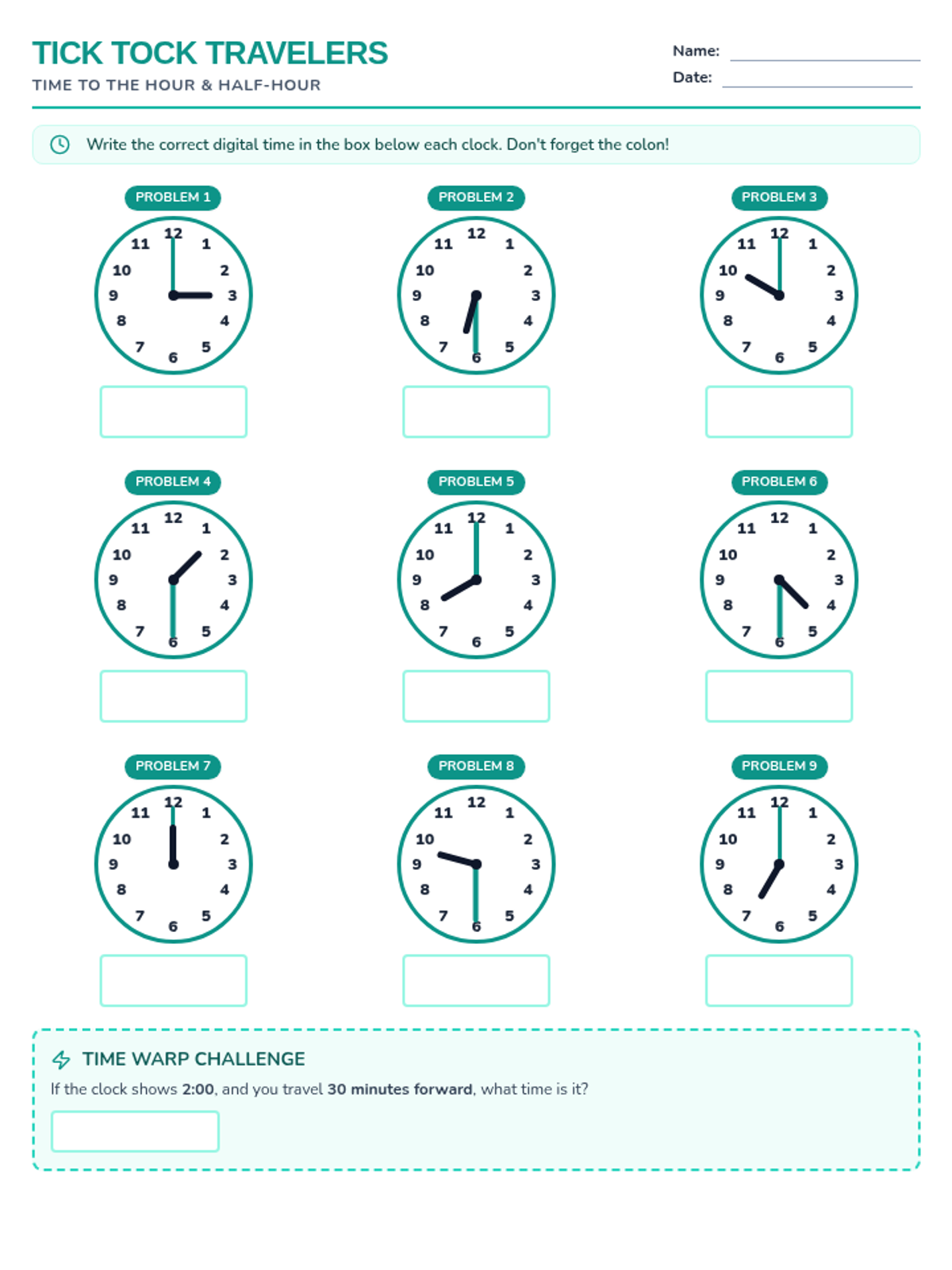
A 2nd-grade worksheet featuring analog clocks where students practice telling time to the hour and half-hour by writing the corresponding digital time. Includes a bonus challenge for time elapsed by 30 minutes.
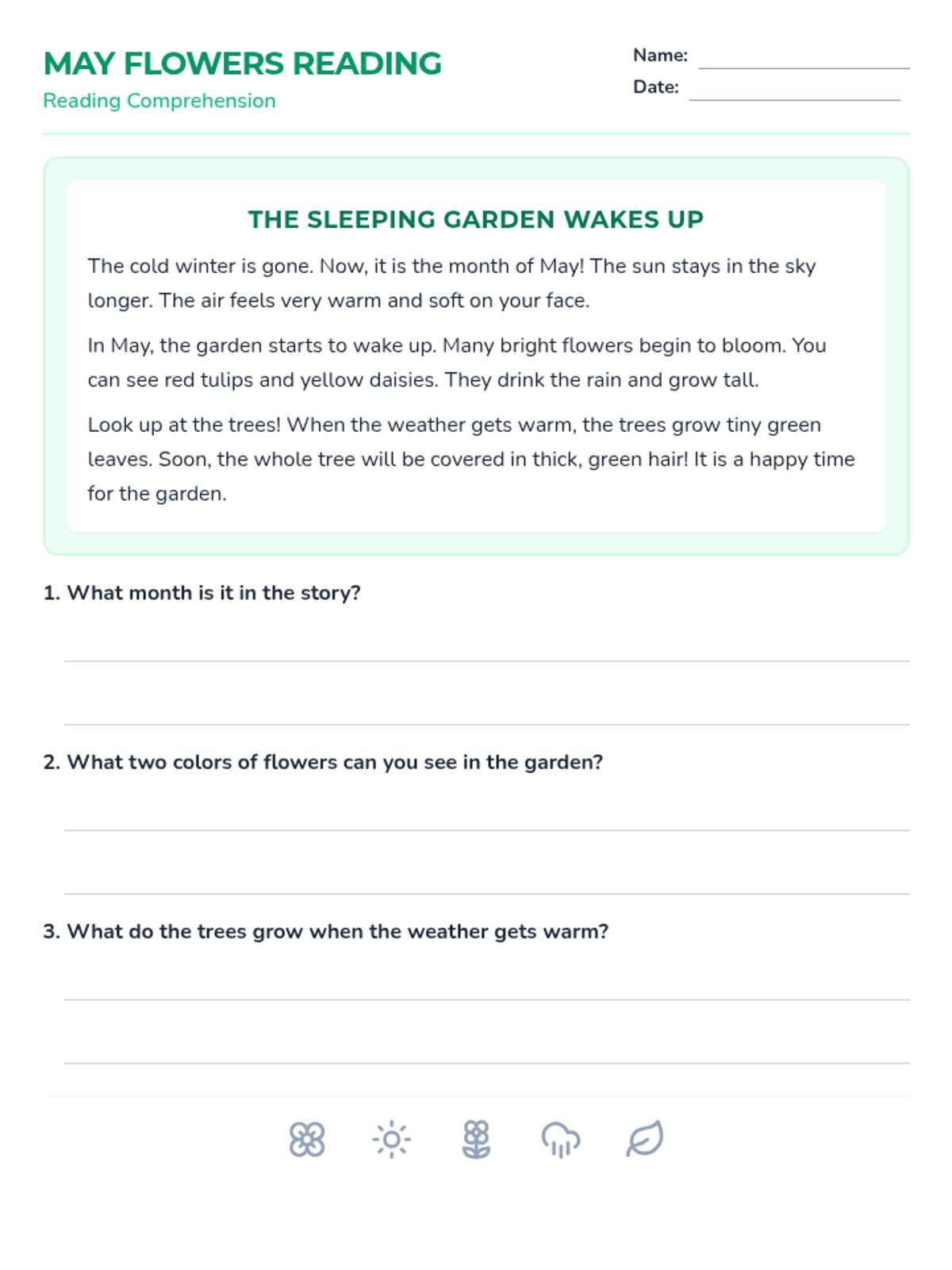
A 1st-grade level reading comprehension worksheet featuring a passage about springtime changes in May and three short-answer questions. Consistently formatted on one page with ample handwriting space. Adjusted to ensure single-page printing.
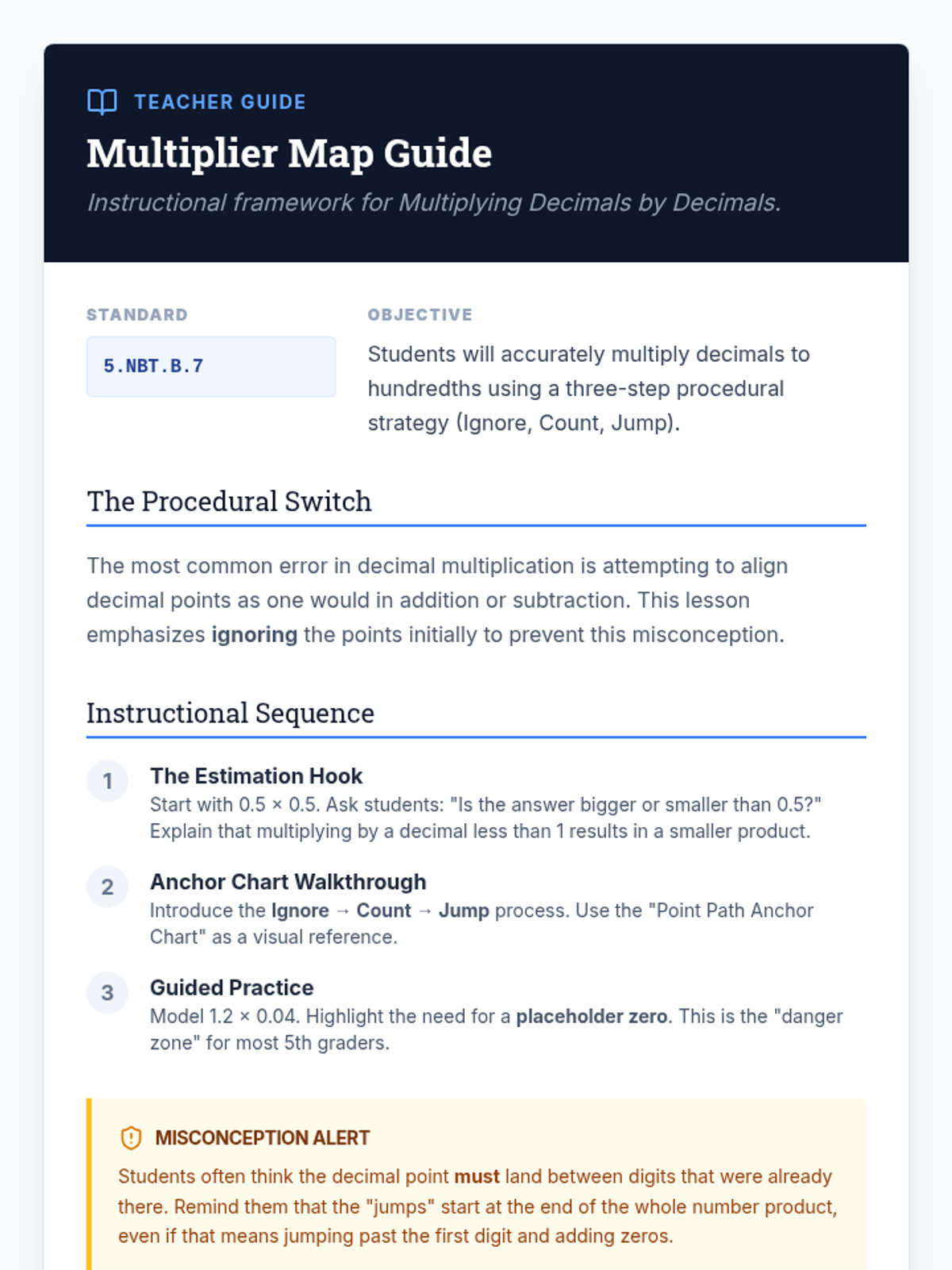
A professional teacher guide for the "Decimal Multipliers" lesson, including instructional strategies, standard alignment, common student misconceptions, and a quick-reference answer key for the practice sheet.
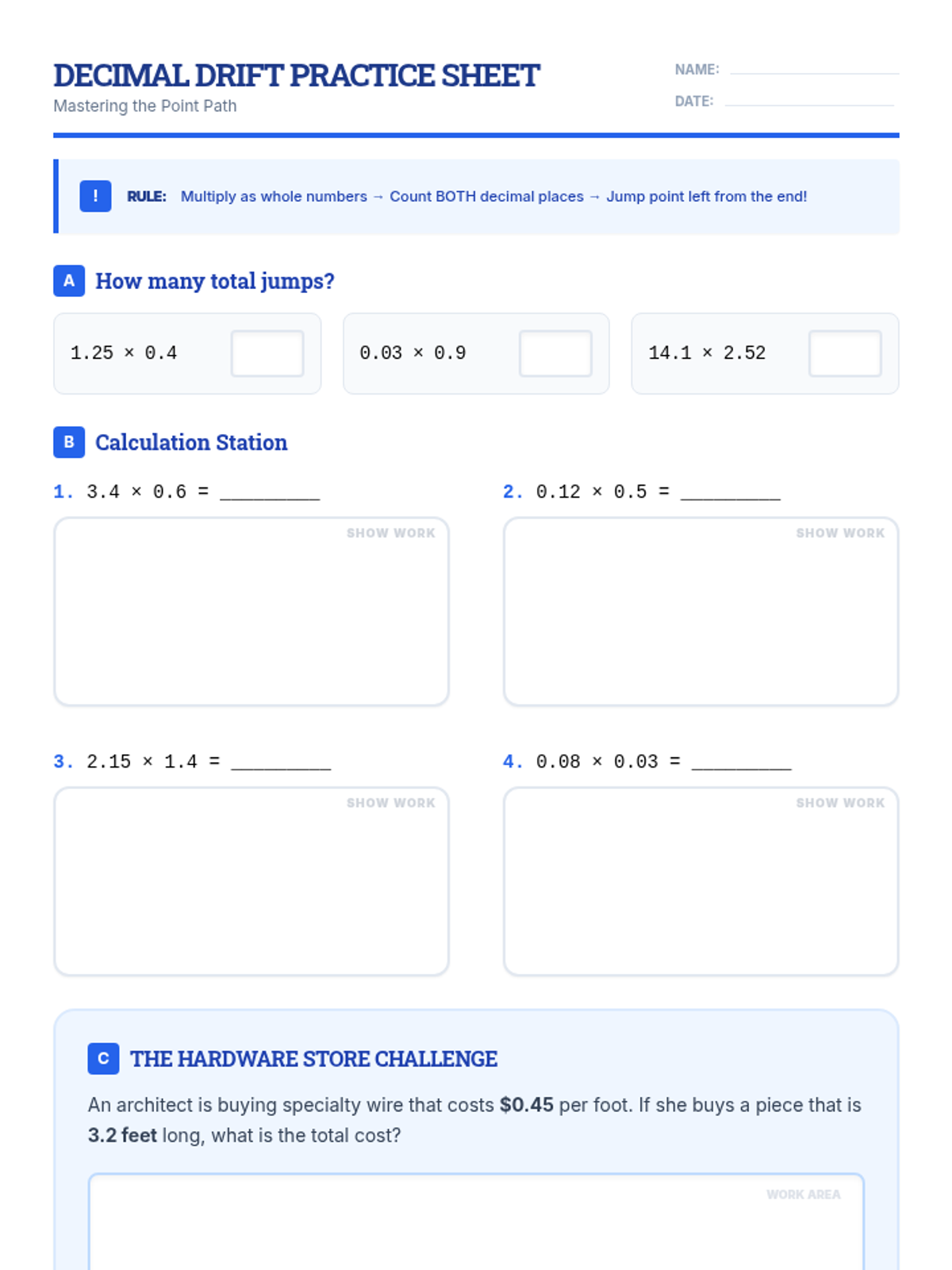
A student practice worksheet containing three sections: a "Warm Up" for counting decimal places, a "Calculation Station" for procedural practice with workspace, and a "Real World Drill" word problem.
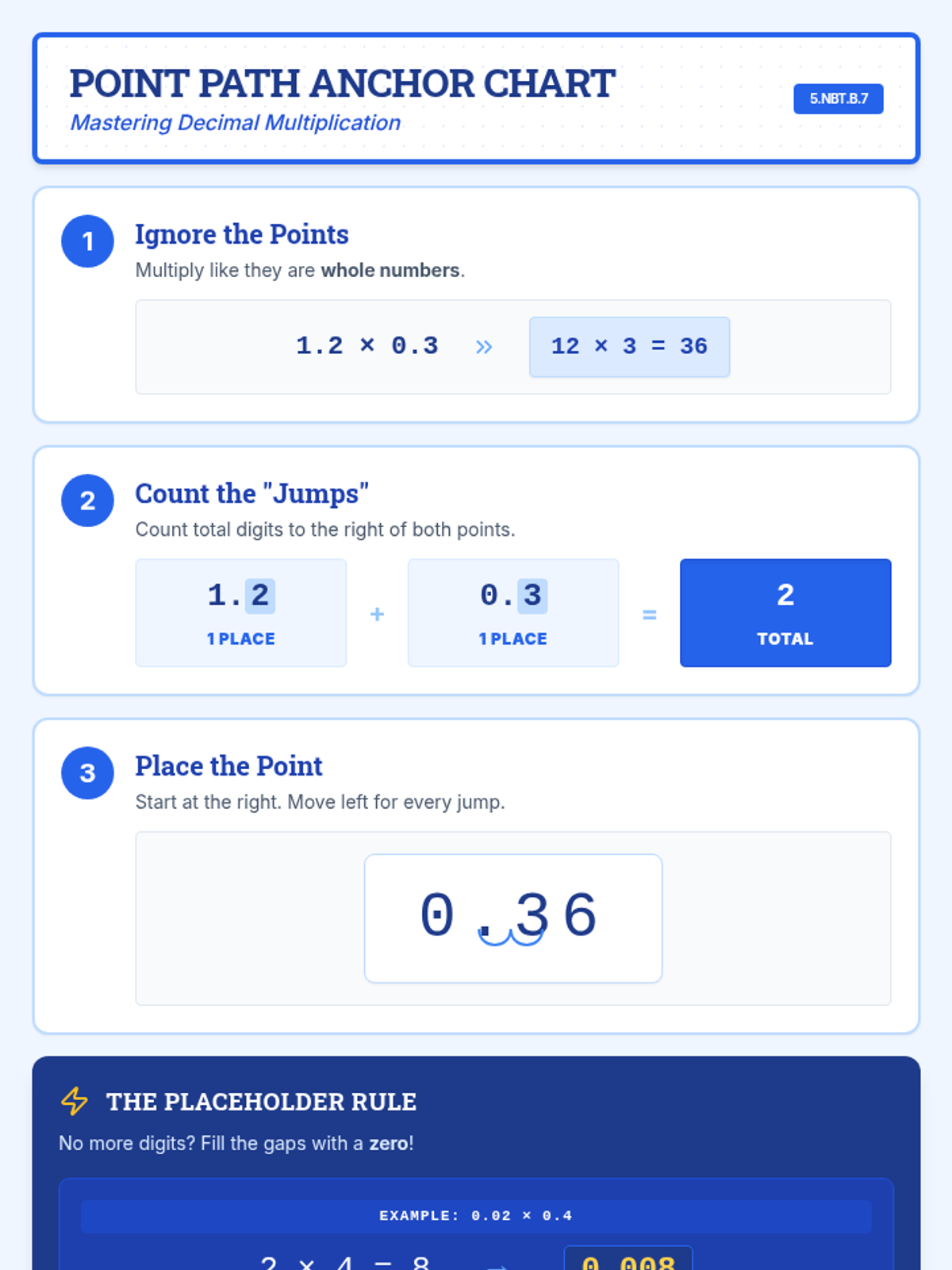
A visual anchor chart illustrating the three-step process for multiplying decimals by decimals. It features a clean blueprint aesthetic with clear examples and a special section on using placeholder zeros.
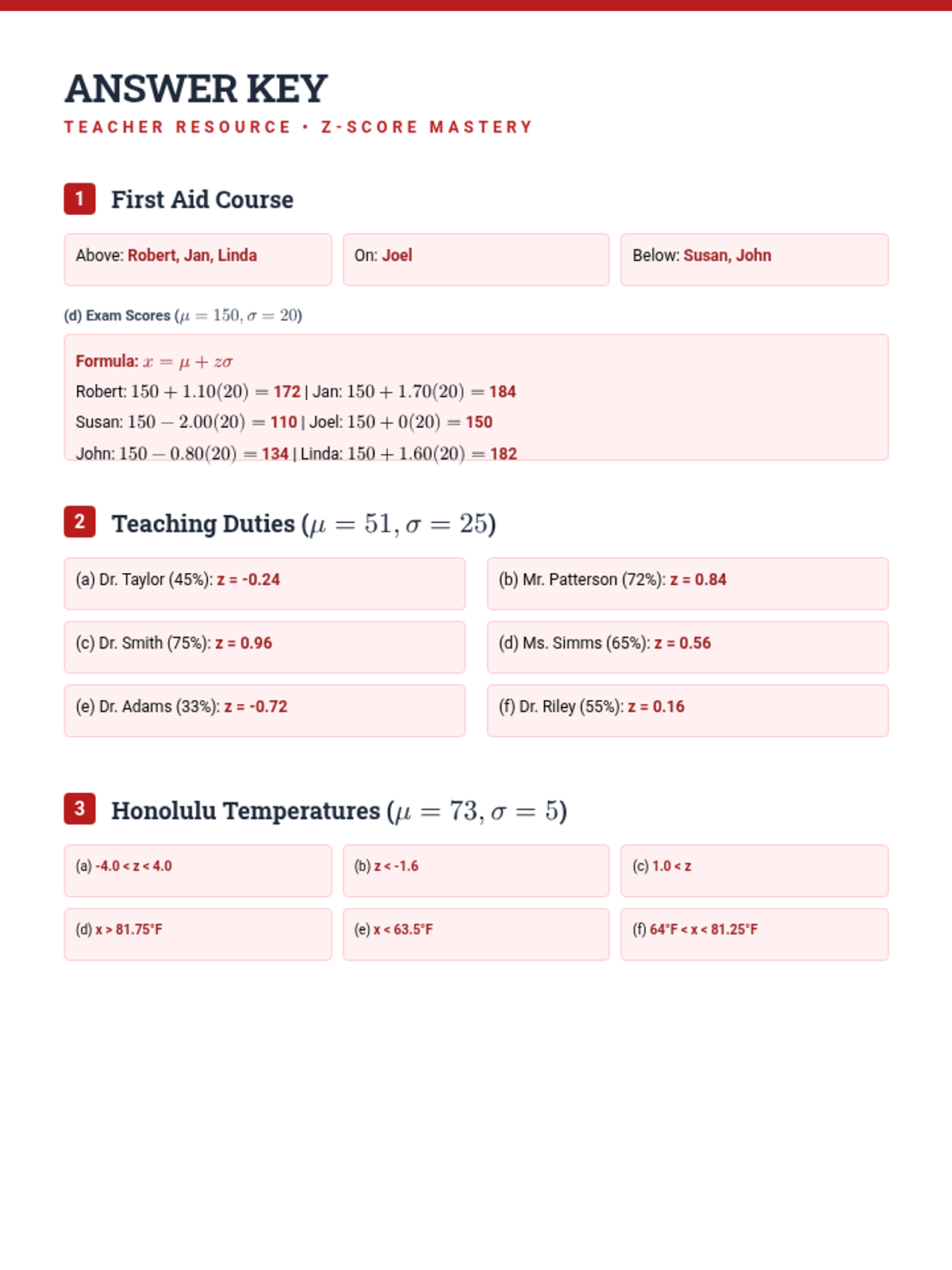
A comprehensive teacher's answer key for the Stat Sense Worksheet, including step-by-step calculation formulas and final results for z-scores, raw values, and distribution interpretations.
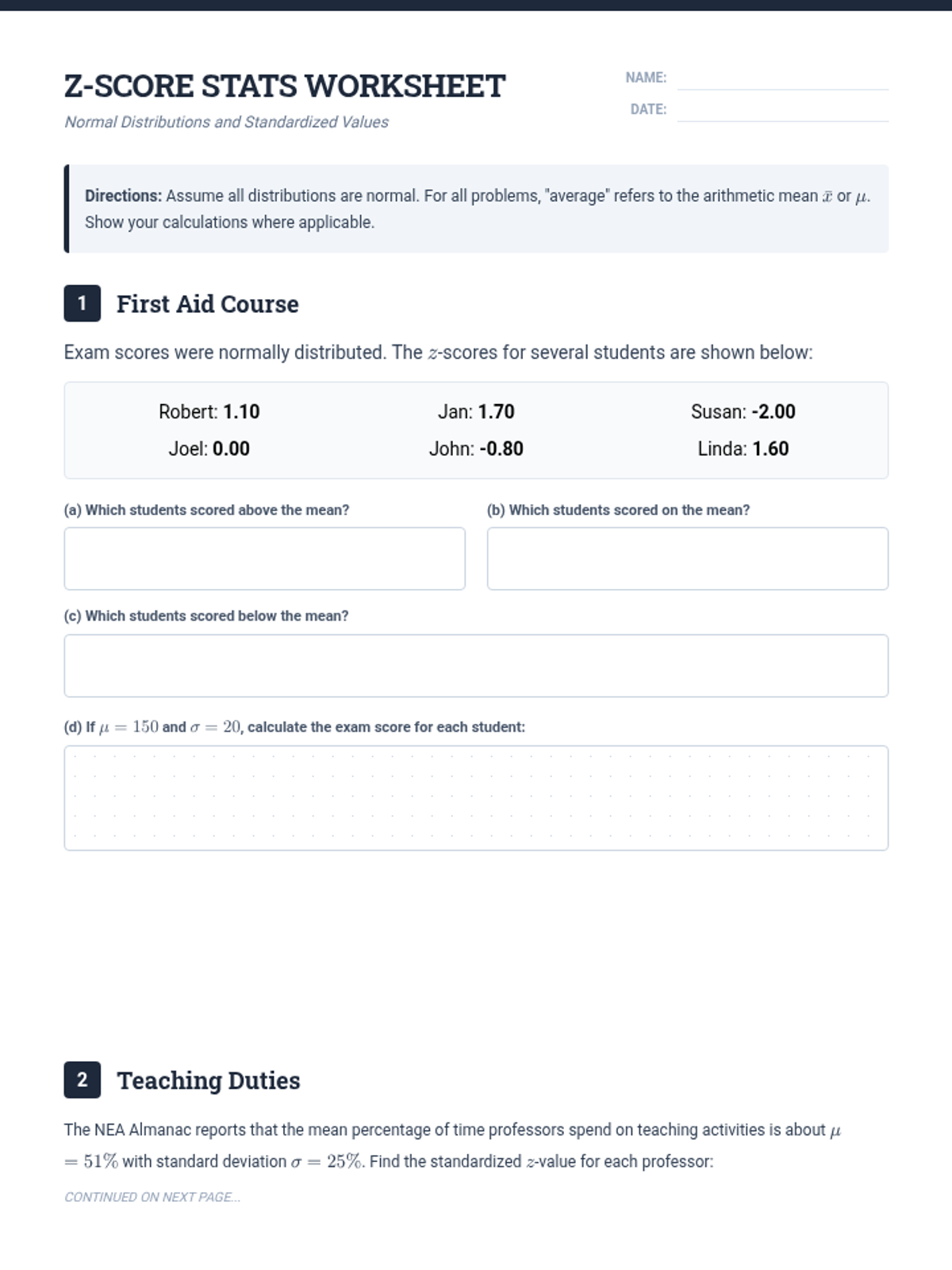
A 4-page statistics worksheet featuring five detailed word problems on z-scores and normal distributions. Includes sections on first aid exams, teaching hours, regional temperatures, and wildlife population data with ample space for calculations.
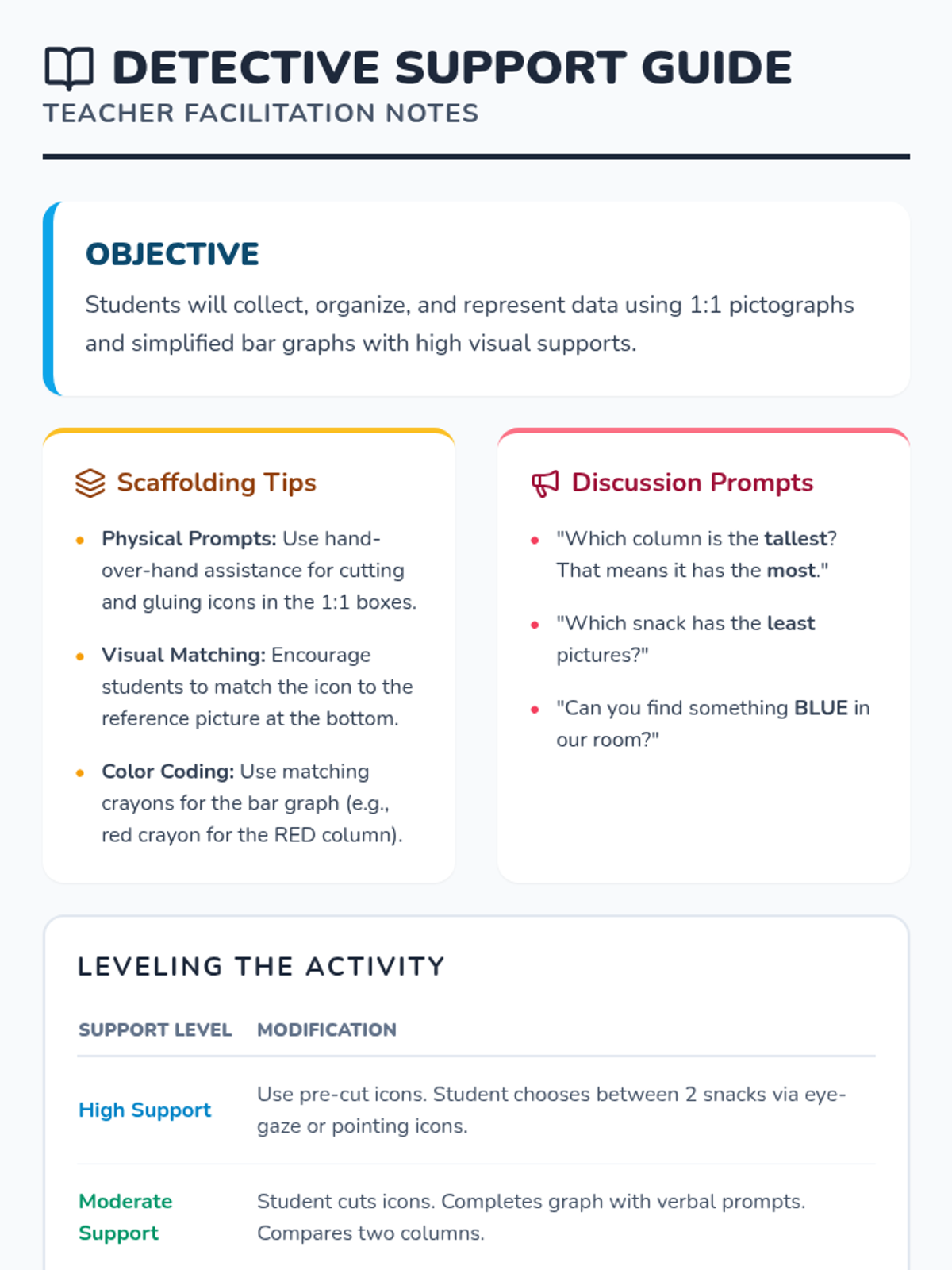
A teacher support guide providing scaffolding strategies, discussion prompts, and level-based modifications for the graphing activities. Includes tips for IEP alignment and physical accessibility.
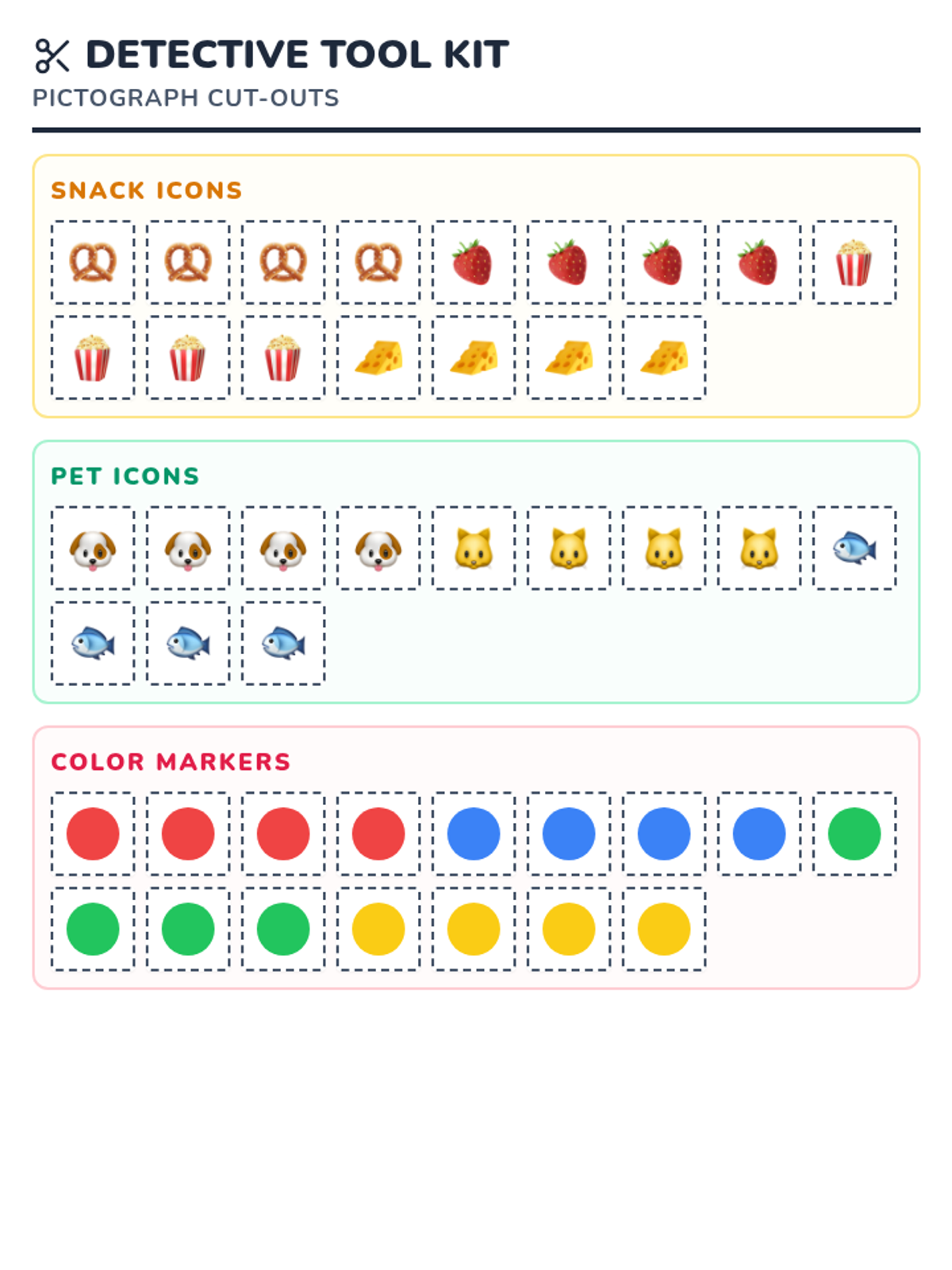
A collection of cut-out icons (snacks, pets, and colors) to be used with the pictograph activities. Designed with large dotted borders and high contrast to assist students with developing fine motor and visual skills.