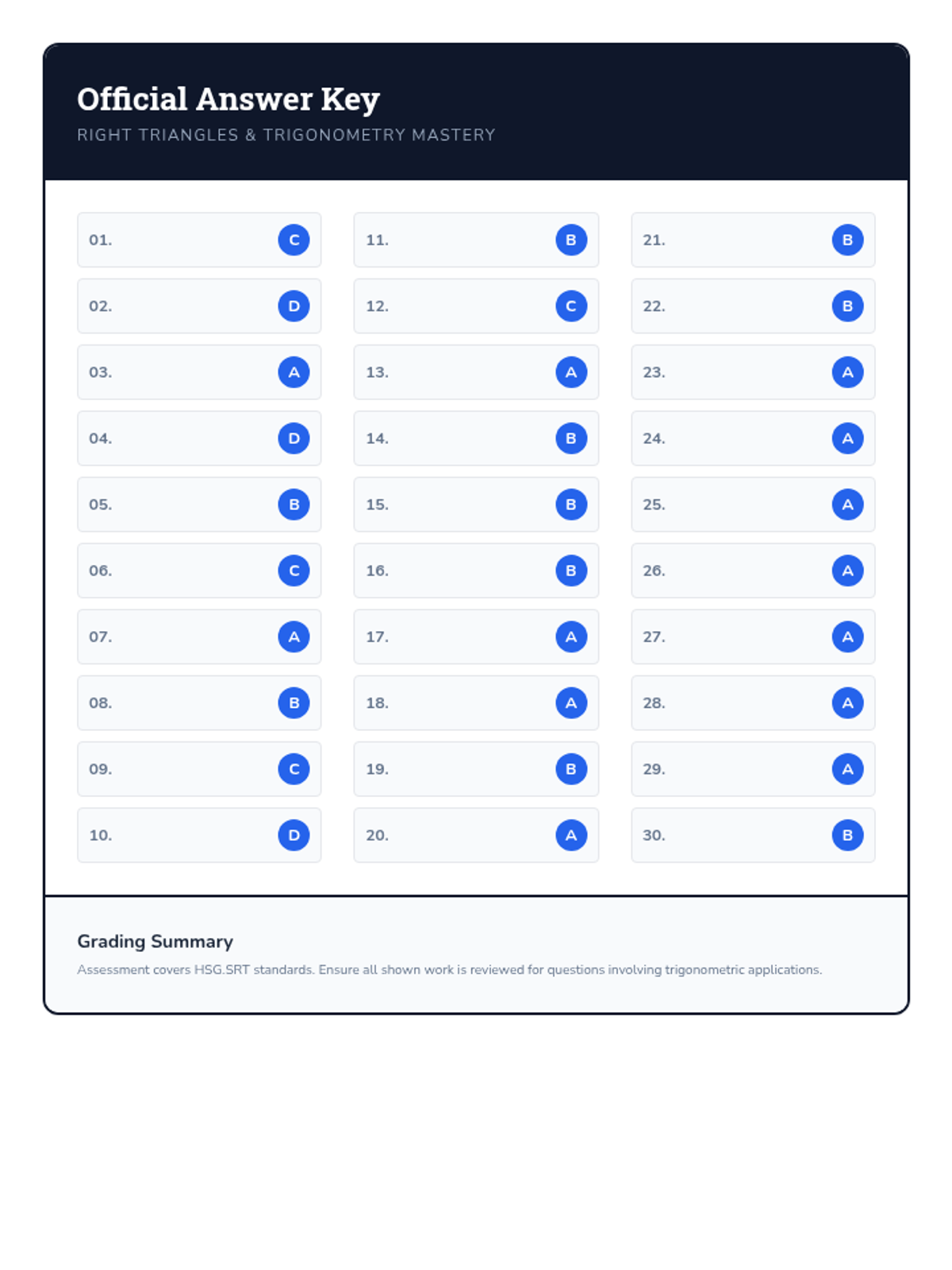
A 30-question multiple-choice questionnaire focused on Right Triangle Geometry and Trigonometry. It includes problems on the Pythagorean Theorem, special right triangles, similar triangles, and real-world trig applications.
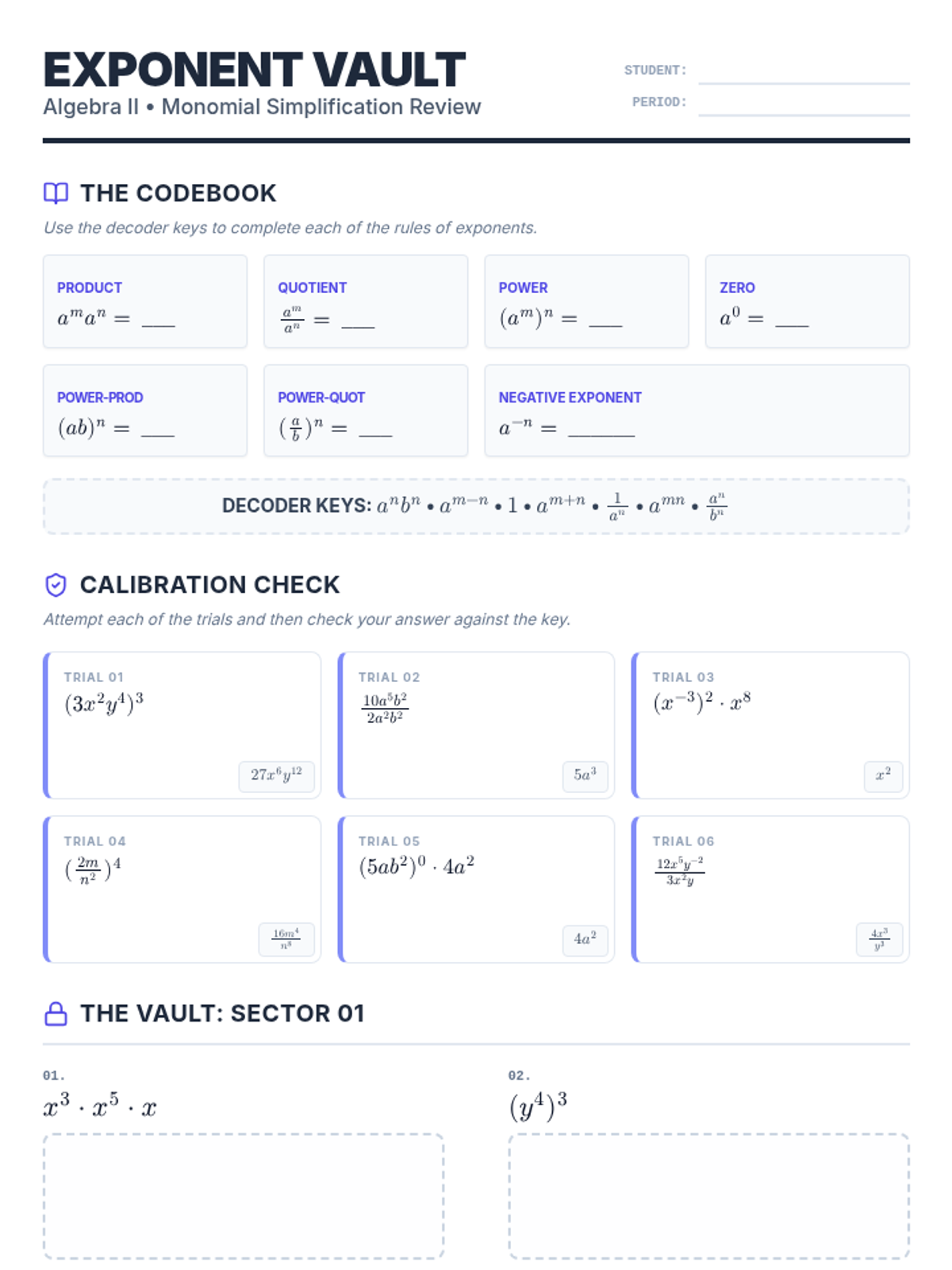
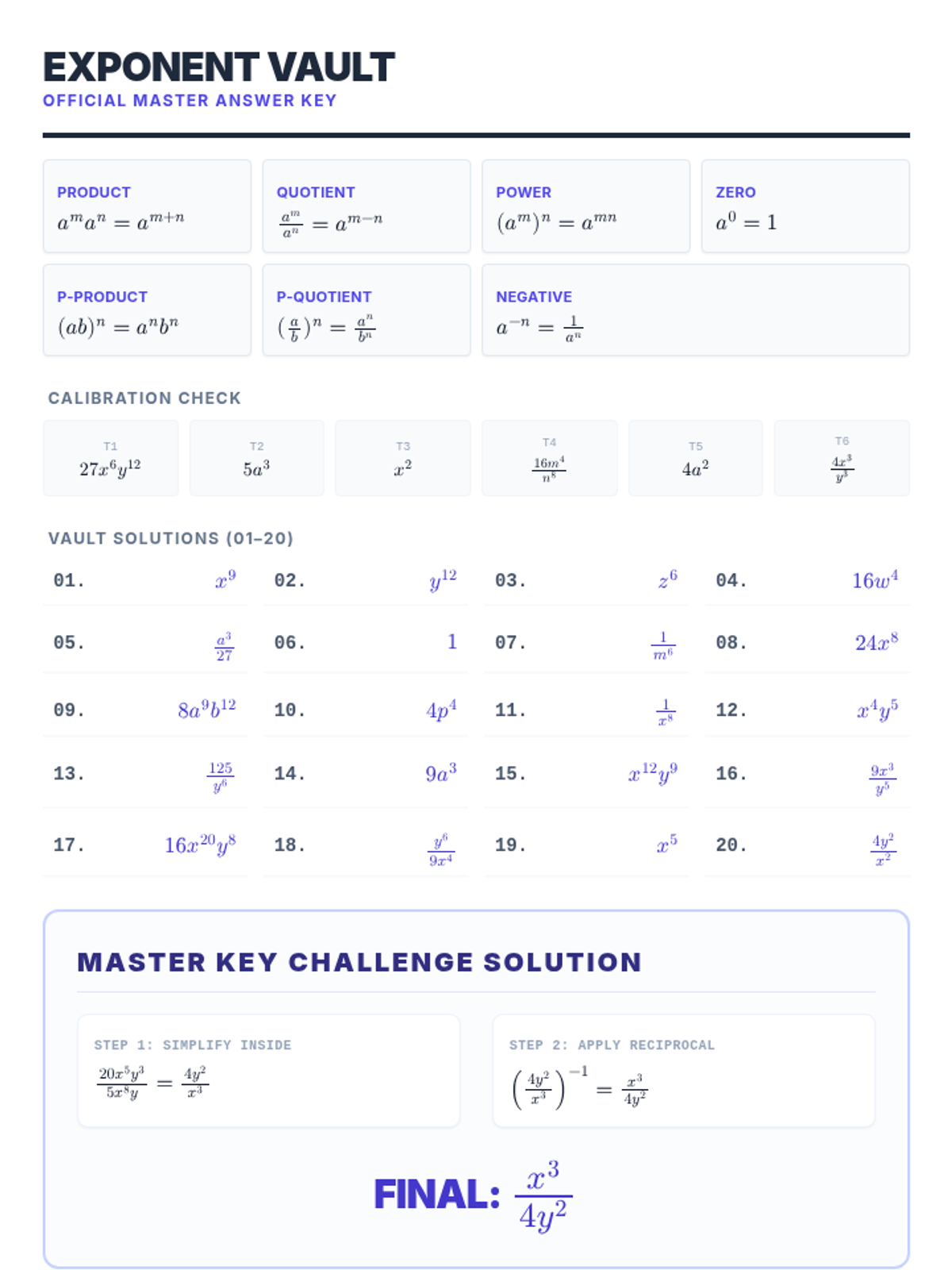
A polished self-guided worksheet for Algebra II students reviewing monomial exponent rules. Features a 'vault breaker' theme with rule recall, an expanded calibration check with 6 self-check problems, and 20 practice problems with balanced student work areas. Sectors are now logically organized with Sector 01 on Page 2 and Sector 02 on Page 3, and a cinematic Master Key Challenge on Page 4. Layout tightened to ensure Sectors fit on individual pages and the Challenge fits on page 3.
Complete answer key for the Geometry Mastery Questionnaire. Includes correct responses for all 30 multiple-choice questions and a basic scoring guide for teachers.
A corrected and polished answer key for the Exponent Vault worksheet. Includes clear rule definitions, instructions, answers for all 6 calibration trials, accurate solutions for all 20 problems, and a detailed two-step breakdown for the Master Key Challenge, all optimized for teacher use on a single page.
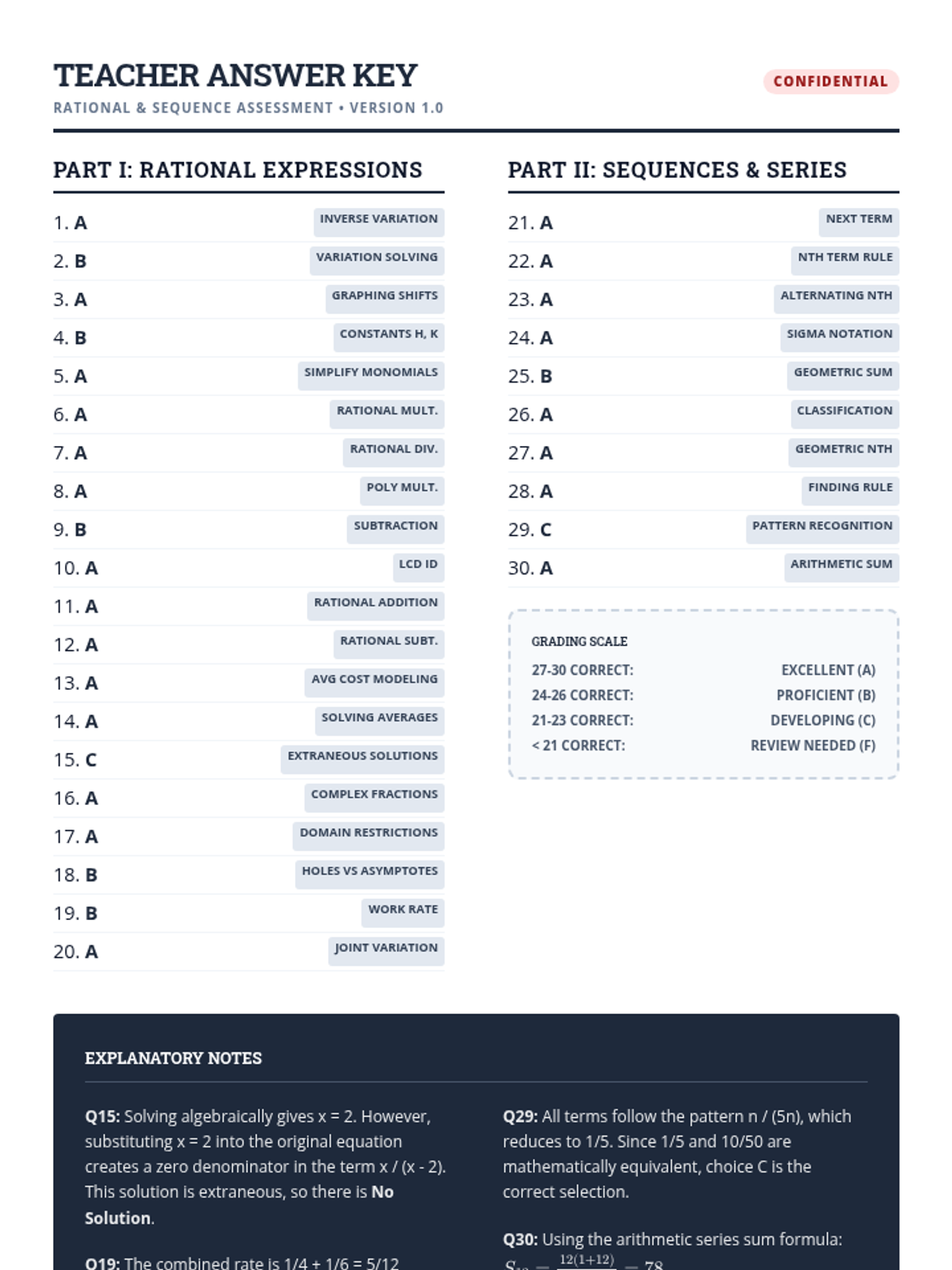
The teacher's answer key for the Rational and Sequence Assessment, providing the correct choices, topic categories for each question, and in-depth explanatory notes for challenging items.
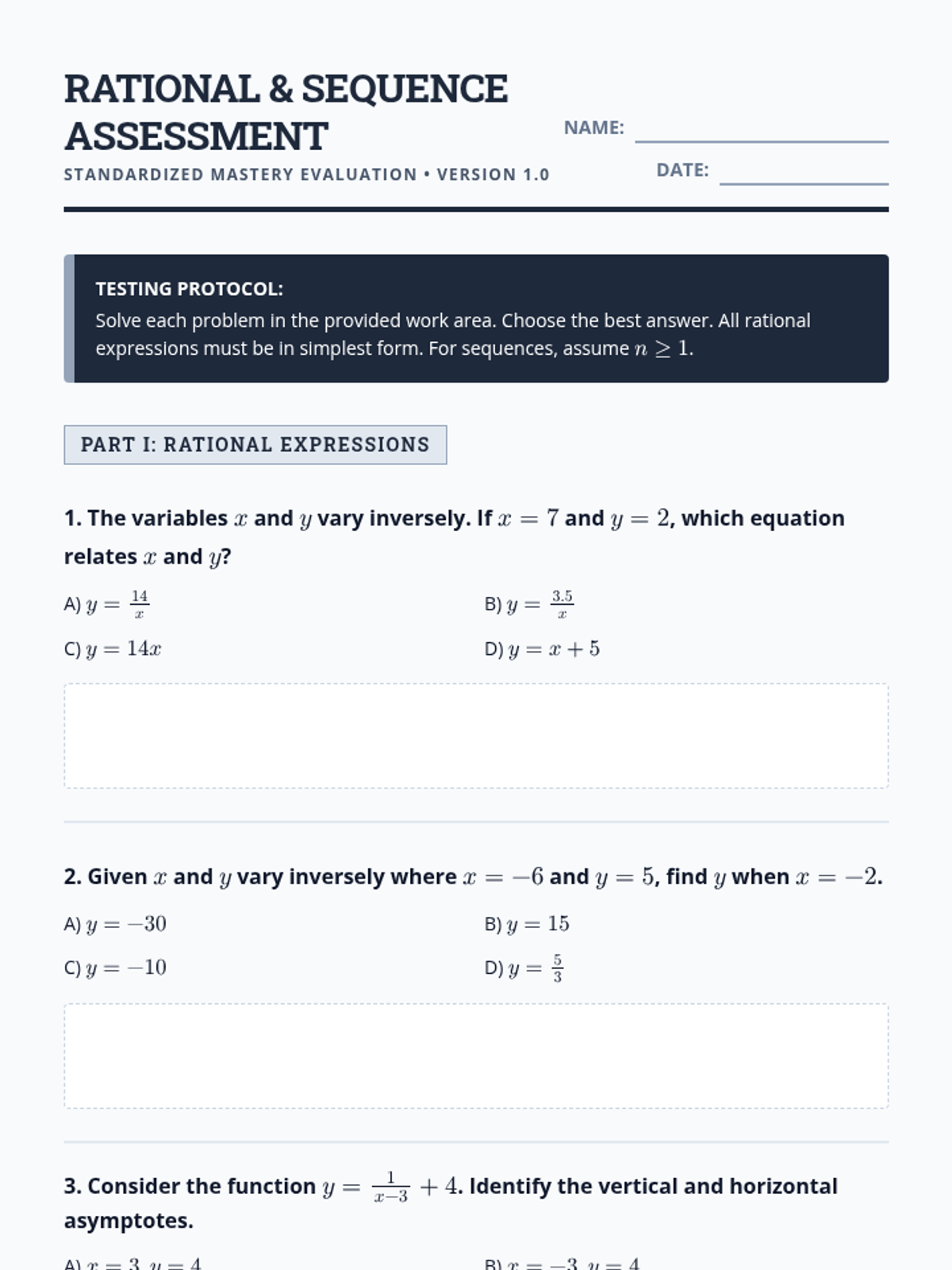
A 30-question multiple-choice assessment covering rational expressions and sequences/series. Features a math laboratory aesthetic with dedicated student work areas for each problem, LaTeX-formatted equations, and consistent visual styling.
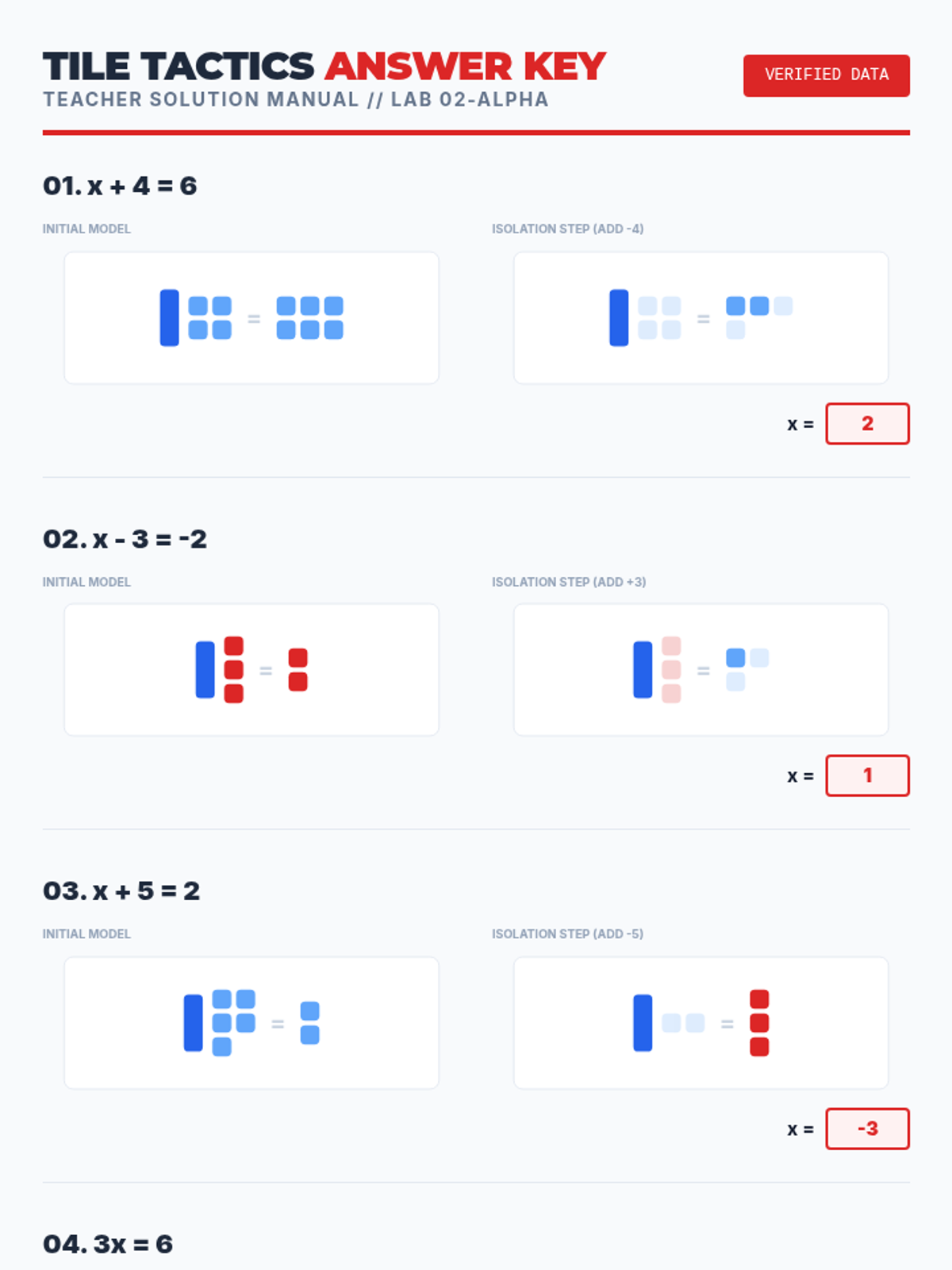
Teacher's answer key for the Tile Tactics worksheet, showing the correct model sketches for each step and the final solutions for x. Revised to match worksheet quantity and formatting.
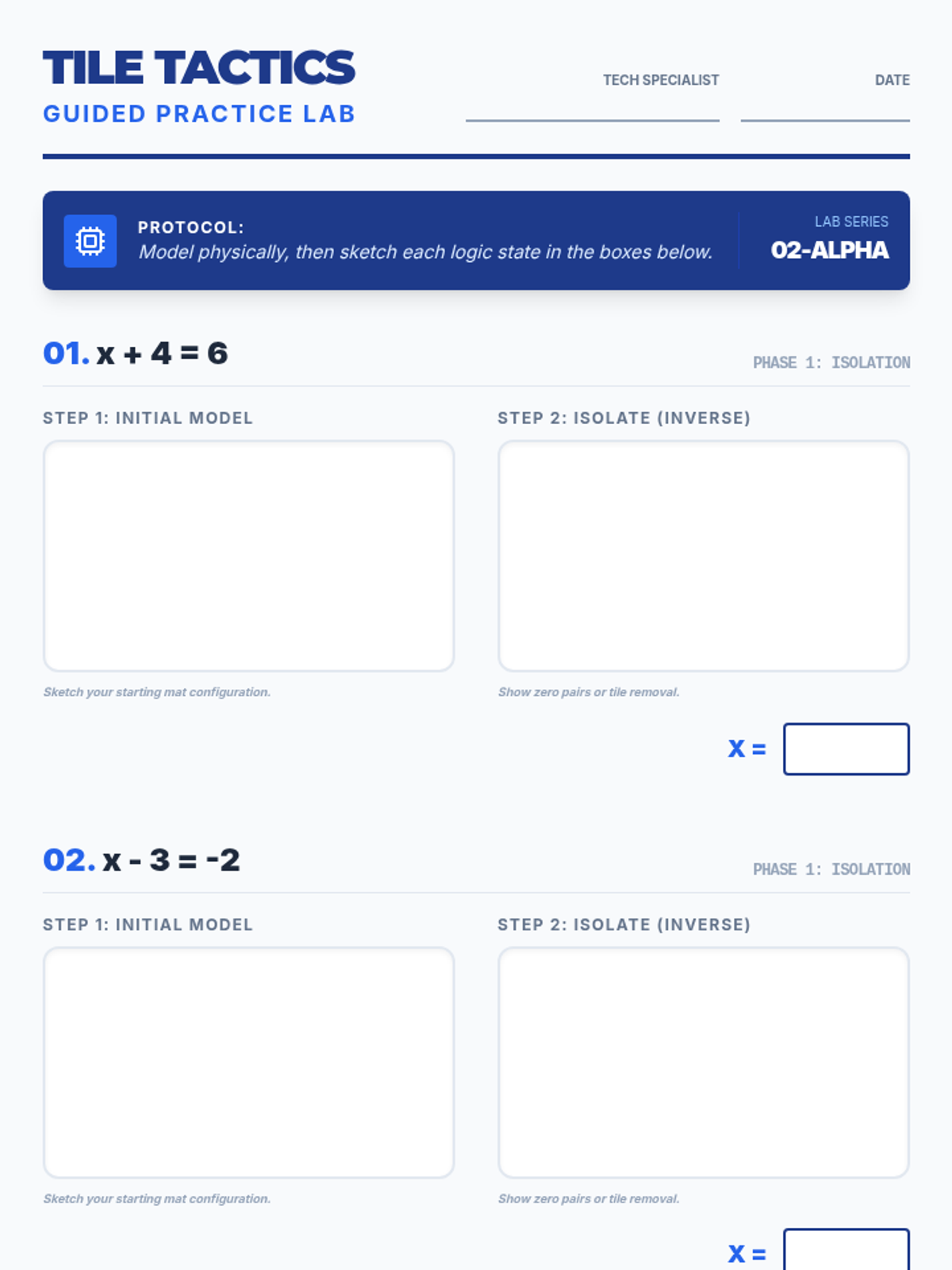
Student practice document for using algebra tiles to solve 1-step and introductory 2-step equations. Revised for problem quantity, labeling consistency, and improved page breaks.
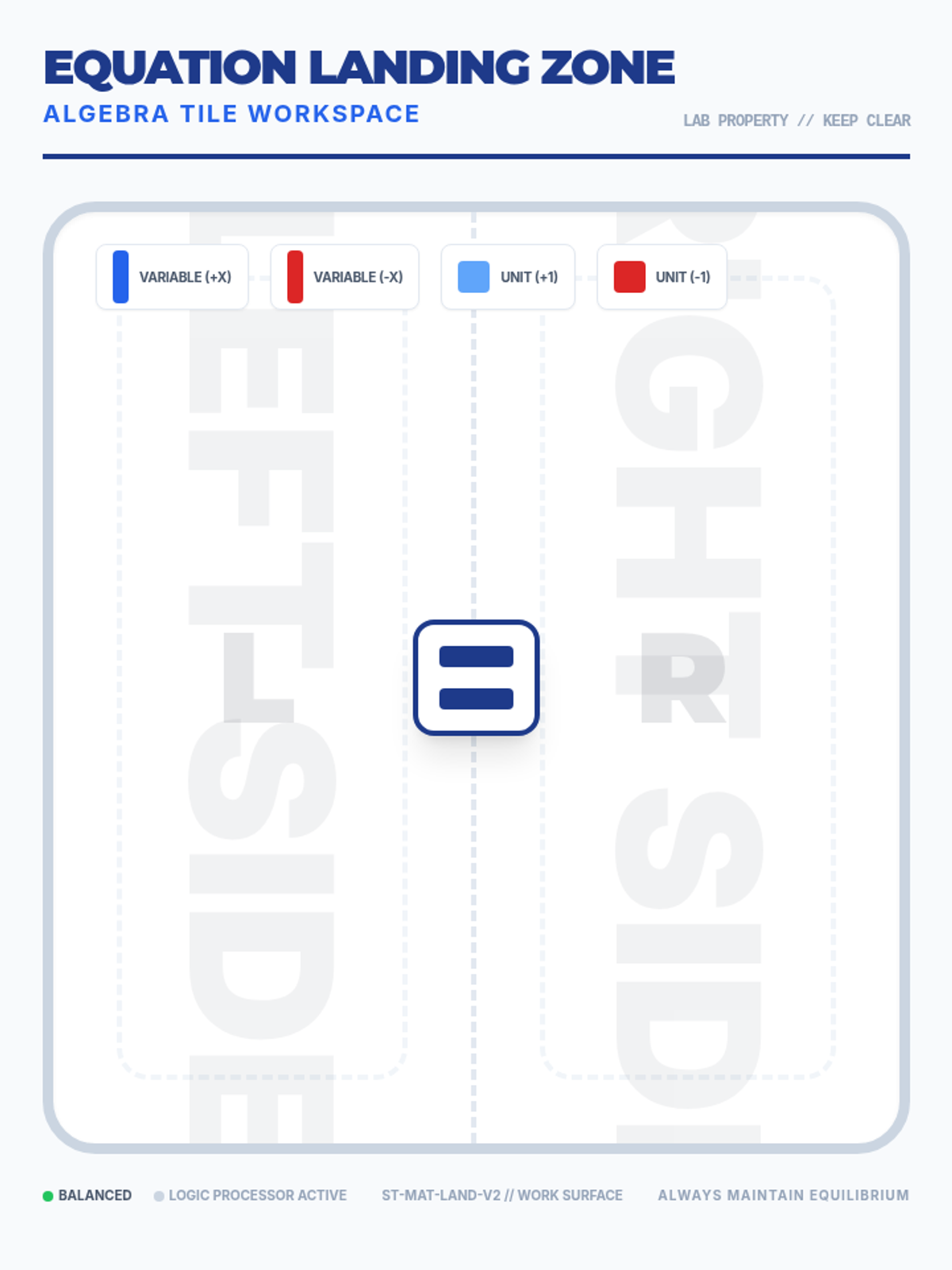
A physical workspace mat for algebra tiles, featuring a clear 'Left Side' and 'Right Side' divided by a bold equals sign. Revised for legend completeness (-x) and watermark visibility.
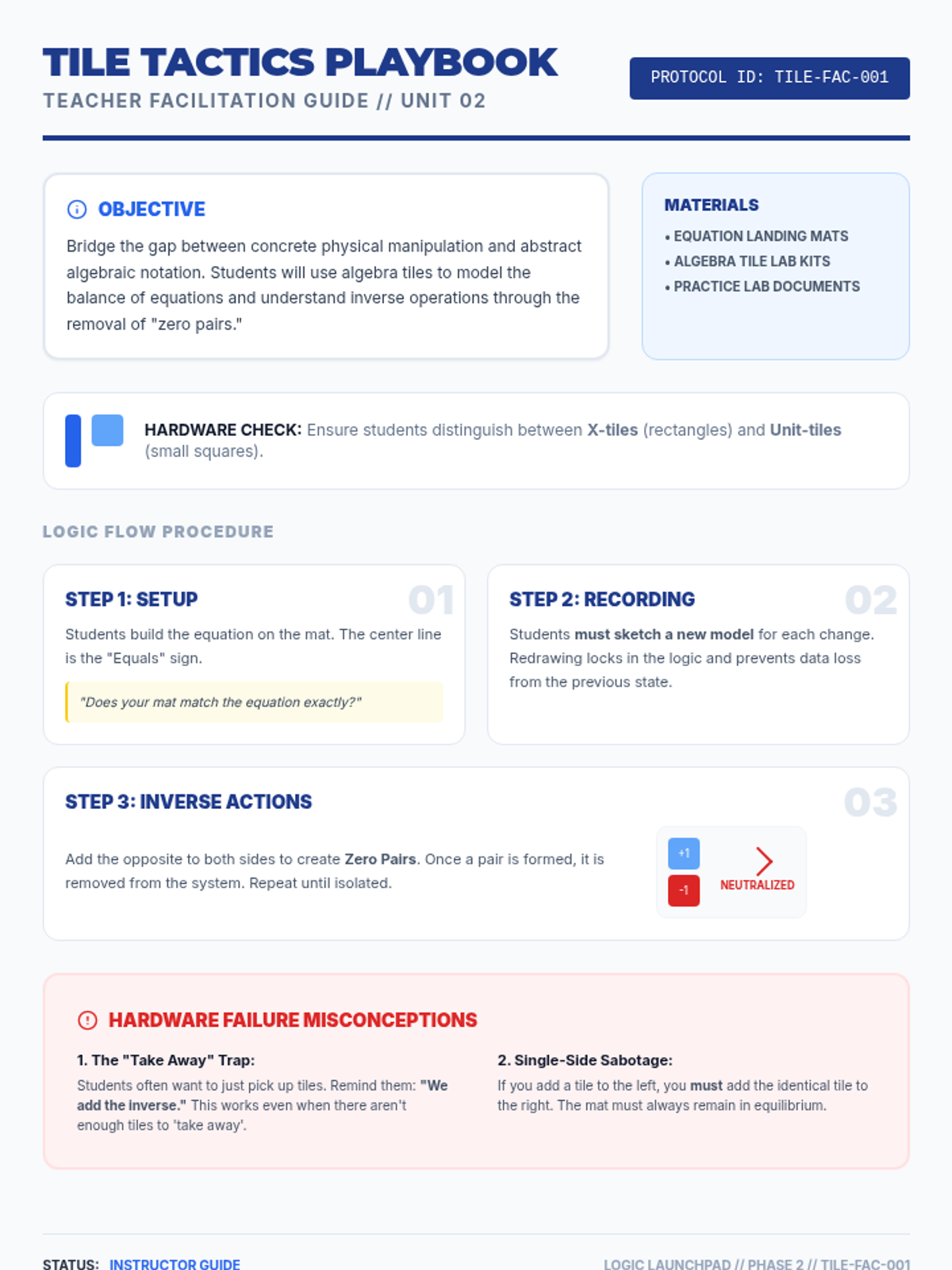
Teacher's facilitation guide for using algebra tiles, covering pedagogical strategy (rearranging vs. redrawing), key vocabulary, and common student misconceptions. Revised for improved layout and page breaks.
Introductory slide deck for algebra tiles, explaining variable vs. unit tiles, the concept of zero pairs, and the step-by-step logic of modeling equations. Revised for icon rendering, color consistency, and speed arithmetic rationale.
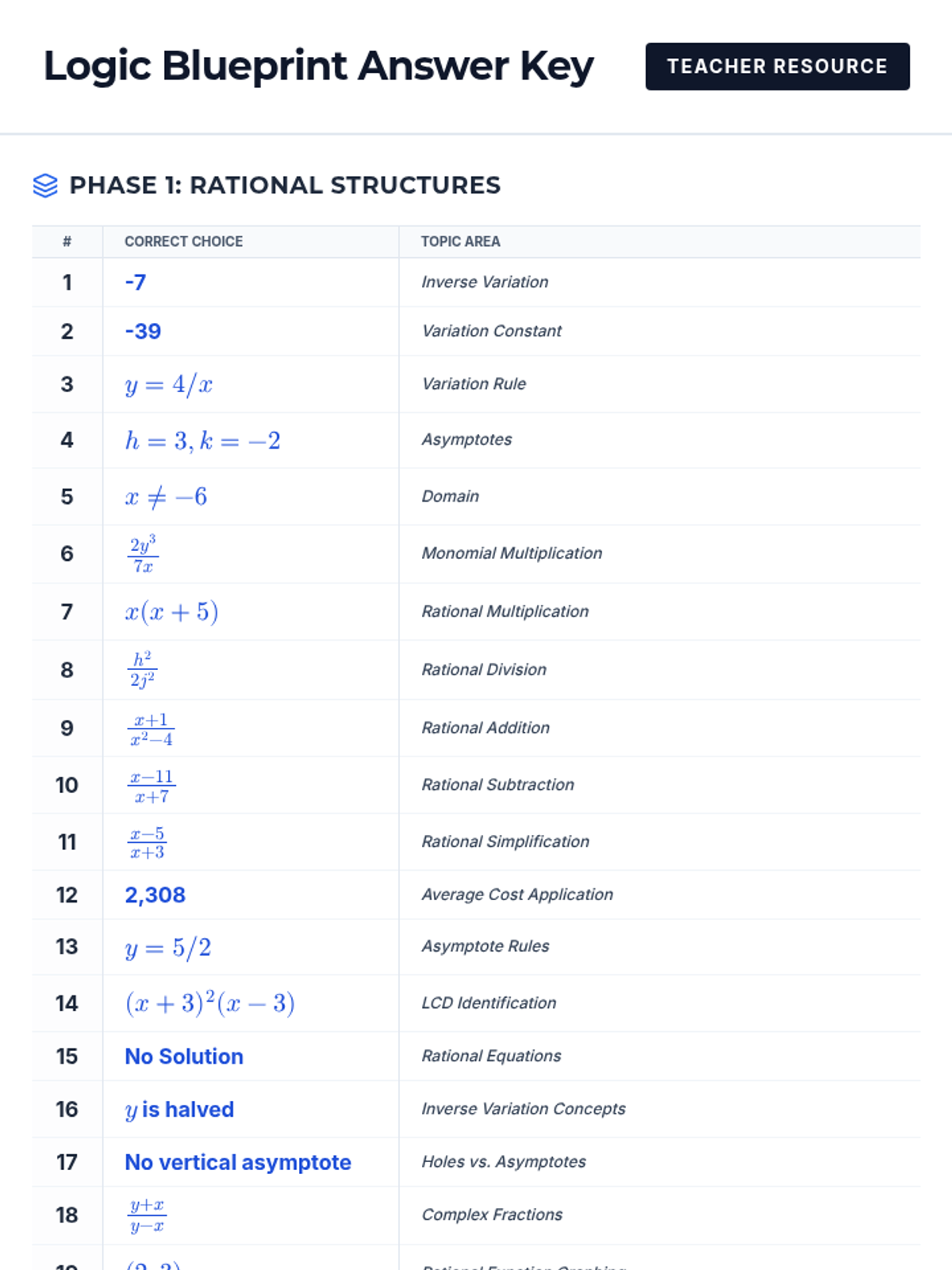
Comprehensive answer key for the Logic Blueprint Assessment, providing correct choices and identifying topic domains for each question. Includes a diagnostic grading scale for teacher use.
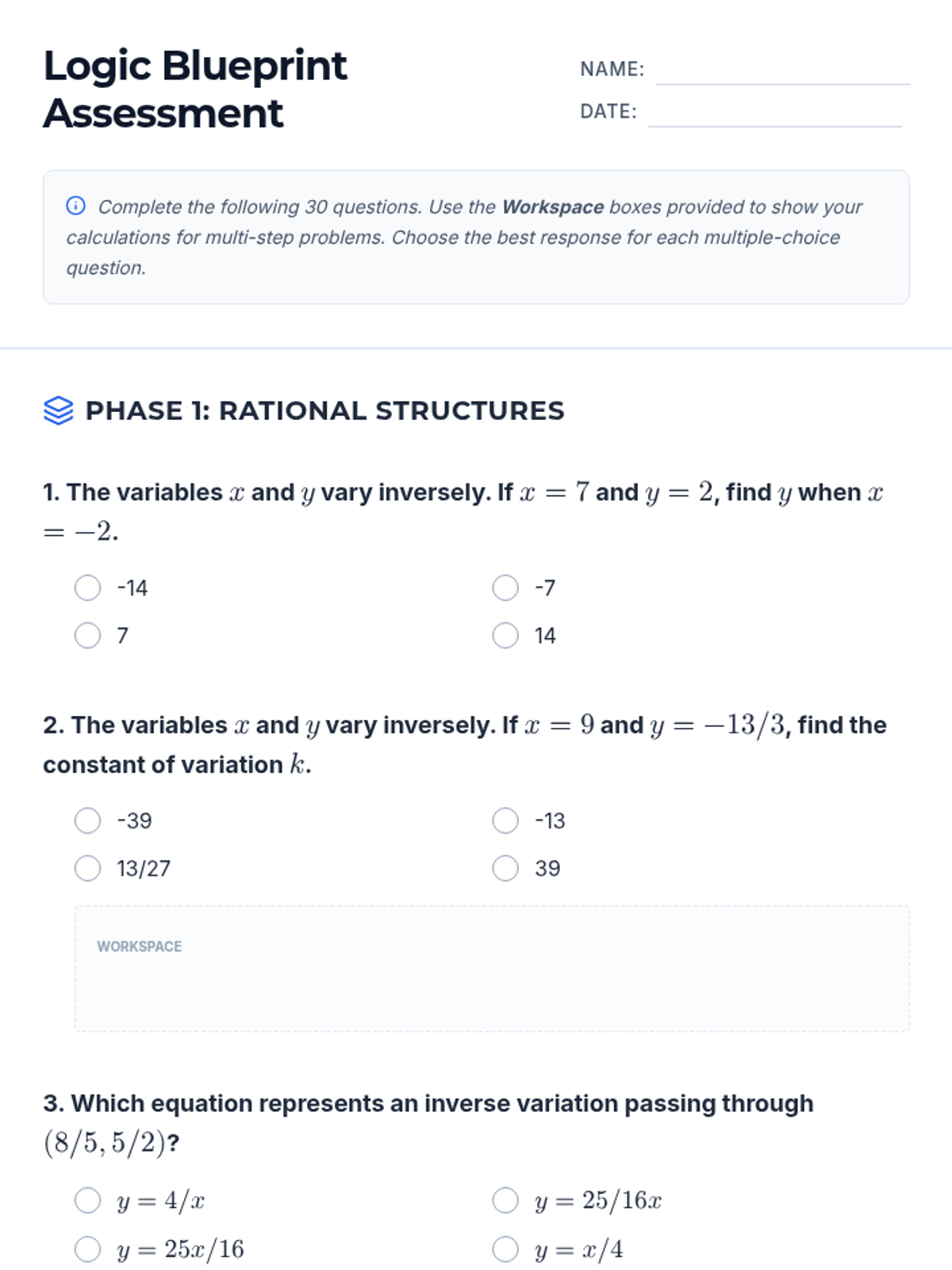
A 30-question multiple-choice assessment covering rational expressions, functions, and sequences and series. This document features structured layout, clear mathematical notation, and diverse problem types from inverse variation to summation rules.
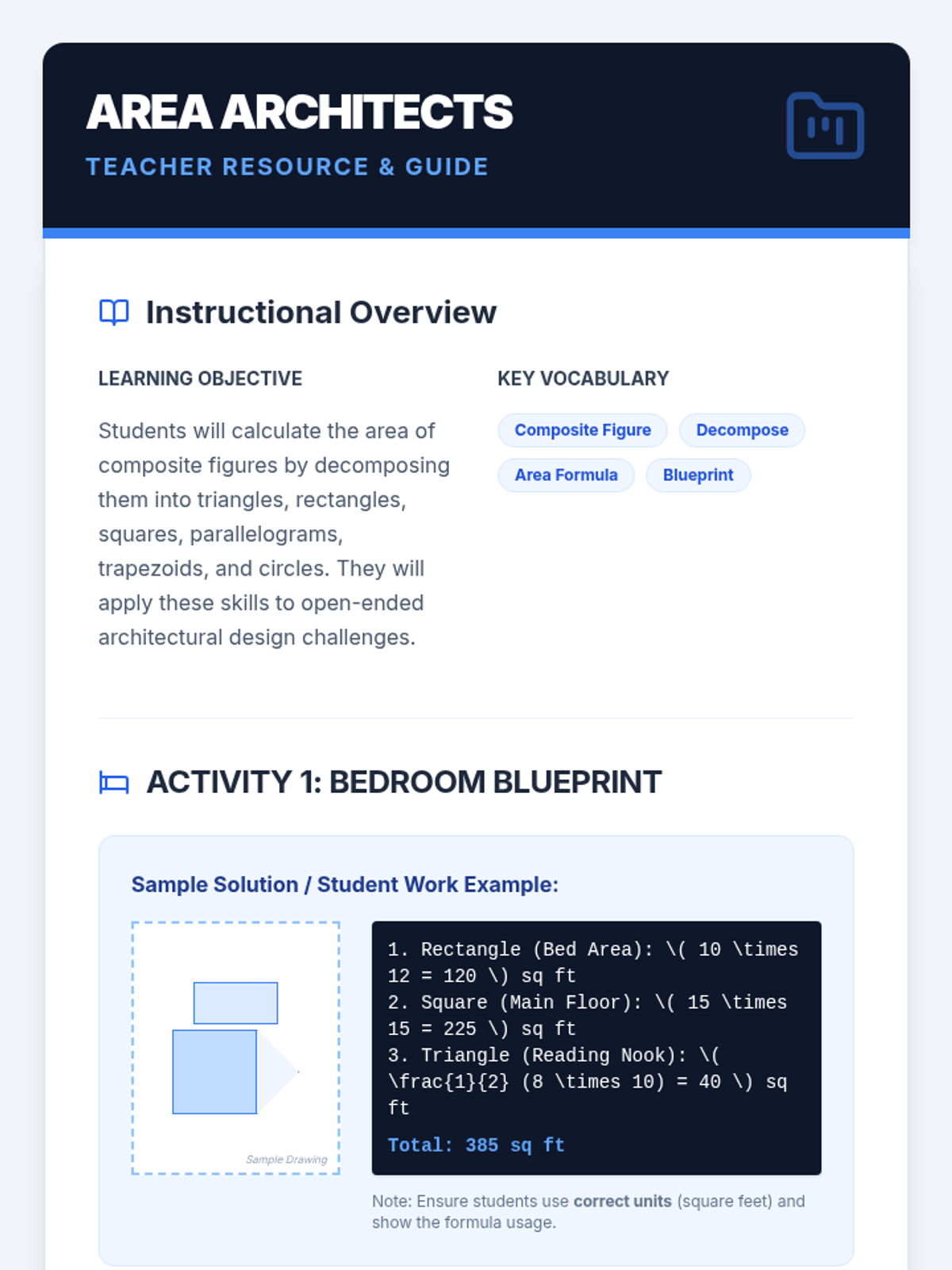
A teacher resource guide providing a lesson overview, sample student work solutions for the bedroom activity, and differentiation strategies for varied learners.
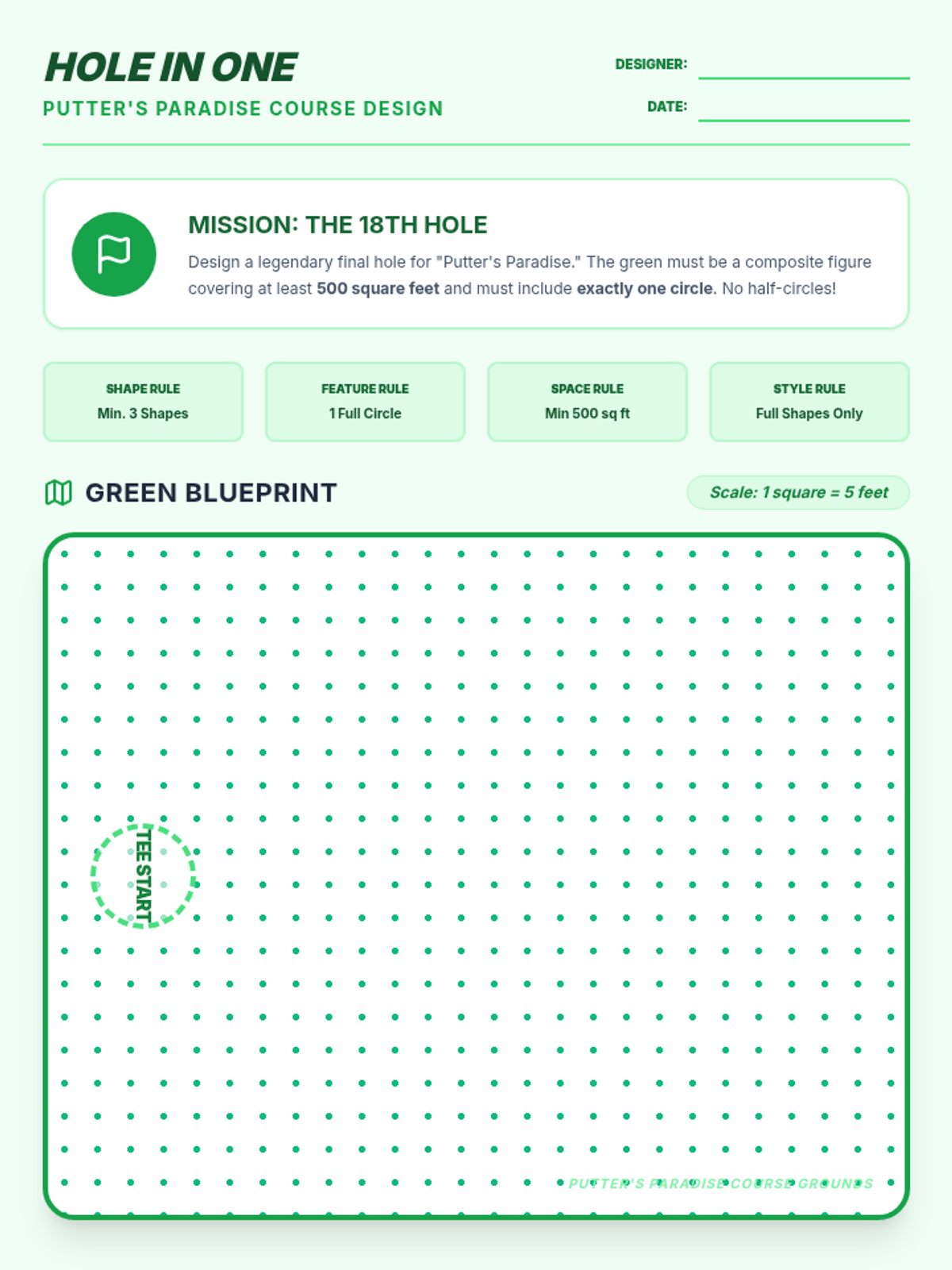
A hands-on mini-golf design activity where students use composite shapes to create a challenging golf hole and calculate the total playable area.
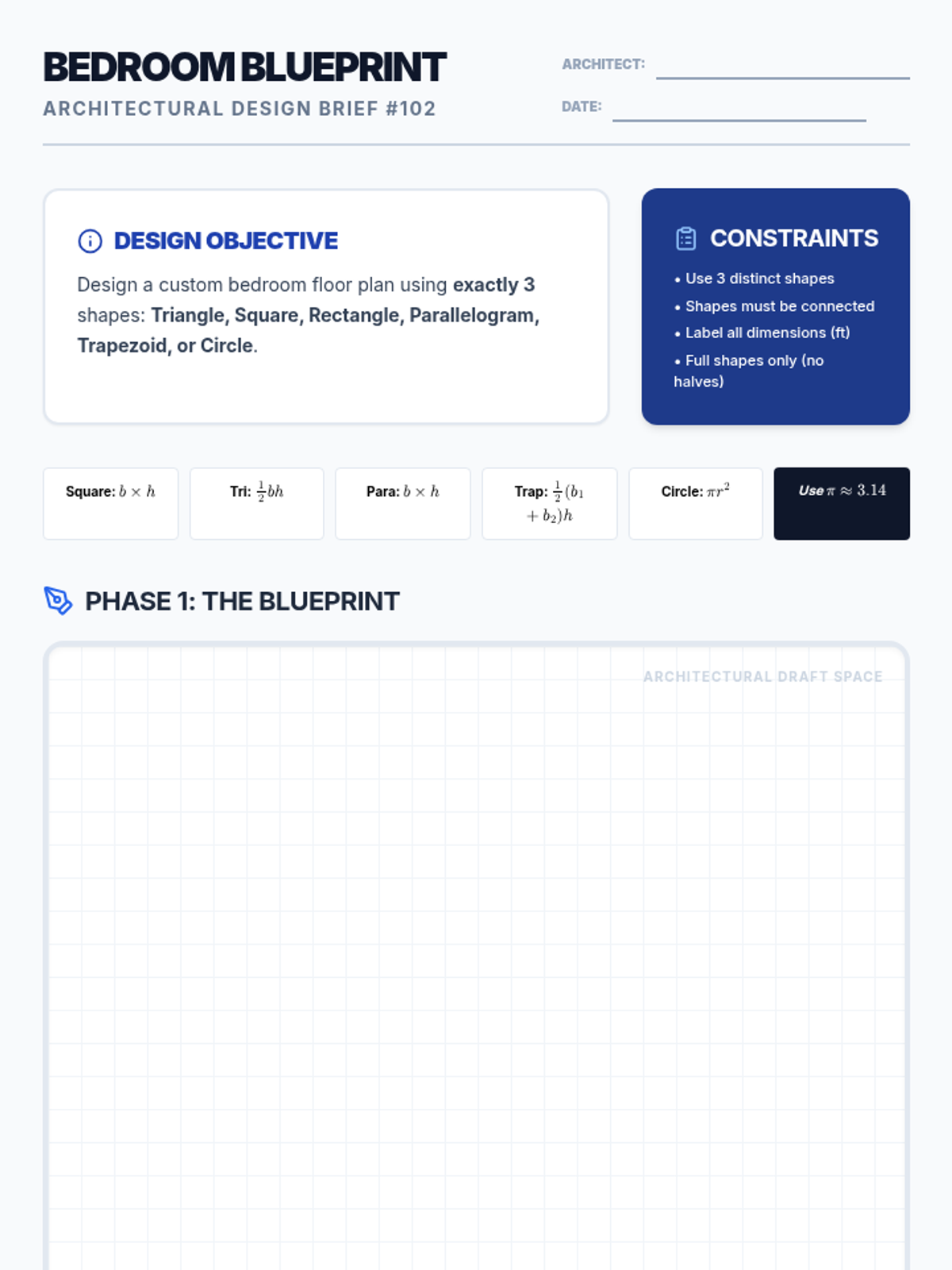
A design-focused worksheet where students create a custom bedroom floor plan using three different composite shapes and calculate the total area.
An engaging slide deck introducing composite figures, the 3-step 'Architect Workflow', and a real-world pool calculation example to prepare students for the design activities.
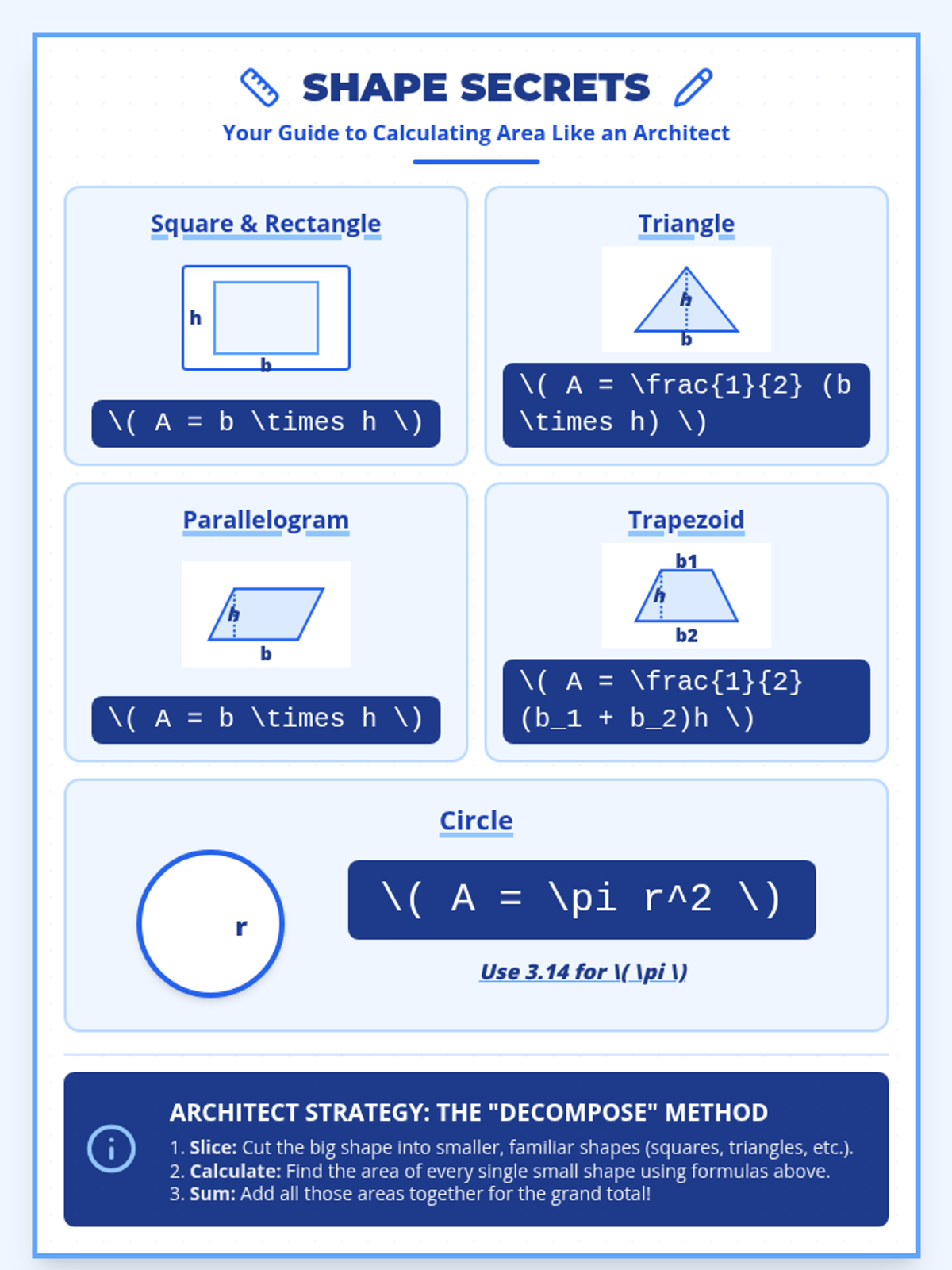
A visual reference anchor chart for students featuring area formulas for squares, rectangles, triangles, parallelograms, trapezoids, and circles with clear diagrams and an architectural theme.
Revised Phase 4 slides for the 'Game of Life' project with polished correlation examples, accurate trend line visualizations, and a cohesive concluding mission-success theme.
Revised Phase 3 slides for the 'Game of Life' project with improved formula rendering, specifically focusing on clearly aligned exponents and high-contrast text for classroom visibility.
Revised Phase 2 slides with an accurate intersection point graph, clearer step-by-step substitution instructions, and high-contrast labels for classroom instruction.
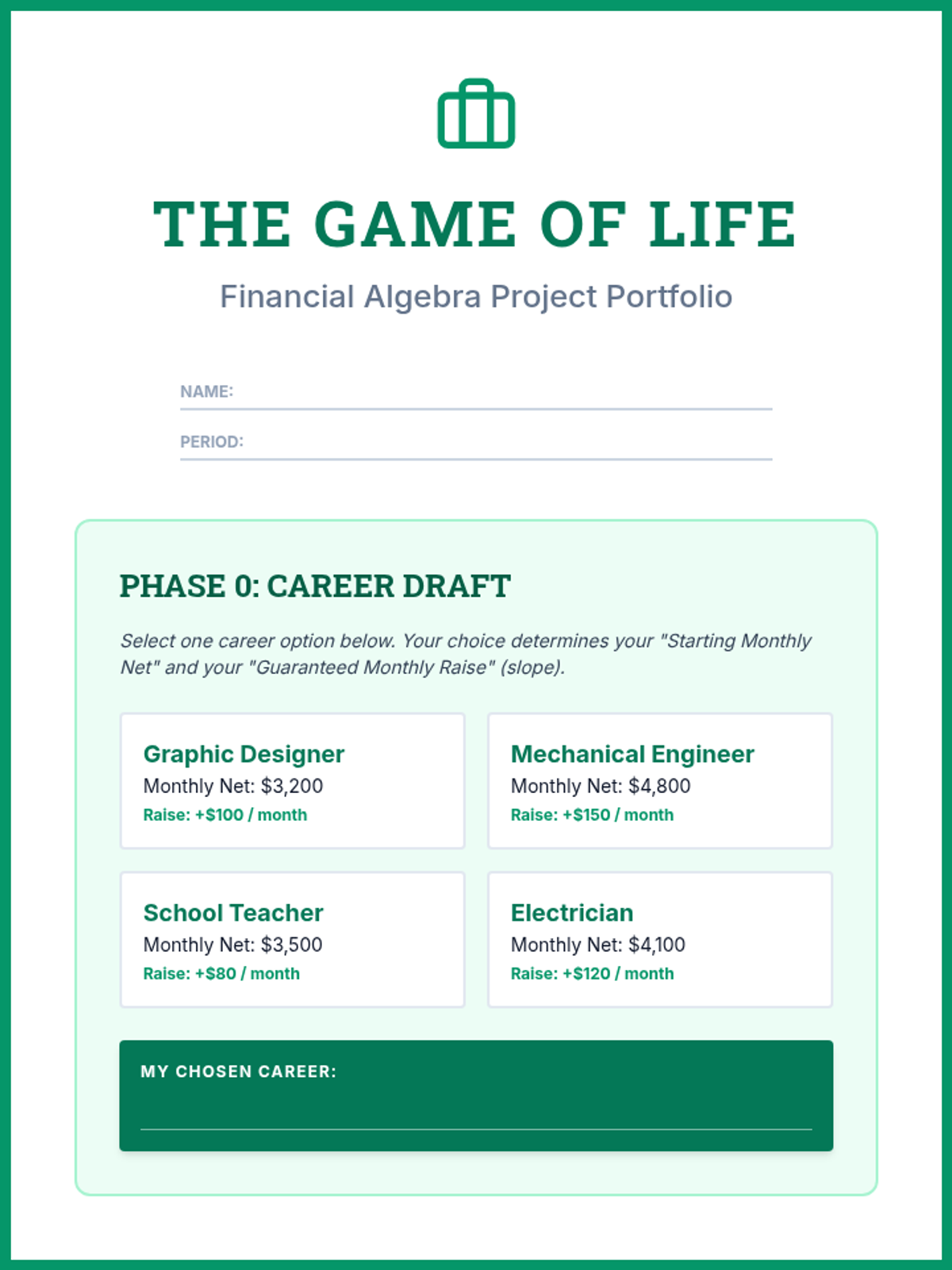
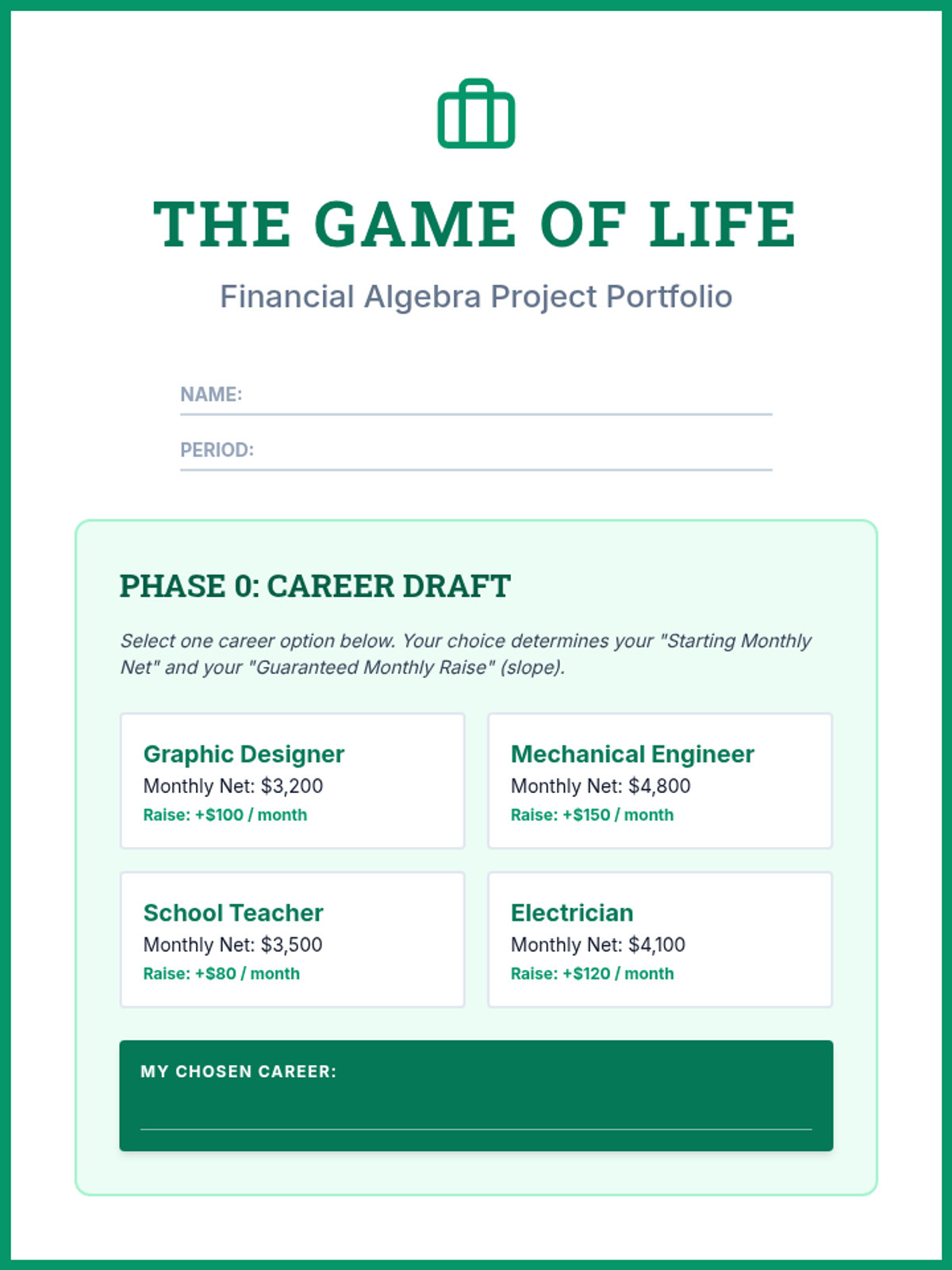
A polished 8-page student workbook for the 'Game of Life' project, featuring improved table styles, fixed axis labels on graph paper, and standardized mathematical formatting for better rendering.
Revised Phase 4 slides for the 'Game of Life' project with an expanded 6-slide lesson, corrected trend line visuals, high-contrast text, and real-world forecasting examples.
Revised Phase 3 slides for the 'Game of Life' project with improved formula rendering, higher text contrast, and detailed step-by-step exponential modeling.
Revised Phase 2 slides for the 'Game of Life' project with corrected graph visuals, a step-by-step substitution guide, and removed text compression for better readability.
Revised Phase 1 slides for the 'Game of Life' project with improved text contrast, fixed equation wrapping, and clearer visual hierarchy.
A refined 8-page student workbook for the 'Game of Life' project, with improved page breaks, full-page graph paper, clear substitution scaffolding, and a single-page completion certificate.
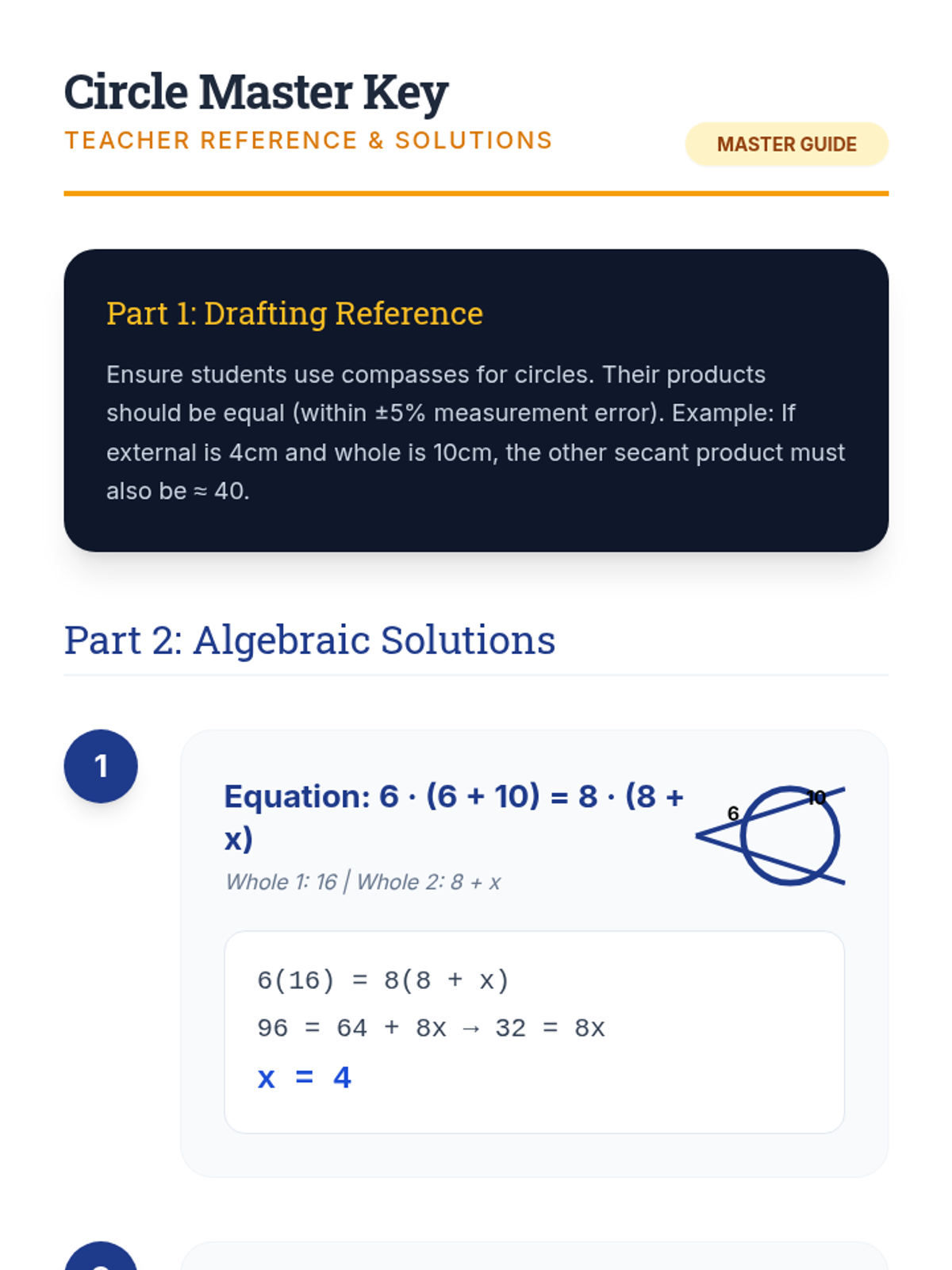
A teacher's answer key and instructional guide for the Circle Segments lesson, featuring step-by-step algebraic solutions and common misconception alerts.
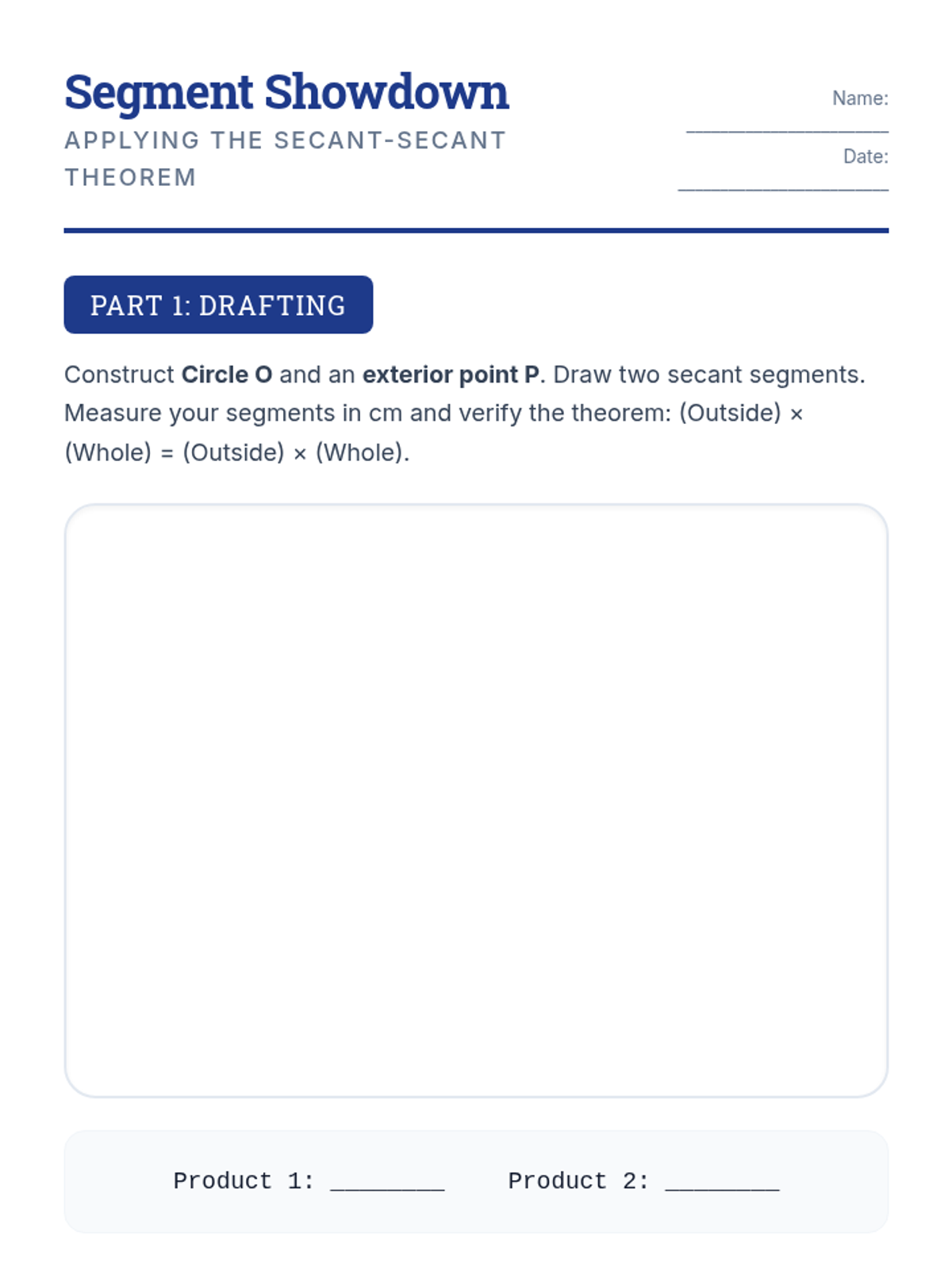
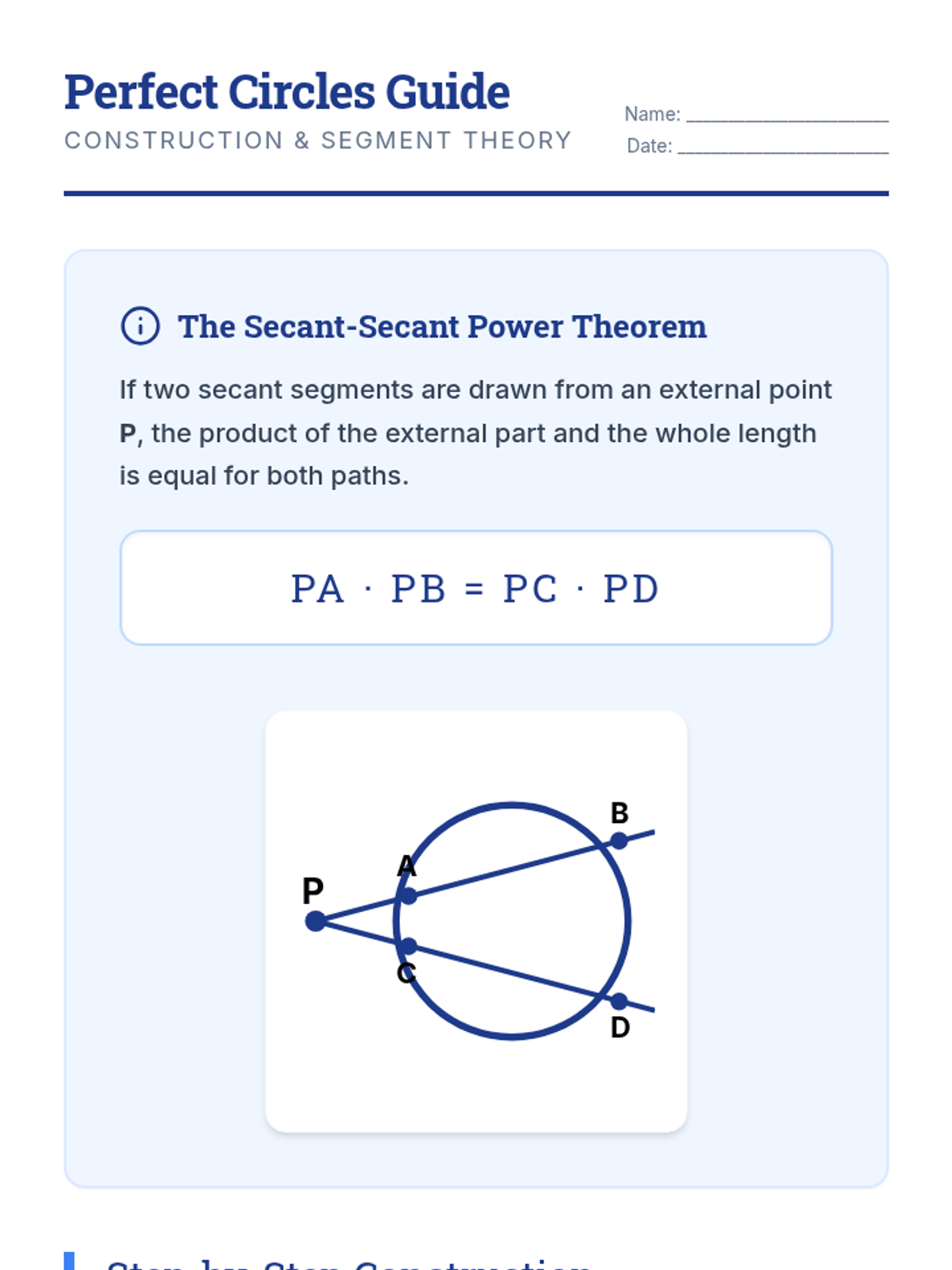
A practice worksheet for constructing circles and calculating segment lengths using the Secant-Secant Theorem. Features drafting space and diverse algebraic problems.
A detailed step-by-step construction guide for drawing circles and secant segments, including clear instructional diagrams and a breakdown of the Secant-Secant Power Theorem.
A visually engaging slide deck exploring circle segment relationships, specifically focusing on secants intersecting outside the circle. Includes tool definitions, theorem explanations, and a guided example.
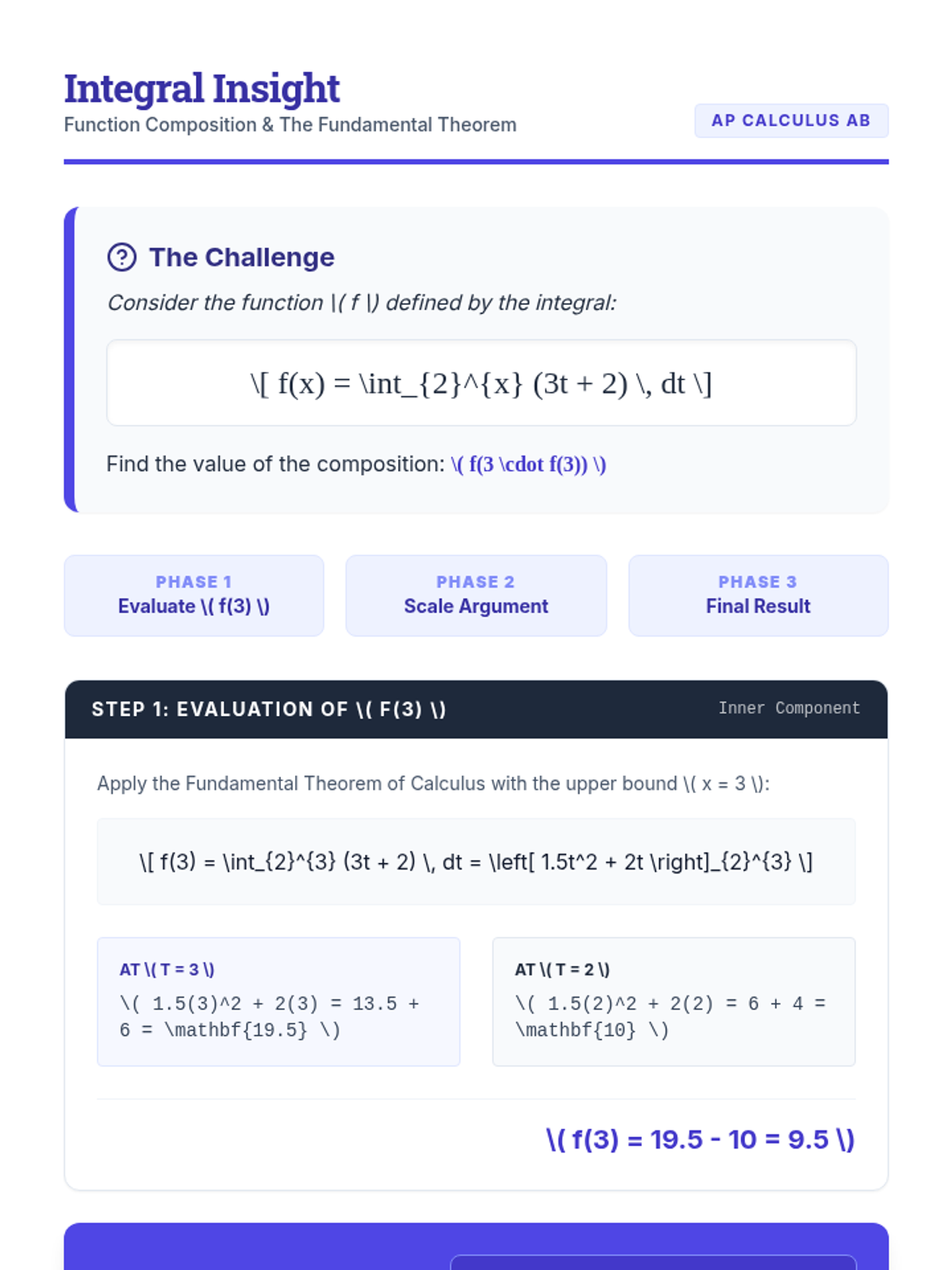
A comprehensive, step-by-step solution for the AP Calculus problem f(3f(3)), detailing the evaluation of the inner function, the input scaling, and the final integral calculation using the Fundamental Theorem of Calculus.
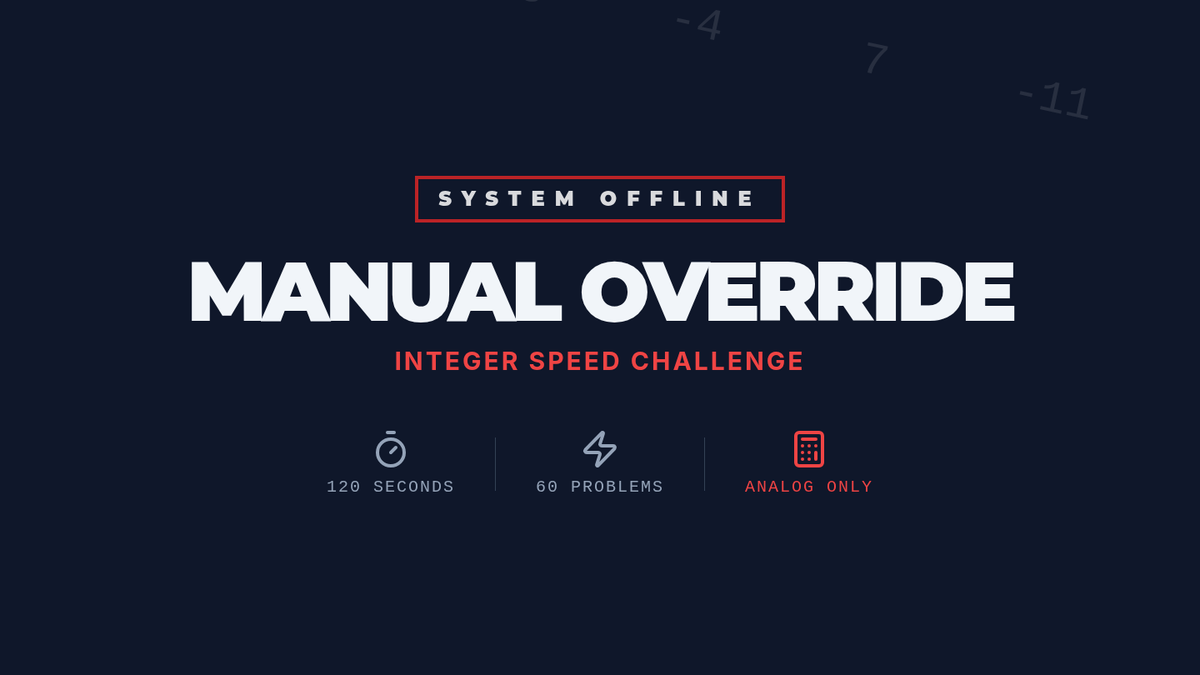
An introductory slide deck for the Manual Override activity, providing context and a rationale for mental arithmetic practice (e.g., acuity, processing speed, and tech independence).
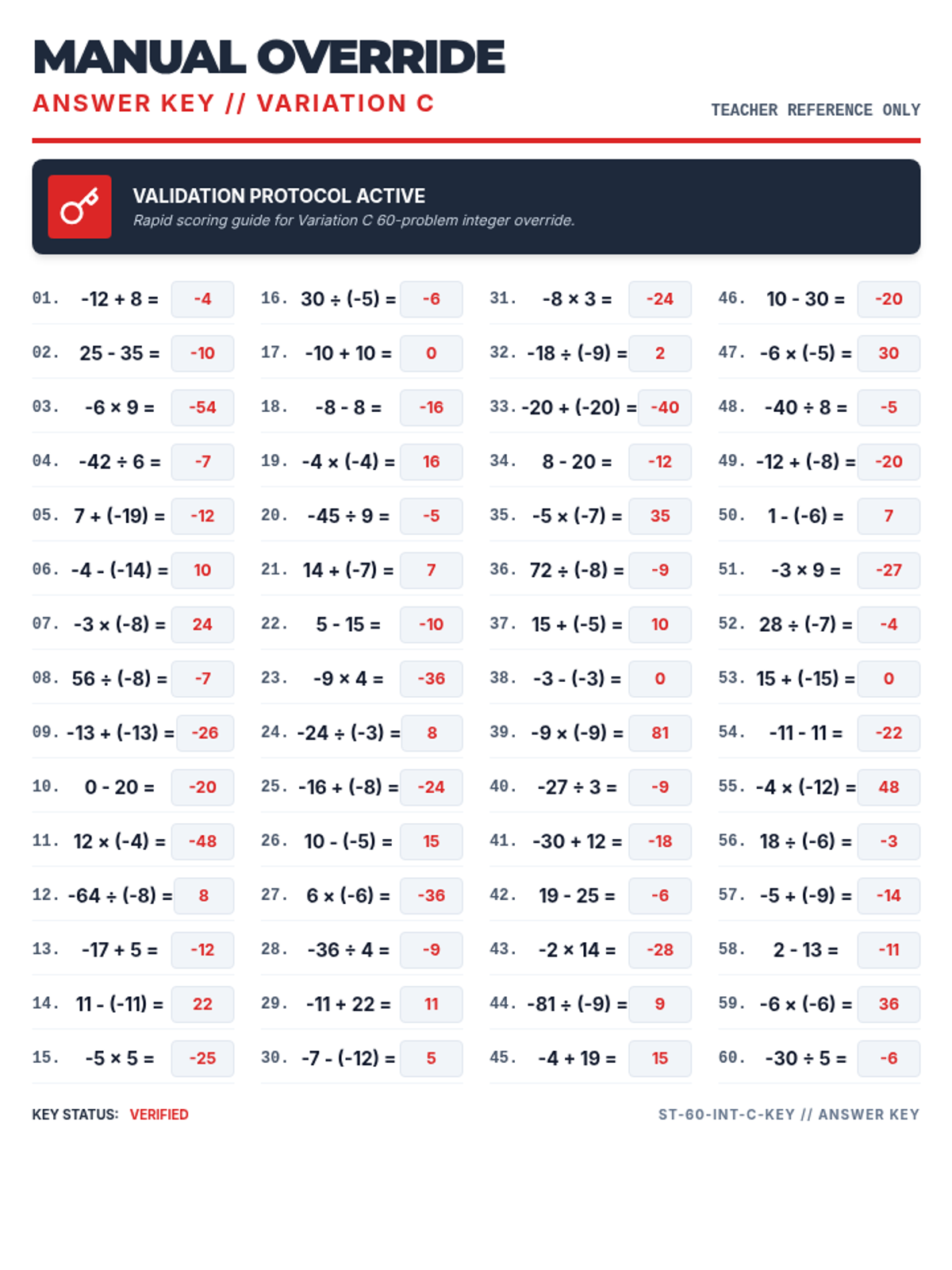
The answer key for the Variation C Integer Overdrive worksheet, featuring all 60 solved integer arithmetic problems. Revised for consistent spacing and layout.