A formative assessment exit ticket for summarizing numerical data sets. It requires students to independently identify context, calculate mean and median, find the MAD, and write a concluding summary sentence.
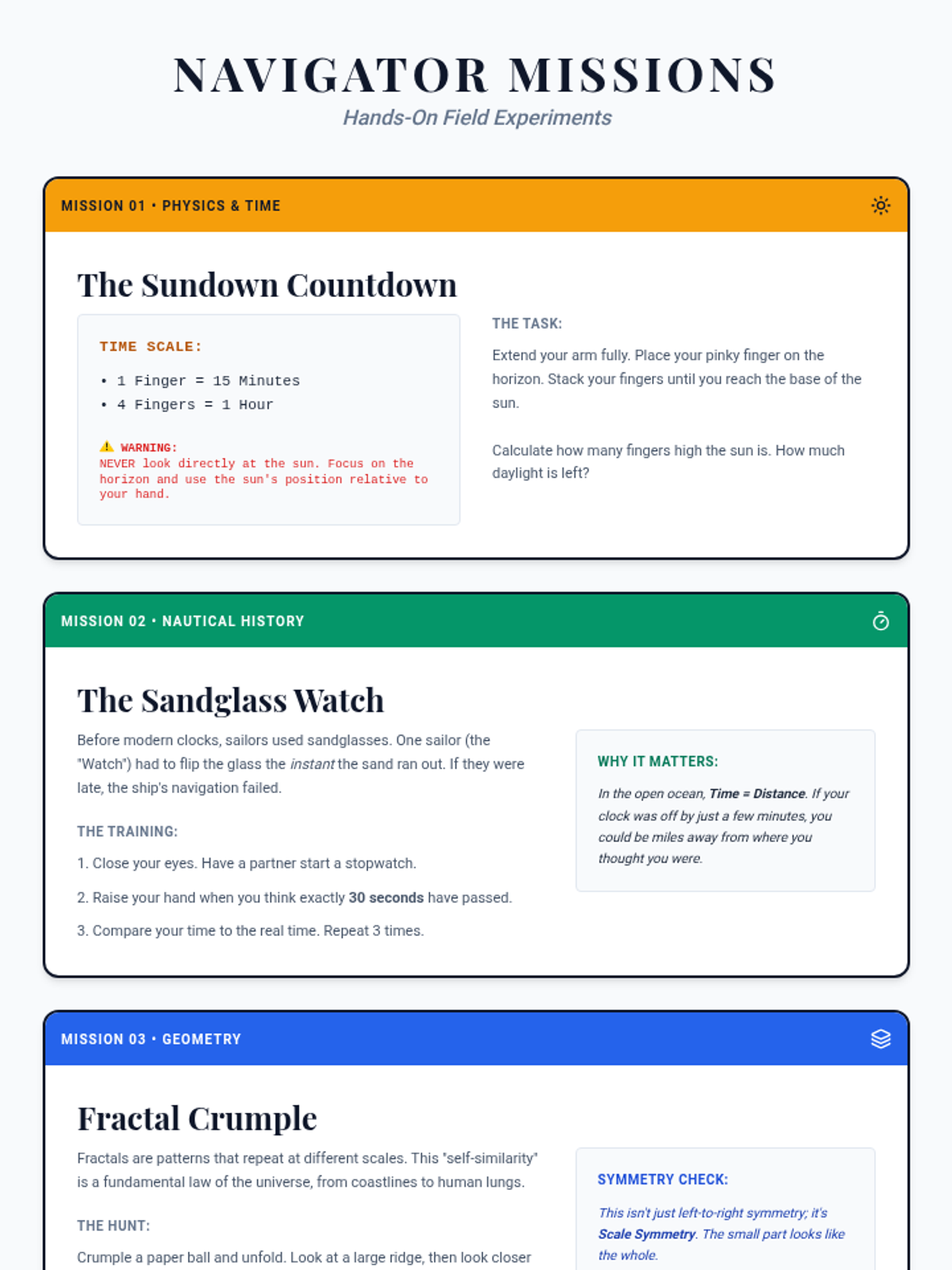
A set of four hands-on field missions for students to experiment with daylight estimation, historical nautical timekeeping, fractal scaling, and sun-based coordinate mapping. All missions now feature consistent, professional layouts with scientific sidebars.
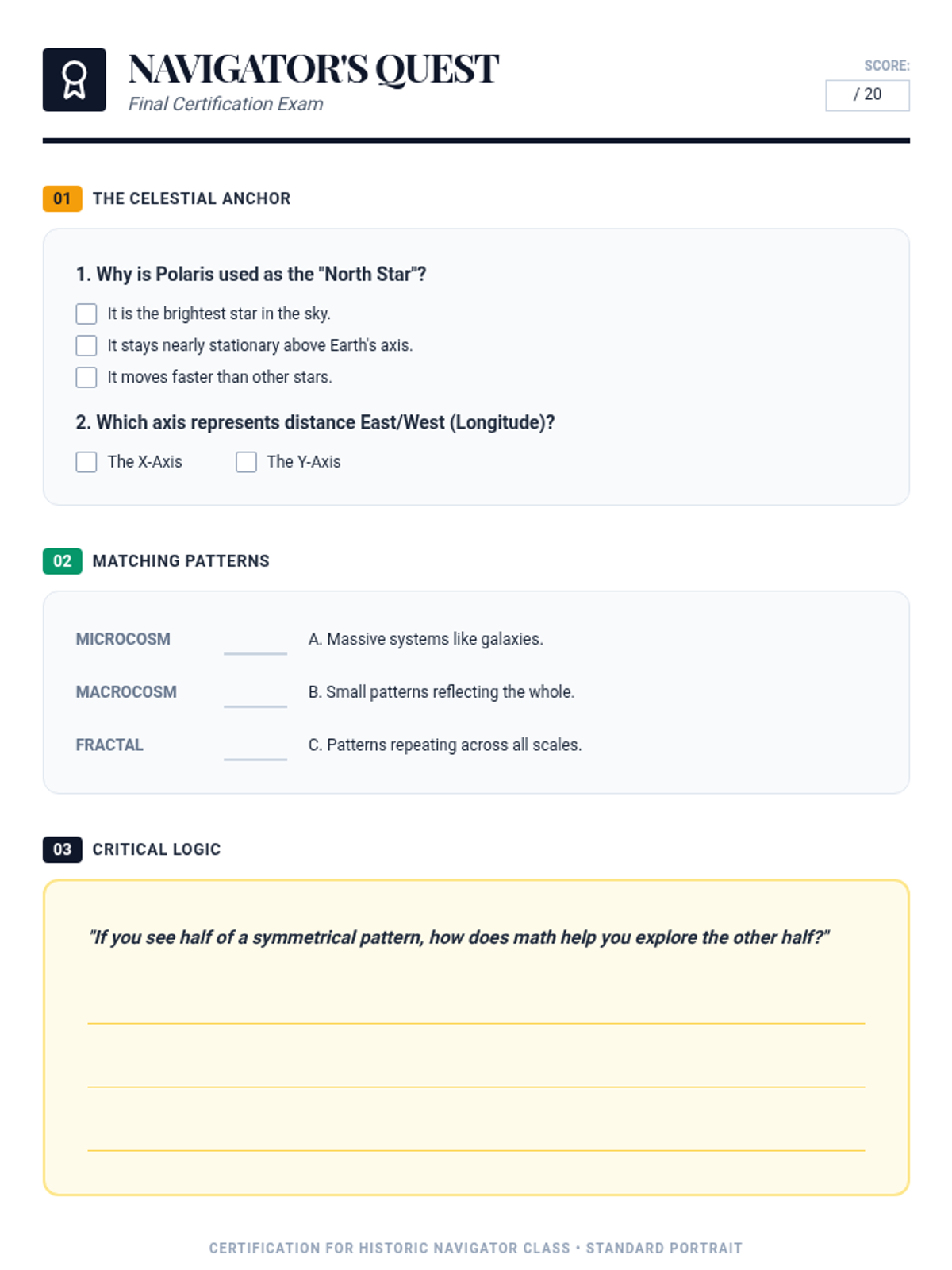
A comprehensive quiz covering fixed-point navigation, coordinate axes, microcosms vs macrocosms, and different types of symmetry. Refactored for standard portrait format.
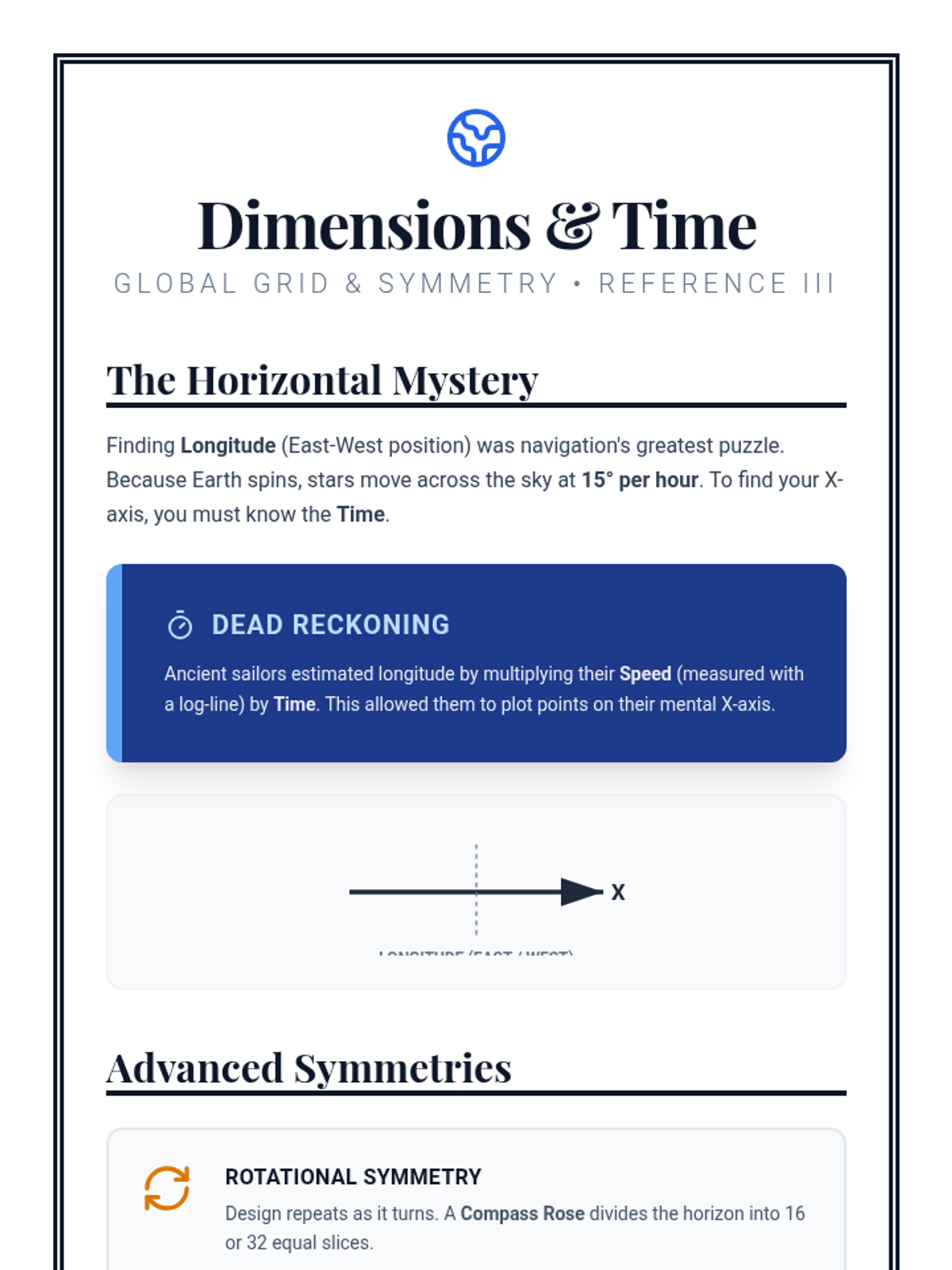
A reference page explaining Longitude as the X-axis of navigation, along with advanced symmetry concepts like Rotational and Logarithmic Spirals. Updated for scientific accuracy regarding the difficulty of longitude and spiral patterns. Standard portrait format.
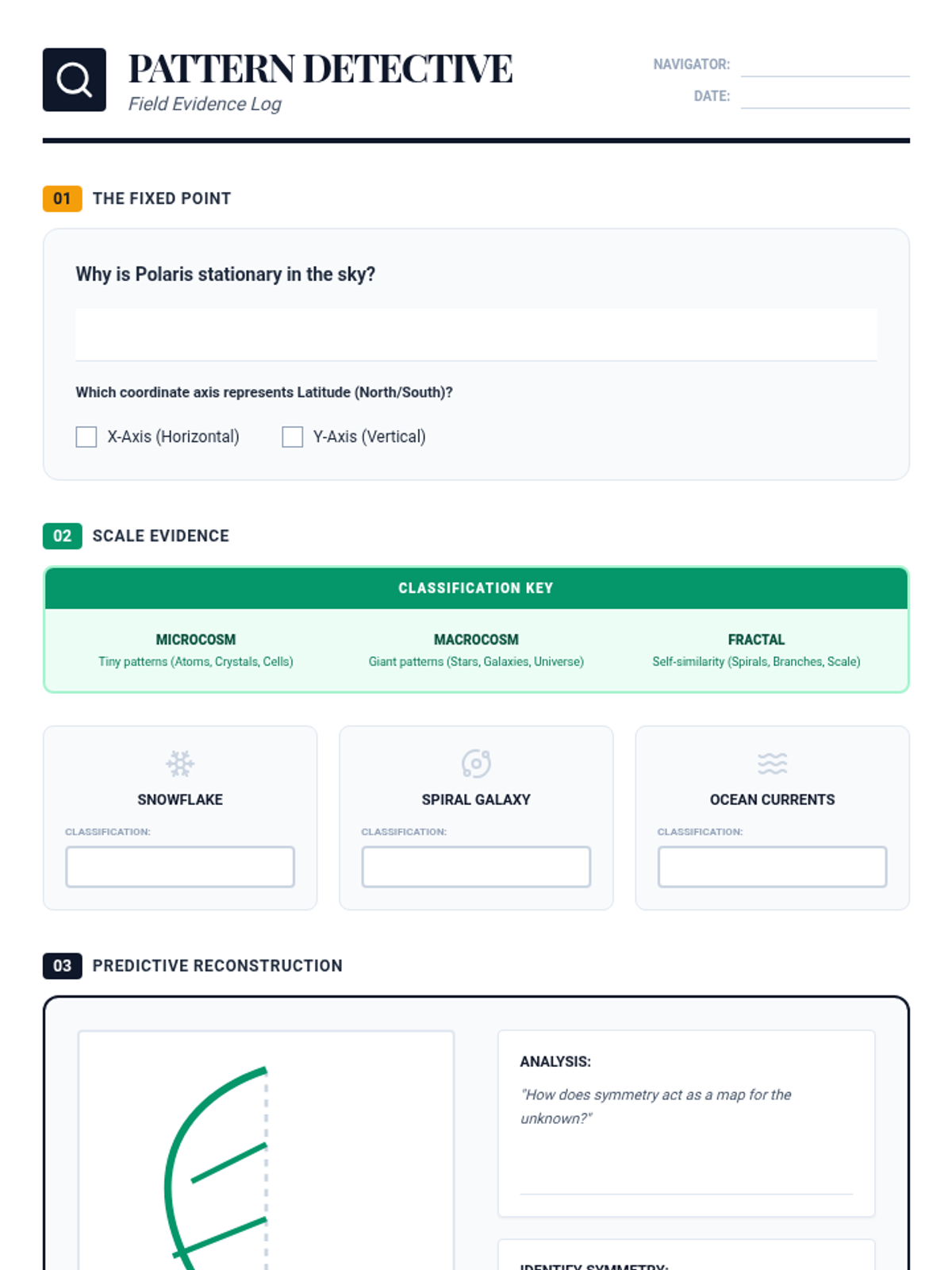
A conceptual worksheet for students to identify patterns of symmetry and scale in nature. Updated with 'Mission Break' callouts after Section 1 and Section 2 to guide students to specific field activities.
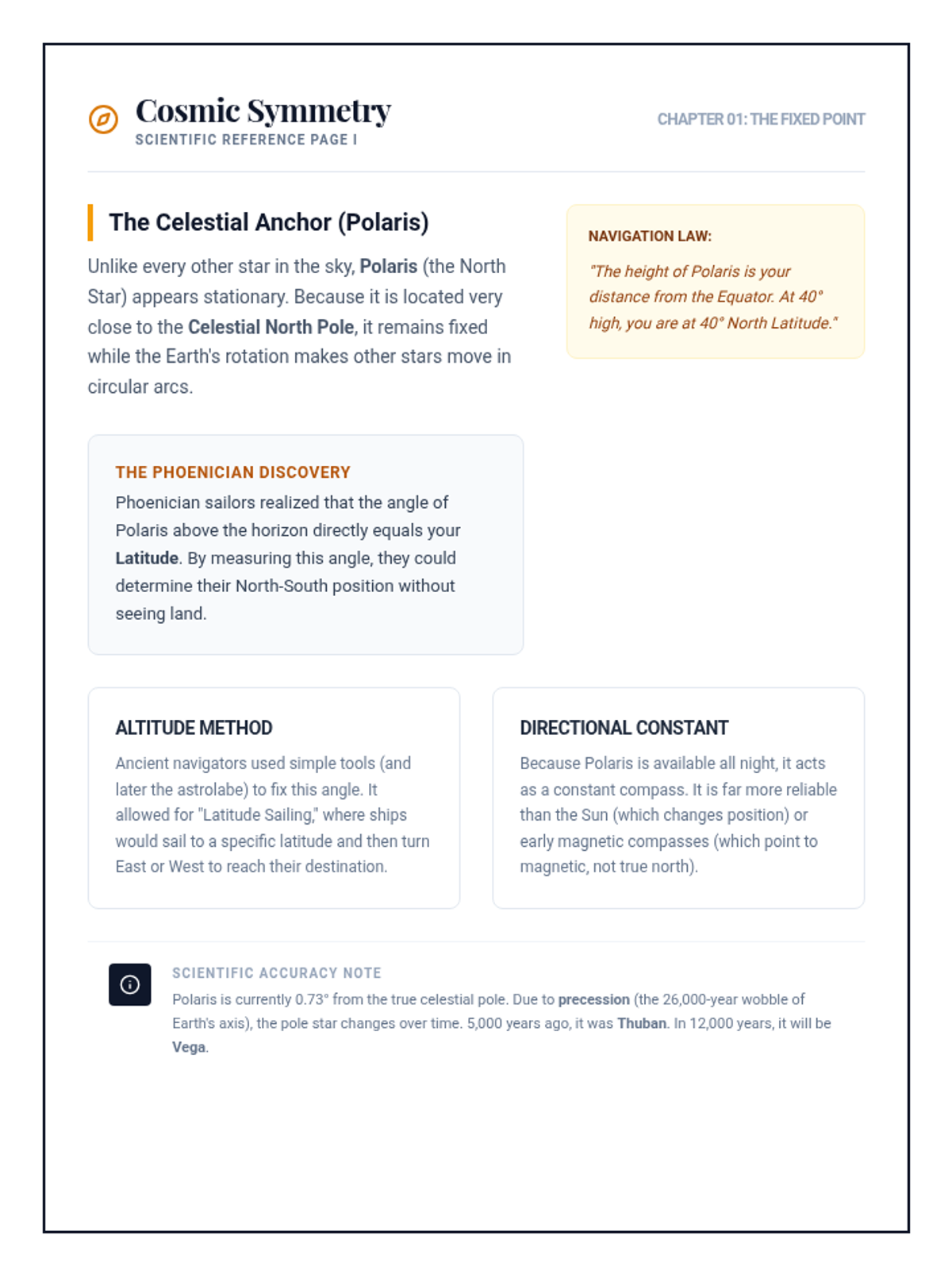
A two-page reference sheet covering the North Star (Polaris) as a navigation tool on page one, and the concepts of symmetry and scale (Microcosm/Macrocosm) in nature on page two. Updated for scientific accuracy and refactored for standard portrait format with small, professional font sizes.
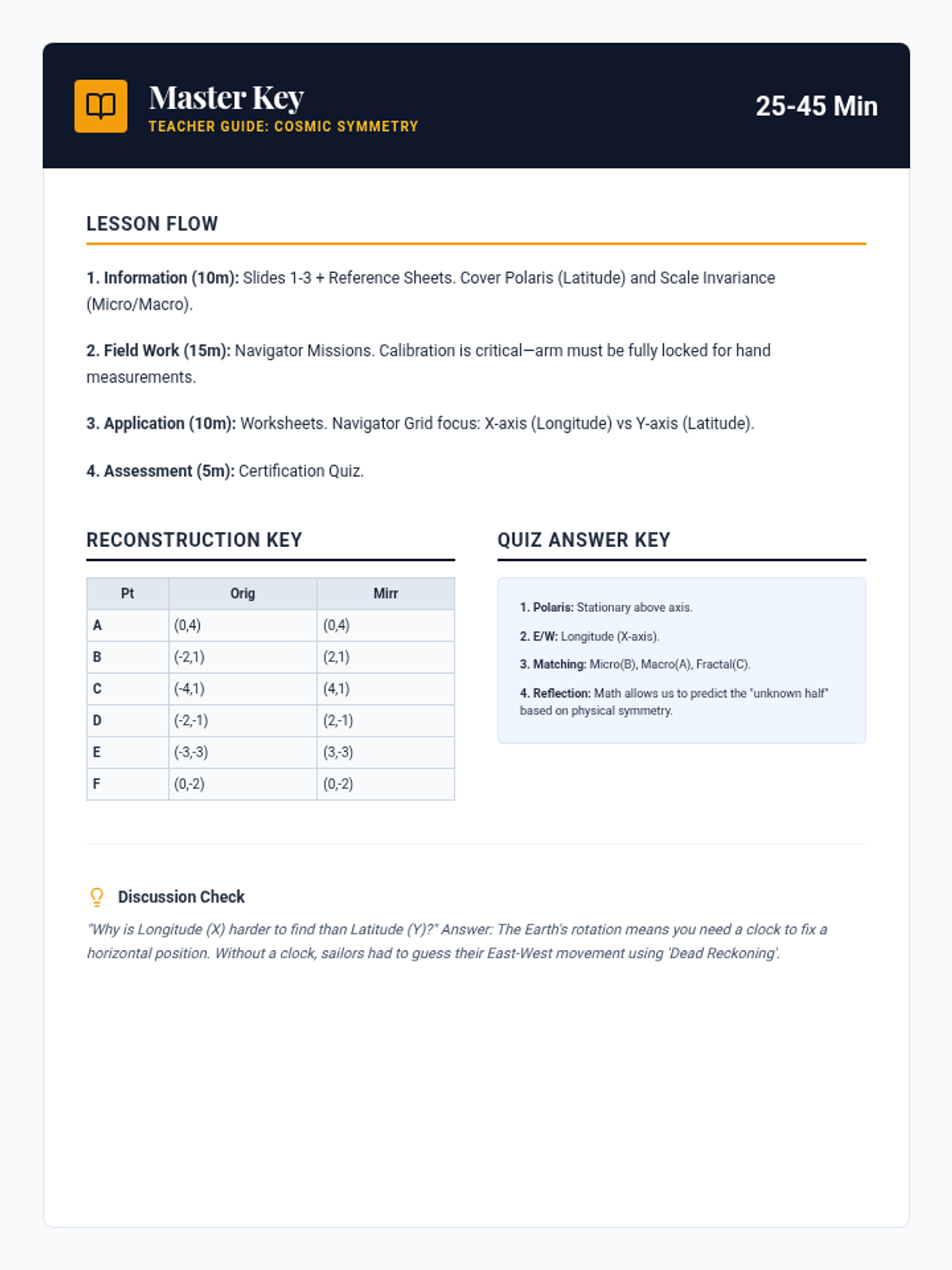
A teacher guide providing a 15-minute pacing plan, discussion script, and answer key for the Cosmic Symmetry lesson. Updated for scientific accuracy regarding precession and terminology. Standard portrait format.
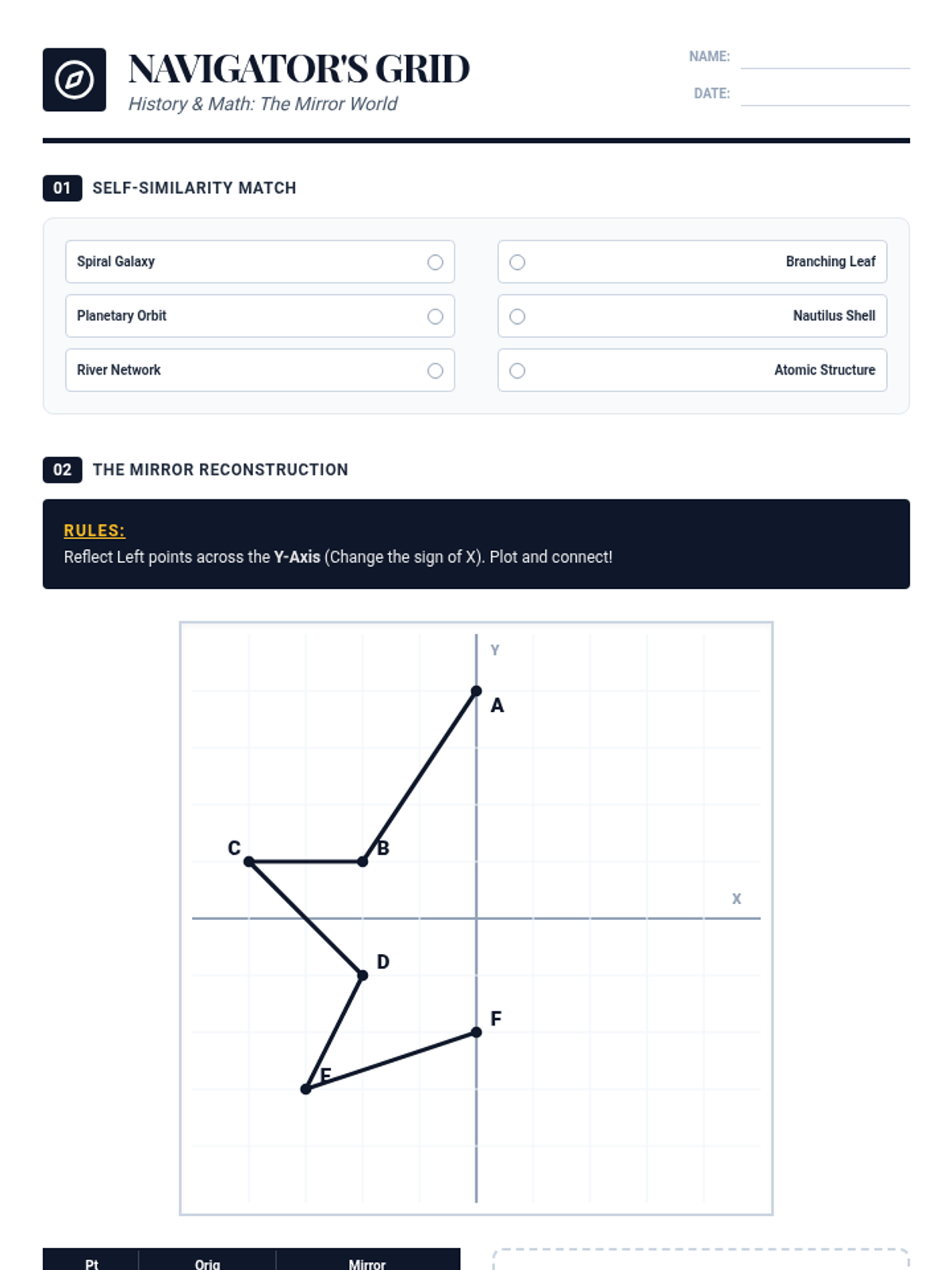
A student worksheet focused on identifying microcosm/macrocosm patterns and using coordinate symmetry (reflection) to complete a geometric compass rose design. Refactored for standard portrait format with an added 'Mission Break' callout.
A visual slide deck distinguishing between the North Star (fixed points) and Nature's Symmetry (repeating patterns) as tools for ancient navigation, now updated with integrated 'Mission Break' slides to signal field work timing.
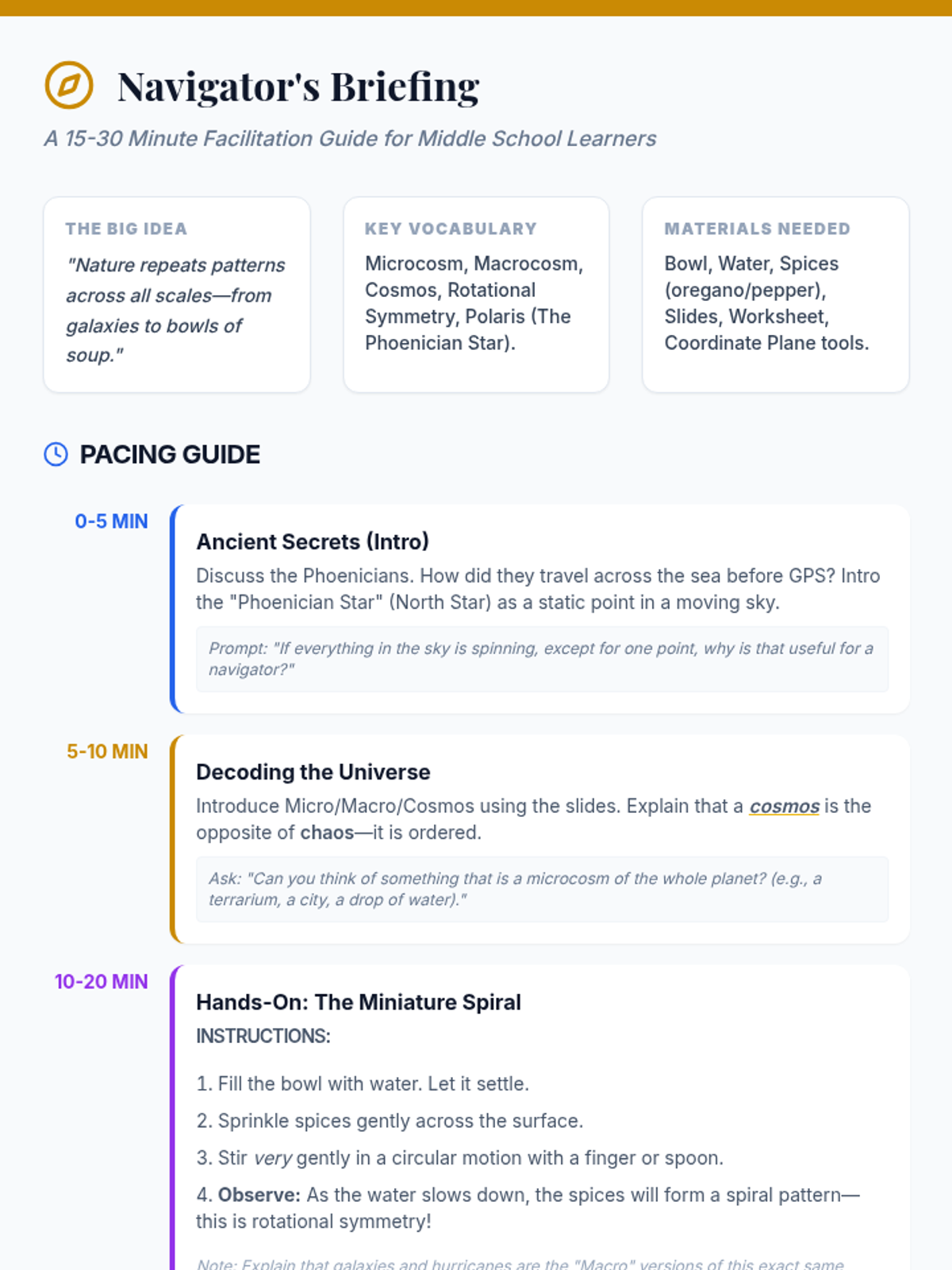
A teacher-facing lesson guide with pacing, hands-on activity instructions, discussion prompts, and key concepts for the 15-30 minute Cosmic Compass lesson. Redesigned with a modern star chart aesthetic.
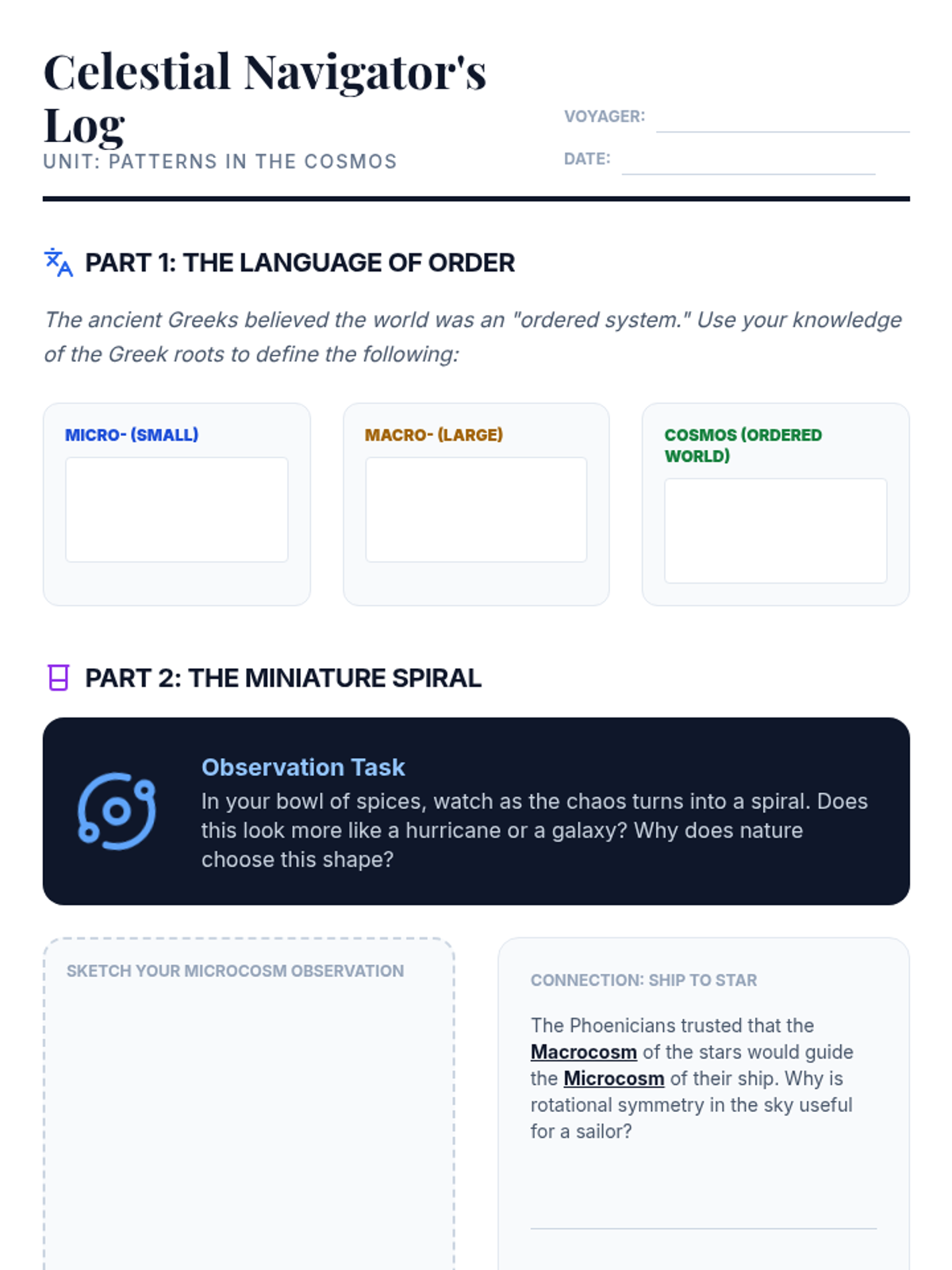
A three-page student resource featuring 'The Navigator's Codex' (informational text) and a two-part 'Blueprint Analysis' (interactive worksheet). Covers the historical breakthrough of Polaris, rotational symmetry in nature and navigation, Greek root decoding, and mathematical coordinate prediction. Redesigned with a modern star chart aesthetic and updated with the specific 'Why it matters' takeaway requested by the user. Vertical spacing tightened and font sizes adjusted to prevent content overlap.
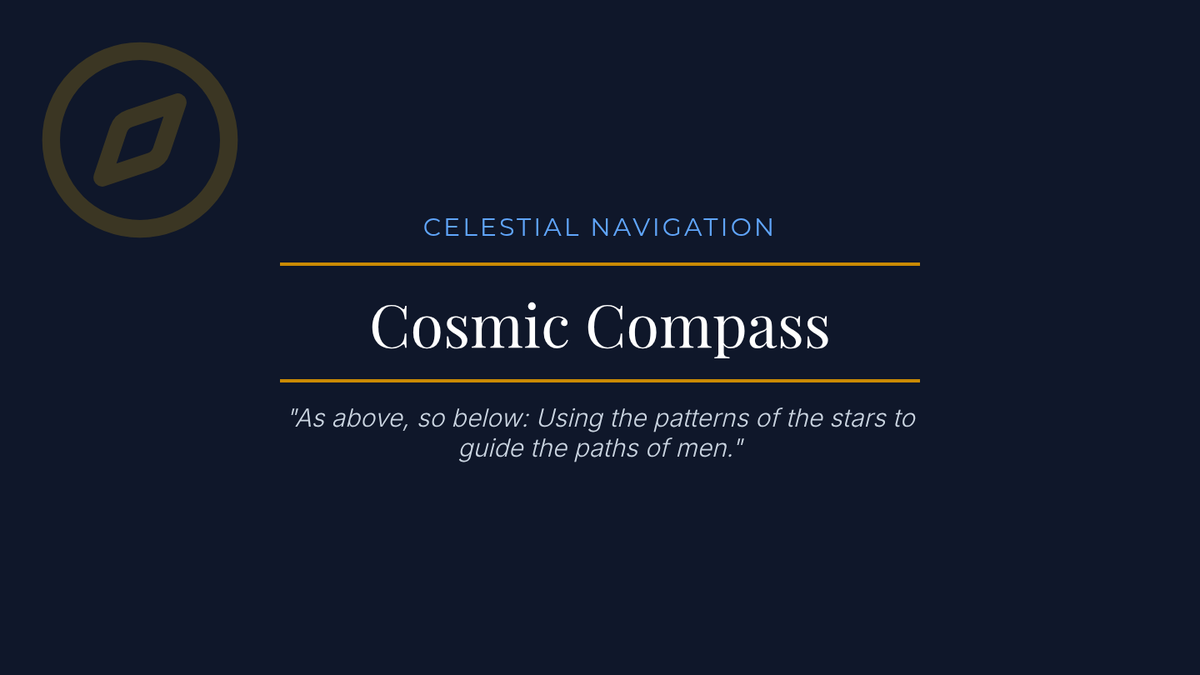
Instructional slides for the 'Cosmic Compass' lesson, redesigned with a modern star chart aesthetic. Features neon accents, geometric layouts, and high-contrast digital motifs to teach the Greek roots micro/macro/cosmos and rotational symmetry. Updated with the specific 'Why it matters' takeaway requested by the user.
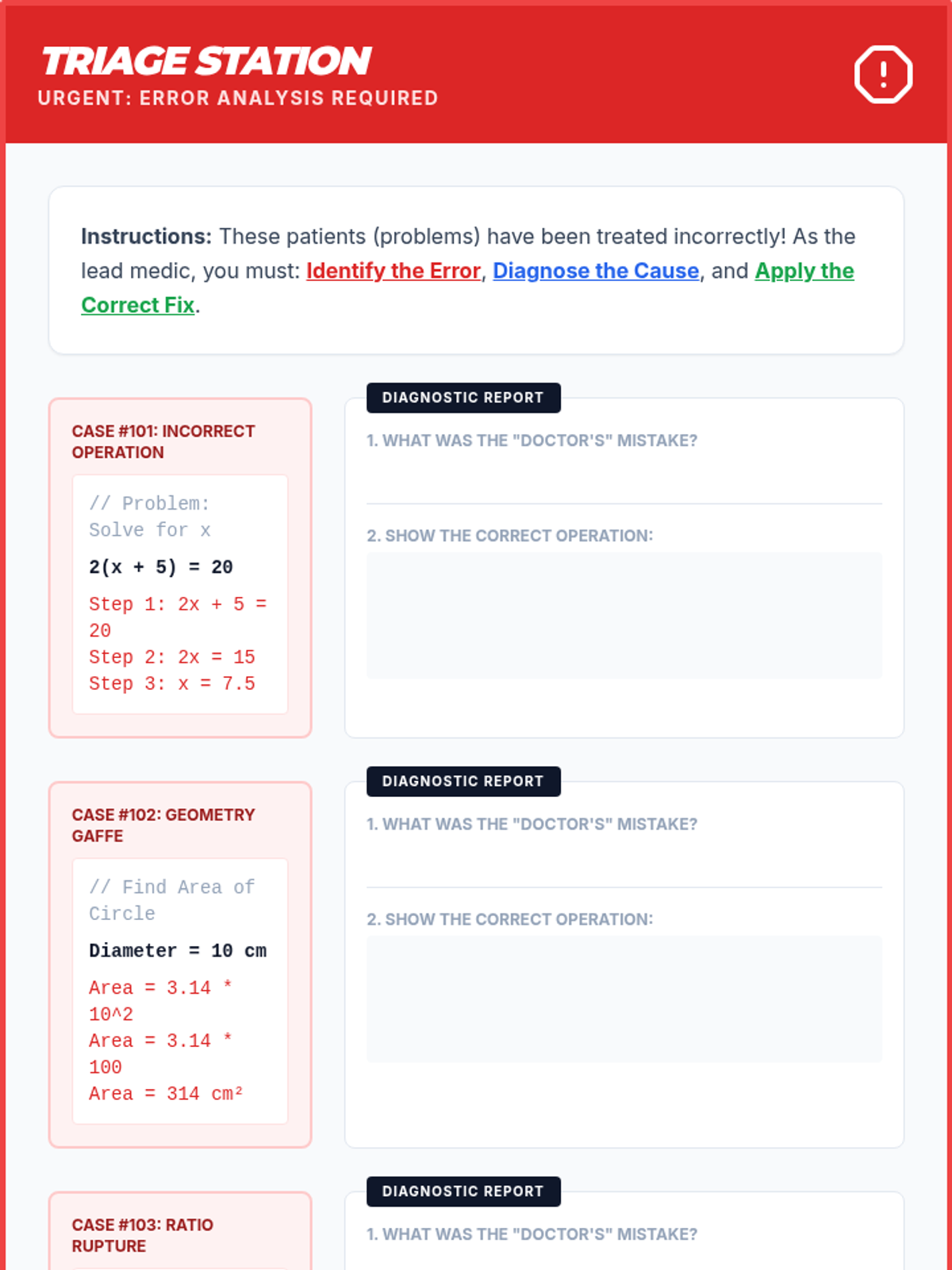
An error-analysis worksheet where students act as medical diagnosticians to find and correct common mathematical mistakes in algebra, geometry, and proportional reasoning.
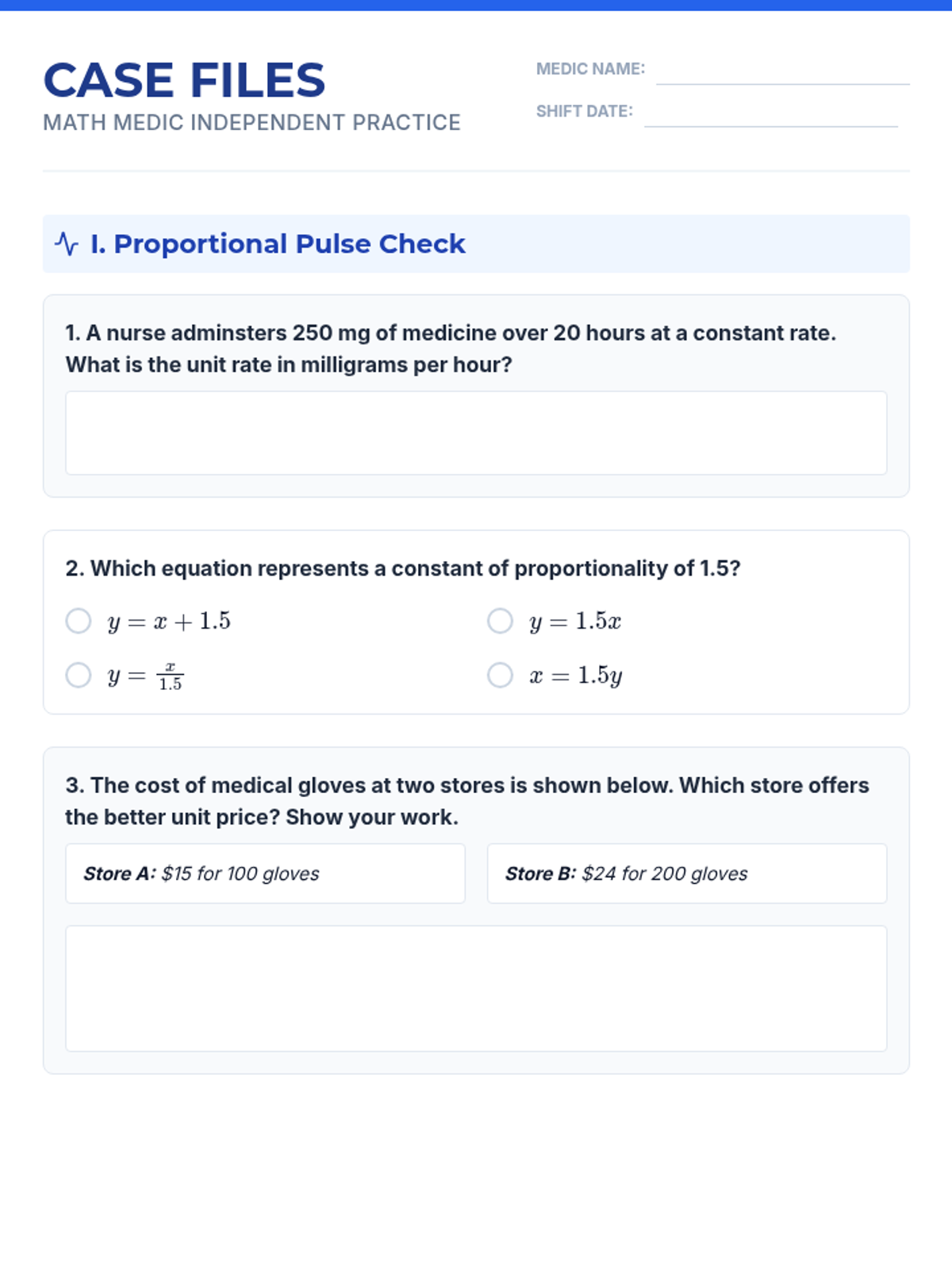
The student practice packet for the Math Medics review, containing real-world application problems and state-assessment style items for proportional relationships, equations, and geometry. Includes ample workspace for calculations.
An engaging, high-energy slide deck for a 50-minute middle school math review, featuring a medical clinic theme with segments on proportions, equations, and geometry formulas.
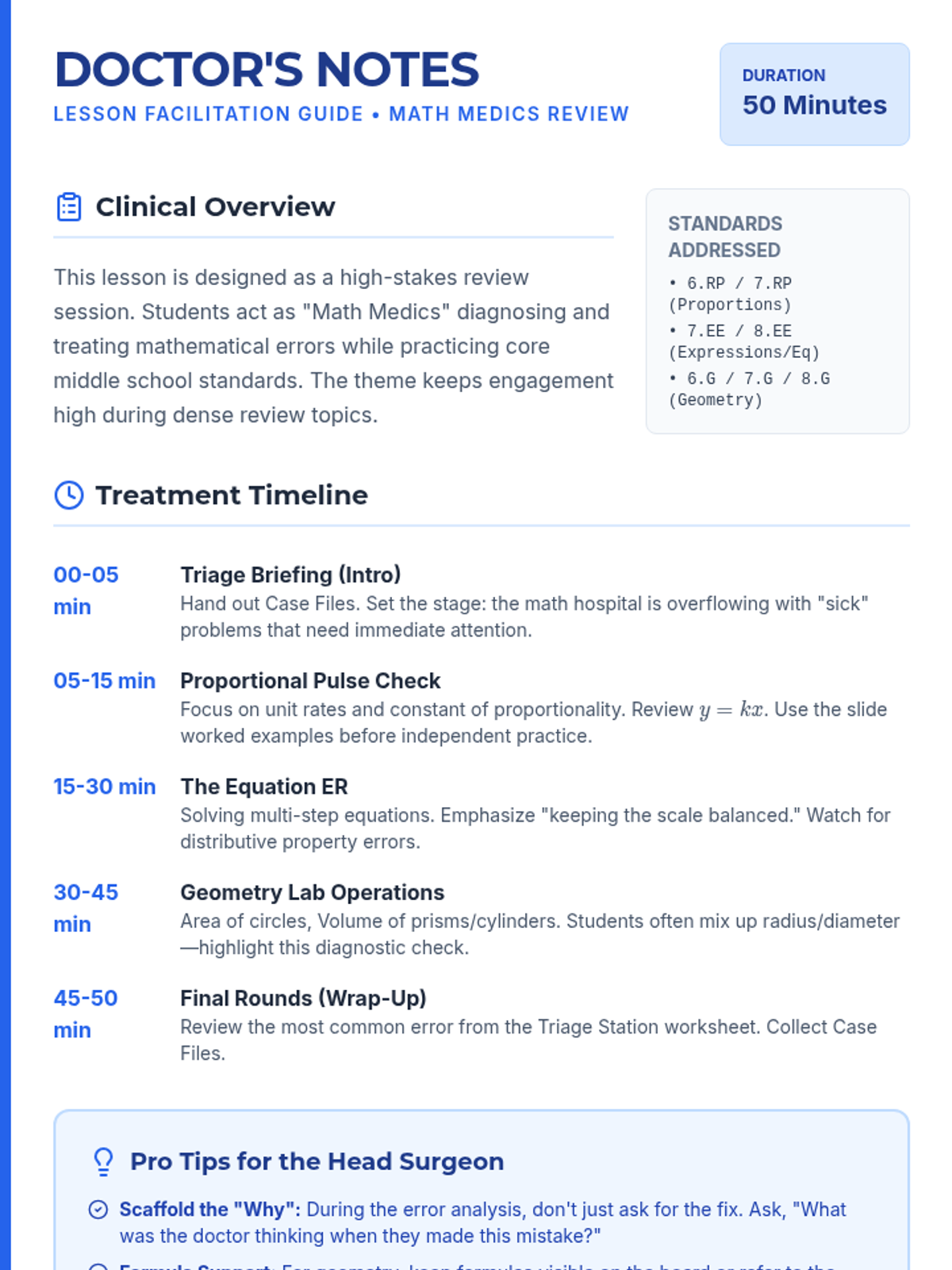
A comprehensive teacher facilitation guide and answer key for the Math Medics review lesson, including a 50-minute pacing guide, instructional tips, and detailed solutions for all student activities.
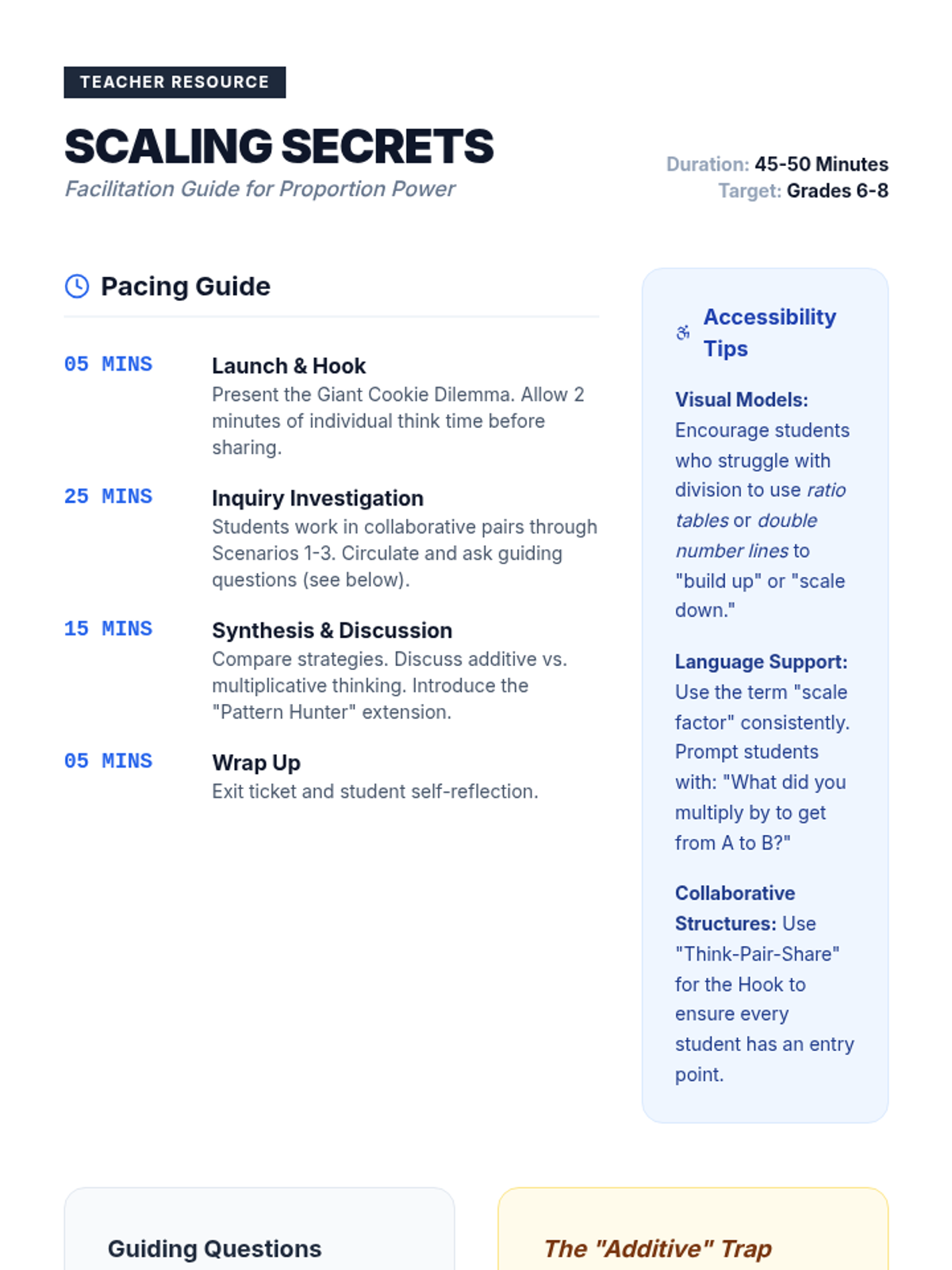
A comprehensive facilitator's guide for teachers. Includes a 50-minute pacing guide, specific scaffolding tips for accessibility, a detailed answer key with multiple solution pathways, and strategies for addressing common misconceptions like additive thinking.
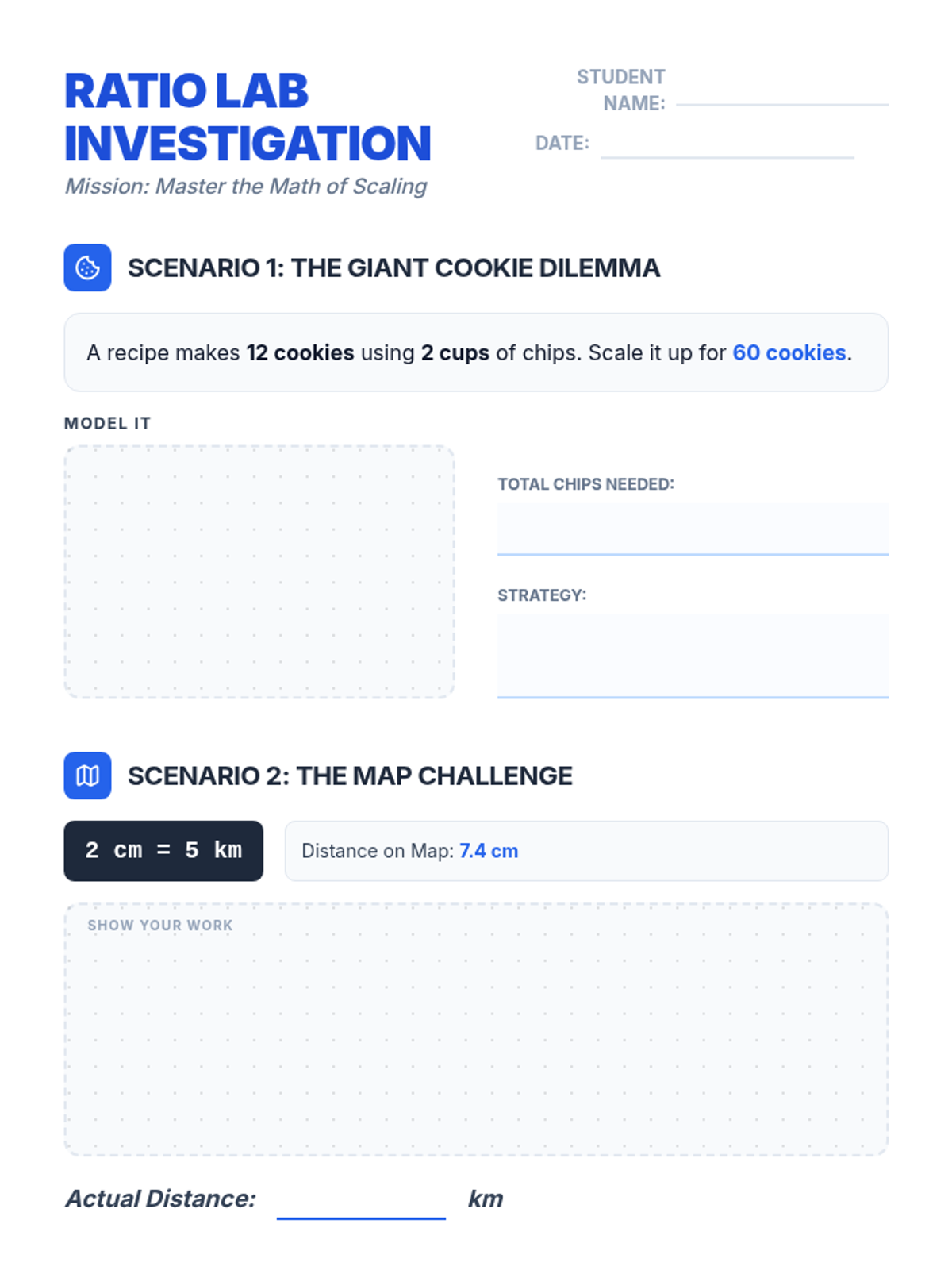
A comprehensive inquiry packet for students to explore proportional reasoning through three real-world scenarios. Includes ample workspace with grid backgrounds and a "Level Up" extension for algebraic thinking. Layout optimized for 8.5x11 printing.
A high-impact slide deck for teaching proportional reasoning. Includes real-world scenarios for mapping, budgeting, and recipe scaling, featuring visual models like ratio tables and tape diagrams. All text is optimized for presentation visibility (minimum 24px).
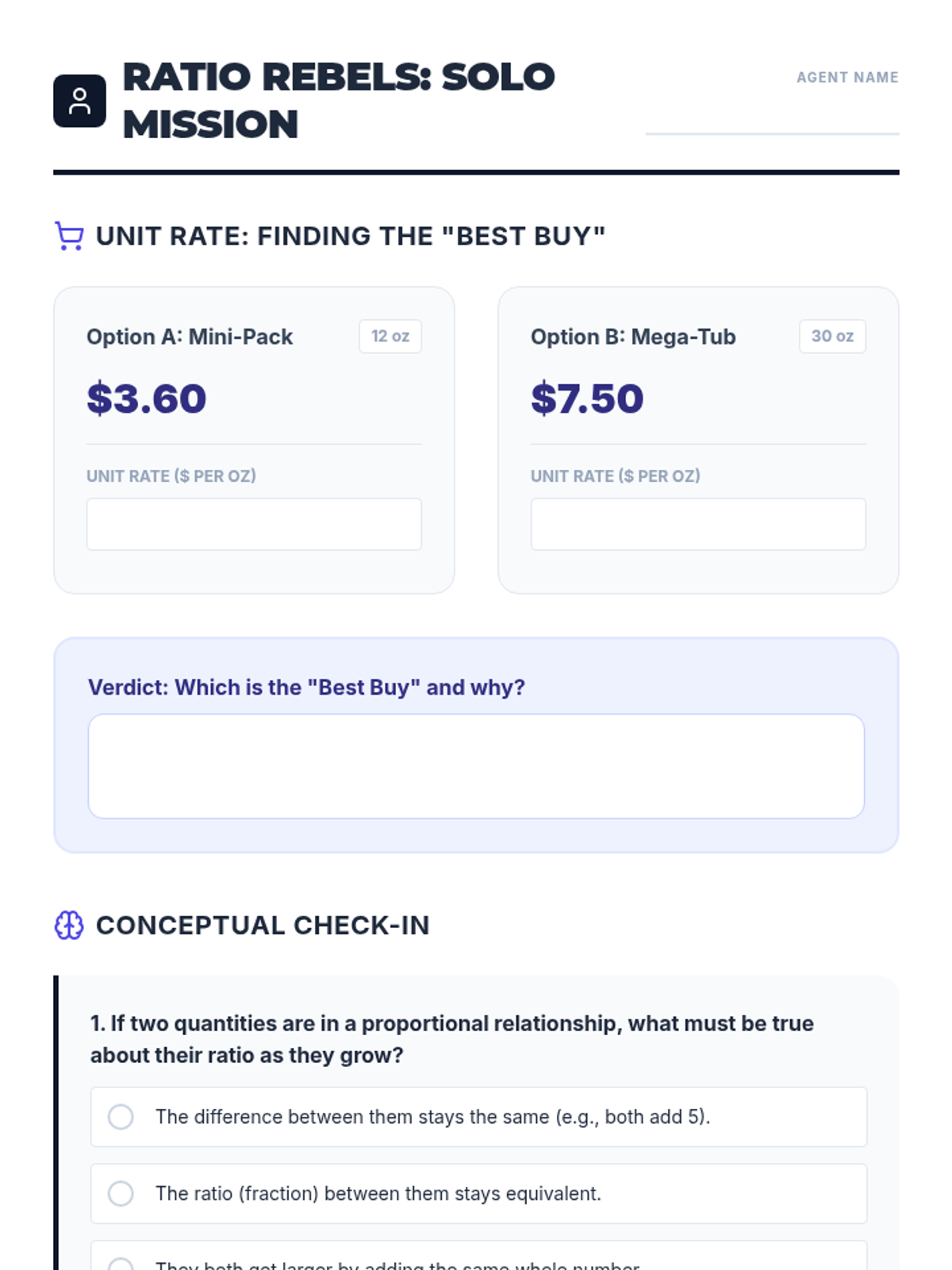
An individual practice sheet and exit ticket for students to demonstrate mastery of unit rates and conceptual understanding of proportional relationships.
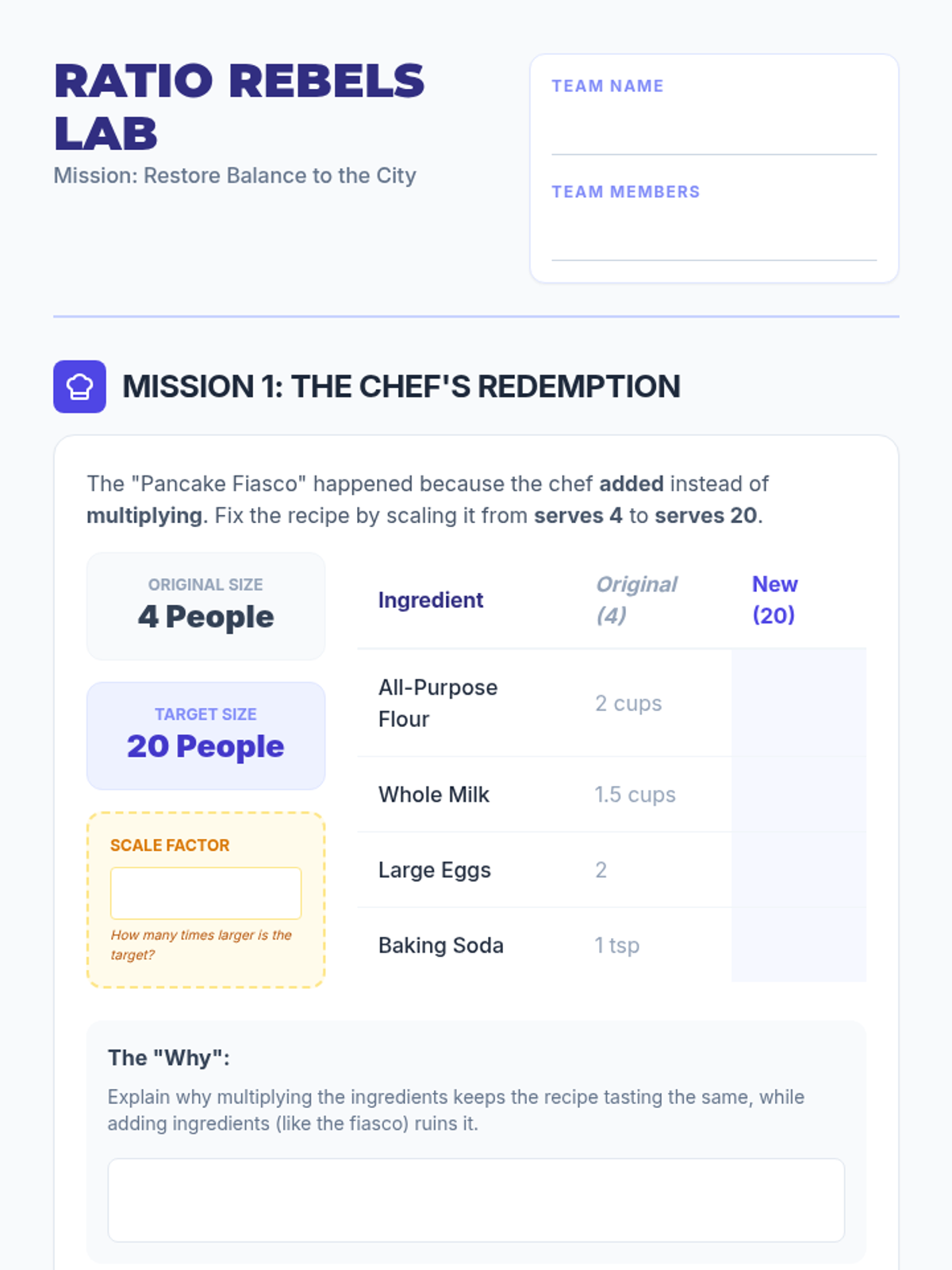
A collaborative lab sheet where students work in teams to fix a scaled recipe and navigate a map using proportional reasoning and scale factors.
A visually engaging slide deck to launch the lesson, featuring the 'Pancake Fiasco' hook and introducing the core concepts of recipe scaling, map reading, and unit rates.
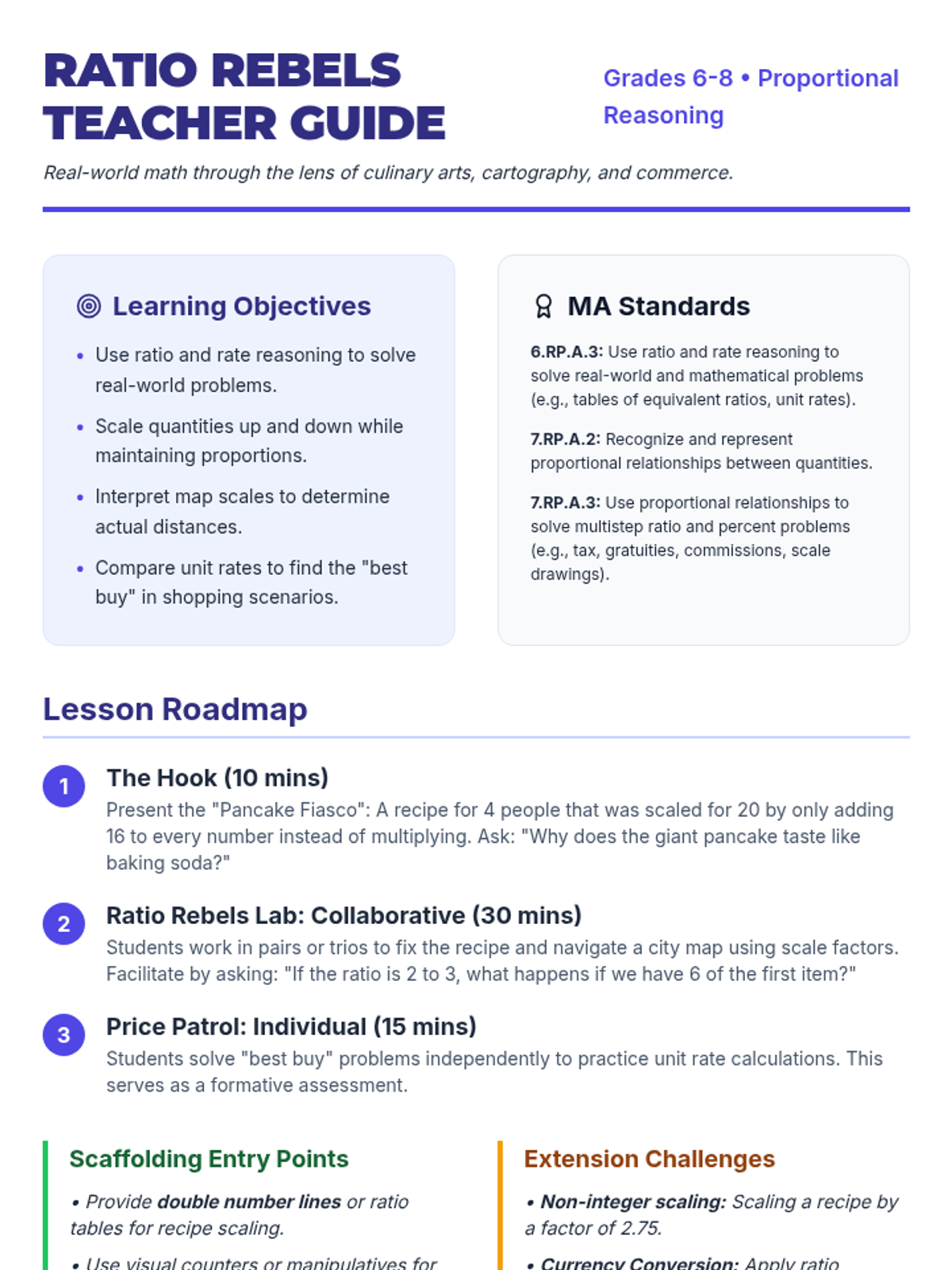
A comprehensive teacher guide for the Ratio Rebels lesson, featuring MA standards, learning objectives, scaffolding strategies, extension challenges, and a quick answer key.
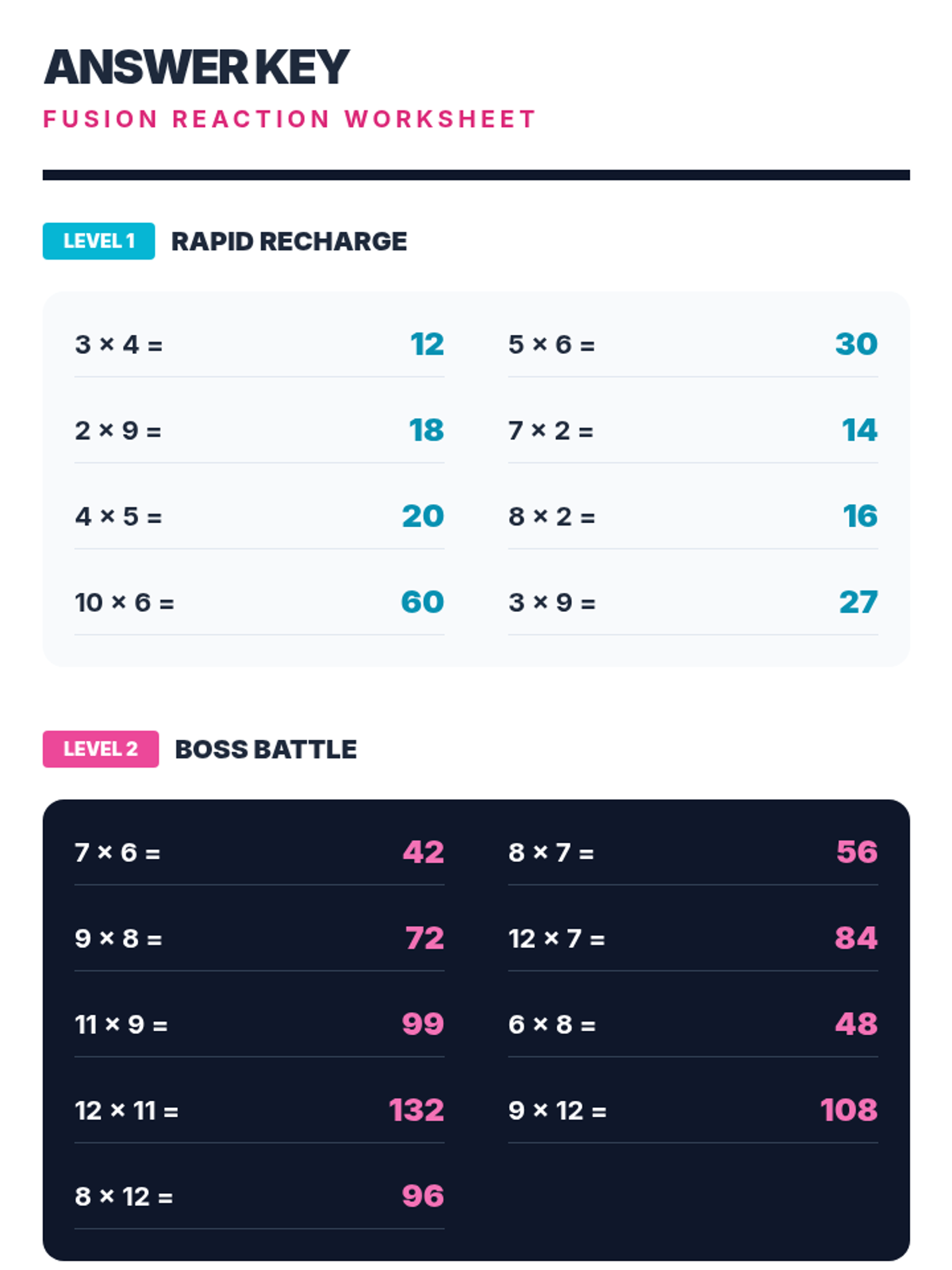
A teacher-facing answer key for the 'Fusion Reaction' worksheet, including a quick-reference strategy guide for grading reflection responses.
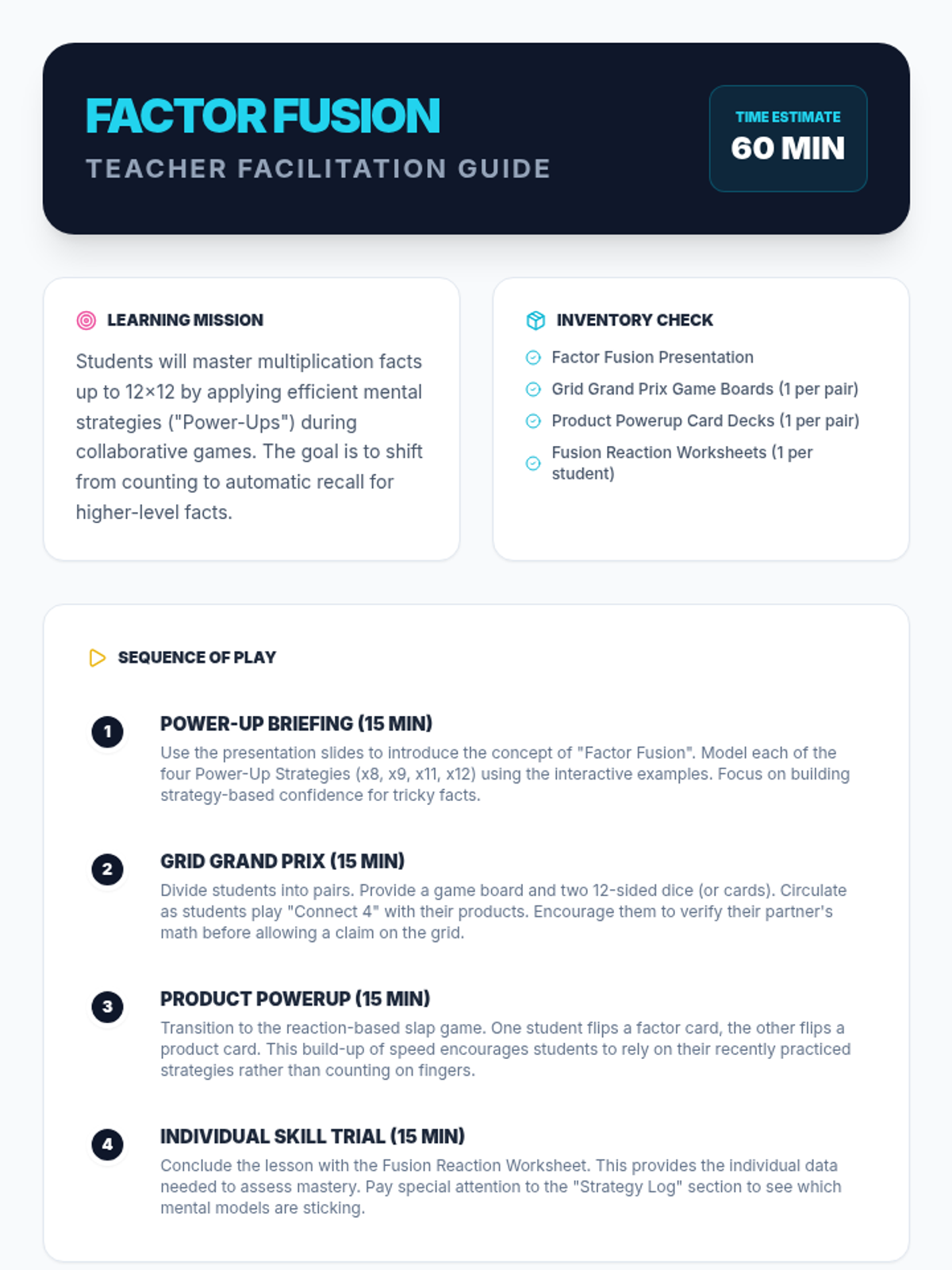
A comprehensive guide for teachers on facilitating the 'Factor Fusion' lesson. Includes time estimates, lesson sequence, game rules, and tips for addressing common multiplication misconceptions.
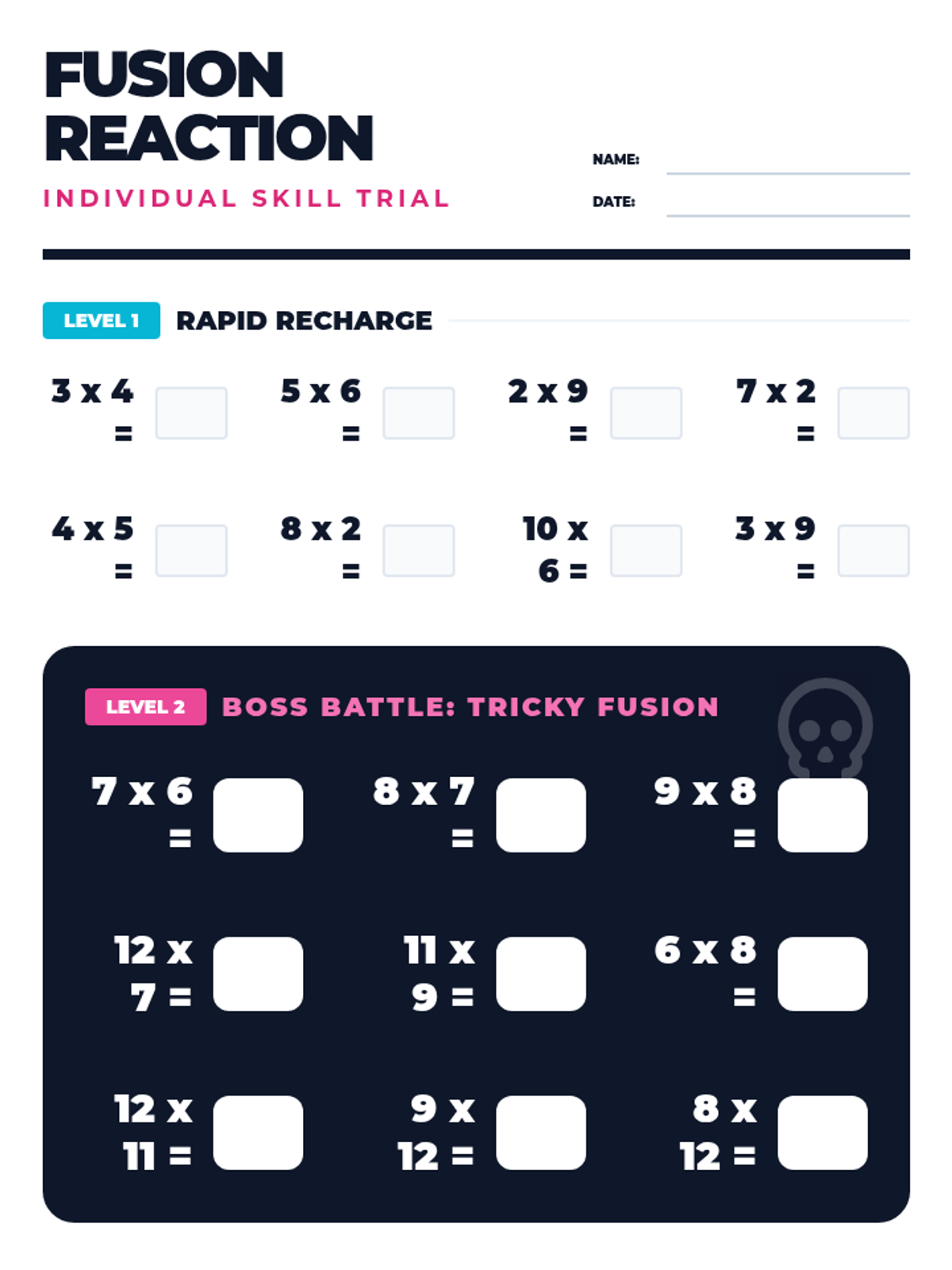
An arcade-themed multiplication worksheet with tiered difficulty levels and a strategy reflection section. Encourages students to apply multiplication 'power-up' strategies to solve tricky facts.
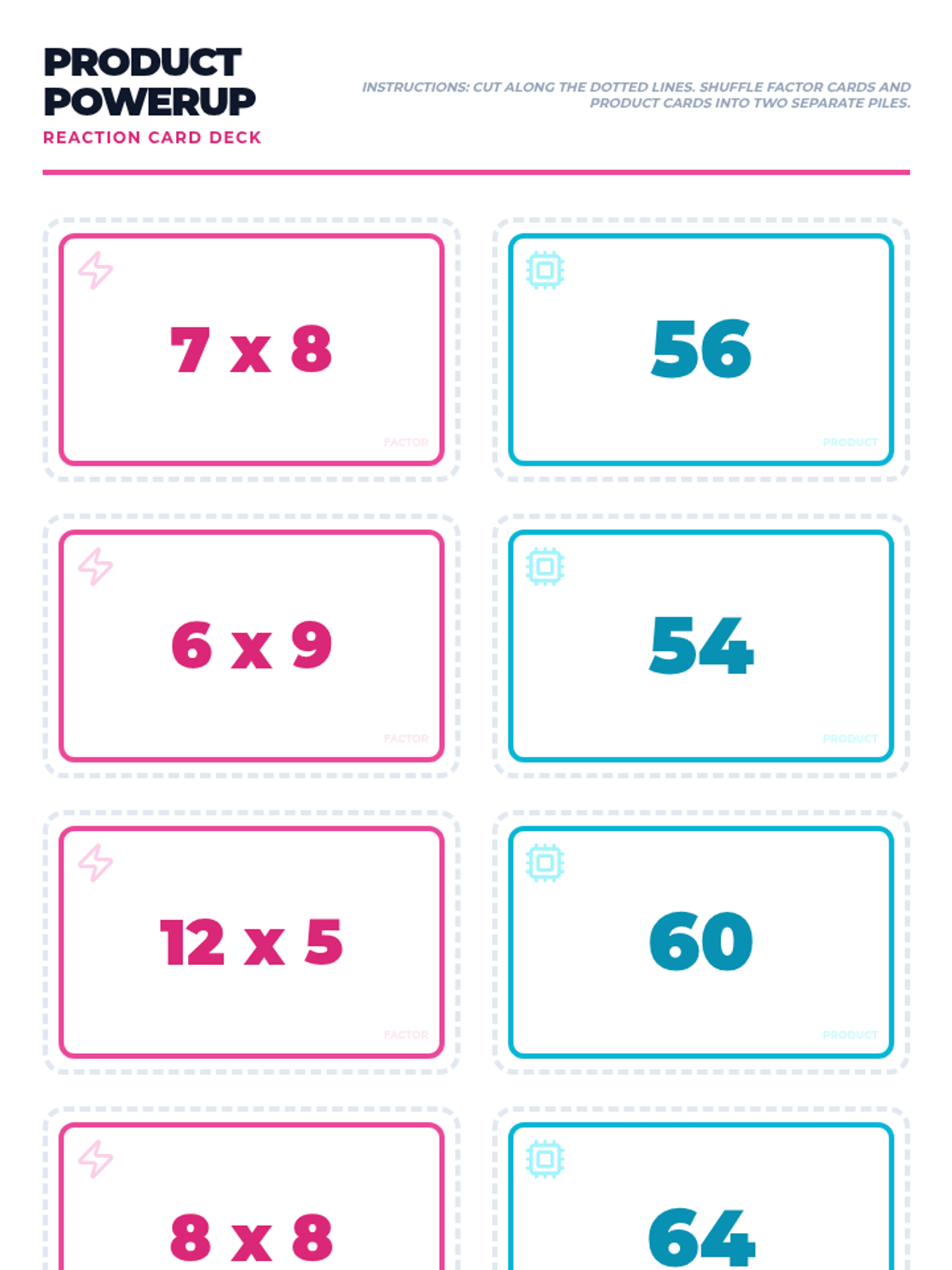
An expanded set of 24 printable Factor and Product cards (12 pairs) for the 'Product Powerup' game, featuring tricky facts up to 12x12. Cards are color-coded for factors (pink) and products (cyan).
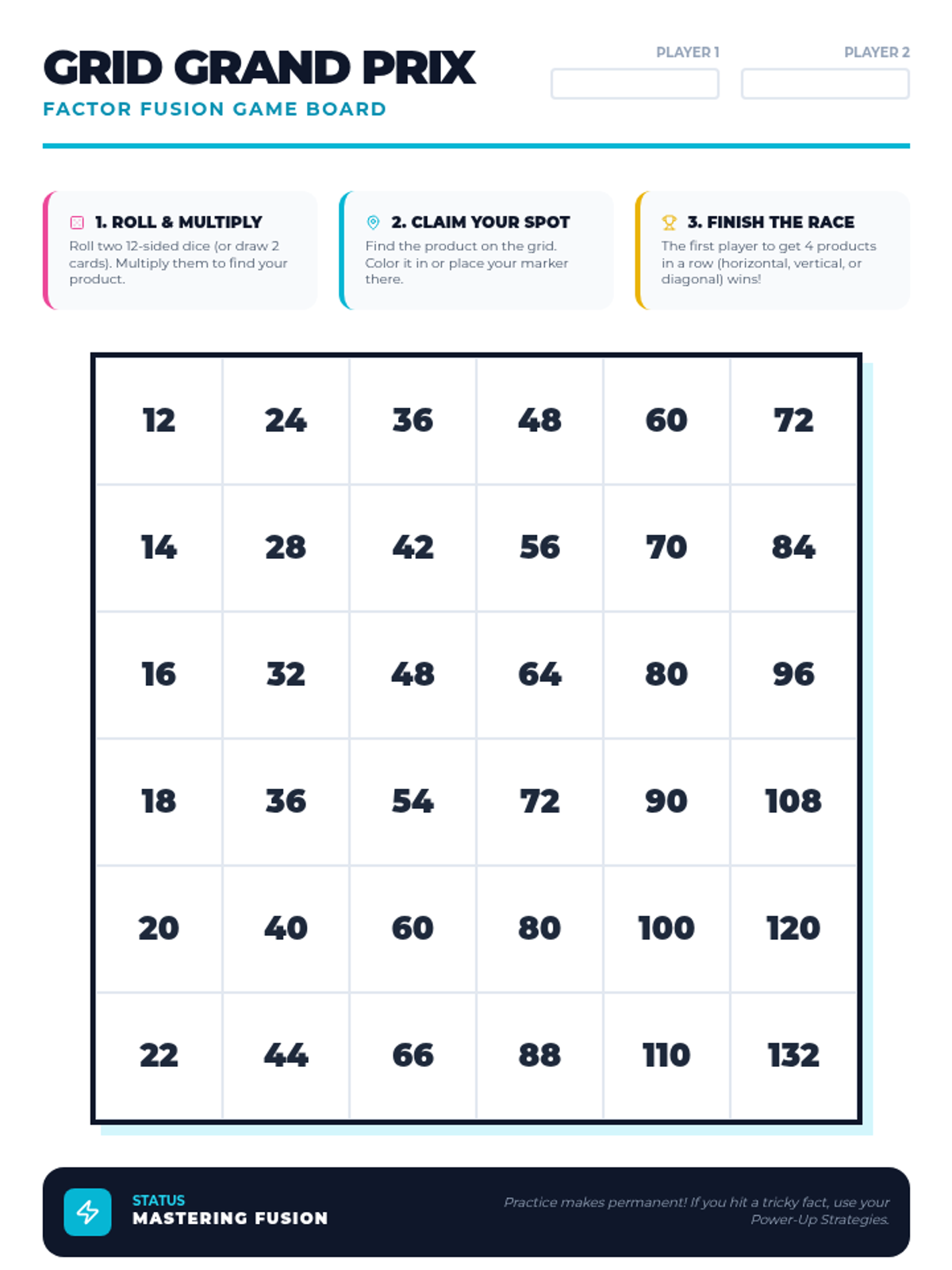
A printable 6x6 game board for 'Grid Grand Prix'. Students roll two dice, multiply the factors, and claim products on the grid to connect four in a row.
An arcade-themed slide deck with increased font sizes and improved layout for better visibility. Introduces 'Factor Fusion', teaching strategies for difficult facts and explaining two classroom games.
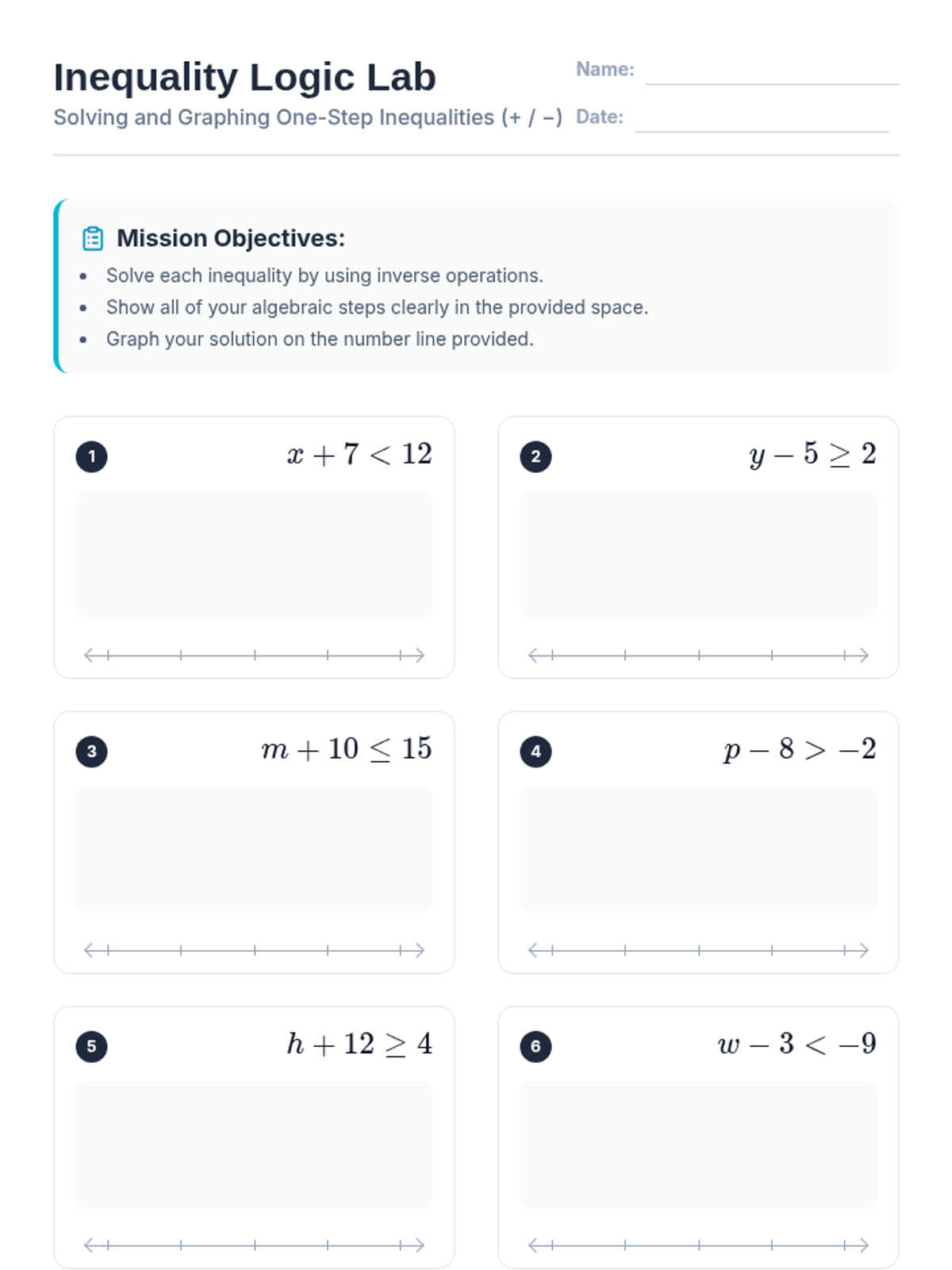
A practice worksheet for solving one-step inequalities using addition and subtraction, featuring 12 problems with space for algebraic work and number line graphing.
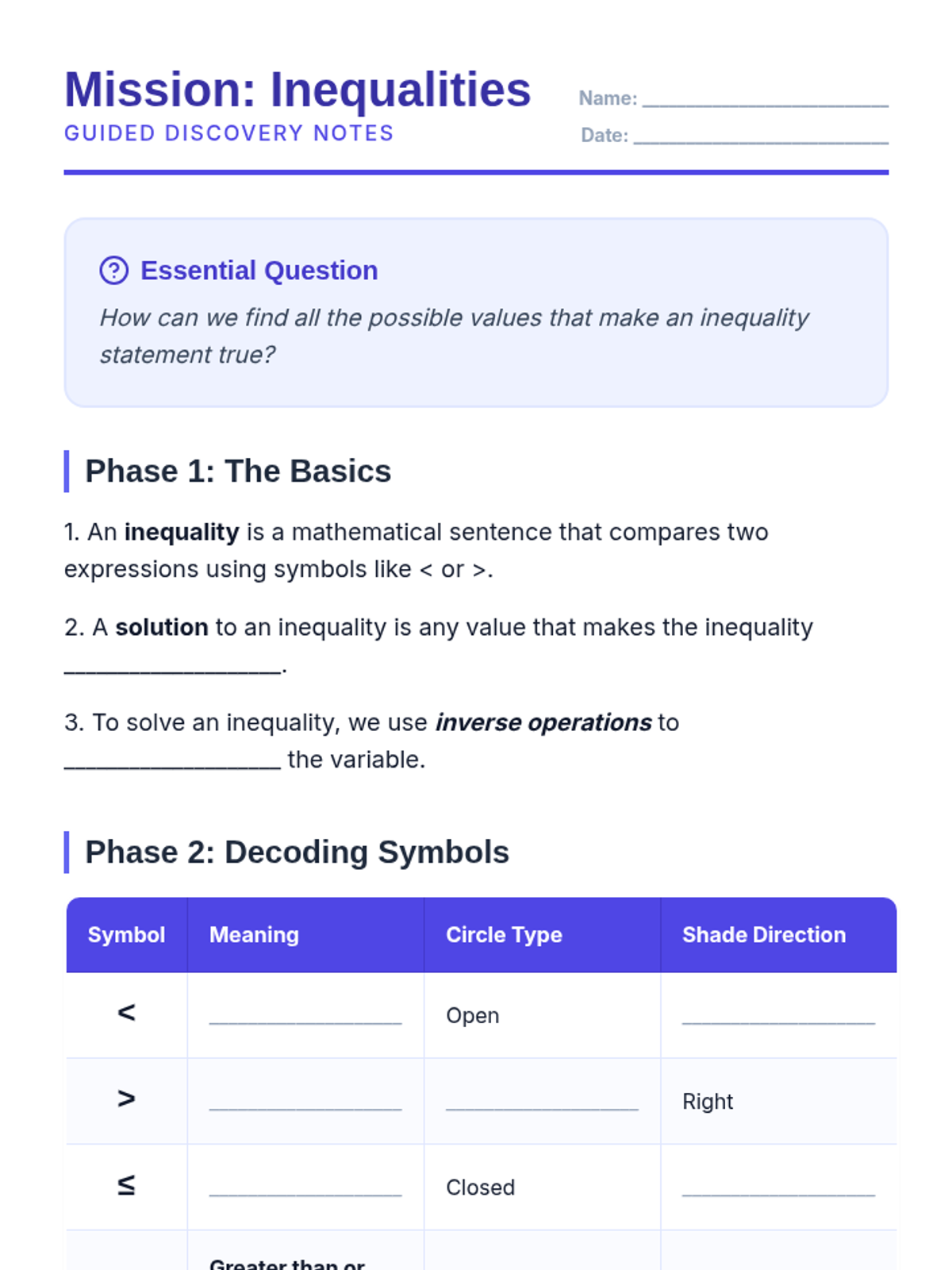
Guided notes for introducing one-step inequalities using addition and subtraction, including vocabulary, a symbol reference table, and worked examples.
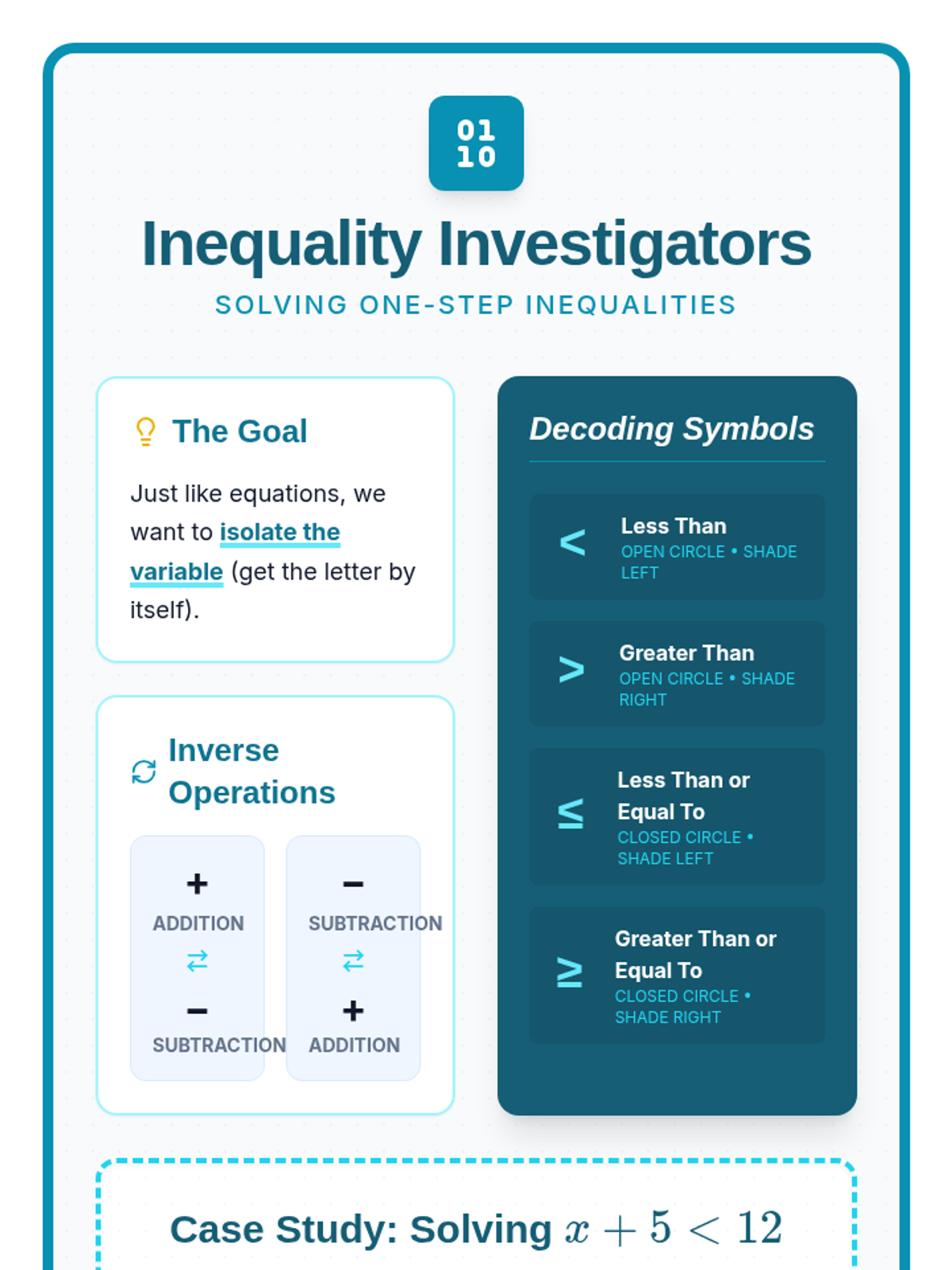
A visually engaging anchor chart for solving one-step inequalities using addition and subtraction, featuring symbol guides and a step-by-step example.
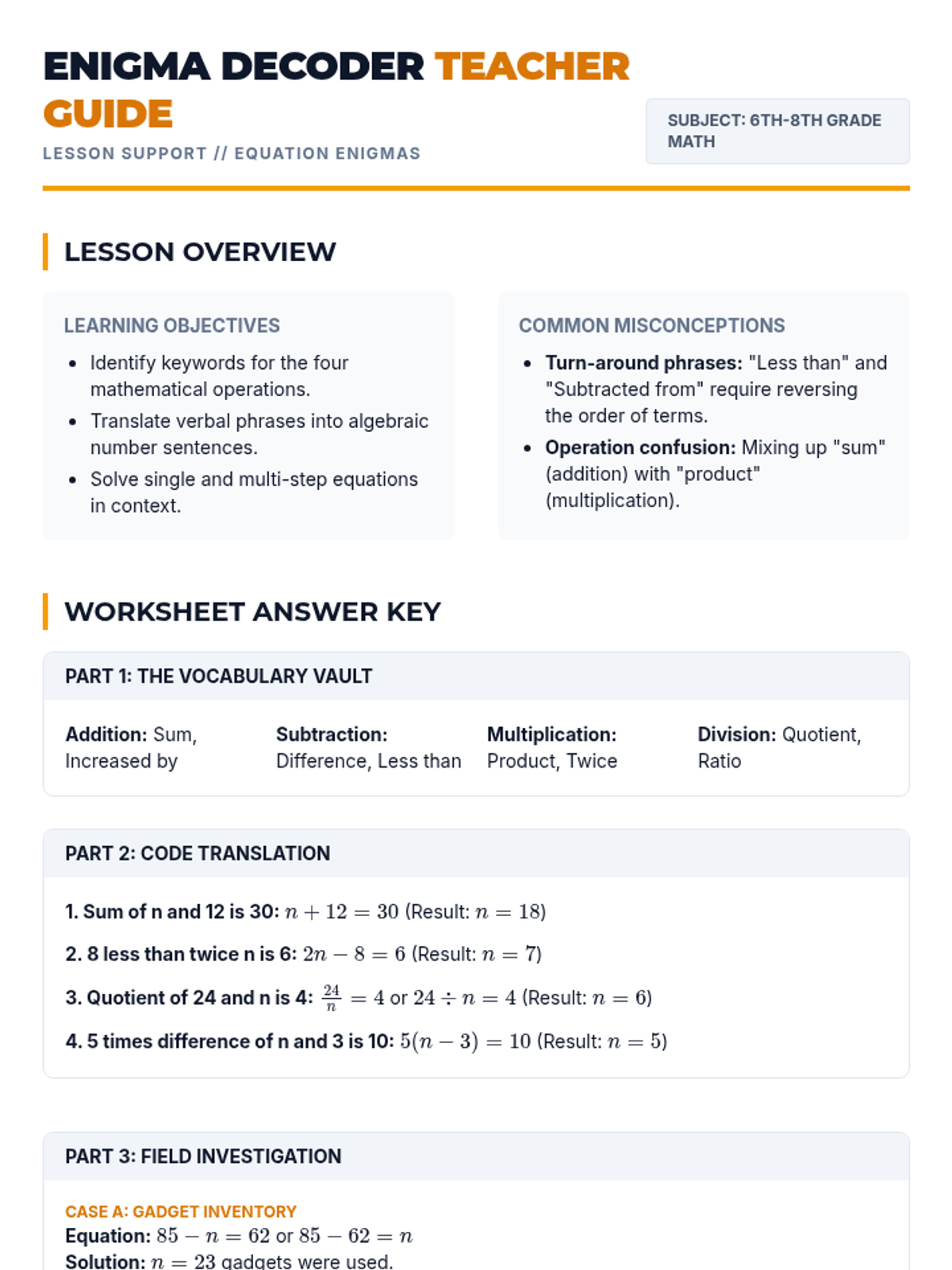
A comprehensive teacher guide for the Equation Enigmas lesson, including learning objectives, common misconceptions, a full answer key, and teaching strategies.
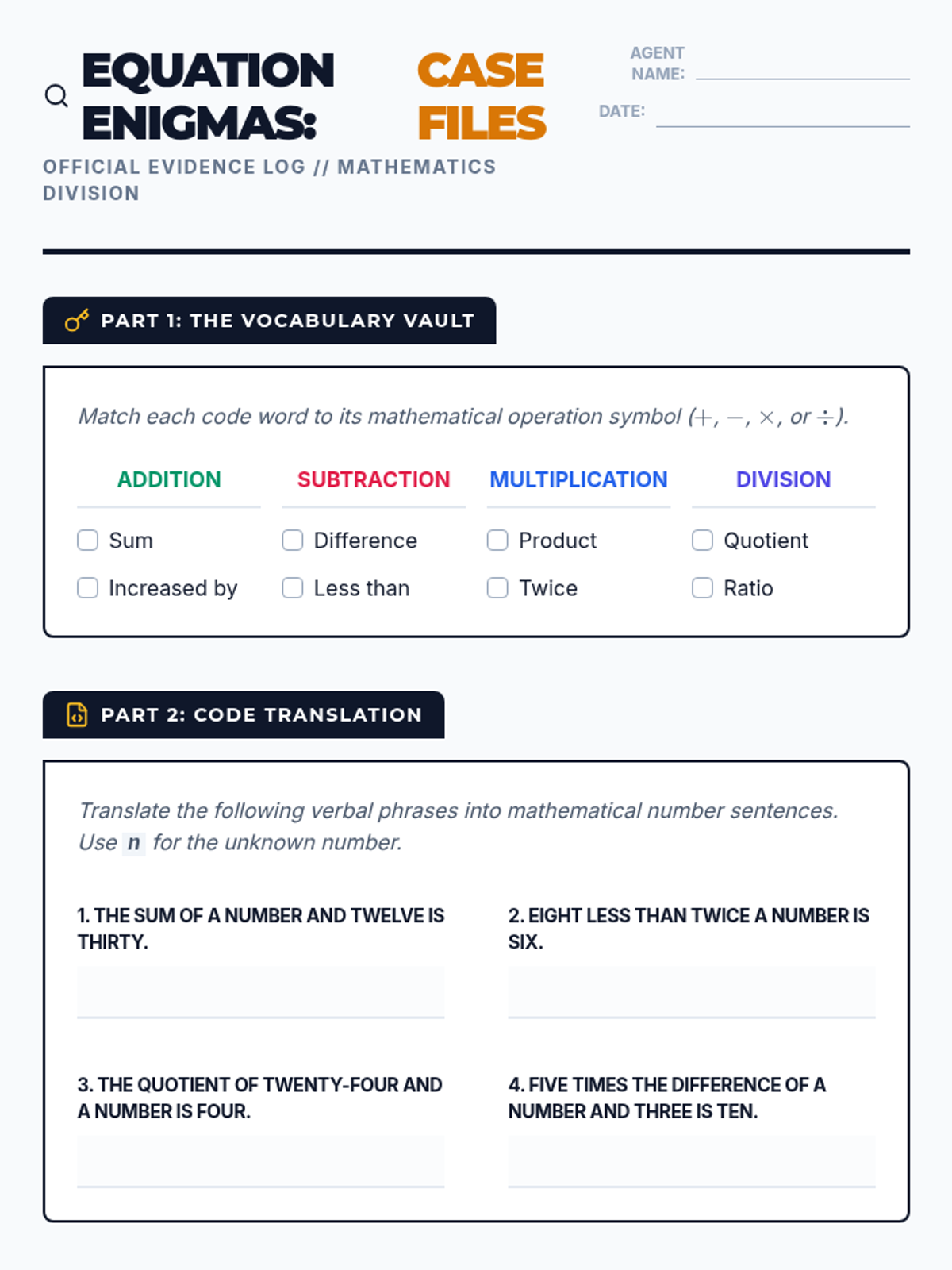
A detective-themed worksheet where students practice matching operation keywords, translating phrases into equations, and solving real-world mathematical mysteries.
An engaging detective-themed slide deck that teaches middle school students how to translate verbal phrases into mathematical number sentences using the four operations.
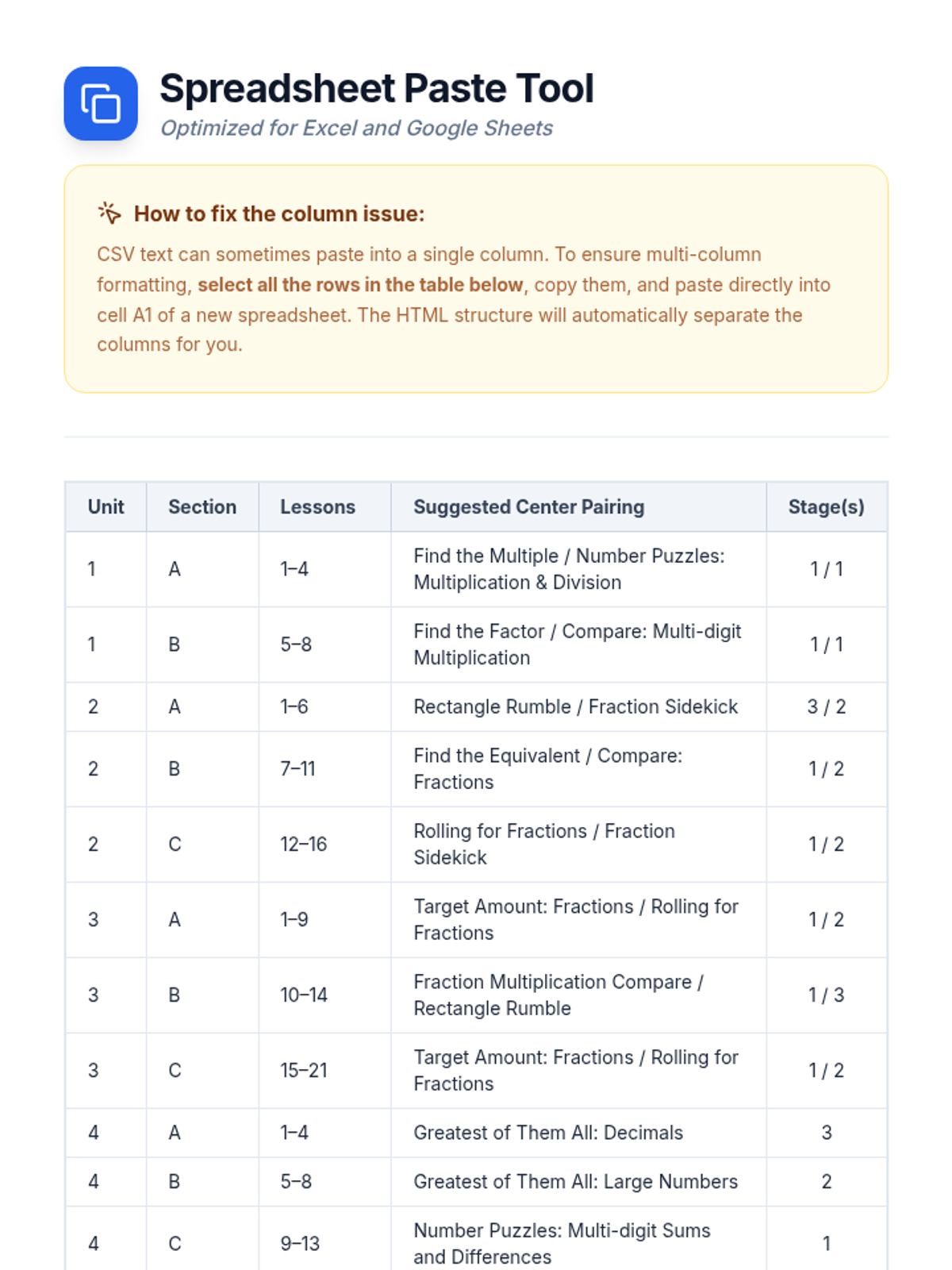
A specialized spreadsheet paste resource containing a clean HTML table of 4th-grade Illustrative Mathematics centers. Optimized for directly copying and pasting into Excel or Google Sheets to ensure all data maps to the correct columns.
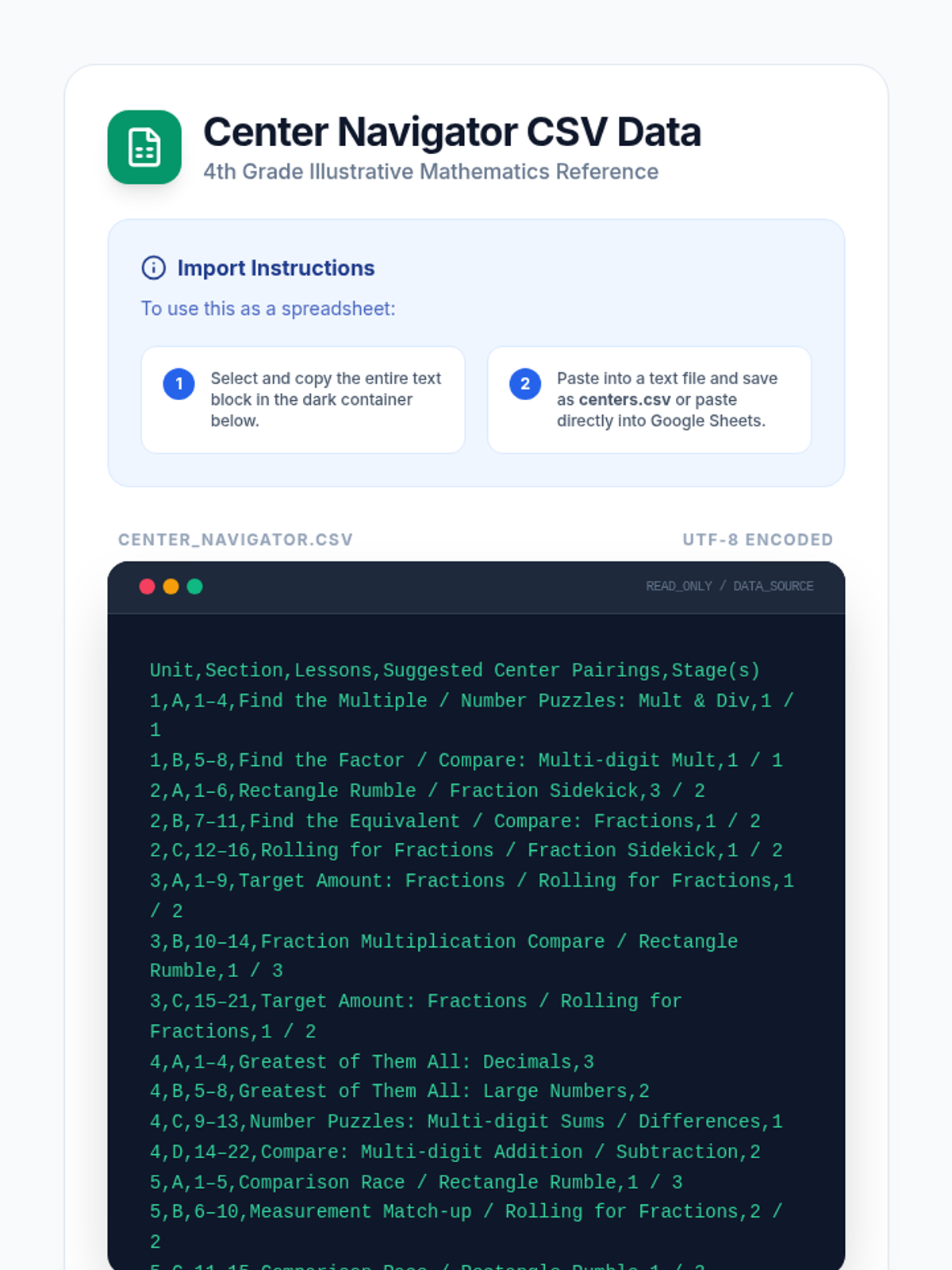
A raw CSV data export for 4th-grade Illustrative Mathematics center planning. Contains structured data for units, sections, lessons, centers, and stages for easy import into spreadsheet software.
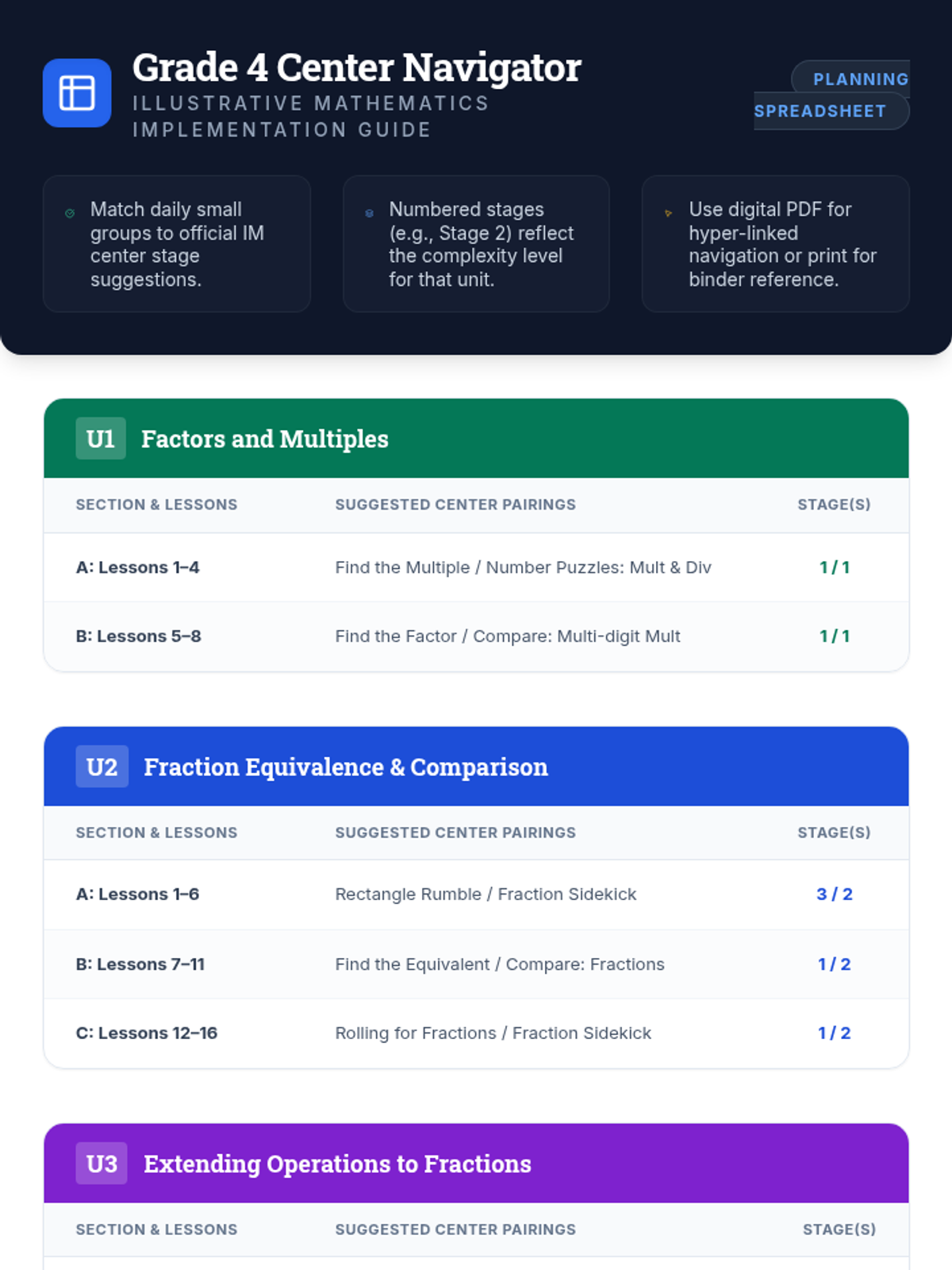
A comprehensive 4th-grade reference guide for Illustrative Mathematics, listing suggested centers and their specific stages for every unit and lesson. Organized by unit and section in a clean, professional table format.
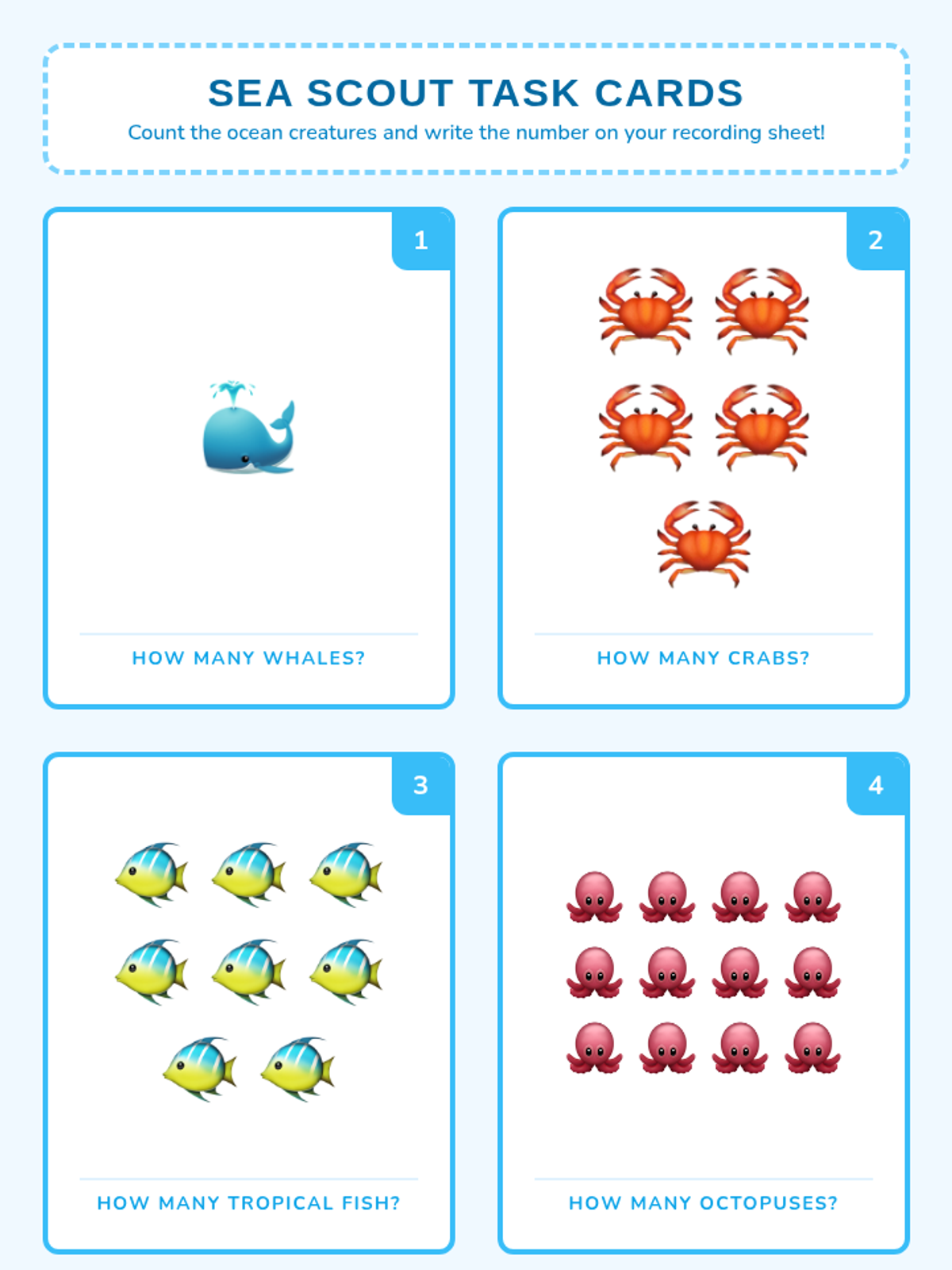
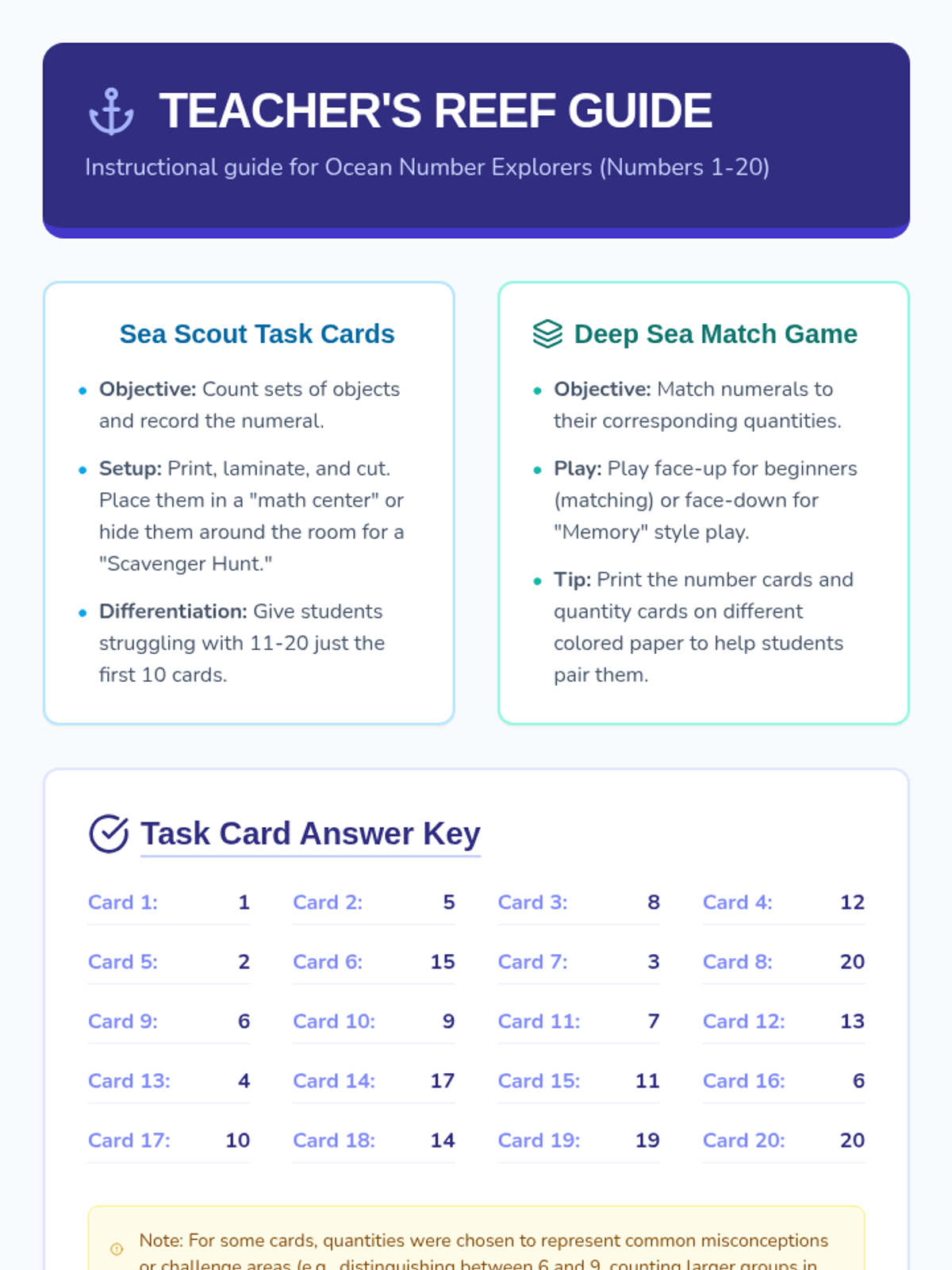
A teacher's guide for the Ocean Number Explorers activities. Includes instructions for use, differentiation strategies, scaffolding prompts, and a full answer key for the Sea Scout Task Cards.
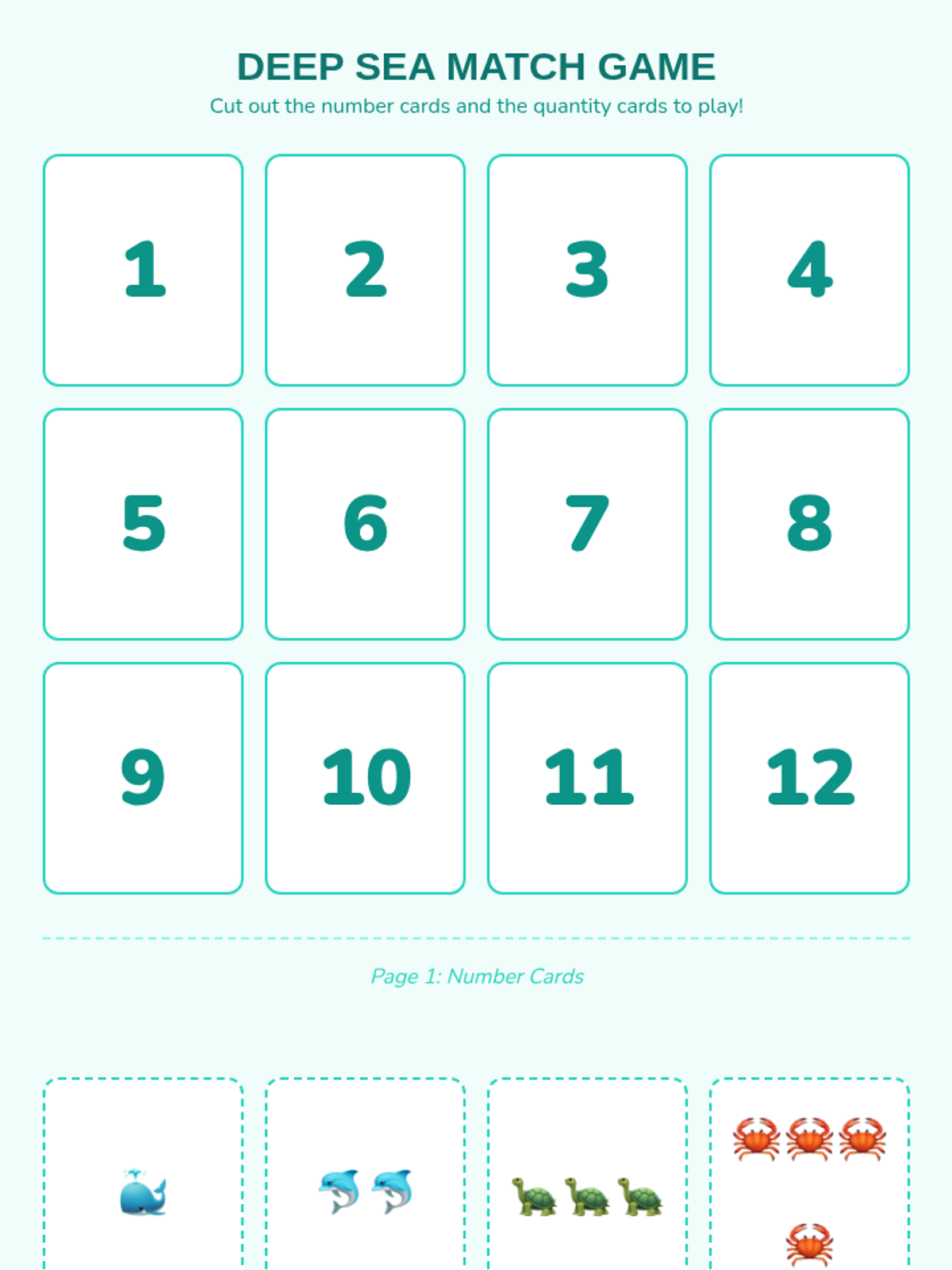
A matching game featuring ocean creatures and numbers 1-20. Includes two sets of cards: one with clear numerals and another with corresponding sets of ocean emojis for students to count and pair.
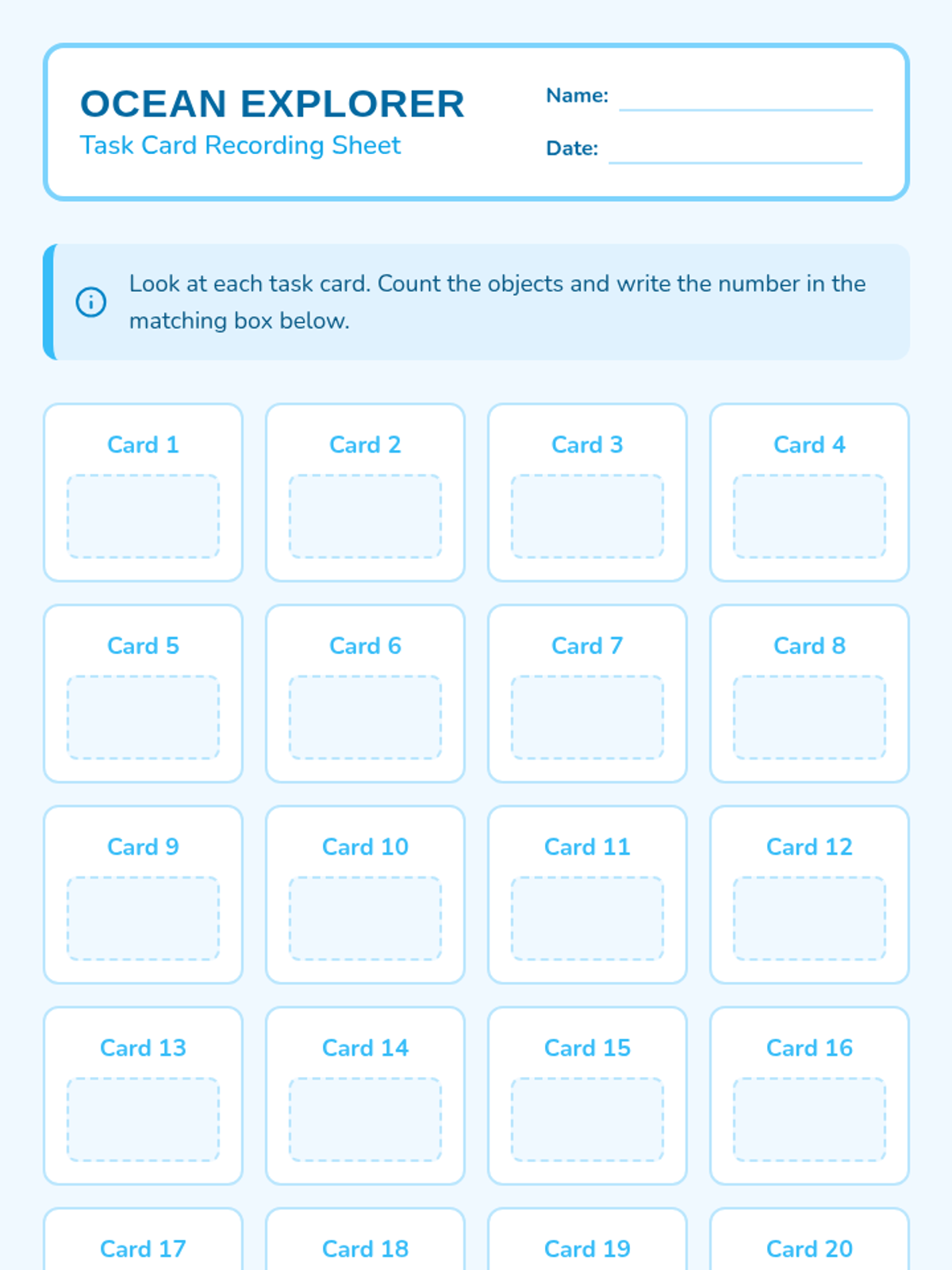
A structured recording sheet for students to use with the Sea Scout Task Cards. It features numbered boxes for numbers 1-20 and space for name and date, keeping work organized and legible.
A set of 20 ocean-themed task cards for students to practice counting objects up to 20. Each card features cute ocean emojis and a clear question to guide one-to-one correspondence practice.
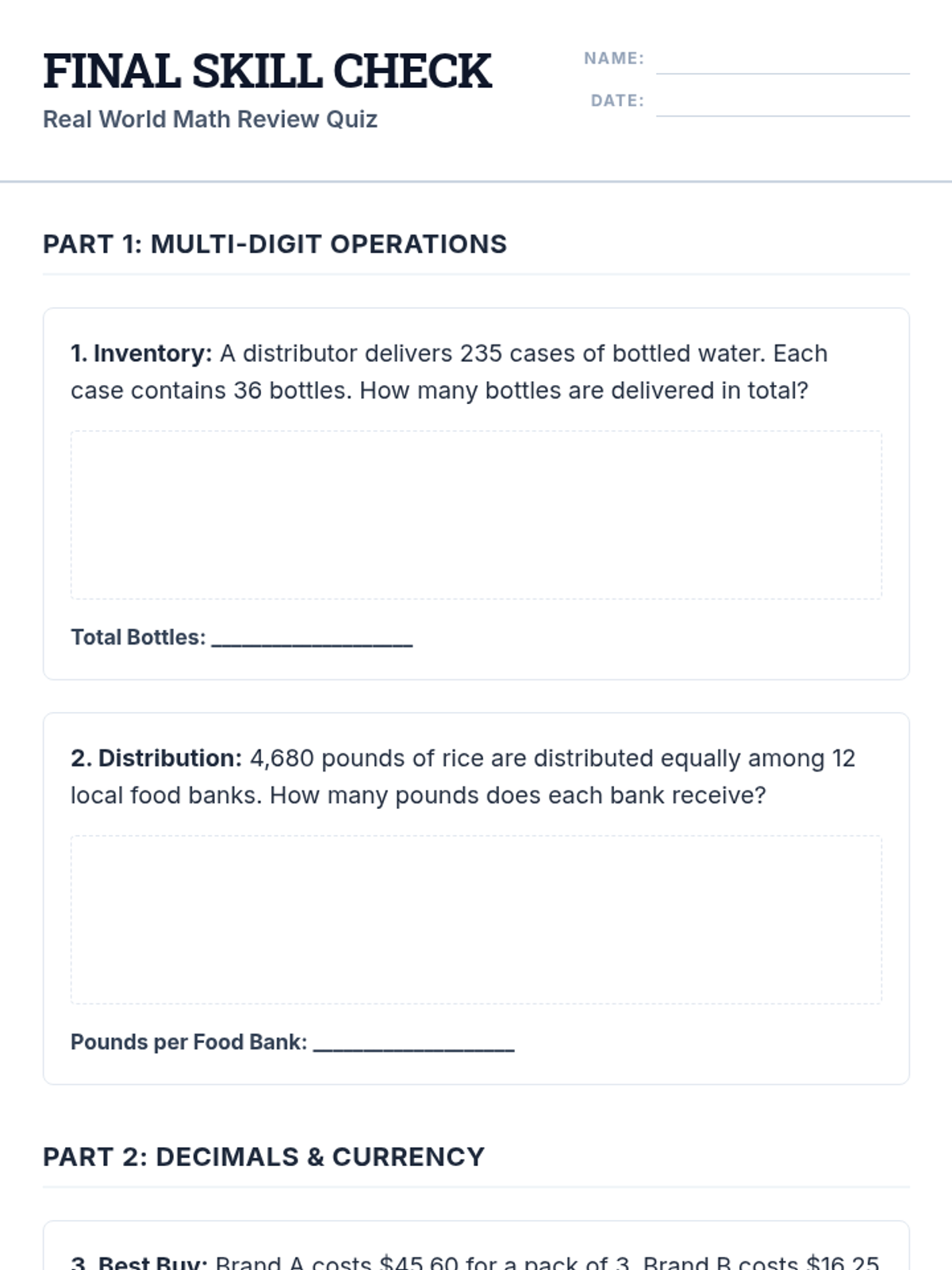
A printer-friendly final review quiz covering all core series topics with high-contrast design and optimized layout for ink-efficient printing.
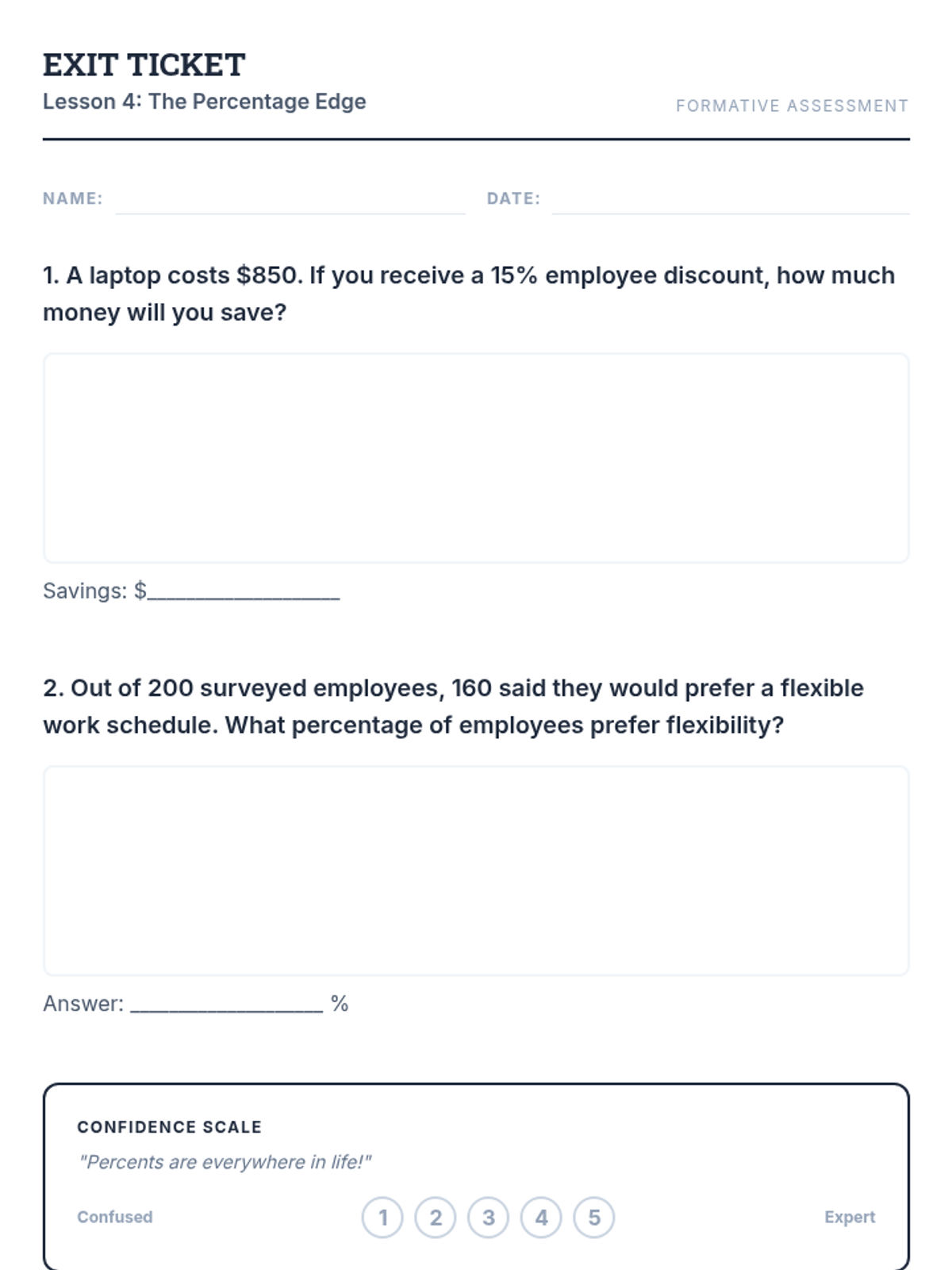
A printer-friendly exit ticket for percentages, utilizing a clean layout and high-contrast design for efficient student assessment.
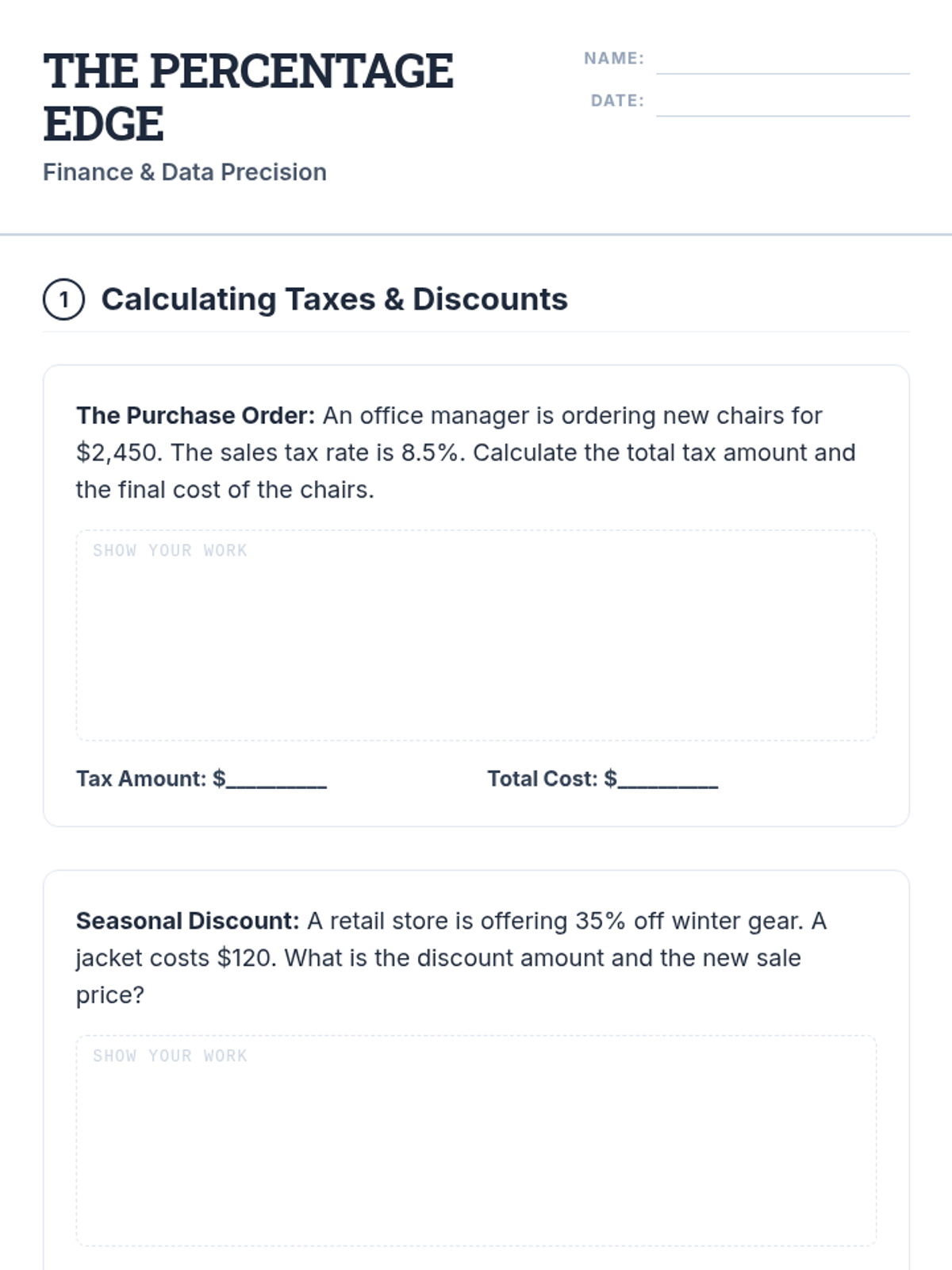
A printer-friendly percentages worksheet covering financial calculations like tax, interest, and goals, designed with minimal color and maximum clarity.
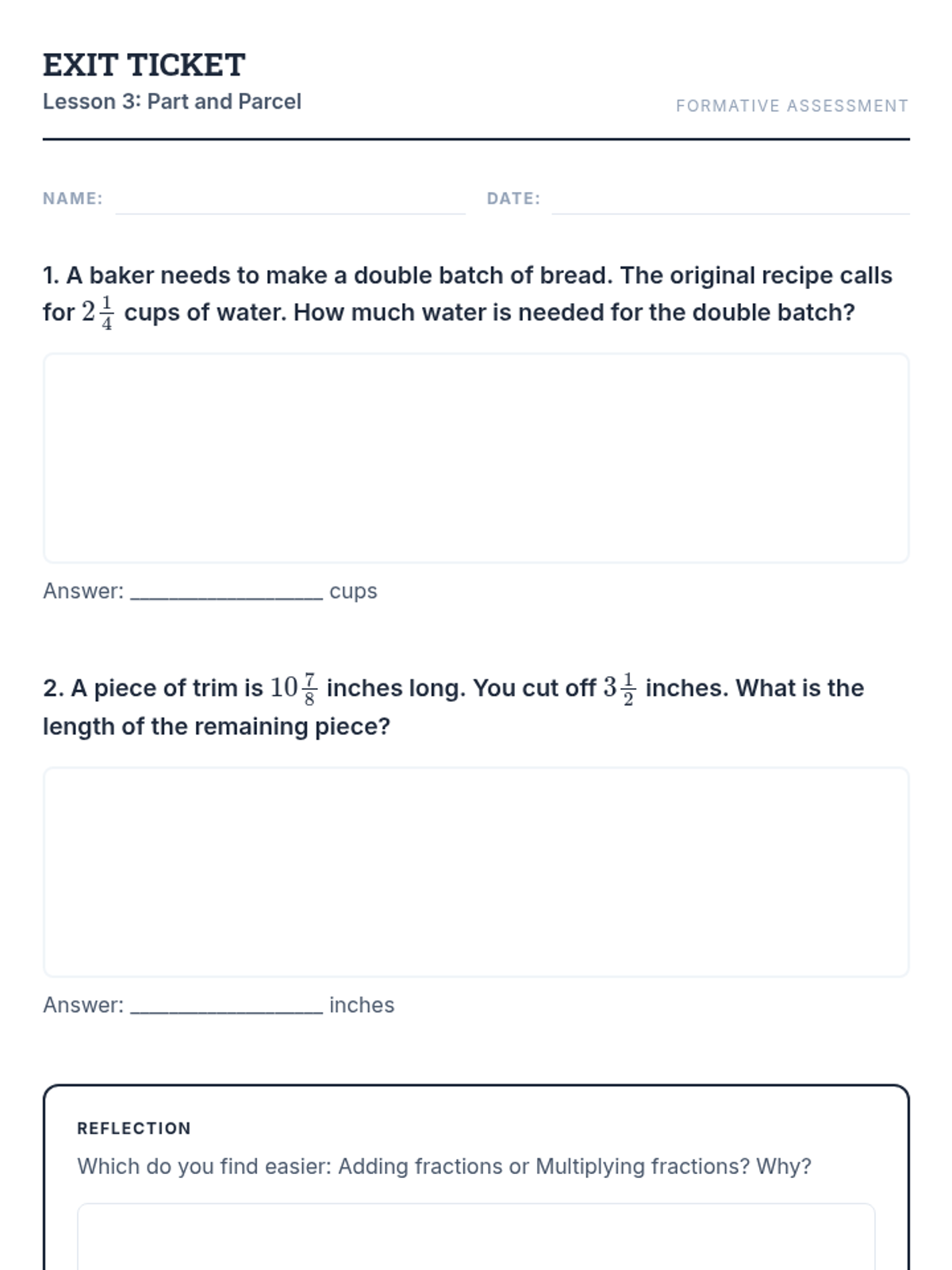
A printer-friendly exit ticket for fraction operations, designed with minimal color usage and efficient layout for high-volume printing.
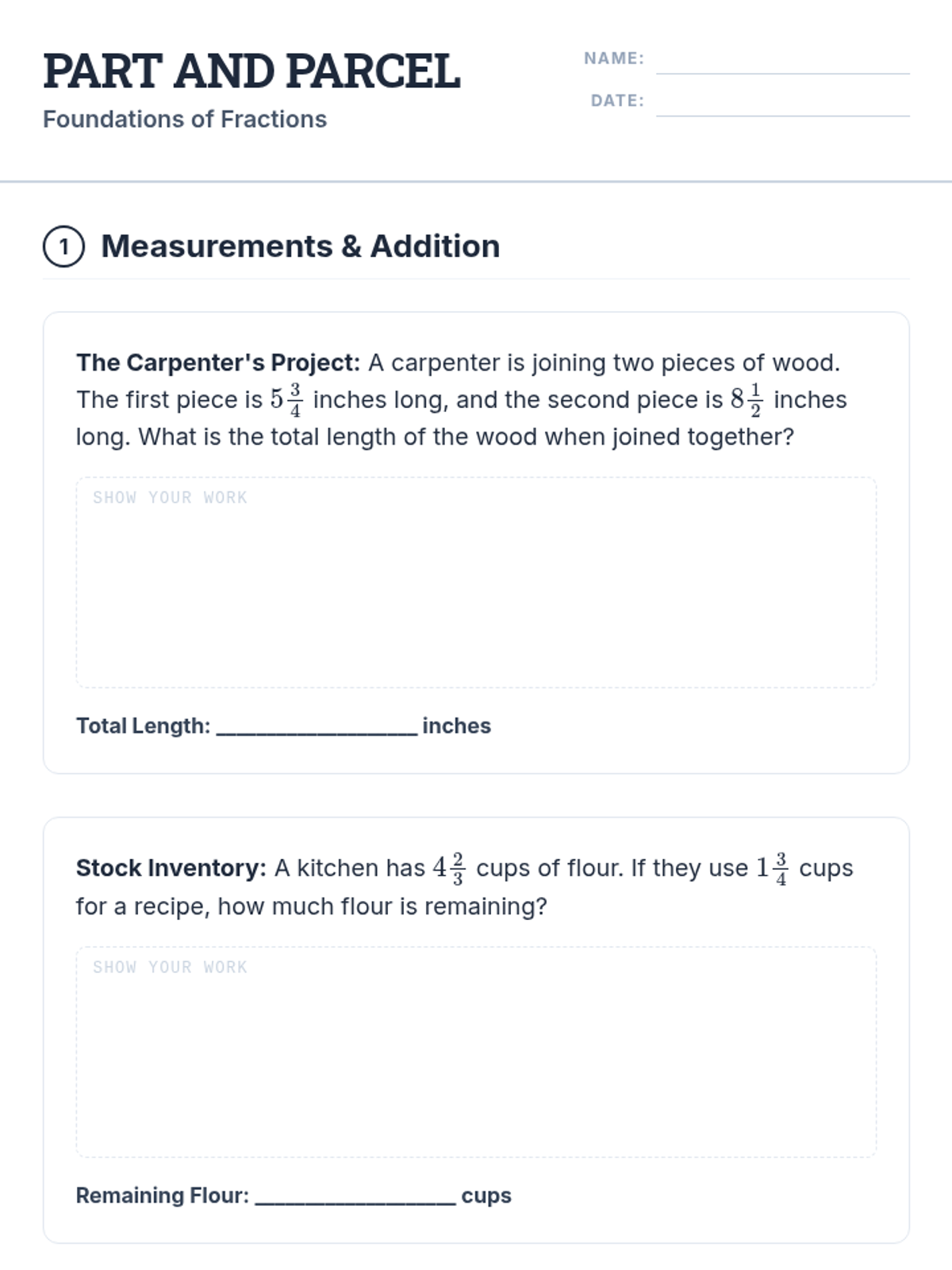
A printer-friendly fractions worksheet covering all basic operations in real-world contexts, designed for clarity and minimal ink consumption.
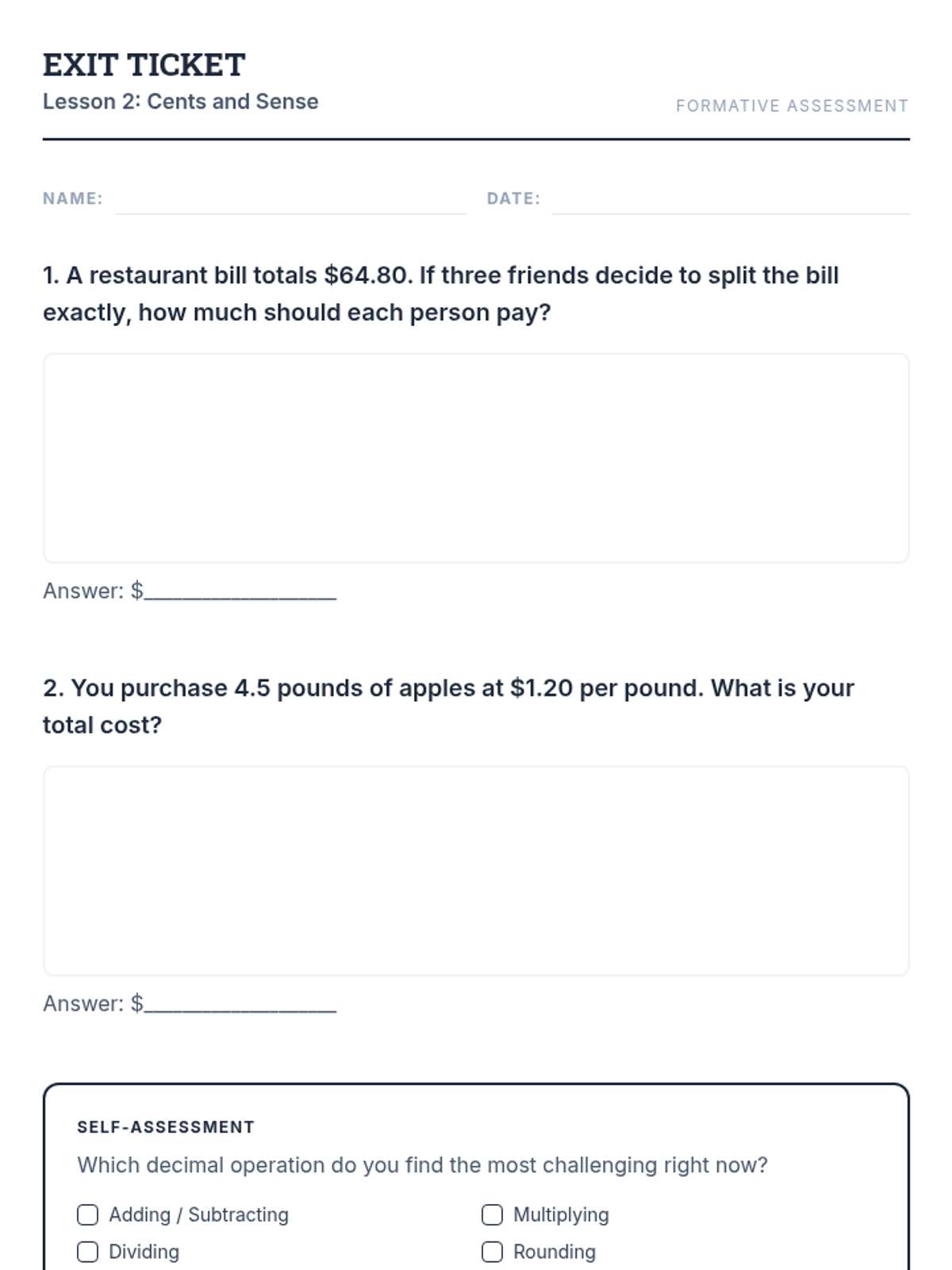
A printer-friendly exit ticket for decimal operations, designed with high contrast and minimal ink usage for assessments.
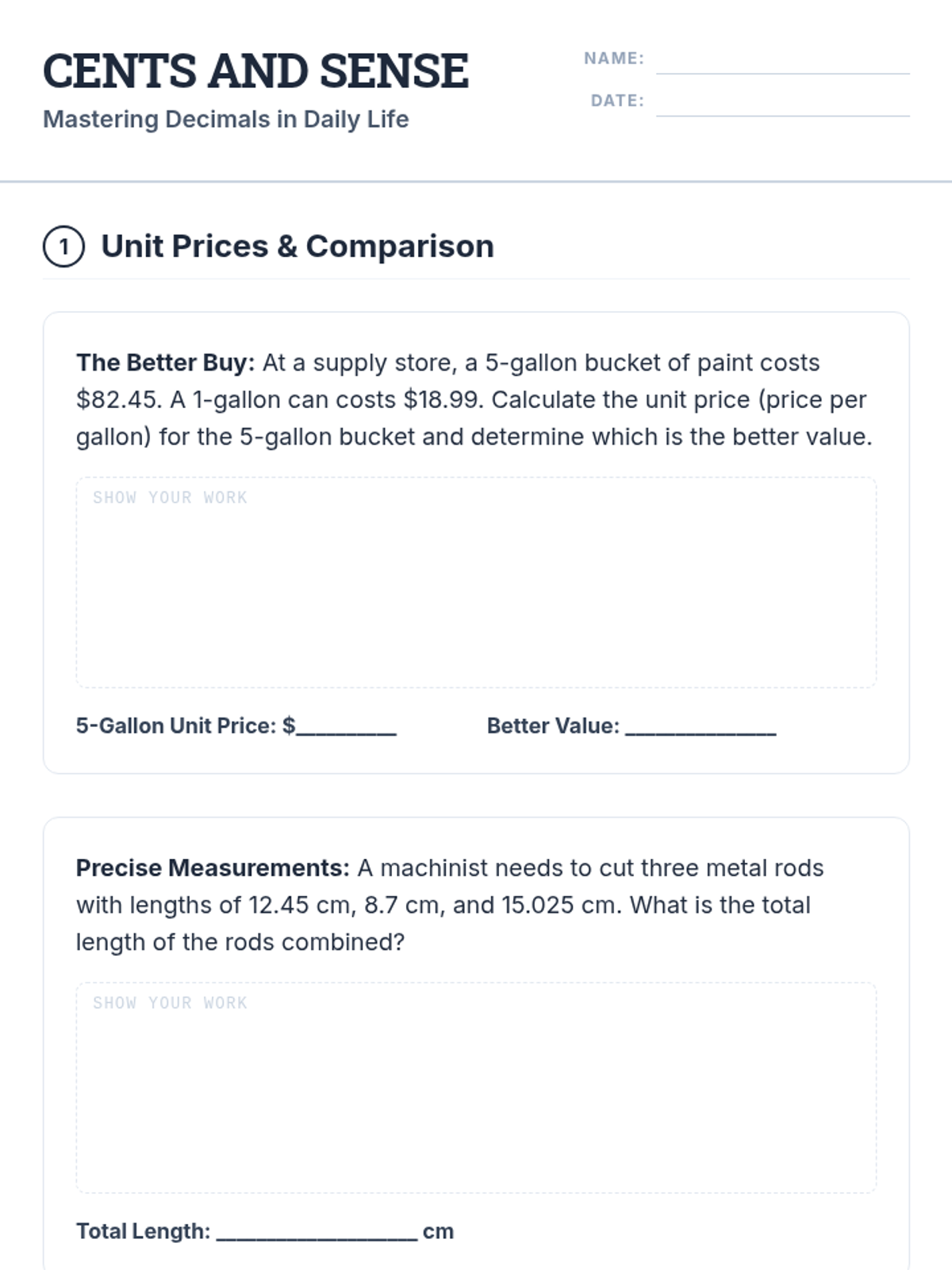
A printer-friendly decimal operations worksheet focused on real-world financial and technical scenarios with minimal ink consumption.
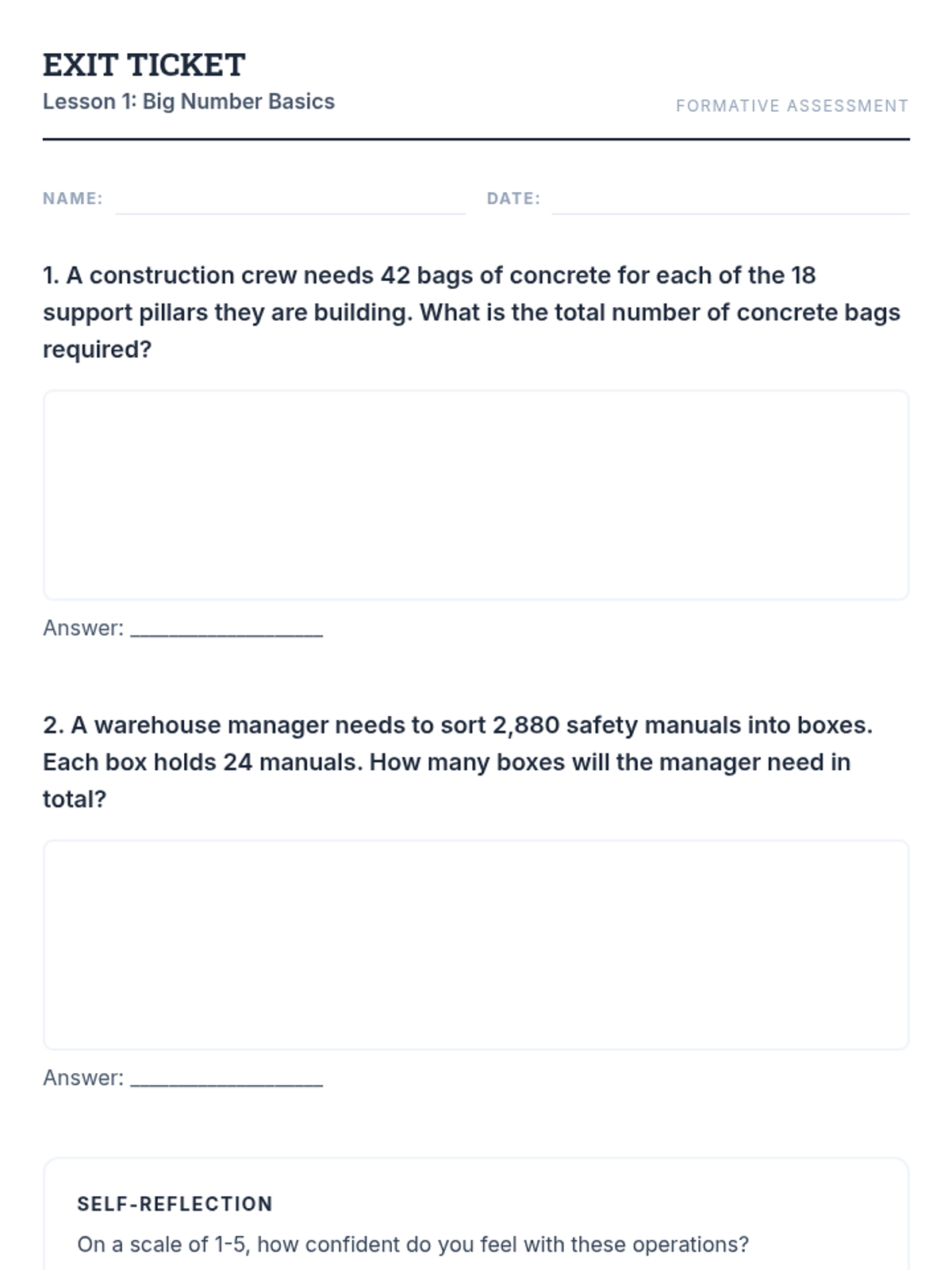
A printer-friendly exit ticket for Lesson 1, featuring high-contrast text and ample workspace for student responses with minimal ink usage.
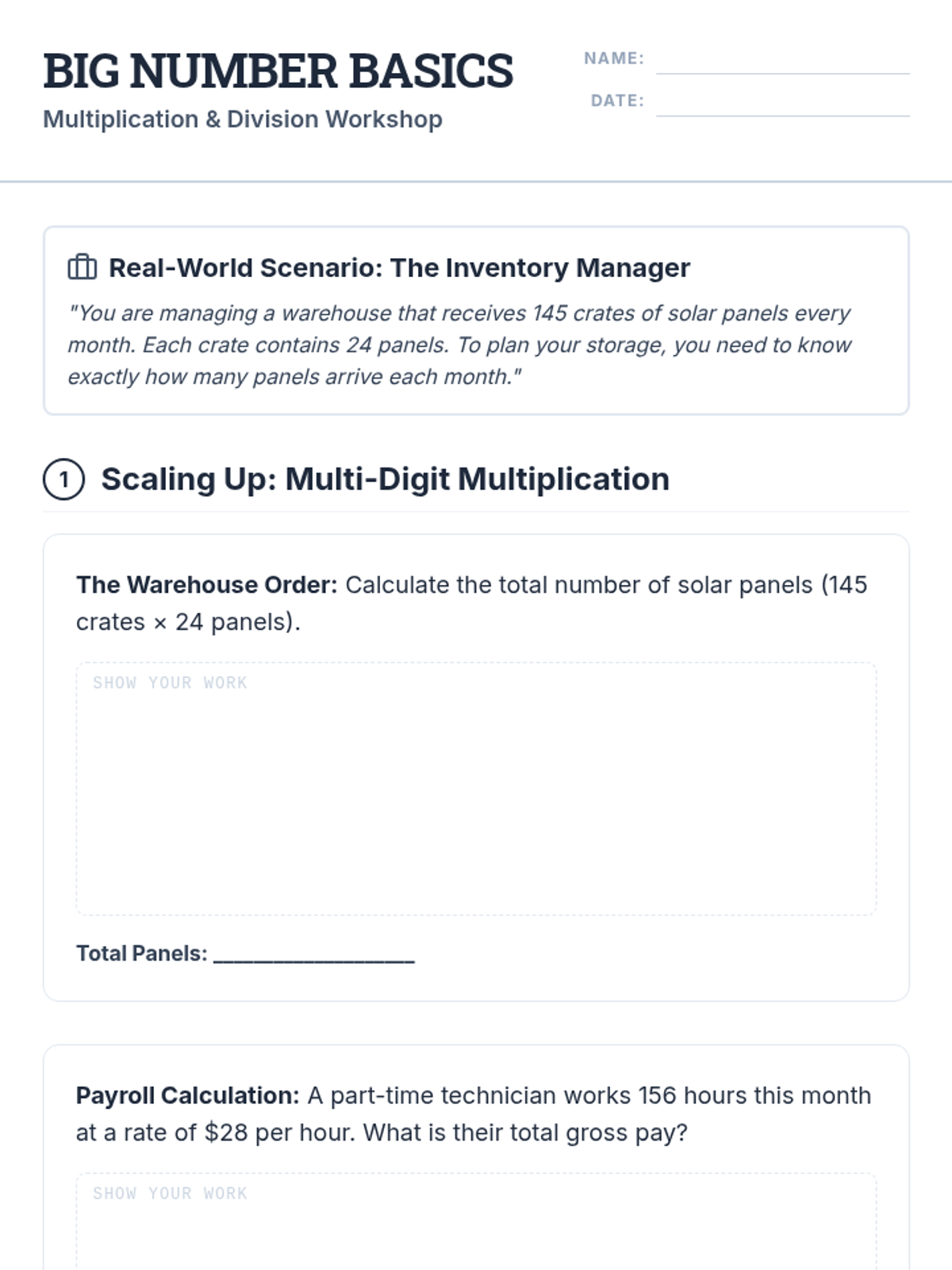
A printer-friendly multi-digit multiplication and division worksheet featuring four real-world scenarios and a mastery challenge, designed with minimal color usage.