Field observation worksheet for students to identify and document real-world examples of proximity and similarity in their immediate environment. Includes sketching areas and a synthesis reflection.
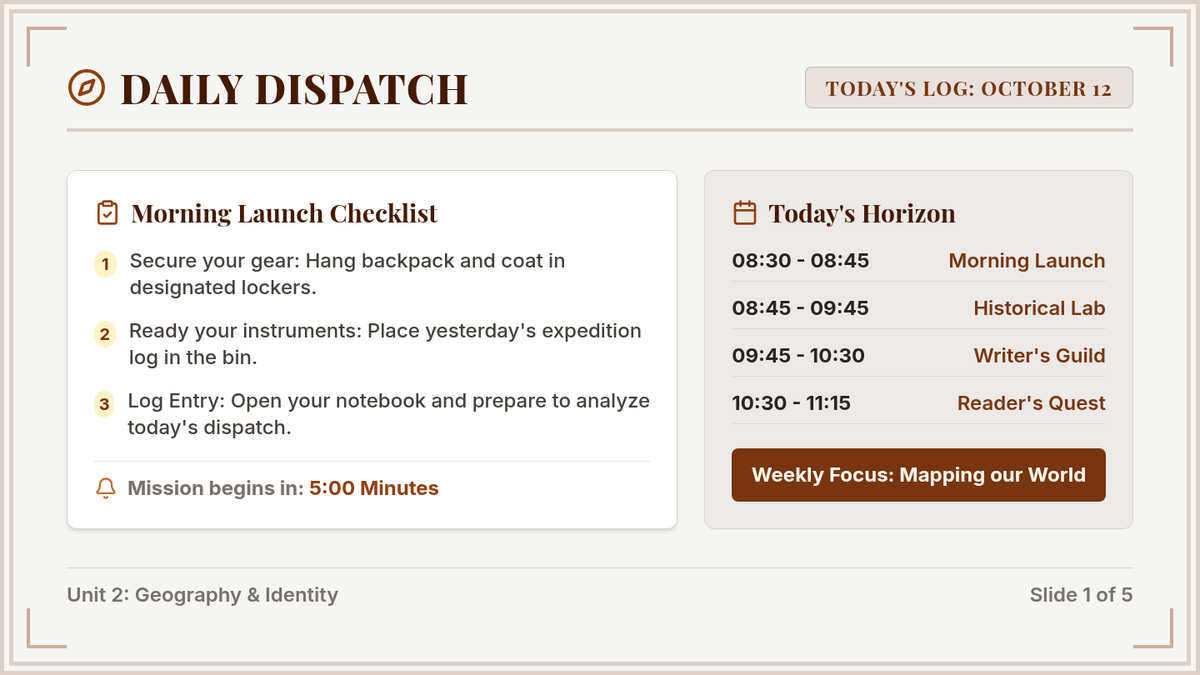
A 5-slide visual slide template designed to launch a social studies class. Includes slides for daily routines, map skills, historical quote analysis, and current events discussions.
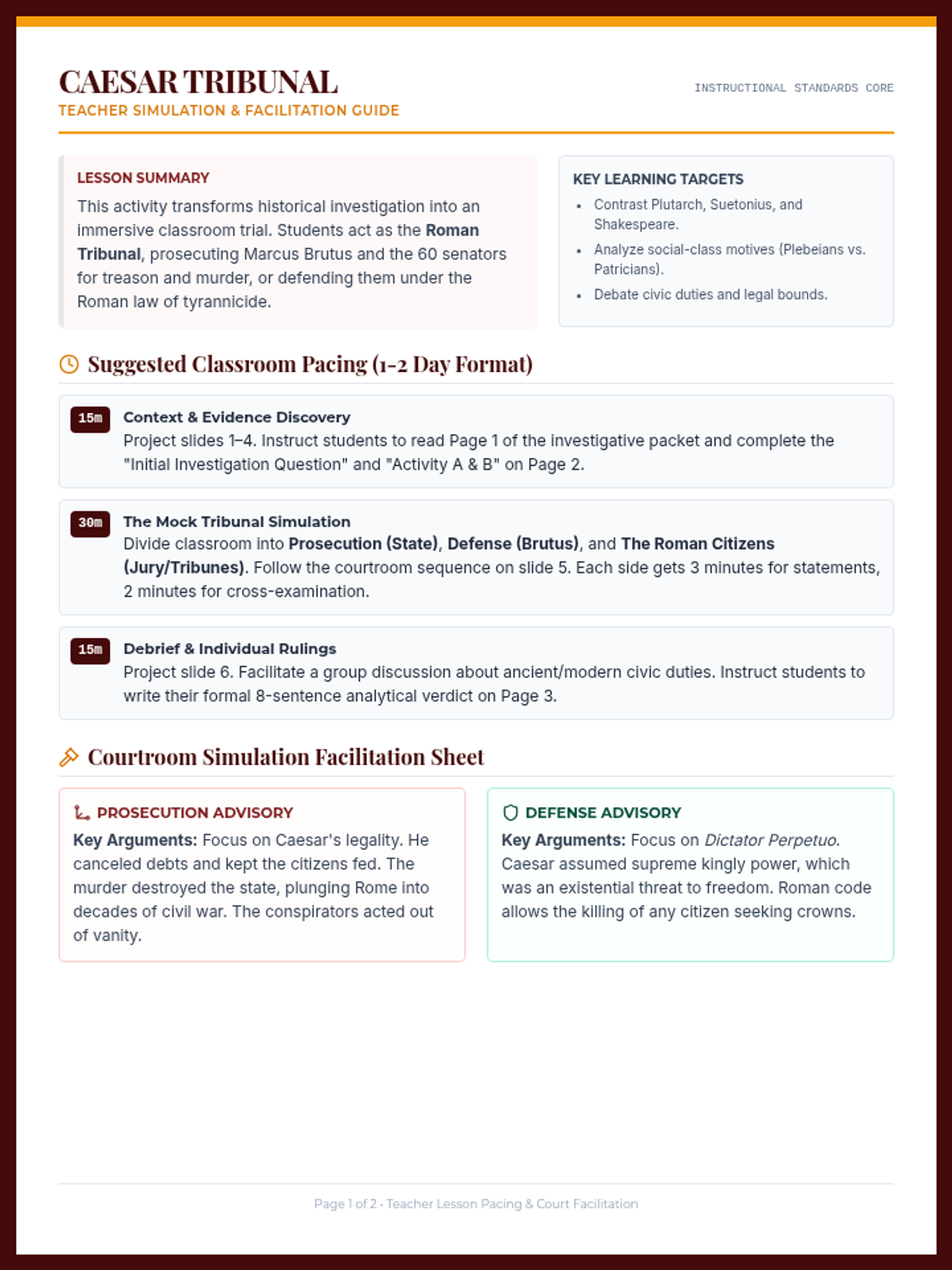
A two-page printable teacher guide and lesson key. Contains complete instructional scaffolding, pacing, step-by-step mock trial simulation guidelines, and a comprehensive answer key for the Caesar Conspiracy student workbook.
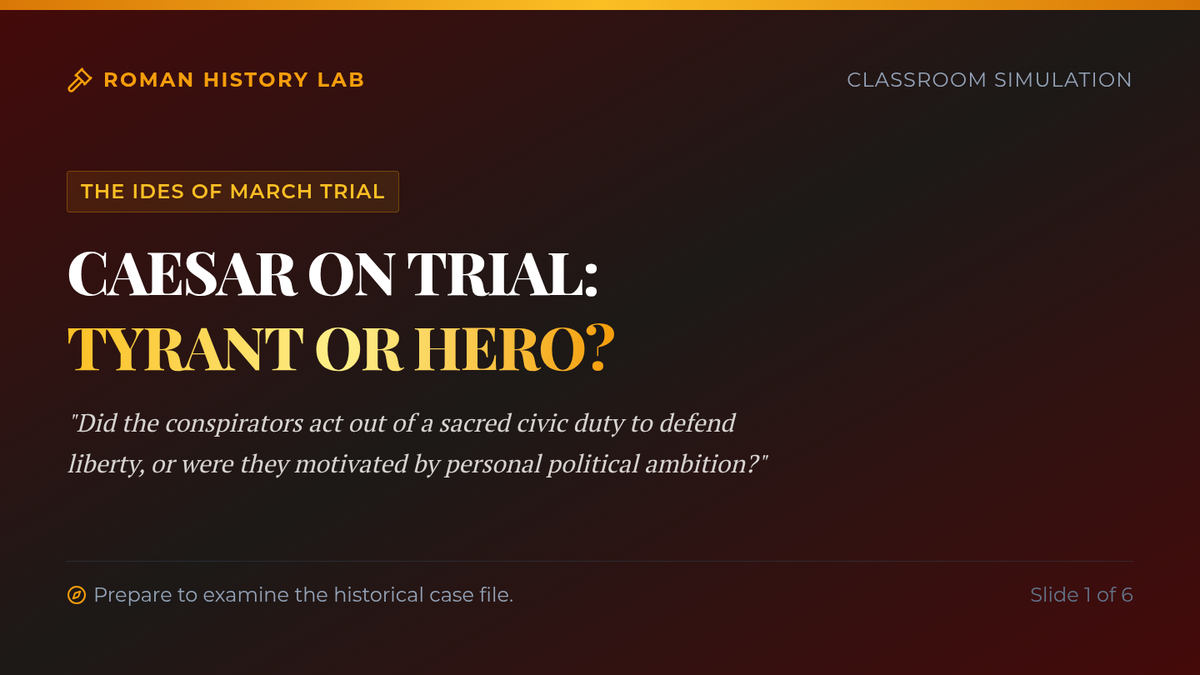
A six-slide instructional presentation for the Caesar Tribunal lesson. Featuring high-impact visuals, a deep Roman crimson theme, analysis of the historical sources (Plutarch, Suetonius, Shakespeare), and guidelines for the classroom mock trial.
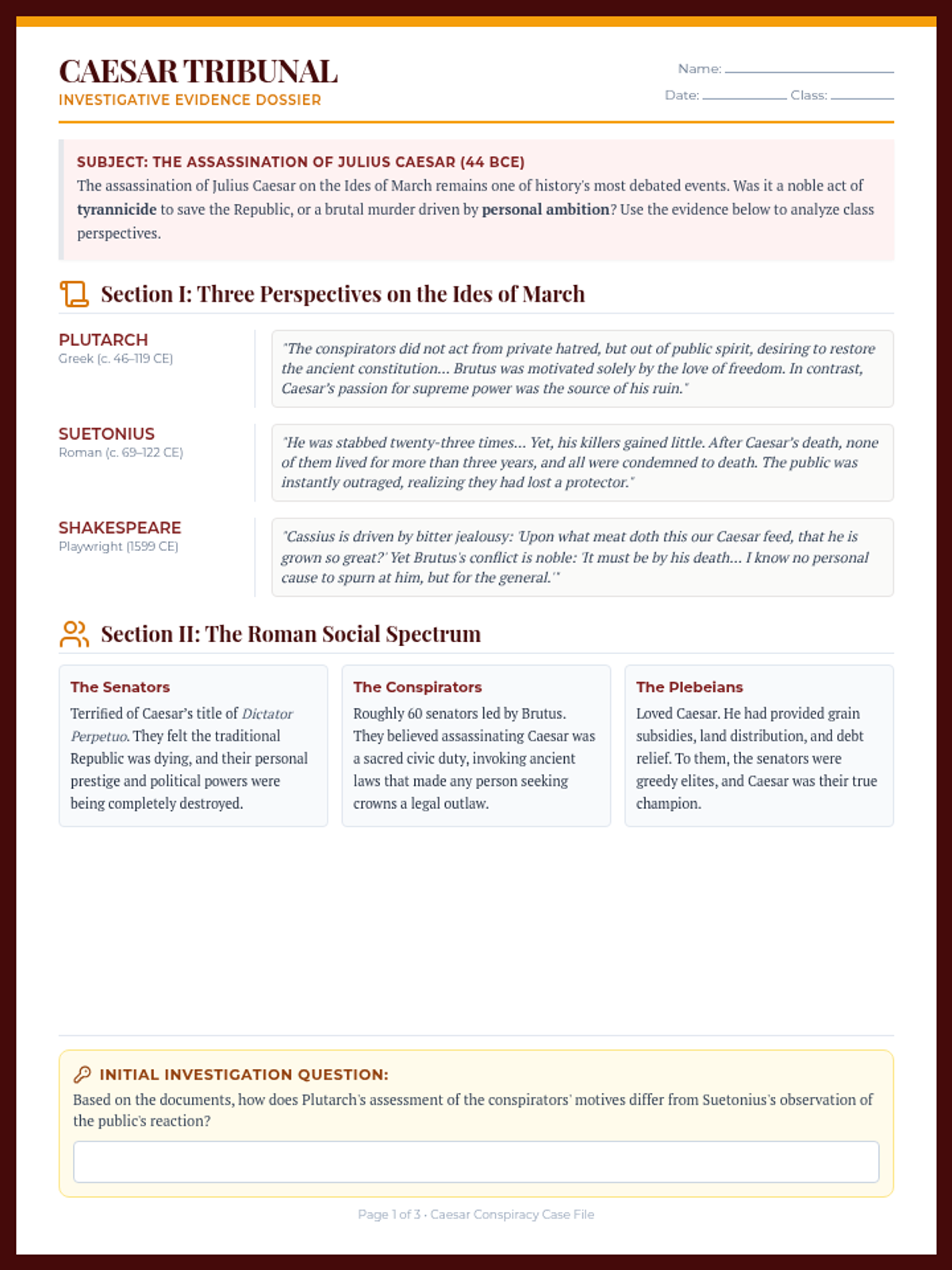
A three-page student investigative packet for the Caesar Tribunal lesson. It includes a primary source-based reading passage, a vocabulary matching activity, a custom Roman word search, short-answer questions, and a scaffolded 8-sentence analytical essay.
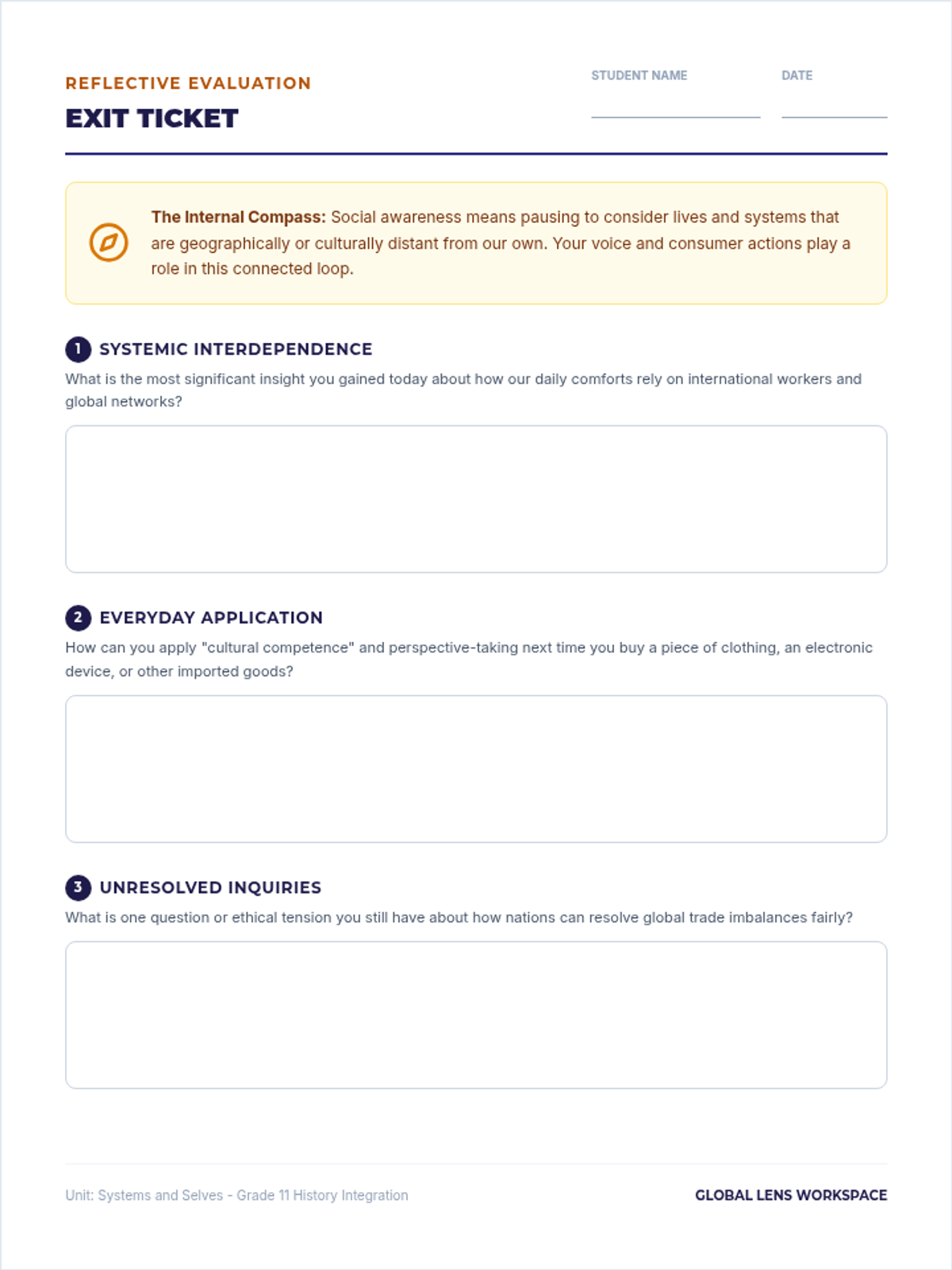
Student self-reflective exit ticket containing three core perspective-taking and application questions, styled inside a polished, card-based physical layout.
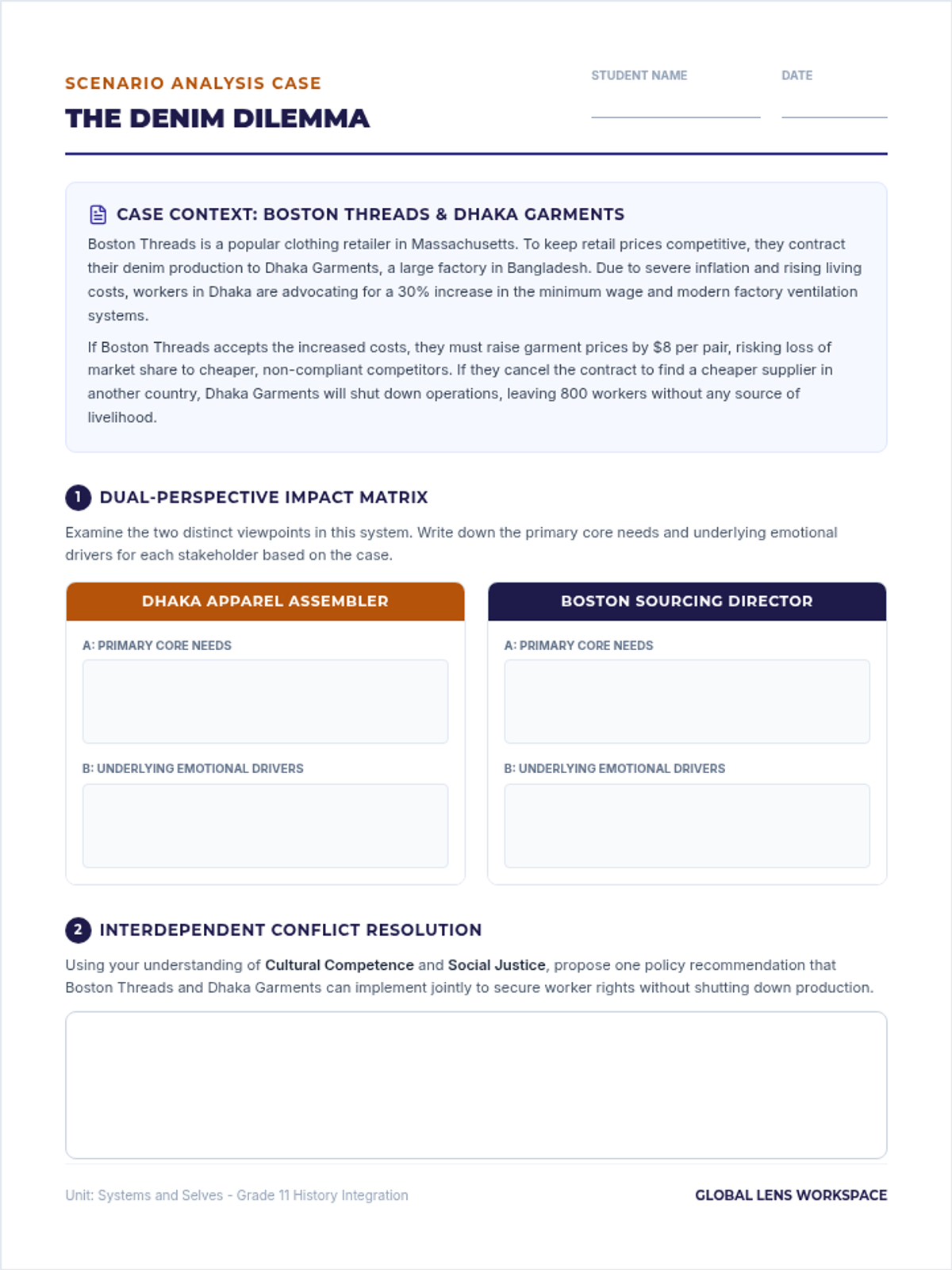
Student-facing 1-page scenario analysis worksheet focusing on 'The Denim Dilemma' in the global garment industry, complete with stakeholder analysis tables and resolution prompts.
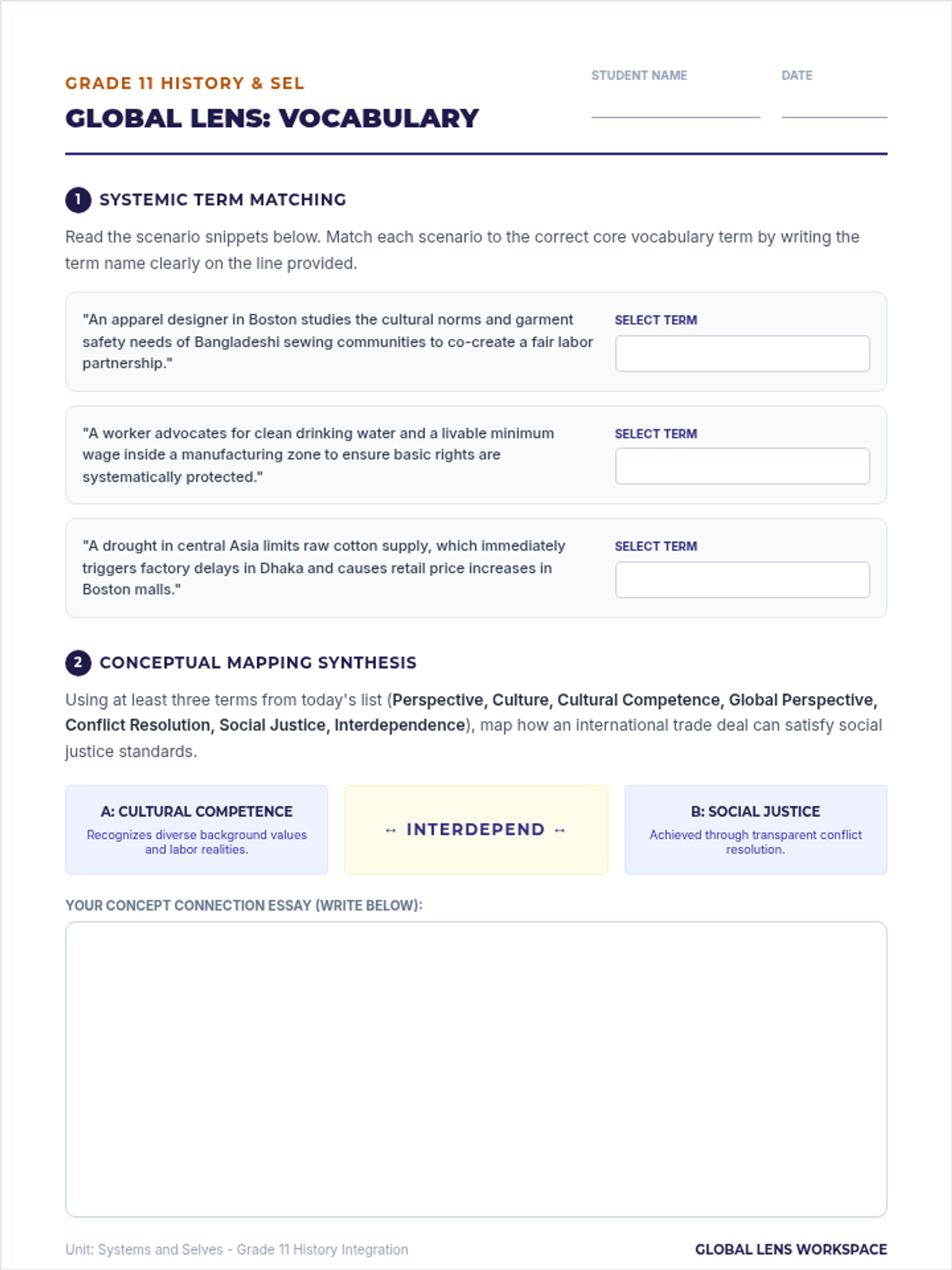
Student-facing 1-page vocabulary builder containing matching, term association, and conceptual mapping activities to solidify core SEL and economics vocabulary.
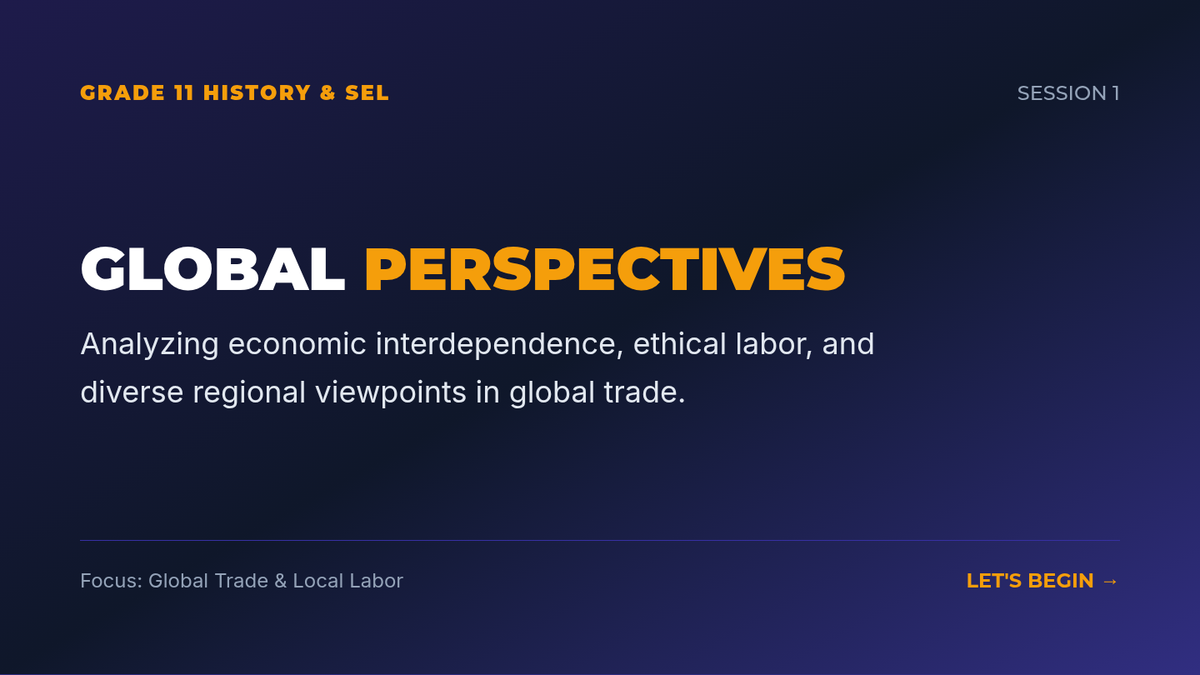
An elegant, high-impact 6-slide deck designed to guide classroom discussions on global trade, ethical labor, and the visual concept map of interrelated social-emotional terms.
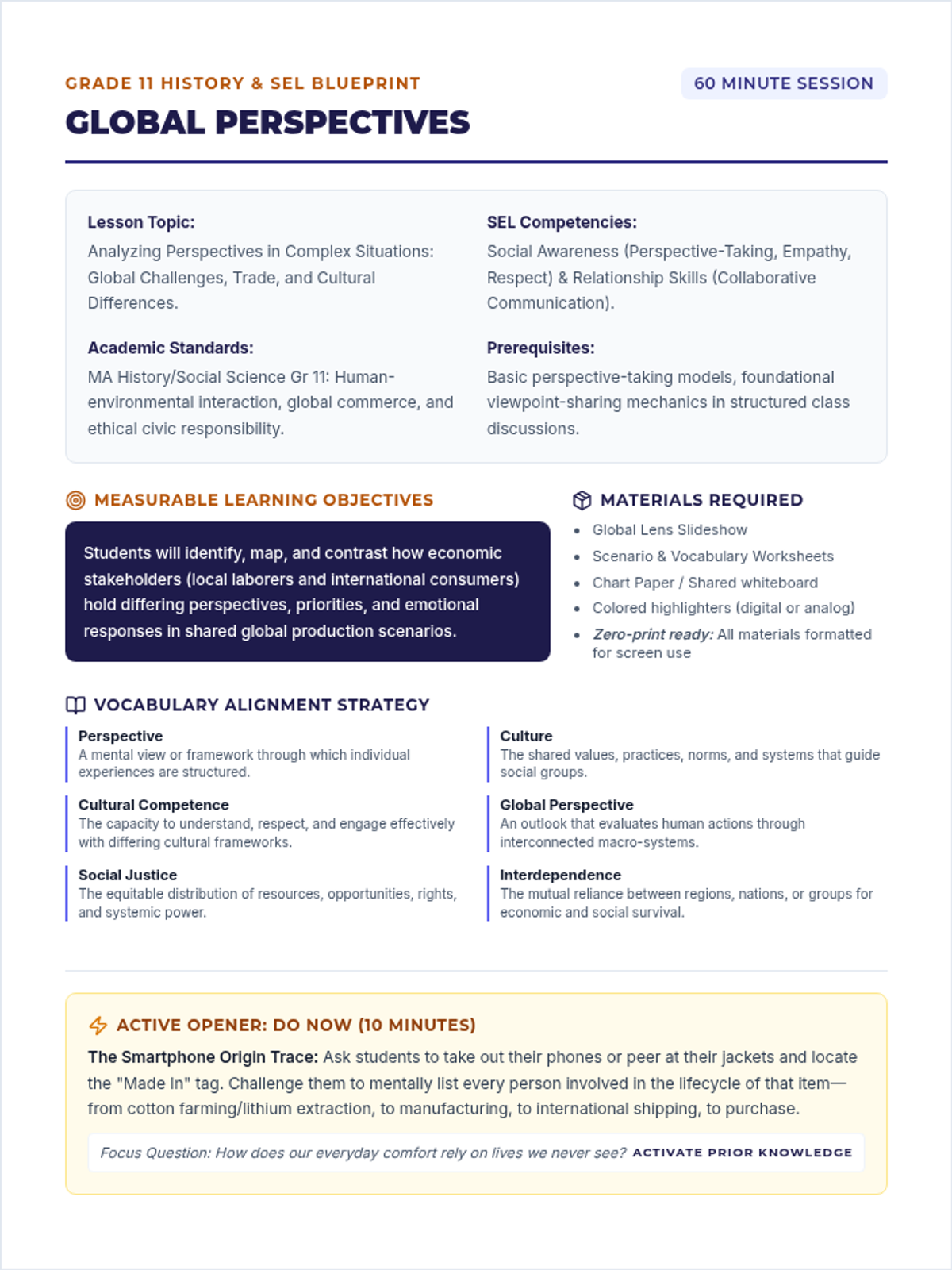
Comprehensive 2-page teacher guide and instructional blueprint for Grade 11 History & SEL, detailing the global trade scenario, step-by-step lesson sequence, interactive scripts, and differentiation strategies.
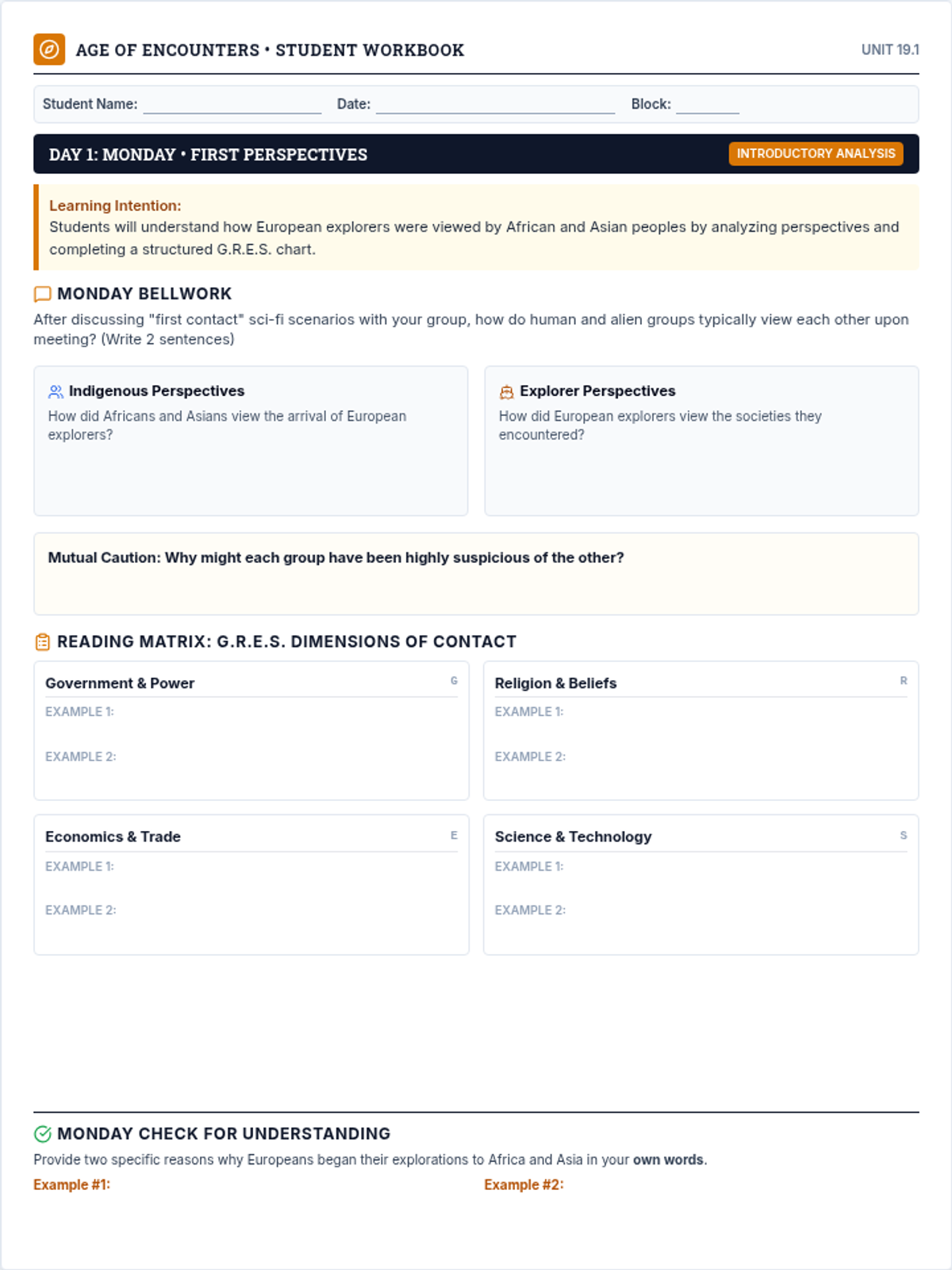
A highly structured, 5-day printable student workbook featuring daily bellworks, readings, graphic organizers (including a GREASES matrix, Say-Mean-Matter navigation table, a Transatlantic Slave Trade main idea web, and an interactive trade timeline), and checks for understanding.
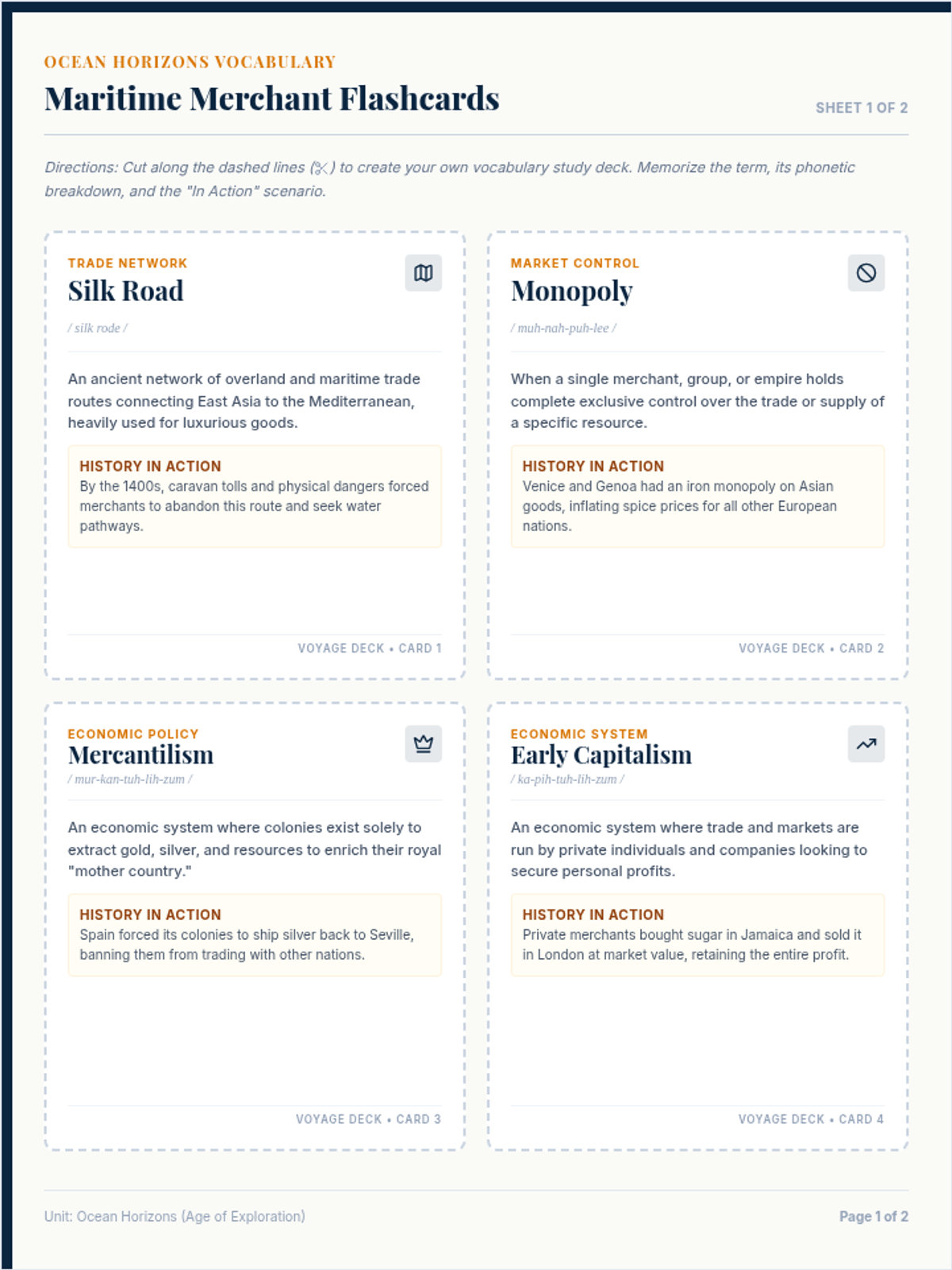
An elegant, print-ready, two-page vocabulary card deck featuring 8 key maritime and economic terms. Each card includes phonetic pronunciations, clear definitions, visual icons, and "History in Action" real-world context prompts, styled with dashed scissor cut lines.
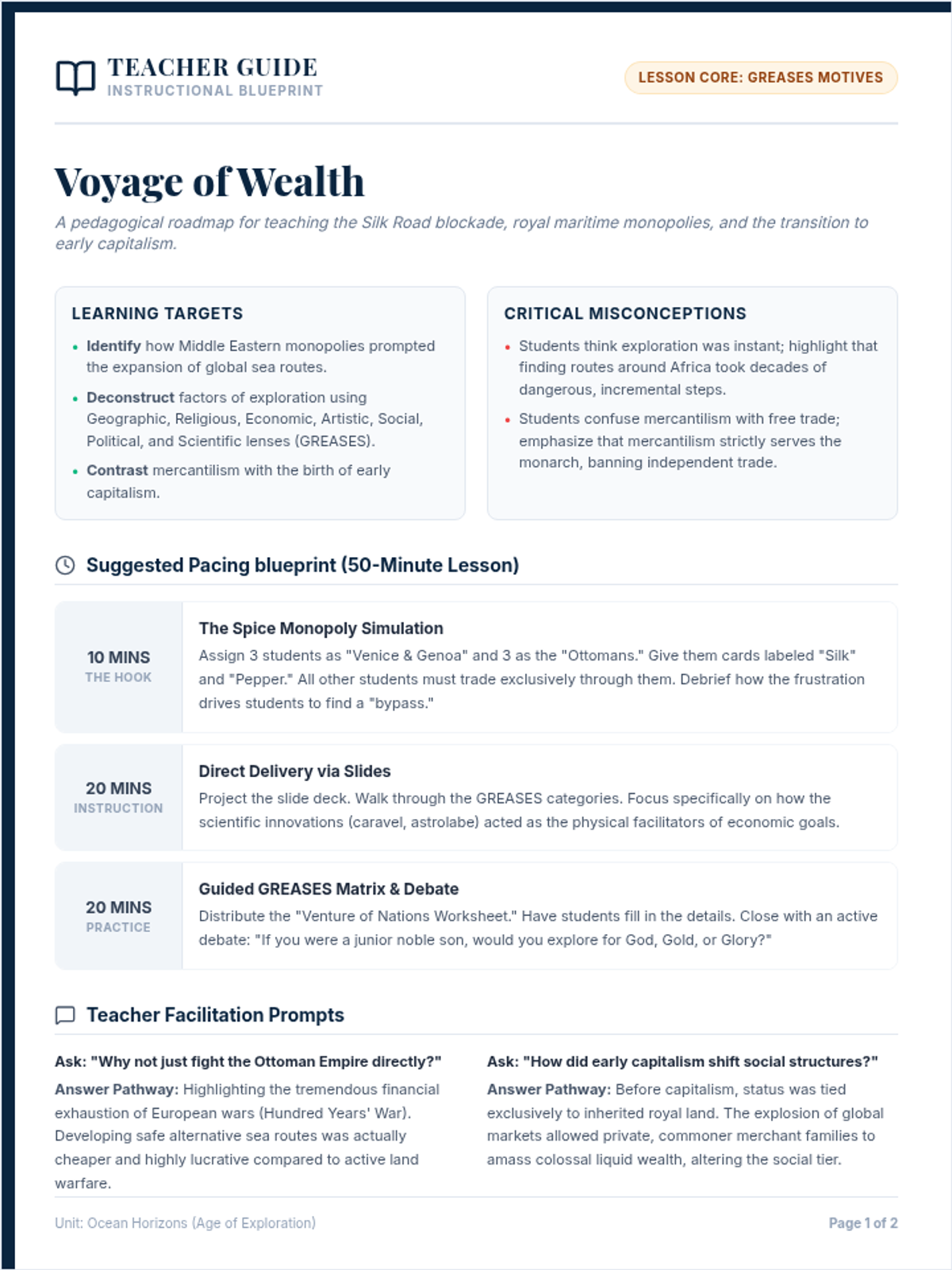
A professional, two-page teacher's guide and facilitation blueprint. Page 1 details instructional objectives, a minute-by-minute pacing guide, discussion hooks, and student prompts. Page 2 provides the complete GREASES answer key and exemplar answers for critical thinking assessments.
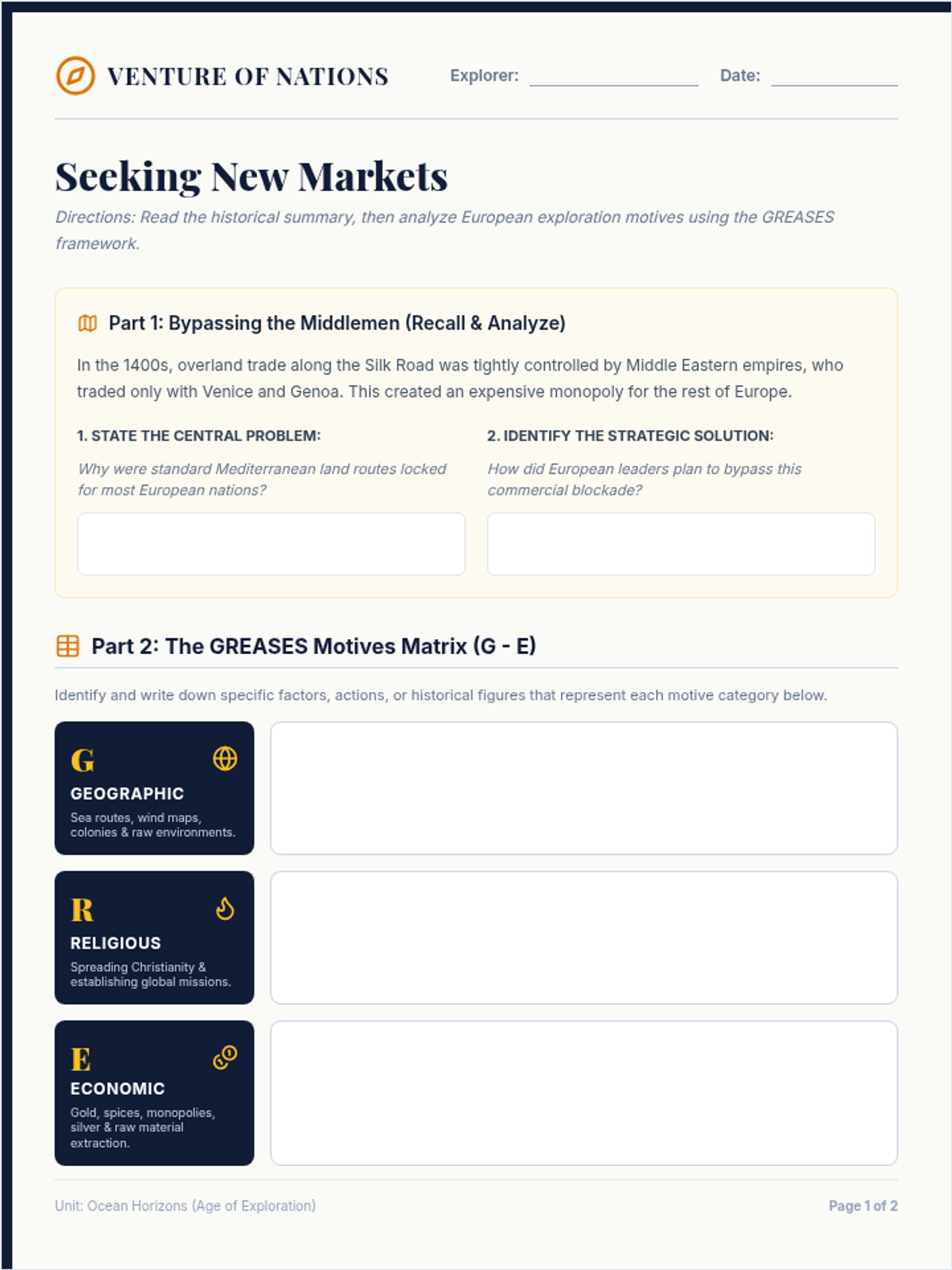
A comprehensive student worksheet with name and date fields, featuring a guided reading activity, a two-page GREASES graphic organizer, and critical thinking questions comparing mercantilism and early capitalism.
Interactive slide deck introducing the European motives for exploration, featuring the GREASES analytical framework and the transition from mercantilism to early capitalism.
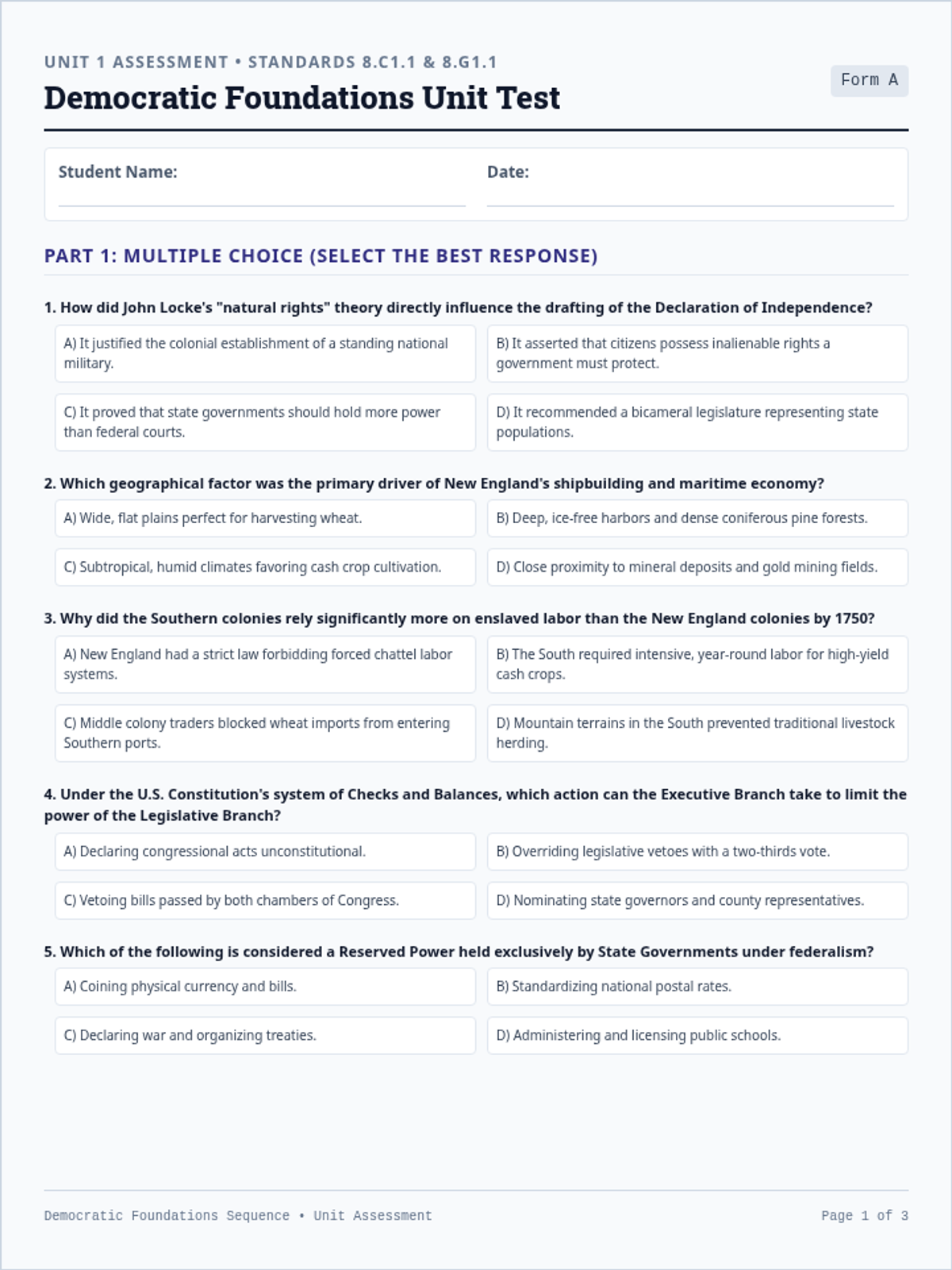
A standards-aligned, printable unit assessment featuring multiple choice questions, a document-based writing prompt (DBQ), and an analytical grading rubric.
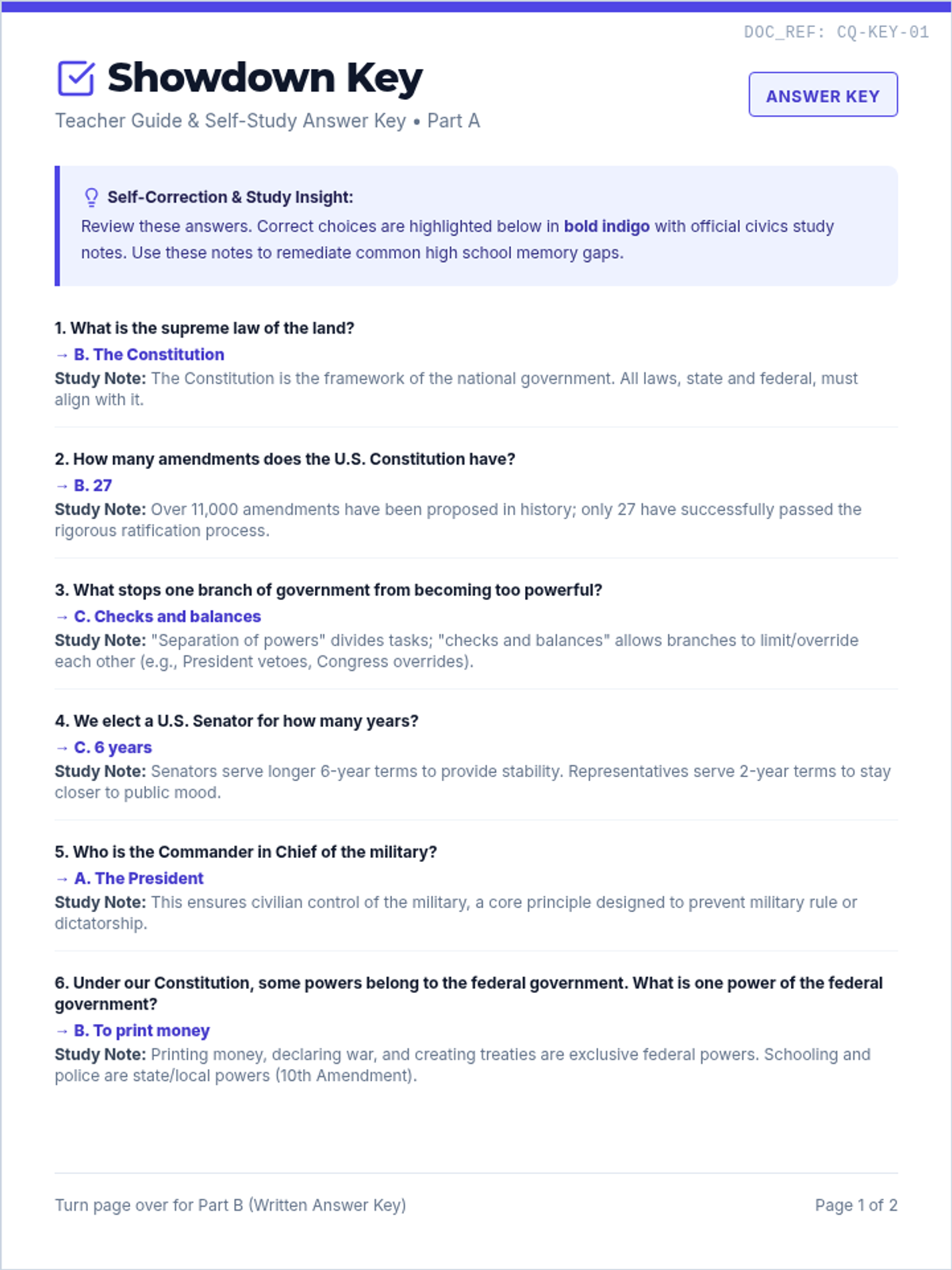
Educator and self-paced study answer key with clear explanations, rubrics, and diagnostic tips for the Civics Showdown Quiz.
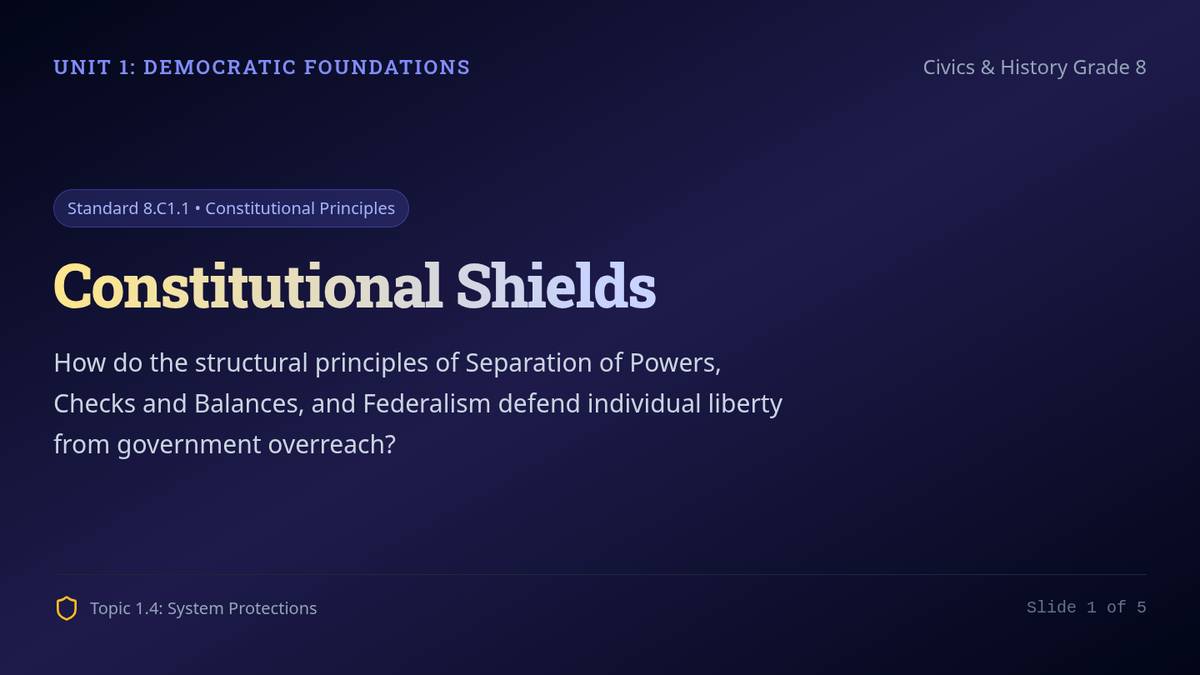
An instructional slide deck focusing on separation of powers, checks and balances, and federalism as the protective structural elements of the U.S. Constitution.
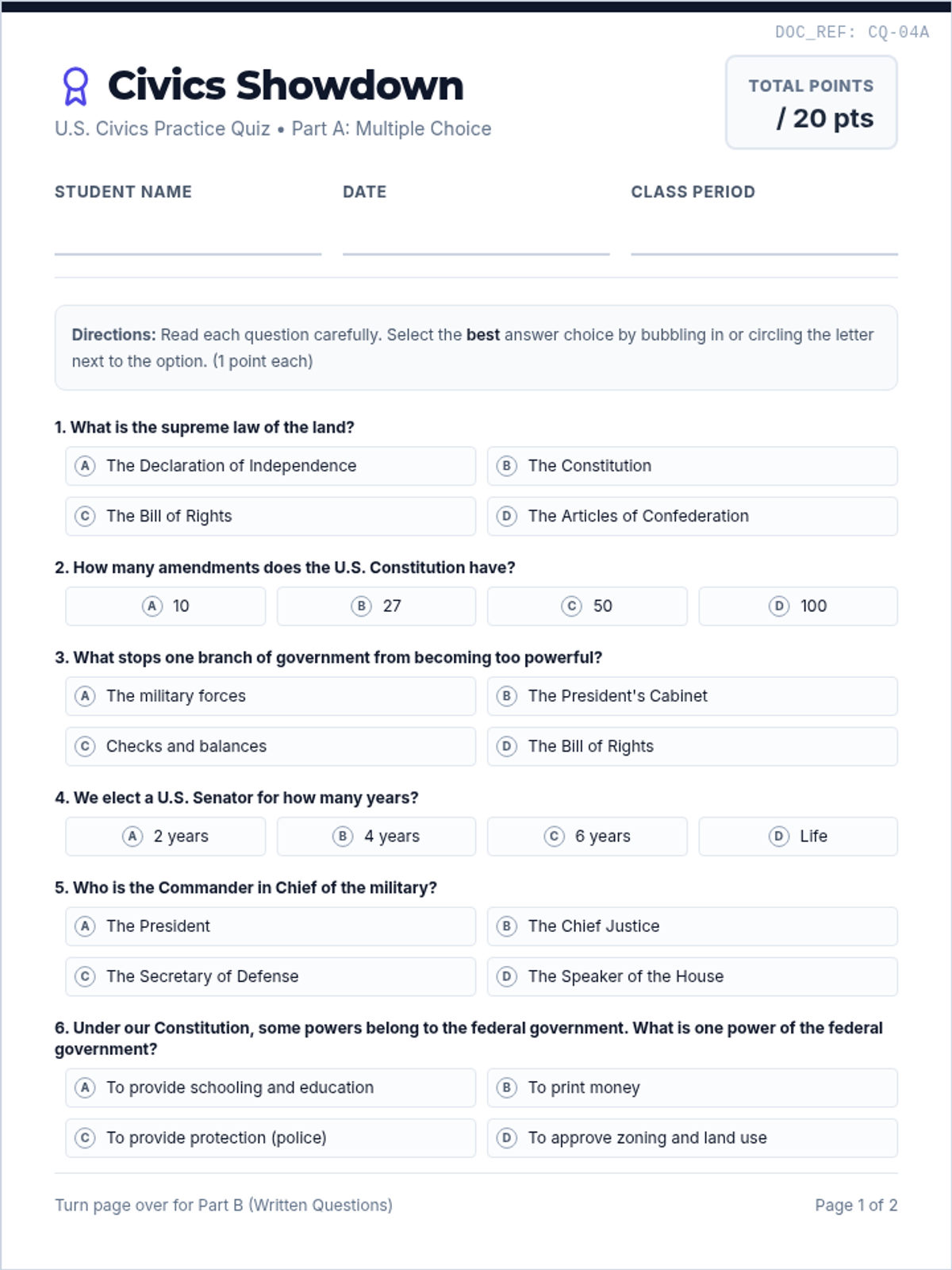
Practice quiz containing multiple-choice and short-answer questions modeled after the actual civics exam, designed to evaluate students' mastery of core topics.
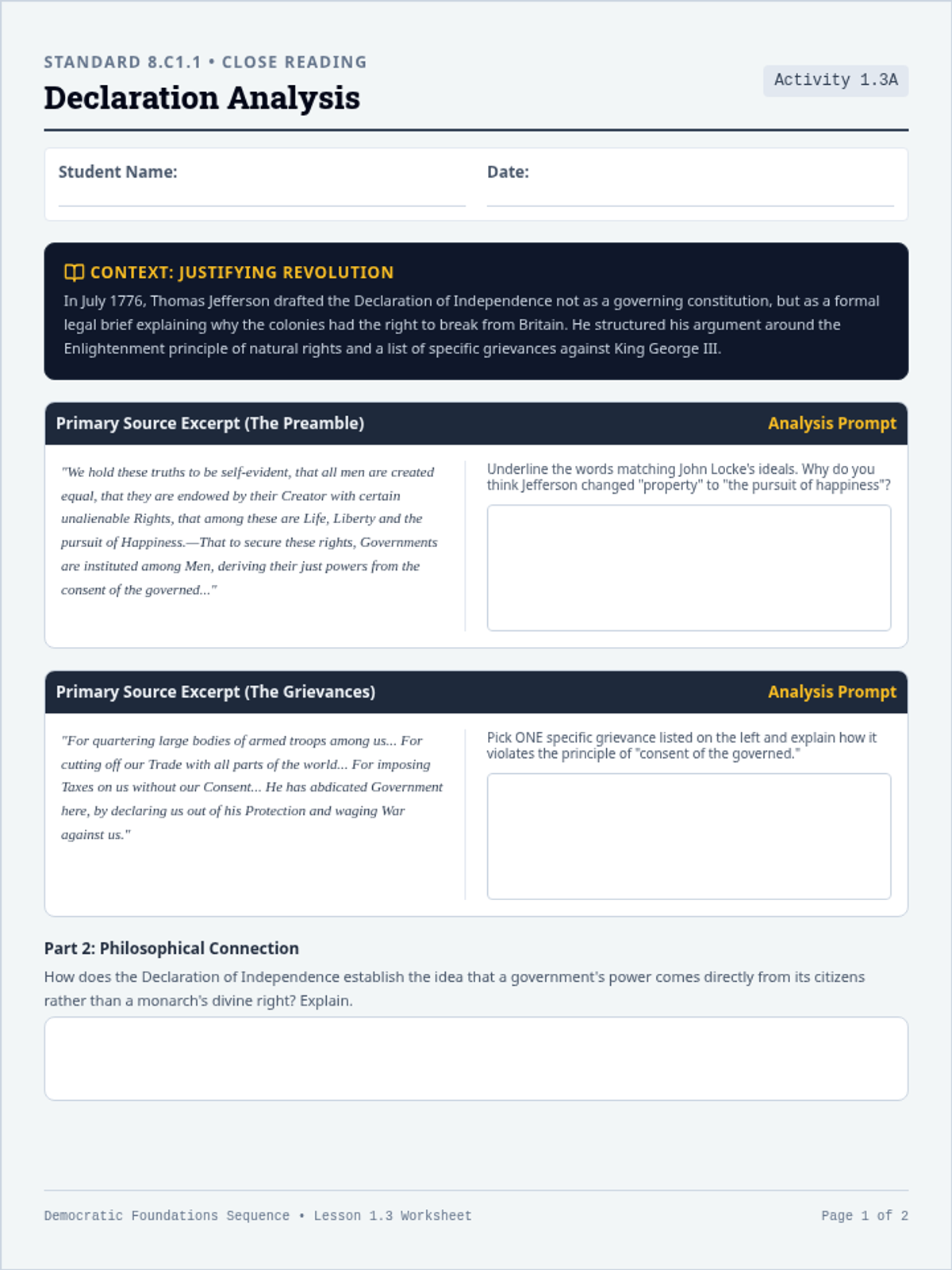
A student-facing primary source analysis worksheet and structured guided notes packet focusing on the Declaration of Independence and the original U.S. Constitution.
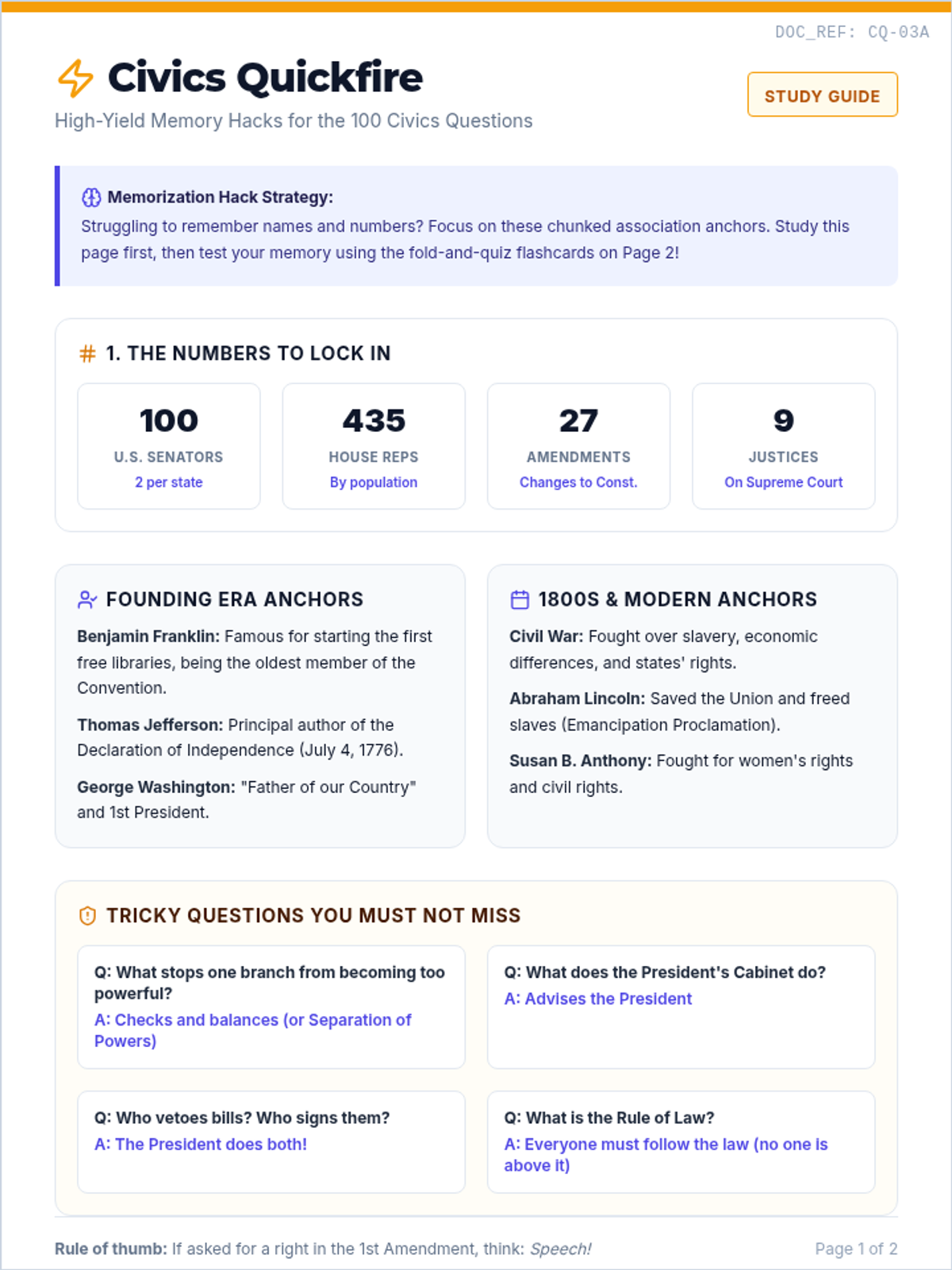
Consolidated memory aids focusing on the official 100 civics questions. Features a high-yield study sheet on page 1 and a set of folding pocket flashcards on page 2.
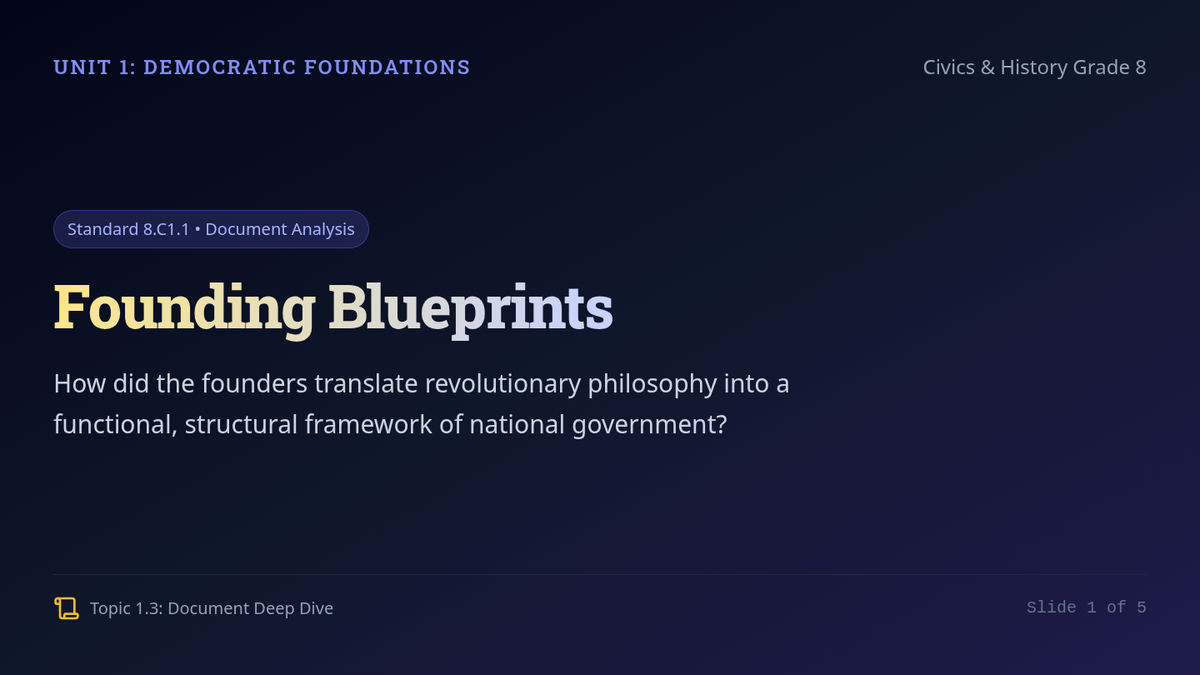
An instructional slide deck focusing on key themes, structural arguments, and critical compromises within the Declaration of Independence and the original U.S. Constitution.
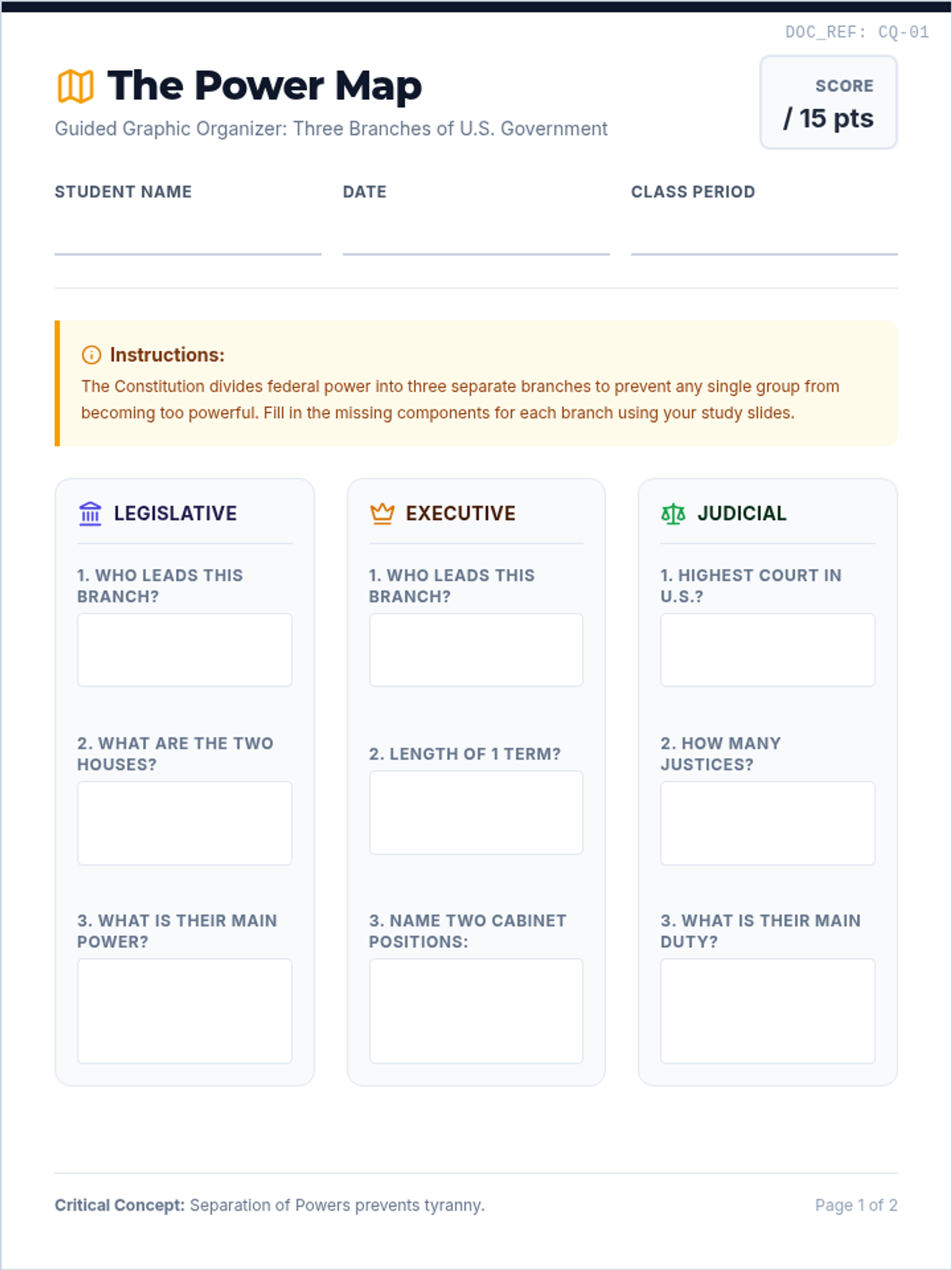
Guided graphic organizer worksheet designed to help students map out the three branches of government, constitutional amendments, and citizen rights. Features scaffolded boxes and spacious writing sections.
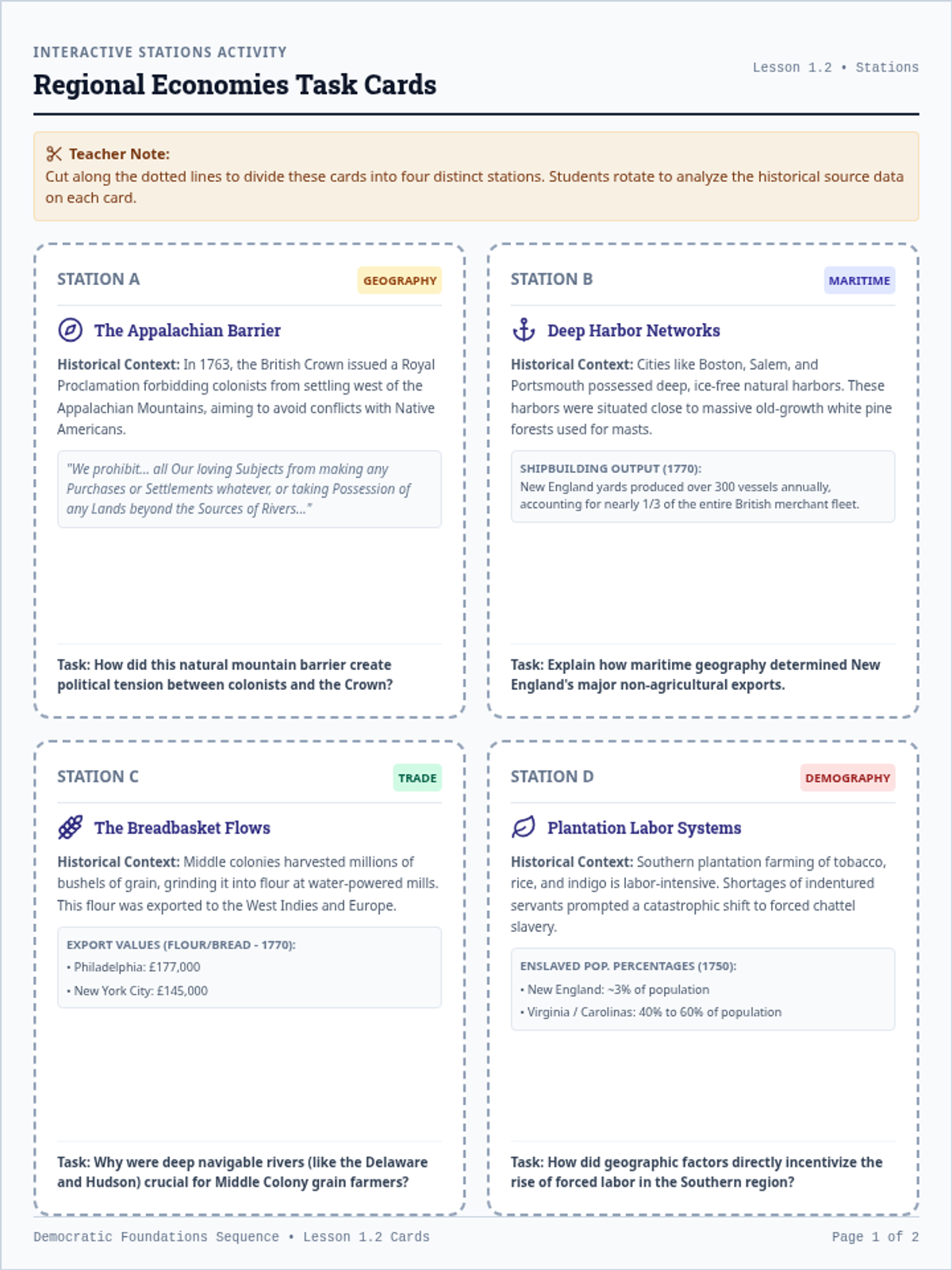
A collection of printable, source-based station task cards and a matching student recording sheet for analyzing geographic variables and early regional economies.
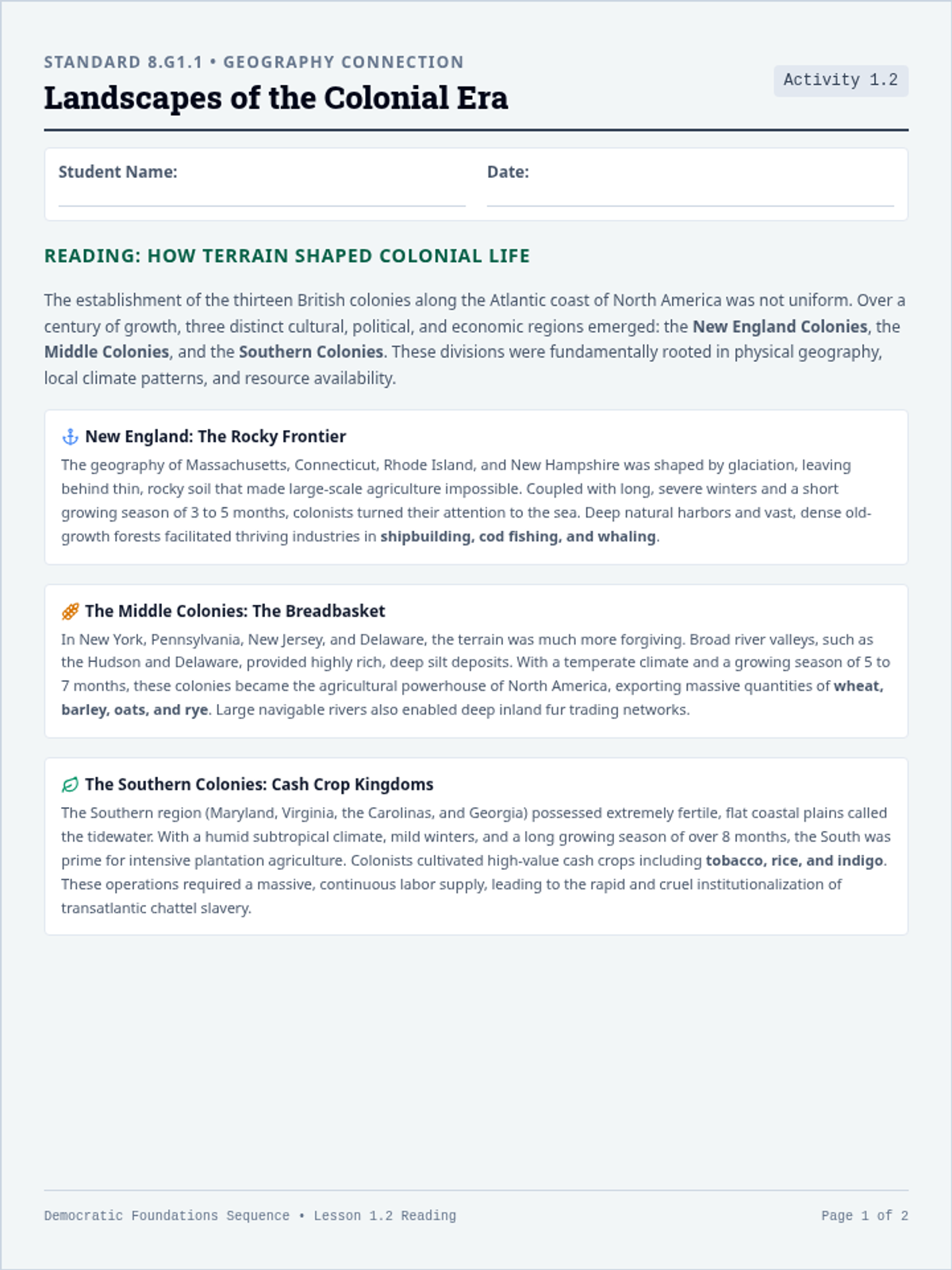
A comprehensive, student-facing reading passage and analysis worksheet focusing on geographic factors, regional economies, and resource structures across the original thirteen colonies.
Interactive, high-impact instructional slides designed to break down the key historical events, the three branches of government, and fundamental rights of citizens. The visual deck uses chunked text, dual-tone diagrams, and direct memory aids to maximize retention.
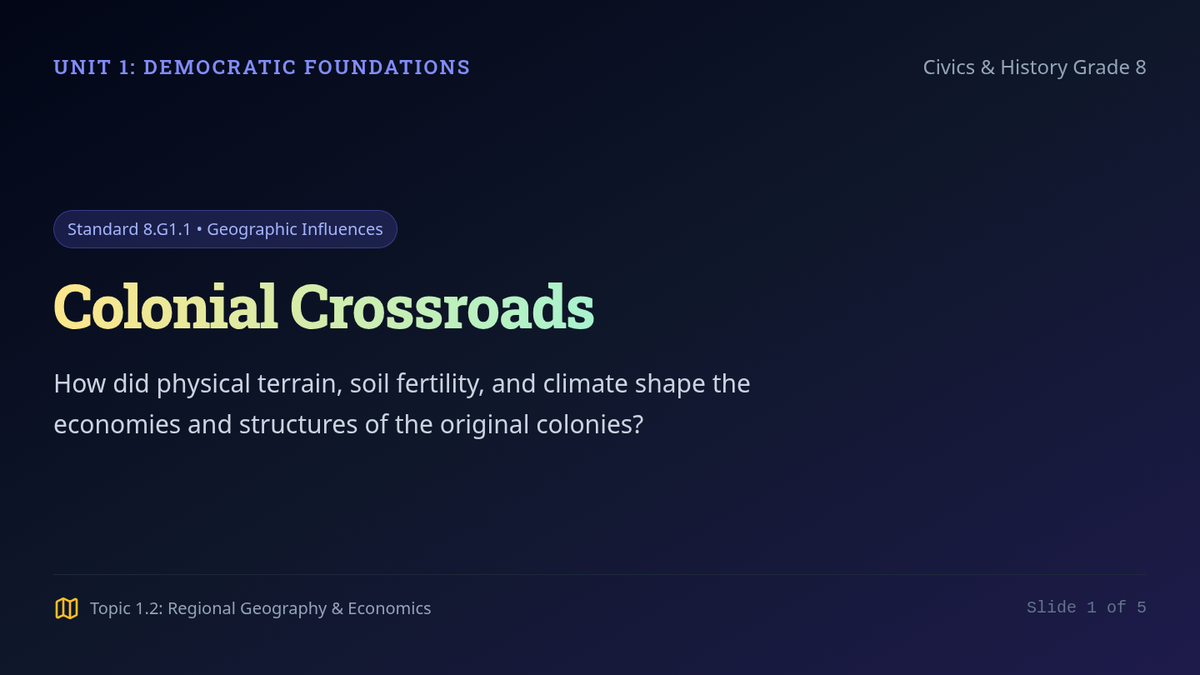
An instructional slide deck highlighting the direct connection between regional geography, climate, and economic specializations in the New England, Middle, and Southern colonies.
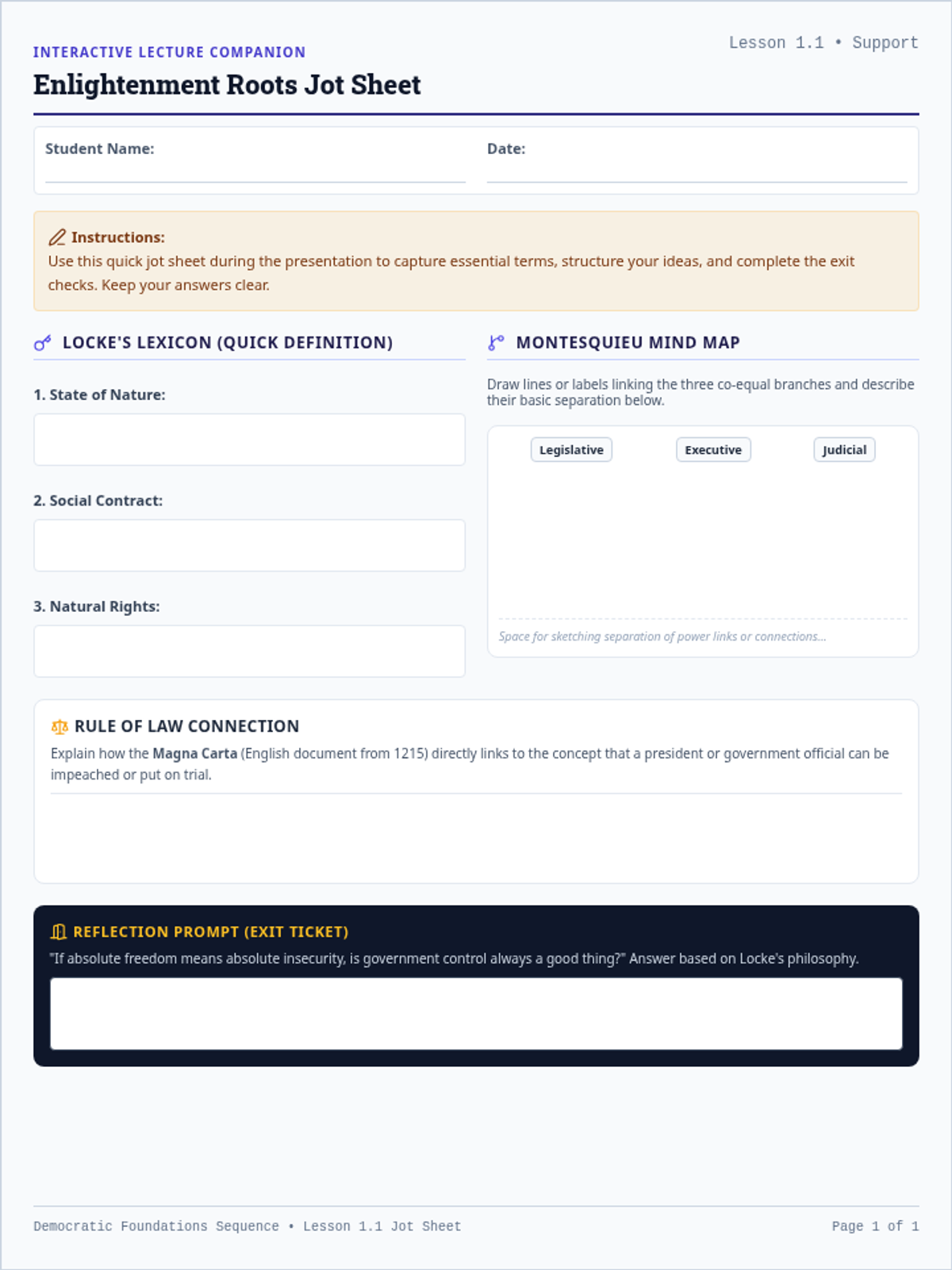
A compact, structured student jot sheet designed for quick note-taking, vocabulary mapping, and brief synthesis prompts during the Enlightenment lecture.
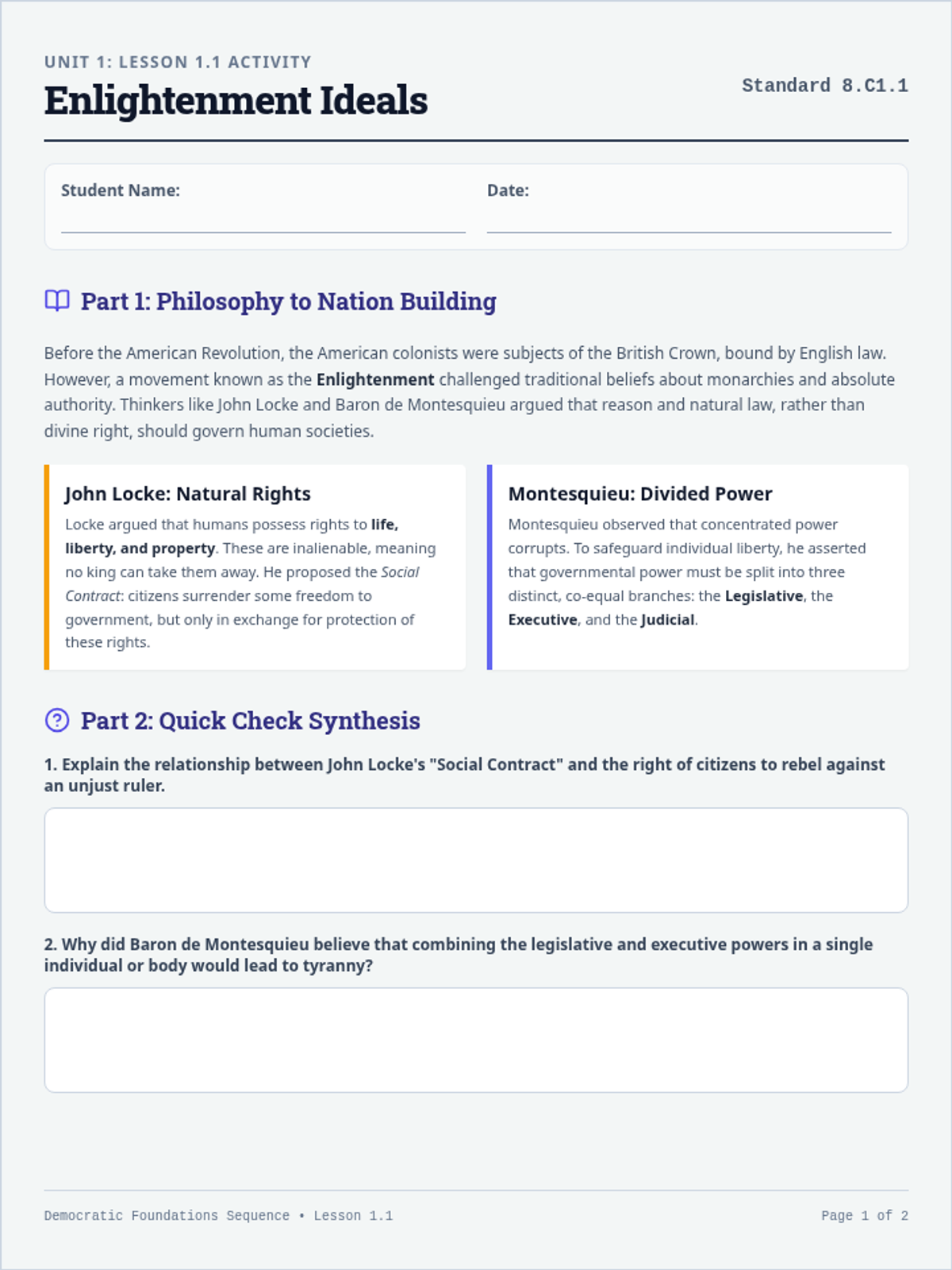
A student-facing graphic organizer analyzing the direct connections between European Enlightenment philosophies (John Locke, Montesquieu) and founding U.S. documents.
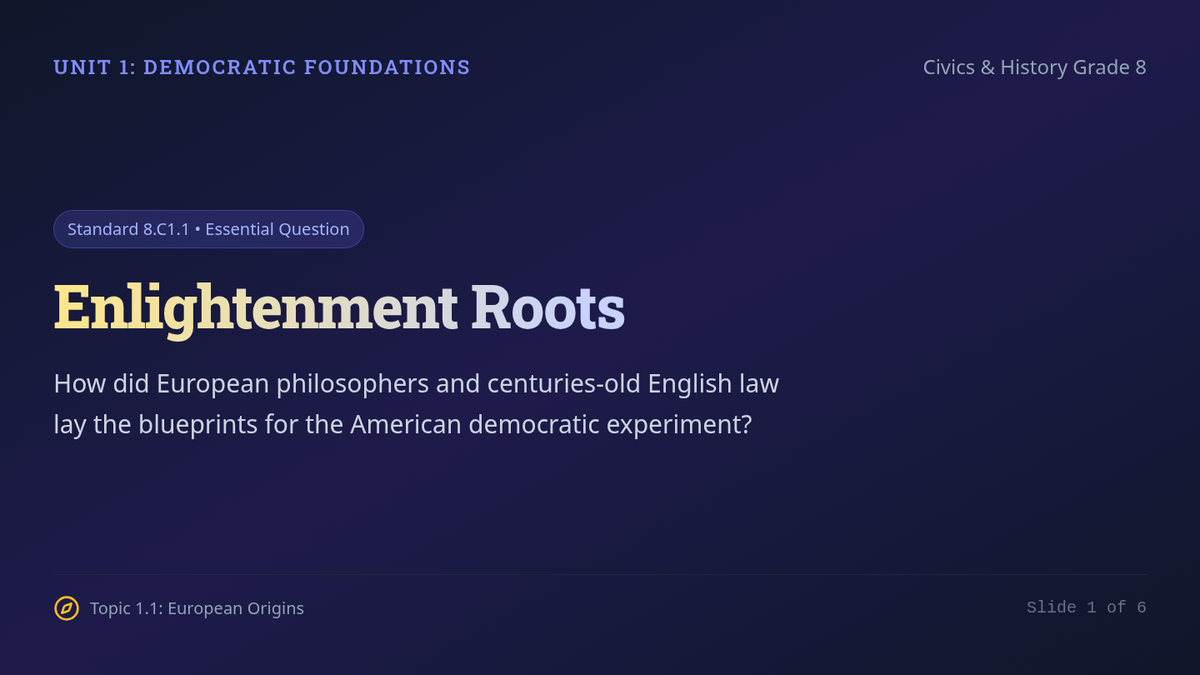
An interactive-ready slide presentation introducing the Magna Carta, John Locke's natural rights theory, and Montesquieu's separation of powers as the intellectual origins of American democracy.
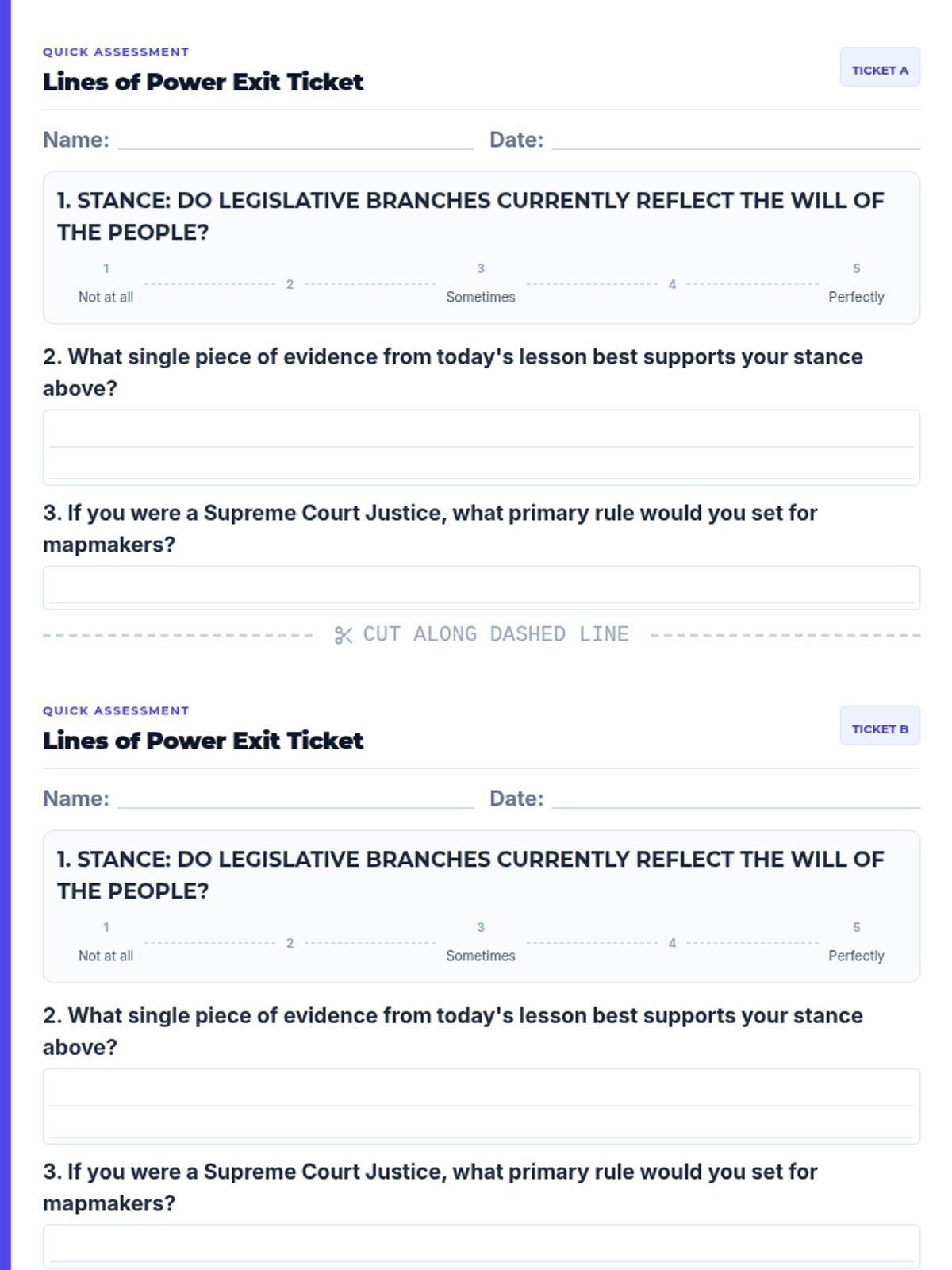
An elegant, print-ready, double-sided styled exit ticket containing name and date fields, a visual representation scale, and text-based reasoning prompts for student closure.
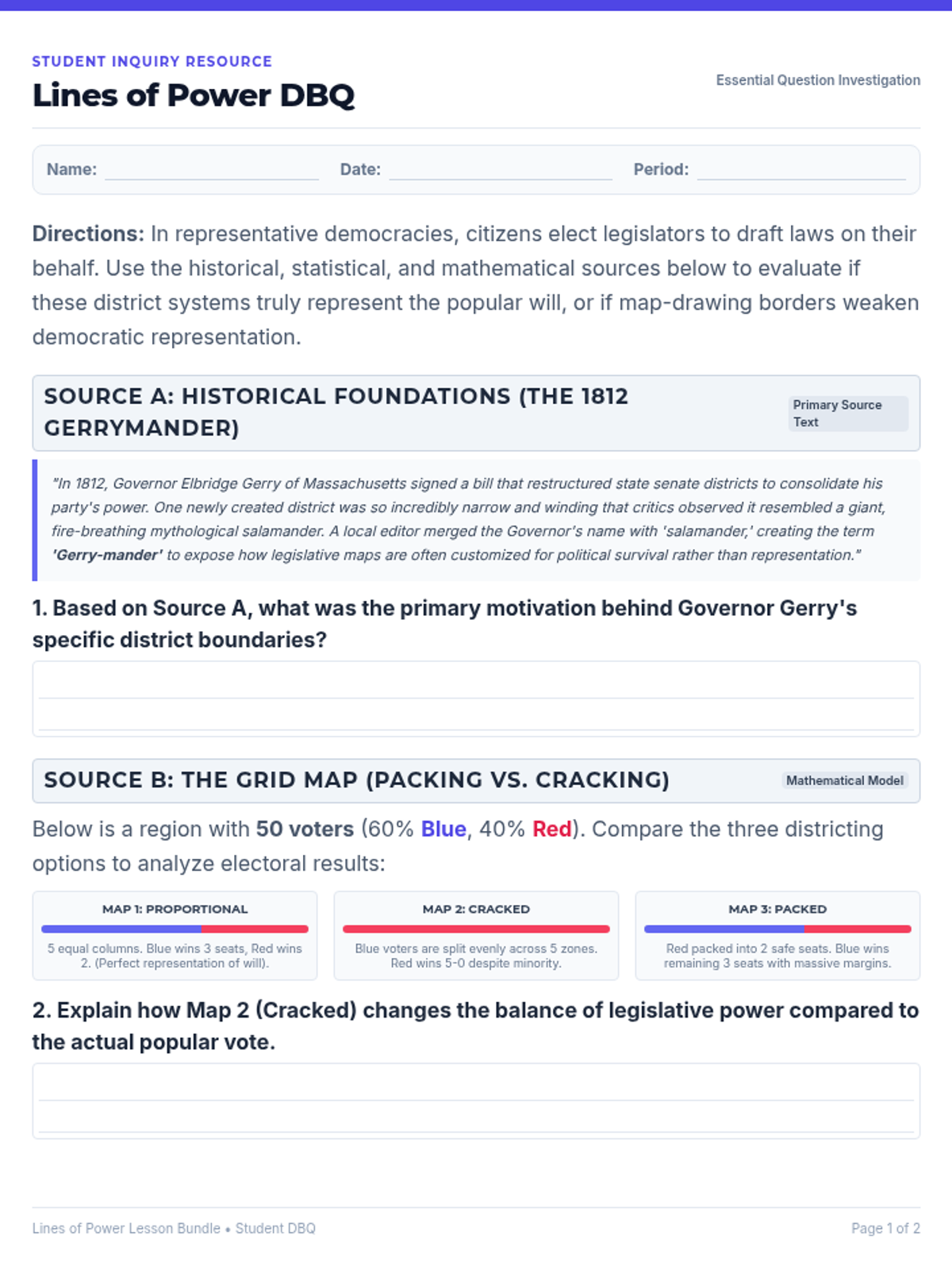
A structured, two-page DBQ worksheet for students containing a historical gerrymandering source, a mathematical grid map scenario, public opinion data, and a lined synthesis writing section.
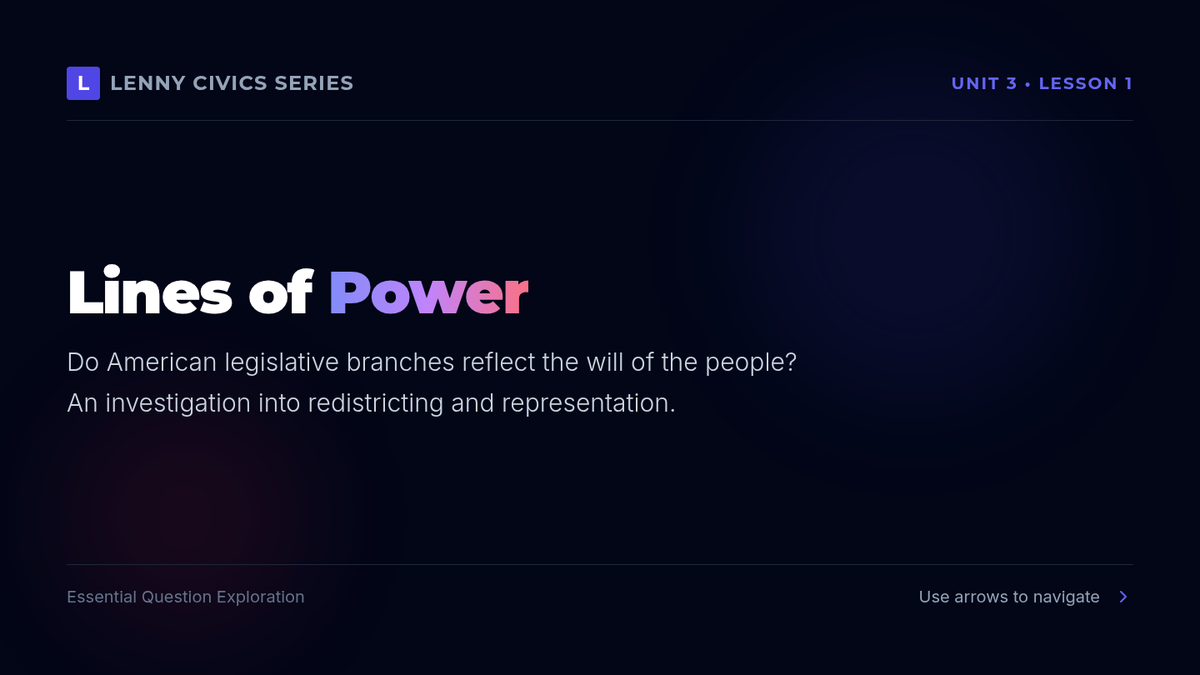
A highly visual, six-slide presentation introducing the mechanics of redistricting, visual diagrams of packing and cracking, and discussion prompts exploring the core essential question.
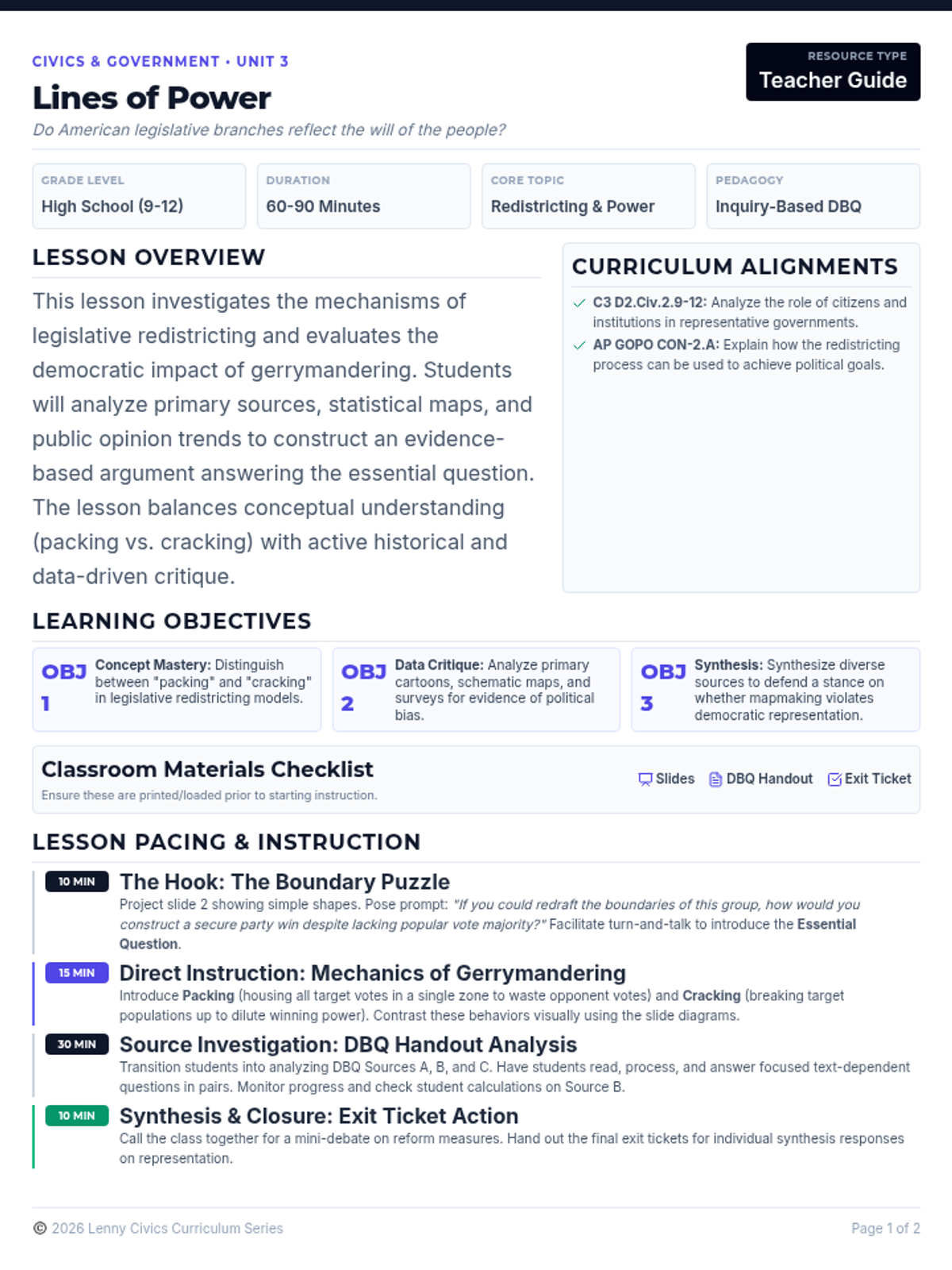
A professional, two-page editorial teacher guide providing instructional pacing, discussion scaffolding, standard alignments, and detailed answer keys/rubrics for the Lines of Power lesson.
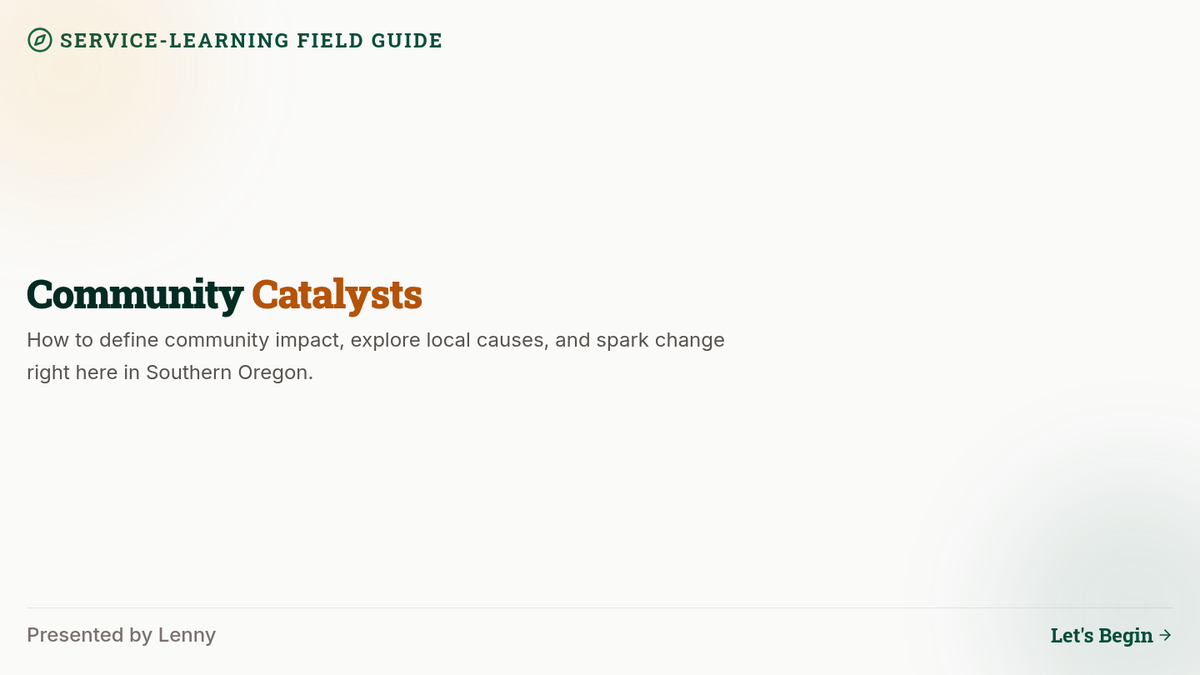
A 5-slide visual presentation to accompany the lesson. It introduces service learning, explains the four pathways of community impact, highlights local examples in Southern Oregon, and guides students through starting their investigative worksheet.
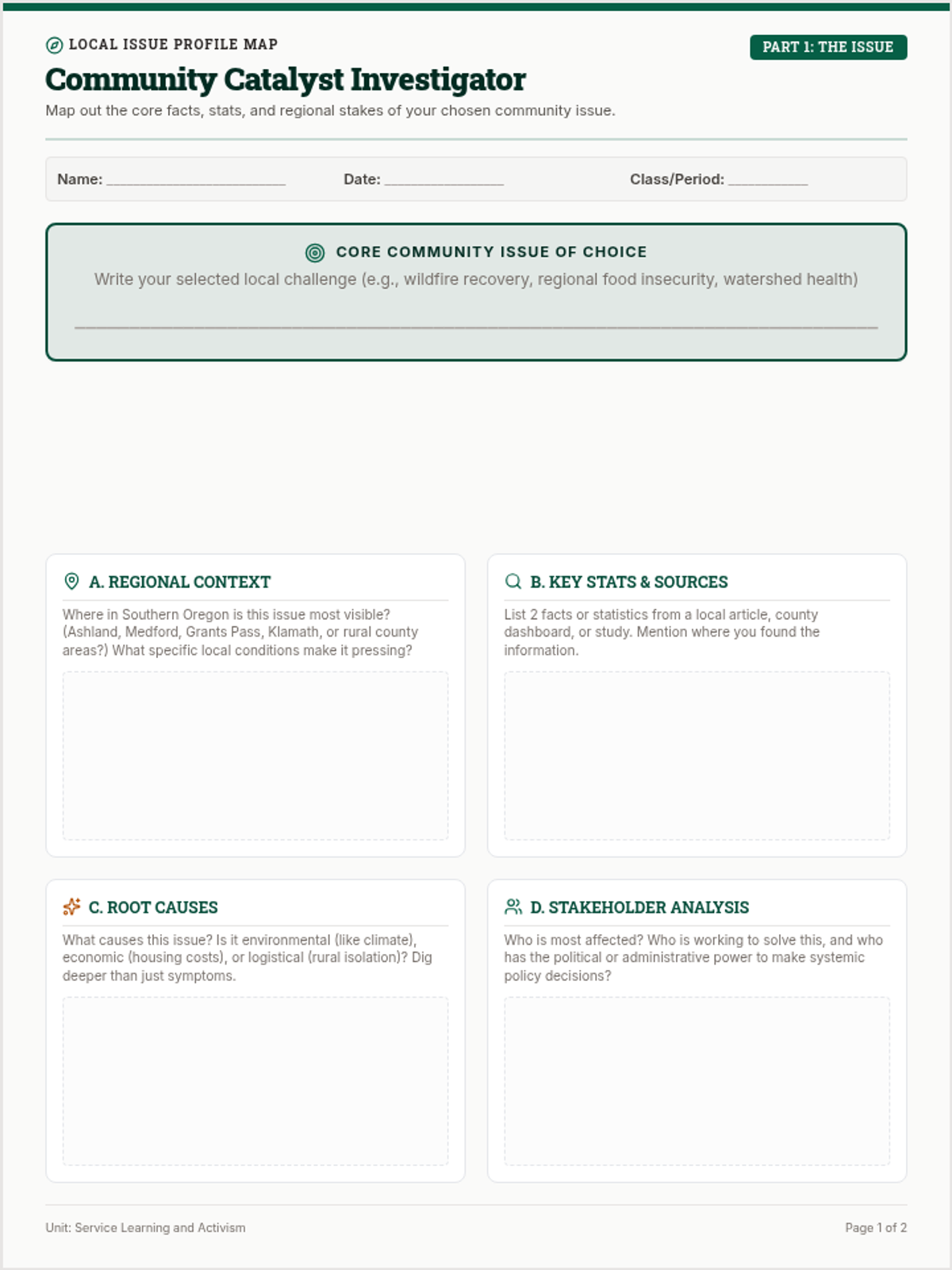
A two-page print-ready graphic organizer and research dossier. Students use it to profile a local community issue in Southern Oregon and map out a chosen charity's mission, impact pathways, support systems, and student opportunities.
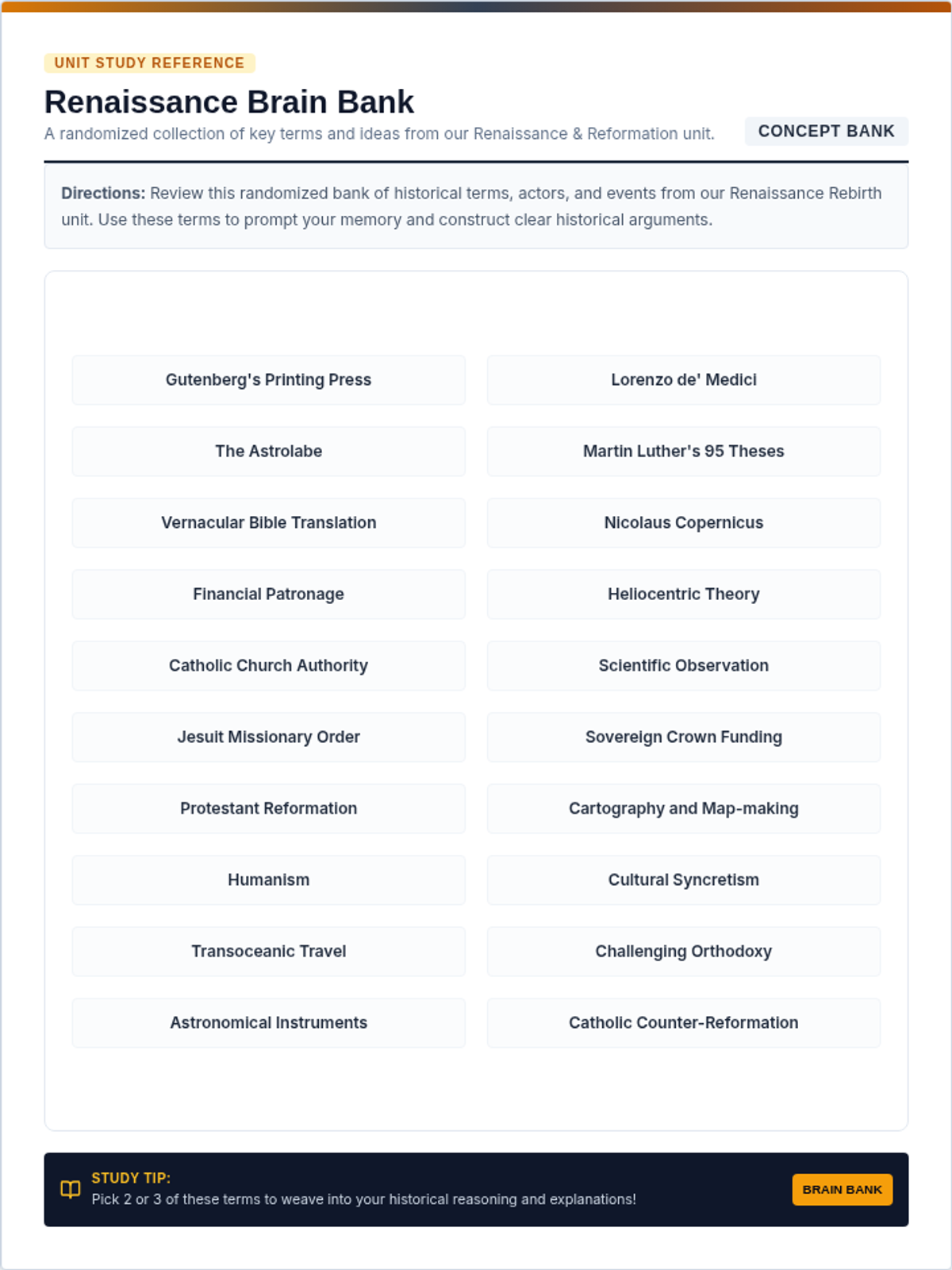
A gamified review slide deck based on the Renaissance Brain Bank. It challenges students to quickly match brief, 3-5 word definitions to terms from their idea banks, with consecutive slides revealing the definitions and answers in a stylized academic format. Contains all 20 terms in randomized order.
A comprehensive study reference card featuring a detailed word and idea bank of key unit concepts from the Renaissance and Reformation. It breaks down critical terms into categories—Technology & Science, Power & Patronage, and Reformation & Adaptation—providing historical definitions and conceptual connection triggers.

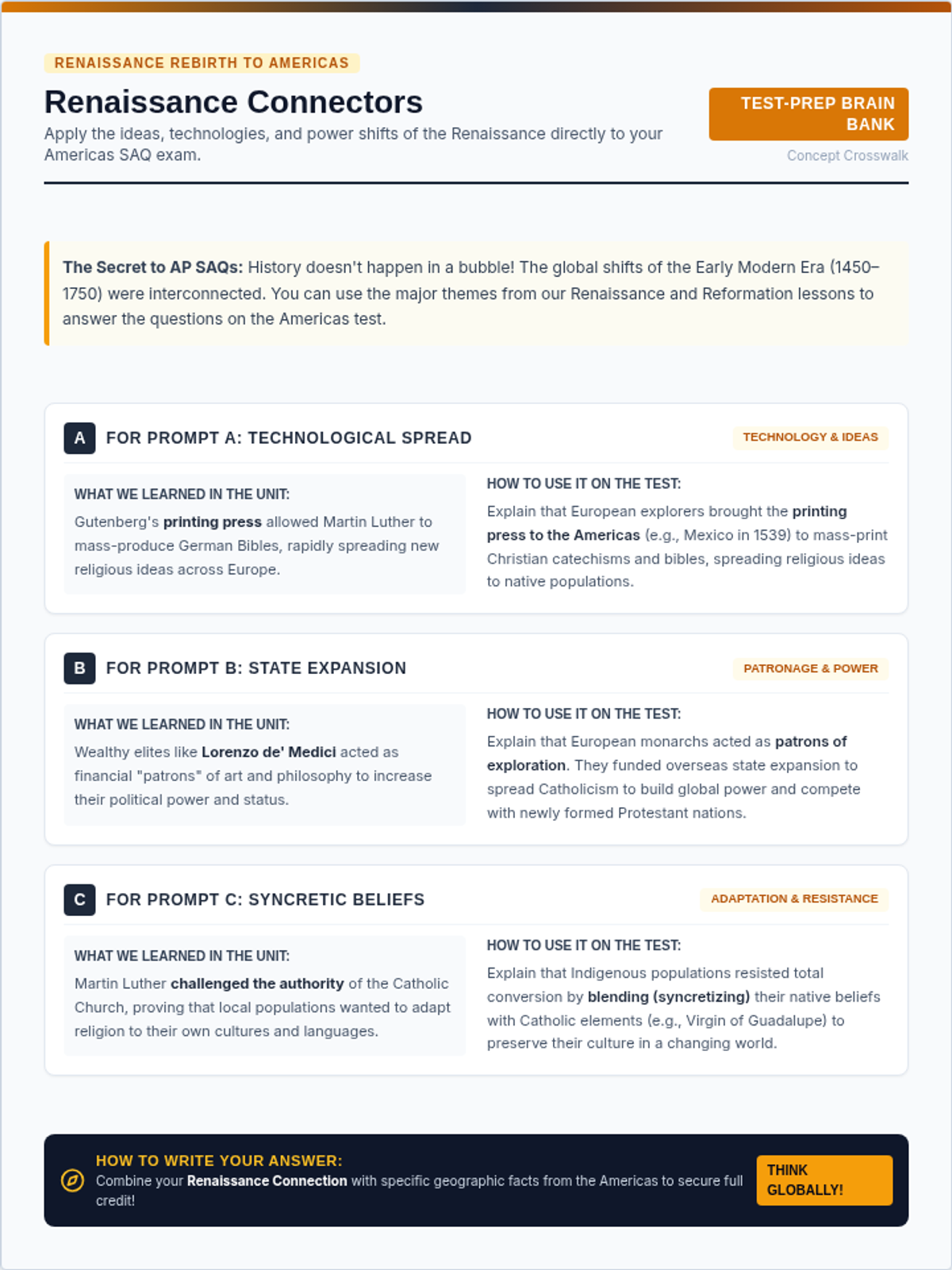
An expanded conceptual bridging guide that connects Renaissance unit concepts directly to global interactions. Page 1 maps the connections to the Americas (1450-1750), and Page 2 features an open-ended synthesis activity with multiple correct historical pathways, allowing students to map Renaissance developments to global scenarios without explicitly referencing the test prompts.
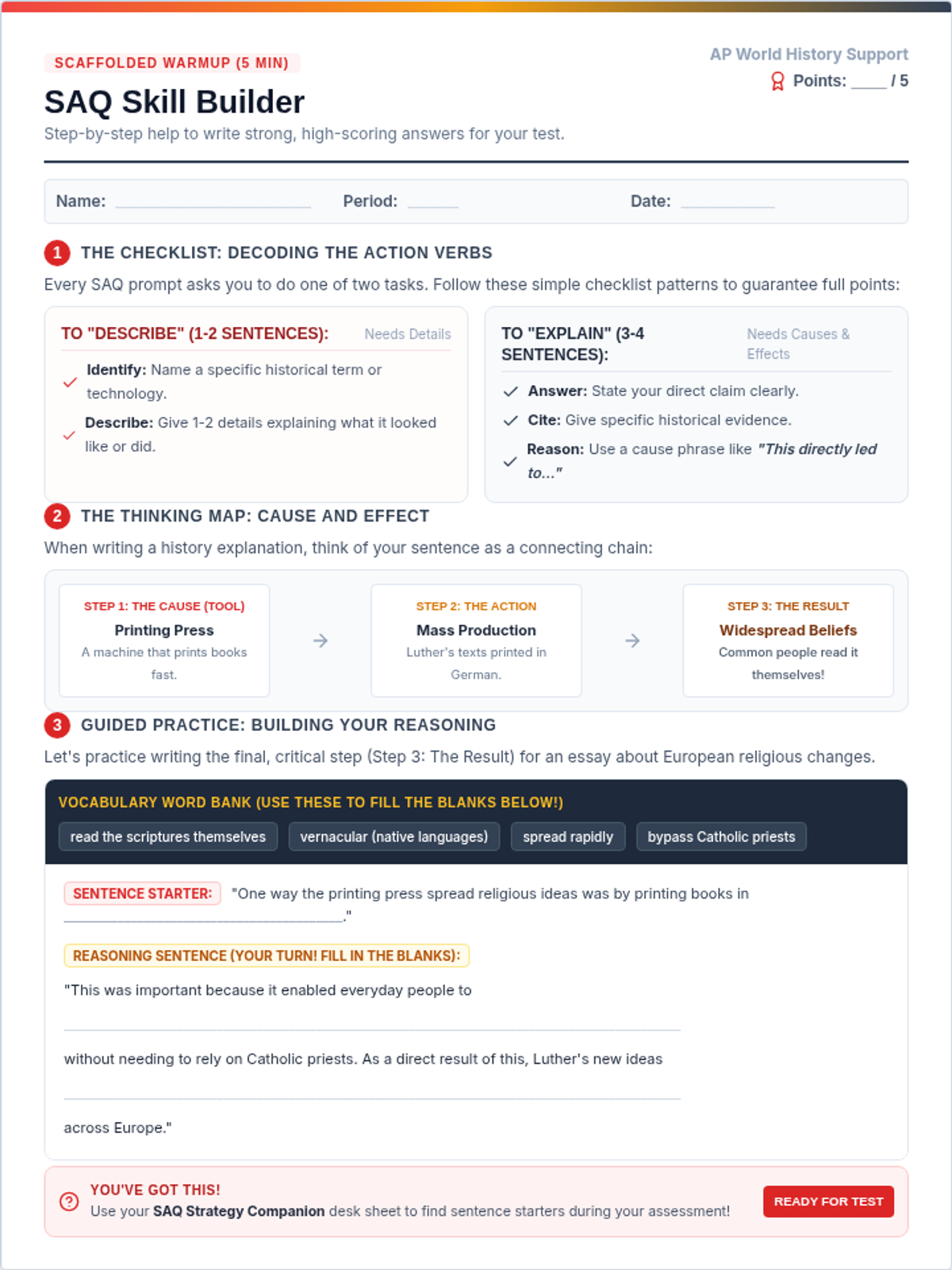
A scaffolded 5-minute pre-teach warmup worksheet leveled for students who struggle academically or have lower reading levels. It features simplified language, visual checklists for task verbs, a causal flowchart showing a step-by-step historical reasoning connection, and structured sentence frames with a word bank to guide students in writing rigorous historical explanations.
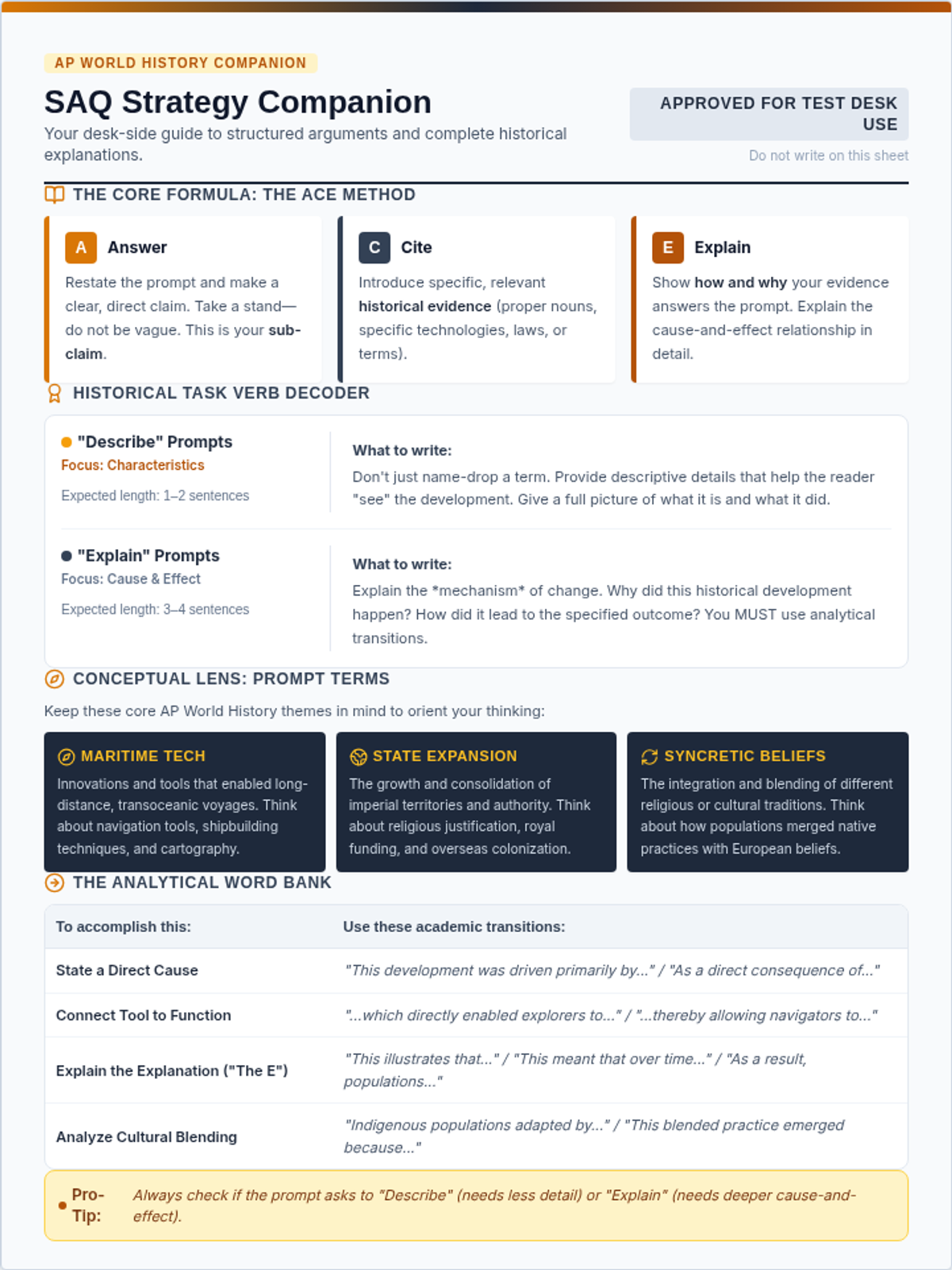
A desk-side reference companion for students to use during AP World History SAQ assessments. It features structural guidelines using the ACE formula, clear visual definitions of historical task verbs, concept breakdowns for maritime technology, state expansion, and syncretism, and an analytical sentence-starter bank for constructing high-quality arguments.
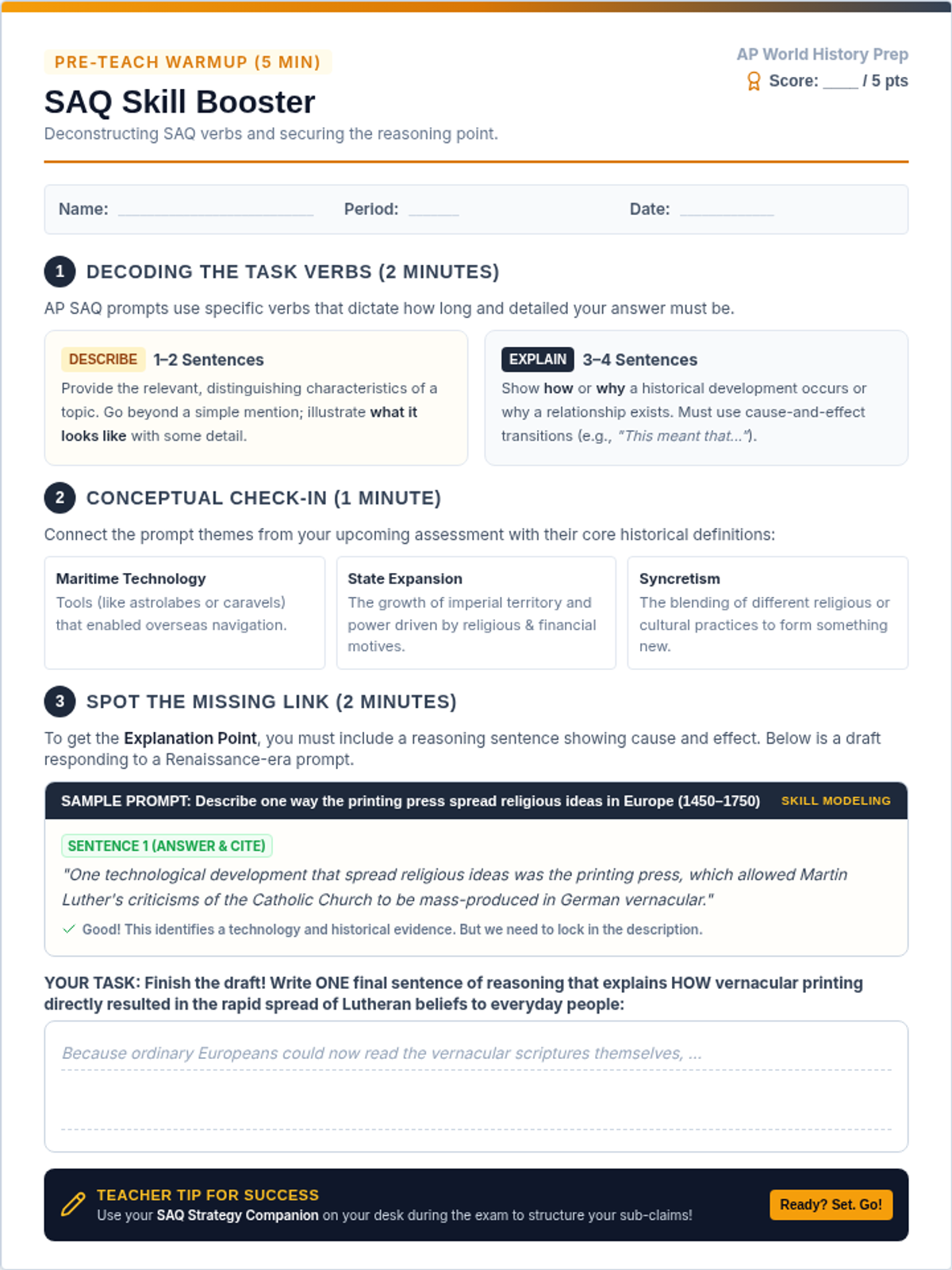
A 5-minute pre-teach warmup worksheet designed to prepare students for the AP World History SAQ assessment. It guides students through deconstructing prompt verbs (Describe vs. Explain) and features a quick 'Spot the Missing Link' activity to practice writing critical reasoning sentences.
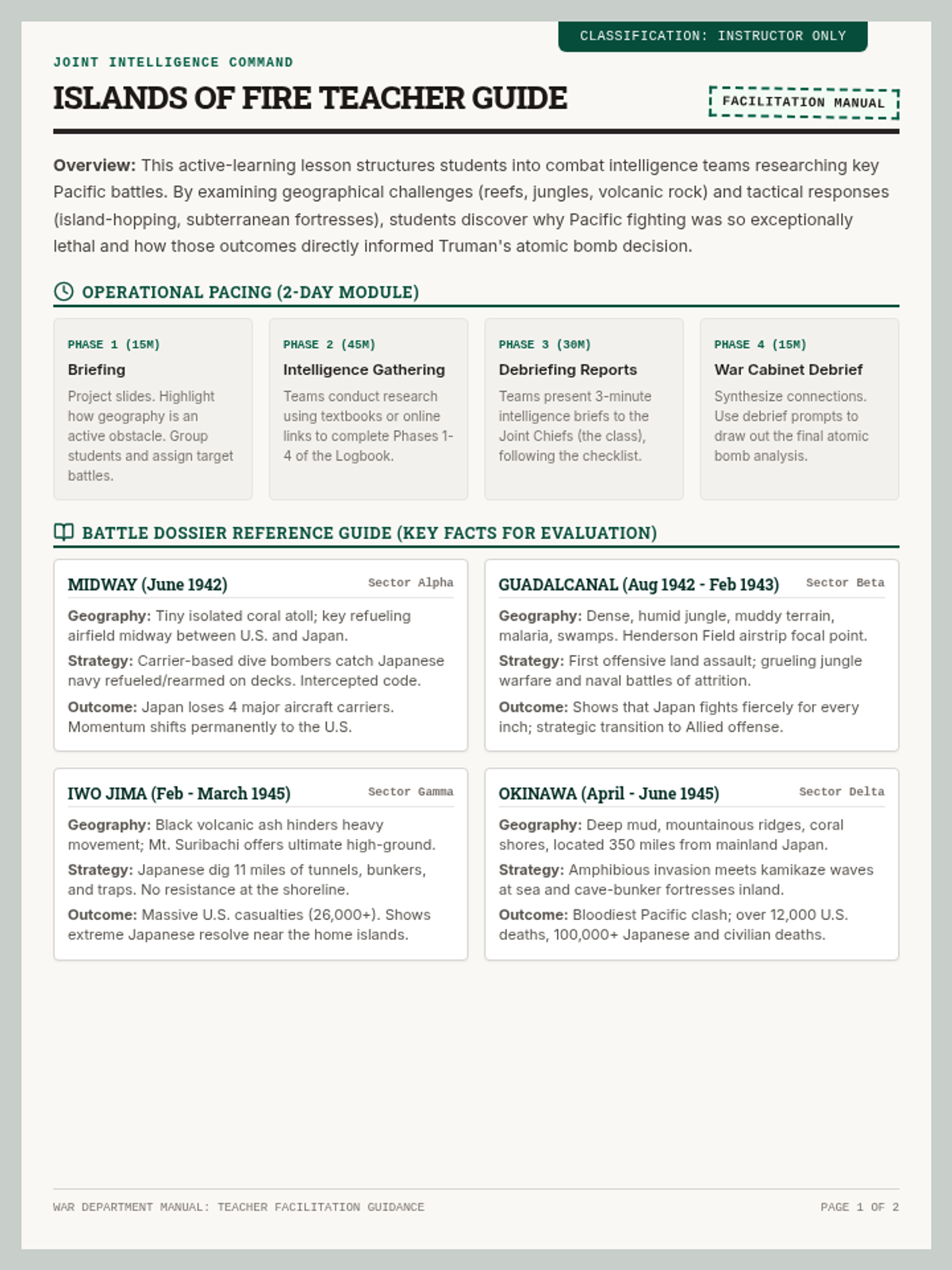
A 2-page instructional facilitation guide and battle cheat sheet for teachers. Includes a step-by-step pacing plan, quick reference battle profiles, a collaborative rubric, and historical debrief questions.
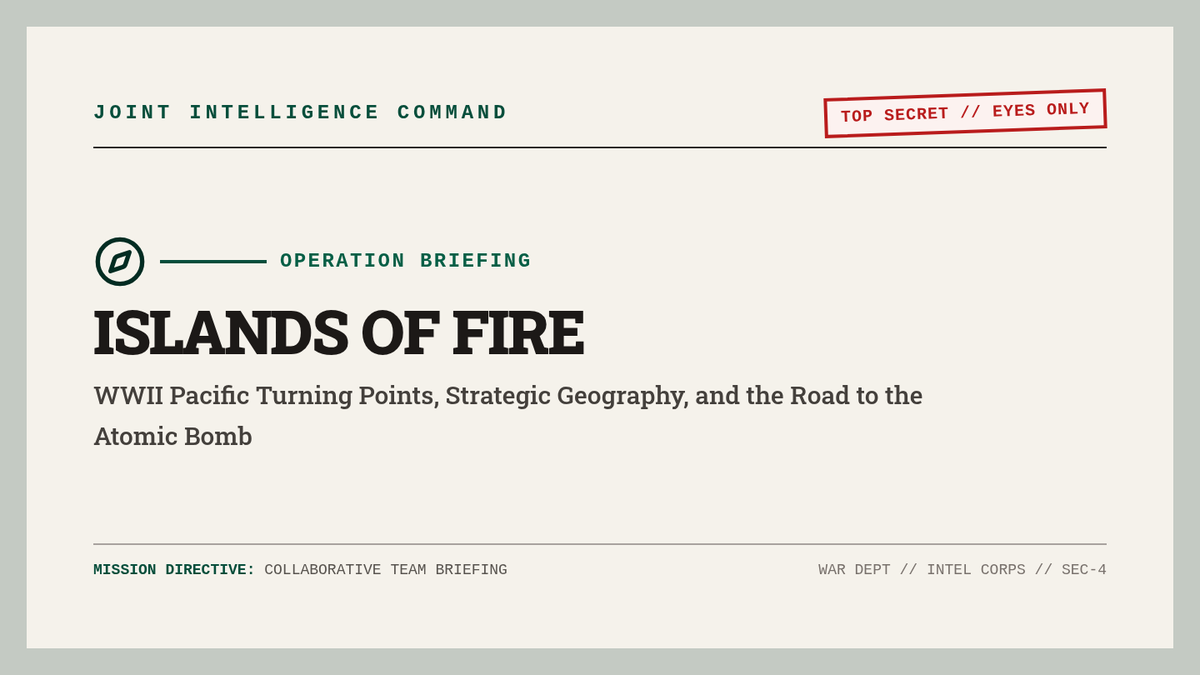
A 5-slide military intelligence briefing presentation that establishes the Pacific Theater context, explains the island-hopping and defensive fortification strategies, and assigns the collaborative team mission.
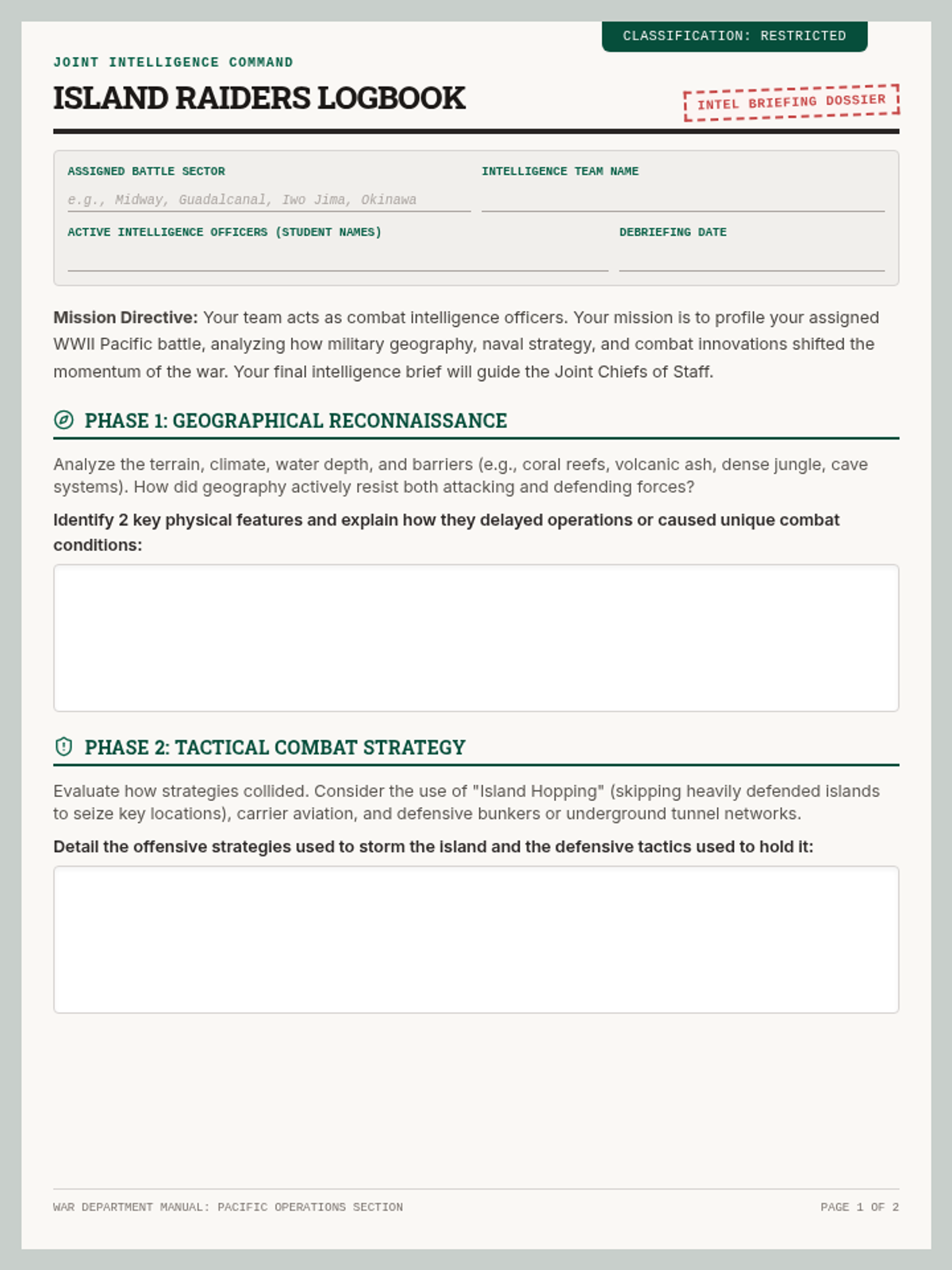
A 2-page military intelligence research dossier and logbook for student teams to profile their assigned Pacific battle, analyzing tactical geography, combat strategies, and its connection to the atomic bomb decision.
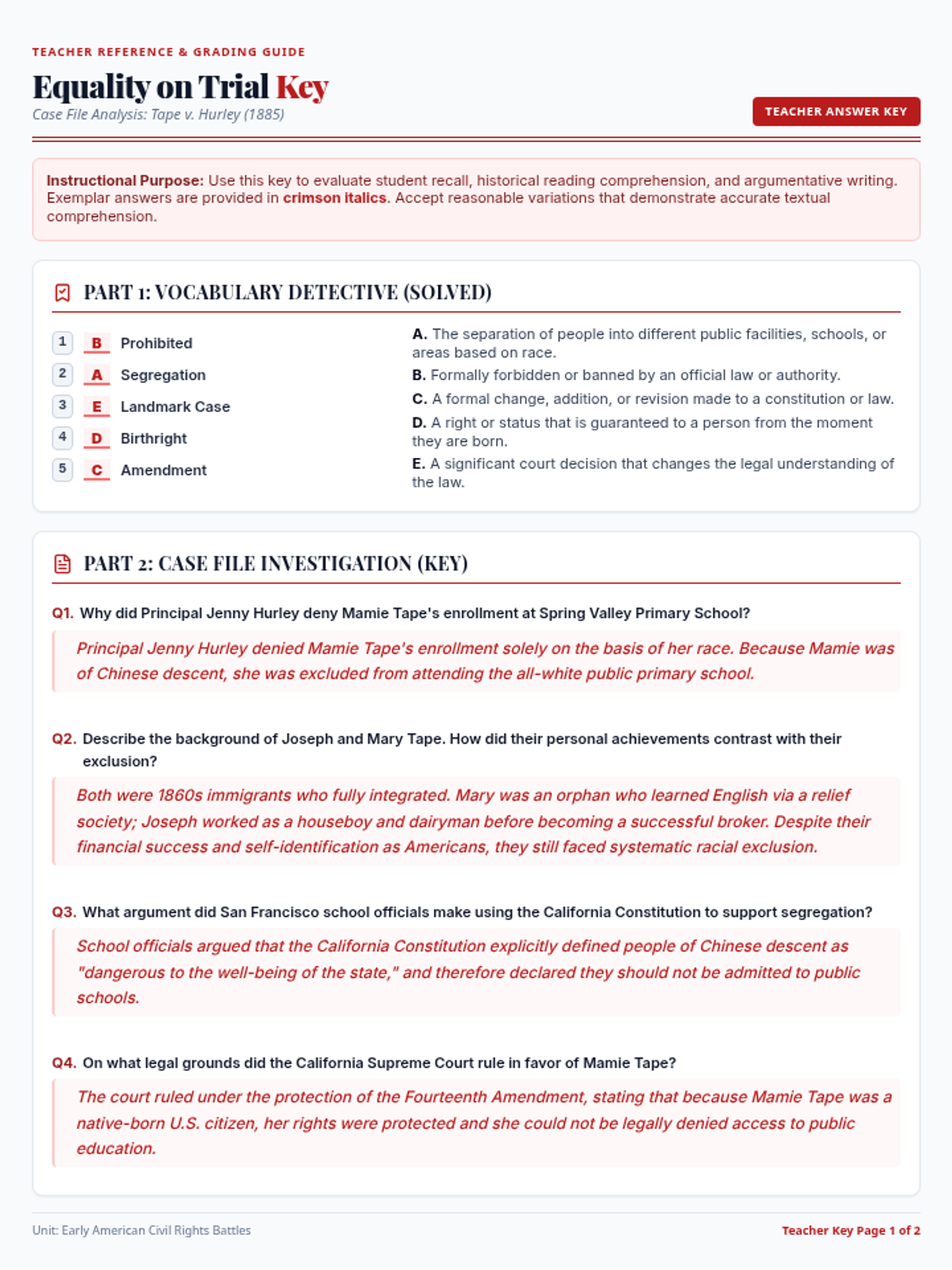
A printable 2-page Teacher Answer Key and Grading Guide for the Tape v. Hurley Guided Reading Worksheet. Includes highlighted correct vocabulary matches, detailed model responses for comprehension questions, filled comparative matrices, and pedagogical scoring criteria.
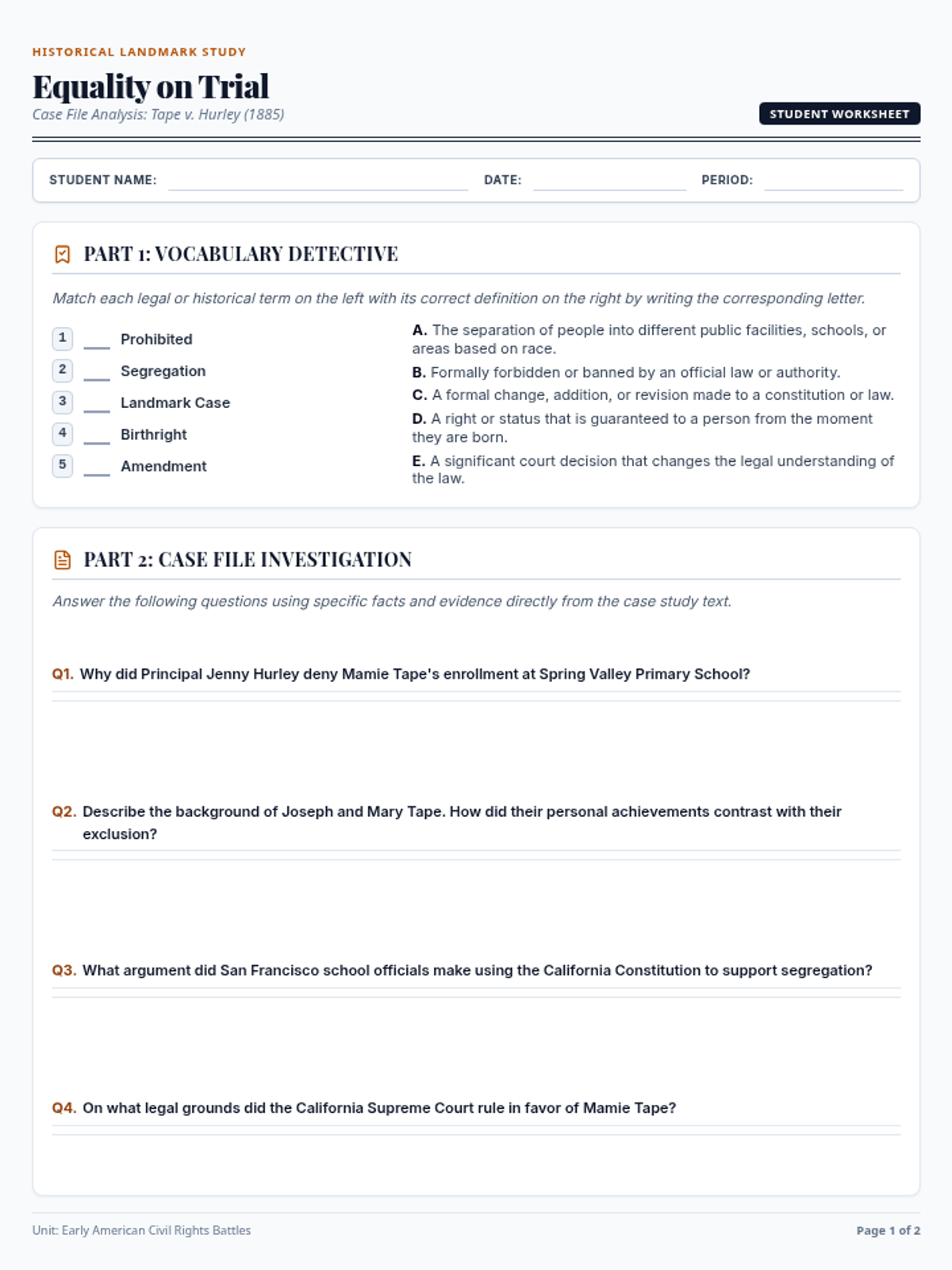
A printable 2-page Guided Reading Worksheet for students covering the Tape v. Hurley civil rights case. Features a vocabulary builder, chronological comprehension questions, a comparative civil rights matrix, and reflective analysis prompts with handwriting-friendly response spaces.
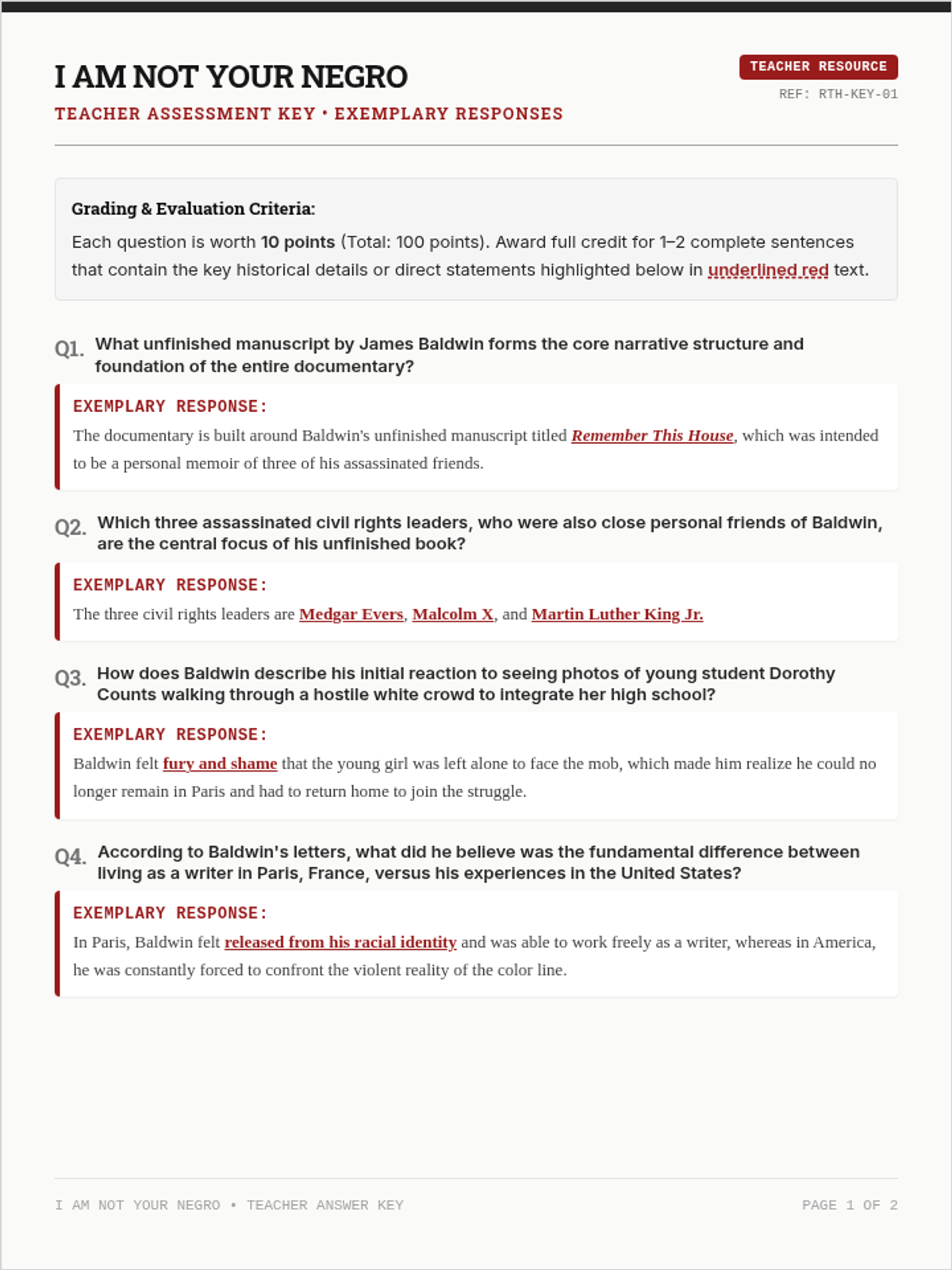
The formal assessment and teacher answer key featuring the 10 literal comprehension questions alongside exemplary responses and grading guidance for 'I Am Not Your Negro'.
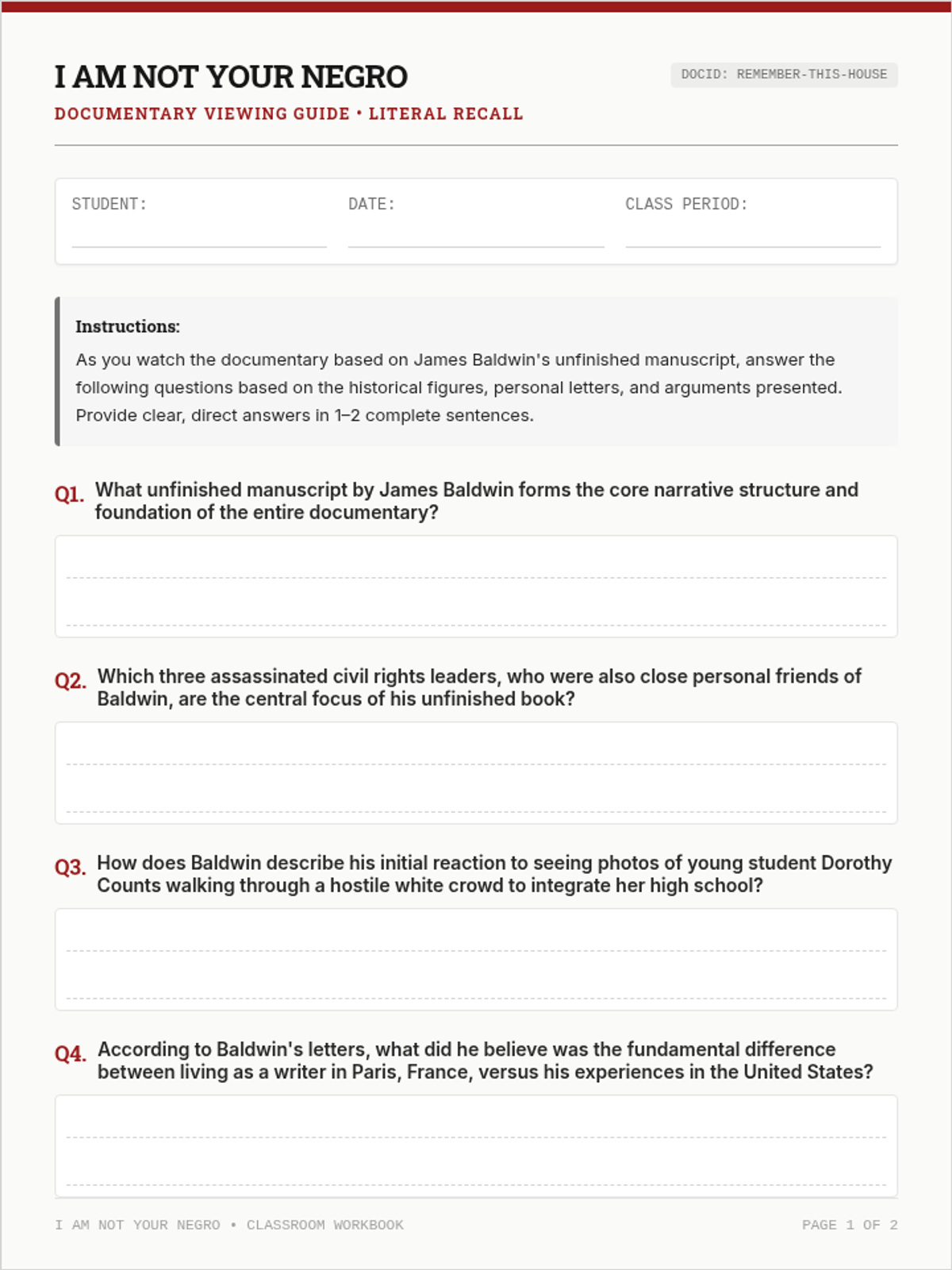
A clean, typewriter-themed printable viewing guide with designated handwriting lines for students to answer 10 literal comprehension and recall questions about James Baldwin's documentary 'I Am Not Your Negro'.
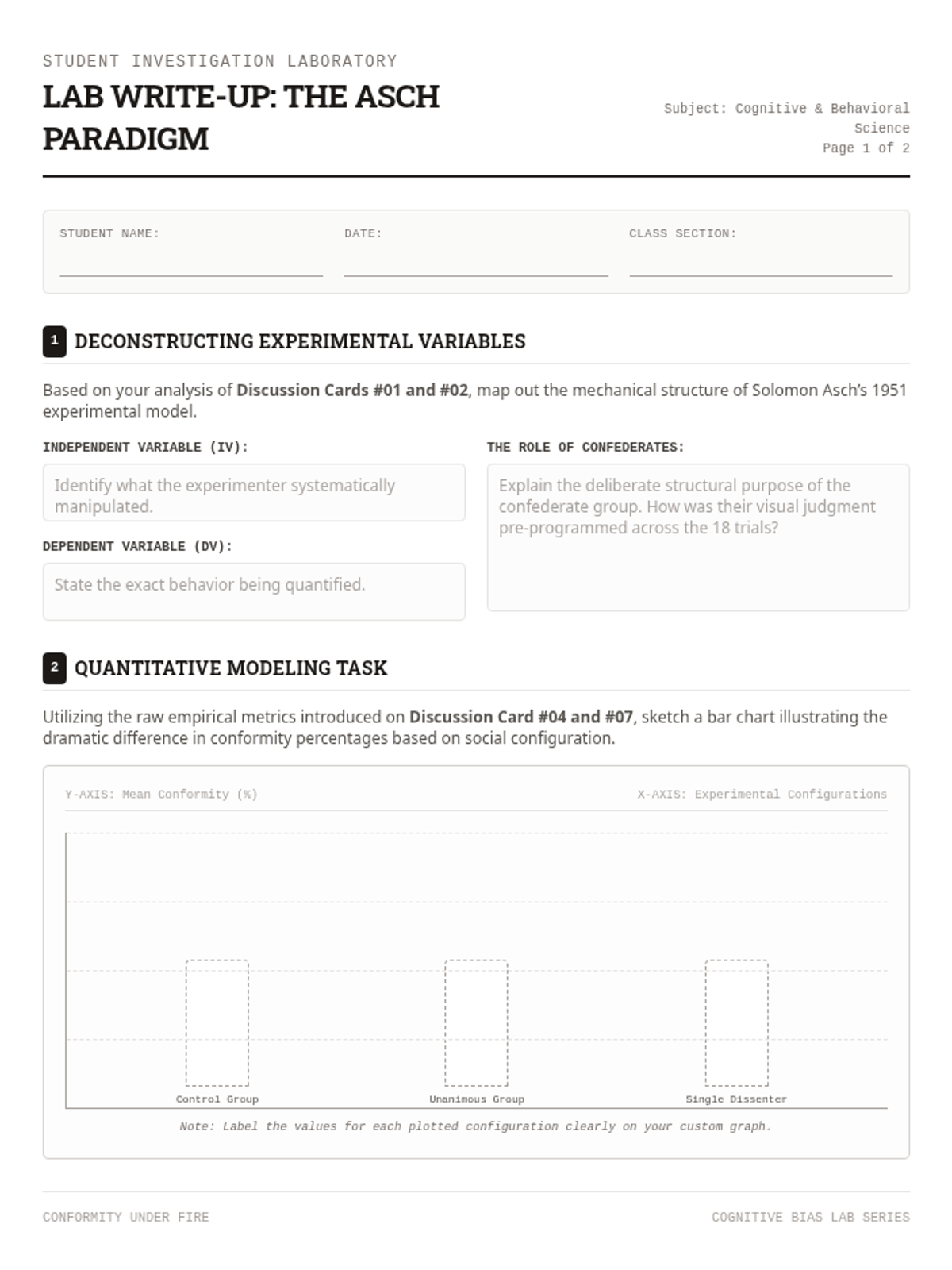
A rigorous 2-page student analysis worksheet and lab write-up companion designed to be used alongside the Pressure Point Discussion Cards. Features experimental modeling tasks, custom statistical graphing sections, and structured response fields.