A comprehensive teacher facilitation guide for the Denominator Discovery lesson, outlining the instructional sequence, key vocabulary, and specific discussion prompts centered around the Identity Property of Multiplication.
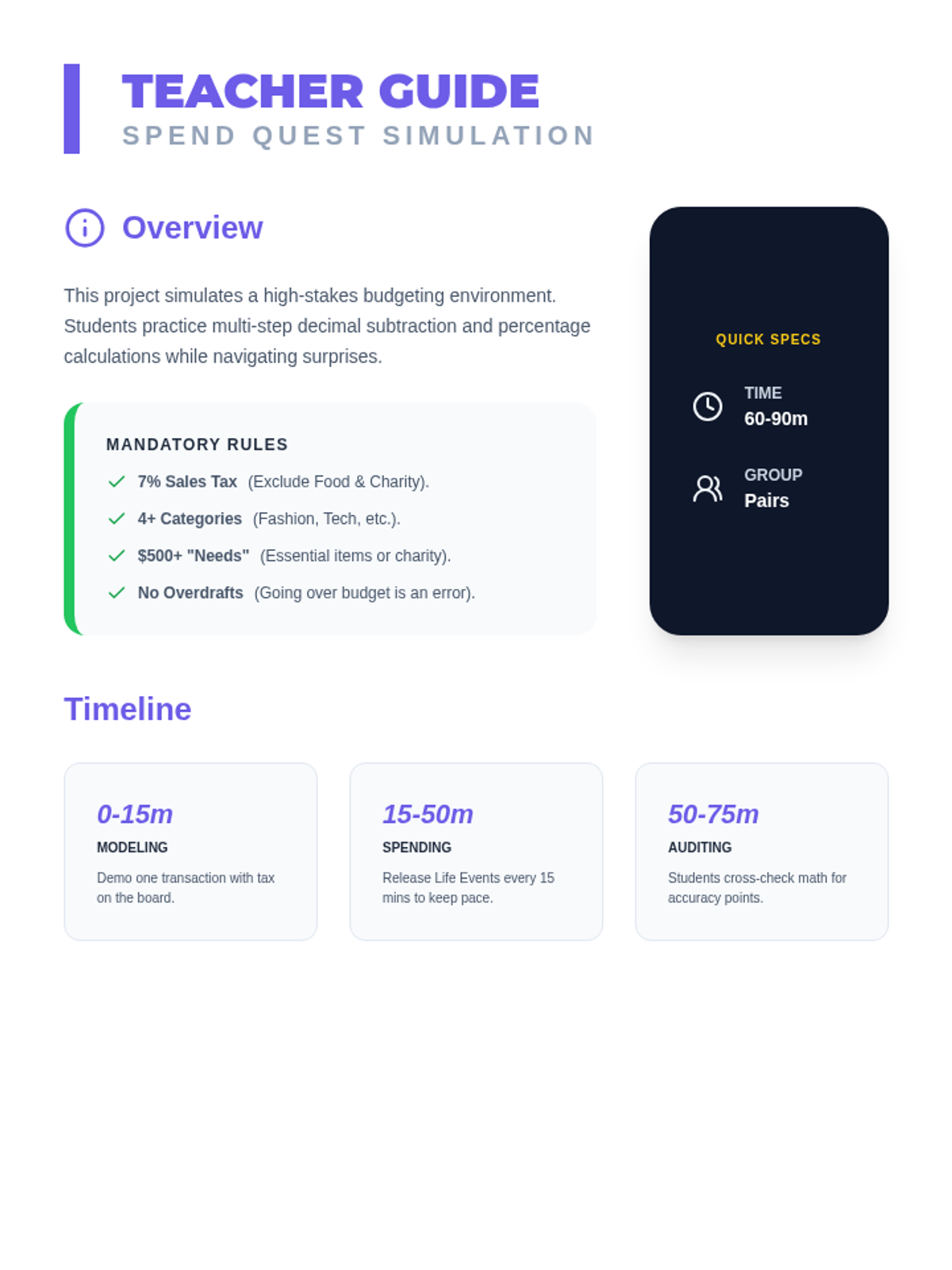
A comprehensive teacher's guide for the Spend Quest simulation, including pacing tips, 'Life Event' prompts, and an updated assessment rubric for high-efficiency budgeting.
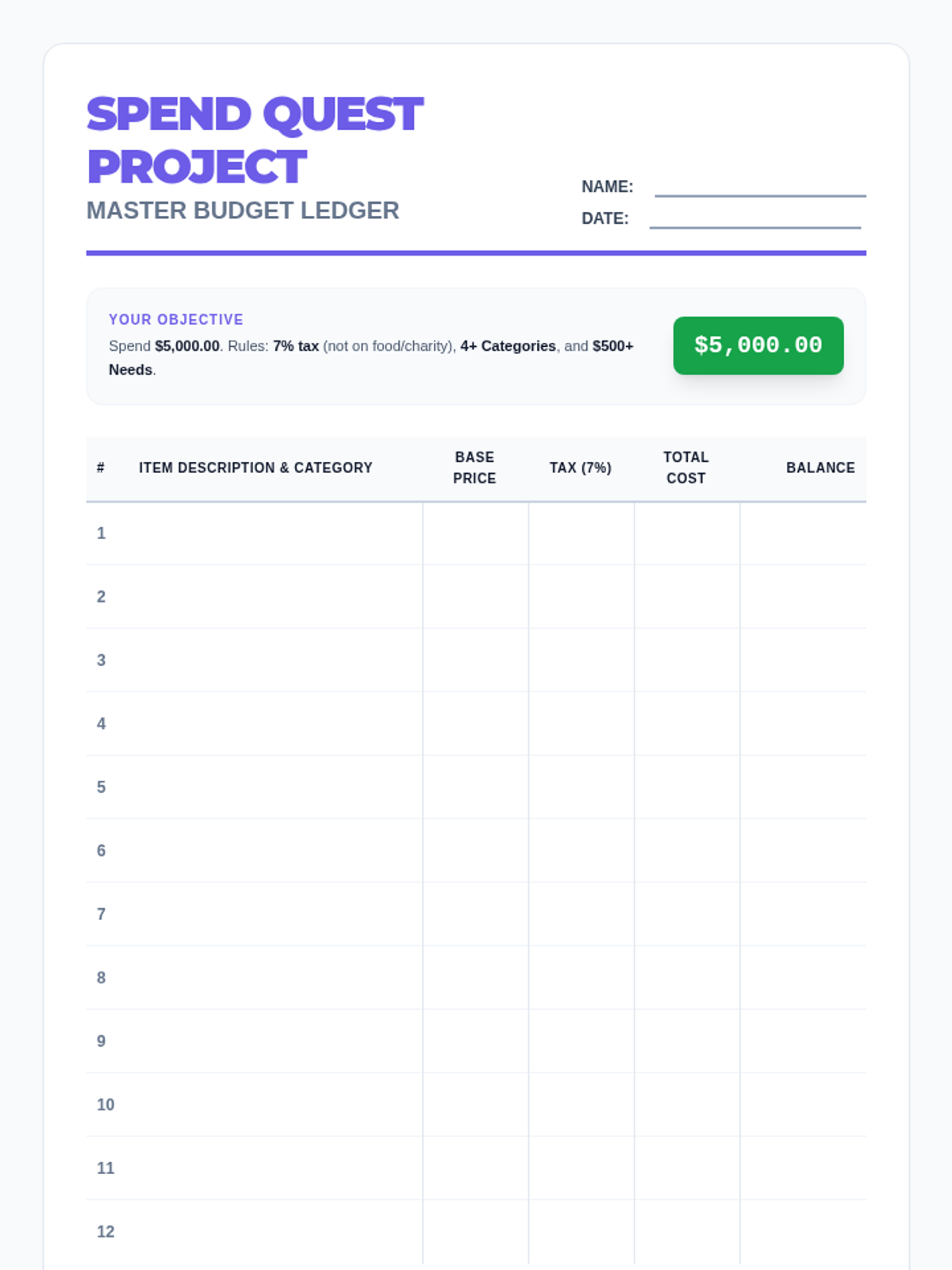
A structured project packet for students to track their spending spree, including rules, a large budget ledger, and life event tracking with clean work areas.
A vibrant presentation to introduce the Spend Quest budget simulation, covering the scenario, rules, and multi-step math processes required for the project.
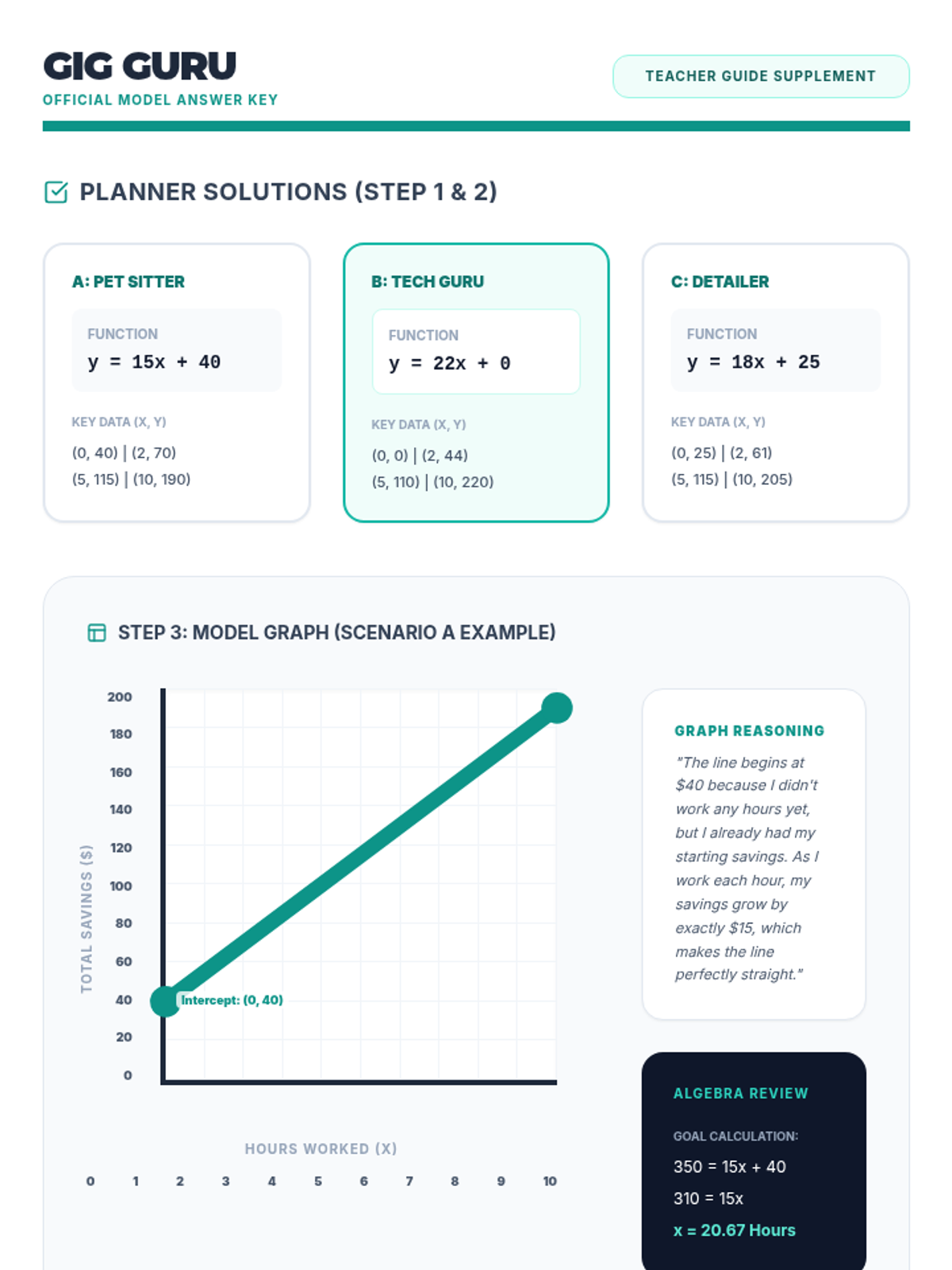
A complete teacher's answer key for the Gig Guru project, providing exact numerical solutions for all three job scenarios, model graphs, and detailed algebraic solving steps for the financial goals.
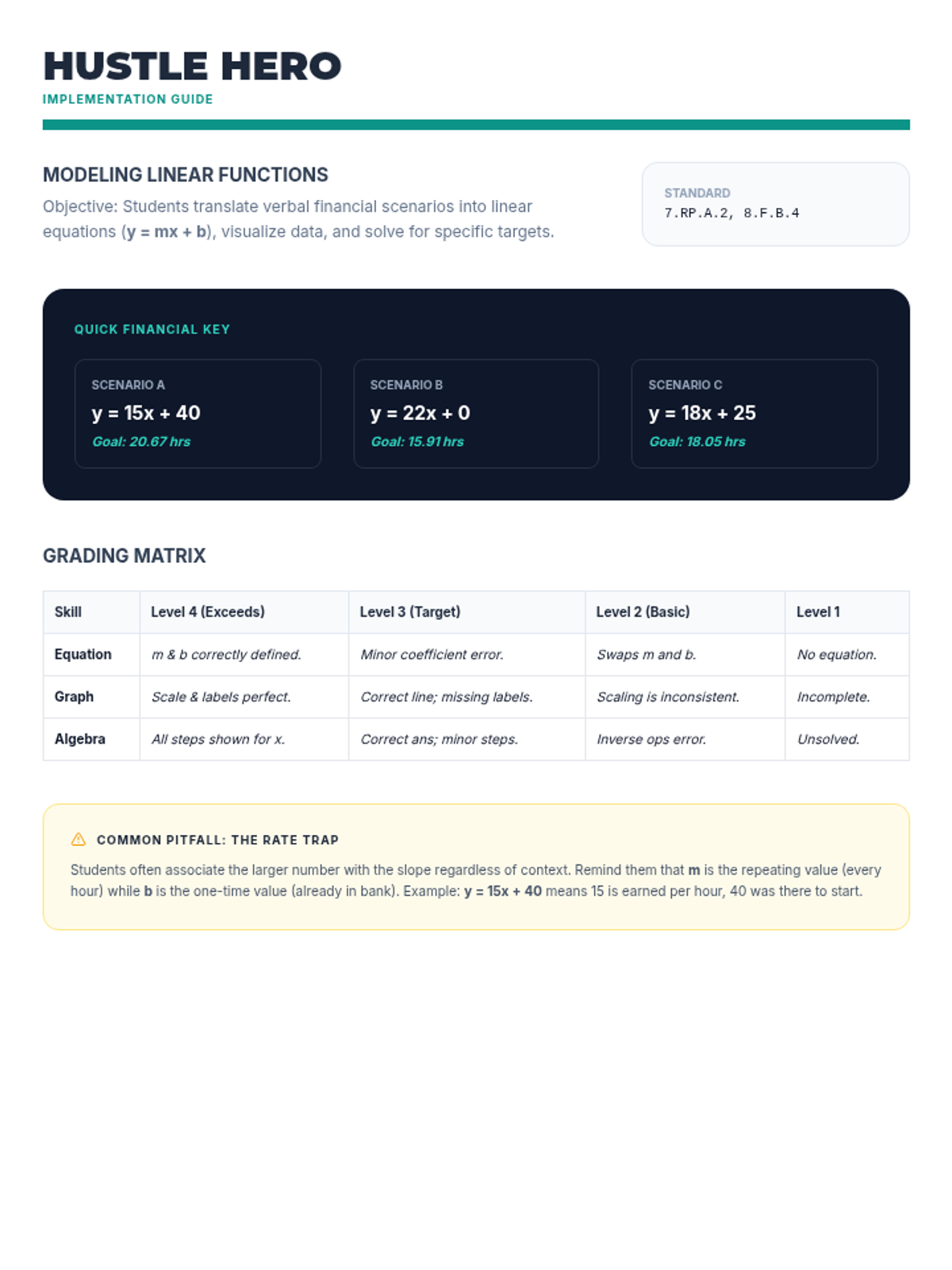
A comprehensive guide for teachers to facilitate the Gig Guru project, including standards alignment, pacing suggestions, answer keys, and a grading rubric.
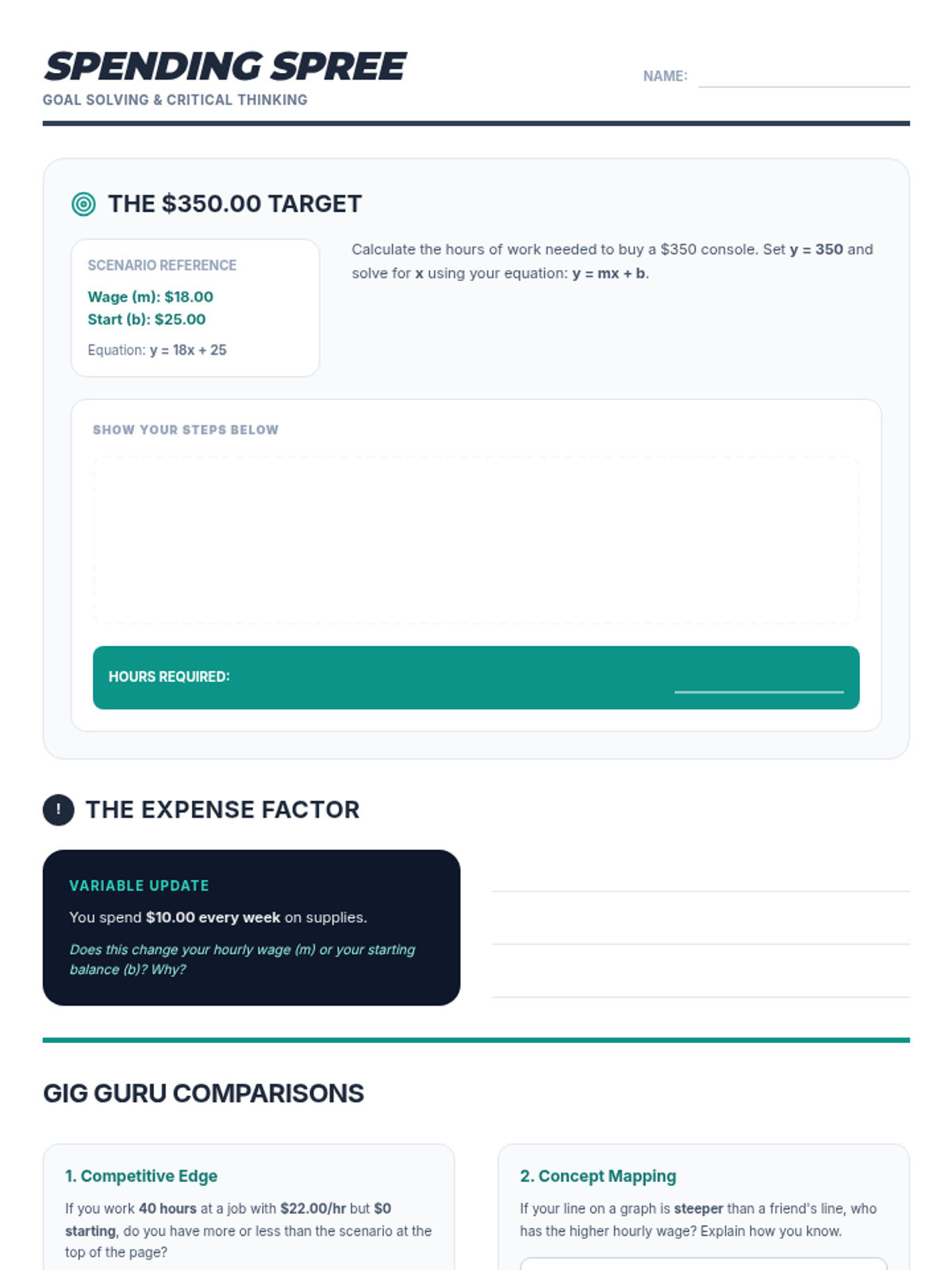
An extension worksheet focusing on budget management, calculating goal-based targets using algebraic solving, and reflecting on the impact of expenses on linear models.
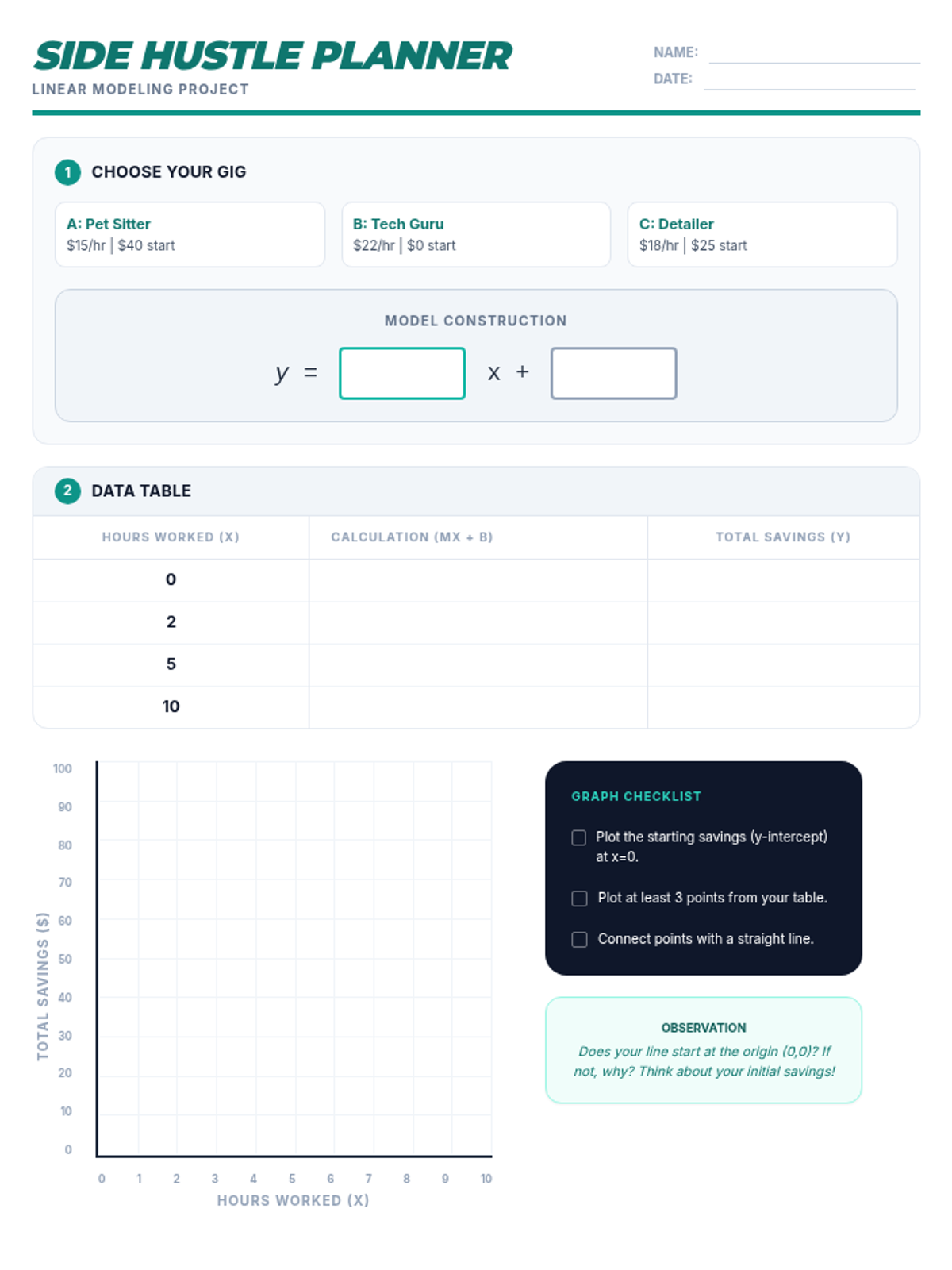
A project worksheet where students select a summer job scenario and build a linear function model. It includes identifying parameters, writing the equation, calculating values in a table, and graphing the results.
A visual presentation introducing students to the Gig Guru project. It covers the core mathematical concepts of linear functions (slope and y-intercept) within the context of a summer job and starting savings.
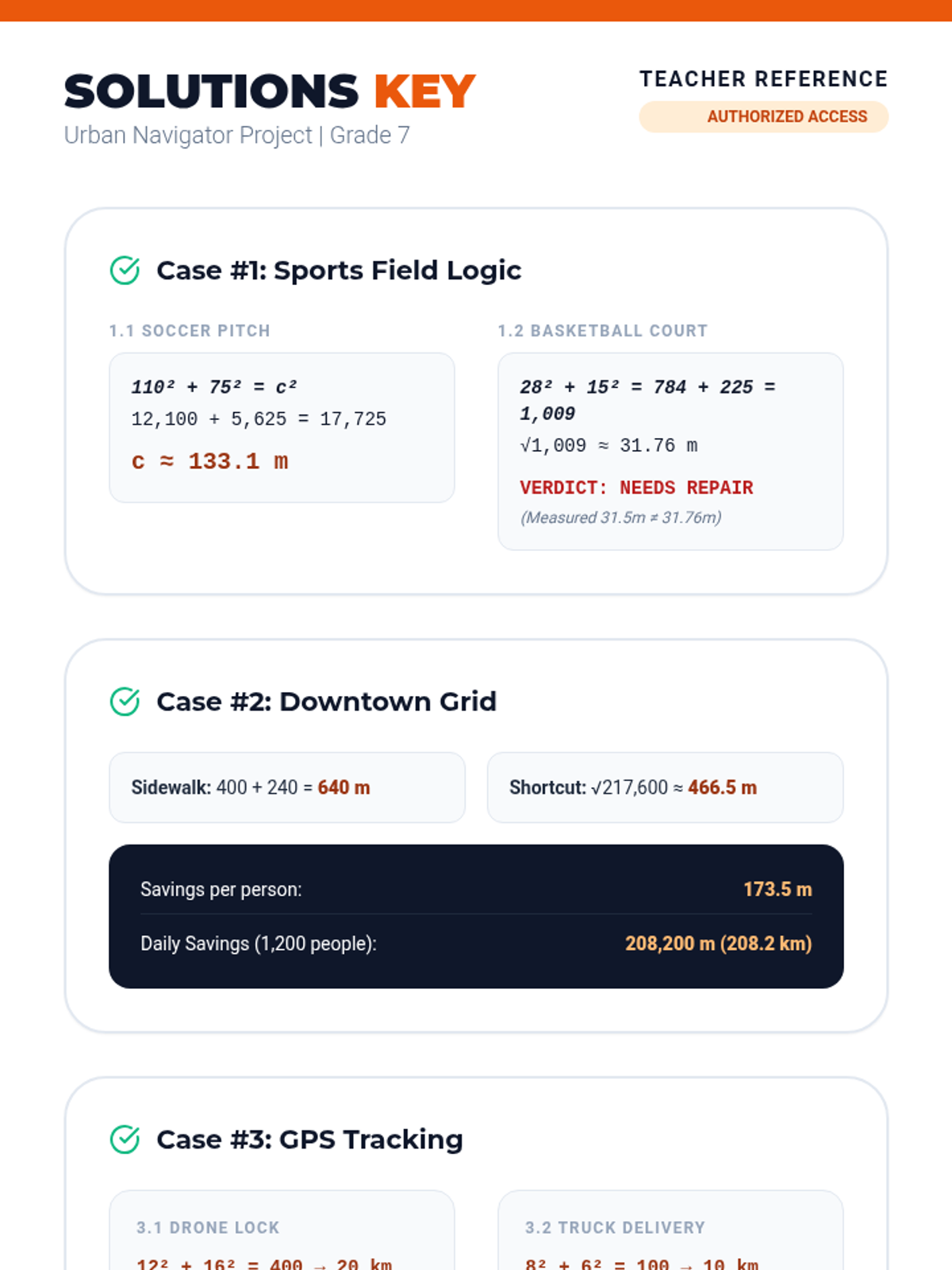
A teacher's answer key providing step-by-step calculations and final answers for all tasks in the Pythagoras Project Packet.
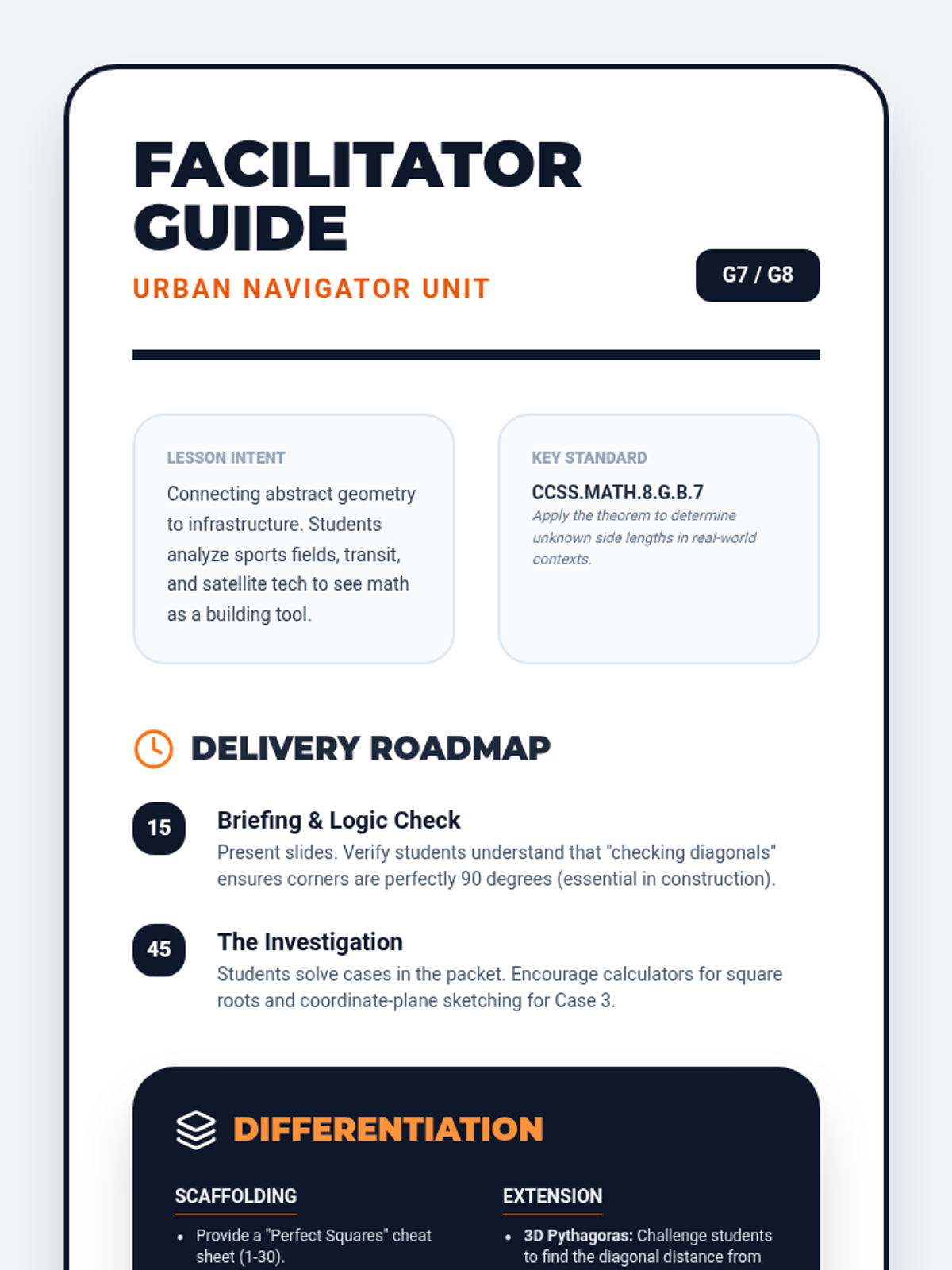
A professional facilitator guide for teachers, providing instructional strategies, common misconceptions, and differentiation tips for the Urban Navigator project.
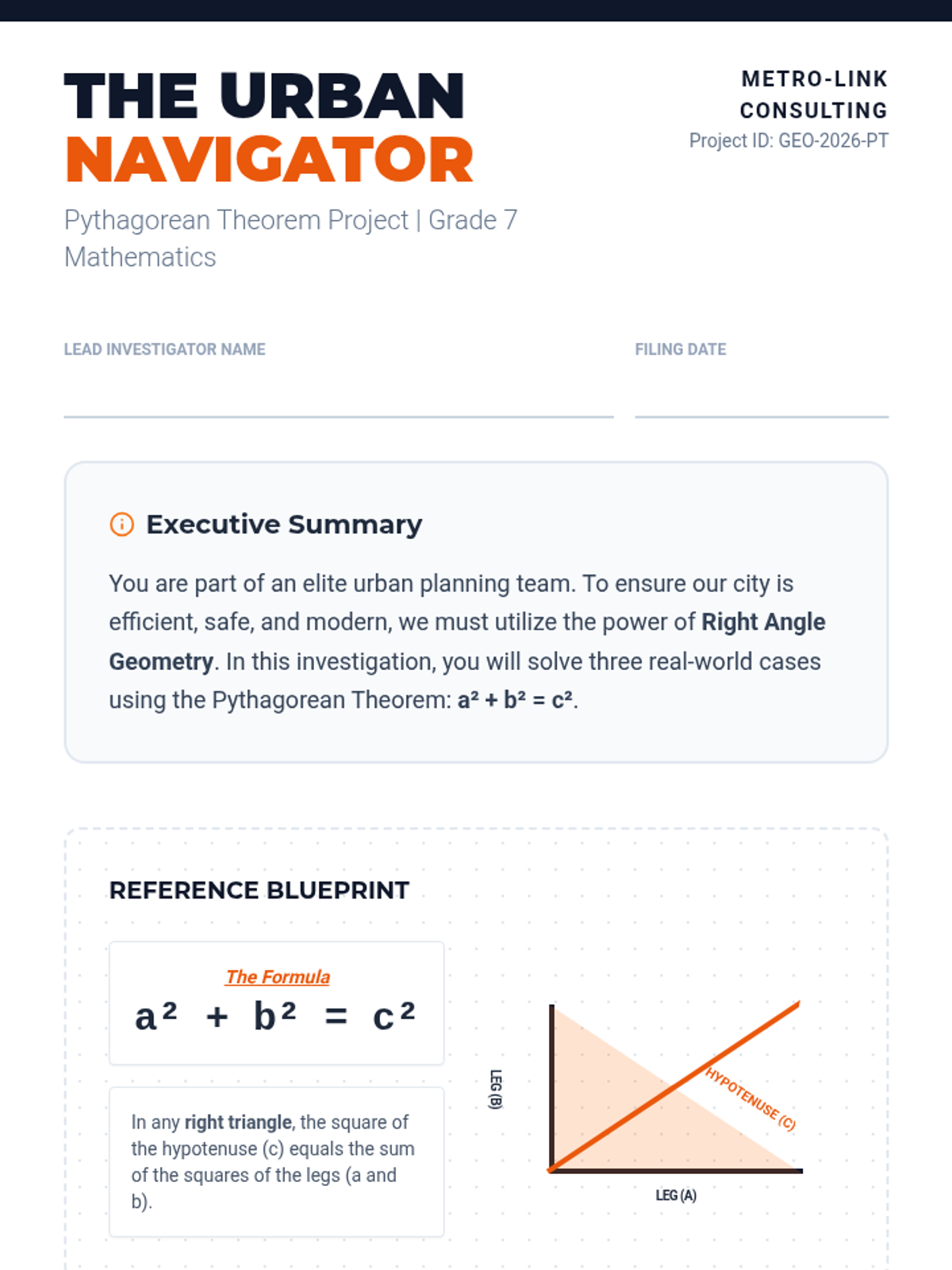
A comprehensive student investigation packet that applies the Pythagorean Theorem to sports fields, city planning shortcuts, and coordinate-based GPS navigation.
A vibrant slide deck introducing the Urban Navigator project, connecting the Pythagorean Theorem to sports, city planning, and GPS navigation.
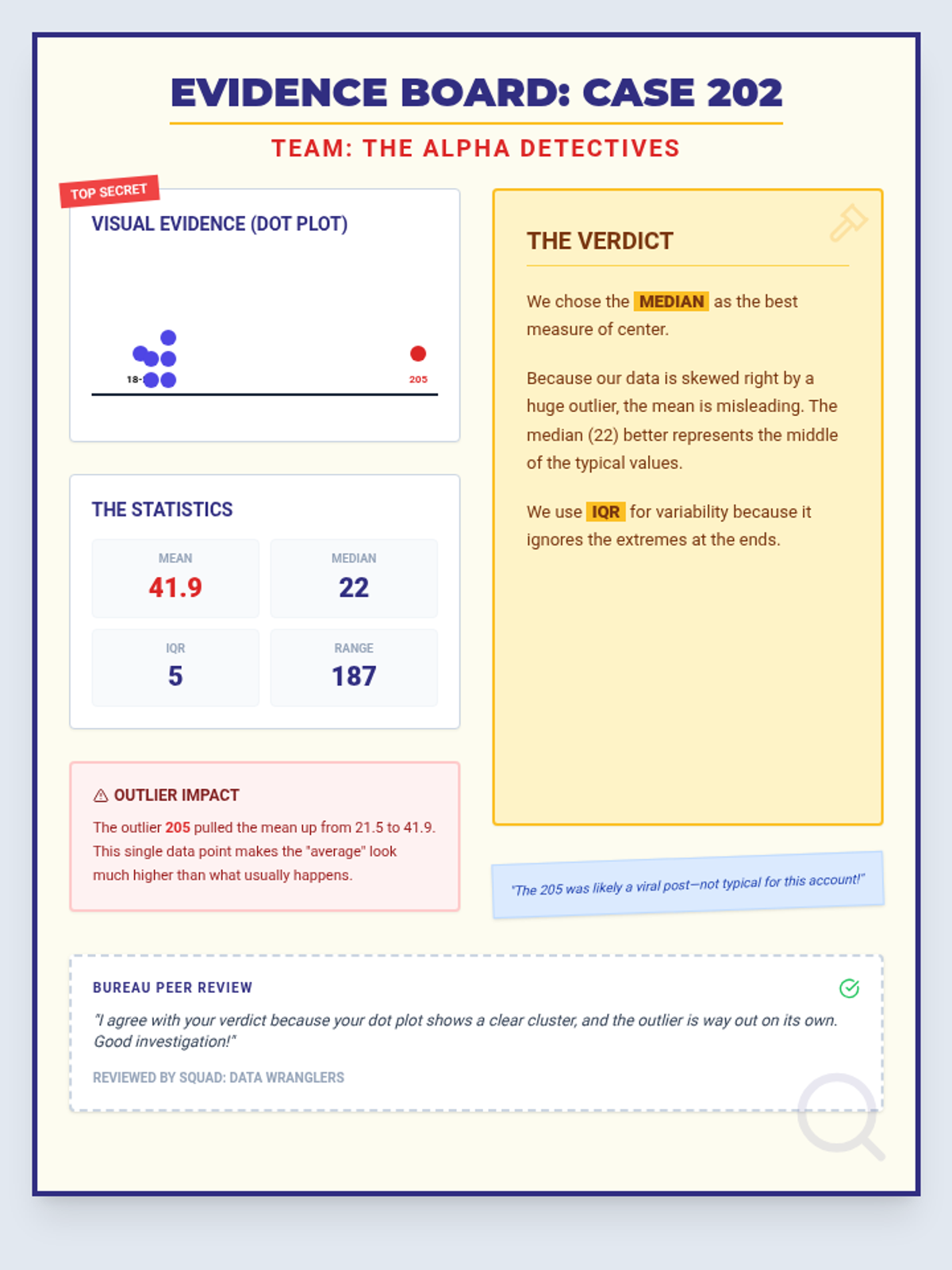
A visual example and mockup of a completed 'Evidence Board' poster for Case 202, demonstrating how students should present their visual plot, statistics, verdict, and outlier analysis. Revised for single-page layout.
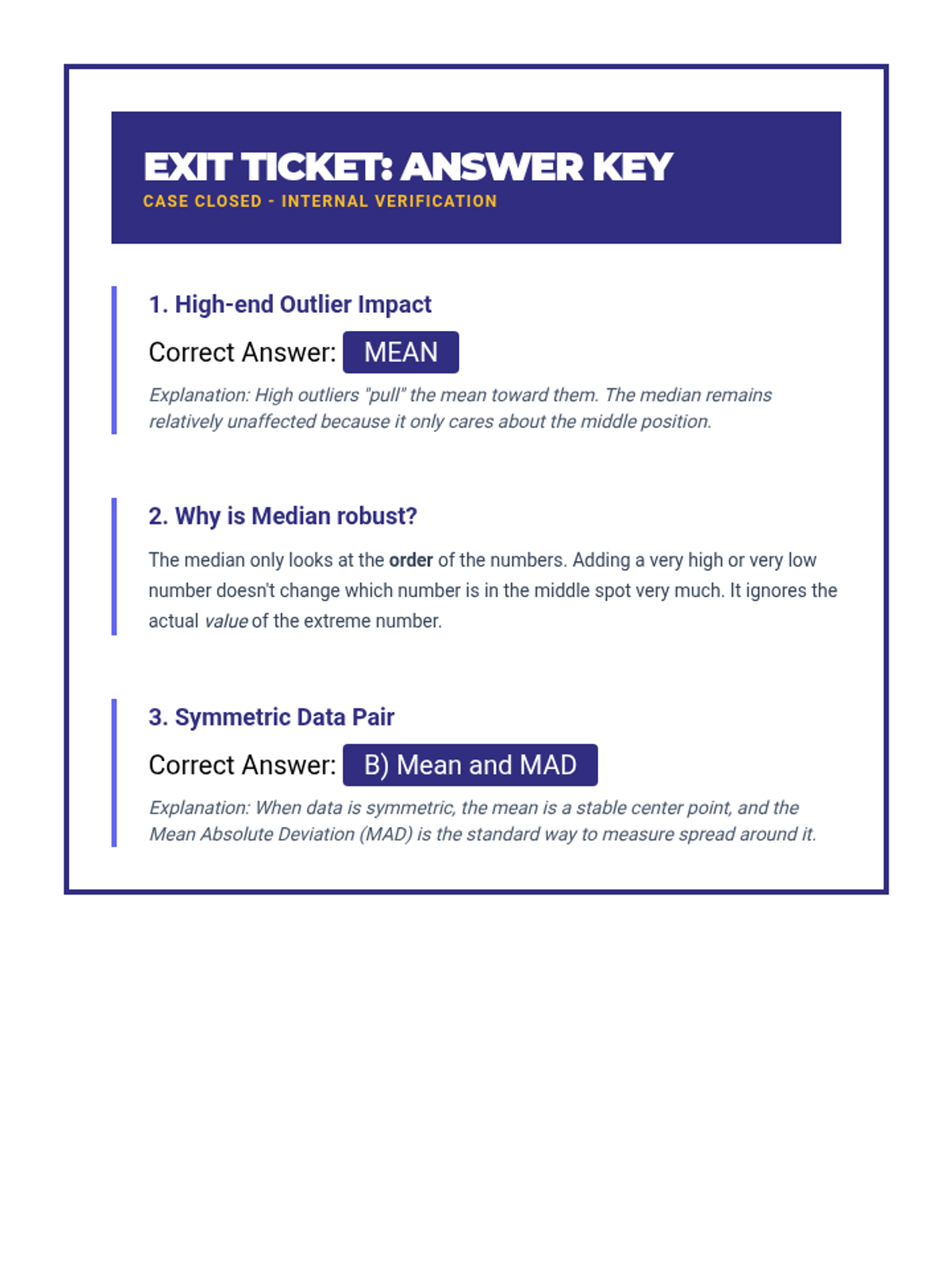
An answer key for the Distribution Debrief Exit Ticket, providing correct answers and brief pedagogical explanations.
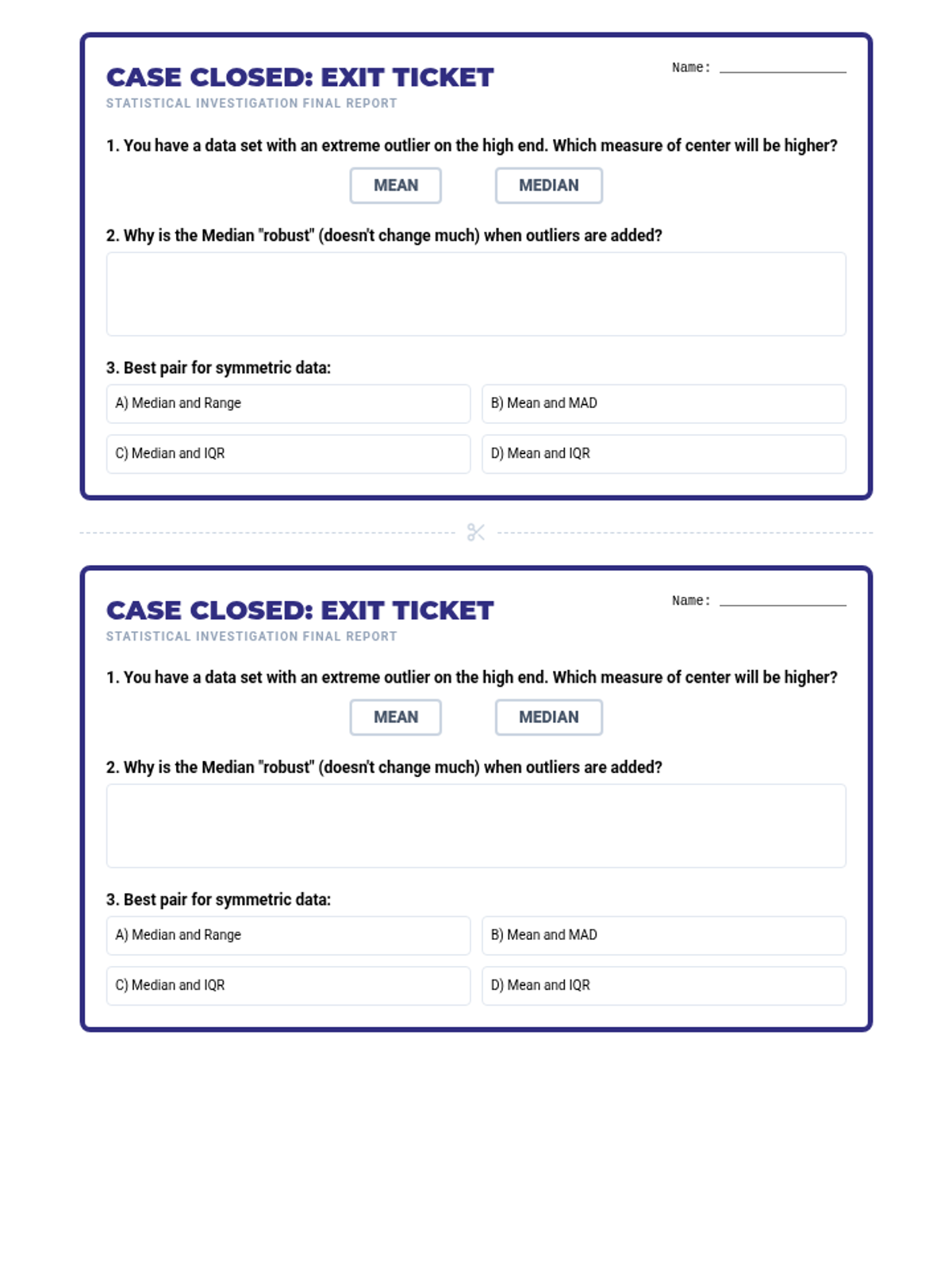
A brief end-of-lesson assessment checking student understanding of how outliers affect mean vs median and when to use specific statistical measures. Two tickets per page for efficient printing. Revised for layout and uniform answer choices.
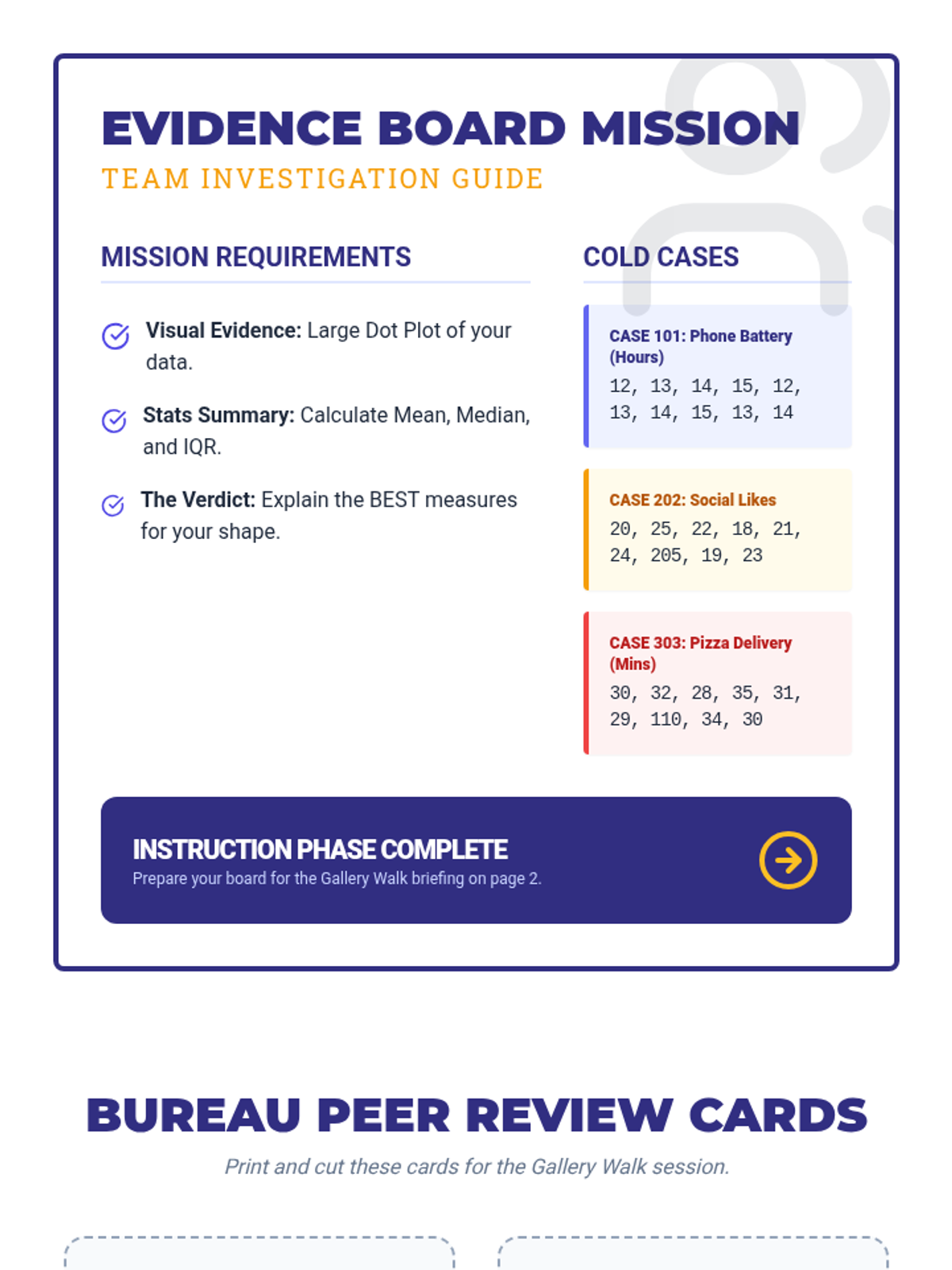
A guide for the collaborative poster activity featuring specific case studies for students to analyze and 'peer review' cards for a gallery walk. Revised with larger peer review cards and better layout.
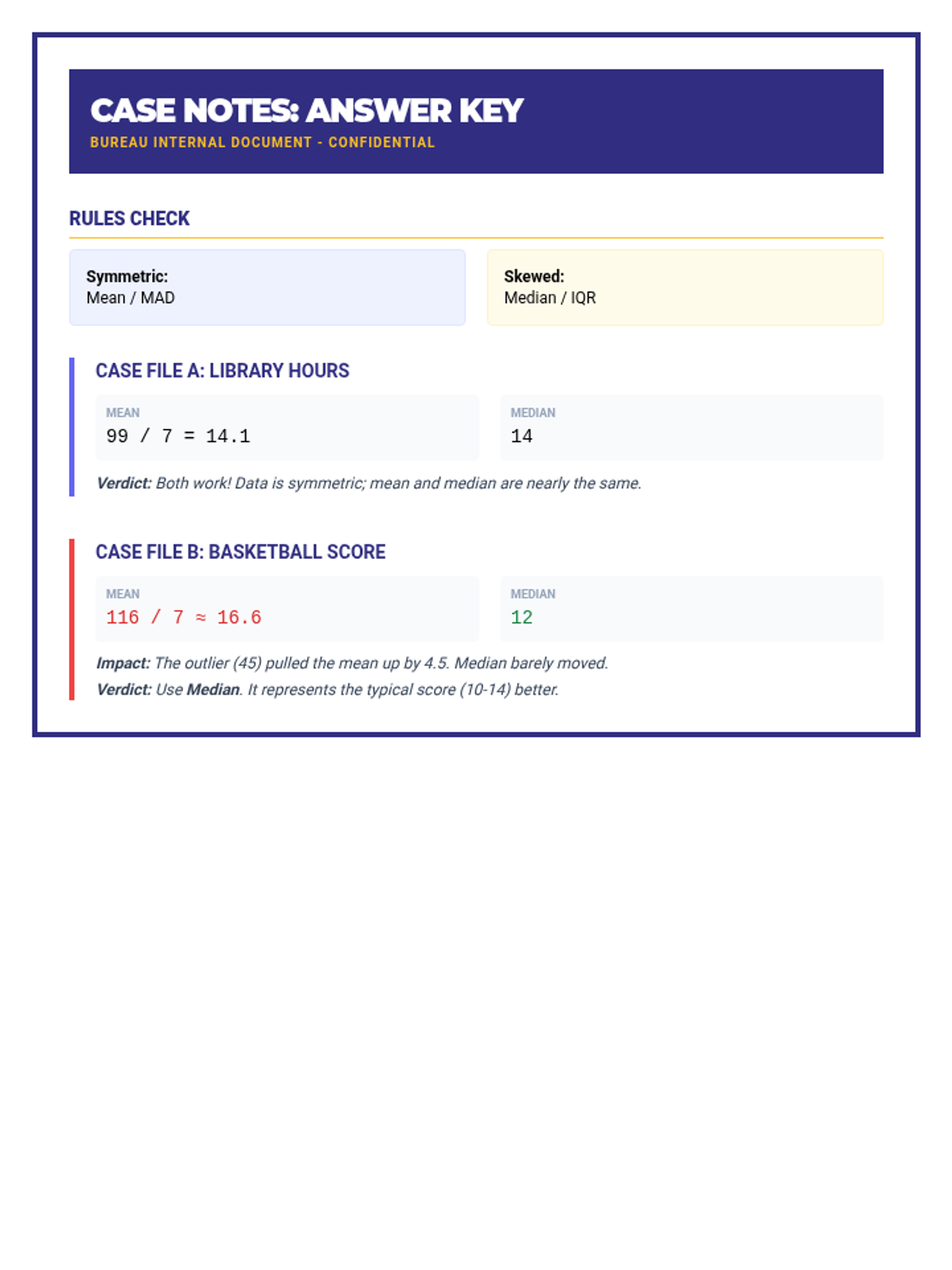
An answer key for the Case Notes handout, providing calculations for mean and median and clear explanations of why certain measures are preferred in symmetric vs skewed data. Revised for layout and clarity.
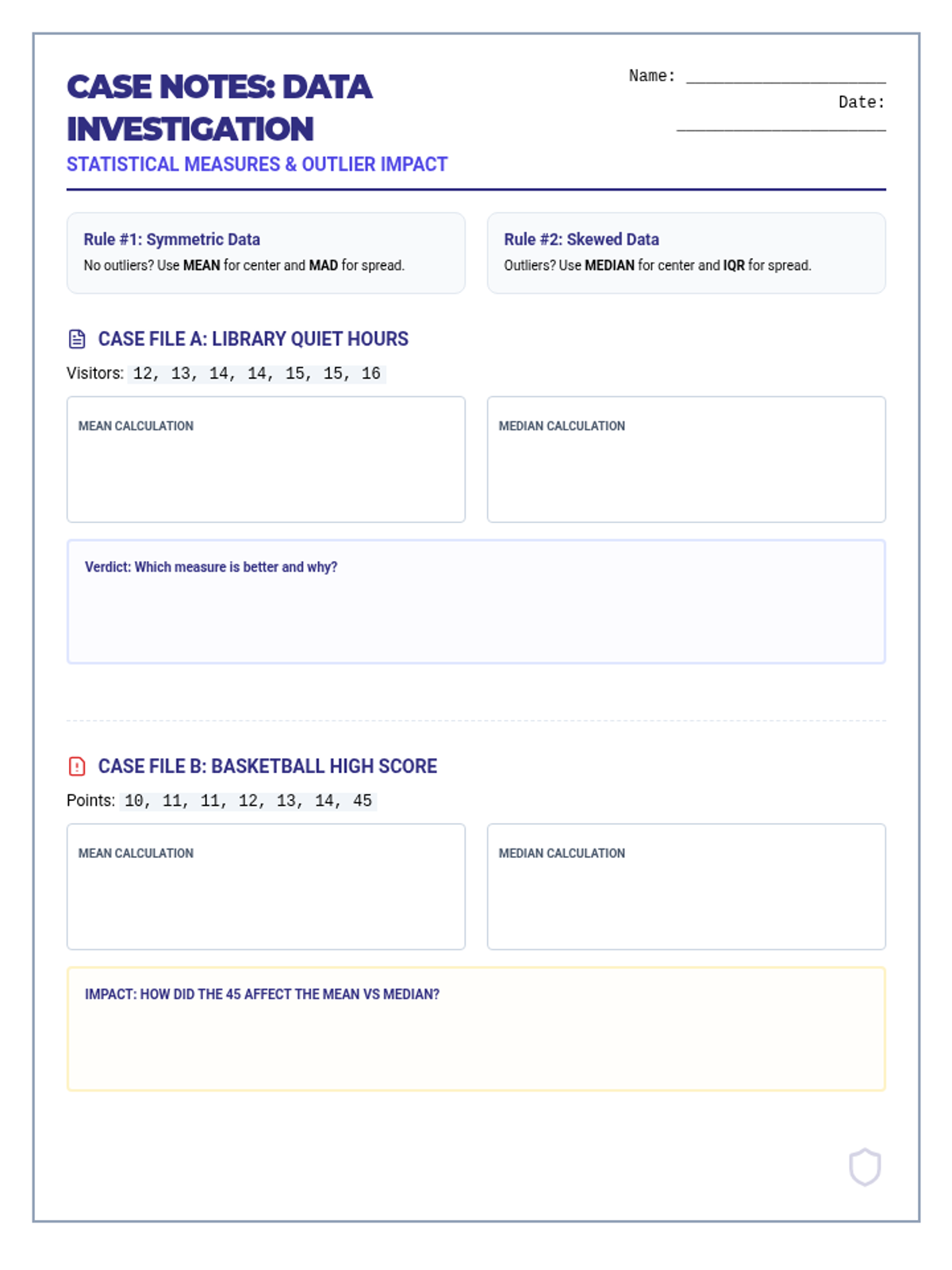
A student practice worksheet with two real-world scenarios comparing symmetric data to data with an outlier, requiring students to calculate measures and justify their selection. Layout optimized for 8.5x11 printing. Revised for single-page fit.
Visual presentation for the lesson including outlier identification, impact on mean vs median, and selection criteria for symmetric vs skewed data.
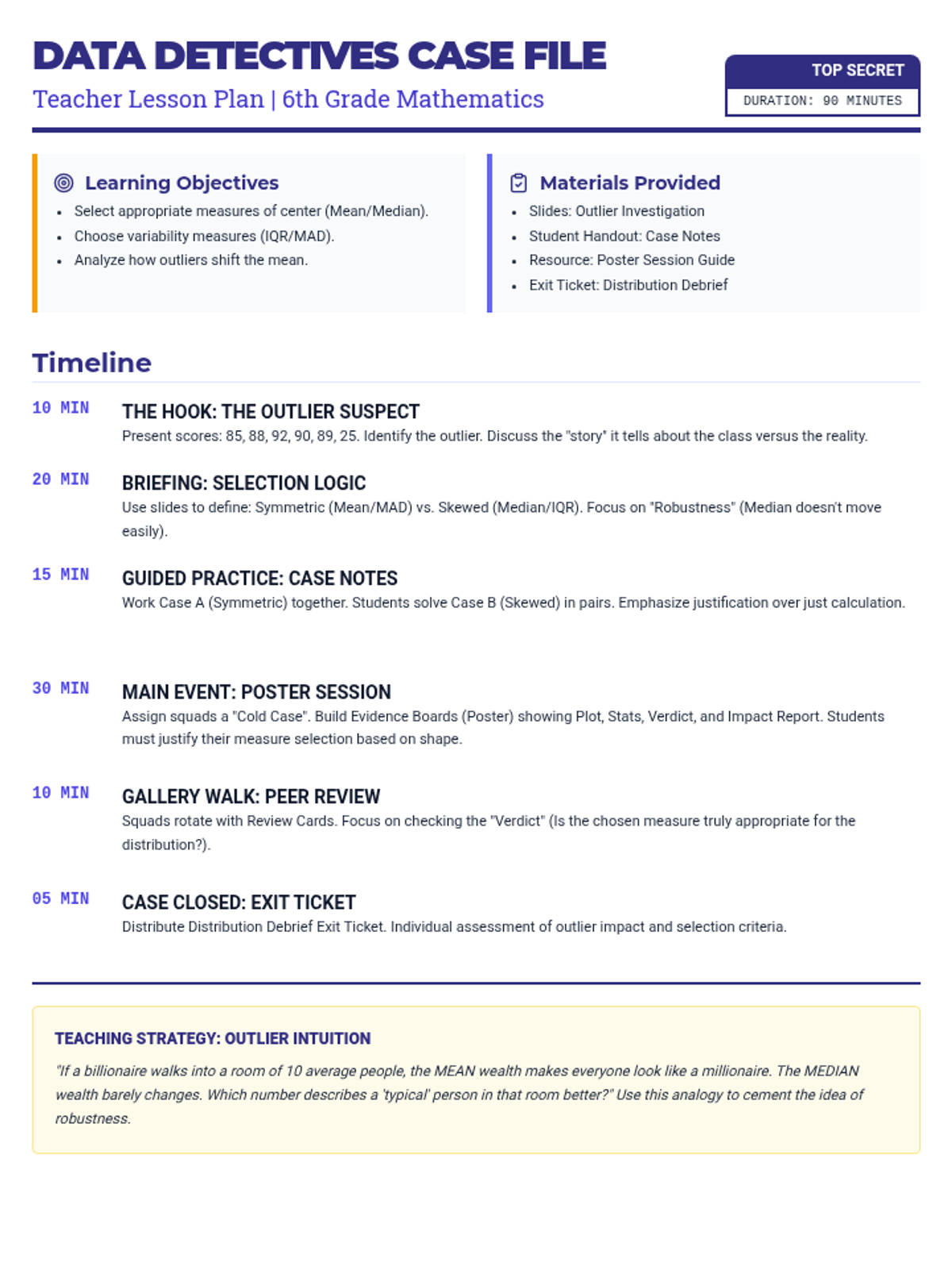
A detailed 90-minute teacher guide for a 6th grade math lesson on statistical measures and outliers, featuring a 'Data Detective' theme with a clear timeline, learning objectives, and teaching tips. Revised for better page breaks.
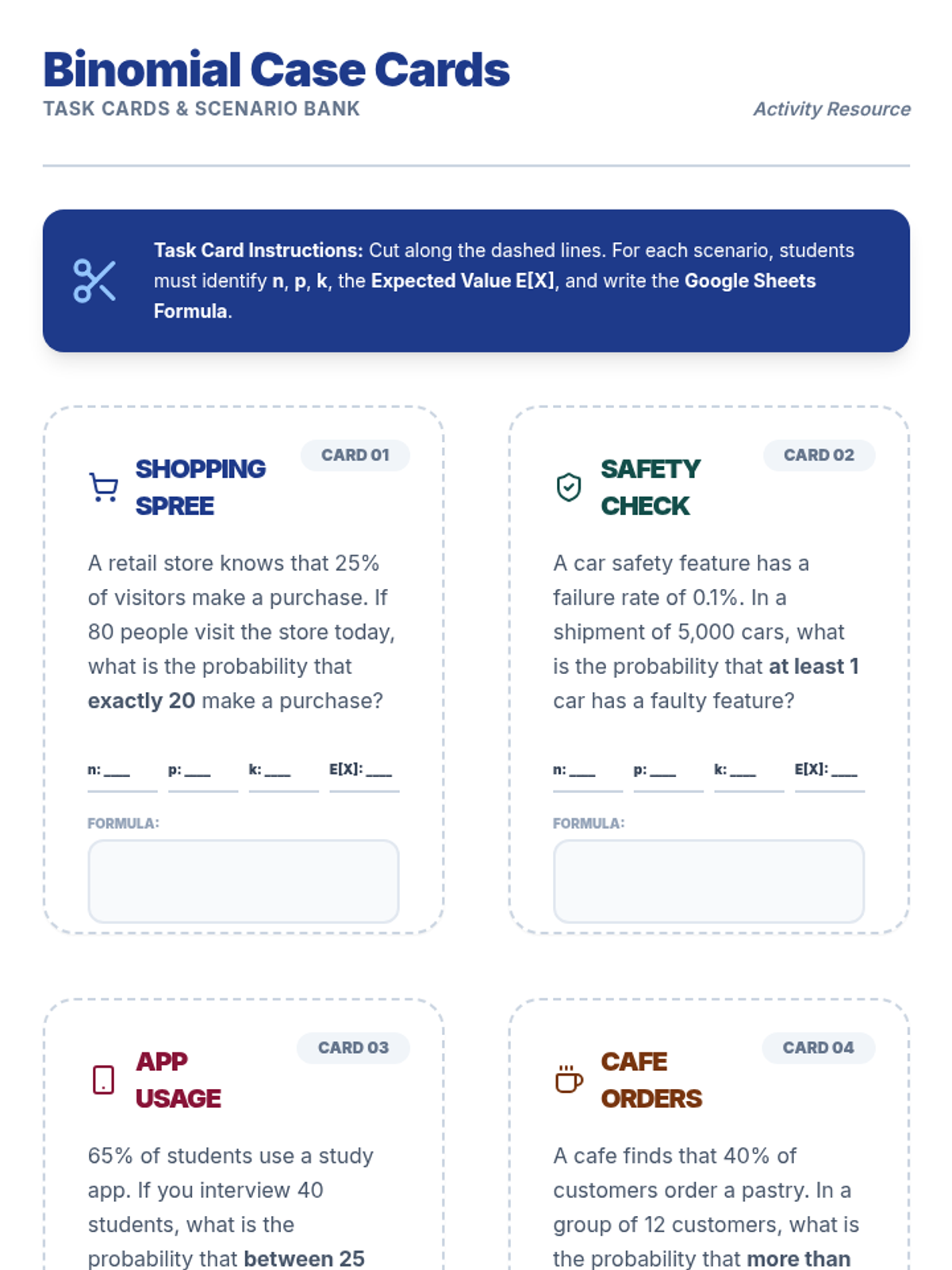
A set of 10 printable task cards featuring diverse binomial distribution scenarios. Perfect for station activities, group work, or extra practice bank. Includes integrated answer key. Now updated to include Expected Value (E[X]) calculations for every case.
A comprehensive answer key for the task-card edition of the Binomial Breakdown Worksheet, reformatted into individual 1/3-page cards to facilitate separate distribution or physical cutting. Each card provides detailed logic, modern BINOM.DIST syntax, and correctly rendered manual formulas. Updated for density and usability.
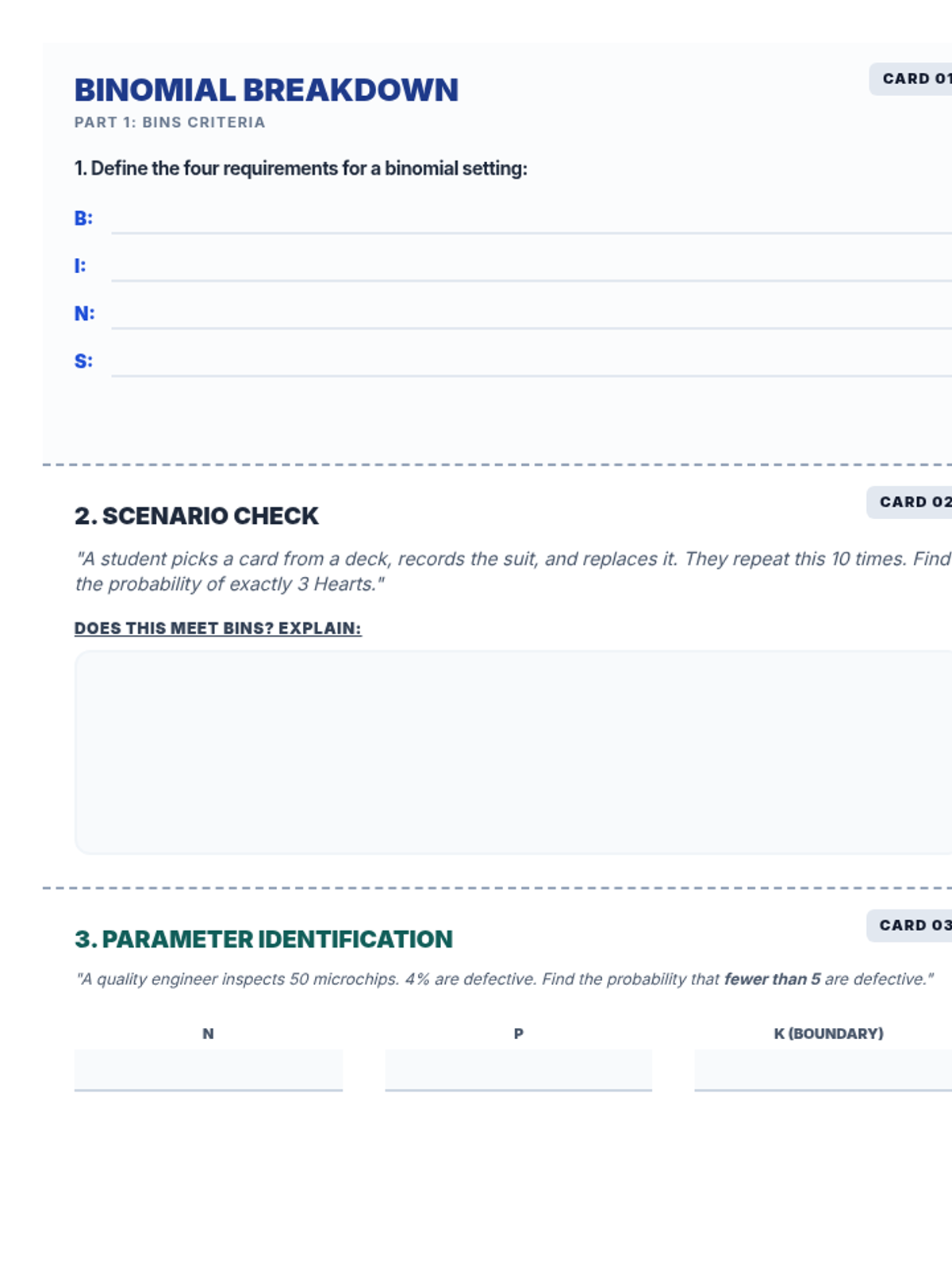
A 21-question practice worksheet for 12th-grade statistics, reformatted as a modular task-card bank. Designed with three horizontal cut-lines per page for easy physical division. Covers BINS criteria, spreadsheet formulas (BINOM.DIST), hand-calculation theory, and now includes questions on Expected Value (n*p). Card IDs and questions are aligned 1:1.
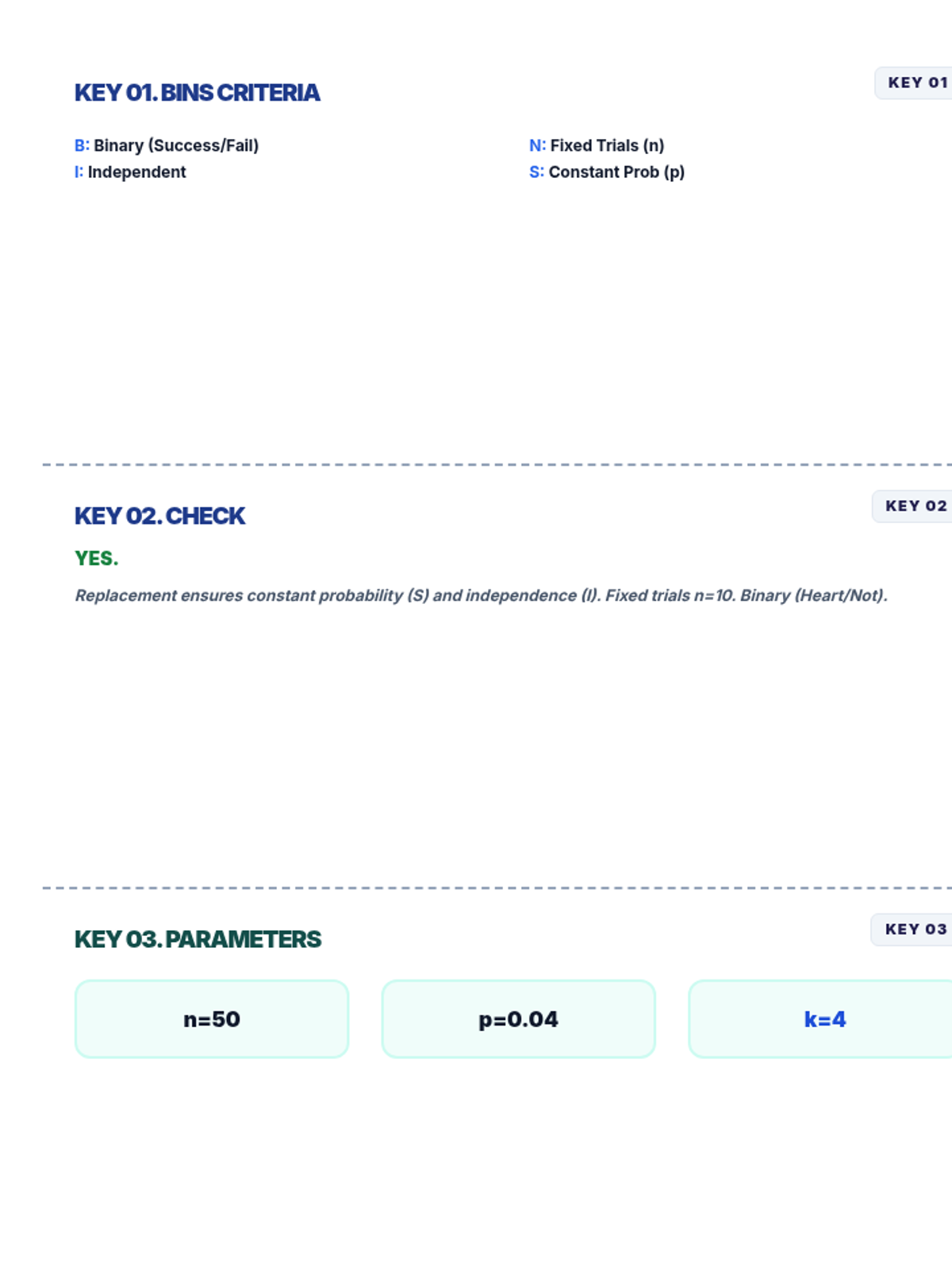
A visual presentation accompanying the Binomial Breakdown lesson. Covers BINS criteria, expected value (mean), spreadsheet formula syntax (BINOM.DIST), and the hand-calculation formula connection. Updated with a new slide for expected value (n*p) and improved summary visuals.
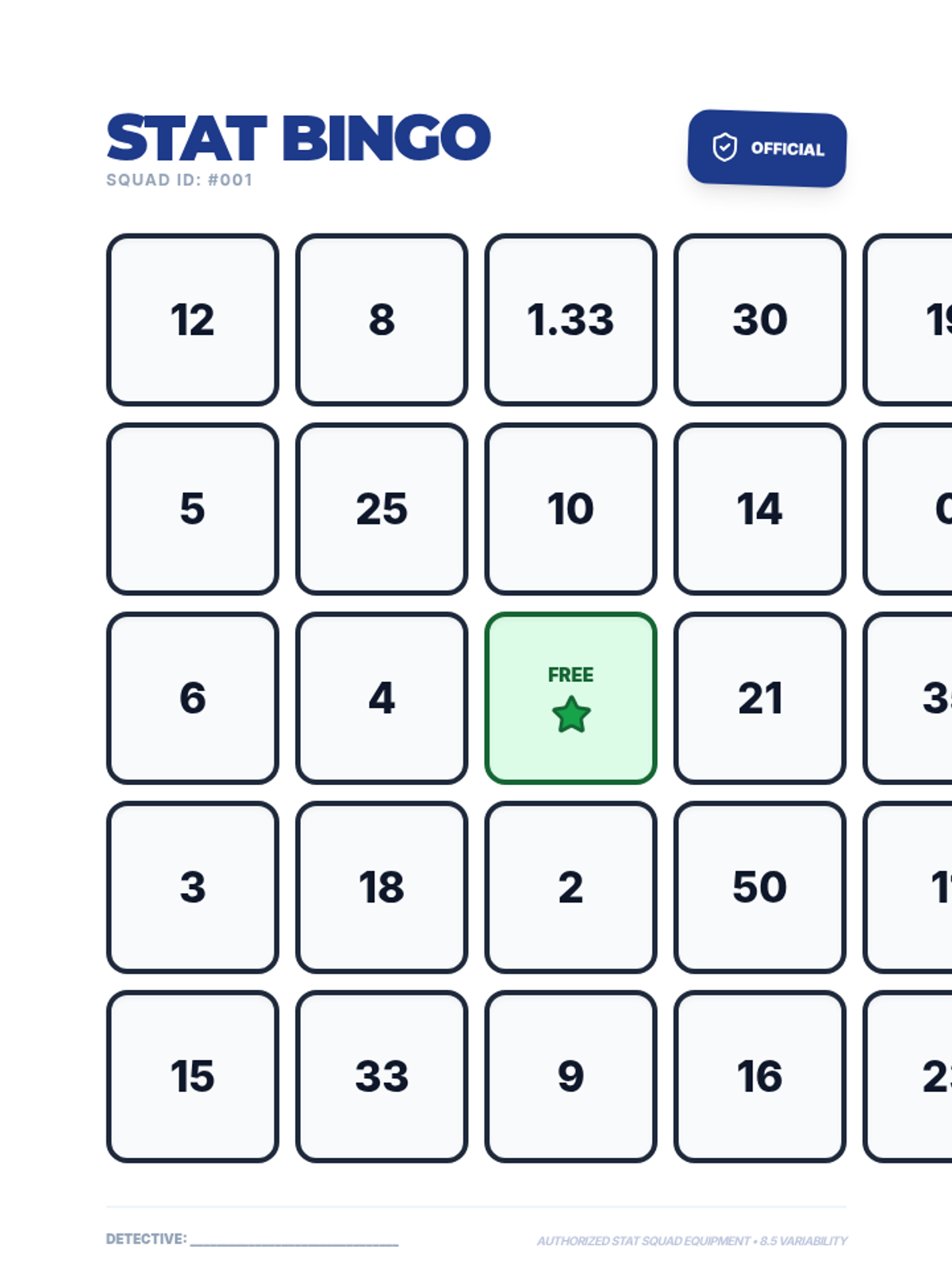
Set of unique, pre-filled randomized Bingo cards for the Stat Squad activity. Each card features 24 numbers from the evidence pool and a free space. Optimized for 8.5 x 11 printing. Card set IDs #001 to #030.
Bingo activity presentation for calling variability problems in class. Features large, readable data sets and distinct case numbers to match the teacher's calling guide. Includes step-by-step solution slides.
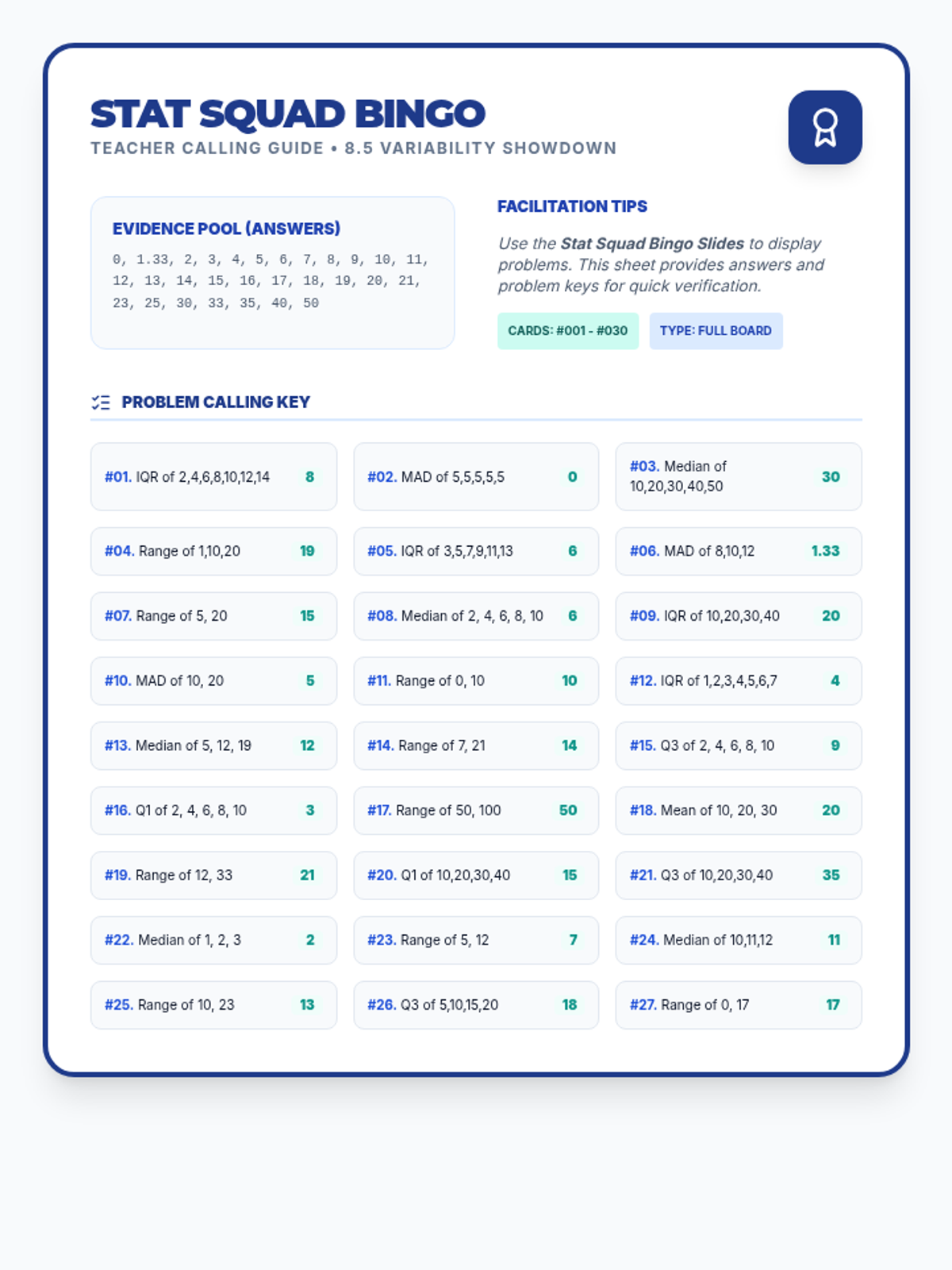
Teacher Calling Sheet for Stat Squad Bingo. Features a complete answer key for Case #01 through #27, facilitation tips, and an Evidence Pool reference.
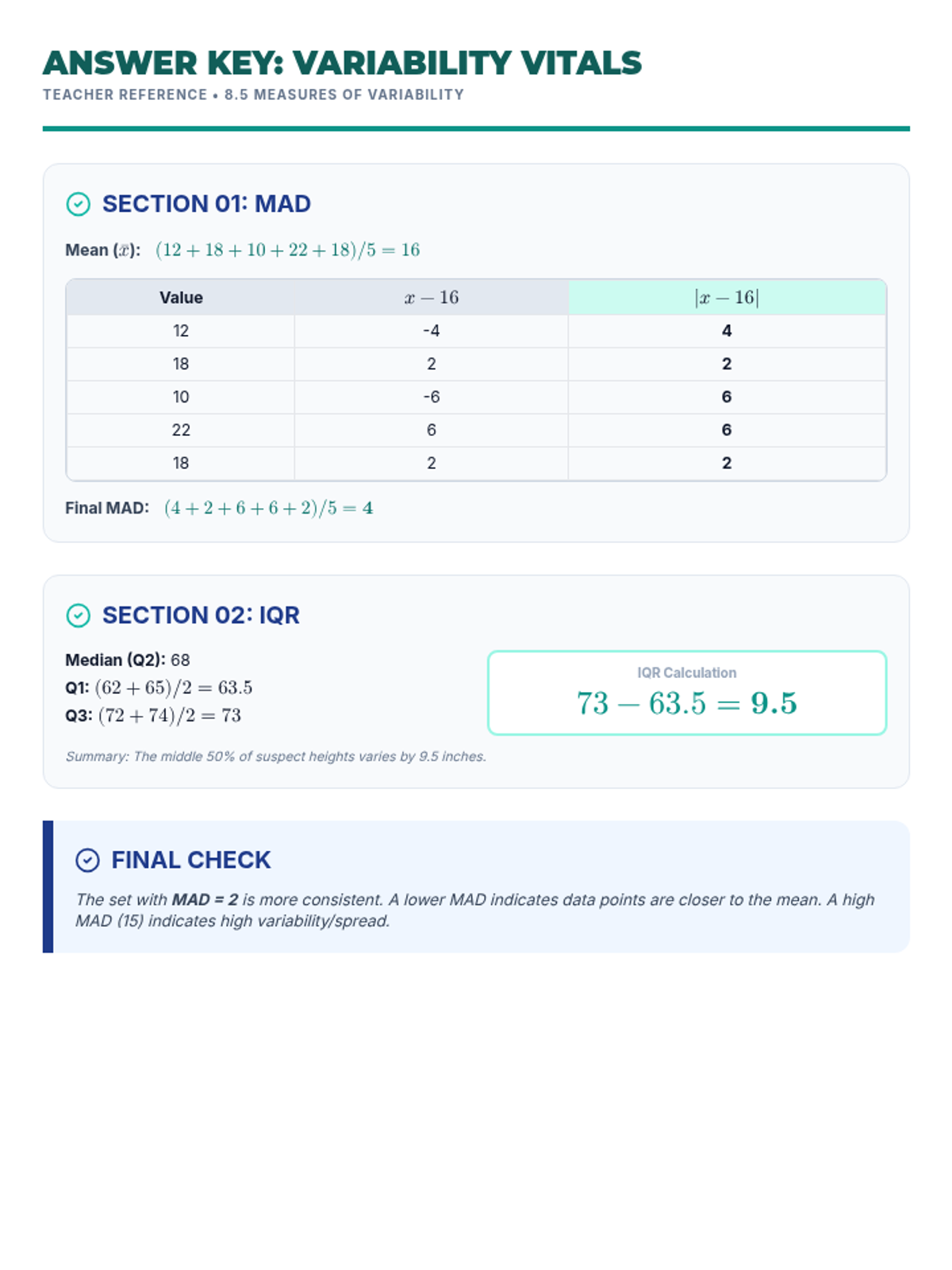
Teacher's answer key for the "Variability Vitals" worksheet, providing step-by-step solutions for MAD and IQR calculations. Optimized to fit on a single page.
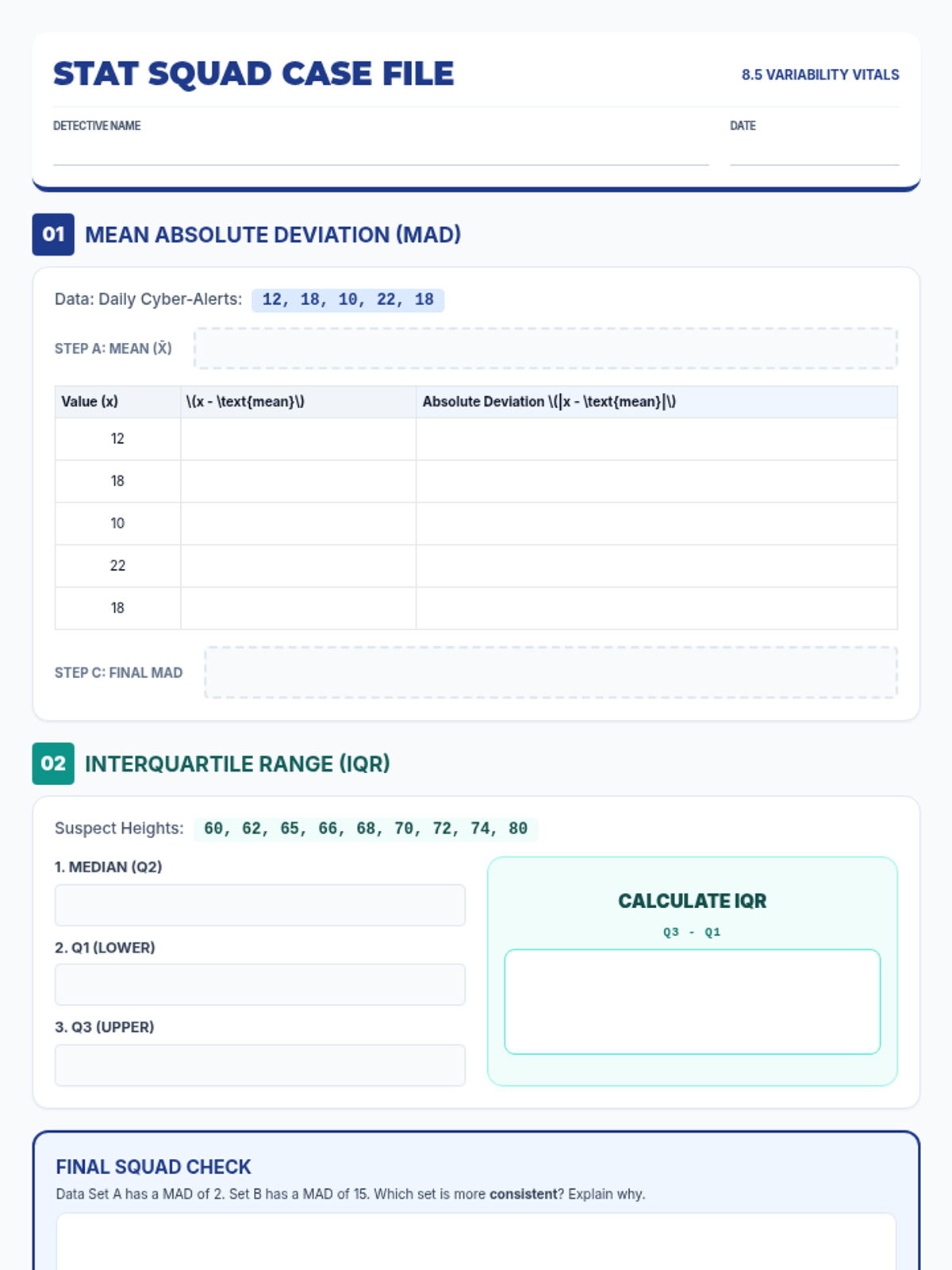
A high-quality 6th-grade math worksheet titled "Variability Vitals" focused on calculating MAD and IQR with structured work areas for students. Optimized to fit on a single 8.5 x 11 page. Improved header sizes and work area spacing.
Updated slide deck for Variability Vitals, now including detailed step-by-step examples for Mean Absolute Deviation and Interquartile Range to facilitate teacher explanation.
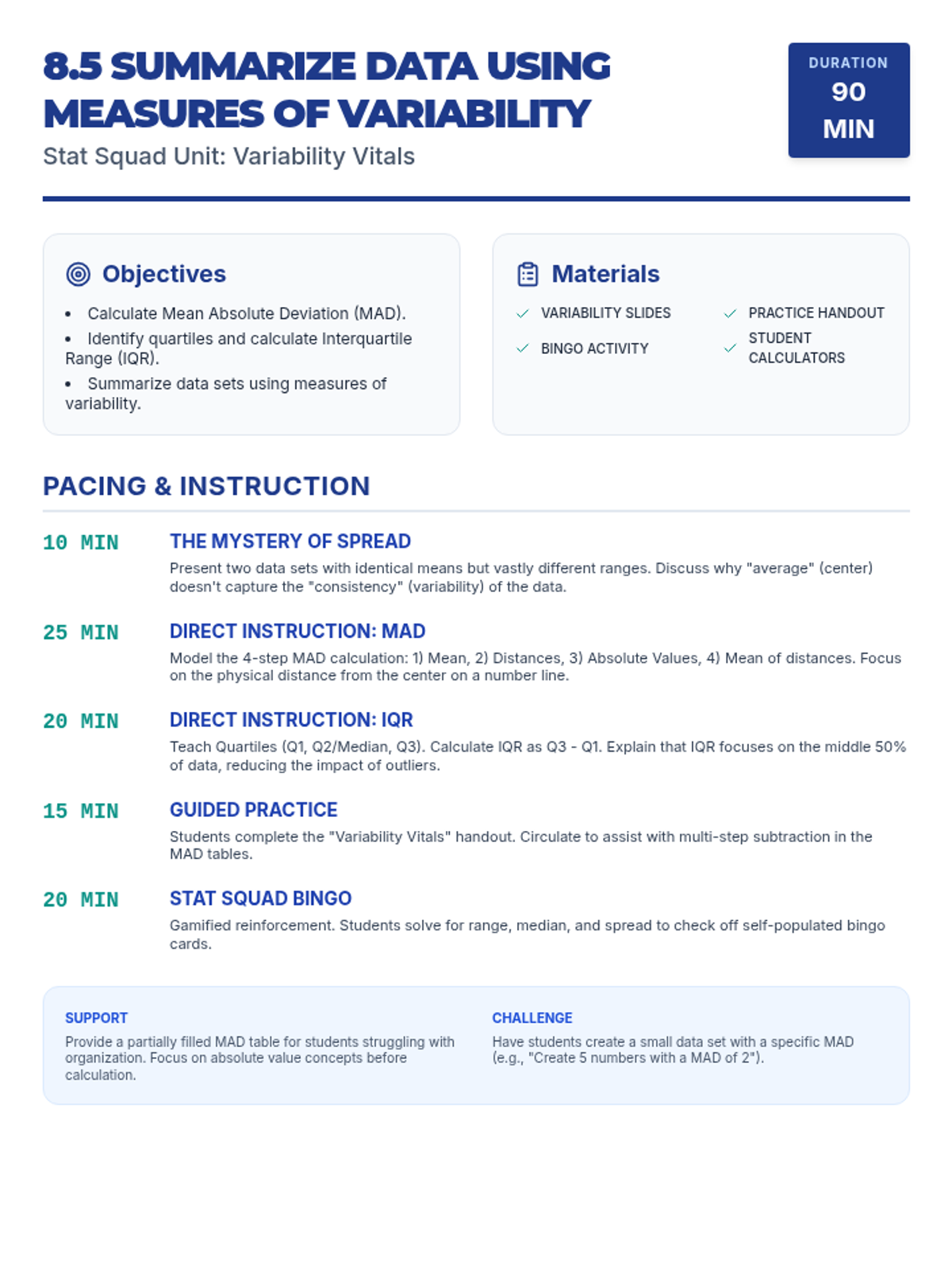
A detailed 90-minute lesson plan for 6th grade math covering Mean Absolute Deviation and Interquartile Range with a "Stat Squad" theme. Updated with requested title and single-page layout.
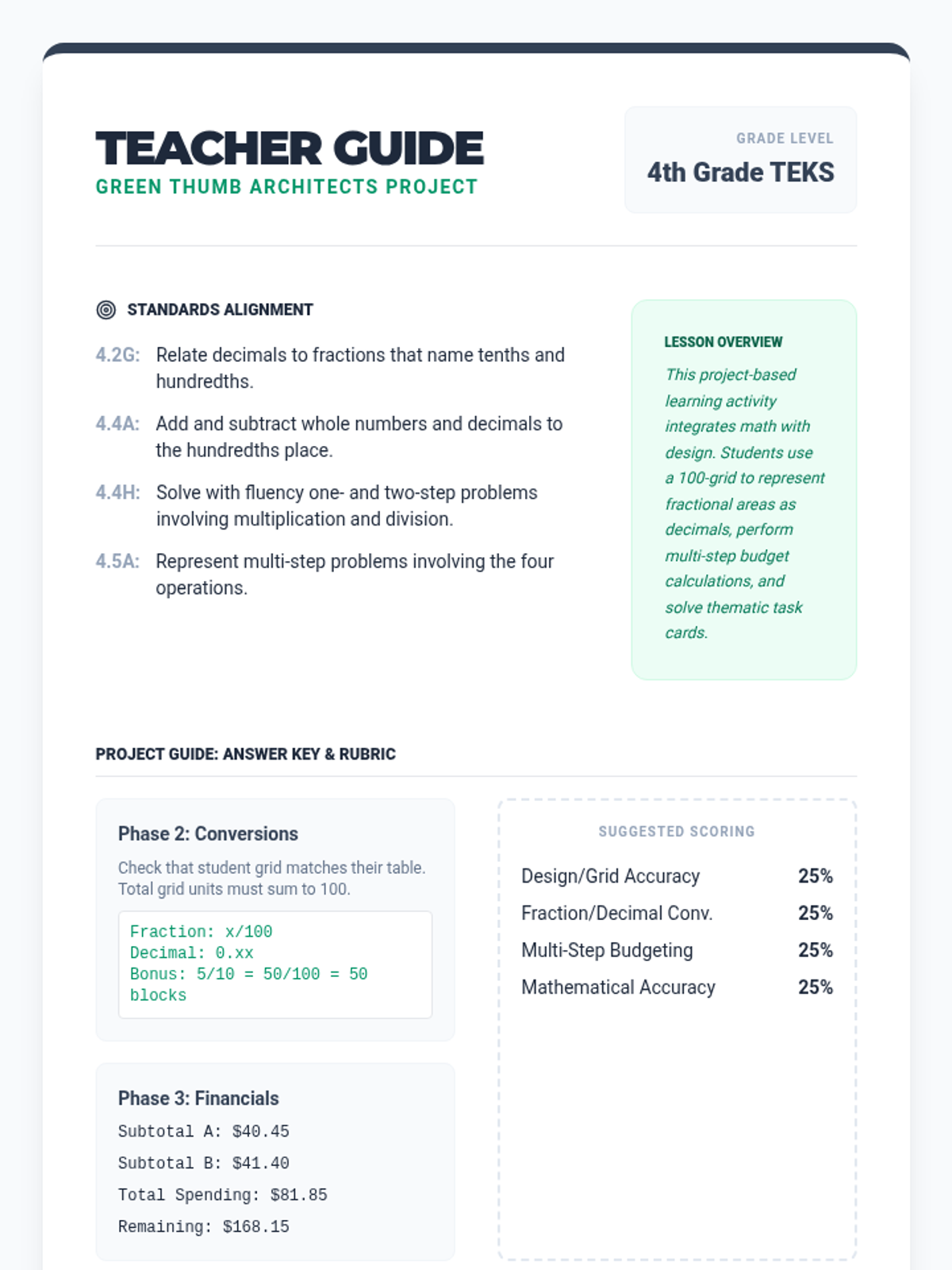
A teacher-facing guide for the Green Thumb Architects lesson, including TEKS alignment, grading rubric, project answer keys, and task card solutions.
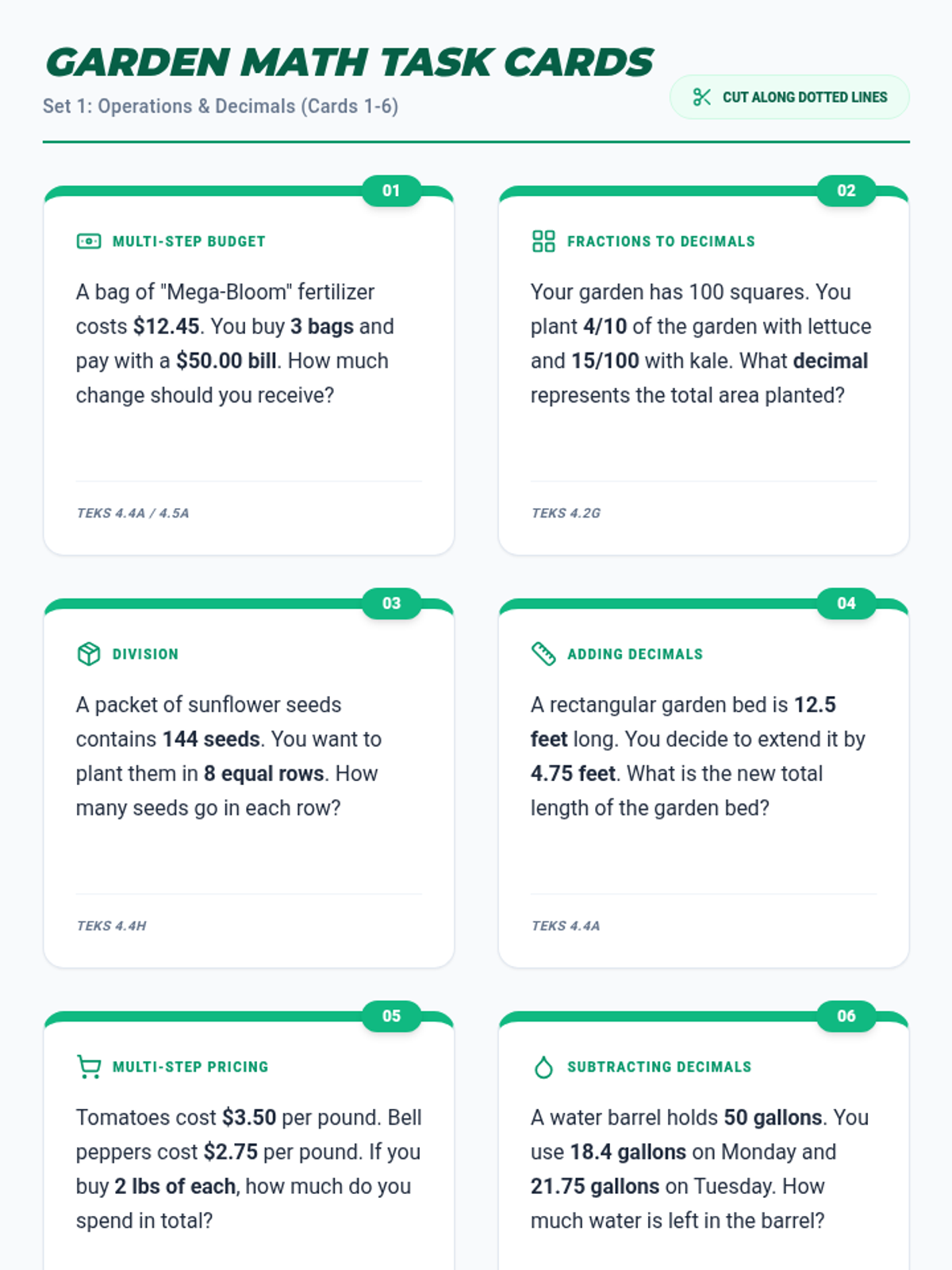
A set of 12 thematic task cards for 4th-grade math, focusing on multi-step word problems, decimal addition and subtraction, and fraction-to-decimal relationships within a community garden context. Now includes a 2-page student recording sheet with ample workspace.