A student-facing lab guide for DNA extraction, including safety protocols, a materials checklist, a step-by-step procedure, and reflection sections for observations and the rope analogy.
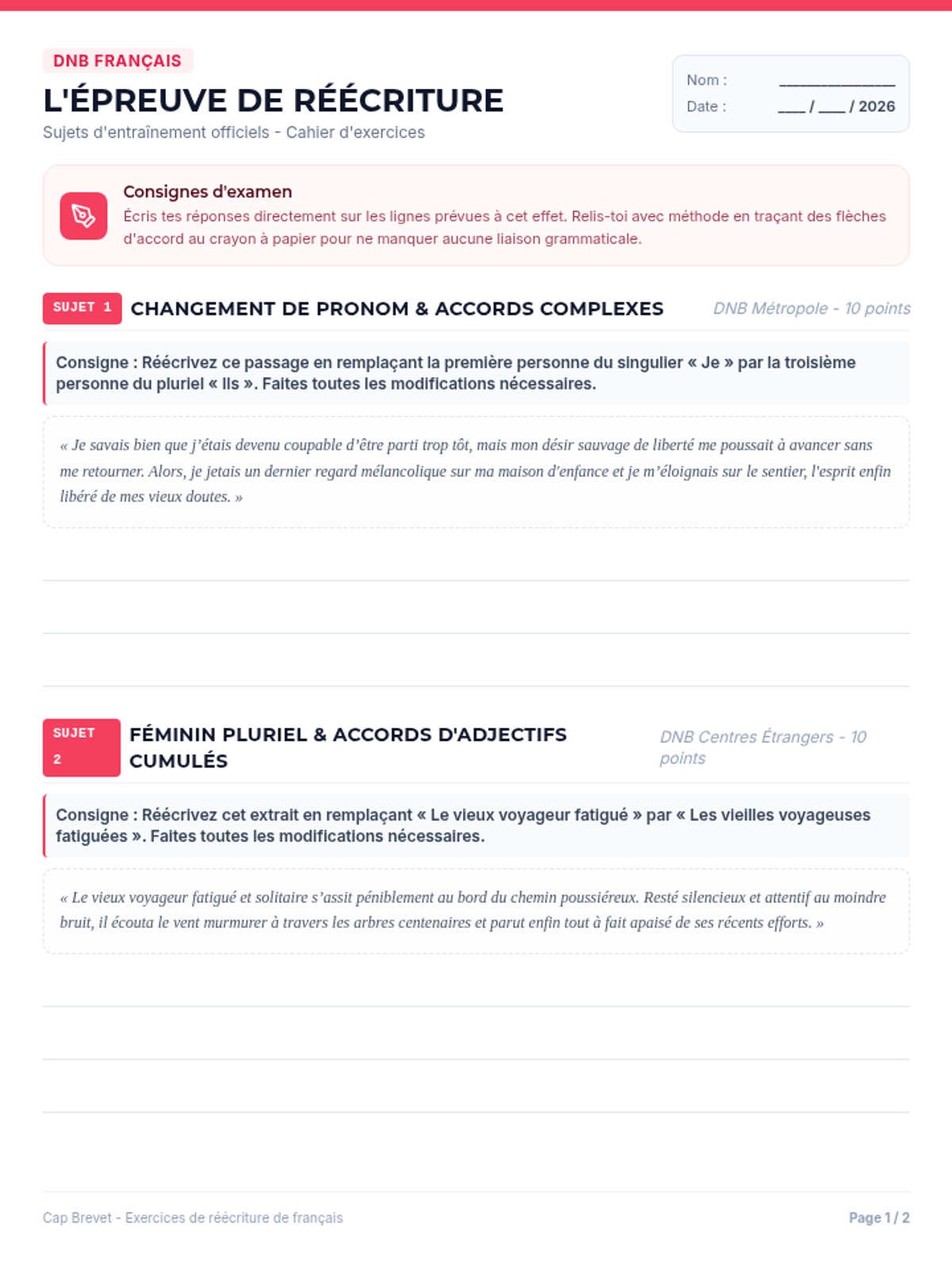
Une série d'exercices de réécriture calqués sur les épreuves de français du Brevet des années précédentes. Ce document de 2 pages comprend les sujets d'entraînement avec des lignes d'écriture spacieuses pour permettre aux élèves de formuler leurs réponses.
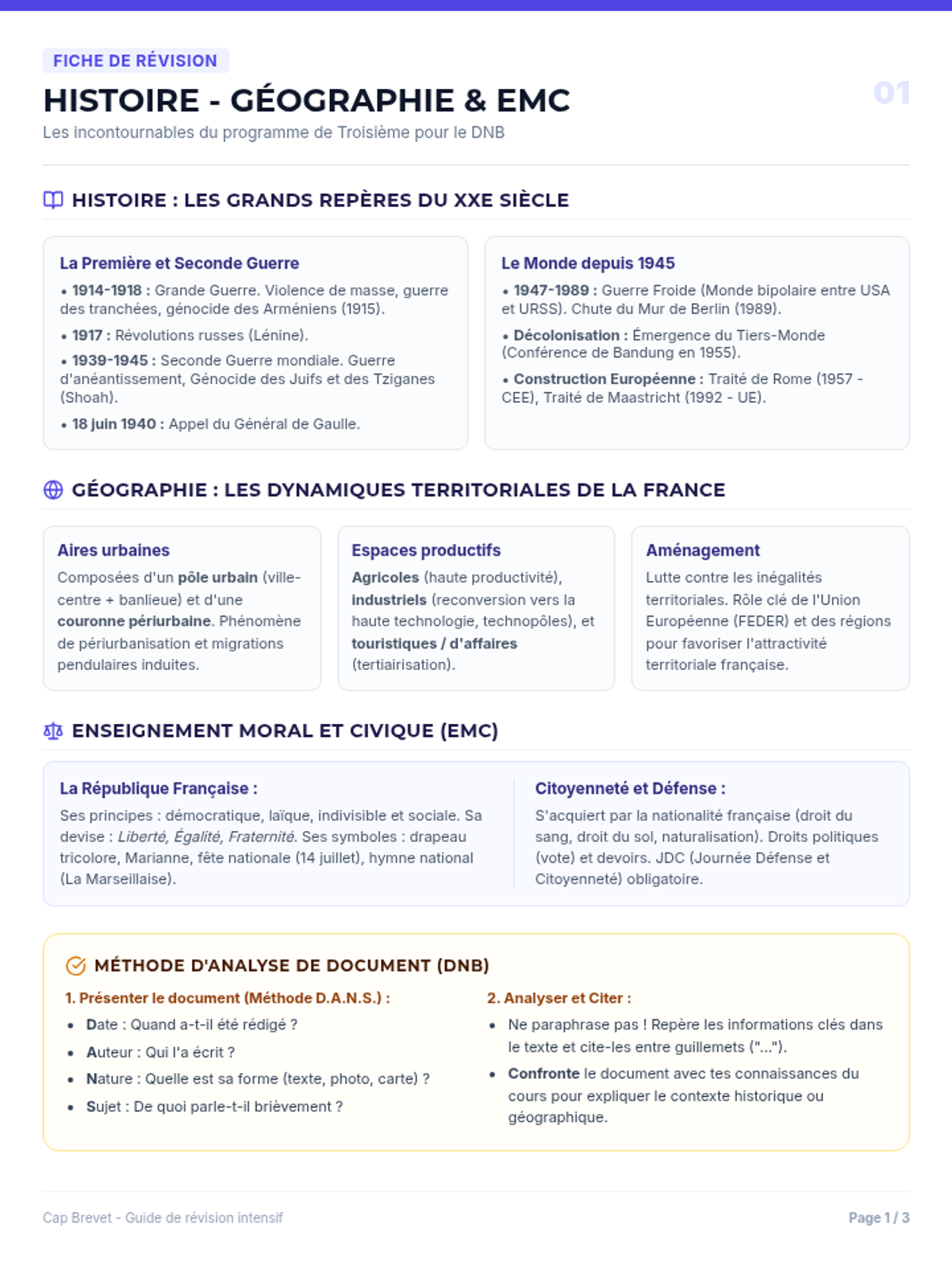
Un guide méthodologique et notionnel complet pour le Brevet en SVT, Physique-Chimie et Histoire-Géo. Ce document de 3 pages regroupe les définitions incontournables, les formules indispensables et des fiches de méthode pas-à-pas pour réussir le jour J.
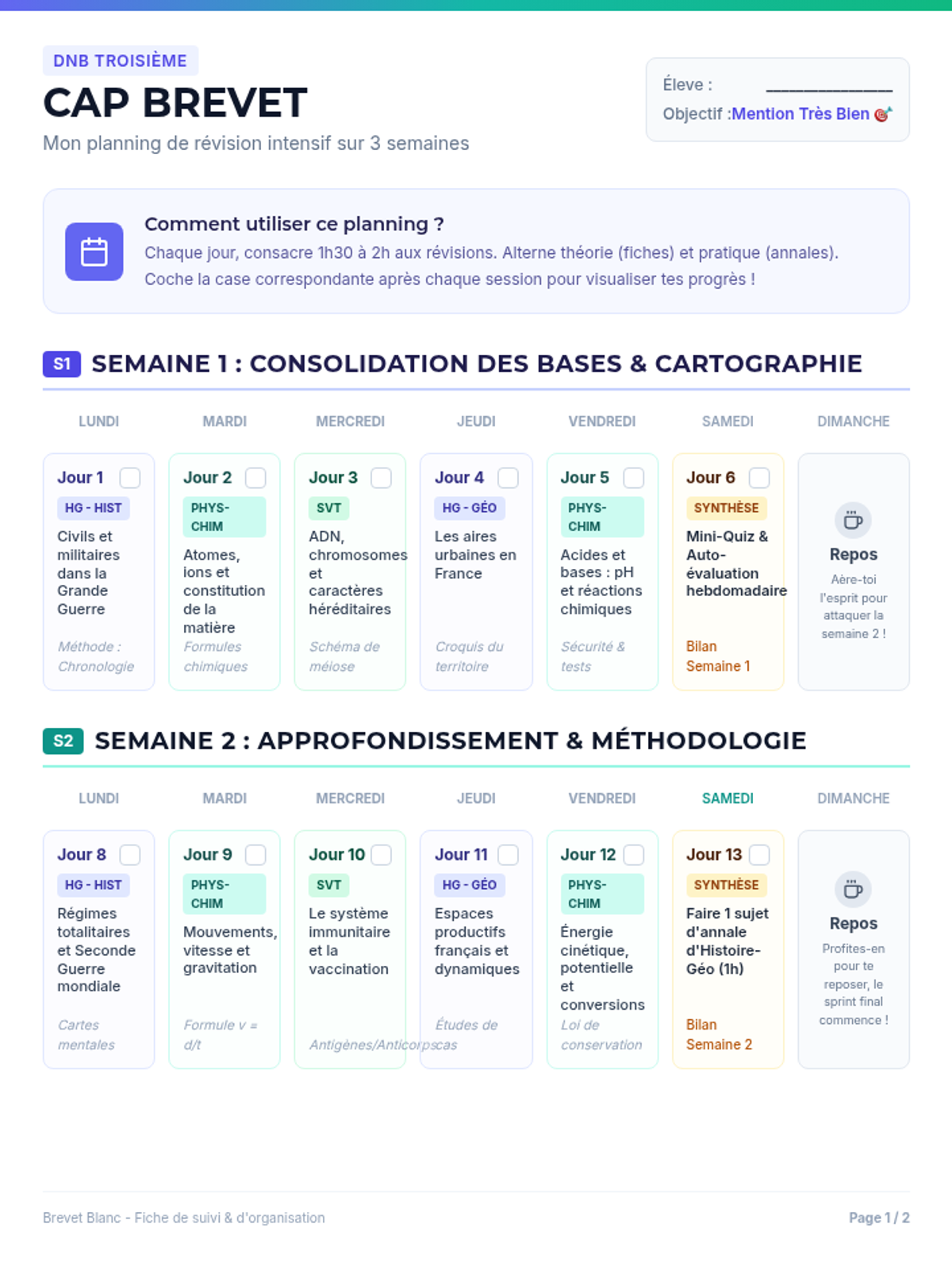
Un calendrier de révision sur 3 semaines, structuré jour par jour pour le Brevet (SVT, Physique-Chimie, Histoire-Géo). Conçu pour être imprimé et affiché, il propose un rythme quotidien équilibré avec des cases à cocher pour suivre sa progression.
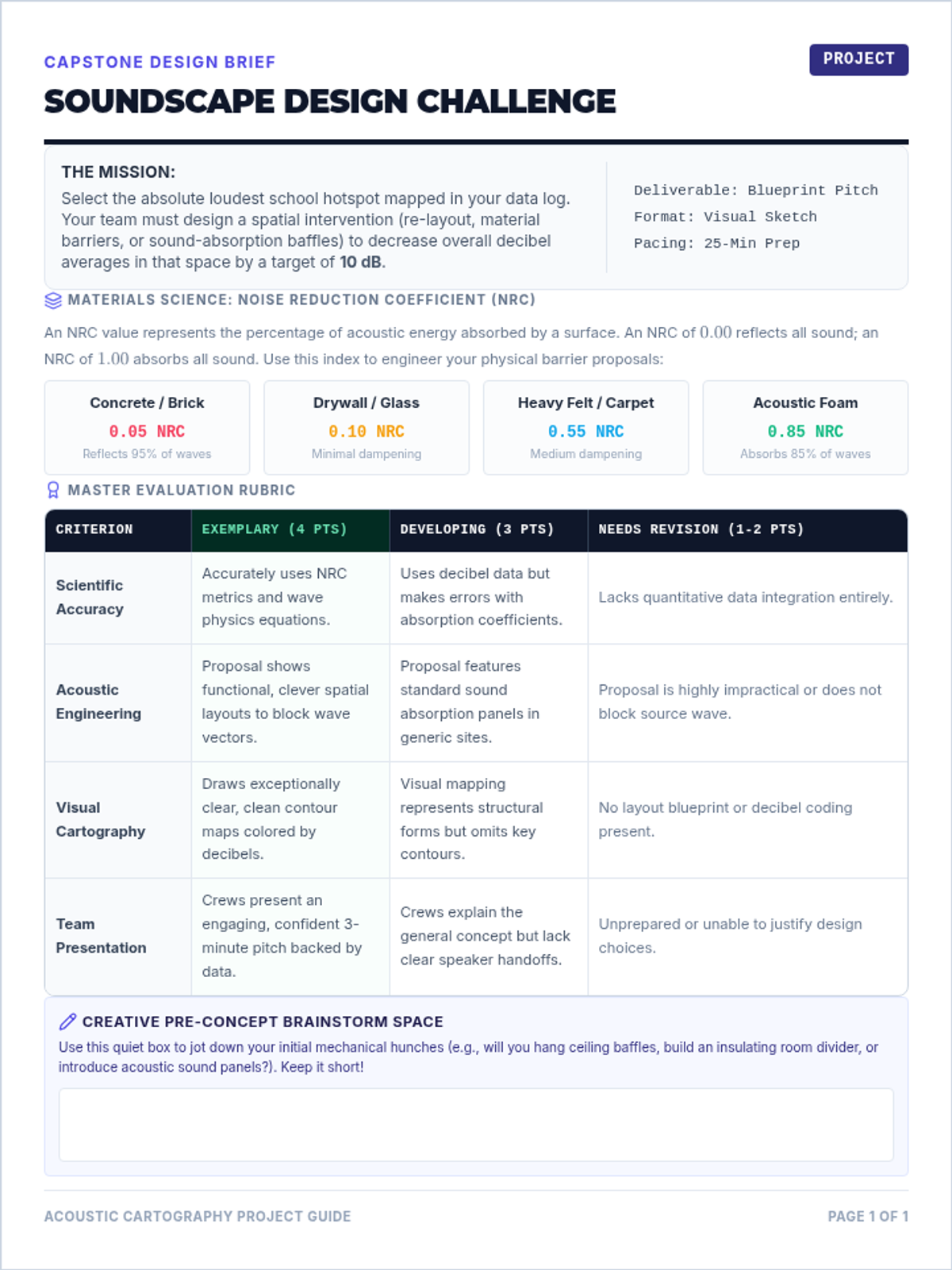
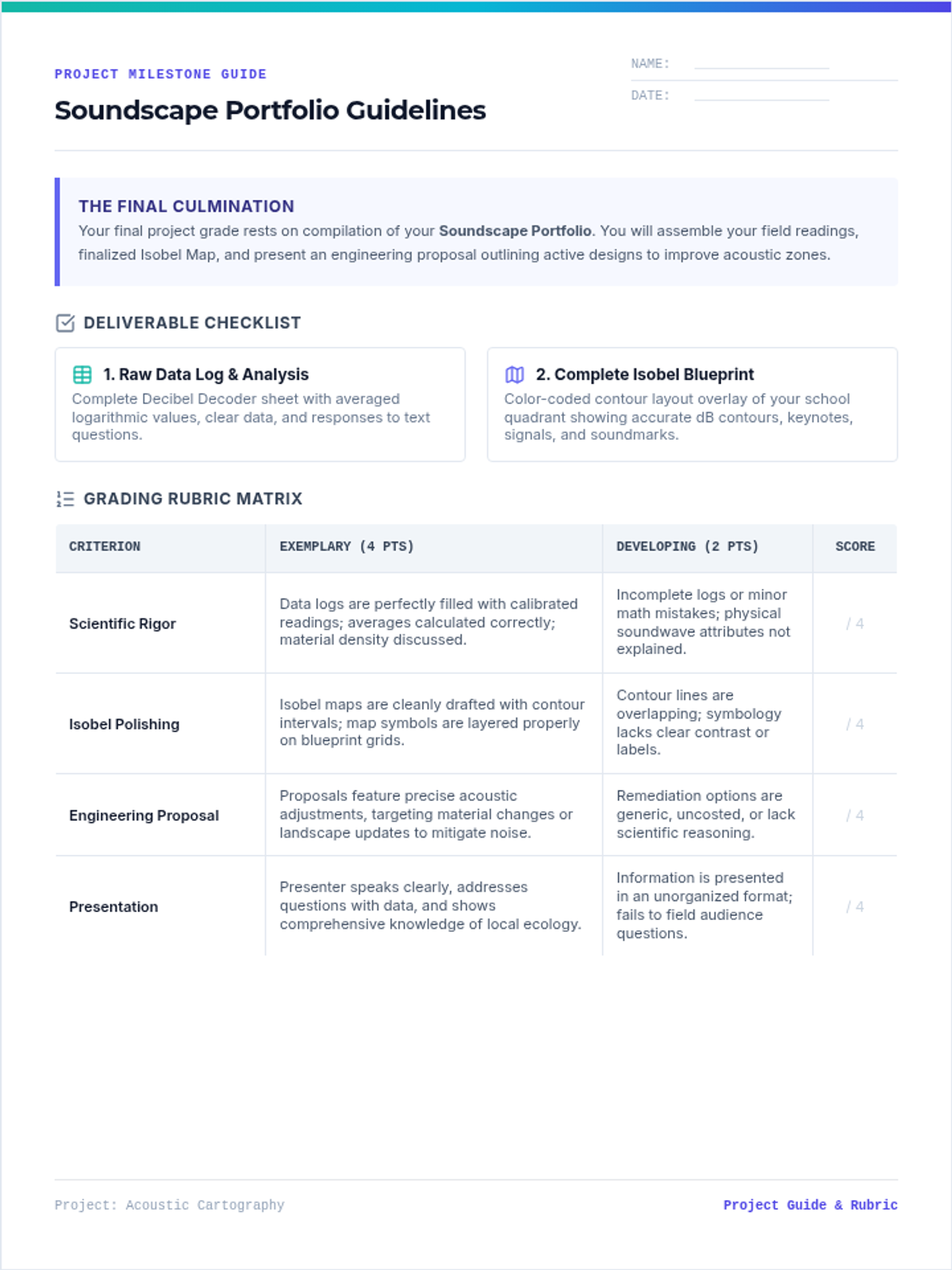
A comprehensive single-page project brief and grading rubric guiding students through designing acoustic noise-mitigation structures.
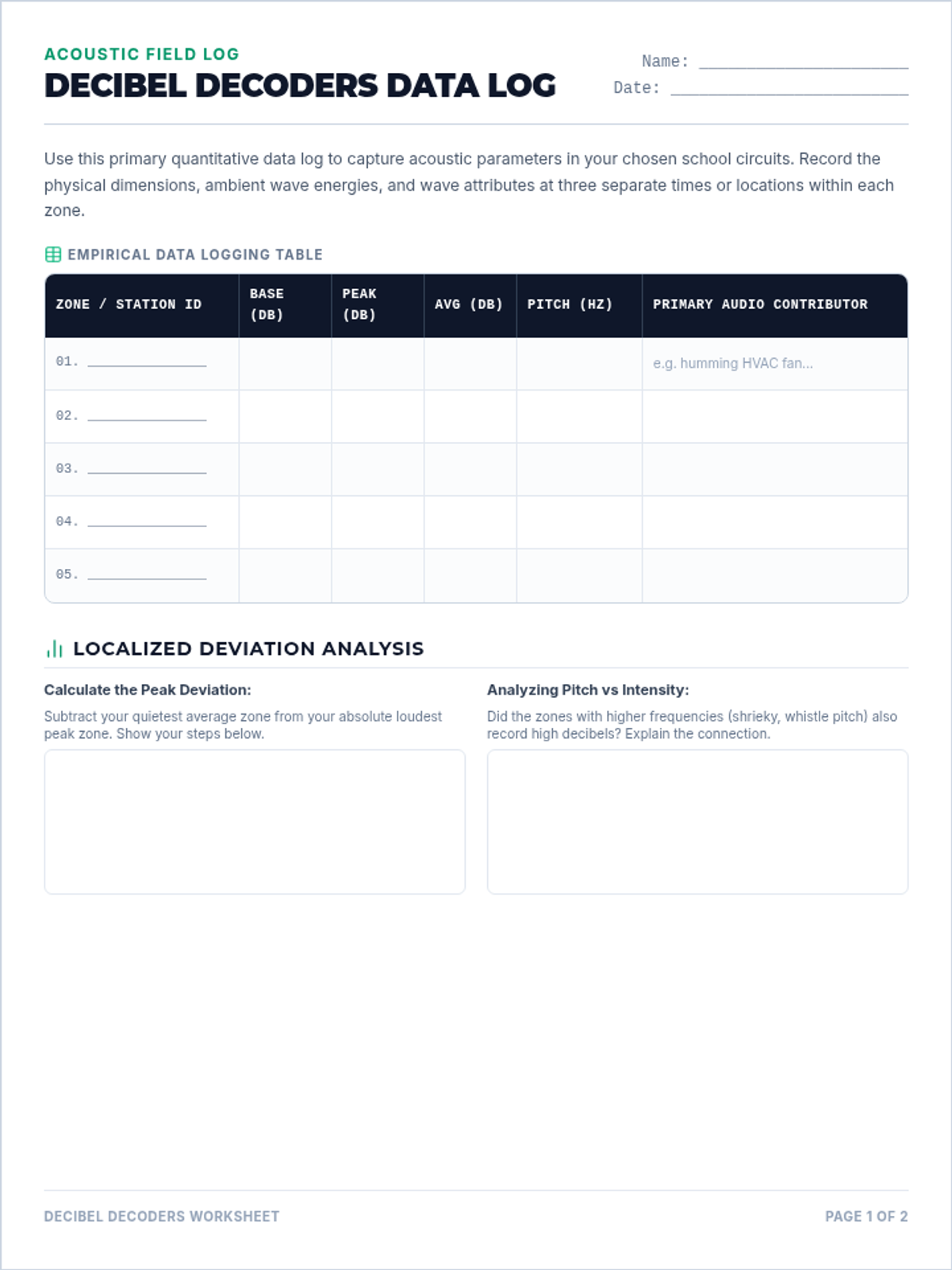
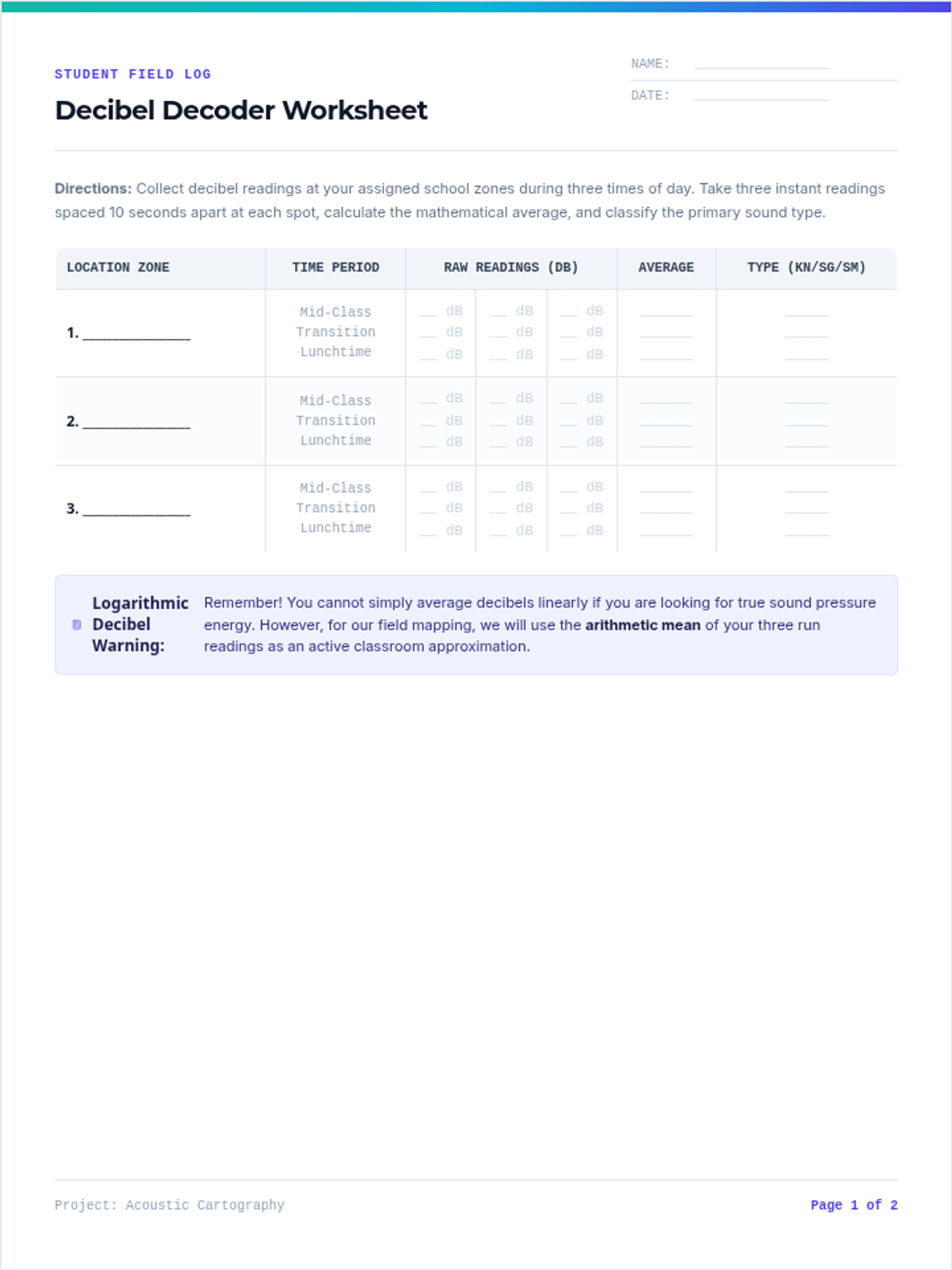
A two-page student data worksheet featuring comprehensive quantitative sound logging, decibel comparison matrices, and mathematical analysis of acoustic energy.
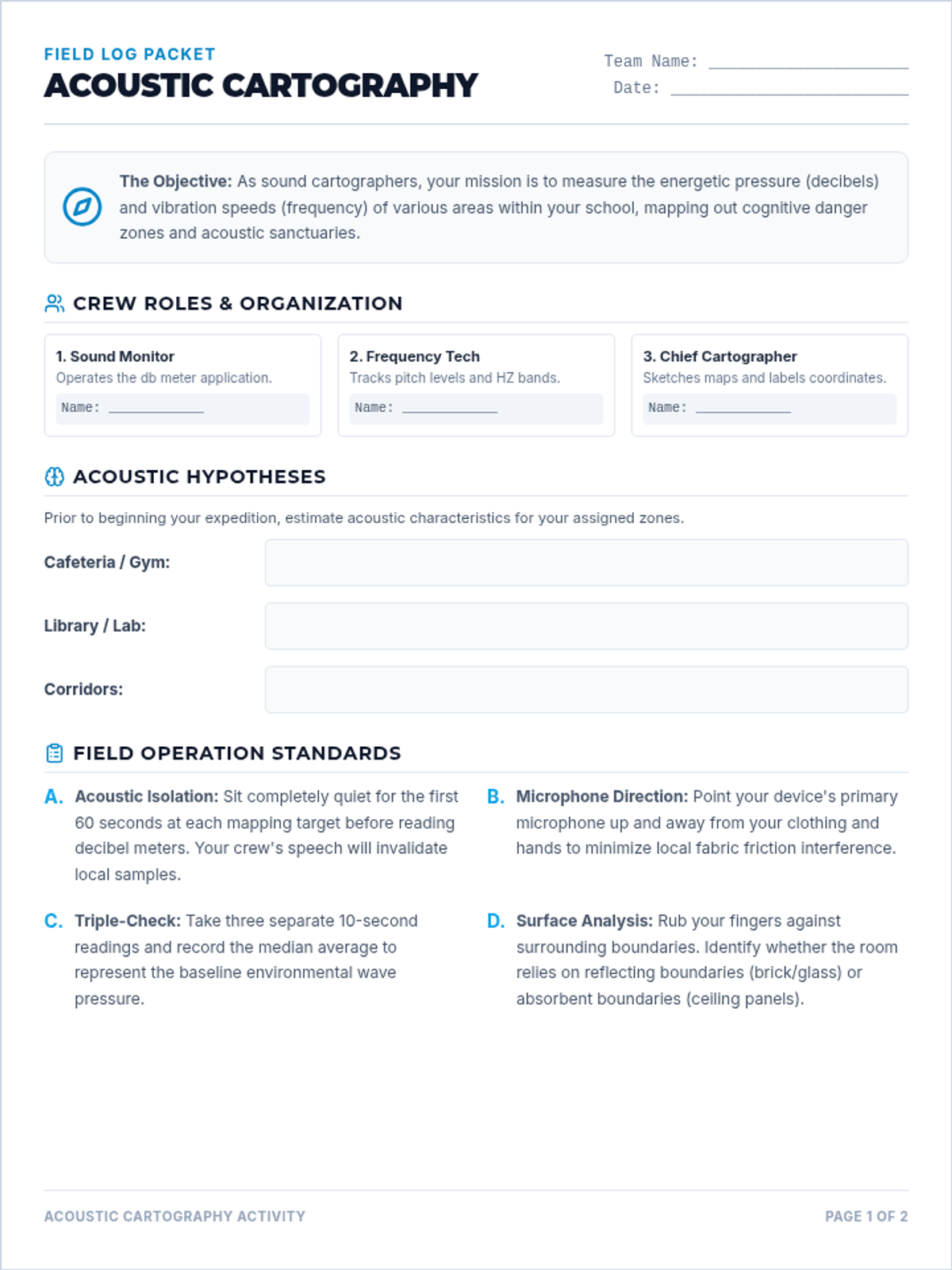
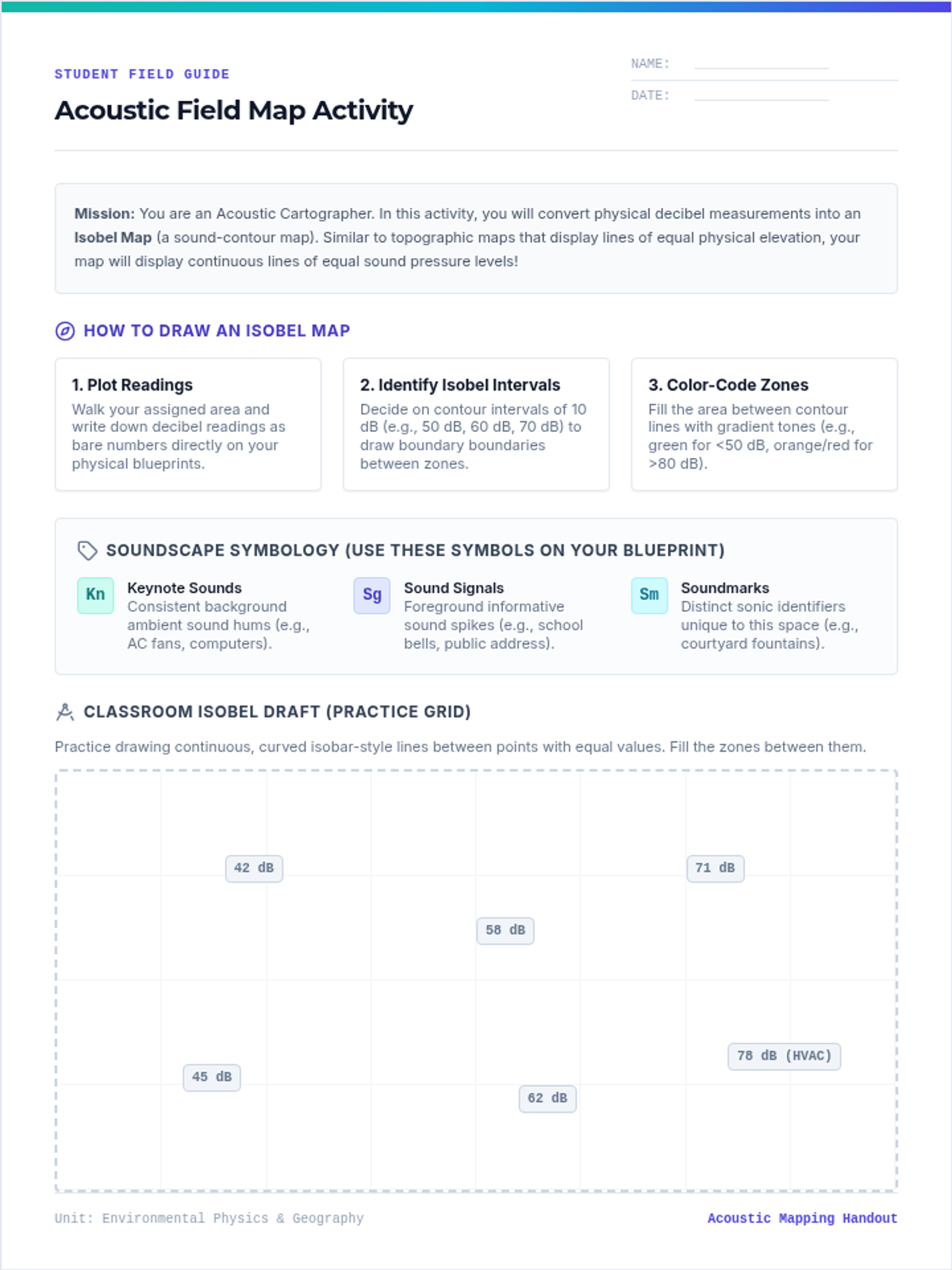
A student activity packet guiding mapping crews through setting hypotheses, setting field safety protocols, and creating hand-sketched acoustic choropleth maps.
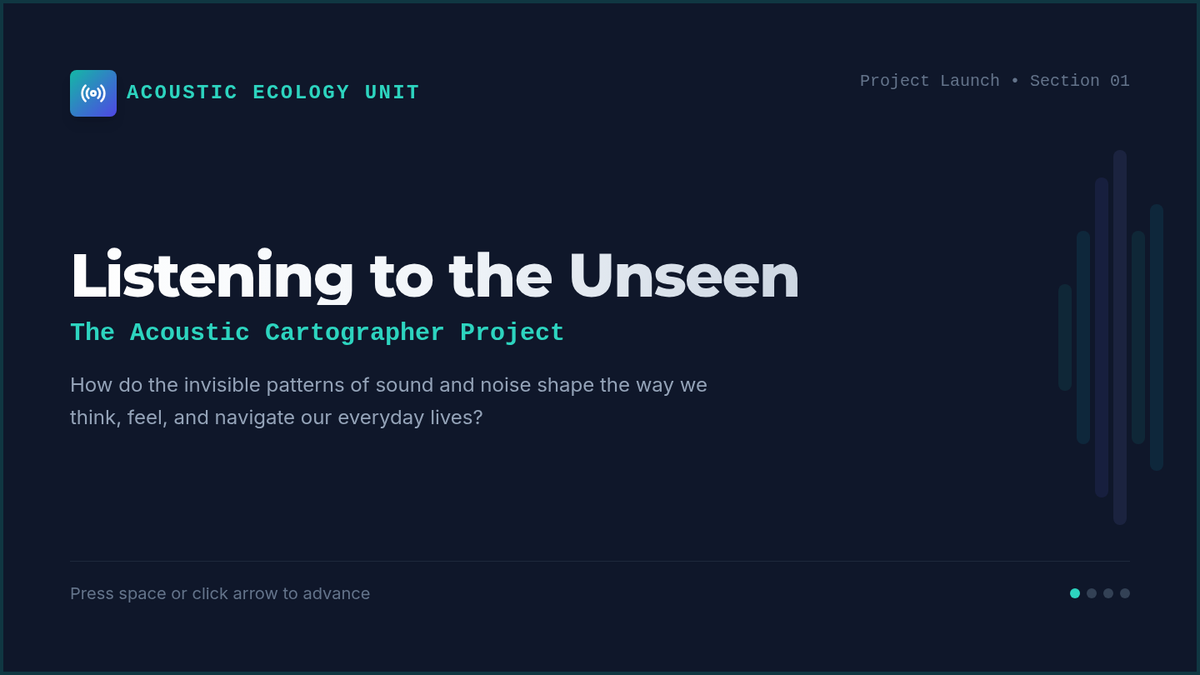
An instructional slide deck designed to deliver the lesson's core acoustic principles, data collection protocols, and cognitive science connections to students.
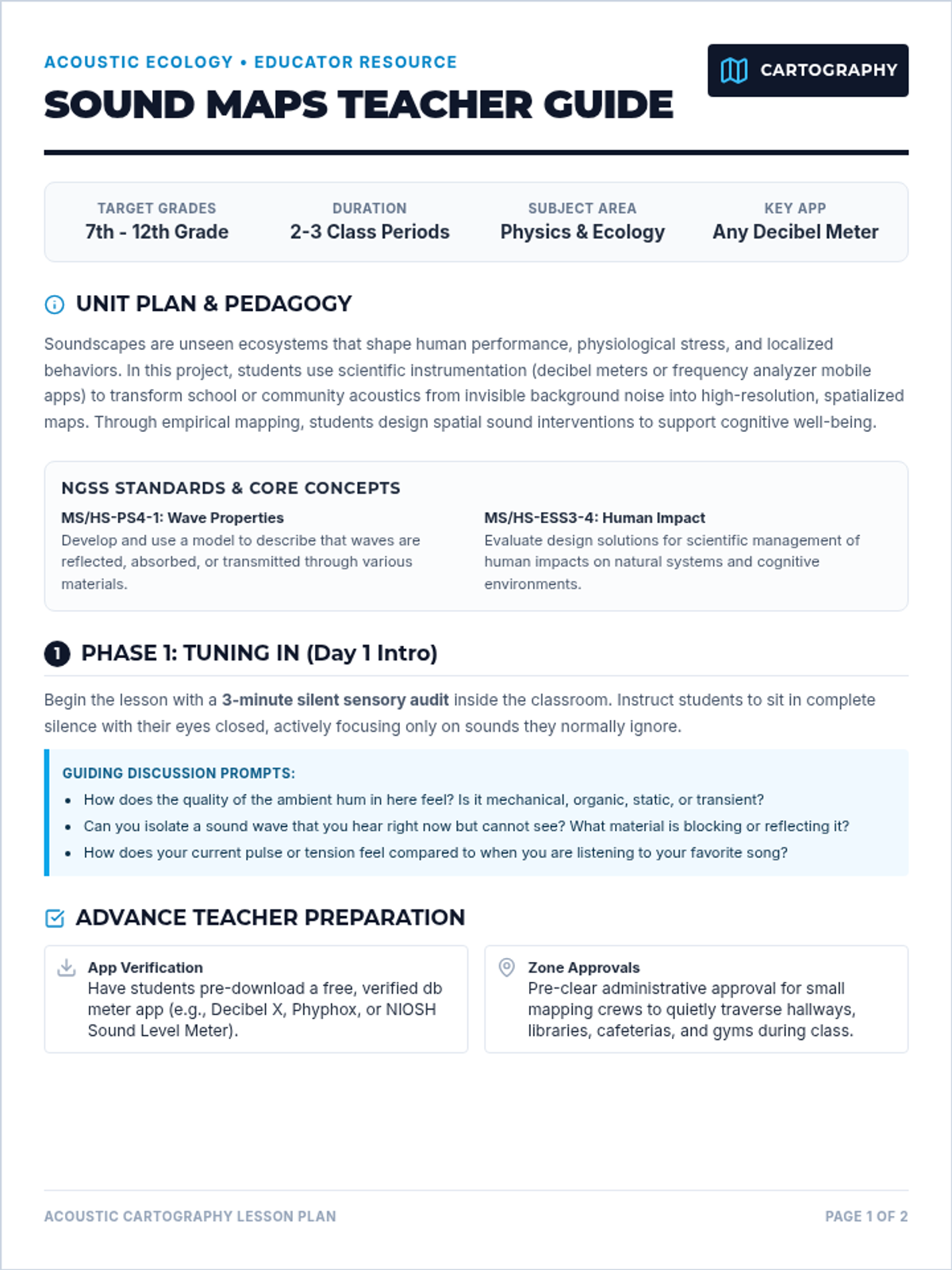
A comprehensive two-page instructional guide for teachers to facilitate the Acoustic Cartography lesson, including scheduling, safety protocols, prompting questions, and discussion frameworks.
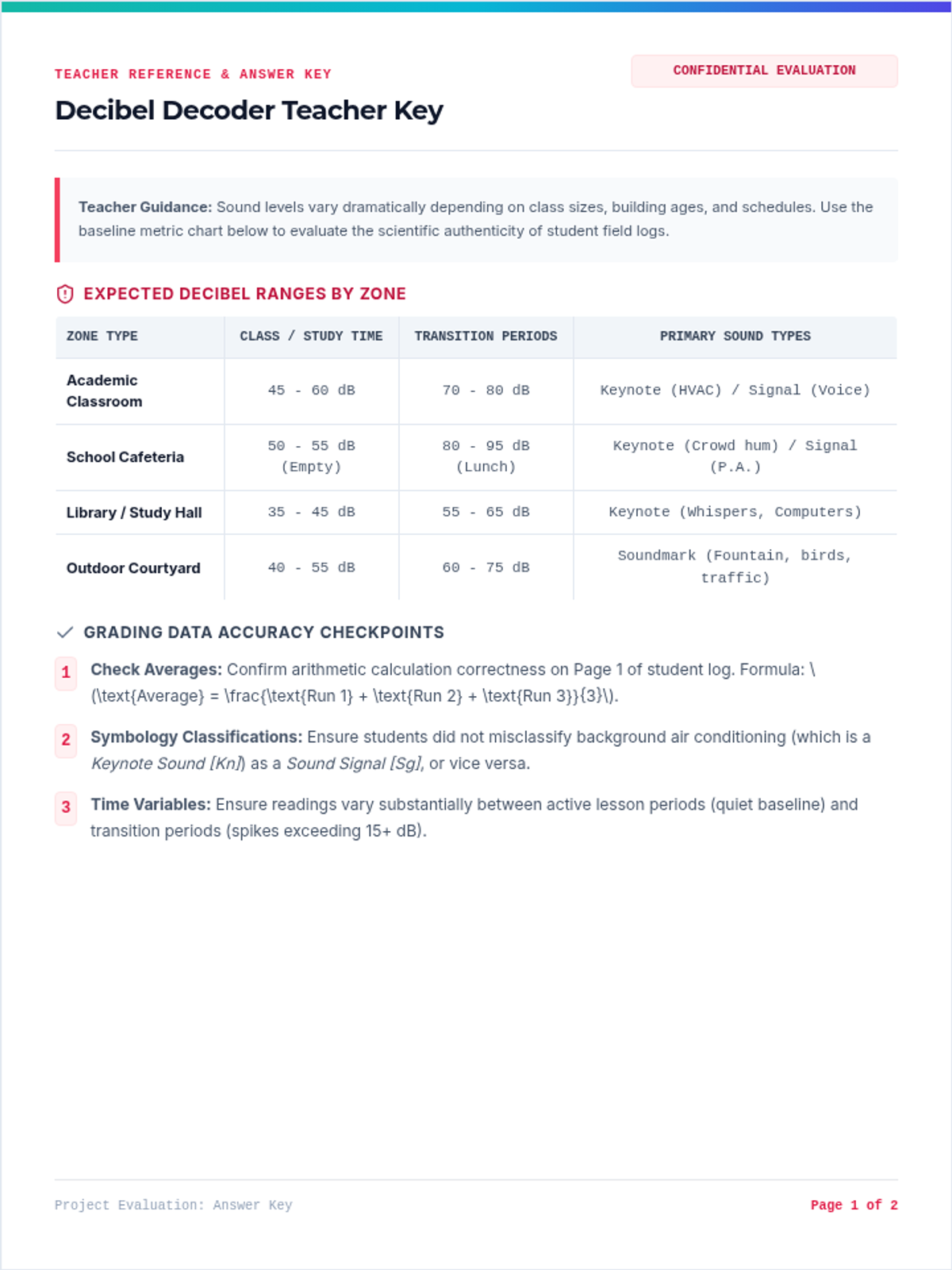
A detailed teacher answer key and assessment guide for the Decibel Decoder Worksheet, featuring exemplar data ranges, calculation reminders, and professional scientific model answers for grading.
A student-facing guide detailing the deliverables, timeline milestones, and a comprehensive grading rubric for the final Acoustic Portfolio project.
A student data log and comprehensive analysis worksheet for recording multi-interval decibel measurements across various school zones and answering physics and psychology integration questions.
A student field activity guide and graphic organizer that provides step-by-step instructions on creating contour sound maps (isobels) and maps the symbols for keynotes, signals, and soundmarks.
An introductory presentation slide deck designed to engage students in the concepts of acoustic ecology, the science of decibels, soundscapes, and the step-by-step procedures of their field mapping mission.
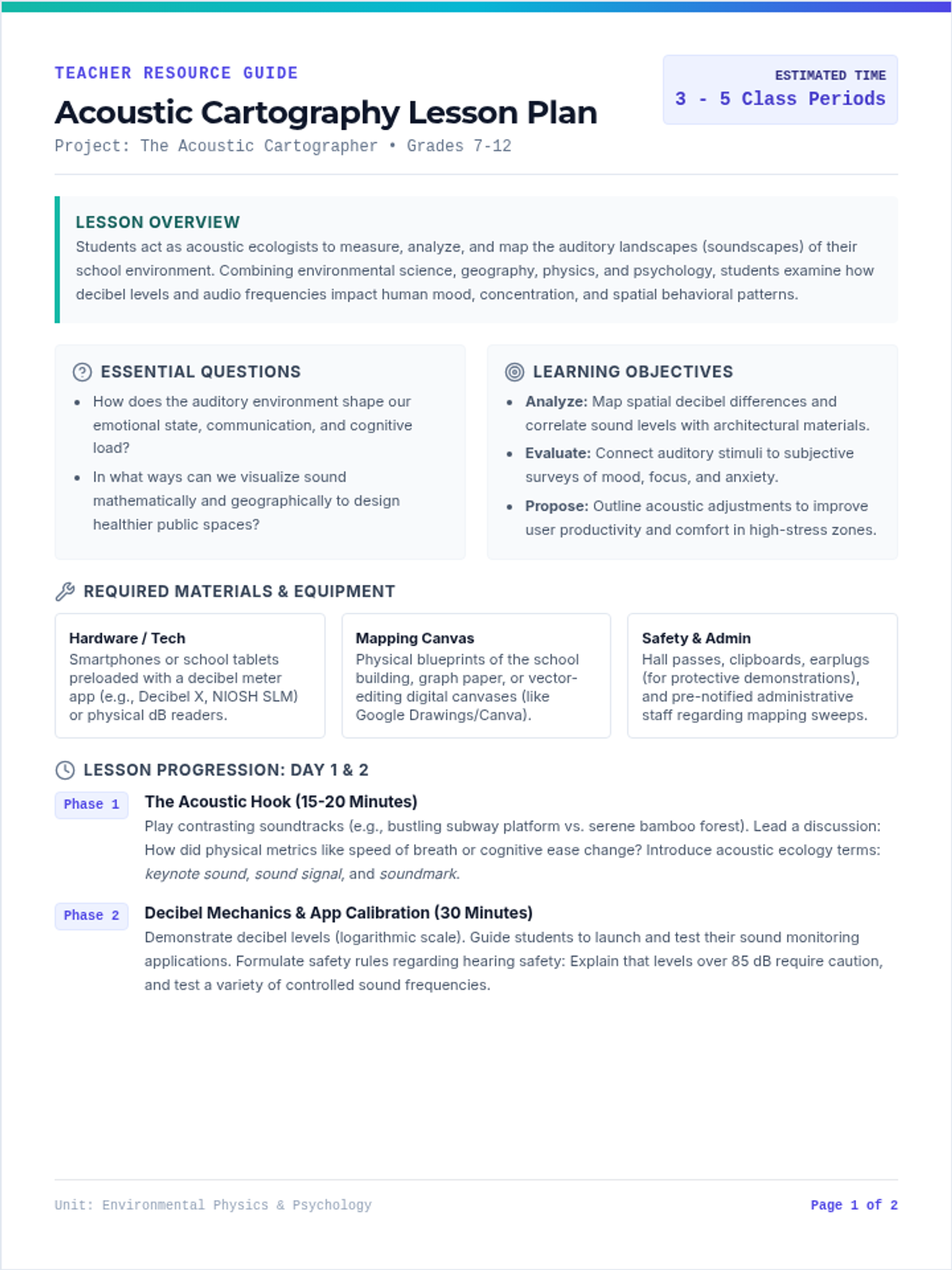
A comprehensive lesson plan for teachers, detailing the academic objectives, step-by-step instructions, materials, safety considerations, and pedagogical strategies for conducting the Acoustic Cartography project in grades 7-12.
A 6-slide design challenge deck designed to guide students visually through the concepts of magnetism, non-contact forces, material testing, and iterative maze engineering.
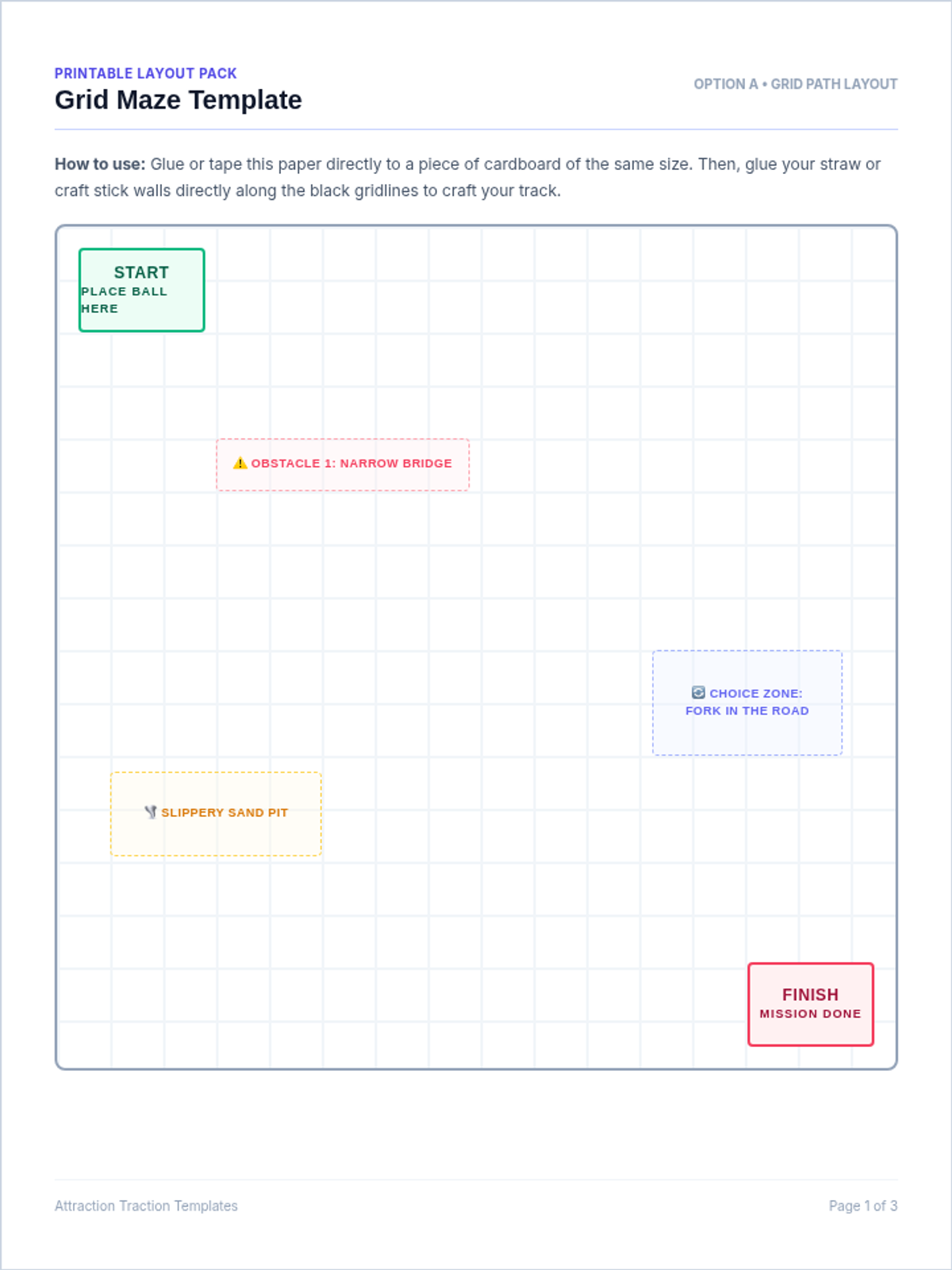
A 3-page printable pack featuring two complete pathing templates (orthogonal grid and concentric radial maze designs) and a hands-on material testing log sheet.
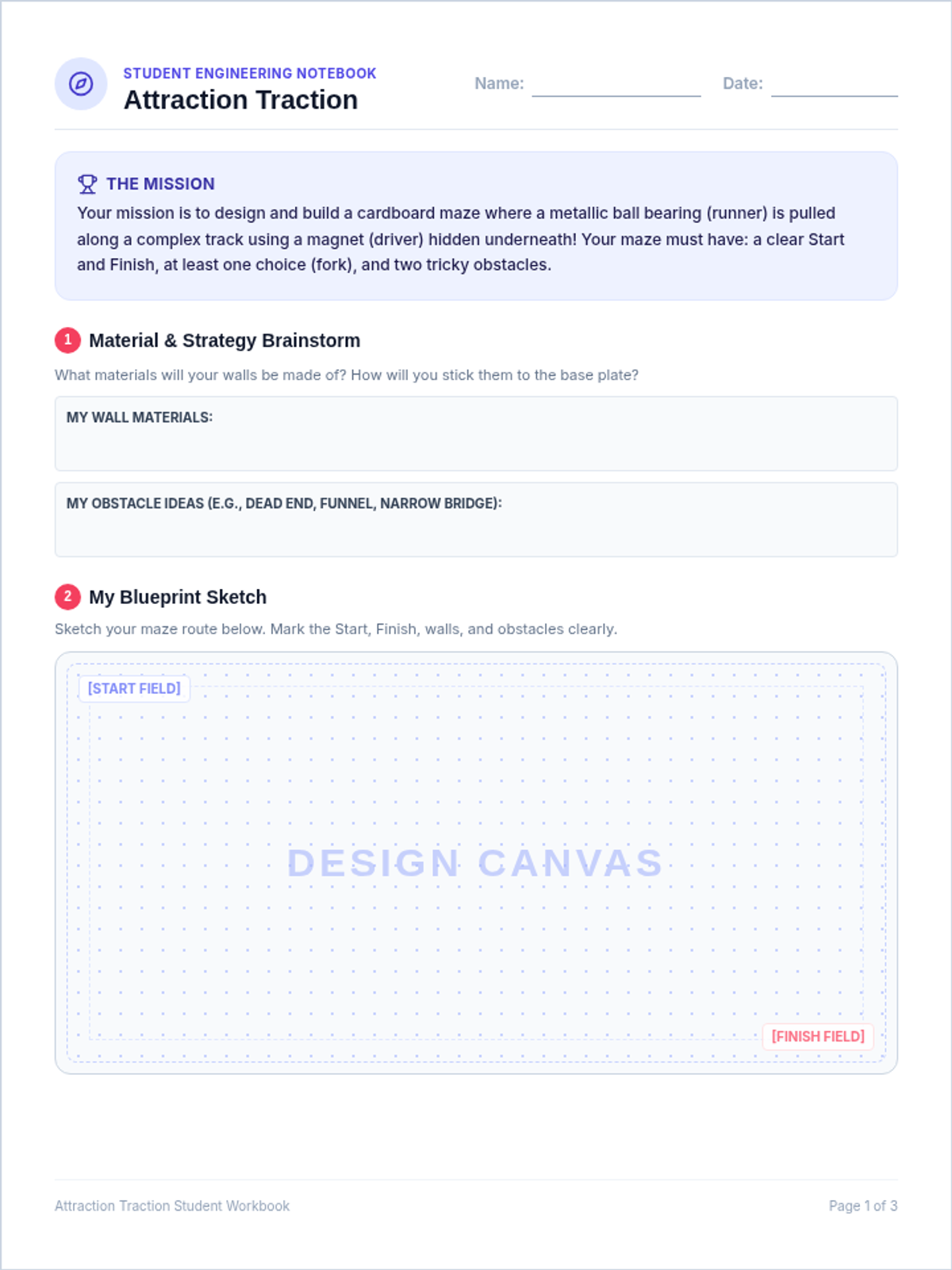
A 3-page student-facing STEM workbook containing a blueprint planning sheet, testing/iteration log, and a high-retention exit ticket with reflective writing prompts about magnetism and force vectors.
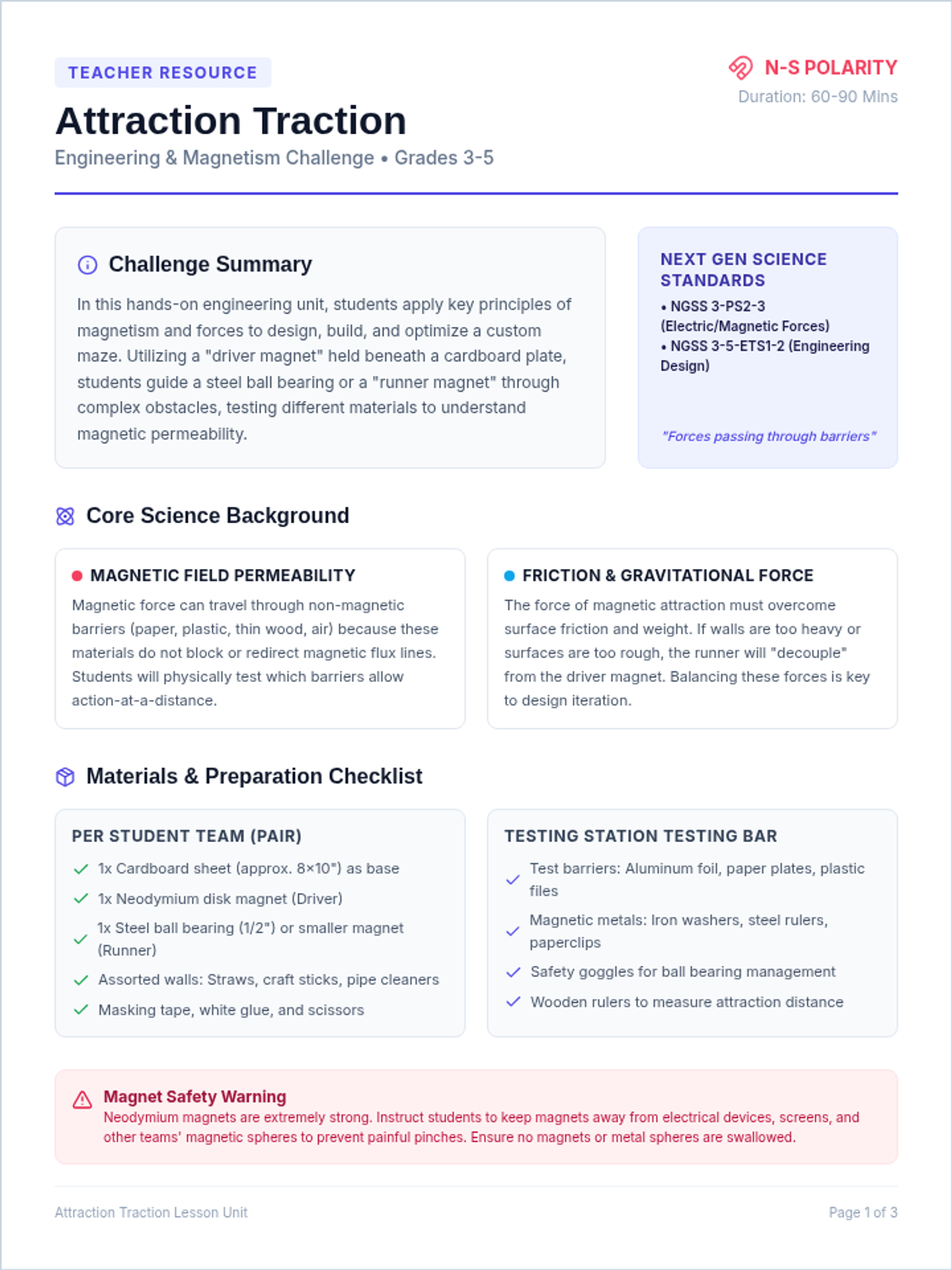
A 3-page printable guide for teachers featuring background science, step-by-step facilitation prompts, material checklists, lesson timeline, and a rubric for the Attraction Traction magnetic maze design challenge.
A 2-page print-ready teacher instructional plan and facilitation guide for running the Force Field Engineers magnet maze lab. Includes NGSS standards, a materials checklist, lesson pacing, inquiry prompts, a 3-tier grading rubric, and classroom troubleshooting tips.
A 2-page collection of printable layout templates, assembly components, and cutouts for building custom student magnet mazes. Includes a 1-inch printable grid board and a materials folding lab sheet.
A 2-page print-ready student lab handbook for the Magnet Maze engineering challenge. It includes a material testing matrix, maze blueprinting grid, testing logs, and reflective engineering prompts.
A 2-page teacher facilitation guide containing next-generation science standards (NGSS) alignments, a detailed 60-minute pacing guide, visual setup directions, a structured engineering design rubric, and a guide to solving common student misconceptions.
A 5-slide visual presentation for teachers to introduce non-contact forces, magnetic fields, attraction/repulsion, and the step-by-step engineering constraints of the Magnet Maze challenge.
A 3-page student activity guide and engineering worksheet for the magnet maze challenge. Includes design constraints, a layout sketching grid, material testing logs, and conceptual reflection questions on non-contact forces and poles.
A 1-page printable resource containing 2 identical high-impact exit tickets to easily print, cut, and distribute for quick formative assessment on Group 7 trends.
A 1-page printable resource featuring 4 distinct collaborative task cards covering shielding mechanisms, displacement equations, everyday uses, and state transitions.
A 2-page laboratory investigation guide detailing simulated halogen displacement reactions with clear procedures, observations grids, and a CER analysis framework.
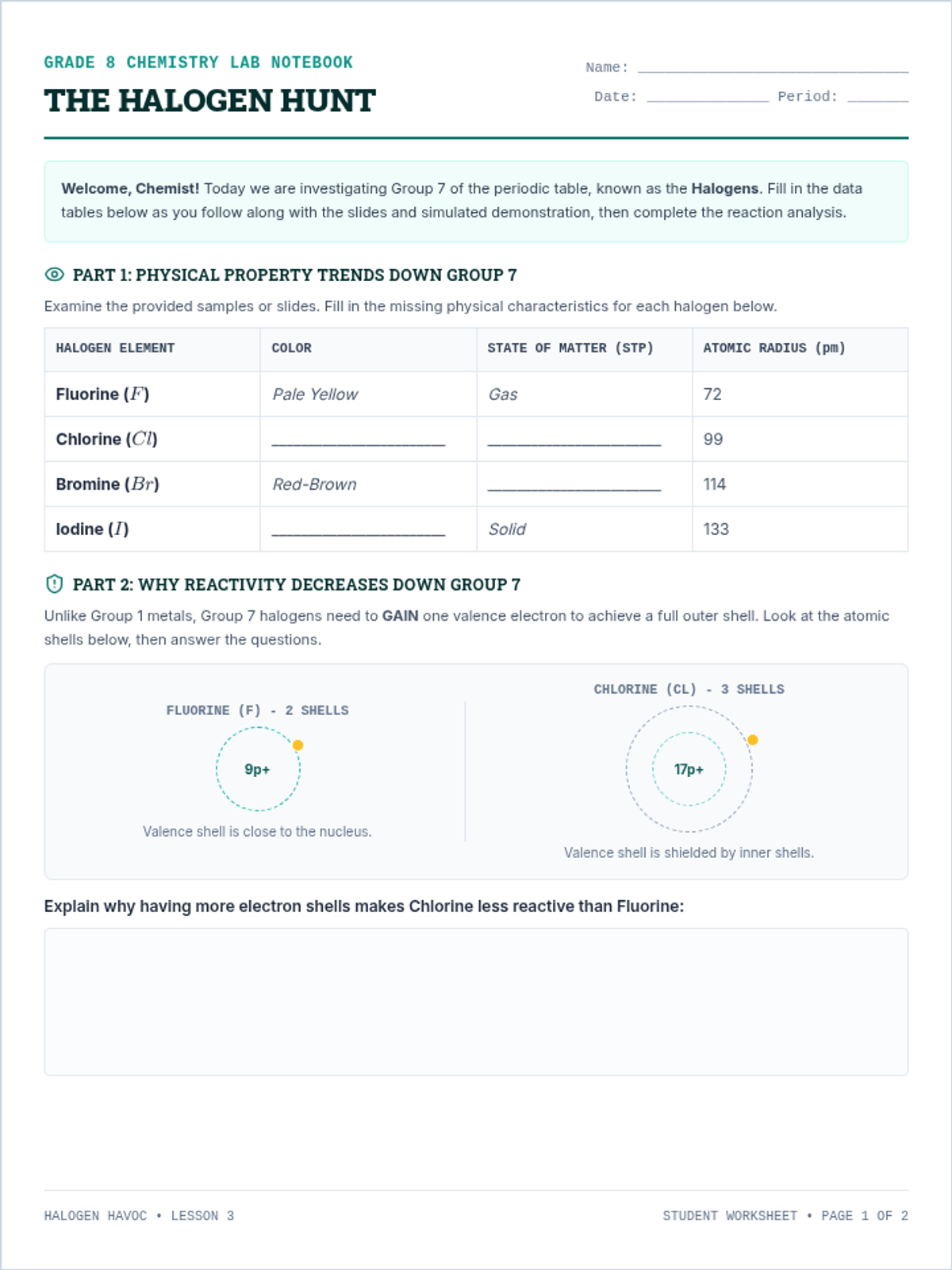
A 2-page print-ready guided worksheet with name/date fields, physical properties completion table, atomic shielding diagram questions, and displacement equation practice problems.
A high-impact, visual slide presentation covering Group 7 trends, color changes, subatomic shielding, and displacement rules. Optimized for 1440x810 layout.
A 2-page print-ready teacher guide detailing lesson pacing, pedagogical strategies, common student misconceptions, questioning guides, and answer keys for the entire Halogen Havoc unit.
A single-page formative assessment exit ticket where students analyze vague steps for logical loopholes, practice writing highly precise instructions, and explain why exact detail is crucial for programming.
A highly-structured 2-page student worksheet that helps kids brainstorm, sketch, and systematically draft chronological, step-by-step algorithms for building a marshmallow fluff and jelly sandwich.
A comprehensive, step-by-step facilitation guide for teachers on how to execute the literal-interpretation marshmallow fluff and jelly demo, complete with loophole guides, common student instruction errors, and reflection prompts.
A vibrant, projection-ready slide presentation that guides students through the 'Exact Instructions Challenge'. It establishes the rules of the robot-teacher demo, showcases ingredients, sets up the writing activity, and leads the class debrief on the importance of clarity.
A 2-page complete teacher facilitation guide and answer key for the Microbot Mission viewing unit. It provides lesson timelines, pre- and during-viewing classroom discussion prompts, and fully explained numerical solutions for all math and geometry challenges.
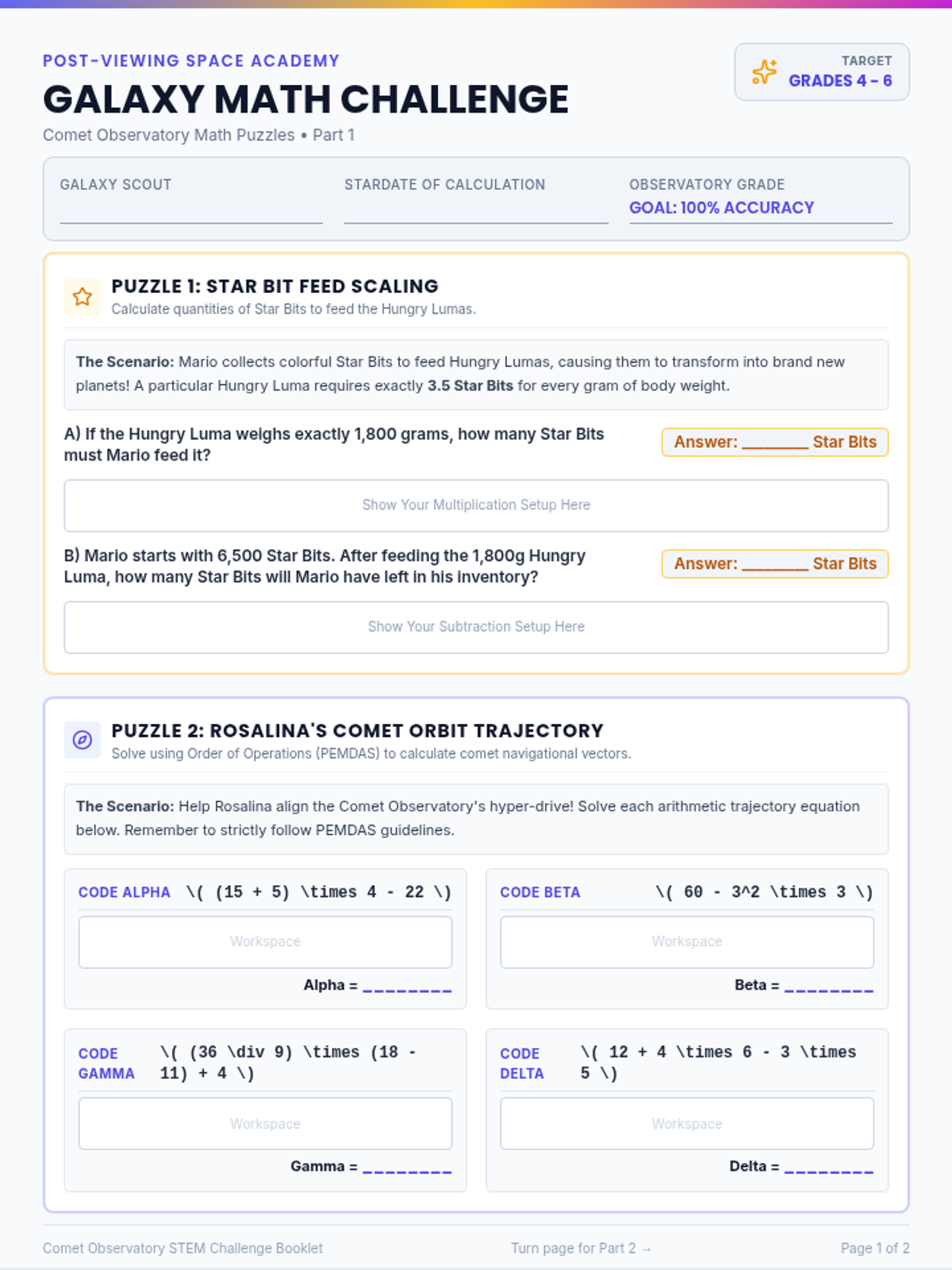
A high-energy 2-page math challenge booklet based on the physics, orbits, and story of Super Mario Galaxy. It presents Grade 4-6 aligned puzzles covering Star Bit scaling, PEMDAS navigational vectors, distance word problems, and orbital geometry.
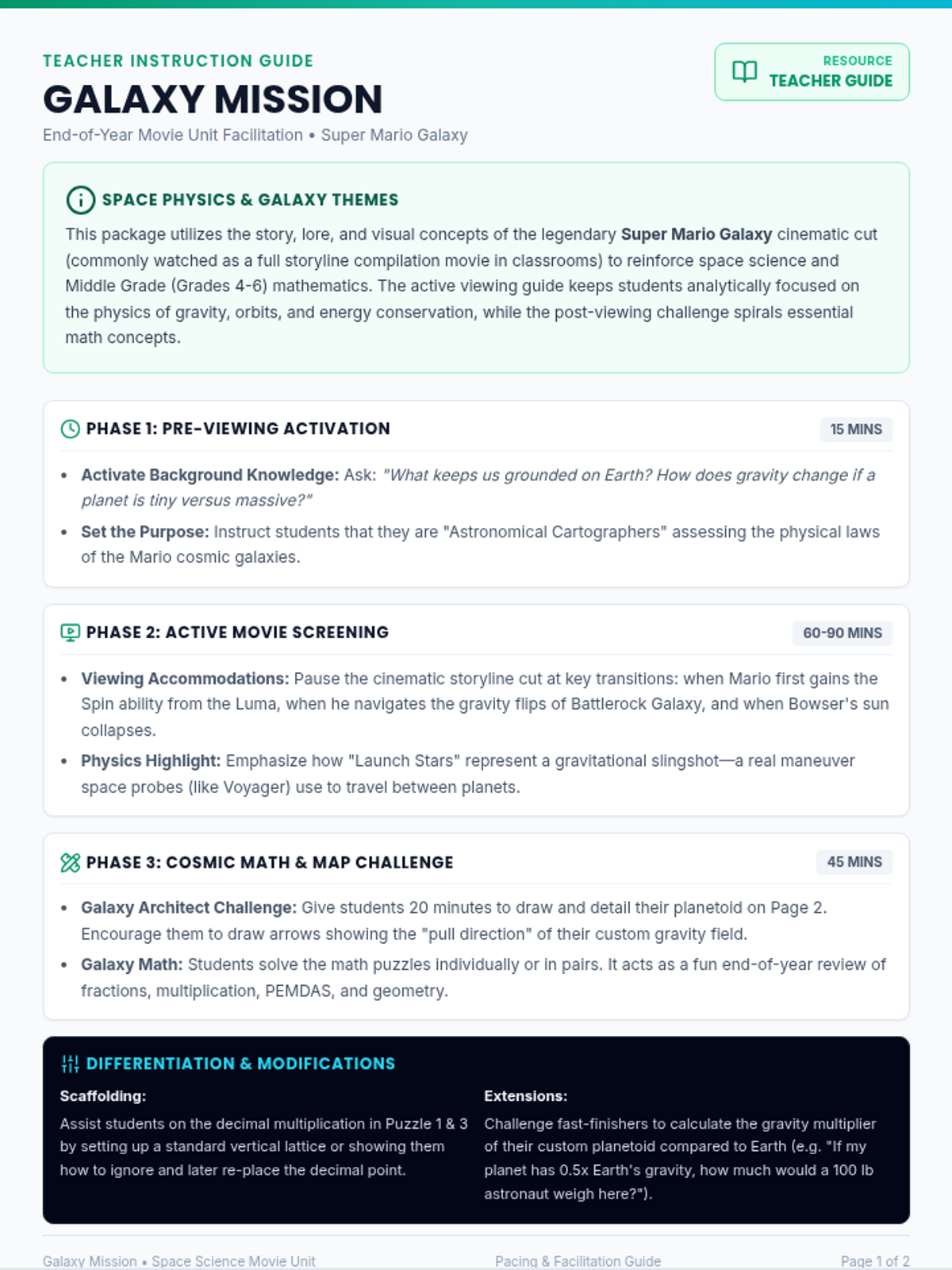
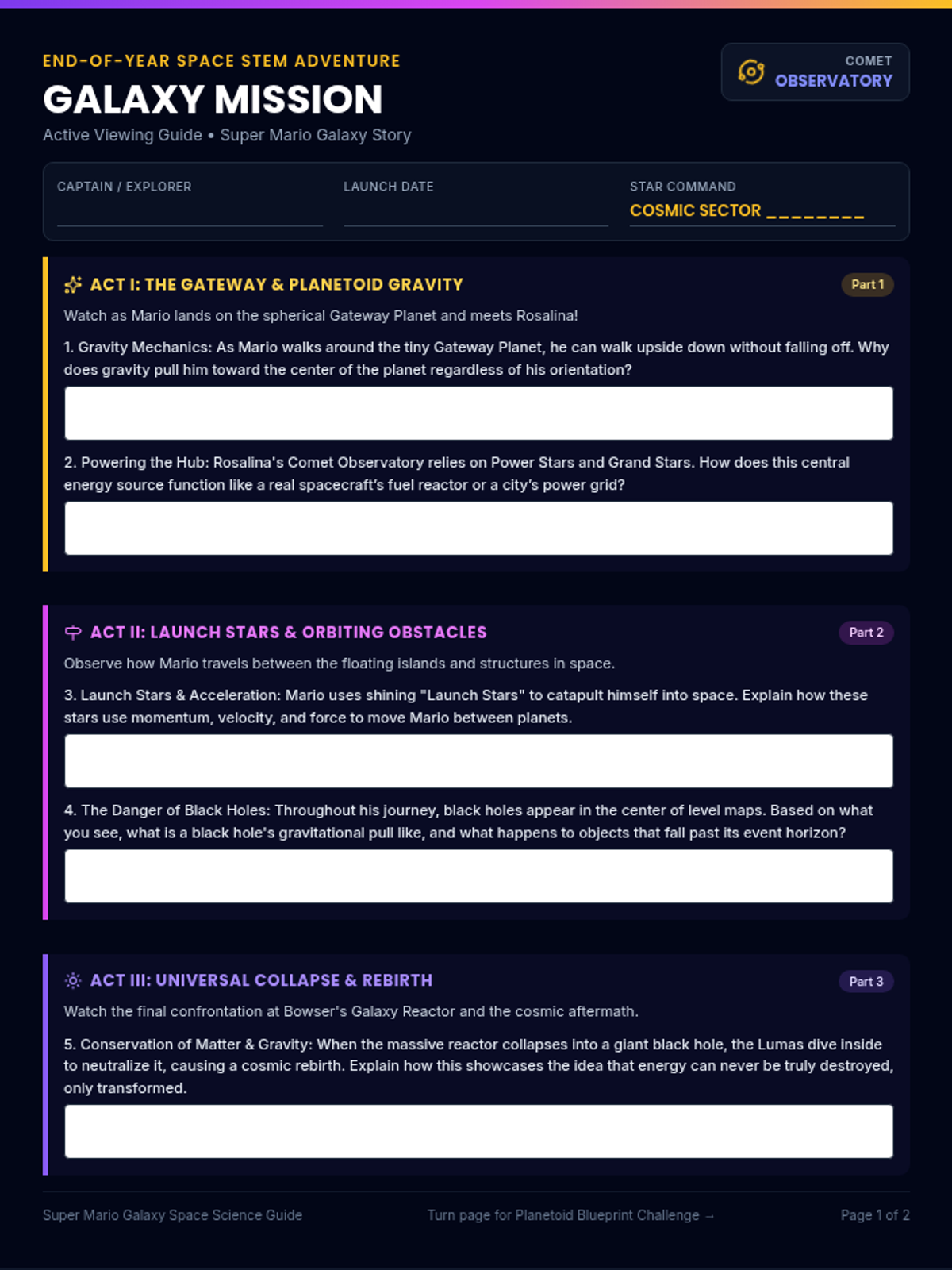
A 2-page active viewing and creative space-science guide based on the story of Super Mario Galaxy. Students explore gravity, orbits, energy transfer, and black holes, followed by designing and mapping their own gravitational planetoid.
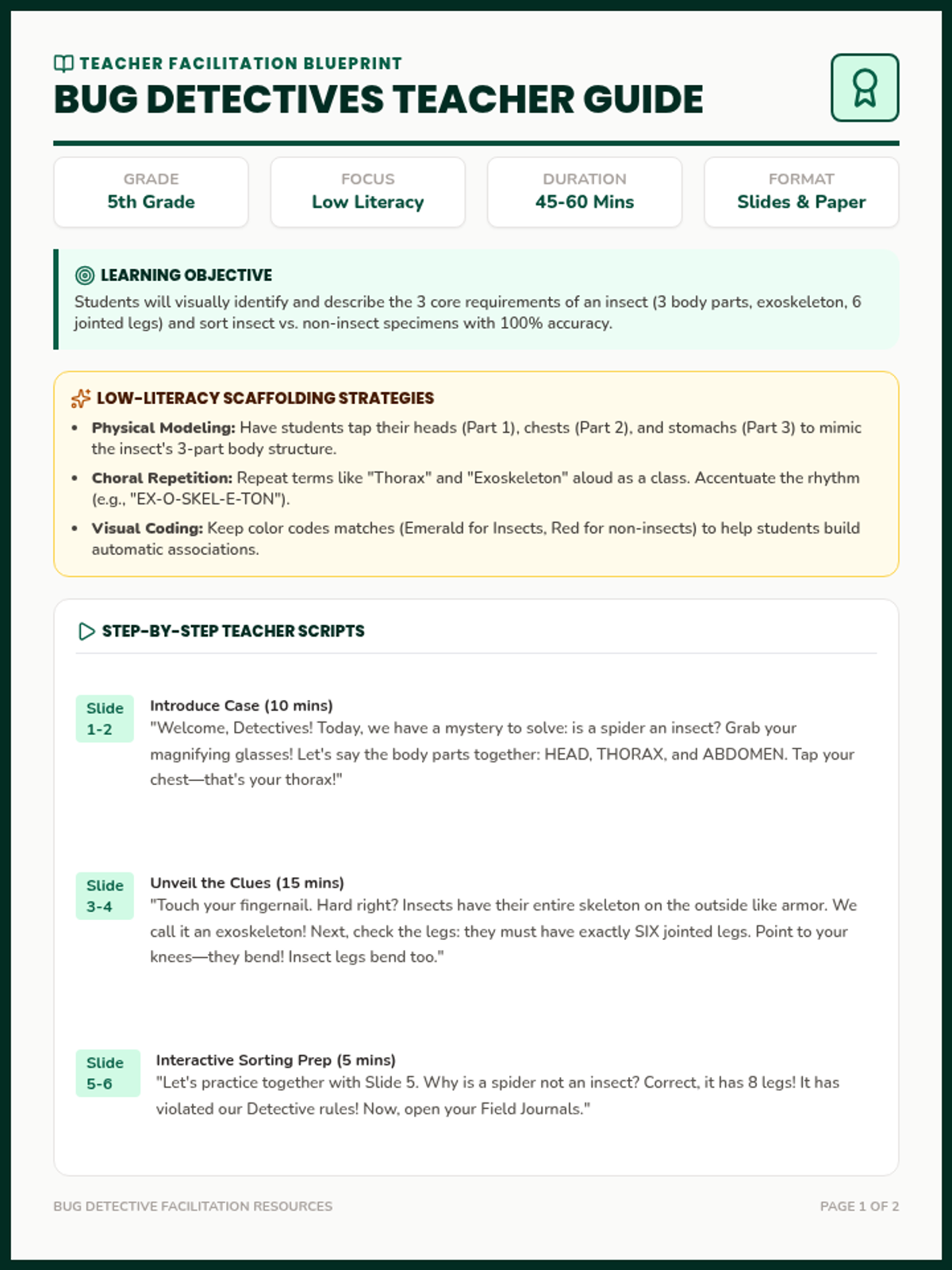
A comprehensive 2-page print-ready teacher blueprint and answer key. Page 1 contains a detailed pacing breakdown, instructional script matched to slides, and critical pedagogical scaffolding strategies for students with low literacy. Page 2 provides explicit answer keys for both the student Field Journal and Sorting Board, alongside formative checklist diagnostics.