A visual presentation for the lesson "The Caesar Question," introducing Great Man Theory vs. Systemic Analysis and providing a guided viewing structure for the Crash Course World History video.
Expanded introductory slides for Lesson 1 covering the full range of landforms and bodies of water with a global focus, featuring comparative visuals and global examples like the Andes and Italy.
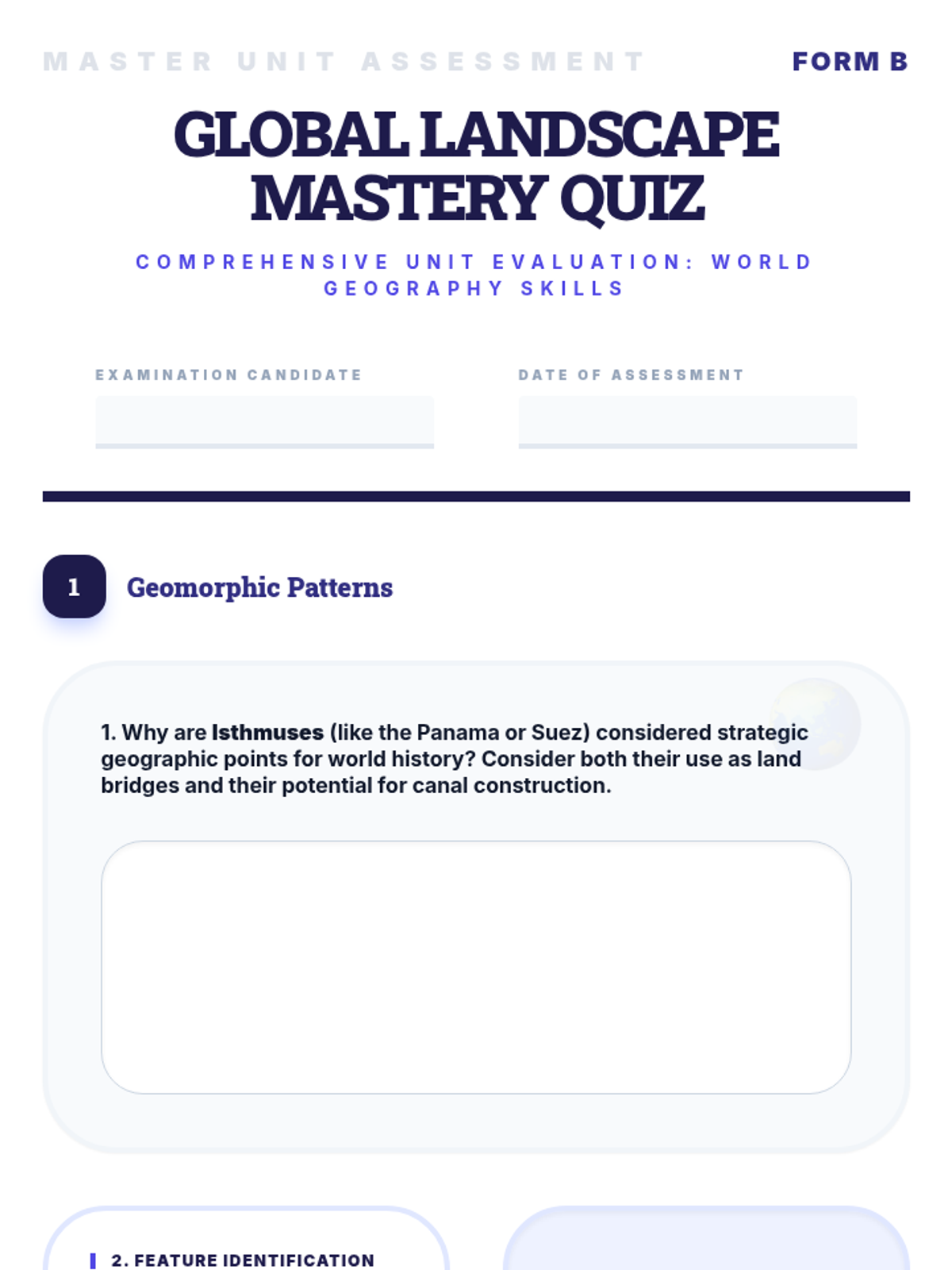
Global-focused final mastery quiz (Form B) featuring questions on isthmuses, world elevation averages, and regional economic advantages. Part of a secondary assessment set.
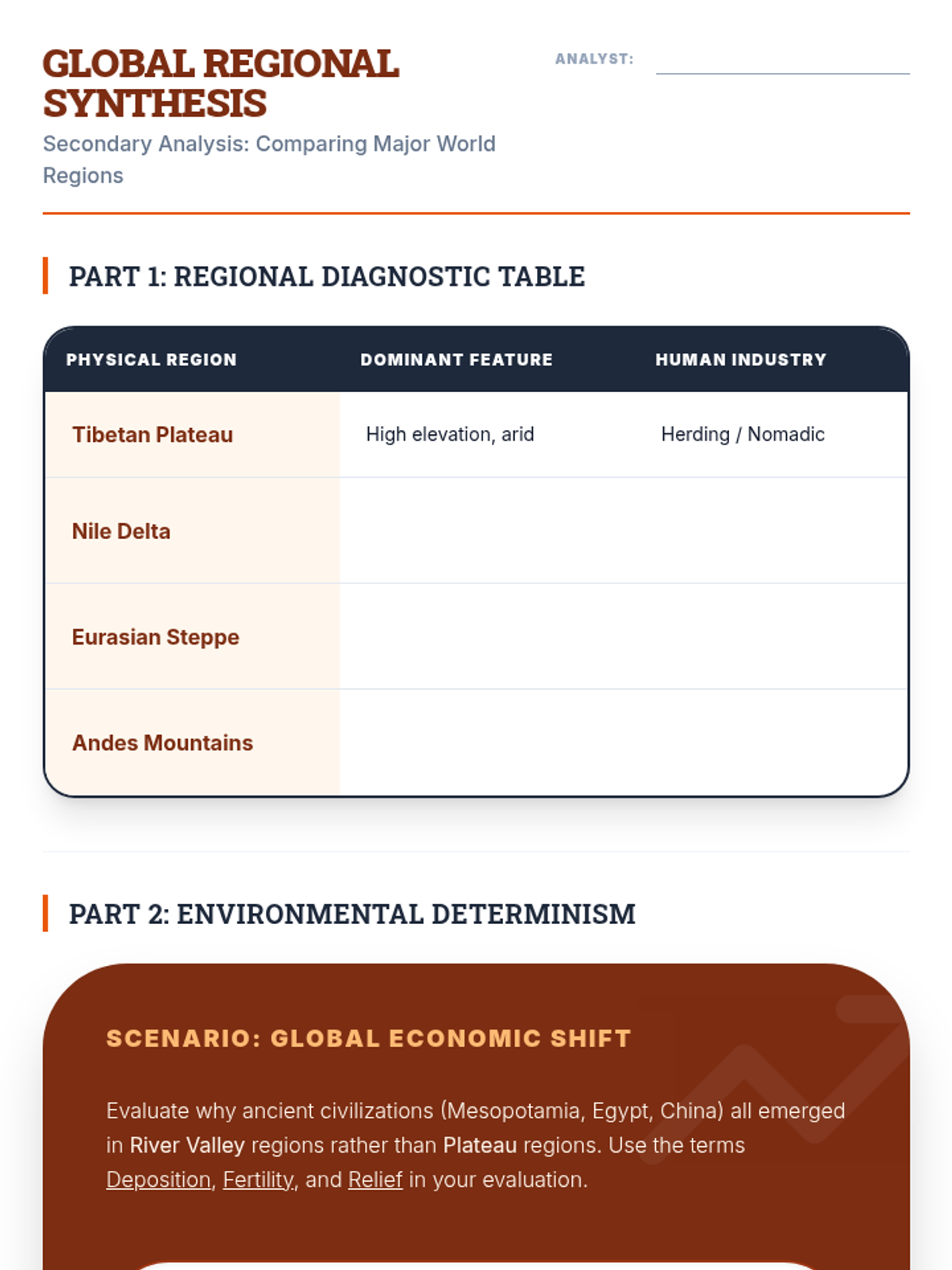
Secondary worksheet for Lesson 4 focusing on global regional diagnostics and the socio-economic analysis of river valleys vs. plateaus.
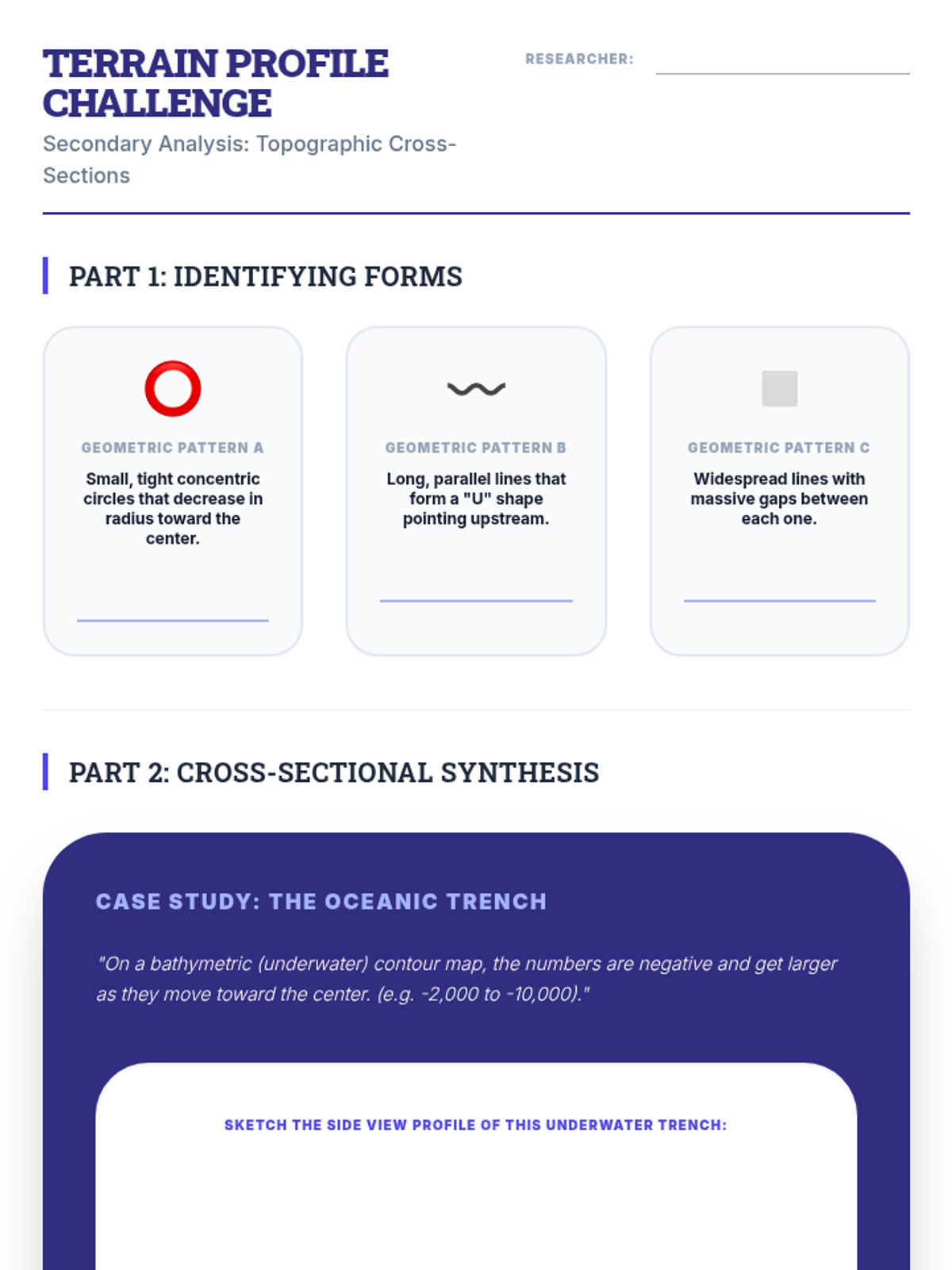
Secondary worksheet for Lesson 3 focusing on topographic pattern recognition and the construction of vertical profiles from contour data.
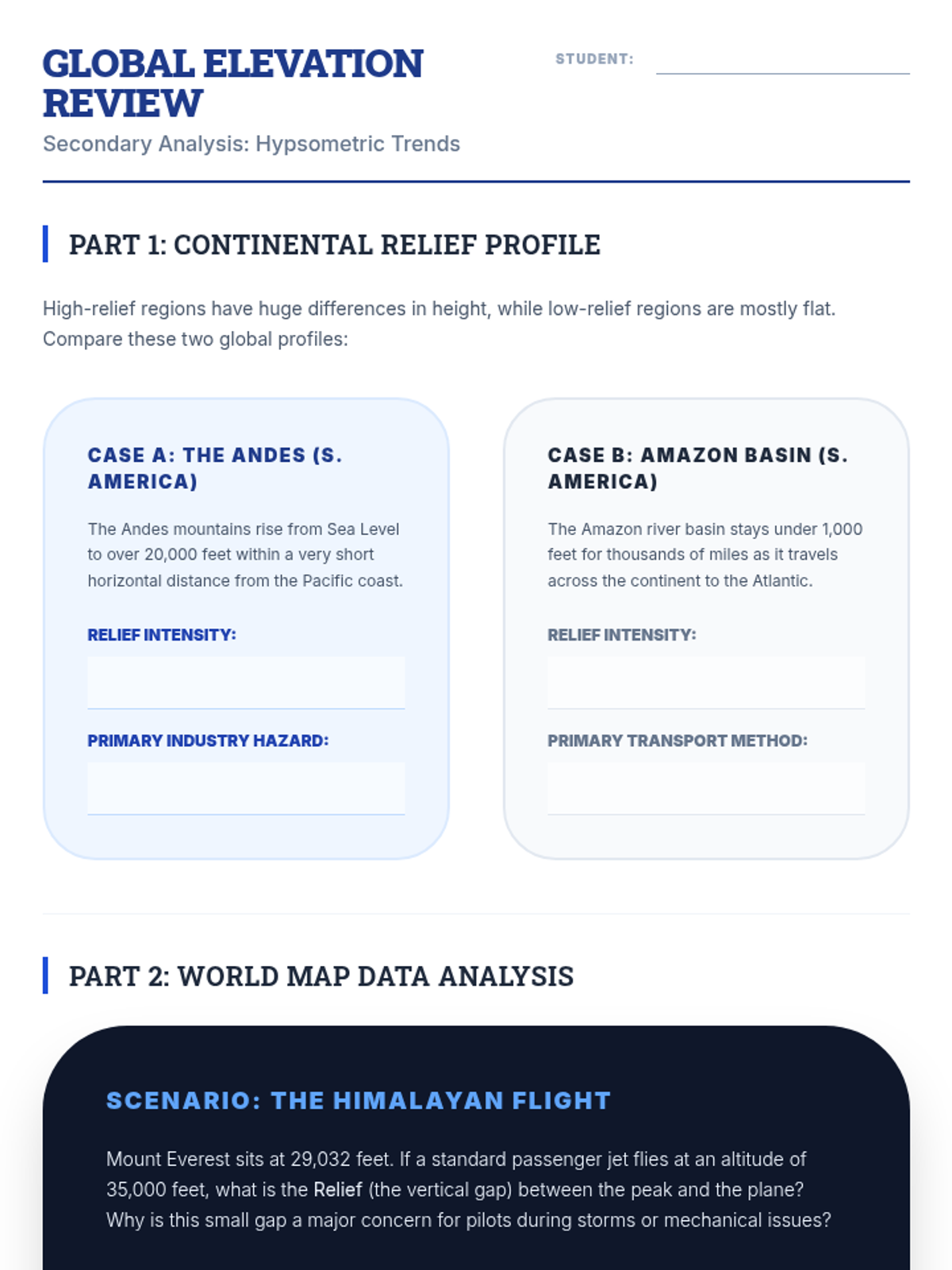
Secondary worksheet for Lesson 2 focusing on global relief comparisons, continental elevation profiles, and mathematical synthesis of flight data relative to world peaks.
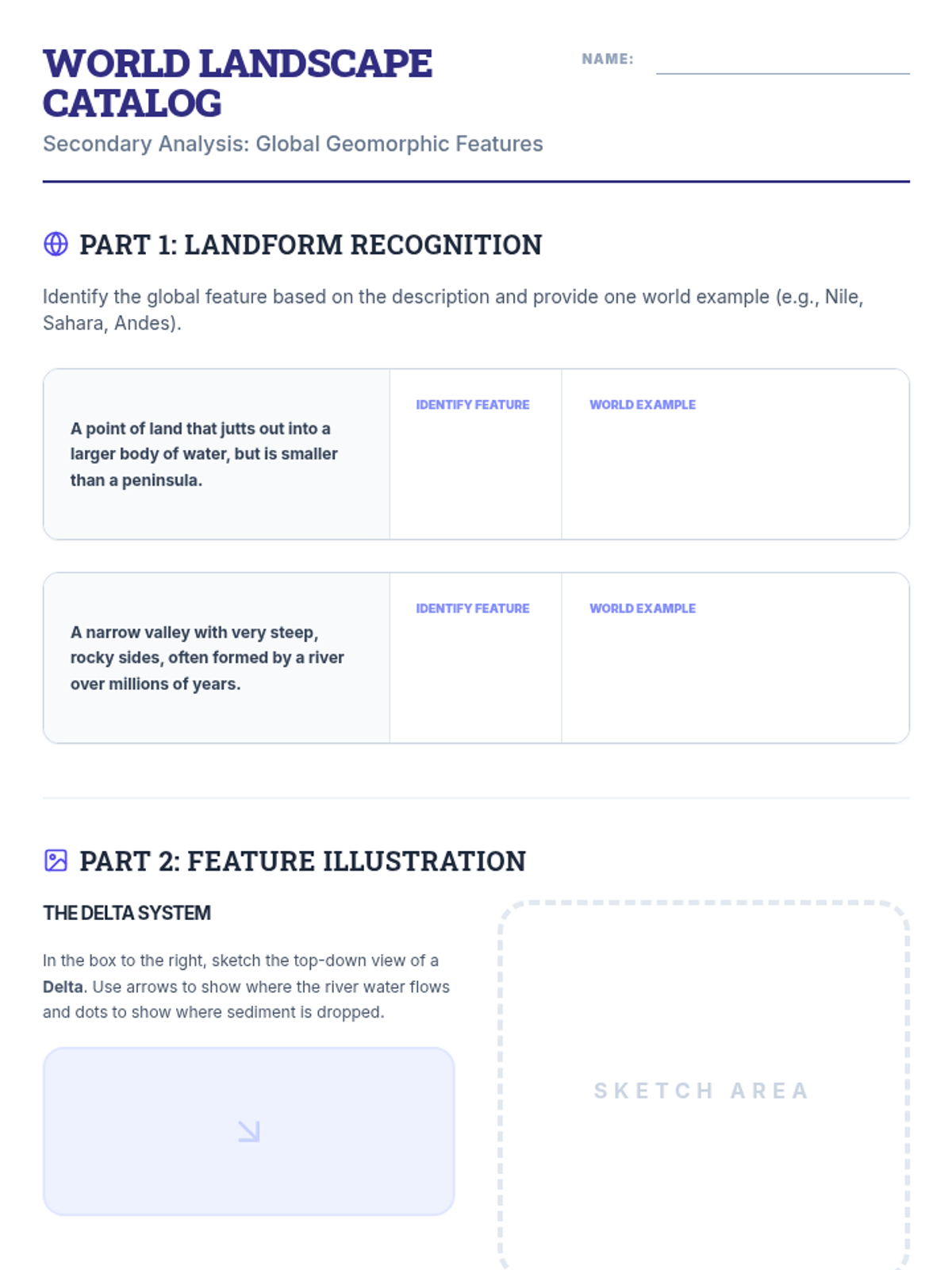
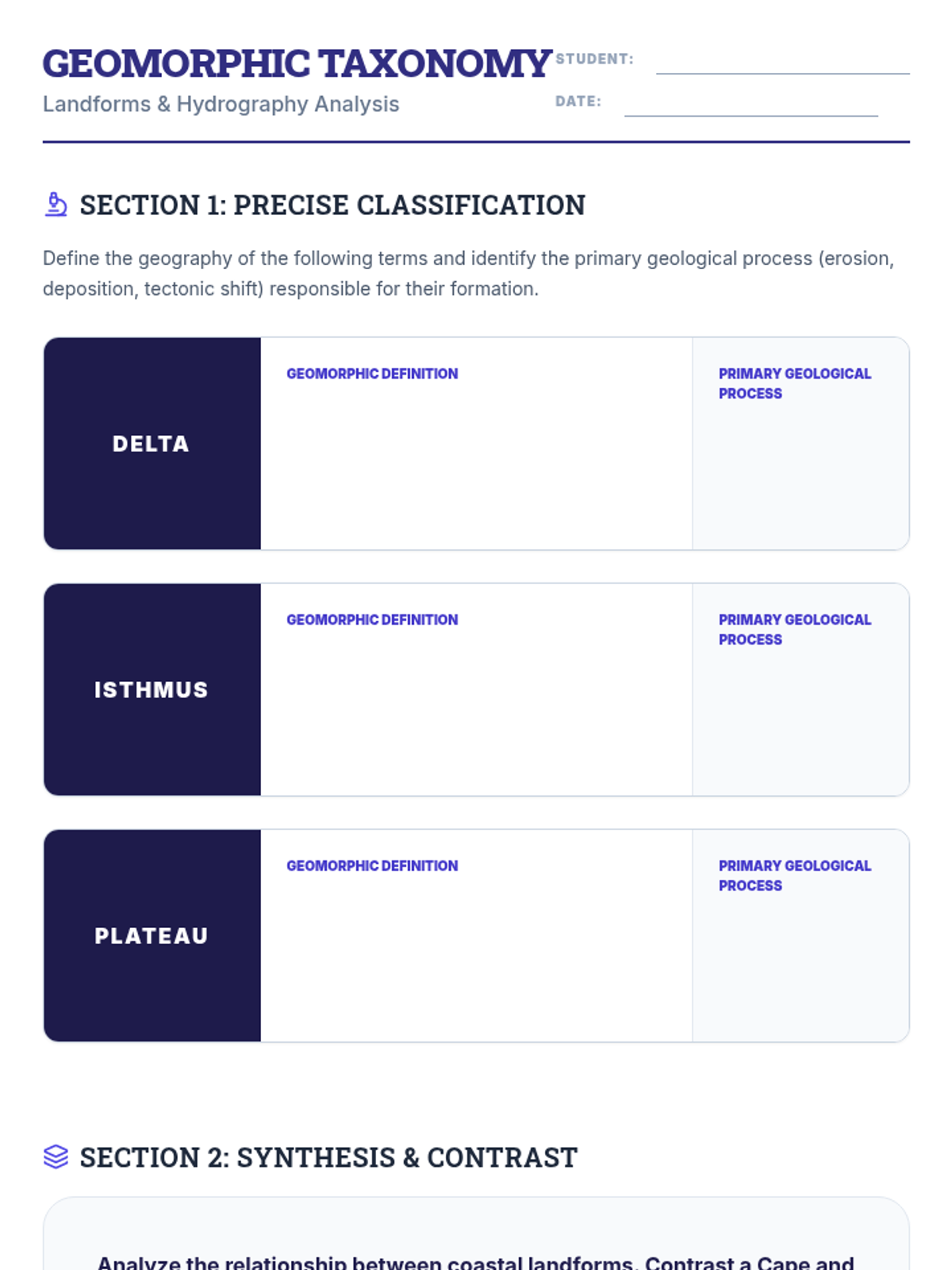
Secondary worksheet for Lesson 1 focusing on global landform identification and visual representation of geomorphic systems.
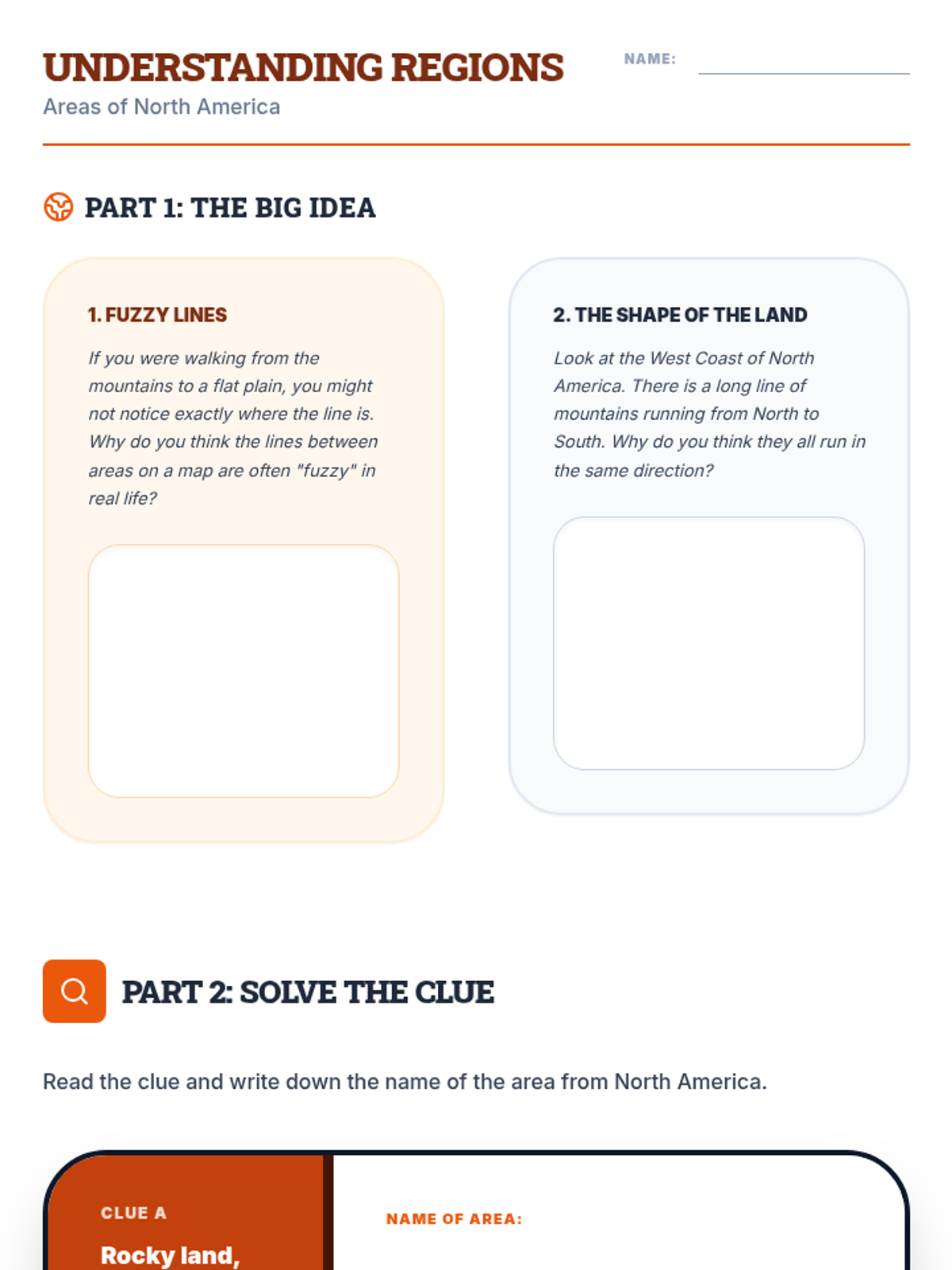
Worksheet for understanding the physical regions of North America and how they affect where people work and live, using simple language.
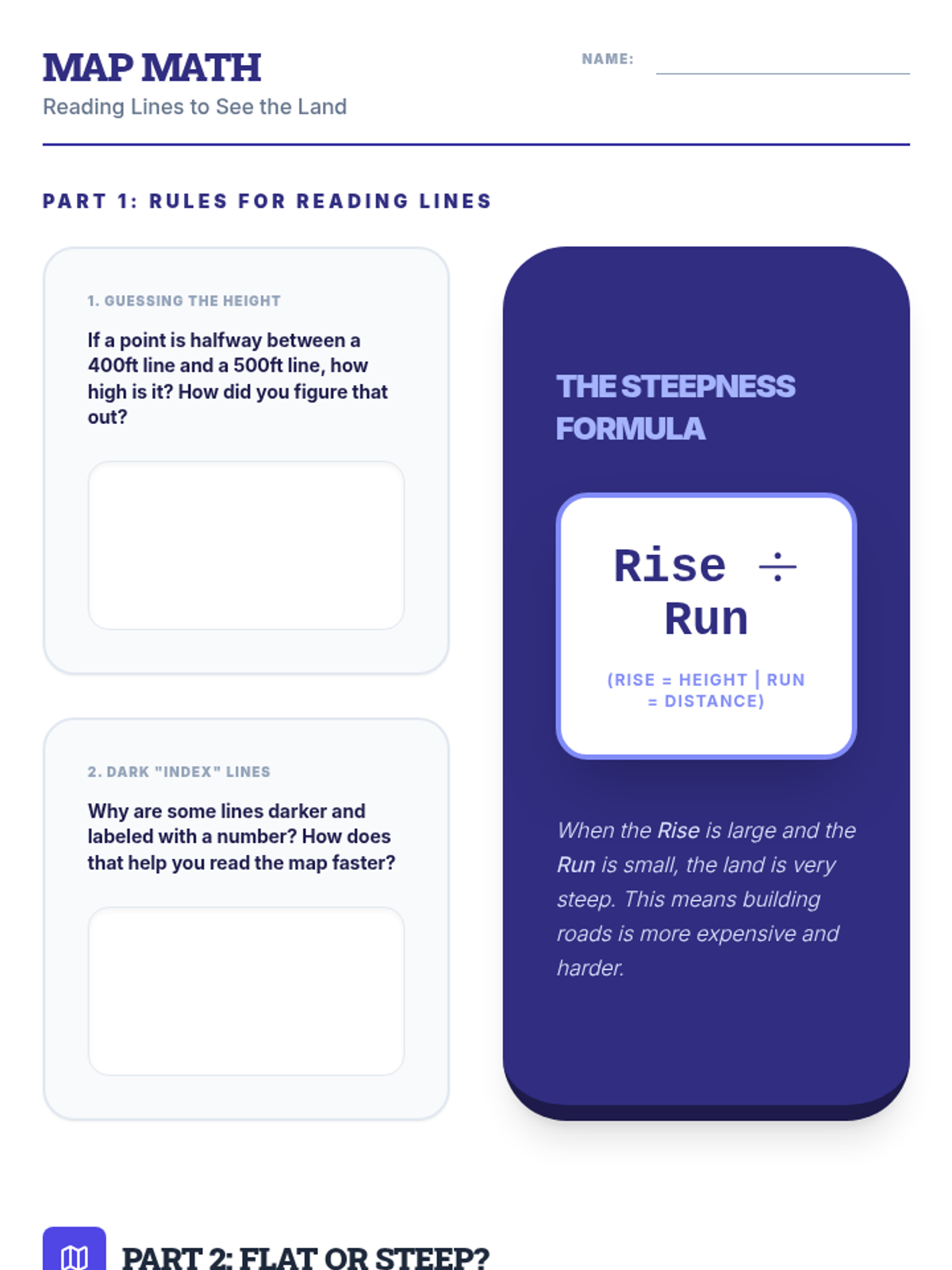
Worksheet for understanding contour lines, intervals, and terrain steepness using simple, easy-to-follow language.
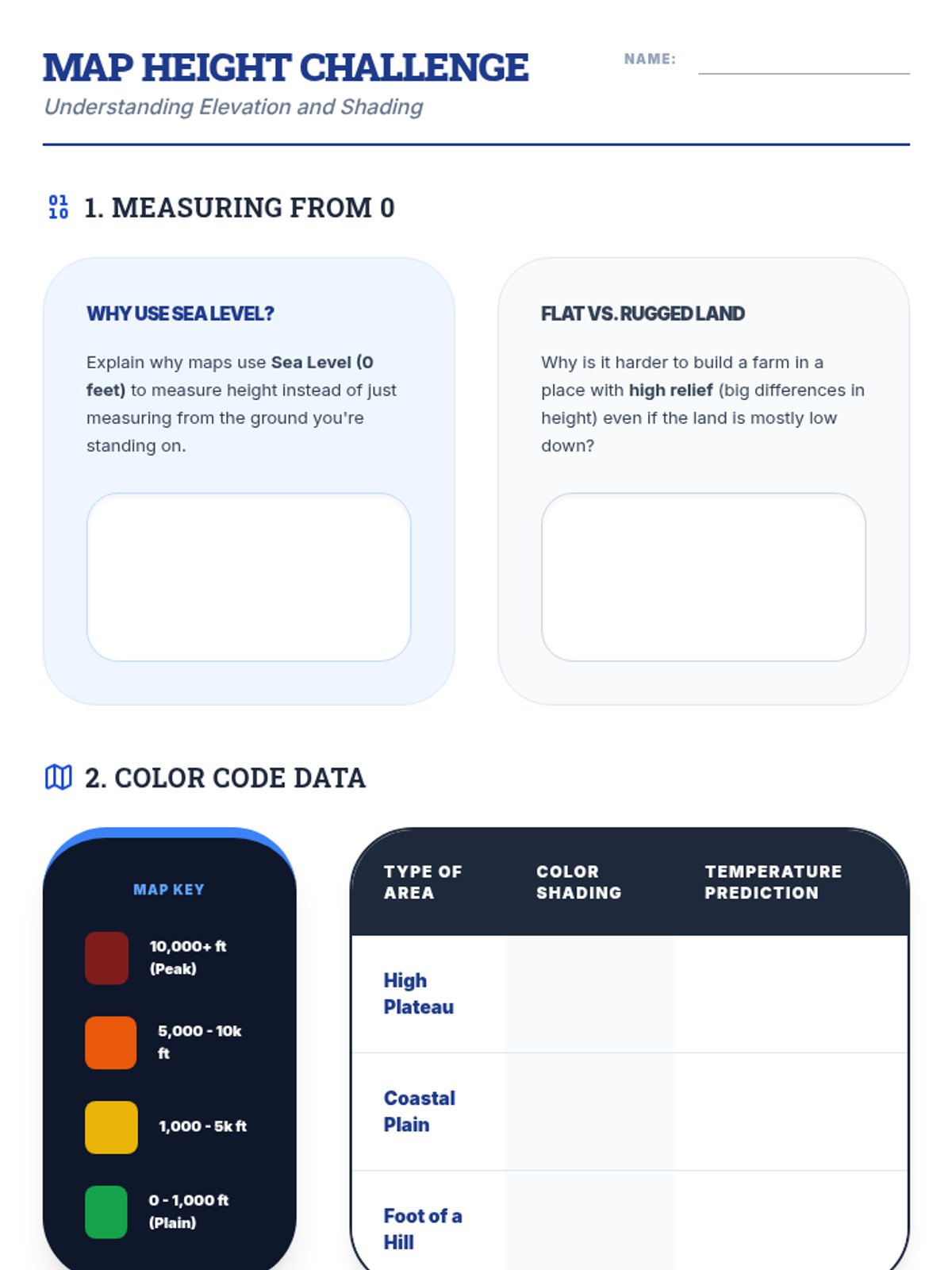
Worksheet for understanding elevation maps, legends, and temperature changes with height, using simple language.
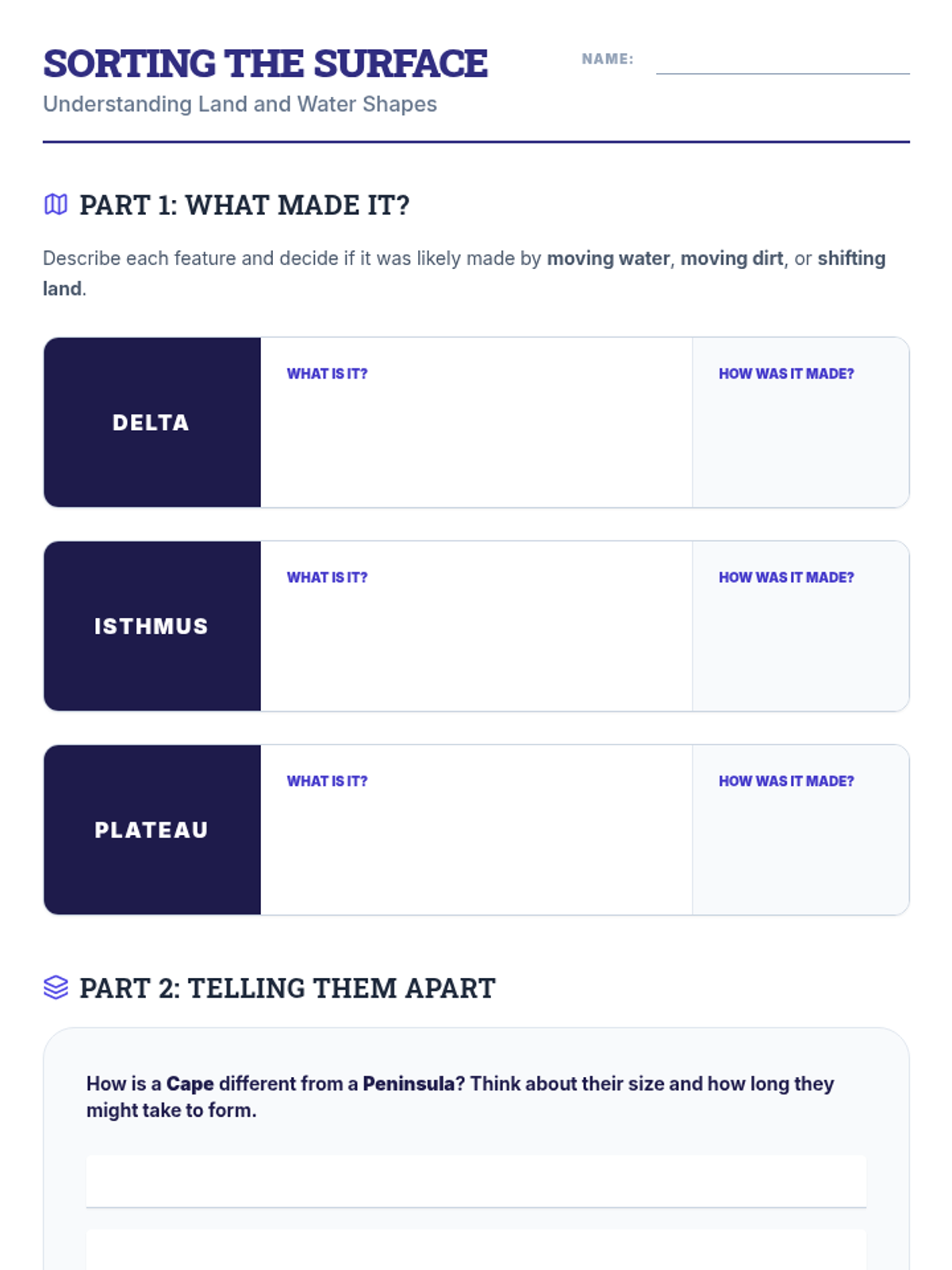
Worksheet focusing on landform shapes and how they affect human life, using clear and accessible language.
Scoring key for the Mapping Mastery Quiz, providing detailed rationales and evaluation criteria for text interpretation and quantitative map skills. All level labels removed for general use.
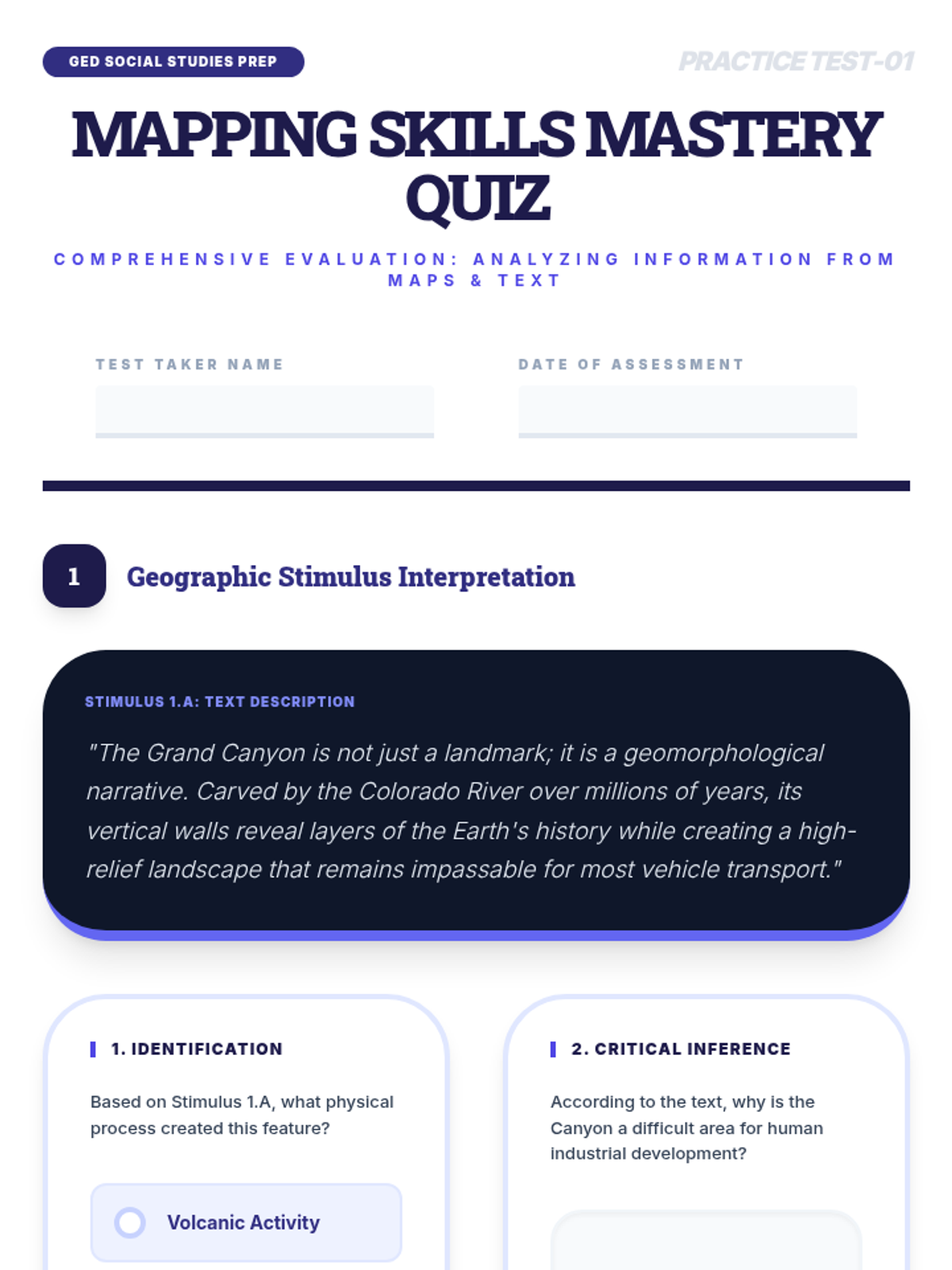
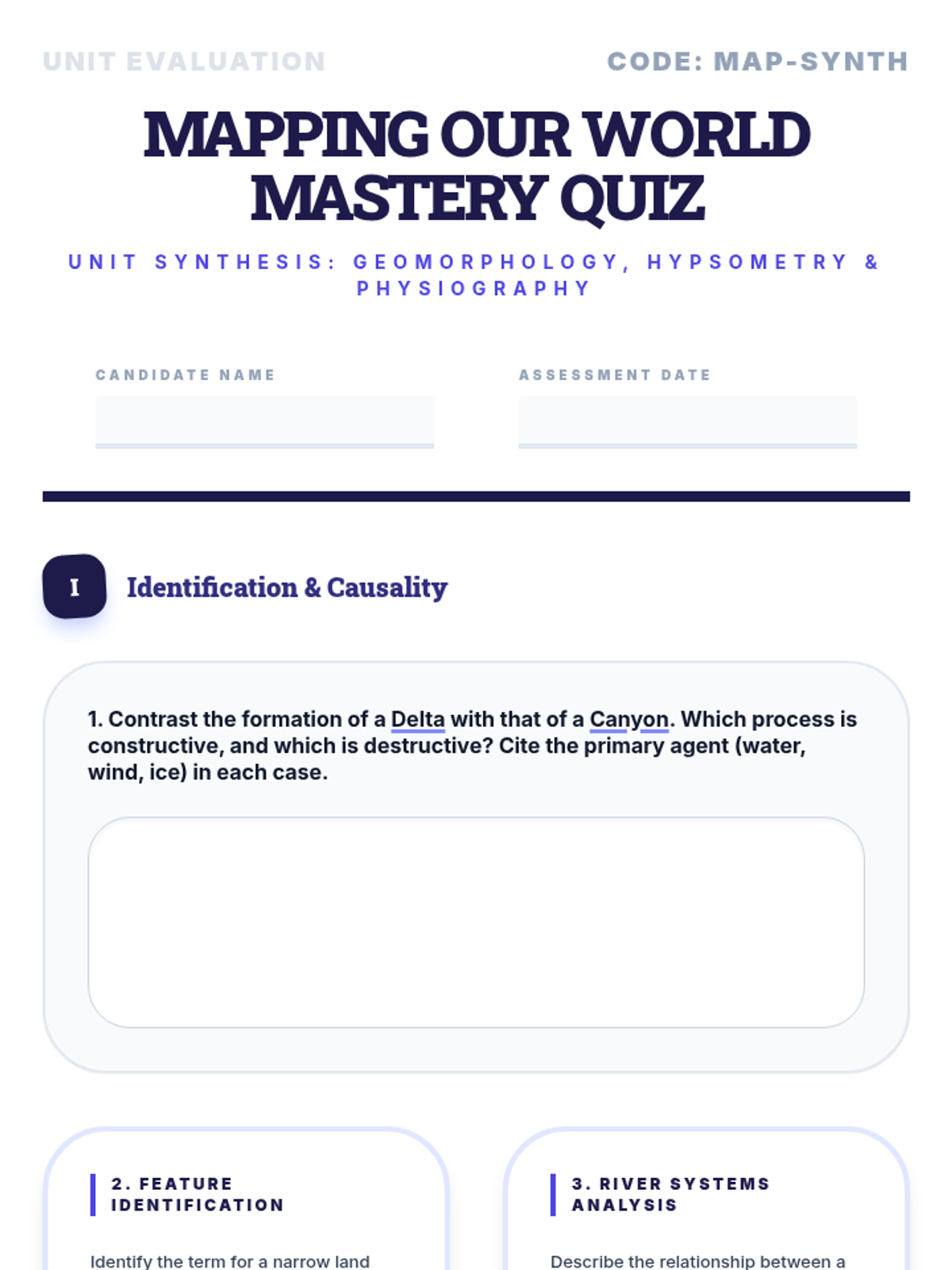
GED-formatted final mastery quiz focusing on interpreting informational text stimulus, quantitative contour calculations, and synthesizing geographic data for economic analysis.
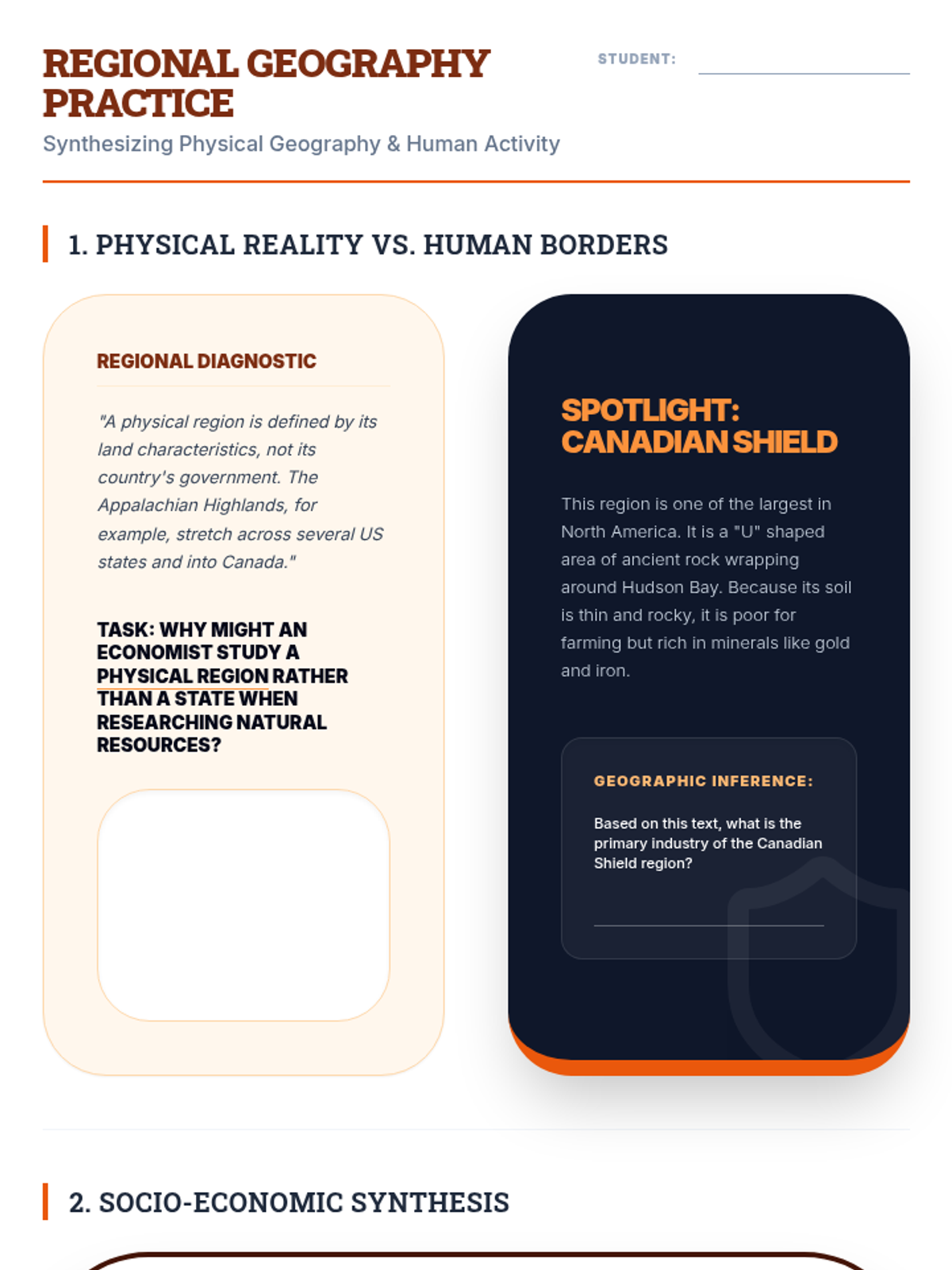
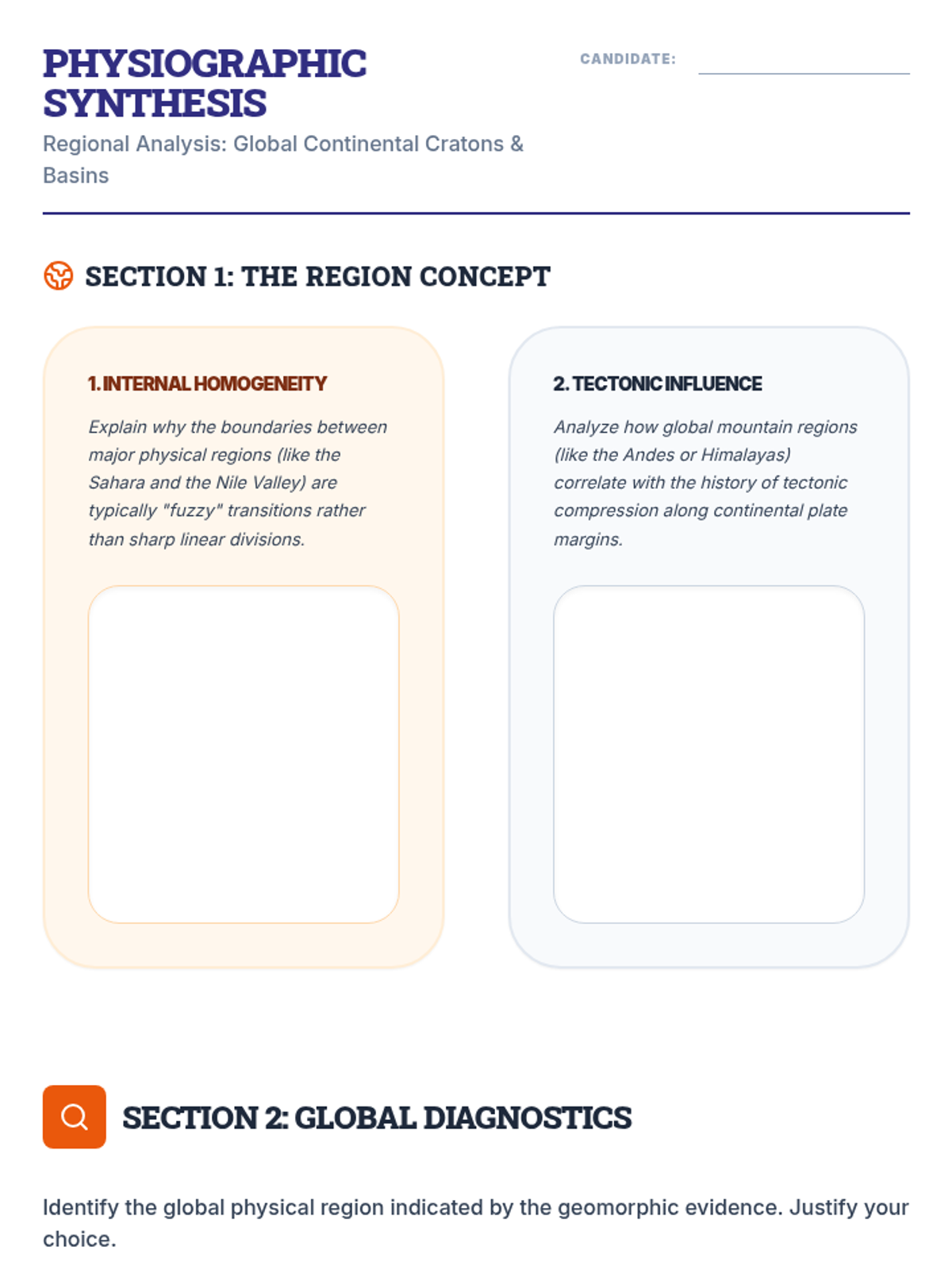
Worksheet for physiographic regions, focusing on interpreting regional text descriptions and analyzing how physical terrain dictates regional economies and industry. Level labels removed for general use.
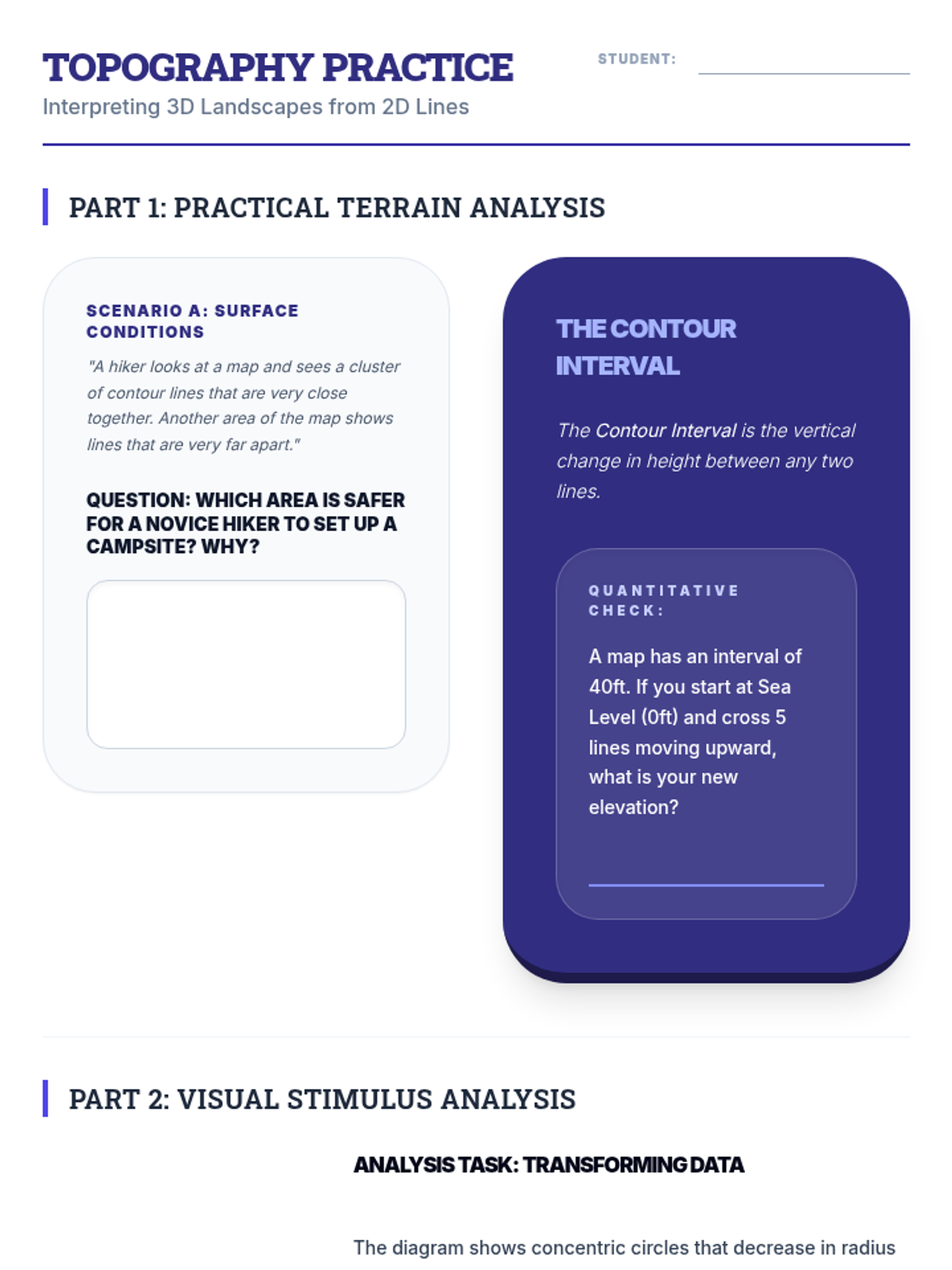
Worksheet for topographic maps, focusing on practical terrain application, contour interval math, and visualizing 3D landforms from 2D diagrams. Level labels removed for general use.
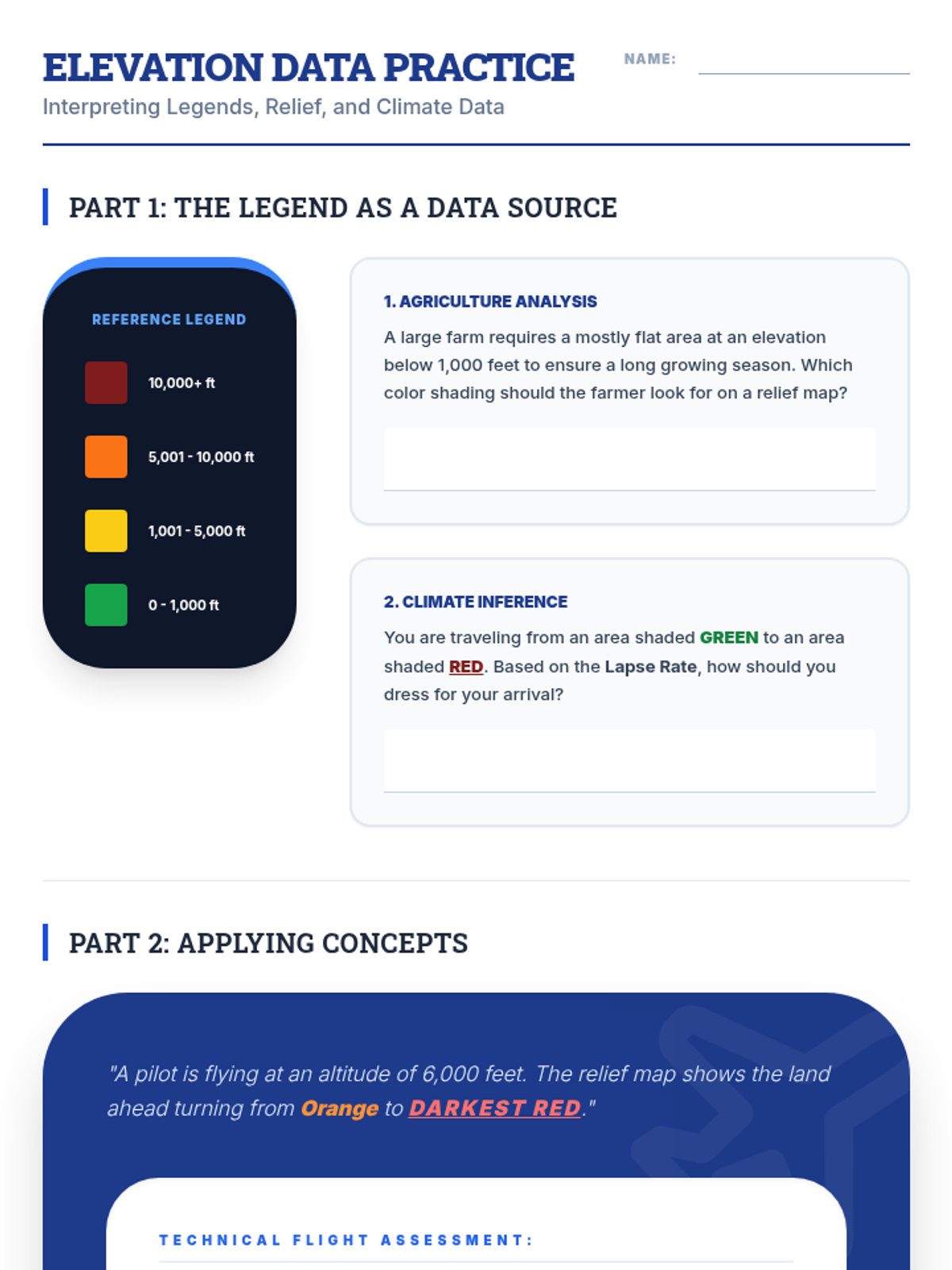
Worksheet for elevation maps, focusing on using legends to make inferences about agricultural suitability, climate shifts, and aviation safety. Level labels removed for general use.
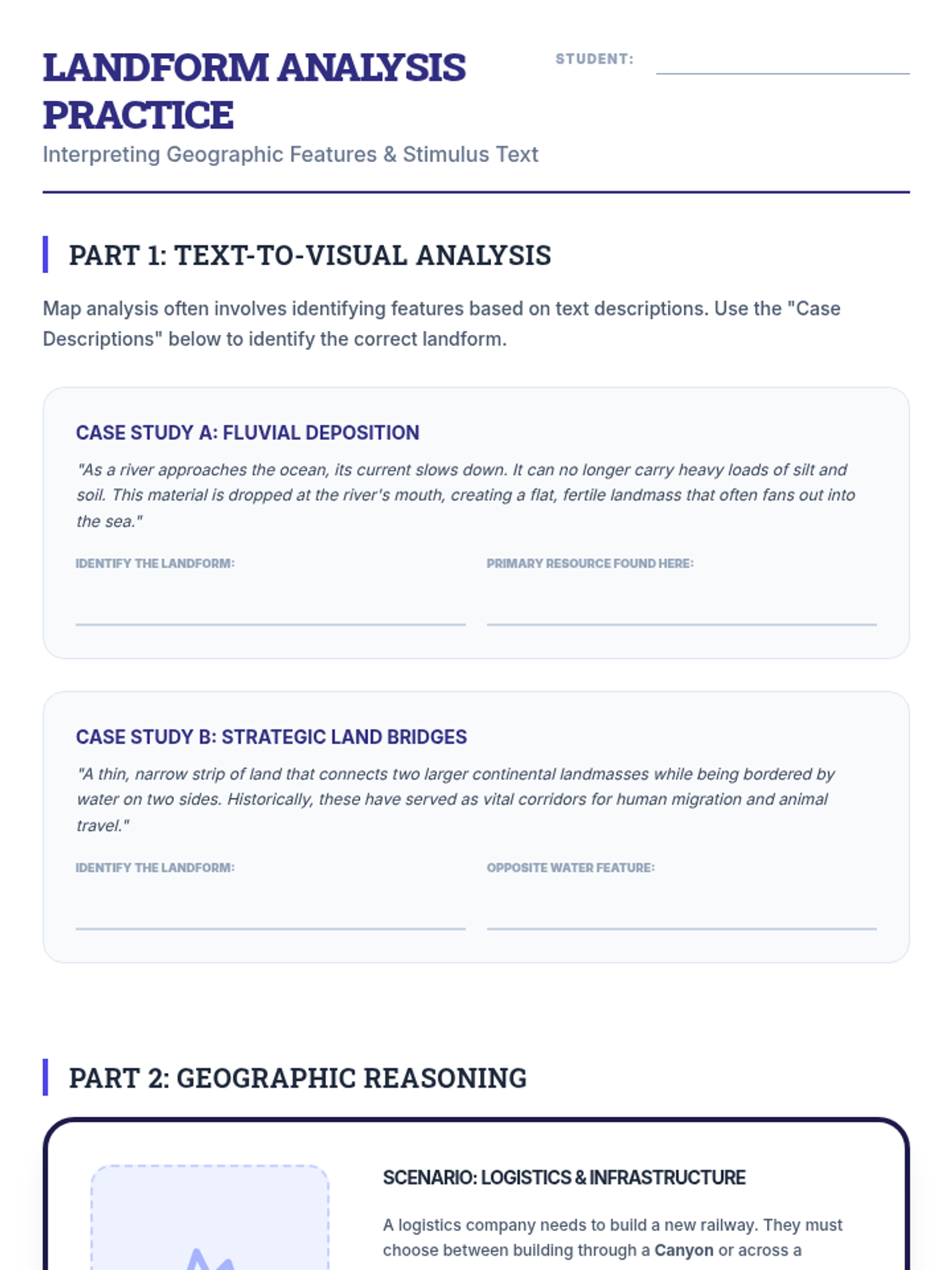
Worksheet focusing on identifying landforms from text-based stimulus and applying geographic reasoning to transportation and resource scenarios. Level labels removed for general use.
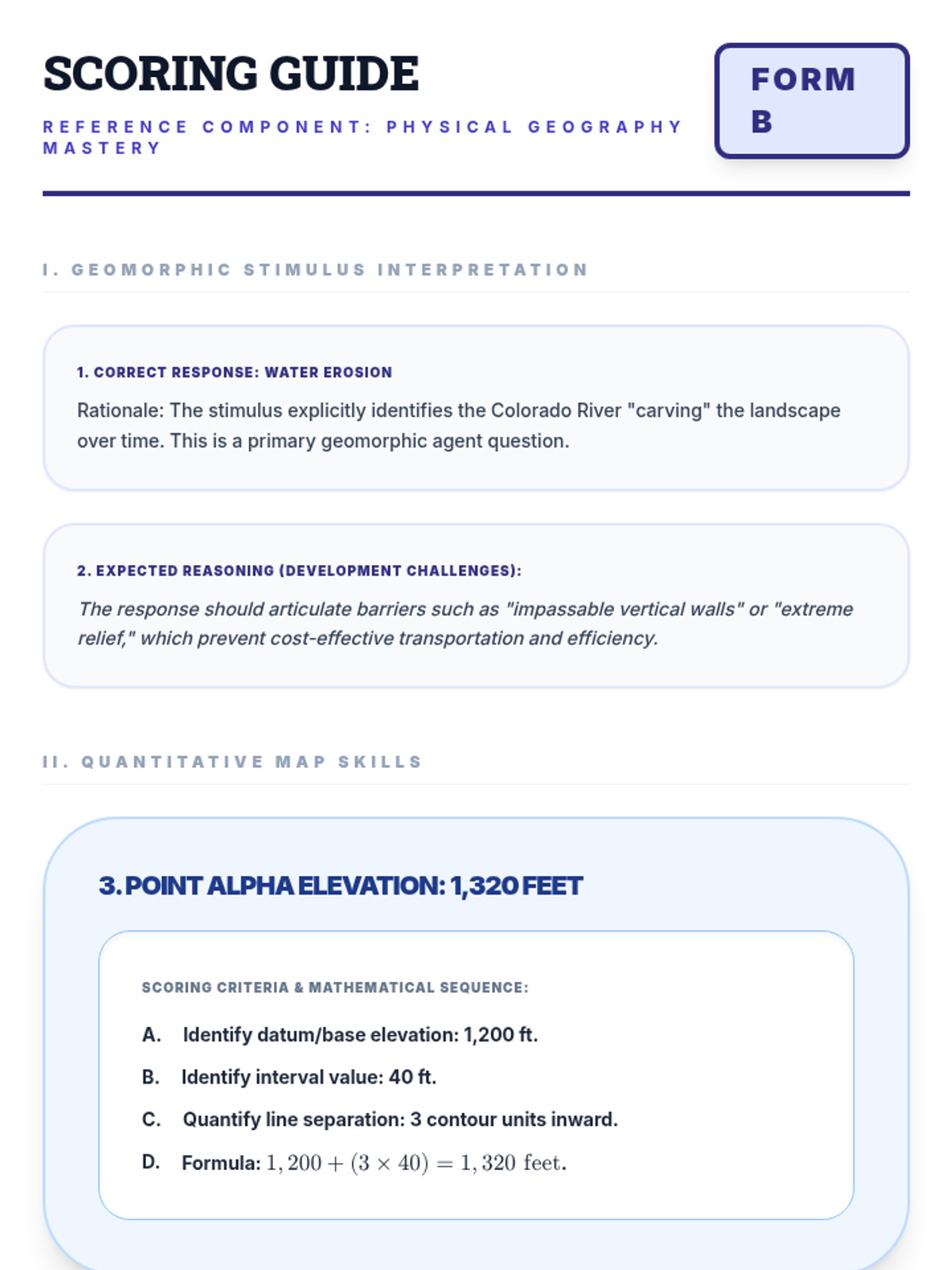
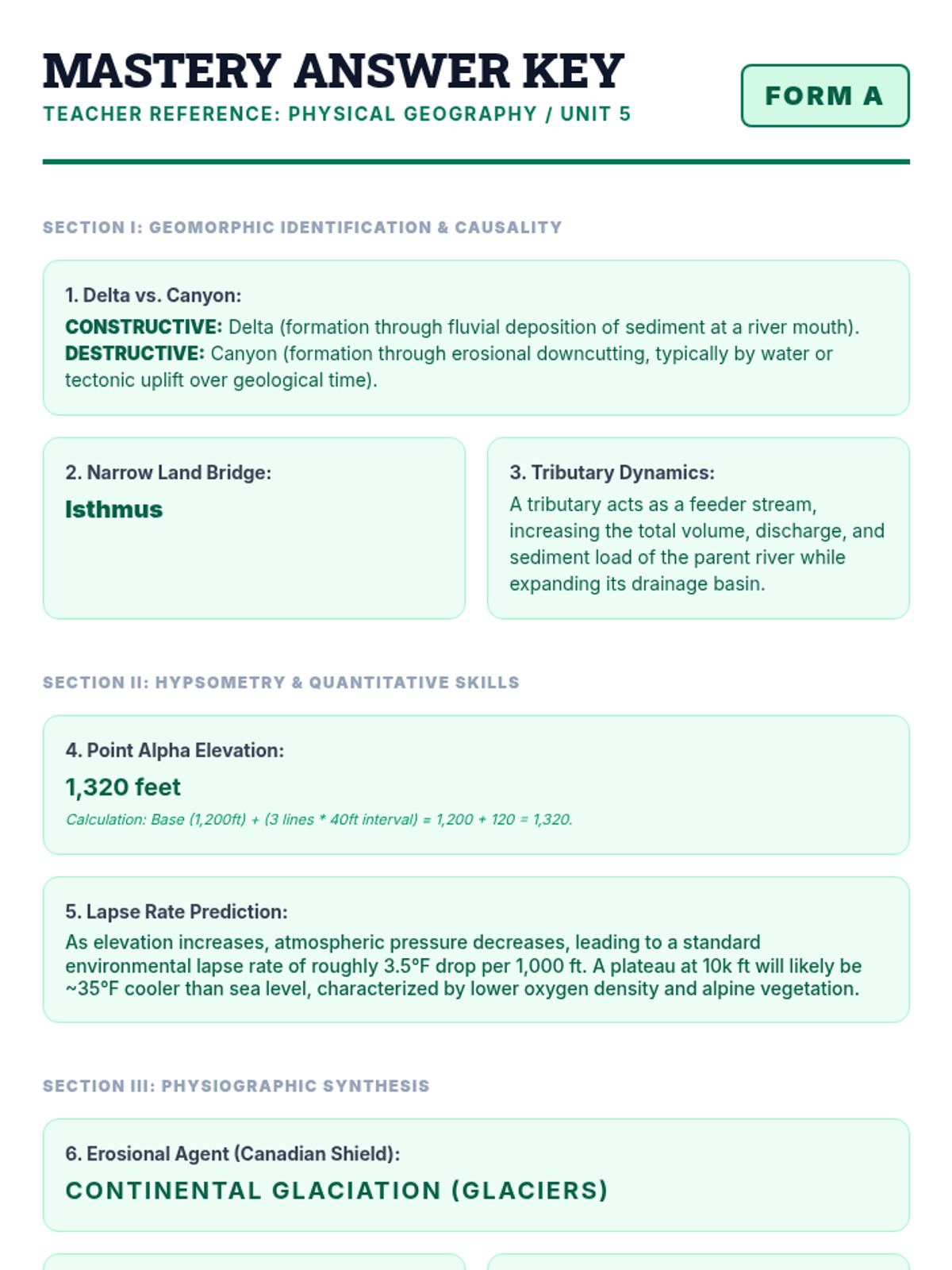
Teacher-facing answer key for the Mapping Mastery Quiz, providing technical geological explanations and mathematical solutions for high-school level analysis. All level labels removed for general use.
Mastery quiz covering landforms, elevation, and North American regions. All level labels removed for a general assessment experience.
High-school level worksheet for Lesson 4 focusing on physiographic analysis, tectonic influences on regional formation, and the synthesis of physical geography with economic industrialization patterns. Fixed page breaks and contrast.
Exploration of global physical regions, their characteristics, and their impact on human development. Updated to a world-wide focus with visual context.
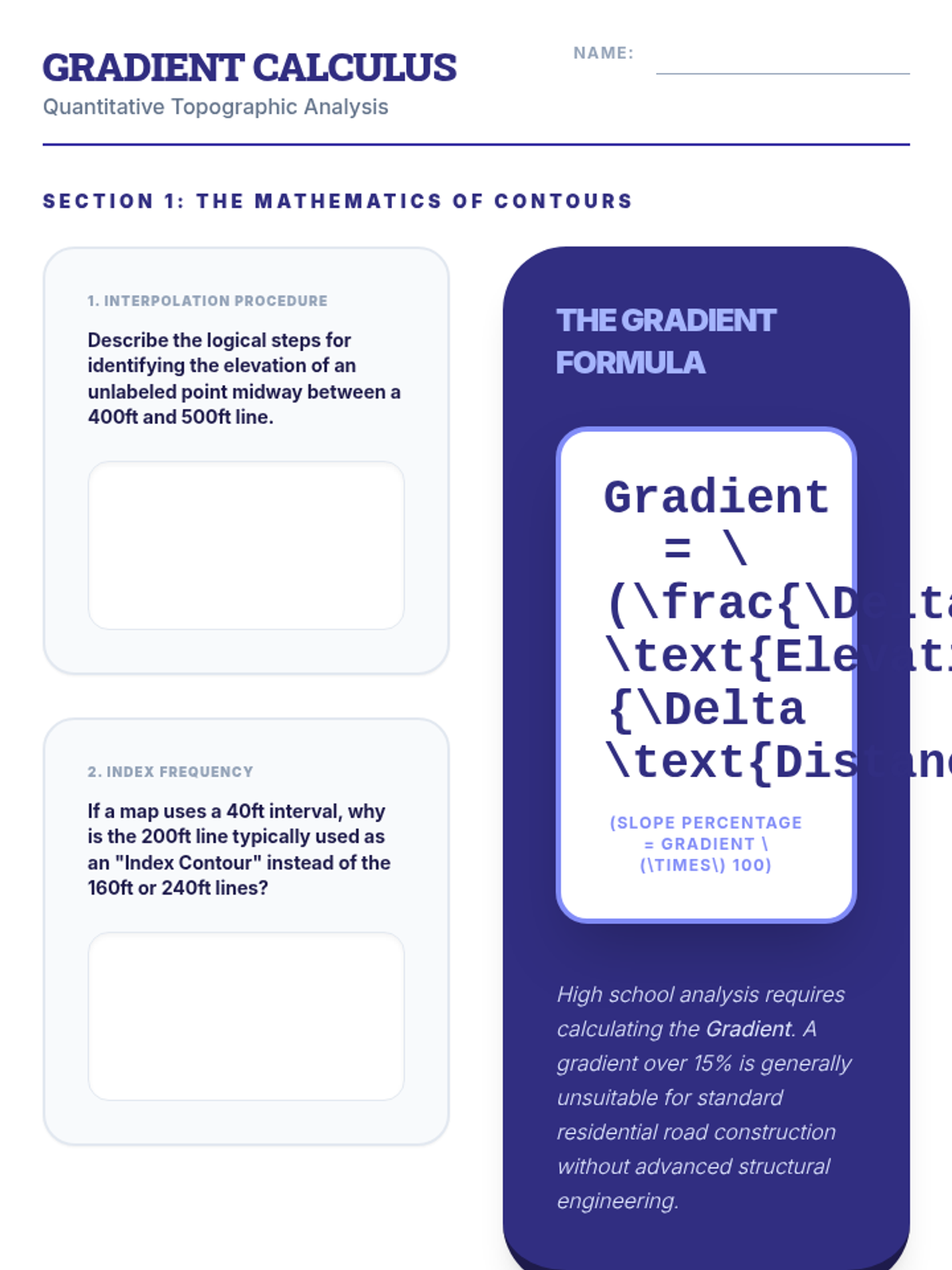
High-school level worksheet focusing on gradient calculation, quantitative interpretation of topographic maps, and geomorphological cross-sectioning using the Ithaca, NY case study. Fixed page breaks and MathJax rendering.
Expanded "Contour Secrets" slides with in-depth explanations of index contours, contour interval calculation, and below-sea-level elevation.
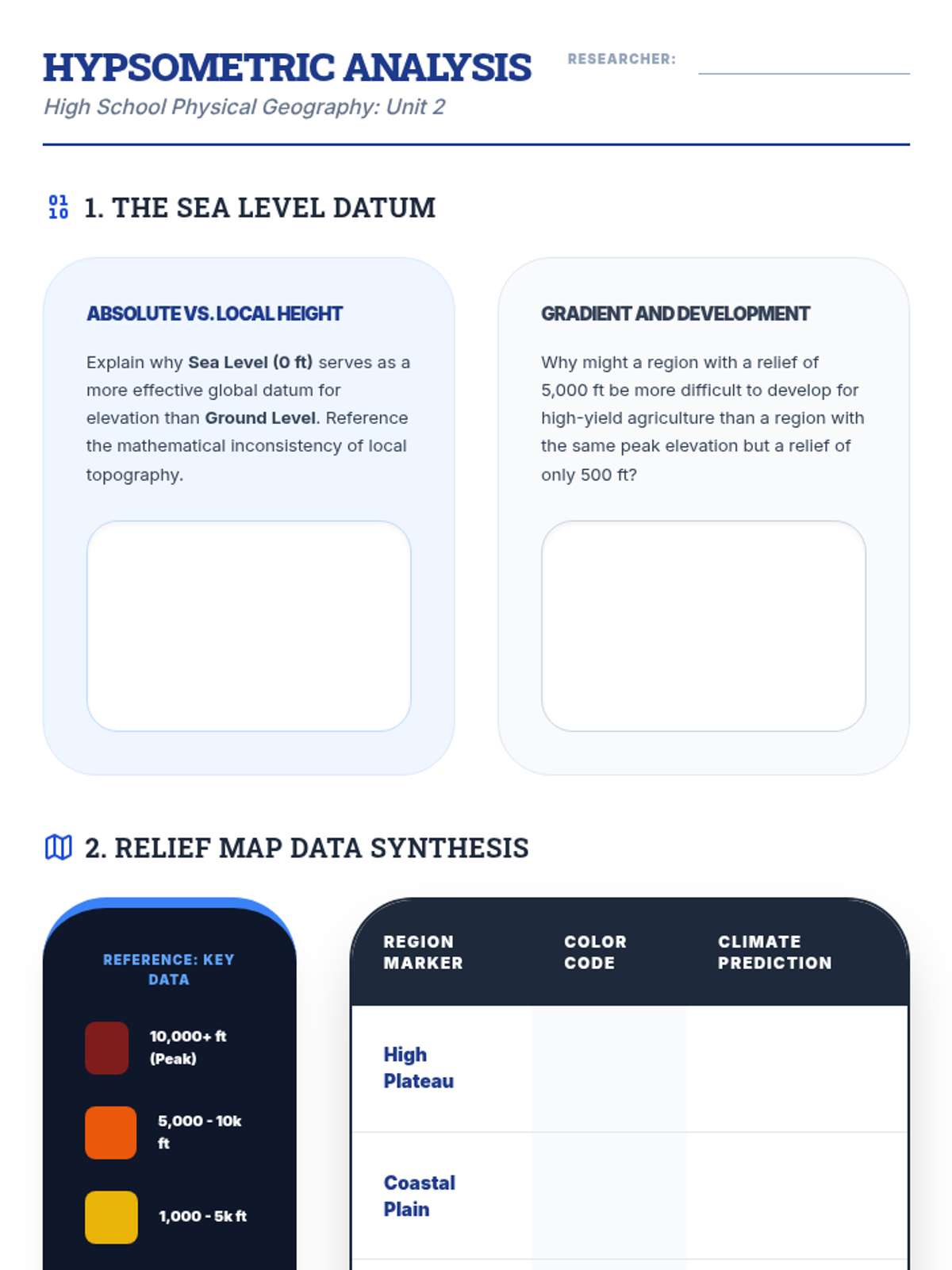
High-school level worksheet for Lesson 2 focusing on hypsometric analysis, climate implications of elevation (lapse rate), and technical interpretation of relief maps. Improved contrast and page utilization.
Presentation slides for Lesson 2 covering elevation, sea level, and relief shading on maps, with added sections on climate impact and water flow.
Geomorphic processes worksheet focusing on landforms and human development. Level labels removed for general use.