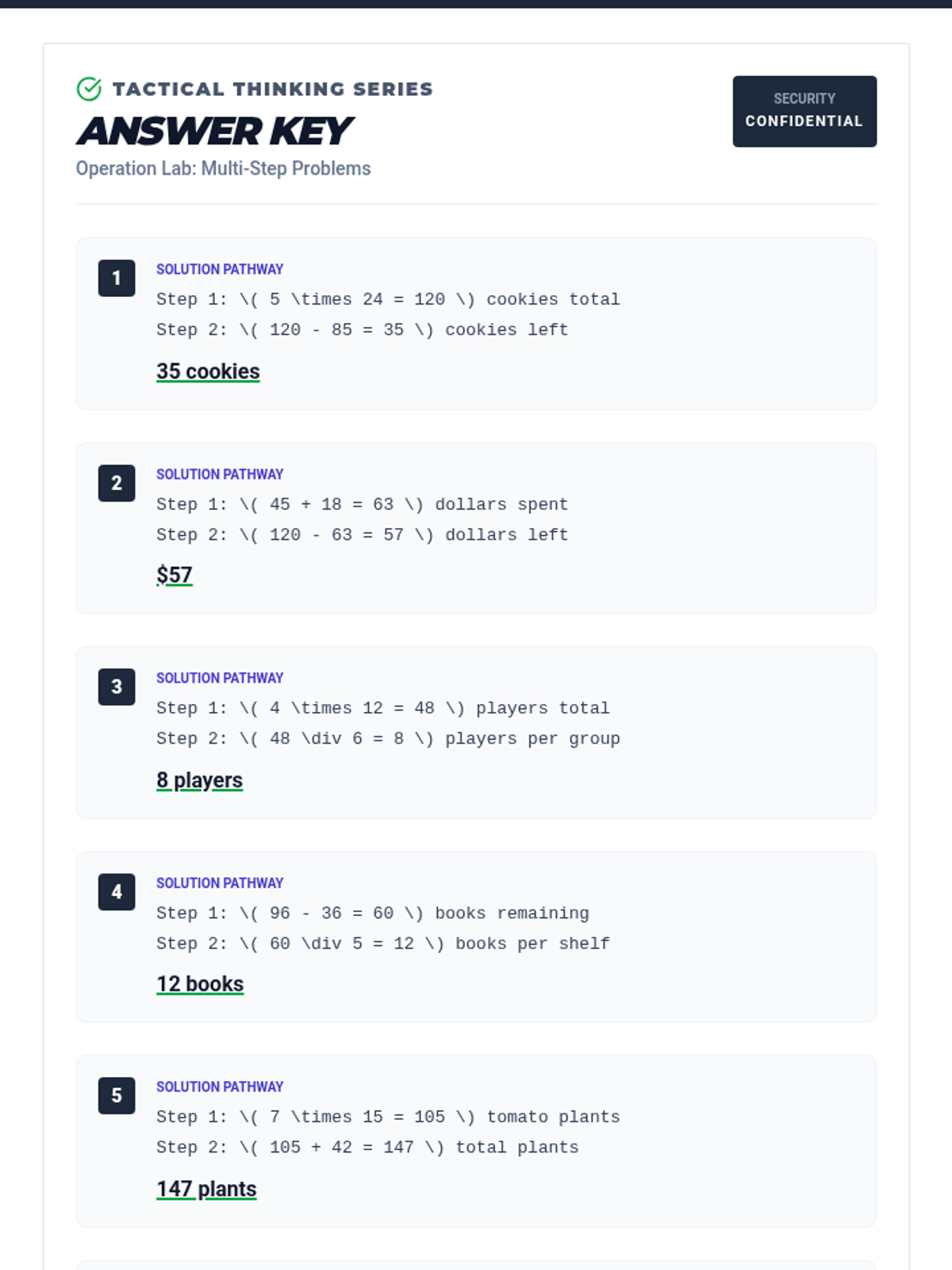
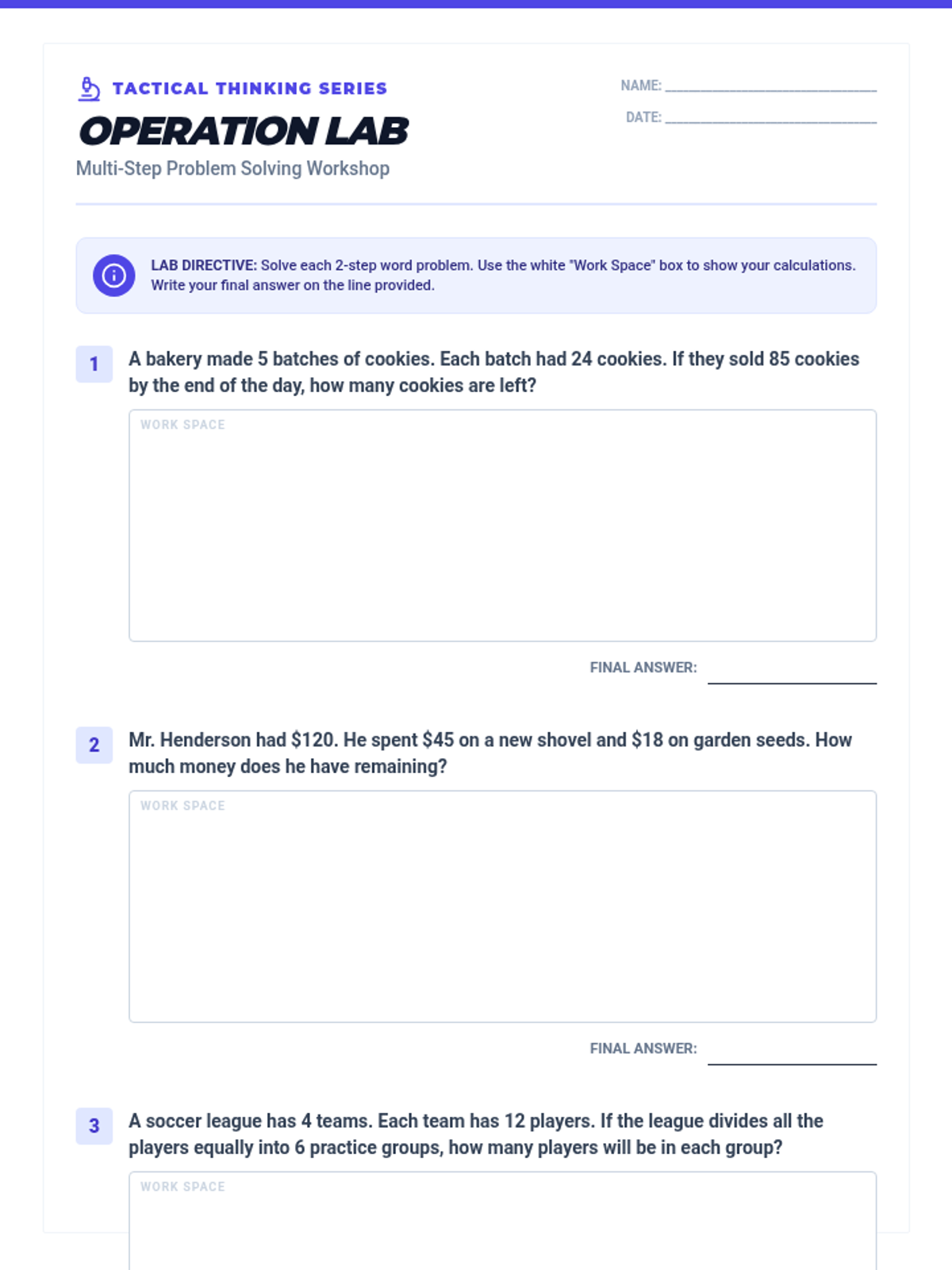
Visual presentation for a Grade 3 math lesson. Uses a clean, minimal bakery theme in blue tones to guide students through the CUBES strategy and multi-step word problem solving with clear visual models.
Final student performance task where they apply all area concepts to design a room with specific furniture areas and a total area constraint of 40 units.
Teacher's guide for the final lesson in the sequence, a cumulative design project where students apply all area concepts to create a "Dream Room" within constraints.
Student worksheet for Lesson 11 where students practice finding the total area of composite or decomposed shapes by adding partial areas.
Teacher's guide for Lesson 11 focusing on additive area and decomposing rectangles into smaller parts to find the total area.
Student worksheet for Lesson 10 where they design multiple rectangles with the same area (16 square units).
Teacher's guide for Lesson 10 which explores the concept that rectangles with the same area can have different side lengths.
Student worksheet for Lesson 9 focusing on finding missing side lengths given the area and one side length.
Teacher's guide for Lesson 9 where students find a missing side length of a rectangle given its area and one side.
Student worksheet for Lesson 8 containing real-world area word problems with space for drawing diagrams and solving.
Teacher's guide for Lesson 8 which focuses on solving real-world word problems using area calculations.
Student worksheet for Lesson 7 where they calculate the area of rectangles using labeled side lengths without a visual grid.
Teacher's guide for Lesson 7 which transitions students from counting grid squares to using only labeled side lengths to find area.
Student worksheet for Lesson 6 focusing on using the multiplication formula (Length x Width) to find area and representing multiplication facts as rectangular areas.
Teacher's guide for Lesson 6 which introduces the area formula (Length x Width) by connecting it to repeated addition and multiplication facts.
Student worksheet for Lesson 5 focusing on skip counting and repeated addition as methods for finding area.
Teacher's guide for Lesson 5 which connects area measurement to skip counting and repeated addition as more efficient strategies than one-by-one counting.
Student worksheet for Lesson 4 focusing on identifying rows and columns in an array and building specific arrays to find area.
Teacher's guide for Lesson 4 where students connect area to arrays by organizing square tiles into rows and columns.
Student worksheet for Lesson 3 exploring the importance of consistent units and introducing square inches and square centimeters.
Teacher's guide for Lesson 3 which introduces the concept of standard units (square inches, square cm) and why consistency is important in measurement.
Student worksheet for Lesson 2 focusing on identifying incorrect tiling (gaps and overlaps) and practicing precision measurement.
Teacher's guide for Lesson 2 focusing on the precision of area measurement. Students learn to avoid gaps and overlaps when tiling.
A student worksheet for the first lesson where they use physical square tiles to cover rectangles of varying sizes to build the concept of area as "covering space". Updated to ensure shapes have distinct proportions.
A detailed teacher's guide for the first lesson in the Area Architects sequence, focusing on the foundational concept of area as covering space. Includes instructional steps, high-leverage concepts, and differentiation strategies.
Final exit ticket and assessment for Lesson 12: Mastery Mission, covering equal groups, arrays, and unknown factors.