A practice worksheet where students audit article usage by filling in blanks, choosing between a/an/the, and editing a short report for errors. Optimized for 2-page printing with corrected error counts and better writing space.
A final unit assessment for Lesson 12. Revised for better page breaks, increased reflection space, and improved instructional clarity.
A slide deck for the final consolidation lesson. Revised for better title spacing, specific text context, and improved font sizes.
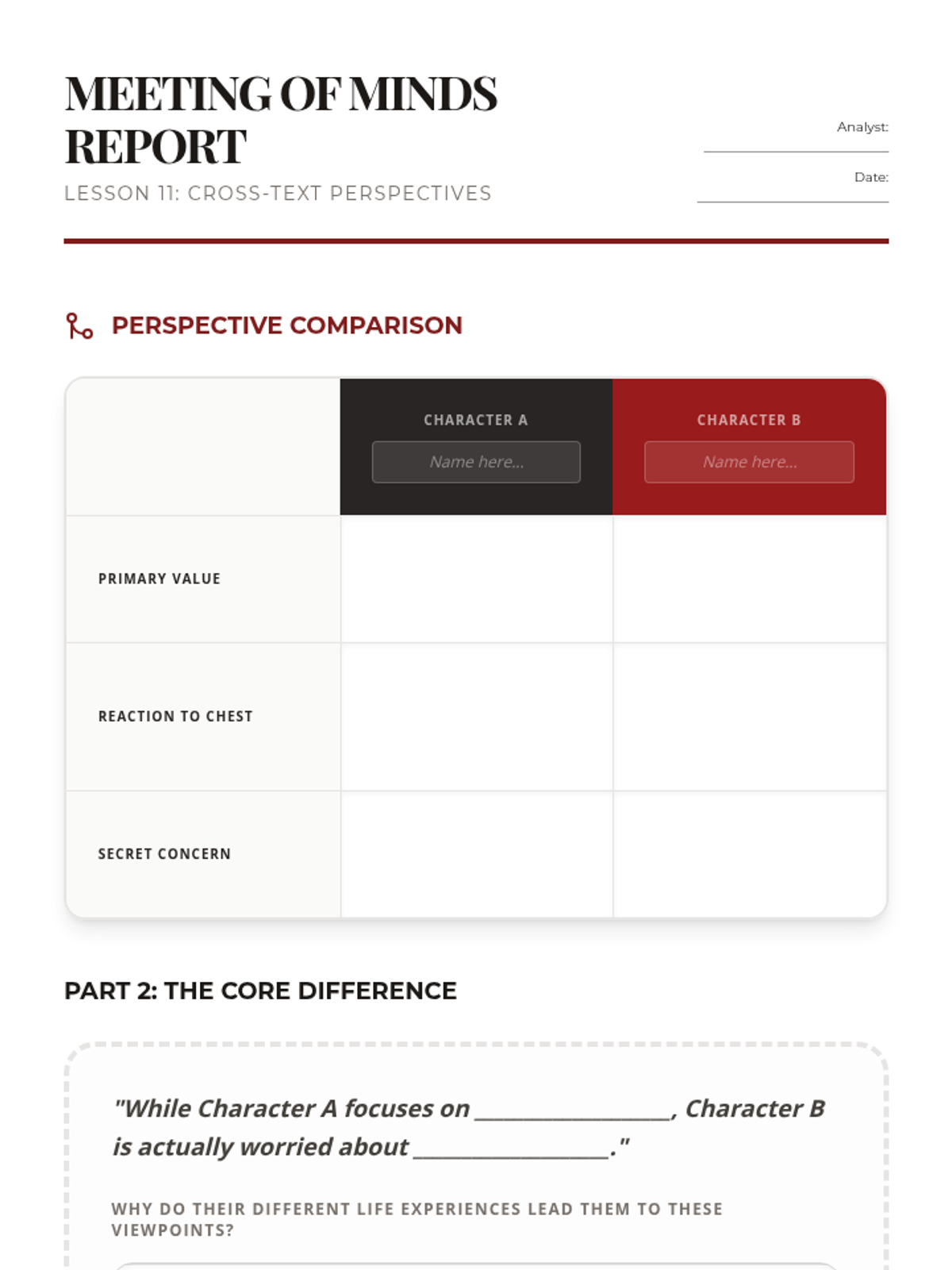
A reporting sheet for character comparison. Revised for better page breaks, improved header clarity for names, and ruled lines for insight.
A slide deck for Lesson 11 focusing on comparing perspectives across different texts using the 'Meeting of Minds' technique.
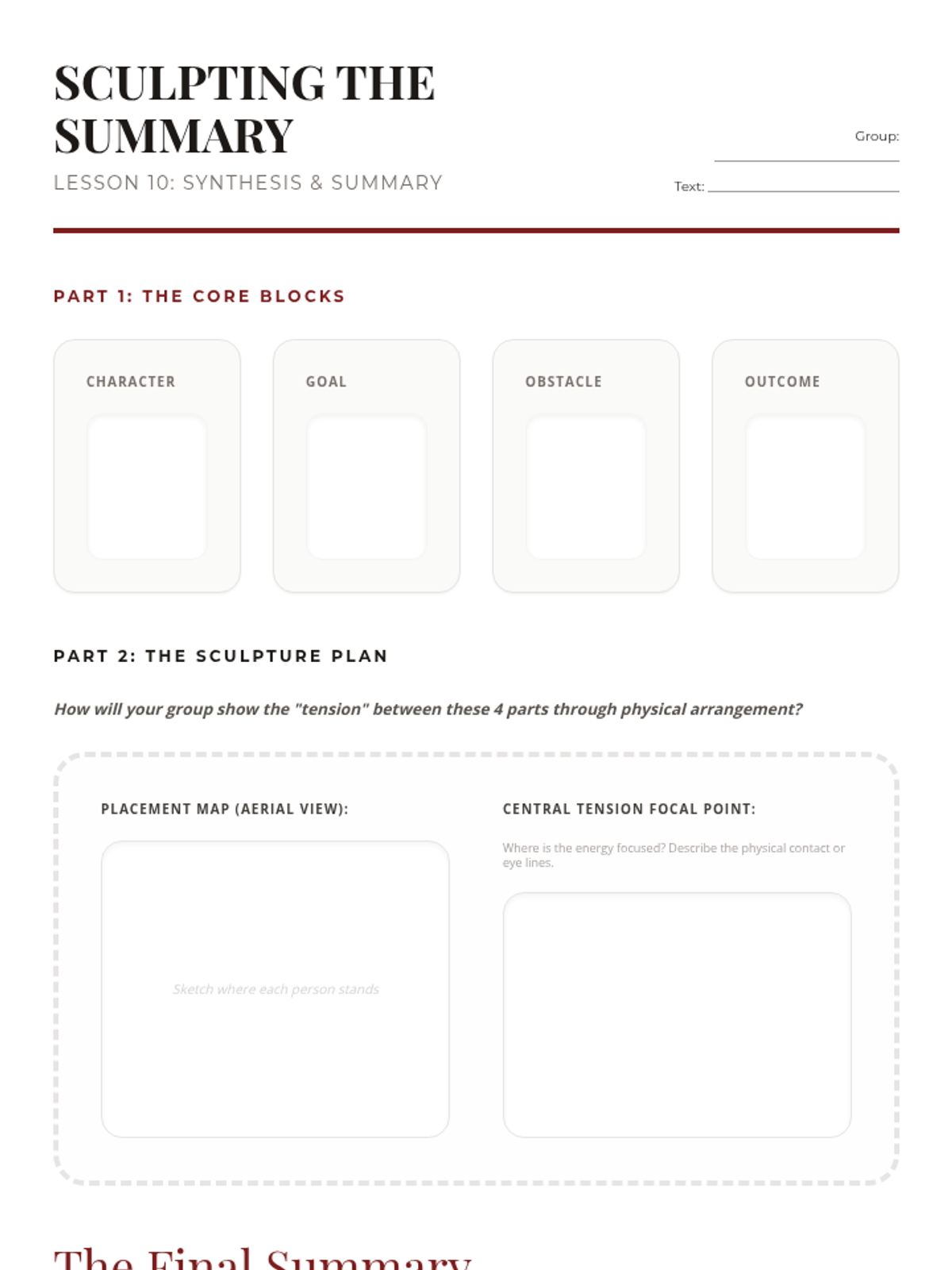
A planning sheet for summary sculptures. Revised for better response box heights, improved page breaks, and removal of bracketed placeholders.
A slide deck for Lesson 10 introducing 'Summary Sculptures' as a physical way to synthesize and summarize key text elements.
A character-themed stationery sheet for Lesson 9 to facilitate perspective-driven writing and summarization. Revised for better page breaks, contrast, and layout.
A slide deck for Lesson 9 bridging enactment with writing through character correspondence and journal entries.
A recording log for fluency practice. Revised to ensure a one-page layout, better contrast for markup icons, and an evaluation board with clear markers.
A slide deck for Lesson 8 focusing on reading fluency, accuracy, and intonation through 'Radio Drama' and foley sound effects.
A student worksheet for sequencing events. Revised for better page breaks, increased line heights, and ruled lines for the summary.
A slide deck for Lesson 7 focusing on memory skills and sequencing through 'Action Replay' reenactment techniques.
A student activity sheet for tracking perspectives. Revised for better page breaks, increased writing space, and improved visual contrast.
A slide deck for Lesson 6 focusing on multiple perspectives. Revised for better title spacing, improved Group A contrast, and specific context.
A recording sheet for Hot Seat interviews. Revised for better page breaks, clearer headers, and properly spaced writing lines.
A slide deck for Lesson 5 introducing the 'Hot Seat' technique for deepening character analysis and perspective-taking.
A planning card for informational structure enactment. Revised for better role assignment (up to 4 people) and clearer spatial mapping.
A slide deck for Lesson 4 exploring informational text structures (sequence, cause/effect, etc.) through physical 'blueprinting' and spatial enactment.
A planning worksheet for tableaux. Revised for better page breaks, increased label font sizes, and improved drawing area prompts.
A slide deck for Lesson 3 introducing tableaux. Revised for better arc alignment and color contrast.
A student artifact log for Lesson 2 to record inferences. Revised for better page breaks, increased observation space, and normalized title tracking.
A slide deck for Lesson 2 focusing on inferences about healthy habits and scientific facts using the 'Talking Statues' technique.
A comprehensive guide for teachers on how to facilitate the 'Into the Scene' enactment strategy, with corrected icon rendering.
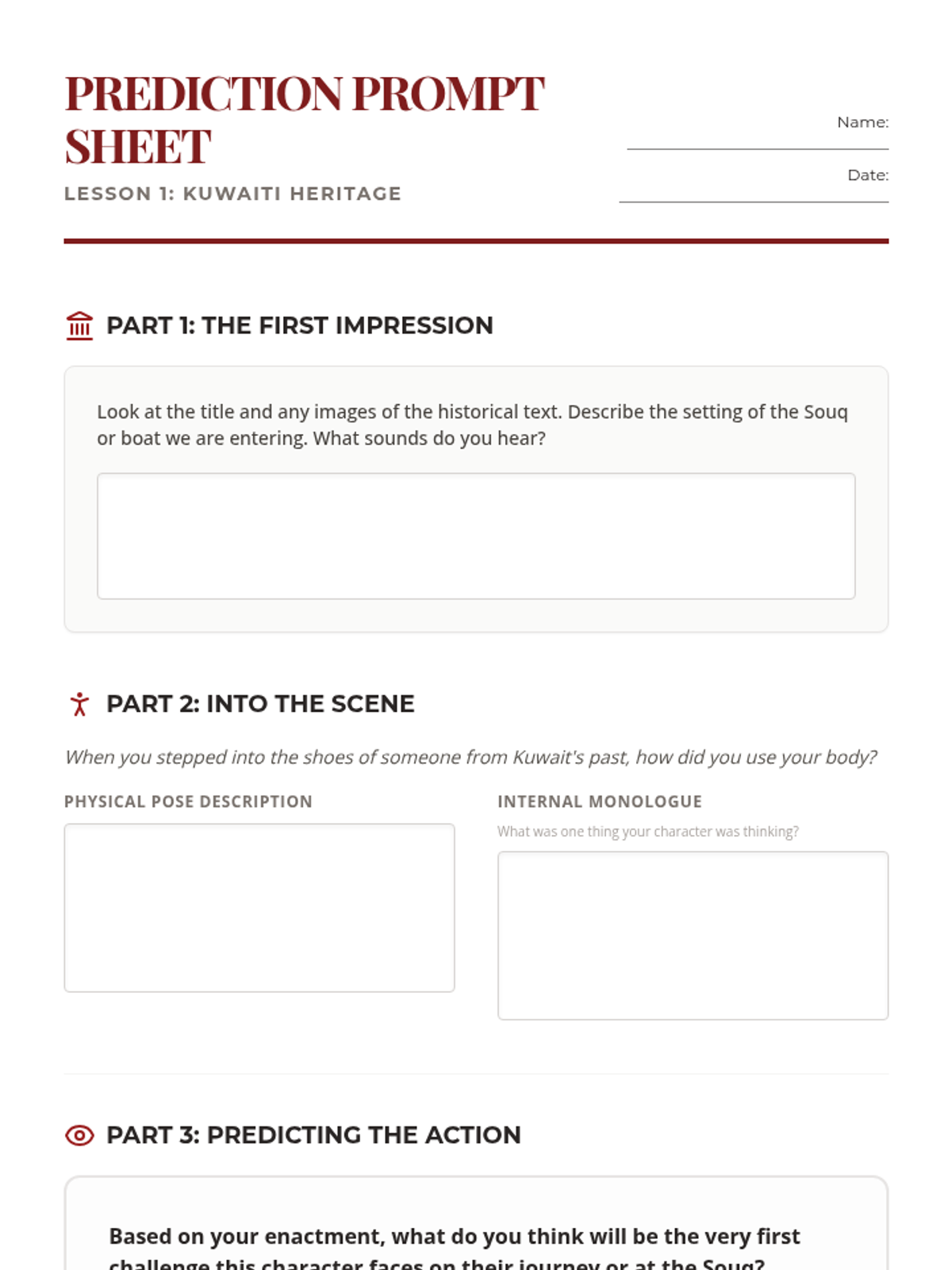
A student worksheet for capturing initial predictions and reflections during the 'Into the Scene' enactment activity, themed around Kuwait's history and heritage.
A visual slide deck introducing the 'Into the Scene' enactment technique for making predictions, themed around Kuwaiti heritage and the history of pearl diving.
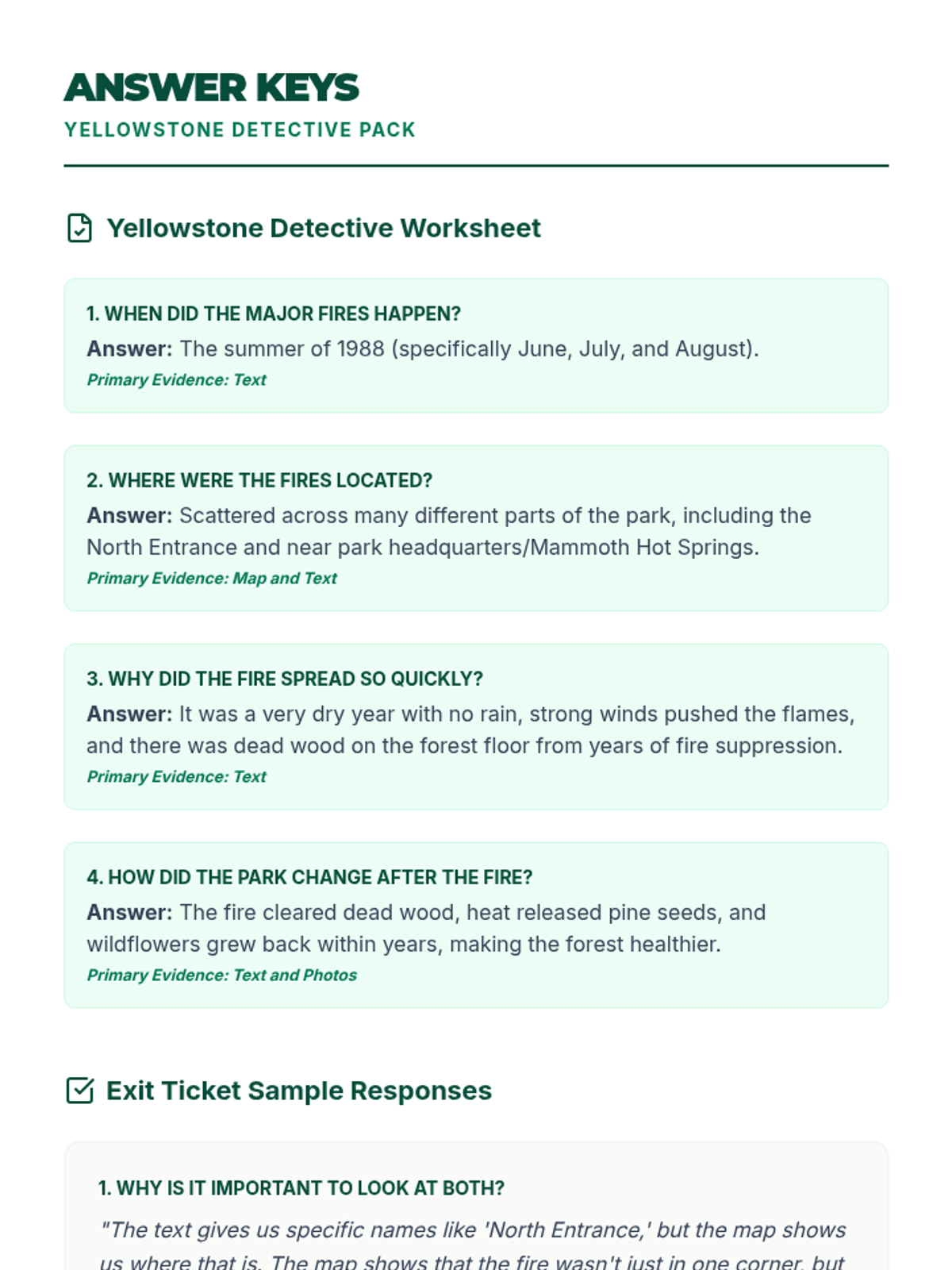
Answer keys for the 'Yellowstone Detective' worksheet and sample responses for the exit ticket. Includes specific evidence-source tagging for each question to support teacher evaluation.
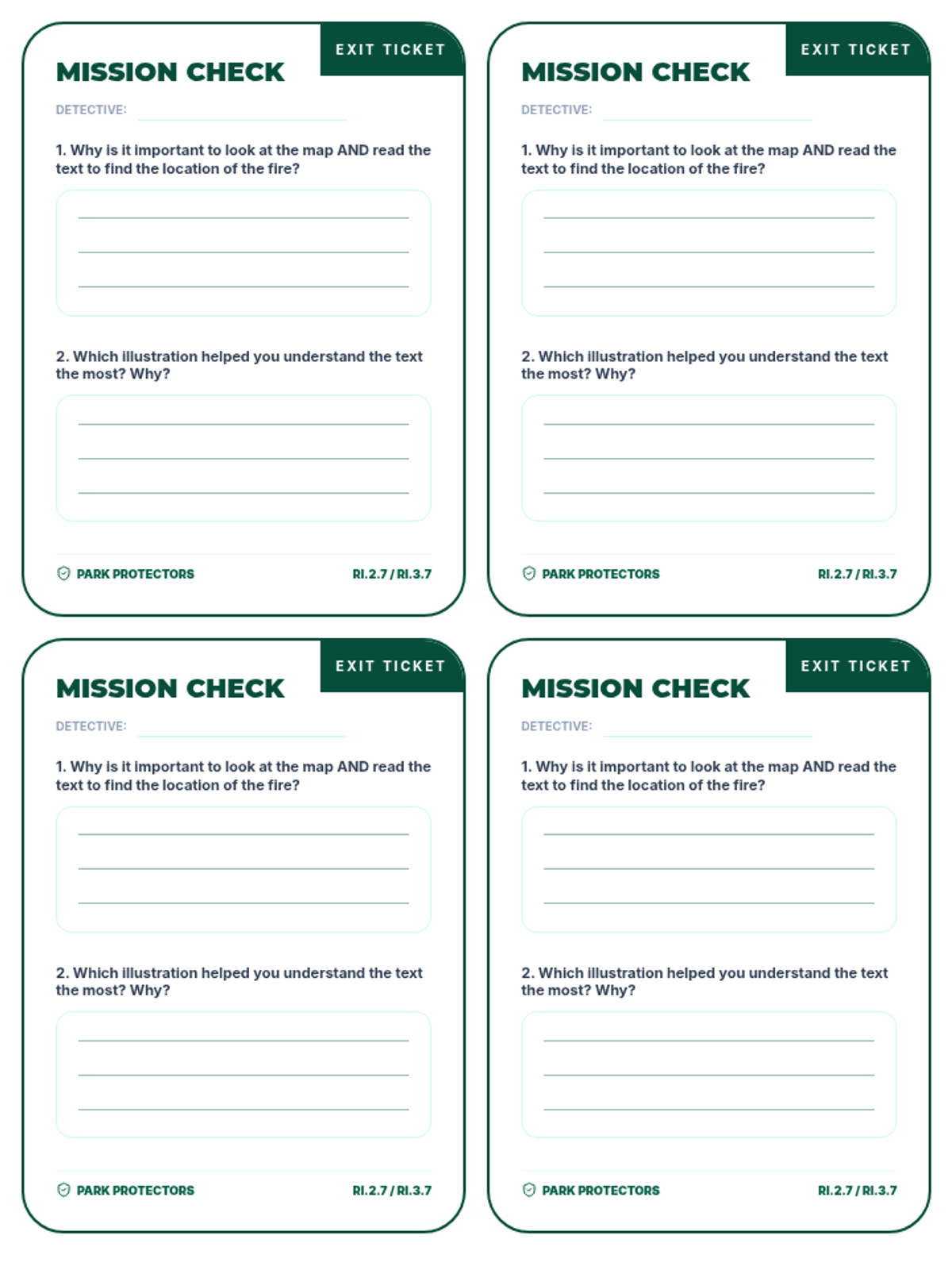
A set of four identical exit tickets on a single page, designed to efficiently assess student understanding of the lesson objective. Questions focus on the metacognitive process of combining text and illustrations.
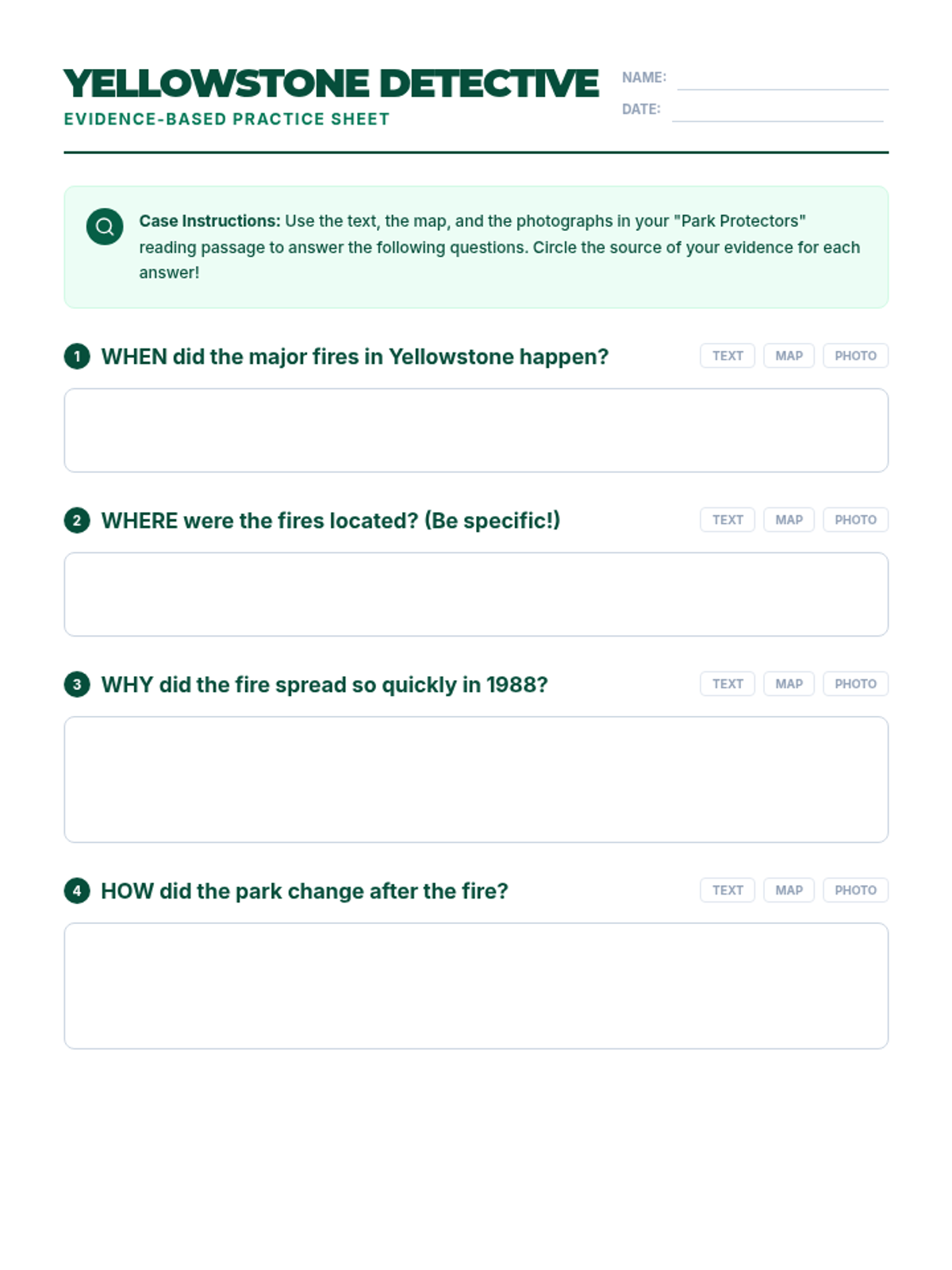
A structured practice worksheet that requires students to identify evidence from text, maps, and photographs to answer 'where, when, why, and how' questions about the Yellowstone fires. Includes a specific 'Evidence Source' tracker for each question.
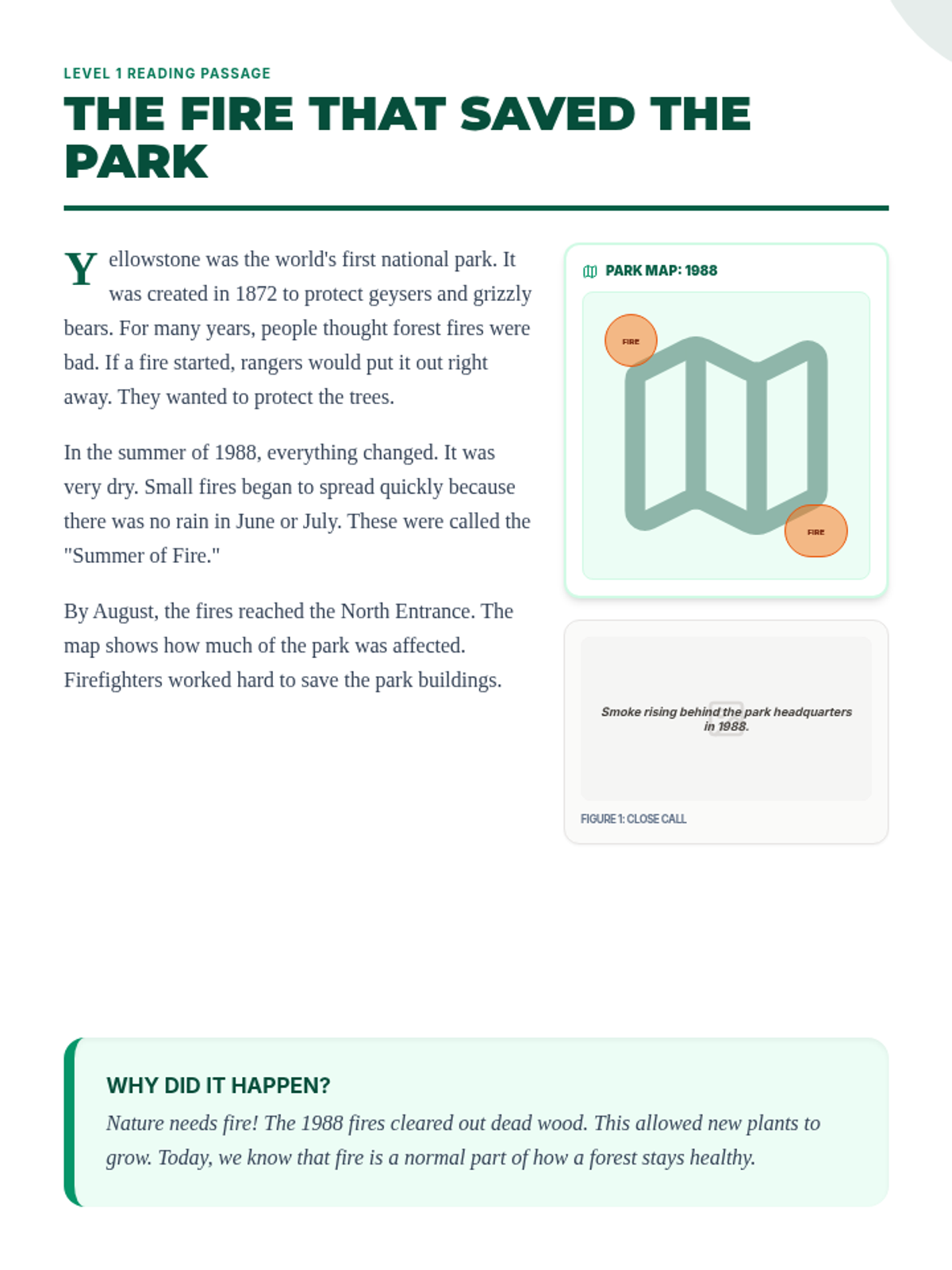
Two levels of a reading passage about the 1988 Yellowstone fires, designed to help students integrate text with maps and photographs. Level 1 uses simpler language, while Level 2 adds technical vocabulary and ecological details.
A high-impact slide deck for teaching students how to combine information from text and illustrations. Features visual placeholders for maps and photos, think-aloud prompts, and clear 'Detective Mission' instructions.
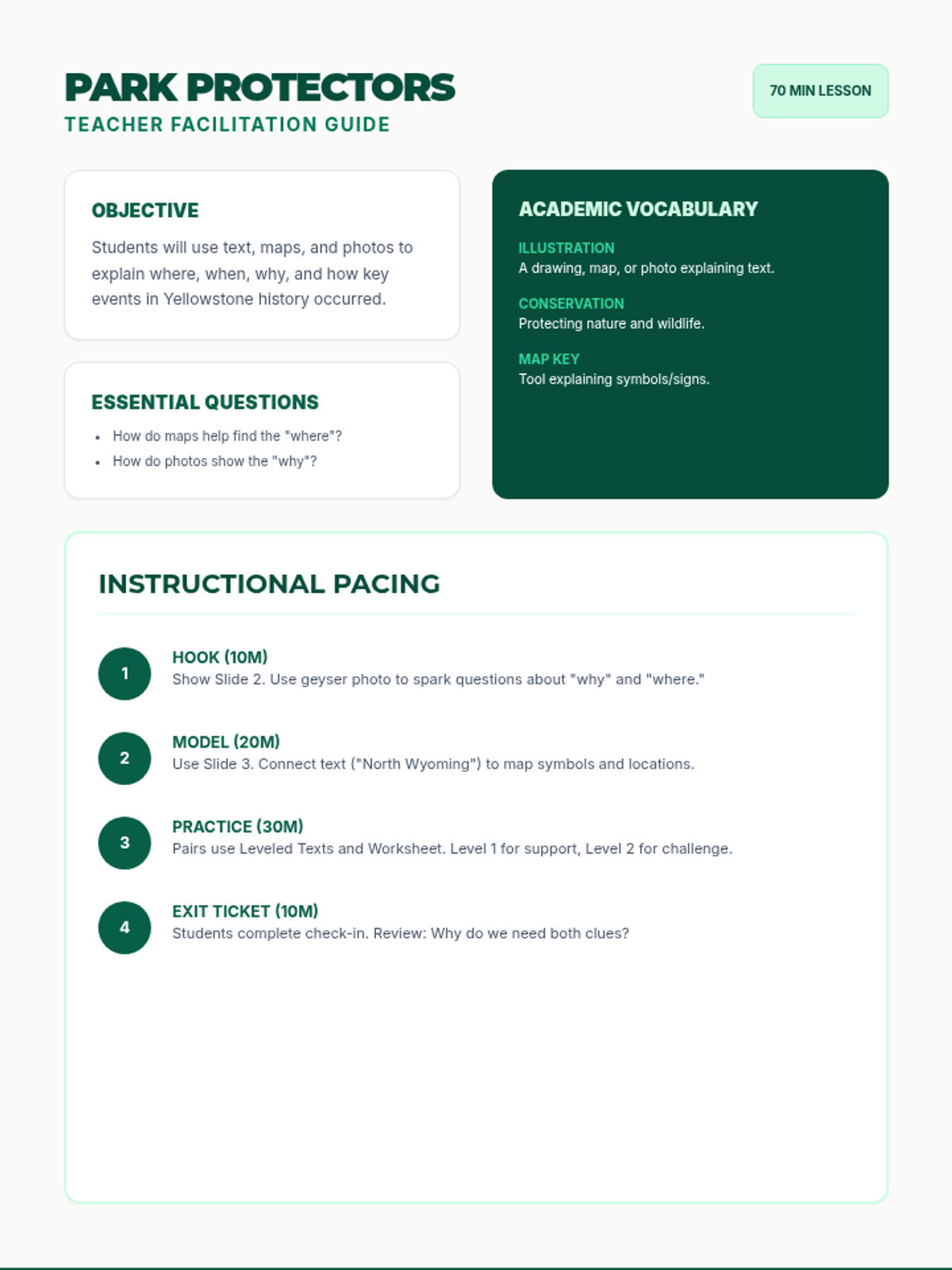
A comprehensive teacher facilitation guide for the 'Park Protectors' lesson, including learning objectives, standards alignment, academic vocabulary, and a detailed 60-minute instructional pacing guide.
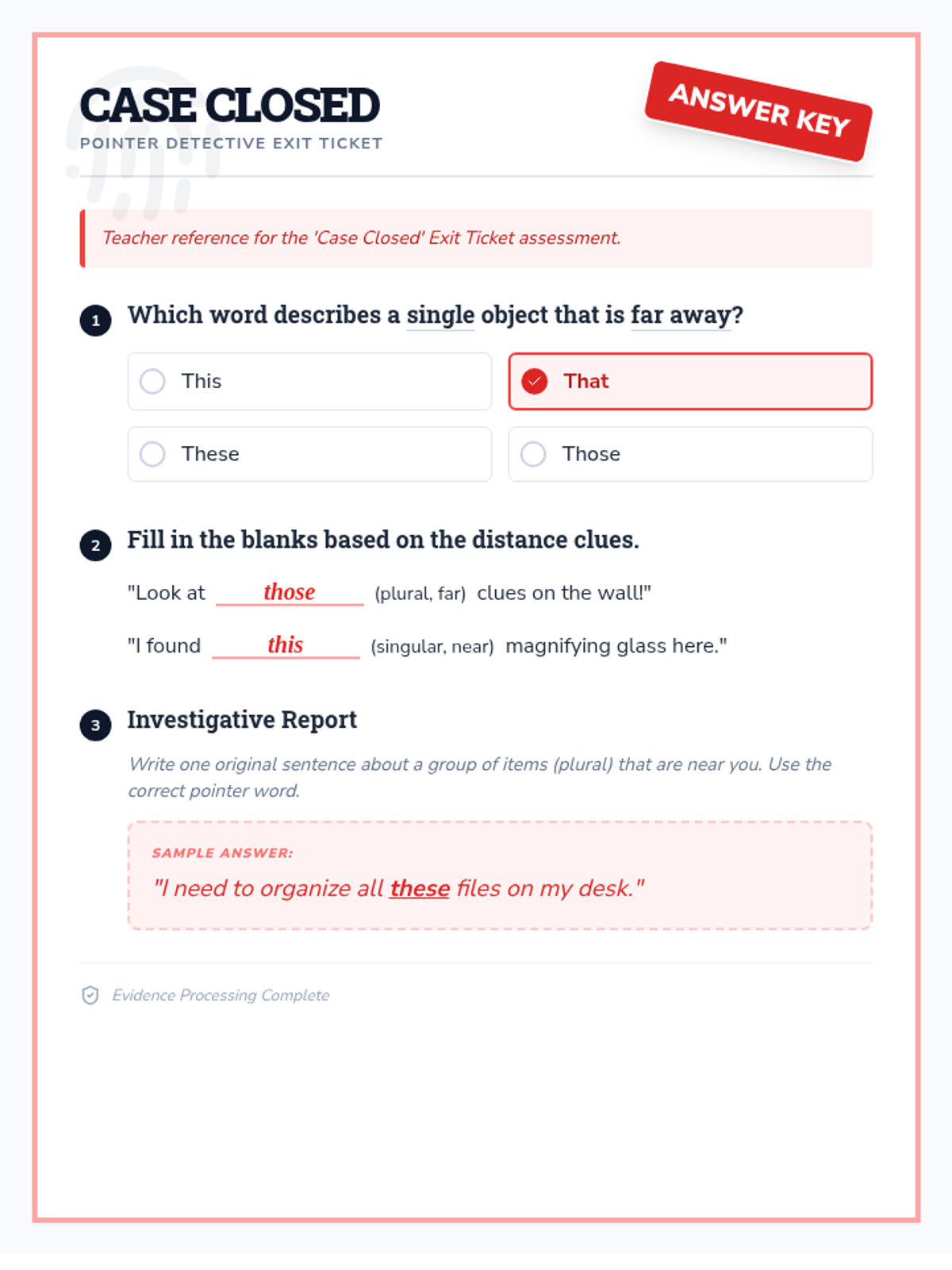
A teacher-facing answer key for the 'Case Closed' Exit Ticket, providing correct answers for multiple choice, fill-in-the-blank, and a sample sentence.
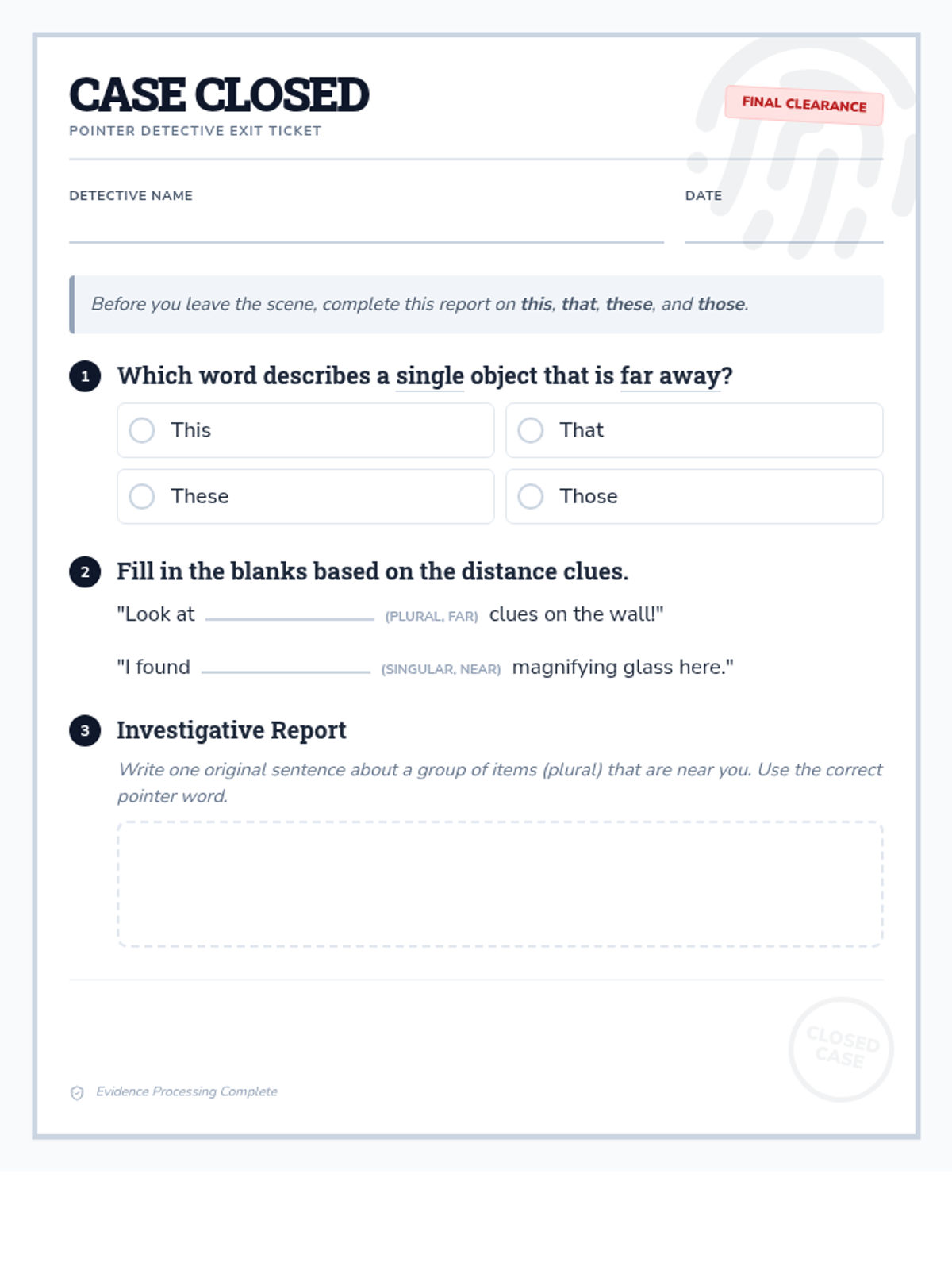
A detective-themed exit ticket titled 'Case Closed' that assesses student mastery of demonstrative pronouns (this, that, these, those) through multiple choice, fill-in-the-blank, and sentence writing exercises.
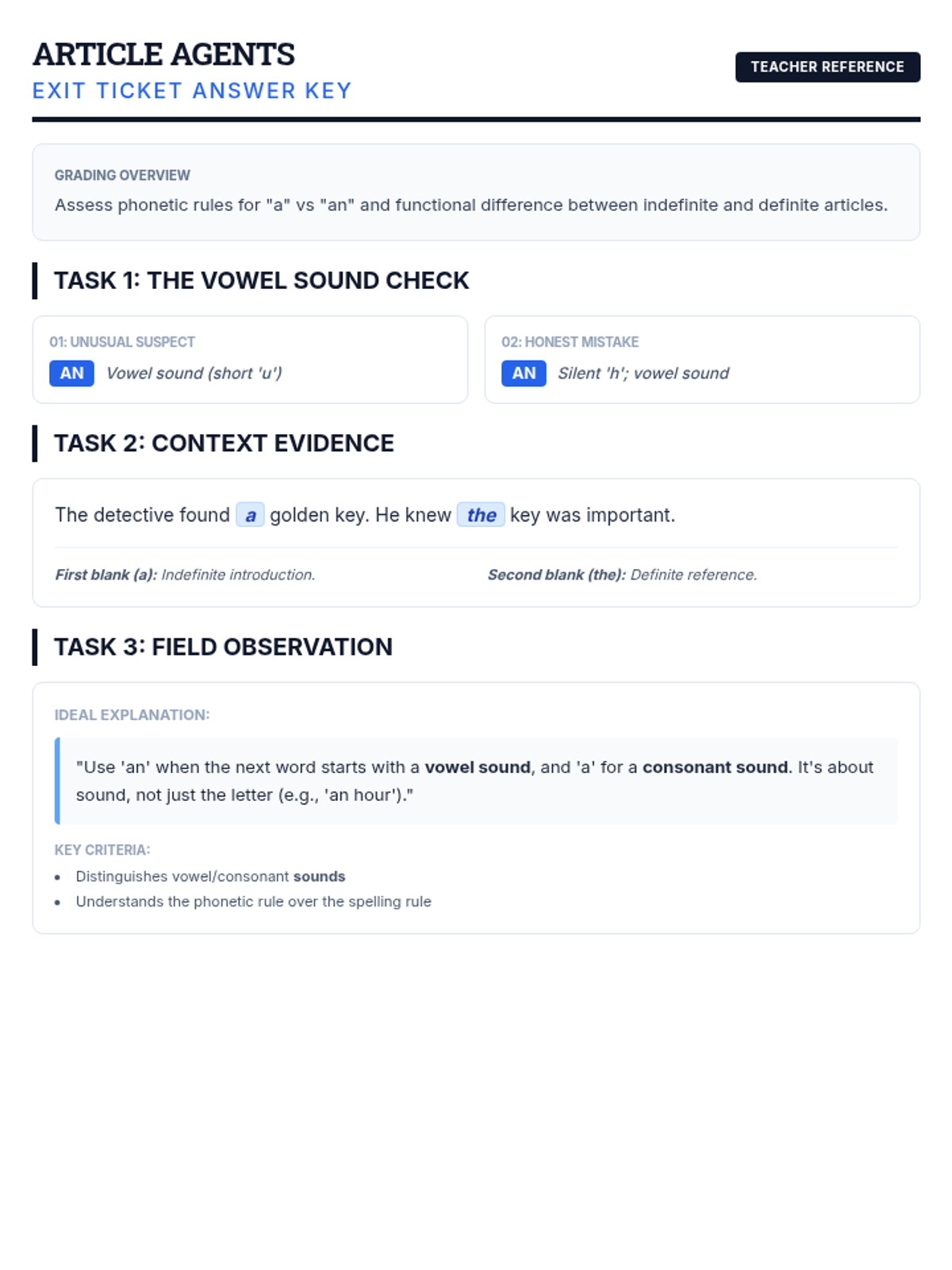
A dedicated answer key for the "Article Agents" exit ticket, providing correct answers and scoring criteria for the teacher. Revised with improved page break handling.
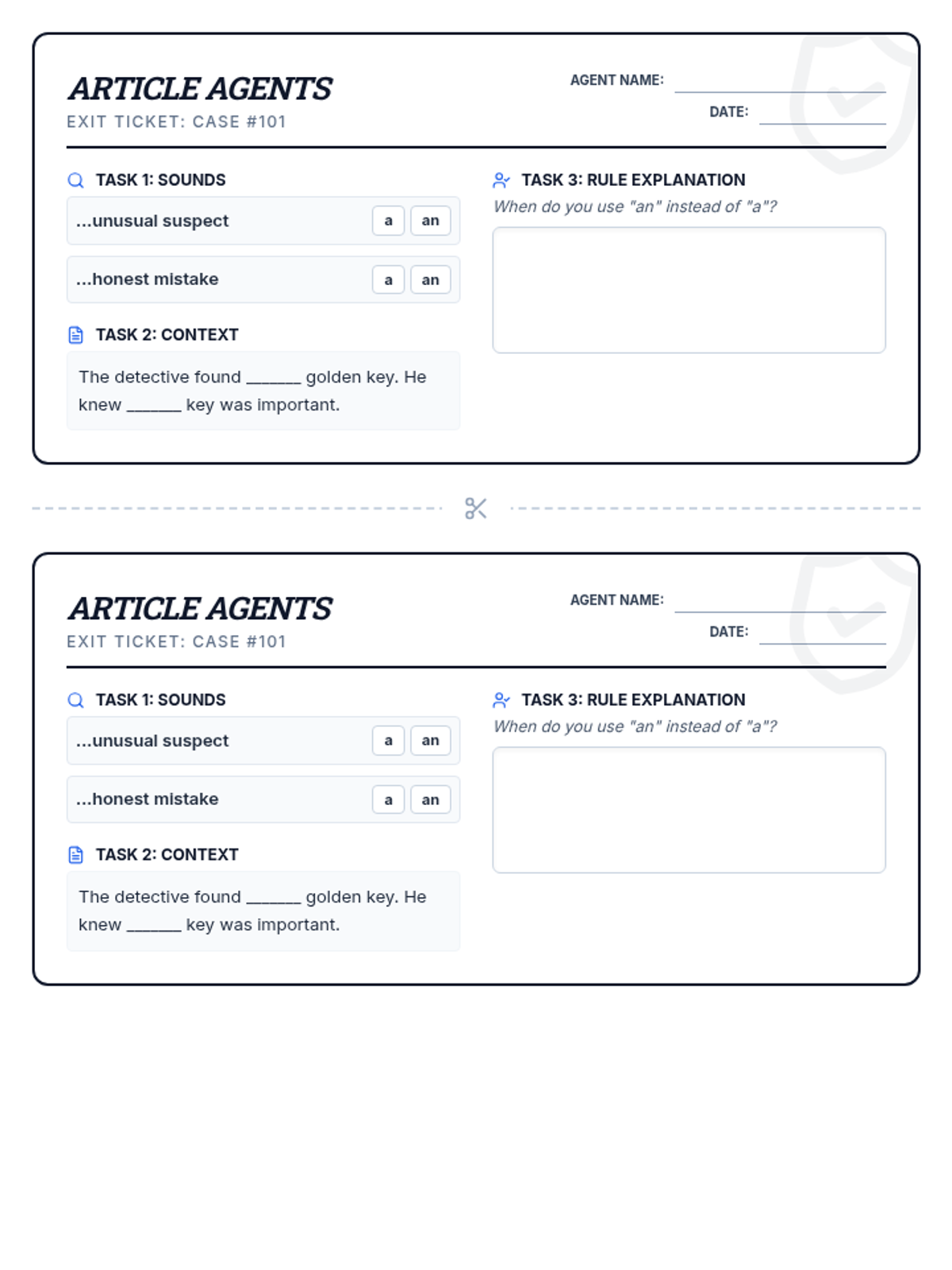
A themed exit ticket for the "Article Agents" lesson, containing two identical tickets per page for easy assessment. Covers a/an distinction and definite vs. indefinite context. Updated for better page-break handling and larger reflection space.
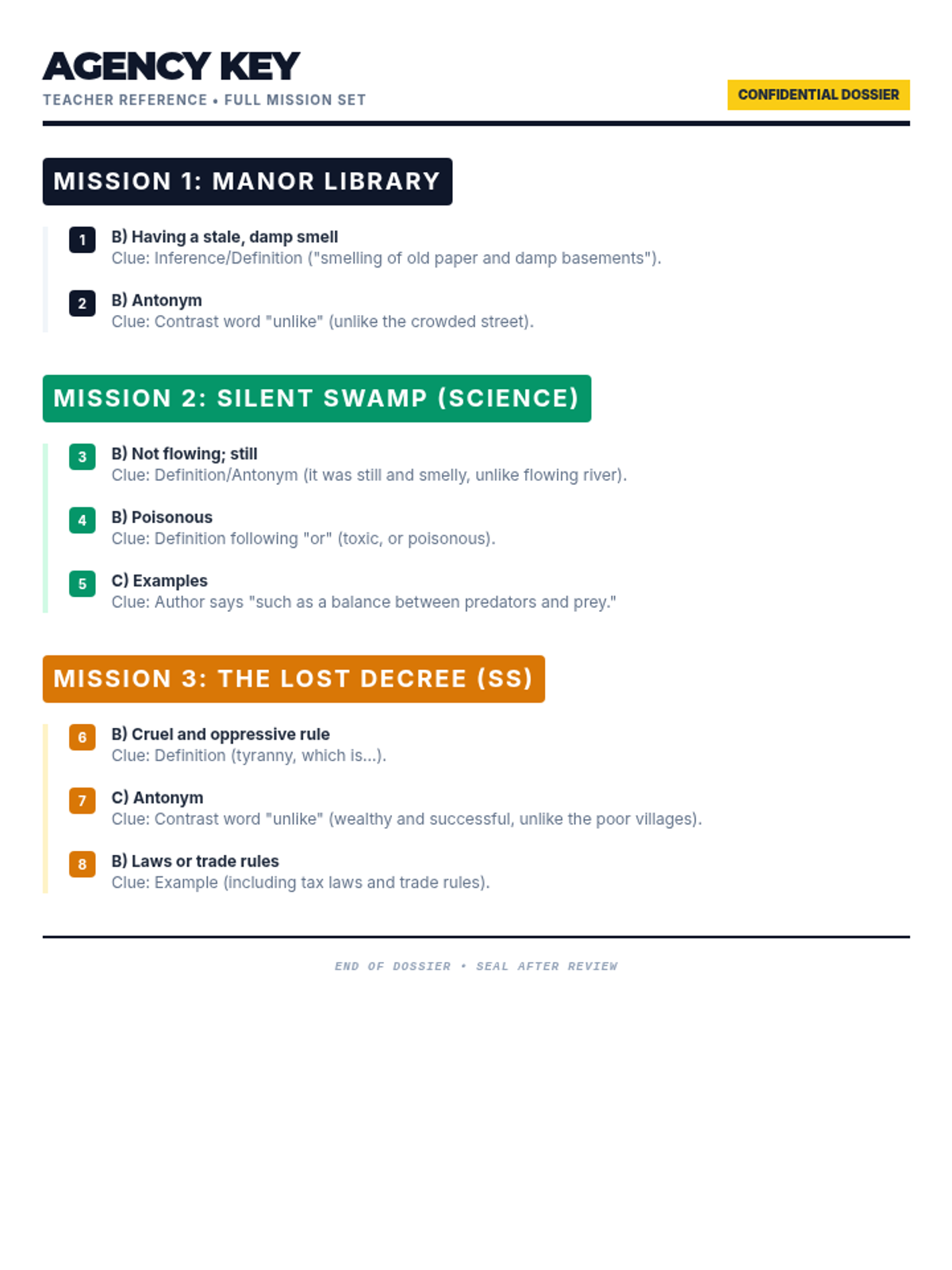
Updated teacher answer key covering general, science, and social studies missions with specific clue rationales.
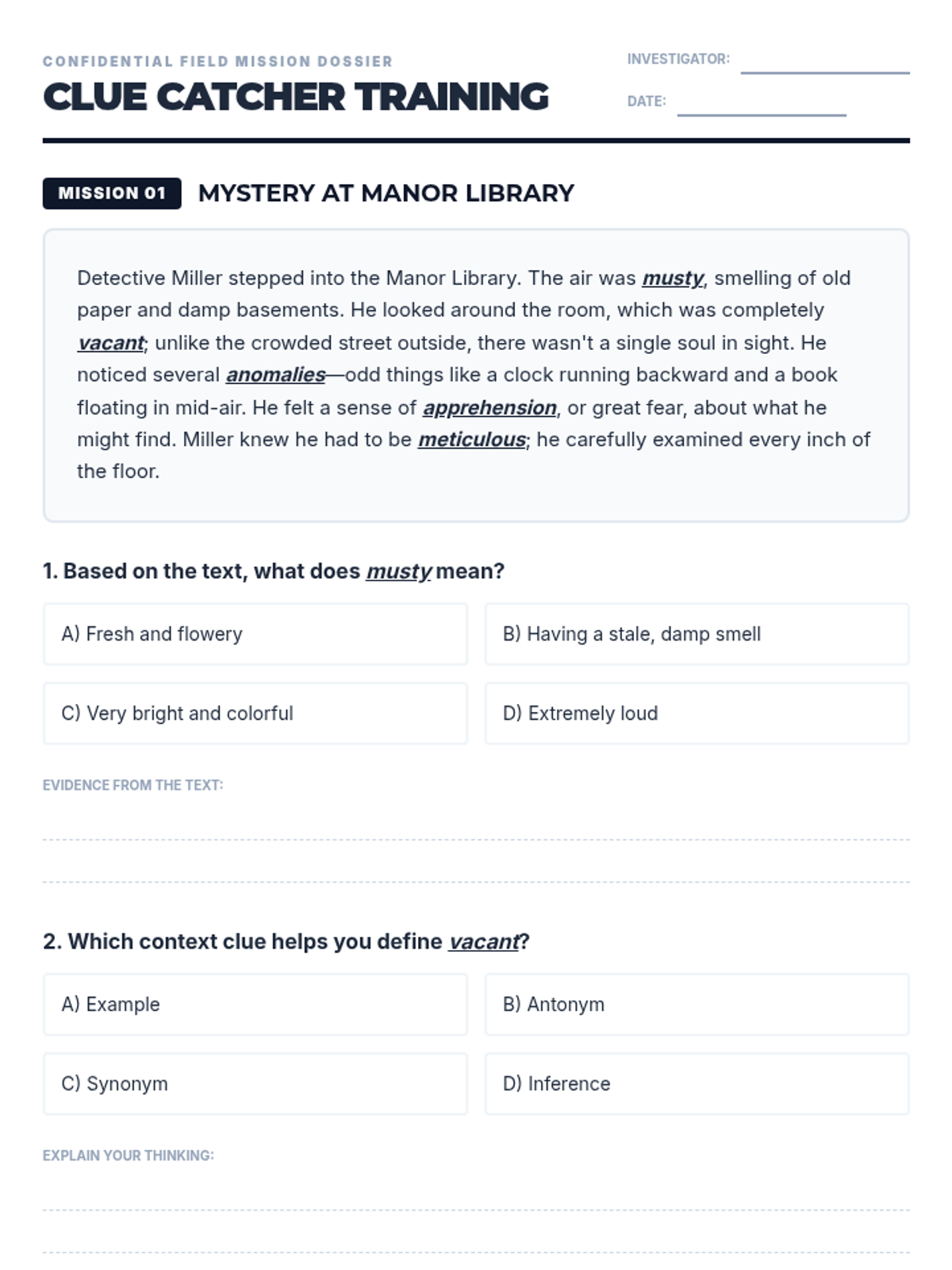
Comprehensive independent practice worksheet featuring general, science, and social studies mysteries with EOG-level vocabulary and context clue analysis, optimized for a clean 3-page layout.
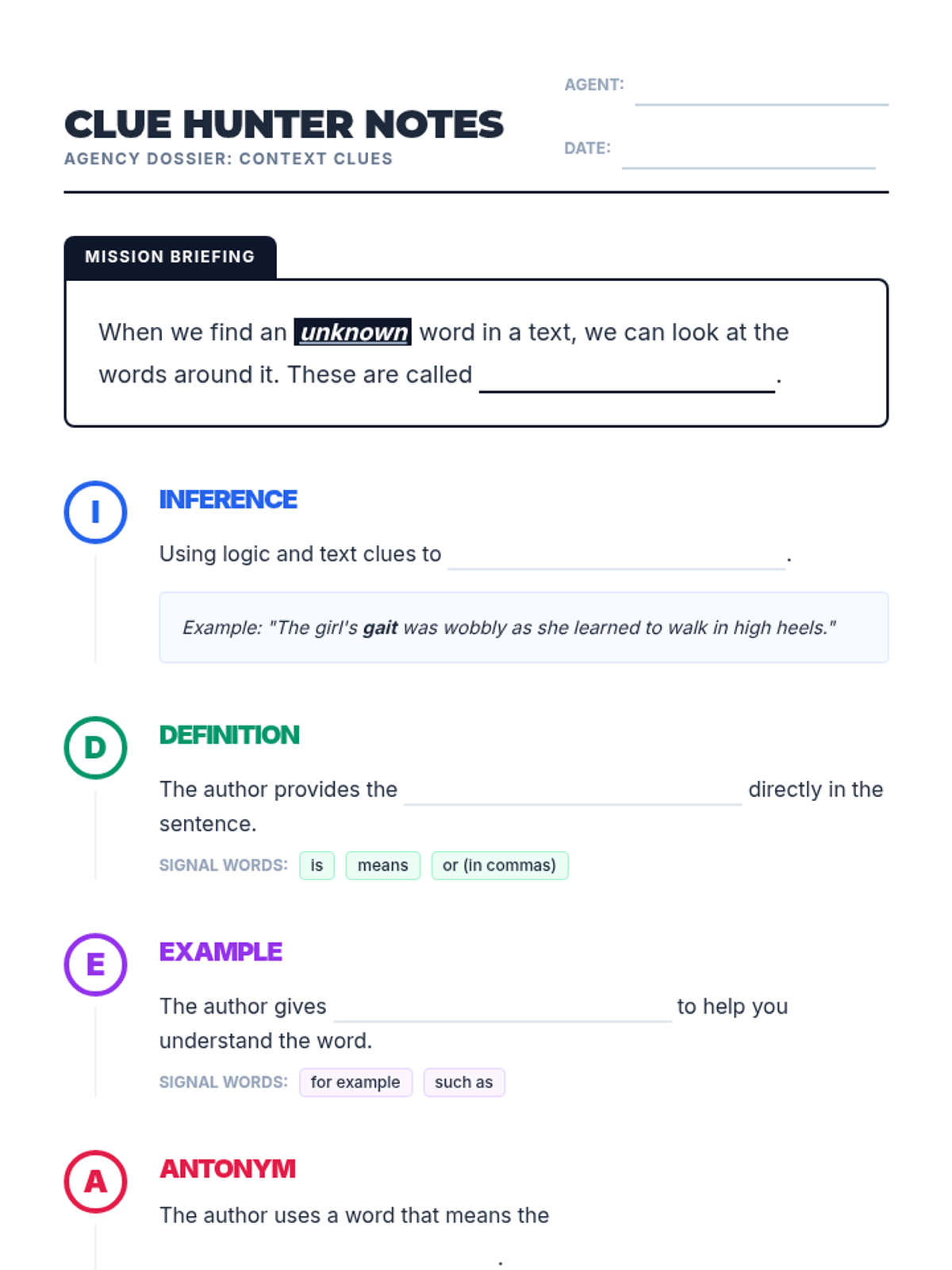
Polished guided notes with consistent layout, large handwriting spaces, and corrected alignment for inference prompts.
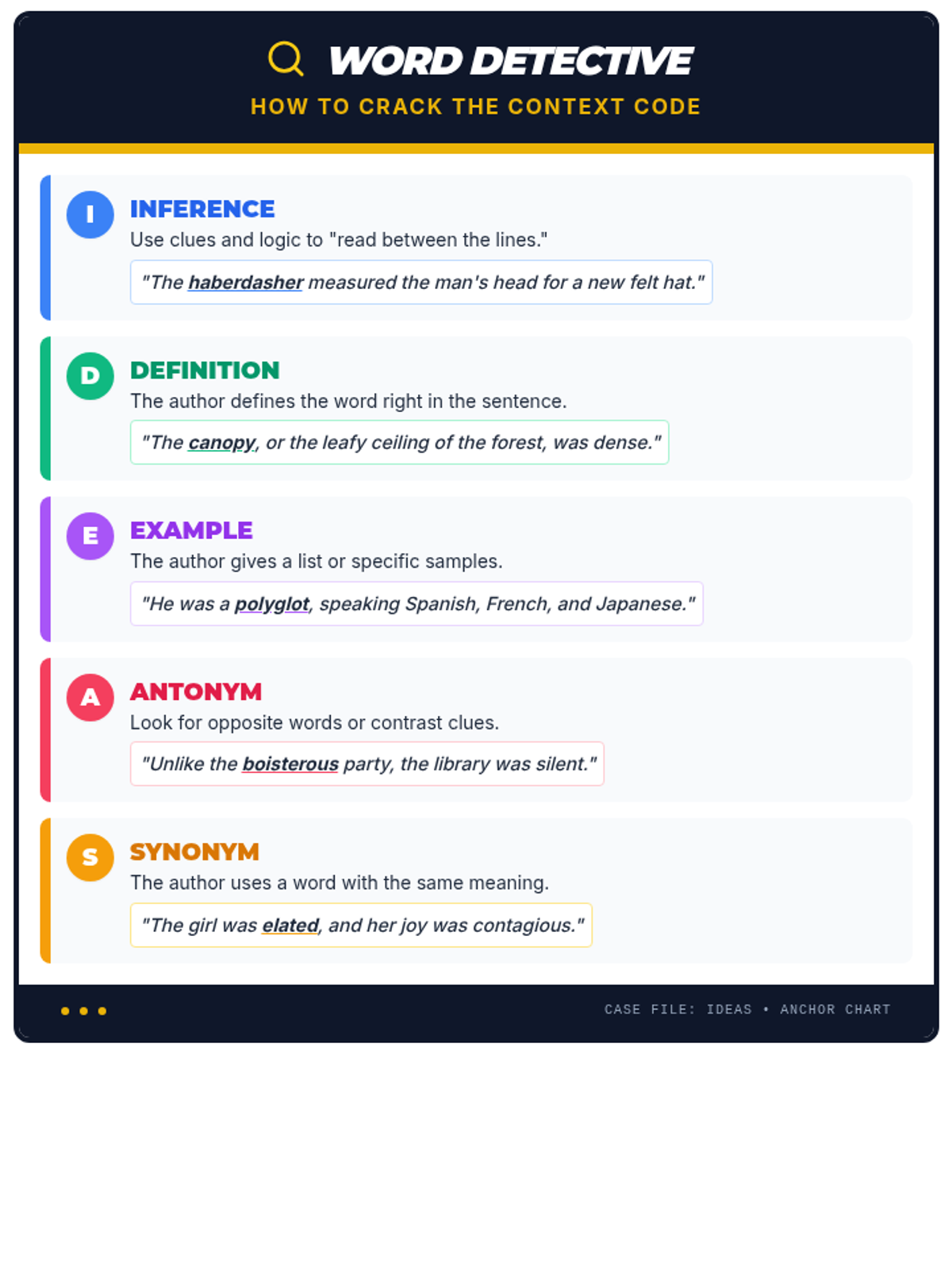
Final polished detective-themed anchor chart with legible example text and optimized single-page layout.
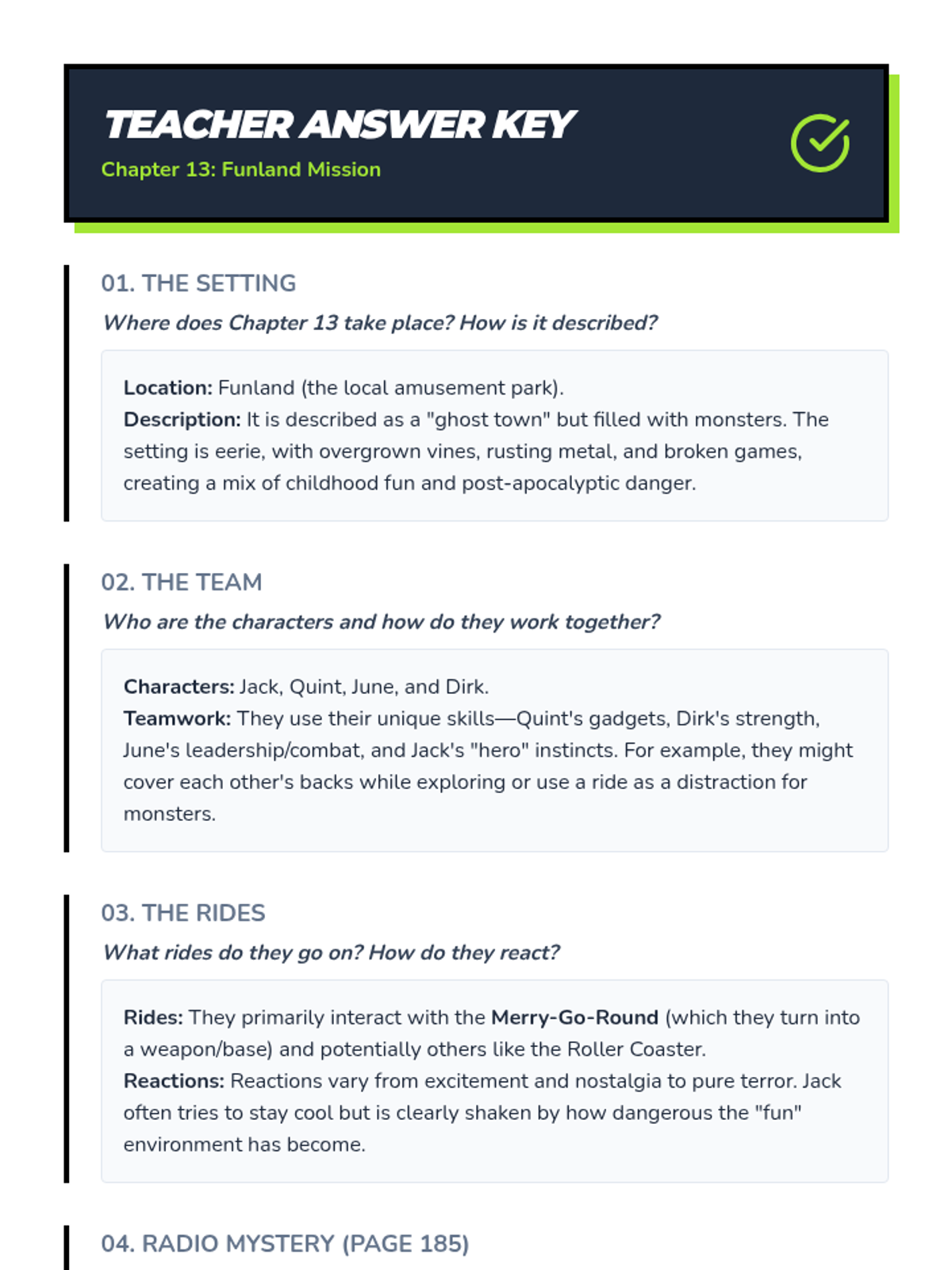
A teacher answer key for the Funland Mission worksheet, providing detailed responses for Chapter 13 of 'The Last Kids on Earth and the Nightmare King' and instructional tips.
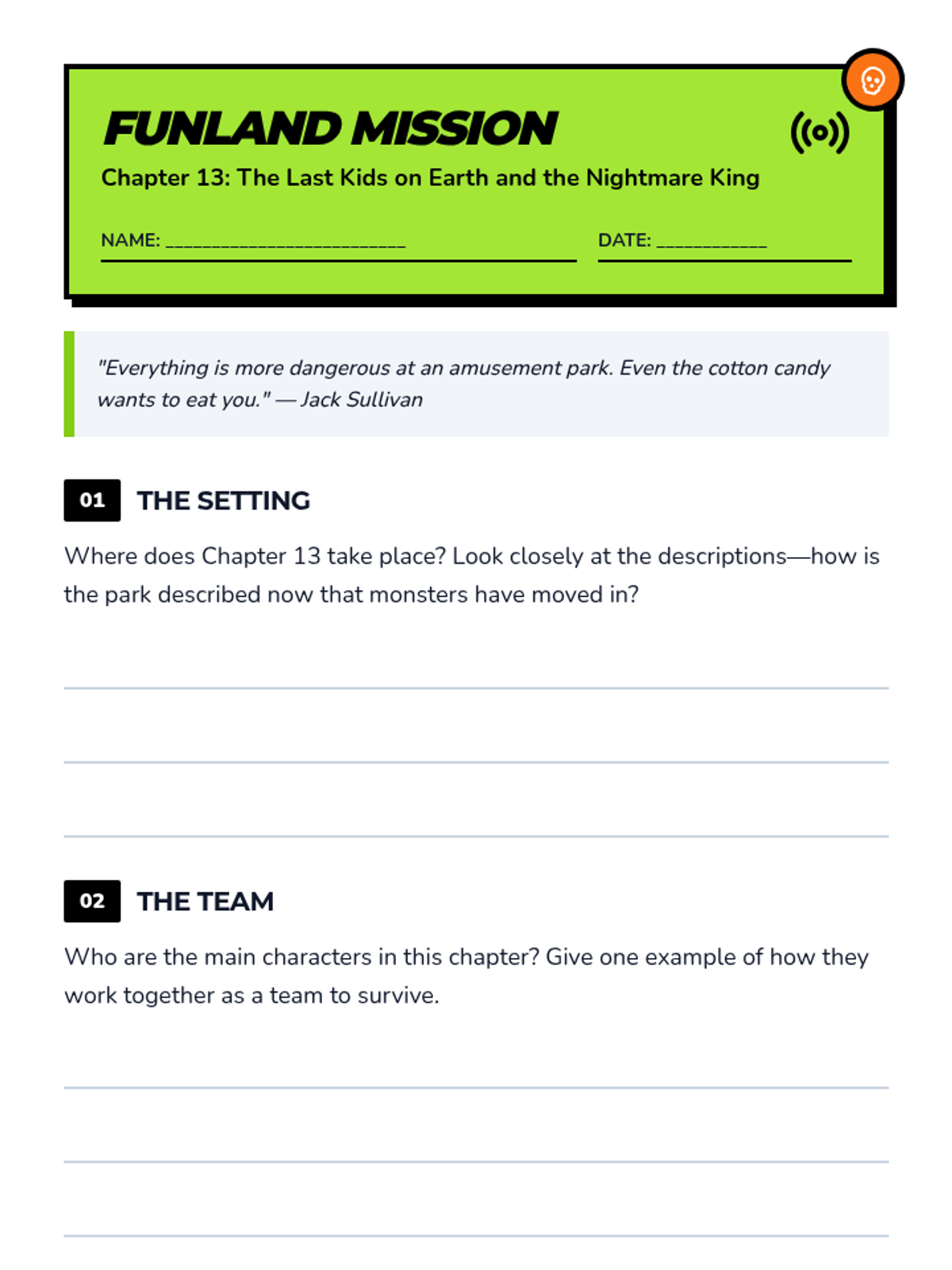
A student worksheet for Chapter 13 of 'The Last Kids on Earth and the Nightmare King' featuring open-response questions about setting, character teamwork, amusement park rides, and the radio plot point.
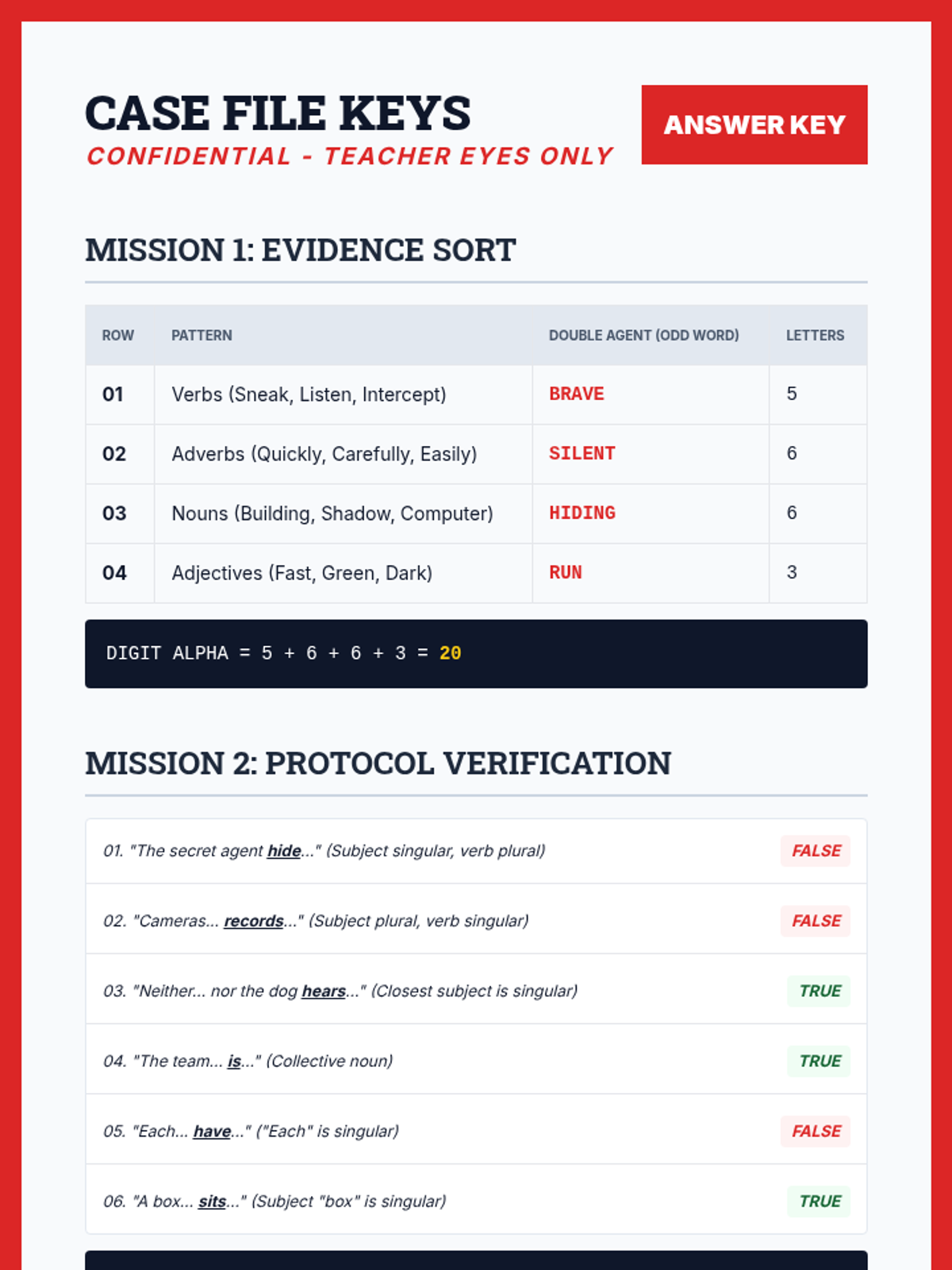
An answer key for the teacher. It provides the solutions for both missions, the letter counts for Mission 1, the identification of correct/incorrect subject-verb agreement for Mission 2, and the final step-by-step math solution for the code. Revised for clarity and improved page breaks.
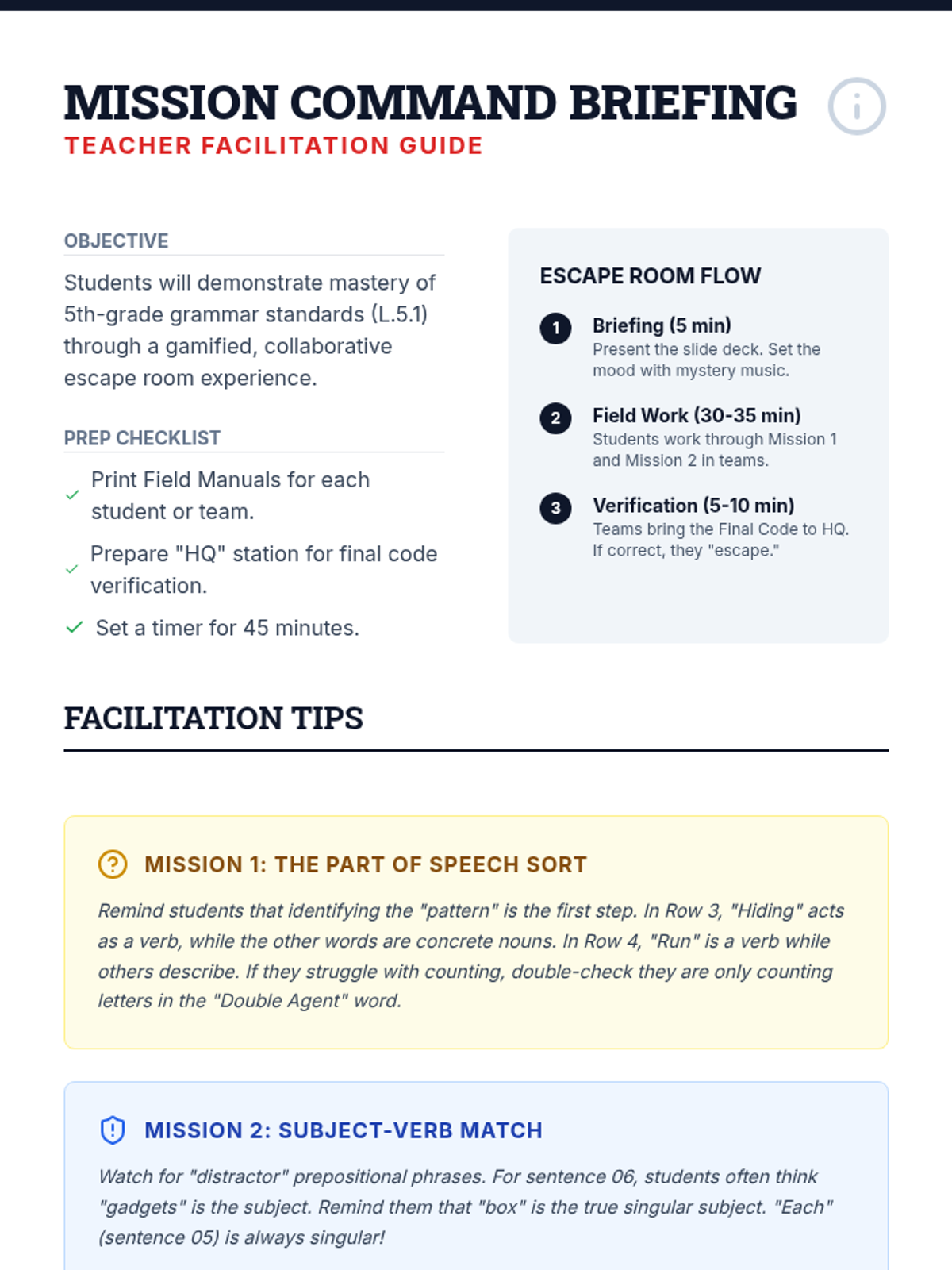
A comprehensive facilitation guide for the teacher. Includes pacing, setup checklists, facilitation tips for each mission, and the logic behind the final code cracker. Revised to prevent content splitting across page breaks.