An answer key for the Agent Meaning packet, providing correct responses for both Day 1 and Day 2 tasks, including expanded practice and matching sections. Revised for single-page layout.
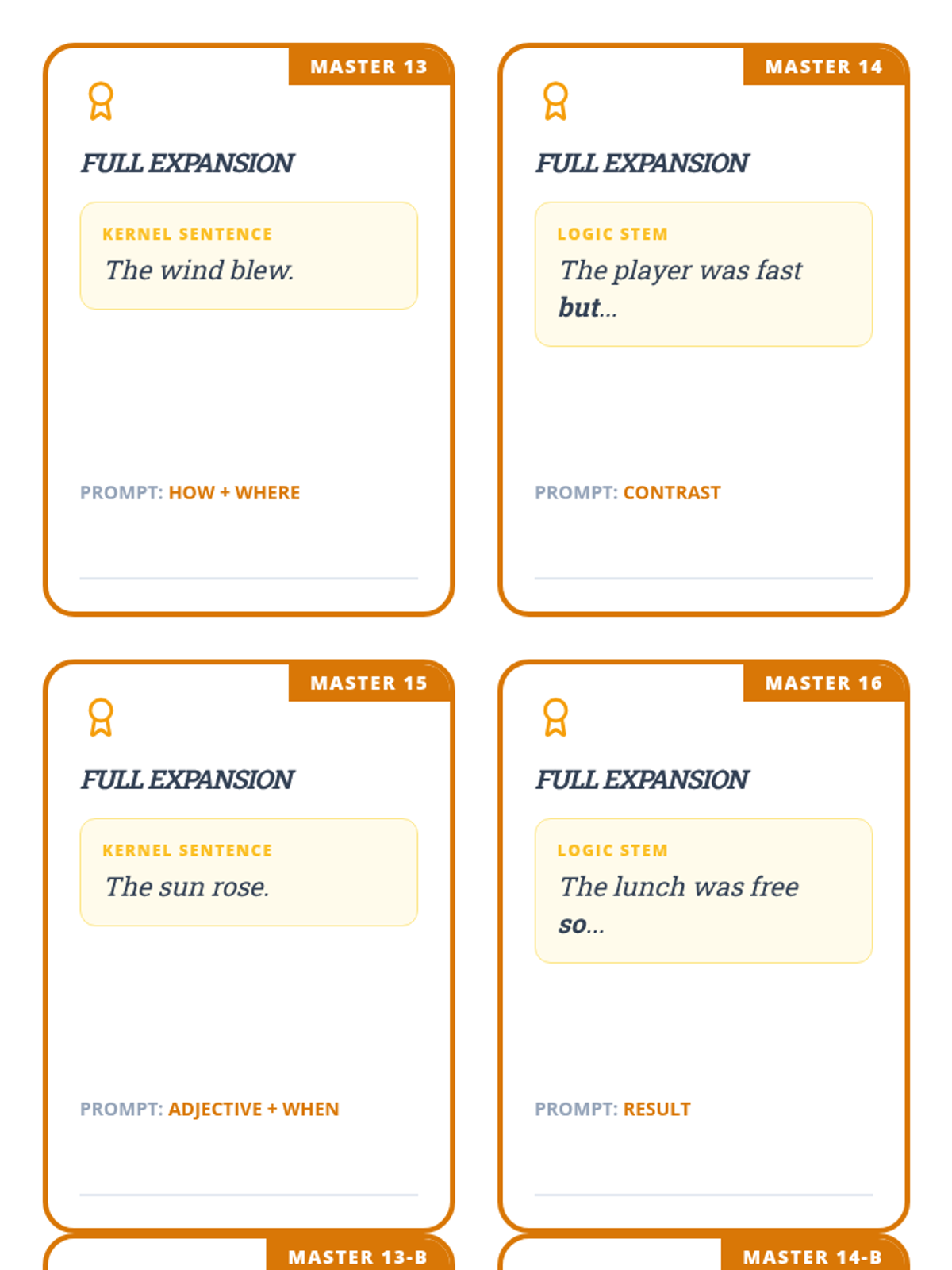
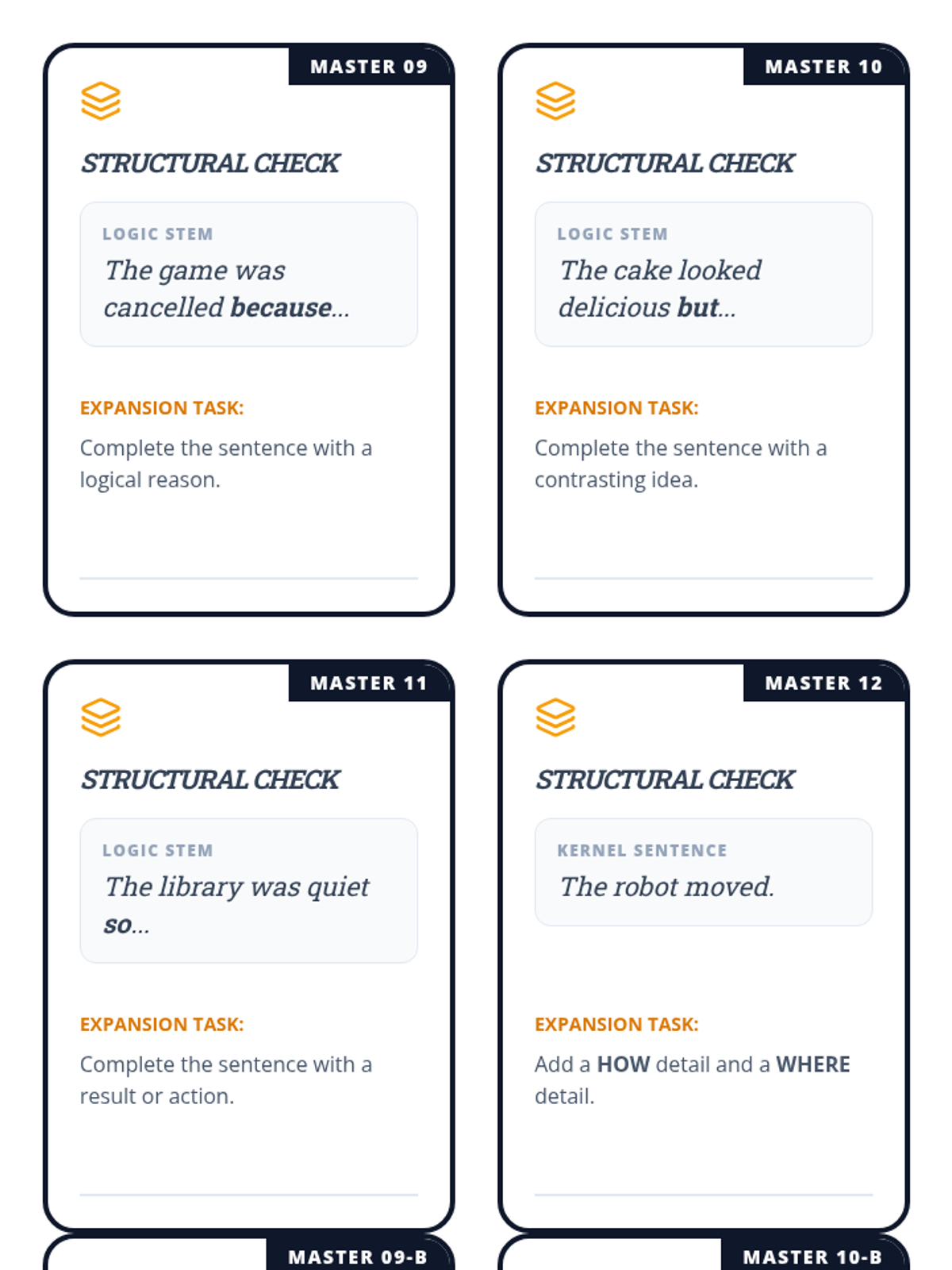
A final set of 8 task cards for mixed review of all sentence expansion strategies. These cards are designed for final progress monitoring.
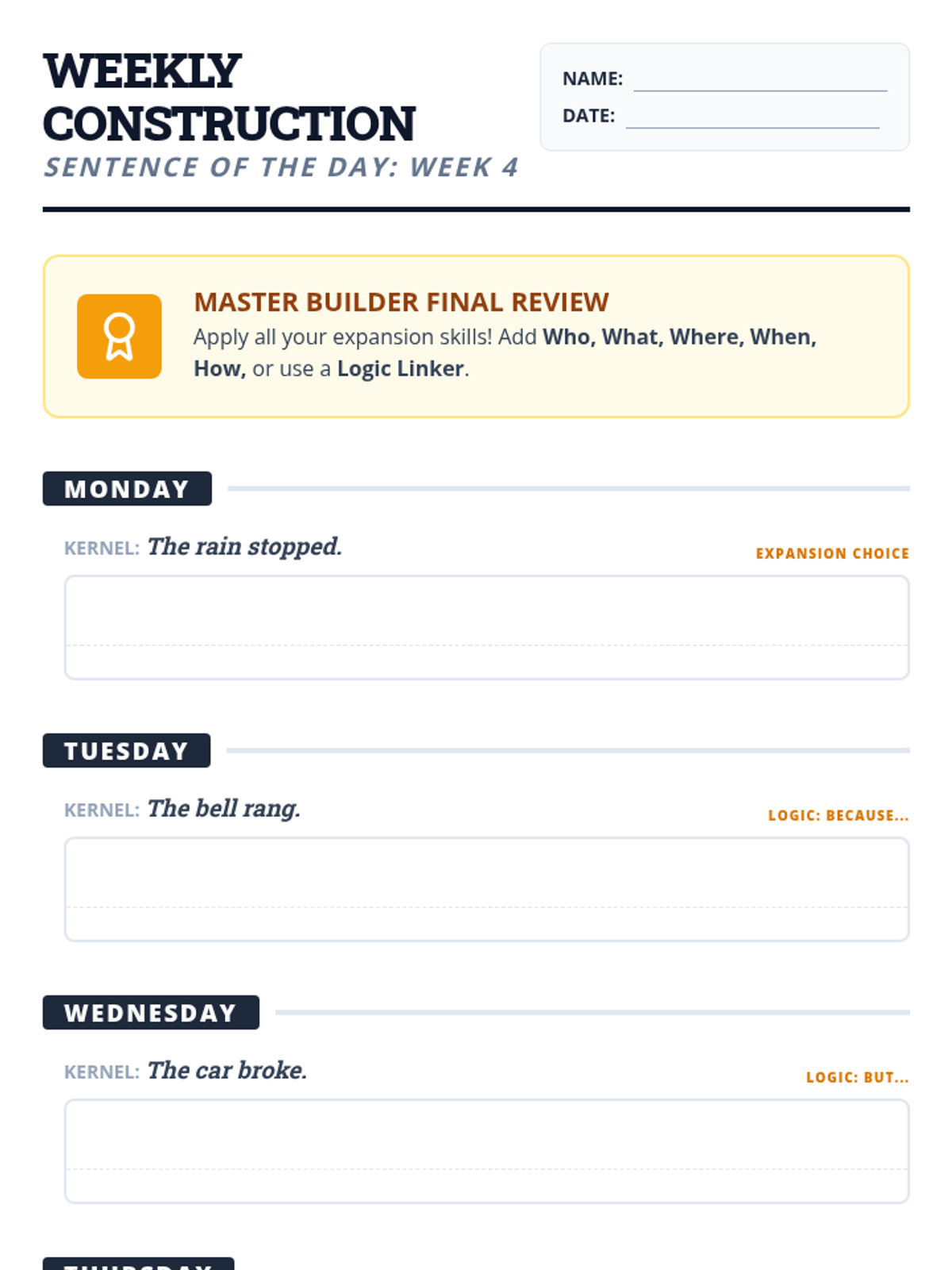
A weekly student worksheet focusing on mixed sentence expansion and logical completion for the final review week.
A set of 8 printable task cards for mastering logical conjunctions (Because, But, So) and mixed kernel expansion. Ideal for progress monitoring.
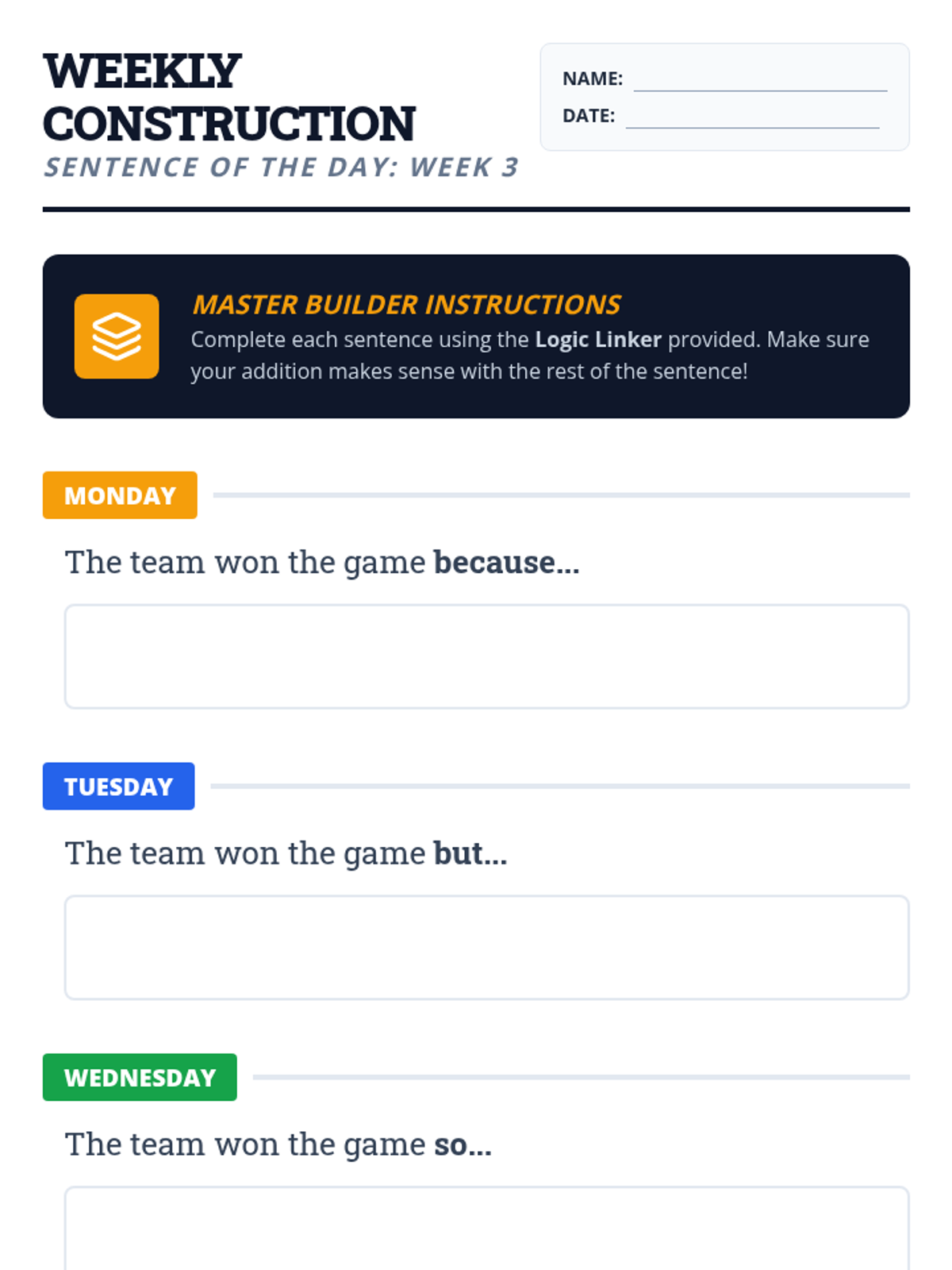
A weekly student worksheet focusing on logical sentence completion using 'Because, But, So' conjunctions.
Instructional slides for the third lesson in the Sentence Architects series. These slides focus on using 'Because, But, So' conjunctions to expand sentences logically, following the Hochman Method framework.
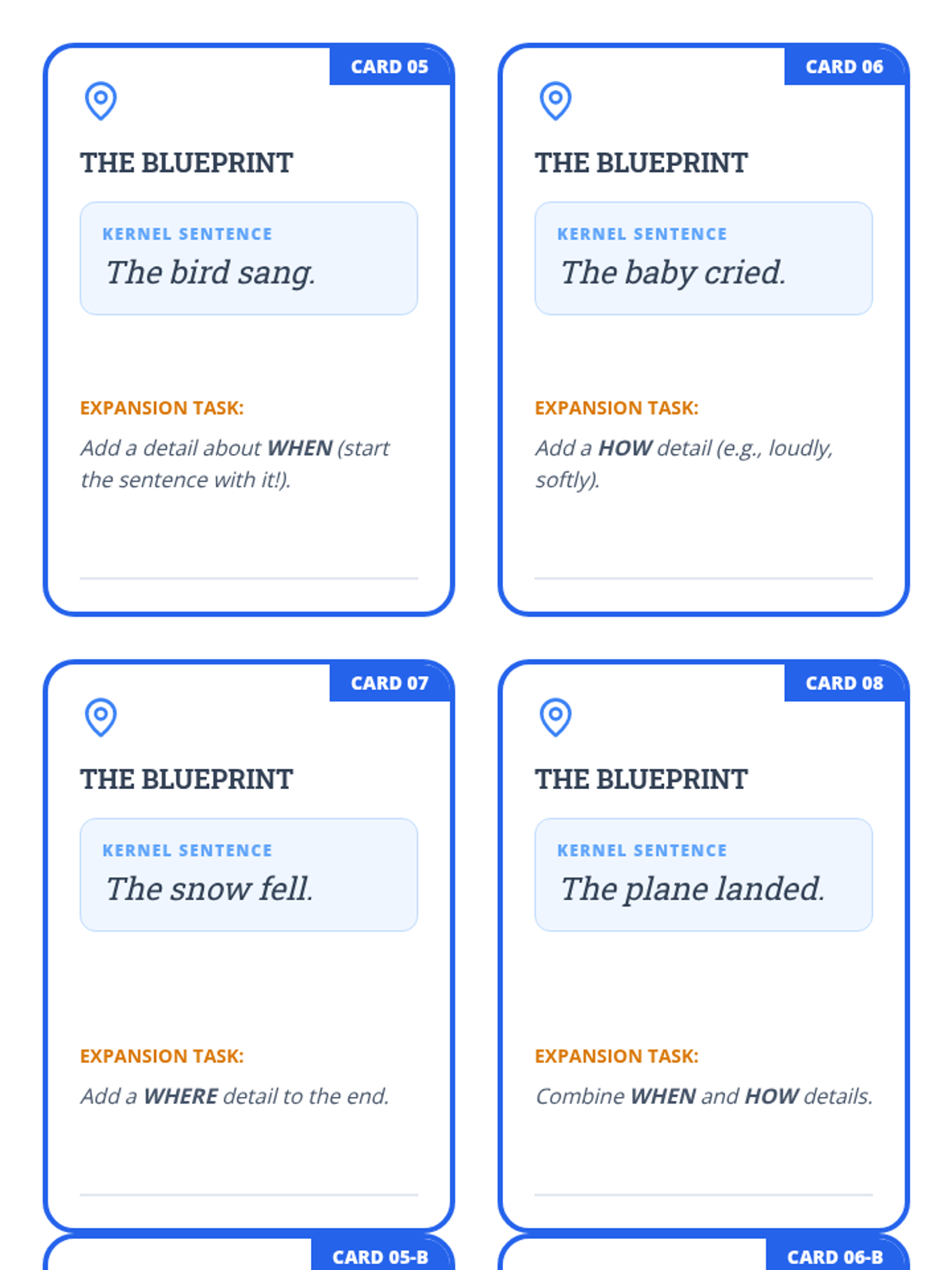
A second set of task cards for sentence expansion, specifically targeting 'When', 'Where', and 'How' details. These cards are designed for progress monitoring data collection.
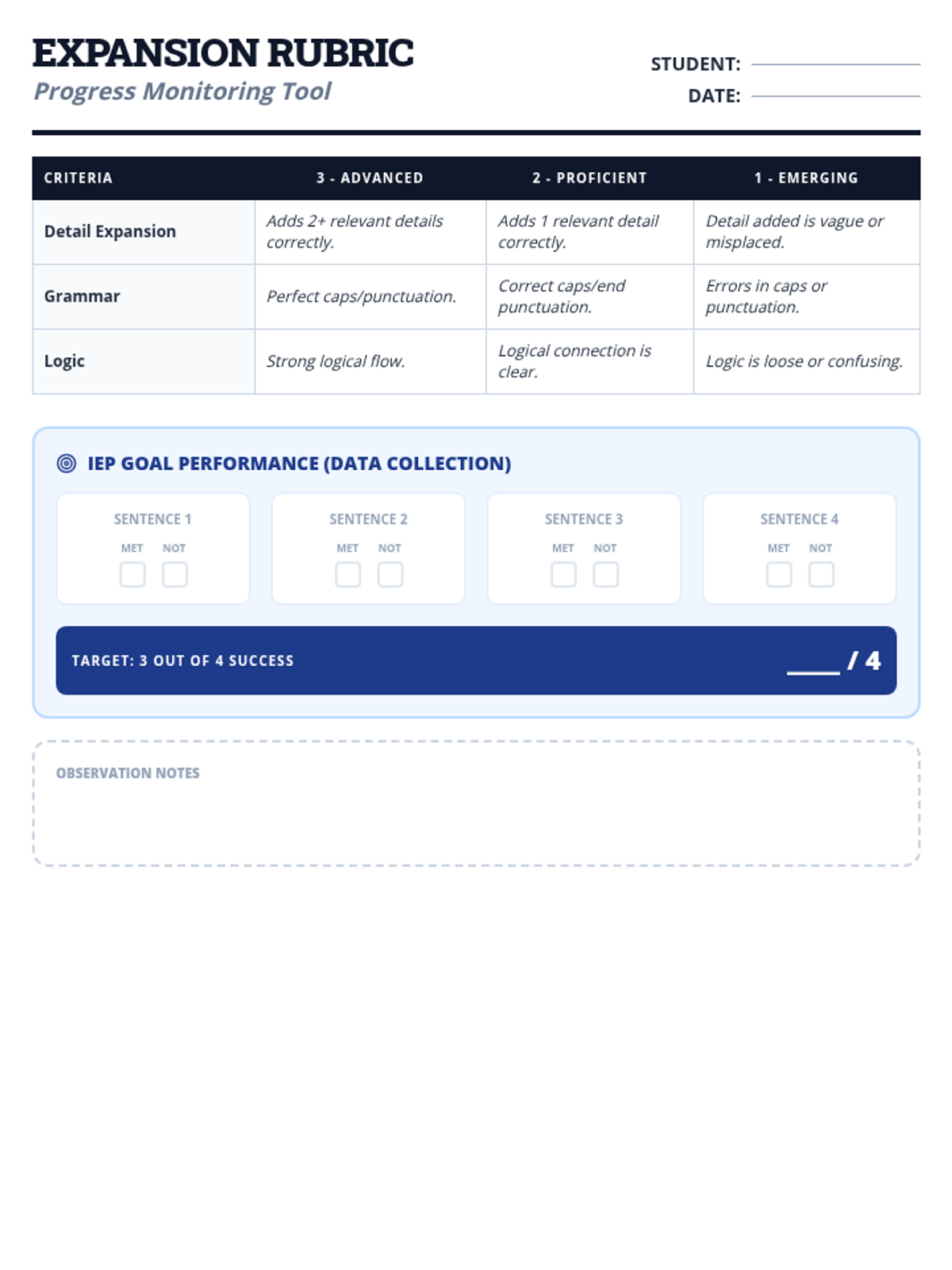
A comprehensive teacher resource for tracking student progress toward sentence expansion IEP goals. Includes a 3-point rubric and a specific data collection area for monitoring the 3-out-of-4 success rate.
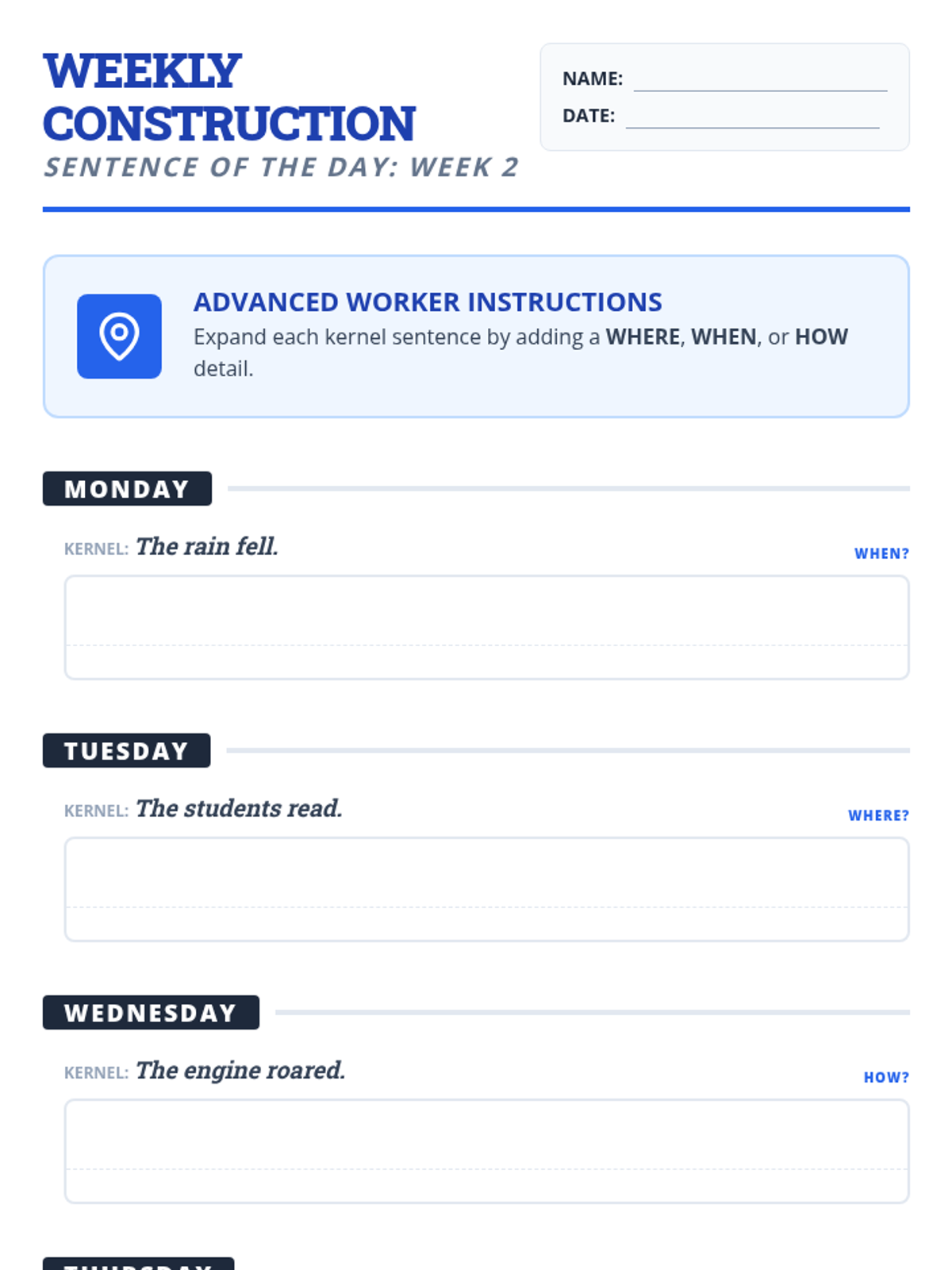
A student worksheet for the second week of instruction, focusing on expanding sentences with 'Where', 'When', and 'How' details.
Instructional slides for the second lesson in the Sentence Architects series. These slides focus on expanding kernel sentences using 'Where', 'When', and 'How' question words, including correct comma usage for introductory phrases.
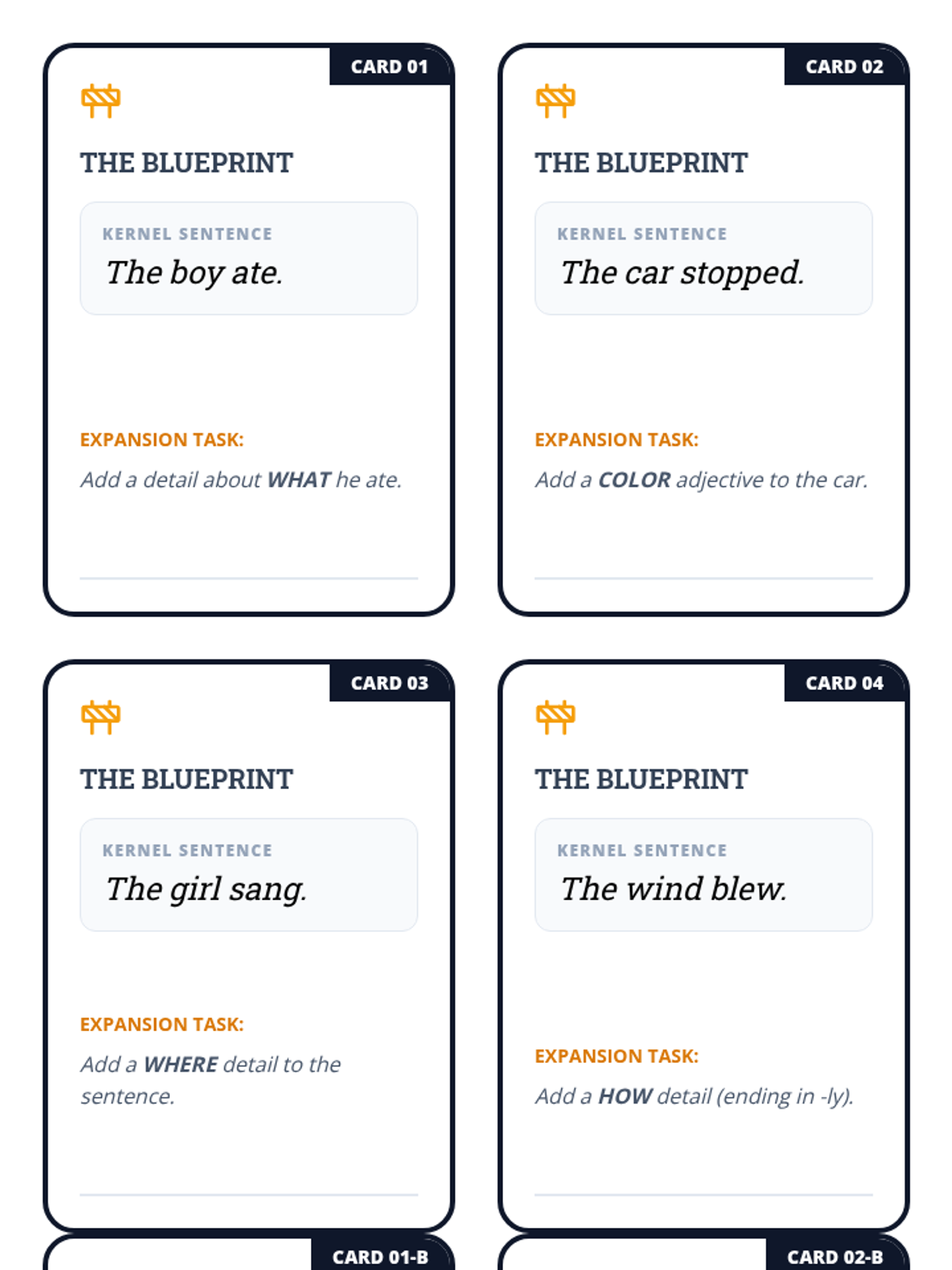
A robust set of 8 printable task cards for practicing basic kernel sentence expansion. Each card features a kernel sentence and a specific construction prompt.
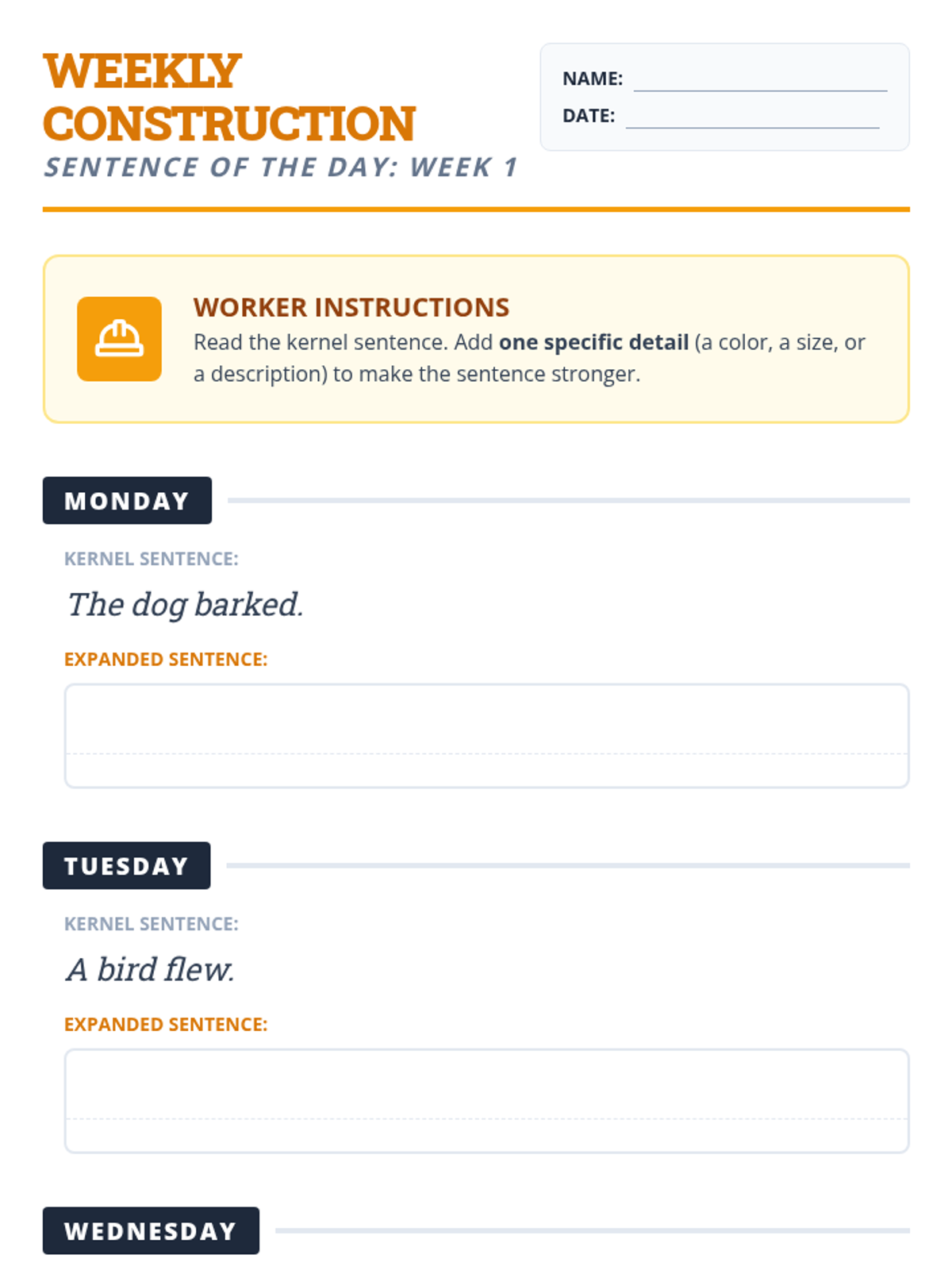
A weekly student worksheet featuring five days of "Sentence of the Day" warm-ups, focusing on basic kernel expansion with descriptive details.
Instructional slides for the first lesson in the Sentence Architects series. These slides cover fragments vs. sentences and the basics of kernel expansion, including newly added slides on adjectives (Standard L.4.1.d), adverbs, and prepositional phrases (Standard L.4.1.e) to align with Massachusetts fourth-grade standards.
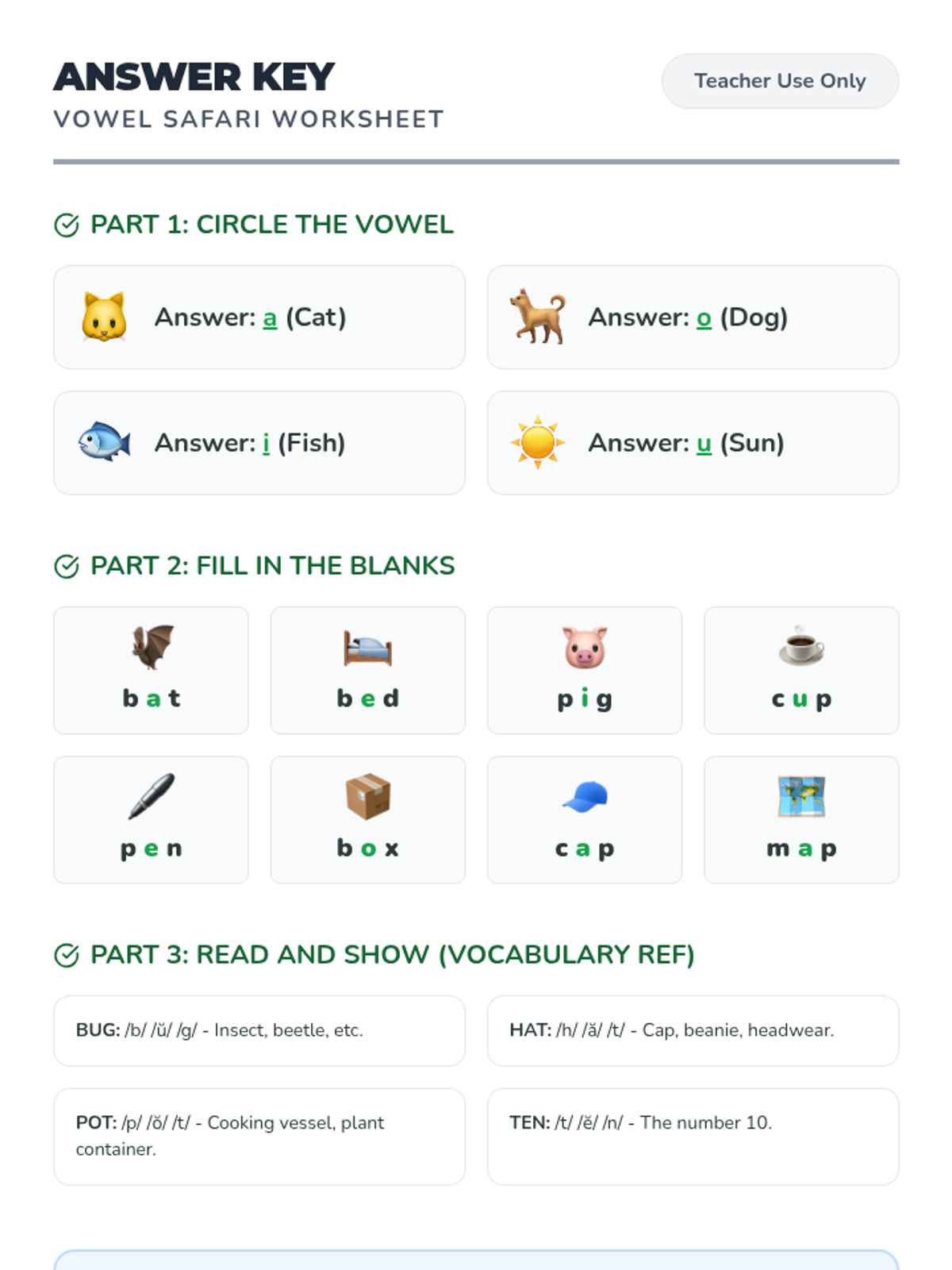
Answer key for the Vowel Safari Worksheet. Provides clear solutions for vowel identification, missing vowel completion, and vocabulary references for the reading section. Compacted to fit on a single page.
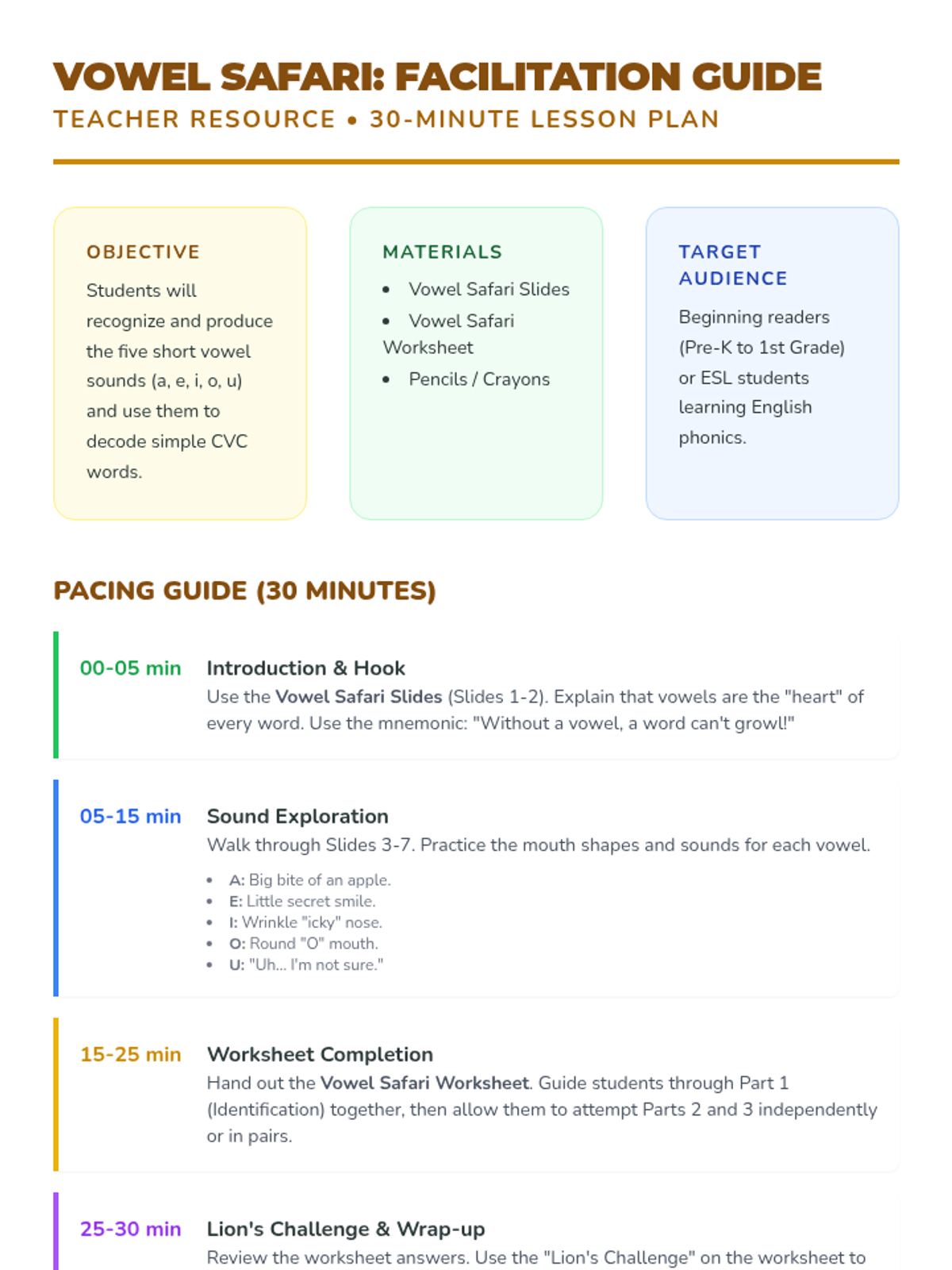
A comprehensive teacher's guide for the Vowel Safari lesson. Includes a 30-minute pacing guide, mnemonic cues for vowel production, differentiation strategies, and tips for addressing common misconceptions. Standardized styling and improved page flow.
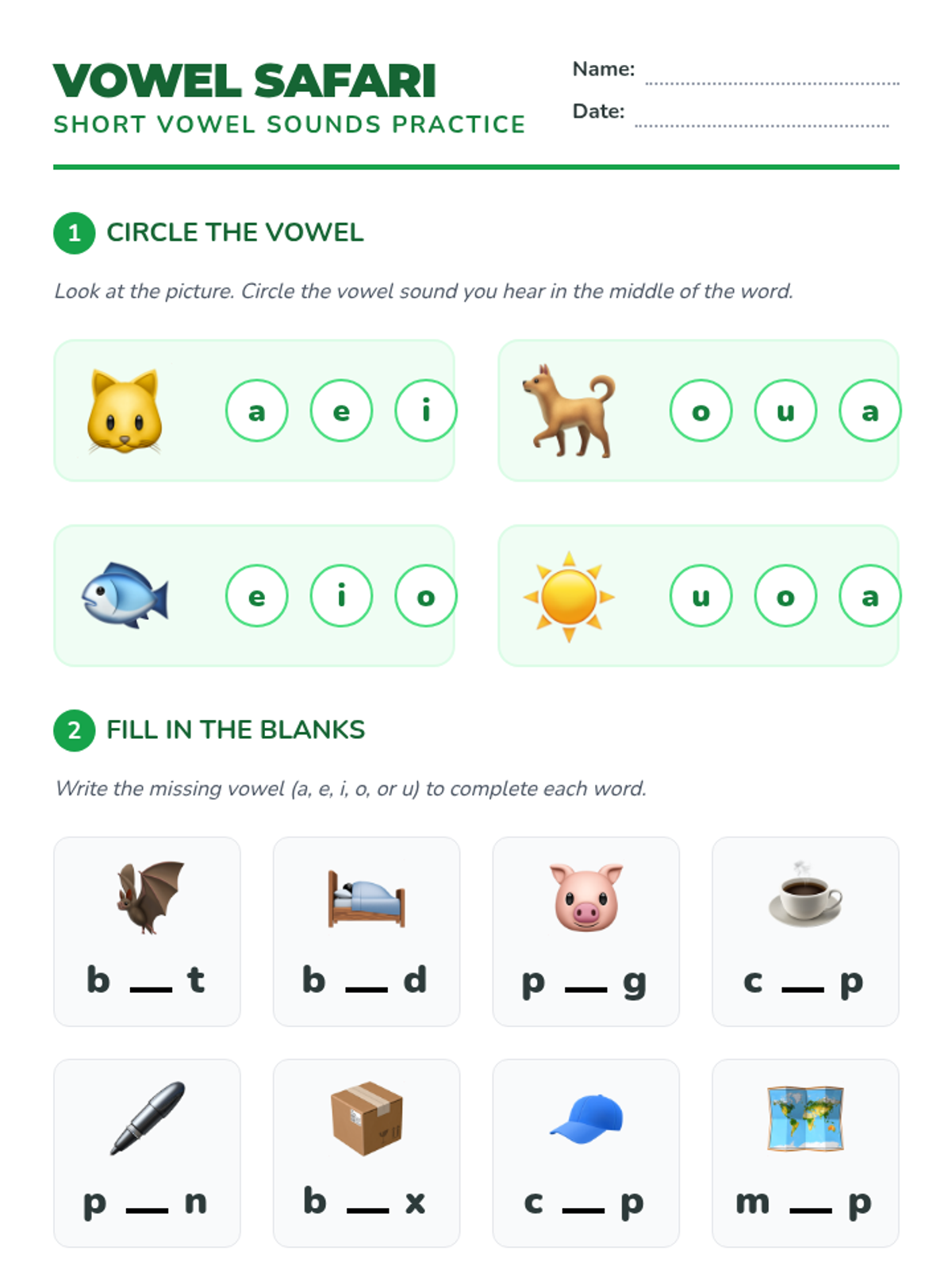
A 2-page worksheet for practicing short vowel sounds. Activities include circling vowel sounds in CVC words, filling in missing vowels, and drawing pictures based on simple read-aloud words. Vocabulary is updated for variety.
A colorful slide deck for teaching short vowel sounds (a, e, i, o, u). Includes mnemonic associations, visual examples, and simple CVC words to build phonemic awareness in beginning readers. All vocabulary is in standard uppercase for clarity.
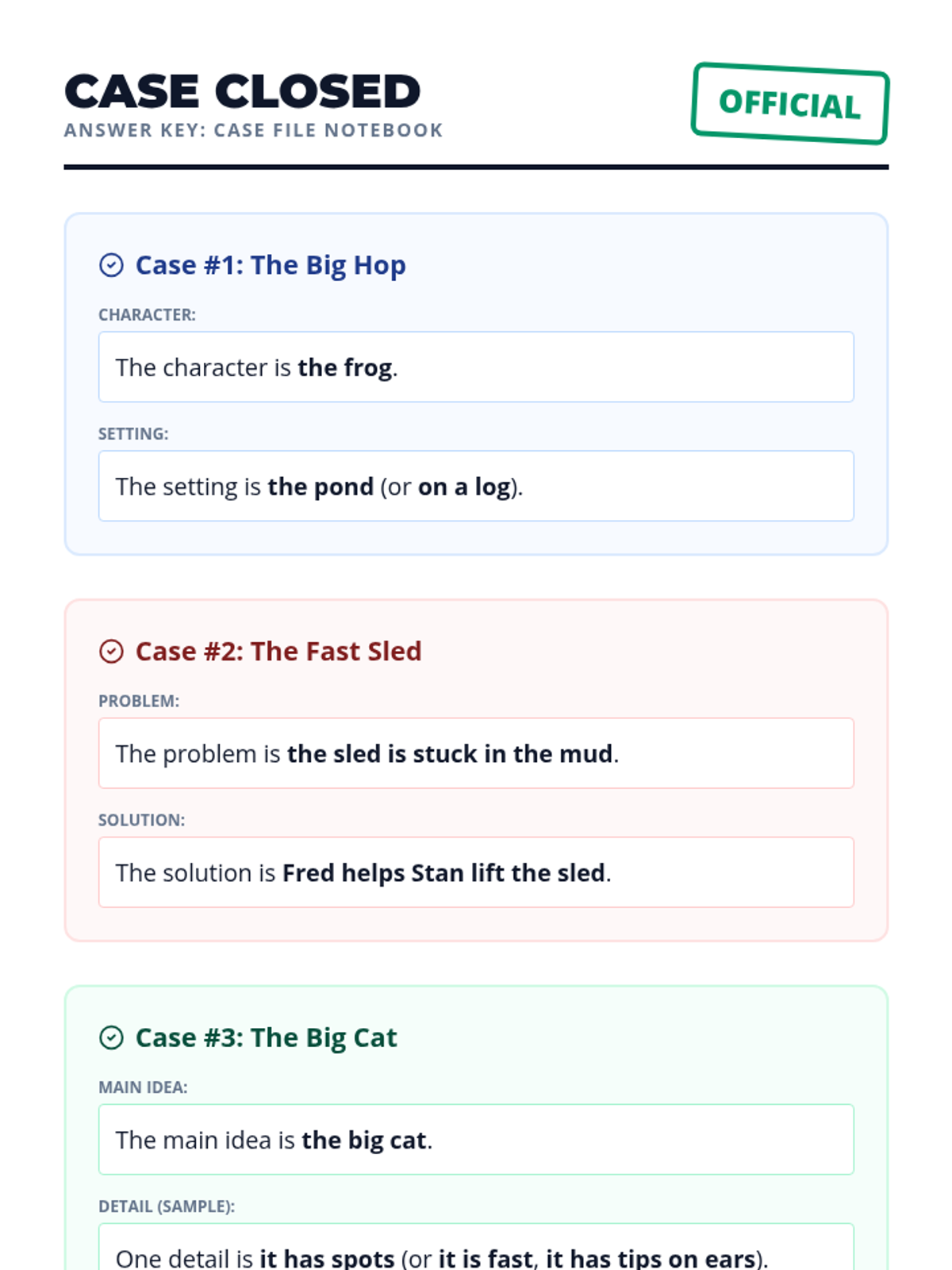
A comprehensive answer key for the Case File Notebook, providing sample student responses using the provided sentence stems.
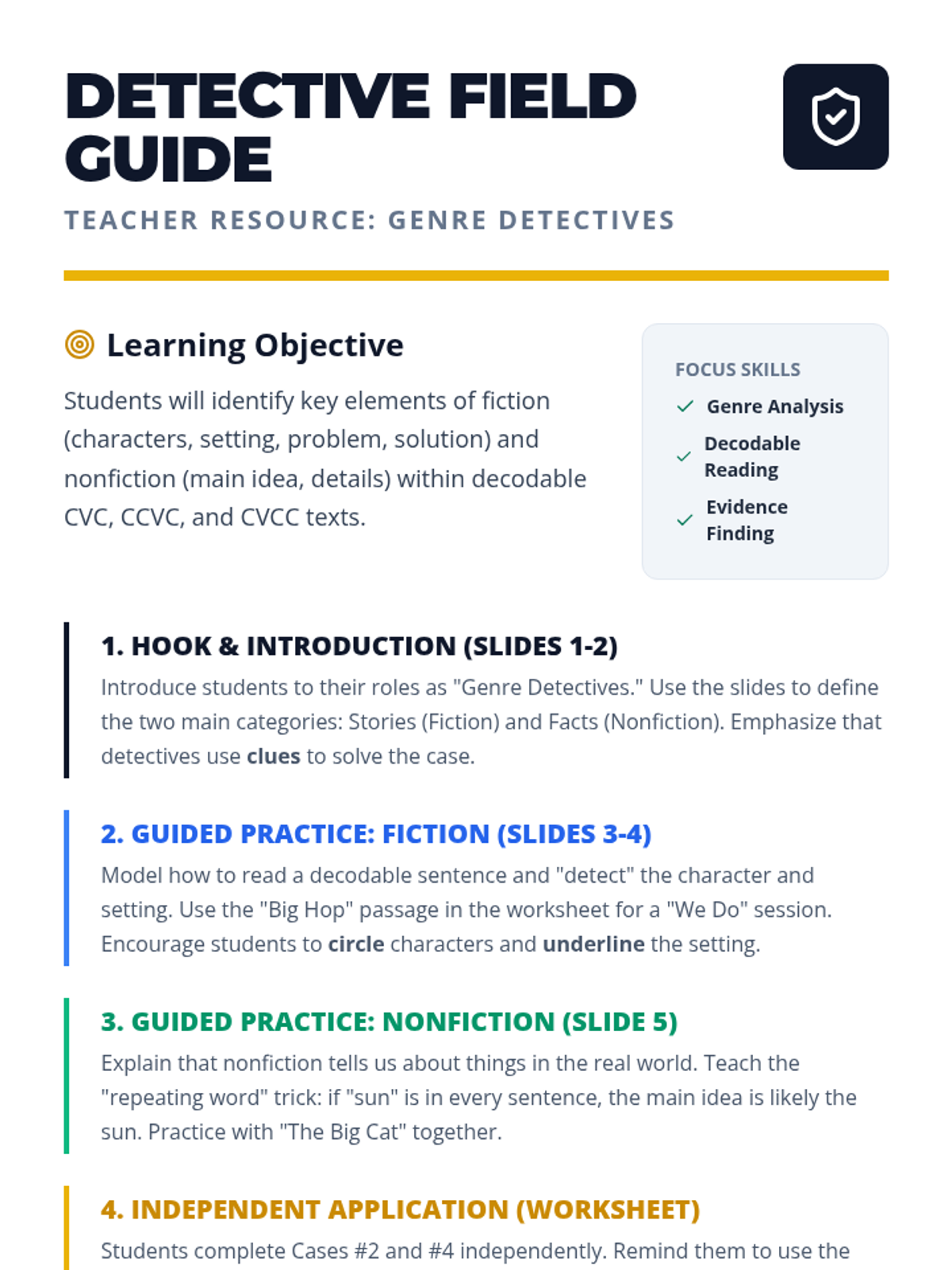
A teacher-facing guide providing instructional routines, scaffolding strategies for EL students, and troubleshooting tips for teaching genre analysis.
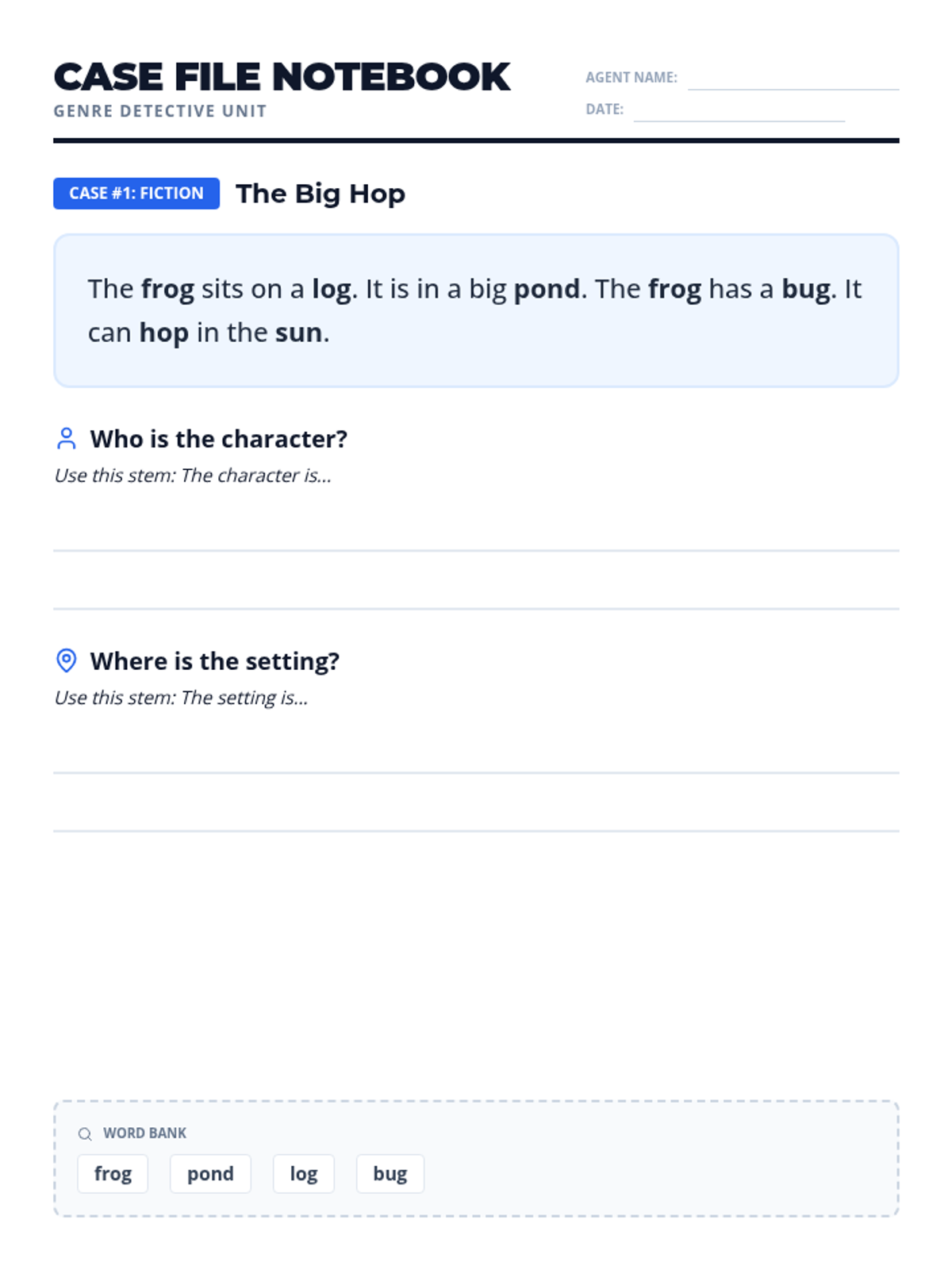
A student worksheet featuring multiple mini-passages with decodable text, focused on genre analysis (fiction/nonfiction) with sentence stems and ample writing space.
A high-impact slide deck introducing the concepts of fiction (character, setting, problem, solution) and nonfiction (main idea, details) using decodable text and visual scaffolds.
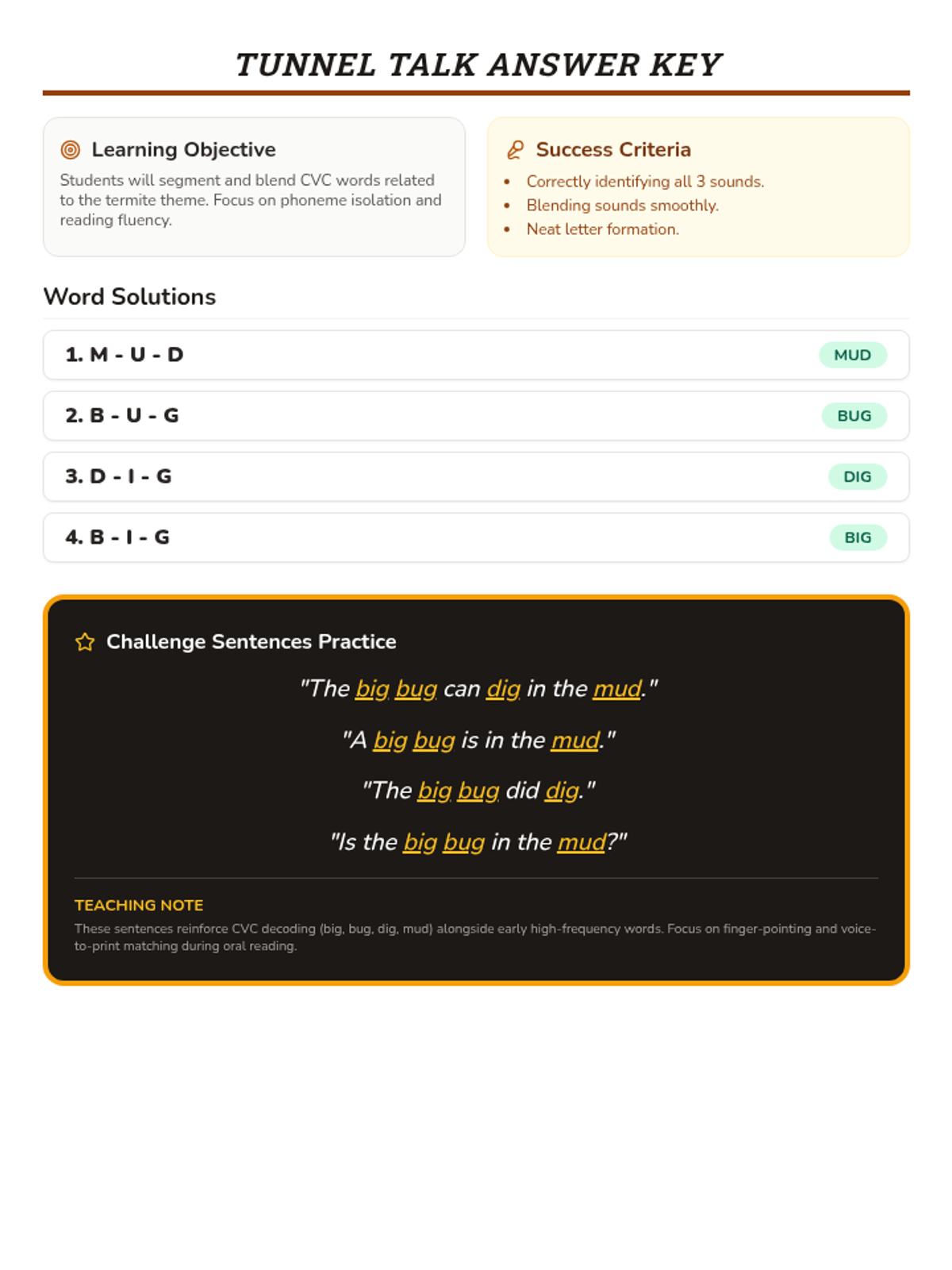
Teacher's answer key for the Tunnel Talk Decoding Worksheet, featuring solutions for the four CVC words and four challenge sentences.
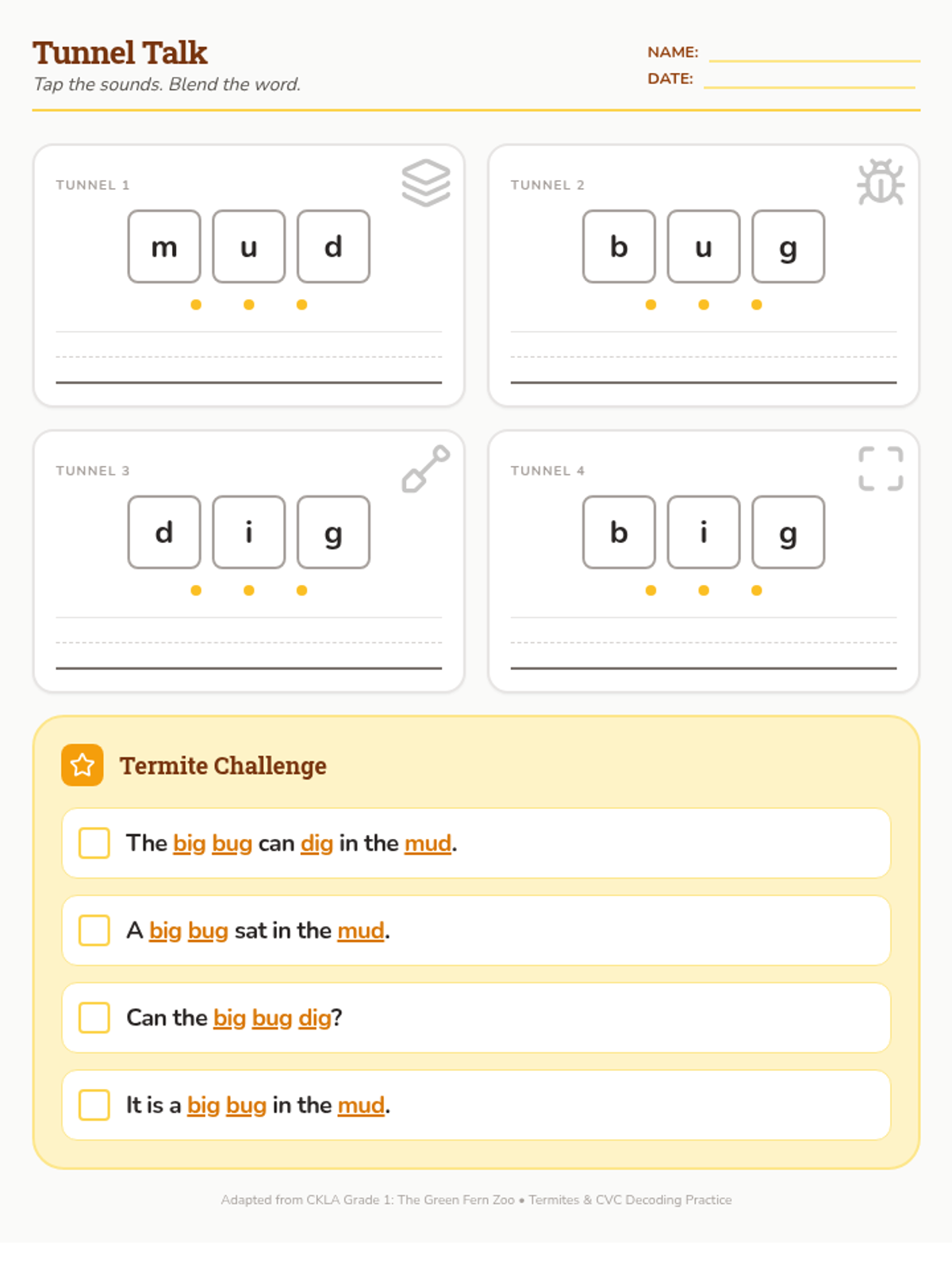
A termite-themed CVC decoding worksheet for Grade 1 students, featuring sound boxes for 'mud', 'bug', 'dig', and 'big', improved icons, and four varied challenge sentences.
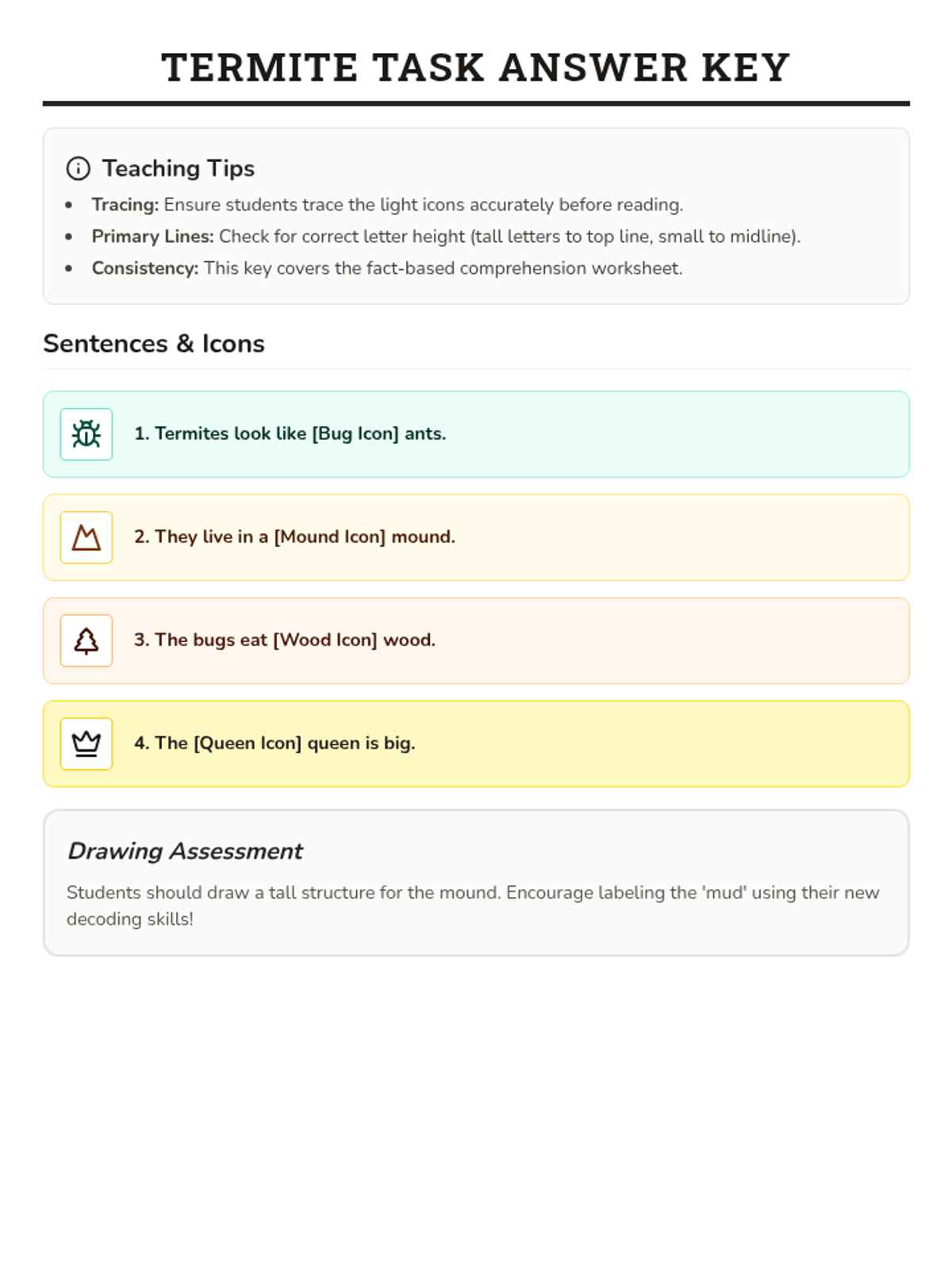
A teacher's answer key for the Termite Tale worksheet, providing solutions for sentence icons and drawing criteria.
An engaging visual presentation introducing termite facts and CVC decoding practice for words like 'mud', 'bug', 'dig', and 'big'.
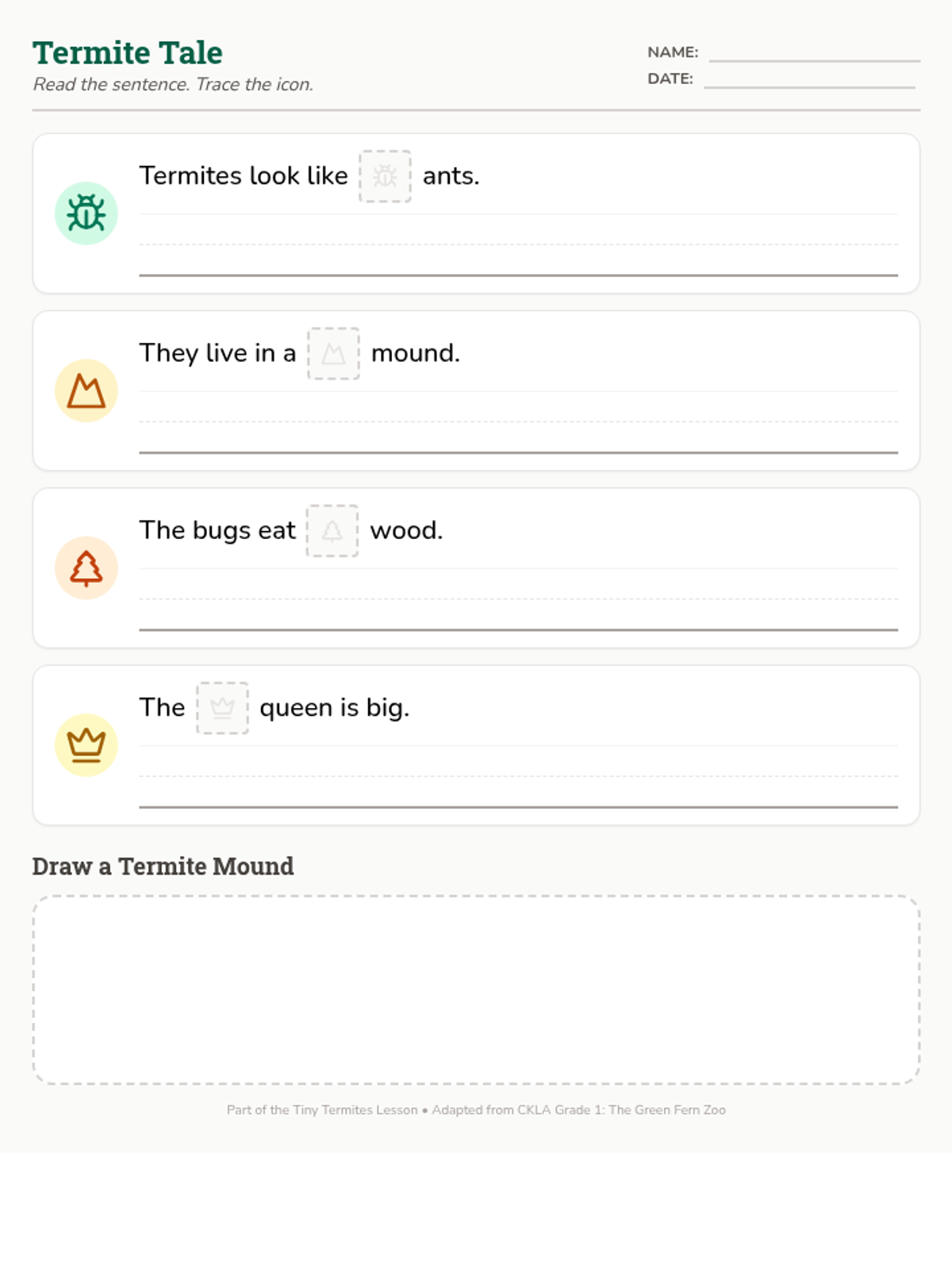
A student worksheet featuring simplified sentences about termites with light icons for tracing and improved primary ruled writing lines.
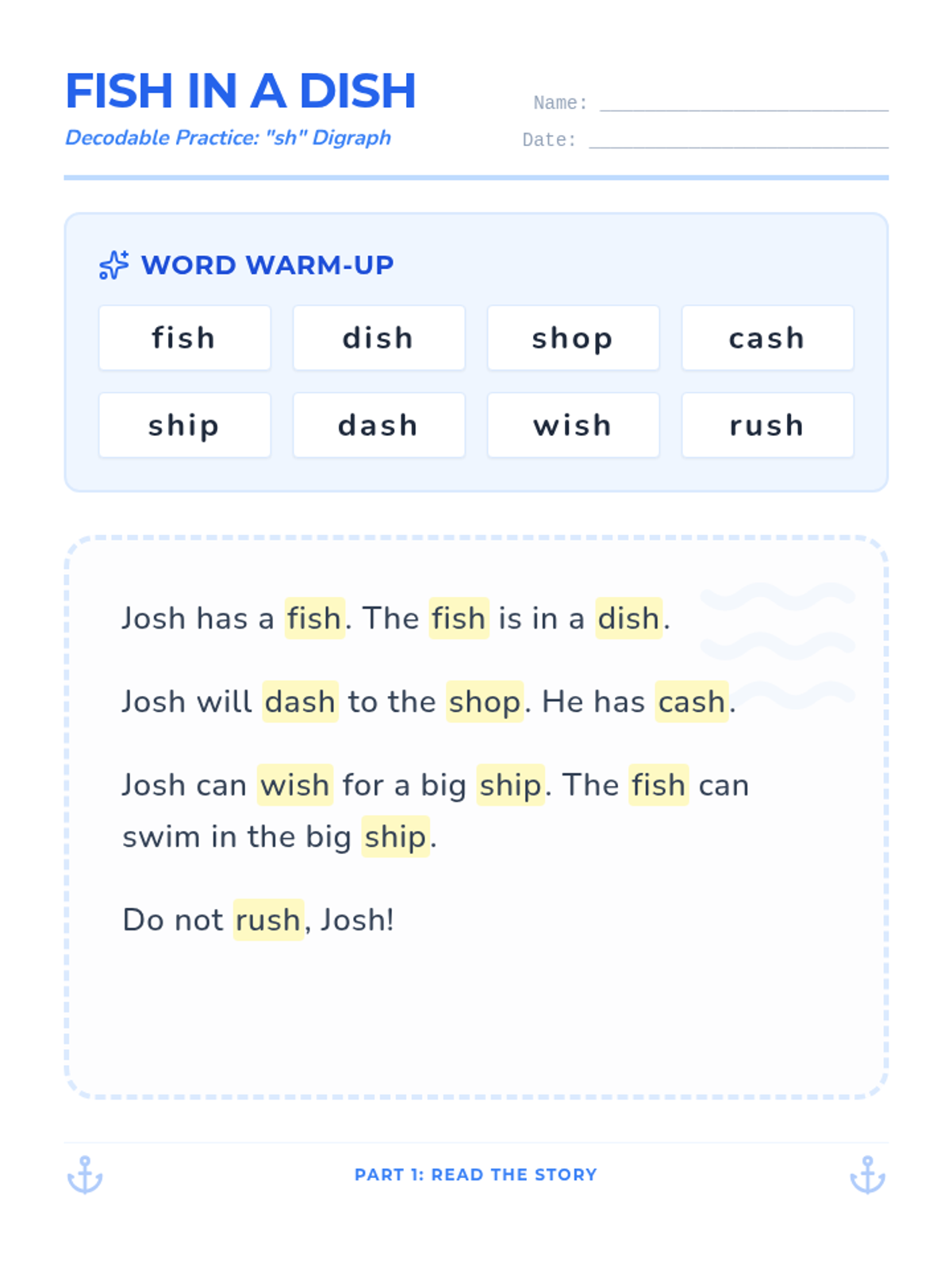
A decodable reading passage titled 'Fish in a Dish' focusing on CVC words with the 'sh' digraph. Includes a word warm-up bank, the primary story text with highlighted targets, and comprehension/illustration activities.
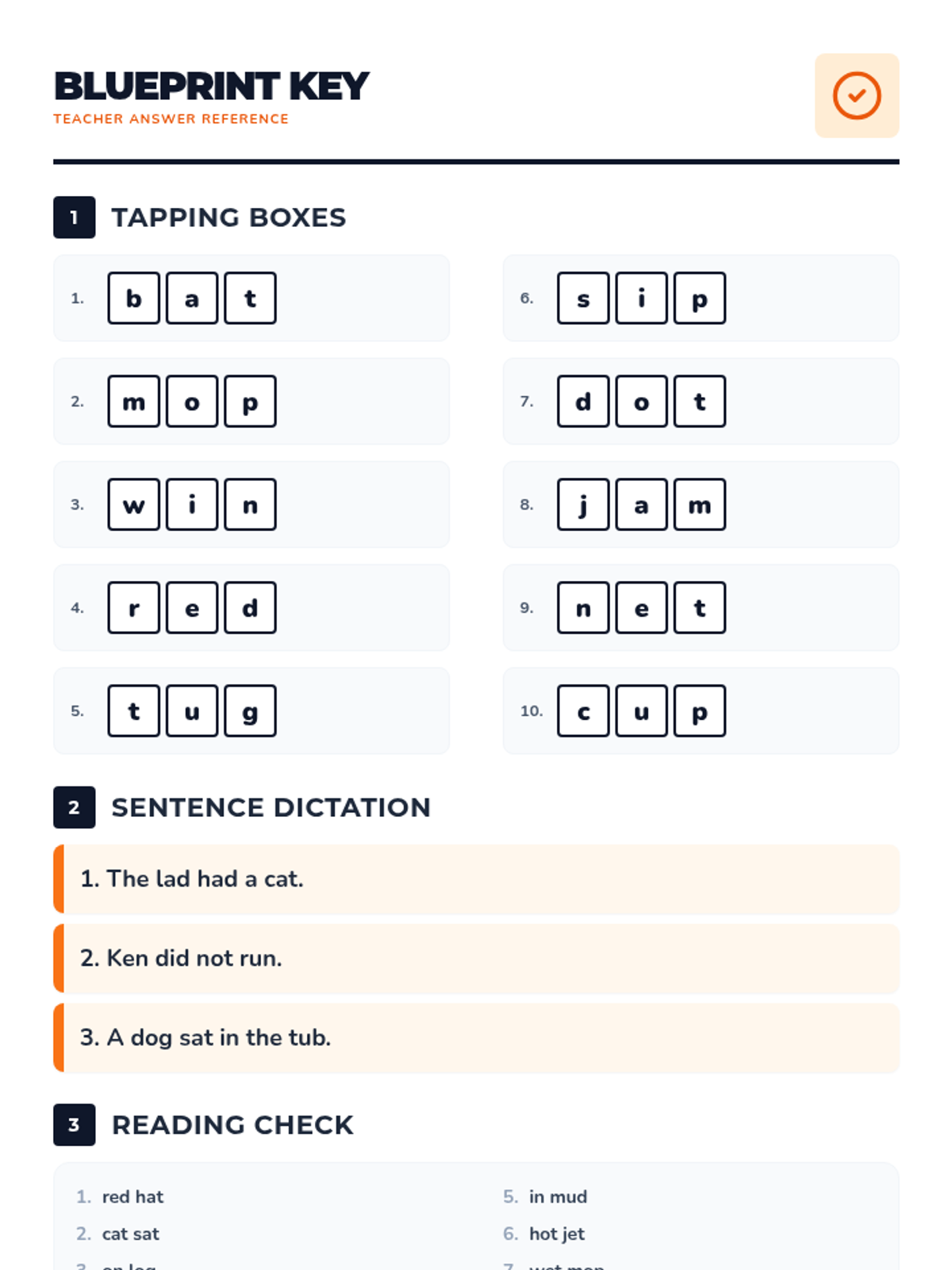
The answer key for the Sound Smith Workbook, providing correct CVC word spelling for tapping boxes and sentence dictation examples.
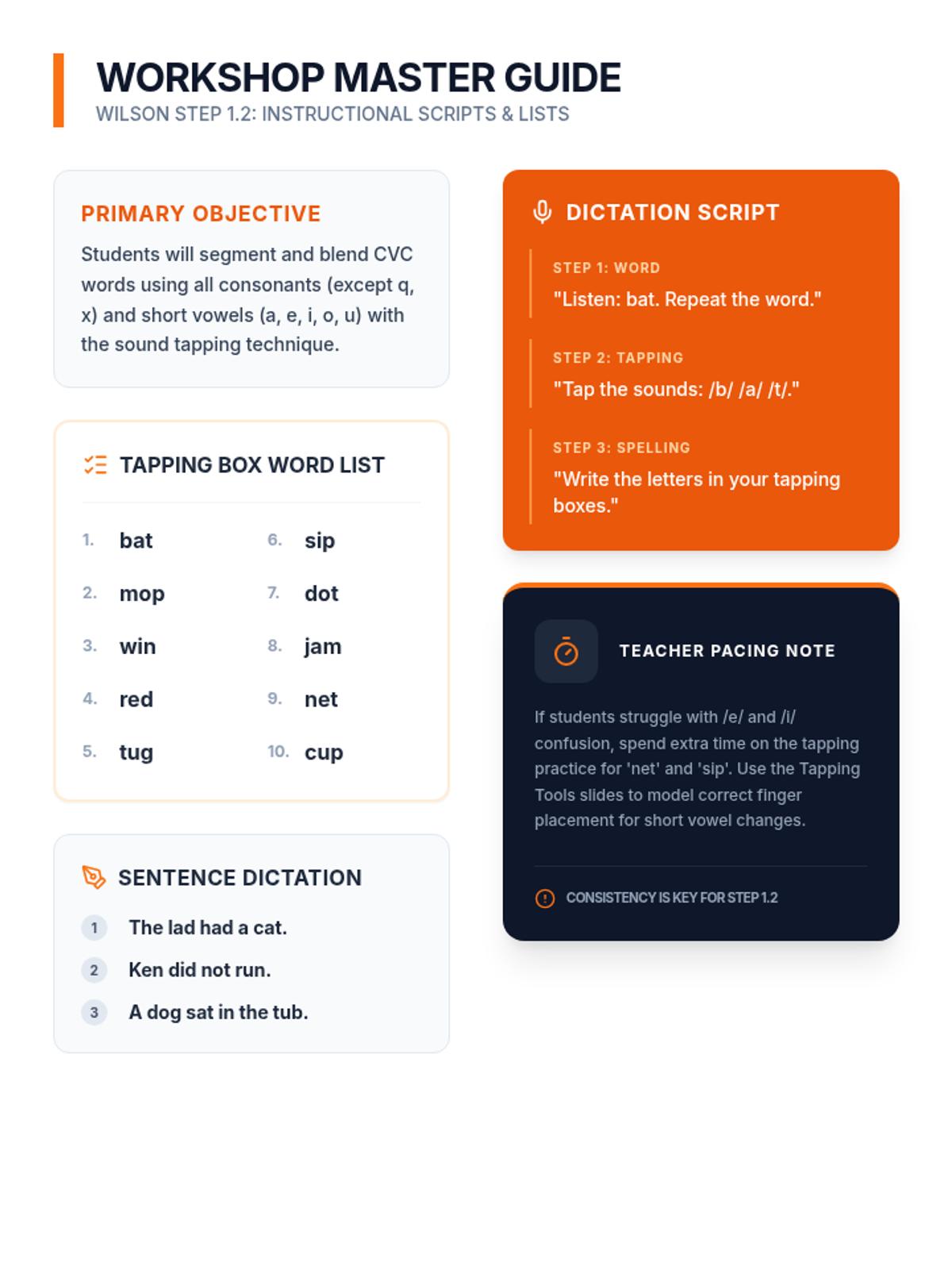
A teacher guide for Wilson Step 1.2 providing word lists for tapping, sentence dictation prompts, and instructional scripts.
An instructional slide deck for Wilson Step 1.2 teaching the sound tapping technique for CVC words and sentence reading.
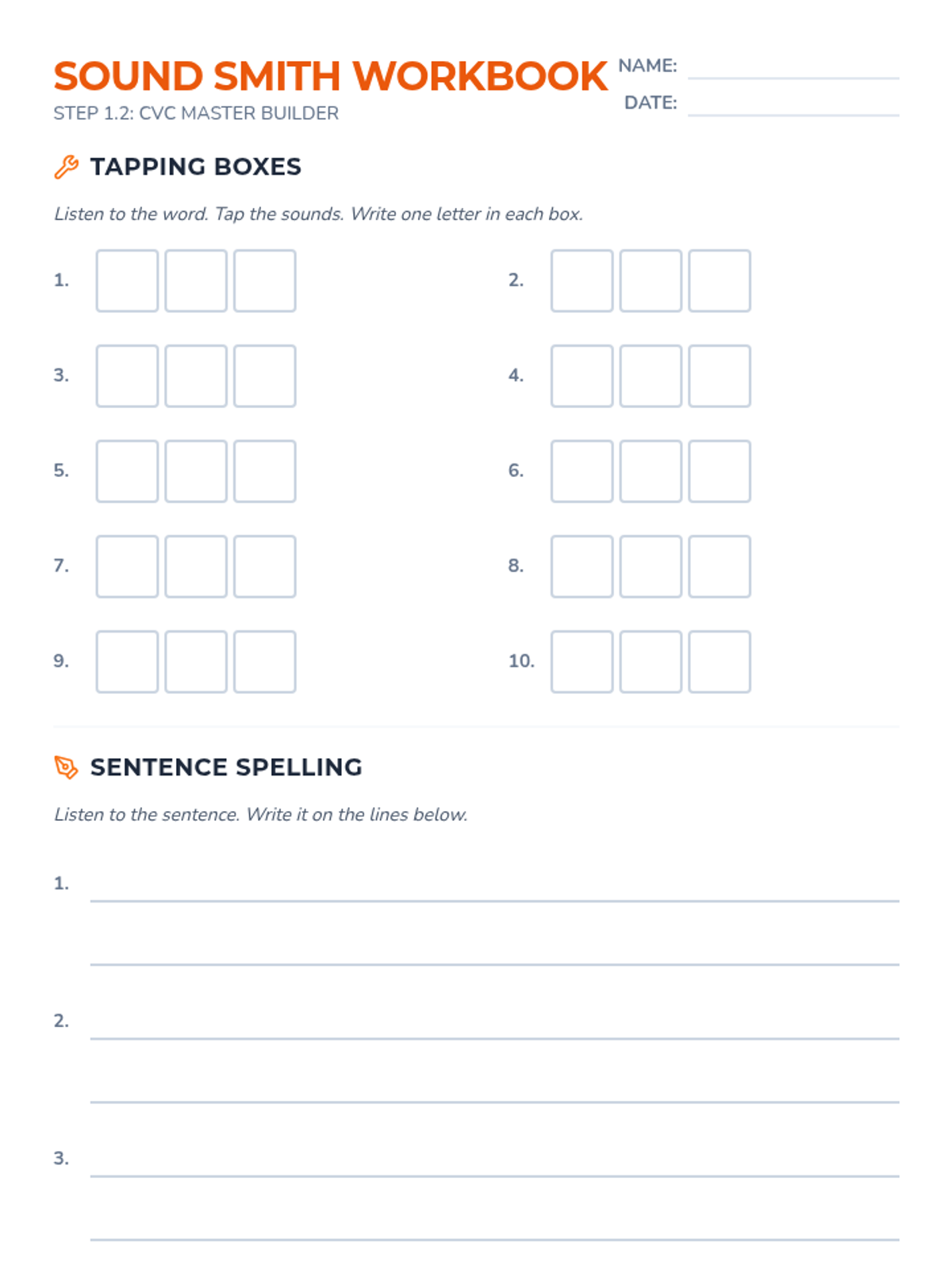
A student workbook for Wilson Step 1.2 featuring sound tapping boxes, sentence spelling lines, and CVC reading fluency practice.
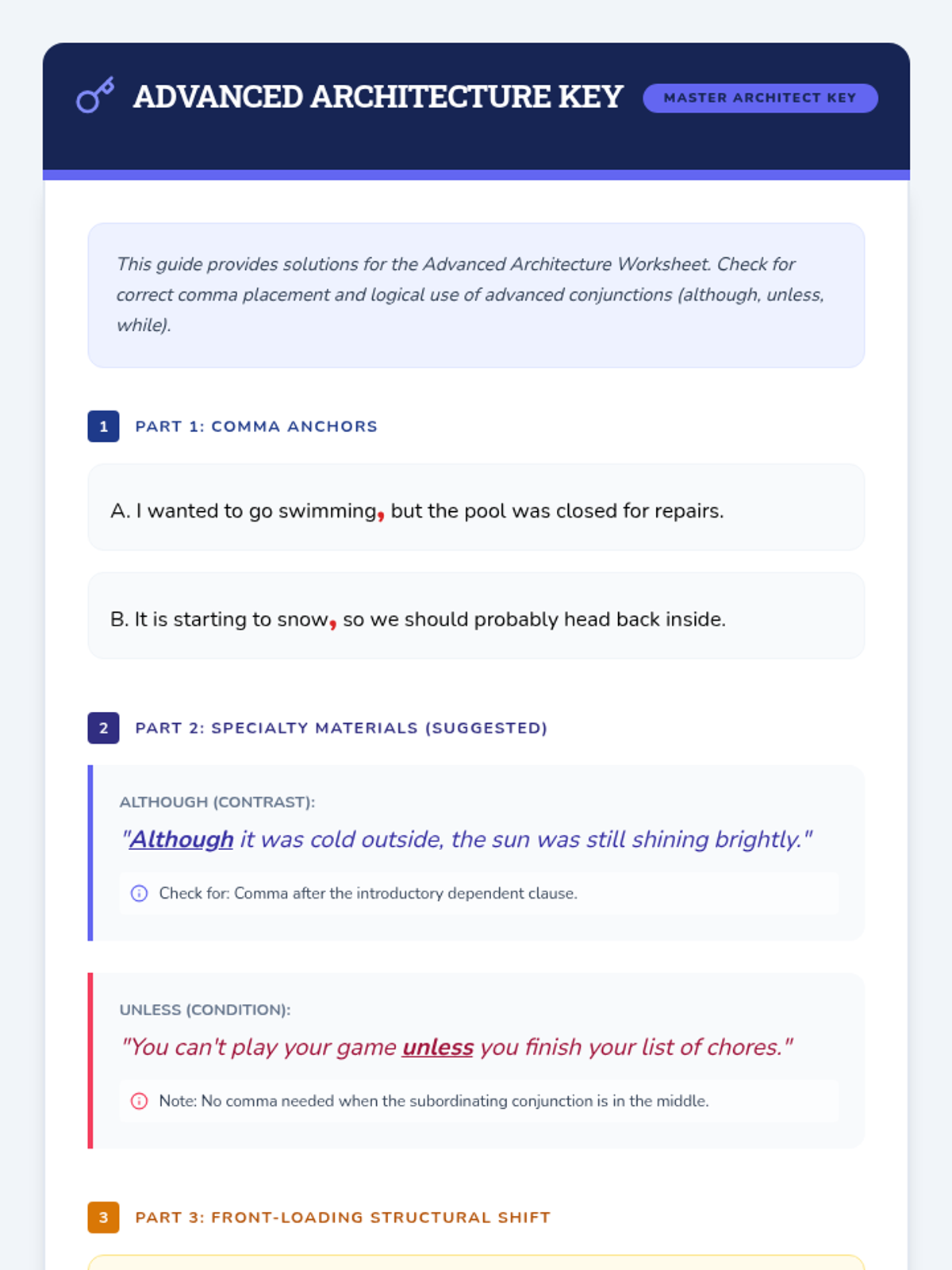
An answer key for the Advanced Architecture Worksheet, providing solutions and punctuation tips for complex conjunction structures.
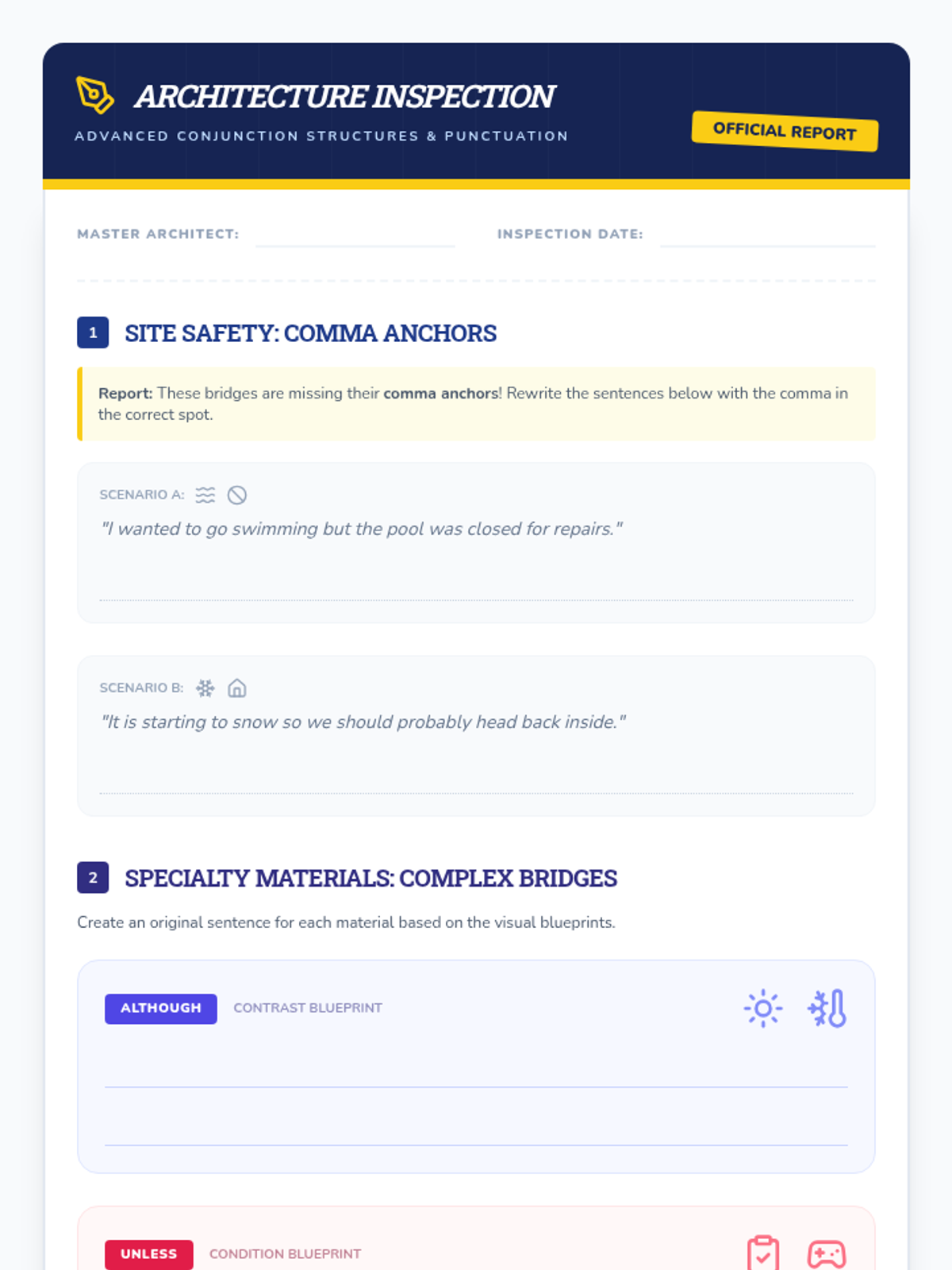
A worksheet for practicing advanced conjunction structures, including comma placement in compound sentences, using 'although' and 'unless', and rewriting sentences in front-loaded structures.
An advanced slide deck for conjunctions, introducing 'although', 'unless', and 'while'. It focuses on comma usage in compound sentences and complex sentences starting with subordinating conjunctions.
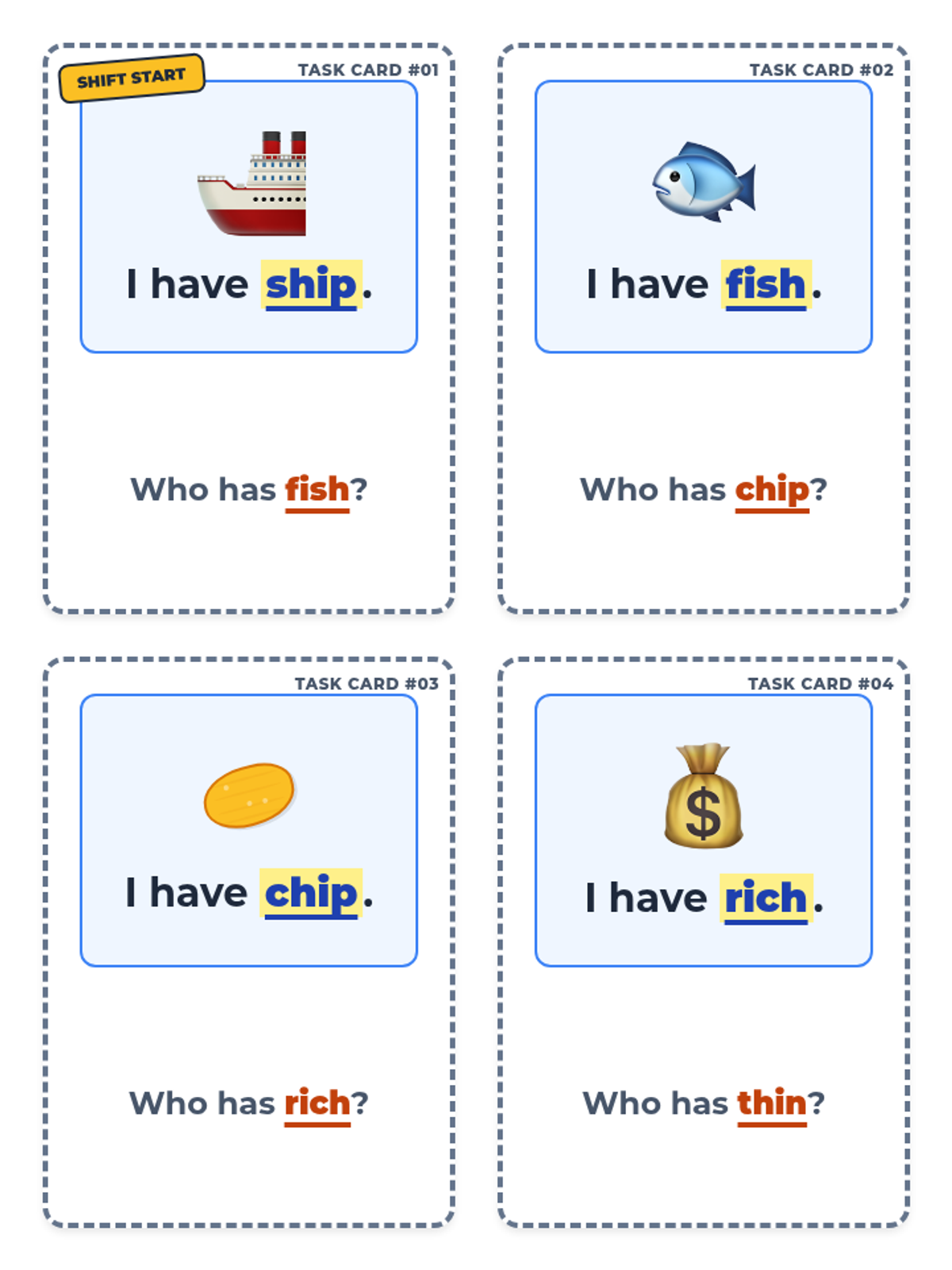
A set of 28 printable "I Have, Who Has" cards for the Blend Builders lesson, featuring words with blends and digraphs. The cards follow a construction/workshop theme with blueprint backgrounds and task card labels. Includes custom visuals for 'chip', 'whip', and 'neck'.
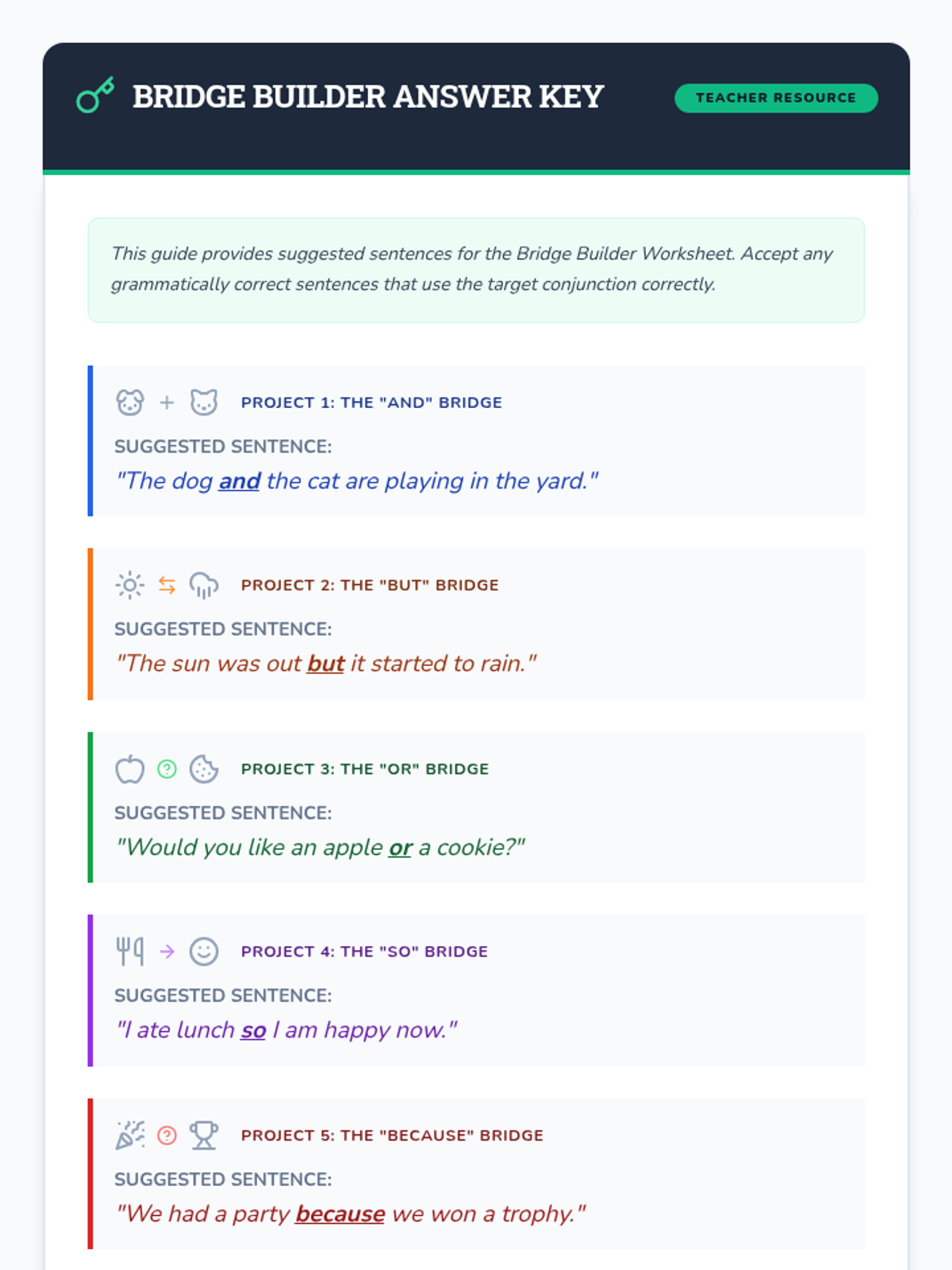
An answer key for the Bridge Builder Worksheet, providing example sentences and teaching tips for each conjunction visual prompt.
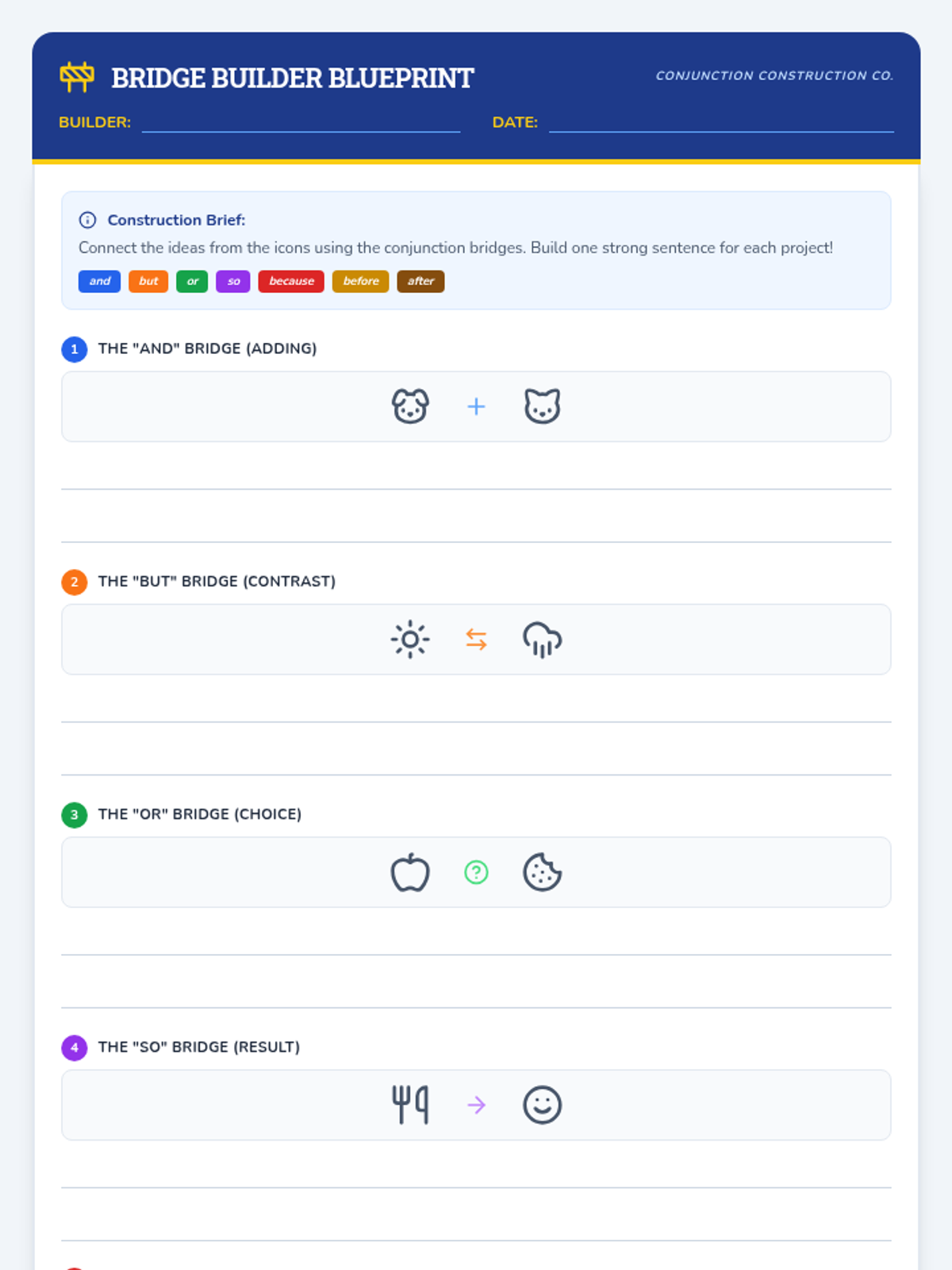
A visual worksheet where students build sentences using 'and', 'but', 'or', 'so', 'because', 'before', and 'after'. Each section includes visual icon prompts and designated writing lines in a fun construction-blueprint theme.
A visual slide deck that introduces coordinating and subordinating conjunctions using a bridge-building theme. It includes clear definitions, examples with visual icons, and practice prompts for seven key conjunctions.
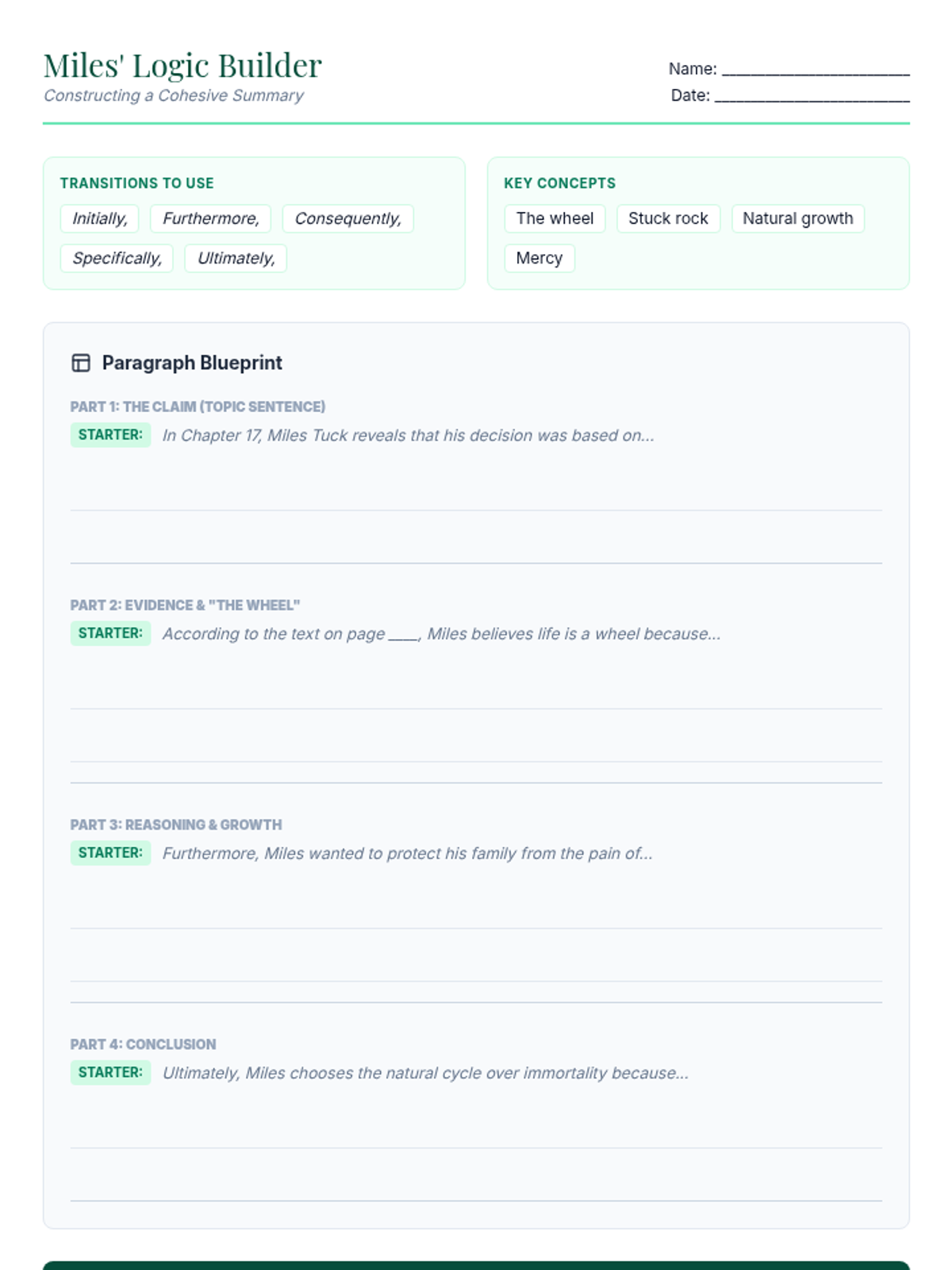
Medium-support worksheet for Tuck Everlasting Chapter 17. It provides a "Paragraph Blueprint" with specific sentence starters and labeled sections to help students bridge the gap between cloze frames and independent writing. Revised with better writing lines and spacing.
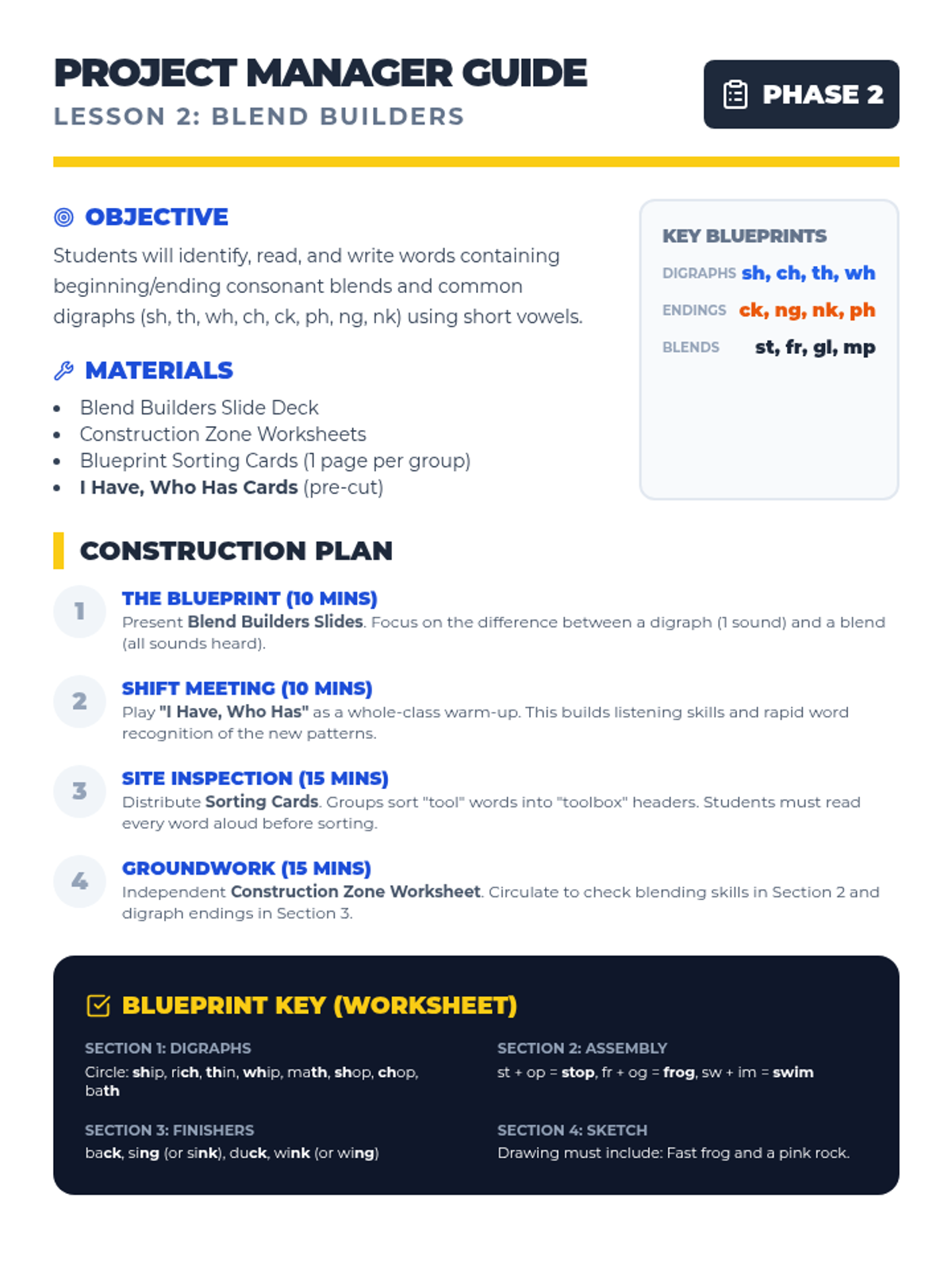
A comprehensive teacher's guide for the Blend Builders lesson, providing an objective, materials list, step-by-step procedure, and an answer key for the student worksheet. Designed in a professional "project manager" theme.
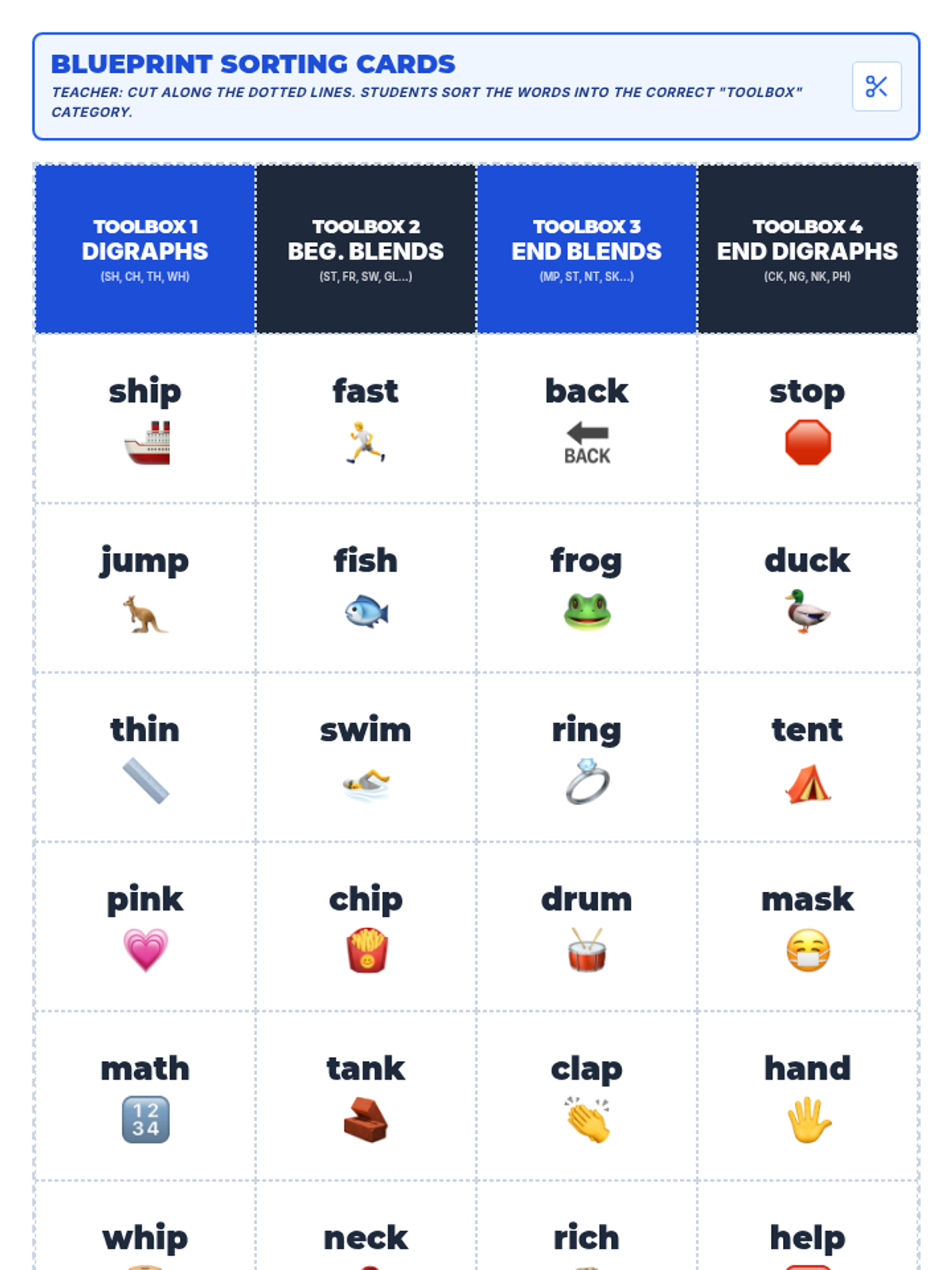
A single-page set of 28 printable sorting cards (4 category headers and 24 randomized word cards). Designed for a hands-on literacy center activity where students categorize "tool" words into themed "toolbox" headers without visual cues from color coding.
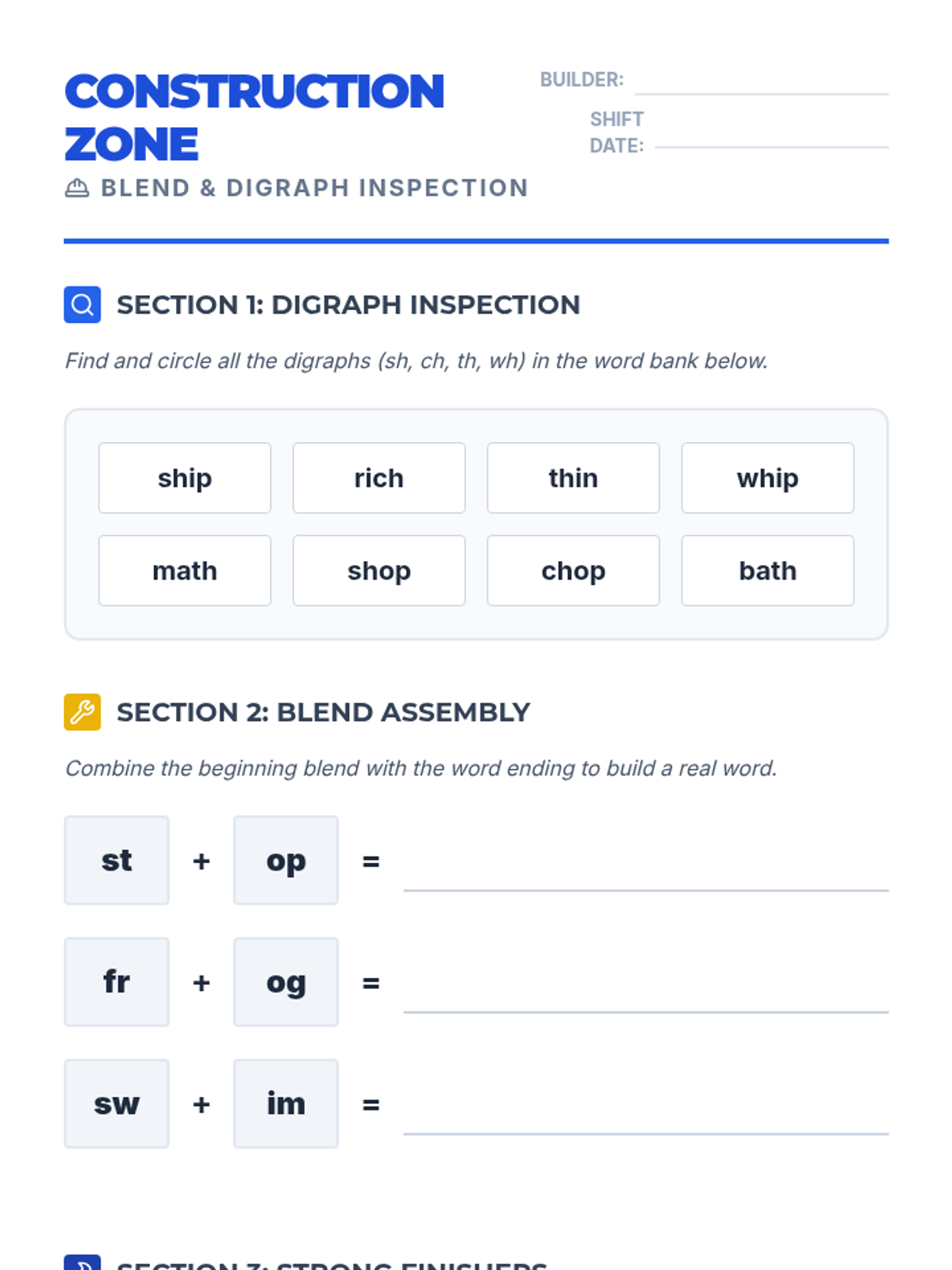
A student-facing practice worksheet with sections for identifying digraphs, building words with beginning blends, and completing words with ending digraphs. Includes a "blueprint sketch" reading comprehension task.
An interactive slide deck introducing beginning and ending consonant blends and digraphs. Features a construction/workshop theme with clear visual breakdowns of word structures and a "Word Build Challenge."
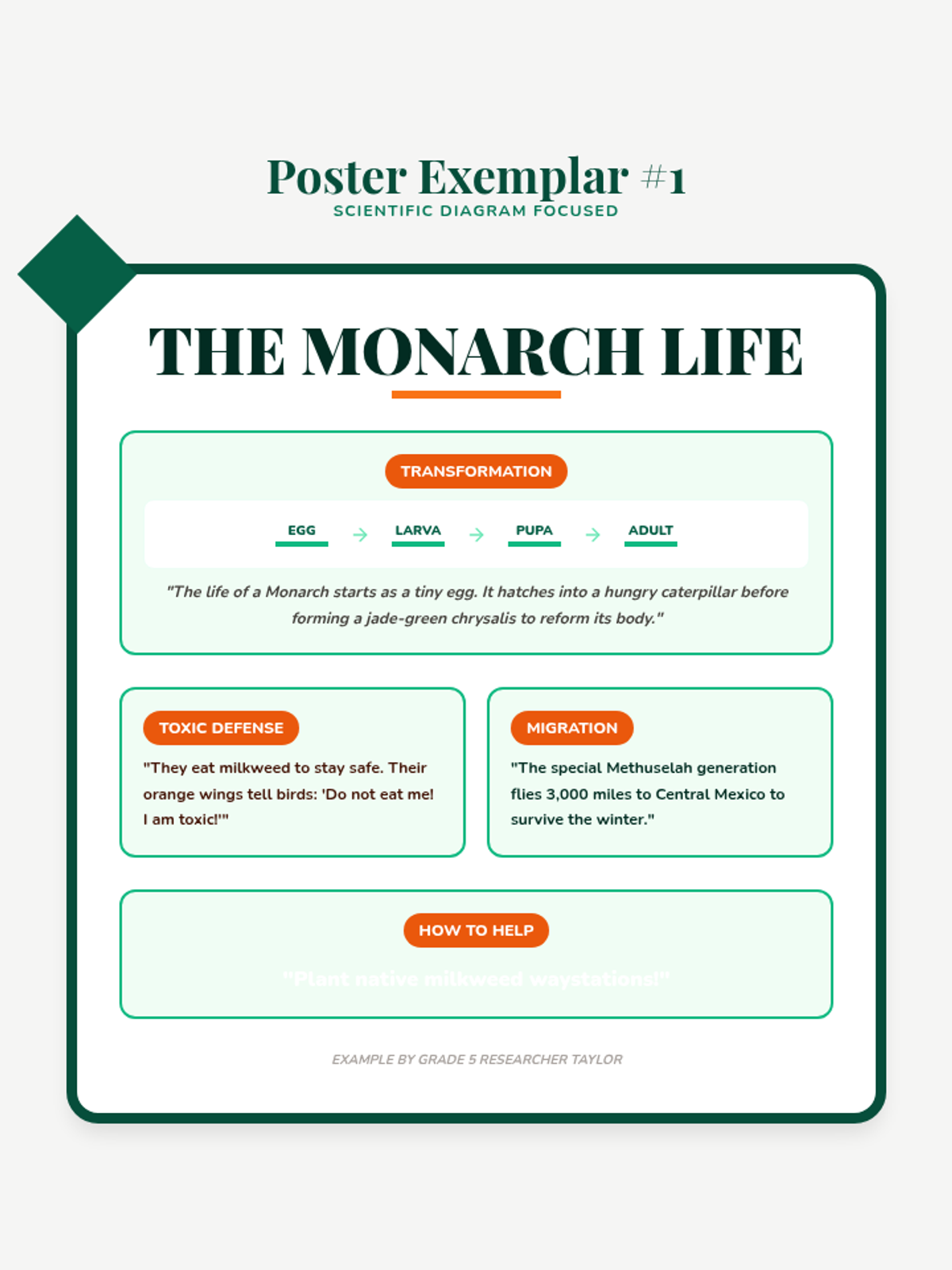
Visual student exemplars for the butterfly poster project, showcasing different design styles (Scientific Diagram vs. Travel Map) while meeting all project requirements. Helps students visualize successful final products. Optimized for clear, single-page presentation with high-contrast text.
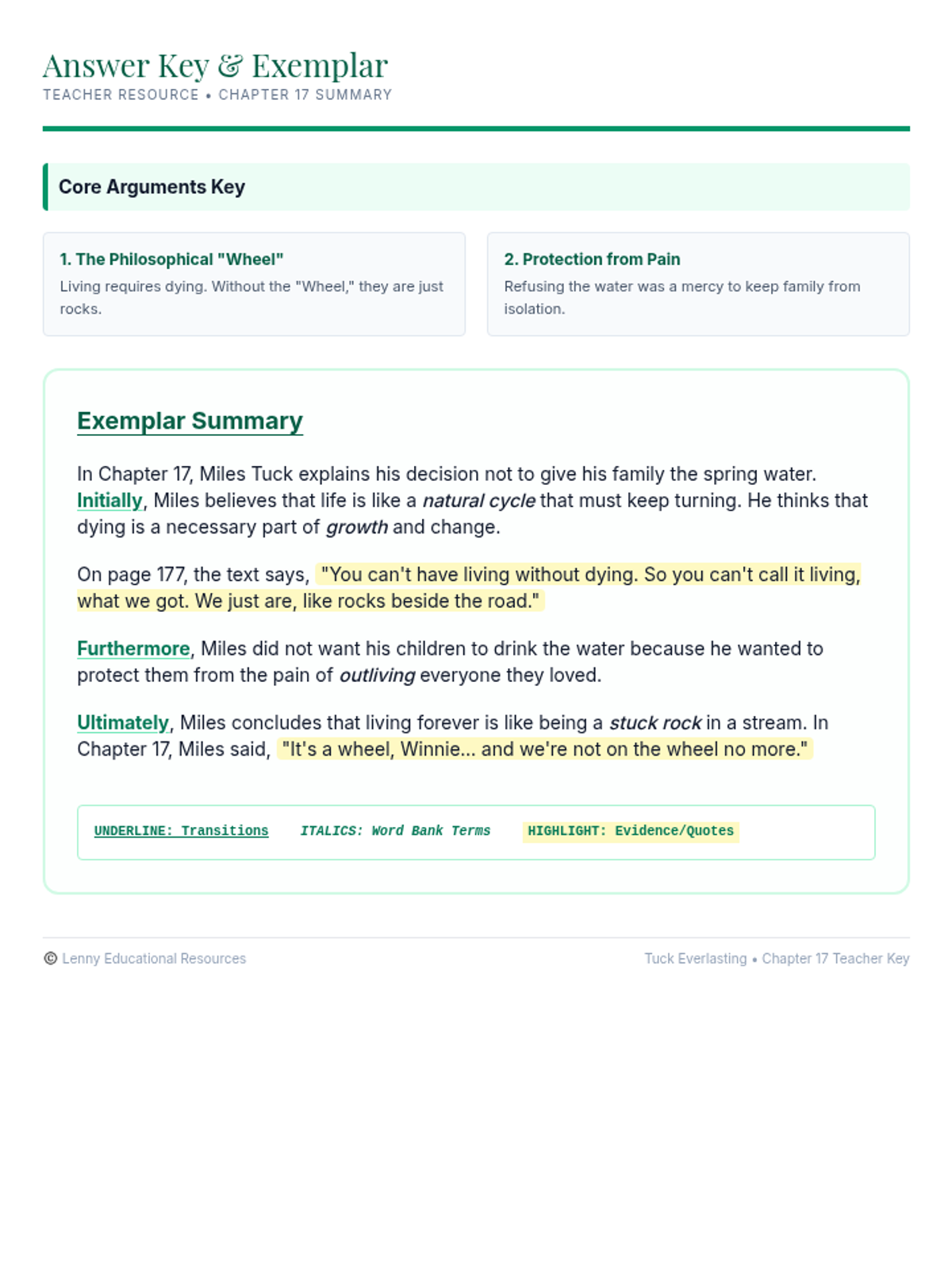
Answer key and exemplar summary for the Miles Tuck reasoning activity, including core arguments and a sample completed paragraph. Revised for better layout and explicit labeling of required elements.
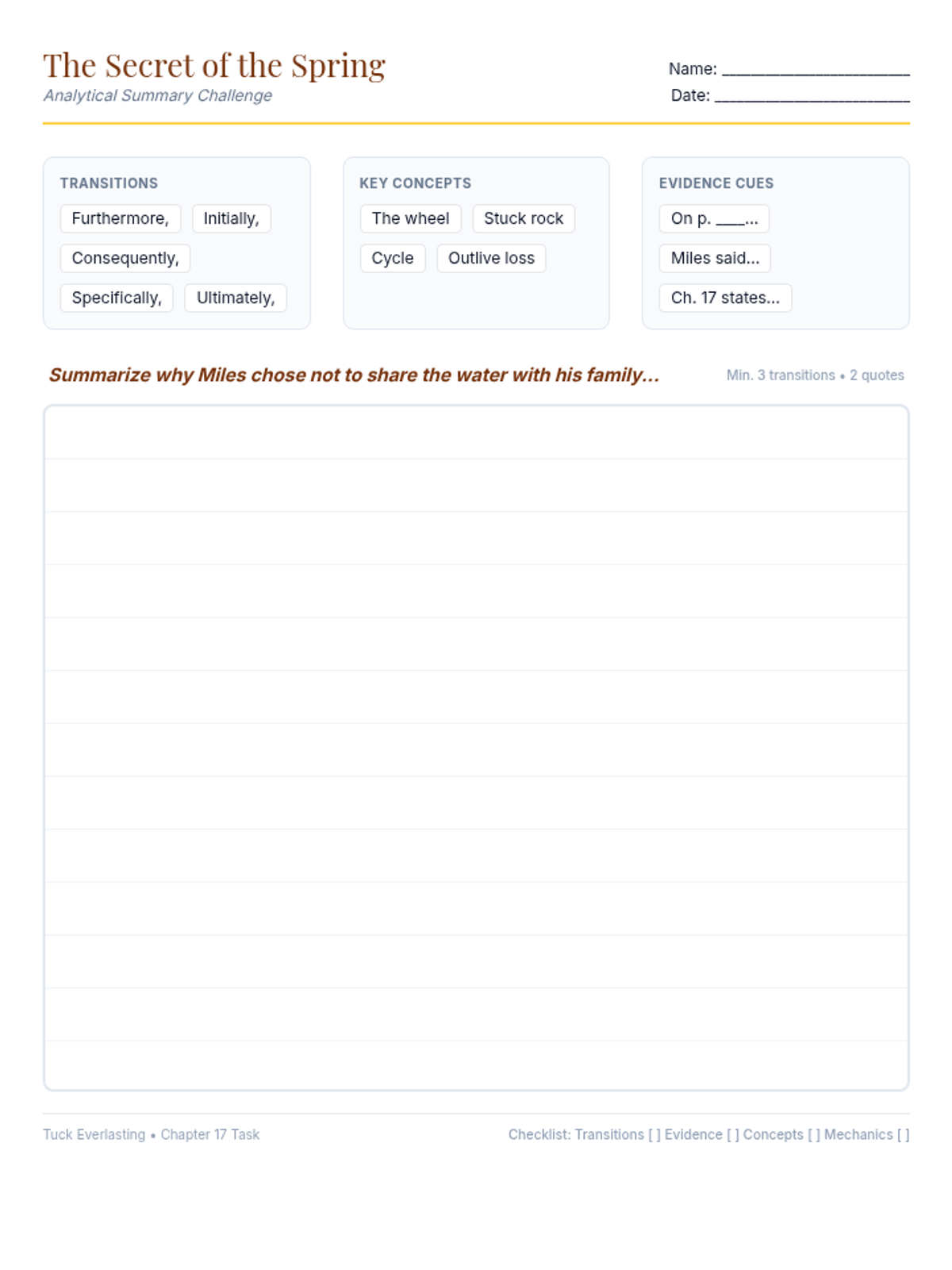
Standard-support worksheet for Tuck Everlasting Chapter 17 providing transition word banks and sentence starters while allowing students to construct their own paragraph. Revised with more reliable writing lines and increased line height for handwriting.
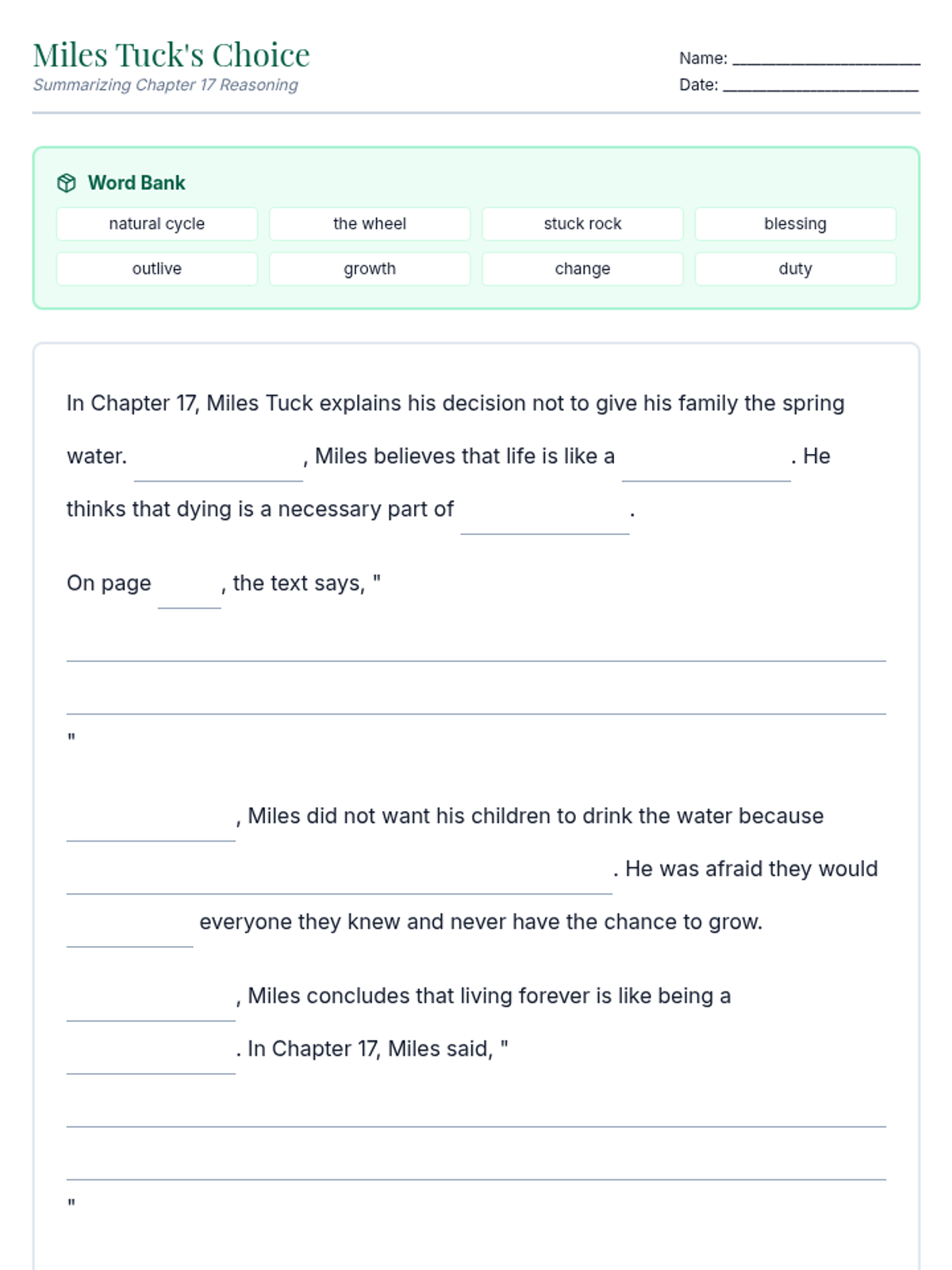
High-support worksheet for Tuck Everlasting Chapter 17 with a detailed paragraph frame, word bank, and specific evidence cues for students. Revised for better page flow and stable writing lines.
Instructional slide deck for Chapter 17 of Tuck Everlasting, introducing Miles' reasoning, transition words, and the use of textual evidence. Now includes differentiated transitions and a visual model of the paragraph frame.
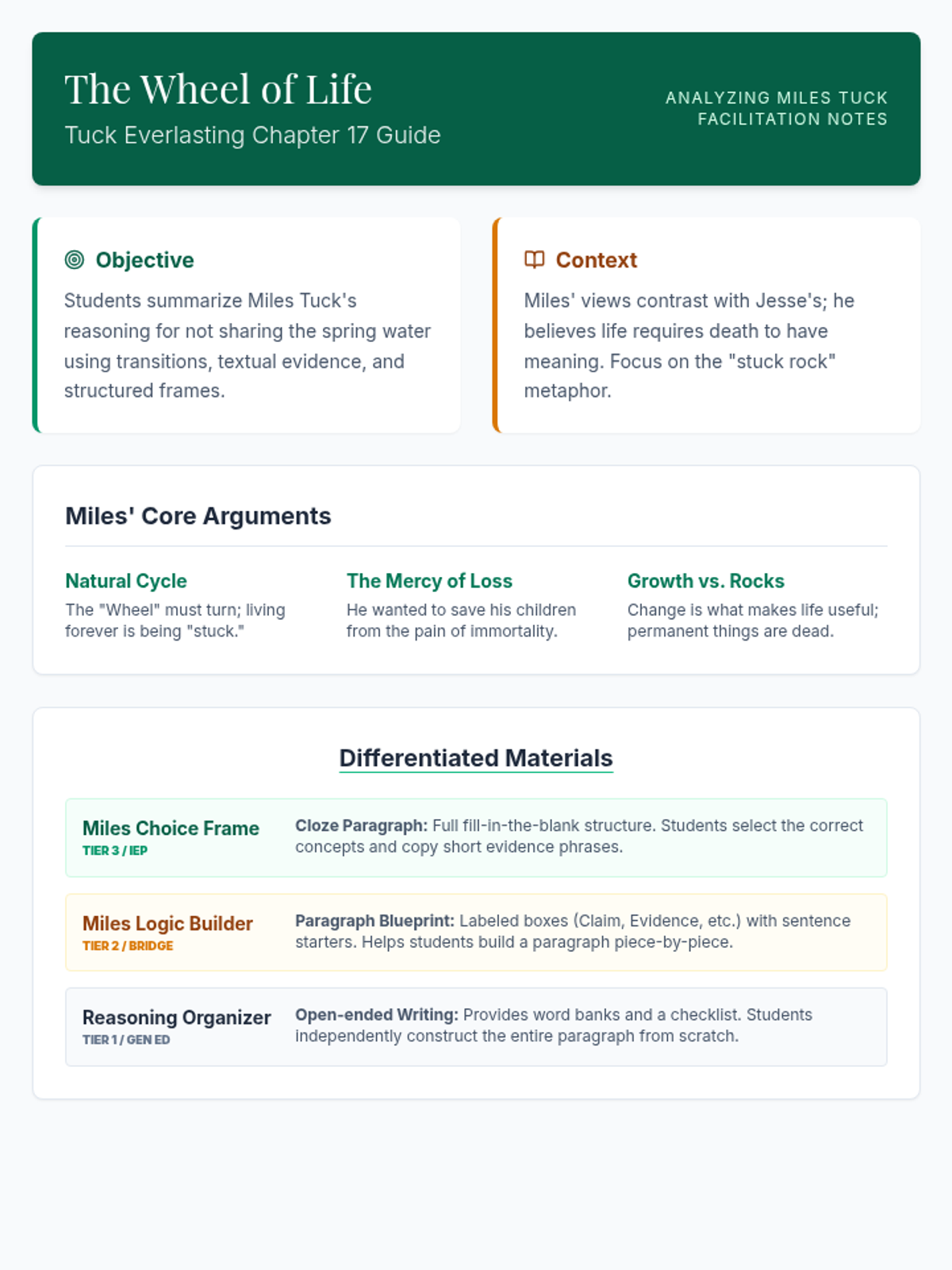
Teacher facilitation guide for Chapter 17 of Tuck Everlasting, focusing on Miles Tuck's reasoning, key philosophical points, and differentiation strategies for the summary activities. Updated to include the new "Medium Support" bridge material.
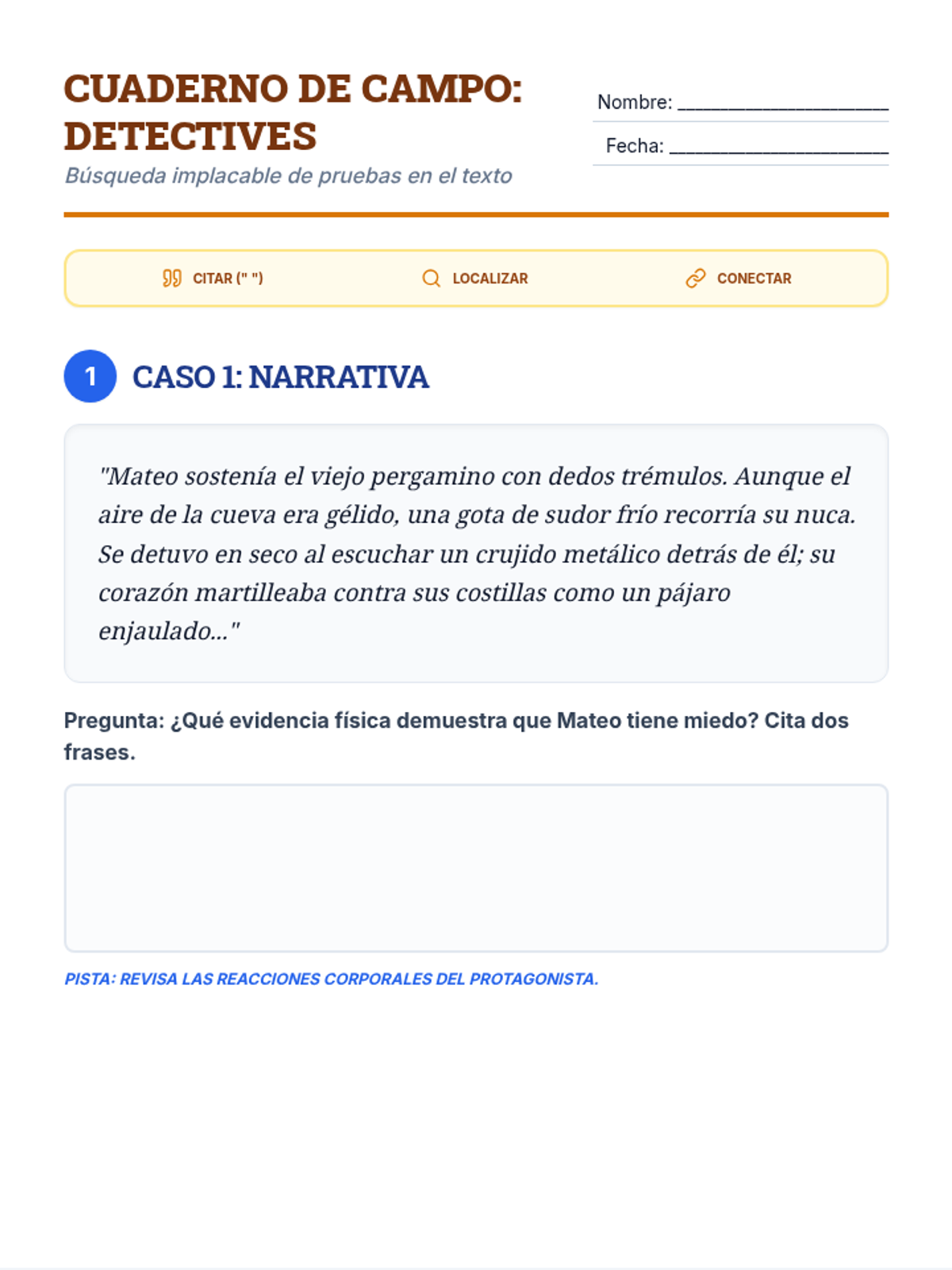
Una hoja de trabajo mejorada con los textos incluidos, espacios de respuesta más amplios y una estructura de tres páginas que garantiza que los estudiantes tengan el material necesario para encontrar evidencia.