A foundational laboratory-themed lesson for 6th-grade beginner woodwinds focusing on rhythm data counting, tonguing chemistry, and applying posture 'protocols' to three instrumental experiments.
An intermediate jazzy pom dance routine set to 'Under the Sea', focusing on sharp motions, jazz technique, and high-energy performance.
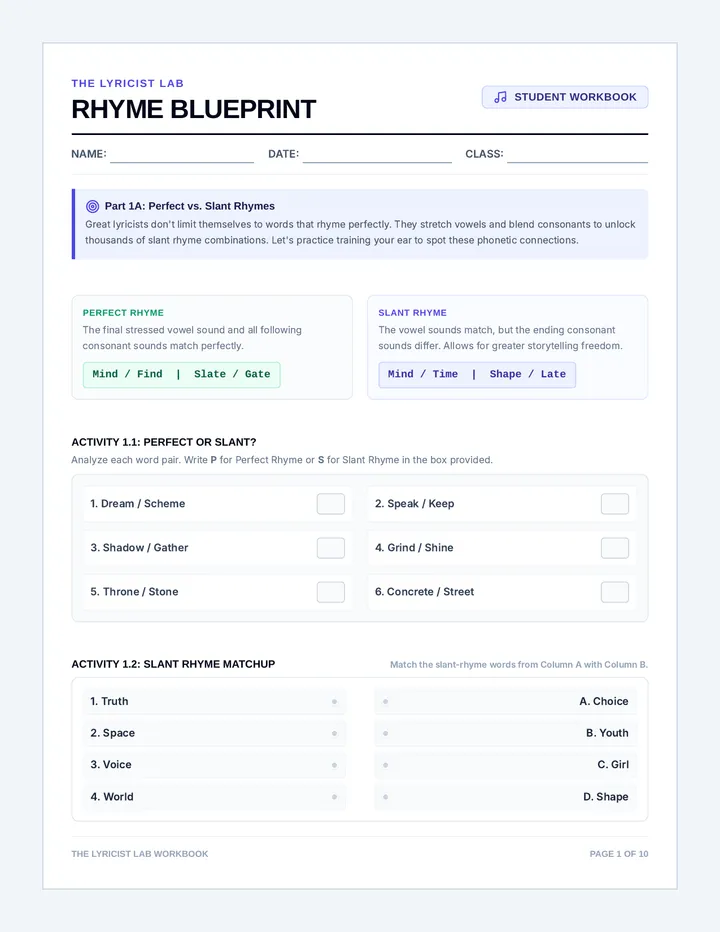
A comprehensive rhythm project where students review fundamental rhythm values (quarter, eighth, sixteenth, half, whole notes and rests) through interactive games and a final composition project called the 'Groove Blueprint'.
Conception d'actions de médiation concrètes, de la mise en espace physique du CDI aux outils numériques, pour engager les élèves dans la lecture.
Exploration de l'histoire, des genres et des mutations actuelles de l'édition pour adolescents, incluant l'impact des réseaux sociaux et des nouvelles tendances éditoriales.
A high-energy, low-pressure 15-minute music lesson designed to engage disengaged students and build vocal confidence through rhythm and stealth games. This lesson moves from non-verbal rhythmic games to collective vocalizing to bypass the fear of singing.
Students explore the historical significance and emotional weight of the Greensboro Sit-ins through drama-based activities and historical analysis, focusing on the theme of courage.
A 45-minute exploration of how Valentine's Day art has evolved from medieval manuscripts to modern pop art, followed by a creative design activity.
A lesson designed to help students distinguish between effective and ineffective slide design for their invention presentations. It uses a side-by-side comparison of a 'good' and 'bad' presentation to teach visual design and organization principles.
A design-focused workshop that provides middle schoolers with rigorous step-by-step guidance on creating a purposeful, visually balanced, and deeply personal vision board.
This lesson explores how artists blend and draw inspiration from various cultures, focusing on cultural fusion, symbolism, and identity in global art. Students will analyze contemporary artists and create their own fusion-inspired designs.
A lesson designed to help students analyze and discuss visual art using specific vocabulary and sentence stems focused on color, perspective, design, lines, and detail.
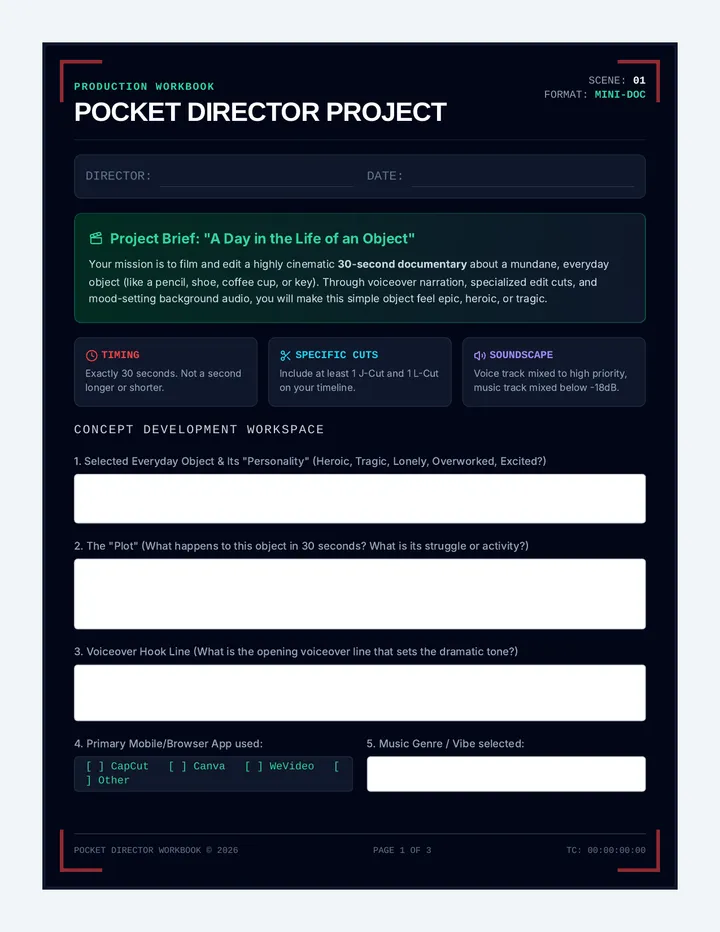
A comprehensive lesson on the art of storyboarding for short videos, teaching students how to translate their creative visions into structured visual plans. Students will learn the key elements of a storyboard and practice planning their own video production.
Students will explore the iconic art and architecture of Southwestern Europe, specifically focusing on France, Italy, and Spain. They will analyze the significance of landmarks like the Mona Lisa and the Colosseum before creating a historical postcard to demonstrate their understanding of the region's cultural heritage.
Students explore the history and technique of Roman and Byzantine mosaics, culminating in the creation of a modern icon using paper tesserae. The lesson connects ancient preservation methods to modern visual communication.
A culturally immersive art lesson where students explore the tradition of Guatemalan Alfombras (sawdust carpets), learning about the concept of syncretism and creating their own radial designs.
A lesson tracing the cultural origins and evolution of American music genres from Indigenous traditions to modern Hip-Hop. Students will analyze the 'parents' of various musical styles and collaborate to build a visual genealogy of American sound.
Students will explore the visual language of comics, focusing on how onomatopoeia and motion lines convey sound and action. They will apply these techniques by transforming a text-based script into a silent, action-oriented 6-panel comic strip.
A lesson exploring cultural syncretism through the lens of Renaissance influence on global art, featuring the Benin Bronzes and Mexican architecture. Students analyze artistic blending and create their own 'syncretic' art by mixing modern objects with historical styles.
Students explore the Victory Stele of Naram-Sin to understand how ancient Mesopotamian rulers used art as political propaganda. They will analyze visual hierarchy and create their own 'Victory Stele' to demonstrate mastery of hierarchical scale.
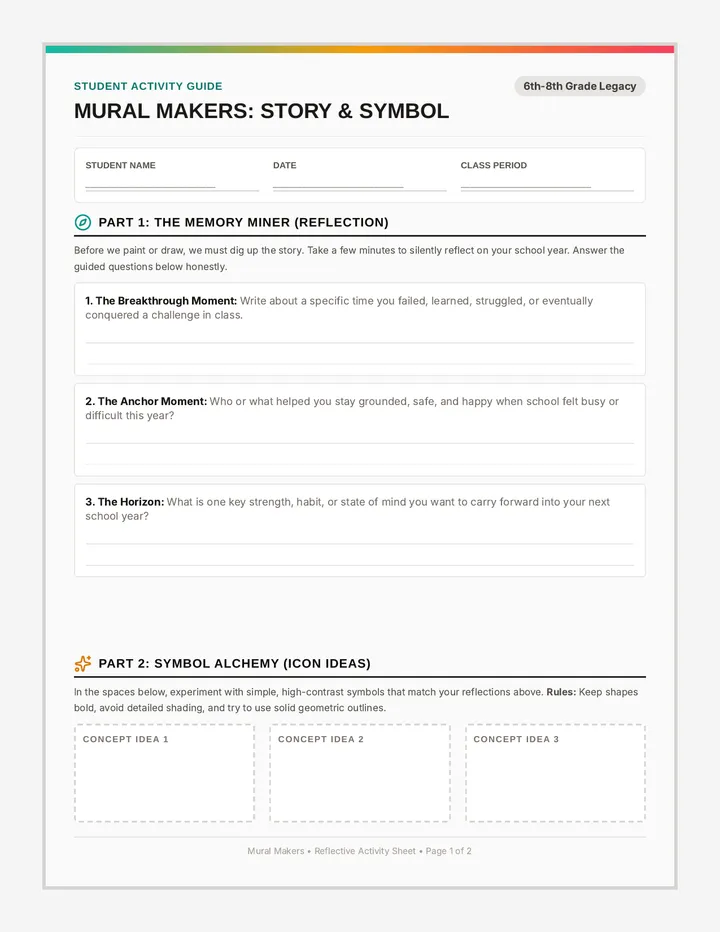
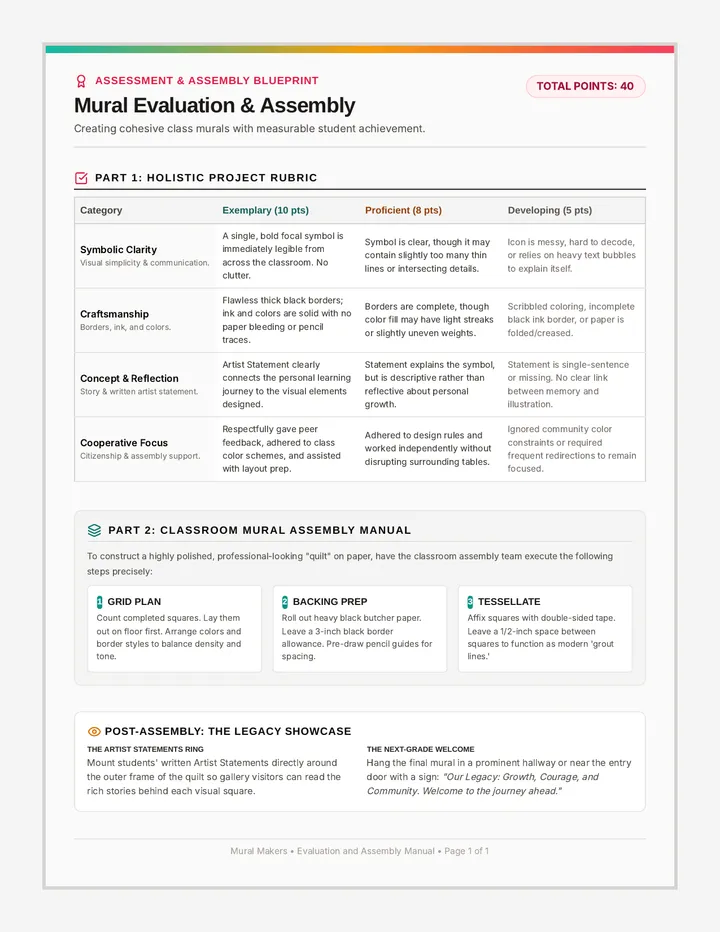
Students explore the intersection of art, history, and identity by analyzing Mexican muralism and designing their own community-focused mural sketches. The lesson uses video content to connect cultural movements like religion and art to public expression.
A visual-focused exploration of Babylonian architecture, specifically the Ishtar Gate, where students design their own symbolic 'city gates' using blue and gold motifs.
A multi-sensory exploration of Impressionism, connecting the visual brushstrokes of Claude Monet with the auditory 'atmospheric' compositions of Claude Debussy. Students analyze historical context before creating their own musical-inspired artwork.
A middle school art lesson where students distinguish between Realism and Impressionism, analyze historical masterpieces, and apply specific techniques to a 'Style Swap' drawing activity.
A cross-curricular lesson for Music and Social Studies exploring music as a universal language that transcends cultural and linguistic boundaries. Students analyze clips from diverse global traditions to understand how rhythm, melody, and instrumentation communicate complex emotions and cultural values.
A creative exploration of the Tang Dynasty's 'Golden Age,' focusing on the cultural heights of poetry, ceramics, and silk fashion through a hands-on workshop. Students analyze a video clip and rotate through artistic stations to experience Tang achievements firsthand.
Students will explore the history of Native American petroglyphs (specifically Newspaper Rock), analyze how symbols convey complex narratives, and create their own visual history using symbolic language.
A lesson exploring the collaborative nature of digital media production, focusing on how different talents (writing, art, performance) combine to create complex projects like Crash Course. Students simulate a production line to experience how a script evolves through various creative lenses.
A creative art lesson focused on positive and negative space through the lens of Kirigami snowflake cutting. Students create a dual-image composition using both their snowflake and the leftover scraps to explore spatial relationships.
A cross-curricular Art and Creative Writing lesson where students explore the mesmerising movement of starling murmurations to learn about emergence and collective behaviour.
A cross-curricular Art and Geometry lesson where middle/high school students explore the Fibonacci sequence and Golden Ratio to construct a Golden Spiral and analyze classical masterpieces.
In this lesson, middle school students analyze how performance, tone, and medium change the meaning of a text. Using a Khan Academy video as a case study, students move from reading a script to performing a neutral dialogue in various 'scenario' tones to demonstrate oral reading fluency and interpretative skills.
Students explore how sound effects and vocal performance transform written text. They will analyze a Khan Academy video and then work in groups to act as 'Soundscape Directors,' annotating and recording a literary excerpt with their own audio design.
Students will learn to distinguish between narrative and non-narrative media before planning their own creative project (film or comic) and justifying their choices based on their personal strengths.
Students learn to convey character emotion and conflict using only stage directions, props, and setting. This hands-on drama lesson focuses on visual storytelling and the technical elements of playwriting without relying on dialogue.
A middle school drama lesson focusing on using asides and monologues to reveal character subtext, featuring a video on playwriting strategies.
Students explore indirect characterization and subtext through the lens of theatrical performance. They analyze a mentor script for 'beats' and perform it using specific vocal and physical strategies to convey hidden motivations.
A lesson exploring how physical objects (props) can transform a speech from a simple reading into an authentic, engaging story. Students analyze a famous political speech and perform their own 60-second 'Prop Reveal' stories.
A lesson for middle schoolers to master the difference between dialogue and stage directions, focusing on how parenthetical tone markers transform the meaning of spoken lines.