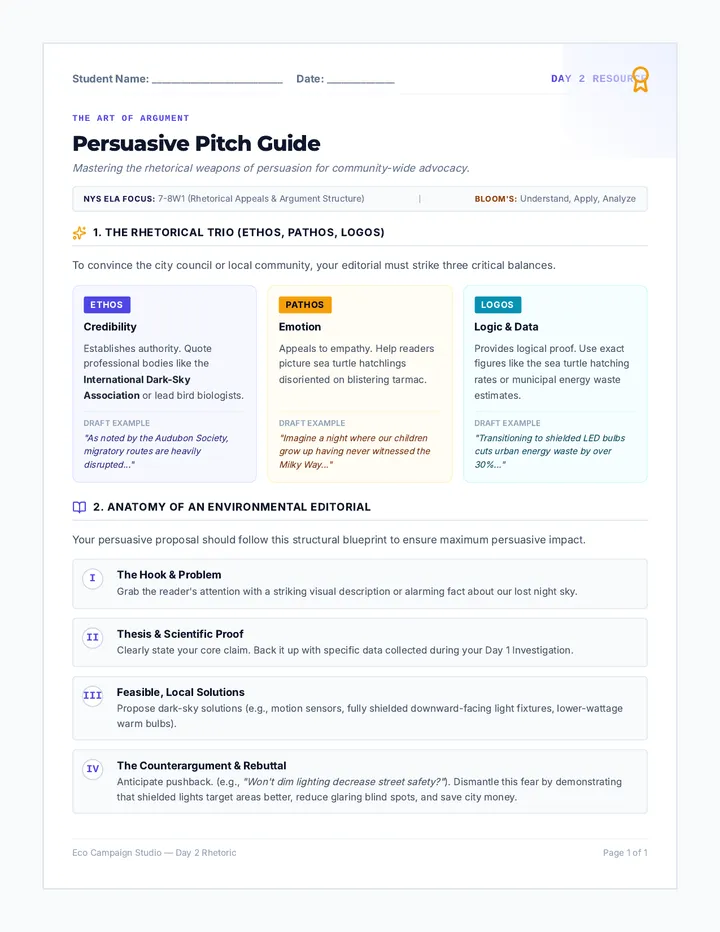
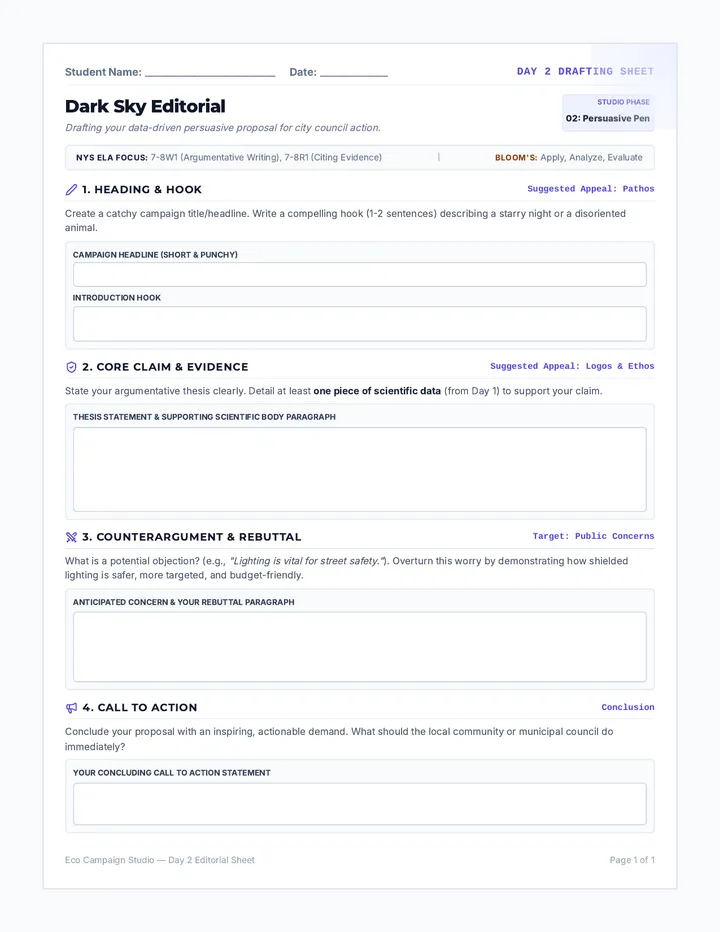
A 30-minute individual lesson for a 2nd-grade student exploring winter weather, animal adaptations, and seasonal activities through reading, discussion, and interactive games.
The capstone week where students synthesize their knowledge of solar energy, wind, and water to explain regional climate variations and master the MCAS Open Response CER strategy.
Students dive into the 'Great Ocean Conveyor Belt,' analyzing how surface winds and density differences (temperature and salinity) drive oceanic circulation and transport heat around the globe.
An exploration of atmospheric pressure and the Coriolis effect, focusing on how air moves from high to low pressure to create global wind belts and how these winds influence regional weather patterns.
Students investigate how differential heating of Earth's surface by the sun creates the initial energy imbalance that drives all weather and climate, practicing CER to explain the relationship between latitude and solar intensity.
An in-depth exploration of electromagnetism focusing on the relationship between electric currents and magnetic fields, featuring the Biot-Savart Law, Ampere's Law, and the Lorentz Force.
A comprehensive lesson on the nature of magnetic fields, focusing on their vector properties, dipole sources, and the implications of Gauss's Law for magnetism. Students will explore how fields are represented and why magnetic monopoles do not exist.
In this lesson, students analyze the 'brain rot' phenomenon through a scientific lens, focusing on how short-form media impacts the brain's reward system. Students engage with new vocabulary, watch a targeted video, and participate in a mediated debate about their digital habits.
A hands-on exploration of thermal energy transfer through convection and freezing point depression experiments. Students observe how density and temperature interact in water and how salt affects the melting process of ice.
In this introductory lesson, Kindergarten students embark on a scientific journey to discover their five senses. Through a mystery box activity and collaborative discussion, they begin to explore how they use sight, hearing, smell, taste, and touch to understand the world around them.
The final lesson focuses on social behavior, communication, and play. Students learn about how dolphins 'talk' with clicks and whistles and how they play with bubbles and sea plants.
This lesson covers the birth and early growth stages of a dolphin calf, including how they swim close to their mothers (slipstreaming) and how they grow over time.
Students explore where baby dolphins live (habitats) and what they eat (diet). The lesson emphasizes the transition from milk to fish and the characteristics of a warm ocean home.
An introduction to baby dolphins (calves), focusing on identifying what they are and comparing them to other animal babies. Students will learn the term 'calf' and basic physical features.
A deep dive into the time-dependent behavior of RC circuits, covering the calculus of charging and discharging, the physical meaning of the time constant, and graphical analysis.
This lesson provides the additional framework and assignments required for graduate students participating in the Research Proposal Project. It focuses on technical plausibility, resource management, and strategic academic significance.
A comprehensive lesson exploring debt financing, equity financing, and alternative funding sources like grants and incubators, helping students understand the strategic trade-offs of each.
A deep dive into the molecular machinery of CRISPR-Cas9, focusing on the structural biology of Cas9, guide RNA architecture, and the precision of genome editing.
An introductory lesson for kindergarten students exploring basic ocean facts and marine life through visual aids and hands-on activities.