A single-session 30-minute lesson designed for 7th-grade students to explore the importance of history, how it connects the past to the present, and why it is essential for shaping the future.
A focused examination of the constitutional issues, conditions, and historical impact of Japanese American internment during WWII, centered on Executive Order 9066 and the Korematsu v. US decision.
A comprehensive 35-minute lesson exploring the massive shift in American society as women entered the workforce and military during WWII, with a specific focus on Rosie the Riveter, Cornelia Fort, and the Women's Army Corps.
A master curriculum framework for World History that defines standards, objectives, skills, learning goals, and vocabulary for nine instructional units spanning 1200 C.E. to the present.
A master curriculum framework for Civic Literacy that defines standards, objectives, skills, learning goals, and vocabulary for thirteen instructional units.
A master curriculum framework for American History that defines standards, objectives, skills, learning goals, and vocabulary for thirteen instructional units.
A comprehensive project-based lesson for 11th-grade students to synthesize US history from 1877 to the present through a creative ABC book. This lesson includes the initial project launch, a two-week implementation schedule with checkpoints, and a detailed planning template.
A 50-minute deep dive into FDR's New Deal programs through primary source analysis, categorizing the 'alphabet soup' of agencies into Relief, Recovery, and Reform. Students will examine original posters, photographs, and legislation snippets to understand the massive scale of government intervention during the Great Depression.
A concise 20-minute lesson covering President Herbert Hoover's response to the Great Depression, focusing on his philosophy of Rugged Individualism, the Hoover Dam, the RFC, and the Bonus Army incident.
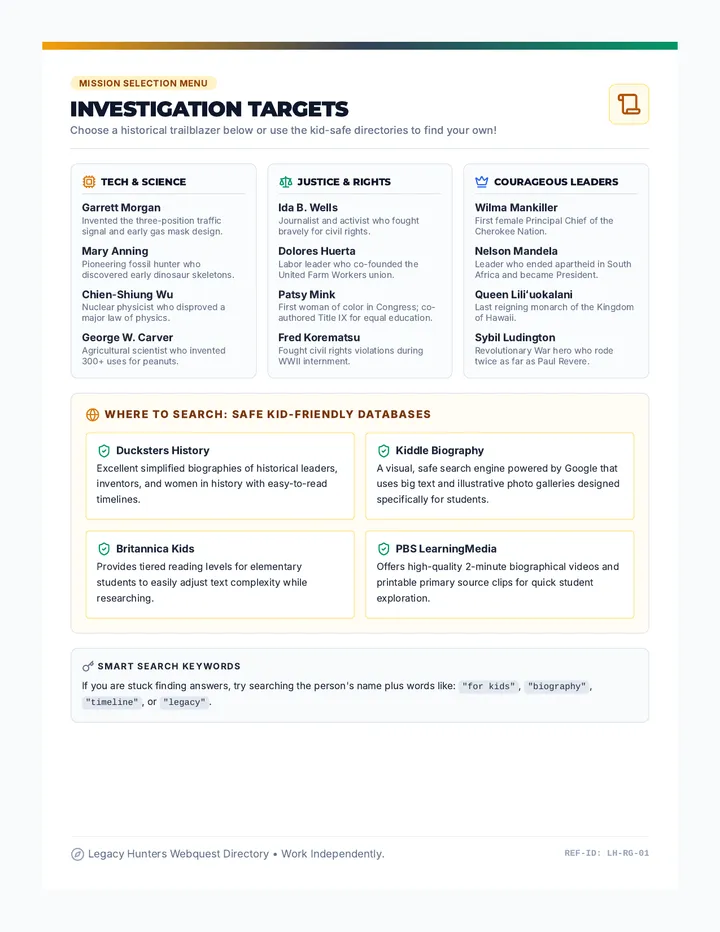
In this lesson, students research unsung heroes of social justice movements and create a 'Justice Journey Map' to visualize the spatial impact of historical change. They explore how geography and movement shape activism while developing research and empathy skills.
A unit assessment covering prominent African American leaders, their roles as agents of change, and the systemic barriers they worked to dismantle within their communities.
A collection of resources for an educational information booth about Peru at a cultural fair, including a fact sheet and interactive trivia cards.
This lesson explores the Homestead Act of 1862 and the logistical realities of settling the American West, focusing on the grid system and survival challenges.