A 75-minute deep dive into the cardiovascular system, covering the composition of blood, the structure of vessels, and the mechanics of the heart.
A comprehensive makeup assessment covering Earth science topics including the water cycle, sedimentary rock formation, fossil fuels, natural resources, weather and climate, and the behavior of light.
A focused lesson on thermochemical stoichiometry, specifically calculating enthalpy changes for the combustion of butane. Students learn to relate molar enthalpy to total energy produced in exothermic reactions.
A four-day series of 30-minute activities exploring spring weather and nature through two outdoor adventures and two indoor crafts.
A foundational lesson on Photoshop clipping masks, covering the 'layer sandwich' concept and the technical steps to clip images into shapes.
A comprehensive lesson for 6th-grade students exploring the three methods of thermal energy transfer: conduction, convection, and radiation. Students will learn to identify these processes in everyday scenarios through visual diagrams and interactive examples.
An introductory lesson for 1st and 2nd graders focusing on block-based coding for Sphero and Marty on a 12-square grid. Students will learn how to sequence commands to move their robot from a start square to a target square.
An advanced introductory lesson for 3rd to 5th graders focusing on block-based logic, loops, and precise grid navigation. Students will use block coding to program Marty and Sphero to complete complex paths on a 12-square mat.
Essential documents and procedures for substitute teachers to ensure a seamless transition and productive classroom environment.
Focuses on long-term curriculum implementation strategies, data-driven scaling, and creating sustainable systems that align district goals with classroom reality.
Focuses on moving from curriculum on paper to instructional practice through high-quality coaching cycles and teacher support frameworks.
Focuses on the methodology of curriculum auditing, evaluating alignment to standards, and identifying gaps in instructional materials across a district landscape.
A comprehensive dive into the Design Thinking process specifically tailored for creating digital solutions. Students will move from empathy-driven problem solving to rapid prototyping through real-world case studies.
A foundational 30-minute lesson for K-1 students exploring the heart as a powerful pump that moves blood throughout the body.
Diving into the layers of the skin, touch receptors, and temperature regulation. Features the "Sweet Skin Layers" edible model and a final CER assessment.
Focusing on skin as the largest organ and its function as a protective barrier against germs and external conditions. Includes the "Shield Test" apple experiment.
A fast-paced, engaging 30-minute introduction to the circulatory system for 3rd graders, focusing on the heart as a pump and blood as a delivery system.
An introductory lesson for early elementary students to learn about NASA, its mission, and the tools they use to explore space.
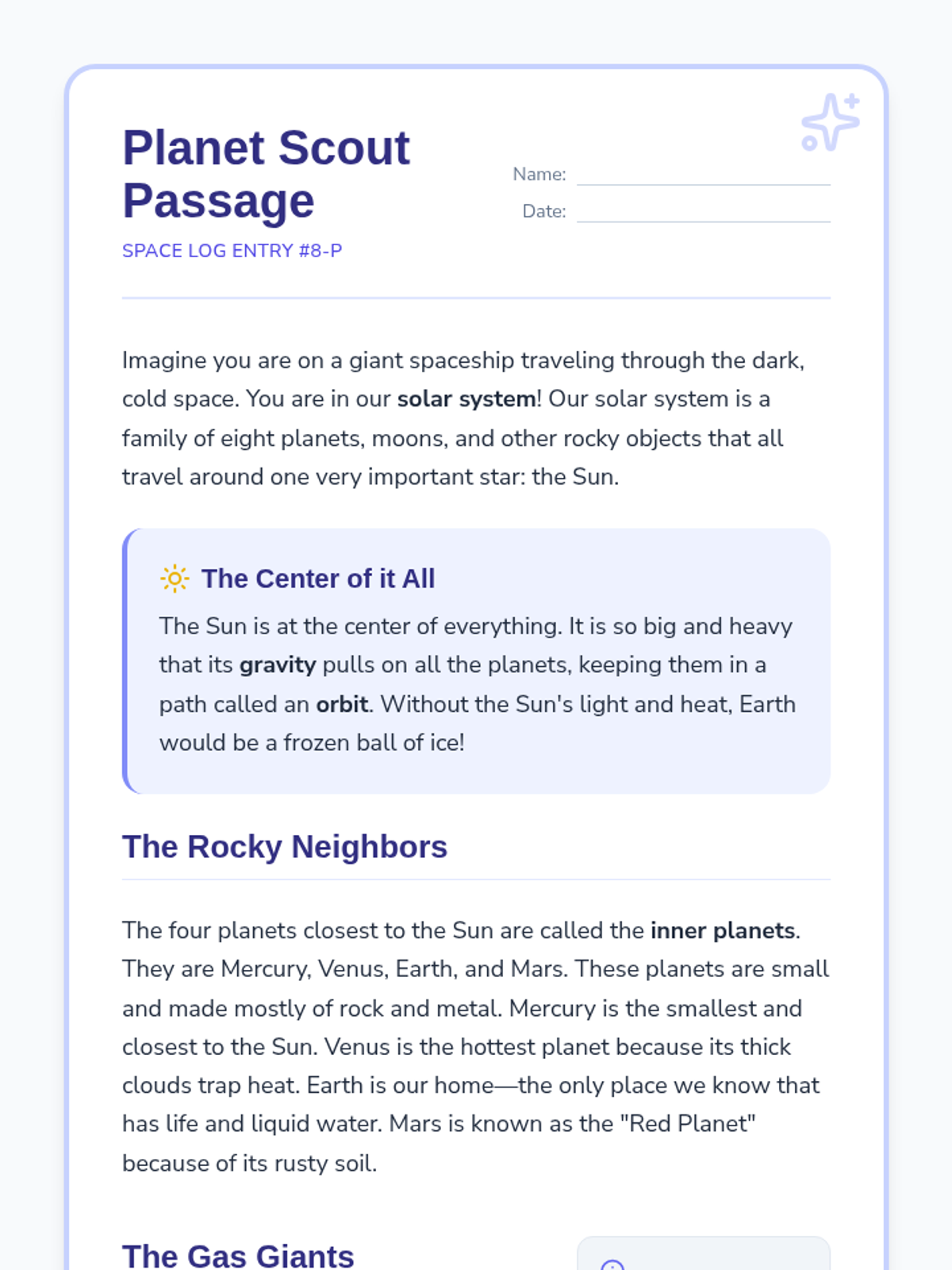
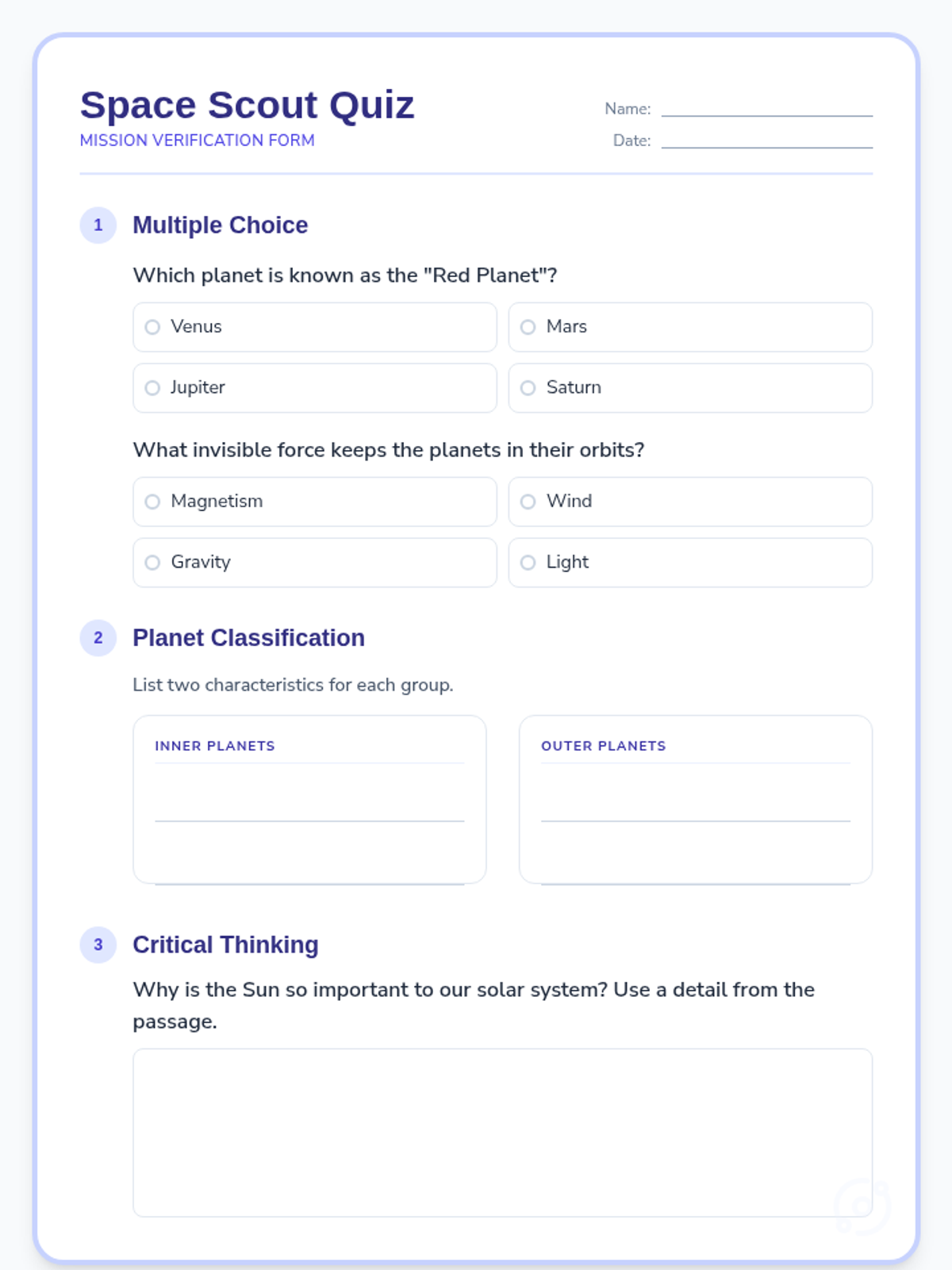
An introductory lesson for first graders to practice reading comprehension through the lens of basic space concepts like the sun, moon, and stars.
A comprehensive lesson on stoichiometry covering mass conservation, molar conversions, and reaction yields. Includes a visual cheat sheet and a mastery assessment.
Students explore the differences between mixtures and solutions, focusing on categorization and vocabulary mastery through interactive-style challenges.
Étude des mouvements sous l'influence de la gravité, incluant la chute libre verticale et les trajectoires paraboliques des projectiles.
Maîtrisez les concepts de base du mouvement circulaire uniforme (MCU), y compris la vitesse angulaire, l'accélération centripète et l'analyse des vecteurs position.
Day 2 focuses on phase changes, specifically how energy is used to break or form attractions between particles during transitions like melting and boiling.
Day 1 focuses on the Kinetic Molecular Theory, exploring how adding or removing thermal energy changes the speed and spacing of particles in solids, liquids, and gases.
Cette leçon explore la cinématique d'un point en mouvement circulaire uniforme. Les élèves apprendront à passer des équations horaires à la trajectoire, et à dériver les vecteurs vitesse et accélération.
Cette leçon porte sur les conditions d'équilibre statique d'un corps rigide, en se concentrant sur le calcul des moments de force (torques) et des réactions aux supports. Les élèves apprendront à appliquer les lois de Newton pour résoudre des problèmes d'ingénierie structurelle simple.
A comprehensive lecture on the four primary tissue types (Connective, Muscular, Nervous, Epithelial) and the Integumentary System, featuring interactive 'Think-Pair-Share' activities and guided notes.