A comprehensive assessment and review covering inequalities, angle relationships, triangles, quadrilaterals, and scale drawings from the third quarter.
A comprehensive assessment covering linear equation foundations and systems of linear equations for 8th-grade mathematics.
A comprehensive introduction to function notation and solving systems of equations using the substitution method, designed for 7th-grade students using real-world contexts and integer values.
A comprehensive assessment covering polygons, quadrilaterals, and similarity based on chapters 7 and 8 content. Students will demonstrate mastery of geometric properties, proportionality theorems, and similarity proofs.
A comprehensive assessment covering linear equations and systems of linear equations, featuring a 50-question multiple-choice exam categorized by difficulty and topic.
A lesson on solving systems of linear equations using the Equal Values Method, where students set two expressions for the same variable equal to each other to find the point of intersection.
A lesson focused on identifying and combining like terms involving positive and negative integers using an adventure-themed approach.
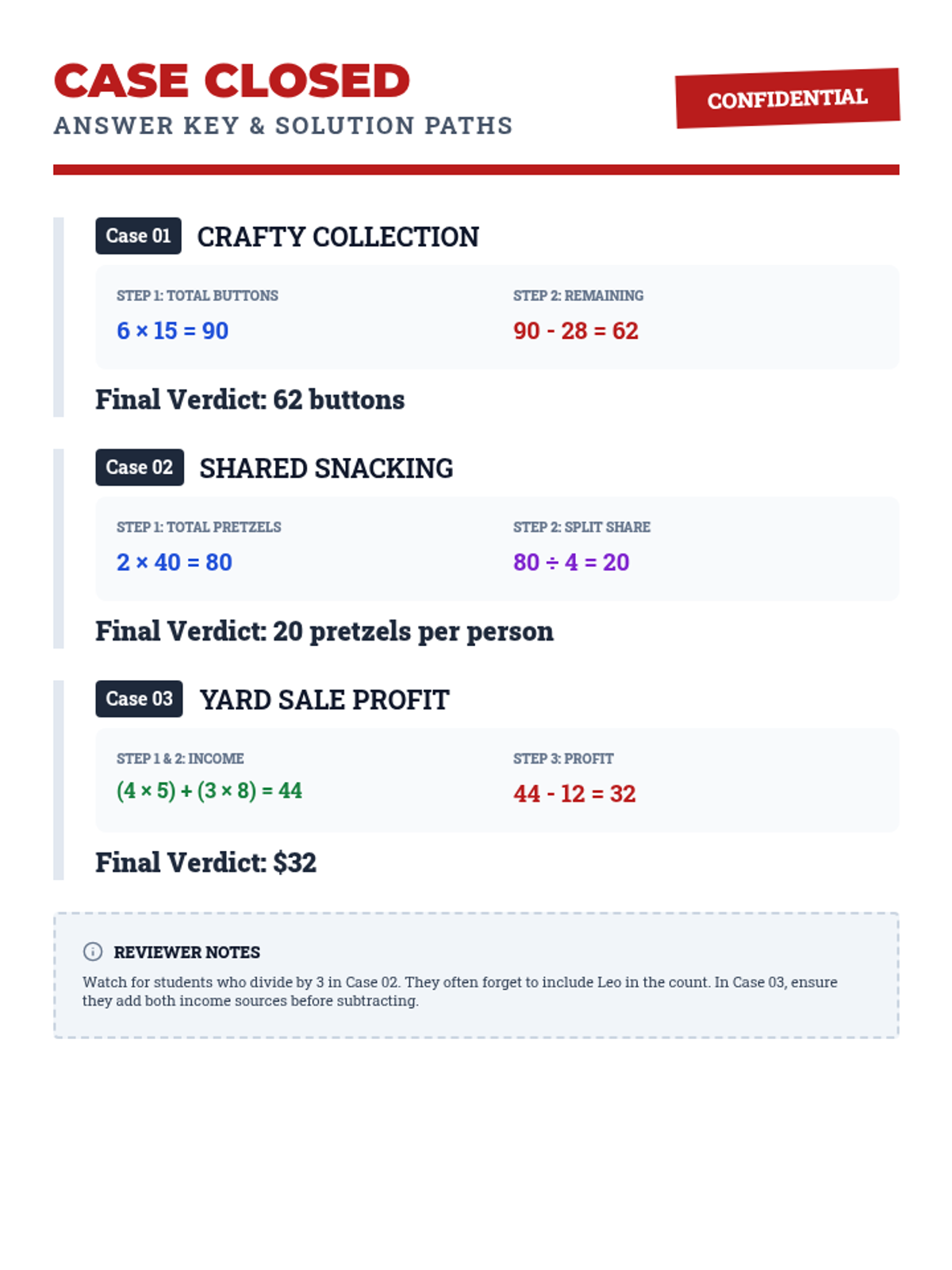
A detective-themed lesson focusing on identifying proportional relationships and solving for missing values through real-world 'cases'.
A lesson focusing on mastering multiplication facts for 3, 4, and 6 through drills and visual number line models.
A focused lesson on the mechanics of multiplying and dividing fractions when combined with whole numbers and algebraic variables. Students practice simplifying expressions and applying reciprocal rules in a skill-based format.
A quick 15-minute review focusing on finding the least common denominator to compare fractions with different denominators.
Students will master solving one-step equations involving fractions and variables through a technical, blueprint-themed matching activity. This lesson focuses on isolation of variables using inverse operations with fractional terms.
A lesson focused on comparing fractions with denominators that share common factors but are not multiples of each other. Students will learn to find the least common multiple to create common denominators for comparison.
Cumulative review and assessment of all Fraction Factory skills.
Understanding the relationship between multiplication and division of fractions.
Dividing whole numbers by unit fractions using visual models.