This lesson explores the convergence of lighting and video, utilizing media servers to map video content onto three-dimensional scenic elements. Students troubleshoot the challenges of balancing projector luminosity with stage lighting.
A 30-minute introduction to sight reading in 6/8 time and the key of E-flat major, focusing on the feeling of compound meter and navigating three flats.
Conception d'actions de médiation concrètes, de la mise en espace physique du CDI aux outils numériques, pour engager les élèves dans la lecture.
Exploration de l'histoire, des genres et des mutations actuelles de l'édition pour adolescents, incluant l'impact des réseaux sociaux et des nouvelles tendances éditoriales.
A project-based lesson for middle school students to learn fundamental composition techniques, including melody writing, harmonic support, and arranging for classroom instruments. Students will apply these skills to create and perform an original short piece.
Students explore the historical significance and emotional weight of the Greensboro Sit-ins through drama-based activities and historical analysis, focusing on the theme of courage.
A comprehensive look at the 1937 Degenerate Art exhibition in Nazi Germany, exploring how art was used as a tool for propaganda and the suppression of modern expression.
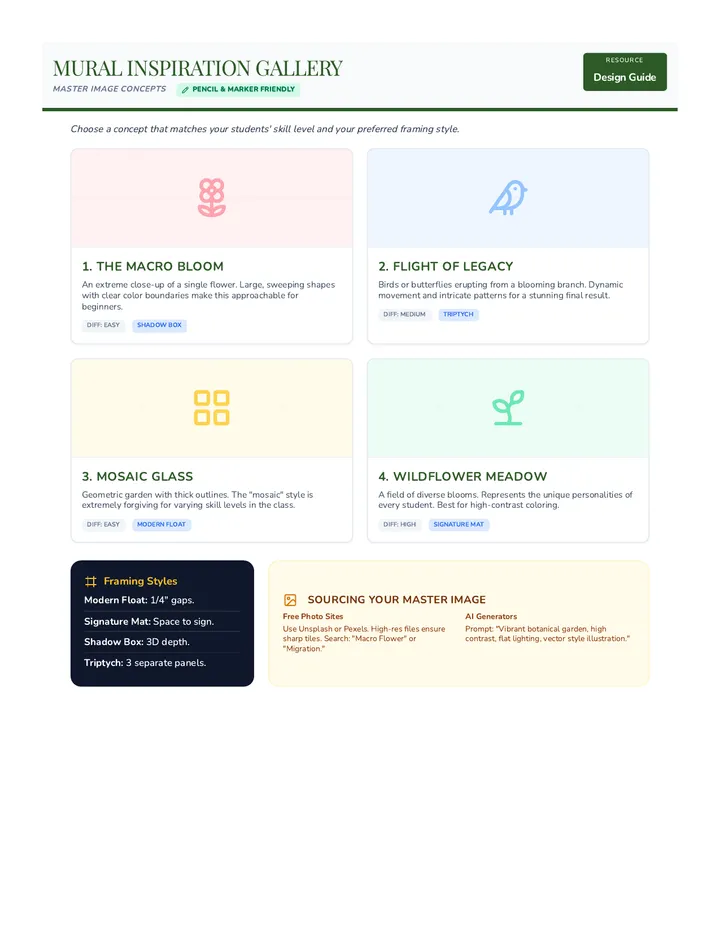
A lesson designed to help students analyze and discuss visual art using specific vocabulary and sentence stems focused on color, perspective, design, lines, and detail.
Students explore the intersection of geometry and realism by mastering one-point linear perspective, inspired by Leonardo da Vinci's Renaissance masterpieces.
A visual arts and science lesson where students explore the concept of fog as a 'cloud on the ground' through watercolor painting and sponge-dabbing techniques.
A music theory lesson for 3rd and 4th graders focused on identifying the 'tonic' (the home note) and understanding the concept of musical resolution using patterns and expectations.
A cross-curricular Art and Creative Writing lesson where students explore the mesmerising movement of starling murmurations to learn about emergence and collective behaviour.
A vibrant introduction to color theory where young students explore primary colors and discover how to create secondary colors through a mess-free "squish" experiment and interactive video predictions.
A Pre-K lesson exploring musical dynamics through the lens of a gentle lullaby. Students practice 'playground' and 'naptime' voices, watch a soothing kitten video, and sing the ABCs at different volumes and tempos.
A high-energy Pre-K lesson that helps students distinguish between singing and speaking voices using the 'Alphabet Song' and interactive vocal play.
In this 8th-grade creative writing lesson, students explore the analogy of storytelling as a recipe. By watching a video that connects culinary chemical reactions to narrative structure, students learn how individual plot devices (ingredients) function within a 'whole' story, eventually practicing 'substitution' by swapping key elements in classic fairy tales to radically alter their tone and climax.
A workshop for Pre-K parents focused on using high-energy music and rhythm to boost letter recognition through daily routines and interactive singing.
Students will analyze a spoken word performance to evaluate how non-verbal cues and vocal delivery choices impact the meaning and emotional resonance of a text, culminating in a performance of their own.
A fun, musical lesson for Pre-K students to develop phonemic awareness and rhythm by clapping and using rhythm sticks to the 'Alphabet Song'.
In this culminating lesson, students learn what a conductor does to unify the orchestra. They practice basic conducting patterns and understand how tempo and expression are communicated without words.
Students study the lives and music of Mozart and Beethoven. They compare the light, structured sounds of the Classical period with the dramatic emotional shifts of the early Romantic period.
Synthesize knowledge by categorizing mystery musical excerpts into the correct historical era. Students will use specific vocabulary to justify their choices in a 'Time Machine' game.
Students explore the power and rhythm of the brass and percussion sections. The lesson focuses on dynamics (loud/soft) and the role of percussion in keeping the heartbeat of the orchestra.