Movement Guide and Activity
A 2-page document formatted for 8.5x11 printing. Page 1 is a teacher guide for Week 1 (Movement and Light Waves) with a daily breakdown and key concepts. Page 2 is a student "Human Orbit Lab" activity with instructions and work areas.
Movement and Light Slides
A visual presentation for Week 1 covering rotation, revolution, moon phases, and light waves. Designed for 3rd-grade readability with high-impact visuals and clear definitions.
Dancing Earth Passage
A reading passage about Earth's movement (rotation and revolution), the moon, and light waves, written at a 3rd-grade level. Includes comprehension questions and a drawing area. Now formatted for 8.5x11 printing.
Cosmic Vocabulary Cards
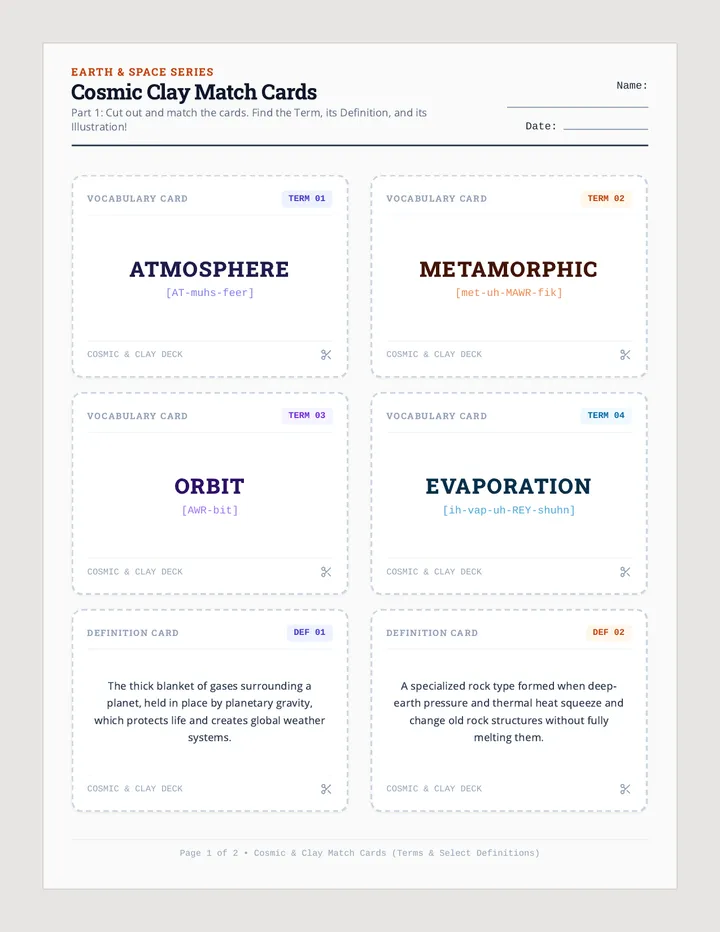
A set of 6 large-print vocabulary cards with definitions and icons, written at a 3rd-grade level. Perfect for tactile learning and classroom display. Now formatted for 8.5x11 printing.
Moon Phase Lab Activity
A hands-on "Cookie Moon Phases" lab activity for Week 1. Students use cookies to model the four primary moon phases, helping them visualize orbital movement at a 3rd-grade readability level. Now formatted for 8.5x11 printing.
Movement Mastery Worksheet
A more challenging worksheet for Lesson 1 with 8 complex questions focusing on rotation, revolution, moon phase progression, and light wave properties, designed for 3rd-grade readability. Includes multiple choice and fill-in-the-blank questions. Now formatted for 8.5x11 printing.